EP3898566B1 - Hydroxylierte chinon-antipolymerante und verfahren zur verwendung - Google Patents
Hydroxylierte chinon-antipolymerante und verfahren zur verwendung Download PDFInfo
- Publication number
- EP3898566B1 EP3898566B1 EP19842477.2A EP19842477A EP3898566B1 EP 3898566 B1 EP3898566 B1 EP 3898566B1 EP 19842477 A EP19842477 A EP 19842477A EP 3898566 B1 EP3898566 B1 EP 3898566B1
- Authority
- EP
- European Patent Office
- Prior art keywords
- antipolymerant
- composition
- ppm
- aryl
- alkyl
- Prior art date
- Legal status (The legal status is an assumption and is not a legal conclusion. Google has not performed a legal analysis and makes no representation as to the accuracy of the status listed.)
- Active
Links
Images

Classifications
-
- C—CHEMISTRY; METALLURGY
- C07—ORGANIC CHEMISTRY
- C07C—ACYCLIC OR CARBOCYCLIC COMPOUNDS
- C07C7/00—Purification; Separation; Use of additives
- C07C7/20—Use of additives, e.g. for stabilisation
-
- C—CHEMISTRY; METALLURGY
- C07—ORGANIC CHEMISTRY
- C07C—ACYCLIC OR CARBOCYCLIC COMPOUNDS
- C07C15/00—Cyclic hydrocarbons containing only six-membered aromatic rings as cyclic parts
- C07C15/40—Cyclic hydrocarbons containing only six-membered aromatic rings as cyclic parts substituted by unsaturated carbon radicals
- C07C15/42—Cyclic hydrocarbons containing only six-membered aromatic rings as cyclic parts substituted by unsaturated carbon radicals monocyclic
- C07C15/44—Cyclic hydrocarbons containing only six-membered aromatic rings as cyclic parts substituted by unsaturated carbon radicals monocyclic the hydrocarbon substituent containing a carbon-to-carbon double bond
- C07C15/46—Styrene; Ring-alkylated styrenes
-
- C—CHEMISTRY; METALLURGY
- C07—ORGANIC CHEMISTRY
- C07C—ACYCLIC OR CARBOCYCLIC COMPOUNDS
- C07C50/00—Quinones
- C07C50/26—Quinones containing groups having oxygen atoms singly bound to carbon atoms
- C07C50/28—Quinones containing groups having oxygen atoms singly bound to carbon atoms with monocyclic quinoid structure
-
- C—CHEMISTRY; METALLURGY
- C07—ORGANIC CHEMISTRY
- C07C—ACYCLIC OR CARBOCYCLIC COMPOUNDS
- C07C67/00—Preparation of carboxylic acid esters
- C07C67/48—Separation; Purification; Stabilisation; Use of additives
- C07C67/62—Use of additives, e.g. for stabilisation
-
- C—CHEMISTRY; METALLURGY
- C07—ORGANIC CHEMISTRY
- C07C—ACYCLIC OR CARBOCYCLIC COMPOUNDS
- C07C69/00—Esters of carboxylic acids; Esters of carbonic or haloformic acids
- C07C69/52—Esters of acyclic unsaturated carboxylic acids having the esterified carboxyl group bound to an acyclic carbon atom
- C07C69/533—Monocarboxylic acid esters having only one carbon-to-carbon double bond
- C07C69/54—Acrylic acid esters; Methacrylic acid esters
-
- C—CHEMISTRY; METALLURGY
- C08—ORGANIC MACROMOLECULAR COMPOUNDS; THEIR PREPARATION OR CHEMICAL WORKING-UP; COMPOSITIONS BASED THEREON
- C08F—MACROMOLECULAR COMPOUNDS OBTAINED BY REACTIONS ONLY INVOLVING CARBON-TO-CARBON UNSATURATED BONDS
- C08F2410/00—Features related to the catalyst preparation, the catalyst use or to the deactivation of the catalyst
- C08F2410/01—Additive used together with the catalyst, excluding compounds containing Al or B
Definitions
- the invention is directed to compositions and use of hydroxylated quinone antipolymerant compounds for preventing premature polymerization of monomers.
- free-radical polymerization inhibitors as antipolymerants are often added to process streams or stored compositions.
- these compounds are generally consumed quite rapidly. For example, in cases of emergency due to a mechanical or processing problems and where more inhibitor cannot be added, previously added inhibitor will be rapidly consumed. Subsequently, unwanted polymerization reactions will then rapidly recur.
- polymerization inhibitors known in the art include dialkylhydroxylamines, such as hydroxypropylhydroxylamine (HPHA), and stable nitroxide free radicals.
- Other inhibitors include N,N'-dialkylphenylenediamines, N,N'-diarylphenylenediamines and N-aryl-N'-alkylphenylene-diamines.
- Quinone diimide compounds are also another class of inhibitors.
- nitroxide-containing compounds can release NO x , making their use undesirable in some situations.
- retarders Other types of antipolymerant compounds often referred to as "retarders” slow down the rate of polymerization reactions. However, they are often not as effective as polymerization inhibitors, particularly stable nitroxide free radicals. Polymerization retarders, however, are usually not consumed as quickly as polymerization inhibitors so they tend to be more useful in cases of emergency shutdowns.
- DNP sulfur and dinitrophenol
- DNBP 2-sec-butyl-4,6-dinitrophenol
- DNP and sulfur retarders release NO X and SO X emissions, making their use problematic.
- DNP-based retarders are highly toxic such that the safety of personnel handling DNP-based antipolymerants is a major concern.
- One class of compounds designed to function as a safer substitute for DNP retarders is based on quinone methide chemistry. Quinone methides slow the rate of polymer formation under static conditions and do not need to be frequently re-fed into the process stream. Some quinone methide compounds, however, do not exhibit good stability. Examples of quinone methide compounds are in U.S. Pat. Nos. 4,003,800 , 5,583,247, and 7,045,647 .
- the production of styrene typically involves the use of both an inhibitor (e.g., a nitroxide-containing inhibitor such as TEMPO) and a retarder (e.g., a quinone methide). While it is desired in various styrene production situations to eliminate the nitroxide-containing inhibitor, the use of only a retarder has been found to provide insufficient polymerization inhibition, making it difficult to eliminate or minimize inhibitor use.
- an inhibitor e.g., a nitroxide-containing inhibitor such
- WO2013027042 is directed to a an antipolymerant composition for the prevention of unwanted polymerisation reactions during the production and processing of ethylenically unsaturated compounds, the composition comprising a concentrated liquid formulation, wherein said concentrated liquid formulation is a suspension concentrate which comprises: (a) at least one compound selected from the group comprising phenols, quinones, thiazines, hydroxylamines and aromatic amines; (b) at least one dispersing agent; and (c) at least one polar or non-polar liquid carrier.
- the composition additionally comprises at least one stable free radical compound, typically a nitroxyl compound, and/or at least one thickening agent and/or at least one preservative agent.
- WO0140149 is directed to a method for inhibiting the premature polymerization of ethylenically unsaturated monomers comprising adding to said monomers an effective amount of a mixture comprising:
- compositions and methods that include or utilize a hydroxylated quinone antipolymerant to inhibit the polymerization of ethylenically unsaturated monomers like styrene and butadiene in various processes and situations, such as purification, fractionation, separation, compression, transportation, and storage of various monomer-containing compositions.
- the hydroxylated quinone antipolymerant can be used without, or with very little, other antipolymerants, yet it still provides excellent ability to inhibit polymerization of monomers in solution.
- inventive hydroxylated quinone antipolymerant compositions mitigates the fouling of process, transportation and storage equipment. In turn, polymer contamination of purified monomer products can be drastically reduced and maintenance costs of said equipment minimized. Further, it can also be used to inhibit monomer polymerization in compositions without requiring other types of polymerization inhibitors such as nitroxyl-based antipolymerants.
- the disclosure provides a method for inhibiting the polymerization of monomers in a composition comprising polymerizable monomers, or compounds capable of forming polymerizable monomers.
- the method includes a step of adding a hydroxylated quinone antipolymerant to a composition comprising polymerizable monomer or a compound capable of forming a polymerizable monomer, the antipolymerant being a compound of Formula I: wherein at least two of -R 1 , -R 2 , -R 3 , and -R 4 are -OR 10 , wherein R 10 is selected from the group consisting of hydrogen, alkyl, aryl, alkyl aryl, and aryl alkyl, with at least one of -R 10 being hydrogen, and any one or more of -R 1 , -R 2 , -R 3 , and -R 4 that is not -OR 10 is selected from the group consisting of hydrogen, alkyl, aryl, alkyl ary
- the hydroxylated quinone antipolymerant can provide excellent antipolymerant activities similar to many nitroxyl-containing antipolymerants, and therefore does not necessarily require the simultaneous addition of a nitroxyl compound-containing antipolymerant for treatment of a hydrocarbon composition. In turn, this allows greater flexibility for inhibiting polymerization of a monomer composition, such as when the use of a nitroxyl-containing antipolymerant is not recommended. Compositions and methods of the disclosure are also advantageous in that they can avoid any release of NO x emissions that would otherwise result from the use of nitroxyl-containing antipolymerants. Therefore, the treated hydrocarbon composition can have no, or less than 50 ppm of a nitroxyl group containing antipolymerant, such as HTEMPO.
- a nitroxyl group containing antipolymerant such as HTEMPO.
- the hydroxylated quinone antipolymerant can be provided in a composition for addition to a composition containing a polymerizable monomer, or a composition that is capable of forming monomer.
- the composition can include a solvent and antipolymerant component consisting essentially of the hydroxylated quinone of Formula I.
- the composition can include a solvent and the hydroxylated quinone antipolymerant, with the proviso that the composition includes little or no nitroxyl group-containing antipolymerant.
- a hydrocarbon composition can include one or more hydrocarbon compounds such as derived from a petroleum product, which can be obtained from a subterranean reservoir, any product derived therefrom, or any mixture thereof.
- the hydroxylated quinone antipolymerant compounds provide excellent antipolymerant activity similar to many nitroxyl-containing antipolymerants, and therefore methods of the disclosure do not necessarily require, and preferably do not include, the simultaneous addition of a nitroxyl compound-containing antipolymerant for treatment of a monomer stream. In turn, this allows greater flexibility for inhibiting polymerization of a monomer composition, such as when the use of a nitroxyl-containing antipolymerant is not recommended. Composition and methods of the disclosure are also advantageous in that they can avoid any release of NO x emissions that would otherwise result from the use of nitroxyl-containing antipolymerants.
- a composition that includes the hydroxylated quinone antipolymerant and any one or more optional component can be in a desired form, such as in a liquid form, a dry form, or as a suspension or dispersion.
- the hydroxylated quinone antipolymerant can be in a desired physical state in the composition, such as in a dissolved state, in a partially dissolved state, in a suspended state, or in a dry mixture.
- the hydroxylated quinone antipolymerant can be in desired forms in the composition, such as optionally in particulate forms.
- the particles can optionally be described in terms of particle size (e.g., particles of a size range) and/or shape.
- the form of the composition and the state of the component(s) therein can be chosen by selection of the hydroxylated quinone antipolymerant, with an understanding of its physical properties.
- the form of the composition and the state of the component(s) therein can also be affected by the inclusion of one or more optional components, such as a solvent, or solvent mixture, or other excipient compounds like surfactants, dispersants, etc.
- the form of the composition and the state of the components therein can also be affected by temperature, and composition properties may optionally be described in circumstances at a particular temperature (e.g., at a storage temperature such as 5°C or below, at room temperature (25°C), or at a temperature used for monomer synthesis and/or processing (e.g., about 100°C or greater, about 150°C, about 175°C, etc.).
- a hydroxylated quinone antipolymerant composition can include other components such as a solvent, surfactants, dispersants, etc. If an optional component is present in the composition, it may be described in terms of a weight amount relative to the hydroxylated quinone antipolymerant. The optional component(s) may be present in a weight amount greater than, in an amount about the same as, or an amount less than the hydroxylated quinone antipolymerant.
- the term “optional” or “optionally” means that the subsequently described object (e.g., compound), event (e.g., processing step), or circumstance may, but need not occur, and that the description includes instances where the object, event, or circumstance occurs and instances in which it does not.
- compositions of the disclosure can include those recited compounds and optionally can include other components in the composition but in very small amounts (e.g., described in terms of a composition "consisting essentially of” the recited components).
- such compositions can include one or more other components but not in an amount that is greater than about 1% (wt), greater than about 0.5% (wt), greater than about 0.1% (wt), or greater than about 0.01% (wt), of the total composition.
- a composition that consists essentially of a solid component that is the hydroxylated quinone antipolymerant (for example, dissolved in a solvent) can optionally include one or more other (e.g., solid) components but in an amount less than about 1% (wt) of the total composition weight.
- a nitroxyl-containing antipolymerant can optionally be present in an amount of less than 1% (wt), less than 0.5% (wt), less than 0.1% (wt), or less than 0.01% (wt), of the total composition, and more preferably a nitroxyl-containing antipolymerant is not present in a detectable level in the composition.
- Antipolymerants broadly refer to “polymerization inhibitors” and “polymerization retarders” which are compounds that generally inhibit or reduce the formation of polymers from one or more radically polymerizable compounds.
- a "polymerization retarder,” such as hydroxylated quinone compounds disclosed herein, does not exhibit an induction time, but instead once added to a polymerizable monomer composition reduces the rate at which the formation of the polymer occurs relative to the rate at which it would have formed in the absence of the polymerization retarder.
- Polymerization inhibitors as opposed to polymerization retarders, are generally consumed rapidly. Polymerization retarders, while they slow down the rate of polymerization reactions, are not as effective as polymerization inhibitors. Polymerization retarders, however, are usually not consumed as quickly as polymerization inhibitors.
- intended properties include, solely by way of nonlimiting examples thereof, dispersibility, stability, rate, solubility, and the like; intended values include weight of a component added, concentration of components added, and the like.
- the effect on methods that are modified include the effects caused by variations in type or amount of materials used in a process, variability in machine settings, the effects of ambient conditions on a process, and the like wherein the manner or degree of the effect does not negate one or more intended properties or results; and like proximate considerations.
- the claims appended hereto include equivalents to these types and amounts of materials.
- the term “about” also encompasses amounts that differ due to aging of a formulation with a particular initial concentration or mixture, and amounts that differ due to mixing or processing a formulation with a particular initial concentration or mixture.
- compositions and methods of the disclosure include or use an antipolymerant that has a hydroxylated quinone chemistry.
- the hydroxylated quinone antipolymerant includes a partially unsaturated 6 carbon ring structure having at least two, and preferably two, carbonyl groups (C(O)), and at least one, and preferably two, hydroxyl groups attached to carbon ring atoms.
- the hydroxylated quinone antipolymerant is a compound of Formula I: wherein at least two of -R 1 , -R 2 , -R 3 , and -R 4 are -OR 10 , wherein R 10 is selected from the group consisting of hydrogen, alkyl, aryl, alkyl aryl, and aryl alkyl, with at least one of -R 10 being hydrogen, and any one or more of -R 1 , -R 2 , -R 3 , and -R 4 that is not -OR 10 is selected from the group consisting of hydrogen, alkyl, aryl, alkyl aryl, aryl alkylene, alkoxy, hydroxyalkyl, -R 5 OOR 6 , -R 5 OR 6 , and -(R 5 O) n R 7 , where -R 5 is a divalent alkylene group, and -R 6 and R 7 are selected from the group consisting of hydrogen, alkyl
- any one or more of -R 1 , -R 2 , -R 3 , and -R 4 that is not -OR 10 can be selected from the group consisting of C1-C18 alkyl, aryl, alkyl aryl and aryl alkyl, alkoxy, hydroxyalkyl, -R 5 OOR 6 , -R 5 OR 6 , -(R 5 O) n R 7 .
- two of -R 1 , -R 2 , -R 3 , and -R 4 that are not -OR 10 are independently selected from the group consisting of C1-C18 alkyl, aryl, alkyl aryl, aryl alkyl, alkoxy, hydroxyalkyl, -R 5 OOR 6 , -R 5 OR 6 , and -(R 5 O) n R 7 .
- Any one or more of -R 1 , -R 2 , -R 3 , and -R 4 can include a linear, branched, or cyclic hydrocarbon structure, or a combination of these structures.
- one of -R 1 , -R 2 , -R 3 , and -R 4 that is not - OR 10 is selected from the group consisting of linear and branched C1-C12 alkyl, alkoxy, or hydroxyalkyl, and one of -R 1 , -R 2 , -R 3 , and -R 4 that is not -OR 10 is -H.
- two of -R 1 , -R 2 , -R 3 , and -R 4 that are not -OH are -H.
- Exemplary linear alkyl groups include methyl, ethyl, propyl, butyl, pentyl, hexyl, heptyl, octyl, nonyl, decyl, undecyl, and dodecyl.
- Exemplary branched alkyl groups include isobutyl, sec-butyl, tert-butyl, 1-, 2-, and 3-methylbutyl, 1,1-, 1,2-, or 2,2-dimethylpropyl, 1-ethyl-propyl, 1-, 2-, 3-, or 4-methylpentyl, 1,1-, 1,2-, 1,3-, 2,2-, 2,3-, or 3,3-dimethylbutyl, 1- or 2-ethylbutyl, 1-ethyl-1-methylpropyl, and 1,1,2- or 1,2,2-trimethylpropyl.
- Exemplary cycloalkyl groups include those such as cyclopentyl, methylcyclopentyl, cyclohexyl, methylcyclohexyl, ethylcyclohexyl, propylcyclohexyl, etc.
- Exemplary partially or fully unsaturated hydrocarbon groups include those such as phenyl, benzyl, methylphenyl, ethylphenyl, etc.
- Exemplary alkoxy groups include methoxymethyl, methoxyethyl, methoxypropyl, methoxybutyl, methoxypentyl, methoxyhexyl, ethoxymethyl, ethoxyethyl, etc.
- Exemplary hydroxyalkyl groups include hydoxymethyl, hydoxyethyl, hydoxypropyl, hydoxybutyl, hydoxypentyl, hydoxyhexyl, etc.
- Alkyl aryl groups include those of Formula III: -R 8 R 9 y , wherein R 8 is a divalent hydrocarbyl group (e.g., alkylene) and R 9 is an aryl group, and y is an integer of 1 or greater (e.g., 2, 3, etc.).
- R 8 is C1-C12 alkylene, C1-C6 alkylene, and preferably C1, C2, or C3 alkylene.
- Exemplary alkyl aryl groups wherein y is 1 include benzyl, phenyl ethyl, phenyl propyl, and phenyl butyl.
- Exemplary alkyl aryl groups wherein y is 2 include dibenzyl, diphenyl ethyl, diphenyl propyl, and diphenyl butyl.
- the aryl (R 9 ) group can be substituted, such as having an alkyl substituent, to form an alkyl aryl alkyl group.
- the hydroxylated quinone antipolymerant is a compound of Formula II: wherein -R 2 and -R 4 are not -OH and have the meanings set forth herein.
- Exemplary hydroxylated quinone antipolymerants include 2,5-dihydroxy-1,4-benzoquinone, 3,6-dibenzhydryl-2,5-dihydroxybenzoquinone, and 3-benzhydryl-2,5-dihydroxybenzoquinone.
- Hydroxylated quinone compounds are commercially available or can be prepared from any one or more methods as known in the art.
- 2,5-dihydroxy-1,4-benzoquinone can be obtained from Sigma Aldrich (St. Louis, MO) or Santa Cruz Biotechnology (Dallas, TX).
- Hydroxylated benzoquinone derivatives can be made by reaction of a reactant such as 2,5-dihydroxy-1,4-benzoquinone with an alcohol in the presence of an acid.
- the synthesis of aryl group-derivatized dihydroxybenzoquinone can be carried out using methods such as described in Inorg. Chem.
- An amount of the hydroxylated quinone antipolymerant and any other (optional) component in a composition can be described in various ways, such as by a weight percentage (% wt.) or by molar amount of hydroxylated quinone antipolymerant in the composition.
- % wt. weight percentage
- molar amount of hydroxylated quinone antipolymerant in the composition molar amount of hydroxylated quinone antipolymerant in the composition.
- such compounds can also be described in terms of weight ratios, or in terms of relative amounts to one another, in a composition.
- a hydroxylated quinone can be used without, or with minimal nitroxyl group containing antipolymerant. If a nitroxyl group containing antipolymerant is included, it can be present in very small amounts, such as in a composition comprising polymerizable monomer, wherein the nitroxyl group containing antipolymerant is not present at all, or present in a very small amount (less than 50 ppm).
- a nitroxyl group containing antipolymerant in a composition comprising polymerizable monomer and the hydroxylated quinone antipolymerant, can optionally be present in an amount of less than 50 ppm, less than 25 ppm, less than 10 ppm, less than 5 ppm, less than 2.5 ppm, less than 2 ppm, less than 1.5 ppm, less than 1 ppm, less than 0.75 ppm, or less than 0.5 ppm.
- Nitroxyl group-containing compounds trap propagating monomer radicals in thermally unstable species and inhibit polymerization.
- a nitroxyl/nitroxide group which can also be referred to as an amine-N-oxide group, is a functional group including an NO bond and side groups attaching to the nitrogen.
- Nitroxide (nitroxyl) radicals are oxygen-centered radicals with the free electron delocalized over the N-O bond.
- Nitroxide-containing polymerization inhibitors can include N-O resonance structures that contribute to the stability of nitroxide radicals.
- nitroxide-containing compounds which can be excluded from compositions from the disclosure, or are used in limited amounts, include, but are not limited to: 2,2,6,6-tetramethylpiperidinyl-1-oxyl (TEMPO), 4-hydroxy-2,2,6,6-tetramethylpiperidinyl-1-oxyl(HTMPO), 4-oxo-2,2,6,6-tetramethylpiperidinyl-1-oxyl (OTEMPO), di-tert-butyl nitroxyl, 1-oxyl-2,2,6,6-tetramethyl-4-n-propoxypiperidine, 1-oxyl-2,2,6,6-tetramethyl-4-n-butoxypiperidine, 1-oxyl-2,2,6,6-tetramethyl-4-t-butoxypiperidine, 1-oxyl-2,2,6,6-tetramethyl-4-s-butoxypiperidine, 1-oxyl-2,2,6,6-tetramethyl-4-(2-methoxyethoxy)piperidine, 1-oxyl-2,2,6,6-te
- Any of these compounds can be present at very low amounts (less than 50 ppm, 25 ppm, 10 ppm, etc., as described herein) in a polymerizable monomer composition, or can be excluded from the composition altogether.
- exemplary nitroxide-containing compounds include two or three nitroxyl groups. Such compounds may be bis- or tris- compounds.
- Exemplary bis -nitroxide and tris -nitroxide polymerization inhibitor compound include bis (1-oxyl-2,2,6,6-tetramethylpiperidin-4-yl) succinate, bis (1-oxyl-2,2,6,6-tetramethylpiperidin-4-yl) adipate, bis (1-oxyl-2,2,6,6-tetramethylpiperidin-4-yl) sebacate, bis (1-oxyl-2,2,6,6-tetramethylpiperidin-4-yl) n-butylmalonate, bis (1-oxyl-2,2,6,6-tetramethylpiperidin-4-yl) phthalate, bis (1-oxyl-2,2,6,6-tetramethylpiperidin-4-yl) isophthalate, bis (1-oxyl-2,2,6,6-tetramethylpiperidin-4-yl) terephthalate,
- Any of these compounds can be present at very low amounts (less than 50 ppm, 25 ppm, 10 ppm, etc., as described herein) in a polymerizable monomer composition, or can be excluded from the composition altogether.
- compositions optionally excludes, or uses very low amounts of zinc chloride, such as less than 0.1 % (wt), less than 0.01 % (wt), less than 0.001 % (wt), or less than 0.0001 % (wt), or no detectable amount of zinc chloride.
- the composition optionally excludes, or uses very low amounts of tetrahydroquinoline, such as less than 0.1 % (wt), less than 0.01 % (wt), less than 0.001 % (wt), or less than 0.0001 % (wt), or no detectable amount of tetrahydroquinoline.
- the hydroxylated quinone antipolymerant can be present in a composition with a solvent, or a combination of solvents.
- a solvent or solvent combination can be chosen so that one or more of the hydroxylated quinone antipolymerant is soluble in the solvent or solvent combination. If the hydroxylated quinone antipolymerant is a liquid at ambient conditions, a miscible solvent can be chosen.
- Useful solvents include any solvent in which the hydroxylated quinone antipolymerant is soluble or can be stably suspended.
- a solvent or solvent combination can be selected from water soluble or water miscible solvents such glycol-based solvents and hydrophobic or hydrocarbon solvents such as aromatic solvents, paraffinic solvents, or mixtures of both.
- glycol solvents include, but are not limited to, Ci-Cs glycols such as ethylene glycol, propylene glycol, diethylene glycol, and triethylene glycol, ethers of such glycols such as diethylene glycol monobutyl ether, diethylene glycol monomethyl ether, diethylene glycol monoethyl ether, diethylene glycol monobutyl ether, triethylene glycol, triethylene glycol monomethyl ether, liquid polyethylene glycol, dipropylene glycol, dipropylene glycol monomethyl ether, dipropylene glycol monoethyl ether, and a low molecular weight polypropylene glycol and the like and combinations thereof.
- Ci-Cs glycols such as ethylene glycol, propylene glycol, diethylene glycol, and triethylene glycol
- ethers of such glycols such as diethylene glycol monobutyl ether, diethylene glycol monomethyl ether, diethylene glycol monoethyl ether, diethylene glycol monobutyl
- Butyl Carbitol and Butyl CELLOSOLVE TM which contains primarily Butyl CARBITOL TM , which consists primarily of ethylene glycol monobutyl ether may be used and are available from DOW.
- hydrophobic or hydrocarbon solvents include heavy aromatic naphtha, toluene, ethylbenzene, isomeric hexanes, benzene, xylene, such as ortho-xylene, para-xylene, or meta-xylene, and mixtures of two or more thereof.
- the solvent is selected from glycol and aromatic naphtha and combinations thereof.
- the amount of hydroxylated quinone antipolymerant (with one or more optional components), in a solvent, or a combination of solvents can be described one or more ways, such as by the percent solids (wt) of the component(s) in the composition, or by the molar amount of solid components in the composition.
- a stock composition of hydroxylated quinone antipolymerant can be dissolved in a solvent to a concentration of about at least about 0.00001% (wt), at least about 5% (wt), such as in an amount in the range from about 0.00001% (wt) to about 50% (wt).
- An amount of the stock composition including hydroxylated quinone antipolymerant can be added to a monomer-containing composition or composition capable of forming monomer, to provide the antipolymerant at a concentration effective to inhibit polymerization of monomer.
- the polymerizable monomer that is subjected to polymerization inhibition by the hydroxylated quinone can include a vinyl or ethylenically unsaturated group.
- the components of the hydroxylated quinone antipolymerant and any optional component can be added to a composition that includes one or more of the following polymerizable monomers: acrolein, acrylic acid, acrylonitrile, alkylated styrene, butadiene, chloroprene, divinylbenzene, ethyl acrylate, ethyl methacrylate, isoprene, methacrylic acid, methyl methacrylate, methyl acrylate, ⁇ -methylstyrene, methacrylonitrile, styrene, styrene sulfonic acid, vinyl acetate, vinyltoluene, and vinylpyridine.
- the polymerizable monomer can be present in a crude mixture of compounds, a semi-refined mixture of compounds, or a fully-refined mixture of compounds.
- the hydroxylated quinone antipolymerant can be added to a process stream that includes the polymerizable monomer and one or more other components that are different than the polymerizable monomer.
- the hydroxylated quinone antipolymerant can be added before, during, or after, (or combinations thereof) a processing step, such as distillation, wherein compounds in the composition are separated from one another.
- the hydroxylated quinone antipolymerant can inhibit polymerization of monomer at any one or more stages in a processing system, and therefore reduce or prevent fouling of equipment.
- the hydroxylated quinone antipolymerant can be added to a process stream that includes a compound capable of forming into a polymerizable monomer (e.g., a monomer precursor), such as ethylbenzene which is a precursor to styrene.
- a composition may include a compound that is capable of forming a polymerizable monomer as an unwanted by-product.
- the presence of the hydroxylated quinone antipolymerant can inhibit polymerization of the monomer if it does form as a by-product, and can therefore reduce or prevent fouling of equipment.
- the hydroxylated quinone antipolymerant is introduced into a monomer-containing composition or a composition that includes a compound capable of forming a polymerizable monomer, at a desired concentration effective to inhibit monomer polymerization.
- the hydroxylated quinone antipolymerant can be added to a composition that includes one or more polymerizable monomers, or one or more compounds that are capable of forming polymerizable monomers.
- the monomer(s) and/or monomer-forming compound(s) can be present at any concentration in the composition, such as in very small amounts (ppm) or amounts wherein the monomer(s) and/or monomer-forming compound(s) are present in bulk amounts in the composition (e.g., 50% (wt) or greater). Exemplary ranges are from any one of about 5 ppm, about 200 ppm, about 50 ppm, or about 100 ppm (0.1 %) to , about 10 % (wt), about 25 % (wt), about 50 % (wt), or about 75 % (wt).
- the amount of hydroxylated quinone antipolymerant in a composition that includes monomer(s) and/or monomer-forming compound(s) can be chosen based on the monomer/compound type, the amount of monomer/compound in the composition, the type of composition having the monomer/compound, any processing, treatment, or storage conditions for the composition, and the presence of any one or more optional compounds that are different than the hydroxylated quinone antipolymerant and that are added to the composition.
- the hydroxylated quinone antipolymerant can be added to the composition in an amount to provide a desired level of polymerization inhibition.
- the hydroxylated quinone antipolymerant can be used in an amount of at least about 0.10 ppm, such as in the range of about 0.10 ppm to about 50,000 ppm, in the range of about 0.10 ppm to about 25,000 ppm, about 0.10 ppm to about 10,000 ppm, about 5 ppm to about 5,000 ppm, about 25 ppm to about 2,500 ppm, about 50 ppm to about 1,000 ppm, about 50 ppm to about 1,000 ppm, about 75 ppm to about 500 ppm, about 100 ppm to about 300 ppm, about 125 ppm to about 275 ppm, or about 150 to about 250 ppm.
- 0.10 ppm such as in the range of about 0.10 ppm to about 50,000 ppm, in the range of about 0.10 ppm to about 25,000 ppm, about 0.10 ppm to about 10,000 ppm, about 5 ppm to about 5,000 ppm, about 25 ppm
- the hydroxylated quinone antipolymerant is used before or after a polymerizable monomer-containing composition is treated with a polymerization inhibitor that is different than the hydroxylated quinone , such as a nitroxide-containing polymerization inhibitor (e.g., HTEMPO, etc.).
- a polymerization inhibitor that is different than the hydroxylated quinone
- the hydroxylated quinone antipolymerant is added to a polymerizable monomer composition after the composition has been treated with a nitroxide-containing polymerization inhibitor, and the inhibitor has been at least substantially consumed or has otherwise at least lost most of its inhibitor activity.
- a nitroxide-containing polymerization inhibitor can be added to a monomer-containing composition at a first time point and then the composition can be monitored to determine any increase in the formation of polymer and/or presence of inhibitor, and if there is an increase in formation of polymer or reduction in inhibitor, the hydroxylated quinone antipolymerant can be added at a second time point to maintain inhibition of polymerization.
- the hydroxylated quinone antipolymerant can be added to a monomer-containing composition at a first time point, and then one or more other compounds useful for inhibiting polymerization that is different than the hydroxylated quinone can be added to the composition at one or more later time point(s) (e.g., second, third, etc.).
- the hydroxylated quinone antipolymerant can be added to a polymerizable monomer composition in any one or more different ways, such as addition of the antipolymerant in single dose, continuous addition, semi-continuous addition, intermittent addition, or any combination of these methods. In a continuous addition, the hydroxylated quinone antipolymerant can be added at a constant or variable rate.
- the mode or modes of addition of the hydroxylated quinone antipolymerant can be chosen based on the polymerizable monomer-containing composition and how it is being stored, processed, or otherwise treated.
- the hydroxylated quinone antipolymerant can be added in a continuous or semi-continuous manner to account for new monomer or monomer precursor constantly being introduced.
- fouling refers to the formation of polymers, prepolymers, oligomer and/or other materials which would become insoluble in and/or precipitate from a stream and deposit on equipment under conditions of operating the equipment.
- the hydroxylated quinone antipolymerant can be referred to as an "antifoulant” as it prevents or reduces such formation.
- the ability of the compositions of the disclosure to inhibit polymerization can be described relative to a composition that does not include the hydroxylated quinone antipolymerant, or that includes a comparative compound.
- the effect of the hydroxylated quinone antipolymerant can be understood by measuring the formation of a polymer (e.g., polystyrene) in a monomer (e.g., styrene) composition over time, in the presence of a composition that includes the hydroxylated quinone antipolymerant as compared to one that does not include the hydroxylated quinone antipolymerant, or that uses an antipolymerant having chemistry that is different than one of the disclosure.
- a polymer e.g., polystyrene
- a monomer e.g., styrene
- a composition of the disclosure with a hydroxylated quinone antipolymerant can inhibit polymerization of monomer by more than 50 %, by more than 60 %, by more than 70 %, by more than 80 %, by more than 85 %, by more than 90 %, by more than 92.5 %, by more than 95 %, or by more than 97 %, as compared to a composition with a non-hydroxylated quinone (e.g., a di-butyl-1,4-benzoquinone), under the same conditions.
- a non-hydroxylated quinone e.g., a di-butyl-1,4-benzoquinone
- the hydroxylated quinone antipolymerant can be used in conjunction with compositions containing polymerizable monomers and "process equipment" such as reactors, reactor beds, pipes, valves, distillation columns, trays, condensers, heat exchangers, compressors, fans, impellers, pumps, recirculators, inter-coolers, sensors, and the like, that are associated with the process and which may be subject to fouling by monomer polymerization.
- process equipment such as reactors, reactor beds, pipes, valves, distillation columns, trays, condensers, heat exchangers, compressors, fans, impellers, pumps, recirculators, inter-coolers, sensors, and the like, that are associated with the process and which may be subject to fouling by monomer polymerization.
- This term also includes sets of these components where more than one of the components is part of a "system.”
- a composition of the disclosure with hydroxylated quinone antipolymerant and solvent is used with a process that involves a distillation tower that is used to separate and purify vinylic monomers, such as styrene.
- a distillation tower that is used to separate and purify vinylic monomers, such as styrene.
- vinylic monomers such as styrene.
- ethylbenzene can be subjected to a catalytic dehydrogenation reaction which results in the formation of styrene.
- the reaction product containing styrene also contains other compounds such as aromatics like toluene and benzene, unreacted ethylbenzene, and other materials such as polymers. This mixture of compounds is generally fractionally distilled using one or more distillations towers.
- hydroxylated quinone antipolymerant is used along with one or more secondary components such as stabilizers like butylated hydroxytoluene (BHT) and tert -butylcatechol (TBC).
- BHT butylated hydroxytoluene
- TBC tert -butylcatechol
- the hydroxylated quinone antipolymerant-containing composition can be introduced into a stream leading from the reaction bed to the distillation tower, or can be directly added to the distillation tower.
- the compositions can be added prior to heating the monomer composition or while heating the monomer composition in the distillation tower.
- the hydroxylated quinone antipolymerant compound has a boiling point that is higher than that of the desired compound or distillate (e.g., a monomer such as styrene) subject to distillation tower and during the distillation process the desired compound is separated from the hydroxylated quinone antipolymerant compound by virtue of temperature difference.
- the boiling point difference between the compound of interest and the hydroxylated quinone antipolymerant is about 10 °C or greater, about 15 °C or greater, about 20 °C or greater, about 25 °C or greater, about 30 °C or greater, about 35 °C or greater, about 40 °C or greater, about 45 °C or greater, or about 50 °C or greater.
- the composition can be optionally or further added to a distillation effluent stream, such as a purified styrene stream.
- a distillation effluent stream such as a purified styrene stream.
- another antipolymerant can be added to a distillation effluent stream prior to or along with the hydroxylated quinone antipolymerant.
- the hydroxylated quinone antipolymerant can be used with any "hydrocarbon process stream" which can include unsaturated monomer in order to stabilize the stream during transportation and storage.
- the hydroxylated quinone antipolymerant can be used in conjunction with a "petroleum product” which can include a hydrocarbon product obtained from a subterranean reservoir, any product derived therefrom, or any mixture thereof.
- Polymerizable monomers are found in or can be chemically derived from petroleum products.
- petroleum products include but are not limited to crude oil, reduced crude oil, crude distillate, heavy oil, or bitumen, hydrotreated oil, refined oil, byproducts of petroleum product processing such as pyrolysis, hydrotreating, or phase separation, or mixtures of two or more of these.
- a liquid petroleum product is a petroleum product that is substantially a liquid at 20 °C.
- the hydroxylated quinone antipolymerant can be added to or can be present in a "petroleum process stream" which refers to any petroleum product disposed within petroleum process equipment in fluid contact with an interior surface thereof.
- the petroleum process stream can include, or can be capable of forming as a by-product, one or more polymerizable monomer.
- the process stream may be substantially static, such as a petroleum product disposed within in a settler (separator) or storage container for a selected period of contact, such as up to two years.
- the process stream may be substantially dynamic, such as a liquid petroleum product disposed within a pipe during transportation of the product from a first location to a second location.
- the process stream includes one or more additional components related to petroleum processing; such components are not particularly limited.
- Petroleum process equipment or “petroleum process apparatus” refers to a man-made item having an interior surface including a metal, further wherein one or more petroleum products are fluidly contacted with the metal for any period of time and at any temperature further as determined by context.
- Petroleum process equipment includes items for removing petroleum products from a subterranean reservoir, for transporting one or more petroleum products from a first location to a second location, or for separating, refining, treating, isolating, distilling, reacting, metering, heating, cooling, or containing one or more petroleum products.
- compositions including the hydroxylated quinone antipolymerant are thermally stable and have antipolymerant activity in processing streams or other polymerizable monomer-containing compositions at temperatures of about 20 °C to about 400 °C, for example about 100 °C to about 400 °C, about 100 °C to about 350 °C, about 100 °C to about 300 °C, about 100 °C to about 250 °C, about 100 °C to about 200 °C, or about 100 °C to about 150 °C.
- compositions including hydroxylated quinone antipolymerant can be introduced into a composition with a polymerizable monomer, such as a liquid petroleum process stream in a batch-wise, a continuous, or a semi-continuous manner.
- a polymerizable monomer such as a liquid petroleum process stream
- the hydroxylated quinone antipolymerant (and any other optional component) are introduced manually; and in other embodiments, their introduction is automated.
- the amount of the hydroxylated quinone antipolymerant introduced over a selected unit of time is varied with a variable composition of the associated process stream.
- Such variability in dosing may be conducted manually by periodic testing of the process equipment interior surfaces, following by adjusting the amount of the composition up or down based on test results; or automatically by monitoring of one or more conditions within the interior of the petroleum process equipment and signaling the need to apply more composition to the process stream.
- the hydroxylated quinone antipolymerant is added to a petroleum product that is a crude oil, a reduced crude oil, a heavy oil, a bitumen, a coker charge, a hydrotreater influent, a hydrotreater effluent, a flashed crude, a light cycle oil, or a diesel or naphtha refinery stream.
- the antipolymerant is added to petroleum process equipment conventionally associated with the collecting, processing, transportation, or storage of one or more of crude oil, reduced crude oil, crude distillate, heavy oil, bitumen, coker charge, flashed crude, light cycle oil, or a diesel or naphtha refinery stream, including pipes and associated infrastructure used to fluidly connect process equipment items together to facilitate processing of a process stream disposed therein.
- Equipment containing the polymerizable monomer-containing compositions that are treated with the hydroxylated quinone antipolymerant and any other optional component can result in reduction or elimination of fouling interior surface of the equipment.
- fouling is measured as a relative increase in retention of solids within the treated composition compared to the retention of solids in untreated composition over the same time period.
- fouling is measured as a relative decrease in the weight or volume of precipitate arising from a selected period of contact of a treated process stream in an associated process equipment item, relative to the same period of contact of the process equipment with the corresponding untreated process stream.
- a reduction in fouling is a relative decrease in the measured weight or volume of solids deposited on or precipitated from process equipment contacted with the treated process stream over a selected period of time, when compared to the weight or volume of solids deposited or precipitated from an untreated process stream over the same period of time.
- the hydroxylated quinone antipolymerant can also inhibit unwanted polymerization and fouling of the process equipment in a primary fractionation process, light ends fractionation, non-aromatic halogenated vinyl fractionation and stabilization, process-gas compression, dilution steam system, caustic tower, quench water tower, quench water separator (pyrolysis gasoline), butadiene extraction, propane dehydrogenation, diesel and petrol fuel stabilization, olefin metathesis, styrene purification, hydroxyhydrocarbon purification, stabilization of vinylic monomers during transportation and storage, or delays the polymerization of resins and compositions comprising ethylenically unsaturated species.
- the hydroxylated quinone antipolymerant can be added at any given point in a process and at one or more locations.
- an antipolymerant composition can be added directly at the interstage coolers or compressors or upstream of the inter-coolers or compressors.
- the hydroxylated quinone antipolymerant can be added continuously or intermittently to the process equipment as required preventing or reducing fouling.
- the hydroxylated quinone antipolymerant can be introduced to desired systems by any suitable method. For example it may be added in neat or a dilute solution.
- a composition containing the hydroxylated quinone antipolymerant can be applied as a solution, emulsion, or dispersion that is sprayed, dripped, poured or injected into a desired opening within a system or onto the process equipment or process condensate.
- the composition may be added with a washoil or an attemperation water.
- treated process equipment After introducing the composition to process equipment, treated process equipment can be observed to have less deposition on equipment than in process equipment without addition of the composition.
- Reduction or prevention in fouling can be evaluated by any known method or test.
- the reduction or prevention of fouling can be accessed by measuring the time it takes for a sample with and without the antifoulant composition to gel.
- 2,5-dihydroxy-1,4-benzoquinone 2,5-DHBQ
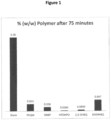
- a static method was used.
- a 200 ppm solution of 2,5-DHBQ was prepared in styrene in which 4 - tert -butylcatechol (TBC) stabilizer was removed just before the treatment with 2,5-DHBQ.
- An alumina column was used for removal of said stabilizer.
- a solution consisting of 200 ppm of 2,5-DHBQ was prepared by dissolving 0.0715 g in the freshly de-inhibited styrene to yield 350 g of solution.
- a solution consisting of 20 ppm of benzoyl peroxide in methyl methacrylate was prepared.
- Ace Glass #15 threaded pressure tubes equipped with PTFE screw caps and fluoroelastomer (FETFE) 0-rings were added 10 mL aliquots of this solution.
- the dissolved oxygen removed and kept out of the solutions as described in Example 1.
- Polymerization reactions were performed by loading the tubes into a heating block preheated to 100°C. Following 30 minutes, and every 15 minutes after that, four tubes were retrieved from the block and an ice bath used to quench the polymerization reactions.
- the cooled polymer solutions were immediately diluted with toluene and then the polymer content immediately measured using a proprietary method.
- a solution consisting of 0.58 mmolal of 2,5-DHBQ and 20 ppm of benzoyl peroxide in methyl methacrylate was prepared.
- the procedure in Example 1 was used to remove oxygen, polymerize the solutions, and measure the amount of polymer formed.
- Table 2 provides results of the study, which are also shown in Figure 2 .
- Table 2 Performance of antipolymerants in methyl methacrylate at 0.580 mmol. Time (minutes) Poly(methyl methacrylate) (ppm) Blank HTEMPO 2,5-DHBQ pBQ 30 18588 31 20 22 45 48550 34 48 63 60 80231 64 63 98 75 83625 93 90 159 90 93993 144 122 228 105 180 135 409
- Results show that 2,5-DHBQ, by itself, inhibited polymerization of methyl methacrylate to a significant extent and remarkably performed better than HTEMPO and pBQ.
Landscapes
- Chemical & Material Sciences (AREA)
- Organic Chemistry (AREA)
- Engineering & Computer Science (AREA)
- Analytical Chemistry (AREA)
- Oil, Petroleum & Natural Gas (AREA)
- Water Supply & Treatment (AREA)
- Organic Low-Molecular-Weight Compounds And Preparation Thereof (AREA)
- Polymerisation Methods In General (AREA)
Claims (15)
- Verfahren zum Hemmen der Polymerisation von Monomeren in einer Zusammensetzung, umfassend ein polymerisierbares Monomer oder eine polymerisierbare monomerbildende Verbindung, das Verfahren umfassend:Hinzufügen eines hydroxylierten Chinon-Antipolymermittels zu einer Kohlenwasserstoffzusammensetzung, umfassend ein polymerisierbares Monomer oder das in der Lage ist, ein polymerisierbares Monomer zu bilden, wobei das Antipolymermittel eine Verbindung der Formel I ist:
 wobei zwei oder drei von -R1, -R2, -R3, und -R4 -OR10 sind, wobei R10 Wasserstoff ist und ein oder zwei von -R1, -R2, -R3, und -R4, das/die nicht -OR10 ist/sind, aus der Gruppe ausgewählt ist/sind, bestehend aus Wasserstoff, Alkyl, Aryl, Alkylaryl und Arylalkyl.
 - Verfahren nach Anspruch 1, wobei das eine oder die zwei von -R1, -R2, -R3, und -R4, das/die nicht -OR10 ist/sind, aus der Gruppe ausgewählt ist/sind, bestehend aus C1-C18-Alkyl, -Aryl, -Alkylaryl und -Arylalkyl.
- Verfahren nach Anspruch 1 oder 2, wobei ein oder zwei von -R1, -R2, -R3, und -R4, die nicht -OR10 sind, -R8R9 y sind, wobei R8 eine zweiwertige Hydrocarbylgruppe ist und R9 eine Arylgruppe ist und y eine ganze Zahl ist.
- Verfahren nach Anspruch 2, wobei zwei von -R1, -R2, -R3, und -R4, die nicht -OR10 sind, H sind.
- Verfahren nach einem der vorstehenden Ansprüche, wobei das Antipolymermittel eine Verbindung der Formel II ist:

- Verfahren nach Anspruch 5, wobei das Antipolymermittel 2,5-Dihydroxy-1,4-benzochinon, 3,6-Dibenzhydryl-2,5-dihydroxybenzochinon oder 3-Benzhydryl-2,5-dihydroxybenzochinon ist.
- Verfahren nach einem der vorstehenden Ansprüche, wobei das Antipolymermittel in der Zusammensetzung in einer Menge in dem Bereich von 0,1 ppm bis 50000 ppm, in dem Bereich von 5 ppm bis 5000 ppm oder in dem Bereich von 75 ppm bis 500 ppm vorhanden ist.
- Verfahren nach einem der vorstehenden Ansprüche, wobei das polymerisierbare Monomer eine vinyl- oder ethylenisch ungesättigte Gruppe umfasst, wobei das polymerisierbare Monomer optional aus der Gruppe ausgewählt ist, bestehend aus Acrylsäure, Acrylnitril, alkyliertem Styrol, Butadien, Chloropren, Divinylbenzol, Ethylacrylat, Ethylmethacrylat, Isopren, Methacrylsäure, Methylmethacrylat, Methylacrylat, α-Methylstyrol, Methacrylnitril, Styrol, Styrolsulfonsäure, Vinyltoluol, Vinylpyridin, Divinylbenzol, Ethylen, Acetylen, Methylacetylen, Vinylacetylen, Propylen, Buten, Butin, Butadien, Cyclopentadien, Dicyclopentadien und Inden.
- Verfahren nach einem der vorstehenden Ansprüche, wobei die Zusammensetzung aus einem Erdölstrom gewonnen wird.
- Verfahren nach einem der vorstehenden Ansprüche, wobei die Zusammensetzung Kohlenwasserstoffe umfasst, die sich von den polymerisierbaren Monomeren unterscheiden oder deren Vorläufer sind.
- Verfahren nach einem der vorstehenden Ansprüche, das während einer Reinigung oder einer Verarbeitung einer oder mehrerer Komponenten der Zusammensetzung durchgeführt wird.
- Verfahren nach einem der vorstehenden Ansprüche, wobei die Zusammensetzung kein oder weniger: als 50 ppm eines Nitroxylgruppen enthaltenden Antipolymermittels, weniger als 5 ppm eines Nitroxylgruppen enthaltenden Antipolymermittels oder weniger als 0,5 ppm eines Nitroxylgruppen enthaltenden Antipolymermittels aufweist.
- Verfahren nach Anspruch 12, wobei das Nitroxylgruppen enthaltende Antipolymermittel 2,2,6,6-Tetramethylpiperidinyl-1-oxyl (TEMPO), 4-Hydroxy-2,2,6,6-tetramethylpiperidinyl-1-oxyl (HTMPO), 4-Oxo-2,2,6,6-tetramethylpiperidinyl-1-oxyl (OTEMPO) oder eine Kombination davon ist.
- Verfahren nach einem der vorstehenden Ansprüche, wobei die wobei die Zusammensetzung (a) kein oder weniger als 0,1 Gew.-% Chlorid, (b) kein oder weniger als 0,01 Gew.-% Tetrahydrochinolin oder sowohl (a) als auch (b) aufweist.
- Verfahren zum Hemmen der Polymerisation von Monomeren in einer Zusammensetzung, umfassend polymerisierbare Monomere oder Verbindungen, die in der Lage sind, polymerisierbare Monomere zu bilden, wobei das Verfahren einen Schritt des Hinzufügens eines hydroxylierten Chinon-Antipolymermittels zu einer Zusammensetzung einschließt, umfassend ein polymerisierbares Monomer oder eine Verbindung, die in der Lage ist, ein polymerisierbares Monomer zu bilden, wobei das Antipolymermittel eine Verbindung der Formel I ist:

Applications Claiming Priority (2)
| Application Number | Priority Date | Filing Date | Title |
|---|---|---|---|
| US201862782755P | 2018-12-20 | 2018-12-20 | |
| PCT/US2019/067355 WO2020132178A1 (en) | 2018-12-20 | 2019-12-19 | Hydroxylated quinone antipolymerants and methods of using |
Publications (3)
| Publication Number | Publication Date |
|---|---|
| EP3898566A1 EP3898566A1 (de) | 2021-10-27 |
| EP3898566B1 true EP3898566B1 (de) | 2024-12-11 |
| EP3898566C0 EP3898566C0 (de) | 2024-12-11 |
Family
ID=69187935
Family Applications (1)
| Application Number | Title | Priority Date | Filing Date |
|---|---|---|---|
| EP19842477.2A Active EP3898566B1 (de) | 2018-12-20 | 2019-12-19 | Hydroxylierte chinon-antipolymerante und verfahren zur verwendung |
Country Status (7)
| Country | Link |
|---|---|
| US (1) | US11104626B2 (de) |
| EP (1) | EP3898566B1 (de) |
| JP (1) | JP7695191B2 (de) |
| KR (1) | KR102876866B1 (de) |
| CN (1) | CN113166020A (de) |
| ES (1) | ES3002772T3 (de) |
| WO (1) | WO2020132178A1 (de) |
Families Citing this family (6)
| Publication number | Priority date | Publication date | Assignee | Title |
|---|---|---|---|---|
| JP7247630B2 (ja) * | 2019-02-13 | 2023-03-29 | 栗田工業株式会社 | 不飽和芳香族単量体の重合を抑制する方法 |
| EP3947271A1 (de) | 2019-04-02 | 2022-02-09 | Ecolab Usa Inc. | System zur erzeugung von reinem chlordioxid mit reduzierter säureverwendung |
| TW202348787A (zh) | 2022-04-01 | 2023-12-16 | 美商藝康美國公司 | 用於乙烯系單體流之高苛刻度加工的防汙劑組成物 |
| TW202348786A (zh) | 2022-04-01 | 2023-12-16 | 美商藝康美國公司 | 用於蒸氣空間應用之防汙劑組成物 |
| TW202404930A (zh) | 2022-04-01 | 2024-02-01 | 美商藝康美國公司 | 在共軛二烯單體之萃取蒸餾期間減少非所要之乳化聚合 |
| WO2025231070A1 (en) | 2024-05-01 | 2025-11-06 | Ecolab Usa Inc. | Composition with fatty acid derivatives and use in industrial processes |
Family Cites Families (22)
| Publication number | Priority date | Publication date | Assignee | Title |
|---|---|---|---|---|
| DK126006B (da) | 1969-12-05 | 1973-05-28 | Tokyo Three Bond Co Ltd | Anaerobt hærdende forseglingsmateriale. |
| JPS4897362A (de) | 1972-03-22 | 1973-12-12 | ||
| JPS5265593A (en) | 1975-11-26 | 1977-05-31 | Mitsubishi Chem Ind Ltd | Preparation of dried water-soluble polymers |
| US4003800A (en) | 1976-01-02 | 1977-01-18 | Gulf Research & Development Company | Styrene purification process |
| US4410644A (en) | 1980-04-11 | 1983-10-18 | Cajon Company | Flowable anaerobic sealant composition |
| LU83807A1 (fr) * | 1981-12-02 | 1983-09-01 | Oreal | Utilisation de benzoquinones pour la coloration directe des fibres keratiniques |
| EP0496349B1 (de) * | 1991-01-22 | 1996-04-10 | Shin-Etsu Chemical Co., Ltd. | Beschichtungslösung zur Verhinderung von Polymeransatzbildung und Verfahren zu ihrem Gebrauch |
| US5728872A (en) | 1994-06-27 | 1998-03-17 | Lutz Riemenschneider | Stabilized acrylic acid compositions |
| US5583247A (en) | 1995-04-14 | 1996-12-10 | Ciba-Geigy Corporation | 7-substituted quinone methides as inhibitors for unsaturated monomers |
| US5648573A (en) | 1995-06-12 | 1997-07-15 | Betzdearborn Inc. | Compositions and methods for inhibiting vinyl aromatic monomer polymerization |
| ATE307789T1 (de) * | 1999-12-02 | 2005-11-15 | Crompton Corp | Polymerisationsinhibierung von ungesättigten monomeren |
| US6447649B1 (en) * | 2000-07-24 | 2002-09-10 | Ge Betz, Inc. | Polymerization inhibitor for vinyl-containing materials |
| KR100812038B1 (ko) | 2000-10-16 | 2008-03-10 | 유니로얄 캐미칼 캄파니, 인크. | 중합 억제제로서 퀴논 알키드와 니트록실 화합물의 블렌드물 |
| JP2002226409A (ja) | 2001-02-01 | 2002-08-14 | Hakuto Co Ltd | スチレン類の重合抑制方法 |
| JP2002284717A (ja) | 2001-03-26 | 2002-10-03 | Hakuto Co Ltd | スチレン類の重合抑制方法 |
| US6639026B2 (en) * | 2001-05-22 | 2003-10-28 | Ge Betz, Inc. | Methods and compositions for inhibiting polymerization of vinyl monomers |
| US6579442B2 (en) * | 2001-05-22 | 2003-06-17 | Ge Betz, Inc. | Methods and compositions for inhibiting polymerization of vinyl monomers |
| JP2009045897A (ja) | 2007-08-22 | 2009-03-05 | Fujifilm Corp | 平版印刷版原版 |
| GB201011594D0 (en) | 2010-07-09 | 2010-08-25 | Nufarm Uk Ltd | Retarder composition |
| GB201114332D0 (en) * | 2011-08-19 | 2011-10-05 | Nufarm Uk Ltd | Novel inhibitor compositions and methods of use |
| US9266797B2 (en) | 2013-02-12 | 2016-02-23 | Ecolab Usa Inc. | Online monitoring of polymerization inhibitors for control of undesirable polymerization |
| US10155705B2 (en) * | 2015-04-20 | 2018-12-18 | Ecolab Usa Inc. | Sterically hindered hydroquinones as antifoulants for unsaturated monomers |
-
2019
- 2019-12-19 EP EP19842477.2A patent/EP3898566B1/de active Active
- 2019-12-19 JP JP2021535106A patent/JP7695191B2/ja active Active
- 2019-12-19 CN CN201980079087.7A patent/CN113166020A/zh active Pending
- 2019-12-19 KR KR1020217016948A patent/KR102876866B1/ko active Active
- 2019-12-19 WO PCT/US2019/067355 patent/WO2020132178A1/en not_active Ceased
- 2019-12-19 US US16/721,297 patent/US11104626B2/en active Active
- 2019-12-19 ES ES19842477T patent/ES3002772T3/es active Active
Also Published As
| Publication number | Publication date |
|---|---|
| JP2022514026A (ja) | 2022-02-09 |
| KR20210107641A (ko) | 2021-09-01 |
| CN113166020A (zh) | 2021-07-23 |
| JP7695191B2 (ja) | 2025-06-18 |
| WO2020132178A1 (en) | 2020-06-25 |
| KR102876866B1 (ko) | 2025-10-24 |
| US11104626B2 (en) | 2021-08-31 |
| EP3898566C0 (de) | 2024-12-11 |
| US20200199048A1 (en) | 2020-06-25 |
| ES3002772T3 (en) | 2025-03-07 |
| EP3898566A1 (de) | 2021-10-27 |
Similar Documents
| Publication | Publication Date | Title |
|---|---|---|
| EP3898566B1 (de) | Hydroxylierte chinon-antipolymerante und verfahren zur verwendung | |
| EP3820846B1 (de) | Zusammensetzung zur hemmung der polymerisierung von monomeren enthaltend einen stickoxid-inhibitor, einen chinonmethid-verzögerer und einen amin-stabilisator | |
| JP7664850B2 (ja) | 酸素化アミノフェノール化合物およびモノマー重合を防止するための方法 | |
| US11312793B2 (en) | Amino-quinone antipolymerants and methods of using | |
| US10869444B2 (en) | Compositions of oxygenated amines and quinone methides as antifoulants for vinylic monomers | |
| US11396629B2 (en) | Quinone methide and ammonium salt antipolymerant composition and method | |
| US20240141131A1 (en) | Antipolymerant compositions with naphthoquinone and hydroxylamine and methods of using |
Legal Events
| Date | Code | Title | Description |
|---|---|---|---|
| STAA | Information on the status of an ep patent application or granted ep patent |
Free format text: STATUS: UNKNOWN |
|
| STAA | Information on the status of an ep patent application or granted ep patent |
Free format text: STATUS: THE INTERNATIONAL PUBLICATION HAS BEEN MADE |
|
| PUAI | Public reference made under article 153(3) epc to a published international application that has entered the european phase |
Free format text: ORIGINAL CODE: 0009012 |
|
| STAA | Information on the status of an ep patent application or granted ep patent |
Free format text: STATUS: REQUEST FOR EXAMINATION WAS MADE |
|
| 17P | Request for examination filed |
Effective date: 20210630 |
|
| AK | Designated contracting states |
Kind code of ref document: A1 Designated state(s): AL AT BE BG CH CY CZ DE DK EE ES FI FR GB GR HR HU IE IS IT LI LT LU LV MC MK MT NL NO PL PT RO RS SE SI SK SM TR |
|
| DAV | Request for validation of the european patent (deleted) | ||
| DAX | Request for extension of the european patent (deleted) | ||
| STAA | Information on the status of an ep patent application or granted ep patent |
Free format text: STATUS: EXAMINATION IS IN PROGRESS |
|
| 17Q | First examination report despatched |
Effective date: 20230706 |
|
| GRAP | Despatch of communication of intention to grant a patent |
Free format text: ORIGINAL CODE: EPIDOSNIGR1 |
|
| STAA | Information on the status of an ep patent application or granted ep patent |
Free format text: STATUS: GRANT OF PATENT IS INTENDED |
|
| INTG | Intention to grant announced |
Effective date: 20240718 |
|
| GRAS | Grant fee paid |
Free format text: ORIGINAL CODE: EPIDOSNIGR3 |
|
| GRAA | (expected) grant |
Free format text: ORIGINAL CODE: 0009210 |
|
| STAA | Information on the status of an ep patent application or granted ep patent |
Free format text: STATUS: THE PATENT HAS BEEN GRANTED |
|
| AK | Designated contracting states |
Kind code of ref document: B1 Designated state(s): AL AT BE BG CH CY CZ DE DK EE ES FI FR GB GR HR HU IE IS IT LI LT LU LV MC MK MT NL NO PL PT RO RS SE SI SK SM TR |
|
| REG | Reference to a national code |
Ref country code: GB Ref legal event code: FG4D |
|
| REG | Reference to a national code |
Ref country code: CH Ref legal event code: EP |
|
| REG | Reference to a national code |
Ref country code: DE Ref legal event code: R096 Ref document number: 602019063475 Country of ref document: DE |
|
| REG | Reference to a national code |
Ref country code: IE Ref legal event code: FG4D |
|
| U01 | Request for unitary effect filed |
Effective date: 20250107 |
|
| U07 | Unitary effect registered |
Designated state(s): AT BE BG DE DK EE FI FR IT LT LU LV MT NL PT RO SE SI Effective date: 20250115 |
|
| REG | Reference to a national code |
Ref country code: ES Ref legal event code: FG2A Ref document number: 3002772 Country of ref document: ES Kind code of ref document: T3 Effective date: 20250307 |
|
| U20 | Renewal fee for the european patent with unitary effect paid |
Year of fee payment: 6 Effective date: 20250205 |
|
| PG25 | Lapsed in a contracting state [announced via postgrant information from national office to epo] |
Ref country code: HR Free format text: LAPSE BECAUSE OF FAILURE TO SUBMIT A TRANSLATION OF THE DESCRIPTION OR TO PAY THE FEE WITHIN THE PRESCRIBED TIME-LIMIT Effective date: 20241211 |
|
| PGFP | Annual fee paid to national office [announced via postgrant information from national office to epo] |
Ref country code: ES Payment date: 20250228 Year of fee payment: 6 |
|
| PG25 | Lapsed in a contracting state [announced via postgrant information from national office to epo] |
Ref country code: NO Free format text: LAPSE BECAUSE OF FAILURE TO SUBMIT A TRANSLATION OF THE DESCRIPTION OR TO PAY THE FEE WITHIN THE PRESCRIBED TIME-LIMIT Effective date: 20250311 |
|
| PG25 | Lapsed in a contracting state [announced via postgrant information from national office to epo] |
Ref country code: GR Free format text: LAPSE BECAUSE OF FAILURE TO SUBMIT A TRANSLATION OF THE DESCRIPTION OR TO PAY THE FEE WITHIN THE PRESCRIBED TIME-LIMIT Effective date: 20250312 |
|
| PG25 | Lapsed in a contracting state [announced via postgrant information from national office to epo] |
Ref country code: RS Free format text: LAPSE BECAUSE OF FAILURE TO SUBMIT A TRANSLATION OF THE DESCRIPTION OR TO PAY THE FEE WITHIN THE PRESCRIBED TIME-LIMIT Effective date: 20250311 |
|
| PG25 | Lapsed in a contracting state [announced via postgrant information from national office to epo] |
Ref country code: SM Free format text: LAPSE BECAUSE OF FAILURE TO SUBMIT A TRANSLATION OF THE DESCRIPTION OR TO PAY THE FEE WITHIN THE PRESCRIBED TIME-LIMIT Effective date: 20241211 |
|
| PG25 | Lapsed in a contracting state [announced via postgrant information from national office to epo] |
Ref country code: PL Free format text: LAPSE BECAUSE OF FAILURE TO SUBMIT A TRANSLATION OF THE DESCRIPTION OR TO PAY THE FEE WITHIN THE PRESCRIBED TIME-LIMIT Effective date: 20241211 |
|
| PG25 | Lapsed in a contracting state [announced via postgrant information from national office to epo] |
Ref country code: IS Free format text: LAPSE BECAUSE OF FAILURE TO SUBMIT A TRANSLATION OF THE DESCRIPTION OR TO PAY THE FEE WITHIN THE PRESCRIBED TIME-LIMIT Effective date: 20250411 |
|
| PG25 | Lapsed in a contracting state [announced via postgrant information from national office to epo] |
Ref country code: SK Free format text: LAPSE BECAUSE OF FAILURE TO SUBMIT A TRANSLATION OF THE DESCRIPTION OR TO PAY THE FEE WITHIN THE PRESCRIBED TIME-LIMIT Effective date: 20241211 |
|
| PG25 | Lapsed in a contracting state [announced via postgrant information from national office to epo] |
Ref country code: CZ Free format text: LAPSE BECAUSE OF FAILURE TO SUBMIT A TRANSLATION OF THE DESCRIPTION OR TO PAY THE FEE WITHIN THE PRESCRIBED TIME-LIMIT Effective date: 20241211 |
|
| REG | Reference to a national code |
Ref country code: CH Ref legal event code: PL |
|
| PG25 | Lapsed in a contracting state [announced via postgrant information from national office to epo] |
Ref country code: MC Free format text: LAPSE BECAUSE OF FAILURE TO SUBMIT A TRANSLATION OF THE DESCRIPTION OR TO PAY THE FEE WITHIN THE PRESCRIBED TIME-LIMIT Effective date: 20241211 |
|
| PLBE | No opposition filed within time limit |
Free format text: ORIGINAL CODE: 0009261 |
|
| STAA | Information on the status of an ep patent application or granted ep patent |
Free format text: STATUS: NO OPPOSITION FILED WITHIN TIME LIMIT |
|
| PG25 | Lapsed in a contracting state [announced via postgrant information from national office to epo] |
Ref country code: CH Free format text: LAPSE BECAUSE OF NON-PAYMENT OF DUE FEES Effective date: 20241231 |
|
| PG25 | Lapsed in a contracting state [announced via postgrant information from national office to epo] |
Ref country code: IE Free format text: LAPSE BECAUSE OF NON-PAYMENT OF DUE FEES Effective date: 20241219 |
|
| 26N | No opposition filed |
Effective date: 20250912 |
|
| GBPC | Gb: european patent ceased through non-payment of renewal fee |
Effective date: 20250311 |
|
| U20 | Renewal fee for the european patent with unitary effect paid |
Year of fee payment: 7 Effective date: 20251110 |
|
| PG25 | Lapsed in a contracting state [announced via postgrant information from national office to epo] |
Ref country code: GB Free format text: LAPSE BECAUSE OF NON-PAYMENT OF DUE FEES Effective date: 20250311 |