EP3897496B1 - System mit einem tragbaren absorbierenden hygieneartikel und einer hygieneüberwachungsvorrichtung - Google Patents
System mit einem tragbaren absorbierenden hygieneartikel und einer hygieneüberwachungsvorrichtung Download PDFInfo
- Publication number
- EP3897496B1 EP3897496B1 EP18826035.0A EP18826035A EP3897496B1 EP 3897496 B1 EP3897496 B1 EP 3897496B1 EP 18826035 A EP18826035 A EP 18826035A EP 3897496 B1 EP3897496 B1 EP 3897496B1
- Authority
- EP
- European Patent Office
- Prior art keywords
- plates
- pair
- longitudinal axis
- monitoring device
- sensing
- Prior art date
- Legal status (The legal status is an assumption and is not a legal conclusion. Google has not performed a legal analysis and makes no representation as to the accuracy of the status listed.)
- Active
Links
Images




Classifications
-
- A—HUMAN NECESSITIES
- A61—MEDICAL OR VETERINARY SCIENCE; HYGIENE
- A61F—FILTERS IMPLANTABLE INTO BLOOD VESSELS; PROSTHESES; DEVICES PROVIDING PATENCY TO, OR PREVENTING COLLAPSING OF, TUBULAR STRUCTURES OF THE BODY, e.g. STENTS; ORTHOPAEDIC, NURSING OR CONTRACEPTIVE DEVICES; FOMENTATION; TREATMENT OR PROTECTION OF EYES OR EARS; BANDAGES, DRESSINGS OR ABSORBENT PADS; FIRST-AID KITS
- A61F13/00—Bandages or dressings; Absorbent pads
- A61F13/15—Absorbent pads, e.g. sanitary towels, swabs or tampons for external or internal application to the body; Supporting or fastening means therefor; Tampon applicators
- A61F13/42—Absorbent pads, e.g. sanitary towels, swabs or tampons for external or internal application to the body; Supporting or fastening means therefor; Tampon applicators with wetness indicator or alarm
-
- A—HUMAN NECESSITIES
- A61—MEDICAL OR VETERINARY SCIENCE; HYGIENE
- A61F—FILTERS IMPLANTABLE INTO BLOOD VESSELS; PROSTHESES; DEVICES PROVIDING PATENCY TO, OR PREVENTING COLLAPSING OF, TUBULAR STRUCTURES OF THE BODY, e.g. STENTS; ORTHOPAEDIC, NURSING OR CONTRACEPTIVE DEVICES; FOMENTATION; TREATMENT OR PROTECTION OF EYES OR EARS; BANDAGES, DRESSINGS OR ABSORBENT PADS; FIRST-AID KITS
- A61F13/00—Bandages or dressings; Absorbent pads
- A61F13/15—Absorbent pads, e.g. sanitary towels, swabs or tampons for external or internal application to the body; Supporting or fastening means therefor; Tampon applicators
- A61F13/44—Absorbent pads, e.g. sanitary towels, swabs or tampons for external or internal application to the body; Supporting or fastening means therefor; Tampon applicators with radio-opaque material or signalling means for residual material
-
- A—HUMAN NECESSITIES
- A61—MEDICAL OR VETERINARY SCIENCE; HYGIENE
- A61F—FILTERS IMPLANTABLE INTO BLOOD VESSELS; PROSTHESES; DEVICES PROVIDING PATENCY TO, OR PREVENTING COLLAPSING OF, TUBULAR STRUCTURES OF THE BODY, e.g. STENTS; ORTHOPAEDIC, NURSING OR CONTRACEPTIVE DEVICES; FOMENTATION; TREATMENT OR PROTECTION OF EYES OR EARS; BANDAGES, DRESSINGS OR ABSORBENT PADS; FIRST-AID KITS
- A61F13/00—Bandages or dressings; Absorbent pads
- A61F13/15—Absorbent pads, e.g. sanitary towels, swabs or tampons for external or internal application to the body; Supporting or fastening means therefor; Tampon applicators
- A61F13/45—Absorbent pads, e.g. sanitary towels, swabs or tampons for external or internal application to the body; Supporting or fastening means therefor; Tampon applicators characterised by the shape
- A61F13/49—Absorbent pads, e.g. sanitary towels, swabs or tampons for external or internal application to the body; Supporting or fastening means therefor; Tampon applicators characterised by the shape specially adapted to be worn around the waist, e.g. diapers, nappies
- A61F13/49007—Form-fitting, self-adjusting disposable diapers
-
- A—HUMAN NECESSITIES
- A61—MEDICAL OR VETERINARY SCIENCE; HYGIENE
- A61F—FILTERS IMPLANTABLE INTO BLOOD VESSELS; PROSTHESES; DEVICES PROVIDING PATENCY TO, OR PREVENTING COLLAPSING OF, TUBULAR STRUCTURES OF THE BODY, e.g. STENTS; ORTHOPAEDIC, NURSING OR CONTRACEPTIVE DEVICES; FOMENTATION; TREATMENT OR PROTECTION OF EYES OR EARS; BANDAGES, DRESSINGS OR ABSORBENT PADS; FIRST-AID KITS
- A61F13/00—Bandages or dressings; Absorbent pads
- A61F13/15—Absorbent pads, e.g. sanitary towels, swabs or tampons for external or internal application to the body; Supporting or fastening means therefor; Tampon applicators
- A61F13/505—Absorbent pads, e.g. sanitary towels, swabs or tampons for external or internal application to the body; Supporting or fastening means therefor; Tampon applicators with separable parts, e.g. combination of disposable and reusable parts
-
- A—HUMAN NECESSITIES
- A61—MEDICAL OR VETERINARY SCIENCE; HYGIENE
- A61F—FILTERS IMPLANTABLE INTO BLOOD VESSELS; PROSTHESES; DEVICES PROVIDING PATENCY TO, OR PREVENTING COLLAPSING OF, TUBULAR STRUCTURES OF THE BODY, e.g. STENTS; ORTHOPAEDIC, NURSING OR CONTRACEPTIVE DEVICES; FOMENTATION; TREATMENT OR PROTECTION OF EYES OR EARS; BANDAGES, DRESSINGS OR ABSORBENT PADS; FIRST-AID KITS
- A61F13/00—Bandages or dressings; Absorbent pads
- A61F13/15—Absorbent pads, e.g. sanitary towels, swabs or tampons for external or internal application to the body; Supporting or fastening means therefor; Tampon applicators
- A61F13/53—Absorbent pads, e.g. sanitary towels, swabs or tampons for external or internal application to the body; Supporting or fastening means therefor; Tampon applicators characterised by the absorbing medium
-
- A—HUMAN NECESSITIES
- A61—MEDICAL OR VETERINARY SCIENCE; HYGIENE
- A61F—FILTERS IMPLANTABLE INTO BLOOD VESSELS; PROSTHESES; DEVICES PROVIDING PATENCY TO, OR PREVENTING COLLAPSING OF, TUBULAR STRUCTURES OF THE BODY, e.g. STENTS; ORTHOPAEDIC, NURSING OR CONTRACEPTIVE DEVICES; FOMENTATION; TREATMENT OR PROTECTION OF EYES OR EARS; BANDAGES, DRESSINGS OR ABSORBENT PADS; FIRST-AID KITS
- A61F17/00—First-aid kits
-
- G—PHYSICS
- G01—MEASURING; TESTING
- G01N—INVESTIGATING OR ANALYSING MATERIALS BY DETERMINING THEIR CHEMICAL OR PHYSICAL PROPERTIES
- G01N27/00—Investigating or analysing materials by the use of electric, electrochemical, or magnetic means
- G01N27/02—Investigating or analysing materials by the use of electric, electrochemical, or magnetic means by investigating impedance
-
- A—HUMAN NECESSITIES
- A61—MEDICAL OR VETERINARY SCIENCE; HYGIENE
- A61F—FILTERS IMPLANTABLE INTO BLOOD VESSELS; PROSTHESES; DEVICES PROVIDING PATENCY TO, OR PREVENTING COLLAPSING OF, TUBULAR STRUCTURES OF THE BODY, e.g. STENTS; ORTHOPAEDIC, NURSING OR CONTRACEPTIVE DEVICES; FOMENTATION; TREATMENT OR PROTECTION OF EYES OR EARS; BANDAGES, DRESSINGS OR ABSORBENT PADS; FIRST-AID KITS
- A61F13/00—Bandages or dressings; Absorbent pads
- A61F13/15—Absorbent pads, e.g. sanitary towels, swabs or tampons for external or internal application to the body; Supporting or fastening means therefor; Tampon applicators
- A61F13/42—Absorbent pads, e.g. sanitary towels, swabs or tampons for external or internal application to the body; Supporting or fastening means therefor; Tampon applicators with wetness indicator or alarm
- A61F2013/424—Absorbent pads, e.g. sanitary towels, swabs or tampons for external or internal application to the body; Supporting or fastening means therefor; Tampon applicators with wetness indicator or alarm having an electronic device
Definitions
- the present disclosure relates to a system comprising a wearable hygiene article and a hygiene monitoring device.
- the present disclosure also relates to a kit comprising a wearable hygiene article and a hygiene monitoring device, and a method relating to the same.
- the present disclosure also relates to the hygiene monitoring device per se.
- a hygiene monitoring device may be used to monitor a hygienic state of a user.
- a hygiene monitoring device may monitor a wetness level, a temperature and/or a concentration of a particular substance associated with the user.
- the hygiene monitoring device is attached to an article which is worn by the user such that the hygiene monitoring device may monitor a hygienic state of the article.
- the hygiene monitoring device transmits information relating to the monitored hygienic state of the user, such as a soiling event.
- the hygiene monitoring device produces an alert, such as a sound, to notify a detection of soiling event.
- Such a device is known from, for example, WO 2012/084924 A1 , WO 2016/090492 A1 or WO 2012/084987 A2 .
- Certain hygiene monitoring devices comprise a sensing panel with one or more sensing plates, which is configured to be attached to the surface of the article or within the article. As such sensing panels may need to conform to the shape of the article, which may change depending on the movements of the user, the sensing panel may be flexible.
- Typical sensing plates are square or circular and are disposed such that they are offset along the length of the sensing panel. Such a configuration is disclosed in Applicant's co-pending application PCT/EP2017/079675 .
- the sensing area is less localised to the absorbent article, and, therefore, typical arrangements of the plates tend to be sensitive to unwanted factors, such as the user themselves and/or the clothing worn by the user, rather than being sensitive to the state of the article, which is used to determine the hygienic state of the article.
- elongate plates and a sensing length that is 50% to 100% of the core length allows for a more complete detection of the state of the absorbent article, whilst improving accuracy of the measurements whilst the article is curved.
- the use of elongate plates allows for the electric field lines between the plates to be more localised to regions in the immediate vicinity of the hygiene monitoring device (i.e. the article), regardless of the curved shaped taken by the sensing panel, which in turn allows for a longer sensing length without compromising the accuracy.
- a hygiene monitoring device which allows for more accurate and complete detection of a hygienic state when the hygiene monitoring device is curved.
- the sensing length is 15 cm to 40 cm, or wherein the sensing length is 40 cm to 80 cm.
- the sensing length is 60% to 95% of the core length.
- the hygiene monitoring device is further optimised to allow for more accurate and complete detection of a hygienic state when the hygiene monitoring device is curved.
- the sensing length is 18 cm to 38 cm, or wherein the sensing length is 38 cm to 76 cm.
- the sensing length is 70% to 80% of the core length.
- the hygiene monitoring device is further optimised to allow for more accurate and complete detection of a hygienic state when the hygiene monitoring device is curved.
- the sensing length is 21 cm to 32 cm, or wherein the sensing length is 32 cm to 64 cm.
- the pair of plates are spaced apart from each other in a direction crossing the longitudinal axis of the elongate flexible panel.
- the pair of plates are spaced apart from each other in a direction substantially parallel to the longitudinal axis of the elongate flexible panel.
- the plates comprise a second pair of plates.
- the pair of plates may be offset along the longitudinal axis of the elongate flexible panel with respect to the second pair of plates.
- the plates of the first pair of plates partially or fully overlap along the longitudinal axis of the elongate flexible panel.
- the plates of the second pair of plates partially or fully overlap along the longitudinal axis of the elongate flexible panel.
- the plates of the first pair of plates and/or the plates of the second pair of plates have partially of fully overlapping longitudinal extents along the longitudinal axis of the elongate flexible panel.
- the plates of the first pair of plates lie in the same plane. In certain embodiments, the plates of the second pair of plates lie in the same plane. In other words, the plates of the first pair of plates and/or the plates of the second pair of plates are coplanar.
- the plates of the first pair of plates lie in the same plane as the flexible substrate. In certain embodiments, the plates of the second pair of plates lie in the same plane as the flexible substrate.
- the plates of the pair of spaced apart plates are spaced apart along a transverse axis of the elongate flexible panel which is perpendicular to the longitudinal axis.
- the longitudinal axes of the plates are parallel to the longitudinal axis of the elongate flexible panel.
- the measurement of impedance may optionally be a measurement and/or a calculation of the magnitude of the impedance.
- the plates comprise a third pair of plates, wherein the third pair of plates is offset along the longitudinal axis with respect to each of the first and second pair of plates, and wherein the second pair of plates is disposed along the longitudinal axis between the first pair of plates and the second pair of plates.
- one of the two plates is a plate in the first pair of plates and the other of the two plates is a plate in the third pair of plates.
- the coupling between the two plates is mainly resistive which enables improved resolution when measuring high degrees of saturation in a wearable absorbent hygiene article.
- the two plates have a greater spacing along the longitudinal axis of the elongate flexible panel as opposed to the situation where the two plates are in the same pair/ neighbouring pairs.
- a large volume of exudate forms in the wearable hygiene article to form an absorbent material (i.e. super absorbent material) /exudate gel and tends to extend in size along the length of the article, with the two plates exciting opposing sides of the volume of exudate.
- the coupling between the two plates is mainly resistive, and, therefore, as the size of the volume of exudate grows, the resistance between the two plates systematically drops, which allows for measurement with a higher resolution.
- the longitudinal axis of each of the plates of the first pair of plates are parallel and/or wherein the longitudinal axis of each of the plates of the second pair of plates are parallel, and, optionally, wherein the plates of the first pair of plates are parallel with the plates of the second pair of plates.
- the longitudinal axis of each of the plates of the first pair of plates converge and/or wherein the longitudinal axis of each of the plates of the second pair of plates converge.
- the plates may be arranged to be sensitive to two different types of exudate on opposite sides of the plates.
- the impedance between the plates of the first pair of plates in free space has a first value
- the impedance between the plates of the second pair of plates in free space has a second value
- the first value and the second value are different.
- a comparison between the impedance between any two pairs of plates is a reference to a comparison between the impendences measured at the same frequency between the two pairs of plates.
- the impedance of each pair of plates may be measured at one and the same frequency, such as 10 kHz, 20 kHz, 30 kHz, 40 kHz, 50 kHz, 60 kHz or 70 kHz.
- the properties of the two pairs of plates are different such that their impedance in free space is different, it is possible to tailor each pair of plates so as to be more sensitive to a particular type of soiling.
- the first pair of plates may be configured such that they are more sensitive to the measurements of urine, whereas the second pair of plates may be configured such that they are more sensitive to the measurement of faecal matter.
- the at least one or both of the plates of the first pair of plates has a different shape from at least one or both of the plates of the second pair of plates, optionally, wherein at least one or both of the plates of the first pair of plates has a different width and/or length from at least one or both of the plates of the second pair of plates.
- the plates of the first pair of plates are spaced apart a first distance, wherein the plates of the second pair of plates are spaced apart a second distance, and wherein the first distance and the second distance are different.
- the two plates are plates in the same pair of plates.
- the coupling between the two plates is mainly reactive which enables improved resolution when measuring low degrees of saturation in a wearable absorbent hygiene article.
- the two plates are plates in different pairs of plates.
- the coupling between the two plates is mainly resistive which enables improved resolution when measuring high degrees of saturation in a wearable absorbent hygiene article.
- the two plates have a greater spacing along the longitudinal axis of the elongate flexible panel as opposed to the situation where the two plates are in the same pair.
- a large volume of exudate forms in the wearable hygiene article to form an absorbent material (i.e. super absorbent material) /exudate gel and tends to extend in size along the length of the article, with the two plates exciting opposing sides of the volume of exudate.
- the coupling between the two plates is mainly resistive, and, therefore, as the size of the volume of exudate grows, the resistance between the two plates systematically drops, which allows for measurement with a higher resolution.
- the elongate flexible panel further comprises a third pair of plates spaced apart from each other in a direction crossing the longitudinal axis, the third pair of plates being disposed on the flexible substrate, optionally, wherein at least one of the two plates is a plate in the third pair of plates.
- the accuracy of the measurements may be improved.
- the third pair of plates is offset along the longitudinal axis with respect to each of the first and second pair of plates.
- the two plates are plates in the same pair of plates.
- the two plates are plates in different pairs of plates.
- the two plates are plates in different pairs of plates.
- the hygiene monitoring device is further configured to measure a second impedance between a second two of the plates.
- the second two plates are plates in the same pair of plates.
- the hygiene monitoring device may be configured to individually measure the impedance between each and every possible combination of two plates.
- the hygiene monitoring device is attached to the wearable absorbent hygiene article such that the longitudinal axis of the elongate flexible panel is substantially parallel to the longitudinal axis of the wearable absorbent hygiene article.
- the hygiene monitoring device is configured to be attachable to the back layer of the wearable absorbent hygiene article.
- the hygiene monitoring device may be configured to be removably attachable to the back layer of the wearable absorbent hygiene article.
- the plates are disposed on one side of the flexible substrate.
- the elongate flexible panel further comprises a grounding plate disposed on the other side of the flexible substrate.
- the measurements carried out by the hygiene monitoring device are primarily sensitive to only one side of the device, which means that the dielectric constant and resistance on the other side of the device does not significantly impact the measured impedance.
- the dielectric constant and resistance on the other side of the plates may tend to change frequently (for example, due to a change in clothing worn by the user).
- the measured impedance is not significantly affected by these changes, which results in improved accuracy of detection.
- the grounding plate partially or fully overlaps the plates in the plane of the flexible substrate.
- the grounding plate may more optimally localise the electric fields to only one side of the hygiene monitoring device.
- At least one of the plates has a rectangular, tapered or curved shape.
- At least one of the plates has a generally rectangular shape with rounded corners.
- the hygiene monitoring device comprises a monitoring unit electrically connected to each of the plates.
- the monitoring unit is configured to measure the impedance between the two plates.
- the first plate of the two plates is on a first side of the elongate flexible panel along a direction perpendicular to the longitudinal axis.
- the second plate of the two plates is on a second, opposite side of the elongate flexible panel along the direction perpendicular to the longitudinal axis.
- the two plates are offset from each other in a direction crossing the longitudinal axis. In one embodiment, the two plates are opposite to each other along a direction perpendicular to the longitudinal axis.
- the sensitivity of the hygiene monitoring device may be arranged to extend across a larger portion of a wearable absorbent hygiene article.
- the sensitivity of the hygiene monitoring device may be arranged to extend across a larger portion of a wearable absorbent hygiene article.
- the two plates are plates in the same pair of plates.
- the hygiene monitoring device is further configured to measure a second impedance between a second two of the plates.
- the second two plates are plates in different pairs of plates.
- the hygiene monitoring device is configured to individually measure the impedance between each and every possible combination of two plates.
- the hygiene monitoring device is configured to individually measure the impedance between two, three, four, five or six combinations of two plates.
- the hygiene monitoring device may base the determination of the hygienic state on the pairing of plates (or combination of pairings) which provides an accurate assessment of the hygienic state.
- the elongate flexible panel further comprises an insulating layer which entirely covers the plates.
- the hygiene monitoring device is configured to be attachable to a wearable absorbent hygiene article.
- the hygiene monitoring device is configured to be removably attachable to a wearable absorbent hygiene article.
- the hook and/or loop type fastener is disposed on the elongate flexible panel.
- the hook and/or loop type fastener may be disposed on the plates.
- the hygiene monitoring device is configured to be attachable to a wearable absorbent hygiene article, and, wherein, the hygiene monitoring device comprises a pressure sensitive adhesive configured to allow the hygiene monitoring device to be attached to the wearable absorbent hygiene article.
- the pressure sensitive adhesive may be disposed on the elongate flexible panel.
- the pressure sensitive adhesive may be disposed on the plates.
- At least one plate or all plates have a length L P in the longitudinal direction L of the elongate flexible panel.
- the length L P may be between 45 mm to 1000 mm, preferably between 180 mm and 220 mm, and more preferably 200 mm.
- the plates in at least one pair or all pairs of plates are spaced apart along the transverse direction T of the elongate flexible panel by a distance W SA .
- the distance W SA may be between 4 mm and 7 mm , and preferably 6 mm.
- the plates in at least one pair or all pairs of plates are spaced apart along the longitudinal axis with respect to the plates of the second pair of plates 15a, 15b by a distance L SA .
- the distance L SA may be between 4 mm and 7 mm, and preferably 6 mm .
- the distance W SA and the distance L SA are the same.
- the elongate flexible panel has a length L SP in the longitudinal direction L.
- the length L P may be between 20% to 40%, preferably 30% of the length L SP .
- a hygiene monitoring device which allows for more accurate and complete detection of a hygienic state when the hygiene monitoring device is curved.
- a hygiene monitoring device which allows for more accurate and complete detection of a hygienic state when the hygiene monitoring device is curved.
- the method comprises measuring the impedance between the two plates.
- the method further comprises measuring a second impedance between a second two of the plates.
- the impedance between the two plates in free space has a first value, wherein the impedance between the second two plates has a second value, and wherein the first value and the second value are different.
- the method further comprises detecting a hygienic event by analysing the impedance measured between the two plates.
- the method further comprises detecting a hygienic event by analysing the second impedance measured between the second two plates.
- the method may comprise detecting a hygienic event by analysing the impedance measured between the two plates and by analysing the impedance measured between the second two plates.
- the hygienic event detected by analysing the impedance and the hygienic event detected by analysing the second impedance are the same hygienic event.
- the hygienic event may be urination or defecation.
- the hygienic event detected by analysing the impedance and the hygienic event detected by analysing the second impedance are different hygienic events.
- One hygienic event may be urination and the other hygienic event is defecation.
- At least one or both of the plates of the two plates has a greater width than at least one or both of the plates of the second two plates, and, wherein the hygienic event detected by analysing the impedance is defecation and the hygienic event detected by analysing the second impedance is urination.
- the electric fields emanating from the first pair of plates extend a greater distance than the electric fields emanating from the second pair of plates.
- the faecal matter does not tend to penetrate into the article during a soiling event, the faecal matter is disposed further away from the plates than urine.
- the first pair of plates is disposed towards a back waist region of a wearable absorbent hygiene article.
- the second pair of plates is disposed towards a front waist region of a wearable absorbent hygiene article.
- the method further comprises identifying a hygiene article to which, among a range of hygiene articles, the hygiene monitoring device has been installed, by analysing the impedance measured between the two plates.
- the back layer is liquid impermeable, and, optionally, the back layer is breathable or vapour permeable.
- the hygiene monitoring device may be configured to be attachable to the outside surface of the back layer.
- the hygiene monitoring device may be configured to be attachable to the surface of the back layer which is opposite to the surface of the back layer facing the absorbent core.
- the elongate flexible panel may be an elongate flex PCB panel.
- Various components of the sensing panel in particular, the plates, tracks and contacts, may be printed components.
- the wearable absorbent hygiene article may be an open-type diaper, pant-type diaper, belted diaper, incontinence pad or sanitary napkin.
- the hygienic event which is detected based on the measured impedance(s) may be the presence of liquid, such as urine, or the presence of faeces.
- the absorbent core may be adapted to absorb bodily liquids.
- the absorbent core may include a fluffed wood pulp component for wicking and structural integrity and a high absorbency material (or super absorbent) for containing liquids, or any other composition known in the art.
- all of the plates of the elongate flexible panel may have substantially the same length and width, and, optionally, may be substantially the same shape and size.
- reference to a length/width of an element refers to the relevant dimension of the element when the element is laid out flat, and, if the element is extensible, whilst the element is in its fully extended configuration.
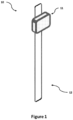
- FIG 1 shows a hygiene monitoring device 10 for monitoring a hygienic state of a user.
- the hygiene monitoring device 10 may be removably attached to a wearable article of a user so that it may monitor the hygienic state of the article.
- the hygiene monitoring device 10 is removably attachable to the outside surface of the back layer 104 of the wearable absorbent article 100 (see Figures 4 , 7A and 7B ), although other configurations are also contemplated.
- the hygiene monitoring device 10 further comprises a hook and/or loop type fastener (not shown) configured to be removably attachable to the wearable absorbent hygiene article 100 which may optionally have a corresponding hook and/or loop type fastener (not shown).
- Other types of fasteners are contemplated herein.
- the hygiene monitoring device 10 comprises a housing 11 and a sensing panel 12 in the form of a strip.
- the sensing panel 12 extends on both sides of the housing 11. However, in other embodiments, the sensing panel 12 may extend on only one side of the housing 11.
- the sensing panel 12 is in the form of an elongate flex PCB panel having various components printed thereon, as described below.
- the hygiene monitoring device comprises a monitoring unit (not shown) removably provided to the sensing panel 12 which is configured to receive information (e.g. in the form of electrical signals) from the sensing panel 12 about the hygienic state of the article.
- the monitoring unit is disposed in the housing 11.
- the hygiene monitoring device 10 further comprises a transmitter (not shown) which is configured to transmit data to an external device, such as a centralised server (not shown).
- the hygiene monitoring device 10 is configured to transmit information relating to the monitored hygienic state of the article.
- the hygiene monitoring device 10 may be configured to sound an alarm or provide another form of alert such as a visible or haptic indication when a particular hygienic state of the article is detected.
- the transmitter is disposed in the housing 11.
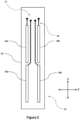
- the sensing panel 12 of the hygiene monitoring device 10 has an elongate flex PCB panel having a longitudinal axis L and a transverse axis T.
- the elongate flex PCB panel comprises plates disposed on a flexible substrate 13 of the elongate flex PCB panel.
- the plates are each separated from one another other.
- 'plates' refer to electrically conductive plates.
- the elongate flex PCB panel has a first pair of plates 14a, 14b spaced apart from each other.
- the first pair of plates 14a, 14b are disposed on the flexible substrate 13 of the elongate flex PCB panel.
- the plates of the first pair of plates 14a, 14b are spaced apart or offset relative to each other along the transverse axis T of the elongate flex PCB panel.
- the plates of the first pair of plates 14a, 14b are spaced apart or offset relative to each other along the direction perpendicularly crossing the longitudinal axis L of the elongate flex PCB panel.
- the plates of the first pair of plates 14a, 14b are spaced apart or offset relative to each other along any direction crossing the longitudinal axis L of the elongate flex PCB panel.
- the pair of plates 14a and 14b are coplanar. Similarly, the pair of plates 15a and 15b are coplanar. Each of the plates 14a, 14b, 15a and 15b lies in the same plane as the flexible substrate.
- the first pair of spaced apart plates 14a, 14b is configured to allow a measurement of an impedance therebetween by the monitoring unit.
- each plate of the first pair of spaced apart plates 14a, 14b is elongate along the longitudinal axis L of the elongate flex PCB panel.
- the longitudinal axes of the plates 14a, 14b are parallel to each other.
- Each plate 14a, 14b is rectangular in shape.
- the plates of the first pair of spaced apart plates 14a, 14b are substantially aligned along the longitudinal axis L of the elongate flex PCB panel.
- a certain arrangement of the first pair of spaced apart plates 14a, 14b is given, however, as exemplified below, other shapes and arrangements of the plates are contemplated herein.
- the elongate flex PCB panel also has a second pair of plates 15a, 15b disposed on the flexible substrate 13.
- the second pair of plates 15a, 15b is similar to the above-described first pair of plates 14a, 14b, and, therefore, for brevity, no further details are given in this respect. All aspects described herein in relation to the first pair of plates 14a, 14b are equally applicable to the second pair of plates 15a, 15b.
- the hygiene monitoring device 10 is configured to measure the impedance between two plates in two different pairs of plates.
- the hygiene monitoring device 10 is configured to individually measure the impedance between each and every possible combination of two plates.
- the hygiene monitoring device 10 is configured to individually measure the impedance between: plate 14a and plate 14b; plate 15a and plate 15b; plate 14a and plate 15a; plate 14a and plate 15b; plate 14b and plate 15a; and plate 14b and plate 15b.
- the hygiene monitoring device 10 may carry out a method comprising measuring an impedance between the plates of the first pair of spaced apart plates 14a, 14b.
- the measured impedance between the first pair of spaced apart plates 14a, 14b may be used to determine by the monitoring unit the hygienic state in a first area of the hygiene article.
- the hygiene monitoring device may identify a hygienic event, such as a urinary or faecal insult, based on a change in the impedance between the plates.
- the change in the impedance may be detected based on a change in the magnitude of the impedance of the response of the plates at one or more frequencies.
- a urinary insult may be associated with a change in the magnitude of the response of the plates at a given frequency
- a faecal insult may be associated with a different change in the magnitude of the response.
- the hygiene monitoring device may identify a hygienic event based on the response of the plates at a plurality of frequencies. For example, a urinary insult may be associated with a change in the magnitude of the impedance of the plates predominantly at one frequency, whereas a faecal insult may be associated with a change in the magnitude predominantly at a second, different frequency.
- the hygiene monitoring device may associate a first characteristic frequency response of the plates with a first event, such as a urinary insult, and may associate a second characteristic frequency response of the plates with a second event, such as a faecal insult.
- a first event such as a urinary insult
- a second characteristic frequency response of the plates such as a faecal insult
- the method may further comprise measuring a second impedance between the plates of the second pair of spaced apart plates 15a, 15b.
- the measured second impedance may be used to determine by the monitoring unit the hygienic state in a second area of the hygiene article.
- the hygiene monitoring device may identify a hygienic event based on a change in the impedance between the plates, and the change in the impedance may be detected based on a change in magnitude of the measured impedance.
- the hygienic events detected by the analysis of the first impedance and the second impedance may be different, for example, the first event may be urination and the second event may be defecation.
- the monitoring device may discriminate between different events on the basis of the area associated with a pair of plates which provides the strongest response to a drive signal during the event.
- the monitoring device may also or alternatively discriminate between different events based on a consideration of the magnitude of the impedance measured between the plates at one or more frequencies. For example, the hygiene monitoring device may compare the response of one or both pairs of plates at one or more frequencies against a set of characteristic responses correlated with a corresponding set of distinct events, and select the event that most closely matches the response.
- the hygiene monitoring device 10 may also carry out a method of confirming the installation of the strip 12 to an intended article.
- the response of one or both pairs of plates may differ depending on whether the strip 12 is in free space, is in a storage configuration, or is arranged against an absorbent article.
- the hygiene monitoring device may confirm that the strip has been correctly installed to the intended article, by a similar mechanism to the classification of different hygienic events as described above.
- the hygiene monitoring device may confirm to which, among a range of hygiene articles, the strip has been installed, again based on a consideration of the magnitude of the response of one or both pairs of plates at one or more frequencies, again by a similar mechanism to the classification of different hygienic events as described above.
- Figure 2 shows various components/elements of the sensing panel 12 printed on a first side of the flexible substrate 13 of the elongate flex PCB panel.
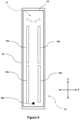
- Figure 3 shows the opposite side of the flexible substrate 13 and the various components/elements printed thereon.
- the elongate flex PCB panel further comprises a grounding plate 18 disposed on the opposite side of the flexible substrate 13 from the first pair of spaced apart plates 14a, 14b and the second pair of spaced apart plates 15a, 15b.
- a water-impermeable dielectric layer such as a polymer coating, may cover the plates so as to protect the plates and to avoid moisture from inducing short-circuits between the plates.
- first pair of spaced apart plates 14a, 14b, the second pair of spaced apart plates 15a, 15b and the contacts 17 are shown with phantom lines.
- the tracks 16 are not shown for ease of illustration, however, they are arranged in the manner shown in Figure 2 .
- the grounding plate 18 is disposed on the second side of the flexible substrate 13 and defines a contact 18a which may be connected to the ground (relative ground), for example, the ground in the monitoring unit.
- the grounding plate 18 is arranged such that it entirely overlaps with the first pair of spaced apart plates 14a, 14b, the second pair of spaced apart plates 15a, 15b, the tracks 16 (not shown in Figure 3 ), and the contacts 17.
- the grounding plate 18 is arranged such that it entirely overlaps with the first pair of spaced apart plates 14a, 14b, the second pair of spaced apart plates 15a, 15b, the tracks 16 (not shown in Figure 3 ), and the contacts 17.
- other arrangements of the grounding plate 18 are contemplated with only partial overlap.
- the grounding plate 18 is configured to shield the electric fields emanating from the first pair of spaced apart plates 14a, 14b, and the second pair of spaced apart plates 15a, 15b. In other words, the grounding plate 18 is configured to attenuate the electric fields emanating from the first pair of spaced apart plates 14a, 14b, and the second pair of spaced apart plates 15a, 15b. By such a configuration, the electric fields emanating from the plates are directed primarily towards the first side of the flexible substrate 13.
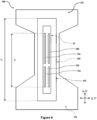
- FIG 4 shows a wearable absorbent hygiene article 100 which has the hygiene monitoring device 10.
- the wearable absorbent hygiene article 100 is an open-type diaper, however other wearable absorbent hygiene articles are contemplated herein.
- the housing 11 of the hygiene monitoring device 10 is not shown in Figure 4 .
- the wearable absorbent hygiene article 100 defines a front waist region 101, a crotch region 102 and a back waist region 103. As shown in Figures 7A and 7B , the wearable absorbent hygiene article 100 comprises a liquid permeable top layer 106 adapted to face the wearer during use, a back layer 104 opposite to the top layer, and an absorbent member/core 105 located between the top layer 106 and the back layer 104.
- the wearable absorbent hygiene article 100 defines a longitudinal axis L' and a perpendicular transverse axis T', as shown in Figure 4 and as would be understood by the skilled person in the art.
- the hygiene monitoring device 10 is disposed such that the longitudinal axis L of the sensing panel 12 (and the elongate flex PCB panel) is parallel to the longitudinal axis L' of the wearable absorbent hygiene article 100, as shown in Figure 4 .
- the sensing panel 12, and, in particular, the elongate flex PCB panel extends in the waist region 101, the crotch region 102 and the back waist region 103.
- the plates have a longitudinal extent which extends in the waist region 101, the crotch region 102 and the back waist region 103.
- the hygiene monitoring device 10, and, in particular, the sensing panel 12 may be configured to be disposed on the back layer opposite to the side of the absorbent member.
- the hygiene monitoring device 10, and, in particular, the sensing panel 12 may be configured to be disposed on the outer side of the back layer.
- the hygiene monitoring device 10 may be removably attached to the back layer by any means, in particular, the sensing panel 10 may be removably attached to the back layer by a hook-and-loop fasteners such as VELCRO ® .
- the sensing panel is configured to be arranged such that the plates are disposed entirely within the area defined by the absorbent core 105. However, it is also contemplated that the sensing panel is configured such that the plates extend partially outside the area defined by the absorbent core 105.
- the absorbent core 105 has a core length L C along the longitudinal axis L' of the wearable absorbent hygiene article 100.
- the extent of the plates along the longitudinal axis L of the elongate flex PCB panel defines a sensing length L S .
- the opposing most longitudinally spaced points of the plates are separated by the sensing length L S .
- the sensing length L S is 75% of the core length L C .
- the sensing length L S may be 50% to 100% of the core length L C .
- Wearable absorbent hygiene articles suited for use with children may for example have an absorbent core with a core length L C of from 15 to 50 cm.
- Sensors adapted for such hygiene articles may have sensing length L S of from 8, 15, 20 to 50, 40 or 30 cm.
- Wearable absorbent hygiene articles suited for use with adults may for example have an absorbent core with a core length L C of from 40 to 100 cm.
- Sensors adapted for such hygiene articles may have sensing length L S of from 20, 30, 40, to 100, 90, 80, 70 cm.
- the hygiene monitoring device 10, and, in particular, the sensing panel 12 may be disposed between the liquid permeable top layer and the back layer, and, in certain embodiments, between the absorbent member and the back layer.
- the elongate flex PCB panel may comprise an insulating layer which entirely covers the plates.
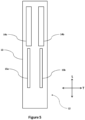
- Figure 5 shows an alternative embodiment of the sensing panel 12.
- the embodiment shown in Figure 5 is similar to the embodiment shown in Figures 2 and 3 and includes similar elements. Accordingly, for brevity, only the differences are detailed below.
- the plates of the first pair of spaced apart plates 14a, 14b have a greater width in the transverse direction T of the elongate flex PCB panel than the plates of the second pair of spaced apart plates 15a, 15b.
- the first pair of spaced apart plates 14a, 14b thereby is more responsive to material which does not penetrate deeply into an absorbent article against which the sensing panel is arranged. Accordingly, the first pair of spaced apart plates 14a, 14b is configured preferentially to detect faecal matter, which tends to be absorbed with greater difficulty into an absorbent core, and which may lie on the surface thereof after an insult.
- the second pair of spaced apart plates 15a, 15b thereby is more responsive to material which penetrates deeply into an absorbent article against which the sensing panel is arranged. Accordingly, the second pair of spaced apart plates 15a, 15b is configured to detect urine, which tends to be absorbed with greater ease into an absorbent core, and which may wholly be absorbed therein.
- the first pair of spaced apart plates 14a, 14b is configured to be disposed towards the back waist region 103 of the wearable absorbent hygiene article 100.
- the second pair of spaced apart plates 15a, 15b is configured to be disposed towards the front waist region 101 of the wearable absorbent hygiene article 100.
- Figure 6 shows another alternative embodiment of the sensing panel 12.
- the embodiment shown in Figure 6 is similar to the embodiment shown in Figures 2 and 3 and includes similar elements. Accordingly, for brevity, only the differences are detailed below.
- the plates of the first pair of spaced apart plates 14a, 14b are spaced-apart in the transverse direction T a greater distance than the plates of the second pair of spaced apart plates 15a, 15b.
- the first pair of spaced apart plates 14a, 14b is configured to be disposed towards the back waist region 103 of the wearable absorbent hygiene article 100.
- the second pair of spaced apart plates 15a, 15b is configured to be disposed towards the front waist region 101 of the wearable absorbent hygiene article 100.
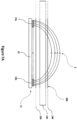
- Figures 7A and 7B each show a cross section of a wearable absorbent hygiene article 100 with the sensing panel 12 of Figure 6 disposed on the back layer 104 of the wearable absorbent hygiene article 100.
- Figure 7A shows a cross section including the first pair of spaced apart plates 14a, 14b and
- Figure 7B shows a cross section including the second pair of spaced apart plates 15a, 15b.
- Figures 7A and 7B additionally show the typical electric fields E between the pairs of plates, where in each case, the plates 14a and 15a are negatively charged and the plates 14b and 15b are positively charged.
- the strength of the electric field E between the first pair of spaced apart plates 14a, 14b above the top layer 106 (i.e. on the wearer-facing side of the top layer 106) is greater than the strength of the electric field E between the second pair of spaced apart plates 15a, 15b.
- the first pair of spaced apart plates 14a, 14b thereby is more responsive to material which does not penetrate deeply into an absorbent article against which the sensing panel is arranged. Accordingly, the first pair of spaced apart plates 14a, 14b is configured preferentially to detect faecal matter, which tends to be absorbed with greater difficulty into the absorbent core 105, and which may lie on the surface thereof after an insult.
- the second pair of spaced apart plates 15a, 15b thereby is more responsive to material which penetrates deeply into an absorbent article against which the sensing panel is arranged. Accordingly, the second pair of spaced apart plates 15a, 15b is configured to detect urine, which tends to be absorbed with greater ease into the absorbent core 105, and which may wholly be absorbed therein.
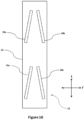
- Figure 8 shows another alternative embodiment of the sensing panel 12.
- the embodiment shown in Figure 6 is similar to the embodiment shown in Figures 2 and 3 and includes similar elements. Accordingly, for brevity, only the differences are detailed below.
- each of the plates of the first pair of spaced apart plates 14a, 14b and each of the plates of the second pair of spaced apart plates 15a, 15b have a tapered shape.
- each of the plates has a width which decreases moving along the longitudinal axis of the plate. By the decreasing width, an increased gap is provided between the respective plates moving along the longitudinal axis. With an increased gap, as described above, the plate becomes more sensitive to the environment at a greater distance.
- the plates of Figure 6 therefore exhibit an increased distance sensitivity at one longitudinal end than the other.
- the width decreases along the entire length of the plates.
- the width decreases along only a portion of the length of the plates.
- the plates comprise a tapered portion.
- the plates may not themselves be tapered, but may be arranged to converge along the longitudinal axis of the sense strip, with similar effects.
- the narrower portions of the plates are disposed towards the centre of the elongate flex PCB panel.
- Such a configuration may have improved discrimination between hygienic events and movements of the user's body at such a region.
- the wider portions of the first pair of spaced apart plates 14a, 14b and/or the narrower portions of the second pair of spaced apart plates 15a, 15b may be disposed towards the centre of the elongate flex PCB panel.
- Such a configuration may improve response time to a hygienic event taking place in the vicinity of the centre of the panel.
- a single pair of plates 14a, 14b may be provided, exhibiting a large-spacing portion at a first end of the strip and a small-spacing portion at a second end of the strip.
- such a single pair of plates may have a large-spacing portion (or a small-spacing portion) at the ends, and a corresponding small-spacing portion (or a large-spacing portion) between the ends.
- the large-spacing portion and the small-spacing portion may be formed by changing the width of the plates, inclining the plates, or both.
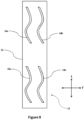
- Figure 9 shows another alternative embodiment of the sensing panel 12.
- the embodiment shown in Figure 9 is similar to the embodiment shown in Figures 2 and 3 and includes similar elements. Accordingly, for brevity, only the differences are detailed below.
- each of the plates of the first pair of spaced apart plates 14a, 14b and each of the plates of the second pair of spaced apart plates 15a, 15b have a wavy shape, which is a specific form of curved shape.
- the above disclosure may be extended to three, four, five or more pairs of plates longitudinally arranged.
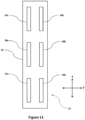
- Figure 11 shows another alternative embodiment of the sensing panel 12.
- the embodiment shown in Figure 11 is similar to the embodiment shown in Figures 2 and 3 and includes similar elements. Accordingly, for brevity, only the differences are detailed below.
- the sensing panel 12 comprises: a first pair of plates 19a, 19b, and second pair of plates 20a, 20b, and the third pair of plates 21a, 21b.
- the first pair of plates 19a, 19b, the second pair of plates 20a, 20b, and the third pair of plates 21a, 21b are each offset from each other along longitudinal axis L of the elongate flex PCB panel.
- the second pair of plates 20a, 2b is disposed in the longitudinal direction L between the first pair of plates 19a, 19b and the third pair of plates 21a, 21b.
- pairs of plates are arranged and configured in a similar manner to the pairs of plates 14a, 14b and 15a, 15b as described in any of the above embodiments.
- the hygiene monitoring 10 may be configured to measure the impedance at least between a plate in the first pair of plates 19a, 19b and a plate in the third pair of plates 21a, 21b.
- the hygiene monitoring 10 may also be configured to measure the impedance also between a plate in the first pair of plates 19a, 19b and a plate in the second pair of plates 20a, 20b. Additionally or alternatively, the hygiene monitoring 10 may also be configured to measure the impedance also between two plates in the same pair of plates (i.e. between plates 19a and 19b; plates 20a and 20b; or plates 21a and 21b).
- the hygiene monitoring device 10 may be configured to individually measure the impedance between each and every possible combination of two plates.
- Figure 12 shows the embodiment of the sensing panel 12 shown in Figures 2 and 3 with certain elements omitted for ease of illustration.
- each plate has a width W P in the transverse direction T of the elongate flex PCB panel and a length L P in the longitudinal direction L of the elongate flex PCB panel.
- the plates in each pair of plates are spaced apart along the transverse direction T of the elongate flex PCB panel by a distance W SA .
- the plates of the first pair of plates 14a, 14b are offset along the longitudinal axis with respect to the plates of the second pair of plates 15a, 15b by a distance L SA .
- the width W P is 6 mm for all plates. It is contemplated herein that the width W P may be between 4 mm and 7 mm.
- the length L P is 200 mm. It is contemplated herein that the length L P may be between 45 mm to 1000 mm, preferably between 180 mm and 220 mm.
- the distance W SA is 6 mm. It is contemplated herein that the distance W SA may be between 4 mm and 7 mm.
- the distance L SA is 6 mm. It is contemplated herein that the distance L SA may be between 4 mm and 7 mm.
- the distance W SA and the distance L SA are the same.
- the elongate flex PCB panel has a length L SP in the longitudinal direction L.
- the length L P may be between 20% to 40%, preferably 30% of the length L SP .
- the hygiene monitoring device comprises a different number of pairs of spaced apart electrodes.
- the hygiene monitoring device may comprise only a single pair of spaced apart electrodes.
- the plates may be spaced apart along the transverse direction T and/or the longitudinal direction L of the flex PCB panel.
- the plates of the pairs of spaced apart electrodes are the same, it is possible that the plates are different.
- the plate 14a and the plate 14b may have different shapes.
- the plate 15a and the plate 15b may have different shapes.
- the plates may be substantially linear, may have a zig-zag form, a sinusoidal form, or an irregular form.
- the hygiene monitoring device 10 is configured to individually measure the impedance between each and every possible combination of two plates, it is contemplated that the hygiene monitoring device 10 is configured to measure the impedance between a single two plates.
- the hygiene monitoring device 10 comprises an elongate flex PCB panel
- the hygiene monitoring device may comprise an elongate flexible panel of any kind.
- the further components, in particular, the plates, tracks and contacts may be formed by any means known in the art.
Landscapes
- Health & Medical Sciences (AREA)
- Life Sciences & Earth Sciences (AREA)
- General Health & Medical Sciences (AREA)
- Veterinary Medicine (AREA)
- Heart & Thoracic Surgery (AREA)
- Vascular Medicine (AREA)
- Biomedical Technology (AREA)
- Animal Behavior & Ethology (AREA)
- Engineering & Computer Science (AREA)
- Public Health (AREA)
- Epidemiology (AREA)
- Chemical & Material Sciences (AREA)
- Chemical Kinetics & Catalysis (AREA)
- Electrochemistry (AREA)
- Physics & Mathematics (AREA)
- Analytical Chemistry (AREA)
- Biochemistry (AREA)
- General Physics & Mathematics (AREA)
- Immunology (AREA)
- Pathology (AREA)
- Investigating Or Analyzing Materials By The Use Of Electric Means (AREA)
- Absorbent Articles And Supports Therefor (AREA)
- Orthopedics, Nursing, And Contraception (AREA)
Claims (15)
- System, umfassend:
einen tragbaren absorbierenden Hygieneartikel (100), der einen vorderen Taillenbereich (101), einen hinteren Taillenbereich (103), einen Schrittbereich (102) und eine Längsachse (L') definiert, wobei der tragbare absorbierende Hygieneartikel Folgendes umfasst:eine flüssigkeitsdurchlässige obere Schicht (106), die dazu angepasst ist, dem Träger während des Tragens zugewandt zu sein;eine hintere Schicht (104), die der oberen Schicht gegenüberliegt; undeinen absorbierenden Kern (105), der sich im Schrittbereich und zwischen der oberen Schicht und der hinteren Schicht befindet, wobei der absorbierende Kern eine Kernlänge entlang der Längsachse aufweist; undeine Hygieneüberwachungsvorrichtung (10), die eine Abtastbahn umfasst, wobei die Abtastbahn Folgendes umfasst:eine langgestreckte flexible Bahn (12), die eine Längsachse (L) definiert und Platten (14a, 14b, 15a, 15b) umfasst,wobei die Platten ein Paar voneinander beabstandeter Platten (14a, 14b) umfasst, wobei die Platten auf einem flexiblen Substrat (13) der langgestreckten flexiblen Bahn angeordnet sind,wobei jede der Platten entlang der Längsachse der langgestreckten flexiblen Bahn langgestreckt ist,wobei die Hygieneüberwachungsvorrichtung so konfiguriert ist, dass sie die Impedanz zwischen zwei der Platten mindestens bei einer vorbestimmten Frequenz misst,wobei die Erstreckung der Platten entlang der Längsachse der langgestreckten flexiblen Bahn eine Abtastlänge definiert,und wobei die Abtastlänge 50 % bis 100 % der Kernlänge ist,wobei die langgestreckte flexible Bahn (12) weiter eine Isolierschicht umfasst, die die Platten (14a, 14b, 15a, 15b) vollständig bedeckt. - System nach Anspruch 1, wobei die Abtastlänge 15 cm bis 40 cm beträgt, oder wobei die Abtastlänge 40 cm bis 80 cm beträgt.
- System nach Anspruch 1 oder 2, wobei die Abtastlänge 60 % bis 95 % der Kernlänge ist.
- System nach einem vorstehenden Anspruch, wobei die Abtastlänge 18 cm bis 38 cm beträgt, oder wobei die Abtastlänge 38 cm bis 76 cm beträgt.
- System nach einem vorstehenden Anspruch, wobei die Abtastlänge 70 % bis 80 % der Kernlänge ist.
- System nach einem vorstehenden Anspruch, wobei die Abtastlänge 21 cm bis 32 cm beträgt, oder wobei die Abtastlänge 32 cm bis 64 cm beträgt.
- System nach einem vorstehenden Anspruch, wobei das Plattenpaar in einer Richtung, die die Längsachse der langgestreckten flexiblen Bahn kreuzt, voneinander beabstandet sind.
- System nach einem der Ansprüche 1 bis 6, wobei das Plattenpaar in einer Richtung, die im Wesentlichen parallel zur Längsachse der langgestreckten flexiblen Bahn ist, voneinander beabstandet sind.
- System nach einem vorstehenden Anspruch, wobei das Plattenpaar ein zweites Plattenpaar umfasst, wobei das Plattenpaar wahlweise entlang der Längsachse der langgestreckten flexiblen Bahn in Bezug auf das zweite Plattenpaar versetzt ist,
- System nach einem vorstehenden Anspruch, wobei die Hygieneüberwachungsvorrichtung an dem tragbaren absorbierenden Hygieneartikel so angebracht ist, dass die Längsachse der langgestreckten flexiblen Bahn im Wesentlichen parallel zur Längsachse des tragbaren absorbierenden Hygieneartikels ist.
- System nach einem vorstehenden Anspruch, wobei die Hygieneüberwachungsvorrichtung so konfiguriert ist, dass sie an der hinteren Schicht des tragbaren absorbierenden Hygieneartikels angebracht werden, wobei die Hygieneüberwachungsvorrichtung wahlweise so konfiguriert ist, dass sie abnehmbar an der hinteren Schicht des tragbaren absorbierenden Hygieneartikels angebracht werden kann.
- Kit, umfassend:
einen tragbaren absorbierenden Hygieneartikel (100), der einen vorderen Taillenbereich (101), einen hinteren Taillenbereich (103), einen Schrittbereich (102) und eine Längsachse (L') definiert, wobei der tragbare absorbierende Hygieneartikel Folgendes umfasst:eine flüssigkeitsdurchlässige obere Schicht (106), die dazu angepasst ist, dem Träger während des Tragens zugewandt zu sein;eine hintere Schicht (104), die der oberen Schicht gegenüberliegt; undeinen absorbierenden Kern (105), der sich mindestens im Schrittbereich und zwischen der oberen Schicht und der hinteren Schicht befindet, wobei der absorbierende Kern eine Kernlänge entlang der Längsachse aufweist; undeine Hygieneüberwachungsvorrichtung (10), die eine Abtastbahn umfasst, wobei die Abtastbahn Folgendes umfasst:eine langgestreckte flexible Bahn (12), die eine Längsachse (L) definiert und Platten (14a, 14b, 15a, 15b) umfasst, wobei die Platten ein Paar voneinander beabstandeter Platten (14a, 14b) umfasst, wobei die Platten auf einem flexiblen Substrat (13) der langgestreckten flexiblen Bahn angeordnet sind,wobei jede der Platten entlang der Längsachse der langgestreckten flexiblen Bahn langgestreckt ist,wobei die Hygieneüberwachungsvorrichtung so konfiguriert ist, dass sie die Impedanz zwischen zwei der Platten mindestens bei einer vorbestimmten Frequenz misst,wobei die Erstreckung der Platten entlang der Längsachse der langgestreckten flexiblen Bahn eine Abtastlänge definiert,wobei die Abtastlänge 50 % bis 100 % der Kernlänge ist, undwobei die langgestreckte flexible Bahn (12) weiter eine Isolierschicht umfasst, die die Platten (14a, 14b, 15a, 15b) vollständig bedeckt. - Hygieneüberwachungsvorrichtung (10), die dazu angepasst ist, abnehmbar an einer hinteren Schicht eines tragbaren absorbierenden Hygieneartikels (100) angebracht zu werden, wobei die Hygieneüberwachungsvorrichtung eine Abtastbahn (12) aufweist, wobei die Abtastbahn Folgendes umfasst:eine langgestreckte flexible Bahn, die eine Längsachse (L) definiert und Platten (14a, 14b, 15a, 15b) umfasst, wobei die Platten ein Paar voneinander beabstandeter Platten (14a, 14b) umfasst, wobei die Platten auf einem flexiblen Substrat (13) der langgestreckten flexiblen Bahn angeordnet sind,wobei jede der Platten entlang der Längsachse der langgestreckten flexiblen Bahn langgestreckt ist,wobei die Hygieneüberwachungsvorrichtung so konfiguriert ist, dass sie die Impedanz zwischen zwei der Platten mindestens bei einer vorbestimmten Frequenz misst,wobei die Erstreckung der Platten entlang der Längsachse der langgestreckten flexiblen Bahn eine Abtastlänge definiert,wobei die Abtastlänge 15 cm bis 40 cm oder 40 cm bis 80 cm beträgt, undwobei die langgestreckte flexible Bahn (12) weiter eine Isolierschicht umfasst, die die Platten (14a, 14b, 15a, 15b) vollständig bedeckt.
- Verfahren, umfassend:Bereitstellen des Systems oder Kits nach einem vorstehenden Anspruch; undAnbringen der Hygieneüberwachungsvorrichtung an den tragbaren absorbierenden Hygieneartikel so, dass die Längsachse der langgestreckten flexiblen Bahn im Wesentlichen parallel zur Längsachse des tragbaren absorbierenden Hygieneartikels ist.
- Verfahren nach Anspruch 14, umfassend Vergleichen der Impedanz zwischen den zwei Platten bei mindestens der vorbestimmten Frequenz.
Priority Applications (1)
| Application Number | Priority Date | Filing Date | Title |
|---|---|---|---|
| PL18826035.0T PL3897496T3 (pl) | 2018-12-20 | 2018-12-20 | Układ zawierający chłonny artykuł higieniczny do noszenia i urządzenie do monitorowania higieny |
Applications Claiming Priority (1)
| Application Number | Priority Date | Filing Date | Title |
|---|---|---|---|
| PCT/EP2018/086217 WO2020125999A1 (en) | 2018-12-20 | 2018-12-20 | A system comprising a wearable absorbent hygiene article and a hygiene monitoring device |
Publications (3)
| Publication Number | Publication Date |
|---|---|
| EP3897496A1 EP3897496A1 (de) | 2021-10-27 |
| EP3897496B1 true EP3897496B1 (de) | 2025-06-04 |
| EP3897496C0 EP3897496C0 (de) | 2025-06-04 |
Family
ID=64870504
Family Applications (1)
| Application Number | Title | Priority Date | Filing Date |
|---|---|---|---|
| EP18826035.0A Active EP3897496B1 (de) | 2018-12-20 | 2018-12-20 | System mit einem tragbaren absorbierenden hygieneartikel und einer hygieneüberwachungsvorrichtung |
Country Status (11)
| Country | Link |
|---|---|
| US (1) | US12447067B2 (de) |
| EP (1) | EP3897496B1 (de) |
| JP (1) | JP7443371B2 (de) |
| KR (1) | KR102677710B1 (de) |
| CN (1) | CN113164293A (de) |
| AU (1) | AU2018454245B2 (de) |
| CA (1) | CA3123929A1 (de) |
| CO (1) | CO2021008642A2 (de) |
| MX (1) | MX2021007443A (de) |
| PL (1) | PL3897496T3 (de) |
| WO (1) | WO2020125999A1 (de) |
Families Citing this family (2)
| Publication number | Priority date | Publication date | Assignee | Title |
|---|---|---|---|---|
| WO2020125999A1 (en) | 2018-12-20 | 2020-06-25 | Essity Hygiene And Health Aktiebolag | A system comprising a wearable absorbent hygiene article and a hygiene monitoring device |
| US12399042B2 (en) | 2019-04-15 | 2025-08-26 | Essity Hygiene And Health Aktiebolag | Data logger unit, sensor unit, absorbent article management system and identification method |
Family Cites Families (55)
| Publication number | Priority date | Publication date | Assignee | Title |
|---|---|---|---|---|
| JPS5069190U (de) | 1973-10-24 | 1975-06-19 | ||
| US5845644A (en) | 1996-08-26 | 1998-12-08 | Hughes; Charles B. | Bladder and bowel training system |
| JP2000093448A (ja) | 1998-09-18 | 2000-04-04 | Panetto:Kk | おむつ用センサおよびこれを内蔵したおむつ |
| US6232366B1 (en) | 1999-06-09 | 2001-05-15 | 3M Innovative Properties Company | Pressure sensitive conductive adhesive having hot-melt properties and biomedical electrodes using same |
| JP2002082080A (ja) | 2000-09-08 | 2002-03-22 | Matsushita Electric Works Ltd | 水分量センサ |
| US20050101841A9 (en) | 2001-12-04 | 2005-05-12 | Kimberly-Clark Worldwide, Inc. | Healthcare networks with biosensors |
| US8663106B2 (en) | 2002-08-22 | 2014-03-04 | Bodymedia, Inc. | Non-invasive temperature monitoring device |
| KR20050062773A (ko) | 2002-10-09 | 2005-06-27 | 보디미디어 인코퍼레이티드 | 생리 및/또는 컨텍스츄얼 파라미터를 이용한 연속 또는이산 신체상태의 자동 저널링을 위한 방법 및 장치 |
| US20090177068A1 (en) | 2002-10-09 | 2009-07-09 | Stivoric John M | Method and apparatus for providing derived glucose information utilizing physiological and/or contextual parameters |
| US20050156744A1 (en) * | 2003-09-02 | 2005-07-21 | Pires Harold G. | Diaper wetness annunciator system |
| WO2006047815A1 (en) | 2004-11-03 | 2006-05-11 | Fred Bergman Healthcare Pty. Ltd | Incontinence management system and diaper |
| CN101217923B (zh) | 2005-07-13 | 2010-10-06 | 尤妮佳股份有限公司 | 尿传感器 |
| US7642396B2 (en) | 2005-08-31 | 2010-01-05 | Kimberly-Clark Worldwide, Inc. | Method and device for detecting the presence of multiple insults in an absorbent article |
| US7855653B2 (en) * | 2006-04-28 | 2010-12-21 | Medtronic, Inc. | External voiding sensor system |
| WO2007128038A1 (en) | 2006-05-02 | 2007-11-15 | Fred Bergman Healthcare Pty Ltd | Moisture monitoring system |
| US7667608B2 (en) | 2007-04-30 | 2010-02-23 | Kimberly-Clark Worldwide, Inc. | Wetness device lock and key and device ID |
| US7749170B2 (en) | 2007-05-22 | 2010-07-06 | Tyco Healthcare Group Lp | Multiple configurable electronic thermometer |
| WO2008157298A2 (en) | 2007-06-15 | 2008-12-24 | Board Of Regents, The University Of Texas System | Thin flexible sensor |
| US8101813B2 (en) | 2008-10-30 | 2012-01-24 | Kimberly-Clark Worldwide, Inc. | Training progress indicator |
| WO2010123425A1 (en) | 2009-04-23 | 2010-10-28 | Sca Hygiene Products Ab | Article and method for wetness detection |
| GB0912009D0 (en) | 2009-07-10 | 2009-08-19 | Univ Strathclyde | Sensor |
| JP5396233B2 (ja) | 2009-10-23 | 2014-01-22 | ユニ・チャーム株式会社 | 排便排尿判別装置 |
| JP2013509280A (ja) | 2009-11-06 | 2013-03-14 | フレッド バーグマン ヘルスケア ピーティーワイ リミテッド | 失禁監視における改善および評価 |
| US20120084924A1 (en) * | 2010-10-07 | 2012-04-12 | Cheng Mei Yuk | Pillows |
| GB201022028D0 (en) * | 2010-12-23 | 2011-02-02 | Sca Hygiene Prod Ab | Tool for analysing liquid discharge data in an absorbent article, an absorbent article adapted for liquid dicharge data collection and a control unit |
| GB201022029D0 (en) | 2010-12-23 | 2011-02-02 | Sca Hygiene Prod Ab | Absorbent article comprising a liquid discharge sensor |
| GB201022031D0 (en) * | 2010-12-23 | 2011-02-02 | Sca Hygiene Prod Ab | Absorbent article comprising a liquid discharge detection sensor |
| CN102650608B (zh) | 2011-02-24 | 2014-04-02 | 徐菲 | 基于电化学电容器的液体检测装置、方法及纸尿裤 |
| BR112013031079A2 (pt) | 2011-06-03 | 2016-11-29 | Procter & Gamble | sistemas de sensor que compreendem recursos antiengasgamento |
| US9241839B2 (en) | 2011-07-15 | 2016-01-26 | Kimberly-Clark Worldwide, Inc. | Absorbent article fullness indicator |
| JP2013039158A (ja) | 2011-08-11 | 2013-02-28 | Kao Corp | 排尿検知装置 |
| US8816149B2 (en) | 2011-10-28 | 2014-08-26 | Kimberly-Clark Worldwide, Inc. | System for detection and monitoring of body exudates using a gas emitting substance for use in interactive toilet training |
| MX350231B (es) | 2011-12-23 | 2017-08-30 | Sca Hygiene Prod Ab | Metodo para detectar una descarga de liquido en un articulo absorbente. |
| US9956125B2 (en) | 2011-12-29 | 2018-05-01 | Sca Hygiene Products | Absorbent article comprising a wetness detector |
| JP5928107B2 (ja) | 2012-04-06 | 2016-06-01 | セイコーエプソン株式会社 | センサーシステム、センサーモジュール |
| WO2017013493A1 (en) | 2015-07-20 | 2017-01-26 | L.I.F.E. Corporation S.A. | Flexible fabric ribbon connectors for garments with sensors and electronics |
| US9366708B2 (en) | 2013-02-06 | 2016-06-14 | Nokia Technologies Oy | Apparatus comprising a flexible substrate and a component supported by the flexible substrate |
| DK2991602T3 (en) | 2013-04-30 | 2018-05-22 | Sca Hygiene Prod Ab | EVENT-MANAGED TRANSITIONS IN MANAGING ABSORBING ARTICLES |
| EP2992662B1 (de) | 2013-04-30 | 2020-06-17 | Essity Hygiene and Health Aktiebolag | Überwachung und anzeige des absorptionszustands eines absorbierenden artikels |
| JP6322415B2 (ja) * | 2014-01-06 | 2018-05-09 | ユニ・チャーム株式会社 | 排便排尿判定装置、及び、排便排尿判定方法 |
| US9739681B2 (en) | 2014-10-29 | 2017-08-22 | Kulite Semiconductor Products, Inc. | Systems and methods for electrically identifying and compensating individual pressure transducers |
| BR112017011327B1 (pt) * | 2014-12-11 | 2022-07-05 | Essity Hygiene And Health Aktiebolag | Sistema e método de detecção de umidificação e sistema de gerenciamento de incontinência |
| US11173073B2 (en) | 2015-05-21 | 2021-11-16 | MacNaughton Living Trust utd Dec. 30, 2002 | Monitoring incontinence events |
| US10568778B2 (en) * | 2015-06-12 | 2020-02-25 | Fred Bergman Healthcare Pty Ltd. | System and method for determining a pre-existing characteristic and pre-existing state of an article |
| WO2017152687A1 (en) | 2016-03-10 | 2017-09-14 | Little Nobleman Technology Limited | Absorbent article and related methods |
| EP3415130B1 (de) | 2017-06-16 | 2022-04-13 | Ontex BV | Intelligenter absorbierender artikel, komponenten und verfahren zur herstellung |
| CA3084835A1 (en) | 2017-11-07 | 2019-05-16 | Fred Bergman Healthcare Pty Ltd | A system for managing incontinence |
| WO2019096413A1 (en) | 2017-11-17 | 2019-05-23 | Essity Hygiene And Health Aktiebolag | A hygiene monitoring device comprising an electrode panel |
| US20190247650A1 (en) | 2018-02-14 | 2019-08-15 | Bao Tran | Systems and methods for augmenting human muscle controls |
| US11583453B2 (en) * | 2018-08-21 | 2023-02-21 | Johnson & Johnson Consumer Inc. | Personal hygiene device for detecting a fluid |
| JP7252338B2 (ja) | 2018-12-20 | 2023-04-04 | エシティ・ハイジーン・アンド・ヘルス・アクチエボラグ | 感知パネルを備える衛生監視デバイス |
| WO2020125999A1 (en) | 2018-12-20 | 2020-06-25 | Essity Hygiene And Health Aktiebolag | A system comprising a wearable absorbent hygiene article and a hygiene monitoring device |
| US11369525B1 (en) | 2019-07-05 | 2022-06-28 | Essity Hygiene And Health Aktiebolag | Sensing panel for hygiene monitoring device |
| US11298063B2 (en) | 2019-10-20 | 2022-04-12 | Bao Q Tran | Hydrogen powered device |
| EP4591326A1 (de) | 2022-09-22 | 2025-07-30 | Essity Hygiene and Health Aktiebolag | Voiding-datenprotokollierungsvorrichtung mit erfassung eines füllzustands während eines erfassungszyklus |
-
2018
- 2018-12-20 WO PCT/EP2018/086217 patent/WO2020125999A1/en not_active Ceased
- 2018-12-20 CA CA3123929A patent/CA3123929A1/en active Pending
- 2018-12-20 US US17/413,670 patent/US12447067B2/en active Active
- 2018-12-20 MX MX2021007443A patent/MX2021007443A/es unknown
- 2018-12-20 JP JP2021535834A patent/JP7443371B2/ja active Active
- 2018-12-20 PL PL18826035.0T patent/PL3897496T3/pl unknown
- 2018-12-20 CN CN201880100095.0A patent/CN113164293A/zh active Pending
- 2018-12-20 AU AU2018454245A patent/AU2018454245B2/en active Active
- 2018-12-20 KR KR1020217019765A patent/KR102677710B1/ko active Active
- 2018-12-20 EP EP18826035.0A patent/EP3897496B1/de active Active
-
2021
- 2021-06-30 CO CONC2021/0008642A patent/CO2021008642A2/es unknown
Also Published As
| Publication number | Publication date |
|---|---|
| JP2022516007A (ja) | 2022-02-24 |
| CA3123929A1 (en) | 2020-06-25 |
| MX2021007443A (es) | 2021-08-11 |
| KR102677710B1 (ko) | 2024-06-24 |
| BR112021011142A2 (pt) | 2021-08-31 |
| CN113164293A (zh) | 2021-07-23 |
| JP7443371B2 (ja) | 2024-03-05 |
| US20220015956A1 (en) | 2022-01-20 |
| PL3897496T3 (pl) | 2025-09-01 |
| AU2018454245B2 (en) | 2022-07-21 |
| AU2018454245A1 (en) | 2021-06-10 |
| EP3897496A1 (de) | 2021-10-27 |
| KR20210095917A (ko) | 2021-08-03 |
| EP3897496C0 (de) | 2025-06-04 |
| WO2020125999A1 (en) | 2020-06-25 |
| US12447067B2 (en) | 2025-10-21 |
| CO2021008642A2 (es) | 2021-07-19 |
Similar Documents
| Publication | Publication Date | Title |
|---|---|---|
| EP3897497B1 (de) | Hygieneüberwachungsvorrichtung mit einer sensortafel | |
| CA3008224C (en) | Wearable absorbent article | |
| KR102587532B1 (ko) | 흡수 용품 누설 평가 시스템 | |
| JP6275473B2 (ja) | 着用物品 | |
| EP3897496B1 (de) | System mit einem tragbaren absorbierenden hygieneartikel und einer hygieneüberwachungsvorrichtung | |
| EP3968927B1 (de) | Hygieneüberwachungsvorrichtung mit schmaler datenprotokollierungseinheit | |
| BR112021011142B1 (pt) | Sistema, kit, dispositivo de monitoramento de higiene e método | |
| BR112021008140B1 (pt) | Dispositivo de monitoramento de higiene, sistema de monitoramento de higiene e método para medir impedância | |
| JP6449971B2 (ja) | 着用物品 |
Legal Events
| Date | Code | Title | Description |
|---|---|---|---|
| STAA | Information on the status of an ep patent application or granted ep patent |
Free format text: STATUS: UNKNOWN |
|
| STAA | Information on the status of an ep patent application or granted ep patent |
Free format text: STATUS: THE INTERNATIONAL PUBLICATION HAS BEEN MADE |
|
| PUAI | Public reference made under article 153(3) epc to a published international application that has entered the european phase |
Free format text: ORIGINAL CODE: 0009012 |
|
| STAA | Information on the status of an ep patent application or granted ep patent |
Free format text: STATUS: REQUEST FOR EXAMINATION WAS MADE |
|
| 17P | Request for examination filed |
Effective date: 20210716 |
|
| AK | Designated contracting states |
Kind code of ref document: A1 Designated state(s): AL AT BE BG CH CY CZ DE DK EE ES FI FR GB GR HR HU IE IS IT LI LT LU LV MC MK MT NL NO PL PT RO RS SE SI SK SM TR |
|
| DAV | Request for validation of the european patent (deleted) | ||
| DAX | Request for extension of the european patent (deleted) | ||
| STAA | Information on the status of an ep patent application or granted ep patent |
Free format text: STATUS: EXAMINATION IS IN PROGRESS |
|
| 17Q | First examination report despatched |
Effective date: 20230103 |
|
| TPAC | Observations filed by third parties |
Free format text: ORIGINAL CODE: EPIDOSNTIPA |
|
| TPAC | Observations filed by third parties |
Free format text: ORIGINAL CODE: EPIDOSNTIPA |
|
| TPAC | Observations filed by third parties |
Free format text: ORIGINAL CODE: EPIDOSNTIPA |
|
| TPAC | Observations filed by third parties |
Free format text: ORIGINAL CODE: EPIDOSNTIPA |
|
| GRAP | Despatch of communication of intention to grant a patent |
Free format text: ORIGINAL CODE: EPIDOSNIGR1 |
|
| STAA | Information on the status of an ep patent application or granted ep patent |
Free format text: STATUS: GRANT OF PATENT IS INTENDED |
|
| INTG | Intention to grant announced |
Effective date: 20250212 |
|
| GRAS | Grant fee paid |
Free format text: ORIGINAL CODE: EPIDOSNIGR3 |
|
| GRAA | (expected) grant |
Free format text: ORIGINAL CODE: 0009210 |
|
| STAA | Information on the status of an ep patent application or granted ep patent |
Free format text: STATUS: THE PATENT HAS BEEN GRANTED |
|
| AK | Designated contracting states |
Kind code of ref document: B1 Designated state(s): AL AT BE BG CH CY CZ DE DK EE ES FI FR GB GR HR HU IE IS IT LI LT LU LV MC MK MT NL NO PL PT RO RS SE SI SK SM TR |
|
| REG | Reference to a national code |
Ref country code: GB Ref legal event code: FG4D |
|
| REG | Reference to a national code |
Ref country code: CH Ref legal event code: EP |
|
| REG | Reference to a national code |
Ref country code: IE Ref legal event code: FG4D |
|
| U01 | Request for unitary effect filed |
Effective date: 20250604 |
|
| U07 | Unitary effect registered |
Designated state(s): AT BE BG DE DK EE FI FR IT LT LU LV MT NL PT RO SE SI Effective date: 20250611 |
|
| PG25 | Lapsed in a contracting state [announced via postgrant information from national office to epo] |
Ref country code: ES Free format text: LAPSE BECAUSE OF FAILURE TO SUBMIT A TRANSLATION OF THE DESCRIPTION OR TO PAY THE FEE WITHIN THE PRESCRIBED TIME-LIMIT Effective date: 20250604 |
|
| PG25 | Lapsed in a contracting state [announced via postgrant information from national office to epo] |
Ref country code: GR Free format text: LAPSE BECAUSE OF FAILURE TO SUBMIT A TRANSLATION OF THE DESCRIPTION OR TO PAY THE FEE WITHIN THE PRESCRIBED TIME-LIMIT Effective date: 20250905 Ref country code: NO Free format text: LAPSE BECAUSE OF FAILURE TO SUBMIT A TRANSLATION OF THE DESCRIPTION OR TO PAY THE FEE WITHIN THE PRESCRIBED TIME-LIMIT Effective date: 20250904 |
|
| PG25 | Lapsed in a contracting state [announced via postgrant information from national office to epo] |
Ref country code: HR Free format text: LAPSE BECAUSE OF FAILURE TO SUBMIT A TRANSLATION OF THE DESCRIPTION OR TO PAY THE FEE WITHIN THE PRESCRIBED TIME-LIMIT Effective date: 20250604 |
|
| PG25 | Lapsed in a contracting state [announced via postgrant information from national office to epo] |
Ref country code: RS Free format text: LAPSE BECAUSE OF FAILURE TO SUBMIT A TRANSLATION OF THE DESCRIPTION OR TO PAY THE FEE WITHIN THE PRESCRIBED TIME-LIMIT Effective date: 20250904 |