EP3896102B1 - Polyolefin and method for preparing same - Google Patents
Polyolefin and method for preparing same Download PDFInfo
- Publication number
- EP3896102B1 EP3896102B1 EP19897225.9A EP19897225A EP3896102B1 EP 3896102 B1 EP3896102 B1 EP 3896102B1 EP 19897225 A EP19897225 A EP 19897225A EP 3896102 B1 EP3896102 B1 EP 3896102B1
- Authority
- EP
- European Patent Office
- Prior art keywords
- polyolefin
- formula
- compound
- polymerization catalyst
- olefin polymerization
- Prior art date
- Legal status (The legal status is an assumption and is not a legal conclusion. Google has not performed a legal analysis and makes no representation as to the accuracy of the status listed.)
- Active
Links
Classifications
-
- C—CHEMISTRY; METALLURGY
- C08—ORGANIC MACROMOLECULAR COMPOUNDS; THEIR PREPARATION OR CHEMICAL WORKING-UP; COMPOSITIONS BASED THEREON
- C08F—MACROMOLECULAR COMPOUNDS OBTAINED BY REACTIONS ONLY INVOLVING CARBON-TO-CARBON UNSATURATED BONDS
- C08F210/00—Copolymers of unsaturated aliphatic hydrocarbons having only one carbon-to-carbon double bond
- C08F210/16—Copolymers of ethene with alpha-alkenes, e.g. EP rubbers
-
- C—CHEMISTRY; METALLURGY
- C08—ORGANIC MACROMOLECULAR COMPOUNDS; THEIR PREPARATION OR CHEMICAL WORKING-UP; COMPOSITIONS BASED THEREON
- C08F—MACROMOLECULAR COMPOUNDS OBTAINED BY REACTIONS ONLY INVOLVING CARBON-TO-CARBON UNSATURATED BONDS
- C08F2/00—Processes of polymerisation
- C08F2/38—Polymerisation using regulators, e.g. chain terminating agents, e.g. telomerisation
-
- C—CHEMISTRY; METALLURGY
- C08—ORGANIC MACROMOLECULAR COMPOUNDS; THEIR PREPARATION OR CHEMICAL WORKING-UP; COMPOSITIONS BASED THEREON
- C08F—MACROMOLECULAR COMPOUNDS OBTAINED BY REACTIONS ONLY INVOLVING CARBON-TO-CARBON UNSATURATED BONDS
- C08F210/00—Copolymers of unsaturated aliphatic hydrocarbons having only one carbon-to-carbon double bond
- C08F210/02—Ethene
-
- C—CHEMISTRY; METALLURGY
- C08—ORGANIC MACROMOLECULAR COMPOUNDS; THEIR PREPARATION OR CHEMICAL WORKING-UP; COMPOSITIONS BASED THEREON
- C08F—MACROMOLECULAR COMPOUNDS OBTAINED BY REACTIONS ONLY INVOLVING CARBON-TO-CARBON UNSATURATED BONDS
- C08F4/00—Polymerisation catalysts
- C08F4/42—Metals; Metal hydrides; Metallo-organic compounds; Use thereof as catalyst precursors
- C08F4/44—Metals; Metal hydrides; Metallo-organic compounds; Use thereof as catalyst precursors selected from light metals, zinc, cadmium, mercury, copper, silver, gold, boron, gallium, indium, thallium, rare earths or actinides
- C08F4/52—Metals; Metal hydrides; Metallo-organic compounds; Use thereof as catalyst precursors selected from light metals, zinc, cadmium, mercury, copper, silver, gold, boron, gallium, indium, thallium, rare earths or actinides selected from boron, aluminium, gallium, indium, thallium or rare earths
-
- C—CHEMISTRY; METALLURGY
- C08—ORGANIC MACROMOLECULAR COMPOUNDS; THEIR PREPARATION OR CHEMICAL WORKING-UP; COMPOSITIONS BASED THEREON
- C08F—MACROMOLECULAR COMPOUNDS OBTAINED BY REACTIONS ONLY INVOLVING CARBON-TO-CARBON UNSATURATED BONDS
- C08F4/00—Polymerisation catalysts
- C08F4/42—Metals; Metal hydrides; Metallo-organic compounds; Use thereof as catalyst precursors
- C08F4/44—Metals; Metal hydrides; Metallo-organic compounds; Use thereof as catalyst precursors selected from light metals, zinc, cadmium, mercury, copper, silver, gold, boron, gallium, indium, thallium, rare earths or actinides
- C08F4/60—Metals; Metal hydrides; Metallo-organic compounds; Use thereof as catalyst precursors selected from light metals, zinc, cadmium, mercury, copper, silver, gold, boron, gallium, indium, thallium, rare earths or actinides together with refractory metals, iron group metals, platinum group metals, manganese, rhenium technetium or compounds thereof
- C08F4/62—Refractory metals or compounds thereof
- C08F4/64—Titanium, zirconium, hafnium or compounds thereof
- C08F4/659—Component covered by group C08F4/64 containing a transition metal-carbon bond
- C08F4/65912—Component covered by group C08F4/64 containing a transition metal-carbon bond in combination with an organoaluminium compound
-
- C—CHEMISTRY; METALLURGY
- C08—ORGANIC MACROMOLECULAR COMPOUNDS; THEIR PREPARATION OR CHEMICAL WORKING-UP; COMPOSITIONS BASED THEREON
- C08F—MACROMOLECULAR COMPOUNDS OBTAINED BY REACTIONS ONLY INVOLVING CARBON-TO-CARBON UNSATURATED BONDS
- C08F4/00—Polymerisation catalysts
- C08F4/42—Metals; Metal hydrides; Metallo-organic compounds; Use thereof as catalyst precursors
- C08F4/44—Metals; Metal hydrides; Metallo-organic compounds; Use thereof as catalyst precursors selected from light metals, zinc, cadmium, mercury, copper, silver, gold, boron, gallium, indium, thallium, rare earths or actinides
- C08F4/60—Metals; Metal hydrides; Metallo-organic compounds; Use thereof as catalyst precursors selected from light metals, zinc, cadmium, mercury, copper, silver, gold, boron, gallium, indium, thallium, rare earths or actinides together with refractory metals, iron group metals, platinum group metals, manganese, rhenium technetium or compounds thereof
- C08F4/62—Refractory metals or compounds thereof
- C08F4/64—Titanium, zirconium, hafnium or compounds thereof
- C08F4/659—Component covered by group C08F4/64 containing a transition metal-carbon bond
- C08F4/6592—Component covered by group C08F4/64 containing a transition metal-carbon bond containing at least one cyclopentadienyl ring, condensed or not, e.g. an indenyl or a fluorenyl ring
- C08F4/65922—Component covered by group C08F4/64 containing a transition metal-carbon bond containing at least one cyclopentadienyl ring, condensed or not, e.g. an indenyl or a fluorenyl ring containing at least two cyclopentadienyl rings, fused or not
- C08F4/65927—Component covered by group C08F4/64 containing a transition metal-carbon bond containing at least one cyclopentadienyl ring, condensed or not, e.g. an indenyl or a fluorenyl ring containing at least two cyclopentadienyl rings, fused or not two cyclopentadienyl rings being mutually bridged
-
- C—CHEMISTRY; METALLURGY
- C08—ORGANIC MACROMOLECULAR COMPOUNDS; THEIR PREPARATION OR CHEMICAL WORKING-UP; COMPOSITIONS BASED THEREON
- C08F—MACROMOLECULAR COMPOUNDS OBTAINED BY REACTIONS ONLY INVOLVING CARBON-TO-CARBON UNSATURATED BONDS
- C08F2420/00—Metallocene catalysts
- C08F2420/09—Cyclic bridge, i.e. Cp or analog where the bridging unit linking the two Cps or analogs is part of a cyclic group
-
- C—CHEMISTRY; METALLURGY
- C08—ORGANIC MACROMOLECULAR COMPOUNDS; THEIR PREPARATION OR CHEMICAL WORKING-UP; COMPOSITIONS BASED THEREON
- C08F—MACROMOLECULAR COMPOUNDS OBTAINED BY REACTIONS ONLY INVOLVING CARBON-TO-CARBON UNSATURATED BONDS
- C08F2500/00—Characteristics or properties of obtained polyolefins; Use thereof
- C08F2500/02—Low molecular weight, e.g. <100,000 Da.
-
- C—CHEMISTRY; METALLURGY
- C08—ORGANIC MACROMOLECULAR COMPOUNDS; THEIR PREPARATION OR CHEMICAL WORKING-UP; COMPOSITIONS BASED THEREON
- C08F—MACROMOLECULAR COMPOUNDS OBTAINED BY REACTIONS ONLY INVOLVING CARBON-TO-CARBON UNSATURATED BONDS
- C08F4/00—Polymerisation catalysts
- C08F4/42—Metals; Metal hydrides; Metallo-organic compounds; Use thereof as catalyst precursors
- C08F4/44—Metals; Metal hydrides; Metallo-organic compounds; Use thereof as catalyst precursors selected from light metals, zinc, cadmium, mercury, copper, silver, gold, boron, gallium, indium, thallium, rare earths or actinides
- C08F4/60—Metals; Metal hydrides; Metallo-organic compounds; Use thereof as catalyst precursors selected from light metals, zinc, cadmium, mercury, copper, silver, gold, boron, gallium, indium, thallium, rare earths or actinides together with refractory metals, iron group metals, platinum group metals, manganese, rhenium technetium or compounds thereof
- C08F4/62—Refractory metals or compounds thereof
- C08F4/64—Titanium, zirconium, hafnium or compounds thereof
- C08F4/659—Component covered by group C08F4/64 containing a transition metal-carbon bond
- C08F4/65908—Component covered by group C08F4/64 containing a transition metal-carbon bond in combination with an ionising compound other than alumoxane, e.g. (C6F5)4B-X+
Definitions
- the present invention relates to a method for preparing a polyolefin, and more specifically, a method for preparing a polyolefin having low molecular weight and low viscosity characteristics.
- a metallocene catalyst which is one of the catalysts used to polymerize olefins, is a compound, in which a ligand, such as a cyclopentadienyl group, an indenyl group, and a cycloheptadienyl group, is coordinate bonded to a transition metal or a transition metal halogen compound, and has a sandwich structure in its basic form.
- a ligand such as a cyclopentadienyl group, an indenyl group, and a cycloheptadienyl group
- the metallocene catalyst is a single-site catalyst including the metallocene compound and a cocatalyst such as methylaluminoxane, and a polymer polymerized by the metallocene catalyst has a narrow molecular weight distribution, a uniform comonomer distribution, and a copolymerization activity higher than that of the Ziegler-Natta catalyst.
- US 5451649 discloses benzofluorenyl-containing metallocenes along with methods for making the metallocenes. Also disclosed are methods for using the metallocenes as polymerization catalysts. In addition, polymers resulting from such polymerizations are disclosed.
- EP 3708792 A1 relates to a transition metal compound, represented by a chemical formula 1, for an olefin polymerization catalyst, an olefin polymerization catalyst comprising the same and a polyolefin polymerized using the same.
- US 5770664 relates to a catalyst component for producing polyolefin, a catalyst for producing polyolefin comprising the catalyst component, and a process for producing the polyolefin in the presence of the catalyst.
- the catalyst component has no cyclopentadienyl structure.
- EP 1642913 A1 relates to a non-pourable homogeneous ultra-low molecular weight ethylene polymer composition and a process for the preparation thereof.
- KR 20160121566 A relates to ethylene/alpha-olefin copolymer obtained by copolymerizing in the presence of an olefin polymerization catalyst.
- KR 20190110848 A to a catalyst component and a process of copolymerizing ethylene and 1-hexane by using the catalyst.
- a problem to be solved by the present invention is to provide a transition metal compound for an olefin polymerization catalyst, an olefin polymerization catalyst comprising the same and having high stability even at high temperatures and excellent reactivity with olefins, and a polyolefin polymerized using the same and having excellent properties such as a low molecular weight and low viscosity.
- a method for preparing a polyolefin according to an exemplary embodiment for solving the above problem may include forming a polyolefin by polymerizing an olefin-based monomer and a comonomer in the presence of an olefin polymerization catalyst comprising a transition metal compound represented by the following Formula A or B, and a cocatalyst compound; wherein the polyolefin has a viscosity ranging from 5000 cP to 10000 cP, as measured by Brookfield at 177°C.
- the olefin polymerization catalyst may have a catalytic activity ranging from 160 kg-PE/g-Cat to 200 kg-PE/g-Cat.
- the polyolefin may have a weight average molecular weight (Mw) of 20,000 or less.
- the polyolefin may have a number average molecular weight (Mn) of 10,000 or less, and a molecular weight distribution (MWD) ranging from 2 to 3, as defined by the following Mathematical Formula 1.
- Mn number average molecular weight
- Mn molecular weight distribution
- the olefin-based monomer may be ethylene, and the comonomer may be 1-octene.
- the olefin polymerization catalyst further includes a cocatalyst compound.
- the cocatalyst compound may include at least any one of a compound represented by the following Formula I, a compound represented by the following Formula II and a compound represented by Formula III.
- n is an integer of 2 or higher
- R a is a halogen atom, a C 1-20 hydrocarbon group or a C 1-20 hydrocarbon group substituted with a halogen.
- D is aluminum (Al) or boron (B), and R b , R c and R d are each independently a halogen atom, a C 1-20 hydrocarbon group, a C 1-20 hydrocarbon group substituted with a halogen or a C 1-20 alkoxy group.
- R b , R c and R d are each independently a halogen atom, a C 1-20 hydrocarbon group, a C 1-20 hydrocarbon group substituted with a halogen or a C 1-20 alkoxy group.
- L is a neutral or cationic Lewis base
- [L-H] + and [L] + are Brönsted acids
- Z is a Group 13 element
- A is each independently a substituted or unsubstituted C 6-20 aryl group or a substituted or unsubstituted C 1-20 alkyl group.
- a polyolefin polymerized using an olefin polymerization catalyst including a transition metal compound of the present invention to have high stability even at high temperatures and react with olefins can have excellent properties such as low molecular weight and low viscosity.
- the olefin polymerization catalyst including the transition metal compound of the present invention has a high synthesis rate and can be easily produced by an economical method, so that the olefin polymerization catalyst is excellent in commercial practicality.
- C A-B means "the number of carbon atoms is A or more and B or less
- the term “A to B” means “A or more and B or less”
- substituted or unsubstituted means "at least one hydrogen of a hydrocarbon compound or hydrocarbon derivative is substituted with a halogen, a C 1-20 alkyl, a C 2-20 alkenyl, a C 2-20 alkynyl, a C 6-20 aryl, a C 1-20 alkyl C 6-20 aryl, a C 6-20 aryl C 1-20 alkyl, a C 1-20 alkylamido, a C 6-20 arylamido or a C 1-20 alkylidene
- unsubstituted means "at least one hydrogen of a hydrocarbon compound or hydrocarbon derivative is not substituted with a halogen, a C 1-20 alkyl, a C 2-20 alkenyl
- a polyolefin may be formed by copolymerizing an olefin-based monomer and a comonomer.
- the polyolefin may be a homopolymer or copolymer polymerized by polymerization reactions such as, for example, free radical, cationic, coordination, condensation, and addition, but is not limited thereto.
- the polyolefin may be prepared by a gas phase polymerization method, a solution polymerization method, a slurry polymerization method.
- a solvent which can be used include a C 5-12 aliphatic hydrocarbon solvent such as pentane, hexane, heptane, nonane, decane and an isomer thereof; an aromatic hydrocarbon solvent such as toluene and benzene; a hydrocarbon solvent substituted with a chlorine atoms, such as dichloromethane and chlorobenzene; a mixture thereof.
- the olefin-based monomer may be one or more selected from the group consisting of a C 2-20 ⁇ -olefin, a C 1-20 diolefin, a C 3-20 cyclo-olefin and a C 3-20 cyclodiolefin.
- the polyolefin-based monomer may be ethylene, propylene, 1-butene, 1-pentene, 4-methyl-1-pentene, 1-hexene, 1-heptene, 1-octene, 1-decene, 1-undecene, 1-dodecene, 1-tetradecene, 1-hexadecene, and the polyolefin may be a homopolymer including only one of the exemplified olefin-based monomers, or a copolymer including two or more thereof.
- the polyolefin may be a copolymer in which ethylene and 1-octene are copolymerized, but is not limited thereto.
- the polyolefin according to an exemplary embodiment of the present invention may have a weight average molecular weight (Mw) of 20,000 or less.
- the polyolefin is polymerized in the presence of a catalyst including a transition metal compound for an olefin polymerization catalyst to be described below, and thus has low molecular weight and low viscosity characteristics compared to the same olefin-based polymer.
- the transition metal compound has high catalytic activity for the olefin-based monomer, and can polymerize a low-molecular weight polyolefin even when a relatively small amount of hydrogen (H 2 ) is injected.
- the polyolefin according to an exemplary embodiment of the present invention exhibits low viscosity characteristics by having a low molecular weight, and accordingly, the polyolefin may be used as a raw material for waxes and adhesives.
- the polyolefin has a viscosity ranging from 5000 cP to 10000 cP, as measured at 177°C. Details on this will be described below with reference to Experimental Examples.
- the polyolefin may have a number average molecular weight (Mn) of 10,000 or less, and a molecular weight distribution (MWD) ranging from 2 to 3, as defined by the following Mathematical Formula 1.
- MWD Mw / Mn
- the polyolefin of the present invention may be formed by polymerizing an olefin-based monomer in the presence of an olefin polymerization catalyst.
- the polyolefin according to an exemplary embodiment of the present disclosure may be polymerized in the presence of an olefin polymerization catalyst including a transition metal compound for an olefin polymerization catalyst represented by the following Formula 1.
- M may be titanium (Ti), zirconium (Zr) or hafnium (Hf). Specifically, M may be zirconium or hafnium.
- X may each be independently a halogen, a C 1-20 alkyl, a C 2-20 alkenyl, a C 2-20 alkynyl, a C 6-20 aryl, a C 1-20 alkyl C 6-20 aryl, a C 6-20 aryl C 1-20 alkyl, a C 1-20 alkylamido, a C 6-20 arylamido or a C 1-20 alkylidene.
- X may each be independently a halogen or a C 1-20 alkyl. More specifically, X may each be independently chlorine (Cl) or methyl.
- R 1 to R 4 may each be independently hydrogen, a C 1-20 alkyl, a C 2-20 alkenyl, a C 2-20 alkynyl, a C 6-20 aryl, a C 1-20 alkyl C 6-20 aryl, a C 6-20 aryl C 1-20 alkyl, a C 1-20 alkylamido, a C 6-20 arylamido or a C 1-20 alkylidene.
- R 1 , R 3 and R 4 are each hydrogen, and R 2 may be a C 1-20 alkyl. More specifically, R 1 , R 3 and R 4 are each hydrogen, and R 2 may be n-butyl.
- R 5 and R 6 are each independently a C 1-20 alkyl, a C 2-20 alkenyl, a C 2-20 alkynyl, a C 6-20 aryl, a C 1-20 alkyl C 6-20 aryl, a C 6-20 aryl C 1-20 alkyl, a C 1-20 alkylamido, a C 6-20 arylamido or a C 1-20 alkylidene, or may be linked to each other to form a substituted or unsubstituted C 4-20 ring.
- R 5 and R 6 are each independently a C 1-20 alkyl or a C 6-20 aryl, or may be linked to each other to form a substituted or unsubstituted aliphatic C 4-20 ring. More specifically, R 5 and R 6 are each independently methyl, or may be linked to each other to form an aliphatic C 4 ring.
- Two adjacent ones of R 7 to R 10 may be linked to each other to form a substituted or unsubstituted C 4-20 ring. Specifically, two adjacent ones of R 7 to R 10 may be linked to each other to form a substituted or unsubstituted aromatic C 5-20 ring. More specifically, two adjacent ones of R 7 to R 10 may be linked to each other to form a substituted or unsubstituted aromatic C 6 ring. Two adjacent ones of R 7 to R 10 may refer to R 7 and R 8 or R 9 and R 10 .
- the aromatic C 6 ring may be substituted with one or more of a halogen, a C 6-20 aryl, a C 1-20 alkylsilyl, a C 1-20 alkyloxy and a C 1-20 alkylamino.
- the halogen may be fluorine (F)
- the C 6-20 aryl may be phenyl
- the C 1-20 alkylsilyl may be trimethylsilyl (-SiMe 3 )
- the C 1-20 alkyloxy may be methyloxy[methoxy] (-OMe)
- the C 1-20 alkylamino may be dimethylamino (-NMe 2 ).
- the transition metal compound may be represented by at least one of the following Formulae 1-1 to 1-12.
- M may be zirconium or hafnium, and X may each be independently a halogen or a C 1-20 alkyl.
- the transition metal compound may be any one or more of the following Formulae A to D.
- the transition metal compound may be a compound of Formula A.
- Formula A includes hafnium (Hf) as a central metal, so that an olefin polymerization catalyst for polymerizing a polyolefin including Formula A may have characteristics which are excellent in the adjustment of a molecular weight of a polyolefin and copolymerizability. Further, when a bridge substituent between cyclopentadiene groups in the transition compound of Formula A is a cyclobutyl group, the activity performance and polymerization performance of the olefin polymerization catalyst are excellent compared to the case where the bridge substituent is an alkyl.
- the olefin polymerization catalyst for polymerizing a polyolefin may include one or more of the exemplified transition metal compounds and a cocatalyst compound.
- the cocatalyst compound may include one or more of a compound represented by the following Formula I, a compound represented by the following Formula II and a compound represented by Formula III.
- n may an integer of 2 or higher
- R a is a halogen atom, a C 1- hydrocarbon group or a C 1-20 hydrocarbon group substituted with a halogen.
- R a may be methyl, ethyl, n-butyl or isobutyl, but is not limited thereto.
- D may be aluminum (Al) or boron (B), and Rb, Rc and Rd may each be independently a halogen atom, a C 1-20 hydrocarbon group, a C 1-20 hydrocarbon group substituted with a halogen or a C 1-20 alkoxy group.
- Rb, Rc and Rd may each be independently methyl or isobutyl
- D when D is boron, Rb, Rc and Rd may each be independently pentafluorophenyl, but are not limited thereto.
- L may be a neutral or cationic Lewis base
- [L-H] + or [L] + may be a Brönsted acid
- Z may be a Group 13 element
- A may each be independently a substituted or unsubstituted C 6-20 aryl group or a substituted or unsubstituted C 1-20 alkyl group.
- the [L-H] + may be a dimethylanilinium cation
- the [Z(A) 4 ] - may be [B(C 6 F 5 ) 4 ] -
- the [L] + may be [(C 6 H 5 ) 3 C] + , but are not limited thereto.
- the olefin polymerization catalyst may further include a carrier.
- the carrier is not particularly limited as long as it can support a transition metal compound for an olefin polymerization catalyst and a cocatalyst compound.
- the carrier may be carbon, silica, alumina, zeolite, and magnesium chloride.
- a physical adsorption method or a chemical adsorption method may be used as a method of supporting a transition metal compound for an olefin polymerization catalyst and a cocatalyst compound on a carrier.
- the physical adsorption method may be a method of bringing a solution in which a transition metal compound for an olefin polymerization catalyst is dissolved into contact with a carrier, and then drying the carrier, a method of bringing a solution in which a transition metal compound for an olefin polymerization catalyst and a cocatalyst compound are dissolved into contact with a carrier, and then drying the carrier, a method of preparing a carrier on which a transition metal compound for an olefin polymerization catalyst is supported by bringing a solution in which a transition metal compound for an olefin polymerization catalyst is dissolved into contact with a carrier, and then drying the carrier, separately preparing a catalyst on which a cocatalyst compound is supported by bringing a solution in which a cocatalyst compound is dissolved into contact with a carrier, and then drying the carrier, and then mixing the carriers.
- the chemical adsorption method may be a method of first supporting a cocatalyst compound on the surface of a carrier, and then supporting a transition metal compound for an olefin polymerization catalyst on the cocatalyst compound, a method of covalently bonding a catalyst compound with a functional group (for example, in the case of silica, a hydroxy group (-OH) on the surface of a carrier.
- a functional group for example, in the case of silica, a hydroxy group (-OH) on the surface of a carrier.
- a total supported amount of the main catalyst compound including a transition metal compound may be 0.001 mmol to 1 mmol based on 1 g of a carrier, and the supported amount of the cocatalyst compound may be 2 mmol to 15 mmol based on 1 g of the carrier.
- Such carriers need not be essentially included, and whether or not they can be used can be appropriately selected, if necessary.
- the olefin polymerization catalyst including the transition metal compound of the present invention has stability at high temperatures and excellent reactivity with an olefin, particularly, an ⁇ -olefin, the olefin is easily polymerized, thus the catalyst has high catalytic activity and it is possible to prepare a polyolefin having low molecular weight and low viscosity characteristics.
- This may be caused by the improvement in (co)polymerization reactivity of the olefin due to the relative abundance of electrons, particularly, in the case of the transition metal compound of the present invention in which two adjacent ones of R 7 to R 10 are linked to each other to form a substituted or unsubstituted aromatic C 6 ring, but is not limited thereto.
- 1,1'-binaphthyl-2,2'-dicarboxylic acid (3.02 g, 8.82 mmol) prepared in Preparation Example 1-1 and acetic anhydride (30 mL) were mixed, and the resulting mixture was stirred at 140°C for 1 and a half hours. After the acetic anhydride was removed under vacuum, the remaining solution was stirred at 300°C for 3 hours.
- Ethylene and 1-octene were copolymerized as follows using an olefin polymerization catalyst including the compound of Formula A prepared in Preparation Example 1.
- an olefin polymerization catalyst including the compound of Formula A prepared in Preparation Example 1 was used, and for the catalyst, a certain amount of compound of Formula A was dissolved in a hexane solvent, the resulting solution was treated with tri-iso-butylaluminium (TiBA), and the treated solution was injected directly into the reactor.
- TiBA tri-iso-butylaluminium
- a polymer melted in the reactor passed through a reactor discharge stream and entered a separator, and unreacted ethylene and 1-octene were separated from the hexane solvent, and then dried in a vacuum oven at 80°C for 12 hours or more to prepare an [ethylene]-[1-octene] polyolefin.
- a polyolefin was prepared by injecting ethylene as an olefin-based monomer and 1-octene as a comonomer thereinto at a flow rate of 8.3 g/min and 8 g/min, respectively, and introducing Formula A of Preparation Example 1 and hydrogen (H 2 ) thereinto at a flow rate of 0.044 g/min and 0.2 g/hr, respectively, and the polyolefin prepared as described above is referred to hereinafter as ⁇ Example 1'.
- a polyolefin was prepared in the same manner as in Example 1, except that 1-octene as a comonomer was injected thereinto at a flow rate of 12 g/min, and the polyloefin prepared as described above is referred to hereinafter as ⁇ Example 2'.
- Ethylene and 1-hexene were copolymerized as follows using an olefin polymerization catalyst including a compound of the following Formula E.
- a polyolefin was prepared in the same manner as in Example 1, except that the transition metal compound of Formula E as an olefin polymerization catalyst was injected thereinto at a flow rate of 0.049 g/min, and 1-octene as a comonomer and hydrogen (H 2 ) were injected thereinto at a flow rate of 10 g/min and 0 g/hr, respectively, and the polyolefin prepared as described above is referred to hereinafter as the ⁇ Comparative Example 1'.
- a polyolefin was prepared in the same manner as in Comparative Example 1, except that 1-octene as a comonomer was injected thereinto at a flow rate of 12 g/min, and the polyloefin prepared as described above is referred to hereinafter as 'Comparative Example 2'.
- a polyolefin was prepared in the same manner as in Comparative Example 1, except that 1-octene as a comonomer and hydrogen (H 2 ) were injected thereinto at a flow rate of 8g/min and 0.3 g/hr, respectively, and the polyolefin prepared as described above is referred to hereinafter as ⁇ Comparative Example 3'.
- a polyolefin was prepared in the same manner as in Comparative Example 3, except that 1-octene as a comonomer was injected thereinto at a flow rate of 12 g/min, and the polyloefin prepared as described above is referred to hereinafter as 'Comparative Example 4'.
- the polyolefin according to an exemplary embodiment of the present invention is polymerized in the presence of an olefin polymerization catalyst including a transition metal compound, which has high catalytic activity and is excellent in the adjustment of a molecular weight and copolymerizability, and thus may have low molecular weight and low viscosity characteristics even though relatively small amounts of catalyst and hydrogen are introduced.
- an olefin polymerization catalyst including a transition metal compound which has high catalytic activity and is excellent in the adjustment of a molecular weight and copolymerizability, and thus may have low molecular weight and low viscosity characteristics even though relatively small amounts of catalyst and hydrogen are introduced.
Landscapes
- Chemical & Material Sciences (AREA)
- Health & Medical Sciences (AREA)
- Chemical Kinetics & Catalysis (AREA)
- Medicinal Chemistry (AREA)
- Polymers & Plastics (AREA)
- Organic Chemistry (AREA)
- Engineering & Computer Science (AREA)
- Materials Engineering (AREA)
- Crystallography & Structural Chemistry (AREA)
- Transition And Organic Metals Composition Catalysts For Addition Polymerization (AREA)
- Addition Polymer Or Copolymer, Post-Treatments, Or Chemical Modifications (AREA)
Description
- The present invention relates to a method for preparing a polyolefin, and more specifically, a method for preparing a polyolefin having low molecular weight and low viscosity characteristics.
- A metallocene catalyst, which is one of the catalysts used to polymerize olefins, is a compound, in which a ligand, such as a cyclopentadienyl group, an indenyl group, and a cycloheptadienyl group, is coordinate bonded to a transition metal or a transition metal halogen compound, and has a sandwich structure in its basic form.
- The metallocene catalyst is a single-site catalyst including the metallocene compound and a cocatalyst such as methylaluminoxane, and a polymer polymerized by the metallocene catalyst has a narrow molecular weight distribution, a uniform comonomer distribution, and a copolymerization activity higher than that of the Ziegler-Natta catalyst.
- However, since there are still many difficulties in commercial use, there is a need for a manufacturing technique based on the development of a catalyst with high stability even at high temperatures or excellent reactivity with olefins and economic feasibility.
-
US 5451649 discloses benzofluorenyl-containing metallocenes along with methods for making the metallocenes. Also disclosed are methods for using the metallocenes as polymerization catalysts. In addition, polymers resulting from such polymerizations are disclosed. -
EP 3708792 A1 relates to a transition metal compound, represented by a chemical formula 1, for an olefin polymerization catalyst, an olefin polymerization catalyst comprising the same and a polyolefin polymerized using the same. -
US 5770664 relates to a catalyst component for producing polyolefin, a catalyst for producing polyolefin comprising the catalyst component, and a process for producing the polyolefin in the presence of the catalyst. The catalyst component has no cyclopentadienyl structure. -
EP 1642913 A1 relates to a non-pourable homogeneous ultra-low molecular weight ethylene polymer composition and a process for the preparation thereof. -
KR 20160121566 A KR 20190110848 A - A problem to be solved by the present invention is to provide a transition metal compound for an olefin polymerization catalyst, an olefin polymerization catalyst comprising the same and having high stability even at high temperatures and excellent reactivity with olefins, and a polyolefin polymerized using the same and having excellent properties such as a low molecular weight and low viscosity.
- The problems of the present invention are not limited to the aforementioned technical problems, and other technical problems, which have not been mentioned, may be clearly understood by a person with ordinary skill in the art from the following description.
- A method for preparing a polyolefin according to an exemplary embodiment for solving the above problem may include forming a polyolefin by polymerizing an olefin-based monomer and a comonomer in the presence of an olefin polymerization catalyst comprising a transition metal compound represented by the following Formula A or B, and a cocatalyst compound; wherein the polyolefin has a viscosity ranging from 5000 cP to 10000 cP, as measured by Brookfield at 177°C.


- R3
- The olefin polymerization catalyst may have a catalytic activity ranging from 160 kg-PE/g-Cat to 200 kg-PE/g-Cat.
- The polyolefin may have a weight average molecular weight (Mw) of 20,000 or less.
- The polyolefin may have a number average molecular weight (Mn) of 10,000 or less, and a molecular weight distribution (MWD) ranging from 2 to 3, as defined by the following Mathematical Formula 1.

- The olefin-based monomer may be ethylene, and the comonomer may be 1-octene.
- The olefin polymerization catalyst further includes a cocatalyst compound.
- The cocatalyst compound may include at least any one of a compound represented by the following Formula I, a compound represented by the following Formula II and a compound represented by Formula III.

- In Formula I, n is an integer of 2 or higher, and Ra is a halogen atom, a C1-20 hydrocarbon group or a C1-20 hydrocarbon group substituted with a halogen.

- In Formula II, D is aluminum (Al) or boron (B), and Rb, Rc and Rd are each independently a halogen atom, a C1-20 hydrocarbon group, a C1-20 hydrocarbon group substituted with a halogen or a C1-20 alkoxy group.
<Formula III> [L-H]+[Z(A)4]- or [L]+[Z(A)4]-
- In Formula III, L is a neutral or cationic Lewis base, [L-H]+ and [L]+ are Brönsted acids, Z is a Group 13 element, and A is each independently a substituted or unsubstituted C6-20 aryl group or a substituted or unsubstituted C1-20 alkyl group.
- Specific details of other embodiments are included in the detailed description and drawings.
- A polyolefin polymerized using an olefin polymerization catalyst including a transition metal compound of the present invention to have high stability even at high temperatures and react with olefins can have excellent properties such as low molecular weight and low viscosity.
- Further, the olefin polymerization catalyst including the transition metal compound of the present invention has a high synthesis rate and can be easily produced by an economical method, so that the olefin polymerization catalyst is excellent in commercial practicality.
- The effects according to the embodiments of the present invention are not limited to the contents exemplified above, and more various effects are included in the present specification.
- As used herein, the term "CA-B" means "the number of carbon atoms is A or more and B or less", the term "A to B" means "A or more and B or less", and in the term "substituted or unsubstituted", "substituted" means "at least one hydrogen of a hydrocarbon compound or hydrocarbon derivative is substituted with a halogen, a C1-20 alkyl, a C2-20 alkenyl, a C2-20 alkynyl, a C6-20 aryl, a C1-20 alkyl C6-20 aryl, a C6-20 aryl C1-20 alkyl, a C1-20 alkylamido, a C6-20 arylamido or a C1-20 alkylidene", and "unsubstituted" means "at least one hydrogen of a hydrocarbon compound or hydrocarbon derivative is not substituted with a halogen, a C1-20 alkyl, a C2-20 alkenyl, a C2-20 alkynyl, a C6-20 aryl, a C1-20 alkyl C6-20 aryl, a C6-20 aryl C1-20 alkyl, a C1-20 alkylamido, a C6-20 arylamido or a C1-20 alkylidene".
- A polyolefin may be formed by copolymerizing an olefin-based monomer and a comonomer.
- The polyolefin may be a homopolymer or copolymer polymerized by polymerization reactions such as, for example, free radical, cationic, coordination, condensation, and addition, but is not limited thereto.
- In exemplary embodiments, the polyolefin may be prepared by a gas phase polymerization method, a solution polymerization method, a slurry polymerization method. When the polyolefin is prepared by a solution polymerization method or a slurry polymerization method, examples of a solvent which can be used include a C5-12 aliphatic hydrocarbon solvent such as pentane, hexane, heptane, nonane, decane and an isomer thereof; an aromatic hydrocarbon solvent such as toluene and benzene; a hydrocarbon solvent substituted with a chlorine atoms, such as dichloromethane and chlorobenzene; a mixture thereof.
- The olefin-based monomer may be one or more selected from the group consisting of a C2-20 α-olefin, a C1-20 diolefin, a C3-20 cyclo-olefin and a C3-20 cyclodiolefin.
- In exemplary embodiments, the polyolefin-based monomer may be ethylene, propylene, 1-butene, 1-pentene, 4-methyl-1-pentene, 1-hexene, 1-heptene, 1-octene, 1-decene, 1-undecene, 1-dodecene, 1-tetradecene, 1-hexadecene, and the polyolefin may be a homopolymer including only one of the exemplified olefin-based monomers, or a copolymer including two or more thereof.
- The polyolefin may be a copolymer in which ethylene and 1-octene are copolymerized, but is not limited thereto.
- The polyolefin according to an exemplary embodiment of the present invention may have a weight average molecular weight (Mw) of 20,000 or less.
- The polyolefin is polymerized in the presence of a catalyst including a transition metal compound for an olefin polymerization catalyst to be described below, and thus has low molecular weight and low viscosity characteristics compared to the same olefin-based polymer. The transition metal compound has high catalytic activity for the olefin-based monomer, and can polymerize a low-molecular weight polyolefin even when a relatively small amount of hydrogen (H2) is injected. The polyolefin according to an exemplary embodiment of the present invention exhibits low viscosity characteristics by having a low molecular weight, and accordingly, the polyolefin may be used as a raw material for waxes and adhesives.
- The polyolefin has a viscosity ranging from 5000 cP to 10000 cP, as measured at 177°C. Details on this will be described below with reference to Experimental Examples.
- Further, according to an exemplary embodiment, the polyolefin may have a number average molecular weight (Mn) of 10,000 or less, and a molecular weight distribution (MWD) ranging from 2 to 3, as defined by the following Mathematical Formula 1.

- Meanwhile, as described above, the polyolefin of the present invention may be formed by polymerizing an olefin-based monomer in the presence of an olefin polymerization catalyst.
- The polyolefin according to an exemplary embodiment of the present disclosure may be polymerized in the presence of an olefin polymerization catalyst including a transition metal compound for an olefin polymerization catalyst represented by the following Formula 1.

- In Formula 1, M may be titanium (Ti), zirconium (Zr) or hafnium (Hf). Specifically, M may be zirconium or hafnium.
- X may each be independently a halogen, a C1-20 alkyl, a C2-20 alkenyl, a C2-20 alkynyl, a C6-20 aryl, a C1-20 alkyl C6-20 aryl, a C6-20 aryl C1-20 alkyl, a C1-20 alkylamido, a C6-20 arylamido or a C1-20 alkylidene. Specifically, X may each be independently a halogen or a C1-20 alkyl. More specifically, X may each be independently chlorine (Cl) or methyl.
- R1 to R4 may each be independently hydrogen, a C1-20 alkyl, a C2-20 alkenyl, a C2-20 alkynyl, a C6-20 aryl, a C1-20 alkyl C6-20 aryl, a C6-20 aryl C1-20 alkyl, a C1-20 alkylamido, a C6-20 arylamido or a C1-20 alkylidene. Specifically, R1, R3 and R4 are each hydrogen, and R2 may be a C1-20 alkyl. More specifically, R1, R3 and R4 are each hydrogen, and R2 may be n-butyl.
- R5 and R6 are each independently a C1-20 alkyl, a C2-20 alkenyl, a C2-20 alkynyl, a C6-20 aryl, a C1-20 alkyl C6-20 aryl, a C6-20 aryl C1-20 alkyl, a C1-20 alkylamido, a C6-20 arylamido or a C1-20 alkylidene, or may be linked to each other to form a substituted or unsubstituted C4-20 ring. Specifically, R5 and R6 are each independently a C1-20 alkyl or a C6-20 aryl, or may be linked to each other to form a substituted or unsubstituted aliphatic C4-20 ring. More specifically, R5 and R6 are each independently methyl, or may be linked to each other to form an aliphatic C4 ring.
- Two adjacent ones of R7 to R10 may be linked to each other to form a substituted or unsubstituted C4-20 ring. Specifically, two adjacent ones of R7 to R10 may be linked to each other to form a substituted or unsubstituted aromatic C5-20 ring. More specifically, two adjacent ones of R7 to R10 may be linked to each other to form a substituted or unsubstituted aromatic C6 ring. Two adjacent ones of R7 to R10 may refer to R7 and R8 or R9 and R10.
- The aromatic C6 ring may be substituted with one or more of a halogen, a C6-20 aryl, a C1-20 alkylsilyl, a C1-20 alkyloxy and a C1-20 alkylamino. Specifically, the halogen may be fluorine (F), the C6-20 aryl may be phenyl, the C1-20 alkylsilyl may be trimethylsilyl (-SiMe3), the C1-20 alkyloxy may be methyloxy[methoxy] (-OMe), and the C1-20 alkylamino may be dimethylamino (-NMe2).
- The transition metal compound may be represented by at least one of the following Formulae 1-1 to 1-12.


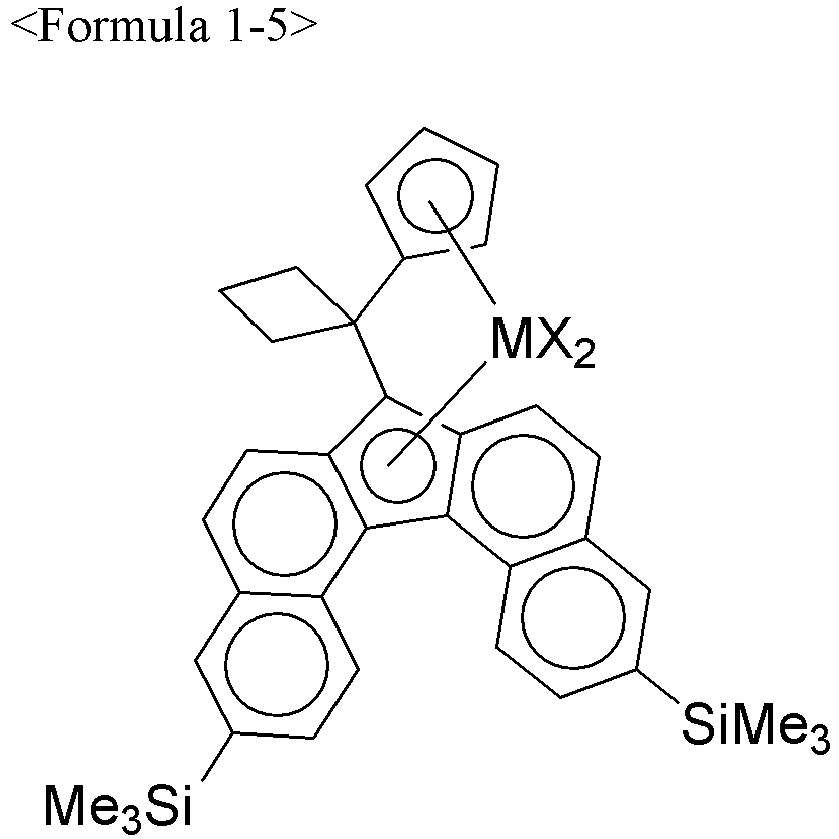


- In Formulae 1-1 to 1-12, M may be zirconium or hafnium, and X may each be independently a halogen or a C1-20 alkyl.
- The transition metal compound may be any one or more of the following Formulae A to D.


- The transition metal compound may be a compound of Formula A. Formula A includes hafnium (Hf) as a central metal, so that an olefin polymerization catalyst for polymerizing a polyolefin including Formula A may have characteristics which are excellent in the adjustment of a molecular weight of a polyolefin and copolymerizability. Further, when a bridge substituent between cyclopentadiene groups in the transition compound of Formula A is a cyclobutyl group, the activity performance and polymerization performance of the olefin polymerization catalyst are excellent compared to the case where the bridge substituent is an alkyl.
- Meanwhile, the olefin polymerization catalyst for polymerizing a polyolefin may include one or more of the exemplified transition metal compounds and a cocatalyst compound.
- The cocatalyst compound may include one or more of a compound represented by the following Formula I, a compound represented by the following Formula II and a compound represented by Formula III.

- In Formula I, n may an integer of 2 or higher, and Ra is a halogen atom, a C1-hydrocarbon group or a C1-20 hydrocarbon group substituted with a halogen. Specifically, Ra may be methyl, ethyl, n-butyl or isobutyl, but is not limited thereto.

- In Formula II, D may be aluminum (Al) or boron (B), and Rb, Rc and Rd may each be independently a halogen atom, a C1-20 hydrocarbon group, a C1-20 hydrocarbon group substituted with a halogen or a C1-20 alkoxy group. Specifically, when D is aluminum, Rb, Rc and Rd may each be independently methyl or isobutyl, and when D is boron, Rb, Rc and Rd may each be independently pentafluorophenyl, but are not limited thereto.
<Formula III> [L-H]+[Z(A)4]- or [L]+[Z(A)4]-
- In Formula III, L may be a neutral or cationic Lewis base, [L-H]+ or [L]+ may be a Brönsted acid, Z may be a Group 13 element, and A may each be independently a substituted or unsubstituted C6-20 aryl group or a substituted or unsubstituted C1-20 alkyl group. Specifically, the [L-H]+ may be a dimethylanilinium cation, the [Z(A)4]- may be [B(C6F5)4]-, and the [L]+ may be [(C6H5)3C]+, but are not limited thereto.
- The olefin polymerization catalyst may further include a carrier.
- The carrier is not particularly limited as long as it can support a transition metal compound for an olefin polymerization catalyst and a cocatalyst compound. The carrier may be carbon, silica, alumina, zeolite, and magnesium chloride.
- As a method of supporting a transition metal compound for an olefin polymerization catalyst and a cocatalyst compound on a carrier, a physical adsorption method or a chemical adsorption method may be used.
- In exemplary embodiments, the physical adsorption method may be a method of bringing a solution in which a transition metal compound for an olefin polymerization catalyst is dissolved into contact with a carrier, and then drying the carrier, a method of bringing a solution in which a transition metal compound for an olefin polymerization catalyst and a cocatalyst compound are dissolved into contact with a carrier, and then drying the carrier, a method of preparing a carrier on which a transition metal compound for an olefin polymerization catalyst is supported by bringing a solution in which a transition metal compound for an olefin polymerization catalyst is dissolved into contact with a carrier, and then drying the carrier, separately preparing a catalyst on which a cocatalyst compound is supported by bringing a solution in which a cocatalyst compound is dissolved into contact with a carrier, and then drying the carrier, and then mixing the carriers.
- In exemplary embodiments, the chemical adsorption method may be a method of first supporting a cocatalyst compound on the surface of a carrier, and then supporting a transition metal compound for an olefin polymerization catalyst on the cocatalyst compound, a method of covalently bonding a catalyst compound with a functional group (for example, in the case of silica, a hydroxy group (-OH) on the surface of a carrier.
- A total supported amount of the main catalyst compound including a transition metal compound may be 0.001 mmol to 1 mmol based on 1 g of a carrier, and the supported amount of the cocatalyst compound may be 2 mmol to 15 mmol based on 1 g of the carrier.
- However, such carriers need not be essentially included, and whether or not they can be used can be appropriately selected, if necessary.
- Since the olefin polymerization catalyst including the transition metal compound of the present invention has stability at high temperatures and excellent reactivity with an olefin, particularly, an α-olefin, the olefin is easily polymerized, thus the catalyst has high catalytic activity and it is possible to prepare a polyolefin having low molecular weight and low viscosity characteristics.
- This may be caused by the improvement in (co)polymerization reactivity of the olefin due to the relative abundance of electrons, particularly, in the case of the transition metal compound of the present invention in which two adjacent ones of R7 to R10 are linked to each other to form a substituted or unsubstituted aromatic C6 ring, but is not limited thereto.
- Hereinafter, specific preparation examples for the compounds represented by Formulae A to D among the transition metal compounds for an olefin polymerization catalyst of the present invention will be described.
- After t-BuLi (15.8 g, 41.1 mmol, 1.7 M in pentane) was added to a solution in which 2,2'-dibromo-1,1'-binaphthyl (3.85 g, 9.34 mmol) was diluted in THF (40 mL) at -78°C, the resulting solution was stirred for 1 hour. After a CO2 gas was injected into the solution at -78°C for 3 minutes, the temperature was slowly increased to room temperature, and the resulting solution was stirred for 12 hours. After the reaction was terminated by adding 10% HCl thereto at 0°C, the THF was removed under vacuum. An organic layer was separated by performing extraction with ethyl acetate, and recrystallized with chloroform to obtain 3.49 g (quant.) of 2,2'-dibromo-1,1'-binaphthyl which is a white solid compound having a 1H-NMR spectrum as follows.
- 1H-NMR (DMSO-d6, 300 MHz): δ 124 (s, 2H), 8.11-8.00 (m, 6H), 7.54 (t, 2H), 7.27 (t, 2H), 6.87 (d, 2H).
- 1,1'-binaphthyl-2,2'-dicarboxylic acid (3.02 g, 8.82 mmol) prepared in Preparation Example 1-1 and acetic anhydride (30 mL) were mixed, and the resulting mixture was stirred at 140°C for 1 and a half hours. After the acetic anhydride was removed under vacuum, the remaining solution was stirred at 300°C for 3 hours. After the solution was filtered with dichloromethane, the residue was subjected to column chromatography (hexane : dichloromethane = 1 : 1, v/v) to obtain 1.17 g (47%) of 7H-dibenzo[c,g]fluoren-7-one which is a red solid compound having a 1H-NMR spectrum as follows.
- 1H-NMR (CDCl3, 300 MHz): δ 8.37-8.33 (m, 2H), 7.92-7.87 (m, 2H), 7.83 (d, 2H), 7.77 (d, 2H), 7.60-7.55 (m, 4H).
- A solution in which 7H-dibenzo[c,g]fluoren-7-one (641 mg, 2.29 mmol) prepared in Preparation Example 1-2, N2H4·H2O (2.86 g, 57.2 mmol) and KOH (385 mg, 6.86 mmol) were dispersed in diethylene glycol (30 mL) was stirred at 170°C for 3 hours. After the reaction was terminated by adding 10% HCl thereto at 0°C, the resulting solid was filtered. The solid was dried under vacuum to obtain 603 mg (99%) of 7H-dibenzo[c,g]fluorene which is a dark brown solid compound having a 1H-NMR spectrum as follows.
- 1H-NMR (CDCl3, 300 MHz): δ 8.73 (d, 2H), 7.97 (d, 2H), 7.86 (d, 2H), 7.73 (d, 2H), 7.59-7.48 (m, 4H), 4.13 (s, 2H).
- After n-BuLi (980 mg, 2.30 mmol, 1.6 M in hexane) was slowly added to a solution in which 7H-dibenzo[c,g]fluorene (585 mg, 2.20 mmol) prepared in Preparation Example 1-3 was diluted in diethyl ether (50 mL) at -30°C, the temperature was slowly increased to room temperature, and the resulting solution was stirred for 12 hours. The resulting solid was filtered, and then dried under vacuum to obtain 598 mg (100%) of (7H-dibenzo[c,g]fluorene) lithium, which is a light brownish yellow solid compound.
- After a solution in which 5-cyclobutylidene-1,3-cyclopentadiene (518 mg, 4.38 mmol) was diluted in diethyl ether (10 mL) was slowly added to a solution in which (7H-dibenzo[c,g]fluorene) lithium (596 mg, 2.19 mmol) prepared in Preparation Example 1-4 was dispersed in diethyl ether (35 mL) at -30°C, the temperature was slowly increased to room temperature, and the resulting solution was stirred for 3 days. After the reaction was terminated, an organic layer was separated by performing extraction with diethyl ether and aqueous NH4Cl. The organic layer was recrystallized with hexane to obtain 654 mg (78%) of 9-[1-(2,4-cyclopentadien-1-yl)-1-cyclobutyl]-7H-dibenzo[c,g] fluorene which is a white solid compound having a 1H-NMR spectrum as follows.
- 1H-NMR (CDCl3, 300 MHz): δ 8.56-8.47 (m, 2H), 7.95-7.89 (m, 2H), 7.79-7.76 (m, 4H), 7.50-7.44 (m, 4H), 5.96-5.81 (m, 1H), 5.74-5.67 (m, 1H), 5.59-5.50 (m, 1H), 4.42 (d, 1H), 2.99-2.79 (m, 2H), 2.58-2.44 (m, 2H), 2.39-2.02 (m, 2H), 2.01-1.94 (m, 2H).
- After n-BuLi (741 mg, 1.74 mmol, 1.6 M in Hexane) was slowly added to a solution in which 9-[1-(2,4-cyclopentadien-1-yl)-1-cyclobutyl]-7H-dibenzo[c,g] fluorene (319 mg, 0.83 mmol) prepared in Preparation Example 1-5 was diluted in diethyl ether (35 mL) at -30°C, the temperature was slowly increased to room temperature, and the resulting solution was stirred for 12 hours. The resulting solid was filtered, and then dried under vacuum to obtain 368 mg (quant., ether adduct) of cyclobutylidene [(cyclopentadienyl)-(7H-dibenzo[c,g]fluorenyl)] dilithium which is a light brownish yellow solid compound.
- After a solution in which HfCl4 (277 mg, 0.86 mmol) was diluted in toluene (5 mL) was slowly added to a solution in which cyclobutylidene [(cyclopentadienyl)-(7H-dibenzo[c,g]fluorenyl)] dilithium (342 mg, 0.86 mmol) prepared in Preparation Example 1-6 was dispersed in toluene (40 mL) at -30°C, the temperature was slowly increased to room temperature, and the resulting solution was stirred for 12 hours. After the reaction was terminated, the resulting product was extracted with toluene and filtered. After the toluene was removed under vacuum, the residue was washed with hexane to obtain 335 mg (61%) of cyclobutylidene [(cyclopentadienyl)-(7H-dibenzo[c,g]fluorenyl)] hafnium dichloride which is a yellow solid compound having a 1H-NMR spectrum as follows.
- 1H-NMR (C6D6, 300 MHz): δ 9.10 (d, 2H), 7.69 (d, 2H), 7.39-7.24 (m, 8H), 6.02 (t, 2H), 5.44 (t, 2H), 2.90-2.77 (m, 2H), 2.58 (t, 2H), 2.26-2.14 (m, 1H), 1.88-1.74 (m, 1H).
- After a solution in which MeMgBr (448 mg, 1.30 mmol, 3.0 M in diethyl ether) was diluted in toluene (5 mL) was slowly added to a solution in which cyclobutylidene [(cyclopentadienyl)-(7H-dibenzo[c,g]fluorenyl)] hafnium dichloride (273 mg, 0.43 mmol) prepared in Preparation Example 1-7 was dispersed in toluene (20 mL) at -30°C, the resulting solution was stirred under reflux at 70°C for 4 hours. After the reaction was terminated, the resulting product was extracted with toluene and filtered. After the toluene was removed under vacuum, the residue was washed with hexane to obtain 182 mg (71%) of cyclobutylidene [(cyclopentadienyl)-(7H-dibenzo[c,g]fluorenyl)] hafnium dichloride (a compound of the following Formula A) which is a yellow solid compound having a 1H-NMR spectrum as follows.
- 1H-NMR (C6D6, 300 MHz): δ 9.22 (d, 2H), 7.73 (d, 2H), 7.46-7.22 (m, 8H), 6.03 (t, 2H), 5.40 (t, 2H), 2.90-2.80 (m, 2H), 2.68-2.58 (m, 2H), 2.34-2.18 (m, 1H), 1.92-1.84 (m, 1H), -1.37 (s, 6H).

- After a solution in which ZrCl4 (74 mg, 0.32 mmol) was diluted in toluene (3 mL) was slowly added to a solution in which cyclobutylidene [(cyclopentadienyl)-(7H-dibenzo[c,g]fluorenyl)] dilithium (127 mg, 0.32 mmol) prepared in Preparation Example 1-6 was dispersed in toluene (10 mL) at -30°C, the temperature was slowly increased to room temperature, and the resulting solution was stirred for 12 hours. After the reaction was terminated, the resulting product was extracted with toluene and filtered. After the toluene was removed under vacuum, the residue was washed with hexane to obtain 128 mg (74%) of cyclobutylidene [(cyclopentadienyl)-(7H-dibenzo[c,g]fluorenyl)] zirconium dichloride (a compound of the following Formula B) which is an orange solid compound having a 1H-NMR spectrum as follows.
- 1H-NMR (C6D6, 300 MHz): δ 9.15 (d, 2H), 7.72 (d, 2H), 7.42-7.30 (m, 8H), 6.11 (t, 2H), 5.52 (t, 2H), 2.92-2.82 (m, 2H), 2.60 (t, 2H), 2.28-2.16 (m, 1H), 1.92-1.82 (m, 1H).

- After a solution in which 6,6-dimethylfulvene (522 mg, 4.92 mmol) was diluted in diethyl ether (5 mL) was slowly added to a solution in which (7H-dibenzo[c,g]fluorene) lithium (893 mg, 3.28 mmol) prepared in Preparation Example 1-4 was dispersed in diethyl ether (35 mL) at -78°C, the temperature was slowly increased to room temperature, and the resulting solution was stirred for 12 hours. After the reaction was terminated, an organic layer was separated by performing extraction with diethyl ether and aqueous NH4Cl. The organic layer was subjected to column chromatography (hexane 100%) to obtain 907 mg (74%) of 2,2-[(cyclopentadienyl)-(7H-dibenzo[c,g]fluorenyl)] propane which is a soft beige solid compound having 1H-NMR spectrum as follows.
- 1H-NMR (CDCl3, 300 MHz): δ 8.61 (d, 2H), 7.91 (d, 2H), 7.74-7.66 (m, 2H), 7.52-7.46 (m, 4H), 7.41 (d, 1H), 7.32 (d, 1H), 7.00-6.64 (m, 1H), 6.57-6.45 (m, 1H), 6.16-5.87 (m, 1H), 4.33 (d, 1H), 3.24-3.08 (m, 2H), 1.08 (s, 3H), 1.07 (s, 3H).
- After n-BuLi (1.24 mg, 2.93 mmol, 1.6 M in hexane) was slowly added to a solution in which 2,2-[(cyclopentadienyl)-(7H-dibenzo[c,g]fluorenyl)] propane (519 mg, 1.39 mmol) prepared in Preparation Example 3-1 was diluted in diethyl ether (10 mL) at -30°C, the temperature was slowly increased to room temperature, and the resulting solution was stirred for 12 hours. The resulting solid was filtered, and then dried under vacuum to obtain 600 mg (quant., ether adduct) of isopropylidene [(cyclopentadienyl)-(7H-dibenzo[c,g]fluorenyl)] dilithium which is a yellow solid compound.
- After a solution in which HfCl4 (472 mg, 1.47 mmol) was diluted in toluene (10 mL) was slowly added to a solution in which isopropylidene [(cyclopentadienyl)-(7H-dibenzo[c,g]fluorenyl)] dilithium (566 mg, 1.47 mmol) prepared in Preparation Example 3-2 was dispersed in toluene (40 mL) at -30°C, the temperature was slowly increased to room temperature, and the resulting solution was stirred for 12 hours. After the reaction was terminated, the resulting product was extracted with toluene and filtered. After the toluene was removed under vacuum, the residue was washed with hexane to obtain 549 mg (60%) of isopropylidene [(cyclopentadienyl)-(7H-dibenzo[c,g]fluorenyl)] hafnium dichloride which is a yellow solid compound having a 1H-NMR spectrum as follows.
- 1H-NMR (CDCl3, 300 MHz): δ 8.84 (d, 2H), 7.95 (d, 2H), 7.88-7.82 (m, 2H), 7.61-7.54 (m, 4H), 7.49 (d, 2H), 6.30 (t, 2H), 5.88 (t, 2H), 2.48 (s, 6H).
- After a solution in which MeMgBr (468 mg, 1.36 mmol, 3.0 M in diethyl ether) was diluted in toluene (2 mL) was slowly added to a solution in which isopropylidene [(cyclopentadienyl)-(7H-dibenzo[c,g]fluorenyl)] hafnium dichloride (400 mg, 0.65 mmol) prepared in Preparation Example 3-3 was dispersed in toluene (20 mL) at -30°C, the resulting solution was stirred under reflux at 70°C for 2 hours. After the reaction was terminated, the resulting product was extracted with toluene and filtered. After the toluene was removed under vacuum, the residue was washed with hexane to obtain 241 mg (64%) of isopropylidene [(cyclopentadienyl)-(7H-dibenzo[c,g]fluorenyl)] hafnium dimethyl (a compound of the following Formula C) which is a yellow solid compound having a 1H-NMR spectrum as follows.
- 1H-NMR (CDCl3, 300 MHz): δ 8.92 (d, 2H), 7.84 (t, 4H), 7.60-7.46 (m, 4H), 7.41 (d, 2H), 6.23 (t, 2H), 5.66 (t, 2H), 2.26 (s, 6H), -1.82 (s, 6H).


- After a solution in which ZrCl4 (107 mg, 0.46 mmol) was diluted in toluene (5 mL) was slowly added to a solution in which isopropylidene [(cyclopentadienyl)-(7H-dibenzo[c,g]fluorenyl)] dilithium (176 mg, 0.46 mmol) prepared in Preparation Example 3-2 was dispersed in toluene (20 mL) at -30°C, the temperature was slowly increased to room temperature, and the resulting solution was stirred for 12 hours. After the reaction was terminated, the resulting product was extracted with toluene and filtered. After the toluene was removed under vacuum, the residue was washed with hexane to obtain 107 mg (44 %) of isopropylidene [(cyclopentadienyl)-(7H-dibenzo[c,g]fluorenyl)] zirconium dichloride (a compound of the following Formula D) which is a reddish brown solid compound having a 1H-NMR spectrum as follows.
- 1H-NMR (CDCl3, 300 MHz): δ 8.87 (d, 2H), 7.95-7.84 (m, 4H), 7.62-7.50 (m, 6H), 6.37 (t, 2H), 5.94 (t, 2H), 2.48 (s, 6H).


- Ethylene and 1-octene were copolymerized as follows using an olefin polymerization catalyst including the compound of Formula A prepared in Preparation Example 1.
- First, after a 850-mL reactor was heated to 140°C to 150°C using a temperature control jacket, the pressure of the reactor was maintained at 90 bar while continuously supplying a hexane solvent, 1-octene (Cs), hydrogen, a scavenger and ethylene (C2). A catalyst and a cocatalyst were each continuously injected directly into the reactor, and dimethylanilinium tetrakis(pentafluorophenyl)borate was used as the cocatalyst and tri-iso-butylaluminium (TiBA) was used as the scavenger.
- As the catalyst, an olefin polymerization catalyst including the compound of Formula A prepared in Preparation Example 1 was used, and for the catalyst, a certain amount of compound of Formula A was dissolved in a hexane solvent, the resulting solution was treated with tri-iso-butylaluminium (TiBA), and the treated solution was injected directly into the reactor.
- A polymer melted in the reactor passed through a reactor discharge stream and entered a separator, and unreacted ethylene and 1-octene were separated from the hexane solvent, and then dried in a vacuum oven at 80°C for 12 hours or more to prepare an [ethylene]-[1-octene] polyolefin.
- In the preparation process, a polyolefin was prepared by injecting ethylene as an olefin-based monomer and 1-octene as a comonomer thereinto at a flow rate of 8.3 g/min and 8 g/min, respectively, and introducing Formula A of Preparation Example 1 and hydrogen (H2) thereinto at a flow rate of 0.044 g/min and 0.2 g/hr, respectively, and the polyolefin prepared as described above is referred to hereinafter as `Example 1'.
- A polyolefin was prepared in the same manner as in Example 1, except that 1-octene as a comonomer was injected thereinto at a flow rate of 12 g/min, and the polyloefin prepared as described above is referred to hereinafter as `Example 2'.
- Ethylene and 1-hexene were copolymerized as follows using an olefin polymerization catalyst including a compound of the following Formula E.

- A polyolefin was prepared in the same manner as in Example 1, except that the transition metal compound of Formula E as an olefin polymerization catalyst was injected thereinto at a flow rate of 0.049 g/min, and 1-octene as a comonomer and hydrogen (H2) were injected thereinto at a flow rate of 10 g/min and 0 g/hr, respectively, and the polyolefin prepared as described above is referred to hereinafter as the `Comparative Example 1'.
- A polyolefin was prepared in the same manner as in Comparative Example 1, except that 1-octene as a comonomer was injected thereinto at a flow rate of 12 g/min, and the polyloefin prepared as described above is referred to hereinafter as 'Comparative Example 2'.
- A polyolefin was prepared in the same manner as in Comparative Example 1, except that 1-octene as a comonomer and hydrogen (H2) were injected thereinto at a flow rate of 8g/min and 0.3 g/hr, respectively, and the polyolefin prepared as described above is referred to hereinafter as `Comparative Example 3'.
- A polyolefin was prepared in the same manner as in Comparative Example 3, except that 1-octene as a comonomer was injected thereinto at a flow rate of 12 g/min, and the polyloefin prepared as described above is referred to hereinafter as 'Comparative Example 4'.
- Properties of each of the polyolefins prepared in Examples 1 and 2 and Comparative Examples 1 to 4, and catalytic activities of Formulae A and E were measured, and the results thereof are shown in the following Table 1. In the following Table 1, for each of the respective Examples and Comparative Examples, the density, molecular weight (3D-GPC), and Brookfield viscosity (Brookfield, cP) were measured at room temperature, 160°C, and 177°C, respectively.
[Table 1] Exam ple 1 Exam ple 2 Comparat ive Example 1 Comparat ive Example 2 Comparat ive Example 3 Comparat ive Example 4 Catalyst Type Formula A Formula E Catalyst (g/min) 0.044 0.044 0.049 0.049 0.049 0.049 Ethylene (C2, g/min) 8.3 8.3 8.3 8.3 8.3 8.3 1-octene (C8, g/min) 8 12 10 12 8 12 C8/C2 (Molar rate) 0.24 0.36 0.3 0.36 0.24 0.36 Catalytic activity (kg-PE/g-cat) 167 194 124 20.2 136 150 H2 (g/hr) 0.2 0.2 0 0 0.3 0.3 Reaction temperat ure (°C) 152 151 152 150 149 150 Density (g/cc) 0.880 0.863 0.863 0.868 0.875 0.858 Mn (3D-GPC) 8,077 6,519 71,450 100,416 25,279 30,456 MW (3D-GPC) 19,451 17,491 124,282 158,924 48,761 51,868 MWD (3D-GPC) 2.41 2.68 1.74 1.58 1.93 1.70 Viscosity (Brook field, cP at 177°C) 9,998 5,549 Cannot be measured Cannot be measured 250,000 2,950,000 - As shown in Table 1, it can be seen that in the case of Examples 1 and 2, an olefin polymerization catalyst including the compound of Formula A has high catalytic activity, and a polyolefin polymerized in the presence of the catalyst has low molecular weight and low viscosity characteristics. In contrast, it can be seen that in the case of Comparative Examples 1 to 4, an olefin polymerization catalyst including the compound of Formula E has low catalytic activity, and a polyolefin polymerized in the presence of the catalyst has a high molecular weight.
- In particular, when Examples 1 and 2 and Comparative Examples 3 and 4 were compared, polyolefins having a low molecular weight could be prepared even though Examples 1 and 2 had a small amount of hydrogen (H2) introduced. Further, the larger the injected amount of catalyst is, the lower the molecular weight of the polymerized polyolefin tends to be, but it could be seen that in the case of Examples 1 and 2, the prepared polyolefin had a smaller molecular weight than Comparative Examples 1 to 4 even though a smaller amount of catalyst was used compared to Comparative Examples 1 to 4.
- That is, the polyolefin according to an exemplary embodiment of the present invention is polymerized in the presence of an olefin polymerization catalyst including a transition metal compound, which has high catalytic activity and is excellent in the adjustment of a molecular weight and copolymerizability, and thus may have low molecular weight and low viscosity characteristics even though relatively small amounts of catalyst and hydrogen are introduced.
Claims (6)
- A method for preparing a polyolefin, the method comprising: forming a polyolefin by polymerizing an olefin-based monomer and a comonomer in the presence of an olefin polymerization catalyst comprising a transition metal compound represented by the following Formula A or B, and a cocatalyst compound;
wherein the polyolefin has a viscosity ranging from 5000 cP to 10000 cP, as measured by Brookfield viscometer at 177°C;

- The method of claim 1, wherein the olefin polymerization catalyst has a catalytic activity ranging from 160 kg-PE/g-Cat to 200 kg-PE/g-Cat, determined as specified in the description .
- The method of claim 1, wherein the polyolefin has a weight average molecular weight (Mw) of 20,000 or less, as determined by 3D-GPC.
- The method of claim 1, wherein the polyolefin has a number average molecular weight (Mn) of 10,000 or less, as determined by 3D-GPC, and a molecular weight distribution (MWD) ranging from 2 to 3, as determined by 3D-GPC and defined by the following Mathematical Formula 1.

- The method of claim 1, wherein the olefin-based monomer is ethylene, and the comonomer is 1-octene.
- The method of claim 1, wherein the cocatalyst compound comprises at least any one of a compound represented by the following Formula I, a compound represented by the following Formula II and a compound represented by Formula III.
 in Formula I, n is an integer of 2 or higher, andRa is a halogen atom, a C1-20 hydrocarbon group or a C1-20 hydrocarbon group substituted with a halogen
 in Formula II, D is aluminum (Al) or boron (B), andRb, Rc and Rd are each independently a halogen atom, a C1-20 hydrocarbon group, a C1-20 hydrocarbon group substituted with a halogen group or a C1-20 alkoxy group
<Formula III> [L-H]+[Z(A)4]- or [L]+[Z(A)4]-
in Formula III, L is a neutral or cationic Lewis base,[L-H]+ and [L]+ are Brönsted acids,Z is a Group 13 element, andA is each independently a substituted or unsubstituted C6-20 aryl group or a substituted or unsubstituted C1-20 alkyl group.
Applications Claiming Priority (2)
| Application Number | Priority Date | Filing Date | Title |
|---|---|---|---|
| KR1020180158913A KR102382131B1 (en) | 2018-12-11 | 2018-12-11 | Polyolefin and method for manufacturing the same |
| PCT/KR2019/012003 WO2020122371A1 (en) | 2018-12-11 | 2019-09-17 | Polyolefin and method for preparing same |
Publications (3)
| Publication Number | Publication Date |
|---|---|
| EP3896102A1 EP3896102A1 (en) | 2021-10-20 |
| EP3896102A4 EP3896102A4 (en) | 2022-09-07 |
| EP3896102B1 true EP3896102B1 (en) | 2024-11-06 |
Family
ID=71076066
Family Applications (1)
| Application Number | Title | Priority Date | Filing Date |
|---|---|---|---|
| EP19897225.9A Active EP3896102B1 (en) | 2018-12-11 | 2019-09-17 | Polyolefin and method for preparing same |
Country Status (6)
| Country | Link |
|---|---|
| US (1) | US12187824B2 (en) |
| EP (1) | EP3896102B1 (en) |
| JP (1) | JP7223139B2 (en) |
| KR (1) | KR102382131B1 (en) |
| CN (1) | CN113195558B (en) |
| WO (1) | WO2020122371A1 (en) |
Families Citing this family (2)
| Publication number | Priority date | Publication date | Assignee | Title |
|---|---|---|---|---|
| CN114230702B (en) * | 2022-01-17 | 2023-10-13 | 万华化学集团股份有限公司 | Olefin polymerization catalyst with naphthoxy skeleton, preparation method and application |
| KR102869729B1 (en) * | 2023-12-26 | 2025-10-14 | 디엘케미칼 주식회사 | Ethylene/alpha-olefin copolymer and method for preparing same |
Citations (2)
| Publication number | Priority date | Publication date | Assignee | Title |
|---|---|---|---|---|
| US5451649A (en) * | 1991-05-09 | 1995-09-19 | Phillips Petroleum Company | Organometallic fluorenyl compounds, preparation, and use |
| EP3708592A1 (en) * | 2017-11-10 | 2020-09-16 | Hanwha Solutions Corporation | Transition metal compound for olefin polymerization catalyst, olefin polymerization catalyst comprising same, and polyolefin polymerized using same |
Family Cites Families (14)
| Publication number | Priority date | Publication date | Assignee | Title |
|---|---|---|---|---|
| KR100368194B1 (en) * | 1994-10-13 | 2003-04-03 | 니혼폴리올레핀 가부시키가이샤 | A catalyst component for producing polyolefin, a catalyst for producing polyolefin containing the catalyst component, and a method for producing polyolefin in the presence of the catalyst |
| JP3537236B2 (en) * | 1994-10-13 | 2004-06-14 | 昭和電工株式会社 | Catalyst component for producing polyolefin, catalyst for producing polyolefin containing the component, and method for producing polyolefin |
| ID16442A (en) * | 1996-01-22 | 1997-10-02 | Dow Chemical Co | WEIGHT POLYMER ETHYLENE ULTRA LOW MOLECULES |
| CN100434433C (en) * | 1999-10-08 | 2008-11-19 | 三井化学株式会社 | Metallocene compound and preparation method thereof, olefin polymerization catalyst, polyolefin and preparation method thereof |
| US6875719B2 (en) | 2000-04-27 | 2005-04-05 | Industrial Technology Research Institute | Catalyst composition for preparing olefin polymers |
| JP2004051676A (en) | 2002-07-16 | 2004-02-19 | Mitsui Chemicals Inc | Production method for ethylene copolymer |
| JP2005200452A (en) | 2004-01-13 | 2005-07-28 | Mitsui Chemicals Inc | METHOD FOR PRODUCING alpha-OLEFIN (CO)POLYMER |
| US7741419B2 (en) * | 2004-03-31 | 2010-06-22 | Mitsui Chemicals, Inc. | Process for producing olefin polymers |
| JP2006176760A (en) | 2004-11-26 | 2006-07-06 | Mitsui Chemicals Inc | Synthetic lubricating oil and lubricating oil composition |
| WO2006126610A1 (en) | 2005-05-25 | 2006-11-30 | Mitsui Chemicals, Inc. | Transition metal compound, olefin polymerization catalyst, and process for producing olefin polymer |
| JP2010150334A (en) | 2008-12-24 | 2010-07-08 | Mitsui Chemicals Inc | Method for producing ethylenic wax |
| WO2015147215A1 (en) | 2014-03-28 | 2015-10-01 | 三井化学株式会社 | ETHYLENE/α-OLEFIN COPOLYMER AND LUBRICATING OIL |
| KR101711788B1 (en) * | 2016-03-09 | 2017-03-14 | 한화케미칼 주식회사 | Hybride catalyst compositon, preparation method thereof, and manufactured polyolefin using the same |
| KR102193693B1 (en) | 2018-03-21 | 2020-12-21 | 한화솔루션 주식회사 | Transition metal compound used to prepare catalyst for polymerizing olefin, catalyst for polymerizing olefin comprising the same and polyolefin polymerized by using the same |
-
2018
- 2018-12-11 KR KR1020180158913A patent/KR102382131B1/en active Active
-
2019
- 2019-09-17 JP JP2021533173A patent/JP7223139B2/en active Active
- 2019-09-17 WO PCT/KR2019/012003 patent/WO2020122371A1/en not_active Ceased
- 2019-09-17 EP EP19897225.9A patent/EP3896102B1/en active Active
- 2019-09-17 CN CN201980081827.0A patent/CN113195558B/en active Active
- 2019-09-17 US US17/296,991 patent/US12187824B2/en active Active
Patent Citations (2)
| Publication number | Priority date | Publication date | Assignee | Title |
|---|---|---|---|---|
| US5451649A (en) * | 1991-05-09 | 1995-09-19 | Phillips Petroleum Company | Organometallic fluorenyl compounds, preparation, and use |
| EP3708592A1 (en) * | 2017-11-10 | 2020-09-16 | Hanwha Solutions Corporation | Transition metal compound for olefin polymerization catalyst, olefin polymerization catalyst comprising same, and polyolefin polymerized using same |
Also Published As
| Publication number | Publication date |
|---|---|
| US20210395412A1 (en) | 2021-12-23 |
| CN113195558B (en) | 2023-10-03 |
| JP7223139B2 (en) | 2023-02-15 |
| EP3896102A4 (en) | 2022-09-07 |
| KR102382131B1 (en) | 2022-04-01 |
| KR20200071318A (en) | 2020-06-19 |
| US12187824B2 (en) | 2025-01-07 |
| EP3896102A1 (en) | 2021-10-20 |
| JP2022512356A (en) | 2022-02-03 |
| WO2020122371A1 (en) | 2020-06-18 |
| CN113195558A (en) | 2021-07-30 |
Similar Documents
| Publication | Publication Date | Title |
|---|---|---|
| JP6469832B2 (en) | Ligand compound, transition metal compound and catalyst composition containing the same | |
| US6232420B1 (en) | Polymers from ionic metallocene catalyst compositions | |
| US5198401A (en) | Ionic metallocene catalyst compositions | |
| EP3219718B1 (en) | Ligand compound, transition metal compound, and catalyst composition containing compounds | |
| EP3456724B1 (en) | Ligand compound, transition metal compound, and catalyst composition containing same | |
| US12187824B2 (en) | Polyolefin and method for preparing same | |
| EP3783004B1 (en) | Transition metal compound, catalyst composition comprising same, and polymer preparation method using same | |
| EP3792288B1 (en) | Transition metal compound for olefin polymerization catalyst, and olefin polymerization catalyst including same | |
| EP3708592A1 (en) | Transition metal compound for olefin polymerization catalyst, olefin polymerization catalyst comprising same, and polyolefin polymerized using same | |
| KR102455607B1 (en) | Transition metal compound used to prepare catalyst for polymerizing olefin, catalyst for polymerizing olefin comprising the same and polyolefin polymerized by using the same | |
| KR102193693B1 (en) | Transition metal compound used to prepare catalyst for polymerizing olefin, catalyst for polymerizing olefin comprising the same and polyolefin polymerized by using the same | |
| KR101202719B1 (en) | Preparation method of polyolefin and polyolefin prepared therefrom | |
| KR100376053B1 (en) | Metallocene Catalysts Having Multi-Nuclear Constrained Geometry and Polymerization Process Using the Catalysts | |
| KR20190023926A (en) | Catalyst System For Ethylene Oligomerization And Method For Preparation Of Linear Alpha Olefin | |
| KR20220101482A (en) | Novel metallocene compound, catalyst composition comprising the same, and method for preparing olefin polymer using the same | |
| KR20220055863A (en) | Novel metallocene compound, catalyst composition comprising the same, and method for preparing olefin polymer using the same | |
| US20030144435A1 (en) | Catalyst activator | |
| KR20220017199A (en) | Transition metal compound, method for preparing the same, and catalyst composition comprising the same |
Legal Events
| Date | Code | Title | Description |
|---|---|---|---|
| STAA | Information on the status of an ep patent application or granted ep patent |
Free format text: STATUS: THE INTERNATIONAL PUBLICATION HAS BEEN MADE |
|
| PUAI | Public reference made under article 153(3) epc to a published international application that has entered the european phase |
Free format text: ORIGINAL CODE: 0009012 |
|
| STAA | Information on the status of an ep patent application or granted ep patent |
Free format text: STATUS: REQUEST FOR EXAMINATION WAS MADE |
|
| 17P | Request for examination filed |
Effective date: 20210527 |
|
| AK | Designated contracting states |
Kind code of ref document: A1 Designated state(s): AL AT BE BG CH CY CZ DE DK EE ES FI FR GB GR HR HU IE IS IT LI LT LU LV MC MK MT NL NO PL PT RO RS SE SI SK SM TR |
|
| DAV | Request for validation of the european patent (deleted) | ||
| DAX | Request for extension of the european patent (deleted) | ||
| A4 | Supplementary search report drawn up and despatched |
Effective date: 20220803 |
|
| RIC1 | Information provided on ipc code assigned before grant |
Ipc: C08F 4/52 20060101ALI20220729BHEP Ipc: C08F 4/659 20060101ALI20220729BHEP Ipc: C08F 4/6592 20060101ALI20220729BHEP Ipc: C08F 2/38 20060101ALI20220729BHEP Ipc: C08F 210/02 20060101ALI20220729BHEP Ipc: C08F 210/16 20060101AFI20220729BHEP |
|
| STAA | Information on the status of an ep patent application or granted ep patent |
Free format text: STATUS: EXAMINATION IS IN PROGRESS |
|
| 17Q | First examination report despatched |
Effective date: 20230720 |
|
| GRAP | Despatch of communication of intention to grant a patent |
Free format text: ORIGINAL CODE: EPIDOSNIGR1 |
|
| STAA | Information on the status of an ep patent application or granted ep patent |
Free format text: STATUS: GRANT OF PATENT IS INTENDED |
|
| INTG | Intention to grant announced |
Effective date: 20240719 |
|
| GRAS | Grant fee paid |
Free format text: ORIGINAL CODE: EPIDOSNIGR3 |
|
| GRAA | (expected) grant |
Free format text: ORIGINAL CODE: 0009210 |
|
| STAA | Information on the status of an ep patent application or granted ep patent |
Free format text: STATUS: THE PATENT HAS BEEN GRANTED |
|
| AK | Designated contracting states |
Kind code of ref document: B1 Designated state(s): AL AT BE BG CH CY CZ DE DK EE ES FI FR GB GR HR HU IE IS IT LI LT LU LV MC MK MT NL NO PL PT RO RS SE SI SK SM TR |
|
| REG | Reference to a national code |
Ref country code: GB Ref legal event code: FG4D |
|
| REG | Reference to a national code |
Ref country code: CH Ref legal event code: EP |
|
| REG | Reference to a national code |
Ref country code: DE Ref legal event code: R096 Ref document number: 602019061730 Country of ref document: DE |
|
| REG | Reference to a national code |
Ref country code: IE Ref legal event code: FG4D |
|
| REG | Reference to a national code |
Ref country code: LT Ref legal event code: MG9D |
|
| REG | Reference to a national code |
Ref country code: NL Ref legal event code: MP Effective date: 20241106 |
|
| PG25 | Lapsed in a contracting state [announced via postgrant information from national office to epo] |
Ref country code: PT Free format text: LAPSE BECAUSE OF FAILURE TO SUBMIT A TRANSLATION OF THE DESCRIPTION OR TO PAY THE FEE WITHIN THE PRESCRIBED TIME-LIMIT Effective date: 20250306 Ref country code: HR Free format text: LAPSE BECAUSE OF FAILURE TO SUBMIT A TRANSLATION OF THE DESCRIPTION OR TO PAY THE FEE WITHIN THE PRESCRIBED TIME-LIMIT Effective date: 20241106 Ref country code: IS Free format text: LAPSE BECAUSE OF FAILURE TO SUBMIT A TRANSLATION OF THE DESCRIPTION OR TO PAY THE FEE WITHIN THE PRESCRIBED TIME-LIMIT Effective date: 20250306 |
|
| PG25 | Lapsed in a contracting state [announced via postgrant information from national office to epo] |
Ref country code: FI Free format text: LAPSE BECAUSE OF FAILURE TO SUBMIT A TRANSLATION OF THE DESCRIPTION OR TO PAY THE FEE WITHIN THE PRESCRIBED TIME-LIMIT Effective date: 20241106 Ref country code: NL Free format text: LAPSE BECAUSE OF FAILURE TO SUBMIT A TRANSLATION OF THE DESCRIPTION OR TO PAY THE FEE WITHIN THE PRESCRIBED TIME-LIMIT Effective date: 20241106 |
|
| REG | Reference to a national code |
Ref country code: AT Ref legal event code: MK05 Ref document number: 1739283 Country of ref document: AT Kind code of ref document: T Effective date: 20241106 |
|
| PG25 | Lapsed in a contracting state [announced via postgrant information from national office to epo] |
Ref country code: BG Free format text: LAPSE BECAUSE OF FAILURE TO SUBMIT A TRANSLATION OF THE DESCRIPTION OR TO PAY THE FEE WITHIN THE PRESCRIBED TIME-LIMIT Effective date: 20241106 |
|
| PG25 | Lapsed in a contracting state [announced via postgrant information from national office to epo] |
Ref country code: ES Free format text: LAPSE BECAUSE OF FAILURE TO SUBMIT A TRANSLATION OF THE DESCRIPTION OR TO PAY THE FEE WITHIN THE PRESCRIBED TIME-LIMIT Effective date: 20241106 |
|
| PG25 | Lapsed in a contracting state [announced via postgrant information from national office to epo] |
Ref country code: NO Free format text: LAPSE BECAUSE OF FAILURE TO SUBMIT A TRANSLATION OF THE DESCRIPTION OR TO PAY THE FEE WITHIN THE PRESCRIBED TIME-LIMIT Effective date: 20250206 |
|
| PG25 | Lapsed in a contracting state [announced via postgrant information from national office to epo] |
Ref country code: GR Free format text: LAPSE BECAUSE OF FAILURE TO SUBMIT A TRANSLATION OF THE DESCRIPTION OR TO PAY THE FEE WITHIN THE PRESCRIBED TIME-LIMIT Effective date: 20250207 Ref country code: LV Free format text: LAPSE BECAUSE OF FAILURE TO SUBMIT A TRANSLATION OF THE DESCRIPTION OR TO PAY THE FEE WITHIN THE PRESCRIBED TIME-LIMIT Effective date: 20241106 Ref country code: AT Free format text: LAPSE BECAUSE OF FAILURE TO SUBMIT A TRANSLATION OF THE DESCRIPTION OR TO PAY THE FEE WITHIN THE PRESCRIBED TIME-LIMIT Effective date: 20241106 |
|
| PG25 | Lapsed in a contracting state [announced via postgrant information from national office to epo] |
Ref country code: PL Free format text: LAPSE BECAUSE OF FAILURE TO SUBMIT A TRANSLATION OF THE DESCRIPTION OR TO PAY THE FEE WITHIN THE PRESCRIBED TIME-LIMIT Effective date: 20241106 |
|
| PG25 | Lapsed in a contracting state [announced via postgrant information from national office to epo] |
Ref country code: RS Free format text: LAPSE BECAUSE OF FAILURE TO SUBMIT A TRANSLATION OF THE DESCRIPTION OR TO PAY THE FEE WITHIN THE PRESCRIBED TIME-LIMIT Effective date: 20250206 |
|
| PG25 | Lapsed in a contracting state [announced via postgrant information from national office to epo] |
Ref country code: SM Free format text: LAPSE BECAUSE OF FAILURE TO SUBMIT A TRANSLATION OF THE DESCRIPTION OR TO PAY THE FEE WITHIN THE PRESCRIBED TIME-LIMIT Effective date: 20241106 |
|
| PG25 | Lapsed in a contracting state [announced via postgrant information from national office to epo] |
Ref country code: DK Free format text: LAPSE BECAUSE OF FAILURE TO SUBMIT A TRANSLATION OF THE DESCRIPTION OR TO PAY THE FEE WITHIN THE PRESCRIBED TIME-LIMIT Effective date: 20241106 |
|
| PG25 | Lapsed in a contracting state [announced via postgrant information from national office to epo] |
Ref country code: EE Free format text: LAPSE BECAUSE OF FAILURE TO SUBMIT A TRANSLATION OF THE DESCRIPTION OR TO PAY THE FEE WITHIN THE PRESCRIBED TIME-LIMIT Effective date: 20241106 |
|
| PG25 | Lapsed in a contracting state [announced via postgrant information from national office to epo] |
Ref country code: RO Free format text: LAPSE BECAUSE OF FAILURE TO SUBMIT A TRANSLATION OF THE DESCRIPTION OR TO PAY THE FEE WITHIN THE PRESCRIBED TIME-LIMIT Effective date: 20241106 |
|
| PG25 | Lapsed in a contracting state [announced via postgrant information from national office to epo] |
Ref country code: SK Free format text: LAPSE BECAUSE OF FAILURE TO SUBMIT A TRANSLATION OF THE DESCRIPTION OR TO PAY THE FEE WITHIN THE PRESCRIBED TIME-LIMIT Effective date: 20241106 |
|
| PG25 | Lapsed in a contracting state [announced via postgrant information from national office to epo] |
Ref country code: CZ Free format text: LAPSE BECAUSE OF FAILURE TO SUBMIT A TRANSLATION OF THE DESCRIPTION OR TO PAY THE FEE WITHIN THE PRESCRIBED TIME-LIMIT Effective date: 20241106 |
|
| PG25 | Lapsed in a contracting state [announced via postgrant information from national office to epo] |
Ref country code: IT Free format text: LAPSE BECAUSE OF FAILURE TO SUBMIT A TRANSLATION OF THE DESCRIPTION OR TO PAY THE FEE WITHIN THE PRESCRIBED TIME-LIMIT Effective date: 20241106 |
|
| REG | Reference to a national code |
Ref country code: DE Ref legal event code: R097 Ref document number: 602019061730 Country of ref document: DE |
|
| PG25 | Lapsed in a contracting state [announced via postgrant information from national office to epo] |
Ref country code: SE Free format text: LAPSE BECAUSE OF FAILURE TO SUBMIT A TRANSLATION OF THE DESCRIPTION OR TO PAY THE FEE WITHIN THE PRESCRIBED TIME-LIMIT Effective date: 20241106 |
|
| PLBE | No opposition filed within time limit |
Free format text: ORIGINAL CODE: 0009261 |
|
| STAA | Information on the status of an ep patent application or granted ep patent |
Free format text: STATUS: NO OPPOSITION FILED WITHIN TIME LIMIT |
|
| PGFP | Annual fee paid to national office [announced via postgrant information from national office to epo] |
Ref country code: DE Payment date: 20250702 Year of fee payment: 7 |
|
| 26N | No opposition filed |
Effective date: 20250807 |
|
| PGFP | Annual fee paid to national office [announced via postgrant information from national office to epo] |
Ref country code: GB Payment date: 20250703 Year of fee payment: 7 |
|
| PGFP | Annual fee paid to national office [announced via postgrant information from national office to epo] |
Ref country code: FR Payment date: 20250708 Year of fee payment: 7 |
|
| REG | Reference to a national code |
Ref country code: CH Ref legal event code: H13 Free format text: ST27 STATUS EVENT CODE: U-0-0-H10-H13 (AS PROVIDED BY THE NATIONAL OFFICE) Effective date: 20260504 |
|
| PG25 | Lapsed in a contracting state [announced via postgrant information from national office to epo] |
Ref country code: LU Free format text: LAPSE BECAUSE OF NON-PAYMENT OF DUE FEES Effective date: 20250917 |
|
| REG | Reference to a national code |
Ref country code: BE Ref legal event code: MM Effective date: 20250930 |
|
| PG25 | Lapsed in a contracting state [announced via postgrant information from national office to epo] |
Ref country code: LT Free format text: LAPSE BECAUSE OF FAILURE TO SUBMIT A TRANSLATION OF THE DESCRIPTION OR TO PAY THE FEE WITHIN THE PRESCRIBED TIME-LIMIT Effective date: 20241106 |
|
| PG25 | Lapsed in a contracting state [announced via postgrant information from national office to epo] |
Ref country code: MC Free format text: LAPSE BECAUSE OF FAILURE TO SUBMIT A TRANSLATION OF THE DESCRIPTION OR TO PAY THE FEE WITHIN THE PRESCRIBED TIME-LIMIT Effective date: 20241106 |
|
| PG25 | Lapsed in a contracting state [announced via postgrant information from national office to epo] |
Ref country code: CH Free format text: LAPSE BECAUSE OF NON-PAYMENT OF DUE FEES Effective date: 20250930 Ref country code: BE Free format text: LAPSE BECAUSE OF NON-PAYMENT OF DUE FEES Effective date: 20250930 Ref country code: IE Free format text: LAPSE BECAUSE OF NON-PAYMENT OF DUE FEES Effective date: 20250917 |