EP3891069B1 - Housing structure provided with a deployable supporting frame. for aerospace applications - Google Patents
Housing structure provided with a deployable supporting frame. for aerospace applications Download PDFInfo
- Publication number
- EP3891069B1 EP3891069B1 EP19835483.9A EP19835483A EP3891069B1 EP 3891069 B1 EP3891069 B1 EP 3891069B1 EP 19835483 A EP19835483 A EP 19835483A EP 3891069 B1 EP3891069 B1 EP 3891069B1
- Authority
- EP
- European Patent Office
- Prior art keywords
- rods
- supporting frame
- housing structure
- aerospace
- structure according
- Prior art date
- Legal status (The legal status is an assumption and is not a legal conclusion. Google has not performed a legal analysis and makes no representation as to the accuracy of the status listed.)
- Active
Links
Images



Classifications
-
- B—PERFORMING OPERATIONS; TRANSPORTING
- B64—AIRCRAFT; AVIATION; COSMONAUTICS
- B64G—COSMONAUTICS; VEHICLES OR EQUIPMENT THEREFOR
- B64G1/00—Cosmonautic vehicles
- B64G1/22—Parts of, or equipment specially adapted for fitting in or to, cosmonautic vehicles
- B64G1/52—Protection, safety or emergency devices; Survival aids
- B64G1/54—Protection against radiation
- B64G1/543—Protection against radiation protecting the crew in manned spacecraft
-
- B—PERFORMING OPERATIONS; TRANSPORTING
- B64—AIRCRAFT; AVIATION; COSMONAUTICS
- B64G—COSMONAUTICS; VEHICLES OR EQUIPMENT THEREFOR
- B64G1/00—Cosmonautic vehicles
- B64G1/22—Parts of, or equipment specially adapted for fitting in or to, cosmonautic vehicles
- B64G1/60—Crew or passenger accommodations
-
- B—PERFORMING OPERATIONS; TRANSPORTING
- B64—AIRCRAFT; AVIATION; COSMONAUTICS
- B64G—COSMONAUTICS; VEHICLES OR EQUIPMENT THEREFOR
- B64G1/00—Cosmonautic vehicles
- B64G1/22—Parts of, or equipment specially adapted for fitting in or to, cosmonautic vehicles
-
- B—PERFORMING OPERATIONS; TRANSPORTING
- B64—AIRCRAFT; AVIATION; COSMONAUTICS
- B64G—COSMONAUTICS; VEHICLES OR EQUIPMENT THEREFOR
- B64G1/00—Cosmonautic vehicles
- B64G1/22—Parts of, or equipment specially adapted for fitting in or to, cosmonautic vehicles
- B64G1/222—Parts of, or equipment specially adapted for fitting in or to, cosmonautic vehicles for deploying structures between a stowed and deployed state
-
- B—PERFORMING OPERATIONS; TRANSPORTING
- B64—AIRCRAFT; AVIATION; COSMONAUTICS
- B64G—COSMONAUTICS; VEHICLES OR EQUIPMENT THEREFOR
- B64G1/00—Cosmonautic vehicles
- B64G1/22—Parts of, or equipment specially adapted for fitting in or to, cosmonautic vehicles
- B64G1/222—Parts of, or equipment specially adapted for fitting in or to, cosmonautic vehicles for deploying structures between a stowed and deployed state
- B64G1/2221—Parts of, or equipment specially adapted for fitting in or to, cosmonautic vehicles for deploying structures between a stowed and deployed state characterised by the manner of deployment
- B64G1/2222—Folding
- B64G1/2223—Folding via scissor linkage
-
- E—FIXED CONSTRUCTIONS
- E04—BUILDING
- E04B—GENERAL BUILDING CONSTRUCTIONS; WALLS, e.g. PARTITIONS; ROOFS; FLOORS; CEILINGS; INSULATION OR OTHER PROTECTION OF BUILDINGS
- E04B1/00—Constructions in general; Structures which are not restricted either to walls, e.g. partitions, or floors or ceilings or roofs
- E04B1/343—Structures characterised by movable, separable, or collapsible parts, e.g. for transport
- E04B1/344—Structures characterised by movable, separable, or collapsible parts, e.g. for transport with hinged parts
- E04B1/3441—Structures characterised by movable, separable, or collapsible parts, e.g. for transport with hinged parts with articulated bar-shaped elements
Definitions
- the present invention relates to a deployable supporting frame for aerospace applications.
- the present invention relates to a supporting frame which, once deployed, forms a housing structure for use in a space station, for example to obtain a living cell (i.e. a crew housing), a shelf with two or more compartments, a radiation shelter for the crew, or a work area.
- a living cell i.e. a crew housing
- a shelf with two or more compartments i.e. a radiation shelter for the crew, or a work area.
- housings are already known that are provided with a folding or compactable supporting frame, i.e. a frame that can be configured in a folded condition, to allow its transport, or in a deployed condition to form the housing, to store objects and/or accommodate people.
- a folding or compactable supporting frame i.e. a frame that can be configured in a folded condition, to allow its transport, or in a deployed condition to form the housing, to store objects and/or accommodate people.
- a folding or compactable supporting frame i.e. a frame that can be configured in a folded condition, to allow its transport, or in a deployed condition to form the housing, to store objects and/or accommodate people.
- folding frames of a known type in the folded configuration, do not have the structural characteristics such as to withstand the accelerations (more than ten times the acceleration of gravity) to which they would be subjected during space station launches.
- the supporting frames must satisfy practically opposite requirements, i.e. have structural characteristics such as to be lightweight. Regarding the latter, weight reduction is an essential element for minimising the costs and energy required for launching into space. More specifically, the supporting frame should not be oversized, as in its deployed configuration the forces to which the supporting frame is subjected during in-orbit parking are relatively low (e.g., the supporting frame must withstand impulsive forces of about 70 N, i.e., a force caused by accidental kicking by a crew member).
- folding frames of a known type, in the folded configuration are not the right size for passing through the space hatches that are currently being designed.
- the support frames must satisfy practically opposite requirements, i.e. they must be of such dimensions as to define a living space with a minimum volume, established by the agencies responsible for space programmes.
- US5016418A discloses a deployable structure that synchronously deploys in both length and width and is suitable for use as a structural component for orbiting space stations or large satellites.
- the structure is designed with maximum packing efficiency so that large structures may be collapsed and transported in the cargo bay of the Space Shuttle.
- the structure is made up of interconnected structural units, connected with hinged and fixed connections at connection nodes.
- CN206050100U relates to an extending arm, which is applied to an aerospace environment and is formed by arranging a plurality of folding and unfolding units in series: the length of the extending arm can be changed by changing the number of the folding and unfolding units.
- WO2009148652A2 discloses a structure according to the preamble of claim 1, with a box-shaped unit which holds panels to protect personnel and assets against external force and impacts.
- the purpose of the present invention is, therefore, to provide a housing structure provided with a deployable supporting frame for aerospace applications, which meets the needs set out above in a simple and economical manner and, in particular, has a small size, such as to be able to pass through the space hatches that are currently being designed and allows the housing structure to be assembled directly inside a space station in a simple and fast manner.
- this housing structure should be configurable in order to be able to adapt the space and equipment inside the space station effectively according to the needs of the crew.
- an aerospace housing structure as defined in claim 1, is provided.
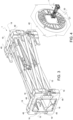
- reference number 1 denotes an aerospace supporting frame, having a substantially parallelepiped shape and comprising a plurality of rods 2a,2b,2c,2d that are coupled so as to be able to rotate relative to each other and thereby manually configure the frame 1, between a deployed operating condition ( Fig. 1 ) and a compacted or folded operating condition ( Fig. 2 ).
- each base 3 consists of a pair of rods 2a, which comprise respective ends 8a and respective intermediate portions 9a: the intermediate portions 9a are hinged to each other so as to form a cross.
- the hinge axes provided at the ends 8a and the intermediate portions 9a are parallel to the direction 6.
- the rods 2a have a fixed length and, in more detail, are straight.
- each of the rods 2b is arranged on two sides 10 of the supporting frame 1.
- the sides 10 lie on planes spaced apart and substantially parallel to each other, are connected to each other by the rods 2a of the bases 3, and face each other along a direction 11, which is orthogonal to the direction 6 and therefore, in the deployed condition during use, is horizontal.
- the rods 2b are similar to the rods 2a, from a constructive point of view and from the point of view of mutual assembly.
- the rods 2b are the same length as the rods 2a.
- each of the rods 2b comprises:
- the hinge axes of the rods 2b are parallel to the direction 11.
- pantograph structure or leverage on each side 10 and on each base 3 starting from the deployed condition, said pantograph leverages allow the bases 3 to approach each other along the direction 6 and the sides 10 to approach each other along the direction 11 relatively easily and quickly in order to switch to the compacted condition.
- the height of the frame 1 along the direction 6 decreases from a value H1 to a value H2
- the width of the frame 1 along the direction 11 decreases from a value D1 to a value D2
- the length of the bases 10 and therefore of the frame 1 along a direction 12 orthogonal to the directions 6 and 11 increases from a value L1 to a value L2.
- the aforementioned rods 2c and 2d have a length that is adjustable, for example they are defined by telescopic rods, i.e. with two parts sliding with respect to each other.
- the rods 2c and 2d are parallel to the direction 12 and are arranged along the sides 10.
- the rods 2c and 2d must extend from the length value L1 to the length value L2.
- a locking system is provided to stop the extension and possibly the shortening of each of the rods 2c and 2d, for example to stop the reciprocal sliding of the two parts of which each rod 2c,2d consists.
- the rods 2c are arranged substantially centrally between the bases 3 (in relation to the direction 6), while the rods 2d are substantially coplanar to the bases 3, i.e. they are arranged at the edges of the frame 1, at virtual intersections between the bases 3 and the sides 10.
- each side 10 there are two rods 2c, arranged in proximity, even if spaced apart along the direction 6.
- the rods 2c comprise respective ends 8c that are carried by two coupling elements 15 opposite each other and hinged to the ends 10b of the rods 2b.
- the rods 2d comprise respective ends 8d that are carried by coupling elements 16, arranged at the eight vertices of the frame 1 and thus defining respective angle elements.
- Each of the coupling elements 16 is hinged to one of the ends 8a and to one of the ends 8b, in addition to being coupled to one of the ends 8d of the rods 2d.
- the coupling elements 15 and 16 are spaced apart from each other.
- at least some of the elements 15 and 16 i.e. at least the elements 16
- the elements 15 and 16 define respective nodes that are hinged to the ends of the rods and that cooperate with each other, in the compacted condition, to create a system suitable for absorbing loads.
- each of the supporting members 18 has a ring shape, and its nodes are arranged in series along this ring.
- each node is interposed between, and is in contact against, two adjacent nodes.
- the coupling mode for coupling these nodes defines at least two contact bearings directed along respective X and Y directions that are orthogonal to each other and are parallel, respectively, to the directions 11 and 6.
- each of these nodes has two abutment shoulders that are orthogonal to said directions X and Y, respectively, and are in contact against corresponding abutment shoulders of the adjacent node.
- Each of the nodes defined by the elements 16 is an angle node comprising a body 16a and a flap 16b, protruding cantilevered from the body 16a along the direction 12.
- Each flap 16b comprises two straight portions 16c and 16d that are orthogonal and joined to each other, and are parallel to the directions 11 and 6, respectively.
- the portions 16c are aligned with each other parallel to the direction 11, and at least one of the portions 16c protrudes relative to the body 16a of its node so as to couple to the portion 16c of the adjacent node.
- the bodies 16a of two adjacent nodes are spaced apart from each other; at the same time, the end of one of the two portions 16c forms a seat 16g, which has a step shape, is engaged by the end of the other portion 16c and is bounded by two abutment shoulders 16e and 16f, that are orthogonal to the aforementioned directions X and Y and are in contact with corresponding shoulders of the other portion 16c.
- the flaps 16b define the contact coupling along both the directions X and Y, in the case of adjacent nodes both defined by elements 16.
- the element 15 comprises a body 15a and a flap 15b, which protrudes cantilevered from the body 15a along the direction 12 and is straight and parallel to the direction 6.
- the flap 15b protrudes relative to the body 15a parallel to the direction 6 so as to couple to the portion 16d of the adjacent node, which is defined by the element 16 (according to variants not illustrated, the portion 16d protrudes from the body 16a to couple to the flap 15b).
- the end of the flap 15b has an abutment shoulder 15e that is orthogonal to the direction X and is in contact against a corresponding shoulder of the end of the portion 16d.
- the body 15a has an abutment shoulder 15f that is orthogonal to the Y direction and is in contact against a corresponding shoulder of the body 16a.
- the contact bearings along the directions X and Y are defined, one, by the flaps 15b and 16b and, the other, by the bodies 16a and 16b.
- the adjacent nodes defined by the elements 15 and 16 are preferably also in contact against each other along a direction Z, parallel to the direction 12.
- the end of the flap 15b has an abutment shoulder 15g in contact against the body 16a of the adjacent node, along this direction Z (according to non-illustrated variants, it is the end of the portion 16d that is resting on the body 15a).
- the elements 15 and 16 have a reference system, one with respect to the other, for defining a correct relative positioning of the nodes in the compacted condition.
- the supporting members 18 can be wound by belts 19 or similar extended elements, preferably flexible (ropes, cables, etc.), to retain the elements 15 and 16 in a fixed position, in contact with each other, and to prevent the frame 1 from deploying autonomously and/or accidentally.
- an intermediate cover is placed between each member 18 and the relative belt 19.
- This intermediate cover is defined, for example, by two C-shaped half-shells, or by four covering elements, each of which has an angular shape and is coupled to a respective element 16 so as to cover the latter (while the elements 15 may remain uncovered).
- such covering elements are defined by the same elements 48 that will be described below with reference to Figure 9 .
- the compacted condition is used to launch the frame 1 into an orbiting space station 20 (partially illustrated).
- the loads due to space launch are absorbed by the nodes defined by the elements 15 and 16, with a consequent advantage in saving mass from a structural point of view. In fact, in this way, it is possible to lighten the structure of the rods that are arranged between the members 18 in the compacted condition.
- the dimensions of the frame 1 defined by the height value H2 and the width value D2 are extremely small, as explained above, so that the frame 1 can enter the station 20 through its relatively small hatch 21.
- the frame 1 is without rods on one side (i.e. at the front end), while it comprises a plurality of rods 2e on the other side (at the rear end) .
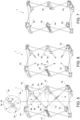
- the rods 2e comprise respective ends 8e that are coupled to the coupling elements 15 and/or 16 by means of joints 22 ( Fig. 6 ) that allow the rods 2e to be arranged in a first position ( Fig.5 ) or in a second position ( Fig.7 ).
- the elements 15 and 16 arranged at the rear end may differ slightly from the elements 15 and 16 arranged at the front end, in terms of structure/shape and/or dimensions.
- the rods 2e lie on a plane orthogonal to the direction 12 and are fixed together in a releasable manner by at least one fastening device 23.
- the device 23 comprises a locking rod 24 that is coupled in a sliding manner to one of the rods 2e to move to and from a locked position, wherein it is simultaneously fastened to the ends of four rods 2e so as to hold them in a fixed position with respect to each other, thus forming a cross.
- the rods 2e perform a stiffening function for the frame 1 at the rear end in the deployed condition.
- the rods 2e are uncoupled from each other and protrude cantilevered from respective coupling elements 15 and 16, in positions facing and parallel to the rods 2c and 2d.
- the devices 23 To switch from the deployed to the compacted condition, the devices 23 must first be released to uncouple the rods 2e from each other ( Fig. 6 ), and then the rods 2e must be rotated around the joints 22 to arrange them in their second position ( Fig. 7 ). After these operations, and after unlocking the extension of the rods 2c and 2d, it is possible to close the frame 1 in the compacted condition by bringing the coupling elements 15 and 16 closer together so as to touch.
- the pantograph leverages defined by the rods 2a and 2b close, so as to bring the rods 2d closer together along the directions 6 and 11, while maintaining the parallelism of the rods 2c and 2d.
- This closing or compacting movement ends when the elements 16 come into contact with the elements 15 and, thus, form the two supporting members 18.
- the rods 2a, 2b, 2c and 2d continue to remain along the bases 3 and sides 10 of the frame 1 and define a cavity 26 that is elongated along the direction 12, houses the rods 2e, and is open at the two opposite longitudinal ends of the frame 1.
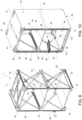
- the frame 1 When the frame 1 is arranged in its deployed condition, it is normally used to form a housing structure 30, as shown in Figures 8 to 12 .
- the frame 1 is joined to at least one covering element, arranged along at least one of the bases 3 and/or sides 10.
- the structure 30 is assembled by mounting, in a releasable manner, at least one rigid panel 32 in the space inside the frame 1.
- two horizontal panels 32 are arranged to cover the bases 3, as floor and roof, while an additional horizontal panel 32 is coupled to the elements 15 in a fixed position, as an intermediate shelf.
- the structure 30 defines a shelf that is partially open at the side and rear, as well as being fully open at the front to ensure access to its interior.
- the structure 30 comprises at least two uprights 34, which are parallel to the direction 6, are arranged at the front ends of sides 10 of the frame 1 and, in particular, are attached to the elements 15 and 16 that are arranged at said front ends.
- the uprights 34 are provided with respective rows of fasteners or connectors 27, which can be used as an alternative to each other to couple one or more components to the frame 1 in a desired position.
- the connectors 27 of the uprights 34 can be used to couple a hook 35 to hang objects and/or a support arm 36 for a keyboard or tray, at any height.
- the structure 30 comprises a canvas cover 40, which is arranged around the frame 1, as the outer covering of at least one of the bases 3 (the upper one), the sides 10, and the rear end of the frame 1.
- the canvas 40 is tensioned when coupled to the frame 1, so as to form a tensile structure and further stiffen the frame 1, as with an umbrella.
- the canvas 40 carries belt elements 41 and/or elastic elements 42 suitable for tensioning the canvas 40 around the frame 1.
- the material of the canvas 40 has elastic properties that allow it to be slightly smaller than the outer dimensions of the frame 1, at rest, and to extend slightly to be tensioned when placed around the frame 1.
- the open shelf in Figure 8 becomes a closed structure along the entire periphery, except for a front opening 45 that allows users to access the internal space of the structure 30 ( Fig. 10 ).
- the opening 45 is defined laterally by two frontal portions 47 of the canvas 40.
- the portions 47 partially cover the uprights 34 and the elements 15 and 16 and have respective vertical eyelets 46 that allow access to the connectors 27 of the uprights 34 and/or access to front connection portions forming part of the elements 15,16.
- the canvas 40 has a parallelepiped shape, i.e. the same shape as the frame 1.
- the canvas 40 is supported by a plurality of rigid angle elements 48, only some of which are visible in Figure 9 .
- the elements 48 are arranged at the vertices of the canvas 40, preferably inside the latter.
- the elements 48 are coupled in a releasable manner to the frame 1: in particular, they overlap the elements 16 and are fixed to the latter, for example by interlocking and/or by male-female type couplings and/or by additional fixing pins.
- the eight elements 48 are used not only to tension the canvas 40 and/or to protect said canvas 40 from possible tears, which could be caused by the metal parts and/or protruding parts of elements 16 of the frame 1, but are also used to define the intermediate cover between the members 18 and the respective belts 19, when the frame 1 is in the compacted condition, as already mentioned above.
- the elements 48 are preferably provided with respective loops, on an outer surface thereof, for the passage and fixing of the belt 19.
- the elements 48 contribute to the alignment and interconnection between the nodes defined by the elements 16: in fact, in addition to being coupled to the corresponding elements 16 that are covered, the four elements 48 are coupled to each other at each member 18, two by two, by means of a coupling of the interlocking type and/or the male-female type.
- the housing structure 30 (configured as a shelf) further comprises a plurality of anechoic and/or insulating panels 49, arranged inside the frame 1 at the sides 10 and/or at the rear end, opposite the opening 45.
- the panels 49 are fixed to the frame 1 and/or to the canvas 40 in a releasable manner, in a way not shown in detail, e.g. by means of Velcro stitched or glued to the inner surface of the canvas 40.
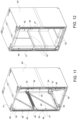
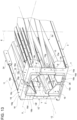
- Figures 11 and 12 show how the housing structure 30 can be configured as a living cell for a crew member of the station 20 or as a radiation shelter, again for crew members.
- the housing structure 30 is without panels 32, while the panels 49 are also provided at the bases 3 and/or the rear end of the frame 1.
- the structure 30 may also comprise covering elements arranged above the rods 2c and/or 2d.
- the housing structure 30 comprises a plurality of anti-radiation panels 50 (defined, for example, by containers containing water) that are arranged inside the frame 1 and are attached directly or indirectly to the latter and/or to the canvas 40 in a releasable manner, not illustrated in detail.
- the panels 50 overlap the panels 49 and are attached to the latter by Velcro.
- the structure 30 further comprises a plurality of interfaces, not illustrated, of the electrical type (for signal transmission and/or power supply), of the sensor type, or of the hydraulic or pneumatic type.
- the panels 49 and 50 and the canvas 40 are provided with pre-cut holes or pre-cut or pre-marked areas, not illustrated, in order to obtain openings that are arranged in various positions, defined in the design phase, and allowing, in use, the passage of ducts (air ventilation ducts) and/or wiring from the outside to the inside of the housing structure 30.
- the canvas 40 bears one or more wirings, which are preferably arranged integrated in the canvas 40 as weaving and/or sewing elements.
- the frame 1 in addition to being deployable, is extremely light, thanks to the rods, but also has structural characteristics that allow it to support the loads that are present during space launches, in the compacted operating condition.
- the members 18 only form in the compacted condition and contribute to stiffening the frame 1 specifically during the space launch.
- the frame 1 is positioned so that the launch direction is orthogonal to the direction 12, so that the rods (preferably made of carbon) are completely unloaded and the loads are supported only and exclusively by the nodes arranged, together, to form the members 18.
- the members 18 are broken down into several elements 15 and 16 which are separate from each other, without adversely affecting the overall weight of the frame 1.
- structural rigidity is essentially conferred by the rods 2a,2b,2c,2d,2e, which can be designed so as to have a very low weight, without causing the frame 1 to be oversized as a whole, since they must withstand relatively low loads (corresponding to those of an accidental kick by a crew member, the so-called "crew kick load").
- the frame 1 has a high volume reduction in shifting from the deployed condition to the compacted condition.
- the dimensions L1, D1, H1 can be set so as to meet the minimum size requirements required by regulations and/or agencies responsible for space programmes, with regard to the volume of living space inside the structure 30.
- the frame 1 is able to pass through the small hatches provided in modern generation space stations. Again, in the compacted condition, the frame 1 is compatible with transport inside the bags already used today, with standard defined dimensions, without having to design dedicated transport containers.
- the frame 1 allows a liveable volume to be obtained quickly.
- the volume can be configured for different purposes, e.g. as a crew living cell, as a storage shelf, as a support shelf for components and equipment, as a work area, as a temporary radiation shelter, etc. Consequently, the structure 30 is multifunctional or multi-purpose and is particularly suitable for inside space stations.
- all the coupling systems provided to connect the various components (directly or indirectly) to the frame 1 are of the releasable type, so that it is possible to assemble, disassemble, and modify the arrangement of these components quickly, with the aim of optimizing the space inside the space station according to the specific needs of the crew during the mission.
- the coupling mode between the nodes defined by the elements 15 and 16 could be different from the one illustrated and described by way of example, but always aimed at defining a ring shape or path for the members 18, in which each node is coupled in contact against two adjacent nodes, without having a hyperstatic structure, but in such a way as to transfer the loads in a reciprocal manner along the ring path.
Landscapes
- Engineering & Computer Science (AREA)
- Remote Sensing (AREA)
- Aviation & Aerospace Engineering (AREA)
- Health & Medical Sciences (AREA)
- General Health & Medical Sciences (AREA)
- Toxicology (AREA)
- Critical Care (AREA)
- Emergency Medicine (AREA)
- Tents Or Canopies (AREA)
Applications Claiming Priority (3)
| Application Number | Priority Date | Filing Date | Title |
|---|---|---|---|
| IT102018000010818A IT201800010818A1 (it) | 2018-12-05 | 2018-12-05 | Telaio di supporto estendibile, e struttura di alloggiamento provvista di tale telaio di supporto, in particolare per applicazioni aerospaziali |
| IT102018000010824A IT201800010824A1 (it) | 2018-12-05 | 2018-12-05 | Telaio di supporto estendibile, e struttura di alloggiamento provvista di tale telaio di supporto, in particolare per applicazioni aerospaziali |
| PCT/IB2019/060485 WO2020115701A1 (en) | 2018-12-05 | 2019-12-05 | Deployable supporting frame, and housing structure provided with such supporting frame, in particular for aerospace applications |
Publications (2)
| Publication Number | Publication Date |
|---|---|
| EP3891069A1 EP3891069A1 (en) | 2021-10-13 |
| EP3891069B1 true EP3891069B1 (en) | 2023-10-11 |
Family
ID=69158145
Family Applications (1)
| Application Number | Title | Priority Date | Filing Date |
|---|---|---|---|
| EP19835483.9A Active EP3891069B1 (en) | 2018-12-05 | 2019-12-05 | Housing structure provided with a deployable supporting frame. for aerospace applications |
Country Status (5)
| Country | Link |
|---|---|
| US (1) | US11958639B2 (pl) |
| EP (1) | EP3891069B1 (pl) |
| ES (1) | ES2963427T3 (pl) |
| PL (1) | PL3891069T3 (pl) |
| WO (1) | WO2020115701A1 (pl) |
Families Citing this family (4)
| Publication number | Priority date | Publication date | Assignee | Title |
|---|---|---|---|---|
| IT201900019322A1 (it) * | 2019-10-18 | 2021-04-18 | Thales Alenia Space Italia Spa Con Unico Socio | Assistenza end-to-end in orbita |
| US12448153B2 (en) * | 2021-03-31 | 2025-10-21 | Roccor, Llc | Rigid articulated batten integrated truss devices, systems, and methods |
| CN113895659B (zh) * | 2021-11-25 | 2023-09-19 | 苏州馥昶空间技术有限公司 | 一种太阳翼展开装置 |
| CN116039954B (zh) * | 2023-01-14 | 2026-06-02 | 哈尔滨工业大学(深圳) | 单自由度平面二维可展开基本单元及大尺度可展开装置 |
Family Cites Families (11)
| Publication number | Priority date | Publication date | Assignee | Title |
|---|---|---|---|---|
| US5016418A (en) * | 1986-08-22 | 1991-05-21 | The United States Of America As Represented By The Administrator Of The National Aeronautics And Space Administration | Synchronously deployable double fold beam and planar truss structure |
| US5244001A (en) | 1991-01-04 | 1993-09-14 | Lynch James P | Collapsible canopy framework having captured scissor ends with non-compressive pivots |
| US5327700A (en) * | 1991-12-05 | 1994-07-12 | Skyline Displays, Inc. | Collapsible modular display tower assembly |
| JPH05221392A (ja) | 1992-02-12 | 1993-08-31 | Uchu Tsushin Kiso Gijutsu Kenkyusho:Kk | 展開型トラス構造体 |
| US5243718A (en) | 1992-04-14 | 1993-09-14 | Louis Shamie | Foldable playpen |
| TW499019U (en) * | 2001-08-03 | 2002-08-11 | Yi-Ching Guo | Improved connecting and drawing structure of a frame |
| WO2005111343A1 (en) | 2004-05-13 | 2005-11-24 | National University Of Singapore | Deployable structure |
| WO2009148652A2 (en) | 2008-03-03 | 2009-12-10 | United States Government | Transportable modular configuration for holding panels |
| US10024050B2 (en) * | 2011-12-07 | 2018-07-17 | Cpi Technologies, Llc | Solar panel truss deployable from moving carrier |
| CN206050100U (zh) | 2016-08-31 | 2017-03-29 | 燕山大学 | 扭簧驱动剪叉式伸展臂 |
| US10207826B2 (en) * | 2016-10-12 | 2019-02-19 | The Boeing Company | Artificial gravity system with a unibody rotating structure that rotates about a stationary structure |
-
2019
- 2019-12-05 EP EP19835483.9A patent/EP3891069B1/en active Active
- 2019-12-05 ES ES19835483T patent/ES2963427T3/es active Active
- 2019-12-05 PL PL19835483.9T patent/PL3891069T3/pl unknown
- 2019-12-05 WO PCT/IB2019/060485 patent/WO2020115701A1/en not_active Ceased
- 2019-12-05 US US17/311,235 patent/US11958639B2/en active Active
Also Published As
| Publication number | Publication date |
|---|---|
| US20220017241A1 (en) | 2022-01-20 |
| PL3891069T3 (pl) | 2024-03-11 |
| EP3891069A1 (en) | 2021-10-13 |
| ES2963427T3 (es) | 2024-03-27 |
| WO2020115701A1 (en) | 2020-06-11 |
| US11958639B2 (en) | 2024-04-16 |
Similar Documents
| Publication | Publication Date | Title |
|---|---|---|
| US11958639B2 (en) | Deployable supporting frame, and housing structure provided with such supporting frame, in particular for aerospace applications | |
| US5016418A (en) | Synchronously deployable double fold beam and planar truss structure | |
| JP5694306B2 (ja) | 伸縮式構造 | |
| US6016999A (en) | Spacecraft platforms | |
| US8616502B1 (en) | Deployable solar panel assembly for spacecraft | |
| US20190044475A1 (en) | Compact, Self-Deploying Structures and Methods for Deploying Foldable, Structural Origami Arrays Using a Compression Column | |
| US3435570A (en) | Erectable structure with scissors link | |
| JP3417559B2 (ja) | 無線周波数遮蔽包囲体用の携帯テント組立体 | |
| US4604844A (en) | Deployable M-braced truss structure | |
| US4765114A (en) | Expandable pallet for space station interface attachments | |
| CN109850185B (zh) | 装载可展开天线与多光学相机的卫星结构 | |
| EP4012837B1 (en) | Satellite antenna having pantographic trusses and associated methods | |
| EP2498334A1 (en) | Deployable flat panel array | |
| CN111332495A (zh) | 板状卫星及其发射方法 | |
| EP2890924A1 (en) | A transportation box for technical equipment | |
| US7774987B2 (en) | Movable building | |
| CN109860974B (zh) | 复合剪铰式周边桁架可展开天线机构 | |
| US8872042B2 (en) | Methods and systems for providing inflatable lightweight shielded enclosures | |
| EP2743187B1 (en) | Spacecraft with at least one deployable panel structure and deployable panel structure | |
| KR20250066087A (ko) | 접이식 의자 및 이를 포함하는 항공기 | |
| US20090199503A1 (en) | Deployable structures | |
| US5184789A (en) | Space station facility | |
| US12448153B2 (en) | Rigid articulated batten integrated truss devices, systems, and methods | |
| CN206655540U (zh) | 一种通用大跨度可扩展快速展开折叠帐篷 | |
| IT201800010824A1 (it) | Telaio di supporto estendibile, e struttura di alloggiamento provvista di tale telaio di supporto, in particolare per applicazioni aerospaziali |
Legal Events
| Date | Code | Title | Description |
|---|---|---|---|
| STAA | Information on the status of an ep patent application or granted ep patent |
Free format text: STATUS: UNKNOWN |
|
| STAA | Information on the status of an ep patent application or granted ep patent |
Free format text: STATUS: THE INTERNATIONAL PUBLICATION HAS BEEN MADE |
|
| PUAI | Public reference made under article 153(3) epc to a published international application that has entered the european phase |
Free format text: ORIGINAL CODE: 0009012 |
|
| STAA | Information on the status of an ep patent application or granted ep patent |
Free format text: STATUS: REQUEST FOR EXAMINATION WAS MADE |
|
| 17P | Request for examination filed |
Effective date: 20210617 |
|
| AK | Designated contracting states |
Kind code of ref document: A1 Designated state(s): AL AT BE BG CH CY CZ DE DK EE ES FI FR GB GR HR HU IE IS IT LI LT LU LV MC MK MT NL NO PL PT RO RS SE SI SK SM TR |
|
| DAV | Request for validation of the european patent (deleted) | ||
| DAX | Request for extension of the european patent (deleted) | ||
| GRAP | Despatch of communication of intention to grant a patent |
Free format text: ORIGINAL CODE: EPIDOSNIGR1 |
|
| STAA | Information on the status of an ep patent application or granted ep patent |
Free format text: STATUS: GRANT OF PATENT IS INTENDED |
|
| INTG | Intention to grant announced |
Effective date: 20221208 |
|
| GRAJ | Information related to disapproval of communication of intention to grant by the applicant or resumption of examination proceedings by the epo deleted |
Free format text: ORIGINAL CODE: EPIDOSDIGR1 |
|
| STAA | Information on the status of an ep patent application or granted ep patent |
Free format text: STATUS: REQUEST FOR EXAMINATION WAS MADE |
|
| GRAP | Despatch of communication of intention to grant a patent |
Free format text: ORIGINAL CODE: EPIDOSNIGR1 |
|
| STAA | Information on the status of an ep patent application or granted ep patent |
Free format text: STATUS: GRANT OF PATENT IS INTENDED |
|
| INTC | Intention to grant announced (deleted) | ||
| INTG | Intention to grant announced |
Effective date: 20230502 |
|
| P01 | Opt-out of the competence of the unified patent court (upc) registered |
Effective date: 20230518 |
|
| GRAS | Grant fee paid |
Free format text: ORIGINAL CODE: EPIDOSNIGR3 |
|
| GRAA | (expected) grant |
Free format text: ORIGINAL CODE: 0009210 |
|
| STAA | Information on the status of an ep patent application or granted ep patent |
Free format text: STATUS: THE PATENT HAS BEEN GRANTED |
|
| AK | Designated contracting states |
Kind code of ref document: B1 Designated state(s): AL AT BE BG CH CY CZ DE DK EE ES FI FR GB GR HR HU IE IS IT LI LT LU LV MC MK MT NL NO PL PT RO RS SE SI SK SM TR |
|
| REG | Reference to a national code |
Ref country code: GB Ref legal event code: FG4D |
|
| REG | Reference to a national code |
Ref country code: CH Ref legal event code: EP |
|
| REG | Reference to a national code |
Ref country code: DE Ref legal event code: R096 Ref document number: 602019039301 Country of ref document: DE |
|
| REG | Reference to a national code |
Ref country code: IE Ref legal event code: FG4D |
|
| REG | Reference to a national code |
Ref country code: NL Ref legal event code: FP |
|
| REG | Reference to a national code |
Ref country code: LT Ref legal event code: MG9D |
|
| REG | Reference to a national code |
Ref country code: AT Ref legal event code: MK05 Ref document number: 1620001 Country of ref document: AT Kind code of ref document: T Effective date: 20231011 |
|
| REG | Reference to a national code |
Ref country code: ES Ref legal event code: FG2A Ref document number: 2963427 Country of ref document: ES Kind code of ref document: T3 Effective date: 20240327 |
|
| PG25 | Lapsed in a contracting state [announced via postgrant information from national office to epo] |
Ref country code: GR Free format text: LAPSE BECAUSE OF FAILURE TO SUBMIT A TRANSLATION OF THE DESCRIPTION OR TO PAY THE FEE WITHIN THE PRESCRIBED TIME-LIMIT Effective date: 20240112 |
|
| PG25 | Lapsed in a contracting state [announced via postgrant information from national office to epo] |
Ref country code: IS Free format text: LAPSE BECAUSE OF FAILURE TO SUBMIT A TRANSLATION OF THE DESCRIPTION OR TO PAY THE FEE WITHIN THE PRESCRIBED TIME-LIMIT Effective date: 20240211 |
|
| PG25 | Lapsed in a contracting state [announced via postgrant information from national office to epo] |
Ref country code: LT Free format text: LAPSE BECAUSE OF FAILURE TO SUBMIT A TRANSLATION OF THE DESCRIPTION OR TO PAY THE FEE WITHIN THE PRESCRIBED TIME-LIMIT Effective date: 20231011 |
|
| PG25 | Lapsed in a contracting state [announced via postgrant information from national office to epo] |
Ref country code: AT Free format text: LAPSE BECAUSE OF FAILURE TO SUBMIT A TRANSLATION OF THE DESCRIPTION OR TO PAY THE FEE WITHIN THE PRESCRIBED TIME-LIMIT Effective date: 20231011 |
|
| PG25 | Lapsed in a contracting state [announced via postgrant information from national office to epo] |
Ref country code: LT Free format text: LAPSE BECAUSE OF FAILURE TO SUBMIT A TRANSLATION OF THE DESCRIPTION OR TO PAY THE FEE WITHIN THE PRESCRIBED TIME-LIMIT Effective date: 20231011 Ref country code: IS Free format text: LAPSE BECAUSE OF FAILURE TO SUBMIT A TRANSLATION OF THE DESCRIPTION OR TO PAY THE FEE WITHIN THE PRESCRIBED TIME-LIMIT Effective date: 20240211 Ref country code: GR Free format text: LAPSE BECAUSE OF FAILURE TO SUBMIT A TRANSLATION OF THE DESCRIPTION OR TO PAY THE FEE WITHIN THE PRESCRIBED TIME-LIMIT Effective date: 20240112 Ref country code: BG Free format text: LAPSE BECAUSE OF FAILURE TO SUBMIT A TRANSLATION OF THE DESCRIPTION OR TO PAY THE FEE WITHIN THE PRESCRIBED TIME-LIMIT Effective date: 20240111 Ref country code: AT Free format text: LAPSE BECAUSE OF FAILURE TO SUBMIT A TRANSLATION OF THE DESCRIPTION OR TO PAY THE FEE WITHIN THE PRESCRIBED TIME-LIMIT Effective date: 20231011 Ref country code: PT Free format text: LAPSE BECAUSE OF FAILURE TO SUBMIT A TRANSLATION OF THE DESCRIPTION OR TO PAY THE FEE WITHIN THE PRESCRIBED TIME-LIMIT Effective date: 20240212 |
|
| PG25 | Lapsed in a contracting state [announced via postgrant information from national office to epo] |
Ref country code: SE Free format text: LAPSE BECAUSE OF FAILURE TO SUBMIT A TRANSLATION OF THE DESCRIPTION OR TO PAY THE FEE WITHIN THE PRESCRIBED TIME-LIMIT Effective date: 20231011 Ref country code: RS Free format text: LAPSE BECAUSE OF FAILURE TO SUBMIT A TRANSLATION OF THE DESCRIPTION OR TO PAY THE FEE WITHIN THE PRESCRIBED TIME-LIMIT Effective date: 20231011 Ref country code: NO Free format text: LAPSE BECAUSE OF FAILURE TO SUBMIT A TRANSLATION OF THE DESCRIPTION OR TO PAY THE FEE WITHIN THE PRESCRIBED TIME-LIMIT Effective date: 20240111 Ref country code: LV Free format text: LAPSE BECAUSE OF FAILURE TO SUBMIT A TRANSLATION OF THE DESCRIPTION OR TO PAY THE FEE WITHIN THE PRESCRIBED TIME-LIMIT Effective date: 20231011 Ref country code: HR Free format text: LAPSE BECAUSE OF FAILURE TO SUBMIT A TRANSLATION OF THE DESCRIPTION OR TO PAY THE FEE WITHIN THE PRESCRIBED TIME-LIMIT Effective date: 20231011 |
|
| PG25 | Lapsed in a contracting state [announced via postgrant information from national office to epo] |
Ref country code: DK Free format text: LAPSE BECAUSE OF FAILURE TO SUBMIT A TRANSLATION OF THE DESCRIPTION OR TO PAY THE FEE WITHIN THE PRESCRIBED TIME-LIMIT Effective date: 20231011 |
|
| REG | Reference to a national code |
Ref country code: DE Ref legal event code: R097 Ref document number: 602019039301 Country of ref document: DE |
|
| PG25 | Lapsed in a contracting state [announced via postgrant information from national office to epo] |
Ref country code: CZ Free format text: LAPSE BECAUSE OF FAILURE TO SUBMIT A TRANSLATION OF THE DESCRIPTION OR TO PAY THE FEE WITHIN THE PRESCRIBED TIME-LIMIT Effective date: 20231011 |
|
| PG25 | Lapsed in a contracting state [announced via postgrant information from national office to epo] |
Ref country code: SK Free format text: LAPSE BECAUSE OF FAILURE TO SUBMIT A TRANSLATION OF THE DESCRIPTION OR TO PAY THE FEE WITHIN THE PRESCRIBED TIME-LIMIT Effective date: 20231011 |
|
| PG25 | Lapsed in a contracting state [announced via postgrant information from national office to epo] |
Ref country code: SM Free format text: LAPSE BECAUSE OF FAILURE TO SUBMIT A TRANSLATION OF THE DESCRIPTION OR TO PAY THE FEE WITHIN THE PRESCRIBED TIME-LIMIT Effective date: 20231011 Ref country code: SK Free format text: LAPSE BECAUSE OF FAILURE TO SUBMIT A TRANSLATION OF THE DESCRIPTION OR TO PAY THE FEE WITHIN THE PRESCRIBED TIME-LIMIT Effective date: 20231011 Ref country code: RO Free format text: LAPSE BECAUSE OF FAILURE TO SUBMIT A TRANSLATION OF THE DESCRIPTION OR TO PAY THE FEE WITHIN THE PRESCRIBED TIME-LIMIT Effective date: 20231011 Ref country code: EE Free format text: LAPSE BECAUSE OF FAILURE TO SUBMIT A TRANSLATION OF THE DESCRIPTION OR TO PAY THE FEE WITHIN THE PRESCRIBED TIME-LIMIT Effective date: 20231011 Ref country code: DK Free format text: LAPSE BECAUSE OF FAILURE TO SUBMIT A TRANSLATION OF THE DESCRIPTION OR TO PAY THE FEE WITHIN THE PRESCRIBED TIME-LIMIT Effective date: 20231011 Ref country code: CZ Free format text: LAPSE BECAUSE OF FAILURE TO SUBMIT A TRANSLATION OF THE DESCRIPTION OR TO PAY THE FEE WITHIN THE PRESCRIBED TIME-LIMIT Effective date: 20231011 |
|
| PLBE | No opposition filed within time limit |
Free format text: ORIGINAL CODE: 0009261 |
|
| STAA | Information on the status of an ep patent application or granted ep patent |
Free format text: STATUS: NO OPPOSITION FILED WITHIN TIME LIMIT |
|
| PG25 | Lapsed in a contracting state [announced via postgrant information from national office to epo] |
Ref country code: LU Free format text: LAPSE BECAUSE OF NON-PAYMENT OF DUE FEES Effective date: 20231205 |
|
| PG25 | Lapsed in a contracting state [announced via postgrant information from national office to epo] |
Ref country code: MC Free format text: LAPSE BECAUSE OF FAILURE TO SUBMIT A TRANSLATION OF THE DESCRIPTION OR TO PAY THE FEE WITHIN THE PRESCRIBED TIME-LIMIT Effective date: 20231011 |
|
| PG25 | Lapsed in a contracting state [announced via postgrant information from national office to epo] |
Ref country code: MC Free format text: LAPSE BECAUSE OF FAILURE TO SUBMIT A TRANSLATION OF THE DESCRIPTION OR TO PAY THE FEE WITHIN THE PRESCRIBED TIME-LIMIT Effective date: 20231011 Ref country code: LU Free format text: LAPSE BECAUSE OF NON-PAYMENT OF DUE FEES Effective date: 20231205 |
|
| 26N | No opposition filed |
Effective date: 20240712 |
|
| REG | Reference to a national code |
Ref country code: IE Ref legal event code: MM4A |
|
| PG25 | Lapsed in a contracting state [announced via postgrant information from national office to epo] |
Ref country code: IE Free format text: LAPSE BECAUSE OF NON-PAYMENT OF DUE FEES Effective date: 20231205 |
|
| PG25 | Lapsed in a contracting state [announced via postgrant information from national office to epo] |
Ref country code: SI Free format text: LAPSE BECAUSE OF FAILURE TO SUBMIT A TRANSLATION OF THE DESCRIPTION OR TO PAY THE FEE WITHIN THE PRESCRIBED TIME-LIMIT Effective date: 20231011 |
|
| PG25 | Lapsed in a contracting state [announced via postgrant information from national office to epo] |
Ref country code: SI Free format text: LAPSE BECAUSE OF FAILURE TO SUBMIT A TRANSLATION OF THE DESCRIPTION OR TO PAY THE FEE WITHIN THE PRESCRIBED TIME-LIMIT Effective date: 20231011 Ref country code: IE Free format text: LAPSE BECAUSE OF NON-PAYMENT OF DUE FEES Effective date: 20231205 |
|
| PG25 | Lapsed in a contracting state [announced via postgrant information from national office to epo] |
Ref country code: FI Free format text: LAPSE BECAUSE OF FAILURE TO SUBMIT A TRANSLATION OF THE DESCRIPTION OR TO PAY THE FEE WITHIN THE PRESCRIBED TIME-LIMIT Effective date: 20231011 |
|
| PG25 | Lapsed in a contracting state [announced via postgrant information from national office to epo] |
Ref country code: CY Free format text: LAPSE BECAUSE OF FAILURE TO SUBMIT A TRANSLATION OF THE DESCRIPTION OR TO PAY THE FEE WITHIN THE PRESCRIBED TIME-LIMIT; INVALID AB INITIO Effective date: 20191205 |
|
| PG25 | Lapsed in a contracting state [announced via postgrant information from national office to epo] |
Ref country code: HU Free format text: LAPSE BECAUSE OF FAILURE TO SUBMIT A TRANSLATION OF THE DESCRIPTION OR TO PAY THE FEE WITHIN THE PRESCRIBED TIME-LIMIT; INVALID AB INITIO Effective date: 20191205 |
|
| PG25 | Lapsed in a contracting state [announced via postgrant information from national office to epo] |
Ref country code: TR Free format text: LAPSE BECAUSE OF FAILURE TO SUBMIT A TRANSLATION OF THE DESCRIPTION OR TO PAY THE FEE WITHIN THE PRESCRIBED TIME-LIMIT Effective date: 20231011 |
|
| REG | Reference to a national code |
Ref country code: CH Ref legal event code: U11 Free format text: ST27 STATUS EVENT CODE: U-0-0-U10-U11 (AS PROVIDED BY THE NATIONAL OFFICE) Effective date: 20260101 |
|
| PGFP | Annual fee paid to national office [announced via postgrant information from national office to epo] |
Ref country code: GB Payment date: 20251223 Year of fee payment: 7 |
|
| PGFP | Annual fee paid to national office [announced via postgrant information from national office to epo] |
Ref country code: IT Payment date: 20251117 Year of fee payment: 7 |
|
| PGFP | Annual fee paid to national office [announced via postgrant information from national office to epo] |
Ref country code: FR Payment date: 20251223 Year of fee payment: 7 Ref country code: NL Payment date: 20251222 Year of fee payment: 7 |
|
| PGFP | Annual fee paid to national office [announced via postgrant information from national office to epo] |
Ref country code: BE Payment date: 20251231 Year of fee payment: 7 |
|
| PGFP | Annual fee paid to national office [announced via postgrant information from national office to epo] |
Ref country code: PL Payment date: 20251110 Year of fee payment: 7 |
|
| PGFP | Annual fee paid to national office [announced via postgrant information from national office to epo] |
Ref country code: ES Payment date: 20260122 Year of fee payment: 7 |
|
| PGFP | Annual fee paid to national office [announced via postgrant information from national office to epo] |
Ref country code: DE Payment date: 20251229 Year of fee payment: 7 |
|
| PGFP | Annual fee paid to national office [announced via postgrant information from national office to epo] |
Ref country code: CH Payment date: 20260101 Year of fee payment: 7 |