EP3890992B1 - Lauffläche für einen flugzeugreifen - Google Patents
Lauffläche für einen flugzeugreifen Download PDFInfo
- Publication number
- EP3890992B1 EP3890992B1 EP19845818.4A EP19845818A EP3890992B1 EP 3890992 B1 EP3890992 B1 EP 3890992B1 EP 19845818 A EP19845818 A EP 19845818A EP 3890992 B1 EP3890992 B1 EP 3890992B1
- Authority
- EP
- European Patent Office
- Prior art keywords
- rubber composition
- phr
- tyre
- tread
- elastomer
- Prior art date
- Legal status (The legal status is an assumption and is not a legal conclusion. Google has not performed a legal analysis and makes no representation as to the accuracy of the status listed.)
- Active
Links
Images
Classifications
-
- B—PERFORMING OPERATIONS; TRANSPORTING
- B60—VEHICLES IN GENERAL
- B60C—VEHICLE TYRES; TYRE INFLATION; TYRE CHANGING; CONNECTING VALVES TO INFLATABLE ELASTIC BODIES IN GENERAL; DEVICES OR ARRANGEMENTS RELATED TO TYRES
- B60C1/00—Tyres characterised by the chemical composition or the physical arrangement or mixture of the composition
- B60C1/0016—Compositions of the tread
-
- B—PERFORMING OPERATIONS; TRANSPORTING
- B60—VEHICLES IN GENERAL
- B60C—VEHICLE TYRES; TYRE INFLATION; TYRE CHANGING; CONNECTING VALVES TO INFLATABLE ELASTIC BODIES IN GENERAL; DEVICES OR ARRANGEMENTS RELATED TO TYRES
- B60C11/00—Tyre tread bands; Tread patterns; Anti-skid inserts
- B60C11/0041—Tyre tread bands; Tread patterns; Anti-skid inserts comprising different tread rubber layers
- B60C11/005—Tyre tread bands; Tread patterns; Anti-skid inserts comprising different tread rubber layers with cap and base layers
- B60C11/0058—Tyre tread bands; Tread patterns; Anti-skid inserts comprising different tread rubber layers with cap and base layers with different cap rubber layers in the axial direction
-
- C—CHEMISTRY; METALLURGY
- C08—ORGANIC MACROMOLECULAR COMPOUNDS; THEIR PREPARATION OR CHEMICAL WORKING-UP; COMPOSITIONS BASED THEREON
- C08K—Use of inorganic or non-macromolecular organic substances as compounding ingredients
- C08K3/00—Use of inorganic substances as compounding ingredients
- C08K3/02—Elements
- C08K3/04—Carbon
-
- C—CHEMISTRY; METALLURGY
- C08—ORGANIC MACROMOLECULAR COMPOUNDS; THEIR PREPARATION OR CHEMICAL WORKING-UP; COMPOSITIONS BASED THEREON
- C08L—COMPOSITIONS OF MACROMOLECULAR COMPOUNDS
- C08L15/00—Compositions of rubber derivatives
-
- C—CHEMISTRY; METALLURGY
- C08—ORGANIC MACROMOLECULAR COMPOUNDS; THEIR PREPARATION OR CHEMICAL WORKING-UP; COMPOSITIONS BASED THEREON
- C08L—COMPOSITIONS OF MACROMOLECULAR COMPOUNDS
- C08L7/00—Compositions of natural rubber
-
- C—CHEMISTRY; METALLURGY
- C08—ORGANIC MACROMOLECULAR COMPOUNDS; THEIR PREPARATION OR CHEMICAL WORKING-UP; COMPOSITIONS BASED THEREON
- C08L—COMPOSITIONS OF MACROMOLECULAR COMPOUNDS
- C08L9/00—Compositions of homopolymers or copolymers of conjugated diene hydrocarbons
- C08L9/06—Copolymers with styrene
-
- B—PERFORMING OPERATIONS; TRANSPORTING
- B60—VEHICLES IN GENERAL
- B60C—VEHICLE TYRES; TYRE INFLATION; TYRE CHANGING; CONNECTING VALVES TO INFLATABLE ELASTIC BODIES IN GENERAL; DEVICES OR ARRANGEMENTS RELATED TO TYRES
- B60C2200/00—Tyres specially adapted for particular applications
- B60C2200/02—Tyres specially adapted for particular applications for aircrafts
-
- C—CHEMISTRY; METALLURGY
- C08—ORGANIC MACROMOLECULAR COMPOUNDS; THEIR PREPARATION OR CHEMICAL WORKING-UP; COMPOSITIONS BASED THEREON
- C08C—TREATMENT OR CHEMICAL MODIFICATION OF RUBBERS
- C08C19/00—Chemical modification of rubber
- C08C19/30—Addition of a reagent which reacts with a hetero atom or a group containing hetero atoms of the macromolecule
- C08C19/42—Addition of a reagent which reacts with a hetero atom or a group containing hetero atoms of the macromolecule reacting with metals or metal-containing groups
-
- C—CHEMISTRY; METALLURGY
- C08—ORGANIC MACROMOLECULAR COMPOUNDS; THEIR PREPARATION OR CHEMICAL WORKING-UP; COMPOSITIONS BASED THEREON
- C08L—COMPOSITIONS OF MACROMOLECULAR COMPOUNDS
- C08L45/00—Compositions of homopolymers or copolymers of compounds having no unsaturated aliphatic radicals in side chain, and having one or more carbon-to-carbon double bonds in a carbocyclic or in a heterocyclic ring system; Compositions of derivatives of such polymers
Definitions
- the present invention relates to an aircraft tire, and, in particular, to the tread of an aircraft tire.
- An aircraft tire is characterized by use at high pressure, load and speed.
- an aircraft tire of size 46x17R20 intended to equip a commercial aircraft, can be used at a pressure equal to 15.3 bars, a static load equal to 21 tonnes and a maximum speed equal to 360 km/h.
- an aircraft tire is used at a pressure greater than 9 bars and at a deflection rate at least equal to 32%.
- the operating pressure is defined, for example, by the Tire and Rim Association (TRA) standard.
- the deflection rate of a tire is, by definition, its radial deformation, or its variation in radial height, when it passes from an unloaded inflated state to a statically loaded inflated state, under the pressure and load conditions recommended, for example, by the TRA standard.
- a tire having a geometry of revolution relative to an axis of rotation the geometry of the tire is generally described in a meridian plane containing the axis of rotation of the tire.
- the radial, axial and circumferential directions respectively designate the directions perpendicular to the axis of rotation of the tire, parallel to the axis of rotation of the tire and perpendicular to the meridian plane.
- the expressions "radially”, “axially” and “circumferentially” respectively mean “in the radial direction”, “in the axial direction” and “in the circumferential direction”.
- the tread is the portion of the tire intended to come into contact with the ground via a rolling surface and extending radially from a bottom surface to the rolling surface, axially from a first edge to a second tread edge defining the axial width of the tread, and circumferentially over the entire periphery of the tire.
- the axial width of the tread is defined as the width of the contact area between the tread and the ground, measured along the axial line passing through the centre of the contact area, when the new tyre is subjected to the load and pressure conditions recommended by the TRA standard.
- the tread is generally made up of raised elements separated by hollows.
- the raised elements are most often continuous circumferential ribs over the entire circumference of the tyre and separated by circumferential hollows or grooves.
- the tread which is the wearing part of the tyre, comprises at least one rubber composition, most often based on natural rubber and carbon black, these two main elements giving the rubber composition the mechanical properties necessary for the conditions of use of an aircraft tyre.
- such a rubber composition typically comprises a vulcanisation system and protective agents.
- a radial tire comprises a reinforcing reinforcement, consisting of a crown reinforcement and a radial carcass reinforcement radially inside the crown reinforcement.
- the crown reinforcement comprises at least one crown layer consisting of reinforcing elements or reinforcements coated with an elastomeric mixture and parallel to each other.
- the radial carcass reinforcement comprises at least one carcass layer consisting of reinforcements coated with an elastomeric mixture, parallel to each other and oriented substantially radially, that is to say forming, with the circumferential direction, an angle of between 85° and 95°.
- the reinforcements of the crown and carcass layers, for aircraft tires are most often textile reinforcements, in aliphatic polyamide, such as nylon, in aromatic polyamide, such as aramid, or in hybrid material combining, for example, an aliphatic polyamide and an aromatic polyamide.
- the person skilled in the art has identified two types of wear depending on the phase of the tire's life.
- the middle part of the tread having an axial width at least equal to 50% and at most equal to 80% of the total axial width of the tread and coming into contact with the ground, is subject to wear called “touch wear”, resulting from significant thermal heating, at the time of contact of the tread surface with the ground, due to the speed differential between the rotation speed of the tire and the speed of the airplane.
- the lateral parts of the tread positioned axially on either side of the median part and each having an axial width at least equal to 10% and at most equal to 25% of the total axial width of the tread, are subject to wear called “taxi wear", resulting from the braking forces exerted on these lateral parts due to their rotation speed being higher than that of the median part.
- the tread is mainly worn at its median part, on landing, and at its lateral parts, in the taxi phase.
- the skilled person sought, according to a first course of action, to optimize the inflated meridian profile of the tread surface, this meridian profile being the meridian section of the tread surface of a new tire inflated to its nominal pressure and unloaded, without taking into account the circumferential grooves.
- Optimizing this inflated meridian profile i.e. its geometric shape, makes it possible to optimize the geometric shape of the contact surface of the tire with the ground and, consequently, the distribution of mechanical stresses in this contact surface and therefore to act on the wear of the tread.
- the documents EP 1 163 120 , EP 1 381 525 , EP 1 477 333 And EP 2 310 213 describe solutions aimed at optimizing the inflated profile of the rolling surface, by acting on the extension stiffnesses of the crown and/or carcass layers, or on differentials of extension stiffnesses between the medial part and the lateral parts of the crown layers, or on an optimized crown layer profile with a concave medial part. All these solutions are based on developments in the material and/or geometry of the crown layers.
- WO 2017/017123 A1 proposes a rubber composition comprising a tin-functionalized butadiene and styrene copolymer.
- the inventors set themselves the objective, compared with a prior art aircraft tire, of increasing the resistance to touch wear of the middle part of the tread, during landing phases, while maintaining the same level of resistance to taxi wear of the lateral parts of the tread, during taxi phases, by acting on the rubber composition(s) of the various parts of the tread.
- composition based on means a composition comprising the mixture and/or the in situ reaction product of the different constituents used, some of these constituents being able to react and/or being intended to react with each other, at least partially, during the different phases of manufacture of the composition; the composition can thus be in a totally or partially crosslinked state or in a non-crosslinked state.
- part by weight per hundred parts by weight of elastomer (or pce), it is meant, for the purposes of the present invention, the part, by mass per hundred parts by mass of elastomer.
- any range of values designated by the expression "between a and b" represents the range of values from more than a to less than b (i.e., excluding the limits a and b) while any range of values designated by the expression “from a to b” means the range of values from a to b (i.e., including the strict limits a and b).
- the range represented by the expression "between a and b" is also and preferentially described.
- this compound is the majority among the compounds of the same type in the composition, i.e. it is the one that represents the greatest quantity by mass among the compounds of the same type.
- a majority elastomer is the elastomer representing the greatest mass relative to the total mass of the elastomers in the composition.
- a so-called majority filler is the one representing the greatest mass among the fillers in the composition.
- the majority elastomer in a system comprising a single elastomer, the latter is the majority within the meaning of the present invention; and in a system comprising two elastomers, the majority elastomer represents more than half of the mass of the elastomers.
- by majority is meant present at more than 50%, preferably more than 60%, 70%, 80%, 90%, and more preferably the "majority" compound represents 100%.
- the carbon-containing compounds mentioned in the description may be of fossil or bio-sourced origin. In the latter case, they may be, partially or totally, derived from biomass or obtained from renewable raw materials derived from biomass. This includes in particular polymers, plasticizers, fillers, etc.
- Tg glass transition temperature
- lateral portions of the tread may have different axial widths and/or have different lateral rubber compositions.
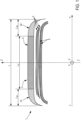
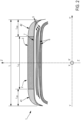
- the two lateral parts 41, 42, positioned axially on either side of the middle part 3, are different from the middle rubber composition.
- the two lateral parts 41, 42, positioned axially on either side of the middle part 3, are constituted by identical lateral rubber compositions and/or have identical axial widths (L S1 , L S2 ).
- the tire according to the invention can advantageously comprise an intermediate layer 7 consisting of a rubber composition in contact via a radially outer face with at least the middle portion 3 of the tread 2. and by a radially inner face with the crown reinforcement 5.
- a contact of the radially outer face of the intermediate layer with at least the middle portion of the tread means that the axial width of this contact is at least equal to the axial width L C of the middle portion of the tread.
- a contact of the radially inner face of the intermediate layer with the crown reinforcement is a contact with the protective reinforcement, which is the radially outermost part of the crown reinforcement intended to protect the working reinforcement, which is the radially innermost part of the crown reinforcement.
- This intermediate layer also called a bonding layer, guarantees a better bond between the tread comprising a rubber composition according to the invention and the crown reinforcement.
- the carcass reinforcement of an aircraft tire generally comprises a carcass reinforcement 6 consisting of a plurality of carcass layers extending between the two beads and distributed between a first and a second family.
- the first family consists of carcass layers, wrapping, in each bead, from the inside to the outside of the tire, around a circumferential reinforcing element, called a bead wire, to form a turn-up whose end is generally radially outward at the most radially outward point of the bead wire.
- the turn-up is the portion of the carcass layer between the most radially inner point of the carcass layer and its end.
- the carcass layers of the first family are the carcass layers closest to the inner cavity of the tire and therefore the most axially inward, in the sidewalls.
- the second family consists of carcass layers extending, in each bead, from the outside to the inside of the tire, up to a generally radially inner end at the most radially outer point of the bead wire.
- the carcass layers of the second family are the carcass layers closest to the outer surface of the tire and therefore the most axially outer, in the sidewalls.
- the carcass layers of the second family are positioned, over their entire length, outside the carcass layers of the first family, that is to say that they envelop, in particular, the turn-ups of the carcass layers of the first family.
- Each carcass layer of the first and second families consists of reinforcing elements parallel to each other, making, with the circumferential direction, an angle of between 80° and 100°.
- the reinforcement elements of the carcass layers of an aircraft tire are most often cables made of textile filament yarns, preferably made of aliphatic polyamide or aromatic polyamide, and characterized by their mechanical properties in extension.
- the textile reinforcement elements are subjected to traction over an initial length of 400 mm at a nominal speed of 200 mm/min. All results are an average of 10 measurements.
- the tire according to the invention may comprise a number of carcass layers ranging from 2 to 12, preferably from 5 to 10.
- the tires according to the present invention can be used on any type of aircraft. They are particularly interesting for aircraft using large-sized tires. Indeed, the larger the dimension of an aircraft tire, the greater the impact of wear on landing on the overall wear of the tire. Thus, according to the invention, the tire can have a dimension greater than 18 inches, preferably 20 to 23 inches.
- the elastomeric matrix of the median rubber composition comprising from 25 to 85 parts by weight per hundred parts by weight of elastomer, pce, of a tin-functionalized butadiene and styrene copolymer and from 15 to 75 pce of isoprene elastomer, the total content of isoprene elastomer and of tin-functionalized butadiene and styrene copolymer in the median rubber composition being within a range of from 45 to 100 pce.
- isoprene elastomer is meant, in a known manner, a homopolymer or a copolymer of isoprene, in other words a diene elastomer chosen from the group consisting of natural rubber (NR), synthetic polyisoprenes (IR), the various isoprene copolymers and the mixtures of these elastomers.
- NR natural rubber
- IR synthetic polyisoprenes
- isoprene copolymers examples include isobutene-isoprene copolymers (butyl rubber - IIR), isoprene-styrene (SIR), isoprene-butadiene (BIR) or isoprene-butadiene-styrene (SBIR).
- This isoprene elastomer is preferably natural rubber or a synthetic cis-1,4 polyisoprene, preferably natural rubber.
- the synthetic polyisoprene may be a polyisoprene having a rate (mol %) of cis-1,4 bonds greater than 90%, more preferably still greater than 98%.
- the elastomers used in the context of the present invention may be, for example, block, statistical, sequenced, microsequenced, and may be prepared in dispersion or in solution; they may be coupled and/or star-shaped and/or functionalized with a coupling and/or star-shaping and/or functionalizing agent.
- the isoprene elastomer content may be within a range from 20 to 70 pce, preferably from 20 to 65 or from 30 to 65 pce, preferably from 25 to 60 pce, preferably from 25 to 50 pce.
- the isoprene elastomer may be selected from the group consisting of natural rubber, synthetic polyisoprene and their mixture.
- the isoprene elastomer is natural rubber.
- a copolymer of butadiene units and styrene units is any copolymer obtained by copolymerization of one or more butadiene(s) with one or more styrene compounds.
- Suitable styrene compounds include, for example, styrene, ortho-, meta-, para-methylstyrene, the commercial mixture "vinyl-toluene", para-tert-butylstyrene, methoxystyrenes, chlorostyrenes, vinylmesitylene, divinylbenzene, vinylnaphthalene.
- elastomers can have any microstructure which depends on the polymerization conditions used, in particular the presence or absence of a modifying and/or randomizing agent and the quantities of modifying and/or randomizing agent used.
- the elastomers can be, for example, block, random, sequenced, microsequenced, and can be prepared in dispersion or in solution.
- the butadiene and styrene copolymer functionalized with tin (Sn), i.e. comprising C-Sn bonds (also called Sn functionalization), can be functionalized simply (C-Sn bonds at the end of the chain) and/or coupled (Sn atom between two chains) and/or starred (Sn atom between 3 or more chains) with a functionalization and/or coupling and/or starring agent.
- Sn tin
- elastomers we speak of tin-functionalized elastomers to bring together all these elastomers linked to tin. These elastomers are known to those skilled in the art, for example those described in the document WO 2011/042507 .
- styrenic and butadiene copolymers such as silanol or polysiloxane functional groups having a silanol end, or epoxidized styrenic and butadiene copolymers.
- Such functionalizations are possible within the scope of the present invention in addition to that with tin.
- a functionalizing agent derived from tin which may correspond to the general formula (X 1 1 R 1 2 Sn)-O-(SnR 1 3-y X 1 y ) or (X 1 1 R 1 2 Sn)-O-(CH2) n -O-(SnR 1 3-y X 1 y ), where y represents an integer of value 0 or 1, R 1 represents an alkyl, cycloalkyl, aryl, alkaryl or vinyl radical having from 1 to 12 carbon atoms, preferably a butyl, X 1 is a halogen atom, preferably chlorine, and n represents an integer from 1 to 20, preferably 4.
- tin coupling or starring agents mention may be made of tin derivatives of formula SnRxX 4 -x, x representing an integer of value 0 to 2, R representing an alkyl, cycloalkyl, aryl, alkaryl, aralkyl, vinyl radical having from 1 to 10 carbon atoms, preferably an alkyl radical having from 1 to 4 carbon atoms, and X is a halogen atom, preferably chlorine.
- dibutyltin dichloride or tin tetrachloride the latter being particularly preferred.
- the tin-functionalized butadiene and styrene copolymer can be obtained in a manner known per se by reacting a tin derivative with the butadiene and styrene copolymer.
- the preparation of a star diene elastomer is for example described in the patent US 3,393,182 .
- the tin-functionalized butadiene and styrene copolymer is preferably a statistical butadiene-styrene copolymer (SBR). This will then be referred to as a tin-functionalized SBR (Sn-SBR). It may be, for example, an SBR prepared in emulsion ("ESBR") or an SBR prepared in solution (“SSBR”).
- SBR tin-functionalized SBR
- ESBR SBR prepared in emulsion
- SSBR SBR prepared in solution
- the tin-functionalized butadiene and styrene copolymer is a statistical butadiene-styrene copolymer prepared in solution (SSBR).
- the contents of vinyl bonds (-1,2), trans-1,4 and cis-1,4 of the butadiene part of the SBR may be variable. For example, the vinyl content may be between 15% and 80% (mol%), the content of trans-1,4 bonds between 15% and
- the tin-functionalized butadiene-styrene copolymer is a low-styrene-functionalized butadiene-styrene copolymer.
- the styrene content of the low-styrene-functionalized butadiene-styrene copolymer may be in a range from 5 to 25%, preferably from 5 to 20%, more preferably from 10 to 19%.
- the tin-functionalized butadiene and styrene copolymer has a glass transition temperature in the range from -70°C to -30°C.
- the content of tin-functionalized butadiene and styrene copolymer is within a range from 30 to 80 phr, preferably from 35 to 80 phr or from 35 to 70 phr, preferably from 40 to 75 phr, preferably from 50 to 75 phr.
- the total content of isoprene elastomer and tin-functionalized butadiene and styrene copolymer may be 100 pce.
- the elastomeric matrix of the composition of the tread of the aircraft tire according to the invention exclusively comprises isoprene elastomer and tin-functionalized butadiene and styrene copolymer.
- the total content of isoprene elastomer and tin-functionalized butadiene and styrene copolymer may also be in the range from 45 to less than 100 phr.
- the elastomeric matrix of the composition of the tread of the aircraft tire according to the invention comprises from more than 0 to 55 phr of another diene elastomer in addition to the isoprene elastomer and the tin-functionalized butadiene and styrene copolymer.
- the total content of isoprene elastomer and tin-functionalized butadiene and styrene copolymer may be, for example, in the range from 50 to less than 100 phr, preferably from 45 to 90 phr, preferably from 70 to 80 phr.
- diene elastomer a diene elastomer other than isoprene elastomer and tin-functionalized butadiene-styrene copolymer.
- iene elastomer one (meaning one or more) elastomers derived at least in part (i.e., a homopolymer or a copolymer) must be understood in a known manner of diene monomers (monomers carrying two carbon-carbon double bonds, conjugated or not).
- Suitable conjugated dienes include, in particular, 1,3-butadiene, 2-methyl-1,3-butadiene, 2,3-di(C 1 -C 5 alkyl)-1,3-butadienes such as, for example, 2,3-dimethyl-1,3-butadiene, 2,3-diethyl-1,3-butadiene, 2-methyl-3-ethyl-1,3-butadiene, 2-methyl-3-isopropyl-1,3-butadiene, aryl-1,3-butadiene, 1,3-pentadiene, 2,4-hexadiene.
- Suitable vinyl aromatic compounds include, for example, styrene, ortho-, meta-, para-methylstyrene, the commercial mixture "vinyl-toluene", para-tert-butylstyrene, methoxystyrenes, vinylmesitylene, divinylbenzene, vinylnaphthalene.
- the other diene elastomer may be chosen from the group comprising or consisting of non-tin-functionalized butadiene and styrene copolymers, polybutadienes and their mixtures.
- the non-tin-functionalized butadiene-styrene copolymer may be, for example, butadiene-styrene copolymer (SBR). It may be, for example, an emulsion-prepared SBR ("ESBR") or a solution-prepared SBR ("SSBR").
- SBR butadiene-styrene copolymer
- ESBR emulsion-prepared SBR
- SSBR solution-prepared SBR
- the contents of (-1,2), trans-1,4 and cis-1,4 vinyl bonds in the butadiene portion of the SBR may be variable.
- the vinyl content may be between 15% and 80% (mol%), the content of trans-1,4 bonds between 15% and 80% (mol%).
- the other diene elastomer mainly comprises a polybutadiene.
- the polybutadiene may be, for example, a polybutadiene comprising mainly cis-1,4 bonds. It may be, for example, a composite polybutadiene comprising 5 to 25% of syndiotactic 1,2-polybutadiene in a cis-1,4-polybutadiene matrix, for example “VCR412 UBEPOL” from the company UBE, comprising 12% of syndiotactic 1,2-polybutadiene in a cis-1,4-polybutadiene matrix.
- VCR412 UBEPOL from the company UBE
- the rate of the other diene elastomer may depend on the nature of this other diene elastomer. This rate may be within a range from more than 0 to 50 pce, preferably from 10 to 55 pce, preferably from 20 to 30 pce.
- the diene elastomer content can be within a range from 10 to 30 pce, preferably from 15 to 25 pce.
- the other diene elastomer mainly comprises composite polybutadiene comprising 5 to 25% of syndiotactic 1,2-polybutadiene in a cis-1,4-polybutadiene matrix
- the content of the other diene elastomer is within a range from 10 to 55 phr, preferably from 30 to 55 phr, preferably from 40 to 55 phr, preferably from 45 to 50 phr.
- the median rubber composition of the tread of the tire according to the invention further comprises a reinforcing filler, known for its abilities to reinforce a rubber composition usable for the manufacture of tires.
- the reinforcing filler may comprise carbon black and/or a reinforcing inorganic filler (preferably a silica).
- the reinforcing filler comprises predominantly, preferably exclusively, carbon black.
- the blacks that can be used in the context of the present invention can be any black conventionally used in tires or their treads (so-called tire grade blacks).
- tire grade blacks any black conventionally used in tires or their treads
- These carbon blacks can be used in the state isolated, as commercially available, or in any other form, for example as a carrier for some of the rubber additives used.
- Carbon blacks could for example already be incorporated into the diene elastomer, in particular isoprene in the form of a masterbatch (see for example applications WO 97/36724 Or WO 99/16600 ).
- organic fillers other than carbon blacks examples include functionalized polyvinyl organic fillers as described in the applications WO 2006/069792 , WO 2006/069793 , WO 2008/003434 And WO 2008/003435 .
- the carbon black comprises mainly, preferably exclusively, a carbon black having a BET specific surface area of less than or greater than 80 m 2 /g, preferably within a range between 80 and 170 m 2 /g, more preferably between 120 and 145 m 2 /g.
- the BET specific surface area of carbon blacks is measured according to standard D6556-10 [multipoint method (minimum 5 points) - gas: nitrogen - relative pressure range P/P0: 0.1 to 0.3].
- filler any inorganic or mineral filler, whatever its colour and origin (natural or synthetic), also called “white” filler, “light” filler or even “non-black” filler as opposed to carbon black, capable of reinforcing on its own, without any means other than an intermediate coupling agent, a rubber composition intended for the manufacture of pneumatic tires, in other words capable of replacing, in its reinforcing function, a conventional pneumatic grade carbon black; such a filler is generally characterised, in a known manner, by the presence of hydroxyl groups (-OH) on its surface.
- -OH hydroxyl groups
- reinforcing inorganic filler is present in the form of powder, microbeads, granules, beads or any other suitable densified form.
- reinforcing inorganic filler also means mixtures of different reinforcing inorganic fillers, in particular highly dispersible siliceous and/or aluminous fillers as described below.
- mineral fillers of the siliceous type preferably silica (SiO 2 ) are particularly suitable.
- the silica used may be any reinforcing silica known to those skilled in the art, particularly any precipitated or pyrogenic silica having a BET surface area and a CTAB specific surface area both of less than 450 m2/g, preferably from 30 to 400 m2/g, particularly between 60 and 300 m2/g.
- the silicas or other reinforcing inorganic fillers which can be used in the context of the present invention may be any silica known to those skilled in the art, in particular any precipitated or pyrogenic silica having a BET surface area and a CTAB specific surface area both of less than 450 m2/g, preferably from 30 to 400 m2/g.
- the BET specific surface area of silica or reinforcing inorganic fillers is determined in a known manner by gas adsorption using the method of Brunauer-Emmett-Teller described in "The Journal of the American Chemical Society” Vol. 60, page 309, February 1938 , more precisely according to the French standard NF ISO 9277 of December 1996 (multipoint volumetric method (5 points) - gas: nitrogen - degassing: 1 hour at 160°C - relative pressure range p/po: 0.05 to 0.17).
- the CTAB specific surface area of silica is determined according to the French standard NF T 45-007 of November 1987 (method B).
- the reinforcing inorganic fillers preferably silica
- the reinforcing inorganic fillers have a BET specific surface area of less than 200 m 2 /g and/or a CTAB specific surface area of less than 220 m 2 /g, preferably a BET specific surface area in a range from 125 to 200 m 2 /g and/or a CTAB specific surface area in a range from 140 to 170 m 2 /g.
- inorganic fillers that can be used in the context of the present invention, mention may be made, for example, of the highly dispersible precipitated silicas (known as "HDS") "Ultrasil 7000" and “Ultrasil 7005" from the company Evonik, the silicas “Zeosil 1165MP, 1135MP and 1115MP” from the company Rhodia, the silica "Hi-Sil EZ150G” from the company PPG, the silicas “Zeopol 8715, 8745 and 8755” from the company Huber, the silicas with a high specific surface area as described in the application WO 03/16837 .
- HDS highly dispersible precipitated silicas
- an at least bifunctional coupling agent (or bonding agent) is used in a well-known manner, intended to ensure a sufficient connection, of a chemical and/or physical nature, between the silica (surface of its particles) and the diene elastomer.
- at least bifunctional organosilanes or polyorganosiloxanes are used.
- alkoxysilane-polysulfide compounds in particular bis-(trialkoxylsilylpropyl) polysulfides, most particularly bis-3-triethoxysilylpropyl disulfide (abbreviated to "TESPD”) and bis-3-triethoxysilylpropyl tetrasulfide (abbreviated to "TESPT”).
- TESPD bis-3-triethoxysilylpropyl disulfide
- TESPT bis-3-triethoxysilylpropyl tetrasulfide
- TESPD of formula [( C2H5O ) 3Si ( CH2 )3S] 2
- Si266 or Si75 in the second case, in the form of a mixture of disulfide (at 75 % by weight) and polysulfides.
- TESPT of formula [(C 2 H 5 O) 3 Si(CH 2 ) 5 S 2 ] 2 is marketed in particular by the company Degussa under the name Si69 (or X50S when it is supported at 50% by weight on carbon black), in the form of a commercial mixture of polysulfides Sx with an average value for x which is close to 4.
- the level of reinforcing filler, preferably carbon black, in the composition is preferably within a range from 20 to 100 phr, preferably from 25 to 75 phr, more preferably from 30 to 70 phr.
- the level of reinforcing inorganic filler, preferably silica, in the composition is within a range from 0 to 20 pce, preferably from 1 to 15 pce.
- crosslinking system of the middle rubber composition of the tire tread according to the invention may be based on molecular sulfur and/or sulfur and/or peroxide donors, well known to those skilled in the art.
- the crosslinking system is preferably a sulfur-based vulcanization system (molecular sulfur and/or sulfur donor agent).
- Sulphur is used at a preferential rate of between 0.5 and 10 pce.
- the sulphur rate is between 0.5 and 2 pce, preferably between 0.5 and 1.5 pce, more preferably between 0.5 and 1.4 pce.
- composition of the outer sidewall of the tire according to the invention advantageously comprises a vulcanization accelerator, which is preferably chosen from the group consisting of thiazole type accelerators and their derivatives, sulfenamide type accelerators, thioureas and their mixtures.
- a vulcanization accelerator which is preferably chosen from the group consisting of thiazole type accelerators and their derivatives, sulfenamide type accelerators, thioureas and their mixtures.
- the vulcanization accelerator is chosen from the group consisting of 2-mercaptobenzothiazyl disulfide (MBTS), N-cyclohexyl-2-benzothiazyl sulfenamide (CBS), N,N-dicyclohexyl-2-benzothiazyl sulfenamide (DCBS), N-tert-butyl-2-benzothiazyl sulfenamide (TBBS), N-tert-butyl-2-benzothiazyl sulfenimide (TBSI), morpholine disulfide, N-morpholino-2-benzothiazyl sulfenamide (MBS), dibutylthiourea (DBTU), and their mixtures.
- the primary vulcanization accelerator is N-cyclohexyl-2-benzothiazyl sulfenamide (CBS).
- the vulcanization accelerator content is preferably within a range from 0.2 to 10 pce, preferably from 0.5 to 2 pce, preferably between 0.5 and 1.5 pce, more preferably between 0.5 and 1.4 pce.
- the median rubber composition of the tread of the tire according to the invention may comprise from 1 to 30 pce of a plasticizing resin mainly composed of units derived from aromatic and cycloaliphatic monomers.
- This resin is also called aromatic/cycloaliphatic resin in the following.
- Plasticizing resins in general are known to those skilled in the art. They are also sometimes called hydrocarbon resins or high glass transition temperature resins.
- plasticizing resin is reserved in the present application, by definition, for a compound which is on the one hand solid at room temperature (23°C) (as opposed to a liquid plasticizing compound such as an oil).
- Hydrocarbon resins are polymers well known to those skilled in the art, miscible by nature in diene elastomer compositions when they are also described as “plasticizers". They have been described for example in the work entitled " Hydrocarbon Resins” by R. Mildenberg, M. Zander and G. Collin (New York, VCH, 1997, ISBN 3-527-28617-9 ) whose chapter 5 is devoted to their applications, particularly in pneumatic rubber (5.5. "Rubber Tires and Mechanical Goods” ). They can be aliphatic, aromatic or of the aliphatic/aromatic type, i.e. based on aliphatic and/or aromatic monomers. They can be natural or synthetic, based or not on petroleum (if this is the case, also known as petroleum resins). They are preferably exclusively hydrocarbon-based, i.e. they only contain carbon and hydrogen atoms.
- the specific resin for the invention is mainly composed of units derived from aromatic and cycloaliphatic monomers.
- cycloaliphatic monomers are understood to mean saturated cyclic monomers and the monomers will preferably be chosen from the group consisting of cyclopentadiene (abbreviated CPD), dicyclopentadiene (abbreviated DCPD) and their mixtures.
- CPD cyclopentadiene
- DCPD dicyclopentadiene
- the monomers will preferably be chosen from the group consisting of styrene, alpha-methyl styrene, vinyl toluene, indene and their mixtures.
- the hydrocarbon resin composed mainly of units derived from aromatic and cycloaliphatic monomers is such that the cycloaliphatic monomers are chosen from the group consisting of cyclopentadiene, dicyclopentadiene and their mixtures, and the aromatic monomers are chosen from the group consisting of styrene, alpha-methyl styrene, vinyl toluene, indene and their mixtures. More preferably, the aromatic monomer is styrene.
- the resin useful for the purposes of the invention may comprise, in addition to these units, and to a minor extent, aliphatic units, i.e. based on aliphatic monomers, other than cycloaliphatic monomers.
- the resin may comprise, to a minor extent, units derived from olefinic monomers.
- the aromatic/cycloaliphatic resin preferably has an aromatic proton content in the range of 3 to 40%, preferably 5 to 30%. It also preferably has an ethylenic proton content in the range of 2 to 15%, preferably 3 to 10%.
- the aromatic/cycloaliphatic resin has an ethylenic proton content within a range of 2 to 15%, preferably 3 to 10%.
- the hydrocarbon resin useful for the needs of the invention has a glass transition temperature (Tg) within a range from 30°C to 150°C, preferably from 30 to 120°C.
- the hydrocarbon resin useful for the purposes of the invention has an average molecular mass Mn within a range extending from 300 g/mol to 3000 g/mol and preferably from 400 to 1500 g/mol.
- the hydrocarbon resin useful for the purposes of the invention has a polymolecularity index (Ip) within a range from 1 to 4, and preferably from 1.5 to 3.5.
- hydrocarbon resins there are many hydrocarbon resins available. These resins may have characteristics, including chemical composition, Tg, Mn, aromatic proton rate, ethylenic or even Ip, which differ depending on the supplier.
- the macrostructure (Mw, Mn, Ip and Mz) of the hydrocarbon resin is determined by size exclusion chromatography (SEC) based on the standards ISO 16014 (Determination of average molecular mass and molecular mass distribution of polymers using size exclusion chromatography), ASTM D5296 (Molecular Weight Averages and molecular weight distribution of polystyrene by High performance size exclusion chromatography), and DIN 55672 (size exclusion chromatography).
- the resin sample is solubilized in non-antioxidized tetrahydrofuran to a concentration of 1.5 g/l.
- the solution is filtered with a Teflon filter with a porosity of 0.45 ⁇ m, using for example a single-use syringe fitted with a filter.
- a volume of 100 ⁇ l is injected through a set of size exclusion chromatography columns.
- the mobile phase is eluted with a flow rate of 1 ml/min.
- the columns are thermostated in an oven at 35°C. Detection is ensured by a refractometer thermostated at 35°C.
- the stationary phase of the columns is based on a polystyrene divinylbenzene gel with controlled porosity.
- the polymer chains are separated according to the size they occupy when they are solubilized in the solvent: the larger the volume they occupy, the less accessible the pores of the columns are to them and the shorter their elution time.
- polystyrene standards with narrow molecular distributions (polydispersity index, Ip, less than or equal to 1.1) are used.
- the molar mass range of these standards extends from 160 to approximately 70,000 g/mol.
- These standards can be grouped into "families" of 4 or 5 standards with an increment of approximately 0.55 in log of M between each.
- the number-average molar masses (Mn), mass-average molar masses (Mw), Mz, and polydispersity of the analyzed resin are calculated from this calibration curve. This is why we speak of molar masses relative to a polystyrene calibration.
- the integration limits of the product elution are defined on the chromatogram corresponding to the injection of the sample.
- the refractometric signal defined between the 2 integration limits is "cut” every second. For each of the "elementary cuts", the elution time ti and the area of the detector signal Ai are recorded.
- the equipment used for the SEC measurement is a liquid chromatography chain, for example the Alliance 2690 chain from WATERS comprising a pump, a degasser and an injector; a differential refractometer (for example the 2410 refractometer from WATERS), data acquisition and processing software, for example the EMPOWER software from WATERS, a column oven, for example the WATERS “columns Heater Module” and 4 columns connected in series in the following order: Table 1 Number Brand Molar mass range (g / mol) Length (mm) Internal diameter (mm) Particle size ( ⁇ m) Trade name References (for information purposes only) Columns 1 and 2 Polymer Laboratories 200 - 400000 300 7.5 5 MIXED-D PL1110-6504 Columns 3 and 4 Polymer Laboratories 200 - 30000 300 7.5 3 MIXED-E PL1110-6300
- the aromatic proton rate (%HA) and the ethylenic proton rate (%HE) are measured by 1H NMR. This determination is carried out in relation to all the signals detected. Thus, the results obtained are expressed in % of peak area.
- Samples are solubilized in deuterated chloroform (CDCl3) at a rate of approximately 10 mg of resin in approximately 1 mL of solvent.
- Spectra are acquired on a Bruker Avance 500 MHz spectrometer equipped with a Bruker BBO z-grad 5 mm "broadband" probe.
- the 1H NMR experiment uses a single 30° pulse sequence and a 5-second repetition delay between each acquisition. 64 accumulations are performed at room temperature. Chemical shifts are calibrated relative to the protonated impurity of deuterated chloroform; ⁇ ppm 1H at 7.20 ppm.
- the 1H NMR signals of aromatic protons are located between 8.5 ppm and 6.2 ppm.
- Ethylene protons generate signals between 6.2 ppm and 4.5 ppm. Finally, the signals corresponding to aliphatic protons are located between 4.5ppm and 0ppm. The areas of each category of protons are reported to the sum of these areas to give a distribution in % of area of each category of protons.
- the aromatic/cycloaliphatic resin rate is preferably within a range of 2 to 30 pce, more preferably 2 to 15 pce.
- composition of the tread of the aircraft tire of the invention does not comprise any resin other than the C5 resin described above.
- the plasticizing resin mainly composed of units derived from aromatic and cycloaliphatic monomers has an aromatic proton content of between 0 and 12%, an ethylenic proton content greater than 3%, a number average molecular weight greater than 500 g/mol and a polymolecularity index greater than 2.
- the aromatic/cycloaliphatic resin has an aromatic proton content of between 0 and 12%, preferably an aromatic proton content in a range from 1 to 10%, preferably from 2 to 7%.
- the aromatic/cycloaliphatic resin has an ethylenic proton level greater than 3%, preferably an ethylenic proton level within a range from 3 to 7%.
- the hydrocarbon resin useful for the needs of the invention can advantageously have a glass transition temperature (Tg) within a range from 30°C to 150°C, preferably from 30 to 120°C.
- Tg glass transition temperature
- the hydrocarbon resin useful for the needs of the invention can advantageously have a number-average molecular mass (Mn) greater than 500 g/mol, preferably within a range from 500 g/mol to 1500 g/mol and preferably from 500 to 1000 g/mol.
- Mn number-average molecular mass
- the hydrocarbon resin useful for the needs of the invention can advantageously have a polymolecularity index (Ip) greater than 2, preferably within a range from 2 to 5, and preferentially from 3 to 4.5.
- Ip polymolecularity index
- the hydrocarbon resin mainly composed of units derived from aromatic and cycloaliphatic monomers, advantageously further comprises units derived from pine derivatives, preferentially chosen from the group consisting of alphapinene, betapinene, rosin, turpentine, tall oil and mixtures thereof.
- the resin is also preferentially modified with maleic anhydride.
- the median rubber composition comprises 0 to 20 pce of a liquid plasticizer.
- a plasticizer is considered liquid when, at 23°C, it has the capacity to eventually take the shape of its container, this definition being given in contrast to plasticizing resins which are by nature solid at room temperature.
- liquid plasticizers include vegetable oils, mineral oils, ether, ester, phosphate, sulfonate plasticizers and their mixtures.
- the liquid plasticizer rate of the median rubber composition is equal to 0.
- the rubber compositions of the tread of the tire according to the invention may optionally also comprise all or part of the usual additives usually used in elastomer compositions for tires, such as for example plasticizers (such as plasticizing oils and/or plasticizing resins), pigments, protective agents such as anti-ozone waxes, chemical anti-ozonants, antioxidants, anti-fatigue agents, reinforcing resins (as described for example in the application WO 02/10269 ).
- plasticizers such as plasticizing oils and/or plasticizing resins
- protective agents such as anti-ozone waxes, chemical anti-ozonants, antioxidants, anti-fatigue agents, reinforcing resins (as described for example in the application WO 02/10269 ).
- At least one lateral rubber composition is different from the middle rubber composition.
- the difference is advantageously linked to the absence of tin-functionalized butadiene and styrene copolymer, or by its presence at a rate of less than 25 pce.
- the lateral rubber composition does not comprise tin-functionalized butadiene and styrene copolymer, or comprises less than 25 phr, preferably less than 15 phr, more preferably less than 10 phr.
- the lateral rubber composition does not comprise tin-functionalized butadiene and styrene copolymer.
- the at least one lateral rubber composition comprises at least one diene elastomer, a reinforcing filler and a crosslinking system, which the diene elastomer predominantly comprises at least one isoprene elastomer.
- the lateral rubber composition comprises more than 85 pce, preferably at least 90 pce of at least one isoprene elastomer. More preferably, it comprises 100 pce of at least one isoprene elastomer.
- the isoprene elastomer of the lateral rubber composition may be selected from the group consisting of natural rubber, synthetic polyisoprenes and mixtures thereof.
- the at least one isoprene elastomer of the lateral rubber composition is a natural rubber.
- the lateral rubber composition also advantageously comprises one or more reinforcing fillers, preferably chosen from carbon blacks, silicas and their mixtures, preferably at a rate in a range from 20 to 200 phr, preferably from 20 to 70 phr, more preferably from 40 to 55 phr.
- the reinforcing filler comprises mainly, preferably exclusively, carbon black.
- the carbon black of the lateral rubber composition advantageously has a BET specific surface area of less than or greater than 80 m 2 /g, preferably in a range between 80 and 170 m 2 /g, more preferably between 120 and 145 m 2 /g.
- the lateral rubber composition advantageously comprises a crosslinking system based on molecular sulfur and/or sulfur donors and/or peroxide, preferably based on molecular sulfur and/or sulfur donors, preferably at a rate of between 0.5 and 12 pce, preferably between 1 and 10 pce.
- the lateral rubber composition may comprise all or part of the usual additives usually used in tire elastomer compositions such as those previously mentioned.
- the tire comprising a crown reinforcement radially inside the tread, the tire advantageously comprises an intermediate layer consisting of a rubber composition in contact by a radially external face with at least the median portion of the tread and by a face radially inner with the crown reinforcement.
- a contact of the radially outer face of the intermediate layer with at least the middle portion of the tread means that the axial width of this contact is at least equal to the axial width L C of the middle portion of the tread.
- a contact of the radially inner face of the intermediate layer with the crown reinforcement is a contact with the protective reinforcement, which is the radially outermost part of the crown reinforcement intended to protect the working reinforcement, which is the radially innermost part of the crown reinforcement.
- This intermediate layer also called a bonding layer, ensures a better bond between the tread comprising a rubber composition according to the invention and the crown reinforcement.
- the interlayer advantageously comprises at least one diene elastomer, a reinforcing filler and a crosslinking system, which diene elastomer predominantly comprises at least one isoprene elastomer.
- the interlayer is as defined, preferably identical to, the lateral rubber composition of the tread of the tire according to the invention.
- the interlayer may thus comprise more than 85 pce, preferably at least 90 pce of at least one isoprene elastomer. More preferably, it comprises 100 pce of at least one isoprene elastomer.
- the isoprene elastomer of the interlayer may be selected from the group consisting of natural rubber, synthetic polyisoprenes and their mixtures.
- the at least one isoprene elastomer of the interlayer is a natural rubber.
- the interlayer also advantageously comprises one or more reinforcing fillers, preferably chosen from carbon blacks, silicas and their mixtures, preferably at a rate within a range from 20 to 200 phr, preferably from 20 to 70 phr, more preferably from 40 to 55 phr.
- the reinforcing filler comprises mainly, preferably exclusively, carbon black.
- the interlayer advantageously comprises a crosslinking system based on molecular sulfur and/or sulfur and/or peroxide donors, preferably based of molecular sulfur and/or sulfur donors, preferably at a rate of between 0.5 and 12 pce, preferably between 1 and 10 pce.
- the interlayer may comprise all or part of the usual additives usually used in elastomer compositions for tires such as those previously mentioned.
- the final composition thus obtained is then calendered, for example, in the form of a sheet or plate, in particular for characterization in the laboratory, or extruded (or co-extruded with another rubber composition) in the form of a semi-finished rubber (or profile) usable, for example, as a tire tread.
- These products can then be used for the manufacture of tires, according to techniques known to those skilled in the art.
- the composition can be either in the raw state (before crosslinking or vulcanization) or in the cooked state (after crosslinking or vulcanization), can be a semi-finished product which can be used in a tire.
- crosslinking of the composition can be carried out in a manner known to those skilled in the art, for example at a temperature between 130°C and 200°C, under pressure.
- the elongations at break (in %) are measured at two temperatures: at 23°C and at 100°C, under normal hygrometry conditions (50% relative humidity), according to the French standard NF T 40-101 (December 1979), the breaking stresses (in MPa) and the breaking energy can also be measured, the breaking energy (Energie Rupture) being the product of the breaking stress and the breaking elongation.
- the results are given on a base of 100, i.e. the values are expressed relative to a control, whose breaking elongation is considered as the reference at 100.
- This test determines the mass loss of a sample of aircraft tire tread compound when subjected to an abrasion test on a high-speed abraser.
- the high-speed abrasion test is carried out according to the principle described in the article by SK Clark “Touchdown dynamics”, Precision Measurement Company, Ann Arbor, MI, NASA, 35 Langley Research Center, Computational Modeling of Tires pages 9-19 published August 1995 .
- the tread material rubs on a surface such as a Norton Vulcan A30S-BF42 disc.
- the linear velocity at contact is 70 m/s with an average contact pressure of 15 to 20 bar.
- An energy of 10 to 20 MJ/m2 of contact surface is involved during the experiment.
- the elements of the constant energy tribometry device according to the above-mentioned article by S.K. Clark are a motor, a clutch, a rotating plate and a sample holder.
- Results are expressed in base 100. A performance for the sample greater than 100 is considered better than the control.
- the dynamic properties G* and tan( ⁇ )max are measured on a viscoanalyzer (Metravib V A4000), according to the ASTM D 5992 - 96 standard.
- the response of a sample of vulcanized composition (cylindrical specimen 4 mm thick and 400 mm2 in section) is recorded, subjected to sinusoidal stress in alternating simple shear, at a frequency of 10 Hz, at 60 ° C according to the ASTM D 1349 - 99 standard.
- a peak-to-peak strain amplitude scan is carried out from 0.1 to 50% (forward cycle), then from 50% to 1% (return cycle).
- the results used are the complex dynamic shear modulus (G*) and the loss factor tan( ⁇ ).
- tan( ⁇ )max the maximum value of tan( ⁇ ) observed (tan( ⁇ )max) is indicated, as well as the difference in complex modulus (G*) between the values at 0.1% and 50% deformation (Payne effect).
- G* complex modulus
- the tearability indices are measured at two temperatures: 23°C and 100°C.
- the force required to achieve rupture (FRD, in N/mm) is determined and the strain at rupture (DRD, in %) is measured on a test piece measuring 10 x 85 x 2.5 mm, notched in the centre of its length by 3 notches to a depth of 5 mm, to cause the test piece to rupture.
- This allows the energy required to cause rupture (Energy) of the test piece to be determined, which is the product of the FRD and DRD.
- the results are given on a base of 100, i.e. the values are expressed relative to a control, whose strain at rupture (DRD) is considered to be the reference at 100.
- the measurements are carried out at 130°C, in accordance with the French standard NF T 43-005.
- the evolution of the consistometric index as a function of time makes it possible to determine the fixing time of the rubber compositions, assessed in accordance with the aforementioned standard by the parameter T5 (case of a large rotor), expressed in minutes, and defined as the time necessary to obtain an increase in the index consistometric (expressed in UM) of 5 units above the minimum value measured for this index.
- the microstructure is determined by 1H NMR analysis, supplemented by 13C NMR analysis when the resolution of 1H NMR spectra does not allow the attribution and quantification of all species.
- the measurements are carried out using a BRUKER 500 MHz NMR spectrometer at frequencies of 500.43 MHz for proton observation and 125.83 MHz for carbon observation.
- a 4 mm z-grad HRMAS probe is used to observe the proton and carbon in proton-decoupled mode.
- the spectra are acquired at rotation speeds of 4000 Hz to 5000 Hz.
- a liquid NMR probe is used to observe the proton and carbon in proton-decoupled mode.
- the preparation of non-soluble samples is done in rotors filled with the analyzed material and a deuterated solvent allowing swelling, generally deuterated chloroform (CDCl3).
- the solvent used must always be deuterated and its chemical nature can be adapted by the skilled person.
- the quantities of material used are adjusted so as to obtain spectra with sufficient sensitivity and resolution.
- the soluble samples are dissolved in a deuterated solvent (approximately 25 mg of elastomer in 1 mL), generally deuterated chloroform (CDCl3).
- the solvent or solvent blend used must always be deuterated and its chemical nature can be adapted by the skilled person.
- the sequences used for proton NMR and carbon NMR are identical for a soluble sample and a swollen sample.
- proton NMR a single 30° pulse sequence is used.
- the spectral window is set to observe all the resonance lines belonging to the molecules analyzed.
- the accumulation number is set to obtain a sufficient signal-to-noise ratio for the quantification of each pattern.
- the recycling delay between each pulse is adapted to obtain a quantitative measurement.
- For carbon NMR a single 30° pulse sequence is used with proton decoupling only during acquisition to avoid “Nuclear Overhauser” (NOE) effects and remain quantitative.
- NOE Nuclear Overhauser
- the spectral window is set to observe all the resonance lines belonging to the molecules analyzed.
- the accumulation number is adjusted in order to obtain a sufficient signal-to-noise ratio for the quantification of each pattern.
- the recycling delay between each pulse is adapted to obtain a quantitative measurement.
- the NMR measurements are carried out at 25°C.
- the rubber compositions were produced as described in point II-5 above.
- the diene elastomers, the reinforcing fillers, and the various other ingredients are successively introduced into an internal mixer (final filling rate: approximately 70% by volume), the initial tank temperature of which is approximately 80°C.
- Thermomechanical work (non-productive phase) is then carried out in one step, lasting a total of approximately 3 to 4 minutes, until a maximum “drop” temperature of 165°C is reached.
- the mixture thus obtained is recovered, cooled and then sulfur and a sulfonamide-type accelerator are incorporated into a mixer (homo-finisher) at 70°C, mixing everything (productive phase) for an appropriate time (for example, about ten minutes).
- This example aims to show the influence of the incorporation rate of tin-functionalized SBR in compositions of the middle part of aircraft tire treads on the performance compromise between wear resistance and the conservation of mechanical and thermal properties.
- T1 corresponds to the composition of an aircraft tread conventionally used by a person skilled in the art; it is based on natural rubber as the only elastomer.
- T2 corresponds to a tread composition in which the natural rubber has been replaced by a tin-functional SBR.
- T3 corresponds to a tread composition in which half of the natural rubber has been replaced by a polybutadiene.
- Tests C1 to C3 are in accordance with the invention.
- Compositions C1 to C3 differ in the respective rates of natural rubber and tin SBR.
- the mass loss and elongation at break performance results at 60°C are expressed as a percentage base 100 relative to the control composition T1, corresponding to the usual tread compositions.
- Table 2 shows the compositions tested (in pce), as well as the results obtained.
- Table 2 T1 C1 C2 C3 T2 T3 NR (1) 100 70 50 25 - 50 SBR (2) - 30 50 75 100 - BR (3) - - - - - 50 Carbon black (4) 49 49 49 49 49 49 49 49 49 49 49 49 49 49 49 49 49 49 49 49 49 49 49 49 49 49 49 49 49 49 49 49 49 49 49 49 49 49 49 49 49 49 49 49 49 49 49 49 49 49 49 49 49 49 49 49 49 49 49 49 49 49 49 49 49 49 49 49 49 49 49 49 49 49 49 49 49 49 49 49 49 49 49 49 49 49 49 49 49 49 49 49 49 49 49 49 49 49 49 49 49 49 49 49 49 49 49 49 49 49 49 49 49 49 49 49 49 49 49 49 49 49 49 49 49 49 49 49 49 49 49 49 49 49 49 49 49 49 49 49 49 49 49 49 49 49 49 49 49 49 49 49 49 49 49 49 49 49 49 49 49 49 49 49 49 49 49 49 49 49 49 49 49 49 49 49 49 49 49
- compositions C1 to C3 have an elongation at break at 60°C that is 20% lower than the control T1 (composition of an aircraft tread conventionally used by a person skilled in the art to manufacture an aircraft tire tread), which remains an acceptable level of mechanical properties. Beyond a 20% decrease compared to T1, it may be considered that the mechanical properties could no longer be considered sufficient for the tread composition to be used on aircraft tires.
- the absence of natural rubber in the composition causes a sharp drop in mechanical properties.
- the T3 composition corresponding to a tread composition in which half of the natural rubber has been replaced by polybutadiene does not significantly improve wear resistance.
- the median compositions in accordance with the invention have the advantage of allowing better wear resistance of the median part of the tread during the landing phase of the aircraft, while maintaining or even improving the thermal properties of the composition and keeping the mechanical properties at an acceptable level. It is observed that the use of 45 to 75 pce of tin SBR in the composition leads to a better compromise in performance between wear resistance and the maintenance of thermal and mechanical properties.
- This example aims to show the influence of the incorporation of other diene elastomers in addition to the tin-functionalized SBR on the performance compromise between wear resistance and the conservation of the mechanical and thermal properties of the middle part of the tread.
- composition C2 corresponds to composition C2 of Example 1. It corresponds to an embodiment of the invention in which only the tin-functionalized SBR is present in addition to the diene elastomer.
- Tests C4 and C5 are also consistent with the median rubber composition according to the invention.
- Compositions C4 and C5 comprise complementary synthetic elastomers of different nature as indicated in Table 3 below.
- the mass loss and elongation at break performance results at 60°C are expressed as a percentage base 100 relative to the control composition T1 of Example 1.
- Table 3 shows the compositions tested (in pce), as well as the results obtained.
- compositions exhibit an elongation at break at 60°C well below 20%, or even higher, compared to the control T1, and the thermal stability of the composition is also maintained compared to the control T1. These results are comparable, or even higher, to the composition C2 in accordance with the present invention.
- the median rubber compositions in accordance with the invention whether or not they comprise another diene elastomer in addition to the isoprene elastomer and the tin-functionalized SBR, have the advantage of providing better wear resistance during the landing phase of the aircraft, while maintaining or even improving the thermal properties of the composition and retaining good mechanical properties.
- Tables 4 and 5 present all the compositions tested (in pce), as well as the results obtained.
- T4 and T5 are control compositions.
- Compositions C6 to C12 are in accordance with the invention.
- Table 6 presents all the compositions tested (in pce) as well as the results obtained.
- T6 is a control composition.
- Compositions C13 to C15 are in accordance with the invention.
- the elongation at break performance results at 23°C and 100°C are expressed as a percentage base 100 relative to the control composition, as are the tear resistance performance results at 23°C and 100°C.
- Processability is represented by Mooney viscosity values in Mooney units.
- the overall results show that the cutting resistance performances as represented by the elongation at break and tearability measurements, both at 23°C and 100°C, are greatly improved by the embodiment of the invention according to which the median rubber composition of the tread comprises at least one hydrocarbon resin predominantly composed of units derived from aromatic and cycloaliphatic monomers.
- the viscosity Mooney is reduced in the compositions useful for the invention, making it possible to increase industrial productivity during the manufacture of aircraft tires.
- the median rubber compositions in accordance with the invention based on at least in particular 25 to 85 pce of a tin-functionalized butadiene and styrene copolymer and 15 to 75 pce of isoprene elastomer, constituting the median part of the tread of an aircraft tire, give the tire a significantly improved resistance to touch wear during landing.
- a tire according to the invention compared to the reference tire, allows an overall gain in wear life over the entire tire usage cycle including the landing, rolling and braking phases.
- the retreading operation most often requires, in addition to the removal of the worn tread, the removal of the radially outermost crown layer, generally consisting of metal reinforcements and called the protective layer, said protective layer often being damaged at the end of the tyre's life due to its proximity to the tread.
Landscapes
- Chemical & Material Sciences (AREA)
- Health & Medical Sciences (AREA)
- Chemical Kinetics & Catalysis (AREA)
- Medicinal Chemistry (AREA)
- Polymers & Plastics (AREA)
- Organic Chemistry (AREA)
- Engineering & Computer Science (AREA)
- Mechanical Engineering (AREA)
- Compositions Of Macromolecular Compounds (AREA)
- Tires In General (AREA)
Claims (14)
- Flugzeugreifen (1) mit einer Lauffläche (2) mit einer axialen Breite L, wobei die Lauffläche (2) Folgendes umfasst:- einen mittleren Teil (3) mit einer axialen Breite LC, die mindestens gleich 50 % und höchstens gleich 80 % der axialen Breite L der Lauffläche ist und aus einer mittleren Kautschukzusammensetzung besteht,- und zwei seitliche Teile (41, 42), die axial auf jeder Seite des mittleren Teils (3) positioniert sind, jeweils eine axiale Breite (LS1, LS2), die mindestens gleich 10 % und höchstens gleich 25 % der axialen Breite L der Lauffläche ist, aufweisen und jeweils aus einer seitlichen Kautschukzusammensetzung bestehen,dadurch gekennzeichnet, dass die mittlere Kautschukzusammensetzung mindestens eine Elastomermatrix, einen verstärkenden Füllstoff und ein Vernetzungssystem umfasst, wobei die Elastomermatrix 25 bis 85 Gewichtsteile pro hundert Gewichtsteile Elastomer, phe, eines zinnfunktionalisierten Butadien-Styrol-Copolymers und 15 bis 75 phe Isopren-Elastomer umfasst, wobei der Gesamtgehalt an Isopren-Elastomer und zinnfunktionalisiertem Butadien-Styrol-Copolymer in der mittleren Kautschukzusammensetzung in einem Bereich von 45 bis 100 phe liegt,dass mindestens eine seitliche Kautschukzusammensetzung von der mittleren Kautschukzusammensetzung verschieden ist,und dass die mindestens eine seitliche Kautschukzusammensetzung mindestens ein Dienelastomer, einen verstärkenden Füllstoff und ein Vernetzungssystem umfasst, wobei das Dienelastomer hauptsächlich mindestens ein Isopren-Elastomer umfasst.
- Reifen (1) nach Anspruch 1, wobei der Gehalt an Isopren-Elastomer in der mittleren Kautschukzusammensetzung in einem Bereich von 20 bis 65 phe, vorzugsweise von 25 bis 60 phe, liegt.
- Reifen (1) nach einem der vorhergehenden Ansprüche, wobei der Gehalt an zinnfunktionalisiertem Butadien-Styrol-Copolymer in der mittleren Kautschukzusammensetzung in einem Bereich von 35 bis 80 phe, vorzugsweise von 40 bis 75 phe, liegt.
- Reifen (1) nach einem der vorhergehenden Ansprüche, wobei die Elastomermatrix der mittleren Kautschukzusammensetzung ferner 0 bis 55 phe, vorzugsweise mehr als 0 bis 50 phe, eines anderen Dienelastomers umfasst.
- Reifen (1) nach Anspruch 4, wobei das andere Dienelastomer der mittleren Kautschukzusammensetzung aus der Gruppe bestehend aus nicht zinnfunktionalisierten Butadien-Styrol-Copolymeren, Polybutadienen und Mischungen davon ausgewählt ist.
- Reifen (1) nach einem der vorhergehenden Ansprüche, wobei der verstärkende Füllstoff der mittleren Kautschukzusammensetzung Ruß und/oder einen verstärkenden anorganischen Füllstoff umfasst, wobei der verstärkende Füllstoff der mittleren Kautschukzusammensetzung vorzugsweise hauptsächlich, vorzugsweise ausschließlich, Ruß umfasst.
- Reifen (1) nach einem der vorhergehenden Ansprüche, wobei der Gehalt an verstärkendem Füllstoff, vorzugsweise Ruß, in der mittleren Kautschukzusammensetzung in einem Bereich von 20 bis 100 phe, vorzugsweise von 25 bis 75 phe, weiter bevorzugt von 30 bis 70 phe, liegt.
- Reifen (1) nach einem der vorangehenden Ansprüche, wobei die mittlere Kautschukzusammensetzung ferner 1 bis 30 phe mindestens eines Kohlenwasserstoffharzes, das hauptsächlich aus Einheiten besteht, die von aromatischen und cycloaliphatischen Monomeren stammen, umfasst.
- Reifen (1) nach Anspruch 8, wobei das Kohlenwasserstoffharz, das hauptsächlich aus Einheiten besteht, die von aromatischen und cycloaliphatischen Monomeren stammen, derart beschaffen ist, dass die cycloaliphatischen Monomere aus der Gruppe bestehend aus Cyclopentadien, Dicyclopentadien und Mischungen davon ausgewählt sind und die aromatischen Monomere aus der Gruppe bestehend aus Styrol, alpha-Methylstyrol, Vinyltoluol, Inden und Mischungen davon ausgewählt sind.
- Reifen (1) nach einem der Ansprüche 8 oder 9, wobei das Kohlenwasserstoffharz, das hauptsächlich aus Einheiten besteht, die von aromatischen und cycloaliphatischen Monomeren stammen, einen Gehalt an aromatischen Protonen zwischen 0 und 12 %, einen Gehalt an ethylenischen Protonen von mehr als 3 %, eine zahlenmittlere Molmasse von mehr als 500 g/mol und einen Polydispersitätsindex von mehr als 2 aufweist.
- Reifen (1) nach einem der vorhergehenden Ansprüche, wobei die seitliche Kautschukzusammensetzung mehr als 85 phe, vorzugsweise mindestens 90 phe, mindestens eines Isopren-Elastomers umfasst.
- Reifen (1) nach einem der vorhergehenden Ansprüche, wobei die beiden seitlichen Abschnitte (41, 42), die axial auf jeder Seite des mittleren Teils (3) angeordnet sind, von der mittleren Kautschukzusammensetzung verschieden sind.
- Reifen (1) nach einem der vorhergehenden Ansprüche, wobei die beiden seitlichen Teile (41, 42), die axial auf jeder Seite des mittleren Teils (3) angeordnet sind, aus den gleichen seitlichen Kautschukzusammensetzungen bestehen.
- Reifen (1) nach einem der vorhergehenden Ansprüche, wobei die beiden seitlichen Teile (41, 42), die axial auf jeder Seite des mittleren Teils (3) angeordnet sind, gleiche axiale Breiten (LS1, LS2) aufweisen.
Applications Claiming Priority (2)
| Application Number | Priority Date | Filing Date | Title |
|---|---|---|---|
| FR1872317A FR3089225A3 (fr) | 2018-12-04 | 2018-12-04 | Bande de roulement pour pneumatique d’avion |
| PCT/FR2019/052881 WO2020115412A1 (fr) | 2018-12-04 | 2019-12-02 | Bande de roulement pour pneumatique d'avion |
Publications (2)
| Publication Number | Publication Date |
|---|---|
| EP3890992A1 EP3890992A1 (de) | 2021-10-13 |
| EP3890992B1 true EP3890992B1 (de) | 2025-02-19 |
Family
ID=69411470
Family Applications (1)
| Application Number | Title | Priority Date | Filing Date |
|---|---|---|---|
| EP19845818.4A Active EP3890992B1 (de) | 2018-12-04 | 2019-12-02 | Lauffläche für einen flugzeugreifen |
Country Status (5)
| Country | Link |
|---|---|
| US (1) | US11865866B2 (de) |
| EP (1) | EP3890992B1 (de) |
| CN (1) | CN113165427A (de) |
| FR (1) | FR3089225A3 (de) |
| WO (1) | WO2020115412A1 (de) |
Families Citing this family (5)
| Publication number | Priority date | Publication date | Assignee | Title |
|---|---|---|---|---|
| US20220251270A1 (en) * | 2019-07-26 | 2022-08-11 | Exxonmobil Chemical Patents Inc. | Hydrocarbon Polymer Modifiers Having Low Aromaticity and Uses Thereof |
| FR3119169B1 (fr) * | 2021-01-26 | 2022-12-30 | Michelin & Cie | Pneu incorporant une composition de caoutchouc comprenant une résine hydrocarbure spécifique |
| FR3119168B1 (fr) * | 2021-01-26 | 2023-01-13 | Michelin & Cie | Pneu incorporant une composition de caoutchouc comprenant une résine hydrocarbure spécifique |
| CN113580530A (zh) * | 2021-07-27 | 2021-11-02 | 三角轮胎股份有限公司 | 可实现胎面左右异胶的四复合胎面挤出预口型及使用方法 |
| FR3128159B1 (fr) * | 2021-10-15 | 2023-09-22 | Michelin & Cie | Pneumatique avec une bande de roulement comportant des elements de renforcement |
Family Cites Families (42)
| Publication number | Priority date | Publication date | Assignee | Title |
|---|---|---|---|---|
| US3393182A (en) | 1965-02-23 | 1968-07-16 | Phillips Petroleum Co | Prevention of cold flow in polymers of conjugated dienes |
| FR2673187B1 (fr) | 1991-02-25 | 1994-07-01 | Michelin & Cie | Composition de caoutchouc et enveloppes de pneumatiques a base de ladite composition. |
| FR2732351B1 (fr) | 1995-03-29 | 1998-08-21 | Michelin & Cie | Composition de caoutchouc pour enveloppe de pneumatique renfermant de la silice dopee aluminium a titre de charge renforcante |
| EP0892705B1 (de) | 1996-04-01 | 2008-10-22 | Cabot Corporation | Neue elastomere verbundwerkstoffe, verfahren und vorrichtung zur herstellung derselben |
| FR2749313A1 (fr) | 1996-05-28 | 1997-12-05 | Michelin & Cie | Composition de caoutchouc dienique a base d'alumine en tant que charge renforcante et son utilisation pour la fabrication d'enveloppes de pneumatiques |
| AU8917998A (en) | 1997-08-21 | 1999-03-08 | Crompton Corporation | Blocked mercaptosilane coupling agents for filled rubbers |
| PT1537908E (pt) | 1997-09-30 | 2012-04-24 | Cabot Corp | Misturas de compósitos de elastómeros e métodos para a sua produção |
| AU5038799A (en) | 1998-07-22 | 2000-02-14 | Michelin Recherche Et Technique S.A. | Coupling system (white filler/diene elastomer) based on polysulphide alkoxysilane, enamine and guanidine derivative |
| DE69903563T2 (de) | 1998-07-22 | 2003-06-05 | Michelin Recherche Et Technique S.A., Granges-Paccot | Haftvermittlerzusammensetzung (weisser füllstoff/dienrubber) die ein alkoxysilanpolysulfid, ein zinkdithiophosphat und ein guanidinderivat enthält |
| FR2791000B1 (fr) | 1999-03-17 | 2001-05-04 | Michelin Soc Tech | Armature de sommet de pneumatique radial |
| CA2417681A1 (fr) | 2000-07-31 | 2002-02-07 | Michelin Recherche Et Technique S.A. | Bande de roulement pour pneumatique |
| WO2002030939A1 (fr) | 2000-10-13 | 2002-04-18 | Societe De Technologie Michelin | Organosilane polyfonctionnel utilisable comme agent de couplage et son procede d'obtention |
| MXPA03003245A (es) | 2000-10-13 | 2003-10-15 | Michelin Rech Tech | Composicion de caucho que contiene un organosilano polifuncional como agente de acoplamiento. |
| FR2823215B1 (fr) | 2001-04-10 | 2005-04-08 | Michelin Soc Tech | Pneumatique et bande de roulement de pneumatique comportant a titre d'agent de couplage un tetrasulfure de bis-alkoxysilane |
| FR2823698B1 (fr) | 2001-04-19 | 2004-05-07 | Michelin Soc Tech | Armatures de pneumatique pour avion |
| ES2252606T3 (es) | 2001-08-06 | 2006-05-16 | Degussa Ag | Compuestos de organosilicio. |
| WO2003016387A1 (fr) | 2001-08-13 | 2003-02-27 | Societe De Technologie Michelin | Composition de caoutchouc dienique pour pneumatique comprenant une silice specifique comme charge renforcante |
| SE519792C2 (sv) | 2001-08-17 | 2003-04-08 | Volvo Lastvagnar Ab | Metod för estimering av massan hos ett fordon vilket framförs på en väg med en varierande lutning samt metod för estimering av lutningen av den väg där ett fordon framförs |
| US7712499B2 (en) * | 2002-01-24 | 2010-05-11 | Bridgestone Corporation | Pneumatic radial tire with specified belt layer |
| EP1558677B1 (de) * | 2002-11-07 | 2008-09-24 | ExxonMobil Chemical Patents Inc. | Elastomere zusammensetzung enthaltend pfropfpolymere- komponenten für luftsperren |
| US7928258B2 (en) | 2004-08-20 | 2011-04-19 | Momentive Performance Materials Inc. | Cyclic diol-derived blocked mercaptofunctional silane compositions |
| FR2880354B1 (fr) | 2004-12-31 | 2007-03-02 | Michelin Soc Tech | Composition elastomerique renforcee d'une charge de polyvinylaromatique fonctionnalise |
| FR2880349B1 (fr) | 2004-12-31 | 2009-03-06 | Michelin Soc Tech | Nanoparticules de polyvinylaromatique fonctionnalise |
| FR2886304B1 (fr) | 2005-05-26 | 2007-08-10 | Michelin Soc Tech | Composition de caoutchouc pour pneumatique comportant un systeme de couplage organosilicique |
| FR2886306B1 (fr) | 2005-05-26 | 2007-07-06 | Michelin Soc Tech | Composition de caoutchouc pour pneumatique comportant un agent de couplage organosiloxane |
| FR2886305B1 (fr) | 2005-05-26 | 2007-08-10 | Michelin Soc Tech | Composition de caoutchouc pour pneumatique comportant un agent de couplage organosilicique et un agent de recouvrement de charge inorganique |
| JP2009515959A (ja) | 2005-11-16 | 2009-04-16 | ダウ・コーニング・コーポレイション | オルガノシラン、それらの調製及びエラストマー組成物における使用 |
| US7510670B2 (en) | 2006-02-21 | 2009-03-31 | Momentive Performance Materials Inc. | Free flowing filler composition based on organofunctional silane |
| FR2903416B1 (fr) | 2006-07-06 | 2008-09-05 | Michelin Soc Tech | Composition elastomerique renforcee d'une charge de polymere vinylique non aromatique fonctionnalise |
| FR2903411B1 (fr) | 2006-07-06 | 2012-11-02 | Soc Tech Michelin | Nanoparticules de polymere vinylique fonctionnalise |
| FR2908410A1 (fr) | 2006-11-10 | 2008-05-16 | Rhodia Recherches & Tech | Procede de preparation d'alcoxysilanes (poly)sulfures et nouveaux produits intermediaires dans ce procede |
| FR2933031B1 (fr) | 2008-06-30 | 2011-08-19 | Michelin Soc Tech | Sommet pour pneumatique d'avion |
| FR2940290B1 (fr) | 2008-12-22 | 2010-12-31 | Michelin Soc Tech | Agent de couplage mercaptosilane bloque |
| FR2951178B1 (fr) | 2009-10-08 | 2012-08-17 | Michelin Soc Tech | Elastomere dienique fonctionnalise et composition de caoutchouc le contenant. |
| CA2865902C (en) * | 2012-03-02 | 2016-06-07 | Cabot Corporation | Elastomeric composites containing modified fillers and functionalized elastomers |
| FR3019548B1 (fr) | 2014-04-03 | 2016-04-01 | Michelin & Cie | Composition de caoutchouc comprenant une resine dicyclopentadiene aromatique |
| US20160376428A1 (en) * | 2015-06-24 | 2016-12-29 | The Goodyear Tire & Rubber Company | Tire with tread for combination of low temperature performance and for wet traction |
| FR3039556A1 (fr) * | 2015-07-29 | 2017-02-03 | Michelin & Cie | Pneumatique d'avion |
| FR3044007B1 (fr) * | 2015-11-19 | 2017-12-08 | Michelin & Cie | Bande de roulement pour pneumatique d'avion |
| FR3045636B1 (fr) * | 2015-12-22 | 2017-12-29 | Michelin & Cie | Pneumatique pour vehicule portant des lourdes charges comprenant une nouvelle bande de roulement |
| WO2019002766A1 (fr) | 2017-06-30 | 2019-01-03 | Compagnie Generale Des Etablissements Michelin | Pneumatique d'avion |
| EP3724266B1 (de) | 2017-12-14 | 2022-02-02 | Compagnie Generale Des Etablissements Michelin | Aircraft tire |
-
2018
- 2018-12-04 FR FR1872317A patent/FR3089225A3/fr active Pending
-
2019
- 2019-12-02 EP EP19845818.4A patent/EP3890992B1/de active Active
- 2019-12-02 US US17/299,475 patent/US11865866B2/en active Active
- 2019-12-02 CN CN201980079719.XA patent/CN113165427A/zh active Pending
- 2019-12-02 WO PCT/FR2019/052881 patent/WO2020115412A1/fr not_active Ceased
Also Published As
| Publication number | Publication date |
|---|---|
| US11865866B2 (en) | 2024-01-09 |
| FR3089225A3 (fr) | 2020-06-05 |
| EP3890992A1 (de) | 2021-10-13 |
| US20220048329A1 (en) | 2022-02-17 |
| WO2020115412A1 (fr) | 2020-06-11 |
| CN113165427A (zh) | 2021-07-23 |
Similar Documents
| Publication | Publication Date | Title |
|---|---|---|
| EP3362512B1 (de) | Kautschukzusammensetzung mit einem spezifischen kohlenwasserstoffharz | |
| EP3890992B1 (de) | Lauffläche für einen flugzeugreifen | |
| EP3724266B1 (de) | Aircraft tire | |
| EP3645311B1 (de) | Flugzeugreifen | |
| EP3237523B1 (de) | Kautschukzusammensetzung mit einem spezifischen kohlenwasserstoffharz | |
| EP3558712A1 (de) | Gummizusammensetzung mit einem spezifischen gummigranulat | |
| EP3377338B1 (de) | Lauffläche für flugzeugreifen | |
| EP3558700B1 (de) | Kautschukzusammensetzung mit einem speziellen kohlenwasserstoffharz | |
| EP3558713A1 (de) | Gummizusammensetzung mit einem spezifischen gummigranulat | |
| EP3645309A1 (de) | Reifen mit einer äusseren seitenwand, deren zusammensetzung ein kohlenwasserstoffharz enthält | |
| EP3609723A1 (de) | Kautschukzusammensetzung mit einem speziellen kohlenwasserstoffharz | |
| FR3120565A1 (fr) | Stratifie elastomere | |
| WO2020229155A1 (fr) | Pneumatique pourvu de flancs externes | |
| EP4448644B1 (de) | Kautschukzusammensetzung enthaltend ein stark gesättigtes dien elastomer | |
| EP4540070B1 (de) | Kautschukzusammensetzung mit einem hochgesättigten dienelastomer | |
| EP4352153B1 (de) | Kautschukzusammensetzung aus stark gesättigtem elastomer und butadien-styrol copolymer | |
| EP4304875B1 (de) | Elastomerzusammensetzung | |
| FR3135722A1 (fr) | Composition de caoutchouc a base d’un elastomere fortement sature et d’un plastifiant liquide | |
| FR3135723A1 (fr) | Composition de caoutchouc a base d’un elastomere fortement sature et d’un plastifiant liquide polaire | |
| FR3136473A1 (fr) | Composition de caoutchouc comprenant un élastomère diénique fortement saturé | |
| FR3130283A1 (fr) | Composition de caoutchouc comprenant un plastifiant polaire et un elastomere fortement sature | |
| WO2025124984A1 (fr) | Composition de caoutchouc a base d'elastomere dienique fortement sature | |
| FR3133857A1 (fr) | Composition élastomérique aux propriétés améliorées |
Legal Events
| Date | Code | Title | Description |
|---|---|---|---|
| STAA | Information on the status of an ep patent application or granted ep patent |
Free format text: STATUS: UNKNOWN |
|
| STAA | Information on the status of an ep patent application or granted ep patent |
Free format text: STATUS: THE INTERNATIONAL PUBLICATION HAS BEEN MADE |
|
| PUAI | Public reference made under article 153(3) epc to a published international application that has entered the european phase |
Free format text: ORIGINAL CODE: 0009012 |
|
| STAA | Information on the status of an ep patent application or granted ep patent |
Free format text: STATUS: REQUEST FOR EXAMINATION WAS MADE |
|
| 17P | Request for examination filed |
Effective date: 20210705 |
|
| AK | Designated contracting states |
Kind code of ref document: A1 Designated state(s): AL AT BE BG CH CY CZ DE DK EE ES FI FR GB GR HR HU IE IS IT LI LT LU LV MC MK MT NL NO PL PT RO RS SE SI SK SM TR |
|
| DAV | Request for validation of the european patent (deleted) | ||
| DAX | Request for extension of the european patent (deleted) | ||
| GRAP | Despatch of communication of intention to grant a patent |
Free format text: ORIGINAL CODE: EPIDOSNIGR1 |
|
| STAA | Information on the status of an ep patent application or granted ep patent |
Free format text: STATUS: GRANT OF PATENT IS INTENDED |
|
| RIC1 | Information provided on ipc code assigned before grant |
Ipc: B60C 11/00 20060101ALI20240912BHEP Ipc: C08L 15/00 20060101ALI20240912BHEP Ipc: C08L 7/00 20060101ALI20240912BHEP Ipc: B60C 1/00 20060101AFI20240912BHEP |
|
| INTG | Intention to grant announced |
Effective date: 20240920 |
|
| GRAS | Grant fee paid |
Free format text: ORIGINAL CODE: EPIDOSNIGR3 |
|
| GRAA | (expected) grant |
Free format text: ORIGINAL CODE: 0009210 |
|
| STAA | Information on the status of an ep patent application or granted ep patent |
Free format text: STATUS: THE PATENT HAS BEEN GRANTED |
|
| AK | Designated contracting states |
Kind code of ref document: B1 Designated state(s): AL AT BE BG CH CY CZ DE DK EE ES FI FR GB GR HR HU IE IS IT LI LT LU LV MC MK MT NL NO PL PT RO RS SE SI SK SM TR |
|
| REG | Reference to a national code |
Ref country code: GB Ref legal event code: FG4D Free format text: NOT ENGLISH |
|
| REG | Reference to a national code |
Ref country code: CH Ref legal event code: EP |
|
| REG | Reference to a national code |
Ref country code: IE Ref legal event code: FG4D Free format text: LANGUAGE OF EP DOCUMENT: FRENCH |
|
| REG | Reference to a national code |
Ref country code: DE Ref legal event code: R096 Ref document number: 602019066272 Country of ref document: DE |
|
| REG | Reference to a national code |
Ref country code: NL Ref legal event code: MP Effective date: 20250219 |
|
| PG25 | Lapsed in a contracting state [announced via postgrant information from national office to epo] |
Ref country code: RS Free format text: LAPSE BECAUSE OF FAILURE TO SUBMIT A TRANSLATION OF THE DESCRIPTION OR TO PAY THE FEE WITHIN THE PRESCRIBED TIME-LIMIT Effective date: 20250519 |
|
| PG25 | Lapsed in a contracting state [announced via postgrant information from national office to epo] |
Ref country code: FI Free format text: LAPSE BECAUSE OF FAILURE TO SUBMIT A TRANSLATION OF THE DESCRIPTION OR TO PAY THE FEE WITHIN THE PRESCRIBED TIME-LIMIT Effective date: 20250219 |
|
| PG25 | Lapsed in a contracting state [announced via postgrant information from national office to epo] |
Ref country code: PL Free format text: LAPSE BECAUSE OF FAILURE TO SUBMIT A TRANSLATION OF THE DESCRIPTION OR TO PAY THE FEE WITHIN THE PRESCRIBED TIME-LIMIT Effective date: 20250219 |
|
| PG25 | Lapsed in a contracting state [announced via postgrant information from national office to epo] |
Ref country code: ES Free format text: LAPSE BECAUSE OF FAILURE TO SUBMIT A TRANSLATION OF THE DESCRIPTION OR TO PAY THE FEE WITHIN THE PRESCRIBED TIME-LIMIT Effective date: 20250219 |
|
| REG | Reference to a national code |
Ref country code: LT Ref legal event code: MG9D |
|
| PG25 | Lapsed in a contracting state [announced via postgrant information from national office to epo] |
Ref country code: NO Free format text: LAPSE BECAUSE OF FAILURE TO SUBMIT A TRANSLATION OF THE DESCRIPTION OR TO PAY THE FEE WITHIN THE PRESCRIBED TIME-LIMIT Effective date: 20250519 Ref country code: IS Free format text: LAPSE BECAUSE OF FAILURE TO SUBMIT A TRANSLATION OF THE DESCRIPTION OR TO PAY THE FEE WITHIN THE PRESCRIBED TIME-LIMIT Effective date: 20250619 |
|
| PG25 | Lapsed in a contracting state [announced via postgrant information from national office to epo] |
Ref country code: NL Free format text: LAPSE BECAUSE OF FAILURE TO SUBMIT A TRANSLATION OF THE DESCRIPTION OR TO PAY THE FEE WITHIN THE PRESCRIBED TIME-LIMIT Effective date: 20250219 |
|
| PG25 | Lapsed in a contracting state [announced via postgrant information from national office to epo] |
Ref country code: HR Free format text: LAPSE BECAUSE OF FAILURE TO SUBMIT A TRANSLATION OF THE DESCRIPTION OR TO PAY THE FEE WITHIN THE PRESCRIBED TIME-LIMIT Effective date: 20250219 |
|
| PG25 | Lapsed in a contracting state [announced via postgrant information from national office to epo] |
Ref country code: PT Free format text: LAPSE BECAUSE OF FAILURE TO SUBMIT A TRANSLATION OF THE DESCRIPTION OR TO PAY THE FEE WITHIN THE PRESCRIBED TIME-LIMIT Effective date: 20250620 Ref country code: LV Free format text: LAPSE BECAUSE OF FAILURE TO SUBMIT A TRANSLATION OF THE DESCRIPTION OR TO PAY THE FEE WITHIN THE PRESCRIBED TIME-LIMIT Effective date: 20250219 |
|
| PG25 | Lapsed in a contracting state [announced via postgrant information from national office to epo] |
Ref country code: GR Free format text: LAPSE BECAUSE OF FAILURE TO SUBMIT A TRANSLATION OF THE DESCRIPTION OR TO PAY THE FEE WITHIN THE PRESCRIBED TIME-LIMIT Effective date: 20250520 Ref country code: BG Free format text: LAPSE BECAUSE OF FAILURE TO SUBMIT A TRANSLATION OF THE DESCRIPTION OR TO PAY THE FEE WITHIN THE PRESCRIBED TIME-LIMIT Effective date: 20250219 |
|
| REG | Reference to a national code |
Ref country code: AT Ref legal event code: MK05 Ref document number: 1767969 Country of ref document: AT Kind code of ref document: T Effective date: 20250219 |
|
| PG25 | Lapsed in a contracting state [announced via postgrant information from national office to epo] |
Ref country code: SE Free format text: LAPSE BECAUSE OF FAILURE TO SUBMIT A TRANSLATION OF THE DESCRIPTION OR TO PAY THE FEE WITHIN THE PRESCRIBED TIME-LIMIT Effective date: 20250219 |
|
| PG25 | Lapsed in a contracting state [announced via postgrant information from national office to epo] |
Ref country code: SM Free format text: LAPSE BECAUSE OF FAILURE TO SUBMIT A TRANSLATION OF THE DESCRIPTION OR TO PAY THE FEE WITHIN THE PRESCRIBED TIME-LIMIT Effective date: 20250219 |
|
| PG25 | Lapsed in a contracting state [announced via postgrant information from national office to epo] |
Ref country code: DK Free format text: LAPSE BECAUSE OF FAILURE TO SUBMIT A TRANSLATION OF THE DESCRIPTION OR TO PAY THE FEE WITHIN THE PRESCRIBED TIME-LIMIT Effective date: 20250219 |
|
| PG25 | Lapsed in a contracting state [announced via postgrant information from national office to epo] |
Ref country code: IT Free format text: LAPSE BECAUSE OF FAILURE TO SUBMIT A TRANSLATION OF THE DESCRIPTION OR TO PAY THE FEE WITHIN THE PRESCRIBED TIME-LIMIT Effective date: 20250219 |
|
| PG25 | Lapsed in a contracting state [announced via postgrant information from national office to epo] |
Ref country code: AT Free format text: LAPSE BECAUSE OF FAILURE TO SUBMIT A TRANSLATION OF THE DESCRIPTION OR TO PAY THE FEE WITHIN THE PRESCRIBED TIME-LIMIT Effective date: 20250219 |
|
| PG25 | Lapsed in a contracting state [announced via postgrant information from national office to epo] |
Ref country code: CZ Free format text: LAPSE BECAUSE OF FAILURE TO SUBMIT A TRANSLATION OF THE DESCRIPTION OR TO PAY THE FEE WITHIN THE PRESCRIBED TIME-LIMIT Effective date: 20250219 Ref country code: EE Free format text: LAPSE BECAUSE OF FAILURE TO SUBMIT A TRANSLATION OF THE DESCRIPTION OR TO PAY THE FEE WITHIN THE PRESCRIBED TIME-LIMIT Effective date: 20250219 |
|
| PG25 | Lapsed in a contracting state [announced via postgrant information from national office to epo] |
Ref country code: RO Free format text: LAPSE BECAUSE OF FAILURE TO SUBMIT A TRANSLATION OF THE DESCRIPTION OR TO PAY THE FEE WITHIN THE PRESCRIBED TIME-LIMIT Effective date: 20250219 |
|
| PG25 | Lapsed in a contracting state [announced via postgrant information from national office to epo] |
Ref country code: SK Free format text: LAPSE BECAUSE OF FAILURE TO SUBMIT A TRANSLATION OF THE DESCRIPTION OR TO PAY THE FEE WITHIN THE PRESCRIBED TIME-LIMIT Effective date: 20250219 |
|
| REG | Reference to a national code |
Ref country code: DE Ref legal event code: R097 Ref document number: 602019066272 Country of ref document: DE |
|
| PLBE | No opposition filed within time limit |
Free format text: ORIGINAL CODE: 0009261 |
|
| STAA | Information on the status of an ep patent application or granted ep patent |
Free format text: STATUS: NO OPPOSITION FILED WITHIN TIME LIMIT |
|
| PGFP | Annual fee paid to national office [announced via postgrant information from national office to epo] |
Ref country code: DE Payment date: 20251211 Year of fee payment: 7 |
|
| PGFP | Annual fee paid to national office [announced via postgrant information from national office to epo] |
Ref country code: GB Payment date: 20251219 Year of fee payment: 7 |
|
| PGFP | Annual fee paid to national office [announced via postgrant information from national office to epo] |
Ref country code: FR Payment date: 20251229 Year of fee payment: 7 |
|
| 26N | No opposition filed |
Effective date: 20251120 |