EP3890913B1 - Schweissbrenner und entsprechendes herstellungsverfahren - Google Patents
Schweissbrenner und entsprechendes herstellungsverfahren Download PDFInfo
- Publication number
- EP3890913B1 EP3890913B1 EP19828963.9A EP19828963A EP3890913B1 EP 3890913 B1 EP3890913 B1 EP 3890913B1 EP 19828963 A EP19828963 A EP 19828963A EP 3890913 B1 EP3890913 B1 EP 3890913B1
- Authority
- EP
- European Patent Office
- Prior art keywords
- welding torch
- electrode
- carrier
- wire
- head
- Prior art date
- Legal status (The legal status is an assumption and is not a legal conclusion. Google has not performed a legal analysis and makes no representation as to the accuracy of the status listed.)
- Active
Links
Images





Classifications
-
- B—PERFORMING OPERATIONS; TRANSPORTING
- B23—MACHINE TOOLS; METAL-WORKING NOT OTHERWISE PROVIDED FOR
- B23K—SOLDERING OR UNSOLDERING; WELDING; CLADDING OR PLATING BY SOLDERING OR WELDING; CUTTING BY APPLYING HEAT LOCALLY, e.g. FLAME CUTTING; WORKING BY LASER BEAM
- B23K9/00—Arc welding or cutting
- B23K9/02—Seam welding; Backing means; Inserts
- B23K9/028—Seam welding; Backing means; Inserts for curved planar seams
- B23K9/0282—Seam welding; Backing means; Inserts for curved planar seams for welding tube sections
- B23K9/0284—Seam welding; Backing means; Inserts for curved planar seams for welding tube sections with an electrode working inside the tube
-
- B—PERFORMING OPERATIONS; TRANSPORTING
- B22—CASTING; POWDER METALLURGY
- B22F—WORKING METALLIC POWDER; MANUFACTURE OF ARTICLES FROM METALLIC POWDER; MAKING METALLIC POWDER; APPARATUS OR DEVICES SPECIALLY ADAPTED FOR METALLIC POWDER
- B22F5/00—Manufacture of workpieces or articles from metallic powder characterised by the special shape of the product
- B22F5/10—Manufacture of workpieces or articles from metallic powder characterised by the special shape of the product of articles with cavities or holes, not otherwise provided for in the preceding subgroups
- B22F5/106—Tube or ring forms
-
- B—PERFORMING OPERATIONS; TRANSPORTING
- B23—MACHINE TOOLS; METAL-WORKING NOT OTHERWISE PROVIDED FOR
- B23K—SOLDERING OR UNSOLDERING; WELDING; CLADDING OR PLATING BY SOLDERING OR WELDING; CUTTING BY APPLYING HEAT LOCALLY, e.g. FLAME CUTTING; WORKING BY LASER BEAM
- B23K9/00—Arc welding or cutting
- B23K9/02—Seam welding; Backing means; Inserts
-
- B—PERFORMING OPERATIONS; TRANSPORTING
- B23—MACHINE TOOLS; METAL-WORKING NOT OTHERWISE PROVIDED FOR
- B23K—SOLDERING OR UNSOLDERING; WELDING; CLADDING OR PLATING BY SOLDERING OR WELDING; CUTTING BY APPLYING HEAT LOCALLY, e.g. FLAME CUTTING; WORKING BY LASER BEAM
- B23K9/00—Arc welding or cutting
- B23K9/16—Arc welding or cutting making use of shielding gas
- B23K9/167—Arc welding or cutting making use of shielding gas and of a non-consumable electrode
-
- B—PERFORMING OPERATIONS; TRANSPORTING
- B23—MACHINE TOOLS; METAL-WORKING NOT OTHERWISE PROVIDED FOR
- B23K—SOLDERING OR UNSOLDERING; WELDING; CLADDING OR PLATING BY SOLDERING OR WELDING; CUTTING BY APPLYING HEAT LOCALLY, e.g. FLAME CUTTING; WORKING BY LASER BEAM
- B23K9/00—Arc welding or cutting
- B23K9/16—Arc welding or cutting making use of shielding gas
- B23K9/173—Arc welding or cutting making use of shielding gas and of a consumable electrode
-
- B—PERFORMING OPERATIONS; TRANSPORTING
- B23—MACHINE TOOLS; METAL-WORKING NOT OTHERWISE PROVIDED FOR
- B23K—SOLDERING OR UNSOLDERING; WELDING; CLADDING OR PLATING BY SOLDERING OR WELDING; CUTTING BY APPLYING HEAT LOCALLY, e.g. FLAME CUTTING; WORKING BY LASER BEAM
- B23K9/00—Arc welding or cutting
- B23K9/24—Features related to electrodes
- B23K9/28—Supporting devices for electrodes
- B23K9/29—Supporting devices adapted for making use of shielding means
- B23K9/291—Supporting devices adapted for making use of shielding means the shielding means being a gas
- B23K9/296—Supporting devices adapted for making use of shielding means the shielding means being a gas using non-consumable electrodes
-
- B—PERFORMING OPERATIONS; TRANSPORTING
- B23—MACHINE TOOLS; METAL-WORKING NOT OTHERWISE PROVIDED FOR
- B23K—SOLDERING OR UNSOLDERING; WELDING; CLADDING OR PLATING BY SOLDERING OR WELDING; CUTTING BY APPLYING HEAT LOCALLY, e.g. FLAME CUTTING; WORKING BY LASER BEAM
- B23K9/00—Arc welding or cutting
- B23K9/32—Accessories
-
- B—PERFORMING OPERATIONS; TRANSPORTING
- B33—ADDITIVE MANUFACTURING TECHNOLOGY
- B33Y—ADDITIVE MANUFACTURING, i.e. MANUFACTURING OF THREE-DIMENSIONAL [3D] OBJECTS BY ADDITIVE DEPOSITION, ADDITIVE AGGLOMERATION OR ADDITIVE LAYERING, e.g. BY 3D PRINTING, STEREOLITHOGRAPHY OR SELECTIVE LASER SINTERING
- B33Y80/00—Products made by additive manufacturing
-
- B—PERFORMING OPERATIONS; TRANSPORTING
- B22—CASTING; POWDER METALLURGY
- B22F—WORKING METALLIC POWDER; MANUFACTURE OF ARTICLES FROM METALLIC POWDER; MAKING METALLIC POWDER; APPARATUS OR DEVICES SPECIALLY ADAPTED FOR METALLIC POWDER
- B22F2999/00—Aspects linked to processes or compositions used in powder metallurgy
-
- Y—GENERAL TAGGING OF NEW TECHNOLOGICAL DEVELOPMENTS; GENERAL TAGGING OF CROSS-SECTIONAL TECHNOLOGIES SPANNING OVER SEVERAL SECTIONS OF THE IPC; TECHNICAL SUBJECTS COVERED BY FORMER USPC CROSS-REFERENCE ART COLLECTIONS [XRACs] AND DIGESTS
- Y02—TECHNOLOGIES OR APPLICATIONS FOR MITIGATION OR ADAPTATION AGAINST CLIMATE CHANGE
- Y02P—CLIMATE CHANGE MITIGATION TECHNOLOGIES IN THE PRODUCTION OR PROCESSING OF GOODS
- Y02P10/00—Technologies related to metal processing
- Y02P10/25—Process efficiency
Definitions
- the present invention relates to welding torches, and in particular a welding torch, and a method of manufacturing such a welding torch according to the preamble of claims 1 and 11 (see for example WO 96/01717 A1 )
- Welding torches are manufactured in the classic way by assembling parts made of different materials (brass, stainless steel, copper, ceramic). These parts are obtained for example by machining. They are assembled by processes such as screwing, welding, brazing, etc.
- the body of the torch must integrate at least the functions of supplying electric current, shielding gas and passage of the metal wire. contribution, while being very compact.
- the passage of the electric current can be done through the material constituting the torch body, such that it is not necessary to provide a specific circuit for the passage of the current.
- the wire guide of the filler metal wire can thus be integrated into the welding head due to the presence of the insulating sheath. This contributes to the compactness of the torch.
- the invention relates to a method of manufacturing a welding torch having the above characteristics, the method comprising a manufacturing step during which the body is obtained by additive manufacturing in a metal conducting the electricity, see claim 11.
- the welding torch of the invention is typically intended for carrying out welding operations with filler metal, in areas where the available space is reduced or in areas inaccessible to operators.
- the welding torch is intended to be used in a gas-shielded arc welding process such as TIG, MIG, MAG, or any other suitable process.
- the welding torch 1 shown on the figure 1 has a head 3.
- the head 3 has a cylindrical shape, of substantially circular section. It has a diameter of less than 50 mm, preferably less than 30 mm, more preferably less than 20 mm.
- It can have, for example, a diameter of 20 mm, so as to carry out welding operations inside a conduit with a diameter of less than 50 mm.
- the welding torch 1 also includes a carrier 7 secured to the head 3.
- the base 8 has, perpendicular to the axis of the conduit, a section much larger than the carrier or the head. It is designed to remain outside the conduit.
- the base 8 ensures the mechanical connection with the welding torch support. It carries the carrier 7 and other equipment or mechanisms such as fluid supplies (gas and coolant), electric current and filler wire.
- the carrier 7 is designed to be engaged in the conduit 5. It allows the welding head 3 to be placed in the working zone.
- the carrier 7 has the shape of an arm elongated along a central axis C.
- axis C is parallel to the central axis of conduit 5.
- the head 3 is located at an axial end of the carrier 7.
- the head 3 is located at the axial end of the carrier 7 opposite the base 8.
- the welding torch 1 preferably comprises a motorization 9 configured to rotate the head 3 relative to the conduit 5 around an axis of rotation, here corresponding to the central axis of the conduit 5.
- the motorization 9 is configured to rotate the head 3, the carrier 7 and the base 8.
- This motor controls the angular movement as well as the movement speed during welding.
- motors not shown allow the positioning of the torch 1 in part 5, axially and radially. These motors are for example used manually to position the head 3 as close as possible to the work area. In addition or alternatively, these motors are controlled automatically in order to ensure, for example, the regulation of the arc voltage during welding, or the oscillatory movements necessary for the welding operation.
- the central axis of the head 3 is not aligned with the central axis of the carrier 7.
- the central axis of the head 3 is aligned with the central axis of the carrier 7.
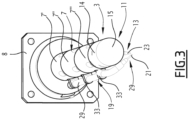
- the head 3 comprises a body 11 carrying an electrode 13 (case of implementing the TIG welding process).
- the body 11 has a generally cylindrical shape, with a cylindrical section 14 and an axial end 15 in the form of a sphere.
- the electrode 13 projects radially relative to the torch body 11.
- the torch 1 also includes a filler metal wire 17 and a wire guide 19 guiding the filler metal wire 17 to the electrode 13.
- the wire guide 19 guides the wire from a filler metal wire storage magazine (not shown) to the electrode 13. It is arranged so that the free end 21 of the wire is immediately next to the tip 23 of the electrode 13.
- the torch 1 also includes an electrical power supply 25, comprising an electrical current source 27.
- the body 11 is obtained by additive manufacturing in a metal conducting electricity.
- the electrode 13 is electrically connected to the electric current source 27 by the metal constituting the body 11 of the welding torch.
- the carrier 7 is also obtained by additive manufacturing in a metal conducting electricity.
- the electrode 13 is electrically connected to the electric current source 27 by the metal constituting the carrier 7 of the welding torch.
- the carrier 7 is for example made of several sections 7', 7", 7′′′ fixed to each other, three sections in the example shown.
- Each section 7', 7", 7′′′ defines an axial portion of the carrier.
- the sections 7', 7", 7′′′ are fixed axially in line with each other.
- Section 7' is mounted on base 8, and section 7' carries head 3. Section 7" connects sections 7' and 7'" to each other.
- the 7', 7", 7" sections are fixed to each other by any suitable means: screwing, welding, etc.
- the base 8 is also obtained by additive manufacturing in a metal conducting electricity.
- the electrode 13 is then electrically connected to the current source 27 by the metal constituting the base 8.
- the electric current is therefore not brought to the electrode 13 directly by a cable or an additional conductor.
- the electric current passes through the material constituting the elements obtained by additive manufacturing, typically the carrier 7, the torch body 11, and possibly the base 8.
- the elements obtained by additive manufacturing are electrically connected to the electric current source 27 by any suitable means, for example by cables not shown, arranged on the base of the welding torch.
- the metal conducting electricity is for example a steel, an aluminum alloy, a nickel alloy or a titanium alloy.
- the electrode 13 is typically made of tungsten (case of the TIG process) pure or doped with oxides (eg cerium, thorium, tantalum).
- the electrical potential of the current source can be transmitted directly to the filler wire in the case of the MIG or MAG process.
- the body 11 is obtained by any suitable additive manufacturing process (laser-powder, laser-wire, etc.).
- the carrier 7 and/or the base 8 are obtained, where appropriate, by the same process.
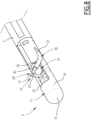
- the wire guide 19 advantageously comprises an insulating sheath 29, inside which the filler metal wire 17 moves ( Figure 4 ).
- the filler metal wire 17 is thus electrically isolated from the potential of the elements obtained by additive manufacturing, typically the carrier 7 and the body 11, by the insulating sheath 29.
- the insulating sheath 29 is made of a plastic material such as Teflon or any other suitable material.
- the insulating sheath 29 typically extends from the store to near the electrode 13.
- the filler metal wire 17 is free to slide inside the insulating sheath 29 towards the electrode 13.
- the wire is driven by a drive member not shown.
- the wire guide 19 is located entirely outside the head 3.
- the wire guide 19 comprises in this case for example a tube 31 located entirely outside the head 3.
- the tube 31 is also located entirely outside the carrier 7.
- This tube extends along the carrier 7, and along the head 3. It stops a short distance from the tip 23 of the electrode. It is attached to the carrier 7 by jumpers 33.
- the insulating sheath 29 and the filler metal wire 17 pass inside the tube 31.
- the tube 31 is for example made of steel.
- the torch 1 also includes a supply 35 of a shielding gas.
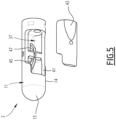
- the body 11 comprises an internal cavity 37 for passing the shielding gas, fluidly connected to the shielding gas supply 35.
- This cavity 37 is visible on the figures 5 to 7 .
- the internal cavity for passing the shielding gas 37 is arranged directly in the material of the body 11. It has any suitable shape, even complicated or tortuous. It is obtained in a simple and economical manner due to the fact that the body 11 is obtained by additive manufacturing.
- a protective gas supply port 39 is provided in the body 11 ( Figure 6 ). It opens into the internal cavity for passing the shielding gas 37, allowing its stabilization. It is connected to the protective gas supply 35 by any suitable means, for example by a conduit not shown crossing the entire length of the torch 1 from the base to the body 11, through the carrier 7.
- the body 11 also includes an opening 41 for diffusing the shielding gas around the electrode 13, into which the internal cavity for the passage of the shielding gas 37 opens ( Figure 5 ).
- the opening 41 is for example formed in the cylindrical section 14.
- the electrode 13 passes through the diffusion opening 41.
- the head 3 preferably comprises a diffusion grid 43 extending into the diffusion opening 41 and obtained by additive manufacturing together with the body 11.
- the diffusion grid 43 therefore comes from one piece with the body 11. It constitutes a single piece with the body 11. On the figure 4 , it is shown separated from the body 11 only to reveal the internal structure of the head 3.
- the diffusion grid 43 is porous with respect to the shielding gas. It has passage holes for the shielding gas (not shown on the diagram). Figure 5 ), of suitable sizes and configuration. Preferably, these orifices constitute a three-dimensional mesh. The orifices are for example of rectangular section and are arranged in a rectangular pattern.
- the diffusion grid 43 occupies the entire surface of the diffusion opening 41.
- the body 11 forms a solid mass 45 located across the internal cavity for passing the shielding gas 37 ( figures 5 And 6 ).
- This mass 45 has an orifice 47 for receiving the electrode 13, in which the electrode 13 is blocked by any suitable means, for example by cooperation of shapes.
- This mass also constitutes a reinforcement and contributes to the rigidity of the body 11, to compensate for the weakening caused by the cavity 37 and the perforated structure of the diffusion grid 43.
- the welding head 1 includes a supply 49 of a cooling fluid ( figure 2 ).
- the body 11 comprises an internal cavity 51 for passing the cooling fluid, fluidly connected to the cooling fluid supply 49 ( Figure 6 ).
- This refrigerant fluid circulates in a closed circuit through the torch from the base to the torch body 11, through the carrier 7.
- the body 11 comprises an external wall 53 internally delimiting the internal cavity for passing the shielding gas 37.
- the internal cavity for passing the cooling fluid 51 is formed in the thickness of the external wall 53.
- This internal cavity 51 has a complex shape. It typically comprises one or more axial sections such as section 54 of the Figure 6 , and one or more circumferential sections such as the sections 55 shown on the Figure 6 . These sections are arranged to cover the entire surface of the body 11. Its trajectory is thus substantially helical, which is made possible thanks to the unconventional manufacturing method.
- Cooling fluid inlet and outlet orifices 57, 59 are provided in the body 11 ( Figure 6 ).
- Sections 54 and 55 constitute a closed circuit fluidly connecting inlet 57 to outlet 59.
- the inlet 57 and the outlet 59 are connected to the cooling fluid supply 49 by any suitable means, for example conduits not shown passing through the carrier 7.
- the internal cavity for the passage of the cooling fluid 51 is thus formed directly in the material of the body 11. It is obtained in a simple and economical manner due to the fact that the body 11 is obtained by additive manufacturing.
- the torch 1 comprises a video observation system 61.
- the body 11 comprises an internal cavity 63 for passage of the video observation system 61.
- the video observation system 61 comprises for example an endoscope 65 extending into the internal cavity 63.
- the endoscope 65 preferably comprises an independent cooling system.
- the endoscope 65 has a diode 67 configured to ensure vision when the electric arc is extinguished.
- the diode 67 is carried by one end of the endoscope 65 curved to point towards the tip 23 of the electrode 13, through the orifice 41.
- the endoscope 65 extends over the entire length of the torch, from the base 8 to the head 3, inside the carrier 7.
- the image is in this case processed by an external camera, located at one end of the endoscope 65 opposite the diode 67.
- the image is sent to a monitor to allow an operator to control the head of the welding.
- the video observation system comprises a camera installed at the end of the torch body.
- a lighting device is then added nearby.
- a cable carrying the image signal extends into the internal cavity 63. It is connected at one end to the camera. It travels through the torch to its base 8, inside the carrier 7. The cable is connected to a monitor to allow an operator to control the welding head.
- the internal passage cavity of the video observation system 63 is formed in the thickness of the external wall 53.
- the torch 1 comprises at least one sensor 69 carried by the body 11 and a signal transmission cable 71 connected to the sensor 69 ( Figure 7 ).
- the body 11 has an internal cavity 73 for passing the signal transmission cable 71.
- the sensor 69 is for example an additional lamp, a temperature probe or any other type of sensor.
- the internal cavity for passing the signal transmission cable 73 is formed in the thickness of the external wall 53.
- the signal transmission cable 71 is configured to transmit the data acquired by the sensor 69 to remote equipment, for example a digital processing unit not shown.
- the signal transmission cable 71 leaving the internal cavity 73, runs through the carrier 7 then is connected to the remote equipment.
- the torch 1 comprises a light source carried by the body 11 and an electrical power cable connected to the light source.
- the body 11 then has an internal cavity for the passage of the electrical power cable.
- the light source is typically designed to visualize the working area of the torch 1.
- the internal cavity for passage of the electrical power cable is formed in the thickness of the external wall 53.
- the electrical power cable is configured to connect the light source to a source of electrical energy not shown.
- the body 11 has an internal cavity 75 through which the filler metal wire 17 and the insulating sheath 29 pass.
- the filler metal wire 17 circulates through the insulating sheath 29 facilitating its unwinding and insulating it from the electrical potential, from the base to the section 79.
- An external motor (not shown) drives it from a coil (not shown).
- the internal cavity 75 for passing the metal filler wire 17 comprises a section 77 formed in the thickness of the external wall 53. This section 77 is extended by a section 79 projecting from the external surface of the body and opening at the edge of the diffusion opening 41. The orientation of this section 79 defines the angle of arrival of the filler metal wire 17 in the weld pool.
- the wire guide 19 comprises a ceramic tip 81 fixed to the body 11 in the extension of the internal cavity 75. This tip is hollow, and defines an internal passage for the filler metal wire 17.
- the end piece 81 extends the section 79 over a short length towards the tip 23 of the electrode 13. It forms for example an angle of 45° with the electrode.
- the end piece 81 is for example fixed on the end of the section 79 in a removable manner, for example by screwing.
- the end piece 81 is in fact a wearing part, undergoing abrasion from the filler metal wire 17 in the same way as the sheath 29.
- the filler metal wire 17 emerging from the internal cavity 75 passes through the end piece 81 and emerges near the electrode 23, where it is consumed.
- the or each internal cavity 63, 73, 75 is thus formed directly in the material of the body 11. It is obtained in a simple and economical manner due to the fact that the body 11 is obtained by additive manufacturing.
- the invention also relates to a method of manufacturing a welding torch having the above characteristics.
- This process comprises a manufacturing step during which the body 11 is obtained by additive manufacturing in a metal conducting electricity.
- the manufacturing step also makes it possible to form the diffusion grid 43 jointly with the body 11.
- the method typically comprises a second manufacturing step during which the carrier 7 is obtained by additive manufacturing in a metal conducting electricity, and/or a third manufacturing step during which the base 8 is obtained by additive manufacturing in one metal that conducts electricity.
- the invention has multiple advantages.
- the invention makes it possible to produce welding torches of any geometry in the three dimensions (for example non-rectilinear and curved) with the aim of adapting to the actual configuration of the assembly to be produced and to the constraints of environment and available space.
- the three-dimensional printing manufacturing technique makes it possible to custom model, in a short time and at a lower cost, the equipment necessary for the welding operation according to the constraints of the application encountered, and the problems to be resolved.
- the welding torch comprises a head 3 fixed to the base 8 via a carrier 7.
- the head 3 is integral with the base 8. In d In other words, it is directly linked to the base 8, without the interposition of a carrier.
- the welding torch comprises in certain cases several elements obtained by additive manufacturing in a metal conducting electricity.
- at least the body 11 of the head is obtained by additive manufacturing.
- one or more segments of the carrier 7 and/or the base 8 are advantageously obtained by additive manufacturing.
- these different elements are obtained by additive manufacturing separately and then assembled together.
- these different elements are obtained together, by a single additive manufacturing operation leading to the formation of a single part.
Landscapes
- Engineering & Computer Science (AREA)
- Mechanical Engineering (AREA)
- Physics & Mathematics (AREA)
- Plasma & Fusion (AREA)
- Manufacturing & Machinery (AREA)
- Chemical & Material Sciences (AREA)
- Materials Engineering (AREA)
- Arc Welding In General (AREA)
Claims (11)
- Schweißbrenner, der Schweißbrenner (1) umfassend:- einen Kopf (3), umfassend einen Körper (11), der eine Elektrode (13) trägt;- eine Stromversorgung (25), umfassend eine elektrische Stromquelle (27);- einen Zusatzwerkstoffdraht (17) und eine Drahtführung (19), die den Zusatzwerkstoffdraht (17) bis zu der Elektrode (13) führt;und dadurch gekennzeichnet:
dass der Körper (11) durch additive Fertigung aus einem elektrisch leitenden Metall erlangt wird, wobei die Elektrode (13) durch das Metall, das den Körper (11) bildet, elektrisch mit der elektrischen Stromquelle (27) verbunden istdie Drahtführung (19) umfassend eine Isolierhülle (29), innerhalb derer sich der Zusatzwerkstoffdraht (17) bewegt, wobei der Zusatzwerkstoffdraht (17) durch die Isolierhülle (29) elektrisch von dem Potenzial des Körpers (11) isoliert ist;wobei der Brenner eine Schutzgasversorgung (35) umfasst, der Körper (11) umfassend einen inneren Durchgangshohlraum des Schutzgases (37), der fluidisch mit der Schutzgasversorgung (35) verbunden ist; unddass der Brenner (1) eine Kühlfluidzufuhr (49) umfasst, der Körper (11) umfassend einen inneren Durchgangshohlraum des Kühlmittels (51), der fluidisch mit der Kühlfluidzufuhr (49) verbunden ist; unddass der Körper (11) eine Außenwand (53) umfasst, die den inneren Durchgangshohlraum des Schutzgases (37) innen begrenzt, wobei der innere Durchgangshohlraum des Kühlfluids (51) in der Stärke der Außenwand (53) ausgebildet ist. - Schweißbrenner nach Anspruch 1, wobei der Schweißbrenner (1) einen Träger (7) aufweist, der fest mit dem Kopf (3) verbunden ist, wobei der Träger (7) durch additive Fertigung aus einem elektrisch leitenden Metall erlangt wird, wobei die Elektrode (13) durch das Metall, das den Träger (7) bildet elektrisch mit der elektrischen Stromquelle (27) verbunden ist, wobei der Zusatzwerkstoffdraht (17) durch die Isolierhülle (29) elektrisch von dem Potenzial des Trägers (7) isoliert ist
- Schweißbrenner nach Anspruch 2, wobei der Schweißbrenner (1) eine Basis (8) umfasst, die durch additive Fertigung aus einem elektrisch leitenden Metall erlangt wird, wobei die Elektrode (13) durch das Metall, das die Basis (8) bildet, elektrisch mit der elektrischen Stromquelle (27) verbunden ist, wobei der Träger (7) fest mit der Basis (8) verbunden ist.
- Schweißbrenner nach Anspruch 1, wobei der Schweißbrenner (1) eine Basis (8) umfasst, die durch additive Fertigung aus einem elektrisch leitenden Metall erlangt wird, wobei die Elektrode (13) durch das Metall, das die Basis (8) bildet, elektrisch mit der elektrischen Stromquelle (27) verbunden ist, wobei der Kopf (3) fest mit der Basis (8) verbunden ist.
- Schweißbrenner nach einem der vorherigen Ansprüche, wobei der Körper (11) einen inneren Hohlraum (75) umfasst, durch den der Zusatzwerkstoffdraht (17) und die Isolierhülle (29) verlaufen.
- Schweißbrenner nach Anspruch 5, wobei die Drahtführung (19) eine Keramikspitze (81) umfasst, die an dem Körper (11) in Verlängerung des inneren Hohlraums (75) befestigt ist.
- Schweißbrenner nach einem der Ansprüche 1 bis 4, wobei die Drahtführung (19) ein Rohr (31) umfasst, das sich vollständig außerhalb des Kopfs (3) befindet und durch das der Zusatzwerkstoffdraht (17) und die Isolierhülle (29) verlaufen.
- Schweißbrenner nach einem der vorherigen Ansprüche, wobei der Körper (11) eine Diffusionsöffnung des Schutzgases (41) um die Elektrode (13) umfasst, in die der innere Durchgangshohlraum des Schutzgases (37) mündet, der Kopf (3) umfassend ein Diffusionsgitter (43), das sich in die Diffusionsöffnung (41) erstreckt und durch additive Fertigung gemeinsam mit dem Körper (11) erlangt wird.
- Schweißbrenner nach einem der vorherigen Ansprüche, wobei der Brenner (1) ein Videobeobachtungssystem (61) umfasst, wobei der Körper (11) einen inneren Durchgangshohlraum des Videobeobachtungssystems (63) aufweist.
- Schweißbrenner (1) nach einem der vorherigen Ansprüche, wobei der Brenner mindestens einen Sensor (69), der von dem Körper (11) getragen wird, und ein mit dem Sensor (69) verbundenes Übertragungskabel des Signals (71) umfasst, wobei der Körper (11) einen inneren Durchgangshohlraum des Übertragungskabels des Signals (73) aufweist.
- Verfahren zur Herstellung eines Schweißbrenners (1) nach einem der vorherigen Ansprüche, das Verfahren umfassend einen Herstellungsschritt, dadurch gekennzeichnet, dass der Körper (11) durch additive Herstellung aus einem elektrisch leitfähigen Metall erlangt wird.
Applications Claiming Priority (2)
| Application Number | Priority Date | Filing Date | Title |
|---|---|---|---|
| FR1872355A FR3089444B1 (fr) | 2018-12-05 | 2018-12-05 | Torche de soudage et procédé de fabrication correspondant |
| PCT/EP2019/083472 WO2020115033A1 (fr) | 2018-12-05 | 2019-12-03 | Torche de soudage et procédé de fabrication correspondant |
Publications (2)
| Publication Number | Publication Date |
|---|---|
| EP3890913A1 EP3890913A1 (de) | 2021-10-13 |
| EP3890913B1 true EP3890913B1 (de) | 2023-10-11 |
Family
ID=66530153
Family Applications (1)
| Application Number | Title | Priority Date | Filing Date |
|---|---|---|---|
| EP19828963.9A Active EP3890913B1 (de) | 2018-12-05 | 2019-12-03 | Schweissbrenner und entsprechendes herstellungsverfahren |
Country Status (6)
| Country | Link |
|---|---|
| US (1) | US12330245B2 (de) |
| EP (1) | EP3890913B1 (de) |
| ES (1) | ES2966081T3 (de) |
| FI (1) | FI3890913T3 (de) |
| FR (1) | FR3089444B1 (de) |
| WO (1) | WO2020115033A1 (de) |
Families Citing this family (2)
| Publication number | Priority date | Publication date | Assignee | Title |
|---|---|---|---|---|
| US20210268594A1 (en) * | 2020-02-27 | 2021-09-02 | The Esab Group Inc. | Dynamic torch head |
| CN112548279A (zh) * | 2020-11-27 | 2021-03-26 | 河北机电职业技术学院 | 一种可以单转或自转的调节型焊接装置 |
Family Cites Families (6)
| Publication number | Priority date | Publication date | Assignee | Title |
|---|---|---|---|---|
| US4532406A (en) * | 1984-02-10 | 1985-07-30 | General Electric Company | Arc welding torch having integrated wire feed |
| JPH0314074U (de) * | 1989-06-26 | 1991-02-13 | ||
| WO1996001717A1 (en) * | 1994-07-08 | 1996-01-25 | Cherne Larry W | Concentric cold wire gas tungsten arc welding |
| US9833859B2 (en) * | 2014-09-15 | 2017-12-05 | Lincoln Global, Inc. | Electric arc torch with cooling conduit |
| US10898965B2 (en) * | 2016-09-17 | 2021-01-26 | Illinois Tool Works Inc. | Helical welding wire and helix forming welding torch |
| WO2018227189A1 (en) * | 2017-06-09 | 2018-12-13 | Illinois Tool Works Inc. | Contact tips with screw threads and head to enable unthreading or the screw threads comprising longitudinal slots for gas flow; welding torch with contact tips |
-
2018
- 2018-12-05 FR FR1872355A patent/FR3089444B1/fr active Active
-
2019
- 2019-12-03 ES ES19828963T patent/ES2966081T3/es active Active
- 2019-12-03 FI FIEP19828963.9T patent/FI3890913T3/fi active
- 2019-12-03 EP EP19828963.9A patent/EP3890913B1/de active Active
- 2019-12-03 WO PCT/EP2019/083472 patent/WO2020115033A1/fr not_active Ceased
- 2019-12-03 US US17/299,159 patent/US12330245B2/en active Active
Also Published As
| Publication number | Publication date |
|---|---|
| WO2020115033A1 (fr) | 2020-06-11 |
| EP3890913A1 (de) | 2021-10-13 |
| ES2966081T3 (es) | 2024-04-18 |
| US12330245B2 (en) | 2025-06-17 |
| FI3890913T3 (fi) | 2023-12-12 |
| FR3089444B1 (fr) | 2020-12-04 |
| US20220072643A1 (en) | 2022-03-10 |
| FR3089444A1 (fr) | 2020-06-12 |
Similar Documents
| Publication | Publication Date | Title |
|---|---|---|
| EP3890913B1 (de) | Schweissbrenner und entsprechendes herstellungsverfahren | |
| JP6367186B2 (ja) | 紫色又は青色レーザーダイオードを用いた電気ケーブル剥皮装置 | |
| ES2961651T3 (es) | Máquina herramienta multieje, kit y método para conectar un primer cabezal de procesamiento a una máquina herramienta | |
| US5491317A (en) | System and method for laser welding an inner surface of a tubular member | |
| EP1459831B1 (de) | Verfahren zum TIG-Schweissen mit einem eine Düsen/Drahtführungsanordnung aufweisenden TIG-Roboterschweissbrenner | |
| US5563391A (en) | Orbital head laser welder | |
| EP0216694B1 (de) | Vorrichtung zur Echtzeitkontrolle von Schweissungen, insbesondere für nicht direkt beobachtbare Schweissstellen | |
| EP0923276A1 (de) | Elektrodenkörper/Elektrodenhalter Einheit für Plasmabrenner | |
| EP0609108A1 (de) | Verfahren und Vorrichtung zum orbitalen Schweissen eines cylindrischen Stücks auf einer gebogenen Wand | |
| WO2015097243A1 (fr) | Machine de soudure a arc electrique | |
| EP2556913B1 (de) | Lichtbogenschweißbrenner mit modulierbarer Rauchabsaugung | |
| FR2923295A1 (fr) | Procede et dispositif de visualisation et de controle du profil d'un cordon de soudure a l'interieur d'un chanfrein menage entre deux pieces metalliques | |
| EP0403327A1 (de) | Verfahren und Vorrichtung für das Ersetzen eines Heizstabes eines Druckerzeugers eines Wasserkernreaktors | |
| CA2480569C (fr) | Ensemble buse/guide-fil pour torche de soudage tig robotise | |
| EP2561944B1 (de) | Lichtbogenschweißbrenner mit verbesserter Abdichtung | |
| EP0062554A1 (de) | Bewegbare Punktschweissanordnung mit Zusatzmetall unter Verwendung von Schutzgas | |
| JPH0118829B2 (de) | ||
| WO2005083718A2 (fr) | Dispositif de deplacement d'une barre de commande d'un reacteur nucleaire a eau sous pression et procede de montage du dispositif sur un couvercle de cuve | |
| CN110072662A (zh) | 焊枪和全姿势焊接装置 | |
| EP2292366B1 (de) | Plasmabrenner mit einem durch eine trapezgewinde abnehmbaren brennerkopf | |
| EP3556504B1 (de) | Schweissbrenner und universalpositionschweissvorrichtung | |
| EP3623644A1 (de) | Herstellungsverfahren eines hydraulikzylinders, und mit diesem vefahren erhaltener zylinder | |
| FR3132411A1 (fr) | Torche de coupage plasma munie d'un empilement de consommables | |
| JPS6150072B2 (de) | ||
| WO2023143816A1 (fr) | Tuyère aval pour une torche de coupage plasma |
Legal Events
| Date | Code | Title | Description |
|---|---|---|---|
| STAA | Information on the status of an ep patent application or granted ep patent |
Free format text: STATUS: UNKNOWN |
|
| STAA | Information on the status of an ep patent application or granted ep patent |
Free format text: STATUS: THE INTERNATIONAL PUBLICATION HAS BEEN MADE |
|
| PUAI | Public reference made under article 153(3) epc to a published international application that has entered the european phase |
Free format text: ORIGINAL CODE: 0009012 |
|
| STAA | Information on the status of an ep patent application or granted ep patent |
Free format text: STATUS: REQUEST FOR EXAMINATION WAS MADE |
|
| 17P | Request for examination filed |
Effective date: 20210603 |
|
| AK | Designated contracting states |
Kind code of ref document: A1 Designated state(s): AL AT BE BG CH CY CZ DE DK EE ES FI FR GB GR HR HU IE IS IT LI LT LU LV MC MK MT NL NO PL PT RO RS SE SI SK SM TR |
|
| DAV | Request for validation of the european patent (deleted) | ||
| DAX | Request for extension of the european patent (deleted) | ||
| GRAP | Despatch of communication of intention to grant a patent |
Free format text: ORIGINAL CODE: EPIDOSNIGR1 |
|
| STAA | Information on the status of an ep patent application or granted ep patent |
Free format text: STATUS: GRANT OF PATENT IS INTENDED |
|
| INTG | Intention to grant announced |
Effective date: 20220829 |
|
| GRAJ | Information related to disapproval of communication of intention to grant by the applicant or resumption of examination proceedings by the epo deleted |
Free format text: ORIGINAL CODE: EPIDOSDIGR1 |
|
| STAA | Information on the status of an ep patent application or granted ep patent |
Free format text: STATUS: REQUEST FOR EXAMINATION WAS MADE |
|
| GRAP | Despatch of communication of intention to grant a patent |
Free format text: ORIGINAL CODE: EPIDOSNIGR1 |
|
| STAA | Information on the status of an ep patent application or granted ep patent |
Free format text: STATUS: GRANT OF PATENT IS INTENDED |
|
| INTC | Intention to grant announced (deleted) | ||
| INTG | Intention to grant announced |
Effective date: 20230510 |
|
| RIN1 | Information on inventor provided before grant (corrected) |
Inventor name: NICOLAS, HERVE Inventor name: PETIT, ALAIN Inventor name: RANC, MAXIMILIEN |
|
| P01 | Opt-out of the competence of the unified patent court (upc) registered |
Effective date: 20230606 |
|
| GRAS | Grant fee paid |
Free format text: ORIGINAL CODE: EPIDOSNIGR3 |
|
| GRAA | (expected) grant |
Free format text: ORIGINAL CODE: 0009210 |
|
| STAA | Information on the status of an ep patent application or granted ep patent |
Free format text: STATUS: THE PATENT HAS BEEN GRANTED |
|
| AK | Designated contracting states |
Kind code of ref document: B1 Designated state(s): AL AT BE BG CH CY CZ DE DK EE ES FI FR GB GR HR HU IE IS IT LI LT LU LV MC MK MT NL NO PL PT RO RS SE SI SK SM TR |
|
| REG | Reference to a national code |
Ref country code: GB Ref legal event code: FG4D Free format text: NOT ENGLISH |
|
| REG | Reference to a national code |
Ref country code: CH Ref legal event code: EP |
|
| REG | Reference to a national code |
Ref country code: DE Ref legal event code: R096 Ref document number: 602019039285 Country of ref document: DE |
|
| REG | Reference to a national code |
Ref country code: IE Ref legal event code: FG4D Free format text: LANGUAGE OF EP DOCUMENT: FRENCH |
|
| REG | Reference to a national code |
Ref country code: FI Ref legal event code: FGE |
|
| REG | Reference to a national code |
Ref country code: NL Ref legal event code: FP |
|
| REG | Reference to a national code |
Ref country code: SE Ref legal event code: TRGR |
|
| REG | Reference to a national code |
Ref country code: LT Ref legal event code: MG9D |
|
| REG | Reference to a national code |
Ref country code: AT Ref legal event code: MK05 Ref document number: 1619711 Country of ref document: AT Kind code of ref document: T Effective date: 20231011 |
|
| PG25 | Lapsed in a contracting state [announced via postgrant information from national office to epo] |
Ref country code: GR Free format text: LAPSE BECAUSE OF FAILURE TO SUBMIT A TRANSLATION OF THE DESCRIPTION OR TO PAY THE FEE WITHIN THE PRESCRIBED TIME-LIMIT Effective date: 20240112 |
|
| PG25 | Lapsed in a contracting state [announced via postgrant information from national office to epo] |
Ref country code: IS Free format text: LAPSE BECAUSE OF FAILURE TO SUBMIT A TRANSLATION OF THE DESCRIPTION OR TO PAY THE FEE WITHIN THE PRESCRIBED TIME-LIMIT Effective date: 20240211 |
|
| PG25 | Lapsed in a contracting state [announced via postgrant information from national office to epo] |
Ref country code: LT Free format text: LAPSE BECAUSE OF FAILURE TO SUBMIT A TRANSLATION OF THE DESCRIPTION OR TO PAY THE FEE WITHIN THE PRESCRIBED TIME-LIMIT Effective date: 20231011 |
|
| REG | Reference to a national code |
Ref country code: ES Ref legal event code: FG2A Ref document number: 2966081 Country of ref document: ES Kind code of ref document: T3 Effective date: 20240418 |
|
| PG25 | Lapsed in a contracting state [announced via postgrant information from national office to epo] |
Ref country code: AT Free format text: LAPSE BECAUSE OF FAILURE TO SUBMIT A TRANSLATION OF THE DESCRIPTION OR TO PAY THE FEE WITHIN THE PRESCRIBED TIME-LIMIT Effective date: 20231011 |
|
| PG25 | Lapsed in a contracting state [announced via postgrant information from national office to epo] |
Ref country code: LT Free format text: LAPSE BECAUSE OF FAILURE TO SUBMIT A TRANSLATION OF THE DESCRIPTION OR TO PAY THE FEE WITHIN THE PRESCRIBED TIME-LIMIT Effective date: 20231011 Ref country code: IS Free format text: LAPSE BECAUSE OF FAILURE TO SUBMIT A TRANSLATION OF THE DESCRIPTION OR TO PAY THE FEE WITHIN THE PRESCRIBED TIME-LIMIT Effective date: 20240211 Ref country code: GR Free format text: LAPSE BECAUSE OF FAILURE TO SUBMIT A TRANSLATION OF THE DESCRIPTION OR TO PAY THE FEE WITHIN THE PRESCRIBED TIME-LIMIT Effective date: 20240112 Ref country code: BG Free format text: LAPSE BECAUSE OF FAILURE TO SUBMIT A TRANSLATION OF THE DESCRIPTION OR TO PAY THE FEE WITHIN THE PRESCRIBED TIME-LIMIT Effective date: 20240111 Ref country code: AT Free format text: LAPSE BECAUSE OF FAILURE TO SUBMIT A TRANSLATION OF THE DESCRIPTION OR TO PAY THE FEE WITHIN THE PRESCRIBED TIME-LIMIT Effective date: 20231011 Ref country code: PT Free format text: LAPSE BECAUSE OF FAILURE TO SUBMIT A TRANSLATION OF THE DESCRIPTION OR TO PAY THE FEE WITHIN THE PRESCRIBED TIME-LIMIT Effective date: 20240212 |
|
| PG25 | Lapsed in a contracting state [announced via postgrant information from national office to epo] |
Ref country code: RS Free format text: LAPSE BECAUSE OF FAILURE TO SUBMIT A TRANSLATION OF THE DESCRIPTION OR TO PAY THE FEE WITHIN THE PRESCRIBED TIME-LIMIT Effective date: 20231011 Ref country code: PL Free format text: LAPSE BECAUSE OF FAILURE TO SUBMIT A TRANSLATION OF THE DESCRIPTION OR TO PAY THE FEE WITHIN THE PRESCRIBED TIME-LIMIT Effective date: 20231011 Ref country code: NO Free format text: LAPSE BECAUSE OF FAILURE TO SUBMIT A TRANSLATION OF THE DESCRIPTION OR TO PAY THE FEE WITHIN THE PRESCRIBED TIME-LIMIT Effective date: 20240111 Ref country code: LV Free format text: LAPSE BECAUSE OF FAILURE TO SUBMIT A TRANSLATION OF THE DESCRIPTION OR TO PAY THE FEE WITHIN THE PRESCRIBED TIME-LIMIT Effective date: 20231011 Ref country code: HR Free format text: LAPSE BECAUSE OF FAILURE TO SUBMIT A TRANSLATION OF THE DESCRIPTION OR TO PAY THE FEE WITHIN THE PRESCRIBED TIME-LIMIT Effective date: 20231011 |
|
| REG | Reference to a national code |
Ref country code: DE Ref legal event code: R119 Ref document number: 602019039285 Country of ref document: DE |
|
| PG25 | Lapsed in a contracting state [announced via postgrant information from national office to epo] |
Ref country code: DK Free format text: LAPSE BECAUSE OF FAILURE TO SUBMIT A TRANSLATION OF THE DESCRIPTION OR TO PAY THE FEE WITHIN THE PRESCRIBED TIME-LIMIT Effective date: 20231011 |
|
| PG25 | Lapsed in a contracting state [announced via postgrant information from national office to epo] |
Ref country code: CZ Free format text: LAPSE BECAUSE OF FAILURE TO SUBMIT A TRANSLATION OF THE DESCRIPTION OR TO PAY THE FEE WITHIN THE PRESCRIBED TIME-LIMIT Effective date: 20231011 |
|
| PG25 | Lapsed in a contracting state [announced via postgrant information from national office to epo] |
Ref country code: SK Free format text: LAPSE BECAUSE OF FAILURE TO SUBMIT A TRANSLATION OF THE DESCRIPTION OR TO PAY THE FEE WITHIN THE PRESCRIBED TIME-LIMIT Effective date: 20231011 |
|
| PG25 | Lapsed in a contracting state [announced via postgrant information from national office to epo] |
Ref country code: SM Free format text: LAPSE BECAUSE OF FAILURE TO SUBMIT A TRANSLATION OF THE DESCRIPTION OR TO PAY THE FEE WITHIN THE PRESCRIBED TIME-LIMIT Effective date: 20231011 Ref country code: SK Free format text: LAPSE BECAUSE OF FAILURE TO SUBMIT A TRANSLATION OF THE DESCRIPTION OR TO PAY THE FEE WITHIN THE PRESCRIBED TIME-LIMIT Effective date: 20231011 Ref country code: RO Free format text: LAPSE BECAUSE OF FAILURE TO SUBMIT A TRANSLATION OF THE DESCRIPTION OR TO PAY THE FEE WITHIN THE PRESCRIBED TIME-LIMIT Effective date: 20231011 Ref country code: IT Free format text: LAPSE BECAUSE OF FAILURE TO SUBMIT A TRANSLATION OF THE DESCRIPTION OR TO PAY THE FEE WITHIN THE PRESCRIBED TIME-LIMIT Effective date: 20231011 Ref country code: EE Free format text: LAPSE BECAUSE OF FAILURE TO SUBMIT A TRANSLATION OF THE DESCRIPTION OR TO PAY THE FEE WITHIN THE PRESCRIBED TIME-LIMIT Effective date: 20231011 Ref country code: DK Free format text: LAPSE BECAUSE OF FAILURE TO SUBMIT A TRANSLATION OF THE DESCRIPTION OR TO PAY THE FEE WITHIN THE PRESCRIBED TIME-LIMIT Effective date: 20231011 Ref country code: CZ Free format text: LAPSE BECAUSE OF FAILURE TO SUBMIT A TRANSLATION OF THE DESCRIPTION OR TO PAY THE FEE WITHIN THE PRESCRIBED TIME-LIMIT Effective date: 20231011 |
|
| PLBE | No opposition filed within time limit |
Free format text: ORIGINAL CODE: 0009261 |
|
| STAA | Information on the status of an ep patent application or granted ep patent |
Free format text: STATUS: NO OPPOSITION FILED WITHIN TIME LIMIT |
|
| PG25 | Lapsed in a contracting state [announced via postgrant information from national office to epo] |
Ref country code: LU Free format text: LAPSE BECAUSE OF NON-PAYMENT OF DUE FEES Effective date: 20231203 |
|
| PG25 | Lapsed in a contracting state [announced via postgrant information from national office to epo] |
Ref country code: MC Free format text: LAPSE BECAUSE OF FAILURE TO SUBMIT A TRANSLATION OF THE DESCRIPTION OR TO PAY THE FEE WITHIN THE PRESCRIBED TIME-LIMIT Effective date: 20231011 |
|
| PG25 | Lapsed in a contracting state [announced via postgrant information from national office to epo] |
Ref country code: MC Free format text: LAPSE BECAUSE OF FAILURE TO SUBMIT A TRANSLATION OF THE DESCRIPTION OR TO PAY THE FEE WITHIN THE PRESCRIBED TIME-LIMIT Effective date: 20231011 Ref country code: LU Free format text: LAPSE BECAUSE OF NON-PAYMENT OF DUE FEES Effective date: 20231203 |
|
| 26N | No opposition filed |
Effective date: 20240712 |
|
| REG | Reference to a national code |
Ref country code: IE Ref legal event code: MM4A |
|
| PG25 | Lapsed in a contracting state [announced via postgrant information from national office to epo] |
Ref country code: DE Free format text: LAPSE BECAUSE OF NON-PAYMENT OF DUE FEES Effective date: 20240702 Ref country code: IE Free format text: LAPSE BECAUSE OF NON-PAYMENT OF DUE FEES Effective date: 20231203 |
|
| PG25 | Lapsed in a contracting state [announced via postgrant information from national office to epo] |
Ref country code: SI Free format text: LAPSE BECAUSE OF FAILURE TO SUBMIT A TRANSLATION OF THE DESCRIPTION OR TO PAY THE FEE WITHIN THE PRESCRIBED TIME-LIMIT Effective date: 20231011 |
|
| PG25 | Lapsed in a contracting state [announced via postgrant information from national office to epo] |
Ref country code: SI Free format text: LAPSE BECAUSE OF FAILURE TO SUBMIT A TRANSLATION OF THE DESCRIPTION OR TO PAY THE FEE WITHIN THE PRESCRIBED TIME-LIMIT Effective date: 20231011 Ref country code: IE Free format text: LAPSE BECAUSE OF NON-PAYMENT OF DUE FEES Effective date: 20231203 Ref country code: DE Free format text: LAPSE BECAUSE OF NON-PAYMENT OF DUE FEES Effective date: 20240702 |
|
| PGFP | Annual fee paid to national office [announced via postgrant information from national office to epo] |
Ref country code: CH Payment date: 20250101 Year of fee payment: 6 |
|
| PG25 | Lapsed in a contracting state [announced via postgrant information from national office to epo] |
Ref country code: CY Free format text: LAPSE BECAUSE OF FAILURE TO SUBMIT A TRANSLATION OF THE DESCRIPTION OR TO PAY THE FEE WITHIN THE PRESCRIBED TIME-LIMIT; INVALID AB INITIO Effective date: 20191203 |
|
| PG25 | Lapsed in a contracting state [announced via postgrant information from national office to epo] |
Ref country code: HU Free format text: LAPSE BECAUSE OF FAILURE TO SUBMIT A TRANSLATION OF THE DESCRIPTION OR TO PAY THE FEE WITHIN THE PRESCRIBED TIME-LIMIT; INVALID AB INITIO Effective date: 20191203 |
|
| PG25 | Lapsed in a contracting state [announced via postgrant information from national office to epo] |
Ref country code: TR Free format text: LAPSE BECAUSE OF FAILURE TO SUBMIT A TRANSLATION OF THE DESCRIPTION OR TO PAY THE FEE WITHIN THE PRESCRIBED TIME-LIMIT Effective date: 20231011 |
|
| PGFP | Annual fee paid to national office [announced via postgrant information from national office to epo] |
Ref country code: NL Payment date: 20251127 Year of fee payment: 7 |
|
| REG | Reference to a national code |
Ref country code: CH Ref legal event code: U11 Free format text: ST27 STATUS EVENT CODE: U-0-0-U10-U11 (AS PROVIDED BY THE NATIONAL OFFICE) Effective date: 20260101 |
|
| REG | Reference to a national code |
Ref country code: CH Ref legal event code: R18 Free format text: ST27 STATUS EVENT CODE: U-0-0-R10-R18 (AS PROVIDED BY THE NATIONAL OFFICE) Effective date: 20260106 |
|
| PGFP | Annual fee paid to national office [announced via postgrant information from national office to epo] |
Ref country code: GB Payment date: 20251229 Year of fee payment: 7 |
|
| PGFP | Annual fee paid to national office [announced via postgrant information from national office to epo] |
Ref country code: FI Payment date: 20251124 Year of fee payment: 7 |
|
| PGFP | Annual fee paid to national office [announced via postgrant information from national office to epo] |
Ref country code: FR Payment date: 20251230 Year of fee payment: 7 |
|
| PGFP | Annual fee paid to national office [announced via postgrant information from national office to epo] |
Ref country code: BE Payment date: 20251226 Year of fee payment: 7 |
|
| PGFP | Annual fee paid to national office [announced via postgrant information from national office to epo] |
Ref country code: SE Payment date: 20251218 Year of fee payment: 7 |
|
| PGFP | Annual fee paid to national office [announced via postgrant information from national office to epo] |
Ref country code: ES Payment date: 20260112 Year of fee payment: 7 |