EP3889163A1 - Platin-komplexe mit ferrocen-liganden für die katalyse der alkoxycarbonylierung ethylenisch ungesättigter verbindungen - Google Patents
Platin-komplexe mit ferrocen-liganden für die katalyse der alkoxycarbonylierung ethylenisch ungesättigter verbindungen Download PDFInfo
- Publication number
- EP3889163A1 EP3889163A1 EP20166579.1A EP20166579A EP3889163A1 EP 3889163 A1 EP3889163 A1 EP 3889163A1 EP 20166579 A EP20166579 A EP 20166579A EP 3889163 A1 EP3889163 A1 EP 3889163A1
- Authority
- EP
- European Patent Office
- Prior art keywords
- alkyl
- platinum
- butene
- heteroaryl
- ethylenically unsaturated
- Prior art date
- Legal status (The legal status is an assumption and is not a legal conclusion. Google has not performed a legal analysis and makes no representation as to the accuracy of the status listed.)
- Granted
Links
- BCJVBDBJSMFBRW-UHFFFAOYSA-N C(CCP(c1ccccc1)c1ccccc1)CP(c1ccccc1)c1ccccc1 Chemical compound C(CCP(c1ccccc1)c1ccccc1)CP(c1ccccc1)c1ccccc1 BCJVBDBJSMFBRW-UHFFFAOYSA-N 0.000 description 1
- QYAITKHZDVATGR-UHFFFAOYSA-N CC(C)(C)P(c1ccc(cccc2)c2c1-c(c(cccc1)c1cc1)c1P(C(C)(C)C)c1ccccn1)c1ncccc1 Chemical compound CC(C)(C)P(c1ccc(cccc2)c2c1-c(c(cccc1)c1cc1)c1P(C(C)(C)C)c1ccccn1)c1ncccc1 QYAITKHZDVATGR-UHFFFAOYSA-N 0.000 description 1
Classifications
-
- C—CHEMISTRY; METALLURGY
- C07—ORGANIC CHEMISTRY
- C07F—ACYCLIC, CARBOCYCLIC OR HETEROCYCLIC COMPOUNDS CONTAINING ELEMENTS OTHER THAN CARBON, HYDROGEN, HALOGEN, OXYGEN, NITROGEN, SULFUR, SELENIUM OR TELLURIUM
- C07F17/00—Metallocenes
- C07F17/02—Metallocenes of metals of Groups 8, 9 or 10 of the Periodic Table
-
- C—CHEMISTRY; METALLURGY
- C07—ORGANIC CHEMISTRY
- C07F—ACYCLIC, CARBOCYCLIC OR HETEROCYCLIC COMPOUNDS CONTAINING ELEMENTS OTHER THAN CARBON, HYDROGEN, HALOGEN, OXYGEN, NITROGEN, SULFUR, SELENIUM OR TELLURIUM
- C07F15/00—Compounds containing elements of Groups 8, 9, 10 or 18 of the Periodic Table
- C07F15/02—Iron compounds
-
- B—PERFORMING OPERATIONS; TRANSPORTING
- B01—PHYSICAL OR CHEMICAL PROCESSES OR APPARATUS IN GENERAL
- B01J—CHEMICAL OR PHYSICAL PROCESSES, e.g. CATALYSIS OR COLLOID CHEMISTRY; THEIR RELEVANT APPARATUS
- B01J31/00—Catalysts comprising hydrides, coordination complexes or organic compounds
- B01J31/16—Catalysts comprising hydrides, coordination complexes or organic compounds containing coordination complexes
- B01J31/1616—Coordination complexes, e.g. organometallic complexes, immobilised on an inorganic support, e.g. ship-in-a-bottle type catalysts
-
- B—PERFORMING OPERATIONS; TRANSPORTING
- B01—PHYSICAL OR CHEMICAL PROCESSES OR APPARATUS IN GENERAL
- B01J—CHEMICAL OR PHYSICAL PROCESSES, e.g. CATALYSIS OR COLLOID CHEMISTRY; THEIR RELEVANT APPARATUS
- B01J31/00—Catalysts comprising hydrides, coordination complexes or organic compounds
- B01J31/16—Catalysts comprising hydrides, coordination complexes or organic compounds containing coordination complexes
- B01J31/22—Organic complexes
- B01J31/2282—Unsaturated compounds used as ligands
- B01J31/2295—Cyclic compounds, e.g. cyclopentadienyls
-
- B—PERFORMING OPERATIONS; TRANSPORTING
- B01—PHYSICAL OR CHEMICAL PROCESSES OR APPARATUS IN GENERAL
- B01J—CHEMICAL OR PHYSICAL PROCESSES, e.g. CATALYSIS OR COLLOID CHEMISTRY; THEIR RELEVANT APPARATUS
- B01J31/00—Catalysts comprising hydrides, coordination complexes or organic compounds
- B01J31/16—Catalysts comprising hydrides, coordination complexes or organic compounds containing coordination complexes
- B01J31/24—Phosphines, i.e. phosphorus bonded to only carbon atoms, or to both carbon and hydrogen atoms, including e.g. sp2-hybridised phosphorus compounds such as phosphabenzene, phosphole or anionic phospholide ligands
- B01J31/2404—Cyclic ligands, including e.g. non-condensed polycyclic ligands, the phosphine-P atom being a ring member or a substituent on the ring
- B01J31/2409—Cyclic ligands, including e.g. non-condensed polycyclic ligands, the phosphine-P atom being a ring member or a substituent on the ring with more than one complexing phosphine-P atom
-
- B—PERFORMING OPERATIONS; TRANSPORTING
- B01—PHYSICAL OR CHEMICAL PROCESSES OR APPARATUS IN GENERAL
- B01J—CHEMICAL OR PHYSICAL PROCESSES, e.g. CATALYSIS OR COLLOID CHEMISTRY; THEIR RELEVANT APPARATUS
- B01J31/00—Catalysts comprising hydrides, coordination complexes or organic compounds
- B01J31/16—Catalysts comprising hydrides, coordination complexes or organic compounds containing coordination complexes
- B01J31/24—Phosphines, i.e. phosphorus bonded to only carbon atoms, or to both carbon and hydrogen atoms, including e.g. sp2-hybridised phosphorus compounds such as phosphabenzene, phosphole or anionic phospholide ligands
- B01J31/2404—Cyclic ligands, including e.g. non-condensed polycyclic ligands, the phosphine-P atom being a ring member or a substituent on the ring
- B01J31/2409—Cyclic ligands, including e.g. non-condensed polycyclic ligands, the phosphine-P atom being a ring member or a substituent on the ring with more than one complexing phosphine-P atom
- B01J31/2414—Cyclic ligands, including e.g. non-condensed polycyclic ligands, the phosphine-P atom being a ring member or a substituent on the ring with more than one complexing phosphine-P atom comprising aliphatic or saturated rings
-
- B—PERFORMING OPERATIONS; TRANSPORTING
- B01—PHYSICAL OR CHEMICAL PROCESSES OR APPARATUS IN GENERAL
- B01J—CHEMICAL OR PHYSICAL PROCESSES, e.g. CATALYSIS OR COLLOID CHEMISTRY; THEIR RELEVANT APPARATUS
- B01J31/00—Catalysts comprising hydrides, coordination complexes or organic compounds
- B01J31/16—Catalysts comprising hydrides, coordination complexes or organic compounds containing coordination complexes
- B01J31/24—Phosphines, i.e. phosphorus bonded to only carbon atoms, or to both carbon and hydrogen atoms, including e.g. sp2-hybridised phosphorus compounds such as phosphabenzene, phosphole or anionic phospholide ligands
- B01J31/2404—Cyclic ligands, including e.g. non-condensed polycyclic ligands, the phosphine-P atom being a ring member or a substituent on the ring
- B01J31/2442—Cyclic ligands, including e.g. non-condensed polycyclic ligands, the phosphine-P atom being a ring member or a substituent on the ring comprising condensed ring systems
- B01J31/2447—Cyclic ligands, including e.g. non-condensed polycyclic ligands, the phosphine-P atom being a ring member or a substituent on the ring comprising condensed ring systems and phosphine-P atoms as substituents on a ring of the condensed system or on a further attached ring
- B01J31/2452—Cyclic ligands, including e.g. non-condensed polycyclic ligands, the phosphine-P atom being a ring member or a substituent on the ring comprising condensed ring systems and phosphine-P atoms as substituents on a ring of the condensed system or on a further attached ring with more than one complexing phosphine-P atom
-
- B—PERFORMING OPERATIONS; TRANSPORTING
- B01—PHYSICAL OR CHEMICAL PROCESSES OR APPARATUS IN GENERAL
- B01J—CHEMICAL OR PHYSICAL PROCESSES, e.g. CATALYSIS OR COLLOID CHEMISTRY; THEIR RELEVANT APPARATUS
- B01J31/00—Catalysts comprising hydrides, coordination complexes or organic compounds
- B01J31/16—Catalysts comprising hydrides, coordination complexes or organic compounds containing coordination complexes
- B01J31/24—Phosphines, i.e. phosphorus bonded to only carbon atoms, or to both carbon and hydrogen atoms, including e.g. sp2-hybridised phosphorus compounds such as phosphabenzene, phosphole or anionic phospholide ligands
- B01J31/2404—Cyclic ligands, including e.g. non-condensed polycyclic ligands, the phosphine-P atom being a ring member or a substituent on the ring
- B01J31/2442—Cyclic ligands, including e.g. non-condensed polycyclic ligands, the phosphine-P atom being a ring member or a substituent on the ring comprising condensed ring systems
- B01J31/2461—Cyclic ligands, including e.g. non-condensed polycyclic ligands, the phosphine-P atom being a ring member or a substituent on the ring comprising condensed ring systems and phosphine-P atoms as ring members in the condensed ring system or in a further ring
-
- C—CHEMISTRY; METALLURGY
- C07—ORGANIC CHEMISTRY
- C07C—ACYCLIC OR CARBOCYCLIC COMPOUNDS
- C07C67/00—Preparation of carboxylic acid esters
- C07C67/36—Preparation of carboxylic acid esters by reaction with carbon monoxide or formates
- C07C67/38—Preparation of carboxylic acid esters by reaction with carbon monoxide or formates by addition to an unsaturated carbon-to-carbon bond
-
- C—CHEMISTRY; METALLURGY
- C07—ORGANIC CHEMISTRY
- C07F—ACYCLIC, CARBOCYCLIC OR HETEROCYCLIC COMPOUNDS CONTAINING ELEMENTS OTHER THAN CARBON, HYDROGEN, HALOGEN, OXYGEN, NITROGEN, SULFUR, SELENIUM OR TELLURIUM
- C07F15/00—Compounds containing elements of Groups 8, 9, 10 or 18 of the Periodic Table
- C07F15/0006—Compounds containing elements of Groups 8, 9, 10 or 18 of the Periodic Table compounds of the platinum group
- C07F15/0086—Platinum compounds
-
- B—PERFORMING OPERATIONS; TRANSPORTING
- B01—PHYSICAL OR CHEMICAL PROCESSES OR APPARATUS IN GENERAL
- B01J—CHEMICAL OR PHYSICAL PROCESSES, e.g. CATALYSIS OR COLLOID CHEMISTRY; THEIR RELEVANT APPARATUS
- B01J2531/00—Additional information regarding catalytic systems classified in B01J31/00
- B01J2531/02—Compositional aspects of complexes used, e.g. polynuclearity
- B01J2531/0225—Complexes comprising pentahapto-cyclopentadienyl analogues
-
- B—PERFORMING OPERATIONS; TRANSPORTING
- B01—PHYSICAL OR CHEMICAL PROCESSES OR APPARATUS IN GENERAL
- B01J—CHEMICAL OR PHYSICAL PROCESSES, e.g. CATALYSIS OR COLLOID CHEMISTRY; THEIR RELEVANT APPARATUS
- B01J2531/00—Additional information regarding catalytic systems classified in B01J31/00
- B01J2531/80—Complexes comprising metals of Group VIII as the central metal
- B01J2531/82—Metals of the platinum group
- B01J2531/828—Platinum
-
- B—PERFORMING OPERATIONS; TRANSPORTING
- B01—PHYSICAL OR CHEMICAL PROCESSES OR APPARATUS IN GENERAL
- B01J—CHEMICAL OR PHYSICAL PROCESSES, e.g. CATALYSIS OR COLLOID CHEMISTRY; THEIR RELEVANT APPARATUS
- B01J2531/00—Additional information regarding catalytic systems classified in B01J31/00
- B01J2531/80—Complexes comprising metals of Group VIII as the central metal
- B01J2531/84—Metals of the iron group
- B01J2531/842—Iron
-
- C—CHEMISTRY; METALLURGY
- C07—ORGANIC CHEMISTRY
- C07C—ACYCLIC OR CARBOCYCLIC COMPOUNDS
- C07C2531/00—Catalysts comprising hydrides, coordination complexes or organic compounds
- C07C2531/16—Catalysts comprising hydrides, coordination complexes or organic compounds containing coordination complexes
Definitions
- the present invention relates to platinum complexes with ferrocene ligands for the catalysis of the alkoxycarbonylation of ethylenically unsaturated compounds.
- alkoxycarbonylation of ethylenically unsaturated compounds is a process of increasing importance.
- An alkoxycarbonylation is understood to mean the reaction of ethylenically unsaturated compounds, such as olefins, with carbon monoxide and alcohols in the presence of a metal or a metal complex and a ligand to give the corresponding esters:
- EP 0 662 467 A1 describes a process for alkoxycarbonylation.
- the complexes described there have palladium as a central atom.
- the technical problem on which the present invention was based is to provide new complexes which have a metal as a central atom which is lower in price than palladium.
- good conversions should be achieved with the complex in alkoxycarbonylations.
- (C 1 -C 12 ) -alkyl includes straight-chain and branched alkyl groups having 1 to 12 carbon atoms. These are preferably (C 1 -C 8 ) -alkyl groups, particularly preferably (C 1 -C 6 ) -alkyl, most preferably (C 1 -C 4 ) -alkyl.
- (C 3 -C 12 ) -cycloalkyl includes mono-, bi- or tricyclic hydrocarbon groups with 3 to 12 carbon atoms. It is preferably (C 5 -C 12 ) -cycloalkyl.
- (C 3 -C 12 ) -heterocycloalkyl encompasses non-aromatic, saturated or partially unsaturated cycloaliphatic groups having 3 to 12 carbon atoms, one or more of the ring carbon atoms being replaced by heteroatoms.
- the (C 3 -C 12 ) -heterocycloalkyl groups preferably have 3 to 8, particularly preferably 5 or 6, ring atoms.
- the heterocycloalkyl groups are in contrast to the cycloalkyl groups one or more of the ring carbon atoms replaced by heteroatoms or heteroatom-containing groups.
- the heteroatoms or the heteroatom-containing groups are preferably selected from O, S, N.
- (C 6 -C 20 ) -aryl encompasses mono- or polycyclic aromatic hydrocarbon radicals with 6 to 20 carbon atoms. It is preferably (C 6 -C 14 ) aryl, particularly preferably (C 6 -C 10 ) aryl.
- (C 6 -C 20 ) -heteroaryl encompasses mono- or polycyclic aromatic hydrocarbon radicals having 6 to 20 carbon atoms, one or more of the carbon atoms being replaced by heteroatoms. Preferred heteroatoms are N, O and S.
- the (C 3 -C 20 ) -heteroaryl groups have 6 to 20, preferably 6 to 14, particularly preferably 6 to 10 ring atoms.
- pyridyl is a C 6 -heteroaryl radical
- furyl is a Cs-heteroaryl radical.
- Suitable (C 6 -C 20 ) -heteroaryl groups with at least six ring atoms are, in particular, pyridyl, pyridazinyl, pyrimidyl, pyrazinyl, benzofuranyl, indolyl, isoindolyl.
- halogen includes in particular fluorine, chlorine, bromine and iodine. Fluorine and chlorine are particularly preferred.
- At least two of the radicals R 1 , R 2 , R 3 , R 4 represent a - (C 6 -C 20 ) -heteroaryl radical having at least six ring atoms.
- the radicals R 1 and R 3 each represent a - (C 6 -C 20 ) -heteroaryl radical having at least six ring atoms.
- radicals R 1 and R 3 each represent 2-pyridyl.
- R 2 and R 4 are - (C 1 -C 12 ) -alkyl.
- R 2 and R 4 represent tert- butyl.
- the compound ( I ) has the structure ( 1 ):
- the invention further relates to the use of a complex according to the invention for catalyzing an alkoxycarbonylation reaction.
- Process steps a), b), c) and d) can be carried out in any order. Usually, however, the addition of CO takes place after the reactants in steps a) to c) have been submitted. Steps d) and e) can take place simultaneously or one after the other. In addition, CO can also be fed in in several steps, so that, for example, part of the CO is fed in first, then heated and then a further part of CO is fed in.
- the ethylenically unsaturated compounds used as starting material in the process according to the invention contain one or more carbon-carbon double bonds. These compounds are also referred to below as olefins for the sake of simplicity.
- the double bonds can be terminal or internal.
- the ethylenically unsaturated compounds can contain further functional groups in addition to the one or more double bonds.
- the ethylenically unsaturated compound here preferably comprises a total of 2 to 30 carbon atoms, preferably 2 to 22 carbon atoms, particularly preferably 2 to 12 carbon atoms.
- the ethylenically unsaturated compound does not contain any further functional groups other than carbon-carbon double bonds.
- the ethylenically unsaturated compound is selected from: ethene, propene, 1-butene, cis- and / or trans -2-butene, isobutene, 1,3-butadiene, 1-pentene, cis- and / or trans -2-pentene, 2-methyl-1-butene, 3-methyl-1-butene, 2-methyl-2-butene, hexene, tetramethylethylene, heptene, 1-octene, 2-octene, di-n-butene , or mixtures thereof.
- the ethylenically unsaturated compound is selected from: propene, 1-butene, cis-2-butene, trans-2-butene, or mixtures thereof.
- the ethylenically unsaturated compound is selected from: 1-pentene, cis-2-pentene, trans-2-pentene, 2-methyl-1-butene, 2-methyl-2-butene, 3-methyl-1 -butene, or mixtures thereof.
- Suitable mixtures of ethylenically unsaturated compounds are the so-called raffinates I to III.
- Raffinate I comprises 40 to 50% isobutene, 20 to 30% 1-butene, 10 to 20% cis- and trans-2-butene, up to 1% 1,3-butadiene and 10 to 20% n-butane and Isobutane.
- the raffinate II is part of the produced during naphtha cracking C 4 fraction and consists essentially of the isomeric n-butenes, isobutane and n-butane after separation of isobutene from the raffinate I.
- raffinate III is a part of the produced during naphtha cracking C 4 - Fraction and consists essentially of the isomeric n-butenes and n-butane.
- a mixture comprising isobutene, 1-butene, cis- and trans-2-butene is used.
- the mixture comprises 1-butene, cis- and trans-2-butene.
- the alcohol in process step c) is selected from: methanol, ethanol, 1-propanol, 1-butanol, 1-pentanol, 1-hexanol, 2-propanol, tert-butanol, 3-pentanol, cyclohexanol, phenol .
- the alcohol in process step c) is methanol.
- the substance comprising Pt is selected from: platinum dichloride (PtCl 2 ), platinum (II) acetylacetonate [Pt (acac) 2 ], platinum (II) acetate [Pt (OAc) 2 ], dichloro (1,5-cyclooctadiene) platinum (II) [Pt (cod) 2 Cl 2 ], bis (dibenzylideneacetone) platinum [Pt (dba) 2 ], bis (acetonitrile) dichloropatin (II) [Pt (CH 3 CN) 2 Cl 2 ], platinum (cinnamyl) dichloride [Pt (cinnamyl) Cl 2 ]
- the substance comprising Pt is selected from: platinum dichloride (PtCl 2 ), platinum (II) acetylacetonate [Pt (acac) 2 ], platinum (II) acetate [Pt (OAc) 2
- CO is preferably at a CO partial pressure between 0.1 and 10 MPa (1 to 100 bar), preferably between 1 and 8 MPa (10 to 80 bar), particularly preferably between 2 and 6 MPa (20 to 60 bar).
- the reaction mixture is preferably heated to a temperature in the range from 60 ° C. to 160 ° C., preferably from 80 ° C. to 140 ° C., particularly preferably from 100 ° C. to 140 ° C., in order to achieve the ethylenic temperature to convert unsaturated compound to an ester.
Landscapes
- Chemical & Material Sciences (AREA)
- Organic Chemistry (AREA)
- Chemical Kinetics & Catalysis (AREA)
- Inorganic Chemistry (AREA)
- Engineering & Computer Science (AREA)
- Materials Engineering (AREA)
- Organic Low-Molecular-Weight Compounds And Preparation Thereof (AREA)
- Low-Molecular Organic Synthesis Reactions Using Catalysts (AREA)
- Catalysts (AREA)
Abstract
Description
- Die vorliegende Erfindung betrifft Platin-Komplexe mit Ferrocen-Liganden für die Katalyse der Alkoxycarbonylierung ethylenisch ungesättigter Verbindungen.
- Die Alkoxycarbonylierung ethylenisch ungesättigter Verbindungen ist ein Prozess mit steigender Bedeutung. Unter einer Alkoxycarbonylierung versteht man die Umsetzung von ethylenisch ungesättigten Verbindungen, wie Olefinen, mit Kohlenmonoxid und Alkoholen in Gegenwart eines Metalls bzw. eines Metallkomplexes und eines Liganden zu den entsprechenden Estern:

- In
EP 0 662 467 A1 wird ein Verfahren zur Alkoxycarbonylierung beschrieben. Die dort beschriebenen Komplexe weisen neben den Liganden Palladium als Zentralatom auf. - Ein Nachteil von Palladium ist dessen hoher Preis.
- Die technische Aufgabe, welche der vorliegenden Erfindung zugrunde lag, ist die Bereitstellung neuer Komplexe, welche ein Metall als Zentralatom aufweisen, welches einen niedrigeren Preis als Palladium hat. Mit dem Komplex soll zudem bei Alkoxycarbonylierungen gute Umsätze erzielt werden.
- Diese Aufgabe wird gelöst durch ein Komplex nach Anspruch 1.
- Komplex umfassend Pt und eine Verbindung gemäß Formel (I)
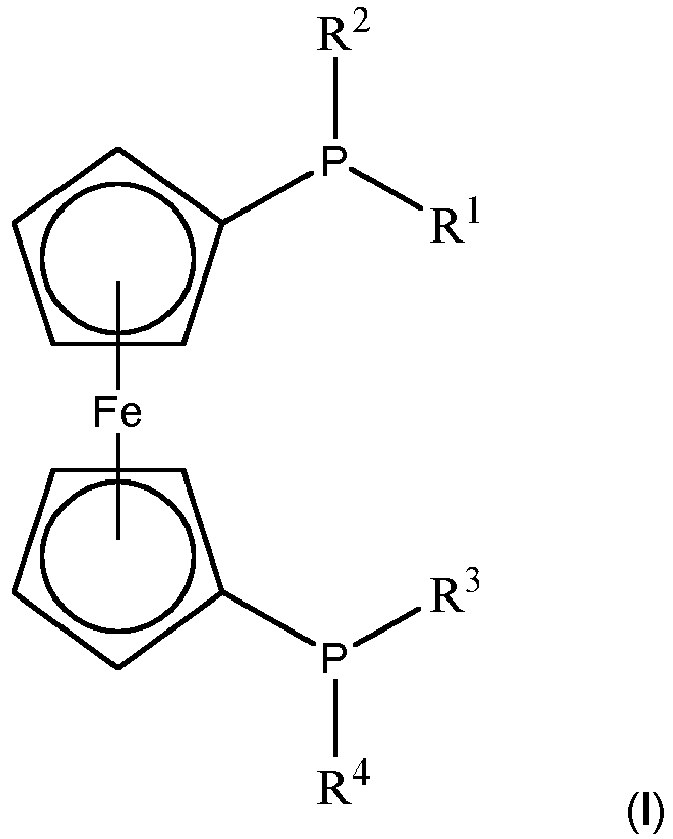
- R1, R2, R3, R4 jeweils unabhängig voneinander ausgewählt sind aus -(C1-C12)-Alkyl, -(C3-C12)-Cycloalkyl, -(C3-C12)-Heterocycloalkyl, -(C6-C20)-Aryl, -(C6-C20)-Heteroaryl;
- mindestens einer der Reste R1, R2, R3, R4 für einen -(C6-C20)-Heteroarylrest mit mindestens sechs Ringatomen steht;
- und
- R1, R2, R3, R4, falls diese für -(C1-C12)-Alkyl, -(C3-C12)-Cycloalkyl, -(C3-C12)-Heterocycloalkyl,-(C6-C20)-Aryl oder -(C6-C20)-Heteroaryl stehen,
- jeweils unabhängig voneinander mit einem oder mehreren Substituenten ausgewählt aus:-(C1-C12)-Alkyl, -O-(C1-C12)-Alkyl, -OH, -NH2, Halogen substituiert sein können.
- Der Begriff (C1-C12)-Alkyl umfasst geradkettige und verzweigte Alkylgruppen mit 1 bis 12 Kohlenstoffatomen. Vorzugsweise handelt es sich dabei um (C1-C8)-Alkylgruppen, besonders bevorzugt (C1-C6)-Alkyl, am meisten bevorzugt (C1-C4)-Alkyl.
- Der Begriff (C3-C12)-Cycloalkyl umfasst mono-, bi- oder tricyclische Kohlenwasserstoffgruppen mit 3 bis 12 Kohlenstoffatomen. Vorzugsweise handelt es sich dabei um (C5-C12)-Cycloalkyl.
- Der Begriff (C3-C12)-Heterocycloalkyl umfasst nichtaromatische, gesättigte oder teilweise ungesättigte cycloaliphatische Gruppen mit 3 bis 12 Kohlenstoffatomen, wobei eins oder mehrere der Ringkohlenstoffatome durch Heteroatome ersetzt sind. Die (C3-C12)-Heterocycloalkylgruppen weisen vorzugsweise 3 bis 8, besonders bevorzugt 5 oder 6, Ringatome auf. In den Heterocycloalkylgruppen sind im Unterschied zu den Cycloalkylgruppen eins oder mehrere der Ringkohlenstoffatome durch Heteroatome oder heteroatomhaltige Gruppen ersetzt. Die Heteroatome oder die heteroatomhaltigen Gruppen sind vorzugsweise ausgewählt unter O, S, N.
- Der Begriff (C6-C20)-Aryl umfasst mono- oder polycyclische aromatische Kohlenwasserstoffreste mit 6 bis 20 Kohlenstoffatomen. Vorzugsweise handelt es sich dabei um (C6-C14)-Aryl, besonders bevorzugt (C6-C10)-Aryl.
- Der Begriff (C6-C20)-Heteroaryl umfasst mono- oder polycyclische aromatische Kohlenwasserstoffreste mit 6 bis 20 Kohlenstoffatomen, wobei eins oder mehrere der Kohlenstoffatome durch Heteroatome ersetzt sind. Bevorzugte Heteroatome sind N, O und S. Die (C3-C20)-Heteroarylgruppen weisen 6 bis 20, bevorzugt 6 bis 14, besonders bevorzugt 6 bis 10 Ringatome auf. Somit ist beispielsweise Pyridyl im Rahmen dieser Erfindung ein C6-Heteroarylrest, Furyl ist ein Cs-Heteroarylrest.
- Geeignete (C6-C20)-Heteroarylgruppen mit mindestens sechs Ringatomen sind insbesondere Pyridyl, Pyridazinyl, Pyrimidyl, Pyrazinyl, Benzofuranyl, Indolyl, Isoindolyl.
- Der Begriff Halogen umfasst insbesondere Fluor, Chlor, Brom und Iod. Besonders bevorzugt sind Fluor und Chlor.
- In einer Ausführungsform stehen mindestens zwei der Reste R1, R2, R3, R4 für einen -(C6-C20)-Heteroarylrest mit mindestens sechs Ringatomen.
- In einer Ausführungsform stehen die Reste R1 und R3 jeweils für einen -(C6-C20)-Heteroarylrest mit mindestens sechs Ringatomen.
- In einer Ausführungsform stehen die Reste R1 und R3 jeweils für 2-Pyridyl.
- In einer Ausführungsform stehen R2 und R4 für -(C1-C12)-Alkyl.
- In einer Ausführungsform stehen R2 und R4 für tert-Butyl.
- In einer Ausführungsform weist die Verbindung (I) die Struktur (1) auf:

- Die Erfindung betrifft weiterhin die Verwendung eines erfindungsgemäßen Komplexes zur Katalyse einer Alkoxycarbonylierungsreaktion.
- Verfahren umfassend die Verfahrensschritte:
- a) Vorlegen einer ethylenisch ungesättigten Verbindung;
- b) Zugabe eines zuvor beschriebenen Komplexes, oder
eine Verbindung gemäß Formel (I)
- R1, R2, R3, R4 jeweils unabhängig voneinander ausgewählt sind aus -(C1-C12)-Alkyl, -(C3-C12)-Cycloalkyl, -(C3-C12)-Heterocycloalkyl, -(C6-C20)-Aryl, -(C6-C20)-Heteroaryl;
- mindestens einer der Reste R1, R2, R3, R4 für einen -(C6-C20)-Heteroarylrest mit mindestens sechs Ringatomen steht;
- und
- R1, R2, R3, R4, falls diese für -(C1-C12)-Alkyl, -(C3-C12)-Cycloalkyl, -(C3-C12)-Heterocycloalkyl,-(C6-C20)-Aryl oder -(C6-C20)-Heteroaryl stehen,
- jeweils unabhängig voneinander mit einem oder mehreren Substituenten ausgewählt aus:-(C1-C12)-Alkyl, -O-(C1-C12)-Alkyl, -OH, -NH2, Halogen substituiert sein können, und einer Substanz, welche Pt umfasst;
- c) Zugabe eines Alkohols;
- d) Zuführen von CO;
- e) Erwärmen des Reaktionsgemisches aus a) bis d), wobei die ethylenisch ungesättigte Verbindung zu einem Ester umgesetzt wird.
- Hierbei können die Verfahrensschritte a), b), c) und d) in beliebiger Reihenfolge erfolgen. Üblicherweise erfolgt die Zugabe von CO jedoch, nachdem die Reaktionspartner in den Schritten a) bis c) vorgelegt wurden. Die Schritte d) und e) können gleichzeitig oder nacheinander erfolgen. Darüber hinaus kann CO auch in mehreren Schritten zugeführt werden, so dass beispielsweise zunächst ein Teil des CO zugeführt, dann erwärmt und anschließend ein weiterer Teil CO zugeführt wird.
- Die in dem erfindungsgemäßen Verfahren als Edukt eingesetzten ethylenisch ungesättigten Verbindungen enthalten eine oder mehrere Kohlenstoff-Kohlenstoff-Doppelbindungen. Diese Verbindungen werden auch im Folgenden zur Vereinfachung als Olefine bezeichnet. Die Doppelbindungen können terminal oder intern sein.
- Die ethylenisch ungesättigten Verbindungen können zusätzlich zu der einen oder mehreren Doppelbindungen weitere funktionelle Gruppen enthalten. Dabei umfasst die ethylenisch ungesättigte Verbindung vorzugsweise insgesamt 2 bis 30 Kohlenstoffatome, bevorzugt 2 bis 22 Kohlenstoffatome, besonders bevorzugt 2 bis 12 Kohlenstoffatome.
- In einer Variante des Verfahrens umfasst die ethylenisch ungesättigte Verbindung keine weiteren funktionellen Gruppen außer Kohlenstoff-Kohlenstoff-Doppelbindungen.
- In einer Variante des Verfahrens ist die ethylenisch ungesättigte Verbindung ausgewählt aus: Ethen, Propen, 1-Buten, cis- und/oder trans-2-Buten, iso-Buten, 1,3-Butadien, 1-Penten, cis- und/oder trans-2-Penten, 2-Methyl-1-buten, 3-Methyl-1-buten, 2-Methyl-2-buten, Hexen, Tetramethylethylen, Hepten, 1-Octen, 2-Octen, Di-n-Buten, oder Mischungen davon.
- In einer Variante des Verfahrens ist die ethylenisch ungesättigte Verbindung ausgewählt aus: Propen, 1-Buten, cis-2-Buten, trans-2-Buten, oder Mischungen davon.
- In einer Variante des Verfahrens ist die ethylenisch ungesättigte Verbindung ausgewählt aus: 1-Penten, cis-2-Penten, trans-2-Penten, 2-Methyl-1-buten, 2-Methyl-2-buten, 3-Methyl-1-buten, oder Mischungen davon.
- Geeignete Gemische ethylenisch ungesättigter Verbindungen sind die sogenannten Raffinate I bis III. Raffinat I umfasst 40 bis 50 % iso-Buten, 20 bis 30 % 1-Buten, 10 bis 20 % cis- und trans-2-Buten, bis zu 1 % 1,3-Butadien und 10 bis 20 % n-Butan und Isobutan. Das Raffinat II ist ein Teil der beim Naphthacracken entstehenden C4-Fraktion und besteht im Wesentlichen aus den isomeren n-Butenen, Isobutan und n-Butan nach Abtrennung von Isobuten aus Raffinat I. Raffinat III ist ein Teil der beim Naphthacracken entstehenden C4-Fraktion und besteht im Wesentlichen aus den isomeren n-Butenen und n-Butan.
- In einer Variante wird ein Gemisch umfassend iso-Buten, 1-Buten, cis- und trans-2-Buten eingesetzt. Vorzugsweise umfasst das Gemisch 1-Buten, cis- und trans-2-Buten.
- In einer Variante des Verfahrens ist der Alkohol in Verfahrensschritt c) ausgewählt aus: Methanol, Ethanol, 1-Propanol, 1-Butanol, 1-Pentanol, 1-Hexanol, 2-Propanol, tert-Butanol, 3-Pentanol, Cyclohexanol, Phenol.
- In einer Variante des Verfahrens ist der Alkohol in Verfahrensschritt c) Methanol.
- In einer Variante des Verfahrens ist die Substanz, welche Pt umfasst ausgewählt aus: Platindichlorid (PtCl2), Platin(II)-acetylacetonat [Pt(acac)2], Platin(II)-acetat [Pt(OAc)2], Dichloro(1,5-cyclooctadiene)platin(II) [Pt(cod)2Cl2], Bis(dibenzylideneaceton)platin [Pt(dba)2], Bis(acetonitrile)dichloropatin(II) [Pt(CH3CN)2Cl2], Platin(cinnamyl)dichlorid [Pt(cinnamyl)Cl2] In einer Variante des Verfahrens ist die Substanz, welche Pt umfasst ausgewählt aus: Platindichlorid (PtCl2), Platin(II)-acetylacetonat [Pt(acac)2], Platin(II)-acetat [Pt(OAc)2].
- CO wird in Schritt d) vorzugsweise bei einem CO-Partialdruck zwischen 0,1 und 10 MPa (1 bis 100 bar), bevorzugt zwischen 1 und 8 MPa (10 bis 80 bar), besonders bevorzugt zwischen 2 und 6 MPa (20 bis 60 bar) zugeführt.
- Die Reaktionsmischung wird in Schritt e) des erfindungsgemäßen Verfahrens vorzugsweise auf eine Temperatur im Bereich von 60 °C bis 160 °C, bevorzugt von 80 °C bis 140 °C, besonders bevorzugt von 100 °C bis 140 °C erwärmt, um die ethylenisch ungesättigte Verbindung zu einem Ester umzusetzen.
- Im Folgenden soll die Erfindung anhand eines Ausführungsbeispieles näher erläutert werden.
-

- Reaktionsbedingungen: 1-Octen (1.0 mmol), PtCl2 (0.01 mmol, 1.0 mol%), Ligand: monodentater Phosphinligand (0.04 mmol, 4.0 mol%), bidentater Phosphinligand (0.02 mmol, 2.0 mol%), PTSA·H2O (Monohydrat der p-Toluolsulfonsäure) (5.0 mol%), MeOH (2.0 mL), Druck(CO): 40 bar, Temperatur: 120 °C, Reaktionszeit: 20 h.
- Die Reaktion wurde mit den folgenden Liganden durchgeführt:
- Monodentate Phosphinliganden:

- Bidentate Phosphinliganden:


- Die jeweilige Ausbeute und n/iso-Selektivität sind unterhalb des Liganden angegeben. Selektivitäten und Ausbeuten wurden gaschromatographisch mit Mesitylen als internem Standard bestimmt.
- Von den 16 verwendeten Liganden lieferten 11 keinen Umsatz (0%). Lediglich mit einem Liganden (L12 = (1)) konnte ein Umsatz von über 60% erzielt werden. Wie die Versuchsreihe zeigt wird der größte Umsatz mit dem erfindungsgemäßen Komplex aus Pt und (1) erzielt.
- Der Preis von Pt liegt unter dem von Pd. Die Aufgebe wird somit durch einen erfindungsgemäßen Komplex gelöst.
Claims (13)
- Komplex umfassend Pt und eine Verbindung gemäß Formel (I)
 R1, R2, R3, R4 jeweils unabhängig voneinander ausgewählt sind aus -(C1-C12)-Alkyl,-(C3-C12)-Cycloalkyl, -(C3-C12)-Heterocycloalkyl, -(C6-C20)-Aryl, -(C6-C20)-Heteroaryl; mindestens einer der Reste R1, R2, R3, R4 für einen -(C6-C20)-Heteroarylrest mit mindestens sechs Ringatomen steht;undR1, R2, R3, R4, falls diese für -(C1-C12)-Alkyl, -(C3-C12)-Cycloalkyl, -(C3-C12)-Heterocycloalkyl, -(C6-C20)-Aryl oder -(C6-C20)-Heteroaryl stehen,jeweils unabhängig voneinander mit einem oder mehreren Substituenten ausgewählt aus: -(C1-C12)-Alkyl, -O-(C1-C12)-Alkyl, -OH, -NH2, Halogen substituiert sein können.
 - Komplex nach Anspruch 1,
wobei mindestens zwei der Reste R1, R2, R3, R4 für einen -(C6-C20)-Heteroarylrest mit mindestens sechs Ringatomen stehen. - Komplex nach einem der Ansprüche 1 bis 2,
wobei die Reste R1 und R3 jeweils für einen -(C6-C20)-Heteroarylrest mit mindestens sechs Ringatomen stehen. - Komplex nach einem der Ansprüche 1 bis 3,
wobei die Reste R1 und R3 jeweils für 2-Pyridyl stehen. - Komplex nach einem der Ansprüche 1 bis 4,
wobei R2 und R4 für -(C1-C12)-Alkyl stehen. - Komplex nach einem der Ansprüche 1 bis 5,
wobei R2 und R4 für tert-Butyl stehen. - Komplex nach einem der Ansprüche 1 bis 6,
wobei die Verbindung (I) die Struktur (1) aufweist: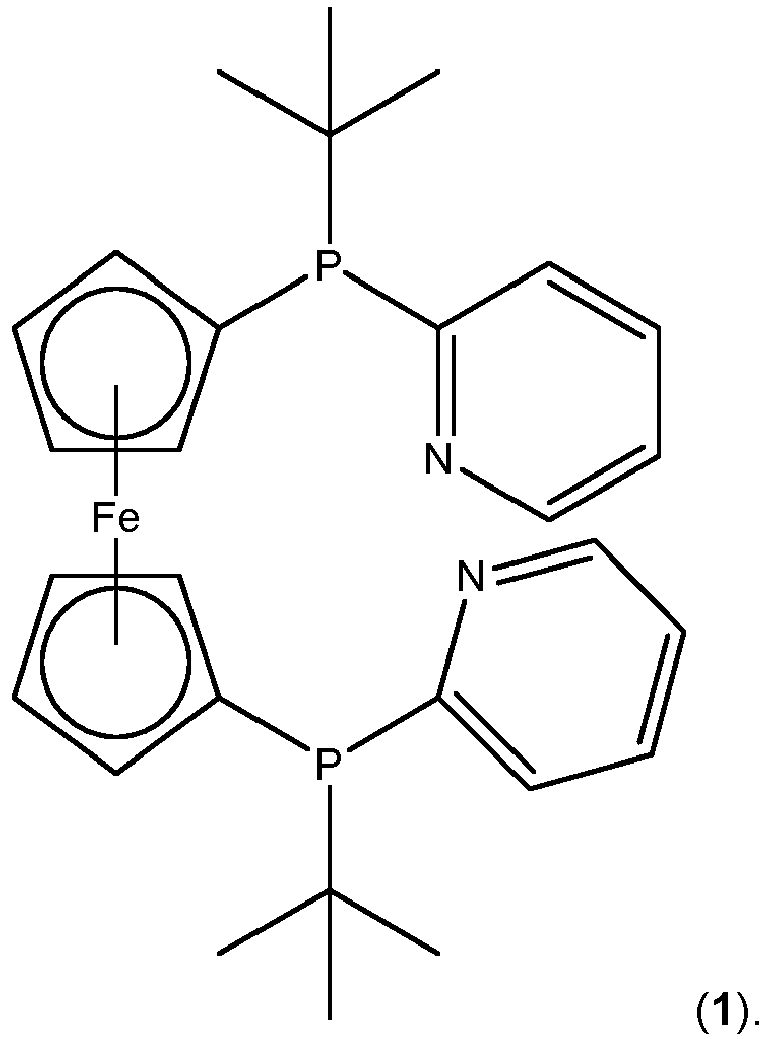
- Verfahren umfassend die Verfahrensschritte:a) Vorlegen einer ethylenisch ungesättigten Verbindung;b) Zugabe eines Komplexes nach einem der Ansprüche 1 bis 7, oder eine Verbindung gemäß Formel (I)
 R1, R2, R3, R4 jeweils unabhängig voneinander ausgewählt sind aus -(C1-C12)-Alkyl,-(C3-C12)-Cycloalkyl, -(C3-C12)-Heterocycloalkyl, -(C6-C20)-Aryl, -(C6-C20)-Heteroaryl; mindestens einer der Reste R1, R2, R3, R4 für einen -(C6-C20)-Heteroarylrest mit mindestens sechs Ringatomen steht;undR1, R2, R3, R4, falls diese für -(C1-C12)-Alkyl, -(C3-C12)-Cycloalkyl, -(C3-C12)-Heterocycloalkyl, -(C6-C20)-Aryl oder -(C6-C20)-Heteroaryl stehen,jeweils unabhängig voneinander mit einem oder mehreren Substituenten ausgewählt aus: -(C1-C12)-Alkyl, -O-(C1-C12)-Alkyl, -OH, -NH2, Halogen substituiert sein können, undeiner Substanz, welche Pt umfasst;c) Zugabe eines Alkohols;d) Zuführen von CO;e) Erwärmen des Reaktionsgemisches aus a) bis d), wobei die ethylenisch ungesättigte Verbindung zu einem Ester umgesetzt wird.
 - Verfahren nach Anspruch 8,
wobei die ethylenisch ungesättigte Verbindung ausgewählt ist aus: Ethen, Propen, 1-Buten, cis- und/oder trans-2-Buten, iso-Buten, 1,3-Butadien, 1-Penten, cis- und/oder trans-2-Penten, 2-Methyl-1-buten, 3-Methyl-1-buten, 2-Methyl-2-buten, Hexen, Tetramethylethylen, Hepten, 1-Octen, 2-Octen, Di-n-Buten, oder Mischungen davon. - Verfahren nach einem der Ansprüche 8 oder 9,
wobei der Alkohol in Verfahrensschritt c) ausgewählt ist aus: Methanol, Ethanol, 1-Propanol, 1-Butanol, 1-Pentanol, 1-Hexanol, 2-Propanol, tert-Butanol, 3-Pentanol, Cyclohexanol, Phenol. - Verfahren nach einem der Ansprüche 8 bis 10,
wobei der Alkohol in Verfahrensschritt c) Methanol ist. - Verfahren nach einem der Ansprüche 8 bis 11,
wobei die Substanz, welche Pt umfasst ausgewählt ist aus: Platindichlorid (PtCl2), Platin(II)-acetylacetonat [Pt(acac)2], Platin(II)-acetat [Pt(OAc)2], Dichloro(1,5-cyclooctadiene)platin(II) [Pt(cod)2Cl2], Bis(dibenzylideneaceton)platin [Pt(dba)2], Bis(acetonitrile)dichloropatin(II) [Pt(CH3CN)2Cl2], Platin(cinnamyl)dichlorid [Pt(cinnamyl)Cl2]. - Verfahren nach einem der Ansprüche 8 bis 12,
wobei die Substanz, welche Pt umfasst ausgewählt ist aus: Platindichlorid (PtCl2), Platin(II)-acetylacetonat [Pt(acac)2], Platin(II)-acetat [Pt(OAc)2].
Priority Applications (3)
| Application Number | Priority Date | Filing Date | Title |
|---|---|---|---|
| EP20166579.1A EP3889163B1 (de) | 2020-03-30 | 2020-03-30 | Platin-komplexe mit ferrocen-liganden für die katalyse der alkoxycarbonylierung ethylenisch ungesättigter verbindungen |
| CN202110280320.7A CN113461742A (zh) | 2020-03-30 | 2021-03-16 | 用于催化烯属不饱和化合物的烷氧基羰基化的具有二茂铁配体的铂配合物 |
| US17/215,075 US12195483B2 (en) | 2020-03-30 | 2021-03-29 | Platinum complexes having ferrocene ligands for the catalysis of the alkoxycarbonylation of ethylenically unsaturated compounds |
Applications Claiming Priority (1)
| Application Number | Priority Date | Filing Date | Title |
|---|---|---|---|
| EP20166579.1A EP3889163B1 (de) | 2020-03-30 | 2020-03-30 | Platin-komplexe mit ferrocen-liganden für die katalyse der alkoxycarbonylierung ethylenisch ungesättigter verbindungen |
Publications (2)
| Publication Number | Publication Date |
|---|---|
| EP3889163A1 true EP3889163A1 (de) | 2021-10-06 |
| EP3889163B1 EP3889163B1 (de) | 2023-07-19 |
Family
ID=70058144
Family Applications (1)
| Application Number | Title | Priority Date | Filing Date |
|---|---|---|---|
| EP20166579.1A Active EP3889163B1 (de) | 2020-03-30 | 2020-03-30 | Platin-komplexe mit ferrocen-liganden für die katalyse der alkoxycarbonylierung ethylenisch ungesättigter verbindungen |
Country Status (3)
| Country | Link |
|---|---|
| US (1) | US12195483B2 (de) |
| EP (1) | EP3889163B1 (de) |
| CN (1) | CN113461742A (de) |
Families Citing this family (4)
| Publication number | Priority date | Publication date | Assignee | Title |
|---|---|---|---|---|
| EP3889161B1 (de) | 2020-03-30 | 2022-06-08 | Evonik Operations GmbH | Platin-komplexe mit benzylbasierten diphosphinliganden für die katalyse der alkoxycarbonylierung ethylenisch ungesättigter verbindungen |
| EP4011894B1 (de) | 2020-12-09 | 2023-05-31 | Evonik Operations GmbH | Platin-komplexe mit binaphthyl-diphosphin-liganden für die katalyse der hydroxycarbonylierung ethylenisch ungesättigter verbindungen |
| EP4011892A1 (de) | 2020-12-09 | 2022-06-15 | Evonik Operations GmbH | Platin-komplexe mit ferrocen-diphosphin-liganden für die katalyse der hydroxycarbonylierung ethylenisch ungesättigter verbindungen |
| WO2024175054A1 (zh) * | 2023-02-22 | 2024-08-29 | 中国科学院上海有机化学研究所 | 膦配体及其在乙炔/乙烯羰基化合成丙烯酸酯/丙酸酯中的应用 |
Citations (2)
| Publication number | Priority date | Publication date | Assignee | Title |
|---|---|---|---|---|
| EP0662467A1 (de) | 1994-01-06 | 1995-07-12 | Dsm N.V. | Verfahren zur Herstellung eines Esters |
| US20170022236A1 (en) * | 2015-07-23 | 2017-01-26 | Evonik Degussa Gmbh | Ferrocene-based compounds and palladium catalysts based thereon for the alkoxycarbonylation of ethylenically unsaturated compounds |
Family Cites Families (6)
| Publication number | Priority date | Publication date | Assignee | Title |
|---|---|---|---|---|
| US3906015A (en) * | 1971-10-18 | 1975-09-16 | Du Pont | Carboalkoxylation and carboalkoxylation of olefins |
| US9334227B2 (en) * | 2005-11-17 | 2016-05-10 | Lucite International Uk Limited | Carbonylation of ethylenically unsaturated compounds |
| KR20120093250A (ko) * | 2009-10-08 | 2012-08-22 | 스미또모 가가꾸 가부시끼가이샤 | 금속 착물, 피리딜포스핀 화합물 및 알킬메타크릴레이트의 제조 방법 |
| EP3272760B1 (de) * | 2016-07-19 | 2019-05-15 | Evonik Degussa GmbH | 1,1'-bis(phosphino)ferrocenliganden für die alkoxycarbonylierung |
| EP3502084B1 (de) * | 2017-12-21 | 2020-02-12 | Evonik Operations GmbH | Verfahren zur direkten umsetzung von diisobuten zu einer carbonsäure |
| EP3889161B1 (de) | 2020-03-30 | 2022-06-08 | Evonik Operations GmbH | Platin-komplexe mit benzylbasierten diphosphinliganden für die katalyse der alkoxycarbonylierung ethylenisch ungesättigter verbindungen |
-
2020
- 2020-03-30 EP EP20166579.1A patent/EP3889163B1/de active Active
-
2021
- 2021-03-16 CN CN202110280320.7A patent/CN113461742A/zh active Pending
- 2021-03-29 US US17/215,075 patent/US12195483B2/en active Active
Patent Citations (2)
| Publication number | Priority date | Publication date | Assignee | Title |
|---|---|---|---|---|
| EP0662467A1 (de) | 1994-01-06 | 1995-07-12 | Dsm N.V. | Verfahren zur Herstellung eines Esters |
| US20170022236A1 (en) * | 2015-07-23 | 2017-01-26 | Evonik Degussa Gmbh | Ferrocene-based compounds and palladium catalysts based thereon for the alkoxycarbonylation of ethylenically unsaturated compounds |
Non-Patent Citations (1)
| Title |
|---|
| THOMAS J. COLACOT ET AL: "Precious Metal-Phosphine Complexes for Homogeneous Catalysis: Synthesis and Characterization of a Complete Series of Cp 2 Fe(PPh 2 ) 2 MX 2 (M = Pt, Pd; X = Cl, Br, I, Ph)", PHOSPHORUS, SULFUR AND SILICON AND THE RELATED ELEMENTS, vol. 144, no. 1, 1 January 1999 (1999-01-01), US, pages 49 - 52, XP055719946, ISSN: 1042-6507, DOI: 10.1080/10426509908546179 * |
Also Published As
| Publication number | Publication date |
|---|---|
| CN113461742A (zh) | 2021-10-01 |
| US12195483B2 (en) | 2025-01-14 |
| EP3889163B1 (de) | 2023-07-19 |
| US20210300957A1 (en) | 2021-09-30 |
Similar Documents
| Publication | Publication Date | Title |
|---|---|---|
| EP3889161B1 (de) | Platin-komplexe mit benzylbasierten diphosphinliganden für die katalyse der alkoxycarbonylierung ethylenisch ungesättigter verbindungen | |
| EP3889163B1 (de) | Platin-komplexe mit ferrocen-liganden für die katalyse der alkoxycarbonylierung ethylenisch ungesättigter verbindungen | |
| EP4011895A1 (de) | Platin-komplexe mit 1,2-substituierten benzylbasierten diphosphinliganden für die katalyse der alkoxycarbonylierung ethylenisch ungesättigter verbindungen | |
| DE69916755T2 (de) | Verfahren zur Herstellung von Alkoholen | |
| EP3121185B1 (de) | Phosphinligand und darauf basierende palladium-katalysatoren für die alkoxycarbonylierung ethylenisch ungesättigter verbindungen | |
| EP1677911B1 (de) | Stabilisierung von hydroformylierungskatalysatoren auf basis von phosphoramiditliganden | |
| DE2922757C2 (de) | Verfahren zur Hydroformylierung von olefinischen Verbindungen | |
| EP3272732A1 (de) | Verfahren zur alkoxycarbonylierung ethylenisch ungesättigter verbindungen mit monophosphinliganden | |
| EP0138141A1 (de) | Verfahren zur selektiven Hydrierung von C-C-Doppelbindungen in Gegenwart von reduzierbaren, stickstoffhaltigen Gruppen | |
| DE2104626C2 (de) | Verfahren zur Herstellung eines Additionsproduktes eines konjugierten Diens und einer Verbindung mit endständiger Venylgruppe | |
| DE69005542T2 (de) | Verfahren zur Herstellung von 3-Pentensäure. | |
| EP3272760A1 (de) | 1,1'-bis(phosphino)ferrocenliganden für die alkoxycarbonylierung | |
| EP0780157A1 (de) | Rutheniumkomplexe mit einem chiralen, zweizähnigen Phosphinoxazolin-Liganden zur enantioselektiven Transferhydrierung von prochiralen Ketonen | |
| EP4011894B1 (de) | Platin-komplexe mit binaphthyl-diphosphin-liganden für die katalyse der hydroxycarbonylierung ethylenisch ungesättigter verbindungen | |
| DE2124718C3 (de) | Verfahren zur Herstellung einer Carbonsäure oder eines Carbonsäureesters | |
| DE102011089008B4 (de) | Verfahren zur Herstellung von Estern aus Formiaten und olefinisch ungesättigten Verbindungen | |
| EP4001253A1 (de) | Doppelte alkoxycarbonylierung von dienen als eintopfsynthese | |
| EP3441384A1 (de) | Methoxycarbonylierung mit ameisensäure und methanol | |
| EP3441383A1 (de) | Methoxycarbonylierung mit ameisensäure als co-quelle | |
| EP4455120A1 (de) | Verfahren zur alkoxycarbonylierung von olefinen unter einsatz von synthesegas | |
| DE10243446A1 (de) | Verfahren zur Herstellung von Aldehyden | |
| DE3220316A1 (de) | Verfahren zur herstellung von carbonsaeureestern | |
| EP4011892A1 (de) | Platin-komplexe mit ferrocen-diphosphin-liganden für die katalyse der hydroxycarbonylierung ethylenisch ungesättigter verbindungen | |
| EP0931046B1 (de) | VERFAHREN ZUR HERSTELLUNG VON n-BUTYLALKYLETHERN | |
| EP4011893A1 (de) | Platin-komplexe mit binaphthyl basiertem diphosphinliganden für die selektive katalyse der hydroxycarbonylierung ethylenisch ungesättigter verbindungen |
Legal Events
| Date | Code | Title | Description |
|---|---|---|---|
| PUAI | Public reference made under article 153(3) epc to a published international application that has entered the european phase |
Free format text: ORIGINAL CODE: 0009012 |
|
| STAA | Information on the status of an ep patent application or granted ep patent |
Free format text: STATUS: THE APPLICATION HAS BEEN PUBLISHED |
|
| AK | Designated contracting states |
Kind code of ref document: A1 Designated state(s): AL AT BE BG CH CY CZ DE DK EE ES FI FR GB GR HR HU IE IS IT LI LT LU LV MC MK MT NL NO PL PT RO RS SE SI SK SM TR |
|
| STAA | Information on the status of an ep patent application or granted ep patent |
Free format text: STATUS: REQUEST FOR EXAMINATION WAS MADE |
|
| 17P | Request for examination filed |
Effective date: 20211027 |
|
| RBV | Designated contracting states (corrected) |
Designated state(s): AL AT BE BG CH CY CZ DE DK EE ES FI FR GB GR HR HU IE IS IT LI LT LU LV MC MK MT NL NO PL PT RO RS SE SI SK SM TR |
|
| GRAP | Despatch of communication of intention to grant a patent |
Free format text: ORIGINAL CODE: EPIDOSNIGR1 |
|
| STAA | Information on the status of an ep patent application or granted ep patent |
Free format text: STATUS: GRANT OF PATENT IS INTENDED |
|
| INTG | Intention to grant announced |
Effective date: 20230328 |
|
| GRAS | Grant fee paid |
Free format text: ORIGINAL CODE: EPIDOSNIGR3 |
|
| GRAA | (expected) grant |
Free format text: ORIGINAL CODE: 0009210 |
|
| STAA | Information on the status of an ep patent application or granted ep patent |
Free format text: STATUS: THE PATENT HAS BEEN GRANTED |
|
| AK | Designated contracting states |
Kind code of ref document: B1 Designated state(s): AL AT BE BG CH CY CZ DE DK EE ES FI FR GB GR HR HU IE IS IT LI LT LU LV MC MK MT NL NO PL PT RO RS SE SI SK SM TR |
|
| REG | Reference to a national code |
Ref country code: GB Ref legal event code: FG4D Free format text: NOT ENGLISH |
|
| P01 | Opt-out of the competence of the unified patent court (upc) registered |
Effective date: 20230620 |
|
| REG | Reference to a national code |
Ref country code: CH Ref legal event code: EP |
|
| REG | Reference to a national code |
Ref country code: DE Ref legal event code: R096 Ref document number: 502020004216 Country of ref document: DE |
|
| REG | Reference to a national code |
Ref country code: IE Ref legal event code: FG4D Free format text: LANGUAGE OF EP DOCUMENT: GERMAN |
|
| REG | Reference to a national code |
Ref country code: NL Ref legal event code: FP |
|
| REG | Reference to a national code |
Ref country code: DE Ref legal event code: R081 Ref document number: 502020004216 Country of ref document: DE Owner name: EVONIK OXENO GMBH & CO. KG, DE Free format text: FORMER OWNER: EVONIK OPERATIONS GMBH, 45128 ESSEN, DE |
|
| REG | Reference to a national code |
Ref country code: LT Ref legal event code: MG9D |
|
| RAP2 | Party data changed (patent owner data changed or rights of a patent transferred) |
Owner name: EVONIK OXENO GMBH & CO. KG |
|
| REG | Reference to a national code |
Ref country code: NL Ref legal event code: PD Owner name: EVONIK OXENO GMBH & CO. KG; DE Free format text: DETAILS ASSIGNMENT: CHANGE OF OWNER(S), ASSIGNMENT; FORMER OWNER NAME: EVONIK OPERATIONS GMBH Effective date: 20231218 |
|
| PG25 | Lapsed in a contracting state [announced via postgrant information from national office to epo] |
Ref country code: GR Free format text: LAPSE BECAUSE OF FAILURE TO SUBMIT A TRANSLATION OF THE DESCRIPTION OR TO PAY THE FEE WITHIN THE PRESCRIBED TIME-LIMIT Effective date: 20231020 |
|
| PG25 | Lapsed in a contracting state [announced via postgrant information from national office to epo] |
Ref country code: IS Free format text: LAPSE BECAUSE OF FAILURE TO SUBMIT A TRANSLATION OF THE DESCRIPTION OR TO PAY THE FEE WITHIN THE PRESCRIBED TIME-LIMIT Effective date: 20231119 |
|
| PG25 | Lapsed in a contracting state [announced via postgrant information from national office to epo] |
Ref country code: SE Free format text: LAPSE BECAUSE OF FAILURE TO SUBMIT A TRANSLATION OF THE DESCRIPTION OR TO PAY THE FEE WITHIN THE PRESCRIBED TIME-LIMIT Effective date: 20230719 Ref country code: RS Free format text: LAPSE BECAUSE OF FAILURE TO SUBMIT A TRANSLATION OF THE DESCRIPTION OR TO PAY THE FEE WITHIN THE PRESCRIBED TIME-LIMIT Effective date: 20230719 Ref country code: PT Free format text: LAPSE BECAUSE OF FAILURE TO SUBMIT A TRANSLATION OF THE DESCRIPTION OR TO PAY THE FEE WITHIN THE PRESCRIBED TIME-LIMIT Effective date: 20231120 Ref country code: NO Free format text: LAPSE BECAUSE OF FAILURE TO SUBMIT A TRANSLATION OF THE DESCRIPTION OR TO PAY THE FEE WITHIN THE PRESCRIBED TIME-LIMIT Effective date: 20231019 Ref country code: LV Free format text: LAPSE BECAUSE OF FAILURE TO SUBMIT A TRANSLATION OF THE DESCRIPTION OR TO PAY THE FEE WITHIN THE PRESCRIBED TIME-LIMIT Effective date: 20230719 Ref country code: LT Free format text: LAPSE BECAUSE OF FAILURE TO SUBMIT A TRANSLATION OF THE DESCRIPTION OR TO PAY THE FEE WITHIN THE PRESCRIBED TIME-LIMIT Effective date: 20230719 Ref country code: IS Free format text: LAPSE BECAUSE OF FAILURE TO SUBMIT A TRANSLATION OF THE DESCRIPTION OR TO PAY THE FEE WITHIN THE PRESCRIBED TIME-LIMIT Effective date: 20231119 Ref country code: HR Free format text: LAPSE BECAUSE OF FAILURE TO SUBMIT A TRANSLATION OF THE DESCRIPTION OR TO PAY THE FEE WITHIN THE PRESCRIBED TIME-LIMIT Effective date: 20230719 Ref country code: GR Free format text: LAPSE BECAUSE OF FAILURE TO SUBMIT A TRANSLATION OF THE DESCRIPTION OR TO PAY THE FEE WITHIN THE PRESCRIBED TIME-LIMIT Effective date: 20231020 Ref country code: FI Free format text: LAPSE BECAUSE OF FAILURE TO SUBMIT A TRANSLATION OF THE DESCRIPTION OR TO PAY THE FEE WITHIN THE PRESCRIBED TIME-LIMIT Effective date: 20230719 |
|
| REG | Reference to a national code |
Ref country code: BE Ref legal event code: PD Owner name: EVONIK OXENO GMBH & CO. KG; DE Free format text: DETAILS ASSIGNMENT: CHANGE OF OWNER(S), ASSIGNMENT; FORMER OWNER NAME: EVONIK OPERATIONS GMBH Effective date: 20231129 |
|
| PG25 | Lapsed in a contracting state [announced via postgrant information from national office to epo] |
Ref country code: PL Free format text: LAPSE BECAUSE OF FAILURE TO SUBMIT A TRANSLATION OF THE DESCRIPTION OR TO PAY THE FEE WITHIN THE PRESCRIBED TIME-LIMIT Effective date: 20230719 |
|
| REG | Reference to a national code |
Ref country code: DE Ref legal event code: R097 Ref document number: 502020004216 Country of ref document: DE |
|
| PG25 | Lapsed in a contracting state [announced via postgrant information from national office to epo] |
Ref country code: ES Free format text: LAPSE BECAUSE OF FAILURE TO SUBMIT A TRANSLATION OF THE DESCRIPTION OR TO PAY THE FEE WITHIN THE PRESCRIBED TIME-LIMIT Effective date: 20230719 |
|
| PG25 | Lapsed in a contracting state [announced via postgrant information from national office to epo] |
Ref country code: SM Free format text: LAPSE BECAUSE OF FAILURE TO SUBMIT A TRANSLATION OF THE DESCRIPTION OR TO PAY THE FEE WITHIN THE PRESCRIBED TIME-LIMIT Effective date: 20230719 Ref country code: RO Free format text: LAPSE BECAUSE OF FAILURE TO SUBMIT A TRANSLATION OF THE DESCRIPTION OR TO PAY THE FEE WITHIN THE PRESCRIBED TIME-LIMIT Effective date: 20230719 Ref country code: ES Free format text: LAPSE BECAUSE OF FAILURE TO SUBMIT A TRANSLATION OF THE DESCRIPTION OR TO PAY THE FEE WITHIN THE PRESCRIBED TIME-LIMIT Effective date: 20230719 Ref country code: EE Free format text: LAPSE BECAUSE OF FAILURE TO SUBMIT A TRANSLATION OF THE DESCRIPTION OR TO PAY THE FEE WITHIN THE PRESCRIBED TIME-LIMIT Effective date: 20230719 Ref country code: DK Free format text: LAPSE BECAUSE OF FAILURE TO SUBMIT A TRANSLATION OF THE DESCRIPTION OR TO PAY THE FEE WITHIN THE PRESCRIBED TIME-LIMIT Effective date: 20230719 Ref country code: CZ Free format text: LAPSE BECAUSE OF FAILURE TO SUBMIT A TRANSLATION OF THE DESCRIPTION OR TO PAY THE FEE WITHIN THE PRESCRIBED TIME-LIMIT Effective date: 20230719 Ref country code: SK Free format text: LAPSE BECAUSE OF FAILURE TO SUBMIT A TRANSLATION OF THE DESCRIPTION OR TO PAY THE FEE WITHIN THE PRESCRIBED TIME-LIMIT Effective date: 20230719 |
|
| PLBE | No opposition filed within time limit |
Free format text: ORIGINAL CODE: 0009261 |
|
| STAA | Information on the status of an ep patent application or granted ep patent |
Free format text: STATUS: NO OPPOSITION FILED WITHIN TIME LIMIT |
|
| PG25 | Lapsed in a contracting state [announced via postgrant information from national office to epo] |
Ref country code: IT Free format text: LAPSE BECAUSE OF FAILURE TO SUBMIT A TRANSLATION OF THE DESCRIPTION OR TO PAY THE FEE WITHIN THE PRESCRIBED TIME-LIMIT Effective date: 20230719 |
|
| 26N | No opposition filed |
Effective date: 20240422 |
|
| PG25 | Lapsed in a contracting state [announced via postgrant information from national office to epo] |
Ref country code: SI Free format text: LAPSE BECAUSE OF FAILURE TO SUBMIT A TRANSLATION OF THE DESCRIPTION OR TO PAY THE FEE WITHIN THE PRESCRIBED TIME-LIMIT Effective date: 20230719 |
|
| REG | Reference to a national code |
Ref country code: CH Ref legal event code: PL |
|
| PG25 | Lapsed in a contracting state [announced via postgrant information from national office to epo] |
Ref country code: BG Free format text: LAPSE BECAUSE OF FAILURE TO SUBMIT A TRANSLATION OF THE DESCRIPTION OR TO PAY THE FEE WITHIN THE PRESCRIBED TIME-LIMIT Effective date: 20230719 |
|
| PG25 | Lapsed in a contracting state [announced via postgrant information from national office to epo] |
Ref country code: LU Free format text: LAPSE BECAUSE OF NON-PAYMENT OF DUE FEES Effective date: 20240330 |
|
| PG25 | Lapsed in a contracting state [announced via postgrant information from national office to epo] |
Ref country code: MC Free format text: LAPSE BECAUSE OF FAILURE TO SUBMIT A TRANSLATION OF THE DESCRIPTION OR TO PAY THE FEE WITHIN THE PRESCRIBED TIME-LIMIT Effective date: 20230719 |
|
| GBPC | Gb: european patent ceased through non-payment of renewal fee |
Effective date: 20240330 |
|
| PG25 | Lapsed in a contracting state [announced via postgrant information from national office to epo] |
Ref country code: MC Free format text: LAPSE BECAUSE OF FAILURE TO SUBMIT A TRANSLATION OF THE DESCRIPTION OR TO PAY THE FEE WITHIN THE PRESCRIBED TIME-LIMIT Effective date: 20230719 Ref country code: LU Free format text: LAPSE BECAUSE OF NON-PAYMENT OF DUE FEES Effective date: 20240330 Ref country code: BG Free format text: LAPSE BECAUSE OF FAILURE TO SUBMIT A TRANSLATION OF THE DESCRIPTION OR TO PAY THE FEE WITHIN THE PRESCRIBED TIME-LIMIT Effective date: 20230719 |
|
| PG25 | Lapsed in a contracting state [announced via postgrant information from national office to epo] |
Ref country code: GB Free format text: LAPSE BECAUSE OF NON-PAYMENT OF DUE FEES Effective date: 20240330 |
|
| PG25 | Lapsed in a contracting state [announced via postgrant information from national office to epo] |
Ref country code: FR Free format text: LAPSE BECAUSE OF NON-PAYMENT OF DUE FEES Effective date: 20240331 |
|
| PG25 | Lapsed in a contracting state [announced via postgrant information from national office to epo] |
Ref country code: IE Free format text: LAPSE BECAUSE OF NON-PAYMENT OF DUE FEES Effective date: 20240330 |
|
| PG25 | Lapsed in a contracting state [announced via postgrant information from national office to epo] |
Ref country code: IE Free format text: LAPSE BECAUSE OF NON-PAYMENT OF DUE FEES Effective date: 20240330 Ref country code: GB Free format text: LAPSE BECAUSE OF NON-PAYMENT OF DUE FEES Effective date: 20240330 Ref country code: FR Free format text: LAPSE BECAUSE OF NON-PAYMENT OF DUE FEES Effective date: 20240331 Ref country code: CH Free format text: LAPSE BECAUSE OF NON-PAYMENT OF DUE FEES Effective date: 20240331 |
|
| PGFP | Annual fee paid to national office [announced via postgrant information from national office to epo] |
Ref country code: AT Payment date: 20250417 Year of fee payment: 5 |
|
| PG25 | Lapsed in a contracting state [announced via postgrant information from national office to epo] |
Ref country code: CY Free format text: LAPSE BECAUSE OF FAILURE TO SUBMIT A TRANSLATION OF THE DESCRIPTION OR TO PAY THE FEE WITHIN THE PRESCRIBED TIME-LIMIT; INVALID AB INITIO Effective date: 20200330 |
|
| PG25 | Lapsed in a contracting state [announced via postgrant information from national office to epo] |
Ref country code: HU Free format text: LAPSE BECAUSE OF FAILURE TO SUBMIT A TRANSLATION OF THE DESCRIPTION OR TO PAY THE FEE WITHIN THE PRESCRIBED TIME-LIMIT; INVALID AB INITIO Effective date: 20200330 |
|
| PG25 | Lapsed in a contracting state [announced via postgrant information from national office to epo] |
Ref country code: TR Free format text: LAPSE BECAUSE OF FAILURE TO SUBMIT A TRANSLATION OF THE DESCRIPTION OR TO PAY THE FEE WITHIN THE PRESCRIBED TIME-LIMIT Effective date: 20230719 |
|
| PGFP | Annual fee paid to national office [announced via postgrant information from national office to epo] |
Ref country code: DE Payment date: 20260319 Year of fee payment: 7 |
|
| PGFP | Annual fee paid to national office [announced via postgrant information from national office to epo] |
Ref country code: BE Payment date: 20260319 Year of fee payment: 7 |
|
| PGFP | Annual fee paid to national office [announced via postgrant information from national office to epo] |
Ref country code: NL Payment date: 20260319 Year of fee payment: 7 |
|
| REG | Reference to a national code |
Ref country code: AT Ref legal event code: MM01 Ref document number: 1589387 Country of ref document: AT Kind code of ref document: T Effective date: 20250330 |
|
| PG25 | Lapsed in a contracting state [announced via postgrant information from national office to epo] |
Ref country code: AT Free format text: LAPSE BECAUSE OF NON-PAYMENT OF DUE FEES Effective date: 20250330 |