EP3887253B1 - Passenger location platform - Google Patents
Passenger location platform Download PDFInfo
- Publication number
- EP3887253B1 EP3887253B1 EP19817490.6A EP19817490A EP3887253B1 EP 3887253 B1 EP3887253 B1 EP 3887253B1 EP 19817490 A EP19817490 A EP 19817490A EP 3887253 B1 EP3887253 B1 EP 3887253B1
- Authority
- EP
- European Patent Office
- Prior art keywords
- person
- devices
- navigable environment
- environment
- activation
- Prior art date
- Legal status (The legal status is an assumption and is not a legal conclusion. Google has not performed a legal analysis and makes no representation as to the accuracy of the status listed.)
- Active
Links
Images





Classifications
-
- B—PERFORMING OPERATIONS; TRANSPORTING
- B64—AIRCRAFT; AVIATION; COSMONAUTICS
- B64D—EQUIPMENT FOR FITTING IN OR TO AIRCRAFT; FLIGHT SUITS; PARACHUTES; ARRANGEMENT OR MOUNTING OF POWER PLANTS OR PROPULSION TRANSMISSIONS IN AIRCRAFT
- B64D11/00—Passenger or crew accommodation; Flight-deck installations not otherwise provided for
- B64D11/0015—Arrangements for entertainment or communications, e.g. radio, television
-
- H—ELECTRICITY
- H04—ELECTRIC COMMUNICATION TECHNIQUE
- H04W—WIRELESS COMMUNICATION NETWORKS
- H04W4/00—Services specially adapted for wireless communication networks; Facilities therefor
- H04W4/02—Services making use of location information
- H04W4/024—Guidance services
-
- B—PERFORMING OPERATIONS; TRANSPORTING
- B64—AIRCRAFT; AVIATION; COSMONAUTICS
- B64D—EQUIPMENT FOR FITTING IN OR TO AIRCRAFT; FLIGHT SUITS; PARACHUTES; ARRANGEMENT OR MOUNTING OF POWER PLANTS OR PROPULSION TRANSMISSIONS IN AIRCRAFT
- B64D11/00—Passenger or crew accommodation; Flight-deck installations not otherwise provided for
-
- B—PERFORMING OPERATIONS; TRANSPORTING
- B64—AIRCRAFT; AVIATION; COSMONAUTICS
- B64D—EQUIPMENT FOR FITTING IN OR TO AIRCRAFT; FLIGHT SUITS; PARACHUTES; ARRANGEMENT OR MOUNTING OF POWER PLANTS OR PROPULSION TRANSMISSIONS IN AIRCRAFT
- B64D11/00—Passenger or crew accommodation; Flight-deck installations not otherwise provided for
- B64D11/06—Arrangements of seats, or adaptations or details specially adapted for aircraft seats
-
- B—PERFORMING OPERATIONS; TRANSPORTING
- B64—AIRCRAFT; AVIATION; COSMONAUTICS
- B64D—EQUIPMENT FOR FITTING IN OR TO AIRCRAFT; FLIGHT SUITS; PARACHUTES; ARRANGEMENT OR MOUNTING OF POWER PLANTS OR PROPULSION TRANSMISSIONS IN AIRCRAFT
- B64D47/00—Equipment not otherwise provided for
- B64D47/02—Arrangements or adaptations of signal or lighting devices
-
- G—PHYSICS
- G01—MEASURING; TESTING
- G01C—MEASURING DISTANCES, LEVELS OR BEARINGS; SURVEYING; NAVIGATION; GYROSCOPIC INSTRUMENTS; PHOTOGRAMMETRY OR VIDEOGRAMMETRY
- G01C21/00—Navigation; Navigational instruments not provided for in groups G01C1/00 - G01C19/00
- G01C21/20—Instruments for performing navigational calculations
Definitions
- the present disclosure generally relates to wireless communication systems. More particularly, the present disclosure describes techniques for leveraging the technological capabilities of various devices to provide navigation aid to a person moving about a navigable environment such as an aircraft cabin.
- a cabin of an aircraft is typically a crowded environment carrying a large number of passengers and crew members.
- a passenger or crew member may need to navigate the cabin to access a location such a passenger's seat, an entranceway, a lavatory, or an overhead storage compartment.
- the crowded, unfamiliar, and often dimly lit conditions of the aircraft cabin may impede movement around the aircraft cabin.
- a passenger or crew member in an aircraft cabin may carry a personal wireless electronic device, such as a smartphone.
- a personal wireless electronic device such as a smartphone.
- Some existing applications enable passengers to use a personal device to view an electronic boarding pass, which may indicate the passenger's seat number.
- these existing applications do not provide further navigation aid to the seat or to other areas of the cabin, nor do these applications mitigate the above-described inconveniences associated with the cabin environment.
- US 9 380 428 B1 relates to location-based services onboard an aircraft for users having mobile devices utilizing wireless beacons dispersed at fixed locations within a passenger cabin of the aircraft.
- One embodiment comprises a system that includes a plurality of wireless beacons and a location server. Each of the wireless beacons broadcast a unique ID in a broadcast area for receipt by the mobile devices.
- the location server receives a message from a mobile device that indicates at least one of the IDs received by the mobile device, and identifies location information for the mobile device within the passenger cabin based on the at least one ID.
- the location server provides the location information to the mobile device for display to a user.
- US 2014/309924 A1 describes techniques for seamlessly transitioning from a map that displays out-of-doors elements to a map that displays indoor elements, in response to detecting a transition event.
- the transition event may be, for example, that a navigation system that is generating the out-of-doors map has moved to an indoors location.
- WO 2018/1 64710 A1 relates to a boarding guidance including a beacon associated with a passenger seat.
- the beacon is configured to communicate with a passenger guiding device and determine a distance between the passenger guiding device and the passenger seat. When the passenger guiding device is a predetermined distance from the passenger seat, the beacon provides an indication.
- US 2012/253658 A1 relates to user guidance with mobile electronic devices.
- a visitor can receive guidance (e.g., movement directions) through a portable electronic device.
- the visitor can read an information-containing tag with the electronic device to input location information into the device.
- the visitor can then select one or more destinations.
- the device then provides directions to the visitor for the one or more destinations.
- WO 2008/043877 A1 relates to a method and system for optimizing the route of a passenger.
- the passenger selects the route he/she wants from at least two different route options, of which at least one of the route options comprises a passenger transport appliance.
- the most suitable route at the time is determined for the passenger, about which information is conveyed to the passenger through a guide sign or a portable terminal device.
- the disclosure of the present application describes computing systems and methods for providing navigation aid to one or more persons moving about a "navigable physical environment" such as an aircraft cabin, stadium, theater, or auditorium.
- avigable physical environment such as an aircraft cabin, stadium, theater, or auditorium.
- the techniques described herein may provide visual, audial, and/or haptic navigation aid by leveraging the technological capabilities of (1) lighting/display devices installed within the aircraft cabin environment, and/or (2) wireless communication devices (e.g., smartphones) carried aboard the aircraft by passengers and crew members.
- the techniques described herein may thereby mitigate inconveniences often encountered by persons moving about the navigable environment.
- these techniques may provide locations of passengers, seats, lavatories, and other locations, where in an unfamiliar environment the locations may otherwise be unknown.
- the navigation aid techniques herein may be implemented via one or more computing devices disposed within the navigable environment.
- one or more on-board servers may be physically disposed within the cabin, or may be otherwise operatively connected to various lighting devices and other electronic devices within the aircraft cabin (e.g., via Air-To-Ground (ATG) and/or satellite communications links).
- AVG Air-To-Ground
- satellite communications links In response to receiving an indication of a person intending to move about the navigable environment ("navigation intent"), a current location of the person and a destination may be determined.
- An ad hoc "activation arrangement" may be assembled, the activation arrangement including a determination one or more "aid devices” to be activated in a particular manner to guide the person from the current location to the destination.
- the activation arrangement may be executed, causing the one or more aid devices to activate as determined to guide the person to the destination.
- a computer-implemented method provides visual aid to a person within a navigable environment such as an aircraft cabin.
- the method includes, via one or more processors: (1) receiving, via a computing device disposed within the navigable environment, an indication of an intent of a person to navigate within the navigable environment, (2) determining a current location of the person within the navigable environment, (3) determining, based upon the received indication of the navigation intent, a destination of the person within the navigable environment, (4) determining, based upon the determination of the current location and destination, an activation arrangement comprising a determination of one or more visual aid devices to be activated within the navigable environment to guide the person from the current location to the destination, (5) causing activation of the one or more visual aid devices according to the activation arrangement.
- the method includes, furthermore, the person within the navigable environment being a first person, and the determined activation arrangement comprising a seatback unit corresponding to a second person located between the current location and the destination, and wherein causing activation of the one or more visual aid devices according to the activation arrangement comprises causing a visual alert to be displayed via the seatback unit to notify the second person of movement of the first person in the navigable environment.
- a computing system provides visual aid to a person within a navigable environment.
- the computing system includes one or more processors and one or more computer memories storing computer-executable instructions that, when executed via the one or more processors, cause the computing system to (1) receive, via a computing device disposed within the navigable environment, an indication of an intent of a person to navigate within the navigable environment, (2) determine a current location of the person within the navigable environment, (3) determine, based upon the received indication of the navigation intent, a destination of the person within the navigable environment, (4) determine, based upon the determination of the current location and destination, an activation arrangement comprising one or more visual aid devices to be activated within the navigable environment to guide the person from the current location to the destination, (5) cause the one or more visual aid devices to activate according to the activation arrangement.
- the computing system furthermore, includes the person within the navigable environment being a first person, and the determined activation arrangement comprising a seatback unit corresponding to a second person located between the current location and the destination, and the instructions to cause activation of the one or more visual aid devices according to the activation arrangement comprising instructions to cause a visual alert to be displayed via the seatback unit to notify the second person of movement of the first person in the navigable environment.
- the disclosure of the present application describes methods and a computing platform for providing navigation aid to persons moving about a "navigable physical environment" such as an aircraft cabin environment.
- these techniques may provide navigation aid to passengers and/or crew members via visual, audial, and/or haptic activation of various "navigation aid devices” devices in the within and/or proximal to the cabin.
- These navigation aid devices may include, but are not limited to, (1) lighting devices including aisle lighting devices, overhead lighting devices, and/or public display screens, (2) seatback computing units provided at seats of passengers, and/or (3) personal wireless communication devices ("personal devices," e.g ., smartphones) carried aboard the aircraft by passengers and/or crew members.
- Activating one or more such devices may include causing each device to provide various visual, audial, and/or haptic prompts/alerts to the person such that they may easily navigate to a destination within or near the aircraft cabin.
- an ad hoc "activation arrangement" may be determined, execution of which may cause one or more aid devices activate according to various techniques described herein to guide the person from their current location to the destination.
- the techniques described herein may more particularly leverage the technological capabilities of personal devices carried by persons within a navigable environment.
- Location of such devices, and thus the corresponding persons within the navigable environment may be determined via various location techniques, including wireless location techniques via wireless access points, RFID readers, iBeacons, and/or other near-field communication (NFC) devices.
- locations of each person within a navigable environment may be monitored, such that (1) any person may receive navigation aid to any destination within the navigable environment, (2) navigation aid may be provided based upon location of such persons to avoid crowding in the navigable environment, and/or (3) other persons, such as seated passengers in an aircraft, may themselves receive timely notification that a navigating person is approaching/passing and "make way" to reduce inconvenience.
- an on-board server may be physically placed in the aircraft cabin environment, and/or may be otherwise communicatively connected to the elements therein.
- the on-board server may be communicatively connected to lighting devices, seatback units, personal devices, and/or other devices via various communications links, examples of which will be provided herein.
- An indication of a "navigation intent" of a person may be received, the indication of the navigation intent generally indicating a person's intent to move (“navigate") to another location ("destination") within the navigable environment.
- the indication of the navigation intent may comprise one or more signals received, for example, via a personal device, seatback unit, or other electronic device described herein.
- a current location of the person and the destination may be determined.
- the received indication of the navigation intent may itself clearly indicate a current location of the person.
- the indication of the navigation intent may be received via a fixedly installed computing device, such as a seatback unit fixedly mounted to a seat or wall in an aircraft cabin, the location of the person may generally correspond to the location of the device, record of which may be stored at the on-board server.
- the current location of the person may be determined based upon a determined location of a personal device corresponding to the person. Examples of personal device location techniques will be provided herein.
- the received indication of the navigation intent may additionally or alternatively be indicative of the person's destination within the navigable environment.
- the received indication of the navigation intent in the aircraft cabin environment may explicitly indicate an intent to find a "Seat 22E.”
- the received indication of the navigation intent may be less clearly indicative of the destination.
- the received indication of the navigation intent may indicate the person seeking to "Return to My Seat” or "Find the Nearest Open Lavatory," without an explicit identification of a destination.
- the techniques described herein may leverage the technological capabilities of various electronic devices within the navigable environment to determine an exact destination and facilitate navigation thereto, even if the navigating person does not know or cannot explicitly indicate their exact destination.
- an "activation arrangement” may be determined.
- the activation arrangement may include a determination of one or more navigation aid devices for activation in a particular manner to guide the person between the current location and the destination.
- the one or more navigation aid devices may include, for example, various lighting devices, public display screens, seatback units, personal devices, and/or other visual, audial, and/or haptic devices within the navigable environment.
- "Executing" an activation arrangement may include causing the one or more aid devices to "activate” according to the activation arrangement, that is, to operate in a particular manner ( e.g ., to visually display light, to play an audible sound, or to vibrate).
- An activation arrangement may more particularly comprise a determination of various "activation characteristics" according to which an aid devices may be activated. For example, determining an activation arrangement may include determining a lighting device to activate to display a particular color, color pattern, image, or brightness. Other examples of activation characteristics will be provided herein. Using these techniques, an activation arrangement may be determined based upon environmental conditions within the navigable environment ( e.g ., existing lighting levels), based upon personalized settings, and/or based upon other considerations described herein.
- execution of the activation arrangement may be based at least in part upon continuous determination and updating of the current location of the person within the navigable environment.
- executing an activation arrangement may include causing a display screen to activate in response to a determination that the navigating person is within a predetermined threshold proximity of the display screen, as determined based upon a location of a personal device corresponding to the person. Timely activation of one or more navigation aid devices may further facilitate convenient navigation about the navigable environment.
- multiple activation arrangements may potentially be determined and/or executed simultaneously within a same environment.
- the techniques herein may provide simultaneous navigation aid for two or more people moving about a same aircraft cabin environment.
- the variety of available aid devices and activation characteristics may be leveraged to effectively distinguish any two or more activation arrangements, such that a person may clearly differentiate their own path to a destination.
- An aircraft cabin environment may include a communication environment (e.g. , a wired Local Area Network (LAN) and/or a Wireless Local Area Network (WLAN)) that may communicatively interconnect one or more on-board servers (e.g ., Airborne Control Processor Unit (ACPU)), one or more lighting devices, one or more seatback units, one or more personal devices, and/or other devices present in the cabin environment.
- LAN Local Area Network
- WLAN Wireless Local Area Network
- ACPU Airborne Control Processor Unit
- Other terms used in this detailed description may correspond to the example aircraft cabin navigable environments. For example, persons seeking navigation guidance within the aircraft cabin environment may be described as "passengers” and “crew members” (e.g ., pilots, flight attendants, etc.).
- Locations to and from which persons may receive navigation aid may include seats, lavatories, galleys, entranceways, cockpits, overhead storage compartments, etc.
- the navigation aid techniques described herein are not limited to use within aircraft cabin environments.
- the navigation aid techniques described herein may provide navigation aid to persons navigating to and from locations within a train, bus, stadium, theater, arena, auditorium, office space, school, or other suitable environment.
- computing devices and other elements described herein may be envisioned.
- an aircraft cabin environment may include one or more "on-board servers”
- a stadium or theater environment may alternatively include one or more computing devices operatively connected to various devices therein, and may be configured to facilitate the techniques described in this detailed description.
- FIG. 1 depicts an example aircraft communication environment 100 in which the navigation aid techniques described herein may be implemented.
- An aircraft 101 may be communicatively connected (via one or more satellite links via one or more satellites 102 and/or via one or more Air-to-Ground [ATG] links) to a ground base station 103 ( e.g., one or more ground base stations).
- the base station 103 may facilitate unidirectional or bidirectional communications between the aircraft 101 and the Internet 104 and/or a Public Switched Telephone Network (PTSN) 105.
- the external communication link(s) between the aircraft 101 and the base station 103 may be enabled via one or more aircraft-mounted ATG antennas 106 and/or one or more aircraft-mounted satellite antennas 107.
- the external communication link(s) may correspond to one or more particular communication protocols (e.g., TDMA, GSM, CDMA, GSM, LTE, WiMAX, Wi-Fi, etc.) and/or to one or more particular frequency bands (e.g ., K a band, K, band, L band, S band, Cellular band, AWS Band, PCS band, an unlicensed band, etc.).
- the aircraft 101 may generally contain a communication architecture that establishes a Local Area Network (LAN) 110 (e.g., a wired and/or wireless LAN) within a cabin of the aircraft.
- LAN Local Area Network
- the Local Area Network 110 may enable passengers and/or crew within an aircraft cabin to wirelessly register devices and/or users, download and access applications, consume media or other digital content/services via wireless local area network (WLAN) communication protocols.
- WLAN wireless local area network
- the aircraft 101 may include an on-board server 111 (e.g., an Airborne Control Processor Unit (ACPU)), which may include one or more computing devices.
- the on-board server may include one or more non-transitory computer memories 112.
- the on-board server 111 may generally operate to establish and manage operations of the Local Area Network 110 within the aircraft 101, including provision of applications, data, media content, and the like, which may be stored via the one or more non-transitory computer memories 112.
- the on-board server 111 may be coupled to one or more modems communicatively connected to the antenna(s) 106 and/or 107 to exchange unidirectional and/or bidirectional communications with the Internet 104 and/or PTSN 105 via the base station 103, thereby providing access to systems, nodes, and devices not located within the aircraft 101. That is, the on-board server 111 may determine that data transmitted by one or more computing devices on-board the aircraft 101 is addressed to a location external to the aircraft 101, and may route the data via the one or more modems to the base station 103 via one or more ATG communications links and/or satellite communications links. Conversely, the on-board server 111 may, via the one or more modems and antennas 106 and/or 107, receive data addressed to a location within the aircraft 101, and may route the data to the location within the aircraft.
- One or more wireless access points 114 may be operatively connected (wiredly and/or wirelessly) to the on-board server 111. Although FIG. 1 depicts three wireless access points 114, it should be understood that the environment 100 may include additional or fewer wireless access points.
- the wireless access points 114 may operate according to one or more wireless local area network (WLAN) communication protocols, such as one or more IEEE 802.11 (Wi-Fi) protocols (e.g., 802.11b, 802.11g, 802.11ac, etc.) to support wireless communications among various devices within and/or proximal to the aircraft 101.
- WLAN wireless local area network
- the on-board server 111 and/or wireless access point(s) 114 may facilitate communications with one or more seatback units 118.
- a seatback unit 118 may comprise one or more computing devices configured to provide Internet browsing capabilities, real-time media programming, and/or other services and applications that require access to remote content, or to locally stored content accessible via the on-board server 111.
- each of the one or more seatback units 118 may be affixed to a seatback or other surface within the aircraft 101 to provide the services/applications to a corresponding passenger, who may be seated behind the seatback or other surface to which the seatback unit 118 is affixed.
- the on-board server 111 may store data associating the one or more seatback units 118 to (1) one or more respective seats within the aircraft, and/or (2) one or more respective passengers to be seated therein.
- the on-board server 111 and/or wireless access point(s) 114 may facilitate communications with one or more passenger personal devices 119.
- the one or more personal devices 119 may include, for example, smartphones, PDAs, tablet computing devices, laptop computing devices, and/or other personal computing devices carried on-board the aircraft 101 by passengers and/or crew members. Passengers and/or crew members may use respective personal devices 119 to access an Internet browser, consume media and other digital content, and/or access other services and applications that require access to remote content or locally stored content.
- the on-board server 111 may facilitate wireless registration, authentication, and/or authorization of the one or more personal devices 119 (e.g ., device, application, and/or user registration/authentication/authorization) to access the services/content.
- the on-board server 111 may further store data associating the one or more personal devices 119 to particular passengers and/or crew members. In some embodiments, this data may be leveraged to determine a current location of a person within or proximal to the aircraft 101, based upon a detected location of a corresponding personal device 119.
- the on-board server 111 may control and/or monitor the operational status of one or more lighting devices within the aircraft 101.
- the on-board server 111 may operate to control and/or monitor aisle lighting devices, overhead lighting devices, luminous signage, and/or other lighting devices fixedly mounted within the aircraft 101.
- the on-board server 111 may determine an activation arrangement of the devices and cause activation of the devices in accordance therewith.
- the aircraft 101 may further comprise one or more photosensors strategically placed configured to detect a general lighting level within the cabin of the aircraft 101, detect a lighting level within a particular portion of the cabin of the aircraft 101 ( e.g., within a lavatory), and/or detect movement within the cabin of the aircraft 101.
- the one or more photosensors may be communicatively connected to the on-board server 111 to facilitate at least some of the techniques described herein.
- the environment 100 may include additional, fewer, or alternate elements, in some embodiments. While the aircraft 101 is described herein as being communicatively connected to the ground, it should be understood that, in some embodiments, some or all of the navigation aid techniques described herein may be implemented locally within the aircraft 101 ( e.g ., via the on-board server 111 and other devices in the aircraft 101), without requiring any exterior communication links.
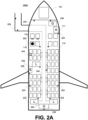
- FIGS. 2A and 2B are overhead views of example aircraft cabin environments 200a and 200b in which navigation aid techniques may be implemented.
- the aircraft cabin environments 200a and 200b will generally focus on devices and locations within and physically proximal to the aircraft 101. It should be understood, though, that the elements within the aircraft cabin environments 200a and/or 200b may be operatively connected to other exterior elements via the techniques described with respect to FIG. 1 .
- the on-board server 111 in the environments 200a and 200b may be communicatively connected to one or more base stations via one or more ATG and/or satellite communications links.
- the aircraft cabin environment 200a includes the aircraft 101, within the cabin of which the Local Area Network 110 may be provided.
- the aircraft cabin environment 200a may be understood to further include physical areas proximal to the aircraft 101.
- the cabin environment 200a may include an entranceway/exit (hereinafter simply "entranceway") 228 through which passengers and/or crew may enter the aircraft 101.
- the aircraft cabin environment 200a may be understood to further include one or more other areas on the ground but in proximity to the aircraft 101 (e.g., a gate within an airport, a baggage loading station, a fueling station, etc.).
- an aircraft cabin environment is not limited to just the physical area bounded by the fuselage of the aircraft 101.
- the aircraft 101 includes a plurality of seats 220, generally corresponding to respective passengers and/or crew members within the aircraft cabin environment 200a.
- One or more personal devices 119 may be associated with each of the respective passengers.
- a seatback unit 118 may be affixed to a seat or other surface to serve the passengers and/or crew members at each of the respective seats 220.
- the cabin environment 200a may include one or more positioning devices 224 operable to facilitate determination of a location of a person ( e.g ., location of a personal device 119).
- the one or more positioning devices 224 may include, for example, one or more wireless positioning devices such as the wireless access points 114 depicted in FIG. 1 , one or more iBeacons, one or more RFID devices, and/or one or more other near-field communication (NFC) devices.
- the one or more wireless positioning devices may operate using any one or more suitable protocols (e.g ., BLUETOOTH low energy (BLE), Wi-Fi protocols, radio frequency identification (RFID) and/or a near field communication (NFC) protocols, etc.).
- BLE BLUETOOTH low energy
- RFID radio frequency identification
- NFC near field communication
- the one or more wireless positioning devices may be operable to facilitate determination a current location of a person within the cabin environment 200a, based upon a detected location of a corresponding personal device 119.
- one or more wireless access points, iBeacons, and/or RFIDs may transmit (e.g ., broadcast) signals to and/or receive communications signals from a personal device 119, and a current location of the personal device 119 may be determined based upon a detected signal strength, as measured at the personal device 119, at one or more wireless positioning devices, and/or at the on-board server 111.
- the one or more positioning devices 224 may additionally or alternatively include one or more input devices operable to receive input from a human user indicative of the user's location within the cabin environment 200a.
- Input devices may include one or more biometric input devices, such as an iris scanner, a fingerprint scanner, a facial scanner, or a voice recognition device.
- a biometric input device may receive biometric input (e.g., an iris or fingerprint scan, audio input, etc.) and facilitate identification of a particular person based upon comparison to reference biometric data stored at the biometric input device, at the on-board server 111, and/or at another location exterior to the aircraft 101. Location of a person may thereby be determined based upon the known location of the biometric device.
- an input device may receive other forms of input (e.g ., a touch screen selection, or a literal voice command) from a person, the received input indicative of the person being at the known location of the input device.
- the one or more input devices may be wiredly and/or wirelessly connected to one or more wireless access points and/or the on-board server 111.
- selection and arrangement of positioning device(s) 224 included within any particular aircraft cabin environment may vary.
- the cabin environment 200a may include various other physical locations. These locations may include, but are not limited to, the entranceway 228, one or more lavatories 232 (" L "), one or more galleys 236 ("G,” e.g., a kitchen, food cart, etc.), one or more emergency exits 238 (" E "), and/or one or more storage compartments 240 ( e.g. , overhead storage compartments).
- one or more positioning devices may be strategically positioned at or near a location.
- one or more input devices may be positioned outside a lavatory 232, such that a person may optionally use the input device to provide a current location, facilitating use of the navigation aid techniques described herein.
- the cabin environment 200a includes one or more lighting devices 244.
- Lighting devices may include, for example, aisle lighting devices, such as one or more LED bulbs installed in rows along an aisle or other walking space in the environment 200a. Additionally or alternatively, the one or more lighting devices may include one or more overhead lighting devices fixedly mounted above one or more seats 220. Still additionally or alternatively, the one or more lighting devices 244 may include one or more luminous signs or public display screens mounted to a surface within the aircraft 101 or elsewhere in the environment 200a.
- the on-board server 111 may be operable to control and/or monitor operation of the one or more lighting devices 244 to provide navigation aid in the aircraft cabin environment 200a.
- the on-board server 111 may store environmental layout data indicative of the dimensions and/or arrangements of computing devices, lighting devices, and locations in the aircraft cabin environment 200a. Based at least in part upon the environmental layout data, a particular lighting device 244 or other computing device may be identified as being physically located between a particular two locations within the aircraft cabin environment 200a.
- the environment 200b includes another embodiment of the aircraft 101 with a modified arrangement of elements therein.
- the cabin of the aircraft 101 includes two levels of seating, the two levels traversable via either of a stairway 260a or stairway 260b.
- Each level of seating may include a plurality of seats 220, each of which may similarly be associated with respective passengers, seatback units 118, and/or personal devices 119.
- Either or both levels of seating may comprise one or more positioning devices 224, one or more lavatories 232 (" L “), one or more galleys 236 (" G “), one or more emergency exits 238 (" E “), one or more overhead storage compartments 240, one or more lighting devices 244, and/or any of the other suitable elements depicted in FIG. 2A . Communications across both levels of seating may be facilitated via the on-board server 111 (" A "), positioning device(s) 224, and LAN 110.
- the complexity of the cabin environment 200b exemplifies the potential inconveniences caused by crowded navigable environments. That is, the cabin environment 200b includes many seats 220, multiple routes of passage on each level of seating, and multiple usable lavatories 232. For passengers and/or crew members, navigating these environments may prove especially challenging, particularly when these environments are crowded or dimly lit, as is often the case in the cabin of an aircraft in flight. Challenges may be found, for example, in finding an unoccupied lavatory, finding a particular seat, or performing various crew tasks. By accounting for the particular arrangement of a navigable environment and producing an ad hoc activation arrangement, the techniques described herein may reduce discomfort for persons navigating such environments.
- FIG. 3 depicts example navigation aid devices via which navigation aid may be provided in a navigable physical environment such as an aircraft cabin.
- Navigation aid devices may be included in an ad hoc activation arrangement, and may be activated accordingly to guide a person about the navigable environment.
- one or more navigation aid devices may be activated via one or more signals from an on-board server within an aircraft ( e.g. , on-board server 111), and/or via another centrally disposed computing device within the navigable environment. While the description of navigation aid devices with respect to FIG. 3 will focus primarily on visual aid devices and visual aid techniques associated therewith, it should be appreciated from this detailed description that navigation aid devices/techniques may include visual, audial, and/or haptic aid devices and techniques.
- Visual aid devices within a navigable environment may include any one or more of the lighting devices 244 discussed with respect to FIGS. 2A and 2B .
- These lighting devices 244 may include, for example, one or more aisle lighting devices 322, which are typically placed in rows along seats 220.
- Lighting devices may include additionally or alternatively one or more overhead lights 324, one or more luminous signs 332, and/or one or more public display screens 334.
- Navigation aid devices may additionally include one or more seatback units 118.
- navigation aid devices may include one or more personal devices 119 as discussed with respected to FIGS. 1 , 2A , and 2B .
- the one or more aisle lighting devices 322 may include LED bulbs and/or other suitable devices fixedly located in one or more rows along an aisle or other passageway in the navigable environment.
- each aisle lighting device 322 may be activated independently, such that as a person walks along an aisle, for example, the aisle lighting devices 322 may activate sequentially to lead a person along the aisle.
- one or more aisle lighting devices 322 may be activated according to one or more modifiable activation characteristics, such as a modifiable pattern (e.g ., flicker, blinking, pulse, etc.), color, color pattern, or brightness.
- a modifiable pattern e.g ., flicker, blinking, pulse, etc.
- the one or more overhead lights 324 may generally include one or more LED bulbs and/or other suitable lighting devices fixedly located within the navigable environment. In some embodiments, for example, one overhead light 324 may be placed above each seat 220 within an aircraft, or above a group of seats 220. In some embodiments, one or more overhead lights 324 may be activated according to one or more modifiable activation characteristics, such as a particular pattern (e.g ., flicker, blinking, pulse, etc.), color, color pattern, or brightness.
- a particular pattern e.g ., flicker, blinking, pulse, etc.
- the one or more luminous signs 332 may generally include various luminous signage placed about the navigable environment. For example, as depicted in FIG. 3 , a luminous sign 332 may, when activated, indicate a direction to an exit. In some embodiments, one or more luminous signs 332 may be activated according to one or more modifiable characteristics, such as a particular pattern (e.g., flicker, blinking, pulse, etc.), color, color pattern (e.g., an alternating color pattern, or a striping pattern), or brightness.
- a particular pattern e.g., flicker, blinking, pulse, etc.
- color e.g., an alternating color pattern, or a striping pattern
- brightness e.g., alternating color pattern, or a striping pattern
- the one or more public display screens 324 may generally include any of various display devices placed in common areas within the navigable environment. That is, a public display screen 324 may be distinguished from a display screen of a seatback unit 118 in that, while a seatback unit 118 generally corresponds to a particular seat 220, a public display screen 324 may be placed in a location not particularly tied to any one particular person within the navigable environment.
- a public display screen 324 may, for example, display text content and/or a directional cue (e.g., an arrow indicating direction to a seat "22A" as depicted in FIG. 3 ). Additionally or alternatively, a public display screen 324 may be configured to display a particular color, particular color pattern, or other content according to modifiable characteristics, such that public display screens in common areas may be differentiated as corresponding to a particular activation arrangement.
- any of one or more lighting devices 244 may be activated to guide a person to a destination within the navigable environment.
- the various modifiable activation characteristics of activated lighting devices 244 may allow for effective differentiation of visual aid devices as corresponding to particular persons.
- executing an activation arrangement for a first person may include causing one or more lighting devices 244 to display blue light
- executing an activation arrangement for a second person may include causing one or more lighting devices 244 to display red light.
- the one or more seatback computing devices 118 may be activated, for example, to display a particular color, color pattern, image, etc. Activation of a seatback unit 118 may be particularly useful, for example, to assist an aircraft passenger returning to the seat from a lavatory or other location within an aircraft cabin environment. That is, a destination of a seat may be easily identified by an activated seatback unit adjacent to the seat.
- the one or more personal devices 119 may be activated to display various visual prompts and/or other prompts for a person moving about the navigable environment.
- a personal device 119 may be activated to display an interactive mini-map of the navigable environment, the mini-map including a current location of the person, a destination, and/or other reference locations within the navigable environment.
- the personal device 119 may be activated indicate other aid devices that are currently activated or that will soon be activated as part of an executing activation arrangement.
- the personal device may indicate that aisle lights 322 have been activated, and that a seatback unit 118 that is activated or will be activated in a vertical striping pattern.
- Navigation aid devices used in a navigable environment may additionally or alternatively include audial aid devices (e.g., speakers) and/or haptic aid devices (e.g., vibration devices).
- a speaker may be activated, for example, to play a particular verbal cue or other sound to provide navigation aid.
- a same navigation aid device may be more than one of a visual, audial, or haptic aid device.
- one or more public display screens 334 may further include a speaker unit operable to provide audial navigation aid.
- a personal device 119 may be operable to provide visual, audial, and/or haptic navigation aid.
- each of the navigation aid devices described herein may be activated via one or more signals transmitted via the on-board server 111.
- the on-board server 111 may, for example, determine an activation arrangement of one or more navigation aid devices, and may transmit one or more signals to each of the one of more navigation aid devices to cause the respective devices to activate according to the determined activation arrangement.
- FIG. 4 describes an example computer-implemented method 400 for providing navigation aid to a person in a navigable environment, such as an aircraft cabin environment.
- the method 400 may include determining and executing an "activation arrangement" of one or more navigation aid devices (e.g ., one or more visual aid devices) to be activated within the navigable environment to guide a person to a destination.
- Actions of the computer-implemented method 400 may be performed, for example, via an on-board server 111 from FIGS. 1 , 2A , and 2B , and/or via one or more other computing devices operatively disposed within the navigable environment.
- the method 400 may include receiving an indication of a "navigation intent" of a person within the navigable environment (402).
- a navigation intent as referred to herein, may generally include an intent of a person to navigate to a destination within the navigable environment.
- a navigation intent may be an intent of a person to find a particular seat, a lavatory, an entranceway or another location within the cabin environment.
- the indication of the navigation intent may be received, for example, via a client application executing at a personal device of the person, via an application executing at a seatback unit corresponding to the person, and/or via input provided at another input device (e.g., a biometric input device) located within the navigable environment.
- a client application executing at a personal device of the person
- an application executing at a seatback unit corresponding to the person
- input provided at another input device e.g., a biometric input device located within the navigable environment.
- an identity of the person may be determined. Identity of the person may be determined, for example, based upon identification of the personal device or seatback unit from which the indication of the navigation intent is received. More specifically, in some embodiments, identity of the person may be determined based upon an identity of a logged-in user at a client application from which the indication of the indication navigation intent was received ( e.g ., an application running at a personal device or seatback unit). Additionally or alternatively, identity of the person may be determined based upon a comparison of optionally provided biometric data (e.g ., iris scan, facial scan, fingerprint scan, etc.) to reference biometric data stored at an on-board server or other computing device.
- biometric data e.g ., iris scan, facial scan, fingerprint scan, etc.
- determination of identity may facilitate determination of an activation arrangement in accordance with customization settings corresponding to an identified person. Additionally or alternatively, determination of the identity of the person may facilitate determination of one or more corresponding personal devices and/or seatback units that may be used as navigation aid devices in the activation arrangement.
- the method 400 may include determining, based upon the received indication of the navigation intent, a current location of the person within the navigable environment (404).
- the current location of the person may be determined based upon the source of the indication of the navigation intent. For example, if the indication of the navigation intent is received from a seatback unit or another fixedly placed input device, location of the person may be determined based upon location of the source. Additionally or alternatively, the current location of the person may be determined based upon a location of a personal computing device (e.g ., a smartphone) corresponding to the person. Location of a personal device may be determined, for example, based upon detected signal strength of signals exchanged the personal device and one or more wireless access points, RFID devices, iBeacons, and/or other suitable wireless positioning devices.
- the method 400 may include determining, based upon the received indication of the navigation intent, a destination of the person within the navigable environment (406).
- the received indication of the navigation intent may indicate a literal destination (e.g., "Seat 22E" in an aircraft cabin).
- the received navigation intent may be less directly indicative of the destination.
- the received indication of navigation intent may indicate a person's intent to "Find My Seat,” or to "Find a Lavatory" without an explicit indication of the destination.
- the destination may be determined, for example, based upon (1) stored flight record data mapping persons to seats, (2) stored environmental layout data indicating special layout of the aircraft cabin environment, (3) detected location of other persons/devices within the aircraft cabin environment, and/or (4) monitored availability/occupancy of a lavatory, entranceway, or other location within the aircraft cabin environment.
- the method 400 may include determining, based upon the determination of the current location and destination, an activation arrangement (408).
- the activation arrangement may include a determination of one or more navigation aid devices (e.g ., visual, audial, and/or haptic aid devices) to be activated in a particular manner to guide the person from the current location to the destination.
- Navigation aid devices may include, for example, any one or more of the aid devices described with respect to FIG. 3 .
- one or more navigation aid devices may include a personal device, a seatback unit, and/or one or more lighting device within the aircraft cabin environment.
- determining the activation arrangement may include determining one or more activation characteristics for one or more of the navigation aid devices. For example, determining a visual aid device to be used in an activation arrangement may further include determining a brightness, color, color pattern, image, etc., according to which the lighting device may be activated. As another example, determining an audial aid device to be included in the activation arrangement may include determining a volume at which the device may be activated. As yet another example, determining a haptic aid device to be included in the activation arrangement may include determining a vibration intensity at which the device may be activated. Other examples of activation characteristics will evident from the description of FIG. 3 .
- the determination of the activation arrangement may be based at least in part upon one or more monitored environmental conditions in the navigable environment or a portion thereof. For example, determining the activation arrangement may include determining that the navigable environment or a portion thereof (e.g ., a current location) is dimly lit, and accordingly determining that a navigation aid device should be activated with a reduced brightness or a reduced volume to reduce disturbance to other persons.
- the determination of the activation arrangement may be based at least in part upon user customization settings corresponding to the user.
- a user may provide input indicative of preferred navigation aid devices and/or preferred activation characteristics (e.g. , color, volume, etc.).
- preferred navigation aid devices e.g. , color, volume, etc.
- preferred activation characteristics e.g. , color, volume, etc.
- the method 400 may include, subsequent to determining the activation arrangement, causing the one or more navigation aid devices to activate according to the determined activation arrangement (410, e.g., to display light, to play sound, to vibrate, etc.). Causing the one or more navigation aid devices to activate may include causing the one or more navigation aid devices to activate alternately or simultaneously.
- the method 400 may include continuously determining the location of the person within the navigable environment ( e.g ., via location determination at a predetermined rate), and causing one or more navigation aid devices to activate only as the person passes or approaches each device (e.g ., enters a predetermined threshold proximity of the device), as determined based upon the updated location of the person.
- activation of the one or more navigation aid devices may terminate in response to a determination that the person has arrived at the destination in the navigable environment. Arrival of the person at the destination may be determined, for example, based upon any of the wireless location techniques described herein. Additionally or alternatively, arrival of the person at the destination may be determined based upon further input received via a seatback unit, personal device, or other input device as described herein.
- causing a device to activate should be interpreted as causing a device to operate in a particular manner (e.g., in accordance with a predetermined activation arrangement). "Activation" of a device should not be interpreted to mean that the activated device was necessarily powered off, in a sleep mode, not running a particular application, or otherwise inactive by any particular definition prior to "activation.” Activation of a visual aid device may, for example, include causing a personal device to display a push notification or other content when the device is already powered on and running an application.
- the method 400 may include additional, fewer, or alternate actions, in some embodiments.
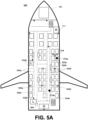
- FIGS. 5A and 5B depict example use scenarios of the navigation aid techniques described herein (e.g., the computer-implemented method 400 from FIG. 4 ).
- FIGS. 5A and 5B provide example use scenarios in an aircraft cabin environment 500, within which an activation arrangement may be determined and executed.
- the aircraft cabin environment 500 may include any of the elements described with respect to the example aircraft cabin environments 200a and 200b from FIGS. 2A and 2B .
- some elements and reference signs from FIGS. 2A and 2B are removed, and others are rearranged.
- the example use scenario includes aircraft passenger initially seated a seat 520a and seeking an occupied lavatory within the aircraft cabin environment 500.
- the passenger is represented in this example by a passenger personal device 519a, which may typically be carried by the passenger.
- An indication of a navigation intent may be received, indicating the intent of the person to find a nearest available lavatory.
- a current location of the person may be determined, for example, based upon a location of the personal device 519a as determined using any suitable wireless location technique described herein.
- Alternative location techniques including any suitable technique described herein, may be used in some embodiments.
- the received indication of the navigation intent may not explicitly indicate a particular lavatory as a destination.
- the on-board server 111 may monitor a status of each of the lavatories 532a and 532b ( e.g., occupied or unoccupied), and determine, after receiving the indication of the navigation intent, that the lavatory 532a is occupied and that the lavatory 532b is unoccupied. Accordingly, the destination may be determined to be the lavatory 532b.
- an activation arrangement may be determined.
- multiple possible paths exist between the personal device 519a and the lavatory 532b.
- a first possible path follows an aisle 540a
- a second possible path follows an aisle 540b.
- determining an activation arrangement may include determining a path between the current location and destination, such that a suitable one or more aid devices may be selected and activated.
- an activation arrangement may be determined to include a series of aisle lighting devices 544a along the aisle 540a, and not include a series of aisle lighting devices 544b along the aisle 540b.
- An input device 564 may be located outside the lavatory 532b.
- the input device 564 may receive input from the passenger, the input indicative of passenger having arrived at the lavatory 532b. Upon detection of arrival of the passenger at the lavatory 532b, execution of the activation arrangement may be completed.
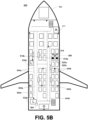
- FIG. 5B illustrates another use scenario of navigation aid techniques in the aircraft cabin environment 500.
- the same passenger may intend to return from the lavatory 532b to the seat 520a.
- An indication of a navigation intent may be received, for example, via the personal device 519a, the input device 564, and/or another suitable device.
- the current location and destination of the passenger may once again be determined, using any suitable techniques described herein.
- the personal device 519b is no longer located in the aisle 540b. Instead, the personal device 519b is located in the seat 520b, which obstructs the path to the seat 520a, and in which a passenger may currently be seated.
- the return of a passenger from a lavatory or another location may pose an inconvenience to the passenger seated in the seat 520b, as the seated passenger may be required to briefly exit their seat to allow the first passenger access to the seat 520a.
- determining an activation arrangement may comprise (1) determining that one or more further persons may be required to move to accommodate the navigating passenger ( e.g., based upon the location the device 519b), and (2) identifying one or more further aid devices to be activated to alert the one or more such persons of the navigating passenger's movement.
- the determined activation arrangement in this scenario may include (1) activation of one or more overhead lights 568, (2) activation of the personal device 519b, (3) activation of one or seatback units corresponding to the seat 520b.
- these techniques may be integrated into a one or more client applications used by the further persons, such that one or more visual, audial, and/or haptic prompts may be provided to the further person(s) if the further person(s) is/are distracted by consumption of services or content via a seatback unit or personal device.
- the one or more prompts provided to a further person may be determined based upon a determination of services/content currently being consumed by the further person via a personal device and/or seatback unit.
- arrival of the navigating passenger at the seat 520a may be detected via wireless locating of the personal device 519a, via input at the personal device 519a and/or the seatback unit 518, and/or via other techniques described herein.
- execution of the activation arrangement may be completed.
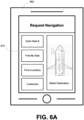
- FIGS. 6A and 6B depict example interactive graphical user interfaces that may be presented via an electronic device 602 (e.g., via a client application executing at a personal device or seatback unit) to enable navigation within the aircraft cabin environment.
- Input may be received at the user interfaces of FIGS. 6A and/or 6B via a touchscreen interaction ( e.g., touch, swipe, etc.), vocal input, and/or via other suitable input methods.
- a user such as a passenger or a crew member may utilize the interface 614 to indicate an intent to navigate to a destination within the aircraft cabin environment. For example, a user may select an "Enter Seat Number” option to provide an indication of a particular seat to which the user intends to navigate. Alternatively, if the user is not aware of the user's own seat number, the user may select a "Find My Seat” option. In response to receiving a "Find My Seat” selection, the device 602 may communicate, for example, with an on-board server and/or one or more other computing devices storing information that associates the user with a known seat number, thereby identifying a destination in response to the received user selection via the interface 614.
- the user may additionally or alternatively utilize the interface 614 to select a "Find a Lavatory" option, selection of which may enable a user to view a status of one or more lavatories in the cabin environment to identify a particular lavatory that is unoccupied.
- a "Find a Lavatory" option selection of which may enable a user to view a status of one or more lavatories in the cabin environment to identify a particular lavatory that is unoccupied.
- An example user interface for viewing the status of one or more lavatories will be described with respect to FIG. 6B .
- the user may additionally or alternatively utilize the interface 614 to select a "Customize” option, selection of which may enable a user to personalize the aid devices and/or techniques (e.g., colors, patterns, etc.) to be provided in navigable environment.
- a "Customize” option selection of which may enable a user to personalize the aid devices and/or techniques (e.g., colors, patterns, etc.) to be provided in navigable environment.
- Example user interfaces for personalizing aid devices and/or techniques will be described with respect to FIGS. 8A-8D .
- the interface 614 may include a "Select Destination" option, selection of which enables a user to view an interactive mini-map of the aircraft cabin environment to familiarize the user with the environment and/or to select a destination from the mini-map.
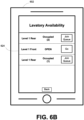
- an interface 624 may be presented at the device 602 in response to selection of the "Find a Lavatory" option from the interface 614, in some embodiments.
- the interface 624 may include a list of lavatories within the aircraft cabin environment, with each lavatory identified by its general location within the cabin.
- the interface 624 may display a status of each of the lavatories as monitored within the aircraft cabin environment ( e.g., occupied or unoccupied). In the example depicted in FIG. 6B , one lavatory is unoccupied, and a user may use a "Go" control to indicate an intent to navigate to that lavatory.
- an activation arrangement of one or more visual aid devices and/or other aid devices may be determined and executed to guide the user to the selected lavatory.
- the user may select a "Join Queue” option to enter a lavatory queue, which may allow a user to "wait in line” for a lavatory without needing to leave their seat.
- the device 602 may notify the user of the unoccupied lavatory (e.g., via a push notification, and/or via another visual, audial, or haptic prompt such as those described herein).
- an activation arrangement may be determined and/or executed to guide the user to the selected lavatory.
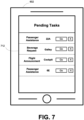
- FIG. 7 depicts an example graphical user interface 712 presented at the electronic device 602 (e.g., a personal device of a crew member).
- the user interface 712 may be presented, for example, via a workflow client application executing at the device 602.
- Input may be received at the user interface 712 via a touchscreen interaction ( e.g., touch, swipe, etc.), vocal input, and/or via other suitable input methods.
- the interface 712 presents a listing of received tasks for the user.
- tasks may be populated at the interface 712 based upon communications between the device 602 and an on-board server, which may receive passenger service requests and/or manage other scheduled tasks during flight (e.g., scheduled announcements after takeoff or before landing).
- Each of the presented tasks includes user options that may be selected to either activate the task ("Go") or remove the task from the presented listing of tasks ("X").
- Activation of a task via the "Go” option may cause an activation arrangement to be determined and/or executed to guide the user to the location as required to perform the task ( i.e., the destination).
- the task in response to detection of the user arriving at the destination, the task may be automatically removed from the listing of tasks.
- FIGS. 8A-8D depict example interactive user interfaces that may be presented at the electronic device 602 to allow a user (e.g., passenger or crew member) within a navigable environment (e.g., aircraft cabin environment) to view and/or alter the visual, audial, and haptic aid devices and techniques to be used in an activation arrangement.
- a navigable environment e.g., aircraft cabin environment
- Use of the interfaces depicted in FIGS. 8A-8D may enable the person to easily differentiate aid devices within a navigable environment, and thus may further facilitate simultaneous execution of two or more activation arrangements in the navigable environment without confusion to persons receiving navigation guidance.
- User interfaces such as those depicted in FIGS. 8A-8D may be presented, for example, via a client application executing at the device 602.
- Input may be received at the user interfaces of FIGS. 8A-8D via a touchscreen interaction (e.g., touch, swipe, etc.), vocal input, and/or via other suitable input methods.
- the device 602 may communicate with an on-board server to indicate personalized settings as received via the device 602, such that settings may be viewed and/or modified consistently across two or more devices, and such that activation arrangements may be determined based upon the personalized settings.
- one or more of the interfaces of FIGS. 8A-8D may be presented in response to a selection of the "Customize" option from FIG. 6A .
- an example interface 812 may present an overview of various navigation aid devices.
- the listing provided in the interface 812 may correspond to the navigation aid devices available in a navigable environment in which the user is currently located (e.g., an aircraft cabin environment during a flight or prior to an upcoming flight).
- the interface 812 may present a comprehensive listing of navigation aid devices that may or may not be available across various navigable environments, such that the user may personalize aid devices for future use.
- listed aid devices may include aisle lighting devices, luminous signage ("Signage"), one or more registered personal devices (“Personal”), a seatback unit (“Seatback”), and/or other computing devices including lighting devices described herein.
- buttons may be presented ("On” and “Off”) to allow the user to indicate whether the device should be used in an activation arrangement. Additionally, for each listed device, a "More” option may be presented, selection of which may enable the user to further customize activation characteristics of the device. Examples of customized activation characteristics of particularly navigation aid devices will be described with respect to FIGS. 8B-8D .
- the interface 812 may include a "Return Notification” option, allowing the user to indicate a preferred technique via which the user may be notified when another person is returning to a seat (and may require the user to move to accommodate).
- the user may select a preference to be notified via a seatback unit, via a personal device, and/or via other suitable techniques described herein.
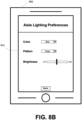
- FIG. 8B depicts another example interface 814 that may enable a user to personalize one or more activation characteristics of a particular visual aid device.
- the interface 814 may be presented, for example, in response to selection of the "More" option corresponding to "Aisle Lighting” from the interface 812 of FIG. 8A .
- the interface 814 may, for example, enable the user to select options to select (1) one or more colors according to which aisle lighting devices may be activated (e.g., blue, red, alternating colors, etc.), (2) a pattern according to which aisle lighting devices may be activated ( e.g., burst, flicker, pulse), and/or (3) a brightness at which the aisle lighting devices may be activated.
- Similar interfaces and options may be presented to personalize one or more visual activation characteristics of any suitable visual aid device in any suitable navigable environment.
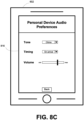
- FIG. 8C depicts yet another example interface 816 that may enable a user to personalize one or more activation characteristics of a particular audial aid device.
- the interface 816 may be presented, for example, in response to selection of the "More” option corresponding to "Personal (Audio)" (e.g., smartphone audio) from the interface 812 of FIG. 8A .
- the interface 816 may, for example, enable the user to select options to select (1) a particular sound to be played to provide audial prompt to the user (2) a timing at which the selected tone may be played, and/or (3) a volume at which the tone may be played. Similar interfaces and options may be presented to personalize one or more activation characteristics of any suitable audial aid device in any suitable navigable environment.
- FIG. 8D depicts still another example interface 818 that may enable a user to personalize one or more activation characteristics of a particular haptic aid device.
- the interface 818 may be presented, for example, in response to selection of the "More” option corresponding to "Vibration" (e.g., smartphone vibration) from the interface 812 of FIG. 8A .
- the interface 816 may, for example, enable the user to select options to select (1) a particular vibration pattern (2) a timing at which the device may vibrate, and/or (3) an intensity at which the device may vibrate. Similar interfaces and options may be presented to personalize one or more activation characteristics of any suitable haptic aid device in any suitable navigable environment.
- any reference to "one embodiment” or “an embodiment” means that a particular element, feature, structure, or characteristic described in connection with the embodiment is included in at least one embodiment.
- the appearances of the phrase “in one embodiment” in various places in the specification are not necessarily all referring to the same embodiment.
- Coupled and “connected” along with their derivatives.
- some embodiments may be described using the term “coupled” to indicate that two or more elements are in direct physical or electrical contact.
- the term “coupled,” however, may also mean that two or more elements are not in direct contact with each other, but yet still cooperate or interact with each other.
- the embodiments are not limited in this context.
- the terms “comprises,” “comprising,” “includes,” “including,” “has,” “having” or any other variation thereof, are intended to cover a non-exclusive inclusion.
- a process, method, article, or apparatus that comprises a list of elements is not necessarily limited to only those elements but may include other elements not expressly listed or inherent to such process, method, article, or apparatus.
- “or” refers to an inclusive or and not to an exclusive or. For example, a condition A or B is satisfied by any one of the following: A is true (or present) and B is false (or not present), A is false (or not present) and B is true (or present), and both A and B are true (or present).
- any of the methods and techniques described herein or portions thereof may be performed by executing software stored in one or more non-transitory, tangible, computer readable storage media or memories such as magnetic disks, laser disks, optical discs, semiconductor memories, biological memories, other memory devices, or other storage media, in a RAM or ROM of a computer or processor, etc.
Landscapes
- Engineering & Computer Science (AREA)
- Aviation & Aerospace Engineering (AREA)
- Radar, Positioning & Navigation (AREA)
- Remote Sensing (AREA)
- Computer Networks & Wireless Communication (AREA)
- Signal Processing (AREA)
- Automation & Control Theory (AREA)
- Physics & Mathematics (AREA)
- General Physics & Mathematics (AREA)
- Traffic Control Systems (AREA)
- Navigation (AREA)
Description
- Priority is claimed to
U.S. Application No. 16/200,920, filed November 27, 2018 - The present disclosure generally relates to wireless communication systems. More particularly, the present disclosure describes techniques for leveraging the technological capabilities of various devices to provide navigation aid to a person moving about a navigable environment such as an aircraft cabin.
- A cabin of an aircraft, particularly a commercial aircraft, is typically a crowded environment carrying a large number of passengers and crew members. Within this crowded and often unfamiliar environment, a passenger or crew member may need to navigate the cabin to access a location such a passenger's seat, an entranceway, a lavatory, or an overhead storage compartment. However, the crowded, unfamiliar, and often dimly lit conditions of the aircraft cabin may impede movement around the aircraft cabin.
- Typically, a passenger or crew member in an aircraft cabin may carry a personal wireless electronic device, such as a smartphone. Some existing applications enable passengers to use a personal device to view an electronic boarding pass, which may indicate the passenger's seat number. However, these existing applications do not provide further navigation aid to the seat or to other areas of the cabin, nor do these applications mitigate the above-described inconveniences associated with the cabin environment.
-
US 9 380 428 B1 -
US 2014/309924 A1 describes techniques for seamlessly transitioning from a map that displays out-of-doors elements to a map that displays indoor elements, in response to detecting a transition event. The transition event may be, for example, that a navigation system that is generating the out-of-doors map has moved to an indoors location. -
WO 2018/1 64710 A1 relates to a boarding guidance including a beacon associated with a passenger seat. The beacon is configured to communicate with a passenger guiding device and determine a distance between the passenger guiding device and the passenger seat. When the passenger guiding device is a predetermined distance from the passenger seat, the beacon provides an indication. -
US 2012/253658 A1 relates to user guidance with mobile electronic devices. A visitor can receive guidance (e.g., movement directions) through a portable electronic device. The visitor can read an information-containing tag with the electronic device to input location information into the device. With the electronic device, the visitor can then select one or more destinations. The device then provides directions to the visitor for the one or more destinations. -
WO 2008/043877 A1 relates to a method and system for optimizing the route of a passenger. The passenger selects the route he/she wants from at least two different route options, of which at least one of the route options comprises a passenger transport appliance. According to the method the most suitable route at the time is determined for the passenger, about which information is conveyed to the passenger through a guide sign or a portable terminal device. - The disclosure of the present application describes computing systems and methods for providing navigation aid to one or more persons moving about a "navigable physical environment" such as an aircraft cabin, stadium, theater, or auditorium. In example embodiments for navigation aid in an aircraft cabin environment, the techniques described herein may provide visual, audial, and/or haptic navigation aid by leveraging the technological capabilities of (1) lighting/display devices installed within the aircraft cabin environment, and/or (2) wireless communication devices (e.g., smartphones) carried aboard the aircraft by passengers and crew members. The techniques described herein may thereby mitigate inconveniences often encountered by persons moving about the navigable environment. Furthermore, in some scenarios, these techniques may provide locations of passengers, seats, lavatories, and other locations, where in an unfamiliar environment the locations may otherwise be unknown.
- Generally, the navigation aid techniques herein may be implemented via one or more computing devices disposed within the navigable environment. For example, in the aircraft cabin environment, one or more on-board servers may be physically disposed within the cabin, or may be otherwise operatively connected to various lighting devices and other electronic devices within the aircraft cabin (e.g., via Air-To-Ground (ATG) and/or satellite communications links). In response to receiving an indication of a person intending to move about the navigable environment ("navigation intent"), a current location of the person and a destination may be determined. An ad hoc "activation arrangement" may be assembled, the activation arrangement including a determination one or more "aid devices" to be activated in a particular manner to guide the person from the current location to the destination. The activation arrangement may be executed, causing the one or more aid devices to activate as determined to guide the person to the destination.
- In a first aspect, a computer-implemented method provides visual aid to a person within a navigable environment such as an aircraft cabin. The method, as defined in
claim 1, includes, via one or more processors: (1) receiving, via a computing device disposed within the navigable environment, an indication of an intent of a person to navigate within the navigable environment, (2) determining a current location of the person within the navigable environment, (3) determining, based upon the received indication of the navigation intent, a destination of the person within the navigable environment, (4) determining, based upon the determination of the current location and destination, an activation arrangement comprising a determination of one or more visual aid devices to be activated within the navigable environment to guide the person from the current location to the destination, (5) causing activation of the one or more visual aid devices according to the activation arrangement. The method includes, furthermore, the person within the navigable environment being a first person, and the determined activation arrangement comprising a seatback unit corresponding to a second person located between the current location and the destination, and wherein causing activation of the one or more visual aid devices according to the activation arrangement comprises causing a visual alert to be displayed via the seatback unit to notify the second person of movement of the first person in the navigable environment. - In another aspect, a computing system provides visual aid to a person within a navigable environment. The computing system, as defined in claim 10, includes one or more processors and one or more computer memories storing computer-executable instructions that, when executed via the one or more processors, cause the computing system to (1) receive, via a computing device disposed within the navigable environment, an indication of an intent of a person to navigate within the navigable environment, (2) determine a current location of the person within the navigable environment, (3) determine, based upon the received indication of the navigation intent, a destination of the person within the navigable environment, (4) determine, based upon the determination of the current location and destination, an activation arrangement comprising one or more visual aid devices to be activated within the navigable environment to guide the person from the current location to the destination, (5) cause the one or more visual aid devices to activate according to the activation arrangement. The computing system, furthermore, includes the person within the navigable environment being a first person, and the determined activation arrangement comprising a seatback unit corresponding to a second person located between the current location and the destination, and the instructions to cause activation of the one or more visual aid devices according to the activation arrangement comprising instructions to cause a visual alert to be displayed via the seatback unit to notify the second person of movement of the first person in the navigable environment.
- Embodiments are set out in the dependent claims.
- The accompanying figures, where like reference numerals refer to identical or functionally similar elements throughout the separate views, together with the detailed description below, are incorporated in and form part of the specification, and serve to further illustrate embodiments of concepts that include the claimed embodiments, and explain various principles and advantages of those embodiments.
-
FIG. 1 depicts an example aircraft communication environment in which the techniques described herein be implemented; -
FIGS. 2A and2B are overhead views of example aircraft cabin environments in which the techniques described herein may be implemented; -
FIG. 3 depicts example "navigation aid devices" that may be caused to activate in an activation arrangement; -
FIG. 4 depicts an example computer-implemented method for providing navigation aid to a person in a navigable environment; -
FIGS. 5A-5B depict example use scenarios of the computer-implemented method fromFIG. 4 ; -
FIGS. 6A-6B depict example graphical user interfaces via which a user may request navigation aid; -
FIG. 7 depicts an example workflow management graphical user interface via which a crew member in an aircraft cabin environment may request navigation aid; and -
FIGS. 8A-8D depict example graphical user interfaces via which a user may personalize aid devices and activation characteristics associated therewith. - At a high level, the disclosure of the present application describes methods and a computing platform for providing navigation aid to persons moving about a "navigable physical environment" such as an aircraft cabin environment. Particularly, in example aircraft cabin environments that will be described herein, these techniques may provide navigation aid to passengers and/or crew members via visual, audial, and/or haptic activation of various "navigation aid devices" devices in the within and/or proximal to the cabin. These navigation aid devices may include, but are not limited to, (1) lighting devices including aisle lighting devices, overhead lighting devices, and/or public display screens, (2) seatback computing units provided at seats of passengers, and/or (3) personal wireless communication devices ("personal devices," e.g., smartphones) carried aboard the aircraft by passengers and/or crew members. "Activating" one or more such devices may include causing each device to provide various visual, audial, and/or haptic prompts/alerts to the person such that they may easily navigate to a destination within or near the aircraft cabin. For any person intending to navigate about the aircraft cabin environment, an ad hoc "activation arrangement" may be determined, execution of which may cause one or more aid devices activate according to various techniques described herein to guide the person from their current location to the destination.
- In some embodiments, the techniques described herein may more particularly leverage the technological capabilities of personal devices carried by persons within a navigable environment. Location of such devices, and thus the corresponding persons within the navigable environment, may be determined via various location techniques, including wireless location techniques via wireless access points, RFID readers, iBeacons, and/or other near-field communication (NFC) devices. In some embodiments, locations of each person within a navigable environment may be monitored, such that (1) any person may receive navigation aid to any destination within the navigable environment, (2) navigation aid may be provided based upon location of such persons to avoid crowding in the navigable environment, and/or (3) other persons, such as seated passengers in an aircraft, may themselves receive timely notification that a navigating person is approaching/passing and "make way" to reduce inconvenience.
- Generally, the techniques described herein may be implemented via one or more centrally disposed computing devices within the navigable environment. For example, in the aircraft cabin environment, as will be described herein, an on-board server may be physically placed in the aircraft cabin environment, and/or may be otherwise communicatively connected to the elements therein. The on-board server may be communicatively connected to lighting devices, seatback units, personal devices, and/or other devices via various communications links, examples of which will be provided herein.
- An indication of a "navigation intent" of a person may be received, the indication of the navigation intent generally indicating a person's intent to move ("navigate") to another location ("destination") within the navigable environment. The indication of the navigation intent may comprise one or more signals received, for example, via a personal device, seatback unit, or other electronic device described herein. In response to receiving a navigation intent, a current location of the person and the destination may be determined.
- In some scenarios, the received indication of the navigation intent may itself clearly indicate a current location of the person. For example, the indication of the navigation intent may be received via a fixedly installed computing device, such as a seatback unit fixedly mounted to a seat or wall in an aircraft cabin, the location of the person may generally correspond to the location of the device, record of which may be stored at the on-board server. In some scenarios, the current location of the person may be determined based upon a determined location of a personal device corresponding to the person. Examples of personal device location techniques will be provided herein.
- In some scenarios, the received indication of the navigation intent may additionally or alternatively be indicative of the person's destination within the navigable environment. For example, the received indication of the navigation intent in the aircraft cabin environment may explicitly indicate an intent to find a "Seat 22E." In other scenarios, though, the received indication of the navigation intent may be less clearly indicative of the destination. For example, the received indication of the navigation intent may indicate the person seeking to "Return to My Seat" or "Find the Nearest Open Lavatory," without an explicit identification of a destination. The techniques described herein may leverage the technological capabilities of various electronic devices within the navigable environment to determine an exact destination and facilitate navigation thereto, even if the navigating person does not know or cannot explicitly indicate their exact destination.
- In any case, based upon the determined current location and destination, an "activation arrangement" may be determined. Generally, the activation arrangement may include a determination of one or more navigation aid devices for activation in a particular manner to guide the person between the current location and the destination. The one or more navigation aid devices may include, for example, various lighting devices, public display screens, seatback units, personal devices, and/or other visual, audial, and/or haptic devices within the navigable environment. "Executing" an activation arrangement may include causing the one or more aid devices to "activate" according to the activation arrangement, that is, to operate in a particular manner (e.g., to visually display light, to play an audible sound, or to vibrate). An activation arrangement may more particularly comprise a determination of various "activation characteristics" according to which an aid devices may be activated. For example, determining an activation arrangement may include determining a lighting device to activate to display a particular color, color pattern, image, or brightness. Other examples of activation characteristics will be provided herein. Using these techniques, an activation arrangement may be determined based upon environmental conditions within the navigable environment (e.g., existing lighting levels), based upon personalized settings, and/or based upon other considerations described herein.
- In some embodiments, execution of the activation arrangement may be based at least in part upon continuous determination and updating of the current location of the person within the navigable environment. For example, executing an activation arrangement may include causing a display screen to activate in response to a determination that the navigating person is within a predetermined threshold proximity of the display screen, as determined based upon a location of a personal device corresponding to the person. Timely activation of one or more navigation aid devices may further facilitate convenient navigation about the navigable environment.
- Using the techniques described herein, multiple activation arrangements may potentially be determined and/or executed simultaneously within a same environment. For example, the techniques herein may provide simultaneous navigation aid for two or more people moving about a same aircraft cabin environment. As will be understood from this detailed description, the variety of available aid devices and activation characteristics may be leveraged to effectively distinguish any two or more activation arrangements, such that a person may clearly differentiate their own path to a destination.
- In this detailed description, navigation aid techniques will generally be described with respect to example aircraft cabin environments. An aircraft cabin environment may include a communication environment (e.g., a wired Local Area Network (LAN) and/or a Wireless Local Area Network (WLAN)) that may communicatively interconnect one or more on-board servers (e.g., Airborne Control Processor Unit (ACPU)), one or more lighting devices, one or more seatback units, one or more personal devices, and/or other devices present in the cabin environment. Other terms used in this detailed description may correspond to the example aircraft cabin navigable environments. For example, persons seeking navigation guidance within the aircraft cabin environment may be described as "passengers" and "crew members" (e.g., pilots, flight attendants, etc.). Locations to and from which persons may receive navigation aid may include seats, lavatories, galleys, entranceways, cockpits, overhead storage compartments, etc. However, unless indicated otherwise, it should be understood that the navigation aid techniques described herein are not limited to use within aircraft cabin environments. In some embodiments, the navigation aid techniques described herein may provide navigation aid to persons navigating to and from locations within a train, bus, stadium, theater, arena, auditorium, office space, school, or other suitable environment. Corresponding modifications to computing devices and other elements described herein may be envisioned. For example, whereas an aircraft cabin environment may include one or more "on-board servers," a stadium or theater environment may alternatively include one or more computing devices operatively connected to various devices therein, and may be configured to facilitate the techniques described in this detailed description.
-
FIG. 1 depicts an exampleaircraft communication environment 100 in which the navigation aid techniques described herein may be implemented. - An
aircraft 101 may be communicatively connected (via one or more satellite links via one ormore satellites 102 and/or via one or more Air-to-Ground [ATG] links) to a ground base station 103 (e.g., one or more ground base stations). Thebase station 103 may facilitate unidirectional or bidirectional communications between theaircraft 101 and theInternet 104 and/or a Public Switched Telephone Network (PTSN) 105. The external communication link(s) between theaircraft 101 and thebase station 103 may be enabled via one or more aircraft-mountedATG antennas 106 and/or one or more aircraft-mountedsatellite antennas 107. The external communication link(s) may correspond to one or more particular communication protocols (e.g., TDMA, GSM, CDMA, GSM, LTE, WiMAX, Wi-Fi, etc.) and/or to one or more particular frequency bands (e.g., Ka band, K, band, L band, S band, Cellular band, AWS Band, PCS band, an unlicensed band, etc.). - The
aircraft 101 may generally contain a communication architecture that establishes a Local Area Network (LAN) 110 (e.g., a wired and/or wireless LAN) within a cabin of the aircraft. TheLocal Area Network 110 may enable passengers and/or crew within an aircraft cabin to wirelessly register devices and/or users, download and access applications, consume media or other digital content/services via wireless local area network (WLAN) communication protocols. - The
aircraft 101 may include an on-board server 111 (e.g., an Airborne Control Processor Unit (ACPU)), which may include one or more computing devices. The on-board server may include one or morenon-transitory computer memories 112. The on-board server 111 may generally operate to establish and manage operations of theLocal Area Network 110 within theaircraft 101, including provision of applications, data, media content, and the like, which may be stored via the one or morenon-transitory computer memories 112. - The on-
board server 111 may be coupled to one or more modems communicatively connected to the antenna(s) 106 and/or 107 to exchange unidirectional and/or bidirectional communications with theInternet 104 and/orPTSN 105 via thebase station 103, thereby providing access to systems, nodes, and devices not located within theaircraft 101. That is, the on-board server 111 may determine that data transmitted by one or more computing devices on-board theaircraft 101 is addressed to a location external to theaircraft 101, and may route the data via the one or more modems to thebase station 103 via one or more ATG communications links and/or satellite communications links. Conversely, the on-board server 111 may, via the one or more modems andantennas 106 and/or 107, receive data addressed to a location within theaircraft 101, and may route the data to the location within the aircraft. - One or more
wireless access points 114 may be operatively connected (wiredly and/or wirelessly) to the on-board server 111. AlthoughFIG. 1 depicts threewireless access points 114, it should be understood that theenvironment 100 may include additional or fewer wireless access points. Thewireless access points 114 may operate according to one or more wireless local area network (WLAN) communication protocols, such as one or more IEEE 802.11 (Wi-Fi) protocols (e.g., 802.11b, 802.11g, 802.11ac, etc.) to support wireless communications among various devices within and/or proximal to theaircraft 101. - The on-
board server 111 and/or wireless access point(s) 114 may facilitate communications with one ormore seatback units 118. Aseatback unit 118 may comprise one or more computing devices configured to provide Internet browsing capabilities, real-time media programming, and/or other services and applications that require access to remote content, or to locally stored content accessible via the on-board server 111. Generally, each of the one ormore seatback units 118 may be affixed to a seatback or other surface within theaircraft 101 to provide the services/applications to a corresponding passenger, who may be seated behind the seatback or other surface to which theseatback unit 118 is affixed. The on-board server 111 may store data associating the one ormore seatback units 118 to (1) one or more respective seats within the aircraft, and/or (2) one or more respective passengers to be seated therein. - The on-
board server 111 and/or wireless access point(s) 114 may facilitate communications with one or more passengerpersonal devices 119. The one or morepersonal devices 119 may include, for example, smartphones, PDAs, tablet computing devices, laptop computing devices, and/or other personal computing devices carried on-board theaircraft 101 by passengers and/or crew members. Passengers and/or crew members may use respectivepersonal devices 119 to access an Internet browser, consume media and other digital content, and/or access other services and applications that require access to remote content or locally stored content. The on-board server 111 may facilitate wireless registration, authentication, and/or authorization of the one or more personal devices 119 (e.g., device, application, and/or user registration/authentication/authorization) to access the services/content. The on-board server 111 may further store data associating the one or morepersonal devices 119 to particular passengers and/or crew members. In some embodiments, this data may be leveraged to determine a current location of a person within or proximal to theaircraft 101, based upon a detected location of a correspondingpersonal device 119. - In some embodiments, the on-
board server 111 may control and/or monitor the operational status of one or more lighting devices within theaircraft 101. For example, the on-board server 111 may operate to control and/or monitor aisle lighting devices, overhead lighting devices, luminous signage, and/or other lighting devices fixedly mounted within theaircraft 101. Via the communicative connection(s) between the on-board server 111 and the one ormore seatback units 118, one or morepersonal devices 119, other computing devices, and various lighting devices, the on-board server 111 may determine an activation arrangement of the devices and cause activation of the devices in accordance therewith. - In some embodiments, the
aircraft 101 may further comprise one or more photosensors strategically placed configured to detect a general lighting level within the cabin of theaircraft 101, detect a lighting level within a particular portion of the cabin of the aircraft 101 (e.g., within a lavatory), and/or detect movement within the cabin of theaircraft 101. In these embodiments, the one or more photosensors may be communicatively connected to the on-board server 111 to facilitate at least some of the techniques described herein. - The
environment 100 may include additional, fewer, or alternate elements, in some embodiments. While theaircraft 101 is described herein as being communicatively connected to the ground, it should be understood that, in some embodiments, some or all of the navigation aid techniques described herein may be implemented locally within the aircraft 101 (e.g., via the on-board server 111 and other devices in the aircraft 101), without requiring any exterior communication links. -
FIGS. 2A and2B are overhead views of exampleaircraft cabin environments - Description of the
aircraft cabin environments aircraft 101. It should be understood, though, that the elements within theaircraft cabin environments 200a and/or 200b may be operatively connected to other exterior elements via the techniques described with respect toFIG. 1 . For example, in some embodiments, the on-board server 111 in theenvironments - Referring first to
FIG. 2A , theaircraft cabin environment 200a includes theaircraft 101, within the cabin of which theLocal Area Network 110 may be provided. In embodiments where theaircraft 101 is on the ground (e.g., at a gate), theaircraft cabin environment 200a may be understood to further include physical areas proximal to theaircraft 101. For example, thecabin environment 200a may include an entranceway/exit (hereinafter simply "entranceway") 228 through which passengers and/or crew may enter theaircraft 101. Additionally or alternatively, when theaircraft 101 is on the ground, theaircraft cabin environment 200a may be understood to further include one or more other areas on the ground but in proximity to the aircraft 101 (e.g., a gate within an airport, a baggage loading station, a fueling station, etc.). Thus, it should be understood that an aircraft cabin environment, as referred to herein, is not limited to just the physical area bounded by the fuselage of theaircraft 101. - The
aircraft 101 includes a plurality ofseats 220, generally corresponding to respective passengers and/or crew members within theaircraft cabin environment 200a. One or morepersonal devices 119 may be associated with each of the respective passengers. Aseatback unit 118 may be affixed to a seat or other surface to serve the passengers and/or crew members at each of therespective seats 220. - The
cabin environment 200a may include one ormore positioning devices 224 operable to facilitate determination of a location of a person (e.g., location of a personal device 119). The one ormore positioning devices 224 may include, for example, one or more wireless positioning devices such as thewireless access points 114 depicted inFIG. 1 , one or more iBeacons, one or more RFID devices, and/or one or more other near-field communication (NFC) devices. The one or more wireless positioning devices may operate using any one or more suitable protocols (e.g., BLUETOOTH low energy (BLE), Wi-Fi protocols, radio frequency identification (RFID) and/or a near field communication (NFC) protocols, etc.). Generally, the one or more wireless positioning devices may be operable to facilitate determination a current location of a person within thecabin environment 200a, based upon a detected location of a correspondingpersonal device 119. In some embodiments, for example, one or more wireless access points, iBeacons, and/or RFIDs may transmit (e.g., broadcast) signals to and/or receive communications signals from apersonal device 119, and a current location of thepersonal device 119 may be determined based upon a detected signal strength, as measured at thepersonal device 119, at one or more wireless positioning devices, and/or at the on-board server 111. - In some embodiments, the one or
more positioning devices 224 may additionally or alternatively include one or more input devices operable to receive input from a human user indicative of the user's location within thecabin environment 200a. Input devices may include one or more biometric input devices, such as an iris scanner, a fingerprint scanner, a facial scanner, or a voice recognition device. A biometric input device may receive biometric input (e.g., an iris or fingerprint scan, audio input, etc.) and facilitate identification of a particular person based upon comparison to reference biometric data stored at the biometric input device, at the on-board server 111, and/or at another location exterior to theaircraft 101. Location of a person may thereby be determined based upon the known location of the biometric device. - In some embodiments, an input device may receive other forms of input (e.g., a touch screen selection, or a literal voice command) from a person, the received input indicative of the person being at the known location of the input device. The one or more input devices may be wiredly and/or wirelessly connected to one or more wireless access points and/or the on-
board server 111. In any case, it should be understood that selection and arrangement of positioning device(s) 224 included within any particular aircraft cabin environment may vary. - The
cabin environment 200a may include various other physical locations. These locations may include, but are not limited to, theentranceway 228, one or more lavatories 232 ("L"), one or more galleys 236 ("G," e.g., a kitchen, food cart, etc.), one or more emergency exits 238 ("E"), and/or one or more storage compartments 240 (e.g., overhead storage compartments). In some embodiments, one or more positioning devices may be strategically positioned at or near a location. For example, one or more input devices may be positioned outside alavatory 232, such that a person may optionally use the input device to provide a current location, facilitating use of the navigation aid techniques described herein. - The
cabin environment 200a includes one ormore lighting devices 244. Lighting devices may include, for example, aisle lighting devices, such as one or more LED bulbs installed in rows along an aisle or other walking space in theenvironment 200a. Additionally or alternatively, the one or more lighting devices may include one or more overhead lighting devices fixedly mounted above one ormore seats 220. Still additionally or alternatively, the one ormore lighting devices 244 may include one or more luminous signs or public display screens mounted to a surface within theaircraft 101 or elsewhere in theenvironment 200a. In some embodiments, the on-board server 111 may be operable to control and/or monitor operation of the one ormore lighting devices 244 to provide navigation aid in theaircraft cabin environment 200a. - The on-
board server 111 may store environmental layout data indicative of the dimensions and/or arrangements of computing devices, lighting devices, and locations in theaircraft cabin environment 200a. Based at least in part upon the environmental layout data, aparticular lighting device 244 or other computing device may be identified as being physically located between a particular two locations within theaircraft cabin environment 200a. - Moving to
FIG. 2B , theenvironment 200b includes another embodiment of theaircraft 101 with a modified arrangement of elements therein. In this embodiment, the cabin of theaircraft 101 includes two levels of seating, the two levels traversable via either of astairway 260a orstairway 260b. Each level of seating may include a plurality ofseats 220, each of which may similarly be associated with respective passengers,seatback units 118, and/orpersonal devices 119. Either or both levels of seating may comprise one ormore positioning devices 224, one or more lavatories 232 ("L"), one or more galleys 236 ("G"), one or more emergency exits 238 ("E"), one or more overhead storage compartments 240, one ormore lighting devices 244, and/or any of the other suitable elements depicted inFIG. 2A . Communications across both levels of seating may be facilitated via the on-board server 111 ("A"), positioning device(s) 224, andLAN 110. - The complexity of the
cabin environment 200b exemplifies the potential inconveniences caused by crowded navigable environments. That is, thecabin environment 200b includesmany seats 220, multiple routes of passage on each level of seating, and multipleusable lavatories 232. For passengers and/or crew members, navigating these environments may prove especially challenging, particularly when these environments are crowded or dimly lit, as is often the case in the cabin of an aircraft in flight. Challenges may be found, for example, in finding an unoccupied lavatory, finding a particular seat, or performing various crew tasks. By accounting for the particular arrangement of a navigable environment and producing an ad hoc activation arrangement, the techniques described herein may reduce discomfort for persons navigating such environments. -
FIG. 3 depicts example navigation aid devices via which navigation aid may be provided in a navigable physical environment such as an aircraft cabin. Navigation aid devices may be included in an ad hoc activation arrangement, and may be activated accordingly to guide a person about the navigable environment. In some embodiments, one or more navigation aid devices may be activated via one or more signals from an on-board server within an aircraft (e.g., on-board server 111), and/or via another centrally disposed computing device within the navigable environment. While the description of navigation aid devices with respect toFIG. 3 will focus primarily on visual aid devices and visual aid techniques associated therewith, it should be appreciated from this detailed description that navigation aid devices/techniques may include visual, audial, and/or haptic aid devices and techniques. - Visual aid devices within a navigable environment may include any one or more of the
lighting devices 244 discussed with respect toFIGS. 2A and2B . Theselighting devices 244 may include, for example, one or moreaisle lighting devices 322, which are typically placed in rows alongseats 220. Lighting devices may include additionally or alternatively one or moreoverhead lights 324, one or moreluminous signs 332, and/or one or more public display screens 334. Navigation aid devices may additionally include one ormore seatback units 118. Still additionally or alternatively, navigation aid devices may include one or morepersonal devices 119 as discussed with respected toFIGS. 1 ,2A , and2B . - The one or more
aisle lighting devices 322 may include LED bulbs and/or other suitable devices fixedly located in one or more rows along an aisle or other passageway in the navigable environment. In some embodiments, eachaisle lighting device 322 may be activated independently, such that as a person walks along an aisle, for example, theaisle lighting devices 322 may activate sequentially to lead a person along the aisle. In some embodiments, one or moreaisle lighting devices 322 may be activated according to one or more modifiable activation characteristics, such as a modifiable pattern (e.g., flicker, blinking, pulse, etc.), color, color pattern, or brightness. - The one or more
overhead lights 324 may generally include one or more LED bulbs and/or other suitable lighting devices fixedly located within the navigable environment. In some embodiments, for example, oneoverhead light 324 may be placed above eachseat 220 within an aircraft, or above a group ofseats 220. In some embodiments, one or moreoverhead lights 324 may be activated according to one or more modifiable activation characteristics, such as a particular pattern (e.g., flicker, blinking, pulse, etc.), color, color pattern, or brightness. - The one or more
luminous signs 332 may generally include various luminous signage placed about the navigable environment. For example, as depicted inFIG. 3 , aluminous sign 332 may, when activated, indicate a direction to an exit. In some embodiments, one or moreluminous signs 332 may be activated according to one or more modifiable characteristics, such as a particular pattern (e.g., flicker, blinking, pulse, etc.), color, color pattern (e.g., an alternating color pattern, or a striping pattern), or brightness. - The one or more public display screens 324 may generally include any of various display devices placed in common areas within the navigable environment. That is, a
public display screen 324 may be distinguished from a display screen of aseatback unit 118 in that, while aseatback unit 118 generally corresponds to aparticular seat 220, apublic display screen 324 may be placed in a location not particularly tied to any one particular person within the navigable environment. Apublic display screen 324 may, for example, display text content and/or a directional cue (e.g., an arrow indicating direction to a seat "22A" as depicted inFIG. 3 ). Additionally or alternatively, apublic display screen 324 may be configured to display a particular color, particular color pattern, or other content according to modifiable characteristics, such that public display screens in common areas may be differentiated as corresponding to a particular activation arrangement. - Thus, within a navigable environment, any of one or
more lighting devices 244 may be activated to guide a person to a destination within the navigable environment. Moreover, the various modifiable activation characteristics of activatedlighting devices 244 may allow for effective differentiation of visual aid devices as corresponding to particular persons. In some embodiments, for example, executing an activation arrangement for a first person may include causing one ormore lighting devices 244 to display blue light, whereas executing an activation arrangement for a second person may include causing one ormore lighting devices 244 to display red light. These techniques may facilitate effective differentiation of two or more activation arrangements executing simultaneously in a same navigable environment. - The one or more
seatback computing devices 118 may be activated, for example, to display a particular color, color pattern, image, etc. Activation of aseatback unit 118 may be particularly useful, for example, to assist an aircraft passenger returning to the seat from a lavatory or other location within an aircraft cabin environment. That is, a destination of a seat may be easily identified by an activated seatback unit adjacent to the seat. - The one or more
personal devices 119 may be activated to display various visual prompts and/or other prompts for a person moving about the navigable environment. As depicted inFIG. 3 , for example, apersonal device 119 may be activated to display an interactive mini-map of the navigable environment, the mini-map including a current location of the person, a destination, and/or other reference locations within the navigable environment. In some embodiments, thepersonal device 119 may be activated indicate other aid devices that are currently activated or that will soon be activated as part of an executing activation arrangement. For example, as depicted inFIG. 3 , the personal device may indicate that aisle lights 322 have been activated, and that aseatback unit 118 that is activated or will be activated in a vertical striping pattern. - Navigation aid devices used in a navigable environment may additionally or alternatively include audial aid devices (e.g., speakers) and/or haptic aid devices (e.g., vibration devices). A speaker may be activated, for example, to play a particular verbal cue or other sound to provide navigation aid. In some embodiments, a same navigation aid device may be more than one of a visual, audial, or haptic aid device. For example, one or more public display screens 334 may further include a speaker unit operable to provide audial navigation aid. As another example, a
personal device 119 may be operable to provide visual, audial, and/or haptic navigation aid. - In the example aircraft cabin environments described herein, each of the navigation aid devices described herein may be activated via one or more signals transmitted via the on-
board server 111. The on-board server 111 may, for example, determine an activation arrangement of one or more navigation aid devices, and may transmit one or more signals to each of the one of more navigation aid devices to cause the respective devices to activate according to the determined activation arrangement. -
FIG. 4 describes an example computer-implementedmethod 400 for providing navigation aid to a person in a navigable environment, such as an aircraft cabin environment. Generally, themethod 400 may include determining and executing an "activation arrangement" of one or more navigation aid devices (e.g., one or more visual aid devices) to be activated within the navigable environment to guide a person to a destination. Actions of the computer-implementedmethod 400 may be performed, for example, via an on-board server 111 fromFIGS. 1 ,2A , and2B , and/or via one or more other computing devices operatively disposed within the navigable environment. - The
method 400 may include receiving an indication of a "navigation intent" of a person within the navigable environment (402). A navigation intent, as referred to herein, may generally include an intent of a person to navigate to a destination within the navigable environment. In the aircraft cabin environment ofFIGS. 2A and2B , for example, a navigation intent may be an intent of a person to find a particular seat, a lavatory, an entranceway or another location within the cabin environment. The indication of the navigation intent may be received, for example, via a client application executing at a personal device of the person, via an application executing at a seatback unit corresponding to the person, and/or via input provided at another input device (e.g., a biometric input device) located within the navigable environment. - In some embodiments, based upon the received indication of the navigation intent, an identity of the person may be determined. Identity of the person may be determined, for example, based upon identification of the personal device or seatback unit from which the indication of the navigation intent is received. More specifically, in some embodiments, identity of the person may be determined based upon an identity of a logged-in user at a client application from which the indication of the indication navigation intent was received (e.g., an application running at a personal device or seatback unit). Additionally or alternatively, identity of the person may be determined based upon a comparison of optionally provided biometric data (e.g., iris scan, facial scan, fingerprint scan, etc.) to reference biometric data stored at an on-board server or other computing device. In some embodiments, determination of identity may facilitate determination of an activation arrangement in accordance with customization settings corresponding to an identified person. Additionally or alternatively, determination of the identity of the person may facilitate determination of one or more corresponding personal devices and/or seatback units that may be used as navigation aid devices in the activation arrangement.
- The
method 400 may include determining, based upon the received indication of the navigation intent, a current location of the person within the navigable environment (404). In some scenarios, the current location of the person may be determined based upon the source of the indication of the navigation intent. For example, if the indication of the navigation intent is received from a seatback unit or another fixedly placed input device, location of the person may be determined based upon location of the source. Additionally or alternatively, the current location of the person may be determined based upon a location of a personal computing device (e.g., a smartphone) corresponding to the person. Location of a personal device may be determined, for example, based upon detected signal strength of signals exchanged the personal device and one or more wireless access points, RFID devices, iBeacons, and/or other suitable wireless positioning devices. - The
method 400 may include determining, based upon the received indication of the navigation intent, a destination of the person within the navigable environment (406). In some scenarios, the received indication of the navigation intent may indicate a literal destination (e.g., "Seat 22E" in an aircraft cabin). Alternatively, in some scenarios, the received navigation intent may be less directly indicative of the destination. For example, the received indication of navigation intent may indicate a person's intent to "Find My Seat," or to "Find a Lavatory" without an explicit indication of the destination. In these scenarios, the destination may be determined, for example, based upon (1) stored flight record data mapping persons to seats, (2) stored environmental layout data indicating special layout of the aircraft cabin environment, (3) detected location of other persons/devices within the aircraft cabin environment, and/or (4) monitored availability/occupancy of a lavatory, entranceway, or other location within the aircraft cabin environment. - The
method 400 may include determining, based upon the determination of the current location and destination, an activation arrangement (408). Generally, the activation arrangement may include a determination of one or more navigation aid devices (e.g., visual, audial, and/or haptic aid devices) to be activated in a particular manner to guide the person from the current location to the destination. Navigation aid devices may include, for example, any one or more of the aid devices described with respect toFIG. 3 . In the example aircraft cabin environment, for example, one or more navigation aid devices may include a personal device, a seatback unit, and/or one or more lighting device within the aircraft cabin environment. - In some embodiments, determining the activation arrangement may include determining one or more activation characteristics for one or more of the navigation aid devices. For example, determining a visual aid device to be used in an activation arrangement may further include determining a brightness, color, color pattern, image, etc., according to which the lighting device may be activated. As another example, determining an audial aid device to be included in the activation arrangement may include determining a volume at which the device may be activated. As yet another example, determining a haptic aid device to be included in the activation arrangement may include determining a vibration intensity at which the device may be activated. Other examples of activation characteristics will evident from the description of
FIG. 3 . - In some embodiments, the determination of the activation arrangement may be based at least in part upon one or more monitored environmental conditions in the navigable environment or a portion thereof. For example, determining the activation arrangement may include determining that the navigable environment or a portion thereof (e.g., a current location) is dimly lit, and accordingly determining that a navigation aid device should be activated with a reduced brightness or a reduced volume to reduce disturbance to other persons.
- In some embodiments, the determination of the activation arrangement may be based at least in part upon user customization settings corresponding to the user. In some embodiments, for example, a user may provide input indicative of preferred navigation aid devices and/or preferred activation characteristics (e.g., color, volume, etc.). Example interfaces for user customization settings are depicted in
FIGS. 8A-8D . - The
method 400 may include, subsequent to determining the activation arrangement, causing the one or more navigation aid devices to activate according to the determined activation arrangement (410, e.g., to display light, to play sound, to vibrate, etc.). Causing the one or more navigation aid devices to activate may include causing the one or more navigation aid devices to activate alternately or simultaneously. For example, in some embodiments, themethod 400 may include continuously determining the location of the person within the navigable environment (e.g., via location determination at a predetermined rate), and causing one or more navigation aid devices to activate only as the person passes or approaches each device (e.g., enters a predetermined threshold proximity of the device), as determined based upon the updated location of the person. - In some embodiments, activation of the one or more navigation aid devices may terminate in response to a determination that the person has arrived at the destination in the navigable environment. Arrival of the person at the destination may be determined, for example, based upon any of the wireless location techniques described herein. Additionally or alternatively, arrival of the person at the destination may be determined based upon further input received via a seatback unit, personal device, or other input device as described herein.
- As used herein "causing a device to activate," or similar phrases, should be interpreted as causing a device to operate in a particular manner (e.g., in accordance with a predetermined activation arrangement). "Activation" of a device should not be interpreted to mean that the activated device was necessarily powered off, in a sleep mode, not running a particular application, or otherwise inactive by any particular definition prior to "activation." Activation of a visual aid device may, for example, include causing a personal device to display a push notification or other content when the device is already powered on and running an application.
- The
method 400 may include additional, fewer, or alternate actions, in some embodiments. -
FIGS. 5A and5B depict example use scenarios of the navigation aid techniques described herein (e.g., the computer-implementedmethod 400 fromFIG. 4 ). Specifically,FIGS. 5A and5B provide example use scenarios in anaircraft cabin environment 500, within which an activation arrangement may be determined and executed. It should be understood that theaircraft cabin environment 500 may include any of the elements described with respect to the exampleaircraft cabin environments FIGS. 2A and2B . For the sake of these example use scenarios, though, some elements and reference signs fromFIGS. 2A and2B are removed, and others are rearranged. - First referring to
FIG. 5A , the example use scenario includes aircraft passenger initially seated aseat 520a and seeking an occupied lavatory within theaircraft cabin environment 500. The passenger is represented in this example by a passengerpersonal device 519a, which may typically be carried by the passenger. An indication of a navigation intent may be received, indicating the intent of the person to find a nearest available lavatory. - A current location of the person may be determined, for example, based upon a location of the
personal device 519a as determined using any suitable wireless location technique described herein. Alternative location techniques, including any suitable technique described herein, may be used in some embodiments. - In this example use scenario, the received indication of the navigation intent may not explicitly indicate a particular lavatory as a destination. The on-
board server 111 may monitor a status of each of thelavatories lavatory 532a is occupied and that thelavatory 532b is unoccupied. Accordingly, the destination may be determined to be the lavatory 532b. - Based upon the determined current location and destination, an activation arrangement may be determined. In this example scenario, multiple possible paths exist between the
personal device 519a and thelavatory 532b. A first possible path follows anaisle 540a, and a second possible path follows anaisle 540b. Accordingly, determining an activation arrangement may include determining a path between the current location and destination, such that a suitable one or more aid devices may be selected and activated. In this example scenario, it may be determined that a secondpersonal device 519b is located in theaisle 540b. To reduce crowding within theaircraft cabin environment 500, it may be determined that the passenger should use the first path along theaisle 540a to reach thelavatory 532b. Accordingly, an activation arrangement may be determined to include a series ofaisle lighting devices 544a along theaisle 540a, and not include a series ofaisle lighting devices 544b along theaisle 540b. - An input device 564 (e.g., a biometric device) may be located outside the
lavatory 532b. In some embodiments, theinput device 564 may receive input from the passenger, the input indicative of passenger having arrived at thelavatory 532b. Upon detection of arrival of the passenger at thelavatory 532b, execution of the activation arrangement may be completed. -
FIG. 5B illustrates another use scenario of navigation aid techniques in theaircraft cabin environment 500. In this scenario ofFIG. 5B , the same passenger may intend to return from thelavatory 532b to theseat 520a. An indication of a navigation intent may be received, for example, via thepersonal device 519a, theinput device 564, and/or another suitable device. In response to receiving the navigation intent, the current location and destination of the passenger may once again be determined, using any suitable techniques described herein. - After determining the current location current location and destination of the passenger, another activation arrangement may be determined. In the use scenario of
FIG. 5B , thepersonal device 519b is no longer located in theaisle 540b. Instead, thepersonal device 519b is located in theseat 520b, which obstructs the path to theseat 520a, and in which a passenger may currently be seated. Typically, the return of a passenger from a lavatory or another location may pose an inconvenience to the passenger seated in theseat 520b, as the seated passenger may be required to briefly exit their seat to allow the first passenger access to theseat 520a. In some embodiments, determining an activation arrangement may comprise (1) determining that one or more further persons may be required to move to accommodate the navigating passenger (e.g., based upon the location thedevice 519b), and (2) identifying one or more further aid devices to be activated to alert the one or more such persons of the navigating passenger's movement. For example, the determined activation arrangement in this scenario may include (1) activation of one or moreoverhead lights 568, (2) activation of thepersonal device 519b, (3) activation of one or seatback units corresponding to theseat 520b. In some embodiments, these techniques may be integrated into a one or more client applications used by the further persons, such that one or more visual, audial, and/or haptic prompts may be provided to the further person(s) if the further person(s) is/are distracted by consumption of services or content via a seatback unit or personal device. In some embodiments, the one or more prompts provided to a further person may be determined based upon a determination of services/content currently being consumed by the further person via a personal device and/or seatback unit. - In any case, arrival of the navigating passenger at the
seat 520a may be detected via wireless locating of thepersonal device 519a, via input at thepersonal device 519a and/or theseatback unit 518, and/or via other techniques described herein. Upon detection of arrival of the passenger at theseat 520a, execution of the activation arrangement may be completed. -
FIGS. 6A and6B depict example interactive graphical user interfaces that may be presented via an electronic device 602 (e.g., via a client application executing at a personal device or seatback unit) to enable navigation within the aircraft cabin environment. Input may be received at the user interfaces ofFIGS. 6A and/or 6B via a touchscreen interaction (e.g., touch, swipe, etc.), vocal input, and/or via other suitable input methods. - Referring first to
FIG. 6A , a user such as a passenger or a crew member may utilize theinterface 614 to indicate an intent to navigate to a destination within the aircraft cabin environment. For example, a user may select an "Enter Seat Number" option to provide an indication of a particular seat to which the user intends to navigate. Alternatively, if the user is not aware of the user's own seat number, the user may select a "Find My Seat" option. In response to receiving a "Find My Seat" selection, thedevice 602 may communicate, for example, with an on-board server and/or one or more other computing devices storing information that associates the user with a known seat number, thereby identifying a destination in response to the received user selection via theinterface 614. The user may additionally or alternatively utilize theinterface 614 to select a "Find a Lavatory" option, selection of which may enable a user to view a status of one or more lavatories in the cabin environment to identify a particular lavatory that is unoccupied. An example user interface for viewing the status of one or more lavatories will be described with respect toFIG. 6B . - The user may additionally or alternatively utilize the
interface 614 to select a "Customize" option, selection of which may enable a user to personalize the aid devices and/or techniques (e.g., colors, patterns, etc.) to be provided in navigable environment. Example user interfaces for personalizing aid devices and/or techniques will be described with respect toFIGS. 8A-8D . In some embodiments, theinterface 614 may include a "Select Destination" option, selection of which enables a user to view an interactive mini-map of the aircraft cabin environment to familiarize the user with the environment and/or to select a destination from the mini-map. - Moving to
FIG. 6B , aninterface 624 may be presented at thedevice 602 in response to selection of the "Find a Lavatory" option from theinterface 614, in some embodiments. Theinterface 624 may include a list of lavatories within the aircraft cabin environment, with each lavatory identified by its general location within the cabin. Theinterface 624 may display a status of each of the lavatories as monitored within the aircraft cabin environment (e.g., occupied or unoccupied). In the example depicted inFIG. 6B , one lavatory is unoccupied, and a user may use a "Go" control to indicate an intent to navigate to that lavatory. In response, an activation arrangement of one or more visual aid devices and/or other aid devices may be determined and executed to guide the user to the selected lavatory. - If all lavatories are occupied, or if the user prefers to user a nearby lavatory that is occupied, the user may select a "Join Queue" option to enter a lavatory queue, which may allow a user to "wait in line" for a lavatory without needing to leave their seat. When the user reaches the "front" of the queue, the
device 602 may notify the user of the unoccupied lavatory (e.g., via a push notification, and/or via another visual, audial, or haptic prompt such as those described herein). Furthermore, in response to the user reaching the front of the queue, an activation arrangement may be determined and/or executed to guide the user to the selected lavatory. - Embodiments of the aid techniques described herein may facilitate performance for various tasks by a user such as a flight attendant within an aircraft cabin environment.
FIG. 7 depicts an examplegraphical user interface 712 presented at the electronic device 602 (e.g., a personal device of a crew member). Theuser interface 712 may be presented, for example, via a workflow client application executing at thedevice 602. Input may be received at theuser interface 712 via a touchscreen interaction (e.g., touch, swipe, etc.), vocal input, and/or via other suitable input methods. - The
interface 712 presents a listing of received tasks for the user. In some embodiments, tasks may be populated at theinterface 712 based upon communications between thedevice 602 and an on-board server, which may receive passenger service requests and/or manage other scheduled tasks during flight (e.g., scheduled announcements after takeoff or before landing). - Each of the presented tasks includes user options that may be selected to either activate the task ("Go") or remove the task from the presented listing of tasks ("X"). Activation of a task via the "Go" option may cause an activation arrangement to be determined and/or executed to guide the user to the location as required to perform the task (i.e., the destination). In some embodiments, in response to detection of the user arriving at the destination, the task may be automatically removed from the listing of tasks.
-
FIGS. 8A-8D depict example interactive user interfaces that may be presented at theelectronic device 602 to allow a user (e.g., passenger or crew member) within a navigable environment (e.g., aircraft cabin environment) to view and/or alter the visual, audial, and haptic aid devices and techniques to be used in an activation arrangement. Use of the interfaces depicted inFIGS. 8A-8D may enable the person to easily differentiate aid devices within a navigable environment, and thus may further facilitate simultaneous execution of two or more activation arrangements in the navigable environment without confusion to persons receiving navigation guidance. User interfaces such as those depicted inFIGS. 8A-8D may be presented, for example, via a client application executing at thedevice 602. Input may be received at the user interfaces ofFIGS. 8A-8D via a touchscreen interaction (e.g., touch, swipe, etc.), vocal input, and/or via other suitable input methods. In some embodiments, thedevice 602 may communicate with an on-board server to indicate personalized settings as received via thedevice 602, such that settings may be viewed and/or modified consistently across two or more devices, and such that activation arrangements may be determined based upon the personalized settings. In some embodiments, one or more of the interfaces ofFIGS. 8A-8D may be presented in response to a selection of the "Customize" option fromFIG. 6A . - Referring first to
FIG. 8A , anexample interface 812 may present an overview of various navigation aid devices. In some embodiments, the listing provided in theinterface 812 may correspond to the navigation aid devices available in a navigable environment in which the user is currently located (e.g., an aircraft cabin environment during a flight or prior to an upcoming flight). Alternatively, theinterface 812 may present a comprehensive listing of navigation aid devices that may or may not be available across various navigable environments, such that the user may personalize aid devices for future use. In any case, listed aid devices may include aisle lighting devices, luminous signage ("Signage"), one or more registered personal devices ("Personal"), a seatback unit ("Seatback"), and/or other computing devices including lighting devices described herein. - For each listed device, options may be presented ("On" and "Off") to allow the user to indicate whether the device should be used in an activation arrangement. Additionally, for each listed device, a "More" option may be presented, selection of which may enable the user to further customize activation characteristics of the device. Examples of customized activation characteristics of particularly navigation aid devices will be described with respect to
FIGS. 8B-8D . - In some embodiments, the
interface 812 may include a "Return Notification" option, allowing the user to indicate a preferred technique via which the user may be notified when another person is returning to a seat (and may require the user to move to accommodate). In theexample interface 812, the user may select a preference to be notified via a seatback unit, via a personal device, and/or via other suitable techniques described herein. -
FIG. 8B depicts anotherexample interface 814 that may enable a user to personalize one or more activation characteristics of a particular visual aid device. Theinterface 814 may be presented, for example, in response to selection of the "More" option corresponding to "Aisle Lighting" from theinterface 812 ofFIG. 8A . Theinterface 814 may, for example, enable the user to select options to select (1) one or more colors according to which aisle lighting devices may be activated (e.g., blue, red, alternating colors, etc.), (2) a pattern according to which aisle lighting devices may be activated (e.g., burst, flicker, pulse), and/or (3) a brightness at which the aisle lighting devices may be activated. Similar interfaces and options may be presented to personalize one or more visual activation characteristics of any suitable visual aid device in any suitable navigable environment. -
FIG. 8C depicts yet anotherexample interface 816 that may enable a user to personalize one or more activation characteristics of a particular audial aid device. Theinterface 816 may be presented, for example, in response to selection of the "More" option corresponding to "Personal (Audio)" (e.g., smartphone audio) from theinterface 812 ofFIG. 8A . Theinterface 816 may, for example, enable the user to select options to select (1) a particular sound to be played to provide audial prompt to the user (2) a timing at which the selected tone may be played, and/or (3) a volume at which the tone may be played. Similar interfaces and options may be presented to personalize one or more activation characteristics of any suitable audial aid device in any suitable navigable environment. -
FIG. 8D depicts still anotherexample interface 818 that may enable a user to personalize one or more activation characteristics of a particular haptic aid device. Theinterface 818 may be presented, for example, in response to selection of the "More" option corresponding to "Vibration" (e.g., smartphone vibration) from theinterface 812 ofFIG. 8A . Theinterface 816 may, for example, enable the user to select options to select (1) a particular vibration pattern (2) a timing at which the device may vibrate, and/or (3) an intensity at which the device may vibrate. Similar interfaces and options may be presented to personalize one or more activation characteristics of any suitable haptic aid device in any suitable navigable environment. - Throughout this specification, plural instances may implement components, operations, or structures described as a single instance. Although individual operations of one or more methods are illustrated and described as separate operations, one or more of the individual operations may be performed concurrently, and nothing requires that the operations be performed in the order illustrated. Structures and functionality presented as separate components in example configurations may be implemented as a combined structure or component. Similarly, structures and functionality presented as a single component may be implemented as separate components.
- As used herein any reference to "one embodiment" or "an embodiment" means that a particular element, feature, structure, or characteristic described in connection with the embodiment is included in at least one embodiment. The appearances of the phrase "in one embodiment" in various places in the specification are not necessarily all referring to the same embodiment.
- Some embodiments may be described using the expression "coupled" and "connected" along with their derivatives. For example, some embodiments may be described using the term "coupled" to indicate that two or more elements are in direct physical or electrical contact. The term "coupled," however, may also mean that two or more elements are not in direct contact with each other, but yet still cooperate or interact with each other. The embodiments are not limited in this context.
- As used herein, the terms "comprises," "comprising," "includes," "including," "has," "having" or any other variation thereof, are intended to cover a non-exclusive inclusion. For example, a process, method, article, or apparatus that comprises a list of elements is not necessarily limited to only those elements but may include other elements not expressly listed or inherent to such process, method, article, or apparatus. Further, unless expressly stated to the contrary, "or" refers to an inclusive or and not to an exclusive or. For example, a condition A or B is satisfied by any one of the following: A is true (or present) and B is false (or not present), A is false (or not present) and B is true (or present), and both A and B are true (or present).
- In addition, use of the "a" or "an" are employed to describe elements and components of the embodiments herein. This is done merely for convenience and to give a general sense of the description. This description, and the claims that follow, should be read to include one or at least one and the singular also includes the plural unless it is obvious that it is meant otherwise.
- When implemented, any of the methods and techniques described herein or portions thereof may be performed by executing software stored in one or more non-transitory, tangible, computer readable storage media or memories such as magnetic disks, laser disks, optical discs, semiconductor memories, biological memories, other memory devices, or other storage media, in a RAM or ROM of a computer or processor, etc.
- This detailed description is to be construed as examples and does not describe every possible embodiment, as describing every possible embodiment would be impractical, if not impossible. Numerous alternative embodiments could be implemented, using either current technology or technology developed after the filing date of this patent, which would still fall within the scope of the claims.
Claims (14)
- A computer-implemented method (400) of providing visual aid to a person within a navigable environment, the method comprising:receiving (402), at one or more processors, via a computing device disposed within the navigable environment, an indication of an intent of a person to navigate within the navigable environment;determining (404), via the one or more processors, a current location of the person within the navigable environment;determining (406), via the one or more processors, based upon the received indication of the navigation intent, a destination of the person within the navigable environment;determining (408), via the one or more processors, based upon the determination of the current location and destination, an activation arrangement comprising a determination of one or more visual aid devices to be activated within the navigable environment to guide the person from the current location to the destination; andcausing (410), via the one or more processors, activation of the one or more visual aid devices according to the activation arrangement,wherein the person within the navigable environment is a first person, and wherein the determined activation arrangement comprises a seatback unit corresponding to a second person located between the current location and the destination, and wherein causing activation of the one or more visual aid devices according to the activation arrangement comprises causing a visual alert to be displayed via the seatback unit to notify the second person of movement of the first person in the navigable environment.
- The computer-implemented method (400) of claim 1, further comprising, after determining (408) the activation arrangement:continuously updating, via the one or more processors, the current location of the person while the person moves to the destination within the navigable environment,wherein causing (410) the activation the one or more visual aid devices to activate according to the activation arrangement comprises causing each visual aid device of the one or more visual aid devices to activate based upon a determination that the visual aid device is within a predetermined proximity of the current location of the person.
- The computer-implemented method (400) of either claim 1 or claim 2, wherein the computing device disposed within the navigable environment comprises a biometric device, and wherein receiving the indication of the navigation intent via the one or more processors comprises:(i) receiving biometric data obtained via the biometric device, and(ii) determining an identity of person within the navigable environment based upon received the biometric data.
- The computer-implemented method (400) of any one of claims 1-3, wherein identifying (404) the current location of the person within the navigable environment comprises determining, via one or more wireless positioning devices, a location of a wireless communication device corresponding to the person.
- The computer-implemented method (400) of any one of claims 1-4, wherein the determination (408) of the activation arrangement is based at least in part upon a determination of one or more environmental conditions within the navigable environment.
- The computer-implemented method (400) of any one of claims 1-5, wherein determining (408) the activation arrangement comprises determining one or more of an image, pattern, color, or lighting intensity to be displayed via the one or more visual aid devices.
- The computer-implemented method (400) of claim 6, wherein the one or more of the image, pattern, color, or lighting intensity is determined based upon a determined identity of the person within the navigable environment.
- The computer-implemented method (400) of any one of claims 1-7, wherein determining (408) the arrangement further comprises determining one or more audial aid devices to be activated within the navigable environment, and wherein the method further comprises causing the one or more audial aid devices to activate according to the activation arrangement to guide the person from the current location to the destination.
- The computer-implemented method (400) of any one of claims 1-8, wherein determining (408) the arrangement further comprises determining one or more haptic aid devices to be activated within the navigable environment, and wherein the method further comprises causing the one or more haptic aid devices to activate according to the navigation pattern to guide the person from the current location to the destination.
- A computing system comprising:one or more processors; andone or more computer memories storing computer-executable instructions that, when executed via the one or more processors, cause the computing system to:receive, via a computing device disposed within the navigable environment, an indication of an intent of a person to navigate within the navigable environment;determine a current location of the person within the navigable environment;determine, based upon the received indication of the navigation intent, a destination of the person within the navigable environment;determine, based upon the determination of the current location and destination, an activation arrangement comprising one or more visual aid devices to be activated within the navigable environment to guide the person from the current location to the destination; andcause the one or more visual aid devices to activate according to the activation arrangement,wherein the person within the navigable environment is a first person, and wherein the determined activation arrangement comprises a seatback unit corresponding to a second person located between the current location and the destination, and wherein the instructions to cause activation of the one or more visual aid devices according to the activation arrangement comprise instructions to cause a visual alert to be displayed via the seatback unit to notify the second person of movement of the first person in the navigable environment.
- The computing system of claim 10, wherein the computer-executable instructions, when executed via the one or more processors, cause the computing system to:continuously update the current location of the person while the person moves to the destination within the navigable environment,wherein causing the activation the one or more visual aid devices to activate according to the activation arrangement comprises causing each visual aid device of the one or more visual aid devices to activate based upon a determination that the visual aid device is within a predetermined proximity of the current location of the person.
- The computing system of either claim 10 or claim 11, wherein the computing device disposed within the navigable environment comprises a biometric device, and wherein receiving the indication of the navigation intent via the one or more processors comprises:(i) receiving biometric data obtained via the biometric device; and(ii) determining an identity of the person within the navigable environment based upon the received biometric data.
- The computing system of any one of claims 10-12, wherein identifying the current location of the person within the navigable environment comprises determining, via one or more wireless positioning devices, a location of a wireless communication device corresponding to the person.
- The computing system of any one of claims 10-13, wherein the computer-executable instructions, when executed via the one or more processors, further cause the computing system to carry out the method (400) of any of claims 5-9.
Applications Claiming Priority (2)
| Application Number | Priority Date | Filing Date | Title |
|---|---|---|---|
| US16/200,920 US11689886B2 (en) | 2018-11-27 | 2018-11-27 | Passenger location platform |
| PCT/US2019/061300 WO2020112356A1 (en) | 2018-11-27 | 2019-11-13 | Passenger location platform |
Publications (2)
| Publication Number | Publication Date |
|---|---|
| EP3887253A1 EP3887253A1 (en) | 2021-10-06 |
| EP3887253B1 true EP3887253B1 (en) | 2024-09-04 |
Family
ID=68835324
Family Applications (1)
| Application Number | Title | Priority Date | Filing Date |
|---|---|---|---|
| EP19817490.6A Active EP3887253B1 (en) | 2018-11-27 | 2019-11-13 | Passenger location platform |
Country Status (4)
| Country | Link |
|---|---|
| US (3) | US11689886B2 (en) |
| EP (1) | EP3887253B1 (en) |
| CN (1) | CN113226930B (en) |
| WO (1) | WO2020112356A1 (en) |
Families Citing this family (8)
| Publication number | Priority date | Publication date | Assignee | Title |
|---|---|---|---|---|
| US11689886B2 (en) * | 2018-11-27 | 2023-06-27 | Gogo Business Aviation Llc | Passenger location platform |
| US11402913B1 (en) * | 2020-01-06 | 2022-08-02 | Rockwell Collins, Inc. | System and method for aircraft display device feedback |
| US11572174B2 (en) * | 2020-03-23 | 2023-02-07 | Panasonic Avionics Corporation | Systems and methods for modifying control of a device within a vehicle |
| DE102020210572A1 (en) | 2020-08-20 | 2022-02-24 | Diehl Aerospace Gmbh | Cabin for an aircraft with a surveillance arrangement, aircraft with the cabin, surveillance arrangement and method for surveillance of a cabin of an aircraft |
| EP4196948A1 (en) * | 2020-09-22 | 2023-06-21 | Viasat Inc. | Systems and methods for delivery of advertisements related to public announcements onboard mobile vehicles |
| CN112880689A (en) * | 2021-01-29 | 2021-06-01 | 北京百度网讯科技有限公司 | Method and device for leading position, electronic equipment and storage medium |
| US12035200B2 (en) * | 2021-08-03 | 2024-07-09 | The Boeing Company | Wayfinding assistance system for visually-impaired passengers |
| US12428153B2 (en) * | 2023-02-03 | 2025-09-30 | B/E Aerospace, Inc. | Neuromorphic sensor implementation in aircraft cabin environments |
Family Cites Families (16)
| Publication number | Priority date | Publication date | Assignee | Title |
|---|---|---|---|---|
| EP0795469A1 (en) | 1996-03-15 | 1997-09-17 | DaimlerChrysler Aerospace Airbus Gesellschaft mit beschränkter Haftung | Evacuation and guidance lightning system for the occupants of an aircraft cabin |
| EP1132291B1 (en) * | 2000-03-09 | 2004-11-03 | Airbus Deutschland GmbH | Seat row with aircraft cabin orientation device |
| DE10329752A1 (en) | 2003-07-02 | 2005-02-03 | Airbus Deutschland Gmbh | System for guiding a passenger in the cabin of an aircraft |
| FI118963B (en) | 2006-10-12 | 2008-05-30 | Kone Corp | wayfinding |
| FR2947771B1 (en) * | 2009-07-08 | 2011-10-21 | Airbus Operations Sas | METHOD AND DEVICE FOR PASSENGER CABIN LAYOUT |
| DE102010033624A1 (en) * | 2010-08-06 | 2012-02-09 | Daimler Ag | Seat occupancy recognition system for omnibus, has control device for directing passengers to unoccupied seats based on cooperation of detecting unit with indicator unit |
| CA2820442C (en) | 2011-03-29 | 2018-01-16 | Inventio Ag | User guidance with mobile electronic devices |
| DE102012108956A1 (en) * | 2012-09-21 | 2014-03-27 | Eads Deutschland Gmbh | Interactive passenger cabin unit and method for controlling presentations thereon |
| EP2738060A1 (en) * | 2012-11-29 | 2014-06-04 | Bombardier Transportation GmbH | Passenger guidance system for guidance of passengers within a public transportation vehicle |
| US8896456B2 (en) * | 2013-03-11 | 2014-11-25 | The Boeing Company | Seat location system |
| US9976860B2 (en) | 2013-04-16 | 2018-05-22 | Apple Inc. | Seamless transition from outdoor to indoor mapping |
| EP2824032B1 (en) * | 2013-07-09 | 2016-03-30 | Airbus Operations GmbH | Orientation for visually impaired passengers on-board a vehicle |
| DE102014209554A1 (en) * | 2014-05-20 | 2015-11-26 | Siemens Aktiengesellschaft | Management of passengers |
| US9380428B1 (en) | 2015-07-02 | 2016-06-28 | The Boeing Company | Location-based services onboard aircraft |
| EP3862275B1 (en) | 2017-03-06 | 2024-08-14 | Safran Seats USA LLC | Boarding guidance system |
| US11689886B2 (en) * | 2018-11-27 | 2023-06-27 | Gogo Business Aviation Llc | Passenger location platform |
-
2018
- 2018-11-27 US US16/200,920 patent/US11689886B2/en active Active
-
2019
- 2019-11-13 WO PCT/US2019/061300 patent/WO2020112356A1/en not_active Ceased
- 2019-11-13 EP EP19817490.6A patent/EP3887253B1/en active Active
- 2019-11-13 CN CN201980077778.3A patent/CN113226930B/en active Active
-
2023
- 2023-06-26 US US18/214,155 patent/US12375875B2/en active Active
-
2025
- 2025-07-14 US US19/268,736 patent/US20260012751A1/en active Pending
Also Published As
| Publication number | Publication date |
|---|---|
| CN113226930B (en) | 2024-09-03 |
| US20260012751A1 (en) | 2026-01-08 |
| WO2020112356A1 (en) | 2020-06-04 |
| EP3887253A1 (en) | 2021-10-06 |
| US20200169844A1 (en) | 2020-05-28 |
| US20230336943A1 (en) | 2023-10-19 |
| US11689886B2 (en) | 2023-06-27 |
| US12375875B2 (en) | 2025-07-29 |
| CN113226930A (en) | 2021-08-06 |
Similar Documents
| Publication | Publication Date | Title |
|---|---|---|
| EP3887253B1 (en) | Passenger location platform | |
| US11699110B2 (en) | Vehicle ride sharing system and method using smart modules | |
| US11443634B2 (en) | Smart signs for autonomous vehicles | |
| JP6915966B2 (en) | Position-based service on board the aircraft | |
| US9736654B2 (en) | Method and hand luggage trolley for facilitating a flow of passengers in an airport terminal | |
| CA3095197A1 (en) | A passenger handling system and method | |
| KR101984600B1 (en) | Flight information system and method for processing signal thereof | |
| CN107108035A (en) | Position detection and configuration in the vehicle of vehicle part | |
| CN107836138A (en) | Adjustable lighting based on position of movable objects in aircraft | |
| KR101634501B1 (en) | Method for guiding position of aircraft baggage in arrival area for mobile terminal, and server and mobile terminal for the same | |
| MX2015002352A (en) | Guiding users in an area. | |
| WO2015036266A1 (en) | Method and apparatus for detecting boarding of a means of transport | |
| KR102282909B1 (en) | Bus buzzer remote system | |
| EP3862275B1 (en) | Boarding guidance system | |
| JP7798152B2 (en) | Touchpoint Device | |
| US11560158B2 (en) | Robot and method for controlling the same | |
| KR20240036643A (en) | Evacuation guidance system and evacuation guidance method | |
| TW201635230A (en) | Airport automatic reminder system, method, and device | |
| HK40057213A (en) | Passenger location platform | |
| HK40057213B (en) | Passenger location platform | |
| EP4130778B1 (en) | Wayfinding assistance system for visually-impaired passengers | |
| JP2023539894A (en) | System and method for reducing congestion points associated with switching transportation modes of a multi-mode transportation service | |
| KR20210127452A (en) | Method for supporting self check-in and robot control system using the same | |
| US20260124764A1 (en) | Method, apparatus, and program product for controlling guide robot | |
| EP2747461B1 (en) | Integrating mobile devices into a fixed communication infrastructure |
Legal Events
| Date | Code | Title | Description |
|---|---|---|---|
| STAA | Information on the status of an ep patent application or granted ep patent |
Free format text: STATUS: UNKNOWN |
|
| STAA | Information on the status of an ep patent application or granted ep patent |
Free format text: STATUS: THE INTERNATIONAL PUBLICATION HAS BEEN MADE |
|
| PUAI | Public reference made under article 153(3) epc to a published international application that has entered the european phase |
Free format text: ORIGINAL CODE: 0009012 |
|
| STAA | Information on the status of an ep patent application or granted ep patent |
Free format text: STATUS: REQUEST FOR EXAMINATION WAS MADE |
|
| 17P | Request for examination filed |
Effective date: 20210617 |
|
| AK | Designated contracting states |
Kind code of ref document: A1 Designated state(s): AL AT BE BG CH CY CZ DE DK EE ES FI FR GB GR HR HU IE IS IT LI LT LU LV MC MK MT NL NO PL PT RO RS SE SI SK SM TR |
|
| DAV | Request for validation of the european patent (deleted) | ||
| DAX | Request for extension of the european patent (deleted) | ||
| STAA | Information on the status of an ep patent application or granted ep patent |
Free format text: STATUS: EXAMINATION IS IN PROGRESS |
|
| 17Q | First examination report despatched |
Effective date: 20230217 |
|
| P01 | Opt-out of the competence of the unified patent court (upc) registered |
Effective date: 20230525 |
|
| GRAP | Despatch of communication of intention to grant a patent |
Free format text: ORIGINAL CODE: EPIDOSNIGR1 |
|
| STAA | Information on the status of an ep patent application or granted ep patent |
Free format text: STATUS: GRANT OF PATENT IS INTENDED |
|
| INTG | Intention to grant announced |
Effective date: 20240403 |
|
| GRAS | Grant fee paid |
Free format text: ORIGINAL CODE: EPIDOSNIGR3 |
|
| GRAA | (expected) grant |
Free format text: ORIGINAL CODE: 0009210 |
|
| STAA | Information on the status of an ep patent application or granted ep patent |
Free format text: STATUS: THE PATENT HAS BEEN GRANTED |
|
| AK | Designated contracting states |
Kind code of ref document: B1 Designated state(s): AL AT BE BG CH CY CZ DE DK EE ES FI FR GB GR HR HU IE IS IT LI LT LU LV MC MK MT NL NO PL PT RO RS SE SI SK SM TR |
|
| REG | Reference to a national code |
Ref country code: GB Ref legal event code: FG4D |
|
| REG | Reference to a national code |
Ref country code: CH Ref legal event code: EP |
|
| REG | Reference to a national code |
Ref country code: IE Ref legal event code: FG4D |
|
| REG | Reference to a national code |
Ref country code: DE Ref legal event code: R096 Ref document number: 602019058399 Country of ref document: DE |
|
| REG | Reference to a national code |
Ref country code: LT Ref legal event code: MG9D |
|
| REG | Reference to a national code |
Ref country code: NL Ref legal event code: MP Effective date: 20240904 |
|
| PG25 | Lapsed in a contracting state [announced via postgrant information from national office to epo] |
Ref country code: NO Free format text: LAPSE BECAUSE OF FAILURE TO SUBMIT A TRANSLATION OF THE DESCRIPTION OR TO PAY THE FEE WITHIN THE PRESCRIBED TIME-LIMIT Effective date: 20241204 |
|
| PG25 | Lapsed in a contracting state [announced via postgrant information from national office to epo] |
Ref country code: FI Free format text: LAPSE BECAUSE OF FAILURE TO SUBMIT A TRANSLATION OF THE DESCRIPTION OR TO PAY THE FEE WITHIN THE PRESCRIBED TIME-LIMIT Effective date: 20240904 Ref country code: GR Free format text: LAPSE BECAUSE OF FAILURE TO SUBMIT A TRANSLATION OF THE DESCRIPTION OR TO PAY THE FEE WITHIN THE PRESCRIBED TIME-LIMIT Effective date: 20241205 Ref country code: PL Free format text: LAPSE BECAUSE OF FAILURE TO SUBMIT A TRANSLATION OF THE DESCRIPTION OR TO PAY THE FEE WITHIN THE PRESCRIBED TIME-LIMIT Effective date: 20240904 |
|
| PG25 | Lapsed in a contracting state [announced via postgrant information from national office to epo] |
Ref country code: BG Free format text: LAPSE BECAUSE OF FAILURE TO SUBMIT A TRANSLATION OF THE DESCRIPTION OR TO PAY THE FEE WITHIN THE PRESCRIBED TIME-LIMIT Effective date: 20240904 |
|
| PG25 | Lapsed in a contracting state [announced via postgrant information from national office to epo] |
Ref country code: LV Free format text: LAPSE BECAUSE OF FAILURE TO SUBMIT A TRANSLATION OF THE DESCRIPTION OR TO PAY THE FEE WITHIN THE PRESCRIBED TIME-LIMIT Effective date: 20240904 |
|
| PG25 | Lapsed in a contracting state [announced via postgrant information from national office to epo] |
Ref country code: HR Free format text: LAPSE BECAUSE OF FAILURE TO SUBMIT A TRANSLATION OF THE DESCRIPTION OR TO PAY THE FEE WITHIN THE PRESCRIBED TIME-LIMIT Effective date: 20240904 |
|
| PG25 | Lapsed in a contracting state [announced via postgrant information from national office to epo] |
Ref country code: ES Free format text: LAPSE BECAUSE OF FAILURE TO SUBMIT A TRANSLATION OF THE DESCRIPTION OR TO PAY THE FEE WITHIN THE PRESCRIBED TIME-LIMIT Effective date: 20240904 Ref country code: RS Free format text: LAPSE BECAUSE OF FAILURE TO SUBMIT A TRANSLATION OF THE DESCRIPTION OR TO PAY THE FEE WITHIN THE PRESCRIBED TIME-LIMIT Effective date: 20241204 |
|
| PG25 | Lapsed in a contracting state [announced via postgrant information from national office to epo] |
Ref country code: RS Free format text: LAPSE BECAUSE OF FAILURE TO SUBMIT A TRANSLATION OF THE DESCRIPTION OR TO PAY THE FEE WITHIN THE PRESCRIBED TIME-LIMIT Effective date: 20241204 Ref country code: PL Free format text: LAPSE BECAUSE OF FAILURE TO SUBMIT A TRANSLATION OF THE DESCRIPTION OR TO PAY THE FEE WITHIN THE PRESCRIBED TIME-LIMIT Effective date: 20240904 Ref country code: NO Free format text: LAPSE BECAUSE OF FAILURE TO SUBMIT A TRANSLATION OF THE DESCRIPTION OR TO PAY THE FEE WITHIN THE PRESCRIBED TIME-LIMIT Effective date: 20241204 Ref country code: LV Free format text: LAPSE BECAUSE OF FAILURE TO SUBMIT A TRANSLATION OF THE DESCRIPTION OR TO PAY THE FEE WITHIN THE PRESCRIBED TIME-LIMIT Effective date: 20240904 Ref country code: HR Free format text: LAPSE BECAUSE OF FAILURE TO SUBMIT A TRANSLATION OF THE DESCRIPTION OR TO PAY THE FEE WITHIN THE PRESCRIBED TIME-LIMIT Effective date: 20240904 Ref country code: GR Free format text: LAPSE BECAUSE OF FAILURE TO SUBMIT A TRANSLATION OF THE DESCRIPTION OR TO PAY THE FEE WITHIN THE PRESCRIBED TIME-LIMIT Effective date: 20241205 Ref country code: FI Free format text: LAPSE BECAUSE OF FAILURE TO SUBMIT A TRANSLATION OF THE DESCRIPTION OR TO PAY THE FEE WITHIN THE PRESCRIBED TIME-LIMIT Effective date: 20240904 Ref country code: ES Free format text: LAPSE BECAUSE OF FAILURE TO SUBMIT A TRANSLATION OF THE DESCRIPTION OR TO PAY THE FEE WITHIN THE PRESCRIBED TIME-LIMIT Effective date: 20240904 Ref country code: BG Free format text: LAPSE BECAUSE OF FAILURE TO SUBMIT A TRANSLATION OF THE DESCRIPTION OR TO PAY THE FEE WITHIN THE PRESCRIBED TIME-LIMIT Effective date: 20240904 |
|
| REG | Reference to a national code |
Ref country code: AT Ref legal event code: MK05 Ref document number: 1720147 Country of ref document: AT Kind code of ref document: T Effective date: 20240904 |
|
| PG25 | Lapsed in a contracting state [announced via postgrant information from national office to epo] |
Ref country code: NL Free format text: LAPSE BECAUSE OF FAILURE TO SUBMIT A TRANSLATION OF THE DESCRIPTION OR TO PAY THE FEE WITHIN THE PRESCRIBED TIME-LIMIT Effective date: 20240904 |
|
| PG25 | Lapsed in a contracting state [announced via postgrant information from national office to epo] |
Ref country code: IS Free format text: LAPSE BECAUSE OF FAILURE TO SUBMIT A TRANSLATION OF THE DESCRIPTION OR TO PAY THE FEE WITHIN THE PRESCRIBED TIME-LIMIT Effective date: 20250104 Ref country code: PT Free format text: LAPSE BECAUSE OF FAILURE TO SUBMIT A TRANSLATION OF THE DESCRIPTION OR TO PAY THE FEE WITHIN THE PRESCRIBED TIME-LIMIT Effective date: 20250106 |
|
| PG25 | Lapsed in a contracting state [announced via postgrant information from national office to epo] |
Ref country code: RO Free format text: LAPSE BECAUSE OF FAILURE TO SUBMIT A TRANSLATION OF THE DESCRIPTION OR TO PAY THE FEE WITHIN THE PRESCRIBED TIME-LIMIT Effective date: 20240904 Ref country code: SM Free format text: LAPSE BECAUSE OF FAILURE TO SUBMIT A TRANSLATION OF THE DESCRIPTION OR TO PAY THE FEE WITHIN THE PRESCRIBED TIME-LIMIT Effective date: 20240904 |
|
| PG25 | Lapsed in a contracting state [announced via postgrant information from national office to epo] |
Ref country code: EE Free format text: LAPSE BECAUSE OF FAILURE TO SUBMIT A TRANSLATION OF THE DESCRIPTION OR TO PAY THE FEE WITHIN THE PRESCRIBED TIME-LIMIT Effective date: 20240904 Ref country code: AT Free format text: LAPSE BECAUSE OF FAILURE TO SUBMIT A TRANSLATION OF THE DESCRIPTION OR TO PAY THE FEE WITHIN THE PRESCRIBED TIME-LIMIT Effective date: 20240904 |
|
| PG25 | Lapsed in a contracting state [announced via postgrant information from national office to epo] |
Ref country code: CZ Free format text: LAPSE BECAUSE OF FAILURE TO SUBMIT A TRANSLATION OF THE DESCRIPTION OR TO PAY THE FEE WITHIN THE PRESCRIBED TIME-LIMIT Effective date: 20240904 |
|
| PG25 | Lapsed in a contracting state [announced via postgrant information from national office to epo] |
Ref country code: IT Free format text: LAPSE BECAUSE OF FAILURE TO SUBMIT A TRANSLATION OF THE DESCRIPTION OR TO PAY THE FEE WITHIN THE PRESCRIBED TIME-LIMIT Effective date: 20240904 Ref country code: SK Free format text: LAPSE BECAUSE OF FAILURE TO SUBMIT A TRANSLATION OF THE DESCRIPTION OR TO PAY THE FEE WITHIN THE PRESCRIBED TIME-LIMIT Effective date: 20240904 |
|
| REG | Reference to a national code |
Ref country code: DE Ref legal event code: R097 Ref document number: 602019058399 Country of ref document: DE |
|
| REG | Reference to a national code |
Ref country code: CH Ref legal event code: PL |
|
| PG25 | Lapsed in a contracting state [announced via postgrant information from national office to epo] |
Ref country code: MC Free format text: LAPSE BECAUSE OF FAILURE TO SUBMIT A TRANSLATION OF THE DESCRIPTION OR TO PAY THE FEE WITHIN THE PRESCRIBED TIME-LIMIT Effective date: 20240904 |
|
| PG25 | Lapsed in a contracting state [announced via postgrant information from national office to epo] |
Ref country code: DK Free format text: LAPSE BECAUSE OF FAILURE TO SUBMIT A TRANSLATION OF THE DESCRIPTION OR TO PAY THE FEE WITHIN THE PRESCRIBED TIME-LIMIT Effective date: 20240904 |
|
| PLBE | No opposition filed within time limit |
Free format text: ORIGINAL CODE: 0009261 |
|
| STAA | Information on the status of an ep patent application or granted ep patent |
Free format text: STATUS: NO OPPOSITION FILED WITHIN TIME LIMIT |
|
| PG25 | Lapsed in a contracting state [announced via postgrant information from national office to epo] |
Ref country code: LU Free format text: LAPSE BECAUSE OF NON-PAYMENT OF DUE FEES Effective date: 20241113 |
|
| REG | Reference to a national code |
Ref country code: CH Ref legal event code: PL |
|
| PG25 | Lapsed in a contracting state [announced via postgrant information from national office to epo] |
Ref country code: CH Free format text: LAPSE BECAUSE OF NON-PAYMENT OF DUE FEES Effective date: 20241130 |
|
| 26N | No opposition filed |
Effective date: 20250605 |
|
| REG | Reference to a national code |
Ref country code: BE Ref legal event code: MM Effective date: 20241130 |
|
| PG25 | Lapsed in a contracting state [announced via postgrant information from national office to epo] |
Ref country code: SE Free format text: LAPSE BECAUSE OF FAILURE TO SUBMIT A TRANSLATION OF THE DESCRIPTION OR TO PAY THE FEE WITHIN THE PRESCRIBED TIME-LIMIT Effective date: 20240904 |
|
| PG25 | Lapsed in a contracting state [announced via postgrant information from national office to epo] |
Ref country code: BE Free format text: LAPSE BECAUSE OF NON-PAYMENT OF DUE FEES Effective date: 20241130 |
|
| PG25 | Lapsed in a contracting state [announced via postgrant information from national office to epo] |
Ref country code: FR Free format text: LAPSE BECAUSE OF NON-PAYMENT OF DUE FEES Effective date: 20241130 |
|
| PG25 | Lapsed in a contracting state [announced via postgrant information from national office to epo] |
Ref country code: IE Free format text: LAPSE BECAUSE OF NON-PAYMENT OF DUE FEES Effective date: 20241113 |
|
| PGFP | Annual fee paid to national office [announced via postgrant information from national office to epo] |
Ref country code: DE Payment date: 20251119 Year of fee payment: 7 |
|
| PGFP | Annual fee paid to national office [announced via postgrant information from national office to epo] |
Ref country code: GB Payment date: 20251121 Year of fee payment: 7 |
|
| PG25 | Lapsed in a contracting state [announced via postgrant information from national office to epo] |
Ref country code: HU Free format text: LAPSE BECAUSE OF FAILURE TO SUBMIT A TRANSLATION OF THE DESCRIPTION OR TO PAY THE FEE WITHIN THE PRESCRIBED TIME-LIMIT; INVALID AB INITIO Effective date: 20191113 |
|
| PG25 | Lapsed in a contracting state [announced via postgrant information from national office to epo] |
Ref country code: CY Free format text: LAPSE BECAUSE OF FAILURE TO SUBMIT A TRANSLATION OF THE DESCRIPTION OR TO PAY THE FEE WITHIN THE PRESCRIBED TIME-LIMIT; INVALID AB INITIO Effective date: 20191113 |