EP3885166B1 - Vorhersageverfahren für verschleissgrad, vorhersagevorrichtung für verschleissgrad und vorhersageprogramm für verschleissgrad - Google Patents
Vorhersageverfahren für verschleissgrad, vorhersagevorrichtung für verschleissgrad und vorhersageprogramm für verschleissgrad Download PDFInfo
- Publication number
- EP3885166B1 EP3885166B1 EP19886250.0A EP19886250A EP3885166B1 EP 3885166 B1 EP3885166 B1 EP 3885166B1 EP 19886250 A EP19886250 A EP 19886250A EP 3885166 B1 EP3885166 B1 EP 3885166B1
- Authority
- EP
- European Patent Office
- Prior art keywords
- aircraft
- tire
- wear amount
- wear
- rib
- Prior art date
- Legal status (The legal status is an assumption and is not a legal conclusion. Google has not performed a legal analysis and makes no representation as to the accuracy of the status listed.)
- Active
Links
Images


Classifications
-
- B—PERFORMING OPERATIONS; TRANSPORTING
- B60—VEHICLES IN GENERAL
- B60C—VEHICLE TYRES; TYRE INFLATION; TYRE CHANGING; CONNECTING VALVES TO INFLATABLE ELASTIC BODIES IN GENERAL; DEVICES OR ARRANGEMENTS RELATED TO TYRES
- B60C11/00—Tyre tread bands; Tread patterns; Anti-skid inserts
- B60C11/24—Wear-indicating arrangements
- B60C11/246—Tread wear monitoring systems
-
- B—PERFORMING OPERATIONS; TRANSPORTING
- B60—VEHICLES IN GENERAL
- B60C—VEHICLE TYRES; TYRE INFLATION; TYRE CHANGING; CONNECTING VALVES TO INFLATABLE ELASTIC BODIES IN GENERAL; DEVICES OR ARRANGEMENTS RELATED TO TYRES
- B60C23/00—Devices for measuring, signalling, controlling, or distributing tyre pressure or temperature, specially adapted for mounting on vehicles; Arrangement of tyre inflating devices on vehicles, e.g. of pumps or of tanks; Tyre cooling arrangements
- B60C23/02—Signalling devices actuated by tyre pressure
- B60C23/04—Signalling devices actuated by tyre pressure mounted on the wheel or tyre
- B60C23/0408—Signalling devices actuated by tyre pressure mounted on the wheel or tyre transmitting the signals by non-mechanical means from the wheel or tyre to a vehicle body mounted receiver
- B60C23/0479—Communicating with external units being not part of the vehicle, e.g. tools for diagnostic, mobile phones, electronic keys or service stations
-
- B—PERFORMING OPERATIONS; TRANSPORTING
- B60—VEHICLES IN GENERAL
- B60C—VEHICLE TYRES; TYRE INFLATION; TYRE CHANGING; CONNECTING VALVES TO INFLATABLE ELASTIC BODIES IN GENERAL; DEVICES OR ARRANGEMENTS RELATED TO TYRES
- B60C23/00—Devices for measuring, signalling, controlling, or distributing tyre pressure or temperature, specially adapted for mounting on vehicles; Arrangement of tyre inflating devices on vehicles, e.g. of pumps or of tanks; Tyre cooling arrangements
- B60C23/02—Signalling devices actuated by tyre pressure
- B60C23/04—Signalling devices actuated by tyre pressure mounted on the wheel or tyre
- B60C23/0486—Signalling devices actuated by tyre pressure mounted on the wheel or tyre comprising additional sensors in the wheel or tyre mounted monitoring device, e.g. movement sensors, microphones or earth magnetic field sensors
- B60C23/0488—Movement sensor, e.g. for sensing angular speed, acceleration or centripetal force
-
- B—PERFORMING OPERATIONS; TRANSPORTING
- B60—VEHICLES IN GENERAL
- B60C—VEHICLE TYRES; TYRE INFLATION; TYRE CHANGING; CONNECTING VALVES TO INFLATABLE ELASTIC BODIES IN GENERAL; DEVICES OR ARRANGEMENTS RELATED TO TYRES
- B60C23/00—Devices for measuring, signalling, controlling, or distributing tyre pressure or temperature, specially adapted for mounting on vehicles; Arrangement of tyre inflating devices on vehicles, e.g. of pumps or of tanks; Tyre cooling arrangements
- B60C23/02—Signalling devices actuated by tyre pressure
- B60C23/04—Signalling devices actuated by tyre pressure mounted on the wheel or tyre
- B60C23/0486—Signalling devices actuated by tyre pressure mounted on the wheel or tyre comprising additional sensors in the wheel or tyre mounted monitoring device, e.g. movement sensors, microphones or earth magnetic field sensors
- B60C23/0489—Signalling devices actuated by tyre pressure mounted on the wheel or tyre comprising additional sensors in the wheel or tyre mounted monitoring device, e.g. movement sensors, microphones or earth magnetic field sensors for detecting the actual angular position of the monitoring device while the wheel is turning
-
- G—PHYSICS
- G01—MEASURING; TESTING
- G01M—TESTING STATIC OR DYNAMIC BALANCE OF MACHINES OR STRUCTURES; TESTING OF STRUCTURES OR APPARATUS, NOT OTHERWISE PROVIDED FOR
- G01M17/00—Testing of vehicles
- G01M17/007—Wheeled or endless-tracked vehicles
- G01M17/02—Tyres
-
- G—PHYSICS
- G16—INFORMATION AND COMMUNICATION TECHNOLOGY [ICT] SPECIALLY ADAPTED FOR SPECIFIC APPLICATION FIELDS
- G16Y—INFORMATION AND COMMUNICATION TECHNOLOGY SPECIALLY ADAPTED FOR THE INTERNET OF THINGS [IoT]
- G16Y10/00—Economic sectors
- G16Y10/40—Transportation
-
- G—PHYSICS
- G16—INFORMATION AND COMMUNICATION TECHNOLOGY [ICT] SPECIALLY ADAPTED FOR SPECIFIC APPLICATION FIELDS
- G16Y—INFORMATION AND COMMUNICATION TECHNOLOGY SPECIALLY ADAPTED FOR THE INTERNET OF THINGS [IoT]
- G16Y20/00—Information sensed or collected by the things
- G16Y20/20—Information sensed or collected by the things relating to the thing itself
-
- G—PHYSICS
- G16—INFORMATION AND COMMUNICATION TECHNOLOGY [ICT] SPECIALLY ADAPTED FOR SPECIFIC APPLICATION FIELDS
- G16Y—INFORMATION AND COMMUNICATION TECHNOLOGY SPECIALLY ADAPTED FOR THE INTERNET OF THINGS [IoT]
- G16Y40/00—IoT characterised by the purpose of the information processing
- G16Y40/20—Analytics; Diagnosis
-
- B—PERFORMING OPERATIONS; TRANSPORTING
- B60—VEHICLES IN GENERAL
- B60C—VEHICLE TYRES; TYRE INFLATION; TYRE CHANGING; CONNECTING VALVES TO INFLATABLE ELASTIC BODIES IN GENERAL; DEVICES OR ARRANGEMENTS RELATED TO TYRES
- B60C2200/00—Tyres specially adapted for particular applications
- B60C2200/02—Tyres specially adapted for particular applications for aircrafts
Definitions
- the present invention relates to a wear amount estimation method, a wear amount estimation device, and a wear amount estimation program.
- Patent Literature 1 A technique is known that estimates a wear amount of aircraft tires (for example, Patent Literature 1).
- the method disclosed in Patent Literature 1 acquires plural kinds of wear energy corresponding to plural running states (such as a touching down state, a deceleration state after touching down, and a taxiing state) classified depending on the conditions of use, and estimates the wear amount of the respective aircraft tires based on the acquired wear energy.
- Patent Document 1 Japanese Patent No. 5778560 . Attention is also drawn to the disclosure of JP 2013 113724 A
- a plurality of aircraft tires are mounted on the aircraft.
- the wear amount of each aircraft tire is different.
- the state (such as shearing force, slip rate) of each aircraft tire is not uniform because a load applied to each aircraft tire is different.
- the method according to Patent Literature 1 does not consider the state of each aircraft tire in the touching down state, it is difficult to accurately estimate the wear amount of each aircraft tire in the touching down state.
- the present invention provides a wear amount estimation method, a wear amount estimation device, and a wear amount estimation program capable of accurately estimating the wear amount of each aircraft tire in the touching down state.
- a wear amount estimation method is as claimed in claim 1.
- a wear amount estimation device is as claimed in claim 6.
- a wear amount estimation program is as claimed in claim 7.
- Various optional features are as set out in the dependent claims.
- the wear amount of each aircraft tire in the touching down state can be accurately estimated.
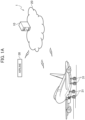
- the wear amount estimation system 1 includes a wear amount estimation device 10, a network 20, and an airline 30.
- the wear amount estimation device 10 mutually communicates with the airline 30 via the network 20. Specifically, the wear amount estimation device 10 acquires pieces of information from the airline 30 via the network 20, and estimates wear amounts of a plurality of aircraft tires 31 mounted on an aircraft individually. A scene where the aircraft tire 31 is used includes a plurality of driving states. The wear amount estimation device 10 estimates the wear amount of the aircraft tire 31 in a touching down state. Details of the touching down state will be described later. The information acquired by the wear amount estimation device 10 from the airline 30 will also be described later. In the following, "aircraft” may be simply referred to as "airframe".
- the network 20 is a communication network capable of transmitting and receiving various kinds of information. For example, the network 20 is implemented by various types of communication lines, such as dedicated lines installed by telecommunications carriers, public switched telephone networks, satellite communication lines, and mobile communication lines.
- the wear amount estimation device 10 is a general-purpose computer, for example, including a processor including a CPU and a memory such as a read-only memory (ROM) and a random-access memory (RAM).
- the CPU reads out a program stored in the ROM to the RAM and executes the program.
- the wear amount estimation device 10 may be either a built-in terminal device or a mobile terminal device easy to carry (such as a smartphone).
- the wear amount estimation device 10 may be a server. As shown in Fig. 1B , the wear amount estimation device 10 includes a communication unit 11, a calculation unit 12, and an estimation unit 13.
- the communication unit 11 is an interface connected to the network 20 to transmit/receive pieces of data to communicate with the airline 30.
- the calculation unit 12 calculates a wear energy of each aircraft tire 31 mounted on the aircraft.
- the estimation unit 13 estimates the wear amount of the aircraft tire 31 based on the wear energy calculated by the calculation unit 12.
- the communication unit 11, the calculation unit 12, and the estimation unit 13 can be fabricated in single or plural processing circuits.
- the respective processing circuits include a programmed processing device, such as a processing device including an electric circuit.
- the respective processing circuits include an application-specific integrated circuit (ASIC) configured to execute the functions described above or a device including circuit components.
- ASIC application-specific integrated circuit
- the plurality of aircraft tires include an aircraft tire mounted on the main gear and an aircraft tire mounted on the nose gear. Further, a plurality of aircraft tires (six, for example) are mounted on the main gear. Also a plurality of aircraft tires (two, for example) are mounted on the nose gear. However, depending on the size of the aircraft, one aircraft tire may be mounted on the nose gear.
- the main gear may be referred to as a main landing gear.
- the nose gear may be referred to as a nose landing gear.
- the main gear and the nose gear are so-called landing gears, and include, in addition to the aircraft tires, a shock absorbing device for absorbing an impact load at the time of landing, a pedestal, or the like.
- the aircraft tire refer to each tire mounted on the aircraft.
- aircraft tire is simply referred to as tire.
- the gear includes the main landing gear and the nose landing gear.
- FIG. 2 is a flowchart for explaining an operation example of the wear amount estimation device 10.
- the wear amount estimation device 10 acquires information related to the aircraft from the airline 30. Specifically, the wear amount estimation device 10 acquires a speed of the aircraft (including a descending speed of the aircraft), an acceleration of the aircraft, a current position of the aircraft, an altitude of the aircraft, a direction of the nose of the aircraft, a total weight of the aircraft, an internal pressure of the tires mounted on the aircraft, position of ribs of the tires, a rotational speed of the tires, a pitch angle of the aircraft (including a pitch rate), a roll angle of the aircraft (including a roll rate), a gear structure of the aircraft, or the like. The wear amount estimation device 10 also acquires the time when these information is acquired.
- the rotational speed of the tire or the like may be acquired from an RFID tag attached to an inner surface of the tire. That is, all of the information used to estimate the wear amount need not be acquired from the airline 30.
- the internal pressure of the tire acquired from the airline 30 will be described as a measured value, however the present invention is not limited thereto.
- the internal pressure of the tire may be an estimated value.
- the process proceeds to step S103, and the wear amount estimation device 10 estimates the touching down time of the tire.
- the touching down time means the time at the moment when the tire is grounded (the tire lands).
- the touching down time may be different between the tire mounted on the main gear and the tire mounted on the nose gear. Also, even in each tire mounted on the same main gear, the touching down time may be different depending on the mounted shaft position.
- step S201 shown in Fig. 3 the wear amount estimation device 10 determines whether or not the altitude of the aircraft is less than or equal to a first threshold value.
- the first threshold value is not particularly limited, but is, for example, 10m.
- the process proceeds to step S203.
- the reason for comparing the altitude with the first threshold value is to avoid erroneous determination of touching down.
- step S203 the wear amount estimation device 10 determines that the tire is grounded when the pitch angle becomes maximum.
- the tire mounted on the main gear is grounded first, and then the tire mounted on the nose gear is grounded. In addition, even each tire mounted on the same main gear may have different grounding timing.
- each tire mounted on the third shaft is grounded first, and then the tire mounted on the first shaft and the second shaft is grounded (refer to Fig. 4 ).
- the difference in the grounding time between the main gears is very small and can usually be ignored. Therefore, the wear amount estimation device 10 may determine that the tire mounted on the main gear is grounded when the pitch angle is the maximum.
- the wear amount estimation device 10 may determine that the tire mounted on the main gear is grounded when the pitch angle is maximum and the large acceleration is generated in the vertical direction of the aircraft.
- step S205 the wear amount estimation device 10 determines that the tire mounted on the nose gear is grounded when the pitch angle is less than or equal to a second threshold value.
- the second threshold value is not particularly limited, but is, for example, 0 (zero) degrees. In the example shown in Fig. 4 , the position of the pitch angle is 0 degrees and the grounding time (the touching down time) of the tire mounted on the nose gear are slightly different, this is because the vertical acceleration of the aircraft is taken into account.
- the wear amount estimation device 10 may determine that the tire mounted on the nose gear is grounded when the pitch angle is 0 degrees.
- the evaluation time means a time to estimate the wear amount.
- the evaluation time means a time from when the tire is grounded until the distance advanced by rotation of the tire and the distance that the aircraft advances become equal to.
- the evaluation time is a time during which the touching down state described above continues.
- the touching down state in the present embodiment means a state after when the tire is grounded until the distance advanced by rotation of the tire becomes substantially equal to the distance that the aircraft advances.
- the aircraft receives various forces during the touching down. In some cases, it is difficult to accurately calculate the evaluation time by the above definition.
- the wear amount estimation device 10 calculates the evaluation time Tg based on the descending speed of the aircraft.
- An example of a method for calculating the evaluation time Tg will be described with reference to Fig. 5.
- Fig. 5 is a graph showing the relationship between the evaluation time Tg and the descending speed.
- a violent shearing force accompanied by white smoke is generated by the tire is grounded to the road surface, and the shearing force becomes a torque to start the rotation.
- the duration of the touching down state is 1 second or less, and about 1 second at the longest.
- the rotation of the tire is affected by the descending speed.
- Fig. 5 is a graph showing the relationship between the evaluation time Tg and the descending speed.
- the evaluation time Tg becomes longer because the rotational speed of the tire slowly increases as the aircraft slowly descends.
- the rotational speed of the tire is also fast, so that the evaluation time Tg becomes short.
- the wear amount estimation device 10 calculates the evaluation time Tg based on the descending speed.
- the descending speed is not constant in the touching down state. As shown in Fig. 4 , the descending speed when the tire mounted on the main gear was grounded is different from the descending speed when the tire mounted on the nose gear was grounded. Therefore, the evaluation time Tg is different between the tire mounted on the main gear and the tire mounted on the nose gear. In each tire, the wear amount estimation device 10 estimates the wear amount of each tire until the evaluation time Tg based on the descending speed at the time of grounding elapses after the tire is grounded.
- the evaluation time Tg may be defined as a time from when the tire is grounded until the aircraft enters a taxiing state.
- the taxiing state is a state in which the aircraft runs on the runway using the power of the aircraft.
- step S107 the wear amount estimation device 10 calculates a load applied to the tire. For example, when one tire is grounded on the road surface at the moment of touching down, the tire bears the total load of the aircraft. The load is determined by subtracting a lift from the total weight of the aircraft. The lift is determined by well-known methods.
- the wear amount estimation device 10 calculates a wheel load applied to the tire.
- the wheel load is a weight to be borne by the tire, which is the same as the load described above, but the wheel load is a parameter in consideration of the characteristics and behavior of the aircraft relative to the load described above.
- the characteristics of the aircraft include, for example, gear arrangement and gear structure.
- the gear arrangement relates to a position where the main gear and the nose gear are attached to the aircraft.
- the gear structure relates to the shaft position to which the tire is attached. The position of each gear or the load borne by the tire in each shaft varies. The load after the variation is defined as the wheel load.
- the behavior of aircraft includes the lift, the roll angle, the roll rate, the pitch angle, and the pitch rate.
- the behavior of the aircraft also includes an impact load generated by the rotation of the gear structure and the bounce of the aircraft and the tire.
- the load borne by the tire is varied by the behavior of the aircraft.
- the load after the variation is defined as the wheel load.
- the behavior of the aircraft acquired by the wear amount estimation device 10 is in the touching down state.
- the aircraft receives various forces. Such forces vary depending on the characteristics and behavior of the aircraft.
- the gear is deformed by the force acting up and down the aircraft.
- the wheel load of the tire is calculated according to where the tire is mounted in the gear.
- fs is defined as a coefficient determined by where the tire is mounted in the gear
- the lift is statically zero.
- the wear amount estimation device 10 calculates the wheel load using above Formula 3.
- step S111 the wear amount estimation device 10 calculates the shearing force of the tire.
- a plurality of circumferential grooves 60 (in Fig. 6 , there are three) extending along a tire circumferential direction are formed, and a plurality of ribs 50 to 53 (in Fig. 6 , there are four) partitioned by the circumferential grooves 60 are formed.
- the ribs 50 to 53 are formed in the order of the ribs 50, 51, 52, 53 from the center side of the aircraft toward the outside of the aircraft.
- the shearing force depends on the position of the rib.
- the wear amount estimation device 10 calculates the shearing force of each rib by multiplying an average grounding pressure of each rib by a dynamic friction coefficient ⁇ .
- the average grounding pressure of each rib is calculated based on the wheel load of each rib and the internal pressure of each rib.
- the wheel load of each rib and the internal pressure of each rib are calculated by dividing the wheel load of the tire and the internal pressure of the tire by the number of ribs, for example.
- the average grounding pressure of each rib is calculated in advance.
- the average grounding pressure of each rib may be calculated based on an FEM model (Finite Element Method) of the tire.
- the road surface condition of each airport is different. It is assumed that the dynamic friction coefficient ⁇ of the road surface of each airport is acquired in advance.
- step S113 the wear amount estimation device 10 calculates a slip rate in a rotational direction of the tire.
- the wear amount estimation device 10 calculates the slip rate using a rotational speed of the tire.
- the wear amount estimation device 10 can acquire the rotational speed of the tire from the airline 30.
- the rotational speed of the tire is measured by a sensor mounted on the tire (or the aircraft). It is also possible that the rotational speed of the tire cannot be acquired.
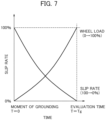
- the wear amount estimation device 10 may calculate the slip rate based on a laboratory test result.
- the laboratory test is, for example, a test in which conditions equivalent to those at the time of landing of the aircraft are given to the tire.
- the rotational speed information and the wheel load information are acquired by the laboratory test.
- Fig. 7 shows an example of the laboratory test result.
- Fig. 7 is not limited to the wheel load reaches 100% at the time Tg. Similarly, it is not limited to a decrease in the slip rate to 0% at the time Tg.
- step S115 the wear amount estimation device 10 multiplies the slip rate by the shearing force and calculates an instant wear energy in a minute time. Then, the wear amount estimation device 10 calculates a wear energy by integrating the instant wear energy at the evaluation time Tg.
- the wear amount estimation device 10 estimates the wear amount based on the wear energy and a wear resistance showing a relationship between a predetermined wear amount. For example, the wear resistance is calculated by using the wear energy per flight calculated from the behavior of the aircraft of an average flight (airport to airport) and the wear amount per flight.
- the wear resistance described above is usually used in the taxiing state. Since the impact is large in the touching down state, the wear resistance smaller than the wear resistance described above may be used. In other words, in the touching down state, the wear resistance smaller than the wear resistance used in the taxiing state may be used.
- the wear amount estimation device 10 acquires information related to the aircraft from the airline 30 and estimates the wear amount of the tire in the touching down state. Specifically, the wear amount estimation device 10 calculates the shearing force of each rib by multiplying the average grounding pressure of each rib of each tire by the dynamic friction coefficient ⁇ .
- the information related to the aircraft includes the internal pressure of the tire.
- the average grounding pressure of each rib is calculated based on the internal pressure and the wheel load applied to the tire.
- the wear amount estimation device 10 calculates the wear energy of the tire based on the shearing force.
- the wear amount estimation device 10 estimates the wear amount of the tire based on the wear energy and the wear resistance showing the relationship between the predetermined wear amount.
- the wear amount estimation device 10 can accurately estimate the wear amount of each tire in the touching down state.
- the information related to the aircraft includes the structure of the landing gear of the aircraft, the total weight of the aircraft, and the behavior of the aircraft in the touching down state.
- the wear amount estimation device 10 calculates the wheel load by using the Formula 3.
- the wear amount estimation device 10 can calculate the wheel load in consideration of the characteristics and behavior of the aircraft. Since the wheel load thus calculated is highly accurate, the wear amount estimation device 10 can accurately estimate the wear amount of each tire in the touching down state.
- the wear amount estimation device 10 calculates the slip rate in the rotational direction of the tire based on the rotational speed of the tire.
- the wear amount estimation device 10 can accurately calculate the slip rate by using the actual rotational speed.
- the wear amount estimation device 10 estimates the time during which the touching down state continues based on the descending speed. As described above, the evaluation time Tg becomes longer because the rotational speed of the tire slowly increases as the aircraft slowly descends. On the other hand, when the descending speed is fast, the rotational speed of the tire is also fast, so that the evaluation time Tg becomes short. The wear amount estimation device 10 can accurately estimate the time during which the touching down state continues by using the descending speed.
- the wear amount estimation device 10 estimates the time when the touching down occurs based on the pitch angle. As in the above example, the wear amount estimation device 10 determines that the tire mounted on the main gear is grounded when the altitude is less than or equal to the first threshold value and the pitch angle becomes maximum. The wear amount estimation device 10 determines that the tire mounted on the nose gear is grounded when the altitude is less than or equal to the first threshold value and the pitch angle becomes 0 degrees. Thus, the wear amount estimation device 10 can accurately estimate the time when the touching down occurs for each tire. The wear amount estimation device 10 estimates the wear amount while the touching down state continues from the time when the touch-down occurs. Thus, since the touching down state is accurately divided from other running states (for example, taxiing state), the wear amount estimation device 10 can accurately estimate the wear amount of each tire in the touching down state.
Landscapes
- Engineering & Computer Science (AREA)
- Mechanical Engineering (AREA)
- Computing Systems (AREA)
- Accounting & Taxation (AREA)
- Operations Research (AREA)
- Business, Economics & Management (AREA)
- General Physics & Mathematics (AREA)
- Development Economics (AREA)
- Economics (AREA)
- General Business, Economics & Management (AREA)
- Physics & Mathematics (AREA)
- Health & Medical Sciences (AREA)
- Biomedical Technology (AREA)
- General Health & Medical Sciences (AREA)
- Tires In General (AREA)
Claims (7)
- Verschleißgrad-Abschätzungsverfahren zum Abschätzen eines Verschleißgrades von Luftfahrzeugreifen (31) in einem Aufsetzzustand auf Grundlage von Informationen bezüglich des Luftfahrzeugs, wobei das Verfahren Folgendes umfasst:Berechnen einer Scherkraft jeder Rippe (50-53), wobei die Rippen (50-53) auf einer Lauffläche des Reifens (31) gebildet sind und durch umlaufende Rillen (60) unterteilt sind, wobei die umlaufenden Rillen (60) auf der Lauffläche gebildet sind und sich entlang einer Reifenumfangsrichtung erstrecken;Berechnen einer Verschleißenergie des Luftfahrzeugreifens (31) auf Grundlage der Scherkraft; undAbschätzen des Verschleißgrades des Luftfahrzeugreifens (31) auf Grundlage der Verschleißenergie und einer Verschleißfestigkeit, die eine Beziehung zwischen einem vorbestimmten Verschleißgrad zeigt,wobei die Informationen bezüglich des Luftfahrzeugs einen Innendruck des Luftfahrzeugreifens (31) einschließen, dadurch gekennzeichnet, dass:
die Scherkraft jeder Rippe (50-53) auf Grundlage eines durchschnittlichen Bodenberührungsdrucks jeder Rippe (50-53) des Luftfahrzeugreifens (31) berechnet wird; und dadurch, dass:
der durchschnittliche Bodenberührungsdruck jeder Rippe (50-53) auf Grundlage des Innendrucks und einer Radlast, die auf den Luftfahrzeugreifen (31) ausgeübt wird, berechnet wird. - Verschleißgrad-Abschätzungsverfahren nach Anspruch 1, wobeidie Informationen bezüglich des Luftfahrzeugs eine Struktur eines Fahrwerks des Luftfahrzeugs, ein Gesamtgewicht des Luftfahrzeugs und ein Verhalten des Luftfahrzeugs im Aufsetzzustand einschließen, undwenn fs als ein Koeffizient definiert ist, der dadurch bestimmt wird, wo der Luftfahrzeugreifen (31) in dem Fahrwerk montiert ist, wenn fd als ein Koeffizient definiert ist, der durch das Luftfahrzeug bestimmt wird, an dem der Luftfahrzeugreifen (31) montiert ist, wenn fr als ein Koeffizient definiert ist, der durch das Verhalten bestimmt wird, die Radlast entsprechend der folgenden Formel 1 berechnet wird:
[Math. 1]
- Verschleißgrad-Abschätzungsverfahren nach Anspruch 2, wobeidas Berechnen einer Schlupfrate in einer Umdrehungsrichtung des Luftfahrzeugreifens (31) auf einer Umdrehungsgeschwindigkeit des Luftfahrzeugreifens (31) basiert, wenn die Informationen bezüglich des Luftfahrzeugs die Umdrehungsgeschwindigkeit des Luftfahrzeugreifens (31) einschließen,das Berechnen der Schlupfrate auf einem vorbestimmten Testergebnis basiert, wenn die Informationen bezüglich des Luftfahrzeugs die Umdrehungsgeschwindigkeit des Luftfahrzeugreifens (31) nicht einschließen.
- Verschleißgrad-Abschätzungsverfahren nach einem der Ansprüche 1 bis 3, wobeidie Informationen bezüglich des Luftfahrzeugs eine Sinkgeschwindigkeit des Luftfahrzeugs, unddas Abschätzen einer Zeit, während derer sich der Aufsetzzustand auf Grundlage der Sinkgeschwindigkeit fortsetzt, einschließen.
- Verschleißgrad-Abschätzungsverfahren nach Anspruch 4, wobeidie Informationen bezüglich des Luftfahrzeugs einen Nickwinkel des Luftfahrzeugs,das Abschätzen eines Zeitpunktes, wann das Aufsetzen stattfindet, auf Grundlage des Nickwinkels, unddas Abschätzen des Verschleißgrades, während sich der Aufsetzzustand fortsetzt, von dem Zeitpunkt an, wann das Aufsetzen stattfindet, einschließen.
- Verschleißgrad-Abschätzungsvorrichtung, die eine Steuerung umfasst, die einen Verschleißgrad von Luftfahrzeugreifen (31) in einem Aufsetzzustand auf Grundlage von Informationen bezüglich des Luftfahrzeugs abschätzt,
wobei die Steuerung zu Folgendem konfiguriert ist:eine Scherkraft jeder Rippe (50-53) zu berechnen, wobei die Rippen (50-53) auf einer Lauffläche des Reifens (31) gebildet sind und durch umlaufende Rillen (60) unterteilt sind, wobei die umlaufenden Rillen (60) auf der Lauffläche gebildet sind und sich entlang einer Reifenumfangsrichtung erstrecken;eine Verschleißenergie des Luftfahrzeugreifens (31) auf Grundlage der Scherkraft zu berechnen; undden Verschleißgrad des Luftfahrzeugreifens (31) auf Grundlage der Verschleißenergie und einer Verschleißfestigkeit, die eine Beziehung zwischen einem vorbestimmten Verschleißgrad zeigt, abzuschätzen;wobei die Informationen bezüglich des Luftfahrzeugs einen Innendruck des Luftfahrzeugreifens (31) einschließen, dadurch gekennzeichnet, dass:
die Scherkraft jeder Rippe (50-53) auf Grundlage eines durchschnittlichen Bodenberührungsdrucks jeder Rippe des Luftfahrzeugreifens (31) berechnet wird; und dadurch, dass:
der durchschnittliche Bodenberührungsdruck jeder Rippe (50-53) auf Grundlage des Innendrucks und einer Radlast, die auf den Luftfahrzeugreifen (31) ausgeübt wird, berechnet wird. - Verschleißgrad-Abschätzungsprogramm zum Abschätzen eines Verschleißgrades von Luftfahrzeugreifen (31) in einem Aufsetzzustand auf Grundlage von Informationen bezüglich des Luftfahrzeugs, wobei das Programm veranlasst, dass ein Rechner eines Endgeräts die folgenden Schritte ausführt:Berechnen einer Scherkraft jeder Rippe (50-53), wobei die Rippen (50-53) auf einer Lauffläche des Reifens (31) gebildet sind und durch umlaufende Rillen (60) unterteilt sind, wobei die umlaufenden Rillen (60) auf der Lauffläche gebildet sind und sich entlang einer Reifenumfangsrichtung erstrecken,Berechnen einer Verschleißenergie des Luftfahrzeugreifens (31) auf Grundlage der Scherkraft; undAbschätzen des Verschleißgrades des Luftfahrzeugreifens (31) auf Grundlage der Verschleißenergie und einer Verschleißfestigkeit, die eine Beziehung zwischen einem vorbestimmten Verschleißgrad zeigt;wobei die Informationen bezüglich des Luftfahrzeugs einen Innendruck des Luftfahrzeugreifens (31) einschließen, dadurch gekennzeichnet, dass:
die Scherkraft jeder Rippe (50-53) auf Grundlage eines durchschnittlichen Bodenberührungsdrucks jeder Rippe (50-53) des Luftfahrzeugreifens (31) berechnet wird; und dadurch, dass:
der durchschnittliche Bodenberührungsdruck jeder Rippe (50-53) auf Grundlage des Innendrucks und einer Radlast, die auf den Luftfahrzeugreifen (31) ausgeübt wird, berechnet wird.
Applications Claiming Priority (2)
| Application Number | Priority Date | Filing Date | Title |
|---|---|---|---|
| JP2018216320 | 2018-11-19 | ||
| PCT/JP2019/045295 WO2020105641A1 (ja) | 2018-11-19 | 2019-11-19 | 摩耗量予測方法、摩耗量予測装置、及び摩耗量予測プログラム |
Publications (3)
| Publication Number | Publication Date |
|---|---|
| EP3885166A1 EP3885166A1 (de) | 2021-09-29 |
| EP3885166A4 EP3885166A4 (de) | 2022-07-27 |
| EP3885166B1 true EP3885166B1 (de) | 2023-11-15 |
Family
ID=70773794
Family Applications (1)
| Application Number | Title | Priority Date | Filing Date |
|---|---|---|---|
| EP19886250.0A Active EP3885166B1 (de) | 2018-11-19 | 2019-11-19 | Vorhersageverfahren für verschleissgrad, vorhersagevorrichtung für verschleissgrad und vorhersageprogramm für verschleissgrad |
Country Status (5)
| Country | Link |
|---|---|
| US (1) | US11807047B2 (de) |
| EP (1) | EP3885166B1 (de) |
| JP (1) | JP7299239B2 (de) |
| CN (1) | CN113165449B (de) |
| WO (1) | WO2020105641A1 (de) |
Families Citing this family (1)
| Publication number | Priority date | Publication date | Assignee | Title |
|---|---|---|---|---|
| JP2024099386A (ja) * | 2023-01-12 | 2024-07-25 | 株式会社ブリヂストン | プログラム、ユーザ端末、及び出力方法 |
Family Cites Families (14)
| Publication number | Priority date | Publication date | Assignee | Title |
|---|---|---|---|---|
| JP3320653B2 (ja) * | 1998-05-08 | 2002-09-03 | 株式会社ブリヂストン | タイヤ摩耗寿命予測方法 |
| CN100348962C (zh) | 2003-05-15 | 2007-11-14 | 同济大学 | 轮胎接地压力及轮胎作用下路面结构内应力应变测量装置 |
| EP1657082A4 (de) | 2003-08-19 | 2010-07-21 | Bridgestone Corp | Reifen mit eingebautem sensor und reifenzustandsbewertungsverfahren |
| CN101183402B (zh) * | 2006-11-13 | 2012-07-25 | 韩国轮胎株式会社 | 轮胎花纹的实际磨损预测方法 |
| JP5534588B2 (ja) | 2010-02-24 | 2014-07-02 | 株式会社ブリヂストン | タイヤのゴムインデックス算出方法、装置及びプログラム |
| JP5829861B2 (ja) | 2011-08-08 | 2015-12-09 | 住友ゴム工業株式会社 | タイヤの摩耗エネルギーの予測方法及びタイヤの設計方法 |
| JP5778560B2 (ja) * | 2011-11-29 | 2015-09-16 | 株式会社ブリヂストン | タイヤ摩耗予測方法及びタイヤ摩耗予測装置 |
| JP6006576B2 (ja) | 2012-07-31 | 2016-10-12 | 住友ゴム工業株式会社 | タイヤのシミュレーション方法 |
| JP6076818B2 (ja) * | 2013-04-23 | 2017-02-08 | 株式会社ブリヂストン | 航空機用タイヤ |
| JP6291366B2 (ja) | 2014-06-25 | 2018-03-14 | 住友ゴム工業株式会社 | タイヤのシミュレーション方法及びシミュレーション装置 |
| FR3060821A1 (fr) * | 2016-12-20 | 2018-06-22 | Compagnie Generale Des Etablissements Michelin | Procede de determination de l'etat d'usure d'un pneumatique pour avion |
| CN206664169U (zh) * | 2017-05-05 | 2017-11-24 | 肇庆市广应科通用航空研究院 | 飞机轮胎监测装置 |
| JP6976833B2 (ja) * | 2017-12-14 | 2021-12-08 | 株式会社ブリヂストン | 摩耗量予測方法、摩耗量予測装置、及び摩耗量予測プログラム |
| JP7440295B2 (ja) * | 2020-02-28 | 2024-02-28 | 株式会社ブリヂストン | 摩耗状態予測方法、摩耗状態予測装置、及び摩耗状態予測プログラム |
-
2019
- 2019-11-19 CN CN201980076174.7A patent/CN113165449B/zh active Active
- 2019-11-19 US US17/293,270 patent/US11807047B2/en active Active
- 2019-11-19 EP EP19886250.0A patent/EP3885166B1/de active Active
- 2019-11-19 WO PCT/JP2019/045295 patent/WO2020105641A1/ja not_active Ceased
- 2019-11-19 JP JP2020557562A patent/JP7299239B2/ja active Active
Also Published As
| Publication number | Publication date |
|---|---|
| US20220001701A1 (en) | 2022-01-06 |
| JP7299239B2 (ja) | 2023-06-27 |
| CN113165449A (zh) | 2021-07-23 |
| WO2020105641A1 (ja) | 2020-05-28 |
| CN113165449B (zh) | 2023-01-03 |
| US11807047B2 (en) | 2023-11-07 |
| EP3885166A1 (de) | 2021-09-29 |
| JPWO2020105641A1 (ja) | 2021-09-30 |
| EP3885166A4 (de) | 2022-07-27 |
Similar Documents
| Publication | Publication Date | Title |
|---|---|---|
| US11519824B2 (en) | Wear amount estimation method, wear amount estimation device, and wear amount estimation program | |
| US11440646B2 (en) | Remaining tire tread depth management system | |
| CN115840461B (zh) | 一种无人机安全保护方法、装置及无人机 | |
| EP3862196B1 (de) | Verfahren zur schätzung des reifenverschleisses | |
| US8972141B2 (en) | Method and system for controlling aircraft braking on a runway | |
| CN115099532B (zh) | 基于机器学习的飞行器着陆风险预测方法、系统及设备 | |
| EP3885166B1 (de) | Vorhersageverfahren für verschleissgrad, vorhersagevorrichtung für verschleissgrad und vorhersageprogramm für verschleissgrad | |
| EP2821302B1 (de) | Bremsregelsystem mit reifen-/landebahnreibungseigenschaftsschätzung | |
| EP3556619B1 (de) | Energiebasiertes antiblockierbremssteuerungssystem | |
| EP3367076A1 (de) | Systeme und verfahren zur bestimmung der flugzeugmasse | |
| EP3822949B1 (de) | Systeme und verfahren zur vorhersage von flugdaten | |
| CN115190966B (zh) | 磨损状态预测方法、磨损状态预测装置以及磨损状态预测程序 | |
| EP2701027B1 (de) | Systeme und Verfahren zur Überwachung einer niedrigen Geschwindigkeit eines Drehflüglers | |
| US9922572B2 (en) | Method and device for automatically determining a runway state using reference distances for an adhesion limitation zone | |
| JP2019100765A (ja) | 制動性能評価方法 | |
| KR102872250B1 (ko) | 레이더 스펙트럼 폭을 이용하여 고체 수상체의 성장 영역을 추정하는 장치 및 방법 | |
| US20230002070A1 (en) | System for aiding formation flying of aircraft | |
| CN113032906A (zh) | 一种起落架形变程度的测量方法、装置、设备及介质 | |
| CN110362111B (zh) | 确定无人直升机发动机停车后安全着陆的方法及装置 | |
| CN119124654A (zh) | 无人驾驶物流车辆的在线质量评估方法、装置、设备和介质 | |
| EP3153364A1 (de) | Verbesserte robustheit und verfügbarkeit von flugzeugbeschleunigungsbewertung |
Legal Events
| Date | Code | Title | Description |
|---|---|---|---|
| STAA | Information on the status of an ep patent application or granted ep patent |
Free format text: STATUS: THE INTERNATIONAL PUBLICATION HAS BEEN MADE |
|
| PUAI | Public reference made under article 153(3) epc to a published international application that has entered the european phase |
Free format text: ORIGINAL CODE: 0009012 |
|
| STAA | Information on the status of an ep patent application or granted ep patent |
Free format text: STATUS: REQUEST FOR EXAMINATION WAS MADE |
|
| 17P | Request for examination filed |
Effective date: 20210520 |
|
| AK | Designated contracting states |
Kind code of ref document: A1 Designated state(s): AL AT BE BG CH CY CZ DE DK EE ES FI FR GB GR HR HU IE IS IT LI LT LU LV MC MK MT NL NO PL PT RO RS SE SI SK SM TR |
|
| DAV | Request for validation of the european patent (deleted) | ||
| DAX | Request for extension of the european patent (deleted) | ||
| A4 | Supplementary search report drawn up and despatched |
Effective date: 20220628 |
|
| RIC1 | Information provided on ipc code assigned before grant |
Ipc: G16Y 40/20 20200101ALI20220623BHEP Ipc: G16Y 20/20 20200101ALI20220623BHEP Ipc: G16Y 10/40 20200101ALI20220623BHEP Ipc: G01M 17/02 20060101ALI20220623BHEP Ipc: B60C 11/24 20060101ALI20220623BHEP Ipc: B60C 19/00 20060101AFI20220623BHEP |
|
| GRAP | Despatch of communication of intention to grant a patent |
Free format text: ORIGINAL CODE: EPIDOSNIGR1 |
|
| STAA | Information on the status of an ep patent application or granted ep patent |
Free format text: STATUS: GRANT OF PATENT IS INTENDED |
|
| INTG | Intention to grant announced |
Effective date: 20230616 |
|
| P01 | Opt-out of the competence of the unified patent court (upc) registered |
Effective date: 20230713 |
|
| GRAS | Grant fee paid |
Free format text: ORIGINAL CODE: EPIDOSNIGR3 |
|
| GRAA | (expected) grant |
Free format text: ORIGINAL CODE: 0009210 |
|
| STAA | Information on the status of an ep patent application or granted ep patent |
Free format text: STATUS: THE PATENT HAS BEEN GRANTED |
|
| AK | Designated contracting states |
Kind code of ref document: B1 Designated state(s): AL AT BE BG CH CY CZ DE DK EE ES FI FR GB GR HR HU IE IS IT LI LT LU LV MC MK MT NL NO PL PT RO RS SE SI SK SM TR |
|
| REG | Reference to a national code |
Ref country code: CH Ref legal event code: EP Ref country code: GB Ref legal event code: FG4D |
|
| REG | Reference to a national code |
Ref country code: DE Ref legal event code: R096 Ref document number: 602019041673 Country of ref document: DE |
|
| REG | Reference to a national code |
Ref country code: IE Ref legal event code: FG4D |
|
| REG | Reference to a national code |
Ref country code: LT Ref legal event code: MG9D |
|
| REG | Reference to a national code |
Ref country code: NL Ref legal event code: MP Effective date: 20231115 |
|
| PG25 | Lapsed in a contracting state [announced via postgrant information from national office to epo] |
Ref country code: GR Free format text: LAPSE BECAUSE OF FAILURE TO SUBMIT A TRANSLATION OF THE DESCRIPTION OR TO PAY THE FEE WITHIN THE PRESCRIBED TIME-LIMIT Effective date: 20240216 |
|
| PG25 | Lapsed in a contracting state [announced via postgrant information from national office to epo] |
Ref country code: IS Free format text: LAPSE BECAUSE OF FAILURE TO SUBMIT A TRANSLATION OF THE DESCRIPTION OR TO PAY THE FEE WITHIN THE PRESCRIBED TIME-LIMIT Effective date: 20240315 |
|
| PG25 | Lapsed in a contracting state [announced via postgrant information from national office to epo] |
Ref country code: LT Free format text: LAPSE BECAUSE OF FAILURE TO SUBMIT A TRANSLATION OF THE DESCRIPTION OR TO PAY THE FEE WITHIN THE PRESCRIBED TIME-LIMIT Effective date: 20231115 |
|
| REG | Reference to a national code |
Ref country code: AT Ref legal event code: MK05 Ref document number: 1631447 Country of ref document: AT Kind code of ref document: T Effective date: 20231115 |
|
| PG25 | Lapsed in a contracting state [announced via postgrant information from national office to epo] |
Ref country code: NL Free format text: LAPSE BECAUSE OF FAILURE TO SUBMIT A TRANSLATION OF THE DESCRIPTION OR TO PAY THE FEE WITHIN THE PRESCRIBED TIME-LIMIT Effective date: 20231115 |
|
| PG25 | Lapsed in a contracting state [announced via postgrant information from national office to epo] |
Ref country code: AT Free format text: LAPSE BECAUSE OF FAILURE TO SUBMIT A TRANSLATION OF THE DESCRIPTION OR TO PAY THE FEE WITHIN THE PRESCRIBED TIME-LIMIT Effective date: 20231115 |
|
| PG25 | Lapsed in a contracting state [announced via postgrant information from national office to epo] |
Ref country code: ES Free format text: LAPSE BECAUSE OF FAILURE TO SUBMIT A TRANSLATION OF THE DESCRIPTION OR TO PAY THE FEE WITHIN THE PRESCRIBED TIME-LIMIT Effective date: 20231115 |
|
| PG25 | Lapsed in a contracting state [announced via postgrant information from national office to epo] |
Ref country code: NL Free format text: LAPSE BECAUSE OF FAILURE TO SUBMIT A TRANSLATION OF THE DESCRIPTION OR TO PAY THE FEE WITHIN THE PRESCRIBED TIME-LIMIT Effective date: 20231115 Ref country code: LT Free format text: LAPSE BECAUSE OF FAILURE TO SUBMIT A TRANSLATION OF THE DESCRIPTION OR TO PAY THE FEE WITHIN THE PRESCRIBED TIME-LIMIT Effective date: 20231115 Ref country code: IS Free format text: LAPSE BECAUSE OF FAILURE TO SUBMIT A TRANSLATION OF THE DESCRIPTION OR TO PAY THE FEE WITHIN THE PRESCRIBED TIME-LIMIT Effective date: 20240315 Ref country code: GR Free format text: LAPSE BECAUSE OF FAILURE TO SUBMIT A TRANSLATION OF THE DESCRIPTION OR TO PAY THE FEE WITHIN THE PRESCRIBED TIME-LIMIT Effective date: 20240216 Ref country code: ES Free format text: LAPSE BECAUSE OF FAILURE TO SUBMIT A TRANSLATION OF THE DESCRIPTION OR TO PAY THE FEE WITHIN THE PRESCRIBED TIME-LIMIT Effective date: 20231115 Ref country code: BG Free format text: LAPSE BECAUSE OF FAILURE TO SUBMIT A TRANSLATION OF THE DESCRIPTION OR TO PAY THE FEE WITHIN THE PRESCRIBED TIME-LIMIT Effective date: 20240215 Ref country code: AT Free format text: LAPSE BECAUSE OF FAILURE TO SUBMIT A TRANSLATION OF THE DESCRIPTION OR TO PAY THE FEE WITHIN THE PRESCRIBED TIME-LIMIT Effective date: 20231115 Ref country code: PT Free format text: LAPSE BECAUSE OF FAILURE TO SUBMIT A TRANSLATION OF THE DESCRIPTION OR TO PAY THE FEE WITHIN THE PRESCRIBED TIME-LIMIT Effective date: 20240315 |
|
| PG25 | Lapsed in a contracting state [announced via postgrant information from national office to epo] |
Ref country code: SE Free format text: LAPSE BECAUSE OF FAILURE TO SUBMIT A TRANSLATION OF THE DESCRIPTION OR TO PAY THE FEE WITHIN THE PRESCRIBED TIME-LIMIT Effective date: 20231115 Ref country code: RS Free format text: LAPSE BECAUSE OF FAILURE TO SUBMIT A TRANSLATION OF THE DESCRIPTION OR TO PAY THE FEE WITHIN THE PRESCRIBED TIME-LIMIT Effective date: 20231115 Ref country code: PL Free format text: LAPSE BECAUSE OF FAILURE TO SUBMIT A TRANSLATION OF THE DESCRIPTION OR TO PAY THE FEE WITHIN THE PRESCRIBED TIME-LIMIT Effective date: 20231115 Ref country code: NO Free format text: LAPSE BECAUSE OF FAILURE TO SUBMIT A TRANSLATION OF THE DESCRIPTION OR TO PAY THE FEE WITHIN THE PRESCRIBED TIME-LIMIT Effective date: 20240215 Ref country code: LV Free format text: LAPSE BECAUSE OF FAILURE TO SUBMIT A TRANSLATION OF THE DESCRIPTION OR TO PAY THE FEE WITHIN THE PRESCRIBED TIME-LIMIT Effective date: 20231115 Ref country code: HR Free format text: LAPSE BECAUSE OF FAILURE TO SUBMIT A TRANSLATION OF THE DESCRIPTION OR TO PAY THE FEE WITHIN THE PRESCRIBED TIME-LIMIT Effective date: 20231115 |
|
| REG | Reference to a national code |
Ref country code: CH Ref legal event code: PL |
|
| PG25 | Lapsed in a contracting state [announced via postgrant information from national office to epo] |
Ref country code: DK Free format text: LAPSE BECAUSE OF FAILURE TO SUBMIT A TRANSLATION OF THE DESCRIPTION OR TO PAY THE FEE WITHIN THE PRESCRIBED TIME-LIMIT Effective date: 20231115 |
|
| PG25 | Lapsed in a contracting state [announced via postgrant information from national office to epo] |
Ref country code: LU Free format text: LAPSE BECAUSE OF NON-PAYMENT OF DUE FEES Effective date: 20231119 |
|
| PG25 | Lapsed in a contracting state [announced via postgrant information from national office to epo] |
Ref country code: CH Free format text: LAPSE BECAUSE OF NON-PAYMENT OF DUE FEES Effective date: 20231130 |
|
| PG25 | Lapsed in a contracting state [announced via postgrant information from national office to epo] |
Ref country code: CZ Free format text: LAPSE BECAUSE OF FAILURE TO SUBMIT A TRANSLATION OF THE DESCRIPTION OR TO PAY THE FEE WITHIN THE PRESCRIBED TIME-LIMIT Effective date: 20231115 |
|
| PG25 | Lapsed in a contracting state [announced via postgrant information from national office to epo] |
Ref country code: SK Free format text: LAPSE BECAUSE OF FAILURE TO SUBMIT A TRANSLATION OF THE DESCRIPTION OR TO PAY THE FEE WITHIN THE PRESCRIBED TIME-LIMIT Effective date: 20231115 |
|
| PG25 | Lapsed in a contracting state [announced via postgrant information from national office to epo] |
Ref country code: SM Free format text: LAPSE BECAUSE OF FAILURE TO SUBMIT A TRANSLATION OF THE DESCRIPTION OR TO PAY THE FEE WITHIN THE PRESCRIBED TIME-LIMIT Effective date: 20231115 Ref country code: SK Free format text: LAPSE BECAUSE OF FAILURE TO SUBMIT A TRANSLATION OF THE DESCRIPTION OR TO PAY THE FEE WITHIN THE PRESCRIBED TIME-LIMIT Effective date: 20231115 Ref country code: RO Free format text: LAPSE BECAUSE OF FAILURE TO SUBMIT A TRANSLATION OF THE DESCRIPTION OR TO PAY THE FEE WITHIN THE PRESCRIBED TIME-LIMIT Effective date: 20231115 Ref country code: LU Free format text: LAPSE BECAUSE OF NON-PAYMENT OF DUE FEES Effective date: 20231119 Ref country code: IT Free format text: LAPSE BECAUSE OF FAILURE TO SUBMIT A TRANSLATION OF THE DESCRIPTION OR TO PAY THE FEE WITHIN THE PRESCRIBED TIME-LIMIT Effective date: 20231115 Ref country code: EE Free format text: LAPSE BECAUSE OF FAILURE TO SUBMIT A TRANSLATION OF THE DESCRIPTION OR TO PAY THE FEE WITHIN THE PRESCRIBED TIME-LIMIT Effective date: 20231115 Ref country code: DK Free format text: LAPSE BECAUSE OF FAILURE TO SUBMIT A TRANSLATION OF THE DESCRIPTION OR TO PAY THE FEE WITHIN THE PRESCRIBED TIME-LIMIT Effective date: 20231115 Ref country code: CZ Free format text: LAPSE BECAUSE OF FAILURE TO SUBMIT A TRANSLATION OF THE DESCRIPTION OR TO PAY THE FEE WITHIN THE PRESCRIBED TIME-LIMIT Effective date: 20231115 Ref country code: CH Free format text: LAPSE BECAUSE OF NON-PAYMENT OF DUE FEES Effective date: 20231130 |
|
| REG | Reference to a national code |
Ref country code: BE Ref legal event code: MM Effective date: 20231130 |
|
| REG | Reference to a national code |
Ref country code: DE Ref legal event code: R097 Ref document number: 602019041673 Country of ref document: DE |
|
| PG25 | Lapsed in a contracting state [announced via postgrant information from national office to epo] |
Ref country code: MC Free format text: LAPSE BECAUSE OF FAILURE TO SUBMIT A TRANSLATION OF THE DESCRIPTION OR TO PAY THE FEE WITHIN THE PRESCRIBED TIME-LIMIT Effective date: 20231115 |
|
| PG25 | Lapsed in a contracting state [announced via postgrant information from national office to epo] |
Ref country code: MC Free format text: LAPSE BECAUSE OF FAILURE TO SUBMIT A TRANSLATION OF THE DESCRIPTION OR TO PAY THE FEE WITHIN THE PRESCRIBED TIME-LIMIT Effective date: 20231115 |
|
| REG | Reference to a national code |
Ref country code: IE Ref legal event code: MM4A |
|
| PLBE | No opposition filed within time limit |
Free format text: ORIGINAL CODE: 0009261 |
|
| STAA | Information on the status of an ep patent application or granted ep patent |
Free format text: STATUS: NO OPPOSITION FILED WITHIN TIME LIMIT |
|
| PG25 | Lapsed in a contracting state [announced via postgrant information from national office to epo] |
Ref country code: IE Free format text: LAPSE BECAUSE OF NON-PAYMENT OF DUE FEES Effective date: 20231119 |
|
| PG25 | Lapsed in a contracting state [announced via postgrant information from national office to epo] |
Ref country code: BE Free format text: LAPSE BECAUSE OF NON-PAYMENT OF DUE FEES Effective date: 20231130 |
|
| 26N | No opposition filed |
Effective date: 20240819 |
|
| GBPC | Gb: european patent ceased through non-payment of renewal fee |
Effective date: 20240215 |
|
| PG25 | Lapsed in a contracting state [announced via postgrant information from national office to epo] |
Ref country code: SI Free format text: LAPSE BECAUSE OF FAILURE TO SUBMIT A TRANSLATION OF THE DESCRIPTION OR TO PAY THE FEE WITHIN THE PRESCRIBED TIME-LIMIT Effective date: 20231115 |
|
| PG25 | Lapsed in a contracting state [announced via postgrant information from national office to epo] |
Ref country code: SI Free format text: LAPSE BECAUSE OF FAILURE TO SUBMIT A TRANSLATION OF THE DESCRIPTION OR TO PAY THE FEE WITHIN THE PRESCRIBED TIME-LIMIT Effective date: 20231115 Ref country code: IE Free format text: LAPSE BECAUSE OF NON-PAYMENT OF DUE FEES Effective date: 20231119 Ref country code: BE Free format text: LAPSE BECAUSE OF NON-PAYMENT OF DUE FEES Effective date: 20231130 |
|
| PG25 | Lapsed in a contracting state [announced via postgrant information from national office to epo] |
Ref country code: GB Free format text: LAPSE BECAUSE OF NON-PAYMENT OF DUE FEES Effective date: 20240215 |
|
| PG25 | Lapsed in a contracting state [announced via postgrant information from national office to epo] |
Ref country code: GB Free format text: LAPSE BECAUSE OF NON-PAYMENT OF DUE FEES Effective date: 20240215 |
|
| PG25 | Lapsed in a contracting state [announced via postgrant information from national office to epo] |
Ref country code: FI Free format text: LAPSE BECAUSE OF FAILURE TO SUBMIT A TRANSLATION OF THE DESCRIPTION OR TO PAY THE FEE WITHIN THE PRESCRIBED TIME-LIMIT Effective date: 20231115 |
|
| PG25 | Lapsed in a contracting state [announced via postgrant information from national office to epo] |
Ref country code: CY Free format text: LAPSE BECAUSE OF FAILURE TO SUBMIT A TRANSLATION OF THE DESCRIPTION OR TO PAY THE FEE WITHIN THE PRESCRIBED TIME-LIMIT; INVALID AB INITIO Effective date: 20191119 |
|
| PG25 | Lapsed in a contracting state [announced via postgrant information from national office to epo] |
Ref country code: HU Free format text: LAPSE BECAUSE OF FAILURE TO SUBMIT A TRANSLATION OF THE DESCRIPTION OR TO PAY THE FEE WITHIN THE PRESCRIBED TIME-LIMIT; INVALID AB INITIO Effective date: 20191119 |
|
| PG25 | Lapsed in a contracting state [announced via postgrant information from national office to epo] |
Ref country code: TR Free format text: LAPSE BECAUSE OF FAILURE TO SUBMIT A TRANSLATION OF THE DESCRIPTION OR TO PAY THE FEE WITHIN THE PRESCRIBED TIME-LIMIT Effective date: 20231115 |
|
| PGFP | Annual fee paid to national office [announced via postgrant information from national office to epo] |
Ref country code: DE Payment date: 20251119 Year of fee payment: 7 |
|
| PGFP | Annual fee paid to national office [announced via postgrant information from national office to epo] |
Ref country code: FR Payment date: 20251126 Year of fee payment: 7 |