EP3882006A1 - Verfahren zur herstellung einer alveolarknochenregenerationsmembran - Google Patents
Verfahren zur herstellung einer alveolarknochenregenerationsmembran Download PDFInfo
- Publication number
- EP3882006A1 EP3882006A1 EP19904876.0A EP19904876A EP3882006A1 EP 3882006 A1 EP3882006 A1 EP 3882006A1 EP 19904876 A EP19904876 A EP 19904876A EP 3882006 A1 EP3882006 A1 EP 3882006A1
- Authority
- EP
- European Patent Office
- Prior art keywords
- acid
- polymer film
- membrane
- polymer resin
- film
- Prior art date
- Legal status (The legal status is an assumption and is not a legal conclusion. Google has not performed a legal analysis and makes no representation as to the accuracy of the status listed.)
- Pending
Links
Images



Classifications
-
- C—CHEMISTRY; METALLURGY
- C08—ORGANIC MACROMOLECULAR COMPOUNDS; THEIR PREPARATION OR CHEMICAL WORKING-UP; COMPOSITIONS BASED THEREON
- C08G—MACROMOLECULAR COMPOUNDS OBTAINED OTHERWISE THAN BY REACTIONS ONLY INVOLVING UNSATURATED CARBON-TO-CARBON BONDS
- C08G63/00—Macromolecular compounds obtained by reactions forming a carboxylic ester link in the main chain of the macromolecule
- C08G63/02—Polyesters derived from hydroxycarboxylic acids or from polycarboxylic acids and polyhydroxy compounds
- C08G63/06—Polyesters derived from hydroxycarboxylic acids or from polycarboxylic acids and polyhydroxy compounds derived from hydroxycarboxylic acids
- C08G63/08—Lactones or lactides
-
- B—PERFORMING OPERATIONS; TRANSPORTING
- B29—WORKING OF PLASTICS; WORKING OF SUBSTANCES IN A PLASTIC STATE IN GENERAL
- B29C—SHAPING OR JOINING OF PLASTICS; SHAPING OF MATERIAL IN A PLASTIC STATE, NOT OTHERWISE PROVIDED FOR; AFTER-TREATMENT OF THE SHAPED PRODUCTS, e.g. REPAIRING
- B29C64/00—Additive manufacturing, i.e. manufacturing of three-dimensional [3D] objects by additive deposition, additive agglomeration or additive layering, e.g. by 3D printing, stereolithography or selective laser sintering
- B29C64/10—Processes of additive manufacturing
- B29C64/188—Processes of additive manufacturing involving additional operations performed on the added layers, e.g. smoothing, grinding or thickness control
-
- A—HUMAN NECESSITIES
- A61—MEDICAL OR VETERINARY SCIENCE; HYGIENE
- A61C—DENTISTRY; APPARATUS OR METHODS FOR ORAL OR DENTAL HYGIENE
- A61C8/00—Means to be fixed to the jaw-bone for consolidating natural teeth or for fixing dental prostheses thereon; Dental implants; Implanting tools
- A61C8/0003—Not used, see subgroups
- A61C8/0004—Consolidating natural teeth
- A61C8/0006—Periodontal tissue or bone regeneration
-
- A—HUMAN NECESSITIES
- A61—MEDICAL OR VETERINARY SCIENCE; HYGIENE
- A61F—FILTERS IMPLANTABLE INTO BLOOD VESSELS; PROSTHESES; DEVICES PROVIDING PATENCY TO, OR PREVENTING COLLAPSING OF, TUBULAR STRUCTURES OF THE BODY, e.g. STENTS; ORTHOPAEDIC, NURSING OR CONTRACEPTIVE DEVICES; FOMENTATION; TREATMENT OR PROTECTION OF EYES OR EARS; BANDAGES, DRESSINGS OR ABSORBENT PADS; FIRST-AID KITS
- A61F2/00—Filters implantable into blood vessels; Prostheses, i.e. artificial substitutes or replacements for parts of the body; Appliances for connecting them with the body; Devices providing patency to, or preventing collapsing of, tubular structures of the body, e.g. stents
- A61F2/02—Prostheses implantable into the body
- A61F2/28—Bones
-
- A—HUMAN NECESSITIES
- A61—MEDICAL OR VETERINARY SCIENCE; HYGIENE
- A61F—FILTERS IMPLANTABLE INTO BLOOD VESSELS; PROSTHESES; DEVICES PROVIDING PATENCY TO, OR PREVENTING COLLAPSING OF, TUBULAR STRUCTURES OF THE BODY, e.g. STENTS; ORTHOPAEDIC, NURSING OR CONTRACEPTIVE DEVICES; FOMENTATION; TREATMENT OR PROTECTION OF EYES OR EARS; BANDAGES, DRESSINGS OR ABSORBENT PADS; FIRST-AID KITS
- A61F2/00—Filters implantable into blood vessels; Prostheses, i.e. artificial substitutes or replacements for parts of the body; Appliances for connecting them with the body; Devices providing patency to, or preventing collapsing of, tubular structures of the body, e.g. stents
- A61F2/02—Prostheses implantable into the body
- A61F2/28—Bones
- A61F2/2846—Support means for bone substitute or for bone graft implants, e.g. membranes or plates for covering bone defects
-
- A—HUMAN NECESSITIES
- A61—MEDICAL OR VETERINARY SCIENCE; HYGIENE
- A61F—FILTERS IMPLANTABLE INTO BLOOD VESSELS; PROSTHESES; DEVICES PROVIDING PATENCY TO, OR PREVENTING COLLAPSING OF, TUBULAR STRUCTURES OF THE BODY, e.g. STENTS; ORTHOPAEDIC, NURSING OR CONTRACEPTIVE DEVICES; FOMENTATION; TREATMENT OR PROTECTION OF EYES OR EARS; BANDAGES, DRESSINGS OR ABSORBENT PADS; FIRST-AID KITS
- A61F2/00—Filters implantable into blood vessels; Prostheses, i.e. artificial substitutes or replacements for parts of the body; Appliances for connecting them with the body; Devices providing patency to, or preventing collapsing of, tubular structures of the body, e.g. stents
- A61F2/02—Prostheses implantable into the body
- A61F2/30—Joints
- A61F2/3094—Designing or manufacturing processes
-
- A—HUMAN NECESSITIES
- A61—MEDICAL OR VETERINARY SCIENCE; HYGIENE
- A61L—METHODS OR APPARATUS FOR STERILISING MATERIALS OR OBJECTS IN GENERAL; DISINFECTION, STERILISATION OR DEODORISATION OF AIR; CHEMICAL ASPECTS OF BANDAGES, DRESSINGS, ABSORBENT PADS OR SURGICAL ARTICLES; MATERIALS FOR BANDAGES, DRESSINGS, ABSORBENT PADS OR SURGICAL ARTICLES
- A61L27/00—Materials for grafts or prostheses or for coating grafts or prostheses
- A61L27/14—Macromolecular materials
-
- A—HUMAN NECESSITIES
- A61—MEDICAL OR VETERINARY SCIENCE; HYGIENE
- A61L—METHODS OR APPARATUS FOR STERILISING MATERIALS OR OBJECTS IN GENERAL; DISINFECTION, STERILISATION OR DEODORISATION OF AIR; CHEMICAL ASPECTS OF BANDAGES, DRESSINGS, ABSORBENT PADS OR SURGICAL ARTICLES; MATERIALS FOR BANDAGES, DRESSINGS, ABSORBENT PADS OR SURGICAL ARTICLES
- A61L31/00—Materials for other surgical articles, e.g. stents, stent-grafts, shunts, surgical drapes, guide wires, materials for adhesion prevention, occluding devices, surgical gloves, tissue fixation devices
- A61L31/04—Macromolecular materials
- A61L31/043—Proteins; Polypeptides; Degradation products thereof
- A61L31/044—Collagen
-
- A—HUMAN NECESSITIES
- A61—MEDICAL OR VETERINARY SCIENCE; HYGIENE
- A61L—METHODS OR APPARATUS FOR STERILISING MATERIALS OR OBJECTS IN GENERAL; DISINFECTION, STERILISATION OR DEODORISATION OF AIR; CHEMICAL ASPECTS OF BANDAGES, DRESSINGS, ABSORBENT PADS OR SURGICAL ARTICLES; MATERIALS FOR BANDAGES, DRESSINGS, ABSORBENT PADS OR SURGICAL ARTICLES
- A61L31/00—Materials for other surgical articles, e.g. stents, stent-grafts, shunts, surgical drapes, guide wires, materials for adhesion prevention, occluding devices, surgical gloves, tissue fixation devices
- A61L31/04—Macromolecular materials
- A61L31/06—Macromolecular materials obtained otherwise than by reactions only involving carbon-to-carbon unsaturated bonds
-
- A—HUMAN NECESSITIES
- A61—MEDICAL OR VETERINARY SCIENCE; HYGIENE
- A61L—METHODS OR APPARATUS FOR STERILISING MATERIALS OR OBJECTS IN GENERAL; DISINFECTION, STERILISATION OR DEODORISATION OF AIR; CHEMICAL ASPECTS OF BANDAGES, DRESSINGS, ABSORBENT PADS OR SURGICAL ARTICLES; MATERIALS FOR BANDAGES, DRESSINGS, ABSORBENT PADS OR SURGICAL ARTICLES
- A61L31/00—Materials for other surgical articles, e.g. stents, stent-grafts, shunts, surgical drapes, guide wires, materials for adhesion prevention, occluding devices, surgical gloves, tissue fixation devices
- A61L31/14—Materials characterised by their function or physical properties, e.g. injectable or lubricating compositions, shape-memory materials, surface modified materials
- A61L31/146—Porous materials, e.g. foams or sponges
-
- B—PERFORMING OPERATIONS; TRANSPORTING
- B29—WORKING OF PLASTICS; WORKING OF SUBSTANCES IN A PLASTIC STATE IN GENERAL
- B29C—SHAPING OR JOINING OF PLASTICS; SHAPING OF MATERIAL IN A PLASTIC STATE, NOT OTHERWISE PROVIDED FOR; AFTER-TREATMENT OF THE SHAPED PRODUCTS, e.g. REPAIRING
- B29C64/00—Additive manufacturing, i.e. manufacturing of three-dimensional [3D] objects by additive deposition, additive agglomeration or additive layering, e.g. by 3D printing, stereolithography or selective laser sintering
- B29C64/10—Processes of additive manufacturing
- B29C64/106—Processes of additive manufacturing using only liquids or viscous materials, e.g. depositing a continuous bead of viscous material
- B29C64/118—Processes of additive manufacturing using only liquids or viscous materials, e.g. depositing a continuous bead of viscous material using filamentary material being melted, e.g. fused deposition modelling [FDM]
-
- B—PERFORMING OPERATIONS; TRANSPORTING
- B29—WORKING OF PLASTICS; WORKING OF SUBSTANCES IN A PLASTIC STATE IN GENERAL
- B29C—SHAPING OR JOINING OF PLASTICS; SHAPING OF MATERIAL IN A PLASTIC STATE, NOT OTHERWISE PROVIDED FOR; AFTER-TREATMENT OF THE SHAPED PRODUCTS, e.g. REPAIRING
- B29C64/00—Additive manufacturing, i.e. manufacturing of three-dimensional [3D] objects by additive deposition, additive agglomeration or additive layering, e.g. by 3D printing, stereolithography or selective laser sintering
- B29C64/10—Processes of additive manufacturing
- B29C64/141—Processes of additive manufacturing using only solid materials
- B29C64/147—Processes of additive manufacturing using only solid materials using sheet material, e.g. laminated object manufacturing [LOM] or laminating sheet material precut to local cross sections of the 3D object
-
- B—PERFORMING OPERATIONS; TRANSPORTING
- B29—WORKING OF PLASTICS; WORKING OF SUBSTANCES IN A PLASTIC STATE IN GENERAL
- B29C—SHAPING OR JOINING OF PLASTICS; SHAPING OF MATERIAL IN A PLASTIC STATE, NOT OTHERWISE PROVIDED FOR; AFTER-TREATMENT OF THE SHAPED PRODUCTS, e.g. REPAIRING
- B29C64/00—Additive manufacturing, i.e. manufacturing of three-dimensional [3D] objects by additive deposition, additive agglomeration or additive layering, e.g. by 3D printing, stereolithography or selective laser sintering
- B29C64/20—Apparatus for additive manufacturing; Details thereof or accessories therefor
- B29C64/205—Means for applying layers
- B29C64/209—Heads; Nozzles
-
- B—PERFORMING OPERATIONS; TRANSPORTING
- B29—WORKING OF PLASTICS; WORKING OF SUBSTANCES IN A PLASTIC STATE IN GENERAL
- B29C—SHAPING OR JOINING OF PLASTICS; SHAPING OF MATERIAL IN A PLASTIC STATE, NOT OTHERWISE PROVIDED FOR; AFTER-TREATMENT OF THE SHAPED PRODUCTS, e.g. REPAIRING
- B29C65/00—Joining or sealing of preformed parts, e.g. welding of plastics materials; Apparatus therefor
- B29C65/02—Joining or sealing of preformed parts, e.g. welding of plastics materials; Apparatus therefor by heating, with or without pressure
-
- B—PERFORMING OPERATIONS; TRANSPORTING
- B29—WORKING OF PLASTICS; WORKING OF SUBSTANCES IN A PLASTIC STATE IN GENERAL
- B29D—PRODUCING PARTICULAR ARTICLES FROM PLASTICS OR FROM SUBSTANCES IN A PLASTIC STATE
- B29D7/00—Producing flat articles, e.g. films or sheets
- B29D7/01—Films or sheets
-
- B—PERFORMING OPERATIONS; TRANSPORTING
- B32—LAYERED PRODUCTS
- B32B—LAYERED PRODUCTS, i.e. PRODUCTS BUILT-UP OF STRATA OF FLAT OR NON-FLAT, e.g. CELLULAR OR HONEYCOMB, FORM
- B32B27/00—Layered products comprising a layer of synthetic resin
- B32B27/36—Layered products comprising a layer of synthetic resin comprising polyesters
-
- B—PERFORMING OPERATIONS; TRANSPORTING
- B32—LAYERED PRODUCTS
- B32B—LAYERED PRODUCTS, i.e. PRODUCTS BUILT-UP OF STRATA OF FLAT OR NON-FLAT, e.g. CELLULAR OR HONEYCOMB, FORM
- B32B3/00—Layered products comprising a layer with external or internal discontinuities or unevennesses, or a layer of non-planar shape; Layered products comprising a layer having particular features of form
- B32B3/26—Layered products comprising a layer with external or internal discontinuities or unevennesses, or a layer of non-planar shape; Layered products comprising a layer having particular features of form characterised by a particular shape of the outline of the cross-section of a continuous layer; characterised by a layer with cavities or internal voids ; characterised by an apertured layer
-
- B—PERFORMING OPERATIONS; TRANSPORTING
- B32—LAYERED PRODUCTS
- B32B—LAYERED PRODUCTS, i.e. PRODUCTS BUILT-UP OF STRATA OF FLAT OR NON-FLAT, e.g. CELLULAR OR HONEYCOMB, FORM
- B32B9/00—Layered products comprising a layer of a particular substance not covered by groups B32B11/00 - B32B29/00
- B32B9/02—Layered products comprising a layer of a particular substance not covered by groups B32B11/00 - B32B29/00 comprising animal or vegetable substances, e.g. cork, bamboo, starch
-
- B—PERFORMING OPERATIONS; TRANSPORTING
- B32—LAYERED PRODUCTS
- B32B—LAYERED PRODUCTS, i.e. PRODUCTS BUILT-UP OF STRATA OF FLAT OR NON-FLAT, e.g. CELLULAR OR HONEYCOMB, FORM
- B32B9/00—Layered products comprising a layer of a particular substance not covered by groups B32B11/00 - B32B29/00
- B32B9/04—Layered products comprising a layer of a particular substance not covered by groups B32B11/00 - B32B29/00 comprising such particular substance as the main or only constituent of a layer, which is next to another layer of the same or of a different material
- B32B9/045—Layered products comprising a layer of a particular substance not covered by groups B32B11/00 - B32B29/00 comprising such particular substance as the main or only constituent of a layer, which is next to another layer of the same or of a different material of synthetic resin
-
- B—PERFORMING OPERATIONS; TRANSPORTING
- B33—ADDITIVE MANUFACTURING TECHNOLOGY
- B33Y—ADDITIVE MANUFACTURING, i.e. MANUFACTURING OF THREE-DIMENSIONAL [3D] OBJECTS BY ADDITIVE DEPOSITION, ADDITIVE AGGLOMERATION OR ADDITIVE LAYERING, e.g. BY 3D PRINTING, STEREOLITHOGRAPHY OR SELECTIVE LASER SINTERING
- B33Y10/00—Processes of additive manufacturing
-
- B—PERFORMING OPERATIONS; TRANSPORTING
- B33—ADDITIVE MANUFACTURING TECHNOLOGY
- B33Y—ADDITIVE MANUFACTURING, i.e. MANUFACTURING OF THREE-DIMENSIONAL [3D] OBJECTS BY ADDITIVE DEPOSITION, ADDITIVE AGGLOMERATION OR ADDITIVE LAYERING, e.g. BY 3D PRINTING, STEREOLITHOGRAPHY OR SELECTIVE LASER SINTERING
- B33Y70/00—Materials specially adapted for additive manufacturing
-
- B—PERFORMING OPERATIONS; TRANSPORTING
- B33—ADDITIVE MANUFACTURING TECHNOLOGY
- B33Y—ADDITIVE MANUFACTURING, i.e. MANUFACTURING OF THREE-DIMENSIONAL [3D] OBJECTS BY ADDITIVE DEPOSITION, ADDITIVE AGGLOMERATION OR ADDITIVE LAYERING, e.g. BY 3D PRINTING, STEREOLITHOGRAPHY OR SELECTIVE LASER SINTERING
- B33Y80/00—Products made by additive manufacturing
-
- C—CHEMISTRY; METALLURGY
- C08—ORGANIC MACROMOLECULAR COMPOUNDS; THEIR PREPARATION OR CHEMICAL WORKING-UP; COMPOSITIONS BASED THEREON
- C08H—DERIVATIVES OF NATURAL MACROMOLECULAR COMPOUNDS
- C08H1/00—Macromolecular products derived from proteins
- C08H1/06—Macromolecular products derived from proteins derived from horn, hoofs, hair, skin or leather
-
- C—CHEMISTRY; METALLURGY
- C08—ORGANIC MACROMOLECULAR COMPOUNDS; THEIR PREPARATION OR CHEMICAL WORKING-UP; COMPOSITIONS BASED THEREON
- C08J—WORKING-UP; GENERAL PROCESSES OF COMPOUNDING; AFTER-TREATMENT NOT COVERED BY SUBCLASSES C08B, C08C, C08F, C08G or C08H
- C08J3/00—Processes of treating or compounding macromolecular substances
- C08J3/24—Crosslinking, e.g. vulcanising, of macromolecules
-
- C—CHEMISTRY; METALLURGY
- C08—ORGANIC MACROMOLECULAR COMPOUNDS; THEIR PREPARATION OR CHEMICAL WORKING-UP; COMPOSITIONS BASED THEREON
- C08J—WORKING-UP; GENERAL PROCESSES OF COMPOUNDING; AFTER-TREATMENT NOT COVERED BY SUBCLASSES C08B, C08C, C08F, C08G or C08H
- C08J5/00—Manufacture of articles or shaped materials containing macromolecular substances
- C08J5/18—Manufacture of films or sheets
-
- C—CHEMISTRY; METALLURGY
- C08—ORGANIC MACROMOLECULAR COMPOUNDS; THEIR PREPARATION OR CHEMICAL WORKING-UP; COMPOSITIONS BASED THEREON
- C08K—Use of inorganic or non-macromolecular organic substances as compounding ingredients
- C08K5/00—Use of organic ingredients
- C08K5/0008—Organic ingredients according to more than one of the "one dot" groups of C08K5/01 - C08K5/59
- C08K5/0025—Crosslinking or vulcanising agents; including accelerators
-
- C—CHEMISTRY; METALLURGY
- C08—ORGANIC MACROMOLECULAR COMPOUNDS; THEIR PREPARATION OR CHEMICAL WORKING-UP; COMPOSITIONS BASED THEREON
- C08K—Use of inorganic or non-macromolecular organic substances as compounding ingredients
- C08K5/00—Use of organic ingredients
- C08K5/04—Oxygen-containing compounds
- C08K5/07—Aldehydes; Ketones
-
- C—CHEMISTRY; METALLURGY
- C08—ORGANIC MACROMOLECULAR COMPOUNDS; THEIR PREPARATION OR CHEMICAL WORKING-UP; COMPOSITIONS BASED THEREON
- C08L—COMPOSITIONS OF MACROMOLECULAR COMPOUNDS
- C08L5/00—Compositions of polysaccharides or of their derivatives not provided for in groups C08L1/00 or C08L3/00
-
- C—CHEMISTRY; METALLURGY
- C08—ORGANIC MACROMOLECULAR COMPOUNDS; THEIR PREPARATION OR CHEMICAL WORKING-UP; COMPOSITIONS BASED THEREON
- C08L—COMPOSITIONS OF MACROMOLECULAR COMPOUNDS
- C08L5/00—Compositions of polysaccharides or of their derivatives not provided for in groups C08L1/00 or C08L3/00
- C08L5/02—Dextran; Derivatives thereof
-
- C—CHEMISTRY; METALLURGY
- C08—ORGANIC MACROMOLECULAR COMPOUNDS; THEIR PREPARATION OR CHEMICAL WORKING-UP; COMPOSITIONS BASED THEREON
- C08L—COMPOSITIONS OF MACROMOLECULAR COMPOUNDS
- C08L5/00—Compositions of polysaccharides or of their derivatives not provided for in groups C08L1/00 or C08L3/00
- C08L5/04—Alginic acid; Derivatives thereof
-
- C—CHEMISTRY; METALLURGY
- C08—ORGANIC MACROMOLECULAR COMPOUNDS; THEIR PREPARATION OR CHEMICAL WORKING-UP; COMPOSITIONS BASED THEREON
- C08L—COMPOSITIONS OF MACROMOLECULAR COMPOUNDS
- C08L5/00—Compositions of polysaccharides or of their derivatives not provided for in groups C08L1/00 or C08L3/00
- C08L5/08—Chitin; Chondroitin sulfate; Hyaluronic acid; Derivatives thereof
-
- C—CHEMISTRY; METALLURGY
- C08—ORGANIC MACROMOLECULAR COMPOUNDS; THEIR PREPARATION OR CHEMICAL WORKING-UP; COMPOSITIONS BASED THEREON
- C08L—COMPOSITIONS OF MACROMOLECULAR COMPOUNDS
- C08L5/00—Compositions of polysaccharides or of their derivatives not provided for in groups C08L1/00 or C08L3/00
- C08L5/10—Heparin; Derivatives thereof
-
- C—CHEMISTRY; METALLURGY
- C08—ORGANIC MACROMOLECULAR COMPOUNDS; THEIR PREPARATION OR CHEMICAL WORKING-UP; COMPOSITIONS BASED THEREON
- C08L—COMPOSITIONS OF MACROMOLECULAR COMPOUNDS
- C08L67/00—Compositions of polyesters obtained by reactions forming a carboxylic ester link in the main chain; Compositions of derivatives of such polymers
- C08L67/02—Polyesters derived from dicarboxylic acids and dihydroxy compounds
-
- C—CHEMISTRY; METALLURGY
- C08—ORGANIC MACROMOLECULAR COMPOUNDS; THEIR PREPARATION OR CHEMICAL WORKING-UP; COMPOSITIONS BASED THEREON
- C08L—COMPOSITIONS OF MACROMOLECULAR COMPOUNDS
- C08L67/00—Compositions of polyesters obtained by reactions forming a carboxylic ester link in the main chain; Compositions of derivatives of such polymers
- C08L67/02—Polyesters derived from dicarboxylic acids and dihydroxy compounds
- C08L67/025—Polyesters derived from dicarboxylic acids and dihydroxy compounds containing polyether sequences
-
- C—CHEMISTRY; METALLURGY
- C08—ORGANIC MACROMOLECULAR COMPOUNDS; THEIR PREPARATION OR CHEMICAL WORKING-UP; COMPOSITIONS BASED THEREON
- C08L—COMPOSITIONS OF MACROMOLECULAR COMPOUNDS
- C08L67/00—Compositions of polyesters obtained by reactions forming a carboxylic ester link in the main chain; Compositions of derivatives of such polymers
- C08L67/04—Polyesters derived from hydroxycarboxylic acids, e.g. lactones
-
- C—CHEMISTRY; METALLURGY
- C08—ORGANIC MACROMOLECULAR COMPOUNDS; THEIR PREPARATION OR CHEMICAL WORKING-UP; COMPOSITIONS BASED THEREON
- C08L—COMPOSITIONS OF MACROMOLECULAR COMPOUNDS
- C08L69/00—Compositions of polycarbonates; Compositions of derivatives of polycarbonates
-
- C—CHEMISTRY; METALLURGY
- C08—ORGANIC MACROMOLECULAR COMPOUNDS; THEIR PREPARATION OR CHEMICAL WORKING-UP; COMPOSITIONS BASED THEREON
- C08L—COMPOSITIONS OF MACROMOLECULAR COMPOUNDS
- C08L89/00—Compositions of proteins; Compositions of derivatives thereof
-
- C—CHEMISTRY; METALLURGY
- C08—ORGANIC MACROMOLECULAR COMPOUNDS; THEIR PREPARATION OR CHEMICAL WORKING-UP; COMPOSITIONS BASED THEREON
- C08L—COMPOSITIONS OF MACROMOLECULAR COMPOUNDS
- C08L89/00—Compositions of proteins; Compositions of derivatives thereof
- C08L89/04—Products derived from waste materials, e.g. horn, hoof or hair
- C08L89/06—Products derived from waste materials, e.g. horn, hoof or hair derived from leather or skin, e.g. gelatin
-
- A—HUMAN NECESSITIES
- A61—MEDICAL OR VETERINARY SCIENCE; HYGIENE
- A61F—FILTERS IMPLANTABLE INTO BLOOD VESSELS; PROSTHESES; DEVICES PROVIDING PATENCY TO, OR PREVENTING COLLAPSING OF, TUBULAR STRUCTURES OF THE BODY, e.g. STENTS; ORTHOPAEDIC, NURSING OR CONTRACEPTIVE DEVICES; FOMENTATION; TREATMENT OR PROTECTION OF EYES OR EARS; BANDAGES, DRESSINGS OR ABSORBENT PADS; FIRST-AID KITS
- A61F2/00—Filters implantable into blood vessels; Prostheses, i.e. artificial substitutes or replacements for parts of the body; Appliances for connecting them with the body; Devices providing patency to, or preventing collapsing of, tubular structures of the body, e.g. stents
- A61F2/02—Prostheses implantable into the body
- A61F2/30—Joints
- A61F2/3094—Designing or manufacturing processes
- A61F2002/30971—Laminates, i.e. layered products
-
- A—HUMAN NECESSITIES
- A61—MEDICAL OR VETERINARY SCIENCE; HYGIENE
- A61F—FILTERS IMPLANTABLE INTO BLOOD VESSELS; PROSTHESES; DEVICES PROVIDING PATENCY TO, OR PREVENTING COLLAPSING OF, TUBULAR STRUCTURES OF THE BODY, e.g. STENTS; ORTHOPAEDIC, NURSING OR CONTRACEPTIVE DEVICES; FOMENTATION; TREATMENT OR PROTECTION OF EYES OR EARS; BANDAGES, DRESSINGS OR ABSORBENT PADS; FIRST-AID KITS
- A61F2/00—Filters implantable into blood vessels; Prostheses, i.e. artificial substitutes or replacements for parts of the body; Appliances for connecting them with the body; Devices providing patency to, or preventing collapsing of, tubular structures of the body, e.g. stents
- A61F2/02—Prostheses implantable into the body
- A61F2/30—Joints
- A61F2/3094—Designing or manufacturing processes
- A61F2002/30985—Designing or manufacturing processes using three dimensional printing [3DP]
-
- A—HUMAN NECESSITIES
- A61—MEDICAL OR VETERINARY SCIENCE; HYGIENE
- A61F—FILTERS IMPLANTABLE INTO BLOOD VESSELS; PROSTHESES; DEVICES PROVIDING PATENCY TO, OR PREVENTING COLLAPSING OF, TUBULAR STRUCTURES OF THE BODY, e.g. STENTS; ORTHOPAEDIC, NURSING OR CONTRACEPTIVE DEVICES; FOMENTATION; TREATMENT OR PROTECTION OF EYES OR EARS; BANDAGES, DRESSINGS OR ABSORBENT PADS; FIRST-AID KITS
- A61F2240/00—Manufacturing or designing of prostheses classified in groups A61F2/00 - A61F2/26 or A61F2/82 or A61F9/00 or A61F11/00 or subgroups thereof
- A61F2240/001—Designing or manufacturing processes
-
- A—HUMAN NECESSITIES
- A61—MEDICAL OR VETERINARY SCIENCE; HYGIENE
- A61L—METHODS OR APPARATUS FOR STERILISING MATERIALS OR OBJECTS IN GENERAL; DISINFECTION, STERILISATION OR DEODORISATION OF AIR; CHEMICAL ASPECTS OF BANDAGES, DRESSINGS, ABSORBENT PADS OR SURGICAL ARTICLES; MATERIALS FOR BANDAGES, DRESSINGS, ABSORBENT PADS OR SURGICAL ARTICLES
- A61L2430/00—Materials or treatment for tissue regeneration
- A61L2430/02—Materials or treatment for tissue regeneration for reconstruction of bones; weight-bearing implants
-
- B—PERFORMING OPERATIONS; TRANSPORTING
- B32—LAYERED PRODUCTS
- B32B—LAYERED PRODUCTS, i.e. PRODUCTS BUILT-UP OF STRATA OF FLAT OR NON-FLAT, e.g. CELLULAR OR HONEYCOMB, FORM
- B32B2250/00—Layers arrangement
- B32B2250/03—3 layers
-
- B—PERFORMING OPERATIONS; TRANSPORTING
- B32—LAYERED PRODUCTS
- B32B—LAYERED PRODUCTS, i.e. PRODUCTS BUILT-UP OF STRATA OF FLAT OR NON-FLAT, e.g. CELLULAR OR HONEYCOMB, FORM
- B32B2250/00—Layers arrangement
- B32B2250/42—Alternating layers, e.g. ABAB(C), AABBAABB(C)
-
- B—PERFORMING OPERATIONS; TRANSPORTING
- B32—LAYERED PRODUCTS
- B32B—LAYERED PRODUCTS, i.e. PRODUCTS BUILT-UP OF STRATA OF FLAT OR NON-FLAT, e.g. CELLULAR OR HONEYCOMB, FORM
- B32B2307/00—Properties of the layers or laminate
- B32B2307/70—Other properties
- B32B2307/732—Dimensional properties
-
- B—PERFORMING OPERATIONS; TRANSPORTING
- B32—LAYERED PRODUCTS
- B32B—LAYERED PRODUCTS, i.e. PRODUCTS BUILT-UP OF STRATA OF FLAT OR NON-FLAT, e.g. CELLULAR OR HONEYCOMB, FORM
- B32B2535/00—Medical equipment, e.g. bandage, prostheses or catheter
-
- C—CHEMISTRY; METALLURGY
- C08—ORGANIC MACROMOLECULAR COMPOUNDS; THEIR PREPARATION OR CHEMICAL WORKING-UP; COMPOSITIONS BASED THEREON
- C08K—Use of inorganic or non-macromolecular organic substances as compounding ingredients
- C08K5/00—Use of organic ingredients
- C08K5/16—Nitrogen-containing compounds
- C08K5/29—Compounds containing one or more carbon-to-nitrogen double bonds
-
- C—CHEMISTRY; METALLURGY
- C08—ORGANIC MACROMOLECULAR COMPOUNDS; THEIR PREPARATION OR CHEMICAL WORKING-UP; COMPOSITIONS BASED THEREON
- C08K—Use of inorganic or non-macromolecular organic substances as compounding ingredients
- C08K5/00—Use of organic ingredients
- C08K5/16—Nitrogen-containing compounds
- C08K5/34—Heterocyclic compounds having nitrogen in the ring
- C08K5/3412—Heterocyclic compounds having nitrogen in the ring having one nitrogen atom in the ring
- C08K5/3415—Five-membered rings
Definitions
- the present invention relates to a method for manufacturing an alveolar bone regeneration membrane, and more specifically, to a method for manufacturing an alveolar bone regeneration membrane, which is easy to mold, has excellent space retention ability after molding, and has improved convenience of surgery.
- the guided bone regeneration is an alveolar bone regeneration technique in which a membrane is placed on a bone regeneration site and a protective barrier for growth of alveolar bone is formed while blocking the invasion of undifferentiated fibroblasts.
- a membrane is required to provide an appropriate space to the bone regeneration site.
- Typical used membranes include polytetrafluoroethylene (PTFE), collagen, titanium, and the like.
- a collagen membrane is generally an absorbent membrane that uses collagen obtained from animals, and has the advantages of a high success rate of bone regeneration and no need for removal surgery, but most of the absorbent membranes have problems in that due to reduced robustness of the membrane itself, it is not easy to fix a bone grafting material to the grafted part and the elasticity may cause poor retention after molding, and the membrane is ruptured or pushed, and thus may be difficult to fix in an accurate position, thereby causing the bone grafting material to fall off or move.
- the absorbent membrane since the absorbent membrane may be absorbed at an early stage, the bone tissue regeneration effect may be reduced.
- a titanium membrane is a non-absorbent membrane, and has excellent space-retaining power derived from the robustness inherent to metal, and thus enables a large amount of bone grafting.
- the titanium membrane requires additional molding depending on the periodontal morphology of an individual patient, and there is an inconvenience that the titanium membrane should be removed through a separate secondary surgery after alveolar bone regeneration.
- the protrusion may penetrate the gingiva during the bone regeneration induction period to cause infection from the outside.
- a PTFE membrane is a non-absorbent membrane, and has advantages in that the PTFE membrane is not harmful to the human body due to excellent biocompatibility, has excellent shielding stability, and retains existing bones and artificial bones in their original shape.
- the PTFE membrane should be removed through a secondary surgery like the titanium membrane, and plaque may be deposited on an exposed site of the membrane, thereby causing infection.
- Korean Registered Patent No. 10-1649125 provides a method for manufacturing an alveolar bone regeneration membrane in which a biomaterial is laminated on a biodegradable polymer, and realized high space retention ability by the method.
- the alveolar bone regeneration membrane is provided in a thermoformed state with a bent structure, and thus has a limitation in terms of convenience of surgery because it is difficult for a practitioner to mold a membrane according to the oral structure and shape of a patient.
- the present invention has been made to solve the above-described problems in the related art, and an object of the present invention is to provide a method for manufacturing an alveolar bone regeneration membrane, which is easy to mold, has excellent space retention ability after molding, and has improved convenience of surgery.
- An aspect of the present invention provides a method for manufacturing an alveolar bone regeneration membrane, the method comprising: (A) a step of preparing a base film by melting and molding a synthetic polymer resin; (B) a step of pressing the base film to prepare a first polymer film; and (C) a step of alternately laminating and bonding the first polymer film and a second polymer film containing a natural polymer resin.
- the method satisfies the conditions below.
- the average pore size of the base film and the first polymer film are D 1 and D 2 , respectively, and 0.1 ⁇ D 2 /D 1 ⁇ 0.5.
- the synthetic polymer resin may be one selected from the group consisting of polylactic acid (PLA), polyglycolic acid (PGA), poly lactic-co-glycolic acid (PLGA), poly(L-lactic acid) (PLLA), polycaprolactone (PCL), poly(lactide-co-caprolactone) (PLCL), polyhydroxybutyrate (PHB), polyhydroxyvalerate (PHV), polydioxanone (PDO), poly(trimethylene carbonate) (PTMC), and combinations of two or more thereof.
- PLA polylactic acid
- PGA polyglycolic acid
- PLGA poly(L-lactic acid)
- PCL polycaprolactone
- PCL poly(lactide-co-caprolactone)
- PHB polyhydroxybutyrate
- PDO polyhydroxyvalerate
- PDO polydioxanone
- PTMC poly(trimethylene carbonate)
- the molding in the step (A), the molding may be performed by additive manufacturing.
- the additive manufacturing may be performed using a fused deposition modeling (FDM) type 3D printer including one or more nozzles.
- FDM fused deposition modeling
- the nozzle may have a diameter of 0.1 to 0.5 mm.
- the pressurization may be performed at a pressure of 3 to 50 mPa.
- the natural polymer resin may be one selected from the group consisting of collagen, chitosan, hyaluronic acid, carboxymethyl cellulose, heparan sulfate, dextran, alginate, and combinations of two or more thereof.
- the second polymer film may be prepared by a method including the following steps. (b1) a step of dissolving a second polymer resin in an acid solution; (b2) a step of fiberizing the second polymer resin by introducing a salt into the product of the step (b1); (b3) a step of drying the product of the step (b2); (b4) a step of cross-linking the second polymer resin by introducing a cross-linking agent into the product of the step (b3); and (b5) a step of washing and drying the product of the step (b4) and then pressurizing.
- the acid solution may include one selected from the group consisting of phosphoric acid, sulfuric acid, hydrochloric acid, nitric acid, acetic acid, and combinations of two or more thereof.
- the salt may be one selected from the group consisting of a phosphate, a calcium salt, a sodium salt, and combinations of two or more thereof.
- the cross-linking agent may be one selected from the group consisting of formaldehyde, a-hydroxyadipaldehyde, glutaraldehyde, 1-ethyl-3-(3-dimethylaminopropyl)-carbodiimide/N-hydroxy succinimide (EDC/NHS), and combinations of two or more thereof.
- the step (C) may include the following steps. (c1) a step of alternately laminating the first and second polymer films; and (c2) a step of heating the product of the step (c1) to a temperature of 30 to 80°C and bonding the product at a pressure of 3 to 30 mPa.
- the second polymer film including the natural polymer resin may be laminated and bonded on at least one surface of the first polymer film.
- the moldability and post-molding retention ability of the alveolar bone regeneration membrane manufactured that is, the space retention ability can be implemented in a balanced manner, and the convenience of surgery by a practitioner can be maximized accordingly.
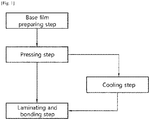
- FIG. 1 illustrates a method for manufacturing an alveolar bone regeneration membrane according to an embodiment of the present invention.
- the method for manufacturing an alveolar bone regeneration membrane according to an aspect of the present invention may include: (A) a step of preparing a base film by melting and molding a synthetic polymer resin; (B) a step of pressing the base film to prepare a first polymer film; and (C) a step of alternately laminating and bonding the first polymer film and a second polymer film containing a natural polymer resin; and may further include: a step of cooling the first polymer film between the steps (B) and (C), if necessary.
- the average pore size of the base film and the first polymer film may be D 1 and D 2 , respectively, and 0.1 ⁇ D 2 /D 1 ⁇ 0.5.
- the method for manufacturing an alveolar bone regeneration membrane may actually include: a step of preparing the first polymer film, a step of preparing the second polymer film, and a step of laminating and bonding the first and second polymer films.
- the first polymer film may be prepared by (A) a step of preparing a base film by melting and molding a synthetic polymer resin and (B) a step of pressing the base film to prepare a first polymer film.
- the synthetic polymer resin may be one selected from the group consisting of polylactic acid (PLA), polyglycolic acid (PGA), poly lactic-co-glycolic acid (PLGA), poly(L-lactic acid) (PLLA), polycaprolactone (PCL), poly(lactide-co-caprolactone) (PLCL), polyhydroxybutyrate (PHB), polyhydroxyvalerate (PHV), polydioxanone (PDO), poly(trimethylene carbonate) (PTMC), and combinations of two or more thereof, and may be preferably polycaprolactone (PCL), but is not limited thereto.
- the molding may be performed by one selected from the group consisting of casting, melt compression, extrusion, injection, additive manufacturing, and combinations of two or more thereof, preferably additive manufacturing, that is, a 3D printing method.
- the 3D printing may be performed using a fused deposition modeling (FDM) type 3D printer including one or more nozzles, and the nozzle may have a diameter of 0.1 to 0.5 mm.
- the nozzle may have a diameter of 0.1 mm or more, 0.2 mm or more, or 0.3 mm or more, and 0.5 mm or less.
- FDM fused deposition modeling
- the diameter of the nozzle is a factor that directly or indirectly affects the pore characteristics of the first polymer film, specifically, the porosity and/or the pore size, and for example, the larger the diameter of the nozzle is, the larger the average pore size of the base film may be.
- the pressurization may be performed at a pressure of 3 to 50 mPa.
- the pressure applied in the step (B) may be 3 mPa or more, or 30 mPa or more, and 50 mPa or less.
- the average pore size of the base film may be reduced by the pressurization, and with respect to the reducible range, for example, when the average pore size of the base film and the first polymer film is D 1 and D 2 , respectively, 0.1 ⁇ D 2 /D 1 ⁇ 0.5.
- the D 2 /D 1 value may be 0.1 or more, 0.15 or more, or 0.2 or more, and 0.5 or less, 0.45 or less, or 0.4 or less.
- the method for preparing the first polymer film may include: a step of preparing a synthetic polymer resin raw material as a powder phase having an average particle size of 0.1 to 2 mm; preparing the synthetic polymer resin raw material into a base film having a thickness of 0.1 to 0.5 mm and an average pore size of 0.1 to 3 mm; and reducing the average pore size and thickness of the base film by cooling the base film for 3 minutes to 3 hours and pressing the base film at 3 to 50 mPa; but each step and condition are not limited thereto.
- FIG. 2 illustrates a method for preparing a second polymer film according to an embodiment of the present invention.
- the second polymer film may be prepared by a method including (b1) a step of dissolving a second polymer resin in an acid solution; (b2) a step of fiberizing the second polymer resin by introducing a salt into the product of the step (b1); (b3) a step of drying the product of the step (b2); (b4) a step of cross-linking the second polymer resin by introducing a cross-linking agent into the product of the step (b3); and (b5) a step of washing and drying the product of the step (b4) and then pressurizing.
- the acid solution may include one selected from the group consisting of phosphoric acid, sulfuric acid, hydrochloric acid, nitric acid, acetic acid, and combinations of two or more thereof, but is not limited thereto.
- the salt may be one selected from the group consisting of a phosphate, a calcium salt, a sodium salt, and combinations of two or more thereof, and may be preferably a phosphate in consideration of compatibility with the step (b1), but is not limited thereto.
- the cross-linking agent may be one selected from the group consisting of formaldehyde, a-hydroxyadipaldehyde, glutaraldehyde, 1-ethyl-3-(3-dimethylaminopropyl)-carbodiimide/N-hydroxy succinimide (EDC/NHS), and combinations of two or more thereof, and may be preferably glutaraldehyde, but is not limited thereto.
- the natural polymer resin may be one selected from the group consisting of collagen, chitosan, hyaluronic acid, carboxymethyl cellulose, heparan sulfate, dextran, alginate, and combinations of two or more thereof, and may be preferably collagen, but is not limited thereto.
- the collagen may be extracted from one selected from the group consisting of porcine skin, porcine pericardium, porcine tendon, bovine skin, bovine pericardium, bovine tendon, and combinations of two or more thereof, but is not limited thereto.
- the washing may be performed using one selected from the group consisting of purified water, phosphate buffered saline (PBS), ethanol, and combinations of two or more thereof.
- PBS phosphate buffered saline
- an alveolar regeneration membrane which is a final product may be prepared by alternately laminating and bonding the first polymer film and a second polymer film containing a natural polymer resin.
- the step (C) may include: (c1) a step of alternately laminating the first and second polymer films; and (c2) a step of heating the product of the step (c1) to a temperature of 30 to 80°C and bonding the product at a pressure of 3 to 30 mPa.
- the heating temperature in the step (c2) may be 30°C or more, 40°C or more, or 50°C or more, and 80°C or less, 70°C or less, or 60°C or less.
- the pressure applied in the step (c2) may be 3 mPa or more, 7 mPa or more, or 11 mPa or more, and 30 mPa or less, 26 mPa or less, or 22 mPa or less.
- the second polymer film including a natural polymer resin may be laminated and bonded on at least one surface, preferably both surfaces of the first polymer film.
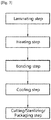
- FIG. 3 illustrates a method for laminating and bonding a synthetic polymer film and a natural polymer film according to an embodiment of the present invention.
- a method for laminating and bonding the first and second polymer films may include: for example, a step of alternately laminating the first and second polymer films into 2 to 10 layers and heating the films to 30 to 80°C; a step of bonding the first and second polymer films by pressing the first and second polymer films at a pressure of 3 to 30 mPa; a step of cooling a bonded membrane for 3 minutes to 3 hours; a step of cutting the cooled membrane into an appropriate size; and a step of sterilizing the cut membrane, and then packaging the sterilized membrane, but each step and condition are not limited thereto.
- Polycaprolactone (PCL) was supplied to a 3D printer nozzle having a diameter of 0.2 mm, the polycaprolactone was melted by heating the nozzle to 130°C, and then a base film having an average pore size of 1.2 mm was prepared by injecting the polycaprolactone at a pressure of 300 kPa.
- a polymer film having an average pore size of 0.5 mm was obtained by cooling the injected base film at 25°C for 5 minutes and then pressing the cooled base film at a pressure of 30 mPa.
- an alveolar bone regeneration membrane having a three-layered structure of collagen/polycaprolactone/collagen (Col/PCL/Col) and an average pore size and a thickness of 0.2 mm and 0.4 mm, respectively, was manufactured by thermo-compressing the laminate under the conditions of 80°C and 20 mPa with a plate-type thermocompressor (Qmesys, QM900M) for 5 minutes.
- a plate-type thermocompressor Qmesys, QM900M
- An alveolar bone regeneration membrane was manufactured in the same manner as in Example 1, except that the diameter of the 3D printer nozzle was changed to 0.4 mm during the preparation of the polymer film.
- An alveolar bone regeneration membrane was manufactured in the same manner as in Example 1, except that the average pore size of the alveolar bone regeneration membrane was adjusted to 0.4 mm by changing the pressure of the thermocompressor to 7 mPa during the manufacture of the alveolar bone regeneration membrane.
- An alveolar bone regeneration membrane was manufactured in the same manner as in Example 1, except that the collagen film was laminated on one surface of the polymer film during the manufacture of the alveolar bone regeneration membrane.
- An alveolar bone regeneration membrane was manufactured in the same manner as in Example 1, except that the temperature and pressure of the thermocompressor were changed to 50°C and 5 mPa, respectively, during the manufacture of the alveolar bone regeneration membrane.
- An alveolar bone regeneration membrane was manufactured in the same manner as in Example 1, except that the temperature and pressure of the thermocompressor were changed to 50°C and 30 mPa, respectively, during the manufacture of the alveolar bone regeneration membrane.
- An alveolar bone regeneration membrane was manufactured in the same manner as in Example 1, except that the pressure of the thermocompressor was changed to 5 mPa during the manufacture of the alveolar bone regeneration membrane.
- An alveolar bone regeneration membrane was manufactured in the same manner as in Example 1, except that the pressure of the thermocompressor was changed to 30 mPa during the manufacture of the alveolar bone regeneration membrane.
- An alveolar bone regeneration membrane (OssGuideTM, manufactured by SK Bioland Co., Ltd., thickness 0.5 mm) made of a collagen material, which was commercially available, was prepared.
- An alveolar bone regeneration membrane was manufactured in the same manner as in Example 1, except that the preparation of the polymer film was changed as follows.
- PLGA was melted at a temperature of 200°C before being moved into a barrel of an injection molding machine (Fanuc, i30A-injection molding machine), then placed in a molding portion in the form of a sheet and injection-molded at a pressure of 1,800 bar and a temperature of 200°C.
- a PLGA plate-type material was obtained by cooling the injection-molded PLGA at 25°C for 10 minutes, and then detaching the cooled PLGA from the molding portion.
- An alveolar bone regeneration membrane was manufactured in the same manner as in Example 1, except that the base film was pressed at a pressure of 2 mPa during the preparation of the polymer film.
- An alveolar bone regeneration membrane was manufactured in the same manner as in Example 1, except that the base film was pressed at a pressure of 60 mPa during the preparation of the polymer film.
- the space retention ability and moldability of the alveolar bone regeneration membranes according to the Examples and the Comparative Examples were compared and evaluated.
- the space retention ability was evaluated through bending strength using a push-pull gauge (HG-500) in FIG. 4
- the moldability was evaluated through an elastic recovery rate using a universal material tester (INSTRON 3365) in FIG. 5 .
- Table 4 and FIG. 6 shows the results of evaluating the space retention ability and moldability of the alveolar bone regeneration membranes according to the Examples and the Comparative Examples.
- Table 4 Classification Bending strength (N) Elastic recovery rate (%) Example 1 19 - Example 2 31 - Example 3 11 - Example 4 9 - Example 5 12 0 Example 6 18 17 Example 7 24 33 Example 8 40 89 Comparative Example 1 0.3 100 Comparative Example 2 0.5 100 Comparative Example 3 2 45 Comparative Example 4 3 51 Comparative Example 5 42 100
- both Comparative Examples 1 and 2 which are existing alveolar bone regeneration membranes made of a collagen material, showed a bending strength of 1 N or less, but the bending strengths of the membranes according to Examples 1 to 4 were shown to be 9 N or more, so that an improved fixing force can be implemented compared to Comparative Examples 1 and 2.
- Examples 5 to 8 in which the pore size of the membrane is adjusted within a predetermined range by adjusting the pressure and temperature during the bonding of the laminated membrane, has a bending strength of 12 N or more and simultaneously exhibits an elastic recovery rate of 90% or less, and thus has sufficient moldability at room temperature.
- Comparative Examples 3 to 5 failed to implement the space retention ability and moldability in a balanced manner. Specifically, the membranes of Comparative Examples 3 and 4 having a D 2 /D 1 value of more than 0.5 have good moldability, but have remarkably poor space retention ability, and the membrane of Comparative Example 5 having a D 2 /D 1 value of less than 0.1 has a good space retention ability, but shows an elastic recovery rate of 100%, and thus has remarkably poor moldability.
- the membrane of Examples 1 and 2 have an ability to allow nutrients to pass through the membrane, which is equal to or more than those of Comparative Examples 1 and 2, which are existing alveolar bone regeneration membranes made of a collagen material, and particularly, the difference in permeation ability is more noticeably confirmed after about 40 hours have passed.
Landscapes
- Chemical & Material Sciences (AREA)
- Health & Medical Sciences (AREA)
- Engineering & Computer Science (AREA)
- Medicinal Chemistry (AREA)
- Chemical Kinetics & Catalysis (AREA)
- Materials Engineering (AREA)
- Organic Chemistry (AREA)
- Polymers & Plastics (AREA)
- Life Sciences & Earth Sciences (AREA)
- Manufacturing & Machinery (AREA)
- General Health & Medical Sciences (AREA)
- Animal Behavior & Ethology (AREA)
- Public Health (AREA)
- Veterinary Medicine (AREA)
- Mechanical Engineering (AREA)
- Physics & Mathematics (AREA)
- Optics & Photonics (AREA)
- Oral & Maxillofacial Surgery (AREA)
- Epidemiology (AREA)
- Heart & Thoracic Surgery (AREA)
- Vascular Medicine (AREA)
- Transplantation (AREA)
- Orthopedic Medicine & Surgery (AREA)
- Biomedical Technology (AREA)
- Cardiology (AREA)
- Surgery (AREA)
- Dermatology (AREA)
- Developmental Biology & Embryology (AREA)
- Dentistry (AREA)
- Biochemistry (AREA)
- Ceramic Engineering (AREA)
- Dispersion Chemistry (AREA)
- Materials For Medical Uses (AREA)
Applications Claiming Priority (2)
| Application Number | Priority Date | Filing Date | Title |
|---|---|---|---|
| KR1020180171560A KR102142321B1 (ko) | 2018-12-28 | 2018-12-28 | 치조골 재생 차폐막의 제조방법 |
| PCT/KR2019/017576 WO2020138779A1 (ko) | 2018-12-28 | 2019-12-12 | 치조골 재생 차폐막의 제조방법 |
Publications (2)
| Publication Number | Publication Date |
|---|---|
| EP3882006A1 true EP3882006A1 (de) | 2021-09-22 |
| EP3882006A4 EP3882006A4 (de) | 2022-08-17 |
Family
ID=71127234
Family Applications (1)
| Application Number | Title | Priority Date | Filing Date |
|---|---|---|---|
| EP19904876.0A Pending EP3882006A4 (de) | 2018-12-28 | 2019-12-12 | Verfahren zur herstellung einer alveolarknochenregenerationsmembran |
Country Status (3)
| Country | Link |
|---|---|
| EP (1) | EP3882006A4 (de) |
| KR (1) | KR102142321B1 (de) |
| WO (1) | WO2020138779A1 (de) |
Cited By (1)
| Publication number | Priority date | Publication date | Assignee | Title |
|---|---|---|---|---|
| WO2025242824A1 (fr) | 2024-05-22 | 2025-11-27 | Glad Medical | Piece de recouvrement d'un defaut osseux |
Families Citing this family (1)
| Publication number | Priority date | Publication date | Assignee | Title |
|---|---|---|---|---|
| CN116688248B (zh) * | 2023-06-20 | 2025-01-28 | 湖南大学 | 一种抗组织粘连薄膜及其制备方法和应用 |
Family Cites Families (7)
| Publication number | Priority date | Publication date | Assignee | Title |
|---|---|---|---|---|
| JP3379088B2 (ja) * | 2000-03-29 | 2003-02-17 | 科学技術振興事業団 | 生体材料用複合体およびその製造方法 |
| KR100968231B1 (ko) * | 2007-12-28 | 2010-07-06 | 한양대학교 산학협력단 | 골조직유도 재생용 차폐막 및 이의 제조방법 |
| KR20140003942A (ko) * | 2012-07-02 | 2014-01-10 | 주식회사 네오바이오텍 | 연조직 또는 골조직 성장이 우수한 치과용 차폐막 |
| KR101649122B1 (ko) * | 2014-12-09 | 2016-08-19 | 오스템임플란트 주식회사 | 성장인자가 포함된 흡수성 치조골 재생막 및 이의 제조방법 |
| KR101649125B1 (ko) * | 2014-12-09 | 2016-08-30 | 오스템임플란트 주식회사 | 치주 재생용 멤브레인 및 이의 제조방법 |
| KR101741255B1 (ko) * | 2016-03-11 | 2017-05-29 | 오스템임플란트 주식회사 | 두께 구배를 가지는 치조골 재생용 멤브레인 |
| KR102685018B1 (ko) * | 2016-09-02 | 2024-07-15 | 전남대학교산학협력단 | 음경용 인공 생체조직 및 3d 프린팅을 이용한 음경용 인공 생체조직의 제조방법 |
-
2018
- 2018-12-28 KR KR1020180171560A patent/KR102142321B1/ko active Active
-
2019
- 2019-12-12 WO PCT/KR2019/017576 patent/WO2020138779A1/ko not_active Ceased
- 2019-12-12 EP EP19904876.0A patent/EP3882006A4/de active Pending
Cited By (2)
| Publication number | Priority date | Publication date | Assignee | Title |
|---|---|---|---|---|
| WO2025242824A1 (fr) | 2024-05-22 | 2025-11-27 | Glad Medical | Piece de recouvrement d'un defaut osseux |
| FR3162353A1 (fr) * | 2024-05-22 | 2025-11-28 | Glad Medical | Piece de recouvrement d’un defaut osseux |
Also Published As
| Publication number | Publication date |
|---|---|
| EP3882006A4 (de) | 2022-08-17 |
| WO2020138779A1 (ko) | 2020-07-02 |
| KR20200087885A (ko) | 2020-07-22 |
| KR102142321B1 (ko) | 2020-08-10 |
Similar Documents
| Publication | Publication Date | Title |
|---|---|---|
| CA2219995C (en) | Implantable bioresorbable membrane and method for the preparation thereof | |
| EP1981558B1 (de) | Vernähbares reparaturprodukt mit collagenmatrix für dura und meninges | |
| US8932619B2 (en) | Dural repair material | |
| KR101649125B1 (ko) | 치주 재생용 멤브레인 및 이의 제조방법 | |
| KR101461652B1 (ko) | 유착방지용 조성물, 이를 포함하는 유착방지기능을 갖는 수술용 메쉬 복합체 및 이의 제조 방법 | |
| JP2001505114A (ja) | 生分解性ポリマー膜 | |
| AU2011231259A1 (en) | Implant for tissue repair | |
| KR101964907B1 (ko) | 상이한 생분해 속도를 갖는 콜라겐층이 적층된 복합 콜라겐 멤브레인 및 이의 제조 방법 | |
| EP3882006A1 (de) | Verfahren zur herstellung einer alveolarknochenregenerationsmembran | |
| EP2286822A1 (de) | Diabetesbehandlung | |
| Thuaksuban et al. | Biodegradable polycaprolactone-chitosan three-dimensional scaffolds fabricated by melt stretching and multilayer deposition for bone tissue engineering: assessment of the physical properties and cellular response | |
| JP2021500170A (ja) | 人体に導入するための生体適合性複合材料 | |
| JPH07236688A (ja) | 生体吸収性プラスチックとコラーゲンの複合材料 | |
| EP3946483B1 (de) | Verfahren zur herstellung von gewebe- und organersatz | |
| KR20210001474A (ko) | 치주 재생용 멤브레인 및 이의 제조방법 | |
| JP2001192337A (ja) | 癒着防止材料 | |
| CN215690222U (zh) | 一种屏障膜 | |
| US11000989B2 (en) | Method for preparing a highly elastic, biodegradable, three-dimensional structure | |
| KR101649122B1 (ko) | 성장인자가 포함된 흡수성 치조골 재생막 및 이의 제조방법 | |
| RU2795561C1 (ru) | Заменители тканей и органов и способы их изготовления | |
| Pattanashetti et al. | Polyurethanes for Scaffolds | |
| HK40068891A (en) | Methods of making tissue and organ replacements | |
| HK40068891B (en) | Methods of making tissue and organ replacements |
Legal Events
| Date | Code | Title | Description |
|---|---|---|---|
| STAA | Information on the status of an ep patent application or granted ep patent |
Free format text: STATUS: THE INTERNATIONAL PUBLICATION HAS BEEN MADE |
|
| PUAI | Public reference made under article 153(3) epc to a published international application that has entered the european phase |
Free format text: ORIGINAL CODE: 0009012 |
|
| STAA | Information on the status of an ep patent application or granted ep patent |
Free format text: STATUS: REQUEST FOR EXAMINATION WAS MADE |
|
| 17P | Request for examination filed |
Effective date: 20210615 |
|
| AK | Designated contracting states |
Kind code of ref document: A1 Designated state(s): AL AT BE BG CH CY CZ DE DK EE ES FI FR GB GR HR HU IE IS IT LI LT LU LV MC MK MT NL NO PL PT RO RS SE SI SK SM TR |
|
| DAV | Request for validation of the european patent (deleted) | ||
| DAX | Request for extension of the european patent (deleted) | ||
| A4 | Supplementary search report drawn up and despatched |
Effective date: 20220718 |
|
| RIC1 | Information provided on ipc code assigned before grant |
Ipc: C08L 67/02 20060101ALI20220712BHEP Ipc: C08L 67/04 20060101ALI20220712BHEP Ipc: A61L 27/14 20060101ALI20220712BHEP Ipc: A61F 2/28 20060101ALI20220712BHEP Ipc: A61C 8/02 20060101ALI20220712BHEP Ipc: B29C 65/02 20060101ALI20220712BHEP Ipc: B29C 64/209 20170101ALI20220712BHEP Ipc: B29C 64/118 20170101ALI20220712BHEP Ipc: B29C 64/147 20170101ALI20220712BHEP Ipc: B29C 64/188 20170101AFI20220712BHEP |
|
| STAA | Information on the status of an ep patent application or granted ep patent |
Free format text: STATUS: EXAMINATION IS IN PROGRESS |
|
| 17Q | First examination report despatched |
Effective date: 20251022 |