EP3881374B1 - Verfahren zur herstellung einer positiven elektrode für eine batteriezelle - Google Patents
Verfahren zur herstellung einer positiven elektrode für eine batteriezelle Download PDFInfo
- Publication number
- EP3881374B1 EP3881374B1 EP19806112.9A EP19806112A EP3881374B1 EP 3881374 B1 EP3881374 B1 EP 3881374B1 EP 19806112 A EP19806112 A EP 19806112A EP 3881374 B1 EP3881374 B1 EP 3881374B1
- Authority
- EP
- European Patent Office
- Prior art keywords
- conductive additive
- active material
- method step
- particles
- binder
- Prior art date
- Legal status (The legal status is an assumption and is not a legal conclusion. Google has not performed a legal analysis and makes no representation as to the accuracy of the status listed.)
- Active
Links
Images

Classifications
-
- H—ELECTRICITY
- H01—ELECTRIC ELEMENTS
- H01M—PROCESSES OR MEANS, e.g. BATTERIES, FOR THE DIRECT CONVERSION OF CHEMICAL ENERGY INTO ELECTRICAL ENERGY
- H01M4/00—Electrodes
- H01M4/02—Electrodes composed of, or comprising, active material
- H01M4/04—Processes of manufacture in general
- H01M4/0402—Methods of deposition of the material
- H01M4/0416—Methods of deposition of the material involving impregnation with a solution, dispersion, paste or dry powder
-
- H—ELECTRICITY
- H01—ELECTRIC ELEMENTS
- H01M—PROCESSES OR MEANS, e.g. BATTERIES, FOR THE DIRECT CONVERSION OF CHEMICAL ENERGY INTO ELECTRICAL ENERGY
- H01M4/00—Electrodes
- H01M4/02—Electrodes composed of, or comprising, active material
- H01M4/04—Processes of manufacture in general
- H01M4/0402—Methods of deposition of the material
- H01M4/0404—Methods of deposition of the material by coating on electrode collectors
-
- H—ELECTRICITY
- H01—ELECTRIC ELEMENTS
- H01M—PROCESSES OR MEANS, e.g. BATTERIES, FOR THE DIRECT CONVERSION OF CHEMICAL ENERGY INTO ELECTRICAL ENERGY
- H01M4/00—Electrodes
- H01M4/02—Electrodes composed of, or comprising, active material
- H01M4/13—Electrodes for accumulators with non-aqueous electrolyte, e.g. for lithium-accumulators; Processes of manufacture thereof
- H01M4/139—Processes of manufacture
-
- H—ELECTRICITY
- H01—ELECTRIC ELEMENTS
- H01M—PROCESSES OR MEANS, e.g. BATTERIES, FOR THE DIRECT CONVERSION OF CHEMICAL ENERGY INTO ELECTRICAL ENERGY
- H01M10/00—Secondary cells; Manufacture thereof
- H01M10/05—Accumulators with non-aqueous electrolyte
- H01M10/052—Li-accumulators
-
- H—ELECTRICITY
- H01—ELECTRIC ELEMENTS
- H01M—PROCESSES OR MEANS, e.g. BATTERIES, FOR THE DIRECT CONVERSION OF CHEMICAL ENERGY INTO ELECTRICAL ENERGY
- H01M4/00—Electrodes
- H01M4/02—Electrodes composed of, or comprising, active material
- H01M2004/026—Electrodes composed of, or comprising, active material characterised by the polarity
- H01M2004/028—Positive electrodes
-
- H—ELECTRICITY
- H01—ELECTRIC ELEMENTS
- H01M—PROCESSES OR MEANS, e.g. BATTERIES, FOR THE DIRECT CONVERSION OF CHEMICAL ENERGY INTO ELECTRICAL ENERGY
- H01M2220/00—Batteries for particular applications
- H01M2220/20—Batteries in motive systems, e.g. vehicle, ship, plane
-
- H—ELECTRICITY
- H01—ELECTRIC ELEMENTS
- H01M—PROCESSES OR MEANS, e.g. BATTERIES, FOR THE DIRECT CONVERSION OF CHEMICAL ENERGY INTO ELECTRICAL ENERGY
- H01M4/00—Electrodes
- H01M4/02—Electrodes composed of, or comprising, active material
- H01M4/36—Selection of substances as active materials, active masses, active liquids
- H01M4/48—Selection of substances as active materials, active masses, active liquids of inorganic oxides or hydroxides
- H01M4/485—Selection of substances as active materials, active masses, active liquids of inorganic oxides or hydroxides of mixed oxides or hydroxides for inserting or intercalating light metals, e.g. LiTi2O4 or LiTi2OxFy
-
- H—ELECTRICITY
- H01—ELECTRIC ELEMENTS
- H01M—PROCESSES OR MEANS, e.g. BATTERIES, FOR THE DIRECT CONVERSION OF CHEMICAL ENERGY INTO ELECTRICAL ENERGY
- H01M4/00—Electrodes
- H01M4/02—Electrodes composed of, or comprising, active material
- H01M4/36—Selection of substances as active materials, active masses, active liquids
- H01M4/58—Selection of substances as active materials, active masses, active liquids of inorganic compounds other than oxides or hydroxides, e.g. sulfides, selenides, tellurides, halogenides or LiCoFy; of polyanionic structures, e.g. phosphates, silicates or borates
- H01M4/5825—Oxygenated metallic salts or polyanionic structures, e.g. borates, phosphates, silicates, olivines
-
- H—ELECTRICITY
- H01—ELECTRIC ELEMENTS
- H01M—PROCESSES OR MEANS, e.g. BATTERIES, FOR THE DIRECT CONVERSION OF CHEMICAL ENERGY INTO ELECTRICAL ENERGY
- H01M4/00—Electrodes
- H01M4/02—Electrodes composed of, or comprising, active material
- H01M4/62—Selection of inactive substances as ingredients for active masses, e.g. binders, fillers
- H01M4/621—Binders
- H01M4/622—Binders being polymers
- H01M4/623—Binders being polymers fluorinated polymers
-
- H—ELECTRICITY
- H01—ELECTRIC ELEMENTS
- H01M—PROCESSES OR MEANS, e.g. BATTERIES, FOR THE DIRECT CONVERSION OF CHEMICAL ENERGY INTO ELECTRICAL ENERGY
- H01M4/00—Electrodes
- H01M4/02—Electrodes composed of, or comprising, active material
- H01M4/62—Selection of inactive substances as ingredients for active masses, e.g. binders, fillers
- H01M4/624—Electric conductive fillers
- H01M4/625—Carbon or graphite
-
- Y—GENERAL TAGGING OF NEW TECHNOLOGICAL DEVELOPMENTS; GENERAL TAGGING OF CROSS-SECTIONAL TECHNOLOGIES SPANNING OVER SEVERAL SECTIONS OF THE IPC; TECHNICAL SUBJECTS COVERED BY FORMER USPC CROSS-REFERENCE ART COLLECTIONS [XRACs] AND DIGESTS
- Y02—TECHNOLOGIES OR APPLICATIONS FOR MITIGATION OR ADAPTATION AGAINST CLIMATE CHANGE
- Y02E—REDUCTION OF GREENHOUSE GAS [GHG] EMISSIONS, RELATED TO ENERGY GENERATION, TRANSMISSION OR DISTRIBUTION
- Y02E60/00—Enabling technologies; Technologies with a potential or indirect contribution to GHG emissions mitigation
- Y02E60/10—Energy storage using batteries
Definitions
- the present invention relates to a method according to the preamble of the independent claim.
- secondary batteries preferably lithium-ion batteries, are suitable for storing electrical energy in various applications, especially in electrically powered vehicles.
- Lithium-ion batteries comprise one or more lithium-ion battery cells.
- Such lithium-ion battery cells usually contain one or more electrode units in the form of electrode coils or electrode stacks, which have at least one positive electrode, at least one negative electrode and at least one ion-conducting separator that spatially separates the positive and negative electrodes from one another.
- the positive or negative electrode is located on a positive or negative current collector.
- the electrode units are accommodated in a housing, which can be prismatic, round or foil-like depending on the application.
- a method for producing a positive electrode from the US 2017/8468 A1 in which, in a first process step, a mixture of an active material comprising a plurality of active material particles and a conductive additive is provided.
- the active material particles preferably have an average diameter of 10 to 50 nm.
- the cathode paste comprises, among other things, an electroactive material which is mixed with graphene (conductive additive), wherein the ratio of the domain diameter of the electroactive material to the domain diameter of the graphene is between 3:2 and 15:1 and the solids content in the cathode paste is 80%.
- a method for producing a positive electrode for a battery cell wherein the positive electrode comprises an active material and a conductive additive.
- the active material contains a first number of active material particles, in particular spherical active material particles, which have a first average diameter.
- a second number of conductive additive particles is also included.
- the conductive additive particles have a second average diameter.
- active material are the material components of an electrode at which the corresponding electrochemical processes take place during operation of the battery cell, such as the intercalation or deintercalation of lithium ions.
- the conductive additive serves to increase the electrical conductivity in the positive electrode and to electrically connect individual active material particles with each other.
- the active material and the conductive additive are provided, wherein the number of conductive additive particles is adjusted depending on a ratio of the second average diameter to the first average diameter and on the number of active material particles.
- a surface of the active material particles is coated with conductive additive material particles across the entire surface.
- the surface of the active material particles is largely completely covered by the conductive additive particles provided. This significantly reduces the total electrical resistance of the battery cell, which includes an ohmic resistance, a charge transfer resistance and a diffusion resistance, compared to conventional battery cells.
- the weight of the binder is set equal to the weight of the conductive additive particles provided in the first process step.
- the dispersion of the binder and the conductive additive particles is mixed with the active material particles provided in the first process step.
- a further amount of binder is mixed with a further amount of conductive additive particles in a fourth process step.
- the total amount of conductive additive particles in the positive electrode is preferably 4% to 10% based on the total amount of active material particles.
- the total amount of conductive additive particles is made up of an amount according to the first process step and a further amount according to the third process step.
- the mixture comprising binder and conductive additive particles from the fourth process step is mixed with the mixture from the third process step.
- the solvent can be N-methyl-2-pyrrolidone (NMP).
- the suspension according to the sixth process step is applied to a carrier foil to form a positive electrode layer.
- the carrier foil preferably has an aluminum foil, which also functions as a positive current collector. After the suspension has been applied to the carrier foil, the solvent is finally evaporated, for example in an autoclave.
- the method according to the invention can be advantageously used for positive electrodes in lithium-ion battery cells, which are used in electric vehicles, in hybrid vehicles, or in stationary applications such as for storing energy generated from renewable sources.
- a method 10 according to the invention for producing a positive electrode for a battery cell, preferably a lithium-ion battery cell, is shown schematically.
- the method 10 can be carried out, for example, in the order shown.
- an active material and a conductive additive are provided.
- the active material can be a lithium metal oxide, a lithium iron phosphate or a lithium titanate oxide and the conductive additive can comprise carbon black.
- the active material has a first number n 1 of active material particles, in particular spherical active material particles.
- the conductive additive has a second number n 2 of conductive additive particles, in particular spherical conductive additive particles.
- the number of conductive additive particles to be used is determined depending on a ratio of the second average diameter D 2 of the conductive additive particles to the first average diameter D 1 of the active material particles and the number of active material particles provided
- the conductive additive particles are dispersed in a binder according to the first method step.
- the binder can comprise, for example, a polymer, preferably polyvinylidene fluoride (PVDF).
- PVDF polyvinylidene fluoride
- a weight of the binder is set such that the weight of the binder is equal to a weight of the conductive additive particles.
- a third process step 106 the dispersion is mixed with the active material particles provided according to the first process step 102.
- a further amount of binder is mixed with a further amount of conductive additive particles.
- a fifth process step 110 the mixture of the further amount of binder and the further amount of conductive additive particles is combined with the mixture according to the third process step 106.
- a sixth process step 112 the mixture according to the fifth process step 110 is suspended in a solvent, preferably N-methyl-2-pyrrolidone (NMP).
- NMP N-methyl-2-pyrrolidone
- This suspension is applied to a carrier foil in a seventh process step 114.
- This carrier foil can be an aluminum foil, which also functions as a positive current collector for the positive electrode.
- an eighth process step 116 the solvent of the suspension is evaporated.
- This process can preferably be carried out in an autoclave at a temperature of 140 °C to 160 °C.
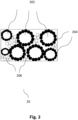
- FIG 2 is a sectional view of a positive electrode 20, which is produced according to the method 10 described above, shown schematically in the form of a positive electrode layer.
- the positive electrode 20 comprises at least a number of in particular spherical active material particles 202 and a mixture 204 of in particular spherical conductive additive material particles and a weight of binder.
- the surfaces of the in particular spherical active material particles 202 are covered with the mixture 204.
- a further mixture 206 of a further amount of in particular spherical conductive additive material particles and a further amount of binder is provided in the spaces between the in particular spherical active material particles 202 covered with the mixture 204.
- the in particular spherical active material particles 202 can be of different sizes.
- Such positive electrodes 20 can be advantageously used for battery cells that are used in motor vehicles, in particular in electric vehicles (EV), hybrid vehicles (HEV) and plug-in hybrid vehicles (PHEV).
- EV electric vehicles
- HEV hybrid vehicles
- PHEV plug-in hybrid vehicles
Landscapes
- Chemical & Material Sciences (AREA)
- Chemical Kinetics & Catalysis (AREA)
- Electrochemistry (AREA)
- General Chemical & Material Sciences (AREA)
- Engineering & Computer Science (AREA)
- Manufacturing & Machinery (AREA)
- Dispersion Chemistry (AREA)
- Materials Engineering (AREA)
- Battery Electrode And Active Subsutance (AREA)
Description
- Die vorliegende Erfindung bezieht sich auf ein Verfahren gemäß dem Oberbegriff des unabhängigen Anspruchs.
- Aufgrund ihrer großen Energiedichte und ihrer guten thermischen Stabilität sind Sekundärbatterien, bevorzugt Lithium-Ionen-Batterien, zur Speicherung elektrischer Energie in verschiedenen Anwendungsgebieten, vor allem in elektrisch angetriebenen Fahrzeugen geeignet.
- Dabei umfassen Lithium-Ionen-Batterien eine oder mehrere Lithium-Ionen-Batteriezellen. Derartige Lithium-lonen-Batteriezellen beinhalten üblicherweise eine oder mehrere Elektrodeneinheiten in Form von Elektrodenwickeln oder Elektrodenstapeln, die zumindest eine positive Elektrode, zumindest eine negative Elektrode und zumindest einen ionenleitenden Separator aufweisen, der die positive und die negative Elektrode räumlich voneinander trennt. Die positive bzw. negative Elektrode befindet sich auf einem positiven bzw. negativen Stromsammler. Unter Ausbildung einer Lithium-lonen-Batteriezelle sind die Elektrodeneinheiten in einem Gehäuse aufgenommen, welches je nach Anwendungsfall prismatisch, rund oder folienartig sein kann.
- Die die Lithium-lonen-Batteriezellen kennzeichnenden Eigenschaften, wie elektrische Leitfähigkeit, Leistungsdichte sowie Energiedichte, sind hauptsächlich
Neue Beschreibungsseite 2 in Reinschrift von Design und Materialeigenschaften sowie dem Herstellungsprozess der positiven Elektrode abhängig. - Diesbezüglich ist ein Verfahren zur Herstellung einer positiven Elektrode aus der
US 2017/8468 A1 - Ein weiteres Verfahren zur Herstellung einer positiven Elektrode für eine Lithium-lonen-Batteriezelle ist aus der
US 2017/098817 A1 bekannt, bei dem eine Mischung aus einem Aktivmaterial und einem Leitadditiv in einem ersten Verfahrensschritt bereitgestellt wird, wobei das Aktivmaterial vorzugsweise größere Partikel als das Leitadditiv aufweist. - Aus dem Dokument
US 2015/194674 A1 ist ein Verfahren zur Herstellung einer Kathode für eine Batteriezelle bekannt, wobei die Kathodenpaste u.a. ein elektroaktives Material umfasst, welches mit Graphen (Leitadditiv) durchmischt ist, wobei das Verhältnis des Domänendurchmessers des elektroaktiven Materials zum Domänendurchmesser des Graphens zwischen 3:2 und 15:1 liegt und der Feststoffanteil in der Kathodenpaste 80% beträgt. - Erfindungsgemäß wird ein Verfahren zur Herstellung einer positiven Elektrode für eine Batteriezelle bereitgestellt, wobei die positive Elektrode ein Aktivmaterial und ein Leitadditiv umfasst.
- Dabei beinhaltet das Aktivmaterial eine erste Anzahl an Aktivmaterialpartikeln, insbesondere an kugelförmigen Aktivmaterialpartikeln, die einen ersten mittleren Durchmesser aufweisen. Zugleich ist eine zweite Anzahl an Leitadditivpartikeln,
- insbesondere an kugelförmigen Leitadditivpartikeln, vorgesehen. Dabei weisen die Leitadditivpartikel einen zweiten mittleren Durchmesser auf. Als Aktivmaterial werden Materialanteile einer Elektrode bezeichnet, an denen im Betrieb der Batteriezelle die entsprechenden elektrochemischen Vorgänge ablaufen, wie beispielsweise, die Interkalation oder Deinterkalation von Lithiumionen.
- Das Leitadditiv dient dazu, die elektrische Leitfähigkeit in der positiven Elektrode zu erhöhen und einzelne Aktivmaterialpartikel miteinander elektrisch zu verbinden.
- In einem ersten Verfahrensschritt werden das Aktivmaterial und das Leitadditiv bereitgestellt, wobei die Anzahl der Leitadditivpartikel abhängig von einem Verhältnis des zweiten mittleren Durchmessers zu dem ersten mittleren Durchmesser und von der Anzahl der Aktivmaterialpartikel eingestellt wird.
- Dabei ist es vorteilhaft, dass eine Oberfläche der Aktivmaterialpartikel flächendeckend mit Leitadditivmaterialpartikeln beschichtet wird. Durch die vorbeschriebene Festlegung der Anzahl der Leitadditivpartikel wird die Oberfläche der Aktivmaterialpartikel durch die bereitgestellten Leitadditivpartikel weitgehend vollständig bedeckt. Dadurch wird der elektrische Gesamtwiderstand der Batteriezelle umfassend einen ohmschen Widerstand, einen Ladungsübertragungswiderstand und einen Diffusionswiderstand im Vergleich zu üblichen Batteriezellen deutlich reduziert.
- Weitere vorteilhafte Ausführungsformen der vorliegenden Erfindung sind Gegenstand der Unteransprüche.
- So ist es von Vorteil, wenn in einem zweiten Verfahrensschritt Leitadditivpartikel in einem Binder dispergiert werden.
- Weiterhin ist es von Vorteil, wenn in dem zweiten Verfahrensschritt eine Einwaage des Binders gleich der Einwaage der in dem ersten Verfahrensschritt bereitgestellten Leitadditivpartikel eingestellt wird.
- Weiterhin ist es von Vorteil, wenn in einem dritten Verfahrensschritt die Dispersion aus dem Binder und den Leitadditivpartikeln mit den Aktivmaterialpartikeln, die in dem ersten Verfahrensschritt bereitgestellt sind, gemischt wird.
- Um einen Diffusionswiderstand zu reduzieren, der durch Bewegung der Lithiumionen zwischen einer positiven und negativen Elektrode in einer Batteriezelle, vorzugsweise in einer Lithium-lonen-Batteriezelle, verursacht wird, wird in einem vierten Verfahrensschritt eine weitere Menge an Binder mit einer weiteren Menge an Leitadditivpartikeln gemischt. Die gesamte Menge an Leitadditivpartikeln in der positiven Elektrode beträgt vorzugsweise 4% bis 10% bezogen auf die gesamte Menge an Aktivmaterialpartikeln. Dabei setzt sich die gesamte Menge an Leitadditivpartikeln aus einer Menge gemäß dem ersten Verfahrensschritt und einer weiteren Menge gemäß dem dritten Verfahrensschritt zusammen.
- In einem fünften Verfahrensschritt wird die Mischung umfassend Binder und Leitadditivpartikel aus dem vierten Verfahrensschritt mit der Mischung aus dem dritten Verfahrensschritt gemischt.
- Hierbei ist es von Vorteil, wenn um alle Feststoffe, insbesondere den Binder, suspendieren zu können, in einem sechsten Verfahrensschritt ein Lösungsmittel zu der Mischung gemäß dem fünften Verfahrensschritt hinzugegeben wird. Dabei kann das Lösungsmittel N-Methyl-2-pyrrolidon (NMP) sein.
- Unter Ausbildung einer positiven Elektrodenschicht wird in einem siebten Verfahrensschritt die Suspension gemäß dem sechsten Verfahrensschritt auf einer Trägerfolie aufgebracht. Die Trägerfolie weist vorzugsweise eine Aluminiumfolie auf, die auch als ein positiver Stromsammler funktioniert. Nach dem Aufbringen der Suspension auf der Trägerfolie wird das Lösungsmittel abschließend beispielsweise in einem Autoklav abgedampft.
- Das erfindungsgemäße Verfahren lässt sich vorteilhaft für positive Elektroden in Lithium-Ionen-Batteriezellen einsetzen, die Anwendung in elektrischen Fahrzeugen, in Hybridfahrzeugen, oder in stationären Anwendungen wie beispielsweise zur Speicherung regenerativ gewonnener Energie finden.
- In der Zeichnung sind vorteilhafte Ausführungsformen der vorliegenden Erfindung dargestellt und in der nachfolgenden Figurenbeschreibung näher erläutert. Es zeigt:
- Figur 1:
- eine schematische Darstellung eines erfindungsgemäßen Verfahrens zur Herstellung einer positiven Elektrode für eine Batteriezelle,
- Figur 2:
- eine schematische Schnittansicht einer erfindungsgemäßen positiven Elektrode für eine Batteriezelle.
- In
Figur 1 ist ein erfindungsgemäßes Verfahren 10 zur Herstellung einer positiven Elektrode für eine Batteriezelle, vorzugsweise eine Lithium-lonen-Batteriezelle, schematisch dargestellt. Das Verfahren 10 kann beispielsweise in der dargestellten Reihenfolge erfolgen. - In einem ersten Verfahrensschritt 102 werden ein Aktivmaterial und ein Leitadditiv bereitgestellt. Vorzugsweise kann das Aktivmaterial ein Lithium-MetallOxid, ein Lithium-Eisen-Phosphat oder ein Lithium-Titanat-Oxid sein und das Leitadditiv Ruß umfassen.
- Dabei weist das Aktivmaterial eine erste Anzahl n 1 an Aktivmaterialpartikeln auf, insbesondere an kugelförmigen Aktivmaterialpartikeln. Darüber hinaus weist das Leitadditiv eine zweite Anzahl n 2 an Leitadditivpartikeln auf, insbesondere an kugelförmigen Leitadditivpartikeln. Dabei liegt ein erster mittlerer Durchmesser
D 1 der insbesondere kugelförmigen Aktivmaterialpartikel und ein zweiter mittlerer DurchmesserD 2 der insbesondere kugelförmigen Leitadditivpartikel vor. In dem ersten Verfahrensschritt wird die zu verwendende Anzahl der Leitadditivpartikel abhängig von einem Verhältnis des zweiten mittleren DurchmessersD 2 der Leitadditivpartikel zu dem ersten mittleren DurchmesserD 1 der Aktivmaterialpartikel und der Anzahl der bereitgestellten Aktivmaterialpartikel eingestellt. Die Einstellung kann mit der folgenden Formel mathematisch beschrieben werden:
- In einem zweiten Verfahrensschritt 104 werden die Leitadditivpartikel gemäß dem ersten Verfahrensschritt in einem Binder dispergiert. Der Binder kann beispielsweise ein Polymer umfassen, vorzugsweise Polyvinylidenfluorid (PVDF). Dabei wird eine Einwaage des Binders derart eingestellt, dass die Einwaage des Binders gleich einer Einwaage der Leitadditivpartikel ist.
- Danach wird die Dispersion in einem dritten Verfahrensschritt 106 mit den Aktivmaterialpartikeln, die gemäß dem ersten Verfahrensschritt 102 bereitgestellt sind, gemischt.
- Darauf wird in einem vierten Verfahrensschritt 108 eine weitere Menge an Binder mit einer weiteren Menge an Leitadditivpartikeln gemischt.
- Anschließend wird in einem fünften Verfahrensschritt 110 die Mischung aus der weiteren Menge an Binder und der weiteren Menge an Leitadditivpartikeln mit der Mischung gemäß dem dritten Verfahrensschritt 106 zusammengeführt.
- Danach wird in einem sechsten Verfahrensschritt 112 die Mischung gemäß dem fünften Verfahrensschritt 110 in einem Lösungsmittel, vorzugsweise N-Methyl-2-pyrrolidon (NMP), suspendiert. Diese Suspension wird in einem siebten Verfahrensschritt 114 auf einer Trägerfolie aufgebracht. Diese Trägerfolie kann eine Aluminiumfolie sein, welche zugleich als ein positiver Stromsammler für die positive Elektrode funktioniert.
- Abschließend wird in einem achten Verfahrensschritt 116 das Lösungsmittel der Suspension abgedampft. Dieser Prozess kann vorzugsweise in einem Autoklav bei einer Temperatur von 140 °C bis 160 °C durchgeführt werden.
- In
Figur 2 ist eine Schnittansicht einer positiven Elektrode 20, die gemäß dem vorbeschriebenen Verfahren 10 hergestellt ist, in Form einer positiven Elektrodenschicht schematisch dargestellt. Die positive Elektrode 20 umfasst zumindest eine Anzahl an insbesondere kugelförmigen Aktivmaterialpartikeln 202 und eine Mischung 204 aus insbesondere kugelförmigen Leitadditivmaterialpartikeln und einer Einwaage an Binder. Dabei sind die Oberflächen der insbesondere kugelförmigen Aktivmaterialpartikel 202 mit der Mischung 204 bedeckt. Ferner ist eine weitere Mischung 206 aus einer weiteren Menge an insbesondere kugelförmigen Leitadditivmaterialpartikeln und einer weiteren Menge an Binder in den Zwischenräumen zwischen den insbesondere kugelförmigen Aktivmaterialpartikeln 202 bedeckt mit der Mischung 204 vorgesehen. Die insbesondere kugelförmigen Aktivmaterialpartikel 202 können unterschiedlich groß sein. - Derartige positiven Elektroden 20 lassen sich vorteilhaft für Batteriezellen einsetzen, die in Kraftfahrzeugen, insbesondere in Elektrofahrzeugen (Electric Vehicle, EV), Hybridfahrzeugen (Hybride Electric Vehicle, HEV) sowie Plug-In-Hybridfahrzeugen (Plug-In-Hybride Electric Vehicle, PHEV) zum Einsatz kommen.
Claims (9)
- Verfahren zur Herstellung einer positiven Elektrode für eine Batteriezelle, mit einem Aktivmaterial und einem Leitadditiv,wobei das Aktivmaterial eine erste Anzahl an insbesondere kugelförmigen Aktivmaterialpartikeln mit einem ersten mittleren Durchmesser aufweist und wobeidas Leitadditiv eine zweite Anzahl an insbesondere kugelförmigen Leitadditivpartikeln mit einem zweiten mittleren Durchmesser aufweist, dadurch gekennzeichnet, dassin einem ersten Verfahrensschritt (102) das Aktivmaterial und das Leitadditiv bereitgestellt werden, wobei die Anzahl der Leitadditivpartikel abhängig von einem Verhältnis des zweiten mittleren Durchmessers zu dem ersten mittleren Durchmesser und von der Anzahl der Aktivmaterialpartikel eingestellt wird.
- Verfahren nach dem vorherigen Anspruch 1,wobei die positive Elektrode weiterhin einen Binder umfasst,dadurch gekennzeichnet, dassin einem zweiten Verfahrensschritt (104) Leitadditivpartikel in dem Binder dispergiert werden.
- Verfahren nach dem vorherigen Anspruch 2,dadurch gekennzeichnet, dassin dem zweiten Verfahrensschritt (104) eine Einwaage des Binders derart eingestellt wird, sodassdie Einwaage des Binders gleich einer Einwaage der Leitadditivpartikel ist.
- Verfahren nach dem vorherigen Anspruch 3,
dadurch gekennzeichnet, dass
in einem dritten Verfahrensschritt (106) die Dispersion aus dem zweiten Verfahrensschritt (104) mit den in dem ersten Verfahrensschritt (102) bereitgestellten Aktivmaterialpartikeln gemischt wird. - Verfahren nach dem vorherigen Anspruch 4,
dadurch gekennzeichnet, dass
in einem vierten Verfahrensschritt (108) eine weitere Menge an Binder mit einer weiteren Menge an Leitadditivpartikeln gemischt wird. - Verfahren nach dem vorherigen Anspruch 5,
dadurch gekennzeichnet, dass
in einem fünften Verfahrensschritt (110) die Mischung aus dem vierten Verfahrensschritt (108) mit der Mischung aus dem dritten Verfahrensschritt (106) gemischt wird. - Verfahren nach dem vorherigen Anspruch 6,
dadurch gekennzeichnet, dass
in einem sechsten Verfahrensschritt (112) die Mischung aus dem fünften Verfahrensschritt (110) in einem Lösungsmittel, insbesondere N-Methyl-2-pyrrolidon (NMP), suspendiert wird. - Verfahren nach dem vorherigen Anspruch 7,
dadurch gekennzeichnet, dass
in einem siebten Verfahrensschritt (114) die Suspension auf einer Trägerfolie, insbesondere einer Trägerfolie aus Aluminium, aufgebracht wird. - Verfahren nach dem vorherigen Anspruch 8,
dadurch gekennzeichnet, dass
abschließend in einem achten Verfahrensschritt (116) das Lösungsmittel von der Suspension abgedampft wird.
Applications Claiming Priority (2)
| Application Number | Priority Date | Filing Date | Title |
|---|---|---|---|
| DE102018219472.6A DE102018219472A1 (de) | 2018-11-15 | 2018-11-15 | Verfahren zur Herstellung einer positiven Elektrode für eine Batteriezelle |
| PCT/EP2019/080854 WO2020099312A1 (de) | 2018-11-15 | 2019-11-11 | Verfahren zur herstellung einer positiven elektrode für eine batteriezelle |
Publications (2)
| Publication Number | Publication Date |
|---|---|
| EP3881374A1 EP3881374A1 (de) | 2021-09-22 |
| EP3881374B1 true EP3881374B1 (de) | 2024-04-17 |
Family
ID=68621223
Family Applications (1)
| Application Number | Title | Priority Date | Filing Date |
|---|---|---|---|
| EP19806112.9A Active EP3881374B1 (de) | 2018-11-15 | 2019-11-11 | Verfahren zur herstellung einer positiven elektrode für eine batteriezelle |
Country Status (5)
| Country | Link |
|---|---|
| US (1) | US20220029143A1 (de) |
| EP (1) | EP3881374B1 (de) |
| CN (1) | CN112970133A (de) |
| DE (1) | DE102018219472A1 (de) |
| WO (1) | WO2020099312A1 (de) |
Family Cites Families (11)
| Publication number | Priority date | Publication date | Assignee | Title |
|---|---|---|---|---|
| JP2007173134A (ja) * | 2005-12-26 | 2007-07-05 | Sumitomo Osaka Cement Co Ltd | リチウムイオン電池の電極用材料、リチウムイオン電池の電極形成用スラリーおよびリチウムイオン電池 |
| CA2534276A1 (fr) * | 2006-01-26 | 2007-07-26 | Hydro Quebec | Melange cobroye d'un materiau actif et d'un materiau de conduction, ses procedes de preparation et ses applications |
| US9236594B2 (en) * | 2007-02-16 | 2016-01-12 | Namics Corporation | Lithium ion secondary battery and process for manufacturing the same |
| CN101393978B (zh) * | 2007-09-19 | 2012-11-28 | 深圳市比克电池有限公司 | 一种锂离子电池电极用浆料及其制备方法 |
| CN101504978B (zh) * | 2009-03-19 | 2011-11-09 | 厦门钨业股份有限公司 | 一种三元材料的锂离子电池正极片及其制备方法 |
| DE102010041544B4 (de) | 2010-09-28 | 2023-05-04 | Bayerische Motoren Werke Aktiengesellschaft | Fahrerassistenzsystem zur Unterstützung des Fahrers zum verbrauchskontrollierten Fahren |
| WO2013192258A1 (en) * | 2012-06-20 | 2013-12-27 | Cabot Corporation | Electrode formulations comprising graphenes |
| JP5664932B2 (ja) * | 2012-10-17 | 2015-02-04 | トヨタ自動車株式会社 | 二次電池 |
| CN107078284A (zh) * | 2014-05-21 | 2017-08-18 | 通用汽车环球科技运作有限责任公司 | 在锂电池组电极中的活性材料上分布导电性炭黑 |
| JP6631831B2 (ja) * | 2014-12-01 | 2020-01-15 | 株式会社豊田自動織機 | 二次電池用電極及び二次電池並びにこれらの製造方法 |
| CN107910546A (zh) * | 2017-11-09 | 2018-04-13 | 东莞深圳清华大学研究院创新中心 | 一种锂离子电池正电极用均匀浆料制备方法 |
-
2018
- 2018-11-15 DE DE102018219472.6A patent/DE102018219472A1/de not_active Withdrawn
-
2019
- 2019-11-11 EP EP19806112.9A patent/EP3881374B1/de active Active
- 2019-11-11 CN CN201980075244.7A patent/CN112970133A/zh active Pending
- 2019-11-11 WO PCT/EP2019/080854 patent/WO2020099312A1/de not_active Ceased
- 2019-11-11 US US17/294,059 patent/US20220029143A1/en not_active Abandoned
Also Published As
| Publication number | Publication date |
|---|---|
| CN112970133A (zh) | 2021-06-15 |
| DE102018219472A1 (de) | 2020-05-20 |
| EP3881374A1 (de) | 2021-09-22 |
| WO2020099312A1 (de) | 2020-05-22 |
| US20220029143A1 (en) | 2022-01-27 |
Similar Documents
| Publication | Publication Date | Title |
|---|---|---|
| DE112014000438B4 (de) | Festkörperbatterie und Verfahren zum Herstellen derselben | |
| DE102014226946B4 (de) | Elektrode einer All-Solid-State-Batterie und All-Solid-State-Batterie | |
| DE112016006819T5 (de) | Lithium-ionen-batterie und kondensator-hybridisierung auf material- und elektrodenniveau | |
| EP3611788A1 (de) | Wiederaufladbare elektrochemische zelle | |
| DE102013204872A1 (de) | Elektrode und Verfahren zum Herstellen derselben | |
| DE112012006430T5 (de) | Verschlechterungsdiagnosevorrichtung für eine Zelle, Verschlechterungsdiagnoseverfahren und Verfahren zur Herstellung einer Zelle | |
| DE102017207439A1 (de) | Elektroden mit verbesserter Beschichtung und Verfahren zu ihrer Herstellung | |
| DE102023116918A1 (de) | Mikron- und submikron-grosse lithium-eisen-phosphat-partikel und verfahren zum herstellen derselben | |
| EP3881374B1 (de) | Verfahren zur herstellung einer positiven elektrode für eine batteriezelle | |
| WO2018077937A1 (de) | Neue bindersysteme für silicium-haltige kompositelektroden für lithium-ionen-batterien | |
| DE102023104534B4 (de) | Sandwich-strukturierte, vorlithiierte anodenelektrode für all-festkörperbatterien | |
| DE102023132928A1 (de) | Verfahren zum vorformen von anodenpartikeln mit massgeschneiderter zusammensetzung der festkörperelektrolyt-zwischenphasen | |
| EP4200920A1 (de) | Verfahren zur herstellung einer elektrode einer batteriezelle, batteriezelle und verwendung derselben | |
| DE102021109109B4 (de) | Verfahren zur Herstellung einer Lithium-Ionen-Zelle | |
| DE102022209885A1 (de) | Verfahren zur Herstellung von zumindest einem Halbzeug einer Festkörperbatterie, Halbzeug einer Festkörperbatterie und, bevorzugt gewickelte, Festkörperbatterie | |
| DE102016217702A1 (de) | Kompositmaterial für eine Elektrode einer galvanischen Zelle | |
| DE102021201239A1 (de) | Festkörperelektrolyt für eine Elektrodenschicht einer Festkörperbatterie | |
| DE102023126389B3 (de) | Doppelschicht-elektrolyt | |
| DE102019210857A1 (de) | Lithium-Ionen-Batteriezelle und Verfahren zu deren Herstellung | |
| DE112019007013T5 (de) | Positive Elektrode für Lithium-Ionen-Batterie sowie Lithium-Ionen-Batterie | |
| DE102021213786A1 (de) | Verfahren zum Herstellen einer Elektrode, Elektrode | |
| DE102024113269A1 (de) | Verfahren zum herstellen einer batteriezelle | |
| DE102016212293B4 (de) | Verfahren zur Herstellung einer Kathode, Kathode und Batteriezelle | |
| DE102023127455A1 (de) | Schichtaufbau für elektrodenwickel einer batteriezelle | |
| DE102023117951A1 (de) | Elektrochemische elektrodenanordnung, elektrochemische speicherzelle und fahrzeug |
Legal Events
| Date | Code | Title | Description |
|---|---|---|---|
| STAA | Information on the status of an ep patent application or granted ep patent |
Free format text: STATUS: UNKNOWN |
|
| STAA | Information on the status of an ep patent application or granted ep patent |
Free format text: STATUS: THE INTERNATIONAL PUBLICATION HAS BEEN MADE |
|
| PUAI | Public reference made under article 153(3) epc to a published international application that has entered the european phase |
Free format text: ORIGINAL CODE: 0009012 |
|
| STAA | Information on the status of an ep patent application or granted ep patent |
Free format text: STATUS: REQUEST FOR EXAMINATION WAS MADE |
|
| 17P | Request for examination filed |
Effective date: 20210615 |
|
| AK | Designated contracting states |
Kind code of ref document: A1 Designated state(s): AL AT BE BG CH CY CZ DE DK EE ES FI FR GB GR HR HU IE IS IT LI LT LU LV MC MK MT NL NO PL PT RO RS SE SI SK SM TR |
|
| DAV | Request for validation of the european patent (deleted) | ||
| DAX | Request for extension of the european patent (deleted) | ||
| RIC1 | Information provided on ipc code assigned before grant |
Ipc: H01M 10/052 20100101ALN20231228BHEP Ipc: H01M 4/62 20060101ALN20231228BHEP Ipc: H01M 4/58 20100101ALN20231228BHEP Ipc: H01M 4/485 20100101ALN20231228BHEP Ipc: H01M 4/04 20060101ALI20231228BHEP Ipc: H01M 4/02 20060101ALI20231228BHEP Ipc: H01M 4/139 20100101AFI20231228BHEP |
|
| GRAP | Despatch of communication of intention to grant a patent |
Free format text: ORIGINAL CODE: EPIDOSNIGR1 |
|
| STAA | Information on the status of an ep patent application or granted ep patent |
Free format text: STATUS: GRANT OF PATENT IS INTENDED |
|
| INTG | Intention to grant announced |
Effective date: 20240208 |
|
| GRAS | Grant fee paid |
Free format text: ORIGINAL CODE: EPIDOSNIGR3 |
|
| GRAA | (expected) grant |
Free format text: ORIGINAL CODE: 0009210 |
|
| STAA | Information on the status of an ep patent application or granted ep patent |
Free format text: STATUS: THE PATENT HAS BEEN GRANTED |
|
| AK | Designated contracting states |
Kind code of ref document: B1 Designated state(s): AL AT BE BG CH CY CZ DE DK EE ES FI FR GB GR HR HU IE IS IT LI LT LU LV MC MK MT NL NO PL PT RO RS SE SI SK SM TR |
|
| REG | Reference to a national code |
Ref country code: GB Ref legal event code: FG4D Free format text: NOT ENGLISH |
|
| REG | Reference to a national code |
Ref country code: CH Ref legal event code: EP |
|
| REG | Reference to a national code |
Ref country code: IE Ref legal event code: FG4D Free format text: LANGUAGE OF EP DOCUMENT: GERMAN Ref country code: DE Ref legal event code: R096 Ref document number: 502019011081 Country of ref document: DE |
|
| REG | Reference to a national code |
Ref country code: LT Ref legal event code: MG9D |
|
| REG | Reference to a national code |
Ref country code: NL Ref legal event code: MP Effective date: 20240417 |
|
| PG25 | Lapsed in a contracting state [announced via postgrant information from national office to epo] |
Ref country code: NL Free format text: LAPSE BECAUSE OF FAILURE TO SUBMIT A TRANSLATION OF THE DESCRIPTION OR TO PAY THE FEE WITHIN THE PRESCRIBED TIME-LIMIT Effective date: 20240417 |
|
| PG25 | Lapsed in a contracting state [announced via postgrant information from national office to epo] |
Ref country code: NL Free format text: LAPSE BECAUSE OF FAILURE TO SUBMIT A TRANSLATION OF THE DESCRIPTION OR TO PAY THE FEE WITHIN THE PRESCRIBED TIME-LIMIT Effective date: 20240417 |
|
| PG25 | Lapsed in a contracting state [announced via postgrant information from national office to epo] |
Ref country code: IS Free format text: LAPSE BECAUSE OF FAILURE TO SUBMIT A TRANSLATION OF THE DESCRIPTION OR TO PAY THE FEE WITHIN THE PRESCRIBED TIME-LIMIT Effective date: 20240817 |
|
| PG25 | Lapsed in a contracting state [announced via postgrant information from national office to epo] |
Ref country code: BG Free format text: LAPSE BECAUSE OF FAILURE TO SUBMIT A TRANSLATION OF THE DESCRIPTION OR TO PAY THE FEE WITHIN THE PRESCRIBED TIME-LIMIT Effective date: 20240417 |
|
| PG25 | Lapsed in a contracting state [announced via postgrant information from national office to epo] |
Ref country code: HR Free format text: LAPSE BECAUSE OF FAILURE TO SUBMIT A TRANSLATION OF THE DESCRIPTION OR TO PAY THE FEE WITHIN THE PRESCRIBED TIME-LIMIT Effective date: 20240417 Ref country code: FI Free format text: LAPSE BECAUSE OF FAILURE TO SUBMIT A TRANSLATION OF THE DESCRIPTION OR TO PAY THE FEE WITHIN THE PRESCRIBED TIME-LIMIT Effective date: 20240417 |
|
| PG25 | Lapsed in a contracting state [announced via postgrant information from national office to epo] |
Ref country code: GR Free format text: LAPSE BECAUSE OF FAILURE TO SUBMIT A TRANSLATION OF THE DESCRIPTION OR TO PAY THE FEE WITHIN THE PRESCRIBED TIME-LIMIT Effective date: 20240718 |
|
| PG25 | Lapsed in a contracting state [announced via postgrant information from national office to epo] |
Ref country code: PT Free format text: LAPSE BECAUSE OF FAILURE TO SUBMIT A TRANSLATION OF THE DESCRIPTION OR TO PAY THE FEE WITHIN THE PRESCRIBED TIME-LIMIT Effective date: 20240819 |
|
| PG25 | Lapsed in a contracting state [announced via postgrant information from national office to epo] |
Ref country code: ES Free format text: LAPSE BECAUSE OF FAILURE TO SUBMIT A TRANSLATION OF THE DESCRIPTION OR TO PAY THE FEE WITHIN THE PRESCRIBED TIME-LIMIT Effective date: 20240417 |
|
| PG25 | Lapsed in a contracting state [announced via postgrant information from national office to epo] |
Ref country code: PL Free format text: LAPSE BECAUSE OF FAILURE TO SUBMIT A TRANSLATION OF THE DESCRIPTION OR TO PAY THE FEE WITHIN THE PRESCRIBED TIME-LIMIT Effective date: 20240417 |
|
| PG25 | Lapsed in a contracting state [announced via postgrant information from national office to epo] |
Ref country code: LV Free format text: LAPSE BECAUSE OF FAILURE TO SUBMIT A TRANSLATION OF THE DESCRIPTION OR TO PAY THE FEE WITHIN THE PRESCRIBED TIME-LIMIT Effective date: 20240417 |
|
| PG25 | Lapsed in a contracting state [announced via postgrant information from national office to epo] |
Ref country code: PT Free format text: LAPSE BECAUSE OF FAILURE TO SUBMIT A TRANSLATION OF THE DESCRIPTION OR TO PAY THE FEE WITHIN THE PRESCRIBED TIME-LIMIT Effective date: 20240819 Ref country code: PL Free format text: LAPSE BECAUSE OF FAILURE TO SUBMIT A TRANSLATION OF THE DESCRIPTION OR TO PAY THE FEE WITHIN THE PRESCRIBED TIME-LIMIT Effective date: 20240417 Ref country code: NO Free format text: LAPSE BECAUSE OF FAILURE TO SUBMIT A TRANSLATION OF THE DESCRIPTION OR TO PAY THE FEE WITHIN THE PRESCRIBED TIME-LIMIT Effective date: 20240717 Ref country code: LV Free format text: LAPSE BECAUSE OF FAILURE TO SUBMIT A TRANSLATION OF THE DESCRIPTION OR TO PAY THE FEE WITHIN THE PRESCRIBED TIME-LIMIT Effective date: 20240417 Ref country code: IS Free format text: LAPSE BECAUSE OF FAILURE TO SUBMIT A TRANSLATION OF THE DESCRIPTION OR TO PAY THE FEE WITHIN THE PRESCRIBED TIME-LIMIT Effective date: 20240817 Ref country code: HR Free format text: LAPSE BECAUSE OF FAILURE TO SUBMIT A TRANSLATION OF THE DESCRIPTION OR TO PAY THE FEE WITHIN THE PRESCRIBED TIME-LIMIT Effective date: 20240417 Ref country code: GR Free format text: LAPSE BECAUSE OF FAILURE TO SUBMIT A TRANSLATION OF THE DESCRIPTION OR TO PAY THE FEE WITHIN THE PRESCRIBED TIME-LIMIT Effective date: 20240718 Ref country code: FI Free format text: LAPSE BECAUSE OF FAILURE TO SUBMIT A TRANSLATION OF THE DESCRIPTION OR TO PAY THE FEE WITHIN THE PRESCRIBED TIME-LIMIT Effective date: 20240417 Ref country code: ES Free format text: LAPSE BECAUSE OF FAILURE TO SUBMIT A TRANSLATION OF THE DESCRIPTION OR TO PAY THE FEE WITHIN THE PRESCRIBED TIME-LIMIT Effective date: 20240417 Ref country code: BG Free format text: LAPSE BECAUSE OF FAILURE TO SUBMIT A TRANSLATION OF THE DESCRIPTION OR TO PAY THE FEE WITHIN THE PRESCRIBED TIME-LIMIT Effective date: 20240417 Ref country code: RS Free format text: LAPSE BECAUSE OF FAILURE TO SUBMIT A TRANSLATION OF THE DESCRIPTION OR TO PAY THE FEE WITHIN THE PRESCRIBED TIME-LIMIT Effective date: 20240717 |
|
| PG25 | Lapsed in a contracting state [announced via postgrant information from national office to epo] |
Ref country code: DK Free format text: LAPSE BECAUSE OF FAILURE TO SUBMIT A TRANSLATION OF THE DESCRIPTION OR TO PAY THE FEE WITHIN THE PRESCRIBED TIME-LIMIT Effective date: 20240417 |
|
| REG | Reference to a national code |
Ref country code: DE Ref legal event code: R097 Ref document number: 502019011081 Country of ref document: DE |
|
| PG25 | Lapsed in a contracting state [announced via postgrant information from national office to epo] |
Ref country code: EE Free format text: LAPSE BECAUSE OF FAILURE TO SUBMIT A TRANSLATION OF THE DESCRIPTION OR TO PAY THE FEE WITHIN THE PRESCRIBED TIME-LIMIT Effective date: 20240417 |
|
| PG25 | Lapsed in a contracting state [announced via postgrant information from national office to epo] |
Ref country code: CZ Free format text: LAPSE BECAUSE OF FAILURE TO SUBMIT A TRANSLATION OF THE DESCRIPTION OR TO PAY THE FEE WITHIN THE PRESCRIBED TIME-LIMIT Effective date: 20240417 |
|
| PG25 | Lapsed in a contracting state [announced via postgrant information from national office to epo] |
Ref country code: RO Free format text: LAPSE BECAUSE OF FAILURE TO SUBMIT A TRANSLATION OF THE DESCRIPTION OR TO PAY THE FEE WITHIN THE PRESCRIBED TIME-LIMIT Effective date: 20240417 Ref country code: SK Free format text: LAPSE BECAUSE OF FAILURE TO SUBMIT A TRANSLATION OF THE DESCRIPTION OR TO PAY THE FEE WITHIN THE PRESCRIBED TIME-LIMIT Effective date: 20240417 |
|
| PG25 | Lapsed in a contracting state [announced via postgrant information from national office to epo] |
Ref country code: SM Free format text: LAPSE BECAUSE OF FAILURE TO SUBMIT A TRANSLATION OF THE DESCRIPTION OR TO PAY THE FEE WITHIN THE PRESCRIBED TIME-LIMIT Effective date: 20240417 |
|
| PG25 | Lapsed in a contracting state [announced via postgrant information from national office to epo] |
Ref country code: SM Free format text: LAPSE BECAUSE OF FAILURE TO SUBMIT A TRANSLATION OF THE DESCRIPTION OR TO PAY THE FEE WITHIN THE PRESCRIBED TIME-LIMIT Effective date: 20240417 Ref country code: SK Free format text: LAPSE BECAUSE OF FAILURE TO SUBMIT A TRANSLATION OF THE DESCRIPTION OR TO PAY THE FEE WITHIN THE PRESCRIBED TIME-LIMIT Effective date: 20240417 Ref country code: RO Free format text: LAPSE BECAUSE OF FAILURE TO SUBMIT A TRANSLATION OF THE DESCRIPTION OR TO PAY THE FEE WITHIN THE PRESCRIBED TIME-LIMIT Effective date: 20240417 Ref country code: EE Free format text: LAPSE BECAUSE OF FAILURE TO SUBMIT A TRANSLATION OF THE DESCRIPTION OR TO PAY THE FEE WITHIN THE PRESCRIBED TIME-LIMIT Effective date: 20240417 Ref country code: DK Free format text: LAPSE BECAUSE OF FAILURE TO SUBMIT A TRANSLATION OF THE DESCRIPTION OR TO PAY THE FEE WITHIN THE PRESCRIBED TIME-LIMIT Effective date: 20240417 Ref country code: CZ Free format text: LAPSE BECAUSE OF FAILURE TO SUBMIT A TRANSLATION OF THE DESCRIPTION OR TO PAY THE FEE WITHIN THE PRESCRIBED TIME-LIMIT Effective date: 20240417 |
|
| PG25 | Lapsed in a contracting state [announced via postgrant information from national office to epo] |
Ref country code: IT Free format text: LAPSE BECAUSE OF FAILURE TO SUBMIT A TRANSLATION OF THE DESCRIPTION OR TO PAY THE FEE WITHIN THE PRESCRIBED TIME-LIMIT Effective date: 20240417 |
|
| PLBE | No opposition filed within time limit |
Free format text: ORIGINAL CODE: 0009261 |
|
| STAA | Information on the status of an ep patent application or granted ep patent |
Free format text: STATUS: NO OPPOSITION FILED WITHIN TIME LIMIT |
|
| 26N | No opposition filed |
Effective date: 20250120 |
|
| PG25 | Lapsed in a contracting state [announced via postgrant information from national office to epo] |
Ref country code: SI Free format text: LAPSE BECAUSE OF FAILURE TO SUBMIT A TRANSLATION OF THE DESCRIPTION OR TO PAY THE FEE WITHIN THE PRESCRIBED TIME-LIMIT Effective date: 20240417 |
|
| REG | Reference to a national code |
Ref country code: DE Ref legal event code: R119 Ref document number: 502019011081 Country of ref document: DE |
|
| REG | Reference to a national code |
Ref country code: CH Ref legal event code: PL |
|
| PG25 | Lapsed in a contracting state [announced via postgrant information from national office to epo] |
Ref country code: MC Free format text: LAPSE BECAUSE OF FAILURE TO SUBMIT A TRANSLATION OF THE DESCRIPTION OR TO PAY THE FEE WITHIN THE PRESCRIBED TIME-LIMIT Effective date: 20240417 |
|
| PG25 | Lapsed in a contracting state [announced via postgrant information from national office to epo] |
Ref country code: LU Free format text: LAPSE BECAUSE OF NON-PAYMENT OF DUE FEES Effective date: 20241111 |
|
| REG | Reference to a national code |
Ref country code: CH Ref legal event code: PL |
|
| GBPC | Gb: european patent ceased through non-payment of renewal fee |
Effective date: 20241111 |
|
| PG25 | Lapsed in a contracting state [announced via postgrant information from national office to epo] |
Ref country code: CH Free format text: LAPSE BECAUSE OF NON-PAYMENT OF DUE FEES Effective date: 20241130 |
|
| REG | Reference to a national code |
Ref country code: BE Ref legal event code: MM Effective date: 20241130 |
|
| PG25 | Lapsed in a contracting state [announced via postgrant information from national office to epo] |
Ref country code: SE Free format text: LAPSE BECAUSE OF FAILURE TO SUBMIT A TRANSLATION OF THE DESCRIPTION OR TO PAY THE FEE WITHIN THE PRESCRIBED TIME-LIMIT Effective date: 20240417 |
|
| PG25 | Lapsed in a contracting state [announced via postgrant information from national office to epo] |
Ref country code: DE Free format text: LAPSE BECAUSE OF NON-PAYMENT OF DUE FEES Effective date: 20250603 |
|
| PG25 | Lapsed in a contracting state [announced via postgrant information from national office to epo] |
Ref country code: GB Free format text: LAPSE BECAUSE OF NON-PAYMENT OF DUE FEES Effective date: 20241111 Ref country code: BE Free format text: LAPSE BECAUSE OF NON-PAYMENT OF DUE FEES Effective date: 20241130 |
|
| PG25 | Lapsed in a contracting state [announced via postgrant information from national office to epo] |
Ref country code: FR Free format text: LAPSE BECAUSE OF NON-PAYMENT OF DUE FEES Effective date: 20241130 |
|
| PG25 | Lapsed in a contracting state [announced via postgrant information from national office to epo] |
Ref country code: IE Free format text: LAPSE BECAUSE OF NON-PAYMENT OF DUE FEES Effective date: 20241111 |
|
| PG25 | Lapsed in a contracting state [announced via postgrant information from national office to epo] |
Ref country code: AT Free format text: LAPSE BECAUSE OF NON-PAYMENT OF DUE FEES Effective date: 20241111 |
|
| REG | Reference to a national code |
Ref country code: AT Ref legal event code: MM01 Ref document number: 1678134 Country of ref document: AT Kind code of ref document: T Effective date: 20241111 |
|
| PG25 | Lapsed in a contracting state [announced via postgrant information from national office to epo] |
Ref country code: HU Free format text: LAPSE BECAUSE OF FAILURE TO SUBMIT A TRANSLATION OF THE DESCRIPTION OR TO PAY THE FEE WITHIN THE PRESCRIBED TIME-LIMIT; INVALID AB INITIO Effective date: 20191111 |
|
| PG25 | Lapsed in a contracting state [announced via postgrant information from national office to epo] |
Ref country code: CY Free format text: LAPSE BECAUSE OF FAILURE TO SUBMIT A TRANSLATION OF THE DESCRIPTION OR TO PAY THE FEE WITHIN THE PRESCRIBED TIME-LIMIT; INVALID AB INITIO Effective date: 20191111 |