EP3881069B1 - Procede de determination d'au moins un parametre representatif d'un changement d'un fluide par spectroscopie proche infrarouge multipoints - Google Patents
Procede de determination d'au moins un parametre representatif d'un changement d'un fluide par spectroscopie proche infrarouge multipoints Download PDFInfo
- Publication number
- EP3881069B1 EP3881069B1 EP19797257.3A EP19797257A EP3881069B1 EP 3881069 B1 EP3881069 B1 EP 3881069B1 EP 19797257 A EP19797257 A EP 19797257A EP 3881069 B1 EP3881069 B1 EP 3881069B1
- Authority
- EP
- European Patent Office
- Prior art keywords
- fluid
- temperature
- measurement
- carried out
- change
- Prior art date
- Legal status (The legal status is an assumption and is not a legal conclusion. Google has not performed a legal analysis and makes no representation as to the accuracy of the status listed.)
- Active
Links
Images

Classifications
-
- G—PHYSICS
- G01—MEASURING; TESTING
- G01N—INVESTIGATING OR ANALYSING MATERIALS BY DETERMINING THEIR CHEMICAL OR PHYSICAL PROPERTIES
- G01N33/00—Investigating or analysing materials by specific methods not covered by groups G01N1/00 - G01N31/00
- G01N33/26—Oils; Viscous liquids; Paints; Inks
- G01N33/28—Oils, i.e. hydrocarbon liquids
- G01N33/2811—Oils, i.e. hydrocarbon liquids by measuring cloud point or pour point of oils
-
- G—PHYSICS
- G01—MEASURING; TESTING
- G01N—INVESTIGATING OR ANALYSING MATERIALS BY DETERMINING THEIR CHEMICAL OR PHYSICAL PROPERTIES
- G01N21/00—Investigating or analysing materials by the use of optical means, i.e. using sub-millimetre waves, infrared, visible or ultraviolet light
- G01N21/17—Systems in which incident light is modified in accordance with the properties of the material investigated
- G01N21/25—Colour; Spectral properties, i.e. comparison of effect of material on the light at two or more different wavelengths or wavelength bands
- G01N21/31—Investigating relative effect of material at wavelengths characteristic of specific elements or molecules, e.g. atomic absorption spectrometry
- G01N21/35—Investigating relative effect of material at wavelengths characteristic of specific elements or molecules, e.g. atomic absorption spectrometry using infrared light
- G01N21/3577—Investigating relative effect of material at wavelengths characteristic of specific elements or molecules, e.g. atomic absorption spectrometry using infrared light for analysing liquids, e.g. polluted water
-
- G—PHYSICS
- G01—MEASURING; TESTING
- G01N—INVESTIGATING OR ANALYSING MATERIALS BY DETERMINING THEIR CHEMICAL OR PHYSICAL PROPERTIES
- G01N21/00—Investigating or analysing materials by the use of optical means, i.e. using sub-millimetre waves, infrared, visible or ultraviolet light
- G01N21/17—Systems in which incident light is modified in accordance with the properties of the material investigated
- G01N21/25—Colour; Spectral properties, i.e. comparison of effect of material on the light at two or more different wavelengths or wavelength bands
- G01N21/31—Investigating relative effect of material at wavelengths characteristic of specific elements or molecules, e.g. atomic absorption spectrometry
- G01N21/35—Investigating relative effect of material at wavelengths characteristic of specific elements or molecules, e.g. atomic absorption spectrometry using infrared light
- G01N21/359—Investigating relative effect of material at wavelengths characteristic of specific elements or molecules, e.g. atomic absorption spectrometry using infrared light using near infrared light
-
- G—PHYSICS
- G01—MEASURING; TESTING
- G01N—INVESTIGATING OR ANALYSING MATERIALS BY DETERMINING THEIR CHEMICAL OR PHYSICAL PROPERTIES
- G01N21/00—Investigating or analysing materials by the use of optical means, i.e. using sub-millimetre waves, infrared, visible or ultraviolet light
- G01N21/17—Systems in which incident light is modified in accordance with the properties of the material investigated
- G01N21/47—Scattering, i.e. diffuse reflection
- G01N21/49—Scattering, i.e. diffuse reflection within a body or fluid
- G01N21/51—Scattering, i.e. diffuse reflection within a body or fluid inside a container, e.g. in an ampoule
-
- G—PHYSICS
- G01—MEASURING; TESTING
- G01N—INVESTIGATING OR ANALYSING MATERIALS BY DETERMINING THEIR CHEMICAL OR PHYSICAL PROPERTIES
- G01N33/00—Investigating or analysing materials by specific methods not covered by groups G01N1/00 - G01N31/00
- G01N33/26—Oils; Viscous liquids; Paints; Inks
- G01N33/28—Oils, i.e. hydrocarbon liquids
- G01N33/2823—Raw oil, drilling fluid or polyphasic mixtures
-
- G—PHYSICS
- G01—MEASURING; TESTING
- G01N—INVESTIGATING OR ANALYSING MATERIALS BY DETERMINING THEIR CHEMICAL OR PHYSICAL PROPERTIES
- G01N33/00—Investigating or analysing materials by specific methods not covered by groups G01N1/00 - G01N31/00
- G01N33/26—Oils; Viscous liquids; Paints; Inks
- G01N33/28—Oils, i.e. hydrocarbon liquids
- G01N33/2835—Specific substances contained in the oils or fuels
Definitions
- the present invention relates to the field of the characterization of a fluid, in particular a crude oil.
- the characterization of the fluid determines at least one parameter of the fluid, the parameter being related to a change (i.e. a transition) of the fluid due to a variation in temperature of the fluid.
- the invention relates to the determination of the starting paraffin crystallization temperature (Tcc) or WAT (from the English “Wax Appearance Temperature”) in the fluid and/or the pour point temperature of the PP fluid ( from English “Pour Point”).
- This invention fits in particular within the framework of the needs for characterization and understanding of the cold properties of petroleum products for refining and in the field of exploration-production.
- the cold properties are, among other things, characterized by the paraffin appearance temperature WAT, and the pour point PP.
- WAT paraffin appearance temperature
- PP pour point PP
- DSC differential scanning calorimetry
- a first solution described in particular in the patent application US 5454257 consists in determining the appearance of paraffins from the modification of the volume of the cell where the petroleum product is located as a function of the temperature. Such a method requires a fluid sample and cannot be used continuously online.
- Another method relates to the determination of the WAT by determining the temperature at which the pressure is no longer stable in a micro-fluidic system where the product circulates. Such a method also requires a fluid sample and cannot be used for online monitoring of continuous fluid circulation.
- Another invention as described in particular in the patent application US2003/0075478 , also proposes to determine the WAT online thanks to the reflection of a laser source.
- Another method relates to a system making it possible to determine the temperature of appearance and disappearance of paraffin crystals in transparent, translucent and opaque oils by measuring the signal diffused at a point in reflection.
- the system allows the circulation and heating of the fluid.
- Such a method requires a fluid sample and cannot be used for online monitoring of continuous fluid circulation.
- parameters representative of changes in a fluid may in particular be parameters linked to a transition threshold between the phases of the fluid, a point of appearance of the crystals, a parameter linked to an aggregate or an agglomeration of objects within the fluid, for example the generation of nano-aggregates.
- the present invention relates to a method for determining at least one parameter representative of a change in a fluid due to a variation in temperature of the fluid, for which the fluid is placed in a medium transparent to the area close to infrared and a spectral measurement is carried out by multi-point near infrared spectroscopy (also called spatially resolved near infrared spectroscopy) and multi temperatures. Then, by multivariate analysis of the measurement, the desired parameter is deduced therefrom.
- the method according to the invention is suitable for any type of fluid, including opaque fluids, thanks to spatially resolved spectroscopy, and makes it possible to quickly and simply perform online measurements for monitoring a continuous circulation of a fluid. using near infrared spectroscopy.
- the realization of a multipoint and multi-temperature spectroscopy makes it possible to precisely obtain the desired parameter, and, if necessary, to determine several parameters of the fluid. Indeed, the multivariate analysis makes it possible to determine several characteristics of the fluid.
- said parameter representative of a change in said fluid is chosen from among the temperature at which paraffin appears in said fluid, the temperature of the pour point of said fluid, a point at which crystals appear, a limit temperature filterability, a transition threshold between the phases of said fluid, a parameter linked to an aggregate or an agglomeration of objects within said fluid, such as the generation of nano-aggregates, the growth of objects, the poly-dispersity of objects .
- said fluid is a petroleum crude.
- said fluid is placed in a deviation of a flow conduit for said fluid.
- said spatially resolved near infrared spectroscopy is carried out by means of at least one transmission measurement, in particular with a measurement angle ( ⁇ ) of between 130° and 180°, preferably between 165° and 180°.
- said spatially resolved near-infrared spectroscopy is carried out by means of at least one measurement in reflection, in particular with a measurement angle ( ⁇ ) of between 5° and 90°, preferably between 20 and 40°.
- said spatially resolved near-infrared spectroscopy is carried out by means of at least two transmission measurements with respectively measurement angles ( ⁇ ) selected from approximately 170°, 175° and 180° and by means of a measurement in reflection with a measurement angle ( ⁇ ) of approximately 30°.
- said multivariate analysis is a principal component analysis or an analysis of common components and specific weights.
- said parameter representative of a change in said fluid is determined by analyzing at least one point of inflection and/or a break in slope and/or limiting the noise of at least one component of said multivariate analysis.
- said spatially resolved near infrared spectroscopy is implemented with variation of the wavelength between a minimum value between 780 and 1000 nm, and a maximum value between 1700 and 2500 nm, preferably said Wavelength variation is between 900 and 1700 nm.
- the fluid is circulated in a pipe, and said spectral measurement is carried out in a branch of said pipe, in which said fluid circulates.
- the parameter representative of a change in the fluid can be chosen from among the starting temperature of paraffin crystallization WAT in the fluid, the temperature of the pour point PP of the fluid, the point of appearance of the crystals, the limit temperature of filterability, a transition threshold between the phases of the fluid, a parameter related to an aggregate or an agglomeration of objects within the fluid, such as the generation of nano-aggregates, the growth of objects, the poly-dispersity of objects, the precipitation of the asphaltenes, the crystallization of the water into hydrate, the temperature at which the paraffins disappear (from the English “Wax disappearance temperature”).
- the parameter representing a change in the fluid can be the paraffin appearance temperature WAT in the fluid and/or the pour point temperature PP of the fluid.
- the method according to the invention can determine the WAT and the PP.
- the fluid can be of any type, in particular an organic fluid, for example a fluid of petroleum origin, preferably a petroleum fluid, and very preferably a petroleum crude, for example a paraffinic crude.
- a fluid of petroleum origin preferably a petroleum fluid
- very preferably a petroleum crude for example a paraffinic crude.
- the method according to the invention is adaptable to any type of fluid, and works for opaque fluids as well as for clear fluids (transparent, translucent), or turbid fluids.
- the fluid can be a kerosene or a distillate.
- the method according to the invention is particularly suitable for determining the paraffin appearance temperature WAT and the pour point temperature PP of a petroleum crude.
- the parameter representative of a change in the fluid can be the point of disappearance of the crystals (“freezing point”).
- the parameter may be the pour point temperature, and/or the filterability limit temperature TLF and/or the crystal appearance temperature CP (from the English “cloud point”).
- Multipoint PIR-SRS spectroscopy consists of measuring the signal at several points with respect to an illumination source, which emits in the near infrared range (i.e. with wavelengths between 0.78 and 3 ⁇ m). The spectra obtained can be measured in reflection mode or in a configuration which makes it possible to acquire the signals in reflection and in transmission. SRS measurements associated with multivariate analysis tools (also called chemometric tools) bring out the different phenomena present in the monitored environment.
- multivariate analysis tools also called chemometric tools
- NIRS Near Infrared Spectroscopy
- the realization of the spectral measurement on a fluid in flow allows a continuous and real-time follow-up of the representative parameter of the change of the fluid. Additionally, performing the measurement for a plurality of fluid temperatures allows for accurate analysis of fluid change as a function of temperature.
- an SRS Sam-Flex TM probe (Indatech-Chauvin Arnoux, France) can be used.
- a PIR-SRS spectroscopy by means of at least two measurements in transmission with respectively measurement angles of approximately 175°, and approximately 180°, and by means of at least one measurement in reflection with a measurement angle of approximately 30°.
- the advantage of this multipoint measurement configuration is to have both reflection measurements and transmission measurements to allow spectral measurement and therefore precise multivariate analysis.
- spatially resolved near infrared spectroscopy can be implemented for a wavelength of the scattering source varying from a minimum value between 780 and 1000 nm, and a maximum value between 1700 and 3000 nm, preferably said variation of the wavelength is between 900 and 2200 nm.
- the method according to the invention scans a wide range of wavelengths, which makes it possible to obtain parameters linked to a change in the fluid, such as parameters related to the precipitation of asphaltenes or parameters related to the SARA (Saturated Aromatic Resin and Asphaltene) composition of the fluid.
- SARA saturated Aromatic Resin and Asphaltene
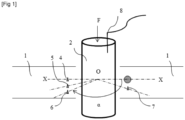
- FIG. 1 illustrates, schematically and in a non-limiting manner, a PIR-SRS probe 1 and a tube 2 for implementing the method according to one embodiment of the invention.
- a fluid F the direction of circulation of the fluid is not important.
- an illumination source 3 which has an illumination direction XX.
- the PIR-SRS probe comprises four light detectors 4, 5, 6, and 7.
- the light detectors 4, 5, 6 and 7 can be remote: the probe can include optical fibers (not shown) which transmit the optical signals to the light detectors 4, 5, 6 and 7.
- the detectors placed opposite the illumination source 3 are detectors for transmission measurements, and the detectors placed on the same side as the illumination source are reflection measurement detectors.
- the measurement system can also comprise a system for regulating the temperature (not shown) of the tube 2, so as to control the temperature of the fluid F, for example by decreasing the fluid temperature F.
- the spectra processing step by multivariate data analysis obtained by NIR-SRS spectroscopy makes it possible to differentiate the information contained in the spectra.
- different methods can be used, such as a principal component analysis (PCA), or an analysis of common components and specific weights (ACCPS). These methods allow rapid differentiation.
- PCA principal component analysis
- ACCPS analysis of common components and specific weights
- multivariate analysis makes it possible to determine by means of measurements with a single device (spatially resolved near infrared spectroscopy) a plurality of parameters representative of a change in the fluid.
- the method according to the invention makes it possible to determine, with a single means of measurement, the temperature at which paraffin appears and the temperature of the pour point of the fluid.
- PCA is a multivariate data analysis tool for exploring a data set with a large number of variables.
- PCA consists of representing individuals (samples) in a smaller space defined by the variables. It is a method that aims to find the directions of greatest dispersion of individuals in this space, the idea being that the directions of greatest dispersion are the most interesting directions. If the variables contain only noise, the individuals will be dispersed homogeneously and uniformly in all directions. A direction that deviates from such a spherical distribution can potentially contain information.
- PCA calculates linear combinations of the input variables giving new axes, called principal components (PC), which contain most of the variability of the input data matrix.
- the method may also include a step of measuring the temperature of the fluid in the transparent medium.
- This temperature measurement step can be implemented by means of a temperature probe in the transparent medium.
- step a) in the context of the flow of a crude oil in a "pipe", it is possible to determine during step a) the temperature at which paraffin WAT appears and/or the pour point temperature PP of the crude oil, the presence of particles and/or fouling.
- paraffins can, below the WAT, form deposits on the internal walls of the transport pipe and lead to an obstruction of the pipe which generates either a high pressure drop or a clogging of the pipe. .
- This same paraffinic crude can gel en masse, in particular during a shutdown phase and require high pressures for its restart. Determining the WAT and the "Pour Point" PP for this type of petroleum fluid is very important for anticipating field architectures and remediation operations.
- composition of the fluid can vary for various reasons (export line transporting a mixture of oils in variable proportions, evolution of the composition of the crude oil produced during the operating life of the field). This variation in composition also induces variations in the WAT and PP values of the transported fluid.
- the operator has access to a real-time measurement of WAT and PP enabling him to better assess the safety margin and thus optimize his production strategies.
- the probe was connected to a spectrometer equipped with hyperspectral detection in order to be able to measure the spectra at the four angles at the same time (Hy-ternity TM , Indatech-Chauvin Arnoux).
- the InGaAs detector made it possible to perform measurements in the spectral range from 900 to 1700 nm.
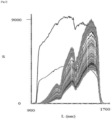
- FIG. 2 illustrates the signal S (unitless) corresponding to the raw intensity received on the detector as a function of the wavelength L in nm obtained for the measurement angle of 180°. Similar curves are obtained for the other measurement angles (not shown). The different curves correspond to the spectra obtained for the different temperatures. The variations in intensity observed on the y-axis are caused by the modifications of the analyzed medium, themselves due to the modification of temperature.
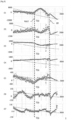
- FIG. 3 There picture 3 represents the seven principal components C1 to C7 as a function of time T in s.
- the points correspond to the scores (values for the main component considered) as a function of time T and the curve corresponds to the temperature of the medium as a function of time T.
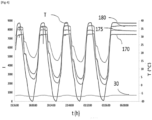
- FIG. 4 represents the tracking at 1555 nm for the 4 angles of sample 7 during 4 temperature cycles. That is four drops in temperature from 40 to -20°C and 4 rises in temperature from -20 to 40°C.
- the figure shows that the intensities I measured at the four angles (30°, 170°, 175°, 180°) as a function of time stenh are very similar from one cycle to another.
- the figure 4 illustrates the curve of temperature T in °C as a function of time t in h. This proves that the experiments are repeatable, which validates the operating protocol. Thus the exploitation of the results can be done on a single temperature cycle but remains valid each time.
Landscapes
- Chemical & Material Sciences (AREA)
- Physics & Mathematics (AREA)
- Health & Medical Sciences (AREA)
- Life Sciences & Earth Sciences (AREA)
- General Physics & Mathematics (AREA)
- Biochemistry (AREA)
- General Health & Medical Sciences (AREA)
- Analytical Chemistry (AREA)
- Immunology (AREA)
- Pathology (AREA)
- Engineering & Computer Science (AREA)
- Spectroscopy & Molecular Physics (AREA)
- Chemical Kinetics & Catalysis (AREA)
- General Chemical & Material Sciences (AREA)
- Oil, Petroleum & Natural Gas (AREA)
- Food Science & Technology (AREA)
- Medicinal Chemistry (AREA)
- Investigating Or Analysing Materials By Optical Means (AREA)
Applications Claiming Priority (2)
| Application Number | Priority Date | Filing Date | Title |
|---|---|---|---|
| FR1871571A FR3088728B1 (fr) | 2018-11-16 | 2018-11-16 | Procede de determination d’au moins un parametre representatif d’un changement d’un fluide par spectroscopie proche infrarouge multipoints |
| PCT/EP2019/079625 WO2020099130A1 (fr) | 2018-11-16 | 2019-10-30 | Procede de determination d'au moins un parametre representatif d'un changement d'un fluide par spectroscopie proche infrarouge multipoints |
Publications (3)
| Publication Number | Publication Date |
|---|---|
| EP3881069A1 EP3881069A1 (fr) | 2021-09-22 |
| EP3881069B1 true EP3881069B1 (fr) | 2023-06-21 |
| EP3881069C0 EP3881069C0 (fr) | 2023-06-21 |
Family
ID=66166136
Family Applications (1)
| Application Number | Title | Priority Date | Filing Date |
|---|---|---|---|
| EP19797257.3A Active EP3881069B1 (fr) | 2018-11-16 | 2019-10-30 | Procede de determination d'au moins un parametre representatif d'un changement d'un fluide par spectroscopie proche infrarouge multipoints |
Country Status (6)
| Country | Link |
|---|---|
| US (1) | US11788954B2 (pl) |
| EP (1) | EP3881069B1 (pl) |
| BR (1) | BR112021007430B1 (pl) |
| FR (1) | FR3088728B1 (pl) |
| PL (1) | PL3881069T3 (pl) |
| WO (1) | WO2020099130A1 (pl) |
Family Cites Families (11)
| Publication number | Priority date | Publication date | Assignee | Title |
|---|---|---|---|---|
| FR2647903B1 (fr) * | 1989-05-31 | 1991-03-22 | Inst Francais Du Petrole | Procede et appareillage de determination rapide du seuil de floculation de particules dans une charge petroliere, une sequence d'analyses et son utilisation |
| NO176156C (no) | 1992-06-22 | 1995-02-08 | Norsk Hydro As | Fremgangsmåte for bestemmelse av voksutfellingstemperatur og megnde voks i råolje e.l. |
| US6841779B1 (en) * | 2001-08-24 | 2005-01-11 | University Of Utah Research Foundation | Measurement of wax precipitation temperature and precipitated solid weight percent versus temperature by infrared spectroscopy |
| US6827842B2 (en) | 2001-10-19 | 2004-12-07 | Exxonmobil Research & Engrg. Co. | On-line determination of wax crystallization temperature of waxy solvent stream |
| US7379819B2 (en) * | 2003-12-04 | 2008-05-27 | Schlumberger Technology Corporation | Reservoir sample chain-of-custody |
| US8326548B2 (en) * | 2010-05-22 | 2012-12-04 | Kyeongseok Oh | Prediction of wax appearance temperature and solid wax amount by reduced spectral analysis using FTIR spectroscopy |
| US10677718B2 (en) * | 2011-02-22 | 2020-06-09 | Saudi Arabian Oil Company | Characterization of crude oil by near infrared spectroscopy |
| EP3047101A4 (en) | 2013-09-20 | 2017-06-07 | Services Pétroliers Schlumberger | Microfluidic determination of wax appearance temperature |
| US9354167B2 (en) | 2014-10-07 | 2016-05-31 | Phase Technology | Method and apparatus for measuring appearance and disappearance temperatures of wax for transparent, translucent and opaque oils |
| WO2016209248A1 (en) * | 2015-06-26 | 2016-12-29 | Schlumberger Canada Limited | Microfluidic method for detection of fines, waxes, and asphaltenes in oil |
| US11434755B2 (en) * | 2017-10-27 | 2022-09-06 | Schlumberger Technology Corporation | Determining asphaltene onset |
-
2018
- 2018-11-16 FR FR1871571A patent/FR3088728B1/fr active Active
-
2019
- 2019-10-30 BR BR112021007430-9A patent/BR112021007430B1/pt active IP Right Grant
- 2019-10-30 WO PCT/EP2019/079625 patent/WO2020099130A1/fr not_active Ceased
- 2019-10-30 PL PL19797257.3T patent/PL3881069T3/pl unknown
- 2019-10-30 EP EP19797257.3A patent/EP3881069B1/fr active Active
- 2019-10-30 US US17/293,376 patent/US11788954B2/en active Active
Also Published As
| Publication number | Publication date |
|---|---|
| US20220003666A1 (en) | 2022-01-06 |
| EP3881069A1 (fr) | 2021-09-22 |
| BR112021007430B1 (pt) | 2024-01-23 |
| BR112021007430A2 (pt) | 2021-08-03 |
| PL3881069T3 (pl) | 2023-11-27 |
| WO2020099130A1 (fr) | 2020-05-22 |
| FR3088728B1 (fr) | 2020-11-13 |
| US11788954B2 (en) | 2023-10-17 |
| EP3881069C0 (fr) | 2023-06-21 |
| FR3088728A1 (fr) | 2020-05-22 |
Similar Documents
| Publication | Publication Date | Title |
|---|---|---|
| Karaliūnas et al. | Non-destructive inspection of food and technical oils by terahertz spectroscopy | |
| EP3559641B1 (fr) | Dispositif simplifie de detection de la formation d'hydrates de gaz | |
| BE903531A (fr) | Appareil optique pour l'etude de la stabilite | |
| CN101210873A (zh) | 一种利用太赫兹时域光谱快速检测植物油纯度的方法及设备 | |
| CN103712949A (zh) | 一种基于光热吸收光谱技术的食用油检测方法及装置 | |
| Chen et al. | Spatially and angularly resolved spectroscopy for in-situ estimation of concentration and particle size in colloidal suspensions | |
| FR2820503A1 (fr) | Methode et dispositif pour predire le seuil de floculation d'asphaltenes contenus dans des melanges d'hydrocarbures | |
| EP1751518A1 (fr) | Sonde de mesure de la lumiere dans un liquide sonde de detection du seuil de floculation d"un milieu colloidal procede de detection associe et application a la determination de la floculation des asphaltenes | |
| CN107436288A (zh) | 一种基于受激布里渊散射及吸收光谱的橄榄油等级鉴别方法 | |
| EP3881069A1 (fr) | Procede de determination d'au moins un parametre representatif d'un changement d'un fluide par spectroscopie proche infrarouge multipoints | |
| EP3559617B1 (fr) | Methode optimisee de detection de la formation d'hydrates de gaz | |
| Wang et al. | A method for measuring the oil film thickness on metal sheet before stamping based on infrared absorption and correlation filtering | |
| FR2845013A1 (fr) | Procede et dispositif pour la conduite en continu d'un processus de preparation d'un carburant, notamment pour moteur diesel, par melange en ligne de ses constituants | |
| Sun et al. | Investigating the thermal effects and oxidation of aluminum alloy 6061 using In-situ spectroscopic ellipsometry | |
| Knochen et al. | Determination of insolubles in diesel lubricating oil by FIA-visible spectrometry | |
| Bakar et al. | Oil contaminant detection using long-range surface plasmon resonance-based sensors | |
| Bakar et al. | Thermally Tuned Long-Range Surface Plasmon Resonance Sensor for In Situ Detection of Oil Mixture in Edible Oils. | |
| EP4168781B1 (fr) | Dispositif et procédé de détection du seuil de floculation d'un milieu colloïdal, notamment d'un milieu comprenant des asphaltènes, par addition de solvant aliphatique | |
| Bello et al. | Micro-opto-fluidic platform for spectroscopic identification of water-based fluids | |
| Shi et al. | STUDY ON GENETIC ALGORITHMS‐BASED NIR WAVELENGTH SELECTION FOR DETERMINATION OF SOLUBLE SOLIDS CONTENT IN FUJI APPLES | |
| EP4168780B1 (fr) | Dispositif et procédé de détection du seuil de floculation d'un milieu colloïdal, notamment d'un milieu comprenant des asphaltènes, par addition de solvant aliphatique | |
| EP2812677A1 (fr) | Procede de detection de la transition de produits dans une conduite | |
| FR2647903A1 (fr) | Procede et appareillage de determination rapide du seuil de floculation de particules dans une charge petroliere, une sequence d'analyses et son utilisation | |
| Zhao et al. | Predicting Cold Flow Properties of Diesel by Terahertz Time‐Domain Spectroscopy | |
| FR2596522A1 (fr) | Appareil optique pour etudier la stabilite des systemes colloidaux |
Legal Events
| Date | Code | Title | Description |
|---|---|---|---|
| STAA | Information on the status of an ep patent application or granted ep patent |
Free format text: STATUS: UNKNOWN |
|
| STAA | Information on the status of an ep patent application or granted ep patent |
Free format text: STATUS: THE INTERNATIONAL PUBLICATION HAS BEEN MADE |
|
| PUAI | Public reference made under article 153(3) epc to a published international application that has entered the european phase |
Free format text: ORIGINAL CODE: 0009012 |
|
| STAA | Information on the status of an ep patent application or granted ep patent |
Free format text: STATUS: REQUEST FOR EXAMINATION WAS MADE |
|
| 17P | Request for examination filed |
Effective date: 20210616 |
|
| AK | Designated contracting states |
Kind code of ref document: A1 Designated state(s): AL AT BE BG CH CY CZ DE DK EE ES FI FR GB GR HR HU IE IS IT LI LT LU LV MC MK MT NL NO PL PT RO RS SE SI SK SM TR |
|
| DAV | Request for validation of the european patent (deleted) | ||
| DAX | Request for extension of the european patent (deleted) | ||
| GRAP | Despatch of communication of intention to grant a patent |
Free format text: ORIGINAL CODE: EPIDOSNIGR1 |
|
| STAA | Information on the status of an ep patent application or granted ep patent |
Free format text: STATUS: GRANT OF PATENT IS INTENDED |
|
| INTG | Intention to grant announced |
Effective date: 20230130 |
|
| GRAS | Grant fee paid |
Free format text: ORIGINAL CODE: EPIDOSNIGR3 |
|
| GRAA | (expected) grant |
Free format text: ORIGINAL CODE: 0009210 |
|
| STAA | Information on the status of an ep patent application or granted ep patent |
Free format text: STATUS: THE PATENT HAS BEEN GRANTED |
|
| AK | Designated contracting states |
Kind code of ref document: B1 Designated state(s): AL AT BE BG CH CY CZ DE DK EE ES FI FR GB GR HR HU IE IS IT LI LT LU LV MC MK MT NL NO PL PT RO RS SE SI SK SM TR |
|
| REG | Reference to a national code |
Ref country code: CH Ref legal event code: EP |
|
| REG | Reference to a national code |
Ref country code: DE Ref legal event code: R096 Ref document number: 602019031425 Country of ref document: DE |
|
| REG | Reference to a national code |
Ref country code: AT Ref legal event code: REF Ref document number: 1581239 Country of ref document: AT Kind code of ref document: T Effective date: 20230715 |
|
| REG | Reference to a national code |
Ref country code: IE Ref legal event code: FG4D Free format text: LANGUAGE OF EP DOCUMENT: FRENCH |
|
| U01 | Request for unitary effect filed |
Effective date: 20230621 |
|
| U07 | Unitary effect registered |
Designated state(s): AT BE BG DE DK EE FI FR IT LT LU LV MT NL PT SE SI Effective date: 20230623 |
|
| REG | Reference to a national code |
Ref country code: NO Ref legal event code: T2 Effective date: 20230621 |
|
| REG | Reference to a national code |
Ref country code: LT Ref legal event code: MG9D |
|
| PG25 | Lapsed in a contracting state [announced via postgrant information from national office to epo] |
Ref country code: RS Free format text: LAPSE BECAUSE OF FAILURE TO SUBMIT A TRANSLATION OF THE DESCRIPTION OR TO PAY THE FEE WITHIN THE PRESCRIBED TIME-LIMIT Effective date: 20230621 Ref country code: HR Free format text: LAPSE BECAUSE OF FAILURE TO SUBMIT A TRANSLATION OF THE DESCRIPTION OR TO PAY THE FEE WITHIN THE PRESCRIBED TIME-LIMIT Effective date: 20230621 Ref country code: GR Free format text: LAPSE BECAUSE OF FAILURE TO SUBMIT A TRANSLATION OF THE DESCRIPTION OR TO PAY THE FEE WITHIN THE PRESCRIBED TIME-LIMIT Effective date: 20230922 |
|
| U20 | Renewal fee for the european patent with unitary effect paid |
Year of fee payment: 5 Effective date: 20231031 |
|
| PG25 | Lapsed in a contracting state [announced via postgrant information from national office to epo] |
Ref country code: SK Free format text: LAPSE BECAUSE OF FAILURE TO SUBMIT A TRANSLATION OF THE DESCRIPTION OR TO PAY THE FEE WITHIN THE PRESCRIBED TIME-LIMIT Effective date: 20230621 |
|
| PG25 | Lapsed in a contracting state [announced via postgrant information from national office to epo] |
Ref country code: ES Free format text: LAPSE BECAUSE OF FAILURE TO SUBMIT A TRANSLATION OF THE DESCRIPTION OR TO PAY THE FEE WITHIN THE PRESCRIBED TIME-LIMIT Effective date: 20230621 |
|
| PG25 | Lapsed in a contracting state [announced via postgrant information from national office to epo] |
Ref country code: IS Free format text: LAPSE BECAUSE OF FAILURE TO SUBMIT A TRANSLATION OF THE DESCRIPTION OR TO PAY THE FEE WITHIN THE PRESCRIBED TIME-LIMIT Effective date: 20231021 |
|
| PG25 | Lapsed in a contracting state [announced via postgrant information from national office to epo] |
Ref country code: SM Free format text: LAPSE BECAUSE OF FAILURE TO SUBMIT A TRANSLATION OF THE DESCRIPTION OR TO PAY THE FEE WITHIN THE PRESCRIBED TIME-LIMIT Effective date: 20230621 Ref country code: SK Free format text: LAPSE BECAUSE OF FAILURE TO SUBMIT A TRANSLATION OF THE DESCRIPTION OR TO PAY THE FEE WITHIN THE PRESCRIBED TIME-LIMIT Effective date: 20230621 Ref country code: RO Free format text: LAPSE BECAUSE OF FAILURE TO SUBMIT A TRANSLATION OF THE DESCRIPTION OR TO PAY THE FEE WITHIN THE PRESCRIBED TIME-LIMIT Effective date: 20230621 Ref country code: IS Free format text: LAPSE BECAUSE OF FAILURE TO SUBMIT A TRANSLATION OF THE DESCRIPTION OR TO PAY THE FEE WITHIN THE PRESCRIBED TIME-LIMIT Effective date: 20231021 Ref country code: ES Free format text: LAPSE BECAUSE OF FAILURE TO SUBMIT A TRANSLATION OF THE DESCRIPTION OR TO PAY THE FEE WITHIN THE PRESCRIBED TIME-LIMIT Effective date: 20230621 Ref country code: CZ Free format text: LAPSE BECAUSE OF FAILURE TO SUBMIT A TRANSLATION OF THE DESCRIPTION OR TO PAY THE FEE WITHIN THE PRESCRIBED TIME-LIMIT Effective date: 20230621 |
|
| REG | Reference to a national code |
Ref country code: DE Ref legal event code: R097 Ref document number: 602019031425 Country of ref document: DE |
|
| PLBE | No opposition filed within time limit |
Free format text: ORIGINAL CODE: 0009261 |
|
| STAA | Information on the status of an ep patent application or granted ep patent |
Free format text: STATUS: NO OPPOSITION FILED WITHIN TIME LIMIT |
|
| 26N | No opposition filed |
Effective date: 20240322 |
|
| PG25 | Lapsed in a contracting state [announced via postgrant information from national office to epo] |
Ref country code: MC Free format text: LAPSE BECAUSE OF FAILURE TO SUBMIT A TRANSLATION OF THE DESCRIPTION OR TO PAY THE FEE WITHIN THE PRESCRIBED TIME-LIMIT Effective date: 20230621 |
|
| REG | Reference to a national code |
Ref country code: CH Ref legal event code: PL |
|
| PG25 | Lapsed in a contracting state [announced via postgrant information from national office to epo] |
Ref country code: CH Free format text: LAPSE BECAUSE OF NON-PAYMENT OF DUE FEES Effective date: 20231031 |
|
| PG25 | Lapsed in a contracting state [announced via postgrant information from national office to epo] |
Ref country code: CH Free format text: LAPSE BECAUSE OF NON-PAYMENT OF DUE FEES Effective date: 20231031 |
|
| PG25 | Lapsed in a contracting state [announced via postgrant information from national office to epo] |
Ref country code: IE Free format text: LAPSE BECAUSE OF NON-PAYMENT OF DUE FEES Effective date: 20231030 |
|
| PG25 | Lapsed in a contracting state [announced via postgrant information from national office to epo] |
Ref country code: IE Free format text: LAPSE BECAUSE OF NON-PAYMENT OF DUE FEES Effective date: 20231030 |
|
| U20 | Renewal fee for the european patent with unitary effect paid |
Year of fee payment: 6 Effective date: 20241031 |
|
| PG25 | Lapsed in a contracting state [announced via postgrant information from national office to epo] |
Ref country code: CY Free format text: LAPSE BECAUSE OF FAILURE TO SUBMIT A TRANSLATION OF THE DESCRIPTION OR TO PAY THE FEE WITHIN THE PRESCRIBED TIME-LIMIT; INVALID AB INITIO Effective date: 20191030 |
|
| PG25 | Lapsed in a contracting state [announced via postgrant information from national office to epo] |
Ref country code: HU Free format text: LAPSE BECAUSE OF FAILURE TO SUBMIT A TRANSLATION OF THE DESCRIPTION OR TO PAY THE FEE WITHIN THE PRESCRIBED TIME-LIMIT; INVALID AB INITIO Effective date: 20191030 |
|
| U20 | Renewal fee for the european patent with unitary effect paid |
Year of fee payment: 7 Effective date: 20251031 |
|
| PG25 | Lapsed in a contracting state [announced via postgrant information from national office to epo] |
Ref country code: TR Free format text: LAPSE BECAUSE OF FAILURE TO SUBMIT A TRANSLATION OF THE DESCRIPTION OR TO PAY THE FEE WITHIN THE PRESCRIBED TIME-LIMIT Effective date: 20230621 |
|
| PGFP | Annual fee paid to national office [announced via postgrant information from national office to epo] |
Ref country code: GB Payment date: 20251021 Year of fee payment: 7 |
|
| PGFP | Annual fee paid to national office [announced via postgrant information from national office to epo] |
Ref country code: NO Payment date: 20251020 Year of fee payment: 7 |
|
| PGFP | Annual fee paid to national office [announced via postgrant information from national office to epo] |
Ref country code: PL Payment date: 20251017 Year of fee payment: 7 |