EP3880656B1 - Verfahren zur herstellung von zytostatischen benzodiazepinderivaten - Google Patents
Verfahren zur herstellung von zytostatischen benzodiazepinderivaten Download PDFInfo
- Publication number
- EP3880656B1 EP3880656B1 EP19816995.5A EP19816995A EP3880656B1 EP 3880656 B1 EP3880656 B1 EP 3880656B1 EP 19816995 A EP19816995 A EP 19816995A EP 3880656 B1 EP3880656 B1 EP 3880656B1
- Authority
- EP
- European Patent Office
- Prior art keywords
- compound
- formula
- salt
- reacting
- activating agent
- Prior art date
- Legal status (The legal status is an assumption and is not a legal conclusion. Google has not performed a legal analysis and makes no representation as to the accuracy of the status listed.)
- Active
Links
Classifications
-
- C—CHEMISTRY; METALLURGY
- C07—ORGANIC CHEMISTRY
- C07D—HETEROCYCLIC COMPOUNDS
- C07D207/00—Heterocyclic compounds containing five-membered rings not condensed with other rings, with one nitrogen atom as the only ring hetero atom
- C07D207/02—Heterocyclic compounds containing five-membered rings not condensed with other rings, with one nitrogen atom as the only ring hetero atom with only hydrogen or carbon atoms directly attached to the ring nitrogen atom
- C07D207/44—Heterocyclic compounds containing five-membered rings not condensed with other rings, with one nitrogen atom as the only ring hetero atom with only hydrogen or carbon atoms directly attached to the ring nitrogen atom having three double bonds between ring members or between ring members and non-ring members
- C07D207/444—Heterocyclic compounds containing five-membered rings not condensed with other rings, with one nitrogen atom as the only ring hetero atom with only hydrogen or carbon atoms directly attached to the ring nitrogen atom having three double bonds between ring members or between ring members and non-ring members having two doubly-bound oxygen atoms directly attached in positions 2 and 5
- C07D207/448—Heterocyclic compounds containing five-membered rings not condensed with other rings, with one nitrogen atom as the only ring hetero atom with only hydrogen or carbon atoms directly attached to the ring nitrogen atom having three double bonds between ring members or between ring members and non-ring members having two doubly-bound oxygen atoms directly attached in positions 2 and 5 with only hydrogen atoms or radicals containing only hydrogen and carbon atoms directly attached to other ring carbon atoms, e.g. maleimide
-
- C—CHEMISTRY; METALLURGY
- C07—ORGANIC CHEMISTRY
- C07D—HETEROCYCLIC COMPOUNDS
- C07D207/00—Heterocyclic compounds containing five-membered rings not condensed with other rings, with one nitrogen atom as the only ring hetero atom
- C07D207/02—Heterocyclic compounds containing five-membered rings not condensed with other rings, with one nitrogen atom as the only ring hetero atom with only hydrogen or carbon atoms directly attached to the ring nitrogen atom
- C07D207/44—Heterocyclic compounds containing five-membered rings not condensed with other rings, with one nitrogen atom as the only ring hetero atom with only hydrogen or carbon atoms directly attached to the ring nitrogen atom having three double bonds between ring members or between ring members and non-ring members
- C07D207/444—Heterocyclic compounds containing five-membered rings not condensed with other rings, with one nitrogen atom as the only ring hetero atom with only hydrogen or carbon atoms directly attached to the ring nitrogen atom having three double bonds between ring members or between ring members and non-ring members having two doubly-bound oxygen atoms directly attached in positions 2 and 5
- C07D207/448—Heterocyclic compounds containing five-membered rings not condensed with other rings, with one nitrogen atom as the only ring hetero atom with only hydrogen or carbon atoms directly attached to the ring nitrogen atom having three double bonds between ring members or between ring members and non-ring members having two doubly-bound oxygen atoms directly attached in positions 2 and 5 with only hydrogen atoms or radicals containing only hydrogen and carbon atoms directly attached to other ring carbon atoms, e.g. maleimide
- C07D207/452—Heterocyclic compounds containing five-membered rings not condensed with other rings, with one nitrogen atom as the only ring hetero atom with only hydrogen or carbon atoms directly attached to the ring nitrogen atom having three double bonds between ring members or between ring members and non-ring members having two doubly-bound oxygen atoms directly attached in positions 2 and 5 with only hydrogen atoms or radicals containing only hydrogen and carbon atoms directly attached to other ring carbon atoms, e.g. maleimide with hydrocarbon radicals, substituted by hetero atoms, directly attached to the ring nitrogen atom
-
- A—HUMAN NECESSITIES
- A61—MEDICAL OR VETERINARY SCIENCE; HYGIENE
- A61K—PREPARATIONS FOR MEDICAL, DENTAL OR TOILETRY PURPOSES
- A61K31/00—Medicinal preparations containing organic active ingredients
- A61K31/33—Heterocyclic compounds
- A61K31/395—Heterocyclic compounds having nitrogen as a ring hetero atom, e.g. guanethidine or rifamycins
- A61K31/40—Heterocyclic compounds having nitrogen as a ring hetero atom, e.g. guanethidine or rifamycins having five-membered rings with one nitrogen as the only ring hetero atom, e.g. sulpiride, succinimide, tolmetin, buflomedil
- A61K31/4015—Heterocyclic compounds having nitrogen as a ring hetero atom, e.g. guanethidine or rifamycins having five-membered rings with one nitrogen as the only ring hetero atom, e.g. sulpiride, succinimide, tolmetin, buflomedil having oxo groups directly attached to the heterocyclic ring, e.g. piracetam, ethosuximide
-
- C—CHEMISTRY; METALLURGY
- C07—ORGANIC CHEMISTRY
- C07D—HETEROCYCLIC COMPOUNDS
- C07D487/00—Heterocyclic compounds containing nitrogen atoms as the only ring hetero atoms in the condensed system, not provided for by groups C07D451/00 - C07D477/00
- C07D487/02—Heterocyclic compounds containing nitrogen atoms as the only ring hetero atoms in the condensed system, not provided for by groups C07D451/00 - C07D477/00 in which the condensed system contains two hetero rings
- C07D487/04—Ortho-condensed systems
-
- C—CHEMISTRY; METALLURGY
- C07—ORGANIC CHEMISTRY
- C07D—HETEROCYCLIC COMPOUNDS
- C07D519/00—Heterocyclic compounds containing more than one system of two or more relevant hetero rings condensed among themselves or condensed with a common carbocyclic ring system not provided for in groups C07D453/00 or C07D455/00
Definitions
- the present invention relates to novel methods for preparing cytotoxic indolinobenzodiazepine derivatives.
- cell-binding agent conjugates of indolinobenzodiazepine dimers that have one imine functionality and one amine functionality display a much higher therapeutic index (ratio of maximum tolerated dose to minimum effective dose) in vivo compared to previously disclosed benzodiazepine derivatives having two imine functionalities. See, for example, WO 2012/128868 .
- the previously disclosed method for making the indolinobenzodiazepine dimers with one imine functionality and one amine functionality involves partial reduction of indolinobenzodiazepine dimers having two imine functionalities. The partial reduction step generally leads to the formation of fully reduced by-product and unreacted starting material, which requires cumbersome purification step and results in low yield.
- the present invention provides new methods for preparing indolinobenzodiazepine dimer compounds and synthetic precursors thereof.
- the present invention provides a method of preparing a compound of formula (IIIa): or a salt thereof, comprising the steps:
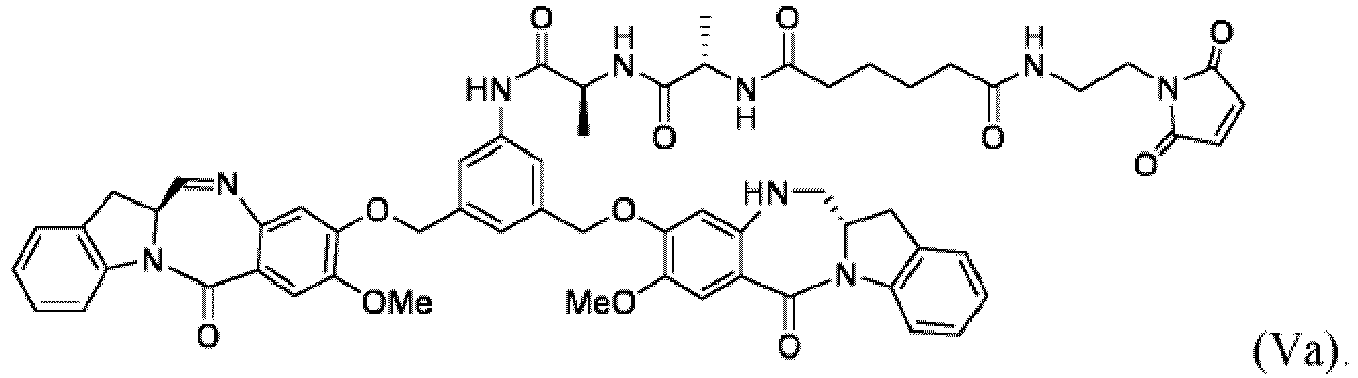
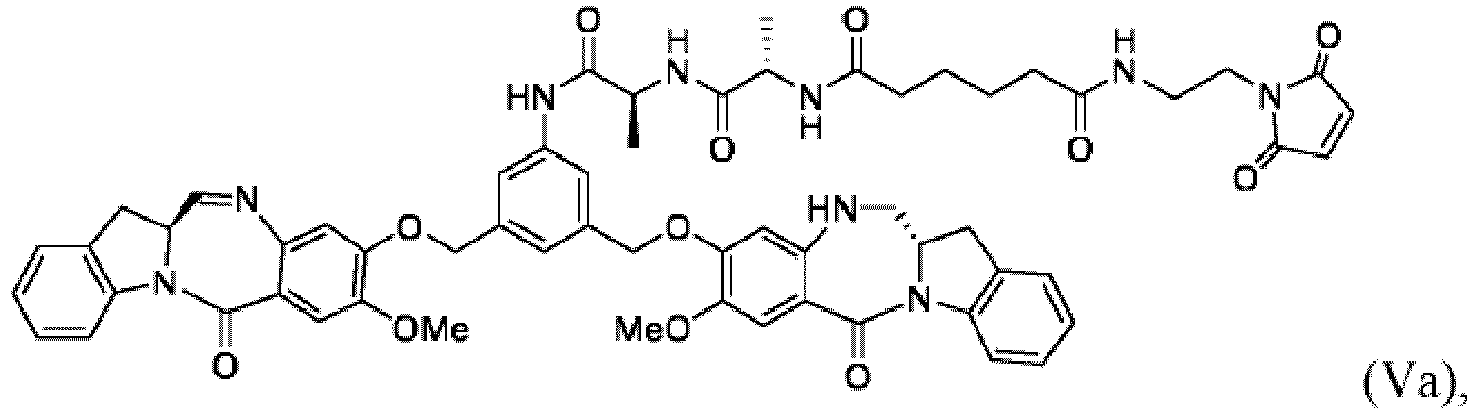
- the present invention provides a method of preparing a compound of formula (Va): comprising the steps of:
- Alkyl' as used herein refers to a saturated linear or branched monovalent hydrocarbon radical.
- a straight chain or branched chain alkyl has thirty or fewer carbon atoms (e.g., C 1 -C 30 for straight chain alkyl group and C 3 -C 30 for branched alkyl), and more preferably twenty or fewer carbon atoms. Even more preferably, the straight chain or branched chain alkyl has ten or fewer carbon atoms ( i.e ., C 1 -C 10 for straight chain alkyl group and C 3 -C 10 for branched alkyl).
- the straight chain or branched chain alkyl has six or fewer carbon atoms (i.e ., C 1 -C 6 for straight chain alky group or C 3 -C 6 for branched chain alkyl).
- alkyl include, but are not limited to, methyl, ethyl, 1-propyl, 2-propyl, 1-butyl, 2-methyl-1-propyl, -CH 2 CH(CH 3 ) 2 ), 2-butyl, 2-methyl-2-propyl, 1-pentyl, 2-pentyl 3-pentyl, 2-methyl-2-butyl, 3-methyl-2-butyl, 3-methyl-1-butyl, 2-methyl-1-butyl, 1-hexyl), 2-hexyl, 3-hexyl, 2-methyl-2-pentyl, 3-methyl-2-pentyl, 4-methyl-2-pentyl, 3-methyl-3-pentyl, 2-methyl-3-pentyl, 2,3-dimethyl-2-butyl.
- alkyl as used throughout the specification, examples, and claims is intended to include both “unsubstituted alkyls” and “substituted alkyls”, the latter of which refers to alkyl moieties having substituents replacing a hydrogen on one or more carbons of the hydrocarbon backbone.
- (C x -C xx )alkyl or C x-xx alky means a linear or branched alkyl having x-xx carbon atoms.
- an "activated ester” refers to an ester group that is readily displaced by a hydroxyl or an amine group.
- exemplary activated esters include, but are not limited to N-hydroxysuccinimide ester, nitrophenyl ( e.g., 2 or 4-nitrophenyl) ester, dinitrophenyl ( e.g ., 2,4-dinitrophenyl) ester, sulfo-tetraflurophenyl ( e.g., 4-sulfo-2,3,5,6-tetrafluorophenyl) ester, pentafluorophenyl ester, nitropyridyl ( e.g., 4-nitropyridyl) ester, trifluoroacetate, and acetate.
- halide refers to F, Cl, Br or I. In one embodiment, the halide is Cl. In one embodiment, the halide is Br. In one embodiment, the halide is I. In one embodiment, the halide is F.
- the term "compound” is intended to include compounds for which a structure or formula or any derivative thereof has been disclosed in the present invention.
- the term also includes, stereoisomers, geometric isomers, or tautomers.
- stereoisomers geometric isomers, or tautomers.
- the specific recitation of "stereoisomers,” “geometric isomers,” “tautomers,” “salt” in certain aspects of the invention described in this application shall not be interpreted as an intended omission of these forms in other aspects of the invention where the term “compound” is used without recitation of these other forms.
- precursor of a given group refers to any group which may lead to that group by any deprotection, a chemical modification, or a coupling reaction.
- chiral refers to molecules which have the property of non-superimposability of the mirror image partner, while the term “achiral” refers to molecules which are superimposable on their mirror image partner.
- stereoisomer refers to compounds which have identical chemical constitution and connectivity, but different orientations of their atoms in space that cannot be interconverted by rotation about single bonds.
- Diastereomer refers to a stereoisomer with two or more centers of chirality and whose molecules are not mirror images of one another. Diastereomers have different physical properties, e.g. melting points, boiling points, spectral properties, and reactivities. Mixtures of diastereomers may separate under high resolution analytical procedures such as crystallization, electrophoresis and chromatography.
- Enantiomers refer to two stereoisomers of a compound which are non-superimposable mirror images of one another.
- the compounds of the invention may contain asymmetric or chiral centers, and therefore exist in different stereoisomeric forms. It is intended that all stereoisomeric forms of the compounds of the invention, including but not limited to, diastereomers, enantiomers and atropisomers, as well as mixtures thereof such as racemic mixtures, form part of the present invention.
- optically active compounds i.e ., they have the ability to rotate the plane of plane-polarized light.
- the prefixes D and L, or R and S are used to denote the absolute configuration of the molecule about its chiral center(s).
- the prefixes d and l or (+) and (-) are employed to designate the sign of rotation of plane-polarized light by the compound, with (-) or 1 meaning that the compound is levorotatory.
- a compound prefixed with (+) or d is dextrorotatory.
- these stereoisomers are identical except that they are mirror images of one another.
- a specific stereoisomer may also be referred to as an enantiomer, and a mixture of such isomers is often called an enantiomeric mixture.
- a 50:50 mixture of enantiomers is referred to as a racemic mixture or a racemate, which may occur where there has been no stereoselection or stereospecificity in a chemical reaction or process.
- the terms “racemic mixture” and “racemate” refer to an equimolar mixture of two enantiomeric species, devoid of optical activity.
- tautomer or “tautomeric form” refers to structural isomers of different energies which are interconvertible via a low energy barrier.
- proton tautomers also known as prototropic tautomers
- Valence tautomers include interconversions by reorganization of some of the bonding electrons.
- protecting group or “protecting moiety” refers to a substituent that is commonly employed to block or protect a particular functionality while reacting other functional groups on the compound, a derivative thereof, or a conjugate thereof.
- carboxylic acid protecting group is a substituent attached to an carbonyl group that blocks or protects the carboxylic acid functionality in the compound.
- Such groups are well known in the art (see for example , P. Wuts and T. Greene, 2007, Protective Groups in Organic Synthesis, Chapter 5, J. Wiley & Sons, NJ ).
- Suitable carboxylic acid protecting group include, but are not limited to, alkyl ester (e.g., methyl ester or tert-butyl ester), benzyl ester, thioester ( e.g., tert-butyl thioester), silyl ester ( e.g., trimethylsilyl ester), 9-fluorenylmehtyl ester, (2-trimethylsilyl)ethoxymethyl ester, 2-(trimethylsilyl)ethyl ester, diphenylmethyl ester or oxazoline.
- alkyl ester e.g., methyl ester or tert-butyl ester
- benzyl ester e.g., methyl ester or tert-butyl ester
- thioester e.g., tert-butyl thioester
- silyl ester e.g., trimethylsilyl ester
- the carboxylic acid protecting group is methyl ester, tert-butyl ester, benzyl ester or trimethylsilyl ester. In certain embodiments, the carboxylic acid protecting group is tert-butyl ester.
- carboxylic acid deprotecting agent refers a reagent that is capable of cleaving a carboxylic acid protecting group to form free carboxylic acid.
- Such reagents are well known in the art (see for example P. Wuts and T. Greene, 2007, Protective Groups in Organic Synthesis, Chapter 5, J. Wiley & Sons, NJ ) and depend on the carboxylic acid protecting group used. For example, when the carboxylic acid protecting group is tert-butyl ester, it can be cleaved with an acid.
- the carboxylic acid deprotecting agent is trifluoroacetic acid.
- alcohol activating agent refers a reagent that increases the reactivity of a hydroxyl group thereby making the hydroxyl group a better leaving group.
- examples of such alcohol activating agents include p-toluenesulfonyl chloride, thionyl chloride, triflic anhydride, mesyl chloride, mesyl anhydride, triphenylphosphine, acyl chloride, 4-dimethylaminopyridine, and others.
- the alcohol activating agent is thionyl chloride.
- the alcohol activating agent is triphenylphosphine.
- salt refers to an organic or inorganic salts of a compound of the invention.
- Exemplary salts include, but are not limited, to sulfate, citrate, acetate, oxalate, chloride, bromide, iodide, nitrate, bisulfate, phosphate, acid phosphate, isonicotinate, lactate, salicylate, acid citrate, tartrate, oleate, tannate, pantothenate, bitartrate, ascorbate, succinate, maleate, gentisinate, fumarate, gluconate, glucuronate, saccharate, formate, benzoate, glutamate, methanesulfonate "mesylate,” ethanesulfonate, benzenesulfonate, p-toluenesulfonate, pamoate ( i.e ., 1,1'-methylene-bis-(2-hydroxy-3-nap
- a salt may involve the inclusion of another molecule such as an acetate ion, a succinate ion or other counter ion.
- the counter ion may be any organic or inorganic moiety that stabilizes the charge on the parent compound.
- a salt may have more than one charged atom in its structure. Instances where multiple charged atoms are part of the salt can have multiple counter ions. Hence, a salt can have one or more charged atoms and/or one or more counter ion.
- the desired salt may be prepared by any suitable method available in the art, for example, treatment of the free base with an inorganic acid, such as hydrochloric acid, hydrobromic acid, sulfuric acid, nitric acid, methanesulfonic acid, phosphoric acid and the like, or with an organic acid, such as acetic acid, maleic acid, succinic acid, mandelic acid, fumaric acid, malonic acid, pyruvic acid, oxalic acid, glycolic acid, salicylic acid, a pyranosidyl acid, such as glucuronic acid or galacturonic acid, an alpha hydroxy acid, such as citric acid or tartaric acid, an amino acid, such as aspartic acid or glutamic acid, an aromatic acid, such as benzoic acid or cinnamic acid, a sulfonic acid, such as p-toluenesulfonic acid or ethanesulfonic acid, or the
- the desired salt may be prepared by any suitable method, for example, treatment of the free acid with an inorganic or organic base, such as an amine (primary, secondary or tertiary), an alkali metal hydroxide or alkaline earth metal hydroxide, or the like.
- suitable salts include, but are not limited to, organic salts derived from amino acids, such as glycine and arginine, ammonia, primary, secondary, and tertiary amines, and cyclic amines, such as piperidine, morpholine and piperazine, and inorganic salts derived from sodium, calcium, potassium, magnesium, manganese, iron, copper, zinc, aluminum and lithium.
- the salt is a pharmaceutically acceptable salt.
- pharmaceutically acceptable indicates that the substance or composition must be compatible chemically and/or toxicologically, with the other ingredients comprising a formulation, and/or the mammal being treated therewith.
- volume amount (V) means the ratio of the solvent volume (in mL) versus the weight amount (in g) of the compound.
- 40 volume amount means that 40 mL of solvent is used per 1 g of the compound.
- the present invention provides novel synthetic methods for preparing indolinobenzodiazepine dimer compounds and precursors.
- the present invention provides a method of preparing a method of preparing a compound of formula (IIIa): or a salt thereof, comprising the steps:
- E is -OH and the compound of formula (Ia) is prepared by hydrolysis of the compound of formula (Ia"):
- the hydrolysis is performed in the presence of a base.
- the base is selected from LiOH, KOH, NaOH.
- the base is LiOH.
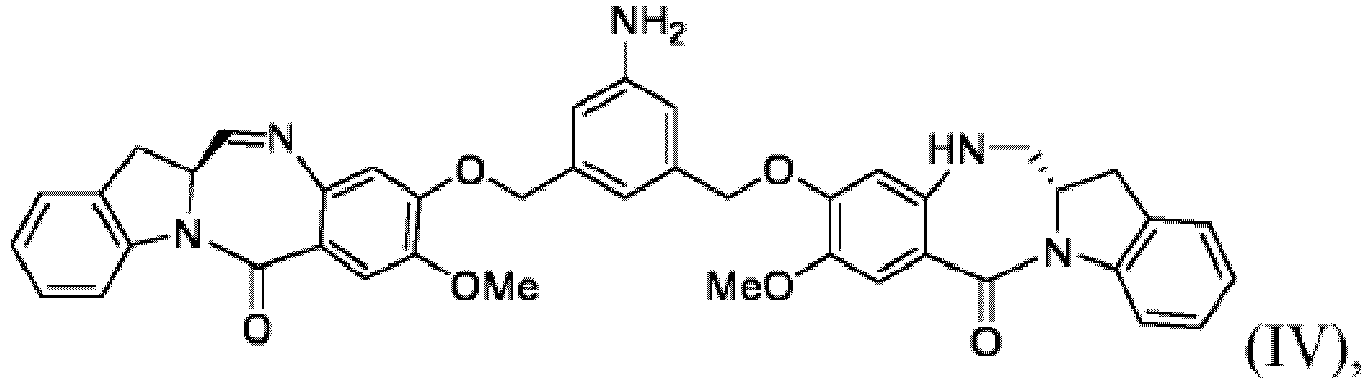
- the method of the 1 st embodiment further comprises reacting the compound of formula (IIIa) with a compound of formula (IV): to form a compound of formula (Va):
- the present invention provides a method of preparing a compound of formula (Va): comprising the steps of:
- P 1 can be any suitable carboxylic acid protecting group known in the art.
- the carboxylic acid protecting group include, but are not limited to alkyl ester (e.g., methyl ester or tert-butyl ester), benzyl ester, thioester ( e.g., tert-butyl thioester), silyl ester ( e.g ., trimethylsilyl ester), 9-fluorenylmethyl ester, (2-trimethylsilyl)ethoxymethyl ester, 2-(trimethylsilyl)ethyl ester, diphenylmethyl ester or oxazoline.
- the carboxylic acid protecting group is methyl ester, tert-butyl ester, benzyl ester or trimethylsilyl ester, i.e ., P 1 is -OMe, -O t Bu, -OBn, -O-silyl (e.g., -OSi(Me) 3 ).
- the carboxylic acid protecting group is tert-butyl ester, i.e ., P 1 is -O t Bu.
- E is -OH and the reaction between the compound of formula (Ia) or a salt thereof and the compound of formula (a) or a salt (e.g., HCl salt or TFA salt) thereof is carried out in the presence of an activating agent; and the remaining variables are as described in the first, second, third or fourth embodiment.
- the activating agent is a 2,4,6-trialkyl-1,3,5,2,4,6-trioxatriphosphorinane 2,4,6-trioxide, carbodiimide (e.g., N,N'-dicyclohexylcarbodiimide (DCC) or 1-ethyl-3-(3-dimethylaminopropyl)carbodiimide (EDC)), 1,1'-carbonyldiimidazole (CDI), a uronium, an activated ester, a phosphonium, 2-alkyl-l-alkylcarbonyl-1,2-dihydroquinoline, 2-alkoxy-l-alkoxycarbonyl-l,2-dihydroquinoline, or alkylchloroformate.
- carbodiimide e.g., N,N'-dicyclohexylcarbodiimide (DCC) or 1-ethyl-3-(3-dimethylaminopropyl)car
- the activating agent is 2,4,6-trialkyl-1,3,5,2,4,6-trioxatriphosphorinane 2,4,6-trioxide.
- the activating agent is 2,4,6-tripropyl-1,3,5,2,4,6-trioxatriphosphorinane 2,4,6-trioxide (T3P).
- the activating agent is a 2,4,6-trialkyl-1,3,5,2,4,6-trioxatriphosphorinane 2,4,6-trioxide, 1-[bis(dimethylamino)methylene]-1H-1,2,3-triazolo[4,5-b]pyridinium 3-oxid hexafluorophosphate (HATU), 1-hydroxy-7-azabenzotriazole or 1H-[1,2,3]triazolo[4,5-b]pyridin-1-ol (HOAt), a 2,4,6-trialkyl-1,3,5,2,4,6-trioxatriphosphorinane 2,4,6-trioxide, carbodiimide, a uronium, an activated ester, a phosphonium, 2-alkyl-l-alkylcarbonyl-l,2-dihydroquinoline, 2-alkoxy-l-alkoxycarbonyl-l,2-dihydroquinoline, or alkylchloroformate
- the activating agent is 1-[bis(dimethylamino)methylene]-1H-1,2,3-triazolo[4,5-b]pyridinium 3-oxid hexafluorophosphate (HATU).
- the activating agents are HATU and HOAt.
- any suitable amount of the activating agent can be used in the reaction between the compound of fomula (Ia) or a salt thereof and the compound of formula (a) or a salt (e.g ., HCl salt or TFA salt) thereof.
- a salt e.g ., HCl salt or TFA salt
- between 1.0 and 5.0 molar equivalents of the activating agent (e..g ., HATU) relative to the amount of the compound of formula (Ia) is used in the reaction.
- 1.0-2.0, 1.2-1.7, or 1.3-1.6 equivalent of HATU is used.
- 1.2, 1.3, 1.4, 1.5, 1.6 or 1.7 equivalents of HATU is used.
- 1.5 equivalent of HATU is used.
- the reaction between the compound of formula (Ia) or a salt thereof and the compound of formula (a) or a salt (e.g., HCl salt or TFA salt) thereof is carried out in the presence of a base.
- the base is a non-nucleophilic base.
- Exemplary non-nucleophilic bases include, but are not limited to, triethylamine, imidazole, diisopropylethylamine, pyridine, 2,6-lutidine, dimethylformamide, 1,8-diazabicyclo[5.4.0]undec-7-ene (DBU), or tetramethylpiperidine.
- the base is triethylamine or diisopropylethylamine.
- the base is diisopropylethylamine.
- reaction between the compound of formula (Ia) or a salt thereof and the compound of formula (a) or a salt (e.g., HCl salt or TFA salt) thereof is carried out in the presence of an activating agent described above and a base described above.
- the reaction is carried out in the presence of 2,4,6-tripropyl-1,3,5,2,4,6-trioxatriphosphorinane 2,4,6-trioxide as the activating agent and triethylamine or diisopropylethylamine as the base.
- reaction is carried out in the presence of 2,4,6-tripropyl-1,3,5,2,4,6-trioxatriphosphorinane 2,4,6-trioxide (T3P) and diisopropylethylamine.
- reaction is carried out in the presence of HATU and HOAt as the activating agents and diisopropylethylamine as the base.
- reaction between the compound of formula (Ia) or a salt thereof and the compound of formula (a) or a salt (e.g., HCl salt or TFA salt) thereof can be carried out in any suitable organic solvent(s). In one embodiment, the reaction is carried out in dichloromethane.
- the reaction between the compound of formula (Ia) or a salt thereof and the compound of formula (a) or a salt (e.g., HCl salt or TFA salt) thereof is carried out under an inert atmosphere.
- the inert atmosphere is achieved by degasing the reaction solutions and purging the reaction vessel with nitrogen or argon.
- the reaction between the compound of formula (Ia) or a salt thereof and the compound of formula (a) or a salt (e.g., HCl salt or TFA salt) thereof can be carried out at a suitable temperature.
- the reaction is carried out at a temperature between 0 °C and 50 °C, between 5 °C and 50 °C, between 10 °C and 50 °C, between 10 °C and 40 °C, between 10 °C and 30 °C or between 15 °C and 25 °C.
- the reaction is carried out at 20 ⁇ 3 °C.
- any suitable carboxylic acid protecting group can be used in step (b).
- Suitable deprotecting agents that can be used depend on the identity of the carboxylic acid protecting group.
- the protecting group can be removed by the treatment with an acid, a base or a suitable reductant.
- an acid can be used to remove the tert-butyl ester protecting group.
- Exemplary acids include, but are not limited to, formic acid, acetic acid, trifluoroacetic acid, hydrochloric acid, and phosphoric acid.
- trifluoroacetic acid is used as the carboxylic acid deprotecting agent.
- the deprotection reaction can be carried in any suitable organic solvent(s).
- exemplary organic solvents include, but are not limited to, DMF, CH 2 Cl 2 , dichloroethane, THF, dimethylacetamide, methanol, ethanol, etc.
- the deprotection reaction is carried out in dichloromethane.
- the present invention provides a method of preparing a compound of formula (IIIa): comprising the steps of:
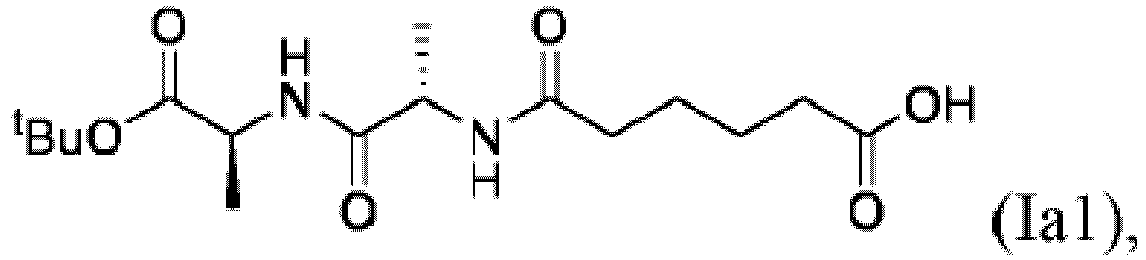
- the compound of formula Ia1 is prepared by hydrolysis of the compound of formula (Ia1"): In a specific embodiment, the hydrolysis is performed in the presence of a base. In another specific embodiment, the base is selected from LiOH, KOH, NaOH. In yet another specific embodiment, the base is LiOH.
- the present invention provides a method of preparing a compound of formula (Va): comprising the steps of:
- the reaction of the compound of formula (Ia1) and the compound of formula (a) or a salt (e.g ., HCl salt or TFA salt) therof in step (a) is carried out in the presence of 2,4,6-tripropyl-1,3,5,2,4,6-trioxatriphosphorinane-2,4,6-trioxide (T3P) as the activating agent in step (a).
- the reaction of the compound of formula (Ia1) and the compound of formula (a) or a salt (e.g., HCl salt or TFA salt) therof in step (a) can be carried in the presence of a base.
- the base is trimethylamine or diisopropylethylamine.
- the reaction of the compound of formula (Ia1) and the compound of formula (a) or a salt (e.g., HCl salt or TFA salt) thereof in step (a) can be carried out in the presence of 2,4,6-tripropyl-1,3,5,2,4,6-trioxatriphosphorinane-2,4,6-trioxide (T3P) as the activating agent and diisopropylethylamine as the base.
- T3P 2,4,6-tripropyl-1,3,5,2,4,6-trioxatriphosphorinane-2,4,6-trioxide
- the reaction can be carried out in dichloromethane.
- the carboxylic acid deprotecting agent in step (b) is trifluoroacetic acid (TFA).
- the deprotection reaction is carried out in dichloromethane.
- the reaction between the compound of formula (IIIa) or a salt thereof and the compound of formula (IV) or a salt thereof is carried out in the presence of an activating agent; and the remaining variables are as described in the second, third, fourth, fifth, sixth, seventh, eighth, ninth or tenth embodiment.
- the activating agent is a 2,4,6-trialkyl-1,3,5,2,4,6-trioxatriphosphorinane 2,4,6-trioxide, 1-[bis(dimethylamino)methylene]-1H-1,2,3-triazolo[4,5-b]pyridinium 3-oxid hexafluorophosphate (HATU), 1-hydroxy-7-azabenzotriazole or 1H-[1,2,3]triazolo[4,5-b]pyridin-1-ol (HOAt), carbodiimide (e.g., N,N'-dicyclohexylcarbodiimide (DCC) or 1-ethyl-3-(3-dimethylaminopropyl)carbodiimide (EDC)), 1,1'-carbonyldiimidazole (CDI),, a uronium, an activated ester, a phosphonium, 2-alkyl-l-alkylcarbonyl-l,2-
- the activating agent is 1-[bis(dimethylamino)methylene]-1H-1,2,3-triazolo[4,5-b]pyridinium 3-oxid hexafluorophosphate (HATU).
- the activating agents are HATU and HOAt.
- any suitable amount of the activating agent can be used in the reaction between the compound of fomula (IIIa) or a salt thereof and the compound of formula (IV) or a salt thereof.
- between 1.0 and 5.0 molar equivalents of HATU relative to the amount of the compound of formula (IV) is used in the reaction.
- 1.0-2.0, 1.2-1.7, or 1.3-1.6 equivalents of HATU is used in a specific embodiment.
- 1.2, 1.3, 1.4, 1.5, 1.6 or 1.7 equivalents of HATU is used.
- 1.5 equivalent of HATU is used.
- between 0.1 and 1.0 molar equivalent of HOAt relative to the amount of the compound of formula (IV) is used in the reaction between the compound of fomula (IIIa) or a salt thereof and the compound of formula (IV) or a salt thereof.
- 0.2-0.8, 0.3-0.7 or 0.4-0.6 equivalents of HOAt is used in a specific embodiment.
- 0.3, 0.4, 0.5, 0.6 or 0.7 equivalent of HOAt is used.
- 0.5 equivalent of HOAt is used.
- the reaction between the compound of formula (IIIa) or a salt thereof and the compound of formula (IV) or a salt thereof is carried out in the presence of a base.
- the base is a non-nucleophilic base.
- Exemplary non-nucleophilic bases include, but are not limited to, triethylamine, imidazole, diisopropylethylamine, pyridine, 2,6-lutidine, dimethylformamide, 1,8-diazabicyclo[5.4.0]undec-7-ene (DBU), or tetramethylpiperidine.
- the base is triethylamine or diisopropylethylamine.
- the base is diisopropylethylamine.
- reaction between the compound of formula (IIIa) or a salt thereof and the compound of formula (IV) or a salt thereof is carried out in the presence of an activating agent described above and a base described above.
- the reaction is carried out in the presence of HATU and HOAt as the activating agents and diisopropylethylamine as the base.
- reaction between the compound of formula (IIIa) or a salt thereof and the compound of formula (IV) or a salt thereof is carried out under an inert atmosphere.
- the inert atmosphere is achieved by degasing the reaction solutions and purging the reaction vessel with nitrogen or argon.
- reaction between the compound of formula (IIIa) or a salt thereof and the compound of formula (IV) or a salt (e.g ., HCl salt or TFA salt) thereof can be carried out in any suitable organic solvent(s). In one embodiment, the reaction is carried out in dichloromethane.
- the reaction between the compound of formula (IIIa) or a salt thereof and the compound of formula (IV) or a salt (e.g., HCl salt, TFA salt) thereof can be carried out at a suitable temperature.
- the reaction is carried out at a temperature between 0 °C and 50 °C, between 5 °C and 50 °C, between 10 °C and 50 °C, between 10 °C and 40 °C, between 10 °C and 30 °C or between 15 °C and 25 °C.
- the reaction is carried out at 20 °C.
- the compound of formula (IV) can be prepard by a method of comprising the step of reacting a compound of formula (V): with a reducing agent to form the compound of formula (IV).
- the compound of formula (IV) can be prepared by a method of comprising the steps of:
- any suitable reducing agent that can convert a nitro (-NO 2 ) group to an amine (-NH 2 ) group can be used for converting the compound of formula (V) to the compound of formula (IV).
- the reducing reagent is selected from the group consisting of: hydrogen gas, sodium hydrosulfite, sodium sulfide, stannous chloride, titanium (II) chloride, zinc, iron and samarium iodide.
- the reducing reagent is Fe/NH 4 Cl, Fe/NH 4 Cl, Zn/NH 4 Cl, FeSO 4 /NH 4 OH, or Sponge Nickel.
- the reducing agent is Fe/NH 4 Cl.
- step 1) in the method described in the twelfth embodiment compound of formula (VI) is reacted with concentrated hydrochloric acid to form the compound of formula (VII).
- step 2) in the method described in the twelfth embodiment the compound of formula (VII) is reacted with the monomer compound of formula (a1) in the presence of an alcohol activating agent and an azodicarboxylate.
- the alcohol activating agent is tributylphosphine or triphenylphosphine.
- the azodicarboxylate is diethyl azodicarboxylate (DEAD), diisopropyl azodicarboxylate (DIAD), 1,1'-(azodicarbonyl)dipiperidine (ADDP), and ditertbutyl azodicarboxylate (DTAD).
- the alcohol activating agent is tributylphosphine or triphenylphosphine
- the azodicarboxylate is diethyl azodicarboxylate (DEAD), diisopropyl azodicarboxylate (DIAD), 1,1'-(azodicarbonyl)dipiperidine (ADDP), and ditertbutyl azodicarboxylate (DTAD).
- DEAD diethyl azodicarboxylate
- DIAD diisopropyl azodicarboxylate
- ADDP 1,1'-(azodicarbonyl)dipiperidine
- DTAD ditertbutyl azodicarboxylate
- the alcohol activating agent is tributylphosphine and the azodicarboxylate is DIAD.
- the alcohol activating agent is triphenylphosphine and the azodicarboxylate is DIAD.
- the triphenylphosphine is added after the mixing of the compound of formula (VII), the monomer compound of formula (a1) and the azodicarboxylate. In an even more specific embodiment, the triphenylphosphine is added after the mixing of the compound of formula (VII), the momnomer compound of formula (a1) and DIAD.
- the reaction between the compound of formula (VIII) and the monomer compound of formula (b1) is carried out in the presence of a base.
- the base is sodium carbonate, potassium carbonate, cesium carbonate, sodium hydride, or potassium hydride.
- the base is potassium carbonate.
- the reaction between the compound of formula (VIII) and the monomer compound of formula (b1) further comprises potassium iodide.
- the reaction between the compound of formula (VIII) and the monomer compound of formula (b1) is carried out in the presence of potassium carbonate and potassium iodide.
- TFA (4.0 mL, 10 vol) was added and the reaction was stirred and allowed to slowly warm to 20 ⁇ 5°C. The reaction was stirred at 20 ⁇ 5°C for 2 hours and quenched with water (few drops added by glass pipette). The reaction mixture was concentrated to dryness and toluene was added. The resulting toluene solution was concentrated to remove any remaining water.
- reaction mixture was stirred at 5 ⁇ 3 °C for 30 minutes before it was cooled to 5 ⁇ 3 °C and water (5.0 mL, 5V) was added. The resulting mixture was stirred for 30 minutes and DCM (40 mL, 40V) was added. The resulting mixture was transferred to a 250 mL separatory funnel and washed with water (2x10 mL, 2 x 10V). The organic phase was separated and concentrated to obtain crude product, which was purified via silica gel column chromatography eluted with a gradient of 0-20% DCM/ethyl acetate over 40 minutes. Fractions containing pure products were combined and concentrated to dryness to afford the desired product.
- Crude product 7b from step 1a was concentrated to 10V (compared to theoretical yield of 11.65 g).
- the temperature of the mixture was decreased to 5 °C.
- TFA was slowly added at 5 °C and the reaction mixture was allowed to warm up to 20 °C and stirred. After 1 h, the conversion rate was determined to be 99.6%.
- the reaction was quenched by addition of water (1V) and concentrated to dryness.
- Co-evaporation with DCM was performed (3x30V). The residue is dissolved in DCM (13V) and slowly added onto MTBE (13V).
- the mixture temperature was decreases to 5 °C and the suspension was stirred at 5 °C for 30 minutures before being filtered.
- the solid was washed with MTBE (2x2.5V) before being dried under deep vacuum at 35 °C.
- the organic phase was concentrated and purified by reverse phase chromatography (YMC C18 Triart) eluting with a gradient of 5-60% acetonitrile/deionized water in 20 minutes followed by holding at 60% for 10 minutes, ramping up gradient to 95% in 10 minutes, and holding at 95% for 5 minutes. Fractions containing the product were combined and extracted with DCM (0.7 x total volume of fractions). The organic layer was collected and solvent was removed by distillation to afford dry off-while, fine powder product compound (Va) (0.6062g, 0.529 mmol, 51.9% yield).
Landscapes
- Chemical & Material Sciences (AREA)
- Organic Chemistry (AREA)
- Health & Medical Sciences (AREA)
- Public Health (AREA)
- Epidemiology (AREA)
- Life Sciences & Earth Sciences (AREA)
- Animal Behavior & Ethology (AREA)
- General Health & Medical Sciences (AREA)
- Pharmacology & Pharmacy (AREA)
- Veterinary Medicine (AREA)
- Medicinal Chemistry (AREA)
- Pharmaceuticals Containing Other Organic And Inorganic Compounds (AREA)
- Nitrogen Condensed Heterocyclic Rings (AREA)
- Organic Low-Molecular-Weight Compounds And Preparation Thereof (AREA)
- Medicines That Contain Protein Lipid Enzymes And Other Medicines (AREA)
- Peptides Or Proteins (AREA)
Claims (16)
- Verfahren für die Herstellung einer Verbindung der Formel (IIIa):
 (a) Reagieren einer Verbindung der Formel (Ia):

 (b) Reagieren der Verbindung der Formel (IIa) mit einem Carbonsäure entschützenden Mittel, um die Verbindung der Formel (IIIa) zu bilden, wobei E -OH, Halogenid ist oder -C(=O)E ein aktivierter Ester ist; und P1 eine Carbonsäure schützende Gruppe ist.
 - Verfahren nach Anspruch 1, wobei das Verfahren ferner das Reagieren der Verbindung der Formel (IIIa) mit einer Verbindung der Formel (IV) umfasst:
- Verfahren nach Anspruch 1 oder 2, wobei (i) P1 -OtBu, -OMe, -OBn oder -O-Silyl ist; oder (ii) P1 -OtBu ist.
- Verfahren nach einem der Ansprüche 1-3, wobei E -OH ist und die Reaktion zwischen der Verbindung der Formel (Ia) und der Verbindung der Formel (a) in Gegenwart eines Aktivierungsmittels ausgeführt wird; wobei wahlweise (i) das Aktivierungsmittel ein 2,4,6-Trialkyl-1,3,5,2,4,6-trioxatriphosphorinan-2,4,6-trioxid, Carbodiimid, ein Uronium, ein aktivierter Ester, ein Phosphonium, 2-Alkyl-1-alkylcarbonyl-1,2-dihydrochinolin, 2-Alkoxy-1-alkoxycarbonyl-1,2-dihydrochinolin oder Alkylchlorformiat ist; (ii) das Aktivierungsmittel 2,4,6-Trialkyl-1,3,5,2,4,6-trioxatriphosphorinan-2,4,6-trioxid ist; oder (iii) das Aktivierungsmittel 2,4,6-Tripropyl-1,3,5,2,4,6-trioxatriphosphorinan-2,4,6-trioxid ist.
- Verfahren nach einem der Ansprüche 1-4, wobei das Carbonsäure entschützende Mittel in Schritt (b) eine Säure ist, wobei wahlweise die Säure Trifluoressigsäure (TFA) ist.
- Verfahren nach Anspruch 1, wobei das Verfahren die Schritte umfasst des:(a) Reagierens einer Verbindung der Formel (Ia1):


 (b) Reagieren der Verbindung der Formel (IIa1) mit einem Carbonsäure entschützenden Mittel, um die Verbindung der Formel (IIIa) zu bilden,
 - Verfahren nach Anspruch 6, wobei das Aktivierungsmittel in Schritt (a) 2,4,6-Tripropyl-1,3,5,2,4,6-trioxatriphosphorinan-2,4,6-trioxid ist und/oder das Carbonsäure entschützende Mittel in Schritt (b) Trifluoressigsäure (TFA) ist.
- Verfahren für die Herstellung einer Verbindung der Formel (Va):
 (a) Reagierens einer Verbindung der Formel (Ia):

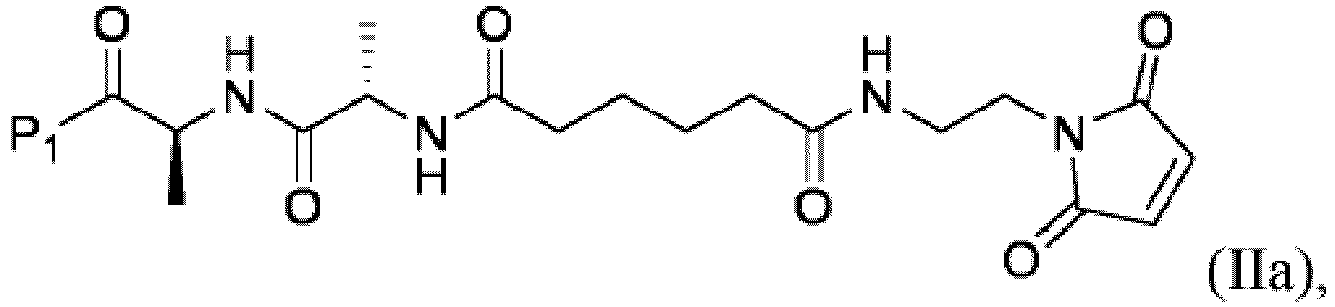 (b) Reagierens der Verbindung der Formel (IIa) mit einem Carbonsäure entschützenden Mittel, um die Verbindung der Formel (IIIa):
 (c) Reagierens der Verbindung der Formel (IIIa) mit einer Verbindung der Formel (IV):
- Verfahren nach Anspruch 8, wobei (i) P1 -OtBu, -OMe, -OBn oder -O-Silyl ist; oder (ii) P1 -OtBu ist.
- Verfahren nach Anspruch 8 oder 9, wobei E -OH ist und die Reaktion zwischen der Verbindung der Formel (Ia) und der Verbindung der Formel (a) in Gegenwart eines Aktivierungsmittels ausgeführt wird; wobei wahlweise (i) das Aktivierungsmittel ein 2,4,6-Trialkyl-1,3,5,2,4,6-trioxatriphosphorinan-2,4,6-trioxid, Carbodiimid, ein Uronium, ein aktivierter Ester, ein Phosphonium, 2-Alkyl-1-alkylcarbonyl-1,2-dihydrochinolin, 2-Alkoxy-1-alkoxycarbonyl-1,2-dihydrochinolin oder Alkylchlorformiat ist; (ii) das Aktivierungsmittel 2,4,6-Trialkyl-1,3,5,2,4,6-trioxatriphosphorinan-2,4,6-trioxid ist; oder (iii) das Aktivierungsmittel 2,4,6-Tripropyl-1,3,5,2,4,6-trioxatriphosphorinan-2,4,6-trioxid ist.
- Verfahren nach einem der Ansprüche 8-10, wobei das Carbonsäure entschützende Mittel in Schritt (b) eine Säure ist; wobei wahlweise die Säure Trifluoressigsäure (TFA) ist.
- Verfahren nach Anspruch 8, wobei das Verfahren die Schritte umfasst des:(a) Reagierens einer Verbindung der Formel (Ia1):

 (b) Reagierens der Verbindung der Formel (IIa1) mit einem Carbonsäure entschützenden Mittel, um die Verbindung der Formel (IIIa) zu bilden:
 (c) Reagierens der Verbindung der Formel (IIIa) mit einer Verbindung der Formel (IV):
- Verfahren nach Anspruch 12, wobei das Aktivierungsmittel in Schritt (a) 2,4,6-Tripropyl-1,3,5,2,4,6-trioxatriphosphorinan-2,4,6-trioxid ist und/oder das Carbonsäure entschützende Mittel in Schritt (b) Trifluoressigsäure (TFA) ist.
- Verfahren nach einem der Ansprüche 1-13, wobei E, liegt es vor, -OH ist und die Reaktion in Schritt (a) in Gegenwart eines Aktivierungsmittels ausgeführt wird, das HATU und HOAt ist.
- Verfahren nach Anspruch 14, wobei die Reaktion in Schritt (a) in Gegenwart einer Base ausgeführt wird, wobei wahlweise die Base Triethylamin oder Diisopropylethylamin ist.
- Verfahren nach einem der Ansprüche 1-15, wobei das Salz der Verbindung der Formel (a) ein HCl-Salz oder ein TFA-Salz ist.
Priority Applications (1)
| Application Number | Priority Date | Filing Date | Title |
|---|---|---|---|
| EP24164117.4A EP4365173A3 (de) | 2018-11-12 | 2019-11-11 | Verfahren zur herstellung zytotoxischer benzodiazepinderivate |
Applications Claiming Priority (2)
| Application Number | Priority Date | Filing Date | Title |
|---|---|---|---|
| US201862758819P | 2018-11-12 | 2018-11-12 | |
| PCT/US2019/060679 WO2020102053A1 (en) | 2018-11-12 | 2019-11-11 | Methods of preparing cytotoxic benzodiazepine derivatives |
Related Child Applications (1)
| Application Number | Title | Priority Date | Filing Date |
|---|---|---|---|
| EP24164117.4A Division EP4365173A3 (de) | 2018-11-12 | 2019-11-11 | Verfahren zur herstellung zytotoxischer benzodiazepinderivate |
Publications (2)
| Publication Number | Publication Date |
|---|---|
| EP3880656A1 EP3880656A1 (de) | 2021-09-22 |
| EP3880656B1 true EP3880656B1 (de) | 2024-03-20 |
Family
ID=68808530
Family Applications (2)
| Application Number | Title | Priority Date | Filing Date |
|---|---|---|---|
| EP24164117.4A Withdrawn EP4365173A3 (de) | 2018-11-12 | 2019-11-11 | Verfahren zur herstellung zytotoxischer benzodiazepinderivate |
| EP19816995.5A Active EP3880656B1 (de) | 2018-11-12 | 2019-11-11 | Verfahren zur herstellung von zytostatischen benzodiazepinderivaten |
Family Applications Before (1)
| Application Number | Title | Priority Date | Filing Date |
|---|---|---|---|
| EP24164117.4A Withdrawn EP4365173A3 (de) | 2018-11-12 | 2019-11-11 | Verfahren zur herstellung zytotoxischer benzodiazepinderivate |
Country Status (12)
| Country | Link |
|---|---|
| US (3) | US10913713B2 (de) |
| EP (2) | EP4365173A3 (de) |
| JP (1) | JP2022512936A (de) |
| KR (1) | KR20210099010A (de) |
| CN (1) | CN113166053A (de) |
| AU (1) | AU2019381628A1 (de) |
| CA (1) | CA3119544A1 (de) |
| IL (2) | IL308670A (de) |
| MA (1) | MA54225A (de) |
| SG (1) | SG11202104423XA (de) |
| TW (1) | TWI849000B (de) |
| WO (1) | WO2020102053A1 (de) |
Families Citing this family (3)
| Publication number | Priority date | Publication date | Assignee | Title |
|---|---|---|---|---|
| MA54225A (fr) | 2018-11-12 | 2021-09-22 | Immunogen Inc | Procédés de préparation de dérivés de benzodiazépine cytotoxiques |
| CN117813287A (zh) | 2021-08-13 | 2024-04-02 | 伊缪诺金公司 | 用于制备细胞毒性苯二氮卓衍生物的改进方法 |
| EP4548932A1 (de) | 2022-06-30 | 2025-05-07 | Toray Industries, Inc. | Pharmazeutische zusammensetzung zur behandlung und/oder prävention von krebs |
Family Cites Families (9)
| Publication number | Priority date | Publication date | Assignee | Title |
|---|---|---|---|---|
| GB0708818D0 (en) * | 2007-05-08 | 2007-06-13 | Portela & Ca Sa | Compounds |
| EP2675479B1 (de) * | 2011-02-15 | 2016-01-13 | Immunogen, Inc. | Zytotoxische benzodiazepin-derivate |
| LT3313884T (lt) * | 2015-06-29 | 2021-03-10 | Immunogen, Inc. | Anti-cd123 antikūnai, konjugatai ir jų dariniai |
| PL3313845T3 (pl) * | 2015-06-29 | 2021-01-11 | Immunogen, Inc. | Koniugaty przeciwciał modyfikowanych cysteiną |
| EP3653628B1 (de) * | 2015-07-21 | 2022-09-14 | ImmunoGen, Inc. | Verfahren zur herstellung von zytostatischen benzodiazepinderivaten |
| FI3380525T3 (fi) * | 2015-11-25 | 2024-01-30 | Immunogen Inc | Lääkeformulaatioita ja niiden käyttömenetelmiä |
| IL287405B (en) * | 2017-01-25 | 2022-07-01 | Immunogen Inc | Methods of preparing cytotoxic benzodiazepine derivatives |
| EP3732178A1 (de) * | 2017-12-28 | 2020-11-04 | ImmunoGen, Inc. | Benzodiazepinderivate |
| MA54225A (fr) | 2018-11-12 | 2021-09-22 | Immunogen Inc | Procédés de préparation de dérivés de benzodiazépine cytotoxiques |
-
2019
- 2019-11-11 MA MA054225A patent/MA54225A/fr unknown
- 2019-11-11 JP JP2021524308A patent/JP2022512936A/ja not_active Ceased
- 2019-11-11 EP EP24164117.4A patent/EP4365173A3/de not_active Withdrawn
- 2019-11-11 SG SG11202104423XA patent/SG11202104423XA/en unknown
- 2019-11-11 EP EP19816995.5A patent/EP3880656B1/de active Active
- 2019-11-11 IL IL308670A patent/IL308670A/en unknown
- 2019-11-11 CN CN201980074349.0A patent/CN113166053A/zh active Pending
- 2019-11-11 TW TW108140770A patent/TWI849000B/zh active
- 2019-11-11 KR KR1020217017973A patent/KR20210099010A/ko not_active Withdrawn
- 2019-11-11 AU AU2019381628A patent/AU2019381628A1/en not_active Abandoned
- 2019-11-11 WO PCT/US2019/060679 patent/WO2020102053A1/en not_active Ceased
- 2019-11-11 US US16/679,593 patent/US10913713B2/en active Active
- 2019-11-11 IL IL283047A patent/IL283047B2/en unknown
- 2019-11-11 CA CA3119544A patent/CA3119544A1/en active Pending
-
2021
- 2021-01-07 US US17/143,723 patent/US11591296B2/en active Active
-
2023
- 2023-01-19 US US18/098,834 patent/US20230286914A1/en not_active Abandoned
Also Published As
| Publication number | Publication date |
|---|---|
| EP4365173A3 (de) | 2024-07-17 |
| IL283047A (en) | 2021-06-30 |
| CA3119544A1 (en) | 2020-05-22 |
| KR20210099010A (ko) | 2021-08-11 |
| EP3880656A1 (de) | 2021-09-22 |
| SG11202104423XA (en) | 2021-05-28 |
| IL283047B1 (en) | 2023-12-01 |
| TW202033498A (zh) | 2020-09-16 |
| EP4365173A2 (de) | 2024-05-08 |
| TWI849000B (zh) | 2024-07-21 |
| US10913713B2 (en) | 2021-02-09 |
| WO2020102053A1 (en) | 2020-05-22 |
| IL308670A (en) | 2024-01-01 |
| US20230286914A1 (en) | 2023-09-14 |
| WO2020102053A8 (en) | 2020-06-18 |
| JP2022512936A (ja) | 2022-02-07 |
| US11591296B2 (en) | 2023-02-28 |
| IL283047B2 (en) | 2024-04-01 |
| US20210230114A1 (en) | 2021-07-29 |
| CN113166053A (zh) | 2021-07-23 |
| MA54225A (fr) | 2021-09-22 |
| US20200172481A1 (en) | 2020-06-04 |
| AU2019381628A1 (en) | 2021-05-27 |
Similar Documents
| Publication | Publication Date | Title |
|---|---|---|
| US20230286914A1 (en) | Methods of preparing cytotoxic benzodiazepine derivatives | |
| EP3325485B1 (de) | Verfahren zur herstellung von zytostatischen benzodiazepinderivaten | |
| US11390633B2 (en) | Methods of preparing cytotoxic benzodiazepine derivatives | |
| RU2807546C2 (ru) | Способы получения цитотоксических производных бензодиазепина | |
| WO2023018960A1 (en) | Improved methods for preparing cytotoxic benzodiazepine derivatives | |
| HK40089587A (en) | Methods of preparing cytotoxic benzodiazepine derivatives | |
| HK40029973B (en) | Methods of preparing cytotoxic benzodiazepine derivatives | |
| HK40018558B (en) | Methods of preparing cytotoxic benzodiazepine derivatives | |
| HK40018558A (en) | Methods of preparing cytotoxic benzodiazepine derivatives | |
| HK1252323B (en) | Methods of preparing cytotoxic benzodiazepine derivatives |
Legal Events
| Date | Code | Title | Description |
|---|---|---|---|
| STAA | Information on the status of an ep patent application or granted ep patent |
Free format text: STATUS: UNKNOWN |
|
| STAA | Information on the status of an ep patent application or granted ep patent |
Free format text: STATUS: THE INTERNATIONAL PUBLICATION HAS BEEN MADE |
|
| PUAI | Public reference made under article 153(3) epc to a published international application that has entered the european phase |
Free format text: ORIGINAL CODE: 0009012 |
|
| STAA | Information on the status of an ep patent application or granted ep patent |
Free format text: STATUS: REQUEST FOR EXAMINATION WAS MADE |
|
| 17P | Request for examination filed |
Effective date: 20210505 |
|
| AK | Designated contracting states |
Kind code of ref document: A1 Designated state(s): AL AT BE BG CH CY CZ DE DK EE ES FI FR GB GR HR HU IE IS IT LI LT LU LV MC MK MT NL NO PL PT RO RS SE SI SK SM TR |
|
| STAA | Information on the status of an ep patent application or granted ep patent |
Free format text: STATUS: EXAMINATION IS IN PROGRESS |
|
| REG | Reference to a national code |
Ref country code: HK Ref legal event code: DE Ref document number: 40060523 Country of ref document: HK |
|
| 17Q | First examination report despatched |
Effective date: 20220429 |
|
| P01 | Opt-out of the competence of the unified patent court (upc) registered |
Effective date: 20230529 |
|
| GRAP | Despatch of communication of intention to grant a patent |
Free format text: ORIGINAL CODE: EPIDOSNIGR1 |
|
| STAA | Information on the status of an ep patent application or granted ep patent |
Free format text: STATUS: GRANT OF PATENT IS INTENDED |
|
| INTG | Intention to grant announced |
Effective date: 20231004 |
|
| GRAS | Grant fee paid |
Free format text: ORIGINAL CODE: EPIDOSNIGR3 |
|
| GRAA | (expected) grant |
Free format text: ORIGINAL CODE: 0009210 |
|
| STAA | Information on the status of an ep patent application or granted ep patent |
Free format text: STATUS: THE PATENT HAS BEEN GRANTED |
|
| AK | Designated contracting states |
Kind code of ref document: B1 Designated state(s): AL AT BE BG CH CY CZ DE DK EE ES FI FR GB GR HR HU IE IS IT LI LT LU LV MC MK MT NL NO PL PT RO RS SE SI SK SM TR |
|
| REG | Reference to a national code |
Ref country code: GB Ref legal event code: FG4D |
|
| REG | Reference to a national code |
Ref country code: CH Ref legal event code: EP |
|
| REG | Reference to a national code |
Ref country code: DE Ref legal event code: R096 Ref document number: 602019048716 Country of ref document: DE |
|
| REG | Reference to a national code |
Ref country code: IE Ref legal event code: FG4D |
|
| PG25 | Lapsed in a contracting state [announced via postgrant information from national office to epo] |
Ref country code: LT Free format text: LAPSE BECAUSE OF FAILURE TO SUBMIT A TRANSLATION OF THE DESCRIPTION OR TO PAY THE FEE WITHIN THE PRESCRIBED TIME-LIMIT Effective date: 20240320 |
|
| REG | Reference to a national code |
Ref country code: LT Ref legal event code: MG9D |
|
| PG25 | Lapsed in a contracting state [announced via postgrant information from national office to epo] |
Ref country code: GR Free format text: LAPSE BECAUSE OF FAILURE TO SUBMIT A TRANSLATION OF THE DESCRIPTION OR TO PAY THE FEE WITHIN THE PRESCRIBED TIME-LIMIT Effective date: 20240621 |
|
| PG25 | Lapsed in a contracting state [announced via postgrant information from national office to epo] |
Ref country code: RS Free format text: LAPSE BECAUSE OF FAILURE TO SUBMIT A TRANSLATION OF THE DESCRIPTION OR TO PAY THE FEE WITHIN THE PRESCRIBED TIME-LIMIT Effective date: 20240620 Ref country code: HR Free format text: LAPSE BECAUSE OF FAILURE TO SUBMIT A TRANSLATION OF THE DESCRIPTION OR TO PAY THE FEE WITHIN THE PRESCRIBED TIME-LIMIT Effective date: 20240320 |
|
| REG | Reference to a national code |
Ref country code: NL Ref legal event code: MP Effective date: 20240320 |
|
| PG25 | Lapsed in a contracting state [announced via postgrant information from national office to epo] |
Ref country code: RS Free format text: LAPSE BECAUSE OF FAILURE TO SUBMIT A TRANSLATION OF THE DESCRIPTION OR TO PAY THE FEE WITHIN THE PRESCRIBED TIME-LIMIT Effective date: 20240620 Ref country code: NO Free format text: LAPSE BECAUSE OF FAILURE TO SUBMIT A TRANSLATION OF THE DESCRIPTION OR TO PAY THE FEE WITHIN THE PRESCRIBED TIME-LIMIT Effective date: 20240620 Ref country code: LT Free format text: LAPSE BECAUSE OF FAILURE TO SUBMIT A TRANSLATION OF THE DESCRIPTION OR TO PAY THE FEE WITHIN THE PRESCRIBED TIME-LIMIT Effective date: 20240320 Ref country code: HR Free format text: LAPSE BECAUSE OF FAILURE TO SUBMIT A TRANSLATION OF THE DESCRIPTION OR TO PAY THE FEE WITHIN THE PRESCRIBED TIME-LIMIT Effective date: 20240320 Ref country code: GR Free format text: LAPSE BECAUSE OF FAILURE TO SUBMIT A TRANSLATION OF THE DESCRIPTION OR TO PAY THE FEE WITHIN THE PRESCRIBED TIME-LIMIT Effective date: 20240621 Ref country code: FI Free format text: LAPSE BECAUSE OF FAILURE TO SUBMIT A TRANSLATION OF THE DESCRIPTION OR TO PAY THE FEE WITHIN THE PRESCRIBED TIME-LIMIT Effective date: 20240320 Ref country code: BG Free format text: LAPSE BECAUSE OF FAILURE TO SUBMIT A TRANSLATION OF THE DESCRIPTION OR TO PAY THE FEE WITHIN THE PRESCRIBED TIME-LIMIT Effective date: 20240320 |
|
| REG | Reference to a national code |
Ref country code: AT Ref legal event code: MK05 Ref document number: 1667728 Country of ref document: AT Kind code of ref document: T Effective date: 20240320 |
|
| PG25 | Lapsed in a contracting state [announced via postgrant information from national office to epo] |
Ref country code: SE Free format text: LAPSE BECAUSE OF FAILURE TO SUBMIT A TRANSLATION OF THE DESCRIPTION OR TO PAY THE FEE WITHIN THE PRESCRIBED TIME-LIMIT Effective date: 20240320 Ref country code: LV Free format text: LAPSE BECAUSE OF FAILURE TO SUBMIT A TRANSLATION OF THE DESCRIPTION OR TO PAY THE FEE WITHIN THE PRESCRIBED TIME-LIMIT Effective date: 20240320 |
|
| PG25 | Lapsed in a contracting state [announced via postgrant information from national office to epo] |
Ref country code: NL Free format text: LAPSE BECAUSE OF FAILURE TO SUBMIT A TRANSLATION OF THE DESCRIPTION OR TO PAY THE FEE WITHIN THE PRESCRIBED TIME-LIMIT Effective date: 20240320 |
|
| PG25 | Lapsed in a contracting state [announced via postgrant information from national office to epo] |
Ref country code: NL Free format text: LAPSE BECAUSE OF FAILURE TO SUBMIT A TRANSLATION OF THE DESCRIPTION OR TO PAY THE FEE WITHIN THE PRESCRIBED TIME-LIMIT Effective date: 20240320 |
|
| PG25 | Lapsed in a contracting state [announced via postgrant information from national office to epo] |
Ref country code: IS Free format text: LAPSE BECAUSE OF FAILURE TO SUBMIT A TRANSLATION OF THE DESCRIPTION OR TO PAY THE FEE WITHIN THE PRESCRIBED TIME-LIMIT Effective date: 20240720 |
|
| VS25 | Lapsed in a validation state [announced via postgrant information from nat. office to epo] |
Ref country code: MD Free format text: LAPSE BECAUSE OF FAILURE TO SUBMIT A TRANSLATION OF THE DESCRIPTION OR TO PAY THE FEE WITHIN THE PRESCRIBED TIME-LIMIT Effective date: 20240320 |
|
| PG25 | Lapsed in a contracting state [announced via postgrant information from national office to epo] |
Ref country code: SM Free format text: LAPSE BECAUSE OF FAILURE TO SUBMIT A TRANSLATION OF THE DESCRIPTION OR TO PAY THE FEE WITHIN THE PRESCRIBED TIME-LIMIT Effective date: 20240320 Ref country code: PT Free format text: LAPSE BECAUSE OF FAILURE TO SUBMIT A TRANSLATION OF THE DESCRIPTION OR TO PAY THE FEE WITHIN THE PRESCRIBED TIME-LIMIT Effective date: 20240722 |
|
| PG25 | Lapsed in a contracting state [announced via postgrant information from national office to epo] |
Ref country code: ES Free format text: LAPSE BECAUSE OF FAILURE TO SUBMIT A TRANSLATION OF THE DESCRIPTION OR TO PAY THE FEE WITHIN THE PRESCRIBED TIME-LIMIT Effective date: 20240320 |
|
| PG25 | Lapsed in a contracting state [announced via postgrant information from national office to epo] |
Ref country code: CZ Free format text: LAPSE BECAUSE OF FAILURE TO SUBMIT A TRANSLATION OF THE DESCRIPTION OR TO PAY THE FEE WITHIN THE PRESCRIBED TIME-LIMIT Effective date: 20240320 Ref country code: EE Free format text: LAPSE BECAUSE OF FAILURE TO SUBMIT A TRANSLATION OF THE DESCRIPTION OR TO PAY THE FEE WITHIN THE PRESCRIBED TIME-LIMIT Effective date: 20240320 |
|
| PG25 | Lapsed in a contracting state [announced via postgrant information from national office to epo] |
Ref country code: AT Free format text: LAPSE BECAUSE OF FAILURE TO SUBMIT A TRANSLATION OF THE DESCRIPTION OR TO PAY THE FEE WITHIN THE PRESCRIBED TIME-LIMIT Effective date: 20240320 |
|
| PG25 | Lapsed in a contracting state [announced via postgrant information from national office to epo] |
Ref country code: PL Free format text: LAPSE BECAUSE OF FAILURE TO SUBMIT A TRANSLATION OF THE DESCRIPTION OR TO PAY THE FEE WITHIN THE PRESCRIBED TIME-LIMIT Effective date: 20240320 |
|
| PG25 | Lapsed in a contracting state [announced via postgrant information from national office to epo] |
Ref country code: SK Free format text: LAPSE BECAUSE OF FAILURE TO SUBMIT A TRANSLATION OF THE DESCRIPTION OR TO PAY THE FEE WITHIN THE PRESCRIBED TIME-LIMIT Effective date: 20240320 |
|
| PG25 | Lapsed in a contracting state [announced via postgrant information from national office to epo] |
Ref country code: SM Free format text: LAPSE BECAUSE OF FAILURE TO SUBMIT A TRANSLATION OF THE DESCRIPTION OR TO PAY THE FEE WITHIN THE PRESCRIBED TIME-LIMIT Effective date: 20240320 Ref country code: SK Free format text: LAPSE BECAUSE OF FAILURE TO SUBMIT A TRANSLATION OF THE DESCRIPTION OR TO PAY THE FEE WITHIN THE PRESCRIBED TIME-LIMIT Effective date: 20240320 Ref country code: RO Free format text: LAPSE BECAUSE OF FAILURE TO SUBMIT A TRANSLATION OF THE DESCRIPTION OR TO PAY THE FEE WITHIN THE PRESCRIBED TIME-LIMIT Effective date: 20240320 Ref country code: PT Free format text: LAPSE BECAUSE OF FAILURE TO SUBMIT A TRANSLATION OF THE DESCRIPTION OR TO PAY THE FEE WITHIN THE PRESCRIBED TIME-LIMIT Effective date: 20240722 Ref country code: PL Free format text: LAPSE BECAUSE OF FAILURE TO SUBMIT A TRANSLATION OF THE DESCRIPTION OR TO PAY THE FEE WITHIN THE PRESCRIBED TIME-LIMIT Effective date: 20240320 Ref country code: IS Free format text: LAPSE BECAUSE OF FAILURE TO SUBMIT A TRANSLATION OF THE DESCRIPTION OR TO PAY THE FEE WITHIN THE PRESCRIBED TIME-LIMIT Effective date: 20240720 Ref country code: ES Free format text: LAPSE BECAUSE OF FAILURE TO SUBMIT A TRANSLATION OF THE DESCRIPTION OR TO PAY THE FEE WITHIN THE PRESCRIBED TIME-LIMIT Effective date: 20240320 Ref country code: EE Free format text: LAPSE BECAUSE OF FAILURE TO SUBMIT A TRANSLATION OF THE DESCRIPTION OR TO PAY THE FEE WITHIN THE PRESCRIBED TIME-LIMIT Effective date: 20240320 Ref country code: CZ Free format text: LAPSE BECAUSE OF FAILURE TO SUBMIT A TRANSLATION OF THE DESCRIPTION OR TO PAY THE FEE WITHIN THE PRESCRIBED TIME-LIMIT Effective date: 20240320 Ref country code: AT Free format text: LAPSE BECAUSE OF FAILURE TO SUBMIT A TRANSLATION OF THE DESCRIPTION OR TO PAY THE FEE WITHIN THE PRESCRIBED TIME-LIMIT Effective date: 20240320 |
|
| VS25 | Lapsed in a validation state [announced via postgrant information from nat. office to epo] |
Ref country code: MD Free format text: LAPSE BECAUSE OF FAILURE TO SUBMIT A TRANSLATION OF THE DESCRIPTION OR TO PAY THE FEE WITHIN THE PRESCRIBED TIME-LIMIT Effective date: 20240320 |
|
| PG25 | Lapsed in a contracting state [announced via postgrant information from national office to epo] |
Ref country code: IT Free format text: LAPSE BECAUSE OF FAILURE TO SUBMIT A TRANSLATION OF THE DESCRIPTION OR TO PAY THE FEE WITHIN THE PRESCRIBED TIME-LIMIT Effective date: 20240320 |
|
| REG | Reference to a national code |
Ref country code: DE Ref legal event code: R097 Ref document number: 602019048716 Country of ref document: DE |
|
| PG25 | Lapsed in a contracting state [announced via postgrant information from national office to epo] |
Ref country code: IT Free format text: LAPSE BECAUSE OF FAILURE TO SUBMIT A TRANSLATION OF THE DESCRIPTION OR TO PAY THE FEE WITHIN THE PRESCRIBED TIME-LIMIT Effective date: 20240320 |
|
| PG25 | Lapsed in a contracting state [announced via postgrant information from national office to epo] |
Ref country code: DK Free format text: LAPSE BECAUSE OF FAILURE TO SUBMIT A TRANSLATION OF THE DESCRIPTION OR TO PAY THE FEE WITHIN THE PRESCRIBED TIME-LIMIT Effective date: 20240320 |
|
| PLBE | No opposition filed within time limit |
Free format text: ORIGINAL CODE: 0009261 |
|
| STAA | Information on the status of an ep patent application or granted ep patent |
Free format text: STATUS: NO OPPOSITION FILED WITHIN TIME LIMIT |
|
| PG25 | Lapsed in a contracting state [announced via postgrant information from national office to epo] |
Ref country code: DK Free format text: LAPSE BECAUSE OF FAILURE TO SUBMIT A TRANSLATION OF THE DESCRIPTION OR TO PAY THE FEE WITHIN THE PRESCRIBED TIME-LIMIT Effective date: 20240320 |
|
| 26N | No opposition filed |
Effective date: 20241223 |
|
| PG25 | Lapsed in a contracting state [announced via postgrant information from national office to epo] |
Ref country code: SI Free format text: LAPSE BECAUSE OF FAILURE TO SUBMIT A TRANSLATION OF THE DESCRIPTION OR TO PAY THE FEE WITHIN THE PRESCRIBED TIME-LIMIT Effective date: 20240320 |
|
| REG | Reference to a national code |
Ref country code: DE Ref legal event code: R119 Ref document number: 602019048716 Country of ref document: DE |
|
| REG | Reference to a national code |
Ref country code: CH Ref legal event code: PL |
|
| PG25 | Lapsed in a contracting state [announced via postgrant information from national office to epo] |
Ref country code: MC Free format text: LAPSE BECAUSE OF FAILURE TO SUBMIT A TRANSLATION OF THE DESCRIPTION OR TO PAY THE FEE WITHIN THE PRESCRIBED TIME-LIMIT Effective date: 20240320 |
|
| PG25 | Lapsed in a contracting state [announced via postgrant information from national office to epo] |
Ref country code: LU Free format text: LAPSE BECAUSE OF NON-PAYMENT OF DUE FEES Effective date: 20241111 |
|
| REG | Reference to a national code |
Ref country code: CH Ref legal event code: PL |
|
| GBPC | Gb: european patent ceased through non-payment of renewal fee |
Effective date: 20241111 |
|
| PG25 | Lapsed in a contracting state [announced via postgrant information from national office to epo] |
Ref country code: CH Free format text: LAPSE BECAUSE OF NON-PAYMENT OF DUE FEES Effective date: 20241130 |
|
| REG | Reference to a national code |
Ref country code: BE Ref legal event code: MM Effective date: 20241130 |
|
| PG25 | Lapsed in a contracting state [announced via postgrant information from national office to epo] |
Ref country code: DE Free format text: LAPSE BECAUSE OF NON-PAYMENT OF DUE FEES Effective date: 20250603 |
|
| PG25 | Lapsed in a contracting state [announced via postgrant information from national office to epo] |
Ref country code: BE Free format text: LAPSE BECAUSE OF NON-PAYMENT OF DUE FEES Effective date: 20241130 Ref country code: GB Free format text: LAPSE BECAUSE OF NON-PAYMENT OF DUE FEES Effective date: 20241111 |
|
| PG25 | Lapsed in a contracting state [announced via postgrant information from national office to epo] |
Ref country code: FR Free format text: LAPSE BECAUSE OF NON-PAYMENT OF DUE FEES Effective date: 20241130 |
|
| PG25 | Lapsed in a contracting state [announced via postgrant information from national office to epo] |
Ref country code: IE Free format text: LAPSE BECAUSE OF NON-PAYMENT OF DUE FEES Effective date: 20241111 |