EP3879604B1 - Surface treatment method for lithium metal negative electrode - Google Patents
Surface treatment method for lithium metal negative electrode Download PDFInfo
- Publication number
- EP3879604B1 EP3879604B1 EP18939602.1A EP18939602A EP3879604B1 EP 3879604 B1 EP3879604 B1 EP 3879604B1 EP 18939602 A EP18939602 A EP 18939602A EP 3879604 B1 EP3879604 B1 EP 3879604B1
- Authority
- EP
- European Patent Office
- Prior art keywords
- lithium
- lithium metal
- negative electrode
- dry ice
- metal negative
- Prior art date
- Legal status (The legal status is an assumption and is not a legal conclusion. Google has not performed a legal analysis and makes no representation as to the accuracy of the status listed.)
- Active
Links
Images


Classifications
-
- B—PERFORMING OPERATIONS; TRANSPORTING
- B24—GRINDING; POLISHING
- B24C—ABRASIVE OR RELATED BLASTING WITH PARTICULATE MATERIAL
- B24C1/00—Methods for use of abrasive blasting for producing particular effects; Use of auxiliary equipment in connection with such methods
- B24C1/003—Methods for use of abrasive blasting for producing particular effects; Use of auxiliary equipment in connection with such methods using material which dissolves or changes phase after the treatment, e.g. ice, CO2
-
- B—PERFORMING OPERATIONS; TRANSPORTING
- B24—GRINDING; POLISHING
- B24C—ABRASIVE OR RELATED BLASTING WITH PARTICULATE MATERIAL
- B24C3/00—Abrasive blasting machines or devices; Plants
- B24C3/32—Abrasive blasting machines or devices; Plants designed for abrasive blasting of particular work, e.g. the internal surfaces of cylinder blocks
- B24C3/322—Abrasive blasting machines or devices; Plants designed for abrasive blasting of particular work, e.g. the internal surfaces of cylinder blocks for electrical components
-
- H—ELECTRICITY
- H01—ELECTRIC ELEMENTS
- H01M—PROCESSES OR MEANS, e.g. BATTERIES, FOR THE DIRECT CONVERSION OF CHEMICAL ENERGY INTO ELECTRICAL ENERGY
- H01M10/00—Secondary cells; Manufacture thereof
- H01M10/05—Accumulators with non-aqueous electrolyte
- H01M10/052—Li-accumulators
-
- H—ELECTRICITY
- H01—ELECTRIC ELEMENTS
- H01M—PROCESSES OR MEANS, e.g. BATTERIES, FOR THE DIRECT CONVERSION OF CHEMICAL ENERGY INTO ELECTRICAL ENERGY
- H01M10/00—Secondary cells; Manufacture thereof
- H01M10/42—Methods or arrangements for servicing or maintenance of secondary cells or secondary half-cells
- H01M10/4235—Safety or regulating additives or arrangements in electrodes, separators or electrolyte
-
- H—ELECTRICITY
- H01—ELECTRIC ELEMENTS
- H01M—PROCESSES OR MEANS, e.g. BATTERIES, FOR THE DIRECT CONVERSION OF CHEMICAL ENERGY INTO ELECTRICAL ENERGY
- H01M4/00—Electrodes
- H01M4/02—Electrodes composed of, or comprising, active material
- H01M4/13—Electrodes for accumulators with non-aqueous electrolyte, e.g. for lithium-accumulators; Processes of manufacture thereof
- H01M4/134—Electrodes based on metals, Si or alloys
-
- H—ELECTRICITY
- H01—ELECTRIC ELEMENTS
- H01M—PROCESSES OR MEANS, e.g. BATTERIES, FOR THE DIRECT CONVERSION OF CHEMICAL ENERGY INTO ELECTRICAL ENERGY
- H01M4/00—Electrodes
- H01M4/02—Electrodes composed of, or comprising, active material
- H01M2004/026—Electrodes composed of, or comprising, active material characterised by the polarity
- H01M2004/027—Negative electrodes
-
- H—ELECTRICITY
- H01—ELECTRIC ELEMENTS
- H01M—PROCESSES OR MEANS, e.g. BATTERIES, FOR THE DIRECT CONVERSION OF CHEMICAL ENERGY INTO ELECTRICAL ENERGY
- H01M4/00—Electrodes
- H01M4/02—Electrodes composed of, or comprising, active material
- H01M4/36—Selection of substances as active materials, active masses, active liquids
- H01M4/362—Composites
- H01M4/366—Composites as layered products
-
- Y—GENERAL TAGGING OF NEW TECHNOLOGICAL DEVELOPMENTS; GENERAL TAGGING OF CROSS-SECTIONAL TECHNOLOGIES SPANNING OVER SEVERAL SECTIONS OF THE IPC; TECHNICAL SUBJECTS COVERED BY FORMER USPC CROSS-REFERENCE ART COLLECTIONS [XRACs] AND DIGESTS
- Y02—TECHNOLOGIES OR APPLICATIONS FOR MITIGATION OR ADAPTATION AGAINST CLIMATE CHANGE
- Y02E—REDUCTION OF GREENHOUSE GAS [GHG] EMISSIONS, RELATED TO ENERGY GENERATION, TRANSMISSION OR DISTRIBUTION
- Y02E60/00—Enabling technologies; Technologies with a potential or indirect contribution to GHG emissions mitigation
- Y02E60/10—Energy storage using batteries
Definitions
- the present disclosure relates to a method of surface treatment of a lithium metal negative electrode according the preamble of claim 1.
- Lithium metal negative electrodes are currently attracting attention as a core material for next-generation batteries. Lithium metal negative electrodes have a specific capacity of 10 times or more that of negative electrodes generally used in lithium-ion secondary batteries, and the weight and thickness thereof may be remarkably reduced, and thus they are usually used in the development of batteries having an energy density of 400Wh/kg or 1000Wh/L or more.
- a lithium foil having a predetermined thickness produced by extrusion and rolling or a copper foil attached to the lithium foil is used.
- lithium is deposited on a substrate using CVD or thermal evaporation to form a thin film.
- a lithium metal negative electrode generally used is a rolled foil-type lithium foil, and during extrusion, rolling, and compression processes, lithium is exposed to oil and impurities during the processes.
- this leads to non-uniform surface reaction of the lithium metal negative electrode, which leads to non-uniform growth of lithium dendrites on the lithium metal negative electrode during battery charging/discharging, thereby increasing a deterioration in lifetime and a possibility of causing safety accidents due to internal short circuits.
- An aspect is to provide a surface treatment method according to claim 1 capable of leading uniform lithium plating due to eliminating contaminants and impurities on the surface of a lithium metal anode and minimizing the side-reaction of lithium during cycle charging and discharging.
- a method of surface treatment of a lithium metal negative electrode including a process of cleaning the surface of a lithium metal negative electrode using dry ice blasting, wherein in the dry ice blasting, fluorine gas is mixed with liquefied carbonic acid or dry ice pellets and then sprayed.
- a surface-treated lithium metal electrode including a lithium metal negative electrode; and a first protective layer formed on one surface of the lithium metal negative electrode and including at least one selected from lithium carbon oxide, lithium oxalate, lithium carbonate, lithium carbonite, and lithium fluoride.
- a lithium metal battery including the lithium metal negative electrode.
- the surface of the lithium metal negative electrode is cleaned and surface-treated using dry ice blasting, thereby improving the lifetime performance of a lithium metal battery compared to that of an untreated lithium metal negative electrode and providing stable charge-discharge efficiency during the lifetime of the battery.
- a surface treatment method of a lithium metal negative electrode includes a process of cleaning a surface of a lithium metal negative electrode using dry ice blasting.
- Dry ice blasting is a type of carbon dioxide cleaning, where dry ice, which is a solid form of carbon dioxide, is accelerated in a pressurized air stream to clean the surface.
- dry ice blasting is similar to other types of media spraying such as sand blasting and plastic bead blasting, the dry ice blasting is non-abrasive, non-conductive, non-flammable and environmentally harmless because dry ice is used as a spraying medium.
- dry ice blasting since dry ice is adsorbed on the surface of the lithium metal negative electrode and sublimated, secondary wastes or chemical residues are not produced. Further, when dry ice hits the surface being cleaned, it may be converted into a gaseous state again.
- the dry ice blasting may be performed using liquefied carbonic acid (liquid CO 2 ) for generating dry ice or using dry ice pellets prepared using the liquefied carbonic acid.
- liquefied carbonic acid liquid CO 2
- Dry ice pellets used for dry ice blasting are very soft and have a much lower density than other media (sand or plastic beads) used for spray cleaning, and upon impact, these pellets sublimate almost immediately and transfer minimal kinetic energy to the surface. Therefore, a damage to the lithium metal negative electrode can be minimized.
- the sublimation process absorbs a large amount of heat from the surface while creating shear stress due to thermal shock. In this case, dry ice adsorbed on contaminants on the surface causes a sudden phase change from solid to gas and generates minute shock waves. Through this, the surface of the lithium metal negative electrode is protected, and only contaminants can be effectively removed.
- the dry ice blasting may be performed by making dry ice pellets through adiabatic expansion of liquefied carbonic acid in the vicinity of a cleaning nozzle or the cleaning nozzle and spraying the dry ice pallets on the surface of a lithium metal negative electrode through the cleaning nozzle.
- the dry ice blasting may be performed by spraying liquefied carbonic acid or dry ice pellets on the surface of the lithium metal negative electrode with compressed air.
- a spraying pressure may be 10 bar or lower.
- the spraying pressure may be 8 bar or lower.
- the spraying pressure may be 5 bar or lower.
- the spraying pressure may be in a range of 0.5 bar to 10 bar or in a range of 0.5 bar to 5 bar. Within the above range, the lithium metal negative electrode may be surface-treated without excessive damage to the surface thereof.
- a spraying pressure may be in a range of 0.5 bar to 10 bar
- a spraying angle may be in a range of 15° to 90°
- a spraying distance may be in a range of 5 mm to 150 mm.
- the lithium metal negative electrode may be surface-treated without excessive damage to the surface thereof to form a protective layer.
- a first protective layer may be formed on the surface of the lithium metal negative electrode.
- the first protective layer may include at least one selected from lithium carbon dioxide, lithium oxalate, lithium carbonate, and lithium carbonite.
- the first protective layer formed on the surface of the lithium metal negative electrode during the dry ice blasting process may further include lithium fluoride (LiF).
- the method may further include a process of spraying fluorine gas on the surface of the lithium metal negative electrode after the cleaning using the dry ice blasting.
- a first protective layer including at least one selected from lithium carbon dioxide, lithium oxalate, lithium carbonate, and lithium carbonite; and a second protective layer formed on the first protective layer and including lithium fluoride (LiF) may be formed on the surface of the lithium metal negative electrode.
- the surface of the lithium metal negative electrode cleaned by dry ice blasting becomes a very uniform surface, and the lithium precipitation and peeling of the uniform surface may occur.
- the surface protective layer generated during the process enables side reactions of lithium and high-density lithium metal plating during charging, thereby improving the lifetime performance of lithium metal batteries as compared with untreated lithium metal and having stable charging and discharging efficiency during the life cycle.
- the use of dry ice blasting may contribute to suppressing internal short circuits caused by lithium dendrite growth, which is the biggest problem of lithium metal batteries, and ignition or explosion of the cells due to the internal short circuits.
- the lithium metal negative electrode may be a lithium metal thin film or a lithium alloy thin film.
- a lithium alloy may include lithium and a metal/metalloid alloyable with lithium.
- the metal/metalloid alloyable with lithium may be Si, Sn, Al, Ge, Pb, Bi, Sb, Si-Y alloy (Y is an alkali metal, alkaline earth metal, group 13 element, group 14 element, transition metal, rare earth element, or a thereof, not Si), Sn-Y alloy (Y is an alkali metal, alkaline earth metal, group 13 element, group 14 element, transition metal, rare earth element, or a combination thereof, not Sn), or the like.
- the element Y may be Mg, Ca, Sr, Ba, Ra, Sc, Y, Ti, Zr, Hf, Rf, V, Nb, Ta, Db, Cr, Mo, W, Sg, Tc, Re, Bh, Fe, Pb, Ru, Os, Hs, Rh, Ir, Pd, Pt, Cu, Ag, Au, Zn, Cd, B, Al, Ga, Sn, In, Ti, Ge, P, As, Sb, Bi, S, Se, Te, Po, or a combination thereof.
- the first protective layer may include lithium fluoride (LiF).
- the surface-treated lithium metal negative electrode may further include a second protective layer including lithium fluoride (LiF) on the first protective layer.
- a second protective layer including lithium fluoride (LiF) on the first protective layer may further include a second protective layer including lithium fluoride (LiF) on the first protective layer.
- a lithium metal battery according to another illustrative example includes the above-described surface-treated lithium metal negative electrode.
- the lithium metal battery includes, for example, a positive electrode; the lithium metal negative electrode; and an electrolyte between the positive electrode and the lithium metal negative electrode.
- the type of the lithium metal battery is not particularly limited, and examples thereof include lithium secondary batteries such as lithium ion batteries, lithium ion polymer batteries, and lithium sulfur batteries, as well as lithium primary batteries.
- the lithium metal battery has excellent stability at a high voltage of 4.35 V or higher, for example, 4.4 V to 4.5 V.
- the lithium metal battery may be manufactured by the following method.
- a positive electrode is prepared.
- a positive electrode active material composition in which a positive electrode active material, a conductive agent, a binder, and a solvent are mixed is prepared.
- the positive electrode active material composition is directly applied onto a metal current collector to form a positive electrode plate.
- the positive electrode active material composition may be cast on a separate support, and then a film obtained by peeling from the support may be laminated on a metal current collector to form a positive electrode plate.
- the type of the positive electrode is not limited to the types listed above, and may have a type other than the above types.
- the positive electrode active material is a lithium composite oxide, and may be used without limitation as long as it is commonly used in the art.
- At least one of composite oxides of lithium and a metal selected from cobalt, manganese, nickel, and combinations thereof may be used.
- a compound represented by any one of Formulae of Li a A 1-b B b D 2 (where, 0.90 ⁇ a ⁇ 1.8, 0 ⁇ b ⁇ 0.5); Li a E 1-b B b O 2-c D c (where, 0.90 ⁇ a ⁇ 1.8, 0 ⁇ b ⁇ 0.5, 0 ⁇ c ⁇ 0.05); LiE 2-b B b O 4-c D c (where, 0 ⁇ b ⁇ 0.5, 0 ⁇ c ⁇ 0.05); Li a Ni 1-b-c Co b B c D ⁇ (where, 0.90 ⁇ a ⁇ 1.8, 0 ⁇ b ⁇ 0.5, 0 ⁇ c ⁇ 0.05, 0 ⁇ ⁇ ⁇ 2); Li a Ni 1-b-c Co b B c O 2- ⁇ F
- A is Ni, Co, Mn, or a combination thereof
- B is Al, Ni, Co, Mn, Cr, Fe, Mg, Sr, V, a rare earth element, or a combination thereof
- D is O, F, S, P, or a combination thereof
- E is Co, Mn, or a combination thereof
- F is F, S, P, or a combination thereof
- G is Al, Cr, Mn, Fe, Mg, La, Ce, Sr, V, or a combination thereof
- Q is Ti, Mo, Mn, or a combination thereof
- I is Cr, V, Fe, Sc, Y, or a combination thereof
- J is V, Cr, Mn, Co, Ni, Cu, or a combination thereof.
- a compound having a coating layer on the surface of the compound may be used, or a mixture of the compound and a compound having a coating layer may be used.
- the coating layer may include a coating element compound of an oxide of a coating element, a hydroxide of a coating element, an oxyhydroxide of a coating element, an oxycarbonate of a coating element, or a hydroxycarbonate of a coating element.
- the compound constituting this coating layer may be amorphous or crystalline.
- the coating element included in the coating layer Mg, Al, Co, K, Na, Ca, Si, Ti, V, Sn, Ge, Ga, B, As, Zr, or a mixture thereof may be used.
- any coating method may be used as long as this compound may be coated with such elements by a method that does not adversely affect the physical properties of the positive electrode active material (for example, spray coating, dipping or the like).
- This coating method will be understood by those skilled in the art, so that a detailed description thereof will be omitted.
- LiCoO 2 may be used in manufacturing a high-density positive electrode.
- the positive electrode active material for example, the positive electrode of the lithium metal battery may include a nickel-rich lithium composite oxide having a nickel content of 20 wt% to 90 wt%, for example, 30 wt% to 80 wt%, based on the total weight of the transition metal in the lithium metal battery.
- This nickel-rich lithium composite oxide is required to be improved in high-temperature performance.
- the lithium salt and a disultone-based compound are added to the electrolyte, an increase in resistance at a high temperature is reduced and charge/discharge characteristics are improved.
- the lithium composite oxide may be, for example, a compound represented by Formula 3 below.
- Formula 3 Li a Ni 1-b-c Co b M' c O 2
- the above-described nickel-rich lithium composite oxide is, for example, LiNi 0.6 Co 0.2 Mn 0.2 O 2 , LiNi 0.5 Co 0.2 Mn 0.3 O 2 , or LiNi 0.8 Co 0.15 Al 0.05 O 2 .
- conductive agent carbon black, graphite fine particles, natural graphite, artificial graphite, acetylene black, ketjen black, carbon fiber, carbon nanotubes, metal powder, metal fiber or metal tube of copper, nickel, aluminum, or silver, or a conductive polymer such as a polyphenylene derivative may be used, but the present disclosure is not limited thereto, and any conductive agent may be used as long as it is used in the art.
- binder vinylidene fluoride/hexafluoropropylene copolymer, polyvinylidene fluoride, polyimide, polyethylene, polyester, polyacrylonitrile, polymethyl methacrylate, polytetrafluoroethylene (PTFE), carboxymethyl cellulose-styrene-butadiene rubber (SMC/SBR) copolymer, styrene butadiene rubber-based polymer, or a mixture thereof may be used.
- the binder is not limited thereto, and any binder may be used as long as it is used in the art.
- N-methylpyrrolidone N-methylpyrrolidone, acetone, or water
- the present disclosure is not limited thereto, and any solvent may be used as long as it is used in the art.
- the contents of the positive electrode active material, the conductive agent, the binder, and the solvent are levels commonly used in lithium metal batteries, one or more of the conductive agent, the binder, and the solvent may be omitted depending on the use and configuration of the lithium metal battery.
- a lithium metal thin film or a lithium alloy thin film is prepared by performing cleaning and surface treatment using dry ice blasting as described above.
- the separator an insulating thin film having high ion permeability and mechanical strength is used.
- the pore diameter of the separator is generally 0.01 ⁇ m to 10 ⁇ m, and the thickness thereof is generally 5 ⁇ m to 20 ⁇ m.
- a sheet or non-woven fabric made glass fiber, polyethylene, or an olefin-based polymer such as polypropylene.
- the solid polymer electrolyte may also serve as the separator.
- a polyethylene film, a polypropylene film, a polyvinylidene fluoride film, or a multilayer film of two or more thereof may be used.
- a mixed multilayer film such as a two-layer separator of polyethylene/polypropylene, a three-layer separator of polyethylene/polypropylene/polyethylene, or a three-layer separator of polypropylene/polyethylene/polypropylene may be used.
- the lithium metal battery may use an electrolyte commonly used as the electrolyte.
- the electrolyte may be a liquid electrolyte, a gel electrolyte, a solid electrolyte, a polymer ionic liquid, or a combination thereof.
- the electrolyte may be a liquid electrolyte.
- the liquid electrolyte may include a metal salt and an organic solvent.
- the organic solvent may include a low-boiling solvent.
- the low-boiling solvent refers to a solvent having a boiling point of 200°C or less at 25°C and 1 atmosphere.
- the organic solvent may include one or more selected from dialkyl carbonates, cyclic carbonates, linear or cyclic esters, linear or cyclic amides, aliphatic nitriles, sulfone compounds, linear or cyclic ethers, and derivatives thereof.
- the organic solvent may include one or more selected from Dimethyl carbonate (DMC), diethyl carbonate (DEC), ethyl methyl carbonate (EMC), methyl propyl carbonate, ethyl propyl carbonate, methyl isopropyl carbonate, diethyl carbonate (DEC), dipropyl carbonate, dibutyl carbonate, propylene carbonate (PC), ethylene carbonate (EC), fluoroethylene carbonate (FEC), butylene carbonate, dimethylene glycol dimethyl ether, trimethylene glycol dimethyl ether, tetraethylene glycol dimethyl ether, polyethylene glycol dimethyl ether, dimethyl sulfone, ethyl methyl sulfone, diethylsulfone, adiponitrile, 1,1,2,2-tetrafluoroethyl 2,2,3,3-tetrafluoropropyl ether, ethyl propionate, ethyl butyrate, benz
- lithium salt may include LiSCN, LiN(CN) 2 , LiClO 4 , LiBF 4 , LiAsF 6 , LiPF 6 , LiCF 3 SO 3 , Li(CF 3 SO 2 ) 2 N, Li(CF 3 SO 2 ) 3 C, LiSbF 6 , LiN(SO 2 CF 3 ) 2 , Li(FSO 2 ) 2 N, LiC 4 F 9 SO 3 , LiN(SO 2 CF 2 CF 3 ) 2 , LiSbF 6 , LiPF 3 (CF 2 CF 3 ) 3 , LiPF 3 (C 2 F 5 ) 3 , LiPF 3 (CF 3 ) 3 , LiCI, LiF, LiBr, Lil, LiB(C 2 O 4 ) 2 , lithium difluoro(oxalato)borate (LiFOB), lithium bis(oxalato)borate (LiBOB), and mixtures thereof.
- LiSCN LiSCN, LiN(CN) 2 , Li
- the lithium salt may be a fluorine-containing sulfone-based compound.
- the fluorine-containing sulfone-based compound may be LiN(FSO 2 ) 2 (LiFSI), LiN(CF 3 SO 2 ) 2 (LiTFSI), LiN(CF 2 SO 2 )(CF 3 CF 2 CF 2 CF 2 SO 2 ), LiN(CF 3 CF 2 SO 2 ) 2 , LiC(CF 3 SO 2 ) 2 , or LiC(CF 3 CF 2 SO 2 ) 2 .
- the content of the lithium salt in the liquid electrolyte may be in a range of 0.1 M to 7 M based on the organic solvent.
- the content of the lithium salt may in a range of 0.5 M to 5 M based on the organic solvent.
- the content of the lithium salt may in a range of 1 M to 3 M based on the organic solvent.
- pyridine triethylphosphite, triethanolamine, cyclic ether, ethylene diamine, n-glyme, hexamethyl phosphoramide, nitrobenzene derivative, sulfur, quinone imine dye, N-substituted oxazolidinone, N, N-substituted imidazolidine, ethylene glycol dialkyl ether, ammonium salt, pyrrole, 2-methoxy ethanol, aluminum trichloride, or the like.
- a halogen-containing solvent such as carbon tetrachloride or ethylene trifluoride may be further included.
- the liquid electrolyte may further include an ionic liquid. Any ionic liquid may be used as long as it is generally used in preparing an electrolyte in the art.
- the ionic liquid may include i) at least one or more cations selected from ammonium-based cations, pyrrolidinium-based cations, pyridinium-based cations, pyrimidinium-based cations, imidazolium-based cations, piperidinium-based cations, pyrazolium-based cations, oxazolium-based cations, pyridazinium-based cations, phosphonium-based cations, sulfonium-based cations, triazole-based cations, and mixtures thereof; and ii) anions.
- Examples of the anions may include, but are not limited to, BF 4 - , PF 6 - , AsF 6 - , SbF 6 - , AlCl 4 - , HSO 4 - , ClO 4 - , CH 3 SO 3 - , CF 3 CO 2 - , (CF 3 SO 2 ) 2 N - , (FSO 2 ) 2 N - , Cl, Br, I - , SO 4 - , CF 3 SO 3 - , (C 2 F 5 SO 2 ) 2 N - , (C 2 F 5 SO 2 )(CF 3 SO 2 )N - , NO 3 - , Al 2 Cl 7 - , (CF 3 SO 2 ) 3 C - , (CF 3 ) 2 PF 4 - , (CF 3 ) 3 PF 3 - , (CF 3 ) 4 PF 2 - , (CF 3 ) 5 PF - , (CF 3 ) 6 P -
- the liquid electrolyte may have a viscosity of 5 cP or less, for example, 2.5 cp to 4.0 cp at 25°C.
- a viscosity of the electrolyte is within the above-described range, an electrochemical device having excellent conductivity and oxidation resistance of the electrolyte and improved high-voltage stability may be obtained.
- the ionic conductivity of the liquid electrolyte is 1.0 mS/cm or more, for example, 1 to 5 mS/cm at 25°C.
- the gel electrolyte is an electrolyte having a gel phase, and may have components and phases well known in the art.
- the gel electrolyte may contain, for example, a polymer and a polymer ionic liquid.
- the polymer may be, for example, a solid graft (block) copolymer.
- the solid electrolyte may be an organic solid electrolyte, an inorganic solid electrolyte, or a combination thereof.
- organic solid electrolyte for example, a polyethylene derivative, a polyethylene oxide derivative, a polypropylene oxide derivative, a phosphate ester polymer, polyegitated lysine, polyester sulfide, polyvinyl alcohol, polyvinylidene fluoride, a polymer containing an ionic dissociation group, or the like may be used.
- the inorganic solid electrolyte Cu 3 N, Li 3 N, LiPON, Li 3 PO 4 .Li 2 S.SiS 2 , Li 2 S.GeS 2 .Ga 2 S 3 ,(Na,Li) 1+x Ti 2-x Al x (PO 4 ) 3 (0.1 ⁇ x ⁇ 0.9), Li 1+x Hf 2-x Al x (PO 4 ) 3 (0.1 ⁇ x ⁇ 0.9), Na 3 Zr 2 Si 2 PO 12 , Li 3 Zr 2 Si 2 PO 12 , Na 5 ZrP 3 O 12 , Na 5 TiP 3 O 12 , Na 3 Fe 2 P 3 O 12 , Na 4 NbP 3 O 12 , NLi 0.3 La 0.5 TiO 3 , Na 5 MSi 4 O 12 (M is a rare-earth element such as Nd, Gd, or Dy) Li 5 ZrP 3 O 12 , Li 5 TiP 3 O 12 , Li 3 Fe 2 P 3 O 12 , Li 4 NbP 3 O 12 , Li 1+x
- polymeric ionic liquid a polymer obtained by polymerizing ionic liquid monomers may be used, and a compound obtained in the form of a polymer may be used.
- a polymeric ionic liquid has high solubility in an organic solvent, and has an advantage of further improving ionic conductivity when added to an electrolyte.
- the ionic liquid is prepared to have appropriate anions capable of imparting solubility in an organic solvent through an anion substitution reaction after cleaning and drying the resultant product subjected to a polymerization reaction.
- the polymer ionic liquid according to an embodiment may contain a repetition unit including i) one or more cations selected from ammonium-based cations, pyrrolidinium-based cations, pyridinium-based cations, pyrimidinium-based cations, imidazolium-based cations, piperidinium-based cations, pyrazolium-based cations, oxazolium-based cations, pyridazinium-based cations, phosphonium-based cations, sulfonium-based cations, triazole-based cations, and mixtures thereof, and ii) one or more anions selected from ii) BF 4 - , PF 6 - , AsF 6 - , SbF 6 - , AlCl 4 - , HSO 4 - , CH 3 SO 3 - , CF 3 CO 2 - , (CF 3 SO 2 ) 2 N -
- the polymeric ionic liquid may be prepared by polymerizing ionic liquid monomers.
- the ionic liquid monomer has a functional group polymerizable with a vinyl group, allyl group, acrylate group, methacrylate group, or the like, and may include one or more cations selected from ammonium-based cations, pyrrolidinium-based cations, pyridinium-based cations, pyrimidinium-based cations, imidazolium-based cations, piperidinium-based cations, pyrazolium-based cations, oxazolium-based cations, pyridazinium-based cations, phosphonium-based cations, sulfonium-based cations, triazole-based cations, and mixtures thereof, and the aforementioned anions.
- the ionic liquid monomer is, for example, 1-vinyl-3-ethylimidazolium bromide or a compound represented by Formula 4 or 5 below.
- Examples of the aforementioned polymer ionic liquid may include a compound represented by Formula 6 and a compound represented by Formula 7.
- R 1 and R 3 are each independently hydrogen, a substituted or unsubstituted C1-C30 alkyl group, a substituted or unsubstituted C2-C30 alkenyl group, a substituted or unsubstituted C2-C30 alkynyl group, a substituted or unsubstituted C6-C30 aryl group, a substituted or unsubstituted C2-C30 heteroaryl group, or a substituted or unsubstituted C4-C30 carbocyclic group.
- R 2 simply represents a chemical bond or represents a C1-C3 alkylene group, a C6-C30 arylene group, a C2-C30 heteroarylene group, or a C4-C30 carbocyclic group,
- Y - is defined the same as X in Formula 6, and n is 500 to 2800.
- Y - is, for example, bis(trifluoromethanesulfonyl)imide (TFSI), BF 4 , or CF 3 SO 3 .
- the polymer ionic liquid includes, for example, a cation selected from cations of poly(1-vinyl-3-alkylimidazolium), poly(1-allyl-3-alkylimidazolium), and poly(1-(methacryloyloxy)-3-alkylimidazolium), and anion selected from (CH 3 COO - , CF 3 COO - , CH 3 SO 3 - , CF 3 SO 3 - , (CF 3 SO 2 ) 2 N - , (CF 3 SO 2 ) 3 C - , (CF 3 CF 2 SO 2 ) 2 N - , C 4 F 9 SO 3 - , C 3 F 7 COO - , and (CF 3 SO 2 )(CF 3 CO)N - .
- anion selected from (CH 3 COO - , CF 3 COO - , CH 3 SO 3 - , CF 3 SO 3 - , (CF 3 SO 2 ) 2 N
- the compound represented by Formula 7 may include polydiallyldimethylammonium bis(trifluoromethanesulfonyl)imide.
- the high-molecular-weight ionic liquid may include a low-molecular-weight polymer, a thermally stable ionic liquid, and a lithium salt.
- the low-molecular-weight polymer may have an ethylene oxide chain.
- the low-molecular-weight polymer may be glyme.
- the glyme is, for example, polyethylene glycol dimethyl ether (polyglyme), tetraethylene glycol dimethyl ether (tetraglyme), and triethylene glycol dimethyl ether (triglyme).
- the weight average molecular weight of the low-molecular-weight polymer is 75 to 2000, for example 250 to 500.
- pyridine, triethylphosphite, triethanolamine, cyclic ether, ethylene diamine, n-glyme, hexamethyl phosphoramide, nitrobenzene derivative, sulfur, quinone imine dye, N-substituted oxazolidinone , N, N-substituted imidazolidine, ethylene glycol dialkyl ether, ammonium salt, pyrrole, 2-methoxy ethanol, aluminum trichloride, or the like may be added to the electrolyte.
- a halogen-containing solvent such as carbon tetrachloride or ethylene trifluoride may be further included.
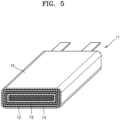
- the lithium metal battery 11 includes a positive electrode 13, a lithium metal negative electrode 12, and a separator14.
- the positive electrode 13, the lithium metal negative electrode 12, and the separator 14 are wound or folded and then accommodated in a battery case 15. Subsequently, an electrolyte is injected into the battery case 15, and the battery case 15 is sealed with a cap assembly 16 to complete the lithium battery 11.
- the battery case may have a cylindrical shape, a rectangular shape, or a thin film shape.
- the lithium metal battery may be a large thin film-type battery.
- the lithium metal battery may be a lithium ion battery.
- the lithium metal battery is suitable for electric vehicles (EV) because it has excellent lifetime characteristics and high rate characteristics.
- the lithium metal battery is suitable for hybrid vehicles such as plug-in hybrid electric vehicles (PHEV).
- PHEV plug-in hybrid electric vehicles
- the lithium metal battery may be used in a field where a large amount of power storage is required.
- the lithium metal battery may be used for electric bicycles, power tools, and the like.
- a hopper-type spraying apparatus used in dry ice blasting consists of one mixing hose (dry ice pellets and high-pressure gas (argon) are used), and the dry ice pellets are guided to a T-type mixing unit and are sprayed into a nozzle by high-pressure gas (argon).
- a nozzle gun was kept at a distance of 100mm at an inclination angle of 60° to the surface of a lithium metal negative electrode, and the dry ice pellets were sprayed at a pressure of 1.4bar.
- the lithium metal negative electrode was subjected to unwinding and rewinding at a speed of 10m/min.
- a lithium metal negative electrode having a uniform surface formed of small particles and having a protective layer formed during the adsorption sublimation process of the dry ice pellets was obtained.
- a negative electrode having a desired size was prepared.
- LiCoOz LiCoOz
- a conductive agent Super-P; Timcal Ltd.
- PVdF polyvinylidene fluoride
- N-pyrrolidone N-pyrrolidone
- the mixing weight ratio of LiCoO 2 , the conductive agent and PVDF was 97:1.5:1.5.
- the positive electrode composition was applied on an aluminum foil (thickness: about 15 ⁇ m) and dried at 25°C, and then the dried result was dried at about 110°C in vacuum to prepare a positive electrode.
- a polyethylene/polypropylene separator was laminated to be disposed between the positive electrode and the lithium metal negative electrode, and an electrolyte in which 1.3 M LiPF 6 is dissolved in a mixed solvent of EC (ethylene carbonate): EMC (ethyl methyl carbonate): DEC (diethyl carbonate) (3: 5: 2 volume ratio) was used to manufacture a stack-type lithium metal battery.
- EC ethylene carbonate
- EMC ethyl methyl carbonate
- DEC diethyl carbonate
- the lithium metal secondary battery according to Comparative Example 1 was manufactured in a jelly roll type through winding instead of laminating.
- a lithium metal secondary battery was manufactured in the same manner as in Comparative Example 1, except that cleaning and surface treatment were performed by mixing and spraying liquefied carbonic acid gas and fluorine gas on the surface of the lithium metal negative electrode in Comparative Example 1.
- a lithium metal secondary battery was manufactured in the same manner as in Comparative Example 1, except that a lithium metal negative electrode not having been subjected to dry ice blasting was used.
- FIG. 1 shows an image of a surface of a lithium metal negative electrode processed into a full roll type.
- the silver-colored surface (a) is a lithium metal negative electrode portion not treated by dry ice blasting
- the light gray surface (b) is a lithium metal negative electrode portion treated by dry ice blasting.
- FIG. 2 shows a negative electrode punched for manufacturing a cell.
- the left portion of FIG. 2 is a lithium metal negative electrode cleaned and surface-treated using dry ice blasting, and the right portion thereof is a lithium metal negative electrode not surface-treated.
- the lithium metal negative electrode cleaned and surface-treated using dry ice blasting is composed of grain boundaries each having a uniform surface and a small area as compared with the untreated lithium metal negative electrode, and. shows a gray color due to lithium carbonate (Li 2 CO 3 )-based surface treatment due to the sublimation process of the lithium surface and dry ice during cleaning.
- the electrolyte diffuses at a much faster rate during an impregnation test.
- the non-treated lithium negative electrode showed a contact angle of 50° to70°
- the treated lithium negative electrode showed a contact angle of 20° to 45°.
- the lithium metal batteries of Comparative Example 1 and Comparative Example 4 were charged and discharged under the following conditions.
- the lithium metal battery was charged with a constant current of 0.1 C rate until a voltage reached 4.30 V (vs. Li), and then was cut-off at a current of 1/20 CA rate while maintaining the voltage at 4.30 V in a constant current mode. Subsequently, during discharging, the battery was discharged with a constant current of 0.1 C rate until the battery voltage reached 2.8 V (vs. Li) (formation process, 1 st cycle). This charging/discharging process was performed twice to complete the formation process.
- the lithium metal battery having undergone the formation process was charged with a constant current of i) 0.1 C or ii) 0.2 C and a constant voltage at room temperature (25°C.) within a voltage range of 3.0 V to 4.3 V as compared with lithium metal until the battery was cut-off at a current of 1/20 CA rate, and was then discharged with a current of 1 C until a cut-off voltage reached 3 V.
- Capacity retention rate (%) (discharged capacity in each cycle/discharged capacity in 1 st cycle) ⁇ 100
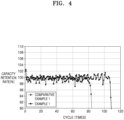
- charge-discharge efficiency [%] [discharge capacity in each cycle/charge capacity in each cycle) ⁇ 100
- the lithium metal negative electrode surface-treated by dry ice blasting has a stable charge/discharge efficiency during lifetime as compared with the non-treated lithium metal negative electrode.
Landscapes
- Engineering & Computer Science (AREA)
- Chemical & Material Sciences (AREA)
- Chemical Kinetics & Catalysis (AREA)
- Electrochemistry (AREA)
- General Chemical & Material Sciences (AREA)
- Manufacturing & Machinery (AREA)
- Mechanical Engineering (AREA)
- Materials Engineering (AREA)
- Battery Electrode And Active Subsutance (AREA)
- Secondary Cells (AREA)
Description
- The present disclosure relates to a method of surface treatment of a lithium metal negative electrode according the preamble of
claim 1. - Lithium metal negative electrodes are currently attracting attention as a core material for next-generation batteries. Lithium metal negative electrodes have a specific capacity of 10 times or more that of negative electrodes generally used in lithium-ion secondary batteries, and the weight and thickness thereof may be remarkably reduced, and thus they are usually used in the development of batteries having an energy density of 400Wh/kg or 1000Wh/L or more.
- In a method of manufacturing a lithium metal negative electrode, a lithium foil having a predetermined thickness produced by extrusion and rolling or a copper foil attached to the lithium foil is used. Alternatively, lithium is deposited on a substrate using CVD or thermal evaporation to form a thin film.
- Currently, a lithium metal negative electrode generally used is a rolled foil-type lithium foil, and during extrusion, rolling, and compression processes, lithium is exposed to oil and impurities during the processes. Thus, this leads to non-uniform surface reaction of the lithium metal negative electrode, which leads to non-uniform growth of lithium dendrites on the lithium metal negative electrode during battery charging/discharging, thereby increasing a deterioration in lifetime and a possibility of causing safety accidents due to internal short circuits.
- Accordingly, there is a need for a surface treatment method capable of suppressing the non-uniform growth of lithium dendrites due to contamination and impurities on the surface of the lithium metal negative electrode and minimizing the dendric lithium growth during cycling test lifetime. A surface treatment of silicon electrode assemblies using dry ice blasting according to the preamble of
claim 1 is disclosed inUS2006/138081A1 - An aspect is to provide a surface treatment method according to
claim 1 capable of leading uniform lithium plating due to eliminating contaminants and impurities on the surface of a lithium metal anode and minimizing the side-reaction of lithium during cycle charging and discharging. - According to an aspect of the present disclosure, there provided a method of surface treatment of a lithium metal negative electrode, the method including a process of cleaning the surface of a lithium metal negative electrode using dry ice blasting, wherein in the dry ice blasting, fluorine gas is mixed with liquefied carbonic acid or dry ice pellets and then sprayed.
- According to an illustrative aspect not forming part of the present invention, there provided a surface-treated lithium metal electrode including a lithium metal negative electrode; and a first protective layer formed on one surface of the lithium metal negative electrode and including at least one selected from lithium carbon oxide, lithium oxalate, lithium carbonate, lithium carbonite, and lithium fluoride.
- According to another illustrative aspect not forming part of the present invention, there provided a lithium metal battery including the lithium metal negative electrode.
- In the method of surface treatment of the lithium metal negative electrode according to an aspect, the surface of the lithium metal negative electrode is cleaned and surface-treated using dry ice blasting, thereby improving the lifetime performance of a lithium metal battery compared to that of an untreated lithium metal negative electrode and providing stable charge-discharge efficiency during the lifetime of the battery.
-
-
FIG. 1 shows an image of a surface of a lithium metal negative electrode processed into a full roll type in Example 1. InFIG. 1 , a silver-colored surface (a) is a lithium metal negative electrode portion not treated by dry ice blasting, and a light gray surface (b) is a lithium metal negative electrode portion treated by dry ice blasting. -
FIG. 2 shows a negative electrode punched for manufacturing a cell, where the left portion ofFIG. 2 is a lithium metal negative electrode cleaned and surface-treated using dry ice blasting, and the right portion thereof is a lithium metal negative electrode not surface-treated. -
FIG. 3 is a graph evaluating the lifetime characteristics of lithium metal batteries of Example 1 and Comparative Example 1. -
FIG. 4 is a graph comparing charge/discharge efficiencies of lithium metal batteries of Example 1 and Comparative Example 1 in the evaluation of the lifetime characteristics thereof. -
FIG. 5 is a schematic view of a lithium metal battery according to an embodiment. - Hereinafter, a method of surface treatment of a lithium metal negative electrode, a surface-treated lithium metal negative electrode, and a lithium metal battery including the same according to embodiments will be described in detail with reference to the attached drawings.
- A surface treatment method of a lithium metal negative electrode according to an embodiment includes a process of cleaning a surface of a lithium metal negative electrode using dry ice blasting.
- Dry ice blasting is a type of carbon dioxide cleaning, where dry ice, which is a solid form of carbon dioxide, is accelerated in a pressurized air stream to clean the surface. Although dry ice blasting is similar to other types of media spraying such as sand blasting and plastic bead blasting, the dry ice blasting is non-abrasive, non-conductive, non-flammable and environmentally harmless because dry ice is used as a spraying medium. In the dry ice blasting, since dry ice is adsorbed on the surface of the lithium metal negative electrode and sublimated, secondary wastes or chemical residues are not produced. Further, when dry ice hits the surface being cleaned, it may be converted into a gaseous state again.
- As an example provided for illustrative purposes only and not forming part of the claimed invention, the dry ice blasting may be performed using liquefied carbonic acid (liquid CO2) for generating dry ice or using dry ice pellets prepared using the liquefied carbonic acid.
- Dry ice pellets used for dry ice blasting are very soft and have a much lower density than other media (sand or plastic beads) used for spray cleaning, and upon impact, these pellets sublimate almost immediately and transfer minimal kinetic energy to the surface. Therefore, a damage to the lithium metal negative electrode can be minimized. The sublimation process absorbs a large amount of heat from the surface while creating shear stress due to thermal shock. In this case, dry ice adsorbed on contaminants on the surface causes a sudden phase change from solid to gas and generates minute shock waves. Through this, the surface of the lithium metal negative electrode is protected, and only contaminants can be effectively removed.
- When cleaning the surface of the lithium metal negative electrode using dry ice blasting, it is possible to increase the uniformity of the negative electrode surface and suppress non-uniform reactions by removing oil and other impurities on the surface of the lithium metal negative electrode, and it is possible to obtain charge-discharge efficiency (coulombic efficiency) and lifetime improvement effect of a lithium metal battery by allowing the used CO2 (dry ice) to react with the surface of the lithium metal negative electrode to form a protective layer.
- According to an illustrative example not forming part of the present invention, the dry ice blasting may be performed by making dry ice pellets through adiabatic expansion of liquefied carbonic acid in the vicinity of a cleaning nozzle or the cleaning nozzle and spraying the dry ice pallets on the surface of a lithium metal negative electrode through the cleaning nozzle.
- According to another illustrative example not forming part of the present invention, the dry ice blasting may be performed by spraying liquefied carbonic acid or dry ice pellets on the surface of the lithium metal negative electrode with compressed air.
- According to an embodiment, during the dry ice blasting, a spraying pressure may be 10 bar or lower. For example, during the dry ice blasting, the spraying pressure may be 8 bar or lower. For example, during the dry ice blasting, the spraying pressure may be 5 bar or lower. For example, during the dry ice blasting, the spraying pressure may be in a range of 0.5 bar to 10 bar or in a range of 0.5 bar to 5 bar. Within the above range, the lithium metal negative electrode may be surface-treated without excessive damage to the surface thereof.
- As an example provided for illustrative purposes only and not forming part of the claimed invention, during the dry ice blasting, a spraying pressure may be in a range of 0.5 bar to 10 bar, a spraying angle may be in a range of 15° to 90°, and a spraying distance may be in a range of 5 mm to 150 mm. Within the above range, the lithium metal negative electrode may be surface-treated without excessive damage to the surface thereof to form a protective layer.
- As an example provided for illustrative purposes only and not forming part of the claimed invention, a first protective layer may be formed on the surface of the lithium metal negative electrode. The first protective layer may include at least one selected from lithium carbon dioxide, lithium oxalate, lithium carbonate, and lithium carbonite.
- In the dry ice blasting, fluorine gas is mixed with liquefied carbonic acid or dry ice pellets, and then the mixture is sprayed. When mixing and spraying fluorine gas, the first protective layer formed on the surface of the lithium metal negative electrode during the dry ice blasting process may further include lithium fluoride (LiF).
- According to an illustrative example not forming part of the claimed invention, the method may further include a process of spraying fluorine gas on the surface of the lithium metal negative electrode after the cleaning using the dry ice blasting. After spraying the fluorine gas, a first protective layer including at least one selected from lithium carbon dioxide, lithium oxalate, lithium carbonate, and lithium carbonite; and a second protective layer formed on the first protective layer and including lithium fluoride (LiF) may be formed on the surface of the lithium metal negative electrode.
- As described above, the surface of the lithium metal negative electrode cleaned by dry ice blasting becomes a very uniform surface, and the lithium precipitation and peeling of the uniform surface may occur. Further, the surface protective layer generated during the process enables side reactions of lithium and high-density lithium metal plating during charging, thereby improving the lifetime performance of lithium metal batteries as compared with untreated lithium metal and having stable charging and discharging efficiency during the life cycle. In addition, the use of dry ice blasting may contribute to suppressing internal short circuits caused by lithium dendrite growth, which is the biggest problem of lithium metal batteries, and ignition or explosion of the cells due to the internal short circuits.
- A surface-treated lithium metal negative electrode according to an illustrative embodiment includes:
- a lithium metal negative electrode; and
- a first protective layer formed on at least one surface of the lithium metal negative electrode and including at least one selected from lithium carbon dioxide, lithium oxalate, lithium carbonate, and lithium carbonite.
- The lithium metal negative electrode may be a lithium metal thin film or a lithium alloy thin film.
- A lithium alloy may include lithium and a metal/metalloid alloyable with lithium. For example, the metal/metalloid alloyable with lithium may be Si, Sn, Al, Ge, Pb, Bi, Sb, Si-Y alloy (Y is an alkali metal, alkaline earth metal,
group 13 element,group 14 element, transition metal, rare earth element, or a thereof, not Si), Sn-Y alloy (Y is an alkali metal, alkaline earth metal,group 13 element,group 14 element, transition metal, rare earth element, or a combination thereof, not Sn), or the like. The element Y may be Mg, Ca, Sr, Ba, Ra, Sc, Y, Ti, Zr, Hf, Rf, V, Nb, Ta, Db, Cr, Mo, W, Sg, Tc, Re, Bh, Fe, Pb, Ru, Os, Hs, Rh, Ir, Pd, Pt, Cu, Ag, Au, Zn, Cd, B, Al, Ga, Sn, In, Ti, Ge, P, As, Sb, Bi, S, Se, Te, Po, or a combination thereof. - The first protective layer may include lithium fluoride (LiF).
- According to an illustrative example, the surface-treated lithium metal negative electrode may further include a second protective layer including lithium fluoride (LiF) on the first protective layer.
- A lithium metal battery according to another illustrative example includes the above-described surface-treated lithium metal negative electrode.
- The lithium metal battery includes, for example, a positive electrode; the lithium metal negative electrode; and an electrolyte between the positive electrode and the lithium metal negative electrode.
- The type of the lithium metal battery is not particularly limited, and examples thereof include lithium secondary batteries such as lithium ion batteries, lithium ion polymer batteries, and lithium sulfur batteries, as well as lithium primary batteries.
- The lithium metal battery has excellent stability at a high voltage of 4.35 V or higher, for example, 4.4 V to 4.5 V.
- In the lithium metal battery according to an illustrative example, after charging and discharging of 20 cycles to 30 cycles are carried out under the charge/discharge conditions of 0.5 C and 3 V to 4.4 V, a lithium electrodeposition layer having a morphology in the form of a jelly bean of about 10 to 30 µm, for example, about 20 µm, is formed on the surface of the lithium negative electrode.
- For example, the lithium metal battery may be manufactured by the following method.
- First, a positive electrode is prepared.
- For example, a positive electrode active material composition in which a positive electrode active material, a conductive agent, a binder, and a solvent are mixed is prepared. The positive electrode active material composition is directly applied onto a metal current collector to form a positive electrode plate. Alternatively, the positive electrode active material composition may be cast on a separate support, and then a film obtained by peeling from the support may be laminated on a metal current collector to form a positive electrode plate. The type of the positive electrode is not limited to the types listed above, and may have a type other than the above types.
- The positive electrode active material is a lithium composite oxide, and may be used without limitation as long as it is commonly used in the art.
- For example, at least one of composite oxides of lithium and a metal selected from cobalt, manganese, nickel, and combinations thereof may be used. Specifically, a compound represented by any one of Formulae of LiaA1-bBbD2 (where, 0.90 ≤ a ≤ 1.8, 0 ≤ b ≤ 0.5); LiaE1-bBbO2-cDc (where, 0.90 ≤ a ≤ 1.8, 0 ≤ b ≤ 0.5, 0 ≤ c ≤ 0.05); LiE2-bBbO4-cDc (where, 0 ≤ b ≤ 0.5, 0 ≤ c ≤ 0.05); LiaNi1-b-cCobBcDα (where, 0.90 ≤ a ≤ 1.8, 0 ≤ b ≤ 0.5, 0 ≤ c ≤ 0.05, 0 < α ≤ 2); LiaNi1-b-cCobBcO2-αFα (where, 0.90 ≤ a ≤ 1.8, 0 ≤ b ≤ 0.5, 0 ≤ c ≤ 0.05, 0 < α < 2); LiaNi1-b-cCObBcO2-αF2 (where, 0.90 ≤ a ≤ 1.8, 0 ≤ b ≤ 0.5, 0 ≤ c ≤ 0.05, 0 < α < 2); LiaNi1-b-cMnbBcDα (where, 0.90 ≤ a ≤ 1.8, 0 ≤ b ≤ 0.5, 0 ≤ c ≤ 0.05, 0 < α ≤ 2); LiaNi1-b-cMnbBcO2-αFα (where, 0.90 ≤ a ≤ 1.8, 0 ≤ b ≤ 0.5, 0 ≤ c ≤ 0.05, 0 < α < 2); LiaNi1-b-cMnbBcO2-αF2 (where, 0.90 ≤ a ≤ 1.8, 0 ≤ b ≤ 0.5, 0 ≤ c ≤ 0.05, 0 < α < 2); LiaNibEcGdO2 (where, 0.90 ≤ a ≤ 1.8, 0 ≤ b ≤ 0.9, 0 ≤ c ≤ 0.5, 0.001 ≤ d ≤ 0.1.);LiaNibEcGdO2 (where, 0.90 ≤ a ≤ 1.8, 0 ≤ b ≤ 0.9, 0 ≤ c ≤ 0.5, 0.001 ≤ d ≤ 0.1);LiaNiGbO2 (where, 0.90 ≤ a ≤ 1.8, 0.001 ≤ b ≤ 0.1);LiaCoGbO2 (where, 0.90 ≤ a ≤ 1.8, 0.001 ≤ b ≤ 0.1);LiaMnGbO2 (where, 0.90 ≤ a ≤ 1.8, 0.001 ≤ b ≤ 0.1);LiaMn2GbO4 (where, 0.90 ≤ a ≤ 1.8, 0.001 ≤ b ≤ 0.1);QO2; QS2; LiQS2; V2O5; LiV2O5; LiIO2; LiNiVO4; Li(3-f)J2(PO4)3 (0 ≤ f ≤ 2); Li(3-f)Fe2(PO4)3 (0 ≤ f ≤ 2); and LiFePO4 may be used.
- In Formulae above, A is Ni, Co, Mn, or a combination thereof; B is Al, Ni, Co, Mn, Cr, Fe, Mg, Sr, V, a rare earth element, or a combination thereof; D is O, F, S, P, or a combination thereof; E is Co, Mn, or a combination thereof; F is F, S, P, or a combination thereof; G is Al, Cr, Mn, Fe, Mg, La, Ce, Sr, V, or a combination thereof; Q is Ti, Mo, Mn, or a combination thereof; I is Cr, V, Fe, Sc, Y, or a combination thereof; and J is V, Cr, Mn, Co, Ni, Cu, or a combination thereof.
- For example, LiCoO2, LiMnxO2x(x=1, 2), LiNi1-xMnxO2x(0<x<1), LiNi1-x-yCoxMnyO2 (0≤x≤0.5, 0≤y≤0.5), and LiFePO4 may be used.
- Also, a compound having a coating layer on the surface of the compound may be used, or a mixture of the compound and a compound having a coating layer may be used. The coating layer may include a coating element compound of an oxide of a coating element, a hydroxide of a coating element, an oxyhydroxide of a coating element, an oxycarbonate of a coating element, or a hydroxycarbonate of a coating element. The compound constituting this coating layer may be amorphous or crystalline. As the coating element included in the coating layer, Mg, Al, Co, K, Na, Ca, Si, Ti, V, Sn, Ge, Ga, B, As, Zr, or a mixture thereof may be used. In the process of forming the coating layer, any coating method may be used as long as this compound may be coated with such elements by a method that does not adversely affect the physical properties of the positive electrode active material (for example, spray coating, dipping or the like). This coating method will be understood by those skilled in the art, so that a detailed description thereof will be omitted.
- In order to obtain a high-density lithium metal battery, it is advantageous to use a high-density positive electrode. LiCoO2 may be used in manufacturing a high-density positive electrode.
- The positive electrode active material, for example, the positive electrode of the lithium metal battery may include a nickel-rich lithium composite oxide having a nickel content of 20 wt% to 90 wt%, for example, 30 wt% to 80 wt%, based on the total weight of the transition metal in the lithium metal battery. This nickel-rich lithium composite oxide is required to be improved in high-temperature performance. When the lithium salt and a disultone-based compound are added to the electrolyte, an increase in resistance at a high temperature is reduced and charge/discharge characteristics are improved.
- The lithium composite oxide may be, for example, a compound represented by Formula 3 below.
[Formula 3] LiaNi1-b-cCobM'cO2
- in Formula 3, 0.90 ≤ a ≤ 1.8, 0 < b ≤ 0.5, and 0 ≤ c ≤ 0 are satisfied, and
- M' is Al, Mn, Cr, Fe, Mg, Sr, V or a combination thereof.
- The above-described nickel-rich lithium composite oxide is, for example, LiNi0.6Co0.2Mn0.2O2, LiNi0.5Co0.2Mn0.3O2, or LiNi0.8Co0.15Al0.05O2.
- As the conductive agent, carbon black, graphite fine particles, natural graphite, artificial graphite, acetylene black, ketjen black, carbon fiber, carbon nanotubes, metal powder, metal fiber or metal tube of copper, nickel, aluminum, or silver, or a conductive polymer such as a polyphenylene derivative may be used, but the present disclosure is not limited thereto, and any conductive agent may be used as long as it is used in the art.
- As the binder, vinylidene fluoride/hexafluoropropylene copolymer, polyvinylidene fluoride, polyimide, polyethylene, polyester, polyacrylonitrile, polymethyl methacrylate, polytetrafluoroethylene (PTFE), carboxymethyl cellulose-styrene-butadiene rubber (SMC/SBR) copolymer, styrene butadiene rubber-based polymer, or a mixture thereof may be used. The binder is not limited thereto, and any binder may be used as long as it is used in the art.
- As the solvent, N-methylpyrrolidone, acetone, or water may be used as the solvent, but the present disclosure is not limited thereto, and any solvent may be used as long as it is used in the art.
- The contents of the positive electrode active material, the conductive agent, the binder, and the solvent are levels commonly used in lithium metal batteries, one or more of the conductive agent, the binder, and the solvent may be omitted depending on the use and configuration of the lithium metal battery.
- As the lithium metal negative electrode, a lithium metal thin film or a lithium alloy thin film is prepared by performing cleaning and surface treatment using dry ice blasting as described above.
- Next, a separator to be inserted between the positive electrode and the lithium metal negative electrode is prepared.
- As the separator, an insulating thin film having high ion permeability and mechanical strength is used. The pore diameter of the separator is generally 0.01 µm to 10 µm, and the thickness thereof is generally 5 µm to 20 µm. As the separator, a sheet or non-woven fabric made glass fiber, polyethylene, or an olefin-based polymer such as polypropylene. When a solid polymer electrolyte is used as the electrolyte, the solid polymer electrolyte may also serve as the separator.
- As a specific example of the separator, a polyethylene film, a polypropylene film, a polyvinylidene fluoride film, or a multilayer film of two or more thereof may be used. Alternatively, a mixed multilayer film such as a two-layer separator of polyethylene/polypropylene, a three-layer separator of polyethylene/polypropylene/polyethylene, or a three-layer separator of polypropylene/polyethylene/polypropylene may be used.
- The lithium metal battery may use an electrolyte commonly used as the electrolyte.
- The electrolyte may be a liquid electrolyte, a gel electrolyte, a solid electrolyte, a polymer ionic liquid, or a combination thereof.
- The electrolyte may be a liquid electrolyte. The liquid electrolyte may include a metal salt and an organic solvent.
- In the liquid electrolyte, the organic solvent may include a low-boiling solvent. The low-boiling solvent refers to a solvent having a boiling point of 200°C or less at 25°C and 1 atmosphere.
- The organic solvent may include one or more selected from dialkyl carbonates, cyclic carbonates, linear or cyclic esters, linear or cyclic amides, aliphatic nitriles, sulfone compounds, linear or cyclic ethers, and derivatives thereof.
- More specifically, the organic solvent may include one or more selected from Dimethyl carbonate (DMC), diethyl carbonate (DEC), ethyl methyl carbonate (EMC), methyl propyl carbonate, ethyl propyl carbonate, methyl isopropyl carbonate, diethyl carbonate (DEC), dipropyl carbonate, dibutyl carbonate, propylene carbonate (PC), ethylene carbonate (EC), fluoroethylene carbonate (FEC), butylene carbonate, dimethylene glycol dimethyl ether, trimethylene glycol dimethyl ether, tetraethylene glycol dimethyl ether, polyethylene glycol dimethyl ether, dimethyl sulfone, ethyl methyl sulfone, diethylsulfone, adiponitrile, 1,1,2,2-
tetrafluoroethyl - Examples of the lithium salt may include LiSCN, LiN(CN)2, LiClO4, LiBF4, LiAsF6, LiPF6, LiCF3SO3, Li(CF3SO2)2N, Li(CF3SO2)3C, LiSbF6, LiN(SO2CF3)2, Li(FSO2)2N, LiC4F9SO3, LiN(SO2CF2CF3)2, LiSbF6, LiPF3(CF2CF3)3, LiPF3(C2F5)3, LiPF3(CF3)3, LiCI, LiF, LiBr, Lil, LiB(C2O4)2, lithium difluoro(oxalato)borate (LiFOB), lithium bis(oxalato)borate (LiBOB), and mixtures thereof.
- The lithium salt may be a fluorine-containing sulfone-based compound. The fluorine-containing sulfone-based compound may be LiN(FSO2)2(LiFSI), LiN(CF3SO2)2(LiTFSI), LiN(CF2SO2)(CF3CF2CF2CF2SO2), LiN(CF3CF2SO2)2, LiC(CF3SO2)2, or LiC(CF3CF2SO2)2.
- The content of the lithium salt in the liquid electrolyte may be in a range of 0.1 M to 7 M based on the organic solvent. For example, the content of the lithium salt may in a range of 0.5 M to 5 M based on the organic solvent. For example, the content of the lithium salt may in a range of 1 M to 3 M based on the organic solvent. When the content of the lithium salt is within the above range, the effect of improving the lifetime characteristics of the lithium metal battery is excellent without increasing the internal resistance of the electrolyte.
- For the purpose of improving charge/discharge properties and flame retardancy, for example, pyridine, triethylphosphite, triethanolamine, cyclic ether, ethylene diamine, n-glyme, hexamethyl phosphoramide, nitrobenzene derivative, sulfur, quinone imine dye, N-substituted oxazolidinone, N, N-substituted imidazolidine, ethylene glycol dialkyl ether, ammonium salt, pyrrole, 2-methoxy ethanol, aluminum trichloride, or the like. may be added to the liquid electrolyte. In some cases, in order to impart non-flammability, a halogen-containing solvent such as carbon tetrachloride or ethylene trifluoride may be further included.
- The liquid electrolyte may further include an ionic liquid. Any ionic liquid may be used as long as it is generally used in preparing an electrolyte in the art.
- The ionic liquid may include i) at least one or more cations selected from ammonium-based cations, pyrrolidinium-based cations, pyridinium-based cations, pyrimidinium-based cations, imidazolium-based cations, piperidinium-based cations, pyrazolium-based cations, oxazolium-based cations, pyridazinium-based cations, phosphonium-based cations, sulfonium-based cations, triazole-based cations, and mixtures thereof; and ii) anions.
- Examples of the anions may include, but are not limited to, BF4 -, PF6 -, AsF6 -, SbF6 -, AlCl4 - , HSO4 -, ClO4 -, CH3SO3 -, CF3CO2 -, (CF3SO2)2N-, (FSO2)2N-, Cl, Br, I-, SO4 -, CF3SO3 -, (C2F5SO2)2N-, (C2F5SO2)(CF3SO2)N-, NO3 -, Al2Cl7 -, (CF3SO2)3C-, (CF3)2PF4 -, (CF3)3PF3 -, (CF3)4PF2 -, (CF3)5PF-, (CF3)6P-, SF5CF2SO3 -, SF5CHFCF2SO3 -, CF3CF2(CF3)2CO-, (CF3SO2)2CH-, (SF5)3C-, and (O(CF3)2C2(CF3)2O)2PO-.
- The liquid electrolyte may have a viscosity of 5 cP or less, for example, 2.5 cp to 4.0 cp at 25°C. When the viscosity of the electrolyte is within the above-described range, an electrochemical device having excellent conductivity and oxidation resistance of the electrolyte and improved high-voltage stability may be obtained.
- The ionic conductivity of the liquid electrolyte is 1.0 mS/cm or more, for example, 1 to 5 mS/cm at 25°C.
- The gel electrolyte is an electrolyte having a gel phase, and may have components and phases well known in the art.
- The gel electrolyte may contain, for example, a polymer and a polymer ionic liquid.
- The polymer may be, for example, a solid graft (block) copolymer.
- The solid electrolyte may be an organic solid electrolyte, an inorganic solid electrolyte, or a combination thereof.
- As the organic solid electrolyte, for example, a polyethylene derivative, a polyethylene oxide derivative, a polypropylene oxide derivative, a phosphate ester polymer, polyegitated lysine, polyester sulfide, polyvinyl alcohol, polyvinylidene fluoride, a polymer containing an ionic dissociation group, or the like may be used.
- As the inorganic solid electrolyte, Cu3N, Li3N, LiPON, Li3PO4.Li2S.SiS2, Li2S.GeS2.Ga2S3,(Na,Li)1+xTi2-xAlx(PO4)3(0.1≤x≤0.9), Li1+xHf2-xAlx(PO4)3(0.1≤x≤0.9), Na3Zr2Si2PO12, Li3Zr2Si2PO12, Na5ZrP3O12, Na5TiP3O12, Na3Fe2P3O12, Na4NbP3O12, NLi0.3La0.5TiO3, Na5MSi4O12 (M is a rare-earth element such as Nd, Gd, or Dy) Li5ZrP3O12, Li5TiP3O12, Li3Fe2P3O12, Li4NbP3O12, Li1+x(M,Al,Ga)x(Ge1-yTiy)2-x(PO4)3(0≤X≤0.8, 0≤Y≤1.0, M is Nd, Sm, Eu, Gd, Tb, Dy, Ho, Er, Tm orYb), Li1+x+yQxTi2-xSiyP3-yO12 (0<x≤0.4, 0<y≤0.6, Q is Al or Ga), Li6BaLa2Ta2O12, Li7La3Zr2O12, Li3La3Nb2O12, Li5La3M2O12 (M is Nb or Ta), or Li7+xAxLa3-xZr2O12 (0<x<3, A is Zn) may be used.
- As the polymeric ionic liquid, a polymer obtained by polymerizing ionic liquid monomers may be used, and a compound obtained in the form of a polymer may be used. Such a polymeric ionic liquid has high solubility in an organic solvent, and has an advantage of further improving ionic conductivity when added to an electrolyte.
- In the case of polymerizing the aforementioned ionic liquid monomer to obtain a polymeric ionic liquid, the ionic liquid is prepared to have appropriate anions capable of imparting solubility in an organic solvent through an anion substitution reaction after cleaning and drying the resultant product subjected to a polymerization reaction.
- The polymer ionic liquid according to an embodiment may contain a repetition unit including i) one or more cations selected from ammonium-based cations, pyrrolidinium-based cations, pyridinium-based cations, pyrimidinium-based cations, imidazolium-based cations, piperidinium-based cations, pyrazolium-based cations, oxazolium-based cations, pyridazinium-based cations, phosphonium-based cations, sulfonium-based cations, triazole-based cations, and mixtures thereof, and ii) one or more anions selected from ii) BF4 -, PF6 -, AsF6 -, SbF6 -, AlCl4 -, HSO4 -, CH3SO3 -, CF3CO2 -, (CF3SO2)2N-, Cl, Br, I-, SO4 -, CF3SO3 -, (C2F5SO2)2N-, (C2F5SO2)(CF3SO2)N-, NO3 -, Al2Cl7 -, CH3COO-, (CF3SO2)3C-, (CF3CF2SO2)2N-, (CF3)2PF4 -, (CF3)3PF3 -, (CF3)4PF2 -, (CF3)5PF-, (CF3)6P-, SF5CF2SO3 -, SF5CHFCF2SO3 -, CF3CF2(CF3)2CO-, (CF3SO2)2CH-, (SF5)3C-, and (O(CF3)2C2(CF3)2O)2PO-.
- The polymeric ionic liquid may be prepared by polymerizing ionic liquid monomers. The ionic liquid monomer has a functional group polymerizable with a vinyl group, allyl group, acrylate group, methacrylate group, or the like, and may include one or more cations selected from ammonium-based cations, pyrrolidinium-based cations, pyridinium-based cations, pyrimidinium-based cations, imidazolium-based cations, piperidinium-based cations, pyrazolium-based cations, oxazolium-based cations, pyridazinium-based cations, phosphonium-based cations, sulfonium-based cations, triazole-based cations, and mixtures thereof, and the aforementioned anions.
- The ionic liquid monomer is, for example, 1-vinyl-3-ethylimidazolium bromide or a compound represented by Formula 4 or 5 below.


- Examples of the aforementioned polymer ionic liquid may include a compound represented by Formula 6 and a compound represented by Formula 7.

- In Formula 6, R1 and R3 are each independently hydrogen, a substituted or unsubstituted C1-C30 alkyl group, a substituted or unsubstituted C2-C30 alkenyl group, a substituted or unsubstituted C2-C30 alkynyl group, a substituted or unsubstituted C6-C30 aryl group, a substituted or unsubstituted C2-C30 heteroaryl group, or a substituted or unsubstituted C4-C30 carbocyclic group. In Formula 6, R2 simply represents a chemical bond or represents a C1-C3 alkylene group, a C6-C30 arylene group, a C2-C30 heteroarylene group, or a C4-C30 carbocyclic group,
- X- represents an anion of the ionic liquid, and
- n is 500 to 2800.
- In Formula 7, Y- is defined the same as X in Formula 6, and
n is 500 to 2800. - In Formula 7, Y- is, for example, bis(trifluoromethanesulfonyl)imide (TFSI), BF4, or CF3SO3.
- The polymer ionic liquid includes, for example, a cation selected from cations of poly(1-vinyl-3-alkylimidazolium), poly(1-allyl-3-alkylimidazolium), and poly(1-(methacryloyloxy)-3-alkylimidazolium), and anion selected from (CH3COO-, CF3COO-, CH3SO3 -, CF3SO3 -, (CF3SO2)2N-, (CF3SO2)3C-, (CF3CF2SO2)2N-, C4F9SO3 -, C3F7COO-, and (CF3SO2)(CF3CO)N-.
- The compound represented by Formula 7 may include polydiallyldimethylammonium bis(trifluoromethanesulfonyl)imide.
- The high-molecular-weight ionic liquid may include a low-molecular-weight polymer, a thermally stable ionic liquid, and a lithium salt. The low-molecular-weight polymer may have an ethylene oxide chain. The low-molecular-weight polymer may be glyme. Here, the glyme is, for example, polyethylene glycol dimethyl ether (polyglyme), tetraethylene glycol dimethyl ether (tetraglyme), and triethylene glycol dimethyl ether (triglyme).
- The weight average molecular weight of the low-molecular-weight polymer is 75 to 2000, for example 250 to 500.
- Further, for the purpose of improving charge/discharge characteristics and flame retardancy, for example, pyridine, triethylphosphite, triethanolamine, cyclic ether, ethylene diamine, n-glyme, hexamethyl phosphoramide, nitrobenzene derivative, sulfur, quinone imine dye, N-substituted oxazolidinone , N, N-substituted imidazolidine, ethylene glycol dialkyl ether, ammonium salt, pyrrole, 2-methoxy ethanol, aluminum trichloride, or the like may be added to the electrolyte. In some cases, in order to impart non-flammability, a halogen-containing solvent such as carbon tetrachloride or ethylene trifluoride may be further included.
- As shown in
FIG. 5 , thelithium metal battery 11 includes apositive electrode 13, a lithium metalnegative electrode 12, and a separator14. Thepositive electrode 13, the lithium metalnegative electrode 12, and theseparator 14 are wound or folded and then accommodated in abattery case 15. Subsequently, an electrolyte is injected into thebattery case 15, and thebattery case 15 is sealed with a cap assembly 16 to complete thelithium battery 11. The battery case may have a cylindrical shape, a rectangular shape, or a thin film shape. For example, the lithium metal battery may be a large thin film-type battery. The lithium metal battery may be a lithium ion battery. - The lithium metal battery is suitable for electric vehicles (EV) because it has excellent lifetime characteristics and high rate characteristics. For example, the lithium metal battery is suitable for hybrid vehicles such as plug-in hybrid electric vehicles (PHEV). Further, the lithium metal battery may be used in a field where a large amount of power storage is required. For example, the lithium metal battery may be used for electric bicycles, power tools, and the like.
- Hereinafter, the present disclosure will be described in more detail through Examples and Comparative Examples (which do not fall within the scope of the present invention and are provided for illustrative purposes only). However, these Examples are set forth to illustrate the present disclosure, and the scope of the present disclosure is not limited thereto.
- A hopper-type spraying apparatus used in dry ice blasting consists of one mixing hose (dry ice pellets and high-pressure gas (argon) are used), and the dry ice pellets are guided to a T-type mixing unit and are sprayed into a nozzle by high-pressure gas (argon). A nozzle gun was kept at a distance of 100mm at an inclination angle of 60° to the surface of a lithium metal negative electrode, and the dry ice pellets were sprayed at a pressure of 1.4bar. For continuous processes, the lithium metal negative electrode was subjected to unwinding and rewinding at a speed of 10m/min. As a result, a lithium metal negative electrode having a uniform surface formed of small particles and having a protective layer formed during the adsorption sublimation process of the dry ice pellets was obtained. After punching this lithium metal negative electrode for cell fabrication, a negative electrode having a desired size was prepared.
- LiCoOz, a conductive agent (Super-P; Timcal Ltd.),polyvinylidene fluoride (PVdF), and N-pyrrolidone were mixed to obtain a positive electrode composition. In the positive electrode composition, the mixing weight ratio of LiCoO2, the conductive agent and PVDF was 97:1.5:1.5.
- The positive electrode composition was applied on an aluminum foil (thickness: about 15 µm) and dried at 25°C, and then the dried result was dried at about 110°C in vacuum to prepare a positive electrode.
- A polyethylene/polypropylene separator was laminated to be disposed between the positive electrode and the lithium metal negative electrode, and an electrolyte in which 1.3 M LiPF6 is dissolved in a mixed solvent of EC (ethylene carbonate): EMC (ethyl methyl carbonate): DEC (diethyl carbonate) (3: 5: 2 volume ratio) was used to manufacture a stack-type lithium metal battery.
- The lithium metal secondary battery according to Comparative Example 1 was manufactured in a jelly roll type through winding instead of laminating.
- A lithium metal secondary battery was manufactured in the same manner as in Comparative Example 1, except that cleaning and surface treatment were performed by mixing and spraying liquefied carbonic acid gas and fluorine gas on the surface of the lithium metal negative electrode in Comparative Example 1.
- A lithium metal secondary battery was manufactured in the same manner as in Comparative Example 1, except that a lithium metal negative electrode not having been subjected to dry ice blasting was used.
- An image of a lithium metal negative electrode manufactured using dry ice blasting in Comparative Example 1 is shown in
FIG. 1. FIG. 1 shows an image of a surface of a lithium metal negative electrode processed into a full roll type. InFIG. 1 , the silver-colored surface (a) is a lithium metal negative electrode portion not treated by dry ice blasting, and the light gray surface (b) is a lithium metal negative electrode portion treated by dry ice blasting. -
FIG. 2 shows a negative electrode punched for manufacturing a cell. The left portion ofFIG. 2 is a lithium metal negative electrode cleaned and surface-treated using dry ice blasting, and the right portion thereof is a lithium metal negative electrode not surface-treated. - As shown in
FIGS. 1 and2 , the lithium metal negative electrode cleaned and surface-treated using dry ice blasting is composed of grain boundaries each having a uniform surface and a small area as compared with the untreated lithium metal negative electrode, and. shows a gray color due to lithium carbonate (Li2CO3)-based surface treatment due to the sublimation process of the lithium surface and dry ice during cleaning. - Due to an increase in specific surface area, the electrolyte diffuses at a much faster rate during an impregnation test. As a result of evaluation of a contact angle in impregnation evaluation, the non-treated lithium negative electrode showed a contact angle of 50° to70°, and the treated lithium negative electrode showed a contact angle of 20° to 45°.
- The lithium metal batteries of Comparative Example 1 and Comparative Example 4 were charged and discharged under the following conditions.
- The lithium metal battery was charged with a constant current of 0.1 C rate until a voltage reached 4.30 V (vs. Li), and then was cut-off at a current of 1/20 CA rate while maintaining the voltage at 4.30 V in a constant current mode. Subsequently, during discharging, the battery was discharged with a constant current of 0.1 C rate until the battery voltage reached 2.8 V (vs. Li) (formation process, 1st cycle). This charging/discharging process was performed twice to complete the formation process.
- The lithium metal battery having undergone the formation process was charged with a constant current of i) 0.1 C or ii) 0.2 C and a constant voltage at room temperature (25°C.) within a voltage range of 3.0 V to 4.3 V as compared with lithium metal until the battery was cut-off at a current of 1/20 CA rate, and was then discharged with a current of 1 C until a cut-off voltage reached 3 V.
- The above-described charging and discharging process was repeatedly performed until the capacity or voltage of the cell reached the termination condition. In Comparative Example 4, the charging and discharging process were performed up to 80 times, and in Comparative Examples 1 and 2, the charging and discharging process were performed up to 110 times.
- In order to compare the lifetime performance of a lithium metal battery using the lithium metal negative electrode treated by dry ice blasting in Comparative Example 1 with that of a lithium metal battery using the lithium metal negative electrode not treated in Comparative Example 4, a capacity retention rate in each cycle was measured, and the results thereof are shown in
FIG. 3 . The capacity retention rate is defined byEquation 1 below.Capacity retention rate (%) = (discharged capacity in each cycle/discharged capacity in 1st cycle) × 100 - As shown in
FIG. 3 , it may be found that lifetime characteristics of the lithium metal negative electrode ((b) ofFIG. 1 ) surface-treated by dry ice blasting are remarkably improved as compared with those of the non-treated lithium metal negative electrode ((a) ofFIG. 1 ). - In addition, charge-discharge efficiencies of lithium metal batteries of Comparative Example 1 and Comparative Example 4 during evaluation of lifetime characteristics thereof were compared, and the results are shown in
FIG. 4 . The charge-discharge efficiency is defined byEquation 2 below.Charge-distance efficiency [%] = [discharge capacity in each cycle/charge capacity in each cycle) × 100 - As shown in
FIG. 4 , it may be found that the lithium metal negative electrode surface-treated by dry ice blasting has a stable charge/discharge efficiency during lifetime as compared with the non-treated lithium metal negative electrode. - From the above results, a uniform surface and a protective layer are formed by surface treatment using dry ice blasting, and thus it is expected to contribute to suppressing internal short circuits caused by lithium dendrite growth, which is the biggest problem of lithium metal batteries, and ignition or explosion of the cells due to the internal short circuits.
- Heretofore, preferred embodiments according to the present disclosure have been described with reference to the drawings and embodiments, but these are only exemplary, and it will be understood that various modifications and other equivalent embodiments are possible from those of ordinary skill in the art. Therefore, the protection scope of the present disclosure should be determined by the appended claims.

Claims (2)
- A method of surface treatment of an electrode, the method comprising:cleaning a surface of an electrode using dry ice blasting;characterized in that the electrode is a lithium metal negative electrode; andin the dry ice blasting, fluorine gas is mixed with liquefied carbonic acid or dry ice pellets and then sprayed.
- The method of claim 1, whereinin the dry ice blasting, a first protective layer including at least one selected from lithium carbon dioxide, lithium oxalate, lithium carbonate, and lithium carbonite is formed on the surface of the lithium metal negative electrode, andthe first protective layer further includes lithium fluoride (LiF).
Applications Claiming Priority (1)
| Application Number | Priority Date | Filing Date | Title |
|---|---|---|---|
| PCT/KR2018/013624 WO2020096091A1 (en) | 2018-11-09 | 2018-11-09 | Surface treatment method for lithium metal negative electrode, surface-treated lithium metal negative electrode, and lithium metal battery comprising same |
Publications (3)
| Publication Number | Publication Date |
|---|---|
| EP3879604A1 EP3879604A1 (en) | 2021-09-15 |
| EP3879604A4 EP3879604A4 (en) | 2022-06-29 |
| EP3879604B1 true EP3879604B1 (en) | 2024-10-16 |
Family
ID=70611175
Family Applications (1)
| Application Number | Title | Priority Date | Filing Date |
|---|---|---|---|
| EP18939602.1A Active EP3879604B1 (en) | 2018-11-09 | 2018-11-09 | Surface treatment method for lithium metal negative electrode |
Country Status (3)
| Country | Link |
|---|---|
| EP (1) | EP3879604B1 (en) |
| FI (1) | FI3879604T3 (en) |
| WO (1) | WO2020096091A1 (en) |
Families Citing this family (2)
| Publication number | Priority date | Publication date | Assignee | Title |
|---|---|---|---|---|
| DE102020202754A1 (en) | 2020-03-04 | 2021-09-09 | Fraunhofer-Gesellschaft zur Förderung der angewandten Forschung eingetragener Verein | Process for the surface treatment of metal substrates and metal alloy substrates for a negative electrode of a secondary galvanic element |
| US20240213460A1 (en) * | 2022-12-23 | 2024-06-27 | Belenos Clean Power Holding Ag | Lithium metal anode protective layer and method of depositing same on lithium metal anode |
Family Cites Families (14)
| Publication number | Priority date | Publication date | Assignee | Title |
|---|---|---|---|---|
| JP3033953B2 (en) * | 1997-07-28 | 2000-04-17 | 川崎重工業株式会社 | Electric dust collector |
| KR100413796B1 (en) * | 2001-05-31 | 2004-01-03 | 삼성에스디아이 주식회사 | Method of manufacturing lithium metal anode protective layer for lithium battery |
| JP2003045415A (en) * | 2001-07-31 | 2003-02-14 | Nec Corp | Negative electrode for secondary battery |
| JP3958080B2 (en) * | 2002-03-18 | 2007-08-15 | 東京エレクトロン株式会社 | Method for cleaning member to be cleaned in plasma processing apparatus |
| JP2005205530A (en) * | 2004-01-22 | 2005-08-04 | Hitachi Industries Co Ltd | Blasting method and apparatus |
| JP2005238059A (en) * | 2004-02-25 | 2005-09-08 | Mediken Inc | Method and apparatus for cleaning electronic part |
| US7442114B2 (en) * | 2004-12-23 | 2008-10-28 | Lam Research Corporation | Methods for silicon electrode assembly etch rate and etch uniformity recovery |
| DE102010005762A1 (en) * | 2010-01-25 | 2011-07-28 | Oerlikon Trading Ag, Trübbach | Cleaning process for coating systems |
| DE102012214800A1 (en) * | 2012-08-21 | 2014-02-27 | Robert Bosch Gmbh | Method for purifying battery cell housing for lithium secondary battery, involves directing cleaning jet of gas and/or sublimable solid particles as jet medium by device for beam generation on the to-be-cleaned surface of housing |
| CN105552316B (en) * | 2014-10-27 | 2018-09-18 | 财团法人工业技术研究院 | Negative electrode material for lithium ion battery and lithium ion battery comprising same |
| JP2016096265A (en) * | 2014-11-14 | 2016-05-26 | 株式会社東芝 | Device manufacturing method |
| JP6704625B2 (en) * | 2016-05-30 | 2020-06-03 | エルジー・ケム・リミテッド | Separation membrane for lithium secondary battery and lithium secondary battery including the same |
| PL3460882T3 (en) * | 2017-01-23 | 2022-05-30 | Lg Energy Solution Ltd. | Negative electrode for lithium secondary battery, lithium secondary battery comprising same, and method for manufacturing same |
| KR102692563B1 (en) * | 2017-04-28 | 2024-08-08 | 삼성전자주식회사 | Negative electrode for lithium metal battery, preparing method thereof and lithium metal battery comprising the same |
-
2018
- 2018-11-09 EP EP18939602.1A patent/EP3879604B1/en active Active
- 2018-11-09 WO PCT/KR2018/013624 patent/WO2020096091A1/en not_active Ceased
- 2018-11-09 FI FIEP18939602.1T patent/FI3879604T3/en active
Also Published As
| Publication number | Publication date |
|---|---|
| FI3879604T3 (en) | 2024-12-05 |
| EP3879604A1 (en) | 2021-09-15 |
| EP3879604A4 (en) | 2022-06-29 |
| WO2020096091A1 (en) | 2020-05-14 |
Similar Documents
| Publication | Publication Date | Title |
|---|---|---|
| KR102255921B1 (en) | Surface treatment method of lithium metal electrode, surface-treated lithium metal electrode and ithium metal battery including the same | |
| CN106169610B (en) | Lithium metal battery and electrolyte for lithium metal battery | |
| US12218350B2 (en) | Negative electrode for lithium metal battery and lithium metal battery comprising same | |
| CN106935907B (en) | Lithium metal battery | |
| KR102045472B1 (en) | Electrolytes for lithium metal secondary battery | |
| EP3264500B1 (en) | Lithium secondary battery anode and lithium secondary battery including same | |
| KR102718762B1 (en) | Composite electrolyte for lithium metal battery, preparing method thereof, and lithium metal battery comprising the same | |
| KR101669113B1 (en) | Composite cathode active material, and cathode and lithium battery containing the material | |
| US6620553B2 (en) | Lithium secondary battery | |
| KR102244904B1 (en) | Anode comprising electrode protective layer and lithium secondary battery comprising the same | |
| KR20210022030A (en) | Surface treatment method of lithium metal electrode, surface-treated lithium metal electrode and ithium metal battery including the same | |
| KR20160075233A (en) | Composite electrolyte, and lithium battery comprising electrolyte | |
| KR20150004678A (en) | Lithium pouch type battery | |
| KR20140147412A (en) | Case for electrochemical device containing volume expansibile material and electrochemical device comprising the same | |
| KR20180129492A (en) | Lithium secondary battery comprising phosphite-based additive | |
| US20120177989A1 (en) | Negative active material composition, method of preparing negative electrode plate by using negative active material composition, and lithium secondary battery manufactured by using the negative active material composition | |
| EP4693560A1 (en) | Lithium metal battery and method for producing same | |
| KR101807693B1 (en) | Gel polymer electrolyte and Lithium battery comprising gel polymer electrolyte and method for preparing gel polymer electrolyte | |
| US20130302701A1 (en) | Non-aqueous electrolyte for secondary batteries and non-aqueous electrolyte secondary battery | |
| EP3879604A1 (en) | Surface treatment method for lithium metal negative electrode, surface-treated lithium metal negative electrode, and lithium metal battery comprising same | |
| KR102473691B1 (en) | Electrolyte for lithium secondary battery | |
| EP4618215A1 (en) | Lithium secondary battery | |
| KR101470334B1 (en) | Method for Preparing Non-woven Fabric Separator Having Improved Mechanical Property and Separator Prepared Using the Same | |
| EP4579847A1 (en) | Gel polymer electrolyte for lithium battery and lithium battery including the same | |
| KR100847214B1 (en) | Electrochemical device with excellent safety in overcharge and high temperature storage |
Legal Events
| Date | Code | Title | Description |
|---|---|---|---|
| STAA | Information on the status of an ep patent application or granted ep patent |
Free format text: STATUS: THE INTERNATIONAL PUBLICATION HAS BEEN MADE |
|
| PUAI | Public reference made under article 153(3) epc to a published international application that has entered the european phase |
Free format text: ORIGINAL CODE: 0009012 |
|
| STAA | Information on the status of an ep patent application or granted ep patent |
Free format text: STATUS: REQUEST FOR EXAMINATION WAS MADE |
|
| 17P | Request for examination filed |
Effective date: 20210604 |
|
| AK | Designated contracting states |
Kind code of ref document: A1 Designated state(s): AL AT BE BG CH CY CZ DE DK EE ES FI FR GB GR HR HU IE IS IT LI LT LU LV MC MK MT NL NO PL PT RO RS SE SI SK SM TR |
|
| DAV | Request for validation of the european patent (deleted) | ||
| DAX | Request for extension of the european patent (deleted) | ||
| A4 | Supplementary search report drawn up and despatched |
Effective date: 20220531 |
|
| RIC1 | Information provided on ipc code assigned before grant |
Ipc: H01M 4/36 20060101ALN20220524BHEP Ipc: H01M 10/42 20060101ALI20220524BHEP Ipc: B24C 3/32 20060101ALI20220524BHEP Ipc: B08B 7/00 20060101ALI20220524BHEP Ipc: B24C 1/00 20060101ALI20220524BHEP Ipc: H01M 10/052 20100101ALI20220524BHEP Ipc: H01M 4/134 20100101ALI20220524BHEP Ipc: H01M 4/1395 20100101AFI20220524BHEP |
|
| RIC1 | Information provided on ipc code assigned before grant |
Ipc: H01M 4/36 20060101ALN20230831BHEP Ipc: H01M 10/42 20060101ALI20230831BHEP Ipc: B24C 3/32 20060101ALI20230831BHEP Ipc: B08B 7/00 20060101ALI20230831BHEP Ipc: B24C 1/00 20060101ALI20230831BHEP Ipc: H01M 10/052 20100101ALI20230831BHEP Ipc: H01M 4/134 20100101ALI20230831BHEP Ipc: H01M 4/1395 20100101AFI20230831BHEP |
|
| STAA | Information on the status of an ep patent application or granted ep patent |
Free format text: STATUS: EXAMINATION IS IN PROGRESS |
|
| 17Q | First examination report despatched |
Effective date: 20231006 |
|
| GRAP | Despatch of communication of intention to grant a patent |
Free format text: ORIGINAL CODE: EPIDOSNIGR1 |
|
| STAA | Information on the status of an ep patent application or granted ep patent |
Free format text: STATUS: GRANT OF PATENT IS INTENDED |
|
| RIC1 | Information provided on ipc code assigned before grant |
Ipc: H01M 4/02 20060101ALN20240501BHEP Ipc: H01M 4/36 20060101ALN20240501BHEP Ipc: H01M 10/42 20060101ALI20240501BHEP Ipc: B24C 3/32 20060101ALI20240501BHEP Ipc: B08B 7/00 20060101ALI20240501BHEP Ipc: B24C 1/00 20060101ALI20240501BHEP Ipc: H01M 10/052 20100101ALI20240501BHEP Ipc: H01M 4/134 20100101ALI20240501BHEP Ipc: H01M 4/1395 20100101AFI20240501BHEP |
|
| INTG | Intention to grant announced |
Effective date: 20240522 |
|
| GRAS | Grant fee paid |
Free format text: ORIGINAL CODE: EPIDOSNIGR3 |
|
| GRAA | (expected) grant |
Free format text: ORIGINAL CODE: 0009210 |
|
| STAA | Information on the status of an ep patent application or granted ep patent |
Free format text: STATUS: THE PATENT HAS BEEN GRANTED |
|
| AK | Designated contracting states |
Kind code of ref document: B1 Designated state(s): AL AT BE BG CH CY CZ DE DK EE ES FI FR GB GR HR HU IE IS IT LI LT LU LV MC MK MT NL NO PL PT RO RS SE SI SK SM TR |
|
| REG | Reference to a national code |
Ref country code: GB Ref legal event code: FG4D |
|
| REG | Reference to a national code |
Ref country code: CH Ref legal event code: EP |
|
| REG | Reference to a national code |
Ref country code: IE Ref legal event code: FG4D |
|
| REG | Reference to a national code |
Ref country code: DE Ref legal event code: R096 Ref document number: 602018075651 Country of ref document: DE |
|
| REG | Reference to a national code |
Ref country code: FI Ref legal event code: FGE |
|
| REG | Reference to a national code |
Ref country code: LT Ref legal event code: MG9D |
|
| REG | Reference to a national code |
Ref country code: NL Ref legal event code: MP Effective date: 20241016 |
|
| REG | Reference to a national code |
Ref country code: AT Ref legal event code: MK05 Ref document number: 1733689 Country of ref document: AT Kind code of ref document: T Effective date: 20241016 |
|
| PG25 | Lapsed in a contracting state [announced via postgrant information from national office to epo] |
Ref country code: NL Free format text: LAPSE BECAUSE OF FAILURE TO SUBMIT A TRANSLATION OF THE DESCRIPTION OR TO PAY THE FEE WITHIN THE PRESCRIBED TIME-LIMIT Effective date: 20241016 |
|
| PG25 | Lapsed in a contracting state [announced via postgrant information from national office to epo] |
Ref country code: NL Free format text: LAPSE BECAUSE OF FAILURE TO SUBMIT A TRANSLATION OF THE DESCRIPTION OR TO PAY THE FEE WITHIN THE PRESCRIBED TIME-LIMIT Effective date: 20241016 |
|
| PG25 | Lapsed in a contracting state [announced via postgrant information from national office to epo] |
Ref country code: PT Free format text: LAPSE BECAUSE OF FAILURE TO SUBMIT A TRANSLATION OF THE DESCRIPTION OR TO PAY THE FEE WITHIN THE PRESCRIBED TIME-LIMIT Effective date: 20250217 Ref country code: IS Free format text: LAPSE BECAUSE OF FAILURE TO SUBMIT A TRANSLATION OF THE DESCRIPTION OR TO PAY THE FEE WITHIN THE PRESCRIBED TIME-LIMIT Effective date: 20250216 Ref country code: HR Free format text: LAPSE BECAUSE OF FAILURE TO SUBMIT A TRANSLATION OF THE DESCRIPTION OR TO PAY THE FEE WITHIN THE PRESCRIBED TIME-LIMIT Effective date: 20241016 |
|
| PG25 | Lapsed in a contracting state [announced via postgrant information from national office to epo] |
Ref country code: BG Free format text: LAPSE BECAUSE OF FAILURE TO SUBMIT A TRANSLATION OF THE DESCRIPTION OR TO PAY THE FEE WITHIN THE PRESCRIBED TIME-LIMIT Effective date: 20241016 |
|
| PG25 | Lapsed in a contracting state [announced via postgrant information from national office to epo] |
Ref country code: ES Free format text: LAPSE BECAUSE OF FAILURE TO SUBMIT A TRANSLATION OF THE DESCRIPTION OR TO PAY THE FEE WITHIN THE PRESCRIBED TIME-LIMIT Effective date: 20241016 |
|
| PG25 | Lapsed in a contracting state [announced via postgrant information from national office to epo] |
Ref country code: NO Free format text: LAPSE BECAUSE OF FAILURE TO SUBMIT A TRANSLATION OF THE DESCRIPTION OR TO PAY THE FEE WITHIN THE PRESCRIBED TIME-LIMIT Effective date: 20250116 |
|
| PG25 | Lapsed in a contracting state [announced via postgrant information from national office to epo] |
Ref country code: GR Free format text: LAPSE BECAUSE OF FAILURE TO SUBMIT A TRANSLATION OF THE DESCRIPTION OR TO PAY THE FEE WITHIN THE PRESCRIBED TIME-LIMIT Effective date: 20250117 Ref country code: LV Free format text: LAPSE BECAUSE OF FAILURE TO SUBMIT A TRANSLATION OF THE DESCRIPTION OR TO PAY THE FEE WITHIN THE PRESCRIBED TIME-LIMIT Effective date: 20241016 Ref country code: AT Free format text: LAPSE BECAUSE OF FAILURE TO SUBMIT A TRANSLATION OF THE DESCRIPTION OR TO PAY THE FEE WITHIN THE PRESCRIBED TIME-LIMIT Effective date: 20241016 |
|
| PG25 | Lapsed in a contracting state [announced via postgrant information from national office to epo] |
Ref country code: PL Free format text: LAPSE BECAUSE OF FAILURE TO SUBMIT A TRANSLATION OF THE DESCRIPTION OR TO PAY THE FEE WITHIN THE PRESCRIBED TIME-LIMIT Effective date: 20241016 |
|
| PG25 | Lapsed in a contracting state [announced via postgrant information from national office to epo] |
Ref country code: RS Free format text: LAPSE BECAUSE OF FAILURE TO SUBMIT A TRANSLATION OF THE DESCRIPTION OR TO PAY THE FEE WITHIN THE PRESCRIBED TIME-LIMIT Effective date: 20250116 |
|
| REG | Reference to a national code |
Ref country code: CH Ref legal event code: PL |
|
| PG25 | Lapsed in a contracting state [announced via postgrant information from national office to epo] |
Ref country code: SM Free format text: LAPSE BECAUSE OF FAILURE TO SUBMIT A TRANSLATION OF THE DESCRIPTION OR TO PAY THE FEE WITHIN THE PRESCRIBED TIME-LIMIT Effective date: 20241016 |
|
| PG25 | Lapsed in a contracting state [announced via postgrant information from national office to epo] |
Ref country code: MC Free format text: LAPSE BECAUSE OF FAILURE TO SUBMIT A TRANSLATION OF THE DESCRIPTION OR TO PAY THE FEE WITHIN THE PRESCRIBED TIME-LIMIT Effective date: 20241016 |
|
| PG25 | Lapsed in a contracting state [announced via postgrant information from national office to epo] |
Ref country code: DK Free format text: LAPSE BECAUSE OF FAILURE TO SUBMIT A TRANSLATION OF THE DESCRIPTION OR TO PAY THE FEE WITHIN THE PRESCRIBED TIME-LIMIT Effective date: 20241016 |
|
| PG25 | Lapsed in a contracting state [announced via postgrant information from national office to epo] |
Ref country code: LU Free format text: LAPSE BECAUSE OF NON-PAYMENT OF DUE FEES Effective date: 20241109 |
|
| REG | Reference to a national code |
Ref country code: CH Ref legal event code: PL |
|
| REG | Reference to a national code |
Ref country code: DE Ref legal event code: R097 Ref document number: 602018075651 Country of ref document: DE |
|
| PG25 | Lapsed in a contracting state [announced via postgrant information from national office to epo] |
Ref country code: EE Free format text: LAPSE BECAUSE OF FAILURE TO SUBMIT A TRANSLATION OF THE DESCRIPTION OR TO PAY THE FEE WITHIN THE PRESCRIBED TIME-LIMIT Effective date: 20241016 |
|
| PG25 | Lapsed in a contracting state [announced via postgrant information from national office to epo] |
Ref country code: CH Free format text: LAPSE BECAUSE OF NON-PAYMENT OF DUE FEES Effective date: 20241130 |
|
| PG25 | Lapsed in a contracting state [announced via postgrant information from national office to epo] |
Ref country code: RO Free format text: LAPSE BECAUSE OF FAILURE TO SUBMIT A TRANSLATION OF THE DESCRIPTION OR TO PAY THE FEE WITHIN THE PRESCRIBED TIME-LIMIT Effective date: 20241016 |
|
| PG25 | Lapsed in a contracting state [announced via postgrant information from national office to epo] |
Ref country code: SK Free format text: LAPSE BECAUSE OF FAILURE TO SUBMIT A TRANSLATION OF THE DESCRIPTION OR TO PAY THE FEE WITHIN THE PRESCRIBED TIME-LIMIT Effective date: 20241016 |
|
| PG25 | Lapsed in a contracting state [announced via postgrant information from national office to epo] |
Ref country code: CZ Free format text: LAPSE BECAUSE OF FAILURE TO SUBMIT A TRANSLATION OF THE DESCRIPTION OR TO PAY THE FEE WITHIN THE PRESCRIBED TIME-LIMIT Effective date: 20241016 |
|
| PG25 | Lapsed in a contracting state [announced via postgrant information from national office to epo] |
Ref country code: IT Free format text: LAPSE BECAUSE OF FAILURE TO SUBMIT A TRANSLATION OF THE DESCRIPTION OR TO PAY THE FEE WITHIN THE PRESCRIBED TIME-LIMIT Effective date: 20241016 |
|
| PLBE | No opposition filed within time limit |
Free format text: ORIGINAL CODE: 0009261 |
|
| STAA | Information on the status of an ep patent application or granted ep patent |
Free format text: STATUS: NO OPPOSITION FILED WITHIN TIME LIMIT |
|
| REG | Reference to a national code |
Ref country code: BE Ref legal event code: MM Effective date: 20241130 |
|
| PG25 | Lapsed in a contracting state [announced via postgrant information from national office to epo] |
Ref country code: SE Free format text: LAPSE BECAUSE OF FAILURE TO SUBMIT A TRANSLATION OF THE DESCRIPTION OR TO PAY THE FEE WITHIN THE PRESCRIBED TIME-LIMIT Effective date: 20241016 |
|
| 26N | No opposition filed |
Effective date: 20250717 |
|
| PG25 | Lapsed in a contracting state [announced via postgrant information from national office to epo] |
Ref country code: BE Free format text: LAPSE BECAUSE OF NON-PAYMENT OF DUE FEES Effective date: 20241130 |
|
| PG25 | Lapsed in a contracting state [announced via postgrant information from national office to epo] |
Ref country code: FR Free format text: LAPSE BECAUSE OF NON-PAYMENT OF DUE FEES Effective date: 20241216 |
|
| PG25 | Lapsed in a contracting state [announced via postgrant information from national office to epo] |
Ref country code: IE Free format text: LAPSE BECAUSE OF NON-PAYMENT OF DUE FEES Effective date: 20241109 |
|
| PGFP | Annual fee paid to national office [announced via postgrant information from national office to epo] |
Ref country code: DE Payment date: 20251127 Year of fee payment: 8 |
|
| PGFP | Annual fee paid to national office [announced via postgrant information from national office to epo] |
Ref country code: GB Payment date: 20251201 Year of fee payment: 8 |
|
| PGFP | Annual fee paid to national office [announced via postgrant information from national office to epo] |
Ref country code: FI Payment date: 20251127 Year of fee payment: 8 |
|
| PG25 | Lapsed in a contracting state [announced via postgrant information from national office to epo] |
Ref country code: HU Free format text: LAPSE BECAUSE OF FAILURE TO SUBMIT A TRANSLATION OF THE DESCRIPTION OR TO PAY THE FEE WITHIN THE PRESCRIBED TIME-LIMIT; INVALID AB INITIO Effective date: 20181109 |
|
| PG25 | Lapsed in a contracting state [announced via postgrant information from national office to epo] |
Ref country code: CY Free format text: LAPSE BECAUSE OF FAILURE TO SUBMIT A TRANSLATION OF THE DESCRIPTION OR TO PAY THE FEE WITHIN THE PRESCRIBED TIME-LIMIT; INVALID AB INITIO Effective date: 20181109 |