EP3878688B1 - Vorrichtung mit zwei scharnieren - Google Patents
Vorrichtung mit zwei scharnieren Download PDFInfo
- Publication number
- EP3878688B1 EP3878688B1 EP21161271.8A EP21161271A EP3878688B1 EP 3878688 B1 EP3878688 B1 EP 3878688B1 EP 21161271 A EP21161271 A EP 21161271A EP 3878688 B1 EP3878688 B1 EP 3878688B1
- Authority
- EP
- European Patent Office
- Prior art keywords
- pin
- hinges
- longer
- section
- hinge
- Prior art date
- Legal status (The legal status is an assumption and is not a legal conclusion. Google has not performed a legal analysis and makes no representation as to the accuracy of the status listed.)
- Active
Links
Images
Classifications
-
- E—FIXED CONSTRUCTIONS
- E05—LOCKS; KEYS; WINDOW OR DOOR FITTINGS; SAFES
- E05D—HINGES OR SUSPENSION DEVICES FOR DOORS, WINDOWS OR WINGS
- E05D7/00—Hinges or pivots of special construction
- E05D7/10—Hinges or pivots of special construction to allow easy separation or connection of the parts at the hinge axis
- E05D7/1083—Hinges or pivots of special construction to allow easy separation or connection of the parts at the hinge axis facilitating simultaneous assembly of a plurality of hinges, e.g. for mounting heavy wings
-
- B—PERFORMING OPERATIONS; TRANSPORTING
- B60—VEHICLES IN GENERAL
- B60P—VEHICLES ADAPTED FOR LOAD TRANSPORTATION OR TO TRANSPORT, TO CARRY, OR TO COMPRISE SPECIAL LOADS OR OBJECTS
- B60P1/00—Vehicles predominantly for transporting loads and modified to facilitate loading, consolidating the load, or unloading
- B60P1/43—Vehicles predominantly for transporting loads and modified to facilitate loading, consolidating the load, or unloading using a loading ramp mounted on the vehicle
-
- E—FIXED CONSTRUCTIONS
- E05—LOCKS; KEYS; WINDOW OR DOOR FITTINGS; SAFES
- E05D—HINGES OR SUSPENSION DEVICES FOR DOORS, WINDOWS OR WINGS
- E05D7/00—Hinges or pivots of special construction
- E05D7/10—Hinges or pivots of special construction to allow easy separation or connection of the parts at the hinge axis
- E05D7/1083—Hinges or pivots of special construction to allow easy separation or connection of the parts at the hinge axis facilitating simultaneous assembly of a plurality of hinges, e.g. for mounting heavy wings
- E05D2007/1088—Hinges or pivots of special construction to allow easy separation or connection of the parts at the hinge axis facilitating simultaneous assembly of a plurality of hinges, e.g. for mounting heavy wings using hinge pins having different lengths
-
- E—FIXED CONSTRUCTIONS
- E05—LOCKS; KEYS; WINDOW OR DOOR FITTINGS; SAFES
- E05Y—INDEXING SCHEME ASSOCIATED WITH SUBCLASSES E05D AND E05F, RELATING TO CONSTRUCTION ELEMENTS, ELECTRIC CONTROL, POWER SUPPLY, POWER SIGNAL OR TRANSMISSION, USER INTERFACES, MOUNTING OR COUPLING, DETAILS, ACCESSORIES, AUXILIARY OPERATIONS NOT OTHERWISE PROVIDED FOR, APPLICATION THEREOF
- E05Y2900/00—Application of doors, windows, wings or fittings thereof
- E05Y2900/50—Application of doors, windows, wings or fittings thereof for vehicles
- E05Y2900/516—Application of doors, windows, wings or fittings thereof for vehicles for trucks or trailers
-
- E—FIXED CONSTRUCTIONS
- E05—LOCKS; KEYS; WINDOW OR DOOR FITTINGS; SAFES
- E05Y—INDEXING SCHEME ASSOCIATED WITH SUBCLASSES E05D AND E05F, RELATING TO CONSTRUCTION ELEMENTS, ELECTRIC CONTROL, POWER SUPPLY, POWER SIGNAL OR TRANSMISSION, USER INTERFACES, MOUNTING OR COUPLING, DETAILS, ACCESSORIES, AUXILIARY OPERATIONS NOT OTHERWISE PROVIDED FOR, APPLICATION THEREOF
- E05Y2900/00—Application of doors, windows, wings or fittings thereof
- E05Y2900/50—Application of doors, windows, wings or fittings thereof for vehicles
- E05Y2900/53—Type of wing
- E05Y2900/544—Tailboards, tailgates or sideboards opening downwards
Definitions
- the invention relates to a device for connecting a tail lift of a commercial vehicle or a motor vehicle trailer to a stop section of a loading area of the commercial vehicle or motor vehicle trailer, the tail lift being pivotably and detachably articulated to the stop section via at least two hinges, the hinges having a common axis of rotation and each are formed from a pin and a socket that can be plugged onto the pin, with a hinge arranged along the axis of rotation having a longer pin than a next hinge and the longer pin having a cylindrical section with a uniform diameter in the radial extension to the axis of rotation.
- tail lifts are usually removably attached to the commercial vehicle or vehicle trailer.
- several people, but at least two persons are usually required at the respective ends of the tail lift in order to push the pins and sockets of the hinges arranged in alignment with one another onto one another.
- the biggest challenge is that the pins and bushes of all hinges have to be brought together at the same time. If there is no person to help, the pins and bushes of the hinges can hardly be brought together by one person, also due to the dimensions and weight of tail lifts.
- the U.S. 2013/192008 A1 discloses a method of attaching a tailgate to a trailer by an individual.
- either the trailer or the loading flap has two mandrels on which sleeves of the respective other part can be fastened.
- the sleeves should each be composed of a cylindrical section and a semi-cylindrical section.
- the object of the invention is therefore to further develop a correspondingly detachable hinge connection in such a way that it can be brought together by a single person and ensures particularly stable guidance during rotary movement of the parts coupled to one another.
- the tail lift to be mounted on the hinges can initially only be pushed partially onto the longer pin of a first hinge or is partially inserted with the longer pin into an associated socket. Pin and socket are pushed together only to the extent that the longer pin is longer than the other pin.
- the tail lift can then be aligned on the longer pin or in the socket of the first hinge resting on a next pin or a next socket of an adjacent, second hinge.
- the alignment to the hinges is therefore sequential.
- the tail lift which can also be aligned by one person to the hinges, is then simultaneously pushed onto the pins of the at least two hinges or simultaneously inserted into the sockets of the at least two hinges. Another person is therefore no longer required to align the tail lift with the pivots of the hinges, since only one end of the tail lift has to be aligned with one of the hinges.
- the pin of the hinge with the longer pin tapers at least in sections towards its free end.
- the pin tapering towards its free end allows a greater tolerance with regard to the alignment of the tail lift and the stop section with respect to one another. Pin and socket can then also be brought together if they are not aligned exactly concentrically with one another.
- the longer pin is designed to taper conically at least in sections.
- the tapered, free end of the pin is thus advantageously aligned concentrically with the remaining circumference of the pin and the axis of rotation of the hinges, in particular aligned concentrically with a non-tapered section of the pin.
- the socket and pin of the hinge can thus deviate equally far in all directions when they are brought together radially to an axis of rotation of the hinge.
- the longer pin has at least one cylindrical section with a uniform diameter in the radial extension to the axis of rotation.
- the cylindrical section with a uniform diameter in the radial extension to the axis of rotation then rests with its lateral surface at least in sections on an inner wall of the bushing, which has a slightly larger inner diameter, thereby ensuring torsion-free pivoting of the tail lift relative to the stop section.
- the cylindrical section of the pin to be brought into contact with the socket is correspondingly attached to the thicker end of the tapered section.
- the socket Since the cylindrical section of the longer pin has a length that corresponds at least to the length of the socket, the socket has a constant gap dimension to the pin over its entire length when the tail lift is suspended.
- the cylindrical section of the longer pin is longer than the length of the bushing, so that the tapering section is spaced apart from the bushing by the amount by which the cylindrical section is longer than the bushing when the bushing is completely pushed on.
- the shorter pivot of the other hinge is or the shorter pivots of the other hinges are advantageously formed only from such a cylindrical section. This or these are possibly pointed or rounded at the ends for easy merging of the pin and socket.
- a section that tapers in the direction of the free end in particular a section that tapers conically in the direction of the free end, can also be arranged centrally between two cylindrical sections, each with a constant diameter.
- the further cylindrical section optionally adjoining the tapering section, in particular the conical section, in the direction of the free end of the pin then advantageously has a maximum diameter which corresponds to the diameter of the younger end of the tapering section.
- An upper surface in the intended arrangement or an upper area in the intended arrangement of the tapering part of the longer pin is then in a further embodiment at a greater angle to the axis of rotation of the hinges than a lower surface or a lower area of the tapering part of the longer pin .
- the tapering part of the longer pin can then be formed by a truncated cone section, the central axis of which is deflected in the direction of the tapering end of the pin with respect to an axis of rotation of the hinges.
- the central axis is then employed at an angle to the axis of rotation of the hinges, which results from the angles with which the lower and top surfaces or areas of the tapered portion deviate from the axis of rotation.
- the socket can have a widening on the side on which the pin is inserted into the socket.
- a widening of the socket leads to the same advantages as a pin that tapers in the direction of the free end.
- the bushing then also has at least one cylindrical section on an inner wall with a constant diameter in the radial extension, the diameter being slightly larger than the diameter of the cylindrical section of the spigot, in particular slightly larger than the diameter of the spigot at its thickest section is.
- the hinges of the device all have a single, common axis of rotation, according to a further development it is sufficient even with more than two hinges if only one pin, in particular a single pin of one of the hinges, is longer than the pins of the other hinges.
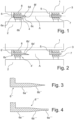
- the cross-section according to figure 1 shows a first embodiment of the device according to the invention, comprising a stop section 1 of a loading area of a commercial vehicle or motor vehicle trailer and a tail lift 2 detachably and pivotably articulated on the stop section 1.
- the stop section 1 and the tail lift 2 are connected to one another via a hinge connection made up of two hinges 3, 4, wherein the two hinges 3, 4 have a common axis of rotation A.
- the two hinges 3 , 4 are each composed of a pin 5 , 6 arranged on the stop section 1 and a socket 7 , 8 assigned to the tail lift 2 .
- the pin 5 and the socket 7 form the hinge 3 and the pin 6 and the socket 8 form the hinge 4.
- the sockets 7, 8 are identical to one another and are fitted onto the pins 5, 6, respectively.
- the two hinges 3, 4 differ in the shape of the pins 5, 6.
- the pin 5 has a cylindrical basic shape consistently constant diameter and has a greater length in the direction of the axis of rotation A than the length of the bushing 7 .
- the pin 5 thus protrudes from the socket 7 with its free end.
- the diameter of the cylindrical pin 5 is designed in such a way that it can be inserted into the socket 7 with a precise fit.
- the pin 6 is longer in the direction of the axis of rotation A than the pin 5.
- the sockets 7, 8 are identical to one another.
- the pin 6, like the pin 5, has a cylindrical section 6a of the same length of the cylindrical pin 5, onto which the bushing 8 is pushed with a precise fit.
- the pin 6 has a tapering section 6b adjoining the cylindrical section 6a.
- the tapering section 6b forms a truncated cone section with a central axis deviating from the axis of rotation A of the hinges, with an intended upper area 6d of the tapering section 6b being set at a greater angle to the axis of rotation A than a lower area 6c of the tapering section 6b .
- the pin 6 is longer than the pin 5 around this tapering section 6b.
- the free end of the tapering section 6b of the pin 6 has a curved surface 6f.
- the protruding part of the longer pin 6, by which it is longer than the pin 5, is used to align the tail lift 2 with the stop section 1.
- the tail lift 2 is first pushed with the socket 8 onto the tapering section 6b of the pin 6.
- the socket 8 and the pin 6 of the hinge 4 are not yet fully pushed together.
- the tail lift 2 resting with the socket 8 on the tapering section 6b of the pin 6 can then be aligned on the second hinge 3 in such a way that the pin 5 and the socket 7 of the hinge 3 are aligned with one another.
- a person attaching the tail lift 2 to the stop section 1 therefore only has to align the tail lift 2 to one of the hinges 3, 4 at any given time.
- the pin 5, 6 and the sockets 7, 8 of the two hinges 3, 4 can be pushed together as far as possible, i.e. completely, at the same time, until they are arranged in their predetermined position relative to one another.
- FIG 2 an alternative embodiment of the device is shown, wherein the pin 6' of the hinge 4' faces a figure 1 modified tapered portion 6b'. This is flattened on one side in the direction of the free end of the pin 6'. This flattening 6d' of the pin 6' is formed on an upper side of the pin 6' in an intended arrangement of the device, while its lower side is continued as an extension of the outer circumference of the cylindrical section 6a'. The lower side or a lower area of the pin 6' therefore has no taper.
- FIGs 3 and 4 each show more compared to the figure 1 and the figure 2 modified versions of the pin 6 or the pin 6'.
- the pin 6" is modified in relation to the pin 6 and the pin 6' in such a way that the tapering section 6b" tapers conically in the direction of the free end of the pin 6".
- the cylindrical section 6a" corresponds to the cylindrical sections 6a and 6a ⁇ .
- the execution according to figure 2 allows compared to the execution according to figure 1 when the pin 6" and bushing 8 are brought together, starting from the axis of rotation A, there is a greater tolerance in all directions.
- figure 3 shows another version with a pin 6 ′′′.
- the tapered section 6b′′′ which as in figure 2 is designed as a cone, contrary to the statements in figure 1 and in figure 2 no longer to the free end of the pin 6′′′.
- the tapering portion 6b ′′′ is rather between a cylindrical portion 6a ′′′ and another cylindrical section 6e ′′′ arranged.
- the thicker, cylindrical section 6a′′′ has a diameter equal to the diameter of the wider end of the cone and the thinner, cylindrical section 6e′′′ has a diameter equal to the diameter of the thinner end of the cone.
Landscapes
- Engineering & Computer Science (AREA)
- Mechanical Engineering (AREA)
- Transportation (AREA)
- Pivots And Pivotal Connections (AREA)
Description
- Die Erfindung betrifft eine Vorrichtung zur Verbindung einer Ladebordwand eines Nutzfahrzeugs oder eines Kraftfahrzeuganhängers mit einem Anschlagabschnitt einer Ladefläche des Nutzfahrzeugs oder des Kraftfahrzeuganhängers, wobei die Ladebordwand über wenigstens zwei Scharniere schwenkbeweglich und lösbar an dem Anschlagabschnitt angelenkt ist, wobei die Scharniere eine gemeinsame Drehachse aufweisen und jeweils aus einem Zapfen und einer auf den Zapfen aufsteckbaren Buchse gebildet sind, wobei ein entlang der Drehachse angeordnetes Scharnier einen längeren Zapfen als ein nächstes Scharnier aufweist und wobei der längere Zapfen einen zylindrischen Abschnitt mit in radialer Erstreckung zu der Drehachse gleichmäßigem Durchmesser aufweist.
- Für übergroße Ladungen oder zum Entladen der Nutzfahrzeuge oder Kraftfahrzeuganhänger sind entsprechende Ladebordwände zumeist abnehmbar an dem Nutzfahrzeug oder an dem Kraftfahrzeuganhänger befestigt. Um abgenommene Ladebordwände anschließend wieder einzuhängen, werden zumeist mehrere Personen, zumindest aber zwei Personen, an den jeweiligen Enden der Ladebordwand benötigt, um Zapfen und Buchsen der fluchtend zueinander angeordneten Scharniere aufeinander zu schieben. Die größte Herausforderung besteht dabei darin, dass die Zapfen und Buchsen aller Scharniere gleichzeitig zusammengeführt werden müssen. Fehlt eine helfende Person, sind die Zapfen und Buchsen der Scharniere von einer Person auch aufgrund der Abmessungen und des Gewichts von Ladebordwänden kaum zusammenzuführen.
- Die
US 2013/192008 A1 offenbart ein Verfahren, wie eine Ladeklappe eines Anhängers von einer Einzelperson an diesem befestigt werden kann. Hierzu weist entweder der Anhänger oder die Ladeklappe zwei Dorne auf, an denen Hülsen des jeweils anderen Teils befestigbar sind. Die Hülsen sollen sich jeweils aus einem zylindrischen Abschnitt und einem halbzylindrischen Abschnitt zusammensetzen. - Gemäß der
DE 298 03 711 U1 wird ein Gelenksystem zum gelenkigen und trennbaren Verbinden zweier Teile aufgezeigt, wobei Gelenkelemente der Teile durch eine Translationsbewegung der Teile in Achsenrichtung ab einem Kopplungspunkt voneinander gelöst bzw. miteinander gekoppelt werden. - Aufgabe der Erfindung ist es daher, eine entsprechend lösbare Scharnierverbindung dahingehend weiterzuentwickeln, dass diese von einer einzelnen Person zusammengeführt werden kann und eine besonders stabile Führung bei Drehbewegung der miteinander gekoppelten Teile sicherstellt. Die Lösung dieser Aufgabe erfolgt mit den Merkmalen des Anspruchs 1. Weiterbildungen und vorteilhafte Ausgestaltungen sind in den jeweils nachgeordneten Ansprüchen angegeben.
- Die Vorrichtung zur Verbindung einer Ladebordwand eines Nutzfahrzeugs oder eines Kraftfahrzeuganhängers mit einem Anschlagabschnitt einer Ladefläche des Nutzfahrzeugs oder des Kraftfahrzeuganhängers, wobei die Ladebordwand über wenigstens zwei Scharniere schwenkbeweglich und lösbar an dem Anschlagabschnitt angelenkt ist, wobei die Scharniere eine gemeinsame Drehachse aufweisen und jeweils aus einem Zapfen und einer auf den Zapfen aufsteckbaren Buchse gebildet sind, wobei ein entlang der Drehachse angeordnetes Scharnier einen längeren Zapfen als ein nächstes Scharnier aufweist und wobei der längere Zapfen einen zylindrischen Abschnitt mit in radialer Erstreckung zu der Drehachse gleichmäßigem Durchmesser aufweist, zeichnet sich erfindungsgemäß dadurch aus, dass der zylindrische Abschnitt des Zapfens eine Länge entsprechend wenigstens der Länge der Buchse aufweist.
- Mit den unterschiedlich langen Zapfen der Scharniere ist auf einfache Weise erreicht, dass die an den Scharnieren einzuhängende Ladebordwand zunächst nur auf den längeren Zapfen eines ersten Scharniers teilweise aufgeschoben werden kann beziehungsweise mit dem längeren Zapfen in eine diesem zugeordnete Buchse teilweise eingeführt wird. Zapfen und Buchse werden dabei nur soweit zusammengeschoben, wie der längere Zapfen gegenüber dem anderen Zapfen länger ist. Anschließend kann die Ladebordwand auf dem längeren Zapfen oder in der Buchse des ersten Scharniers aufliegend zu einem nächsten Zapfen oder einer nächsten Buchse eines benachbarten, zweiten Scharniers ausgerichtet werden. Die Ausrichtung zu den Scharnieren erfolgt demnach nacheinander. Die so auch von einer Person zu den Scharnieren ausrichtbare Ladebordwand wird dann gleichzeitig auf die Zapfen der wenigstens beiden Scharniere aufgeschoben oder gleichzeitig in die Buchsen der wenigstens beiden Scharniere eingeführt. Eine weitere Person ist somit nicht mehr erforderlich, um die Ladebordwand zu den Zapfen der Scharniere auszurichten, da jeweils nur ein Ende der Ladebordwand zu einem der Scharniere ausgerichtet werden muss.
- Um die Buchse und den längeren Zapfen des wenigstens einen Scharniers auf einfache Weise zusammenführen zu können, ist nach einer Weiterbildung vorgesehen, dass der Zapfen des Scharniers mit dem längeren Zapfen sich zumindest abschnittsweise zu seinem freien Ende hin verjüngt. Der zu seinem freien Ende hin angespitzt zulaufende Zapfen erlaubt eine größere Toleranz hinsichtlich der Ausrichtung der Ladebordwand und des Anschlagabschnitts zueinander. Zapfen und Buchse können dann auch zusammengeführt werden, wenn diese nicht genau konzentrisch zueinander fluchtend ausgerichtet sind.
- Gemäß einer vorteilhaften Ausgestaltung ist der längere Zapfen dabei zumindest abschnittsweise konisch zulaufend ausgebildet. Das verjüngte, freie Ende des Zapfens ist damit vorteilhafterweise konzentrisch zum restlichen Umfang des Zapfens und der Drehachse der Scharniere ausgerichtet, insbesondere konzentrisch zu einem nicht verjüngten Abschnitt des Zapfens ausgerichtet. Buchse und Zapfen des Scharniers können damit beim Zusammenführen dieser radial zu einer Drehachse des Scharniers in alle Richtungen gleich weit abweichen.
- Damit die an den Scharnieren eingehängte Ladebordwand in vorbestimmter Weise um die gemeinsame Drehachse der Scharniere verschwenkt werden kann ohne zu verklemmen oder zu wackeln, weist der längere Zapfen gemäß einer Weiterbildung wenigstens einen zylindrischen Abschnitt mit in radialer Erstreckung zu der Drehachse gleichmäßigem Durchmesser auf. Der zylindrische Abschnitt mit in radialer Erstreckung zu der Drehachse gleichmäßigem Durchmesser liegt dann mit seiner Mantelfläche zumindest abschnittsweise an einer Innenwandung der Buchse an, die einen geringfügig größeren Innendurchmesser aufweist, wodurch ein verwindungsfreies Verschwenken der Ladebordwand zu dem Anschlagabschnitt sichergestellt ist. Der mit der Buchse in Anlage zu bringende zylindrische Abschnitt des Zapfens setzt entsprechend an dem dickeren Ende des sich verjüngenden Abschnitts an.
- Indem der zylindrische Abschnitt des längeren Zapfens eine Länge entsprechend wenigstens der Länge der Buchse aufweist, weist die Buchse bei eingehängter Ladebordwand über deren gesamte Länge ein gleichbleibendes Spaltmaß zu dem Zapfen auf. In weiterer Ausgestaltung ist der zylindrische Abschnitt des längeren Zapfens länger ausgebildet als die Länge der Buchse, so dass der sich verjüngende Abschnitt bei vollständig aufgeschobener Buchse um das Maß, mit dem der zylindrische Abschnitt länger ist als die Buchse, zu der Buchse beabstandet ist.
- Der kürzere Zapfen des anderen Scharniers ist oder die kürzeren Zapfen der anderen Scharniere sind vorteilhafterweise nur aus einem solchen zylindrischen Abschnitt gebildet. Dieser ist beziehungsweise diese sind zum einfachen Zusammenführen von Zapfen und Buchse gegebenenfalls endseitig angespitzt oder abgerundet.
- Der sich verjüngende Teil des längeren Zapfens muss dabei nicht bis zum freien Ende des Zapfens reichen. Nach einer Weiterbildung kann ein sich in Richtung freies Ende verjüngender Abschnitt, insbesondere ein in Richtung freies Ende konisch zulaufender Abschnitt, auch mittig zwischen zwei zylindrischen Abschnitten mit jeweils gleichbleibendem Durchmesser angeordnet sein. Der sich in Richtung freies Ende des Zapfens an den sich verjüngenden Abschnitt, insbesondere den konischen Abschnitt, gegebenenfalls anschließende weitere zylindrische Abschnitt weist dann vorteilhafterweise einen maximalen Durchmesser auf, der dem Durchmesser des jüngeren Endes des sich verjüngten Abschnitts entspricht.
- Besonders vorteilhaft ist eine Gestaltung des sich verjüngenden Teils des längeren Zapfens, bei dem dieser unterschiedlich stark abgewinkelte oder gekrümmte Flächen oder Bereiche aufweist. Eine bei bestimmungsgemäßer Anordnung obere Fläche oder ein bei bestimmungsgemäßer Anordnung oberer Bereich des sich verjüngenden Teils des längeren Zapfens ist dann in weiterer Ausgestaltung in einem stärkeren Winkel zu der Drehachse der Scharniere angestellt als eine untere Fläche beziehungsweise ein unterer Bereich des sich verjüngenden Teils des längeren Zapfens. Der sich verjüngende Teil des längeren Zapfens kann dann durch einen Kegelstumpfabschnitt gebildet sein, dessen Mittenachse in Richtung des sich verjüngenden Endes des Zapfens gegenüber einer Drehachse der Scharniere abgelenkt ist. Die Mittenachse ist dann in einem Winkel zu der Drehachse der Scharniere angestellt, die sich aus den Winkeln ergibt, mit denen die unteren und oberen Flächen oder Bereiche des sich verjüngenden Abschnitts gegenüber der Drehachse abweichen.
- Gemäß einer alternativen oder ergänzenden Ausführung kann die Buchse an der Seite, an der der Zapfen in die Buchse eingeführt wird, eine Aufweitung aufweisen. Eine Aufweitung der Buchse führt dabei zu den gleichen Vorteilen wie ein sich in Richtung freies Ende verjüngender Zapfen. Entsprechend dem Zapfen weist dann auch die Buchse an einer Innenwandung wenigstens einen zylindrischen Abschnitt mit in radialer Erstreckung gleichbleibendem Durchmesser auf, wobei der Durchmesser geringfügig größer als der Durchmesser des zylindrischen Abschnitts des Zapfens ist, insbesondere geringfügig größer als der Durchmesser des Zapfens an seinem dicksten Abschnitt ist.
- Da die Scharniere der Vorrichtung alle eine einzige, gemeinsame Drehachse aufweisen, ist es nach einer Weiterbildung auch bei mehr als zwei Scharnieren ausreichend, wenn jeweils nur ein Zapfen, insbesondere ein einziger Zapfen eines der Scharniere, länger ausgeführt ist als die Zapfen der anderen Scharniere. Zum Ausrichten der Ladebordwand ist es in jedem Fall und unabhängig von der Anzahl der Scharniere nur erforderlich, zwei dieser Scharniere zueinander auszurichten. Sind zwei von mehreren Scharnieren zwischen der Ladebordwand und dem Anschlagabschnitt fluchtend zueinander ausgerichtet, sind zwangsweise immer auch die restlichen Scharniere mit derselben Drehachse fluchtend ausgerichtet.
- Ein Ausführungsbeispiel der Erfindung, aus dem sich weitere erfindungswesentliche Merkmale ergeben können, ist in der Zeichnung dargestellt. Gleiche Teile sind dabei in allen Figuren mit gleichen Bezugszeichen versehen. Es zeigen:
- Figur 1:
- einen Querschnitt durch eine erste Ausführung einer erfindungsgemäßen Vorrichtung;
- Figur 2:
- einen Querschnitt durch eine zweite Ausführung einer erfindungsgemäßen Vorrichtung;
- Figur 3:
- einen Querschnitt durch eine dritte Ausführung eines erfindungsgemäßen Zapfens der Vorrichtung gemäß
Figur 1 oder Figur 2 ; und - Figur 4:
- einen Querschnitt durch eine vierte Ausführung eines erfindungsgemäßen Zapfens der Vorrichtung gemäß
Figur 1 oder Figur 2 . - Der Querschnitt gemäß
Figur 1 zeigt eine erste Ausführung der erfindungsgemäßen Vorrichtung umfassend einen Anschlagabschnitt 1 einer Ladefläche eines Nutzfahrzeugs oder Kraftfahrzeuganhängers und eine lösbar und schwenkbeweglich an dem Anschlagabschnitt 1 angelenkte Ladebordwand 2. Der Anschlagabschnitt 1 und die Ladebordwand 2 sind über eine Scharnierverbindung aus zwei Scharnieren 3, 4 miteinander verbunden, wobei die beiden Scharniere 3, 4 eine gemeinsame Drehachse A aufweisen. Die beiden Scharniere 3, 4 setzen sich jeweils aus einem an dem Anschlagabschnitt 1 angeordneten Zapfen 5, 6 und einer der Ladebordwand 2 zugeordneten Buchse 7, 8 zusammen. Der Zapfen 5 und die Buchse 7 bilden das Scharnier 3 und der Zapfen 6 und die Buchse 8 bilden das Scharnier 4. Die Buchsen 7, 8 sind zueinander identisch und jeweils auf die Zapfen 5, 6 aufgesteckt. - Die beiden Scharniere 3, 4 unterscheiden sich jeweils durch die Ausformung der Zapfen 5, 6. Der Zapfen 5 weist eine zylindrische Grundform mit durchgehend gleich bleibendem Durchmesser auf und weist in Richtung der Drehachse A eine größere Länge als die Länge der Buchse 7 auf. Mit seinem freien Ende ragt der Zapfen 5 damit aus der Buchse 7 hervor. Der Durchmesser des zylindrischen Zapfens 5 ist dabei so gestaltet, dass dieser passgenau in die Buchse 7 eingeführt werden kann. Der Zapfen 6 ist in Richtung der Drehachse A länger als der Zapfen 5. Die Buchsen 7, 8 sind zueinander identisch ausgebildet. Der Zapfen 6 weist ebenso wie der Zapfen 5 einen zylindrischen Abschnitt 6a gleicher Länge des zylindrischen Zapfens 5 auf, auf den die Buchse 8 passgenau aufgeschoben ist. In Richtung seines freien Endes weist der Zapfen 6 einen sich an den zylindrischen Abschnitt 6a anschließenden, sich verjüngenden Abschnitt 6b auf. Der sich verjüngende Abschnitt 6b formt einen Kegelstumpfabschnitt mit einer von der Drehachse A der Scharniere abweichenden Mittenachse, wobei ein bestimmungsgemäß oberer Bereich 6d des sich verjüngenden Abschnitts 6b in einem größeren Winkel zu der Drehachse A angestellt ist als ein unterer Bereich 6c des sich verjüngenden Abschnitts 6b. Um diesen sich verjüngenden Abschnitt 6b ist der Zapfen 6 länger als der Zapfen 5. Als Abschluss weist das freie Ende des sich verjüngenden Abschnitts 6b des Zapfens 6 eine gewölbte Fläche 6f auf.
- Der hervorstehende Teil des längeren Zapfens 6, um den dieser länger ist als der Zapfen 5, dient dem Ausrichten der Ladebordwand 2 zu dem Anschlagabschnitt 1. Die Ladebordwand 2 wird dazu zunächst mit der Buchse 8 auf den sich verjüngenden Abschnitt 6b des Zapfens 6 aufgeschoben. Die Buchse 8 und der Zapfen 6 des Scharniers 4 sind damit noch nicht vollständig zusammengeschoben. Die mit der Buchse 8 auf dem sich verjüngenden Abschnitt 6b des Zapfens 6 aufliegende Ladebordwand 2 kann dann an dem zweiten Scharnier 3 so ausgerichtet werden, dass auch der Zapfen 5 und die Buchse 7 des Scharniers 3 fluchtend zueinander ausgerichtet sind. Eine die Ladebordwand 2 an dem Anschlagabschnitt 1 anbringende Person muss die Ladebordwand 2 somit zu einem beliebigen Zeitpunkt immer nur zu einem der Scharniere 3, 4 ausrichten. Ist auch das zweite Scharnier 3 so ausgerichtet, dass die Buchse 7 und der Zapfen 5 auf der Drehachse A der Scharniere 3, 4 angeordnet sind, können die Zapfen 5, 6 und die Buchsen 7, 8 der beiden Scharniere 3, 4 zeitgleich soweit wie möglich, das heißt vollständig, zusammengeschoben werden, bis diese in ihrer vorbestimmten Lage zueinander angeordnet sind.
- In
Figur 2 ist eine alternative Ausführung der Vorrichtung gezeigt, wobei der Zapfen 6' des Scharniers 4' einen gegenüberFigur 1 abgeänderten, sich verjüngenden Abschnitt 6b' aufweist. Dieser ist in Richtung des freien Endes des Zapfens 6' einseitig abgeflacht ausgeführt. Diese Abflachung 6d' des Zapfens 6' ist dabei in einer bestimmungsgemäßen Anordnung der Vorrichtung an einer oberen Seite des Zapfens 6' ausgebildet, während dessen untere Seite in Verlängerung des äußeren Umfangs des zylindrischen Abschnitts 6a' fortgeführt ist. Die untere Seite beziehungsweise ein unterer Bereich des Zapfens 6` weist damit keine Verjüngung auf. - Die
Figuren 3 und 4 zeigen jeweils weitere gegenüber derFigur 1 und derFigur 2 abgeänderte Ausführungen des Zapfens 6 beziehungsweise des Zapfens 6`. InFigur 3 ist der Zapfen 6" dahingehend gegenüber dem Zapfen 6 und dem Zapfen 6' verändert, dass der sich verjüngende Abschnitt 6b" konisch in Richtung freies Ende des Zapfens 6" verjüngend ausgebildet ist. Der zylindrische Abschnitt 6a" entspricht den zylindrischen Abschnitten 6a und 6a`. Die Ausführung gemäßFigur 2 ermöglicht gegenüber der Ausführung gemäßFigur 1 beim Zusammenführen von Zapfen 6" und Buchse 8 ausgehend von der Drehachse A eine größere Toleranz in alle Richtungen. -
Figur 3 zeigt eine weitere Ausführung mit einem Zapfen 6‴. In dieser Ausführung reicht der sich verjüngende Abschnitt 6b‴, der wie inFigur 2 als Konus ausgeführt ist, entgegen den Ausführungen inFigur 1 und inFigur 2 nicht mehr bis zum freien Ende des Zapfens 6‴. Der sich verjüngende Abschnitt 6b‴ ist vielmehr zwischen einem zylindrischen Abschnitt 6a‴ und einem weiteren zylindrischen Abschnitt 6e‴ angeordnet. Der dickere, zylindrische Abschnitt 6a‴ weist dabei einen Durchmesser gleich dem Durchmesser des breiteren Endes des Konus auf und der dünnere, zylindrische Abschnitt 6e‴ weist einen Durchmesser gleich dem Durchmesser des dünneren Endes des Konus auf. - Alle in der vorstehenden Beschreibung und in den Ansprüchen genannten Merkmale sind in einer beliebigen Auswahl mit den Merkmalen des unabhängigen Anspruchs kombinierbar. Die Offenbarung der Erfindung ist somit nur auf die beanspruchten Merkmalskombinationen beschränkt.
Claims (6)
- Vorrichtung zur Verbindung einer Ladebordwand (2) eines Nutzfahrzeugs oder eines Kraftfahrzeuganhängers mit einem Anschlagabschnitt (1) einer Ladefläche des Nutzfahrzeugs oder des Kraftfahrzeuganhängers, wobei die Ladebordwand (2) über wenigstens zwei Scharniere (3, 4, 4`) schwenkbeweglich und lösbar an dem Anschlagabschnitt (1) angelenkt ist, wobei die Scharniere (3, 4, 4') eine gemeinsame Drehachse (A) aufweisen und jeweils aus einem Zapfen (5, 6, 6', 6", 6‴) und einer auf den Zapfen (5, 6, 6', 6", 6‴) aufsteckbaren Buchse (7, 8) gebildet sind, dadurch gekennzeichnet, dass ein entlang der Drehachse (A) angeordnetes Scharnier (4, 4') einen längeren Zapfen (6, 6', 6", 6‴) als ein nächstes Scharnier (3) aufweist und wobei der längere Zapfen (6, 6', 6", 6‴) einen zylindrischen Abschnitt (6a, 6a', 6a", 6a‴) mit in radialer Erstreckung zu der Drehachse (A) gleichmäßigem Durchmesser aufweist, wobei der zylindrische Abschnitt (6a, 6a', 6a", 6a‴) des Zapfens (6, 6', 6", 6‴) eine Länge entsprechend wenigstens der Länge der Buchse (8) aufweist.
- Vorrichtung nach Anspruch 1, dadurch gekennzeichnet, dass der längere Zapfen (6, 6', 6", 6‴) sich zumindest abschnittsweise zu seinem freien Ende hin verjüngt.
- Vorrichtung nach einem der Ansprüche 1 oder 2, dadurch gekennzeichnet, dass der längere Zapfen (6, 6", 6‴) zumindest abschnittsweise konisch zulaufend ausgebildet ist.
- Vorrichtung nach einem der Ansprüche 1 bis 3, dadurch gekennzeichnet, dass der zylindrische Abschnitt (6a, 6a', 6a", 6a‴)eine Länge größer der Länge der Buchse (8) aufweist.
- Vorrichtung nach einem der Ansprüche 1 bis 4, dadurch gekennzeichnet, dass der sich verjüngende Teil des längeren Zapfens (6, 6') unterschiedlich stark abgewinkelte oder gekrümmte Flächen oder Bereiche (6d, 6d', 6c) aufweist.
- Vorrichtung nach einem der Ansprüche 1 bis 5, dadurch gekennzeichnet, dass bei mehr als zwei Scharnieren (3, 4, 4') mit einer gemeinsamen Drehachse (A) nur ein Zapfen (6, 6', 6", 6‴) eines der Scharniere (4, 4') länger ausgeführt ist als die Zapfen (5) der anderen Scharniere (3).
Applications Claiming Priority (1)
| Application Number | Priority Date | Filing Date | Title |
|---|---|---|---|
| DE202020101283.5U DE202020101283U1 (de) | 2020-03-09 | 2020-03-09 | Vorrichtung mit zwei Scharnieren |
Publications (3)
| Publication Number | Publication Date |
|---|---|
| EP3878688A1 EP3878688A1 (de) | 2021-09-15 |
| EP3878688B1 true EP3878688B1 (de) | 2023-08-16 |
| EP3878688C0 EP3878688C0 (de) | 2023-08-16 |
Family
ID=70469866
Family Applications (1)
| Application Number | Title | Priority Date | Filing Date |
|---|---|---|---|
| EP21161271.8A Active EP3878688B1 (de) | 2020-03-09 | 2021-03-08 | Vorrichtung mit zwei scharnieren |
Country Status (2)
| Country | Link |
|---|---|
| EP (1) | EP3878688B1 (de) |
| DE (1) | DE202020101283U1 (de) |
Family Cites Families (4)
| Publication number | Priority date | Publication date | Assignee | Title |
|---|---|---|---|---|
| CH350216A (de) * | 1957-01-10 | 1960-11-15 | Thalmann Jakob | Drehbeschlag für Türen, Fenster, Fensterläden oder dergleichen |
| DE29803711U1 (de) * | 1998-03-04 | 1998-04-23 | Kratzmaier, Erich, 82547 Eurasburg | Gelenksystem |
| FR2941000B1 (fr) * | 2009-01-09 | 2018-05-25 | Sarl Entreprendre Logistique | Systeme de charniere avec cale pour faciliter la mise en place de tout systeme de vantail ou analogues |
| US20130192008A1 (en) * | 2009-06-19 | 2013-08-01 | Duane R. Smith | Method for attaching and removing a trailer ramp |
-
2020
- 2020-03-09 DE DE202020101283.5U patent/DE202020101283U1/de active Active
-
2021
- 2021-03-08 EP EP21161271.8A patent/EP3878688B1/de active Active
Also Published As
| Publication number | Publication date |
|---|---|
| DE202020101283U1 (de) | 2020-03-27 |
| EP3878688A1 (de) | 2021-09-15 |
| EP3878688C0 (de) | 2023-08-16 |
Similar Documents
| Publication | Publication Date | Title |
|---|---|---|
| EP0803332B1 (de) | Auspressvorrichtung für ein Achstraggelenk und/oder einen Spurstangenkopf | |
| EP0445591B1 (de) | Einrichtung zum Verbinden einer Lenksäule eines Kraftfahrzeuges mit einem Wellenzapfen eines Lenkgetriebes | |
| EP0686748B1 (de) | Scharnierstiftloses wartungsfrei gelagertes Blechscharnier für Kraftwagentüren | |
| DE2249211C2 (de) | Bremskeil für Radfahrzeuge | |
| DE102007035754A1 (de) | Zerlegbarer Stock | |
| EP3784439A1 (de) | Zange | |
| DE2819832A1 (de) | Bremsscheibenanordnung fuer fahrzeug- scheibenbremsen | |
| DE69918547T2 (de) | Vorrichtung zum herstellen einer lösbaren rohrverbindung | |
| DE2623870A1 (de) | Elastisches lenkerlager fuer radaufhaengungen von kraftfahrzeugen | |
| DE60224118T2 (de) | Gelenkbolzen zum Verbinden von Aussen- und Innenlaschen einer Kette, insbesondere einer Fahrradkette | |
| EP3878688B1 (de) | Vorrichtung mit zwei scharnieren | |
| DE102008061854A1 (de) | Scharnier | |
| DE19915718C2 (de) | Türscharnier für Kraftfahrzeuge | |
| DE102004003251B4 (de) | Vorrichtung zur axialen Festlegung, insbesondere für die Armlehne eines Fahrzeugsitzes, sowie Armlehne und Sitz | |
| DE2025266C3 (de) | Vorrichtung zum Verbinden von axial gestoßenen Stützenteilen einer Metallkonstruktion | |
| DE1525615C3 (de) | Haltevorrichtung für eine Manschettenanordnung | |
| EP3838634B1 (de) | Längslenkerachse für fahrzeuganhänger | |
| DE3409600C2 (de) | Kaltschmiedegesenkeinheit | |
| AT527945B1 (de) | Steckverbinder zum strömungstechnischen Verbinden eines fluidführenden Bauteils mit einer Fluidleitung | |
| DE2946224A1 (de) | Verriegelungsvorrichtung fuer container | |
| WO2003097429A1 (de) | Zweigelenkanordnung | |
| DE4205653A1 (de) | Kreuzgelenk | |
| DE102017214635A1 (de) | Trägerelement für eine klappbare Armlehne und Fahrzeugsitz mit einer klappbaren Armlehne | |
| DE3527646A1 (de) | Farbroller | |
| DE2606880C3 (de) | Rohrverbindung für Bohrrohre o.dgl |
Legal Events
| Date | Code | Title | Description |
|---|---|---|---|
| PUAI | Public reference made under article 153(3) epc to a published international application that has entered the european phase |
Free format text: ORIGINAL CODE: 0009012 |
|
| STAA | Information on the status of an ep patent application or granted ep patent |
Free format text: STATUS: THE APPLICATION HAS BEEN PUBLISHED |
|
| AK | Designated contracting states |
Kind code of ref document: A1 Designated state(s): AL AT BE BG CH CY CZ DE DK EE ES FI FR GB GR HR HU IE IS IT LI LT LU LV MC MK MT NL NO PL PT RO RS SE SI SK SM TR |
|
| STAA | Information on the status of an ep patent application or granted ep patent |
Free format text: STATUS: REQUEST FOR EXAMINATION WAS MADE |
|
| 17P | Request for examination filed |
Effective date: 20220314 |
|
| RBV | Designated contracting states (corrected) |
Designated state(s): AL AT BE BG CH CY CZ DE DK EE ES FI FR GB GR HR HU IE IS IT LI LT LU LV MC MK MT NL NO PL PT RO RS SE SI SK SM TR |
|
| GRAP | Despatch of communication of intention to grant a patent |
Free format text: ORIGINAL CODE: EPIDOSNIGR1 |
|
| STAA | Information on the status of an ep patent application or granted ep patent |
Free format text: STATUS: GRANT OF PATENT IS INTENDED |
|
| INTG | Intention to grant announced |
Effective date: 20230314 |
|
| GRAS | Grant fee paid |
Free format text: ORIGINAL CODE: EPIDOSNIGR3 |
|
| GRAA | (expected) grant |
Free format text: ORIGINAL CODE: 0009210 |
|
| STAA | Information on the status of an ep patent application or granted ep patent |
Free format text: STATUS: THE PATENT HAS BEEN GRANTED |
|
| AK | Designated contracting states |
Kind code of ref document: B1 Designated state(s): AL AT BE BG CH CY CZ DE DK EE ES FI FR GB GR HR HU IE IS IT LI LT LU LV MC MK MT NL NO PL PT RO RS SE SI SK SM TR |
|
| REG | Reference to a national code |
Ref country code: CH Ref legal event code: EP Ref country code: DE Ref legal event code: R096 Ref document number: 502021001236 Country of ref document: DE |
|
| REG | Reference to a national code |
Ref country code: IE Ref legal event code: FG4D Free format text: LANGUAGE OF EP DOCUMENT: GERMAN |
|
| U01 | Request for unitary effect filed |
Effective date: 20230914 |
|
| U07 | Unitary effect registered |
Designated state(s): AT BE BG DE DK EE FI FR IT LT LU LV MT NL PT SE SI Effective date: 20230925 |
|
| PG25 | Lapsed in a contracting state [announced via postgrant information from national office to epo] |
Ref country code: GR Free format text: LAPSE BECAUSE OF FAILURE TO SUBMIT A TRANSLATION OF THE DESCRIPTION OR TO PAY THE FEE WITHIN THE PRESCRIBED TIME-LIMIT Effective date: 20231117 |
|
| PG25 | Lapsed in a contracting state [announced via postgrant information from national office to epo] |
Ref country code: IS Free format text: LAPSE BECAUSE OF FAILURE TO SUBMIT A TRANSLATION OF THE DESCRIPTION OR TO PAY THE FEE WITHIN THE PRESCRIBED TIME-LIMIT Effective date: 20231216 |
|
| PG25 | Lapsed in a contracting state [announced via postgrant information from national office to epo] |
Ref country code: RS Free format text: LAPSE BECAUSE OF FAILURE TO SUBMIT A TRANSLATION OF THE DESCRIPTION OR TO PAY THE FEE WITHIN THE PRESCRIBED TIME-LIMIT Effective date: 20230816 Ref country code: NO Free format text: LAPSE BECAUSE OF FAILURE TO SUBMIT A TRANSLATION OF THE DESCRIPTION OR TO PAY THE FEE WITHIN THE PRESCRIBED TIME-LIMIT Effective date: 20231116 Ref country code: IS Free format text: LAPSE BECAUSE OF FAILURE TO SUBMIT A TRANSLATION OF THE DESCRIPTION OR TO PAY THE FEE WITHIN THE PRESCRIBED TIME-LIMIT Effective date: 20231216 Ref country code: HR Free format text: LAPSE BECAUSE OF FAILURE TO SUBMIT A TRANSLATION OF THE DESCRIPTION OR TO PAY THE FEE WITHIN THE PRESCRIBED TIME-LIMIT Effective date: 20230816 Ref country code: GR Free format text: LAPSE BECAUSE OF FAILURE TO SUBMIT A TRANSLATION OF THE DESCRIPTION OR TO PAY THE FEE WITHIN THE PRESCRIBED TIME-LIMIT Effective date: 20231117 |
|
| PG25 | Lapsed in a contracting state [announced via postgrant information from national office to epo] |
Ref country code: PL Free format text: LAPSE BECAUSE OF FAILURE TO SUBMIT A TRANSLATION OF THE DESCRIPTION OR TO PAY THE FEE WITHIN THE PRESCRIBED TIME-LIMIT Effective date: 20230816 |
|
| U20 | Renewal fee for the european patent with unitary effect paid |
Year of fee payment: 4 Effective date: 20240313 |
|
| PG25 | Lapsed in a contracting state [announced via postgrant information from national office to epo] |
Ref country code: ES Free format text: LAPSE BECAUSE OF FAILURE TO SUBMIT A TRANSLATION OF THE DESCRIPTION OR TO PAY THE FEE WITHIN THE PRESCRIBED TIME-LIMIT Effective date: 20230816 |
|
| PG25 | Lapsed in a contracting state [announced via postgrant information from national office to epo] |
Ref country code: SM Free format text: LAPSE BECAUSE OF FAILURE TO SUBMIT A TRANSLATION OF THE DESCRIPTION OR TO PAY THE FEE WITHIN THE PRESCRIBED TIME-LIMIT Effective date: 20230816 Ref country code: RO Free format text: LAPSE BECAUSE OF FAILURE TO SUBMIT A TRANSLATION OF THE DESCRIPTION OR TO PAY THE FEE WITHIN THE PRESCRIBED TIME-LIMIT Effective date: 20230816 Ref country code: ES Free format text: LAPSE BECAUSE OF FAILURE TO SUBMIT A TRANSLATION OF THE DESCRIPTION OR TO PAY THE FEE WITHIN THE PRESCRIBED TIME-LIMIT Effective date: 20230816 Ref country code: CZ Free format text: LAPSE BECAUSE OF FAILURE TO SUBMIT A TRANSLATION OF THE DESCRIPTION OR TO PAY THE FEE WITHIN THE PRESCRIBED TIME-LIMIT Effective date: 20230816 Ref country code: SK Free format text: LAPSE BECAUSE OF FAILURE TO SUBMIT A TRANSLATION OF THE DESCRIPTION OR TO PAY THE FEE WITHIN THE PRESCRIBED TIME-LIMIT Effective date: 20230816 |
|
| REG | Reference to a national code |
Ref country code: DE Ref legal event code: R097 Ref document number: 502021001236 Country of ref document: DE |
|
| PLBE | No opposition filed within time limit |
Free format text: ORIGINAL CODE: 0009261 |
|
| STAA | Information on the status of an ep patent application or granted ep patent |
Free format text: STATUS: NO OPPOSITION FILED WITHIN TIME LIMIT |
|
| 26N | No opposition filed |
Effective date: 20240517 |
|
| REG | Reference to a national code |
Ref country code: CH Ref legal event code: PL |
|
| PG25 | Lapsed in a contracting state [announced via postgrant information from national office to epo] |
Ref country code: MC Free format text: LAPSE BECAUSE OF FAILURE TO SUBMIT A TRANSLATION OF THE DESCRIPTION OR TO PAY THE FEE WITHIN THE PRESCRIBED TIME-LIMIT Effective date: 20230816 |
|
| PG25 | Lapsed in a contracting state [announced via postgrant information from national office to epo] |
Ref country code: MC Free format text: LAPSE BECAUSE OF FAILURE TO SUBMIT A TRANSLATION OF THE DESCRIPTION OR TO PAY THE FEE WITHIN THE PRESCRIBED TIME-LIMIT Effective date: 20230816 |
|
| PG25 | Lapsed in a contracting state [announced via postgrant information from national office to epo] |
Ref country code: IE Free format text: LAPSE BECAUSE OF NON-PAYMENT OF DUE FEES Effective date: 20240308 |
|
| PG25 | Lapsed in a contracting state [announced via postgrant information from national office to epo] |
Ref country code: IE Free format text: LAPSE BECAUSE OF NON-PAYMENT OF DUE FEES Effective date: 20240308 Ref country code: CH Free format text: LAPSE BECAUSE OF NON-PAYMENT OF DUE FEES Effective date: 20240331 |
|
| U20 | Renewal fee for the european patent with unitary effect paid |
Year of fee payment: 5 Effective date: 20250327 |
|
| PG25 | Lapsed in a contracting state [announced via postgrant information from national office to epo] |
Ref country code: CY Free format text: LAPSE BECAUSE OF FAILURE TO SUBMIT A TRANSLATION OF THE DESCRIPTION OR TO PAY THE FEE WITHIN THE PRESCRIBED TIME-LIMIT; INVALID AB INITIO Effective date: 20210308 |
|
| PG25 | Lapsed in a contracting state [announced via postgrant information from national office to epo] |
Ref country code: HU Free format text: LAPSE BECAUSE OF FAILURE TO SUBMIT A TRANSLATION OF THE DESCRIPTION OR TO PAY THE FEE WITHIN THE PRESCRIBED TIME-LIMIT; INVALID AB INITIO Effective date: 20210308 |
|
| GBPC | Gb: european patent ceased through non-payment of renewal fee |
Effective date: 20250308 |
|
| PG25 | Lapsed in a contracting state [announced via postgrant information from national office to epo] |
Ref country code: TR Free format text: LAPSE BECAUSE OF FAILURE TO SUBMIT A TRANSLATION OF THE DESCRIPTION OR TO PAY THE FEE WITHIN THE PRESCRIBED TIME-LIMIT Effective date: 20230816 |
|
| PG25 | Lapsed in a contracting state [announced via postgrant information from national office to epo] |
Ref country code: GB Free format text: LAPSE BECAUSE OF NON-PAYMENT OF DUE FEES Effective date: 20250308 |
|
| U20 | Renewal fee for the european patent with unitary effect paid |
Year of fee payment: 6 Effective date: 20260206 |