EP3875567A1 - Nitroxidverbindungen in wasch- oder reinigungsmitteln - Google Patents
Nitroxidverbindungen in wasch- oder reinigungsmitteln Download PDFInfo
- Publication number
- EP3875567A1 EP3875567A1 EP20161455.9A EP20161455A EP3875567A1 EP 3875567 A1 EP3875567 A1 EP 3875567A1 EP 20161455 A EP20161455 A EP 20161455A EP 3875567 A1 EP3875567 A1 EP 3875567A1
- Authority
- EP
- European Patent Office
- Prior art keywords
- weight
- acid
- cleaning
- compound
- minutes
- Prior art date
- Legal status (The legal status is an assumption and is not a legal conclusion. Google has not performed a legal analysis and makes no representation as to the accuracy of the status listed.)
- Granted
Links
Classifications
-
- C—CHEMISTRY; METALLURGY
- C11—ANIMAL OR VEGETABLE OILS, FATS, FATTY SUBSTANCES OR WAXES; FATTY ACIDS THEREFROM; DETERGENTS; CANDLES
- C11D—DETERGENT COMPOSITIONS; USE OF SINGLE SUBSTANCES AS DETERGENTS; SOAP OR SOAP-MAKING; RESIN SOAPS; RECOVERY OF GLYCEROL
- C11D3/00—Other compounding ingredients of detergent compositions covered in group C11D1/00
- C11D3/16—Organic compounds
- C11D3/26—Organic compounds containing nitrogen
- C11D3/28—Heterocyclic compounds containing nitrogen in the ring
-
- C—CHEMISTRY; METALLURGY
- C11—ANIMAL OR VEGETABLE OILS, FATS, FATTY SUBSTANCES OR WAXES; FATTY ACIDS THEREFROM; DETERGENTS; CANDLES
- C11D—DETERGENT COMPOSITIONS; USE OF SINGLE SUBSTANCES AS DETERGENTS; SOAP OR SOAP-MAKING; RESIN SOAPS; RECOVERY OF GLYCEROL
- C11D3/00—Other compounding ingredients of detergent compositions covered in group C11D1/00
- C11D3/39—Organic or inorganic per-compounds
- C11D3/3902—Organic or inorganic per-compounds combined with specific additives
- C11D3/3905—Bleach activators or bleach catalysts
- C11D3/3907—Organic compounds
- C11D3/3917—Nitrogen-containing compounds
- C11D3/392—Heterocyclic compounds, e.g. cyclic imides or lactames
-
- C—CHEMISTRY; METALLURGY
- C11—ANIMAL OR VEGETABLE OILS, FATS, FATTY SUBSTANCES OR WAXES; FATTY ACIDS THEREFROM; DETERGENTS; CANDLES
- C11D—DETERGENT COMPOSITIONS; USE OF SINGLE SUBSTANCES AS DETERGENTS; SOAP OR SOAP-MAKING; RESIN SOAPS; RECOVERY OF GLYCEROL
- C11D7/00—Compositions of detergents based essentially on non-surface-active compounds
- C11D7/22—Organic compounds
- C11D7/32—Organic compounds containing nitrogen
- C11D7/3281—Heterocyclic compounds
Definitions
- the present invention relates to the use of certain nitroxide compounds for enhancing the cleaning performance of detergents and cleaning agents against soiling, washing and cleaning processes using such compounds, and washing and cleaning agents which contain these compounds.
- Inorganic peroxygen compounds in particular hydrogen peroxide and solid peroxygen compounds which dissolve in water to release hydrogen peroxide, such as sodium perborate and sodium carbonate perhydrate, have long been used as oxidizing agents for disinfecting and bleaching purposes.
- the oxidizing effect of these substances depends strongly on the temperature in dilute solutions; For example, with H 2 O 2 or perborate in alkaline bleaching liquors, sufficiently rapid bleaching of soiled textiles is only achieved at temperatures above about 80 ° C.
- bleach activators which are capable of delivering peroxocarboxylic acids under the perhydrolysis conditions mentioned and for which numerous proposals, especially from the classes of N- or O-acyl compounds, for example reactive ones Esters, polyacylated alkylenediamines, in particular N, N, N ', N'-tetraacetylethylenediamine (TAED), acylated glycolurils, in particular tetraacetylglycoluril, N-acylated hydantoins, hydrazides, triazoles, hydrotriazines, urazoles, diketopiperazines, sulfuryl anhydrides, and carboxylic anhydrides, and in particular phthalic anhydride, carboxylic acid esters, in particular sodium nonanoyloxy-benzenesulfonate (NOBS), sodium isononanoyloxy-benzenesul
- N- or O-acyl compounds for example reactive ones Esters, polyacylated alkylenedi
- transition metal compounds in particular transition metal complexes, to increase the oxidizing power of peroxygen compounds or even atmospheric oxygen in detergents and cleaning agents has also been proposed on various occasions.
- transition metal compounds proposed for this purpose include, for example, manganese, iron, cobalt, ruthenium or molybdenum salen complexes, manganese, iron, cobalt, ruthenium or molybdenum carbonyl complexes, manganese, iron, cobalt, ruthenium, molybdenum, titanium -, vanadium and copper complexes with nitrogen-containing tripod ligands, and manganese complexes with polyazacycloalkane ligands, such as TACN.
- a disadvantage of such metal complexes is that they either do not have sufficient bleaching capacity, especially at low temperatures, or, if the bleaching capacity is sufficient, undesirable damage to the colors of the material to be washed or cleaned and possibly even to the material itself, for example the textile fibers.
- the invention accordingly relates to the use of compounds of the general formula I or II, in which X is ONa, NH 2 or NHRY, R is a C 2-3 alkylene group, Y is OH, NR 1 R 2 or N + R 1 R 2 R 3 Z - , R 1 , R 2 , and R 3 independently of one another for H or a C 1-2 -alkyl radical and Z - for an anion, in particular a halide such as chloride, bromide and iodide, halogenate such as chlorate and iodate, 1 ⁇ 2 sulfate and / or 1 ⁇ 2 methyl sulfate and mixtures thereof, to strengthen the Cleaning performance of detergents and cleaning agents, in particular against bleachable and / or protein-containing soiling, in an aqueous, in particular surfactant-containing liquor.
- a halide such as chloride, bromide and iodide
- halogenate such as chlorate and iodate
- Further objects of the invention are a method for washing textiles and a method for cleaning hard surfaces, in particular for machine cleaning of dishes, using a compound of the general formula I or II in an aqueous, especially surfactant-containing liquor.
- R is preferably a 1,2-ethylene group.
- R is preferably a 1,3-propylene group.
- the 3-pyrroline and pyrolidine nitroxide radical compounds of the general formulas I and II can be prepared electrochemically by anodic oxidation from the corresponding hydroxylamines or amines. The latter serve as starting materials for the synthesis of nitroxides by chemical oxidation.
- the preparation of the amines is generally known and is described in Example 1 of the nitroxides I, II and III.
- the hydroxylamines can be made from the amines by chemical oxidation.
- An overview of various methods for such oxidation is given, for example Geffken, D .; Koellner, MA "Hydroxylamines", Science of Synthesis (2008), 40b, 937-1082 .
- the presence of a corresponding electrolysis device has the advantage that the compounds formed from the nitroxide radical compounds during the oxidation of the substrate desired according to the invention can be converted electrochemically back into the nitroxide radical compounds.
- the compound of the general formula I or II or or its precursor compound can be used in a sub-stoichiometric amount based on the substrate.
- the bleach-active compound of the general formula I, II or III can be produced in a simple manner by adding an aqueous system which contains the precursor compound, an electrical potential difference between at least two electrodes, which is preferably 0.2 V to 5 V, in particular 1 V to 3 V, so that the precursor compound releases an electron and a reaction sequence is started by which the radical compound of the general formula I, II or III is formed.
- the radical species generated in this way reaches the dirt with the aqueous liquor, removes an electron from the dirt and thus a less colored and / or more water-soluble and / or water-dispersible material emerges from the dirt.
- the precursor compound is formed from the bleach-active species through reaction with the soil, its substrate, so that a reversible redox system is present.
- nitroxides of the general formula I, II or III can, however, also be oxidized electrochemically by means of one-electron oxidation into the corresponding oxoammonium salts. These are even stronger oxidizing agents and can remove an electron from the dirt even more efficiently than the nitroxides themselves. These would regress from the oxoammonium salts during the reaction with the dirt. This would result in a second redox system consisting of nitroxide-oxoaamonium salt.
- Electron transfer reactions of nitroxides or oxoammonium salts have been extensively studied, for example by Zhang, FaLiu, You Cheng: “Electron transfer reactions of piperidine aminoxyl radicals", Chin. Sci. Bull. (2010), 55 (25), 2760-2783 .
- the electrolysis time being adapted to the degree of soiling of the laundry can be; It is irrelevant here whether the precursor compound itself was used at the beginning or whether it was formed after the first reaction cycle from the compound of the general formula I or II used initially.
- the production of the bleach-active compound of the general formula I or II is also possible in that the precursor compound, in particular when using a conventional flushing device, passes through an electrolysis device before the inlet into the chamber of a washing machine or dishwasher, in particular an electrolysis cell in aqueous solution or slurry flows through, which can be attached in the feed line inside or outside the machine.
- it is possible at the beginning of the process to allow other active ingredients, for example enzymes, to perform unaffected, and only later to start the bleaching effect of the compound of the general formula I or II by switching on the electrolysis device.
- the electrolysis device is installed inside a washing machine or dishwasher in the flooded area of the washing or cleaning room, in the case of a drum washing machine preferably outside the washing drum.
- the device can be a permanently installed component of the washing machine or dishwasher or a separate component.
- the electrolysis device in particular designed as an electrolysis cell, is designed in a further embodiment of the invention as a separate device which is separate from a washing machine or dishwasher and which is operated with its own power source, for example a battery (e-bleach ball).
- Another embodiment according to the invention consists in integrating the electrolysis device into an additional water circuit within the machine.
- the electrodes of the electrolysis device can come into contact with the electrolyte (the washing or cleaning liquor, or the industrial water supplied) that contains the precursor compound, for example if the e-bleach ball is during the washing process located in the drum of a washing machine.
- the electrolysis device is advantageously designed as two half-cells connected by means of an ion-permeable membrane, each half-cell being equipped with an electrode.
- the activity of the bleach can be easily modified by regulating the current strength, if desired depending on the degree of soiling or the fabric.
- the current strength in the case of textile washing processes, there is no damage to the textile treated in this way that goes beyond the extent that occurs when using commercially available agents.
- the concentration of the compound of the general formula I or II including the precursor compounds which can be electrochemically converted into them in the aqueous washing or cleaning liquor is 0.05 mmol / l to 5 mmol / l, in particular Is 0.1 mmol / L to 2 mmol / L.
- the use according to the invention and the process according to the invention are each preferably carried out at temperatures in the range from 10 ° C. to 95 ° C., in particular from 20 ° C. to 40 ° C.
- the use according to the invention and the method according to the invention are each preferably carried out at pH values in the range from pH 2 to pH 12, in particular from pH 4 to pH 11.
- the use according to the invention and the process according to the invention can be implemented particularly easily by using a washing or cleaning agent which contains the compound of the general formula I or II or the precursor compound with an amine or hydroxylamine function.
- a washing or cleaning agent which contains the compound of the general formula I or II or the precursor compound with an amine or hydroxylamine function.
- Detergents for cleaning textiles and agents for cleaning hard surfaces, in particular dishwashing detergents and, among these, preferably those for machine use which contain a compound of the general formula I or II or the precursor compound The invention therefore furthermore relates to the usual ingredients that are compatible therewith, in particular a surfactant.
- an agent according to the invention can additionally also contain, in particular, peroxygen-containing bleaching agent.
- an agent according to the invention is therefore free from bleach and conventional bleach activator.
- an agent according to the invention contains water and is liquid.
- the cleaning-enhancing effect of the compound of the general formula I or II obtained from the precursor compound can, if desired, be switched off by completely omitting the electrolysis if it is to be dispensed with, for example, with only lightly soiled laundry or extremely bleach-sensitive textiles. The consumer therefore only needs a single detergent to wash insensitive, usually white, and sensitive, usually colored textiles.
- the agents according to the invention which can be in particular pulverulent solids, in compacted particle form, as homogeneous solutions or suspensions, can in principle contain all known ingredients that are customary in such agents, in addition to the compound to be used according to the invention.
- the agents according to the invention can in particular builder substances, surface-active surfactants, water-miscible organic solvents, enzymes, sequestering agents, electrolytes, pH regulators, polymers with special effects, such as soil release polymers, dye transfer inhibitors, graying inhibitors, crease-reducing polymeric active ingredients and shape-retaining polymeric active ingredients, bleaching agents, bleach activators, and other auxiliaries such as optical brighteners, foam regulators, dyes and fragrances.
- the agents according to the invention can contain one or more surfactants, in particular anionic surfactants, nonionic surfactants and mixtures thereof, but cationic and / or amphoteric surfactants can also be included.
- Suitable nonionic surfactants are in particular alkyl glycosides and ethoxylation and / or propoxylation products of alkyl glycosides or linear or branched alcohols each with 12 to 18 carbon atoms in the alkyl part and 3 to 20, preferably 4 to 10, alkyl ether groups.
- N-alkylamines vicinal diols, fatty acid esters and fatty acid amides, which correspond to the long-chain alcohol derivatives mentioned with regard to the alkyl part, and also of alkylphenols with 5 to 12 carbon atoms in the alkyl radical can be used.
- Suitable anionic surfactants are in particular soaps and those which contain sulfate or sulfonate groups with preferably alkali ions as cations.
- Soaps that can be used are preferably the alkali salts of saturated or unsaturated fatty acids having 12 to 18 carbon atoms. Such fatty acids can also be used in a form that is not completely neutralized.
- the sulfate-type surfactants which can be used include the salts of the sulfuric acid half-esters of fatty alcohols with 12 to 18 carbon atoms and the sulfation products of the nonionic surfactants mentioned with a low degree of ethoxylation.
- the sulfonate-type surfactants that can be used include linear alkylbenzenesulfonates with 9 to 14 carbon atoms in the alkyl part, alkanesulfonates with 12 to 18 carbon atoms, and olefin sulfonates with 12 to 18 carbon atoms, which are formed when corresponding monoolefins are reacted with sulfur trioxide, and alpha-sulfo fatty acid esters, which are formed during the sulfonation of fatty acid methyl or ethyl esters.
- Such surfactants are contained in the cleaning agents or detergents according to the invention in proportions of preferably 5% by weight to 50% by weight, in particular from 8% by weight to 30% by weight, while the disinfectants according to the invention as well as cleaning agents according to the invention preferably 0.1% by weight to 20% by weight, in particular 0.2% by weight to 5% by weight surfactants.
- the cationic surfactants have customary anions in the type and number necessary for charge balancing, it being possible for these to be selected from the anionic surfactants in addition to, for example, halides.
- the cationic surfactants used are hydroxyalkyltrialkylammonium compounds, in particular C 12-18 -alkyl (hydroxyethyl) dimethylammonium compounds, and preferably their halides, in particular chlorides.
- An agent according to the invention preferably contains 0.5% by weight to 25% by weight, in particular 1% by weight to 15% by weight, of a cationic surfactant.
- An agent according to the invention preferably contains at least one water-soluble and / or water-insoluble, organic and / or inorganic builder.
- the water-soluble organic builders include polycarboxylic acids, particularly citric acid and sugar acids, monomeric and polymeric aminopolycarboxylic acids, in particular methylglycinediacetic acid, nitrilotriacetic acid and ethylenediaminetetraacetic acid and polyaspartic acid, polyphosphonic acids, especially amino-tris (methylenephosphonic acid), ethylenediaminetetrakis (methylenephosphonic acid) and 1-hydroxyethane-1,1-diphosphonic acid, polymeric hydroxyl compounds such as dextrin and polymeric (poly) carboxylic acids, in particular polycarboxylates accessible by oxidation of polysaccharides such as dextrins, and / or polymeric acrylic acids, methacrylic acids, maleic acids and copolymers of these, which can also contain small amounts of polymerizable
- the relative molecular weight of the homopolymers of unsaturated carboxylic acids is generally between 5,000 and 200,000, that of the copolymers between 2,000 and 200,000, preferably 50,000 to 120,000, based in each case on the free acid.
- a particularly preferred acrylic acid-maleic acid copolymer has a relative molecular weight of 50,000 to 100,000.
- Suitable, albeit less preferred, compounds of this class are copolymers of acrylic acid or methacrylic acid with vinyl ethers, such as vinyl methyl ethers, vinyl esters, ethylene, propylene and styrene, in which the acid makes up at least 50% by weight.
- Terpolymers which contain two unsaturated acids and / or their salts as monomers and vinyl alcohol and / or an esterified vinyl alcohol or a carbohydrate as a third monomer can also be used as water-soluble organic builder substances.
- the first acidic monomer or its salt is derived from a monoethylenically unsaturated C 3 -C 8 carboxylic acid and preferably from a C 3 -C 4 monocarboxylic acid, in particular from (meth) acrylic acid.
- the second acidic monomer or its salt can be a derivative of a C 4 -C 8 dicarboxylic acid, maleic acid being particularly preferred and / or a derivative of an allylsulfonic acid which is substituted in the 2-position by an alkyl or aryl radical.
- Such polymers generally have a relative molecular weight between 1,000 g / mol and 200,000 g / mol.
- Further preferred copolymers are those which have acrolein and acrylic acid / acrylic acid salts or vinyl acetate as monomers.
- the organic builder substances can, in particular for the production of liquid agents, be used in the form of aqueous solutions, preferably in the form of 30 to 50 percent by weight aqueous solutions. All of the acids mentioned are generally used in the form of their water-soluble salts, in particular their alkali salts.
- Such organic builder substances can, if desired, be present in amounts of up to 40% by weight, in particular up to 25% by weight and preferably from 1% by weight to 8% by weight. Quantities close to the upper limit mentioned are preferably used in pasty or liquid, in particular water-containing, agents according to the invention.
- Particularly suitable water-soluble inorganic builder materials are polymeric alkali metal phosphates, which can be present in the form of their alkaline, neutral or acidic sodium or potassium salts. Examples are tetrasodium diphosphate, disodium dihydrogen diphosphate, pentasodium triphosphate, so-called sodium hexametaphosphate and the corresponding potassium salts or mixtures of sodium and potassium salts.
- the water-insoluble, water-dispersible inorganic builder materials used are in particular crystalline or amorphous alkali metal aluminosilicates, in amounts of up to 50% by weight, preferably not more than 40% by weight and, in liquid agents, in particular from 1% by weight to 5% by weight, used.
- the crystalline sodium aluminosilicates in detergent quality in particular zeolite A, P and optionally X, are preferred. Quantities close to the upper limit mentioned are preferably used in solid, particulate compositions. Suitable aluminosilicates in particular do not have any particles with a particle size of more than 30 ⁇ m and preferably consist of at least 80% by weight of particles with a size of less than 10 ⁇ m. Their calcium binding capacity is usually in the range of 100 to 200 mg CaO per gram.
- Suitable substitutes or partial substitutes for said aluminosilicate are crystalline alkali metal silicates, which can be present alone or in a mixture with amorphous silicates.
- the alkali silicates which can be used as builders in the agents according to the invention preferably have a molar ratio of alkali oxide to SiO 2 below 0.95, in particular from 1: 1.1 to 1:12, and can be amorphous or crystalline.
- Preferred alkali silicates are the sodium silicates, in particular the amorphous sodium silicates, with a molar ratio Na 2 O: SiO 2 of 1: 2 to 1: 2.8.
- the crystalline silicates used alone or in a mixture with amorphous silicates are preferably crystalline sheet silicates of the general formula Na 2 Si x O 2x + 1 y H 2 O, in which x, the so-called module, is a number of 1, 9 to 4 and y is a number from 0 to 20 and preferred values for x are 2, 3 or 4.
- Preferred crystalline sheet silicates are those in which x is in the general formula mentioned takes the values 2 or 3. In particular, both ⁇ - and ⁇ -sodium disitics (Na 2 Si 2 O 5 ⁇ y H 2 O) are preferred.
- Virtually anhydrous crystalline alkali silicates of the above general formula, in which x is a number from 1.9 to 2.1, prepared from amorphous alkali silicates, can also be used in agents according to the invention.
- a crystalline layered sodium silicate with a module of 2 to 3 is used, as can be produced from sand and soda.
- Crystalline sodium silicates with a modulus in the range from 1.9 to 3.5 are used in a further preferred embodiment of agents according to the invention.
- a granular compound of alkali silicate and alkali carbonate is used, as is commercially available, for example, under the name Nabion® 15.
- the weight ratio of aluminosilicate to silicate is preferably 1:10 to 10: 1.
- the weight ratio of amorphous alkali silicate to crystalline alkali silicate is preferably 1: 2 to 2: 1 and in particular 1: 1 to 2: 1.
- the detergents or cleaning agents according to the invention preferably contain builder substances in amounts of up to 60% by weight, in particular from 5% by weight to 40% by weight.
- the water-soluble builder block contains at least 2 of components b), c) and d) in amounts greater than 0% by weight.
- component a) in a preferred embodiment of agents according to the invention, 15% by weight to 25% by weight of alkali metal carbonate, which can be at least partially replaced by alkali metal hydrogen carbonate, and up to 5% by weight, in particular 0.5% by weight, are % to 2.5% by weight of citric acid and / or alkali citrate.
- 5% by weight to 25% by weight, in particular 5% by weight to 15% by weight of citric acid and / or alkali citrate and up to 5% by weight, in particular are used as component a) 1% by weight to 5% by weight alkali metal carbonate, which can be at least partially replaced by alkali metal hydrogen carbonate. If both alkali carbonate and alkali hydrogen carbonate are present, component a) preferably has alkali carbonate and alkali hydrogen carbonate in a weight ratio of 10: 1 to 1: 1.
- a preferred embodiment of agents according to the invention contains 1% by weight to 5% by weight alkali metal silicate with a modulus in the range from 1.8 to 2.5.
- agents according to the invention contain 0.05% by weight to 1% by weight of phosphonic acid and / or alkali metal phosphonate in a preferred embodiment.
- Phosphonic acids are also understood to mean optionally substituted alkylphosphonic acids which can also have several phosphonic acid groups (so-called polyphosphonic acids).
- hydroxy and / or aminoalkylphosphonic acids and / or their alkali salts such as, for example, dimethylaminomethanediphosphonic acid, 3-aminopropane-1-hydroxy-1,1-diphosphonic acid, 1-amino-1-phenyl-methanediphosphonic acid, 1-hydroxyethane -1, 1-diphosphonic acid, amino-tris (methylenephosphonic acid), N, N, N ', N'-ethylenediamine-tetrakis- (methylenephosphonic acid) and acylated derivatives of phosphorous acid, which can also be used in any mixtures.
- a preferred embodiment of agents according to the invention contains 1.5% by weight to 5% by weight of polymeric polycarboxylate, in particular selected from the polymerization or copolymerization products of acrylic acid, methacrylic acid and / or maleic acid.
- polymeric polycarboxylate in particular selected from the polymerization or copolymerization products of acrylic acid, methacrylic acid and / or maleic acid.
- the homopolymers of acrylic acid and, among these, those with an average molar mass in the range from 5,000 D to 15,000 D (PA standard) are particularly preferred.
- Enzymes that can be used in the agents are those from the class of the proteases, lipases, cutinases, amylases, pullulanases, mannanases, cellulases, hemicellulases, xylanases, oxidases and peroxidases and mixtures thereof, for example proteases such as BLAP®, Optimase®, Opticlean® , Maxacal®, Maxapem®, Alcalase®, Esperase®, Savinase®, Durazym® and / or Purafect® OxP, amylases such as Termamyl®, Amylase-LT®, Maxamyl®, Duramyl® and / or Purafect® OxAm, lipases such as Lipolase®, Lipomax®, Lumafast® and / or Lipozym®, cellulases such as Celluzyme® and / or Carezyme®.
- proteases such as BLAP®, Optimas
- Enzymes obtained from fungi or bacteria such as Bacillus subtilis, Bacillus licheniformis, Streptomyces griseus, Humicola lanuginosa, Humicola insolens, Pseudomonas pseudoalcaligenes or Pseudomonas cepacia are particularly suitable.
- the optionally used enzymes can be adsorbed on carrier substances and / or embedded in coating substances in order to protect them against premature inactivation. They are contained in the washing, cleaning and disinfecting agents according to the invention preferably in amounts of up to 10% by weight, in particular from 0.2% by weight to 2% by weight, enzymes stabilized against oxidative degradation being particularly preferred will.
- the agent contains 5% by weight to 50% by weight, in particular 8% by weight to 30% by weight, of anionic and / or nonionic surfactant, up to 60% by weight, in particular 5 % By weight to 40% by weight builder substance and 0.2% by weight to 2% by weight enzyme, selected from proteases, lipases, cutinases, amylases, pullulanases, mannanases, cellulases, oxidases and peroxidases and mixtures thereof .
- enzyme selected from proteases, lipases, cutinases, amylases, pullulanases, mannanases, cellulases, oxidases and peroxidases and mixtures thereof .
- Peroxygen compounds that may be present in the agents, but which can preferably be omitted in agents intended for use in the process according to the invention, include, in particular, organic peracids or peracid salts of organic acids, such as phthalimidopercaproic acid, perbenzoic acid or salts of diperdodecanedioic acid, hydrogen peroxide and, under the washing conditions, inorganic hydrogen peroxide that give off hydrogen peroxide Salts such as perborate, percarbonate and / or persilicate can be considered. Hydrogen peroxide can also be generated with the help of an enzymatic system, i.e. an oxidase and its substrate.
- solid peroxygen compounds are to be used, these can be used in the form of powders or granules, which can also be coated in a manner known in principle.
- Alkali percarbonate, alkali perborate monohydrate, alkali perborate tetrahydrate or hydrogen peroxide in the form of aqueous solutions containing 3% by weight to 10% by weight hydrogen peroxide are particularly preferably used.
- peroxygen compounds, if present, are present in amounts of up to 50% by weight, in particular from 5% by weight to 30% by weight, in washing or cleaning agents according to the invention.
- customary bleach activators which form peroxocarboxylic acids or peroxoimidic acids under perhydrolysis conditions, and / or customary transition metal complexes which activate bleach can be used.
- the optional, in particular in amounts of 0.5 wt .-% to 6 wt .-%, present component of the bleach activators comprises the commonly used N- or O-acyl compounds, for example poly-acylated alkylenediamines, in particular tetraacetylethylenediamine, acylated glycolurils, in particular tetraacetylglycoluril, N-acylated hydantoins, hydrazides, triazoles, urazoles, diketopiperazines, sulfurylamides and cyanurates, as well Carboxylic acid anhydrides, in particular phthalic anhydride, carboxylic acid esters, in particular sodium isononanoyl phenolsulfonate, and acylated sugar derivatives, in
- the bleach activators can be coated or granulated in a known manner with coating substances to avoid interaction with the per compounds during storage, with the aid of carboxymethyl cellulose granulated tetraacetylethylenediamine with average particle sizes of 0.01 mm to 0.8 mm, granulated 1.5- Diacetyl-2,4-dioxohexahydro-1,3,5-triazine, and / or trialkylammonium acetonitrile made up in particulate form is particularly preferred.
- such bleach activators if present, are preferably contained in amounts of up to 8% by weight, in particular from 2% by weight to 6% by weight, in each case based on the total agent.
- the organic solvents that can be used in the agents according to the invention include alcohols with 1 to 4 carbon atoms, in particular methanol, ethanol, isopropanol and tert-butanol, diols with 2 to 4 carbon atoms , in particular ethylene glycol and propylene glycol, as well as their mixtures and the ethers which can be derived from the cited classes of compounds.
- Such water-miscible solvents are present in the detergents according to the invention preferably not more than 30% by weight, in particular from 6% by weight to 20% by weight.
- the agents according to the invention can contain acids that are compatible with the system and the environment, in particular citric acid, acetic acid, tartaric acid, malic acid, lactic acid, glycolic acid, succinic acid, glutaric acid and / or adipic acid, but also contain mineral acids, especially sulfuric acid, or bases, especially ammonium or alkali hydroxides.
- acids that are compatible with the system and the environment, in particular citric acid, acetic acid, tartaric acid, malic acid, lactic acid, glycolic acid, succinic acid, glutaric acid and / or adipic acid, but also contain mineral acids, especially sulfuric acid, or bases, especially ammonium or alkali hydroxides.
- Such pH regulators are preferably contained in the agents according to the invention not more than 20% by weight, in particular from 1.2% by weight to 17% by weight.
- Polymers with the ability to release soil which are often referred to as "soil release” active ingredients or, because of their ability to make the treated surface, for example the fiber, soil-repellent, as “soil repellents", are, for example, nonionic or cationic cellulose derivatives.
- the particularly polyester-active soil-releasing polymers include copolyesters made from dicarboxylic acids, for example adipic acid, phthalic acid or terephthalic acid, diols, for example ethylene glycol or propylene glycol, and polydiols, for example polyethylene glycol or polypropylene glycol.
- the preferably used dirt-releasing polyesters include those compounds which are formally accessible by esterification of two monomer parts, the first monomer being a dicarboxylic acid HOOC-Ph-COOH and the second monomer being a diol HO- (CHR 11 -) a OH, which is also known as a polymer Diol H- (O- (CHR 11 -) a ) b OH may be present.
- the polyesters obtainable from these preferably contain both monomer diol units -O- (CHR 11 -) a O- and polymer diol units - (O- (CHR 11 -) a ) b O-.
- the molar ratio of monomer diol units to polymer diol units is preferably 100: 1 to 1: 100, in particular 10: 1 to 1:10.
- the degree of polymerization b is preferably in the range from 4 to 200, in particular from 12 to 140.
- the molecular weight or the average molecular weight or the maximum of the molecular weight distribution of preferred soil-releasing polyesters is in the range from 250 to 100,000, in particular from 500 to 50,000
- the acid on which the remainder Ph is based is preferably selected from terephthalic acid, isophthalic acid, phthalic acid, trimellitic acid, mellitic acid, the isomers of sulfophthalic acid, sulfoisophthalic acid and sulfoterephthalic acid and mixtures thereof. If their acid groups are not part of the ester bonds in the polymer, they are preferably in salt form, in particular as an alkali or ammonium salt. Among these, the sodium and potassium salts are particularly preferred.
- small proportions, in particular not more than 10 mol% based on the proportion of Ph with the meaning given above, of other acids which have at least two carboxyl groups can be contained in the soil-releasing polyester instead of the HOOC-Ph-COOH monomer.
- these include, for example, alkylene and alkenylene dicarboxylic acids such as malonic acid, succinic acid, fumaric acid, maleic acid, glutaric acid, adipic acid, pimelic acid, suberic acid, azelaic acid and sebacic acid.
- diol components are ethylene glycol, 1,2-propylene glycol, 1,3-propylene glycol, 1,4-butanediol, 1,5-pentanediol, 1,6-hexanediol, 1,8-octanediol, 1,2-decanediol, 1, 2-dodecanediol and neopentyl glycol.
- Particularly preferred among the polymeric diols is polyethylene glycol with an average molecular weight in the range from 1000 to 6000. If desired, these polyesters can also be end-capped, with possible end groups being alkyl groups with 1 to 22 carbon atoms and esters of monocarboxylic acids.
- Polymers of ethylene terephthalate and polyethylene oxide terephthalate in which the polyethylene glycol units have molecular weights of 750 to 5000 and the molar ratio of ethylene terephthalate to polyethylene oxide terephthalate is 50:50 to 90:10 are preferred, used alone or in combination with cellulose derivatives.
- the dye transfer inhibitors suitable for use in the inventive agents for washing textiles include, in particular, polyvinylpyrrolidones, polyvinylimidazoles, polymeric N-oxides such as poly (vinylpyridine-N-oxide) and copolymers of vinylpyrrolidone with vinylimidazole and optionally other monomers.
- the agents according to the invention for use in laundry can contain anti-crease agents, since textile fabrics, in particular made of rayon, wool, cotton and mixtures thereof, can tend to crease because the individual fibers prevent bending, kinking, pressing and squeezing are sensitive across the grain.
- anti-crease agents include, for example, synthetic products based on fatty acids, fatty acid esters, fatty acid amides, fatty acid alkylol esters, fatty acid esters or fatty alcohols, which are usually reacted with ethylene oxide, or products based on lecithin or modified phosphoric acid esters.
- the task of graying inhibitors is to keep the dirt detached from the hard surface and in particular from the textile fiber suspended in the liquor.
- Water-soluble colloids of mostly organic nature are suitable for this, for example starch, glue, gelatin, salts of ether carboxylic acids or ether sulfonic acids of starch or cellulose or salts of acid sulfuric acid esters of cellulose or starch.
- Water-soluble polyamides containing acidic groups are also suitable for this purpose. It is also possible to use starch derivatives other than those mentioned above, for example aldehyde starches.
- Cellulose ethers such as carboxymethyl cellulose (Na salt), methyl cellulose, hydroxyalkyl cellulose and mixed ethers such as methyl hydroxyethyl cellulose, methylhydroxypropyl cellulose, methyl carboxymethyl cellulose and their mixtures, for example in amounts of 0.1 to 5% by weight, based on the agent, are preferably used.
- the agents can contain optical brighteners, among these in particular derivatives of diaminostilbene disulfonic acid or their alkali metal salts.
- optical brighteners among these in particular derivatives of diaminostilbene disulfonic acid or their alkali metal salts.
- brighteners of the substituted diphenylstyryl type can be present, for example the alkali metal salts of 4,4'-bis (2-sulfostyryl) -diphenyl, 4,4'-bis (4-chloro-3-sulfostyryl) -diphenyl, or 4 - (4-chlorostyryl) -4 '- (2-sulfostyryl) -diphenyls.
- Brighteners of the substituted diphenylstyryl type can be present, for example the alkali metal salts of 4,4'-bis (2-sulfostyryl) -diphenyl, 4,4'-bis (4-chloro-3-sulfostyryl) -diphenyl, or 4 - (4-chlorostyryl) -4 '- (2-sulfostyryl) -diphenyls.
- Mixtures of the aforementioned optical brighteners can also be used.
- foam inhibitors In particular when used in machine washing or cleaning processes, it can be advantageous to add customary foam inhibitors to the agents.
- Soaps of natural or synthetic origin which have a high proportion of C 18 -C 24 fatty acids are suitable as foam inhibitors.
- Suitable non-surfactant foam inhibitors are, for example, organopolysiloxanes and their mixtures with microfine, optionally silanized silica, and paraffins, waxes, microcrystalline waxes and their mixtures with silanized silica or bisfatty acid alkylenediamides.
- Mixtures of various foam inhibitors are also advantageously used, for example those made from silicones, paraffins or waxes.
- the foam inhibitors, in particular silicone- and / or paraffin-containing foam inhibitors are preferably bound to a granular carrier substance which is soluble or dispersible in water. Mixtures of paraffins and bistearyl ethylene diamide are particularly preferred.
- silver corrosion inhibitors are organic disulfides, dihydric phenols, trihydric phenols, optionally alkyl- or aminoalkyl-substituted triazoles such as benzotriazole and cobalt, manganese, titanium, zirconium, hafnium, vanadium or cerium salts and / or complexes, in which the named Metals are present in one of the oxidation states II, III, IV, V or VI.
- compositions according to the invention presents no difficulties and can be carried out in a manner known in principle, for example by spray drying or granulation.
- a method comprising an extrusion step is preferred.
- Detergents, cleaning agents or disinfectants in the form of aqueous solutions or solutions containing other customary solvents are particularly advantageously produced by simply mixing the ingredients, which can be added in bulk or as a solution to an automatic mixer. In a preferred embodiment of means for the particularly machine cleaning of dishes, these are in the form of tablets.
- Table 1 Overview of compounds essential to the invention T1 T5 T2 T6 T3 T7 T4 T8
- the Nitroxid T1 was manufactured according to the instructions of: Krishna, Murali C .; DeGraff, William; Hankovszky, Olga H .; Sar, Cecilia P .; Kalai, Tamas; Jeko, Jozsef; Russo, Angelo; Mitchell, James B .; Hideg, Kalman, Journal of Medicinal Chemistry (1998), 41 (18), 3477-3492 .
- the Nitroxid T2 was manufactured according to the instructions of: Wright, Karen; Dutot, Laurence; Wakselman, Michel; Mazaleyrat, Jean-Paul; Crisma, Marco; Formaggio, Fernando; Toniolo, Claudio, Tetrahedron (2008), 64 (19), 4416-4426 .
- the Nitroxid T3 was manufactured according to the instructions of: Krishna, Murali C .; DeGraff, William; Hankovszky, Olga H .; Sar, Cecilia P .; Kalai, Tamas; Jeko, Jozsef; Russo, Angelo; Mitchell, James B .; Hideg, Kalman, Journal of Medicinal Chemistry (1998), 41 (18), 3477-3492 .
- the Nitroxid T6 was manufactured according to the instructions of: Sosnovsky, George; Cai, Zhen-wie, Journal of Organic Chemistry (1995), 60 (11), 3414-18 .
- the nitroxide T8 was produced in analogy to T4 from T7 as a red powder.
- An electrolysis device consisting of two half-cells connected by means of an ion-permeable membrane was used. Each half-cell was equipped with a stainless steel electrode. The electrolysis device was each with a 2 millimolar aqueous solution of T1 or T2 prepared in Example 1 or, for comparison, of 1-hydroxy-2,2,6,6-tetramethylpiperidine (V1), which also contained 0.1 mol / l Na 2 SO 4 contained, filled.
- V1 1-hydroxy-2,2,6,6-tetramethylpiperidine
- two-dimensional pieces of cotton textile were placed in the anode half-cell, which had previously been provided with the standardized soiling A1 (baby food carrots / potatoes), A2 (paprika), A3 (blueberry juice) or A4 (tea) specified in the table below.
- T1 compared to V1 had a significantly lower tendency to unwanted discoloration of the spots (lower b value).
- T2 also showed a lower tendency towards undesired discoloration (lower b-value) paired with a significantly better cleaning effect (higher L-value).
Landscapes
- Chemical & Material Sciences (AREA)
- Life Sciences & Earth Sciences (AREA)
- Engineering & Computer Science (AREA)
- Chemical Kinetics & Catalysis (AREA)
- Oil, Petroleum & Natural Gas (AREA)
- Wood Science & Technology (AREA)
- Organic Chemistry (AREA)
- Inorganic Chemistry (AREA)
- Detergent Compositions (AREA)
Abstract
Description
- Die vorliegende Erfindung betrifft die Verwendung bestimmter Nitroxidverbindungen zur Verstärkung der Reinigungsleistung von Wasch- und Reinigungsmitteln gegenüber Anschmutzungen, Wasch- und Reinigungsverfahren unter Einsatz solcher Verbindungen sowie Wasch- und Reinigungsmittel, welche diese Verbindungen enthalten.
- Anorganische Persauerstoffverbindungen, insbesondere Wasserstoffperoxid und feste Persauerstoffverbindungen, die sich in Wasser unter Freisetzung von Wasserstoffperoxid lösen, wie Natriumperborat und Natriumcarbonat-Perhydrat, werden seit langem als Oxidationsmittel zu Desinfektions- und Bleichzwecken verwendet. Die Oxidationswirkung dieser Substanzen hängt in verdünnten Lösungen stark von der Temperatur ab; so erzielt man beispielsweise mit H2O2 oder Perborat in alkalischen Bleichflotten erst bei Temperaturen oberhalb von etwa 80 °C eine ausreichend schnelle Bleiche verschmutzter Textilien. Bei niedrigeren Temperaturen kann die Oxidationswirkung der anorganischen Persauerstoffverbindungen durch Zusatz sogenannter Bleichaktivatoren verbessert werden, die in der Lage sind, unter den angesprochenen Perhydrolysebedingungen Peroxocarbonsäuren zu liefern und für die zahlreiche Vorschläge, vor allem aus den Stoffklassen der N- oder O-Acylverbindungen, beispielsweise reaktive Ester, mehrfach acylierte Alkylendiamine, insbesondere N,N,N',N'-Tetraacetylethylendiamin (TAED), acylierte Glykolurile, insbesondere Tetraacetylglykoluril, N-acylierte Hydantoine, Hydrazide, Triazole, Hydrotriazine, Urazole, Diketopiperazine, Sulfurylamide und Cyanurate, außerdem Carbonsäureanhydride, insbesondere Phthalsäureanhydrid, Carbonsäureester, insbesondere Natrium-nonanoyloxy-benzolsulfonat (NOBS), Natrium-isononanoyloxy-benzolsulfonat, O-acylierte Zuckerderivate, wie Pentaacetylglukose, und N-acylierte Lactame, wie N-Benzoylcaprolactam, in der Literatur bekannt geworden sind. Durch Zusatz dieser Substanzen kann die Bleichwirkung wässriger Peroxidflotten so weit gesteigert werden, dass bereits bei Temperaturen um 60 °C im Wesentlichen die gleichen Wirkungen wie mit der Peroxidflotte allein bei 95 °C eintreten.
- Im Bemühen um energiesparende Wasch- und Bleichverfahren gewinnen in den letzten Jahren zudem Anwendungstemperaturen noch deutlich unterhalb 60 °C, insbesondere unterhalb 45 °C bis herunter zur Kaltwassertemperatur an Bedeutung.
- Bei diesen niedrigen Temperaturen lässt die Wirkung der bisher bekannten Aktivatorverbindungen in der Regel erkennbar nach. Es hat deshalb nicht an Bestrebungen gefehlt, für diesen Temperaturbereich wirksamere Aktivatoren zu entwickeln. Verschiedentlich ist auch der Einsatz von Übergangsmetallverbindungen, insbesondere Übergangsmetallkomplexen, zur Steigerung der Oxidationskraft von Persauerstoffverbindungen oder auch Luftsauerstoff in Wasch- und Reinigungsmitteln vorgeschlagen worden. Zu den für diesen Zweck vorgeschlagenen Übergangsmetallverbindungen gehören beispielsweise Mangan-, Eisen-, Cobalt-, Ruthenium- oder Molybdän-Salenkomplexe, Mangan-, Eisen-, Cobalt-, Ruthenium- oder Molybdän-Carbonylkomplexe, Mangan-, Eisen-, Cobalt-, Ruthenium-, Molybdän-, Titan-, Vanadium- und Kupfer-Komplexe mit stickstoffhaltigen Tripod-Liganden, und Mangan-Komplexe mit Polyazacycloalkan-Liganden, wie TACN. Ein Nachteil derartiger Metallkomplexe besteht jedoch darin, dass sie entweder, insbesondere bei niedriger Temperatur, teilweise keine ausreichende Bleichleistung besitzen oder aber bei ausreichender Bleichleistung es zu einer unerwünschten Schädigung der Farben des zu waschenden oder zu reinigenden Materials und gegebenenfalls sogar des Materials selbst, zum Beispiel der Textilfasern, kommen kann.
- Aus der internationalen Patentanmeldung
WO 2013/017476 A1 ist bekannt, dass aus sterisch gehinderten N-Hydroxyverbindungen wie beispielsweise 1-Hydroxy-2,2,6,6-Tetramethylpiperidin mittels Elektrolyse bleichaktive Spezies erzeugt werden können, die eine bleichverstärkende Wirkung aufweisen. Aus der internationalen PatentanmeldungWO 2015/162008 A1 ist bekannt, dass die Wirkung von 1-Hydroxy-2,2,6,6-Tetramethylpiperidin, 2,2,6,6-Tetramethylpiperidin-N-oxid und (2,2,6,6-Tetramethylpiperidin-1-yl)oxyl noch gesteigert werden kann, wenn ein anionischer Substituent anwesend ist. - Überraschenderweise wurde gefunden, dass Nitroxide bestimmter 5-gliedriger N-Heterocylen den bekannten Piperidin-Derivaten überlegen sind.
- Ein Gegenstand der Erfindung ist demgemäß die Verwendung von Verbindungen der allgemeinen Formel I oder II,

- Weitere Gegenstände der Erfindung sind ein Verfahren zum Waschen von Textilien und ein Verfahren zum Reinigen harter Oberflächen, insbesondere zum maschinellen Reinigen von Geschirr, unter Einsatz einer Verbindung der allgemeinen Formel I oder II in wässriger, insbesondere tensidhaltiger Flotte.
- Wenn Y in den Verbindungen der allgemeinen Formel I oder II OH ist, ist R vorzugsweise eine 1,2-Ethylengruppe. Wenn Y in den Verbindungen der allgemeinen Formel I oder II NR1R2 oder N+R1R2R3 Z- ist, ist R vorzugsweise eine 1,3-Propylengruppe.
- Die 3-Pyrrolin- und Pyrolidin-Nitroxidradikalverbindungen der allgemeinen Formeln I und II lassen sich elektrochemisch durch anodische Oxidation aus den entsprechenden Hydroxylaminen oder Aminen herstellen. Letztere dienen als Ausgangsmaterialien für die Synthese der Nitroxide durch chemische Oxidation. Die Herstellung der Amine ist allgemein bekannt und im Beispiel 1 der Nitroxide I, II und III beschrieben.
- Anodische Oxidation von sterisch gehinderten Aminen zu Nitroxiden ist ebenfalls bekannt und wurde beschrieben beispielsweise von Kagan, E. Sh.; Zhukova, I. Yu.; Yanilkin, V. V.; Morozov, V. I.; Nastapova, N. V.; Kashparova, V. P.; Kashparov, I. I.: "Mechanism of electrochemical oxidation of spatially hindered amines of 2,2,6,6-tetramethylpiperidine series" Russian Journal of Electrochemistry (2011), 47(11), 1199-1204.
- Die Hydroxylamine können aus den Aminen durch chemische Oxidation hergestellt werden. Uebersicht diverser Methoden für solche Oxidation gibt zum Beispiel Geffken, D.; Koellner, M. A. "Hydroxylamines", Science of Synthesis (2008), 40b, 937-1082.
- Anodische Oxidation von Hydroxylaminen zu Nitroxiden ist beschrieben von Fish, Judith R.; Swarts, Steven G.; Sevilla, Michael D.; Malinski, Tadeusz: "Electrochemistry and spectroelectrochemistry of nitroxyl free radicals", Journal of Physical Chemistry, (1988), 92 (13), 3745-51.
- Aus diesem Grund ist es im Rahmen der vorliegenden Erfindung auch möglich, nicht die Verbindung der allgemeinen Formeln I, II oder III direkt einzusetzen, sondern die entsprechenden Amine oder Hydroxylamine zu verwenden und aus diesen Vorläuferverbindungen die Verbindungen der allgemeinen Formeln I, II oder III elektrochemisch in situ zu erzeugen, wie unten noch näher ausgeführt wird. Die Anwesenheit einer entsprechenden Elektrolysevorrichtung hat im Zusammenhang mit der erfindungsgemäßen Verwendung und dem erfindungsgemäßen Verfahren den Vorteil, dass sich die bei der erfindungsgemäß erwünschten Oxidation des Substrats aus den Nitroxidradikalverbindungen entstehenden Verbindungen elektrochemisch wieder in die Nitroxidradikalverbindungen überführen lassen. So kann die Verbindung der allgemeinen Formel I, oder II oder oder ihre Vorläuferverbindung in unterstöchiometrischer Menge bezogen auf das Substrat eingesetzt werden.
- Die Herstellung der bleichaktiven Verbindung der allgemeinen Formel I, II oder III kann auf einfache Weise dadurch erfolgen, dass man ein wässriges System, welches die Vorläuferverbindung enthält, einer zwischen mindestens zwei Elektroden anliegenden elektrischen Potentialdifferenz, die vorzugsweise 0,2 V bis 5 V, insbesondere 1 V bis 3 V beträgt, unterwirft, so dass die Vorläuferverbindung ein Elektron abgibt und dadurch eine Reaktionssequenz gestartet wird durch welche die Radikalverbindung der allgemeinen Formel I, II oder III entsteht. Ohne an diese Theorie gebunden sein zu wollen ist vorstellbar, dass die so erzeugte radikalische Spezies mit derwässrigen Flotte zum Schmutz gelangt, der Anschmutzung ein Elektron entzieht und dadurch aus der Anschmutzung ein weniger gefärbtes und/oder besser wasserlösliches und/oder-dispergierbares Material entsteht. Die Vorläuferverbindung bildet sich aus der bleichaktiven Spezies durch Reaktion mit der Anschmutzung, ihrem Substrat, zurück, so dass ein reversibles Redox-System vorliegt.
- Die Nitroxide der allgemeinen Formel I, II oder III können aber auch elektrochemisch durch eine Einelektronenoxidation in die entsprechenden Oxoammonium Salze oxidiert werden. Diese sind noch stärkere Oxidationsmittel, und können der Anschmutzung ein Elektron noch effizienter abziehen als die Nitroxide selbst. Diese würden sich bei der Reaktion mit der Anschmutzung aus der Oxoammonium Salzen zurückbilden. Somit würde ein zweites Redox-System, bestehend aus Nitroxid-Oxoaamonium Salz vorliegen. Die Gesetzmässigkeiten der elektrochemischen Oxidation von Nitroxiden in Oxoammoniumsalze sind untersucht worden, zum Beispiel von Fish, Judith R.; Swarts, Steven G.; Sevilla, Michael D.; Malinski, Tadeusz: "Electrochemistry and spectroelectrochemistry of nitroxyl free radicals", Journal of Physical Chemistry, (1988), 92 (13), 3745-51.
- Elektronenübertragungsreaktionen von Nitroxiden oder Oxoammonium Salzen sind eingehend untersucht worden, beispielsweise von Zhang, FaLiu, You Cheng: "Electron transfer reactions of piperidine aminoxyl radicals", Chin. Sci. Bull. (2010), 55 (25), 2760-2783.
- Es ist möglich, die die Vorläuferverbindung enthaltene Flotte kontinuierlich oder ein- oder mehrmals für bestimmte Zeiträume, zum Beispiel 10 Minuten, 20 Minuten, 30 Minuten, 40 Minuten, 50 Minuten oder 60 Minuten, zu elektrolysieren, wobei die Elektrolysedauer dem Verschmutzungsgrad der Wäsche angepasst werden kann; dabei ist es unerheblich, ob man anfangs die Vorläuferverbindung selbst eingesetzt hatte oder ob sie sich nach dem ersten Reaktionszyklus aus der anfangs eingesetzten Verbindung der allgemeinen Formel I oder II gebildet hatte. Die Erzeugung der bleichaktiven Verbindung der allgemeinen Formel I oder II ist auch dadurch möglich, dass die Vorläuferverbindung, insbesondere bei Verwendung einer üblichen Einspülvorrichtung, vor dem Einlass in die Kammer einer Wasch- oder Geschirrspülmaschine eine Elektrolysevorrichtung passiert, insbesondere in wässriger Lösung oder Aufschlämmung eine Elektrolysezelle durchströmt, die in der Zulaufleitung innerhalb oder außerhalb der Maschine angebracht sein kann. Alternativ ist möglich, zu Beginn des Verfahrens andere Wirkstoffe, zum Beispiel Enzyme, unbeeinflusst ihre Leistung erbringen zu lassen, und erst später durch Einschalten der Elektrolysevorrichtung die bleichende Wirkung der Verbindung der allegemeinen Formel I oder II zu starten.
- In einer bevorzugten Ausgestaltung der Erfindung wird die Elektrolysevorrichtung innerhalb einer Wasch- oder Geschirrspülmaschine im gefluteten Bereich des Wasch- oder Reinigungsraums, bei einer Trommelwaschmaschine vorzugsweise außerhalb der Waschtrommel, eingebaut. Die Vorrichtung kann ein fest eingebauter Bestandteil der Wasch- oder Geschirrspülmaschine oder ein separates Bauteil sein. Die insbesondere als Elektrolysezelle ausgebildete Elektrolysevorrichtung ist in einer weiteren Ausführungsform der Erfindung als von einer Wasch- oder Geschirrspülmaschine getrennte separate Vorrichtung ausgebildet, die mit einer eigenen Stromquelle, zum Beispiel einer Batterie, betrieben wird (e-bleach-ball). Eine weitere erfindungsgemäße Ausführungsform besteht darin, die Elektrolysevorrichtung in einen zusätzlichen Wasserkreislauf innerhalb der Maschine zu integrieren. Bei allen Ausführungsformen ist wichtig, dass die Elektroden der Elektrolysevorrichtung mit dem Elektrolyten (der Wasch- oder Reinigungsflotte, oder dem zugeführten Brauchwasser), der die Vorläuferverbindung enthält, in Kontakt treten können, zum Beispiel wenn sich der e-bleach-ball während des Waschvorganges in der Waschtrommel einer Waschmaschine befindet. Die Elektrolysevorrichtung ist dabei vorteilhafterweise als zwei mittels einer ionendurchlässigen Membran verbundene Halbzellen ausgestaltet, wobei jede Halbzelle mit einer Elektrode ausgestattet ist.
- Dabei ist besonders vorteilhaft, dass durch die Regelung der Stromstärke die Aktivität der Bleiche, gewünschtenfalls in Abhängigkeit von Verschmutzungsgrad oder Gewebe, einfach modifiziert werden kann. Bei Textilwaschverfahren kommt es zu keinen Schädigungen des so behandelten Textils, die über das beim Einsatz marktüblicher Mittel auftretende Maß hinausgehen.
- Im Rahmen der erfindungsgemäßen Verwendung und des erfindungsgemäßen Verfahrens ist bevorzugt, wenn die Konzentration der Verbindung der allgemeinen Formel I oder II einschließlich der elektrochemisch in sie überführbaren Vorläuferverbindungen in der wässrigen Wasch- oder Reinigungsflotte 0,05 mmol/l bis 5 mmol/l, insbesondere 0,1 mmol/l bis 2 mmol/l beträgt. Die erfindungsgemäße Verwendung und das erfindungsgemäße Verfahren werden jeweils vorzugsweise bei Temperaturen im Bereich von 10 °C bis 95 °C, insbesondere 20 °C bis 40 °C durchgeführt. Die erfindungsgemäße Verwendung und das erfindungsgemäße Verfahren werden jeweils vorzugsweise bei pH-Werten im Bereich von pH 2 bis pH 12, insbesondere von pH 4 bis pH 11 durchgeführt.
- Die erfindungsgemäße Verwendung und das erfindungsgemäße Verfahren können besonders einfach durch den Einsatz eines Wasch- oder Reinigungsmittels, das die Verbindung der allgemeinen Formel I oder II oder die Vorläuferverbindung mit Amin- oder Hydroxylamin-Funktion enthält, realisiert werden. Waschmittel zur Reinigung von Textilien und Mittel zur Reinigung harter Oberflächen, insbesondere Geschirrspülmittel und unter diesen vorzugsweise solche für den maschinellen Einsatz, die eine Verbindung der allgemeinen Formel I oder II oder die Vorläuferverbindung neben üblichen damit verträglichen Inhaltsstoffen, insbesondere einem Tensid, enthalten, sind daher weitere Gegenstände der Erfindung. Obgleich der erfindungsgemäße Erfolg sich bereits durch die Anwesenheit der Verbindung der allgemeinen Formel I oder II einstellt, kann ein erfindungsgemäßes Mittel zusätzlich auch insbesondere persauerstoffhaltiges Bleichmittel enthalten. Von besonderem Vorteil ist jedoch, dass sowohl auf Bleichmittel wie auch auf konventionellen Bleichaktivator verzichtet werden kann, so dass im Ergebnis eine geringere Menge an Wasch- oder Reinigungsmittel pro Wasch- oder Reinigungsgang eingesetzt werden muss. Ein erfindungsgemäßes Mittel ist daher in einer bevorzugten Ausführungsform frei von Bleichmittel und konventionellem Bleichaktivator. In einer bevorzugten Ausführungsform ist ein erfindungsgemäßes Mittel wasserhaltig und flüssig.
- Vorzugsweise ist in erfindungsgemäßen Mitteln 0,05 Gew.-% bis 10 Gew.-%, insbesondere 0,1 Gew.-% bis 5 Gew.-% der Verbindung der allgemeinen Formel I oder II oder der Vorläuferverbindung mit N-Oxid- oder Hydroxylamin-Funktion enthalten. Bei Einsatz eines erfindungsgemäßen Mittels kann gewünschtenfalls der reinigungsverstärkende Effekt der aus der Vorläuferverbindung erhaltenen Verbindung der allgemeinen Formel I oder II durch völliges Unterlassen der Elektrolyse ausgeschaltet werden, wenn auf ihn zum Beispiel bei nur leicht verschmutzter Wäsche oder extrem bleichempfindlichen Textilien verzichtet werden soll. Der Verbraucher benötigt daher zum Waschen von unempfindlichen, in der Regel weißen und von empfindlichen, in der Regel farbigen Textilien nur noch ein einziges Waschmittel.
- Die erfindungsgemäßen Mittel, die als insbesondere pulverförmige Feststoffe, in nachverdichteter Teilchenform, als homogene Lösungen oder Suspensionen vorliegen können, können außer der erfindungsgemäß zu verwendenden Verbindung im Prinzip alle bekannten und in derartigen Mitteln üblichen Inhaltsstoffe enthalten. Die erfindungsgemäßen Mittel können insbesondere Buildersubstanzen, oberflächenaktive Tenside, wassermischbare organische Lösungsmittel, Enzyme, Sequestrierungsmittel, Elektrolyte, pH-Regulatoren, Polymere mit Spezialeffekten, wie soil release-Polymere, Farbübertragungsinhibitoren, Vergrauungsinhibitoren, knitterreduzierende polymere Wirkstoffe und formerhaltende polymere Wirkstoffe, Bleichmittel, Bleichaktivatoren, und weitere Hilfsstoffe, wie optische Aufheller, Schaumregulatoren, Farb- und Duftstoffe enthalten.
- Die erfindungsgemäßen Mittel können ein oder mehrere Tenside enthalten, wobei insbesondere anionische Tenside, nichtionische Tenside und deren Gemische in Frage kommen, aber auch kationische und/oder amphotere Tenside enthalten sein können. Geeignete nichtionische Tenside sind insbesondere Alkylglykoside und Ethoxylierungs- und/oder Propoxylierungsprodukte von Alkylglykosiden oder linearen oder verzweigten Alkoholen mit jeweils 12 bis 18 C-Atomen im Alkylteil und 3 bis 20, vorzugsweise 4 bis 10 Alkylethergruppen. Weiterhin sind entsprechende Ethoxylierungs- und/oder Propoxylierungsprodukte von N-Alkyl-aminen, vicinalen Diolen, Fettsäureestern und Fettsäureamiden, die hinsichtlich des Alkylteils den genannten langkettigen Alkoholderivaten entsprechen, sowie von Alkylphenolen mit 5 bis 12 C-Atomen im Alkylrest brauchbar.
- Geeignete anionische Tenside sind insbesondere Seifen und solche, die Sulfat- oder SulfonatGruppen mit bevorzugt Alkaliionen als Kationen enthalten. Verwendbare Seifen sind bevorzugt die Alkalisalze der gesättigten oder ungesättigten Fettsäuren mit 12 bis 18 C-Atomen. Derartige Fettsäuren können auch in nicht vollständig neutralisierter Form eingesetzt werden. Zu den brauchbaren Tensiden des Sulfat-Typs gehören die Salze der Schwefelsäurehalbester von Fettalkoholen mit 12 bis 18 C-Atomen und die Sulfatierungsprodukte der genannten nichtionischen Tenside mit niedrigem Ethoxylierungsgrad. Zu den verwendbaren Tensiden vom Sulfonat-Typ gehören lineare Alkylbenzolsulfonate mit 9 bis 14 C-Atomen im Alkylteil, Alkansulfonate mit 12 bis 18 C-Atomen, sowie Olefinsulfonate mit 12 bis 18 C-Atomen, die bei der Umsetzung entsprechender Monoolefine mit Schwefeltrioxid entstehen, sowie alpha-Sulfofettsäureester, die bei der Sulfonierung von Fettsäuremethyl- oder -ethylestern entstehen.
- Derartige Tenside sind in den erfindungsgemäßen Reinigungs- oder Waschmitteln in Mengenanteilen von vorzugsweise 5 Gew.-% bis 50 Gew.-%, insbesondere von 8 Gew.-% bis 30 Gew.-%, enthalten, während die erfindungsgemäßen Desinfektionsmittel wie auch erfindungsgemäße Reinigungsmittel vorzugsweise 0,1 Gew.-% bis 20 Gew.-%, insbesondere 0,2 Gew.-% bis 5 Gew.-% Tenside, enthalten.
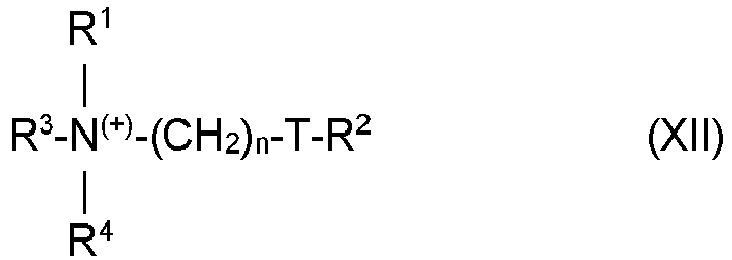
- Die erfindungsgemäßen Mittel, insbesondere wenn es sich bei ihnen um solche handelt, die für die Behandlung von Textilien vorgesehen sind, können als kationische Aktivsubstanzen mit textilweichmachender Wirkung insbesondere einen oder mehrere der kationischen, textilweichmachenden Stoffe der allgemeinen Formeln X, XI oder XII enthalten:


- Ein erfindungsgemäßes Mittel enthält vorzugsweise mindestens einen wasserlöslichen und/oder wasserunlöslichen, organischen und/oder anorganischen Builder. Zu den wasserlöslichen organischen Buildersubstanzen gehören Polycarbonsäuren, insbesondere Citronensäure und Zuckersäuren, monomere und polymere Aminopolycarbonsäuren, insbesondere Methylglycindiessigsäure, Nitrilotriessigsäure und Ethylendiamintetraessigsäure sowie Polyasparaginsäure, Polyphosphonsäuren, insbesondere Aminotris(methylenphosphonsäure), Ethylendiamintetrakis(methylenphosphonsäure) und 1-Hydroxyethan-1,1-diphosphonsäure, polymere Hydroxyverbindungen wie Dextrin sowie polymere (Poly-)carbonsäuren, insbesondere durch Oxidation von Polysacchariden wie Dextrinen zugänglichen Polycarboxylate, und/oder polymere Acrylsäuren, Methacrylsäuren, Maleinsäuren und Mischpolymere aus diesen, die auch geringe Anteile polymerisierbarer Substanzen ohne Carbonsäurefunktionalität einpolymerisiert enthalten können. Die relative Molekülmasse der Homopolymeren ungesättigter Carbonsäuren liegt im allgemeinen zwischen 5 000 und 200 000, die der Copolymeren zwischen 2 000 und 200 000, vorzugsweise 50 000 bis 120 000, jeweils bezogen auf freie Säure. Ein besonders bevorzugtes Acrylsäure-Maleinsäure-Copolymer weist eine relative Molekülmasse von 50 000 bis 100 000 auf. Geeignete, wenn auch weniger bevorzugte Verbindungen dieser Klasse sind Copolymere der Acrylsäure oder Methacrylsäure mit Vinylethern, wie Vinylmethylethern, Vinylester, Ethylen, Propylen und Styrol, in denen der Anteil der Säure mindestens 50 Gew.-% beträgt. Als wasserlösliche organische Buildersubstanzen können auch Terpolymere eingesetzt werden, die als Monomere zwei ungesättigte Säuren und/oder deren Salze sowie als drittes Monomer Vinylalkohol und/oder einem veresterten Vinylalkohol oder ein Kohlenhydrat enthalten. Das erste saure Monomer oder dessen Salz leitet sich von einer monoethylenisch ungesättigten C3-C8-Carbonsäure und vorzugsweise von einer C3-C4-Monocarbonsäure, insbesondere von (Meth)-acrylsäure ab. Das zweite saure Monomer oder dessen Salz kann ein Derivat einer C4-C8-Dicarbonsäure, wobei Maleinsäure besonders bevorzugt ist, und/oder ein Derivat einer Allylsulfonsäure, die in 2-Stellung mit einem Alkyl- oder Arylrest substituiert ist, sein. Derartige Polymere weisen im Allgemeinen eine relative Molekülmasse zwischen 1 000 g/mol und 200 000 g/mol auf. Weitere bevorzugte Copolymere sind solche, die als Monomere Acrolein und Acrylsäure/Acrylsäuresalze oder Vinylacetat aufweisen. Die organischen Buildersubstanzen können, insbesondere zur Herstellung flüssiger Mittel, in Form wässriger Lösungen, vorzugsweise in Form 30- bis 50-gewichtsprozentiger wässriger Lösungen eingesetzt werden. Alle genannten Säuren werden in der Regel in Form ihrer wasserlöslichen Salze, insbesondere ihre Alkalisalze, eingesetzt.
- Derartige organische Buildersubstanzen können gewünschtenfalls in Mengen bis zu 40 Gew.-%, insbesondere bis zu 25 Gew.-% und vorzugsweise von 1 Gew.-% bis 8 Gew.-% enthalten sein. Mengen nahe der genannten Obergrenze werden vorzugsweise in pastenförmigen oder flüssigen, insbesondere wasserhaltigen, erfindungsgemäßen Mitteln eingesetzt.
- Als wasserlösliche anorganische Buildermaterialien kommen insbesondere polymere Alkaliphosphate, die in Form ihrer alkalischen neutralen oder sauren Natrium- oder Kaliumsalze vorliegen können, in Betracht. Beispiele hierfür sind Tetranatriumdiphosphat, Dinatriumdihydrogendiphosphat, Pentanatriumtriphosphat, sogenanntes Natriumhexametaphosphat sowie die entsprechenden Kaliumsalze oder Gemische aus Natrium- und Kaliumsalzen. Als wasserunlösliche, wasserdispergierbare anorganische Buildermaterialien werden insbesondere kristalline oder amorphe Alkalialumosilikate, in Mengen von bis zu 50 Gew.-%, vorzugsweise nicht über 40 Gew.-% und in flüssigen Mitteln insbesondere von 1 Gew.-% bis 5 Gew.-%, eingesetzt. Unter diesen sind die kristallinen Natriumalumosilikate in Waschmittelqualität, insbesondere Zeolith A, P und gegebenenfalls X, bevorzugt. Mengen nahe der genannten Obergrenze werden vorzugsweise in festen, teilchenförmigen Mitteln eingesetzt. Geeignete Alumosilikate weisen insbesondere keine Teilchen mit einer Korngröße über 30 µm auf und bestehen vorzugsweise zu wenigstens 80 Gew.-% aus Teilchen mit einer Größe unter 10 µm. Ihr Calciumbindevermögen liegt in der Regel im Bereich von 100 bis 200 mg CaO pro Gramm.
- Geeignete Substitute oder Teilsubstitute für das genannte Alumosilikat sind kristalline Alkalisilikate, die allein oder im Gemisch mit amorphen Silikaten vorliegen können. Die in den erfindungsgemäßen Mitteln als Gerüststoffe brauchbaren Alkalisilikate weisen vorzugsweise ein molares Verhältnis von Alkalioxid zu SiO2 unter 0,95, insbesondere von 1:1,1 bis 1:12 auf und können amorph oder kristallin vorliegen. Bevorzugte Alkalisilikate sind die Natriumsilikate, insbesondere die amorphen Natriumsilikate, mit einem molaren Verhältnis Na2O:SiO2 von 1:2 bis 1:2,8. Als kristalline Silikate, die allein oder im Gemisch mit amorphen Silikaten vorliegen können, werden vorzugsweise kristalline Schichtsilikate der allgemeinen Formel Na2SixO2x+1 · y H2O eingesetzt, in der x, das sogenannte Modul, eine Zahl von 1,9 bis 4 und y eine Zahl von 0 bis 20 ist und bevorzugte Werte für x 2, 3 oder 4 sind. Bevorzugte kristalline Schichtsilikate sind solche, bei denen x in der genannten allgemeinen Formel die Werte 2 oder 3 annimmt. Insbesondere sind sowohl β- als auch δ-Natriumdisitikate (Na2Si2O5 · y H2O) bevorzugt. Auch aus amorphen Alkalisilikaten hergestellte, praktisch wasserfreie kristalline Alkalisilikate der obengenannten allgemeinen Formel, in der x eine Zahl von 1,9 bis 2,1 bedeutet, können in erfindungsgemäßen Mitteln eingesetzt werden. In einer weiteren bevorzugten Ausführungsform erfindungsgemäßer Mittel wird ein kristallines Natriumschichtsilikat mit einem Modul von 2 bis 3 eingesetzt, wie es n aus Sand und Soda hergestellt werden kann. Kristalline Natriumsilikate mit einem Modul im Bereich von 1,9 bis 3,5 werden in einer weiteren bevorzugten Ausführungsform erfindungsgemäßer Mittel eingesetzt. In einer bevorzugten Ausgestaltung erfindungsgemäßer Mittel setzt man ein granulares Compound aus Alkalisilikat und Alkalicarbonat ein, wie es zum Beispiel unter dem Namen Nabion® 15 im Handel erhältlich ist. Falls als zusätzliche Buildersubstanz auch Alkalialumosilikat, insbesondere Zeolith, vorhanden ist, beträgt das Gewichtsverhältnis Alumosilikat zu Silikat, jeweils bezogen auf wasserfreie Aktivsubstanzen, vorzugsweise 1:10 bis 10:1. In Mitteln, die sowohl amorphe als auch kristalline Alkalisilikate enthalten, beträgt das Gewichtsverhältnis von amorphem Alkalisilikat zu kristallinem Alkalisilikat vorzugsweise 1:2 bis 2:1 und insbesondere 1:1 bis 2:1.
- Buildersubstanzen sind in den erfindungsgemäßen Wasch- oder Reinigungsmitteln vorzugsweise in Mengen bis zu 60 Gew.-%, insbesondere von 5 Gew.-% bis 40 Gew.-%, enthalten.
- In einer bevorzugten Ausgestaltung der Erfindung weist ein erfindungsgemäßes Mittel einen wasserlöslichen Builderblock auf. Durch die Verwendung des Begriffes "Builderblock" soll hierbei ausgedrückt werden, dass die Mittel keine weiteren Buildersubstanzen enthalten als solche, die wasserlöslich sind, das heißt sämtliche in dem Mittel enthaltenen Buildersubstanzen sind in dem so charakterisierten "Block" zusammengefasst, wobei allenfalls die Mengen an Stoffen ausgenommen sind, die als Verunreinigungen oder stabilisierende Zusätze in geringen Mengen in den übrigen Inhaltsstoffen der Mittel handelsüblicherweise enthalten sein können. Unter dem Begriff "wasserlöslich" soll dabei verstanden werden, dass sich der Builderblock bei der Konzentration, die sich durch die Einsatzmenge des ihn enthaltenden Mittels bei den üblichen Bedingungen ergibt, rückstandsfrei löst. Vorzugsweise sind mindestens 15 Gew.-% und bis zu 55 Gew.-%, insbesondere 25 Gew.-% bis 50 Gew.-% an wasserlöslichem Builderblock in den erfindungsgemäßen Mitteln enthalten. Dieser setzt sich vorzugsweise zusammen aus den Komponenten
- a) 5 Gew.-% bis 35 Gew.-% Citronensäure, Alkalicitrat und/oder Alkalicarbonat, welches auch zumindest anteilig durch Alkalihydrogencarbonat ersetzt sein kann,
- b) bis zu 10 Gew.-% Alkalisilikat mit einem Modul im Bereich von 1,8 bis 2,5,
- c) bis zu 2 Gew.-% Phosphonsäure und/oder Alkaliphosphonat, und
- d) bis zu 10 Gew.-% polymerem Polycarboxylat,
- In einer bevorzugten Ausführungsform erfindungsgemäßer Mittel enthält der wasserlösliche Builderblock mindestens 2 der Komponenten b), c) und d) in Mengen größer 0 Gew.-%.
- Hinsichtlich der Komponente a) sind in einer bevorzugten Ausführungsform erfindungsgemäßer Mittel 15 Gew.-% bis 25 Gew.-% Alkalicarbonat, welches zumindest anteilig durch Alkalihydrogencarbonat ersetzt sein kann, und bis zu 5 Gew.-%, insbesondere 0,5 Gew.-% bis 2,5 Gew.-% Citronensäure und/oder Alkalicitrat enthalten. In einer alternativen Ausführungsform erfindungsgemäßer Mittel sind als Komponente a) 5 Gew.-% bis 25 Gew.-%, insbesondere 5 Gew.-% bis 15 Gew.-% Citronensäure und/oder Alkalicitrat und bis zu 5 Gew.-% , insbesondere 1 Gew.-% bis 5 Gew.-% Alkalicarbonat, welches zumindest anteilig durch Alkalihydrogencarbonat ersetzt sein kann, enthalten. Falls sowohl Alkalicarbonat wie auch Alkalihydrogencarbonat vorhanden sind, weist die Komponente a) Alkalicarbonat und Alkalihydrogencarbonat vorzugsweise im Gewichtsverhältnis von 10:1 bis 1:1 auf.
- Hinsichtlich der Komponente b) sind in einer bevorzugten Ausführungsform erfindungsgemäßer Mittel 1 Gew.-% bis 5 Gew.-% Alkalisilikat mit einem Modul im Bereich von 1,8 bis 2,5 enthalten.
- Hinsichtlich der Komponente c) sind in einer bevorzugten Ausführungsform erfindungsgemäßer Mittel 0,05 Gew.-% bis 1 Gew.-% Phosphonsäure und/oder Alkaliphosphonat enthalten. Unter Phosphonsäuren werden dabei auch gegebenenfalls substituierte Alkylphosphonsäuren verstanden, die auch mehrere Phosphonsäuregruppierungen aufweisen könne (sogenannte Polyphosphonsäuren). Bevorzugt werden sie ausgewählt aus den Hydroxy- und/oder Aminoalkylphosphonsäuren und/oder deren Alkalisalzen, wie zum Beispiel Dimethylaminomethandiphosphonsäure, 3-Aminopropan-1-hydroxy-1,1-diphosphonsäure, 1-Amino-1-phenyl-methandiphosphonsäure, 1-Hydroxyethan-1 ,1-diphosphonsäure, Amino-tris(methylenphosphonsäure), N,N,N',N'-Ethylendiamin-tetrakis-(methylenphosphonsäure) und acylierte Derivate der phosphorigen Säure, die auch in beliebigen Mischungen eingesetzt werden können.
- Hinsichtlich der Komponente d) sind in einer bevorzugten Ausführungsform erfindungsgemäßer Mittel 1,5 Gew.-% bis 5 Gew.-% polymeres Polycarboxylat, insbesondere ausgewählt aus den Polymerisations- oder Copolymerisationsprodukten von Acrylsäure, Methacrylsäure und/oder Maleinsäure enthalten. Unter diesen sind die Homopolymere der Acrylsäure und unter diesen wiederum solche mit einer mittleren Molmasse im Bereich von 5 000 D bis 15 000 D (PA-Standard) besonders bevorzugt.
- Als in den Mitteln verwendbare Enzyme kommen solche aus der Klasse der Proteasen, Lipasen, Cutinasen, Amylasen, Pullulanasen, Mannanasen, Cellulasen, Hemicellulasen, Xylanasen, Oxidasen und Peroxidasen sowie deren Gemische in Frage, beispielsweise Proteasen wie BLAP®, Optimase®, Opticlean®, Maxacal®, Maxapem®, Alcalase®, Esperase®, Savinase®, Durazym® und/oder Purafect® OxP, Amylasen wie Termamyl®, Amylase-LT®, Maxamyl®, Duramyl® und/oder Purafect® OxAm, Lipasen wie Lipolase®, Lipomax®, Lumafast® und/oder Lipozym®, Cellulasen wie Celluzyme® und/oder Carezyme®. Besonders geeignet sind aus Pilzen oder Bakterien, wie Bacillus subtilis, Bacillus licheniformis, Streptomyces griseus, Humicola lanuginosa, Humicola insolens, Pseudomonas pseudoalcaligenes oder Pseudomonas cepacia gewonnene enzymatische Wirkstoffe. Die gegebenenfalls verwendeten Enzyme können an Trägerstoffen adsorbiert und/oder in Hüllsubstanzen eingebettet sein, um sie gegen vorzeitige Inaktivierung zu schützen. Sie sind in den erfindungsgemäßen Wasch-, Reinigungs- und Desinfektionsmitteln vorzugsweise in Mengen bis zu 10 Gew.-%, insbesondere von 0,2 Gew.-% bis 2 Gew.-%, enthalten, wobei besonders bevorzugt gegen oxidativen Abbau stabilisierte Enzyme eingesetzt werden.
- In einer bevorzugten Ausführungsform der Erfindung enthält das Mittel 5 Gew.-% bis 50 Gew.-%, insbesondere 8 Gew.-% bis 30 Gew.-% anionisches und/oder nichtionisches Tensid, bis zu 60 Gew.-%, insbesondere 5 Gew.-% bis 40 Gew.-% Buildersubstanz und 0,2 Gew.-% bis 2 Gew.-% Enzym, ausgewählt aus den Proteasen, Lipasen, Cutinasen, Amylasen, Pullulanasen, Mannanasen, Cellulasen, Oxidasen und Peroxidasen sowie deren Gemischen.
- Als in den Mitteln gegebenenfalls enthaltene Persauerstoffverbindungen, die in für den Einsatz im erfindungsgemäßen Verfahren vorgesehenen Mitteln vorzugsweise aber entfallen können, kommen insbesondere organische Persäuren oder persaure Salze organischer Säuren, wie Phthalimidopercapronsäure, Perbenzoesäure oder Salze der Diperdodecandisäure, Wasserstoffperoxid und unter den Waschbedingungen Wasserstoffperoxid abgebende anorganische Salze, wie Perborat, Percarbonat und/oder Persilikat, in Betracht. Wasserstoffperoxid kann dabei auch mit Hilfe eines enzymatischen Systems, das heißt einer Oxidase und ihres Substrats, erzeugt werden. Sofern feste Persauerstoffverbindungen eingesetzt werden sollen, können diese in Form von Pulvern oder Granulaten verwendet werden, die auch in im Prinzip bekannter Weise umhüllt sein können. Besonders bevorzugt wird Alkalipercarbonat, Alkaliperborat-Monohydrat, Alkaliperborat-Tetrahydrat oder Wasserstoffperoxid in Form wässriger Lösungen, die 3 Gew.-% bis 10 Gew.-% Wasserstoffperoxid enthalten, eingesetzt. Gewünschtenfalls sind Persauerstoffverbindungen, wenn vorhanden, in Mengen von bis zu 50 Gew.-%, insbesondere von 5 Gew.-% bis 30 Gew.-%, in erfindungsgemäßen Wasch- oder Reinigungsmitteln vorhanden.
- Zusätzlich können übliche Bleichaktivatoren, die unter Perhydrolysebedingungen Peroxocarbonsäuren oder Peroxoimidsäuren bilden, und/oder übliche die Bleiche aktivierende Übergangsmetallkomplexe eingesetzt werden. Die fakultativ, insbesondere in Mengen von 0,5 Gew.-% bis 6 Gew.-%, vorhandene Komponente der Bleichaktivatoren umfasst die üblicherweise verwendeten N- oder O-Acylverbindungen, beispielsweise mehrfach acylierte Alkylendiamine, insbesondere Tetraacetylethylendiamin, acylierte Glykolurile, insbesondere Tetraacetylglykoluril, N-acylierte Hydantoine, Hydrazide, Triazole, Urazole, Diketopiperazine, Sulfurylamide und Cyanurate, außerdem Carbonsäureanhydride, insbesondere Phthalsäureanhydrid, Carbonsäureester, insbesondere Natrium-isononanoyl-phenolsulfonat, und acylierte Zuckerderivate, insbesondere Pentaacetylglukose, sowie kationische Nitrilderivate wie Trimethylammoniumacetonitril-Salze. Die Bleichaktivatoren können zur Vermeidung der Wechselwirkung mit den Perverbindungen bei der Lagerung in bekannter Weise mit Hüllsubstanzen überzogen oder granuliert worden sein, wobei mit Hilfe von Carboxymethylcellulose granuliertes Tetraacetylethylendiamin mit mittleren Korngrößen von 0,01 mm bis 0,8 mm, granuliertes 1,5-Diacetyl-2,4-dioxohexahydro-1,3,5-triazin, und/oder in Teilchenform konfektioniertes Trialkylammoniumacetonitril besonders bevorzugt ist. In Wasch- oder Reinigungsmitteln sind derartige Bleichaktivatoren, wenn vorhanden, vorzugsweise in Mengen bis zu 8 Gew.-%, insbesondere von 2 Gew.-% bis 6 Gew.-%, jeweils bezogen auf gesamtes Mittel, enthalten.
- Zu den in den erfindungsgemäßen Mitteln, insbesondere wenn sie in flüssiger oder pastöser Form vorliegen, verwendbaren organischen Lösungsmitteln gehören Alkohole mit 1 bis 4 C-Atomen, insbesondere Methanol, Ethanol, Isopropanol und tert.-Butanol, Diole mit 2 bis 4 C-Atomen, insbesondere Ethylenglykol und Propylenglykol, sowie deren Gemische und die aus den genannten Verbindungsklassen ableitbaren Ether. Derartige wassermischbare Lösungsmittel sind in den erfindungsgemäßen Waschmitteln vorzugsweise nicht über 30 Gew.-%, insbesondere von 6 Gew.-% bis 20 Gew.-%, vorhanden.
- Zur Einstellung eines gewünschten, sich durch die Mischung der übrigen Komponenten nicht von selbst ergebenden pH-Werts können die erfindungsgemäßen Mittel system- und umweltverträgliche Säuren, insbesondere Citronensäure, Essigsäure, Weinsäure, Äpfelsäure, Milchsäure, Glykolsäure, Bernsteinsäure, Glutarsäure und/oder Adipinsäure, aber auch Mineralsäuren, insbesondere Schwefelsäure, oder Basen, insbesondere Ammonium- oder Alkalihydroxide, enthalten. Derartige pH-Regulatoren sind in den erfindungsgemäßen Mitteln vorzugsweise nicht über 20 Gew.-%, insbesondere von 1,2 Gew.-% bis 17 Gew.-%, enthalten.
- Schmutzablösevermögende Polymere, die oft als "Soil Release"-Wirkstoffe oder wegen ihres Vermögens, die behandelte Oberfläche, zum Beispiel der Faser, schmutzabstoßend auszurüsten, als "Soil Repellents" bezeichnet werden, sind beispielsweise nichtionische oder kationische Cellulosederivate. Zu den insbesondere polyesteraktiven schmutzablösevermögenden Polymeren gehören Copolyester aus Dicarbonsäuren, beispielsweise Adipinsäure, Phthalsäure oder Terephthalsäure, Diolen, beispielsweise Ethylenglykol oder Propylenglykol, und Polydiolen, beispielsweise Polyethylenglykol oder Polypropylenglykol. Zu den bevorzugt eingesetzten schmutzablösevermögenden Polyestern gehören solche Verbindungen, die formal durch Veresterung zweier Monomerteile zugänglich sind, wobei das erste Monomer eine Dicarbonsäure HOOC-Ph-COOH und das zweite Monomer ein Diol HO-(CHR11-)aOH, das auch als polymeres Diol H-(O-(CHR11-)a)bOH vorliegen kann, ist. Darin bedeutet Ph einen o-, m- oder p-Phenylenrest, der 1 bis 4 Substituenten, ausgewählt aus Alkylresten mit 1 bis 22 C-Atomen, Sulfonsäuregruppen, Carboxylgruppen und deren Mischungen, tragen kann, R11 Wasserstoff, einen Alkylrest mit 1 bis 22 C-Atomen und deren Mischungen, a eine Zahl von 2 bis 6 und b eine Zahl von 1 bis 300. Vorzugsweise liegen in den aus diesen erhältlichen Polyestern sowohl Monomerdioleinheiten -O-(CHR11-)aO- als auch Polymerdioleinheiten -(O-(CHR11-)a)bO- vor. Das molare Verhältnis von Monomerdioleinheiten zu Polymerdioleinheiten beträgt vorzugsweise 100:1 bis 1:100, insbesondere 10:1 bis 1:10. In den Polymerdioleinheiten liegt der Polymerisationsgrad b vorzugsweise im Bereich von 4 bis 200, insbesondere von 12 bis 140. Das Molekulargewicht oder das mittlere Molekulargewicht oder das Maximum der Molekulargewichtsverteilung bevorzugter schmutzablösevermögender Polyester liegt im Bereich von 250 bis 100 000, insbesondere von 500 bis 50 000. Die dem Rest Ph zugrundeliegende Säure wird vorzugsweise aus Terephthalsäure, Isophthalsäure, Phthalsäure, Trimellithsäure, Mellithsäure, den Isomeren der Sulfophthalsäure, Sulfoisophthalsäure und Sulfoterephthalsäure sowie deren Gemischen ausgewählt. Sofern deren Säuregruppen nicht Teil der Esterbindungen im Polymer sind, liegen sie vorzugsweise in Salzform, insbesondere als Alkali- oder Ammoniumsalz vor. Unter diesen sind die Natrium- und Kaliumsalze besonders bevorzugt. Gewünschtenfalls können statt des Monomers HOOC-Ph-COOH geringe Anteile, insbesondere nicht mehr als 10 Mol-% bezogen auf den Anteil an Ph mit der oben gegebenen Bedeutung, anderer Säuren, die mindestens zwei Carboxylgruppen aufweisen, im schmutzablösevermögenden Polyester enthalten sein. Zu diesen gehören beispielsweise Alkylen- und Alkenylendicarbonsäuren wie Malonsäure, Bernsteinsäure, Fumarsäure, Maleinsäure, Glutarsäure, Adipinsäure, Pimelinsäure, Korksäure, Azelainsäure und Sebacinsäure. Beispiele für Diolkomponenten sind Ethylenglykol, 1,2-Propylenglykol, 1,3-Propylenglykol, 1,4-Butandiol, 1,5-Pentandiol, 1,6-Hexandiol, 1,8-Octandiol, 1,2-Decandiol, 1,2-Dodecandiol und Neopentylglykol. Besonders bevorzugt unter den polymeren Diolen ist Polyethylenglykol mit einer mittleren Molmasse im Bereich von 1000 bis 6000. Gewünschtenfalls können diese Polyester auch endgruppenverschlossen sein, wobei als Endgruppen Alkylgruppen mit 1 bis 22 C-Atomen und Ester von Monocarbonsäuren in Frage kommen. Bevorzugt werden Polymere aus Ethylenterephthalat und Polyethylenoxid-terephthalat, in denen die Polyethylenglykol-Einheiten Molgewichte von 750 bis 5000 aufweisen und das Molverhältnis von Ethylenterephthalat zu Polyethylenoxid-terephthalat 50:50 bis 90:10 beträgt, allein oder in Kombination mit Cellulosederivaten verwendet.
- Zu den für den Einsatz in erfindungsgemäßen Mitteln für die Wäsche von Textilien in Frage kommenden Farbübertragungsinhibitoren gehören insbesondere Polyvinylpyrrolidone, Polyvinylimidazole, polymere N-Oxide wie Poly-(vinylpyridin-N-oxid) und Copolymere von Vinylpyrrolidon mit Vinylimidazol und gegebenenfalls weiteren Monomeren.
- Die erfindungsgemäßen Mittel zum Einsatz in der Textilwäsche können Knitterschutzmittel enthalten, da textile Flächengebilde, insbesondere aus Reyon, Wolle, Baumwolle und deren Mischungen, zum Knittern neigen können, weil die Einzelfasern gegen Durchbiegen, Knicken, Pressen und Quetschen quer zur Faserrichtung empfindlich sind. Hierzu zählen beispielsweise synthetische Produkte auf der Basis von Fettsäuren, Fettsäureestern, Fettsäureamiden, -alkylolestern, -alkylolamiden oder Fettalkoholen, die meist mit Ethylenoxid umgesetzt sind, oder Produkte auf der Basis von Lecithin oder modifizierter Phosphorsäureester.
- Vergrauungsinhibitoren haben die Aufgabe, den von der harten Oberfläche und insbesondere von der Textilfaser abgelösten Schmutz in der Flotte suspendiert zu halten. Hierzu sind wasserlösliche Kolloide meist organischer Natur geeignet, beispielsweise Stärke, Leim, Gelatine, Salze von Ethercarbonsäuren oder Ethersulfonsäuren der Stärke oder der Cellulose oder Salze von sauren Schwefelsäureestern der Cellulose oder der Stärke. Auch wasserlösliche, saure Gruppen enthaltende Polyamide sind für diesen Zweck geeignet. Weiterhin lassen sich andere als die obengenannten Stärkederivate verwenden, zum Beispiel Aldehydstärken. Bevorzugt werden Celluloseether, wie Carboxymethylcellulose (Na-Salz), Methylcellulose, Hydroxyalkylcellulose und Mischether, wie Methylhydroxyethylcellulose, Methylhydroxypropylcellulose, Methylcarboxymethylcellulose und deren Gemische, beispielsweise in Mengen von 0,1 bis 5 Gew.-%, bezogen auf die Mittel, eingesetzt.
- Die Mittel können optische Aufheller, unter diesen insbesondere Derivate der Diaminostilbendisulfonsäure oder deren Alkalimetallsalze, enthalten. Geeignet sind zum Beispiel Salze der 4,4'-Bis(2-anilino-4-morpholino-1,3,5-triazinyl-6-amino)stilben-2,2'-disulfonsäure oder gleichartig aufgebaute Verbindungen, die anstelle der Morpholino-Gruppe eine Diethanolaminogruppe, eine Methylaminogruppe, eine Anilinogruppe oder eine 2-Methoxyethylaminogruppe tragen. Weiterhin können Aufheller vom Typ der substituierten Diphenylstyryle anwesend sein, zum Beispiel die Alkalisalze des 4,4'-Bis(2-sulfostyryl)-diphenyls, 4,4'-Bis(4-chlor-3-sulfostyryl)-diphenyls, oder 4-(4-Chlorstyryl)-4'-(2-sulfostyryl)-diphenyls. Auch Gemische der vorgenannten optischen Aufheller können verwendet werden.
- Insbesondere beim Einsatz in maschinellen Wasch- oder Reinigungsverfahren kann es von Vorteil sein, den Mitteln übliche Schauminhibitoren zuzusetzen. Als Schauminhibitoren eignen sich beispielsweise Seifen natürlicher oder synthetischer Herkunft, die einen hohen Anteil an C18-C24-Fettsäuren aufweisen. Geeignete nichttensidartige Schauminhibitoren sind beispielsweise Organopolysiloxane und deren Gemische mit mikrofeiner, gegebenenfalls silanierter Kieselsäure sowie Paraffine, Wachse, Mikrokristallinwachse und deren Gemische mit silanierter Kieselsäure oder Bisfettsäurealkylendiamiden. Mit Vorteilen werden auch Gemische aus verschiedenen Schauminhibitoren verwendet, zum Beispiel solche aus Silikonen, Paraffinen oder Wachsen. Vorzugsweise sind die Schauminhibitoren, insbesondere Silikon- und/oder Paraffin-haltige Schauminhibitoren, an eine granulare, in Wasser lösliche oder dispergierbare Trägersubstanz gebunden. Insbesondere sind dabei Mischungen aus Paraffinen und Bistearylethylendiamid bevorzugt.
- In erfindungsgemäßen Mitteln können außerdem Wirkstoffe zur Vermeidung des Anlaufens von Gegenständen aus Silber, sogenannte Silberkorrosionsinhibitoren, eingesetzt werden. Bevorzugte Silberkorrosionsschutzmittel sind organische Disulfide, zweiwertige Phenole, dreiwertige Phenole, gegebenenfalls alkyl- oder aminoalkylsubstituierte Triazole wie Benzotriazol sowie Cobalt-, Mangan-, Titan-, Zirkonium-, Hafnium-, Vanadium- oder Cersalze und/oder -komplexe, in denen die genannten Metalle in einer der Oxidationsstufen II, III, IV, V oder VI vorliegen.
- Die Herstellung erfindungsgemäßer fester Mittel bietet keine Schwierigkeiten und kann in im Prinzip bekannter Weise, zum Beispiel durch Sprühtrocknen oder Granulation, erfolgen. Zur Herstellung erfindungsgemäßer Mittel mit erhöhtem Schüttgewicht, insbesondere im Bereich von 650 g/l bis 950 g/l, ist ein einen Extrusionsschritt aufweisendes Verfahren bevorzugt. Wasch-, Reinigungs- oder Desinfektionsmittel in Form wässriger oder sonstige übliche Lösungsmittel enthaltender Lösungen werden besonders vorteilhaft durch einfaches Mischen der Inhaltsstoffe, die in Substanz oder als Lösung in einen automatischen Mischer gegeben werden können, hergestellt. In einer bevorzugten Ausführung von Mitteln für die insbesondere maschinelle Reinigung von Geschirr sind diese tablettenförmig.
-
Tabelle 1: Übersicht erfindungswesentlicher Verbindungen T1 
T5 
T2 
T6 
T3 
T7 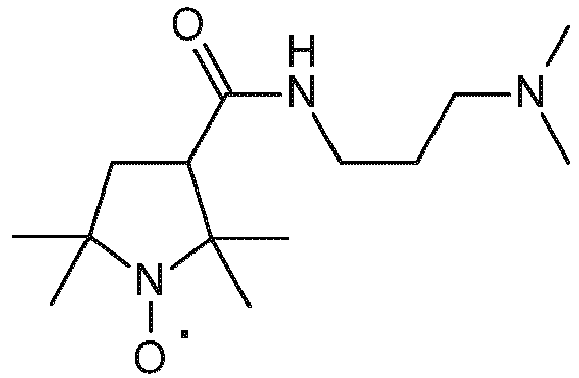
T4 
T8 
- Das Nitroxid T1 wurde hergestellt nach der Vorschrift von: Krishna, Murali C.; DeGraff, William; Hankovszky, Olga H.; Sar, Cecilia P.; Kalai, Tamas; Jeko, Jozsef; Russo, Angelo; Mitchell, James B.; Hideg, Kalman, Journal of Medicinal Chemistry (1998), 41(18), 3477-3492.
- Das Nitroxid T2 wurde hergestellt nach der Vorschrift von: Wright, Karen; Dutot, Laurence; Wakselman, Michel; Mazaleyrat, Jean-Paul; Crisma, Marco; Formaggio, Fernando; Toniolo, Claudio, Tetrahedron (2008), 64(19), 4416-4426.
- Das Nitroxid T3 wurde hergestellt nach der Vorschrift von: Krishna, Murali C.; DeGraff, William; Hankovszky, Olga H.; Sar, Cecilia P.; Kalai, Tamas; Jeko, Jozsef; Russo, Angelo; Mitchell, James B.; Hideg, Kalman, Journal of Medicinal Chemistry (1998), 41(18), 3477-3492.
- Zu einer Lösung von 5,37 g (0,020 mol) des Nitroxids T3 in 25 ml trockenem Acetonitril wurden 3,03 g (0,024 mol) Dimethylsulfat zugegeben und die Lösung wurde bei Raumtempetratur 22 Stunden stehen gelassen. Das Acetonitril wurde dann bei 50 °C / 20 mbar abdestilliert. Der ölige Rückstand wurde mit 100 ml tert-Butylmethylether 1 Stunde gerührt. Die Etherphase wurde dann abdekantiert und der Rückstand wurde bei 50 °C / 0,5 mbar getrocknet. Es wurden 7,8 g des Nitroxids T4 als rotes Harz erhalten.
- In 50 ml Wasser wurden 4,0126 g (21,547 mmol) 3-Carboxy-2,2,5,5-tetramethylpyrrolidin-1-oxyl (gekauft bei ABCR GmbH, Deutschland) und 1,8102g (21,547 mmol) Natriumhydrogencarbonat vorgelegt. Das Gemisch wurde 30 Minuten bei 50 °C gerührt. Die entstandene klare Lösung wurde am Rotationsverdampfer bei 50 °C/ 20 mbar eingedampft. Es wurden 4,46 g des Nitroxids T5 als rotes Pulver erhalten.
- Das Nitroxid T6 wurde hergestellt nach der Vorschrift von: Sosnovsky, George; Cai, Zhen-wie, Journal of Organic Chemistry (1995), 60(11), 3414-18.
- Unter einer Argonatmosphäre wurden 10,01 g (0,050 mol) 3-Methoxycarbonyl-2,2,5,5-tetramethyl-3-pyrrolidin-1-oxyl (hergestellt nach Hatano, Bunpei et al.: Heterocycles, 81(2), 349-356; 2010), 2,088 g (0,015 mol) 1,5,7-triazabicyclo[4.4.0]dec-5-en und 6,131 g (0,060 mol) 3-Dimethylamino-1-propylamin vorgelegt und 18 Stunden bei 75 °C gerührt. Anschliessende Chromatographie über Kieselgel mit Methanol + 5% Triethylamin und Kristallisation aus Dichlormethan ergab 10,0 g des Nitroxids T7 als orange Kristalle, Schmp. 86.9 - 90.5°C
- Das Nitroxid T8 wurde in Analogie zu T4 aus T7 als rotes Pulver hergestellt.
- Zum Einsatz kam eine Elektrolysevorrichtung aus zwei mittels einer ionendurchlässigen Membran verbundenen Halbzellen. Jede Halbzelle war mit einer Elektrode aus Edelstahl ausgestattet. Die Elektrolysevorrichtung wurde mit jeweils einer 2 millimolaren wässrigen Lösung von in Beispiel 1 hergestelltem T1 oder T2 oder zum Vergleich von 1-Hydroxy-2,2,6,6-Tetramethylpiperidin (V1), die außerdem jeweils 0,1 mol/l Na2SO4 enthielten, befüllt. Zur Quantifizierung der Bleichwirkung wurden flächige Baumwolltextilstücke in die Anodenhalbzelle eingebracht, die zuvor mit den in der nachfolgenden Tabelle angegebenen standardisierten Anschmutzungen A1 (Babynahrung Karrotte/Kartoffel), A2 (Paprika), A3 (Heidelbeersaft) oder A4 (Tee) versehen worden waren. Bei 20 °C und pH 6 wurde mit einer Potentialdifferenz von 2 V über einen Zeitraum von 2 Stunden elektrolysiert, wobei die Konvektion in der Lösung durch Einsatz eines Magnetrührers unterstützt wurde. Anschließend wurden die Baumwolltextilstücke entnommen, mit Wasser ausgespült, unter Lichtausschluss getrocknet und mit einem Farbspektrometer im L·a·b Farbraum vermessen. In der nachfolgendenTabelle 2 sind die so erhaltenen Werte und die der angeschmutzten ungewaschenen Textilstücke aufgeführt.
Tabelle 2: L,a,b - Werte A1; L/a/b A2; L/a/b A3; L/a/b A4; L/a/b ungewaschen 88,96 / 2,65 / 22,68 72,9 / 26,56 / 37,46 31,71 / 22,66 / -0,87 74,08 / 7,11/ 24,51 T1 91,5 / 3,1 / 6,4 92,6 / 1,2 / 5,3 84,9 / 3,7 / 11,1 82,4 / 3,9 / 14,4 T2 92,4 / 3,1 / 4,9 92,6 / 1,7 / 4,5 88,2 / 2,4 / 12,7 85,7 / 3,0 / 15,4 V1 92,2 / 3,1 / 6,0 92,5 / 0,18 / 8,3 85,4 / 4,4 / 13,7 82,8 / 4,1 / 16,5 - Es ist zu erkennen, dass T1 im Vergleich zu V1 eine deutlich niedrigere Neigung zur ungewollten Verfärbung der Flecke (niedrigerer b-Wert) aufwies. T2 zeigte ebenfalls eine geringere Tendenz zu unerwünschten Verfärbungen (niedrigerer b-Wert) gepaart mit einer signifikant besseren Reinigungswirkung (höherer L-Wert).
Claims (10)
- Wasch- oder Reinigungsmittel, dadurch gekennzeichnet, dass es eine Verbindung der allgemeinen Formel I oder II,

- Mittel nach Anspruch 1, dadurch gekennzeichnet, dass es 0,05 Gew.-% bis 10 Gew.-%, insbesondere 0,1 Gew.-% bis 5 Gew.-% der Verbindung enthält und/oder frei von Bleichmittel und konventionellem Bleichaktivator ist.
- Mittel nach Anspruch 1 oder 2, dadurch gekennzeichnet, dass es wasserhaltig und flüssig ist.
- Verwendung von Verbindungen der allgemeinen Formel I oder II,

- Verfahren zum Waschen von Textilien oder zum Reinigen harter Oberflächen, insbesondere zum maschinellen Reinigen von Geschirr, unter Einsatz einer Verbindung der allgemeinen Formel I oder II,
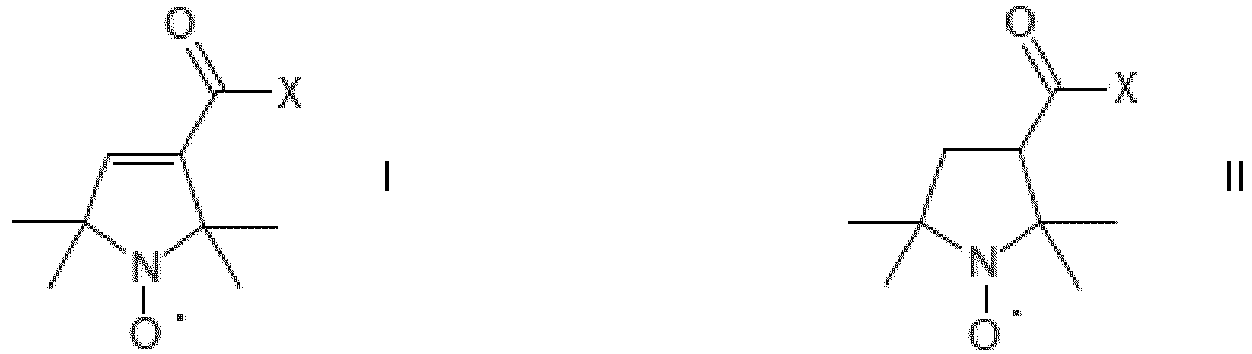
- Verfahren nach Anspruch 5, dadurch gekennzeichnet, dass die die Verbindung enthaltene Flotte mit Hilfe einer Elektrolysevorrichtung kontinuierlich oder ein- oder mehrmals für bestimmter Zeiträume, insbesondere 10 Minuten, 20 Minuten, 30 Minuten, 40 Minuten, 50 Minuten oder 60 Minuten, elektrolysiert wird.
- Verfahren nach Anspruch 5 oder 6, dadurch gekennzeichnet, dass die insbesondere als Elektrolysezelle ausgebildete Elektrolysevorrichtung als von einer Wasch- oder Geschirrspülmaschine getrennte separate Vorrichtung ausgebildet ist, die mit einer eigenen Stromquelle betrieben wird.
- Verfahren nach Anspruch 5, dadurch gekennzeichnet, dass das der Formel I oder II entsprechende Amin oder Hydroxylamin, insbesondere bei Verwendung einer üblichen Einspülvorrichtung, vor dem Einlass in die Kammer einer Waschmaschine eine Elektrolysevorrichtung passiert, insbesondere in wässriger Lösung oder Aufschlämmung eine Elektrolysezelle durchströmt.
- Verwendung nach Anspruch 4 oder Verfahren nach einem der Ansprüche 5 bis 8, dadurch gekennzeichnet, dass die Konzentration der Verbindung in der wässrigen Wasch- oder Reinigungsflotte 0,05 mmol/l bis 5 mmol/l, insbesondere 0,1 mmol/l bis 2 mmol/l beträgt.
- Verwendung oder Verfahren nach einem der Ansprüche 4 bis 9, dadurch gekennzeichnet, dass sie oder es bei pH-Werten im Bereich von pH 2 bis pH 12, insbesondere von pH 4 bis pH 11 durchgeführt wird.
Priority Applications (2)
| Application Number | Priority Date | Filing Date | Title |
|---|---|---|---|
| EP20161455.9A EP3875567B1 (de) | 2020-03-06 | 2020-03-06 | Nitroxidverbindungen in wasch- oder reinigungsmitteln |
| PCT/EP2021/055021 WO2021175770A1 (de) | 2020-03-06 | 2021-03-01 | Nitroxidverbindungen in wasch- oder reinigungsmitteln |
Applications Claiming Priority (1)
| Application Number | Priority Date | Filing Date | Title |
|---|---|---|---|
| EP20161455.9A EP3875567B1 (de) | 2020-03-06 | 2020-03-06 | Nitroxidverbindungen in wasch- oder reinigungsmitteln |
Publications (2)
| Publication Number | Publication Date |
|---|---|
| EP3875567A1 true EP3875567A1 (de) | 2021-09-08 |
| EP3875567B1 EP3875567B1 (de) | 2024-05-01 |
Family
ID=69960217
Family Applications (1)
| Application Number | Title | Priority Date | Filing Date |
|---|---|---|---|
| EP20161455.9A Active EP3875567B1 (de) | 2020-03-06 | 2020-03-06 | Nitroxidverbindungen in wasch- oder reinigungsmitteln |
Country Status (2)
| Country | Link |
|---|---|
| EP (1) | EP3875567B1 (de) |
| WO (1) | WO2021175770A1 (de) |
Citations (5)
| Publication number | Priority date | Publication date | Assignee | Title |
|---|---|---|---|---|
| DE4445088A1 (de) * | 1994-12-16 | 1996-06-20 | Ibv Ind Bioverfahren | Mehrkomponentenbleichsystem aus Oxidoreductasen, Oxidationsmitteln, Mediatoren und Mediator-verstärkenden oder recyclierenden Verbindungen zur Verwendung mit waschaktiven Substanzen |
| US6274186B1 (en) * | 1996-05-29 | 2001-08-14 | Heineken Technical Services B.V. | Method for cleaning items in particular filters, used during foodstuff production |
| US20070079446A1 (en) * | 2003-11-03 | 2007-04-12 | Lupia Joseph A | Stabilized body care products, household products, textiles and fabrics |
| WO2013017476A1 (de) | 2011-07-29 | 2013-02-07 | Henkel Ag & Co. Kgaa | Wasch- oder reinigungsmittel mit elektrochemisch aktivierbarer mediatorverbindung |
| WO2015162008A1 (de) | 2014-04-24 | 2015-10-29 | Henkel Ag & Co. Kgaa | Wasch- oder reinigungsmittel mit elektrochemisch aktivierbarer anionischer mediatorverbindung |
-
2020
- 2020-03-06 EP EP20161455.9A patent/EP3875567B1/de active Active
-
2021
- 2021-03-01 WO PCT/EP2021/055021 patent/WO2021175770A1/de not_active Ceased
Patent Citations (5)
| Publication number | Priority date | Publication date | Assignee | Title |
|---|---|---|---|---|
| DE4445088A1 (de) * | 1994-12-16 | 1996-06-20 | Ibv Ind Bioverfahren | Mehrkomponentenbleichsystem aus Oxidoreductasen, Oxidationsmitteln, Mediatoren und Mediator-verstärkenden oder recyclierenden Verbindungen zur Verwendung mit waschaktiven Substanzen |
| US6274186B1 (en) * | 1996-05-29 | 2001-08-14 | Heineken Technical Services B.V. | Method for cleaning items in particular filters, used during foodstuff production |
| US20070079446A1 (en) * | 2003-11-03 | 2007-04-12 | Lupia Joseph A | Stabilized body care products, household products, textiles and fabrics |
| WO2013017476A1 (de) | 2011-07-29 | 2013-02-07 | Henkel Ag & Co. Kgaa | Wasch- oder reinigungsmittel mit elektrochemisch aktivierbarer mediatorverbindung |
| WO2015162008A1 (de) | 2014-04-24 | 2015-10-29 | Henkel Ag & Co. Kgaa | Wasch- oder reinigungsmittel mit elektrochemisch aktivierbarer anionischer mediatorverbindung |
Non-Patent Citations (8)
| Title |
|---|
| FISH, JUDITH R.SWARTS, STEVEN G.SEVILLA, MICHAEL D.MALINSKI, TADEUSZ: "Electrochemistry and spectroelectrochemistry of nitroxyl free radicals", JOURNAL OF PHYSICAL CHEMISTRY, vol. 92, no. 13, 1988, pages 3745 - 51 |
| GEFFKEN, D.KOELLNER, M. A.: "Hydroxylamines", SCIENCE OF SYNTHESIS, vol. 40b, 2008, pages 937 - 1082 |
| HATANO, BUNPEI ET AL., HETEROCYCLES, vol. 81, no. 2, 2010, pages 349 - 356 |
| KAGAN, E. SH.ZHUKOVA, I. YU.YANILKIN, V. V.MOROZOV, V. I.NASTAPOVA, N. V.KASHPAROVA, V. P.KASHPAROV, I. I.: "Mechanism of electrochemical oxidation of spatially hindered amines of 2,2,6,6-tetramethylpiperidine series", RUSSIAN JOURNAL OF ELECTROCHEMISTRY, vol. 47, no. 11, 2011, pages 1199 - 1204 |
| KRISHNA, MURALI C.DEGRAFF, WILLIAMHANKOVSZKY, OLGA H.SAR, CECILIA P.KALAI, TAMASJEKO, JOZSEFRUSSO, ANGELOMITCHELL, JAMES B.HIDEG, , JOURNAL OF MEDICINAL CHEMISTRY, vol. 41, no. 18, 1998, pages 3477 - 3492 |
| SOSNOVSKY, GEORGECAI, ZHEN-WIE, JOURNAL OF ORGANIC CHEMISTRY, vol. 60, no. 11, 1995, pages 3414 - 18 |
| WRIGHT, KARENDUTOT, LAURENCEWAKSELMAN, MICHELMAZALEYRAT, JEAN-PAULCRISMA, MARCOFORMAGGIO, FERNANDOTONIOLO, CLAUDIO, TETRAHEDRON, vol. 64, no. 19, 2008, pages 4416 - 4426 |
| ZHANG, FALIUYOU CHENG: "Electron transfer reactions of piperidine aminoxyl radicals", CHIN. SCI. BULL., vol. 55, no. 25, 2010, pages 2760 - 2783 |
Also Published As
| Publication number | Publication date |
|---|---|
| WO2021175770A1 (de) | 2021-09-10 |
| EP3875567B1 (de) | 2024-05-01 |
Similar Documents
| Publication | Publication Date | Title |
|---|---|---|
| EP2440641B1 (de) | Nanopartikuläres mangandioxid | |
| EP2802644B1 (de) | Acylhydrazone als bleichverstärkende wirkstoffe | |
| DE102009001692A1 (de) | Wasch- oder Reinigungsmittel mit gegebenenfalls in situ erzeugtem bleichverstärkendem Übergangsmetallkomplex | |
| DE102009001691A1 (de) | Wasch- oder Reinigungsmittel mit gegebenenfalls in situ erzeugtem bleichverstärkendem Übergangsmetallkomplex | |
| EP2737042B2 (de) | Wasch- oder reinigungsverfahren mit elektrochemisch aktivierbarer mediatorverbindung | |
| EP0902832A1 (de) | Enolester als bleichaktivatoren für wasch- und reinigungsmittel | |
| WO1997041202A1 (de) | Acyllactame als bleichaktivatoren für wasch- und reinigungsmittel | |
| EP3134500B1 (de) | Wasch- oder reinigungsmittel mit elektrochemisch aktivierbarer anionischer mediatorverbindung | |
| EP2504419B1 (de) | Wasch- oder reinigungsmittel mit gegebenenfalls in situ erzeugtem bleichverstärkendem übergangsmetallkomplex | |
| EP2504418B1 (de) | Wasch- oder reinigungsmittel mit gegebenenfalls in situ erzeugtem bleichverstärkendem übergangsmetallkomplex | |
| EP3875567B1 (de) | Nitroxidverbindungen in wasch- oder reinigungsmitteln | |
| EP3167038A1 (de) | Neuartiges waschverfahren mit elektrochemisch aktivierbarer mediatorverbindung | |
| EP3875566B1 (de) | Nitroxidverbindungen in wasch- oder reinigungsmitteln | |
| EP1749084B1 (de) | Bleichverstärkerkombination für den einsatz in wasch- und reinigungsmitteln | |
| EP1747259A1 (de) | Waschmittel mit gegebenenfalls in situ erzeugtem bleichverstärkendem übergangsmetallkomplex | |
| WO2021099243A1 (de) | Bleichaktivator mit kationischer gruppe und diesen enthaltendes wasch- oder reinigungsmittel | |
| EP0866116A2 (de) | Bisacylacetale als Bleichaktivatoren für Wasch- und Reinigungsmittel | |
| EP3095845A1 (de) | Acylhydrazone als bleichverstärkende wirkstoffe | |
| EP0879875A2 (de) | Oxacarbonsäureester als Bleichaktivatoren für Wasch- und Reinigungsmittel |
Legal Events
| Date | Code | Title | Description |
|---|---|---|---|
| PUAI | Public reference made under article 153(3) epc to a published international application that has entered the european phase |
Free format text: ORIGINAL CODE: 0009012 |
|
| STAA | Information on the status of an ep patent application or granted ep patent |
Free format text: STATUS: THE APPLICATION HAS BEEN PUBLISHED |
|
| AK | Designated contracting states |
Kind code of ref document: A1 Designated state(s): AL AT BE BG CH CY CZ DE DK EE ES FI FR GB GR HR HU IE IS IT LI LT LU LV MC MK MT NL NO PL PT RO RS SE SI SK SM TR |
|
| STAA | Information on the status of an ep patent application or granted ep patent |
Free format text: STATUS: REQUEST FOR EXAMINATION WAS MADE |
|
| 17P | Request for examination filed |
Effective date: 20220301 |
|
| RAP1 | Party data changed (applicant data changed or rights of an application transferred) |
Owner name: HENKEL AG & CO. KGAA |
|
| STAA | Information on the status of an ep patent application or granted ep patent |
Free format text: STATUS: EXAMINATION IS IN PROGRESS |
|
| 17Q | First examination report despatched |
Effective date: 20220901 |
|
| P01 | Opt-out of the competence of the unified patent court (upc) registered |
Effective date: 20230530 |
|
| GRAP | Despatch of communication of intention to grant a patent |
Free format text: ORIGINAL CODE: EPIDOSNIGR1 |
|
| STAA | Information on the status of an ep patent application or granted ep patent |
Free format text: STATUS: GRANT OF PATENT IS INTENDED |
|
| INTG | Intention to grant announced |
Effective date: 20230726 |
|
| GRAS | Grant fee paid |
Free format text: ORIGINAL CODE: EPIDOSNIGR3 |
|
| GRAA | (expected) grant |
Free format text: ORIGINAL CODE: 0009210 |
|
| STAA | Information on the status of an ep patent application or granted ep patent |
Free format text: STATUS: THE PATENT HAS BEEN GRANTED |
|
| AK | Designated contracting states |
Kind code of ref document: B1 Designated state(s): AL AT BE BG CH CY CZ DE DK EE ES FI FR GB GR HR HU IE IS IT LI LT LU LV MC MK MT NL NO PL PT RO RS SE SI SK SM TR |
|
| REG | Reference to a national code |
Ref country code: GB Ref legal event code: FG4D Free format text: NOT ENGLISH |
|
| REG | Reference to a national code |
Ref country code: CH Ref legal event code: EP |
|
| REG | Reference to a national code |
Ref country code: IE Ref legal event code: FG4D Free format text: LANGUAGE OF EP DOCUMENT: GERMAN |
|
| REG | Reference to a national code |
Ref country code: DE Ref legal event code: R096 Ref document number: 502020007803 Country of ref document: DE |
|
| REG | Reference to a national code |
Ref country code: LT Ref legal event code: MG9D |
|
| REG | Reference to a national code |
Ref country code: NL Ref legal event code: MP Effective date: 20240501 |
|
| PG25 | Lapsed in a contracting state [announced via postgrant information from national office to epo] |
Ref country code: IS Free format text: LAPSE BECAUSE OF FAILURE TO SUBMIT A TRANSLATION OF THE DESCRIPTION OR TO PAY THE FEE WITHIN THE PRESCRIBED TIME-LIMIT Effective date: 20240901 |
|
| PG25 | Lapsed in a contracting state [announced via postgrant information from national office to epo] |
Ref country code: BG Free format text: LAPSE BECAUSE OF FAILURE TO SUBMIT A TRANSLATION OF THE DESCRIPTION OR TO PAY THE FEE WITHIN THE PRESCRIBED TIME-LIMIT Effective date: 20240501 |
|
| PG25 | Lapsed in a contracting state [announced via postgrant information from national office to epo] |
Ref country code: HR Free format text: LAPSE BECAUSE OF FAILURE TO SUBMIT A TRANSLATION OF THE DESCRIPTION OR TO PAY THE FEE WITHIN THE PRESCRIBED TIME-LIMIT Effective date: 20240501 Ref country code: FI Free format text: LAPSE BECAUSE OF FAILURE TO SUBMIT A TRANSLATION OF THE DESCRIPTION OR TO PAY THE FEE WITHIN THE PRESCRIBED TIME-LIMIT Effective date: 20240501 |
|
| PG25 | Lapsed in a contracting state [announced via postgrant information from national office to epo] |
Ref country code: GR Free format text: LAPSE BECAUSE OF FAILURE TO SUBMIT A TRANSLATION OF THE DESCRIPTION OR TO PAY THE FEE WITHIN THE PRESCRIBED TIME-LIMIT Effective date: 20240802 |
|
| PG25 | Lapsed in a contracting state [announced via postgrant information from national office to epo] |
Ref country code: PT Free format text: LAPSE BECAUSE OF FAILURE TO SUBMIT A TRANSLATION OF THE DESCRIPTION OR TO PAY THE FEE WITHIN THE PRESCRIBED TIME-LIMIT Effective date: 20240902 |
|
| PG25 | Lapsed in a contracting state [announced via postgrant information from national office to epo] |
Ref country code: NL Free format text: LAPSE BECAUSE OF FAILURE TO SUBMIT A TRANSLATION OF THE DESCRIPTION OR TO PAY THE FEE WITHIN THE PRESCRIBED TIME-LIMIT Effective date: 20240501 |
|
| PG25 | Lapsed in a contracting state [announced via postgrant information from national office to epo] |
Ref country code: ES Free format text: LAPSE BECAUSE OF FAILURE TO SUBMIT A TRANSLATION OF THE DESCRIPTION OR TO PAY THE FEE WITHIN THE PRESCRIBED TIME-LIMIT Effective date: 20240501 |
|
| PG25 | Lapsed in a contracting state [announced via postgrant information from national office to epo] |
Ref country code: PL Free format text: LAPSE BECAUSE OF FAILURE TO SUBMIT A TRANSLATION OF THE DESCRIPTION OR TO PAY THE FEE WITHIN THE PRESCRIBED TIME-LIMIT Effective date: 20240501 |
|
| PG25 | Lapsed in a contracting state [announced via postgrant information from national office to epo] |
Ref country code: LV Free format text: LAPSE BECAUSE OF FAILURE TO SUBMIT A TRANSLATION OF THE DESCRIPTION OR TO PAY THE FEE WITHIN THE PRESCRIBED TIME-LIMIT Effective date: 20240501 |
|
| PG25 | Lapsed in a contracting state [announced via postgrant information from national office to epo] |
Ref country code: PT Free format text: LAPSE BECAUSE OF FAILURE TO SUBMIT A TRANSLATION OF THE DESCRIPTION OR TO PAY THE FEE WITHIN THE PRESCRIBED TIME-LIMIT Effective date: 20240902 Ref country code: PL Free format text: LAPSE BECAUSE OF FAILURE TO SUBMIT A TRANSLATION OF THE DESCRIPTION OR TO PAY THE FEE WITHIN THE PRESCRIBED TIME-LIMIT Effective date: 20240501 Ref country code: NO Free format text: LAPSE BECAUSE OF FAILURE TO SUBMIT A TRANSLATION OF THE DESCRIPTION OR TO PAY THE FEE WITHIN THE PRESCRIBED TIME-LIMIT Effective date: 20240801 Ref country code: NL Free format text: LAPSE BECAUSE OF FAILURE TO SUBMIT A TRANSLATION OF THE DESCRIPTION OR TO PAY THE FEE WITHIN THE PRESCRIBED TIME-LIMIT Effective date: 20240501 Ref country code: LV Free format text: LAPSE BECAUSE OF FAILURE TO SUBMIT A TRANSLATION OF THE DESCRIPTION OR TO PAY THE FEE WITHIN THE PRESCRIBED TIME-LIMIT Effective date: 20240501 Ref country code: IS Free format text: LAPSE BECAUSE OF FAILURE TO SUBMIT A TRANSLATION OF THE DESCRIPTION OR TO PAY THE FEE WITHIN THE PRESCRIBED TIME-LIMIT Effective date: 20240901 Ref country code: HR Free format text: LAPSE BECAUSE OF FAILURE TO SUBMIT A TRANSLATION OF THE DESCRIPTION OR TO PAY THE FEE WITHIN THE PRESCRIBED TIME-LIMIT Effective date: 20240501 Ref country code: GR Free format text: LAPSE BECAUSE OF FAILURE TO SUBMIT A TRANSLATION OF THE DESCRIPTION OR TO PAY THE FEE WITHIN THE PRESCRIBED TIME-LIMIT Effective date: 20240802 Ref country code: FI Free format text: LAPSE BECAUSE OF FAILURE TO SUBMIT A TRANSLATION OF THE DESCRIPTION OR TO PAY THE FEE WITHIN THE PRESCRIBED TIME-LIMIT Effective date: 20240501 Ref country code: ES Free format text: LAPSE BECAUSE OF FAILURE TO SUBMIT A TRANSLATION OF THE DESCRIPTION OR TO PAY THE FEE WITHIN THE PRESCRIBED TIME-LIMIT Effective date: 20240501 Ref country code: BG Free format text: LAPSE BECAUSE OF FAILURE TO SUBMIT A TRANSLATION OF THE DESCRIPTION OR TO PAY THE FEE WITHIN THE PRESCRIBED TIME-LIMIT Effective date: 20240501 Ref country code: RS Free format text: LAPSE BECAUSE OF FAILURE TO SUBMIT A TRANSLATION OF THE DESCRIPTION OR TO PAY THE FEE WITHIN THE PRESCRIBED TIME-LIMIT Effective date: 20240801 |
|
| PG25 | Lapsed in a contracting state [announced via postgrant information from national office to epo] |
Ref country code: DK Free format text: LAPSE BECAUSE OF FAILURE TO SUBMIT A TRANSLATION OF THE DESCRIPTION OR TO PAY THE FEE WITHIN THE PRESCRIBED TIME-LIMIT Effective date: 20240501 |
|
| PG25 | Lapsed in a contracting state [announced via postgrant information from national office to epo] |
Ref country code: EE Free format text: LAPSE BECAUSE OF FAILURE TO SUBMIT A TRANSLATION OF THE DESCRIPTION OR TO PAY THE FEE WITHIN THE PRESCRIBED TIME-LIMIT Effective date: 20240501 |
|
| PG25 | Lapsed in a contracting state [announced via postgrant information from national office to epo] |
Ref country code: CZ Free format text: LAPSE BECAUSE OF FAILURE TO SUBMIT A TRANSLATION OF THE DESCRIPTION OR TO PAY THE FEE WITHIN THE PRESCRIBED TIME-LIMIT Effective date: 20240501 |
|
| PG25 | Lapsed in a contracting state [announced via postgrant information from national office to epo] |
Ref country code: SK Free format text: LAPSE BECAUSE OF FAILURE TO SUBMIT A TRANSLATION OF THE DESCRIPTION OR TO PAY THE FEE WITHIN THE PRESCRIBED TIME-LIMIT Effective date: 20240501 Ref country code: RO Free format text: LAPSE BECAUSE OF FAILURE TO SUBMIT A TRANSLATION OF THE DESCRIPTION OR TO PAY THE FEE WITHIN THE PRESCRIBED TIME-LIMIT Effective date: 20240501 |
|
| PG25 | Lapsed in a contracting state [announced via postgrant information from national office to epo] |
Ref country code: SM Free format text: LAPSE BECAUSE OF FAILURE TO SUBMIT A TRANSLATION OF THE DESCRIPTION OR TO PAY THE FEE WITHIN THE PRESCRIBED TIME-LIMIT Effective date: 20240501 |
|
| PG25 | Lapsed in a contracting state [announced via postgrant information from national office to epo] |
Ref country code: SM Free format text: LAPSE BECAUSE OF FAILURE TO SUBMIT A TRANSLATION OF THE DESCRIPTION OR TO PAY THE FEE WITHIN THE PRESCRIBED TIME-LIMIT Effective date: 20240501 Ref country code: SK Free format text: LAPSE BECAUSE OF FAILURE TO SUBMIT A TRANSLATION OF THE DESCRIPTION OR TO PAY THE FEE WITHIN THE PRESCRIBED TIME-LIMIT Effective date: 20240501 Ref country code: RO Free format text: LAPSE BECAUSE OF FAILURE TO SUBMIT A TRANSLATION OF THE DESCRIPTION OR TO PAY THE FEE WITHIN THE PRESCRIBED TIME-LIMIT Effective date: 20240501 Ref country code: EE Free format text: LAPSE BECAUSE OF FAILURE TO SUBMIT A TRANSLATION OF THE DESCRIPTION OR TO PAY THE FEE WITHIN THE PRESCRIBED TIME-LIMIT Effective date: 20240501 Ref country code: DK Free format text: LAPSE BECAUSE OF FAILURE TO SUBMIT A TRANSLATION OF THE DESCRIPTION OR TO PAY THE FEE WITHIN THE PRESCRIBED TIME-LIMIT Effective date: 20240501 Ref country code: CZ Free format text: LAPSE BECAUSE OF FAILURE TO SUBMIT A TRANSLATION OF THE DESCRIPTION OR TO PAY THE FEE WITHIN THE PRESCRIBED TIME-LIMIT Effective date: 20240501 |
|
| REG | Reference to a national code |
Ref country code: DE Ref legal event code: R097 Ref document number: 502020007803 Country of ref document: DE |
|
| PG25 | Lapsed in a contracting state [announced via postgrant information from national office to epo] |
Ref country code: IT Free format text: LAPSE BECAUSE OF FAILURE TO SUBMIT A TRANSLATION OF THE DESCRIPTION OR TO PAY THE FEE WITHIN THE PRESCRIBED TIME-LIMIT Effective date: 20240501 |
|
| PLBE | No opposition filed within time limit |
Free format text: ORIGINAL CODE: 0009261 |
|
| STAA | Information on the status of an ep patent application or granted ep patent |
Free format text: STATUS: NO OPPOSITION FILED WITHIN TIME LIMIT |
|
| 26N | No opposition filed |
Effective date: 20250204 |
|
| PGFP | Annual fee paid to national office [announced via postgrant information from national office to epo] |
Ref country code: DE Payment date: 20250319 Year of fee payment: 6 |
|
| PG25 | Lapsed in a contracting state [announced via postgrant information from national office to epo] |
Ref country code: SI Free format text: LAPSE BECAUSE OF FAILURE TO SUBMIT A TRANSLATION OF THE DESCRIPTION OR TO PAY THE FEE WITHIN THE PRESCRIBED TIME-LIMIT Effective date: 20240501 |
|
| PG25 | Lapsed in a contracting state [announced via postgrant information from national office to epo] |
Ref country code: SE Free format text: LAPSE BECAUSE OF FAILURE TO SUBMIT A TRANSLATION OF THE DESCRIPTION OR TO PAY THE FEE WITHIN THE PRESCRIBED TIME-LIMIT Effective date: 20240501 |
|
| PG25 | Lapsed in a contracting state [announced via postgrant information from national office to epo] |
Ref country code: MC Free format text: LAPSE BECAUSE OF FAILURE TO SUBMIT A TRANSLATION OF THE DESCRIPTION OR TO PAY THE FEE WITHIN THE PRESCRIBED TIME-LIMIT Effective date: 20240501 |
|
| REG | Reference to a national code |
Ref country code: CH Ref legal event code: H13 Free format text: ST27 STATUS EVENT CODE: U-0-0-H10-H13 (AS PROVIDED BY THE NATIONAL OFFICE) Effective date: 20251023 |
|
| PG25 | Lapsed in a contracting state [announced via postgrant information from national office to epo] |
Ref country code: LU Free format text: LAPSE BECAUSE OF NON-PAYMENT OF DUE FEES Effective date: 20250306 |
|
| REG | Reference to a national code |
Ref country code: BE Ref legal event code: MM Effective date: 20250331 |
|
| PG25 | Lapsed in a contracting state [announced via postgrant information from national office to epo] |
Ref country code: BE Free format text: LAPSE BECAUSE OF NON-PAYMENT OF DUE FEES Effective date: 20250331 |
|
| PG25 | Lapsed in a contracting state [announced via postgrant information from national office to epo] |
Ref country code: CH Free format text: LAPSE BECAUSE OF NON-PAYMENT OF DUE FEES Effective date: 20250331 |
|
| PG25 | Lapsed in a contracting state [announced via postgrant information from national office to epo] |
Ref country code: IE Free format text: LAPSE BECAUSE OF NON-PAYMENT OF DUE FEES Effective date: 20250306 |
|
| REG | Reference to a national code |
Ref country code: DE Ref legal event code: R084 Ref document number: 502020007803 Country of ref document: DE |
|
| PGFP | Annual fee paid to national office [announced via postgrant information from national office to epo] |
Ref country code: GB Payment date: 20260324 Year of fee payment: 7 |
|
| PGFP | Annual fee paid to national office [announced via postgrant information from national office to epo] |
Ref country code: FR Payment date: 20260323 Year of fee payment: 7 |