EP3874601B1 - Korrektur der relativen zeitdrift für verteilte mehrbenutzerübertragungen - Google Patents
Korrektur der relativen zeitdrift für verteilte mehrbenutzerübertragungen Download PDFInfo
- Publication number
- EP3874601B1 EP3874601B1 EP19801179.3A EP19801179A EP3874601B1 EP 3874601 B1 EP3874601 B1 EP 3874601B1 EP 19801179 A EP19801179 A EP 19801179A EP 3874601 B1 EP3874601 B1 EP 3874601B1
- Authority
- EP
- European Patent Office
- Prior art keywords
- signal
- timing
- substantially simultaneous
- simultaneous transmission
- channel sounding
- Prior art date
- Legal status (The legal status is an assumption and is not a legal conclusion. Google has not performed a legal analysis and makes no representation as to the accuracy of the status listed.)
- Active
Links
Images



Classifications
-
- H—ELECTRICITY
- H04—ELECTRIC COMMUNICATION TECHNIQUE
- H04W—WIRELESS COMMUNICATION NETWORKS
- H04W56/00—Synchronisation arrangements
- H04W56/001—Synchronization between nodes
- H04W56/0015—Synchronization between nodes one node acting as a reference for the others
-
- H—ELECTRICITY
- H04—ELECTRIC COMMUNICATION TECHNIQUE
- H04B—TRANSMISSION
- H04B7/00—Radio transmission systems, i.e. using radiation field
- H04B7/02—Diversity systems; Multi-antenna system, i.e. transmission or reception using multiple antennas
- H04B7/022—Site diversity; Macro-diversity
- H04B7/024—Co-operative use of antennas of several sites, e.g. in co-ordinated multipoint or co-operative multiple-input multiple-output [MIMO] systems
-
- H—ELECTRICITY
- H04—ELECTRIC COMMUNICATION TECHNIQUE
- H04L—TRANSMISSION OF DIGITAL INFORMATION, e.g. TELEGRAPHIC COMMUNICATION
- H04L5/00—Arrangements affording multiple use of the transmission path
- H04L5/003—Arrangements for allocating sub-channels of the transmission path
- H04L5/0032—Distributed allocation, i.e. involving a plurality of allocating devices, each making partial allocation
- H04L5/0035—Resource allocation in a cooperative multipoint environment
-
- H—ELECTRICITY
- H04—ELECTRIC COMMUNICATION TECHNIQUE
- H04L—TRANSMISSION OF DIGITAL INFORMATION, e.g. TELEGRAPHIC COMMUNICATION
- H04L5/00—Arrangements affording multiple use of the transmission path
- H04L5/003—Arrangements for allocating sub-channels of the transmission path
- H04L5/0053—Allocation of signalling, i.e. of overhead other than pilot signals
-
- H—ELECTRICITY
- H04—ELECTRIC COMMUNICATION TECHNIQUE
- H04L—TRANSMISSION OF DIGITAL INFORMATION, e.g. TELEGRAPHIC COMMUNICATION
- H04L5/00—Arrangements affording multiple use of the transmission path
- H04L5/003—Arrangements for allocating sub-channels of the transmission path
- H04L5/0078—Timing of allocation
-
- H—ELECTRICITY
- H04—ELECTRIC COMMUNICATION TECHNIQUE
- H04L—TRANSMISSION OF DIGITAL INFORMATION, e.g. TELEGRAPHIC COMMUNICATION
- H04L5/00—Arrangements affording multiple use of the transmission path
- H04L5/0091—Signalling for the administration of the divided path, e.g. signalling of configuration information
-
- H—ELECTRICITY
- H04—ELECTRIC COMMUNICATION TECHNIQUE
- H04W—WIRELESS COMMUNICATION NETWORKS
- H04W56/00—Synchronisation arrangements
- H04W56/001—Synchronization between nodes
-
- H—ELECTRICITY
- H04—ELECTRIC COMMUNICATION TECHNIQUE
- H04W—WIRELESS COMMUNICATION NETWORKS
- H04W56/00—Synchronisation arrangements
- H04W56/001—Synchronization between nodes
- H04W56/002—Mutual synchronization
-
- H—ELECTRICITY
- H04—ELECTRIC COMMUNICATION TECHNIQUE
- H04W—WIRELESS COMMUNICATION NETWORKS
- H04W56/00—Synchronisation arrangements
- H04W56/0035—Synchronisation arrangements detecting errors in frequency or phase
-
- H—ELECTRICITY
- H04—ELECTRIC COMMUNICATION TECHNIQUE
- H04W—WIRELESS COMMUNICATION NETWORKS
- H04W92/00—Interfaces specially adapted for wireless communication networks
- H04W92/16—Interfaces between hierarchically similar devices
- H04W92/20—Interfaces between hierarchically similar devices between access points
Definitions
- This disclosure relates to wireless communications, and more specifically to relative timing drift correction for distributed multi-user transmissions.
- Wireless communications systems are widely deployed to provide various types of communication content such as voice, video, packet data, messaging, broadcast, and so on. These systems may be multiple-access systems capable of supporting communication with multiple users by sharing the available system resources (such as time, frequency, and power).
- a wireless network for example a WLAN, such as a Wi-Fi (i.e., Institute of Electrical and Electronics Engineers (IEEE) 802.11) network may include one or more access points (AP(s)) that may communicate with one or more stations or mobile devices.
- the AP may be coupled to a network, such as the Internet, and may enable a mobile device to communicate via the network (or communicate with other devices coupled to the AP).
- a wireless device may communicate with a network device bi-directionally.
- a station may communicate with an associated AP via downlink (DL) and uplink (UL).
- DL downlink
- UL uplink
- the DL (or forward link) may refer to the communication link from the AP to the station
- the UL (or reverse link) may refer to the communication link from the station to the AP.
- US2014056205 entitled "System and Method for a Collaborative Service Set” discloses a collaborative service set (CSS) including a controller access point (AP) configured to be associated with a first plurality of stations and a first member AP, where the first member AP is associated with a second plurality of stations, where the controller AP is configured to coordinate transmissions between the first member AP and the second plurality of stations with transmissions between the controller AP and the first plurality of stations, where the controller AP and the first member AP are configured to transmit messages simultaneously.
- US2018234135 discloses systems, methods and apparatus, including computer programs encoded on computer storage media, for group formation and sounding for distributed multi-user multiple input multiple output (MU-MIMO).
- MU-MIMO distributed multi-user multiple input multiple output
- the systems, methods and devices of this disclosure each have several innovative aspects, no single one of which is solely responsible for the desirable attributes disclosed herein.
- One innovative aspect of the subject matter described in this disclosure can be implemented in a method for wireless communication at a first access point (AP).
- the method includes receiving, from a second AP, a first signal associated with a channel sounding procedure to be performed simultaneously by the second AP and the first AP, receiving, from the second AP and prior to a substantially simultaneous transmission by the second AP and the first AP, a second signal including timing information relative to the first signal, a second signal including timing information relative to the first signal, determining a start time of the substantially simultaneous transmission at the first AP based on the timing information, and initiating the substantially simultaneous transmission according to the determined start time.
- the method can include estimating a timing of reception of the first signal associated with the channel sounding procedure to be performed by the second AP, performing, by the first AP, the channel sounding procedure based on the timing of reception of the first signal, and identifying a time period based on the second signal, where determining the start time of the substantially simultaneous transmission includes determining that the identified time period has elapsed since an event of the channel sounding procedure can be performed by the first AP.
- the event of the channel sounding procedure can include one or more of a timing of reception of a synchronization trigger signal prior to a null data packet (NDP), a timing of reception of beginning of a null data packet announcement (NDPA), a timing of reception of end of the NDPA, a timing associated with a beginning of the NDP, a timing associated with an end of the NDP, or a combination thereof.
- NDP null data packet
- NDPA null data packet announcement
- end of the NDPA a timing associated with a beginning of the NDP
- a timing associated with an end of the NDP a combination thereof.
- the time period can be indicated in the second signal using one or more of a timing synchronization counter, a clock common to the first AP and the second AP, or a combination thereof.
- the method can include estimating a timing of reception of the first signal associated with the channel sounding procedure, performing, by the first AP, the channel sounding procedure based on the timing of reception of the first signal, and determining a time period based on the second signal, the time period being a multiple of a timing grid interval, where determining the start time of the substantially simultaneous transmission includes determining that the identified time period has elapsed since an event of the channel sounding procedure can be performed by the first AP.
- the method can include determining the timing grid boundaries based on the first signal associated with the channel sounding procedure, where the presence of the timing grid can be indicated by setting a bit included in the first signal or the second signal. In some implementations, the method can include receiving a broadcast packet associated with the substantially simultaneous transmission, and determining the timing grid interval based on the received broadcast packet.
- the broadcast packet includes at least one packet of a beacon associated with the substantially simultaneous transmission, at least one packet of a request to send (RTS) signal associated with the substantially simultaneous transmission, at least one packet of a clear to send (CTS) signal associated with the substantially simultaneous transmission, or a combination thereof.
- RTS request to send
- CTS clear to send
- the method can include estimating a timing of reception of the first signal associated with the channel sounding procedure, and estimating a timing of reception of the second signal associated with the substantially simultaneous transmission, where determining the start time of the substantially simultaneous transmission can include rounding off the timing of reception of the second signal to a multiple of a timing grid interval.
- the second signal associated with the substantially simultaneous transmission can include a synchronization trigger signal to the first AP prior to the substantially simultaneous transmission.
- the timing information relative to the first signal can be included in at least one of a payload of the second signal, a preamble of the second signal, or a combination thereof.
- the method can include identifying a bit included in the second signal to indicate that the start time of the substantially simultaneous transmission at the first AP can be to be determined using an estimated time of reception of the first signal at the first AP and the timing information relative to the first signal, where determining the start time of the substantially simultaneous transmission can be based on the identified bit.
- the method includes transmitting, to a first AP, a first signal associated with a channel sounding procedure, transmitting, to the first AP, a second signal including timing information relative to the first signal, where a start time of a substantially simultaneous transmission at the first AP is determined based on the timing information, and performing, in conjunction with the first AP, the substantially simultaneous transmission, where the substantially simultaneous transmission at the first AP is performed according to the determined start time.
- the method can include configuring the second signal to indicate a time period, where the start time of the substantially simultaneous transmission can be determined based on determining that the configured time period has elapsed since an event of the channel sounding procedure can be performed by the first AP.
- the event of the channel sounding procedure can include one or more of: a timing of reception of a synchronization trigger signal prior to an NDP, a timing of reception of beginning of an NDPA, a timing of reception of end of the NDPA, a timing associated with a beginning of the NDP, a timing associated with an end of the NDP, or a combination thereof.
- the time period can be indicated in the second signal using one or more of a timing synchronization counter, a clock common to the first AP and a second AP, or a combination thereof.
- the method can include configuring the second signal to indicate a time period, the time period being a multiple of a timing grid interval, the start time of the substantially simultaneous transmission can be determined based on determining that the identified time period has elapsed since an event of the channel sounding procedure can be performed by the first AP.
- the method can include setting a bit included in the first signal associated with the channel sounding procedure to indicate the presence of a timing grid, where transmitting the first signal can include transmitting the bit to the first AP.
- the method can include transmitting a broadcast packet associated with the substantially simultaneous transmission, where the timing grid interval can be determined based on the transmitted broadcast packet.
- the broadcast packet can include at least one packet of a beacon associated with the substantially simultaneous transmission, at least one packet of an RTS signal associated with the substantially simultaneous transmission, at least one packet of a CTS signal associated with the substantially simultaneous transmission, or a combination thereof.
- the method can include setting a bit included in the second signal to indicate the presence of a timing grid, where transmitting the second signal can include transmitting the bit to the first AP.
- the timing information relative to the first signal can be included in at least one of a payload of the second signal, a preamble of the second signal, or a combination thereof.
- the method can include setting a bit included in the second signal to indicate that the start time of the substantially simultaneous transmission at the first AP can be to be determined using an estimated time of reception of the first signal at the first AP and the timing information relative to the first signal.
- the apparatus includes means for receiving, from a second AP, a first signal associated with a channel sounding procedure to be performed simultaneously by the second AP and the first AP, means for receiving, from the second AP and prior to a substantially simultaneous transmission by the second AP and the first AP, a second signal including timing information relative to the first signal, a second signal including timing information relative to the first signal, means for determining a start time of the substantially simultaneous transmission at the first AP based on the timing information, and means for initiating the substantially simultaneous transmission according to the determined start time.
- the apparatus can include a first interface, a second interface, and a wireless modem configured to obtain via the first interface a first signal associated with a channel sounding procedure to be performed substantially simultaneously by the second AP and the first AP received from the second AP, obtain via the first interface a second signal including timing information relative to the first signal from the second AP and prior to a substantially simultaneous transmission by the second AP and the first AP, determine a start time of the substantially simultaneous transmission at the first AP based on the timing information, and output the substantially simultaneous transmission via the second interface for transmission according to the determined start time.
- the non-transitory computer-readable medium can include instructions operable to cause a processor to receive, from a second AP, a first signal associated with a channel sounding procedure to be performed simultaneously by the second AP and the first AP, receive, from the second AP and prior to a substantially simultaneous transmission by the second AP and the first AP, a second signal including timing information relative to the first signal, a second signal including timing information relative to the first signal, determine a start time of the substantially simultaneous transmission at the first AP based on the timing information, and initiate the substantially simultaneous transmission according to the determined start time.
- the apparatus includes means for transmitting, to a first AP, a first signal associated with a channel sounding procedure, means for transmitting, to the first AP, a second signal including timing information relative to the first signal, where a start time of a substantially simultaneous transmission at the first AP is determined based on the timing information, and means for performing, in conjunction with the first AP, the substantially simultaneous transmission, where the substantially simultaneous transmission at the first AP is performed according to the determined start time.
- the apparatus can include a first interface, a second interface, and a wireless modem configured to output a first signal associated with a channel sounding procedure via the second interface for transmission to a first AP, output a second signal including timing information relative to the first signal, where a start time of a substantially simultaneous transmission at the first AP is determined based on the timing information, via the second interface for transmission to the first AP, and output, in conjunction with the first AP, the substantially simultaneous transmission via the second interface for transmission, where the substantially simultaneous transmission at the first AP is outputted according to the determined start time.
- the non-transitory computer-readable medium can include instructions operable to cause a processor to transmit, to a first AP, a first signal associated with a channel sounding procedure, transmit, to the first AP, a second signal including timing information relative to the first signal, where a start time of a substantially simultaneous transmission at the first AP can be determined based on the timing information, and perform, in conjunction with the first AP, the substantially simultaneous transmission, where the substantially simultaneous transmission at the first AP can be performed according to the determined start time.
- the following description is directed to some implementations for the purposes of describing the innovative aspects of this disclosure.
- RF radio frequency
- the described implementations may be implemented in any device, system or network that is capable of transmitting and receiving radio frequency (RF) signals according to any of the IEEE 16.11 standards, or any of the IEEE 802.11 standards, the Bluetooth ® standard, code division multiple access (CDMA), frequency division multiple access (FDMA), time division multiple access (TDMA), Global System for Mobile communications (GSM), GSM/General Packet Radio Service (GPRS), Enhanced Data GSM Environment (EDGE), Terrestrial Trunked Radio (TETRA), Wideband-CDMA (W-CDMA), Evolution Data Optimized (EV-DO), 1xEV-DO, EV-DO Rev A, EV-DO Rev B, High Speed Packet Access (HSPA), High Speed Downlink Packet Access (HSDPA), High Speed Uplink Packet Access (HSUPA), Evolved
- CDMA code division multiple access
- FDMA frequency division multiple access
- TDMA
- Wireless communication systems may be configured to support multi-user transmissions in which multiple access points (AP(s)) perform wireless communications with their associated wireless stations during a transmission opportunity.
- AP access points
- an AP may signal to other APs that extra resources are available, and these extra resources may be used by the other AP(s) performing wireless communications with their associated wireless stations.
- the AP that captures or otherwise obtains access to the channel may be referred to in this context as a master AP while the other AP(s) participating in the multi-user transmission may be considered as slave AP(s).
- a multi-user transmission may be associated with a channel sounding procedure and a joint transmission procedure.
- a master AP may be configured to send a null data packet (NDP) to one or more stations.
- a slave AP may be configured to send an NDP to one or more stations.
- the NDP sent by the slave AP may be sent simultaneously, or substantially simultaneously, with the NDP sent by the master AP.
- the master AP may send a null data packet announcement (NDPA) or a synchronization trigger signal to at least one of the slave AP(s), prior to sending the NDP.
- NDPA null data packet announcement
- the slave AP(s) may receive a first signal indicating that an event of the channel sounding procedure is performed at the master AP.
- the slave AP(s) may estimate a timing of reception of the signal, and may perform the event of the channel sounding procedure based on the estimated timing. Similarly, during the joint transmission procedure, the slave AP(s) may receive a second signal including an indication of a start time of the joint transmission at the master AP. Based on the timing of the received indication, the slave AP(s) may estimate a start time of the joint transmission to be performed at the slave AP(s). However, there may be a first timing offset between the master AP and the slave AP during the event of channel sounding procedure, and a second timing offset between the master AP and the slave AP during the joint transmission procedure. To reduce the difference between the first timing offset and the second timing offset, in the second signal transmitted during the joint transmission procedure, the master AP may indicate timing information relative to the first signal.
- the master AP may indicate that a joint transmission procedure at the master AP is being performed after lapse of a time period since an event of the channel sounding procedure.
- the slave AP may receive the timing indication in a synchronization trigger signal prior to the start of the joint transmission procedure.
- the slave AP(s) may determine a time when the time period indicated in the synchronization trigger signal elapses after the event of the channel sounding procedure is performed by the slave AP. Based on the time period indicated in the synchronization trigger, the slave AP(s) may determine a start time for the joint transmission procedure.
- the presence of the time period may be indicated by setting a bit in the synchronization trigger.
- the slave AP may determine the time period indicated by the master AP, as a multiple of a timing grid interval.
- the master AP may indicate a presence of the timing grid by setting a bit included in the first signal transmitted during the channel sounding procedure or in the second signal transmitted during the joint transmission procedure.
- the techniques described for coordinating multi-user transmissions may reduce the change in timing offsets between master AP(s) and slave AP(s), the change being measured between the sounding procedure and the joint transmission procedure. This reduction in difference of timing offsets may decrease cross-stream leakage during the multi-user transmissions and ensure that the channel seen by a multi-user transmission is consistent with the precoder used to transmit on that channel. Additionally, the techniques described for coordinating multi-user transmissions may reduce estimation error by the master AP conveying the time elapsed since the sounding procedure to slave AP(s). In some implementations, the slave AP(s) may be configured to calculate timing estimates based on a timing grid common to the master AP and the slave AP(s), thereby reducing estimation errors.
- FIG. 1 shows an example of a system for wireless communications that supports relative timing drift correction for distributed multi-user transmissions.
- the system for wireless communications may include a wireless local area network (WLAN) 100 (also known as a Wi-Fi network).
- the WLAN 100 may include an AP 105 and multiple associated stations 115, which may represent devices such as mobile stations, personal digital assistant (PDAs), other handheld devices, netbooks, notebook computers, tablet computers, laptops, display devices (such as TVs, computer monitors, etc.), printers, etc.
- the AP 105 and the associated stations 115 may represent a basic service set (BSS) or an extended service set (ESS).
- BSS basic service set
- ESS extended service set
- the various stations 115 in the network are able to communicate with one another through the AP 105.
- a coverage area 110 of the AP 105 which may represent a basic service area (BSA) of the WLAN 100.
- An extended network station (not shown) associated with the WLAN 100 may be coupled with a wired or wireless distribution system that may allow multiple AP(s) 105 to be connected in an ESS.
- a station 115 may be located in the intersection of more than one coverage area 110 and may associate with more than one AP 105.
- a single AP 105 and an associated set of stations 115 may be referred to as a BSS.
- An ESS is a set of connected BSSs.
- a distribution system (not shown) may be used to connect AP(s) 105 in an ESS.
- the coverage area 110 of an AP 105 may be divided into sectors (also not shown).
- the WLAN 100 may include AP(s) 105 of different types (such as metropolitan area, home network, etc.), with varying and overlapping coverage areas 110.
- Two stations 115 also may communicate directly via a direct wireless link 125 regardless of whether both stations 115 are in the same coverage area 110.
- Examples of direct wireless links 120 may include Wi-Fi Direct connections, Wi-Fi Tunneled Direct Link Setup (TDLS) links, and other group connections.
- Stations 115 and AP(s) 105 may communicate according to the WLAN radio and baseband protocol for physical and media access control (MAC) layers from IEEE 802.11 and versions including, but not limited to, 802.11b, 802.11g, 802.11a, 802.11n, 802.11ac, 802.11ad, 802.11ah, 802.11ax, 802.11-EHT, etc.
- peer-to-peer connections or ad hoc networks may be implemented within WLAN 100.
- a station 115 may be detectable by a central AP 105, but not by other stations 115 in the coverage area 110 of the central AP 105.
- one station 115 may be at one end of the coverage area 110 of the central AP 105 while another station 115 may be at the other end.
- both stations 115 may communicate with the AP 105, but may not receive the transmissions of the other. This may result in colliding transmissions for the two stations 115 in a contention based environment (such as CSMA/CA) because the stations 115 may not refrain from transmitting on top of each other.
- a station 115 whose transmissions are not identifiable, but that is within the same coverage area 110 may be known as a hidden node.
- CSMA/CA may be supplemented by the exchange of an RTS packet transmitted by a sending station 115 (or AP 105) and a CTS packet transmitted by the receiving station 115 (or AP 105). This may alert other devices within range of the sender and receiver not to transmit for the duration of the primary transmission.
- RTS/CTS may help mitigate a hidden node problem.
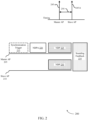
- Figure 2 shows an example channel sounding procedure 200 that supports relative timing drift correction for distributed multi-user transmissions.
- the channel sounding procedure 200 may implement aspects of the system for wireless communications 100. Aspects of the channel sounding procedure 200 may be implemented in a wireless network such as a Wi-Fi network implementing the one or more 802.11 family of standards, such as, 802.11be, 802.11ax, 802.11ac, or some other Wi-Fi standard.
- wireless communication systems (such as, the system for wireless communications 100) may be configured to support distributed multi-user transmissions.
- multiple AP(s) may perform wireless communications with their associated wireless stations during a transmission opportunity.
- a distributed multi-user transmission may be associated with a channel sounding procedure (such as, channel sounding procedure 200) and a joint transmission procedure. Additionally, or alternatively, the channel sounding procedure 200 (such as, power measurements) may be performed between multiple AP(s), and between multiple wireless stations.
- the channel sounding procedure 200 may be implemented by a wireless station and an AP, which may be examples of the corresponding devices described herein.
- the channel sounding procedure 200 may be implemented by a set of participating AP(s) (for example, the set of participating AP(s) including a master AP and a slave AP).
- the AP(s) may belong to the same BSS or may belong to different BSSs.
- an AP may signal to other AP(s) that extra resources are available. The other AP(s) may use these extra resources for performing wireless communications with their associated wireless stations.
- the AP that is coordinating the distributed multi-user transmissions may be considered a master AP and the other AP(s) participating in the distributed multi-user transmissions may be considered slave AP(s) (or a second AP or a neighboring AP).
- the master AP 205 may be an example of an AP as described with reference to Figure 1 .
- the slave AP 210 may be an example of an AP as described with reference to Figure 1 .
- wireless networks may be configured to support transmissions during the channel sounding procedure 200.
- the associated transmissions may include uplink or downlink transmissions between AP(s) and their associated wireless stations.
- a master AP may be configured to send an NDP to one or more stations.
- a slave AP also may be configured to send an NDP to one or more stations.
- the master AP may obtain access to the channel, and may send a transmission or a first signal (such as, a synchronization trigger signal, an NDPA, etc.) to at least one of the slave AP(s).
- the master AP may transmit or otherwise provide an indication of the synchronization trigger signal to at least one of the slave AP(s).
- the synchronization trigger signal may confirm that the slave AP(s) participating in a joint transmission procedure, as described with reference to Figure 3 .
- the master AP may transmit a first signal to indicate an NDP transmission to be performed at the master AP. That is, the slave AP(s) may receive the first signal, and may determine that an event of the channel sounding procedure is performed at the master AP.
- the slave AP(s) may estimate a time associated with the event of the channel sounding procedure performed at the master AP. The slave AP(s) may then perform the channel sounding procedure based on the estimated time. In some implementations, there may be a first timing offset between the master AP and at least one of the slave AP(s) during the channel sounding procedure. Additionally, during the joint transmission procedure, as further described with reference to Figure 3 , the slave AP(s) may receive a signal indicating a start time of a joint transmission at the master AP.
- the first signal i.e., synchronization trigger signal, an NDPA, etc.
- the one or more slave AP(s) may utilize the received signal to estimate a start time associated with performing the joint transmission.
- Conventional techniques do not resolve the difference between the first timing offset and the second timing offset.
- a large difference between the first timing offset and the second timing offset may result in cross-stream leakage.
- Cross-stream leakage may refer to spatial streams that can leak into each other. For example, spatial streams transmitted to the stations may leak into each other resulting in precoding becoming imperfect.
- the master AP may indicate timing information in a second signal transmitted during the joint transmission procedure.
- the timing information included in the second signal may be relative to a first signal transmitted during the channel sounding procedure (such as, channel sounding procedure 200).
- a master AP 205 may send a first signal associated with the channel sounding procedure 200.
- the channel sounding procedure 200 may be initialized by sending a synchronization frame (such as, synchronization trigger 215) and an NDPA 220.
- the NDPA 220 may announce an upcoming NDP 225 transmission at the master AP 205.
- the NDPA 220 may be a synchronization message.
- the synchronization trigger 215 may additionally be transmitted before an NDPA frame (not shown).
- the master AP may further transmit synchronization frames to allow one or more neighboring AP(s) (such as, slave AP 210) to synchronize and to collect feedback, using explicit or implicit feedback mechanisms.
- the master AP 205 may perform a channel sounding between itself and its associated wireless stations concurrently with one or more of the neighboring AP(s) (such as, slave AP 210).
- a slave AP 210 may receive the first signal associated with the channel sounding procedure. In some instances, the slave AP 210 may estimate a time associated with the NDP 225 transmission at the master AP 205. The slave AP 210 may then transmit an NDP 230 based on the estimated time. As previously described, there may be a relative time offset between the master AP 205 and the slave AP 210. For instance, there may be a relative time offset between a time of the NDP 225 transmission at the master AP 205 and a time of the NDP 230 transmission at the slave AP 210.
- this timing offset between AP(s) may be referred to as timing offset 250, a sounding stage relative timing offset, or ⁇ 1 .
- the timing offset 250 may be a non-zero value.
- the master AP 205 may send a transmission (i.e., the first signal associated with the channel sounding procedure 200, the NDP 225 transmission, etc.) at a time 245-a.
- the slave AP 210 may send a transmission (such as, the NDP 230 transmission, etc.) at a time 245-b.
- the NDP 225 transmission at the master AP 205 and the NDP 230 transmission at the slave AP 210 may have a timing offset 250.
- the master AP 205 may include timing information in a synchronization trigger during the joint transmission procedure to preserve the timing offset 250 across the channel procedure and the joint transmission procedure.
- the timing information may be configured to carry information associated with a prior event (such as, an event during the channel sounding procedure 200).
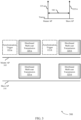
- FIG 3 shows an example joint transmission procedure 300 that supports relative timing drift correction for distributed multi-user transmissions.
- the joint transmission procedure 300 may implement aspects of the system for wireless communications 100.
- the joint transmission procedure 300 may be implemented in a wireless network such as a Wi-Fi network implementing the one or more 802.11 family of standards, such as, 802.11be, 802.11ax, 802.11ac, or some other Wi-Fi standard.
- wireless communication systems (such as, the system for wireless communications 100) may be configured to support distributed multi-user transmissions.
- a distributed multi-user transmission may be associated with a channel sounding procedure (such as, channel sounding procedure 200) and a joint transmission procedure (such as, joint transmission procedure 300).
- the joint transmission procedure 300 may be implemented by a set of participating AP(s) including a master AP and a slave AP.
- a master AP may transmit or otherwise provide an indication of a request to participate (such as, an invitation to participate) in a distributed multi-user transmission.
- an AP may signal to other AP(s) that extra resources are available.
- the other AP(s) may use the extra resources for performing wireless communications with their associated wireless stations.
- the AP capturing the channel may be referred to as a master AP, and the other AP(s) participating in the distributed multi-user transmission may be referred to as slave AP(s).
- master AP 305 may be an example of an AP as described with reference to Figure 1 .
- slave AP 310 may be an example of an AP as described with reference to Figure 1 .
- the slave AP(s) may receive a request (such as, a request from the master AP) to participate in the distributed multi-user transmission.
- One or more slave AP(s) (such as, slave AP 310) may respond to the request by transmitting or otherwise providing an indication (not shown) of an intent to participate in the distributed multi-user transmission.
- the indication of intent to participate also may carry or otherwise convey an indication of the resources that the slave AP is requesting for the distributed multi-user transmission.
- the distributed multi-user transmission includes being distributed such that portions of functions are implemented at different physical locations by one or more physical components.
- a master AP 305 may be configured to transmit a synchronization trigger to one or more neighboring AP(s) (such as, slave AP 310).
- the master AP 305 may transmit or otherwise provide an indication of a synchronization trigger signal that carries or otherwise conveys an indication of the resources (such as, a resource grant or allocation) for the slave AP(s) 310.
- the slave AP(s) 310 may use the indicated resources to participate in the distributed multi-user transmissions.
- a master AP may transmit a first signal indicating that an event of the channel sounding procedure is performed at the master AP.
- the slave AP(s) (such as, slave AP 310) may estimate a timing of reception of the first signal, and may perform the event of the channel sounding procedure based on the estimated timing.
- the master AP 305 may transmit a second signal associated with a joint transmission procedure 300.
- the master AP 305 may utilize the second signal to indicate a start time of the joint transmission at the master AP.
- the joint transmission procedure 300 may be initialized at the master AP 305, upon sending the second signal (such as, synchronization trigger 315-a).
- the synchronization trigger 315 (such as, synchronization trigger 315-a and synchronization trigger 315-b) may be transmitted prior to sending a distributed multi-user transmission 320 (such as, distributed multi-user transmission 320-a and distributed multi-user transmission 320-b).
- the synchronization trigger 315 may specify timing of one or more subsequent joint transmissions.
- the slave AP 310 may estimate a start time of the joint transmission to be performed at the slave AP 310, based on a timing of the received indication (such as, the timing of the synchronization trigger 315).
- the master AP 305 may send a transmission (such as, the distributed multi-user transmission 320-a) associated with a joint transmission procedure 300 at a time 335-a.
- the slave AP 310 may send a transmission (such as, the distributed multi-user transmission 325-a) at a time 335-b.
- the distributed multi-user transmission 320-a at the master AP 305 and the distributed multi-user transmission 325-a at the slave AP 310 may have a timing offset 340.
- the timing offset 340 between AP(s) (such as, the master AP 305 and the slave AP 310) may be referred to as a joint transmission stage relative timing offset, or ⁇ 2 .
- the master AP 305 may indicate timing information relative to the first signal.
- the synchronization trigger 315 may inform the slave AP(s) to discard new timing estimates and utilize relevant timing information indicated in the synchronization trigger 315.
- synchronization trigger 315-a may specify a timing of distributed multi-user transmission 320-a, and may inform the slave AP 310 to discard an estimate of a start time of the joint transmission to be performed at the slave AP 310.
- synchronization trigger 315 may convey a timing value associated with the joint transmission, where the timing value if relative to an event of the channel sounding procedure or a previous synchronization trigger. This timing value may be referred to as ⁇ T synch .
- one or more neighboring AP(s) can preserve the relative timing offset between the channel sounding procedure and the joint transmission procedure.
- One or more synchronization triggers described herein may convey ⁇ T synch and reduce the absolute difference between ⁇ 2 and ⁇ 1 .
- the joint transmission procedure 300 begins with the master AP 305 transmitting a synchronization trigger 315-a to one or more neighboring AP(s) (including the slave AP 310).
- the synchronization trigger 315-a may carry or otherwise provides an indication that an event for a joint transmission procedure 300 (such as, distributed multi-user transmission 320-a) at the master AP 305 is being performed after lapse of a time period since an event of a channel sounding procedure.
- the synchronization trigger 315-a may be transmitted during an initial period of the joint transmission procedure 300.
- the synchronization trigger 315-a may ensure cross- AP synchronization and symbol alignment for the distributed multi-user transmission.
- the slave AP 310 may identify a time period based on the synchronization trigger 315-a. For example, the time period may be indicated in the synchronization trigger 315-a using a timing synchronization counter or a clock common to the master AP 305 and the slave AP 310.
- the slave AP 310 may determine a start time of a substantially simultaneous transmission (such as, the distributed multi-user transmission 325-a and distributed multi-user transmission 325-b) based on determining that the identified time period has elapsed since an event of the channel sounding procedure is performed by the slave AP 310. That is, the slave AP 310 may determine a start time for the distributed multi-user transmission 325-a based on a time period indicated in the synchronization trigger 315-a.
- the master AP 305 may indicate a presence of the time period by setting a bit in the synchronization trigger 315 (such as, the synchronization trigger 315-a and the synchronization trigger 315-b).
- the synchronization trigger 315 may carry a bit which informs the slave AP 310 to disregard a fresh timing estimate or multiple timing estimates.
- the bit may be referred to as a freeze timing bit.
- the master AP 305 may set the bit to ensure that the timing estimates of the channel sounding procedure are preserved during the joint transmission procedure.
- a value may be associated with a timing information field that may indicate that a separate freeze timing bit is not required or a timing information (such as, the timing estimated during the joint transmission procedure 300) may be discarded.
- the timing information may not be contained in a frame.
- the slave AP 310 may determine a time period indicated by the master AP 305 (such as, a time period indicated by the synchronization trigger 315-a), as a multiple of a timing grid interval.
- the timing grid interval may be referred to as T grid .
- a starting boundary of the synchronization trigger 315-a or a starting boundary of a joint transmission (as described with reference to Figure 3 ), relative to when an NDP or an NDPA transmission occurred (as described with reference to Figure 2 ), may be associated with a time value.
- This time value may be a multiple (M) of one or more time-slot durations and referred to as M * T grid .
- the slave AP 310 may estimate a timing from the start of a frame associated with the synchronization trigger 315-a, and round it to the next numerical value of M * T grid .
- ⁇ T synch may be a multiple of M * T grid .
- T 1 a timing estimate associated with the NDP or the NDPA transmission
- T 2 a timing estimate associated with a trigger frame (such as, synchronization trigger 315) prior to the distributed multi-user transmission
- T 2 a timing estimate associated with a trigger frame (such as, synchronization trigger 315) prior to the distributed multi-user transmission
- the slave AP 310 may be configured to round T 2 to a new time value referred to as T new .
- the slave AP 310 may determine a time period indicated by the master AP 305 as a multiple of an absolute timing grid interval.
- one or more frames from the master AP 305 may have a start time associated with the one or more multiples of a constant T grid .
- a constant T grid may reduce a data burden associated with packet detection at the slave AP 310.
- the slave AP 310 may compute a timing based on timing information included in the one or more frames. Additionally, or alternatively, the slave AP 310 may compute the timing based on rounding to a next value (such as, a nearest value) of T grid (such as, the constant T grid ) .
- the master AP 305 may indicate a presence of the timing grid by setting a bit included in a signal transmitted during the channel sounding procedure or in a signal transmitted during the joint transmission procedure 300.
- the master AP 305 may indicate the presence of the timing grid (referred to as "T grid ON") by setting a bit within one or more frames transmitted from the master AP 305.
- the bit indicating the presence of the timing grid may inform the slave AP 310 to round an associated timing estimate to a value closest to the a multiple of an associated time-slot.
- the slave AP 310 may receive (once or periodically) a broadcast packet associated with the joint transmission (such as, distributed multi-user transmission), and determine a timing grid interval based on the received broadcast packet.
- the broadcast packet may include at least one packet of a beacon associated with the joint transmission, at least one packet of a request to send (RTS) signal associated with the joint transmission, at least one packet of a clear to send (CTS) signal associated with the joint transmission, or a combination.
- RTS request to send
- CTS clear to send
- a value of the timing grid may be fixed, and available to the master AP 305 and the slave AP 310.
- the presence of the timing grid may be referred to as a freeze timing bit, and may inform the slave AP 310 to refrain from updating the joint transmission timing based on a start of the packet timing estimation.
- the slave AP 310 may perform a timing estimation when decoding a frame carrying the one or more bits or the one or more fields associated with a freeze timing bit.
- the timing information may be carried in a preamble such that the slave AP 310 may use the computed timing instead of the estimated timing starting from an extreme high throughput modulated portion.
- the bits or fields may generally be associated with one or more trigger frames, or one or more frames transmitted by the master AP 305 to the slave AP 310.
- the slave AP 310 may correct frequency and timing used to account for sampling clock offsets (as small frequency errors may lead to large phase ramps).
- the frequency offset referred to as ⁇
- the slave AP 310 may estimate a frequency offset with respect to a master AP 305 prior to an NDP transmission.
- the slave AP 310 may be configured to correct for the estimated implementations offset by adjusting an oscillator clock or by applying a phase ramp in time.
- the digital correction applied by the slave AP 310 may be adjusted to increase accuracy.
- the frequency associated with the slave AP 310 may be referred to as f slave and the frequency associated with the master AP 305 may be referred to as f master .
- a sampling clock may be associated with the frequency offset ⁇ .
- the slave AP 310 may account for the frequency offset ⁇ for a duration associated with the NDP. Additionally, or alternatively, the slave AP 310 may make an adjustment to the timing associated with the joint transmission (such as, prior to the joint transmission).
- the adjustment may be associated with a correction factor (1 - ⁇ ) to increase the accuracy of a timing T new .
- OFDMA coordinated orthogonal frequency-division multiple access
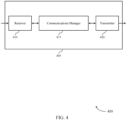
- FIG 4 shows a block diagram 400 of an example wireless device 405 that supports relative timing drift correction for distributed multi-user transmissions.
- the wireless device 405 may be an example of aspects of an AP as described herein.
- the wireless device 405 may be an example of aspects of a master AP and an example of aspects of a stave AP as described herein.
- the wireless device 405 may include a receiver 410, a communications manager 415, and a transmitter 420.
- the wireless device 405 also may include a processor. Each of these components may be in communication with one another (such as via one or more buses).
- the receiver 410 may receive information such as packets, user data, or control information associated with various information channels (such as control channels, data channels, and information related to relative timing drift correction for distributed substantially simultaneous transmissions, etc.). Information may be passed on to other components of the device.
- the receiver 410 may be an example of aspects of the transceiver 720 described with reference to Figure 7 .
- the receiver 410 may utilize a single antenna or a set of antennas.
- the communications manager 415 receives, from a second AP, a first signal associated with a channel sounding procedure to be performed simultaneously by the second AP and the first AP, receive, from the second AP and prior to a substantially simultaneous transmission by the second AP and the first AP, a second signal including timing information relative to the first signal, determine a start time of a substantially simultaneous transmission at the first AP based on the timing information, and initiate the substantially simultaneous transmission according to the determined start time.
- the communications manager 415 also transmits to a first AP, a first signal associated with a channel sounding procedure, transmit, to the first AP, a second signal including timing information relative to the first signal, where a start time of a substantially simultaneous transmission at the first AP is determined based on the timing information, and perform, in conjunction with the first AP, the substantially simultaneous transmission, where the substantially simultaneous transmission at the first AP is performed according to the determined start time.
- the communications manager 415 may be an example of aspects of the communications manager 710 described herein.
- the communications manager 415 may be implemented in hardware, code (such as software or firmware) executed by a processor, or any combination thereof. If implemented in code executed by a processor, the functions of the communications manager 415, or its sub-components may be executed by a general-purpose processor, a DSP, an application-specific integrated circuit (ASIC), a field programmable gate array (FPGA), or other programmable logic device, discrete gate or transistor logic, discrete hardware components, or any combination thereof designed to perform the functions described in the present disclosure.
- code such as software or firmware executed by a processor
- ASIC application-specific integrated circuit
- FPGA field programmable gate array
- the communications manager 415 may be physically located at various positions, including being distributed such that portions of functions are implemented at different physical locations by one or more physical components.
- the communications manager 415, or its sub-components may be a separate and distinct component.
- the communications manager 415, or its sub-components may be combined with one or more other hardware components, including but not limited to an input/output (I/O) component, a transceiver, a network server, another computing device, one or more other components described in the present disclosure, or a combination thereof.
- I/O input/output
- the communications manager 415 may include a wireless modem chipset, and the receiver 410 and the transmitter 420 may include analog components (such as amplifiers, filters, phase shifters, and antennas) for receiving and transmitting wireless signals, respectively.
- the communications manager 415 may obtain and decode signals received over a wireless channel from the receiver 410 via a receive interface.
- the communications manager 415 may output signals to the transmitter for transmission over the wireless channel via a transmit interface.
- the transmitter 420 may transmit signals generated by other components of the device.
- the transmitter 420 may be collocated with a receiver 410 in a transceiver module.
- the transmitter 420 may be an example of aspects of the transceiver 720 described with reference to Figure 7 .
- the transmitter 420 may utilize a single antenna or a set of antennas.
- the communications manager 415 as described herein may be implemented to realize one or more potential advantages. For example, some implementations may allow the wireless device 405 to more efficiently coordinate communications (such as, communications including synchronization trigger) in next generation WLANs, that may include devices such as the wireless device 405. Based on implementing the relative timing drift correction as described herein, a processor of a user equipment (UE) (such as controlling the receiver 410, the transmitter 420, or the transceiver 720 as described with reference to Figure 7 ) may reduce the timing drift, while maintaining backwards compatibility, and allow increased capabilities of AP(s) and stations in a WLAN.
- UE user equipment
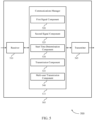
- FIG. 5 shows a block diagram 500 of an example wireless device 505 that supports relative timing drift correction for distributed multi-user transmissions.
- the wireless device 505 may be an example of aspects of a wireless device 405 or an AP 105 as described herein.
- the wireless device 505 may include a receiver 510, a communications manager 515, and a transmitter 545.
- the wireless device 505 also may include a processor. Each of these components may be in communication with one another (such as via one or more buses).
- the receiver 510 may receive information such as packets, user data, or control information associated with various information channels (such as control channels, data channels, and information related to relative timing drift correction for distributed simultaneous transmissions, etc.). Information may be passed on to other components of the device.
- the receiver 510 may be an example of aspects of the transceiver 720 described with reference to Figure 7 .
- the receiver 510 may utilize a single antenna or a set of antennas.
- the communications manager 515 may be an example of aspects of the communications manager 415 as described herein.
- the communications manager 515 may include a first signal component 520, a second signal component 525, a start time determination component 530, a transmission component 535, and a simultaneous transmission component 540.
- the communications manager 515 may be an example of aspects of the communications manager 710 described herein.
- the first signal component 520 receives, from a second AP, a first signal associated with a channel sounding procedure to be performed simultaneously by the second AP and the first AP.
- the second signal component 525 receives, from the second AP and prior to a substantially simultaneous transmission by the second AP and the first AP, a second signal including timing information relative to the first signal.
- the start time determination component 530 determines a start time of a substantially simultaneous transmission at the first AP based on the timing information.
- the transmission component 535 initiates the substantially simultaneous transmission according to the determined start time.
- the first signal component 520 transmits to a first AP, a first signal associated with a channel sounding procedure.
- the second signal component 525 transmits to the first AP, a second signal including timing information relative to the first signal, where a start time of a substantially simultaneous transmission at the first AP is determined based on the timing information.
- the substantially simultaneous transmission component 540 performs in conjunction with the first AP, the substantially simultaneous transmission, where the substantially simultaneous transmission at the first AP is performed according to the determined start time.
- the transmitter 545 may transmit signals generated by other components of the device.
- the transmitter 545 may be collocated with a receiver 510 in a transceiver module.
- the transmitter 545 may be an example of aspects of the transceiver 720 described with reference to Figure 7 .
- the transmitter 545 may utilize a single antenna or a set of antennas.
- FIG. 6 shows a block diagram 600 of an example communications manager 605 that supports relative timing drift correction for distributed multi-user transmissions.
- the communications manager 605 may be an example of aspects of a communications manager 415, a communications manager 515, or a communications manager 710 described herein.
- the communications manager 605 may include a first signal component 610, a second signal component 615, a start time determination component 620, a transmission component 625, a timing estimation component 630, a channel sounding component 635, a timing grid component 640, a multi-user transmission component 645, and a bit setting component 650.
- Each of these modules may communicate, directly or indirectly, with one another (such as via one or more buses).
- the first signal component 610 receives from a second AP, a first signal associated with a channel sounding procedure to be performed simultaneously by the second AP and the first AP. In some implementations, the first signal component 610 transmits to a first AP, a first signal associated with a channel sounding procedure.
- the second signal component 615 receives from the second AP and prior to a substantially simultaneous transmission by the second AP and the first AP, a second signal including timing information relative to the first signal.
- the second signal component 615 transmits to the first AP, a second signal including timing information relative to the first signal, where a start time of a substantially simultaneous transmission at the first AP is determined based on the timing information.
- the second signal component 615 may identify a bit included in the second signal to indicate that the start time of the substantially simultaneous transmission at the first AP is to be determined using an estimated time of reception of the first signal at the first AP and the timing information relative to the first signal, where determining the start time of the substantially simultaneous transmission is based on the identified bit.
- the second signal component 615 may configure the second signal to indicate a time period, where the start time of the substantially simultaneous transmission is determined based on determining that the configured time period has elapsed since an event of the channel sounding procedure is performed by the first AP. In some implementations, the second signal component 615 may configure the second signal to indicate a time period, the time period being a multiple of a timing grid interval, the start time of the substantially simultaneous transmission is determined based on determining that the identified time period has elapsed since an event of the channel sounding procedure is performed by the first AP.
- the second signal associated with the substantially simultaneous transmission includes a synchronization trigger signal to the first AP prior to the substantially simultaneous transmission.
- the timing information relative to the first signal is included in at least one of a payload of the second signal, a preamble of the second signal, or a combination thereof.
- the second signal associated with the substantially simultaneous transmission includes a synchronization trigger signal to the first AP.
- the timing information relative to the first signal is included in at least one of a payload of the second signal, a preamble of the second signal, or a combination thereof.
- the start time determination component 620 determines a start time of a substantially simultaneous transmission at the first AP based on the timing information. In some implementations, identifying a time period based on the second signal, where determining the start time of the substantially simultaneous transmission includes determining that the identified time period has elapsed since an event of the channel sounding procedure is performed by the first AP.
- determining a time period based on the second signal, the time period being a multiple of a timing grid interval, where determining the start time of the substantially simultaneous transmission includes determining that the identified time period has elapsed since an event of the channel sounding procedure is performed by the first AP.
- the transmission component 625 initiates the substantially simultaneous transmission according to the determined start time.
- the multi-user transmission component 645 performs in conjunction with the first AP, the substantially simultaneous transmission, where the substantially simultaneous transmission at the first AP is performed according to the determined start time.
- the timing estimation component 630 may estimate a timing of reception of the first signal associated with the channel sounding procedure to be performed by the second AP. In some implementations, the timing estimation component 630 may estimate a timing of reception of the first signal associated with the channel sounding procedure. In some implementations, estimating a timing of reception of the second signal associated with the substantially simultaneous transmission, where determining the start time of the substantially simultaneous transmission includes rounding off the timing of reception of the second signal to a multiple of a timing grid interval.
- the channel sounding component 635 may perform, by the first AP, the channel sounding procedure based on the timing of reception of the first signal.
- the timing grid component 640 may determine the timing grid boundaries based on the first signal associated with the channel sounding procedure, where the presence of the timing grid is indicated by setting a bit included in the first signal or the second signal.
- the timing grid component 640 may receive a broadcast packet associated with the substantially simultaneous transmission. In some implementations, the timing grid component 640 may determine the timing grid interval based on the received broadcast packet. In some implementations, setting a bit included in the first signal associated with the channel sounding procedure to indicate the presence of a timing grid, where transmitting the first signal includes transmitting the bit to the first AP.
- the timing grid component 640 may transmit a broadcast packet associated with the substantially simultaneous transmission, where the timing grid interval is determined based on the transmitted broadcast packet.
- setting a bit included in the second signal to indicate the presence of a timing grid, where transmitting the second signal includes transmitting the bit to the first AP.
- the bit setting component 650 may set a bit included in the second signal to indicate that the start time of the substantially simultaneous transmission at the first AP is to be determined using an estimated time of reception of the first signal at the first AP and the timing information relative to the first signal.
- the broadcast packet includes at least one packet of a beacon associated with the substantially simultaneous transmission, at least one packet of a RTS signal associated with the substantially simultaneous transmission, at least one packet of a CTS signal associated with the substantially simultaneous transmission, or a combination thereof. In some implementations, the broadcast packet includes at least one packet of a beacon associated with the substantially simultaneous transmission, at least one packet of a RTS signal associated with the substantially simultaneous transmission, at least one packet of a CTS signal associated with the substantially simultaneous transmission, or a combination thereof.
- Figure 7 shows a diagram of an example system 700 including a device 705 that supports relative timing drift correction for distributed multi-user transmissions.
- the device 705 may be an example of or include the components of wireless device 405, wireless device 505, or an AP as described herein.
- the device 705 may include components for bi-directional voice and data communications including components for transmitting and receiving communications, including a communications manager 710, a network communications manager 715, a transceiver 720, an antenna 725, memory 730, a processor 740, and an inter-station communications manager 745. These components may be in electronic communication via one or more buses (such as bus 750).
- the communications manager 710 receives from a second AP, a first signal associated with a channel sounding procedure to be performed by the second AP, receive, from the second AP and prior to a substantially simultaneous transmission, a second signal including timing information relative to the first signal, determine a start time of a substantially simultaneous transmission at the first AP based on the timing information, and initiate the substantially simultaneous transmission according to the determined start time.
- the communications manager 710 also transmits to a first AP, a first signal associated with a channel sounding procedure, transmit, to the first AP, a second signal including timing information relative to the first signal, where a start time of a substantially simultaneous transmission at the first AP is determined based on the timing information, and perform, in conjunction with the first AP, the substantially simultaneous transmission, where the substantially simultaneous transmission at the first AP is performed according to the determined start time.
- the network communications manager 715 may manage communications with the core network (such as via one or more wired backhaul links). For example, the network communications manager 715 may manage the transfer of data communications for client devices, such as one or more UEs.
- the transceiver 720 may communicate bi-directionally, via one or more antennas, wired, or wireless links as described herein.
- the transceiver 720 may represent a wireless transceiver and may communicate bi-directionally with another wireless transceiver.
- the transceiver 720 also may include a modem to modulate the packets and provide the modulated packets to the antennas for transmission, and to demodulate packets received from the antennas.
- the wireless device may include a single antenna 725. However, in some implementations the device may have more than one antenna 725, which may be capable of concurrently transmitting or receiving multiple wireless transmissions.
- the memory 730 may include random-access memory (RAM) and read-only memory (ROM).
- RAM random-access memory
- ROM read-only memory
- the memory 730 may store computer-readable, computer-executable code 735 including instructions that, when executed, cause the processor to perform various functions described herein.
- the memory 730 may contain, among other things, a basic input output system (BIOS) which may control basic hardware or software operation such as the interaction with peripheral components or devices.
- BIOS basic input output system
- the processor 740 may include an intelligent hardware device, (such as a general-purpose processor, a DSP, a CPU, a microcontroller, an ASIC, an FPGA, a programmable logic device, a discrete gate or transistor logic component, a discrete hardware component, or any combination thereof).
- the processor 740 may be configured to operate a memory array using a memory controller.
- a memory controller may be integrated into processor 740.
- the processor 740 may be configured to execute computer-readable instructions stored in a memory to perform various functions (such as functions or tasks supporting relative timing drift correction for distributed substantially simultaneous transmissions).
- the inter-station communications manager 745 may manage communications with other AP 105, and may include a controller or scheduler for controlling communications with stations 115 in cooperation with other AP(s) 105. For example, the inter-station communications manager 745 may coordinate scheduling for transmissions to stations 115 for various interference mitigation techniques such as beamforming or joint transmission. In some implementations, the inter-station communications manager 745 may provide an X2 interface within an LTE/LTE-A wireless communication network technology to provide communication between AP(s) 105.
- the communications manager 710 may be implemented as a wireless modem that connects to a receiver via, or over a first interface and to a transmitter, via, or over a second interface.
- the wireless modem may obtain and decode signals received wirelessly from the receiver via, or over the first interface, and may output signals for wireless transmission via, or over the transmitter via the second interface.
- Figure 8 shows a flowchart illustrating an example method 800 that supports relative timing drift correction for distributed multi-user transmissions.
- the operations of method 800 may be implemented by an AP or its components as described herein.
- the operations of method 800 may be performed by a communications manager as described with reference to Figures 4-7 .
- an AP may execute a set of instructions to control the functional elements of the AP to perform the functions described herein. Additionally, or alternatively, an AP may perform aspects of the functions described herein using special-purpose hardware.
- the AP receives from a second AP, a first signal associated with a channel sounding procedure to be performed simultaneously by the second AP and the first AP.
- the operations of 805 may be performed according to the methods described herein. In some implementations, aspects of the operations of 805 may be performed by a first signal component as described with reference to Figures 4-7 .
- the AP receives from the second AP and prior to a substantially simultaneous transmission by the second AP and the first AP, a second signal including timing information relative to the first signal.
- the operations of 810 may be performed according to the methods described herein. In some implementations, aspects of the operations of 810 may be performed by a second signal component as described with reference to Figures 4-7 .
- the AP determines a start time of the substantially simultaneous transmission at the first AP based on the timing information.
- the operations of 815 may be performed according to the methods described herein. In some implementations, aspects of the operations of 815 may be performed by a start time determination component as described with reference to Figures 4-7 .
- the AP initiates the substantially simultaneous transmission according to the determined start time.
- the operations of 820 may be performed according to the methods described herein. In some implementations, aspects of the operations of 820 may be performed by a transmission component as described with reference to Figures 4-7 .
- Figure 9 shows a flowchart illustrating an example method 900 that supports relative timing drift correction for distributed multi-user transmissions.
- the operations of method 900 may be implemented by an AP or its components as described herein.
- the operations of method 900 may be performed by a communications manager as described with reference to Figures 4-7 .
- an AP may execute a set of instructions to control the functional elements of the AP to perform the functions described herein. Additionally, or alternatively, an AP may perform aspects of the functions described herein using special-purpose hardware.
- the AP receives from a second AP, a first signal associated with a channel sounding procedure to be performed simultaneously by the second AP and the first AP.
- the operations of 905 may be performed according to the methods described herein. In some implementations, aspects of the operations of 905 may be performed by a first signal component as described with reference to Figures 4-7 .
- the AP may estimate a timing of reception of the first signal associated with the channel sounding procedure to be performed by the second AP.
- the operations of 910 may be performed according to the methods described herein. In some implementations, aspects of the operations of 910 may be performed by a timing estimation component as described with reference to Figures 4-7 .
- the AP may perform, by the first AP, the channel sounding procedure based on the timing of reception of the first signal.
- the operations of 915 may be performed according to the methods described herein. In some implementations, aspects of the operations of 915 may be performed by a channel sounding component as described with reference to Figures 4-7 .
- the AP receives from the second AP and prior to a substantially simultaneous transmission by the second AP and the first AP, a second signal including timing information relative to the first signal.
- the operations of 920 may be performed according to the methods described herein. In some implementations, aspects of the operations of 920 may be performed by a second signal component as described with reference to Figures 4-7 .
- the AP identifies a time period based on the second signal.
- the operations of 925 may be performed according to the methods described herein. In some implementations, aspects of the operations of 925 may be performed by a start time determination component as described with reference to Figures 4-7 .
- the AP determines a start time of a substantially simultaneous transmission at the first AP based on the timing information, where determining the start time of the substantially simultaneous transmission includes determining that the identified time period has elapsed since an event of the channel sounding procedure is performed by the first AP.
- the operations of 930 may be performed according to the methods described herein. In some implementations, aspects of the operations of 930 may be performed by a start time determination component as described with reference to Figures 4-7 .
- the AP initiates the substantially simultaneous transmission according to the determined start time.
- the operations of 935 may be performed according to the methods described herein. In some implementations, aspects of the operations of 935 may be performed by a transmission component as described with reference to Figures 4-7 .
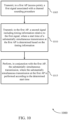
- Figure 10 shows a flowchart illustrating an example method 1000 that supports relative timing drift correction for distributed multi-user transmissions.
- the operations of method 1000 may be implemented by an AP or its components as described herein.
- the operations of method 1000 may be performed by a communications manager as described with reference to Figures 4-7 .
- an AP may execute a set of instructions to control the functional elements of the AP to perform the functions described herein. Additionally, or alternatively, an AP may perform aspects of the functions described below using special-purpose hardware.
- the AP transmits to a first AP, a first signal associated with a channel sounding procedure.
- the operations of 1005 may be performed according to the methods described herein. In some implementations, aspects of the operations of 1005 may be performed by a first signal component as described with reference to Figures 4-7 .
- the AP transmits to the first AP, a second signal including timing information relative to the first signal, where a start time of a substantially simultaneous transmission at the first AP is determined based on the timing information.
- the operations of 1010 may be performed according to the methods described herein. In some implementations, aspects of the operations of 1010 may be performed by a second signal component as described with reference to Figures 4-7 .
- the AP performs in conjunction with the first AP, the substantially simultaneous transmission, where the substantially simultaneous transmission at the first AP is performed according to the determined start time.
- the operations of 1015 may be performed according to the methods described herein. In some implementations, aspects of the operations of 1015 may be performed by a substantially simultaneous transmission component as described with reference to Figures 4-7 .
- a phrase referring to "at least one of" a list of items refers to any combination of those items, including single members.
- "at least one of: a, b, or c” is intended to cover: a, b, c, a-b, a-c, b-c, and a-b-c.
- the hardware and data processing apparatus used to implement the various illustrative logics, logical blocks, modules and circuits described in connection with the aspects disclosed herein may be implemented or performed with a general purpose single- or multichip processor, a digital signal processor (DSP), an application specific integrated circuit (ASIC), an FPGA or other programmable logic device, discrete gate or transistor logic, discrete hardware components, or any combination thereof designed to perform the functions described herein.
- DSP digital signal processor
- ASIC application specific integrated circuit
- FPGA field-programmable gate or transistor logic
- a general-purpose processor may be a microprocessor, or, any conventional processor, controller, microcontroller, or state machine.
- a processor also may be implemented as a combination of computing devices, such as a combination of a DSP and a microprocessor, a plurality of microprocessors, one or more microprocessors in conjunction with a DSP core, or any other such configuration.
- particular processes and methods may be performed by circuitry that is specific to a given function.
- the functions described may be implemented in hardware, digital electronic circuitry, computer software, firmware, including the structures disclosed in this specification and their structural equivalents thereof, or in any combination thereof. Implementations of the subject matter described in this specification also can be implemented as one or more computer programs, i.e., one or more modules of computer program instructions, encoded on a computer storage media for execution by, or to control the operation of, data processing apparatus.
- Computer-readable media includes both computer storage media and communication media including any medium that can be enabled to transfer a computer program from one place to another.
- a storage media may be any available media that may be accessed by a computer.
- such computer-readable media may include RAM, ROM, EEPROM, CD-ROM or other optical disk storage, magnetic disk storage or other magnetic storage devices, or any other medium that may be used to store desired program code in the form of instructions or data structures and that may be accessed by a computer.
- Disk and disc includes compact disc (CD), laser disc, optical disc, digital versatile disc (DVD), floppy disk, and Blu-ray disc where disks usually reproduce data magnetically, while discs reproduce data optically with lasers. Combinations of the above should also be included within the scope of computer-readable media. Additionally, the operations of a method or algorithm may reside as one or any combination or set of codes and instructions on a machine readable medium and computer-readable medium, which may be incorporated into a computer program product.
Landscapes
- Engineering & Computer Science (AREA)
- Signal Processing (AREA)
- Computer Networks & Wireless Communication (AREA)
- Mobile Radio Communication Systems (AREA)
- Two-Way Televisions, Distribution Of Moving Picture Or The Like (AREA)
- Electric Clocks (AREA)
- Fluid-Pressure Circuits (AREA)
- Train Traffic Observation, Control, And Security (AREA)
Claims (15)
- Ein Verfahren für eine drahtlose Kommunikation an einem ersten Zugangspunkt (Access Point bzw. AP), aufweisend:Empfangen (805), von einem zweiten AP, eines ersten Signals, das mit einer gleichzeitig durch den zweiten AP und den ersten AP durchzuführenden Kanalsondierungsprozedur assoziiert ist,Empfangen (810), von dem zweiten AP und vor einer im Wesentlichen gleichzeitigen Sendung durch den zweiten AP und den ersten AP, eines zweiten Signals, das Zeitinformationen relativ zu dem ersten Signal aufweist,Bestimmen (815) einer Startzeit der im Wesentlichen gleichzeitigen Sendung an dem ersten AP basierend wenigstens teilweise auf den Zeitinformationen, undEinleiten (820) der im Wesentlichen gleichzeitigen Sendung gemäß der bestimmten Startzeit.
- Verfahren nach Anspruch 1, das weiterhin aufweist:Schätzen (910) einer Empfangszeit des ersten Signals, das mit der durch den zweiten AP durchzuführenden Kanalsondierungsprozedur assoziiert ist,Durchführen (915), durch den ersten AP, der Kanalsondierungsprozedur basierend wenigstens teilweise auf der Empfangszeit des ersten Signals, undIdentifizieren einer Zeitperiode basierend wenigstens teilweise auf dem zweiten Signal, wobei das Bestimmen der Startzeit der im Wesentlichen gleichzeitigen Sendung das Bestimmen, dass die identifizierte Zeitperiode seit der Durchführung eines Ereignisses der Kanalsondierungsprozedur durch den ersten AP abgelaufen ist, aufweist.
- Ein Verfahren für eine drahtlose Kommunikation, aufweisend:Senden (1005), an einen ersten Zugangspunkt (Access Point bzw. AP), eines ersten Signals, das mit einer Kanalsondierungsprozedur assoziiert ist,Senden (1010), an den ersten AP, eines zweiten Signals, das Zeitinformationen relativ zu dem ersten Signal aufweist, wobei eine Startzeit einer im Wesentlichen gleichzeitigen Sendung an dem ersten AP basierend wenigstens teilweise auf den Zeitinformationen bestimmt wird, undDurchführen (1015), in Verbindung mit dem ersten AP, der im Wesentlichen gleichzeitigen Sendung, wobei die im Wesentlichen gleichzeitige Sendung an dem ersten AP gemäß der bestimmten Startzeit durchgeführt wird.
- Verfahren nach Anspruch 3, das weiterhin aufweist:
Konfigurieren des zweiten Signals, um eine Zeitperiode anzugeben, wobei die Startzeit der im Wesentlichen gleichzeitigen Sendung basierend wenigstens teilweise auf dem Bestimmen, dass die konfigurierte Zeitperiode seit der Durchführung eines Ereignisses der Kanalsondierungsprozedur durch den ersten AP abgelaufen ist, bestimmt wird. - Verfahren nach Anspruch 2 oder 4, wobei:
das Ereignis der Kanalsondierungsprozedur eines oder mehrere der Folgenden ist: eine Empfangszeit eines Synchronisationsauslösersignals vor einem Nulldatenpaket (NDP), eine Empfangszeit des Anfangs einer Nulldatenpaket-Ankündigung (NDPA), eine Empfangszeit des Endes der NDPA; ein mit dem Anfang des NDP assoziierter Zeitpunkt, ein mit dem Ende des NDP assoziierter Zeitpunkt oder eine Kombination aus diesen. - Eine Vorrichtung für eine drahtlose Kommunikation an einem ersten Zugangspunkt (Access Point bzw. AP), aufweisend:Mittel zum Empfangen, von einem zweiten AP, eines ersten Signals, das mit einer gleichzeitig durch den zweiten AP und den ersten AP durchzuführenden Kanalsondierungsprozedur assoziiert ist,Mittel zum Empfangen, von dem zweiten AP und vor einer im Wesentlichen gleichzeitigen Sendung durch den zweiten AP und den ersten AP, eines zweiten Signals, das Zeitinformationen relativ zu dem ersten Signal aufweist,Mittel zum Bestimmen einer Startzeit der im Wesentlichen gleichzeitigen Sendung an dem ersten AP basierend wenigstens teilweise auf den Zeitinformationen, undMittel zum Einleiten der im Wesentlichen gleichzeitigen Sendung gemäß der bestimmten Startzeit.
- Vorrichtung nach Anspruch 6, die weiterhin aufweist:Mittel zum Schätzen einer Empfangszeit des ersten Signals, das mit der durch den zweiten AP durchzuführenden Kanalsondierungsprozedur assoziiert ist,Mittel zum Durchführen, durch den ersten AP, der Kanalsondierungsprozedur basierend wenigstens teilweise auf der Empfangszeit des ersten Signals, undMittel zum Identifizieren einer Zeitperiode basierend wenigstens teilweise auf dem zweiten Signal, wobei das Bestimmen der Startzeit der im Wesentlichen gleichzeitigen Sendung das Bestimmen, dass die identifizierte Zeitperiode seit der Durchführung eines Ereignisses der Kanalsondierungsprozedur durch den ersten AP abgelaufen ist, aufweist.
- Vorrichtung nach Anspruch 2 oder 6, wobei:
das Ereignis der Kanalsondierungsprozedur eines oder mehrere der Folgenden ist: eine Empfangszeit eines Synchronisationsauslösersignals vor einem Nulldatenpaket (NDP), eine Empfangszeit des Anfangs einer Nulldatenpaket-Ankündigung (NDPA), eine Empfangszeit des Endes der NDPA; ein mit dem Anfang des NDP assoziierter Zeitpunkt, ein mit dem Ende des NDP assoziierter Zeitpunkt oder eine Kombination aus diesen. - Vorrichtung nach Anspruch 6, die weiterhin aufweistMittel zum Schätzen einer Empfangszeit des ersten Signals, das mit der Kanalsondierungsprozedur assoziiert ist,Mittel zum Durchführen, durch den ersten AP, der Kanalsondierungsprozedur basierend wenigstens teilweise auf der Empfangszeit des ersten Signals, undMittel zum Bestimmen einer Zeitperiode basierend wenigstens teilweise auf dem zweiten Signal, wobei die Zeitperiode ein Vielfaches eines Zeitrasterintervalls ist, wobei die Vorrichtung weiterhin konfiguriert ist zum Bestimmen der Startzeit der im Wesentlichen gleichzeitigen Sendung durch das Bestimmen, dass die identifizierte Zeitperiode seit dem Durchführen eines Ereignisses der Kanalsondierungsprozedur durch den ersten AP abgelaufen ist.
- Vorrichtung nach Anspruch 6, die weiterhin aufweist:Mittel zum Schätzen einer Empfangszeit des ersten Signals, das mit der Kanalsondierungsprozedur assoziiert ist, undMittel zum Schätzen einer Empfangszeit des zweiten Signals, das mit der im Wesentlichen gleichzeitigen Sendung assoziiert ist, wobei das drahtlose Modem weiterhin konfiguriert ist zum Bestimmen der Startzeit der im Wesentlichen gleichzeitigen Sendung durch das Abrunden der Empfangszeit des zweiten Signals zu einem Vielfachen eines Zeitrasterintervalls.
- Vorrichtung nach Anspruch 6, wobei:
das mit der im Wesentlichen gleichzeitigen Sendung assoziierte zweite Signal ein Synchronisationsauslösersignal für den ersten AP vor der im Wesentlichen gleichzeitigen Sendung ist. - Vorrichtung nach Anspruch 6, die weiterhin aufweist:
Mittel zum Identifizieren eines Bits in dem zweiten Signal, um anzugeben, dass die Startzeit der im Wesentlichen gleichzeitigen Sendung an dem ersten AP unter Verwendung einer geschätzten Empfangszeit des ersten Signals an dem ersten AP und der Zeitinformationen relativ zu dem ersten Signal zu bestimmen ist, wobei das Bestimmen der Startzeit der im Wesentlichen gleichzeitigen Sendung wenigstens teilweise auf dem identifizierten Bit basiert. - Eine Vorrichtung für eine drahtlose Kommunikation, aufweisend:Mittel zum Senden, an einen ersten Zugangspunkt (Access Point bzw. AP), eines ersten Signals, das mit einer Kanalsondierungsprozedur assoziiert ist,Mittel zum Senden, an den ersten AP, eines zweiten Signals, das Zeitinformationen relativ zu dem ersten Signal aufweist, wobei eine Startzeit einer im Wesentlichen gleichzeitigen Sendung an dem ersten AP basierend wenigstens teilweise auf den Zeitinformationen bestimmt wird, undMittel zum Durchführen, in Verbindung mit dem ersten AP, der im Wesentlichen gleichzeitigen Sendung, wobei die im Wesentlichen gleichzeitige Sendung an dem ersten AP gemäß der bestimmten Startzeit durchgeführt wird.
- Vorrichtung nach Anspruch 7 oder 13, wobei:
die Zeitinformationen relativ zu dem ersten Signal in einer Nutzlast des zweiten Signals, einer Präambel des zweiten Signals oder einer Kombination aus diesen enthalten sind. - Vorrichtung nach Anspruch 13, die weiterhin aufweist:
Mittel zum Setzen eines in dem zweiten Signal enthaltenen Bits, um anzugeben, dass die Startzeit der im Wesentlichen gleichzeitigen Sendung an dem ersten AP unter Verwendung einer geschätzten Empfangszeit des ersten Signals an dem ersten AP und der Zeitinformationen relativ zu dem ersten Signal zu bestimmen ist.
Priority Applications (1)
| Application Number | Priority Date | Filing Date | Title |
|---|---|---|---|
| EP23177820.0A EP4236176A3 (de) | 2018-10-31 | 2019-10-22 | Korrektur der relativen zeitdrift für verteilte mehrbenutzerübertragungen |
Applications Claiming Priority (3)
| Application Number | Priority Date | Filing Date | Title |
|---|---|---|---|
| US201862753784P | 2018-10-31 | 2018-10-31 | |
| US16/659,253 US11533694B2 (en) | 2018-10-31 | 2019-10-21 | Relative timing drift correction for distributed multi-user transmissions |
| PCT/US2019/057480 WO2020092067A1 (en) | 2018-10-31 | 2019-10-22 | Relative timing drift correction for distributed multi-user transmissions |
Related Child Applications (2)
| Application Number | Title | Priority Date | Filing Date |
|---|---|---|---|
| EP23177820.0A Division EP4236176A3 (de) | 2018-10-31 | 2019-10-22 | Korrektur der relativen zeitdrift für verteilte mehrbenutzerübertragungen |
| EP23177820.0A Division-Into EP4236176A3 (de) | 2018-10-31 | 2019-10-22 | Korrektur der relativen zeitdrift für verteilte mehrbenutzerübertragungen |
Publications (2)
| Publication Number | Publication Date |
|---|---|
| EP3874601A1 EP3874601A1 (de) | 2021-09-08 |
| EP3874601B1 true EP3874601B1 (de) | 2023-12-20 |
Family
ID=70326073
Family Applications (2)
| Application Number | Title | Priority Date | Filing Date |
|---|---|---|---|
| EP23177820.0A Pending EP4236176A3 (de) | 2018-10-31 | 2019-10-22 | Korrektur der relativen zeitdrift für verteilte mehrbenutzerübertragungen |
| EP19801179.3A Active EP3874601B1 (de) | 2018-10-31 | 2019-10-22 | Korrektur der relativen zeitdrift für verteilte mehrbenutzerübertragungen |
Family Applications Before (1)
| Application Number | Title | Priority Date | Filing Date |
|---|---|---|---|
| EP23177820.0A Pending EP4236176A3 (de) | 2018-10-31 | 2019-10-22 | Korrektur der relativen zeitdrift für verteilte mehrbenutzerübertragungen |
Country Status (5)
| Country | Link |
|---|---|
| US (2) | US11533694B2 (de) |
| EP (2) | EP4236176A3 (de) |
| CN (1) | CN112913151B (de) |
| TW (1) | TWI816918B (de) |
| WO (1) | WO2020092067A1 (de) |
Families Citing this family (12)
| Publication number | Priority date | Publication date | Assignee | Title |
|---|---|---|---|---|
| CA3090131A1 (en) * | 2018-02-02 | 2019-08-08 | Atc Technologies, Llc | Network device data exchange coordination |
| US11533694B2 (en) | 2018-10-31 | 2022-12-20 | Qualcomm Incorporated | Relative timing drift correction for distributed multi-user transmissions |
| WO2020149717A1 (ko) * | 2019-01-18 | 2020-07-23 | 엘지전자 주식회사 | 무선랜 시스템에서 복수의 ap를 이용한 신호 송신 |
| US12010748B2 (en) * | 2019-01-24 | 2024-06-11 | Sony Group Corporation | Communication device, communication control device, communication method, and communication control method |
| US11362708B2 (en) * | 2019-09-04 | 2022-06-14 | Qualcomm Incorporated | Gain normalization for a joint transmission |
| US11641633B1 (en) | 2019-09-06 | 2023-05-02 | Marvell Asia Pte Ltd | Synchronization of joint transmissions with multiple access points |
| US11764845B2 (en) * | 2019-10-30 | 2023-09-19 | Intel Corporation | Channel state information for multiple access points |
| JP7404789B2 (ja) * | 2019-11-01 | 2023-12-26 | オムロン株式会社 | 制御システム、制御システムの通信制御方法、および制御装置 |
| US11616588B2 (en) * | 2020-07-24 | 2023-03-28 | Dish Wireless L.L.C. | Method and system for timing synchronization in a cellular network |
| EP4701116A3 (de) * | 2020-09-01 | 2026-04-29 | InterDigital Patent Holdings, Inc. | Multi-ap-einrichtungs- und übertragungsverfahren für wlan-systeme |
| CN112039626B (zh) * | 2020-11-04 | 2021-02-05 | 电子科技大学 | 一种依赖于通信距离的随机相位调制方法 |
| US12581434B2 (en) * | 2022-04-11 | 2026-03-17 | Qualcomm Incorporated | Time synchronization over a wireless network for latency-sensitive traffic |
Family Cites Families (52)
| Publication number | Priority date | Publication date | Assignee | Title |
|---|---|---|---|---|
| US6510174B1 (en) * | 1999-11-30 | 2003-01-21 | Nokia Corporation | Apparatus, and associated method, for facilitating setting of link parameters to improve communication qualities in a radio communication system |
| US7155171B2 (en) * | 2001-12-12 | 2006-12-26 | Saraband Wireless | Vector network analyzer applique for adaptive communications in wireless networks |
| US8942219B2 (en) * | 2007-04-13 | 2015-01-27 | Hart Communication Foundation | Support for network management and device communications in a wireless network |
| US9137815B2 (en) * | 2009-06-17 | 2015-09-15 | Qualcomm Incorporated | Multi-user multiple input multiple output wireless communications |
| US8737323B2 (en) * | 2009-07-28 | 2014-05-27 | Interdigital Patent Holdings, Inc. | Method and apparatus for using direct wireless links and a central controller for dynamic resource allocation |
| CA2772266C (en) * | 2009-08-26 | 2015-10-27 | Lg Electronics Inc. | Method and apparatus for multiple frame transmission for supporting mu-mimo |
| US8472383B1 (en) * | 2009-11-24 | 2013-06-25 | Marvell International Ltd. | Group management in multiuser communications |
| US9401753B2 (en) * | 2009-12-23 | 2016-07-26 | Intel Corporation | Native medium access control support for beamforming |
| EP2700271B1 (de) * | 2011-04-18 | 2017-08-23 | Marvell World Trade Ltd. | Reduktion des enerigeverbrauchs in einem drahtlosen kommunikationssystem |
| WO2013085289A1 (ko) * | 2011-12-06 | 2013-06-13 | 엘지전자 주식회사 | 무선랜 시스템에서 채널 사운딩 수행 방법 및 이를 지원하는 장치 |
| WO2013093550A1 (en) * | 2011-12-19 | 2013-06-27 | Nokia Corporation | An apparatus and associated methods for switching between antennas in a multi-antenna receiver |
| US9338660B2 (en) * | 2012-05-08 | 2016-05-10 | Electronics And Telecommunications Research Institute | Apparatus and method for extending coverage in wireless communication system |
| US9351297B2 (en) * | 2012-08-27 | 2016-05-24 | Huawei Technologies Co., Ltd. | System and method for a collaborative service set |
| US9615309B2 (en) * | 2013-05-06 | 2017-04-04 | Huawei Technologies Co., Ltd. | System and method for Wi-Fi downlink-uplink protocol design for uplink interference alignment |
| US20150063327A1 (en) * | 2013-08-27 | 2015-03-05 | Qualcomm Incorporated | High efficiency wireless (hew) access point (ap) coordination protocol |
| US20160142122A1 (en) * | 2013-10-17 | 2016-05-19 | Qualcomm Incorporated | Methods and apparatus for channel state information feedback |
| US20150124677A1 (en) | 2013-11-04 | 2015-05-07 | Qualcomm Incorporated | Definition of different ndp ps-poll types |
| JP6262852B2 (ja) * | 2013-11-07 | 2018-01-17 | エルジー エレクトロニクス インコーポレイティド | 無線lanにおけるマルチユーザアップリンク受信方法及び装置 |
| US9172446B2 (en) * | 2014-03-19 | 2015-10-27 | Magnolia Broadband Inc. | Method and system for supporting sparse explicit sounding by implicit data |
| CN106464476B (zh) * | 2014-06-08 | 2019-06-28 | Lg电子株式会社 | 无线lan系统中的上行链路多用户传输方法及其装置 |
| US20170171878A1 (en) * | 2014-07-03 | 2017-06-15 | Lg Electronics Inc. | Method and device for transmitting uplink multi-user data in wireless communication system |
| US9438250B2 (en) * | 2014-09-11 | 2016-09-06 | Hughes Network Systems, Llc | Variable rate interpolation with numerically controlled oscillator |
| KR102406033B1 (ko) * | 2014-11-18 | 2022-06-07 | 뉴라컴 인코포레이티드 | 고효율 무선랜에서 상향링크 다중 사용자 전송을 포함하는 사운딩 과정 |
| US9680632B2 (en) * | 2015-02-12 | 2017-06-13 | Qualcomm Incorporated | Systems and methods for symbol time tracking |
| US9877149B2 (en) * | 2015-03-16 | 2018-01-23 | Sr Technologies, Inc. | Assisted passive geo-location of a wireless local area network device |
| US9814088B2 (en) * | 2015-04-02 | 2017-11-07 | Qualcomm Incorporated | Techniques for assisting radio access technology (RAT) communications using another RAT |
| WO2016176110A1 (en) * | 2015-04-28 | 2016-11-03 | Interdigital Patent Holdings, Inc. | Methods, apparatus and systems for procedures for carrier sense multiple access and spatial reuse in sub-channelized wireless local area networks (wlans) |
| US20160323424A1 (en) | 2015-05-01 | 2016-11-03 | Qualcomm Incorporated | Null data packet frame structure for wireless communication |
| US10637583B2 (en) * | 2015-07-10 | 2020-04-28 | Omnisent, LLC | Systems and methods for modeling quantum entanglement and performing quantum communication |
| WO2017011744A1 (en) * | 2015-07-16 | 2017-01-19 | Atefi Ali | Apparatuses, methods, and computer-readable medium for communication in a wireless local area network |
| WO2017011569A1 (en) * | 2015-07-16 | 2017-01-19 | Atefi Ali | Apparatuses, methods, and computer-readable medium for communication in a wireless local area network |
| WO2017031762A1 (zh) * | 2015-08-27 | 2017-03-02 | 华为技术有限公司 | 一种上行信道的发射方法、ue及基站 |
| US10277424B2 (en) * | 2015-09-29 | 2019-04-30 | Apple Inc. | Uplink sounding in a wireless local area network |
| US10178673B1 (en) * | 2015-12-16 | 2019-01-08 | Marvell International Ltd. | Sounding for UL OFDMA transmission in WLAN |
| CN106937325B (zh) * | 2015-12-31 | 2020-11-27 | 华为技术有限公司 | 信道测量信息的反馈方法、用户设备及基站 |
| US20200314220A1 (en) * | 2016-06-28 | 2020-10-01 | Intel IP Corporation | Enhanced fine timing measurement protocol negotiation |
| CN107733561B (zh) * | 2016-08-12 | 2019-12-13 | 华为技术有限公司 | 信号发送装置、信号检测装置及方法 |
| JP6630251B2 (ja) * | 2016-09-20 | 2020-01-15 | 株式会社東芝 | 無線通信装置および無線通信方法 |
| US10637709B2 (en) * | 2017-01-16 | 2020-04-28 | Qualcomm Incorporated | Signaling methods for frequency offset estimation using reference signals |
| US11070276B2 (en) * | 2017-02-09 | 2021-07-20 | Sony Group Corporation | Message transmission based on a determined beam configuration |
| US10897285B2 (en) * | 2017-02-15 | 2021-01-19 | Qualcomm Incorporated | Distributed multi-user (MU) wireless communication |
| CN110495220B (zh) * | 2017-03-31 | 2021-11-02 | 中兴通讯股份有限公司 | 用于低功率装置同步的方法和设备 |
| EP3592084B1 (de) * | 2017-04-12 | 2021-03-03 | Guangdong Oppo Mobile Telecommunications Corp., Ltd. | Signalübertragungsverfahren und -vorrichtung |
| US20180310133A1 (en) * | 2017-04-25 | 2018-10-25 | Qualcomm Incorporated | Wireless network positioning |
| US11438839B2 (en) * | 2017-05-05 | 2022-09-06 | Interdigital Patent Holdings, Inc. | Closed loop transmissions associated with wake-up radios |
| US11039382B2 (en) * | 2017-06-07 | 2021-06-15 | Apple Inc. | EMTC-U measurement |
| CN109302220B (zh) * | 2017-07-25 | 2021-12-28 | 华为技术有限公司 | 用于数据传输的方法、装置和系统 |
| CN109327884B (zh) * | 2017-07-31 | 2021-02-12 | 华为技术有限公司 | 通信方法、网络设备和中继设备 |
| US10492165B2 (en) * | 2017-11-09 | 2019-11-26 | Intel IP Corporation | Enhanced collaborating timing measurements for wireless communications |
| US10555257B2 (en) * | 2018-02-06 | 2020-02-04 | Futurewei Technologies, Inc. | System and method for detecting an erroneous beacon signal |
| US20190306825A1 (en) * | 2018-04-02 | 2019-10-03 | Qualcomm Incorporated | Access point (ap) to access point (ap) ranging for passive locationing |
| US11533694B2 (en) | 2018-10-31 | 2022-12-20 | Qualcomm Incorporated | Relative timing drift correction for distributed multi-user transmissions |
-
2019
- 2019-10-21 US US16/659,253 patent/US11533694B2/en active Active
- 2019-10-22 CN CN201980070554.XA patent/CN112913151B/zh active Active
- 2019-10-22 EP EP23177820.0A patent/EP4236176A3/de active Pending
- 2019-10-22 WO PCT/US2019/057480 patent/WO2020092067A1/en not_active Ceased
- 2019-10-22 EP EP19801179.3A patent/EP3874601B1/de active Active
- 2019-10-23 TW TW108138220A patent/TWI816918B/zh active
-
2022
- 2022-12-07 US US18/062,839 patent/US11956743B2/en active Active
Also Published As
| Publication number | Publication date |
|---|---|
| CN112913151A (zh) | 2021-06-04 |
| TW202029827A (zh) | 2020-08-01 |
| TWI816918B (zh) | 2023-10-01 |
| US20230180160A1 (en) | 2023-06-08 |
| US11533694B2 (en) | 2022-12-20 |
| WO2020092067A1 (en) | 2020-05-07 |
| US20200137704A1 (en) | 2020-04-30 |
| EP4236176A2 (de) | 2023-08-30 |
| US11956743B2 (en) | 2024-04-09 |
| EP3874601A1 (de) | 2021-09-08 |
| CN112913151B (zh) | 2024-08-30 |
| EP4236176A3 (de) | 2023-09-20 |
Similar Documents
| Publication | Publication Date | Title |
|---|---|---|
| EP3874601B1 (de) | Korrektur der relativen zeitdrift für verteilte mehrbenutzerübertragungen | |
| JP6383675B2 (ja) | ライセンス不要周波数帯域における共存のためのセルラーデバイスによるWi−Fiシグナリング | |
| KR101844837B1 (ko) | 기회성 네트워킹을 위한 시스템들, 방법들 및 디바이스들 | |
| US20190116545A1 (en) | Bandwidth signaling for a basic service set (bss) supporting 320 mhz operating bandwidth | |
| CN115104344B (zh) | 用于无线通信的方法和设备 | |
| RU2676407C2 (ru) | Доступ к каналу lte по нелицензируемым диапазонам | |
| US9730151B2 (en) | Method and apparatus for initiating channel sounding with unassociated access points | |
| CN109314591B (zh) | 减轻邻近蜂窝通信之间的干扰 | |
| US12170971B2 (en) | Time synchronization for coordinated restricted target wake time (r-TWT) operation | |
| CN112889331A (zh) | 无线局域网中的多接入点调度 | |
| US20180139617A1 (en) | License Assisted Access Uplink Communication with Wi-Fi Preamble | |
| EP3007493B1 (de) | Verfahren und vorrichtung zum senden und empfangen von datenrahmen | |
| KR101517321B1 (ko) | 무선랜 시스템에서의 다중 물리계층을 이용한 프레임 전송방법 및 장치 | |
| CN105453654A (zh) | 利用未许可频谱的lte/lte-a通信系统的下行链路过程 | |
| CN111316722B (zh) | 多基本服务集上行链路时间对准 | |
| CN107624228A (zh) | 用于全双工接入点的增强型调度规程 | |
| EP3687258A1 (de) | Kollisionsvermeidung mit synchronisierter übertragung | |
| CN119817162A (zh) | 具有不同信道的接入点(ap)间的协调式时域多址(tdma) | |
| CN113678554A (zh) | 协调多个接入点之间的联合传输 | |
| US20140064229A1 (en) | Method and apparatus for transmitting discovery signal in wireless communication system | |
| US9693269B2 (en) | Source base station and mobile apparatus for use in long term evolution communication system | |
| EP3020234B1 (de) | Verwendung von short range discovery zur vorhersage der agc-konfiguration für long range discovery | |
| US10945162B2 (en) | Special uplink subframe for enhanced mobility | |
| CN118451760A (zh) | 促进lte cv2x自主同步的技术 |
Legal Events
| Date | Code | Title | Description |
|---|---|---|---|
| STAA | Information on the status of an ep patent application or granted ep patent |
Free format text: STATUS: UNKNOWN |
|
| STAA | Information on the status of an ep patent application or granted ep patent |
Free format text: STATUS: THE INTERNATIONAL PUBLICATION HAS BEEN MADE |
|
| PUAI | Public reference made under article 153(3) epc to a published international application that has entered the european phase |
Free format text: ORIGINAL CODE: 0009012 |
|
| STAA | Information on the status of an ep patent application or granted ep patent |
Free format text: STATUS: REQUEST FOR EXAMINATION WAS MADE |
|
| 17P | Request for examination filed |
Effective date: 20210319 |
|
| AK | Designated contracting states |
Kind code of ref document: A1 Designated state(s): AL AT BE BG CH CY CZ DE DK EE ES FI FR GB GR HR HU IE IS IT LI LT LU LV MC MK MT NL NO PL PT RO RS SE SI SK SM TR |
|
| DAV | Request for validation of the european patent (deleted) | ||
| DAX | Request for extension of the european patent (deleted) | ||
| REG | Reference to a national code |
Free format text: PREVIOUS MAIN CLASS: H04B0007024000 Ipc: H04W0056000000 Ref country code: DE Ref legal event code: R079 Ref document number: 602019043690 Country of ref document: DE Free format text: PREVIOUS MAIN CLASS: H04B0007024000 Ipc: H04W0056000000 |
|
| GRAP | Despatch of communication of intention to grant a patent |
Free format text: ORIGINAL CODE: EPIDOSNIGR1 |
|
| STAA | Information on the status of an ep patent application or granted ep patent |
Free format text: STATUS: GRANT OF PATENT IS INTENDED |
|
| RIC1 | Information provided on ipc code assigned before grant |
Ipc: H04W 92/20 20090101ALN20230117BHEP Ipc: H04L 5/00 20060101ALI20230117BHEP Ipc: H04B 7/024 20170101ALI20230117BHEP Ipc: H04W 56/00 20090101AFI20230117BHEP |
|
| INTG | Intention to grant announced |
Effective date: 20230203 |
|
| RIC1 | Information provided on ipc code assigned before grant |
Ipc: H04W 92/20 20090101ALN20230120BHEP Ipc: H04L 5/00 20060101ALI20230120BHEP Ipc: H04B 7/024 20170101ALI20230120BHEP Ipc: H04W 56/00 20090101AFI20230120BHEP |
|
| GRAJ | Information related to disapproval of communication of intention to grant by the applicant or resumption of examination proceedings by the epo deleted |
Free format text: ORIGINAL CODE: EPIDOSDIGR1 |
|
| STAA | Information on the status of an ep patent application or granted ep patent |
Free format text: STATUS: REQUEST FOR EXAMINATION WAS MADE |
|
| INTC | Intention to grant announced (deleted) | ||
| GRAP | Despatch of communication of intention to grant a patent |
Free format text: ORIGINAL CODE: EPIDOSNIGR1 |
|
| STAA | Information on the status of an ep patent application or granted ep patent |
Free format text: STATUS: GRANT OF PATENT IS INTENDED |
|
| RIC1 | Information provided on ipc code assigned before grant |
Ipc: H04W 92/20 20090101ALN20230704BHEP Ipc: H04L 5/00 20060101ALI20230704BHEP Ipc: H04B 7/024 20170101ALI20230704BHEP Ipc: H04W 56/00 20090101AFI20230704BHEP |
|
| INTG | Intention to grant announced |
Effective date: 20230802 |
|
| GRAS | Grant fee paid |
Free format text: ORIGINAL CODE: EPIDOSNIGR3 |
|
| GRAA | (expected) grant |
Free format text: ORIGINAL CODE: 0009210 |
|
| STAA | Information on the status of an ep patent application or granted ep patent |
Free format text: STATUS: THE PATENT HAS BEEN GRANTED |
|
| AK | Designated contracting states |
Kind code of ref document: B1 Designated state(s): AL AT BE BG CH CY CZ DE DK EE ES FI FR GB GR HR HU IE IS IT LI LT LU LV MC MK MT NL NO PL PT RO RS SE SI SK SM TR |
|
| REG | Reference to a national code |
Ref country code: GB Ref legal event code: FG4D |
|
| REG | Reference to a national code |
Ref country code: CH Ref legal event code: EP |
|
| REG | Reference to a national code |
Ref country code: DE Ref legal event code: R096 Ref document number: 602019043690 Country of ref document: DE |
|
| REG | Reference to a national code |
Ref country code: IE Ref legal event code: FG4D |
|
| REG | Reference to a national code |
Ref country code: NL Ref legal event code: FP |
|
| PG25 | Lapsed in a contracting state [announced via postgrant information from national office to epo] |
Ref country code: GR Free format text: LAPSE BECAUSE OF FAILURE TO SUBMIT A TRANSLATION OF THE DESCRIPTION OR TO PAY THE FEE WITHIN THE PRESCRIBED TIME-LIMIT Effective date: 20240321 |
|
| REG | Reference to a national code |
Ref country code: LT Ref legal event code: MG9D |
|
| PG25 | Lapsed in a contracting state [announced via postgrant information from national office to epo] |
Ref country code: LT Free format text: LAPSE BECAUSE OF FAILURE TO SUBMIT A TRANSLATION OF THE DESCRIPTION OR TO PAY THE FEE WITHIN THE PRESCRIBED TIME-LIMIT Effective date: 20231220 |
|
| PG25 | Lapsed in a contracting state [announced via postgrant information from national office to epo] |
Ref country code: ES Free format text: LAPSE BECAUSE OF FAILURE TO SUBMIT A TRANSLATION OF THE DESCRIPTION OR TO PAY THE FEE WITHIN THE PRESCRIBED TIME-LIMIT Effective date: 20231220 |
|
| PG25 | Lapsed in a contracting state [announced via postgrant information from national office to epo] |
Ref country code: LT Free format text: LAPSE BECAUSE OF FAILURE TO SUBMIT A TRANSLATION OF THE DESCRIPTION OR TO PAY THE FEE WITHIN THE PRESCRIBED TIME-LIMIT Effective date: 20231220 Ref country code: GR Free format text: LAPSE BECAUSE OF FAILURE TO SUBMIT A TRANSLATION OF THE DESCRIPTION OR TO PAY THE FEE WITHIN THE PRESCRIBED TIME-LIMIT Effective date: 20240321 Ref country code: FI Free format text: LAPSE BECAUSE OF FAILURE TO SUBMIT A TRANSLATION OF THE DESCRIPTION OR TO PAY THE FEE WITHIN THE PRESCRIBED TIME-LIMIT Effective date: 20231220 Ref country code: ES Free format text: LAPSE BECAUSE OF FAILURE TO SUBMIT A TRANSLATION OF THE DESCRIPTION OR TO PAY THE FEE WITHIN THE PRESCRIBED TIME-LIMIT Effective date: 20231220 Ref country code: BG Free format text: LAPSE BECAUSE OF FAILURE TO SUBMIT A TRANSLATION OF THE DESCRIPTION OR TO PAY THE FEE WITHIN THE PRESCRIBED TIME-LIMIT Effective date: 20240320 |
|
| REG | Reference to a national code |
Ref country code: AT Ref legal event code: MK05 Ref document number: 1643538 Country of ref document: AT Kind code of ref document: T Effective date: 20231220 |
|
| PG25 | Lapsed in a contracting state [announced via postgrant information from national office to epo] |
Ref country code: SE Free format text: LAPSE BECAUSE OF FAILURE TO SUBMIT A TRANSLATION OF THE DESCRIPTION OR TO PAY THE FEE WITHIN THE PRESCRIBED TIME-LIMIT Effective date: 20231220 Ref country code: RS Free format text: LAPSE BECAUSE OF FAILURE TO SUBMIT A TRANSLATION OF THE DESCRIPTION OR TO PAY THE FEE WITHIN THE PRESCRIBED TIME-LIMIT Effective date: 20231220 Ref country code: NO Free format text: LAPSE BECAUSE OF FAILURE TO SUBMIT A TRANSLATION OF THE DESCRIPTION OR TO PAY THE FEE WITHIN THE PRESCRIBED TIME-LIMIT Effective date: 20240320 Ref country code: LV Free format text: LAPSE BECAUSE OF FAILURE TO SUBMIT A TRANSLATION OF THE DESCRIPTION OR TO PAY THE FEE WITHIN THE PRESCRIBED TIME-LIMIT Effective date: 20231220 Ref country code: HR Free format text: LAPSE BECAUSE OF FAILURE TO SUBMIT A TRANSLATION OF THE DESCRIPTION OR TO PAY THE FEE WITHIN THE PRESCRIBED TIME-LIMIT Effective date: 20231220 |
|
| PG25 | Lapsed in a contracting state [announced via postgrant information from national office to epo] |
Ref country code: IS Free format text: LAPSE BECAUSE OF FAILURE TO SUBMIT A TRANSLATION OF THE DESCRIPTION OR TO PAY THE FEE WITHIN THE PRESCRIBED TIME-LIMIT Effective date: 20240420 |
|
| PG25 | Lapsed in a contracting state [announced via postgrant information from national office to epo] |
Ref country code: AT Free format text: LAPSE BECAUSE OF FAILURE TO SUBMIT A TRANSLATION OF THE DESCRIPTION OR TO PAY THE FEE WITHIN THE PRESCRIBED TIME-LIMIT Effective date: 20231220 Ref country code: CZ Free format text: LAPSE BECAUSE OF FAILURE TO SUBMIT A TRANSLATION OF THE DESCRIPTION OR TO PAY THE FEE WITHIN THE PRESCRIBED TIME-LIMIT Effective date: 20231220 |
|
| PG25 | Lapsed in a contracting state [announced via postgrant information from national office to epo] |
Ref country code: SK Free format text: LAPSE BECAUSE OF FAILURE TO SUBMIT A TRANSLATION OF THE DESCRIPTION OR TO PAY THE FEE WITHIN THE PRESCRIBED TIME-LIMIT Effective date: 20231220 |
|
| PG25 | Lapsed in a contracting state [announced via postgrant information from national office to epo] |
Ref country code: SM Free format text: LAPSE BECAUSE OF FAILURE TO SUBMIT A TRANSLATION OF THE DESCRIPTION OR TO PAY THE FEE WITHIN THE PRESCRIBED TIME-LIMIT Effective date: 20231220 Ref country code: SK Free format text: LAPSE BECAUSE OF FAILURE TO SUBMIT A TRANSLATION OF THE DESCRIPTION OR TO PAY THE FEE WITHIN THE PRESCRIBED TIME-LIMIT Effective date: 20231220 Ref country code: RO Free format text: LAPSE BECAUSE OF FAILURE TO SUBMIT A TRANSLATION OF THE DESCRIPTION OR TO PAY THE FEE WITHIN THE PRESCRIBED TIME-LIMIT Effective date: 20231220 Ref country code: IT Free format text: LAPSE BECAUSE OF FAILURE TO SUBMIT A TRANSLATION OF THE DESCRIPTION OR TO PAY THE FEE WITHIN THE PRESCRIBED TIME-LIMIT Effective date: 20231220 Ref country code: IS Free format text: LAPSE BECAUSE OF FAILURE TO SUBMIT A TRANSLATION OF THE DESCRIPTION OR TO PAY THE FEE WITHIN THE PRESCRIBED TIME-LIMIT Effective date: 20240420 Ref country code: EE Free format text: LAPSE BECAUSE OF FAILURE TO SUBMIT A TRANSLATION OF THE DESCRIPTION OR TO PAY THE FEE WITHIN THE PRESCRIBED TIME-LIMIT Effective date: 20231220 Ref country code: CZ Free format text: LAPSE BECAUSE OF FAILURE TO SUBMIT A TRANSLATION OF THE DESCRIPTION OR TO PAY THE FEE WITHIN THE PRESCRIBED TIME-LIMIT Effective date: 20231220 Ref country code: AT Free format text: LAPSE BECAUSE OF FAILURE TO SUBMIT A TRANSLATION OF THE DESCRIPTION OR TO PAY THE FEE WITHIN THE PRESCRIBED TIME-LIMIT Effective date: 20231220 |
|
| PG25 | Lapsed in a contracting state [announced via postgrant information from national office to epo] |
Ref country code: PL Free format text: LAPSE BECAUSE OF FAILURE TO SUBMIT A TRANSLATION OF THE DESCRIPTION OR TO PAY THE FEE WITHIN THE PRESCRIBED TIME-LIMIT Effective date: 20231220 Ref country code: PT Free format text: LAPSE BECAUSE OF FAILURE TO SUBMIT A TRANSLATION OF THE DESCRIPTION OR TO PAY THE FEE WITHIN THE PRESCRIBED TIME-LIMIT Effective date: 20240422 |
|
| PG25 | Lapsed in a contracting state [announced via postgrant information from national office to epo] |
Ref country code: PT Free format text: LAPSE BECAUSE OF FAILURE TO SUBMIT A TRANSLATION OF THE DESCRIPTION OR TO PAY THE FEE WITHIN THE PRESCRIBED TIME-LIMIT Effective date: 20240422 Ref country code: PL Free format text: LAPSE BECAUSE OF FAILURE TO SUBMIT A TRANSLATION OF THE DESCRIPTION OR TO PAY THE FEE WITHIN THE PRESCRIBED TIME-LIMIT Effective date: 20231220 |
|
| REG | Reference to a national code |
Ref country code: DE Ref legal event code: R097 Ref document number: 602019043690 Country of ref document: DE |
|
| PG25 | Lapsed in a contracting state [announced via postgrant information from national office to epo] |
Ref country code: DK Free format text: LAPSE BECAUSE OF FAILURE TO SUBMIT A TRANSLATION OF THE DESCRIPTION OR TO PAY THE FEE WITHIN THE PRESCRIBED TIME-LIMIT Effective date: 20231220 |
|
| PLBE | No opposition filed within time limit |
Free format text: ORIGINAL CODE: 0009261 |
|
| STAA | Information on the status of an ep patent application or granted ep patent |
Free format text: STATUS: NO OPPOSITION FILED WITHIN TIME LIMIT |
|
| PG25 | Lapsed in a contracting state [announced via postgrant information from national office to epo] |
Ref country code: SI Free format text: LAPSE BECAUSE OF FAILURE TO SUBMIT A TRANSLATION OF THE DESCRIPTION OR TO PAY THE FEE WITHIN THE PRESCRIBED TIME-LIMIT Effective date: 20231220 |
|
| PG25 | Lapsed in a contracting state [announced via postgrant information from national office to epo] |
Ref country code: SI Free format text: LAPSE BECAUSE OF FAILURE TO SUBMIT A TRANSLATION OF THE DESCRIPTION OR TO PAY THE FEE WITHIN THE PRESCRIBED TIME-LIMIT Effective date: 20231220 Ref country code: DK Free format text: LAPSE BECAUSE OF FAILURE TO SUBMIT A TRANSLATION OF THE DESCRIPTION OR TO PAY THE FEE WITHIN THE PRESCRIBED TIME-LIMIT Effective date: 20231220 |
|
| 26N | No opposition filed |
Effective date: 20240923 |
|
| REG | Reference to a national code |
Ref country code: CH Ref legal event code: PL |
|
| PG25 | Lapsed in a contracting state [announced via postgrant information from national office to epo] |
Ref country code: MC Free format text: LAPSE BECAUSE OF FAILURE TO SUBMIT A TRANSLATION OF THE DESCRIPTION OR TO PAY THE FEE WITHIN THE PRESCRIBED TIME-LIMIT Effective date: 20231220 |
|
| PG25 | Lapsed in a contracting state [announced via postgrant information from national office to epo] |
Ref country code: LU Free format text: LAPSE BECAUSE OF NON-PAYMENT OF DUE FEES Effective date: 20241022 Ref country code: BE Free format text: LAPSE BECAUSE OF NON-PAYMENT OF DUE FEES Effective date: 20241031 |
|
| PG25 | Lapsed in a contracting state [announced via postgrant information from national office to epo] |
Ref country code: CH Free format text: LAPSE BECAUSE OF NON-PAYMENT OF DUE FEES Effective date: 20241031 |
|
| REG | Reference to a national code |
Ref country code: BE Ref legal event code: MM Effective date: 20241031 |
|
| PGFP | Annual fee paid to national office [announced via postgrant information from national office to epo] |
Ref country code: NL Payment date: 20250916 Year of fee payment: 7 |
|
| PGFP | Annual fee paid to national office [announced via postgrant information from national office to epo] |
Ref country code: GB Payment date: 20250911 Year of fee payment: 7 |
|
| PGFP | Annual fee paid to national office [announced via postgrant information from national office to epo] |
Ref country code: FR Payment date: 20250912 Year of fee payment: 7 |
|
| PGFP | Annual fee paid to national office [announced via postgrant information from national office to epo] |
Ref country code: IE Payment date: 20250912 Year of fee payment: 7 |
|
| PGFP | Annual fee paid to national office [announced via postgrant information from national office to epo] |
Ref country code: DE Payment date: 20250912 Year of fee payment: 7 |
|
| PG25 | Lapsed in a contracting state [announced via postgrant information from national office to epo] |
Ref country code: CY Free format text: LAPSE BECAUSE OF FAILURE TO SUBMIT A TRANSLATION OF THE DESCRIPTION OR TO PAY THE FEE WITHIN THE PRESCRIBED TIME-LIMIT; INVALID AB INITIO Effective date: 20191022 |
|
| PG25 | Lapsed in a contracting state [announced via postgrant information from national office to epo] |
Ref country code: HU Free format text: LAPSE BECAUSE OF FAILURE TO SUBMIT A TRANSLATION OF THE DESCRIPTION OR TO PAY THE FEE WITHIN THE PRESCRIBED TIME-LIMIT; INVALID AB INITIO Effective date: 20191022 |