EP3871680A1 - Double-stranded ribonucleic acid inhibiting expression of complement c5 - Google Patents
Double-stranded ribonucleic acid inhibiting expression of complement c5 Download PDFInfo
- Publication number
- EP3871680A1 EP3871680A1 EP19876529.9A EP19876529A EP3871680A1 EP 3871680 A1 EP3871680 A1 EP 3871680A1 EP 19876529 A EP19876529 A EP 19876529A EP 3871680 A1 EP3871680 A1 EP 3871680A1
- Authority
- EP
- European Patent Office
- Prior art keywords
- sirna
- seq
- double
- ribonucleic acid
- stranded ribonucleic
- Prior art date
- Legal status (The legal status is an assumption and is not a legal conclusion. Google has not performed a legal analysis and makes no representation as to the accuracy of the status listed.)
- Granted
Links
Images




Classifications
-
- C—CHEMISTRY; METALLURGY
- C12—BIOCHEMISTRY; BEER; SPIRITS; WINE; VINEGAR; MICROBIOLOGY; ENZYMOLOGY; MUTATION OR GENETIC ENGINEERING
- C12N—MICROORGANISMS OR ENZYMES; COMPOSITIONS THEREOF; PROPAGATING, PRESERVING, OR MAINTAINING MICROORGANISMS; MUTATION OR GENETIC ENGINEERING; CULTURE MEDIA
- C12N15/00—Mutation or genetic engineering; DNA or RNA concerning genetic engineering, vectors, e.g. plasmids, or their isolation, preparation or purification; Use of hosts therefor
- C12N15/09—Recombinant DNA-technology
- C12N15/11—DNA or RNA fragments; Modified forms thereof; Non-coding nucleic acids having a biological activity
- C12N15/113—Non-coding nucleic acids modulating the expression of genes, e.g. antisense oligonucleotides; Antisense DNA or RNA; Triplex- forming oligonucleotides; Catalytic nucleic acids, e.g. ribozymes; Nucleic acids used in co-suppression or gene silencing
-
- A—HUMAN NECESSITIES
- A61—MEDICAL OR VETERINARY SCIENCE; HYGIENE
- A61K—PREPARATIONS FOR MEDICAL, DENTAL OR TOILETRY PURPOSES
- A61K31/00—Medicinal preparations containing organic active ingredients
- A61K31/70—Carbohydrates; Sugars; Derivatives thereof
- A61K31/7088—Compounds having three or more nucleosides or nucleotides
- A61K31/713—Double-stranded nucleic acids or oligonucleotides
-
- A—HUMAN NECESSITIES
- A61—MEDICAL OR VETERINARY SCIENCE; HYGIENE
- A61K—PREPARATIONS FOR MEDICAL, DENTAL OR TOILETRY PURPOSES
- A61K9/00—Medicinal preparations characterised by special physical form
- A61K9/10—Dispersions; Emulsions
- A61K9/127—Synthetic bilayered vehicles, e.g. liposomes or liposomes with cholesterol as the only non-phosphatidyl surfactant
-
- A—HUMAN NECESSITIES
- A61—MEDICAL OR VETERINARY SCIENCE; HYGIENE
- A61K—PREPARATIONS FOR MEDICAL, DENTAL OR TOILETRY PURPOSES
- A61K9/00—Medicinal preparations characterised by special physical form
- A61K9/48—Preparations in capsules, e.g. of gelatin, of chocolate
- A61K9/50—Microcapsules having a gas, liquid or semi-solid filling; Solid microparticles or pellets surrounded by a distinct coating layer, e.g. coated microspheres, coated drug crystals
- A61K9/5005—Wall or coating material
- A61K9/5015—Organic compounds, e.g. fats, sugars
-
- A—HUMAN NECESSITIES
- A61—MEDICAL OR VETERINARY SCIENCE; HYGIENE
- A61P—SPECIFIC THERAPEUTIC ACTIVITY OF CHEMICAL COMPOUNDS OR MEDICINAL PREPARATIONS
- A61P13/00—Drugs for disorders of the urinary system
- A61P13/10—Drugs for disorders of the urinary system of the bladder
-
- A—HUMAN NECESSITIES
- A61—MEDICAL OR VETERINARY SCIENCE; HYGIENE
- A61P—SPECIFIC THERAPEUTIC ACTIVITY OF CHEMICAL COMPOUNDS OR MEDICINAL PREPARATIONS
- A61P7/00—Drugs for disorders of the blood or the extracellular fluid
-
- C—CHEMISTRY; METALLURGY
- C12—BIOCHEMISTRY; BEER; SPIRITS; WINE; VINEGAR; MICROBIOLOGY; ENZYMOLOGY; MUTATION OR GENETIC ENGINEERING
- C12N—MICROORGANISMS OR ENZYMES; COMPOSITIONS THEREOF; PROPAGATING, PRESERVING, OR MAINTAINING MICROORGANISMS; MUTATION OR GENETIC ENGINEERING; CULTURE MEDIA
- C12N2310/00—Structure or type of the nucleic acid
- C12N2310/10—Type of nucleic acid
- C12N2310/11—Antisense
-
- C—CHEMISTRY; METALLURGY
- C12—BIOCHEMISTRY; BEER; SPIRITS; WINE; VINEGAR; MICROBIOLOGY; ENZYMOLOGY; MUTATION OR GENETIC ENGINEERING
- C12N—MICROORGANISMS OR ENZYMES; COMPOSITIONS THEREOF; PROPAGATING, PRESERVING, OR MAINTAINING MICROORGANISMS; MUTATION OR GENETIC ENGINEERING; CULTURE MEDIA
- C12N2310/00—Structure or type of the nucleic acid
- C12N2310/10—Type of nucleic acid
- C12N2310/11—Antisense
- C12N2310/111—Antisense spanning the whole gene, or a large part of it
-
- C—CHEMISTRY; METALLURGY
- C12—BIOCHEMISTRY; BEER; SPIRITS; WINE; VINEGAR; MICROBIOLOGY; ENZYMOLOGY; MUTATION OR GENETIC ENGINEERING
- C12N—MICROORGANISMS OR ENZYMES; COMPOSITIONS THEREOF; PROPAGATING, PRESERVING, OR MAINTAINING MICROORGANISMS; MUTATION OR GENETIC ENGINEERING; CULTURE MEDIA
- C12N2310/00—Structure or type of the nucleic acid
- C12N2310/10—Type of nucleic acid
- C12N2310/14—Type of nucleic acid interfering nucleic acids [NA]
-
- C—CHEMISTRY; METALLURGY
- C12—BIOCHEMISTRY; BEER; SPIRITS; WINE; VINEGAR; MICROBIOLOGY; ENZYMOLOGY; MUTATION OR GENETIC ENGINEERING
- C12N—MICROORGANISMS OR ENZYMES; COMPOSITIONS THEREOF; PROPAGATING, PRESERVING, OR MAINTAINING MICROORGANISMS; MUTATION OR GENETIC ENGINEERING; CULTURE MEDIA
- C12N2310/00—Structure or type of the nucleic acid
- C12N2310/30—Chemical structure
- C12N2310/31—Chemical structure of the backbone
- C12N2310/315—Phosphorothioates
-
- C—CHEMISTRY; METALLURGY
- C12—BIOCHEMISTRY; BEER; SPIRITS; WINE; VINEGAR; MICROBIOLOGY; ENZYMOLOGY; MUTATION OR GENETIC ENGINEERING
- C12N—MICROORGANISMS OR ENZYMES; COMPOSITIONS THEREOF; PROPAGATING, PRESERVING, OR MAINTAINING MICROORGANISMS; MUTATION OR GENETIC ENGINEERING; CULTURE MEDIA
- C12N2310/00—Structure or type of the nucleic acid
- C12N2310/30—Chemical structure
- C12N2310/31—Chemical structure of the backbone
- C12N2310/317—Chemical structure of the backbone with an inverted bond, e.g. a cap structure
-
- C—CHEMISTRY; METALLURGY
- C12—BIOCHEMISTRY; BEER; SPIRITS; WINE; VINEGAR; MICROBIOLOGY; ENZYMOLOGY; MUTATION OR GENETIC ENGINEERING
- C12N—MICROORGANISMS OR ENZYMES; COMPOSITIONS THEREOF; PROPAGATING, PRESERVING, OR MAINTAINING MICROORGANISMS; MUTATION OR GENETIC ENGINEERING; CULTURE MEDIA
- C12N2310/00—Structure or type of the nucleic acid
- C12N2310/30—Chemical structure
- C12N2310/32—Chemical structure of the sugar
- C12N2310/321—2'-O-R Modification
-
- C—CHEMISTRY; METALLURGY
- C12—BIOCHEMISTRY; BEER; SPIRITS; WINE; VINEGAR; MICROBIOLOGY; ENZYMOLOGY; MUTATION OR GENETIC ENGINEERING
- C12N—MICROORGANISMS OR ENZYMES; COMPOSITIONS THEREOF; PROPAGATING, PRESERVING, OR MAINTAINING MICROORGANISMS; MUTATION OR GENETIC ENGINEERING; CULTURE MEDIA
- C12N2310/00—Structure or type of the nucleic acid
- C12N2310/30—Chemical structure
- C12N2310/35—Nature of the modification
- C12N2310/351—Conjugate
- C12N2310/3515—Lipophilic moiety, e.g. cholesterol
-
- C—CHEMISTRY; METALLURGY
- C12—BIOCHEMISTRY; BEER; SPIRITS; WINE; VINEGAR; MICROBIOLOGY; ENZYMOLOGY; MUTATION OR GENETIC ENGINEERING
- C12N—MICROORGANISMS OR ENZYMES; COMPOSITIONS THEREOF; PROPAGATING, PRESERVING, OR MAINTAINING MICROORGANISMS; MUTATION OR GENETIC ENGINEERING; CULTURE MEDIA
- C12N2310/00—Structure or type of the nucleic acid
- C12N2310/30—Chemical structure
- C12N2310/35—Nature of the modification
- C12N2310/352—Nature of the modification linked to the nucleic acid via a carbon atom
- C12N2310/3521—Methyl
-
- C—CHEMISTRY; METALLURGY
- C12—BIOCHEMISTRY; BEER; SPIRITS; WINE; VINEGAR; MICROBIOLOGY; ENZYMOLOGY; MUTATION OR GENETIC ENGINEERING
- C12N—MICROORGANISMS OR ENZYMES; COMPOSITIONS THEREOF; PROPAGATING, PRESERVING, OR MAINTAINING MICROORGANISMS; MUTATION OR GENETIC ENGINEERING; CULTURE MEDIA
- C12N2320/00—Applications; Uses
- C12N2320/10—Applications; Uses in screening processes
- C12N2320/11—Applications; Uses in screening processes for the determination of target sites, i.e. of active nucleic acids
-
- C—CHEMISTRY; METALLURGY
- C12—BIOCHEMISTRY; BEER; SPIRITS; WINE; VINEGAR; MICROBIOLOGY; ENZYMOLOGY; MUTATION OR GENETIC ENGINEERING
- C12N—MICROORGANISMS OR ENZYMES; COMPOSITIONS THEREOF; PROPAGATING, PRESERVING, OR MAINTAINING MICROORGANISMS; MUTATION OR GENETIC ENGINEERING; CULTURE MEDIA
- C12N2320/00—Applications; Uses
- C12N2320/30—Special therapeutic applications
- C12N2320/32—Special delivery means, e.g. tissue-specific
Definitions
- the present invention relates to a double-stranded ribonucleic acid (dsRNA) capable of suppressing expression of complement C5.
- dsRNA double-stranded ribonucleic acid
- the present invention relates to a double-stranded ribonucleic acid, a lipid complex encapsulating the double-stranded ribonucleic acid, and a complement C5 inhibitor and pharmaceutical composition comprising the double-stranded ribonucleic acid or the lipid complex.
- a protein group called complement includes proteins indicated as C1 to C9, and these proteins are successively activated through three different pathways (classical pathway, lectin pathway, alternative pathway) to elicit immune response.
- the fifth complement component, C5 is cleaved to C5a and C5b by C5 convertase.
- C5a is called anaphylatoxin, and induces inflammatory response for various cells via C5aR (CD88) and C5L2 (GPR77).
- C5b sequentially reacts with C6 to C9 to be converted into a membrane attack complex (MAC) as a final product, which causes bacteriolysis to pathogens or cell lysis.
- the complement system may elicit strong cytotoxicity to host cells if the complement system fails to be suitably controlled or is excessively activated.
- the complement C5 is known to be associated with various diseases including paroxysmal nocturnal hemoglobinuria (PNH), atypical hemolytic uremic syndrome (aHUS), myasthenia gravis (MG), neuromyelitis optica (NMO), antibody-mediated rejection in kidney transplantation, Guillain-Barre syndrome, antineutrophil cytoplasmic antibody-associated vasculitis (ANCA-associated vasculitis), amyotrophic lateral sclerosis (ALS), Parkinson's disease (PD), autoimmune encephalitis, IgG4-related diseases, asthma, antiphospholipid antibody syndrome, ischemia-reperfusion injury, typical hemolytic uremic syndrome (tHUS), multifocal motor neuropathy (MMN), multiple sclerosis (MS), thrombotic thrombocytopenic purpura (TTP), spontaneous abortion, habitual abortion, traumatic brain injury, cold agglutinin disease, dermatomyositis, hemolytic uremic syndrome associated with Shigatoxin-producing Es
- Non Patent Literature 1 paroxysmal nocturnal hemoglobinuria
- Non Patent Literature 2 atypical hemolytic uremic syndrome
- Non Patent Literature 3 myasthenia gravis
- Neuromyelitis optica Non Patent Literature 4
- antibody-mediated kidney transplant rejections Non Patent Literature 5
- the anti-C5 monoclonal antibody eculizumab (Soliris (registered trademark)) exhibits high affinity for complement C5, and suppresses excessive activation of the complement through inhibition of cleavage of C5 into C5a/C5b and accompanying formation of a membrane attack complex.
- eculizumab exhibits inhibitory effect on hemolysis, and thus is known as a therapeutic agent for paroxysmal nocturnal hemoglobinuria and atypical hemolytic uremic syndrome.
- eculizumab is known as a therapeutic agent for generalized myasthenia gravis (gMG).
- gMG generalized myasthenia gravis
- eculizumab is very expensive, and hence development of alternative means applicable to treatment and prevention of complement C5-mediated diseases is desired.
- RNA interference RNA interference
- dsRNA double-stranded ribonucleic acid
- RISC RNA-induced silencing complex
- Patent Literature 1 WO 2014/160129
- An object of the present invention is to provide a novel double-stranded ribonucleic acid for suppressing expression of complement C5.
- the present invention provides, for example, the following ⁇ 1> to ⁇ 38>.
- a novel double-stranded ribonucleic acid capable of suppressing expression of complement C5, a lipid complex encapsulating the nucleic acid in the lipid complex, and a complement C5 inhibitor and pharmaceutical composition comprising the nucleic acid or the lipid complex can be provided.
- the double-stranded ribonucleic acid according to the present invention can suppress expression of complement C5 to suppress hemolysis, and hence can be applicable as a therapeutic agent for paroxysmal nocturnal hemoglobinuria (PNH) and atypical hemolytic uremic syndrome (aHUS).
- PNH paroxysmal nocturnal hemoglobinuria
- aHUS atypical hemolytic uremic syndrome
- genes encoding complement C5 targeted by the double-stranded ribonucleic acid include, but are not limited to, C5 derived from humans, mice, and monkeys.
- Information on C5 gene sequences is available from public databases including registered sequence information such as GenBank provided by The National Center for Biotechnology Information (NCBI), or can be obtained by designing a primer based on information of a nucleotide sequence for C5 from a closely related animal species followed by cloning therewith from an RNA extracted from a desired animal species.
- Examples of the sequence of an mRNA transcript corresponding to the target gene human C5 include the sequence of a human C5 mRNA transcript registered as GenBank Accession No. NM_001735.2 (GI: 38016946).
- the term "C5 gene” herein is not limited to a gene having a particular sequence. For example, naturally-occurring C5 genes with single nucleotide polymorphism can be also included in the term.
- combination of sense strand and antisense strand is selected from the group consisting of: SEQ ID NO: 13 and SEQ ID NO: 14, SEQ ID NO: 159 and SEQ ID NO: 160, SEQ ID NO: 115 and SEQ ID NO: 116, SEQ ID NO: 117 and SEQ ID NO: 118, SEQ ID NO: 119 and SEQ ID NO: 120, SEQ ID NO: 121 and SEQ ID NO: 122, SEQ ID NO: 123 and SEQ ID NO: 124, SEQ ID NO: 125 and SEQ ID NO: 126, SEQ ID NO: 127 and SEQ ID NO: 128, SEQ ID NO: 129 and SEQ ID NO: 130, SEQ ID NO: 131 and SEQ ID NO: 132, SEQ ID NO: 133 and SEQ ID NO: 134, SEQ ID NO: 137 and SEQ ID NO: 138,
- the combinations respectively correspond to the sequences of siRNA-008, siRNA-008-01, siRNA-008-02, siRNA-008-08, siRNA-008-09, siRNA-008-10, siRNA-008-11, siRNA-008-12, siRNA-008-13, siRNA-008-14, siRNA-008-22, siRNA-008-23, siRNA-008-30, siRNA-008-31, siRNA-008-32, siRNA-008-33, siRNA-008-34, siRNA-008-35, siRNA-008-36, siRNA-008-37, and siRNA-008-38 in the present specification.
- a sense strand and an antisense strand as any one of the combinations (1) to (21) are pairing.
- Each of the combinations (1) to (21) of a sense strand and an antisense strand includes a region complementary to each other.
- a double-stranded ribonucleic acid including the combination (1) of the sense strand ofSEQ ID NO: 13 and the antisense strand ofSEQ ID NO: 14 includes the following complementary strands (dT ⁇ dT at the 3'-terminal is not shown, see Table 1 for more details).
- combination of sense strand and antisense strand is selected from the group consisting of: SEQ ID NO: 159 and SEQ ID NO: 160, SEQ ID NO: 139 and SEQ ID NO: 140, SEQ ID NO: 141 and SEQ ID NO: 142, SEQ ID NO: 143 and SEQ ID NO: 144, SEQ ID NO: 145 and SEQ ID NO: 146, SEQ ID NO: 147 and SEQ ID NO: 148, and SEQ ID NO: 153 and SEQ ID NO: 154.
- the combinations respectively correspond to the sequences of siRNA-008-01, siRNA-008-31, siRNA-008-32, siRNA-008-33, siRNA-008-34, siRNA-008-35, and siRNA-008-38 in the present specification.
- combination of sense strand and antisense strand is selected from the group consisting of: SEQ ID NO: 159 and SEQ ID NO: 160, SEQ ID NO: 141 and SEQ ID NO: 142, SEQ ID NO: 143 and SEQ ID NO: 144, SEQ ID NO: 145 and SEQ ID NO: 146, SEQ ID NO: 147 and SEQ ID NO: 148, and SEQ ID NO: 153 and SEQ ID NO: 154.
- the combinations respectively correspond to the sequences of siRNA-008-01, siRNA-008-32, siRNA-008-33, siRNA-008-34, siRNA-008-35, and siRNA-008-38 in the present specification.
- combination of sense strand and antisense strand is selected from the group consisting of: SEQ ID NO: 141 and SEQ ID NO: 142, SEQ ID NO: 143 and SEQ ID NO: 144, SEQ ID NO: 145 and SEQ ID NO: 146, SEQ ID NO: 147 and SEQ ID NO: 148, and SEQ ID NO: 153 and SEQ ID NO: 154.
- the combinations respectively correspond to the sequences of siRNA-008-32, siRNA-008-33, siRNA-008-34, siRNA-008-35, and siRNA-008-38 in the present specification.
- a double-stranded ribonucleic acid according to an embodiment comprising a sense strand and an antisense strand includes a sense strand of SEQ ID NO: 159 and an antisense strand of SEQ ID NO: 160.
- the combination corresponds to the sequence of siRNA-008-01 in the present specification.
- a double-stranded ribonucleic acid according to an embodiment comprising a sense strand and an antisense strand includes a sense strand of SEQ ID NO: 141 and an antisense strand of SEQ ID NO: 142.
- the combination corresponds to the sequence of siRNA-008-32 in the present specification.
- a double-stranded ribonucleic acid according to an embodiment comprising a sense strand and an antisense strand includes a sense strand of SEQ ID NO: 143 and an antisense strand of SEQ ID NO: 144.
- the combination corresponds to the sequence of siRNA-008-33 in the present specification.
- a double-stranded ribonucleic acid according to an embodiment comprising a sense strand and an antisense strand includes a sense strand of SEQ ID NO: 145 and an antisense strand of SEQ ID NO: 146.
- the combination corresponds to the sequence of siRNA-008-34 in the present specification.
- a double-stranded ribonucleic acid according to an embodiment comprising a sense strand and an antisense strand includes a sense strand of SEQ ID NO: 147 and an antisense strand of SEQ ID NO: 148.
- the combination corresponds to the sequence of siRNA-008-35 in the present specification.
- a double-stranded ribonucleic acid according to an embodiment comprising a sense strand and an antisense strand includes a sense strand of SEQ ID NO: 153 and an antisense strand of SEQ ID NO: 154.
- the combination corresponds to the sequence of siRNA-008-38 in the present specification.
- the antisense strand is substantially complementary to at least a part of an mRNA transcript of a C5 gene.
- the phrase "substantially complementary” includes not only cases that the antisense strand is completely complement to a part of an mRNA transcript of a C5 gene but also cases that there are one to several acceptable mismatches between the antisense strand and a part of an mRNA transcript of C5 gene.
- the sense strand is substantially complementary to at least a part of the nucleotide sequence of the antisense strand.
- substantially complementary includes not only cases that the sense strand is completely complement to a part of the nucleotide sequence of the antisense strand but also cases that there are one to several acceptable mismatches between the sense strand and a part of the nucleotide sequence of the antisense strand.
- completely complementary may apply to cases when the oligonucleotide of the longer of the sense strand and the antisense strand includes a nucleotide sequence completely complementary to the oligonucleotide of the shorter.
- the double-stranded ribonucleic acid according to an embodiment also includes a modified nucleotide, as described later (see also Table 1).
- nucleotide used herein is intended not only to refer to guanosine-3'-phosphate, cytidine-3'-phosphate, adenosine-3'-phosphate, and uridine-3'-phosphate, but also to encompass various modified nucleotides.
- double-stranded ribonucleic acid or “dsRNA” herein refers to a ribonucleic acid (RNA) molecule having double-stranded structure including two antiparallel, substantially complementary oligonucleotides, or a complex thereof.
- double-stranded ribonucleic acids include, but are not limited to, siRNAs (small interfering RNAs).
- the double-stranded ribonucleic acid according to an embodiment comprises a sense strand and an antisense strand.
- an mRNA for a C5 gene is cleaved as the target mRNA molecule in an RISC complex, and as a result expression of C5 is suppressed.
- expression of C5 in cells in a subject is suppressed.
- the double-stranded ribonucleic acid according to an embodiment can be synthesized, for example, by using a method with chemical synthesis known in the art (e.g., described in Nucleic Acid Research, 35(10), 3287-96 (2007 )) and enzymatic transcription.
- the double-stranded ribonucleic acid according to an embodiment includes various modifications. Modification can be performed by using a method known in the art. Examples of the modification include sugar modification.
- sugar modification examples include modification for the ribose moiety constituting ribonucleoside, specifically, substitution or addition at the hydroxy group at the 2'-position, more specifically, 2'-O-methyl-modified nucleotide in which the hydroxy group has been substituted with a methoxy group.
- Nucleotides represented as lowercase a, u, g, and c in Table 1 are 2'-O-methyl-modified nucleotides, and the sense strand and antisense strand of the double-stranded ribonucleic acid according to an embodiment each include 2'-O-methyl-modified nucleotide.
- the double-stranded ribonucleic acid can be modified by inserting an additional nucleotide or nucleotide derivative, which is called overhang, into the 3'-side or 5'-side of a region where the sense strand and the antisense strand are forming a double strand.
- the double-stranded ribonucleic acid according to an embodiment includes the sense strand and/or the antisense strand including deoxy-thymidine (dT) at the 3'-terminal as SEQ ID NO: 13 and SEQ ID NO: 14, and the sense strand and/or the antisense strand including inverted deoxy-thymidine (idT) as SEQ ID NO: 129.
- the double-stranded ribonucleic acid also includes the sense strand and/or the antisense strand including U, A, and so forth, added as an overhang sequence, for example, that including UUUU added at the 3'-terminal of the antisense strand as SEQ ID NOs: 140 and 142.
- the double-stranded ribonucleic acid can be backbone-modified through modification or substitution of the phosphodiester bond.
- the modification or substitution of the phosphodiester bond include a phosphorothioate bond.
- the double-stranded ribonucleic acid according to an embodiment also includes that including neighboring nucleotides connected with a phosphorothioate bond as SEQ ID NO: 13, SEQ ID NO: 14, and SEQ ID NO: 121.
- the double-stranded ribonucleic acid according to an embodiment can be introduced into cells in a subject by using a chemical method (e.g., transfection), physical method (e.g., electroporation, microinjection), or biological method (e.g., virus vectors) known in the art.
- a chemical method e.g., transfection
- physical method e.g., electroporation, microinjection
- biological method e.g., virus vectors
- Transfection is a method of bonding a nucleic acid to a positively charged substance (such as a liposome and polymer) to form a complex followed by allowing cells to incorporate the complex by endocytosis through attracting the complex to negatively charged cell surfaces.
- Transfection can be performed by using a known method, and can be performed by using a commercially available transfection reagent (e.g., TransIT (registered trademark) series from Takara Bio Inc., Lipofectamine (registered trademark) series from Invitrogen) in a simple manner.
- Nucleic acid molecules are easily degraded by ribonuclease present in the living body and each nucleic acid molecule itself is a negatively charged polymer, and hence it is difficult for nucleic acid molecules to pass cell membranes, which are also negatively charged.
- a technique with a Drug Delivery System (DDS) using a lipid complex, polymer, or the like has been developed.
- a lipid complex comprising: (I) the double-stranded ribonucleic acid, (II) a cationic lipid, and (III) at least one lipid selected from the group consisting of neutral lipid, polyethylene glycol-modified lipid (PEG lipid), and sterol, is provided.
- the lipid complex herein include, but are not limited to, LNPs (lipid nanoparticles).
- Examples of the form of a complex formed of a lipid containing a cationic lipid and the double-stranded ribonucleic acid include a complex of the double-stranded ribonucleic acid and a membrane consisting of a lipid monolayer (single molecule) (reverse micelle); a complex of the double-stranded ribonucleic acid and a liposome; and a complex of the double-stranded ribonucleic acid and a micelle.
- the double-stranded ribonucleic acid is encapsulated in a fine particle comprising a lipid containing a cationic lipid.
- the lipid complex according to an embodiment contains the double-stranded ribonucleic acid in a content of, for example, 0.01 to 50% by weight, 0.1 to 30% by weight, or 1 to 10% by weight to the total weight of the lipid complex.
- Cationic lipid is an amphiphilic molecule having a lipophilic region including one or more hydrocarbon groups and a hydrophilic region including a polar group to be protonated at specific pH.
- Examples of the cationic lipid according to an embodiment include, but are not particularly limited to, cationic lipids described in International Publication Nos. WO 2015/105131 , WO 2016/104580 , and WO 2017/222016 , and alternatively a cationic lipid with improved biodegradability described in International Publication No. WO 2016/104580 or WO 2017/222016 can be used.
- Examples of the cationic lipid according to an embodiment include 1-oxo-1-(undecan-5-yloxy)nonadecan-10-yl-1 -methylpiperidine-4-carboxylate, 1-((2-butyloctyl)oxy)-1-oxononadecan-10-yl-1-methylpiperidine-4-carboxylate, 1-oxo-1-(undecan-5-yloxy)heptadecan-8-yl-1-methylpiperidine 4-carboxylate, 21-oxo- 21-(undecan-5-yloxy)heneicosan-10-yl-1-methylpiperidine4-carboxylate, 21-(octan-3-yloxy)-21-oxoheneicosan-10-yl-1-methylpiperidine-4-carboxylate, 1-((2-butyloctyl)oxy)-1-oxoicosan-10-yl-1-methylpiperidine-4-carboxylate, (Z)-1-((2-
- the lipid complex according to an embodiment contains the above-described cationic lipid in a content of, for example, 10 to 100 mol%, 20 to 90 mol%, or 40 to 70 mol% based on the total lipids contained in the lipid complex.
- One cationic lipid can be used singly, and mixture of two or more cationic lipids can also be used.
- the lipid complex according to an embodiment comprises (I) the above-described cationic lipid and (II) at least one lipid selected from the group consisting of neutral lipid, polyethylene glycol-modified lipid, and sterol, as a lipid component.
- the lipid complex according to an embodiment contains the lipid component in a content of, for example, 50 to 99.99% by weight, 70 to 99.9% by weight, or 90 to 99% by weight to the total weight of the lipid complex.
- neutral lipid refers to a lipid present either as a non-charged form or as a neutral zwitterion at physiological pH.
- Examples of the neutral lipid according to an embodiment include dioleoylphosphatidylethanolamine (DOPE), palmitoyloleoylphosphatidylcholine (POPC), egg phosphatidylcholine (EPC), dimyristoylphosphatidylcholine (DMPC), dipalmitoylphosphatidylcholine (DPPC), distearoylphosphatidylcholine (DSPC), diarachidoylphosphatidylcholine (DAPC), dibehenoylphosphatidylcholine (DBPC), dilignoceroylphosphatidylcholine (DLPC), dioleoylphosphatidylcholine (DOPC), sphingomyelin, ceramide, dioleoylphosphatidylglycerol (DOPG), dipalmito
- the lipid complex according to an embodiment may contain the neutral lipid in a content of, for example, 0 to 50 mol%, 0 to 40 mol%, 0 to 30 mol%, or 0 to 20 mol% based on the total lipids contained in the lipid complex.
- Examples of the polyethylene glycol-modified lipid (PEG lipid) include PEG2000-DMG (PEG2000-dimyristyl glycerol), MPEG2000-DMG (MPEG2000-dimyristyl glycerol), PEG2000-DPG (PEG2000-dipalmitoylglycerol), PEG2000-DSG (PEG2000-distearoylglycerol), PEG5000-DMG (PEG5000-dimyristyl glycerol), PEG5000-DPG (PEG5000-dipalmitoylglycerol), PEG5000-DSG (PEG5000-distearoylglycerol), PEG-cDMA (N-[(methoxypoly(ethylene glycol)2000)carbamyl]-1,2-dimyris1yloxylpropyl-3-amine), PEG-C-DOMG (R-3-[( ⁇ -methoxy-poly(ethylene glycol)
- PEG-dialkyloxypropyl examples include PEG-dilauryloxypropyl, PEG-dimyristyloxypropyl, PEG-dipalmityloxypropyl, and PEG-distearyloxypropyl.
- the polyethylene glycol-modified lipid is MPEG2000-DMG (MPEG2000-dimyristyl glycerol).
- MPEG2000-dimyristyl glycerol MPEG2000-dimyristyl glycerol.
- One polyethylene glycol-modified lipid can be used singly, and mixture of two or more polyethylene glycol-modified lipids can also be used.
- the lipid complex according to an embodiment may contain the polyethylene glycol-modified lipid in a content of, for example, 0 to 30 mol%, 0 to 20 mol%, 0 to 10 mol%, or 0.5 to 2 mol% based on the total lipids contained in the lipid complex.
- Sterol is an alcohol having a steroid backbone.
- examples of the sterol according to an embodiment include cholesterol, dihydrocholesterol, lanosterol, ⁇ -sitosterol, campesterol, stigmasterol, brassicasterol, ergosterol, fucosterol, and 3 ⁇ -[N-(N',N'-dimethylaminoethyl)carbamoyl]cholesterol (DC-Chol).
- the sterol is cholesterol.
- One sterol can be used singly, and mixture of two or more sterols can also be used.
- the lipid complex according to an embodiment may contain the sterol in a content of, for example, 0 to 90 mol%, 10 to 80 mol%, or 20 to 40 mol% based on the total lipids contained in the lipid complex.
- Combination of lipid components in the lipid complex according to an embodiment is not particularly limited, and examples thereof include combination of the above-described cationic lipid, neutral lipid, and sterol, and combination of the above-described cationic lipid, neutral lipid, polyethylene glycol-modified lipid, and sterol.
- the lipid complex according to an embodiment encapsulating the double-stranded ribonucleic acid comprises lipid components of cationic lipid/neutral lipid/polyethylene glycol-modified lipid/sterol, and the mole ratio of the lipids may be, for example, 10 to 99/0 to 50/0 to 10/0 to 50, or 40 to 70/0 to 20/0.5 to 2/20 to 40.
- the "average particle size" of the lipid complex particle encapsulating the double-stranded ribonucleic acid according to the present invention refers to the Z-average particle size.
- the average particle size (Z-average) of a lipid complex according to an embodiment encapsulating the double-stranded ribonucleic acid may be, for example, 10 to 1000 nm, 30 to 500 nm, or 30 to 200 nm as measured by using a particle size analyzer (Malvern Panalytical Ltd., Zetasizer Nano ZS), though the average particle size is not particularly limited thereto.
- the siRNA encapsulation efficiency for a lipid complex according to an embodiment encapsulating the double-stranded ribonucleic acid can be calculated, for example, from the siRNA concentration of a formulation diluted with RNase Free Water, which is assumed as the concentration of siRNA present in the LNP external solution, and the siRNA concentration of the formulation diluted with 1% Triton X-100, which is assumed as the total siRNA concentration of the formulation, where each siRNA concentration is measured by using Quant-iT RiboGreen RNA Reagent (Invitrogen, Cat#R11491) (see also Kewal K. Jain, Drug Delivery System, Methods in Molecular Biology, Vol. 1141: 109-120 ).
- the encapsulation efficiency calculated in this manner be, for example, higher than 80%, higher than 85%, or higher than 90%. It is preferable that the siRNA encapsulation efficiency for a lipid complex according to an embodiment encapsulating the double-stranded ribonucleic acid be higher than 90%.
- Examples of methods for encapsulating an effective molecule in a lipid complex include a reverse phase evaporation method, a zwitterion (NaCl) hydration method, a cationic core hydration method, and a method with ethanol and calcium (see, Biomembr., 1468, 239-252 (2000 )).
- a lipid complex according to an embodiment encapsulating the double-stranded ribonucleic acid can be prepared by using any of these methods known in the art.
- a lipid complex according to an embodiment encapsulating the double-stranded ribonucleic acid can be prepared by, for example, mixing a lipid solution containing the cationic lipid and at least one lipid selected from the group consisting of neutral lipid, polyethylene glycol-modified lipid, and sterol, and an acidic buffer containing the double-stranded ribonucleic acid.
- a lipid complex the inside of which is filled with a core of the double-stranded ribonucleic acid and the lipids can be obtained.
- a lipid complex according to an embodiment encapsulating the double-stranded ribonucleic acid may contain the cationic lipid and at least one lipid selected from the group consisting of neutral lipid, polyethylene glycol-modified lipid, and sterol.
- a lipid complex according to an embodiment encapsulating the double-stranded ribonucleic acid can be produced by using a method including: a step (a) of mixing a polar organic solvent-containing aqueous solution containing (I) the cationic lipid and (II) at least one lipid selected from the group consisting of neutral lipid, polyethylene glycol-modified lipid, and sterol, and an aqueous solution containing (III) the double-stranded ribonucleic acid to obtain a mixed solution; and a step (b) of reducing the content of the polar organic solvent in the mixed solution.
- a lipid complex encapsulating the double-stranded ribonucleic acid in a fine particle comprising the lipids can be formed.
- a lipid complex can be formed by reducing the content of the polar organic solvent in the mixed solution to change the solubility of the lipid component containing (I) the cationic lipid and (II) at least one lipid selected from the group consisting of neutral lipid, polyethylene glycol-modified lipid, and sterol in the polar organic solvent-containing aqueous solution.
- the polar organic solvent include alcohol such as ethanol.
- a polar organic solvent-containing aqueous solution containing (I) the cationic lipid and (II) at least one lipid selected from the group consisting of neutral lipid, polyethylene glycol-modified lipid, and sterol dissolved therein is mixed with an aqueous solution containing (III) the double-stranded ribonucleic acid to obtain a mixed solution.
- concentration of the polar organic solvent in the polar organic solvent-containing aqueous solution is not particularly limited as long as conditions for dissolving lipid molecules are satisfied even after mixing with the aqueous solution containing the double-stranded ribonucleic acid.
- the concentration of the polar organic solvent in the polar organic solvent-containing aqueous solution in the step (a) can be 0 to 60% by weight.
- the aqueous solution containing (III) the double-stranded ribonucleic acid is obtained by, for example, dissolving the double-stranded ribonucleic acid in an acidic buffer.
- the content of the polar organic solvent is reduced by adding water or the like to the mixed solution.
- a lipid complex can be formed. It is preferred for efficient formation of the lipid complex to rapidly lower the content of the polar organic solvent.
- the concentration of the polar organic solvent in the final polar organic solvent-containing aqueous solution in the step (b) can be 0 to 5% by weight.
- the mixed solution obtained in the step (a) may be subjected to dialysis to remove the polar organic solvent and substitute the solvent with a pharmaceutically acceptable medium.
- the content of the polar organic solvent in the solution decreases during the dialysis, by which a lipid complex can be formed.
- a lipid complex encapsulating the double-stranded ribonucleic acid in the inside of a fine particle can be obtained with high encapsulation efficiency.
- Examples of the acidic buffer to dissolve the double-stranded ribonucleic acid therein include sulfate buffer, phosphate buffer, phthalate buffer, tartrate buffer, citrate buffer, formate buffer, oxalate buffer, and acetate buffer.
- Examples of the solvent to dissolve the lipids therein include polar organic solvent such as alcohol, and the solvent may be, for example, ethanol, isopropanol, chloroform, or tert-butanol.
- complement C5 can be inhibited through RNAi by using the double-stranded ribonucleic acid according to an embodiment.
- a complement C5 inhibitor and pharmaceutical composition containing a double-stranded ribonucleic acid according to an embodiment or a lipid complex encapsulating the double-stranded ribonucleic acid can be provided.
- the complement C5 inhibitor and pharmaceutical composition can contain a pharmaceutically acceptable carrier in addition to a double-stranded ribonucleic acid according to an embodiment or a lipid complex encapsulating the double-stranded ribonucleic acid.
- Examples of the pharmaceutically acceptable carrier include liquid or solid fillers, diluent, excipients, production aids, and solvent-encapsulating materials.
- the pharmaceutical composition according to an embodiment may be, for example, in the form of powder obtained by removing solvent through freeze-drying or the like, or in the form of liquid.
- a pharmaceutical composition according to an embodiment is a powder composition containing a lipid complex according to any of the above-described embodiments.
- the powder composition may be prepared by removing solvent from a composition in the form of liquid (dispersion), for example, through filtration or centrifugation, or prepared by freeze-drying the dispersion.
- the pharmaceutical composition in the form of powder, the pharmaceutical composition can be suspended or dissolved in a pharmaceutically acceptable medium before use and used as an injection.
- a pharmaceutical composition according to an embodiment is a liquid composition containing a lipid complex according to any of the above-described embodiments and a pharmaceutically acceptable medium.
- the pharmaceutical composition in the form of liquid, the pharmaceutical composition can be directly used as an injection, or suspended or dissolved in a pharmaceutically acceptable medium and used as an injection.
- complement C5 inhibitor or pharmaceutical composition By administering a complement C5 inhibitor or pharmaceutical composition according to an embodiment to a subject in need thereof, expression of complement C5 in the subject can be inhibited through RNAi.
- the "subject in need thereof' refers to a subject presenting with a disease or disorder associated with expression or activity of the C5 gene, or a subject determined to have a high risk of development thereof.
- the double-stranded ribonucleic acid can inhibit expression of complement C5, and hence a complement C5 inhibitor or pharmaceutical composition containing the double-stranded ribonucleic acid or a lipid complex encapsulating the double-stranded ribonucleic acid can be useful for treating paroxysmal nocturnal hemoglobinuria (PNH) and atypical hemolytic uremic syndrome (aHUS).
- PNH paroxysmal nocturnal hemoglobinuria
- aHUS atypical hemolytic uremic syndrome
- a method for treating paroxysmal nocturnal hemoglobinuria or atypical hemolytic uremic syndrome including a step of administering a therapeutically effective amount of a complement C5 inhibitor or pharmaceutical composition according to an embodiment, is provided.
- use of the double-stranded ribonucleic acid according to an embodiment or a lipid complex encapsulating the double-stranded ribonucleic acid according to an embodiment for producing a therapeutic drug for paroxysmal nocturnal hemoglobinuria or atypical hemolytic uremic syndrome is provided.
- the double-stranded ribonucleic acid according to an embodiment or a lipid complex encapsulating the double-stranded ribonucleic acid according to an embodiment for use in a method for treating paroxysmal nocturnal hemoglobinuria or atypical hemolytic uremic syndrome is provided.
- the double-stranded ribonucleic acid according to an embodiment or a lipid complex encapsulating the double-stranded ribonucleic acid according to an embodiment in the lipid complex can be used singly or in combination with another agent or composition in a therapeutic method.
- the double-stranded ribonucleic acid according to an embodiment or a lipid complex encapsulating the double-stranded ribonucleic acid according to an embodiment may be administered simultaneously with or separately from administration of another agent.
- Such combination therapy includes combined administration (two or more agents are contained in one formulation or different formulations) and separate administration (e.g., simultaneous or sequential).
- the double-stranded ribonucleic acid according to an embodiment or a lipid complex encapsulating the double-stranded ribonucleic acid according to an embodiment may be administered prior to or sequentially after the accompanying therapeutic method.
- the subject to administer a complement C5 inhibitor or pharmaceutical composition containing the double-stranded ribonucleic acid according to an embodiment or a lipid complex encapsulating the double-stranded ribonucleic acid according to an embodiment is not limited, and, for example, the subject can be humans or non-human mammals (such as monkeys, mice, rats, rabbits, cows, horses, goats).
- the method for administering a complement C5 inhibitor or pharmaceutical composition containing the double-stranded ribonucleic acid according to an embodiment or a lipid complex encapsulating the double-stranded ribonucleic acid according to an embodiment to a subject is not limited, and can be appropriately determined by one of ordinary skill in the art (e.g., physicians) in accordance with the health condition of a subject, the degree of a disease, the type of an agent to be used in combination.
- the mode of administration of a complement C5 inhibitor and pharmaceutical composition according to an embodiment is not particularly limited, and may be parenteral administration, and examples thereof include intravenous administration, intramuscular administration, subcutaneous administration, intradermal administration, and intrathecal administration.
- a complement C5 inhibitor and pharmaceutical composition according to an embodiment can be administered in an amount enough to inhibit complement C5 depending on the mode of administration.
- the dose of a complement C5 inhibitor and pharmaceutical composition according to an embodiment may be, for example, 0.01 mg to 100 mg, or 0.1 mg to 50 mg, or 0.3 mg to 10 mg, per kg body weight of a subject.
- first and second are used to represent various elements, it is to be understood that such elements should not be limited by the terms themselves. The terms are used only to distinguish one element from another element, and, for example, it is acceptable without departing from the scope of the present invention to express a first element as “second element” and to express a second element as “first element”, similarly.
- Sense strands and antisense strands listed in Table 2 were synthesized by using the phosphoramidite method, and then annealed to synthesize double-stranded nucleic acids (GeneDesign, Inc.). Abbreviations in the sequences are as shown in Table 1. Each double-stranded nucleic acid synthesized had a hydroxy group instead of a phosphate group at each 3'-terminal.
- RNAiMax each of the double-stranded nucleic acids listed in Table 2 in combination with the transfection reagent Lipofectamine RNAiMax (from Invitrogen, catalog number: 13778150) was diluted with an Opti-MEM medium (from Gibco, catalog number: 31985062) to prepare siRNA/RNAiMax mixed solution with a final concentration of 3 nM double-stranded nucleic acid and 0.3% RNAiMax.
- the siRNA/RNAiMax mixed solution was aliquoted into 20 ⁇ L portions in wells of a 96-well culture plate, and Hep3B cells (obtained from ATCC) as cell lines derived from human liver cancer were seeded in each well at 20000 cells/80 ⁇ L/well, and cultured under conditions of 37°C and 5%CO 2 overnight.
- a template lysate for real-time PCR was prepared by using a CellAmp (registered trademark) Direct RNA Prep Kit for RT-PCR (Real Time) (from Takara Bio Inc., catalog number: 3732) and Proteinase K (from Takara Bio Inc., catalog number: 9034) in accordance with a protocol provided by Takara Bio Inc.
- cDNA was prepared by using a PrimeScript (registered trademark) RT Master Mix (Perfect Real Time) (from Takara Bio Inc., catalog number: RR036A) in accordance with a protocol provided by Takara Bio Inc. Further, Ct values were measured for the target gene human C5 and the endogenous control gene human GAPDH (glyceraldehyde-3-phosphate dehydrogenase) by using an EagleTaq Universal Master Mix (ROX) (from Roche Diagnostics K.K., catalog number: 07260296190) and a TaqMan probe (from Applied Biosystems, C5: Hs00156197 m1; GAPDH: Hs02758991_g1) with an ABI7900HT real-time PCR system (from Applied Biosystems) in accordance with a protocol provided by Applied Biosystems.
- RT Master Mix Perfect Real Time
- the C5 mRNA expression level in the case that Hep3B cells were treated only with the transfection reagent without addition of siRNA was defined as 100%, and a C5 mRNA residual rate (relative value) was calculated for each introduction of siRNA by using a calibration curve method. As a negative control, Mock which does not cross over with any human gene was used.
- Sense strands and antisense strands listed in Table 4 were synthesized by using the phosphoramidite method, and then annealed to synthesize double-stranded nucleic acids (GeneDesign, Inc.).
- Double strand ID Numbers of nucleotides in sense strand/antisense strand Sense strand Antisense strand Sequence (5' ⁇ 3) SEQIDNO Sequence (5' ⁇ 3') SEQIDNO siRNA-001 21/21 AGGcAAAGGuGuucAAAGAdT ⁇ dT 89 UCUUUGAAcACCUUUGCCUdT ⁇ dT 90 siRNA-001-02 19/19 AGGcAAAGGuGuGuucAAAGA 91 UCUUUGAAcACCUUUGCCU 92 siRNA-001-08 21/21 A ⁇ GGcAAAGGuGuucAAAGAuu 93 U ⁇ CUUUGAAcACCUUUGCCUuu 94 siRNA-001-09 21/21 A ⁇ G ⁇ GcAA
- Example 1 A test was performed to measure Ct values for the target gene human C5 and the endogenous control gene human GAPDH in cultured Hep3B cells in the same manner as in Example 1, except that siRNA/RNAiMax mixed solution was prepared with a final concentration of 1 nM double-stranded nucleic acid and 0.3% RNAiMax.
- the C5 mRNA expression level in the case of Lipofection only was defined as 100%, and a C5 mRNA residual rate (relative value) was calculated for each introduction of siRNA.
- siRNA listed in Table 6 was dissolved in 10 mM sodium citrate (pH 4.0) to prepare diluted siRNA solution.
- Lipid solution was prepared by dissolving 2- ⁇ 9-oxo-9-[(3-pentyloctyl)oxy]nonyl ⁇ dodecyl 1-methylpiperidine-4-carboxylate, DSPC (NIPPON FINE CHEMICAL CO., LTD.), Cholesterol (NIPPON FINE CHEMICAL CO., LTD.), and MPEG2000-DMG (NOF CORPORATION) at a mole ratio of 60/10.5/28/1.5 in ethanol.
- Lipid Nanoparticles were obtained by mixing the diluted siRNA solution and the lipid solution at flow rates of 3 mL/min and 1 mL/min, respectively, with an siRNA/lipid weight ratio of 0.1.
- the external solution of the resulting LNP aqueous solution was substituted with PBS (pH 7.4) through dialysis by using a Float-A-Lyzer G2 (SPECTRUM, 100K MWCO). After the dialysis, the resultant was subjected to concentration and filtration sterilization for use in experiments.
- the siRNA concentration and encapsulation efficiency were measured by using a Quant-iT RiboGreen RNA Reagent (Invitrogen, Cat#R11491).
- the siRNA concentration measured after dilution with RNase Free Water was assumed as the concentration of siRNA present in the LNP external solution
- the siRNA concentration measured after dilution with 1% Triton X-100 was assumed as the total siRNA concentration of the formulation.
- the average particle size (Z-average) was measured by using a particle size analyzer (Malvern Panalytical Ltd., Zetasizer Nano ZS). Results of evaluation of product quality for the prepared LNPs are shown in Table 7.
- Ct values were measured for the target gene mouse C5 and the endogenous control gene mouse GAPDH by using a TaqMan (registered trademark) Gene Expression Master Mix (Applied Biosystem, Cat#4369510) and a TaqMan probe (Applied Biosystems, C5: Mm01336776_g1; GAPDH: Mm99999915_g1) with an ABI7500 Fast (Applied Biosystems) in accordance with a protocol provided by the manufacturer.
- the liver C5 mRNA residual rate 5 days after the administration for the PBS administration group was defined as 100%, and a liver C5 mRNA residual rate (relative value) was calculated for each siRNA administration group by using the comparative Ct method. The results are shown in Table 8.
- mice anti-C5 antibody BB5.1 Hycult Biotech, Cat#HM1073-FS
- PBS(-) Wi-Fi Protected S-100
- blocking solution PBS(-) (Wako Pure Chemical Industries, Ltd.) containing 1% BSA (R&D systems, Inc., Cat#DY995)
- PBS(-) Wired Chemical Industries, Ltd.
- BSA R&D systems, Inc., Cat#DY995
- the washing solution was discarded, and the heparin plasma sample diluted with blocking solution was then added, and the resultant was incubated at room temperature for 5 hours.
- the plasma of the PBS administration group was used as a standard sample.
- the sample was discarded, and washing was then performed five times with washing solution, and a goat anti-human C5 antibody (Quidel Corporation, Cat#A306) diluted 4000-fold with blocking solution was added, and the resultant was incubated at room temperature for 1 hour.
- the antibody was discarded, and washing was then performed five times with washing solution, and an HRP-labeled donkey anti-goat IgG (H+L) (Jackson ImmunoResearch Inc., Cat#805-035-180) diluted 40000-fold with blocking solution was added, and the resultant was incubated at room temperature for 1 hour.
- the antibody was discarded, and washing was then performed five times with washing solution.
- Sense strands and antisense strands listed in Table 10 were synthesized by using the phosphoramidite method, and then annealed to synthesize double-stranded nucleic acids (GeneDesign, Inc.). A test was performed to measure Ct values for the target gene human C5 and the endogenous control gene human GAPDH in cultured Hep3B cells in the same manner as in Example 1, except that siRNA/RNAiMax mixed solution was prepared with a final concentration of 0.003 to 10 nM double-stranded nucleic acid and 0.3% RNAiMax.
- Lipid nanoparticles (LNPs) encapsulating siRNA therein were prepared in the same manner as in Example 3, except that siRNAs listed in Table 12 were used. Results of evaluation of product quality for the prepared LNPs are shown in Table 13.
- Table 12 Double strand ID Numbers of nucleotides in sense strand/antisense strand Sense strand Antisense strand Sequence (5' ⁇ 3') SEQ ID NO Sequence (5' ⁇ 3') SEQ ID NO Mock 21/21 cuuAcGcuGAGuAcuucGAdT ⁇ dT 87 UCGAAGuACllcAGCGuAAGdT ⁇ dT 88 siRNA-008 21/21 uGGuAuAuGuGuuGcuGAudT ⁇ dT 13 AUcAGcAAcAcAuAuACcAdT ⁇ dT 14 siRNA-008-32 19/23 uGGuAuAuGuGuuGCuGAu 141 AUcAGcAAcAcAuA
- Total RNA was purified by using an RNeasy Plus Mini Kit (Qiagen, Cat#74106) in accordance with a protocol provided by the manufacturer.
- cDNA was prepared by using a PrimeScript RT Master Mix (Perfect Real Time) (Takara Bio Inc., Cat#RR036A) in accordance with a protocol provided by the manufacturer.
- Ct values were measured for the target gene mouse C5 and the endogenous control gene mouse GAPDH by using a TaqMan (registered trademark) Gene Expression Master Mix (Applied Biosystem, Cat#4369510) and a TaqMan probe (Applied Biosystems, C5: Mm01336776_g1; GAPDH: Mm99999915_g1) with an ABI7500 Fast (Applied Biosystems) in accordance with a protocol provided by the manufacturer.
- the liver C5 mRNA residual rate on each day of measurement for the PBS administration group was defined as 100%, and liver C5 mRNA residual rates (relative values) were calculated for each siRNA administration group by using the comparative Ct method. The results are shown in Table 14.
- mice anti-C5 antibody BB5.1 Hycult Biotech, Cat#HM1073-FS
- PBS(-) Wi-Fi Protected S-100
- blocking solution PBS(-) (Wako Pure Chemical Industries, Ltd.) containing 1% BSA (R&D systems, Inc., Cat#DY995)
- PBS(-) Wired Chemical Industries, Ltd.
- BSA R&D systems, Inc., Cat#DY995
- the washing solution was discarded, and the heparin plasma sample diluted with blocking solution was then added, and the resultant was incubated at room temperature for 5 hours.
- the plasma of the PBS administration group was used as a standard sample.
- the sample was discarded, and washing was then performed five times with washing solution, and a goat anti-human C5 antibody (Quidel Corporation, Cat#A306) diluted 4000-fold with blocking solution was added, and the resultant was incubated at room temperature for 1 hour.
- the antibody was discarded, and washing was then performed five times with washing solution, and an HRP-labeled donkey anti-goat IgG (H+L) (Jackson ImmunoResearch Inc., Cat#805-035-180) diluted 40000-fold with blocking solution was added, and the resultant was incubated at room temperature for 1 hour.
- the antibody was discarded, and washing was then performed five times with washing solution.
- Liver C5 mRNA residual rates and plasma C5 concentrations 5 days, 14 days, and 21 days after the administration were quantified, and subjected to statistical analysis (unpaired T-test) for the siRNA-008-34 administration group to the siRNA-008 administration group.
- the results are shown in FIG. 1 and FIG. 2 .
- Groups with a P value of 0.05 or lower were provided with ⁇ (asterisk), and groups with a P value of 0.01 or lower were provided with ⁇ .
- Sense strands and antisense strands listed in Table 16 were synthesized by using the phosphoramidite method, and then annealed to synthesize double-stranded nucleic acids (GeneDesign, Inc.). As in Example 1, the C5 mRNA expression level in the case of Lipofection only was defined as 100%, and a C5 mRNA residual rate (relative value) was calculated for each introduction of siRNA. The results are shown in Table 17.
- LNPs Lipid nanoparticles encapsulating siRNA therein were prepared in the same manner as in Example 3, except that siRNAs listed in Table 18 were used. Results of evaluation of product quality for the prepared LNPs are shown in Table 19.
- Table 18 Double strand ID Numbers of nucleotides in sense strand/antisense strand Sense strand Antisense strand Sequence (5' ⁇ 3) SEQ ID NO Sequence (5' ⁇ 3) SEQ ID NO Mock 21/21 cuuAcGcuGAGuAcuucGAdT ⁇ dT 89 UCGAAGuACUcAGCGuAAGdT ⁇ dT 90 siRNA-008-34 19/23 uGGuAuAuGuGuuGCuGAu 145 AUcAGcAAcAcAuAuACcAuu ⁇ a ⁇ a 146 [Table 19] Double strand ID Encapsulation efficiency Average particle size (nm) Polydispersity index Mock >90% 92 0.06 siRNA-008-34 >90%
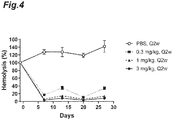
- the blood sampled on each sampling day was placed in a blood separator tube containing clot activator (Immuno-Biological Laboratories Co, Ltd., Cat#31203) and centrifuged at 3000 rpm for 15 minutes, and then the serum as the supernatant was collected and stored at -80°C. Thereafter, the complement activity in the serum was quantified in the following manner.
- sheep erythrocytes with a concentration of 1.5 ⁇ 10 8 cells/mL were prepared by using a serum complement titer CH50 kit (DENKA SEIKEN Co., Ltd., Cat#400017) in accordance with a protocol provided by the manufacturer.
- zymosan (Wako Pure Chemical Industries, Ltd., Cat#263-01491) was prepared so as at a dose of 20 ⁇ g/mL with a diluting medium attached to the serum complement titer CH50 kit.
- the sample serum was diluted 40-fold with the same diluting medium.
- the sheep erythrocytes, the zymosan, and the diluted serum sample each in a volume of 50 ⁇ L were mixed together, and the mixture was incubated at 37°C overnight. On the next day, the assay plate was centrifuged at 2000 rpm at room temperature for 10 minutes, and the absorbance of the supernatant was then measured at 405 nm. Values for the samples as the complement activity in the serum on the day before the administration to each individual was defined as 100% are shown in Table 20.
- Lipid nanoparticles (LNPs) encapsulating siRNA therein were prepared in the same manner as in Example 3, except that siRNAs listed in Table 21 were used. Results of evaluation of product quality for the prepared LNPs are shown in Table 22.
- Table 21 Double strand ID Numbers of nucleotides in sense strand/antisense strand Sense strand Antisense strand Sequence (5' ⁇ 3') SEQ ID NO Sequence (5' ⁇ 3') SEQ ID NO siRNA-008-34 19/23 uGGuAuAuGuGuuGCuGAu 145 AUcAGcAAcAcAuAuAGcAu ⁇ a ⁇ a 146
- the blood sampled on each sampling day was placed in a blood separator tube containing clot activator (Immuno-Biological Laboratories Co, Ltd., Cat#31203) and centrifuged at 3000 rpm for 15 minutes, and then the serum as the supernatant was collected and stored at -80°C. Thereafter, the complement activity in the serum was quantified in the following manner. Specifically, sheep erythrocytes with a concentration of 1.5 ⁇ 10 8 cells/mL were prepared by using a serum complement titer CH50 kit (DENKA SEIKEN Co., Ltd., Cat#400017) in accordance with a protocol provided by the manufacturer.
- zymosan (Wako Pure Chemical Industries, Ltd., Cat#263-01491) was prepared so as at a dose of 20 ⁇ g/mL with a diluting medium attached to the serum complement titer CH50 kit.
- the sample serum was diluted 40-fold with the same diluting medium.
- the sheep erythrocytes, the zymosan, and the diluted serum sample each in a volume of 50 ( ⁇ L were mixed together, and the mixture was incubated at 37°C overnight.
- the assay plate was centrifuged at 2000 rpm at room temperature for 10 minutes, and the absorbance of the supernatant was then measured at 405 nm.
- Lipid nanoparticles (LNPs) encapsulating siRNA therein were prepared in the same manner as in Example 8.
- the blood was sampled under anesthesia on the day before the administration (-1 Day in Table 24), and 7 days, 13 days, 20 days and 27 days after the administration (7 Day, 13 Day, 20 Day and 27 Day in Table 24).
- the blood sampled on each sampling day was placed in a blood separator tube containing clot activator (Immuno-Biological Laboratories Co, Ltd., Cat#31203) and centrifuged at 3000 rpm for 15 minutes, and then the serum as the supernatant was collected and stored at -80°C. Thereafter, the complement activity in the serum was quantified in the following manner. Specifically, sheep erythrocytes with a concentration of 1.5 ⁇ 10 8 cells/mL were prepared by using a serum complement titer CH50 kit (DENKA SEIKEN Co., Ltd., Cat#400017) in accordance with a protocol provided by the manufacturer.
- zymosan (Wako Pure Chemical Industries, Ltd., Cat#263-01491) was prepared so as at a dose of 20 ⁇ g/mL with a diluting medium attached to the serum complement titer CH50 kit.
- the sample serum was diluted 40-fold with the same diluting medium.
- the sheep erythrocytes, the zymosan, and the diluted serum sample each in a volume of 50 ⁇ L were mixed together, and the mixture was incubated at 37°C overnight.
- the assay plate was centrifuged at 2000 rpm at room temperature for 10 minutes, and the absorbance of the supernatant was then measured at 405 nm.
- Lipid nanoparticles (LNPs) encapsulating siRNA therein were prepared in the same manner as in Example 8.
- the blood was sampled under anesthesia on the day before the administration (-1 Day in Table 25), and 7 days, 13 days, 20 days, 27 days, 34 days, 41 days, 48 days and 55 days after the administration (7 Day, 13 Day, 20 Day, 27 Day, 34 Day, 41 Day, 48 Day and 55 Day in Table 25).
- the blood sampled on each sampling day was placed in a blood separator tube containing clot activator (Immuno-Biological Laboratories Co, Ltd., Cat#31203) and centrifuged at 3000 rpm for 15 minutes, and then the serum as the supernatant was collected and stored at -80°C. Thereafter, the complement activity in the serum was quantified in the following manner. Specifically, sheep erythrocytes with a concentration of 1.5 ⁇ 10 8 cells/mL were prepared by using a serum complement titer CH50 kit (DENKA SEIKEN Co., Ltd., Cat#400017) in accordance with a protocol provided by the manufacturer.
- zymosan (Wako Pure Chemical Industries, Ltd., Cat#263-01491) was prepared so as at a dose of 20 ⁇ g/mL with a diluting medium attached to the serum complement titer CH50 kit.
- the sample serum was diluted 40-fold with the same diluting medium.
- the sheep erythrocytes, the zymosan, and the diluted serum sample each in a volume of 50 ⁇ L were mixed together, and the mixture was incubated at 37°C overnight.
- the assay plate was centrifuged at 2000 rpm at room temperature for 10 minutes, and the absorbance of the supernatant was then measured at 405 nm. Values for the samples as the complement activity in the serum on the day before the administration (-1 Day in Table 25) to each individual was defined as 100% are shown in Table 25. The results are also shown in FIG. 5 .
- Lipid nanoparticles (LNPs) encapsulating siRNA therein were prepared in the same manner as in Example 8.
- the blood was sampled under anesthesia on the day before the administration (-1 Day in Table 26), and 7 days, 13 days, 20 days, 27 days, 34 days, 41 days, 48 days and 55 days after the administration (7 Day, 13 Day, 20 Day, 27 Day, 34 Day, 41 Day, 48 Day and 55 Day in Table 26).
- the blood sampled on each sampling day was placed in a blood separator tube containing clot activator (Immuno-Biological Laboratories Co, Ltd., Cat#31203) and centrifuged at 3000 rpm for 15 minutes, and then the serum as the supernatant was collected and stored at -80°C. Thereafter, the complement activity in the serum was quantified in the following manner. Specifically, sheep erythrocytes with a concentration of 1.5 ⁇ 10 8 cells/mL were prepared by using a serum complement titer CH50 kit (DENKA SEIKEN Co., Ltd., Cat#400017) in accordance with a protocol provided by the manufacturer.
- zymosan (Wako Pure Chemical Industries, Ltd., Cat#263-01491) was prepared so as at a dose of 20 ⁇ g/mL with a diluting medium attached to the serum complement titer CH50 kit.
- the sample serum was diluted 40-fold with the same diluting medium.
- the sheep erythrocytes, the zymosan, and the diluted serum sample each in a volume of 50 ⁇ L were mixed together, and the mixture was incubated at 37°C overnight.
- the assay plate was centrifuged at 2000 rpm at room temperature for 10 minutes, and the absorbance of the supernatant was then measured at 405 nm. Values for the samples as the complement activity in the serum on the day before the administration (-1 Day in Table 26) to each individual was defined as 100% are shown in Table 26. The results are also shown in FIG. 6 .
Landscapes
- Health & Medical Sciences (AREA)
- Life Sciences & Earth Sciences (AREA)
- Engineering & Computer Science (AREA)
- Chemical & Material Sciences (AREA)
- Bioinformatics & Cheminformatics (AREA)
- Genetics & Genomics (AREA)
- General Health & Medical Sciences (AREA)
- Organic Chemistry (AREA)
- Veterinary Medicine (AREA)
- Pharmacology & Pharmacy (AREA)
- Medicinal Chemistry (AREA)
- Animal Behavior & Ethology (AREA)
- Biomedical Technology (AREA)
- Public Health (AREA)
- Molecular Biology (AREA)
- General Engineering & Computer Science (AREA)
- Zoology (AREA)
- Wood Science & Technology (AREA)
- Biotechnology (AREA)
- Epidemiology (AREA)
- Biochemistry (AREA)
- Nuclear Medicine, Radiotherapy & Molecular Imaging (AREA)
- General Chemical & Material Sciences (AREA)
- Chemical Kinetics & Catalysis (AREA)
- Microbiology (AREA)
- Diabetes (AREA)
- Physics & Mathematics (AREA)
- Biophysics (AREA)
- Plant Pathology (AREA)
- Hematology (AREA)
- Dispersion Chemistry (AREA)
- Urology & Nephrology (AREA)
- Pharmaceuticals Containing Other Organic And Inorganic Compounds (AREA)
- Medicines That Contain Protein Lipid Enzymes And Other Medicines (AREA)
- Dc Digital Transmission (AREA)
- Cosmetics (AREA)
- Anti-Oxidant Or Stabilizer Compositions (AREA)
- Medicinal Preparation (AREA)
- Saccharide Compounds (AREA)
Abstract
Description
- The present invention relates to a double-stranded ribonucleic acid (dsRNA) capable of suppressing expression of complement C5. In particular, the present invention relates to a double-stranded ribonucleic acid, a lipid complex encapsulating the double-stranded ribonucleic acid, and a complement C5 inhibitor and pharmaceutical composition comprising the double-stranded ribonucleic acid or the lipid complex.
- A protein group called complement includes proteins indicated as C1 to C9, and these proteins are successively activated through three different pathways (classical pathway, lectin pathway, alternative pathway) to elicit immune response. The fifth complement component, C5, is cleaved to C5a and C5b by C5 convertase. C5a is called anaphylatoxin, and induces inflammatory response for various cells via C5aR (CD88) and C5L2 (GPR77). C5b sequentially reacts with C6 to C9 to be converted into a membrane attack complex (MAC) as a final product, which causes bacteriolysis to pathogens or cell lysis. The complement system may elicit strong cytotoxicity to host cells if the complement system fails to be suitably controlled or is excessively activated.
- From previous studies, the complement C5 is known to be associated with various diseases including paroxysmal nocturnal hemoglobinuria (PNH), atypical hemolytic uremic syndrome (aHUS), myasthenia gravis (MG), neuromyelitis optica (NMO), antibody-mediated rejection in kidney transplantation, Guillain-Barre syndrome, antineutrophil cytoplasmic antibody-associated vasculitis (ANCA-associated vasculitis), amyotrophic lateral sclerosis (ALS), Parkinson's disease (PD), autoimmune encephalitis, IgG4-related diseases, asthma, antiphospholipid antibody syndrome, ischemia-reperfusion injury, typical hemolytic uremic syndrome (tHUS), multifocal motor neuropathy (MMN), multiple sclerosis (MS), thrombotic thrombocytopenic purpura (TTP), spontaneous abortion, habitual abortion, traumatic brain injury, cold agglutinin disease, dermatomyositis, hemolytic uremic syndrome associated with Shigatoxin-producing Escherichia coli (E. coli), graft dysfunction, myocardial infarction, sepsis, atherosclerosis, septic shock, spinal cord injury, psoriasis, autoimmune hemolytic anemia (AIHA), antiphospholipid syndrome (APS), myocarditis, immune complex vasculitis, Takayasu's disease, and Kawasaki's disease (arteritis). Thus, inhibition or suppression of expression of complement C5 is expected to lead to successful treatment of these diseases. In particular, inhibition of complement C5 is suggested to be effective for treating or preventing paroxysmal nocturnal hemoglobinuria (Non Patent Literature 1), atypical hemolytic uremic syndrome (Non Patent Literature 2), myasthenia gravis (Non Patent Literature 3), neuromyelitis optica (Non Patent Literature 4), and antibody-mediated kidney transplant rejections (Non Patent Literature 5).
- The anti-C5 monoclonal antibody eculizumab (Soliris (registered trademark)) exhibits high affinity for complement C5, and suppresses excessive activation of the complement through inhibition of cleavage of C5 into C5a/C5b and accompanying formation of a membrane attack complex. Thereby, eculizumab exhibits inhibitory effect on hemolysis, and thus is known as a therapeutic agent for paroxysmal nocturnal hemoglobinuria and atypical hemolytic uremic syndrome. In addition, eculizumab is known as a therapeutic agent for generalized myasthenia gravis (gMG). However, eculizumab is very expensive, and hence development of alternative means applicable to treatment and prevention of complement C5-mediated diseases is desired.
- Examples of methods for suppressing expression of complement C5 include methods utilizing RNA interference (hereinafter, also referred to as "RNAi"). For example, a double-stranded ribonucleic acid (dsRNA) agent is known, which induces cleavage of an RNA transcript of the C5 gene via an RNA-induced silencing complex (RISC) (Patent Literature 1).
- [Patent Literature 1]
WO 2014/160129 -
- [Non-Patent Literature 1] Non Patent Literature 1: Peter Hillmen et al., The New England Journal of Medicine 2004 Feb 5; 350(6): 552-559.
- [Non-Patent Literature 2] Legendre CM et al., The New England Journal of Medicine 2013 Jun 6; 368(23): 2169-2181.
- [Non-Patent Literature 3] Howard JF Jr et al., Muscle Nerve 2013 Jul; 48(1): 76-84.
- [Non-Patent Literature 4] Pittock SJ et al., The Lancet Neurology 2013 Jun; 12(6): 554-562.
- [Non-Patent Literature 5] Stegall MD et al., American Journal of Transplantation 2011 Nov; 11(11): 2405-2413.
- An object of the present invention is to provide a novel double-stranded ribonucleic acid for suppressing expression of complement C5.
- The present invention provides, for example, the following <1> to <38>.
- <1>A double-stranded ribonucleic acid comprising:
- a combination of a sense strand and an antisense strand,
- wherein the combination of the sense strand and the antisense strand are selected from the group consisting of combinations:
SEQ ID NO: 13 and SEQ ID NO: 14; SEQ ID NO: 159 and SEQ ID NO: 160; SEQ ID NO: 115 and SEQ ID NO: 116; SEQ ID NO: 117 and SEQ ID NO: 118; SEQ ID NO: 119 and SEQ ID NO: 120; SEQ ID NO: 121 and SEQ ID NO: 122; SEQ ID NO: 123 and SEQ ID NO: 124; SEQ ID NO: 125 and SEQ ID NO: 126; SEQ ID NO: 127 and SEQ ID NO: 128; SEQ ID NO: 129 and SEQ ID NO: 130; SEQ ID NO: 131 and SEQ ID NO: 132; SEQ ID NO: 133 and SEQ ID NO: 134; SEQ ID NO: 137 and SEQ ID NO: 138, SEQ ID NO: 139 and SEQ ID NO: 140; SEQ ID NO: 141 and SEQ ID NO: 142; SEQ ID NO: 143 and SEQ ID NO: 144; SEQ ID NO: 145 and SEQ ID NO: 146; SEQ ID NO: 147 and SEQ ID NO: 148; SEQ ID NO: 149 and SEQ ID NO: 150; SEQ ID NO: 151 and SEQ ID NO: 152; and SEQ ID NO: 153 and SEQ ID NO: 154.
- <2> A double-stranded ribonucleic acid comprising:
- a combination of a sense strand and an antisense strand,
- wherein the combination of the sense strand and the antisense strand are selected from the group consisting of combinations:
SEQ ID NO: 159 and SEQ ID NO: 160; SEQ ID NO: 139 and SEQ ID NO: 140; SEQ ID NO: 141 and SEQ ID NO: 142; SEQ ID NO: 143 and SEQ ID NO: 144; SEQ ID NO: 145 and SEQ ID NO: 146; SEQ ID NO: 147 and SEQ ID NO: 148; and SEQ ID NO: 153 and SEQ ID NO: 154.
- <3> A double-stranded ribonucleic acid comprising:
- a combination of a sense strand and an antisense strand,
- wherein the combination of the sense strand and the antisense strand are selected from the group consisting of combinations:
SEQ ID NO: 159 and SEQ ID NO: 160; SEQ ID NO: 141 and SEQ ID NO: 142; SEQ ID NO: 143 and SEQ ID NO: 144; SEQ ID NO: 145 and SEQ ID NO: 146; SEQ ID NO: 147 and SEQ ID NO: 148; and SEQ ID NO: 153 and SEQ ID NO: 154.
- <4> A double-stranded ribonucleic acid comprising:
- a combination of a sense strand and an antisense strand,
- wherein the combination of the sense strand and the antisense strand are selected from the group consisting of combinations:
SEQ ID NO: 141 and SEQ ID NO: 142; SEQ ID NO: 143 and SEQ ID NO: 144; SEQ ID NO: 145 and SEQ ID NO: 146; SEQ ID NO: 147 and SEQ ID NO: 148; and SEQ ID NO: 153 and SEQ ID NO: 154.
- <5> A double-stranded ribonucleic acid comprising:
- a sense strand of SEQ ID NO: 141; and
- an antisense strand of SEQ ID NO: 142.
- <6> A double-stranded ribonucleic acid comprising:
- a sense strand of SEQ ID NO: 143; and
- an antisense strand of SEQ ID NO: 144.
- <7> A double-stranded ribonucleic acid comprising:
- a sense strand of SEQ ID NO: 145; and
- an antisense strand of SEQ ID NO: 146.
- <8> A double-stranded ribonucleic acid comprising:
- a sense strand of SEQ ID NO: 147; and
- an antisense strand of SEQ ID NO: 148.
- <9> A double-stranded ribonucleic acid comprising:
- a sense strand of SEQ ID NO: 153; and
- an antisense strand of SEQ ID NO: 154.
- <10> A double-stranded ribonucleic acid comprising:
- a sense strand of SEQ ID NO: 159; and
- an antisense strand of SEQ ID NO: 160.
- <11>A complement C5 inhibitor comprising:
the double-stranded ribonucleic acid according to any one of <1> to <10>. - <12> A pharmaceutical composition comprising:
the double-stranded ribonucleic acid according to any one of <1> to <10>. - <13> The pharmaceutical composition according to <12>, further comprising a pharmaceutically acceptable carrier.
- <14> The pharmaceutical composition according to <12> or <13>, for treating paroxysmal nocturnal hemoglobinuria.
- <15> The pharmaceutical composition according to <12> or <13>, for treating atypical hemolytic uremic syndrome.
- <16> A lipid complex encapsulating the double-stranded ribonucleic acid according to any one of <1> to <10>.
- <17> The lipid complex according to <16>, comprising:
- a cationic lipid; and
- at least one lipid selected from the group consisting of neutral lipid, polyethylene glycol-modified lipid, and sterol.
- <18> The lipid complex according to <17>, wherein the cationic lipid is 2-{9-oxo-9-[(3-pentyloctyl)oxy]nonyl} dodecyl 1 -methylpiperidine-4-carboxylate.
- <19> The lipid complex according to <17>, wherein the neutral lipid is distearoylphosphatidylcholine (DSPC).
- <20> The lipid complex according to <17>, wherein the polyethylene glycol-modified lipid is MPEG2000-DMG (MPEG2000-dimyristyl glycerol).
- <21> The lipid complex according to <17>, wherein the sterol is cholesterol.
- <22> A complement C5 inhibitor comprising:
the lipid complex according to any one of<16> to <21>. - <23> A pharmaceutical composition comprising:
the lipid complex according to any one of<16> to <21>. - <24> The pharmaceutical composition according to <23>, further comprising a pharmaceutically acceptable carrier.
- <25> The pharmaceutical composition according to <23> or <24>, for treating paroxysmal nocturnal hemoglobinuria.
- <26> The pharmaceutical composition according to <23> or <24>, for treating atypical hemolytic uremic syndrome.
- <27> A method for treating paroxysmal nocturnal hemoglobinuria, comprising:
administering the double-stranded ribonucleic acid according to any one of <1> to <10> to a patient in need thereof. - <28> A method for treating atypical hemolytic uremic syndrome, comprising:
administering the double-stranded ribonucleic acid according to any one of <1> to <10> to a patient in need thereof. - <29> The double-stranded ribonucleic acid according to any one of <1> to <10>, for use in treating paroxysmal nocturnal hemoglobinuria.
- <30> The double-stranded ribonucleic acid according to any one of <1> to <10>, for use in treating atypical hemolytic uremic syndrome.
- <31> Use of the double-stranded ribonucleic acid according to any one of<1> to <10>, in the manufacture of a pharmaceutical composition for treating paroxysmal nocturnal hemoglobinuria.
- <32> Use of the double-stranded ribonucleic acid according to any one of<1> to <10>, in the manufacture of a pharmaceutical composition for treating atypical hemolytic uremic syndrome.
- <33> A method for treating paroxysmal nocturnal hemoglobinuria, comprising:
administering the lipid complex according to any one of <16> to <21> to a patient in need thereof. - <34> A method for treating atypical hemolytic uremic syndrome, comprising:
administering the lipid complex according to any one of <16> to <21> to a patient in need thereof. - <35> The lipid complex according to any one of <16> to <21>, for use in treating paroxysmal nocturnal hemoglobinuria.
- <36> The lipid complex according to any one of <16> to <21>, for use in treating atypical hemolytic uremic syndrome.
- <37> Use of the lipid complex according to any one of<16> to <21>, in the manufacture of a pharmaceutical composition for treating paroxysmal nocturnal hemoglobinuria.
- <38> Use of the lipid complex according to any one of<16> to <21>, in the manufacture of a pharmaceutical composition for treating atypical hemolytic uremic syndrome.
- In accordance with the present invention, a novel double-stranded ribonucleic acid capable of suppressing expression of complement C5, a lipid complex encapsulating the nucleic acid in the lipid complex, and a complement C5 inhibitor and pharmaceutical composition comprising the nucleic acid or the lipid complex can be provided.
- The double-stranded ribonucleic acid according to the present invention can suppress expression of complement C5 to suppress hemolysis, and hence can be applicable as a therapeutic agent for paroxysmal nocturnal hemoglobinuria (PNH) and atypical hemolytic uremic syndrome (aHUS).
-
-
FIG. 1 shows graphs representing results of liver C5 mRNA residual rates after administration of siRNA-008 and liver C5 mRNA residual rates after administration of siRNA-008-34 in Example 5; -
FIG. 2 shows graphs representing results of plasma C5 residual rates after administration of siRNA-008 and plasma C5 residual rates after administration of siRNA-008-34 in Example 5; -
FIG. 3 shows graphs representing results of complement activity after administration of siRNA-008-34 in Example 8; -
FIG. 4 shows graphs representing results of complement activity after administration of siRNA-008-34 in Example 9; -
FIG. 5 shows graphs representing results of complement activity after administration of siRNA-008-34 in Example 10; and -
FIG. 6 shows graphs representing results of complement activity after administration of siRNA-008-34 in Example 11. - Examples of genes encoding complement C5 targeted by the double-stranded ribonucleic acid according to an embodiment include, but are not limited to, C5 derived from humans, mice, and monkeys. Information on C5 gene sequences is available from public databases including registered sequence information such as GenBank provided by The National Center for Biotechnology Information (NCBI), or can be obtained by designing a primer based on information of a nucleotide sequence for C5 from a closely related animal species followed by cloning therewith from an RNA extracted from a desired animal species. Examples of the sequence of an mRNA transcript corresponding to the target gene human C5 include the sequence of a human C5 mRNA transcript registered as GenBank Accession No. NM_001735.2 (GI: 38016946). The term "C5 gene" herein is not limited to a gene having a particular sequence. For example, naturally-occurring C5 genes with single nucleotide polymorphism can be also included in the term.
- In a double-stranded ribonucleic acid according to an embodiment comprising a sense strand and an antisense strand, combination of sense strand and antisense strand is selected from the group consisting of: SEQ ID NO: 13 and SEQ ID NO: 14, SEQ ID NO: 159 and SEQ ID NO: 160, SEQ ID NO: 115 and SEQ ID NO: 116, SEQ ID NO: 117 and SEQ ID NO: 118, SEQ ID NO: 119 and SEQ ID NO: 120, SEQ ID NO: 121 and SEQ ID NO: 122, SEQ ID NO: 123 and SEQ ID NO: 124, SEQ ID NO: 125 and SEQ ID NO: 126, SEQ ID NO: 127 and SEQ ID NO: 128, SEQ ID NO: 129 and SEQ ID NO: 130, SEQ ID NO: 131 and SEQ ID NO: 132, SEQ ID NO: 133 and SEQ ID NO: 134, SEQ ID NO: 137 and SEQ ID NO: 138, SEQ ID NO: 139 and SEQ ID NO: 140, SEQ ID NO: 141 and SEQ ID NO: 142, SEQ ID NO: 143 and SEQ ID NO: 144, SEQ ID NO: 145 and SEQ ID NO: 146, SEQ ID NO: 147 and SEQ ID NO: 148, SEQ ID NO: 149 and SEQ ID NO: 150, SEQ ID NO: 151 and SEQ ID NO: 152, and SEQ ID NO: 153 and SEQ ID NO: 154. The combinations respectively correspond to the sequences of siRNA-008, siRNA-008-01, siRNA-008-02, siRNA-008-08, siRNA-008-09, siRNA-008-10, siRNA-008-11, siRNA-008-12, siRNA-008-13, siRNA-008-14, siRNA-008-22, siRNA-008-23, siRNA-008-30, siRNA-008-31, siRNA-008-32, siRNA-008-33, siRNA-008-34, siRNA-008-35, siRNA-008-36, siRNA-008-37, and siRNA-008-38 in the present specification.
- In the double-stranded ribonucleic acid according to the embodiment, a sense strand and an antisense strand as any one of the combinations (1) to (21) are pairing.
- (1) a sense strand of SEQ ID NO: 13, and an antisense strand of SEQ ID NO: 14
- (2) a sense strand of SEQ ID NO: 159, and an antisense strand of SEQ ID NO: 160
- (3) a sense strand of SEQ ID NO: 115, and an antisense strand of SEQ ID NO: 116
- (4) a sense strand of SEQ ID NO: 117, and an antisense strand of SEQ ID NO: 118
- (5) a sense strand of SEQ ID NO: 119, and an antisense strand of SEQ ID NO: 120
- (6) a sense strand of SEQ ID NO: 121, and an antisense strand of SEQ ID NO: 122
- (7) a sense strand of SEQ ID NO: 123, and an antisense strand of SEQ ID NO: 124
- (8) a sense strand of SEQ ID NO: 125, and an antisense strand ofSEQ ID NO: 126
- (9) a sense strand ofSEQ ID NO: 127, and an antisense strand ofSEQ ID NO: 128
- (10) a sense strand of SEQ ID NO: 129, and an antisense strand of SEQ ID NO: 130
- (11) a sense strand of SEQ ID NO: 131, and an antisense strand of SEQ ID NO: 132
- (12) a sense strand of SEQ ID NO: 133, and an antisense strand of SEQ ID NO: 134
- (13) a sense strand of SEQ ID NO: 137, and an antisense strand of SEQ ID NO: 138
- (14) a sense strand of SEQ ID NO: 139, and an antisense strand of SEQ ID NO: 140
- (15) a sense strand of SEQ ID NO: 141, and an antisense strand of SEQ ID NO: 142
- (16) a sense strand of SEQ ID NO: 143, and an antisense strand of SEQ ID NO: 144
- (17) a sense strand of SEQ ID NO: 145, and an antisense strand of SEQ ID NO: 146
- (18) a sense strand of SEQ ID NO: 147, and an antisense strand of SEQ ID NO: 148
- (19) a sense strand of SEQ ID NO: 149, and an antisense strand of SEQ ID NO: 150
- (20) a sense strand of SEQ ID NO: 151, and an antisense strand of SEQ ID NO: 152
- (21) a sense strand of SEQ ID NO: 153, and an antisense strand of SEQ ID NO: 154
- Each of the combinations (1) to (21) of a sense strand and an antisense strand includes a region complementary to each other. For example, a double-stranded ribonucleic acid including the combination (1) of the sense strand ofSEQ ID NO: 13 and the antisense strand ofSEQ ID NO: 14 includes the following complementary strands (dT^dT at the 3'-terminal is not shown, see Table 1 for more details).
- 5'-uGGuAuAuGuGuuGcuGAu-3' (SEQ ID NO: 13)
- 3'-AcCAuAuAcAcAAcGAcUA-5' (SEQ ID NO: 14)
- In a double-stranded ribonucleic acid according to an embodiment comprising a sense strand and an antisense strand, combination of sense strand and antisense strand is selected from the group consisting of: SEQ ID NO: 159 and SEQ ID NO: 160, SEQ ID NO: 139 and SEQ ID NO: 140, SEQ ID NO: 141 and SEQ ID NO: 142, SEQ ID NO: 143 and SEQ ID NO: 144, SEQ ID NO: 145 and SEQ ID NO: 146, SEQ ID NO: 147 and SEQ ID NO: 148, and SEQ ID NO: 153 and SEQ ID NO: 154. The combinations respectively correspond to the sequences of siRNA-008-01, siRNA-008-31, siRNA-008-32, siRNA-008-33, siRNA-008-34, siRNA-008-35, and siRNA-008-38 in the present specification.
- In a double-stranded ribonucleic acid according to an embodiment comprising a sense strand and an antisense strand, combination of sense strand and antisense strand is selected from the group consisting of: SEQ ID NO: 159 and SEQ ID NO: 160, SEQ ID NO: 141 and SEQ ID NO: 142, SEQ ID NO: 143 and SEQ ID NO: 144, SEQ ID NO: 145 and SEQ ID NO: 146, SEQ ID NO: 147 and SEQ ID NO: 148, and SEQ ID NO: 153 and SEQ ID NO: 154. The combinations respectively correspond to the sequences of siRNA-008-01, siRNA-008-32, siRNA-008-33, siRNA-008-34, siRNA-008-35, and siRNA-008-38 in the present specification.
- In a double-stranded ribonucleic acid according to an embodiment comprising a sense strand and an antisense strand, combination of sense strand and antisense strand is selected from the group consisting of: SEQ ID NO: 141 and SEQ ID NO: 142, SEQ ID NO: 143 and SEQ ID NO: 144, SEQ ID NO: 145 and SEQ ID NO: 146, SEQ ID NO: 147 and SEQ ID NO: 148, and SEQ ID NO: 153 and SEQ ID NO: 154. The combinations respectively correspond to the sequences of siRNA-008-32, siRNA-008-33, siRNA-008-34, siRNA-008-35, and siRNA-008-38 in the present specification.
- A double-stranded ribonucleic acid according to an embodiment comprising a sense strand and an antisense strand includes a sense strand of SEQ ID NO: 159 and an antisense strand of SEQ ID NO: 160. The combination corresponds to the sequence of siRNA-008-01 in the present specification.
- A double-stranded ribonucleic acid according to an embodiment comprising a sense strand and an antisense strand includes a sense strand of SEQ ID NO: 141 and an antisense strand of SEQ ID NO: 142. The combination corresponds to the sequence of siRNA-008-32 in the present specification.
- A double-stranded ribonucleic acid according to an embodiment comprising a sense strand and an antisense strand includes a sense strand of SEQ ID NO: 143 and an antisense strand of SEQ ID NO: 144. The combination corresponds to the sequence of siRNA-008-33 in the present specification.
- A double-stranded ribonucleic acid according to an embodiment comprising a sense strand and an antisense strand includes a sense strand of SEQ ID NO: 145 and an antisense strand of SEQ ID NO: 146. The combination corresponds to the sequence of siRNA-008-34 in the present specification.
- A double-stranded ribonucleic acid according to an embodiment comprising a sense strand and an antisense strand includes a sense strand of SEQ ID NO: 147 and an antisense strand of SEQ ID NO: 148. The combination corresponds to the sequence of siRNA-008-35 in the present specification.
- A double-stranded ribonucleic acid according to an embodiment comprising a sense strand and an antisense strand includes a sense strand of SEQ ID NO: 153 and an antisense strand of SEQ ID NO: 154. The combination corresponds to the sequence of siRNA-008-38 in the present specification.
- The antisense strand according to an embodiment is substantially complementary to at least a part of an mRNA transcript of a C5 gene. Here, the phrase "substantially complementary" includes not only cases that the antisense strand is completely complement to a part of an mRNA transcript of a C5 gene but also cases that there are one to several acceptable mismatches between the antisense strand and a part of an mRNA transcript of C5 gene.
- The sense strand according to an embodiment is substantially complementary to at least a part of the nucleotide sequence of the antisense strand. The phrase "substantially complementary" includes not only cases that the sense strand is completely complement to a part of the nucleotide sequence of the antisense strand but also cases that there are one to several acceptable mismatches between the sense strand and a part of the nucleotide sequence of the antisense strand. The phrase "completely complementary" may apply to cases when the oligonucleotide of the longer of the sense strand and the antisense strand includes a nucleotide sequence completely complementary to the oligonucleotide of the shorter.
- The double-stranded ribonucleic acid according to an embodiment also includes a modified nucleotide, as described later (see also Table 1). Hence, the term "nucleotide" used herein is intended not only to refer to guanosine-3'-phosphate, cytidine-3'-phosphate, adenosine-3'-phosphate, and uridine-3'-phosphate, but also to encompass various modified nucleotides.
- The term "double-stranded ribonucleic acid" or "dsRNA" herein refers to a ribonucleic acid (RNA) molecule having double-stranded structure including two antiparallel, substantially complementary oligonucleotides, or a complex thereof. Examples of double-stranded ribonucleic acids herein include, but are not limited to, siRNAs (small interfering RNAs). The double-stranded ribonucleic acid according to an embodiment comprises a sense strand and an antisense strand. Through RNAi using the double-stranded ribonucleic acid according to an embodiment, an mRNA for a C5 gene is cleaved as the target mRNA molecule in an RISC complex, and as a result expression of C5 is suppressed. For example, expression of C5 in cells in a subject is suppressed.
- The double-stranded ribonucleic acid according to an embodiment can be synthesized, for example, by using a method with chemical synthesis known in the art (e.g., described in Nucleic Acid Research, 35(10), 3287-96 (2007)) and enzymatic transcription.
- The double-stranded ribonucleic acid according to an embodiment includes various modifications. Modification can be performed by using a method known in the art. Examples of the modification include sugar modification.
- Examples of the sugar modification include modification for the ribose moiety constituting ribonucleoside, specifically, substitution or addition at the hydroxy group at the 2'-position, more specifically, 2'-O-methyl-modified nucleotide in which the hydroxy group has been substituted with a methoxy group. Nucleotides represented as lowercase a, u, g, and c in Table 1 are 2'-O-methyl-modified nucleotides, and the sense strand and antisense strand of the double-stranded ribonucleic acid according to an embodiment each include 2'-O-methyl-modified nucleotide.
- The double-stranded ribonucleic acid can be modified by inserting an additional nucleotide or nucleotide derivative, which is called overhang, into the 3'-side or 5'-side of a region where the sense strand and the antisense strand are forming a double strand. The double-stranded ribonucleic acid according to an embodiment includes the sense strand and/or the antisense strand including deoxy-thymidine (dT) at the 3'-terminal as SEQ ID NO: 13 and SEQ ID NO: 14, and the sense strand and/or the antisense strand including inverted deoxy-thymidine (idT) as SEQ ID NO: 129. The double-stranded ribonucleic acid according to an embodiment also includes the sense strand and/or the antisense strand including U, A, and so forth, added as an overhang sequence, for example, that including UUUU added at the 3'-terminal of the antisense strand as SEQ ID NOs: 140 and 142.
- Alternatively, the double-stranded ribonucleic acid can be backbone-modified through modification or substitution of the phosphodiester bond. Examples of the modification or substitution of the phosphodiester bond include a phosphorothioate bond. The double-stranded ribonucleic acid according to an embodiment also includes that including neighboring nucleotides connected with a phosphorothioate bond as SEQ ID NO: 13, SEQ ID NO: 14, and SEQ ID NO: 121.
- The double-stranded ribonucleic acid according to an embodiment can be introduced into cells in a subject by using a chemical method (e.g., transfection), physical method (e.g., electroporation, microinjection), or biological method (e.g., virus vectors) known in the art.
- Transfection is a method of bonding a nucleic acid to a positively charged substance (such as a liposome and polymer) to form a complex followed by allowing cells to incorporate the complex by endocytosis through attracting the complex to negatively charged cell surfaces. Transfection can be performed by using a known method, and can be performed by using a commercially available transfection reagent (e.g., TransIT (registered trademark) series from Takara Bio Inc., Lipofectamine (registered trademark) series from Invitrogen) in a simple manner.
- Nucleic acid molecules are easily degraded by ribonuclease present in the living body and each nucleic acid molecule itself is a negatively charged polymer, and hence it is difficult for nucleic acid molecules to pass cell membranes, which are also negatively charged. As an effective method for delivering nucleic acid molecules having such character to the cytoplasm, a technique with a Drug Delivery System (DDS) using a lipid complex, polymer, or the like has been developed.
- In some embodiments, a lipid complex comprising: (I) the double-stranded ribonucleic acid, (II) a cationic lipid, and (III) at least one lipid selected from the group consisting of neutral lipid, polyethylene glycol-modified lipid (PEG lipid), and sterol, is provided. Examples of the lipid complex herein include, but are not limited to, LNPs (lipid nanoparticles).
- Examples of the form of a complex formed of a lipid containing a cationic lipid and the double-stranded ribonucleic acid include a complex of the double-stranded ribonucleic acid and a membrane consisting of a lipid monolayer (single molecule) (reverse micelle); a complex of the double-stranded ribonucleic acid and a liposome; and a complex of the double-stranded ribonucleic acid and a micelle. In a lipid complex according to an embodiment of the present invention, the double-stranded ribonucleic acid is encapsulated in a fine particle comprising a lipid containing a cationic lipid.
- The lipid complex according to an embodiment contains the double-stranded ribonucleic acid in a content of, for example, 0.01 to 50% by weight, 0.1 to 30% by weight, or 1 to 10% by weight to the total weight of the lipid complex.
- Cationic lipid is an amphiphilic molecule having a lipophilic region including one or more hydrocarbon groups and a hydrophilic region including a polar group to be protonated at specific pH. Examples of the cationic lipid according to an embodiment include, but are not particularly limited to, cationic lipids described in
International Publication Nos. WO 2015/105131 ,WO 2016/104580 , andWO 2017/222016 , and alternatively a cationic lipid with improved biodegradability described inInternational Publication No. WO 2016/104580 orWO 2017/222016 can be used. Examples of the cationic lipid according to an embodiment include 1-oxo-1-(undecan-5-yloxy)nonadecan-10-yl-1 -methylpiperidine-4-carboxylate, 1-((2-butyloctyl)oxy)-1-oxononadecan-10-yl-1-methylpiperidine-4-carboxylate, 1-oxo-1-(undecan-5-yloxy)heptadecan-8-yl-1-methylpiperidine 4-carboxylate, 21-oxo- 21-(undecan-5-yloxy)heneicosan-10-yl-1-methylpiperidine4-carboxylate, 21-(octan-3-yloxy)-21-oxoheneicosan-10-yl-1-methylpiperidine-4-carboxylate, 1-((2-butyloctyl)oxy)-1-oxoicosan-10-yl-1-methylpiperidine-4-carboxylate, (Z)-1-((2-butylnon-3-en-1-yl)oxy)-1-oxoicosan-10-yl-1-methylpiperidine-4-carboxylate, 1-oxo-1-((3-pentyloctyl)oxy)icosan-10-yl-1-methylpiperidine-4-carboxylate, 1-((3,4-dipropylheptyl)oxy)-1-oxoicosan-10-yl-1-methylpiperidine-4-carboxylate, 1-((6-(butyldisulfanyl)-3-(3-(butyldisulfanyl)propyl)hexyl)oxy)-1-oxoicosan-10-yl-1-methylpiperidine-4-carboxylate, 2-butyloctyl-10-((4-(dimethylamino)butanoyl)oxy)icosanoate, 2-{9-[(2-butyloctyl)oxy]-9-oxononyl} dodecyl 1-methylpiperidine-4-carboxylate, 2- {9-oxo-9-[(3-pentyloctyl)oxy]nonyl} dodecyl 1-methylpiperidine-4-carboxylate, 2-nonyl-11-oxo-11-[(3-pentyloctyl)oxy]undecyl 1-methylpiperidine-4-carboxylate, bis(3-pentyloctyl) 9-{[(1-methylpiperidine-4-carbonyl)oxy]methyl} heptadecanedioate, and di[(Z)-2-nonen-1-yl] 9-{[(1-methylpiperidine-4-carbonyl)oxy]methyl} heptadecanedioate. In an embodiment, the cationic lipid is 2-{9-oxo-9-[(3-pentyloctyl)oxy]nonyl} dodecyl 1 -methylpiperidine-4-carboxylate. - The lipid complex according to an embodiment contains the above-described cationic lipid in a content of, for example, 10 to 100 mol%, 20 to 90 mol%, or 40 to 70 mol% based on the total lipids contained in the lipid complex. One cationic lipid can be used singly, and mixture of two or more cationic lipids can also be used.
- The lipid complex according to an embodiment comprises (I) the above-described cationic lipid and (II) at least one lipid selected from the group consisting of neutral lipid, polyethylene glycol-modified lipid, and sterol, as a lipid component. The lipid complex according to an embodiment contains the lipid component in a content of, for example, 50 to 99.99% by weight, 70 to 99.9% by weight, or 90 to 99% by weight to the total weight of the lipid complex.
- The term "neutral lipid" refers to a lipid present either as a non-charged form or as a neutral zwitterion at physiological pH. Examples of the neutral lipid according to an embodiment include dioleoylphosphatidylethanolamine (DOPE), palmitoyloleoylphosphatidylcholine (POPC), egg phosphatidylcholine (EPC), dimyristoylphosphatidylcholine (DMPC), dipalmitoylphosphatidylcholine (DPPC), distearoylphosphatidylcholine (DSPC), diarachidoylphosphatidylcholine (DAPC), dibehenoylphosphatidylcholine (DBPC), dilignoceroylphosphatidylcholine (DLPC), dioleoylphosphatidylcholine (DOPC), sphingomyelin, ceramide, dioleoylphosphatidylglycerol (DOPG), dipalmitoylphosphatidylglycerol (DPPG), palmitoyloleoylphosphatidylethanolamine (POPE), and dioleoylphosphatidylethanolamine 4-(N-maleimidomethyl)-cyclohexane-1-carboxylate (DOPE-mal). In an embodiment, the neutral lipid is distearoylphosphatidylcholine (DSPC). One neutral lipid can be used singly, and mixture of two or more neutral lipids can also be used.
- The lipid complex according to an embodiment may contain the neutral lipid in a content of, for example, 0 to 50 mol%, 0 to 40 mol%, 0 to 30 mol%, or 0 to 20 mol% based on the total lipids contained in the lipid complex.
- Examples of the polyethylene glycol-modified lipid (PEG lipid) according to an embodiment include PEG2000-DMG (PEG2000-dimyristyl glycerol), MPEG2000-DMG (MPEG2000-dimyristyl glycerol), PEG2000-DPG (PEG2000-dipalmitoylglycerol), PEG2000-DSG (PEG2000-distearoylglycerol), PEG5000-DMG (PEG5000-dimyristyl glycerol), PEG5000-DPG (PEG5000-dipalmitoylglycerol), PEG5000-DSG (PEG5000-distearoylglycerol), PEG-cDMA (N-[(methoxypoly(ethylene glycol)2000)carbamyl]-1,2-dimyris1yloxylpropyl-3-amine), PEG-C-DOMG (R-3-[(ω-methoxy-poly(ethylene glycol)2000)carbamoyl)]-1,2-dimyrislyloxylpropyl-3-amine), polyethylene glycol (PEG)-diacylglycerol (DAG), PEG-dialkyloxypropyl (DAA), PEG-phospholipid, and PEG-ceramide (Cer). Examples of PEG-dialkyloxypropyl include PEG-dilauryloxypropyl, PEG-dimyristyloxypropyl, PEG-dipalmityloxypropyl, and PEG-distearyloxypropyl. In an embodiment, the polyethylene glycol-modified lipid is MPEG2000-DMG (MPEG2000-dimyristyl glycerol). One polyethylene glycol-modified lipid can be used singly, and mixture of two or more polyethylene glycol-modified lipids can also be used.
- The lipid complex according to an embodiment may contain the polyethylene glycol-modified lipid in a content of, for example, 0 to 30 mol%, 0 to 20 mol%, 0 to 10 mol%, or 0.5 to 2 mol% based on the total lipids contained in the lipid complex.
- Sterol is an alcohol having a steroid backbone. Examples of the sterol according to an embodiment include cholesterol, dihydrocholesterol, lanosterol, β-sitosterol, campesterol, stigmasterol, brassicasterol, ergosterol, fucosterol, and 3β-[N-(N',N'-dimethylaminoethyl)carbamoyl]cholesterol (DC-Chol). In an embodiment, the sterol is cholesterol. One sterol can be used singly, and mixture of two or more sterols can also be used.
- The lipid complex according to an embodiment may contain the sterol in a content of, for example, 0 to 90 mol%, 10 to 80 mol%, or 20 to 40 mol% based on the total lipids contained in the lipid complex.
- Combination of lipid components in the lipid complex according to an embodiment is not particularly limited, and examples thereof include combination of the above-described cationic lipid, neutral lipid, and sterol, and combination of the above-described cationic lipid, neutral lipid, polyethylene glycol-modified lipid, and sterol.
- The lipid complex according to an embodiment encapsulating the double-stranded ribonucleic acid comprises lipid components of cationic lipid/neutral lipid/polyethylene glycol-modified lipid/sterol, and the mole ratio of the lipids may be, for example, 10 to 99/0 to 50/0 to 10/0 to 50, or 40 to 70/0 to 20/0.5 to 2/20 to 40.
- The "average particle size" of the lipid complex particle encapsulating the double-stranded ribonucleic acid according to the present invention refers to the Z-average particle size. The average particle size (Z-average) of a lipid complex according to an embodiment encapsulating the double-stranded ribonucleic acid may be, for example, 10 to 1000 nm, 30 to 500 nm, or 30 to 200 nm as measured by using a particle size analyzer (Malvern Panalytical Ltd., Zetasizer Nano ZS), though the average particle size is not particularly limited thereto.
- The siRNA encapsulation efficiency for a lipid complex according to an embodiment encapsulating the double-stranded ribonucleic acid can be calculated, for example, from the siRNA concentration of a formulation diluted with RNase Free Water, which is assumed as the concentration of siRNA present in the LNP external solution, and the siRNA concentration of the formulation diluted with 1% Triton X-100, which is assumed as the total siRNA concentration of the formulation, where each siRNA concentration is measured by using Quant-iT RiboGreen RNA Reagent (Invitrogen, Cat#R11491) (see also Kewal K. Jain, Drug Delivery System, Methods in Molecular Biology, Vol. 1141: 109-120). It is preferable that the encapsulation efficiency calculated in this manner be, for example, higher than 80%, higher than 85%, or higher than 90%. It is preferable that the siRNA encapsulation efficiency for a lipid complex according to an embodiment encapsulating the double-stranded ribonucleic acid be higher than 90%.
- Examples of methods for encapsulating an effective molecule in a lipid complex include a reverse phase evaporation method, a zwitterion (NaCl) hydration method, a cationic core hydration method, and a method with ethanol and calcium (see, Biomembr., 1468, 239-252 (2000)). A lipid complex according to an embodiment encapsulating the double-stranded ribonucleic acid can be prepared by using any of these methods known in the art.
- A lipid complex according to an embodiment encapsulating the double-stranded ribonucleic acid can be prepared by, for example, mixing a lipid solution containing the cationic lipid and at least one lipid selected from the group consisting of neutral lipid, polyethylene glycol-modified lipid, and sterol, and an acidic buffer containing the double-stranded ribonucleic acid. By using such a method, a lipid complex the inside of which is filled with a core of the double-stranded ribonucleic acid and the lipids can be obtained. A lipid complex according to an embodiment encapsulating the double-stranded ribonucleic acid may contain the cationic lipid and at least one lipid selected from the group consisting of neutral lipid, polyethylene glycol-modified lipid, and sterol.
- A lipid complex according to an embodiment encapsulating the double-stranded ribonucleic acid can be produced by using a method including: a step (a) of mixing a polar organic solvent-containing aqueous solution containing (I) the cationic lipid and (II) at least one lipid selected from the group consisting of neutral lipid, polyethylene glycol-modified lipid, and sterol, and an aqueous solution containing (III) the double-stranded ribonucleic acid to obtain a mixed solution; and a step (b) of reducing the content of the polar organic solvent in the mixed solution.
- Through the electrostatic interaction between the double-stranded ribonucleic acid and the cationic lipid, each being water-soluble, and the hydrophobic interaction among the lipids, a lipid complex encapsulating the double-stranded ribonucleic acid in a fine particle comprising the lipids can be formed. For example, a lipid complex can be formed by reducing the content of the polar organic solvent in the mixed solution to change the solubility of the lipid component containing (I) the cationic lipid and (II) at least one lipid selected from the group consisting of neutral lipid, polyethylene glycol-modified lipid, and sterol in the polar organic solvent-containing aqueous solution. Examples of the polar organic solvent include alcohol such as ethanol.
- First, in the step (a), a polar organic solvent-containing aqueous solution containing (I) the cationic lipid and (II) at least one lipid selected from the group consisting of neutral lipid, polyethylene glycol-modified lipid, and sterol dissolved therein is mixed with an aqueous solution containing (III) the double-stranded ribonucleic acid to obtain a mixed solution. The concentration of the polar organic solvent in the polar organic solvent-containing aqueous solution is not particularly limited as long as conditions for dissolving lipid molecules are satisfied even after mixing with the aqueous solution containing the double-stranded ribonucleic acid. In an example, the concentration of the polar organic solvent in the polar organic solvent-containing aqueous solution in the step (a) can be 0 to 60% by weight. The aqueous solution containing (III) the double-stranded ribonucleic acid is obtained by, for example, dissolving the double-stranded ribonucleic acid in an acidic buffer.
- Subsequently, in the step (b), the content of the polar organic solvent is reduced by adding water or the like to the mixed solution. Thereby, a lipid complex can be formed. It is preferred for efficient formation of the lipid complex to rapidly lower the content of the polar organic solvent. In an example, the concentration of the polar organic solvent in the final polar organic solvent-containing aqueous solution in the step (b) can be 0 to 5% by weight.
- The mixed solution obtained in the step (a) may be subjected to dialysis to remove the polar organic solvent and substitute the solvent with a pharmaceutically acceptable medium. The content of the polar organic solvent in the solution decreases during the dialysis, by which a lipid complex can be formed.
- By using the method for producing a composition according to an embodiment, a lipid complex encapsulating the double-stranded ribonucleic acid in the inside of a fine particle can be obtained with high encapsulation efficiency.
- Examples of the acidic buffer to dissolve the double-stranded ribonucleic acid therein include sulfate buffer, phosphate buffer, phthalate buffer, tartrate buffer, citrate buffer, formate buffer, oxalate buffer, and acetate buffer.
- Examples of the solvent to dissolve the lipids therein include polar organic solvent such as alcohol, and the solvent may be, for example, ethanol, isopropanol, chloroform, or tert-butanol.
- As described above, expression of complement C5 can be inhibited through RNAi by using the double-stranded ribonucleic acid according to an embodiment. Accordingly, a complement C5 inhibitor and pharmaceutical composition containing a double-stranded ribonucleic acid according to an embodiment or a lipid complex encapsulating the double-stranded ribonucleic acid can be provided. The complement C5 inhibitor and pharmaceutical composition can contain a pharmaceutically acceptable carrier in addition to a double-stranded ribonucleic acid according to an embodiment or a lipid complex encapsulating the double-stranded ribonucleic acid.
- Examples of the pharmaceutically acceptable carrier include liquid or solid fillers, diluent, excipients, production aids, and solvent-encapsulating materials.
- The pharmaceutical composition according to an embodiment may be, for example, in the form of powder obtained by removing solvent through freeze-drying or the like, or in the form of liquid. A pharmaceutical composition according to an embodiment is a powder composition containing a lipid complex according to any of the above-described embodiments. The powder composition may be prepared by removing solvent from a composition in the form of liquid (dispersion), for example, through filtration or centrifugation, or prepared by freeze-drying the dispersion. In the case that the pharmaceutical composition is in the form of powder, the pharmaceutical composition can be suspended or dissolved in a pharmaceutically acceptable medium before use and used as an injection. A pharmaceutical composition according to an embodiment is a liquid composition containing a lipid complex according to any of the above-described embodiments and a pharmaceutically acceptable medium. In the case that the pharmaceutical composition is in the form of liquid, the pharmaceutical composition can be directly used as an injection, or suspended or dissolved in a pharmaceutically acceptable medium and used as an injection.
- By administering a complement C5 inhibitor or pharmaceutical composition according to an embodiment to a subject in need thereof, expression of complement C5 in the subject can be inhibited through RNAi. Here, the "subject in need thereof' refers to a subject presenting with a disease or disorder associated with expression or activity of the C5 gene, or a subject determined to have a high risk of development thereof.
- In some embodiments, the double-stranded ribonucleic acid can inhibit expression of complement C5, and hence a complement C5 inhibitor or pharmaceutical composition containing the double-stranded ribonucleic acid or a lipid complex encapsulating the double-stranded ribonucleic acid can be useful for treating paroxysmal nocturnal hemoglobinuria (PNH) and atypical hemolytic uremic syndrome (aHUS). Thus, in other embodiments, a method for treating paroxysmal nocturnal hemoglobinuria or atypical hemolytic uremic syndrome, the method including a step of administering a therapeutically effective amount of a complement C5 inhibitor or pharmaceutical composition according to an embodiment, is provided. In other embodiments, use of the double-stranded ribonucleic acid according to an embodiment or a lipid complex encapsulating the double-stranded ribonucleic acid according to an embodiment for producing a therapeutic drug for paroxysmal nocturnal hemoglobinuria or atypical hemolytic uremic syndrome, is provided. In other embodiments, the double-stranded ribonucleic acid according to an embodiment or a lipid complex encapsulating the double-stranded ribonucleic acid according to an embodiment for use in a method for treating paroxysmal nocturnal hemoglobinuria or atypical hemolytic uremic syndrome, is provided.
- The double-stranded ribonucleic acid according to an embodiment or a lipid complex encapsulating the double-stranded ribonucleic acid according to an embodiment in the lipid complex can be used singly or in combination with another agent or composition in a therapeutic method. For example, the double-stranded ribonucleic acid according to an embodiment or a lipid complex encapsulating the double-stranded ribonucleic acid according to an embodiment may be administered simultaneously with or separately from administration of another agent. Such combination therapy includes combined administration (two or more agents are contained in one formulation or different formulations) and separate administration (e.g., simultaneous or sequential). If two or more agents are to be separately administered, the double-stranded ribonucleic acid according to an embodiment or a lipid complex encapsulating the double-stranded ribonucleic acid according to an embodiment may be administered prior to or sequentially after the accompanying therapeutic method.
- The subject to administer a complement C5 inhibitor or pharmaceutical composition containing the double-stranded ribonucleic acid according to an embodiment or a lipid complex encapsulating the double-stranded ribonucleic acid according to an embodiment is not limited, and, for example, the subject can be humans or non-human mammals (such as monkeys, mice, rats, rabbits, cows, horses, goats).
- The method for administering a complement C5 inhibitor or pharmaceutical composition containing the double-stranded ribonucleic acid according to an embodiment or a lipid complex encapsulating the double-stranded ribonucleic acid according to an embodiment to a subject (such as the route of administration, dose, frequency of administration per day, timing of administration) is not limited, and can be appropriately determined by one of ordinary skill in the art (e.g., physicians) in accordance with the health condition of a subject, the degree of a disease, the type of an agent to be used in combination.
- The mode of administration of a complement C5 inhibitor and pharmaceutical composition according to an embodiment is not particularly limited, and may be parenteral administration, and examples thereof include intravenous administration, intramuscular administration, subcutaneous administration, intradermal administration, and intrathecal administration.
- A complement C5 inhibitor and pharmaceutical composition according to an embodiment can be administered in an amount enough to inhibit complement C5 depending on the mode of administration. The dose of a complement C5 inhibitor and pharmaceutical composition according to an embodiment may be, for example, 0.01 mg to 100 mg, or 0.1 mg to 50 mg, or 0.3 mg to 10 mg, per kg body weight of a subject.
- One of ordinary skill in the art understand that the present invention may be implemented with appropriate combination of any one or more of all the embodiments described herein, unless the combination causes any technical contradiction. In addition, one of ordinary skill in the art understand that it would be preferred to implement the present invention with appropriate combination of any of all the preferred or advantageous embodiments described herein, unless the combination causes any technical contradiction.
- All of the contents disclosed in the literatures mentioned herein are incorporated by reference in their entirety, and one of ordinary skill in the art can cite and understand related contents disclosed in the literatures as a part of the present specification in accordance with the context of the present specification, without departing from the spirit and scope of the present invention.
- The literatures cited herein are provided only for the purpose of disclosing related art before the filing date of the present application, and should not be interpreted as admission that the present inventors have no right of priority to the disclosures because of any prior invention or for any other reason. All of the descriptions in the literatures are based on information which was available for the applicant, and by no means constitute admission that the described contents are correct.
- The terms used herein are for describing specific embodiments, and not intended to limit the invention.
- The term "comprise" used herein is intended to indicate the presence of a mentioned matter (e.g., a member, a step, an element, or a number) unless the context apparently requires different understanding, and does not exclude the presence of another matter (e.g., a member, a step, an element, or a number). The term "consist of' encompasses embodiments described with the term(s) "consist of' and/or "consist essentially of'.
- Unless otherwise defined, all terms used herein (including technical terms and scientific terms) have the same meaning as commonly understood by one of ordinary skill in the art to which the present invention pertains. Each of the terms used herein should be interpreted to have a meaning consistent with that in the present specification and in the fields of related art unless otherwise specified, and should not be interpreted with respect to an idealized or excessively literal meaning.
- While terms such as "first" and "second" are used to represent various elements, it is to be understood that such elements should not be limited by the terms themselves. The terms are used only to distinguish one element from another element, and, for example, it is acceptable without departing from the scope of the present invention to express a first element as "second element" and to express a second element as "first element", similarly.
- Numerical values used herein to indicate component contents, numerical ranges, and so forth should be understood to be modified with the term "approximately", unless otherwise specified. For example, "4°C" is understood to refer to "approximately 4°C", unless otherwise specified, and, needless to say, one of ordinary skill in the art can rationally understand the allowance in accordance with the common general knowledge and the context of the present specification.
- Unless the context clearly indicates otherwise, embodiments with a singular form as used herein and in the claims are to be understood to allow the plural form, and vice versa, as long as no technical contradiction is caused.
- Hereinafter, the present invention will be described in more detail with reference to Examples. However, the present invention can be realized in various embodiments, and should not be interpreted to be limited to Examples described below. One of ordinary skill in the art can implement the present invention with various modifications, additions, deletions, substitutions, and so forth, without changing the spirit or scope of the present invention.
- Sense strands and antisense strands listed in Table 2 were synthesized by using the phosphoramidite method, and then annealed to synthesize double-stranded nucleic acids (GeneDesign, Inc.). Abbreviations in the sequences are as shown in Table 1. Each double-stranded nucleic acid synthesized had a hydroxy group instead of a phosphate group at each 3'-terminal.
[Table 1] Abbreviation Nucleotide A Adenosine-3'-phosphate U Uridine-3'-phosphate G Guanosine-3'-phosphate C Cytidine-3'-phosphate a 2'-O-methyladenosine-3'-phosphate u 2'-O-methyluridine-3'-phosphate g 2'-O-methylguanosine-3'-phosphate c 2'-O-methylcytidine-3'-phosphate dT Deoxy-thymidine (idT) Inverted deoxy-thymidine (inverted dT) ^ Phosphorothioate bond No symbol indicates that nucleotides are linked together via a phosphodiester bond [Table 2] Double strand ID Numbers of nucleotides in strand/antisense strand Sense strand Antisense strand Target site in NM 001735.2 Sequence (5→ 3') SEQIDNO Sequence (5→ 3') SEQIDNO siRNA-001 21/21 AGGcAAAGGuGuucAAAGAdT^dT 1 UCUUUGAAcACCUUUGCCUdT^dT 2 2477-2495 siRNA-002 21/21 cuGucuuAAcuuucAuAGAd^dT 3 UCuAUGAAAGUuAAGAcAGdT^dT 4 506-524 siRNA-003 21/21 uAGcAuGuGccAGcuAcAAdT^dT 5 UUGuAGCUGGcAcAUGCuAdT^dT 6 4238-4256 siRNA-004 21/21 cuGuGAuuGGAAuuAGAAAdT^dT 7 UUUCuAAUUCcAAUcAcAGdT^dT 8 3473-3491 siRNA-006 21/21 AAGGcAAAGGuGuucAAAGdT^dT 9 CUUUGAAcACCUUUGCCUUdT^dT 10 2476-2494 siRNA-007 21/21 GAAAGGAAcuGuuuAcAAcdT^dT 11 GUUGuAAAcAGUUCCUUUCdT^dT 12 2553-2571 siRNA-008 21/21 uGGuAuAuGuGuuGcuGAudT^dT 13 AUcAGcAAcAcAuAuACcAdT^dT 14 2451-2469 siRNA-009 21/21 AcuGucuuAAcuuucAuAGdT^dT 15 CuAUGAAAGUuAAGAcAGUdT^dT 16 505-523 siRNA-010 21/21 GuGccAGcuAcAAGcccAGdT^dT 17 CUGGGCUUGuAGCUGGcACdT^dT 18 4244-4262 siRNA-011 21/21 AAGGAAcuGuuuAcAAcuAdT^dT 19 uAGUUGuAAAcAGUUCCUUdT^dT 20 2555-2573 siRNA-012 21/21 uccucuGGAAAuuGGccuudT^dT 21 AAGGCcAAUUUCcAGAGGAdT^dT 22 2733-2751 siRNA-013 21/21 uuGAAAGGAAcuGuuuAcAdT^dT 23 UGuAAAcAGUUCCUUUcAAdT^dT 24 2551-2569 siRNA-014 21/21 AAAGGAAcuGuuuAcAAcudT^dT 25 AGUUGuAAAcAGUUCCUUUdT^dT 26 2554-2572 siRNA-015 21/21 AGGAAcuGuuuAcAAcuAudT^dT 27 AuAGUUGuAAAcAGUUCCUdT^dT 28 2556-2574 siRNA-016 21/21 uAcAcuGAAGcAuuuGAuGdT^dT 29 cAUcAAAUGCUUcAGUGuAdT^dT 30 166-184 siRNA-017 21/21 cAcuGAAGcAuuuGAuGcAdT^dT 31 UGcAUcAAAUGCUUcAGUGdT^dT 32 168-186 siRNA-018 21/21 cuGAAGcAuuuGAuGcAAcdT^dT 33 GUUGcAUcAAAUGCUUcAGdT^dT 34 170-188 siRNA-019 21/21 uucuGcAAeuGAAuucGAudT^dT 35 AUCGAAUUcAGUUGcAGAAdT^dT 36 4412-4430 siRNA020 21/21 uGAAAGGAAcuGuuuAcAAdT^dT 37 |UUGuAAAcAGUUCCUUUcAdT^dT 38 2552-2570 siRNA-021 21/21 AcuGAAGcAuuuGAuGcAAdT^dT 39 UUGcAUcAAAUGCUUcAGUdT^dT 40 169-187 siRNA-022 21/21 cAuAcAGAcAAAccuGuuudT^dT 41 AAAcAGGUUUGUCUGuAUGdT^dT 42 415-433 siRNA-023 21/21 AAAcAAcAAGuAccuuuAudT^dT 43 AuAAAGGuACUUGUUGUUUdT^dT 44 984-1002 Double strand ID Numbers of nucleotides in sense strand/antisense strand Sense strand Antisense strand Target site in NM Target sitein_ Sequence (5→ 3') SEQ ID NO Sequence (5→ 3') SEQ ID NO siRNA-024 21/21 AuAcAGAcAAAccuGuuuAdT^dT 45 uAAAcAGGUUUGUCUGuAUdT^dT 46 416-434 siRNA-025 21/21 GGuAuAuGuGuuGcuGAuAdT^dT 47 luAUcAGcAAcAcAuAuACCdT^dT 48 2452-2470 siRNA-026 21/21 ucAGAAAGucuGuGAAGGAdT^dT 49 uCCUUcAcAGACUUUCUGAdT^dT 50 4578-4596 siRNA-027 21/21 ucuccAGGccAAAcuGuGudT^dT 51 AcAcAGUUUGGCCUGGAGAdT^dT 52 1777-1795 siRNA-028 21/21 AcAAcAAGuAccuuuAuAudT^dT 53 AuAuAAAGGuACUUGUUGUdT^dT 54 986-1004 siRNA-029 21/21 cAAcAAGuAccuuuAuAuudT^dT 55 AAuAuAAAGGuACUUGUUGdT^dT 56 987-1005 siRNA-030 21/21 AuucuccAGGccAAAcuGudT^dT 57 AcAGUUUGGCCUGGAGAAUdT^dT 58 1775-1793 siRNA-031 21/21 GuGGcAAccAGcuccAGGudT^dT 59 ACCUGGAGCUGGUUGCcACdT^dT 60 1730-1748 siRNA-032 21/21 AAGAGAcAucuGAcuuGGAdT^dT 61 UCcAAGUcAGAUGUCUCUUdT^dT 62 1226-1244 siRNA-033 21/21 AuucuGcAAcuGAAuucGAdT^dT 63 UCGAAUUcAGUUGcAGAAUdT^dT 64 4411-4429 siRNA-034 21/21 uuccucuGGAAAuuGGccudT^dT 65 AGGCcAAUUUCcAGAGGAAdT^dT 66 2732-2750 siRNA-035 21/21 AAcAAcAAGuAccuuuAuAdT^dT 67 uAuAAAGGuACUUGUUGUUdT^dT 68 985-1003 siRNA-036 21/21 AAuAuGuccucucucccuAdT^dT 69 uAGGGAGAGAGGAcAuAUUdT^dT 70 1067-1085 siRNA-037 21/21 AcucAcuAuAAuuAcuuGAdT^dT 71 UcAAGuAAUuAuAGUGAGUdT^dT 72 1519-1537 siRNA-038 21/21 AuAAcucAcuAuAAuuAcudT^dT 73 AGuAAUuAuAGUGAGUuAUdT^dT 74 1516-1534 siRNA-039 21/21 AAAuAuGuccucucucccudT^dT 75 AGGGAGAGAGGAcAuAUUUdT^dT 76 1066-1084 siRNA-040 21/21 AAGAuAuuuuuAuAAuAAAdT^dT 77 UUuAUuAuAAAAAuAUCUUdT^dT 78 876-894 siRNA-042 21/21 AAAAuAAcucAcuAuAAuudT^dT 79 AAUuAuAGUGAGUuAUUUUdT^dT 80 1513-1531 siRNA-043 21/21 AAAuAAcucAcuAuAAuuAdT^dT 81 uAAUuAuAGUGAGUuAUUUdT^dT 82 1514-1532 siRNA-044 21/21 GuGuuAAAAuGucuGcuGudT^dT 83 AcAGcAGAcAUUUuAAcACdT^dT 84 2597-2615 siRNA-045 21/21 AAAAuGuuuuuGucAAGuAdT^dT 85 uACUUGAcAAAAAcAUUUUdT^dT 86 4742-4760 Mock 21/21 cuuAcGcuGAGuAcuucGAdT^dT 87 UCGAAGuACUcAGCGuAAGdT^dT 88 - - Each of the double-stranded nucleic acids listed in Table 2 in combination with the transfection reagent Lipofectamine RNAiMax (from Invitrogen, catalog number: 13778150) was diluted with an Opti-MEM medium (from Gibco, catalog number: 31985062) to prepare siRNA/RNAiMax mixed solution with a final concentration of 3 nM double-stranded nucleic acid and 0.3% RNAiMax. The siRNA/RNAiMax mixed solution was aliquoted into 20 µL portions in wells of a 96-well culture plate, and Hep3B cells (obtained from ATCC) as cell lines derived from human liver cancer were seeded in each well at 20000 cells/80 µL/well, and cultured under conditions of 37°C and 5%CO2 overnight. From the cultured cells, a template lysate for real-time PCR was prepared by using a CellAmp (registered trademark) Direct RNA Prep Kit for RT-PCR (Real Time) (from Takara Bio Inc., catalog number: 3732) and Proteinase K (from Takara Bio Inc., catalog number: 9034) in accordance with a protocol provided by Takara Bio Inc. Thereafter, cDNA was prepared by using a PrimeScript (registered trademark) RT Master Mix (Perfect Real Time) (from Takara Bio Inc., catalog number: RR036A) in accordance with a protocol provided by Takara Bio Inc. Further, Ct values were measured for the target gene human C5 and the endogenous control gene human GAPDH (glyceraldehyde-3-phosphate dehydrogenase) by using an EagleTaq Universal Master Mix (ROX) (from Roche Diagnostics K.K., catalog number: 07260296190) and a TaqMan probe (from Applied Biosystems, C5: Hs00156197 m1; GAPDH: Hs02758991_g1) with an ABI7900HT real-time PCR system (from Applied Biosystems) in accordance with a protocol provided by Applied Biosystems. The C5 mRNA expression level in the case that Hep3B cells were treated only with the transfection reagent without addition of siRNA was defined as 100%, and a C5 mRNA residual rate (relative value) was calculated for each introduction of siRNA by using a calibration curve method. As a negative control, Mock which does not cross over with any human gene was used.
- The results are shown in Table 3.
[Table 3] Double strand ID C5mRNA residual rate (n=3, average) (3nM siRNA) siRNA-001 18% siRNA-002 43% siRNA-003 107% siRNA-004 35% siRNA-006 37% siRNA-007 28% siRNA-008 18% siRNA-009 89% siRNA-010 107% siRNA-011 107% siRNA-012 37% siRNA-013 53% siRNA-014 64% siRNA-015 125% siRNA-016 35% siRNA-017 26% siRNA-018 48% siRNA-019 27% siRNA-020 42% siRNA-021 74% siRNA-022 39% siRNA-023 101% siRNA-024 41% siRNA-025 125% siRNA-026 41% siRNA-027 143% siRNA-028 61% siRNA-029 40% siRNA-030 151% siRNA-031 96% siRNA-032 73% siRNA-033 70% siRNA-034 I121% siRNA-035 54% siRNA-036 119% siRNA-037 119% siRNA-038 47% siRNA-039 100% siRNA-040 111% siRNA-042 112% siRNA-043 53% siRNA-044 87% siRNA-045 115% Mock 116% Lipofection only 100% - Sense strands and antisense strands listed in Table 4 were synthesized by using the phosphoramidite method, and then annealed to synthesize double-stranded nucleic acids (GeneDesign, Inc.).
[Table 4] Double strand ID Numbers of nucleotides in sense strand/antisense strand Sense strand Antisense strand Sequence (5' →3) SEQIDNO Sequence (5' →3') SEQIDNO siRNA-001 21/21 AGGcAAAGGuGuucAAAGAdT^dT 89 UCUUUGAAcACCUUUGCCUdT^dT 90 siRNA-001-02 19/19 AGGcAAAGGuGuucAAAGA 91 UCUUUGAAcACCUUUGCCU 92 siRNA-001-08 21/21 A^GGcAAAGGuGuucAAAGAuu 93 U^CUUUGAAcACCUUUGCCUuu 94 siRNA-001-09 21/21 A^G^GcAAAGGuGuucAAAGAuu 95 U^C^UUUGAAcACCUUUGCCUuu 96 siRNA-001-10 21/21 A^GGcAAAGGuGuucAAAGA^u^u 97 U^CUUUGAAcACCUUUGCCU^u^u 98 siRNA-001-11 19/21 AGGcAAAGGuGuucAAAGA 99 UGUUUGAAcAGGUUUGGGUuu 100 siRNA-001-12 21/21 AuAGGcAAAGGuGuucAAAGA 101 UCUUUGAAcACCUUUGCCUuu 102 siRNA-001-13 22/21 uAuAGGcAAAGGuGuucAAAGA 103 UCUUUGAAcACCUUUGCCUuu 104 siRNA-006 21/21 AAGGcAAAGGuGuucAAAGdT^dT 105 CUUUGAAcACCUUUGCCUUdT^dT 106 siRNA-006-02 19/19 AAGGcAAAGGuGuucAAAG 107 CUUUGAAcACCUUUGCCUU 108 siRNA-007 21/21 GAAAGGAAcuGuuuAcAAcdT^dT 109 GUUGuAAAcAGUUCCUUUCdT^dT 110 siRNA-007-02 19/19 GAAAGGAAcuGuuuAcAAc 111 )GUUGuAAAcAGUUCCUUUC 112 siRNA-008 21/21 uGGuAuAuGuGuuGcuGAudT^dT 113 AUcAGcAAcAcAuAuAGcAdT^dT 114 siRNA-008-02 19/19 uGGuAuAuGuGuuGcuGAu 115 AUcAGcAAcAcAuAuACcA 116 siRNA-008-08 21/21 u^GGuAuAuGuGuuGcuGAuuu 117 A^UcAGcAAcAcAuAuACcAuu 118 siRNA-008-09 21/21 u^G^GuAuAuGuGuuGcuGAuuu 119 A^U^cAGcAAcAcAuAuACcAuu 120 siRNA-008-10 21/21 u^GGuAuAuGuGuuGcuGAu^u^u 121 A^UcAGcAAcAcAuAuACcA^u^u 122 siRNA-008-11 19/21 uGGuAuAuGuGuuGcuGAu 123 AUcAGcAAcAcAuAuACcAuu 124 siRNA-008-12 21/21 AuuGGuAuAuGuGuuGcuGAu 125 AUcAGcAAcAcAuAuACcAuu 126 siRNA-008-13 22/21 uAuuGGuAuAuGuGuuGcuGAu 127 AUcAGcAAcAcAuAuACcAuu 128 siRNA-008-14 23/21 uAuuGGuAuAuGuGuuGcuGAu(idT) 129 AUcAGcAAcAcAuAuACcAuu 130 siRNA-008-22 21/21 uGGuAuAuGuGuuGCuGAuuu 131 AUcAGcAAcAcAuAuACcAuu 132 siRNA-008-23 21/21 uGGuAuAuGuGuuGcUGAuuu 133 AUcAGcAAcAcAuAuACcAuu 134 siRNA-008-29 20/20 AuuGGuAuAuGuGuuGcuGA 135 UcAGcAAcAcAuAuACcAuu 136 siRNA-008-30 20/20 AuGGuAuAuGuGuuGcuGAu 137 AUcAGcAAcAcAuAuACcuu 138 siRNA-008-31 19/23 uGGuAuAuGuGuuGcuGAu 139 AUcAGcAAcAcAuAuACcAuuuu 140 siRNA-008-32 19/23 luGGuAuAuGuGuuGCuGAu 141 AUcAGcAAcAcAuAuACcAuuuu 142 siRNA-008-33 19/23 uGGuAuAuGuGuuGCuGAu 143 AUcAGcAAcAcAuAuACcAuuaa 144 siRNA-008-34 19/23 uGGuAuAuGuGuuGCuGAu 145 AUcAGcAAcAcAuAuACcAuu^a^a 146 siRNA-008-35 19/23 luGGuAuAuGuGuuGCuGAu 147 AUcAGcAAcAcAuAuACcA^u^uaa 148 siRNA-008-36 19/23 uGGuAuAuGuGuuGCuGAu 149 a^UcAGcAAcAcAuAuACcA^u^uaa 150 siRNA-008-37 19/23 uGGuAuAuGuGuuGCuGAu 151 aUcAGcAAcAcAuAuACcAuuuu 152 siRNA-008-38 19/23 u^GGuAuAuGuGuuGCuGAu 153 AUcAGcAAcAcAuAuACcA^u^uaa 154 siRNA-038 21/21 AuAAcucAcuAuAAuuAcudTd^dT 155 AGuAAUuAuAGUGAGUuAUdT^dT 156 siRNA-038-02 19/19 AuAAcucAcuAuAAuuAcu 157 AGuAAUuAuAGUGAGUuAU 158 Mock 21/21 cuuAcGcuGAGuAcuucGAdT^dT 87 UCGAAGuACUcAGCGuAAGdTdT 88 - A test was performed to measure Ct values for the target gene human C5 and the endogenous control gene human GAPDH in cultured Hep3B cells in the same manner as in Example 1, except that siRNA/RNAiMax mixed solution was prepared with a final concentration of 1 nM double-stranded nucleic acid and 0.3% RNAiMax. As in Example 1, the C5 mRNA expression level in the case of Lipofection only was defined as 100%, and a C5 mRNA residual rate (relative value) was calculated for each introduction of siRNA.
- The results are shown in Table 5. Lowered C5 mRNA residual rates were found for all of the double-stranded nucleic acids except siRNA-008-29, demonstrating that expression of C5 was suppressed.
[Table 5] Double strand ID C5mRNA residual rate (n=3, average) (1nM siRNA) siRNA-001 36% siRNA-001-02 44% siRNA-001-08 42% siRNA-001-09 42% siRNA-001-10 44% siRNA-001-11 45% siRNA-001-12 39% siRNA-001-13 45% siRNA-006 43% siRNA-006-02 40% siRNA-007 44% siRNA-007-02 50% siRNA-008 34% siRNA-008-02 37% siRNA-008-08 37% siRNA-008-09 41% siRNA-008-10 45% siRNA-008-11 38% siRNA-008-12 39% siRNA-008-13 46% siRNA-008-14 42% siRNA-008-22 37% siRNA-008-23 36% siRNA-008-29 119% siRNA-008-30 33% siRNA-008-31 36% siRNA-008-32 39% siRNA-008-33 36% siRNA-008-34 32% siRNA-008-35 33% siRNA-008-36 37% siRNA-008-37 34% siRNA-008-38 38% siRNA-038 43% siRNA-038-02 54% Mock 90% Lipofection only 100% - Each siRNA listed in Table 6 was dissolved in 10 mM sodium citrate (pH 4.0) to prepare diluted siRNA solution. Lipid solution was prepared by dissolving 2-{9-oxo-9-[(3-pentyloctyl)oxy]nonyl}dodecyl 1-methylpiperidine-4-carboxylate, DSPC (NIPPON FINE CHEMICAL CO., LTD.), Cholesterol (NIPPON FINE CHEMICAL CO., LTD.), and MPEG2000-DMG (NOF CORPORATION) at a mole ratio of 60/10.5/28/1.5 in ethanol. Lipid Nanoparticles (LNPs) were obtained by mixing the diluted siRNA solution and the lipid solution at flow rates of 3 mL/min and 1 mL/min, respectively, with an siRNA/lipid weight ratio of 0.1. The external solution of the resulting LNP aqueous solution was substituted with PBS (pH 7.4) through dialysis by using a Float-A-Lyzer G2 (SPECTRUM, 100K MWCO). After the dialysis, the resultant was subjected to concentration and filtration sterilization for use in experiments. The siRNA concentration and encapsulation efficiency were measured by using a Quant-iT RiboGreen RNA Reagent (Invitrogen, Cat#R11491). For calculation of the encapsulation efficiency, the siRNA concentration measured after dilution with RNase Free Water was assumed as the concentration of siRNA present in the LNP external solution, and the siRNA concentration measured after dilution with 1% Triton X-100 was assumed as the total siRNA concentration of the formulation. The average particle size (Z-average) was measured by using a particle size analyzer (Malvern Panalytical Ltd., Zetasizer Nano ZS). Results of evaluation of product quality for the prepared LNPs are shown in Table 7.
[Table 6] Double strand ID Numbers of nucleotides in sense strand/antisense stand Sense strand Antisense strand Sequence (5'→3') SEQ ID NO Sequence (5'→3') SEQ ID NO Mock 21/21 cuuAcGcuGAGuAcuucGAdT^dT 87 UCGAAGuACUcAGCGuAAGdT^dT 88 siRNA-001-01 21/21 AGGcAAAGGuGuucAAAGAuu 161 UCUUUGAAcACCUUUGCCUuu 162 siRNA-007-01 21/21 GAAAGGAAcuGuuuAcAAcuu 163 GUUGuAAAcAGUUCCUUUCuu 164 siRNA-008-01 21/21 uGGuAuAuGuGuuGcuGAuuu 159 AUcAGcAAcAcAuAuACcAuu 160 [Table 7] Double strand ID Encapsulation efficiency Average particle size (nm) Polydispersity index Mock >90% 92 0.06 siRNA-001-01 >90% 90 0.08 siRNA-007-01 >90% 87 0.06 siRNA-008-01 >90% 88 0.1 - LNPs encapsulating PBS or siRNA listed in Table 6 therein were intravenously administered to a BALB/c mouse (male, 6 weeks old, n = 3 per group) from the tail vein at a dose of 0.1 mg/kg siRNA, and the blood and liver were sampled under
anesthesia 5 days and 14 days after the administration. From the liver frozen with liquid nitrogen, Total RNA was purified by using an RNeasy Plus Mini Kit (Qiagen, Cat#74106) in accordance with a protocol provided by the manufacturer. Thereafter, cDNA was prepared by using a PrimeScript RT Master Mix (Perfect Real Time) (Takara Bio Inc., Cat#RR036A) in accordance with a protocol provided by the manufacturer. Further, Ct values were measured for the target gene mouse C5 and the endogenous control gene mouse GAPDH by using a TaqMan (registered trademark) Gene Expression Master Mix (Applied Biosystem, Cat#4369510) and a TaqMan probe (Applied Biosystems, C5: Mm01336776_g1; GAPDH: Mm99999915_g1) with an ABI7500 Fast (Applied Biosystems) in accordance with a protocol provided by the manufacturer. The liver C5 mRNAresidual rate 5 days after the administration for the PBS administration group was defined as 100%, and a liver C5 mRNA residual rate (relative value) was calculated for each siRNA administration group by using the comparative Ct method. The results are shown in Table 8.[Table 8] Double strand ID Liver C5 mRNAresidual rate 5 days after administration (n=3, Average)Liver C5 mRNAresidual rate 14 days after administration (n=3, Average)PBS 100% Not tested Mock 75% 105% siRNA-001-01 51% 104% siRNA-007-01 69% 92% siRNA-008-01 21% 62% - The blood sampled on each sampling day was centrifuged at 3000 rpm for 15 minutes, and then the heparin plasma as the supernatant was collected and stored at -80°C. Thereafter, the plasma Mouse C5 was quantified by ELISA. Specifically, the mouse anti-C5 antibody BB5.1 (Hycult Biotech, Cat#HM1073-FS) as an immobilized antibody was diluted with PBS(-) (Wako Pure Chemical Industries, Ltd., #045-29795) to a final concentration of 2 µg/mL and added to an assay plate (Nunc, Cat#442404), and incubated at 4°C overnight. Thereafter, blocking solution (PBS(-) (Wako Pure Chemical Industries, Ltd.) containing 1% BSA (R&D systems, Inc., Cat#DY995)) was added, and the resultant was incubated at room temperature for 1 hour. The blocking solution was discarded, and washing was performed three times with washing solution (PBS(-) (Wako Pure Chemical Industries, Ltd.) containing 0.02% Tween20). The washing solution was discarded, and the heparin plasma sample diluted with blocking solution was then added, and the resultant was incubated at room temperature for 5 hours. The plasma of the PBS administration group was used as a standard sample. The sample was discarded, and washing was then performed five times with washing solution, and a goat anti-human C5 antibody (Quidel Corporation, Cat#A306) diluted 4000-fold with blocking solution was added, and the resultant was incubated at room temperature for 1 hour. The antibody was discarded, and washing was then performed five times with washing solution, and an HRP-labeled donkey anti-goat IgG (H+L) (Jackson ImmunoResearch Inc., Cat#805-035-180) diluted 40000-fold with blocking solution was added, and the resultant was incubated at room temperature for 1 hour. The antibody was discarded, and washing was then performed five times with washing solution. Thereafter, equal amounts of TMB (3,3',5,5'-tetramethylbenzidine) Peroxidase Substrate (Kirkegaard & Perry Laboratories, Inc., Cat#50-76-01) and Peroxidase Substrate Solution B (Kirkegaard & Perry Laboratories, Inc., Cat#50-65-00) were mixed together as detection reagent, which was added and allowed to develop color. H2SO4 (Wako Pure Chemical Industries, Ltd., Cat#198-09595) was added as quenching solution, and absorbance was then measured at 450 nm and 650 nm. Relative values for the samples as the
plasma C5 concentration 5 days after the administration for the PBS administration group was defined as 100% are shown in Table 9.[Table 9] Double strand ID Blood C5 protein residual rate 5 days after administration (n=3, Average)Blood C5 protein residual rate 14 days after administration (n=3, Average)PBS 100% Not tested Mock 94% 96% siRNA-001-01 44% 87% siRNA-007-01 79% 103% siRNA-008-01 22% 48% - Sense strands and antisense strands listed in Table 10 were synthesized by using the phosphoramidite method, and then annealed to synthesize double-stranded nucleic acids (GeneDesign, Inc.). A test was performed to measure Ct values for the target gene human C5 and the endogenous control gene human GAPDH in cultured Hep3B cells in the same manner as in Example 1, except that siRNA/RNAiMax mixed solution was prepared with a final concentration of 0.003 to 10 nM double-stranded nucleic acid and 0.3% RNAiMax. As in Example 1, the C5 mRNA expression level in the case of Lipofection only was defined as 100%, and a C5 mRNA residual rate (relative value) was calculated for each introduction of siRNA. The results are shown in Table 11.
[Table 10] Double strand ID Numbers of nucleotides in sense strand/antisense strand Sense strand Antisense strand Sequence (5' → 3') SEQ ID NO Sequence (5' → 3') SEQ ID NO siRNA-008-01 21/21 uGGuAuAuGuGuuGcuGAuuu 159 AUcAGcAAcAcAuAuACcAuu 160 siRNA-008-31 19/23 uGGuAuAuGuGuuGcuGAu 139 AUcAGcAAcAcAuAuACcAuuuu 140 siRNA-008-33 19/23 uGGuAuAuGuGuuGCuGAu 143 AUcAGcAAcAcAuAuACcAuuaa 144 siRNA-008-34 19/23 uGGuAuAuGuGuuGCuGAu 145 AUcAGcAAcAcAuAuACcAuu^a^a 146 siRNA-008-35 19/23 uGGuAuAuGuGuuGCuGAu 147 AUcAGcAAcAcAuAuACcA^u^uaa 148 Mock 21/21 cuuAcGcuGAGuAcuucGAdT^dT 87 UCGAAGuACUcAGCGuAAGdT^dT 88 [Table 11] siRNA (nM) Double strand ID C5 mRNAresidual rate (n=3, average) 10 siRNA-008-01 17% 3 siRNA-008-01 20% 1 siRNA-008-01 22% 0.3 siRNA-008-01 26% 0.1 siRNA-008-01 34% 0.03 siRNA-008-01 60% 0.01 siRNA-008-01 66% 0.003 siRNA-008-01 85% 10 siRNA-008-31 16% 3 siRNA-008-31 22% 1 siRNA-008-31 26% 0.3 siRNA-008-31 35% 0.1 siRNA-008-31 49% 0.03 siRNA-008-31 79% 0.01 siRNA-008-31 96% 0.003 siRNA-008-31 83% 10 siRNA-008-33 15% 3 siRNA-008-33 27% 1 siRNA-008-33 37% 0.3 siRNA-008-33 53% 0.1 siRNA-008-33 70% 0.03 siRNA-008-33 96% 0.01 siRNA-008-33 103% 0.003 siRNA-008-33 112% 10 siRNA-008-34 16% 3 siRNA-008-34 28% 1 siRNA-008-34 34% 0.3 siRNA-008-34 38% 0.1 siRNA-008-34 44% 0.03 siRNA-008-34 68% 0.01 siRNA-008-34 76% 0.003 siRNA-008-34 91% 10 siRNA-008-35 15% 3 siRNA-008-35 23% 1 siRNA-008-35 30% 0.3 siRNA-008-35 42% 0.1 siRNA-008-35 59% 0.03 siRNA-008-35 87% 0.01 siRNA-008-35 92% 0.003 siRNA-008-35 98% 10 Mock 116% - Lipofection only 100% - Lipid nanoparticles (LNPs) encapsulating siRNA therein were prepared in the same manner as in Example 3, except that siRNAs listed in Table 12 were used. Results of evaluation of product quality for the prepared LNPs are shown in Table 13.
[Table 12] Double strand ID Numbers of nucleotides in sense strand/antisense strand Sense strand Antisense strand Sequence (5' → 3') SEQ ID NO Sequence (5' → 3') SEQ ID NO Mock 21/21 cuuAcGcuGAGuAcuucGAdT^dT 87 UCGAAGuACllcAGCGuAAGdT^dT 88 siRNA-008 21/21 uGGuAuAuGuGuuGcuGAudT^dT 13 AUcAGcAAcAcAuAuACcAdT^ dT 14 siRNA-008-32 19/23 uGGuAuAuGuGuuGCuGAu 141 AUcAGcAAcAcAuAuACcAuuuu 142 siRNA-008-33 19/23 uGGuAuAuGuGuuGCuGAu 143 AUcAGcAAcAcAuAuACcAuuaa 144 siRNA-008-34 19/23 uGGuAuAuGuGuuGCuGAu 145 AUcAGcAAcAcAuAuACcAuu^a^a 146 siRNA-008-35 19/23 uGGuAuAuGuGuuGCuGAu 147 AUcAGcAAcAcAuAuACcA^u^uaa 148 siRNA-008-38 19/23 uGGuAuAuGuGuuGCuGAu 153 AUcAGcAAcAcAuAuACcA^u^uaa 154 [Table 13] Double strand ID Encapsulation efficiency Average particle size (nm) Polydispersity index Mock >90% 76 0.11 siRNA-008 >90% 68 0.01 siRNA-008-32 >90% 68 0.03 siRNA-008-33 >90% 69 0.05 siRNA-008-34 >90% 70 0.06 siRNA-008-35 >90% 71 0.02 siRNA-008-38 >90% 70 0.01 - LNPs encapsulating PBS or siRNA listed in Table 12 therein were intravenously administered to a BALB/c mouse (male, 6 weeks old, n = 3 per group) from the tail vein at a dose of 0.3 mg/kg siRNA, and the blood and liver were sampled under
anesthesia 5 days, 14 days, and 21 days after the administration. From the liver frozen with liquid nitrogen, Total RNA was purified by using an RNeasy Plus Mini Kit (Qiagen, Cat#74106) in accordance with a protocol provided by the manufacturer. Thereafter, cDNA was prepared by using a PrimeScript RT Master Mix (Perfect Real Time) (Takara Bio Inc., Cat#RR036A) in accordance with a protocol provided by the manufacturer. Further, Ct values were measured for the target gene mouse C5 and the endogenous control gene mouse GAPDH by using a TaqMan (registered trademark) Gene Expression Master Mix (Applied Biosystem, Cat#4369510) and a TaqMan probe (Applied Biosystems, C5: Mm01336776_g1; GAPDH: Mm99999915_g1) with an ABI7500 Fast (Applied Biosystems) in accordance with a protocol provided by the manufacturer. The liver C5 mRNA residual rate on each day of measurement for the PBS administration group was defined as 100%, and liver C5 mRNA residual rates (relative values) were calculated for each siRNA administration group by using the comparative Ct method. The results are shown in Table 14.[Table 14] Double strand ID Liver C5 mRNAresidual rate (n=3, average) 5 days after administration 14 days after administration 21 days after administration PBS 100% 100% 100% Mock 90% 119% 82% siRNA-008 22% 35% 60% siRNA-008-32 22% 23% 46% siRNA-008-33 17% 37% 47% siRNA-008-34 16% 26% 35% siRNA-008-35 12% 20% 47% siRNA-008-38 14% 24% 40% - The blood sampled on each sampling day was centrifuged at 3000 rpm for 15 minutes, and then the heparin plasma as the supernatant was collected and stored at -80°C. Thereafter, the plasma Mouse C5 was quantified by ELISA. Specifically, the mouse anti-C5 antibody BB5.1 (Hycult Biotech, Cat#HM1073-FS) as an immobilized antibody was diluted with PBS(-) (Wako Pure Chemical Industries, Ltd., #045-29795) to a final concentration of 2 µg/mL and added to an assay plate (Nunc, Cat#442404), and incubated at 4°C overnight. Thereafter, blocking solution (PBS(-) (Wako Pure Chemical Industries, Ltd.) containing 1% BSA (R&D systems, Inc., Cat#DY995)) was added, and the resultant was incubated at room temperature for 1 hour. The blocking solution was discarded, and washing was performed three times with washing solution (PBS(-) (Wako Pure Chemical Industries, Ltd.) containing 0.02% Tween20). The washing solution was discarded, and the heparin plasma sample diluted with blocking solution was then added, and the resultant was incubated at room temperature for 5 hours. The plasma of the PBS administration group was used as a standard sample. The sample was discarded, and washing was then performed five times with washing solution, and a goat anti-human C5 antibody (Quidel Corporation, Cat#A306) diluted 4000-fold with blocking solution was added, and the resultant was incubated at room temperature for 1 hour. The antibody was discarded, and washing was then performed five times with washing solution, and an HRP-labeled donkey anti-goat IgG (H+L) (Jackson ImmunoResearch Inc., Cat#805-035-180) diluted 40000-fold with blocking solution was added, and the resultant was incubated at room temperature for 1 hour. The antibody was discarded, and washing was then performed five times with washing solution. Thereafter, equal amounts of TMB (3,3',5,5'-tetramethylbenzidine) Peroxidase Substrate (Kirkegaard & Perry Laboratories, Inc., Cat#50-76-01) and Peroxidase Substrate Solution B (Kirkegaard & Perry Laboratories, Inc., Cat#50-65-00) were mixed together as detection reagent, which was added and allowed to develop color. H2SO4 (Wako Pure Chemical Industries, Ltd., Cat#198-09595) was added as quenching solution, and absorbance was then measured at 450 nm and 650 nm. Relative values for the samples as the plasma C5 concentration on the day before the administration for the PBS administration group was defined as 100%, are shown in Table 15.
[Table 15] Double strand ID Plasma C5 residual rate (n=3, average) 5 days after administration 14 days after administration 21 days after administration PBS 98% 97% 101% Mock 106% 104% 108% siRNA-008 8% 21% 47% siRNA-008-32 9% 15% 42% siRNA-008-33 7% 29% 50% siRNA-008-34 4% 11% 29% siRNA-008-35 7% 19% 49% siRNA-008-38 5% 17% 42% - Liver C5 mRNA residual rates and
plasma C5 concentrations 5 days, 14 days, and 21 days after the administration were quantified, and subjected to statistical analysis (unpaired T-test) for the siRNA-008-34 administration group to the siRNA-008 administration group. The results are shown inFIG. 1 andFIG. 2 . Groups with a P value of 0.05 or lower were provided with ∗ (asterisk), and groups with a P value of 0.01 or lower were provided with ∗∗. - Sense strands and antisense strands listed in Table 16 were synthesized by using the phosphoramidite method, and then annealed to synthesize double-stranded nucleic acids (GeneDesign, Inc.). As in Example 1, the C5 mRNA expression level in the case of Lipofection only was defined as 100%, and a C5 mRNA residual rate (relative value) was calculated for each introduction of siRNA. The results are shown in Table 17.
[Table 16] Double strand ID Numbers of nucleotides in sense strand/antisense strand Sense strand Antisense strand Target site in NM_001735.2 Sequence (5' → 3') SEQ ID NO Sequence (5' → 3) SEQ ID NO Seq2449 21/21 AcuGGuAuAuGuGuuGcuGdT^dT 165 cAGcAAcAcAuAuACcAGUdT^dT 166 2449-2467 Seq2450 21/21 cuGGuAuAuGuGuuGcuGAdT^dT 167 UcAGcAAcAcAuAuACcAGdT^dT 168 2450-2468 Seq2451 (=siRNA-008) 21/21 uGGuAuAuGuGuuGcuGAudT^dT 13 AUcAGcAAcAcAuAuACcAdT^ dT 14 2451-2469 Seq2452 21/21 GGuAuAuGuGuuGcuGAuAdT^dT 169 uAUcAGcAAcAcAuAuACCdT^dT 170 2452-2470 Seq2453 21/21 GuAuAuGuGuuGcuGAuAcdT^dT 171 GuAUcAGcAAcAcAuAuACdT^dT 172 2453-2471 Mock 21/21 cuuAcGcuGAGuAcuucGAdT^dT 87 UCGAAGuACUcAGCGuAAGdT^dT 88 - [Table 17] siRNA (nM) Double strand ID C5 mRNAresidual rate (n=3, average) 10 nM Seq2449 107% Seq2450 105% Seq2451 (=siRNA-008) 12% Seq2452 111 % Seq2453 20% 1 nM Seq2449 110% Seq2450 97% Seq2451 (=siRNA-008) 14% Seq2452 107% Seq2453 24% 10 nM Mock 96% - Lipofection only 100% - Lipid nanoparticles (LNPs) encapsulating siRNA therein were prepared in the same manner as in Example 3, except that siRNAs listed in Table 18 were used. Results of evaluation of product quality for the prepared LNPs are shown in Table 19.
[Table 18] Double strand ID Numbers of nucleotides in sense strand/antisense strand Sense strand Antisense strand Sequence (5' → 3) SEQ ID NO Sequence (5' → 3) SEQ ID NO Mock 21/21 cuuAcGcuGAGuAcuucGAdT^dT 89 UCGAAGuACUcAGCGuAAGdT^dT 90 siRNA-008-34 19/23 uGGuAuAuGuGuuGCuGAu 145 AUcAGcAAcAcAuAuACcAuu^a^a 146 [Table 19] Double strand ID Encapsulation efficiency Average particle size (nm) Polydispersity index Mock >90% 92 0.06 siRNA-008-34 >90% 88 0.1 - LNPs encapsulating PBS or siRNA listed in Table 18 therein were intravenously administered to a BALB/c mouse (male, 6 weeks old, n = 3 per group) from the tail vein at a dose of 1 to 3 mg/kg siRNA, and the blood was sampled under
anesthesia 5 days and 9 days after the administration. The blood sampled on each sampling day was placed in a blood separator tube containing clot activator (Immuno-Biological Laboratories Co, Ltd., Cat#31203) and centrifuged at 3000 rpm for 15 minutes, and then the serum as the supernatant was collected and stored at -80°C. Thereafter, the complement activity in the serum was quantified in the following manner. Specifically, sheep erythrocytes with a concentration of 1.5 × 10⁸ cells/mL were prepared by using a serum complement titer CH50 kit (DENKA SEIKEN Co., Ltd., Cat#400017) in accordance with a protocol provided by the manufacturer. Subsequently, zymosan (Wako Pure Chemical Industries, Ltd., Cat#263-01491) was prepared so as at a dose of 20 µg/mL with a diluting medium attached to the serum complement titer CH50 kit. The sample serum was diluted 40-fold with the same diluting medium. The sheep erythrocytes, the zymosan, and the diluted serum sample each in a volume of 50 µL were mixed together, and the mixture was incubated at 37°C overnight. On the next day, the assay plate was centrifuged at 2000 rpm at room temperature for 10 minutes, and the absorbance of the supernatant was then measured at 405 nm. Values for the samples as the complement activity in the serum on the day before the administration to each individual was defined as 100% are shown in Table 20.[Table 20] Double strand ID siRNA (mg/kg) Complement activity n=3, average 5 days after administration 9 days after administration PBS - 106% Not tested Mock 1 130% 126% siRNA-008-34 1 2% 6% siRNA-008-34 3 2% 0% - Lipid nanoparticles (LNPs) encapsulating siRNA therein were prepared in the same manner as in Example 3, except that siRNAs listed in Table 21 were used. Results of evaluation of product quality for the prepared LNPs are shown in Table 22.
[Table 21] Double strand ID Numbers of nucleotides in sense strand/antisense strand Sense strand Antisense strand Sequence (5' → 3') SEQ ID NO Sequence (5' → 3') SEQ ID NO siRNA-008-34 19/23 uGGuAuAuGuGuuGCuGAu 145 AUcAGcAAcAcAuAuAGcAuu^a^a 146 [Table 22] Double strand ID Encapsulation efficiency Average particle size (nm) Polydispersity index siRNA-008-34 >90% 92 0.09 - LNPs encapsulating PBS or siRNA listed in Table 21 therein were intravenously administered to a BALB/c mouse (male, 7 weeks old, n = 4 per group) from the tail vein at a dose of 0.3, 1 and 3 mg/kg siRNA, and the blood was sampled under anesthesia on the day before the administration (-1 Day in Table 23), and 7 days, 13 days, 20 days and 27 days after the administration (7 Day, 13 Day, 20 Day and 27 Day in Table 23). The blood sampled on each sampling day was placed in a blood separator tube containing clot activator (Immuno-Biological Laboratories Co, Ltd., Cat#31203) and centrifuged at 3000 rpm for 15 minutes, and then the serum as the supernatant was collected and stored at -80°C. Thereafter, the complement activity in the serum was quantified in the following manner. Specifically, sheep erythrocytes with a concentration of 1.5 × 10⁸ cells/mL were prepared by using a serum complement titer CH50 kit (DENKA SEIKEN Co., Ltd., Cat#400017) in accordance with a protocol provided by the manufacturer. Subsequently, zymosan (Wako Pure Chemical Industries, Ltd., Cat#263-01491) was prepared so as at a dose of 20 µg/mL with a diluting medium attached to the serum complement titer CH50 kit. The sample serum was diluted 40-fold with the same diluting medium. The sheep erythrocytes, the zymosan, and the diluted serum sample each in a volume of 50 (µL were mixed together, and the mixture was incubated at 37°C overnight. On the next day, the assay plate was centrifuged at 2000 rpm at room temperature for 10 minutes, and the absorbance of the supernatant was then measured at 405 nm. Values for the samples as the complement activity in the serum on the day before the administration (-1 Day in Table 23) to each individual was defined as 100% are shown in Table 23. Complement activity from 1 mouse in 1 mg/kg group was excluded because it was seemed to be outlier. Therefore, only the value of 1 mg/kg group in Table 23 is shown as the average of 3 mice. The values of PBS group, 0.3 mg/kg group and 3 mg/kg group in Table 23 are shown as the average of 4 mice. The results are also shown in
FIG. 3 .[Table 23] Double strand ID siRNA (mg/kg) Complement activity (average) -1 Day 7 Day 13 Day 20 Day 27 Day PBS - 100% 133% 122% 118% 129% siRNA-008-34 0.3 100% 17% 25% 55% 82% siRNA-008-34 1 100% 9% 13% 29% 75% siRNA-008-34 3 100% 5% 10% 26% 56% - Lipid nanoparticles (LNPs) encapsulating siRNA therein were prepared in the same manner as in Example 8.
- LNPs encapsulating PBS or siRNA listed in Table 21 of Example 8 therein were intravenously administered to a BALB/c mouse (male, 7 weeks old, n = 4 per group) from the tail vein at a dose of 0.3, 1 and 3 mg/kg siRNA bi-weekly (Q2w). The blood was sampled under anesthesia on the day before the administration (-1 Day in Table 24), and 7 days, 13 days, 20 days and 27 days after the administration (7 Day, 13 Day, 20 Day and 27 Day in Table 24). The blood sampled on each sampling day was placed in a blood separator tube containing clot activator (Immuno-Biological Laboratories Co, Ltd., Cat#31203) and centrifuged at 3000 rpm for 15 minutes, and then the serum as the supernatant was collected and stored at -80°C. Thereafter, the complement activity in the serum was quantified in the following manner. Specifically, sheep erythrocytes with a concentration of 1.5 × 10⁸ cells/mL were prepared by using a serum complement titer CH50 kit (DENKA SEIKEN Co., Ltd., Cat#400017) in accordance with a protocol provided by the manufacturer. Subsequently, zymosan (Wako Pure Chemical Industries, Ltd., Cat#263-01491) was prepared so as at a dose of 20 µg/mL with a diluting medium attached to the serum complement titer CH50 kit. The sample serum was diluted 40-fold with the same diluting medium. The sheep erythrocytes, the zymosan, and the diluted serum sample each in a volume of 50 µL were mixed together, and the mixture was incubated at 37°C overnight. On the next day, the assay plate was centrifuged at 2000 rpm at room temperature for 10 minutes, and the absorbance of the supernatant was then measured at 405 nm. Values for the samples as the complement activity in the serum on the day before the administration (-1 Day in Table 24) to each individual was defined as 100% are shown in Table 24. The results are also shown in
FIG. 4 .[Table 24] Double strand ID siRNA (mg/kg) Complement activity (n=4, average) -1 Day 7 Day 13 Day 20 Day 27 Day PBS - 100% 128% 128% 119% 142% siRNA-008-34 0.3 100% 17% 35% 11% 34% siRNA-008-34 1 100% 6% 14% 6% 13% siRNA-008-34 3 100% 4% 8% 4% 8% - Lipid nanoparticles (LNPs) encapsulating siRNA therein were prepared in the same manner as in Example 8.
- LNPs encapsulating PBS or siRNA listed in Table 21 of Example 8 therein were intravenously administered to a BALB/c mouse (male, 7 weeks old, n = 4 per group) from the tail vein at a dose of 0.3, 1 and 3 mg/kg siRNA bi-weekly (Q2w). The blood was sampled under anesthesia on the day before the administration (-1 Day in Table 25), and 7 days, 13 days, 20 days, 27 days, 34 days, 41 days, 48 days and 55 days after the administration (7 Day, 13 Day, 20 Day, 27 Day, 34 Day, 41 Day, 48 Day and 55 Day in Table 25). The blood sampled on each sampling day was placed in a blood separator tube containing clot activator (Immuno-Biological Laboratories Co, Ltd., Cat#31203) and centrifuged at 3000 rpm for 15 minutes, and then the serum as the supernatant was collected and stored at -80°C. Thereafter, the complement activity in the serum was quantified in the following manner. Specifically, sheep erythrocytes with a concentration of 1.5 × 10⁸ cells/mL were prepared by using a serum complement titer CH50 kit (DENKA SEIKEN Co., Ltd., Cat#400017) in accordance with a protocol provided by the manufacturer. Subsequently, zymosan (Wako Pure Chemical Industries, Ltd., Cat#263-01491) was prepared so as at a dose of 20 µg/mL with a diluting medium attached to the serum complement titer CH50 kit. The sample serum was diluted 40-fold with the same diluting medium. The sheep erythrocytes, the zymosan, and the diluted serum sample each in a volume of 50 µL were mixed together, and the mixture was incubated at 37°C overnight. On the next day, the assay plate was centrifuged at 2000 rpm at room temperature for 10 minutes, and the absorbance of the supernatant was then measured at 405 nm. Values for the samples as the complement activity in the serum on the day before the administration (-1 Day in Table 25) to each individual was defined as 100% are shown in Table 25. The results are also shown in
FIG. 5 .

- Lipid nanoparticles (LNPs) encapsulating siRNA therein were prepared in the same manner as in Example 8.
- LNPs encapsulating PBS or siRNA listed in Table 21 of Example 8 therein were intravenously administered to a BALB/c mouse (male, 7 weeks old, n = 4 per group) from the tail vein at a dose of 0.3, 1 and 3 mg/kg siRNA once every three weeks (Q3w). The blood was sampled under anesthesia on the day before the administration (-1 Day in Table 26), and 7 days, 13 days, 20 days, 27 days, 34 days, 41 days, 48 days and 55 days after the administration (7 Day, 13 Day, 20 Day, 27 Day, 34 Day, 41 Day, 48 Day and 55 Day in Table 26). The blood sampled on each sampling day was placed in a blood separator tube containing clot activator (Immuno-Biological Laboratories Co, Ltd., Cat#31203) and centrifuged at 3000 rpm for 15 minutes, and then the serum as the supernatant was collected and stored at -80°C. Thereafter, the complement activity in the serum was quantified in the following manner. Specifically, sheep erythrocytes with a concentration of 1.5 × 10⁸ cells/mL were prepared by using a serum complement titer CH50 kit (DENKA SEIKEN Co., Ltd., Cat#400017) in accordance with a protocol provided by the manufacturer. Subsequently, zymosan (Wako Pure Chemical Industries, Ltd., Cat#263-01491) was prepared so as at a dose of 20 µg/mL with a diluting medium attached to the serum complement titer CH50 kit. The sample serum was diluted 40-fold with the same diluting medium. The sheep erythrocytes, the zymosan, and the diluted serum sample each in a volume of 50 µL were mixed together, and the mixture was incubated at 37°C overnight. On the next day, the assay plate was centrifuged at 2000 rpm at room temperature for 10 minutes, and the absorbance of the supernatant was then measured at 405 nm. Values for the samples as the complement activity in the serum on the day before the administration (-1 Day in Table 26) to each individual was defined as 100% are shown in Table 26. The results are also shown in
FIG. 6 .

-


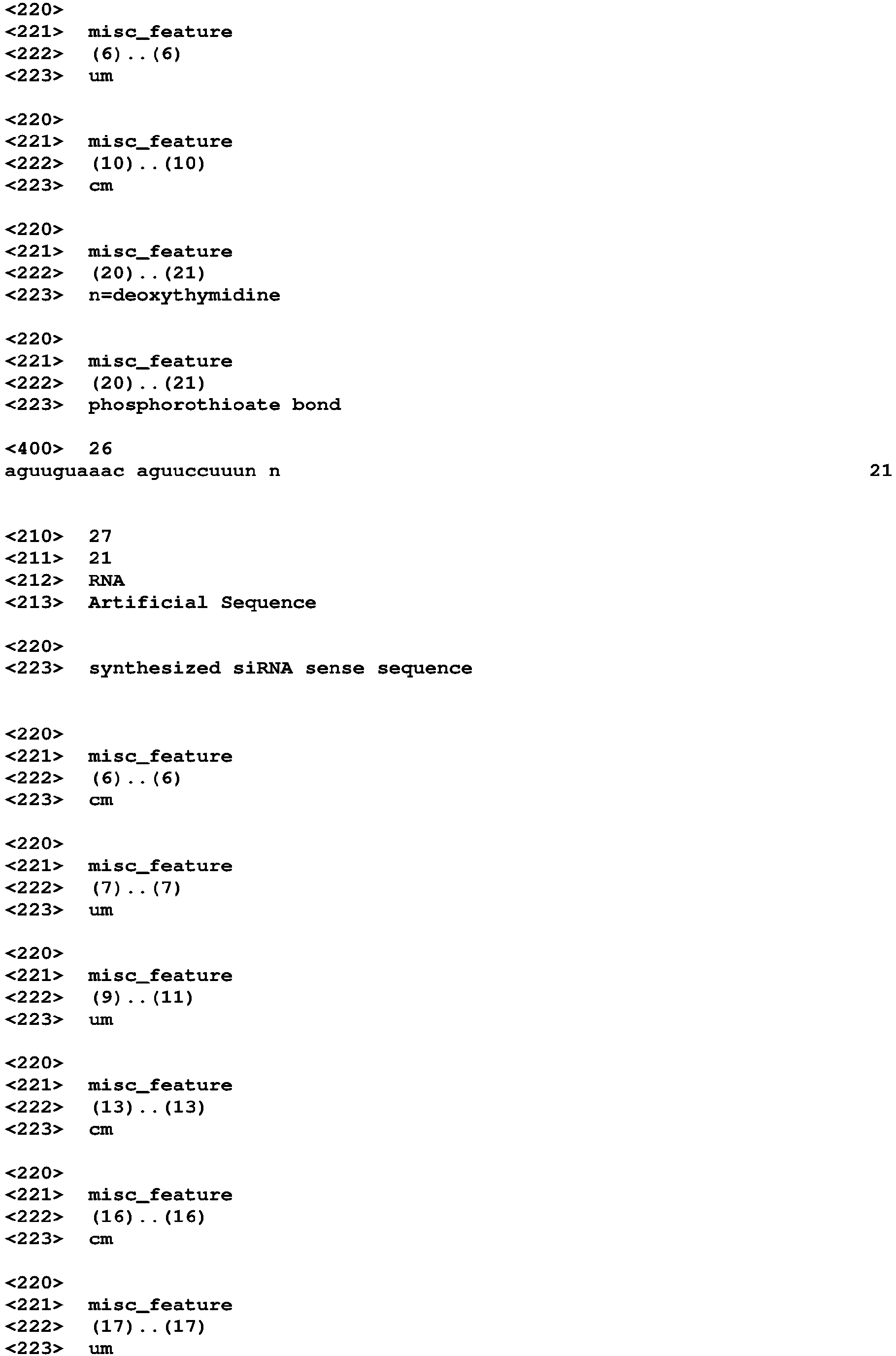

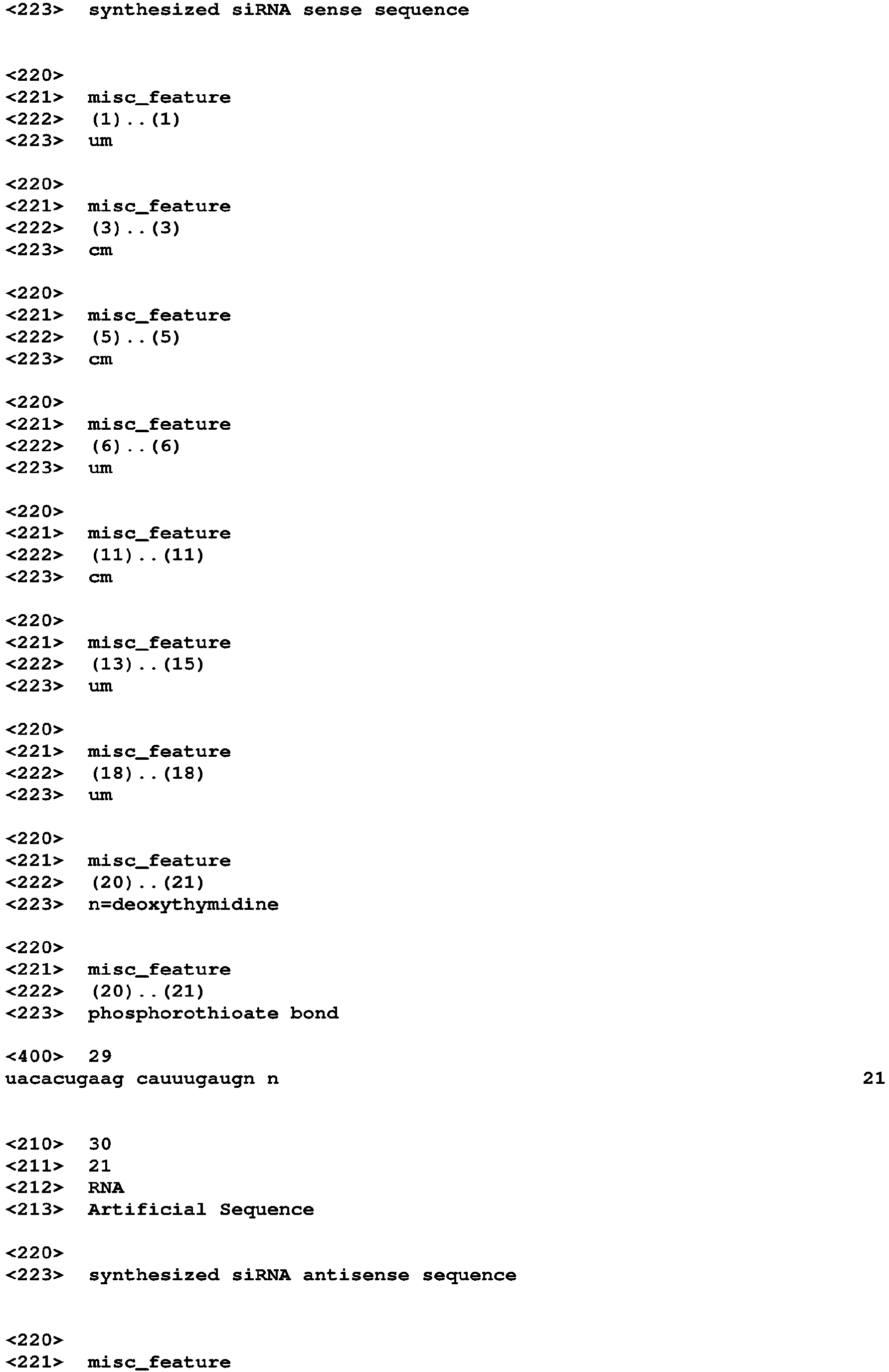


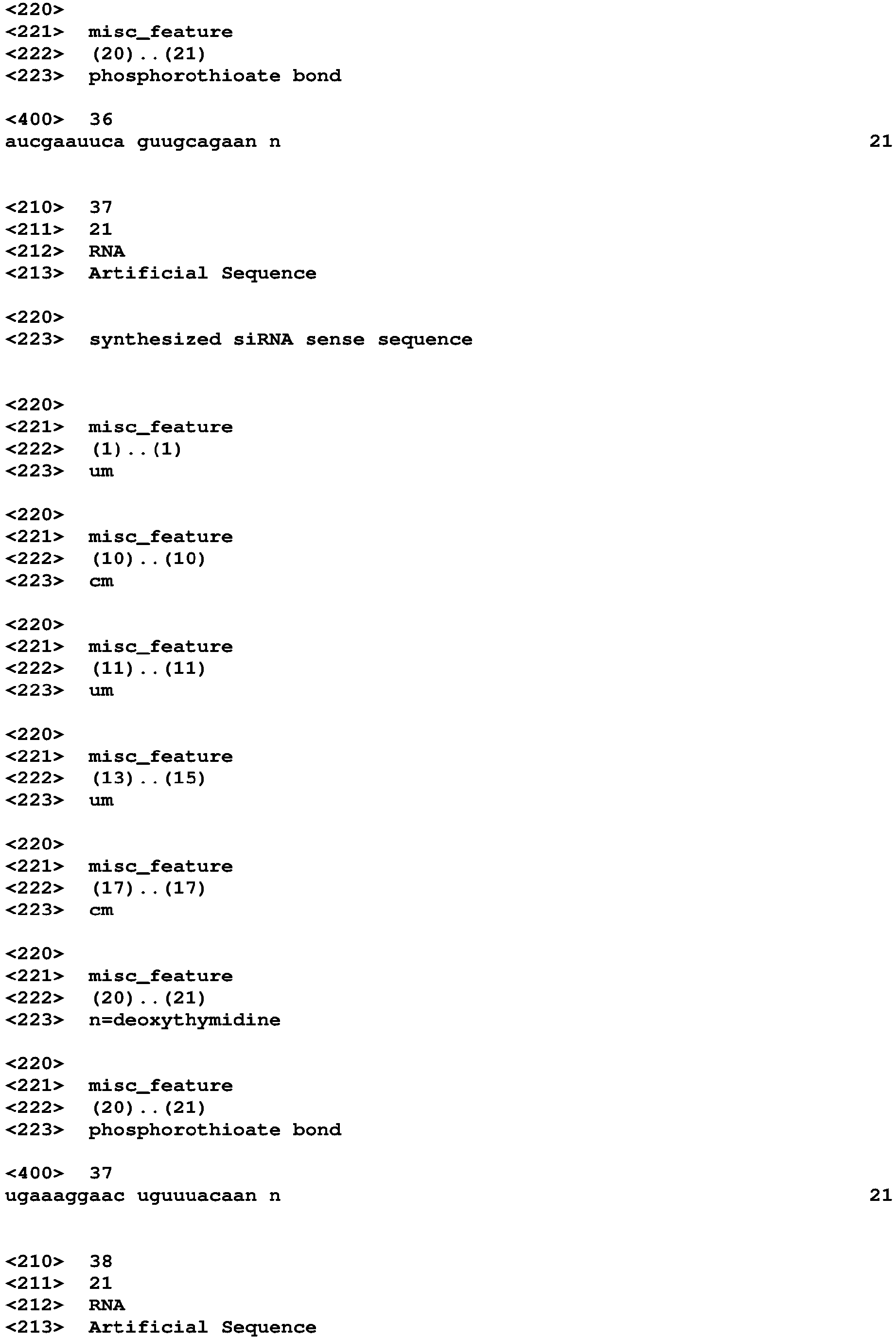


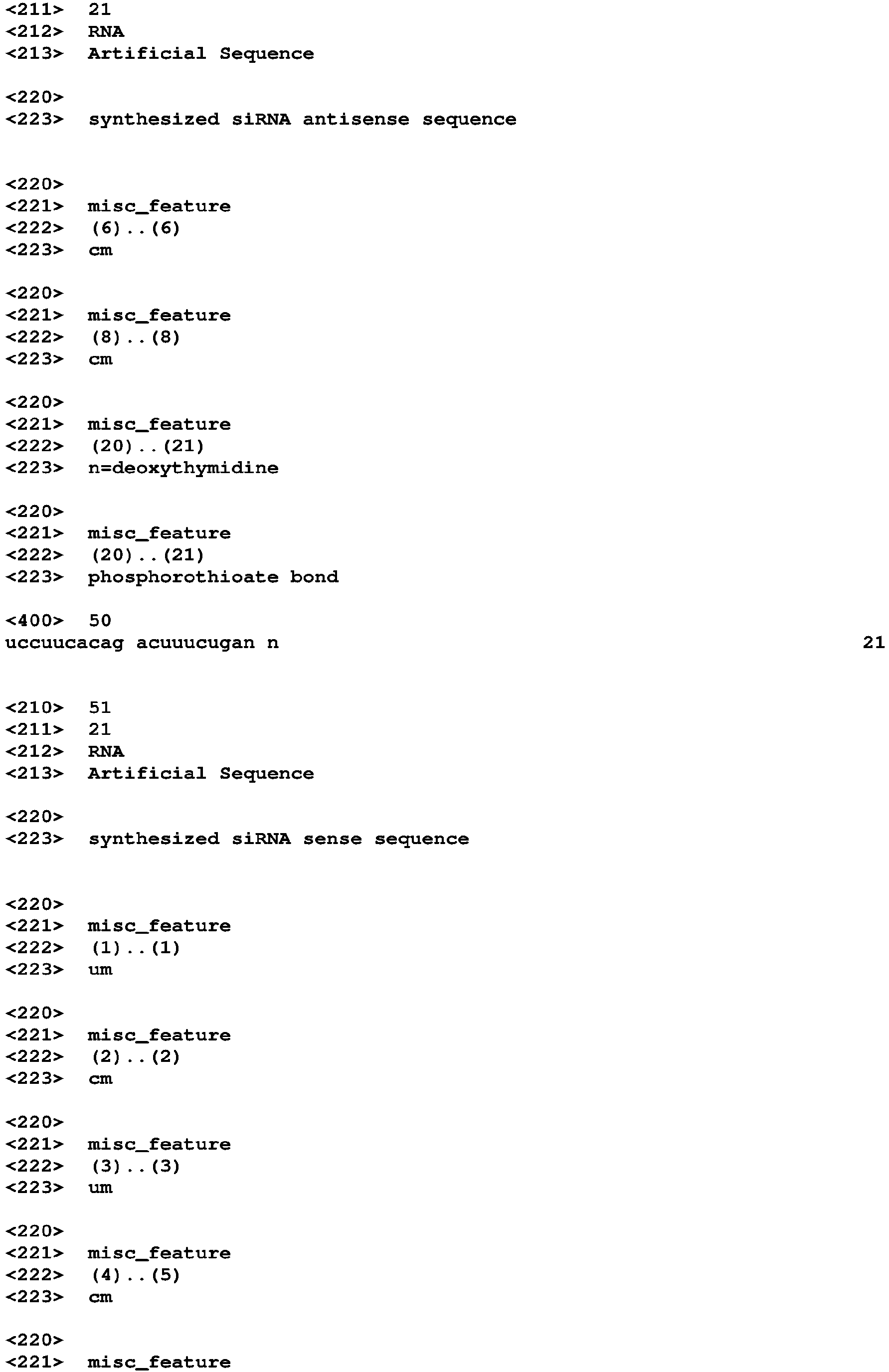


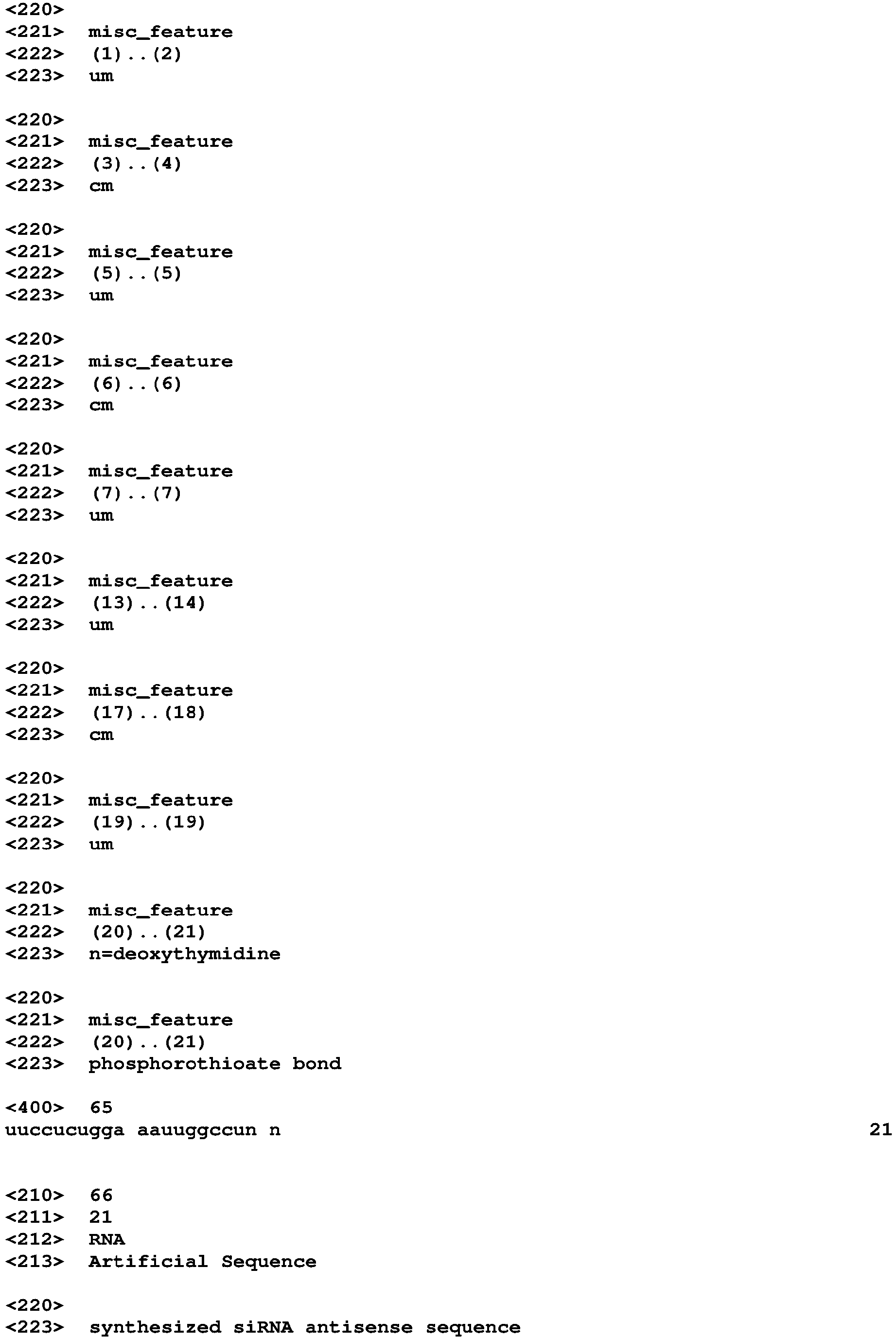


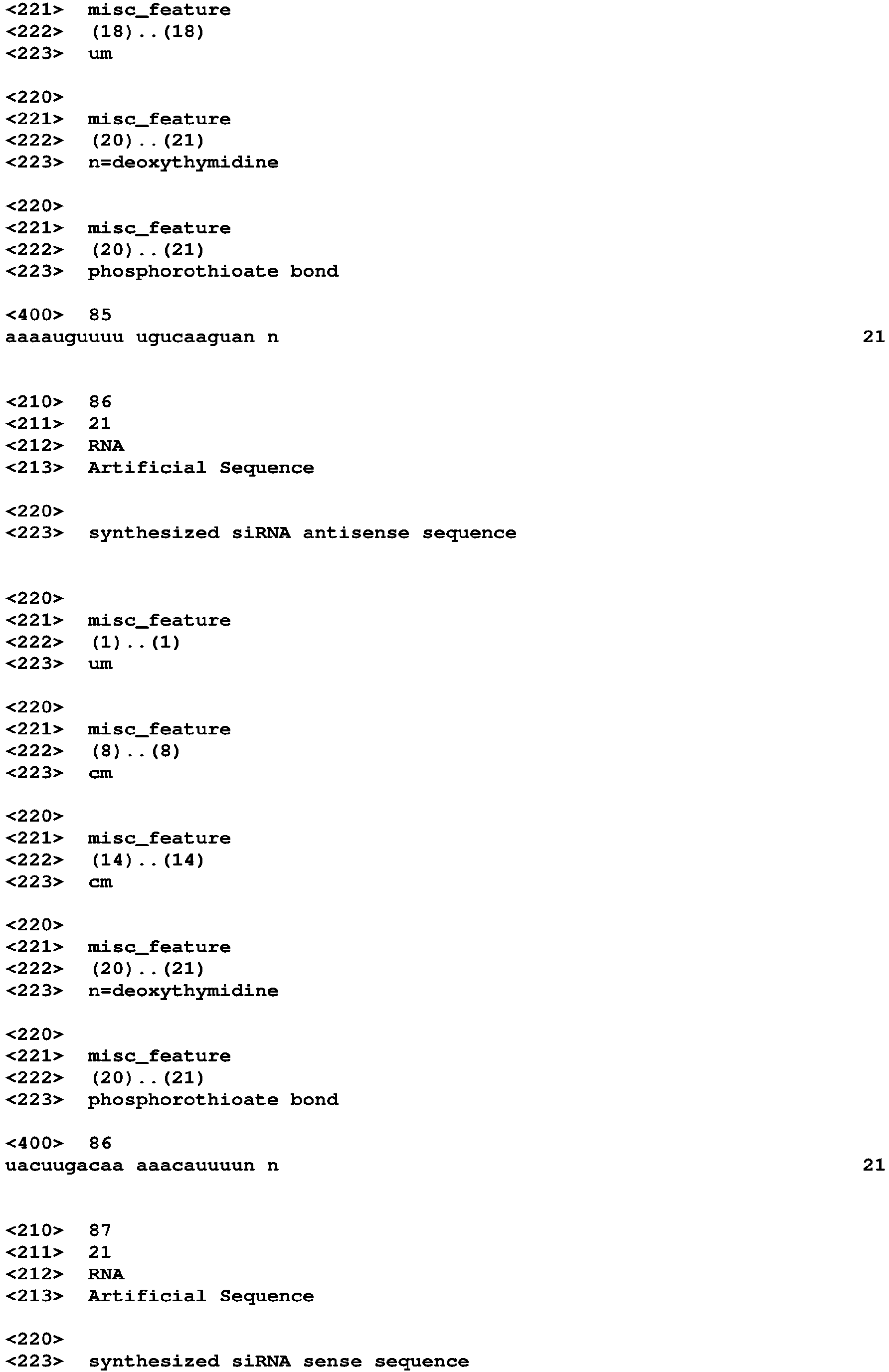

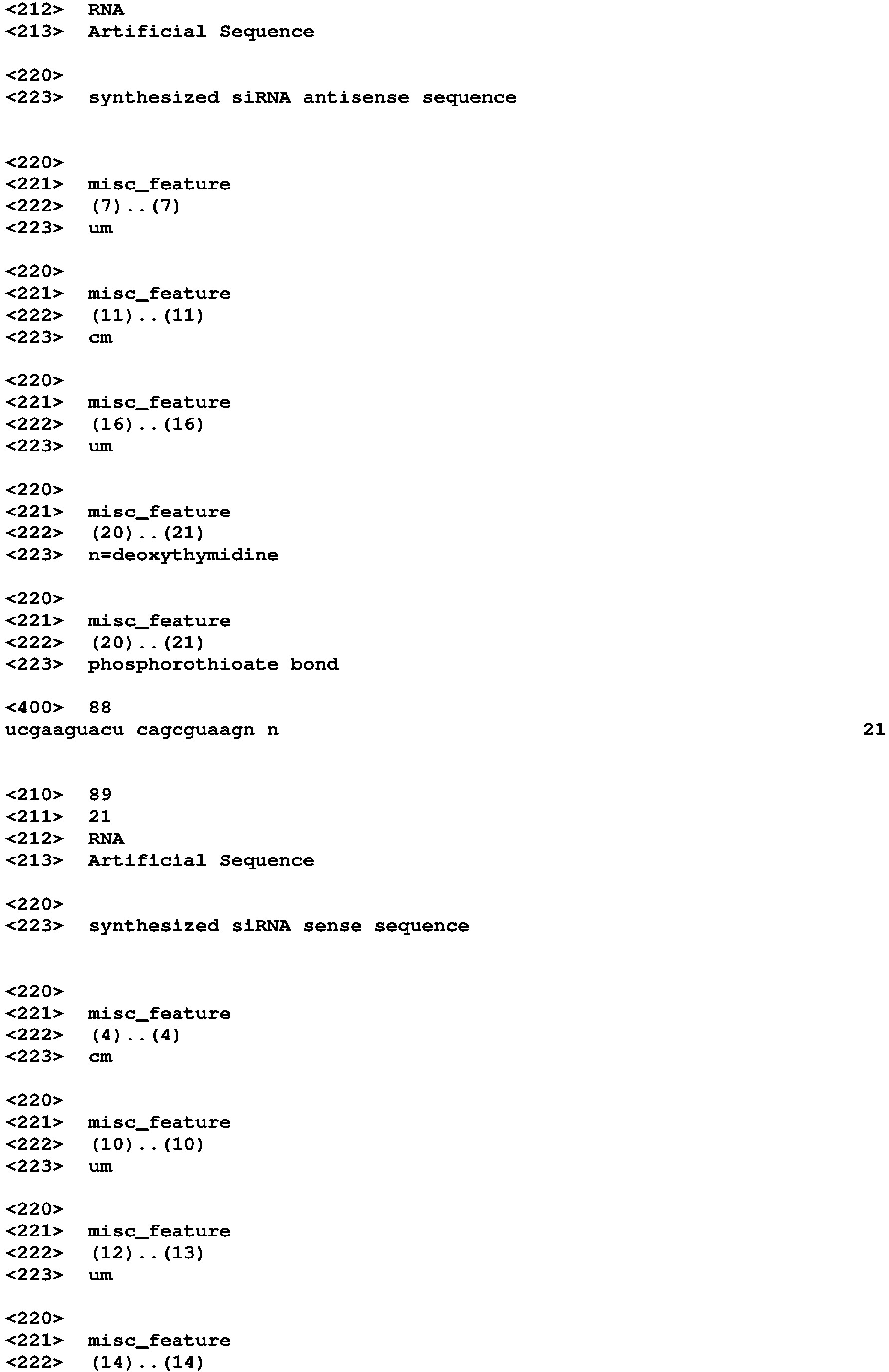


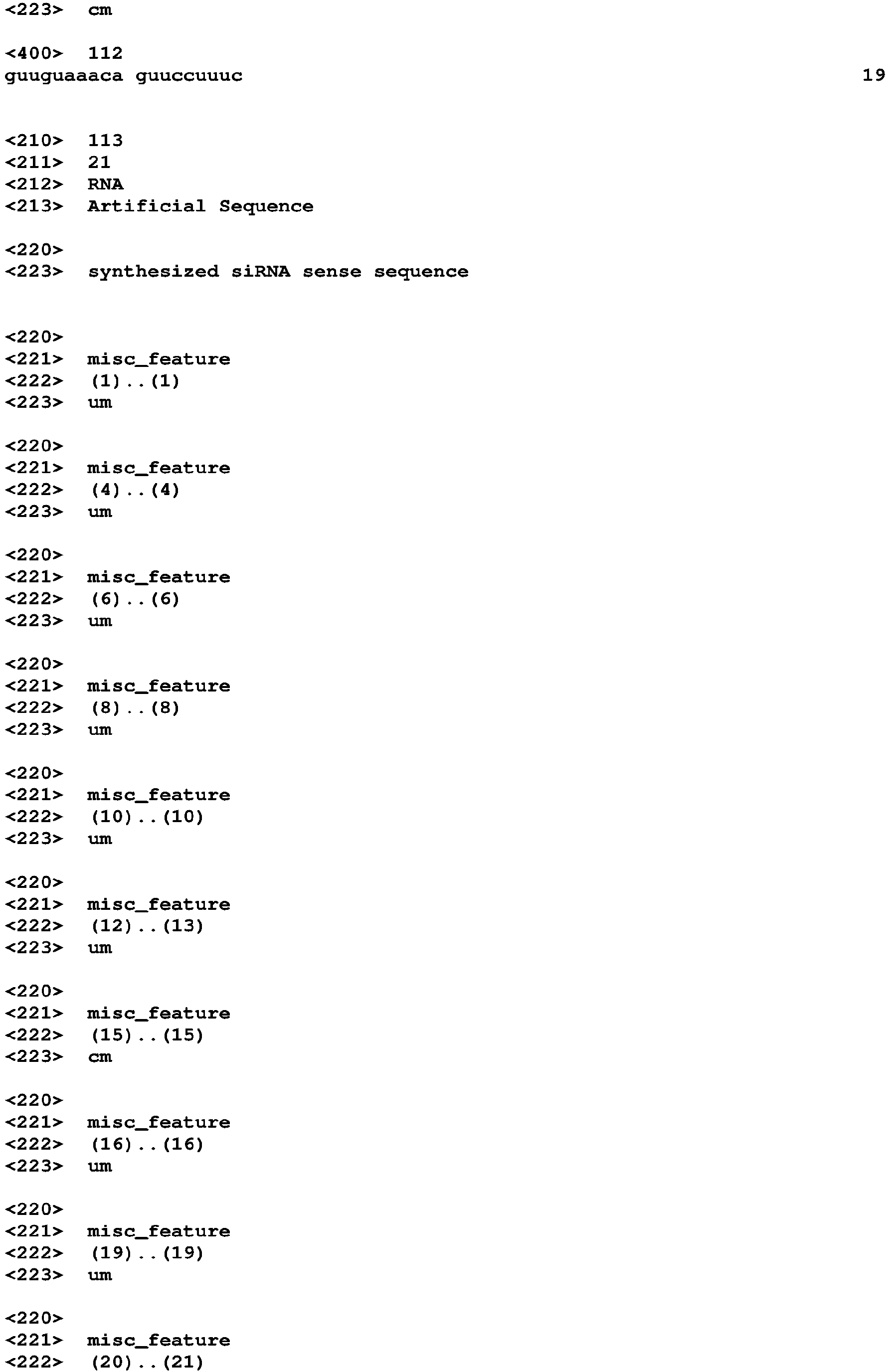


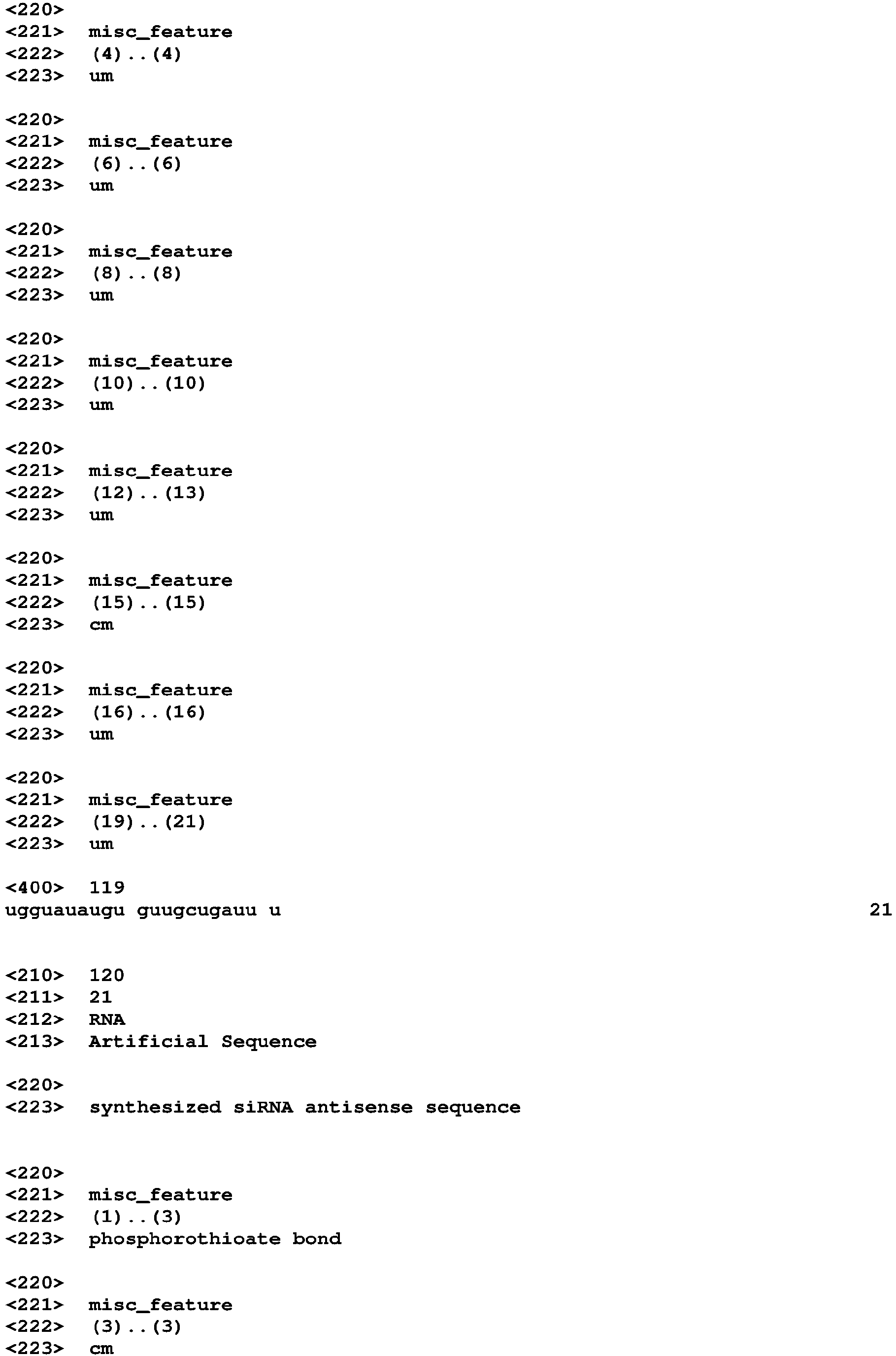


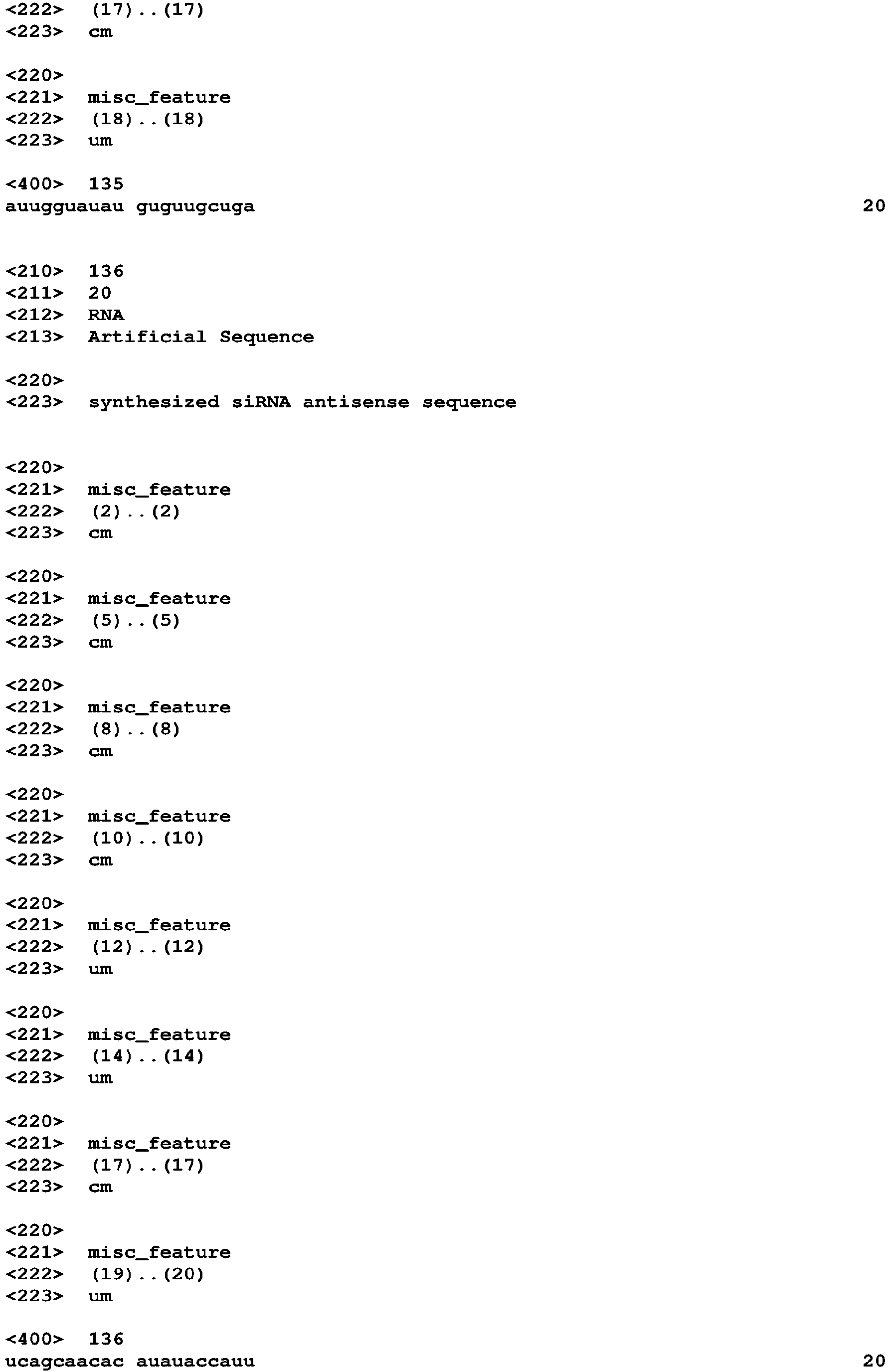


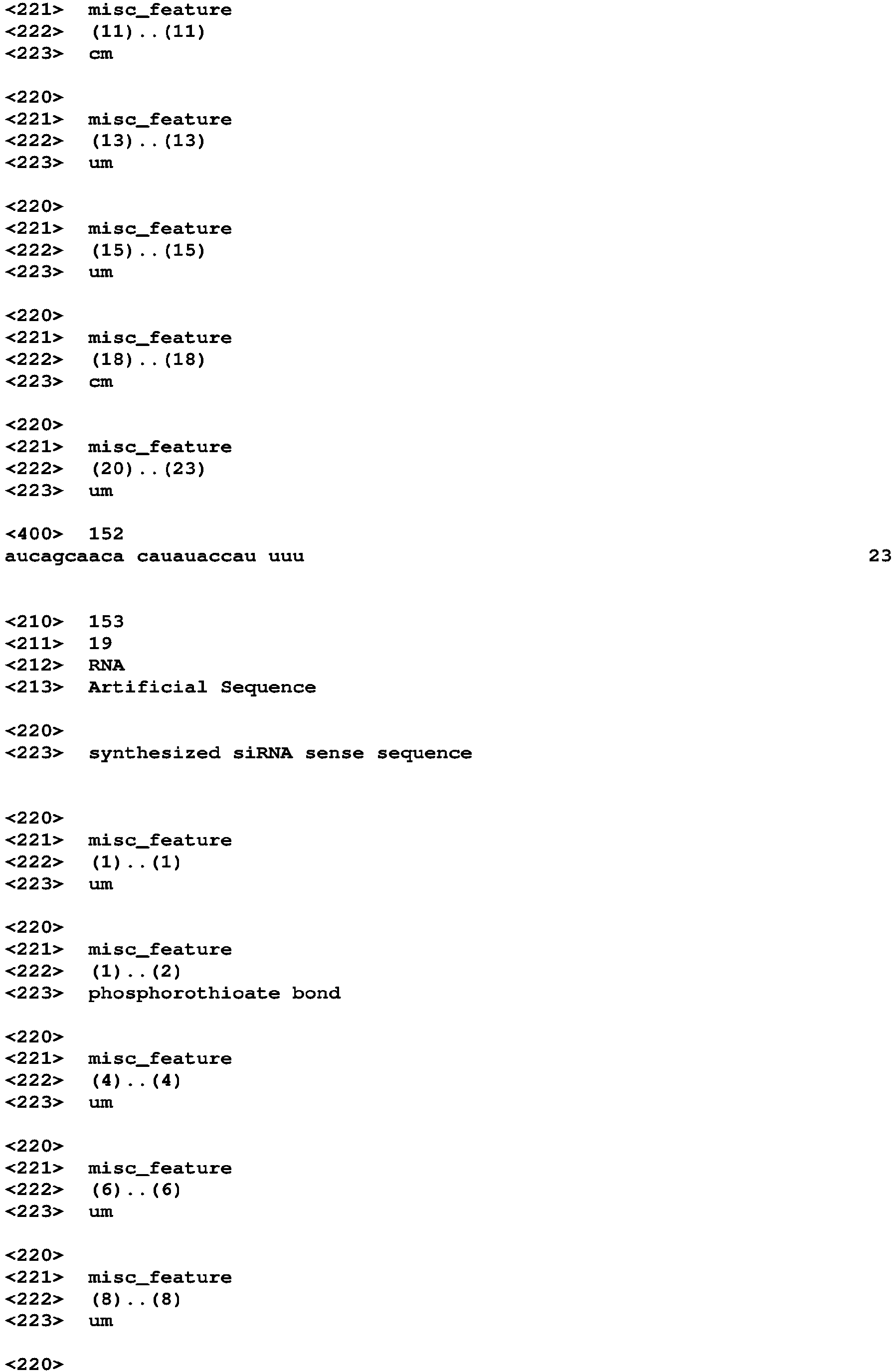


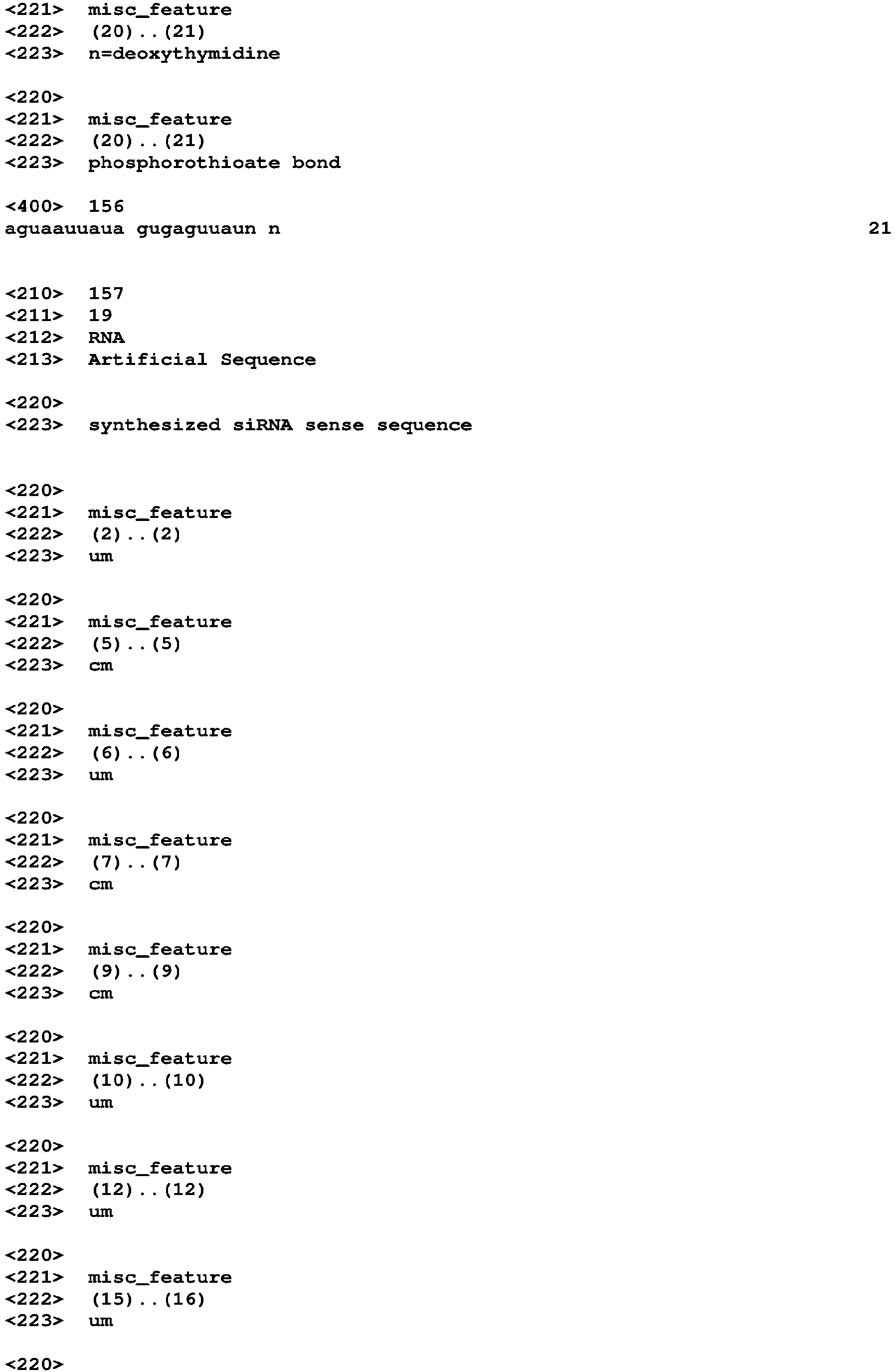


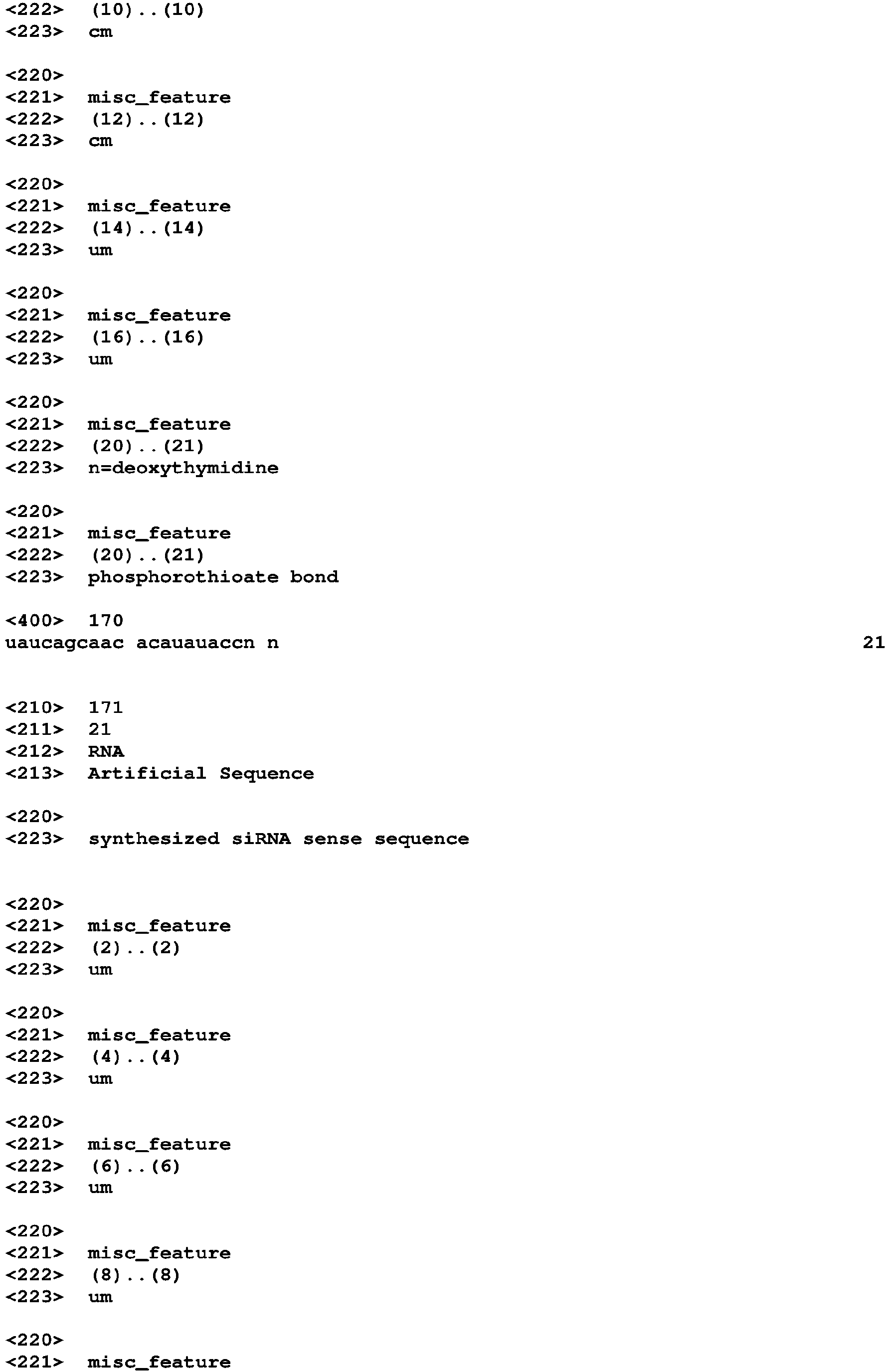


Claims (16)
- A double-stranded ribonucleic acid comprising:a combination of a sense strand and an antisense strand,wherein the combination of the sense strand and the antisense strand are selected from the group consisting of combinations:
SEQ ID NO: 159 and SEQ ID NO: 160; SEQ ID NO: 141 and SEQ ID NO: 142; SEQ ID NO: 143 and SEQ ID NO: 144; SEQ ID NO: 145 and SEQ ID NO: 146; SEQ ID NO: 147 and SEQ ID NO: 148; and SEQ ID NO: 153 and SEQ ID NO: 154. - A double-stranded ribonucleic acid comprising a sense strand of SEQ ID NO: 159; and an antisense strand of SEQ ID NO: 160.
- A double-stranded ribonucleic acid comprising a sense strand of SEQ ID NO: 141; and an antisense strand of SEQ ID NO: 142.
- A double-stranded ribonucleic acid comprising a sense strand of SEQ ID NO: 143; and an antisense strand of SEQ ID NO: 144.
- A double-stranded ribonucleic acid comprising a sense strand of SEQ ID NO: 145; and an antisense strand of SEQ ID NO: 146.
- A double-stranded ribonucleic acid comprising a sense strand of SEQ ID NO: 147; and an antisense strand of SEQ ID NO: 148.
- A double-stranded ribonucleic acid comprising a sense strand of SEQ ID NO: 153; and an antisense strand of SEQ ID NO: 154.
- A pharmaceutical composition comprising:
the double-stranded ribonucleic acid according to any one of claims 1 to 7. - The pharmaceutical composition according to claim 8, for treating paroxysmal nocturnal hemoglobinuria.
- The pharmaceutical composition according to claim 8, for treating atypical hemolytic uremic syndrome.
- A lipid complex encapsulating the double-stranded ribonucleic acid according to any one of claims 1 to 7.
- The lipid complex according to claim 11, comprising:a cationic lipid; andat least one lipid selected from the group consisting of neutral lipid, polyethylene glycol-modified lipid, and sterol.
- The lipid complex according to claim 12, wherein the cationic lipid is 2- {9-oxo-9-[(3-pentyloctyl)oxy]nonyl} dodecyl 1-methylpiperidine-4-carboxylate.
- A pharmaceutical composition comprising:
the lipid complex according to any one of claims 11 to 13. - The pharmaceutical composition according to claim 14, for treating paroxysmal nocturnal hemoglobinuria.
- The pharmaceutical composition according to claim 14, for treating atypical hemolytic uremic syndrome.
Applications Claiming Priority (3)
| Application Number | Priority Date | Filing Date | Title |
|---|---|---|---|
| JP2018201777 | 2018-10-26 | ||
| US16/354,916 US10526603B1 (en) | 2018-10-26 | 2019-03-15 | Double-stranded ribonucleic acid capable of suppressing expression of complement C5 |
| PCT/JP2019/041783 WO2020085456A1 (en) | 2018-10-26 | 2019-10-24 | Double-stranded ribonucleic acid inhibiting expression of complement c5 |
Publications (3)
| Publication Number | Publication Date |
|---|---|
| EP3871680A1 true EP3871680A1 (en) | 2021-09-01 |
| EP3871680A4 EP3871680A4 (en) | 2022-09-21 |
| EP3871680B1 EP3871680B1 (en) | 2024-03-20 |
Family
ID=69058781
Family Applications (1)
| Application Number | Title | Priority Date | Filing Date |
|---|---|---|---|
| EP19876529.9A Active EP3871680B1 (en) | 2018-10-26 | 2019-10-24 | Double-stranded ribonucleic acid inhibiting expression of complement c5 |
Country Status (20)
| Country | Link |
|---|---|
| US (1) | US10526603B1 (en) |
| EP (1) | EP3871680B1 (en) |
| JP (1) | JP6725776B1 (en) |
| KR (1) | KR20210086608A (en) |
| CN (1) | CN112771163B (en) |
| AR (1) | AR116832A1 (en) |
| AU (1) | AU2019367536A1 (en) |
| BR (1) | BR112021006520A2 (en) |
| CA (1) | CA3115249A1 (en) |
| CL (2) | CL2021000826A1 (en) |
| CO (1) | CO2021004029A2 (en) |
| IL (1) | IL281902B (en) |
| JO (1) | JOP20210066A1 (en) |
| MX (1) | MX2021003910A (en) |
| PE (1) | PE20210811A1 (en) |
| PH (1) | PH12021550736A1 (en) |
| SG (1) | SG11202102881PA (en) |
| TW (2) | TWI718717B (en) |
| WO (1) | WO2020085456A1 (en) |
| ZA (1) | ZA202102104B (en) |
Cited By (1)
| Publication number | Priority date | Publication date | Assignee | Title |
|---|---|---|---|---|
| EP4052710A4 (en) * | 2019-12-26 | 2024-02-28 | Eisai R&D Management Co., Ltd. | PHARMACEUTICAL COMPOSITION CONTAINING DOUBLE STRANDED RIBONUCLEIC ACID FOR INHIBITING EXPRESSION OF COMPLEMENT C5 |
Families Citing this family (5)
| Publication number | Priority date | Publication date | Assignee | Title |
|---|---|---|---|---|
| JP6918197B2 (en) * | 2019-12-26 | 2021-08-11 | エーザイ・アール・アンド・ディー・マネジメント株式会社 | Pharmaceutical composition containing lipid complex and pharmaceutical composition containing lipid nanoparticles |
| WO2021154941A1 (en) * | 2020-01-31 | 2021-08-05 | Alnylam Pharmaceuticals, Inc. | Complement component c5 irna compositions for use in the treatment of amyotrophic lateral sclerosis (als) |
| WO2023245126A2 (en) * | 2022-06-15 | 2023-12-21 | Sirnaomics, Inc. | Products and compositions |
| WO2024169908A1 (en) * | 2023-02-17 | 2024-08-22 | 苏州时安生物技术有限公司 | Sirna for regulating expression of complement c5, and conjugate, pharmaceutical composition, and use thereof |
| CN118773195A (en) * | 2023-06-16 | 2024-10-15 | 施能康医药科技(苏州)有限公司 | Nucleic acids targeting complement component 5 and uses thereof |
Family Cites Families (8)
| Publication number | Priority date | Publication date | Assignee | Title |
|---|---|---|---|---|
| ME03043B (en) | 2013-03-14 | 2018-10-20 | Alnylam Pharmaceuticals Inc | IRNK ASSEMBLES C5 COMPLEMENT COMPONENTS AND METHODS FOR THEIR USE |
| CN105916839B (en) | 2014-01-09 | 2018-09-18 | 卫材R&D管理有限公司 | cationic lipid |
| WO2016044419A1 (en) | 2014-09-16 | 2016-03-24 | Alnylam Pharmaceuticals, Inc. | Complement component c5 irna compositions and methods of use thereof |
| EP3239132B1 (en) | 2014-12-26 | 2019-03-06 | Eisai R&D Management Co., Ltd. | Cationic lipid |
| US10036017B2 (en) | 2015-02-17 | 2018-07-31 | Dicerna Pharmaceuticals, Inc. | Methods and compositions for the specific inhibition of complement component 5(C5) by double-stranded RNA |
| WO2016201301A1 (en) * | 2015-06-12 | 2016-12-15 | Alnylam Pharmaceuticals, Inc. | Complement component c5 irna compositions and methods of use thereof |
| WO2017214518A1 (en) * | 2016-06-10 | 2017-12-14 | Alnylam Pharmaceuticals, Inc. | COMPLETMENT COMPONENT C5 iRNA COMPOSTIONS AND METHODS OF USE THEREOF FOR TREATING PAROXYSMAL NOCTURNAL HEMOGLOBINURIA (PNH) |
| WO2017222016A1 (en) * | 2016-06-24 | 2017-12-28 | エーザイ・アール・アンド・ディー・マネジメント株式会社 | Cationic lipid |
-
2019
- 2019-03-15 US US16/354,916 patent/US10526603B1/en active Active
- 2019-10-24 JP JP2020500919A patent/JP6725776B1/en active Active
- 2019-10-24 WO PCT/JP2019/041783 patent/WO2020085456A1/en not_active Ceased
- 2019-10-24 AU AU2019367536A patent/AU2019367536A1/en not_active Withdrawn
- 2019-10-24 SG SG11202102881PA patent/SG11202102881PA/en unknown
- 2019-10-24 MX MX2021003910A patent/MX2021003910A/en unknown
- 2019-10-24 PE PE2021000444A patent/PE20210811A1/en unknown
- 2019-10-24 TW TW108138380A patent/TWI718717B/en not_active IP Right Cessation
- 2019-10-24 KR KR1020217009379A patent/KR20210086608A/en not_active Withdrawn
- 2019-10-24 BR BR112021006520A patent/BR112021006520A2/en not_active IP Right Cessation
- 2019-10-24 AR ARP190103059A patent/AR116832A1/en not_active Application Discontinuation
- 2019-10-24 EP EP19876529.9A patent/EP3871680B1/en active Active
- 2019-10-24 CN CN201980063326.XA patent/CN112771163B/en active Active
- 2019-10-24 IL IL281902A patent/IL281902B/en unknown
- 2019-10-24 CA CA3115249A patent/CA3115249A1/en active Pending
- 2019-10-24 TW TW110101897A patent/TWI818225B/en not_active IP Right Cessation
-
2021
- 2021-03-29 ZA ZA2021/02104A patent/ZA202102104B/en unknown
- 2021-03-30 CO CONC2021/0004029A patent/CO2021004029A2/en unknown
- 2021-03-31 CL CL2021000826A patent/CL2021000826A1/en unknown
- 2021-04-02 PH PH12021550736A patent/PH12021550736A1/en unknown
- 2021-04-06 JO JOP/2021/0066A patent/JOP20210066A1/en unknown
-
2023
- 2023-07-03 CL CL2023001965A patent/CL2023001965A1/en unknown
Cited By (2)
| Publication number | Priority date | Publication date | Assignee | Title |
|---|---|---|---|---|
| EP4052710A4 (en) * | 2019-12-26 | 2024-02-28 | Eisai R&D Management Co., Ltd. | PHARMACEUTICAL COMPOSITION CONTAINING DOUBLE STRANDED RIBONUCLEIC ACID FOR INHIBITING EXPRESSION OF COMPLEMENT C5 |
| US12447173B2 (en) | 2019-12-26 | 2025-10-21 | Eisai R&D Management Co., Ltd. | Pharmaceutical composition containing double-stranded ribonucleic acid inhibiting expression of complement C5 |
Also Published As
| Publication number | Publication date |
|---|---|
| MX2021003910A (en) | 2021-06-04 |
| KR20210086608A (en) | 2021-07-08 |
| PH12021550736A1 (en) | 2021-10-25 |
| AR116832A1 (en) | 2021-06-16 |
| TWI818225B (en) | 2023-10-11 |
| CN112771163A (en) | 2021-05-07 |
| AU2019367536A1 (en) | 2021-04-29 |
| EP3871680A4 (en) | 2022-09-21 |
| CA3115249A1 (en) | 2020-04-30 |
| IL281902B (en) | 2022-09-01 |
| JPWO2020085456A1 (en) | 2021-02-15 |
| TW202031269A (en) | 2020-09-01 |
| BR112021006520A2 (en) | 2021-07-06 |
| TWI718717B (en) | 2021-02-11 |
| IL281902A (en) | 2021-05-31 |
| CL2021000826A1 (en) | 2021-09-10 |
| SG11202102881PA (en) | 2021-04-29 |
| ZA202102104B (en) | 2022-08-31 |
| US10526603B1 (en) | 2020-01-07 |
| CO2021004029A2 (en) | 2021-04-30 |
| EP3871680B1 (en) | 2024-03-20 |
| JP6725776B1 (en) | 2020-07-22 |
| TW202135833A (en) | 2021-10-01 |
| CN112771163B (en) | 2024-07-12 |
| CL2023001965A1 (en) | 2023-12-15 |
| JOP20210066A1 (en) | 2021-04-06 |
| PE20210811A1 (en) | 2021-04-28 |
| WO2020085456A1 (en) | 2020-04-30 |
Similar Documents
| Publication | Publication Date | Title |
|---|---|---|
| EP3871680B1 (en) | Double-stranded ribonucleic acid inhibiting expression of complement c5 | |
| EP3920889B1 (en) | Telomerase-containing exosomes for treatment of diseases associated with aging and age-related organ dysfunction | |
| EP4520349A1 (en) | Interfering rna for inhibiting b7-h3 gene expression and use thereof | |
| EP1842558A1 (en) | Composition for inhibiting expression of target gene | |
| WO2018117253A1 (en) | Nucleic acid inhibiting expression of complement factor b | |
| WO2017135397A1 (en) | Antisense oligonucleotide for suppressing expression of complement b factor | |
| JP6918197B2 (en) | Pharmaceutical composition containing lipid complex and pharmaceutical composition containing lipid nanoparticles | |
| US12447173B2 (en) | Pharmaceutical composition containing double-stranded ribonucleic acid inhibiting expression of complement C5 | |
| RU2781954C1 (en) | Double-stranded ribonucleic acid inhibiting expression of c5 complement component | |
| JP7585166B2 (en) | Substance delivery carriers and compositions | |
| RU2833504C1 (en) | Pharmaceutical composition containing double-stranded ribonucleic acid inhibiting expression of complement component c5 | |
| HK40045225A (en) | Double-stranded ribonucleic acid inhibiting expression of complement c5 | |
| EP3095867A1 (en) | Nucleic acid capable of inhibiting expression of beta2gpi | |
| WO2025148349A9 (en) | Dsrna for inhibiting c5 gene expression and use thereof | |
| US20150045410A1 (en) | Method of regulating cftr expression and processing |
Legal Events
| Date | Code | Title | Description |
|---|---|---|---|
| STAA | Information on the status of an ep patent application or granted ep patent |
Free format text: STATUS: THE INTERNATIONAL PUBLICATION HAS BEEN MADE |
|
| PUAI | Public reference made under article 153(3) epc to a published international application that has entered the european phase |
Free format text: ORIGINAL CODE: 0009012 |
|
| STAA | Information on the status of an ep patent application or granted ep patent |
Free format text: STATUS: REQUEST FOR EXAMINATION WAS MADE |
|
| 17P | Request for examination filed |
Effective date: 20210401 |
|
| AK | Designated contracting states |
Kind code of ref document: A1 Designated state(s): AL AT BE BG CH CY CZ DE DK EE ES FI FR GB GR HR HU IE IS IT LI LT LU LV MC MK MT NL NO PL PT RO RS SE SI SK SM TR |
|
| REG | Reference to a national code |
Free format text: PREVIOUS MAIN CLASS: A61K0031713000 Ref country code: DE Ref legal event code: R079 Ref document number: 602019048790 Country of ref document: DE Ipc: C12N0015113000 |
|
| A4 | Supplementary search report drawn up and despatched |
Effective date: 20220819 |
|
| RIC1 | Information provided on ipc code assigned before grant |
Ipc: A61P 7/00 20060101ALN20220815BHEP Ipc: A61K 31/7125 20060101ALI20220815BHEP Ipc: A61K 31/712 20060101ALI20220815BHEP Ipc: A61K 47/56 20170101ALI20220815BHEP Ipc: A61K 47/54 20170101ALI20220815BHEP Ipc: A61K 47/34 20170101ALI20220815BHEP Ipc: A61K 47/28 20060101ALI20220815BHEP Ipc: A61K 47/24 20060101ALI20220815BHEP Ipc: A61K 47/22 20060101ALI20220815BHEP Ipc: A61K 9/127 20060101ALI20220815BHEP Ipc: A61P 43/00 20060101ALI20220815BHEP Ipc: A61P 13/00 20060101ALI20220815BHEP Ipc: A61K 31/713 20060101ALI20220815BHEP Ipc: C12N 15/113 20100101AFI20220815BHEP |
|
| P01 | Opt-out of the competence of the unified patent court (upc) registered |
Effective date: 20230511 |
|
| RIC1 | Information provided on ipc code assigned before grant |
Ipc: A61P 7/00 20060101ALN20230810BHEP Ipc: A61K 31/7125 20060101ALI20230810BHEP Ipc: A61K 31/712 20060101ALI20230810BHEP Ipc: A61K 47/56 20170101ALI20230810BHEP Ipc: A61K 47/54 20170101ALI20230810BHEP Ipc: A61K 47/34 20170101ALI20230810BHEP Ipc: A61K 47/28 20060101ALI20230810BHEP Ipc: A61K 47/24 20060101ALI20230810BHEP Ipc: A61K 47/22 20060101ALI20230810BHEP Ipc: A61K 9/127 20060101ALI20230810BHEP Ipc: A61P 43/00 20060101ALI20230810BHEP Ipc: A61P 13/00 20060101ALI20230810BHEP Ipc: A61K 31/713 20060101ALI20230810BHEP Ipc: C12N 15/113 20100101AFI20230810BHEP |
|
| RIC1 | Information provided on ipc code assigned before grant |
Ipc: A61P 7/00 20060101ALN20230811BHEP Ipc: A61K 31/7125 20060101ALI20230811BHEP Ipc: A61K 31/712 20060101ALI20230811BHEP Ipc: A61K 47/56 20170101ALI20230811BHEP Ipc: A61K 47/54 20170101ALI20230811BHEP Ipc: A61K 47/34 20170101ALI20230811BHEP Ipc: A61K 47/28 20060101ALI20230811BHEP Ipc: A61K 47/24 20060101ALI20230811BHEP Ipc: A61K 47/22 20060101ALI20230811BHEP Ipc: A61K 9/127 20060101ALI20230811BHEP Ipc: A61P 43/00 20060101ALI20230811BHEP Ipc: A61P 13/00 20060101ALI20230811BHEP Ipc: A61K 31/713 20060101ALI20230811BHEP Ipc: C12N 15/113 20100101AFI20230811BHEP |
|
| GRAP | Despatch of communication of intention to grant a patent |
Free format text: ORIGINAL CODE: EPIDOSNIGR1 |
|
| RIC1 | Information provided on ipc code assigned before grant |
Ipc: A61P 7/00 20060101ALN20230830BHEP Ipc: A61K 31/7125 20060101ALI20230830BHEP Ipc: A61K 31/712 20060101ALI20230830BHEP Ipc: A61K 47/56 20170101ALI20230830BHEP Ipc: A61K 47/54 20170101ALI20230830BHEP Ipc: A61K 47/34 20170101ALI20230830BHEP Ipc: A61K 47/28 20060101ALI20230830BHEP Ipc: A61K 47/24 20060101ALI20230830BHEP Ipc: A61K 47/22 20060101ALI20230830BHEP Ipc: A61K 9/127 20060101ALI20230830BHEP Ipc: A61P 43/00 20060101ALI20230830BHEP Ipc: A61P 13/00 20060101ALI20230830BHEP Ipc: A61K 31/713 20060101ALI20230830BHEP Ipc: C12N 15/113 20100101AFI20230830BHEP |
|
| STAA | Information on the status of an ep patent application or granted ep patent |
Free format text: STATUS: GRANT OF PATENT IS INTENDED |
|
| RIC1 | Information provided on ipc code assigned before grant |
Ipc: A61P 7/00 20060101ALN20230907BHEP Ipc: A61K 31/7125 20060101ALI20230907BHEP Ipc: A61K 31/712 20060101ALI20230907BHEP Ipc: A61K 47/56 20170101ALI20230907BHEP Ipc: A61K 47/54 20170101ALI20230907BHEP Ipc: A61K 47/34 20170101ALI20230907BHEP Ipc: A61K 47/28 20060101ALI20230907BHEP Ipc: A61K 47/24 20060101ALI20230907BHEP Ipc: A61K 47/22 20060101ALI20230907BHEP Ipc: A61K 9/127 20060101ALI20230907BHEP Ipc: A61P 43/00 20060101ALI20230907BHEP Ipc: A61P 13/00 20060101ALI20230907BHEP Ipc: A61K 31/713 20060101ALI20230907BHEP Ipc: C12N 15/113 20100101AFI20230907BHEP |
|
| RIC1 | Information provided on ipc code assigned before grant |
Ipc: A61P 7/00 20060101ALN20230914BHEP Ipc: A61K 31/7125 20060101ALI20230914BHEP Ipc: A61K 31/712 20060101ALI20230914BHEP Ipc: A61K 47/56 20170101ALI20230914BHEP Ipc: A61K 47/54 20170101ALI20230914BHEP Ipc: A61K 47/34 20170101ALI20230914BHEP Ipc: A61K 47/28 20060101ALI20230914BHEP Ipc: A61K 47/24 20060101ALI20230914BHEP Ipc: A61K 47/22 20060101ALI20230914BHEP Ipc: A61K 9/127 20060101ALI20230914BHEP Ipc: A61P 43/00 20060101ALI20230914BHEP Ipc: A61P 13/00 20060101ALI20230914BHEP Ipc: A61K 31/713 20060101ALI20230914BHEP Ipc: C12N 15/113 20100101AFI20230914BHEP |
|
| RIC1 | Information provided on ipc code assigned before grant |
Ipc: A61P 7/00 20060101ALN20230921BHEP Ipc: A61K 31/7125 20060101ALI20230921BHEP Ipc: A61K 31/712 20060101ALI20230921BHEP Ipc: A61K 47/56 20170101ALI20230921BHEP Ipc: A61K 47/54 20170101ALI20230921BHEP Ipc: A61K 47/34 20170101ALI20230921BHEP Ipc: A61K 47/28 20060101ALI20230921BHEP Ipc: A61K 47/24 20060101ALI20230921BHEP Ipc: A61K 47/22 20060101ALI20230921BHEP Ipc: A61K 9/127 20060101ALI20230921BHEP Ipc: A61P 43/00 20060101ALI20230921BHEP Ipc: A61P 13/00 20060101ALI20230921BHEP Ipc: A61K 31/713 20060101ALI20230921BHEP Ipc: C12N 15/113 20100101AFI20230921BHEP |
|
| INTG | Intention to grant announced |
Effective date: 20231005 |
|
| GRAS | Grant fee paid |
Free format text: ORIGINAL CODE: EPIDOSNIGR3 |
|
| GRAA | (expected) grant |
Free format text: ORIGINAL CODE: 0009210 |
|
| STAA | Information on the status of an ep patent application or granted ep patent |
Free format text: STATUS: THE PATENT HAS BEEN GRANTED |
|
| AK | Designated contracting states |
Kind code of ref document: B1 Designated state(s): AL AT BE BG CH CY CZ DE DK EE ES FI FR GB GR HR HU IE IS IT LI LT LU LV MC MK MT NL NO PL PT RO RS SE SI SK SM TR |
|
| REG | Reference to a national code |
Ref country code: GB Ref legal event code: FG4D |
|
| REG | Reference to a national code |
Ref country code: CH Ref legal event code: EP |
|
| REG | Reference to a national code |
Ref country code: IE Ref legal event code: FG4D |
|
| REG | Reference to a national code |
Ref country code: DE Ref legal event code: R096 Ref document number: 602019048790 Country of ref document: DE |
|
| PG25 | Lapsed in a contracting state [announced via postgrant information from national office to epo] |
Ref country code: LT Free format text: LAPSE BECAUSE OF FAILURE TO SUBMIT A TRANSLATION OF THE DESCRIPTION OR TO PAY THE FEE WITHIN THE PRESCRIBED TIME-LIMIT Effective date: 20240320 |
|
| REG | Reference to a national code |
Ref country code: LT Ref legal event code: MG9D |
|
| PG25 | Lapsed in a contracting state [announced via postgrant information from national office to epo] |
Ref country code: GR Free format text: LAPSE BECAUSE OF FAILURE TO SUBMIT A TRANSLATION OF THE DESCRIPTION OR TO PAY THE FEE WITHIN THE PRESCRIBED TIME-LIMIT Effective date: 20240621 |
|
| PG25 | Lapsed in a contracting state [announced via postgrant information from national office to epo] |
Ref country code: HR Free format text: LAPSE BECAUSE OF FAILURE TO SUBMIT A TRANSLATION OF THE DESCRIPTION OR TO PAY THE FEE WITHIN THE PRESCRIBED TIME-LIMIT Effective date: 20240320 Ref country code: RS Free format text: LAPSE BECAUSE OF FAILURE TO SUBMIT A TRANSLATION OF THE DESCRIPTION OR TO PAY THE FEE WITHIN THE PRESCRIBED TIME-LIMIT Effective date: 20240620 |
|
| REG | Reference to a national code |
Ref country code: NL Ref legal event code: MP Effective date: 20240320 |
|
| PG25 | Lapsed in a contracting state [announced via postgrant information from national office to epo] |
Ref country code: RS Free format text: LAPSE BECAUSE OF FAILURE TO SUBMIT A TRANSLATION OF THE DESCRIPTION OR TO PAY THE FEE WITHIN THE PRESCRIBED TIME-LIMIT Effective date: 20240620 Ref country code: NO Free format text: LAPSE BECAUSE OF FAILURE TO SUBMIT A TRANSLATION OF THE DESCRIPTION OR TO PAY THE FEE WITHIN THE PRESCRIBED TIME-LIMIT Effective date: 20240620 Ref country code: LT Free format text: LAPSE BECAUSE OF FAILURE TO SUBMIT A TRANSLATION OF THE DESCRIPTION OR TO PAY THE FEE WITHIN THE PRESCRIBED TIME-LIMIT Effective date: 20240320 Ref country code: HR Free format text: LAPSE BECAUSE OF FAILURE TO SUBMIT A TRANSLATION OF THE DESCRIPTION OR TO PAY THE FEE WITHIN THE PRESCRIBED TIME-LIMIT Effective date: 20240320 Ref country code: GR Free format text: LAPSE BECAUSE OF FAILURE TO SUBMIT A TRANSLATION OF THE DESCRIPTION OR TO PAY THE FEE WITHIN THE PRESCRIBED TIME-LIMIT Effective date: 20240621 Ref country code: FI Free format text: LAPSE BECAUSE OF FAILURE TO SUBMIT A TRANSLATION OF THE DESCRIPTION OR TO PAY THE FEE WITHIN THE PRESCRIBED TIME-LIMIT Effective date: 20240320 Ref country code: BG Free format text: LAPSE BECAUSE OF FAILURE TO SUBMIT A TRANSLATION OF THE DESCRIPTION OR TO PAY THE FEE WITHIN THE PRESCRIBED TIME-LIMIT Effective date: 20240320 |
|
| REG | Reference to a national code |
Ref country code: AT Ref legal event code: MK05 Ref document number: 1667846 Country of ref document: AT Kind code of ref document: T Effective date: 20240320 |
|
| PG25 | Lapsed in a contracting state [announced via postgrant information from national office to epo] |
Ref country code: SE Free format text: LAPSE BECAUSE OF FAILURE TO SUBMIT A TRANSLATION OF THE DESCRIPTION OR TO PAY THE FEE WITHIN THE PRESCRIBED TIME-LIMIT Effective date: 20240320 Ref country code: LV Free format text: LAPSE BECAUSE OF FAILURE TO SUBMIT A TRANSLATION OF THE DESCRIPTION OR TO PAY THE FEE WITHIN THE PRESCRIBED TIME-LIMIT Effective date: 20240320 |
|
| PG25 | Lapsed in a contracting state [announced via postgrant information from national office to epo] |
Ref country code: NL Free format text: LAPSE BECAUSE OF FAILURE TO SUBMIT A TRANSLATION OF THE DESCRIPTION OR TO PAY THE FEE WITHIN THE PRESCRIBED TIME-LIMIT Effective date: 20240320 |
|
| PG25 | Lapsed in a contracting state [announced via postgrant information from national office to epo] |
Ref country code: NL Free format text: LAPSE BECAUSE OF FAILURE TO SUBMIT A TRANSLATION OF THE DESCRIPTION OR TO PAY THE FEE WITHIN THE PRESCRIBED TIME-LIMIT Effective date: 20240320 |
|
| PG25 | Lapsed in a contracting state [announced via postgrant information from national office to epo] |
Ref country code: IS Free format text: LAPSE BECAUSE OF FAILURE TO SUBMIT A TRANSLATION OF THE DESCRIPTION OR TO PAY THE FEE WITHIN THE PRESCRIBED TIME-LIMIT Effective date: 20240720 |
|
| VS25 | Lapsed in a validation state [announced via postgrant information from nat. office to epo] |
Ref country code: MD Free format text: LAPSE BECAUSE OF FAILURE TO SUBMIT A TRANSLATION OF THE DESCRIPTION OR TO PAY THE FEE WITHIN THE PRESCRIBED TIME-LIMIT Effective date: 20240320 |
|
| PG25 | Lapsed in a contracting state [announced via postgrant information from national office to epo] |
Ref country code: SM Free format text: LAPSE BECAUSE OF FAILURE TO SUBMIT A TRANSLATION OF THE DESCRIPTION OR TO PAY THE FEE WITHIN THE PRESCRIBED TIME-LIMIT Effective date: 20240320 Ref country code: PT Free format text: LAPSE BECAUSE OF FAILURE TO SUBMIT A TRANSLATION OF THE DESCRIPTION OR TO PAY THE FEE WITHIN THE PRESCRIBED TIME-LIMIT Effective date: 20240722 |
|
| PG25 | Lapsed in a contracting state [announced via postgrant information from national office to epo] |
Ref country code: ES Free format text: LAPSE BECAUSE OF FAILURE TO SUBMIT A TRANSLATION OF THE DESCRIPTION OR TO PAY THE FEE WITHIN THE PRESCRIBED TIME-LIMIT Effective date: 20240320 |
|
| PG25 | Lapsed in a contracting state [announced via postgrant information from national office to epo] |
Ref country code: EE Free format text: LAPSE BECAUSE OF FAILURE TO SUBMIT A TRANSLATION OF THE DESCRIPTION OR TO PAY THE FEE WITHIN THE PRESCRIBED TIME-LIMIT Effective date: 20240320 Ref country code: CZ Free format text: LAPSE BECAUSE OF FAILURE TO SUBMIT A TRANSLATION OF THE DESCRIPTION OR TO PAY THE FEE WITHIN THE PRESCRIBED TIME-LIMIT Effective date: 20240320 |
|
| PG25 | Lapsed in a contracting state [announced via postgrant information from national office to epo] |
Ref country code: AT Free format text: LAPSE BECAUSE OF FAILURE TO SUBMIT A TRANSLATION OF THE DESCRIPTION OR TO PAY THE FEE WITHIN THE PRESCRIBED TIME-LIMIT Effective date: 20240320 |
|
| PG25 | Lapsed in a contracting state [announced via postgrant information from national office to epo] |
Ref country code: PL Free format text: LAPSE BECAUSE OF FAILURE TO SUBMIT A TRANSLATION OF THE DESCRIPTION OR TO PAY THE FEE WITHIN THE PRESCRIBED TIME-LIMIT Effective date: 20240320 |
|
| PG25 | Lapsed in a contracting state [announced via postgrant information from national office to epo] |
Ref country code: SK Free format text: LAPSE BECAUSE OF FAILURE TO SUBMIT A TRANSLATION OF THE DESCRIPTION OR TO PAY THE FEE WITHIN THE PRESCRIBED TIME-LIMIT Effective date: 20240320 |
|
| PG25 | Lapsed in a contracting state [announced via postgrant information from national office to epo] |
Ref country code: SM Free format text: LAPSE BECAUSE OF FAILURE TO SUBMIT A TRANSLATION OF THE DESCRIPTION OR TO PAY THE FEE WITHIN THE PRESCRIBED TIME-LIMIT Effective date: 20240320 Ref country code: SK Free format text: LAPSE BECAUSE OF FAILURE TO SUBMIT A TRANSLATION OF THE DESCRIPTION OR TO PAY THE FEE WITHIN THE PRESCRIBED TIME-LIMIT Effective date: 20240320 Ref country code: RO Free format text: LAPSE BECAUSE OF FAILURE TO SUBMIT A TRANSLATION OF THE DESCRIPTION OR TO PAY THE FEE WITHIN THE PRESCRIBED TIME-LIMIT Effective date: 20240320 Ref country code: PT Free format text: LAPSE BECAUSE OF FAILURE TO SUBMIT A TRANSLATION OF THE DESCRIPTION OR TO PAY THE FEE WITHIN THE PRESCRIBED TIME-LIMIT Effective date: 20240722 Ref country code: PL Free format text: LAPSE BECAUSE OF FAILURE TO SUBMIT A TRANSLATION OF THE DESCRIPTION OR TO PAY THE FEE WITHIN THE PRESCRIBED TIME-LIMIT Effective date: 20240320 Ref country code: IS Free format text: LAPSE BECAUSE OF FAILURE TO SUBMIT A TRANSLATION OF THE DESCRIPTION OR TO PAY THE FEE WITHIN THE PRESCRIBED TIME-LIMIT Effective date: 20240720 Ref country code: ES Free format text: LAPSE BECAUSE OF FAILURE TO SUBMIT A TRANSLATION OF THE DESCRIPTION OR TO PAY THE FEE WITHIN THE PRESCRIBED TIME-LIMIT Effective date: 20240320 Ref country code: EE Free format text: LAPSE BECAUSE OF FAILURE TO SUBMIT A TRANSLATION OF THE DESCRIPTION OR TO PAY THE FEE WITHIN THE PRESCRIBED TIME-LIMIT Effective date: 20240320 Ref country code: CZ Free format text: LAPSE BECAUSE OF FAILURE TO SUBMIT A TRANSLATION OF THE DESCRIPTION OR TO PAY THE FEE WITHIN THE PRESCRIBED TIME-LIMIT Effective date: 20240320 Ref country code: AT Free format text: LAPSE BECAUSE OF FAILURE TO SUBMIT A TRANSLATION OF THE DESCRIPTION OR TO PAY THE FEE WITHIN THE PRESCRIBED TIME-LIMIT Effective date: 20240320 |
|
| VS25 | Lapsed in a validation state [announced via postgrant information from nat. office to epo] |
Ref country code: MD Free format text: LAPSE BECAUSE OF FAILURE TO SUBMIT A TRANSLATION OF THE DESCRIPTION OR TO PAY THE FEE WITHIN THE PRESCRIBED TIME-LIMIT Effective date: 20240320 |
|
| PG25 | Lapsed in a contracting state [announced via postgrant information from national office to epo] |
Ref country code: IT Free format text: LAPSE BECAUSE OF FAILURE TO SUBMIT A TRANSLATION OF THE DESCRIPTION OR TO PAY THE FEE WITHIN THE PRESCRIBED TIME-LIMIT Effective date: 20240320 |
|
| REG | Reference to a national code |
Ref country code: DE Ref legal event code: R097 Ref document number: 602019048790 Country of ref document: DE |
|
| PG25 | Lapsed in a contracting state [announced via postgrant information from national office to epo] |
Ref country code: IT Free format text: LAPSE BECAUSE OF FAILURE TO SUBMIT A TRANSLATION OF THE DESCRIPTION OR TO PAY THE FEE WITHIN THE PRESCRIBED TIME-LIMIT Effective date: 20240320 |
|
| PG25 | Lapsed in a contracting state [announced via postgrant information from national office to epo] |
Ref country code: DK Free format text: LAPSE BECAUSE OF FAILURE TO SUBMIT A TRANSLATION OF THE DESCRIPTION OR TO PAY THE FEE WITHIN THE PRESCRIBED TIME-LIMIT Effective date: 20240320 |
|
| PLBE | No opposition filed within time limit |
Free format text: ORIGINAL CODE: 0009261 |
|
| STAA | Information on the status of an ep patent application or granted ep patent |
Free format text: STATUS: NO OPPOSITION FILED WITHIN TIME LIMIT |
|
| PG25 | Lapsed in a contracting state [announced via postgrant information from national office to epo] |
Ref country code: DK Free format text: LAPSE BECAUSE OF FAILURE TO SUBMIT A TRANSLATION OF THE DESCRIPTION OR TO PAY THE FEE WITHIN THE PRESCRIBED TIME-LIMIT Effective date: 20240320 |
|
| 26N | No opposition filed |
Effective date: 20241223 |
|
| PG25 | Lapsed in a contracting state [announced via postgrant information from national office to epo] |
Ref country code: SI Free format text: LAPSE BECAUSE OF FAILURE TO SUBMIT A TRANSLATION OF THE DESCRIPTION OR TO PAY THE FEE WITHIN THE PRESCRIBED TIME-LIMIT Effective date: 20240320 |
|
| REG | Reference to a national code |
Ref country code: CH Ref legal event code: PL |
|
| PG25 | Lapsed in a contracting state [announced via postgrant information from national office to epo] |
Ref country code: MC Free format text: LAPSE BECAUSE OF FAILURE TO SUBMIT A TRANSLATION OF THE DESCRIPTION OR TO PAY THE FEE WITHIN THE PRESCRIBED TIME-LIMIT Effective date: 20240320 |
|
| PG25 | Lapsed in a contracting state [announced via postgrant information from national office to epo] |
Ref country code: LU Free format text: LAPSE BECAUSE OF NON-PAYMENT OF DUE FEES Effective date: 20241024 Ref country code: BE Free format text: LAPSE BECAUSE OF NON-PAYMENT OF DUE FEES Effective date: 20241031 |
|
| PG25 | Lapsed in a contracting state [announced via postgrant information from national office to epo] |
Ref country code: CH Free format text: LAPSE BECAUSE OF NON-PAYMENT OF DUE FEES Effective date: 20241031 |
|
| REG | Reference to a national code |
Ref country code: BE Ref legal event code: MM Effective date: 20241031 |
|
| PG25 | Lapsed in a contracting state [announced via postgrant information from national office to epo] |
Ref country code: IE Free format text: LAPSE BECAUSE OF NON-PAYMENT OF DUE FEES Effective date: 20241024 |
|
| PGFP | Annual fee paid to national office [announced via postgrant information from national office to epo] |
Ref country code: DE Payment date: 20251021 Year of fee payment: 7 |
|
| PGFP | Annual fee paid to national office [announced via postgrant information from national office to epo] |
Ref country code: GB Payment date: 20251022 Year of fee payment: 7 |
|
| PGFP | Annual fee paid to national office [announced via postgrant information from national office to epo] |
Ref country code: FR Payment date: 20251030 Year of fee payment: 7 |
|
| PG25 | Lapsed in a contracting state [announced via postgrant information from national office to epo] |
Ref country code: CY Free format text: LAPSE BECAUSE OF FAILURE TO SUBMIT A TRANSLATION OF THE DESCRIPTION OR TO PAY THE FEE WITHIN THE PRESCRIBED TIME-LIMIT; INVALID AB INITIO Effective date: 20191024 |
|
| VS25 | Lapsed in a validation state [announced via postgrant information from nat. office to epo] |
Ref country code: MA Free format text: FAILURE TO ELECT DOMICILE IN THE NATIONAL COUNTRY Effective date: 20240621 |
|
| PG25 | Lapsed in a contracting state [announced via postgrant information from national office to epo] |
Ref country code: HU Free format text: LAPSE BECAUSE OF FAILURE TO SUBMIT A TRANSLATION OF THE DESCRIPTION OR TO PAY THE FEE WITHIN THE PRESCRIBED TIME-LIMIT; INVALID AB INITIO Effective date: 20191024 |
|
| VS25 | Lapsed in a validation state [announced via postgrant information from nat. office to epo] |
Ref country code: MA Free format text: LAPSE BECAUSE OF FAILURE TO SUBMIT A TRANSLATION OF THE DESCRIPTION OR TO PAY THE FEE WITHIN THE PRESCRIBED TIME-LIMIT Effective date: 20240320 |