EP3870833B1 - Moteur hydraulique amélioré pour roue directrice de véhicule - Google Patents
Moteur hydraulique amélioré pour roue directrice de véhicule Download PDFInfo
- Publication number
- EP3870833B1 EP3870833B1 EP19809134.0A EP19809134A EP3870833B1 EP 3870833 B1 EP3870833 B1 EP 3870833B1 EP 19809134 A EP19809134 A EP 19809134A EP 3870833 B1 EP3870833 B1 EP 3870833B1
- Authority
- EP
- European Patent Office
- Prior art keywords
- rotation
- axis
- rolling
- element bearing
- proximal
- Prior art date
- Legal status (The legal status is an assumption and is not a legal conclusion. Google has not performed a legal analysis and makes no representation as to the accuracy of the status listed.)
- Active
Links
Images


Classifications
-
- F—MECHANICAL ENGINEERING; LIGHTING; HEATING; WEAPONS; BLASTING
- F03—MACHINES OR ENGINES FOR LIQUIDS; WIND, SPRING, OR WEIGHT MOTORS; PRODUCING MECHANICAL POWER OR A REACTIVE PROPULSIVE THRUST, NOT OTHERWISE PROVIDED FOR
- F03C—POSITIVE-DISPLACEMENT ENGINES DRIVEN BY LIQUIDS
- F03C1/00—Reciprocating-piston liquid engines
- F03C1/02—Reciprocating-piston liquid engines with multiple-cylinders, characterised by the number or arrangement of cylinders
- F03C1/04—Reciprocating-piston liquid engines with multiple-cylinders, characterised by the number or arrangement of cylinders with cylinders in star or fan arrangement
- F03C1/047—Reciprocating-piston liquid engines with multiple-cylinders, characterised by the number or arrangement of cylinders with cylinders in star or fan arrangement the pistons co-operating with an actuated element at the outer ends of the cylinders
-
- B—PERFORMING OPERATIONS; TRANSPORTING
- B60—VEHICLES IN GENERAL
- B60B—VEHICLE WHEELS; CASTORS; AXLES FOR WHEELS OR CASTORS; INCREASING WHEEL ADHESION
- B60B35/00—Axle units; Parts thereof ; Arrangements for lubrication of axles
- B60B35/12—Torque-transmitting axles
- B60B35/18—Arrangement of bearings
-
- B—PERFORMING OPERATIONS; TRANSPORTING
- B60—VEHICLES IN GENERAL
- B60K—ARRANGEMENT OR MOUNTING OF PROPULSION UNITS OR OF TRANSMISSIONS IN VEHICLES; ARRANGEMENT OR MOUNTING OF PLURAL DIVERSE PRIME-MOVERS IN VEHICLES; AUXILIARY DRIVES FOR VEHICLES; INSTRUMENTATION OR DASHBOARDS FOR VEHICLES; ARRANGEMENTS IN CONNECTION WITH COOLING, AIR INTAKE, GAS EXHAUST OR FUEL SUPPLY OF PROPULSION UNITS IN VEHICLES
- B60K7/00—Disposition of motor in, or adjacent to, traction wheel
- B60K7/0015—Disposition of motor in, or adjacent to, traction wheel the motor being hydraulic
-
- F—MECHANICAL ENGINEERING; LIGHTING; HEATING; WEAPONS; BLASTING
- F03—MACHINES OR ENGINES FOR LIQUIDS; WIND, SPRING, OR WEIGHT MOTORS; PRODUCING MECHANICAL POWER OR A REACTIVE PROPULSIVE THRUST, NOT OTHERWISE PROVIDED FOR
- F03C—POSITIVE-DISPLACEMENT ENGINES DRIVEN BY LIQUIDS
- F03C1/00—Reciprocating-piston liquid engines
- F03C1/02—Reciprocating-piston liquid engines with multiple-cylinders, characterised by the number or arrangement of cylinders
- F03C1/04—Reciprocating-piston liquid engines with multiple-cylinders, characterised by the number or arrangement of cylinders with cylinders in star or fan arrangement
- F03C1/0403—Details, component parts specially adapted of such engines
- F03C1/0435—Particularities relating to the distribution members
-
- B—PERFORMING OPERATIONS; TRANSPORTING
- B60—VEHICLES IN GENERAL
- B60K—ARRANGEMENT OR MOUNTING OF PROPULSION UNITS OR OF TRANSMISSIONS IN VEHICLES; ARRANGEMENT OR MOUNTING OF PLURAL DIVERSE PRIME-MOVERS IN VEHICLES; AUXILIARY DRIVES FOR VEHICLES; INSTRUMENTATION OR DASHBOARDS FOR VEHICLES; ARRANGEMENTS IN CONNECTION WITH COOLING, AIR INTAKE, GAS EXHAUST OR FUEL SUPPLY OF PROPULSION UNITS IN VEHICLES
- B60K7/00—Disposition of motor in, or adjacent to, traction wheel
- B60K2007/0038—Disposition of motor in, or adjacent to, traction wheel the motor moving together with the wheel axle
Definitions
- the present invention relates to hydraulic machines, and more specifically to an improved hydraulic machine structure.
- Hydraulic machines and in particular the hydraulic motors used for driving the steered wheels of a vehicle, must meet several specific constraints in terms of compactness, and must be able to be associated with means for fixing a wheel.
- Hydraulic motors are thus known as presented in the document EN 2693154 , which has a hydraulic motor driving a vehicle steering wheel.
- the motor as presented is rotatably mounted by means of bearings arranged in an O arrangement between the wheel spindle and the hydraulic motor.
- the elements forming the hydraulic motor are arranged between the pivot axis and the bearings.
- Another hydraulic motor is for example known from the document EP 3 012 141 A1 .
- the present invention thus aims to respond at least partially to these problems.
- the distributor or more precisely the core of the distributor, is positioned between the cylinder block and the distal bearing along the second axis of rotation.
- the projections of the pivot element and of the distal bearing in view along a plane defined by the second axis of rotation and parallel to the first axis of rotation are at least partially superimposed.
- the pivot element comprises a plurality of hydraulic conduits arranged within it, so as to allow a supply of hydraulic fluid to the distributor.
- the proximal bearing (5A) and the distal bearing are arranged in an O assembly.
- the cylinder block is then typically configured so as to exert a force tending to move the shaft from its distal end towards its proximal end, and in which the distal bearing comprises an inner ring and an outer ring between which are arranged a plurality frustoconical rollers, the outer ring of the distal bearing being mounted in abutment against a casing segment, so as to oppose said movement of the shaft.
- proximal bearing and the distal bearing are arranged in an X arrangement.
- the proximal bearing then typically comprises an inner ring and an outer ring between which are arranged a plurality of frustoconical rollers and in which the cylinder block is configured so as to exert a force tending to move the inner ring of the proximal bearing in a direction ranging from the distal end towards the proximal end of the shaft, the outer ring of the proximal bearing being mounted in abutment against a casing segment, so as to oppose said displacement.
- This presentation also relates to a vehicle comprising an axle and having two steered wheels, said two steered wheels each being mounted on an assembly as defined above integral with the axle.
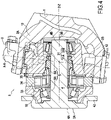
- a first embodiment of the invention is described below with reference to the figure 1 and 2 .
- FIGS. 1 and 2 show a system comprising a hydraulic device 3 coupled to an axle 1 via a pivot 2.
- the hydraulic device 3 is mounted to move relative to the axle 1 along a first axis of rotation X-X by through pivot 2.
- Axle 1 typically comprises two arms 12 defining a general C shape and forming a support for pivot 2.
- the hydraulic apparatus 3 is for example a hydraulic apparatus with radial pistons and multilobe cam.
- the hydraulic device may be an axial piston device, a vane device, an internal or external gear device.
- the hydraulic device 3 also comprises a shaft 4 and a casing 35, sections of which may be formed in particular by the cam 34 and by the timing casing 31b.
- a set of fixed elements or stator and a set of rotating elements or rotor are defined for the hydraulic apparatus 3.
- the rotor includes shaft 4 and cylinder block 32
- the stator includes cam 34, housing 35 and distributor 31.
- connection between the rotor and the stator is made via a bearing 5 comprising here two rolling elements 5A and 5B, here tapered bearings arranged in an O arrangement.
- the bearing 5A is a bearing lubricated with grease and the bearing 5B is a bearing lubricated with oil, in particular the oil of the hydraulic apparatus 3.
- the two bearing elements 5A and B are lubricated by the oil and in particular the oil of the hydraulic device 3.
- the first axis of rotation XX and the second axis of rotation ZZ are not in the same plane. More precisely, if we consider a plane P defined by the second axis of rotation ZZ and parallel to the first axis of rotation XX, the first axis of rotation XX is then outside this plane P, typically offset by a non-zero distance according to a direction perpendicular to the plane P.
- the plane P corresponds to the plane of figure 2 , 4 and 5 .
- This configuration makes it possible to improve the compactness of the assembly, as will be detailed below.
- the hydraulic device 3 typically comprises means configured to allow a vehicle wheel rim and tire to be carried.
- the shaft 4 of the hydraulic device 3 forms a wheel spindle, having a proximal end 4A provided with a portion extending radially and forming a support zone for fixing a rim (not shown).
- the shaft 4 thus forms a wheel spindle comprising a hub 42 at its proximal end 4A for fixing a rim, the opposite end of the shaft 4 here forming a distal end 4B.
- a proximal end 3A of the hydraulic device 3 and a distal end 3B of the hydraulic device 3 are thus generally defined.
- the proximal end 3A of the hydraulic device 3 corresponds to the proximal end 4A of shaft 4, while distal end 3B corresponds to a cover covering distal end 4B of shaft 4.
- pivot 2 connects timing cover 31b (also called timing cover) to axle 1 via two pivot connections 2A and 2B aligned along axis XX on either side of the device hydraulic 3.
- timing cover 31b also called timing cover
- pivot connection is made between the timing cover 31b and a pivot element 2 secured to the axle 1, this pivot element thus being able to be produced with finer manufacturing tolerances than the axle 1.
- One of the pivot links typically comprises ducts forming supply, exhaust and hydraulic drain lines for the hydraulic device 3 made directly in the pivot and connected to the distributor 31 of the hydraulic device 3.
- the other of the pivot connections 2B here the lower pivot connection, may in particular comprise means for forming a pneumatic conduit and/or for measuring the rotation of the pivot 2, for example a rotation sensor, within the pivot, as shown described below.
- the upper pivot link 2A can comprise means for forming a pneumatic conduit and/or for measuring the rotation of the pivot 2, for example a rotation sensor
- the lower pivot linkage 2B comprises conduits forming supply lines hydraulics for the hydraulic apparatus 3, the operation remaining unchanged.
- the pivot connection considered allows relative rotation of the hydraulic apparatus 3 and of the axle 1 along the first axis of rotation X-X.
- the two bearings 5A and 5B will subsequently be referred to as being the proximal bearing 5A and the distal bearing 5B, each being closer to the end of the same name.
- the proximal bearing 5A and the distal bearing 5B are positioned on either side of the cylinder block 32 and of the distributor 31 of the hydraulic device 3, and are arranged in an O assembly as already indicated previously.
- each bearing 5A and 5B comprises an inner ring and an outer ring between which are arranged a plurality of tapered rollers.
- the inner ring is mounted bearing against a shoulder, here formed by the shaft 4, forming a stop in a direction going from the distal end 3B towards the proximal end 3A.
- the outer ring is mounted against a shoulder formed by a segment of the casing 35, forming an abutment in a direction going from the proximal end 3A towards the distal end 3B.
- the inner ring is mounted bearing against a shoulder, here formed by a nut or by an adjustable wedge mounted on the shaft 4, forming a stop in a direction going from the proximal end 3A towards the distal end 3B.
- the outer ring is mounted against a shoulder formed by a segment of the casing 35, forming an abutment in a direction going from the distal end 3B towards the proximal end 3A.
- the proximal bearing 5A and the distal bearing 5B are positioned at least partially on either side of the projection of the first axis of rotation X-X.
- the cylinder block 32 is positioned between the first axis of rotation X-X and the proximal bearing 5A.
- This configuration makes it possible to reconcile a reduced size at the level of the distal part 3B of the hydraulic apparatus 3, while making it possible to propose a shaft 4 which is described as short, that is to say with a reduced distance between the first axis of rotation X-X and the proximal end 4A of the shaft carrying the means configured to make it possible to carry a rim and a vehicle wheel tire, without requiring the size of the hydraulic apparatus 3 to be increased according to the first axis of rotation X-X.
- the bulk at the distal end 3B (which forms what is referred to as the rear, as opposed to the proximal end 3A adapted to carry a tire and which forms the front of the wheel motor) is reduced , which makes it possible to simplify the design of the axle 1 and in particular of the arms 12 of the axle 1 forming a support for the pivot 2, and also to simplify the possible integration of pipes at the rear of the engine, for example pneumatic or hydraulic supply lines if the latter are not made directly within the pivot 2.
- the proximal bearing 5A is typically isolated from the internal volume of the hydraulic apparatus 3 (that is to say from the volume delimited by the casing 35 in which is arranged in particular the cylinder block 32) and the external environment by dynamic sealing means.
- the cylinder block 32 is mounted bearing against an axial abutment formed on the shaft 4 by means of a wedge 43.
- the cylinder block 32 is subjected to a thrust force exerted by the distributor 31 (in the occurrence the core 31a of the distributor 31) resulting from the pressurization of the various ducts of the distributor 31.
- This force is transmitted by the cylinder block 32 to the shaft 4 via the wedge 43 tending to move it in a direction defined by the second axis of rotation Z-Z, from the distal end 4B towards the proximal end 4A.
- the distributor 31 as shown extends on either side of the first axis of rotation X-X in view according to a plane defined by the second axis of rotation Z-Z and the first axis of rotation X-X, and is typically configured so as to extend essentially in the direction of the proximal end 3A of the hydraulic device 3, which results in particular from the position of the cylinder block 32 which is positioned between the distributor 31 and the proximal bearing 5A.
- the fluid supply is here carried out directly through an element of the pivot 2 producing a fluid supply from ducts arranged in the distribution casing 31b as already indicated above.
- FIG. 3 and 4 represent another embodiment of an assembly according to the invention.
- the two rolling elements 5A and 5B are arranged in an X arrangement.
- the inner ring is mounted bearing against a ring resting on the shaft 4, forming a stop in a direction going from the proximal end 3A towards the distal end 3B.
- the outer ring is mounted against a shoulder formed by a segment of the casing 35, forming a abutment in a direction going from the distal end 3B towards the proximal end 3A.
- the inner ring is mounted bearing against a shoulder, here formed by the shaft 4, forming a stop in a direction going from the proximal end 3A towards the distal end 3B.
- the outer ring is mounted against a shoulder formed by a segment of the casing 35, forming an abutment in a direction going from the proximal end 3A towards the distal end 3B.
- the cylinder block 32 is mounted bearing against the inner ring of the proximal bearing 5A.
- the cylinder block 32 is subjected to a thrust force along the second axis of rotation Z-Z in a direction going from the distal end 3B towards the proximal end 3A exerted by the distributor 31 (in this case the core 31a of the distributor 31 ) resulting from the pressurization of the various ducts of the distributor 31.
- This force is transmitted by the cylinder block 32 to the proximal bearing 5A, which will take up this force due to the mounting in X of the bearings 5A and 5B, the proximal bearing 5A will so resume that effort.
- the force tends to move the inner ring of the proximal bearing 5A (and therefore the shaft 4 against which it bears) in this direction going from the distal end 3B towards the proximal end 3A.
- the outer ring of the proximal bearing 5A mounted in abutment against the casing segment 35 opposes this movement.
- the first axis of rotation XX and the second axis of rotation ZZ are not in the same plane. This discrepancy is particularly visible on the picture 3 .
- this embodiment makes it possible to reconcile a reduced size at the level of the distal part 3B of the hydraulic device 3, while making it possible to propose a shaft 4 which is described as short, that is to say with a reduced distance between the first axis of rotation XX and the proximal end 4A of the shaft carrying the means configured to make it possible to carry a rim and a vehicle wheel tire, without needing to increase the size of the hydraulic apparatus 3 along the first axis of rotation XX.
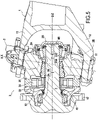
- the figure 5 presents a variant of the embodiment shown in the picture 2 previously described.
- the element 2A of the pivot link 2 has a dimension that is substantially greater than the element 2A of the pivot link 2 shown above with reference to the figure 4 .
- Such a configuration makes it possible to increase the compactness of the system, and/or to offer more volume available for the pivot 2, which can in particular be advantageous when hydraulic or pneumatic conduits are arranged directly in the pivot 2.
- Such a configuration with superposition in the plane P of the projection of the distal bearing 5B and of at least one element of the pivot 2 can also be achieved with bearings forming an X assembly as already presented with reference to the figure 3 and 4 .
Landscapes
- Engineering & Computer Science (AREA)
- Mechanical Engineering (AREA)
- Chemical & Material Sciences (AREA)
- Combustion & Propulsion (AREA)
- General Engineering & Computer Science (AREA)
- Transportation (AREA)
- Hydraulic Motors (AREA)
- Reciprocating Pumps (AREA)
Description
- La présente invention concerne les machines hydrauliques, et plus précisément une structure améliorée de machine hydraulique.
- Les machines hydrauliques, et en particulier les moteurs hydrauliques employés pour l'entrainement de roues directrices d'un véhicule doivent répondre à plusieurs contraintes spécifiques en termes de compacité, et doivent pouvoir être associés à des moyens de fixation d'une roue.
- On connait ainsi des moteurs hydrauliques tels que présentés dans le document
FR 2693154 EP 3 012 141 A1 . - On connait également des architectures dans lesquelles les roulements sont disposés de part et d'autre du moteur hydraulique, et de part et d'autre de l'axe du pivot de direction. Le bloc cylindre est alors monté du côté opposé à la fusée de roue par rapport à l'axe de pivot, et une entretoise est interposée entre le bloc cylindres et le roulement adjacent. Bien que permettant de réaliser une structure avec un arbre court, une telle architecture est cependant contraignante en termes d'encombrement au niveau du support de pivot, entraînant ainsi une augmentation de la longueur du pivot de direction, ce qui peut être pénalisant pour certaines applications.
- On cherche ainsi à concilier les exigences en termes d'encombrement, de possibilité de fixation d'une roue, et de reprise d'efforts pour un tel moteur de roue.
- La présente invention vise ainsi à répondre au moins partiellement à ces problématiques.
- Le présent exposé concerne un ensemble comprenant un appareil hydraulique comprenant un rotor et un stator, le rotor étant monté tournant par rapport au stator selon un second axe de rotation au moyen d'un roulement proximal et d'un roulement distal, l'appareil hydraulique comprenant un arbre, une came multilobes, un bloc cylindres présentant une pluralité de logements chacun muni d'un piston monté coulissant en regard de la came multilobes, et un distributeur comprenant un noyau et un carter de distribution,
- un élément de pivot destiné à être monté sur un essieu, et mobile en rotation par rapport à l'appareil hydraulique selon un premier axe de rotation, le stator étant monté tournant par rapport à l'essieu selon le premier axe de rotation,
- le rotor comprenant l'arbre présentant une extrémité proximale munie de moyens permettant le montage d'une roue de véhicule, et une extrémité distale opposée,
- le bloc cylindres est positionné entre le premier axe de rotation et le roulement proximal selon la direction définie par le second axe de rotation, et en ce que
- en vue en projection selon un plan défini par le second axe de rotation et parallèle au premier axe de rotation, le roulement proximal et le roulement distal sont positionnés au moins partiellement de part et d'autre du premier axe de rotation.
- Selon un exemple, le distributeur, ou plus précisément le noyau du distributeur, est positionné entre le bloc cylindres et le roulement distal selon le second axe de rotation.
- Selon un exemple, les projections de l'élément de pivot et du roulement distal en vue selon un plan défini par le second axe de rotation et parallèle au premier axe de rotation sont au moins partiellement superposées. Selon un exemple, l'élément de pivot comprend une pluralité de conduits hydrauliques aménagés en son sein, de manière à permettre une alimentation en fluide hydraulique du distributeur.
- Selon un exemple, le roulement proximal (5A) et le roulement distal sont agencés selon un montage en O.
- Le bloc cylindres est alors typiquement configuré de manière à exercer un effort tendant à déplacer l'arbre depuis son extrémité distale vers son l'extrémité proximale, et dans lequel le roulement distal comprend une bague interne et une bague externe entre lesquelles sont disposées une pluralité de rouleaux tronconiques, la bague externe du roulement distal étant montée en appui contre un segment de carter, de manière à s'opposer audit déplacement de l'arbre.
- En variante, le roulement proximal et le roulement distal sont agencés selon un montage en X.
- Le roulement proximal comprend alors typiquement une bague interne et une bague externe entre lesquelles sont disposées une pluralité de rouleaux tronconiques et dans lequel le bloc cylindres est configuré de manière à exercer un effort tendant à déplacer la bague interne du roulement proximal dans un sens allant de l'extrémité distale vers l'extrémité proximale de l'arbre, la bague externe du roulement proximal étant montée en appui contre un segment de carter , de manière à s'opposer audit déplacement.
- Le présent exposé concerne également un véhicule comprenant un essieu et présentant deux roues directrices, lesdites deux roues directrices étant chacune montée sur un ensemble tel que défini précédemment solidaire de l'essieu.
- L'invention et ses avantages seront mieux compris à la lecture de la description détaillée faite ci-après de différents modes de réalisation de l'invention donnés à titre d'exemples non limitatifs. Cette description fait référence aux pages de figures annexées, sur lesquelles :
- les
figures 1 et2 représentent un exemple d'ensemble selon un aspect de l'invention, - les
figures 3 et4 représentent deux vues d'un autre exemple d'ensemble selon un aspect de l'invention, - la
figure 5 présente une variante de l'exemple représenté sur lafigure 2 . - Sur l'ensemble des figures, les éléments similaires sont repérés par des références numériques identiques.
- On décrit ci-après un premier mode de réalisation de l'invention en référence aux
figures 1 et2 . - On représente sur ces figures un système comprenant un appareil hydraulique 3 couplé à un essieu 1 par l'intermédiaire d'un pivot 2. L'appareil hydraulique 3 est monté mobile par rapport à l'essieu 1 selon un premier axe de rotation X-X par l'intermédiaire du pivot 2. L'essieu 1 comprend typiquement deux bras 12 définissant une forme générale de C et formant un support pour le pivot 2.
- L'appareil hydraulique 3 est par exemple un appareil hydraulique à pistons radiaux et came multilobes. A titre de variante, l'appareil hydraulique peut être un appareil à pistons axiaux, un appareil à palettes, un appareil à engrenages intérieurs ou extérieurs.
- Il comprend ainsi un distributeur 31 formé d'un noyau 31a entouré d'un carter de distribution 31b, un bloc cylindres 32 comprenant une pluralité de cylindres s'étendant radialement par rapport à un second axe de rotation Z-Z et dans lesquels coulissent des pistons 33, et une came 34 multilobes disposée en regard des pistons 33. L'appareil hydraulique 3 comprend également un arbre 4 et un carter 35, dont des sections peuvent être formées notamment par la came 34 et par le carter de distribution 31b.
- On définit pour l'appareil hydraulique 3 un ensemble d'éléments fixes ou stator, et un ensemble d'éléments tournants ou rotor. Dans l'exemple illustré, le rotor comprend l'arbre 4 et le bloc cylindres 32, tandis que le stator comprend la came 34, le carter 35 et le distributeur 31.
- La liaison entre le rotor et le stator est réalisée via un palier 5 comprenant ici deux éléments de roulement 5A et 5B, ici des roulements coniques disposés selon un montage en O.
- Par exemple le roulement 5A est un roulement lubrifié à la graisse et le roulement 5B est un roulement lubrifié à l'huile, notamment l'huile de l'appareil hydraulique 3. En variante les deux éléments de roulements 5A et B sont lubrifiés par l'huile et notamment l'huile de l'appareil hydraulique 3.
- Comme visible notamment sur la
figure 1 , le premier axe de rotation X-X et le second axe de rotation Z-Z ne sont pas dans un même plan. Plus précisément, si on considère un plan P défini par le second axe de rotation Z-Z et parallèle au premier axe de rotation X-X, le premier axe de rotation X-X est alors hors de ce plan P, typiquement décalé d'une distance non nulle selon une direction perpendiculaire au plan P. Le plan P correspond au plan desfigures 2 ,4 et5 . - Cette configuration permet d'améliorer la compacité de l'ensemble, comme on le détaillera par la suite.
- L'appareil hydraulique 3 comprend typiquement des moyens configurés pour permettre de porter une jante et un pneumatique de roue de véhicule. Dans l'exemple représenté, l'arbre 4 de l'appareil hydraulique 3 forme une fusée de roue, présentant une extrémité proximale 4A munie d'une portion s'étendant radialement et formant une zone de support pour la fixation d'une jante (non représentée). Dans l'exemple illustré, l'arbre 4 forme ainsi une fusée de roue comprenant un moyeu 42 à son extrémité proximale 4A pour la fixation d'une jante, l'extrémité opposée de l'arbre 4 formant ici une extrémité distale 4B. On définit ainsi de manière générale une extrémité proximale 3A de l'appareil hydraulique 3, et une extrémité distale 3B de l'appareil hydraulique 3. Dans l'exemple illustré, l'extrémité proximale 3A de l'appareil hydraulique 3 correspond à l'extrémité proximale 4A de l'arbre 4, tandis que l'extrémité distale 3B correspond à un couvercle venant coiffer l'extrémité distale 4B de l'arbre 4.
- Dans l'exemple représenté, le pivot 2 relie le carter de distribution 31b (également appelée couvercle de distribution) à l'essieu 1 via deux liaisons pivot 2A et 2B alignées selon l'axe X-X de part et d'autre de l'appareil hydraulique 3. Pour des raisons de fabrication, la liaison pivot est réalisée entre le carter de distribution 31b et un élément de pivot 2 solidarisé à l'essieu 1, cet élément de pivot pouvant ainsi être réalisé avec des tolérances de fabrications plus fines que l'essieu 1.
- L'une des liaisons pivot, en l'occurrence la liaison pivot supérieure 2A dans le mode de réalisation représenté sur les
figures 1 et2 , comprend typiquement des conduits formant des lignes d'alimentation, d'échappement et de drain hydraulique pour l'appareil hydraulique 3 réalisées directement dans le pivot et reliées au distributeur 31 de l'appareil hydraulique 3. - L'autre des liaisons pivot 2B, ici la liaison pivot inférieure, peut notamment comprendre des moyens pour la formation de conduit pneumatique et/ou pour mesurer la rotation du pivot 2, par exemple un capteur de rotation, au sein du pivot, comme on le décrit ci-après.
- En variante la liaison pivot supérieure 2A peut comprendre des moyens pour la formation de conduit pneumatique et/ou pour mesurer la rotation du pivot 2, par exemple un capteur de rotation, et la liaison pivot inférieure 2B comprend des conduits formant des lignes d'alimentation hydraulique pour l'appareil hydraulique 3, le fonctionnement demeurant inchangé.
- La liaison pivot considérée permet une mise en rotation relative de l'appareil hydraulique 3 et de l'essieu 1 selon le premier axe de rotation X-X.
- Les deux roulements 5A et 5B seront par la suite désignés comme étant le roulement proximal 5A et le roulement distal 5B, chacun étant plus proche de l'extrémité du même nom.
- Le roulement proximal 5A et le roulement distal 5B sont positionnés de part et d'autre du bloc cylindres 32 et du distributeur 31 de l'appareil hydraulique 3, et sont agencés selon un montage en O comme déjà indiqué précédemment.
- Dans l'exemple illustré, le roulement proximal 5A est interposé entre une partie du carter 35 et l'arbre 4, tandis que le roulement distal 5B est interposé entre l'arbre 4 et le carter de distribution 31b. De manière conventionnelle, chaque roulement 5A et 5B comprend une bague interne et une bague externe entre lesquelles sont disposés une pluralité de rouleaux tronconiques.
- Pour le montage du roulement proximal 5A, la bague interne est montée en appui contre un épaulement, ici formé par l'arbre 4, formant une butée dans un sens allant de l'extrémité distale 3B vers l'extrémité proximale 3A. La bague externe est montée contre un épaulement formé par un segment du carter 35, formant une butée dans un sens allant de l'extrémité proximale 3A vers l'extrémité distale 3B.
- Pour le montage du roulement distal 5B, la bague interne est montée en appui contre un épaulement, ici formé par un écrou ou par une cale réglable monté sur l'arbre 4, formant une butée dans un sens allant de l'extrémité proximale 3A vers l'extrémité distale 3B. La bague externe est montée contre un épaulement formé par un segment du carter 35, formant une butée dans un sens allant de l'extrémité distale 3B vers l'extrémité proximale 3A.
- En vue en projection selon le plan P défini par le second axe de rotation Z-Z et parallèle au premier axe de rotation X-X, le roulement proximal 5A et le roulement distal 5B sont positionnés au moins partiellement de part et d'autre de la projection du premier axe de rotation X-X. Le bloc cylindres 32 est positionné entre le premier axe de rotation X-X et le roulement proximal 5A. Une telle configuration présente plusieurs avantages.
- Cette configuration permet de concilier un encombrement réduit au niveau de la partie distale 3B de l'appareil hydraulique 3, tout en permettant de proposer un arbre 4 que l'on qualifie de court, c'est-à-dire avec une distance réduite entre le premier axe de rotation X-X et l'extrémité proximale 4A de l'arbre portant les moyens configurés pour permettre de porter une jante et un pneumatique de roue de véhicule, sans nécessiter d'accroître l'encombrement de l'appareil hydraulique 3 selon le premier axe de rotation X-X.
- L'encombrement au niveau de l'extrémité distale 3B (qui forme ce que l'on qualifie d'arrière, par opposition à l'extrémité proximale 3A adaptée pour porter un pneumatique et qui forme l'avant du moteur de roue) est réduit, ce qui permet de simplifier la conception de l'essieu 1 et notamment des bras 12 de l'essieu 1 formant un support pour le pivot 2, et également de simplifier l'éventuelle intégration de conduites à l'arrière du moteur, par exemple des conduites d'alimentation pneumatique ou hydraulique si ces dernières ne sont pas réalisées directement au sein de du pivot 2.
- Le roulement proximal 5A est typiquement isolé du volume interne de l'appareil hydraulique 3 (c'est-à-dire du volume délimité par le carter 35 dans lequel est disposé notamment le bloc cylindres 32) et du milieu externe par des moyens d'étanchéité dynamiques.
- Dans l'exemple illustré, le bloc cylindres 32 est monté en appui contre une butée axiale formée sur l'arbre 4 au moyen d'une cale 43. Le bloc cylindres 32 est soumis à un effort de poussée exercé par le distributeur 31 (en l'occurrence le noyau 31a du distributeur 31) résultant de la mise en pression des différents conduits du distributeur 31. Cet effort est transmis par le bloc cylindres 32 sur l'arbre 4 via la cale 43 tendant à le déplacer dans une direction définie par le second axe de rotation Z-Z, depuis l'extrémité distale 4B vers l'extrémité proximale 4A.
- Cet effort est alors repris par le roulement distal 5B, le montage en O des roulements 5A et 5B permettant de supporter la charge axiale.
- Le distributeur 31 tel que représenté s'étend de part et d'autre du premier axe de rotation X-X en vue selon un plan défini par le second axe de rotation Z-Z et le premier axe de rotation X-X, et est typiquement configuré de manière à s'étendre essentiellement en direction de l'extrémité proximale 3A de l'appareil hydraulique 3, ce qui résulte notamment de la position du bloc cylindres 32 qui est positionné entre le distributeur 31 et le roulement proximal 5A. L'alimentation en fluide est ici réalisée directement au travers d'un élément du pivot 2 réalisant une alimentation en fluide de conduits aménagés dans le carter de distribution 31b comme déjà indiqué précédemment.
- Les
figures 3 et4 représentent un autre mode de réalisation d'un ensemble selon l'invention. - On retrouve dans ce mode de réalisation plusieurs éléments déjà décrits en référence à la
figure 1 . On décrit ci-après uniquement les éléments distinctifs de ce mode de réalisation par rapport au mode de réalisation déjà décrit en référence à lafigure 1 . - Dans ce mode de réalisation, les deux éléments de roulements 5A et 5B sont disposés selon un montage en X.
- Dans ce mode de réalisation, pour le montage du roulement proximal 5A, la bague interne est montée en appui contre une bague en appui sur l'arbre 4, formant une butée dans un sens allant de l'extrémité proximale 3A vers l'extrémité distale 3B. La bague externe est montée contre un épaulement formé par un segment du carter 35, formant une butée dans un sens allant de l'extrémité distale 3B vers l'extrémité proximale 3A.
- Pour le montage du roulement distal 5B, la bague interne est montée en appui contre un épaulement, ici formé par l'arbre 4, formant une butée dans un sens allant de l'extrémité proximale 3A vers l'extrémité distale 3B. La bague externe est montée contre un épaulement formé par un segment du carter 35, formant une butée dans un sens allant de l'extrémité proximale 3A vers l'extrémité distale 3B.
- Dans ce mode de réalisation, le bloc cylindres 32 est monté en appui contre la bague interne du roulement proximal 5A. Le bloc cylindres 32 est soumis à un effort de poussée selon le second axe de rotation Z-Z dans un sens allant de l'extrémité distale 3B vers l'extrémité proximale 3A exercé par le distributeur 31 (en l'occurrence le noyau 31a du distributeur 31) résultant de la mise en pression des différents conduits du distributeur 31. Cet effort est transmis par le bloc cylindres 32 au roulement proximal 5A, qui va reprendre cet effort du fait du montage en X des roulements 5A et 5B, le roulement proximal 5A va ainsi reprendre cet effort. En effet, l'effort tend à déplacer la bague interne du roulement proximal 5A (et donc l'arbre 4 contre laquelle elle est en appui) dans ce sens allant de l'extrémité distale 3B vers l'extrémité proximale 3A. La bague externe du roulement proximal 5A montée en appui contre le segment de carter 35 vient s'opposer à ce déplacement.
- Le fonctionnement demeure inchangé par rapport au mode de réalisation déjà décrit en référence à la
figure 1 . - Comme déjà décrit en référence au mode de réalisation visible sur les
figures 1 et2 , le premier axe de rotation X-X et le second axe de rotation Z-Z ne sont pas dans un même plan. Ce décalage est notamment visible sur lafigure 3 . - Tout comme le mode de réalisation déjà décrit en référence à la
figure 1 , ce mode de réalisation permet de concilier un encombrement réduit au niveau de la partie distale 3B de l'appareil hydraulique 3, tout en permettant de proposer un arbre 4 que l'on qualifie de court, c'est-à-dire avec une distance réduite entre le premier axe de rotation X-X et l'extrémité proximale 4A de l'arbre portant les moyens configurés pour permettre de porter une jante et un pneumatique de roue de véhicule, sans nécessiter d'accroître l'encombrement de l'appareil hydraulique 3 selon le premier axe de rotation X-X. - La
figure 5 présente une variante du mode de réalisation représenté sur lafigure 2 décrite précédemment. - Dans ce mode de réalisation, l'élément 2A de la liaison pivot 2 présente une dimension sensiblement supérieure à l'élément 2A de la liaison pivot 2 représenté précédemment en référence à la
figure 4 . - Comme on le voit sur cette figure, en vue en projection selon le plan P défini par le second axe de rotation Z-Z et parallèle au premier axe de rotation X-X, le roulement distal 5B et l'élément 2A du pivot 2 se superposent au moins partiellement. La projection de l'élément 2A du pivot 2 dans le plan P mentionné précédemment est visible en pointillés.
- Une telle superposition est rendue possible par le fait que le premier axe de rotation X-X et le second axe de rotation Z-Z ne soient pas dans le même plan, comme déjà décrit précédemment et visible par exemple sur la
figure 3 . - Une telle configuration permet d'accroître la compacité du système, et/ou d'offrir plus de volume disponible pour le pivot 2, ce qui peut notamment être avantageux lorsque des conduits hydrauliques ou pneumatiques sont aménagés directement dans le pivot 2.
- Une telle configuration avec superposition dans le plan P de la projection du roulement distal 5B et d'au moins un élément du pivot 2 peut également être réalisée avec des roulements formant un montage en X comme déjà présenté en référence aux
figures 3 et4 . - Bien que la présente invention ait été décrite en se référant à des exemples de réalisation spécifiques, il est évident que des modifications et des changements peuvent être effectués sur ces exemples sans sortir de la portée générale de l'invention telle que définie par les revendications. En particulier, des caractéristiques individuelles des différents modes de réalisation illustrés/mentionnés peuvent être combinées dans des modes de réalisation additionnels. Par conséquent, la description et les dessins doivent être considérés dans un sens illustratif plutôt que restrictif.
- Il est également évident que toutes les caractéristiques décrites en référence à un procédé sont transposables, seules ou en combinaison, à un dispositif, et inversement, toutes les caractéristiques décrites en référence à un dispositif sont transposables, seules ou en combinaison, à un procédé.
Claims (9)
- Ensemble comprenantun appareil hydraulique (3) comprenant un rotor et un stator, le rotor étant monté tournant par rapport au stator selon un second axe de rotation (Z-Z) au moyen d'un roulement proximal (5A) et d'un roulement distal (5B), l'appareil hydraulique (3) comprenant un arbre (4), une came multilobes (34), un bloc cylindres (32) présentant une pluralité de logements chacun muni d'un piston (33) monté coulissant en regard de la came multilobes (34), et un distributeur (31) comprenant un noyau (31a) et un carter de distribution (31b),un élément de pivot (2) destiné à être monté sur un essieu (1), et mobile en rotation par rapport à l'appareil hydraulique (3) selon un premier axe de rotation (X-X), le stator étant monté tournant par rapport à l'essieu (1) selon le premier axe de rotation (X-X),le rotor comprenant l'arbre (4) présentant une extrémité proximale (4A) munie de moyens permettant le montage d'une roue de véhicule, et une extrémité distale (4B) opposée,caractérisé en ce que,le bloc cylindres (32) est positionné entre le premier axe de rotation (X-X) et le roulement proximal selon la direction définie par le second axe de rotation (Z-Z), et en ce queen vue en projection selon un plan défini par le second axe de rotation (Z-Z) et parallèle au premier axe de rotation (X-X), le roulement proximal (5A) et le roulement distal (5B) sont positionnés au moins partiellement de part et d'autre du premier axe de rotation (X-X).
- Ensemble selon la revendication 1, dans lequel le noyau du distributeur (31a) est positionné entre le bloc cylindres (32) et le roulement distal (5B) selon le second axe de rotation (Z-Z).
- Ensemble selon l'une des revendications 1 ou 2, dans lequel les projections de l'élément de pivot (2) et du roulement distal (5B) en vue selon un plan défini par le second axe de rotation (Z-Z) et parallèle au premier axe de rotation (X-X) sont au moins partiellement superposées.
- Ensemble selon l'une des revendications 1 à 3, dans lequel l'élément de pivot (2) comprend une pluralité de conduits hydrauliques aménagés en son sein, de manière à permettre une alimentation en fluide hydraulique du distributeur (31).
- Ensemble selon l'une des revendications 1 à 4, dans lequel le roulement proximal (5A) et le roulement distal (5B) sont agencés selon un montage en O.
- Ensemble selon la revendication 5, dans lequel le bloc cylindres (32) est configuré de manière à exercer un effort tendant à déplacer l'arbre (4) depuis son extrémité distale (4B) vers son l'extrémité proximale (4A), et dans lequel le roulement distal (5B) comprend une bague interne et une bague externe entre lesquelles sont disposées une pluralité de rouleaux tronconiques, la bague externe du roulement distal (5B) étant montée en appui contre un segment de carter (35), de manière à s'opposer audit déplacement de l'arbre (4).
- Ensemble selon l'une des revendications 1 à 4, dans lequel le roulement proximal (5A) et le roulement distal (5B) sont agencés selon un montage en X.
- Ensemble selon la revendication 7, dans lequel le roulement proximal (5A) comprend une bague interne et une bague externe entre lesquelles sont disposées une pluralité de rouleaux tronconiques et dans lequel le bloc cylindres (32) est configuré de manière à exercer un effort tendant à déplacer la bague interne du roulement proximal dans un sens allant de l'extrémité distale (4B) vers l'extrémité proximale (4A) de l'arbre (4), la bague externe du roulement proximal (5A) étant montée en appui contre un segment de carter (35), de manière à s'opposer audit déplacement.
- Véhicule comprenant un essieu (1) et présentant au moins une roue directrice, ladite roue directrice étant montée sur un ensemble selon l'une des revendications 1 à 8 solidaire de l'essieu (1).
Applications Claiming Priority (2)
| Application Number | Priority Date | Filing Date | Title |
|---|---|---|---|
| FR1859780A FR3087501B1 (fr) | 2018-10-23 | 2018-10-23 | Moteur hydraulique ameliore pour roue directrice de vehicule |
| PCT/FR2019/052468 WO2020084228A1 (fr) | 2018-10-23 | 2019-10-17 | Moteur hydraulique amélioré pour roue directrice de véhicule |
Publications (2)
| Publication Number | Publication Date |
|---|---|
| EP3870833A1 EP3870833A1 (fr) | 2021-09-01 |
| EP3870833B1 true EP3870833B1 (fr) | 2022-10-05 |
Family
ID=65444042
Family Applications (1)
| Application Number | Title | Priority Date | Filing Date |
|---|---|---|---|
| EP19809134.0A Active EP3870833B1 (fr) | 2018-10-23 | 2019-10-17 | Moteur hydraulique amélioré pour roue directrice de véhicule |
Country Status (5)
| Country | Link |
|---|---|
| US (1) | US12090787B2 (fr) |
| EP (1) | EP3870833B1 (fr) |
| BR (1) | BR112021007515A2 (fr) |
| FR (1) | FR3087501B1 (fr) |
| WO (1) | WO2020084228A1 (fr) |
Families Citing this family (4)
| Publication number | Priority date | Publication date | Assignee | Title |
|---|---|---|---|---|
| FI130485B (en) * | 2021-08-12 | 2023-09-29 | Black Bruin Oy | Radial piston hydraulic motor comprising hollow rotating shaft inside the motor |
| FR3141731B1 (fr) * | 2022-11-04 | 2024-12-13 | Poclain Hydraulics Ind | structure d’assemblage amélioré pour chape de direction de machine hydraulique. |
| FR3141705B1 (fr) * | 2022-11-07 | 2024-11-01 | Poclain Hydraulics Ind | Structure de support améliorée pour organe directeur. |
| FR3141970B1 (fr) * | 2022-11-10 | 2024-11-08 | Poclain Hydraulics Ind | pivot pour moteur de roue avec couvercle amélioré |
Family Cites Families (12)
| Publication number | Priority date | Publication date | Assignee | Title |
|---|---|---|---|---|
| US3199460A (en) * | 1962-01-11 | 1965-08-10 | Stewart Warner Corp | Hydraulic pump or motor |
| US3824899A (en) * | 1973-08-22 | 1974-07-23 | Gen Motors Corp | Hydraulic motor having a hydraulic lock control drive pin |
| FR2693154B1 (fr) | 1992-11-09 | 1994-09-30 | Poclain Hydraulics Sa | Ensemble d'un organe de déplacement moteur et du dispositif de son montage à pivotement. |
| US5509497A (en) * | 1994-04-07 | 1996-04-23 | Fluidrive, Inc. | Steerable wheel drive assembly |
| FR2739418B1 (fr) * | 1995-10-02 | 1997-12-19 | Poclain Hydraulics Sa | Moteur hydraulique d'assistance |
| FI110446B (fi) * | 1997-11-11 | 2003-01-31 | Valmet Hydraulics Oy | Radiaalimäntähydraulimoottori |
| FI109230B (fi) * | 1999-12-08 | 2002-06-14 | Metso Hydraulics Oy | Radiaalimäntähydraulimoottori |
| US6302233B1 (en) * | 2000-06-06 | 2001-10-16 | Spicer Technologies, Inc. | Steering axle for vehicular hydraustatic drive system |
| FR2926854B1 (fr) * | 2008-01-29 | 2010-03-26 | Poclain Hydraulics Ind | Dispositif de moteur hydraulique pour l'assistance a la transmission mecanique d'un vehicule. |
| NL2003466C2 (nl) * | 2009-09-10 | 2011-03-14 | Loven Beheer B V | Wielophanginrichting, truck, en werkwijze voor het samenstellen van een wielophanginrichting. |
| DE102014015809A1 (de) * | 2014-10-24 | 2016-04-28 | Man Truck & Bus Ag | Hydraulischer Radantrieb für ein Kraftfahrzeug und Verfahren zu dessen Betrieb |
| FR3030382B1 (fr) | 2014-12-23 | 2017-01-13 | Poclain Hydraulics Ind | Moteur hydraulique couple |
-
2018
- 2018-10-23 FR FR1859780A patent/FR3087501B1/fr not_active Expired - Fee Related
-
2019
- 2019-10-17 US US17/287,167 patent/US12090787B2/en active Active
- 2019-10-17 BR BR112021007515-1A patent/BR112021007515A2/pt active Search and Examination
- 2019-10-17 WO PCT/FR2019/052468 patent/WO2020084228A1/fr not_active Ceased
- 2019-10-17 EP EP19809134.0A patent/EP3870833B1/fr active Active
Also Published As
| Publication number | Publication date |
|---|---|
| FR3087501B1 (fr) | 2020-11-06 |
| FR3087501A1 (fr) | 2020-04-24 |
| US12090787B2 (en) | 2024-09-17 |
| WO2020084228A1 (fr) | 2020-04-30 |
| EP3870833A1 (fr) | 2021-09-01 |
| US20210354511A1 (en) | 2021-11-18 |
| BR112021007515A2 (pt) | 2021-07-27 |
Similar Documents
| Publication | Publication Date | Title |
|---|---|---|
| EP3870833B1 (fr) | Moteur hydraulique amélioré pour roue directrice de véhicule | |
| EP3152817B1 (fr) | Ensemble stator pour moteur-roue et son support-fusée | |
| EP3645320B1 (fr) | Appareil hydraulique ameliore comprenant une conduite pour la circulation d'air | |
| EP3299656B1 (fr) | Système de freinage amélioré pour machine hydraulique | |
| FR2825765A1 (fr) | Roulement a deux rangees dissymetriques de billes a contact oblique, et montage de pignons en porte-a-faux sur un tel roulement | |
| FR2833528A1 (fr) | Ensemble de suspension reglable pour vehicules | |
| FR2462279A1 (fr) | Essieu directeur mene | |
| WO1990000477A1 (fr) | Roue pour vehicule motorise ou tracte et vehicule equipe d'une telle roue | |
| EP4093983A1 (fr) | Assemblage de roue de vehicule automobile | |
| FR3052110A1 (fr) | Essieu moteur standardise pour vehicule automobile, comportant des machines electriques | |
| EP3106325B1 (fr) | Système pneumatique pour gonflage de pneu intégré à un essieu motorisé | |
| FR2718684A1 (fr) | Assemblage moteur pour roue directrice. | |
| EP3645328A1 (fr) | Pivot de direction amélioré formant un conduit pneumatique interne | |
| FR2851539A1 (fr) | Palier d'articulation d'un element de direction | |
| EP3134286B1 (fr) | Ensemble d'entraînement pour un arbre moteur d'un véhicule automobile | |
| FR3090548A1 (fr) | Système de traction électrique modulaire | |
| EP3638523B1 (fr) | Dispositif anti-dévers à moyens de couplage pilotés, pour un train de véhicule automobile | |
| FR3106635A1 (fr) | Assemblage de ROue de véhicule automobile | |
| FR3115849A1 (fr) | Differentiel de boîte de vitesse a joncs d’arret d’axe porte-satellite | |
| EP0597754B1 (fr) | Machine à piston rotatif et procédé d'assemblage | |
| WO2020245544A1 (fr) | Procede d'ajout d'une machine hydraulique a un engin comprenant une transmission primaire | |
| WO2023073142A1 (fr) | Dispositif d'entrainement en rotation d'une roue comprenant un moteur hydraulique a pistons radiaux et des moyens de verrouillage des pistons en position rentree | |
| FR2765636A1 (fr) | Dispositif d'entrainement pour des organes de deplacement disposes en tandem | |
| EP4547955A1 (fr) | Machine tournante comprenant un carter et un arbre | |
| WO2020128399A1 (fr) | Engin a tourelle presentant un systeme ameliore de mise en rotation de la tourelle |
Legal Events
| Date | Code | Title | Description |
|---|---|---|---|
| STAA | Information on the status of an ep patent application or granted ep patent |
Free format text: STATUS: UNKNOWN |
|
| STAA | Information on the status of an ep patent application or granted ep patent |
Free format text: STATUS: THE INTERNATIONAL PUBLICATION HAS BEEN MADE |
|
| PUAI | Public reference made under article 153(3) epc to a published international application that has entered the european phase |
Free format text: ORIGINAL CODE: 0009012 |
|
| STAA | Information on the status of an ep patent application or granted ep patent |
Free format text: STATUS: REQUEST FOR EXAMINATION WAS MADE |
|
| 17P | Request for examination filed |
Effective date: 20210510 |
|
| AK | Designated contracting states |
Kind code of ref document: A1 Designated state(s): AL AT BE BG CH CY CZ DE DK EE ES FI FR GB GR HR HU IE IS IT LI LT LU LV MC MK MT NL NO PL PT RO RS SE SI SK SM TR |
|
| DAV | Request for validation of the european patent (deleted) | ||
| DAX | Request for extension of the european patent (deleted) | ||
| GRAP | Despatch of communication of intention to grant a patent |
Free format text: ORIGINAL CODE: EPIDOSNIGR1 |
|
| STAA | Information on the status of an ep patent application or granted ep patent |
Free format text: STATUS: GRANT OF PATENT IS INTENDED |
|
| INTG | Intention to grant announced |
Effective date: 20220512 |
|
| GRAS | Grant fee paid |
Free format text: ORIGINAL CODE: EPIDOSNIGR3 |
|
| GRAA | (expected) grant |
Free format text: ORIGINAL CODE: 0009210 |
|
| STAA | Information on the status of an ep patent application or granted ep patent |
Free format text: STATUS: THE PATENT HAS BEEN GRANTED |
|
| AK | Designated contracting states |
Kind code of ref document: B1 Designated state(s): AL AT BE BG CH CY CZ DE DK EE ES FI FR GB GR HR HU IE IS IT LI LT LU LV MC MK MT NL NO PL PT RO RS SE SI SK SM TR |
|
| REG | Reference to a national code |
Ref country code: GB Ref legal event code: FG4D Free format text: NOT ENGLISH |
|
| REG | Reference to a national code |
Ref country code: CH Ref legal event code: EP |
|
| REG | Reference to a national code |
Ref country code: AT Ref legal event code: REF Ref document number: 1522886 Country of ref document: AT Kind code of ref document: T Effective date: 20221015 |
|
| REG | Reference to a national code |
Ref country code: DE Ref legal event code: R096 Ref document number: 602019020364 Country of ref document: DE |
|
| REG | Reference to a national code |
Ref country code: IE Ref legal event code: FG4D Free format text: LANGUAGE OF EP DOCUMENT: FRENCH |
|
| REG | Reference to a national code |
Ref country code: LT Ref legal event code: MG9D |
|
| REG | Reference to a national code |
Ref country code: NL Ref legal event code: MP Effective date: 20221005 |
|
| REG | Reference to a national code |
Ref country code: AT Ref legal event code: MK05 Ref document number: 1522886 Country of ref document: AT Kind code of ref document: T Effective date: 20221005 |
|
| PG25 | Lapsed in a contracting state [announced via postgrant information from national office to epo] |
Ref country code: NL Free format text: LAPSE BECAUSE OF FAILURE TO SUBMIT A TRANSLATION OF THE DESCRIPTION OR TO PAY THE FEE WITHIN THE PRESCRIBED TIME-LIMIT Effective date: 20221005 |
|
| PG25 | Lapsed in a contracting state [announced via postgrant information from national office to epo] |
Ref country code: SE Free format text: LAPSE BECAUSE OF FAILURE TO SUBMIT A TRANSLATION OF THE DESCRIPTION OR TO PAY THE FEE WITHIN THE PRESCRIBED TIME-LIMIT Effective date: 20221005 Ref country code: PT Free format text: LAPSE BECAUSE OF FAILURE TO SUBMIT A TRANSLATION OF THE DESCRIPTION OR TO PAY THE FEE WITHIN THE PRESCRIBED TIME-LIMIT Effective date: 20230206 Ref country code: NO Free format text: LAPSE BECAUSE OF FAILURE TO SUBMIT A TRANSLATION OF THE DESCRIPTION OR TO PAY THE FEE WITHIN THE PRESCRIBED TIME-LIMIT Effective date: 20230105 Ref country code: LT Free format text: LAPSE BECAUSE OF FAILURE TO SUBMIT A TRANSLATION OF THE DESCRIPTION OR TO PAY THE FEE WITHIN THE PRESCRIBED TIME-LIMIT Effective date: 20221005 Ref country code: FI Free format text: LAPSE BECAUSE OF FAILURE TO SUBMIT A TRANSLATION OF THE DESCRIPTION OR TO PAY THE FEE WITHIN THE PRESCRIBED TIME-LIMIT Effective date: 20221005 Ref country code: ES Free format text: LAPSE BECAUSE OF FAILURE TO SUBMIT A TRANSLATION OF THE DESCRIPTION OR TO PAY THE FEE WITHIN THE PRESCRIBED TIME-LIMIT Effective date: 20221005 Ref country code: AT Free format text: LAPSE BECAUSE OF FAILURE TO SUBMIT A TRANSLATION OF THE DESCRIPTION OR TO PAY THE FEE WITHIN THE PRESCRIBED TIME-LIMIT Effective date: 20221005 |
|
| PG25 | Lapsed in a contracting state [announced via postgrant information from national office to epo] |
Ref country code: RS Free format text: LAPSE BECAUSE OF FAILURE TO SUBMIT A TRANSLATION OF THE DESCRIPTION OR TO PAY THE FEE WITHIN THE PRESCRIBED TIME-LIMIT Effective date: 20221005 Ref country code: PL Free format text: LAPSE BECAUSE OF FAILURE TO SUBMIT A TRANSLATION OF THE DESCRIPTION OR TO PAY THE FEE WITHIN THE PRESCRIBED TIME-LIMIT Effective date: 20221005 Ref country code: LV Free format text: LAPSE BECAUSE OF FAILURE TO SUBMIT A TRANSLATION OF THE DESCRIPTION OR TO PAY THE FEE WITHIN THE PRESCRIBED TIME-LIMIT Effective date: 20221005 Ref country code: IS Free format text: LAPSE BECAUSE OF FAILURE TO SUBMIT A TRANSLATION OF THE DESCRIPTION OR TO PAY THE FEE WITHIN THE PRESCRIBED TIME-LIMIT Effective date: 20230205 Ref country code: HR Free format text: LAPSE BECAUSE OF FAILURE TO SUBMIT A TRANSLATION OF THE DESCRIPTION OR TO PAY THE FEE WITHIN THE PRESCRIBED TIME-LIMIT Effective date: 20221005 Ref country code: GR Free format text: LAPSE BECAUSE OF FAILURE TO SUBMIT A TRANSLATION OF THE DESCRIPTION OR TO PAY THE FEE WITHIN THE PRESCRIBED TIME-LIMIT Effective date: 20230106 |
|
| REG | Reference to a national code |
Ref country code: CH Ref legal event code: PL |
|
| P01 | Opt-out of the competence of the unified patent court (upc) registered |
Effective date: 20230513 |
|
| REG | Reference to a national code |
Ref country code: BE Ref legal event code: MM Effective date: 20221031 |
|
| PG25 | Lapsed in a contracting state [announced via postgrant information from national office to epo] |
Ref country code: LU Free format text: LAPSE BECAUSE OF NON-PAYMENT OF DUE FEES Effective date: 20221017 |
|
| REG | Reference to a national code |
Ref country code: DE Ref legal event code: R097 Ref document number: 602019020364 Country of ref document: DE |
|
| PG25 | Lapsed in a contracting state [announced via postgrant information from national office to epo] |
Ref country code: SM Free format text: LAPSE BECAUSE OF FAILURE TO SUBMIT A TRANSLATION OF THE DESCRIPTION OR TO PAY THE FEE WITHIN THE PRESCRIBED TIME-LIMIT Effective date: 20221005 Ref country code: RO Free format text: LAPSE BECAUSE OF FAILURE TO SUBMIT A TRANSLATION OF THE DESCRIPTION OR TO PAY THE FEE WITHIN THE PRESCRIBED TIME-LIMIT Effective date: 20221005 Ref country code: MC Free format text: LAPSE BECAUSE OF FAILURE TO SUBMIT A TRANSLATION OF THE DESCRIPTION OR TO PAY THE FEE WITHIN THE PRESCRIBED TIME-LIMIT Effective date: 20221005 Ref country code: LI Free format text: LAPSE BECAUSE OF NON-PAYMENT OF DUE FEES Effective date: 20221031 Ref country code: EE Free format text: LAPSE BECAUSE OF FAILURE TO SUBMIT A TRANSLATION OF THE DESCRIPTION OR TO PAY THE FEE WITHIN THE PRESCRIBED TIME-LIMIT Effective date: 20221005 Ref country code: DK Free format text: LAPSE BECAUSE OF FAILURE TO SUBMIT A TRANSLATION OF THE DESCRIPTION OR TO PAY THE FEE WITHIN THE PRESCRIBED TIME-LIMIT Effective date: 20221005 Ref country code: CZ Free format text: LAPSE BECAUSE OF FAILURE TO SUBMIT A TRANSLATION OF THE DESCRIPTION OR TO PAY THE FEE WITHIN THE PRESCRIBED TIME-LIMIT Effective date: 20221005 Ref country code: CH Free format text: LAPSE BECAUSE OF NON-PAYMENT OF DUE FEES Effective date: 20221031 |
|
| PLBE | No opposition filed within time limit |
Free format text: ORIGINAL CODE: 0009261 |
|
| STAA | Information on the status of an ep patent application or granted ep patent |
Free format text: STATUS: NO OPPOSITION FILED WITHIN TIME LIMIT |
|
| PG25 | Lapsed in a contracting state [announced via postgrant information from national office to epo] |
Ref country code: SK Free format text: LAPSE BECAUSE OF FAILURE TO SUBMIT A TRANSLATION OF THE DESCRIPTION OR TO PAY THE FEE WITHIN THE PRESCRIBED TIME-LIMIT Effective date: 20221005 Ref country code: AL Free format text: LAPSE BECAUSE OF FAILURE TO SUBMIT A TRANSLATION OF THE DESCRIPTION OR TO PAY THE FEE WITHIN THE PRESCRIBED TIME-LIMIT Effective date: 20221005 |
|
| 26N | No opposition filed |
Effective date: 20230706 |
|
| PG25 | Lapsed in a contracting state [announced via postgrant information from national office to epo] |
Ref country code: BE Free format text: LAPSE BECAUSE OF NON-PAYMENT OF DUE FEES Effective date: 20221031 |
|
| PG25 | Lapsed in a contracting state [announced via postgrant information from national office to epo] |
Ref country code: IE Free format text: LAPSE BECAUSE OF NON-PAYMENT OF DUE FEES Effective date: 20221017 |
|
| PG25 | Lapsed in a contracting state [announced via postgrant information from national office to epo] |
Ref country code: SI Free format text: LAPSE BECAUSE OF FAILURE TO SUBMIT A TRANSLATION OF THE DESCRIPTION OR TO PAY THE FEE WITHIN THE PRESCRIBED TIME-LIMIT Effective date: 20221005 |
|
| PG25 | Lapsed in a contracting state [announced via postgrant information from national office to epo] |
Ref country code: CY Free format text: LAPSE BECAUSE OF FAILURE TO SUBMIT A TRANSLATION OF THE DESCRIPTION OR TO PAY THE FEE WITHIN THE PRESCRIBED TIME-LIMIT Effective date: 20221005 |
|
| PG25 | Lapsed in a contracting state [announced via postgrant information from national office to epo] |
Ref country code: MK Free format text: LAPSE BECAUSE OF FAILURE TO SUBMIT A TRANSLATION OF THE DESCRIPTION OR TO PAY THE FEE WITHIN THE PRESCRIBED TIME-LIMIT Effective date: 20221005 Ref country code: IT Free format text: LAPSE BECAUSE OF FAILURE TO SUBMIT A TRANSLATION OF THE DESCRIPTION OR TO PAY THE FEE WITHIN THE PRESCRIBED TIME-LIMIT Effective date: 20221005 Ref country code: HU Free format text: LAPSE BECAUSE OF FAILURE TO SUBMIT A TRANSLATION OF THE DESCRIPTION OR TO PAY THE FEE WITHIN THE PRESCRIBED TIME-LIMIT; INVALID AB INITIO Effective date: 20191017 |
|
| GBPC | Gb: european patent ceased through non-payment of renewal fee |
Effective date: 20231017 |
|
| PG25 | Lapsed in a contracting state [announced via postgrant information from national office to epo] |
Ref country code: GB Free format text: LAPSE BECAUSE OF NON-PAYMENT OF DUE FEES Effective date: 20231017 |
|
| PG25 | Lapsed in a contracting state [announced via postgrant information from national office to epo] |
Ref country code: GB Free format text: LAPSE BECAUSE OF NON-PAYMENT OF DUE FEES Effective date: 20231017 Ref country code: BG Free format text: LAPSE BECAUSE OF FAILURE TO SUBMIT A TRANSLATION OF THE DESCRIPTION OR TO PAY THE FEE WITHIN THE PRESCRIBED TIME-LIMIT Effective date: 20221005 |
|
| PG25 | Lapsed in a contracting state [announced via postgrant information from national office to epo] |
Ref country code: MT Free format text: LAPSE BECAUSE OF FAILURE TO SUBMIT A TRANSLATION OF THE DESCRIPTION OR TO PAY THE FEE WITHIN THE PRESCRIBED TIME-LIMIT Effective date: 20221005 |
|
| PG25 | Lapsed in a contracting state [announced via postgrant information from national office to epo] |
Ref country code: TR Free format text: LAPSE BECAUSE OF FAILURE TO SUBMIT A TRANSLATION OF THE DESCRIPTION OR TO PAY THE FEE WITHIN THE PRESCRIBED TIME-LIMIT Effective date: 20221005 |
|
| PGFP | Annual fee paid to national office [announced via postgrant information from national office to epo] |
Ref country code: DE Payment date: 20251015 Year of fee payment: 7 |
|
| PGFP | Annual fee paid to national office [announced via postgrant information from national office to epo] |
Ref country code: FR Payment date: 20251021 Year of fee payment: 7 |