EP3869832B1 - Drahtlose kurzstrecken-übertragung von pairing-informationen zum zubehörgerät - Google Patents
Drahtlose kurzstrecken-übertragung von pairing-informationen zum zubehörgerät Download PDFInfo
- Publication number
- EP3869832B1 EP3869832B1 EP21168935.1A EP21168935A EP3869832B1 EP 3869832 B1 EP3869832 B1 EP 3869832B1 EP 21168935 A EP21168935 A EP 21168935A EP 3869832 B1 EP3869832 B1 EP 3869832B1
- Authority
- EP
- European Patent Office
- Prior art keywords
- devices
- wireless
- link
- accessory
- item
- Prior art date
- Legal status (The legal status is an assumption and is not a legal conclusion. Google has not performed a legal analysis and makes no representation as to the accuracy of the status listed.)
- Active
Links
Images



Classifications
-
- H—ELECTRICITY
- H04—ELECTRIC COMMUNICATION TECHNIQUE
- H04L—TRANSMISSION OF DIGITAL INFORMATION, e.g. TELEGRAPHIC COMMUNICATION
- H04L67/00—Network arrangements or protocols for supporting network services or applications
- H04L67/01—Protocols
- H04L67/10—Protocols in which an application is distributed across nodes in the network
- H04L67/104—Peer-to-peer [P2P] networks
-
- H—ELECTRICITY
- H04—ELECTRIC COMMUNICATION TECHNIQUE
- H04L—TRANSMISSION OF DIGITAL INFORMATION, e.g. TELEGRAPHIC COMMUNICATION
- H04L67/00—Network arrangements or protocols for supporting network services or applications
- H04L67/2866—Architectures; Arrangements
- H04L67/30—Profiles
- H04L67/306—User profiles
-
- H—ELECTRICITY
- H04—ELECTRIC COMMUNICATION TECHNIQUE
- H04M—TELEPHONIC COMMUNICATION
- H04M1/00—Substation equipment, e.g. for use by subscribers
- H04M1/72—Mobile telephones; Cordless telephones, i.e. devices for establishing wireless links to base stations without route selection
- H04M1/724—User interfaces specially adapted for cordless or mobile telephones
- H04M1/72403—User interfaces specially adapted for cordless or mobile telephones with means for local support of applications that increase the functionality
- H04M1/72409—User interfaces specially adapted for cordless or mobile telephones with means for local support of applications that increase the functionality by interfacing with external accessories
- H04M1/72412—User interfaces specially adapted for cordless or mobile telephones with means for local support of applications that increase the functionality by interfacing with external accessories using two-way short-range wireless interfaces
-
- H—ELECTRICITY
- H04—ELECTRIC COMMUNICATION TECHNIQUE
- H04W—WIRELESS COMMUNICATION NETWORKS
- H04W12/00—Security arrangements; Authentication; Protecting privacy or anonymity
- H04W12/04—Key management, e.g. using generic bootstrapping architecture [GBA]
-
- H—ELECTRICITY
- H04—ELECTRIC COMMUNICATION TECHNIQUE
- H04W—WIRELESS COMMUNICATION NETWORKS
- H04W12/00—Security arrangements; Authentication; Protecting privacy or anonymity
- H04W12/50—Secure pairing of devices
-
- H—ELECTRICITY
- H04—ELECTRIC COMMUNICATION TECHNIQUE
- H04W—WIRELESS COMMUNICATION NETWORKS
- H04W4/00—Services specially adapted for wireless communication networks; Facilities therefor
- H04W4/06—Selective distribution of broadcast services, e.g. multimedia broadcast multicast service [MBMS]; Services to user groups; One-way selective calling services
- H04W4/08—User group management
-
- H—ELECTRICITY
- H04—ELECTRIC COMMUNICATION TECHNIQUE
- H04W—WIRELESS COMMUNICATION NETWORKS
- H04W4/00—Services specially adapted for wireless communication networks; Facilities therefor
- H04W4/80—Services using short range communication, e.g. near-field communication [NFC], radio-frequency identification [RFID] or low energy communication
-
- H—ELECTRICITY
- H04—ELECTRIC COMMUNICATION TECHNIQUE
- H04W—WIRELESS COMMUNICATION NETWORKS
- H04W76/00—Connection management
- H04W76/10—Connection setup
- H04W76/14—Direct-mode setup
-
- H—ELECTRICITY
- H04—ELECTRIC COMMUNICATION TECHNIQUE
- H04W—WIRELESS COMMUNICATION NETWORKS
- H04W84/00—Network topologies
- H04W84/18—Self-organising networks, e.g. ad-hoc networks or sensor networks
Definitions
- the present application relates to a method, apparatus, and device for wireless communication.
- Electronic devices including smart phones, smart watches, smart glasses, tablet computers, and notebook computers, are often able to communicate with numerous types of supportive or accessory devices such as keyboards, mice, trackpads, headsets, speakers, remote controllers, videogame controllers, etc.
- Such accessory devices may support one or more of various communications technologies, including wired and wireless technologies, in order to connect, or pair, with electronic devices.
- these devices often utilize short range wireless communication technologies and standards, such as IEEE 802.11 (WLAN or Wi-Fi), or BLUETOOTH TM (BT) or BLUETOOTH TM Low Energy (BTLE), among others.
- WPANs wireless personal area networks
- WPANs can be used for communication among the electronic devices themselves (intrapersonal communication), or for connecting to a higher level network and the Internet (an uplink), or for connecting accessory devices with the electronic devices (pairing).
- Other short range wireless communication technologies used in establishing WPANs include Wireless USB TM , INSTEON TM , IrDA TM , and the like.
- the reach of a WPAN can vary from a few centimeters to a few meters.
- One primary concept of WPANs is referred to as "plugging in”.
- any two WPAN-equipped devices when any two WPAN-equipped devices come into close proximity (within several meters of each other), they can establish communications with each other as if they were connected by a cable.
- Another feature associated with WPAN-enabled devices and/or accessories is the ability of each device/accessory to selectively lock out other devices/accessories, preventing needless interference or unauthorized access to information.
- electronic devices are often capable of pairing with one or more accessory devices, enabling direct peer-to-peer communications between the paired devices. Pairing an accessory device and an electronic device often requires a prescribed procedure and/or actions in order to establish a functioning connection. Therefore, further improvements in the field are desired.
- Patent Publication No. US2013311694A1 describes devices and methods for facilitating direct pairing in a wireless docking system. Various aspects enable a docking procedure where a dockee, when docking with a docking host that manages a docking environment, can become directly paired with the peripherals in the docking environment in a straightforward fashion.
- Patent Publication No. WO2012123868A1 describes pairing between wireless devices and in particular to a method for enabling a wireless communication between at least one peripheral unit and a device.
- a user may desire to utilize an accessory device across multiple other electronic devices as necessary.
- a user may wish to use a BLUETOOTH TM (BT) headset with a mobile phone, e.g. an iPhone TM , during one period of time, then use the same headset with a tablet computer (e.g. an iPad TM ) at another time, and possibly with a wearable electronic device (e.g. an Apple Watch TM ) at yet another time.
- BT BLUETOOTH TM
- transitioning an accessory device from being paired with (and thus useable by) a first electronic device to being paired with a second electronic device and a third electronic device (etc.) may present inefficiencies.
- a first user equipment (UE) device associated with a certain user may establish a first communication link with an accessory device and transmit link (pairing) information associated with this communication link to a server, such as a cloud server.
- the server may share this link information with other UEs associated with the same user as the first UE (or belonging to the same specified group of UE devices as the first UE device).
- the link information and link information associated with other UE devices may be useable by the other UE devices and the accessory device in establishing respective communication links between any of the other UE devices and the accessory device.
- the invention provides an apparatus as defined in claim 12 of the appended claims.
- Some embodiments may be implemented in a device that comprises at least one antenna, one or more radios implementing one or more wireless radio access technologies (e.g., Wi-Fi or Bluetooth), and a processing element coupled to the at least one antenna.
- the device may communicate with one or more other accessory devices.
- the techniques described herein may be implemented in and/or used with a number of different types of devices, including but not limited to, computer systems, access points, cellular phones, portable media players, tablet computers, wearable devices, and various other computing devices.
- the invention provides a non-transitory memory element as defined in claim 14 of the appended claims. Preferred embodiments are covered by the appended claims.
- Proximity can be used to prompt pairing of devices through a short range wireless communication protocol, e.g. BLUETOOTH TM (BT) low-energy (BTLE).
- BT BLUETOOTH TM
- BTLE low-energy
- the user interface (UI) for proximity pairing may appear only on the host with which the accessory is attempting to pair.
- Cloud-based proximity pairing/switching helps limit the pairing options for an accessory to a specified or select group of devices, e.g. to a user's iCloud TM registered devices.
- the accessory e.g., the BT stack, may send the link information associated with the pairing and the first device to other devices in the set.
- the link keys and/or other connection information associated with the other devices in the set also may be shared by the currently connected device with the accessory device. That is, link keys and/or other connection information associated with the other devices in the set may also be provided by the currently connected device to the accessory device.
- a disconnect message may be sent, e.g., over the cloud, to the currently connected device, enabling proximity-based switching of the accessory device to another device of the set of devices.
- accessory devices may be connected over a secure transport such as Universal Serial Bus (USB) or secure Wi-Fi and the existing transport may be used for exchanging link information, e.g. security credentials.
- a secure transport such as Universal Serial Bus (USB) or secure Wi-Fi
- the existing transport may be used for exchanging link information, e.g. security credentials.
- link information e.g. security credentials.
- a short range wireless communications connection e.g., a BLUETOOTH TM connection
- the device that has a connection with the other two devices may act as a relay to transfer link information, such as BLUETOOTH TM security credentials, over the existing BLUETOOTH TM connections to establish a third connection without having to go through a pairing procedure.
- Memory Medium Any of various types of memory devices or storage devices.
- the term "memory medium” is intended to include an installation medium, e.g., a CD-ROM, floppy disks 104, or tape device; a computer system memory or random access memory such as DRAM, DDR RAM, SRAM, EDO RAM, Rambus RAM, etc.; a non-volatile memory such as a Flash, magnetic media, e.g., a hard drive, or optical storage; registers, or other similar types of memory elements, etc.
- the memory medium may comprise other types of memory as well or combinations thereof.
- the memory medium may be located in a first computer system in which the programs are executed, or may be located in a second different computer system which connects to the first computer system over a network, such as the Internet. In the latter instance, the second computer system may provide program instructions to the first computer system for execution.
- the term "memory medium" may include two or more memory mediums which may reside in different locations, e.g., in different computer systems that are connected over a network.
- the memory medium may store program instructions (e.g., embodied as computer programs) that may be executed by one or more processors and/or processing elements.
- Carrier Medium a memory medium as described above, as well as a physical transmission medium, such as a bus, network, and/or other physical transmission medium that conveys signals such as electrical, electromagnetic, or digital signals.
- a physical transmission medium such as a bus, network, and/or other physical transmission medium that conveys signals such as electrical, electromagnetic, or digital signals.
- Computer System any of various types of computing or processing systems, including a personal computer system (PC), mainframe computer system, workstation, network appliance, Internet appliance, personal digital assistant (PDA), television system, grid computing system, or other device or combinations of devices.
- PC personal computer system
- mainframe computer system workstation
- network appliance Internet appliance
- PDA personal digital assistant
- television system grid computing system, or other device or combinations of devices.
- computer system may be broadly defined to encompass any device (or combination of devices) having at least one processor that executes instructions from a memory medium.
- UE User Equipment
- UE Device any of various types of computer systems devices which are mobile or portable and which performs wireless communications. Also referred to as wireless communication devices.
- UE devices include mobile telephones or smart phones (e.g., iPhone TM , Android TM -based phones) and tablet computers such as iPad TM , Samsung Galaxy TM , etc., portable gaming devices (e.g., Nintendo DS TM , PlayStation Portable TM , Gameboy Advance TM , iPod TM ), laptops, wearable devices (e.g. Apple Watch TM , Google Glass TM ), PDAs, portable Internet devices, music players, data storage devices, or other handheld devices, etc.
- mobile telephones or smart phones e.g., iPhone TM , Android TM -based phones
- tablet computers such as iPad TM , Samsung Galaxy TM , etc.
- portable gaming devices e.g., Nintendo DS TM , PlayStation Portable TM , Gameboy Advance TM , iPod TM
- laptops e.g
- UE or “UE device” may be broadly defined to encompass any electronic, computing, and/or telecommunications device (or combination of devices) which is easily transported by a user and capable of wireless communication.
- SRATs short-range radio access technologies
- UE device may be broadly defined to encompass any electronic, computing, and/or telecommunications device (or combination of devices) which is easily transported by a user and capable of wireless communication.
- Base Station has the full breadth of its ordinary meaning, and at least includes a wireless communication station installed at a fixed location and used to communicate as part of a wireless telephone system or radio system.
- Processing Element - refers to various elements or combinations of elements that are capable of performing a function in a device, e.g. in a user equipment device or in a cellular network device.
- Processing elements may include, for example: processors and associated memory, portions or circuits of individual processor cores, entire processor cores, processor arrays, circuits such as an ASIC (Application Specific Integrated Circuit), programmable hardware elements such as a field programmable gate array (FPGA), as well any of various combinations of the above.
- ASIC Application Specific Integrated Circuit
- FPGA field programmable gate array
- Wireless Device any of various types of computer systems devices which performs wireless communications using WLAN communications, SRAT communications, Wi-Fi communications and the like.
- the term "wireless device” may refer to a UE device, as defined above, or to a stationary device, such as a stationary wireless client or a wireless base station.
- a wireless device may be any type of wireless station of an 802.11 system, such as an access point (AP) or a client station (UE), or any type of wireless station of a cellular communication system communicating according to a cellular radio access technology (e.g. LTE, CDMA, GSM), such as a base station or a cellular telephone, for example.
- a cellular radio access technology e.g. LTE, CDMA, GSM
- Wi-Fi has the full breadth of its ordinary meaning, and at least includes a wireless communication network or RAT that is serviced by wireless LAN (WLAN) access points and which provides connectivity through these access points to the Internet.
- WLAN wireless LAN
- Most modern Wi-Fi networks (or WLAN networks) are based on IEEE 802.11 standards and are marketed under the name "Wi-Fi”.
- Wi-Fi Wi-Fi
- a Wi-Fi (WLAN) network is different from a cellular network.
- BLUETOOTH TM has the full breadth of its ordinary meaning, and at least includes any of the various implementations of the Bluetooth standard, including Bluetooth Low Energy (BTLE) and Bluetooth Low Energy for Audio (BTLEA), including future implementations of the Bluetooth standard, among others.
- BTLE Bluetooth Low Energy
- BLEA Bluetooth Low Energy for Audio
- Personal Area Network has the full breadth of its ordinary meaning, and at least includes any of various types of computer networks used for data transmission among devices such as computers, phones, tablets and input/output devices.
- Bluetooth is one example of a personal area network.
- a PAN is an example of a short range wireless communication technology.
- Automatically - refers to an action or operation performed by a computer system (e.g., software executed by the computer system) or device (e.g., circuitry, programmable hardware elements, ASICs, etc.), without user input directly specifying or performing the action or operation.
- a computer system e.g., software executed by the computer system
- device e.g., circuitry, programmable hardware elements, ASICs, etc.
- An automatic procedure may be initiated by input provided by the user, but the subsequent actions that are performed "automatically” are not specified by the user, i.e., are not performed "manually", where the user specifies each action to perform.
- a user filling out an electronic form by selecting each field and providing input specifying information is filling out the form manually, even though the computer system must update the form in response to the user actions.
- the form may be automatically filled out by the computer system where the computer system (e.g., software executing on the computer system) analyzes the fields of the form and fills in the form without any user input specifying the answers to the fields.
- the user may invoke the automatic filling of the form, but is not involved in the actual filling of the form (e.g., the user is not manually specifying answers to fields but rather they are being automatically completed).
- the present specification provides various examples of operations being automatically performed in response to actions the user has taken.
- Configured to - Various components may be described as “configured to” perform a task or tasks. In such contexts, “configured to” is a broad recitation generally meaning “having structure that" performs the task or tasks during operation. As such, the component can be configured to perform the task even when the component is not currently performing that task (e.g., a set of electrical conductors may be configured to electrically connect a module to another module, even when the two modules are not connected). In some contexts, “configured to” may be a broad recitation of structure generally meaning “having circuitry that" performs the task or tasks during operation. As such, the component can be configured to perform the task even when the component is not currently on. In general, the circuitry that forms the structure corresponding to "configured to” may include hardware circuits.
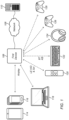
- Figure 1 shows an example first device 106 which may be owned by and/or operated by a first user.
- the first device 106 may selectively connect over a wireless connection such as BLUETOOTH TM (BT) with various devices, such as a tablet computer 114, one or more smart phones 116, a computer 118, a remote control 120, a keyboard 122, a headset or speaker 124, and/or remote game controllers (GC) 126 and 128, etc.
- BLUETOOTH TM BLUETOOTH TM
- GC remote game controllers
- the first device 106 is shown as being possibly connected with a number of BT devices, although the first device 106 may connect to any of various types of devices.
- the first device may be any of various types of devices, such as a computer, tablet, smart phone, wearable device, etc.
- the first device 106 is also shown as being connected through a wide area network 108 to a server computer 110.
- the server computer 110 may store information regarding other devices associated with or owned by the first user, e.g., as indicated by a first user account.
- the server 110 may be a cloud-based server which stores information regarding other devices owned by the first user.
- the first device 106 may connect to the server 110 through network 108 over a Wi-Fi network, e.g., through a Wi-Fi access point for an Internet connection.
- the first device 106 may connect to the server 110 through network 108 over a cellular connection.
- the first device 106 may operate to create a pairing (establish short-range wireless communications) with a wireless device and in the process create and store link information.
- the link information may include any data, security credentials (e.g. security keys), link keys, long term keys, OOB keys, etc. depending on the short-range wireless communications protocol through which the first device 106 is paired with the wireless device.
- proximity pairing also introduces several challenges, including but not limited to host-host calibration differences, environmental variations, and impact of Wi-Fi when associated with 2.4GHz networks.
- the user interface (UI) for proximity pairing (PP) should be displayed only on the host device for which the pairing is intended, and should not be displayed on any of the other hosts in the vicinity.
- the proximity pairing/switching may be based on limiting the pairing to a specified or selected set of devices. For example, in some embodiments a cloud-based proximity pairing/switching between devices (e.g.
- the first device 106 may then be configured to provide the link information (or other connection information) to the server 110 so that this link information may be shared with other devices associated with or owned by the first user. These other devices may be considered as the specified or selected (set of) devices with which the first device 106 may be paired.
- Figure 2 illustrates an example where the first device 106 may be a computer system.
- Figure 2 shows an example of a first computer system 106A connected to one or more of various types of wireless devices.
- the first computer system 106A may connect to a wireless mouse 130, wireless keyboard 122, wireless trackpad 132, and/or wireless headphones/earbuds/speaker 124.
- the first computer system 106A may establish communications over a wide area network 108, such as the Internet, using any of various communication technologies, such as Wi-Fi, cellular, or a wired connection, and may also communicate via network 108 communicate with a remote device/server 110 (for example).
- computer system 106A may wirelessly connect to a streaming device 138 (e.g.
- AppleTV TM may connect with various mobile devices such as tablets 114 and cellular phones 116.
- the first device 106 (such as computer device 106A) may connect over a WPAN to any one or more of the devices enumerated above, and any other similar devices equipped, for example, with short range wireless communication interfaces, e.g. BT and the like.
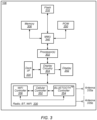
- FIG 3 illustrates an exemplary block diagram of a device 106, such as the first device 106 in Figure 1 and/or computer device 106A in Figure 2 .
- the device 106 may include processor(s) 302, which may execute program instructions for the device 106 and may comprise display circuitry 304 which may perform graphics processing and provide display signals to the display 342.
- the processor(s) 302 may also be coupled to memory management unit (MMU) 340, which may be configured to receive addresses from the processor(s) 302 and translate those addresses to locations in memory (e.g., memory 306, read only memory (ROM) 350, Flash memory 310) and/or to other circuits or devices, such as the display circuitry 304, radio 330, connector I/F 320, and/or display 342.
- the MMU 340 may be configured to perform memory protection and page table translation or set up. In some embodiments, the MMU 340 may be included as a portion of the processor(s) 302.
- the processor 302 may be coupled to various other circuits of the device 106.
- the device 106 may include various types of memory, a connector interface 320 (e.g., for coupling to the computer system), the display 342, and wireless communication circuitry (e.g., for Wi-Fi, BLUETOOTH TM , LTE, LTE-A, GPS, etc.).
- the device 106 may include at least one antenna (e.g. 335a), and possibly multiple antennas (e.g. illustrated by antennas 335a and 335b), for performing wireless communication with base stations and/or other devices.
- Antennas 335a and 335b are shown by way of example, and UE device 106 may include more antennas.
- the one or more antennas are collectively referred to as antenna 335.
- the device 106 may use antenna 335 to perform the wireless communication with the aid of radio 330.
- the UE may be configured to communicate wirelessly using multiple wireless communication standards in some embodiments.
- the device 106 may include hardware and software components for implementing improved methods for pairing and connecting with accessory devices.
- the device of a user may store and execute a wireless software driver (e.g., a BLUETOOTH TM protocol stack), or other software, for providing link information associated with an accessory device to a server to be shared with other devices associated with the user.
- the device 106 may be configured to implement part or all of the methods described herein, e.g., by executing program instructions stored on a memory medium (e.g., a non-transitory computer-readable memory medium) and/or through hardware or firmware operation.
- the methods described herein may be at least partially implemented by a programmable hardware element, such as an FPGA (Field Programmable Gate Array), and/or as an ASIC (Application Specific Integrated Circuit).
- a programmable hardware element such as an FPGA (Field Programmable Gate Array), and/or as an ASIC (Application Specific Integrated Circuit).
- FPGA Field Programmable Gate Array
- ASIC Application Specific Integrated Circuit
- radio 330 may include separate controllers dedicated to controlling communications for various respective RAT standards.
- radio 330 may include a Wi-Fi controller 356 and a BLUETOOTH TM controller 354, and may also comprise a cellular controller (e.g. LTE controller) 352.
- a cellular controller e.g. LTE controller
- one or more or all of these controllers may be implemented as hardware, software, firmware or some combination thereof. While three separate controllers are illustrated within radio 330, other embodiments may have fewer, more, and/or different controllers for various different RATs that may be implemented in device 106.
- any of the accessory devices exemplified in Figure 2 may also include certain components described in Figure 3 as components of first device 106.
- a headset accessory device e.g. 124 in Figure 2
- Figure 4 shows the flow chart for an example method by which an accessory device may transition from a connection with a first device to connecting to a second device, according to some embodiments.
- the first device and the second device may be any of various previously enumerated and/or described devices, such as device 106, and in some scenarios may belong to different classes of devices.
- the first device and second device may also be included in a specified group of devices or a designated set of devices, for example they may be associated with a common user account (e.g., a cloud-based account, such as an iCloud TM account) of a user which may be maintained by a cloud-based server.
- the devices may be grouped and/or designated as belonging to a group of devices based on another criteria.
- the devices may be considered as part of a group of devices, e.g. a group of trusted devices.
- the accessory device may be any of various devices as described above in relation to Figure 1 and Figure 2 , such as a headset, game controller, mouse, keyboard, wearable, or other similar device, including at least components that facilitate and enable short range wireless communication for pairing with the first device and the second device.
- the first device may pair with the accessory device.
- user input on the first device or the accessory device may initiate the pairing or the pairing may occur automatically.
- the first device may exchange a pairing request with the accessory device for the purpose of establishing a connection between the devices.
- the accessory device may be able to connect with the first device by one or more of various means, including wired or wireless connections.
- the accessory device may be a BLUETOOTH TM (BT) device, which may operate to connect to the first device wirelessly, using BT technology.
- BT BLUETOOTH TM
- the accessory device may operate to connect to the first device wirelessly, using any of various available WPAN technologies, or short range wireless communications technologies.
- the first device may communicate information associated with the first pairing (or with the first pairing request) to a central location such as a server, e.g. a cloud-based server.
- the cloud-based server may store respective information associated with various other devices that belong to the specified group of devices into which the first device also belongs, for example devices that all belong to the user of the first device, or are designated as being used by the user of the first device. For example, if the user owns a portable computer, a tablet device and a smart phone, the server (central location) may store respective information associated each of these three devices.
- the server may also have the ability to communicate, e.g., push, data to each of these three devices.
- the information (associated with the first pairing) communicated by the first device to the cloud-based server may comprise various items relevant to the accessory device and/or to establishing a connection with the accessory device, such as link keys, addresses, and/or other information.
- the information may be communicated automatically as a result of the pairing between the first device and the accessory device, or the communication of the information may be triggered by user input on the first device or a request for the information by the cloud-based server.
- the BT software stack may operate to convey the information to the cloud-based server.
- the first device may communicate with the cloud-based server by various means, such as wired or wireless connections to the Internet, e.g., using Wi-Fi, LTE, wired Internet, or related technologies.
- the cloud-based server may store the information and/or distribute the received information among one or more (or all other) devices associated with / belonging to the specified (or designated) group of devices, e.g. devices associated with the user account of the user of the first device.
- the information associated with the accessory device (and the first pairing request) may be propagated from the first device to other devices in the specified group, e.g. to other devices associated with the same user, such as the second device.
- the second device may then store the information.
- the information associated with the pairing (request) of the accessory device and the first device may also be referenced as link information associated with the pairing, and hence include information pertaining to both the accessory device and the first device as associated with the first pairing.
- the link information may include a first portion pertaining to the first device and a second portions pertaining to the accessory device.
- the first portion of the link information may include security credentials of the first device
- the second portion of the link information may include security credentials of the accessory device.
- the first device also may send the link information associated with one or more other user devices (also referred to as second link information) to the accessory device.
- the accessory device is enabled to automatically connect (without having to undergo a pairing procedure which may or may not require user intervention) with a second user device of the other specified user devices, using the first link information previously stored at the second user device and the second link information previously stored at the accessory device.
- the first device connects with the server (or, more generally, with an external device capable of receiving, storing and sharing information, including the link information, about other devices), to establish what information about other devices is stored on the server (404).
- the first device may already have previously received the second link information, and in that case the first device need not be connected to the server as it may already be storing this information.
- the first device may already have stored link information associated with (or corresponding to) the one or more other user devices, and may use this locally stored history to create the connection credentials for the one or more other devices. Accordingly, 404 may not need to take place and be omitted in such scenarios.
- certain conditions and/or actions may trigger an indication for the second user device to pair with the accessory device.
- the second device may determine its proximity to the accessory device. Proximity between the second device and the accessory device may be calculated using various metrics, such as signal strength, and may be compared to a threshold value to determine whether to initiate proximity-based pairing.
- proximity-based pairing if the accessory device is determined to be at least within specified proximity of the accessory device, at 412 the second device may automatically connect with the accessory device (without requiring a pairing procedure) or may present the user with an option to pair the second device to the accessory device, e.g., by prompting the user with a pop-up UI inquiring whether to connect to the accessory device, as desired.
- the distance used to trigger pairing or connecting can be set as any desired or specified distance.
- the proximity may be set to a distance determined to be a distance at which pairing/connecting is expected.
- User input on the second device e.g., through user interaction with buttons and/or a display, may indicate a desire to pair with the accessory device.
- the second user device may simply connect with the accessory device using the previously stored link information (at both the second user device and at the accessory device as described above) without requiring any user interaction and/or without requiring any multi-step pairing procedure.
- the second user device may operate to pair with the accessory device in response to the indication received at 410.
- the second device may communicate a disconnect message to the first device (e.g., over the Internet or through the cloud-based server) for the purpose of transitioning the accessory device from the first user device to the second user device.
- the accessory may alternatively communicate the disconnect message.
- the second user device may use the information received at 404/406, such as link key information associated with the accessory device, in order to connect with the accessory device.
- the accessory device may use the information received at 408, such as link key information associated with the second user device, in order to connect with the second user device. This enables the second user device and the accessory device to more easily and efficiently connect with each other without requiring a pairing procedure.
- the accessory device may disconnect from the first user device and may establish a new connection with the second user device.
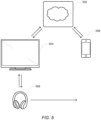
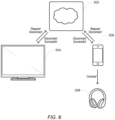
- Figures 5 and 6 provide an illustration of how the pairing process described in Figure 4 may be used to connect user devices to accessory devices via short range wireless communications according to one set of embodiments.
- a user pairs an accessory device 508, shown here as a headset, via BLUETOOTH TM (BT) to any one of the user's registered devices, shown here as a computer 504, e.g. an iMac TM
- the device e.g., through the BT stack, may opt to send the link information associated with the pairing (of user device 504 with accessory device 508) via the cloud 502 to other devices in the user's registered account.
- a second user device 506 is shown in Figure 5 as a smart phone.
- the link information e.g. link keys
- the link information may be relayed to the accessory device 508 from the currently connected device 504.
- the disconnect message may be sent over the cloud 502 to the currently connected device 504, enabling proximity switching.
- accessory device 508 may be connected with second user device 506 using the link information associated with second user device 506 that had been provided to the accessory device 508 and the link information associated with accessory device 508 that had been provided to second user device 506.
- Figure 7 shows a communications system with devices connected and paired according to some other embodiments. More specifically, Figure 7 provides an illustration of the types of wired and wireless connections that may be established in order to allow user devices and accessory devices to be easily connected and/or paired with each other, respectively.
- a user device 702 and an accessory device 708 may be connected over a secure transport such as USB 714 (shown) or secure Wi-Fi (more generally a secure wired or wireless connection), and the existing transport may be used for exchanging Bluetooth security credentials (more generally link information corresponding to establishing a pairing between the devices according to an insecure and/or short range wireless communication protocol) between devices 702 and 708.
- a secure transport such as USB 714 (shown) or secure Wi-Fi (more generally a secure wired or wireless connection)
- Bluetooth security credentials more generally link information corresponding to establishing a pairing between the devices according to an insecure and/or short range wireless communication protocol
- device 702 that has a connection with devices 704 and 706 may act as a relay to transfer BLUETOOTH TM security credentials (more generally link information corresponding to establishing a pairing between the devices according to the insecure and/or short range wireless communication protocol) over the existing BLUETOOTH TM (or more generally the insecure and/or short range wireless communication protocol) connections to bring up the third connection between devices 704 and 706 without devices 704 and 706 having to go through a pairing procedure.
- BLUETOOTH TM security credentials more generally link information corresponding to establishing a pairing between the devices according to the insecure and/or short range wireless communication protocol
- BLUETOOTH TM or more generally the insecure and/or short range wireless communication protocol
- Some embodiments of the system shown in Figure 7 may include a hand held device 702 connected to both a first type of accessory device 704 and to a second type of device 706, for example a wearable device 706.
- the existing BLUETOOTH TM (BT) connection(s) 710 and 712 may be used to exchange BT security credentials of the first type of accessory device 704 and the wearable device 706 between the first type of accessory device 704 and the wearable device 706.
- Devices 704 and 706 may then connect with each other under certain conditions without requiring a pairing procedure.
- a hand held device 702 may be connected to a display device 708 (e.g. a CarPlay TM device) over USB using an iAP TM protocol.
- the existing USB connection may be used to exchange BT security credentials and automatically connect the hand held device 702 and the display device 708.
- a hand held device may be connected to a second type of accessory device over a secure Wi-Fi connection.
- the existing Wi-Fi connection may be used to exchange BT security credentials and automatically connect the hand held device and second type accessory devices.
- a pairing type may be determined. Based upon the device types and application, one of a number of different types of pairings may be selected/identified.
- a first type of pairing may be pairing using a link key. This pairing method may be used for classic pairing between BR/EDR (Basic Rate/Enhanced Data Rate) devices or dual mode devices, where link key is generated on one device and sent to other device for easy pairing.
- a second type of pairing may be pairing using long term key.
- This pairing method may be used for LE (Low Energy) pairing between two dual mode devices or LE devices, where LTK (Long Term Key) and other LE pairing related keys are generated on both devices and then exchanged with one another.
- a third type of pairing may be pairing using OOB (Out of Band) data.
- OOB Out of Band
- This pairing method may be used when either of the above methods are not possible to select for application specific reason.
- OOB keys e.g. as defined by OOB association model in BLUETOOTH TM core spec 2.1 and later
- An application running on the user device side may provide the remote device information and pairing type to the BT stack and may request to generate security keys for the specific pairing type.
- the link keys may be exchanged.
- the generated security keys may be exchanged over existing non-BT transport and stored in the respective security database.
- Embodiments of the present invention may be realized in any of various forms.
- the present invention may be realized as a computer-implemented method, a computer-readable memory medium, or a computer system.
- the present invention may be realized using one or more custom-designed hardware devices such as ASICs.
- the present invention may be realized using one or more programmable hardware elements such as FPGAs.
Landscapes
- Engineering & Computer Science (AREA)
- Computer Networks & Wireless Communication (AREA)
- Signal Processing (AREA)
- Computer Security & Cryptography (AREA)
- Multimedia (AREA)
- Human Computer Interaction (AREA)
- Mobile Radio Communication Systems (AREA)
- Telephone Function (AREA)
Claims (14)
- Verfahren zur drahtlosen Kommunikation, das Verfahren umfassend: Herstellen, durch eine erste drahtlose Vorrichtung (702), einer ersten direkten drahtlosen Kurzstreckenverbindung (710) mit einer Zusatzvorrichtung (704); Teilen, durch die erste drahtlose Vorrichtung (702) mit der Zusatzvorrichtung (704) über die erste direkte drahtlose Kurzstreckenverbindung (710), eines ersten Verbindungsinformationselements, das mit einer zweiten drahtlosen Vorrichtung (706) assoziiert ist, die sich von der ersten drahtlosen Vorrichtung (702) unterscheidet, wobei die erste und die zweite drahtlose Vorrichtung zu einer Gruppe vertrauenswürdiger Vorrichtungen gehören; Teilen, durch die erste drahtlose Vorrichtung (702) mit der zweiten drahtlosen Vorrichtung (706), eines zweiten Verbindungsinformationselements, das mit der Zusatzvorrichtung (704) assoziiert ist; wobei das Teilen des ersten Verbindungsinformationselements mit der Zusatzvorrichtung (704) und das Teilen des zweiten Verbindungsinformationselements mit der zweiten drahtlosen Vorrichtung (706) es der Zusatzvorrichtung (704) und der zweiten drahtlosen Vorrichtung (706) ermöglicht, anschließend eine zweite direkte drahtlose Kurzstreckenverbindung miteinander herzustellen, ohne dass die Zusatzvorrichtung (704) und die zweite drahtlose Vorrichtung (706) an einer separaten Paarungsprozedur teilnehmen.
- Verfahren nach Anspruch 1, wobei die erste drahtlose Vorrichtung (702) und die zweite drahtlose Vorrichtung (706) in einem Satz von Vorrichtungen enthalten sind, die mit einem gemeinsamen Benutzer assoziiert sind.
- Verfahren nach Anspruch 1, wobei das erste Verbindungsinformationselement umfasst: einen Verbindungsschlüssel; einen Langzeitschlüssel; einen Sicherheitsberechtigungsnachweis; eine Adresse; oder einen Out-of-Band-Schlüssel.
- Verfahren nach Anspruch 1, ferner umfassend: automatisches Herstellen der zweiten direkten drahtlosen Kurzstreckenverbindung zwischen der Zusatzvorrichtung (704) und der zweiten Vorrichtung (706), wenn die Zusatzvorrichtung (704) innerhalb einer vorbestimmten Reichweite der zweiten Vorrichtung (706) kommt.
- Verfahren nach Anspruch 4, wobei die zweite direkte drahtlose Kurzstreckenverbindung eine Bluetooth-Verbindung umfasst.
- Verfahren nach Anspruch 5, wobei das erste Verbindungsinformationselement mindestens eines umfasst von: einer Bluetooth-Adresse; einem Bluetooth-Vorrichtungsnamen; oder einer Vorrichtungsklasse.
- Verfahren nach Anspruch 4, ferner umfassend: Empfangen, durch die Zusatzvorrichtung (704) von der zweiten Vorrichtung (706) über die zweite direkte drahtlose Kurzstreckenverbindung, eines dritten Verbindungsinformationselements, das mit einer dritten Vorrichtung (708) assoziiert ist, die sich von der zweiten Vorrichtung (706) unterscheidet, wobei das dritte Verbindungsinformationselement es der Zusatzvorrichtung (704) ermöglicht, eine dritte direkte drahtlose Kurzstreckenverbindung mit der dritten Vorrichtung (708) herzustellen, ohne zuerst an einer Paarungsprozedur mit der dritten Vorrichtung (708) teilzunehmen.
- Verfahren nach Anspruch 7, ferner umfassend: Beenden der zweiten direkten drahtlosen Kurzstreckenverbindung nach dem Empfangen des dritten Verbindungsinformationselements; und Herstellen der dritten direkten drahtlosen Kurzstreckenverbindung zwischen der ersten Vorrichtung (702) und der dritten Vorrichtung (708) nach dem Beenden der zweiten direkten drahtlosen Kurzstreckenverbindung.
- Verfahren nach Anspruch 1, ferner umfassend: indirektes Teilen des zweiten Verbindungsinformationselements durch Übertragen des zweiten Verbindungsinformationselements an einen Server (110).
- Verfahren nach Anspruch 1, ferner umfassend: direktes Teilen des zweiten Verbindungsinformationselements über eine dritte direkte drahtlose Verbindung (712), die zwischen der ersten Vorrichtung (702) und der zweiten Vorrichtung (706) hergestellt wird.
- Verfahren nach Anspruch 1, ferner umfassend: Abrufen, durch die erste drahtlose Vorrichtung (702), des ersten Verbindungsinformationselements aus einem lokalen Speicher.
- Vorrichtung, umfassend: einen Prozessor (302), der konfiguriert ist, um eine Vorrichtung (106) zu veranlassen, das Verfahren nach einem der Ansprüche 1 bis 11 durchzuführen.
- Vorrichtung (106), umfassend: Funkschaltungen (330), die konfiguriert sind, um drahtlose Kommunikationen der Vorrichtung (106) zu ermöglichen; und eine Vorrichtung nach Anspruch 12, die kommunikativ mit den Funkschaltungen (330) gekoppelt ist.
- Nichtflüchtiges Speicherelement, das Programmieranweisungen speichert, die von einem Prozessor (302) ausführbar sind, um das Verfahren nach einem der Ansprüche 1 bis 11 durchzuführen.
Priority Applications (1)
| Application Number | Priority Date | Filing Date | Title |
|---|---|---|---|
| EP25184174.8A EP4618607A3 (de) | 2015-06-05 | 2016-04-15 | Cloud-basierte näherungspaarung und -umschaltung für peer-to-peer-vorrichtungen |
Applications Claiming Priority (4)
| Application Number | Priority Date | Filing Date | Title |
|---|---|---|---|
| US201562171844P | 2015-06-05 | 2015-06-05 | |
| US14/871,487 US9913079B2 (en) | 2015-06-05 | 2015-09-30 | Cloud-based proximity pairing and switching for peer-to-peer devices |
| EP16720252.2A EP3304937B1 (de) | 2015-06-05 | 2016-04-15 | Cloud-basierte näherungspaarung und schaltung für peer-to-peer-vorrichtungen |
| PCT/US2016/027927 WO2016195825A1 (en) | 2015-06-05 | 2016-04-15 | Cloud based proximity pairing and switching for peer-to-peer devices |
Related Parent Applications (2)
| Application Number | Title | Priority Date | Filing Date |
|---|---|---|---|
| EP16720252.2A Division EP3304937B1 (de) | 2015-06-05 | 2016-04-15 | Cloud-basierte näherungspaarung und schaltung für peer-to-peer-vorrichtungen |
| EP16720252.2A Division-Into EP3304937B1 (de) | 2015-06-05 | 2016-04-15 | Cloud-basierte näherungspaarung und schaltung für peer-to-peer-vorrichtungen |
Related Child Applications (1)
| Application Number | Title | Priority Date | Filing Date |
|---|---|---|---|
| EP25184174.8A Division EP4618607A3 (de) | 2015-06-05 | 2016-04-15 | Cloud-basierte näherungspaarung und -umschaltung für peer-to-peer-vorrichtungen |
Publications (3)
| Publication Number | Publication Date |
|---|---|
| EP3869832A1 EP3869832A1 (de) | 2021-08-25 |
| EP3869832C0 EP3869832C0 (de) | 2025-06-25 |
| EP3869832B1 true EP3869832B1 (de) | 2025-06-25 |
Family
ID=55910371
Family Applications (3)
| Application Number | Title | Priority Date | Filing Date |
|---|---|---|---|
| EP25184174.8A Pending EP4618607A3 (de) | 2015-06-05 | 2016-04-15 | Cloud-basierte näherungspaarung und -umschaltung für peer-to-peer-vorrichtungen |
| EP21168935.1A Active EP3869832B1 (de) | 2015-06-05 | 2016-04-15 | Drahtlose kurzstrecken-übertragung von pairing-informationen zum zubehörgerät |
| EP16720252.2A Active EP3304937B1 (de) | 2015-06-05 | 2016-04-15 | Cloud-basierte näherungspaarung und schaltung für peer-to-peer-vorrichtungen |
Family Applications Before (1)
| Application Number | Title | Priority Date | Filing Date |
|---|---|---|---|
| EP25184174.8A Pending EP4618607A3 (de) | 2015-06-05 | 2016-04-15 | Cloud-basierte näherungspaarung und -umschaltung für peer-to-peer-vorrichtungen |
Family Applications After (1)
| Application Number | Title | Priority Date | Filing Date |
|---|---|---|---|
| EP16720252.2A Active EP3304937B1 (de) | 2015-06-05 | 2016-04-15 | Cloud-basierte näherungspaarung und schaltung für peer-to-peer-vorrichtungen |
Country Status (6)
| Country | Link |
|---|---|
| US (7) | US9913079B2 (de) |
| EP (3) | EP4618607A3 (de) |
| JP (6) | JP6553214B2 (de) |
| KR (3) | KR101940709B1 (de) |
| CN (2) | CN113038393B (de) |
| WO (1) | WO2016195825A1 (de) |
Families Citing this family (91)
| Publication number | Priority date | Publication date | Assignee | Title |
|---|---|---|---|---|
| US10860290B2 (en) | 2000-11-01 | 2020-12-08 | Flexiworld Technologies, Inc. | Mobile information apparatuses that include a digital camera, a touch sensitive screen interface, support for voice activated commands, and a wireless communication chip or chipset supporting IEEE 802.11 |
| CN100334577C (zh) | 2000-11-01 | 2007-08-29 | 福来西奥德技术公司 | 用于设备到设备的普适数字输出的控制器及管理器 |
| US9965233B2 (en) | 2000-11-20 | 2018-05-08 | Flexiworld Technologies, Inc. | Digital content services or stores over the internet that transmit or stream protected or encrypted digital content to connected devices and applications that access the digital content services or stores |
| US10915296B2 (en) | 2000-11-01 | 2021-02-09 | Flexiworld Technologies, Inc. | Information apparatus that includes a touch sensitive screen interface for managing or replying to e-mails |
| US11204729B2 (en) | 2000-11-01 | 2021-12-21 | Flexiworld Technologies, Inc. | Internet based digital content services for pervasively providing protected digital content to smart devices based on having subscribed to the digital content service |
| US20020097416A1 (en) | 2001-01-19 | 2002-07-25 | Chang William Ho | Output controller processor for universal data output |
| KR102126993B1 (ko) * | 2014-05-07 | 2020-06-25 | 삼성전자주식회사 | 전자 장치에서 공간 이동 시 서비스 시점의 동기를 제어하기 위한 장치 및 방법 |
| US9763276B2 (en) * | 2014-05-30 | 2017-09-12 | Apple Inc. | Seamless connectivity between hearing aid and multiple devices |
| US10212136B1 (en) | 2014-07-07 | 2019-02-19 | Microstrategy Incorporated | Workstation log-in |
| US20160262205A1 (en) * | 2015-03-06 | 2016-09-08 | Apple Inc. | Cloud support for discovery and data transfer for mobile client devices |
| US9913079B2 (en) | 2015-06-05 | 2018-03-06 | Apple Inc. | Cloud-based proximity pairing and switching for peer-to-peer devices |
| RU2693920C1 (ru) * | 2015-10-30 | 2019-07-05 | Телефонактиеболагет Лм Эрикссон (Пабл) | Установление секрета, совместно используемого между первым устройством связи и по меньшей мере одним вторым устройством связи |
| US10039145B2 (en) * | 2015-11-19 | 2018-07-31 | Nike, Inc. | System, apparatus, and method for received signal strength indicator (RSSI) based authentication |
| US10735467B2 (en) * | 2016-01-11 | 2020-08-04 | Lg Electronics Inc. | Method and apparatus for controlling a device using bluetooth technology |
| US10231128B1 (en) | 2016-02-08 | 2019-03-12 | Microstrategy Incorporated | Proximity-based device access |
| US10855664B1 (en) | 2016-02-08 | 2020-12-01 | Microstrategy Incorporated | Proximity-based logical access |
| US11197331B2 (en) | 2016-06-10 | 2021-12-07 | Apple Inc. | Zero-round-trip-time connectivity over the wider area network |
| US9736290B1 (en) * | 2016-06-10 | 2017-08-15 | Apple Inc. | Cloud messaging between an accessory device and a companion device |
| US10165613B2 (en) * | 2016-10-06 | 2018-12-25 | Htc Corporation | Control method for bluetooth communication and bluetooth low energy communication |
| US11212326B2 (en) | 2016-10-31 | 2021-12-28 | Microsoft Technology Licensing, Llc | Enhanced techniques for joining communication sessions |
| US10264410B2 (en) * | 2017-01-10 | 2019-04-16 | Sang-Rae PARK | Wearable wireless communication device and communication group setting method using the same |
| CN108696843A (zh) | 2017-03-07 | 2018-10-23 | 中移(杭州)信息技术有限公司 | 一种物理设备间蓝牙组网控制方法、装置和系统 |
| WO2018166102A1 (zh) * | 2017-03-14 | 2018-09-20 | 华为技术有限公司 | 一种多设备无线连接方法和设备 |
| US10657242B1 (en) | 2017-04-17 | 2020-05-19 | Microstrategy Incorporated | Proximity-based access |
| US10771458B1 (en) * | 2017-04-17 | 2020-09-08 | MicoStrategy Incorporated | Proximity-based user authentication |
| US11140157B1 (en) | 2017-04-17 | 2021-10-05 | Microstrategy Incorporated | Proximity-based access |
| US10141973B1 (en) * | 2017-06-23 | 2018-11-27 | Cisco Technology, Inc. | Endpoint proximity pairing using acoustic spread spectrum token exchange and ranging information |
| CN107391587A (zh) * | 2017-06-23 | 2017-11-24 | 努比亚技术有限公司 | 链接分享及访问方法、服务器、终端及计算机存储介质 |
| EP3439274B1 (de) * | 2017-08-04 | 2021-11-10 | Nokia Technologies Oy | Ereignisbenachrichtigung |
| US10075539B1 (en) | 2017-09-08 | 2018-09-11 | Google Inc. | Pairing a voice-enabled device with a display device |
| US10455633B2 (en) | 2017-11-14 | 2019-10-22 | Knowmadics, Inc. | Wireless communication system and method for monitoring and alerting a broken pairing between electronic devices |
| US10708769B2 (en) * | 2017-12-20 | 2020-07-07 | Bose Corporation | Cloud assisted accessory pairing |
| KR102473262B1 (ko) | 2018-01-08 | 2022-12-05 | 삼성전자주식회사 | 통신 연결의 형성 또는 해제를 제어하는 전자 장치 및 그 동작 방법 |
| KR102401383B1 (ko) * | 2018-02-27 | 2022-05-24 | 현대자동차주식회사 | 차량에서의 무결절성 멀티 전자 기기 연결 방법 및 장치 |
| CN108717399B (zh) * | 2018-03-29 | 2022-03-25 | 联想(北京)有限公司 | 一种处理方法、系统及电子设备 |
| KR102693979B1 (ko) * | 2018-10-19 | 2024-08-12 | 삼성전자주식회사 | 링크 공유를 지원하는 전자 장치 및 이를 위한 방법 |
| KR102523826B1 (ko) | 2018-10-22 | 2023-04-21 | 삼성전자주식회사 | 블루투스 통신을 사용하는 전자 장치와 이의 동작 방법 |
| CN113039823B (zh) | 2018-11-02 | 2024-07-26 | 亚萨合莱有限公司 | 用于访问控制的系统、方法和设备 |
| KR102613405B1 (ko) | 2019-02-12 | 2023-12-14 | 삼성전자주식회사 | 블루투스 통신 정보 공유 방법 및 전자 장치 |
| CN109981891A (zh) * | 2019-02-27 | 2019-07-05 | 维沃移动通信有限公司 | 一种终端控制方法、装置及终端设备 |
| KR102639249B1 (ko) * | 2019-03-05 | 2024-02-22 | 삼성전자주식회사 | 블루투스 네트워크에서 채널 정보를 공유하기 위한 방법 및 이를 위한 전자 장치 |
| EP3843495B1 (de) * | 2019-03-18 | 2023-11-29 | Spreadtrum Communications (Shanghai) Co., Ltd. | Kommunikationsverfahren und einrichtung und vorrichtung |
| CN113614797B (zh) | 2019-03-25 | 2024-04-19 | 亚萨合莱有限公司 | 具有基于定位的意图检测的物理访问控制系统 |
| WO2020193566A1 (en) | 2019-03-25 | 2020-10-01 | Assa Abloy Ab | Ultra-wide band device for access control reader system |
| US11000759B2 (en) * | 2019-03-29 | 2021-05-11 | Valve Corporation | Game controller operable in bluetooth low energy (BLE) mode |
| US10880382B2 (en) | 2019-04-18 | 2020-12-29 | T-Mobile Usa, Inc. | Configuring meaning and state conditions for paired IoT devices |
| CN110138439B (zh) * | 2019-04-23 | 2020-07-21 | 北京航空航天大学 | 基于天临空地车专用网络的通信方法及装置 |
| US11997496B2 (en) * | 2019-05-31 | 2024-05-28 | Apple Inc. | Temporary pairing for wireless devices |
| CN112312367B (zh) * | 2019-08-01 | 2024-11-15 | 联发科技(新加坡)私人有限公司 | 蓝牙通信方法及通信设备 |
| CN117544931A (zh) | 2019-08-09 | 2024-02-09 | 华为技术有限公司 | 信息共享方法、终端设备、存储介质及计算机程序产品 |
| CN112615891B (zh) * | 2019-09-18 | 2022-02-25 | 华为技术有限公司 | 配对方法及设备 |
| WO2021058479A1 (en) | 2019-09-26 | 2021-04-01 | Assa Abloy Ab | Ultra-wide band antenna configuration for physical access control system |
| CN113039824B (zh) | 2019-10-01 | 2024-05-31 | 亚萨合莱有限公司 | 用于精细测距应用的连接和服务发现 |
| JP7036445B2 (ja) * | 2019-10-21 | 2022-03-15 | Necプラットフォームズ株式会社 | サーバ、スレーブ装置、マスター装置、システム、システムの方法、及びプログラム |
| KR102752916B1 (ko) | 2019-10-28 | 2025-01-10 | 삼성전자 주식회사 | 근접 통신 서비스를 지원하는 전자 장치 및 이를 이용한 근거리 통신 장치의 정보 획득 방법 |
| KR102749983B1 (ko) * | 2019-10-28 | 2025-01-03 | 삼성전자주식회사 | 외부 전자 장치와 주변 장치를 공유하는 전자 장치 및 그 방법 |
| KR20210050398A (ko) * | 2019-10-28 | 2021-05-07 | 삼성전자주식회사 | 전자 장치와 연결되지 않은 외부 전자 장치로 데이터를 전송하는 전자 장치 및 전자 장치의 동작 방법 |
| KR102871050B1 (ko) * | 2019-10-29 | 2025-10-15 | 삼성전자주식회사 | 암호화 통신을 수행하기 위한 전자 장치와 그 동작 방법 |
| US11546391B2 (en) | 2019-11-01 | 2023-01-03 | Microsoft Technology Licensing, Llc | Teleconferencing interfaces and controls for paired user computing devices |
| US11304246B2 (en) | 2019-11-01 | 2022-04-12 | Microsoft Technology Licensing, Llc | Proximity-based pairing and operation of user-specific companion devices |
| US11256392B2 (en) | 2019-11-01 | 2022-02-22 | Microsoft Technology Licensing, Llc | Unified interfaces for paired user computing devices |
| WO2021089195A1 (en) | 2019-11-07 | 2021-05-14 | Assa Abloy Ab | Upper layer device architecture for ultra-wide band enabled device |
| US11899757B2 (en) * | 2019-12-02 | 2024-02-13 | Cox Automotive, Inc. | Systems and methods for temporary digital content sharing |
| KR102852019B1 (ko) * | 2020-02-10 | 2025-08-28 | 삼성전자주식회사 | 외부 전자 장치의 상태에 기반하여 통신하는 방법 및 그 전자 장치 |
| CN111882846B (zh) * | 2020-03-05 | 2021-07-06 | 珠海市杰理科技股份有限公司 | 无线控制方法、装置、ble设备、芯片及存储介质 |
| US12136308B2 (en) | 2020-04-10 | 2024-11-05 | Assa Abloy Ab | Ultra-wide band radar for tailgating detection in access control systems |
| CN111494965B (zh) * | 2020-04-15 | 2021-09-14 | 腾讯科技(深圳)有限公司 | 信息处理方法、装置、设备及存储介质 |
| EP4138462A4 (de) * | 2020-05-14 | 2023-10-18 | Huawei Technologies Co., Ltd. | Verfahren zur gemeinsamen informationsnutzung, elektronische vorrichtungen und system |
| CN113676879B (zh) * | 2020-05-14 | 2024-11-29 | 华为技术有限公司 | 一种分享信息的方法、电子设备和系统 |
| JP7556215B2 (ja) * | 2020-06-08 | 2024-09-26 | 富士フイルムビジネスイノベーション株式会社 | 情報処理装置及びプログラム |
| KR20210155545A (ko) * | 2020-06-16 | 2021-12-23 | 삼성전자주식회사 | 페어링된 장치 정보에 기반한 통신 방법 및 이를 위한 전자 장치 |
| CN112165704A (zh) * | 2020-09-21 | 2021-01-01 | 上海闻泰信息技术有限公司 | 信息共享方法、耳机盒及计算机可读存储介质 |
| CN112383904B (zh) * | 2020-10-22 | 2023-03-14 | 赞同科技股份有限公司 | 无配对快速外设调用方法及装置 |
| US11637819B2 (en) | 2020-11-25 | 2023-04-25 | International Business Machines Corporation | Establishing connectivity between user devices |
| WO2022128627A1 (en) | 2020-12-14 | 2022-06-23 | Assa Abloy Ab | Trajectory prediction with data normalization |
| MX2023007034A (es) | 2020-12-14 | 2023-08-21 | Assa Abloy Ab | Prediccion de trayectoria e intencion. |
| US11700653B2 (en) * | 2021-03-11 | 2023-07-11 | Amazon Technologies, Inc. | Context-based wireless-protocol connections |
| US12369036B2 (en) | 2021-03-11 | 2025-07-22 | Amazon Technologies, Inc. | Remote device pairing |
| US11395356B1 (en) | 2021-07-02 | 2022-07-19 | Google Llc | User account aware personal area network bonding |
| US12245302B2 (en) * | 2021-08-03 | 2025-03-04 | Bose Corporation | Methods for improving wireless connections for previously paired devices |
| US12108317B2 (en) * | 2022-02-02 | 2024-10-01 | Dell Products, L.P. | Seamless pairing of wireless devices in hoteling environments |
| US12568375B2 (en) * | 2022-02-21 | 2026-03-03 | Electrolux Appliances Aktiebolag | Method for pairing an electronic accessory provided with one or more motion sensors to a household appliance connected to a computer network |
| CN115002734B (zh) * | 2022-04-29 | 2024-12-24 | 恒玄科技(上海)股份有限公司 | 一种音频分享方法、装置、系统及可读存储介质 |
| US12609919B2 (en) | 2022-10-21 | 2026-04-21 | Apple Inc. | Initial accessory setup |
| US20240232321A9 (en) * | 2022-10-21 | 2024-07-11 | Apple Inc. | Accessory setup using a setup code |
| JP2024063658A (ja) * | 2022-10-26 | 2024-05-13 | アークレイ株式会社 | 分析装置、機能制限方法、及び機能制限プログラム |
| US12414187B2 (en) * | 2022-11-29 | 2025-09-09 | Silicon Laboratories Inc. | Out of band bluetooth synchronization transfer |
| US12472426B1 (en) * | 2022-12-13 | 2025-11-18 | Amazon Technologies, Inc. | Hub for converting input from control devices |
| KR20240161372A (ko) * | 2023-05-04 | 2024-11-12 | 삼성전자주식회사 | 블루투스 연결을 증폭하는 모바일 장치, 그것을 갖는 무선 통신 시스템, 및 그것의 동작 방법 |
| US20250184270A1 (en) * | 2023-12-04 | 2025-06-05 | Centurylink Intellectual Property Llc | Systems and methods for managing paired connections |
| US20250216530A1 (en) * | 2023-12-29 | 2025-07-03 | Qualcomm Incorporated | Out-of-band key for ranging |
Family Cites Families (38)
| Publication number | Priority date | Publication date | Assignee | Title |
|---|---|---|---|---|
| EP1423796A1 (de) | 2001-08-09 | 2004-06-02 | Gigamedia Access Corporation | Hybride systemarchitektur für die sichere peer-to-peer-kommunikation |
| US7464272B2 (en) * | 2003-09-25 | 2008-12-09 | Microsoft Corporation | Server control of peer to peer communications |
| US7424267B2 (en) | 2005-03-07 | 2008-09-09 | Broadcom Corporation | Automatic resource availability using Bluetooth |
| US8472874B2 (en) * | 2007-03-14 | 2013-06-25 | Apple Inc. | Method and system for pairing of wireless devices using physical presence |
| US8295766B2 (en) * | 2007-08-31 | 2012-10-23 | Motorola Mobility Llc | Methods and devices for automatic multiple pairing of Bluetooth devices |
| US7912020B2 (en) | 2007-09-21 | 2011-03-22 | Motorola Mobility, Inc. | Methods and devices for dynamic mobile conferencing with automatic pairing |
| EP2313990B1 (de) | 2008-08-12 | 2018-05-23 | BlackBerry Limited | Transparente downlink-weiterleitung in einem drahtlosen kommunikationsnetz |
| US8769612B2 (en) | 2008-08-14 | 2014-07-01 | Microsoft Corporation | Portable device association |
| KR20100053986A (ko) | 2008-11-13 | 2010-05-24 | 주식회사 케이티테크 | 블루투스 장치와 단말 간의 자동 페어링 방법 및 블루투스 모듈을 포함하는 단말 |
| US20100278345A1 (en) * | 2009-05-04 | 2010-11-04 | Thomas Matthieu Alsina | Method and apparatus for proximity based pairing of mobile devices |
| US8555063B2 (en) * | 2009-09-30 | 2013-10-08 | Qualcomm Incorporated | Method for establishing a wireless link key between a remote device and a group device |
| US10104183B2 (en) * | 2010-06-22 | 2018-10-16 | Microsoft Technology Licensing, Llc | Networked device authentication, pairing and resource sharing |
| KR101110778B1 (ko) * | 2010-09-07 | 2012-03-13 | 비씨카드(주) | 블루투스 통신 방법 및 시스템 |
| WO2012044395A1 (en) | 2010-09-30 | 2012-04-05 | Apple Inc. | Wireless accessory device pairing transfer between multiple host devices |
| US8429421B2 (en) * | 2010-12-17 | 2013-04-23 | Microsoft Corporation | Server-side encrypted pattern matching |
| KR101807286B1 (ko) * | 2011-02-11 | 2017-12-08 | 삼성전자주식회사 | 근거리 통신을 이용한 휴대 단말기의 기능 수행 방법 및 장치 |
| CN103430509B (zh) * | 2011-03-16 | 2017-06-13 | 皇家飞利浦有限公司 | 使能在至少一个外围单元和装置之间的无线通信的方法 |
| US20120322376A1 (en) | 2011-06-14 | 2012-12-20 | Mitel Networks Corporation | Centralized Bluetooth device pairing |
| KR101964077B1 (ko) * | 2011-09-16 | 2019-04-02 | 삼성전자주식회사 | 휴대용 단말기에서 블루투스 디바이스와 연결하기 위한 장치 및 방법 |
| US9083811B2 (en) * | 2012-03-05 | 2015-07-14 | Qualcomm Incorporated | Method and apparatus to dynamically enable and control communication link optimizations on a communication device |
| US9374397B2 (en) * | 2012-05-17 | 2016-06-21 | Pokos Communications Corp | Method and system for searching, sensing, discovering, screening, enabling awareness, alerting, sharing, sending, receiving, buying, selling, and otherwise transmitting stories, content, interests, data, goods and services among known and unknown devices in a communication network |
| US20130311694A1 (en) * | 2012-05-21 | 2013-11-21 | Qualcomm Incorporated | Devices and methods for facilitating direct pairing in a wireless docking system |
| US20130311692A1 (en) * | 2012-05-21 | 2013-11-21 | Qualcomm Incorporated | Apparatus and method for direct pairing in a wireless docking system |
| WO2014033199A1 (en) * | 2012-08-30 | 2014-03-06 | Koninklijke Philips N.V. | Method and devices for pairing within a group of wireless devices |
| US9100828B2 (en) * | 2012-09-30 | 2015-08-04 | Apple Inc. | Transferring data over Bluetooth using intermediary bridge |
| US8977269B2 (en) * | 2012-11-08 | 2015-03-10 | Apple Inc. | Extending use of a cellular communication capabilities in a wireless device to another device |
| PL2926475T3 (pl) | 2012-11-28 | 2019-09-30 | Salutica Allied Solutions Sdn. Bhd. | System i sposób przesyłania, zapisywania, odbierania i/lub pozyskiwania informacji lub danych identyfikujących i/lub informacji lub danych parowania między akcesoriami lub powiązanymi produktami i inteligentnymi urządzeniami elektronicznymi z i/lub do dowolnego odrębnego serwera lub nośnika pamięci |
| US9201579B2 (en) * | 2012-12-07 | 2015-12-01 | Linkedin Corporation | Slide to apply |
| KR101990040B1 (ko) * | 2013-02-14 | 2019-06-18 | 엘지전자 주식회사 | 이동 단말기 및 그것을 이용한 클라우드 시스템 |
| US9621645B2 (en) * | 2013-12-30 | 2017-04-11 | Google Inc. | Device pairing via a cloud server |
| CN104144470B (zh) * | 2014-03-12 | 2015-12-30 | 腾讯科技(深圳)有限公司 | 一种蓝牙连接方法和客户端 |
| US10048497B1 (en) * | 2014-05-13 | 2018-08-14 | Intuit Inc. | Secure pairing of head-mounted electronic devices |
| JP6380551B2 (ja) * | 2014-12-01 | 2018-08-29 | 富士通株式会社 | ペアリング管理方法、ペアリング管理プログラム、および端末装置 |
| TWM499593U (zh) * | 2014-12-24 | 2015-04-21 | Golden Smart Home Technology Corp | 配對金鑰雲端系統 |
| US10681479B2 (en) * | 2015-01-30 | 2020-06-09 | Cassia Networks Inc. | Methods, devices and systems for bluetooth audio transmission |
| US9913079B2 (en) * | 2015-06-05 | 2018-03-06 | Apple Inc. | Cloud-based proximity pairing and switching for peer-to-peer devices |
| US9480096B1 (en) * | 2015-08-25 | 2016-10-25 | Motorola Solutions, Inc. | Method, device, and system for fast wireless accessory devices pairing |
| AU2022425086A1 (en) * | 2021-12-30 | 2024-05-30 | Abbott Diabetes Care Inc. | Methods and systems for sensing a plurality of analytes |
-
2015
- 2015-09-30 US US14/871,487 patent/US9913079B2/en active Active
-
2016
- 2016-04-15 JP JP2017561830A patent/JP6553214B2/ja active Active
- 2016-04-15 WO PCT/US2016/027927 patent/WO2016195825A1/en not_active Ceased
- 2016-04-15 EP EP25184174.8A patent/EP4618607A3/de active Pending
- 2016-04-15 CN CN202110267765.1A patent/CN113038393B/zh active Active
- 2016-04-15 CN CN201680031633.6A patent/CN107683602B/zh active Active
- 2016-04-15 KR KR1020177034232A patent/KR101940709B1/ko active Active
- 2016-04-15 KR KR1020197001352A patent/KR102072159B1/ko active Active
- 2016-04-15 KR KR1020207002468A patent/KR102115274B1/ko active Active
- 2016-04-15 EP EP21168935.1A patent/EP3869832B1/de active Active
- 2016-04-15 EP EP16720252.2A patent/EP3304937B1/de active Active
-
2018
- 2018-03-05 US US15/911,644 patent/US10419912B2/en active Active
-
2019
- 2019-07-03 JP JP2019124195A patent/JP6913714B2/ja active Active
- 2019-09-13 US US16/570,308 patent/US10986482B2/en active Active
-
2021
- 2021-04-16 US US17/232,422 patent/US11432129B2/en active Active
- 2021-07-12 JP JP2021115046A patent/JP7179922B2/ja active Active
-
2022
- 2022-08-15 US US17/888,289 patent/US11849378B2/en active Active
- 2022-11-16 JP JP2022183162A patent/JP7429279B2/ja active Active
-
2023
- 2023-11-02 US US18/500,739 patent/US12294927B2/en active Active
-
2024
- 2024-01-26 JP JP2024010404A patent/JP7651023B2/ja active Active
-
2025
- 2025-03-12 JP JP2025039127A patent/JP2025100546A/ja active Pending
- 2025-04-07 US US19/172,316 patent/US20250294334A1/en active Pending
Also Published As
Similar Documents
| Publication | Publication Date | Title |
|---|---|---|
| US12294927B2 (en) | Cloud-based proximity pairing and switching for peer-to-peer devices | |
| US11671809B2 (en) | Bluetooth profile fast connect | |
| EP3080704B1 (de) | Automatisierte gemeinsame internetnutzung | |
| CN106027127B (zh) | 天线系统 |
Legal Events
| Date | Code | Title | Description |
|---|---|---|---|
| PUAI | Public reference made under article 153(3) epc to a published international application that has entered the european phase |
Free format text: ORIGINAL CODE: 0009012 |
|
| STAA | Information on the status of an ep patent application or granted ep patent |
Free format text: STATUS: REQUEST FOR EXAMINATION WAS MADE |
|
| 17P | Request for examination filed |
Effective date: 20210416 |
|
| AC | Divisional application: reference to earlier application |
Ref document number: 3304937 Country of ref document: EP Kind code of ref document: P |
|
| AK | Designated contracting states |
Kind code of ref document: A1 Designated state(s): AL AT BE BG CH CY CZ DE DK EE ES FI FR GB GR HR HU IE IS IT LI LT LU LV MC MK MT NL NO PL PT RO RS SE SI SK SM TR |
|
| STAA | Information on the status of an ep patent application or granted ep patent |
Free format text: STATUS: EXAMINATION IS IN PROGRESS |
|
| 17Q | First examination report despatched |
Effective date: 20230925 |
|
| GRAP | Despatch of communication of intention to grant a patent |
Free format text: ORIGINAL CODE: EPIDOSNIGR1 |
|
| STAA | Information on the status of an ep patent application or granted ep patent |
Free format text: STATUS: GRANT OF PATENT IS INTENDED |
|
| RIC1 | Information provided on ipc code assigned before grant |
Ipc: H04W 84/18 20090101ALN20241216BHEP Ipc: H04W 12/04 20210101ALN20241216BHEP Ipc: H04W 12/50 20210101ALI20241216BHEP Ipc: H04M 1/72412 20210101ALI20241216BHEP Ipc: H04W 4/80 20180101ALI20241216BHEP Ipc: H04W 4/08 20090101ALI20241216BHEP Ipc: H04M 1/725 20210101ALI20241216BHEP Ipc: H04W 4/00 20180101AFI20241216BHEP |
|
| INTG | Intention to grant announced |
Effective date: 20250117 |
|
| GRAS | Grant fee paid |
Free format text: ORIGINAL CODE: EPIDOSNIGR3 |
|
| GRAA | (expected) grant |
Free format text: ORIGINAL CODE: 0009210 |
|
| STAA | Information on the status of an ep patent application or granted ep patent |
Free format text: STATUS: THE PATENT HAS BEEN GRANTED |
|
| AC | Divisional application: reference to earlier application |
Ref document number: 3304937 Country of ref document: EP Kind code of ref document: P |
|
| AK | Designated contracting states |
Kind code of ref document: B1 Designated state(s): AL AT BE BG CH CY CZ DE DK EE ES FI FR GB GR HR HU IE IS IT LI LT LU LV MC MK MT NL NO PL PT RO RS SE SI SK SM TR |
|
| REG | Reference to a national code |
Ref country code: GB Ref legal event code: FG4D |
|
| REG | Reference to a national code |
Ref country code: CH Ref legal event code: EP |
|
| REG | Reference to a national code |
Ref country code: DE Ref legal event code: R096 Ref document number: 602016092715 Country of ref document: DE |
|
| REG | Reference to a national code |
Ref country code: CH Ref legal event code: EP |
|
| REG | Reference to a national code |
Ref country code: IE Ref legal event code: FG4D |
|
| U01 | Request for unitary effect filed |
Effective date: 20250716 |
|
| U07 | Unitary effect registered |
Designated state(s): AT BE BG DE DK EE FI FR IT LT LU LV MT NL PT RO SE SI Effective date: 20250724 |
|
| PG25 | Lapsed in a contracting state [announced via postgrant information from national office to epo] |
Ref country code: GR Free format text: LAPSE BECAUSE OF FAILURE TO SUBMIT A TRANSLATION OF THE DESCRIPTION OR TO PAY THE FEE WITHIN THE PRESCRIBED TIME-LIMIT Effective date: 20250926 Ref country code: NO Free format text: LAPSE BECAUSE OF FAILURE TO SUBMIT A TRANSLATION OF THE DESCRIPTION OR TO PAY THE FEE WITHIN THE PRESCRIBED TIME-LIMIT Effective date: 20250925 |
|
| PG25 | Lapsed in a contracting state [announced via postgrant information from national office to epo] |
Ref country code: HR Free format text: LAPSE BECAUSE OF FAILURE TO SUBMIT A TRANSLATION OF THE DESCRIPTION OR TO PAY THE FEE WITHIN THE PRESCRIBED TIME-LIMIT Effective date: 20250625 |
|
| PG25 | Lapsed in a contracting state [announced via postgrant information from national office to epo] |
Ref country code: RS Free format text: LAPSE BECAUSE OF FAILURE TO SUBMIT A TRANSLATION OF THE DESCRIPTION OR TO PAY THE FEE WITHIN THE PRESCRIBED TIME-LIMIT Effective date: 20250925 |
|
| PG25 | Lapsed in a contracting state [announced via postgrant information from national office to epo] |
Ref country code: IS Free format text: LAPSE BECAUSE OF FAILURE TO SUBMIT A TRANSLATION OF THE DESCRIPTION OR TO PAY THE FEE WITHIN THE PRESCRIBED TIME-LIMIT Effective date: 20251025 |
|
| PG25 | Lapsed in a contracting state [announced via postgrant information from national office to epo] |
Ref country code: SM Free format text: LAPSE BECAUSE OF FAILURE TO SUBMIT A TRANSLATION OF THE DESCRIPTION OR TO PAY THE FEE WITHIN THE PRESCRIBED TIME-LIMIT Effective date: 20250625 |
|
| PG25 | Lapsed in a contracting state [announced via postgrant information from national office to epo] |
Ref country code: CZ Free format text: LAPSE BECAUSE OF FAILURE TO SUBMIT A TRANSLATION OF THE DESCRIPTION OR TO PAY THE FEE WITHIN THE PRESCRIBED TIME-LIMIT Effective date: 20250625 |
|
| PG25 | Lapsed in a contracting state [announced via postgrant information from national office to epo] |
Ref country code: PL Free format text: LAPSE BECAUSE OF FAILURE TO SUBMIT A TRANSLATION OF THE DESCRIPTION OR TO PAY THE FEE WITHIN THE PRESCRIBED TIME-LIMIT Effective date: 20250625 |
|
| PG25 | Lapsed in a contracting state [announced via postgrant information from national office to epo] |
Ref country code: SK Free format text: LAPSE BECAUSE OF FAILURE TO SUBMIT A TRANSLATION OF THE DESCRIPTION OR TO PAY THE FEE WITHIN THE PRESCRIBED TIME-LIMIT Effective date: 20250625 |
|
| PG25 | Lapsed in a contracting state [announced via postgrant information from national office to epo] |
Ref country code: ES Free format text: LAPSE BECAUSE OF FAILURE TO SUBMIT A TRANSLATION OF THE DESCRIPTION OR TO PAY THE FEE WITHIN THE PRESCRIBED TIME-LIMIT Effective date: 20250625 |
|
| U20 | Renewal fee for the european patent with unitary effect paid |
Year of fee payment: 11 Effective date: 20260310 |