EP3868349A1 - Multilayer cranial support - Google Patents
Multilayer cranial support Download PDFInfo
- Publication number
- EP3868349A1 EP3868349A1 EP19874057.3A EP19874057A EP3868349A1 EP 3868349 A1 EP3868349 A1 EP 3868349A1 EP 19874057 A EP19874057 A EP 19874057A EP 3868349 A1 EP3868349 A1 EP 3868349A1
- Authority
- EP
- European Patent Office
- Prior art keywords
- support
- pillow
- base
- patient
- head
- Prior art date
- Legal status (The legal status is an assumption and is not a legal conclusion. Google has not performed a legal analysis and makes no representation as to the accuracy of the status listed.)
- Withdrawn
Links
- 239000008187 granular material Substances 0.000 claims description 8
- 239000000463 material Substances 0.000 claims description 6
- 239000004794 expanded polystyrene Substances 0.000 claims description 4
- 239000002861 polymer material Substances 0.000 claims description 3
- 229920002635 polyurethane Polymers 0.000 claims description 3
- 239000004814 polyurethane Substances 0.000 claims description 3
- RTAQQCXQSZGOHL-UHFFFAOYSA-N Titanium Chemical compound [Ti] RTAQQCXQSZGOHL-UHFFFAOYSA-N 0.000 claims description 2
- NIXOWILDQLNWCW-UHFFFAOYSA-N acrylic acid group Chemical group C(C=C)(=O)O NIXOWILDQLNWCW-UHFFFAOYSA-N 0.000 claims description 2
- 239000010936 titanium Substances 0.000 claims description 2
- 229910052719 titanium Inorganic materials 0.000 claims description 2
- 208000004210 Pressure Ulcer Diseases 0.000 abstract description 11
- 230000003902 lesion Effects 0.000 description 4
- 230000036544 posture Effects 0.000 description 4
- 206010040844 Skin exfoliation Diseases 0.000 description 3
- 230000007246 mechanism Effects 0.000 description 3
- 210000001519 tissue Anatomy 0.000 description 3
- 208000025865 Ulcer Diseases 0.000 description 2
- 230000000694 effects Effects 0.000 description 2
- 230000017074 necrotic cell death Effects 0.000 description 2
- 230000000926 neurological effect Effects 0.000 description 2
- 230000000474 nursing effect Effects 0.000 description 2
- 206010061728 Bone lesion Diseases 0.000 description 1
- 208000028399 Critical Illness Diseases 0.000 description 1
- 206010015150 Erythema Diseases 0.000 description 1
- 206010020772 Hypertension Diseases 0.000 description 1
- 208000023178 Musculoskeletal disease Diseases 0.000 description 1
- 206010039897 Sedation Diseases 0.000 description 1
- 206010042566 Superinfection Diseases 0.000 description 1
- 239000011324 bead Substances 0.000 description 1
- 208000029028 brain injury Diseases 0.000 description 1
- 230000001010 compromised effect Effects 0.000 description 1
- 230000006378 damage Effects 0.000 description 1
- 230000000991 decompressive effect Effects 0.000 description 1
- 210000004207 dermis Anatomy 0.000 description 1
- 210000002615 epidermis Anatomy 0.000 description 1
- 231100000321 erythema Toxicity 0.000 description 1
- 208000011316 hemodynamic instability Diseases 0.000 description 1
- 230000002262 irrigation Effects 0.000 description 1
- 238000003973 irrigation Methods 0.000 description 1
- 208000028867 ischemia Diseases 0.000 description 1
- 230000007774 longterm Effects 0.000 description 1
- 210000003205 muscle Anatomy 0.000 description 1
- 206010033675 panniculitis Diseases 0.000 description 1
- 230000007170 pathology Effects 0.000 description 1
- 239000004033 plastic Substances 0.000 description 1
- 229920003023 plastic Polymers 0.000 description 1
- 230000002265 prevention Effects 0.000 description 1
- 230000000284 resting effect Effects 0.000 description 1
- 230000036280 sedation Effects 0.000 description 1
- 238000004904 shortening Methods 0.000 description 1
- 210000003491 skin Anatomy 0.000 description 1
- 208000017520 skin disease Diseases 0.000 description 1
- 210000004304 subcutaneous tissue Anatomy 0.000 description 1
- 210000002435 tendon Anatomy 0.000 description 1
- 238000002627 tracheal intubation Methods 0.000 description 1
- 231100000397 ulcer Toxicity 0.000 description 1
Images

Classifications
-
- A—HUMAN NECESSITIES
- A61—MEDICAL OR VETERINARY SCIENCE; HYGIENE
- A61G—TRANSPORT, PERSONAL CONVEYANCES, OR ACCOMMODATION SPECIALLY ADAPTED FOR PATIENTS OR DISABLED PERSONS; OPERATING TABLES OR CHAIRS; CHAIRS FOR DENTISTRY; FUNERAL DEVICES
- A61G7/00—Beds specially adapted for nursing; Devices for lifting patients or disabled persons
- A61G7/05—Parts, details or accessories of beds
- A61G7/065—Rests specially adapted therefor
- A61G7/07—Rests specially adapted therefor for the head or torso, e.g. special back-rests
- A61G7/072—Rests specially adapted therefor for the head or torso, e.g. special back-rests for the head only
-
- A—HUMAN NECESSITIES
- A47—FURNITURE; DOMESTIC ARTICLES OR APPLIANCES; COFFEE MILLS; SPICE MILLS; SUCTION CLEANERS IN GENERAL
- A47G—HOUSEHOLD OR TABLE EQUIPMENT
- A47G9/00—Bed-covers; Counterpanes; Travelling rugs; Sleeping rugs; Sleeping bags; Pillows
- A47G9/10—Pillows
- A47G9/1009—Rigid frame constructions
Definitions
- the present invention belongs to the field of healthcare for long-term patients, such as critically ill patients, for example.
- the object of the present invention relates to a multilayer support for the patient's head particularly designed to achieve maximum comfort for the purpose of preventing the onset of bedsores.
- Bedsores or pressure ulcers have become a common problem among patients with reduced mobility such as, for example, patients subjected to decompressive craniectomy, patients with long periods of intubation or sedation, patients with hemodynamic instability, or patients with neurological pathologies, where body movement is continuously compromised. Bedsores develop as a result of a constant increase in pressure on the skin and tissues exposed to overload. The physiopathological mechanisms causing bedsores are mainly due to the lack of irrigation of the exposed area, which causes the subsequent ischemia and the onset of the ulcerative lesion. The exposure of deep tissues to the outside then occurs, which implies a significant superinfection tendency.
- Stage I involves reddening or erythema
- Stage II involves partial thickness skin loss which affects the epidermis, dermis, or both
- Stage III involves full thickness skin loss and subcutaneous tissue lesion or necrosis
- Stage IV involves full thickness skin loss with extensive destruction, tissue necrosis which may cause muscle, tendon, or bone lesions.
- the present invention solves the preceding problems as a result of a multilayer cranial support particularly designed to prevent bedsores.
- This support fundamentally comprises two elements joined to one another: a base and a pillow. Each of said elements is described below:
- the cranial support of the invention solves the problems of the prior art by providing a soft anatomical support with configurable orientation for a patient's head.
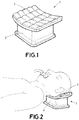
- Figure 1 shows a perspective view of a cranial support (1) according to the present invention formed by a base (2) and a pillow (3) fixed to the upper side of the base (2).
- the base (2) has an essentially parallelepiped shape provided with a flat lower side to be supported on the bed or stretcher on which the patient lies.
- the lower side of the base (2) has a surface larger than the rest of the base (2) itself for the purpose of increasing the stability of the support as much as possible.
- the base (2) is orientable in the sense that the orientation of its upper side can be changed so that the pillow (3) adapts to the patient's posture.
- the pillow (3) is designed with an anatomical shape envisaged for adapting as perfectly as possible to the nape area and the back of the patient's head. Furthermore, as will be described in detail herein below, the pillow (3) is formed by a plurality of layers conferring thereto adaptability, compressibility, and elasticity properties that are ideal for supporting the patient's head.
- Figure 2 shows a view of a patient with his or her head supported on the example of a support (1) of the present invention shown in Figure 1 .
- a perfect alignment of the spine is achieved, thereby minimizing not only problems relating to skin disorders, but also musculoskeletal disorders.
- Figure 3 shows another example of a support (1) according to the invention, wherein the base (2) is formed by a bag containing a plurality of granules made of expanded polystyrene. It is a system that is similar to that currently used in the so-called nursing pillows which allows the orientation of the pillow (3) to be changed manually, with the granules made of expanded polystyrene being relocated according to the particular posture.
- Figure 4 shows another example of a support (1), wherein the base (2) is formed by a rigid plate (21) on which an orientable structure (22) formed by a plurality of bars joined to the pillow (3) is supported.
- the bar structure (22) can allow changing the orientation of the pillow (3), for example, by means of changing the length of the bars through screwing mechanisms.
- each bar can be fixed to the pillow (3) through a ball joint, and by means of a mechanism similar to that of a threaded rod, the length thereof can be changed.
- the pillow (3) can thereby be reoriented by lengthening or shortening certain bars.
- Figure 5 shows a section view of the pillow (3) in which the different layers forming said pillow can be seen.
- Said layers include an external layer (31) made of polyurethane, a first intermediate layer (32) made of polymer material, a second intermediate layer (33) containing an air chamber, and an internal layer (34) of rigid material.
- Figure 5 also shows a cross-section of the plate (21), which can be made of a low-profile plastic material (for example, PVC), acrylic material, titanium, among others. It is important for the plate to be lightweight to facilitate moving the same and to be strong enough to prevent the weight of the head from deforming it.
- a low-profile plastic material for example, PVC
- acrylic material titanium
Landscapes
- Health & Medical Sciences (AREA)
- General Health & Medical Sciences (AREA)
- Otolaryngology (AREA)
- Pulmonology (AREA)
- Nursing (AREA)
- Life Sciences & Earth Sciences (AREA)
- Animal Behavior & Ethology (AREA)
- Public Health (AREA)
- Veterinary Medicine (AREA)
- Invalid Beds And Related Equipment (AREA)
Abstract
Description
- The present invention belongs to the field of healthcare for long-term patients, such as critically ill patients, for example.
- The object of the present invention relates to a multilayer support for the patient's head particularly designed to achieve maximum comfort for the purpose of preventing the onset of bedsores.
- Bedsores or pressure ulcers have become a common problem among patients with reduced mobility such as, for example, patients subjected to decompressive craniectomy, patients with long periods of intubation or sedation, patients with hemodynamic instability, or patients with neurological pathologies, where body movement is continuously compromised. Bedsores develop as a result of a constant increase in pressure on the skin and tissues exposed to overload. The physiopathological mechanisms causing bedsores are mainly due to the lack of irrigation of the exposed area, which causes the subsequent ischemia and the onset of the ulcerative lesion. The exposure of deep tissues to the outside then occurs, which implies a significant superinfection tendency.
- Four stages are defined in the onset of bedsores. Stage I involves reddening or erythema; Stage II involves partial thickness skin loss which affects the epidermis, dermis, or both; Stage III involves full thickness skin loss and subcutaneous tissue lesion or necrosis; and Stage IV involves full thickness skin loss with extensive destruction, tissue necrosis which may cause muscle, tendon, or bone lesions.
- In the general population, about 10% of bedsores appear in the occipital region of the cranium. This percentage increases considerably among neurological patients, and particularly among patients subjected to neurosurgical interventions in serious condition such as, for example, severe brain injuries, requiring patients to remain in the same position at all times.
- For these reasons, there is a need to create a simple, malleable, and easy-to-use device which allows significantly reducing the onset of bedsores and ulcers in the patient's occipital region.
- The present invention solves the preceding problems as a result of a multilayer cranial support particularly designed to prevent bedsores. This support fundamentally comprises two elements joined to one another: a base and a pillow. Each of said elements is described below:
- a) Base
The base is an orientable base configured to be supported on the surface of a bed. In this context, the term "orientable" means that it allows certain variation in terms of the orientation of the upper side thereof to which the pillow is joined for the purpose of adapting the orientation of said pillow to different postures of the patient's head. The capacity of the base to orient its upper side can be achieved in different ways.
In a particularly preferred embodiment of the invention, the base comprises a bag inside which there is housed a plurality of granules or beads that adopt different positions according to the orientation of the pillow. It is a support system lacking elasticity typical of pillows, because once the granules settle in a position corresponding to a specific orientation, said orientation does not change until the base is manipulated again. It is a system similar to that used in current nursing pillows, as described for example inUnited States patent document US6651282B1 . The granules can be made of expanded polystyrene.
In a preferred embodiment alternative with respect to the preceding one, the base comprises a rigid plate and an orientable bar structure joined to the pillow. In this case, the orientation of the upper side of the base is performed mechanically by means of manipulating the bar structure supporting the pillow.
In another preferred embodiment of the invention compatible with any of the described base types, the lower side of the base comprises self-screwing feet to even further facilitate the adjustments of the orientation of the patient's head. - b) Pillow
The pillow is a multilayer pillow which has an anatomical shape that accommodates a patient's nape and is joined to the base. The anatomical shape is chosen such that it adapts as perfectly as possible to the shape of the nape and the back of the cranium of a person. This pillow is joined to the upper side of the base and, since they are orientable, the orientation of the pillow can be changed such that it adapts to different postures of the patient's head.
The pillow can be configured in different ways provided that it is soft and smooth enough so as to allow comfortably supporting the patient's head. In a particularly preferred embodiment of the invention, the pillow comprises at least one external layer of polyurethane, a first intermediate layer of polymer material, a second intermediate layer of air chamber, and an internal layer of rigid material.
The external layer serves to provide comfort for the patient's head and to prevent lesions when the patient's head comes into direct contact with another structure.
The layer of air allows adjusting the height required between the patient's mattress and his or her head according to the required position, be it in extension, hypertension, flexion, and lateral rotations. Furthermore, in a particularly preferred embodiment of the invention, the layer of air comprises several compartments therein to help in the adjustment and direction of the orientation of the supported head of the patient. In other words, the layer of air is formed by at least two levels of air chamber. Furthermore, the layer of air serves to prevent direct contact of the patient's head supported on the external layer with the rigid internal layer, creating an anti-gravity effect for the purpose of reducing lesions caused by the patient resting continuously in the same position.
Moreover, the support of the invention may comprise means for alternately filling and emptying the layer of air to prevent the head from being supported continuously on one and the same specific point, thereby creating a bedsore prevention effect. For example, the means for alternately filling and emptying can be an alternately actuated pump or automatic compressor connected to the layer of air. - As a result of this configuration, the cranial support of the invention solves the problems of the prior art by providing a soft anatomical support with configurable orientation for a patient's head.
-
-
Figure 1 shows a perspective view of an example of a cranial support according to the present invention. -
Figure 2 shows a perspective view of a patient with his or her head supported on an example of a cranial support according to the invention. -
Figure 3 shows a perspective view of an example of a cranial support with the base formed by a bag filled with granules. -
Figure 4 shows a perspective view of an example of a cranial support with the base formed by a rigid plate coupled to a bar structure. -
Figure 5 shows a perspective view of a section of an example of a cranial support in which the different layers of the pillow can be seen. -
Figure 1 shows a perspective view of a cranial support (1) according to the present invention formed by a base (2) and a pillow (3) fixed to the upper side of the base (2). - In this example, the base (2) has an essentially parallelepiped shape provided with a flat lower side to be supported on the bed or stretcher on which the patient lies. As can be seen, the lower side of the base (2) has a surface larger than the rest of the base (2) itself for the purpose of increasing the stability of the support as much as possible. Furthermore, although not shown in this figure, the base (2) is orientable in the sense that the orientation of its upper side can be changed so that the pillow (3) adapts to the patient's posture.
- In turn, the pillow (3) is designed with an anatomical shape envisaged for adapting as perfectly as possible to the nape area and the back of the patient's head. Furthermore, as will be described in detail herein below, the pillow (3) is formed by a plurality of layers conferring thereto adaptability, compressibility, and elasticity properties that are ideal for supporting the patient's head.
-
Figure 2 shows a view of a patient with his or her head supported on the example of a support (1) of the present invention shown inFigure 1 . As can be seen, a perfect alignment of the spine is achieved, thereby minimizing not only problems relating to skin disorders, but also musculoskeletal disorders. -
Figure 3 shows another example of a support (1) according to the invention, wherein the base (2) is formed by a bag containing a plurality of granules made of expanded polystyrene. It is a system that is similar to that currently used in the so-called nursing pillows which allows the orientation of the pillow (3) to be changed manually, with the granules made of expanded polystyrene being relocated according to the particular posture. -
Figure 4 shows another example of a support (1), wherein the base (2) is formed by a rigid plate (21) on which an orientable structure (22) formed by a plurality of bars joined to the pillow (3) is supported. In this example, the bar structure (22) can allow changing the orientation of the pillow (3), for example, by means of changing the length of the bars through screwing mechanisms. In other words, each bar can be fixed to the pillow (3) through a ball joint, and by means of a mechanism similar to that of a threaded rod, the length thereof can be changed. The pillow (3) can thereby be reoriented by lengthening or shortening certain bars. -
Figure 5 shows a section view of the pillow (3) in which the different layers forming said pillow can be seen. Said layers include an external layer (31) made of polyurethane, a first intermediate layer (32) made of polymer material, a second intermediate layer (33) containing an air chamber, and an internal layer (34) of rigid material.Figure 5 also shows a cross-section of the plate (21), which can be made of a low-profile plastic material (for example, PVC), acrylic material, titanium, among others. It is important for the plate to be lightweight to facilitate moving the same and to be strong enough to prevent the weight of the head from deforming it.
Claims (9)
- A multilayer cranial support (1), characterized in that it comprises:an orientable base (2) configured to be supported on the surface of a bed; anda multilayer pillow (3) joined to the base (2), wherein the pillow (3) has an anatomical shape that accommodates a patient's nape.
- The support (1) according to claim 1, wherein the base (2) comprises a bag inside which there is housed a plurality of granules that adopt different positions according to the orientation of the pillow (3).
- The support (1) according to claim 2, wherein the granules are made of expanded polystyrene.
- The support (1) according to claim 1, wherein the base (2) comprises a rigid plate (21) and an orientable bar structure (22) joined to the pillow (3).
- The support (1) according to claim 4, wherein the rigid plate (21) is made of PVC, acrylic material, or titanium.
- The support (1) according to any of the preceding claims, wherein the lower side of the base (2) further comprises self-screwing feet to facilitate the adjustments of the orientation of the patient's head.
- The support according to any of the preceding claims, wherein the pillow (3) comprises at least one external layer (31) of polyurethane, a first intermediate layer (32) of polymer material, a second intermediate layer (33) of air chamber, and an internal layer (34) of rigid material.
- The support (1) according to claim 7, wherein the second intermediate layer (33) of the air chamber comprises several compartments therein to help in the adjustment and direction of the orientation of the supported head of the patient.
- The support (1) according to any of claims 7 to 8, further comprising a means for alternately filling and emptying the second intermediate layer (33) of air chamber to prevent the head from being supported continuously on one and the same point.
Applications Claiming Priority (2)
| Application Number | Priority Date | Filing Date | Title |
|---|---|---|---|
| ES201831579U ES1223884Y (en) | 2018-10-18 | 2018-10-18 | Multilayer cranial support |
| PCT/ES2019/070708 WO2020079306A1 (en) | 2018-10-18 | 2019-10-17 | Multilayer cranial support |
Publications (2)
| Publication Number | Publication Date |
|---|---|
| EP3868349A1 true EP3868349A1 (en) | 2021-08-25 |
| EP3868349A4 EP3868349A4 (en) | 2022-08-10 |
Family
ID=65033681
Family Applications (1)
| Application Number | Title | Priority Date | Filing Date |
|---|---|---|---|
| EP19874057.3A Withdrawn EP3868349A4 (en) | 2018-10-18 | 2019-10-17 | Multilayer cranial support |
Country Status (3)
| Country | Link |
|---|---|
| EP (1) | EP3868349A4 (en) |
| ES (1) | ES1223884Y (en) |
| WO (1) | WO2020079306A1 (en) |
Families Citing this family (1)
| Publication number | Priority date | Publication date | Assignee | Title |
|---|---|---|---|---|
| GB2607324A (en) * | 2021-06-02 | 2022-12-07 | Enanef Ltd | Pillow support |
Family Cites Families (14)
| Publication number | Priority date | Publication date | Assignee | Title |
|---|---|---|---|---|
| US2107962A (en) * | 1936-03-04 | 1938-02-08 | Sheasby Hugh Cecil | Pillow |
| US2239003A (en) * | 1939-07-18 | 1941-04-22 | Samuel R Jones | Headrest |
| US2398940A (en) * | 1942-10-19 | 1946-04-23 | Samuel R Jones | Surgical headrest |
| US4055866A (en) * | 1976-01-19 | 1977-11-01 | Franklin Temple Evans | Polymorphic support systems |
| US4320543A (en) * | 1980-08-25 | 1982-03-23 | Dixon Linda H | Medical pillow |
| US5163194A (en) * | 1992-01-31 | 1992-11-17 | Imperial Feather Corporation (Toronto) Ltd. | Adjustable cervical pillow |
| US6651282B1 (en) | 2000-01-19 | 2003-11-25 | Stein Erik Skoug | Nursing pillow for anatomically correct positioning of baby and mother |
| US20050177946A1 (en) * | 2004-02-12 | 2005-08-18 | Riley Kenneth A. | Head support device for use when lying in the prone position |
| WO2009038278A1 (en) * | 2007-09-20 | 2009-03-26 | Seok-Kwan Oh | A pillow with multi-layered structure |
| CA2851343A1 (en) * | 2010-10-07 | 2012-04-12 | Banyan Licensing, L.L.C. | Pillow for use with assisted breathing masks |
| KR101172851B1 (en) * | 2010-12-27 | 2012-08-14 | 윤성훈 | Pillow position adjustment |
| US8549683B2 (en) * | 2012-02-10 | 2013-10-08 | Mercury Enterprises, Inc. | Surgical head support |
| US9138087B2 (en) * | 2014-02-07 | 2015-09-22 | Latitude Innovations | Universal prone/supine pillow |
| CN105640182A (en) * | 2014-11-27 | 2016-06-08 | 约翰·J·瓦格纳 | Expandable and collapsible pillow structure |
-
2018
- 2018-10-18 ES ES201831579U patent/ES1223884Y/en not_active Expired - Fee Related
-
2019
- 2019-10-17 WO PCT/ES2019/070708 patent/WO2020079306A1/en not_active Ceased
- 2019-10-17 EP EP19874057.3A patent/EP3868349A4/en not_active Withdrawn
Also Published As
| Publication number | Publication date |
|---|---|
| WO2020079306A1 (en) | 2020-04-23 |
| ES1223884U (en) | 2019-01-28 |
| EP3868349A4 (en) | 2022-08-10 |
| ES1223884Y (en) | 2019-04-22 |
Similar Documents
| Publication | Publication Date | Title |
|---|---|---|
| US7908691B2 (en) | Medical support pillow | |
| US20220183913A1 (en) | Systems and methods for controlling multiple surgical variables | |
| LU101692B1 (en) | Orthopedic posture supporting and adjusting device and method | |
| US20070283496A1 (en) | Localized patient support | |
| EP2517684A1 (en) | Airway widening tool and airway widening unit having same | |
| US20170246066A1 (en) | Patient positioning device | |
| JP2012245312A (en) | Orthopedic pillow | |
| US20110154571A1 (en) | Abduction Pillow | |
| AU2016273948B2 (en) | Orthopedic pillow for treatment and prevention of lumbar and thoracic spine diseases | |
| CN210843673U (en) | Spinal surgery orthotic devices | |
| CN116437838B (en) | mat | |
| KR20180040944A (en) | Spine corrector | |
| US11576497B2 (en) | Adjustable, lower back restoration device | |
| US20050262638A1 (en) | Inflatable, pressure alleviating, eggcrate mattress pad | |
| US20240398575A1 (en) | Bone implant device | |
| RU2403002C1 (en) | Functional care bed | |
| WO2020079306A1 (en) | Multilayer cranial support | |
| DE102014015284B4 (en) | Cushion for active rearrangement of a human head | |
| CN208926735U (en) | A kind of traction apparatus for cervical vertebrae for Mongolian medicine's therapy | |
| US20150320626A1 (en) | C-spine pressure distributive support | |
| CN217286344U (en) | A nursing bed for hunchback patients | |
| CN213606988U (en) | Thoracolumbar vertebra posterior operation head fixing device | |
| CN210991337U (en) | Novel stepless regulation turning cushion | |
| CN213346203U (en) | An orthopedic reducer for lumbar spine surgery | |
| CN216495907U (en) | Waist strip for treating lumbar disc herniation |
Legal Events
| Date | Code | Title | Description |
|---|---|---|---|
| STAA | Information on the status of an ep patent application or granted ep patent |
Free format text: STATUS: THE INTERNATIONAL PUBLICATION HAS BEEN MADE |
|
| PUAI | Public reference made under article 153(3) epc to a published international application that has entered the european phase |
Free format text: ORIGINAL CODE: 0009012 |
|
| STAA | Information on the status of an ep patent application or granted ep patent |
Free format text: STATUS: REQUEST FOR EXAMINATION WAS MADE |
|
| 17P | Request for examination filed |
Effective date: 20210518 |
|
| AK | Designated contracting states |
Kind code of ref document: A1 Designated state(s): AL AT BE BG CH CY CZ DE DK EE ES FI FR GB GR HR HU IE IS IT LI LT LU LV MC MK MT NL NO PL PT RO RS SE SI SK SM TR |
|
| DAV | Request for validation of the european patent (deleted) | ||
| DAX | Request for extension of the european patent (deleted) | ||
| A4 | Supplementary search report drawn up and despatched |
Effective date: 20220708 |
|
| RIC1 | Information provided on ipc code assigned before grant |
Ipc: A47C 16/00 20060101ALI20220704BHEP Ipc: A61G 13/12 20060101ALI20220704BHEP Ipc: A61G 7/07 20060101AFI20220704BHEP |
|
| STAA | Information on the status of an ep patent application or granted ep patent |
Free format text: STATUS: THE APPLICATION IS DEEMED TO BE WITHDRAWN |
|
| 18D | Application deemed to be withdrawn |
Effective date: 20230207 |