EP3868002B1 - Ensemble pour un pulseur de vehicule automobile - Google Patents
Ensemble pour un pulseur de vehicule automobile Download PDFInfo
- Publication number
- EP3868002B1 EP3868002B1 EP19806027.9A EP19806027A EP3868002B1 EP 3868002 B1 EP3868002 B1 EP 3868002B1 EP 19806027 A EP19806027 A EP 19806027A EP 3868002 B1 EP3868002 B1 EP 3868002B1
- Authority
- EP
- European Patent Office
- Prior art keywords
- arm
- support
- assembly
- brush
- shaped
- Prior art date
- Legal status (The legal status is an assumption and is not a legal conclusion. Google has not performed a legal analysis and makes no representation as to the accuracy of the status listed.)
- Active
Links
Images


Classifications
-
- H—ELECTRICITY
- H02—GENERATION; CONVERSION OR DISTRIBUTION OF ELECTRIC POWER
- H02K—DYNAMO-ELECTRIC MACHINES
- H02K5/00—Casings; Enclosures; Supports
- H02K5/04—Casings or enclosures characterised by the shape, form or construction thereof
- H02K5/14—Means for supporting or protecting brushes or brush holders
- H02K5/143—Means for supporting or protecting brushes or brush holders for cooperation with commutators
- H02K5/146—Pivotally supported brushes or brush holders
-
- F—MECHANICAL ENGINEERING; LIGHTING; HEATING; WEAPONS; BLASTING
- F04—POSITIVE - DISPLACEMENT MACHINES FOR LIQUIDS; PUMPS FOR LIQUIDS OR ELASTIC FLUIDS
- F04D—NON-POSITIVE-DISPLACEMENT PUMPS
- F04D25/00—Pumping installations or systems
- F04D25/02—Units comprising pumps and their driving means
- F04D25/06—Units comprising pumps and their driving means the pump being electrically driven
-
- H—ELECTRICITY
- H01—ELECTRIC ELEMENTS
- H01R—ELECTRICALLY-CONDUCTIVE CONNECTIONS; STRUCTURAL ASSOCIATIONS OF A PLURALITY OF MUTUALLY-INSULATED ELECTRICAL CONNECTING ELEMENTS; COUPLING DEVICES; CURRENT COLLECTORS
- H01R39/00—Rotary current collectors, distributors or interrupters
- H01R39/02—Details for dynamo electric machines
- H01R39/38—Brush holders
- H01R39/381—Brush holders characterised by the application of pressure to brush
-
- B—PERFORMING OPERATIONS; TRANSPORTING
- B60—VEHICLES IN GENERAL
- B60H—ARRANGEMENTS OF HEATING, COOLING, VENTILATING OR OTHER AIR-TREATING DEVICES SPECIALLY ADAPTED FOR PASSENGER OR GOODS SPACES OF VEHICLES
- B60H1/00—Heating, cooling or ventilating devices
- B60H1/00457—Ventilation unit, e.g. combined with a radiator
Definitions
- the invention relates to an assembly for an electric motor, in particular of an air blower for a motor vehicle ventilation, heating and/or air conditioning device.
- the air blower allows the air flow to enter and circulate in the ventilation, heating and/or air conditioning system to outlet vents, where the air enters the passenger compartment.
- the blower generally comprises an electric motor, in particular a brushed motor, on which a wheel is mounted to set the air in motion.
- the blower also comprises a motor support in which the electric motor is housed, as well as the electric motor control device, the motor and the control device being connected to each other.
- JPS47 25807 And DE 20 2005 008840 disclose motors with a brush arrangement with an arm secured to the brush, a pivot connecting element between the support and the arm, the pivot element being made of elastomer so as to exert a return on the arm.
- the aim of the invention is to at least partially remedy these drawbacks.
- the invention relates to an assembly according to claim 1.
- the assembly of the blower is greatly facilitated, since, on the one hand, it avoids the need for springs to press the brushes onto the collector of the electric motor.
- the elastomer material makes other types of movement possible for the brushes, in particular pivoting movements, which means that it is not necessary to mold radial conduits.
- the thinning zone has a continuous thinning of material between the two interface zones.
- the interface zone with the arm comprises a fitting part shaped to fit into an associated orifice of the arm, a base shaped to bear against the arm and a so-called intermediate part between the base and the thinning zone.
- said intermediate part of the interface zone with the arm has a rectilinear shape converging from the base to the thinning zone.
- the interface zone with the support comprises a fitting part shaped to fit into an associated orifice of the support, a base shaped to bear against the support and a so-called intermediate part between the base and the thinning zone.
- the intermediate part has a rectilinear shape converging from the base to the thinning zone.
- the elastomer material is a polymer with a Shore hardness of between 70 and 90.
- the pivot connecting element is shaped so that, when the assembly is associated with an electric motor comprising a collector, the return force exerted on the arm moves the arm in a direction towards the collector.
- the pivot connection element is overmolded or embedded on the support and/or on the arm.
- the invention also relates to a blower for a ventilation, heating and/or air conditioning device for a motor vehicle, comprising an electric motor provided with a collector and an assembly as described previously, the assembly being shaped so that the brush is pressed against the collector in an operating position of the blower.
- the assembly comprises two brushes and a brush moving device associated with each brush, called first and second moving devices, each brush moving device being secured to the support by a securing part, and in which the support has an annular shape, the securing part of the first device being diametrically opposite the securing part of the second device, and each pivot connecting element being shaped so that, in a rest position, the associated arm extends along a radius of the support.
- the invention also relates to a ventilation, heating and/or air conditioning device for a motor vehicle, comprising a blower as described above.
- Blower ventilation, heating and/or air conditioning device
- the invention relates to an assembly for an electric motor, referenced 1 in the figures.
- the invention also relates to a pulser (not illustrated) comprising the assembly 1 as well as an electric motor, a collector of which is illustrated in the Figure 2 .
- the invention also relates to a ventilation, heating and/or air conditioning device for a motor vehicle (not shown) equipped with said blower.
- the ventilation, heating and/or air conditioning device makes it possible to regulate the temperature of an air flow to the vehicle's passenger compartment.
- the blower allows air to enter and circulate in the ventilation, heating and/or air conditioning system.
- assembly 1 for the electric motor of the blower includes a support 2.
- the support 2 has the general shape of an open cylinder.
- the invention is not limited to this geometry.
- support 2 includes a housing 3, detailed later.
- the assembly 1 also comprises brushes 5.
- the assembly 1 comprises two brushes.
- Each brush 5 is intended to be pressed against a collector 6, visible on the Figure 2 , as will be detailed later.
- the assembly 1 also comprises two arms 7, associated respectively with one of the brushes 5; that is to say that each arm 7 allows the movement of the associated brush.
- each arm 7 extends substantially rectilinearly in a direction L between a first end 8 and a second end 9.
- the first end 8 is mounted to move relative to the support 2.
- the first end 8 comprises a pivot connecting element 10 inserted into the housing 3 of the support 2.
- the pivot connecting element 10 is made from an elastomer material so as to exert a return force on the arm in a direction of approaching the center C of the support 2.
- the elastomer material is a polymer with a Shore hardness of between 70 and 90.
- the material may in particular be an elastomer consisting of two polyols and two isocyanates (designated for example by the term “HPE”) and/or a Styrene, Ethylene, Butylene copolymer (for example the family of materials designated by the English acronym “SEBS”).
- the flexible pivot 10 comprises an interface zone with the associated arm 7, referenced 11 in the figures, an interface zone 12 with the support 2 and a material thinning zone 13 between the interface zones 11 and 12, called thin zone 13.
- the rotational movement of the pivot 10 is enabled by the thin zone 13.
- the interface zone 11 comprises a fitting part 14 shaped to fit into a complementary orifice 15 associated with the arm 7, a base 16 shaped to bear against the end 8 of the arm 7 and a part 17 called intermediate between the base 16 and the thin zone 13.
- the embedding portion 14 and the associated orifice 15 have a general shape according to the letter “T”.
- the “T” of the embedding portion 14 comprises a rod 18 and a base 19, the base 19 being orthogonal to the rod 18.
- the base 16 is a plate adjoining the rod 18 and extending substantially orthogonally to the rod 18.
- the base 26 is a plate 30 adjoining the rod 28 and extending substantially orthogonally to the rod 28.
- the intermediate part 27 has a rectilinear shape converging from the base 26 to the thin zone 13.
- the thin zone 13 allows the pivoting of the pivot 10 around an axis denoted P.
- the axis P is parallel to the motor shaft, when the assembly 1 is part of the blower, which ensures surface contact between the brush and the collector, preventing the pivot connection 10 from twisting.
- the P axis is orthogonal to the extension direction T.
- the flexible pivot 10 is shaped so that, when the assembly is installed in the blower, the return force exerted on the arm moves the arm in a direction of approaching the collector arranged in the center of the support, the facing portions 31, 34 and 32, 33 moving closer or further apart.
Landscapes
- Engineering & Computer Science (AREA)
- Power Engineering (AREA)
- Mechanical Engineering (AREA)
- General Engineering & Computer Science (AREA)
- Air-Conditioning For Vehicles (AREA)
- Structures Of Non-Positive Displacement Pumps (AREA)
- Motor Or Generator Frames (AREA)
Description
- L'invention concerne un ensemble pour un moteur électrique, notamment d'un pulseur de véhicule automobile d'air pour un dispositif de ventilation, de chauffage et/ou de climatisation de véhicule automobile.
- Il est connu qu'un tel dispositif de ventilation, de chauffage et/ou de climatisation permet la régulation de la température d'un flux d'air destiné à alimenter l'habitacle du véhicule.
- Le pulseur d'air permet, quant à lui, de faire entrer et circuler le flux d'air dans le dispositif de ventilation, de chauffage et/ou de climatisation jusqu'à des bouches de sortie, où l'air pénètre dans l'habitacle.
- Le pulseur comporte généralement un moteur électrique, notamment à balais, sur lequel est montée une roue pour mettre l'air en mouvement. Le pulseur comporte également un support moteur dans lequel est logé le moteur électrique, ainsi que le dispositif de commande du moteur électrique, le moteur et le dispositif de commande étant connectés l'un à l'autre.
-
JPS47 25807 DE 20 2005 008840 divulguent des moteurs avec un agencement de balais avec un bras solidaire du balai, un élément de liaison pivot entre le support et le bras, l'élément pivot étant en élastomère de sorte à exercer un rappel sur le bras. - Il est connu de monter les balais sur des bras mobiles en translation dans un conduit radial entre une position de montage où les bras positionnent les balais éloignés du centre du support, et une position fonctionnelle dans laquelle les balais sont plaqués contre le collecteur disposé au centre du support. Les bras sont munis d'un ressort dont la compression augmente lorsque le balai d'éloigne du centre du support. Ainsi, les balais sont tout d'abord installés dans la position de montage, ce qui permet l'insertion du collecteur au centre du support, les ressorts étant maintenus comprimés. Une fois le collecteur en place, on relâche les bras, les ressorts s'étendent et les bras et les balais se déplacent dans les conduits radiaux de façon à disposer les balais dans la position fonctionnelle.
- Néanmoins, une telle configuration est compliquée, à la fois dans sa structure et dans son mécanisme, puisqu'il faut mouler les canaux radiaux, prévoir des ressorts, et s'assurer du bon coulissement des bras dans les canaux. Ainsi, cette configuration présente un procédé de fabrication complexe, avec de nombreuses étapes, et son fonctionnement peut ne pas être fiable durant toute la durée de vie du véhicule automobile.
- Le but de l'invention est de remédier au moins partiellement à ces inconvénients.
- A cet effet, l'invention a pour objet un ensemble selon la revendication 1.
- Ainsi, grâce à la présente invention, l'assemblage du pulseur est grandement facilité, puisque, d'une part, on évite de recourir à des ressorts pour plaquer les balais sur le collecteur du moteur électrique. D'autre part, le matériau élastomère rend possible d'autres types de mouvement pour les balais, notamment des mouvements de pivotement, ce qui permet de ne pas avoir à mouler de conduits radiaux.
- Selon une autre caractéristique de l'invention, la zone d'amincissement présente un amincissement de matière continu entre les deux zones d'interface.
- Selon une autre caractéristique de l'invention, la zone d'interface avec le bras comprend une partie d'encastrement conformée pour s'insérer dans un orifice associé du bras, une embase conformée pour prendre appui contre le bras et une partie dite intermédiaire entre l'embase et la zone d'amincissement.
- Selon une autre caractéristique de l'invention, ladite partie intermédiaire de la zone d'interface avec le bras présente une forme rectiligne convergeant depuis l'embase jusqu'à la zone d'amincissement.
- Selon une autre caractéristique de l'invention, la zone d'interface avec le support comprend une partie d'encastrement conformée pour s'insérer dans un orifice associé du support, une embase conformée pour prendre appui contre le support et une partie dite intermédiaire entre l'embase et la zone d'amincissement.
- Selon une autre caractéristique de l'invention, la partie intermédiaire présente une forme rectiligne convergeant depuis l'embase jusqu'à la zone d'amincissement.
- Selon une autre caractéristique de l'invention, le matériau élastomère est un polymère d'une dureté Shore comprise entre 70 et 90.
- Selon une autre caractéristique de l'invention, l'élément de liaison pivot est conformé de sorte que, lorsque l'ensemble est associé à un moteur électrique comprenant un collecteur, l'effort de rappel exercé sur le bras déplace le bras dans un sens de rapprochement du collecteur.
- Selon une autre caractéristique de l'invention, l'élément de liaison pivot est surmoulé ou encastré sur le support et/ou sur le bras.
- L'invention a également pour objet un pulseur pour un dispositif de ventilation, de chauffage et/ou de climatisation pour véhicule automobile, comprenant un moteur électrique muni d'un collecteur et d'un ensemble tel que décrit précédemment, l'ensemble étant conformé de sorte que le balai est plaqué contre le collecteur dans une position de fonctionnement du pulseur.
- Selon une autre caractéristique de l'invention, l'ensemble comprend deux balais et un dispositif de déplacement de balai associé à chaque balai, appelés premier et deuxième dispositifs de déplacement, chaque dispositif de déplacement de balai étant solidaire du support par une partie de solidarisation, et dans lequel le support présente une forme annulaire, la partie de solidarisation du premier dispositif étant diamétralement opposée de la partie de solidarisation du deuxième dispositif, et chaque élément de liaison pivot étant conformé pour que, dans une position de repos, le bras associé s'étende le long d'un rayon du support.
- L'invention a également pour objet un dispositif de ventilation, de chauffage et/ou de climatisation pour véhicule automobile, comprenant un pulseur tel que décrit précédemment.
- D'autres caractéristiques, détails et avantages de l'invention apparaîtront à la lecture de la description détaillée ci-après, et à l'analyse des dessins annexés, sur lesquels :
- La
figure 1 illustre une vue en perspective d'un ensemble selon la présente invention dans une première position, dite position de montage. - La
figure 2 une vue en perspective de l'ensemble de lafigure 1 dans une deuxième position, dite position fonctionnelle. - La
figure 3 illustre une vue de dessus d'un bras et d'un élément de liaison pivot de l'ensemble de lafigure 1 . - La
figure 4 illustre une vue de dessus de l'élément de liaison pivot de lafigure 3 . - La
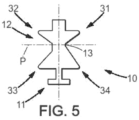
figure 5 illustre une vue de dessus de l'élément de liaison pivot selon une autre variante de réalisation. - L'invention a pour objet un ensemble pour un moteur électrique, référencé 1 dans les figures.
- L'invention a également pour objet un pulseur (non illustré) comprenant l'ensemble 1 ainsi qu'un moteur électrique dont un collecteur est illustré sur la
figure 2 . - L'invention a également pour objet un dispositif de ventilation, de chauffage et/ou de climatisation pour un véhicule automobile (non illustré) équipé dudit pulseur.
- Le dispositif de ventilation, de chauffage et/ou de climatisation permet de réguler la température d'un flux d'air à destination de l'habitacle du véhicule.
- Le pulseur permet de faire pénétrer et de mettre en circulation l'air dans le dispositif de ventilation, chauffage et /ou climatisation.
- Comme visible sur les
figures 1 et2 , l'ensemble 1 pour le moteur électrique du pulseur comprend un support 2. - Sur les figures, le support 2 présente une forme générale de cylindre ouvert. Bien entendu, l'invention n'est pas limitée à cette géométrie.
- Comme particulièrement visible sur la
figure 2 , le support 2 comprend un logement 3, détaillé ultérieurement. - L'ensemble 1 comprend également des balais 5. Sur le mode de réalisation illustré, l'ensemble 1 comprend deux balais. Chaque balai 5 est destiné à être plaqué contre un collecteur 6, visible sur la
figure 2 , comme il sera détaillé ultérieurement. - L'ensemble 1 comprend également deux bras 7, associés respectivement à l'un des balais 5 ; c'est-à-dire que chaque bras 7 permet le déplacement du balai associé.
- Comme il ressort des figures, chaque bras 7 s'étend sensiblement rectilignement selon une direction L entre une première extrémité 8 et une deuxième extrémité 9.
- La première extrémité 8 est montée mobile relativement au support 2. Sur les figures, la première extrémité 8 comprend un élément de liaison pivot 10 inséré dans le logement 3 du support 2.
- Comme on le constate sur les
figures 1 et2 , chaque balai 5 est disposé à proximité de la deuxième extrémité 9 du balai associé. De préférence, chaque balai 5 s'étend selon une direction faisant un angle compris entre 70° et 90° avec la direction L du bras de déplacement associé. - L'élément de liaison pivot 10 va maintenant être décrit en détail.
- L'élément de liaison pivot 10 est réalisé à partir d'un matériau élastomère de sorte à exercer un effort de rappel sur le bras dans un sens de rapprochement du centre C du support 2. De préférence, le matériau élastomère est un polymère d'une dureté Shore comprise entre 70 et 90. Le matériau peut être notamment un élastomère constitué de deux polyols et de deux isocyanates (désigné par exemple par le terme « HPE ») et/ou un copolymère Styrène, Ethylène, Butylène. (par exemple la famille de matériau désignée par l'acronyme Anglais « SEBS »).
- L'élément de liaison pivot 10 est nommé pivot souple 10 dans la suite de la description.
- Comme particulièrement visible sur les
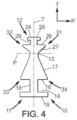
figures 3 et4 , le pivot souple 10 comprend une zone d'interface avec le bras associé 7, référencée 11 sur les figures, une zone d'interface 12 avec le support 2 et une zone d'amincissement de matière 13 entre les zones d'interface 11 et 12, appelée zone fine 13. - Le mouvement de rotation du pivot 10 est permis grâce à la zone fine 13.
- Sur le mode de réalisation illustré, la zone fine 13 présente un amincissement de matière continu entre les deux zones d'interface 11, 12.
- Comme visible sur les
figures 3 et4 , la zone d'interface 11 comprend une partie d'encastrement 14 conformée pour s'insérer dans un orifice 15 complémentaire associé du bras 7, une embase 16 conformée pour prendre appui contre l'extrémité 8 du bras 7 et une partie 17 dite intermédiaire entre l'embase 16 et la zone fine 13. - Comme particulièrement visible sur la
figure 3 , la partie d'encastrement 14 et l'orifice associé 15 présentent une forme générale selon la lettre « T ». Le « T » de la partie d'encastrement 14 comprend une tige 18 et une base 19, la base 19 étant orthogonale à la tige 18. - L'embase 16 est une plaque jointive de la tige 18 et s'étendant sensiblement orthogonalement à la tige 18.
- La partie intermédiaire 17 présente une forme rectiligne convergeant depuis l'embase 16 jusqu'à la zone fine 13.
- De manière analogue, la zone d'interface 12 comprend une partie d'encastrement 24 conformée pour s'insérer dans le logement 3 du support 2, une embase 26 conformée pour prendre appui contre les bords du logement 3 et une partie 27 dite intermédiaire entre l'embase 26 et la zone fine 13.
- La partie d'encastrement 24 présente une forme générale selon la lettre « T » munie d'une tige 28 et d'une base 29, la base 29 étant orthogonale à la tige 28.
- L'embase 26 est une plaque 30 jointive de la tige 28 et s'étendant sensiblement orthogonalement à la tige 28.
- La partie intermédiaire 27 présente une forme rectiligne convergeant depuis l'embase 26 jusqu'à la zone fine 13.
- Sur la
figure 4 , la direction d'extension de la tige 18 coïncide avec la direction d'extension de la tige 28. On note T cette direction. Comme on le constate sur lafigure 4 , une section longitudinale du pivot souple 10 est symétrique par rapport à la direction T. - Comme déjà indiqué, la zone fine 13 permet le pivotement du pivot 10 autour d'un axe noté P. De préférence, l'axe P est parallèle à l'arbre moteur, quand l'ensemble 1 fait partie du pulseur, ce qui permet de garantir un contact surfacique entre le balai et le collecteur, évitant à la liaison pivot 10 de vriller. Sur la
figure 4 , l'axe P est orthogonal à la direction d'extension T. - Sur la
figure 4 , on note 31 à 34 des portions du pivot souple 10 délimitées par l'axe P et la direction T, la portion 31 de la partie intermédiaire 27 faisant face à la portion 34 de la partie intermédiaire 17 et la portion 32 de la partie intermédiaire 27 faisant face à la portion 33 de la partie intermédiaire 17. - Le pivot souple 10 est conformé de sorte que, lorsque l'ensemble est installé dans le pulseur, l'effort de rappel exercé sur le bras déplace le bras dans un sens de rapprochement du collecteur disposé au centre du support, les portions se faisant face 31, 34 et 32, 33 se rapprochant ou s'écartant.
- On note que selon la variante de la
figure 5 , l'amincissement de matière entre les portions 32 et 33 est supérieur à l'amincissement de matière entre les portions 31 et 34. Dans ce cas, l'effort de rapprochement des portions 31 et 34 est différent de celui des portions 32 et 33. - On note également qu'on peut envisager d'autres types de solidarisation de la zone d'interface au bras et/ou au support. En particulier, l'élément de liaison pivot 10 peut être surmoulé sur le support 2 et/ou sur le bras 7.
- L'invention est maintenant décrite en relation avec le procédé de montage du pulseur à partir de l'ensemble 1.
- Tout d'abord, on positionne l'ensemble 1 dans une position de montage, dans laquelle les bras 7 sont écartés du centre C du support. Puis, on insère le collecteur 6 au centre C du support 2, les bras étant maintenus dans la position de montage. Ensuite, on lâche les bras 7. Du fait de l'effort de rappel de la liaison pivot souple 10, les balais 5 se rapprochent du centre C jusqu'à être plaqués sur celui-ci.
- Comme il ressort clairement de la description, le procédé de montage du pulseur selon la présente invention est grandement facilité du fait qu'il n'est pas nécessaire de mouler des conduits de guidage des bras ni d'ajouter des ressorts. De plus, le fonctionnement du pulseur est bien plus fiable grâce à la liaison pivot élastomère.
Claims (9)
- Ensemble pour un moteur électrique, comprenant un support moteur (2), un balai (5) et un dispositif de déplacement (7, 10) dudit balai (5), le dispositif comprenant un bras (7) solidaire du balai (5) et un élément de liaison pivot (10) entre le support (2) et le bras (7), l'élément de liaison pivot (10) étant réalisé à partir d'un matériau élastomère de sorte à exercer un effort de rappel sur le bras (7), caractérisé en ce que l'élément de liaison pivot (10) comprend une zone d'interface avec le bras (11), une zone d'interface avec le support (12) et une zone d'amincissement de matière (13) disposée entre lesdites zones d'interface.
- Ensemble selon la revendication précédente, dans lequel la zone d'amincissement (13) présente un amincissement de matière continu entre les deux zones d'interface (11, 12).
- Ensemble selon l'une des revendications 1 ou 2, dans lequel la zone d'interface avec le bras (11) comprend une partie d'encastrement (14) conformée pour s'insérer dans un orifice (15) associé du bras (7), une embase (16) conformée pour prendre appui contre le bras (7) et une partie dite intermédiaire (17) entre l'embase (16) et la zone d'amincissement (13).
- Ensemble selon l'une des revendications 1 ou 2, dans lequel la zone d'interface avec le support (12) comprend une partie d'encastrement (24) conformée pour s'insérer dans un orifice (3) associé du support (2), une embase (26) conformée pour prendre appui contre le support (2) et une partie (27) dite intermédiaire entre l'embase (26) et la zone d'amincissement (13).
- Ensemble selon l'une des revendications précédentes, dans lequel le matériau élastomère est un polymère d'une dureté Shore comprise entre 70 et 90.
- Ensemble selon l'une des revendications précédentes, dans lequel l'élément de liaison pivot (10) est conformé de sorte que, lorsque l'ensemble (1) est associé à un moteur électrique comprenant un collecteur (6), l'effort de rappel exercé sur le bras (7) déplace le bras (7) dans un sens de rapprochement du collecteur (6).
- Ensemble selon l'une des revendications précédentes, dans lequel l'élément de liaison pivot (10) est surmoulé ou encastré sur le support (2) et/ou sur le bras (7).
- Pulseur pour un dispositif de ventilation, de chauffage et/ou de climatisation pour véhicule automobile, comprenant un moteur électrique muni d'un collecteur (6) et d'un ensemble (1) selon l'une des revendications précédentes, l'ensemble (1) étant conformé de sorte que le balai (5) est plaqué contre le collecteur (6) dans une position de fonctionnement du pulseur.
- Pulseur selon la revendication précédente, dans lequel l'ensemble (1) comprend deux balais (5) et un dispositif de déplacement de balai (7, 10) associé à chaque balai (5), appelés premier et deuxième dispositifs de déplacement, chaque dispositif de déplacement de balai étant solidaire du support (2) par une partie de solidarisation (10), et dans lequel le support présente une forme annulaire, la partie de solidarisation du premier dispositif étant diamétralement opposée de la partie de solidarisation du deuxième dispositif, et chaque élément de liaison pivot étant conformé pour que, dans une position de repos, le bras associé s'étende le long d'un rayon du support.
Applications Claiming Priority (2)
| Application Number | Priority Date | Filing Date | Title |
|---|---|---|---|
| FR1871203A FR3087593B1 (fr) | 2018-10-17 | 2018-10-17 | Ensemble pour un pulseur de vehicule automobile |
| PCT/FR2019/052450 WO2020079365A1 (fr) | 2018-10-17 | 2019-10-16 | Ensemble pour un pulseur de vehicule automobile |
Publications (2)
| Publication Number | Publication Date |
|---|---|
| EP3868002A1 EP3868002A1 (fr) | 2021-08-25 |
| EP3868002B1 true EP3868002B1 (fr) | 2025-03-12 |
Family
ID=65244399
Family Applications (1)
| Application Number | Title | Priority Date | Filing Date |
|---|---|---|---|
| EP19806027.9A Active EP3868002B1 (fr) | 2018-10-17 | 2019-10-16 | Ensemble pour un pulseur de vehicule automobile |
Country Status (5)
| Country | Link |
|---|---|
| US (1) | US12051961B2 (fr) |
| EP (1) | EP3868002B1 (fr) |
| CN (1) | CN112840534B (fr) |
| FR (1) | FR3087593B1 (fr) |
| WO (1) | WO2020079365A1 (fr) |
Citations (1)
| Publication number | Priority date | Publication date | Assignee | Title |
|---|---|---|---|---|
| DE202005008840U1 (de) * | 2005-06-03 | 2006-10-12 | Brose Fahrzeugteile Gmbh & Co. Kommanditgesellschaft, Coburg | Bürstenhalteanordnung für eine elektrische Antriebseinrichtung sowie elektrische Antriebseinrichtung |
Family Cites Families (17)
| Publication number | Priority date | Publication date | Assignee | Title |
|---|---|---|---|---|
| US3590299A (en) * | 1968-05-15 | 1971-06-29 | Morganite Carbon Ltd | Brush arrangement for dynamo electric machines |
| US3532914A (en) * | 1968-06-17 | 1970-10-06 | Mattel Inc | Integral governor for electric motor |
| JPS5114815Y2 (fr) * | 1971-02-04 | 1976-04-20 | ||
| JPS5132884Y2 (fr) * | 1971-04-19 | 1976-08-16 | ||
| DE2327782A1 (de) * | 1973-05-30 | 1974-12-19 | Hilti Ag | Elektrisches gesteinsbohr- und meisselgeraet |
| JPS5950750A (ja) * | 1982-09-13 | 1984-03-23 | Matsushita Electric Ind Co Ltd | 直流モ−タの刷子防振装置 |
| DE8406468U1 (de) * | 1984-03-02 | 1984-05-30 | Süddeutsche Kühlerfabrik Julius Fr. Behr GmbH & Co KG, 7000 Stuttgart | Buerstenhalterung fuer elektromotoren |
| US4785214A (en) * | 1987-10-30 | 1988-11-15 | General Motors Corporation | Brush rigging for dynamoelectric machines |
| DE9112104U1 (de) * | 1991-09-27 | 1993-01-28 | Robert Bosch Gmbh, 7000 Stuttgart | Vorrichtung zum Fördern von Kraftstoff aus einem Vorratstank zur Brennkraftmaschine eines Kraftfahrzeuges |
| DE10054556A1 (de) * | 2000-10-31 | 2002-05-02 | Behr Gmbh & Co | Elastisches Abstützelement für die Halterung eines Elektromotors |
| US6628036B1 (en) * | 2002-05-08 | 2003-09-30 | The United States Of America As Represented By The Secretary Of The Navy | Electrical current transferring and brush pressure exerting spring device |
| DE10241382A1 (de) * | 2002-09-06 | 2004-03-18 | BSH Bosch und Siemens Hausgeräte GmbH | Bürste für eine dynamo-elektrische Maschine |
| US7466056B2 (en) * | 2006-10-06 | 2008-12-16 | Remi International, Inc | Dynamoelectric machine brush holder assembly and method |
| DE102007044399A1 (de) * | 2007-09-18 | 2009-04-09 | Continental Automotive Gmbh | Vierpoliger elektromotorischer Antrieb mit einem Hammerbürstenhaltersystem |
| CN105470768B (zh) * | 2014-09-05 | 2019-07-16 | 德昌电机(深圳)有限公司 | 鼓风机、马达及马达碳刷组件 |
| JP6457987B2 (ja) * | 2016-09-02 | 2019-01-23 | ミネベアミツミ株式会社 | モータ、そのモータを備える回転装置及びその回転装置を備えた空調システムを備える車両 |
| JP6425254B2 (ja) * | 2016-09-02 | 2018-11-21 | ミネベアミツミ株式会社 | モータ |
-
2018
- 2018-10-17 FR FR1871203A patent/FR3087593B1/fr active Active
-
2019
- 2019-10-16 CN CN201980067246.1A patent/CN112840534B/zh active Active
- 2019-10-16 WO PCT/FR2019/052450 patent/WO2020079365A1/fr not_active Ceased
- 2019-10-16 US US17/285,332 patent/US12051961B2/en active Active
- 2019-10-16 EP EP19806027.9A patent/EP3868002B1/fr active Active
Patent Citations (1)
| Publication number | Priority date | Publication date | Assignee | Title |
|---|---|---|---|---|
| DE202005008840U1 (de) * | 2005-06-03 | 2006-10-12 | Brose Fahrzeugteile Gmbh & Co. Kommanditgesellschaft, Coburg | Bürstenhalteanordnung für eine elektrische Antriebseinrichtung sowie elektrische Antriebseinrichtung |
Also Published As
| Publication number | Publication date |
|---|---|
| WO2020079365A1 (fr) | 2020-04-23 |
| EP3868002A1 (fr) | 2021-08-25 |
| US20210384795A1 (en) | 2021-12-09 |
| FR3087593B1 (fr) | 2022-10-14 |
| FR3087593A1 (fr) | 2020-04-24 |
| CN112840534A (zh) | 2021-05-25 |
| US12051961B2 (en) | 2024-07-30 |
| CN112840534B (zh) | 2026-03-17 |
Similar Documents
| Publication | Publication Date | Title |
|---|---|---|
| EP3571072B1 (fr) | Support moteur pour pulseur de véhicule automobile | |
| WO2011098697A1 (fr) | Dispositif de sortie d'air pour planche de bord de véhicule automobile | |
| WO2012101122A1 (fr) | Dispositif d'actionnement d'un equipement pilotable automatiquement ou manuellement avec detection de la reprise du pilotage manuel | |
| EP3868002B1 (fr) | Ensemble pour un pulseur de vehicule automobile | |
| EP0898807B1 (fr) | Ensemble boitier collecteur et connecteur de motoreducteur | |
| EP1907914B1 (fr) | Unite d'indexage et un dispositif de commande comprenant une telle unite d'indexage | |
| FR2549619A1 (fr) | Dispositif de reglage de la vitesse d'un vehicule automobile | |
| EP0604323B1 (fr) | Démarreur pour moteur thermique de véhicule automobile | |
| EP0296909A1 (fr) | Dispositif pour la transmission sans vibrations des mouvements d'une commande électrique à une platine porte-miroir d'un rétroviseur | |
| FR3087592A1 (fr) | Ensemble pour un pulseur de vehicule automobile | |
| FR2782029A1 (fr) | Dispositif de commande a distance par cable pour equipement de vehicule automobile | |
| EP1757477A1 (fr) | Agencement de palier de clapet d'air | |
| EP0008247B1 (fr) | Dispositif de lève-glace électrique | |
| FR2536124A1 (fr) | Dispositif de commande du deplacement d'un element mobile, et installation de chauffage et de climatisation pour vehicule automobile comprenant ce dispositif | |
| EP4484185A1 (fr) | Aérateur comprenant un dispositif de commande sécurisé | |
| WO2021151921A1 (fr) | Dispositif thermostatique pour réguler la circulation d'un fluide, ainsi que vanne thermostatique comprenant un tel dispositif | |
| EP0580471A1 (fr) | Dispositif de transmission entre un bouton de manoeuvre et un organe mené | |
| FR2770181A1 (fr) | Dispositif de commande selective de l'une ou l'autre d'au moins deux fonctions d'un mecanisme de vehicule automobile | |
| EP0229545B1 (fr) | Dispositif de commande en déplacement d'un organe mobile, tel qu'un volet dans une installation de chauffage et de ventilation ou de climatisation pour véhicule automobile | |
| EP0789379A1 (fr) | Démarreur de véhicule automobile muni d'un joint d'étanchéité interne porté par une tige de commande | |
| EP3523164B1 (fr) | Roue dentée pour un motoréducteur d'essuie-glace | |
| FR3081778A1 (fr) | Dispositif d'aeration comprenant un volet pilote par un element de commande et un dispositif de transmission | |
| FR2599441A1 (fr) | Dispositif de montage d'un levier sur une piece mobile placee a l'interieur d'un boitier | |
| EP2540539B1 (fr) | Dispositif à came, notamment pour un appareil de chauffage, ventilation et/ou climatisation de véhicules automobiles | |
| FR2793194A1 (fr) | Organe de commande d'un equipement de vehicule automobile, en particulier de commande par increments |
Legal Events
| Date | Code | Title | Description |
|---|---|---|---|
| STAA | Information on the status of an ep patent application or granted ep patent |
Free format text: STATUS: UNKNOWN |
|
| STAA | Information on the status of an ep patent application or granted ep patent |
Free format text: STATUS: THE INTERNATIONAL PUBLICATION HAS BEEN MADE |
|
| PUAI | Public reference made under article 153(3) epc to a published international application that has entered the european phase |
Free format text: ORIGINAL CODE: 0009012 |
|
| STAA | Information on the status of an ep patent application or granted ep patent |
Free format text: STATUS: REQUEST FOR EXAMINATION WAS MADE |
|
| 17P | Request for examination filed |
Effective date: 20210419 |
|
| AK | Designated contracting states |
Kind code of ref document: A1 Designated state(s): AL AT BE BG CH CY CZ DE DK EE ES FI FR GB GR HR HU IE IS IT LI LT LU LV MC MK MT NL NO PL PT RO RS SE SI SK SM TR |
|
| DAV | Request for validation of the european patent (deleted) | ||
| DAX | Request for extension of the european patent (deleted) | ||
| P01 | Opt-out of the competence of the unified patent court (upc) registered |
Effective date: 20230528 |
|
| STAA | Information on the status of an ep patent application or granted ep patent |
Free format text: STATUS: EXAMINATION IS IN PROGRESS |
|
| 17Q | First examination report despatched |
Effective date: 20240411 |
|
| GRAP | Despatch of communication of intention to grant a patent |
Free format text: ORIGINAL CODE: EPIDOSNIGR1 |
|
| STAA | Information on the status of an ep patent application or granted ep patent |
Free format text: STATUS: GRANT OF PATENT IS INTENDED |
|
| INTG | Intention to grant announced |
Effective date: 20241009 |
|
| GRAS | Grant fee paid |
Free format text: ORIGINAL CODE: EPIDOSNIGR3 |
|
| GRAA | (expected) grant |
Free format text: ORIGINAL CODE: 0009210 |
|
| STAA | Information on the status of an ep patent application or granted ep patent |
Free format text: STATUS: THE PATENT HAS BEEN GRANTED |
|
| AK | Designated contracting states |
Kind code of ref document: B1 Designated state(s): AL AT BE BG CH CY CZ DE DK EE ES FI FR GB GR HR HU IE IS IT LI LT LU LV MC MK MT NL NO PL PT RO RS SE SI SK SM TR |
|
| REG | Reference to a national code |
Ref country code: GB Ref legal event code: FG4D Free format text: NOT ENGLISH |
|
| REG | Reference to a national code |
Ref country code: CH Ref legal event code: EP |
|
| REG | Reference to a national code |
Ref country code: DE Ref legal event code: R096 Ref document number: 602019067221 Country of ref document: DE |
|
| REG | Reference to a national code |
Ref country code: IE Ref legal event code: FG4D Free format text: LANGUAGE OF EP DOCUMENT: FRENCH |
|
| PG25 | Lapsed in a contracting state [announced via postgrant information from national office to epo] |
Ref country code: RS Free format text: LAPSE BECAUSE OF FAILURE TO SUBMIT A TRANSLATION OF THE DESCRIPTION OR TO PAY THE FEE WITHIN THE PRESCRIBED TIME-LIMIT Effective date: 20250612 |
|
| PG25 | Lapsed in a contracting state [announced via postgrant information from national office to epo] |
Ref country code: FI Free format text: LAPSE BECAUSE OF FAILURE TO SUBMIT A TRANSLATION OF THE DESCRIPTION OR TO PAY THE FEE WITHIN THE PRESCRIBED TIME-LIMIT Effective date: 20250312 |
|
| PG25 | Lapsed in a contracting state [announced via postgrant information from national office to epo] |
Ref country code: ES Free format text: LAPSE BECAUSE OF FAILURE TO SUBMIT A TRANSLATION OF THE DESCRIPTION OR TO PAY THE FEE WITHIN THE PRESCRIBED TIME-LIMIT Effective date: 20250312 |
|
| REG | Reference to a national code |
Ref country code: LT Ref legal event code: MG9D |
|
| PG25 | Lapsed in a contracting state [announced via postgrant information from national office to epo] |
Ref country code: NO Free format text: LAPSE BECAUSE OF FAILURE TO SUBMIT A TRANSLATION OF THE DESCRIPTION OR TO PAY THE FEE WITHIN THE PRESCRIBED TIME-LIMIT Effective date: 20250612 |
|
| PG25 | Lapsed in a contracting state [announced via postgrant information from national office to epo] |
Ref country code: HR Free format text: LAPSE BECAUSE OF FAILURE TO SUBMIT A TRANSLATION OF THE DESCRIPTION OR TO PAY THE FEE WITHIN THE PRESCRIBED TIME-LIMIT Effective date: 20250312 |
|
| REG | Reference to a national code |
Ref country code: NL Ref legal event code: MP Effective date: 20250312 |
|
| PG25 | Lapsed in a contracting state [announced via postgrant information from national office to epo] |
Ref country code: LV Free format text: LAPSE BECAUSE OF FAILURE TO SUBMIT A TRANSLATION OF THE DESCRIPTION OR TO PAY THE FEE WITHIN THE PRESCRIBED TIME-LIMIT Effective date: 20250312 |
|
| PG25 | Lapsed in a contracting state [announced via postgrant information from national office to epo] |
Ref country code: GR Free format text: LAPSE BECAUSE OF FAILURE TO SUBMIT A TRANSLATION OF THE DESCRIPTION OR TO PAY THE FEE WITHIN THE PRESCRIBED TIME-LIMIT Effective date: 20250613 Ref country code: BG Free format text: LAPSE BECAUSE OF FAILURE TO SUBMIT A TRANSLATION OF THE DESCRIPTION OR TO PAY THE FEE WITHIN THE PRESCRIBED TIME-LIMIT Effective date: 20250312 |
|
| REG | Reference to a national code |
Ref country code: AT Ref legal event code: MK05 Ref document number: 1775854 Country of ref document: AT Kind code of ref document: T Effective date: 20250312 |
|
| PG25 | Lapsed in a contracting state [announced via postgrant information from national office to epo] |
Ref country code: NL Free format text: LAPSE BECAUSE OF FAILURE TO SUBMIT A TRANSLATION OF THE DESCRIPTION OR TO PAY THE FEE WITHIN THE PRESCRIBED TIME-LIMIT Effective date: 20250312 |
|
| PG25 | Lapsed in a contracting state [announced via postgrant information from national office to epo] |
Ref country code: SE Free format text: LAPSE BECAUSE OF FAILURE TO SUBMIT A TRANSLATION OF THE DESCRIPTION OR TO PAY THE FEE WITHIN THE PRESCRIBED TIME-LIMIT Effective date: 20250312 |
|
| PG25 | Lapsed in a contracting state [announced via postgrant information from national office to epo] |
Ref country code: SM Free format text: LAPSE BECAUSE OF FAILURE TO SUBMIT A TRANSLATION OF THE DESCRIPTION OR TO PAY THE FEE WITHIN THE PRESCRIBED TIME-LIMIT Effective date: 20250312 |
|
| PG25 | Lapsed in a contracting state [announced via postgrant information from national office to epo] |
Ref country code: PT Free format text: LAPSE BECAUSE OF FAILURE TO SUBMIT A TRANSLATION OF THE DESCRIPTION OR TO PAY THE FEE WITHIN THE PRESCRIBED TIME-LIMIT Effective date: 20250714 |
|
| PG25 | Lapsed in a contracting state [announced via postgrant information from national office to epo] |
Ref country code: PL Free format text: LAPSE BECAUSE OF FAILURE TO SUBMIT A TRANSLATION OF THE DESCRIPTION OR TO PAY THE FEE WITHIN THE PRESCRIBED TIME-LIMIT Effective date: 20250312 Ref country code: IT Free format text: LAPSE BECAUSE OF FAILURE TO SUBMIT A TRANSLATION OF THE DESCRIPTION OR TO PAY THE FEE WITHIN THE PRESCRIBED TIME-LIMIT Effective date: 20250312 |
|
| PG25 | Lapsed in a contracting state [announced via postgrant information from national office to epo] |
Ref country code: AT Free format text: LAPSE BECAUSE OF FAILURE TO SUBMIT A TRANSLATION OF THE DESCRIPTION OR TO PAY THE FEE WITHIN THE PRESCRIBED TIME-LIMIT Effective date: 20250312 |
|
| PG25 | Lapsed in a contracting state [announced via postgrant information from national office to epo] |
Ref country code: CZ Free format text: LAPSE BECAUSE OF FAILURE TO SUBMIT A TRANSLATION OF THE DESCRIPTION OR TO PAY THE FEE WITHIN THE PRESCRIBED TIME-LIMIT Effective date: 20250312 Ref country code: EE Free format text: LAPSE BECAUSE OF FAILURE TO SUBMIT A TRANSLATION OF THE DESCRIPTION OR TO PAY THE FEE WITHIN THE PRESCRIBED TIME-LIMIT Effective date: 20250312 |
|
| PG25 | Lapsed in a contracting state [announced via postgrant information from national office to epo] |
Ref country code: RO Free format text: LAPSE BECAUSE OF FAILURE TO SUBMIT A TRANSLATION OF THE DESCRIPTION OR TO PAY THE FEE WITHIN THE PRESCRIBED TIME-LIMIT Effective date: 20250312 |
|
| PG25 | Lapsed in a contracting state [announced via postgrant information from national office to epo] |
Ref country code: SK Free format text: LAPSE BECAUSE OF FAILURE TO SUBMIT A TRANSLATION OF THE DESCRIPTION OR TO PAY THE FEE WITHIN THE PRESCRIBED TIME-LIMIT Effective date: 20250312 |
|
| PG25 | Lapsed in a contracting state [announced via postgrant information from national office to epo] |
Ref country code: IS Free format text: LAPSE BECAUSE OF FAILURE TO SUBMIT A TRANSLATION OF THE DESCRIPTION OR TO PAY THE FEE WITHIN THE PRESCRIBED TIME-LIMIT Effective date: 20250712 |
|
| REG | Reference to a national code |
Ref country code: DE Ref legal event code: R097 Ref document number: 602019067221 Country of ref document: DE |
|
| PGFP | Annual fee paid to national office [announced via postgrant information from national office to epo] |
Ref country code: DE Payment date: 20251015 Year of fee payment: 7 |
|
| PG25 | Lapsed in a contracting state [announced via postgrant information from national office to epo] |
Ref country code: DK Free format text: LAPSE BECAUSE OF FAILURE TO SUBMIT A TRANSLATION OF THE DESCRIPTION OR TO PAY THE FEE WITHIN THE PRESCRIBED TIME-LIMIT Effective date: 20250312 |
|
| PGFP | Annual fee paid to national office [announced via postgrant information from national office to epo] |
Ref country code: FR Payment date: 20251027 Year of fee payment: 7 |
|
| PLBE | No opposition filed within time limit |
Free format text: ORIGINAL CODE: 0009261 |
|
| STAA | Information on the status of an ep patent application or granted ep patent |
Free format text: STATUS: NO OPPOSITION FILED WITHIN TIME LIMIT |
|
| REG | Reference to a national code |
Ref country code: CH Ref legal event code: L10 Free format text: ST27 STATUS EVENT CODE: U-0-0-L10-L00 (AS PROVIDED BY THE NATIONAL OFFICE) Effective date: 20260121 |
|
| 26N | No opposition filed |
Effective date: 20251215 |