EP3864053B1 - Treatment of rms by switching therapy - Google Patents
Treatment of rms by switching therapy Download PDFInfo
- Publication number
- EP3864053B1 EP3864053B1 EP20785440.7A EP20785440A EP3864053B1 EP 3864053 B1 EP3864053 B1 EP 3864053B1 EP 20785440 A EP20785440 A EP 20785440A EP 3864053 B1 EP3864053 B1 EP 3864053B1
- Authority
- EP
- European Patent Office
- Prior art keywords
- ofatumumab
- disease
- treatment
- administered
- weeks
- Prior art date
- Legal status (The legal status is an assumption and is not a legal conclusion. Google has not performed a legal analysis and makes no representation as to the accuracy of the status listed.)
- Active
Links
Images
Classifications
-
- C—CHEMISTRY; METALLURGY
- C07—ORGANIC CHEMISTRY
- C07K—PEPTIDES
- C07K16/00—Immunoglobulins [IG], e.g. monoclonal or polyclonal antibodies
- C07K16/18—Immunoglobulins [IG], e.g. monoclonal or polyclonal antibodies against material from animals or humans
- C07K16/28—Immunoglobulins [IG], e.g. monoclonal or polyclonal antibodies against material from animals or humans against receptors, cell surface antigens or cell surface determinants
- C07K16/2887—Immunoglobulins [IG], e.g. monoclonal or polyclonal antibodies against material from animals or humans against receptors, cell surface antigens or cell surface determinants against CD20
-
- A—HUMAN NECESSITIES
- A61—MEDICAL OR VETERINARY SCIENCE; HYGIENE
- A61K—PREPARATIONS FOR MEDICAL, DENTAL OR TOILETRY PURPOSES
- A61K31/00—Medicinal preparations containing organic active ingredients
- A61K31/16—Amides, e.g. hydroxamic acids
- A61K31/165—Amides, e.g. hydroxamic acids having aromatic rings, e.g. colchicine, atenolol, progabide
- A61K31/167—Amides, e.g. hydroxamic acids having aromatic rings, e.g. colchicine, atenolol, progabide having the nitrogen of a carboxamide group directly attached to the aromatic ring, e.g. lidocaine, paracetamol
-
- A—HUMAN NECESSITIES
- A61—MEDICAL OR VETERINARY SCIENCE; HYGIENE
- A61K—PREPARATIONS FOR MEDICAL, DENTAL OR TOILETRY PURPOSES
- A61K39/00—Medicinal preparations containing antigens or antibodies
- A61K39/395—Antibodies; Immunoglobulins; Immune serum, e.g. antilymphocytic serum
- A61K39/39533—Antibodies; Immunoglobulins; Immune serum, e.g. antilymphocytic serum against materials from animals
- A61K39/3955—Antibodies; Immunoglobulins; Immune serum, e.g. antilymphocytic serum against materials from animals against proteinaceous materials, e.g. enzymes, hormones, lymphokines
-
- A—HUMAN NECESSITIES
- A61—MEDICAL OR VETERINARY SCIENCE; HYGIENE
- A61K—PREPARATIONS FOR MEDICAL, DENTAL OR TOILETRY PURPOSES
- A61K45/00—Medicinal preparations containing active ingredients not provided for in groups A61K31/00 - A61K41/00
- A61K45/06—Mixtures of active ingredients without chemical characterisation, e.g. antiphlogistics and cardiaca
-
- A—HUMAN NECESSITIES
- A61—MEDICAL OR VETERINARY SCIENCE; HYGIENE
- A61P—SPECIFIC THERAPEUTIC ACTIVITY OF CHEMICAL COMPOUNDS OR MEDICINAL PREPARATIONS
- A61P25/00—Drugs for disorders of the nervous system
-
- A—HUMAN NECESSITIES
- A61—MEDICAL OR VETERINARY SCIENCE; HYGIENE
- A61P—SPECIFIC THERAPEUTIC ACTIVITY OF CHEMICAL COMPOUNDS OR MEDICINAL PREPARATIONS
- A61P25/00—Drugs for disorders of the nervous system
- A61P25/28—Drugs for disorders of the nervous system for treating neurodegenerative disorders of the central nervous system, e.g. nootropic agents, cognition enhancers, drugs for treating Alzheimer's disease or other forms of dementia
-
- A—HUMAN NECESSITIES
- A61—MEDICAL OR VETERINARY SCIENCE; HYGIENE
- A61K—PREPARATIONS FOR MEDICAL, DENTAL OR TOILETRY PURPOSES
- A61K39/00—Medicinal preparations containing antigens or antibodies
- A61K2039/505—Medicinal preparations containing antigens or antibodies comprising antibodies
-
- A—HUMAN NECESSITIES
- A61—MEDICAL OR VETERINARY SCIENCE; HYGIENE
- A61K—PREPARATIONS FOR MEDICAL, DENTAL OR TOILETRY PURPOSES
- A61K39/00—Medicinal preparations containing antigens or antibodies
- A61K2039/54—Medicinal preparations containing antigens or antibodies characterised by the route of administration
-
- A—HUMAN NECESSITIES
- A61—MEDICAL OR VETERINARY SCIENCE; HYGIENE
- A61K—PREPARATIONS FOR MEDICAL, DENTAL OR TOILETRY PURPOSES
- A61K39/00—Medicinal preparations containing antigens or antibodies
- A61K2039/545—Medicinal preparations containing antigens or antibodies characterised by the dose, timing or administration schedule
-
- A—HUMAN NECESSITIES
- A61—MEDICAL OR VETERINARY SCIENCE; HYGIENE
- A61K—PREPARATIONS FOR MEDICAL, DENTAL OR TOILETRY PURPOSES
- A61K2300/00—Mixtures or combinations of active ingredients, wherein at least one active ingredient is fully defined in groups A61K31/00 - A61K41/00
-
- C—CHEMISTRY; METALLURGY
- C07—ORGANIC CHEMISTRY
- C07K—PEPTIDES
- C07K2317/00—Immunoglobulins specific features
- C07K2317/20—Immunoglobulins specific features characterized by taxonomic origin
- C07K2317/21—Immunoglobulins specific features characterized by taxonomic origin from primates, e.g. man
-
- C—CHEMISTRY; METALLURGY
- C07—ORGANIC CHEMISTRY
- C07K—PEPTIDES
- C07K2317/00—Immunoglobulins specific features
- C07K2317/70—Immunoglobulins specific features characterized by effect upon binding to a cell or to an antigen
- C07K2317/73—Inducing cell death, e.g. apoptosis, necrosis or inhibition of cell proliferation
- C07K2317/734—Complement-dependent cytotoxicity [CDC]
Definitions
- the present invention relates to the anti-CD20 monoclonal antibody ofatumumab for use in the treatment or prevention of relapsing multiple sclerosis, wherein ofatumumab is used in a patient who had been treated with a disease-modifying therapy other than ofatumumab, wherein the earlier disease-modifying therapy is fingolimod.
- MS Multiple Sclerosis
- DMT disease-modifying therapies
- DMT includes the administration of a disease-modifying drug (DMD).
- DMD disease-modifying drug
- examples of approved drugs for the treatment of MS are glatiramer acetate, ocrelizumab, cladribine, fingolimod, natalizumab, teriflunomide, mitoxantrone or dimethyl fumarate (DMF).
- DMTs While these DMTs usually significantly reduce relapse rates and MRI disease activity and thus delay the time to disability worsening, generally (severe) adverse events may be associated with each of these DMTs.
- natalizumab may lead to an increased risk of a fatal opportunistic infection (i.e. progressive multifocal leukoencephalopathy or PMI,).
- Fingolimod may be associated with S 1P-related safety risks, e.g. bradyarrhythmias upon treatment initiation, macular edema, hypertension and liver transaminase elevations.
- DMT disease-modifying therapy
- MS multiple sclerosis
- DMTs have been associated with birth defects in animal studies, and it is recommended that fingolimod be stopped prior to conception.
- the problem underlying the present invention is to provide improved treatment strategies for MS patients necessitating treatment optimization.
- MS is relapsing-remitting MS (RRMS) and the treatment to be optimized is a DMT.
- Reasons for treatment optimization may include adverse effects, treatment failure, breakthrough disease, disease progression, comorbidities, life cycle events such as pregnancy and lactation, and/or evolving patient preferences.
- any interruption or change in treatment such as when switching therapies, leaves a patient with active MS vulnerable to relapses.
- IRIS immune reconstitution inflammatory syndrome
- B cells produce regulatory IL-10-inhibiting differentiation of pathogenic Th1 and Th17 cells and secrete IL-35, 14, 15, a recently discovered regulatory cytokine of critical importance during autoimmune attacks. Regulatory B cells also secrete TGF- ⁇ . Given the regulatory function of certain B-cell subsets, it appears plausible that the removal of these B cells from the peripheral immune system even several weeks after cessation of fingolimod treatment might have contributed to the secondary deterioration in both patients.
- B-cell depletion has not emerged as a promising avenue for the management of relapses and rebound after DMT (e.g. natalizumab or fingolimod) cessation.
- DMT e.g. natalizumab or fingolimod
- any reference in the description to methods of treatment or in vivo diagnosis refer to the compounds, pharmaceutical compositions and medicaments of the present invention for use in method of treatment of the human or animal body by therapy or for in vivo diagnosis.
- the present invention surprisingly provides a treatment strategy that effectively reduces the risk of disease reactivation, relapses and rebound by administering another B-cell depleting agent.
- B-cell depletion with ofatumumab provides a powerful and efficacious treatment strategy to manage severe relapses and rebound after DMT (i.e. fingolimod) cessation.
- DMT i.e. fingolimod
- This treatment strategy is most efficient when ofatumumab therapy is commenced within 0-6 months.
- natalizumab and fingolimod Although the modes of action of natalizumab and fingolimod are distinct, the "anti-trafficking" strategy shared by both natalizumab and fingolimod reduces CNS entry of lymphocytes, and may help explain why a rebound phenomenon may occur when these drugs are stopped. Though further study is needed, fingolimod has a more complex mode of action than a simple anti-trafficking function, likely augmenting beneficial processes while preventing disadvantageous processes within the immune system. In a small analytic study of messenger RNA expression in peripheral blood CD4+ cells, for example, fingolimod treatment was associated with altered transcription levels of 890 different genes.
- ofatumumab has the potential to reduce the risk of rebound in patients with breakthrough disease activity while on fingolimod or another DMT different from ofatumumab.
- B-cell depletion with ofatumumab provides an efficacious strategy to avoid undesirable risks of DMT therapy in pregnant women or prior to pregnancy.
- a subject of the present invention is ofatumumab for use in the treatment or prevention of relapsing multiple sclerosis, wherein ofatumumab is used in a patient who has been treated with a disease-modifying therapy (DMT) other than ofatumumab wherein the earlier disease-modifying therapy is fingolimod, wherein ofatumumab administration is commenced within 0-6 months after stopping the earlier disease-modifying therapy.
- DMT disease-modifying therapy
- a method for treating or preventing relapsing multiple sclerosis comprises administration of ofatumumab to a patient suffering from relapsing multiple sclerosis, said patient having taken a disease-modifying therapy other than ofatumumab.
- ab for producing a medicament for use in the treatment or prevention of relapsing multiple sclerosis, wherein the medicament is used in a patient who has been treated with a disease-modifying therapy other than ofatumumab.
- the disease-modifying therapy other than ofatumumab is an earlier DMT, particularly fingolimod.
- the patient is switched from an earlier DMT, i.e. fingolimod, to ofatumumab.
- the invention concerns ofatumumab for use in the treatment or prevention of relapsing multiple sclerosis, wherein ofatumumab is used in a patient transitioning from a disease-modifying therapy, wherein the earlier disease-modifying therapy is fingolimod.
- ofatumumab is not administered to patients having an active HBV infection.
- the disease-modifying therapy other than ofatumumab is discontinued before initiation of ofatumumab administration.
- ofatumumab administration is commenced within 0-6 months after stopping the earlier disease-modifying therapy.
- ofatumumab administration is started before the half-life of the drug used in the disease-modifying therapy other than ofatumumab has been reached in the patient.
- ofatumumab therapy is commenced immediately after discontinuation of an earlier DMT (i.e. fingolimod).
- immediately means one week, preferably three days, more preferably two days, more preferably one day, most preferred within 12 hours after discontinuation of an earlier DMT (i.e. fingolimod).
- a loading dose regimen may comprise subcutaneous (s.c.) injections of 20 mg ofatumumab at day 1, day 7 and day 14 of the dosage regimen; alternatively, a loading dose regimen may comprise s.c. injections of 20 mg ofatumumab at day 0, day 7 and day 14 of the dosage regimen.
- ofatumumab therapy and an earlier DMT may proceed in parallel. That is, the ofatumumab administration is started before the administration of the earlier DMT has stopped.
- said therapies may proceed in parallel for 1 day, 3 days, one week, two weeks or one month.
- ofatumumab therapy is commenced when the disease-modifying therapy other than ofatumumab (e.g. an earlier DMT), i.e. fingolimod, has lost efficacy.
- the medication used in the earlier DMT may be washed out.
- the medication is a DMD.
- ofatumumab therapy may be commenced when the earlier DMT's medication (e.g. DMD), i.e. fingolimod, is washed out.
- the earlier DMT is the first DMT and ofatumumab is the second DMT.
- the medication of the first DMT is considered to be washed out if 25%, preferably 50%, more preferably 75%, even more preferably 85%, most preferably 95% of the medication's half-life have elapsed until the last dose of the first DMT's medication has been administrated before discontinuation of the first DMT.
- the first DMT's medication is considered to be washed out if only 30%, preferably 20%, more preferably 10%, even more preferably 5%, most preferably 2.5% or less of the amount administered as the last dose of the first DMT's medication can be detected in samples (e.g. blood or serum) from the patient.
- said amount can be replaced by C max , i.e. the maximum (or peak) serum concentration that the first DMT's medication achieves in serum after the last dose of the first DMT's medication has been administrated before discontinuation of the first DMT.
- ofatumumab therapy is commenced within 0-6 months, more preferably 1-5 months, more preferably within 2-4 months, and even more preferably within the third month after stopping the earlier disease-modifying therapy (e.g. fingolimod). More specifically, ofatumumab therapy may be commenced between 4 and 16 weeks, more preferably between 5 and 15 weeks, more preferably between 6 and 14 weeks, more preferably between 7 and 13 weeks, more preferably between 8 and 12 weeks, more preferably between 9 and 11 weeks, more preferably about 10 weeks after stopping the earlier DMT, e.g. fingolimod.
- ofatumumab therapy may be commenced before 10 weeks, more preferably before 9 weeks, more preferably before 8 weeks, more preferably before 7 weeks, more preferably before 6 weeks, more preferably before 5 weeks, more preferably before 4 weeks after stopping the earlier DMT, e.g. fingolimod.
- ofatumumab therapy is commenced between 3 and 18 weeks, more preferably between 4 and 17 weeks, more preferably between 5 and 16 weeks, more preferably between 6 and 15 weeks, more preferably between 7 and 14 weeks, more preferably between 8 and 13 weeks, more preferably between 9 and 12 weeks, more preferably between 10 and 11 weeks, more preferably about 10.5 weeks after earlier DMT cessation.
- the ofatumumab administration is started without a wash-out period.
- the patient has been treated with the disease-modifying therapy other than ofatumumab for at least 6 months, more preferably at least 7 months, more preferably at least 8 months, more preferably at least 9 months, more preferably at least 10 months, more preferably at least 11 months, more preferably at least 12 months.
- the patient may have been treated with the DMT other than ofatumumab for example for up to 10 years, up to 8 years, up to 6 years, up to 4 years or up to 2 years.
- the use of ofatumumab according to the invention prevents or reduces rebound.
- Rebound is defined below.
- Rebound may manifest within 0-6 months, or 1-5 months, or within 2-4 months, and even more preferred within the third month after stopping the other disease-modifying therapy (e.g. fingolimod). More specifically, rebound may manifest between 4 and 16 weeks, or between 5 and 15 weeks, or between 6 and 14 weeks, or between 7 and 13 weeks, or between 8 and 12 weeks, or between 9 and 11 weeks, or about 10 weeks after stopping the other disease-modifying therapy (e.g. fingolimod).
- rebound may manifest between 3 and 18 weeks, or between 4 and 17 weeks, or between 5 and 16 weeks, or between 6 and 15 weeks, or between 7 and 14 weeks, or between 8 and 13 weeks, or between 9 and 12 weeks, or between 10 and 11 weeks, more preferably about 10.5 weeks after cessation of the other or earlier disease-modifying therapy (e.g. fingolimod).
- disease-modifying therapy e.g. fingolimod
- the disease-modifying therapy other than ofatumumab lacks efficacy.
- a lack of efficacy is present for example if a patient who is on the disease-modifying therapy (DMT) shows signs of disease activity, such as relapses or lesions.
- Lack of efficacy can be defined as not stopping or not appropriately slowing down disease progression.
- the present invention is directed to use of ofatumumab for treating non-responders to the earlier DMT.
- ofatumumab is administered to patients with suboptimal response to DMT therapy, e.g. to anti-CD20 therapy.
- the suboptimal response occurred within the previous 6 months.
- suboptimal response might be characterized by relapse, ⁇ 2 active gadolinium-enhancing [Gd+] lesions, any new/enlarging T2 lesions and/or clinical worsening.
- Gd+ lesion is defined below.
- T2 lesion is described below.
- the patient developed breakthrough disease due to treatment with the other disease-modifying therapy, e.g. due to the treatment with the earlier DMT.
- rebound or recurrent disease activity is avoided.
- breakthrough disease is evidenced by one or more clinically reported relapses or one or more signs of MRI activity, wherein the MRI activity comprises Gd+ enhancement and/or new or enlarging T2 lesions. Reference is made to the definition of breakthrough disease as given below.
- Breakthrough disease may manifest within 0-6 months, or 1-5 months, or within 2-4 months, and even more preferred within the third month before stopping the other disease-modifying therapy (e.g. fingolimod). More specifically, breakthrough disease may manifest between 4 and 16 weeks, or between 5 and 15 weeks, or between 6 and 14 weeks, or between 7 and 13 weeks, or between 8 and 12 weeks, or between 9 and 11 weeks, or about 10 weeks before stopping the other disease-modifying therapy (e.g. fingolimod).
- breakthrough disease may manifest between 3 and 18 weeks, or between 4 and 17 weeks, or between 5 and 16 weeks, or between 6 and 15 weeks, or between 7 and 14 weeks, or between 8 and 13 weeks, or between 9 and 12 weeks, or between 10 and 11 weeks, more preferably about 10.5 weeks before cessation of the other disease-modifying therapy (e.g. fingolimod).
- the other disease-modifying therapy e.g. fingolimod
- the patient lacks tolerability for the other or earlier disease-modifying therapy.
- ofatumumab is administered to a patient who discontinued the earlier DMT due to adverse events.
- a lack of tolerability relates to the presence of adverse events such as headache, dizziness, nausea, infections (such herpes zoster), macular edema, infusion-related reactions or recurrent infections.
- adverse events such as headache, dizziness, nausea, infections (such herpes zoster), macular edema, infusion-related reactions or recurrent infections.
- the patient has a history of one, two or three disease-modifying therapies other than ofatumumab.
- two or three disease modifying therapies preferably relates to two or three different drugs.
- the patient is neurologically stable within one month prior to the first administration of ofatumumab.
- neurologically stable is defined below.
- relapse is administered after a relapse, which can also be referred to as "acute relapse".
- relapse is defined below.
- thalamic volume can act as a marker associated with neurodegeneration.
- Azevedo et al. reported that thalamic atrophy is present early in disease, reflects several aspects of MS pathology including gray matter injury and correlates well with physical and cognitive impairment. Hence, thalamic volume has been proposed as a potentially attractive MRI metric associated with neurodegenerative features of MS.
- ofatumumab is administered when loss of thalamus volume was not sufficiently reduced by the earlier disease-modifying treatment. Reducing the loss of thalamus volume by less than 30% or less than 25% or less than 20% compared to untreated baseline can be regarded as not sufficiently reduced. In this regard the untreated baseline loss can be regarded as 0.71% per year.
- ofatumumab can be administered if the administration of the earlier disease-modifying treatment did not reduce the loss of thalamus volume below 0.70% per year or below 0.65% per year or below 0.60% per year.
- ofatumumab can be administered if the administration of the earlier disease-modifying treatment did not reduce the loss of thalamus volume below 1.40% or below 1.3% or below 1.2% within 24 months.
- a further subject of the present invention is ofatumumab for use in the treatment or prevention of relapsing multiple sclerosis, wherein ofatumumab reduces the loss of thalamus volume, preferably below 0.70% per year or below 0.65% per year or below 0.60% per year.
- the loss can be reduced to 0.30% to 0.70% per year or 0.40% to 0.65% per year or to 0.45% to 0.60% per year.
- the present invention relates to ofatumumab for use in the treatment or prevention of relapsing multiple sclerosis, wherein ofatumumab reduces the loss of thalamus volume below 1.40% or below 1.3% or below 1.2% within 24 months.
- the loss can be reduced to 0.6% to 1.40% or to 0.8% to 1.3% or to 0.9% to 1.2% within 24 months.
- the MSIS-29 (see definition below) is a clinically useful and scientifically sound measure of the impact of MS from the patient's perspective suitable for clinical studies and epidemiological studies. It is considered a reliable, valid and responsive PRO (Patient Reported Outcomes) measure that complements other indicators of disease severity used to improve our understanding of the impact of MS.
- ofatumumab is administered when reduction of the MSIS-29 score under the earlier disease-modifying treatment was not sufficiently achieved. Reducing the MSIS-29 score by less than 2.5 or less than 2.0 or less than 1.5 can be regarded as not sufficiently reduced.
- ofatumumab can be administered if the administration of the earlier disease-modifying treatment did not achieve a reduction of the MSIS-29 score by 1.5 or 2.0 or 2.5 within 24 months.
- a further subject of the present invention is ofatumumab for use in the treatment or prevention of relapsing multiple sclerosis, wherein ofatumumab reduces the MSIS-29 score.
- ofatumumab reduces the MSIS-29 score by at least 1.5, more preferably at least 2.0, still more preferably at least 2.5 within 24 months. The reduction might be up to 3.0 or 3.5 or 4.0.
- the patient has an EDSS score of 1 to 4 prior to the first administration of ofatumumab.
- EDSS means Expanded Disability Status Scale and is defined below.
- ofatumumab can be administered irrespective of body weight, sex, age, race or baseline B-cell count.
- body weight, sex, age, race or baseline B-cell count do not have a clinically meaningful effect on the pharmacokinetics of ofatumumab.
- ofatumumab is administered to patients who discontinued earlier DMT, e.g. anti-CD20 therapy, because of side effects such as severe infusion-related reactions or recurrent infections.
- DMT is known in the art and defined below.
- suitable DMTs are treatments with the following drugs: teriflunomide, leflunomide, dimethyl fumarate, fingolimod, natalizumab, rituximab, ocrelizumab, alemtuzumab, daclizumab, glatirameracetat and laquinimod.
- the disease-modifying therapy other than ofatumumab is administered orally.
- suitable DMTs are teriflunomide, leflunomide, laquinimod, dimethyl fumarate and fingolimod.
- the disease-modifying therapy other than ofatumumab is fingolimod.
- fingolimod is administered in a dose of 0.5 mg once daily.
- fingolimod is administered in a daily dose of 0.1 mg to 2.5 mg, for example 0.25 mg.
- the disease-modifying therapy other than ofatumumab is dimethyl fumarate (DMF).
- DMF is administered in a daily dose of 120 mg to 480 mg, in particular 480 mg.
- the disease-modifying therapy other than ofatumumab is laquinimod.
- laquinimod is administered in a daily dose of 0.2 to 1.0 mg, preferably 0.6 mg.
- the disease-modifying therapy other than ofatumumab is teriflunomide.
- teriflunomide is administered in a daily dose of 6 to 18 mg, preferably 14 mg.
- the disease-modifying therapy other than ofatumumab is administered by injection.
- suitable DMTs are natalizumab, rituximab, ocrelizumab, alemtuzumab, daclizumab, and glatiramer acetate.
- the disease-modifying therapy other than ofatumumab is natalizumab.
- natalizumab is administered by intravenous injections every four weeks at a dose of 100 to 500 mg, preferably, 300 mg.
- the disease-modifying therapy other than ofatumumab is daclizumab.
- daclizumab is administered in a dose of 50 to 250 mg, preferably 150 mg s.c. once monthly.
- the disease-modifying therapy other than ofatumumab is glatiramer acetate.
- glatiramer acetate is administered in a dose of 20 mg/mL by s.c. injection once-daily regimen, or 40 mg/mL by s.c. injection 3-times-per-week.
- the disease-modifying therapy other than ofatumumab is rituximab.
- rituximab is administered in a dose of 500 or 1,000 mg every 6-12 months, in particular intravenously.
- the disease-modifying therapy other than ofatumumab is ocrelizumab.
- ocrelizumab is administered in a dose of 600 mg every 6 months, in particular intravenously.
- patients have been previously treated with at least 2, e.g. 2-5 consecutive courses of intravenous ocrelizumab or rituximab.
- the last dose may be administered e.g. 4-9 months before ofatumumab was administered.
- ofatumumab is administered to patients with suboptimal response to anti-CD20 therapy in the previous 6 months (e.g. relapse, ⁇ 2 active gadolinium-enhancing [Gd+] lesions, any new/enlarging T2 lesions, clinical worsening) and/or to patients or who discontinued anti-CD20 therapy because of adverse events, e.g. severe infusion-related reactions or recurrent infections.
- suboptimal response to anti-CD20 therapy in the previous 6 months (e.g. relapse, ⁇ 2 active gadolinium-enhancing [Gd+] lesions, any new/enlarging T2 lesions, clinical worsening) and/or to patients or who discontinued anti-CD20 therapy because of adverse events, e.g. severe infusion-related reactions or recurrent infections.
- the disease-modifying therapy other than ofatumumab is alemtuzumab.
- alemtuzumab is administered in a dose of 12 mg/day, administered as intravenous infusion.
- ofatumumab is administered at a dose of 10 to 30 mg every 4 weeks, preferably 20 mg every 4 weeks.
- ofatumumab is administered by subcutaneous injection (s.c.).
- ofatumumab is administered with a loading dose.
- the term loading dose is defined below.
- three loading doses are administered. Preferably in week 0 and in week 1 and in week 2 after starting ofatumumab therapy. This means, the first loading dose in week 0 constitutes the start of therapy.
- three loading doses are administered on day 1, and on day 5-9, preferably on day 7, and on day 12 - 16, preferably on day 14, after starting ofatumumab therapy. This means, the first loading dose on day 1 constitutes the start of therapy.
- the loading dose is 10 - 30 mg, preferably 20 mg ofatumumab.
- the preferred dosage of ofatumumab is:
- a premedication is administered to the patient before the first dose of ofatumumab is administered.
- the premedication comprises acetaminophen, antihistamines and/or steroids.
- Methylprednisolone may be a preferred steroid.
- 100 mg iv may be a preferred dose.
- the premedication is administered 30 to 60 minutes prior to ofatumumab injection.
- no premedication is administered prior to the first dose of ofatumumab.
- ofatumumab is administered for the treatment of relapsing forms of multiple sclerosis (MS), to include clinically isolated syndrome, relapsing-remitting disease and active secondary progressive disease, preferably in adults.
- MS multiple sclerosis
- relapsing multiple sclerosis is selected from relapsing remitting multiple sclerosis (RRMS) and secondary progressive multiple sclerosis (SPMS), in particular RRMS. These terms are defined below.
- ofatumumab is administered parenterally, e.g. epidermal, intravenous, intramuscular, intraarterial, intrathecal, intracapsular, intraorbital, intracardiac, intradermal, intraperitoneal, intratendinous, transtracheal, subcutaneous, subcuticular, intraarticular, subcapsular, subarachnoid, intraspinal, intracranial, intrathoracic, epidural and intrasternal injection and infusion.
- the preferred route of administration is subcutaneous injection.
- an ofatumumab composition is formulated in accordance with routine procedures as a pharmaceutical composition adapted for intravenous administration to human beings.
- compositions for intravenous administration are solutions in sterile isotonic aqueous buffer.
- the composition may also include a solubilizing agent and a local anesthetic, such as lignocaine, to ease pain at the site of the injection.
- the ingredients are supplied either separately or mixed together in unit dosage form, for example, as a dry lyophilized powder, or water-free concentrate, in a hermetically sealed container, such as an ampoule or sachet, indicating the quantity of active agent.
- composition is to be administered by infusion, it can be dispensed with an infusion bottle containing sterile pharmaceutical grade water or saline.
- composition is administered by injection
- an ampoule of sterile water for injection or saline can be provided so that the ingredients may be mixed prior to administration.
- a formulation for ofatumumab can be formulated according to a formulation disclosed in WO 2009/009407 .
- ofatumumab is formulated in an antibody formulation wherein ofatumumab is present in an amount of about 20-300 mg/mL, 50-300 mg/mL, 100-300 mg/mL, 150-300 mg/mL, 200-300 mg/mL, or 250-300 mg/mL, preferably at 50 mg/ml.
- ofatumumab is formulated in an antibody formulation wherein the formulation comprises 10 to 100 mM sodium acetate, 25 to 100 mM sodium chloride, 0.5 to 5% arginine free base, 0.02 to 0.2 mM EDTA, 0.01 to 0.2% polysorbate 80, and adjusted to pH 5.0 to 7.0.
- the ofatumumab formulation comprises 50 mM sodium acetate, 51 mM sodium chloride, 1% arginine free base, 0.05 mM EDTA, 0.02% polysorbate 80, and adjusted to pH 5.5.
- the ofatumumab formulation is provided in a pre-filled syringe or in an auto-injector.
- a pre-filled auto-injector intended for the s.c. administration is used.
- each 20 mg/0.4 mL prefilled pen or prefilled syringe delivers 0.4 mL of solution.
- each 0.4 mL contains 20 mg of ofatumumab and arginine (4 mg), disodium edetate (0.007 mg), polysorbate 80 (0.08 mg), sodium acetate trihydrate (2.722 mg), sodium chloride (1.192 mg) and Water for Injection, USP with a pH of 5.5. Hydrochloric acid may be added to adjust pH.
- the ofatumumab formulation is intended for patient self-administration, preferably by subcutaneous injection.
- said formulation is administered in the abdomen, thigh or outer upper arm subcutaneously. In a preferred embodiment said formulation is not administered into moles, scars or areas where the skin is tender, bruised, red, hard or not intact.
- the first injection of said ofatumumab formulation may be performed under the guidance of a healthcare professional. If injection-related reactions occur, symptomatic treatment is recommended. Before administration, the pen or prefilled syringe is preferably removed from the refrigerator and allowed to reach room temperature, e.g. for about 15 to 30 minutes.
- the ofatumumab formulation of the present invention is a clear to slightly opalescent and colorless to slightly brownish-yellow solution available as follows:
- a subcutaneous ofatumumab dose of 20 mg every 4 weeks leads to a mean AUC tau of about 400 to 550, more preferably 450 to 500, e.g. 483 mcg h/mL and/or to a mean C max of 1.0 to 2.5, more preferably 1.2 to 1.7, e.g. 1.43 mcg/mL at steady state.
- the volume of distribution at steady-state can be 4.5 to 6.5, more preferably 5.0 to 6.0, e.g. 5.42 L following subcutaneous administration of repeated ofatumumab 20 mg doses.
- ofatumumab After subcutaneous administration, ofatumumab can be absorbed via the lymphatic system.
- Antibody refers to an immunoglobulin molecule, a fragment of an immunoglobulin molecule, or a derivative of either thereof, which has the ability to specifically bind to an antigen. The binding is preferably under typical physiological conditions for a significant period of time.
- antigen-binding portion refers to fragments of an antibody that retain the ability to specifically bind to an antigen (e.g., CD20). With regard to further definitions reference is made to WO 2018/033841 , in particular pages 9-13.
- breakthrough disease is defined as:
- the CD20 molecule (also called human B-lymphocyte-restricted differentiation antigen or Bp35) is a hydrophobic transmembrane protein with a molecular weight of approximately 35 kD located on pre-B and mature B lymphocytes. CD20 is found on the surface of more than 90% of B cells from peripheral blood or lymphoid organs and is expressed during early pre-B cell development and remains until plasma cell differentiation. CD20 is present on both normal B cells as well as malignant B cells. The 85 amino acid carboxyl-terminal region of the CD20 protein is located within the cytoplasm. Reference is made to the description in the GenBank, Accession No. NP_690605.
- DMT Disease-modifying therapy
- DMTs disease-modifying drugs
- the Expanded Disability Status Scale is a method of quantifying disability in multiple sclerosis and monitoring changes in the level of disability over time.
- the EDSS scale ranges from 0 to 10 in 0.5 unit increments that represent higher levels of disability. Scoring is based on an examination by a neurologist.
- EDSS steps 1.0 to 4.5 refer to people with MS who are able to walk without any aid and is based on measures of impairment in eight functional systems (FS):
- a functional system represents a network of neurons in the brain with responsibility for particular tasks. Each FS is scored on a scale of 0 (no disability) to 5 or 6 (more severe disability). Reference is made to Kurtzke JF. Rating Neurologic Impairment in Multiple Sclerosis: An Expanded Disability Status Sclale (EDSS). Neurology. 1983, Nov;33(11):1444-52 .
- Gadolinium (“contrast”) is a chemical compound that is injected into a person's vein during an MRI scan. Gadolinium normally cannot pass from the bloodstream into the brain or spinal cord due to the blood-brain barrier. But during active inflammation within the brain or spinal cord, as during an MS relapse, the blood-brain barrier is disrupted, allowing gadolinium to pass through. Gadolinium can then enter the brain or spinal cord and leak into an MS lesion, lighting it up, and creating a highlighted spot on an MRI. Such an MS lesion is called gadolinium-enhanced lesion or Gd+ lesion.
- half-life of a biological substance is the time it takes for half of said substance to be removed by biological processes. This concept is used when the rate of removal is roughly exponential.
- half-life explicitly describes the time it takes for the blood plasma concentration of a substance to halve (plasma half-life) its steady-state when circulating in the full blood of an organism.
- a loading dose is an initial dose of a drug, preferably an initial higher dose, that may be given at the beginning of a course of treatment (e.g. a DMT) before succeeding with a maintenance dose, preferably dropping down to a lower maintenance dose.
- a course of treatment e.g. a DMT
- a clinical state characterized by lack of change in mental status or level of consciousness may comprise control of seizures; absence of new neurologic defects, e.g. aphasia, ataxia, dysarthria, paresis, paralysis, visual field loss, or blindness, and is defined as neurologically stability.
- the MSIS-29 version 2 is a 29-item, self-administered questionnaire that includes 2 domains: physical and psychological. Responses were captured on a 4-point ordinal scale ranging from 1 (not at all) to 4 (extremely), with higher scores reflecting greater impact on day-to-day life. The MSIS-29 takes about 5 minutes to complete and the questions are designed to determine the patient's views about the impact of MS on their day-to-day life during the past 2 weeks. Reference is made to Hobart J and Cano S (2009), "Improving the evaluation of therapeutic interventions in multiple sclerosis: the role of new psychometric methods", Health Technol Assess; 13(12):iii, ix-x, 1-177 .
- Ofatumumab is a human monoclonal antibody for the CD20 protein. Ofatumumab may bind specifically to both the small and large extracellular loops of the CD20 molecule. The Fab domain of ofatumumab may bind to the CD20 molecule and the Fc domain mediates immune effector functions to result in B-cell lysis in vitro.
- ofatumumab is a recombinant human monoclonal immunoglobulin G1 (IgG1) antibody that binds to human CD20 expressed on e.g. B cells.
- Ofatumumab is produced in a murine NS0 cell line and consists of two IgG1 heavy chains and two kappa light chains with a molecular weight of approximately 146 kDa.
- Ofatumumab is described in EP 1 558 648 B1 and EP 3 284 753 B1 . Further reference is made to the description in the drugbank.ca, accession number DB06650 and to WHO Drug Information, Vol. 20, No. 1, 2006 .
- the protein chemical formula is C 6480 H 10022 N 1742 O 2020 S 44 and the protein average weight is about 146100 Da.
- the metabolic pathway of ofatumumab can be degradation to small peptides and amino acids by ubiquitous proteolytic enzymes. Ofatumumab might be eliminated in two ways: a target-independent route as with other IgG molecules and a target-mediated route that is related to binding to B cells.
- the half-life of ofatumumab at steady state can be approximately 16 days, in particular following subcutaneous administration of repeated 20 mg doses.
- Ofatumumab preferably does not share a common clearance pathway with chemical drugs that are metabolized by the cytochrome P450 system or other drug metabolizing enzymes.
- ofatumumab is not involved in the regulation of the expression of drug metabolizing enzymes.
- patient preferably refers to a human patient, preferably an adult.
- Relapses can be defined as a new neurologic deficit or episode of neurologic worsening, preferably lasting longer than 24 h.
- relapses can be regarded as discrete episodes (in the art also referred to as "attacks,” “flare-ups,” or “exacerbations”) of neurologic dysfunction, preferably lasting at least 24 h.
- attacks in the art also referred to as "flare-ups,” or “exacerbations”
- relapses are followed by full or partial recovery and a period in which there is no symptom progression or accumulation of disability (remission).
- Relapsing-remitting multiple sclerosis is characterized by relapses, e.g. defined as a new neurologic deficit or episode of neurologic worsening lasting longer than 24 h, often in the absence of fever or infection.
- RRMS can be further characterized as either active (with relapses and/or evidence of new MRI activity) or not active, as well as worsening (a confirmed increase in disability over a specified period of time following a relapse) or not worsening.
- active with relapses and/or evidence of new MRI activity
- worsening a confirmed increase in disability over a specified period of time following a relapse
- RMS (relapsing multiple sclerosis) encompasses RRMS, SPMS and clinically isolated syndrome (CIS).
- PPMS is characterized by worsening neurologic function (accumulation of disability) from the onset of symptoms, without early relapses or remissions.
- PPMS can be further characterized at different points in time as either active (with an occasional relapse and/or evidence of new MRI activity) or not active, as well as with progression (evidence of disease worsening on an objective measure of change over time, with or without relapse or new MRI activity) or without progression. References is made to Lublin 2014.
- PPMS can have brief periods when the disease is stable, with or without a relapse or new MRI activity, as well as periods when increasing disability occurs with or without new relapses or lesions on MRI.
- SPMS follows an initial relapsing-remitting course. Most people who are diagnosed with RRMS will eventually transition to a secondary progressive course in which there is a progressive worsening of neurologic function (accumulation of disability) over time. SPMS can be further characterized at different points in time as either active (with relapses and/or evidence of new MRI activity) or not active, as well as with progression (evidence of disease worsening on an objective measure of change over time, with or without relapses) or without progression. Reference is made to Lublin 2014.
- SPMS follows after relapsing-remitting MS. Disability gradually increases over time, with or without evidence of disease activity (relapses or changes on MRI). In SPMS, occasional relapses may occur, as well as periods of stability.
- Clinically isolated syndrome may refer to a single clinical attack of central nervous system (CNS) inflammatory demyelinating symptoms that are suggestive of multiple sclerosis (MS).
- CNS central nervous system
- MS multiple sclerosis
- CIS presentations can be monofocal or multifocal and typically may involve the optic nerve, brainstem, cerebellum, spinal cord or cerebral hemispheres. Reference is made to Miller et al, Clinically isolated syndromes, Lancet Neurol. 2012;11:157-169 .
- T1 and T2 relate to different MRI methods used to generate magnetic resonance images. Specifically, T1 and T2 refers to the time taken between magnetic pulses and recording of an image. These different methods are used to detect different structures or chemicals in the central nervous system. T1 and T2 lesions refers to whether the lesions were detected using either the T1 or T2 method.
- a T1 MRI image supplies information about current disease activity by highlighting areas of active inflammation.
- a T2 MRI image provides information about disease burden or lesion load (the total amount of lesion area, both old and new).
- wash out relates to a period between clinical treatments (preferably periods between different DMTs) in which any medication delivered as the first treatment (e.g. first DMT) is allowed to - partly or fully - wash out of a patient before the second treatment (e.g. second DMT) begins.
- the patient preferably does not receive any other medication (e.g. DMT for the treatment of MS).
- the medication is a disease modifying drug (DMD).
- the medication of the first DMT is considered to be washed out if 25%, preferably 50%, more preferably 75%, even more preferred 85%, most preferred 95% of the medication's half-life have elapsed until the last dose of the first DMT's medication has been administrated before discontinuation of the first DMT.
- the first DMT's medication is considered to be washed out if only 30%, preferably 20%, more preferably 10%, even more preferred 5%, most preferred 2.5% or less of the amount administered as the last dose of the first DMT's medication can be detected in samples (e.g. blood or serum) from the patient.
- said amount can be replaced by C max , i.e. the maximum (or peak) serum concentration that the first DMT's medication achieves in serum after the last dose of the first DMT's medication has been administrated before discontinuation of the first DMT.
- Detection of the first DMT may be performed by one or more of PAGE, Western blot, ELISA, HPLC and mass spectrometry, capillary electrophoresis, Fourier transform infrared spectroscopy, circular dichroism, DLS, thermoshift assay, NMR, X-ray, chromatography and fluorescence spectroscopy.
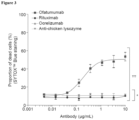
- anti-CD20 antibodies may mediate B cell killing by cellular and/or complement-dependent mechanisms.
- CDC is an important mechanism of ofatumumab-induced B cell lysis.
- PBMCs peripheral blood mononuclear cells
- human primary B cells were harvested by centrifugation and re-suspended at 2x10 5 cells/mL in assay medium (RPMI 1640 + Glutamax supplemented with 0.1% BSA and 20 mM HEPES. Then, B cells were incubated in v-bottom 96 well plates simultaneously with antibody at a 3-fold serial dilution and human serum (30%) as a source of complement at 37°C, 5% CO 2 for 1 hour. Cells were washed, stained with SYTOX Blue (0.25 ⁇ M) and then analyzed for B cell lysis by flow cytometry on a FACS Fortessa. Cell death was defined as SYTOX Blue + cells. Results are shown in Figure 2 demonstrating the strong concentration-dependent induction by ofatumumab of CDC in primary human B cells as compared to ocrelizumab and rituximab.
- ofatumumab provides the ability to activate complement factors and to induce CDC.
- ofatumumab is clearly distinguished from ocrelizumab in this respect.
- Ofatumumab was provided in pre-filled syringes for subcutaneous administration containing 20 mg ofatumumab (50 mg/ml, 0.4 ml content).
- the matching placebo to ofatumumab pre-filled syringe had the same appearance as the investigational drug.
- Control treatment can be teriflunomide (Aubagio ® ) 14 mg.
- Ofatumumab arm ofatumumab 20 mg s.c. injections on Day 1, 7, 14, Week 4 (Study Month 1) and every 4 weeks thereafter + teriflunomide-matching placebo capsule orally once daily.
- Eligible patients can be randomized in a 1:1 ratio to either the active ofatumumab 20 mg group or to the active teriflunomide 14 mg group.
- the randomization was stratified by geographical region and by MS subtype (RRMS, SPMS).
- Relapsing MS relapsing-remitting course (RRMS), or secondary progressive (SPMS) course with disease activity, as defined by Lublin et al., 2014.
- DMT dimethyl fumarate
- the table shows that, among patients randomized to ofatumumab (Study 1), 27 patients were evaluated at each visit, i.e. baseline, 12 months and 24 months. The number of relapses was approx. 1.26 per patient in the 12 months preceding screening. This rate unexpectedly dropped to approx. 0.23 in the 12 months following treatment switch and to about 0.30 in the 24-month period.
- the drop in the ofatumumab group was unexpectedly large.
- the drop was larger than in the comparative group.
- the table shows that, among patients randomized to ofatumumab surprisingly the number of Gd+ lesions were surprisingly reduced.
- the study population consists of adult subjects with RMS. The study is conducted in approximately 120-170 centers worldwide.
- Ofatumumab is provided in an autoinjector (AI) for subcutaneous administration containing 20 mg ofatumumab (50 mg/ml, 0.4 ml content). Ofatumumab (is clear to opalescent, colorless to pale yellow, essentially particle-free liquid.
- AI autoinjector
- the planned duration of treatment is 96 weeks.
- transitioning period As the time between stopping the current treatment (fingolimod or DMF) and starting ofatumumab treatment. The exact timing of the transitioning is based on the clinical judgment of the investigator.
- the subject may not receive any other DMT for the treatment of MS.
- the study drug (ofatumumab injections) is administered starting at Visit 1. Drug is then dispensed at scheduled visits throughout the treatment period. Starting at week 4, the subcutaneous injections should be administered at 4-week intervals (+/- 3 days).
- subjects are closely monitored following administration for any reactions including injection related ones.
- subjects receive the s.c. injection at site.
- the subject or a caregiver injects the study medication under supervision of the study staff.
- Injection 2 (Day 7) is overseen remotely by the designated site personnel to support the self/home administration and provide additional training as needed. Subjects return to the site for the week 2 and 4 administrations.
- Example 4 Clinical trial showing reduced thalamus volume loss and improved MSIS-29
- Ofatumumab showed a highly significant suppression of gadolinium (Gd) T1 lesions when compared to Aubagio ® , demonstrating a profound suppression of new inflammatory activity.
- ASCLEPIOS I patients were randomised (1:1) to receive either ofatumumab 20 mg sc injections every 4 weeks (after an initial loading regimen of 20 mg sc doses on Days 1, 7 and 14) or teriflunomide 14 mg orally once daily, for up to 30 months.
- EDSS Expanded Disability Status Scale
- a higher score on the MSIS-29 is indicative of a greater impact of MS on the daily life from a patient's perspective.
- Ofatumumab treatment reduced the impact of MS on the patient's daily life compared with teriflunomide: the mean change in MSIS-29 physical impact score from baseline was significantly greater in the ofatumumab group than in the teriflunomide treatment group at all time points i.e.
- Ofatumumab treatment was associated with a stronger reduction on the impact of MS on the patient's daily life vs teriflunomide treatment group as measured by the MSIS-29 psychological impact score. However, the difference between treatment groups only reached statistical significance at Month 12.
- Example 5 Maintained ofatumumab efficacy in relapsing MS patients who transition from intravenous anti-CD20 therapy
- Anti-CD20 mAbs ocrelizumab and rituximab are administered by intravenous infusion in clinic; ofatumumab is administered subcutaneously with a pre-filled syringe or autoinjector (AI) pen, facilitating self-administration.
- AI autoinjector
- Results The trial complements the ofatumumab phase 3 program in RMS by generating maintained efficacy, retention and satisfaction data based on monthly subcutaneous drug delivery with the AI pen in patients previously treated with ocrelizumab or rituximab.
Landscapes
- Health & Medical Sciences (AREA)
- Chemical & Material Sciences (AREA)
- Medicinal Chemistry (AREA)
- Life Sciences & Earth Sciences (AREA)
- General Health & Medical Sciences (AREA)
- Organic Chemistry (AREA)
- Pharmacology & Pharmacy (AREA)
- Animal Behavior & Ethology (AREA)
- Public Health (AREA)
- Veterinary Medicine (AREA)
- Engineering & Computer Science (AREA)
- Bioinformatics & Cheminformatics (AREA)
- Neurology (AREA)
- Biomedical Technology (AREA)
- Neurosurgery (AREA)
- Immunology (AREA)
- Epidemiology (AREA)
- General Chemical & Material Sciences (AREA)
- Nuclear Medicine, Radiotherapy & Molecular Imaging (AREA)
- Chemical Kinetics & Catalysis (AREA)
- Biophysics (AREA)
- Proteomics, Peptides & Aminoacids (AREA)
- Biochemistry (AREA)
- Molecular Biology (AREA)
- Genetics & Genomics (AREA)
- Psychiatry (AREA)
- Hospice & Palliative Care (AREA)
- Pain & Pain Management (AREA)
- Mycology (AREA)
- Microbiology (AREA)
- Endocrinology (AREA)
- Pharmaceuticals Containing Other Organic And Inorganic Compounds (AREA)
- Medicines Containing Antibodies Or Antigens For Use As Internal Diagnostic Agents (AREA)
- Medicines That Contain Protein Lipid Enzymes And Other Medicines (AREA)
- Peptides Or Proteins (AREA)
- Acyclic And Carbocyclic Compounds In Medicinal Compositions (AREA)
Priority Applications (2)
| Application Number | Priority Date | Filing Date | Title |
|---|---|---|---|
| EP23183390.6A EP4230655A3 (en) | 2019-09-11 | 2020-09-10 | Treatment of rms by switching therapy |
| SI202030263T SI3864053T1 (sl) | 2019-09-11 | 2020-09-10 | Zdravljenje rms-ja z menjavo terapije |
Applications Claiming Priority (3)
| Application Number | Priority Date | Filing Date | Title |
|---|---|---|---|
| EP19196789 | 2019-09-11 | ||
| EP20154736 | 2020-01-30 | ||
| PCT/EP2020/075332 WO2021048280A1 (en) | 2019-09-11 | 2020-09-10 | Treatment of rms by switching therapy |
Related Child Applications (1)
| Application Number | Title | Priority Date | Filing Date |
|---|---|---|---|
| EP23183390.6A Division EP4230655A3 (en) | 2019-09-11 | 2020-09-10 | Treatment of rms by switching therapy |
Publications (2)
| Publication Number | Publication Date |
|---|---|
| EP3864053A1 EP3864053A1 (en) | 2021-08-18 |
| EP3864053B1 true EP3864053B1 (en) | 2023-07-05 |
Family
ID=72709332
Family Applications (2)
| Application Number | Title | Priority Date | Filing Date |
|---|---|---|---|
| EP20785440.7A Active EP3864053B1 (en) | 2019-09-11 | 2020-09-10 | Treatment of rms by switching therapy |
| EP23183390.6A Pending EP4230655A3 (en) | 2019-09-11 | 2020-09-10 | Treatment of rms by switching therapy |
Family Applications After (1)
| Application Number | Title | Priority Date | Filing Date |
|---|---|---|---|
| EP23183390.6A Pending EP4230655A3 (en) | 2019-09-11 | 2020-09-10 | Treatment of rms by switching therapy |
Country Status (15)
| Country | Link |
|---|---|
| US (1) | US20220298253A1 (cg-RX-API-DMAC7.html) |
| EP (2) | EP3864053B1 (cg-RX-API-DMAC7.html) |
| JP (2) | JP7794735B2 (cg-RX-API-DMAC7.html) |
| KR (1) | KR20220062025A (cg-RX-API-DMAC7.html) |
| CN (3) | CN118436777A (cg-RX-API-DMAC7.html) |
| AU (1) | AU2020344154A1 (cg-RX-API-DMAC7.html) |
| CA (1) | CA3150947A1 (cg-RX-API-DMAC7.html) |
| DK (1) | DK3864053T3 (cg-RX-API-DMAC7.html) |
| ES (1) | ES2957112T3 (cg-RX-API-DMAC7.html) |
| FI (1) | FI3864053T3 (cg-RX-API-DMAC7.html) |
| IL (1) | IL290619A (cg-RX-API-DMAC7.html) |
| LT (1) | LT3864053T (cg-RX-API-DMAC7.html) |
| MX (1) | MX2022003010A (cg-RX-API-DMAC7.html) |
| SI (1) | SI3864053T1 (cg-RX-API-DMAC7.html) |
| WO (1) | WO2021048280A1 (cg-RX-API-DMAC7.html) |
Families Citing this family (5)
| Publication number | Priority date | Publication date | Assignee | Title |
|---|---|---|---|---|
| EP4252847A3 (en) | 2016-08-15 | 2023-11-15 | Novartis AG | Regimens and methods of treating multiple sclerosis using ofatumumab |
| US20220389109A1 (en) * | 2019-09-11 | 2022-12-08 | Novartis Ag | Management of conditions other than multiple sclerosis in ofatumumab-treated patients |
| WO2021204994A1 (en) * | 2020-04-09 | 2021-10-14 | Novartis Ag | Ofatumumab for treating ms while maintaining serum igg |
| CA3215371A1 (en) * | 2021-04-13 | 2022-10-20 | Shibeshih Mitiku BELACHEW | Compositions and methods for treating chronic active white matter lesions / radiologically isolated syndrome |
| CN117529336A (zh) * | 2021-04-14 | 2024-02-06 | 诺华股份有限公司 | 用于治疗亚洲患者的多发性硬化症的奥法木单抗 |
Citations (2)
| Publication number | Priority date | Publication date | Assignee | Title |
|---|---|---|---|---|
| WO2018033841A1 (en) | 2016-08-15 | 2018-02-22 | Novartis Ag | Regimens and methods of treating multiple sclerosis using ofatumumab |
| EP3284753B1 (en) | 2002-10-17 | 2019-06-05 | Genmab A/S | Human monoclonal antibodies against cd20 for use in the treatment of multiple sclerosis |
Family Cites Families (4)
| Publication number | Priority date | Publication date | Assignee | Title |
|---|---|---|---|---|
| UA107557C2 (xx) | 2007-07-06 | 2015-01-26 | Композиція антитіла офатумумабу | |
| AR073295A1 (es) * | 2008-09-16 | 2010-10-28 | Genentech Inc | Metodos para tratar la esclerosis multiple progresiva. articulo de fabricacion. |
| EP2692343A1 (en) * | 2012-08-03 | 2014-02-05 | Forward Pharma A/S | Combination therapy for treatment of multiple sclerosis |
| HK1231413A1 (zh) * | 2014-04-29 | 2017-12-22 | Teva Pharmaceutical Industries Ltd. | 用於治疗具有高残疾状况的复发-缓解型多发性硬化症(rrms)的患者的拉喹莫德 |
-
2020
- 2020-09-10 JP JP2022515966A patent/JP7794735B2/ja active Active
- 2020-09-10 US US17/753,632 patent/US20220298253A1/en active Pending
- 2020-09-10 LT LTEPPCT/EP2020/075332T patent/LT3864053T/lt unknown
- 2020-09-10 EP EP20785440.7A patent/EP3864053B1/en active Active
- 2020-09-10 ES ES20785440T patent/ES2957112T3/es active Active
- 2020-09-10 AU AU2020344154A patent/AU2020344154A1/en active Pending
- 2020-09-10 CN CN202410529206.7A patent/CN118436777A/zh active Pending
- 2020-09-10 CN CN202080064158.9A patent/CN114401742B/zh active Active
- 2020-09-10 CN CN202410529209.0A patent/CN118403156A/zh active Pending
- 2020-09-10 DK DK20785440.7T patent/DK3864053T3/da active
- 2020-09-10 FI FIEP20785440.7T patent/FI3864053T3/fi active
- 2020-09-10 CA CA3150947A patent/CA3150947A1/en active Pending
- 2020-09-10 SI SI202030263T patent/SI3864053T1/sl unknown
- 2020-09-10 EP EP23183390.6A patent/EP4230655A3/en active Pending
- 2020-09-10 KR KR1020227011366A patent/KR20220062025A/ko not_active Ceased
- 2020-09-10 WO PCT/EP2020/075332 patent/WO2021048280A1/en not_active Ceased
- 2020-09-10 MX MX2022003010A patent/MX2022003010A/es unknown
-
2022
- 2022-02-14 IL IL290619A patent/IL290619A/en unknown
-
2025
- 2025-09-25 JP JP2025159217A patent/JP2026016387A/ja active Pending
Patent Citations (2)
| Publication number | Priority date | Publication date | Assignee | Title |
|---|---|---|---|---|
| EP3284753B1 (en) | 2002-10-17 | 2019-06-05 | Genmab A/S | Human monoclonal antibodies against cd20 for use in the treatment of multiple sclerosis |
| WO2018033841A1 (en) | 2016-08-15 | 2018-02-22 | Novartis Ag | Regimens and methods of treating multiple sclerosis using ofatumumab |
Non-Patent Citations (44)
| Title |
|---|
| AMIT BAR-OR, RICHARD A. GROVE, DAREN J. AUSTIN, JERRY M. TOLSON, SUSAN A. VANMETER, ERIC W. LEWIS, FREDERICK J. DEROSIER, MONICA C: "Classification of evidence : The MIRROR study", NEUROLOGY, vol. 90, no. 20, 15 May 2018 (2018-05-15), pages e1805 - e1814, XP055718231, ISSN: 0028-3878, DOI: 10.1212/WNL.0000000000005516 |
| ANONYMOUS: "An Open-label Study Evaluating Ofatumumab Treatment Effectiveness and PROs in Subjects With RMS Transitioning From Fumarate-based RMS Approved Therapies or Fingolimod to Ofatumumab (ARTIOS)", CLINICAL TRIALS, 29 June 2020 (2020-06-29), pages 1 - 12, XP093182579, Retrieved from the Internet <URL:https://clinicaltrials.gov/study/NCT04353492?tab=history&a=3> [retrieved on 20240705] |
| ANONYMOUS: "Clinical Trial Protocol COMB157G2301 A randomized, double-blind, double-dummy, parallel-group study comparing the efficacy and safety of ofatumumab versus teriflunomide in patients with relapsing multiple sclerosis [Supplementary Material: Ofatumumab versus Teriflunomide in Multiple Sclerosis]", NEW ENGLAND JOURNAL OF MEDICINE, vol. 363, no. 6, 7 April 2016 (2016-04-07), US , pages 1 - 694, XP009558202, ISSN: 0028-4793, DOI: 10.1056/NEJMoa1917246 |
| ANONYMOUS: "Detailed Results from the Phase III ASCLEPIOS I & II Studies of Ofatumumab in Patients with Relapsing Multiple Sclerosis Presented at ECTRIMS", GENMAB, 13 September 2019 (2019-09-13), pages 1 - 3, XP093182475, Retrieved from the Internet <URL:https://ir.genmab.com/news-releases/news-release-details/detailed-results-phase-iii-asclepios-i-ii-studies-ofatumumab> [retrieved on 20240705] |
| ANONYMOUS: "Efficacy and Safety of Ofatumumab Compared to Teriflunomide in Patients With Relapsing Multiple Sclerosis (ASCLEPIOS I)", CLINICAL TRIALS, 30 August 2019 (2019-08-30), pages 1 - 26, XP093182552, Retrieved from the Internet <URL:https://clinicaltrials.gov/study/NCT02792218?tab=history&a=21> [retrieved on 20240705] |
| ANONYMOUS: "Efficacy and Safety of Ofatumumab Compared to Teriflunomide in Patients With Relapsing Multiple Sclerosis. (ASCLEPIOS II)", CLINICAL TRIALS, 30 August 2019 (2019-08-30), pages 1 - 5, XP093182558, Retrieved from the Internet <URL:https://clinicaltrials.gov/study/NCT02792231?tab=history> [retrieved on 20240705] |
| ANONYMOUS: "FDA warns about severe worsening of multiple sclerosis after stopping the medicine Gilenya (fingolimod)", FDA - U S FOOD AND DRUG ADMINISTRATION, 20 November 2018 (2018-11-20), pages 1 - 4, XP093323572, Retrieved from the Internet <URL:https://www.fda.gov/media/118217/download?attachment> |
| ANONYMOUS: "Genmab Announces Phase III Studies of Ofatumumab in Relapsing Multiple Sclerosis", GENMAB, 2 June 2016 (2016-06-02), pages 1 - 2, XP093182468, Retrieved from the Internet <URL:https://ir.genmab.com/static-files/3d6876f0-3803-443a-ae7e-88ca03397794#:~:text=The%20Phase%20III%20trials%20are,with%20relapsing%20MS%20per%20study.> [retrieved on 20240705] |
| ANONYMOUS: "Highlights of prescribing information GILENYA", FDA LABEL, 1 September 2010 (2010-09-01), pages 1 - 16, XP093182464 |
| ANONYMOUS: "Highlights of prescribing information KESIMPTA", FDA LABEL, 1 August 2020 (2020-08-01), pages 1 - 26, XP093182462 |
| ANONYMOUS: "Novartis ofatumumab demonstrates superiority versus Aubagio® in two headto-head Phase III multiple sclerosis studies", NOVARIS, 30 August 2019 (2019-08-30), pages 1 - 6, XP093182470, Retrieved from the Internet <URL:https://www.novartis.com/news/media-releases/novartis-ofatumumab-demonstrates-superiority-versus-aubagio-two-head-head-phase-iii-multiple-sclerosis-studies> [retrieved on 20240705] |
| ANONYMOUS: "Novartis Phase IIIASCLEPIOS trials demonstrate robust efficacy of ofatumumab in patients with relapsing multiple sclerosis", NOVARIS, 13 September 2019 (2019-09-13), pages 1 - 6, XP093182480, Retrieved from the Internet <URL:https://www.novartis.com/news/media-releases/novartis-phase-iii-asclepios-trials-demonstrate-robust-efficacy-ofatumumab-patients-relapsing-multiple-sclerosis> [retrieved on 20240705] |
| BIGAUT KÉVIN, COHEN MIKAËL, DURAND-DUBIEF FRANÇOISE, MAILLART ELISABETH, PLANQUE EVELYNE, ZEPHIR HÉLÈNE, LEBRUN-FRENAY CHRISTINE, : "How to switch disease-modifying treatments in multiple sclerosis: Guidelines from the French Multiple Sclerosis Society (SFSEP)", MULTIPLE SCLEROSIS AND RELATED DISORDERS, vol. 53, 1 August 2021 (2021-08-01), NL , pages 103076, XP093274603, ISSN: 2211-0348, DOI: 10.1016/j.msard.2021.103076 |
| BOUDOT DE LA MOTTE MARINE , LOUAPRE CÉLINE, PAPEIX CAROLINE, DEPAZ RAPHAËL, ASSOUAD RANA, ROUX THOMAS, LUBETZKI CATHERINE, MAILLAR: "Challenges of switching towards anti-CD20 monoclonal antibodies in RR-MS: A monocentric study", MULTIPLE SCLEROSIS AND RELATED DISORDERS, vol. 52, 1 July 2021 (2021-07-01), NL , pages 1 - 5, XP093182501, ISSN: 2211-0348, DOI: 10.1016/j.msard.2021.102981 |
| BOVE RILEY, CRANER, LANGDON DAWN, SIENKIEWICZ DANIEL, RICART JAVIER, ANSARI SOUDEH, ARNOULD SOPHIE, BOER IBOLYA, DERFUSS TOBIAS: "Effectiveness and Safety of Ofatumumab in Relapsing Multiple Sclerosis Patients who had Breakthrough Disease Activity on Oral Fumarates or Fingolimod: An Interim Analysis of ARTIOS", POSTER PRESENTATION, 1 January 2023 (2023-01-01), pages 1 - 1, XP093182529 |
| BRIAN BARRY, APRIL A. ERWIN, JESSICA STEVENS, CARLO TORNATORE: "Fingolimod Rebound: A Review of the Clinical Experience and Management Considerations", NEUROLOGY AND THERAPY, SPRINGER, vol. 8, no. 2, 1 December 2019 (2019-12-01), pages 241 - 250, XP055718479, ISSN: 2193-8253, DOI: 10.1007/s40120-019-00160-9 |
| BRIEVA LUIS, ESTRUCH BONAVENTURA CASANOVA, MERINO JUAN ANTONIO GARCÍA, MECA-LALLANA VIRGINIA, RÍO JORDI, RODRÍGUEZ-ANTIGÜEDAD ALFR: "Disease modifying therapy switching in relapsing multiple sclerosis: A Delphi consensus of the demyelinating expert group of the Spanish society of neurology", MULTIPLE SCLEROSIS AND RELATED DISORDERS, vol. 63, 1 July 2022 (2022-07-01), NL , pages 103805, XP093274610, ISSN: 2211-0348, DOI: 10.1016/j.msard.2022.103805 |
| CRANER MATTHEW, BOVE RILEY, LANGDON DAWN, SIENKIEWICZ DANIEL, RICART JAVIER, MISTRY ALOMI, WILEY DAISY, PISAL CHAITALI BABANRA, BA: "Effectiveness, Safety, and Patient-Reported Outcomes of Ofatumumab in Relapsing Multiple Sclerosis Patients Switching from Dimethyl Fumarate or Fingolimod: ARTIOS Phase 3b Study Design", MS CENTERS (CMSC), 1 January 2021 (2021-01-01), pages 1 - 10, XP093182517, Retrieved from the Internet <URL:https://mscare.sharefile.com/share/view/s05da2b6388f1441783d338e13f6b6036> [retrieved on 20240705] |
| D28 - ECTRIMS 2019 AV Recording Policy |
| FRAHM NIKLAS, FNEISH FIRAS, ELLENBERGER DAVID, FLACHENECKER PETER, PAUL FRIEDEMANN, WARNKE CLEMENS, KLEINSCHNITZ CHRISTOPH, PARCIA: "Therapy Switches in Fingolimod-Treated Patients with Multiple Sclerosis: Long-Term Experience from the German MS Registry", NEUROLOGY AND THERAPY, vol. 11, no. 1, 1 March 2022 (2022-03-01), pages 319 - 336, XP093182503, ISSN: 2193-8253, DOI: 10.1007/s40120-021-00320-w |
| GHADIRI MAHTAB, FITZ-GERALD LESLIE, REZK AYMAN, LI RUI, NYIRENDA MUKANTHU, HAEGERT DAVID, GIACOMINI PAUL STEVEN, BAR-OR AMIT, ANTE: "Reconstitution of the peripheral immune repertoire following withdrawal of fingolimod", MULTIPLE SCLEROSIS JOURNAL, SAGE, US, vol. 23, no. 9, 1 August 2017 (2017-08-01), US , pages 1225 - 1232, XP093232749, ISSN: 1352-4585, DOI: 10.1177/1352458517713147 |
| GIOVANNONI GAVIN, HAWKES CHRIS, WAUBANT EMMANUELLE, LUBLIN FRED: "The ‘Field Hypothesis’: rebound activity after stopping disease-modifying therapies", MULTIPLE SCLEROSIS AND RELATED DISORDERS, ELSEVIER, NL, vol. 15, 1 July 2017 (2017-07-01), NL , pages A1 - A2, XP093263863, ISSN: 2211-0348, DOI: 10.1016/j.msard.2017.06.005 |
| GRAND’MAISON FRANCOIS ET AL: "Sequencing of disease-modifying therapies for relapsing–remitting multiple sclerosis: a theoretical approach to optimizing treatment", CURRENT MEDICAL RESEARCH AND OPINION, HANTS, GB, vol. 34, no. 8, 3 August 2018 (2018-08-03), GB , pages 1419 - 1430, XP093263831, ISSN: 0300-7995, DOI: 10.1080/03007995.2018.1458023 |
| GROSS ROBERT H., CORBOY JOHN R.: "Monitoring, Switching, and Stopping Multiple Sclerosis Disease-Modifying Therapies", CONTINUUM - LIFELONG LEARNING IN NEUROLOGY: THE OFFICIAL CME JOURNAL OF THE AMERICAN ACADEMY OF NEUROLOGY, LIPPINCOTT WILLIAMS & WILKINS, BALTIMORE, MD, US, vol. 25, no. 3, 1 June 2019 (2019-06-01), US , pages 715 - 735, XP093263836, ISSN: 1080-2371, DOI: 10.1212/CON.0000000000000738 |
| HATCHER STACY ELLEN ET AL: "Rebound Syndrome in Patients With Multiple Sclerosis After Cessation of Fingolimod Treatment", JAMA NEUROLOGY, AMERICAN MEDICAL ASSOCIATION, US, vol. 73, no. 7, 1 July 2016 (2016-07-01), US , pages 790 - 794, XP093263870, ISSN: 2168-6149, DOI: 10.1001/jamaneurol.2016.0826 |
| HAUSER S L, A. BAR-OR, J. COHEN, G. COMI, J. CORREALE, P.K. COYLE, A.H. CROSS, J. DE SEZE, X. MONTALBAN, K. SELMAJ, H. WIENDL, A.: "Efficacy and safety of ofatumumab versus teriflunomide in relapsing multiple sclerosis: results of the phase 3 ASCLEPIOS I and II trials", MULTIPLE SCLEROSIS JOURNAL, vol. 25, no. 2_suppl, 1 January 2019 (2019-01-01), US , pages 890 - 891, XP093182484, ISSN: 1352-4585, DOI: 10.1177/1352458519869496 |
| HAUSER SL, BAR-OR A, COHEN JA: "Ofatumumab Versus Teriflunomide in Multiple Sclerosis (Supplementary Appendix)", THE NEW ENGLAND JOURNAL OF MEDICINE, 31 December 2020 (2020-12-31), US , pages 1 - 90, XP009557826, ISSN: 0028-4793 |
| HAUSER STEPHEN L., BAR-OR AMIT, COHEN JEFFREY A., COMI GIANCARLO, CORREALE JORGE, COYLE PATRICIA K., CROSS ANNE H., DE SEZE JEROME: "Ofatumumab versus Teriflunomide in Multiple Sclerosis", THE NEW ENGLAND JOURNAL OF MEDICINE, vol. 383, no. 6, 6 August 2020 (2020-08-06), US , pages 546 - 557, XP055802357, ISSN: 0028-4793, DOI: 10.1056/NEJMoa1917246 |
| JUAN-MANUEL ANAYA, YEHUDA SHOENFELD, ADRIANA ROJAS-VILLARRAGA, ROGER A. LEVY, RICARD CERVERA: "Autoimmunity : from bench to bedside", 18 July 2013, CENTER FOR AUTOIMMUNE DISEASES RESEARCH, CREA TEXTS COLLECTION, SCHOOL OF MEDICINE AND HEALTH SCIENCES, EL ROSARIO UNIVERSITY, ISBN: 978-958-738-376-8, article LUZ ELENA CANO R, DAMARIS E. LOPERA H: "5. Introduction to T and B lymphocytes", pages: 77 - 95, XP009560478 |
| KAPPOS L, BAR-OR A, COHEN J, COMI G, CORREALE J, COYLE P K, CROSS A H, DE SEZE J, MONTALBAN X, SELMAJ K, WIENDL H, KERLOEGUEN C, W: "Ofatumumab versus teriflunomide in relapsing multiple sclerosis: baseline characteristics of two pivotal phase 3 trials (ASCELPIOS I and ASCLEPIOS II)", MULTIPLE SCLEROSIS JOURNAL, vol. 24, no. S2, 1 January 2018 (2018-01-01), pages 526 - 527, XP093182491 |
| LUNEMANN JAN D, JUDIT DIAZ-DIAZ, BRUNO STANKOFF, CAROLYN YOUNG, AKSEL SIVA, AARON MILLER, CATHERINE LUBETZKI, HEINZ WIENDL , CELIA: "Highlights fro m the 2019 European Congress on Treatment and Research in Multiple Sclerosis (ECTRIMS 2019)", MULTIPLE SCLEROSIS JOURNAL, vol. 26, no. 7, 1 January 2020 (2020-01-01), pages 859 - 868, XP093182490, DOI: 10.1177/1352458520918377 |
| MIHAI ANCAU, ACHIM BERTHELE, BERNHARD HEMMER: "CD20 monoclonal antibodies for the treatment of multiple sclerosis: up-to-date", EXPERT OPINION ON BIOLOGICAL THERAPY, vol. 19, no. 8, 3 August 2019 (2019-08-03), pages 829 - 843, XP055760397, ISSN: 1471-2598, DOI: 10.1080/14712598.2019.1611778 |
| MILO RON: "Therapeutic strategies targeting B-cells in multiple sclerosis", AUTOIMMUNITY REVIEWS, vol. 15, no. 7, 9 March 2016 (2016-03-09), NL , pages 714 - 718, XP029541469, ISSN: 1568-9972, DOI: 10.1016/j.autrev.2016.03.006 |
| NIKLAS FRAHMAB, FIRAS FNEISHA, DAVID ELLENBERGERA, PETER FLACHENECKERC, FRIEDEMANN PAULD, CLEMENS WARNKE6, CHRISTOPH KLEINSCHNITZF: "Therapy switches in fingolimod-treated patients with multiple sclerosis: long-term experience from the German MS Registry - Supplementary material", NEUROLOGY AND THERAPY, vol. 11, no. 1, 1 January 2022 (2022-01-01), pages 1 - 12, XP009557915, ISSN: 2193-8253 |
| O. FERNÁNDEZ ET AL: "Survey of diagnostic and treatment practices for multiple sclerosis in Europe", EUROPEAN JOURNAL OF NEUROLOGY, RAPID SCIENCE PUBLISHERS., GB, vol. 24, no. 3, 31 January 2017 (2017-01-31), GB , pages 516 - 522, XP072031162, ISSN: 1351-5101, DOI: 10.1111/ene.13236 |
| PER S SORENSEN, STEEN LISBY, RICHARD GROVE, FREDERICK DEROSIER, STEVE SHACKELFORD, EVA HAVRDOVA, JELENA DRULOVIC, AND MASSIMO FILI: "Safety and efficacy of ofatumumab in relapsing-remitting multiple sclerosis; A phase 2 study", NEUROLOGY, vol. 82, 18 February 2014 (2014-02-18), pages 573 - 581, XP055422042 |
| SABATINO JOSEPH J., ZAMVIL SCOTT S., HAUSER STEPHEN L.: "B-Cell Therapies in Multiple Sclerosis", COLD SPRING HARBOR PERSPECTIVES IN MEDICINE, vol. 9, no. 2, 1 February 2019 (2019-02-01), US , pages 1 - 14, XP093182459, ISSN: 2157-1422, DOI: 10.1101/cshperspect.a032037 |
| SAVELIEVA MARINA ET AL: "Comparison of the B-Cell Recovery Time Following EP1624 Discontinuation of Anti-CD20 Therapies", POSTER EP1624, 1 January 2017 (2017-01-01), pages 1 - 2, XP093263860 |
| SCHMIDT STEPHAN, SCHULTEN T: "Severe rebound after cessation of fingolimod treated with ocrelizumab with coincidental transient aggravation: report of two cases", THERAPEUTIC ADVANCES IN NEUROLOGICAL DISORDERS, 6 May 2019 (2019-05-06), XP055927053, [retrieved on 20220601] |
| SELLEBJERG FINN ET AL: "Check for updates Anti-CD20 Monoclonal Antibodies for Relapsing and Progressive Multiple Sclerosis", CNS DRUGS, 1 January 2020 (2020-01-01), pages 1 - 12, XP093263852 |
| THEIL DIETHILDE ET AL: "Imaging Mass Cytometry and Single-Cell Genomics Reveal Differential Depletion and Repletion of B-Cell Populations Following Ofatumumab Treatment in Cynomolgus Monkeys", FRONTIERS IN IMMUNOLOGY, FRONTIERS MEDIA, LAUSANNE, CH, vol. 10, 20 June 2019 (2019-06-20), Lausanne, CH , XP093263848, ISSN: 1664-3224, DOI: 10.3389/fimmu.2019.01340 |
| VOLLMER BRANDI; ONTANEDA DANIEL; HARRIS HALEIGH; NAIR KAVITA; BERMEL ROBERT A.; CORBOY JOHN R.; FOX ROBERT J.; VOLLMER TIMOTHY; CO: "Comparative discontinuation, effectiveness, and switching practices of dimethyl fumarate and fingolimod at 36-month follow-up", JOURNAL OF THE NEUROLOGICAL SCIENCES, vol. 407, 15 October 2019 (2019-10-15), NL , pages 1 - 8, XP085929559, ISSN: 0022-510X, DOI: 10.1016/j.jns.2019.116498 |
| WIRTH TIMO, SCHULTE-MECKLENBECK ANDREAS, STEINBERG OLGRA, RAPOSO CATARINA, GROSS CATHARINA, WIENDL HEINZ, KLOTZ LUISA: "Immunological Signatures Associated With Ocrelizumab Treatment in Early RRMS: 12-Month Interim Analysis From the Ocrelizumab Phase IIIb (ENSEMBLE; NCT03085810) Immunological Substudy (S16.003)", NEUROLOGY, LIPPINCOTT WILLIAMS & WILKINS, vol. 100, no. 17_supplement_2, 25 April 2023 (2023-04-25), XP093232751, ISSN: 0028-3878, DOI: 10.1212/WNL.0000000000202206 |
| YAMOUT BASSEM I., EL-AYOUBI NABIL K., NICOLAS JOHNY, EL KOUZI YEHYA, KHOURY SAMIA J., ZEINEDDINE MAYA M.: "Safety and Efficacy of Rituximab in Multiple Sclerosis: A Retrospective Observational Study", JOURNAL OF IMMUNOLOGY RESEARCH, vol. 2018, 1 January 2018 (2018-01-01), US , pages 1 - 9, XP093182513, ISSN: 2314-8861, DOI: 10.1155/2018/9084759 |
Also Published As
| Publication number | Publication date |
|---|---|
| AU2020344154A1 (en) | 2022-04-07 |
| EP4230655A2 (en) | 2023-08-23 |
| CN114401742A (zh) | 2022-04-26 |
| CN118403156A (zh) | 2024-07-30 |
| DK3864053T3 (da) | 2023-09-11 |
| JP2026016387A (ja) | 2026-02-03 |
| LT3864053T (lt) | 2023-09-11 |
| CN114401742B (zh) | 2024-05-24 |
| SI3864053T1 (sl) | 2023-12-29 |
| CN118436777A (zh) | 2024-08-06 |
| MX2022003010A (es) | 2022-06-02 |
| US20220298253A1 (en) | 2022-09-22 |
| IL290619A (en) | 2022-04-01 |
| CA3150947A1 (en) | 2021-03-18 |
| KR20220062025A (ko) | 2022-05-13 |
| EP4230655A3 (en) | 2023-11-01 |
| JP7794735B2 (ja) | 2026-01-06 |
| FI3864053T3 (fi) | 2023-09-13 |
| EP3864053A1 (en) | 2021-08-18 |
| WO2021048280A1 (en) | 2021-03-18 |
| JP2022548575A (ja) | 2022-11-21 |
| ES2957112T3 (es) | 2024-01-11 |
Similar Documents
| Publication | Publication Date | Title |
|---|---|---|
| EP4230655A2 (en) | Treatment of rms by switching therapy | |
| CA3229704A1 (en) | Ofatumumab for treating pediatric ms | |
| JP2026009900A (ja) | 血清IgGを維持しながらMSを治療するためのオファツムマブ | |
| US20240228647A1 (en) | Ofatumumab for treating multiple sclerosis in asian patients | |
| US20220112294A1 (en) | Methods Of Treating Type 2 Diabetes Mellitus Using Glucagon Receptor Antagonistic Antibodies | |
| HK40051003B (en) | Treatment of rms by switching therapy | |
| HK40051003A (en) | Treatment of rms by switching therapy | |
| RU2849464C1 (ru) | Лечение rms путем смены терапии | |
| TW202300523A (zh) | 用於治療MS同時維持血清IgG之奧法木單抗(OFATUMUMAB) | |
| JP2020517648A (ja) | 抗cd52抗体を用いて多発性硬化症を処置するための経路およびスケジュール | |
| CN117813328A (zh) | 用于治疗儿童ms的奥法妥木单抗 | |
| BR122024017958A2 (pt) | Usos de ofatumumab para tratamento de esclerose múltipla (em) enquanto mantém a igg sérica |
Legal Events
| Date | Code | Title | Description |
|---|---|---|---|
| STAA | Information on the status of an ep patent application or granted ep patent |
Free format text: STATUS: UNKNOWN |
|
| STAA | Information on the status of an ep patent application or granted ep patent |
Free format text: STATUS: THE INTERNATIONAL PUBLICATION HAS BEEN MADE |
|
| PUAI | Public reference made under article 153(3) epc to a published international application that has entered the european phase |
Free format text: ORIGINAL CODE: 0009012 |
|
| STAA | Information on the status of an ep patent application or granted ep patent |
Free format text: STATUS: REQUEST FOR EXAMINATION WAS MADE |
|
| 17P | Request for examination filed |
Effective date: 20210512 |
|
| AK | Designated contracting states |
Kind code of ref document: A1 Designated state(s): AL AT BE BG CH CY CZ DE DK EE ES FI FR GB GR HR HU IE IS IT LI LT LU LV MC MK MT NL NO PL PT RO RS SE SI SK SM TR |
|
| STAA | Information on the status of an ep patent application or granted ep patent |
Free format text: STATUS: EXAMINATION IS IN PROGRESS |
|
| REG | Reference to a national code |
Ref country code: HK Ref legal event code: DE Ref document number: 40051003 Country of ref document: HK |
|
| 17Q | First examination report despatched |
Effective date: 20211220 |
|
| DAV | Request for validation of the european patent (deleted) | ||
| GRAP | Despatch of communication of intention to grant a patent |
Free format text: ORIGINAL CODE: EPIDOSNIGR1 |
|
| STAA | Information on the status of an ep patent application or granted ep patent |
Free format text: STATUS: GRANT OF PATENT IS INTENDED |
|
| INTG | Intention to grant announced |
Effective date: 20230120 |
|
| GRAS | Grant fee paid |
Free format text: ORIGINAL CODE: EPIDOSNIGR3 |
|
| GRAA | (expected) grant |
Free format text: ORIGINAL CODE: 0009210 |
|
| STAA | Information on the status of an ep patent application or granted ep patent |
Free format text: STATUS: THE PATENT HAS BEEN GRANTED |
|
| AK | Designated contracting states |
Kind code of ref document: B1 Designated state(s): AL AT BE BG CH CY CZ DE DK EE ES FI FR GB GR HR HU IE IS IT LI LT LU LV MC MK MT NL NO PL PT RO RS SE SI SK SM TR |
|
| REG | Reference to a national code |
Ref country code: CH Ref legal event code: EP |
|
| REG | Reference to a national code |
Ref country code: AT Ref legal event code: REF Ref document number: 1584783 Country of ref document: AT Kind code of ref document: T Effective date: 20230715 |
|
| P01 | Opt-out of the competence of the unified patent court (upc) registered |
Effective date: 20230621 |
|
| REG | Reference to a national code |
Ref country code: DE Ref legal event code: R096 Ref document number: 602020013423 Country of ref document: DE |
|
| REG | Reference to a national code |
Ref country code: IE Ref legal event code: FG4D |
|
| REG | Reference to a national code |
Ref country code: NL Ref legal event code: FP |
|
| REG | Reference to a national code |
Ref country code: DK Ref legal event code: T3 Effective date: 20230908 |
|
| REG | Reference to a national code |
Ref country code: FI Ref legal event code: FGE |
|
| REG | Reference to a national code |
Ref country code: SE Ref legal event code: TRGR |
|
| REG | Reference to a national code |
Ref country code: PT Ref legal event code: SC4A Ref document number: 3864053 Country of ref document: PT Date of ref document: 20230928 Kind code of ref document: T Free format text: AVAILABILITY OF NATIONAL TRANSLATION Effective date: 20230921 |
|
| REG | Reference to a national code |
Ref country code: EE Ref legal event code: FG4A Ref document number: E023669 Country of ref document: EE Effective date: 20230929 |
|
| REG | Reference to a national code |
Ref country code: ES Ref legal event code: FG2A Ref document number: 2957112 Country of ref document: ES Kind code of ref document: T3 Effective date: 20240111 |
|
| PG25 | Lapsed in a contracting state [announced via postgrant information from national office to epo] |
Ref country code: GR Free format text: LAPSE BECAUSE OF FAILURE TO SUBMIT A TRANSLATION OF THE DESCRIPTION OR TO PAY THE FEE WITHIN THE PRESCRIBED TIME-LIMIT Effective date: 20231006 |
|
| PG25 | Lapsed in a contracting state [announced via postgrant information from national office to epo] |
Ref country code: IS Free format text: LAPSE BECAUSE OF FAILURE TO SUBMIT A TRANSLATION OF THE DESCRIPTION OR TO PAY THE FEE WITHIN THE PRESCRIBED TIME-LIMIT Effective date: 20231105 |
|
| PG25 | Lapsed in a contracting state [announced via postgrant information from national office to epo] |
Ref country code: RS Free format text: LAPSE BECAUSE OF FAILURE TO SUBMIT A TRANSLATION OF THE DESCRIPTION OR TO PAY THE FEE WITHIN THE PRESCRIBED TIME-LIMIT Effective date: 20230705 Ref country code: NO Free format text: LAPSE BECAUSE OF FAILURE TO SUBMIT A TRANSLATION OF THE DESCRIPTION OR TO PAY THE FEE WITHIN THE PRESCRIBED TIME-LIMIT Effective date: 20231005 Ref country code: IS Free format text: LAPSE BECAUSE OF FAILURE TO SUBMIT A TRANSLATION OF THE DESCRIPTION OR TO PAY THE FEE WITHIN THE PRESCRIBED TIME-LIMIT Effective date: 20231105 Ref country code: HR Free format text: LAPSE BECAUSE OF FAILURE TO SUBMIT A TRANSLATION OF THE DESCRIPTION OR TO PAY THE FEE WITHIN THE PRESCRIBED TIME-LIMIT Effective date: 20230705 Ref country code: GR Free format text: LAPSE BECAUSE OF FAILURE TO SUBMIT A TRANSLATION OF THE DESCRIPTION OR TO PAY THE FEE WITHIN THE PRESCRIBED TIME-LIMIT Effective date: 20231006 |
|
| REG | Reference to a national code |
Ref country code: AT Ref legal event code: UEP Ref document number: 1584783 Country of ref document: AT Kind code of ref document: T Effective date: 20230705 |
|
| PG25 | Lapsed in a contracting state [announced via postgrant information from national office to epo] |
Ref country code: PL Free format text: LAPSE BECAUSE OF FAILURE TO SUBMIT A TRANSLATION OF THE DESCRIPTION OR TO PAY THE FEE WITHIN THE PRESCRIBED TIME-LIMIT Effective date: 20230705 |
|
| REG | Reference to a national code |
Ref country code: DE Ref legal event code: R026 Ref document number: 602020013423 Country of ref document: DE |
|
| PLBI | Opposition filed |
Free format text: ORIGINAL CODE: 0009260 |
|
| PLAX | Notice of opposition and request to file observation + time limit sent |
Free format text: ORIGINAL CODE: EPIDOSNOBS2 |
|
| PG25 | Lapsed in a contracting state [announced via postgrant information from national office to epo] |
Ref country code: SM Free format text: LAPSE BECAUSE OF FAILURE TO SUBMIT A TRANSLATION OF THE DESCRIPTION OR TO PAY THE FEE WITHIN THE PRESCRIBED TIME-LIMIT Effective date: 20230705 Ref country code: RO Free format text: LAPSE BECAUSE OF FAILURE TO SUBMIT A TRANSLATION OF THE DESCRIPTION OR TO PAY THE FEE WITHIN THE PRESCRIBED TIME-LIMIT Effective date: 20230705 Ref country code: CZ Free format text: LAPSE BECAUSE OF FAILURE TO SUBMIT A TRANSLATION OF THE DESCRIPTION OR TO PAY THE FEE WITHIN THE PRESCRIBED TIME-LIMIT Effective date: 20230705 Ref country code: SK Free format text: LAPSE BECAUSE OF FAILURE TO SUBMIT A TRANSLATION OF THE DESCRIPTION OR TO PAY THE FEE WITHIN THE PRESCRIBED TIME-LIMIT Effective date: 20230705 |
|
| REG | Reference to a national code |
Ref country code: CH Ref legal event code: PK Free format text: DIE PUBLIKATION VOM 17.04.2024 WURDE AM 24.04.2024 IRRTUEMLICHERWEISE ERNEUT PUBLIZIERT. LA PUBLICATION DU 17.04.2024 A ETE REPUBLIEE PAR ERREUR LE 24.04.2024. LA PUBBLICAZIONE DEL 17.04.2024 E STATA ERRONEAMENTE RIPUBBLICATA IL 24.04.2024. |
|
| 26 | Opposition filed |
Opponent name: MAIWALD GMBH Effective date: 20240405 |
|
| PLAF | Information modified related to communication of a notice of opposition and request to file observations + time limit |
Free format text: ORIGINAL CODE: EPIDOSCOBS2 |
|
| PG25 | Lapsed in a contracting state [announced via postgrant information from national office to epo] |
Ref country code: MC Free format text: LAPSE BECAUSE OF FAILURE TO SUBMIT A TRANSLATION OF THE DESCRIPTION OR TO PAY THE FEE WITHIN THE PRESCRIBED TIME-LIMIT Effective date: 20230705 |
|
| REG | Reference to a national code |
Ref country code: IE Ref legal event code: MM4A |
|
| PG25 | Lapsed in a contracting state [announced via postgrant information from national office to epo] |
Ref country code: IE Free format text: LAPSE BECAUSE OF NON-PAYMENT OF DUE FEES Effective date: 20230910 |
|
| PG25 | Lapsed in a contracting state [announced via postgrant information from national office to epo] |
Ref country code: IE Free format text: LAPSE BECAUSE OF NON-PAYMENT OF DUE FEES Effective date: 20230910 |
|
| PLBB | Reply of patent proprietor to notice(s) of opposition received |
Free format text: ORIGINAL CODE: EPIDOSNOBS3 |
|
| PG25 | Lapsed in a contracting state [announced via postgrant information from national office to epo] |
Ref country code: CY Free format text: LAPSE BECAUSE OF FAILURE TO SUBMIT A TRANSLATION OF THE DESCRIPTION OR TO PAY THE FEE WITHIN THE PRESCRIBED TIME-LIMIT; INVALID AB INITIO Effective date: 20200910 |
|
| PG25 | Lapsed in a contracting state [announced via postgrant information from national office to epo] |
Ref country code: HU Free format text: LAPSE BECAUSE OF FAILURE TO SUBMIT A TRANSLATION OF THE DESCRIPTION OR TO PAY THE FEE WITHIN THE PRESCRIBED TIME-LIMIT; INVALID AB INITIO Effective date: 20200910 |
|
| PGFP | Annual fee paid to national office [announced via postgrant information from national office to epo] |
Ref country code: LU Payment date: 20250829 Year of fee payment: 6 Ref country code: NL Payment date: 20250826 Year of fee payment: 6 |
|
| REG | Reference to a national code |
Ref country code: CH Ref legal event code: U11 Free format text: ST27 STATUS EVENT CODE: U-0-0-U10-U11 (AS PROVIDED BY THE NATIONAL OFFICE) Effective date: 20251001 |
|
| PGFP | Annual fee paid to national office [announced via postgrant information from national office to epo] |
Ref country code: FI Payment date: 20250912 Year of fee payment: 6 Ref country code: PT Payment date: 20250903 Year of fee payment: 6 |
|
| PGFP | Annual fee paid to national office [announced via postgrant information from national office to epo] |
Ref country code: DE Payment date: 20250819 Year of fee payment: 6 Ref country code: LT Payment date: 20250825 Year of fee payment: 6 Ref country code: DK Payment date: 20250911 Year of fee payment: 6 |
|
| PGFP | Annual fee paid to national office [announced via postgrant information from national office to epo] |
Ref country code: IT Payment date: 20250827 Year of fee payment: 6 |
|
| PGFP | Annual fee paid to national office [announced via postgrant information from national office to epo] |
Ref country code: BG Payment date: 20250903 Year of fee payment: 6 Ref country code: BE Payment date: 20250825 Year of fee payment: 6 Ref country code: GB Payment date: 20250821 Year of fee payment: 6 |
|
| PGFP | Annual fee paid to national office [announced via postgrant information from national office to epo] |
Ref country code: FR Payment date: 20250821 Year of fee payment: 6 Ref country code: AT Payment date: 20250827 Year of fee payment: 6 |
|
| PGFP | Annual fee paid to national office [announced via postgrant information from national office to epo] |
Ref country code: MT Payment date: 20250917 Year of fee payment: 6 Ref country code: SE Payment date: 20250827 Year of fee payment: 6 |
|
| PGFP | Annual fee paid to national office [announced via postgrant information from national office to epo] |
Ref country code: EE Payment date: 20250828 Year of fee payment: 6 |
|
| PGFP | Annual fee paid to national office [announced via postgrant information from national office to epo] |
Ref country code: LV Payment date: 20250819 Year of fee payment: 6 |
|
| PGFP | Annual fee paid to national office [announced via postgrant information from national office to epo] |
Ref country code: SI Payment date: 20250827 Year of fee payment: 6 |
|
| PG25 | Lapsed in a contracting state [announced via postgrant information from national office to epo] |
Ref country code: TR Free format text: LAPSE BECAUSE OF FAILURE TO SUBMIT A TRANSLATION OF THE DESCRIPTION OR TO PAY THE FEE WITHIN THE PRESCRIBED TIME-LIMIT Effective date: 20230705 |
|
| PGFP | Annual fee paid to national office [announced via postgrant information from national office to epo] |
Ref country code: CH Payment date: 20251001 Year of fee payment: 6 |
|
| PGFP | Annual fee paid to national office [announced via postgrant information from national office to epo] |
Ref country code: ES Payment date: 20251016 Year of fee payment: 6 |