EP3854185B1 - Transfer including an electrical component - Google Patents
Transfer including an electrical component Download PDFInfo
- Publication number
- EP3854185B1 EP3854185B1 EP19779537.0A EP19779537A EP3854185B1 EP 3854185 B1 EP3854185 B1 EP 3854185B1 EP 19779537 A EP19779537 A EP 19779537A EP 3854185 B1 EP3854185 B1 EP 3854185B1
- Authority
- EP
- European Patent Office
- Prior art keywords
- conductive
- conductive layer
- electrical component
- electrical
- transfer according
- Prior art date
- Legal status (The legal status is an assumption and is not a legal conclusion. Google has not performed a legal analysis and makes no representation as to the accuracy of the status listed.)
- Active
Links
Images


Classifications
-
- B—PERFORMING OPERATIONS; TRANSPORTING
- B44—DECORATIVE ARTS
- B44C—PRODUCING DECORATIVE EFFECTS; MOSAICS; TARSIA WORK; PAPERHANGING
- B44C1/00—Processes, not specifically provided for elsewhere, for producing decorative surface effects
- B44C1/16—Processes, not specifically provided for elsewhere, for producing decorative surface effects for applying transfer pictures or the like
- B44C1/165—Processes, not specifically provided for elsewhere, for producing decorative surface effects for applying transfer pictures or the like for decalcomanias; sheet material therefor
- B44C1/17—Dry transfer
- B44C1/1733—Decalcomanias applied under pressure only, e.g. provided with a pressure sensitive adhesive
-
- B—PERFORMING OPERATIONS; TRANSPORTING
- B32—LAYERED PRODUCTS
- B32B—LAYERED PRODUCTS, i.e. PRODUCTS BUILT-UP OF STRATA OF FLAT OR NON-FLAT, e.g. CELLULAR OR HONEYCOMB, FORM
- B32B37/00—Methods or apparatus for laminating, e.g. by curing or by ultrasonic bonding
- B32B37/02—Methods or apparatus for laminating, e.g. by curing or by ultrasonic bonding characterised by a sequence of laminating steps, e.g. by adding new layers at consecutive laminating stations
- B32B37/025—Transfer laminating
-
- B—PERFORMING OPERATIONS; TRANSPORTING
- B32—LAYERED PRODUCTS
- B32B—LAYERED PRODUCTS, i.e. PRODUCTS BUILT-UP OF STRATA OF FLAT OR NON-FLAT, e.g. CELLULAR OR HONEYCOMB, FORM
- B32B37/00—Methods or apparatus for laminating, e.g. by curing or by ultrasonic bonding
- B32B37/10—Methods or apparatus for laminating, e.g. by curing or by ultrasonic bonding characterised by the pressing technique, e.g. using action of vacuum or fluid pressure
-
- B—PERFORMING OPERATIONS; TRANSPORTING
- B32—LAYERED PRODUCTS
- B32B—LAYERED PRODUCTS, i.e. PRODUCTS BUILT-UP OF STRATA OF FLAT OR NON-FLAT, e.g. CELLULAR OR HONEYCOMB, FORM
- B32B38/00—Ancillary operations in connection with laminating processes
- B32B38/14—Printing or colouring
- B32B38/145—Printing
-
- B—PERFORMING OPERATIONS; TRANSPORTING
- B32—LAYERED PRODUCTS
- B32B—LAYERED PRODUCTS, i.e. PRODUCTS BUILT-UP OF STRATA OF FLAT OR NON-FLAT, e.g. CELLULAR OR HONEYCOMB, FORM
- B32B7/00—Layered products characterised by the relation between layers; Layered products characterised by the relative orientation of features between layers, or by the relative values of a measurable parameter between layers, i.e. products comprising layers having different physical, chemical or physicochemical properties; Layered products characterised by the interconnection of layers
- B32B7/02—Physical, chemical or physicochemical properties
- B32B7/025—Electric or magnetic properties
-
- B—PERFORMING OPERATIONS; TRANSPORTING
- B41—PRINTING; LINING MACHINES; TYPEWRITERS; STAMPS
- B41M—PRINTING, DUPLICATING, MARKING, OR COPYING PROCESSES; COLOUR PRINTING
- B41M3/00—Printing processes to produce particular kinds of printed work, e.g. patterns
- B41M3/12—Transfer pictures or the like, e.g. decalcomanias
-
- H—ELECTRICITY
- H05—ELECTRIC TECHNIQUES NOT OTHERWISE PROVIDED FOR
- H05K—PRINTED CIRCUITS; CASINGS OR CONSTRUCTIONAL DETAILS OF ELECTRIC APPARATUS; MANUFACTURE OF ASSEMBLAGES OF ELECTRICAL COMPONENTS
- H05K1/00—Printed circuits
- H05K1/02—Details
- H05K1/11—Printed elements for providing electric connections to or between printed circuits
-
- H—ELECTRICITY
- H05—ELECTRIC TECHNIQUES NOT OTHERWISE PROVIDED FOR
- H05K—PRINTED CIRCUITS; CASINGS OR CONSTRUCTIONAL DETAILS OF ELECTRIC APPARATUS; MANUFACTURE OF ASSEMBLAGES OF ELECTRICAL COMPONENTS
- H05K1/00—Printed circuits
- H05K1/18—Printed circuits structurally associated with non-printed electric components
- H05K1/182—Printed circuits structurally associated with non-printed electric components associated with components mounted in printed circuit boards [PCB], e.g. insert-mounted components [IMC]
- H05K1/185—Printed circuits structurally associated with non-printed electric components associated with components mounted in printed circuit boards [PCB], e.g. insert-mounted components [IMC] associated with components encapsulated in the insulating substrate of the PCBs; associated with components incorporated in internal layers of multilayer circuit boards
- H05K1/186—Printed circuits structurally associated with non-printed electric components associated with components mounted in printed circuit boards [PCB], e.g. insert-mounted components [IMC] associated with components encapsulated in the insulating substrate of the PCBs; associated with components incorporated in internal layers of multilayer circuit boards manufactured by mounting on or connecting to patterned circuits before or during embedding
-
- H—ELECTRICITY
- H05—ELECTRIC TECHNIQUES NOT OTHERWISE PROVIDED FOR
- H05K—PRINTED CIRCUITS; CASINGS OR CONSTRUCTIONAL DETAILS OF ELECTRIC APPARATUS; MANUFACTURE OF ASSEMBLAGES OF ELECTRICAL COMPONENTS
- H05K3/00—Apparatus or processes for manufacturing printed circuits
- H05K3/0058—Laminating printed circuit boards onto other substrates, e.g. metallic substrates
-
- H—ELECTRICITY
- H05—ELECTRIC TECHNIQUES NOT OTHERWISE PROVIDED FOR
- H05K—PRINTED CIRCUITS; CASINGS OR CONSTRUCTIONAL DETAILS OF ELECTRIC APPARATUS; MANUFACTURE OF ASSEMBLAGES OF ELECTRICAL COMPONENTS
- H05K3/00—Apparatus or processes for manufacturing printed circuits
- H05K3/02—Apparatus or processes for manufacturing printed circuits in which the conductive material is applied to the surface of the insulating support and is thereafter removed from such areas of the surface which are not intended for current conducting or shielding
- H05K3/04—Apparatus or processes for manufacturing printed circuits in which the conductive material is applied to the surface of the insulating support and is thereafter removed from such areas of the surface which are not intended for current conducting or shielding the conductive material being removed mechanically, e.g. by punching
- H05K3/046—Apparatus or processes for manufacturing printed circuits in which the conductive material is applied to the surface of the insulating support and is thereafter removed from such areas of the surface which are not intended for current conducting or shielding the conductive material being removed mechanically, e.g. by punching by selective transfer or selective detachment of a conductive layer
-
- H—ELECTRICITY
- H05—ELECTRIC TECHNIQUES NOT OTHERWISE PROVIDED FOR
- H05K—PRINTED CIRCUITS; CASINGS OR CONSTRUCTIONAL DETAILS OF ELECTRIC APPARATUS; MANUFACTURE OF ASSEMBLAGES OF ELECTRICAL COMPONENTS
- H05K3/00—Apparatus or processes for manufacturing printed circuits
- H05K3/30—Assembling printed circuits with electric components, e.g. with resistors
- H05K3/303—Assembling printed circuits with electric components, e.g. with resistors with surface mounted components
- H05K3/305—Affixing by adhesive
-
- H—ELECTRICITY
- H05—ELECTRIC TECHNIQUES NOT OTHERWISE PROVIDED FOR
- H05K—PRINTED CIRCUITS; CASINGS OR CONSTRUCTIONAL DETAILS OF ELECTRIC APPARATUS; MANUFACTURE OF ASSEMBLAGES OF ELECTRICAL COMPONENTS
- H05K3/00—Apparatus or processes for manufacturing printed circuits
- H05K3/46—Manufacturing multilayer circuits
- H05K3/4644—Manufacturing multilayer circuits by building the multilayer layer by layer, i.e. build-up multilayer circuits
-
- A—HUMAN NECESSITIES
- A41—WEARING APPAREL
- A41D—OUTERWEAR; PROTECTIVE GARMENTS; ACCESSORIES
- A41D1/00—Garments
- A41D1/002—Garments adapted to accommodate electronic equipment
-
- B—PERFORMING OPERATIONS; TRANSPORTING
- B32—LAYERED PRODUCTS
- B32B—LAYERED PRODUCTS, i.e. PRODUCTS BUILT-UP OF STRATA OF FLAT OR NON-FLAT, e.g. CELLULAR OR HONEYCOMB, FORM
- B32B2307/00—Properties of the layers or laminate
- B32B2307/20—Properties of the layers or laminate having particular electrical or magnetic properties, e.g. piezoelectric
- B32B2307/202—Conductive
-
- H—ELECTRICITY
- H05—ELECTRIC TECHNIQUES NOT OTHERWISE PROVIDED FOR
- H05K—PRINTED CIRCUITS; CASINGS OR CONSTRUCTIONAL DETAILS OF ELECTRIC APPARATUS; MANUFACTURE OF ASSEMBLAGES OF ELECTRICAL COMPONENTS
- H05K1/00—Printed circuits
- H05K1/02—Details
- H05K1/03—Use of materials for the substrate
- H05K1/038—Textiles
-
- H—ELECTRICITY
- H05—ELECTRIC TECHNIQUES NOT OTHERWISE PROVIDED FOR
- H05K—PRINTED CIRCUITS; CASINGS OR CONSTRUCTIONAL DETAILS OF ELECTRIC APPARATUS; MANUFACTURE OF ASSEMBLAGES OF ELECTRICAL COMPONENTS
- H05K2201/00—Indexing scheme relating to printed circuits covered by H05K1/00
- H05K2201/01—Dielectrics
- H05K2201/0104—Properties and characteristics in general
- H05K2201/0129—Thermoplastic polymer, e.g. auto-adhesive layer; Shaping of thermoplastic polymer
-
- H—ELECTRICITY
- H05—ELECTRIC TECHNIQUES NOT OTHERWISE PROVIDED FOR
- H05K—PRINTED CIRCUITS; CASINGS OR CONSTRUCTIONAL DETAILS OF ELECTRIC APPARATUS; MANUFACTURE OF ASSEMBLAGES OF ELECTRICAL COMPONENTS
- H05K2201/00—Indexing scheme relating to printed circuits covered by H05K1/00
- H05K2201/10—Details of components or other objects attached to or integrated in a printed circuit board
- H05K2201/10007—Types of components
- H05K2201/10106—Light emitting diode [LED]
-
- H—ELECTRICITY
- H05—ELECTRIC TECHNIQUES NOT OTHERWISE PROVIDED FOR
- H05K—PRINTED CIRCUITS; CASINGS OR CONSTRUCTIONAL DETAILS OF ELECTRIC APPARATUS; MANUFACTURE OF ASSEMBLAGES OF ELECTRICAL COMPONENTS
- H05K2201/00—Indexing scheme relating to printed circuits covered by H05K1/00
- H05K2201/10—Details of components or other objects attached to or integrated in a printed circuit board
- H05K2201/10007—Types of components
- H05K2201/10151—Sensor
-
- H—ELECTRICITY
- H05—ELECTRIC TECHNIQUES NOT OTHERWISE PROVIDED FOR
- H05K—PRINTED CIRCUITS; CASINGS OR CONSTRUCTIONAL DETAILS OF ELECTRIC APPARATUS; MANUFACTURE OF ASSEMBLAGES OF ELECTRICAL COMPONENTS
- H05K3/00—Apparatus or processes for manufacturing printed circuits
- H05K3/22—Secondary treatment of printed circuits
- H05K3/28—Applying non-metallic protective coatings
- H05K3/284—Applying non-metallic protective coatings for encapsulating mounted components
-
- H—ELECTRICITY
- H05—ELECTRIC TECHNIQUES NOT OTHERWISE PROVIDED FOR
- H05K—PRINTED CIRCUITS; CASINGS OR CONSTRUCTIONAL DETAILS OF ELECTRIC APPARATUS; MANUFACTURE OF ASSEMBLAGES OF ELECTRICAL COMPONENTS
- H05K3/00—Apparatus or processes for manufacturing printed circuits
- H05K3/30—Assembling printed circuits with electric components, e.g. with resistors
- H05K3/32—Assembling printed circuits with electric components, e.g. with resistors electrically connecting electric components or wires to printed circuits
- H05K3/34—Assembling printed circuits with electric components, e.g. with resistors electrically connecting electric components or wires to printed circuits by soldering
- H05K3/341—Surface mounted components
- H05K3/3431—Leadless components
Definitions
- the present invention relates to a conductive transfer and a method of producing a conductive transfer.
- Conductive transfers such as that disclosed by the applicant in patent publication GB 2 555 592 provide a means by which thin, lightweight, washable and stretchable conductive elements can be incorporated into flexible items, for example, wearable items such as items of clothing.
- PCBs are also known in the art as providing suitable circuits by surface mount technology which can provide complex functionality including electronic components and are utilised in electronic devices to provide such functionality.
- a further step of curing the bonding material is performed after the at least one electrical component has been placed.
- the bonding material may be any suitable conductive adhesive or a solder paste. When a solder paste is utilised, the conductive transfer is cured in a reflow oven so as to melt the solder paste, which then solidifies on cooling.
- each of the layers involve printing the layer onto a substrate or transfer film, and, following completion, the conductive transfer can be transferred or applied to a suitable surface or article typically by means of application of heat and/or pressure.
- a conductive transfer according to the present invention is configured to be incorporated into a wearable item.
- a wearable item incorporating a conductive transfer in accordance with the present invention is shown and described.
- Wearable item 101 in this example illustrated as a jacket, such as a hi-vis jacket, comprises a conductive transfer having an electrical component in electrical communication with a conductive layer of the conductive transfer.
- wearable item 101 As the conductive transfer is incorporated into wearable item 101, wearable item 101 appears functionally similar to a conventional jacket. However, wearable item 101 comprises a plurality of electrical components 102 and 103 which in this case are a plurality of illuminating devices, for example, light-emitting diodes (LEDs). Each plurality of electrical components 102 and 103 are associated with a conductive transfer incorporated into jacket 101 in accordance with the present invention.
- the conductive transfer is in electrical communication with a driving controller 104 which is incorporated into the wearable item and is configured to provide power and suitable signals to the conductive transfers, and consequently, each of the electrical components. It is appreciated that driving controller 104 may be hidden internally in jacket 101 rather than being externally visible.
- wearable item 101 can be any suitable wearable item other than a jacket, for example, a pair of shorts, vest, hat or other wearable item.
- the conductive transfer as described herein may be incorporated into any other suitable article or device.
- a conductive transfer as described herein may form part of a larger electronic device comprising several components including the conductive transfer.
- the electrical component comprises a sensing device which is configured to measure a required parameter.
- the sensing device may be configured to measure temperature, heat flow, light, sound, touch, biomedical data, physiological data, environmental conditions or electromagnetic waves.
- a sensing device configured to measure environmental conditions involves measuring pollutants or gasses such as carbon monoxide so as to provide an alert to a user.
- the electrical component is configured to provide stimulation and is incorporated into a wearable item so as to provide stimulation to the wearer for medical purposes for example.
- the electrical component or plurality of electrical components can be any suitable component which is able to receive a power source and/or electrical signal from a conductive layer of the conductive transfer.
- Suitable electrical components and applications include, but are not limited to, any of the following: a single-board computer (SBC); a printed circuit board (PCB); a flexi-circuit; a system-on-chip (SOC); volatile memory; dynamic random-access memory (DRAM); non-volatile memory; flash memory; microprocessors; multi-processors; microcontrollers; parallel processors; a digital signal processor (DSP); a graphics processing unit (GPU); display controller; neural processor; speech recognition processor; key phrase recognition chip; accelerator; radio frequency integrated circuits (RFIC); modem; mobile RFIC; mobile communications radio frequency (RF) front end SOC; microwave integrated circuit (IC); wireless enabled IC; wireless LAN IC; Bluetooth ® SOC; low-power wide-area network (LPWAN) SoC; Zigbee ® S
- Electrical components in accordance with the invention may also be printed components. Examples include, but are not limited to, resistors, capacitors, transistors, cooling elements including Peltier coolers, sensors for determining touch, pressure, light, heat flux or temperature.
- the conductive transfer may include a combination of both printed electrical components and physical electrical components.
- FIG. 2 A method of producing a conductive transfer suitable for the applications described in respect of Figure 1 is illustrated diagrammatically in Figure 2 .
- a first non-conductive layer is printed using a conventional ink screen-printing process to create a suitable pattern such as that which will be described in respect of Figure 3 .
- the first non-conductive layer is printed directly onto a substrate or transfer film.
- the first non-conductive layer is subsequently cured and dried at step 202 in anticipation of step 203.
- a first conductive layer is printed over the first non-conductive layer.
- This conductive layer will be described further with respect to Figure 4 and comprises a power trace and a data trace.
- the conductive layer is subsequently cured at step 204.
- a second non-conductive layer is printed over the first conductive layer such that the first conductive layer is positioned between the first non-conductive layer and the second non-conductive layer.
- openings are included in the second non-conductive layer to coincide with the at least one electrical component.
- the second non-conductive layer is cured by heating and/or drying.
- an adhesive layer is printed over the conductive and non-conductive layers to enable transfer of the conductive transfer to a surface or article such as a wearable item as previously described.
- the adhesive layer also includes corresponding openings to second non-conductive layer, again to coincide with the at least one electrical component.
- the adhesive layer may be cured following its application by means of an additional curing step as required.
- a bonding material is applied to the first conductive layer at step 208.
- the bonding material is applied such that the bonding material is in electrical contact with the first conductive layer. This can be achieved by suitable openings in the second non-conductive layer and the adhesive layer as described herein.
- at least one electrical component is attached to the conductive transfer by placing the at least one electrical component in contact with the bonding material.
- the bonding material comprises a conductive adhesive comprising a resin and a metallic material such as silver. It is appreciated that other suitable conductive adhesives of alternative compositions may also be utilised.
- the bonding material comprises a solder paste.
- a suitable solder paste comprising metal alloys is a supplied as a low-temperature solder paste by Qualitek, Wirral, United Kingdom.
- the bonding material can be applied in any suitable manner to the conductive layer. It is possible to hand-place a quantity of conductive adhesive onto the conductive layer. However, in order to ensure accurate placement of the electrical component, it is also suitable to utilise a pick-and-place machine to dispense the bonding material.
- the pick-and-place machine in this embodiment is supplied with a syringe containing the bonding material, and configured to dispense a predetermined quantity of the bonding material at a particular position on the conductive layer.
- a method of stencil printing which comprises printing the bonding material through a stencil can be utilised.
- a printer is supplied with a metal stencil which provides openings where the bonding material is required.
- the printer passes across the stencil, which is loaded with bonding material, such that the bonding material is pushed through the stencil into the required position on the conductive layer.
- the bonding material may then be cured.
- the transfer is placed into an oven known as a reflow oven.
- the metal in the solder paste melts and consequently secures the electrical component(s) into place before solidifying on cooling.
- the conductive transfer may also be placed into an oven for curing.
- solder paste may be stencil printed and the conductive adhesive may be dispensed by the pick-and-place machine.
- the electrical component can be attached to the conductive transfer by alternative means.
- the step of attaching at least one electrical component comprises utilising a pick-and-place machine to position the electrical component(s).
- Pick-and-place machines of this type function by having a plurality of components, typically supplied on a reel of tape, which are removed from the reel by means of a moveable head which is programmed to place the component on a particular part of the conductive transfer.
- a plurality of moveable heads may be provided to enable more complex electrically functional conductive transfers to be manufactured.
- the pick-and-place machine can be suitably aligned with the printed layers by ensuring that markers are printed onto the substrate or transfer film to which the pick-and-place machine can optically align using a vision system. This provides precise placement of the electrical components which is also repeatable, and consequently suitable for mass production.
- the step of attaching at least one electrical component comprises a method known as stamp transfer printing.
- the electrical components are provided on a source material and a transfer stamp, made from an elastomer, is configured to select a plurality of components and place them onto the conductive transfer.
- the transfer stamp is cleaned and reset so the process can be repeated.
- a further step may be included to electrically test the printed conductive layers to ensure their functionality. This process may also be conducted following placement of the electrical component to test the circuit, individual electrical components and the entire system.
- the at least one electrical component is encapsulated by applying an encapsulating material.
- the encapsulating material may comprise a resin-based material. This can be conducted by utilising a dispensing syringe in a similar manner to the dispensing of the bonding material as previously described, or alternatively by means of screen printing or stencil printing.
- the encapsulation can be achieved by utilising a conformal coating machine which are conventionally used to spray coatings onto electrical circuitry.
- the encapsulating material may be any conventional conformal coating material with required properties for the application in question.
- such a coating may include particular heat conductive properties so as to disperse or direct heat towards the electrical component. It is appreciated that following the application of the encapsulating material, a further curing step of the encapsulating material may be performed.
- any one of the printing steps may comprise gravure printing, inkjet printing, laser printing, lithographic printing or any other suitable method.
- First non-conductive layer 301 is printed directly onto a substrate, which is typically in the form of a transfer film.
- Non-conductive layer 301 comprises a suitable printing ink which comprises a water-based printing ink, an ultraviolet cured printing ink, a silicone ink, a solvent based ink, a latex printing ink or any other suitable printing ink.
- First non-conductive layer 301 presents a solid layer with openings 302 which, when the conductive transfer is completed, provide suitable access to the conductive layer so that an external electrical connection can be made.
- Conductive layer 401 is printed over first non-conductive layer 301 as described in Figure 2 .
- Conductive layer 401 comprises an electrically conductive ink comprising a metallic material.
- the electrically conductive ink comprises silver.
- conductive layer 401 comprises three separate traces. Traces 402 and 403 are configured to be power traces to enable power to be provided to an electrical component. A further trace 404 comprises a data trace for providing an electrical component with an electrical signal. Each trace 402, 403 and 404, lead to a connection point 405 which terminates at driving controller 104 shown in Figure 1 . Thus, the driving controller 104 can provide power to each of the power traces 402 and 403 via connection point 405 and electrical signals to data trace 404.
- a voltage of zero volts (0V) is supplied to power trace 402 and a voltage of five volts (5V) is supplied to power trace 403 to ground.
- Data trace 404 is positioned central to each of the power traces and connects electrically to the power traces at points at which electrical components are to be attached so as to enable a voltage to be supplied to each of the electrical components.
- conductive layer 401 is configured to receive nine (9) electrical components at each attachment point 406.
- the nine (9) electrical components comprise an illuminating device 406 as will be described further with respect to Figure 7 .
- the illuminating devices 406 are LEDs which are configured to receive an electrical signal from data trace 404 when in operation.
- conductive layer 401 comprises an antenna and is configured to provide a connection to one or more of the at least one electrical component.
- conductive layer 401 is printed as a touch sensor connectable to a touch controller. It is appreciated that these examples are not exhaustive and the conductive layer may be utilised in any suitable manner to provide an electrical circuit.
- Second non-conductive layer 501 comprises a suitable printing ink which comprises a water-based printing ink, an ultraviolet cured printing ink, a silicone ink, a solvent based ink, a latex printing ink or any other suitable printing ink. It is anticipated that the printing ink of second non-conductive layer 501 is substantially similar to the printing ink of first non-conductive layer 301.
- non-conductive layer 501 comprises a plurality of openings 502 which correspond to the attachment points 406 where electrical components have been attached in the process.
- the electrical components are not printed over by non-conductive layer 501, and protrude through non-conductive layer 501.
- Adhesive layer 601 is substantially similar in terms of its pattern to second non-conductive layer 501. Thus, in a similar way, a plurality of openings 602 are included in the adhesive layer such that the electrical components are not obscured or covered by the adhesive layer.
- Adhesive layer 601 is suitable for adhering the conductive transfer to any suitable surface or article such as the wearable item described in Figure 1 .
- Adhesive layer 601 comprises a water-based adhesive, a solvent based adhesive, a printable adhesive, a powder adhesive or any other suitable adhesive which is capable of adhering conductive transfer to a surface or article.
- any one or all of the layers described in respect of Figures 3 to 6 comprise, in an embodiment, stretchable inks enabling the conductive transfer to be stretchable once produced.
- conductive layer 401 may be printed sinusoidally to provide increased stretchability if required.
- FIG. 7 A suitable electrical component for use in accordance with the present invention is shown in Figure 7 .
- illuminating device 701 comprises an integrated LED chip such as those available from Dongguang Opsco Optoelectronics Co., Ltd., China.
- Illuminating device 701 comprises a housing 702 which comprises a plurality of LEDs and a controller.
- the housing comprises three LEDs which are each a different colour, red, green and blue.
- Illuminating device 701 includes four electrodes for electrical connection. One electrode provides a power source 703 to the controller and LEDs. A further electrode is grounded 704. The remaining two electrodes are configured to receive a control signal input 705 and provide a control signal output 706.
- power trace 403 When attached to conductive layer 401, power trace 403 provides a connection to power source 703 and power trace 402 provides a connection to ground 704.
- Data trace 404 provides an electrical signal which travels along data trace and provides an indication of an operating configuration such as the nature of the LEDs as being off or on or their output intensity. In the embodiment, the electrical signal is provided as a modulated waveform.
- Each LED is configured to receive eight bits (8b) of data from the signal with twenty-four bits (24b) being received per illuminating device. The controller in each illuminating device therefore controls the amount of data received to ensure the LEDs are illuminated as required.
- the electrical signal is sent to a first illuminating device, for example 406A, which receives twenty-four bits (24b) from the data trace, before the next twenty-four bits (24b) are provided to the next illuminating device, 406B.
- a first illuminating device for example 406A, which receives twenty-four bits (24b) from the data trace, before the next twenty-four bits (24b) are provided to the next illuminating device, 406B.
- FIG. 8 A schematic cross-sectional view of a conductive transfer 801 in accordance with the present invention is shown in Figure 8 . It is appreciated that the view is for diagrammatic purposes only and not to scale.
- Conductive transfer 801 comprises a substrate 802 onto which the non-conductive layers and conductive layers are printed in line with the process previously described herein.
- substrate 802 is a polyester film.
- substrate 802 comprises a paper film, coated paper or thermoplastic polyurethane (TPU).
- Conductive transfer 801 further comprises first non-conductive layer 803, second non-conductive layer 804 and first conductive layer 805 between first non-conductive layer 803 and second non-conductive layer 804. From the cross-sectional view shown, it can be seen that conductive transfer 801 comprises a plurality of electrical components 806, with three across this particular cross-section. As described previously, conductive layer 805 comprises a power trace and a data trace for providing a power source and an electrical signal to each of the electrical components as necessary. Thus, each electrical component is in electrical communication with conductive layer 805.
- conductive transfer 801 further comprises an encapsulating material 807 which protects each of the electrical components such as from debris, dirt, fluid or moisture. Each part of the encapsulating material 807 is configured to encapsulate each electrical component.
- Conductive transfer 801 further comprises an adhesive layer 808 which is utilised for attaching conductive transfer 801 to a surface or article.
- the embodiment shown herein is suitable for the application as described in Figure 1 .
- the layers of the conductive transfer could be reversed to account for the directionality of alternative electrical components. This can be achieved by transferring the whole conductive transfer onto a further substrate and utilising a further adhesive that is responsive to ultraviolet light.
- FIG. 9 A schematic cross-sectional view of a conductive transfer 901 in another embodiment in accordance with the present invention is shown in Figure 9 . It is appreciated that the view is for diagrammatic purposes only and not to scale.
- Conductive transfer 901 comprises a substrate 902 which is substantially similar to substrate 802 of conductive transfer 801.
- substrate 902 may be a suitable polyester film, a paper film, coated paper or thermoplastic polyurethane (TPU).
- Conductive transfer 901 further comprises first non-conductive layer 903, second non-conductive layer 904 and third non-conductive layer 905.
- Conductive transfer 901 also includes a first conductive layer 906 positioned between first non-conductive layer 903 and third non-conductive layer 905 and a second conductive layer 907 positioned between second non-conductive layer 904 and third non-conductive layer 905.
- Second conductive layer 907 forms an electrical connection with first conductive layer 906.
- Third non-conductive layer 905 comprises an electrical pathway or via to provide the electrical connection, and in the embodiment, the electrical pathway comprises two openings 908 in third non-conductive layer 905.
- the conductive ink of conductive layer 907 prints into the openings 908 thereby forming the electrical pathway and connection.
- Conductive transfer 901 also comprises a plurality of electrical components 909, with three shown across this particular cross-section.
- each electrical component is in electrical communication with at least one of conductive layers 906 and 907 and at least one of the conductive layers provides a power trace and data trace to communicate with the electrical components as necessary.
- the conductive transfer can be applied to a surface of an article such as the wearable item described in respect of Figure 1 .
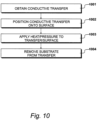
- Figure 10 illustrates the process of applying a conductive transfer to a surface of an article.
- a conductive transfer is obtained before being positioned in a suitable location on a surface to which the conductive transfer can be applied at step 1002.
- heat and pressure is applied by means of a heat press.
- Conventional heat presses typically comprise a rigid surface onto which the pressing is affected. This presents a problem in that damage can be caused to the electrical components on conventional machines.
- an air-filled pad is supplied underneath the press such that, when the electrical components impact the air-filled pad they are not damaged.
- the heat press is supplied with a stencil which aligns with the at least one electrical component such that, when the force from the heat press is applied, the electrical components do not receive the force while the rest of the conductive transfer does. This can also work to protect the electrical components from heat as necessary.
- the article now comprising the conductive transfer can be removed from the machine for applying heat and/pressure with the transfer now attached.
- the substrate onto which the non-conductive and conductive inks are printed can then be removed from the conductive transfer at step 1004 such that the article retains the conductive transfer and electrical components therein.
- the electrical components and conductive transfer may be suitably tested for functionality to ensure they are working effectively. This allows for fully functioning conductive transfers to be provided to third parties for their own application to articles as necessary. However, it is further appreciated that further testing may also take place after the application stages to ensure the functionality of the conductive transfer following application.
- the present invention allows for a transfer with increased functionality which can be applied to any suitable article having a surface and provides an electrically conductive circuit within the article with functions with an integral electrical component.
- the conductive transfer also retains the durability required to be able to withstand conventional cleaning or washing processes.
Landscapes
- Engineering & Computer Science (AREA)
- Microelectronics & Electronic Packaging (AREA)
- Manufacturing & Machinery (AREA)
- Textile Engineering (AREA)
- Physics & Mathematics (AREA)
- Fluid Mechanics (AREA)
- Manufacturing Of Printed Wiring (AREA)
- Production Of Multi-Layered Print Wiring Board (AREA)
- Electric Connection Of Electric Components To Printed Circuits (AREA)
- Structures For Mounting Electric Components On Printed Circuit Boards (AREA)
Applications Claiming Priority (2)
| Application Number | Priority Date | Filing Date | Title |
|---|---|---|---|
| GB1815292.6A GB2577286B (en) | 2018-09-19 | 2018-09-19 | Transfer including an electrical component |
| PCT/GB2019/000137 WO2020058660A1 (en) | 2018-09-19 | 2019-09-13 | Transfer including an electrical component |
Publications (2)
| Publication Number | Publication Date |
|---|---|
| EP3854185A1 EP3854185A1 (en) | 2021-07-28 |
| EP3854185B1 true EP3854185B1 (en) | 2025-02-12 |
Family
ID=68084859
Family Applications (1)
| Application Number | Title | Priority Date | Filing Date |
|---|---|---|---|
| EP19779537.0A Active EP3854185B1 (en) | 2018-09-19 | 2019-09-13 | Transfer including an electrical component |
Country Status (6)
| Country | Link |
|---|---|
| US (1) | US11406012B2 (https=) |
| EP (1) | EP3854185B1 (https=) |
| JP (1) | JP7382396B2 (https=) |
| CN (1) | CN113424664B (https=) |
| GB (1) | GB2577286B (https=) |
| WO (1) | WO2020058660A1 (https=) |
Families Citing this family (1)
| Publication number | Priority date | Publication date | Assignee | Title |
|---|---|---|---|---|
| GB2602800B (en) | 2021-01-13 | 2023-05-10 | Mygo4Ward Ltd | Improvements relating to functional electrical stimulation garments |
Citations (1)
| Publication number | Priority date | Publication date | Assignee | Title |
|---|---|---|---|---|
| US20180220534A1 (en) * | 2015-05-19 | 2018-08-02 | Tactotek Oy | Thermoformed plastic cover for electronics and related method of manufacture |
Family Cites Families (16)
| Publication number | Priority date | Publication date | Assignee | Title |
|---|---|---|---|---|
| JPH02223438A (ja) * | 1989-02-27 | 1990-09-05 | Yoshida Kogyo Kk <Ykk> | 表裏面加飾成形品及びその成形品の製造方法並びに加飾用シート |
| US7759167B2 (en) | 2005-11-23 | 2010-07-20 | Imec | Method for embedding dies |
| JP5600458B2 (ja) * | 2010-03-30 | 2014-10-01 | 株式会社トッパンTdkレーベル | 焼成用転写型フィルム及び焼成体を備えるガラス板の製造方法 |
| US8472207B2 (en) | 2011-01-14 | 2013-06-25 | Harris Corporation | Electronic device having liquid crystal polymer solder mask and outer sealing layers, and associated methods |
| US8948839B1 (en) * | 2013-08-06 | 2015-02-03 | L.I.F.E. Corporation S.A. | Compression garments having stretchable and conductive ink |
| JP6083233B2 (ja) * | 2012-12-19 | 2017-02-22 | Jnc株式会社 | インモールド成形用転写フィルム、インモールド成形体の製造方法および成形体 |
| KR102045113B1 (ko) | 2013-11-01 | 2019-11-14 | 피피지 인더스트리즈 오하이오 인코포레이티드 | 전기전도성 물질의 전달 방법 |
| US20150257278A1 (en) * | 2014-03-06 | 2015-09-10 | Tactotek Oy | Method for manufacturing electronic products, related arrangement and product |
| US9724869B2 (en) * | 2014-12-29 | 2017-08-08 | Tacto Tek Oy | Multilayer structure for accommodating electronics and related method of manufacture |
| CN108141957B (zh) * | 2015-10-16 | 2021-03-16 | 国立研究开发法人科学技术振兴机构 | 布线膜、器件转印片材以及纺织型器件 |
| US20170164461A1 (en) * | 2015-12-08 | 2017-06-08 | Intel Corporation | Conductive flexible and stretchable encapsulation method and apparatus |
| GB2550535B (en) * | 2015-12-31 | 2019-07-31 | Wearable Tech Limited | Constructing a jacket |
| JP6982959B2 (ja) | 2016-02-05 | 2021-12-17 | 日本メクトロン株式会社 | 伸縮基板モジュール、伸縮性配線基板及びそれらの製造方法 |
| JP6823472B2 (ja) | 2016-02-22 | 2021-02-03 | 日本メクトロン株式会社 | 伸縮性配線基板及びその製造方法 |
| GB2555592B (en) * | 2016-11-02 | 2019-02-27 | Conductive Transfers Ltd | Transfer for application to a surface |
| US10057989B1 (en) * | 2017-04-10 | 2018-08-21 | Tactotek Oy | Multilayer structure and related method of manufacture for electronics |
-
2018
- 2018-09-19 GB GB1815292.6A patent/GB2577286B/en active Active
-
2019
- 2019-09-13 WO PCT/GB2019/000137 patent/WO2020058660A1/en not_active Ceased
- 2019-09-13 JP JP2021515183A patent/JP7382396B2/ja active Active
- 2019-09-13 EP EP19779537.0A patent/EP3854185B1/en active Active
- 2019-09-13 US US17/277,959 patent/US11406012B2/en active Active
- 2019-09-13 CN CN201980072424.XA patent/CN113424664B/zh active Active
Patent Citations (1)
| Publication number | Priority date | Publication date | Assignee | Title |
|---|---|---|---|---|
| US20180220534A1 (en) * | 2015-05-19 | 2018-08-02 | Tactotek Oy | Thermoformed plastic cover for electronics and related method of manufacture |
Also Published As
| Publication number | Publication date |
|---|---|
| JP7382396B2 (ja) | 2023-11-16 |
| WO2020058660A1 (en) | 2020-03-26 |
| JP2022501819A (ja) | 2022-01-06 |
| US11406012B2 (en) | 2022-08-02 |
| US20210360784A1 (en) | 2021-11-18 |
| CN113424664B (zh) | 2024-09-06 |
| CN113424664A (zh) | 2021-09-21 |
| GB2577286B (en) | 2022-12-14 |
| GB2577286A (en) | 2020-03-25 |
| EP3854185A1 (en) | 2021-07-28 |
Similar Documents
| Publication | Publication Date | Title |
|---|---|---|
| Van Den Brand et al. | Flexible and stretchable electronics for wearable health devices | |
| CN110974249B (zh) | 一种表皮贴附式血氧饱和度检测系统及其制备 | |
| Bartlett et al. | Rapid fabrication of soft, multilayered electronics for wearable biomonitoring | |
| US5352315A (en) | Biomedical electrode | |
| US10582618B2 (en) | Fabrication of flexible electronic devices | |
| CN111839503B (zh) | 一种表皮贴附式心电加速度检测系统及其制备方法 | |
| US11375895B2 (en) | Three-dimensional integrated stretchable electronics | |
| CN113180618A (zh) | 一种表皮贴附式健康检测系统及其制备方法 | |
| CN205697728U (zh) | 柔性体温贴 | |
| US11729904B2 (en) | Method of producing untethered, stretchable, and wearable electronic devices | |
| Xie et al. | Heterogeneous integration of bio-sensing system-on-chip and printed electronics | |
| CN113171094B (zh) | 人体情绪状态信息柔性检测电路、制备方法和集成系统 | |
| WO2004061954A2 (en) | Electronic unit integrated into a flexible polymer body | |
| EP3854185B1 (en) | Transfer including an electrical component | |
| CN108175394A (zh) | 用于身体活动监测的粘贴片和身体活动无线监测系统 | |
| CN211155749U (zh) | 一种可实时监测人体生理信号的柔性器件 | |
| CN207560433U (zh) | 电磁波屏蔽膜及带电磁波屏蔽膜的印刷电路板 | |
| US20250314651A1 (en) | Permeable bioelectronic systems and methods for making the same | |
| CN205697729U (zh) | 柔性可穿戴装置 | |
| KR20250009357A (ko) | 플렉서블 발열 모니터링 시트 | |
| CN110697646A (zh) | 一种电子皮肤及其制备方法 | |
| JP2022501819A5 (https=) | ||
| CN103417212B (zh) | 生物探针组件 | |
| Deckert et al. | Polyimide foil flip-chip direct bonding | |
| CN208317095U (zh) | 一种应用型印刷电路板 |
Legal Events
| Date | Code | Title | Description |
|---|---|---|---|
| STAA | Information on the status of an ep patent application or granted ep patent |
Free format text: STATUS: UNKNOWN |
|
| STAA | Information on the status of an ep patent application or granted ep patent |
Free format text: STATUS: THE INTERNATIONAL PUBLICATION HAS BEEN MADE |
|
| PUAI | Public reference made under article 153(3) epc to a published international application that has entered the european phase |
Free format text: ORIGINAL CODE: 0009012 |
|
| STAA | Information on the status of an ep patent application or granted ep patent |
Free format text: STATUS: REQUEST FOR EXAMINATION WAS MADE |
|
| 17P | Request for examination filed |
Effective date: 20210326 |
|
| AK | Designated contracting states |
Kind code of ref document: A1 Designated state(s): AL AT BE BG CH CY CZ DE DK EE ES FI FR GB GR HR HU IE IS IT LI LT LU LV MC MK MT NL NO PL PT RO RS SE SI SK SM TR |
|
| DAV | Request for validation of the european patent (deleted) | ||
| DAX | Request for extension of the european patent (deleted) | ||
| GRAP | Despatch of communication of intention to grant a patent |
Free format text: ORIGINAL CODE: EPIDOSNIGR1 |
|
| STAA | Information on the status of an ep patent application or granted ep patent |
Free format text: STATUS: GRANT OF PATENT IS INTENDED |
|
| INTG | Intention to grant announced |
Effective date: 20240830 |
|
| GRAS | Grant fee paid |
Free format text: ORIGINAL CODE: EPIDOSNIGR3 |
|
| GRAA | (expected) grant |
Free format text: ORIGINAL CODE: 0009210 |
|
| STAA | Information on the status of an ep patent application or granted ep patent |
Free format text: STATUS: THE PATENT HAS BEEN GRANTED |
|
| RBV | Designated contracting states (corrected) |
Designated state(s): AL AT BE BG CH CY CZ DE DK EE ES FI FR GR HR HU IE IS IT LI LT LU LV MC MK MT NL NO PL PT RO RS SE SI SK SM TR |
|
| AK | Designated contracting states |
Kind code of ref document: B1 Designated state(s): AL AT BE BG CH CY CZ DE DK EE ES FI FR GR HR HU IE IS IT LI LT LU LV MC MK MT NL NO PL PT RO RS SE SI SK SM TR |
|
| REG | Reference to a national code |
Ref country code: CH Ref legal event code: EP |
|
| REG | Reference to a national code |
Ref country code: DE Ref legal event code: R096 Ref document number: 602019065818 Country of ref document: DE |
|
| REG | Reference to a national code |
Ref country code: IE Ref legal event code: FG4D |
|
| REG | Reference to a national code |
Ref country code: NL Ref legal event code: MP Effective date: 20250212 |
|
| PG25 | Lapsed in a contracting state [announced via postgrant information from national office to epo] |
Ref country code: RS Free format text: LAPSE BECAUSE OF FAILURE TO SUBMIT A TRANSLATION OF THE DESCRIPTION OR TO PAY THE FEE WITHIN THE PRESCRIBED TIME-LIMIT Effective date: 20250512 |
|
| PG25 | Lapsed in a contracting state [announced via postgrant information from national office to epo] |
Ref country code: FI Free format text: LAPSE BECAUSE OF FAILURE TO SUBMIT A TRANSLATION OF THE DESCRIPTION OR TO PAY THE FEE WITHIN THE PRESCRIBED TIME-LIMIT Effective date: 20250212 |
|
| PG25 | Lapsed in a contracting state [announced via postgrant information from national office to epo] |
Ref country code: PL Free format text: LAPSE BECAUSE OF FAILURE TO SUBMIT A TRANSLATION OF THE DESCRIPTION OR TO PAY THE FEE WITHIN THE PRESCRIBED TIME-LIMIT Effective date: 20250212 |
|
| PG25 | Lapsed in a contracting state [announced via postgrant information from national office to epo] |
Ref country code: ES Free format text: LAPSE BECAUSE OF FAILURE TO SUBMIT A TRANSLATION OF THE DESCRIPTION OR TO PAY THE FEE WITHIN THE PRESCRIBED TIME-LIMIT Effective date: 20250212 |
|
| REG | Reference to a national code |
Ref country code: LT Ref legal event code: MG9D |
|
| PG25 | Lapsed in a contracting state [announced via postgrant information from national office to epo] |
Ref country code: NO Free format text: LAPSE BECAUSE OF FAILURE TO SUBMIT A TRANSLATION OF THE DESCRIPTION OR TO PAY THE FEE WITHIN THE PRESCRIBED TIME-LIMIT Effective date: 20250512 Ref country code: IS Free format text: LAPSE BECAUSE OF FAILURE TO SUBMIT A TRANSLATION OF THE DESCRIPTION OR TO PAY THE FEE WITHIN THE PRESCRIBED TIME-LIMIT Effective date: 20250612 |
|
| PG25 | Lapsed in a contracting state [announced via postgrant information from national office to epo] |
Ref country code: NL Free format text: LAPSE BECAUSE OF FAILURE TO SUBMIT A TRANSLATION OF THE DESCRIPTION OR TO PAY THE FEE WITHIN THE PRESCRIBED TIME-LIMIT Effective date: 20250212 |
|
| PG25 | Lapsed in a contracting state [announced via postgrant information from national office to epo] |
Ref country code: HR Free format text: LAPSE BECAUSE OF FAILURE TO SUBMIT A TRANSLATION OF THE DESCRIPTION OR TO PAY THE FEE WITHIN THE PRESCRIBED TIME-LIMIT Effective date: 20250212 |
|
| PG25 | Lapsed in a contracting state [announced via postgrant information from national office to epo] |
Ref country code: PT Free format text: LAPSE BECAUSE OF FAILURE TO SUBMIT A TRANSLATION OF THE DESCRIPTION OR TO PAY THE FEE WITHIN THE PRESCRIBED TIME-LIMIT Effective date: 20250612 Ref country code: LV Free format text: LAPSE BECAUSE OF FAILURE TO SUBMIT A TRANSLATION OF THE DESCRIPTION OR TO PAY THE FEE WITHIN THE PRESCRIBED TIME-LIMIT Effective date: 20250212 |
|
| PG25 | Lapsed in a contracting state [announced via postgrant information from national office to epo] |
Ref country code: BG Free format text: LAPSE BECAUSE OF FAILURE TO SUBMIT A TRANSLATION OF THE DESCRIPTION OR TO PAY THE FEE WITHIN THE PRESCRIBED TIME-LIMIT Effective date: 20250212 Ref country code: GR Free format text: LAPSE BECAUSE OF FAILURE TO SUBMIT A TRANSLATION OF THE DESCRIPTION OR TO PAY THE FEE WITHIN THE PRESCRIBED TIME-LIMIT Effective date: 20250513 |
|
| REG | Reference to a national code |
Ref country code: AT Ref legal event code: MK05 Ref document number: 1767340 Country of ref document: AT Kind code of ref document: T Effective date: 20250212 |
|
| PG25 | Lapsed in a contracting state [announced via postgrant information from national office to epo] |
Ref country code: SE Free format text: LAPSE BECAUSE OF FAILURE TO SUBMIT A TRANSLATION OF THE DESCRIPTION OR TO PAY THE FEE WITHIN THE PRESCRIBED TIME-LIMIT Effective date: 20250212 |
|
| PG25 | Lapsed in a contracting state [announced via postgrant information from national office to epo] |
Ref country code: SM Free format text: LAPSE BECAUSE OF FAILURE TO SUBMIT A TRANSLATION OF THE DESCRIPTION OR TO PAY THE FEE WITHIN THE PRESCRIBED TIME-LIMIT Effective date: 20250212 |
|
| PG25 | Lapsed in a contracting state [announced via postgrant information from national office to epo] |
Ref country code: DK Free format text: LAPSE BECAUSE OF FAILURE TO SUBMIT A TRANSLATION OF THE DESCRIPTION OR TO PAY THE FEE WITHIN THE PRESCRIBED TIME-LIMIT Effective date: 20250212 |
|
| PGFP | Annual fee paid to national office [announced via postgrant information from national office to epo] |
Ref country code: DE Payment date: 20250924 Year of fee payment: 7 |
|
| PG25 | Lapsed in a contracting state [announced via postgrant information from national office to epo] |
Ref country code: AT Free format text: LAPSE BECAUSE OF FAILURE TO SUBMIT A TRANSLATION OF THE DESCRIPTION OR TO PAY THE FEE WITHIN THE PRESCRIBED TIME-LIMIT Effective date: 20250212 |
|
| PGFP | Annual fee paid to national office [announced via postgrant information from national office to epo] |
Ref country code: FR Payment date: 20250916 Year of fee payment: 7 |
|
| REG | Reference to a national code |
Ref country code: DE Ref legal event code: R081 Ref document number: 602019065818 Country of ref document: DE Owner name: CONDUCTIVE TRANSFERS INTERNATIONAL LTD., GB Free format text: FORMER OWNER: CONDUCTIVE TRANSFERS LIMITED, HOYLAND, BARNSLEY, GB |
|
| PG25 | Lapsed in a contracting state [announced via postgrant information from national office to epo] |
Ref country code: CZ Free format text: LAPSE BECAUSE OF FAILURE TO SUBMIT A TRANSLATION OF THE DESCRIPTION OR TO PAY THE FEE WITHIN THE PRESCRIBED TIME-LIMIT Effective date: 20250212 Ref country code: EE Free format text: LAPSE BECAUSE OF FAILURE TO SUBMIT A TRANSLATION OF THE DESCRIPTION OR TO PAY THE FEE WITHIN THE PRESCRIBED TIME-LIMIT Effective date: 20250212 |
|
| PG25 | Lapsed in a contracting state [announced via postgrant information from national office to epo] |
Ref country code: RO Free format text: LAPSE BECAUSE OF FAILURE TO SUBMIT A TRANSLATION OF THE DESCRIPTION OR TO PAY THE FEE WITHIN THE PRESCRIBED TIME-LIMIT Effective date: 20250212 |
|
| PG25 | Lapsed in a contracting state [announced via postgrant information from national office to epo] |
Ref country code: SK Free format text: LAPSE BECAUSE OF FAILURE TO SUBMIT A TRANSLATION OF THE DESCRIPTION OR TO PAY THE FEE WITHIN THE PRESCRIBED TIME-LIMIT Effective date: 20250212 |
|
| REG | Reference to a national code |
Ref country code: DE Ref legal event code: R097 Ref document number: 602019065818 Country of ref document: DE |
|
| PLBE | No opposition filed within time limit |
Free format text: ORIGINAL CODE: 0009261 |
|
| STAA | Information on the status of an ep patent application or granted ep patent |
Free format text: STATUS: NO OPPOSITION FILED WITHIN TIME LIMIT |
|
| PGFP | Annual fee paid to national office [announced via postgrant information from national office to epo] |
Ref country code: IT Payment date: 20250925 Year of fee payment: 7 |
|
| 26N | No opposition filed |
Effective date: 20251113 |