EP3852425B1 - Verfahren zur überwachung der verkehrsverarbeitung - Google Patents
Verfahren zur überwachung der verkehrsverarbeitung Download PDFInfo
- Publication number
- EP3852425B1 EP3852425B1 EP19859972.2A EP19859972A EP3852425B1 EP 3852425 B1 EP3852425 B1 EP 3852425B1 EP 19859972 A EP19859972 A EP 19859972A EP 3852425 B1 EP3852425 B1 EP 3852425B1
- Authority
- EP
- European Patent Office
- Prior art keywords
- traffic
- upf
- measurement
- processing state
- smf
- Prior art date
- Legal status (The legal status is an assumption and is not a legal conclusion. Google has not performed a legal analysis and makes no representation as to the accuracy of the status listed.)
- Active
Links
Images



Classifications
-
- H—ELECTRICITY
- H04—ELECTRIC COMMUNICATION TECHNIQUE
- H04W—WIRELESS COMMUNICATION NETWORKS
- H04W24/00—Supervisory, monitoring or testing arrangements
- H04W24/08—Testing, supervising or monitoring using real traffic
-
- H—ELECTRICITY
- H04—ELECTRIC COMMUNICATION TECHNIQUE
- H04W—WIRELESS COMMUNICATION NETWORKS
- H04W28/00—Network traffic management; Network resource management
- H04W28/02—Traffic management, e.g. flow control or congestion control
- H04W28/0268—Traffic management, e.g. flow control or congestion control using specific QoS parameters for wireless networks, e.g. QoS class identifier [QCI] or guaranteed bit rate [GBR]
-
- H—ELECTRICITY
- H04—ELECTRIC COMMUNICATION TECHNIQUE
- H04L—TRANSMISSION OF DIGITAL INFORMATION, e.g. TELEGRAPHIC COMMUNICATION
- H04L43/00—Arrangements for monitoring or testing data switching networks
- H04L43/04—Processing captured monitoring data, e.g. for logfile generation
-
- H—ELECTRICITY
- H04—ELECTRIC COMMUNICATION TECHNIQUE
- H04L—TRANSMISSION OF DIGITAL INFORMATION, e.g. TELEGRAPHIC COMMUNICATION
- H04L47/00—Traffic control in data switching networks
- H04L47/10—Flow control; Congestion control
- H04L47/20—Traffic policing
-
- H—ELECTRICITY
- H04—ELECTRIC COMMUNICATION TECHNIQUE
- H04L—TRANSMISSION OF DIGITAL INFORMATION, e.g. TELEGRAPHIC COMMUNICATION
- H04L47/00—Traffic control in data switching networks
- H04L47/10—Flow control; Congestion control
- H04L47/23—Bit dropping
-
- H—ELECTRICITY
- H04—ELECTRIC COMMUNICATION TECHNIQUE
- H04L—TRANSMISSION OF DIGITAL INFORMATION, e.g. TELEGRAPHIC COMMUNICATION
- H04L47/00—Traffic control in data switching networks
- H04L47/70—Admission control; Resource allocation
- H04L47/82—Miscellaneous aspects
- H04L47/822—Collecting or measuring resource availability data
-
- H—ELECTRICITY
- H04—ELECTRIC COMMUNICATION TECHNIQUE
- H04W—WIRELESS COMMUNICATION NETWORKS
- H04W24/00—Supervisory, monitoring or testing arrangements
- H04W24/10—Scheduling measurement reports ; Arrangements for measurement reports
Definitions
- the present disclosure relates to a method of monitoring traffic processing.
- the rapidly evolving 5G communication system not only accommodates as many user equipments as possible based on limited radio resources but also supports scenarios of enhanced mobile broadband (eMBB), massive machine type communications (mMTC), and ultra-reliable and low latency communications (URLLC).
- eMBB enhanced mobile broadband
- mMTC massive machine type communications
- URLLC ultra-reliable and low latency communications
- the network structure to support, from end to end, the user equipments, base stations (radio access networks), cores, and servers is defined, and a network structure that separates the Control Plane for the control signaling functions and the User Plane for the data transmission/reception functions is defined by separating the control signaling functions and data transmission/reception functions performed by a single node (e.g., S-GW, P-GW, etc.) in the existing LTE (4G) communication system.
- a single node e.g., S-GW, P-GW, etc.
- various nodes are included in the Control Plane.
- the Access and Mobility Management Function (AMF) that controls wireless access of the user equipment
- the Policy Control Function (PCF) that manages/controls policies such as user equipment information and subscription service information for each user equipment, billing, and the like
- the Session Management Function (SMF) that manages/controls a session for using data services for each user equipment
- the Network Exposure Function (NEF) that performs an information sharing function with an external network are included in the Control Plane.
- functions such as the User Plane Function (UPF) may be included in the User Plane.
- UPF User Plane Function
- Non-patent document "3rd Generation Partnership Project; Technical Specification Group Services and Sustem Aspects: Study on enhancement of Ultra-Reliable Low-Latency Communication support in the 5G Core network", 3GPP TR 23.725, retrieved on September 8, 2018, provides monitoring QoS activated dynamically by the 5GC for a certain UEs.
- Non-patent Literature Solution for QoS Monitoring for URLLC Services
- 3GPP DRAFT 3GPP DRAFT
- S2-187477 provides joint-monitoring of the packet delay in 5GC and 5G-AN.
- Non-patent Literature “New Solution for KI#4 QoS Monitoring", 3GPP DRAFT; S2-187842, provides a measurement on URLLC transmission by only calculating the one-way latency and/or round trip latency between UPF and UE.
- an Ultra-Reliable and Low Latency Communication (URLLC) service (hereinafter, referred to as a 'URLLC service') may be provided to a user equipment.
- a 'URLLC service' an Ultra-Reliable and Low Latency Communication (URLLC) service
- it may be checked whether traffic related to the URLLC service is properly processed by the UPF, and an appropriate remedial action may be taken according to the checked result. For example, if the SMF transmits an enforcement rule for the URLLC service to the UPF, it may be checked whether the UPF actually operates according to the enforcement rule, and the appropriate remedial action may be taken according to the checked result.
- the problem to be solved by the present disclosure is to provide a technology that, when the URLLC service is provided to the user equipment in the 5G communication system, monitors whether the traffic related to the URLLC service is being properly processed by the UPF and takes the remedial action according to the monitored result.
- Fig. 1 shows a diagram conceptually illustrating an architecture 10 of the 5G communication system according to an embodiment.
- the 5G communication system represented by the architecture 10 of Fig. 1 will be described.
- the 5G communication system is an advanced technology from the 4th generation LTE telecommunication technology.
- the 5G communication system is a new Radio Access Technology (RAT) and an expanded technology of Long Tern Evolution (LTE) through an evolution of an existing mobile communication network structure or a clean-state structure, and supports extended LTE (eLTE), non-3GPP access, and the like.
- RAT Radio Access Technology
- LTE Long Tern Evolution
- eLTE extended LTE
- non-3GPP access and the like.
- the architecture 10 includes various components (for example, network functions (NF)). Hereinafter, these components will be described.
- NF network functions
- an Authentication Server Function (AUSF), an (Core) Access and Mobility Management Function (AMF), a Session Management Function (SMF) 100, a Policy Control Function (PCF), an Application Function (AF), Unified Data Management (UDM), a User Plane Function (UPF) 200, an (Radio) Access Network ((R)AN) or a base station 300, a Data Network (DN) 400, and a User Equipment (UE) 500 are shown.
- AUSF Authentication Server Function
- AMF Access and Mobility Management Function
- SMF Session Management Function
- PCF Policy Control Function
- AF Application Function
- UDM Unified Data Management
- UPF User Plane Function
- R Radio Access Network
- DN Data Network
- UE User Equipment
- the UPF 200 may be a component included in a user plane in the 5G communication system, and may be referred to as a user plane function 200 or the UPF 200 in the detailed description. Hereinafter, it will be referred to as the UPF 200.
- the SMF 100 may be a component included in a control plane separated from the above-described user plane in the 5G communication system, and may be referred to as a session management function 100 or the SMF 100 in the detailed description. Hereinafter, it will be referred to as the SMF 100.
- the SMF 100 and the UPF 200 each performs not only publicly known functions required in the 5G communication system, but also functions intended to be provided in an embodiment. Accordingly, hereinafter, description of the publicly known technology itself performed by each of the SMF 100 and the UPF 200 will be briefly described or skipped, and the functions intended to be provided in an embodiment will be described in more detail.
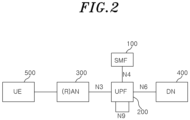
- Fig. 2 shows a diagram illustrating a part of the architecture 10 of the 5G communication system illustrated in Fig. 1 .
- the SMF 100, the UPF 200, the RAN 300 (but, hereinafter, referred to as the base station 300), the DN 400, and the UE 500 is shown.
- the UPF 200 is connected to the SMF 100 through an N4 interface.
- the UPF 200 is connected to the base station 300 through an N3 interface, is connected to the DN 400 through an N6 interface, and is connected to another UPF connected to the SMF 100 through an N9 interface.
- the UE 500 shown in Fig. 2 accesses the base station 300 and is provided with an Ultra-Reliable and Low Latency Communication (URLLC) service while using resources of the base station 300.
- URLLC Ultra-Reliable and Low Latency Communication
- Traffic related to the URLLC service (User Plane traffic) is processed by the UPF 200.
- the SMF 100 transmits a rule for traffic processing to the UPF 200
- the UPF 200 processes the traffic related to the URLLC service or various other traffic based on the transmitted rule.
- the UPF 200 may be measured whether the UPF 200 is processing the traffic related to the URLLC service according to the above-described rule. If the traffic related to the URLLC service is not being processed according to the rules, a problem may occur in the URLLC service, so determining a cause and a remedial action to resolve the cause may be taken.
- the SMF 100 transmits a measurement rule for a state of traffic processing to the UPF 200.
- the UPF 200 measures the state of traffic processing based on the received measurement rule, and transmits a result of the measurement to the SMF 100.
- the result of the measurement may specifically include information on which part of the UPF 200 has a problem. If the SMF 100 receives information on the state of the traffic processing from the UPF 200, and there is a problem in a specific part of the UPF 200, the SMF 100 considers a predetermined remedial action to resolve the problem of the specific part based on the received information and transmits the predetermined remedial action to the UPF 200. Then, the UPF 200 performs the predetermined remedial action received from the SMF 100.
- the information on the state of the traffic processing measured by the UPF 200 may also include information on a place at which the state of the traffic processing is measured.
- the following is an example of a candidate group for the place where the state of the traffic processing may be measured, but the candidate group is not limited thereto.
- Fig. 3 shows a diagram illustrating a procedure for a monitoring method of traffic processing performed by the SMF 100 according to an embodiment.
- Fig. 3 is just an example, the idea of the present disclosure is not limited to those shown in Fig. 3 .
- the SMF 100 transmits a measurement rule for state of traffic processing to UPF 200 in a step S100.
- Fig. 4 shows an example of the measurement rule.
- an identification (ID) for identifying the measurement rule in Fig. 4 , it is shown as an UP measurement request ID value
- an operation mode for identifying the measurement rule (in Fig. 4 , it is shown as an UP measurement request ID value)
- measurement criteria/description for identifying the measurement rule
- a measurement place in Fig. 4
- a measurement method in Fig. 4
- threshold values of latency and throughput may be included in the measurement rule.
- the operation mode indicates a condition for the UPF 200 to transmit the state of the traffic processing to the SMF 100.
- An 'Event' mode among the operation modes is a mode in which the UPF 200 transmits the state of the traffic processing to the SMF 100 if a predetermined event occurs.
- a 'Periodic' mode is a mode in which the UPF 200 transmits the state of the traffic processing to the SMF 100 every predetermined period.
- a 'Self' mode is a mode in which the UPF 200 transmits the state of the traffic processing to the SMF 100 when a predetermined condition in the UPF 200 is satisfied.
- the measurement criteria/description is information used to specify traffic that is a measurement target.
- traffic that satisfies the measurement criteria may be the measurement target.
- the measurement target may be specified in a traffic unit, a flow unit, or a session unit.
- the measurement criteria may specify all traffic regarding a specific customer (e.g., a wild card '*') and if all traffic regarding the specific customer is specified, specific traffic among all traffic may be specified step by step by using the measurement criteria to be mentioned below.
- the measurement criteria may include various types of items. For example, n-tuple or a field of packets such as source IP, destination IP, source port, destination port, and protocol may be included in the measurement criteria, but is not limited thereto.
- the measurement place is information designating a place where the state of the traffic processing is to be measured by the UPF 200.
- the candidate group for the measurement places were described above and the candidate group (including ports a, b, c, d, e, f, g, h, i, j, k, and 1) are shown in Fig. 5 .
- the UPF 200 may include at least one of a module that performs a function according to a packet detection rule (PDR), a module that performs a function according to a forwarding action rule (FAR), and a module that performs a function according to a QoS enforcement rule (QER), and a module that performs a function according to a usage reporting rule (URR).
- PDR packet detection rule
- FAR forwarding action rule
- QER QoS enforcement rule
- URR usage reporting rule
- the ports e, f, g, h, i, j, k, and l through which the traffic is input to or output from each of these modules may also be included in the candidate group of the measurement place.
- the measurement method is information indicating a method of obtaining time information indicating when the traffic processing has been performed. For example, if the measurement method is 'timestamp in packet', the measurement method is a method using a time recorded in a header of the packet, and if the measurement method is 'timestamp in system', the measurement method is a method using an atomic clock provided in the UPF 200 or the like.
- the measurement period means a time period for measuring the state of the traffic processing.
- the threshold values of the latency and the throughput may be included in the measurement rule.
- Fig. 6 shows a diagram illustrating the measurement result that the SMF 100 received from the UPF 200. Referring to Fig.
- the measurement result may include an operation mode indicating an occurred event, a measurement criteria indicating traffic measured as a target, a measurement place indicating a place in which the traffic was measured, a measurement method indicating a method in which time information when the measurement was performed was obtained, a measurement period indicating a time period during which the measurement has been performed, and a latency (and a secondary value) and a throughput (and a secondary value) indicating a measured value.
- the measurement result includes information on 'the latency and the throughput when measuring specific traffic for a predetermined period at a specific place.' This information indicates whether the UPF 200 is processing the traffic according to the measurement rule transmitted from the SMF 100. Further, if the UPF 200 is processing differently from the measurement rule, the information indicates a place where the processing is being performed and a state at that time.
- the SMF 100 considers a predetermined remedial action based on the measurement result received in the step S110 from the UPF 200, and transmits the considered remedial action to the UPF 200 in a step S120.
- the SMF 100 may recognize that the measurement result received from the UPF 200 includes information showing both "event” and "emergency.” In this case, the SMF 100 may consider a remedial action reducing resources of the UPF 200 allocated to a UE that is not provided with an URLLC service among UEs managed by the UPF 200.
- the 'reducing resources' may include, for example, at least one of dropping a packet related to the UE not provided with the URLLC service, adjusting a QoS related value of the UE not provided with the URLLC service, and adjusting a parameter related to reporting packet usage for the UE not provided with the URLLC service, but is not limited thereto.
- the SMF 100 may shorten a period of session report request received from the UPF 200, and accordingly, a request by a UE for generating a new session may be limited than before.
- the SMF 100 may determine, based on the measurement result, that the UPF 200 can no longer process the traffic according to the measurement rule. In this case, the SMF 100 may consider a remedial action on the UE that is provided with the URLLC service among the UEs managed by the UPF 200 to be managed by another UPF other than the UPF 200.
- the SMF 100 may consider a remedial action to resolve the problem, and may transmit the remedial action to the UPF 200 to make the UPF 200 to operate according to the remedial action. Accordingly, it may be monitored whether the URLLC service is smoothly provided to the UE 500 in the 5G communication system.
- Fig. 7 shows a flowchart illustrating a monitoring method of traffic processing performed by the UPF 200 according to an embodiment.
- Fig. 7 is just an example, the idea of the present disclosure is not limited to those illustrated in Fig. 7 .
- the UPF 200 receives a measurement rule from the SMF 100.
- the measurement rule received in the step S200 is identical to the measurement rule transmitted by the SMF 100 to the UPF 200 in the step S100 shown in Fig. 3 , and because the measurement rule has already been described in Fig. 4 , a description thereof will be skipped.
- the UPF 200 measures a processing state of traffic related to an URLLC service based on the measurement rule received from the SMF 100 in the step S200. For example, as shown in Fig. 4 , it may be assumed that the UPF 200 receives the measurement rule from the SMF 100. In this case, the UPF 200 measures a traffic state at a measurement place according to the measurement rule. When measuring, a measurement time is measured according to a method specified in a measurement method. If an operation mode is 'Event', when a predetermined event occurs, the UPF 200 transmits the measurement result to the SMF 100. When transmitting, latency and secondary values or throughput and secondary values measured at the measurement place are also transmitted.
- Time when the traffic is processed in a specific module may be measured.
- the measurement place may be designated as one of the UPF 200 or each module (a PDR, a FAR, a QER, and an URR) in the UPF 200.
- a time period from when the traffic is input to the port a to when the traffic is output from the port b is measured as the latency. This is the same when either the PDR, the FAR, the QER, or the URR is designated as the measurement place.
- Time when the traffic is processed in at least two modules may be measured.
- at least two modules may be designated as the measurement place.
- the PDR and the FAR are designated as the measurement place
- a time period from when the traffic is input to the port e and then output from the port f to when the traffic is input to the port g and then output from the port h is measured as the latency.
- Time when the traffic is transmitted between a module and another module may be measured.
- the measurement place may be separate UPFs 200A and 200B, and, for example, a time period from when the traffic is output from the port c to when the traffic is input to the port d is measured as the latency.
- Transmission time of the traffic on a specific interface may be measured.
- a time period from when the traffic is transmitted from the UPF 200A to the base station 300 through the port a to when the traffic is transmitted from the base station 300 to the UPF 200A through the port a again in other words, round trip time may be measured as the latency.
- the traffic is transmitted and received through the N3 interface. This is the same when the port b is designated as the measurement place, and in this case, the traffic is transmitted and received through the N6 interface.
- Examples 1 to 4 illustrate that the time period is measured based on one single traffic.
- a plurality of traffic, a flow including a plurality of traffic, or a session including a plurality of flows may be applied, as a unit, to the above-described Examples 1 to 4.
- the flow including a plurality of traffic is applied to the Example 1, a time period from when all traffic included in the flow is input to the port a to when all traffic is output from the port b is measured as the latency.
- a time period from when all traffic included in the flow is input to the port e and then output from the port f to when all traffic is input to the port g and then output from the port h is measured as the latency.
- whether a plurality of traffic is input to or output from each port may be identified based on (bidirectional) n-tuple or a field of each traffic.
- the UPF 200 transmits the measurement result of the processing state measured in the step S210 to the SMF 100.
- the measurement result is transmitted according to the operation mode in the measurement rule received from the SMF 100 in the step S200. In other words, if the operation mode is 'Event,' the measurement result is transmitted when a predetermined event occurs, and if the operation mode is 'Periodic,' the measurement result is transmitted periodically.
- the SMF 100 may consider a predetermined remedial action based on the measurement result.
- the UPF 200 receives and performs the remedial action.
- the step S230 may not be performed according to an embodiment. Since the remedial action performed in the step S230 has already been described, a description thereof will be skipped.
- the SMF 100 may consider the remedial action to resolve the problem, and may transmit the remedial action to the UPF 200 so that the UPF 200 operates according to the remedial action.
Landscapes
- Engineering & Computer Science (AREA)
- Computer Networks & Wireless Communication (AREA)
- Signal Processing (AREA)
- Data Mining & Analysis (AREA)
- Data Exchanges In Wide-Area Networks (AREA)
- Mobile Radio Communication Systems (AREA)
Claims (14)
- Verfahren zum Überwachen einer Datenverkehrsverarbeitung, die durch eine Sitzungsmanagementfunktion, SMF, (100) in einem 5G-Kommunikationssystem durchgeführt wird, wobei das Verfahren umfasst:Senden einer Messregel für einen Verarbeitungszustand von Datenverkehr an eine Benutzerebenenfunktion, UPF, (200); undEmpfangen von Informationen über den Verarbeitungszustand des Datenverkehrs von der UPF (200) in Reaktion auf die gesendete Messregel,wobei die Messregel einen Messort enthält, an dem der Verarbeitungszustand des Datenverkehrs gemessen wird, undwobei der Messort eine Gruppe von Ports enthält aus:
einem ersten Port der UPF (200), der für die Eingabe/Ausgabe des Datenverkehrs mit einem Funkzugangsnetz, RAN, (300) verwendet wird, einem zweiten Port der UPF (200), der für die Eingabe/Ausgabe des Datenverkehrs mit einem Datennetz, DN, (400) verwendet wird, einem dritten Port der UPF (200), der für die Eingabe/Ausgabe des Datenverkehrs mit einer anderen UPF (200), die mit der SMF (100) verbunden ist, verwendet wird, und einem vierten Port eines Moduls, das eine zuvor festgelegte Funktion ausführt, die in der UPF (200) bereitgestellt ist. - Verfahren nach Anspruch 1, wobei die Messregel des Weiteren mindestens eines von einer Bedingung für die UPF (200), den Verarbeitungszustand des Datenverkehrs an die SMF (100) zu senden, Informationen, die verwendet werden, um Datenverkehr, der ein Messziel ist, zu spezifizieren, einem Verfahren zum Erhalten einer Zeit, die sich auf den Verarbeitungszustand des Datenverkehrs bezieht, einem Zeitraum, während dem die Messung durchgeführt wird, und einem Typ eines Messergebnisses enthält.
- Verfahren nach Anspruch 1, wobei der Messort des Weiteren mindestens eines von einem Port des Moduls zum Durchführen einer Funktion gemäß einer Paketdetektionsregel, DPR, einem Port des Moduls zum Durchführen einer Funktion gemäß einer Weiterleitungsaktionsregel, FAR, einem Port des Moduls zum Durchführen einer Funktion gemäß einer QoS-Durchsetzungsregel, QER, und einem Port des Moduls zum Durchführen einer Funktion gemäß einer Nutzungsberichtsregel, URR, enthält.
- Verfahren nach Anspruch 1, wobei der Datenverkehr Datenverkehr enthält, der sich auf einen Ultra Reliable Low-Latency Communications-Dienst, URLLC, einer Benutzerausrüstung, UE, bezieht, die mit dem URLLC-Dienst ausgestattet ist.
- Verfahren nach Anspruch 1, wobei die Informationen über den Verarbeitungszustand des Datenverkehrs mindestens eines von Informationen, die angeben, ob die Informationen über den Verarbeitungszustand des Datenverkehrs periodisch oder in Reaktion auf ein zuvor festgelegtes Ereignis empfangen werden, Informationen über einen Messort, an dem der Verarbeitungszustand des Datenverkehrs gemessen wird, Informationen, die zum Spezifizieren des Datenverkehrs, der ein Messziel ist, verwendet werden, einem Verfahren zum Erhalten einer Zeit, die sich auf den Verarbeitungszustand des Datenverkehrs bezieht, einem Zeitraum, während dem die Messung durchgeführt wird, und Informationen über ein Messergebnis enthalten.
- Verfahren nach Anspruch 1, des Weiteren umfassend:Abrufen einer zuvor festgelegten Abhilfemaßnahme auf der Grundlage der empfangenen Informationen über den Verarbeitungszustand des Datenverkehrs; undSenden, an die UPF (200), der zuvor festgelegten Abhilfemaßnahme.
- Verfahren nach Anspruch 6, wobei die zuvor festgelegte Abhilfemaßnahme das Einstellen von Ressourcen der UPF (200), die einer UE, die nicht mit dem URLLC-Dienst ausgestattet ist, unter den durch die UPF (200) gemanagten UEs (500) zugeordnet sind, enthält.
- Verfahren nach Anspruch 7, wobei das Einstellen der Ressourcen mindestens eines von Abwerfen eines Paketes, das Datenverkehr der UE (500) enthält, die nicht mit dem URLLC-Dienst ausgestattet ist, das Einstellen eines QoS-bezogenen Wertes der UE (500), die nicht mit dem URLLC-Dienst ausgestattet ist, und das Einstellen eines Parameters, der sich auf das Berichten einer Paketnutzung für die UE (500) bezieht, die nicht mit dem URLLC-Dienst ausgestattet ist, enthält.
- Verfahren nach Anspruch 6, wobei die zuvor festgelegte Abhilfemaßnahme enthält, eine UE (500), die mit dem URLLC-Dienst ausgestattet ist, unter den durch die UPF (200) gemanagten UEs (500) so zu steuern, dass sie durch eine andere UPF als die UPF, die mit der SMF (100) verbunden ist, gemanagt wird.
- Verfahren zum Überwachen einer Datenverkehrsverarbeitung, die durch eine Benutzerebenenfunktion (UPF) (200) in einem 5G-Kommunikationssystem durchgeführt wird, wobei das Verfahren umfasst:Empfangen einer Messregel für einen Verarbeitungszustand von Datenverkehr von einer Sitzungsmanagementfunktion (SMF) (100);Messen des Verarbeitungszustands des Datenverkehrs auf der Grundlage der gesendeten Messregel; undSenden eines Messergebnisses des Verarbeitungszustands des Datenverkehrs an die SMF (100),wobei die Messregel einen Messort enthält, an dem der Verarbeitungszustand des Datenverkehrs gemessen wird, undwobei der Messort eine Gruppe von Ports enthält, aus:
einem ersten Port der UPF (200), der für die Eingabe/Ausgabe des Datenverkehrs mit einem Funkzugangsnetz, RAN, (300) verwendet wird, einem zweiten Port der UPF (200), der für die Eingabe/Ausgabe des Datenverkehrs mit einem Datennetz (DN) (400) verwendet wird, einem dritten Port der UPF (200), der für die Eingabe/Ausgabe des Datenverkehrs mit einer anderen UPF (200), die mit der SMF (100) verbunden ist, verwendet wird, und einem vierten Port eines Moduls, das eine zuvor festgelegte Funktion ausführt, die in der UPF (200) bereitgestellt ist. - Verfahren nach Anspruch 10, wobei die empfangene Messregel des Weiteren mindestens eines von einer Bedingung für die UPF (200), den Verarbeitungszustand des Datenverkehrs an die SMF (100) zu senden, einem Messort, an dem der Verarbeitungszustand des Datenverkehrs gemessen wird, Informationen, die verwendet werden, um Datenverkehr, der ein Messziel ist, zu spezifizieren, einem Verfahren zum Erhalten einer Zeit, die sich auf den Verarbeitungszustand des Datenverkehrs bezieht, einem Zeitraum, während dem die Messung durchgeführt wird, und einem Typ eines Messergebnisses enthält.
- Verfahren nach Anspruch 10, wobei die Informationen über den Verarbeitungszustand des Datenverkehrs mindestens eines von Informationen, die angeben, ob die Informationen über den Verarbeitungszustand des Datenverkehrs periodisch oder in Reaktion auf ein zuvor festgelegtes Ereignis an die SMF gesendet werden, Informationen, die zum Spezifizieren des Datenverkehrs, der ein Messziel ist, verwendet werden, einem Verfahren zum Erhalten einer Zeit, die sich auf den Verarbeitungszustand des Datenverkehrs bezieht, einem Zeitraum, während dem die Messung durchgeführt wird, und Informationen über ein Messergebnis enthalten.
- Verfahren nach Anspruch 10, des Weiteren umfassend:
Empfangen, von der UPF (200), einer zuvor festgelegten Abhilfemaßnahme, die auf der Grundlage von gemessenen Informationen über den Verarbeitungszustand des Datenverkehrs abgerufen wird. - Verfahren nach Anspruch 13, wobei die zuvor festgelegte Abhilfemaßnahme das Einstellen von Ressourcen der UPF (200), die einer UE, die nicht mit dem URLLC-Dienst ausgestattet ist, unter den durch die UPF (200) gemanagten UEs zugeordnet sind, enthält.
Applications Claiming Priority (2)
| Application Number | Priority Date | Filing Date | Title |
|---|---|---|---|
| KR1020180108833A KR102366709B1 (ko) | 2018-09-12 | 2018-09-12 | 트래픽 처리 모니터링 방법 |
| PCT/KR2019/011850 WO2020055176A1 (ko) | 2018-09-12 | 2019-09-11 | 트래픽 처리 모니터링 방법 |
Publications (3)
| Publication Number | Publication Date |
|---|---|
| EP3852425A1 EP3852425A1 (de) | 2021-07-21 |
| EP3852425A4 EP3852425A4 (de) | 2022-06-22 |
| EP3852425B1 true EP3852425B1 (de) | 2025-05-21 |
Family
ID=69777682
Family Applications (1)
| Application Number | Title | Priority Date | Filing Date |
|---|---|---|---|
| EP19859972.2A Active EP3852425B1 (de) | 2018-09-12 | 2019-09-11 | Verfahren zur überwachung der verkehrsverarbeitung |
Country Status (6)
| Country | Link |
|---|---|
| US (1) | US12075278B2 (de) |
| EP (1) | EP3852425B1 (de) |
| KR (1) | KR102366709B1 (de) |
| CN (1) | CN112690016B (de) |
| ES (1) | ES3038154T3 (de) |
| WO (1) | WO2020055176A1 (de) |
Families Citing this family (2)
| Publication number | Priority date | Publication date | Assignee | Title |
|---|---|---|---|---|
| KR20220025568A (ko) * | 2020-08-24 | 2022-03-03 | 에스케이텔레콤 주식회사 | 네트워크장치 및 그 장치에서 수행되는 단말 위치정보 전달 방법 |
| WO2022196837A1 (ko) | 2021-03-15 | 2022-09-22 | 삼성전자 주식회사 | Pfd 관리 절차에서 양방향 필터를 프로비저닝하는 방법 및 장치 |
Family Cites Families (10)
| Publication number | Priority date | Publication date | Assignee | Title |
|---|---|---|---|---|
| US7894355B2 (en) * | 2002-10-25 | 2011-02-22 | General Instrument Corporation | Method for enabling non-predetermined testing of network using IP measurement protocol packets |
| KR101398630B1 (ko) * | 2008-01-22 | 2014-05-22 | 삼성전자주식회사 | IP converged 시스템 및 상기 시스템에서의 호처리 방법 |
| US11444850B2 (en) * | 2016-05-02 | 2022-09-13 | Huawei Technologies Co., Ltd. | Method and apparatus for communication network quality of service capability exposure |
| WO2018008944A1 (ko) | 2016-07-04 | 2018-01-11 | 엘지전자(주) | 무선 통신 시스템에서 등록 관리 방법 및 이를 위한 장치 |
| CN108093360B (zh) * | 2016-11-20 | 2019-12-24 | 上海朗帛通信技术有限公司 | 一种ue、基站和服务中心中的方法和设备 |
| US11523319B2 (en) | 2017-01-09 | 2022-12-06 | Lg Electronics Inc. | Method for managing PDU session in wireless communication system and device for same |
| US10542454B2 (en) * | 2017-02-10 | 2020-01-21 | Mediatek Inc. | Control and management of reflective QoS |
| US10986516B2 (en) * | 2017-03-10 | 2021-04-20 | Huawei Technologies Co., Ltd. | System and method of network policy optimization |
| WO2018213987A1 (zh) * | 2017-05-22 | 2018-11-29 | 华为技术有限公司 | 一种分发数据的方法、装置和系统 |
| US10849142B2 (en) * | 2018-03-19 | 2020-11-24 | Qualcomm Incorporated | Time-sensitive networking frame pre-emption across cellular interface |
-
2018
- 2018-09-12 KR KR1020180108833A patent/KR102366709B1/ko active Active
-
2019
- 2019-09-11 EP EP19859972.2A patent/EP3852425B1/de active Active
- 2019-09-11 ES ES19859972T patent/ES3038154T3/es active Active
- 2019-09-11 WO PCT/KR2019/011850 patent/WO2020055176A1/ko not_active Ceased
- 2019-09-11 CN CN201980059439.2A patent/CN112690016B/zh active Active
- 2019-09-11 US US17/269,052 patent/US12075278B2/en active Active
Also Published As
| Publication number | Publication date |
|---|---|
| US12075278B2 (en) | 2024-08-27 |
| KR20200030242A (ko) | 2020-03-20 |
| CN112690016B (zh) | 2024-06-21 |
| US20210282048A1 (en) | 2021-09-09 |
| KR102366709B1 (ko) | 2022-02-23 |
| CN112690016A (zh) | 2021-04-20 |
| WO2020055176A1 (ko) | 2020-03-19 |
| EP3852425A1 (de) | 2021-07-21 |
| ES3038154T3 (en) | 2025-10-09 |
| EP3852425A4 (de) | 2022-06-22 |
Similar Documents
| Publication | Publication Date | Title |
|---|---|---|
| US11877227B2 (en) | User access control method and apparatus | |
| US11838802B2 (en) | Slice information processing method and apparatus | |
| AU2020206808A1 (en) | Communication method and communication apparatus | |
| CN111225013A (zh) | 一种传输策略确定方法、策略控制方法及装置 | |
| CN116325899B (zh) | 业务数据流的传输方法、通信装置及通信系统 | |
| CN113923682B (zh) | 通信方法、装置及系统 | |
| JP2014511090A (ja) | インテリジェントな輻輳存在通知サービス | |
| US20230370344A1 (en) | Data processing node device and information transmission method performed in same device | |
| US11575601B2 (en) | Network device and packet processing method using same | |
| WO2024027422A1 (zh) | 通信方法和通信装置 | |
| US12075278B2 (en) | Traffic processing monitoring method | |
| CN112789887A (zh) | 切换管理方法 | |
| US20250039092A1 (en) | Flow-Specific Congestion Handling | |
| US12166846B2 (en) | Control plane network function device, user plane network function device, and packet processing method using same | |
| WO2021018420A1 (en) | Packet detection | |
| US20260019346A1 (en) | Methods and apparatus for qos monitoring | |
| KR102450152B1 (ko) | 트래픽 사이즈 산출 방법 | |
| WO2023117153A1 (en) | Service-based traffic classification service | |
| KR102333106B1 (ko) | Pdu 세션 수립 방법 및 상기 방법을 수행하는 사용자 단말 | |
| CN119586175A (zh) | 确定由无线通信系统处理的用户设备的重新划分的方法 | |
| WO2023155475A1 (zh) | 网络测量的方法和装置 | |
| US20150257034A1 (en) | Method and Apparatus for Combined Sequence Numbers for Drop Precedence Support |
Legal Events
| Date | Code | Title | Description |
|---|---|---|---|
| STAA | Information on the status of an ep patent application or granted ep patent |
Free format text: STATUS: THE INTERNATIONAL PUBLICATION HAS BEEN MADE |
|
| PUAI | Public reference made under article 153(3) epc to a published international application that has entered the european phase |
Free format text: ORIGINAL CODE: 0009012 |
|
| STAA | Information on the status of an ep patent application or granted ep patent |
Free format text: STATUS: REQUEST FOR EXAMINATION WAS MADE |
|
| 17P | Request for examination filed |
Effective date: 20210412 |
|
| AK | Designated contracting states |
Kind code of ref document: A1 Designated state(s): AL AT BE BG CH CY CZ DE DK EE ES FI FR GB GR HR HU IE IS IT LI LT LU LV MC MK MT NL NO PL PT RO RS SE SI SK SM TR |
|
| DAV | Request for validation of the european patent (deleted) | ||
| DAX | Request for extension of the european patent (deleted) | ||
| A4 | Supplementary search report drawn up and despatched |
Effective date: 20220520 |
|
| RIC1 | Information provided on ipc code assigned before grant |
Ipc: H04W 24/10 20090101ALI20220516BHEP Ipc: H04W 24/08 20090101AFI20220516BHEP |
|
| STAA | Information on the status of an ep patent application or granted ep patent |
Free format text: STATUS: EXAMINATION IS IN PROGRESS |
|
| 17Q | First examination report despatched |
Effective date: 20241008 |
|
| GRAP | Despatch of communication of intention to grant a patent |
Free format text: ORIGINAL CODE: EPIDOSNIGR1 |
|
| STAA | Information on the status of an ep patent application or granted ep patent |
Free format text: STATUS: GRANT OF PATENT IS INTENDED |
|
| INTG | Intention to grant announced |
Effective date: 20241218 |
|
| GRAS | Grant fee paid |
Free format text: ORIGINAL CODE: EPIDOSNIGR3 |
|
| GRAA | (expected) grant |
Free format text: ORIGINAL CODE: 0009210 |
|
| STAA | Information on the status of an ep patent application or granted ep patent |
Free format text: STATUS: THE PATENT HAS BEEN GRANTED |
|
| P01 | Opt-out of the competence of the unified patent court (upc) registered |
Free format text: CASE NUMBER: APP_15761/2025 Effective date: 20250401 |
|
| AK | Designated contracting states |
Kind code of ref document: B1 Designated state(s): AL AT BE BG CH CY CZ DE DK EE ES FI FR GB GR HR HU IE IS IT LI LT LU LV MC MK MT NL NO PL PT RO RS SE SI SK SM TR |
|
| REG | Reference to a national code |
Ref country code: GB Ref legal event code: FG4D |
|
| REG | Reference to a national code |
Ref country code: CH Ref legal event code: EP |
|
| REG | Reference to a national code |
Ref country code: DE Ref legal event code: R096 Ref document number: 602019070343 Country of ref document: DE |
|
| REG | Reference to a national code |
Ref country code: IE Ref legal event code: FG4D |
|
| REG | Reference to a national code |
Ref country code: NL Ref legal event code: MP Effective date: 20250521 |
|
| PG25 | Lapsed in a contracting state [announced via postgrant information from national office to epo] |
Ref country code: FI Free format text: LAPSE BECAUSE OF FAILURE TO SUBMIT A TRANSLATION OF THE DESCRIPTION OR TO PAY THE FEE WITHIN THE PRESCRIBED TIME-LIMIT Effective date: 20250521 Ref country code: PT Free format text: LAPSE BECAUSE OF FAILURE TO SUBMIT A TRANSLATION OF THE DESCRIPTION OR TO PAY THE FEE WITHIN THE PRESCRIBED TIME-LIMIT Effective date: 20250922 |
|
| REG | Reference to a national code |
Ref country code: ES Ref legal event code: FG2A Ref document number: 3038154 Country of ref document: ES Kind code of ref document: T3 Effective date: 20251009 |
|
| PGFP | Annual fee paid to national office [announced via postgrant information from national office to epo] |
Ref country code: DE Payment date: 20250702 Year of fee payment: 7 |
|
| REG | Reference to a national code |
Ref country code: LT Ref legal event code: MG9D |
|
| PG25 | Lapsed in a contracting state [announced via postgrant information from national office to epo] |
Ref country code: NO Free format text: LAPSE BECAUSE OF FAILURE TO SUBMIT A TRANSLATION OF THE DESCRIPTION OR TO PAY THE FEE WITHIN THE PRESCRIBED TIME-LIMIT Effective date: 20250821 Ref country code: GR Free format text: LAPSE BECAUSE OF FAILURE TO SUBMIT A TRANSLATION OF THE DESCRIPTION OR TO PAY THE FEE WITHIN THE PRESCRIBED TIME-LIMIT Effective date: 20250822 |
|
| PG25 | Lapsed in a contracting state [announced via postgrant information from national office to epo] |
Ref country code: PL Free format text: LAPSE BECAUSE OF FAILURE TO SUBMIT A TRANSLATION OF THE DESCRIPTION OR TO PAY THE FEE WITHIN THE PRESCRIBED TIME-LIMIT Effective date: 20250521 Ref country code: NL Free format text: LAPSE BECAUSE OF FAILURE TO SUBMIT A TRANSLATION OF THE DESCRIPTION OR TO PAY THE FEE WITHIN THE PRESCRIBED TIME-LIMIT Effective date: 20250521 |
|
| PGFP | Annual fee paid to national office [announced via postgrant information from national office to epo] |
Ref country code: IT Payment date: 20250825 Year of fee payment: 7 |
|
| PG25 | Lapsed in a contracting state [announced via postgrant information from national office to epo] |
Ref country code: BG Free format text: LAPSE BECAUSE OF FAILURE TO SUBMIT A TRANSLATION OF THE DESCRIPTION OR TO PAY THE FEE WITHIN THE PRESCRIBED TIME-LIMIT Effective date: 20250521 |
|
| PGFP | Annual fee paid to national office [announced via postgrant information from national office to epo] |
Ref country code: GB Payment date: 20250703 Year of fee payment: 7 |
|
| PG25 | Lapsed in a contracting state [announced via postgrant information from national office to epo] |
Ref country code: HR Free format text: LAPSE BECAUSE OF FAILURE TO SUBMIT A TRANSLATION OF THE DESCRIPTION OR TO PAY THE FEE WITHIN THE PRESCRIBED TIME-LIMIT Effective date: 20250521 |
|
| PGFP | Annual fee paid to national office [announced via postgrant information from national office to epo] |
Ref country code: FR Payment date: 20250703 Year of fee payment: 7 |
|
| PG25 | Lapsed in a contracting state [announced via postgrant information from national office to epo] |
Ref country code: RS Free format text: LAPSE BECAUSE OF FAILURE TO SUBMIT A TRANSLATION OF THE DESCRIPTION OR TO PAY THE FEE WITHIN THE PRESCRIBED TIME-LIMIT Effective date: 20250821 |
|
| PG25 | Lapsed in a contracting state [announced via postgrant information from national office to epo] |
Ref country code: IS Free format text: LAPSE BECAUSE OF FAILURE TO SUBMIT A TRANSLATION OF THE DESCRIPTION OR TO PAY THE FEE WITHIN THE PRESCRIBED TIME-LIMIT Effective date: 20250921 |
|
| PG25 | Lapsed in a contracting state [announced via postgrant information from national office to epo] |
Ref country code: LV Free format text: LAPSE BECAUSE OF FAILURE TO SUBMIT A TRANSLATION OF THE DESCRIPTION OR TO PAY THE FEE WITHIN THE PRESCRIBED TIME-LIMIT Effective date: 20250521 |
|
| REG | Reference to a national code |
Ref country code: AT Ref legal event code: MK05 Ref document number: 1797933 Country of ref document: AT Kind code of ref document: T Effective date: 20250521 |
|
| PG25 | Lapsed in a contracting state [announced via postgrant information from national office to epo] |
Ref country code: AT Free format text: LAPSE BECAUSE OF FAILURE TO SUBMIT A TRANSLATION OF THE DESCRIPTION OR TO PAY THE FEE WITHIN THE PRESCRIBED TIME-LIMIT Effective date: 20250521 Ref country code: DK Free format text: LAPSE BECAUSE OF FAILURE TO SUBMIT A TRANSLATION OF THE DESCRIPTION OR TO PAY THE FEE WITHIN THE PRESCRIBED TIME-LIMIT Effective date: 20250521 Ref country code: SM Free format text: LAPSE BECAUSE OF FAILURE TO SUBMIT A TRANSLATION OF THE DESCRIPTION OR TO PAY THE FEE WITHIN THE PRESCRIBED TIME-LIMIT Effective date: 20250521 |
|
| PG25 | Lapsed in a contracting state [announced via postgrant information from national office to epo] |
Ref country code: CZ Free format text: LAPSE BECAUSE OF FAILURE TO SUBMIT A TRANSLATION OF THE DESCRIPTION OR TO PAY THE FEE WITHIN THE PRESCRIBED TIME-LIMIT Effective date: 20250521 |
|
| PG25 | Lapsed in a contracting state [announced via postgrant information from national office to epo] |
Ref country code: EE Free format text: LAPSE BECAUSE OF FAILURE TO SUBMIT A TRANSLATION OF THE DESCRIPTION OR TO PAY THE FEE WITHIN THE PRESCRIBED TIME-LIMIT Effective date: 20250521 |
|
| PG25 | Lapsed in a contracting state [announced via postgrant information from national office to epo] |
Ref country code: RO Free format text: LAPSE BECAUSE OF FAILURE TO SUBMIT A TRANSLATION OF THE DESCRIPTION OR TO PAY THE FEE WITHIN THE PRESCRIBED TIME-LIMIT Effective date: 20250521 Ref country code: SK Free format text: LAPSE BECAUSE OF FAILURE TO SUBMIT A TRANSLATION OF THE DESCRIPTION OR TO PAY THE FEE WITHIN THE PRESCRIBED TIME-LIMIT Effective date: 20250521 |
|
| PGFP | Annual fee paid to national office [announced via postgrant information from national office to epo] |
Ref country code: ES Payment date: 20251015 Year of fee payment: 7 |
|
| REG | Reference to a national code |
Ref country code: DE Ref legal event code: R097 Ref document number: 602019070343 Country of ref document: DE |
|
| PLBE | No opposition filed within time limit |
Free format text: ORIGINAL CODE: 0009261 |
|
| STAA | Information on the status of an ep patent application or granted ep patent |
Free format text: STATUS: NO OPPOSITION FILED WITHIN TIME LIMIT |
|
| REG | Reference to a national code |
Ref country code: CH Ref legal event code: L10 Free format text: ST27 STATUS EVENT CODE: U-0-0-L10-L00 (AS PROVIDED BY THE NATIONAL OFFICE) Effective date: 20260402 |
|
| REG | Reference to a national code |
Ref country code: CH Ref legal event code: H13 Free format text: ST27 STATUS EVENT CODE: U-0-0-H10-H13 (AS PROVIDED BY THE NATIONAL OFFICE) Effective date: 20260425 |
|
| 26N | No opposition filed |
Effective date: 20260224 |
|
| PG25 | Lapsed in a contracting state [announced via postgrant information from national office to epo] |
Ref country code: LU Free format text: LAPSE BECAUSE OF NON-PAYMENT OF DUE FEES Effective date: 20250911 |
|
| REG | Reference to a national code |
Ref country code: BE Ref legal event code: MM Effective date: 20250930 |
|
| PG25 | Lapsed in a contracting state [announced via postgrant information from national office to epo] |
Ref country code: LT Free format text: LAPSE BECAUSE OF FAILURE TO SUBMIT A TRANSLATION OF THE DESCRIPTION OR TO PAY THE FEE WITHIN THE PRESCRIBED TIME-LIMIT Effective date: 20250521 |
|
| PG25 | Lapsed in a contracting state [announced via postgrant information from national office to epo] |
Ref country code: MC Free format text: LAPSE BECAUSE OF FAILURE TO SUBMIT A TRANSLATION OF THE DESCRIPTION OR TO PAY THE FEE WITHIN THE PRESCRIBED TIME-LIMIT Effective date: 20250521 |
|
| PG25 | Lapsed in a contracting state [announced via postgrant information from national office to epo] |
Ref country code: BE Free format text: LAPSE BECAUSE OF NON-PAYMENT OF DUE FEES Effective date: 20250930 Ref country code: IE Free format text: LAPSE BECAUSE OF NON-PAYMENT OF DUE FEES Effective date: 20250911 Ref country code: CH Free format text: LAPSE BECAUSE OF NON-PAYMENT OF DUE FEES Effective date: 20250930 |
|
| PG25 | Lapsed in a contracting state [announced via postgrant information from national office to epo] |
Ref country code: SE Free format text: LAPSE BECAUSE OF FAILURE TO SUBMIT A TRANSLATION OF THE DESCRIPTION OR TO PAY THE FEE WITHIN THE PRESCRIBED TIME-LIMIT Effective date: 20250521 |