EP3852016B1 - Bit width selection for fixed point neural networks - Google Patents
Bit width selection for fixed point neural networks Download PDFInfo
- Publication number
- EP3852016B1 EP3852016B1 EP21161624.8A EP21161624A EP3852016B1 EP 3852016 B1 EP3852016 B1 EP 3852016B1 EP 21161624 A EP21161624 A EP 21161624A EP 3852016 B1 EP3852016 B1 EP 3852016B1
- Authority
- EP
- European Patent Office
- Prior art keywords
- layer
- bit widths
- bit width
- model
- multiple layers
- Prior art date
- Legal status (The legal status is an assumption and is not a legal conclusion. Google has not performed a legal analysis and makes no representation as to the accuracy of the status listed.)
- Active
Links
Images


Classifications
-
- G—PHYSICS
- G06—COMPUTING OR CALCULATING; COUNTING
- G06N—COMPUTING ARRANGEMENTS BASED ON SPECIFIC COMPUTATIONAL MODELS
- G06N3/00—Computing arrangements based on biological models
- G06N3/02—Neural networks
- G06N3/08—Learning methods
-
- G—PHYSICS
- G06—COMPUTING OR CALCULATING; COUNTING
- G06F—ELECTRIC DIGITAL DATA PROCESSING
- G06F17/00—Digital computing or data processing equipment or methods, specially adapted for specific functions
- G06F17/10—Complex mathematical operations
- G06F17/11—Complex mathematical operations for solving equations, e.g. nonlinear equations, general mathematical optimization problems
-
- G—PHYSICS
- G06—COMPUTING OR CALCULATING; COUNTING
- G06N—COMPUTING ARRANGEMENTS BASED ON SPECIFIC COMPUTATIONAL MODELS
- G06N3/00—Computing arrangements based on biological models
- G06N3/02—Neural networks
- G06N3/04—Architecture, e.g. interconnection topology
- G06N3/0464—Convolutional networks [CNN, ConvNet]
-
- G—PHYSICS
- G06—COMPUTING OR CALCULATING; COUNTING
- G06N—COMPUTING ARRANGEMENTS BASED ON SPECIFIC COMPUTATIONAL MODELS
- G06N3/00—Computing arrangements based on biological models
- G06N3/02—Neural networks
- G06N3/04—Architecture, e.g. interconnection topology
- G06N3/0495—Quantised networks; Sparse networks; Compressed networks
-
- G—PHYSICS
- G06—COMPUTING OR CALCULATING; COUNTING
- G06N—COMPUTING ARRANGEMENTS BASED ON SPECIFIC COMPUTATIONAL MODELS
- G06N3/00—Computing arrangements based on biological models
- G06N3/02—Neural networks
- G06N3/06—Physical realisation, i.e. hardware implementation of neural networks, neurons or parts of neurons
- G06N3/063—Physical realisation, i.e. hardware implementation of neural networks, neurons or parts of neurons using electronic means
-
- G—PHYSICS
- G06—COMPUTING OR CALCULATING; COUNTING
- G06N—COMPUTING ARRANGEMENTS BASED ON SPECIFIC COMPUTATIONAL MODELS
- G06N3/00—Computing arrangements based on biological models
- G06N3/02—Neural networks
- G06N3/08—Learning methods
- G06N3/09—Supervised learning
-
- G—PHYSICS
- G06—COMPUTING OR CALCULATING; COUNTING
- G06N—COMPUTING ARRANGEMENTS BASED ON SPECIFIC COMPUTATIONAL MODELS
- G06N3/00—Computing arrangements based on biological models
- G06N3/02—Neural networks
- G06N3/08—Learning methods
- G06N3/096—Transfer learning
-
- G—PHYSICS
- G06—COMPUTING OR CALCULATING; COUNTING
- G06N—COMPUTING ARRANGEMENTS BASED ON SPECIFIC COMPUTATIONAL MODELS
- G06N3/00—Computing arrangements based on biological models
- G06N3/02—Neural networks
- G06N3/10—Interfaces, programming languages or software development kits, e.g. for simulating neural networks
Definitions
- Certain aspects of the present disclosure generally relate to machine learning and, more particularly, to improving systems and methods of bit width selection for fixed point machine learning models, such as an artificial neural network.
- An artificial neural network which may comprise an interconnected group of artificial neurons (e.g., neuron models), is a computational device or represents a method to be performed by a computational device.
- Convolutional neural networks are a type of feed-forward artificial neural network.
- Convolutional neural networks may include collections of neurons that each has a receptive field and that collectively tile an input space.
- Convolutional neural networks have numerous applications. In particular, CNNs have broadly been used in the area of pattern recognition and classification.
- Deep learning architectures such as deep belief networks and deep convolutional networks
- Deep neural networks are layered neural networks architectures in which the output of a first layer of neurons becomes an input to a second layer of neurons, the output of a second layer of neurons becomes and input to a third layer of neurons, and so on.
- Deep neural networks may be trained to recognize a hierarchy of features and so they have increasingly been used in object recognition applications.
- computation in these deep learning architectures may be distributed over a population of processing nodes, which may be configured in one or more computational chains.
- These multi-layered architectures may be trained one layer at a time and may involve fine-tuning using back propagation.
- AHMED GHAZI BLAIECH ET AL "Multiwidth fixed-point coding based on reprogrammable hardware implementation of a multi-layer perceptron neural network for alertness classification", INTELLIGENT SYSTEMS DESIGN AND APPLICATIONS (ISDA), 2010 10TH INTERNATIONAL CONFERENCE ON, IEEE, PISCATAWAY, NJ, USA, 29 November 2010, pages 610-614 , pertains to a computer-implemented method for selecting bit widths for a fixed point implementation of a machine learning model comprising a neural network with multiple layers wherein a plurality of the multiple layers is configured to multiply a respective set of activation values by a respective set of weights.
- support vector machines are learning tools that can be applied for classification.
- Support vector machines include a separating hyperplane (e.g., decision boundary) that categorizes data.
- the hyperplane is defined by supervised learning.
- a desired hyperplane increases the margin of the training data. In other words, the hyperplane should have the greatest minimum distance to the training examples.
- a method for selecting bit widths for a fixed point machine learning model in accordance with claim 1 is presented.
- a non-transitory computer readable medium in accordance with claim 11 is presented.
- Machine learning models may be configured using a fixed point implementation or a floating point implementation.
- elements and parameters of the model, as well as input data may be represented using floating point numbers.
- a fixed point representation a fixed position of the decimal point is chosen such that there are a fixed number of bits to the right and/or the left of the decimal point and used to represent the elements, parameters and inputs of the model. Floating point representations may offer greater precision.
- a fixed point implementation may be desirable for machine learning model such as an artificial neural network (ANN). Specifically, a fixed point implementation may reduce a model size, reduce processing time, reduce memory bandwidth, and/or reduce power consumption.
- ANN artificial neural network
- bit widths may be determined to represent different components in a model (e.g., neural network).
- a particular bit width may be used throughout the network.
- the use of different bit widths in different components of the network may be more desirable.
- different bit widths may be selected for bias values, activation values, and/or weights of each layer of the neural network.
- aspects of the present disclosure are directed to selecting a bit width for different layers and/or different components of each layer of an ANN. Additionally, aspects of the present disclosure are directed to changing the bit widths based on performance specifications and system resources.
- model performance may be evaluated using a signal to quantization noise ratio (SQNR). That is, in a machine learning model such as a deep convolutional network, the effect of quantizing weights and/or activations is the introduction of quantization noise. Similar to other communication systems, when quantization noise increases, the model performance decreases. Accordingly, the SQNR observed at the output may provide an indication of model performance or accuracy.
- SQNR signal to quantization noise ratio
- the model quantizer may have a fixed efficiency of K dB/bit. In other words, every bit in a fixed point representation contributes K dB SQNR. As such, the SQNR may be employed to select an improved or optimized bit width.
- the bit width may be selected for the entire model or may be selected on a computational stage (e.g., a layer of a deep convolutional network (DCN)) by computational stage basis.
- DCN deep convolutional network
- bit width in a model may be selected by minimizing the following: 1 K ⁇ ⁇ i 10 log 1 x i , where K represents the quantizer efficiency and x i represents the quantization noise variance (or power) introduced at each computational stage (e.g., layer) of the model.
- K represents the quantizer efficiency
- x i represents the quantization noise variance (or power) introduced at each computational stage (e.g., layer) of the model.
- the signal variance (or power) of each stage may be assumed to be normalized to 1 for simplicity of notation.
- the bit width selection may be subject to certain constraints.
- Equation 2 may represent the allowable quantization noise for injection. Because the model may be linear in the region of interest, noise may be additive from one computational stage to the next. As such, the objective function of Equation 1 is the total number of bits or bit width at each computational stage or layers.
- ⁇ i represents the number of parameters if the objective is to reduce model size.
- p i represents the number of multiplyaccumulates (MACs) for each layer, if the objective is to reduce computations.
- the constant C may be computed based on the SQNR limit.
- bit width selection formulation also recognizes and accounts for differences in the layers of the neural network. That is, bit width selection may be more impactful in some layers than in others.
- fully connected layers of an ANN may be more robust to quantization noise compared to convolutional layers. That is, the fan-ins at fully connected layers may be greater, thus leading to suppression of quantization noise.
- the number of parameters in fully connected layers may be greater than the parameters of the convolutional layers.
- quantizing fully connected layers may lead to greater model size reduction when compared with quantizing convolutional layers.
- a small reduction in bit width can produce a significant change in the overall model size.
- a larger bit width may have a smaller impact.
- the scaling factors and noise amplification factors may be assumed to be the same across layers.
- x i 's may be equal, and the SQNR budget for each layer may be the same.
- additional safety factors may be added to account for non-Gaussian distribution of activations and weights and/or variations for different training and test sets.
- the SQNR specification may be 36 dB SQNR per layer.
- the quantization efficiency may be 2.5 dB/bit because the input distribution at test time may be different, for instance.
- the actual SQNR per layer may be 30 dB SQNR per layer.
- the resulting SQNR at the output would be 20 dB, which is lower than SQNR min .
- One way to prevent this from happening is to add a safety factor to the SQNR specification at each layer (e.g., +12 dB).
- a target of 48 SQNR per layer may be used instead of an SQNR per layer of 36 dB. That amounts to a bit width of 16. As such, even if the actual quantization efficiency is 2.5 dB/bit, 40 dB SQNR per layer may be achieved, and results in SQNR at the output of 30 dB, which is higher than SQNR min .
- bit width selection techniques described above are applied to components of a computational stage (e.g., layer).
- a layer of an ANN such as DCN may refer to biases, weights, and/or activation values.
- quantization operations that introduce quantization noise may be considered as affecting a layer for the purpose of selecting bit widths. That is, each bias, weight, and activation value may be considered a layer.
- the process of quantizing weights and biases can be considered a "layer”
- quantizing activations can be considered another "layer” in the above SQNR computation.
- a DCN with 3 convolutional layers may have 6 quantization "layers", or steps as follows:
- weight w is multiplied by activation a .
- bit width for activation values may be smaller than a bit width for weights (or vice versa).
- bit width selection may be based on a number of weights per layer, a number of activation values per layer, filter size per layer, filter stride per layer, and/or a number of filters per layer in the model.
- transfer learning may be adopted to perform a learning task.
- a machine learning model e.g., DCN
- DCN machine learning model
- the features may be used to train a classifier (e.g., a support vector machine (SVM)).
- SVM support vector machine
- the model may be initialized with random weights. For example, random weights may be used for fully connected layers. Because the classifier (e.g., SVM) may be retrained, as indicated above, the model may be stored without storing the weights. Thus, bit width may be further reduced for the fully connected layers. Therefore, the model size may be greatly reduced.
- SVM styrene-based classifier
- the bit width of intermediate calculations may be reduced online.
- the activation bit width may be selected online as a function of model performance, device capability, latency requirements and the like.
- the bit width of intermediate calculations for different computational stage may also be determined based on a priority, for example, determined by the cost function of Equation 1 or another cost function.
- the cost function could be based on user feedback collected during or after applying the model. The user feedback may indicate that the model has made a classification error or has taken too long to compute a label, for example.
- the SQNR budget may be determined based on an empirical approach.
- noise may be injected layer by layer. Injecting noise may, for example, comprise injecting random noise or performing quantization according to a specific bit width.
- the model performance (e.g., classification accuracy and/or speed) may thereafter be evaluated to determine whether the performance remains acceptable relative to a threshold. Because of the structure of data (as opposed to structure of the model or network), certain layers may have very sparse activations, and therefore may have larger noise budgets (less sensitive to noise).
- the bit width may be dynamically adjusted based on user feedback. For example, a user may provide an indication of classifier performance (e.g., point out classification errors). The number of instances of the user indications may be compared to a threshold and used to adjust the bit width (e.g., triggering a reload of the model at a finer quantization).
- classifier performance e.g., point out classification errors
- the number of instances of the user indications may be compared to a threshold and used to adjust the bit width (e.g., triggering a reload of the model at a finer quantization).
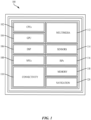
- FIGURE 1 illustrates an example implementation of the aforementioned selection of bit widths for a fixed point machine learning model, using a system-on-a-chip (SOC) 100, which may include a general-purpose processor (CPU) or multi-core general-purpose processors (CPUs) 102 in accordance with certain aspects of the present disclosure.
- SOC system-on-a-chip
- CPU general-purpose processor
- CPUs multi-core general-purpose processors
- Variables e.g., neural signals and synaptic weights
- system parameters associated with a computational device e.g., neural network with weights
- delays e.g., frequency bin information, and task information
- NPU neural processing unit
- GPU graphics processing unit
- DSP digital signal processor
- Instructions executed at the general-purpose processor 102 may be loaded from a program memory associated with the CPU 102 or may be loaded from a dedicated memory block 118.
- the SOC 100 may also include additional processing blocks tailored to specific functions, such as a GPU 104, a DSP 106, a connectivity block 110, which may include fourth generation long term evolution (4G LTE) connectivity, unlicensed Wi-Fi connectivity, USB connectivity, Bluetooth connectivity, and the like, and a multimedia processor 112 that may, for example, detect and recognize gestures.
- the NPU is implemented in the CPU, DSP, and/or GPU.
- the SOC 100 may also include a sensor processor 114, image signal processors (ISPs), and/or navigation 120, which may include a global positioning system.
- ISPs image signal processors
- the SOC 100 may be based on an ARM instruction set.
- the instructions loaded into the general-purpose processor 102 may comprise code for evaluating a sensitivity of model accuracy to bit widths at each computational stage of the model.
- the instructions loaded into the general-purpose processor 102 may also comprise code for selecting a bit width for one or more of parameters and intermediate calculations in each computational stage of the model based on the evaluation of the model accuracy sensitivity.
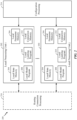
- FIGURE 2 illustrates an example implementation of a system 200 in accordance with certain aspects of the present disclosure.
- the system 200 may have multiple local processing units 202 that may perform various operations of methods described herein.
- Each local processing unit 202 may comprise a local state memory 204 and a local parameter memory 206 that may store parameters of a neural network.
- the local processing unit 202 may have a local (neuron) model program (LMP) memory 208 for storing a local model program, a local learning program (LLP) memory 210 for storing a local learning program, and a local connection memory 212.
- LMP local (neuron) model program
- LLP local learning program
- each local processing unit 202 may interface with a configuration processor unit 214 for providing configurations for local memories of the local processing unit, and with a routing connection processing unit 216 that provides routing between the local processing units 202.
- Deep learning architectures may perform an object recognition task by learning to represent inputs at successively higher levels of abstraction in each layer, thereby building up a useful feature representation of the input data. In this way, deep learning addresses a major bottleneck of traditional machine learning.
- a shallow classifier may be a two-class linear classifier, for example, in which a weighted sum of the feature vector components may be compared with a threshold to predict to which class the input belongs.
- Human engineered features may be templates or kernels tailored to a specific problem domain by engineers with domain expertise. Deep learning architectures, in contrast, may learn to represent features that are similar to what a human engineer might design, but through training. Furthermore, a deep network may learn to represent and recognize new types of features that a human might not have considered.
- a deep learning architecture may learn a hierarchy of features. If presented with visual data, for example, the first layer may learn to recognize relatively simple features, such as edges, in the input stream. In another example, if presented with auditory data, the first layer may learn to recognize spectral power in specific frequencies. The second layer, taking the output of the first layer as input, may learn to recognize combinations of features, such as simple shapes for visual data or combinations of sounds for auditory data. For instance, higher layers may learn to represent complex shapes in visual data or words in auditory data. Still higher layers may learn to recognize common visual objects or spoken phrases.
- Deep learning architectures may perform especially well when applied to problems that have a natural hierarchical structure.
- the classification of motorized vehicles may benefit from first learning to recognize wheels, windshields, and other features. These features may be combined at higher layers in different ways to recognize cars, trucks, and airplanes.
- Neural networks may be designed with a variety of connectivity patterns.
- feed-forward networks information is passed from lower to higher layers, with each neuron in a given layer communicating to neurons in higher layers.
- a hierarchical representation may be built up in successive layers of a feed-forward network, as described above.
- Neural networks may also have recurrent or feedback (also called top-down) connections.
- a recurrent connection the output from a neuron in a given layer may be communicated to another neuron in the same layer.
- a recurrent architecture may be helpful in recognizing patterns that span more than one of the input data chunks that are delivered to the neural network in a sequence.
- a connection from a neuron in a given layer to a neuron in a lower layer is called a feedback (or top-down) connection.
- a network with many feedback connections may be helpful when the recognition of a high level concept may aid in discriminating the particular low-level features of an input.
- the connections between layers of a neural network may be fully connected 302 or locally connected 304.
- a neuron in a first layer may communicate its output to every neuron in a second layer, so that each neuron in the second layer will receive input from every neuron in the first layer.
- a neuron in a first layer may be connected to a limited number of neurons in the second layer.
- a convolutional network 306 may be locally connected, and is further configured such that the connection strengths associated with the inputs for each neuron in the second layer are shared (e.g., 308).
- a locally connected layer of a network may be configured so that each neuron in a layer will have the same or a similar connectivity pattern, but with connections strengths that may have different values (e.g., 310, 312, 314, and 316).
- the locally connected connectivity pattern may give rise to spatially distinct receptive fields in a higher layer, because the higher layer neurons in a given region may receive inputs that are tuned through training to the properties of a restricted portion of the total input to the network.
- Locally connected neural networks may be well suited to problems in which the spatial location of inputs is meaningful.
- a network 300 designed to recognize visual features from a car-mounted camera may develop high layer neurons with different properties depending on their association with the lower versus the upper portion of the image.
- Neurons associated with the lower portion of the image may learn to recognize lane markings, for example, while neurons associated with the upper portion of the image may learn to recognize traffic lights, traffic signs, and the like.
- a DCN may be trained with supervised learning.
- a DCN may be presented with an image, such as a cropped image of a speed limit sign 326, and a "forward pass" may then be computed to produce an output 322.
- the output 322 may be a vector of values corresponding to features such as "sign,” "60,” and "100.”
- the network designer may want the DCN to output a high score for some of the neurons in the output feature vector, for example the ones corresponding to "sign” and "60” as shown in the output 322 for a network 300 that has been trained.
- the output produced by the DCN is likely to be incorrect, and so an error may be calculated between the actual output and the target output.
- the weights of the DCN may then be adjusted so that the output scores of the DCN are more closely aligned with the target.
- a learning algorithm may compute a gradient vector for the weights.
- the gradient may indicate an amount that an error would increase or decrease if the weight were adjusted slightly.
- the gradient may correspond directly to the value of a weight connecting an activated neuron in the penultimate layer and a neuron in the output layer.
- the gradient may depend on the value of the weights and on the computed error gradients of the higher layers.
- the weights may then be adjusted so as to reduce the error. This manner of adjusting the weights may be referred to as "back propagation" as it involves a "backward pass” through the neural network.
- the error gradient of weights may be calculated over a small number of examples, so that the calculated gradient approximates the true error gradient.
- This approximation method may be referred to as stochastic gradient descent. Stochastic gradient descent may be repeated until the achievable error rate of the entire system has stopped decreasing or until the error rate has reached a target level.
- the DCN may be presented with new images 326 and a forward pass through the network may yield an output 322 that may be considered an inference or a prediction of the DCN.
- Deep belief networks are probabilistic models comprising multiple layers of hidden nodes. DBNs may be used to extract a hierarchical representation of training data sets. A DBN may be obtained by stacking up layers of Restricted Boltzmann Machines (RBMs).
- RBM Restricted Boltzmann Machines
- An RBM is a type of artificial neural network that can learn a probability distribution over a set of inputs. Because RBMs can learn a probability distribution in the absence of information about the class to which each input should be categorized, RBMs are often used in unsupervised learning.
- the bottom RBMs of a DBN may be trained in an unsupervised manner and may serve as feature extractors
- the top RBM may be trained in a supervised manner (on a joint distribution of inputs from the previous layer and target classes) and may serve as a classifier.
- DCNs Deep convolutional networks
- DCNs are networks of convolutional networks, configured with additional pooling and normalization layers. DCNs have achieved state-of-the-art performance on many tasks. DCNs can be trained using supervised learning in which both the input and output targets are known for many exemplars and are used to modify the weights of the network by use of gradient descent methods.
- DCNs may be feed-forward networks.
- connections from a neuron in a first layer of a DCN to a group of neurons in the next higher layer are shared across the neurons in the first layer.
- the feed-forward and shared connections of DCNs may be exploited for fast processing.
- the computational burden of a DCN may be much less, for example, than that of a similarly sized neural network that comprises recurrent or feedback connections.
- each layer of a convolutional network may be considered a spatially invariant template or basis projection. If the input is first decomposed into multiple channels, such as the red, green, and blue channels of a color image, then the convolutional network trained on that input may be considered three-dimensional, with two spatial dimensions along the axes of the image and a third dimension capturing color information.
- the outputs of the convolutional connections may be considered to form a feature map in the subsequent layer 318 and 320, with each element of the feature map (e.g., 320) receiving input from a range of neurons in the previous layer (e.g., 318) and from each of the multiple channels.
- the values in the feature map may be further processed with a non-linearity, such as a rectification, max(0,x). Values from adjacent neurons may be further pooled, which corresponds to down sampling, and may provide additional local invariance and dimensionality reduction. Normalization, which corresponds to whitening, may also be applied through lateral inhibition between neurons in the feature map.
- a non-linearity such as a rectification, max(0,x).
- Values from adjacent neurons may be further pooled, which corresponds to down sampling, and may provide additional local invariance and dimensionality reduction. Normalization, which corresponds to whitening, may also be applied through lateral inhibition between neurons in the feature map.
- the performance of deep learning architectures may increase as more labeled data points become available or as computational power increases.
- Modern deep neural networks are routinely trained with computing resources that are thousands of times greater than what was available to a typical researcher just fifteen years ago.
- New architectures and training paradigms may further boost the performance of deep learning. Rectified linear units may reduce a training issue known as vanishing gradients.
- New training techniques may reduce over-fitting and thus enable larger models to achieve better generalization.
- Encapsulation techniques may abstract data in a given receptive field and further boost overall performance.
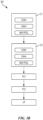
- FIGURE 3B is a block diagram illustrating an exemplary deep convolutional network 350.
- the deep convolutional network 350 may include multiple different types of layers based on connectivity and weight sharing.
- the exemplary deep convolutional network 350 includes multiple convolution blocks (e.g., C1 and C2).
- Each of the convolution blocks may be configured with a convolution layer, a normalization layer (LNorm), and a pooling layer.
- the convolution layers may include one or more convolutional filters, which may be applied to the input data to generate a feature map. Although only two convolution blocks are shown, the present disclosure is not so limiting, and instead, any number of convolutional blocks may be included in the deep convolutional network 350 according to design preference.
- the normalization layer may be used to normalize the output of the convolution filters. For example, the normalization layer may provide whitening or lateral inhibition.
- the pooling layer may provide down sampling aggregation over space for local invariance and dimensionality reduction.
- the parallel filter banks for example, of a deep convolutional network may be loaded on a CPU 102 or GPU 104 of an SOC 100, optionally based on an ARM instruction set, to achieve high performance and low power consumption.
- the parallel filter banks may be loaded on the DSP 106 or an ISP 116 of an SOC 100.
- the DCN may access other processing blocks that may be present on the SOC, such as processing blocks dedicated to sensors 114 and navigation 120.
- the deep convolutional network 350 may also include one or more fully connected layers (e.g., FC1 and FC2).
- the deep convolutional network 350 may further include a logistic regression (LR) layer. Between each layer of the deep convolutional network 350 are weights (not shown) that are to be updated. The output of each layer may serve as an input of a succeeding layer in the deep convolutional network 350 to learn hierarchical feature representations from input data (e.g., images, audio, video, sensor data and/or other input data) supplied at the first convolution block C1.
- input data e.g., images, audio, video, sensor data and/or other input data
- a machine learning model is configured for evaluating a sensitivity of model accuracy to bit widths at each computational stage of the model and selecting a bit width for one or more of parameters and intermediate calculations in each computational stage of the model based on the evaluating.
- the model includes evaluating means and/or selecting means.
- the evaluating means and/or selecting means may be the general-purpose processor 102, program memory associated with the general-purpose processor 102, memory block 118, local processing units 202, and or the routing connection processing units 216 configured to perform the functions recited.
- the aforementioned means may be any module or any apparatus configured to perform the functions recited by the aforementioned means.
- each local processing unit 202 may be configured to determine parameters of the model based upon desired one or more functional features of the model, and develop the one or more functional features towards the desired functional features as the determined parameters are further adapted, tuned and updated.
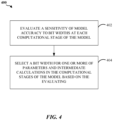
- FIGURE 4 illustrates a method 400 for selecting bit widths for a fixed point machine learning model.
- the process evaluates a sensitivity of model accuracy to bit widths at each computational stage of the model.
- the model accuracy may comprise a measure of signal quantization to noise ratio (SQNR) at an output of the model or classification accuracy.
- the output may use a floating point number format.
- the process selects a bit width for parameters and intermediate calculations in each computational stage of the model based on the evaluating.
- the bit width for intermediate calculations of a computational stage may be less than the bit width for parameters in the computational stage, or vice versa.
- the machine learning model may be a neural network, such as a DCN, for example.
- the computational stage may comprise a layer of the neural network.
- the parameters may comprise bias values and/or weights.
- the intermediate calculations may comprise activation values.
- the bit width may be selected based on the connectivity of the neural network.
- the connectivity may comprise whether a layer of the network is in a fully connected configuration, a convolutional configuration or a configuration with a specific sparsity.
- the bit width for a fully connected layer may be less than the bit width for a convolutional layer of the neural network.
- the weights and/or bias values of the fully connected layer and the convolutional layer may be random in a transfer learning arrangement.
- the selection of the bit width may be based on whether the bit width is for a bias value, weight, or activation value.
- the bit width for bias values, weights, and/or activation values may be based on a number of weights per layer, a number of activation values per layer, filter size per layer, filter stride per layer, and number of filters per layer in the neural network.
- the neural network may also be fine-tuned after selection of the bit width for bias values, activation values, and/or weights of each layer.
- the process may also inject noise into one or more computational stages of the model.
- the model accuracy may be determined for each computational stage of the injected noise.
- the process may further select a level of injected noise that provides a desired level of model accuracy.
- the process may further dynamically update the bit width based on performance specifications or system resources or user input.
- FIGURE 5 is a block diagram 500 illustrating a method for selecting bit widths for a fixed point machine learning model.
- the process injects noise into a computational stage of the machine learning model.
- the process determines a model performance.
- the model performance may comprise a classification accuracy, classification speed, SQNR, other model performance metric or a combination thereof.
- the model performance may be evaluated by comparing the performance to a threshold, in block 506.
- the threshold may comprise a minimally acceptable performance level. If the performance is above the threshold, the process may inject more noise in block 502 and reevaluate the model performance. On the other hand, if the model performance is below the threshold, the bit width may be selected, in block 508, according to the last acceptable noise level.
- the noise level may be reduced and the model performance may be reevaluated. Further, the increment for increasing or decreasing the noise level may be adjusted for more fine selection of the bit width.
- the various operations of methods described above may be performed by any suitable means capable of performing the corresponding functions.
- the means may include various hardware and/or software component(s) and/or module(s), including, but not limited to, a circuit, an application specific integrated circuit (ASIC), or processor.
- ASIC application specific integrated circuit
- determining encompasses a wide variety of actions. For example, “determining” may include calculating, computing, processing, deriving, investigating, looking up (e.g., looking up in a table, a database or another data structure), ascertaining and the like. Additionally, “determining” may include receiving (e.g., receiving information), accessing (e.g., accessing data in a memory) and the like. Furthermore, “determining” may include resolving, selecting, choosing, establishing and the like.
- a phrase referring to "at least one of" a list of items refers to any combination of those items, including single members.
- "at least one of: a, b, or c” is intended to cover: a, b, c, a-b, a-c, b-c, and a-b-c.
- DSP digital signal processor
- ASIC application specific integrated circuit
- FPGA field programmable gate array signal
- PLD programmable logic device
- a general-purpose processor may be a microprocessor, but in the alternative, the processor may be any commercially available processor, controller, microcontroller or state machine.
- a processor may also be implemented as a combination of computing devices, e.g., a combination of a DSP and a microprocessor, a plurality of microprocessors, one or more microprocessors in conjunction with a DSP core, or any other such configuration.
- a software module may reside in any form of storage medium that is known in the art. Some examples of storage media that may be used include random access memory (RAM), read only memory (ROM), flash memory, erasable programmable read-only memory (EPROM), electrically erasable programmable read-only memory (EEPROM), registers, a hard disk, a removable disk, a CD-ROM and so forth.
- RAM random access memory
- ROM read only memory
- EPROM erasable programmable read-only memory
- EEPROM electrically erasable programmable read-only memory
- registers a hard disk, a removable disk, a CD-ROM and so forth.
- a software module may comprise a single instruction, or many instructions, and may be distributed over several different code segments, among different programs, and across multiple storage media.
- a storage medium may be coupled to a processor such that the processor can read information from, and write information to, the storage medium. In the alternative, the storage medium may be integral to the processor.
- the methods disclosed herein comprise one or more steps or actions for achieving the described method.
- an example hardware configuration may comprise a processing system in a device.
- the processing system may be implemented with a bus architecture.
- the bus may include any number of interconnecting buses and bridges depending on the specific application of the processing system and the overall design constraints.
- the bus may link together various circuits including a processor, machine-readable media, and a bus interface.
- the bus interface may be used to connect a network adapter, among other things, to the processing system via the bus.
- the network adapter may be used to implement signal processing functions.
- a user interface e.g., keypad, display, mouse, joystick, etc.
- the bus may also link various other circuits such as timing sources, peripherals, voltage regulators, power management circuits, and the like, which are well known in the art, and therefore, will not be described any further.
- the processor may be responsible for managing the bus and general processing, including the execution of software stored on the machine-readable media.
- the processor may be implemented with one or more general-purpose and/or specialpurpose processors. Examples include microprocessors, microcontrollers, DSP processors, and other circuitry that can execute software.
- Software shall be construed broadly to mean instructions, data, or any combination thereof, whether referred to as software, firmware, middleware, microcode, hardware description language, or otherwise.
- Machine-readable media may include, by way of example, random access memory (RAM), flash memory, read only memory (ROM), programmable read-only memory (PROM), erasable programmable read-only memory (EPROM), electrically erasable programmable Read-only memory (EEPROM), registers, magnetic disks, optical disks, hard drives, or any other suitable storage medium, or any combination thereof.
- RAM random access memory
- ROM read only memory
- PROM programmable read-only memory
- EPROM erasable programmable read-only memory
- EEPROM electrically erasable programmable Read-only memory
- registers magnetic disks, optical disks, hard drives, or any other suitable storage medium, or any combination thereof.
- the machine-readable media may be embodied in a computer-program product.
- the computer-program product may comprise packaging materials.
- the machine-readable media may be part of the processing system separate from the processor.
- the machine-readable media, or any portion thereof may be external to the processing system.
- the machine-readable media may include a transmission line, a carrier wave modulated by data, and/or a computer product separate from the device, all which may be accessed by the processor through the bus interface.
- the machine-readable media, or any portion thereof may be integrated into the processor, such as the case may be with cache and/or general register files.
- the various components discussed may be described as having a specific location, such as a local component, they may also be configured in various ways, such as certain components being configured as part of a distributed computing system.
- the processing system may be configured as a general-purpose processing system with one or more microprocessors providing the processor functionality and external memory providing at least a portion of the machine-readable media, all linked together with other supporting circuitry through an external bus architecture.
- the processing system may comprise one or more neuromorphic processors for implementing the neuron models and models of neural systems described herein.
- the processing system may be implemented with an application specific integrated circuit (ASIC) with the processor, the bus interface, the user interface, supporting circuitry, and at least a portion of the machine-readable media integrated into a single chip, or with one or more field programmable gate arrays (FPGAs), programmable logic devices (PLDs), controllers, state machines, gated logic, discrete hardware components, or any other suitable circuitry, or any combination of circuits that can perform the various functionality described throughout this disclosure.
- ASIC application specific integrated circuit
- FPGAs field programmable gate arrays
- PLDs programmable logic devices
- controllers state machines, gated logic, discrete hardware components, or any other suitable circuitry, or any combination of circuits that can perform the various functionality described throughout this disclosure.
- the machine-readable media may comprise a number of software modules.
- the software modules include instructions that, when executed by the processor, cause the processing system to perform various functions.
- the software modules may include a transmission module and a receiving module.
- Each software module may reside in a single storage device or be distributed across multiple storage devices.
- a software module may be loaded into RAM from a hard drive when a triggering event occurs.
- the processor may load some of the instructions into cache to increase access speed.
- One or more cache lines may then be loaded into a general register file for execution by the processor.
- Computer-readable media include both computer storage media and communication media including any medium that facilitates transfer of a computer program from one place to another.
- a storage medium may be any available medium that can be accessed by a computer.
- such computer-readable media can comprise RAM, ROM, EEPROM, CD-ROM or other optical disk storage, magnetic disk storage or other magnetic storage devices, or any other medium that can be used to carry or store desired program code in the form of instructions or data structures and that can be accessed by a computer. Additionally, any connection is properly termed a computer-readable medium.
- Disk and disc include compact disc (CD), laser disc, optical disc, digital versatile disc (DVD), floppy disk, and Blu-ray ® disc where disks usually reproduce data magnetically, while discs reproduce data optically with lasers.
- computer-readable media may comprise non-transitory computer-readable media (e.g., tangible media).
- computer-readable media may comprise transitory computer- readable media (e.g., a signal). Combinations of the above should also be included within the scope of computer-readable media.
- certain aspects may comprise a computer program product for performing the operations presented herein.
- a computer program product may comprise a computer-readable medium having instructions stored (and/or encoded) thereon, the instructions being executable by one or more processors to perform the operations described herein.
- the computer program product may include packaging material.
- modules and/or other appropriate means for performing the methods and techniques described herein can be downloaded and/or otherwise obtained by a user terminal and/or base station as applicable.
- a user terminal and/or base station can be coupled to a server to facilitate the transfer of means for performing the methods described herein.
- various methods described herein can be provided via storage means (e.g., RAM, ROM, a physical storage medium such as a compact disc (CD) or floppy disk, etc.), such that a user terminal and/or base station can obtain the various methods upon coupling or providing the storage means to the device.
- storage means e.g., RAM, ROM, a physical storage medium such as a compact disc (CD) or floppy disk, etc.
- CD compact disc
- floppy disk etc.
- any other suitable technique for providing the methods and techniques described herein to a device can be utilized.
Landscapes
- Engineering & Computer Science (AREA)
- Physics & Mathematics (AREA)
- Theoretical Computer Science (AREA)
- Mathematical Physics (AREA)
- General Physics & Mathematics (AREA)
- Data Mining & Analysis (AREA)
- Software Systems (AREA)
- Health & Medical Sciences (AREA)
- Life Sciences & Earth Sciences (AREA)
- Biomedical Technology (AREA)
- Biophysics (AREA)
- General Engineering & Computer Science (AREA)
- Computing Systems (AREA)
- Molecular Biology (AREA)
- General Health & Medical Sciences (AREA)
- Evolutionary Computation (AREA)
- Computational Linguistics (AREA)
- Artificial Intelligence (AREA)
- Computational Mathematics (AREA)
- Mathematical Analysis (AREA)
- Mathematical Optimization (AREA)
- Pure & Applied Mathematics (AREA)
- Neurology (AREA)
- Operations Research (AREA)
- Algebra (AREA)
- Databases & Information Systems (AREA)
- Image Analysis (AREA)
Description
- Certain aspects of the present disclosure generally relate to machine learning and, more particularly, to improving systems and methods of bit width selection for fixed point machine learning models, such as an artificial neural network.
- An artificial neural network, which may comprise an interconnected group of artificial neurons (e.g., neuron models), is a computational device or represents a method to be performed by a computational device.
- Convolutional neural networks are a type of feed-forward artificial neural network. Convolutional neural networks may include collections of neurons that each has a receptive field and that collectively tile an input space. Convolutional neural networks (CNNs) have numerous applications. In particular, CNNs have broadly been used in the area of pattern recognition and classification.
- Deep learning architectures, such as deep belief networks and deep convolutional networks, are layered neural networks architectures in which the output of a first layer of neurons becomes an input to a second layer of neurons, the output of a second layer of neurons becomes and input to a third layer of neurons, and so on. Deep neural networks may be trained to recognize a hierarchy of features and so they have increasingly been used in object recognition applications. Like convolutional neural networks, computation in these deep learning architectures may be distributed over a population of processing nodes, which may be configured in one or more computational chains. These multi-layered architectures may be trained one layer at a time and may involve fine-tuning using back propagation. AHMED GHAZI BLAIECH ET AL: "Multiwidth fixed-point coding based on reprogrammable hardware implementation of a multi-layer perceptron neural network for alertness classification", INTELLIGENT SYSTEMS DESIGN AND APPLICATIONS (ISDA), 2010 10TH INTERNATIONAL CONFERENCE ON, IEEE, PISCATAWAY, NJ, USA, 29 November 2010, pages 610-614, pertains to a computer-implemented method for selecting bit widths for a fixed point implementation of a machine learning model comprising a neural network with multiple layers wherein a plurality of the multiple layers is configured to multiply a respective set of activation values by a respective set of weights.
- Other models are also available for object recognition. For example, support vector machines (SVMs) are learning tools that can be applied for classification. Support vector machines include a separating hyperplane (e.g., decision boundary) that categorizes data. The hyperplane is defined by supervised learning. A desired hyperplane increases the margin of the training data. In other words, the hyperplane should have the greatest minimum distance to the training examples.
- Although these solutions achieve excellent results on a number of classification benchmarks, their computational complexity can be prohibitively high. Additionally, training of the models may be challenging.
- A method for selecting bit widths for a fixed point machine learning model in accordance with claim 1 is presented.
- An apparatus for selecting bit widths for a fixed point machine learning model in accordance with claim 10 is presented.
- A non-transitory computer readable medium in accordance with claim 11 is presented.
- Additional features and advantages of the disclosure will be described below. It should be appreciated by those skilled in the art that this disclosure may be readily utilized as a basis for modifying or designing other structures for carrying out the same purposes of the present disclosure. It should also be realized by those skilled in the art that such equivalent constructions do not depart from the teachings of the disclosure as set forth in the appended claims. The novel features, which are believed to be characteristic of the disclosure, both as to its organization and method of operation, together with further objects and advantages, will be better understood from the following description when considered in connection with the accompanying figures. It is to be expressly understood, however, that each of the figures is provided for the purpose of illustration and description only and is not intended as a definition of the limits of the present claims.
- The features, nature, and advantages of the present disclosure will become more apparent from the detailed description set forth below when taken in conjunction with the drawings in which like reference characters identify correspondingly throughout.
-
FIGURE 1 illustrates an example implementation of designing a neural network using a system-on-a-chip (SOC), including a general-purpose processor in accordance with certain aspects of the present disclosure. -
FIGURE 2 illustrates an example implementation of a system in accordance with aspects of the present disclosure. -
FIGURE 3A is a diagram illustrating a neural network in accordance with aspects of the present disclosure. -
FIGURE 3B is a block diagram illustrating an exemplary deep convolutional network (DCN) in accordance with aspects of the present disclosure. -
FIGURES 4 and5 illustrate methods for selecting bit widths for a fixed point machine learning model in accordance with aspects of the present disclosure. - The detailed description set forth below, in connection with the appended drawings, is intended as a description of various configurations and is not intended to represent the only configurations in which the concepts described herein may be practiced. The detailed description includes specific details for the purpose of providing a thorough understanding of the various concepts. However, it will be apparent to those skilled in the art that these concepts may be practiced without these specific details. In some instances, well-known structures and components are shown in block diagram form in order to avoid obscuring such concepts.
- The word "exemplary" is used herein to mean "serving as an example, instance, or illustration." Any aspect described herein as "exemplary" is not necessarily to be construed as preferred or advantageous over other aspects.
- Although particular aspects are described herein, many variations and permutations of these aspects fall within the scope of the claims. Although some benefits and advantages of the preferred aspects are mentioned, the disclosure is not intended to be limited to particular benefits, uses or objectives. Rather, aspects of the disclosure are intended to be broadly applicable to different technologies, system configurations, networks and protocols, some of which are illustrated by way of example in the figures and in the following description of the preferred aspects. The detailed description and drawings are merely illustrative of the disclosure rather than limiting. The invention is defined by the appended independent claims. Embodiments of the invention are defined by the appended depedent claims.
- Machine learning models may be configured using a fixed point implementation or a floating point implementation. In a floating point implementation, elements and parameters of the model, as well as input data, may be represented using floating point numbers. On the other hand, in a fixed point representation, a fixed position of the decimal point is chosen such that there are a fixed number of bits to the right and/or the left of the decimal point and used to represent the elements, parameters and inputs of the model. Floating point representations may offer greater precision. On the other hand, a fixed point implementation may be desirable for machine learning model such as an artificial neural network (ANN). Specifically, a fixed point implementation may reduce a model size, reduce processing time, reduce memory bandwidth, and/or reduce power consumption.
- One challenge of fixed point implementation is to determine the bit widths to represent different components in a model (e.g., neural network). In some cases, a particular bit width may be used throughout the network. Still, the use of different bit widths in different components of the network may be more desirable. For example, different bit widths may be selected for bias values, activation values, and/or weights of each layer of the neural network. Aspects of the present disclosure are directed to selecting a bit width for different layers and/or different components of each layer of an ANN. Additionally, aspects of the present disclosure are directed to changing the bit widths based on performance specifications and system resources.
- In the invention, model performance may be evaluated using a signal to quantization noise ratio (SQNR). That is, in a machine learning model such as a deep convolutional network, the effect of quantizing weights and/or activations is the introduction of quantization noise. Similar to other communication systems, when quantization noise increases, the model performance decreases. Accordingly, the SQNR observed at the output may provide an indication of model performance or accuracy.
- The model quantizer may have a fixed efficiency of K dB/bit. In other words, every bit in a fixed point representation contributes K dB SQNR. As such, the SQNR may be employed to select an improved or optimized bit width. The bit width may be selected for the entire model or may be selected on a computational stage (e.g., a layer of a deep convolutional network (DCN)) by computational stage basis. For example, given an SQNR target at the output of a DCN of Y dB having N layers in which noise is introduced due to quantization, overall bit width in a model may be selected by minimizing the following:


- Equation 2 may represent the allowable quantization noise for injection. Because the model may be linear in the region of interest, noise may be additive from one computational stage to the next. As such, the objective function of Equation 1 is the total number of bits or bit width at each computational stage or layers.
- The bit width selection may be simplified as:

- The noise that may be introduced for each layer may be proportional to the bit width scaling factor and inversely proportional to the amplification factor. If a particular layer has a high scaling factor (e.g., because there are many neurons), the quantizer may increase the bit width reduction, if the objective is to reduce overall model size. Accordingly, the bit width selection is similar to a water filling equation and given by:

- This bit width selection formulation also recognizes and accounts for differences in the layers of the neural network. That is, bit width selection may be more impactful in some layers than in others. For example, fully connected layers of an ANN may be more robust to quantization noise compared to convolutional layers. That is, the fan-ins at fully connected layers may be greater, thus leading to suppression of quantization noise. Additionally, if it is desired to reduce a model size, it may be desirable for the fully connected layers to have a greater quantization in comparison to the quantization of the convolutional layers. Notably, the number of parameters in fully connected layers may be greater than the parameters of the convolutional layers. Thus, quantizing fully connected layers may lead to greater model size reduction when compared with quantizing convolutional layers.
- In another example, comparing a layer that has one million weights to a layer that has one thousand weights, for the one million weight layer, a small reduction in bit width can produce a significant change in the overall model size. On the other hand, in the layer with one thousand weights, a larger bit width may have a smaller impact.
- In one example, for simplicity and ease of understanding, the scaling factors and noise amplification factors may be assumed to be the same across layers. In this example, xi 's may be equal, and the SQNR budget for each layer may be the same. Furthermore, if N layers are assumed, the SQNR specification at each layer may be SQNRmin + 10 log N. Specifically, in one example, where SQNRmin = 26 dB and N = 10, the per layer SQNR specification is 36 dB (or 12 bits, if assuming 3 dB/bit).
- In some aspects, additional safety factors may be added to account for non-Gaussian distribution of activations and weights and/or variations for different training and test sets. For example, suppose that quantization efficiency is K=3 dB/bit. With a bit width of 12, the SQNR specification may be 36 dB SQNR per layer. However, in reality the quantization efficiency may be 2.5 dB/bit because the input distribution at test time may be different, for instance. As such the actual SQNR per layer may be 30 dB SQNR per layer. The resulting SQNR at the output would be 20 dB, which is lower than SQNRmin. One way to prevent this from happening is to add a safety factor to the SQNR specification at each layer (e.g., +12 dB). That is, instead of an SQNR per layer of 36 dB, a target of 48 SQNR per layer may be used. That amounts to a bit width of 16. As such, even if the actual quantization efficiency is 2.5 dB/bit, 40 dB SQNR per layer may be achieved, and results in SQNR at the output of 30 dB, which is higher than SQNRmin.
- The bit width selection techniques described above are applied to components of a computational stage (e.g., layer). A layer of an ANN such as DCN may refer to biases, weights, and/or activation values. Still, quantization operations that introduce quantization noise may be considered as affecting a layer for the purpose of selecting bit widths. That is, each bias, weight, and activation value may be considered a layer. In other words, the process of quantizing weights and biases can be considered a "layer", and quantizing activations can be considered another "layer" in the above SQNR computation.
- For instance, a DCN with 3 convolutional layers, for the purpose of the SQNR calculation, may have 6 quantization "layers", or steps as follows:
- Quantize weights and biases of convolution layer (conv) 1,
- Quantize activations of conv1,
- Quantize weights and biases of conv2,
- Quantize activations of conv2,
- Quantize weights and biases of conv3,
- Quantize activations of conv3.
- In one example, weight w is multiplied by activation a. Both the weight and activation may include inherent quantization noise nw and na. Because (w + nw ) × (a + na ) ≈ w · a + w · na + nw · a, and a new SQNR due to the noise terms may satisfy:

- In some cases, a bit width for activation values may be smaller than a bit width for weights (or vice versa). Furthermore, bit width selection may be based on a number of weights per layer, a number of activation values per layer, filter size per layer, filter stride per layer, and/or a number of filters per layer in the model.
- In some aspects, transfer learning may be adopted to perform a learning task. In this case, a machine learning model (e.g., DCN) may be used to extract features from an input (e.g., an image) and to generate a corresponding feature vector. For a classification task, the features may be used to train a classifier (e.g., a support vector machine (SVM)). Because the classifier may be retrained following the quantization, the model may be further enhanced and may be less sensitive to quantization noise.
- In some aspects, the model may be initialized with random weights. For example, random weights may be used for fully connected layers. Because the classifier (e.g., SVM) may be retrained, as indicated above, the model may be stored without storing the weights. Thus, bit width may be further reduced for the fully connected layers. Therefore, the model size may be greatly reduced.
- In some aspects, the bit width of intermediate calculations (e.g., activation) may be reduced online. For example, the activation bit width may be selected online as a function of model performance, device capability, latency requirements and the like. In some aspects, the bit width of intermediate calculations for different computational stage (e.g., layers) may also be determined based on a priority, for example, determined by the cost function of Equation 1 or another cost function. For instance, the cost function could be based on user feedback collected during or after applying the model. The user feedback may indicate that the model has made a classification error or has taken too long to compute a label, for example.
- In some aspects, the SQNR budget may be determined based on an empirical approach. For a given data set, noise may be injected layer by layer. Injecting noise may, for example, comprise injecting random noise or performing quantization according to a specific bit width.
- The model performance (e.g., classification accuracy and/or speed) may thereafter be evaluated to determine whether the performance remains acceptable relative to a threshold. Because of the structure of data (as opposed to structure of the model or network), certain layers may have very sparse activations, and therefore may have larger noise budgets (less sensitive to noise).
- Additionally, in some aspects, the bit width may be dynamically adjusted based on user feedback. For example, a user may provide an indication of classifier performance (e.g., point out classification errors). The number of instances of the user indications may be compared to a threshold and used to adjust the bit width (e.g., triggering a reload of the model at a finer quantization).
-
FIGURE 1 illustrates an example implementation of the aforementioned selection of bit widths for a fixed point machine learning model, using a system-on-a-chip (SOC) 100, which may include a general-purpose processor (CPU) or multi-core general-purpose processors (CPUs) 102 in accordance with certain aspects of the present disclosure. Variables (e.g., neural signals and synaptic weights), system parameters associated with a computational device (e.g., neural network with weights), delays, frequency bin information, and task information may be stored in a memory block associated with a neural processing unit (NPU) 108, in a memory block associated with aCPU 102, in a memory block associated with a graphics processing unit (GPU) 104, in a memory block associated with a digital signal processor (DSP) 106, in adedicated memory block 118, or may be distributed across multiple blocks. Instructions executed at the general-purpose processor 102 may be loaded from a program memory associated with theCPU 102 or may be loaded from adedicated memory block 118. - The
SOC 100 may also include additional processing blocks tailored to specific functions, such as aGPU 104, aDSP 106, aconnectivity block 110, which may include fourth generation long term evolution (4G LTE) connectivity, unlicensed Wi-Fi connectivity, USB connectivity, Bluetooth connectivity, and the like, and amultimedia processor 112 that may, for example, detect and recognize gestures. In one implementation, the NPU is implemented in the CPU, DSP, and/or GPU. TheSOC 100 may also include a sensor processor 114, image signal processors (ISPs), and/ornavigation 120, which may include a global positioning system. - The
SOC 100 may be based on an ARM instruction set. In an aspect of the present disclosure, the instructions loaded into the general-purpose processor 102 may comprise code for evaluating a sensitivity of model accuracy to bit widths at each computational stage of the model. The instructions loaded into the general-purpose processor 102 may also comprise code for selecting a bit width for one or more of parameters and intermediate calculations in each computational stage of the model based on the evaluation of the model accuracy sensitivity. -
FIGURE 2 illustrates an example implementation of asystem 200 in accordance with certain aspects of the present disclosure. As illustrated inFIGURE 2 , thesystem 200 may have multiplelocal processing units 202 that may perform various operations of methods described herein. Eachlocal processing unit 202 may comprise alocal state memory 204 and alocal parameter memory 206 that may store parameters of a neural network. In addition, thelocal processing unit 202 may have a local (neuron) model program (LMP)memory 208 for storing a local model program, a local learning program (LLP)memory 210 for storing a local learning program, and alocal connection memory 212. Furthermore, as illustrated inFIGURE 2 , eachlocal processing unit 202 may interface with aconfiguration processor unit 214 for providing configurations for local memories of the local processing unit, and with a routingconnection processing unit 216 that provides routing between thelocal processing units 202. - Deep learning architectures may perform an object recognition task by learning to represent inputs at successively higher levels of abstraction in each layer, thereby building up a useful feature representation of the input data. In this way, deep learning addresses a major bottleneck of traditional machine learning. Prior to the advent of deep learning, a machine learning approach to an object recognition problem may have relied heavily on human engineered features, perhaps in combination with a shallow classifier. A shallow classifier may be a two-class linear classifier, for example, in which a weighted sum of the feature vector components may be compared with a threshold to predict to which class the input belongs. Human engineered features may be templates or kernels tailored to a specific problem domain by engineers with domain expertise. Deep learning architectures, in contrast, may learn to represent features that are similar to what a human engineer might design, but through training. Furthermore, a deep network may learn to represent and recognize new types of features that a human might not have considered.
- A deep learning architecture may learn a hierarchy of features. If presented with visual data, for example, the first layer may learn to recognize relatively simple features, such as edges, in the input stream. In another example, if presented with auditory data, the first layer may learn to recognize spectral power in specific frequencies. The second layer, taking the output of the first layer as input, may learn to recognize combinations of features, such as simple shapes for visual data or combinations of sounds for auditory data. For instance, higher layers may learn to represent complex shapes in visual data or words in auditory data. Still higher layers may learn to recognize common visual objects or spoken phrases.
- Deep learning architectures may perform especially well when applied to problems that have a natural hierarchical structure. For example, the classification of motorized vehicles may benefit from first learning to recognize wheels, windshields, and other features. These features may be combined at higher layers in different ways to recognize cars, trucks, and airplanes.
- Neural networks may be designed with a variety of connectivity patterns. In feed-forward networks, information is passed from lower to higher layers, with each neuron in a given layer communicating to neurons in higher layers. A hierarchical representation may be built up in successive layers of a feed-forward network, as described above. Neural networks may also have recurrent or feedback (also called top-down) connections. In a recurrent connection, the output from a neuron in a given layer may be communicated to another neuron in the same layer. A recurrent architecture may be helpful in recognizing patterns that span more than one of the input data chunks that are delivered to the neural network in a sequence. A connection from a neuron in a given layer to a neuron in a lower layer is called a feedback (or top-down) connection. A network with many feedback connections may be helpful when the recognition of a high level concept may aid in discriminating the particular low-level features of an input.
- Referring to
FIGURE 3A , the connections between layers of a neural network may be fully connected 302 or locally connected 304. In a fully connectednetwork 302, a neuron in a first layer may communicate its output to every neuron in a second layer, so that each neuron in the second layer will receive input from every neuron in the first layer. Alternatively, in a locally connectednetwork 304, a neuron in a first layer may be connected to a limited number of neurons in the second layer. Aconvolutional network 306 may be locally connected, and is further configured such that the connection strengths associated with the inputs for each neuron in the second layer are shared (e.g., 308). More generally, a locally connected layer of a network may be configured so that each neuron in a layer will have the same or a similar connectivity pattern, but with connections strengths that may have different values (e.g., 310, 312, 314, and 316). The locally connected connectivity pattern may give rise to spatially distinct receptive fields in a higher layer, because the higher layer neurons in a given region may receive inputs that are tuned through training to the properties of a restricted portion of the total input to the network. - Locally connected neural networks may be well suited to problems in which the spatial location of inputs is meaningful. For instance, a
network 300 designed to recognize visual features from a car-mounted camera may develop high layer neurons with different properties depending on their association with the lower versus the upper portion of the image. Neurons associated with the lower portion of the image may learn to recognize lane markings, for example, while neurons associated with the upper portion of the image may learn to recognize traffic lights, traffic signs, and the like. - A DCN may be trained with supervised learning. During training, a DCN may be presented with an image, such as a cropped image of a
speed limit sign 326, and a "forward pass" may then be computed to produce anoutput 322. Theoutput 322 may be a vector of values corresponding to features such as "sign," "60," and "100." The network designer may want the DCN to output a high score for some of the neurons in the output feature vector, for example the ones corresponding to "sign" and "60" as shown in theoutput 322 for anetwork 300 that has been trained. Before training, the output produced by the DCN is likely to be incorrect, and so an error may be calculated between the actual output and the target output. The weights of the DCN may then be adjusted so that the output scores of the DCN are more closely aligned with the target. - To adjust the weights, a learning algorithm may compute a gradient vector for the weights. The gradient may indicate an amount that an error would increase or decrease if the weight were adjusted slightly. At the top layer, the gradient may correspond directly to the value of a weight connecting an activated neuron in the penultimate layer and a neuron in the output layer. In lower layers, the gradient may depend on the value of the weights and on the computed error gradients of the higher layers. The weights may then be adjusted so as to reduce the error. This manner of adjusting the weights may be referred to as "back propagation" as it involves a "backward pass" through the neural network.
- In practice, the error gradient of weights may be calculated over a small number of examples, so that the calculated gradient approximates the true error gradient. This approximation method may be referred to as stochastic gradient descent. Stochastic gradient descent may be repeated until the achievable error rate of the entire system has stopped decreasing or until the error rate has reached a target level.
- After learning, the DCN may be presented with
new images 326 and a forward pass through the network may yield anoutput 322 that may be considered an inference or a prediction of the DCN. - Deep belief networks (DBNs) are probabilistic models comprising multiple layers of hidden nodes. DBNs may be used to extract a hierarchical representation of training data sets. A DBN may be obtained by stacking up layers of Restricted Boltzmann Machines (RBMs). An RBM is a type of artificial neural network that can learn a probability distribution over a set of inputs. Because RBMs can learn a probability distribution in the absence of information about the class to which each input should be categorized, RBMs are often used in unsupervised learning. Using a hybrid unsupervised and supervised paradigm, the bottom RBMs of a DBN may be trained in an unsupervised manner and may serve as feature extractors, and the top RBM may be trained in a supervised manner (on a joint distribution of inputs from the previous layer and target classes) and may serve as a classifier.
- Deep convolutional networks (DCNs) are networks of convolutional networks, configured with additional pooling and normalization layers. DCNs have achieved state-of-the-art performance on many tasks. DCNs can be trained using supervised learning in which both the input and output targets are known for many exemplars and are used to modify the weights of the network by use of gradient descent methods.
- DCNs may be feed-forward networks. In addition, as described above, the connections from a neuron in a first layer of a DCN to a group of neurons in the next higher layer are shared across the neurons in the first layer. The feed-forward and shared connections of DCNs may be exploited for fast processing. The computational burden of a DCN may be much less, for example, than that of a similarly sized neural network that comprises recurrent or feedback connections.
- The processing of each layer of a convolutional network may be considered a spatially invariant template or basis projection. If the input is first decomposed into multiple channels, such as the red, green, and blue channels of a color image, then the convolutional network trained on that input may be considered three-dimensional, with two spatial dimensions along the axes of the image and a third dimension capturing color information. The outputs of the convolutional connections may be considered to form a feature map in the
subsequent layer - The performance of deep learning architectures may increase as more labeled data points become available or as computational power increases. Modern deep neural networks are routinely trained with computing resources that are thousands of times greater than what was available to a typical researcher just fifteen years ago. New architectures and training paradigms may further boost the performance of deep learning. Rectified linear units may reduce a training issue known as vanishing gradients. New training techniques may reduce over-fitting and thus enable larger models to achieve better generalization. Encapsulation techniques may abstract data in a given receptive field and further boost overall performance.
-
FIGURE 3B is a block diagram illustrating an exemplary deepconvolutional network 350. The deepconvolutional network 350 may include multiple different types of layers based on connectivity and weight sharing. As shown inFIGURE 3B , the exemplary deepconvolutional network 350 includes multiple convolution blocks (e.g., C1 and C2). Each of the convolution blocks may be configured with a convolution layer, a normalization layer (LNorm), and a pooling layer. The convolution layers may include one or more convolutional filters, which may be applied to the input data to generate a feature map. Although only two convolution blocks are shown, the present disclosure is not so limiting, and instead, any number of convolutional blocks may be included in the deepconvolutional network 350 according to design preference. The normalization layer may be used to normalize the output of the convolution filters. For example, the normalization layer may provide whitening or lateral inhibition. The pooling layer may provide down sampling aggregation over space for local invariance and dimensionality reduction. - The parallel filter banks, for example, of a deep convolutional network may be loaded on a
CPU 102 orGPU 104 of anSOC 100, optionally based on an ARM instruction set, to achieve high performance and low power consumption. In alternative embodiments, the parallel filter banks may be loaded on theDSP 106 or anISP 116 of anSOC 100. In addition, the DCN may access other processing blocks that may be present on the SOC, such as processing blocks dedicated to sensors 114 andnavigation 120. - The deep
convolutional network 350 may also include one or more fully connected layers (e.g., FC1 and FC2). The deepconvolutional network 350 may further include a logistic regression (LR) layer. Between each layer of the deepconvolutional network 350 are weights (not shown) that are to be updated. The output of each layer may serve as an input of a succeeding layer in the deepconvolutional network 350 to learn hierarchical feature representations from input data (e.g., images, audio, video, sensor data and/or other input data) supplied at the first convolution block C1. - In one configuration, a machine learning model is configured for evaluating a sensitivity of model accuracy to bit widths at each computational stage of the model and selecting a bit width for one or more of parameters and intermediate calculations in each computational stage of the model based on the evaluating. The model includes evaluating means and/or selecting means. In one aspect, the evaluating means and/or selecting means may be the general-
purpose processor 102, program memory associated with the general-purpose processor 102,memory block 118,local processing units 202, and or the routingconnection processing units 216 configured to perform the functions recited. In another configuration, the aforementioned means may be any module or any apparatus configured to perform the functions recited by the aforementioned means. - According to certain aspects of the present disclosure, each
local processing unit 202 may be configured to determine parameters of the model based upon desired one or more functional features of the model, and develop the one or more functional features towards the desired functional features as the determined parameters are further adapted, tuned and updated. -
FIGURE 4 illustrates amethod 400 for selecting bit widths for a fixed point machine learning model. Inblock 402, the process evaluates a sensitivity of model accuracy to bit widths at each computational stage of the model. The model accuracy may comprise a measure of signal quantization to noise ratio (SQNR) at an output of the model or classification accuracy. In some aspects, the output may use a floating point number format. - In
block 404, the process selects a bit width for parameters and intermediate calculations in each computational stage of the model based on the evaluating. In some aspects, the bit width for intermediate calculations of a computational stage may be less than the bit width for parameters in the computational stage, or vice versa. - In some configurations, the machine learning model may be a neural network, such as a DCN, for example. In this configuration, the computational stage may comprise a layer of the neural network. In addition, the parameters may comprise bias values and/or weights. Furthermore, the intermediate calculations may comprise activation values.
- As such, in some aspects, the bit width may be selected based on the connectivity of the neural network. For example, the connectivity may comprise whether a layer of the network is in a fully connected configuration, a convolutional configuration or a configuration with a specific sparsity. In some aspects, the bit width for a fully connected layer may be less than the bit width for a convolutional layer of the neural network. Additionally, the weights and/or bias values of the fully connected layer and the convolutional layer may be random in a transfer learning arrangement.
- Furthermore, the selection of the bit width may be based on whether the bit width is for a bias value, weight, or activation value. For example, in some aspects, the bit width for bias values, weights, and/or activation values may be based on a number of weights per layer, a number of activation values per layer, filter size per layer, filter stride per layer, and number of filters per layer in the neural network.
- The neural network may also be fine-tuned after selection of the bit width for bias values, activation values, and/or weights of each layer.
- In some aspects, the process may also inject noise into one or more computational stages of the model. The model accuracy may be determined for each computational stage of the injected noise. The process may further select a level of injected noise that provides a desired level of model accuracy.
- In some aspects, the process may further dynamically update the bit width based on performance specifications or system resources or user input.
-
FIGURE 5 is a block diagram 500 illustrating a method for selecting bit widths for a fixed point machine learning model. Inblock 502, the process injects noise into a computational stage of the machine learning model. - In
block 504, the process determines a model performance. In some aspects, the model performance may comprise a classification accuracy, classification speed, SQNR, other model performance metric or a combination thereof. The model performance may be evaluated by comparing the performance to a threshold, inblock 506. The threshold may comprise a minimally acceptable performance level. If the performance is above the threshold, the process may inject more noise inblock 502 and reevaluate the model performance. On the other hand, if the model performance is below the threshold, the bit width may be selected, inblock 508, according to the last acceptable noise level. - In some aspects, where the model performance is below the threshold, the noise level may be reduced and the model performance may be reevaluated. Further, the increment for increasing or decreasing the noise level may be adjusted for more fine selection of the bit width.
- The various operations of methods described above may be performed by any suitable means capable of performing the corresponding functions. The means may include various hardware and/or software component(s) and/or module(s), including, but not limited to, a circuit, an application specific integrated circuit (ASIC), or processor. Generally, where there are operations illustrated in the figures, those operations may have corresponding counterpart means-plus-function components with similar numbering.
- As used herein, the term "determining" encompasses a wide variety of actions. For example, "determining" may include calculating, computing, processing, deriving, investigating, looking up (e.g., looking up in a table, a database or another data structure), ascertaining and the like. Additionally, "determining" may include receiving (e.g., receiving information), accessing (e.g., accessing data in a memory) and the like. Furthermore, "determining" may include resolving, selecting, choosing, establishing and the like.
- As used herein, a phrase referring to "at least one of" a list of items refers to any combination of those items, including single members. As an example, "at least one of: a, b, or c" is intended to cover: a, b, c, a-b, a-c, b-c, and a-b-c.
- The various illustrative logical blocks, modules and circuits described in connection with the present disclosure may be implemented or performed with a general-purpose processor, a digital signal processor (DSP), an application specific integrated circuit (ASIC), a field programmable gate array signal (FPGA) or other programmable logic device (PLD), discrete gate or transistor logic, discrete hardware components or any combination thereof designed to perform the functions described herein. A general-purpose processor may be a microprocessor, but in the alternative, the processor may be any commercially available processor, controller, microcontroller or state machine. A processor may also be implemented as a combination of computing devices, e.g., a combination of a DSP and a microprocessor, a plurality of microprocessors, one or more microprocessors in conjunction with a DSP core, or any other such configuration.
- The steps of a method or algorithm described in connection with the present disclosure may be embodied directly in hardware, in a software module executed by a processor, or in a combination of the two. A software module may reside in any form of storage medium that is known in the art. Some examples of storage media that may be used include random access memory (RAM), read only memory (ROM), flash memory, erasable programmable read-only memory (EPROM), electrically erasable programmable read-only memory (EEPROM), registers, a hard disk, a removable disk, a CD-ROM and so forth. A software module may comprise a single instruction, or many instructions, and may be distributed over several different code segments, among different programs, and across multiple storage media. A storage medium may be coupled to a processor such that the processor can read information from, and write information to, the storage medium. In the alternative, the storage medium may be integral to the processor.
- The methods disclosed herein comprise one or more steps or actions for achieving the described method.
- The functions described may be implemented in hardware, software, firmware, or any combination thereof. If implemented in hardware, an example hardware configuration may comprise a processing system in a device. The processing system may be implemented with a bus architecture. The bus may include any number of interconnecting buses and bridges depending on the specific application of the processing system and the overall design constraints. The bus may link together various circuits including a processor, machine-readable media, and a bus interface. The bus interface may be used to connect a network adapter, among other things, to the processing system via the bus. The network adapter may be used to implement signal processing functions. For certain aspects, a user interface (e.g., keypad, display, mouse, joystick, etc.) may also be connected to the bus. The bus may also link various other circuits such as timing sources, peripherals, voltage regulators, power management circuits, and the like, which are well known in the art, and therefore, will not be described any further.
- The processor may be responsible for managing the bus and general processing, including the execution of software stored on the machine-readable media. The processor may be implemented with one or more general-purpose and/or specialpurpose processors. Examples include microprocessors, microcontrollers, DSP processors, and other circuitry that can execute software. Software shall be construed broadly to mean instructions, data, or any combination thereof, whether referred to as software, firmware, middleware, microcode, hardware description language, or otherwise. Machine-readable media may include, by way of example, random access memory (RAM), flash memory, read only memory (ROM), programmable read-only memory (PROM), erasable programmable read-only memory (EPROM), electrically erasable programmable Read-only memory (EEPROM), registers, magnetic disks, optical disks, hard drives, or any other suitable storage medium, or any combination thereof. The machine-readable media may be embodied in a computer-program product. The computer-program product may comprise packaging materials.
- In a hardware implementation, the machine-readable media may be part of the processing system separate from the processor. However, as those skilled in the art will readily appreciate, the machine-readable media, or any portion thereof, may be external to the processing system. By way of example, the machine-readable media may include a transmission line, a carrier wave modulated by data, and/or a computer product separate from the device, all which may be accessed by the processor through the bus interface. Alternatively, or in addition, the machine-readable media, or any portion thereof, may be integrated into the processor, such as the case may be with cache and/or general register files. Although the various components discussed may be described as having a specific location, such as a local component, they may also be configured in various ways, such as certain components being configured as part of a distributed computing system.
- The processing system may be configured as a general-purpose processing system with one or more microprocessors providing the processor functionality and external memory providing at least a portion of the machine-readable media, all linked together with other supporting circuitry through an external bus architecture. Alternatively, the processing system may comprise one or more neuromorphic processors for implementing the neuron models and models of neural systems described herein. As another alternative, the processing system may be implemented with an application specific integrated circuit (ASIC) with the processor, the bus interface, the user interface, supporting circuitry, and at least a portion of the machine-readable media integrated into a single chip, or with one or more field programmable gate arrays (FPGAs), programmable logic devices (PLDs), controllers, state machines, gated logic, discrete hardware components, or any other suitable circuitry, or any combination of circuits that can perform the various functionality described throughout this disclosure. Those skilled in the art will recognize how best to implement the described functionality for the processing system depending on the particular application and the overall design constraints imposed on the overall system.
- The machine-readable media may comprise a number of software modules. The software modules include instructions that, when executed by the processor, cause the processing system to perform various functions. The software modules may include a transmission module and a receiving module. Each software module may reside in a single storage device or be distributed across multiple storage devices. By way of example, a software module may be loaded into RAM from a hard drive when a triggering event occurs. During execution of the software module, the processor may load some of the instructions into cache to increase access speed. One or more cache lines may then be loaded into a general register file for execution by the processor. When referring to the functionality of a software module below, it will be understood that such functionality is implemented by the processor when executing instructions from that software module. Furthermore, it should be appreciated that aspects of the present disclosure result in improvements to the functioning of the processor, computer, machine, or other system implementing such aspects.
- If implemented in software, the functions may be stored or transmitted over as one or more instructions or code on a computer-readable medium. Computer-readable media include both computer storage media and communication media including any medium that facilitates transfer of a computer program from one place to another. A storage medium may be any available medium that can be accessed by a computer. By way of example, and not limitation, such computer-readable media can comprise RAM, ROM, EEPROM, CD-ROM or other optical disk storage, magnetic disk storage or other magnetic storage devices, or any other medium that can be used to carry or store desired program code in the form of instructions or data structures and that can be accessed by a computer. Additionally, any connection is properly termed a computer-readable medium. For example, if the software is transmitted from a website, server, or other remote source using a coaxial cable, fiber optic cable, twisted pair, digital subscriber line (DSL), or wireless technologies such as infrared (IR), radio, and microwave, then the coaxial cable, fiber optic cable, twisted pair, DSL, or wireless technologies such as infrared, radio, and microwave are included in the definition of medium. Disk and disc, as used herein, include compact disc (CD), laser disc, optical disc, digital versatile disc (DVD), floppy disk, and Blu-ray® disc where disks usually reproduce data magnetically, while discs reproduce data optically with lasers. Thus, in some aspects computer-readable media may comprise non-transitory computer-readable media (e.g., tangible media). In addition, for other aspects computer-readable media may comprise transitory computer- readable media (e.g., a signal). Combinations of the above should also be included within the scope of computer-readable media.
- Thus, certain aspects may comprise a computer program product for performing the operations presented herein. For example, such a computer program product may comprise a computer-readable medium having instructions stored (and/or encoded) thereon, the instructions being executable by one or more processors to perform the operations described herein. For certain aspects, the computer program product may include packaging material.
- Further, it should be appreciated that modules and/or other appropriate means for performing the methods and techniques described herein can be downloaded and/or otherwise obtained by a user terminal and/or base station as applicable. For example, such a device can be coupled to a server to facilitate the transfer of means for performing the methods described herein. Alternatively, various methods described herein can be provided via storage means (e.g., RAM, ROM, a physical storage medium such as a compact disc (CD) or floppy disk, etc.), such that a user terminal and/or base station can obtain the various methods upon coupling or providing the storage means to the device. Moreover, any other suitable technique for providing the methods and techniques described herein to a device can be utilized.
- It is to be understood that the claims are not limited to the precise configuration and components illustrated above. Various modifications, changes and variations may be made in the arrangement, operation and details of the methods and apparatus described above without departing from the scope of the claims.
Claims (11)
- A computer-implemented method (500) for selecting bit widths for a fixed point implementation of a machine learning model comprising a neural network with multiple layers, wherein a plurality of the multiple layers is configured to multiply a respective set of activation values by a respective set of weights, the method comprising:receiving (502), at the plurality of the multiple layers of the neural network a respective input comprising the respective set of activation values;processing to quantize:the respective sets of activation values, to respective activation bit widths, andthe respective sets of weights, to respective weight bit widths, wherein quantizing each of the respective sets of activation values and weights each represents a computational stage introducing noise to each corresponding layer of the multiple layers, the processing to quantize further comprising:determining (504) a model performance metric comprising a signal to quantization noise ratio, SQNR; andselecting bit widths for each of the respective activation bit widths and the weight bit widths based on a constraint that the model performance metric exceeds a minimum performance metric, wherein the selecting bit widths further comprises selecting bit widths for each of the respective activation bit widths and the weight bit widths based on:
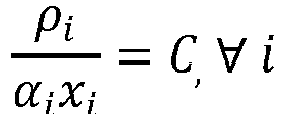
- The method of claim 1, wherein the model performance metric further comprises a classification performance or classification error adjusted based on user feedback.
- The method of claim 1, wherein at least one of the multiple layers is a convolutional layer.
- The method of claims 3, wherein the receiving the input step comprises first decomposing the input into multiple channels.
- The method of claim 1, wherein at least one of the multiple layers is a fully connected layer.
- The method of claim 1, wherein at least one activation bit width is different from at least one weight bit width.
- The method of claim 1, wherein:multiplying the set of activation values with the set of weights generates a result used to generate a t set of intermediate calculations;the set of intermediate calculations is another set of activation values.
- The method of any of claims 1-7, wherein:the plurality of the multiple layers further comprise a set of corresponding bias values;the processing comprises quantizing the set of bias values to a layer bias bit width.
- The method of any of claims 1-8, wherein the plurality of the multiple layers comprises different components and the method further comprises selecting different bit widths for different components of the plurality of the multiple layers.
- An apparatus for selecting bit widths for a fixed point implementation of a machine learning model, comprising:a memory; andat least one processor coupled to the memory, the at least one processor configured to perform the method of any preceding claim.
- A computer-readable storage medium comprising instructions which, when executed by a computer, cause the computer to carry out the steps of the method of any one of claims 1-9.
Applications Claiming Priority (4)
| Application Number | Priority Date | Filing Date | Title |
|---|---|---|---|
| US201562159097P | 2015-05-08 | 2015-05-08 | |
| US14/936,594 US10262259B2 (en) | 2015-05-08 | 2015-11-09 | Bit width selection for fixed point neural networks |
| EP16718942.2A EP3295382B1 (en) | 2015-05-08 | 2016-04-11 | Bit width selection for fixed point neural networks |
| PCT/US2016/026944 WO2016182659A1 (en) | 2015-05-08 | 2016-04-11 | Bit width selection for fixed point neural networks |
Related Parent Applications (1)
| Application Number | Title | Priority Date | Filing Date |
|---|---|---|---|
| EP16718942.2A Division EP3295382B1 (en) | 2015-05-08 | 2016-04-11 | Bit width selection for fixed point neural networks |
Publications (2)
| Publication Number | Publication Date |
|---|---|
| EP3852016A1 EP3852016A1 (en) | 2021-07-21 |
| EP3852016B1 true EP3852016B1 (en) | 2024-11-06 |
Family
ID=57222755
Family Applications (2)
| Application Number | Title | Priority Date | Filing Date |
|---|---|---|---|
| EP21161624.8A Active EP3852016B1 (en) | 2015-05-08 | 2016-04-11 | Bit width selection for fixed point neural networks |
| EP16718942.2A Active EP3295382B1 (en) | 2015-05-08 | 2016-04-11 | Bit width selection for fixed point neural networks |
Family Applications After (1)
| Application Number | Title | Priority Date | Filing Date |
|---|---|---|---|
| EP16718942.2A Active EP3295382B1 (en) | 2015-05-08 | 2016-04-11 | Bit width selection for fixed point neural networks |
Country Status (4)
| Country | Link |
|---|---|
| US (1) | US10262259B2 (en) |
| EP (2) | EP3852016B1 (en) |
| CN (2) | CN113487021B (en) |
| WO (1) | WO2016182659A1 (en) |
Families Citing this family (130)
| Publication number | Priority date | Publication date | Assignee | Title |
|---|---|---|---|---|
| US10417525B2 (en) * | 2014-09-22 | 2019-09-17 | Samsung Electronics Co., Ltd. | Object recognition with reduced neural network weight precision |
| US10860887B2 (en) * | 2015-11-16 | 2020-12-08 | Samsung Electronics Co., Ltd. | Method and apparatus for recognizing object, and method and apparatus for training recognition model |
| US11106973B2 (en) * | 2016-03-16 | 2021-08-31 | Hong Kong Applied Science and Technology Research Institute Company Limited | Method and system for bit-depth reduction in artificial neural networks |
| US10311342B1 (en) * | 2016-04-14 | 2019-06-04 | XNOR.ai, Inc. | System and methods for efficiently implementing a convolutional neural network incorporating binarized filter and convolution operation for performing image classification |
| US10175980B2 (en) | 2016-10-27 | 2019-01-08 | Google Llc | Neural network compute tile |
| CN108345939B (en) * | 2017-01-25 | 2022-05-24 | 微软技术许可有限责任公司 | Neural network based on fixed-point operation |
| FR3062884B1 (en) * | 2017-02-15 | 2019-03-22 | Peugeot Citroen Automobiles Sa | CONTROL METHOD FOR CALCULATING THE SENSITIVITY OF A BEHAVIOR MODEL OF A MOTOR VEHICLE MOTOR ACTUATOR |
| KR102369209B1 (en) | 2017-02-23 | 2022-02-28 | 세레브라스 시스템즈 인코포레이티드 | Accelerated Deep Learning |
| JP6823495B2 (en) * | 2017-02-27 | 2021-02-03 | 株式会社日立製作所 | Information processing device and image recognition device |
| US20180285732A1 (en) * | 2017-03-30 | 2018-10-04 | Intel Corporation | Selective noise tolerance modes of operation in a memory |
| US10346944B2 (en) | 2017-04-09 | 2019-07-09 | Intel Corporation | Machine learning sparse computation mechanism |
| CA3108089C (en) | 2017-04-17 | 2024-04-02 | Cerebras Systems Inc. | Task activating for accelerated deep learning |
| US11488004B2 (en) | 2017-04-17 | 2022-11-01 | Cerebras Systems Inc. | Neuron smearing for accelerated deep learning |
| CA3099965C (en) | 2017-04-17 | 2022-08-02 | Cerebras Systems Inc. | Neuron smearing for accelerated deep learning |
| KR102292349B1 (en) * | 2017-04-19 | 2021-08-20 | 상하이 캠브리콘 인포메이션 테크놀로지 컴퍼니 리미티드 | Processing device and processing method |
| CN117933314A (en) | 2017-04-21 | 2024-04-26 | 上海寒武纪信息科技有限公司 | Processing device, processing method, chip and electronic device |
| US10409614B2 (en) | 2017-04-24 | 2019-09-10 | Intel Corporation | Instructions having support for floating point and integer data types in the same register |
| US10474458B2 (en) * | 2017-04-28 | 2019-11-12 | Intel Corporation | Instructions and logic to perform floating-point and integer operations for machine learning |
| US11017291B2 (en) * | 2017-04-28 | 2021-05-25 | Intel Corporation | Training with adaptive runtime and precision profiling |
| US9928460B1 (en) | 2017-06-16 | 2018-03-27 | Google Llc | Neural network accelerator tile architecture with three-dimensional stacking |
| US9916531B1 (en) * | 2017-06-22 | 2018-03-13 | Intel Corporation | Accumulator constrained quantization of convolutional neural networks |
| EP3639206B1 (en) * | 2017-07-06 | 2024-09-11 | Google LLC | Systems and methods for compression and distribution of machine learning models |
| WO2019008752A1 (en) * | 2017-07-07 | 2019-01-10 | 三菱電機株式会社 | Data processing device, data processing method, and compressed data |
| CN107688849B (en) * | 2017-07-28 | 2021-04-13 | 赛灵思电子科技(北京)有限公司 | A dynamic strategy fixed-point training method and device |
| KR102601604B1 (en) | 2017-08-04 | 2023-11-13 | 삼성전자주식회사 | Method and apparatus for quantizing parameter of neural network |
| US20190050710A1 (en) * | 2017-08-14 | 2019-02-14 | Midea Group Co., Ltd. | Adaptive bit-width reduction for neural networks |
| KR102728799B1 (en) | 2017-09-25 | 2024-11-11 | 삼성전자주식회사 | Method and apparatus of artificial neural network quantization |
| US11437032B2 (en) | 2017-09-29 | 2022-09-06 | Shanghai Cambricon Information Technology Co., Ltd | Image processing apparatus and method |
| CN108701250B (en) * | 2017-10-16 | 2022-03-04 | 深圳市大疆创新科技有限公司 | Data localization method and device |
| US11143532B2 (en) * | 2017-10-19 | 2021-10-12 | International Business Machines Corporation | Adaptive calibration of sensors through cognitive learning |
| KR102589303B1 (en) | 2017-11-02 | 2023-10-24 | 삼성전자주식회사 | Method and apparatus for generating fixed point type neural network |
| GB2568082B (en) * | 2017-11-03 | 2021-06-16 | Imagination Tech Ltd | Hierarchical mantissa bit length selection for hardware implementation of deep neural network |
| GB2568081B (en) * | 2017-11-03 | 2022-01-19 | Imagination Tech Ltd | End-to-end data format selection for hardware implementation of deep neural network |
| GB2568084B (en) | 2017-11-03 | 2022-01-12 | Imagination Tech Ltd | Error allocation format selection for hardware implementation of deep neural network |
| US11270187B2 (en) | 2017-11-07 | 2022-03-08 | Samsung Electronics Co., Ltd | Method and apparatus for learning low-precision neural network that combines weight quantization and activation quantization |
| KR102778191B1 (en) | 2017-11-07 | 2025-03-10 | 삼성전자주식회사 | Method and apparatus for performing devonvolution operation in neural network |
| US11164078B2 (en) | 2017-11-08 | 2021-11-02 | International Business Machines Corporation | Model matching and learning rate selection for fine tuning |
| KR102782965B1 (en) | 2017-11-13 | 2025-03-18 | 삼성전자주식회사 | Method and apparatus of artificial neural network quantization |
| US11270228B2 (en) * | 2017-11-17 | 2022-03-08 | Panasonic Intellectual Property Management Co., Ltd. | Information processing method and information processing system |
| WO2019101314A1 (en) * | 2017-11-23 | 2019-05-31 | Siemens Aktiengesellschaft | Method, controller, and computer program product for reducing oscillations in a technical system |
| KR102931058B1 (en) | 2017-12-05 | 2026-02-24 | 삼성전자주식회사 | Method and apparatus for processing convolution operation in neural network |
| US20190171927A1 (en) * | 2017-12-06 | 2019-06-06 | Facebook, Inc. | Layer-level quantization in neural networks |
| KR102788531B1 (en) | 2017-12-08 | 2025-03-31 | 삼성전자주식회사 | Method and apparatus for generating fixed point neural network |
| US11704125B2 (en) * | 2018-02-13 | 2023-07-18 | Cambricon (Xi'an) Semiconductor Co., Ltd. | Computing device and method |
| CN108334946B (en) * | 2018-02-13 | 2022-03-29 | 北京旷视科技有限公司 | Processing method, device and equipment of deep neural network model |
| CN110162162B (en) | 2018-02-14 | 2023-08-18 | 上海寒武纪信息科技有限公司 | Processor control device, method and device |
| CN108510067B (en) * | 2018-04-11 | 2021-11-09 | 西安电子科技大学 | Convolutional neural network quantification method based on engineering realization |
| US11144316B1 (en) | 2018-04-17 | 2021-10-12 | Ali Tasdighi Far | Current-mode mixed-signal SRAM based compute-in-memory for low power machine learning |
| KR102808577B1 (en) | 2018-04-27 | 2025-05-15 | 삼성전자주식회사 | Method and apparatus for quantizing parameters of neural network |
| US11875251B2 (en) * | 2018-05-03 | 2024-01-16 | Samsung Electronics Co., Ltd. | Neural network method and apparatus |
| US11562208B2 (en) * | 2018-05-17 | 2023-01-24 | Qualcomm Incorporated | Continuous relaxation of quantization for discretized deep neural networks |
| US11995556B2 (en) | 2018-05-18 | 2024-05-28 | Cambricon Technologies Corporation Limited | Video retrieval method, and method and apparatus for generating video retrieval mapping relationship |
| CN110147872B (en) * | 2018-05-18 | 2020-07-17 | 中科寒武纪科技股份有限公司 | Code storage device and method, processor and training method |
| US11551077B2 (en) | 2018-06-13 | 2023-01-10 | International Business Machines Corporation | Statistics-aware weight quantization |
| KR102470893B1 (en) | 2018-06-27 | 2022-11-25 | 상하이 캠브리콘 인포메이션 테크놀로지 컴퍼니 리미티드 | Debug method by breakpoint of on-chip code, chip debug system by on-chip processor and breakpoint |
| CN110728364B (en) | 2018-07-17 | 2024-12-17 | 上海寒武纪信息科技有限公司 | Arithmetic device and arithmetic method |
| CN109146060B (en) * | 2018-08-09 | 2022-04-22 | 郑州云海信息技术有限公司 | A method and device for processing data based on convolutional neural network |
| US20200065676A1 (en) * | 2018-08-22 | 2020-02-27 | National Tsing Hua University | Neural network method, system, and computer program product with inference-time bitwidth flexibility |
| US11328207B2 (en) | 2018-08-28 | 2022-05-10 | Cerebras Systems Inc. | Scaled compute fabric for accelerated deep learning |
| US11328208B2 (en) | 2018-08-29 | 2022-05-10 | Cerebras Systems Inc. | Processor element redundancy for accelerated deep learning |
| WO2020044208A1 (en) | 2018-08-29 | 2020-03-05 | Cerebras Systems Inc. | Isa enhancements for accelerated deep learning |
| US11348009B2 (en) * | 2018-09-24 | 2022-05-31 | Samsung Electronics Co., Ltd. | Non-uniform quantization of pre-trained deep neural network |
| CN109359732B (en) * | 2018-09-30 | 2020-06-09 | 阿里巴巴集团控股有限公司 | Chip and data processing method based on chip |
| WO2020075433A1 (en) * | 2018-10-10 | 2020-04-16 | LeapMind株式会社 | Neural network processing device, neural network processing method, and neural network processing program |
| JP7040771B2 (en) * | 2018-10-10 | 2022-03-23 | LeapMind株式会社 | Neural network processing equipment, communication equipment, neural network processing methods, and programs |
| KR102917770B1 (en) | 2018-10-17 | 2026-01-23 | 삼성전자주식회사 | Method and apparatus for quantizing neural network parameters |
| FR3089329A1 (en) * | 2018-11-29 | 2020-06-05 | Stmicroelectronics (Rousset) Sas | Method for analyzing a set of parameters of a neural network in order to obtain a technical improvement, for example a gain in memory. |
| KR102778192B1 (en) | 2018-12-03 | 2025-03-10 | 삼성전자주식회사 | Semiconductor memory device employing processing in memory (PIM) and operating method for the same |
| KR102891571B1 (en) | 2018-12-19 | 2025-11-26 | 삼성전자주식회사 | Method and apparatus for processing neural network based on nested bit representation |
| US20200202213A1 (en) * | 2018-12-19 | 2020-06-25 | Microsoft Technology Licensing, Llc | Scaled learning for training dnn |
| CN111383157B (en) * | 2018-12-29 | 2023-04-14 | 北京市商汤科技开发有限公司 | Image processing method, device, vehicle-mounted computing platform, electronic equipment and system |
| US11507823B2 (en) * | 2019-01-22 | 2022-11-22 | Black Sesame Technologies Inc. | Adaptive quantization and mixed precision in a network |
| WO2020175862A1 (en) | 2019-02-25 | 2020-09-03 | 주식회사 딥엑스 | Method and system for bit quantization of artificial neural network |
| KR102152374B1 (en) * | 2019-02-25 | 2020-09-07 | 주식회사 딥엑스 | Method and system for bit quantization of artificial neural network |
| WO2020177863A1 (en) * | 2019-03-06 | 2020-09-10 | Nokia Technologies Oy | Training of algorithms |
| US12561276B2 (en) | 2019-03-15 | 2026-02-24 | Intel Corporation | Systems and methods for updating memory side caches in a multi-GPU configuration |
| FR3094118A1 (en) * | 2019-03-20 | 2020-09-25 | Stmicroelectronics (Rousset) Sas | A method of analyzing a set of parameters of a neural network with a view to adjusting areas allocated to said parameters. |
| CN110059805B (en) * | 2019-04-15 | 2021-08-31 | 广州异构智能科技有限公司 | Method for a binary array tensor processor |
| CN110033086B (en) * | 2019-04-15 | 2022-03-22 | 广州异构智能科技有限公司 | Hardware accelerator for neural network convolution operations |
| CN110033085B (en) * | 2019-04-15 | 2021-08-31 | 广州异构智能科技有限公司 | Tensor processor |
| US20220318572A1 (en) * | 2019-06-05 | 2022-10-06 | Nippon Telegraph And Telephone Corporation | Inference Processing Apparatus and Inference Processing Method |
| KR102774094B1 (en) * | 2019-06-05 | 2025-03-04 | 삼성전자주식회사 | Electronic apparatus and method of performing operations thereof |
| CN112085187A (en) * | 2019-06-12 | 2020-12-15 | 安徽寒武纪信息科技有限公司 | Data processing method, data processing device, computer equipment and storage medium |
| CN112085188B (en) | 2019-06-12 | 2024-04-02 | 上海寒武纪信息科技有限公司 | Method for determining quantization parameter of neural network and related product |
| US11676029B2 (en) | 2019-06-12 | 2023-06-13 | Shanghai Cambricon Information Technology Co., Ltd | Neural network quantization parameter determination method and related products |
| WO2021022903A1 (en) * | 2019-08-07 | 2021-02-11 | 安徽寒武纪信息科技有限公司 | Data processing method and apparatus, computer device, and storage medium |
| US12518148B2 (en) | 2019-08-23 | 2026-01-06 | Anhui Cambricon Information Technology Co., Ltd. | Data processing method, device, computer equipment and storage medium |
| EP4020321A4 (en) | 2019-08-23 | 2024-01-17 | Anhui Cambricon Information Technology Co., Ltd. | DATA PROCESSING METHOD, APPARATUS, COMPUTER DEVICE AND STORAGE MEDIUM |
| EP4020329A4 (en) * | 2019-08-23 | 2023-07-05 | Anhui Cambricon Information Technology Co., Ltd. | DATA PROCESSING METHOD AND APPARATUS, COMPUTER EQUIPMENT, AND STORAGE MEDIA |
| CN112434781B (en) | 2019-08-26 | 2024-09-10 | 上海寒武纪信息科技有限公司 | Method, device and related product for processing data |
| JP7146953B2 (en) * | 2019-08-27 | 2022-10-04 | 安徽寒武紀信息科技有限公司 | DATA PROCESSING METHOD, APPARATUS, COMPUTER DEVICE, AND STORAGE MEDIUM |
| CN110728365B (en) * | 2019-09-12 | 2022-04-01 | 东南大学 | Method for selecting calculation bit width of multi-bit-width PE array and calculation precision control circuit |
| KR20210032140A (en) | 2019-09-16 | 2021-03-24 | 삼성전자주식회사 | Method and apparatus for performing pruning of neural network |
| JP7322622B2 (en) * | 2019-09-17 | 2023-08-08 | 富士通株式会社 | Information processing device, information processing method and information processing program |
| US10915298B1 (en) | 2019-10-08 | 2021-02-09 | Ali Tasdighi Far | Current mode multiply-accumulate for compute in memory binarized neural networks |
| US12177133B2 (en) | 2019-10-16 | 2024-12-24 | Cerebras Systems Inc. | Dynamic routing for accelerated deep learning |
| WO2021074865A1 (en) | 2019-10-16 | 2021-04-22 | Cerebras Systems Inc. | Basic wavelet filtering for accelerated deep learning |
| WO2021086861A1 (en) * | 2019-10-28 | 2021-05-06 | Lightmatter, Inc. | Quantized architecture search for machine learning models |
| KR102785402B1 (en) | 2019-12-06 | 2025-03-21 | 삼성전자주식회사 | Apparatus and method for performing matrix multiplication operation of neural network |
| US12570296B2 (en) * | 2019-12-27 | 2026-03-10 | Mobileye Vision Technologies Ltd. | Driving safety systems |
| KR20210083935A (en) | 2019-12-27 | 2021-07-07 | 삼성전자주식회사 | Method and apparatus for quantizing parameters of neural network |
| KR102852287B1 (en) | 2019-12-30 | 2025-08-28 | 삼성전자주식회사 | Processing apparatus and method for processing floating point operation thereof |
| US11610104B1 (en) | 2019-12-30 | 2023-03-21 | Ali Tasdighi Far | Asynchronous analog accelerator for fully connected artificial neural networks |
| US11615256B1 (en) | 2019-12-30 | 2023-03-28 | Ali Tasdighi Far | Hybrid accumulation method in multiply-accumulate for machine learning |
| CN113269320B (en) * | 2020-02-14 | 2024-07-26 | 平头哥(上海)半导体技术有限公司 | Processing unit, computing device, system on chip, data center and related methods |
| CN113298843B (en) | 2020-02-24 | 2024-05-14 | 中科寒武纪科技股份有限公司 | Data quantization processing method, device, electronic equipment and storage medium |
| CN113408716B (en) | 2020-03-17 | 2025-06-24 | 安徽寒武纪信息科技有限公司 | Computing device, method, board and computer readable storage medium |
| CN113408717B (en) | 2020-03-17 | 2025-09-09 | 安徽寒武纪信息科技有限公司 | Computing device, method, board card and computer readable storage medium |
| TWI743710B (en) * | 2020-03-18 | 2021-10-21 | 國立中山大學 | Method, electric device and computer program product for convolutional neural network |
| US11468276B2 (en) * | 2020-04-16 | 2022-10-11 | Robert Bosch Gmbh | System and method of a monotone operator neural network |
| CN111563593B (en) * | 2020-05-08 | 2023-09-15 | 北京百度网讯科技有限公司 | Training methods and devices for neural network models |
| US12015526B2 (en) * | 2020-05-26 | 2024-06-18 | Synopsys, Inc. | Mixed-precision neural networks |
| GB2596150B (en) * | 2020-06-19 | 2022-06-15 | Imagination Tech Ltd | Methods and systems for selecting number formats for deep neural networks based on network sensitivity and quantisation error |
| GB2596606B (en) | 2020-07-03 | 2025-01-01 | Imagination Tech Ltd | Number format selection in recurrent neural networks |
| CN111898751B (en) * | 2020-07-29 | 2022-11-25 | 苏州浪潮智能科技有限公司 | Data processing method, system, equipment and readable storage medium |
| KR20220040234A (en) | 2020-09-23 | 2022-03-30 | 삼성전자주식회사 | Method and apparatus for quantizing parameters of neural network |
| WO2022155890A1 (en) * | 2021-01-22 | 2022-07-28 | Qualcomm Incorporated | Decreased quantization latency |
| US12235931B2 (en) * | 2021-03-08 | 2025-02-25 | Samsung Electronics Co., Ltd. | Methods for training and analysing input data using a machine learning model |
| GB2606601A (en) * | 2021-03-08 | 2022-11-16 | Samsung Electronics Co Ltd | Methods for training and analysing input data using a machine learning model |
| US20220300800A1 (en) * | 2021-03-19 | 2022-09-22 | Vianai Systems, Inc. | Techniques for adaptive generation and visualization of quantized neural networks |
| US20220335293A1 (en) * | 2021-04-19 | 2022-10-20 | Samsung Electronics Co., Ltd. | Method of optimizing neural network model that is pre-trained, method of providing a graphical user interface related to optimizing neural network model, and neural network model processing system performing the same |
| WO2023006805A1 (en) * | 2021-07-28 | 2023-02-02 | Centre National De La Recherche Scientifique | Pattern learning and recognition device and associated system and method |
| WO2023038217A1 (en) * | 2021-09-07 | 2023-03-16 | 삼성전자 주식회사 | Electronic apparatus for processing neural network model and operating method therefor |
| EP4296904B1 (en) | 2021-09-07 | 2025-09-17 | Samsung Electronics Co., Ltd. | Electronic apparatus for processing neural network model and operating method therefor |
| CN118661179A (en) * | 2022-01-28 | 2024-09-17 | 高通股份有限公司 | Quantitative Robust Federated Machine Learning |
| US12499345B2 (en) * | 2022-03-24 | 2025-12-16 | Qualcomm Incorporated | Simulated low bit-width quantization using bit shifted neural network parameters |
| CN114670856B (en) * | 2022-03-30 | 2022-11-25 | 湖南大学无锡智能控制研究院 | Parameter self-tuning longitudinal control method and system based on BP neural network |
| CN117648964A (en) * | 2022-08-30 | 2024-03-05 | 华为技术有限公司 | Model compression method, device and related equipment |
| CN116882457A (en) * | 2023-07-26 | 2023-10-13 | 上海阵量智能科技有限公司 | Neural network quantization method, device, chip, electronic equipment and storage medium |
| WO2025141421A1 (en) * | 2023-12-27 | 2025-07-03 | 株式会社半導体エネルギー研究所 | Display device |
Family Cites Families (21)
| Publication number | Priority date | Publication date | Assignee | Title |
|---|---|---|---|---|
| US8103606B2 (en) | 2006-12-08 | 2012-01-24 | Medhat Moussa | Architecture, system and method for artificial neural network implementation |
| US8423852B2 (en) * | 2008-04-15 | 2013-04-16 | Qualcomm Incorporated | Channel decoding-based error detection |
| US8831141B2 (en) * | 2010-06-25 | 2014-09-09 | Qualcomm Incorporated | Leading edge detection |
| US20140222738A1 (en) | 2011-06-09 | 2014-08-07 | Karen E. Joyce | Agent-Based Brain Model and Related Methods |
| US20130204814A1 (en) * | 2012-02-08 | 2013-08-08 | Qualcomm Incorporated | Methods and apparatus for spiking neural computation |
| US9015096B2 (en) * | 2012-05-30 | 2015-04-21 | Qualcomm Incorporated | Continuous time spiking neural network event-based simulation that schedules co-pending events using an indexable list of nodes |
| US9224089B2 (en) | 2012-08-07 | 2015-12-29 | Qualcomm Incorporated | Method and apparatus for adaptive bit-allocation in neural systems |
| CN103092074B (en) * | 2012-12-30 | 2015-09-09 | 重庆邮电大学 | The parameter optimization control method of semiconductor Advanced process control |
| US9323498B2 (en) | 2013-03-13 | 2016-04-26 | Wisconsin Alumni Research Foundation | Multiplier circuit with dynamic energy consumption adjustment |
| WO2015073771A2 (en) | 2013-11-15 | 2015-05-21 | Saffron Technology, Inc. | Methods, systems and computer program products for using a distributed associative memory base to determine data correlations and convergence therein |
| US9978014B2 (en) | 2013-12-18 | 2018-05-22 | Intel Corporation | Reconfigurable processing unit |
| US20150269480A1 (en) * | 2014-03-21 | 2015-09-24 | Qualcomm Incorporated | Implementing a neural-network processor |
| US20150269479A1 (en) * | 2014-03-24 | 2015-09-24 | Qualcomm Incorporated | Conversion of neuron types to hardware |
| US20150269481A1 (en) * | 2014-03-24 | 2015-09-24 | Qualcomm Incorporated | Differential encoding in neural networks |
| US20150269482A1 (en) * | 2014-03-24 | 2015-09-24 | Qualcomm Incorporated | Artificial neural network and perceptron learning using spiking neurons |
| US10402720B2 (en) * | 2014-07-16 | 2019-09-03 | Qualcomm Incorporated | Decomposing convolution operation in neural networks |
| US9886418B2 (en) * | 2015-04-28 | 2018-02-06 | Intel Corporation | Matrix operands for linear algebra operations |
| US10373050B2 (en) * | 2015-05-08 | 2019-08-06 | Qualcomm Incorporated | Fixed point neural network based on floating point neural network quantization |
| US20160328645A1 (en) * | 2015-05-08 | 2016-11-10 | Qualcomm Incorporated | Reduced computational complexity for fixed point neural network |
| US20160328644A1 (en) * | 2015-05-08 | 2016-11-10 | Qualcomm Incorporated | Adaptive selection of artificial neural networks |
| US10037306B2 (en) * | 2016-09-01 | 2018-07-31 | Qualcomm Incorporated | Approximation of non-linear functions in fixed point using look-up tables |
-
2015
- 2015-11-09 US US14/936,594 patent/US10262259B2/en active Active
-
2016
- 2016-04-11 CN CN202110936027.1A patent/CN113487021B/en active Active
- 2016-04-11 CN CN201680026249.7A patent/CN107646116B/en active Active
- 2016-04-11 WO PCT/US2016/026944 patent/WO2016182659A1/en not_active Ceased
- 2016-04-11 EP EP21161624.8A patent/EP3852016B1/en active Active
- 2016-04-11 EP EP16718942.2A patent/EP3295382B1/en active Active
Also Published As
| Publication number | Publication date |
|---|---|
| CN113487021B (en) | 2025-01-03 |
| WO2016182659A1 (en) | 2016-11-17 |
| US20160328647A1 (en) | 2016-11-10 |
| CN107646116B (en) | 2021-07-30 |
| CN107646116A (en) | 2018-01-30 |
| CN113487021A (en) | 2021-10-08 |
| US10262259B2 (en) | 2019-04-16 |
| EP3295382A1 (en) | 2018-03-21 |
| EP3852016A1 (en) | 2021-07-21 |
| EP3295382B1 (en) | 2021-03-10 |
Similar Documents
| Publication | Publication Date | Title |
|---|---|---|
| EP3852016B1 (en) | Bit width selection for fixed point neural networks | |
| US12131258B2 (en) | Joint pruning and quantization scheme for deep neural networks | |
| US11238346B2 (en) | Learning a truncation rank of singular value decomposed matrices representing weight tensors in neural networks | |
| US10373050B2 (en) | Fixed point neural network based on floating point neural network quantization | |
| US10332028B2 (en) | Method for improving performance of a trained machine learning model | |
| US10515304B2 (en) | Filter specificity as training criterion for neural networks | |
| US11423323B2 (en) | Generating a sparse feature vector for classification | |
| US10275719B2 (en) | Hyper-parameter selection for deep convolutional networks | |
| US20160328645A1 (en) | Reduced computational complexity for fixed point neural network | |
| US11586924B2 (en) | Determining layer ranks for compression of deep networks | |
| US20170091619A1 (en) | Selective backpropagation | |
| US20160328644A1 (en) | Adaptive selection of artificial neural networks | |
| US20190354865A1 (en) | Variance propagation for quantization | |
| US11704571B2 (en) | Learned threshold pruning for deep neural networks | |
| EP4500396B1 (en) | Simulated low bit-width quantization using bit shifted neural network parameters | |
| WO2025096058A1 (en) | Conformal predictions to upper-bound intrinsic aleatoric uncertainty | |
| US20220108165A1 (en) | Quantifying reward and resource allocation for concurrent partial deep learning workloads in multi core environments | |
| WO2026044468A1 (en) | Smooth perplexity (ppl) for fast and precise large language model (llm) evaluation | |
| KR20230091879A (en) | Sub-spectral normalization for neural audio data processing |
Legal Events
| Date | Code | Title | Description |
|---|---|---|---|
| PUAI | Public reference made under article 153(3) epc to a published international application that has entered the european phase |
Free format text: ORIGINAL CODE: 0009012 |
|
| STAA | Information on the status of an ep patent application or granted ep patent |
Free format text: STATUS: THE APPLICATION HAS BEEN PUBLISHED |
|
| AC | Divisional application: reference to earlier application |
Ref document number: 3295382 Country of ref document: EP Kind code of ref document: P |
|
| AK | Designated contracting states |
Kind code of ref document: A1 Designated state(s): AL AT BE BG CH CY CZ DE DK EE ES FI FR GB GR HR HU IE IS IT LI LT LU LV MC MK MT NL NO PL PT RO RS SE SI SK SM TR |
|
| STAA | Information on the status of an ep patent application or granted ep patent |
Free format text: STATUS: REQUEST FOR EXAMINATION WAS MADE |
|
| 17P | Request for examination filed |
Effective date: 20220120 |
|
| RBV | Designated contracting states (corrected) |
Designated state(s): AL AT BE BG CH CY CZ DE DK EE ES FI FR GB GR HR HU IE IS IT LI LT LU LV MC MK MT NL NO PL PT RO RS SE SI SK SM TR |
|
| STAA | Information on the status of an ep patent application or granted ep patent |
Free format text: STATUS: EXAMINATION IS IN PROGRESS |
|
| 17Q | First examination report despatched |
Effective date: 20231204 |
|
| RIC1 | Information provided on ipc code assigned before grant |
Ipc: G06N 3/10 20060101ALN20240423BHEP Ipc: G06N 3/063 20060101AFI20240423BHEP |
|
| GRAP | Despatch of communication of intention to grant a patent |
Free format text: ORIGINAL CODE: EPIDOSNIGR1 |
|
| STAA | Information on the status of an ep patent application or granted ep patent |
Free format text: STATUS: GRANT OF PATENT IS INTENDED |
|
| INTG | Intention to grant announced |
Effective date: 20240603 |
|
| GRAS | Grant fee paid |
Free format text: ORIGINAL CODE: EPIDOSNIGR3 |
|
| GRAA | (expected) grant |
Free format text: ORIGINAL CODE: 0009210 |
|
| STAA | Information on the status of an ep patent application or granted ep patent |
Free format text: STATUS: THE PATENT HAS BEEN GRANTED |
|
| AC | Divisional application: reference to earlier application |
Ref document number: 3295382 Country of ref document: EP Kind code of ref document: P |
|
| AK | Designated contracting states |
Kind code of ref document: B1 Designated state(s): AL AT BE BG CH CY CZ DE DK EE ES FI FR GB GR HR HU IE IS IT LI LT LU LV MC MK MT NL NO PL PT RO RS SE SI SK SM TR |
|
| REG | Reference to a national code |
Ref country code: GB Ref legal event code: FG4D |
|
| REG | Reference to a national code |
Ref country code: CH Ref legal event code: EP |
|
| REG | Reference to a national code |
Ref country code: DE Ref legal event code: R096 Ref document number: 602016090192 Country of ref document: DE |
|
| REG | Reference to a national code |
Ref country code: IE Ref legal event code: FG4D |
|
| REG | Reference to a national code |
Ref country code: LT Ref legal event code: MG9D |
|
| REG | Reference to a national code |
Ref country code: NL Ref legal event code: MP Effective date: 20241106 |
|
| PG25 | Lapsed in a contracting state [announced via postgrant information from national office to epo] |
Ref country code: IS Free format text: LAPSE BECAUSE OF FAILURE TO SUBMIT A TRANSLATION OF THE DESCRIPTION OR TO PAY THE FEE WITHIN THE PRESCRIBED TIME-LIMIT Effective date: 20250306 Ref country code: PT Free format text: LAPSE BECAUSE OF FAILURE TO SUBMIT A TRANSLATION OF THE DESCRIPTION OR TO PAY THE FEE WITHIN THE PRESCRIBED TIME-LIMIT Effective date: 20250306 Ref country code: HR Free format text: LAPSE BECAUSE OF FAILURE TO SUBMIT A TRANSLATION OF THE DESCRIPTION OR TO PAY THE FEE WITHIN THE PRESCRIBED TIME-LIMIT Effective date: 20241106 |
|
| PG25 | Lapsed in a contracting state [announced via postgrant information from national office to epo] |
Ref country code: FI Free format text: LAPSE BECAUSE OF FAILURE TO SUBMIT A TRANSLATION OF THE DESCRIPTION OR TO PAY THE FEE WITHIN THE PRESCRIBED TIME-LIMIT Effective date: 20241106 Ref country code: NL Free format text: LAPSE BECAUSE OF FAILURE TO SUBMIT A TRANSLATION OF THE DESCRIPTION OR TO PAY THE FEE WITHIN THE PRESCRIBED TIME-LIMIT Effective date: 20241106 |
|
| REG | Reference to a national code |
Ref country code: AT Ref legal event code: MK05 Ref document number: 1740182 Country of ref document: AT Kind code of ref document: T Effective date: 20241106 |
|
| PG25 | Lapsed in a contracting state [announced via postgrant information from national office to epo] |
Ref country code: BG Free format text: LAPSE BECAUSE OF FAILURE TO SUBMIT A TRANSLATION OF THE DESCRIPTION OR TO PAY THE FEE WITHIN THE PRESCRIBED TIME-LIMIT Effective date: 20241106 |
|
| PG25 | Lapsed in a contracting state [announced via postgrant information from national office to epo] |
Ref country code: ES Free format text: LAPSE BECAUSE OF FAILURE TO SUBMIT A TRANSLATION OF THE DESCRIPTION OR TO PAY THE FEE WITHIN THE PRESCRIBED TIME-LIMIT Effective date: 20241106 |
|
| PG25 | Lapsed in a contracting state [announced via postgrant information from national office to epo] |
Ref country code: NO Free format text: LAPSE BECAUSE OF FAILURE TO SUBMIT A TRANSLATION OF THE DESCRIPTION OR TO PAY THE FEE WITHIN THE PRESCRIBED TIME-LIMIT Effective date: 20250206 |
|
| PG25 | Lapsed in a contracting state [announced via postgrant information from national office to epo] |
Ref country code: GR Free format text: LAPSE BECAUSE OF FAILURE TO SUBMIT A TRANSLATION OF THE DESCRIPTION OR TO PAY THE FEE WITHIN THE PRESCRIBED TIME-LIMIT Effective date: 20250207 Ref country code: LV Free format text: LAPSE BECAUSE OF FAILURE TO SUBMIT A TRANSLATION OF THE DESCRIPTION OR TO PAY THE FEE WITHIN THE PRESCRIBED TIME-LIMIT Effective date: 20241106 Ref country code: AT Free format text: LAPSE BECAUSE OF FAILURE TO SUBMIT A TRANSLATION OF THE DESCRIPTION OR TO PAY THE FEE WITHIN THE PRESCRIBED TIME-LIMIT Effective date: 20241106 |
|
| PG25 | Lapsed in a contracting state [announced via postgrant information from national office to epo] |
Ref country code: PL Free format text: LAPSE BECAUSE OF FAILURE TO SUBMIT A TRANSLATION OF THE DESCRIPTION OR TO PAY THE FEE WITHIN THE PRESCRIBED TIME-LIMIT Effective date: 20241106 |
|
| PGFP | Annual fee paid to national office [announced via postgrant information from national office to epo] |
Ref country code: FR Payment date: 20250319 Year of fee payment: 10 |
|
| PGFP | Annual fee paid to national office [announced via postgrant information from national office to epo] |
Ref country code: GB Payment date: 20250313 Year of fee payment: 10 |
|
| PG25 | Lapsed in a contracting state [announced via postgrant information from national office to epo] |
Ref country code: RS Free format text: LAPSE BECAUSE OF FAILURE TO SUBMIT A TRANSLATION OF THE DESCRIPTION OR TO PAY THE FEE WITHIN THE PRESCRIBED TIME-LIMIT Effective date: 20250206 |
|
| PG25 | Lapsed in a contracting state [announced via postgrant information from national office to epo] |
Ref country code: SM Free format text: LAPSE BECAUSE OF FAILURE TO SUBMIT A TRANSLATION OF THE DESCRIPTION OR TO PAY THE FEE WITHIN THE PRESCRIBED TIME-LIMIT Effective date: 20241106 |
|
| PGFP | Annual fee paid to national office [announced via postgrant information from national office to epo] |
Ref country code: DE Payment date: 20250317 Year of fee payment: 10 |
|
| PG25 | Lapsed in a contracting state [announced via postgrant information from national office to epo] |
Ref country code: DK Free format text: LAPSE BECAUSE OF FAILURE TO SUBMIT A TRANSLATION OF THE DESCRIPTION OR TO PAY THE FEE WITHIN THE PRESCRIBED TIME-LIMIT Effective date: 20241106 |
|
| PG25 | Lapsed in a contracting state [announced via postgrant information from national office to epo] |
Ref country code: EE Free format text: LAPSE BECAUSE OF FAILURE TO SUBMIT A TRANSLATION OF THE DESCRIPTION OR TO PAY THE FEE WITHIN THE PRESCRIBED TIME-LIMIT Effective date: 20241106 |
|
| PG25 | Lapsed in a contracting state [announced via postgrant information from national office to epo] |
Ref country code: RO Free format text: LAPSE BECAUSE OF FAILURE TO SUBMIT A TRANSLATION OF THE DESCRIPTION OR TO PAY THE FEE WITHIN THE PRESCRIBED TIME-LIMIT Effective date: 20241106 |
|
| PG25 | Lapsed in a contracting state [announced via postgrant information from national office to epo] |
Ref country code: SK Free format text: LAPSE BECAUSE OF FAILURE TO SUBMIT A TRANSLATION OF THE DESCRIPTION OR TO PAY THE FEE WITHIN THE PRESCRIBED TIME-LIMIT Effective date: 20241106 |
|
| PG25 | Lapsed in a contracting state [announced via postgrant information from national office to epo] |
Ref country code: CZ Free format text: LAPSE BECAUSE OF FAILURE TO SUBMIT A TRANSLATION OF THE DESCRIPTION OR TO PAY THE FEE WITHIN THE PRESCRIBED TIME-LIMIT Effective date: 20241106 |
|
| PG25 | Lapsed in a contracting state [announced via postgrant information from national office to epo] |
Ref country code: IT Free format text: LAPSE BECAUSE OF FAILURE TO SUBMIT A TRANSLATION OF THE DESCRIPTION OR TO PAY THE FEE WITHIN THE PRESCRIBED TIME-LIMIT Effective date: 20241106 |
|
| REG | Reference to a national code |
Ref country code: DE Ref legal event code: R097 Ref document number: 602016090192 Country of ref document: DE |
|
| PG25 | Lapsed in a contracting state [announced via postgrant information from national office to epo] |
Ref country code: SE Free format text: LAPSE BECAUSE OF FAILURE TO SUBMIT A TRANSLATION OF THE DESCRIPTION OR TO PAY THE FEE WITHIN THE PRESCRIBED TIME-LIMIT Effective date: 20241106 |
|
| PLBE | No opposition filed within time limit |
Free format text: ORIGINAL CODE: 0009261 |
|
| STAA | Information on the status of an ep patent application or granted ep patent |
Free format text: STATUS: NO OPPOSITION FILED WITHIN TIME LIMIT |
|
| 26N | No opposition filed |
Effective date: 20250807 |
|
| REG | Reference to a national code |
Ref country code: CH Ref legal event code: H13 Free format text: ST27 STATUS EVENT CODE: U-0-0-H10-H13 (AS PROVIDED BY THE NATIONAL OFFICE) Effective date: 20251125 |
|
| PG25 | Lapsed in a contracting state [announced via postgrant information from national office to epo] |
Ref country code: LU Free format text: LAPSE BECAUSE OF NON-PAYMENT OF DUE FEES Effective date: 20250411 |
|
| PG25 | Lapsed in a contracting state [announced via postgrant information from national office to epo] |
Ref country code: MC Free format text: LAPSE BECAUSE OF FAILURE TO SUBMIT A TRANSLATION OF THE DESCRIPTION OR TO PAY THE FEE WITHIN THE PRESCRIBED TIME-LIMIT Effective date: 20241106 |
|
| REG | Reference to a national code |
Ref country code: BE Ref legal event code: MM Effective date: 20250430 |
|
| PG25 | Lapsed in a contracting state [announced via postgrant information from national office to epo] |
Ref country code: BE Free format text: LAPSE BECAUSE OF NON-PAYMENT OF DUE FEES Effective date: 20250430 |
|
| PG25 | Lapsed in a contracting state [announced via postgrant information from national office to epo] |
Ref country code: CH Free format text: LAPSE BECAUSE OF NON-PAYMENT OF DUE FEES Effective date: 20250430 |