EP3851216A1 - Method for producing ultra-thin hot-rolled strip steel - Google Patents
Method for producing ultra-thin hot-rolled strip steel Download PDFInfo
- Publication number
- EP3851216A1 EP3851216A1 EP19859829.4A EP19859829A EP3851216A1 EP 3851216 A1 EP3851216 A1 EP 3851216A1 EP 19859829 A EP19859829 A EP 19859829A EP 3851216 A1 EP3851216 A1 EP 3851216A1
- Authority
- EP
- European Patent Office
- Prior art keywords
- hot
- steel
- rolled strip
- strip steel
- thin
- Prior art date
- Legal status (The legal status is an assumption and is not a legal conclusion. Google has not performed a legal analysis and makes no representation as to the accuracy of the status listed.)
- Granted
Links
Images
Classifications
-
- C—CHEMISTRY; METALLURGY
- C21—METALLURGY OF IRON
- C21D—MODIFYING THE PHYSICAL STRUCTURE OF FERROUS METALS; GENERAL DEVICES FOR HEAT TREATMENT OF FERROUS OR NON-FERROUS METALS OR ALLOYS; MAKING METAL MALLEABLE, e.g. BY DECARBURISATION OR TEMPERING
- C21D9/00—Heat treatment, e.g. annealing, hardening, quenching or tempering, adapted for particular articles; Furnaces therefor
- C21D9/52—Heat treatment, e.g. annealing, hardening, quenching or tempering, adapted for particular articles; Furnaces therefor for wires; for strips ; for rods of unlimited length
-
- B—PERFORMING OPERATIONS; TRANSPORTING
- B21—MECHANICAL METAL-WORKING WITHOUT ESSENTIALLY REMOVING MATERIAL; PUNCHING METAL
- B21B—ROLLING OF METAL
- B21B1/00—Metal-rolling methods or mills for making semi-finished products of solid or profiled cross-section; Sequence of operations in milling trains; Layout of rolling-mill plant, e.g. grouping of stands; Succession of passes or of sectional pass alternations
- B21B1/22—Metal-rolling methods or mills for making semi-finished products of solid or profiled cross-section; Sequence of operations in milling trains; Layout of rolling-mill plant, e.g. grouping of stands; Succession of passes or of sectional pass alternations for rolling plates, strips, bands or sheets of indefinite length
-
- B—PERFORMING OPERATIONS; TRANSPORTING
- B21—MECHANICAL METAL-WORKING WITHOUT ESSENTIALLY REMOVING MATERIAL; PUNCHING METAL
- B21B—ROLLING OF METAL
- B21B1/00—Metal-rolling methods or mills for making semi-finished products of solid or profiled cross-section; Sequence of operations in milling trains; Layout of rolling-mill plant, e.g. grouping of stands; Succession of passes or of sectional pass alternations
- B21B1/46—Metal-rolling methods or mills for making semi-finished products of solid or profiled cross-section; Sequence of operations in milling trains; Layout of rolling-mill plant, e.g. grouping of stands; Succession of passes or of sectional pass alternations for rolling metal immediately subsequent to continuous casting
- B21B1/463—Metal-rolling methods or mills for making semi-finished products of solid or profiled cross-section; Sequence of operations in milling trains; Layout of rolling-mill plant, e.g. grouping of stands; Succession of passes or of sectional pass alternations for rolling metal immediately subsequent to continuous casting in a continuous process, i.e. the cast not being cut before rolling
-
- B—PERFORMING OPERATIONS; TRANSPORTING
- B22—CASTING; POWDER METALLURGY
- B22D—CASTING OF METALS; CASTING OF OTHER SUBSTANCES BY THE SAME PROCESSES OR DEVICES
- B22D1/00—Treatment of fused masses in the ladle or the supply runners before casting
-
- B—PERFORMING OPERATIONS; TRANSPORTING
- B22—CASTING; POWDER METALLURGY
- B22D—CASTING OF METALS; CASTING OF OTHER SUBSTANCES BY THE SAME PROCESSES OR DEVICES
- B22D11/00—Continuous casting of metals, i.e. casting in indefinite lengths
- B22D11/06—Continuous casting of metals, i.e. casting in indefinite lengths into moulds with travelling walls, e.g. with rolls, plates, belts, caterpillars
- B22D11/0622—Continuous casting of metals, i.e. casting in indefinite lengths into moulds with travelling walls, e.g. with rolls, plates, belts, caterpillars formed by two casting wheels
-
- B—PERFORMING OPERATIONS; TRANSPORTING
- B22—CASTING; POWDER METALLURGY
- B22D—CASTING OF METALS; CASTING OF OTHER SUBSTANCES BY THE SAME PROCESSES OR DEVICES
- B22D11/00—Continuous casting of metals, i.e. casting in indefinite lengths
- B22D11/10—Supplying or treating molten metal
- B22D11/103—Distributing the molten metal, e.g. using runners, floats, distributors
-
- B—PERFORMING OPERATIONS; TRANSPORTING
- B22—CASTING; POWDER METALLURGY
- B22D—CASTING OF METALS; CASTING OF OTHER SUBSTANCES BY THE SAME PROCESSES OR DEVICES
- B22D11/00—Continuous casting of metals, i.e. casting in indefinite lengths
- B22D11/10—Supplying or treating molten metal
- B22D11/11—Treating the molten metal
- B22D11/116—Refining the metal
-
- B—PERFORMING OPERATIONS; TRANSPORTING
- B22—CASTING; POWDER METALLURGY
- B22D—CASTING OF METALS; CASTING OF OTHER SUBSTANCES BY THE SAME PROCESSES OR DEVICES
- B22D11/00—Continuous casting of metals, i.e. casting in indefinite lengths
- B22D11/12—Accessories for subsequent treating or working cast stock in situ
-
- B—PERFORMING OPERATIONS; TRANSPORTING
- B22—CASTING; POWDER METALLURGY
- B22D—CASTING OF METALS; CASTING OF OTHER SUBSTANCES BY THE SAME PROCESSES OR DEVICES
- B22D11/00—Continuous casting of metals, i.e. casting in indefinite lengths
- B22D11/12—Accessories for subsequent treating or working cast stock in situ
- B22D11/1206—Accessories for subsequent treating or working cast stock in situ for plastic shaping of strands
-
- B—PERFORMING OPERATIONS; TRANSPORTING
- B22—CASTING; POWDER METALLURGY
- B22D—CASTING OF METALS; CASTING OF OTHER SUBSTANCES BY THE SAME PROCESSES OR DEVICES
- B22D11/00—Continuous casting of metals, i.e. casting in indefinite lengths
- B22D11/12—Accessories for subsequent treating or working cast stock in situ
- B22D11/124—Accessories for subsequent treating or working cast stock in situ for cooling
-
- B—PERFORMING OPERATIONS; TRANSPORTING
- B22—CASTING; POWDER METALLURGY
- B22D—CASTING OF METALS; CASTING OF OTHER SUBSTANCES BY THE SAME PROCESSES OR DEVICES
- B22D11/00—Continuous casting of metals, i.e. casting in indefinite lengths
- B22D11/12—Accessories for subsequent treating or working cast stock in situ
- B22D11/124—Accessories for subsequent treating or working cast stock in situ for cooling
- B22D11/1246—Nozzles; Spray heads
-
- B—PERFORMING OPERATIONS; TRANSPORTING
- B22—CASTING; POWDER METALLURGY
- B22D—CASTING OF METALS; CASTING OF OTHER SUBSTANCES BY THE SAME PROCESSES OR DEVICES
- B22D11/00—Continuous casting of metals, i.e. casting in indefinite lengths
- B22D11/14—Plants for continuous casting
-
- B—PERFORMING OPERATIONS; TRANSPORTING
- B22—CASTING; POWDER METALLURGY
- B22D—CASTING OF METALS; CASTING OF OTHER SUBSTANCES BY THE SAME PROCESSES OR DEVICES
- B22D11/00—Continuous casting of metals, i.e. casting in indefinite lengths
- B22D11/14—Plants for continuous casting
- B22D11/144—Plants for continuous casting with a rotating mould
-
- B—PERFORMING OPERATIONS; TRANSPORTING
- B22—CASTING; POWDER METALLURGY
- B22D—CASTING OF METALS; CASTING OF OTHER SUBSTANCES BY THE SAME PROCESSES OR DEVICES
- B22D11/00—Continuous casting of metals, i.e. casting in indefinite lengths
- B22D11/16—Controlling or regulating processes or operations
- B22D11/18—Controlling or regulating processes or operations for pouring
-
- B—PERFORMING OPERATIONS; TRANSPORTING
- B22—CASTING; POWDER METALLURGY
- B22D—CASTING OF METALS; CASTING OF OTHER SUBSTANCES BY THE SAME PROCESSES OR DEVICES
- B22D11/00—Continuous casting of metals, i.e. casting in indefinite lengths
- B22D11/16—Controlling or regulating processes or operations
- B22D11/20—Controlling or regulating processes or operations for removing cast stock
-
- B—PERFORMING OPERATIONS; TRANSPORTING
- B22—CASTING; POWDER METALLURGY
- B22D—CASTING OF METALS; CASTING OF OTHER SUBSTANCES BY THE SAME PROCESSES OR DEVICES
- B22D41/00—Casting melt-holding vessels, e.g. ladles, tundishes, cups or the like
- B22D41/12—Travelling ladles or similar containers; Cars for ladles
- B22D41/13—Ladle turrets
-
- C—CHEMISTRY; METALLURGY
- C21—METALLURGY OF IRON
- C21D—MODIFYING THE PHYSICAL STRUCTURE OF FERROUS METALS; GENERAL DEVICES FOR HEAT TREATMENT OF FERROUS OR NON-FERROUS METALS OR ALLOYS; MAKING METAL MALLEABLE, e.g. BY DECARBURISATION OR TEMPERING
- C21D1/00—General methods or devices for heat treatment, e.g. annealing, hardening, quenching or tempering
- C21D1/62—Quenching devices
- C21D1/667—Quenching devices for spray quenching
-
- C—CHEMISTRY; METALLURGY
- C21—METALLURGY OF IRON
- C21D—MODIFYING THE PHYSICAL STRUCTURE OF FERROUS METALS; GENERAL DEVICES FOR HEAT TREATMENT OF FERROUS OR NON-FERROUS METALS OR ALLOYS; MAKING METAL MALLEABLE, e.g. BY DECARBURISATION OR TEMPERING
- C21D8/00—Modifying the physical properties of ferrous metals or ferrous alloys by deformation combined with, or followed by, heat treatment
- C21D8/02—Modifying the physical properties of ferrous metals or ferrous alloys by deformation combined with, or followed by, heat treatment during manufacturing of plates or strips
-
- C—CHEMISTRY; METALLURGY
- C21—METALLURGY OF IRON
- C21D—MODIFYING THE PHYSICAL STRUCTURE OF FERROUS METALS; GENERAL DEVICES FOR HEAT TREATMENT OF FERROUS OR NON-FERROUS METALS OR ALLOYS; MAKING METAL MALLEABLE, e.g. BY DECARBURISATION OR TEMPERING
- C21D8/00—Modifying the physical properties of ferrous metals or ferrous alloys by deformation combined with, or followed by, heat treatment
- C21D8/02—Modifying the physical properties of ferrous metals or ferrous alloys by deformation combined with, or followed by, heat treatment during manufacturing of plates or strips
- C21D8/021—Modifying the physical properties of ferrous metals or ferrous alloys by deformation combined with, or followed by, heat treatment during manufacturing of plates or strips involving particular fabrication steps or treatments of ingots or slabs
- C21D8/0215—Rapid solidification; Thin strip casting
-
- C—CHEMISTRY; METALLURGY
- C21—METALLURGY OF IRON
- C21D—MODIFYING THE PHYSICAL STRUCTURE OF FERROUS METALS; GENERAL DEVICES FOR HEAT TREATMENT OF FERROUS OR NON-FERROUS METALS OR ALLOYS; MAKING METAL MALLEABLE, e.g. BY DECARBURISATION OR TEMPERING
- C21D8/00—Modifying the physical properties of ferrous metals or ferrous alloys by deformation combined with, or followed by, heat treatment
- C21D8/02—Modifying the physical properties of ferrous metals or ferrous alloys by deformation combined with, or followed by, heat treatment during manufacturing of plates or strips
- C21D8/0221—Modifying the physical properties of ferrous metals or ferrous alloys by deformation combined with, or followed by, heat treatment during manufacturing of plates or strips characterised by the working steps
- C21D8/0226—Hot rolling
-
- C—CHEMISTRY; METALLURGY
- C21—METALLURGY OF IRON
- C21D—MODIFYING THE PHYSICAL STRUCTURE OF FERROUS METALS; GENERAL DEVICES FOR HEAT TREATMENT OF FERROUS OR NON-FERROUS METALS OR ALLOYS; MAKING METAL MALLEABLE, e.g. BY DECARBURISATION OR TEMPERING
- C21D8/00—Modifying the physical properties of ferrous metals or ferrous alloys by deformation combined with, or followed by, heat treatment
- C21D8/02—Modifying the physical properties of ferrous metals or ferrous alloys by deformation combined with, or followed by, heat treatment during manufacturing of plates or strips
- C21D8/0247—Modifying the physical properties of ferrous metals or ferrous alloys by deformation combined with, or followed by, heat treatment during manufacturing of plates or strips characterised by the heat treatment
- C21D8/0263—Modifying the physical properties of ferrous metals or ferrous alloys by deformation combined with, or followed by, heat treatment during manufacturing of plates or strips characterised by the heat treatment following hot rolling
-
- C—CHEMISTRY; METALLURGY
- C21—METALLURGY OF IRON
- C21D—MODIFYING THE PHYSICAL STRUCTURE OF FERROUS METALS; GENERAL DEVICES FOR HEAT TREATMENT OF FERROUS OR NON-FERROUS METALS OR ALLOYS; MAKING METAL MALLEABLE, e.g. BY DECARBURISATION OR TEMPERING
- C21D9/00—Heat treatment, e.g. annealing, hardening, quenching or tempering, adapted for particular articles; Furnaces therefor
- C21D9/46—Heat treatment, e.g. annealing, hardening, quenching or tempering, adapted for particular articles; Furnaces therefor for sheet metals
-
- B—PERFORMING OPERATIONS; TRANSPORTING
- B21—MECHANICAL METAL-WORKING WITHOUT ESSENTIALLY REMOVING MATERIAL; PUNCHING METAL
- B21B—ROLLING OF METAL
- B21B1/00—Metal-rolling methods or mills for making semi-finished products of solid or profiled cross-section; Sequence of operations in milling trains; Layout of rolling-mill plant, e.g. grouping of stands; Succession of passes or of sectional pass alternations
- B21B1/22—Metal-rolling methods or mills for making semi-finished products of solid or profiled cross-section; Sequence of operations in milling trains; Layout of rolling-mill plant, e.g. grouping of stands; Succession of passes or of sectional pass alternations for rolling plates, strips, bands or sheets of indefinite length
- B21B2001/225—Metal-rolling methods or mills for making semi-finished products of solid or profiled cross-section; Sequence of operations in milling trains; Layout of rolling-mill plant, e.g. grouping of stands; Succession of passes or of sectional pass alternations for rolling plates, strips, bands or sheets of indefinite length by hot-rolling
-
- B—PERFORMING OPERATIONS; TRANSPORTING
- B21—MECHANICAL METAL-WORKING WITHOUT ESSENTIALLY REMOVING MATERIAL; PUNCHING METAL
- B21B—ROLLING OF METAL
- B21B37/00—Control devices or methods specially adapted for metal-rolling mills or the work produced thereby
- B21B37/74—Temperature control, e.g. by cooling or heating the rolls or the product
- B21B37/76—Cooling control on the run-out table
-
- Y—GENERAL TAGGING OF NEW TECHNOLOGICAL DEVELOPMENTS; GENERAL TAGGING OF CROSS-SECTIONAL TECHNOLOGIES SPANNING OVER SEVERAL SECTIONS OF THE IPC; TECHNICAL SUBJECTS COVERED BY FORMER USPC CROSS-REFERENCE ART COLLECTIONS [XRACs] AND DIGESTS
- Y02—TECHNOLOGIES OR APPLICATIONS FOR MITIGATION OR ADAPTATION AGAINST CLIMATE CHANGE
- Y02P—CLIMATE CHANGE MITIGATION TECHNOLOGIES IN THE PRODUCTION OR PROCESSING OF GOODS
- Y02P10/00—Technologies related to metal processing
- Y02P10/20—Recycling
Definitions
- the present disclosure relates to the technical field of hot-rolled strip steel production, in particular to a method of producing ultra-thin hot-rolled strip steel.
- Thin hot-rolled strip steel can not only reduce the number of cold rolling passes and reduce production cost when it is used as a cold rolling raw material, but also open up new uses and new markets for hot-rolled strip steel. Some products can replace cold-rolled strip steel, and bring huge economic benefits to manufacturers and users.
- scrap steel is used as the main raw material.
- the solidification cooling rate is only 10 -1 -10°C/s. Grain boundary segregation of the residual elements in the scrap steel occurs during the solidification process, which deteriorates the properties and quality of the steel, and even causes direct cracking and fracturing in severe cases. Therefore, in the traditional process, these harmful elements must be strictly controlled.
- pre-screening is required, and some special treatments are required in the steelmaking process, such as addition of a concentrate for dilution, etc., which undoubtedly increase the production cost.
- the scrap steel needs to be pre-screened and classified.
- some domestic electric furnace steel plants choose to add concentrates such as purchased sponge iron, iron carbide and the like to the raw material composition to dilute the harmful elements that are difficult to be removed from the scrap steel, thereby improving the quality of the molten steel.
- Some domestic steel plants that have both a blast furnace and an electric furnace add self-produced molten iron into the electric furnace as a raw material in the electric furnace to improve the production efficiency of the electric furnace, thereby shortening the tapping time of the electric furnace greatly.
- the blending ratio of the molten iron in the electric furnace can reach 30-50%.
- the present disclosure provides a method of producing ultra-thin hot-rolled strip steel to realize a compact short-flow process in which all that is smelted is scrap steel.
- the method of producing ultra-thin hot-rolled strip steel comprises the following process steps: (A). smelting step: delivering scrap steel to an induction electric furnace for smelting, so that the scrap steel is melted into molten steel; (B). refining step: using a ladle refining furnace and a ladle vacuum degassing furnace to refine the molten steel; (C). continuous casting step: using a twin-roll thin strip continuous casting system to cast the refined molten steel to a cast strip blank having a thickness of 1.6-2.5 mm; (D).
- hot rolling step delivering the cast strip blank that has been cast in the continuous casting step to a single-stand hot rolling mill for rolling into hot-rolled strip steel having a thickness of 0.8-1.5 mm;
- cooling and coiling step subjecting the hot-rolled strip steel to atomization cooling treatment to control the strip steel at a temperature 400-750 °C, followed by coiling.
- the scrap steel is delivered to the induction electric furnace by a charging vehicle having a preheating function, wherein a preheating temperature is 200-500 °C.
- a pouring temperature is controlled to be 30-80°C above the liquidus.
- the twin-roll thin strip continuous casting system has a casting speed of 60-150 m/min.
- the single-stand hot rolling mill has a total rolling reduction rate of not less than 15%.
- a protective enclosure is provided around the cast strip blank, and an inert gas is fed into the protective enclosure.
- the temperature of the hot-rolled strip steel is decreased at a cooling rate of 10 to 80° C/s.
- the atomization cooling treatment of the hot-rolled strip steel adopts three-stage cooling, wherein cooling capacities of the three-stage cooling are 50-80°C/s, 20-50°C/s and 10-20°C/s in order.
- the scrap steel is all-waste grade scrap steel.
- the induction electric furnace technology is utilized to realize 100% scrap steel smelting;
- the twin-roll thin strip continuous casting technology is utilized to realize the production of ultra-thin hot-rolled strip steel with excellent comprehensive performances from inferior scrap steel resources;
- the molten metal is directly cast into a thin gauge (2.5 mm thickness or less) strip blank, and the sheet material is subjected to single pass hot rolling, instead of rough rolling and hot rolling a traditional thick slab (having a thickness of 150 mm or more) to produce a hot rolled sheet, thereby obtaining a very compact short-flow process which well satisfies the requirements of low-carbon emission and short plant construction.
- the method of producing ultra-thin hot-rolled strip steel according to the present disclosure makes full use of the thin-strip continuous casting technology and the induction electric furnace technology.
- This method of producing ultra-thin hot-rolled strip steel is a compact short process that integrates smelting, continuous casting and rolling production processes.
- an extremely compact, environmentally friendly and economical process for producing ultra-thin hot-rolled strip steel is obtained, and the environmentally friendly and economical continuous production of metal strips is realized.
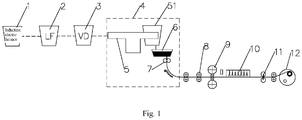
- Fig. 1 is a schematic view showing the process equipment for the method of producing ultra-thin hot-rolled strip steel according to the present disclosure.
- the method of producing ultra-thin hot-rolled strip steel comprises the following process steps: a smelting step, a refining step, a continuous casting step, a hot rolling step, and a cooling and coiling step.
- the process steps will be described in detail as follows:
- An air-water atomization cooling device 10 is used for the atomization cooling treatment.
- the temperature of the strip steel is reduced to 400-750 °C at a cooling rate of 10-80 °C/s, and the uniformity of the coiling temperature at the plate surface in the width and length directions is guaranteed.
- the atomization cooling treatment of the hot-rolled strip steel adopts three-stage cooling, wherein cooling capacities of the three-stage cooling are 50-80°C/s, 20-50°C/s and 10-20°C/s in order.
- the cooling capacity here refers to the rate at which the temperature of the strip steel is lowered by cooling.
- the cooled strip steel is coiled by a coiler 12.
- the coiler 12 may be a Carrousel coiler.
- a flying shear 11 is provided in front of the coiler 12 for cutting head (for the first coil) or splitting.
- the flying shear 11 may be a drum type flying shear with the functions of breaking, cutting head, cutting tail, and splitting.
- the coiler 12 comprises two cylinders to realize continuous coiling. The coiling temperature difference of each steel coil can be controlled within 10° C, and the weight of each steel coil is about 10-30 tons.
- the steel coil that has been coiled by the coiler 12 is coded and bundled, and then sent to a transitional steel coil store house by a conveying mechanism for air cooling or slow cooling. So far, the ultra-thin hot-rolled strip steel has experienced the whole process of producing qualified hot-rolled strip steel from liquid metal by casting and rolling.
- the ultra-thin hot-rolled strip steel can be used directly for further cold rolling production, surface coating, heat treatment processes, etc.
- the materials for the production may include carbon steel, silicon steel, stainless steel, etc..
- Non-ferrous metals, such as copper plate, aluminum plate, magnesium plate, etc. are also suitable.
- an induction electric furnace is used to melt scrap steel, and a ladle refining furnace (LF) and a ladle vacuum degassing furnace (VD) are used to refine the molten steel.
- the refined molten steel is delivered by a straddle trolley to a workshop for twin-roll thin strip continuous casting and continuous rolling.
- twin-roll thin strip continuous casting system the molten steel is directly cast into a cast strip blank having a thickness of 1.6-2.5mm, and then the cast strip blank is rolled by a single-stand hot rolling mill.
- the rolled strip blank is subjected to reasonable atomization cooling treatment, and coiled to obtain a hot-rolled coil having a weight of 10-30 tons and a strip steel thickness of 0.8-1.5 mm.
- the final product has the geometric shape and internal material properties required by the existing cold-rolled strip. Therefore, an extremely compact, environmentally friendly and economical novel process flow for producing ultra-thin hot-rolled strip steel is achieved.
Landscapes
- Engineering & Computer Science (AREA)
- Mechanical Engineering (AREA)
- Chemical & Material Sciences (AREA)
- Physics & Mathematics (AREA)
- Thermal Sciences (AREA)
- Crystallography & Structural Chemistry (AREA)
- Materials Engineering (AREA)
- Metallurgy (AREA)
- Organic Chemistry (AREA)
- Metal Rolling (AREA)
- Continuous Casting (AREA)
Abstract
Description
- The present disclosure relates to the technical field of hot-rolled strip steel production, in particular to a method of producing ultra-thin hot-rolled strip steel.
- In recent years, development of ultra-thin hot-rolled strip steel has gradually become a trend. Thin hot-rolled strip steel can not only reduce the number of cold rolling passes and reduce production cost when it is used as a cold rolling raw material, but also open up new uses and new markets for hot-rolled strip steel. Some products can replace cold-rolled strip steel, and bring huge economic benefits to manufacturers and users.
- In order to save investment cost and production cost, modern steel enterprises actively carry out technological innovations in existing production processes. In view of the long procedure, multiple equipments and complexity of the existing hot-rolled strip production processes, many manufacturers combine the continuous casting and rolling technology with traditional processes closely to meet the requirements of the continuous casting and rolling process. The process supplies molten steel for thin strip continuous casting mainly through an electric furnace or a converter.
- The use of a converter to provide molten steel for steelmaking requires that the manufacturer should have the conditions for providing molten iron. Generally, blast furnace ironmaking or non-blast furnace ironmaking equipment is needed. This belongs to the current long-process steel production mode.
- When an electric furnace is used to provide molten steel for steelmaking, scrap steel is used as the main raw material. In traditional processes such as die casting or thick slab continuous casting, the solidification cooling rate is only 10-1-10°C/s. Grain boundary segregation of the residual elements in the scrap steel occurs during the solidification process, which deteriorates the properties and quality of the steel, and even causes direct cracking and fracturing in severe cases. Therefore, in the traditional process, these harmful elements must be strictly controlled. In the selection of scrap steel raw materials, pre-screening is required, and some special treatments are required in the steelmaking process, such as addition of a concentrate for dilution, etc., which undoubtedly increase the production cost. Due to the need to control the steel composition, there are certain quality requirements for the scrap raw materials to be used. Generally, the scrap steel needs to be pre-screened and classified. In order to enhance the production efficiency, some domestic electric furnace steel plants choose to add concentrates such as purchased sponge iron, iron carbide and the like to the raw material composition to dilute the harmful elements that are difficult to be removed from the scrap steel, thereby improving the quality of the molten steel. Some domestic steel plants that have both a blast furnace and an electric furnace add self-produced molten iron into the electric furnace as a raw material in the electric furnace to improve the production efficiency of the electric furnace, thereby shortening the tapping time of the electric furnace greatly. The blending ratio of the molten iron in the electric furnace can reach 30-50%.
- In order to solve the above problems, the present disclosure provides a method of producing ultra-thin hot-rolled strip steel to realize a compact short-flow process in which all that is smelted is scrap steel.
- In order to fulfill the above object, the method of producing ultra-thin hot-rolled strip steel according to the present disclosure comprises the following process steps: (A). smelting step: delivering scrap steel to an induction electric furnace for smelting, so that the scrap steel is melted into molten steel; (B). refining step: using a ladle refining furnace and a ladle vacuum degassing furnace to refine the molten steel; (C). continuous casting step: using a twin-roll thin strip continuous casting system to cast the refined molten steel to a cast strip blank having a thickness of 1.6-2.5 mm; (D). hot rolling step: delivering the cast strip blank that has been cast in the continuous casting step to a single-stand hot rolling mill for rolling into hot-rolled strip steel having a thickness of 0.8-1.5 mm; (E). cooling and coiling step: subjecting the hot-rolled strip steel to atomization cooling treatment to control the strip steel at a temperature 400-750 °C, followed by coiling.
- Preferably, in the smelting step, the scrap steel is delivered to the induction electric furnace by a charging vehicle having a preheating function, wherein a preheating temperature is 200-500 °C.
- Preferably, in the continuous casting step, a pouring temperature is controlled to be 30-80°C above the liquidus.
- Preferably, the twin-roll thin strip continuous casting system has a casting speed of 60-150 m/min.
- Preferably, in the hot rolling step, the single-stand hot rolling mill has a total rolling reduction rate of not less than 15%.
- Preferably, when the cast strip blank that has been cast in the continuous casting step is delivered to the single-stand hot rolling mill, a protective enclosure is provided around the cast strip blank, and an inert gas is fed into the protective enclosure.
- Preferably, in the cooling and coiling step, when the hot-rolled strip steel is subjected to the atomization cooling treatment, the temperature of the hot-rolled strip steel is decreased at a cooling rate of 10 to 80° C/s.
- Further, the atomization cooling treatment of the hot-rolled strip steel adopts three-stage cooling, wherein cooling capacities of the three-stage cooling are 50-80°C/s, 20-50°C/s and 10-20°C/s in order.
- Preferably, the scrap steel is all-waste grade scrap steel.
- In the method of producing ultra-thin hot-rolled strip steel according to the present disclosure, the induction electric furnace technology is utilized to realize 100% scrap steel smelting; the twin-roll thin strip continuous casting technology is utilized to realize the production of ultra-thin hot-rolled strip steel with excellent comprehensive performances from inferior scrap steel resources; the molten metal is directly cast into a thin gauge (2.5 mm thickness or less) strip blank, and the sheet material is subjected to single pass hot rolling, instead of rough rolling and hot rolling a traditional thick slab (having a thickness of 150 mm or more) to produce a hot rolled sheet, thereby obtaining a very compact short-flow process which well satisfies the requirements of low-carbon emission and short plant construction. The method of producing ultra-thin hot-rolled strip steel according to the present disclosure makes full use of the thin-strip continuous casting technology and the induction electric furnace technology. This method of producing ultra-thin hot-rolled strip steel is a compact short process that integrates smelting, continuous casting and rolling production processes. Thus, an extremely compact, environmentally friendly and economical process for producing ultra-thin hot-rolled strip steel is obtained, and the environmentally friendly and economical continuous production of metal strips is realized.
-
Fig. 1 is a schematic view showing the process equipment for the method of producing ultra-thin hot-rolled strip steel according to the present disclosure. - In order to make the object, technical solution and advantages according to the present disclosure clearer, the specific embodiments according to the present disclosure will be described in detail with reference to the accompanying drawing of the present disclosure. In order to keep the following description of the present disclosure clear and concise, detailed description of known technologies is omitted in the specific embodiments.
- As shown by
Fig. 1 , the method of producing ultra-thin hot-rolled strip steel according to the present disclosure comprises the following process steps: a smelting step, a refining step, a continuous casting step, a hot rolling step, and a cooling and coiling step. The process steps will be described in detail as follows: - (A). Smelting step: scrap steel is delivered to an induction electric furnace 1 for smelting, so that the scrap steel is melted into molten steel.
The scrap steel that does not need to be sorted (all-waste grade) is loaded into a charging vehicle from a hanging basket. The charging vehicle has a preheating function. The waste gas from the refining process or natural gas can be used to preheat the scrap steel. The preheating temperature for the scrap steel is 200-500 °C. The scrap steel is transported to the position of the induction electric furnace 1 while being preheated, and added to the induction electric furnace 1 for melting. The induction electric furnace 1 has a melting capacity of 35-45 tons/hour. Three induction electric furnaces may be installed, so that an hourly output is 105-135 tons of molten steel. - (B). Refining step: a ladle refining furnace 2 and a ladle vacuum degassing furnace 3 are used to refine the molten steel.
The molten steel melted in the three induction electric furnaces 1 is sequentially poured into a 100-130 ton of ladle, and the ladle is transported by a trolley to the station of the refining process for treatment. Firstly, in the ladle refining furnace (LF) 2, the composition of the molten steel is adjusted, and the temperature of the molten steel is increased. Then, in the ladle vacuum degassing furnace (VD) 3, decarburization and dehydrogenation are performed. - (C). Continuous casting step: the refined molten steel is cast through a twin-roll thin strip continuous casting system 4 to form a cast strip blank having a thickness of 1.6-2.5 mm.
The twin-roll thin strip continuous casting system 4 comprises a ladle turntable 5 for supporting aladle 51 and rotarily transporting the molten steel, so as to ensure continuous production; a tundish 6 for transporting the molten steel and distributing the molten steel in a molten pool; and two copper alloy crystallizing rolls 7 having an internal water cooling structure for sub-rapid solidification of the molten steel.
The molten steel processed through the refining process is transported to the ladle turntable 5 of the twin-roll thin strip continuous casting system 4 by a crane. Depending on different steel grades, the pouring temperature is controlled to be 30-80 °C above the liquidus. After theladle 51 begins pouring, the molten steel enters thetundish 6, and the molten steel is delivered through thetundish 6 to the casting molten pool formed by the two crystallizing rolls 7. The molten steel is solidified on a pair of crystallizing rolls 7 of the twin-roll thin strip continuous casting system 4, and a cast strip blank having a thickness of 1.6-2.5 mm is cast successfully. At this time, the temperature of the cast strip blank is very high, substantially above 1200 °C. In order to reduce the influence of high temperature oxidation and similar factors on the strip blank, a protective enclosure (not shown in the figure) is usually provided around the cast strip blank additionally. A certain amount of inert gas (such as N2 or Ar) is fed into the protective enclosure to form a slightly positive pressure in the protective enclosure to achieve the gas protection effect. That is, when the cast strip blank that has been cast in the continuous casting step is delivered to the single-stand hot rolling mill 9, the protective enclosure is provided around the cast strip blank, and the cast strip blank is protected with the inert gas.
The twin-roll thin strip continuous casting system 4 has a casting speed of 60-150 m/min. The cast strip blank has a thickness of 1.6-2.5 mm, and the cast strip blank has a width of 1.0-1.6 m.
Thin strip continuous casting is a typical sub-rapid solidification process, wherein the solidification cooling rate is as high as 102∼104°C/s. Some harmful residual elements in scrap steel, such as Cu, Sn, P, etc., can be dissolved into the steel matrix to the greatest extent, and no grain boundary segregation occurs, so that these elements have a function of solid solution strengthening. As a result, for these harmful residual elements, the effect of "turning harm into profit" and "waste utilization" is achieved. - (D). Hot rolling step: the cast strip blank that has been cast in the continuous casting process is directly delivered to the single-stand hot rolling mill 9 for rolling to form a hot rolled strip, wherein the thickness of the hot rolled strip is 0.8-1.5 mm.
The cast strip blank protected by the atmosphere enters the single-stand hot rolling mill 9 successfully through a guiding device without a lead-out head. A single-stand four-roll hot rolling mill is used as the single-stand hot rolling mill 9, wherein it has the roll bending and roll shifting functions, or roll bending and roll crossing functions for controlling plate shape; it has the strip steel reduction function; and it has the function of guiding and correcting the strip steel. The single-stand hot rolling mill 9 is provided with a double-stand pinch roll 8 with pinching and guiding functions in front of it.
The total rolling reduction rate of the single-stand hot rolling mill 9 is not less than 15%, which is used to improve the strip blank shape and thickness, and at the same time improve the internal structure and mechanical properties. - (E). Cooling and coiling step: the hot-rolled strip steel is subjected to atomization cooling treatment, and the temperature of the strip steel is controlled at 400-750 °C, followed by coiling.
- An air-water
atomization cooling device 10 is used for the atomization cooling treatment. By the atomization cooling of the rolled strip steel, the temperature of the strip steel is reduced to 400-750 °C at a cooling rate of 10-80 °C/s, and the uniformity of the coiling temperature at the plate surface in the width and length directions is guaranteed. Preferably, the atomization cooling treatment of the hot-rolled strip steel adopts three-stage cooling, wherein cooling capacities of the three-stage cooling are 50-80°C/s, 20-50°C/s and 10-20°C/s in order. The cooling capacity here refers to the rate at which the temperature of the strip steel is lowered by cooling. - The cooled strip steel is coiled by a
coiler 12. Thecoiler 12 may be a Carrousel coiler. A flyingshear 11 is provided in front of thecoiler 12 for cutting head (for the first coil) or splitting. The flyingshear 11 may be a drum type flying shear with the functions of breaking, cutting head, cutting tail, and splitting. Thecoiler 12 comprises two cylinders to realize continuous coiling. The coiling temperature difference of each steel coil can be controlled within 10° C, and the weight of each steel coil is about 10-30 tons. - The steel coil that has been coiled by the
coiler 12 is coded and bundled, and then sent to a transitional steel coil store house by a conveying mechanism for air cooling or slow cooling. So far, the ultra-thin hot-rolled strip steel has experienced the whole process of producing qualified hot-rolled strip steel from liquid metal by casting and rolling. - A comparison of the properties of the hot-rolled strip steel produced according to the present disclosure and the properties of the hot-rolled strip steel produced by other processes is shown in Table 1. In the present disclosure, the "harmful elements" in the scrap steel are utilized reasonably. They are "turned from waste into treasure". The "harmful elements" are solid-dissolved into the steel matrix, and have the function of "solid solution strengthening". Therefore, the product properties are improved significantly.
Table 1 Ex. Steel Grade Produc ed Process Flow Requirements For Scrap Steel Yield Strength, MPa Tensile Strength, MPa Elongati on, % Ex. 1 Q235 Induction electric furnace + refining + thin strip continuous casting All-waste grade, 100% scrap steel 305 400 35% Com p. Ex. 1 Q235 Induction electric furnace + refining + traditional continuous casting Pre-screening, adding a concentrate to dilute harmful elements, unable to realize 100% scrap steel 265 360 33% Com p. Ex. 2 Q235 Converter + refining + traditional Using self-produced molten iron, optionally adding a small amount 245 350 36% continuous casting of pre-screened scrap steel (proportion ≦20%) - The ultra-thin hot-rolled strip steel can be used directly for further cold rolling production, surface coating, heat treatment processes, etc. The materials for the production may include carbon steel, silicon steel, stainless steel, etc.. Non-ferrous metals, such as copper plate, aluminum plate, magnesium plate, etc. are also suitable.
- According to the present disclosure, an induction electric furnace is used to melt scrap steel, and a ladle refining furnace (LF) and a ladle vacuum degassing furnace (VD) are used to refine the molten steel. The refined molten steel is delivered by a straddle trolley to a workshop for twin-roll thin strip continuous casting and continuous rolling. With the use of the twin-roll thin strip continuous casting system, the molten steel is directly cast into a cast strip blank having a thickness of 1.6-2.5mm, and then the cast strip blank is rolled by a single-stand hot rolling mill. Subsequently, the rolled strip blank is subjected to reasonable atomization cooling treatment, and coiled to obtain a hot-rolled coil having a weight of 10-30 tons and a strip steel thickness of 0.8-1.5 mm. The final product has the geometric shape and internal material properties required by the existing cold-rolled strip. Therefore, an extremely compact, environmentally friendly and economical novel process flow for producing ultra-thin hot-rolled strip steel is achieved.
- As described above, the exemplary specific embodiments according to the present disclosure have been described in detail with reference to the drawing. It should be understood that the present disclosure is not intended to limit the protection scope of the present disclosure to these specific details. Without departing from the spirit and scope of the present disclosure, equivalent or similar variations can be made to the structures and features of the exemplary specific embodiments, and these variations will also fall in the protection scope defined by the accompanying claims of the present disclosure.
Claims (7)
- A method of producing ultra-thin hot-rolled strip steel, comprising the following process steps:(A). Smelting step: scrap steel is delivered to an induction electric furnace for smelting, so that the scrap steel is melted into molten steel;(B). Refining step: a ladle refining furnace and a ladle vacuum degassing furnace are used to refine the molten steel;(C). Continuous casting step: the refined molten steel is cast through a twin-roll thin strip continuous casting system to form a cast strip blank having a thickness of 1.6-2.5 mm;(D). Hot rolling step: the cast strip blank that has been cast in the continuous casting process is directly delivered to the single-stand hot rolling mill for rolling to form a hot rolled strip, wherein the thickness of the hot rolled strip is 0.8-1.5 mm;(E). Cooling and coiling step: the hot-rolled strip steel is subjected to atomization cooling treatment, and the temperature of the strip steel is controlled at 400-750 °C, followed by coiling.
- The method of producing ultra-thin hot-rolled strip steel according to claim 1, wherein in the smelting step, the scrap steel is delivered to the induction electric furnace by a charging vehicle having a preheating function, wherein a preheating temperature is 200-500 °C.
- The method of producing ultra-thin hot-rolled strip steel according to claim 1, wherein the twin-roll thin strip continuous casting system has a casting speed of 60-150 m/min.
- The method of producing ultra-thin hot-rolled strip steel according to claim 1, wherein in the hot rolling step, the single-stand hot rolling mill has a total rolling reduction rate of not less than 15%.
- The method of producing ultra-thin hot-rolled strip steel according to claim 1, wherein when the cast strip blank that has been cast in the continuous casting step is delivered to the single-stand hot rolling mill, a protective enclosure is provided around the cast strip blank, and an inert gas is fed into the protective enclosure.
- The method of producing ultra-thin hot-rolled strip steel according to claim 1, wherein in the cooling and coiling step, when the hot-rolled strip steel is subjected to the atomization cooling treatment, the temperature of the hot-rolled strip steel is decreased at a cooling rate of 10 to 80° C/s.
- The method of producing ultra-thin hot-rolled strip steel according to claim 6, wherein the atomization cooling treatment of the hot-rolled strip steel adopts three-stage cooling, wherein cooling capacities of the three-stage cooling are 50-80°C/s, 20-50°C/s and 10-20°C/s in order.
Applications Claiming Priority (2)
| Application Number | Priority Date | Filing Date | Title |
|---|---|---|---|
| CN201811075997.1A CN110899644A (en) | 2018-09-14 | 2018-09-14 | A kind of production method of ultra-thin hot-rolled strip steel |
| PCT/CN2019/105572 WO2020052625A1 (en) | 2018-09-14 | 2019-09-12 | Method for producing ultra-thin hot-rolled strip steel |
Publications (3)
| Publication Number | Publication Date |
|---|---|
| EP3851216A1 true EP3851216A1 (en) | 2021-07-21 |
| EP3851216A4 EP3851216A4 (en) | 2021-07-21 |
| EP3851216B1 EP3851216B1 (en) | 2023-07-26 |
Family
ID=69778196
Family Applications (1)
| Application Number | Title | Priority Date | Filing Date |
|---|---|---|---|
| EP19859829.4A Active EP3851216B1 (en) | 2018-09-14 | 2019-09-12 | Method for producing ultra-thin hot-rolled strip steel |
Country Status (4)
| Country | Link |
|---|---|
| US (1) | US12139773B2 (en) |
| EP (1) | EP3851216B1 (en) |
| CN (1) | CN110899644A (en) |
| WO (1) | WO2020052625A1 (en) |
Cited By (1)
| Publication number | Priority date | Publication date | Assignee | Title |
|---|---|---|---|---|
| CN116673329A (en) * | 2023-05-18 | 2023-09-01 | 山东信通铝业有限公司 | A production process and device for ultra-thin aluminum rolling plate |
Families Citing this family (16)
| Publication number | Priority date | Publication date | Assignee | Title |
|---|---|---|---|---|
| CN111496200B (en) * | 2020-04-24 | 2021-11-05 | 浙江大学 | A kind of horizontal continuous casting method of copper alloy |
| IT202000014383A1 (en) * | 2020-06-16 | 2021-12-16 | Danieli Off Mecc | PLANT FOR THE PRODUCTION OF STEEL AND RELATED METHOD |
| EP3932585A1 (en) * | 2020-07-03 | 2022-01-05 | Primetals Technologies Austria GmbH | Combined casting rolling installation with a carousel reel and method for operating such an installation |
| DE102020209185A1 (en) * | 2020-07-22 | 2022-01-27 | Sms Group Gmbh | Method of manufacturing a steel strip |
| CN114107779A (en) * | 2020-08-26 | 2022-03-01 | 宝山钢铁股份有限公司 | Manufacturing method of ultrathin hot-rolled wide strip steel |
| CN113621878B (en) * | 2021-07-20 | 2022-03-04 | 江苏利淮钢铁有限公司 | High-low temperature toughness steel for cylinder head and cylinder tail of hydraulic cylinder and production process thereof |
| CN113957221B (en) * | 2021-10-21 | 2023-11-24 | 山东钢铁集团日照有限公司 | Preparation method and application of DP980 chilled steel strip |
| CN114700364B (en) * | 2022-03-30 | 2024-05-14 | 张家港宏昌钢板有限公司 | Method for improving hot rolling stability of 75Cr1 saw blade steel |
| CN115283629B (en) * | 2022-08-02 | 2024-04-12 | 太原科技大学 | Method for preparing nickel-based superalloy by using double-roller casting and rolling process |
| CN115608788B (en) * | 2022-08-23 | 2025-08-19 | 日照钢铁控股集团有限公司 | Control method, system, medium and equipment for continuous casting and rolling strip steel production line without head |
| CN115612776B (en) * | 2022-09-28 | 2023-11-17 | 本钢板材股份有限公司 | A production method of plain carbon steel without refining |
| CN116254387B (en) * | 2023-03-13 | 2025-02-18 | 丽水华宏钢铁制品有限公司 | Smelting method for producing steel for cord from pure scrap steel of electric furnace |
| CN116511435A (en) * | 2023-03-20 | 2023-08-01 | 中南大学 | Short-process production method of superplastic thin strip steel and superplastic thin strip steel |
| CN117684072B (en) * | 2023-11-07 | 2026-04-21 | 包头钢铁(集团)有限责任公司 | A continuous casting method for hot-rolled H-beams for bridge structures with excellent comprehensive mechanical properties |
| CN119040731A (en) * | 2024-08-23 | 2024-11-29 | 石横特钢集团有限公司 | 400 MPa-grade hot rolled ribbed steel bar and preparation method thereof |
| EP4729637A1 (en) * | 2024-10-17 | 2026-04-22 | Saarloha Advanced Materials Private Limited | A system and a method for producing green steel with near zero ghg emissions intensity |
Family Cites Families (18)
| Publication number | Priority date | Publication date | Assignee | Title |
|---|---|---|---|---|
| CA1102588A (en) * | 1977-12-12 | 1981-06-09 | Thomas A. Perlus | Steel wire manufacture |
| RU2092574C1 (en) | 1995-09-06 | 1997-10-10 | Акционерное общество закрытого типа "Интермет-Сервис и Компания" | Method for making steel in electric-arc furnace |
| CN1073631C (en) * | 1999-04-12 | 2001-10-24 | 师海巍 | Steelmaking method using waste material as raw material |
| DE10060948C2 (en) * | 2000-12-06 | 2003-07-31 | Thyssenkrupp Stahl Ag | Process for producing a hot strip from a steel with a high manganese content |
| ITMI20021996A1 (en) | 2002-09-19 | 2004-03-20 | Giovanni Arvedi | PROCESS AND PRODUCTION LINE FOR THE MANUFACTURE OF ULTRA-THIN HOT TAPE BASED ON THE TECHNOLOGY OF THE THIN SHEET |
| DE10325955A1 (en) | 2003-06-07 | 2004-12-23 | Sms Demag Ag | Process and plant for producing steel products with the best surface quality |
| PL1752549T3 (en) * | 2005-08-03 | 2017-08-31 | Thyssenkrupp Steel Europe Ag | Process for manufacturing grain-oriented magnetic steel spring |
| CN101289731B (en) * | 2008-05-09 | 2011-04-06 | 莱芜钢铁股份有限公司 | CrMnTi narrow hardenability strip pinion steels and method of manufacture |
| CN101928894B (en) * | 2009-06-25 | 2012-09-19 | 宝山钢铁股份有限公司 | High-strength atmospheric corrosion-resistant steel with Cu2-xS dispersed precipitates and manufacturing method thereof |
| CN103374654B (en) * | 2012-04-19 | 2015-07-22 | 宝钢资源有限公司 | Recovery processing method of leftover materials of container plate |
| CN103667895B (en) * | 2012-08-31 | 2016-01-20 | 宝山钢铁股份有限公司 | A kind of manufacture method of cold formability high-strength thin strip steel |
| CN103667878B (en) * | 2012-08-31 | 2015-10-28 | 宝山钢铁股份有限公司 | A kind of Steel strip for thin-wall oil bucket and manufacture method thereof |
| CN104975129A (en) * | 2014-04-08 | 2015-10-14 | 宝钢资源有限公司 | Electrical steel scrap recovery treatment method |
| CN106975660A (en) * | 2017-04-20 | 2017-07-25 | 深圳市中创镁工程技术有限公司 | A kind of magnesium alloy continuous casting tandem rolling device and magnesium alloy continuous casting method for tandem rolling |
| CN107142364A (en) * | 2017-04-27 | 2017-09-08 | 酒泉钢铁(集团)有限责任公司 | A production process of ultra-pure ferritic stainless steel twin-roll strip casting and rolling |
| CN107186185A (en) * | 2017-04-27 | 2017-09-22 | 酒泉钢铁(集团)有限责任公司 | A duplex stainless steel twin-roll strip casting and rolling production process |
| CN107186184A (en) * | 2017-04-27 | 2017-09-22 | 酒泉钢铁(集团)有限责任公司 | A production process of martensitic stainless steel twin-roll strip casting and rolling |
| CN107201478B (en) * | 2017-06-01 | 2018-08-17 | 东北大学 | A kind of Ultra-low carbon orientation silicon steel preparation method based on reducing twin-roll thin strip continuous casting technology |
-
2018
- 2018-09-14 CN CN201811075997.1A patent/CN110899644A/en active Pending
-
2019
- 2019-09-12 WO PCT/CN2019/105572 patent/WO2020052625A1/en not_active Ceased
- 2019-09-12 US US17/273,016 patent/US12139773B2/en active Active
- 2019-09-12 EP EP19859829.4A patent/EP3851216B1/en active Active
Cited By (1)
| Publication number | Priority date | Publication date | Assignee | Title |
|---|---|---|---|---|
| CN116673329A (en) * | 2023-05-18 | 2023-09-01 | 山东信通铝业有限公司 | A production process and device for ultra-thin aluminum rolling plate |
Also Published As
| Publication number | Publication date |
|---|---|
| EP3851216B1 (en) | 2023-07-26 |
| CN110899644A (en) | 2020-03-24 |
| WO2020052625A1 (en) | 2020-03-19 |
| US12139773B2 (en) | 2024-11-12 |
| US20210317543A1 (en) | 2021-10-14 |
| EP3851216A4 (en) | 2021-07-21 |
Similar Documents
| Publication | Publication Date | Title |
|---|---|---|
| US12139773B2 (en) | Method for producing ultra-thin hot-rolled strip steel | |
| CN110565016B (en) | 630MPa high-strength anti-seismic index reinforcing steel bar and production method thereof | |
| CN100438997C (en) | Production process of compact medium and wide band steel | |
| EP3859042A1 (en) | High-strength high-toughness non-quenched and tempered round steel and preparation method | |
| WO2021128590A1 (en) | 600 mpa-grade steel bar for reinforced concrete and preparation method therefor | |
| JP7395719B2 (en) | Thin high corrosion resistant steel and its manufacturing method | |
| WO2021052315A1 (en) | 30crmo hot rolled steel sheet/strip and production method therefor | |
| WO2021052314A1 (en) | Fire-resistant weathering steel plate/strip and manufacturing method therefor | |
| EP4032636B1 (en) | High-strength thin-gauge checkered steel plate/strip and manufacturing method therefor | |
| CN110983193A (en) | 800 MPa-grade high-strength steel based on thin strip casting and rolling and production method thereof | |
| CN104087839A (en) | Steel for hot-rolling ultra-thin laser welding saw blade base and production method | |
| CN107699798A (en) | Pickling vehicle structure steel plate and its production method are exempted from 610MPa level hot rollings | |
| CN113862552A (en) | Steel wire rod for welding and preparation method thereof | |
| CN113714288B (en) | Production method of hot-rolled strip steel for low-cost low-yield-strength DC01 cold-rolled sheet | |
| WO2022042621A1 (en) | Method for manufacturing ultra-thin hot-rolled strip steel | |
| EP4033000B1 (en) | Martensitic steel strip and manufacturing method therefor | |
| CN108277442A (en) | One kind container steel containing Ti and its production method | |
| CN116695010A (en) | Method for eliminating edge crack of high-carbon steel of ESP production line | |
| RU2799885C2 (en) | Method for manufacturing super-thin hot rolled steel strip | |
| CN112522588B (en) | A method for producing high-strength and thin-gauge patterned steel plate/strip by thin strip continuous casting | |
| CN107747044A (en) | Pickling vehicle structure steel plate and its production method are exempted from 560MPa level hot rollings | |
| CN112522584B (en) | Thin-strip continuous casting high-reaming steel and manufacturing method thereof | |
| CN102485362A (en) | Method for producing high-strength low-alloy steel | |
| CN107904503A (en) | Pickling vehicle structure steel plate and its production method are exempted from 510MPa grades of hot rollings | |
| CN115094341A (en) | Hot rolled steel for coal mining coal blocking and preparation method thereof |
Legal Events
| Date | Code | Title | Description |
|---|---|---|---|
| STAA | Information on the status of an ep patent application or granted ep patent |
Free format text: STATUS: THE INTERNATIONAL PUBLICATION HAS BEEN MADE |
|
| PUAI | Public reference made under article 153(3) epc to a published international application that has entered the european phase |
Free format text: ORIGINAL CODE: 0009012 |
|
| STAA | Information on the status of an ep patent application or granted ep patent |
Free format text: STATUS: REQUEST FOR EXAMINATION WAS MADE |
|
| 17P | Request for examination filed |
Effective date: 20210224 |
|
| A4 | Supplementary search report drawn up and despatched |
Effective date: 20210528 |
|
| AK | Designated contracting states |
Kind code of ref document: A1 Designated state(s): AL AT BE BG CH CY CZ DE DK EE ES FI FR GB GR HR HU IE IS IT LI LT LU LV MC MK MT NL NO PL PT RO RS SE SI SK SM TR |
|
| DAV | Request for validation of the european patent (deleted) | ||
| DAX | Request for extension of the european patent (deleted) | ||
| STAA | Information on the status of an ep patent application or granted ep patent |
Free format text: STATUS: EXAMINATION IS IN PROGRESS |
|
| 17Q | First examination report despatched |
Effective date: 20220818 |
|
| REG | Reference to a national code |
Ref legal event code: R079 Ipc: B22D0001000000 Ref country code: DE Ref legal event code: R079 Ref document number: 602019033756 Country of ref document: DE Free format text: PREVIOUS MAIN CLASS: B21B0001460000 Ipc: B22D0001000000 |
|
| GRAP | Despatch of communication of intention to grant a patent |
Free format text: ORIGINAL CODE: EPIDOSNIGR1 |
|
| STAA | Information on the status of an ep patent application or granted ep patent |
Free format text: STATUS: GRANT OF PATENT IS INTENDED |
|
| RIC1 | Information provided on ipc code assigned before grant |
Ipc: B21B 37/76 20060101ALN20230116BHEP Ipc: B21B 1/46 20060101ALN20230116BHEP Ipc: C21D 9/46 20060101ALI20230116BHEP Ipc: C21D 1/667 20060101ALI20230116BHEP Ipc: C21D 8/02 20060101ALI20230116BHEP Ipc: B22D 41/13 20060101ALI20230116BHEP Ipc: B22D 11/20 20060101ALI20230116BHEP Ipc: B22D 11/18 20060101ALI20230116BHEP Ipc: B22D 11/14 20060101ALI20230116BHEP Ipc: B22D 11/124 20060101ALI20230116BHEP Ipc: B22D 11/12 20060101ALI20230116BHEP Ipc: B22D 11/116 20060101ALI20230116BHEP Ipc: B22D 11/103 20060101ALI20230116BHEP Ipc: B22D 11/06 20060101ALI20230116BHEP Ipc: B22D 1/00 20060101AFI20230116BHEP |
|
| INTG | Intention to grant announced |
Effective date: 20230209 |
|
| GRAS | Grant fee paid |
Free format text: ORIGINAL CODE: EPIDOSNIGR3 |
|
| GRAA | (expected) grant |
Free format text: ORIGINAL CODE: 0009210 |
|
| STAA | Information on the status of an ep patent application or granted ep patent |
Free format text: STATUS: THE PATENT HAS BEEN GRANTED |
|
| AK | Designated contracting states |
Kind code of ref document: B1 Designated state(s): AL AT BE BG CH CY CZ DE DK EE ES FI FR GB GR HR HU IE IS IT LI LT LU LV MC MK MT NL NO PL PT RO RS SE SI SK SM TR |
|
| REG | Reference to a national code |
Ref country code: CH Ref legal event code: EP |
|
| REG | Reference to a national code |
Ref country code: IE Ref legal event code: FG4D |
|
| REG | Reference to a national code |
Ref country code: DE Ref legal event code: R096 Ref document number: 602019033756 Country of ref document: DE |
|
| REG | Reference to a national code |
Ref country code: LT Ref legal event code: MG9D |
|
| REG | Reference to a national code |
Ref country code: NL Ref legal event code: MP Effective date: 20230726 |
|
| REG | Reference to a national code |
Ref country code: AT Ref legal event code: MK05 Ref document number: 1591362 Country of ref document: AT Kind code of ref document: T Effective date: 20230726 |
|
| PG25 | Lapsed in a contracting state [announced via postgrant information from national office to epo] |
Ref country code: NL Free format text: LAPSE BECAUSE OF FAILURE TO SUBMIT A TRANSLATION OF THE DESCRIPTION OR TO PAY THE FEE WITHIN THE PRESCRIBED TIME-LIMIT Effective date: 20230726 |
|
| PG25 | Lapsed in a contracting state [announced via postgrant information from national office to epo] |
Ref country code: GR Free format text: LAPSE BECAUSE OF FAILURE TO SUBMIT A TRANSLATION OF THE DESCRIPTION OR TO PAY THE FEE WITHIN THE PRESCRIBED TIME-LIMIT Effective date: 20231027 |
|
| PG25 | Lapsed in a contracting state [announced via postgrant information from national office to epo] |
Ref country code: IS Free format text: LAPSE BECAUSE OF FAILURE TO SUBMIT A TRANSLATION OF THE DESCRIPTION OR TO PAY THE FEE WITHIN THE PRESCRIBED TIME-LIMIT Effective date: 20231126 |
|
| PG25 | Lapsed in a contracting state [announced via postgrant information from national office to epo] |
Ref country code: SE Free format text: LAPSE BECAUSE OF FAILURE TO SUBMIT A TRANSLATION OF THE DESCRIPTION OR TO PAY THE FEE WITHIN THE PRESCRIBED TIME-LIMIT Effective date: 20230726 Ref country code: RS Free format text: LAPSE BECAUSE OF FAILURE TO SUBMIT A TRANSLATION OF THE DESCRIPTION OR TO PAY THE FEE WITHIN THE PRESCRIBED TIME-LIMIT Effective date: 20230726 Ref country code: PT Free format text: LAPSE BECAUSE OF FAILURE TO SUBMIT A TRANSLATION OF THE DESCRIPTION OR TO PAY THE FEE WITHIN THE PRESCRIBED TIME-LIMIT Effective date: 20231127 Ref country code: NO Free format text: LAPSE BECAUSE OF FAILURE TO SUBMIT A TRANSLATION OF THE DESCRIPTION OR TO PAY THE FEE WITHIN THE PRESCRIBED TIME-LIMIT Effective date: 20231026 Ref country code: LV Free format text: LAPSE BECAUSE OF FAILURE TO SUBMIT A TRANSLATION OF THE DESCRIPTION OR TO PAY THE FEE WITHIN THE PRESCRIBED TIME-LIMIT Effective date: 20230726 Ref country code: LT Free format text: LAPSE BECAUSE OF FAILURE TO SUBMIT A TRANSLATION OF THE DESCRIPTION OR TO PAY THE FEE WITHIN THE PRESCRIBED TIME-LIMIT Effective date: 20230726 Ref country code: IS Free format text: LAPSE BECAUSE OF FAILURE TO SUBMIT A TRANSLATION OF THE DESCRIPTION OR TO PAY THE FEE WITHIN THE PRESCRIBED TIME-LIMIT Effective date: 20231126 Ref country code: HR Free format text: LAPSE BECAUSE OF FAILURE TO SUBMIT A TRANSLATION OF THE DESCRIPTION OR TO PAY THE FEE WITHIN THE PRESCRIBED TIME-LIMIT Effective date: 20230726 Ref country code: GR Free format text: LAPSE BECAUSE OF FAILURE TO SUBMIT A TRANSLATION OF THE DESCRIPTION OR TO PAY THE FEE WITHIN THE PRESCRIBED TIME-LIMIT Effective date: 20231027 Ref country code: FI Free format text: LAPSE BECAUSE OF FAILURE TO SUBMIT A TRANSLATION OF THE DESCRIPTION OR TO PAY THE FEE WITHIN THE PRESCRIBED TIME-LIMIT Effective date: 20230726 Ref country code: AT Free format text: LAPSE BECAUSE OF FAILURE TO SUBMIT A TRANSLATION OF THE DESCRIPTION OR TO PAY THE FEE WITHIN THE PRESCRIBED TIME-LIMIT Effective date: 20230726 |
|
| PG25 | Lapsed in a contracting state [announced via postgrant information from national office to epo] |
Ref country code: PL Free format text: LAPSE BECAUSE OF FAILURE TO SUBMIT A TRANSLATION OF THE DESCRIPTION OR TO PAY THE FEE WITHIN THE PRESCRIBED TIME-LIMIT Effective date: 20230726 |
|
| PG25 | Lapsed in a contracting state [announced via postgrant information from national office to epo] |
Ref country code: ES Free format text: LAPSE BECAUSE OF FAILURE TO SUBMIT A TRANSLATION OF THE DESCRIPTION OR TO PAY THE FEE WITHIN THE PRESCRIBED TIME-LIMIT Effective date: 20230726 |
|
| REG | Reference to a national code |
Ref country code: DE Ref legal event code: R097 Ref document number: 602019033756 Country of ref document: DE |
|
| PG25 | Lapsed in a contracting state [announced via postgrant information from national office to epo] |
Ref country code: SM Free format text: LAPSE BECAUSE OF FAILURE TO SUBMIT A TRANSLATION OF THE DESCRIPTION OR TO PAY THE FEE WITHIN THE PRESCRIBED TIME-LIMIT Effective date: 20230726 Ref country code: RO Free format text: LAPSE BECAUSE OF FAILURE TO SUBMIT A TRANSLATION OF THE DESCRIPTION OR TO PAY THE FEE WITHIN THE PRESCRIBED TIME-LIMIT Effective date: 20230726 Ref country code: ES Free format text: LAPSE BECAUSE OF FAILURE TO SUBMIT A TRANSLATION OF THE DESCRIPTION OR TO PAY THE FEE WITHIN THE PRESCRIBED TIME-LIMIT Effective date: 20230726 Ref country code: EE Free format text: LAPSE BECAUSE OF FAILURE TO SUBMIT A TRANSLATION OF THE DESCRIPTION OR TO PAY THE FEE WITHIN THE PRESCRIBED TIME-LIMIT Effective date: 20230726 Ref country code: DK Free format text: LAPSE BECAUSE OF FAILURE TO SUBMIT A TRANSLATION OF THE DESCRIPTION OR TO PAY THE FEE WITHIN THE PRESCRIBED TIME-LIMIT Effective date: 20230726 Ref country code: CZ Free format text: LAPSE BECAUSE OF FAILURE TO SUBMIT A TRANSLATION OF THE DESCRIPTION OR TO PAY THE FEE WITHIN THE PRESCRIBED TIME-LIMIT Effective date: 20230726 Ref country code: SK Free format text: LAPSE BECAUSE OF FAILURE TO SUBMIT A TRANSLATION OF THE DESCRIPTION OR TO PAY THE FEE WITHIN THE PRESCRIBED TIME-LIMIT Effective date: 20230726 |
|
| REG | Reference to a national code |
Ref country code: CH Ref legal event code: PL |
|
| PG25 | Lapsed in a contracting state [announced via postgrant information from national office to epo] |
Ref country code: LU Free format text: LAPSE BECAUSE OF NON-PAYMENT OF DUE FEES Effective date: 20230912 |
|
| REG | Reference to a national code |
Ref country code: BE Ref legal event code: MM Effective date: 20230930 |
|
| PG25 | Lapsed in a contracting state [announced via postgrant information from national office to epo] |
Ref country code: LU Free format text: LAPSE BECAUSE OF NON-PAYMENT OF DUE FEES Effective date: 20230912 Ref country code: MC Free format text: LAPSE BECAUSE OF FAILURE TO SUBMIT A TRANSLATION OF THE DESCRIPTION OR TO PAY THE FEE WITHIN THE PRESCRIBED TIME-LIMIT Effective date: 20230726 |
|
| PLBE | No opposition filed within time limit |
Free format text: ORIGINAL CODE: 0009261 |
|
| STAA | Information on the status of an ep patent application or granted ep patent |
Free format text: STATUS: NO OPPOSITION FILED WITHIN TIME LIMIT |
|
| GBPC | Gb: european patent ceased through non-payment of renewal fee |
Effective date: 20231026 |
|
| 26N | No opposition filed |
Effective date: 20240429 |
|
| REG | Reference to a national code |
Ref country code: IE Ref legal event code: MM4A |
|
| PG25 | Lapsed in a contracting state [announced via postgrant information from national office to epo] |
Ref country code: IE Free format text: LAPSE BECAUSE OF NON-PAYMENT OF DUE FEES Effective date: 20230912 |
|
| PG25 | Lapsed in a contracting state [announced via postgrant information from national office to epo] |
Ref country code: GB Free format text: LAPSE BECAUSE OF NON-PAYMENT OF DUE FEES Effective date: 20231026 |
|
| PG25 | Lapsed in a contracting state [announced via postgrant information from national office to epo] |
Ref country code: CH Free format text: LAPSE BECAUSE OF NON-PAYMENT OF DUE FEES Effective date: 20230930 |
|
| PG25 | Lapsed in a contracting state [announced via postgrant information from national office to epo] |
Ref country code: IE Free format text: LAPSE BECAUSE OF NON-PAYMENT OF DUE FEES Effective date: 20230912 Ref country code: GB Free format text: LAPSE BECAUSE OF NON-PAYMENT OF DUE FEES Effective date: 20231026 Ref country code: FR Free format text: LAPSE BECAUSE OF NON-PAYMENT OF DUE FEES Effective date: 20230926 Ref country code: CH Free format text: LAPSE BECAUSE OF NON-PAYMENT OF DUE FEES Effective date: 20230930 Ref country code: SI Free format text: LAPSE BECAUSE OF FAILURE TO SUBMIT A TRANSLATION OF THE DESCRIPTION OR TO PAY THE FEE WITHIN THE PRESCRIBED TIME-LIMIT Effective date: 20230726 |
|
| PG25 | Lapsed in a contracting state [announced via postgrant information from national office to epo] |
Ref country code: BE Free format text: LAPSE BECAUSE OF NON-PAYMENT OF DUE FEES Effective date: 20230930 |
|
| PG25 | Lapsed in a contracting state [announced via postgrant information from national office to epo] |
Ref country code: BG Free format text: LAPSE BECAUSE OF FAILURE TO SUBMIT A TRANSLATION OF THE DESCRIPTION OR TO PAY THE FEE WITHIN THE PRESCRIBED TIME-LIMIT Effective date: 20230726 |
|
| PG25 | Lapsed in a contracting state [announced via postgrant information from national office to epo] |
Ref country code: BG Free format text: LAPSE BECAUSE OF FAILURE TO SUBMIT A TRANSLATION OF THE DESCRIPTION OR TO PAY THE FEE WITHIN THE PRESCRIBED TIME-LIMIT Effective date: 20230726 |
|
| PG25 | Lapsed in a contracting state [announced via postgrant information from national office to epo] |
Ref country code: CY Free format text: LAPSE BECAUSE OF FAILURE TO SUBMIT A TRANSLATION OF THE DESCRIPTION OR TO PAY THE FEE WITHIN THE PRESCRIBED TIME-LIMIT; INVALID AB INITIO Effective date: 20190912 |
|
| PG25 | Lapsed in a contracting state [announced via postgrant information from national office to epo] |
Ref country code: HU Free format text: LAPSE BECAUSE OF FAILURE TO SUBMIT A TRANSLATION OF THE DESCRIPTION OR TO PAY THE FEE WITHIN THE PRESCRIBED TIME-LIMIT; INVALID AB INITIO Effective date: 20190912 |
|
| PGFP | Annual fee paid to national office [announced via postgrant information from national office to epo] |
Ref country code: DE Payment date: 20250902 Year of fee payment: 7 |
|
| PGFP | Annual fee paid to national office [announced via postgrant information from national office to epo] |
Ref country code: IT Payment date: 20250922 Year of fee payment: 7 |
|
| PG25 | Lapsed in a contracting state [announced via postgrant information from national office to epo] |
Ref country code: TR Free format text: LAPSE BECAUSE OF FAILURE TO SUBMIT A TRANSLATION OF THE DESCRIPTION OR TO PAY THE FEE WITHIN THE PRESCRIBED TIME-LIMIT Effective date: 20230726 |