EP3850127B1 - Réacteur bio-électrochimique à double bio-anode, procédé de régénération anodique et utilisation du réacteur à l'électrosynthèse microbienne - Google Patents
Réacteur bio-électrochimique à double bio-anode, procédé de régénération anodique et utilisation du réacteur à l'électrosynthèse microbienne Download PDFInfo
- Publication number
- EP3850127B1 EP3850127B1 EP19787028.0A EP19787028A EP3850127B1 EP 3850127 B1 EP3850127 B1 EP 3850127B1 EP 19787028 A EP19787028 A EP 19787028A EP 3850127 B1 EP3850127 B1 EP 3850127B1
- Authority
- EP
- European Patent Office
- Prior art keywords
- bio
- reactor
- anode
- compartment
- cathode
- Prior art date
- Legal status (The legal status is an assumption and is not a legal conclusion. Google has not performed a legal analysis and makes no representation as to the accuracy of the status listed.)
- Active
Links
Images



Classifications
-
- C—CHEMISTRY; METALLURGY
- C02—TREATMENT OF WATER, WASTE WATER, SEWAGE, OR SLUDGE
- C02F—TREATMENT OF WATER, WASTE WATER, SEWAGE, OR SLUDGE
- C02F1/00—Treatment of water, waste water, or sewage
- C02F1/46—Treatment of water, waste water, or sewage by electrochemical methods
- C02F1/461—Treatment of water, waste water, or sewage by electrochemical methods by electrolysis
-
- C—CHEMISTRY; METALLURGY
- C02—TREATMENT OF WATER, WASTE WATER, SEWAGE, OR SLUDGE
- C02F—TREATMENT OF WATER, WASTE WATER, SEWAGE, OR SLUDGE
- C02F3/00—Biological treatment of water, waste water, or sewage
- C02F3/005—Combined electrochemical biological processes
-
- C—CHEMISTRY; METALLURGY
- C12—BIOCHEMISTRY; BEER; SPIRITS; WINE; VINEGAR; MICROBIOLOGY; ENZYMOLOGY; MUTATION OR GENETIC ENGINEERING
- C12P—FERMENTATION OR ENZYME-USING PROCESSES TO SYNTHESISE A DESIRED CHEMICAL COMPOUND OR COMPOSITION OR TO SEPARATE OPTICAL ISOMERS FROM A RACEMIC MIXTURE
- C12P7/00—Preparation of oxygen-containing organic compounds
- C12P7/02—Preparation of oxygen-containing organic compounds containing a hydroxy group
-
- C—CHEMISTRY; METALLURGY
- C12—BIOCHEMISTRY; BEER; SPIRITS; WINE; VINEGAR; MICROBIOLOGY; ENZYMOLOGY; MUTATION OR GENETIC ENGINEERING
- C12P—FERMENTATION OR ENZYME-USING PROCESSES TO SYNTHESISE A DESIRED CHEMICAL COMPOUND OR COMPOSITION OR TO SEPARATE OPTICAL ISOMERS FROM A RACEMIC MIXTURE
- C12P7/00—Preparation of oxygen-containing organic compounds
- C12P7/02—Preparation of oxygen-containing organic compounds containing a hydroxy group
- C12P7/04—Preparation of oxygen-containing organic compounds containing a hydroxy group acyclic
-
- C—CHEMISTRY; METALLURGY
- C12—BIOCHEMISTRY; BEER; SPIRITS; WINE; VINEGAR; MICROBIOLOGY; ENZYMOLOGY; MUTATION OR GENETIC ENGINEERING
- C12P—FERMENTATION OR ENZYME-USING PROCESSES TO SYNTHESISE A DESIRED CHEMICAL COMPOUND OR COMPOSITION OR TO SEPARATE OPTICAL ISOMERS FROM A RACEMIC MIXTURE
- C12P7/00—Preparation of oxygen-containing organic compounds
- C12P7/40—Preparation of oxygen-containing organic compounds containing a carboxyl group including Peroxycarboxylic acids
-
- C—CHEMISTRY; METALLURGY
- C25—ELECTROLYTIC OR ELECTROPHORETIC PROCESSES; APPARATUS THEREFOR
- C25B—ELECTROLYTIC OR ELECTROPHORETIC PROCESSES FOR THE PRODUCTION OF COMPOUNDS OR NON-METALS; APPARATUS THEREFOR
- C25B11/00—Electrodes; Manufacture thereof not otherwise provided for
- C25B11/02—Electrodes; Manufacture thereof not otherwise provided for characterised by shape or form
-
- C—CHEMISTRY; METALLURGY
- C25—ELECTROLYTIC OR ELECTROPHORETIC PROCESSES; APPARATUS THEREFOR
- C25B—ELECTROLYTIC OR ELECTROPHORETIC PROCESSES FOR THE PRODUCTION OF COMPOUNDS OR NON-METALS; APPARATUS THEREFOR
- C25B11/00—Electrodes; Manufacture thereof not otherwise provided for
- C25B11/04—Electrodes; Manufacture thereof not otherwise provided for characterised by the material
- C25B11/042—Electrodes formed of a single material
- C25B11/043—Carbon, e.g. diamond or graphene
-
- C—CHEMISTRY; METALLURGY
- C25—ELECTROLYTIC OR ELECTROPHORETIC PROCESSES; APPARATUS THEREFOR
- C25B—ELECTROLYTIC OR ELECTROPHORETIC PROCESSES FOR THE PRODUCTION OF COMPOUNDS OR NON-METALS; APPARATUS THEREFOR
- C25B3/00—Electrolytic production of organic compounds
- C25B3/20—Processes
- C25B3/23—Oxidation
-
- C—CHEMISTRY; METALLURGY
- C25—ELECTROLYTIC OR ELECTROPHORETIC PROCESSES; APPARATUS THEREFOR
- C25B—ELECTROLYTIC OR ELECTROPHORETIC PROCESSES FOR THE PRODUCTION OF COMPOUNDS OR NON-METALS; APPARATUS THEREFOR
- C25B3/00—Electrolytic production of organic compounds
- C25B3/20—Processes
- C25B3/25—Reduction
-
- C—CHEMISTRY; METALLURGY
- C25—ELECTROLYTIC OR ELECTROPHORETIC PROCESSES; APPARATUS THEREFOR
- C25B—ELECTROLYTIC OR ELECTROPHORETIC PROCESSES FOR THE PRODUCTION OF COMPOUNDS OR NON-METALS; APPARATUS THEREFOR
- C25B3/00—Electrolytic production of organic compounds
- C25B3/20—Processes
- C25B3/25—Reduction
- C25B3/26—Reduction of carbon dioxide
-
- C—CHEMISTRY; METALLURGY
- C25—ELECTROLYTIC OR ELECTROPHORETIC PROCESSES; APPARATUS THEREFOR
- C25B—ELECTROLYTIC OR ELECTROPHORETIC PROCESSES FOR THE PRODUCTION OF COMPOUNDS OR NON-METALS; APPARATUS THEREFOR
- C25B9/00—Cells or assemblies of cells; Constructional parts of cells; Assemblies of constructional parts, e.g. electrode-diaphragm assemblies; Process-related cell features
- C25B9/60—Constructional parts of cells
- C25B9/63—Holders for electrodes; Positioning of the electrodes
-
- C—CHEMISTRY; METALLURGY
- C02—TREATMENT OF WATER, WASTE WATER, SEWAGE, OR SLUDGE
- C02F—TREATMENT OF WATER, WASTE WATER, SEWAGE, OR SLUDGE
- C02F1/00—Treatment of water, waste water, or sewage
- C02F1/46—Treatment of water, waste water, or sewage by electrochemical methods
- C02F1/461—Treatment of water, waste water, or sewage by electrochemical methods by electrolysis
- C02F1/46104—Devices therefor; Their operating or servicing
- C02F1/46109—Electrodes
- C02F2001/46133—Electrodes characterised by the material
- C02F2001/46138—Electrodes comprising a substrate and a coating
-
- C—CHEMISTRY; METALLURGY
- C02—TREATMENT OF WATER, WASTE WATER, SEWAGE, OR SLUDGE
- C02F—TREATMENT OF WATER, WASTE WATER, SEWAGE, OR SLUDGE
- C02F1/00—Treatment of water, waste water, or sewage
- C02F1/46—Treatment of water, waste water, or sewage by electrochemical methods
- C02F1/461—Treatment of water, waste water, or sewage by electrochemical methods by electrolysis
- C02F1/46104—Devices therefor; Their operating or servicing
- C02F1/46109—Electrodes
- C02F2001/46152—Electrodes characterised by the shape or form
-
- C—CHEMISTRY; METALLURGY
- C02—TREATMENT OF WATER, WASTE WATER, SEWAGE, OR SLUDGE
- C02F—TREATMENT OF WATER, WASTE WATER, SEWAGE, OR SLUDGE
- C02F2201/00—Apparatus for treatment of water, waste water or sewage
- C02F2201/46—Apparatus for electrochemical processes
- C02F2201/461—Electrolysis apparatus
- C02F2201/46105—Details relating to the electrolytic devices
- C02F2201/46115—Electrolytic cell with membranes or diaphragms
-
- C—CHEMISTRY; METALLURGY
- C02—TREATMENT OF WATER, WASTE WATER, SEWAGE, OR SLUDGE
- C02F—TREATMENT OF WATER, WASTE WATER, SEWAGE, OR SLUDGE
- C02F2201/00—Apparatus for treatment of water, waste water or sewage
- C02F2201/46—Apparatus for electrochemical processes
- C02F2201/461—Electrolysis apparatus
- C02F2201/46105—Details relating to the electrolytic devices
- C02F2201/4612—Controlling or monitoring
-
- C—CHEMISTRY; METALLURGY
- C02—TREATMENT OF WATER, WASTE WATER, SEWAGE, OR SLUDGE
- C02F—TREATMENT OF WATER, WASTE WATER, SEWAGE, OR SLUDGE
- C02F2209/00—Controlling or monitoring parameters in water treatment
- C02F2209/02—Temperature
-
- C—CHEMISTRY; METALLURGY
- C02—TREATMENT OF WATER, WASTE WATER, SEWAGE, OR SLUDGE
- C02F—TREATMENT OF WATER, WASTE WATER, SEWAGE, OR SLUDGE
- C02F2209/00—Controlling or monitoring parameters in water treatment
- C02F2209/06—Controlling or monitoring parameters in water treatment pH
-
- C—CHEMISTRY; METALLURGY
- C02—TREATMENT OF WATER, WASTE WATER, SEWAGE, OR SLUDGE
- C02F—TREATMENT OF WATER, WASTE WATER, SEWAGE, OR SLUDGE
- C02F2209/00—Controlling or monitoring parameters in water treatment
- C02F2209/42—Liquid level
-
- H—ELECTRICITY
- H01—ELECTRIC ELEMENTS
- H01M—PROCESSES OR MEANS, e.g. BATTERIES, FOR THE DIRECT CONVERSION OF CHEMICAL ENERGY INTO ELECTRICAL ENERGY
- H01M8/00—Fuel cells; Manufacture thereof
- H01M8/16—Biochemical fuel cells, i.e. cells in which microorganisms function as catalysts
-
- Y—GENERAL TAGGING OF NEW TECHNOLOGICAL DEVELOPMENTS; GENERAL TAGGING OF CROSS-SECTIONAL TECHNOLOGIES SPANNING OVER SEVERAL SECTIONS OF THE IPC; TECHNICAL SUBJECTS COVERED BY FORMER USPC CROSS-REFERENCE ART COLLECTIONS [XRACs] AND DIGESTS
- Y02—TECHNOLOGIES OR APPLICATIONS FOR MITIGATION OR ADAPTATION AGAINST CLIMATE CHANGE
- Y02E—REDUCTION OF GREENHOUSE GAS [GHG] EMISSIONS, RELATED TO ENERGY GENERATION, TRANSMISSION OR DISTRIBUTION
- Y02E60/00—Enabling technologies; Technologies with a potential or indirect contribution to GHG emissions mitigation
- Y02E60/30—Hydrogen technology
- Y02E60/50—Fuel cells
Definitions
- the present invention relates to the bio-electrochemical field, and more particularly relates to electrochemical synthesis systems and methods implementing bio-electrochemical reactors, that is to say electrochemical devices of which at least one of the electrodes called bio -electrode, is in contact with microorganisms.
- bio-electrochemical synthesis devices make it possible in particular, from organic waste, to produce organic molecules such as organic acids and/or alcohols.
- bio-electrochemical device which comprises both a bio-anode and a bio-cathode, the electrolyte of the anode compartment as well as the electrolyte of the cathode compartment containing microorganisms in suspension or in the form of biofilm(s) ( WO2016/051064 ).
- the activity of the bio-cathode is optimized with a view to the production of particular chemical species in the electrolyte, such as acetic, lactic and/or propionic acids or alcohols.
- These syntheses of organic molecules by microbial route, involving in particular electrochemical oxidation-reduction reactions, are carried out using electro-active bacteria present on the surface of the electrode.
- One of the current problems to be solved is to improve the reliability and the durability of these bio-electrochemical devices, with a view to applications at the industrial stage.
- one of the objectives is to increase the durability of the bio-anode, that is to say to maintain its performance (characterized by acceptable yields in particular in an industrial context) over longer periods . It has in fact been observed that the activity of this bio-anode decreases considerably after a few weeks of operation. This phenomenon has been defined as the "ageing" of the bio-anode, probably due to clogging of the biofilm on this electrode. Indeed, a biofilm composed of electro-active bacteria (in particular of the Geobacter genus) is necessary for the operation of the bio-anode. Other non-electroactive microorganisms also grow on this biofilm and thus inhibit its electro-catalytic activity. The deposition of insoluble particles further aggravates this effect.
- Another objective is to improve the stability of the bio-cathode.
- a first object of the invention is therefore to overcome the drawbacks of the prior art by proposing a bio-electrochemical reactor, in particular in a bio-electrochemical synthesis device, a system making it possible to guarantee its operation as stable as possible, and on long periods.
- Another object of the invention is to provide a bio-electrochemical reactor whose structure allows the regeneration or restoration of the electrochemical activity of an “aging” bio-electrode, without stopping the operation of the synthesis device.
- a “bio-electrode” (“bio-anode” or “bio-cathode”) is an electrode covered at least in part with a bacterial biofilm comprising electro-active organisms, i.e. that is to say covered at least on part of its surface immersed in the electrolyte by a bacterial biofilm.
- the entire submerged surface of the bio-electrode is covered with biofilm.
- only part of the surface of the bio-electrode is covered with biofilm. In this last mode of realization, the surface covered with biofilm is sufficient to generate the desired activity, in particular in the case of an oxidation of hydrolysates of organic waste or of a bio-electrochemical synthesis.
- the bio-electrochemical reactor comprises two bio-anodes and a bio-cathode.
- the invention can relate to any bio-electrochemical reactor comprising more than two bio-anodes and several bio-cathodes.
- bio-anodes in the anode compartment allows their use in particular in alternation: in particular when one is "ageing", that is to say when its electrochemical activity decreases, this makes it possible to replace it or regenerate.
- the two bio-anodes are electrically connected, generally in parallel. According to one embodiment, these two bio-anodes are substantially at the same potential, in particular when they have identical geometry.
- the inter-membrane compartment is able to collect the ions or molecules produced in the anode and/or cathode compartments.
- active surface of a bio-electrode here bio-anode or bio-cathode
- the bio-cathode has greater inertia due to an active surface greater than the total active surface of the two bio-anodes, which makes it possible to guarantee a particularly stable cathode potential.
- the cathode has reached its working potential, the great stability of the cathode potential makes it possible in practice to better control the anode potential by varying the potential difference between the bio-cathode and the bio -anodes, and without having to resort to a reference electrode.
- Such a system thus allows fine control of the anodic potential and therefore optimization of the activity of the anodic biofilm.
- the bio-anodes are removable, and are thus able to be regenerated separately and/or replaced.
- the bio-anodes are not necessarily removable and can be regenerated according to the methods described in the parallel applications filed on the same day as the present patent application, under priority of French requests FR 18 58236 and FR 18 58238 not yet published.
- the bio-electrochemical reactor is a microbial electrosynthesis reactor.
- the reactor is characterized in that the anode compartment comprises one or more ports for injecting organic carbonaceous substrate, such as hydrolysates of organic biowaste, the cathode compartment comprises one or more ports for injecting CO 2 or introduction of an organic or mineral carbonaceous source and the inter-membrane compartment a device for withdrawing molecules synthesized within said reactor.
- three-dimensional electrode is meant here an electrode whose geometric dimensions thickness/height/width are such that its thickness corresponds to its smallest dimension and is greater than or equal to 1/10 of each of its two other dimensions.
- the general shape of a “panel” is understood to mean an electrode having a thickness less than 1/10 of each of its two other dimensions, height and width.
- Electro-active microorganisms are microorganisms capable of interacting directly with an electrode, here they are typically anaerobic microorganisms.
- the microorganisms differ according to the electrode on which they grow in the form of a biofilm, and the characteristics of the electrolyte in which they are immersed. For example, when wastewater or bio-waste hydrolysates are injected into the anode electrolyte, an abundant population affiliated with the genus Geobacter is observed. On the other hand, in a saline environment, other genera such as Geoalkalibacter or Desulforomonas can become dominant.
- the reactor can also comprise means for regulating the pH, the temperature, and/or the level of electrolyte, preferably, in each of the anode and cathode compartments.
- the anode not colonized by electro-active microorganisms is a new anode.
- the process for regenerating the activity of the bio-anodes of the reactor comprises the replacement of one of the bio-anodes of the anode compartment, by an anode not colonized by microorganisms electro-active, such as a "new" anode, the reactor being kept in operation by applying a potential difference between the bio-cathode and the bio-anode remaining in the anode compartment.
- the reactor according to the invention thus allows regeneration or restoration of the “ageing” anode electrochemical activity, without stopping the operation of said reactor.
- the reactor according to the present invention finds an interesting use for the electrosynthesis of organic acids and/or alcohols from organic waste.
- the organic waste used in the invention is typically chosen from: hydrolysates of bio-waste, hydrolyzed sludge from purification stations, various organic liquid fractions from purification stations, urban wastewater after primary settling, industrial effluents organic matter, effluents from agrifood industries, digestates from wastewater treatment plants, or a mixture of several of the above substrates
- the electrolyte of the anode compartment thus contains such organic carbonaceous substrates in liquid form, introduced either raw or diluted in a synthetic base electrolyte.
- the content of organic matter quantified by measuring the COD is advantageously between 0.01 and 200 g/L, preferably between 0.1 and 20 g/L, more preferably between 0.1 and 5 g/L.
- the bio-cathode is advantageously conditioned by introducing an inoculum into the cathodic electrolyte.
- the inoculum is prepared from anaerobic digester sludge, optionally having undergone a pretreatment aimed at inactivating the methanogenic microorganisms.
- this digester sludge can undergo a heat treatment at a temperature and for a time sufficient to inactivate the methanogenic microorganisms.
- the pretreatment can also include the enrichment of the waste in microorganisms of interest.
- This step may in particular comprise the addition of hydrogen and carbon dioxide, for example in a closed flask in discontinuous mode.
- the microorganisms of interest are the microorganisms responsible for bio-electrosynthesis, and include for example bacteria capable of using the electrons or hydrogen generated at the cathode to synthesize the desired compounds (such as organic acids or alcohols).
- the culture resulting from this enrichment can be used directly and introduced into the cathode compartment when the reactor is started.
- the electrolyte of the cathodic compartment contains an electrolyte and a source of carbon, injected in the form of gas: such as CO 2 , biogas, or syngas, and/or introduced into solution in the form of organic carbon: for example acetate and/or in the form of mineral carbon: for example a bicarbonate.
- a source of carbon such as CO 2 , biogas, or syngas
- the reactor according to the invention generally consists of three compartments separated by ion exchange membranes, namely: an anode compartment 11 which contains two bio-anodes 12 and 13 electrically connected to the exterior of the reactor, and a cathode compartment 21 comprising the bio-cathode 22, an anode compartment 11 separated from the cathode compartment 21 by an intermembrane compartment 30.
- a cation exchange membrane 31 separates the anode compartment 11 from the intermembrane compartment 30 and an anion exchange membrane 32 separates the cathode compartment 21 from the intermembrane compartment 30.
- the anode compartment 11 contains an anode electrolyte 14 comprising anodic electro-active microorganisms.
- the cathode compartment 21 contains a cathode electrolyte 24 comprising cathode electro-active microorganisms.
- a potential difference 2 is applied between the bio-cathode 22 and the two bio-anodes 12 and 13.
- the anode compartment includes in particular a port 3 for injection of organic carbonaceous substrate.
- Various regulation systems in said reactor according to the invention, can be incorporated into said reactor and are schematized on the picture 2 . It is possible to have, in particular, a system for regulating the level of the anode 4a and/or cathode 4c liquid, an anode 5a and/or cathode 5c pH regulation system, a system for regulating the temperature of the anode compartment 6a and/or of the cathode compartment 6c by means, for example, of a heating resistor 7a and/or 7c. Finally, a gas phase pressure regulation system 9a or 9c can be provided in each of the electrode compartments, either anodic 8a or cathodic 8c. Indeed, the reactor is closed by a cover 10.
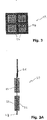
- FIG. 3A An example of cathode structure is shown in figures 3 and 3A .
- the bio-cathode 22 consists of a frame 27 of dimension 30 ⁇ 30 cm delimiting four housings in the example presented here. These housings incorporate metal baskets 23 with a thickness of between 4 and 5 cm in which carbon granules 25 are arranged.
- the metal frame 27 is connected to a current collector 26 surmounting said frame.
- the bio-anode 12 is made up of a metal frame 17 broken down into two parallel walls which enclose between them two parallel stainless steel grids 18 housing between them a carbon fabric 15.
- This carbon fabric 15 can be presented under the form a single element or in the form of strips of fabric arranged in parallel as shown schematically on the figure 4 .
- the assembly is held, for example, by means of screws 19.
- the bio-electrochemical reactor 1 according to the invention schematized in figures 5 and 6 , was designed to mimic industrial conditions.
- This reactor comprises three compartments separated by two ion exchange membranes: an anode compartment 11 which encloses two bio-anodes 12 and 13 (electrically connected to the outside of the reactor).
- This compartment is separated by a cation exchange membrane 31 from an intermembrane compartment 30 which is itself separated by an anion exchange membrane 32 from the cathode compartment 21 which encloses the bio-cathode 22.
- the volumes of these three compartments are 5.25 L, 2 L and 5.25 L respectively.
- each bio-anode 12, 13 is 30X30 cm and less than 1 cm thick.
- the active surfaces of these two bio-anodes is thus 0.36 m 2 , if the four faces of the two bio-anodes are considered.
- the bio-cathode 22 comprises a volume of 1.2 L of carbon grains, which have an active surface of approximately 3 m2, that is to say of the order of 10 times the total active surface of the bio-anodes.
- bio-electrodes are connected to a potentiostat ( BioLogic® , France, VMP3 not shown, controlled by the EC-Lab software), a potential difference of 1.1 V being imposed between the bio-anodes and the bio-cathode.
- a potentiostat BioLogic® , France, VMP3 not shown, controlled by the EC-Lab software
- Reference electrodes 33, 34 may be present respectively in the anode 11 and/or cathode 12 compartments. In an industrial-scale reactor, these reference electrodes may be absent.
- the cathodic electrolyte 24 is the BMP medium modified with 30 g/L of NaHCO 3 .
- the basic anodic electrolyte 14 is composed of 12.5 g/L of Na 2 HPO 4 .7H 2 O, 3 g/L of KH 2 PO 4 , 0.5 g/L of NaCl, 1 g/L of NH 4 Cl and 30 g/L of NaHCO 3 .
- the electrolyte of the intermembrane compartment 30 is composed of 35 g/L of KCl and 32.6 g/L of KH 2 PO 4 .
- the pH of the anode electrolyte is maintained at 7 by automatic injection of a K 2 CO 3 solution into the anode compartment.
- the bio-waste used is hydrolysates, highly loaded with organic matter, for example whose COD value is between 100 and 150 g/L. These hydrolysates are introduced into the anode electrolyte by injection of a volume of 10 to 20 mL, either daily, or when the anode current drops below approximately 0.5 A/m2.
- a device (not shown) for collecting synthesized molecules can be connected to the intermembrane compartment.
- a slight overpressure (for example 20-30 mbar) can be maintained in the gas overhead of the anodic and cathodic compartments, making it possible to prevent air from entering these compartments.
- the inoculum for the bio-cathode 22 can be prepared from an anaerobic digester sludge.
- the preparation consists of applying treatments to on the one hand inactivate the methanogenic microorganisms, competitors of the desired reaction, and on the other hand to enrich the sludge in microorganisms of interest.
- the first step consists of heat-treating the inoculum (at 90°C for 20 minutes), which has the effect of inactivating the methanogens.
- the second step consists of enriching the sludge with microorganisms of interest by adding hydrogen and carbon dioxide to a closed flask in discontinuous mode. This operation can be repeated twice.
- the microorganisms of interest here include bacteria capable of using the electrons or hydrogen generated at the cathode to synthesize the desired compounds (organic acids or alcohols).
- the culture resulting from this enrichment can be used directly and introduced into the cathode compartment 21 when the reactor is started.
- the reactor as described in Example 1, was operated for a period of 140 days.
- a potential difference of 0.9 V was applied between, on the one hand the bio-anodes electrically connected to each other (arranged in parallel), and on the other hand the bio-cathode.
- the most used method is to measure the maximum current density that it is capable of producing in the presence of an organic substrate.
- the current density at the bio-anodes was thus monitored as a function of time (see the curve of the figure 7 showing the current density in solid lines).
- the new renewed bio-anode was then replaced in the position closest to the membrane 31, the other bio-anode having been shifted into the other groove, closer to the outer wall of the reactor.
Landscapes
- Chemical & Material Sciences (AREA)
- Organic Chemistry (AREA)
- Engineering & Computer Science (AREA)
- Life Sciences & Earth Sciences (AREA)
- Chemical Kinetics & Catalysis (AREA)
- Electrochemistry (AREA)
- Metallurgy (AREA)
- Materials Engineering (AREA)
- Zoology (AREA)
- Wood Science & Technology (AREA)
- General Chemical & Material Sciences (AREA)
- Health & Medical Sciences (AREA)
- Microbiology (AREA)
- General Health & Medical Sciences (AREA)
- Biochemistry (AREA)
- Genetics & Genomics (AREA)
- Bioinformatics & Cheminformatics (AREA)
- Biotechnology (AREA)
- General Engineering & Computer Science (AREA)
- Hydrology & Water Resources (AREA)
- Environmental & Geological Engineering (AREA)
- Water Supply & Treatment (AREA)
- Biodiversity & Conservation Biology (AREA)
- Molecular Biology (AREA)
- Apparatus Associated With Microorganisms And Enzymes (AREA)
- Water Treatment By Electricity Or Magnetism (AREA)
- Electrolytic Production Of Non-Metals, Compounds, Apparatuses Therefor (AREA)
- Micro-Organisms Or Cultivation Processes Thereof (AREA)
- Preparation Of Compounds By Using Micro-Organisms (AREA)
- Purification Treatments By Anaerobic Or Anaerobic And Aerobic Bacteria Or Animals (AREA)
Description
- La présente invention concerne le domaine bio-électrochimique, et concerne plus particulièrement les systèmes et les procédés de synthèse électrochimique mettant en œuvre des réacteurs bio-électrochimiques c'est-à-dire des dispositifs électrochimiques dont l'une au moins des électrodes appelée bio-électrode, est au contact de microorganismes.
- Ces dispositifs de synthèses bio-électrochimiques permettent notamment, à partir de déchets organiques, de produire des molécules organiques telles que des acides organiques et/ou des alcools.
- En particulier, il a été mis au point récemment un tel dispositif bio-électrochimique, qui comporte à la fois une bio-anode et une bio-cathode, l'électrolyte du compartiment anodique ainsi que l'électrolyte du compartiment cathodique renfermant des microorganismes en suspension ou sous forme de biofilm(s) (
WO2016/051064 ). Dans ce dispositif, l'activité de la bio-cathode est optimisée en vue de la production d'espèces chimiques particulières dans l'électrolyte, tels que les acides acétique, lactique et/ou propionique ou des alcools. Ces synthèses de molécules organiques par voie microbienne, impliquant en particulier des réactions d'oxydo-réducttion électrochimiques, sont réalisées grâce à des bactéries électro-actives présentes à la surface de l'électrode. - Un des problèmes actuels à résoudre est d'améliorer la fiabilité et la durabilité de ces dispositifs bio-électrochimiques, en vue d'applications au stade industriel.
- Plus particulièrement dans le dispositif mentionné, un des objectifs est d'augmenter la durabilité de la bio-anode, c'est-à-dire de maintenir ses performances (caractérisées par des rendements acceptables notamment dans un contexte industriel) sur des durées plus longues. Il a en effet été constaté que l'activité de cette bio-anode diminue considérablement après quelques semaines de fonctionnement. Ce phénomène a été défini comme le « vieillissement » de la bio-anode, probablement dû à un colmatage du biofilm sur cette électrode. En effet, un biofilm composé de bactéries électro-actives (notamment du genre Geobacter) est nécessaire pour le fonctionnement de la bio-anode. D'autres microorganismes non électro-actifs se développent également sur ce biofilm et inhibent ainsi son activité électro-catalytique. Le dépôt de particules non-solubles aggrave encore cet effet.
- Par ailleurs il existe un besoin pour des dispositifs et procédés qui puissent être déployés à l'échelle industrielle, c'est-à-dire qu'ils puissent traiter des volumes d'effluents tels que ceux traités aujourd'hui à l'échelle industrielle. Des problèmes spécifiques se posent lors de l'augmentation de la taille des réacteurs pour conserver les niveaux d'activité observés en laboratoire : notamment le volume du réacteur augmente en général de manière plus conséquente que la surface active des électrodes. En outre, étant donné les plages de fonctionnement des cellules électrochimiques microbiennes, il est important que la cellule permette de contrôler le potentiel de l'anode avec suffisamment de précision.
- Ce problème est notamment évoqué par Logan et al (Environ. Sci. Technol. Lett. 2015, 2, 206-214), qui recommandent de conserver un rapport volume du réacteur/surface de la cathode pour pallier ce problème. Cependant, Logan et al. ne proposent pas de matériaux ni de configuration particulière pour la cathode.
- Un autre objectif est d'améliorer la stabilité de la bio-cathode.
- Cheng et al. (Environ. Sci. Technol. 2006, 40, 5426-2432) proposent d'optimiser la génération du courant en faisant varier la distance entre les électrodes. Dans leur système les deux électrodes en tissus de carbone.
- Cependant, Cheng et al. proposent un système MFC (Microbial Fuel Cell) à une seule chambre qui enferme une cathode Pt/C abiotique. Leur étude se focalise sur la génération d'électricité par l'oxydation de glucose à l'anode.
- L'art antérieur décrit ci-dessus ne propose pas de solutions aux problèmes spécifiques des réacteurs bio-électrochimiques comportant à la fois une bio-anode et une bio-cathode.
US 2014/069806 A1 , RABAEY et al, Nature Reviews Microbiology, 2010, 8(10), 706 etCN 103 922 487 B divulguent des réacteurs bio-électrochimiques.WO 2017/222382 A1 divulgue un réacteur électrochimique comprenant un compartiment anodique, un compartiment cathodique et un compartiment inter-membranaire. - Un premier but de l'invention est donc de pallier les inconvénients de l'art antérieur en proposant un réacteur bio-électrochimique, notamment dans un dispositif de synthèse bio-électrochimique, un système permettant de garantir son fonctionnement le plus stable possible, et sur de longues périodes.
- Un autre but de l'invention est de proposer un réacteur bio-électrochimique dont la structure permet la régénération ou la restauration de l'activité électrochimique d'une bio-électrode « vieillissante », sans arrêter le fonctionnement du dispositif de synthèse.
- A cet effet, la présente invention concerne un réacteur bio-électrochimique comprenant
- un compartiment anodique comportant au moins deux anodes, dénommées bio-anodes, et un électrolyte anodique comprenant des microorganismes électro-actifs anodiques,
- un compartiment cathodique comportant au moins une cathode, dénommée bio-cathode, et un électrolyte cathodique comprenant des microorganismes électro-actifs cathodiques,
- le compartiment anodique étant séparé du compartiment cathodique par, en allant du compartiment anodique vers le compartiment cathodique, une membrane échangeuse de cations et une membrane échangeuse d'anions, lesdites membranes échangeuses de cations et d'anions étant séparées l'une de l'autre par un compartiment intermembranaire,
- Au sens de l'invention, une « bio-électrode » (« bio-anode » ou « bio-cathode ») est une électrode recouverte au moins en partie d'un biofilm bactérien comprenant des organismes électro-actifs, c'est-à-dire recouverte au moins sur une partie de sa surface immergée dans l'électrolyte par un biofilm bactérien. Selon un mode de réalisation, la totalité de la surface immergée de la bio-électrode est recouverte de biofilm. Alternativement, selon un autre mode de réalisation, une partie seulement de la surface de la bio-électrode est recouverte de biofilm. Dans ce dernier mode de réalisation, la surface recouverte de biofilm est suffisante pour générer l'activité recherchée, notamment dans le cas d'une oxydation d'hydrolysats de déchets organiques ou d'une synthèse bio-électrochimique.
- Selon un mode de réalisation avantageux de l'invention, le réacteur bio-électrochimique comporte deux bio-anodes et une bio-cathode. Cependant, l'invention peut concerner tout réacteur bio-électrochimique comportant plus de deux bio-anodes et plusieurs bio-cathodes.
- La présence de deux bio-anodes dans le compartiment anodique permet notamment leur utilisation en alternance : en particulier lorsque l'une est « vieillissante », c'est-à-dire lorsque son activité électrochimique décroit, cela permet de la remplacer ou de la régénérer. En fonctionnement normal les deux bio-anodes sont connectées électriquement, généralement en parallèle. Selon un mode de réalisation ces deux bio-anodes sont sensiblement au même potentiel, en particulier lorsque celles-ci présentent une géométrie identique.
- Le compartiment inter-membranaire est apte à recueillir les ions ou molécules produites dans les compartiments anodique et/ou cathodique.
- Par surface active d'une bio-électrode (ici bio-anode ou bio-cathode) on entend la surface exposée à l'électrolyte, cette surface étant polarisée. Selon l'invention, la bio-cathode présente une plus grande inertie du fait d'une surface active supérieure à la surface active totale des deux bio-anodes, ce qui permet de garantir un potentiel de cathode particulièrement stable. En effet, en fonctionnement, une fois que la cathode a atteint son potentiel de travail, la grande stabilité du potentiel de la cathode permet en pratique de mieux contrôler le potentiel anodique en faisant varier la différence de potentiel entre la bio-cathode et les bio-anodes, et sans avoir à recourir à une électrode de référence. Un tel système permet ainsi un contrôle fin du potentiel anodique et donc l'optimisation de l'activité du biofilm anodique.
- De manière avantageuse, les bio-anodes sont amovibles, et sont ainsi aptes à être régénérées séparément et /ou remplacées. En variante, les bio-anodes ne sont pas nécessairement amovibles et peuvent être régénérées selon les procédés décrits dans les demandes parallèles déposées le même jour que la présente demande de brevet, sous priorité des demandes françaises
FR 18 58236 FR 18 58238 - Selon un mode de réalisation particulier, le réacteur bio-électrochimique est un réacteur d'électrosynthèse microbienne. Dans ce mode de réalisation, le réacteur est caractérisé en ce que le compartiment anodique comporte un ou plusieurs ports d'injection de substrat carboné organique, tels que des hydrolysats de biodéchets organiques, le compartiment cathodique comporte un ou plusieurs ports d'injection de CO2 ou d'introduction d'une source carbonée organique ou minérale et le compartiment inter-membranaire un dispositif de soutirage des molécules synthétisées au sein dudit réacteur.
- En ce qui concerne les bio-électrodes :
- la bio-cathode est, de préférence, une électrode tri-dimensionnelle, notamment comprenant un matériau granulaire ou se présentant sous la forme générale d'un treillis. La bio-cathode peut, par exemple, comprendre des grains de carbone disposés dans un contenant en acier inox.
- les bio-anodes se présentent, de préférence, sous la forme générale d'un panneau, en particulier plan ou arrondi. Les bio-anodes sont, par exemple, formées d'un tissu ou feutre de carbone, maintenu dans un cadre métallique, de préférence un cadre en acier inox.
- Par électrode tri-dimensionnelle, on entend ici, une électrode dont les dimensions géométriques épaisseur/hauteur/largeur sont telles que son épaisseur corresponde à sa plus petite dimension et soit supérieure ou égale à 1/10 de chacune de ses deux autres dimensions. Par opposition, on entend par forme générale d'un "panneau", une électrode présentant une épaisseur inférieure à 1/10 de chacune de ses deux autres dimensions, hauteur et largeur.
- Les microorganismes électro-actifs sont des microorganismes capables d'interagir directement avec une électrode, ce sont ici typiquement des microorganismes anaérobies. Les microorganismes diffèrent en fonction de l'électrode sur laquelle ils se développent sous forme de biofilm, et des caractéristiques de l'électrolyte dans lequel ils sont immergés. Par exemple, lorsque des eaux usées ou des hydrolysats de bio-déchets sont injectés dans l'électrolyte anodique, on observe une population abondante affiliée au genre Geobacter. Par contre, dans un milieu salin, d'autres genres tels que Geoalkalibacter ou Desulforomonas peuvent devenir dominants. Ainsi, lorsque les micro-organismes sont situés sur l'anode, on parle de microorganismes électro-actifs anodiques, tandis que lorsque les micro-organismes sont situés sur la cathode, on parle de microorganismes électro-actifs cathodiques ou électrotrophes.
- Le réacteur, selon l'invention, peut en outre comprendre des moyens de régulation du pH, de la température, et/ou du niveau d'électrolyte, de préférence, dans chacun des compartiments anodique et cathodique.
- La présente invention concerne également un procédé de régénération de l'activité des bio-anodes du réacteur, tel que décrit ci-dessus, comprenant :
- une étape de retrait d'au moins une des bio-anodes du compartiment anodique, étant entendu qu'au moins une bio-anode est laissée dans le compartiment anodique, et
- une étape d'introduction dans le compartiment anodique d'au moins une anode non colonisée par des microorganismes électro-actifs, le réacteur étant maintenu en fonctionnement par application d'une différence de potentiel entre la bio-cathode et la bio-anode restant dans le compartiment anodique.
- Selon un premier mode de réalisation, l'anode non colonisée est l'anode retirée du compartiment, ayant subi un nettoyage. Dans ce mode de réalisation, le procédé comprend donc :
- une étape de retrait d'au moins une des bio-anodes du compartiment anodique, étant entendu qu'au moins une bio-anode est laissée dans le compartiment anodique,
- une étape de nettoyage (mécanique, chimique ou thermique), à l'extérieur du réacteur, de ladite bio-anode retirée, puis
- sa réintroduction dans le compartiment anodique, le réacteur étant maintenu en fonctionnement par application d'une différence de potentiel entre la bio-cathode et la bio-anode restant dans le compartiment anodique.
- Selon un autre mode de réalisation, l'anode non colonisée par des microorganismes électro-actifs est une anode neuve. Selon ce mode de réalisation, le procédé de régénération de l'activité des bio-anodes du réacteur, tel que décrit ci-dessus, comprend le remplacement d'une des bio-anodes du compartiment anodique, par une anode non colonisée par des microorganismes électro-actifs, telle qu'une anode « neuve », le réacteur étant maintenu en fonctionnement par application d'une différence de potentiel entre la bio-cathode et la bio-anode restant dans le compartiment anodique.
- Le réacteur selon l'invention permet ainsi la régénération ou la restauration de l'activité électrochimique anodique « vieillissante », sans arrêter le fonctionnement du dit réacteur.
- Le réacteur selon la présente invention trouve une utilisation intéressante pour l'électrosynthèse d'acides organiques et/ou d'alcools à partir de déchets organiques. Les déchets organiques utilisés dans l'invention sont typiquement choisis parmi : des hydrolysats de bio-déchets, des boues hydrolysées de stations d'épuration, différentes fractions liquides organiques de stations d'épuration, des eaux usées urbaines après décantation primaire, des effluents industriels organiques, des effluents d'industries agro-alimentaires, des digestats de stations d'épuration, ou un mélange de plusieurs des substrats ci-dessus
- L'électrolyte du compartiment anodique renferme ainsi de tels substrats carbonés organiques sous forme liquide, introduits soit bruts, soit dilués dans un électrolyte de base synthétique. Dans ce compartiment anodique la teneur en matières organiques quantifiées par la mesure de la DCO (demande chimique en oxygène) est avantageusement comprise entre 0,01 et 200 g/L, de préférence entre 0,1 et 20 g/L, de préférence encore entre 0,1 et 5 g/L.
- La bio-cathode est avantageusement conditionnée par introduction d'un inoculum dans l'électrolyte cathodique.
- Dans un mode de réalisation préféré, l'inoculum est préparé à partir d'une boue de digesteur anaérobie, ayant éventuellement subi un prétraitement visant à inactiver les microorganismes méthanogènes. Ainsi, cette boue de digesteur peut subir un traitement thermique à une température et pendant une durée suffisante pour inactiver les microorganismes méthanogènes.
- Le prétraitement peut également comprendre l'enrichissement du déchet en microorganismes d'intérêt. Cette étape peut notamment comprendre l'ajout d'hydrogène et de dioxyde de carbone, par exemple dans une fiole fermée en mode discontinu. Au sens de l'invention, les microorganismes d'intérêt sont les microorganismes responsables de la bio-électrosynthèse, et comprennent par exemple des bactéries capables d'utiliser les électrons ou l'hydrogène générés à la cathode pour synthétiser les composés désirés (tels que des acides organiques ou alcools).
- La culture résultant de cet enrichissement peut être utilisée directement et introduite dans le compartiment cathodique au démarrage du réacteur.
- L'électrolyte du compartiment cathodique renferme un électrolyte et une source de carbone, injecté sous forme de gaz : tel que du CO2, du biogaz, ou du syngas, et/ou introduit en solution sous la forme de carbone organique : par exemple acétate et/ou sous la forme de carbone minéral : par exemple un bicarbonate.
- D'autres caractéristiques et avantages de l'invention apparaîtront dans la description ci-dessous d'exemples de réalisation, non limitatifs, en référence aux schémas annexés, dans lesquels :
- La
figure 1 schématise un réacteur bio-électrochimique, selon l'invention, montrant les différents compartiments et la localisation des bio-électrodes ; - La
figure 2 est un schéma montrant les éventuels systèmes de régulation présents dans un réacteur selon l'invention (les électrodes n'étant pas représentées pour plus de clarté) ; - La
figure 3 est une vue de face de la bio-cathode, lafigure 3A étant un schéma de profil de la bio-cathode de lafigure 3 ; - La
figure 4 est une vue de face d'une bio-anode, lafigure 4A étant un schéma de profil de ladite bio-anode de lafigure 4 ; - La
figure 5 est une vue de dessus en perspective d'un réacteur selon l'invention ; - La
figure 6 montre l'intérieur des compartiments du réacteur de lafigure 5 ; - La
figure 7 présente un diagramme montrant la densité de courant anodique du réacteur de lafigure 5 , en fonction du temps, avant et après régénération d'une des bio-anodes du compartiment anodique. - En se référant aux figures, le réacteur selon l'invention se compose de manière générale de trois compartiments séparés par des membranes échanges d'ions, à savoir : un compartiment anodique 11 qui renferme deux bio-anodes 12 et 13 reliées électriquement à l'extérieur du réacteur, et un compartiment cathodique 21 comprenant la bio-cathode 22, un compartiment anodique 11 séparé du compartiment cathodique 21 par un compartiment intermembranaire 30.
- Une membrane échangeuse de cations 31 sépare le compartiment anodique 11 du compartiment intermembranaire 30 et une membrane échangeuse d'anions 32 sépare le compartiment cathodique 21 du compartiment intermembranaire 30.
- Le compartiment anodique 11 renferme un électrolyte anodique 14 comprenant des microorganismes électro-actifs anodiques. Le compartiment cathodique 21 renferme un électrolyte cathodique 24 comprenant des microorganismes électro-actifs cathodiques.
- Une différence de potentiel 2 est appliquée entre la bio-cathode 22 et les deux bio-anodes 12 et 13. Le compartiment anodique comporte notamment un port 3 d'injection de substrat carboné organique.
- Divers systèmes de régulation, dans ledit réacteur selon l'invention, peuvent être incorporés audit réacteur et sont schématisés sur la
figure 2 . On peut avoir, notamment, un système de régulation du niveau du liquide anodique 4a et/ou cathodique 4c, un système de régulation du pH anodique 5a et/ou cathodique 5c, un système de régulation de température du compartiment anodique 6a et/ou du compartiment cathodique 6c au moyen, par exemple, d'une résistance chauffante 7a et/ou 7c. Enfin, un système de régulation de pression de la phase gazeuse 9a ou 9c peut être prévu dans chacun des compartiments d'électrodes soit 8a anodique ou 8c cathodique. En effet, le réacteur est fermé par un couvercle 10. - Un exemple de structure de la cathode est présenté aux
figures 3 et 3A . - La bio-cathode 22 se compose d'un cadre 27 de dimension 30x30 cm délimitant quatre logements sur l'exemple présenté ici. Ces logements incorporent des paniers métalliques 23 d'épaisseur comprise entre 4 et 5 cm dans lesquels sont disposées des granules de carbone 25. Le cadre métallique 27 est connecté à un collecteur de courant 26 surmontant ledit cadre.
- Un exemple de structure d'une bio-anode est présenté aux
figures 4 et 4A (vue éclatée). - Par exemple, la bio-anode 12 se compose d'un cadre métallique 17 se décomposant en deux parois parallèles qui enserrent entre elles deux grilles inox parallèles 18 logeant entre elles un tissu de carbone 15. Ce tissu de carbone 15 peut se présenter sous la forme d'un élément unique ou sous la forme de bandes de tissu disposées parallèlement comme schématisé sur la
figure 4 . L'ensemble est maintenu, par exemple, au moyen de vis 19. - Un descriptif plus précis du réacteur 1 bio-électrochimique selon l'invention est schématisé aux
figures 6 et7 . - Le réacteur 1 bio-électrochimique selon l'invention schématisé aux
figures 5 et 6 , a été conçu pour mimer les conditions industrielles. Ce réacteur comprend trois compartiments séparés par deux membranes échangeuses d'ions : un compartiment anodique 11 qui enferme deux bio-anodes 12 et 13 (reliées électriquement à l'extérieur du réacteur). Ce compartiment est séparé par une membrane 31 échangeuse de cations, d'un compartiment intermembranaire 30 qui est lui-même séparé par une membrane 32 échangeuse d'anions du compartiment cathodique 21 qui enferme la bio-cathode 22. Les volumes de ces trois compartiments sont de 5,25 L, 2 L et 5,25 L respectivement. - La taille de chaque bio-anode 12, 13 est de 30X30 cm et d'épaisseur inférieure à 1 cm. Les surfaces actives de ces deux bio-anodes est ainsi de 0,36 m2, si l'on considère les quatre faces des deux bio-anodes. La bio-cathode 22 comprend un volume de 1,2 L de grains de carbone, qui présentent une surface active d'environ 3 m2, c'est-à-dire de l'ordre de 10 fois la surface totale active des bio-anodes.
- Ces bio-électrodes sont connectées à un potentiostat (BioLogic®, France, VMP3 non représenté, piloté par le logiciel EC-Lab), une différence de potentiel de 1,1 V étant imposée entre les bio-anodes et la bio-cathode.
- Des électrodes de référence 33, 34 peuvent être présentes respectivement dans les compartiments anodique 11 et/ou cathodique 12. Dans un réacteur à échelle industrielle, ces électrodes de référence peuvent être absentes.
- L'électrolyte cathodique 24 est le milieu BMP modifié avec 30 g/L de NaHCO3. L'électrolyte anodique 14 de base est composé de 12,5 g/L de Na2HPO4.7H2O, 3 g/L de KH2PO4, 0,5 g/L de NaCI, 1 g/L de NH4Cl et 30 g/L de NaHCO3. L'électrolyte du compartiment intermembranaire 30 est composé de 35 g/L de KCI et 32,6 g/L de KH2PO4.
- Le pH de l'électrolyte anodique est maintenu à 7 par injection automatique d'une solution de K2CO3 dans le compartiment anodique. Les biodéchets utilisés sont des hydrolysats, très chargés en matières organiques, par exemple dont la valeur de DCO est comprise entre 100 et 150 g/L. Ces hydrolysats sont introduits dans l'électrolyte anodique par injection d'un volume de 10 à 20 mL, soit quotidiennement, soit lorsque le courant anodique chute au-dessous de 0,5 A/m2 environ.
- Un dispositif de collecte (non représenté) des molécules synthétisées peut être relié au compartiment intermembranaire.
- Une légère surpression (par exemple 20-30 mbar) peut être maintenue dans le ciel gazeux des compartiments anodique et cathodique, permettant d'éviter une entrée d'air dans ces compartiments.
- Dans le cas d'une application du procédé de l'invention à l'électrosynthèse d'acides organiques ou d'alcools, l'inoculum pour la bio-cathode 22 peut être préparé à partir d'une boue de digesteur anaérobie. La préparation consiste à appliquer des traitements pour d'une part inactiver les microorganismes méthanogènes, concurrents de la réaction souhaitée, et d'autre part enrichir la boue en microorganismes d'intérêt.
- La première étape consiste à traiter thermiquement l'inoculum (à 90°C pendant 20 minutes) ce qui a pour conséquence d'inactiver les méthanogènes.
- La seconde étape consiste à enrichir la boue en microorganismes d'intérêt par un apport d'hydrogène et de dioxyde de carbone dans une fiole fermée en mode discontinu. Cette opération peut être renouvelée deux fois. Les microorganismes d'intérêt comprennent ici des bactéries capables d'utiliser les électrons ou l'hydrogène générés à la cathode pour synthétiser les composés désirés (acides organiques ou alcools).
- La culture résultant de cet enrichissement peut être utilisée directement et introduite dans le compartiment cathodique 21 au démarrage du réacteur.
- Le réacteur, tel que décrit dans l'exemple 1, a été mis en fonctionnement pendant une durée de 140 jours. Une différence de potentiel de 0,9 V a été appliquée entre, d'une part les bio-anodes connectées électriquement entre-elles (disposées en parallèle), et d'autre part la bio-cathode.
- Afin de quantifier l'activité d'une bio-anode, la méthode la plus utilisée est de mesurer la densité de courant maximum qu'elle est capable de produire en présence d'un substrat organique. La densité de courant aux bio-anodes a ainsi été suivie en fonction du temps (voir la courbe de la
figure 7 présentant la densité de courant en traits pleins). - Après 18 jours environ, on constate une diminution de cette densité de courant, signe d'un vieillissement des bio-anodes (plage A-A sur la
figure 7 ). Il a alors été procédé à la régénération (flèche R) d'une de ses bio-anodes selon le procédé suivant :
Le cadre 17 et le collecteur de courant 16 d'une des bio-anodes amovibles ont été retirés du compartiment anodique 11 par coulissement dans une des gorges 20 (voirfigure 6 ) nettoyé avec un détergent puis séché, la grille 18 en inox et les tissus de carbone 15 ont été remplacés par des matériaux neufs. - La nouvelle bio-anode renouvelée a ensuite été replacée dans la position la plus proche de la membrane 31, l'autre bio-anode ayant été décalée dans l'autre gorge, plus proche de la paroi extérieure du réacteur.
- On voit nettement qu'après ce remplacement d'une des bio-anodes, l'activité reprend pendant au moins une quarantaine de jours. On note à nouveau un vieillissement à partir du pic B-B sur la
figure 7 . On peut alors remplacer la seconde bio-anode comme présenté ci-dessus pour la première bio-anode.
les bio-anodes et bio-cathode(s) présentant des surfaces actives telles que la surface active totale de la ou des bio-cathode(s) est supérieure à la surface active totale des au moins deux bio-anodes.
Claims (13)
- Réacteur (1) bio-électrochimique comprenant- un compartiment anodique (11) comportant au moins deux anodes (12, 13), dénommées bio-anodes, et un électrolyte anodique (14) comprenant des microorganismes électro-actifs anodiques,- un compartiment cathodique (21) comportant au moins une cathode, dénommée bio-cathode (22), et un électrolyte cathodique (24) comprenant des microorganismes électro-actifs cathodiques,- le compartiment anodique (11) étant séparé du compartiment cathodique (21) par, en allant du compartiment anodique vers le compartiment cathodique, une membrane échangeuse de cations (31) et une membrane échangeuse d'anions (32), lesdites membranes échangeuses de cations et d'anions étant séparées l'une de l'autre par un compartiment inter-membranaire (30),des moyens d'application d'une différence de potentiel entre les bio-anodes connectées entre-elles et la ou les bio-cathode(s),
les bio-anodes et bio-cathode(s) présentant des surfaces actives telles que la surface active totale de la ou des bio-cathode(s) (22) est supérieure à la surface active totale des deux bio-anodes (12, 13). - Réacteur selon la revendication 1, caractérisée en ce que les bio-anodes (12, 13) sont amovibles.
- Réacteur selon la revendication 1 ou 2, caractérisé en ce que ledit réacteur est un réacteur d'électrosynthèse microbienne, le compartiment anodique (11) comportant un ou plusieurs ports (3) d'injection de substrat carboné organique, tels que des hydrolysats de bio-déchets organiques, le compartiment cathodique (21) comportant un ou plusieurs ports d'injection de CO2 ou d'introduction d'une source carbonée organique ou minérale et le compartiment inter-membranaire (30) un dispositif de soutirage des molécules synthétisées au sein dudit réacteur.
- Réacteur selon l'une quelconque des revendications précédentes, caractérisée en ce que la bio-cathode (22) est une électrode dont les dimensions géométriques épaisseur/hauteur/largeur sont telles que son épaisseur corresponde à sa plus petite dimension et soit supérieure ou égale à 1/10 de chacune de ses deux autres dimensions.
- Réacteur selon la revendication 4, caractérisé en ce que la bio-cathode (22) comprend un matériau granulaire ou se présente sous la forme générale d'un treillis.
- Réacteur selon la revendication 4, caractérisé en ce que la bio-cathode comprend des grains de carbone disposés dans un contenant en acier inox.
- Réacteur selon l'une quelconque des revendications précédentes, caractérisé en ce que les bio-anodes (12, 13) se présentent sous la forme générale d'un panneau, notamment plan ou arrondi, ou on entend par forme générale d'un panneau, une électrode présentant une épaisseur inférieure à 1/10 de chacune de ses deux autres dimensions, hauteur et largeur.
- Réacteur selon la revendication 7, caractérisé en ce que les bio-anodes (12, 13) sont formées d'un tissu ou feutre de carbone, maintenu dans un cadre métallique, de préférence un cadre en acier inox.
- Réacteur selon l'une quelconque des revendications précédentes, caractérisé en ce qu'il comporte des moyens de régulation du pH, de la température, et/ou du niveau d'électrolyte.
- Procédé de régénération de l'activité des bio-anodes du réacteur selon l'une quelconque des revendications 2 à 9, comprenant :une étape de retrait d'au moins une des bio-anodes (12, 13) du compartiment anodique (11), étant entendu qu'au moins une bio-anode est laissée dans le compartiment anodique,une étape de nettoyage, à l'extérieur du réacteur (1), de ladite ou desdites bio-anodes retirées, puisleur réintroduction dans le compartiment anodique (11),le réacteur étant maintenu en fonctionnement par application d'une différence de potentiel entre la bio-cathode et la bio-anode restant dans le compartiment anodique.
- Procédé de régénération de l'activité des bio-anodes du réacteur selon l'une quelconque des revendications 2 à 9, comprenant :le remplacement d'au moins une des bio-anodes (12, 13) du compartiment anodique (11), par une anode non colonisée par des microorganismes électro-actifs, étant entendu qu'au moins une bio-anode est laissée dans le compartiment anodique,le réacteur étant maintenu en fonctionnement par application d'une différence de potentiel entre la bio-cathode et la bio-anode restant dans le compartiment anodique.
- Utilisation du réacteur selon l'une quelconque des revendications 1 à 9 pour l'électrosynthèse d'acides organiques et/ou d'alcools à partir de déchets organiques.
- Utilisation selon la revendication 12, caractérisée en ce que les déchets organiques sont choisis parmi : des hydrolysats de bio-déchets, des boues hydrolysées de stations d'épuration, différentes fractions liquides organiques de stations d'épuration, des eaux usées urbaines après décantation primaire, des effluents industriels organiques, des effluents d'industries agro-alimentaires, des digestats de stations d'épuration, ou un mélange de plusieurs de ceux-ci.
Applications Claiming Priority (2)
| Application Number | Priority Date | Filing Date | Title |
|---|---|---|---|
| FR1858240A FR3085972B1 (fr) | 2018-09-13 | 2018-09-13 | Reacteur bio-electrochimique a double bio-anode, procede de regeneration anodique et utilisation du reacteur a l'electrosynthese microbienne |
| PCT/FR2019/052110 WO2020053529A1 (fr) | 2018-09-13 | 2019-09-12 | Réacteur bio-électrochimique à double bio-anode, procédé de régénération anodique et utilisation du réacteur à l'électrosynthèse microbienne |
Publications (2)
| Publication Number | Publication Date |
|---|---|
| EP3850127A1 EP3850127A1 (fr) | 2021-07-21 |
| EP3850127B1 true EP3850127B1 (fr) | 2022-06-01 |
Family
ID=65201417
Family Applications (1)
| Application Number | Title | Priority Date | Filing Date |
|---|---|---|---|
| EP19787028.0A Active EP3850127B1 (fr) | 2018-09-13 | 2019-09-12 | Réacteur bio-électrochimique à double bio-anode, procédé de régénération anodique et utilisation du réacteur à l'électrosynthèse microbienne |
Country Status (5)
| Country | Link |
|---|---|
| US (1) | US11820686B2 (fr) |
| EP (1) | EP3850127B1 (fr) |
| CA (1) | CA3111054A1 (fr) |
| FR (1) | FR3085972B1 (fr) |
| WO (1) | WO2020053529A1 (fr) |
Cited By (1)
| Publication number | Priority date | Publication date | Assignee | Title |
|---|---|---|---|---|
| WO2026082916A1 (fr) * | 2024-10-18 | 2026-04-23 | Suez International | Procédé de production bio-électrochimique de méthane et/ou d'acétate au moyen d'un électrolyseur microbien et système associé |
Families Citing this family (10)
| Publication number | Priority date | Publication date | Assignee | Title |
|---|---|---|---|---|
| EP4153541B1 (fr) * | 2020-05-18 | 2025-09-03 | Universitetet I Sørøst-Norge | Méthode utilisant un bioréacteur bioélectrochimique |
| CN113213624B (zh) * | 2021-02-08 | 2023-03-10 | 北京工业大学 | 一种内置电活性生物载体模块的污水处理的装置 |
| FR3123347A1 (fr) | 2021-05-26 | 2022-12-02 | Suez Groupe | Reacteur bio-electrochimique optimise, notamment pour la degradation de la demande chimique en oxygene d’un effluent |
| US12384705B2 (en) * | 2021-09-23 | 2025-08-12 | San Diego State University (Sdsu) Foundation | Bioelectrochemical system for water deionization and desalination, wastewater treatment and energy recovery |
| CN114409057B (zh) * | 2021-12-30 | 2023-09-19 | 海南大学 | 一种利用生物阴极共代谢系统还原降解恩诺沙星的方法 |
| NL2032221B1 (en) * | 2022-06-20 | 2024-01-08 | Univ Delft Tech | Device for performing a biologically catalysed electrochemical reaction |
| CN117030821B (zh) * | 2023-03-07 | 2026-04-24 | 福建农林大学 | 一种微生物电位传感器及其在水质预警中的应用 |
| FR3151601B1 (fr) | 2023-07-25 | 2025-07-18 | Suez Int | Système et procédé de détermination d’au moins un paramètre de fonctionnement d’une installation de traitement biologique de production de biogaz avec récupération des nutriments azotés |
| FR3151600B1 (fr) | 2023-07-25 | 2025-07-18 | Suez Int | Système et procédé de détermination d’au moins un paramètre de fonctionnement d’une installation de traitement biologique de production de biogaz avec récupération des nutriments azotés |
| FR3160174A1 (fr) | 2024-03-14 | 2025-09-19 | Suez International | Dispositif et procédé d’extraction d’ions ammonium d’un digestat |
Family Cites Families (8)
| Publication number | Priority date | Publication date | Assignee | Title |
|---|---|---|---|---|
| WO2009155587A2 (fr) * | 2008-06-20 | 2009-12-23 | The Penn State Research Foundation | Réacteur électrométhanogène et processus de production de méthane |
| US20100270158A1 (en) * | 2009-04-22 | 2010-10-28 | The Penn State Research Foundation | Desalination devices and methods |
| US9963790B2 (en) * | 2010-10-19 | 2018-05-08 | Matthew Silver | Bio-electrochemical systems |
| CN103922487B (zh) * | 2014-04-25 | 2016-06-01 | 内蒙古科技大学 | 一种实现污水处理和二氧化碳还原制甲醇的方法 |
| FR3026413B1 (fr) | 2014-09-30 | 2023-05-12 | Institut National De Recherche En Sciences Et Tech Pour Lenvironnement Et Lagriculture Irstea | Procede et dispositif de regulation de l'activite d'un systeme bioelectrochimique comportant a la fois une bioanode et une biocathode |
| WO2016179068A1 (fr) * | 2015-05-01 | 2016-11-10 | Stc.Unm | Supercondensateurs biologiques et autonomes pour le traitement de l'eau |
| EP3475468A1 (fr) * | 2016-06-24 | 2019-05-01 | Stichting Wageningen Research | Procédé électrochimique et réacteur |
| ES2834599T3 (es) * | 2016-12-16 | 2021-06-18 | Fcc Aqualia S A | Método de desalinización y tratamiento de aguas residuales en un reactor de celda de desalinización microbiana |
-
2018
- 2018-09-13 FR FR1858240A patent/FR3085972B1/fr active Active
-
2019
- 2019-09-12 US US17/274,308 patent/US11820686B2/en active Active
- 2019-09-12 WO PCT/FR2019/052110 patent/WO2020053529A1/fr not_active Ceased
- 2019-09-12 EP EP19787028.0A patent/EP3850127B1/fr active Active
- 2019-09-12 CA CA3111054A patent/CA3111054A1/fr active Pending
Cited By (2)
| Publication number | Priority date | Publication date | Assignee | Title |
|---|---|---|---|---|
| WO2026082916A1 (fr) * | 2024-10-18 | 2026-04-23 | Suez International | Procédé de production bio-électrochimique de méthane et/ou d'acétate au moyen d'un électrolyseur microbien et système associé |
| FR3167653A1 (fr) * | 2024-10-18 | 2026-04-24 | Suez International | Procédé de production bio-électrochimique de méthane et/ou d’acétate au moyen d’un électrolyseur microbien et système associé |
Also Published As
| Publication number | Publication date |
|---|---|
| EP3850127A1 (fr) | 2021-07-21 |
| US20210340039A1 (en) | 2021-11-04 |
| US11820686B2 (en) | 2023-11-21 |
| FR3085972B1 (fr) | 2020-09-11 |
| WO2020053529A1 (fr) | 2020-03-19 |
| FR3085972A1 (fr) | 2020-03-20 |
| CA3111054A1 (fr) | 2020-03-19 |
Similar Documents
| Publication | Publication Date | Title |
|---|---|---|
| EP3850127A1 (fr) | Réacteur bio-électrochimique à double bio-anode, procédé de régénération anodique et utilisation du réacteur à l'électrosynthèse microbienne | |
| Ren et al. | Characterization of microbial fuel cells at microbially and electrochemically meaningful time scales | |
| Prasad et al. | Microbial fuel cell constructed with a micro-organism isolated from sugar industry effluent | |
| Hejazi et al. | Simultaneous phenol removal and electricity generation using a hybrid granular activated carbon adsorption-biodegradation process in a batch recycled tubular microbial fuel cell | |
| Pasternak et al. | Regeneration of the power performance of cathodes affected by biofouling | |
| CA2907039C (fr) | Procede de fabrication de biofilm electroactif | |
| Ojha et al. | A brief review on factors affecting the performance of microbial fuel cell and integration of artificial intelligence | |
| CN112573667A (zh) | 一种基于藻菌共生电化学体系的污水处理装置及其方法 | |
| Bose et al. | Sustainable power generation from wastewater sources using microbial fuel cell | |
| Zhang et al. | Startup performance and anodic biofilm distribution in continuous-flow microbial fuel cells with serpentine flow fields: effects of external resistance | |
| Roy et al. | Microbial fuel cells | |
| Huang et al. | An integrated electrochemical and biochemical system for sequential reduction of CO2 to methane | |
| EP2379780B1 (fr) | Nouveau procédé électrochimique pour la production d'hydrogène et dispositif pour sa mise en oeuvre | |
| EP4039655B1 (fr) | Réacteur permettant la filtration en continu d'un fluide en écoulement à travers d'un filtre et avec une régénération électrochimique in situ du filtre | |
| WO2013071401A1 (fr) | Methode et systeme de traitement bioelectrochimique d'effluents organiques | |
| Gilani et al. | Photocurrent Generation through Plant Microbial Fuel Cell by Varying Electrode Materials. | |
| Christwardana et al. | Exploring and evaluating the relationship between Saccharomyces cerevisiae biofilm maturation on carbon felt anodes and microbial fuel cell performance | |
| WO2020053528A1 (fr) | Procédé de régénération in situ d'une bio-anode d'un dispositif de synthèse bio-électrochimique | |
| Khalfbadam et al. | A bio-anodic filter facilitated entrapment, decomposition and in situ oxidation of algal biomass in wastewater effluent | |
| FR3045952A1 (fr) | Pile a combustible microbienne a electrode revetue de nitrure de titane et ses utilisations | |
| EP2242592A2 (fr) | Procédé et équipement pour l'oxydation de matières organiques | |
| JP5027462B2 (ja) | 光合成微生物の培養方法 | |
| FR3045951A1 (fr) | Pile a combustible microbienne a electrode revetue de nitrure de chrome et ses utilisations | |
| WO2013104725A1 (fr) | Pile à combustible microbienne avec cathode facilement échangeable | |
| Yılmazoğlu | Microbial fuel cells (MFCs) technology |
Legal Events
| Date | Code | Title | Description |
|---|---|---|---|
| STAA | Information on the status of an ep patent application or granted ep patent |
Free format text: STATUS: UNKNOWN |
|
| STAA | Information on the status of an ep patent application or granted ep patent |
Free format text: STATUS: THE INTERNATIONAL PUBLICATION HAS BEEN MADE |
|
| PUAI | Public reference made under article 153(3) epc to a published international application that has entered the european phase |
Free format text: ORIGINAL CODE: 0009012 |
|
| STAA | Information on the status of an ep patent application or granted ep patent |
Free format text: STATUS: REQUEST FOR EXAMINATION WAS MADE |
|
| 17P | Request for examination filed |
Effective date: 20210311 |
|
| AK | Designated contracting states |
Kind code of ref document: A1 Designated state(s): AL AT BE BG CH CY CZ DE DK EE ES FI FR GB GR HR HU IE IS IT LI LT LU LV MC MK MT NL NO PL PT RO RS SE SI SK SM TR |
|
| DAV | Request for validation of the european patent (deleted) | ||
| DAX | Request for extension of the european patent (deleted) | ||
| GRAP | Despatch of communication of intention to grant a patent |
Free format text: ORIGINAL CODE: EPIDOSNIGR1 |
|
| STAA | Information on the status of an ep patent application or granted ep patent |
Free format text: STATUS: GRANT OF PATENT IS INTENDED |
|
| RIC1 | Information provided on ipc code assigned before grant |
Ipc: C02F 3/00 20060101ALI20220111BHEP Ipc: C02F 1/461 20060101ALI20220111BHEP Ipc: C12P 7/40 20060101ALI20220111BHEP Ipc: C12P 7/04 20060101ALI20220111BHEP Ipc: C25B 11/043 20210101ALI20220111BHEP Ipc: C25B 11/02 20210101ALI20220111BHEP Ipc: C25B 9/19 20210101ALI20220111BHEP Ipc: C25B 3/26 20210101ALI20220111BHEP Ipc: C25B 3/00 20210101AFI20220111BHEP |
|
| INTG | Intention to grant announced |
Effective date: 20220131 |
|
| GRAS | Grant fee paid |
Free format text: ORIGINAL CODE: EPIDOSNIGR3 |
|
| GRAA | (expected) grant |
Free format text: ORIGINAL CODE: 0009210 |
|
| STAA | Information on the status of an ep patent application or granted ep patent |
Free format text: STATUS: THE PATENT HAS BEEN GRANTED |
|
| AK | Designated contracting states |
Kind code of ref document: B1 Designated state(s): AL AT BE BG CH CY CZ DE DK EE ES FI FR GB GR HR HU IE IS IT LI LT LU LV MC MK MT NL NO PL PT RO RS SE SI SK SM TR |
|
| REG | Reference to a national code |
Ref country code: GB Ref legal event code: FG4D Free format text: NOT ENGLISH |
|
| REG | Reference to a national code |
Ref country code: AT Ref legal event code: REF Ref document number: 1495427 Country of ref document: AT Kind code of ref document: T Effective date: 20220615 Ref country code: CH Ref legal event code: EP |
|
| REG | Reference to a national code |
Ref country code: IE Ref legal event code: FG4D Free format text: LANGUAGE OF EP DOCUMENT: FRENCH |
|
| REG | Reference to a national code |
Ref country code: DE Ref legal event code: R096 Ref document number: 602019015483 Country of ref document: DE |
|
| RAP2 | Party data changed (patent owner data changed or rights of a patent transferred) |
Owner name: INSTITUT NATIONAL POLYTECHNIQUE DE TOULOUSE Owner name: CENTRE NATIONAL DE LA RECHERCHE SCIENTIFIQUE Owner name: INSTITUT NATIONAL DE RECHERCHE POUR L'AGRICULTURE, L'ALIMENTATION ET L'ENVIRONNEMENT Owner name: SUEZ INTERNATIONAL |
|
| REG | Reference to a national code |
Ref country code: LT Ref legal event code: MG9D |
|
| REG | Reference to a national code |
Ref country code: NL Ref legal event code: MP Effective date: 20220601 |
|
| PG25 | Lapsed in a contracting state [announced via postgrant information from national office to epo] |
Ref country code: SE Free format text: LAPSE BECAUSE OF FAILURE TO SUBMIT A TRANSLATION OF THE DESCRIPTION OR TO PAY THE FEE WITHIN THE PRESCRIBED TIME-LIMIT Effective date: 20220601 Ref country code: NO Free format text: LAPSE BECAUSE OF FAILURE TO SUBMIT A TRANSLATION OF THE DESCRIPTION OR TO PAY THE FEE WITHIN THE PRESCRIBED TIME-LIMIT Effective date: 20220901 Ref country code: LT Free format text: LAPSE BECAUSE OF FAILURE TO SUBMIT A TRANSLATION OF THE DESCRIPTION OR TO PAY THE FEE WITHIN THE PRESCRIBED TIME-LIMIT Effective date: 20220601 Ref country code: HR Free format text: LAPSE BECAUSE OF FAILURE TO SUBMIT A TRANSLATION OF THE DESCRIPTION OR TO PAY THE FEE WITHIN THE PRESCRIBED TIME-LIMIT Effective date: 20220601 Ref country code: GR Free format text: LAPSE BECAUSE OF FAILURE TO SUBMIT A TRANSLATION OF THE DESCRIPTION OR TO PAY THE FEE WITHIN THE PRESCRIBED TIME-LIMIT Effective date: 20220902 Ref country code: FI Free format text: LAPSE BECAUSE OF FAILURE TO SUBMIT A TRANSLATION OF THE DESCRIPTION OR TO PAY THE FEE WITHIN THE PRESCRIBED TIME-LIMIT Effective date: 20220601 Ref country code: BG Free format text: LAPSE BECAUSE OF FAILURE TO SUBMIT A TRANSLATION OF THE DESCRIPTION OR TO PAY THE FEE WITHIN THE PRESCRIBED TIME-LIMIT Effective date: 20220901 |
|
| REG | Reference to a national code |
Ref country code: AT Ref legal event code: MK05 Ref document number: 1495427 Country of ref document: AT Kind code of ref document: T Effective date: 20220601 |
|
| PG25 | Lapsed in a contracting state [announced via postgrant information from national office to epo] |
Ref country code: RS Free format text: LAPSE BECAUSE OF FAILURE TO SUBMIT A TRANSLATION OF THE DESCRIPTION OR TO PAY THE FEE WITHIN THE PRESCRIBED TIME-LIMIT Effective date: 20220601 Ref country code: PL Free format text: LAPSE BECAUSE OF FAILURE TO SUBMIT A TRANSLATION OF THE DESCRIPTION OR TO PAY THE FEE WITHIN THE PRESCRIBED TIME-LIMIT Effective date: 20220601 Ref country code: LV Free format text: LAPSE BECAUSE OF FAILURE TO SUBMIT A TRANSLATION OF THE DESCRIPTION OR TO PAY THE FEE WITHIN THE PRESCRIBED TIME-LIMIT Effective date: 20220601 |
|
| PG25 | Lapsed in a contracting state [announced via postgrant information from national office to epo] |
Ref country code: NL Free format text: LAPSE BECAUSE OF FAILURE TO SUBMIT A TRANSLATION OF THE DESCRIPTION OR TO PAY THE FEE WITHIN THE PRESCRIBED TIME-LIMIT Effective date: 20220601 |
|
| PG25 | Lapsed in a contracting state [announced via postgrant information from national office to epo] |
Ref country code: SM Free format text: LAPSE BECAUSE OF FAILURE TO SUBMIT A TRANSLATION OF THE DESCRIPTION OR TO PAY THE FEE WITHIN THE PRESCRIBED TIME-LIMIT Effective date: 20220601 Ref country code: SK Free format text: LAPSE BECAUSE OF FAILURE TO SUBMIT A TRANSLATION OF THE DESCRIPTION OR TO PAY THE FEE WITHIN THE PRESCRIBED TIME-LIMIT Effective date: 20220601 Ref country code: RO Free format text: LAPSE BECAUSE OF FAILURE TO SUBMIT A TRANSLATION OF THE DESCRIPTION OR TO PAY THE FEE WITHIN THE PRESCRIBED TIME-LIMIT Effective date: 20220601 Ref country code: PT Free format text: LAPSE BECAUSE OF FAILURE TO SUBMIT A TRANSLATION OF THE DESCRIPTION OR TO PAY THE FEE WITHIN THE PRESCRIBED TIME-LIMIT Effective date: 20221003 Ref country code: ES Free format text: LAPSE BECAUSE OF FAILURE TO SUBMIT A TRANSLATION OF THE DESCRIPTION OR TO PAY THE FEE WITHIN THE PRESCRIBED TIME-LIMIT Effective date: 20220601 Ref country code: EE Free format text: LAPSE BECAUSE OF FAILURE TO SUBMIT A TRANSLATION OF THE DESCRIPTION OR TO PAY THE FEE WITHIN THE PRESCRIBED TIME-LIMIT Effective date: 20220601 Ref country code: CZ Free format text: LAPSE BECAUSE OF FAILURE TO SUBMIT A TRANSLATION OF THE DESCRIPTION OR TO PAY THE FEE WITHIN THE PRESCRIBED TIME-LIMIT Effective date: 20220601 Ref country code: AT Free format text: LAPSE BECAUSE OF FAILURE TO SUBMIT A TRANSLATION OF THE DESCRIPTION OR TO PAY THE FEE WITHIN THE PRESCRIBED TIME-LIMIT Effective date: 20220601 |
|
| PG25 | Lapsed in a contracting state [announced via postgrant information from national office to epo] |
Ref country code: IS Free format text: LAPSE BECAUSE OF FAILURE TO SUBMIT A TRANSLATION OF THE DESCRIPTION OR TO PAY THE FEE WITHIN THE PRESCRIBED TIME-LIMIT Effective date: 20221001 |
|
| REG | Reference to a national code |
Ref country code: DE Ref legal event code: R097 Ref document number: 602019015483 Country of ref document: DE |
|
| PG25 | Lapsed in a contracting state [announced via postgrant information from national office to epo] |
Ref country code: AL Free format text: LAPSE BECAUSE OF FAILURE TO SUBMIT A TRANSLATION OF THE DESCRIPTION OR TO PAY THE FEE WITHIN THE PRESCRIBED TIME-LIMIT Effective date: 20220601 |
|
| REG | Reference to a national code |
Ref country code: DE Ref legal event code: R119 Ref document number: 602019015483 Country of ref document: DE |
|
| PLBE | No opposition filed within time limit |
Free format text: ORIGINAL CODE: 0009261 |
|
| STAA | Information on the status of an ep patent application or granted ep patent |
Free format text: STATUS: NO OPPOSITION FILED WITHIN TIME LIMIT |
|
| PG25 | Lapsed in a contracting state [announced via postgrant information from national office to epo] |
Ref country code: MC Free format text: LAPSE BECAUSE OF FAILURE TO SUBMIT A TRANSLATION OF THE DESCRIPTION OR TO PAY THE FEE WITHIN THE PRESCRIBED TIME-LIMIT Effective date: 20220601 Ref country code: DK Free format text: LAPSE BECAUSE OF FAILURE TO SUBMIT A TRANSLATION OF THE DESCRIPTION OR TO PAY THE FEE WITHIN THE PRESCRIBED TIME-LIMIT Effective date: 20220601 |
|
| REG | Reference to a national code |
Ref country code: CH Ref legal event code: PL |
|
| 26N | No opposition filed |
Effective date: 20230302 |
|
| REG | Reference to a national code |
Ref country code: BE Ref legal event code: MM Effective date: 20220930 |
|
| PG25 | Lapsed in a contracting state [announced via postgrant information from national office to epo] |
Ref country code: SI Free format text: LAPSE BECAUSE OF FAILURE TO SUBMIT A TRANSLATION OF THE DESCRIPTION OR TO PAY THE FEE WITHIN THE PRESCRIBED TIME-LIMIT Effective date: 20220601 |
|
| PG25 | Lapsed in a contracting state [announced via postgrant information from national office to epo] |
Ref country code: LU Free format text: LAPSE BECAUSE OF NON-PAYMENT OF DUE FEES Effective date: 20220912 |
|
| PG25 | Lapsed in a contracting state [announced via postgrant information from national office to epo] |
Ref country code: LI Free format text: LAPSE BECAUSE OF NON-PAYMENT OF DUE FEES Effective date: 20220930 Ref country code: IE Free format text: LAPSE BECAUSE OF NON-PAYMENT OF DUE FEES Effective date: 20220912 Ref country code: DE Free format text: LAPSE BECAUSE OF NON-PAYMENT OF DUE FEES Effective date: 20230401 Ref country code: CH Free format text: LAPSE BECAUSE OF NON-PAYMENT OF DUE FEES Effective date: 20220930 |
|
| PG25 | Lapsed in a contracting state [announced via postgrant information from national office to epo] |
Ref country code: BE Free format text: LAPSE BECAUSE OF NON-PAYMENT OF DUE FEES Effective date: 20220930 |
|
| PG25 | Lapsed in a contracting state [announced via postgrant information from national office to epo] |
Ref country code: CY Free format text: LAPSE BECAUSE OF FAILURE TO SUBMIT A TRANSLATION OF THE DESCRIPTION OR TO PAY THE FEE WITHIN THE PRESCRIBED TIME-LIMIT Effective date: 20220601 |
|
| GBPC | Gb: european patent ceased through non-payment of renewal fee |
Effective date: 20230912 |
|
| PG25 | Lapsed in a contracting state [announced via postgrant information from national office to epo] |
Ref country code: MK Free format text: LAPSE BECAUSE OF FAILURE TO SUBMIT A TRANSLATION OF THE DESCRIPTION OR TO PAY THE FEE WITHIN THE PRESCRIBED TIME-LIMIT Effective date: 20220601 Ref country code: HU Free format text: LAPSE BECAUSE OF FAILURE TO SUBMIT A TRANSLATION OF THE DESCRIPTION OR TO PAY THE FEE WITHIN THE PRESCRIBED TIME-LIMIT; INVALID AB INITIO Effective date: 20190912 |
|
| PG25 | Lapsed in a contracting state [announced via postgrant information from national office to epo] |
Ref country code: TR Free format text: LAPSE BECAUSE OF FAILURE TO SUBMIT A TRANSLATION OF THE DESCRIPTION OR TO PAY THE FEE WITHIN THE PRESCRIBED TIME-LIMIT Effective date: 20220601 |
|
| PG25 | Lapsed in a contracting state [announced via postgrant information from national office to epo] |
Ref country code: GB Free format text: LAPSE BECAUSE OF NON-PAYMENT OF DUE FEES Effective date: 20230912 |
|
| PG25 | Lapsed in a contracting state [announced via postgrant information from national office to epo] |
Ref country code: GB Free format text: LAPSE BECAUSE OF NON-PAYMENT OF DUE FEES Effective date: 20230912 |
|
| PG25 | Lapsed in a contracting state [announced via postgrant information from national office to epo] |
Ref country code: MT Free format text: LAPSE BECAUSE OF FAILURE TO SUBMIT A TRANSLATION OF THE DESCRIPTION OR TO PAY THE FEE WITHIN THE PRESCRIBED TIME-LIMIT Effective date: 20220601 |
|
| PG25 | Lapsed in a contracting state [announced via postgrant information from national office to epo] |
Ref country code: BG Free format text: LAPSE BECAUSE OF FAILURE TO SUBMIT A TRANSLATION OF THE DESCRIPTION OR TO PAY THE FEE WITHIN THE PRESCRIBED TIME-LIMIT Effective date: 20220601 |
|
| PG25 | Lapsed in a contracting state [announced via postgrant information from national office to epo] |
Ref country code: BG Free format text: LAPSE BECAUSE OF FAILURE TO SUBMIT A TRANSLATION OF THE DESCRIPTION OR TO PAY THE FEE WITHIN THE PRESCRIBED TIME-LIMIT Effective date: 20220601 |
|
| PGFP | Annual fee paid to national office [announced via postgrant information from national office to epo] |
Ref country code: IT Payment date: 20250923 Year of fee payment: 7 |
|
| PGFP | Annual fee paid to national office [announced via postgrant information from national office to epo] |
Ref country code: FR Payment date: 20250926 Year of fee payment: 7 |