EP3850127B1 - Bioelektrochemischer reaktor mit doppelter bioanode, verfahren zur anodischen regeneration und verwendung des reaktors für die mikrobielle elektrosynthese - Google Patents
Bioelektrochemischer reaktor mit doppelter bioanode, verfahren zur anodischen regeneration und verwendung des reaktors für die mikrobielle elektrosynthese Download PDFInfo
- Publication number
- EP3850127B1 EP3850127B1 EP19787028.0A EP19787028A EP3850127B1 EP 3850127 B1 EP3850127 B1 EP 3850127B1 EP 19787028 A EP19787028 A EP 19787028A EP 3850127 B1 EP3850127 B1 EP 3850127B1
- Authority
- EP
- European Patent Office
- Prior art keywords
- bio
- reactor
- anode
- compartment
- cathode
- Prior art date
- Legal status (The legal status is an assumption and is not a legal conclusion. Google has not performed a legal analysis and makes no representation as to the accuracy of the status listed.)
- Active
Links
Images



Classifications
-
- C—CHEMISTRY; METALLURGY
- C02—TREATMENT OF WATER, WASTE WATER, SEWAGE, OR SLUDGE
- C02F—TREATMENT OF WATER, WASTE WATER, SEWAGE, OR SLUDGE
- C02F1/00—Treatment of water, waste water, or sewage
- C02F1/46—Treatment of water, waste water, or sewage by electrochemical methods
- C02F1/461—Treatment of water, waste water, or sewage by electrochemical methods by electrolysis
-
- C—CHEMISTRY; METALLURGY
- C02—TREATMENT OF WATER, WASTE WATER, SEWAGE, OR SLUDGE
- C02F—TREATMENT OF WATER, WASTE WATER, SEWAGE, OR SLUDGE
- C02F3/00—Biological treatment of water, waste water, or sewage
- C02F3/005—Combined electrochemical biological processes
-
- C—CHEMISTRY; METALLURGY
- C12—BIOCHEMISTRY; BEER; SPIRITS; WINE; VINEGAR; MICROBIOLOGY; ENZYMOLOGY; MUTATION OR GENETIC ENGINEERING
- C12P—FERMENTATION OR ENZYME-USING PROCESSES TO SYNTHESISE A DESIRED CHEMICAL COMPOUND OR COMPOSITION OR TO SEPARATE OPTICAL ISOMERS FROM A RACEMIC MIXTURE
- C12P7/00—Preparation of oxygen-containing organic compounds
- C12P7/02—Preparation of oxygen-containing organic compounds containing a hydroxy group
-
- C—CHEMISTRY; METALLURGY
- C12—BIOCHEMISTRY; BEER; SPIRITS; WINE; VINEGAR; MICROBIOLOGY; ENZYMOLOGY; MUTATION OR GENETIC ENGINEERING
- C12P—FERMENTATION OR ENZYME-USING PROCESSES TO SYNTHESISE A DESIRED CHEMICAL COMPOUND OR COMPOSITION OR TO SEPARATE OPTICAL ISOMERS FROM A RACEMIC MIXTURE
- C12P7/00—Preparation of oxygen-containing organic compounds
- C12P7/02—Preparation of oxygen-containing organic compounds containing a hydroxy group
- C12P7/04—Preparation of oxygen-containing organic compounds containing a hydroxy group acyclic
-
- C—CHEMISTRY; METALLURGY
- C12—BIOCHEMISTRY; BEER; SPIRITS; WINE; VINEGAR; MICROBIOLOGY; ENZYMOLOGY; MUTATION OR GENETIC ENGINEERING
- C12P—FERMENTATION OR ENZYME-USING PROCESSES TO SYNTHESISE A DESIRED CHEMICAL COMPOUND OR COMPOSITION OR TO SEPARATE OPTICAL ISOMERS FROM A RACEMIC MIXTURE
- C12P7/00—Preparation of oxygen-containing organic compounds
- C12P7/40—Preparation of oxygen-containing organic compounds containing a carboxyl group including Peroxycarboxylic acids
-
- C—CHEMISTRY; METALLURGY
- C25—ELECTROLYTIC OR ELECTROPHORETIC PROCESSES; APPARATUS THEREFOR
- C25B—ELECTROLYTIC OR ELECTROPHORETIC PROCESSES FOR THE PRODUCTION OF COMPOUNDS OR NON-METALS; APPARATUS THEREFOR
- C25B11/00—Electrodes; Manufacture thereof not otherwise provided for
- C25B11/02—Electrodes; Manufacture thereof not otherwise provided for characterised by shape or form
-
- C—CHEMISTRY; METALLURGY
- C25—ELECTROLYTIC OR ELECTROPHORETIC PROCESSES; APPARATUS THEREFOR
- C25B—ELECTROLYTIC OR ELECTROPHORETIC PROCESSES FOR THE PRODUCTION OF COMPOUNDS OR NON-METALS; APPARATUS THEREFOR
- C25B11/00—Electrodes; Manufacture thereof not otherwise provided for
- C25B11/04—Electrodes; Manufacture thereof not otherwise provided for characterised by the material
- C25B11/042—Electrodes formed of a single material
- C25B11/043—Carbon, e.g. diamond or graphene
-
- C—CHEMISTRY; METALLURGY
- C25—ELECTROLYTIC OR ELECTROPHORETIC PROCESSES; APPARATUS THEREFOR
- C25B—ELECTROLYTIC OR ELECTROPHORETIC PROCESSES FOR THE PRODUCTION OF COMPOUNDS OR NON-METALS; APPARATUS THEREFOR
- C25B3/00—Electrolytic production of organic compounds
-
- C—CHEMISTRY; METALLURGY
- C25—ELECTROLYTIC OR ELECTROPHORETIC PROCESSES; APPARATUS THEREFOR
- C25B—ELECTROLYTIC OR ELECTROPHORETIC PROCESSES FOR THE PRODUCTION OF COMPOUNDS OR NON-METALS; APPARATUS THEREFOR
- C25B3/00—Electrolytic production of organic compounds
- C25B3/20—Processes
- C25B3/23—Oxidation
-
- C—CHEMISTRY; METALLURGY
- C25—ELECTROLYTIC OR ELECTROPHORETIC PROCESSES; APPARATUS THEREFOR
- C25B—ELECTROLYTIC OR ELECTROPHORETIC PROCESSES FOR THE PRODUCTION OF COMPOUNDS OR NON-METALS; APPARATUS THEREFOR
- C25B3/00—Electrolytic production of organic compounds
- C25B3/20—Processes
- C25B3/25—Reduction
-
- C—CHEMISTRY; METALLURGY
- C25—ELECTROLYTIC OR ELECTROPHORETIC PROCESSES; APPARATUS THEREFOR
- C25B—ELECTROLYTIC OR ELECTROPHORETIC PROCESSES FOR THE PRODUCTION OF COMPOUNDS OR NON-METALS; APPARATUS THEREFOR
- C25B3/00—Electrolytic production of organic compounds
- C25B3/20—Processes
- C25B3/25—Reduction
- C25B3/26—Reduction of carbon dioxide
-
- C—CHEMISTRY; METALLURGY
- C25—ELECTROLYTIC OR ELECTROPHORETIC PROCESSES; APPARATUS THEREFOR
- C25B—ELECTROLYTIC OR ELECTROPHORETIC PROCESSES FOR THE PRODUCTION OF COMPOUNDS OR NON-METALS; APPARATUS THEREFOR
- C25B9/00—Cells or assemblies of cells; Constructional parts of cells; Assemblies of constructional parts, e.g. electrode-diaphragm assemblies; Process-related cell features
- C25B9/17—Cells comprising dimensionally-stable non-movable electrodes; Assemblies of constructional parts thereof
- C25B9/19—Cells comprising dimensionally-stable non-movable electrodes; Assemblies of constructional parts thereof with diaphragms
-
- C—CHEMISTRY; METALLURGY
- C25—ELECTROLYTIC OR ELECTROPHORETIC PROCESSES; APPARATUS THEREFOR
- C25B—ELECTROLYTIC OR ELECTROPHORETIC PROCESSES FOR THE PRODUCTION OF COMPOUNDS OR NON-METALS; APPARATUS THEREFOR
- C25B9/00—Cells or assemblies of cells; Constructional parts of cells; Assemblies of constructional parts, e.g. electrode-diaphragm assemblies; Process-related cell features
- C25B9/60—Constructional parts of cells
- C25B9/63—Holders for electrodes; Positioning of the electrodes
-
- C—CHEMISTRY; METALLURGY
- C02—TREATMENT OF WATER, WASTE WATER, SEWAGE, OR SLUDGE
- C02F—TREATMENT OF WATER, WASTE WATER, SEWAGE, OR SLUDGE
- C02F1/00—Treatment of water, waste water, or sewage
- C02F1/46—Treatment of water, waste water, or sewage by electrochemical methods
- C02F1/461—Treatment of water, waste water, or sewage by electrochemical methods by electrolysis
- C02F1/46104—Devices therefor; Their operating or servicing
- C02F1/46109—Electrodes
- C02F2001/46133—Electrodes characterised by the material
- C02F2001/46138—Electrodes comprising a substrate and a coating
-
- C—CHEMISTRY; METALLURGY
- C02—TREATMENT OF WATER, WASTE WATER, SEWAGE, OR SLUDGE
- C02F—TREATMENT OF WATER, WASTE WATER, SEWAGE, OR SLUDGE
- C02F1/00—Treatment of water, waste water, or sewage
- C02F1/46—Treatment of water, waste water, or sewage by electrochemical methods
- C02F1/461—Treatment of water, waste water, or sewage by electrochemical methods by electrolysis
- C02F1/46104—Devices therefor; Their operating or servicing
- C02F1/46109—Electrodes
- C02F2001/46152—Electrodes characterised by the shape or form
-
- C—CHEMISTRY; METALLURGY
- C02—TREATMENT OF WATER, WASTE WATER, SEWAGE, OR SLUDGE
- C02F—TREATMENT OF WATER, WASTE WATER, SEWAGE, OR SLUDGE
- C02F2201/00—Apparatus for treatment of water, waste water or sewage
- C02F2201/46—Apparatus for electrochemical processes
- C02F2201/461—Electrolysis apparatus
- C02F2201/46105—Details relating to the electrolytic devices
- C02F2201/46115—Electrolytic cell with membranes or diaphragms
-
- C—CHEMISTRY; METALLURGY
- C02—TREATMENT OF WATER, WASTE WATER, SEWAGE, OR SLUDGE
- C02F—TREATMENT OF WATER, WASTE WATER, SEWAGE, OR SLUDGE
- C02F2201/00—Apparatus for treatment of water, waste water or sewage
- C02F2201/46—Apparatus for electrochemical processes
- C02F2201/461—Electrolysis apparatus
- C02F2201/46105—Details relating to the electrolytic devices
- C02F2201/4612—Controlling or monitoring
-
- C—CHEMISTRY; METALLURGY
- C02—TREATMENT OF WATER, WASTE WATER, SEWAGE, OR SLUDGE
- C02F—TREATMENT OF WATER, WASTE WATER, SEWAGE, OR SLUDGE
- C02F2209/00—Controlling or monitoring parameters in water treatment
- C02F2209/02—Temperature
-
- C—CHEMISTRY; METALLURGY
- C02—TREATMENT OF WATER, WASTE WATER, SEWAGE, OR SLUDGE
- C02F—TREATMENT OF WATER, WASTE WATER, SEWAGE, OR SLUDGE
- C02F2209/00—Controlling or monitoring parameters in water treatment
- C02F2209/06—Controlling or monitoring parameters in water treatment pH
-
- C—CHEMISTRY; METALLURGY
- C02—TREATMENT OF WATER, WASTE WATER, SEWAGE, OR SLUDGE
- C02F—TREATMENT OF WATER, WASTE WATER, SEWAGE, OR SLUDGE
- C02F2209/00—Controlling or monitoring parameters in water treatment
- C02F2209/42—Liquid level
-
- H—ELECTRICITY
- H01—ELECTRIC ELEMENTS
- H01M—PROCESSES OR MEANS, e.g. BATTERIES, FOR THE DIRECT CONVERSION OF CHEMICAL ENERGY INTO ELECTRICAL ENERGY
- H01M8/00—Fuel cells; Manufacture thereof
- H01M8/16—Biochemical fuel cells, i.e. cells in which microorganisms function as catalysts
-
- Y—GENERAL TAGGING OF NEW TECHNOLOGICAL DEVELOPMENTS; GENERAL TAGGING OF CROSS-SECTIONAL TECHNOLOGIES SPANNING OVER SEVERAL SECTIONS OF THE IPC; TECHNICAL SUBJECTS COVERED BY FORMER USPC CROSS-REFERENCE ART COLLECTIONS [XRACs] AND DIGESTS
- Y02—TECHNOLOGIES OR APPLICATIONS FOR MITIGATION OR ADAPTATION AGAINST CLIMATE CHANGE
- Y02E—REDUCTION OF GREENHOUSE GAS [GHG] EMISSIONS, RELATED TO ENERGY GENERATION, TRANSMISSION OR DISTRIBUTION
- Y02E60/00—Enabling technologies; Technologies with a potential or indirect contribution to GHG emissions mitigation
- Y02E60/30—Hydrogen technology
- Y02E60/50—Fuel cells
Definitions
- the present invention relates to the bio-electrochemical field, and more particularly relates to electrochemical synthesis systems and methods implementing bio-electrochemical reactors, that is to say electrochemical devices of which at least one of the electrodes called bio -electrode, is in contact with microorganisms.
- bio-electrochemical synthesis devices make it possible in particular, from organic waste, to produce organic molecules such as organic acids and/or alcohols.
- bio-electrochemical device which comprises both a bio-anode and a bio-cathode, the electrolyte of the anode compartment as well as the electrolyte of the cathode compartment containing microorganisms in suspension or in the form of biofilm(s) ( WO2016/051064 ).
- the activity of the bio-cathode is optimized with a view to the production of particular chemical species in the electrolyte, such as acetic, lactic and/or propionic acids or alcohols.
- These syntheses of organic molecules by microbial route, involving in particular electrochemical oxidation-reduction reactions, are carried out using electro-active bacteria present on the surface of the electrode.
- One of the current problems to be solved is to improve the reliability and the durability of these bio-electrochemical devices, with a view to applications at the industrial stage.
- one of the objectives is to increase the durability of the bio-anode, that is to say to maintain its performance (characterized by acceptable yields in particular in an industrial context) over longer periods . It has in fact been observed that the activity of this bio-anode decreases considerably after a few weeks of operation. This phenomenon has been defined as the "ageing" of the bio-anode, probably due to clogging of the biofilm on this electrode. Indeed, a biofilm composed of electro-active bacteria (in particular of the Geobacter genus) is necessary for the operation of the bio-anode. Other non-electroactive microorganisms also grow on this biofilm and thus inhibit its electro-catalytic activity. The deposition of insoluble particles further aggravates this effect.
- Another objective is to improve the stability of the bio-cathode.
- a first object of the invention is therefore to overcome the drawbacks of the prior art by proposing a bio-electrochemical reactor, in particular in a bio-electrochemical synthesis device, a system making it possible to guarantee its operation as stable as possible, and on long periods.
- Another object of the invention is to provide a bio-electrochemical reactor whose structure allows the regeneration or restoration of the electrochemical activity of an “aging” bio-electrode, without stopping the operation of the synthesis device.
- a “bio-electrode” (“bio-anode” or “bio-cathode”) is an electrode covered at least in part with a bacterial biofilm comprising electro-active organisms, i.e. that is to say covered at least on part of its surface immersed in the electrolyte by a bacterial biofilm.
- the entire submerged surface of the bio-electrode is covered with biofilm.
- only part of the surface of the bio-electrode is covered with biofilm. In this last mode of realization, the surface covered with biofilm is sufficient to generate the desired activity, in particular in the case of an oxidation of hydrolysates of organic waste or of a bio-electrochemical synthesis.
- the bio-electrochemical reactor comprises two bio-anodes and a bio-cathode.
- the invention can relate to any bio-electrochemical reactor comprising more than two bio-anodes and several bio-cathodes.
- bio-anodes in the anode compartment allows their use in particular in alternation: in particular when one is "ageing", that is to say when its electrochemical activity decreases, this makes it possible to replace it or regenerate.
- the two bio-anodes are electrically connected, generally in parallel. According to one embodiment, these two bio-anodes are substantially at the same potential, in particular when they have identical geometry.
- the inter-membrane compartment is able to collect the ions or molecules produced in the anode and/or cathode compartments.
- active surface of a bio-electrode here bio-anode or bio-cathode
- the bio-cathode has greater inertia due to an active surface greater than the total active surface of the two bio-anodes, which makes it possible to guarantee a particularly stable cathode potential.
- the cathode has reached its working potential, the great stability of the cathode potential makes it possible in practice to better control the anode potential by varying the potential difference between the bio-cathode and the bio -anodes, and without having to resort to a reference electrode.
- Such a system thus allows fine control of the anodic potential and therefore optimization of the activity of the anodic biofilm.
- the bio-anodes are removable, and are thus able to be regenerated separately and/or replaced.
- the bio-anodes are not necessarily removable and can be regenerated according to the methods described in the parallel applications filed on the same day as the present patent application, under priority of French requests FR 18 58236 and FR 18 58238 not yet published.
- the bio-electrochemical reactor is a microbial electrosynthesis reactor.
- the reactor is characterized in that the anode compartment comprises one or more ports for injecting organic carbonaceous substrate, such as hydrolysates of organic biowaste, the cathode compartment comprises one or more ports for injecting CO 2 or introduction of an organic or mineral carbonaceous source and the inter-membrane compartment a device for withdrawing molecules synthesized within said reactor.
- three-dimensional electrode is meant here an electrode whose geometric dimensions thickness/height/width are such that its thickness corresponds to its smallest dimension and is greater than or equal to 1/10 of each of its two other dimensions.
- the general shape of a “panel” is understood to mean an electrode having a thickness less than 1/10 of each of its two other dimensions, height and width.
- Electro-active microorganisms are microorganisms capable of interacting directly with an electrode, here they are typically anaerobic microorganisms.
- the microorganisms differ according to the electrode on which they grow in the form of a biofilm, and the characteristics of the electrolyte in which they are immersed. For example, when wastewater or bio-waste hydrolysates are injected into the anode electrolyte, an abundant population affiliated with the genus Geobacter is observed. On the other hand, in a saline environment, other genera such as Geoalkalibacter or Desulforomonas can become dominant.
- the reactor can also comprise means for regulating the pH, the temperature, and/or the level of electrolyte, preferably, in each of the anode and cathode compartments.
- the anode not colonized by electro-active microorganisms is a new anode.
- the process for regenerating the activity of the bio-anodes of the reactor comprises the replacement of one of the bio-anodes of the anode compartment, by an anode not colonized by microorganisms electro-active, such as a "new" anode, the reactor being kept in operation by applying a potential difference between the bio-cathode and the bio-anode remaining in the anode compartment.
- the reactor according to the invention thus allows regeneration or restoration of the “ageing” anode electrochemical activity, without stopping the operation of said reactor.
- the reactor according to the present invention finds an interesting use for the electrosynthesis of organic acids and/or alcohols from organic waste.
- the organic waste used in the invention is typically chosen from: hydrolysates of bio-waste, hydrolyzed sludge from purification stations, various organic liquid fractions from purification stations, urban wastewater after primary settling, industrial effluents organic matter, effluents from agrifood industries, digestates from wastewater treatment plants, or a mixture of several of the above substrates
- the electrolyte of the anode compartment thus contains such organic carbonaceous substrates in liquid form, introduced either raw or diluted in a synthetic base electrolyte.
- the content of organic matter quantified by measuring the COD is advantageously between 0.01 and 200 g/L, preferably between 0.1 and 20 g/L, more preferably between 0.1 and 5 g/L.
- the bio-cathode is advantageously conditioned by introducing an inoculum into the cathodic electrolyte.
- the inoculum is prepared from anaerobic digester sludge, optionally having undergone a pretreatment aimed at inactivating the methanogenic microorganisms.
- this digester sludge can undergo a heat treatment at a temperature and for a time sufficient to inactivate the methanogenic microorganisms.
- the pretreatment can also include the enrichment of the waste in microorganisms of interest.
- This step may in particular comprise the addition of hydrogen and carbon dioxide, for example in a closed flask in discontinuous mode.
- the microorganisms of interest are the microorganisms responsible for bio-electrosynthesis, and include for example bacteria capable of using the electrons or hydrogen generated at the cathode to synthesize the desired compounds (such as organic acids or alcohols).
- the culture resulting from this enrichment can be used directly and introduced into the cathode compartment when the reactor is started.
- the electrolyte of the cathodic compartment contains an electrolyte and a source of carbon, injected in the form of gas: such as CO 2 , biogas, or syngas, and/or introduced into solution in the form of organic carbon: for example acetate and/or in the form of mineral carbon: for example a bicarbonate.
- a source of carbon such as CO 2 , biogas, or syngas
- the reactor according to the invention generally consists of three compartments separated by ion exchange membranes, namely: an anode compartment 11 which contains two bio-anodes 12 and 13 electrically connected to the exterior of the reactor, and a cathode compartment 21 comprising the bio-cathode 22, an anode compartment 11 separated from the cathode compartment 21 by an intermembrane compartment 30.
- a cation exchange membrane 31 separates the anode compartment 11 from the intermembrane compartment 30 and an anion exchange membrane 32 separates the cathode compartment 21 from the intermembrane compartment 30.
- the anode compartment 11 contains an anode electrolyte 14 comprising anodic electro-active microorganisms.
- the cathode compartment 21 contains a cathode electrolyte 24 comprising cathode electro-active microorganisms.
- a potential difference 2 is applied between the bio-cathode 22 and the two bio-anodes 12 and 13.
- the anode compartment includes in particular a port 3 for injection of organic carbonaceous substrate.
- Various regulation systems in said reactor according to the invention, can be incorporated into said reactor and are schematized on the picture 2 . It is possible to have, in particular, a system for regulating the level of the anode 4a and/or cathode 4c liquid, an anode 5a and/or cathode 5c pH regulation system, a system for regulating the temperature of the anode compartment 6a and/or of the cathode compartment 6c by means, for example, of a heating resistor 7a and/or 7c. Finally, a gas phase pressure regulation system 9a or 9c can be provided in each of the electrode compartments, either anodic 8a or cathodic 8c. Indeed, the reactor is closed by a cover 10.
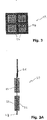
- FIG. 3A An example of cathode structure is shown in figures 3 and 3A .
- the bio-cathode 22 consists of a frame 27 of dimension 30 ⁇ 30 cm delimiting four housings in the example presented here. These housings incorporate metal baskets 23 with a thickness of between 4 and 5 cm in which carbon granules 25 are arranged.
- the metal frame 27 is connected to a current collector 26 surmounting said frame.
- the bio-anode 12 is made up of a metal frame 17 broken down into two parallel walls which enclose between them two parallel stainless steel grids 18 housing between them a carbon fabric 15.
- This carbon fabric 15 can be presented under the form a single element or in the form of strips of fabric arranged in parallel as shown schematically on the figure 4 .
- the assembly is held, for example, by means of screws 19.
- the bio-electrochemical reactor 1 according to the invention schematized in figures 5 and 6 , was designed to mimic industrial conditions.
- This reactor comprises three compartments separated by two ion exchange membranes: an anode compartment 11 which encloses two bio-anodes 12 and 13 (electrically connected to the outside of the reactor).
- This compartment is separated by a cation exchange membrane 31 from an intermembrane compartment 30 which is itself separated by an anion exchange membrane 32 from the cathode compartment 21 which encloses the bio-cathode 22.
- the volumes of these three compartments are 5.25 L, 2 L and 5.25 L respectively.
- each bio-anode 12, 13 is 30X30 cm and less than 1 cm thick.
- the active surfaces of these two bio-anodes is thus 0.36 m 2 , if the four faces of the two bio-anodes are considered.
- the bio-cathode 22 comprises a volume of 1.2 L of carbon grains, which have an active surface of approximately 3 m2, that is to say of the order of 10 times the total active surface of the bio-anodes.
- bio-electrodes are connected to a potentiostat ( BioLogic® , France, VMP3 not shown, controlled by the EC-Lab software), a potential difference of 1.1 V being imposed between the bio-anodes and the bio-cathode.
- a potentiostat BioLogic® , France, VMP3 not shown, controlled by the EC-Lab software
- Reference electrodes 33, 34 may be present respectively in the anode 11 and/or cathode 12 compartments. In an industrial-scale reactor, these reference electrodes may be absent.
- the cathodic electrolyte 24 is the BMP medium modified with 30 g/L of NaHCO 3 .
- the basic anodic electrolyte 14 is composed of 12.5 g/L of Na 2 HPO 4 .7H 2 O, 3 g/L of KH 2 PO 4 , 0.5 g/L of NaCl, 1 g/L of NH 4 Cl and 30 g/L of NaHCO 3 .
- the electrolyte of the intermembrane compartment 30 is composed of 35 g/L of KCl and 32.6 g/L of KH 2 PO 4 .
- the pH of the anode electrolyte is maintained at 7 by automatic injection of a K 2 CO 3 solution into the anode compartment.
- the bio-waste used is hydrolysates, highly loaded with organic matter, for example whose COD value is between 100 and 150 g/L. These hydrolysates are introduced into the anode electrolyte by injection of a volume of 10 to 20 mL, either daily, or when the anode current drops below approximately 0.5 A/m2.
- a device (not shown) for collecting synthesized molecules can be connected to the intermembrane compartment.
- a slight overpressure (for example 20-30 mbar) can be maintained in the gas overhead of the anodic and cathodic compartments, making it possible to prevent air from entering these compartments.
- the inoculum for the bio-cathode 22 can be prepared from an anaerobic digester sludge.
- the preparation consists of applying treatments to on the one hand inactivate the methanogenic microorganisms, competitors of the desired reaction, and on the other hand to enrich the sludge in microorganisms of interest.
- the first step consists of heat-treating the inoculum (at 90°C for 20 minutes), which has the effect of inactivating the methanogens.
- the second step consists of enriching the sludge with microorganisms of interest by adding hydrogen and carbon dioxide to a closed flask in discontinuous mode. This operation can be repeated twice.
- the microorganisms of interest here include bacteria capable of using the electrons or hydrogen generated at the cathode to synthesize the desired compounds (organic acids or alcohols).
- the culture resulting from this enrichment can be used directly and introduced into the cathode compartment 21 when the reactor is started.
- the reactor as described in Example 1, was operated for a period of 140 days.
- a potential difference of 0.9 V was applied between, on the one hand the bio-anodes electrically connected to each other (arranged in parallel), and on the other hand the bio-cathode.
- the most used method is to measure the maximum current density that it is capable of producing in the presence of an organic substrate.
- the current density at the bio-anodes was thus monitored as a function of time (see the curve of the figure 7 showing the current density in solid lines).
- the new renewed bio-anode was then replaced in the position closest to the membrane 31, the other bio-anode having been shifted into the other groove, closer to the outer wall of the reactor.
Landscapes
- Chemical & Material Sciences (AREA)
- Organic Chemistry (AREA)
- Engineering & Computer Science (AREA)
- Chemical Kinetics & Catalysis (AREA)
- Life Sciences & Earth Sciences (AREA)
- Electrochemistry (AREA)
- Metallurgy (AREA)
- Materials Engineering (AREA)
- General Chemical & Material Sciences (AREA)
- Zoology (AREA)
- Wood Science & Technology (AREA)
- Microbiology (AREA)
- Health & Medical Sciences (AREA)
- Genetics & Genomics (AREA)
- Biotechnology (AREA)
- Water Supply & Treatment (AREA)
- Environmental & Geological Engineering (AREA)
- Biochemistry (AREA)
- Bioinformatics & Cheminformatics (AREA)
- General Engineering & Computer Science (AREA)
- General Health & Medical Sciences (AREA)
- Hydrology & Water Resources (AREA)
- Biodiversity & Conservation Biology (AREA)
- Molecular Biology (AREA)
- Apparatus Associated With Microorganisms And Enzymes (AREA)
- Purification Treatments By Anaerobic Or Anaerobic And Aerobic Bacteria Or Animals (AREA)
- Electrolytic Production Of Non-Metals, Compounds, Apparatuses Therefor (AREA)
- Micro-Organisms Or Cultivation Processes Thereof (AREA)
- Preparation Of Compounds By Using Micro-Organisms (AREA)
- Water Treatment By Electricity Or Magnetism (AREA)
Claims (13)
- Bioelektrochemischer Reaktor (1), umfassend:- eine Anodenkammer (11), umfassend mindestens zwei Anoden (12, 13), bezeichnet als Bioanoden, und einen Anodenelektrolyt (14), umfassend anodische elektroaktive Mikroorganismen,- eine Kathodenkammer (21), umfassend mindestens eine Kathode, bezeichnet als Biokathode (22), und einen Kathodenelektrolyt (24), umfassend kathodische elektroaktive Mikroorganismen,- wobei die Anodenkammer (11) von der Kathodenkammer (21), reichend von der Anodenkammer zur Kathodenkammer, durch eine Kationenaustauschmembran (31) und eine Anionenaustauschmembran (32) getrennt ist, wobei die Kationen- und Anionenaustauschmembrane voneinander durch eine Zwischenmembrankammer (30), Mittel zur Anwendung einer Spannungsdifferenz zwischen den miteinander verbundenen Bioanoden und der oder den Biokathode(n) getrennt sind,wobei die Bioanoden und Biokathode(n) aktive Flächen aufweisen, so dass die gesamte aktive Fläche der Biokathode(n) (22) grösser als die gesamte aktive Fläche der zwei Bioanoden (12, 13) ist.
- Reaktor nach Anspruch 1, dadurch gekennzeichnet, dass die Bioanoden (12, 13) entfernbar sind.
- Reaktor nach Anspruch 1 oder 2, dadurch gekennzeichnet, dass der Reaktor ein Reaktor für die mikrobielle Elektrosynthese ist, wobei die Anodenkammer (11) einen oder mehrere Anschlüsse (3) zur Injektion von organischem kohlenstoffhaltigem Substrat, wie z. B. Hydrolysaten von organischen Bioabfällen, umfasst, wobei die Kathodenkammer (21) einen oder mehrere Anschlüsse zur Injektion von CO2 oder zur Einführung einer organischen oder mineralischen kohlenstoffhaltigen Quelle und die Zwischenmembrankammer (30) eine Vorrichtung zum Abstich der synthetisierten Moleküle innerhalb des Reaktors umfasst.
- Reaktor nach einem der vorhergehenden Ansprüche, dadurch gekennzeichnet, dass die Biokathode (22) eine Elektrode ist, deren geometrische Abmessungen Dicke/Höhe/Breite derart sind, dass ihre Dicke ihren kleinsten Abmessung entspricht und grösser oder gleich 1/10 jeder ihrer zwei anderen Abmessungen ist.
- Reaktor nach Anspruch 4, dadurch gekennzeichnet, dass die Biokathode (22) ein körniges Material umfasst oder die allgemeine Form eines Gitters aufweist.
- Reaktor nach Anspruch 4, dadurch gekennzeichnet, dass die Biokathode Kohlenstoffkörner aufweist, die in einem Behälter aus Edelstahl angeordnet sind.
- Reaktor nach einem der vorhergehenden Ansprüche, dadurch gekennzeichnet, dass die Bioanoden (12, 13) die allgemeine Form einer Platte aufweisen, insbesondere eben oder abgerundet, wobei unter der allgemeinen Form einer Platte eine Elektrode verstanden wird, die eine Dicke von weniger als 1/10 jeder ihrer zwei anderen Abmessungen Höhe und Breite aufweist.
- Reaktor nach Anspruch 7, dadurch gekennzeichnet, dass die Bioanoden (12, 13) aus einem Kohlenstoffgewebe oder -filz hergestellt sind, gehalten in einem Metallrahmen, vorzugsweise einem Rahmen aus Edelstahl.
- Reaktor nach einem der vorhergehenden Ansprüche, dadurch gekennzeichnet, dass er Mittel zur Regulierung des pH, der Temperatur und/oder des Elektrolytniveaus umfasst.
- Verfahren zur Regenerierung der Aktivität der Bioanoden des Reaktors nach einem der Ansprüche 2 bis 9, umfassend:einen Schritt des Rückziehens mindestens einer der Bioanoden (12, 13) aus der Anodenkammer (11), wobei davon ausgegangen wird, dass mindestens eine Bioanode in der Anodenkammer gelassen wird,einen Schritt des Reinigens, Außerhalb des Reaktors (1), der zurückgezogenen Bioanode(n), dannihr Wiedereinführen in die Anodenkammer (11),wobei der Reaktor durch das Anwenden einer Potenzialdifferenz zwischen der Biokathode und der Bioanode, die in der Anodekammer verbleibt, in Betrieb gehalten wird.
- Verfahren zum Regenerieren der Aktivität der Bioanoden des Reaktors nach einem der Ansprüche 2 bis 9, umfassend:Ersetzen mindestens einer der Bioanoden (12, 13) der Anodenkammer (11) durch eine Anode, die nicht von elektroaktiven Mikroorganismen kolonisiert ist, wobei davon ausgegangen wird, dass mindestens eine Bioanode in der Anodenkammer gelassen wird,wobei der Reaktor durch das Anwenden einer Potenzialdifferenz zwischen der Biokathode und der Bioanode, die in der Anodekammer verbleibt, in Betrieb gehalten wird.
- Verwendung des Reaktors nach einem der Ansprüche 1 bis 9 zur Elektrolyse von organischen Säuren und/oder Alkoholen auf der Grundlage von organischen Abfällen.
- Verwendung nach Anspruch 12, dadurch gekennzeichnet, dass die organischen Abfälle ausgewählt sind aus Hydrolysaten von Bioabfällen, hydrolysierten Schlämmen aus Kläranlagen, verschiedenen organischen flüssigen Fraktionen von Kläranlagen, städtischen Abwässern nach der ersten Klärung, organischen Industrieabwässern, Lebensmittelindustrieabwässern, Rückständen von Kläranlagen oder einer Mischung von mehreren derselben.
Applications Claiming Priority (2)
| Application Number | Priority Date | Filing Date | Title |
|---|---|---|---|
| FR1858240A FR3085972B1 (fr) | 2018-09-13 | 2018-09-13 | Reacteur bio-electrochimique a double bio-anode, procede de regeneration anodique et utilisation du reacteur a l'electrosynthese microbienne |
| PCT/FR2019/052110 WO2020053529A1 (fr) | 2018-09-13 | 2019-09-12 | Réacteur bio-électrochimique à double bio-anode, procédé de régénération anodique et utilisation du réacteur à l'électrosynthèse microbienne |
Publications (2)
| Publication Number | Publication Date |
|---|---|
| EP3850127A1 EP3850127A1 (de) | 2021-07-21 |
| EP3850127B1 true EP3850127B1 (de) | 2022-06-01 |
Family
ID=65201417
Family Applications (1)
| Application Number | Title | Priority Date | Filing Date |
|---|---|---|---|
| EP19787028.0A Active EP3850127B1 (de) | 2018-09-13 | 2019-09-12 | Bioelektrochemischer reaktor mit doppelter bioanode, verfahren zur anodischen regeneration und verwendung des reaktors für die mikrobielle elektrosynthese |
Country Status (5)
| Country | Link |
|---|---|
| US (1) | US11820686B2 (de) |
| EP (1) | EP3850127B1 (de) |
| CA (1) | CA3111054A1 (de) |
| FR (1) | FR3085972B1 (de) |
| WO (1) | WO2020053529A1 (de) |
Families Citing this family (10)
| Publication number | Priority date | Publication date | Assignee | Title |
|---|---|---|---|---|
| DK4153541T3 (da) * | 2020-05-18 | 2025-12-08 | Univ I Soeroest Norge | Fremgangsmåde til anvendelse af en bioelektrokemisk bioreaktor |
| CN113213624B (zh) * | 2021-02-08 | 2023-03-10 | 北京工业大学 | 一种内置电活性生物载体模块的污水处理的装置 |
| FR3123347A1 (fr) | 2021-05-26 | 2022-12-02 | Suez Groupe | Reacteur bio-electrochimique optimise, notamment pour la degradation de la demande chimique en oxygene d’un effluent |
| US12384705B2 (en) * | 2021-09-23 | 2025-08-12 | San Diego State University (Sdsu) Foundation | Bioelectrochemical system for water deionization and desalination, wastewater treatment and energy recovery |
| CN114409057B (zh) * | 2021-12-30 | 2023-09-19 | 海南大学 | 一种利用生物阴极共代谢系统还原降解恩诺沙星的方法 |
| NL2032221B1 (en) * | 2022-06-20 | 2024-01-08 | Univ Delft Tech | Device for performing a biologically catalysed electrochemical reaction |
| CN117030821A (zh) * | 2023-03-07 | 2023-11-10 | 福建农林大学 | 一种微生物电位传感器及其在水质预警中的应用 |
| FR3151601B1 (fr) | 2023-07-25 | 2025-07-18 | Suez Int | Système et procédé de détermination d’au moins un paramètre de fonctionnement d’une installation de traitement biologique de production de biogaz avec récupération des nutriments azotés |
| FR3151600B1 (fr) | 2023-07-25 | 2025-07-18 | Suez Int | Système et procédé de détermination d’au moins un paramètre de fonctionnement d’une installation de traitement biologique de production de biogaz avec récupération des nutriments azotés |
| FR3160174A1 (fr) | 2024-03-14 | 2025-09-19 | Suez International | Dispositif et procédé d’extraction d’ions ammonium d’un digestat |
Family Cites Families (8)
| Publication number | Priority date | Publication date | Assignee | Title |
|---|---|---|---|---|
| US8440438B2 (en) * | 2008-06-20 | 2013-05-14 | The Penn State Research Foundation | Electromethanogenic reactor and processes for methane production |
| WO2010124079A2 (en) * | 2009-04-22 | 2010-10-28 | The Penn State Research Foundation | Desalination devices and methods |
| WO2012054629A2 (en) * | 2010-10-19 | 2012-04-26 | Cambrian Innovation | Bio-electrochemical systems |
| CN103922487B (zh) * | 2014-04-25 | 2016-06-01 | 内蒙古科技大学 | 一种实现污水处理和二氧化碳还原制甲醇的方法 |
| FR3026413B1 (fr) | 2014-09-30 | 2023-05-12 | Institut National De Recherche En Sciences Et Tech Pour Lenvironnement Et Lagriculture Irstea | Procede et dispositif de regulation de l'activite d'un systeme bioelectrochimique comportant a la fois une bioanode et une biocathode |
| US10784548B2 (en) * | 2015-05-01 | 2020-09-22 | Stc.Unm | Biological and stand-alone super-capacitors for water treatment |
| US11091846B2 (en) | 2016-06-24 | 2021-08-17 | Stichting Wageningen Research | Electrochemical process and reactor |
| ES2834599T3 (es) * | 2016-12-16 | 2021-06-18 | Fcc Aqualia S A | Método de desalinización y tratamiento de aguas residuales en un reactor de celda de desalinización microbiana |
-
2018
- 2018-09-13 FR FR1858240A patent/FR3085972B1/fr active Active
-
2019
- 2019-09-12 US US17/274,308 patent/US11820686B2/en active Active
- 2019-09-12 EP EP19787028.0A patent/EP3850127B1/de active Active
- 2019-09-12 CA CA3111054A patent/CA3111054A1/fr active Pending
- 2019-09-12 WO PCT/FR2019/052110 patent/WO2020053529A1/fr not_active Ceased
Also Published As
| Publication number | Publication date |
|---|---|
| FR3085972B1 (fr) | 2020-09-11 |
| US20210340039A1 (en) | 2021-11-04 |
| US11820686B2 (en) | 2023-11-21 |
| EP3850127A1 (de) | 2021-07-21 |
| WO2020053529A1 (fr) | 2020-03-19 |
| CA3111054A1 (fr) | 2020-03-19 |
| FR3085972A1 (fr) | 2020-03-20 |
Similar Documents
| Publication | Publication Date | Title |
|---|---|---|
| EP3850127B1 (de) | Bioelektrochemischer reaktor mit doppelter bioanode, verfahren zur anodischen regeneration und verwendung des reaktors für die mikrobielle elektrosynthese | |
| Bajracharya et al. | Carbon dioxide reduction by mixed and pure cultures in microbial electrosynthesis using an assembly of graphite felt and stainless steel as a cathode | |
| Ren et al. | Characterization of microbial fuel cells at microbially and electrochemically meaningful time scales | |
| Prasad et al. | Microbial fuel cell constructed with a micro-organism isolated from sugar industry effluent | |
| Pasternak et al. | Regeneration of the power performance of cathodes affected by biofouling | |
| Hejazi et al. | Simultaneous phenol removal and electricity generation using a hybrid granular activated carbon adsorption-biodegradation process in a batch recycled tubular microbial fuel cell | |
| US20160036083A1 (en) | Electroactive cultures and apparatuses therefor | |
| CN112573667A (zh) | 一种基于藻菌共生电化学体系的污水处理装置及其方法 | |
| Bose et al. | Sustainable power generation from wastewater sources using microbial fuel cell | |
| Zhang et al. | Startup performance and anodic biofilm distribution in continuous-flow microbial fuel cells with serpentine flow fields: effects of external resistance | |
| Roy et al. | Microbial fuel cells | |
| Huang et al. | An integrated electrochemical and biochemical system for sequential reduction of CO2 to methane | |
| EP2379780B1 (de) | Neues elektrochemisches verfahren zur herstellung von wasserstoff und vorrichtung zu seiner durchführung | |
| Gilani et al. | Photocurrent Generation through Plant Microbial Fuel Cell by Varying Electrode Materials. | |
| CA2903145C (fr) | Methode et systeme de traitement bioelectrochimique d'effluents organiques | |
| Mardiana et al. | Yeast fuel cell: Application for desalination | |
| EP4039655A1 (de) | Reaktor, der die kontinuierliche filtration einer durch einen filter fliessenden flüssigkeit ermöglicht und eine elektrochemische regeneration des filters in situ umfasst | |
| Ojha et al. | A brief review on factors affecting the performance of microbial fuel cell and integration of artificial intelligence | |
| Christwardana et al. | Exploring and evaluating the relationship between Saccharomyces cerevisiae biofilm maturation on carbon felt anodes and microbial fuel cell performance | |
| Khalfbadam et al. | A bio-anodic filter facilitated entrapment, decomposition and in situ oxidation of algal biomass in wastewater effluent | |
| FR3045952A1 (fr) | Pile a combustible microbienne a electrode revetue de nitrure de titane et ses utilisations | |
| WO2009101358A2 (fr) | Procédé et équipement pour l'oxydation de matières organiques | |
| JP5027462B2 (ja) | 光合成微生物の培養方法 | |
| WO2020053528A1 (fr) | Procédé de régénération in situ d'une bio-anode d'un dispositif de synthèse bio-électrochimique | |
| FR3045951A1 (fr) | Pile a combustible microbienne a electrode revetue de nitrure de chrome et ses utilisations |
Legal Events
| Date | Code | Title | Description |
|---|---|---|---|
| STAA | Information on the status of an ep patent application or granted ep patent |
Free format text: STATUS: UNKNOWN |
|
| STAA | Information on the status of an ep patent application or granted ep patent |
Free format text: STATUS: THE INTERNATIONAL PUBLICATION HAS BEEN MADE |
|
| PUAI | Public reference made under article 153(3) epc to a published international application that has entered the european phase |
Free format text: ORIGINAL CODE: 0009012 |
|
| STAA | Information on the status of an ep patent application or granted ep patent |
Free format text: STATUS: REQUEST FOR EXAMINATION WAS MADE |
|
| 17P | Request for examination filed |
Effective date: 20210311 |
|
| AK | Designated contracting states |
Kind code of ref document: A1 Designated state(s): AL AT BE BG CH CY CZ DE DK EE ES FI FR GB GR HR HU IE IS IT LI LT LU LV MC MK MT NL NO PL PT RO RS SE SI SK SM TR |
|
| DAV | Request for validation of the european patent (deleted) | ||
| DAX | Request for extension of the european patent (deleted) | ||
| GRAP | Despatch of communication of intention to grant a patent |
Free format text: ORIGINAL CODE: EPIDOSNIGR1 |
|
| STAA | Information on the status of an ep patent application or granted ep patent |
Free format text: STATUS: GRANT OF PATENT IS INTENDED |
|
| RIC1 | Information provided on ipc code assigned before grant |
Ipc: C02F 3/00 20060101ALI20220111BHEP Ipc: C02F 1/461 20060101ALI20220111BHEP Ipc: C12P 7/40 20060101ALI20220111BHEP Ipc: C12P 7/04 20060101ALI20220111BHEP Ipc: C25B 11/043 20210101ALI20220111BHEP Ipc: C25B 11/02 20210101ALI20220111BHEP Ipc: C25B 9/19 20210101ALI20220111BHEP Ipc: C25B 3/26 20210101ALI20220111BHEP Ipc: C25B 3/00 20210101AFI20220111BHEP |
|
| INTG | Intention to grant announced |
Effective date: 20220131 |
|
| GRAS | Grant fee paid |
Free format text: ORIGINAL CODE: EPIDOSNIGR3 |
|
| GRAA | (expected) grant |
Free format text: ORIGINAL CODE: 0009210 |
|
| STAA | Information on the status of an ep patent application or granted ep patent |
Free format text: STATUS: THE PATENT HAS BEEN GRANTED |
|
| AK | Designated contracting states |
Kind code of ref document: B1 Designated state(s): AL AT BE BG CH CY CZ DE DK EE ES FI FR GB GR HR HU IE IS IT LI LT LU LV MC MK MT NL NO PL PT RO RS SE SI SK SM TR |
|
| REG | Reference to a national code |
Ref country code: GB Ref legal event code: FG4D Free format text: NOT ENGLISH |
|
| REG | Reference to a national code |
Ref country code: AT Ref legal event code: REF Ref document number: 1495427 Country of ref document: AT Kind code of ref document: T Effective date: 20220615 Ref country code: CH Ref legal event code: EP |
|
| REG | Reference to a national code |
Ref country code: IE Ref legal event code: FG4D Free format text: LANGUAGE OF EP DOCUMENT: FRENCH |
|
| REG | Reference to a national code |
Ref country code: DE Ref legal event code: R096 Ref document number: 602019015483 Country of ref document: DE |
|
| RAP2 | Party data changed (patent owner data changed or rights of a patent transferred) |
Owner name: INSTITUT NATIONAL POLYTECHNIQUE DE TOULOUSE Owner name: CENTRE NATIONAL DE LA RECHERCHE SCIENTIFIQUE Owner name: INSTITUT NATIONAL DE RECHERCHE POUR L'AGRICULTURE, L'ALIMENTATION ET L'ENVIRONNEMENT Owner name: SUEZ INTERNATIONAL |
|
| REG | Reference to a national code |
Ref country code: LT Ref legal event code: MG9D |
|
| REG | Reference to a national code |
Ref country code: NL Ref legal event code: MP Effective date: 20220601 |
|
| PG25 | Lapsed in a contracting state [announced via postgrant information from national office to epo] |
Ref country code: SE Free format text: LAPSE BECAUSE OF FAILURE TO SUBMIT A TRANSLATION OF THE DESCRIPTION OR TO PAY THE FEE WITHIN THE PRESCRIBED TIME-LIMIT Effective date: 20220601 Ref country code: NO Free format text: LAPSE BECAUSE OF FAILURE TO SUBMIT A TRANSLATION OF THE DESCRIPTION OR TO PAY THE FEE WITHIN THE PRESCRIBED TIME-LIMIT Effective date: 20220901 Ref country code: LT Free format text: LAPSE BECAUSE OF FAILURE TO SUBMIT A TRANSLATION OF THE DESCRIPTION OR TO PAY THE FEE WITHIN THE PRESCRIBED TIME-LIMIT Effective date: 20220601 Ref country code: HR Free format text: LAPSE BECAUSE OF FAILURE TO SUBMIT A TRANSLATION OF THE DESCRIPTION OR TO PAY THE FEE WITHIN THE PRESCRIBED TIME-LIMIT Effective date: 20220601 Ref country code: GR Free format text: LAPSE BECAUSE OF FAILURE TO SUBMIT A TRANSLATION OF THE DESCRIPTION OR TO PAY THE FEE WITHIN THE PRESCRIBED TIME-LIMIT Effective date: 20220902 Ref country code: FI Free format text: LAPSE BECAUSE OF FAILURE TO SUBMIT A TRANSLATION OF THE DESCRIPTION OR TO PAY THE FEE WITHIN THE PRESCRIBED TIME-LIMIT Effective date: 20220601 Ref country code: BG Free format text: LAPSE BECAUSE OF FAILURE TO SUBMIT A TRANSLATION OF THE DESCRIPTION OR TO PAY THE FEE WITHIN THE PRESCRIBED TIME-LIMIT Effective date: 20220901 |
|
| REG | Reference to a national code |
Ref country code: AT Ref legal event code: MK05 Ref document number: 1495427 Country of ref document: AT Kind code of ref document: T Effective date: 20220601 |
|
| PG25 | Lapsed in a contracting state [announced via postgrant information from national office to epo] |
Ref country code: RS Free format text: LAPSE BECAUSE OF FAILURE TO SUBMIT A TRANSLATION OF THE DESCRIPTION OR TO PAY THE FEE WITHIN THE PRESCRIBED TIME-LIMIT Effective date: 20220601 Ref country code: PL Free format text: LAPSE BECAUSE OF FAILURE TO SUBMIT A TRANSLATION OF THE DESCRIPTION OR TO PAY THE FEE WITHIN THE PRESCRIBED TIME-LIMIT Effective date: 20220601 Ref country code: LV Free format text: LAPSE BECAUSE OF FAILURE TO SUBMIT A TRANSLATION OF THE DESCRIPTION OR TO PAY THE FEE WITHIN THE PRESCRIBED TIME-LIMIT Effective date: 20220601 |
|
| PG25 | Lapsed in a contracting state [announced via postgrant information from national office to epo] |
Ref country code: NL Free format text: LAPSE BECAUSE OF FAILURE TO SUBMIT A TRANSLATION OF THE DESCRIPTION OR TO PAY THE FEE WITHIN THE PRESCRIBED TIME-LIMIT Effective date: 20220601 |
|
| PG25 | Lapsed in a contracting state [announced via postgrant information from national office to epo] |
Ref country code: SM Free format text: LAPSE BECAUSE OF FAILURE TO SUBMIT A TRANSLATION OF THE DESCRIPTION OR TO PAY THE FEE WITHIN THE PRESCRIBED TIME-LIMIT Effective date: 20220601 Ref country code: SK Free format text: LAPSE BECAUSE OF FAILURE TO SUBMIT A TRANSLATION OF THE DESCRIPTION OR TO PAY THE FEE WITHIN THE PRESCRIBED TIME-LIMIT Effective date: 20220601 Ref country code: RO Free format text: LAPSE BECAUSE OF FAILURE TO SUBMIT A TRANSLATION OF THE DESCRIPTION OR TO PAY THE FEE WITHIN THE PRESCRIBED TIME-LIMIT Effective date: 20220601 Ref country code: PT Free format text: LAPSE BECAUSE OF FAILURE TO SUBMIT A TRANSLATION OF THE DESCRIPTION OR TO PAY THE FEE WITHIN THE PRESCRIBED TIME-LIMIT Effective date: 20221003 Ref country code: ES Free format text: LAPSE BECAUSE OF FAILURE TO SUBMIT A TRANSLATION OF THE DESCRIPTION OR TO PAY THE FEE WITHIN THE PRESCRIBED TIME-LIMIT Effective date: 20220601 Ref country code: EE Free format text: LAPSE BECAUSE OF FAILURE TO SUBMIT A TRANSLATION OF THE DESCRIPTION OR TO PAY THE FEE WITHIN THE PRESCRIBED TIME-LIMIT Effective date: 20220601 Ref country code: CZ Free format text: LAPSE BECAUSE OF FAILURE TO SUBMIT A TRANSLATION OF THE DESCRIPTION OR TO PAY THE FEE WITHIN THE PRESCRIBED TIME-LIMIT Effective date: 20220601 Ref country code: AT Free format text: LAPSE BECAUSE OF FAILURE TO SUBMIT A TRANSLATION OF THE DESCRIPTION OR TO PAY THE FEE WITHIN THE PRESCRIBED TIME-LIMIT Effective date: 20220601 |
|
| PG25 | Lapsed in a contracting state [announced via postgrant information from national office to epo] |
Ref country code: IS Free format text: LAPSE BECAUSE OF FAILURE TO SUBMIT A TRANSLATION OF THE DESCRIPTION OR TO PAY THE FEE WITHIN THE PRESCRIBED TIME-LIMIT Effective date: 20221001 |
|
| REG | Reference to a national code |
Ref country code: DE Ref legal event code: R097 Ref document number: 602019015483 Country of ref document: DE |
|
| PG25 | Lapsed in a contracting state [announced via postgrant information from national office to epo] |
Ref country code: AL Free format text: LAPSE BECAUSE OF FAILURE TO SUBMIT A TRANSLATION OF THE DESCRIPTION OR TO PAY THE FEE WITHIN THE PRESCRIBED TIME-LIMIT Effective date: 20220601 |
|
| REG | Reference to a national code |
Ref country code: DE Ref legal event code: R119 Ref document number: 602019015483 Country of ref document: DE |
|
| PLBE | No opposition filed within time limit |
Free format text: ORIGINAL CODE: 0009261 |
|
| STAA | Information on the status of an ep patent application or granted ep patent |
Free format text: STATUS: NO OPPOSITION FILED WITHIN TIME LIMIT |
|
| PG25 | Lapsed in a contracting state [announced via postgrant information from national office to epo] |
Ref country code: MC Free format text: LAPSE BECAUSE OF FAILURE TO SUBMIT A TRANSLATION OF THE DESCRIPTION OR TO PAY THE FEE WITHIN THE PRESCRIBED TIME-LIMIT Effective date: 20220601 Ref country code: DK Free format text: LAPSE BECAUSE OF FAILURE TO SUBMIT A TRANSLATION OF THE DESCRIPTION OR TO PAY THE FEE WITHIN THE PRESCRIBED TIME-LIMIT Effective date: 20220601 |
|
| REG | Reference to a national code |
Ref country code: CH Ref legal event code: PL |
|
| 26N | No opposition filed |
Effective date: 20230302 |
|
| REG | Reference to a national code |
Ref country code: BE Ref legal event code: MM Effective date: 20220930 |
|
| PG25 | Lapsed in a contracting state [announced via postgrant information from national office to epo] |
Ref country code: SI Free format text: LAPSE BECAUSE OF FAILURE TO SUBMIT A TRANSLATION OF THE DESCRIPTION OR TO PAY THE FEE WITHIN THE PRESCRIBED TIME-LIMIT Effective date: 20220601 |
|
| PG25 | Lapsed in a contracting state [announced via postgrant information from national office to epo] |
Ref country code: LU Free format text: LAPSE BECAUSE OF NON-PAYMENT OF DUE FEES Effective date: 20220912 |
|
| PG25 | Lapsed in a contracting state [announced via postgrant information from national office to epo] |
Ref country code: LI Free format text: LAPSE BECAUSE OF NON-PAYMENT OF DUE FEES Effective date: 20220930 Ref country code: IE Free format text: LAPSE BECAUSE OF NON-PAYMENT OF DUE FEES Effective date: 20220912 Ref country code: DE Free format text: LAPSE BECAUSE OF NON-PAYMENT OF DUE FEES Effective date: 20230401 Ref country code: CH Free format text: LAPSE BECAUSE OF NON-PAYMENT OF DUE FEES Effective date: 20220930 |
|
| PG25 | Lapsed in a contracting state [announced via postgrant information from national office to epo] |
Ref country code: BE Free format text: LAPSE BECAUSE OF NON-PAYMENT OF DUE FEES Effective date: 20220930 |
|
| PG25 | Lapsed in a contracting state [announced via postgrant information from national office to epo] |
Ref country code: CY Free format text: LAPSE BECAUSE OF FAILURE TO SUBMIT A TRANSLATION OF THE DESCRIPTION OR TO PAY THE FEE WITHIN THE PRESCRIBED TIME-LIMIT Effective date: 20220601 |
|
| GBPC | Gb: european patent ceased through non-payment of renewal fee |
Effective date: 20230912 |
|
| PG25 | Lapsed in a contracting state [announced via postgrant information from national office to epo] |
Ref country code: MK Free format text: LAPSE BECAUSE OF FAILURE TO SUBMIT A TRANSLATION OF THE DESCRIPTION OR TO PAY THE FEE WITHIN THE PRESCRIBED TIME-LIMIT Effective date: 20220601 Ref country code: HU Free format text: LAPSE BECAUSE OF FAILURE TO SUBMIT A TRANSLATION OF THE DESCRIPTION OR TO PAY THE FEE WITHIN THE PRESCRIBED TIME-LIMIT; INVALID AB INITIO Effective date: 20190912 |
|
| PG25 | Lapsed in a contracting state [announced via postgrant information from national office to epo] |
Ref country code: TR Free format text: LAPSE BECAUSE OF FAILURE TO SUBMIT A TRANSLATION OF THE DESCRIPTION OR TO PAY THE FEE WITHIN THE PRESCRIBED TIME-LIMIT Effective date: 20220601 |
|
| PG25 | Lapsed in a contracting state [announced via postgrant information from national office to epo] |
Ref country code: GB Free format text: LAPSE BECAUSE OF NON-PAYMENT OF DUE FEES Effective date: 20230912 |
|
| PG25 | Lapsed in a contracting state [announced via postgrant information from national office to epo] |
Ref country code: GB Free format text: LAPSE BECAUSE OF NON-PAYMENT OF DUE FEES Effective date: 20230912 |
|
| PG25 | Lapsed in a contracting state [announced via postgrant information from national office to epo] |
Ref country code: MT Free format text: LAPSE BECAUSE OF FAILURE TO SUBMIT A TRANSLATION OF THE DESCRIPTION OR TO PAY THE FEE WITHIN THE PRESCRIBED TIME-LIMIT Effective date: 20220601 |
|
| PG25 | Lapsed in a contracting state [announced via postgrant information from national office to epo] |
Ref country code: BG Free format text: LAPSE BECAUSE OF FAILURE TO SUBMIT A TRANSLATION OF THE DESCRIPTION OR TO PAY THE FEE WITHIN THE PRESCRIBED TIME-LIMIT Effective date: 20220601 |
|
| PG25 | Lapsed in a contracting state [announced via postgrant information from national office to epo] |
Ref country code: BG Free format text: LAPSE BECAUSE OF FAILURE TO SUBMIT A TRANSLATION OF THE DESCRIPTION OR TO PAY THE FEE WITHIN THE PRESCRIBED TIME-LIMIT Effective date: 20220601 |
|
| PGFP | Annual fee paid to national office [announced via postgrant information from national office to epo] |
Ref country code: IT Payment date: 20250923 Year of fee payment: 7 |
|
| PGFP | Annual fee paid to national office [announced via postgrant information from national office to epo] |
Ref country code: FR Payment date: 20250926 Year of fee payment: 7 |