EP3848331B1 - Entsalzungsverfahren mit fähigkeit zur wasserstofferzeugung - Google Patents
Entsalzungsverfahren mit fähigkeit zur wasserstofferzeugung Download PDFInfo
- Publication number
- EP3848331B1 EP3848331B1 EP20776475.4A EP20776475A EP3848331B1 EP 3848331 B1 EP3848331 B1 EP 3848331B1 EP 20776475 A EP20776475 A EP 20776475A EP 3848331 B1 EP3848331 B1 EP 3848331B1
- Authority
- EP
- European Patent Office
- Prior art keywords
- concentrated water
- water
- process unit
- unit
- produced
- Prior art date
- Legal status (The legal status is an assumption and is not a legal conclusion. Google has not performed a legal analysis and makes no representation as to the accuracy of the status listed.)
- Active
Links
Images







Classifications
-
- C—CHEMISTRY; METALLURGY
- C02—TREATMENT OF WATER, WASTE WATER, SEWAGE, OR SLUDGE
- C02F—TREATMENT OF WATER, WASTE WATER, SEWAGE, OR SLUDGE
- C02F9/00—Multistage treatment of water, waste water or sewage
-
- B—PERFORMING OPERATIONS; TRANSPORTING
- B01—PHYSICAL OR CHEMICAL PROCESSES OR APPARATUS IN GENERAL
- B01D—SEPARATION
- B01D61/00—Processes of separation using semi-permeable membranes, e.g. dialysis, osmosis or ultrafiltration; Apparatus, accessories or auxiliary operations specially adapted therefor
- B01D61/02—Reverse osmosis; Hyperfiltration ; Nanofiltration
- B01D61/025—Reverse osmosis; Hyperfiltration
-
- B—PERFORMING OPERATIONS; TRANSPORTING
- B01—PHYSICAL OR CHEMICAL PROCESSES OR APPARATUS IN GENERAL
- B01D—SEPARATION
- B01D61/00—Processes of separation using semi-permeable membranes, e.g. dialysis, osmosis or ultrafiltration; Apparatus, accessories or auxiliary operations specially adapted therefor
- B01D61/02—Reverse osmosis; Hyperfiltration ; Nanofiltration
- B01D61/06—Energy recovery
-
- B—PERFORMING OPERATIONS; TRANSPORTING
- B01—PHYSICAL OR CHEMICAL PROCESSES OR APPARATUS IN GENERAL
- B01D—SEPARATION
- B01D61/00—Processes of separation using semi-permeable membranes, e.g. dialysis, osmosis or ultrafiltration; Apparatus, accessories or auxiliary operations specially adapted therefor
- B01D61/36—Pervaporation; Membrane distillation; Liquid permeation
- B01D61/364—Membrane distillation
- B01D61/3641—Membrane distillation comprising multiple membrane distillation steps
-
- B—PERFORMING OPERATIONS; TRANSPORTING
- B01—PHYSICAL OR CHEMICAL PROCESSES OR APPARATUS IN GENERAL
- B01D—SEPARATION
- B01D61/00—Processes of separation using semi-permeable membranes, e.g. dialysis, osmosis or ultrafiltration; Apparatus, accessories or auxiliary operations specially adapted therefor
- B01D61/58—Multistep processes
-
- C—CHEMISTRY; METALLURGY
- C02—TREATMENT OF WATER, WASTE WATER, SEWAGE, OR SLUDGE
- C02F—TREATMENT OF WATER, WASTE WATER, SEWAGE, OR SLUDGE
- C02F1/00—Treatment of water, waste water, or sewage
- C02F1/02—Treatment of water, waste water, or sewage by heating
- C02F1/04—Treatment of water, waste water, or sewage by heating by distillation or evaporation
- C02F1/043—Details
-
- C—CHEMISTRY; METALLURGY
- C02—TREATMENT OF WATER, WASTE WATER, SEWAGE, OR SLUDGE
- C02F—TREATMENT OF WATER, WASTE WATER, SEWAGE, OR SLUDGE
- C02F1/00—Treatment of water, waste water, or sewage
- C02F1/46—Treatment of water, waste water, or sewage by electrochemical methods
- C02F1/461—Treatment of water, waste water, or sewage by electrochemical methods by electrolysis
- C02F1/46104—Devices therefor; Their operating or servicing
-
- C—CHEMISTRY; METALLURGY
- C02—TREATMENT OF WATER, WASTE WATER, SEWAGE, OR SLUDGE
- C02F—TREATMENT OF WATER, WASTE WATER, SEWAGE, OR SLUDGE
- C02F1/00—Treatment of water, waste water, or sewage
- C02F1/52—Treatment of water, waste water, or sewage by flocculation or precipitation of suspended impurities
- C02F1/5236—Treatment of water, waste water, or sewage by flocculation or precipitation of suspended impurities using inorganic agents
- C02F1/5245—Treatment of water, waste water, or sewage by flocculation or precipitation of suspended impurities using inorganic agents using basic salts, e.g. of aluminium and iron
-
- C—CHEMISTRY; METALLURGY
- C02—TREATMENT OF WATER, WASTE WATER, SEWAGE, OR SLUDGE
- C02F—TREATMENT OF WATER, WASTE WATER, SEWAGE, OR SLUDGE
- C02F1/00—Treatment of water, waste water, or sewage
- C02F1/66—Treatment of water, waste water, or sewage by neutralisation; pH adjustment
-
- C—CHEMISTRY; METALLURGY
- C25—ELECTROLYTIC OR ELECTROPHORETIC PROCESSES; APPARATUS THEREFOR
- C25B—ELECTROLYTIC OR ELECTROPHORETIC PROCESSES FOR THE PRODUCTION OF COMPOUNDS OR NON-METALS; APPARATUS THEREFOR
- C25B1/00—Electrolytic production of inorganic compounds or non-metals
- C25B1/01—Products
- C25B1/02—Hydrogen or oxygen
- C25B1/04—Hydrogen or oxygen by electrolysis of water
-
- C—CHEMISTRY; METALLURGY
- C25—ELECTROLYTIC OR ELECTROPHORETIC PROCESSES; APPARATUS THEREFOR
- C25B—ELECTROLYTIC OR ELECTROPHORETIC PROCESSES FOR THE PRODUCTION OF COMPOUNDS OR NON-METALS; APPARATUS THEREFOR
- C25B1/00—Electrolytic production of inorganic compounds or non-metals
- C25B1/01—Products
- C25B1/34—Simultaneous production of alkali metal hydroxides and chlorine, oxyacids or salts of chlorine, e.g. by chlor-alkali electrolysis
- C25B1/46—Simultaneous production of alkali metal hydroxides and chlorine, oxyacids or salts of chlorine, e.g. by chlor-alkali electrolysis in diaphragm cells
-
- C—CHEMISTRY; METALLURGY
- C25—ELECTROLYTIC OR ELECTROPHORETIC PROCESSES; APPARATUS THEREFOR
- C25B—ELECTROLYTIC OR ELECTROPHORETIC PROCESSES FOR THE PRODUCTION OF COMPOUNDS OR NON-METALS; APPARATUS THEREFOR
- C25B1/00—Electrolytic production of inorganic compounds or non-metals
- C25B1/50—Processes
- C25B1/55—Photoelectrolysis
-
- C—CHEMISTRY; METALLURGY
- C25—ELECTROLYTIC OR ELECTROPHORETIC PROCESSES; APPARATUS THEREFOR
- C25B—ELECTROLYTIC OR ELECTROPHORETIC PROCESSES FOR THE PRODUCTION OF COMPOUNDS OR NON-METALS; APPARATUS THEREFOR
- C25B15/00—Operating or servicing cells
- C25B15/02—Process control or regulation
- C25B15/023—Measuring, analysing or testing during electrolytic production
- C25B15/025—Measuring, analysing or testing during electrolytic production of electrolyte parameters
- C25B15/029—Concentration
- C25B15/031—Concentration pH
-
- C—CHEMISTRY; METALLURGY
- C25—ELECTROLYTIC OR ELECTROPHORETIC PROCESSES; APPARATUS THEREFOR
- C25B—ELECTROLYTIC OR ELECTROPHORETIC PROCESSES FOR THE PRODUCTION OF COMPOUNDS OR NON-METALS; APPARATUS THEREFOR
- C25B9/00—Cells or assemblies of cells; Constructional parts of cells; Assemblies of constructional parts, e.g. electrode-diaphragm assemblies; Process-related cell features
- C25B9/17—Cells comprising dimensionally-stable non-movable electrodes; Assemblies of constructional parts thereof
- C25B9/19—Cells comprising dimensionally-stable non-movable electrodes; Assemblies of constructional parts thereof with diaphragms
-
- B—PERFORMING OPERATIONS; TRANSPORTING
- B01—PHYSICAL OR CHEMICAL PROCESSES OR APPARATUS IN GENERAL
- B01D—SEPARATION
- B01D2311/00—Details relating to membrane separation process operations and control
- B01D2311/08—Specific process operations in the concentrate stream
-
- B—PERFORMING OPERATIONS; TRANSPORTING
- B01—PHYSICAL OR CHEMICAL PROCESSES OR APPARATUS IN GENERAL
- B01D—SEPARATION
- B01D2311/00—Details relating to membrane separation process operations and control
- B01D2311/26—Further operations combined with membrane separation processes
- B01D2311/2642—Aggregation, sedimentation, flocculation, precipitation or coagulation
-
- B—PERFORMING OPERATIONS; TRANSPORTING
- B01—PHYSICAL OR CHEMICAL PROCESSES OR APPARATUS IN GENERAL
- B01D—SEPARATION
- B01D2311/00—Details relating to membrane separation process operations and control
- B01D2311/26—Further operations combined with membrane separation processes
- B01D2311/2684—Electrochemical processes
-
- B—PERFORMING OPERATIONS; TRANSPORTING
- B01—PHYSICAL OR CHEMICAL PROCESSES OR APPARATUS IN GENERAL
- B01D—SEPARATION
- B01D2313/00—Details relating to membrane modules or apparatus
- B01D2313/36—Energy sources
- B01D2313/367—Renewable energy sources, e.g. wind or solar sources
-
- C—CHEMISTRY; METALLURGY
- C02—TREATMENT OF WATER, WASTE WATER, SEWAGE, OR SLUDGE
- C02F—TREATMENT OF WATER, WASTE WATER, SEWAGE, OR SLUDGE
- C02F1/00—Treatment of water, waste water, or sewage
- C02F1/02—Treatment of water, waste water, or sewage by heating
- C02F1/04—Treatment of water, waste water, or sewage by heating by distillation or evaporation
-
- C—CHEMISTRY; METALLURGY
- C02—TREATMENT OF WATER, WASTE WATER, SEWAGE, OR SLUDGE
- C02F—TREATMENT OF WATER, WASTE WATER, SEWAGE, OR SLUDGE
- C02F1/00—Treatment of water, waste water, or sewage
- C02F1/44—Treatment of water, waste water, or sewage by dialysis, osmosis or reverse osmosis
- C02F1/441—Treatment of water, waste water, or sewage by dialysis, osmosis or reverse osmosis by reverse osmosis
-
- C—CHEMISTRY; METALLURGY
- C02—TREATMENT OF WATER, WASTE WATER, SEWAGE, OR SLUDGE
- C02F—TREATMENT OF WATER, WASTE WATER, SEWAGE, OR SLUDGE
- C02F1/00—Treatment of water, waste water, or sewage
- C02F1/46—Treatment of water, waste water, or sewage by electrochemical methods
- C02F1/461—Treatment of water, waste water, or sewage by electrochemical methods by electrolysis
-
- C—CHEMISTRY; METALLURGY
- C02—TREATMENT OF WATER, WASTE WATER, SEWAGE, OR SLUDGE
- C02F—TREATMENT OF WATER, WASTE WATER, SEWAGE, OR SLUDGE
- C02F1/00—Treatment of water, waste water, or sewage
- C02F1/52—Treatment of water, waste water, or sewage by flocculation or precipitation of suspended impurities
- C02F2001/5218—Crystallization
-
- C—CHEMISTRY; METALLURGY
- C02—TREATMENT OF WATER, WASTE WATER, SEWAGE, OR SLUDGE
- C02F—TREATMENT OF WATER, WASTE WATER, SEWAGE, OR SLUDGE
- C02F2103/00—Nature of the water, waste water, sewage or sludge to be treated
- C02F2103/08—Seawater, e.g. for desalination
-
- C—CHEMISTRY; METALLURGY
- C02—TREATMENT OF WATER, WASTE WATER, SEWAGE, OR SLUDGE
- C02F—TREATMENT OF WATER, WASTE WATER, SEWAGE, OR SLUDGE
- C02F2201/00—Apparatus for treatment of water, waste water or sewage
- C02F2201/009—Apparatus with independent power supply, e.g. solar cells, windpower or fuel cells
-
- C—CHEMISTRY; METALLURGY
- C02—TREATMENT OF WATER, WASTE WATER, SEWAGE, OR SLUDGE
- C02F—TREATMENT OF WATER, WASTE WATER, SEWAGE, OR SLUDGE
- C02F2201/00—Apparatus for treatment of water, waste water or sewage
- C02F2201/46—Apparatus for electrochemical processes
- C02F2201/461—Electrolysis apparatus
- C02F2201/46105—Details relating to the electrolytic devices
- C02F2201/4616—Power supply
- C02F2201/46165—Special power supply, e.g. solar energy or batteries
-
- Y—GENERAL TAGGING OF NEW TECHNOLOGICAL DEVELOPMENTS; GENERAL TAGGING OF CROSS-SECTIONAL TECHNOLOGIES SPANNING OVER SEVERAL SECTIONS OF THE IPC; TECHNICAL SUBJECTS COVERED BY FORMER USPC CROSS-REFERENCE ART COLLECTIONS [XRACs] AND DIGESTS
- Y02—TECHNOLOGIES OR APPLICATIONS FOR MITIGATION OR ADAPTATION AGAINST CLIMATE CHANGE
- Y02A—TECHNOLOGIES FOR ADAPTATION TO CLIMATE CHANGE
- Y02A20/00—Water conservation; Efficient water supply; Efficient water use
- Y02A20/124—Water desalination
-
- Y—GENERAL TAGGING OF NEW TECHNOLOGICAL DEVELOPMENTS; GENERAL TAGGING OF CROSS-SECTIONAL TECHNOLOGIES SPANNING OVER SEVERAL SECTIONS OF THE IPC; TECHNICAL SUBJECTS COVERED BY FORMER USPC CROSS-REFERENCE ART COLLECTIONS [XRACs] AND DIGESTS
- Y02—TECHNOLOGIES OR APPLICATIONS FOR MITIGATION OR ADAPTATION AGAINST CLIMATE CHANGE
- Y02A—TECHNOLOGIES FOR ADAPTATION TO CLIMATE CHANGE
- Y02A20/00—Water conservation; Efficient water supply; Efficient water use
- Y02A20/124—Water desalination
- Y02A20/131—Reverse-osmosis
-
- Y—GENERAL TAGGING OF NEW TECHNOLOGICAL DEVELOPMENTS; GENERAL TAGGING OF CROSS-SECTIONAL TECHNOLOGIES SPANNING OVER SEVERAL SECTIONS OF THE IPC; TECHNICAL SUBJECTS COVERED BY FORMER USPC CROSS-REFERENCE ART COLLECTIONS [XRACs] AND DIGESTS
- Y02—TECHNOLOGIES OR APPLICATIONS FOR MITIGATION OR ADAPTATION AGAINST CLIMATE CHANGE
- Y02E—REDUCTION OF GREENHOUSE GAS [GHG] EMISSIONS, RELATED TO ENERGY GENERATION, TRANSMISSION OR DISTRIBUTION
- Y02E60/00—Enabling technologies; Technologies with a potential or indirect contribution to GHG emissions mitigation
- Y02E60/30—Hydrogen technology
- Y02E60/36—Hydrogen production from non-carbon containing sources, e.g. by water electrolysis
-
- Y—GENERAL TAGGING OF NEW TECHNOLOGICAL DEVELOPMENTS; GENERAL TAGGING OF CROSS-SECTIONAL TECHNOLOGIES SPANNING OVER SEVERAL SECTIONS OF THE IPC; TECHNICAL SUBJECTS COVERED BY FORMER USPC CROSS-REFERENCE ART COLLECTIONS [XRACs] AND DIGESTS
- Y02—TECHNOLOGIES OR APPLICATIONS FOR MITIGATION OR ADAPTATION AGAINST CLIMATE CHANGE
- Y02P—CLIMATE CHANGE MITIGATION TECHNOLOGIES IN THE PRODUCTION OR PROCESSING OF GOODS
- Y02P20/00—Technologies relating to chemical industry
- Y02P20/10—Process efficiency
- Y02P20/133—Renewable energy sources, e.g. sunlight
-
- Y—GENERAL TAGGING OF NEW TECHNOLOGICAL DEVELOPMENTS; GENERAL TAGGING OF CROSS-SECTIONAL TECHNOLOGIES SPANNING OVER SEVERAL SECTIONS OF THE IPC; TECHNICAL SUBJECTS COVERED BY FORMER USPC CROSS-REFERENCE ART COLLECTIONS [XRACs] AND DIGESTS
- Y02—TECHNOLOGIES OR APPLICATIONS FOR MITIGATION OR ADAPTATION AGAINST CLIMATE CHANGE
- Y02W—CLIMATE CHANGE MITIGATION TECHNOLOGIES RELATED TO WASTEWATER TREATMENT OR WASTE MANAGEMENT
- Y02W10/00—Technologies for wastewater treatment
- Y02W10/30—Wastewater or sewage treatment systems using renewable energies
- Y02W10/37—Wastewater or sewage treatment systems using renewable energies using solar energy
Definitions
- the present invention relates generally to a method for desalination for enabling hydrogen production. More particularly, the present invention relates to a method for desalination for enabling hydrogen production, the desalination process being capable of producing hydrogen gas, which is a future energy source, from concentrated water conventionally discharged as a water stream in a seawater desalination process.
- Seawater accounts for a majority of the water on the earth, but seawater is too salty and cannot be used as domestic or industrial water. It is necessary to convert seawater to freshwater to replenish insufficient inland water and to solve problems such as shortage and depletion of freshwater. Desalination collectively refers to desalting to remove mineral components and deionization to remove ions, and is also referred to as seawater desalination.
- Examples of a seawater desalination method include reverse osmosis and electrodialysis using membranes, distillation by which seawater is converted into steam and desalinated (multi-stage flash distillation, multiple-effect distillation, vapor-compression), and other methods such as freezing and solar distillation.
- distillation and reverse osmosis are the mainly used seawater desalination methods.
- seawater desalination by reverse osmosis is a process by which ionic substances dissolved in seawater are rejected by a semi-permeable membrane allowing pure water to pass therethrough while not allowing ionic substances dissolved in water to pass therethrough.
- FIG. 1 a seawater desalination process by reverse osmosis is schematically illustrated.
- the seawater desalination process by reverse osmosis is divided into a pre-treatment process, a reverse osmosis process, and a post-treatment process.
- seawater is supplied to a reverse osmosis unit 20 after foreign matter and/or suspended matter is rejected by a pre-treatment unit 10.
- the seawater flowing into the reverse osmosis unit 20 is separated into concentrated water(water stream) containing concentrated salt and produced water with salt removed, with a reverse osmosis membrane interposed therebetween, under a high pressure of approximately 42 to 60 bar.
- the produced water with salt removed is supplied to a produced water reservoir tank 30.
- the produced water to be used undergoes sterilization by use of chlorine gas.
- the concentrated water is water remaining after the produced water is produced from seawater.
- the concentrated water thus has a high salinity and is under a high pressure.
- the concentrated water is passed through an energy recovery unit to transfer high pressure to influent and then discharged to sea under a reduced pressure.
- a chemical supply unit 50 injects a pH control solution and a scaling inhibitor to the reverse osmosis unit 20.
- Seawater contains substances such as boron and silica, but the concentration of boron and silica in the produced water that has undergone seawater desalination has to be low.
- boron is toxic and has to be removed so that the concentration thereof is equal to or less than a safe concentration.
- the reverse osmosis process removes carbonate ions and bicarbonate ions, the alkalinity of the produced water is low.
- the pH of the influent may be lowered to undergo the reverse osmosis process in the form of carbon dioxide, and then the pH thereof is raised in the post-treatment process to recover alkalinity.
- sodium hydroxide is used. Accordingly, the above-described seawater desalination process by reverse osmosis according to the related art requires a continuous consumption of chemicals such as sodium hydroxide and a scaling inhibitor.
- the produced water is supplied through a pipe network.
- the produced water in order to prevent contamination of the produced water due to generation of microorganisms, the produced water has to undergo chlorination.
- a chlorine tank 40 is connected to the produced water reservoir tank 30 and provides chlorine gas to the produced water reservoir tank 30 to disinfect the produced water. Accordingly, there arises an additional cost for disinfection using chlorine.
- the concentrated water is not used but discharged in the post-treatment process.
- the concentrated water that has undergone the reverse osmosis process has a very high salinity. If the high-salinity concentrated water is discharged directly to sea without dilution, this causes a negative effect on marine environments.
- Korean Patent No. 10-1526299 for example concerns a plant-forward osmosis hybrid desalination system and method.
- WO2016047257A1 illustrates for example an electrolyzed water-generating device that is equipped with an electrolysis tank in which an electrolysis chamber, into which the water to be electrolyzed flows, is formed.
- An anode power supplier and a cathode power supplier are disposed facing each other inside the electrolysis chamber.
- a diaphragm is disposed between the anode power supplier and the cathode power supplier and is for dividing the electrolysis chamber into an anode power supplier -side anode chamber and a cathode power supplier -side cathode chamber.
- a reverse osmosis membrane module has a reverse osmosis membrane for filtering the water.
- a concentrate-supplying water channel is supplying concentrate discharged from the reverse osmosis membrane module to the anode chamber.
- US 2013/193002 A1 relates to an apparatus for producing electrolytic reduced water capable of improving the sterilization performance and a control method thereof, the apparatus including an electrolytic cell configured to produce electrolytic reduced water by electrolyzing purified water that is penetrated through a reverse osmosis filter of a water purifying unit, a water storage tank configured to store the electrolytic reduced water, a sterilization electrolytic cell configured to produce sterilization water by electrolyzing reverse osmosis waste water that is discharged from the water purifying unit
- the present invention relates to a method for desalination for enabling hydrogen production, the method comprising:
- the method further comprises: a produced water reservoir tank (190) storing the produced water received from the desalination process unit (110); a chlorine tank (165) storing the chlorine gas supplied from the anode section (151), and connected to the produced water reservoir tank (190) to supply the chlorine gas to the produced water reservoir tank (190); a hydrogen tank (163) storing the hydrogen gas supplied from the cathode section (155, 156); and an NaOH tank (161) storing the sodium hydroxide generated through the chemical reaction at the cathode section (155, 156), and supplying the sodium hydroxide to the produced water introduced into the cathode section (155, 156), wherein the chlorine gas is supplied to the produced water reservoir tank (190) to disinfect the produced water, and the sodium hydroxide controls a pH of the produced water introduced into the cathode section (155, 156).
- the process comprises: a hydrochloric acid reaction unit (170) individually connected to the chlorine tank (165) and the hydrogen tank (163), and producing hydrochloric acid through a chemical reaction between the supplied chlorine gas and hydrogen gas; and a hydrochloric acid tank (180) storing the hydrochloric acid, and connected to the concentrated water pre-treatment unit (140)to supply the hydrochloric acid to the concentrated water pre-treatment unit (140).
- a hydrochloric acid reaction unit (170) individually connected to the chlorine tank (165) and the hydrogen tank (163), and producing hydrochloric acid through a chemical reaction between the supplied chlorine gas and hydrogen gas
- a hydrochloric acid tank (180) storing the hydrochloric acid, and connected to the concentrated water pre-treatment unit (140)to supply the hydrochloric acid to the concentrated water pre-treatment unit (140).
- the method is a process wherein at the cathode section (155, 156), the produced water is electrolyzed into the hydrogen gas and hydroxyl groups (OH-) to produce the hydrogen gas, and the sodium hydroxide is produced by a chemical reaction between sodium ions resulting from decomposition of the salt of the concentrated water, and the hydroxyl groups (OH-).
- the desalination method is a process, wherein the desalination process unit (110) comprises: a reverse osmosis process unit (112) in which the influent is separated into the produced water and the concentrated water by means of high pressure as the reverse osmosis process is performed; and an energy recovery unit (113) connected to the reverse osmosis process unit (112) and the concentration process unit (120), receiving the concentrated water from the reverse osmosis process unit (112) to transfer a pressure of the concentrated water to the influent, and providing the concentrated water with reduced pressure to the concentration process unit (120).
- the desalination process unit (110) comprises: a reverse osmosis process unit (112) in which the influent is separated into the produced water and the concentrated water by means of high pressure as the reverse osmosis process is performed; and an energy recovery unit (113) connected to the reverse osmosis process unit (112) and the concentration process unit (120), receiving the concentrated water from the reverse osmosis process unit (112) to transfer a pressure of
- a desalination method for enabling hydrogen production includes a desalination process unit in which influent is water-treated through a reverse osmosis process to produce produced water and concentrated water; and a chlor-alkali process unit having an interior space partitioned into an anode section to which the concentrated water is supplied and a cathode section to which the produced water is supplied, wherein the chlor-alkali process unit uses solar electrical energy to generate chlorine gas from salt of the concentrated water through a chemical reaction at the anode section with the concentrated water as an electrolyte, and generate hydrogen gas and sodium hydroxide through a chemical reaction at the cathode section with the produced water as an electrolyte.
- the present invention is provided to produce hydrogen gas, which is a future energy source, from concentrated water conventionally discharged as a waste stream in a seawater desalination process, and to self-produce chlorine, sodium hydroxide, and hydrochloric acid consumed in the desalination process.
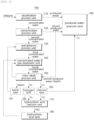
- a desalination system 100 capable of producing hydrogen includes a desalination process unit 110, a concentration process unit 120, a precipitation process unit 130, a concentrated water pre-treatment unit 140, and a chlor-alkali process unit 150, an NaOH tank 161, hydrogen tank 163, a chlorine tank 165, a hydrochloric acid reaction unit 170, a hydrochloric acid tank 180, a produced water reservoir tank 190, and a concentrated water crystallization unit 198.
- the desalination process unit 110 is a device that performs water treatment by which influent (e.g., seawater) containing salt undergoes a reverse osmosis process to produce produced water (e.g., fresh water) with salt removed and concentrated water containing concentrated salt.
- influent e.g., seawater
- produced water e.g., fresh water
- the desalination process unit 110 includes a high pressure pump 111, a reverse osmosis process unit 112, and an energy recovery unit 113.
- the reverse osmosis process unit 112 is a device that performs a reverse osmosis process.
- the reverse osmosis process unit 112 may be configured to perform the reverse osmosis process several times depending on the degree of salt removal from the influent according to the type of produced water (edible water, agricultural water, industrial water).
- the energy recovery unit 113 is a device that receives the concentrated water discharged from the reverse osmosis process unit 112 and recovers the pressure of the concentrated water.
- the high pressure pump 111 pumps the influent from sea into the reverse osmosis process unit 112.
- the reverse osmosis process unit 112 separates the influent into the produced water and the concentrated water through the reverse osmosis process.
- the reverse osmosis process used in the seawater desalination process is a known technique, and thus a detailed description thereof will be omitted.
- the produced water discharged from the reverse osmosis process unit 112 is stored in the produced water reservoir tank 190.
- the concentrated water discharged under a high pressure from the reverse osmosis process unit 112 is introduced into the energy recovery unit 113, and the pressure of the highpressure concentrated water is recovered therein. After energy is recovered by the energy recovery unit 113, the concentrated water is supplied to the concentration process unit 120.
- Seawater in general has a salinity of 3.5%. In the case of the concentrated water that has passed through the desalination process unit 110, the salinity thereof is approximately 6%. In a chlor-alkali process which will be described later, a sodium chloride solution of a high concentration of approximately 25% is required as influent, and thus in the present embodiment, a process of concentrating the concentrated water is preceded prior to performing the chlor-alkali process.
- the concentration process unit 120 is installed between the desalination process unit 110 and the precipitation process unit 130.
- the concentration process unit 120 concentrates salt in the concentrated water to a high concentration through a distillation process.
- the concentration process unit 120 may concentrate the concentrated water having a salinity of 6% to obtain concentrated water having a salinity of approximately 25%.
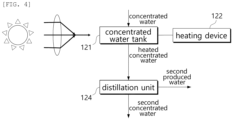
- the concentration process unit 120 includes a concentrated water tank 121, a heating device 122, and a distillation unit 124.
- the concentrated water tank 121 is a tank in which the concentrated water having passed through the energy recovery unit 113 is stored.
- the concentrated water is heated by solar heat or the heating device 122 provided separately.
- the heated concentrated water is supplied to the distillation unit 124.
- the distillation unit 124 separates the concentrated water into a second produced water and a second concentrated water through the distillation process.
- the distillation process may be performed by selecting one of membrane distillation (MD), multi-stage flash distillation (MSF), and multiple-effect distillation (MED) depending on the flow rate of the concentrated water introduced into the distillation unit 124.
- MD membrane distillation
- MSF multi-stage flash distillation
- MED multiple-effect distillation
- the second produced water is supplied from the concentration process unit 120 to the produced water reservoir tank 190. Further, a part of the second produced water may be supplied to a cathode section 155 of the chlor-alkali process unit 150. In the cathode section 155, the second produced water is mixed with a sodium hydroxide solution and then used as an electrolyte of a cathode.
- the second concentrated water is concentrated water having a salinity higher than that of the concentrated water.
- the second concentrated water is supplied from the concentration process unit 120 to the precipitation process unit 130.
- the precipitation process unit 130 is installed between the concentration process unit 120 and the concentrated water pre-treatment unit 140.
- the sedimentation process unit 130 receives the second concentrated water from the concentration process unit 120 and chemically treats the second concentrated water with sodium hydroxide to generate a precipitation reaction of the second concentrated water.
- a part of sodium hydroxide is produced in the chlor-alkali process unit 150.
- the second concentrated water is water-treated to produce a third concentrated water with divalent cations (Ca 2+ , Mg 2+ , etc.) removed, by a precipitation reaction with sodium hydroxide.
- the third concentrated water is concentrated water which results from removal of divalent cations from the second concentrated water.
- the third concentrated water is discharged from the precipitation process unit 130 and then supplied to the concentrated water pre-treatment unit 140.
- the concentrated water pre-treatment unit 140 is installed between the precipitation process unit 130 and the chlor-alkali process unit 150.
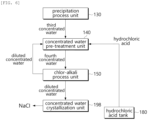
- the concentrated water pre-treatment unit 140 injects hydrochloric acid into the third concentrated water supplied from the precipitation process unit 130, thereby water-treating the third the third concentrated water to produce a fourth concentrated water having a lower pH than the third concentrated water.
- the concentrated water pre-treatment unit 140 receives the third concentrated water, diluted concentrated water, and hydrochloric acid, and discharges the fourth concentrated water.
- the third concentrated water is concentrated water having a higher pH than the fourth concentrated water.
- the diluted concentrated water is concentrated water having a lower salinity than the fourth concentrated water.
- hydrochloric acid is a chemical used to control the pH of the concentrated water.
- hydrochloric acid is prepared from chlorine gas and hydrogen gas generated in the chlor-alkali process unit 150. Hydrochloric acid is supplied from the hydrochloric acid tank 180 to the concentrated water pre-treatment unit 140.
- the chlor-alkali process unit 150 has an internal space partitioned into an anode section 151 and the cathode section 155 with a separation membrane interposed therebetween.
- the anode section 151 is provided with an anode 152.
- the cathode section 156 is provided with a cathode 155.
- the anode 152 and the cathode 156 are electrically connected to each other.
- the chlor-alkali process unit 150 electrolyzes the concentrated water by means of solar electrical energy to produce chlorine gas at the anode section 151, and hydrogen gas and sodium hydroxide at the cathode section 155.
- the anode section 151 is provided with a first fluid inlet 151a, a first fluid outlet 151b, and a first gas outlet 151c.
- the first fluid inlet 151a is a passage connected to the precipitation process unit 130 to allow introduction of the fourth concentrated water into the passage.
- the first fluid outlet 151b is a passage for allowing discharge of the diluted concentrated water through the passage.
- the first fluid outlet 151b is connected to the precipitation process unit 130.
- the first gas outlet 151c is a passage for allowing discharge of chlorine gas through the passage.
- the first gas outlet 151c is connected to the chlorine tank 165.
- the cathode section 155 is provided with a second fluid inlet 155a, a second fluid outlet 155b, and a second gas outlet 155c.
- the second fluid inlet 155a is a passage for allowing introduction of the produced water mixed with the sodium hydroxide solution into the passage.
- the second fluid inlet 155a is a passage connected to a discharge passage for the second produced water of the concentration process unit 120 to receive the second produced water.
- the sodium hydroxide solution is supplied from the NaOH tank 161 in conjunction with the second produced water.
- the second fluid inlet 155a may be connected to the produced water reservoir tank 190 to receive the produced water from the produced water reservoir tank 190.
- the second fluid outlet 155b is a passage for allowing discharge of the sodium hydroxide solution through the passage.
- the second fluid outlet 155b is connected to the NaOH tank 161.
- the second gas outlet 155c is a passage for allowing discharge of hydrogen gas through the passage.
- the second gas outlet 155c is connected to the hydrogen tank 163.
- salt (NaCl) contained in the fourth concentrated water is decomposed into sodium ions and chlorine gas.
- Chlorine gas is collected to be stored in the chlorine tank 165. Chlorine gas may be supplied to the produced water reservoir tank 190 to be used as a chemical to disinfect the produced water. Further, chlorine gas may be supplied to the hydrochloric acid reaction unit 170 to be used as a raw material for producing hydrochloric acid.
- diluted concentrated water As salt contained in the fourth concentrated water is removed by the chemical reaction according to the Formula (1), the salinity of the fourth concentrated water is lowered.
- concentrated water having a lower salinity than the fourth concentrated water is referred to as diluted concentrated water.
- the diluted concentrated water is discharged from the anode section 151 to the concentrated water pre-treatment unit 140.
- the diluted concentrated water is discharged to the concentrated water pre-treatment unit 140 without being directly discharged to sea, it is possible to prevent environmental pollution due to the diluted concentrated water being directly discharged to sea.
- a process of producing hydrogen gas and sodium hydroxide at the cathode section 155 of the chlor-alkali process unit 150 will be described as follows.
- the second produced water is controlled in pH with sodium hydroxide and then provided to the cathode section 155.
- the second produced water is fresh water which results from water treatment in the concentration process unit 120.
- the second produced water is an electrolyte of the cathode 156.
- Sodium hydroxide is produced in the chlor-alkali process unit 150.
- the produced water is electrolyzed into hydrogen gas and hydroxyl groups (OH-) to produce hydrogen gas.
- the chemical formula for producing hydrogen gas is Formula (2).
- Hydrogen gas is stored in the hydrogen tank 163 through the second gas outlet 155c. Hydrogen gas may be used as hydrogen energy.
- Hydrogen gas may be used as hydrogen energy.
- sodium hydroxide is produced by a chemical reaction between sodium ions resulting from decomposition of salt of the concentrated water, and hydroxyl groups (OH-).
- the chemical formula for producing sodium hydroxide is Formula (3).
- the sodium hydroxide solution is stored in the NaOH tank 161 through the second fluid outlet 155b.
- the sodium hydroxide solution is used to control the pH of fluid in the course of water treatment of the influent.
- Sodium hydroxide is used as a chemical to control the pH of the produced water introduced into he cathode section 155 of the above-described chlor-alkali process unit 150. Further, sodium hydroxide is used as a chemical to control the pH of the concentrated water and/or produced water of the desalination process unit 110 and/or precipitation process unit 130.
- the present invention by injecting the sodium hydroxide solution to the influent to increase the pH of the influent, it is possible to increase the removal rate of certain substances such as boron or silica from the influent undergoing the reverse osmosis process, and further, it is possible to recover alkalinity by conversion of carbon dioxide that has undergone the reverse osmosis process into carbonate ions or bicarbonate ions. Additionally, in the present invention, by injecting the sodium hydroxide solution into the produced water having a low pH after mineral injection, it is possible to prevent corrosion of a pipe network through which the produced water flows.
- Hydrochloric acid is produced by the following process.
- Chlorine gas and hydrogen gas produced in the chlor-alkali process unit 150 are individually supplied to the hydrochloric acid reaction unit 170.
- the chemical formula for producing hydrochloric acid is Formula (4).
- Hydrochloric acid produced in the hydrochloric acid reaction unit 170 is stored in the hydrochloric acid tank 180. H 2 (g) + Cl 2 (g) ⁇ 2HCl(l) ......... « Formula (4)
- the concentrated water crystallization unit 198 removes moisture from the diluted concentrated water through a crystallization process to crystallize the diluted concentrated water into salt (NaCl).
- salt NaCl
- the dilute concentrated water is heated, so that salt in the diluted concentrated water crystallizes as moisture in the dilute concentrated water is evaporated and removed as vapor.
- FIGS. 8 to 12 The following example shown in FIGS. 8 to 12 is not according to the invention and is present for illustration purposes only. The scope of the protection of the invention is solely determined by the appended set of claims.
- the desalination system 200 capable of producing hydrogen includes an influent treatment unit 210, a desalination unit 230 for hydrogen production, a concentrated water crystallization unit 240, and an energy supply unit 250, a produced water reservoir tank 271, a chlorine tank 273, a hydrogen tank 275, and an NaOH tank 277.
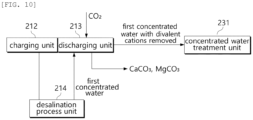
- the influent treatment unit 210 will be described with reference to FIGS. 8 to 10 .
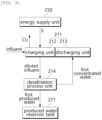
- the influent treatment unit 210 is composed of a seawater battery unit 211 and a desalination process unit 214.
- the seawater battery unit 211 charges electrical energy through an oxidation/reduction reaction of ions in influent. During discharging, electrical energy may be used as an energy source for the desalination process unit 214.
- the seawater battery unit 211 includes a charging unit 212 and a discharging unit 213.
- the charging unit 212 is electrically connected to the energy supply unit 250.
- the energy supply unit 250 generates new renewable energy such as solar power generation, hydropower generation, and wind power generation, and applies produced electrical energy to the charging unit 212.
- Chlorine ions are oxidized to chlorine gas to be collected in the charging unit 212 and stored in the chlorine tank 273.
- Sodium ions migrate from the charging unit 212 to the discharging unit 213 through a separation membrane.
- Chlorine gas may be used as a chemical to disinfect a first produced water produced in the desalination process unit 214. Chlorine gas consumed to disinfect the first produced water is self-produced in the seawater battery unit 211, and thus it is possible to reduce cost of chemical treatment.
- Salt in the influent is removed by electrolysis according to Formula (1).
- the influent of which the salinity is lowered through the charging process of the charging unit 212 will be referred to as diluted influent.
- the diluted influent is discharged from the charging unit 212 to the desalination process unit 214.
- the desalination process unit 214 water-treats the diluted influent through a reverse osmosis process. While passing through the desalination process unit 214, the diluted influent is water-treated to produce a first produced water and a first concentrated water.
- the first produced water is stored in the produced water reservoir tank 271.
- the first concentrated water is supplied to the discharging unit 213.
- the first concentrated water has a higher salinity than the diluted influent.
- the reverse osmosis process may be performed several times depending on the degree of salt removal from the influent according to the type of produced water (edible water, agricultural water, industrial water).
- the reverse osmosis process used in the seawater desalination process is a known technique, and thus a detailed description thereof will be omitted.
- the diluted influent resulting from removal of salt from the influent By desalinating the diluted influent through the reverse osmosis process, it is possible to reduce the amount of energy used to operate the reverse osmosis process, the diluted influent resulting from removal of salt from the influent to have a lowered salinity by electrolyzing the influent during charging of the seawater battery unit 211 to generate chlorine gas.
- the first concentrated water and carbon dioxide are supplied to the discharging unit 213.
- the first concentrated water is concentrated to a higher salinity than the influent while passing through the desalination process unit 214.
- divalent cations e.g., Ca 2+ or Mg 2+
- carbon dioxide cause a chemical reaction, causing the divalent cations to be removed from the first concentrated water.
- Carbon dioxide is reduced to carbonate ions (CO 3 2- ).
- Calcium ions (Ca 2+ ) chemically react with carbonate ions (CO 3 2- ) to precipitate as calcium carbonate (CaCO 3 ).
- Magnesium ions (Mg 2+ ) are chemically react with carbonate ions (CO 3 2- ) to precipitate as magnesium carbonate (MgCO 3 ).
- divalent cations are removed from the first concentrated water through a chemical reaction between the first concentrated water and carbon dioxide.
- sodium is oxidized to sodium ions, thereby increasing the salinity of the first concentrated water with divalent cations removed.
- electrical energy charged in the seawater battery unit 211 is supplied to the desalination process unit 214 and can be used as an energy source for the desalination process unit 214.
- the desalination unit 230 for hydrogen production includes the concentrated water treatment unit 231, a concentrated water pre-treatment unit 232, and a chlor-alkali process unit 233.
- the concentrated water treatment unit 231 receives the first concentrated water with divalent cations removed, and water-treats the concentrated water through a distillation process to produce a second concentrated water and a second produced water.
- the second concentrated water is preferably concentrated to a salinity (24 to 26% NaCl) sufficient to generate hydrogen gas in the chlor-alkali process unit 233, which will be described later, through the distillation process.
- the second concentrated water has a higher salinity than the first concentrated water.
- the second concentrated water is controlled in pH in the concentrated water pre-treatment unit 232 and then supplied to the chlor-alkali process unit 233.
- the second produced water is stored in the produced water reservoir tank 271.
- a distillation process may be performed by selecting one of membrane distillation (MD), multi-stage flash distillation (MSF), and multiple-effect distillation (MED).
- MD membrane distillation
- MSF multi-stage flash distillation
- MED multiple-effect distillation
- the concentrated water pre-treatment unit 232 adjusts the pH of the second concentrated water to a pH lower than that of the second concentrated water by injecting hydrochloric acid into the second concentrated water.
- Hydrochloric acid is a chemical used to control the pH of the concentrated water. Hydrochloric acid can be prepared from chlorine gas and hydrogen gas generated in the chlor-alkali process unit 233.
- hypochlorous acid H 2 O
- the chlor-alkali process unit 233 has an internal space partitioned into an anode section 234 and the cathode section 235 with a separation membrane interposed therebetween.
- the anode section 234 is provided with an anode 234a.
- the cathode section 235 is provided with a cathode 235a.
- the anode 234a and the cathode 235a are electrically connected to each other.
- the chlor-alkali process unit 233 electrolyzes the concentrated water by means of solar electrical energy to produce chlorine gas at the anode section 234, and hydrogen gas and sodium hydroxide at the cathode section 235.
- the anode section 234 is connected to the chlorine tank 273 and the concentrated water crystallization unit 240.
- the cathode section 235 is connected to the hydrogen tank 275 and the NaOH tank 277.
- a process in which chlorine gas is produced at the anode section 234 of the chlor-alkali process unit 233 will be described as follows.
- power is supplied to the chlor-alkali process unit 233, current is applied to the anode 234a and the cathode 235a.
- new renewable energy of the energy supply unit 250 may be used as a power source used.
- salt (NaCl) contained in the second concentrated water is decomposed into sodium ions and chlorine gas.
- Chlorine gas is collected to be stored in the chlorine tank 273. Chlorine gas may be supplied to the produced water reservoir tank 271 to be used as a chemical to disinfect the produced water. Further, chlorine gas may be used as a raw material for producing hydrochloric acid.
- the salinity of the second concentrated water is lowered.
- concentrated water having a lower salinity than the second concentrated water is referred to as diluted concentrated water.
- the diluted concentrated water is discharged from the anode section 234 to the concentrated water crystallization unit 240.
- a process of producing hydrogen gas and sodium hydroxide at the cathode section 235 of the chlor-alkali process unit 233 will be described as follows.
- the second produced water is controlled in pH with sodium hydroxide and then provided to the cathode section 235.
- the second produced water is fresh water which results from water treatment in the concentration process unit 120.
- the second produced water is an electrolyte of the cathode 235a.
- Sodium hydroxide is produced in the chlor-alkali process unit 233.
- the produced water is electrolyzed into hydrogen gas and hydroxyl groups (OH-) to produce hydrogen gas.
- the chemical formula for producing hydrogen gas is Formula (2).
- Hydrogen gas is collected in the cathode section 235 and stored in the hydrogen tank 275. Hydrogen gas may be used as hydrogen energy.
- Hydrogen gas may be used as hydrogen energy.
- sodium hydroxide is produced by a chemical reaction between sodium ions resulting from decomposition of salt of the concentrated water, and hydroxyl groups (OH-).
- the chemical formula for producing sodium hydroxide is Formula (3). 2Na + (aq) + 2OH - (aq) ⁇ 2NaOH(aq) ......... « Formula (3)
- the diluted concentrated water discharged from the chlor-alkali process unit 233 is discharged to the concentrated water crystallization unit 240.
- the diluted concentrated water is concentrated water that results from removal of chlorine gas from the second concentrated water to have a diluted concentration by electrolyzing the second concentrated water.
- the diluted concentrated water has a lower salinity than the second concentrated water.
- the concentrated water crystallization unit 240 removes moisture from the diluted concentrated water through a crystallization process to crystallize the diluted concentrated water into salt (NaCl).
- salt NaCl
- the concentrated water crystallization unit 240 may cool the vapor generated during the crystallization process to produce a third produced water.
- the third produced water is stored in the produced water reservoir tank 271.
- the present invention can find application in the field of producing hydrogen gas, which is a future energy source, from concentrated water discharged as the waste stream in a seawater desalination process.
Landscapes
- Chemical & Material Sciences (AREA)
- Engineering & Computer Science (AREA)
- Water Supply & Treatment (AREA)
- Organic Chemistry (AREA)
- Chemical Kinetics & Catalysis (AREA)
- Electrochemistry (AREA)
- Environmental & Geological Engineering (AREA)
- Hydrology & Water Resources (AREA)
- Life Sciences & Earth Sciences (AREA)
- Metallurgy (AREA)
- Materials Engineering (AREA)
- Inorganic Chemistry (AREA)
- Nanotechnology (AREA)
- General Chemical & Material Sciences (AREA)
- Analytical Chemistry (AREA)
- Automation & Control Theory (AREA)
- Separation Using Semi-Permeable Membranes (AREA)
- Water Treatment By Electricity Or Magnetism (AREA)
Claims (5)
- Verfahren zur Entsalzung zur Ermöglichung der Wasserstoffproduktion, wobei das Verfahren Folgendes umfasst:einen Entsalzungsprozess unter Verwendung einer Entsalzungsprozess-Einheit (110), in der ein Zufluss durch einen Umkehrosmose-Prozess mit Wasser behandelt wird, um produziertes Wasser und konzentriertes Wasser zu erzeugen; undein Chloralkaliverfahren unter Verwendung einer Chloralkaliverfahrenseinheit (150) mit einem Innenraum, der in einen Anodenabschnitt (151), dem das konzentrierte Wasser zugeführt wird, und einen Kathodenabschnitt (155, 156), dem das erzeugte Wasser zugeführt wird, unterteilt ist,wobei die Chloralkali-Prozesseinheit (150) elektrische Solarenergie verwendet, um Chlorgas aus dem Salz des konzentrierten Wassers durch eine chemische Reaktion im Anodenabschnitt (151) mit dem konzentrierten Wasser als Elektrolyt zu erzeugen und Wasserstoffgas und Natriumhydroxid durch eine chemische Reaktion im Kathodenabschnitt (155, 156) mit dem erzeugten Wasser als Elektrolyt zu erzeugen, und ferner umfassend:
einen Konzentrationsprozess unter Verwendung einer Konzentrationsprozess-Einheit (120), die zwischen dem Entsalzungsprozess unter Verwendung einer Entsalzungsprozess-Einheit (110) und der Chloralkali-Prozess-Einheit (150) vorgesehen ist, und eine Wasserbehandlung des konzentrierten Wassers durch einen Destillationsprozess, um ein zweites konzentriertes Wasser, das auf einen höheren Salzgehalt als das konzentrierte Wasser konzentriert ist, und ein zweites erzeugtes Wasser, das aus der Entfernung des Salzes aus dem konzentrierten Wasser resultiert, zu erzeugen, ferner umfassend:
eine Fällungsprozess-Einheit (130), die zwischen der Konzentrationsprozess-Einheit (120) und der Chloralkali-Prozess-Einheit (150) vorgesehen ist, wobei das Natriumhydroxid in das zweite konzentrierte Wasser injiziert wird, das von der Konzentrationsprozess-Einheit (120) zugeführt wird, und das zweite konzentrierte Wasser durch eine Fällungsreaktion wässrig behandelt wird, um ein drittes konzentriertes Wasser zu erzeugen, aus dem zweiwertige Kationen entfernt sind, ferner umfassend:
eine Vorbehandlungseinheit für konzentriertes Wasser (140), die zwischen der Fällungsprozess-Einheit (130) und der Chloralkali-Prozess-Einheit (150) vorgesehen ist, wobei Salzsäure in das von der Fällungsprozess-Einheit (130) gelieferte dritte konzentrierte Wasser injiziert wird, und das dritte konzentrierte Wasser einer Wasserbehandlung unterzieht, um ein viertes konzentriertes Wasser mit einem niedrigeren pH-Wert als das dritte konzentrierte Wasser zu erzeugen, wobei die Chlor-Alkali-Prozesseinheit (150) das vierte konzentrierte Wasser von der konzentrierten Wasser-Vorbehandlungseinheit (140) zum Anodenabschnitt (151) erhält, das Chlorgas in dem vierten konzentrierten Wasser durch die chemische Reaktion am Anodenabschnitt (151) mit dem vierten konzentrierten Wasser als Elektrolyt erzeugt und gibt verdünntes konzentriertes Wasser, das aus der Entfernung des Salzes aus dem vierten konzentrierten Wasser resultiert, an die Vorbehandlungseinheit für konzentriertes Wasser (140) ab. - Entsalzungsverfahren nach Anspruch 1, das ferner Folgendes umfasst:einen Vorratstank für produziertes Wasser (190), der das von der Entsalzungsprozess-Einheit (110) erhaltene produzierte Wasser speichert;einen Chlortank (165), der das vom Anodenabschnitt (151) gelieferte Chlorgas speichert und mit dem Speichertank (190) für das erzeugte Wasser verbunden ist, um das Chlorgas dem Speichertank (190) für das erzeugte Wasser zuzuführen;einen Wasserstofftank (163), der das vom Kathodenabschnitt (155, 156) gelieferte Wasserstoffgas speichert; undeinen NaOH-Tank (161), der das durch die chemische Reaktion im Kathodenabschnitt (155, 156) erzeugte Natriumhydroxid speichert und das Natriumhydroxid dem in den Kathodenabschnitt (155, 156) eingeleiteten erzeugten Wasser zuführt,wobei das Chlorgas dem Vorratsbehälter (190) für das produzierte Wasser zugeführt wird, um das produzierte Wasser zu desinfizieren, und das Natriumhydroxid den pH-Wert des in den Kathodenabschnitt (155, 156) eingeführten produzierten Wassers steuert.
- Entsalzungsverfahren nach Anspruch 2 umfasst ferner:eine Salzsäurereaktionseinheit (170), die einzeln mit dem Chlortank (165) und dem Wasserstofftank (163) verbunden ist und Salzsäure durch eine chemische Reaktion zwischen dem zugeführten Chlorgas und Wasserstoffgas erzeugt; undeinen Salzsäuretank (180), in dem die Salzsäure gelagert wird und der mit der Vorbehandlungseinheit für konzentriertes Wasser (140) verbunden ist, um die Salzsäure der Vorbehandlungseinheit für konzentriertes Wasser (140) zuzuführen.
- Entsalzungsverfahren nach Anspruch 1, wobei in dem Kathodenabschnitt (155, 156) das erzeugte Wasser in das Wasserstoffgas und die Hydroxylgruppen (OH-) elektrolysiert wird, um das Wasserstoffgas zu erzeugen, und das Natriumhydroxid durch eine chemische Reaktion zwischen Natriumionen, die aus der Zersetzung des Salzes des konzentrierten Wassers resultieren, und den Hydroxylgruppen (OH-) erzeugt wird.
- Entsalzungsverfahren nach Anspruch 1, wobei die Entsalzungsprozess-Einheit (110) umfasst: eine Umkehrosmose-Prozess-Einheit (112), in der der Zufluss in das produzierte Wasser und das konzentrierte Wasser mittels Hochdruck getrennt wird, während der Umkehrosmose-Prozess durchgeführt wird; und
eine Energierückgewinnungseinheit (113), die mit der Umkehrosmose-Prozesseinheit (112) und der Konzentrationsprozesseinheit (120) verbunden ist, das konzentrierte Wasser von der Umkehrosmose-Prozesseinheit (112) empfängt, um einen Druck des konzentrierten Wassers auf das einfließende Wasser zu übertragen, und das konzentrierte Wasser mit reduziertem Druck an die Konzentrationsprozesseinheit (120) liefert.
Applications Claiming Priority (2)
| Application Number | Priority Date | Filing Date | Title |
|---|---|---|---|
| KR1020190033654A KR102207458B1 (ko) | 2019-03-25 | 2019-03-25 | 수소 생산가능한 담수시스템 |
| PCT/IB2020/054866 WO2020194284A1 (ko) | 2019-03-25 | 2020-05-22 | 수소 생산가능한 담수시스템 |
Publications (3)
| Publication Number | Publication Date |
|---|---|
| EP3848331A1 EP3848331A1 (de) | 2021-07-14 |
| EP3848331A4 EP3848331A4 (de) | 2022-07-20 |
| EP3848331B1 true EP3848331B1 (de) | 2025-04-30 |
Family
ID=72610298
Family Applications (1)
| Application Number | Title | Priority Date | Filing Date |
|---|---|---|---|
| EP20776475.4A Active EP3848331B1 (de) | 2019-03-25 | 2020-05-22 | Entsalzungsverfahren mit fähigkeit zur wasserstofferzeugung |
Country Status (3)
| Country | Link |
|---|---|
| EP (1) | EP3848331B1 (de) |
| KR (1) | KR102207458B1 (de) |
| WO (1) | WO2020194284A1 (de) |
Families Citing this family (8)
| Publication number | Priority date | Publication date | Assignee | Title |
|---|---|---|---|---|
| CN112266054A (zh) * | 2020-10-12 | 2021-01-26 | 益生瑞(上海)生物科技有限公司 | 一种适合家庭和医院各种消毒的酸性氧化电位水发生器 |
| KR102442583B1 (ko) * | 2021-04-14 | 2022-09-13 | 대우조선해양 주식회사 | 해수전지를 적용한 선박평형수 처리 시스템 및 운영 방법 |
| CN113105058A (zh) * | 2021-04-23 | 2021-07-13 | 广东闻扬环境科技有限公司 | 海水淡化零排放及资源回收利用工艺 |
| US20230057182A1 (en) * | 2021-08-18 | 2023-02-23 | Austin J. Shields | Produced water treatment with co2 absorption |
| KR20240061997A (ko) | 2022-11-01 | 2024-05-08 | 주식회사 삼원카본써큘레이션 | 이산화탄소를 용해한 해수와 전기투석을 이용한 수소 생산 시스템 및 방법 |
| GB2635100A (en) * | 2023-01-25 | 2025-05-07 | John Brown Allan | Methods and related systems for processing an exhaust stream of a ships engine and CO2, hydrogen and NaOH from seawater for on-board utilisation of safe |
| WO2024210836A1 (en) * | 2023-04-03 | 2024-10-10 | Nanyang Technological University | An integrated resource recovery and co-treatment system of desalination brine and flue gas via waste brine electrolysis and sustainable co 2 mineralisation (from brine to newseawater) |
| AU2024354246A1 (en) * | 2023-10-03 | 2026-04-16 | Carbon Blue Ltd. | Process for water treatment |
Family Cites Families (14)
| Publication number | Priority date | Publication date | Assignee | Title |
|---|---|---|---|---|
| JPH06269777A (ja) * | 1993-03-16 | 1994-09-27 | Asahi Glass Co Ltd | 造水プロセス |
| US6261464B1 (en) * | 1999-05-25 | 2001-07-17 | Miox Corporation | Portable water disinfection system |
| WO2009152148A1 (en) * | 2008-06-11 | 2009-12-17 | The Regents Of The University Of California | Method and system for high recovery water desalting |
| KR101134495B1 (ko) * | 2009-08-07 | 2012-04-13 | 배오성 | 그린에너지를 이용하여 해수를 가성소다와 담수로 분리하는 방법 및 장치 |
| KR101206582B1 (ko) * | 2010-06-28 | 2012-11-29 | 효성굿스프링스 주식회사 | 해수담수화를 위한 보론 제거 장치 및 방법 |
| KR20130086717A (ko) * | 2012-01-26 | 2013-08-05 | 삼성전자주식회사 | 전해 환원수 제조 장치 및 그 제어 방법 |
| KR101367477B1 (ko) * | 2012-05-30 | 2014-02-26 | 한국해양과학기술원 | 해수 전기분해 알칼리 수로부터 마그네슘염과 칼슘염을 포함한 미네랄 염의 분리 및 이를 이용한 미네랄음료의 제조방법 |
| JP5865495B2 (ja) * | 2012-07-06 | 2016-02-17 | 株式会社日立製作所 | 塩排水の処理方法及び装置 |
| KR20150112786A (ko) * | 2014-03-27 | 2015-10-07 | 한양대학교 산학협력단 | 해수 농축수 전기분해를 통한 NaOH 회수장치 및 회수방법 |
| KR101526299B1 (ko) | 2014-05-26 | 2015-06-08 | 두산중공업 주식회사 | 플랜트-정삼투 하이브리드 담수화 시스템 및 방법 |
| SI3185247T1 (sl) * | 2014-08-18 | 2019-04-30 | De Nora Permelec Ltd | Postopek za obdelavo s tritijevo vodo vsebujoče neobdelane vode |
| WO2016047257A1 (ja) * | 2014-09-26 | 2016-03-31 | 株式会社日本トリム | 電解水生成装置及びそれを備えた透析液調製用水の製造装置 |
| KR101851645B1 (ko) * | 2016-04-29 | 2018-06-07 | 국민대학교산학협력단 | 결정화장치가 결합된 막증류 수처리 장치 및 이를 이용한 유가자원 회수방법 |
| WO2019036676A1 (en) * | 2017-08-18 | 2019-02-21 | The Regents Of The University Of California | EASY, LOW ENERGY ROUTES FOR THE PRODUCTION OF CALCIUM SALTS AND MAGNESIUM MOISTURIZED FROM INDUSTRIAL ALKALINE WASTE |
-
2019
- 2019-03-25 KR KR1020190033654A patent/KR102207458B1/ko active Active
-
2020
- 2020-05-22 WO PCT/IB2020/054866 patent/WO2020194284A1/ko not_active Ceased
- 2020-05-22 EP EP20776475.4A patent/EP3848331B1/de active Active
Also Published As
| Publication number | Publication date |
|---|---|
| KR102207458B1 (ko) | 2021-01-26 |
| EP3848331A1 (de) | 2021-07-14 |
| WO2020194284A1 (ko) | 2020-10-01 |
| EP3848331A4 (de) | 2022-07-20 |
| KR20200115747A (ko) | 2020-10-08 |
Similar Documents
| Publication | Publication Date | Title |
|---|---|---|
| EP3848331A1 (de) | Entsalzungssystem mit fähigkeit zur wasserstofferzeugung | |
| Tu et al. | Reclaimed seawater discharge–desalination brine treatment and resource recovery system | |
| KR102328974B1 (ko) | 수소 생산가능한 담수시스템 | |
| JP5873771B2 (ja) | 有機性廃水の処理方法及び処理装置 | |
| JP3164558U (ja) | 脱塩のための装置 | |
| US20110056876A1 (en) | Desalination system | |
| KR101373389B1 (ko) | 고농도 차아염소산나트륨 발생장치 | |
| KR101436138B1 (ko) | 해수전해 및 연료전지 복합시스템 | |
| KR102055255B1 (ko) | 해수전지가 결합된 해수담수화 플랜트 | |
| JP2009095821A (ja) | 塩水の処理方法 | |
| EP3250516B1 (de) | Entsalzungsvorrichtung und entsalzungsverfahren mit gasdiffusionselektroden | |
| JP2008223115A (ja) | 塩水の処理方法 | |
| KR20080094303A (ko) | 전처리 공정을 포함한 고효율 해수 전해장치 및 전해방법 | |
| US10934627B2 (en) | Methods and systems for making hypochlorite solution from reverse osmosis brine | |
| US20130206689A1 (en) | Brine treatment scaling control system and method | |
| WO2014006741A1 (ja) | 塩排水の処理方法及び装置 | |
| Liu et al. | Robust electrolysis system divided by bipolar electrode and non-conductive membrane for energy-efficient calcium hardness removal | |
| KR20180111229A (ko) | 저 에너지 비용의 염분차발전-담수화 하이브리드 시스템 | |
| KR20140076540A (ko) | 해수전해 및 연료전지 복합시스템 | |
| Santhanam et al. | A two-step electrochemical method for separating Mg (OH) 2 and CaCO3: Application to RO reject and polluted groundwater | |
| JP2704629B2 (ja) | 電気透析装置 | |
| US11794147B2 (en) | Wastewater treatment method and wastewater treatment apparatus | |
| JP2012217943A (ja) | 脱塩処理方法及び脱塩処理システム | |
| US20240124335A1 (en) | Desalination device and process for recovery and valorisation of chlorides in dilute solutions | |
| CN110028193B (zh) | 废水资源化系统 |
Legal Events
| Date | Code | Title | Description |
|---|---|---|---|
| STAA | Information on the status of an ep patent application or granted ep patent |
Free format text: STATUS: THE INTERNATIONAL PUBLICATION HAS BEEN MADE |
|
| PUAI | Public reference made under article 153(3) epc to a published international application that has entered the european phase |
Free format text: ORIGINAL CODE: 0009012 |
|
| STAA | Information on the status of an ep patent application or granted ep patent |
Free format text: STATUS: REQUEST FOR EXAMINATION WAS MADE |
|
| 17P | Request for examination filed |
Effective date: 20210408 |
|
| AK | Designated contracting states |
Kind code of ref document: A1 Designated state(s): AL AT BE BG CH CY CZ DE DK EE ES FI FR GB GR HR HU IE IS IT LI LT LU LV MC MK MT NL NO PL PT RO RS SE SI SK SM TR |
|
| RIC1 | Information provided on ipc code assigned before grant |
Ipc: B01D 61/06 20060101ALN20220420BHEP Ipc: B01D 61/02 20060101ALN20220420BHEP Ipc: C02F 103/08 20060101ALI20220420BHEP Ipc: C02F 1/66 20060101ALI20220420BHEP Ipc: C02F 1/04 20060101ALI20220420BHEP Ipc: C02F 1/52 20060101ALI20220420BHEP Ipc: C25B 1/04 20210101ALI20220420BHEP Ipc: C02F 1/461 20060101ALI20220420BHEP Ipc: C02F 1/44 20060101AFI20220420BHEP |
|
| DAV | Request for validation of the european patent (deleted) | ||
| DAX | Request for extension of the european patent (deleted) | ||
| A4 | Supplementary search report drawn up and despatched |
Effective date: 20220622 |
|
| RIC1 | Information provided on ipc code assigned before grant |
Ipc: B01D 61/06 20060101ALN20220616BHEP Ipc: B01D 61/02 20060101ALN20220616BHEP Ipc: C02F 103/08 20060101ALI20220616BHEP Ipc: C02F 1/66 20060101ALI20220616BHEP Ipc: C02F 1/04 20060101ALI20220616BHEP Ipc: C02F 1/52 20060101ALI20220616BHEP Ipc: C25B 1/04 20210101ALI20220616BHEP Ipc: C02F 1/461 20060101ALI20220616BHEP Ipc: C02F 1/44 20060101AFI20220616BHEP |
|
| STAA | Information on the status of an ep patent application or granted ep patent |
Free format text: STATUS: EXAMINATION IS IN PROGRESS |
|
| 17Q | First examination report despatched |
Effective date: 20240529 |
|
| GRAP | Despatch of communication of intention to grant a patent |
Free format text: ORIGINAL CODE: EPIDOSNIGR1 |
|
| STAA | Information on the status of an ep patent application or granted ep patent |
Free format text: STATUS: GRANT OF PATENT IS INTENDED |
|
| RIC1 | Information provided on ipc code assigned before grant |
Ipc: B01D 61/06 20060101ALN20241018BHEP Ipc: B01D 61/02 20060101ALN20241018BHEP Ipc: C02F 103/08 20060101ALI20241018BHEP Ipc: C02F 1/66 20060101ALI20241018BHEP Ipc: C02F 1/04 20060101ALI20241018BHEP Ipc: C02F 1/52 20060101ALI20241018BHEP Ipc: C25B 1/04 20210101ALI20241018BHEP Ipc: C02F 1/461 20060101ALI20241018BHEP Ipc: C02F 1/44 20060101AFI20241018BHEP |
|
| INTG | Intention to grant announced |
Effective date: 20241120 |
|
| GRAS | Grant fee paid |
Free format text: ORIGINAL CODE: EPIDOSNIGR3 |
|
| GRAA | (expected) grant |
Free format text: ORIGINAL CODE: 0009210 |
|
| STAA | Information on the status of an ep patent application or granted ep patent |
Free format text: STATUS: THE PATENT HAS BEEN GRANTED |
|
| AK | Designated contracting states |
Kind code of ref document: B1 Designated state(s): AL AT BE BG CH CY CZ DE DK EE ES FI FR GB GR HR HU IE IS IT LI LT LU LV MC MK MT NL NO PL PT RO RS SE SI SK SM TR |
|
| REG | Reference to a national code |
Ref country code: CH Ref legal event code: EP Ref country code: GB Ref legal event code: FG4D |
|
| REG | Reference to a national code |
Ref country code: IE Ref legal event code: FG4D |
|
| REG | Reference to a national code |
Ref country code: DE Ref legal event code: R096 Ref document number: 602020050470 Country of ref document: DE |
|
| PGFP | Annual fee paid to national office [announced via postgrant information from national office to epo] |
Ref country code: FR Payment date: 20250613 Year of fee payment: 6 |
|
| REG | Reference to a national code |
Ref country code: NL Ref legal event code: MP Effective date: 20250430 |
|
| REG | Reference to a national code |
Ref country code: AT Ref legal event code: MK05 Ref document number: 1789927 Country of ref document: AT Kind code of ref document: T Effective date: 20250430 |
|
| PG25 | Lapsed in a contracting state [announced via postgrant information from national office to epo] |
Ref country code: PT Free format text: LAPSE BECAUSE OF FAILURE TO SUBMIT A TRANSLATION OF THE DESCRIPTION OR TO PAY THE FEE WITHIN THE PRESCRIBED TIME-LIMIT Effective date: 20250901 Ref country code: FI Free format text: LAPSE BECAUSE OF FAILURE TO SUBMIT A TRANSLATION OF THE DESCRIPTION OR TO PAY THE FEE WITHIN THE PRESCRIBED TIME-LIMIT Effective date: 20250430 Ref country code: ES Free format text: LAPSE BECAUSE OF FAILURE TO SUBMIT A TRANSLATION OF THE DESCRIPTION OR TO PAY THE FEE WITHIN THE PRESCRIBED TIME-LIMIT Effective date: 20250430 |
|
| REG | Reference to a national code |
Ref country code: LT Ref legal event code: MG9D |
|
| PG25 | Lapsed in a contracting state [announced via postgrant information from national office to epo] |
Ref country code: GR Free format text: LAPSE BECAUSE OF FAILURE TO SUBMIT A TRANSLATION OF THE DESCRIPTION OR TO PAY THE FEE WITHIN THE PRESCRIBED TIME-LIMIT Effective date: 20250731 Ref country code: NO Free format text: LAPSE BECAUSE OF FAILURE TO SUBMIT A TRANSLATION OF THE DESCRIPTION OR TO PAY THE FEE WITHIN THE PRESCRIBED TIME-LIMIT Effective date: 20250730 |
|
| PG25 | Lapsed in a contracting state [announced via postgrant information from national office to epo] |
Ref country code: PL Free format text: LAPSE BECAUSE OF FAILURE TO SUBMIT A TRANSLATION OF THE DESCRIPTION OR TO PAY THE FEE WITHIN THE PRESCRIBED TIME-LIMIT Effective date: 20250430 Ref country code: NL Free format text: LAPSE BECAUSE OF FAILURE TO SUBMIT A TRANSLATION OF THE DESCRIPTION OR TO PAY THE FEE WITHIN THE PRESCRIBED TIME-LIMIT Effective date: 20250430 |
|
| PG25 | Lapsed in a contracting state [announced via postgrant information from national office to epo] |
Ref country code: BG Free format text: LAPSE BECAUSE OF FAILURE TO SUBMIT A TRANSLATION OF THE DESCRIPTION OR TO PAY THE FEE WITHIN THE PRESCRIBED TIME-LIMIT Effective date: 20250430 |
|
| PG25 | Lapsed in a contracting state [announced via postgrant information from national office to epo] |
Ref country code: HR Free format text: LAPSE BECAUSE OF FAILURE TO SUBMIT A TRANSLATION OF THE DESCRIPTION OR TO PAY THE FEE WITHIN THE PRESCRIBED TIME-LIMIT Effective date: 20250430 |
|
| PG25 | Lapsed in a contracting state [announced via postgrant information from national office to epo] |
Ref country code: AT Free format text: LAPSE BECAUSE OF FAILURE TO SUBMIT A TRANSLATION OF THE DESCRIPTION OR TO PAY THE FEE WITHIN THE PRESCRIBED TIME-LIMIT Effective date: 20250430 |
|
| PG25 | Lapsed in a contracting state [announced via postgrant information from national office to epo] |
Ref country code: RS Free format text: LAPSE BECAUSE OF FAILURE TO SUBMIT A TRANSLATION OF THE DESCRIPTION OR TO PAY THE FEE WITHIN THE PRESCRIBED TIME-LIMIT Effective date: 20250731 |
|
| PG25 | Lapsed in a contracting state [announced via postgrant information from national office to epo] |
Ref country code: IS Free format text: LAPSE BECAUSE OF FAILURE TO SUBMIT A TRANSLATION OF THE DESCRIPTION OR TO PAY THE FEE WITHIN THE PRESCRIBED TIME-LIMIT Effective date: 20250830 |
|
| PG25 | Lapsed in a contracting state [announced via postgrant information from national office to epo] |
Ref country code: LV Free format text: LAPSE BECAUSE OF FAILURE TO SUBMIT A TRANSLATION OF THE DESCRIPTION OR TO PAY THE FEE WITHIN THE PRESCRIBED TIME-LIMIT Effective date: 20250430 |
|
| REG | Reference to a national code |
Ref country code: DE Ref legal event code: R119 Ref document number: 602020050470 Country of ref document: DE |
|
| REG | Reference to a national code |
Ref country code: CH Ref legal event code: H13 Free format text: ST27 STATUS EVENT CODE: U-0-0-H10-H13 (AS PROVIDED BY THE NATIONAL OFFICE) Effective date: 20251223 |
|
| PG25 | Lapsed in a contracting state [announced via postgrant information from national office to epo] |
Ref country code: SM Free format text: LAPSE BECAUSE OF FAILURE TO SUBMIT A TRANSLATION OF THE DESCRIPTION OR TO PAY THE FEE WITHIN THE PRESCRIBED TIME-LIMIT Effective date: 20250430 Ref country code: DK Free format text: LAPSE BECAUSE OF FAILURE TO SUBMIT A TRANSLATION OF THE DESCRIPTION OR TO PAY THE FEE WITHIN THE PRESCRIBED TIME-LIMIT Effective date: 20250430 |
|
| PG25 | Lapsed in a contracting state [announced via postgrant information from national office to epo] |
Ref country code: LU Free format text: LAPSE BECAUSE OF NON-PAYMENT OF DUE FEES Effective date: 20250522 |
|
| PG25 | Lapsed in a contracting state [announced via postgrant information from national office to epo] |
Ref country code: CH Free format text: LAPSE BECAUSE OF NON-PAYMENT OF DUE FEES Effective date: 20250531 |
|
| PG25 | Lapsed in a contracting state [announced via postgrant information from national office to epo] |
Ref country code: CZ Free format text: LAPSE BECAUSE OF FAILURE TO SUBMIT A TRANSLATION OF THE DESCRIPTION OR TO PAY THE FEE WITHIN THE PRESCRIBED TIME-LIMIT Effective date: 20250430 |
|
| PG25 | Lapsed in a contracting state [announced via postgrant information from national office to epo] |
Ref country code: EE Free format text: LAPSE BECAUSE OF FAILURE TO SUBMIT A TRANSLATION OF THE DESCRIPTION OR TO PAY THE FEE WITHIN THE PRESCRIBED TIME-LIMIT Effective date: 20250430 |
|
| PG25 | Lapsed in a contracting state [announced via postgrant information from national office to epo] |
Ref country code: RO Free format text: LAPSE BECAUSE OF FAILURE TO SUBMIT A TRANSLATION OF THE DESCRIPTION OR TO PAY THE FEE WITHIN THE PRESCRIBED TIME-LIMIT Effective date: 20250430 Ref country code: SK Free format text: LAPSE BECAUSE OF FAILURE TO SUBMIT A TRANSLATION OF THE DESCRIPTION OR TO PAY THE FEE WITHIN THE PRESCRIBED TIME-LIMIT Effective date: 20250430 |
|
| PG25 | Lapsed in a contracting state [announced via postgrant information from national office to epo] |
Ref country code: IT Free format text: LAPSE BECAUSE OF FAILURE TO SUBMIT A TRANSLATION OF THE DESCRIPTION OR TO PAY THE FEE WITHIN THE PRESCRIBED TIME-LIMIT Effective date: 20250430 |
|
| REG | Reference to a national code |
Ref country code: BE Ref legal event code: MM Effective date: 20250531 |
|
| PG25 | Lapsed in a contracting state [announced via postgrant information from national office to epo] |
Ref country code: MC Free format text: LAPSE BECAUSE OF FAILURE TO SUBMIT A TRANSLATION OF THE DESCRIPTION OR TO PAY THE FEE WITHIN THE PRESCRIBED TIME-LIMIT Effective date: 20250430 |
|
| PLBE | No opposition filed within time limit |
Free format text: ORIGINAL CODE: 0009261 |
|
| STAA | Information on the status of an ep patent application or granted ep patent |
Free format text: STATUS: NO OPPOSITION FILED WITHIN TIME LIMIT |
|
| REG | Reference to a national code |
Ref country code: CH Ref legal event code: L10 Free format text: ST27 STATUS EVENT CODE: U-0-0-L10-L00 (AS PROVIDED BY THE NATIONAL OFFICE) Effective date: 20260311 |
|
| GBPC | Gb: european patent ceased through non-payment of renewal fee |
Effective date: 20250730 |
|
| 26N | No opposition filed |
Effective date: 20260202 |
|
| PG25 | Lapsed in a contracting state [announced via postgrant information from national office to epo] |
Ref country code: GB Free format text: LAPSE BECAUSE OF NON-PAYMENT OF DUE FEES Effective date: 20250730 |
|
| PG25 | Lapsed in a contracting state [announced via postgrant information from national office to epo] |
Ref country code: IE Free format text: LAPSE BECAUSE OF NON-PAYMENT OF DUE FEES Effective date: 20250522 Ref country code: DE Free format text: LAPSE BECAUSE OF NON-PAYMENT OF DUE FEES Effective date: 20251202 |
|
| PG25 | Lapsed in a contracting state [announced via postgrant information from national office to epo] |
Ref country code: BE Free format text: LAPSE BECAUSE OF NON-PAYMENT OF DUE FEES Effective date: 20250531 |