EP3842801A1 - Vorrichtung und verfahren zur verwendung bei der sammlung von speichel für forschung und diagnosen - Google Patents
Vorrichtung und verfahren zur verwendung bei der sammlung von speichel für forschung und diagnosen Download PDFInfo
- Publication number
- EP3842801A1 EP3842801A1 EP20211841.0A EP20211841A EP3842801A1 EP 3842801 A1 EP3842801 A1 EP 3842801A1 EP 20211841 A EP20211841 A EP 20211841A EP 3842801 A1 EP3842801 A1 EP 3842801A1
- Authority
- EP
- European Patent Office
- Prior art keywords
- coupler
- specimen
- paragraph
- tubular member
- elongate tubular
- Prior art date
- Legal status (The legal status is an assumption and is not a legal conclusion. Google has not performed a legal analysis and makes no representation as to the accuracy of the status listed.)
- Withdrawn
Links
- 238000000034 method Methods 0.000 title claims description 24
- 238000011160 research Methods 0.000 title description 4
- HEFNNWSXXWATRW-UHFFFAOYSA-N Ibuprofen Chemical compound CC(C)CC1=CC=C(C(C)C(O)=O)C=C1 HEFNNWSXXWATRW-UHFFFAOYSA-N 0.000 title 1
- 239000012530 fluid Substances 0.000 claims abstract description 37
- 230000015556 catabolic process Effects 0.000 claims description 9
- 238000006731 degradation reaction Methods 0.000 claims description 9
- 239000000975 dye Substances 0.000 claims description 9
- 239000000463 material Substances 0.000 claims description 8
- 239000003795 chemical substances by application Substances 0.000 claims description 6
- 241000894006 Bacteria Species 0.000 claims description 5
- 230000008878 coupling Effects 0.000 claims description 5
- 238000010168 coupling process Methods 0.000 claims description 5
- 238000005859 coupling reaction Methods 0.000 claims description 5
- 239000006260 foam Substances 0.000 claims description 5
- 239000003112 inhibitor Substances 0.000 claims description 5
- 229920000642 polymer Polymers 0.000 claims description 5
- 230000003068 static effect Effects 0.000 claims description 5
- 238000000151 deposition Methods 0.000 claims description 3
- 210000003296 saliva Anatomy 0.000 description 6
- 230000008901 benefit Effects 0.000 description 5
- 238000012986 modification Methods 0.000 description 5
- 230000004048 modification Effects 0.000 description 5
- 239000010902 straw Substances 0.000 description 5
- 238000005187 foaming Methods 0.000 description 3
- 238000011282 treatment Methods 0.000 description 3
- 238000004891 communication Methods 0.000 description 2
- 238000010586 diagram Methods 0.000 description 2
- 238000010992 reflux Methods 0.000 description 2
- 206010013642 Drooling Diseases 0.000 description 1
- 239000004743 Polypropylene Substances 0.000 description 1
- 208000008630 Sialorrhea Diseases 0.000 description 1
- 238000007792 addition Methods 0.000 description 1
- 230000015572 biosynthetic process Effects 0.000 description 1
- 230000005587 bubbling Effects 0.000 description 1
- 150000001720 carbohydrates Chemical class 0.000 description 1
- 235000014633 carbohydrates Nutrition 0.000 description 1
- 238000010276 construction Methods 0.000 description 1
- 238000012217 deletion Methods 0.000 description 1
- 230000037430 deletion Effects 0.000 description 1
- 230000035622 drinking Effects 0.000 description 1
- 230000003203 everyday effect Effects 0.000 description 1
- 229920002521 macromolecule Polymers 0.000 description 1
- 238000005259 measurement Methods 0.000 description 1
- 230000005499 meniscus Effects 0.000 description 1
- 235000019629 palatability Nutrition 0.000 description 1
- 239000004033 plastic Substances 0.000 description 1
- -1 polypropylene Polymers 0.000 description 1
- 229920001155 polypropylene Polymers 0.000 description 1
- 238000005070 sampling Methods 0.000 description 1
- 238000006467 substitution reaction Methods 0.000 description 1
- 238000012546 transfer Methods 0.000 description 1
- 230000000007 visual effect Effects 0.000 description 1
Images


Classifications
-
- A—HUMAN NECESSITIES
- A61—MEDICAL OR VETERINARY SCIENCE; HYGIENE
- A61B—DIAGNOSIS; SURGERY; IDENTIFICATION
- A61B10/00—Instruments for taking body samples for diagnostic purposes; Other methods or instruments for diagnosis, e.g. for vaccination diagnosis, sex determination or ovulation-period determination; Throat striking implements
- A61B10/0045—Devices for taking samples of body liquids
- A61B10/0051—Devices for taking samples of body liquids for taking saliva or sputum samples
-
- A—HUMAN NECESSITIES
- A61—MEDICAL OR VETERINARY SCIENCE; HYGIENE
- A61B—DIAGNOSIS; SURGERY; IDENTIFICATION
- A61B10/00—Instruments for taking body samples for diagnostic purposes; Other methods or instruments for diagnosis, e.g. for vaccination diagnosis, sex determination or ovulation-period determination; Throat striking implements
- A61B10/0045—Devices for taking samples of body liquids
- A61B10/0064—Devices for taking samples of body liquids for taking sweat or sebum samples
Definitions
- the present invention relates generally to specimen collection. More particularly, the present invention relates to a device and method for collecting saliva samples from a subject.
- Oral fluid or saliva is a bio-specimen with considerable research and diagnostic potential.
- the tools and techniques used to collect oral fluids have the potential to introduce error in the measurement of salivary analytes.
- a common solution to these problems is to have patients and research participants passively drool whole saliva into collection vials. This technique eliminates any possibility of confounding influence on the integrity of the specimen.
- this simple technique is unpalatable to many, can draw unwanted attention to the donor, and can be inappropriate in many everyday settings where saliva collections must take place.
- an alternative to sampling drooling is to ask that donors gently force saliva into collection containers using short sections of drinking straws.
- This additional procedure solves a component of the problem but also introduces new issues.
- To use the "crude straw technique" requires that the donor hold the straw with one hand, and the vial with the other.
- the straw sections need to be short (typically 2 inches) and that length makes it hard for the donor to coordinate the two units together. More importantly, as air is forced through the straw into the specimen container it creates bubbles and foaming. Bubbles and/or foaming can easily over flow the top of the collection vial, and obscure visibility of the meniscus.
- the former issue creates a potential biohazard, source of embarrassment, and a need for materials to clean the exterior of the collection device and the surrounding area.
- the latter makes it difficult for the donor or the health/research professional to determine whether sufficient sample has been received in the vial.
- a device for collecting a specimen of oral fluids includes an elongate tubular member, having a first end and a second end and an outer wall defining a lumen extending therethrough wherein the first end of the elongate tubular member is configured to come into contact with a mouth of a subject.
- the device also includes a coupler having a first end and a second end and an outer wall defining a lumen extending therethrough, wherein a first end of the coupler is configured to couple to a second end of the elongate tubular member and wherein the second end of the coupler is configured to couple the device to a collection vial.
- a chamber is defined by the outer wall of the elongate tubular member and positioned proximate to the second end of the elongate tubular member, and a filter is disposed within the chamber.
- An exhaust port is defined by the coupler to allow pressure to escape from the device.
- the filter further can be formed from a polymer blended foam or other material.
- the device can also include a treated coupler, wherein the treated coupler can take the form of a coupler treated with at least one selected from the group of a bacteria static agent to enable the specimen to be held at room temperature during transit, dyes to enable the subject to determine how much specimen has been deposited relative to volume requirements, dyes to determine if sample degradation has occurred, and inhibitors to prevent the degradation of analytes of primary interest in the specimen.
- the exhaust port further can include a channel defined by the outer wall of the coupler.
- the device can have a volume capacity of approximately 50 ⁇ L to 5 mL.
- the outer wall of the coupler further defines a press fit taper such that the device can be press-fit into collection vials of varying size.
- a device for collecting a specimen of oral fluids includes an elongate tubular member, having a first end and a second end and having a lumen extending therethrough wherein the first end of the elongate tubular member is configured to come into contact with a mouth of a subject.
- a coupler having a first end and a second end and a lumen extending therethrough, is also included.
- a first end of the coupler is configured to couple to a second end of the elongate tubular member and the second end of the coupler is configured to couple the device to a standard collection vial.
- a chamber is defined by an outer wall of the elongate tube positioned proximal to the second end of the elongate tube.
- a method of depositing an oral fluid sample into a specimen container includes obtaining a device for collection of the oral fluid sample having an elongate tubular member and a coupler for coupling the device to the specimen container.
- a step includes inserting the device into the specimen container.
- Another step includes allowing the oral fluid to pool in mouth, and another step includes forcing the oral fluid through the elongate tubular member and into the specimen container.
- the method also includes filling the specimen container to the predetermined volume.
- the method can include tearing open a sterile pouch containing the device. Additionally, the method can include attaching a cap to the specimen vial, and disposing of the device.
- An embodiment in accordance with the present invention provides a device for collecting a specimen of oral fluids.
- the device includes an elongate tubular member with a first end being configured to come into contact with a mouth of a subject.
- the device also includes a coupler, wherein the first end of the coupler is configured to couple to a second end of the elongate tubular member and wherein the second end of the coupler is configured to couple the device to a collection vial.
- a chamber is defined by the outer wall of the elongate tubular member and positioned proximate to the second end of the elongate tubular member, and a filter is disposed within the chamber.
- An exhaust port is defined by the coupler to allow pressure to escape from the device to ease the collection of the specimen.
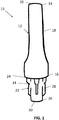
- FIG. 1 illustrates a side view of a device for collecting an oral fluid specimen according to an embodiment of the present invention.
- the device 10 includes an elongate tubular member 12 having a first end14 and a second end 16 and an outer wall 18 defining a lumen 20 extending therethrough.
- the first end 14 of the elongate tube 12 is configured to come into contact with the mouth of the subject and is further configured to receive oral fluid from the subject and deliver it into the device 10.
- the device 10 also includes a coupler 22 having a first end 24 and a second end 26.
- the coupler 22 has an outer wall 28 defining a lumen 30 therethrough.
- the coupler 22 is coupled to the second end 16 of the elongate tube 20 such that the lumen 20 of the elongate tube 12 is in fluid communication with the lumen 30 of the coupler 22.
- the second end 26 of the coupler 22 is configured to be coupled to a standard specimen collection vial known to or conceivable by one of skill in the art.
- the specimen collection vial can hold between approximately 50 ⁇ L to 5 mL of specimen.
- the second end 26 of the coupler can be press fit into the specimen collection vial, or can be coupled to the collection vial in any other means known to or conceivable by one of skill in the art, such as a frictional fit, threads, a luer connector, or any other suitable means.
- the tube 12 and the coupler 22 can be formed from a clear or opaque plastic material, such as polypropylene, or any other suitable material, known to or conceivable by one of skill in the art.
- FIG. 1 also illustrates a chamber 32 defined by the outer wall 18 at the second end 16 of the elongate tubular member 12.
- the chamber 32 can have a slightly greater diameter than that of the first end 14 of the elongate tube 12.
- the chamber 32 is further configured to receive a filter (not shown), which will be discussed further herein.
- the outer wall 28 of the coupler 22 can also define an exhaust port 34 to allow pressure to escape from the device 10.
- the exhaust port 34 can take the form of a channel or any other suitable configuration known to or conceivable by one of skill in the art.
- the exhaust port 34 allows the subject to blow the sample through the device 10 and into the specimen container without pressure buildup and potential specimen reflux.
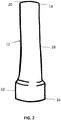
- FIG. 2 illustrates a side view of the elongate tube 12 illustrated in FIG. 1 , according to an embodiment of the present invention.
- the tube 12 includes the first end14 and the second end 16 and the outer wall 18 defining a lumen 20 extending therethrough.
- the first end 14 of the elongate tube 12 is configured to come into contact with the mouth of the subject and is further configured to receive oral fluid from the subject and deliver it into the device 10.
- the second end 16 is configured to be coupled to the first end of the coupler (not illustrated).
- the diameter at the first end 14 of the tube 12 is less than the diameter at the second end 16 of the tube 12.
- the increased diameter at the second end 16 is such that the tube 12 can accommodate a filter (not illustrated) in the chamber 32 defined by the outer wall 18 of the tube and positioned proximate to the second end 16 of the tube 12.
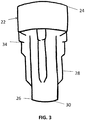
- FIG. 3 illustrates a side view of the coupler 22 illustrated in FIG. 1 , according to an embodiment of the present invention.
- the coupler 22 includes the first end 24 and the second end 26.
- the coupler 22 has the outer wall 28 defining the lumen 30 therethrough.
- the coupler 22 is coupled to the second end 16 of the elongate tube 12 such that the lumen 20 of the elongate tube 12 is in fluid communication with the lumen 30 of the coupler 22.
- the second end 26 of the coupler 22 is configured to be coupled to a standard specimen collection vial known to or conceivable by one of skill in the art.
- the second end 26 of the coupler can be press fit into the specimen collection vial, or can be coupled to the collection vial in any other means known to or conceivable by one of skill in the art, such as a frictional fit, threads, a luer connector, or any other suitable means.
- the second end 26 of the coupler 22 can also include a taper 34 to facilitate a press fit in specimen vials of varying diameters.
- the outer wall 28 of the coupler 22 can also define the exhaust port 34 to allow pressure to escape from the device 10.
- the exhaust port 34 can take the form of a channel or any other suitable configuration known to or conceivable by one of skill in the art.
- the exhaust port 34 allows the subject to blow the sample through the device 10 and into the specimen container without pressure buildup and potential specimen reflux.
- the coupler 32 can further be treated with different agents to improve sample quality and to maintain sample integrity. These treatments can include, but are not limited to, a bacteria static agent to enable samples to be held at room temperature during transit; dyes to enable the subject to determine quickly how much sample has been donated relative to volume requirements; and inhibitors to prevent the degradation of analytes of primary interest in the specimen. These treatments are merely included by way of example, and should not be considered limiting. Any suitable treatments, known to or conceivable by one of skill in the art, to the coupler 32, the elongate tube 12 or any other component of the device 10 can also be used.
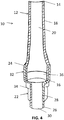
- FIG. 4 illustrates a sectional view of the device 10, according to an embodiment of the present invention.
- the second end 16 of the elongate tube 12 nests within the first end 24 of the coupler 22.
- the outer wall 18 of the second end 16 of the elongate tube 12 and the outer wall 28 of the first end 24 of the coupler 22 also fit together to form the chamber 32.
- a filter 36 is disposed within the chamber 32.
- the filter 36 can be approximately 3 mm to 6 mm thick and slightly smaller in diameter than the inside of the chamber 32.
- the filter 36 can be formed from an inert polymer blended foam or any other suitable material known to or conceivable by one of skill in the art.
- the filter 36 is configured to remove large macromolecules, such as the carbohydrates that make saliva viscous, from the specimen.
- the interior of the chamber 32 and the lumens 20 and 30 can also include fluting to minimize bubble formation and to allow for the rapid flow of specimen across its length. The fluting also allows air pressure accumulating in the device 10, to be vented.
- FIG. 5 illustrates a side view of the device for collecting an oral fluid specimen disposed within a specimen collection vial, according to an embodiment of the present invention.
- the device 10 is press fit within the specimen vial 38, resulting in an easily removable frictional coupling.
- the specimen vial 38 and the device 10 can also be coupled using different means known to or conceivable by one of skill in the art, such as a different form of frictional fit, a luer connector, threading on the device, etc.
- FIG. 6 is a flow diagram illustrating a method of collecting an oral fluid specimen, according to an embodiment of the present invention.
- the method of collecting an oral fluid specimen 100 can include step 102 of obtaining a device for collection of the oral fluid sample having an elongate tubular member and a coupler for coupling the device to the specimen container.
- Step 104 includes inserting the device into the specimen container, and step 106 includes allowing the oral fluid to pool in mouth.
- a step 108 includes forcing the oral fluid through the elongate tubular member and into the specimen container, and step 110 includes filling the specimen container to the predetermined volume.
- the method can further include tearing open a sterile pouch containing the device, and attaching a cap to the specimen vial.
- the device for collecting an oral fluid specimen can also be disposed of after use of the device.
Landscapes
- Health & Medical Sciences (AREA)
- Life Sciences & Earth Sciences (AREA)
- Medical Informatics (AREA)
- Molecular Biology (AREA)
- Hematology (AREA)
- Engineering & Computer Science (AREA)
- Biomedical Technology (AREA)
- Heart & Thoracic Surgery (AREA)
- Pulmonology (AREA)
- Pathology (AREA)
- Surgery (AREA)
- Animal Behavior & Ethology (AREA)
- General Health & Medical Sciences (AREA)
- Public Health (AREA)
- Veterinary Medicine (AREA)
- Sampling And Sample Adjustment (AREA)
- Investigating Or Analysing Biological Materials (AREA)
Applications Claiming Priority (3)
| Application Number | Priority Date | Filing Date | Title |
|---|---|---|---|
| US201161524096P | 2011-08-16 | 2011-08-16 | |
| PCT/US2012/051052 WO2013025862A1 (en) | 2011-08-16 | 2012-08-16 | Device and method for use in the collection of whole saliva in research and diagnostics |
| EP12824184.1A EP2745112B1 (de) | 2011-08-16 | 2012-08-16 | Vorrichtung und verfahren zur verwendung bei der sammlung von speichel für forschung und diagnosen |
Related Parent Applications (1)
| Application Number | Title | Priority Date | Filing Date |
|---|---|---|---|
| EP12824184.1A Division EP2745112B1 (de) | 2011-08-16 | 2012-08-16 | Vorrichtung und verfahren zur verwendung bei der sammlung von speichel für forschung und diagnosen |
Publications (1)
| Publication Number | Publication Date |
|---|---|
| EP3842801A1 true EP3842801A1 (de) | 2021-06-30 |
Family
ID=47715472
Family Applications (2)
| Application Number | Title | Priority Date | Filing Date |
|---|---|---|---|
| EP12824184.1A Active EP2745112B1 (de) | 2011-08-16 | 2012-08-16 | Vorrichtung und verfahren zur verwendung bei der sammlung von speichel für forschung und diagnosen |
| EP20211841.0A Withdrawn EP3842801A1 (de) | 2011-08-16 | 2012-08-16 | Vorrichtung und verfahren zur verwendung bei der sammlung von speichel für forschung und diagnosen |
Family Applications Before (1)
| Application Number | Title | Priority Date | Filing Date |
|---|---|---|---|
| EP12824184.1A Active EP2745112B1 (de) | 2011-08-16 | 2012-08-16 | Vorrichtung und verfahren zur verwendung bei der sammlung von speichel für forschung und diagnosen |
Country Status (3)
| Country | Link |
|---|---|
| US (1) | US9498191B2 (de) |
| EP (2) | EP2745112B1 (de) |
| WO (1) | WO2013025862A1 (de) |
Families Citing this family (5)
| Publication number | Priority date | Publication date | Assignee | Title |
|---|---|---|---|---|
| MX2019010800A (es) * | 2017-03-15 | 2020-07-28 | Ancestry Com Dna Llc | Dispositivo y metodo de recoleccion de muestras. |
| GB2598613B (en) | 2020-09-04 | 2023-01-04 | Conceptomed As | Sample collection devices |
| IT202100001025A1 (it) | 2021-01-21 | 2022-07-21 | Comedical S R L | Dispositivo di raccolta di un campione salivare |
| GB2605429A (en) | 2021-03-31 | 2022-10-05 | Mint Diagnostics Ltd | Collection device for bodily fluids |
| CR20240329A (es) * | 2024-08-07 | 2024-10-22 | Univ Costa Rica | Dispositivo colector de muestras biológicas |
Citations (2)
| Publication number | Priority date | Publication date | Assignee | Title |
|---|---|---|---|---|
| WO2006036163A2 (en) * | 2003-11-05 | 2006-04-06 | Greg Liang | Oral fluid sampling device and method |
| WO2007044082A2 (en) * | 2005-10-07 | 2007-04-19 | Morris Deborah K | Oral fluid collection device |
Family Cites Families (13)
| Publication number | Priority date | Publication date | Assignee | Title |
|---|---|---|---|---|
| NL110281C (de) * | 1959-10-02 | 1964-07-15 | ||
| US3224434A (en) * | 1962-11-06 | 1965-12-21 | Waldemar Medical Res Foundatio | Cell collector |
| US4205690A (en) * | 1978-10-27 | 1980-06-03 | The Kendall Company | Catheterization device |
| US4799924A (en) * | 1986-09-02 | 1989-01-24 | Richard Rosenblatt | Aspirator for collection of bodily fluids |
| US4791914A (en) * | 1987-04-24 | 1988-12-20 | May Stephen C | Endotracheal device |
| US5078603A (en) * | 1989-09-22 | 1992-01-07 | Howard Cohen | Filtering suction nozzle |
| US5268148A (en) * | 1990-12-18 | 1993-12-07 | Saliva Diagnostic Systems, Inc. | Saliva sampling device and sample adequacy system |
| EP0713424A4 (de) | 1994-05-09 | 1997-08-06 | Angelo Joseph D | System zum sammeln von speichelproben |
| US5786227A (en) * | 1995-06-07 | 1998-07-28 | Biex, Inc. | Fluid collection kit and method |
| US6022326A (en) * | 1998-10-30 | 2000-02-08 | Lifepoint, Inc. | Device and method for automatic collection of whole saliva |
| US6299763B1 (en) * | 1999-04-09 | 2001-10-09 | Arthur Ashman | Autogenous bone and cell filter trap |
| US20040022687A1 (en) * | 2002-07-31 | 2004-02-05 | Thomas Wuske | Device and process for collecting and releasing saliva |
| US8122889B2 (en) * | 2007-11-13 | 2012-02-28 | Apnicure, Inc. | Methods and systems for improving airway patency |
-
2012
- 2012-08-16 EP EP12824184.1A patent/EP2745112B1/de active Active
- 2012-08-16 US US14/239,298 patent/US9498191B2/en active Active
- 2012-08-16 WO PCT/US2012/051052 patent/WO2013025862A1/en not_active Ceased
- 2012-08-16 EP EP20211841.0A patent/EP3842801A1/de not_active Withdrawn
Patent Citations (2)
| Publication number | Priority date | Publication date | Assignee | Title |
|---|---|---|---|---|
| WO2006036163A2 (en) * | 2003-11-05 | 2006-04-06 | Greg Liang | Oral fluid sampling device and method |
| WO2007044082A2 (en) * | 2005-10-07 | 2007-04-19 | Morris Deborah K | Oral fluid collection device |
Also Published As
| Publication number | Publication date |
|---|---|
| US20150073305A1 (en) | 2015-03-12 |
| US9498191B2 (en) | 2016-11-22 |
| EP2745112B1 (de) | 2020-12-16 |
| EP2745112A1 (de) | 2014-06-25 |
| WO2013025862A1 (en) | 2013-02-21 |
| EP2745112A4 (de) | 2015-08-05 |
Similar Documents
| Publication | Publication Date | Title |
|---|---|---|
| CN110891487B (zh) | 转移设备和血液采集装备 | |
| US9498191B2 (en) | Device and method for use in the collection of whole saliva in research and diagnostics | |
| AU2008233220B2 (en) | Adaptor for sample vial | |
| US7767448B2 (en) | PAP smear sampling device and system | |
| KR102043955B1 (ko) | 검체 채취용 어댑터 | |
| JP6293787B2 (ja) | 製品流体の分注方法及び針キット | |
| JP2020512862A (ja) | 針、針を含む針アセンブリ、及びこれらのための関連する製造方法及び使用方法 | |
| CN104116514A (zh) | 定量微量采血移液管 | |
| CN110709014B (zh) | 流体收集单元以及相关装置和方法 | |
| WO2021086441A1 (en) | Oral fluid, saliva & sputum collection device and method | |
| AU2006223987A1 (en) | Sampling liquid container | |
| US20110015543A1 (en) | Fluid sample collection system | |
| US20220008911A1 (en) | Devices for extracting a fluid sample from a closed chamber and methods of use thereof | |
| US8528426B2 (en) | Device for transfer of body fluids | |
| US8747334B1 (en) | Method for specimen sample collection | |
| AU2017206230B2 (en) | Device for transfer of body fluids | |
| HK40017922B (en) | Fluid collection unit and related devices and methods | |
| HK40017922A (en) | Fluid collection unit and related devices and methods |
Legal Events
| Date | Code | Title | Description |
|---|---|---|---|
| PUAI | Public reference made under article 153(3) epc to a published international application that has entered the european phase |
Free format text: ORIGINAL CODE: 0009012 |
|
| STAA | Information on the status of an ep patent application or granted ep patent |
Free format text: STATUS: THE APPLICATION HAS BEEN PUBLISHED |
|
| AC | Divisional application: reference to earlier application |
Ref document number: 2745112 Country of ref document: EP Kind code of ref document: P |
|
| AK | Designated contracting states |
Kind code of ref document: A1 Designated state(s): AL AT BE BG CH CY CZ DE DK EE ES FI FR GB GR HR HU IE IS IT LI LT LU LV MC MK MT NL NO PL PT RO RS SE SI SK SM TR |
|
| STAA | Information on the status of an ep patent application or granted ep patent |
Free format text: STATUS: REQUEST FOR EXAMINATION WAS MADE |
|
| 17P | Request for examination filed |
Effective date: 20211230 |
|
| RBV | Designated contracting states (corrected) |
Designated state(s): AL AT BE BG CH CY CZ DE DK EE ES FI FR GB GR HR HU IE IS IT LI LT LU LV MC MK MT NL NO PL PT RO RS SE SI SK SM TR |
|
| STAA | Information on the status of an ep patent application or granted ep patent |
Free format text: STATUS: THE APPLICATION IS DEEMED TO BE WITHDRAWN |
|
| 18D | Application deemed to be withdrawn |
Effective date: 20220104 |