EP3839005B1 - Thermal interface materials including coloring agent - Google Patents
Thermal interface materials including coloring agent Download PDFInfo
- Publication number
- EP3839005B1 EP3839005B1 EP20211073.0A EP20211073A EP3839005B1 EP 3839005 B1 EP3839005 B1 EP 3839005B1 EP 20211073 A EP20211073 A EP 20211073A EP 3839005 B1 EP3839005 B1 EP 3839005B1
- Authority
- EP
- European Patent Office
- Prior art keywords
- thermal interface
- interface material
- coloring agent
- tim
- examples
- Prior art date
- Legal status (The legal status is an assumption and is not a legal conclusion. Google has not performed a legal analysis and makes no representation as to the accuracy of the status listed.)
- Active
Links
Images




Classifications
-
- C—CHEMISTRY; METALLURGY
- C09—DYES; PAINTS; POLISHES; NATURAL RESINS; ADHESIVES; COMPOSITIONS NOT OTHERWISE PROVIDED FOR; APPLICATIONS OF MATERIALS NOT OTHERWISE PROVIDED FOR
- C09K—MATERIALS FOR MISCELLANEOUS APPLICATIONS, NOT PROVIDED FOR ELSEWHERE
- C09K5/00—Heat-transfer, heat-exchange or heat-storage materials, e.g. refrigerants; Materials for the production of heat or cold by chemical reactions other than by combustion
- C09K5/02—Materials undergoing a change of physical state when used
- C09K5/06—Materials undergoing a change of physical state when used the change of state being from liquid to solid or vice versa
- C09K5/063—Materials absorbing or liberating heat during crystallisation; Heat storage materials
-
- H—ELECTRICITY
- H10—SEMICONDUCTOR DEVICES; ELECTRIC SOLID-STATE DEVICES NOT OTHERWISE PROVIDED FOR
- H10W—GENERIC PACKAGES, INTERCONNECTIONS, CONNECTORS OR OTHER CONSTRUCTIONAL DETAILS OF DEVICES COVERED BY CLASS H10
- H10W40/00—Arrangements for thermal protection or thermal control
- H10W40/70—Fillings or auxiliary members in containers or in encapsulations for thermal protection or control
-
- C—CHEMISTRY; METALLURGY
- C08—ORGANIC MACROMOLECULAR COMPOUNDS; THEIR PREPARATION OR CHEMICAL WORKING-UP; COMPOSITIONS BASED THEREON
- C08K—Use of inorganic or non-macromolecular organic substances as compounding ingredients
- C08K3/00—Use of inorganic substances as compounding ingredients
- C08K3/01—Use of inorganic substances as compounding ingredients characterized by their specific function
- C08K3/013—Fillers, pigments or reinforcing additives
-
- C—CHEMISTRY; METALLURGY
- C08—ORGANIC MACROMOLECULAR COMPOUNDS; THEIR PREPARATION OR CHEMICAL WORKING-UP; COMPOSITIONS BASED THEREON
- C08K—Use of inorganic or non-macromolecular organic substances as compounding ingredients
- C08K3/00—Use of inorganic substances as compounding ingredients
- C08K3/02—Elements
- C08K3/08—Metals
-
- C—CHEMISTRY; METALLURGY
- C08—ORGANIC MACROMOLECULAR COMPOUNDS; THEIR PREPARATION OR CHEMICAL WORKING-UP; COMPOSITIONS BASED THEREON
- C08K—Use of inorganic or non-macromolecular organic substances as compounding ingredients
- C08K3/00—Use of inorganic substances as compounding ingredients
- C08K3/18—Oxygen-containing compounds, e.g. metal carbonyls
- C08K3/20—Oxides; Hydroxides
- C08K3/22—Oxides; Hydroxides of metals
-
- C—CHEMISTRY; METALLURGY
- C08—ORGANIC MACROMOLECULAR COMPOUNDS; THEIR PREPARATION OR CHEMICAL WORKING-UP; COMPOSITIONS BASED THEREON
- C08K—Use of inorganic or non-macromolecular organic substances as compounding ingredients
- C08K5/00—Use of organic ingredients
- C08K5/0008—Organic ingredients according to more than one of the "one dot" groups of C08K5/01 - C08K5/59
- C08K5/0041—Optical brightening agents, organic pigments
-
- C—CHEMISTRY; METALLURGY
- C08—ORGANIC MACROMOLECULAR COMPOUNDS; THEIR PREPARATION OR CHEMICAL WORKING-UP; COMPOSITIONS BASED THEREON
- C08K—Use of inorganic or non-macromolecular organic substances as compounding ingredients
- C08K5/00—Use of organic ingredients
- C08K5/16—Nitrogen-containing compounds
- C08K5/22—Compounds containing nitrogen bound to another nitrogen atom
- C08K5/23—Azo-compounds
-
- H—ELECTRICITY
- H10—SEMICONDUCTOR DEVICES; ELECTRIC SOLID-STATE DEVICES NOT OTHERWISE PROVIDED FOR
- H10W—GENERIC PACKAGES, INTERCONNECTIONS, CONNECTORS OR OTHER CONSTRUCTIONAL DETAILS OF DEVICES COVERED BY CLASS H10
- H10W40/00—Arrangements for thermal protection or thermal control
- H10W40/20—Arrangements for cooling
- H10W40/25—Arrangements for cooling characterised by their materials
- H10W40/251—Organics
-
- C—CHEMISTRY; METALLURGY
- C08—ORGANIC MACROMOLECULAR COMPOUNDS; THEIR PREPARATION OR CHEMICAL WORKING-UP; COMPOSITIONS BASED THEREON
- C08K—Use of inorganic or non-macromolecular organic substances as compounding ingredients
- C08K3/00—Use of inorganic substances as compounding ingredients
- C08K3/02—Elements
- C08K3/08—Metals
- C08K2003/0812—Aluminium
-
- C—CHEMISTRY; METALLURGY
- C08—ORGANIC MACROMOLECULAR COMPOUNDS; THEIR PREPARATION OR CHEMICAL WORKING-UP; COMPOSITIONS BASED THEREON
- C08K—Use of inorganic or non-macromolecular organic substances as compounding ingredients
- C08K3/00—Use of inorganic substances as compounding ingredients
- C08K3/18—Oxygen-containing compounds, e.g. metal carbonyls
- C08K3/20—Oxides; Hydroxides
- C08K3/22—Oxides; Hydroxides of metals
- C08K2003/2265—Oxides; Hydroxides of metals of iron
-
- C—CHEMISTRY; METALLURGY
- C08—ORGANIC MACROMOLECULAR COMPOUNDS; THEIR PREPARATION OR CHEMICAL WORKING-UP; COMPOSITIONS BASED THEREON
- C08K—Use of inorganic or non-macromolecular organic substances as compounding ingredients
- C08K2201/00—Specific properties of additives
- C08K2201/001—Conductive additives
Definitions
- the present disclosure relates generally to thermal interface materials for use in electronic components, and more particularly to thermal interface materials including a coloring agent.
- Thermal interface materials are widely used to dissipate heat from electronic components, such as central processing units, video graphics arrays, servers, game consoles, smart phones, LED boards, and the like. Thermal interface materials are typically used to transfer excess heat from the electronic component to a heat spreader, such as a heat sink. Examples of TIM materials from the prior art are described in US2014/171567A1 , US2012/228542A1 and WO01/21393A1 .
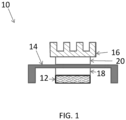
- the electronics package structure 10 illustratively includes a heat generating component, such as an electronic chip 12, and one or more heat dissipating components, such as a heat spreader 14, and a heat sink 16.
- Illustrative heat spreaders 14 and heat sinks comprise a metal, metal alloy, or metal-plated substrate, such as copper, copper alloy, aluminum, aluminum alloy, or nickel-plated copper.
- TIM materials such as TIM 18 and TIM 20, provide a thermal connection between the heat generating component and the one or more heat dissipating components.
- Electronics package structure 10 includes a first TIM 18 connecting the electronic chip 12 and heat spreader 14.
- TIM 18 is typically referred to as a "TIM 1".
- Electronics package structure 10 includes a second TIM 20 connecting the heat spreader 14 and heat sink 16.
- TIM 18 is typically referred to as a "TIM 2".
- electronics package structure 10 does not include a heat spreader 14, and a TIM (not shown) connects the electronic chip 12 directly to the heat sink 16.
- a TIM connecting the electronic chip 12 directly to the heat sink 16 is typically referred to as a TIM 1.5.
- Thermal interface materials include thermal grease, grease-like materials, elastomer tapes, and phase change materials.
- Traditional thermal interface materials include components such as gap pads and thermal pads.
- Typical TIM materials include a relatively high loading of a thermally conductive filler, such as aluminum particles, providing a grey color to the TIM.
- the substrate may have a similar grey color as the TIM material, making it difficult for an operator to visually distinguish or an automatic color recognition machine to judge the TIM from the substrate when transferring the TIM onto the substrate or after the TIM has been transferred to the substrate.
- a thermally conductive filler such as aluminum particles
- typical pigments may provide adequate color differentiation.
- the dark filler colors can cover typical pigments, and little to no color is observed, particularly at relatively high loadings of dark colored fillers.
- the present disclosure provides thermal interface materials that are useful in transferring heat from heat generating electronic devices, such as computer chips, to heat dissipating structures, such as heat spreaders and heat sinks.
- the thermal interface material includes a coloring agent.
- the thermal interface material includes at least one polymer present in an amount of 5 wt.% to 10 wt.%; at least one thermally conductive filler present in an amount of 85 wt.% to 95 wt.%; .1 wt.% to 5 wt.% of a phase change material comprising at least one wax ; and at least one coloring agent present in an amount of 0.5 wt.% to 20 wt.% based on 100 wt.% of the thermal interface material without the coloring agent, and selected from the group consisting of: an organic pigment, wherein the organic pigment has a formula selected from the group consisting of Formulas (I)- (XVI): wherein each R is independently selected from H, alkyl, aryl, and halogen; and
- the coloring agent is an organic pigment of Formula (I).
- the thermal interface material comprises 1 wt.% to 20 wt.% of the coloring agent based on 100 wt.% of the thermal interface material without the coloring agent.
- the thermally conductive filler comprises aluminum particles.
- the aluminum particles comprises at least 80 wt.% of the thermal interface material, based on 100 wt.% of the thermal interface material without the coloring agent.
- the thermal interface material has a thermal impedance of 0.05°C ⁇ cm 2 /W to 0.3°C ⁇ cm 2 /W.
- the thermal interface material comprises: 5 wt.% to 10 wt.% of the at least one polymer; 85 wt. % to 95 wt. % of the at least one thermally conductive filler; 0.1 wt. % and 5 wt.% of a phase change material; and 0.5 wt.% to 20 wt.% of the coloring agent, based on 100 wt.% of the thermal interface material without the coloring agent.
- a dispensable thermal interface material includes at least one polymer; at least one thermally conductive filler; at least one coloring agent; and at least one solvent as set out in claim 7.
- the coloring agent is selected from the group consisting of: an organic pigment.
- the organic pigment has a formula selected from the group consisting of Formulas (I)- (XVI).
- the solvent is an isoparaffinic fluid.
- the solvent comprises from 1 wt.% to 20 wt.% based on the total weight of a mixture including the thermal interface material and the solvent.
- the dispensable thermal interface material as described above has the viscosity in the range of 10 Pa.s to 100,000 Pa.s.
- the coloring agent is an organic pigment of Formula (I).
- an electronic component includes: a heat sink; a substrate; a thermal interface material positioned between the heat sink and the substrate, the thermal interface material including: at least one polymer; at least one thermally conductive filler; and one coloring agent selected from the group consisting of an organic pigment, as set out in claim 11.
- the organic pigment has a formula selected from the group consisting of Formulas (I)-(XVI).
- the present invention relates to thermal interface materials (TIMs) useful in transferring heat away from electronic components.
- the TIM comprises a polymer matrix, at least one thermally conductive filler, and at least one coloring agent selected from the group consisting of: ⁇ -Fe 2 O 3 ; ⁇ -Fe 2 O 3 ⁇ H 2 O; Fe 3 O 4 ; and an organic pigment selected from the group consisting of Formulas (I) - (XVI).
- the TIM comprises a polymer matrix, at least one thermally conductive filler, and at least one coloring agent selected from the group consisting of: ⁇ -Fe 2 O 3 ; ⁇ -Fe 2 O 3 ⁇ H 2 O; Fe 3 O 4 ; and an organic pigment of Formula (I).
- the TIM optionally includes one or more of the following components: coupling agent, antioxidant, phase change material, ion scavenger and other additives.
- the inclusion of the particular pigments in the thermal interface material provided a distinguishable color to the thermal interface material without significantly affecting thermal properties.
- the TIM includes a polymer, such as an elastomer.
- the polymer comprises a silicone rubber, a siloxane rubber, a siloxane copolymer, or other suitable silicone-containing rubber.
- the polymer comprises one or more hydrocarbon rubber compounds, including saturated or unsaturated hydrocarbon rubber compounds.
- Exemplary saturated rubbers include ethylene-propylene rubbers (EPR, EPDM), polyethylene/butylene, polyethylene-butylene-styrene, polyethylene-propylene-styrene, hydrogenated polyalkyldiene "mono-ols” (such as hydrogenated polybutadiene mono-ol, hydrogenated polypropadiene mono-ol, hydrogenated polypentadiene mono-ol), hydrogenated polyalkyldiene "diols” (such as hydrogenated polybutadiene diol, hydrogenated polypropadiene diol, hydrogenated polypentadiene diol) and hydrogenated polyisoprene, polyolefin elastomer, and blends thereof.
- the polymer is a hydrogenated polybutadiene mono-ol.
- Exemplary unsaturated rubbers include polybutadiene, polyisoprene, polystyrene-butadiene and blends thereof, or blends of saturated and unsaturated rubber compounds.
- the TIM comprises the one or more polymers in an amount as little as 5 wt. %, 6 wt. %, 7 wt. %, 8 wt. %, as great as 10 wt.%, , or within any range defined between any two of the foregoing values, based on the total weight of the TIM.
- the TIM includes one or more thermally conductive fillers.
- Exemplary thermally conductive fillers include metals, alloys, nonmetals, metal oxides, metal nitrides, and ceramics, and combinations thereof.
- Exemplary metals include, but are not limited to, aluminum, copper, silver, zinc, nickel, tin, indium, lead, silver coated metals such as silver coated copper or silver coated aluminum, metal coated carbon fibers, and nickel coated fibers.
- Exemplary nonmetals include, but are not limited to, carbon, graphite, carbon nanotubes, carbon fibers, graphene, powdered diamond, glass, silica, silicon nitride, and boron coated particles.
- Exemplary metal oxides, metal nitrides and ceramics include but are not limited to alumina, aluminum nitride, boron nitride, zinc oxide, and tin oxide.
- the thermally conductive filler is provided as a plurality of particles.
- Average particle diameter (D50) is commonly used to measure particle size.
- Illustrative particles have average particle diameters as little as 10 nm, 20 nm, 50 nm, 0.1 microns, 0.2 microns, 0.5 microns, 1 micron, 2 microns, 3 microns, as great as 5 microns, 8 microns, 10 microns, 12 microns, 15 microns 20 microns, 25 microns, 50 microns, 100 microns, or within any range defined between any two of the foregoing values, such as 10 nm to 100 micron, 0.1 microns to 20 microns, or 0.5 microns to 10 microns, for example.
- the thermally conductive fillers have different particle sizes to increase the packing effect between filler particles.
- the first and second thermally conductive fillers are two different types of thermally conductive fillers having different particle sizes.
- the first and second thermally conductive fillers are the same thermally conductive filler, but have different particle sizes.
- the TIM comprise the one or more thermally conductive fillers in a total amount as little as 85 wt.%, 90 wt.%, 95 wt.%, or within any range defined between any two of the foregoing values, such as 85 wt.% to 95 wt.%, for example, based on the total weight of the TIM.
- the TIM includes a coloring agent.
- Coloring agents described herein include organic and inorganic pigments and organic dyes.
- Organic pigments include: benzimidazolone, such as the blue shade benzimidazolone pigment Novoperm Carmine HF3C from Clariant International Ltd, Muttenz Switzerland.
- Inorganic pigments include carbon black and iron based compounds. Iron based compounds include iron oxide compounds such as ⁇ -Fe 2 O 3 , ⁇ -Fe 2 O 3 ⁇ H 2 O, Fe 3 O 4 and combinations thereof.
- Organic dyes include: Benzo[kl]thioxanthene-3,4-dicarboximide,N-octadecyl- (8Cl); Benzothioxanthene-3,4-dicarboxylic acid-N-stearylimide.
- the coloring agent is an inorganic pigment selected from the group consisting of ⁇ -Fe 2 O 3 ; ⁇ -Fe 2 O 3 ⁇ H 2 O; and Fe 3 O 4 .
- the coloring agent is an organic pigment, particularlyt, the coloring agent is an organic selected from the group consisting of Formulas (I)-(XVI).
- the coloring agent is an organic pigment of Formula (I), also known as pigment red 176, and having CAS No. 12225-06-8 .
- the coloring agent is an organic pigment of Formula (II), also known as calcium bis[4-[[1-[[(2-methylphenyl)amino]carbonyl]-2-oxopropyl]azo]-3-nitrobenzenesulphonate, and having CAS No. 12286-66-7 .
- the coloring agent is an organic pigment of Formula (III) also known as diethyl 4,4'-[(3,3'-dichloro[1,1'-biphenyl]-4,4'-diyl)bis(azo)]bis[4,5-dihydro-5-oxo-1-phenyl-1h-pyrazole-3-carboxylate], and having CAS No. 6358-87-8 .
- the coloring agent is an organic pigment of Formula (IV) also known as 2,2'-[(3,3'-Dichloro[1,1'-biphenyl]-4,4'-diyl)bis(azo)]bis[N-(2,4-dimethylphenyl)-3-oxo-butanamide, and having CAS No. 5102-83-0 .
- the coloring agent is an organic pigment of Formula (V) also known as (29H,31H-phthalocyaninato(2-)-N29,N30,N31,N32)copper, and having CAS No. 147-14-8 .
- the coloring agent is an organic pigment of Formula (VI) also known as brilliantgreenphthalocyanine, and having CAS No. 1328-53-6 .
- the coloring agent is an organic pigment of Formula (VII) also known as 9,19-dichloro-5,15-diethyl-5,15-dihydro-diindolo[2,3-c:2',3'-n]triphenodioxazine, and having CAS No. 6358-30-1 .
- the coloring agent is an organic pigment of Formula (VIII) also known as 5,12-DIHYDROQUIN[2,3-B]ACRIDINE-7,14-DIONE;5,12-dihydroquino[2,3-b]acridine-7,14-dione, and having CAS No. 1047-16-1 .
- VIII organic pigment of Formula (VIII) also known as 5,12-DIHYDROQUIN[2,3-B]ACRIDINE-7,14-DIONE;5,12-dihydroquino[2,3-b]acridine-7,14-dione, and having CAS No. 1047-16-1 .
- the coloring agent is an organic pigment of Formula (IX) also known as 2,9-bis(3,5-dimethylphenyl)anthra[2,1,9-def:6,5,10-d'e'f']diisoquinoline-1,3,8,10(2h,9h)-tetrone, and having CAS No. 4948-15-6 .
- the coloring agent is an organic pigment of Formula (X) also known as 4,4'-diamino-[1,1'-bianthracene]-9,9',10,10'-tetraone or pigment red 177, and having20 CAS No. 4051-63-2 .
- organic pigment of Formula (X) also known as 4,4'-diamino-[1,1'-bianthracene]-9,9',10,10'-tetraone or pigment red 177, and having20 CAS No. 4051-63-2 .
- the coloring agent is an organic pigment of Formula (XI) also known as 3,3'-[(2-methyl-1,3-phenylene)diimino]bis[4,5,6,7-tetrachloro-1H-isoindol-1-one], and having CAS No. 5045-40-9 .
- the coloring agent is an organic pigment of Formula (XII) also known as calcium bis[4-[[1-[[(2-chlorophenyl)amino]carbonyl]-2-oxopropyl]azo]-3-nitrobenzenesulphonate], and having CAS No. 71832-85-4 .
- the coloring agent is an organic pigment of Formula (XIII) also known as 3,4,5,6-Tetrachloro-N-[2-(4,5,6,7-tetrachloro-2,3-dihydro-1,3-dioxo-1H-inden-2-yl)-8-quinolyl]phthalimide, and having CAS No. 30125-47-4 .
- the coloring agent is an organic pigment of Formula (XIV) also known as [1,3-dihydro-5,6-bis[[(2-hydroxy-1-naphthyl)methylene]amino]-2H-benzimidazol-2-onato(2-)-N5,N6,O5,O6]nickel, and having CAS No. 42844-93-9 .
- the coloring agent is an organic pigment of Formula (XV) also known as Pigment Red 279, and having CAS No. 832743-59-6 , wherein each R is independently selected from the group consisting of hydrogen, alkyl, aryl, and halogen. In an even more particular embodiment, each R is independently selected from the group consisting of hydrogen, C 1 -C 6 alkyl, phenyl, and halogen. In another more particular embodiment, each R is chlorine, and even more particularly, each R is 7-chloro..
- Formula (XV) also known as Pigment Red 279, and having CAS No. 832743-59-6 , wherein each R is independently selected from the group consisting of hydrogen, alkyl, aryl, and halogen. In an even more particular embodiment, each R is independently selected from the group consisting of hydrogen, C 1 -C 6 alkyl, phenyl, and halogen. In another more particular embodiment, each R is chlorine, and even more particularly, each R is 7-chloro
- the coloring agent is an organic pigment of Formula (XVI) also known as Pyrimido[5,4-g]pteridine-2,4,6,8-tetramine, 4-methylbenzenesulfonate, base-hydrolysed, and having20 CAS No. 346709-25-9 .
- the coloring agent is ⁇ -Fe 2 O 3 , such as such as Iron Red available from BAI YAN.
- the coloring agent is ⁇ -Fe 2 O 3 ⁇ H 2 O, such as such as Iron Yellow available from BAI YAN.
- the coloring agent is Fe 3 O 4 , such as such as Iron Blue available from BAI YAN.
- the coloring agent is the pigment of Formula (I), having the chemical formula C 32 H 24 N 6 O 5 , such as Novoperm Carmine HF3C, available from Clariant International Ltd, Muttenz Switzerland.
- the TIM comprises the coloring agent in an amount as little as 0.5 wt.%, 1 wt.%, 1.5 wt.%, as great as 2 wt.%, 5 wt.%, 10 wt.%, 15 wt.%, 20 wt.%, or within any range defined between any two of the foregoing values, such as 0.5 wt.% to 2 wt.%, or 5 wt.% to 20 wt.%, for example, based on 100 wt.% of the thermal interface material without the coloring agent.
- the TIM comprises one or more coupling agents.
- Exemplary coupling agents include organometallic compounds, such as titanate coupling agents or zircontate coupling agents, and organic compounds, such as silane coupling agents.
- Exemplary coupling agents include titanium IV 2,2 (bis 2-propenolatomethyl)butanolato, tris(dioctyl)pyrophosphato-O; zirconium IV 2,2 (bis 2-propenolatomethyl)butanolato, tris(diisooctyl)pyrophosphato-O; titanium IV 2-propanolato, tris(dioctyl)-pyrophosphato-O) adduct with 1 mole of diisooctyl phosphite; titanium IV bis(dioctyl)pyrophosphato-O, oxoethylenediolato, (Adduct), bis(dioctyl) (hydrogen)phosphite-O; titanium IV bis
- the TIM comprises the one or more coupling agents in an amount as little as 0.1 wt.%, 0.5 wt.%, 0.67 wt.%, 0.75 wt.%, as great as 1 wt.%, 1.5 wt.%, 2 wt.%, 5 wt.%, 10 wt.%, or within any range defined between any two of the foregoing values, such as 0.1 wt.% to 10 wt.%, 0.1 wt.% to 2 wt.%, or 0.5 wt.% to 1 wt.%, for example, based on the total weight of the TIM.
- the TIM comprises one or more antioxidants.
- Exemplary antioxidants include phenol type, amine type antioxidants, or any other suitable type of antioxidant, or a combination thereof.
- the phenol or amine type antioxidant may also be a sterically hindered phenol or amine type antioxidant.
- Exemplary phenol type antioxidants include octadecyl 3-(3,5-di-(tert)-butyl-4-hydroxyphenyl) propionate.
- Exemplary amine type antioxidants include 2,6-di-tert-butyl-4-(4,6-bis(octylthio)-1,3,5-triazin-2-ylamino) phenol.
- Exemplary sterically hindered antioxidants include sterically hindered sulfur containing phenolic antioxidants.
- Exemplary antioxidants include the Irganox ® antioxidants available from BASF.
- ion scavengers and antioxidants both reduce oxidative degradation of the TIM
- ion scavengers are believed to function by capturing and binding metal ions in a complex such that the metal ions no longer have a net charge and are effectively disabled from participating in the metal-catalyzed reactions of FIG. 2B .
- antioxidants are generally believed to function by transferring electrons to an oxidizing agent, such as the radicals of FIG. 2A .
- the TIM comprises the one or more antioxidants in an amount as little as 0.05 wt.%, 0.1 wt.%, 0.5 wt.%, 1 wt.% as great as 1.5 wt.%, 2 wt.%, 5 wt.%, 10 wt.%, or within any range defined between any two of the foregoing values, such as 0.1 wt.% to 10 wt.%, 0.1 wt.% to 2 wt.%, or 0.5 wt.% to 1 wt.%, for example, based on the total weight of the TIM.
- the TIM comprises one or more phase change materials comprising at least one wax.
- a phase change material is a material having a melting point or melting point range at or below the operating temperature of a portion of an electronic device in which the TIM is to be used.
- An exemplary phase change material is a wax.
- Other exemplary phase change materials include low melting alloys, such as Wood's metal, Field's metal, or a metal or alloy having a melting point between about 20°C and 90°C.
- the phase change material has a phase change temperature as low as 20°C, 30°C, 40°C, 45°C 50°C,as high as 60°C, 70°C, 80°C, 90°C, 100°C, 110°C, or within any range defined between any two of the foregoing values. In some more particular embodiments, the phase change material has a phase change temperature as low as 30°C, 40°C, 45°C as high as 50°C, 60°C, 70°C, or within any range defined between any two of the foregoing values.
- Exemplary waxes include polyethylene (PE) wax, paraffin wax, AC-1702, a polyethylene wax, AC-430 , a copolymer of ethylene-vinyl acetate wax, and AC-6702, an oxidized polyethylene wax, each available from Honeywell International Inc., a polyethylene wax blended with polytetrafluoroethylene such as PEW-0602F wax available from Nanjing Tianshi New Material Technologies, TAC wax, available from The International Group, Inc., and RT44HC, available from Hangzhou Ruhr Tech.
- PE polyethylene
- paraffin wax AC-1702
- AC-430 a copolymer of ethylene-vinyl acetate wax
- AC-6702 an oxidized polyethylene wax
- the TIM comprises the one or more phase change materials in an amount as little as 0.5 wt.%, 1 wt.%, 2 wt.%, 3 wt.%, or as great as 5 wt.%, or within any range defined between any two of the foregoing values, such as 1 wt.% to 5 wt.%, for example, based on the total weight of the TIM.
- the TIM comprises one or more ion scavengers.
- exemplary ion scavengers include nitrogen containing complexing agents, phosphorous containing complexing agents, and hydroxyl carboxylic acid based complexing agents.
- the ion scavenger is selected from acid amide compounds, such as hydrazide or dihydrazide.
- the ion scavenger is selected from triazole compounds, tetrazole compounds, triazene compounds, oxamide comounds, or malonamide compounds.
- the ion scavenger is selected from decamethylenedicarboxylic acid disalicyloylhydrazide; 3-(N-salicyloyl)amino-1,2,4-triazole; and 2', 3-bis [[3-[3, 5-di-tert-butyl-4-hydroxyphenyl] propionic]]propionyl hydrazide.
- the ion scavenger is a compound according to any of the following compounds or combinations thereof: N-salicylidene-N'salicyloyl hydrazide, oxalyl bis(benzylidenehydrazide), N,N'-bis(salicyloyl)hydrazine, 3-(N-salicyloyl)amino-1,2,4-triazole, 2,2'-oxamido bis[ethyl 3-(3,5-di-tert-butyl-4-hydroxyphenyl)propionate], N,N'-bis(salicylidene) ethylenediamine, Oxanilide, Methylmalonic acid dianilide, N-formyl-N'-salicyloyl hydrazine, Decamethylenedicarboxylic acid disalicyloylhydrazide, and Bis(2,6-di-ter-butyl-4-methylpheny
- the TIM comprises the one or more ion scavengers in an amount as little as 0.1 wt.%, 0.2 wt.%, 0.5 wt.%, 1 wt.% as great as 1.5 wt.%, 2 wt.%, 5 wt.%, 10 wt.%, or within any range defined between any two of the foregoing values, such as 0.1 wt.% to 10 wt.%, 0.1 wt.% to 2 wt.%, or 0.5 wt.% to 1 wt.%, for example, based on the total weight of the TIM.
- the TIM comprises one or more additional additives.
- exemplary additives include crosslinkers, such as alkylated melamine formaldehyde resin, and pigments.
- the TIM comprises the one or more additives in an amount as little as 0.1 wt.%, 0.5 wt.%, 1 wt.% as great as 1.5 wt.%, 2 wt.%, 5 wt.%, 10 wt.%, or within any range defined between any two of the foregoing values, such as 0.1 wt. % to 10 wt. %, 0.1 wt.% to 2 wt. %, or 0.5 wt.% to 1 wt. %, for example, based on the total weight of the TIM.
- a thermal interface material including a coloring agent as described above has a color that visually distinguishes TIM 18 ( FIG. 1 ) from substrate 12 (e.g., chip 12).
- a thermal interface material including a coloring agent as described above has a thermal impedance approximately the same thermal properties, such as thermal conductivity and thermal impedance, as the thermal properties of a similar thermal interface material that does not include the coloring agent.
- a thermal interface material including a coloring agent as described above has a thermal conductivity at least 1 W/m.K.
- An exemplary thermal conductivity test method standard is ASTM D5470.
- a thermal interface material including a coloring agent as described above has a thermal impedance as little as 0.05°C ⁇ m 2 /W, 0.1°C ⁇ cm 2 /W, 0.15°C ⁇ cm 2 /W, 0.2°C ⁇ cm 2 /W as high as 0.25°C ⁇ cm 2 /W, 0.25°C ⁇ cm 2 /W, 0.3°C ⁇ cm 2 /W, 0.35°C ⁇ cm 2 /W, or within any range defined between any two of the foregoing values, such as 0.05°C ⁇ cm 2 /W to 0.35°C ⁇ cm 2 /W, 0.15°C ⁇ cm 2 /W to 0.3°C ⁇ cm 2 /W, or 0.2°C ⁇ cm 2 /W to 0.3°C ⁇ cm 2 /W, for example.
- a thermal interface material including a coloring agent as described above is combined with a solvent, such as an isoparaffinic fluid, to form a dispensable thermal interface material.
- the dispensable thermal interface includes an amount as little as 1 wt. %, 2 wt.%, 5 wt.%, as great as 10 wt.%, 15 wt.%, 20 wt.% of the solvent, or within any range defined between any two of the foregoing values, such as 1 wt.% to 20 wt.% or 5 wt.% to 10 wt.%, for example, based on 100 wt.% of the thermal interface material without the solvent.
- the dispensable thermal interface material as described above has the viscosity in the range of 10 Pa.s to 100,000 Pa.s, or more particularly in the range of 100 Pa.s to 10,000 Pa.s at room temperature.
- An exemplary viscosity test method standard is DIN 53018.
- the viscosity is tested by Brookfield Rheometer with shear rate 2 s -1 .
- the dispensable thermal interface material as described above has the dispense rate in the range of 1 g/min to 1000 g/min, or more particularly in the range of 10 g/min to 100 g/min.
- the dispense rate is tested under 0.6 MPa pressure with a 10 ml syringe having a 2.54mm (0.1 inch) diameter dispense header opening.
- the TIM is prepared by combining the individual components in a heated mixer and blending the composition together.
- the TIM is then baked at a temperature as low as 25°C, 50°C, 75°C, 80°C, as high as 100°C, 125°C, 150°C, 170°C, or within any range defined between any two of the foregoing values. In some exemplary embodiments, the TIM is baked for as little as 0.5 minutes, 1 minute, 30 minutes, 1 hour, 2 hours, as long as 8 hours, 12 hours, 24 hours, 36, hours, 48 hours, or within any range defined between any two of the foregoing values. An exemplary baking condition is 80°C for 30 minutes.
- the thermal interface material including a pigment or dye is positioned as a TIM 1 between an electronic component 12 and a heat spreader 14, as indicated by TIM 18.
- the thermal interface material including a pigment or dye is positioned as a TIM 2 between an a heat spreader 14 and a heat sink 16, as indicated by TIM 20.
- the thermal interface material including a pigment or dye is positioned as a TIM 1.5 (not shown) between an electronic component 12 and a heat sink 16.
- Thermal interface materials were prepared according to the formulations provided in Table 1. TABLE 1: Formulations (wt.%) for Comparative Examples 1 and 2 Comp. Ex. 1 Comp. Ex. 2 Elastomer 8.69 6.22 First wax 2.48 1.78 Second wax 0.62 - Antioxidant 0.2 0.5 Coupling agent 1.5 0.67 Thermally conductive filler 85.91 90.83 Crosslinker 0.6 -
- the elastomer used was Kraton elastomer (a hydroxyl-terminated ethylene butylene copolymer, specialty mono-ol).
- the first wax was a microcrystalline wax with a melting point of about 45°C.
- the second wax was an amorphous, low density polyethylene homopolymer.
- the coupling agent was a titanium-based coupling agent.
- the thermally conductive filler was aluminum particles having a particle size greater than 1 micron.
- the crosslinker was a Cymel alkylated melamine formaldehyde resin.
- Figures 2A and 2B show the thermal interface material of Comparative Example 1 screen printed at 0.5 mm on paper and a magnesium aluminum alloy substrate.
- Figure 13 shows the thermal interface material of Comparative Example 2 screen printed on a substrate.
- Examples 1-10 were prepared by adding a coloring agent according to Table 2 to 100 grams of Comparative Example 1. Each mixture was then stirred with a speed mixer under 3000 revolutions per minute (rpm) for 5 minutes.
- Example 11 was prepared by adding a coloring agent to 100 grams of Comparative Example 2. The mixture was then stirred with a speed mixer under 34 revolutions per minute (rpm) for 60 minutes. The resulting paste was then screened onto a substrate. Examples 1-10 were visually compared to Comparative Example 1 and Example 11 was visually compared to Comparative Example 2 for any color differentiation. The results are shown in Figures 3A-12C and 14 , and summarized in Table 2 below. TABLE 2: Formulations for Examples 1-11 and Visual comparison of Examples 1-10 with Comparative Example 1 and Example 11 with Comparative Example 2.
- the coloring agent comprises an organic pigment. Accordingly, Examples 1 to 5 and 7 to 11 are not according to the invention.
- Example 6 is according to the invention.
- Additive Additive (g) Comp. Ex. 1 (g) Comp. Ex. 2 (g) Color Difference Ex. 1 Carbon black 1 100 - No Ex. 2 Iron red 10 100 - Yes Ex. 3 Iron yellow 10 100 - Yes Ex. 4 Iron green 10 100 - No Ex. 5 Iron blue 10 100 - Yes Ex. 6 Red pigment 1 100 - Yes Ex. 7 Red dye 1 100 - No Ex. 8 Yellow dye 1 100 - No Ex. 9 Blue dye 1 100 - No Ex. 10 Purple dye 1 100 - No Ex. 11 Carbon black 2 - 100 No
- Example 1 the added coloring agent was carbon black supplied by Guoyao Group Chemical Reagent Co., Ltd. having a particle size such that 95 wt.% passes through a 35 ⁇ m screen. As shown in Table 2 and Figures 3A - 3C , the addition of the carbon black did not result in a significantly detectable difference in color between Comparative Example 1 and Example 1.
- Example 2 the added coloring agent was ⁇ -Fe 2 O 3 supplied by Shanghai Baiyan Industrial Co., Ltd. As shown in Table 2 and Figures 4A - 4C , the addition of the inorganic iron red pigment resulted in a visually significant detectable difference in color as perceived by a human eye between Comparative Example 1 and Example 2.
- Example 3 the added coloring agent was ⁇ -Fe 2 O 3 ⁇ H 2 O supplied by Shanghai Baiyan Industrial Co., Ltd. and Sinopharm Chemical Regent Co., Ltd. As shown in Table 2 and Figures 5A - 5C , the addition of the inorganic iron yellow pigment resulted in a visually significant detectable difference in color as perceived by a human eye between Comparative Example 1 and Example 3.
- Example 4 the added coloring agent was a mixture of ⁇ -Fe 2 O 3 ⁇ H 2 O and Fe 3 O 4 , supplied by Shanghai Baiyan Industrial Co., Ltd. As shown in Table 2 and Figures 6A - 6C , the addition of the inorganic iron green pigment did not result in a visually significant detectable difference in color as perceived by a human eye between Comparative Example 1 and Example 4.
- Example 5 the added coloring agent was Fe 3 O 4 supplied by Shanghai Baiyan Industrial Co., Ltd. and Sinopharm Chemical Regent Co., Ltd. As shown in Table 2 and Figures 7A - 7C , the addition of the inorganic iron blue pigment resulted in a visually significant detectable difference in color as perceived by a human eye between Comparative Example 1 and Example 5.
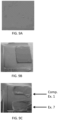
- Example 6 the added coloring agent was Novoperm Carmine H3FC as supplied by Clariant Co. As shown in Table 2 and Figures 8A - 8C , the addition of the organic red pigment resulted in a visually significant detectable difference in color as perceived by a human eye between Comparative Example 1 and Example 6.
- Example 7 the added coloring agent was Solvaperm Red PFS as supplied by Clariant Co. As shown in Table 2 and Figures 9A - 9C , the addition of the organic red dye did not result in a visually significant detectable difference in color as perceived by a human eye between Comparative Example 1 and Example 7.
- Example 8 the added coloring agent was Fat Yellow 3G as supplied by Clariant Co. As shown in Table 2 and Figures 10A - 10C , the addition of the organic yellow dye did not result in a visually significant detectable difference in color as perceived by a human eye between Comparative Example 1 and Example 8.
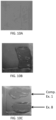
- Example 9 the added coloring agent was Fat Blue B 01 as supplied by Clariant Co. As shown in Table 2 and Figures 11A- 11C , the addition of the organic blue dye did not result in a visually significant detectable difference in color as perceived by a human eye between Comparative Example 1 and Example 9.
- Example 10 the added coloring agent was Solvaperm Red Violet R as supplied by Clariant Co. As shown in Table 2 and Figures 12A - 12C , the addition of the organic purple dye did not result in a visually significant detectable difference in color as perceived by a human eye between Comparative Example 1 and Example 10.
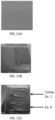
- Example 11 the added coloring agent was carbon black supplied by Guoyao Group Chemical Reagent Co., Ltd. having a particle size such that 95 wt.% passes through a 35 ⁇ m screen. As shown in Table 2, the addition of the carbon black did not result in a visually significant detectable difference in color as perceived by a human eye between Comparative Example 2, as shown in Figure 13 , and Example 11, as shown in Figure 14 .
- the formulations including any of the coloring agents ⁇ -Fe 2 O 3 ; ⁇ -Fe 2 O 3 ⁇ H 2 O; and Fe 3 O 4 , and Formula (I), as used in Examples 2, 3, 5, and 6, exhibited a color differentiation compared to that of Comparative Example 1, which did not include a coloring agent.
- the formulations prepared with the remaining coloring agents, as in Examples 1, 4, and 7-11 did not exhibit color differentiation compared to the respective comparative examples.
- Examples 1 to 5 and 7 to 11 are not according to the invention.
- Example 6 is according to the invention.
Landscapes
- Chemical & Material Sciences (AREA)
- Chemical Kinetics & Catalysis (AREA)
- Organic Chemistry (AREA)
- Medicinal Chemistry (AREA)
- Polymers & Plastics (AREA)
- Health & Medical Sciences (AREA)
- Engineering & Computer Science (AREA)
- Materials Engineering (AREA)
- Physics & Mathematics (AREA)
- Thermal Sciences (AREA)
- Combustion & Propulsion (AREA)
- Compositions Of Macromolecular Compounds (AREA)
- Coloring (AREA)
- Cosmetics (AREA)
- Cooling Or The Like Of Semiconductors Or Solid State Devices (AREA)
Priority Applications (3)
| Application Number | Priority Date | Filing Date | Title |
|---|---|---|---|
| PL20211073.0T PL3839005T3 (pl) | 2016-10-12 | 2016-10-12 | Materiały interfejsu termicznego zawierające środek barwiący |
| PT202110730T PT3839005T (pt) | 2016-10-12 | 2016-10-12 | Materiais de interface térmica incluindo agente corante |
| EP20211073.0A EP3839005B1 (en) | 2016-10-12 | 2016-10-12 | Thermal interface materials including coloring agent |
Applications Claiming Priority (3)
| Application Number | Priority Date | Filing Date | Title |
|---|---|---|---|
| EP16918509.7A EP3526303A4 (en) | 2016-10-12 | 2016-10-12 | THERMAL INTERFACE MATERIALS INCLUDING A COLORING AGENT |
| PCT/CN2016/101874 WO2018068222A1 (en) | 2016-10-12 | 2016-10-12 | Thermal interface materials including coloring agent |
| EP20211073.0A EP3839005B1 (en) | 2016-10-12 | 2016-10-12 | Thermal interface materials including coloring agent |
Related Parent Applications (1)
| Application Number | Title | Priority Date | Filing Date |
|---|---|---|---|
| EP16918509.7A Division EP3526303A4 (en) | 2016-10-12 | 2016-10-12 | THERMAL INTERFACE MATERIALS INCLUDING A COLORING AGENT |
Publications (2)
| Publication Number | Publication Date |
|---|---|
| EP3839005A1 EP3839005A1 (en) | 2021-06-23 |
| EP3839005B1 true EP3839005B1 (en) | 2023-07-19 |
Family
ID=61905079
Family Applications (2)
| Application Number | Title | Priority Date | Filing Date |
|---|---|---|---|
| EP20211073.0A Active EP3839005B1 (en) | 2016-10-12 | 2016-10-12 | Thermal interface materials including coloring agent |
| EP16918509.7A Withdrawn EP3526303A4 (en) | 2016-10-12 | 2016-10-12 | THERMAL INTERFACE MATERIALS INCLUDING A COLORING AGENT |
Family Applications After (1)
| Application Number | Title | Priority Date | Filing Date |
|---|---|---|---|
| EP16918509.7A Withdrawn EP3526303A4 (en) | 2016-10-12 | 2016-10-12 | THERMAL INTERFACE MATERIALS INCLUDING A COLORING AGENT |
Country Status (9)
| Country | Link |
|---|---|
| EP (2) | EP3839005B1 (pl) |
| JP (1) | JP2020500225A (pl) |
| KR (1) | KR102666004B1 (pl) |
| CN (1) | CN109844056B (pl) |
| BR (1) | BR112019007197A2 (pl) |
| MX (1) | MX2019004236A (pl) |
| PL (1) | PL3839005T3 (pl) |
| PT (1) | PT3839005T (pl) |
| WO (1) | WO2018068222A1 (pl) |
Families Citing this family (11)
| Publication number | Priority date | Publication date | Assignee | Title |
|---|---|---|---|---|
| US10155894B2 (en) | 2014-07-07 | 2018-12-18 | Honeywell International Inc. | Thermal interface material with ion scavenger |
| CN107250317A (zh) | 2014-12-05 | 2017-10-13 | 霍尼韦尔国际公司 | 具有低热阻的高性能热界面材料 |
| US10312177B2 (en) * | 2015-11-17 | 2019-06-04 | Honeywell International Inc. | Thermal interface materials including a coloring agent |
| MX393621B (es) | 2016-03-08 | 2025-03-24 | Honeywell Int Inc | Material de camibo de fase. |
| US10501671B2 (en) | 2016-07-26 | 2019-12-10 | Honeywell International Inc. | Gel-type thermal interface material |
| US11041103B2 (en) | 2017-09-08 | 2021-06-22 | Honeywell International Inc. | Silicone-free thermal gel |
| US10428256B2 (en) | 2017-10-23 | 2019-10-01 | Honeywell International Inc. | Releasable thermal gel |
| US11072706B2 (en) | 2018-02-15 | 2021-07-27 | Honeywell International Inc. | Gel-type thermal interface material |
| US11373921B2 (en) | 2019-04-23 | 2022-06-28 | Honeywell International Inc. | Gel-type thermal interface material with low pre-curing viscosity and elastic properties post-curing |
| US20210261845A1 (en) * | 2019-06-24 | 2021-08-26 | Fuji Polymer Industries Co., Ltd. | Heat-resistant thermally conductive composition and heat-resistant thermally conductive sheet |
| US20240059946A1 (en) * | 2020-12-24 | 2024-02-22 | Dow Global Technologies Llc | Thermal interface material |
Family Cites Families (12)
| Publication number | Priority date | Publication date | Assignee | Title |
|---|---|---|---|---|
| WO2001021393A1 (en) * | 1999-09-21 | 2001-03-29 | Saint-Gobain Ceramics And Plastics, Inc. | Thermally conductive materials in a hydrophobic compound for thermal management |
| CN102341474B (zh) * | 2009-03-02 | 2014-09-24 | 霍尼韦尔国际公司 | 热界面材料及制造和使用它的方法 |
| US8618211B2 (en) * | 2009-03-16 | 2013-12-31 | Dow Corning Corporation | Thermally conductive grease and methods and devices in which said grease is used |
| US9260645B2 (en) * | 2010-02-23 | 2016-02-16 | Laird Technologies, Inc. | Thermal interface materials including thermally reversible gels |
| US8552101B2 (en) * | 2011-02-25 | 2013-10-08 | Sabic Innovative Plastics Ip B.V. | Thermally conductive and electrically insulative polymer compositions containing a low thermally conductive filler and uses thereof |
| US20150008361A1 (en) * | 2012-03-02 | 2015-01-08 | Fuji Polymer Industries Co., Ltd. | Putty-like heat transfer material and method for producing the same |
| US20140171567A1 (en) * | 2012-12-14 | 2014-06-19 | Sabic Innovative Plastics Ip B.V. | Thermally conductive flame retardant polymer compositions and uses thereof |
| US20150125646A1 (en) * | 2013-11-05 | 2015-05-07 | Espci Innov | Self-Healing Thermally Conductive Polymer Materials |
| WO2015120773A1 (en) * | 2014-02-13 | 2015-08-20 | Honeywell International Inc. | Compressible thermal interface materials |
| CN104497574A (zh) * | 2014-12-10 | 2015-04-08 | 深圳市博恩实业有限公司 | 多功能有机硅热界面材料 |
| US20170043553A1 (en) * | 2015-01-06 | 2017-02-16 | Fuji Polymer Industries Co., Ltd. | Heat-storage, thermally conductive sheet |
| CN105349113A (zh) * | 2015-10-14 | 2016-02-24 | 文雪烽 | 一种导热界面材料 |
-
2016
- 2016-10-12 JP JP2019519732A patent/JP2020500225A/ja active Pending
- 2016-10-12 PT PT202110730T patent/PT3839005T/pt unknown
- 2016-10-12 KR KR1020197010394A patent/KR102666004B1/ko active Active
- 2016-10-12 EP EP20211073.0A patent/EP3839005B1/en active Active
- 2016-10-12 MX MX2019004236A patent/MX2019004236A/es unknown
- 2016-10-12 EP EP16918509.7A patent/EP3526303A4/en not_active Withdrawn
- 2016-10-12 BR BR112019007197-0A patent/BR112019007197A2/pt not_active Application Discontinuation
- 2016-10-12 PL PL20211073.0T patent/PL3839005T3/pl unknown
- 2016-10-12 CN CN201680089978.7A patent/CN109844056B/zh active Active
- 2016-10-12 WO PCT/CN2016/101874 patent/WO2018068222A1/en not_active Ceased
Also Published As
| Publication number | Publication date |
|---|---|
| KR102666004B1 (ko) | 2024-05-14 |
| CN109844056A (zh) | 2019-06-04 |
| EP3526303A4 (en) | 2020-09-09 |
| EP3839005A1 (en) | 2021-06-23 |
| JP2020500225A (ja) | 2020-01-09 |
| KR20190067176A (ko) | 2019-06-14 |
| PL3839005T3 (pl) | 2023-11-27 |
| PT3839005T (pt) | 2023-09-07 |
| MX2019004236A (es) | 2019-07-04 |
| EP3526303A1 (en) | 2019-08-21 |
| BR112019007197A2 (pt) | 2019-07-02 |
| CN109844056B (zh) | 2021-11-09 |
| WO2018068222A1 (en) | 2018-04-19 |
Similar Documents
| Publication | Publication Date | Title |
|---|---|---|
| US10312177B2 (en) | Thermal interface materials including a coloring agent | |
| EP3839005A1 (en) | Thermal interface materials including coloring agent | |
| EP3426746B1 (en) | Phase change material | |
| US10155894B2 (en) | Thermal interface material with ion scavenger | |
| US20170321100A1 (en) | High performance thermal interface materials with low thermal impedance | |
| TWI343414B (en) | Thermally conductive grease composition and methods and devices in which said grease composition is used | |
| US10428256B2 (en) | Releasable thermal gel | |
| TWI378952B (en) | Amide-substituted silicones and methods for their preparation and use | |
| CN113166545B (zh) | 包含mgo填料的导热组合物以及使用所述组合物的方法和装置 | |
| JP6902163B2 (ja) | シリコーン無含有熱ゲル | |
| US20140240928A1 (en) | Thermal grease having low thermal resistance | |
| TWI749080B (zh) | 包含著色劑之熱介面材料 | |
| JP7603165B2 (ja) | 熱界面材料 | |
| KR20140118218A (ko) | 열전도율이 향상된 솔더 레지스트 조성물 | |
| US20260028518A1 (en) | Low thermal impedance phase change thermal interface materials | |
| KR20160099827A (ko) | 무기산화물계 냉각재, 그를 함유한 냉각용 코팅 조성물 및 그를 이용한 제품 |
Legal Events
| Date | Code | Title | Description |
|---|---|---|---|
| PUAI | Public reference made under article 153(3) epc to a published international application that has entered the european phase |
Free format text: ORIGINAL CODE: 0009012 |
|
| STAA | Information on the status of an ep patent application or granted ep patent |
Free format text: STATUS: THE APPLICATION HAS BEEN PUBLISHED |
|
| AC | Divisional application: reference to earlier application |
Ref document number: 3526303 Country of ref document: EP Kind code of ref document: P |
|
| AK | Designated contracting states |
Kind code of ref document: A1 Designated state(s): AL AT BE BG CH CY CZ DE DK EE ES FI FR GB GR HR HU IE IS IT LI LT LU LV MC MK MT NL NO PL PT RO RS SE SI SK SM TR |
|
| STAA | Information on the status of an ep patent application or granted ep patent |
Free format text: STATUS: REQUEST FOR EXAMINATION WAS MADE |
|
| 17P | Request for examination filed |
Effective date: 20211111 |
|
| RBV | Designated contracting states (corrected) |
Designated state(s): AL AT BE BG CH CY CZ DE DK EE ES FI FR GB GR HR HU IE IS IT LI LT LU LV MC MK MT NL NO PL PT RO RS SE SI SK SM TR |
|
| STAA | Information on the status of an ep patent application or granted ep patent |
Free format text: STATUS: EXAMINATION IS IN PROGRESS |
|
| 17Q | First examination report despatched |
Effective date: 20221121 |
|
| GRAP | Despatch of communication of intention to grant a patent |
Free format text: ORIGINAL CODE: EPIDOSNIGR1 |
|
| STAA | Information on the status of an ep patent application or granted ep patent |
Free format text: STATUS: GRANT OF PATENT IS INTENDED |
|
| INTG | Intention to grant announced |
Effective date: 20230403 |
|
| GRAS | Grant fee paid |
Free format text: ORIGINAL CODE: EPIDOSNIGR3 |
|
| P01 | Opt-out of the competence of the unified patent court (upc) registered |
Effective date: 20230414 |
|
| GRAA | (expected) grant |
Free format text: ORIGINAL CODE: 0009210 |
|
| STAA | Information on the status of an ep patent application or granted ep patent |
Free format text: STATUS: THE PATENT HAS BEEN GRANTED |
|
| AC | Divisional application: reference to earlier application |
Ref document number: 3526303 Country of ref document: EP Kind code of ref document: P |
|
| AK | Designated contracting states |
Kind code of ref document: B1 Designated state(s): AL AT BE BG CH CY CZ DE DK EE ES FI FR GB GR HR HU IE IS IT LI LT LU LV MC MK MT NL NO PL PT RO RS SE SI SK SM TR |
|
| REG | Reference to a national code |
Ref country code: GB Ref legal event code: FG4D |
|
| REG | Reference to a national code |
Ref country code: CH Ref legal event code: EP |
|
| REG | Reference to a national code |
Ref country code: DE Ref legal event code: R096 Ref document number: 602016081276 Country of ref document: DE |
|
| REG | Reference to a national code |
Ref country code: IE Ref legal event code: FG4D |
|
| REG | Reference to a national code |
Ref country code: PT Ref legal event code: SC4A Ref document number: 3839005 Country of ref document: PT Date of ref document: 20230907 Kind code of ref document: T Free format text: AVAILABILITY OF NATIONAL TRANSLATION Effective date: 20230901 |
|
| REG | Reference to a national code |
Ref country code: LT Ref legal event code: MG9D |
|
| REG | Reference to a national code |
Ref country code: NL Ref legal event code: MP Effective date: 20230719 |
|
| REG | Reference to a national code |
Ref country code: AT Ref legal event code: MK05 Ref document number: 1589473 Country of ref document: AT Kind code of ref document: T Effective date: 20230719 |
|
| PG25 | Lapsed in a contracting state [announced via postgrant information from national office to epo] |
Ref country code: NL Free format text: LAPSE BECAUSE OF FAILURE TO SUBMIT A TRANSLATION OF THE DESCRIPTION OR TO PAY THE FEE WITHIN THE PRESCRIBED TIME-LIMIT Effective date: 20230719 |
|
| PG25 | Lapsed in a contracting state [announced via postgrant information from national office to epo] |
Ref country code: GR Free format text: LAPSE BECAUSE OF FAILURE TO SUBMIT A TRANSLATION OF THE DESCRIPTION OR TO PAY THE FEE WITHIN THE PRESCRIBED TIME-LIMIT Effective date: 20231020 |
|
| PG25 | Lapsed in a contracting state [announced via postgrant information from national office to epo] |
Ref country code: IS Free format text: LAPSE BECAUSE OF FAILURE TO SUBMIT A TRANSLATION OF THE DESCRIPTION OR TO PAY THE FEE WITHIN THE PRESCRIBED TIME-LIMIT Effective date: 20231119 |
|
| PG25 | Lapsed in a contracting state [announced via postgrant information from national office to epo] |
Ref country code: SE Free format text: LAPSE BECAUSE OF FAILURE TO SUBMIT A TRANSLATION OF THE DESCRIPTION OR TO PAY THE FEE WITHIN THE PRESCRIBED TIME-LIMIT Effective date: 20230719 Ref country code: RS Free format text: LAPSE BECAUSE OF FAILURE TO SUBMIT A TRANSLATION OF THE DESCRIPTION OR TO PAY THE FEE WITHIN THE PRESCRIBED TIME-LIMIT Effective date: 20230719 Ref country code: NO Free format text: LAPSE BECAUSE OF FAILURE TO SUBMIT A TRANSLATION OF THE DESCRIPTION OR TO PAY THE FEE WITHIN THE PRESCRIBED TIME-LIMIT Effective date: 20231019 Ref country code: LV Free format text: LAPSE BECAUSE OF FAILURE TO SUBMIT A TRANSLATION OF THE DESCRIPTION OR TO PAY THE FEE WITHIN THE PRESCRIBED TIME-LIMIT Effective date: 20230719 Ref country code: LT Free format text: LAPSE BECAUSE OF FAILURE TO SUBMIT A TRANSLATION OF THE DESCRIPTION OR TO PAY THE FEE WITHIN THE PRESCRIBED TIME-LIMIT Effective date: 20230719 Ref country code: IS Free format text: LAPSE BECAUSE OF FAILURE TO SUBMIT A TRANSLATION OF THE DESCRIPTION OR TO PAY THE FEE WITHIN THE PRESCRIBED TIME-LIMIT Effective date: 20231119 Ref country code: HR Free format text: LAPSE BECAUSE OF FAILURE TO SUBMIT A TRANSLATION OF THE DESCRIPTION OR TO PAY THE FEE WITHIN THE PRESCRIBED TIME-LIMIT Effective date: 20230719 Ref country code: GR Free format text: LAPSE BECAUSE OF FAILURE TO SUBMIT A TRANSLATION OF THE DESCRIPTION OR TO PAY THE FEE WITHIN THE PRESCRIBED TIME-LIMIT Effective date: 20231020 Ref country code: FI Free format text: LAPSE BECAUSE OF FAILURE TO SUBMIT A TRANSLATION OF THE DESCRIPTION OR TO PAY THE FEE WITHIN THE PRESCRIBED TIME-LIMIT Effective date: 20230719 Ref country code: AT Free format text: LAPSE BECAUSE OF FAILURE TO SUBMIT A TRANSLATION OF THE DESCRIPTION OR TO PAY THE FEE WITHIN THE PRESCRIBED TIME-LIMIT Effective date: 20230719 |
|
| REG | Reference to a national code |
Ref country code: DE Ref legal event code: R097 Ref document number: 602016081276 Country of ref document: DE |
|
| PG25 | Lapsed in a contracting state [announced via postgrant information from national office to epo] |
Ref country code: ES Free format text: LAPSE BECAUSE OF FAILURE TO SUBMIT A TRANSLATION OF THE DESCRIPTION OR TO PAY THE FEE WITHIN THE PRESCRIBED TIME-LIMIT Effective date: 20230719 |
|
| PG25 | Lapsed in a contracting state [announced via postgrant information from national office to epo] |
Ref country code: SM Free format text: LAPSE BECAUSE OF FAILURE TO SUBMIT A TRANSLATION OF THE DESCRIPTION OR TO PAY THE FEE WITHIN THE PRESCRIBED TIME-LIMIT Effective date: 20230719 Ref country code: RO Free format text: LAPSE BECAUSE OF FAILURE TO SUBMIT A TRANSLATION OF THE DESCRIPTION OR TO PAY THE FEE WITHIN THE PRESCRIBED TIME-LIMIT Effective date: 20230719 Ref country code: ES Free format text: LAPSE BECAUSE OF FAILURE TO SUBMIT A TRANSLATION OF THE DESCRIPTION OR TO PAY THE FEE WITHIN THE PRESCRIBED TIME-LIMIT Effective date: 20230719 Ref country code: EE Free format text: LAPSE BECAUSE OF FAILURE TO SUBMIT A TRANSLATION OF THE DESCRIPTION OR TO PAY THE FEE WITHIN THE PRESCRIBED TIME-LIMIT Effective date: 20230719 Ref country code: DK Free format text: LAPSE BECAUSE OF FAILURE TO SUBMIT A TRANSLATION OF THE DESCRIPTION OR TO PAY THE FEE WITHIN THE PRESCRIBED TIME-LIMIT Effective date: 20230719 Ref country code: CZ Free format text: LAPSE BECAUSE OF FAILURE TO SUBMIT A TRANSLATION OF THE DESCRIPTION OR TO PAY THE FEE WITHIN THE PRESCRIBED TIME-LIMIT Effective date: 20230719 Ref country code: SK Free format text: LAPSE BECAUSE OF FAILURE TO SUBMIT A TRANSLATION OF THE DESCRIPTION OR TO PAY THE FEE WITHIN THE PRESCRIBED TIME-LIMIT Effective date: 20230719 |
|
| PLBE | No opposition filed within time limit |
Free format text: ORIGINAL CODE: 0009261 |
|
| STAA | Information on the status of an ep patent application or granted ep patent |
Free format text: STATUS: NO OPPOSITION FILED WITHIN TIME LIMIT |
|
| PG25 | Lapsed in a contracting state [announced via postgrant information from national office to epo] |
Ref country code: IT Free format text: LAPSE BECAUSE OF FAILURE TO SUBMIT A TRANSLATION OF THE DESCRIPTION OR TO PAY THE FEE WITHIN THE PRESCRIBED TIME-LIMIT Effective date: 20230719 Ref country code: MC Free format text: LAPSE BECAUSE OF FAILURE TO SUBMIT A TRANSLATION OF THE DESCRIPTION OR TO PAY THE FEE WITHIN THE PRESCRIBED TIME-LIMIT Effective date: 20230719 |
|
| REG | Reference to a national code |
Ref country code: CH Ref legal event code: PL |
|
| REG | Reference to a national code |
Ref country code: BE Ref legal event code: MM Effective date: 20231031 |
|
| PG25 | Lapsed in a contracting state [announced via postgrant information from national office to epo] |
Ref country code: LU Free format text: LAPSE BECAUSE OF NON-PAYMENT OF DUE FEES Effective date: 20231012 |
|
| 26N | No opposition filed |
Effective date: 20240422 |
|
| PG25 | Lapsed in a contracting state [announced via postgrant information from national office to epo] |
Ref country code: LU Free format text: LAPSE BECAUSE OF NON-PAYMENT OF DUE FEES Effective date: 20231012 |
|
| PG25 | Lapsed in a contracting state [announced via postgrant information from national office to epo] |
Ref country code: CH Free format text: LAPSE BECAUSE OF NON-PAYMENT OF DUE FEES Effective date: 20231031 |
|
| PG25 | Lapsed in a contracting state [announced via postgrant information from national office to epo] |
Ref country code: CH Free format text: LAPSE BECAUSE OF NON-PAYMENT OF DUE FEES Effective date: 20231031 Ref country code: SI Free format text: LAPSE BECAUSE OF FAILURE TO SUBMIT A TRANSLATION OF THE DESCRIPTION OR TO PAY THE FEE WITHIN THE PRESCRIBED TIME-LIMIT Effective date: 20230719 |
|
| PG25 | Lapsed in a contracting state [announced via postgrant information from national office to epo] |
Ref country code: BE Free format text: LAPSE BECAUSE OF NON-PAYMENT OF DUE FEES Effective date: 20231031 |
|
| PG25 | Lapsed in a contracting state [announced via postgrant information from national office to epo] |
Ref country code: IE Free format text: LAPSE BECAUSE OF NON-PAYMENT OF DUE FEES Effective date: 20231012 |
|
| PG25 | Lapsed in a contracting state [announced via postgrant information from national office to epo] |
Ref country code: IE Free format text: LAPSE BECAUSE OF NON-PAYMENT OF DUE FEES Effective date: 20231012 |
|
| PG25 | Lapsed in a contracting state [announced via postgrant information from national office to epo] |
Ref country code: BG Free format text: LAPSE BECAUSE OF FAILURE TO SUBMIT A TRANSLATION OF THE DESCRIPTION OR TO PAY THE FEE WITHIN THE PRESCRIBED TIME-LIMIT Effective date: 20230719 |
|
| PG25 | Lapsed in a contracting state [announced via postgrant information from national office to epo] |
Ref country code: BG Free format text: LAPSE BECAUSE OF FAILURE TO SUBMIT A TRANSLATION OF THE DESCRIPTION OR TO PAY THE FEE WITHIN THE PRESCRIBED TIME-LIMIT Effective date: 20230719 |
|
| PG25 | Lapsed in a contracting state [announced via postgrant information from national office to epo] |
Ref country code: CY Free format text: LAPSE BECAUSE OF FAILURE TO SUBMIT A TRANSLATION OF THE DESCRIPTION OR TO PAY THE FEE WITHIN THE PRESCRIBED TIME-LIMIT; INVALID AB INITIO Effective date: 20161012 |
|
| PG25 | Lapsed in a contracting state [announced via postgrant information from national office to epo] |
Ref country code: HU Free format text: LAPSE BECAUSE OF FAILURE TO SUBMIT A TRANSLATION OF THE DESCRIPTION OR TO PAY THE FEE WITHIN THE PRESCRIBED TIME-LIMIT; INVALID AB INITIO Effective date: 20161012 |
|
| PGFP | Annual fee paid to national office [announced via postgrant information from national office to epo] |
Ref country code: PT Payment date: 20250929 Year of fee payment: 10 |
|
| PGFP | Annual fee paid to national office [announced via postgrant information from national office to epo] |
Ref country code: PL Payment date: 20250930 Year of fee payment: 10 |
|
| PG25 | Lapsed in a contracting state [announced via postgrant information from national office to epo] |
Ref country code: TR Free format text: LAPSE BECAUSE OF FAILURE TO SUBMIT A TRANSLATION OF THE DESCRIPTION OR TO PAY THE FEE WITHIN THE PRESCRIBED TIME-LIMIT Effective date: 20230719 |
|
| PGFP | Annual fee paid to national office [announced via postgrant information from national office to epo] |
Ref country code: DE Payment date: 20251028 Year of fee payment: 10 |
|
| PGFP | Annual fee paid to national office [announced via postgrant information from national office to epo] |
Ref country code: GB Payment date: 20251023 Year of fee payment: 10 |
|
| PGFP | Annual fee paid to national office [announced via postgrant information from national office to epo] |
Ref country code: FR Payment date: 20251027 Year of fee payment: 10 |