EP3836616A1 - Verfahren und vorrichtung zur datensendung, speichermedium und sendendes ende - Google Patents
Verfahren und vorrichtung zur datensendung, speichermedium und sendendes ende Download PDFInfo
- Publication number
- EP3836616A1 EP3836616A1 EP19846311.9A EP19846311A EP3836616A1 EP 3836616 A1 EP3836616 A1 EP 3836616A1 EP 19846311 A EP19846311 A EP 19846311A EP 3836616 A1 EP3836616 A1 EP 3836616A1
- Authority
- EP
- European Patent Office
- Prior art keywords
- sending end
- end logical
- logical channels
- sending
- pdcp
- Prior art date
- Legal status (The legal status is an assumption and is not a legal conclusion. Google has not performed a legal analysis and makes no representation as to the accuracy of the status listed.)
- Granted
Links
Images



Classifications
-
- H—ELECTRICITY
- H04—ELECTRIC COMMUNICATION TECHNIQUE
- H04W—WIRELESS COMMUNICATION NETWORKS
- H04W80/00—Wireless network protocols or protocol adaptations to wireless operation
- H04W80/02—Data link layer protocols
-
- H—ELECTRICITY
- H04—ELECTRIC COMMUNICATION TECHNIQUE
- H04W—WIRELESS COMMUNICATION NETWORKS
- H04W72/00—Local resource management
- H04W72/12—Wireless traffic scheduling
-
- H—ELECTRICITY
- H04—ELECTRIC COMMUNICATION TECHNIQUE
- H04W—WIRELESS COMMUNICATION NETWORKS
- H04W28/00—Network traffic management; Network resource management
- H04W28/02—Traffic management, e.g. flow control or congestion control
- H04W28/10—Flow control between communication endpoints
- H04W28/12—Flow control between communication endpoints using signalling between network elements
-
- H—ELECTRICITY
- H04—ELECTRIC COMMUNICATION TECHNIQUE
- H04W—WIRELESS COMMUNICATION NETWORKS
- H04W72/00—Local resource management
- H04W72/04—Wireless resource allocation
-
- H—ELECTRICITY
- H04—ELECTRIC COMMUNICATION TECHNIQUE
- H04W—WIRELESS COMMUNICATION NETWORKS
- H04W76/00—Connection management
- H04W76/10—Connection setup
- H04W76/15—Setup of multiple wireless link connections
Definitions
- the present disclosure generally relates to communication technology field, and more particularly, to a data sending method and apparatus, a storage medium and a sending end.
- 3GPP has introduced New Radio (NR) access technology to meet the demand of larger data volume and smaller transmission delay.
- NR New Radio
- This technology is also known as the fifth-generation mobile communication technology (5G).
- Packet Data Convergence Protocol (PDCP) duplication function and Band Width Part (BWP).
- PDCP Packet Data Convergence Protocol
- BWP Band Width Part
- the PDCP replication function is introduced to improve the reliability of Ultra Reliable Low Latency Communication (URLLC) service transmission. More specifically, a PDCP data packet is duplicated into two same duplicates at a PDCP layer of a sending end, where the two same duplicates are sent to two different Radio Link Control (RLC) entities respectively, and then sent through different sending end Logical Channels (LCH). When the two duplicates are successfully received, a PDCP layer at a receiving end keeps one of them and deletes the other one. In other words, a data packet is duplicated into two same duplicates and transmitted through two different channels, thereby improving the reliability of data transmission. And the PDCP data packet may include a PDCP Protocol Data Unit (PDU) and a PDCP Service Data Unit (SDU).
- PDU PDCP Protocol Data Unit
- SDU PDCP Service Data Unit
- a radio bearer (RB) configured with duplication function may be configured with more than two wireless data legs.
- RB it is not clear to use only one bit to indicate how many sending end logical channels to be used are used to send duplicated PDCP data packets, and which sending end logical channels to be used are used for data transmission.
- one bit only includes two states of 0/1, that is, it can only be used to indicate two logical channels, and cannot clearly indicate the use of multi-connectivity duplication.
- Embodiments of the present disclosure provide a data sending method and apparatus, a storage medium and a sending end, which can improve accuracy of instructions, thereby improving efficiency of transmission resource utilization.
- a data sending method including: determining an activation instruction which includes multiple bits to indicate sending end logical channels to be used for each Radio Bearer (RB); and for each RB, according to a number n of the sending end logical channels to be used for the RB, a sending end Packet Data Convergence Protocol (PDCP) entity duplicating a PDCP data packet and sending duplicated PDCP data packets to a receiving end through the sending end logical channels to be used; wherein a maximum value of the number n of the sending end logical channels to be used for each RB is greater than 2.
- PDCP Packet Data Convergence Protocol
- each of the multiple bits indicates whether a corresponding sending end logical channel is a sending end logical channel to be used; wherein each bit of the multiple bits has a one-to-one mapping relationship with each sending end logical channel.
- the one-to-one mapping relationship between each bit of the multiple bits and each sending end logical channel is predefined.
- the data sending method further includes: determining a PDCP duplication configuration information, wherein the PDCP duplication configuration information includes a mapping relationship between each sending end PDCP entity and a sending end logical channel, and the one-to-one mapping relationship between each bit of the multiple bits and each sending end logical channel; wherein each RB corresponds to a sending end PDCP entity.
- the PDCP duplication configuration information further includes a mapping relationship between the sending end logical channels and sub-bands.
- RBs indicated by the multiple bits in the activation instruction are arranged in an order of sequence numbers of the RBs, and the bits indicating a same RB are arranged in an order of sequence numbers of the sending end logical channels; and wherein the order of sequence numbers of the RBs and the order of sequence numbers of the sending end logical channels are ascending or descending, and the order of sequence numbers of the RBs and the order of sequence numbers of the sending end logical channels are same or different.
- CA Carrier Aggregation
- RBs indicated by the multiple bits in the activation instruction are arranged in an order of sequence numbers of the RBs, and the bits indicating a same RB are arranged in an order of sequence numbers of sending end Media Access Control (MAC) layers; and wherein the order of sequence numbers of the RBs and the order of sequence numbers of the sending end MAC layers are ascending or descending, and the order of sequence numbers of the RBs and the order of sequence numbers of the sending end MAC layers are same or different.
- DC Dual Connectivity
- a value of the multiple bits indicating a RB indicates the number n of the sending end logical channels to be used for each RB, where the sending end logical channels of each RB are arranged in a preset order; and according to the preset order, top n sending end logical channels are selected as the sending end logical channels to be used for each RB.
- the data sending method further includes: determining a PDCP duplication configuration information, wherein the PDCP duplication configuration information includes a mapping relationship between each PDCP entity and each sending end logical channel, and the preset order of the sending end logical channels of each RB.
- the PDCP duplication configuration information further includes a mapping relationship between the sending end logical channels and sub-bands.
- the multiple bits used to indicate the sending end logical channels to be used for each RB are a preset number of bits
- the data sending method further includes: determining a PDCP duplication configuration information, wherein the PDCP duplication configuration information includes a mapping relationship between each PDCP entity and each sending end logical channel, the preset order of the sending end logical channels of each RB, and the preset number of bits.
- the data sending method further includes: determining a PDCP duplication configuration information, wherein the PDCP duplication configuration information includes a mapping relationship between each PDCP entity and each sending end logical channel, the preset order of the sending end logical channels of each RB, and a preset value of a maximum number of the sending end logical channels of each RB.
- the PDCP duplication configuration information further includes a mapping relationship between the sending end logical channels and sub-bands.
- a data sending apparatus including: an activation determination module, adapted to determine an activation instruction which includes multiple bits to indicate sending end logical channels to be used for each Radio Bearer (RB); and a sending module, adapted to, for each RB, send duplicated Packet Data Convergence Protocol (PDCP) data packets to a receiving end through the sending end logical channels to be used, wherein the duplicated PDCP data packets are generated by a sending end PDCP entity duplicating a PDCP data packet according to a number n of the sending end logical channels to be used for the RB; wherein a maximum value of the number n of the sending end logical channels to be used for each RB is greater than 2.
- PDCP Packet Data Convergence Protocol
- each of the multiple bits indicates whether a corresponding sending end logical channel is a sending end logical channel to be used; wherein each bit of the multiple bits has a one-to-one mapping relationship with each sending end logical channel.
- the one-to-one mapping relationship between each bit of the multiple bits and each sending end logical channel is predefined.
- the data sending apparatus further includes: a first configuration information determining module, adapted to, before determining the activation instruction, determine a PDCP duplication configuration information, wherein the PDCP duplication configuration information includes a mapping relationship between each sending end PDCP entity and a sending end logical channel, and the one-to-one mapping relationship between each bit of the multiple bits and each sending end logical channel; wherein each RB corresponds to a sending end PDCP entity.
- a first configuration information determining module adapted to, before determining the activation instruction, determine a PDCP duplication configuration information, wherein the PDCP duplication configuration information includes a mapping relationship between each sending end PDCP entity and a sending end logical channel, and the one-to-one mapping relationship between each bit of the multiple bits and each sending end logical channel; wherein each RB corresponds to a sending end PDCP entity.
- the PDCP duplication configuration information further includes a mapping relationship between the sending end logical channels and sub-bands.
- RBs indicated by the multiple bits in the activation instruction are arranged in an order of sequence numbers of the RBs, and the bits indicating a same RB are arranged in an order of sequence numbers of the sending end logical channels; and wherein the order of sequence numbers of the RBs and the order of sequence numbers of the sending end logical channels are ascending or descending, and the order of sequence numbers of the RBs and the order of sequence numbers of the sending end logical channels are same or different.
- CA Carrier Aggregation
- RBs indicated by the multiple bits in the activation instruction are arranged in an order of sequence numbers of the RBs, and the bits indicating a same RB are arranged in an order of sequence numbers of sending end Media Access Control (MAC) layers; and wherein the order of sequence numbers of the RBs and the order of sequence numbers of the sending end MAC layers are ascending or descending, and the order of sequence numbers of the RBs and the order of sequence numbers of the sending end MAC layers are same or different.
- DC Dual Connectivity
- a value of the multiple bits indicating a RB indicates the number n of the sending end logical channels to be used for each RB, where the sending end logical channels of each RB are arranged in a preset order; and according to the preset order, top n sending end logical channels are selected as the sending end logical channels to be used for each RB.
- the data sending apparatus further includes: a second configuration information determining module, adapted to, before determining the activation instruction, determine a PDCP duplication configuration information, wherein the PDCP duplication configuration information includes a mapping relationship between each PDCP entity and each sending end logical channel, and the preset order of the sending end logical channels of each RB.
- a second configuration information determining module adapted to, before determining the activation instruction, determine a PDCP duplication configuration information, wherein the PDCP duplication configuration information includes a mapping relationship between each PDCP entity and each sending end logical channel, and the preset order of the sending end logical channels of each RB.
- the PDCP duplication configuration information further includes a mapping relationship between the sending end logical channels and sub-bands.
- the multiple bits used to indicate the sending end logical channels to be used for each RB are a preset number of bits
- the data sending apparatus further includes: a third configuration information determining module, adapted to determine a PDCP duplication configuration information before determining the activation instruction, wherein the PDCP duplication configuration information includes a mapping relationship between each PDCP entity and each sending end logical channel, the preset order of the sending end logical channels of each RB, and the preset number of bits.
- the data sending apparatus further includes: a fourth configuration information determining module, adapted to determine a PDCP duplication configuration information, wherein the PDCP duplication configuration information includes a mapping relationship between each PDCP entity and each sending end logical channel, the preset order of the sending end logical channels of each RB, and a preset value of a maximum number of the sending end logical channels of each RB.
- a fourth configuration information determining module adapted to determine a PDCP duplication configuration information, wherein the PDCP duplication configuration information includes a mapping relationship between each PDCP entity and each sending end logical channel, the preset order of the sending end logical channels of each RB, and a preset value of a maximum number of the sending end logical channels of each RB.
- the PDCP duplication configuration information further includes a mapping relationship between the sending end logical channels and sub-bands.
- a storage medium having computer instructions stored therein is provided, wherein once the computer instructions are executed, the above data sending method is performed.
- a sending end including a memory and a processor
- the memory has computer instructions stored therein, and when the processor executes the computer instructions, the above data sending method is performed.
- Embodiments of the present disclosure may provide following advantages.
- multiple bits are used to indicate sending end logical channels to be used for each RB by setting an activation instruction.
- only one bit is used to indicate sending end logical channels to be used for each RB, which is not clear in the case of multiple-connectivity duplication.
- n of sending end logical channels of each RB is greater than 2
- multiple bits are used to indicate, which facilitates to improve the accuracy of indication and improve the efficiency of transmission resource utilization.
- the activation instruction uses each of the multiple bits of the activation instruction to indicate whether a corresponding sending end logical channel is a sending end logical channel to be used, so that the sending end can determine whether a sender logical channel corresponding to each bit of the multiple bits is a sending logical channel to be used, so that the sending end logical channel to be used is determined when data needs to be sent.
- a value of the multiple bits indicating a RB indicates the number n of the sending end logical channels to be used for each RB, where the sending end logical channels of each RB are arranged in a preset order; and according to the preset order, top n sending end logical channels are selected as the sending end logical channels to be used for each RB.
- the sending end may use fewer bits to indicate the sending end logical channels to be used, so that the sending end can determine the sending end logical channels to be used of each RB according to the value of the multiple bits indicating the RB and the preset order, and determine the sending end logical channels when data needs to be sent.
- the multiple bits used to indicate the sending end logical channels to be used for each RB are a preset number of bits
- the PDCP duplication configuration information includes a mapping relationship between each PDCP entity and each sending end logical channel, the preset order of the sending end logical channels of each RB and the preset number of bits.
- a preset number of bits may be used to represent each RB in a received instruction, and the sending end may separate the multiple bits corresponding to each RB without calculation, which facilitates to reduce computational complexity.
- activation/deactivation mechanism of two-leg duplication mode is supported. Specifically, for each Radio Bearer (RB) configured with duplication function, a bit is used to indicate activation or deactivation of the duplication function of the RB.
- the activation of the duplication function can be used to instruct a PDCP to perform duplication operation and both two legs can be used for data transmission; the deactivation of the duplication function can be used to instruct the PDCP not to perform duplication operation and only a primary leg can be used for data transmission.
- an RB configured with duplication function may be configured with more than two wireless data legs.
- For each RB it is not clear to use only one bit to indicate how many sending end logical channels to be used are used to send duplicated PDCP data packets, and which sending end logical channels to be used are used for data transmission.
- one bit only includes two states of 0/1, that is, it can only be used to indicate two logical channels, and cannot clearly indicate the use of multi-connectivity duplication.
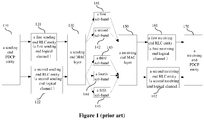
- FIG. 1 schematically illustrate a working scenario diagram of a data sending method in prior art.
- the data sending method may be used in a PDCP duplication function architecture in a Carrier Aggregation (CA) scenario.
- CA Carrier Aggregation
- a sending end PDCP entity 110 sends PDCP data packets to a first sending end RLC entity 121 and a second sending end RLC entity 122 respectively, and the PDCP data packets are sent to a sending end Medium Access Control (MAC) layer 130 through a first sending end logical channel corresponding to the first sending end RLC entity 121 and a second sending end logical channel corresponding to the second sending end RLC entity 122 respectively.
- MAC Medium Access Control
- the PDCP data packets will be sent through different sub-bands respectively. For example, a PDCP data packet sent by the first sending end logical channel will be sent through a first sub-band 141 and a second sub-band 142, and a PDCP data packet sent by the second sending end logical channel will be sent through a third sub-band 143, a fourth sub-band 144 and a fifth sub-band 145.
- a receiving end MAC layer 150 receives the PDCP data packets through different sub-bands, such as the first sub-band 141, the second sub-band 142, the third sub-band 143, the fourth sub-band 144 and the fifth sub-band 145, respectively. And the PDCP data packets will be uploaded to a first receiving end RLC entity 161 and a second receiving end RLC entity 162 correspondingly, and then be uploaded to a receiving end PDCP entity 170 the through a first receiving end logical channel corresponding to the first receiving end RLC entity 161 and a second receiving end logical channel corresponding to the second receiving end RLC entity 162.
- each leg may be a path from the sending end PDCP entity 110 to the receiving end PDCP entity 170, for example, from a sending end PDCP entity, a sending end RLC entity, a sending end MAC layer, a sub-band, a receiving end MSC layer, a receiving end RLC entity, to a receiving end PDCP entity.
- a plurality of steps such as configuration, activation and deactivation may be performed to realize the duplication function.
- a network side may use a Radio Resource Control (RRC) message to configure PDCP duplication function for multiple RBs, and establish an additional duplication RLC entity for each RB; wherein the RRC message may also indicate a sub-band Cell group ID and a Logic Channel ID (LCID) of a main RLC entity.
- RRC Radio Resource Control
- the RRC message may also set a duplication initial state for the RBs (for example, activation/deactivation).
- the two RLC entities are also configured to be mapped to different carriers respectively.
- the activation step is needed to perform the duplication function.
- the activation/deactivation step is performed by sending an activation/deactivation MAC control element (CE) from the network side.
- the MAC CE includes a bitmap, where each bit of the bitmap corresponds to a RB configured with duplication. Specifically, if a certain bit corresponding to a certain RB is configured with 1, it indicates to activate the certain RB; and if a certain bit corresponding to a certain RB is configured with 0, it indicates to deactivate the certain RB.
- the RB may include a Data Radio Bearer (DRB) and a Signaling Radio Bearer (SRB).
- DRB Data Radio Bearer
- SRB Signaling Radio Bearer
- the PDCP layer duplicates the data packet and sends the two same duplicated PDCP Protocol Data Units (PDUs) to two RLC entities corresponding to the RB respectively, and the two RLC entities will send the two same duplicated PDCP PDUs respectively.
- PDUs PDCP Protocol Data Units
- the sending end PDCP layer will not duplicate new data packets.
- the new data packets will be sent to a primary RLC entity (ie, a primary LCH), and not to a secondary RLC entity (ie, a secondary LCH).
- the sending end PDCP entity will notify the secondary RLC entity to cancel data stored in the secondary LCH.
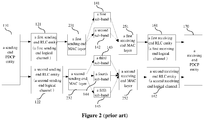
- Figure 2 schematically illustrate another working scenario diagram of a data sending method in prior art.
- the data sending method can be used in a PDCP duplication function architecture in a Dual Connectivity (DC) scenario.
- DC Dual Connectivity
- multiple sending end MAC layers and multiple receiving end MAC layers are provided.
- the multiple sending end MAC layers include a first sending end MAC layer 231 and a second sending end MAC layer 232;
- the multiple receiving end MAC layers include a first receiving end MAC layer 251 and a second receiving end MAC layer 252.
- each leg is a path from a sending end PDCP entity 110 to a receiving end PDCP entity 170, for example, from a sending end PDCP entity, a sending end RLC entity, a sending end MAC layer, a sub-band, a receiving end MAC layer, a receiving end RLC entity to a receiving end PDCP entity.
- the multiple sending end MAC layers correspond to the multiple sending end RLC entities
- the multiple receiving end MAC layers correspond to the multiple receiving end RLC entities.
- a plurality of steps such as configuration, activation and deactivation may be performed to realize the duplication function.
- the configuration step may be similar to that in the CA scenario.
- the activation step is needed to perform the duplication function.
- the activation/deactivation step is performed by sending an activation/deactivation MAC CE from the network side.
- the MAC CE includes a bitmap, where each bit of the bitmap corresponds to a RB configured with duplication. Specifically, if a certain bit corresponding to a certain RB is configured with 1, it indicates to activate the certain RB; and if a certain bit corresponding to a certain RB is configured with 0, it indicates to deactivate the certain RB.
- the PDCP layer duplicates the data packet and sends the two same duplicated PDCP Protocol Data Units (PDUs) to two RLC entities corresponding to the RB respectively, and the two RLC entities will send the two same duplicated PDCP PDUs respectively.
- PDUs PDCP Protocol Data Units
- the UE falls back to a split operation and adopts a relevant configuration of the split operation.
- a RB configured with duplication function may be configured with more than two legs for multiple-connectivity duplication, that is, more than two sending end logical channels may be configured.
- a bit it is not clear to use only one bit to indicate how many sending end logical channels to be used are used to send duplicated PDCP data packets, and which sending end logical channels to be used are used for data transmission.
- one bit only includes two states of 0/1, that is, it can only be used to indicate two logical channels, and cannot clearly indicate the use of multi-connectivity duplication.
- multiple bits are used to indicate sending end logical channels to be used for each RB by setting an activation instruction.
- only one bit is used to indicate sending end logical channels to be used for each RB, which is not clear in the case of multiple-connectivity duplication.
- n of sending end logical channels of each RB is greater than 2
- multiple bits are used to indicate, which facilitates to improve the accuracy of indication and improve the efficiency of transmission resource utilization.
- Figure 3 schematically illustrates a flow chart of a data sending method according to an embodiment.
- the data sending method includes S31 to S32.
- an activation instruction which includes multiple bits to indicate sending end logical channels to be used for each RB is determined.
- a sending end Packet Data Convergence Protocol (PDCP) entity duplicates a PDCP data packet to generate duplicated PDCP data packets, wherein the duplicated PDCP data packets are sent to a receiving end through the sending end logical channels to be used; and wherein a maximum value of the number n of the sending end logical channels to be used for each RB is greater than 2.
- PDCP Packet Data Convergence Protocol
- the operation of determining the activation instruction may be performed in different ways, depending on whether the sending end is a base station or a user equipment.
- the operation of determining activation instruction may include: configuring and sending the activation instruction to a user equipment, so that the user equipment determines the sending end logical channels to be used for each RB according to the multiple bits in the activation instruction.
- the operation of determining the activation instruction may include: receiving the activation instruction from a base station.
- the activation instruction may be transmitted through a MAC CE signaling. It should be noted that in embodiments of the present disclosure, methods of transmitting the activation instruction is not limited.
- each of the multiple bits indicates whether a corresponding sending end logical channel is a sending end logical channel to be used; wherein each bit of the multiple bits has a one-to-one mapping relationship with each sending end logical channel.
- a bit set to be 1 may be used to indicate that a corresponding sending end logical channel is a sending end logical channel to be used, and a bit set to be 0 may be used to indicate that a corresponding sending end logical channel is not a sending end logical channel to be used.
- the one-to-one mapping relationship between each bit of the multiple bits and each sending end logical channel is predefined.
- the RBs corresponding to the multiple bits and the sending end logical channels may be arranged in an ascending order, which may be predefined through a protocol and cannot be modified.
- the one-to-one mapping relationship between each bit of the multiple bits and each sending end logical channel may be sent from a network side (for example, a base station) to a user equipment, for example, a PDCP duplication configuration information may be configured.
- a network side for example, a base station
- a user equipment for example, a PDCP duplication configuration information
- the data sending method further includes: determining the PDCP duplication configuration information.
- the PDCP duplication configuration information includes a mapping relationship between each sending end PDCP entity and a sending end logical channel, and the one-to-one mapping relationship between each bit of the multiple bits and each sending end logical channel; wherein each RB corresponds to a sending end PDCP entity.
- the PDCP duplication configuration information includes a mapping relationship between each sending end PDCP entity and a sending end logical channel, and the one-to-one mapping relationship between each bit of the multiple bits and each sending end logical channel.
- the PDCP duplication configuration information may further includes a mapping relationship between the sending end logical channels and sub-bands.
- the PDCP duplication configuration information may include the one-to-one mapping relationship between each bit of the multiple bits and each sending end logical channel in detail. In other embodiments, the PDCP duplication configuration information may only include a sequence of the multiple bits in the activation instruction, so that, after receiving the activation instruction, the user equipment may determine the one-to-one mapping relationship between each bit of the multiple bits and each sending end logical channel.
- Figure 4 schematically illustrates a working scenario diagram of a data sending method according to an embodiment.
- the data sending method shown in Figure 4 may be used in a CA duplication, where a RB that is configured with a PDCP duplication includes n legs, that is, n sending end logical channels.
- a sending end PDCP entity 410 may send PDCP data packets to a first sending end RLC entity 421, a second sending end RLC entity 422, ... a n-th sending end RLC entity 423, and then the send PDCP data packets may be sent to a sending end MAC layer 430 through a first sending end logical channel corresponding to the first sending end RLC entity 421, a second sending end logical channel corresponding to the second sending end RLC entity 422, ... a nth sending end logical channel corresponding to the nth sending end RLC entity 423; where n is a positive integer.
- the PDCP data packets may be sent through different sub-bands, for example, a first sub-band 441, a second sub-band 442, ..., a nth sub-band 443.
- numbers of specific sub-bands included in the first sub-band 441, the second sub-band 442, and the nth sub-band 443 are not limited, that is, the first sub-band 441, the second sub-band 442, and the nth sub-band 443 may include a sub-band group respectively.
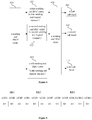
- Figure 5 is a schematic diagram of multiple bits in an activation instruction of a data sending method according to an embodiment.
- RBs indicated by multiple bits in the activation instruction are arranged in an order of sequence numbers of the RBs, and the bits indicating a same RB are arranged in an order of sequence numbers of sending end logical channels; and wherein the order of sequence numbers of the RBs and the order of sequence numbers of the sending end logical channels are ascending or descending, and the order of sequence numbers of the RBs and the order of sequence numbers of the sending end logical channels are same or different.
- multiple bits in the activation instruction are configured in two hierarchies: firstly, the RBs may be arranged in an ascending or descending order of sequence numbers of the RBs; secondly, logical channels (LCHs) may be arranged in an ascending or descending order of sequence numbers of the LCHs; and then a value of each bit in the multiple bits may be configured in the order of arrangement. As shown in Figure 5 , the multiple bits in the activation instruction are configured in the ascending order of sequence numbers of the RBS and the sending end logical channels.
- LCHs logical channels
- the order of sequence numbers of the RBs and the order of sequence numbers of the sending end logical channels are same or different. That is, the sequence numbers of the RBs may be arranged in the ascending order, but the sequence numbers of the sending end logical channels may be arranged in the descending order; or, the sequence numbers of the RBs may be arranged in the descending order, but the sequence numbers of the sending end logical channels may be arranged in the ascending order.
- Figure 6 is a schematic diagram of multiple bits in an activation instruction of a data sending method according to another embodiment.
- the data sending method shown in Figure 6 may be used in a DC duplication, where RBs configured with PDCP duplication function has n legs.
- a sending end PDCP entity 610 may send PDCP data packets to a first sending end RLC entity 621, a second sending end RLC entity 622, ... a nth sending end RLC entity 623, and the PDCP data packets are sent to a first sending end MAC layer 631 through a first sending end logical channel corresponding to the first sending end RLC entity 621, a seocnd sending end MAC layer 632 through a first sending end logical channel corresponding to the seocnd sending end RLC entity 622, and a nth sending end MAC layer 633 through a nth sending end logical channel corresponding to the nth sending end RLC entity 623, where n is a positive integer.
- the PDCP data packets may be sent through different sub-bands respectively.
- a PDCP data packet sent by the first sending end logical channel may be sent through a first sub-band 641
- a PDCP data packet sent by the second sending end logical channel may be sent through a second sub-band 642
- a PDCP data packet sent by the nth sending end logical channel may be sent through a nth sub-band 643.
- numbers of specific sub-bands included in the first sub-band 641, the second sub-band 642, and the nth sub-band 643 are not limited, that is, the first sub-band 641, the second sub-band 642, and the nth sub-band 643 may include a sub-band group respectively.
- Figure 7 is a schematic diagram of multiple bits in an activation instruction of a data sending method according to another embodiment.
- RBs indicated by multiple bits in an activation instruction are arranged in an order of sequence numbers of the RBs, and bits indicating a same RB are arranged in an order of sequence numbers of sending end MAC layers, wherein the order of sequence numbers of the RBs and the order of sequence numbers of the sending end MAC layers are ascending or descending, and the order of sequence numbers of the RBs and the order of sequence numbers of the sending end MAC layers are same or different.
- the multiple bits in the activation instruction are configured in two hierarchies: firstly, the RBs may be arranged in an ascending or descending order of sequence numbers of the RBs; secondly, the sending end logical channels may be arranged in an ascending or descending order of sequence numbers of the sending end logical channels; and then a value of each bit in the multiple bits may be configured in the order of arrangement. As shown in Figure 5 , the multiple bits in the activation instruction are configured in the ascending order of sequence numbers of the RBS and the sending end logical channels.
- the order of sequence numbers of the RBs and the order of sequence numbers of the sending end logical channels are same or different. That is, the sequence numbers of the RBs may be arranged in the ascending order, but the sequence numbers of the sending end logical channels may be arranged in the descending order; or, the sequence numbers of the RBs may be arranged in the descending order, but the sequence numbers of the sending end logical channels may be arranged in the ascending order.
- the activation instruction uses each of the multiple bits of the activation instruction to indicate whether a corresponding sending end logical channel is a sending end logical channel to be used, so that the sending end can determine whether a sender logical channel corresponding to each bit of the multiple bits is a sending logical channel to be used, so that the sending end logical channel to be used is determined when data needs to be sent.
- a value of the multiple bits indicating a RB indicates the number n of the sending end logical channels to be used for each RB, where the sending end logical channels of each RB are arranged in a preset order; and according to the preset order, top n sending end logical channels are selected as the sending end logical channels to be used for each RB.
- the multiple bits in the activation instruction are used to indicate the number n of the sending end logical channel to be used for each RB in the multiple RBs respectively, that is, the value of the multiple bits indicating a RB indicates the number n of the sending end logical channels to be used for each RB, and the UE is defaulted to use the first n sending end logical channels.
- the preset order may be used to indicate priorities of the sending end logical channels in each RB. For example, a sending end logical channel with a higher priority may be set to have a smaller sequence number, so that the sending end logical channel with a higher priority is more likely to be selected.
- the method before determining the activation instruction, the method further includes: determining a PDCP duplication configuration information.
- the PDCP duplication configuration information includes a mapping relationship between each PDCP entity and each sending end logical channel, and the preset order of the sending end logical channels of each RB.
- the PDCP duplication configuration information includes a mapping relationship between each PDCP entity and each sending end logical channel, and the preset order of the sending end logical channels of each RB, and a mapping relationship between the sending end logical channels and sub-bands.
- Figure 8 is a schematic diagram of multiple bits indicating a same RB in an activation instruction of a data sending method according to an embodiment.
- RB1 is "10"
- a value of the multiple bits is 2 and a number n of sending end logical channels to be used for RB1 indicated by the multiple bits is 2, that is, first two sending end logical channels are used;
- multiple bits indicating a RB i.e. RB1
- a value of the multiple bits is 3 and a number n of sending end logical channels to be used for RB 1 indicated by the multiple bits is 3, that is, first 3 sending end logical channels are used.
- the multiple bits in the activation instruction are configured in two hierarchies: firstly, the RBs may be arranged in an ascending or descending order of sequence numbers of the RBs; secondly, for each RB, a value of one or multiple bits may be use to indicate the number n.
- bi represents a number of bits in the activation instruction indicating sending end logical channels to be used for an i-th RB; and n i represents a number of sending end logical channels of the i-th RB.
- the multiple bits used to indicate the sending end logical channels to be used for different RBs may be same or different. If the number of the sending end logical channels to be used changes, the multiple bits used to indicate the sending end logical channels to be used may also change accordingly. Specifically, the user equipment may calculate to determine the multiple bits used to indicate the sending end logical channels to be used for each RB according to the above formula, and then determine the sending end logical channels to be used for each RB.
- the activation instruction uses the value of the multiple bits indicating each RB to indicate the number n of the sending end logical channels to be used, wherein the sending end logical channels of each RB are arranged in a preset order; according to the preset order, top n sending end logical channels are selected as the sending end logical channels to be used.
- the sending end may use fewer bits to indicate the sending end logical channels to be used, so that the sending end can determine the sending end logical channels to be used of each RB according to the value of the multiple bits indicating the RB and the preset order, and determine the sending end logical channels when data needs to be sent.
- the multiple bits used to indicate the sending end logical channels to be used for each RB are a preset number of bits
- the data sending method further includes: determining a PDCP duplication configuration information, wherein the PDCP duplication configuration information includes a mapping relationship between each PDCP entity and each sending end logical channel, the preset order of the sending end logical channels of each RB and the preset number of bits.
- the PDCP duplication configuration information further includes a mapping relationship between the sending end logical channels and sub-bands.
- a preset number of bits may be used to represent each RB in a received instruction, and the sending end may separate the multiple bits corresponding to each RB without calculation, which facilitates to reduce computational complexity.
- the data sending method before determining the activation instruction, further includes: determining a PDCP duplication configuration information, wherein the PDCP duplication configuration information includes a mapping relationship between each PDCP entity and each sending end logical channel, the preset order of the sending end logical channels of each RB, and a preset value of a maximum number of the sending end logical channels of each RB.
- the PDCP duplication configuration information further includes a mapping relationship between the sending end logical channels and sub-bands.
- b i represents a number of bits in the activation instruction indicating sending end logical channels to be used for an i-th RB; and N represents the maximum number of the sending end logical channels of each RB.
- the number of bits calculated according to the above formula can completely indicate all legs which are configured with the replication function.
- the number of bits may be set to be b i calculated according to the above formula, even if the number of legs changes, b i does not need to be changed.
- the activation instruction may use the preset number of bits to indicate each RB, and the sender does not need to calculate for each RB separately.
- multiple bits corresponding to each RB may be separated according to b i , which facilitates to reduce computational complexity.
- the sending end PDCP entity duplicates the PDCP data packet to generate duplicated PDCP data packets and sends the duplicated PDCP data packets to a receiving end through the sending end logical channels to be used, where a maximum value of the number n of the sending end logical channels of each RB is greater than 2.
- the PDCP entity receives a data packet from an upper layer and duplicates it at the PDCP entity's layer. Specifically, if the number of the sending end logical channels to be used is N, the PDCP entity duplicates the PDCP data packet (N-1) times to obtain N PDCP data packets in total, and then sends the original PDCP data packet and the duplicated (N-1) PDCP data packets to the receiver through the sending end logical channels.
- multiple bits are used to indicate sending end logical channels to be used for each RB by setting an activation instruction.
- only one bit is used to indicate sending end logical channels to be used for each RB, which is not clear in the case of multiple-connectivity duplication.
- n of sending end logical channels of each RB is greater than 2
- multiple bits are used to indicate, which facilitates to improve the accuracy of indication and improve the efficiency of transmission resource utilization.
- Figure 9 is a structural diagram of a data sending apparatus according to an embodiment.
- the data sending apparatus includes:
- each of the multiple bits indicates whether a corresponding sending end logical channel is a sending end logical channel to be used; wherein each bit of the multiple bits has a one-to-one mapping relationship with each sending end logical channel.
- the one-to-one mapping relationship between each bit of the multiple bits and each sending end logical channel is predefined.
- the PDCP duplication configuration information further includes a mapping relationship between the sending end logical channels and sub-bands.
- RBs indicated by the multiple bits in the activation instruction are arranged in an order of sequence numbers of the RBs, and the bits indicating a same RB are arranged in an order of sequence numbers of sending end MAC layers; and wherein the order of sequence numbers of the RBs and the order of sequence numbers of the sending end MAC layers are ascending or descending, and the order of sequence numbers of the RBs and the order of sequence numbers of the sending end MAC layers are same or different.
- RBs indicated by the multiple bits in the activation instruction are arranged in an order of sequence numbers of the RBs, and the bits indicating a same RB are arranged in an order of sequence numbers of the sending end logical channels; and wherein the order of sequence numbers of the RBs and the order of sequence numbers of the sending end logical channels are ascending or descending, and the order of sequence numbers of the RBs and the order of sequence numbers of the sending end logical channels are same or different.
- a value of the multiple bits indicating a RB indicates the number n of the sending end logical channels to be used for each RB, where the sending end logical channels of each RB are arranged in a preset order; and according to the preset order, top n sending end logical channels are selected as the sending end logical channels to be used for each RB.
- the PDCP duplication configuration information further includes a mapping relationship between the sending end logical channels and sub-bands.
- the multiple bits used to indicate the sending end logical channels to be used for each RB are a preset number of bits
- the data sending apparatus further includes: a third configuration information determining module, adapted to determine a PDCP duplication configuration information before determining the activation instruction, wherein the PDCP duplication configuration information includes a mapping relationship between each PDCP entity and each sending end logical channel, the preset order of the sending end logical channels of each RB, and the preset number of bits.
- the PDCP duplication configuration information further includes a mapping relationship between the sending end logical channels and sub-bands.
- a storage medium having computer instructions stored therein is provided, wherein once the computer instructions are executed, the above data sending method illustrated in Figure 3 is performed.
- the storage medium may be a computer readable storage medium, for example, including a non-volatile or non-transitory memory, an optical disk, a mechanical disk, a solid disk or the like.
- a sending end including a memory and a processor
- the memory has computer instructions stored therein, and when the processor executes the computer instructions, the above method as shown in Figure 3 is performed.
- the sending end may include but not limited to a network equipment such as a base stations or a server, and a terminal equipment such as a mobile phone, a computers or a tablet.
Landscapes
- Engineering & Computer Science (AREA)
- Computer Networks & Wireless Communication (AREA)
- Signal Processing (AREA)
- Mobile Radio Communication Systems (AREA)
Applications Claiming Priority (2)
| Application Number | Priority Date | Filing Date | Title |
|---|---|---|---|
| CN201810908301.2A CN110831251B (zh) | 2018-08-10 | 2018-08-10 | 数据发送方法及装置、存储介质、发送端 |
| PCT/CN2019/092982 WO2020029699A1 (zh) | 2018-08-10 | 2019-06-26 | 数据发送方法及装置、存储介质、发送端 |
Publications (3)
| Publication Number | Publication Date |
|---|---|
| EP3836616A1 true EP3836616A1 (de) | 2021-06-16 |
| EP3836616A4 EP3836616A4 (de) | 2022-05-04 |
| EP3836616B1 EP3836616B1 (de) | 2024-08-21 |
Family
ID=69414463
Family Applications (1)
| Application Number | Title | Priority Date | Filing Date |
|---|---|---|---|
| EP19846311.9A Active EP3836616B1 (de) | 2018-08-10 | 2019-06-26 | Verfahren und speichermedium zur datensendung |
Country Status (4)
| Country | Link |
|---|---|
| US (1) | US11601954B2 (de) |
| EP (1) | EP3836616B1 (de) |
| CN (1) | CN110831251B (de) |
| WO (1) | WO2020029699A1 (de) |
Families Citing this family (5)
| Publication number | Priority date | Publication date | Assignee | Title |
|---|---|---|---|---|
| EP3900477A2 (de) * | 2018-12-20 | 2021-10-27 | Sony Group Corporation | Telekommunikationsvorrichtung und -verfahren |
| CN113632554A (zh) * | 2019-04-19 | 2021-11-09 | 富士通株式会社 | 基站、终端装置以及通信系统 |
| WO2021016778A1 (zh) * | 2019-07-26 | 2021-02-04 | Oppo广东移动通信有限公司 | 一种传输资源选择方法、网络设备、用户设备 |
| CN112436928B (zh) * | 2020-11-23 | 2023-11-03 | 北京中航通用科技有限公司 | 一种数据传输的方法及装置 |
| EP4252446A1 (de) * | 2020-11-25 | 2023-10-04 | InterDigital Patent Holdings, Inc. | Verbesserung zu redundanter übertragung in einem 5g-netzwerk |
Family Cites Families (15)
| Publication number | Priority date | Publication date | Assignee | Title |
|---|---|---|---|---|
| TWI475856B (zh) | 2008-11-25 | 2015-03-01 | Interdigital Patent Holdings | 多數上鏈載波及多數下鏈載波利用方法及裝置 |
| CN102131275B (zh) | 2010-01-13 | 2015-11-25 | 中兴通讯股份有限公司 | 载波控制方法及装置 |
| CN105493423B (zh) * | 2013-04-24 | 2019-05-03 | 华为技术有限公司 | 数据传输方法和装置 |
| JP6604955B2 (ja) | 2013-10-21 | 2019-11-13 | エルジー エレクトロニクス インコーポレイティド | 二重接続性における上りリンクデータ送信方法及びそのための装置 |
| US10142799B2 (en) | 2014-08-19 | 2018-11-27 | Qualcomm Incorporated | Multicasting traffic using multi-connectivity |
| CN107734546B (zh) | 2016-08-12 | 2022-10-28 | 中兴通讯股份有限公司 | 用户面数据的映射方法、装置及系统 |
| KR102808928B1 (ko) * | 2016-11-04 | 2025-05-16 | 삼성전자 주식회사 | 무선통신시스템에서 고신뢰 저지연 통신을 위한 데이터 송수신 방법 및 장치 |
| CN108270516B (zh) | 2016-12-30 | 2023-07-18 | 华为技术有限公司 | 一种数据传输方法、装置及系统 |
| US10448386B2 (en) | 2017-01-06 | 2019-10-15 | Kt Corporation | Method and apparatus for controlling redundant data transmission |
| WO2018143600A1 (en) | 2017-02-02 | 2018-08-09 | Lg Electronics Inc. | Method and device for transmitting data unit |
| WO2018176231A1 (zh) * | 2017-03-28 | 2018-10-04 | 北京小米移动软件有限公司 | 数据传输方法及装置、数据接收方法及装置、电子设备 |
| CN107147479B (zh) | 2017-04-27 | 2020-04-10 | 电信科学技术研究院 | 一种进行重复传输控制的方法和设备 |
| BR112019026349A2 (pt) * | 2017-06-16 | 2020-07-21 | Guangdong Oppo Mobile Telecommunications Corp., Ltd. | método de transmissão de dados, dispositivo terminal e dispositivo de rede |
| CN108353408B (zh) | 2017-10-25 | 2022-01-04 | 北京小米移动软件有限公司 | 增补上行载波配置方法及装置和调度资源分配方法及装置 |
| CN112514447B (zh) * | 2018-08-01 | 2025-06-20 | 三星电子株式会社 | 控制无线通信系统中的复制分组传输的方法和设备 |
-
2018
- 2018-08-10 CN CN201810908301.2A patent/CN110831251B/zh active Active
-
2019
- 2019-06-26 WO PCT/CN2019/092982 patent/WO2020029699A1/zh not_active Ceased
- 2019-06-26 US US17/265,981 patent/US11601954B2/en active Active
- 2019-06-26 EP EP19846311.9A patent/EP3836616B1/de active Active
Also Published As
| Publication number | Publication date |
|---|---|
| CN110831251B (zh) | 2020-11-06 |
| CN110831251A (zh) | 2020-02-21 |
| US11601954B2 (en) | 2023-03-07 |
| EP3836616A4 (de) | 2022-05-04 |
| WO2020029699A1 (zh) | 2020-02-13 |
| EP3836616B1 (de) | 2024-08-21 |
| US20210314969A1 (en) | 2021-10-07 |
Similar Documents
| Publication | Publication Date | Title |
|---|---|---|
| EP3836616B1 (de) | Verfahren und speichermedium zur datensendung | |
| KR102943296B1 (ko) | 무선 통신 시스템에서 패킷 중복 전송을 제어하는 방법 및 장치 | |
| CN113424580B (zh) | 用于演进分组数据汇聚协议复制的方法及装置 | |
| CN109150388B (zh) | 支持pdcp重复功能的系统、数据传输方法及网络设备 | |
| US20230180338A1 (en) | Communication control method | |
| CN111149383A (zh) | 用于在无线通信系统中发送分组的方法和设备 | |
| US10869213B2 (en) | Transmission status reporting apparatus and method and communication system | |
| EP3164958A1 (de) | Gruppenträgerplanung für unlizenziertes lte-netzwerk | |
| EP3874636A1 (de) | Vorrichtung, verfahren und computerprogramm | |
| EP3376702B1 (de) | Verfahren und vorrichtung für übertragung von duplikationsdaten mit mehreren trägern | |
| KR20200114968A (ko) | 무선 통신 시스템에서 복수 개의 rlc 계층 장치의 활성화를 제어하는 방법 및 장치 | |
| US12120756B2 (en) | Method for data replication, data counting method, corresponding entities and media | |
| TWI706652B (zh) | 處理用於資料複本的暫存器狀態回報的裝置及方法 | |
| WO2013104310A1 (zh) | 实现混合自动重传请求的方法、用户设备和基站 | |
| CN110971349B (zh) | 一种重复传输方法、终端和网络侧设备 | |
| US11363658B2 (en) | Wireless communication method and terminal device | |
| US11882551B2 (en) | Data uploading method and apparatus of user terminal, storage device, and user terminal | |
| CN109688179B (zh) | 通信方法和通信装置 | |
| WO2019227280A1 (zh) | 一种被用于无线通信的用户设备、基站中的方法和装置 | |
| CN104429109A (zh) | 一种通信方法及装置 | |
| US9736841B2 (en) | Data transmission method, base station and user equipment | |
| CN110831025B (zh) | 用户终端上传数据的方法及装置、存储介质、用户终端 | |
| WO2020207243A1 (zh) | 一种被用于无线通信的节点中的方法和装置 | |
| CN120898391A (zh) | 选择性复制 | |
| JP2024528289A (ja) | セカンダリーセルグループのバッファデータ状態情報伝送方法及び装置 |
Legal Events
| Date | Code | Title | Description |
|---|---|---|---|
| STAA | Information on the status of an ep patent application or granted ep patent |
Free format text: STATUS: THE INTERNATIONAL PUBLICATION HAS BEEN MADE |
|
| PUAI | Public reference made under article 153(3) epc to a published international application that has entered the european phase |
Free format text: ORIGINAL CODE: 0009012 |
|
| STAA | Information on the status of an ep patent application or granted ep patent |
Free format text: STATUS: REQUEST FOR EXAMINATION WAS MADE |
|
| 17P | Request for examination filed |
Effective date: 20210301 |
|
| AK | Designated contracting states |
Kind code of ref document: A1 Designated state(s): AL AT BE BG CH CY CZ DE DK EE ES FI FR GB GR HR HU IE IS IT LI LT LU LV MC MK MT NL NO PL PT RO RS SE SI SK SM TR |
|
| DAV | Request for validation of the european patent (deleted) | ||
| DAX | Request for extension of the european patent (deleted) | ||
| REG | Reference to a national code |
Ref country code: DE Ref legal event code: R079 Free format text: PREVIOUS MAIN CLASS: H04W0028120000 Ipc: H04W0080020000 Ref country code: DE Ref legal event code: R079 Ref document number: 602019057582 Country of ref document: DE Free format text: PREVIOUS MAIN CLASS: H04W0028120000 Ipc: H04W0080020000 |
|
| A4 | Supplementary search report drawn up and despatched |
Effective date: 20220405 |
|
| RIC1 | Information provided on ipc code assigned before grant |
Ipc: H04W 76/15 20180101ALN20220330BHEP Ipc: H04W 80/02 20090101AFI20220330BHEP |
|
| STAA | Information on the status of an ep patent application or granted ep patent |
Free format text: STATUS: EXAMINATION IS IN PROGRESS |
|
| 17Q | First examination report despatched |
Effective date: 20230628 |
|
| RIC1 | Information provided on ipc code assigned before grant |
Ipc: H04W 76/15 20180101ALN20240126BHEP Ipc: H04W 80/02 20090101AFI20240126BHEP |
|
| GRAP | Despatch of communication of intention to grant a patent |
Free format text: ORIGINAL CODE: EPIDOSNIGR1 |
|
| STAA | Information on the status of an ep patent application or granted ep patent |
Free format text: STATUS: GRANT OF PATENT IS INTENDED |
|
| INTG | Intention to grant announced |
Effective date: 20240315 |
|
| GRAS | Grant fee paid |
Free format text: ORIGINAL CODE: EPIDOSNIGR3 |
|
| GRAA | (expected) grant |
Free format text: ORIGINAL CODE: 0009210 |
|
| STAA | Information on the status of an ep patent application or granted ep patent |
Free format text: STATUS: THE PATENT HAS BEEN GRANTED |
|
| AK | Designated contracting states |
Kind code of ref document: B1 Designated state(s): AL AT BE BG CH CY CZ DE DK EE ES FI FR GB GR HR HU IE IS IT LI LT LU LV MC MK MT NL NO PL PT RO RS SE SI SK SM TR |
|
| REG | Reference to a national code |
Ref country code: GB Ref legal event code: FG4D |
|
| REG | Reference to a national code |
Ref country code: CH Ref legal event code: EP |
|
| REG | Reference to a national code |
Ref country code: DE Ref legal event code: R096 Ref document number: 602019057582 Country of ref document: DE |
|
| REG | Reference to a national code |
Ref country code: IE Ref legal event code: FG4D |
|
| REG | Reference to a national code |
Ref country code: LT Ref legal event code: MG9D |
|
| REG | Reference to a national code |
Ref country code: NL Ref legal event code: MP Effective date: 20240821 |
|
| PG25 | Lapsed in a contracting state [announced via postgrant information from national office to epo] |
Ref country code: NO Free format text: LAPSE BECAUSE OF FAILURE TO SUBMIT A TRANSLATION OF THE DESCRIPTION OR TO PAY THE FEE WITHIN THE PRESCRIBED TIME-LIMIT Effective date: 20241121 |
|
| REG | Reference to a national code |
Ref country code: AT Ref legal event code: MK05 Ref document number: 1716855 Country of ref document: AT Kind code of ref document: T Effective date: 20240821 |
|
| PG25 | Lapsed in a contracting state [announced via postgrant information from national office to epo] |
Ref country code: NL Free format text: LAPSE BECAUSE OF FAILURE TO SUBMIT A TRANSLATION OF THE DESCRIPTION OR TO PAY THE FEE WITHIN THE PRESCRIBED TIME-LIMIT Effective date: 20240821 Ref country code: GR Free format text: LAPSE BECAUSE OF FAILURE TO SUBMIT A TRANSLATION OF THE DESCRIPTION OR TO PAY THE FEE WITHIN THE PRESCRIBED TIME-LIMIT Effective date: 20241122 Ref country code: FI Free format text: LAPSE BECAUSE OF FAILURE TO SUBMIT A TRANSLATION OF THE DESCRIPTION OR TO PAY THE FEE WITHIN THE PRESCRIBED TIME-LIMIT Effective date: 20240821 Ref country code: PT Free format text: LAPSE BECAUSE OF FAILURE TO SUBMIT A TRANSLATION OF THE DESCRIPTION OR TO PAY THE FEE WITHIN THE PRESCRIBED TIME-LIMIT Effective date: 20241223 Ref country code: PL Free format text: LAPSE BECAUSE OF FAILURE TO SUBMIT A TRANSLATION OF THE DESCRIPTION OR TO PAY THE FEE WITHIN THE PRESCRIBED TIME-LIMIT Effective date: 20240821 |
|
| PG25 | Lapsed in a contracting state [announced via postgrant information from national office to epo] |
Ref country code: BG Free format text: LAPSE BECAUSE OF FAILURE TO SUBMIT A TRANSLATION OF THE DESCRIPTION OR TO PAY THE FEE WITHIN THE PRESCRIBED TIME-LIMIT Effective date: 20240821 |
|
| PG25 | Lapsed in a contracting state [announced via postgrant information from national office to epo] |
Ref country code: LV Free format text: LAPSE BECAUSE OF FAILURE TO SUBMIT A TRANSLATION OF THE DESCRIPTION OR TO PAY THE FEE WITHIN THE PRESCRIBED TIME-LIMIT Effective date: 20240821 |
|
| PG25 | Lapsed in a contracting state [announced via postgrant information from national office to epo] |
Ref country code: IS Free format text: LAPSE BECAUSE OF FAILURE TO SUBMIT A TRANSLATION OF THE DESCRIPTION OR TO PAY THE FEE WITHIN THE PRESCRIBED TIME-LIMIT Effective date: 20241221 Ref country code: AT Free format text: LAPSE BECAUSE OF FAILURE TO SUBMIT A TRANSLATION OF THE DESCRIPTION OR TO PAY THE FEE WITHIN THE PRESCRIBED TIME-LIMIT Effective date: 20240821 |
|
| PG25 | Lapsed in a contracting state [announced via postgrant information from national office to epo] |
Ref country code: HR Free format text: LAPSE BECAUSE OF FAILURE TO SUBMIT A TRANSLATION OF THE DESCRIPTION OR TO PAY THE FEE WITHIN THE PRESCRIBED TIME-LIMIT Effective date: 20240821 |
|
| PG25 | Lapsed in a contracting state [announced via postgrant information from national office to epo] |
Ref country code: ES Free format text: LAPSE BECAUSE OF FAILURE TO SUBMIT A TRANSLATION OF THE DESCRIPTION OR TO PAY THE FEE WITHIN THE PRESCRIBED TIME-LIMIT Effective date: 20240821 Ref country code: RS Free format text: LAPSE BECAUSE OF FAILURE TO SUBMIT A TRANSLATION OF THE DESCRIPTION OR TO PAY THE FEE WITHIN THE PRESCRIBED TIME-LIMIT Effective date: 20241121 |
|
| PG25 | Lapsed in a contracting state [announced via postgrant information from national office to epo] |
Ref country code: RS Free format text: LAPSE BECAUSE OF FAILURE TO SUBMIT A TRANSLATION OF THE DESCRIPTION OR TO PAY THE FEE WITHIN THE PRESCRIBED TIME-LIMIT Effective date: 20241121 Ref country code: PT Free format text: LAPSE BECAUSE OF FAILURE TO SUBMIT A TRANSLATION OF THE DESCRIPTION OR TO PAY THE FEE WITHIN THE PRESCRIBED TIME-LIMIT Effective date: 20241223 Ref country code: PL Free format text: LAPSE BECAUSE OF FAILURE TO SUBMIT A TRANSLATION OF THE DESCRIPTION OR TO PAY THE FEE WITHIN THE PRESCRIBED TIME-LIMIT Effective date: 20240821 Ref country code: NO Free format text: LAPSE BECAUSE OF FAILURE TO SUBMIT A TRANSLATION OF THE DESCRIPTION OR TO PAY THE FEE WITHIN THE PRESCRIBED TIME-LIMIT Effective date: 20241121 Ref country code: NL Free format text: LAPSE BECAUSE OF FAILURE TO SUBMIT A TRANSLATION OF THE DESCRIPTION OR TO PAY THE FEE WITHIN THE PRESCRIBED TIME-LIMIT Effective date: 20240821 Ref country code: LV Free format text: LAPSE BECAUSE OF FAILURE TO SUBMIT A TRANSLATION OF THE DESCRIPTION OR TO PAY THE FEE WITHIN THE PRESCRIBED TIME-LIMIT Effective date: 20240821 Ref country code: IS Free format text: LAPSE BECAUSE OF FAILURE TO SUBMIT A TRANSLATION OF THE DESCRIPTION OR TO PAY THE FEE WITHIN THE PRESCRIBED TIME-LIMIT Effective date: 20241221 Ref country code: HR Free format text: LAPSE BECAUSE OF FAILURE TO SUBMIT A TRANSLATION OF THE DESCRIPTION OR TO PAY THE FEE WITHIN THE PRESCRIBED TIME-LIMIT Effective date: 20240821 Ref country code: GR Free format text: LAPSE BECAUSE OF FAILURE TO SUBMIT A TRANSLATION OF THE DESCRIPTION OR TO PAY THE FEE WITHIN THE PRESCRIBED TIME-LIMIT Effective date: 20241122 Ref country code: FI Free format text: LAPSE BECAUSE OF FAILURE TO SUBMIT A TRANSLATION OF THE DESCRIPTION OR TO PAY THE FEE WITHIN THE PRESCRIBED TIME-LIMIT Effective date: 20240821 Ref country code: ES Free format text: LAPSE BECAUSE OF FAILURE TO SUBMIT A TRANSLATION OF THE DESCRIPTION OR TO PAY THE FEE WITHIN THE PRESCRIBED TIME-LIMIT Effective date: 20240821 Ref country code: BG Free format text: LAPSE BECAUSE OF FAILURE TO SUBMIT A TRANSLATION OF THE DESCRIPTION OR TO PAY THE FEE WITHIN THE PRESCRIBED TIME-LIMIT Effective date: 20240821 Ref country code: AT Free format text: LAPSE BECAUSE OF FAILURE TO SUBMIT A TRANSLATION OF THE DESCRIPTION OR TO PAY THE FEE WITHIN THE PRESCRIBED TIME-LIMIT Effective date: 20240821 |
|
| PG25 | Lapsed in a contracting state [announced via postgrant information from national office to epo] |
Ref country code: SM Free format text: LAPSE BECAUSE OF FAILURE TO SUBMIT A TRANSLATION OF THE DESCRIPTION OR TO PAY THE FEE WITHIN THE PRESCRIBED TIME-LIMIT Effective date: 20240821 Ref country code: RO Free format text: LAPSE BECAUSE OF FAILURE TO SUBMIT A TRANSLATION OF THE DESCRIPTION OR TO PAY THE FEE WITHIN THE PRESCRIBED TIME-LIMIT Effective date: 20240821 Ref country code: DK Free format text: LAPSE BECAUSE OF FAILURE TO SUBMIT A TRANSLATION OF THE DESCRIPTION OR TO PAY THE FEE WITHIN THE PRESCRIBED TIME-LIMIT Effective date: 20240821 |
|
| PG25 | Lapsed in a contracting state [announced via postgrant information from national office to epo] |
Ref country code: EE Free format text: LAPSE BECAUSE OF FAILURE TO SUBMIT A TRANSLATION OF THE DESCRIPTION OR TO PAY THE FEE WITHIN THE PRESCRIBED TIME-LIMIT Effective date: 20240821 |
|
| PG25 | Lapsed in a contracting state [announced via postgrant information from national office to epo] |
Ref country code: CZ Free format text: LAPSE BECAUSE OF FAILURE TO SUBMIT A TRANSLATION OF THE DESCRIPTION OR TO PAY THE FEE WITHIN THE PRESCRIBED TIME-LIMIT Effective date: 20240821 |
|
| PG25 | Lapsed in a contracting state [announced via postgrant information from national office to epo] |
Ref country code: IT Free format text: LAPSE BECAUSE OF FAILURE TO SUBMIT A TRANSLATION OF THE DESCRIPTION OR TO PAY THE FEE WITHIN THE PRESCRIBED TIME-LIMIT Effective date: 20240821 Ref country code: SK Free format text: LAPSE BECAUSE OF FAILURE TO SUBMIT A TRANSLATION OF THE DESCRIPTION OR TO PAY THE FEE WITHIN THE PRESCRIBED TIME-LIMIT Effective date: 20240821 |
|
| REG | Reference to a national code |
Ref country code: DE Ref legal event code: R097 Ref document number: 602019057582 Country of ref document: DE |
|
| PLBE | No opposition filed within time limit |
Free format text: ORIGINAL CODE: 0009261 |
|
| STAA | Information on the status of an ep patent application or granted ep patent |
Free format text: STATUS: NO OPPOSITION FILED WITHIN TIME LIMIT |
|
| PGFP | Annual fee paid to national office [announced via postgrant information from national office to epo] |
Ref country code: DE Payment date: 20250618 Year of fee payment: 7 |
|
| 26N | No opposition filed |
Effective date: 20250522 |
|
| PG25 | Lapsed in a contracting state [announced via postgrant information from national office to epo] |
Ref country code: SE Free format text: LAPSE BECAUSE OF FAILURE TO SUBMIT A TRANSLATION OF THE DESCRIPTION OR TO PAY THE FEE WITHIN THE PRESCRIBED TIME-LIMIT Effective date: 20240821 |
|
| REG | Reference to a national code |
Ref country code: CH Ref legal event code: H13 Free format text: ST27 STATUS EVENT CODE: U-0-0-H10-H13 (AS PROVIDED BY THE NATIONAL OFFICE) Effective date: 20260127 |
|
| PG25 | Lapsed in a contracting state [announced via postgrant information from national office to epo] |
Ref country code: MC Free format text: LAPSE BECAUSE OF FAILURE TO SUBMIT A TRANSLATION OF THE DESCRIPTION OR TO PAY THE FEE WITHIN THE PRESCRIBED TIME-LIMIT Effective date: 20240821 |
|
| PG25 | Lapsed in a contracting state [announced via postgrant information from national office to epo] |
Ref country code: LU Free format text: LAPSE BECAUSE OF NON-PAYMENT OF DUE FEES Effective date: 20250626 |
|
| GBPC | Gb: european patent ceased through non-payment of renewal fee |
Effective date: 20250626 |
|
| REG | Reference to a national code |
Ref country code: BE Ref legal event code: MM Effective date: 20250630 |
|
| PG25 | Lapsed in a contracting state [announced via postgrant information from national office to epo] |
Ref country code: GB Free format text: LAPSE BECAUSE OF NON-PAYMENT OF DUE FEES Effective date: 20250626 |
|
| PG25 | Lapsed in a contracting state [announced via postgrant information from national office to epo] |
Ref country code: IE Free format text: LAPSE BECAUSE OF NON-PAYMENT OF DUE FEES Effective date: 20250626 |
|
| PG25 | Lapsed in a contracting state [announced via postgrant information from national office to epo] |
Ref country code: BE Free format text: LAPSE BECAUSE OF NON-PAYMENT OF DUE FEES Effective date: 20250630 |
|
| PG25 | Lapsed in a contracting state [announced via postgrant information from national office to epo] |
Ref country code: FR Free format text: LAPSE BECAUSE OF NON-PAYMENT OF DUE FEES Effective date: 20250630 |
|
| PG25 | Lapsed in a contracting state [announced via postgrant information from national office to epo] |
Ref country code: CH Free format text: LAPSE BECAUSE OF NON-PAYMENT OF DUE FEES Effective date: 20250630 |