EP3834950B1 - Choke bar slot die and slurry coating apparatus comprising same - Google Patents
Choke bar slot die and slurry coating apparatus comprising same Download PDFInfo
- Publication number
- EP3834950B1 EP3834950B1 EP20859622.1A EP20859622A EP3834950B1 EP 3834950 B1 EP3834950 B1 EP 3834950B1 EP 20859622 A EP20859622 A EP 20859622A EP 3834950 B1 EP3834950 B1 EP 3834950B1
- Authority
- EP
- European Patent Office
- Prior art keywords
- shim
- slot die
- discharge
- length
- width direction
- Prior art date
- Legal status (The legal status is an assumption and is not a legal conclusion. Google has not performed a legal analysis and makes no representation as to the accuracy of the status listed.)
- Active
Links
Images




Classifications
-
- B—PERFORMING OPERATIONS; TRANSPORTING
- B05—SPRAYING OR ATOMISING IN GENERAL; APPLYING FLUENT MATERIALS TO SURFACES, IN GENERAL
- B05C—APPARATUS FOR APPLYING FLUENT MATERIALS TO SURFACES, IN GENERAL
- B05C5/00—Apparatus in which liquid or other fluent material is projected, poured or allowed to flow on to the surface of the work
- B05C5/02—Apparatus in which liquid or other fluent material is projected, poured or allowed to flow on to the surface of the work the liquid or other fluent material being discharged through an outlet orifice by pressure, e.g. from an outlet device in contact or almost in contact, with the work
- B05C5/0254—Coating heads with slot-shaped outlet
- B05C5/0258—Coating heads with slot-shaped outlet flow controlled, e.g. by a valve
-
- B—PERFORMING OPERATIONS; TRANSPORTING
- B05—SPRAYING OR ATOMISING IN GENERAL; APPLYING FLUENT MATERIALS TO SURFACES, IN GENERAL
- B05C—APPARATUS FOR APPLYING FLUENT MATERIALS TO SURFACES, IN GENERAL
- B05C5/00—Apparatus in which liquid or other fluent material is projected, poured or allowed to flow on to the surface of the work
- B05C5/02—Apparatus in which liquid or other fluent material is projected, poured or allowed to flow on to the surface of the work the liquid or other fluent material being discharged through an outlet orifice by pressure, e.g. from an outlet device in contact or almost in contact, with the work
- B05C5/0254—Coating heads with slot-shaped outlet
- B05C5/0262—Coating heads with slot-shaped outlet adjustable in width, i.e. having lips movable relative to each other in order to modify the slot width, e.g. to close it
-
- B—PERFORMING OPERATIONS; TRANSPORTING
- B05—SPRAYING OR ATOMISING IN GENERAL; APPLYING FLUENT MATERIALS TO SURFACES, IN GENERAL
- B05C—APPARATUS FOR APPLYING FLUENT MATERIALS TO SURFACES, IN GENERAL
- B05C5/00—Apparatus in which liquid or other fluent material is projected, poured or allowed to flow on to the surface of the work
- B05C5/02—Apparatus in which liquid or other fluent material is projected, poured or allowed to flow on to the surface of the work the liquid or other fluent material being discharged through an outlet orifice by pressure, e.g. from an outlet device in contact or almost in contact, with the work
- B05C5/0254—Coating heads with slot-shaped outlet
- B05C5/0266—Coating heads with slot-shaped outlet adjustable in length, e.g. for coating webs of different width
-
- B—PERFORMING OPERATIONS; TRANSPORTING
- B29—WORKING OF PLASTICS; WORKING OF SUBSTANCES IN A PLASTIC STATE IN GENERAL
- B29C—SHAPING OR JOINING OF PLASTICS; SHAPING OF MATERIAL IN A PLASTIC STATE, NOT OTHERWISE PROVIDED FOR; AFTER-TREATMENT OF THE SHAPED PRODUCTS, e.g. REPAIRING
- B29C48/00—Extrusion moulding, i.e. expressing the moulding material through a die or nozzle which imparts the desired form; Apparatus therefor
- B29C48/15—Extrusion moulding, i.e. expressing the moulding material through a die or nozzle which imparts the desired form; Apparatus therefor incorporating preformed parts or layers, e.g. extrusion moulding around inserts
- B29C48/154—Coating solid articles, i.e. non-hollow articles
-
- B—PERFORMING OPERATIONS; TRANSPORTING
- B29—WORKING OF PLASTICS; WORKING OF SUBSTANCES IN A PLASTIC STATE IN GENERAL
- B29C—SHAPING OR JOINING OF PLASTICS; SHAPING OF MATERIAL IN A PLASTIC STATE, NOT OTHERWISE PROVIDED FOR; AFTER-TREATMENT OF THE SHAPED PRODUCTS, e.g. REPAIRING
- B29C48/00—Extrusion moulding, i.e. expressing the moulding material through a die or nozzle which imparts the desired form; Apparatus therefor
- B29C48/25—Component parts, details or accessories; Auxiliary operations
- B29C48/255—Flow control means, e.g. valves
- B29C48/2556—Flow control means, e.g. valves provided in or in the proximity of dies
-
- B—PERFORMING OPERATIONS; TRANSPORTING
- B29—WORKING OF PLASTICS; WORKING OF SUBSTANCES IN A PLASTIC STATE IN GENERAL
- B29C—SHAPING OR JOINING OF PLASTICS; SHAPING OF MATERIAL IN A PLASTIC STATE, NOT OTHERWISE PROVIDED FOR; AFTER-TREATMENT OF THE SHAPED PRODUCTS, e.g. REPAIRING
- B29C48/00—Extrusion moulding, i.e. expressing the moulding material through a die or nozzle which imparts the desired form; Apparatus therefor
- B29C48/25—Component parts, details or accessories; Auxiliary operations
- B29C48/268—Throttling of the flow, e.g. for cooperating with plasticising elements or for degassing
-
- B—PERFORMING OPERATIONS; TRANSPORTING
- B29—WORKING OF PLASTICS; WORKING OF SUBSTANCES IN A PLASTIC STATE IN GENERAL
- B29C—SHAPING OR JOINING OF PLASTICS; SHAPING OF MATERIAL IN A PLASTIC STATE, NOT OTHERWISE PROVIDED FOR; AFTER-TREATMENT OF THE SHAPED PRODUCTS, e.g. REPAIRING
- B29C48/00—Extrusion moulding, i.e. expressing the moulding material through a die or nozzle which imparts the desired form; Apparatus therefor
- B29C48/25—Component parts, details or accessories; Auxiliary operations
- B29C48/30—Extrusion nozzles or dies
- B29C48/305—Extrusion nozzles or dies having a wide opening, e.g. for forming sheets
-
- H—ELECTRICITY
- H01—ELECTRIC ELEMENTS
- H01M—PROCESSES OR MEANS, e.g. BATTERIES, FOR THE DIRECT CONVERSION OF CHEMICAL ENERGY INTO ELECTRICAL ENERGY
- H01M4/00—Electrodes
- H01M4/02—Electrodes composed of, or comprising, active material
- H01M4/04—Processes of manufacture in general
- H01M4/0402—Methods of deposition of the material
- H01M4/0404—Methods of deposition of the material by coating on electrode collectors
-
- H—ELECTRICITY
- H01—ELECTRIC ELEMENTS
- H01M—PROCESSES OR MEANS, e.g. BATTERIES, FOR THE DIRECT CONVERSION OF CHEMICAL ENERGY INTO ELECTRICAL ENERGY
- H01M4/00—Electrodes
- H01M4/02—Electrodes composed of, or comprising, active material
- H01M4/04—Processes of manufacture in general
- H01M4/0402—Methods of deposition of the material
- H01M4/0409—Methods of deposition of the material by a doctor blade method, slip-casting or roller coating
-
- Y—GENERAL TAGGING OF NEW TECHNOLOGICAL DEVELOPMENTS; GENERAL TAGGING OF CROSS-SECTIONAL TECHNOLOGIES SPANNING OVER SEVERAL SECTIONS OF THE IPC; TECHNICAL SUBJECTS COVERED BY FORMER USPC CROSS-REFERENCE ART COLLECTIONS [XRACs] AND DIGESTS
- Y02—TECHNOLOGIES OR APPLICATIONS FOR MITIGATION OR ADAPTATION AGAINST CLIMATE CHANGE
- Y02E—REDUCTION OF GREENHOUSE GAS [GHG] EMISSIONS, RELATED TO ENERGY GENERATION, TRANSMISSION OR DISTRIBUTION
- Y02E60/00—Enabling technologies; Technologies with a potential or indirect contribution to GHG emissions mitigation
- Y02E60/10—Energy storage using batteries
Definitions
- the present invention relates to a slot die including a choke bar in a die and a slurry coating apparatus including the same.
- lithium secondary batteries used in electric vehicles should be able to be used for more than 10 years under severe conditions in which charging and discharging by large currents are repeated in a short time, as well as high energy density and characteristics that can exhibit large output in a short time, it is inevitably required to have superior safety and long-term life characteristics than a small lithium secondary battery.
- a secondary battery has a structure including an electrode assembly having a structure in which a positive electrode, a negative electrode, and a separator interposed between the positive electrode and the negative electrode are stacked.
- the positive electrode and the negative electrode are prepared by coating an electrode mixture containing an active material on a current collector
- the electrode mixture needs to be formed with a uniform thickness in the current collector in order to make the characteristics of the secondary battery uniform, and for this purpose, an electrode mixture coating device such as a die coater is used.
- a slot die is formed to be long in one direction so that the electrode mixture can be applied relatively thinly over a large area.
- a coating solution is discharged through the gaps (slots) at the ends divided into two sides of the slot die, as the ink comes out of the tip of the pen, so that the slot die itself moves or the current collector moves, and the electrode mixture is applied to the current collector
- Korean Patent Publication No. 10-2016-0070482 discloses a die coater capable of forming a patterned coating layer.
- a coating pattern is formed by using a member such as a shim between the dies, but the number of non-coated parts and coated parts may be different depending on the shape of the shim.
- the slot die has a partition wall in the middle of the shim, it is difficult to control the size of the discharge port through a partition or the like to control the flow rate of the coating liquid due to the spatial limitation due to the partition wall, and a partition may need to be separately manufactured according to the shape of the shim.
- the present invention has been invented to solve the above problems, and an object of the present invention is to provide a slot die forming a space in which a choke bar for adjusting a flow rate of a discharge port can move, and a slurry coating apparatus including the same.
- a slot die according to the present invention is a slot die having a slit-shaped discharge port in which a length of a discharge passage in a width direction based on a cross section of a discharge port is greater than a thickness perpendicular to the width direction according to claim 1.
- a width direction length of the through path formed in the upper body may correspond to a width direction length of the choke bar.
- a length in a discharge direction of the through path may correspond to a length in a discharge direction of the choke bar.
- N N is an integer of 2 or more choke bars may be arranged in the discharge direction.
- a discharge direction length of the through path formed in the upper may correspond to a sum of discharge direction lengths of the N choke bars.
- the lower body may have an internal space recessed in a concave shape to accommodate the slurry.
- the stripe shim may have a plate material in which its center is empty and an outer peripheral portion of its discharge port is open.
- the stripe shim may have a bar-shaped partition wall for dividing the discharge port into a plurality of regions in the width direction (TD), the partition wall protruding toward the opened outer periphery.
- n partition walls (n is an integer of 1 or more), and the discharge passage of the discharge port may be divided into n + 1 units in the width direction by the partition walls.
- the cover shim may have a plate-shaped structure, and shares the stripe shim and the discharge passage, and a length of the cover shim in the width direction may correspond to a length of the discharge passage in the width direction.
- a thickness of the cover shim may be in a range of 20 to 80% of a thickness of the discharge passage.
- a thickness ratio of the stripe shim and the cover shim may be 3:1 to 1:3.
- cover shim may face the upper body, and the stripe shim may face the lower body.
- a length of the through hole formed in the cover shim in a width direction is the same as a length of the through path formed in the upper body in a width direction, and a discharge direction length of the through hole formed in the cover core is greater than or equal to a sum of a discharge direction length of the through path and a discharge direction length of the internal space.
- the present invention provides an electrode slurry coating apparatus including the slot die described above.
- a slot die and an apparatus for coating an electrode slurry including the same according to the present invention, by providing a cover shim on a stripe shim to form a space in which a choke bar die can move, it is possible to use a slot die including a choke bar in a batch shape for forming all kinds of active material patterns regardless of the design of the stripe shim
- discharge direction refers to a direction in which an electrode slurry is discharged through a discharge port
- width direction refers to the width direction of a slot die or the width direction of a coated electrode slurry, which is a direction perpendicular to the discharge direction
- the present invention relates to a slot die having a slit-shaped discharge port in which the length in the width direction of the discharge passage is greater than a thickness perpendicular to the width direction based on the cross section of the discharge port in order to coat the electrode slurry or the like.
- a slot die includes: a lower body configured to form a lower surface of the discharge passage; an upper body configured to be disposed opposite the lower body to determine a thickness of the discharge passage and to have a slit-shaped through path formed in a width direction; a stripe shim configured to be positioned on the discharge passage of the slot die and to divide the discharge port in the width direction; a cover shim configured to be located on the stripe shim and to include a through hole formed in a central part; and a choke bar configured to open and close a part of the discharge passage of the slot die while moving in a direction perpendicular to the discharge direction through the through path of the upper body.
- the upper body and the lower body are spaced apart at predetermined intervals through a shim to form a discharge passage, and the electrode slurry is introduced into the discharge passage through a slurry inflow passage (not shown) connected to the lower body and discharged through the discharge port.
- the choke bar inserted into the through path of the upper body may move up and down in the through path to adjust the flow rate of the discharged slurry.
- the width direction length of the through path formed in the upper body corresponds to the width direction length of the choke bar. If the length in the width direction of the through path is smaller than the length in the discharge direction of the choke bar, the up and down movement of the choke bar may not be smooth due to friction between the choke bar and the through path, and the choke bar may be damaged. On the other hand, when the length in the width direction of the through path is larger than the length in the width direction of the choke bar, the choke bar moves in the width direction while the choke bar moves up and down in the through path, so that the flow rate control of the slurry may not be uniform.
- the length of the through path in the discharge direction corresponds to the length of the choke bar in the discharge direction. This is to prevent the slurry from flowing into the gap between the through path and the choke bar.
- the length of the choke bar in the width direction is the same as the length of the discharge port formed by the stripe shim in the width direction.
- the length of the choke bar in the width direction is smaller than the length of the discharge port, a space is generated between the choke bar and the edge of the stripe shim, and the slurry is discharged through it, thereby reducing the precision of flow rate control.
- the lower body may have an internal space recessed in a concave shape so that the introduced slurry may be temporarily accommodated for uniform outflow of the slurry.
- N is an integer of 2 or more choke bars may be arranged in the discharge direction.
- the length in the discharge direction of the through path formed in the upper body preferably corresponds to the sum of the lengths in the discharge direction of the N choke bars.
- the length of each choke bar in the discharge direction may be appropriately set. However, it is preferable that the length of each choke bar in the discharge direction be the same for ease of flow control.
- the stripe shim is a plate material in which the center portion is empty and the outer peripheral portion toward the discharge port is open, and the direction of the electrode slurry is adjusted to be discharged toward the open outer peripheral portion.
- the stripe shim divides the discharge port into a plurality of regions in the width direction TD since the bar-shaped partition wall protrudes in the open outer periphery direction. That is, the electrode slurry flowing into the discharge passage through the slurry inflow passage and the lower body may be discharged only through the open portion by being blocked by the partition wall. As a result, a non-coated part is formed as much as the thickness of the partition wall, and the slurry discharged into the space between the partitions forms a coated part.
- n partition walls there are n partition walls (n is an integer greater than or equal to 1), and the discharge passage of the discharge port may be divided n+1 parts in the width direction by the partition walls.
- the length of the partition walls ribs in the width direction and the spacing between the partition walls may be appropriately adjusted according to the pattern shape of the electrode to be coated.
- the flow rate control by the choke bar may not be smooth as it is blocked in the space due to the partition wall as described above.
- the shape of the choke bar is modified to match the shape of the stripe shim, it is difficult to apply it to various stripe shims, and the choke bar should be replaced whenever the coating pattern is changed.
- the flow rate of the electrode slurry can be adjusted regardless of the shape of the stripe shim by securing a space for the choke bar to move up and down as much as the thickness of the cover shim using a cover shim including a through hole located on the stripe shim and formed in the central part together with the stripe shim.
- the cover shim is located between the stripe shim and the lower body and faces the lower body.
- the cover shim has a plate-shaped structure, and shares the stripe shim and the discharge passage, and the width of the cover shim may correspond to the width direction of the discharge passage, that is, the length of the stripe shim in the width direction for assembling of the slot die and stable discharge of the slurry.
- the thickness of the cover shim may be in the range of 20% to 80% of the thickness of the discharge passage formed between the upper body and the lower body, preferably in the range of 30% to 70%, and more preferably in the range of 40 to 60%.
- the thickness of the cover shim becomes too thin, so the effect of controlling the flow rate by the choke bar may be reduced.
- the thickness of the cover shim exceeds 80% of the thickness of the discharge passage, the thickness of the cover shim becomes thick and it is easy to control the flow rate, but the flow of electrode slurry is obstructed by the choke bar, making it difficult to uniformly coat.
- the thickness ratio of the stripe shim and the cover shim may be 3:1 to 1:3, preferably 2:1 to 1:2. As described above, when the thickness ratio of the stripe shim and the cover shim exceeds the above range, the thickness of the cover shim becomes too thin, so that the effect of controlling the flow rate by the choke bar decreases, or the cover shim becomes too thick, so that uniform coating of the slurry may become difficult.
- the through hole partially obstructs the flow of the slurry flowing through the discharge passage by the choke bar descending through the through path and inserted into the through hole, thereby controlling the flow rate of the slurry.
- the choke bar descends by a predetermined distance within the through path, and one end thereof is positioned at a predetermined point in the space formed by the cover shim.
- each of the choke bars may operate independently.
- the flow rate of the slurry can be adjusted by the distance the choke bar has descended and the number of descended choke bars. As the number of descending choke bars increases, the flow of the slurry is more obstructed, and thus the flow rate of the slurry decreases.
- the length of the through hole formed in the cover shim in the width direction is the same as the length of the through path formed in the upper body in the width direction.
- the length in the discharge direction of the through hole is greater than or equal to the sum of the length in the discharge direction of the through path formed in the upper body and the length in the discharge direction of the internal space formed in the lower body.
- the size of the through hole becomes too small.
- the flow of the slurry flowing out of the internal space may be obstructed by the cover shim, and some of the slurry flows directly into the discharge port without adjusting the flow rate by the choke bar, thereby reducing the flow rate control efficiency.
- the present invention provides an electrode slurry coating apparatus including the slot die described above.
- the electrode active material coating apparatus applies the electrode slurry discharged through the discharge port onto the current collector.
- the electrode slurry is agitated while the active material is mixed with a binder, a conductive agent, and a solvent in a mixer (not shown) to form a slurry, and the slurry may be filtered through a sieve or filter to increase dispersion and then transferred to a slot die.
- the positive electrode collector generally has a thickness of 3 to 500 micrometers.
- the positive electrode current collector is not particularly limited as long as it has high conductivity without causing a chemical change in the battery.
- Examples of the positive electrode current collector include stainless steel, aluminum, nickel, titanium, or aluminum or stainless steel of which the surface has been treated with carbon, nickel, titanium, silver, or the like.
- the current collector may have fine irregularities on the surface thereof to increase the adhesion of the positive electrode active material, and various forms such as a sheet, a foil, and a net are possible.
- the negative electrode collector generally has a thickness of 3 to 500 micrometers.
- the negative electrode current collector is not particularly limited as long as it has electrical conductivity without causing chemical changes in the battery, and examples thereof include copper, stainless steel, aluminum, nickel, titanium, sintered carbon, copper or stainless steel of which the surface has been treated with carbon, nickel, titanium, silver or the like, aluminum-cadmium alloy, or the like.
- fine unevenness can be formed on the surface to enhance the bonding force of the negative electrode active material, and it can be used in various forms such as a sheet, a foil, and a net.
- the positive electrode active material is a material capable of causing an electrochemical reaction and a lithium transition metal oxide, and contains two or more transition metals.
- the negative electrode active material examples include carbon such as non-graphitized carbon and graphite carbon; metal complex oxide such as Li x Fe 2 O 3 (0 ⁇ x ⁇ 1), Li x WO 2 (0 ⁇ x ⁇ 1), Sn x Me 1-x Me' y O z (Me: Mn, Fe, Pb, Ge; Me': Al, B, P, Si, groups 1, 2, and 3 of the periodic table, halogen; 0 ⁇ x ⁇ 1; 1 ⁇ y ⁇ 3; 1 ⁇ z ⁇ 8); lithium alloy; silicon alloy; tin alloy; metal oxides such as SnO, SnO 2 , PbO, PbO 2 , Pb 2 O 3 , Pb 3 O 4 , Sb 2 O 3 , Sb 2 O 4 , Sb 2 O 5 , GeO, GeO 2 , Bi 2 O 3 , Bi 2 O 4 , and Bi 2 O 5 ; conductive polymers such as polyacetylene; and Li-Co-Ni-based materials.
- metal complex oxide such as Li
- the conductive material is usually added in an amount of 1 to 30% by weight based on the total weight of the mixture including the positive electrode active material.
- a conductive material is not particularly limited as long as it has electrical conductivity without causing a chemical change in the battery, and examples thereof include graphite such as natural graphite and artificial graphite; carbon black such as carbon black, acetylene black, Ketjen black, channel black, furnace black, lamp black, and summer black; conductive fibers such as carbon fiber and metal fiber; metal powders such as carbon fluoride, aluminum and nickel powder; conductive whiskey such as zinc oxide and potassium titanate; conductive metal oxides such as titanium oxide; and conductive materials such as polyphenylene derivatives and the like.
- the binder is added in an amount of 1 to 30% by weight, on the basis of the total weight of the mixture containing the positive electrode active material, as a component that assists in bonding between the active material and the conductive material and bonding to the current collector.
- binders include polyvinylidene fluoride, polyvinyl alcohol, carboxymethylcellulose (CMC), starch, hydroxypropylcellulose, regenerated cellulose, polyvinylpyrrolidone, tetrafluoroethylene, polyethylene, polypropylene, ethylene-propylene-diene terpolymer (EPDM), sulfonated EPDM, styrene butylene rubber, fluorine rubber, various copolymers and the like.
- the viscosity modifier is a component that adjusts the viscosity of the electrode mixture so that the mixing process of the electrode mixture and the coating process on the current collector thereof may be easy, and may be added up to 30% by weight based on the total weight of the negative electrode mixture.
- examples of such a viscosity modifier include carboxy methyl cellulose, polyvinylidene fluoride, and the like, but are not limited thereto.
- the solvent described above may serve as a viscosity modifier.
- the adhesion promoter is an auxiliary component added to improve the adhesion of the active material to the current collector and may be added in less than 10% by weight compared to the binder, and some examples thereof include oxalic acid, adipic acid, formic acid, acrylic acid derivatives, itaconic acid derivatives, and the like.
- FIG. 1 is an exploded perspective view of a slot die 100 according to an embodiment of the present invention
- FIGS. 2 to 4 are top views showing a stripe shim 130, a cover shim 140, and an upper body 110 according to an embodiment of the present invention
- the slot die 100 according to the present invention has a structure in which a stripe shim 130 and a cover shim 140 are mounted between an upper body 110 and a lower body 120. More specifically, the slot die 100 has a form in which the lower body 120, the stripe shim 130, the cover shim 140, and the upper body 110 are sequentially combined, and the cover shim 140 faces the upper body 110, and the stripe shim 130 faces the lower body 120.
- the discharge port portions of the upper body 110 and the lower body 120 protrude to form discharge lips 112 and 122.
- a choke bar (not shown) is inserted into the upper body 110 and a through path 111 is formed so as to move in a direction perpendicular to the discharge direction.
- an inflow passage (not shown) through which the slurry flows into the slot die and an internal space 121 for temporarily receiving the slurry are formed.
- Stripe shim 130 has an empty center and an open outer peripheral portion of the discharge port, and its partition wall 131 protrudes in the direction of the open outer periphery.
- FIG. 2 illustrates a case in which two partition walls 131 are formed.
- the cover shim 140 shares the discharge passage with the stripe shim 130, and the overall sizes of the cover shim 140 and the stripe shim 130 are the same.
- the length of the cover shim 140 in the width direction corresponds to the length of the discharge passage in the width direction.
- a through hole 141 into which a choke bar can be inserted is formed in the cover shim, and the length a1 of the through hole 141 in the width direction is the same as the length b1 of the through path 111 in the width direction.
- the length b2 in the discharge direction of the through path 111 is equal to or greater than the length in the discharge direction of the choke bar.
- the choke bar is inserted into a partial region of the through hole 141 to control the flow rate of the slurry.
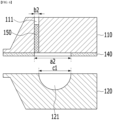
- FIG. 5 is a vertical cross-sectional view in the width direction of a slot die according to an embodiment of the present invention.
- the discharge passage of the slot die 100 is formed in a space between the upper body 110 and the lower body 120.
- the cover shim 140 forming a space in which the choke bar can move and the stripe shim 130 forming the coating pattern are located in the discharge passage between the upper body and the lower body, and the discharge port 132 is formed between the stripe shim 130 and the lower body 120.
- the stripe shim 130 divides the discharge port 132 by the partition wall 131.
- the stripe shim 130 and the cover shim 140 have the same thickness (h, a3), and the thickness ratio of the cover shim is 50% of the thickness of the discharge passage.
- FIG. 6 is a vertical cross-sectional view of a discharge direction of a slot die according to an embodiment of the present invention
- FIG. 7 is a vertical cross-sectional view showing the movement of a choke bar in a slot die according to an embodiment of the present invention.
- FIGS. 6 and 7 show that the discharge direction length (a2) of the through hole formed in the cover shim 140 is equal to the sum of the discharge direction length (b2) of the through path and the discharge direction length (c1) of the internal space formed in the lower body (the stripe shim is not shown).
- the choke bar 150 descends along the through path 111 and is inserted into the through hole 141, and fills a partial area of the through hole 141.
- One end of the choke bar 150 is located at a predetermined point in the space formed by the cover shim 140, and the maximum distance that the choke bar 150 can move is the same as the thickness of the cover shim 140.
- the flow rate of the slurry may be adjusted by the falling distance of the choke bar 150 (or the position of the choke bar), and the larger the falling distance of the choke bar 150, the larger the flow rate of the slurry decreases.
- FIG. 8 is a vertical cross-sectional view of a discharge direction of a slot die according to another embodiment of the present invention
- FIG. 9 is a vertical cross-sectional view showing the movement of a choke bar in a slot die according to another embodiment of the present invention.
- a plurality of choke bars 251 and 252 may be inserted into the through path 211 in the upper body ( FIGS. 8 and 9 show a shape in which two choke bars are inserted).
- the discharge direction length b3 of the through path 211 is equal to the sum of the discharge direction lengths e1 and e2 of respective choke bars.
- the length (a2) in the discharge direction of the through hole formed in the cover shim 240 is equal to the sum of the length (b3) in the discharge direction of the through path and the length (c1) in the discharge direction of the internal space formed in the lower body.
- all or part of the plurality of choke bars descends along the through path and is inserted into the through hole to fill a partial region of the through hole.
- all or part of the choke bar rises along the through path.
- One end of the choke bar is located at a predetermined point in the space formed by the cover shim, and the maximum distance that the choke bar can move is the same as the thickness of the cover shim.
- the flow rate of the slurry can be adjusted not only by the descending distance of the choke bars but also by the number of descended choke bars. As the number of descending choke bars increases, the flow of the slurry is disturbed more, so the flow rate of the slurry decreases. In this case, the flow rate of the slurry will decrease more significantly when both choke bars descend than when one choke bar descends.
- the movement of the plurality of choke bars can be independently controlled.
Landscapes
- Engineering & Computer Science (AREA)
- Manufacturing & Machinery (AREA)
- Chemical & Material Sciences (AREA)
- Chemical Kinetics & Catalysis (AREA)
- Electrochemistry (AREA)
- General Chemical & Material Sciences (AREA)
- Mechanical Engineering (AREA)
- Coating Apparatus (AREA)
Description
- The present invention relates to a slot die including a choke bar in a die and a slurry coating apparatus including the same.
- As technology development and demand for mobile devices have increased, a demand for secondary batteries as an energy source has rapidly increased, and recently, the use of secondary batteries as a power source for electric vehicles (EV) and hybrid electric vehicles (HEV) is being realized. Accordingly, many studies have been conducted on secondary batteries capable of meeting various demands. In particular, there is a high demand for lithium secondary batteries having high energy density, high discharge voltage and output stability.
- In particular, since lithium secondary batteries used in electric vehicles should be able to be used for more than 10 years under severe conditions in which charging and discharging by large currents are repeated in a short time, as well as high energy density and characteristics that can exhibit large output in a short time, it is inevitably required to have superior safety and long-term life characteristics than a small lithium secondary battery.
- In general, a secondary battery has a structure including an electrode assembly having a structure in which a positive electrode, a negative electrode, and a separator interposed between the positive electrode and the negative electrode are stacked. The positive electrode and the negative electrode are prepared by coating an electrode mixture containing an active material on a current collector
- At this time, the electrode mixture needs to be formed with a uniform thickness in the current collector in order to make the characteristics of the secondary battery uniform, and for this purpose, an electrode mixture coating device such as a die coater is used.
- In this electrode mixture coating device, a slot die is formed to be long in one direction so that the electrode mixture can be applied relatively thinly over a large area.
- As for the slot die, a coating solution is discharged through the gaps (slots) at the ends divided into two sides of the slot die, as the ink comes out of the tip of the pen, so that the slot die itself moves or the current collector moves, and the electrode mixture is applied to the current collector
-
Korean Patent Publication No. 10-2016-0070482 - However, since the slot die has a partition wall in the middle of the shim, it is difficult to control the size of the discharge port through a partition or the like to control the flow rate of the coating liquid due to the spatial limitation due to the partition wall, and a partition may need to be separately manufactured according to the shape of the shim.
- The
publications US 2019/118449 A1 ,EP 1 419 827 A2 andWO 2018/199464 A1 also describe slot dies for coating materials. - The present invention has been invented to solve the above problems, and an object of the present invention is to provide a slot die forming a space in which a choke bar for adjusting a flow rate of a discharge port can move, and a slurry coating apparatus including the same.
- A slot die according to the present invention is a slot die having a slit-shaped discharge port in which a length of a discharge passage in a width direction based on a cross section of a discharge port is greater than a thickness perpendicular to the width direction according to claim 1.
- In one embodiment, a width direction length of the through path formed in the upper body may correspond to a width direction length of the choke bar.
- A length in a discharge direction of the through path may correspond to a length in a discharge direction of the choke bar.
- In another embodiment, N (N is an integer of 2 or more) choke bars may be arranged in the discharge direction.
- At this time, a discharge direction length of the through path formed in the upper may correspond to a sum of discharge direction lengths of the N choke bars.
- In one embodiment, the lower body may have an internal space recessed in a concave shape to accommodate the slurry.
- In one embodiment, the stripe shim may have a plate material in which its center is empty and an outer peripheral portion of its discharge port is open.
- Further, the stripe shim may have a bar-shaped partition wall for dividing the discharge port into a plurality of regions in the width direction (TD), the partition wall protruding toward the opened outer periphery.
- There may be n partition walls (n is an integer of 1 or more), and the discharge passage of the discharge port may be divided into n + 1 units in the width direction by the partition walls.
- In one embodiment, the cover shim may have a plate-shaped structure, and shares the stripe shim and the discharge passage, and a length of the cover shim in the width direction may correspond to a length of the discharge passage in the width direction.
- At this time, a thickness of the cover shim may be in a range of 20 to 80% of a thickness of the discharge passage.
- Further, a thickness ratio of the stripe shim and the cover shim may be 3:1 to 1:3.
- Further, the cover shim may face the upper body, and the stripe shim may face the lower body.
- At this time, a length of the through hole formed in the cover shim in a width direction is the same as a length of the through path formed in the upper body in a width direction, and a discharge direction length of the through hole formed in the cover core is greater than or equal to a sum of a discharge direction length of the through path and a discharge direction length of the internal space.
- In addition, the present invention provides an electrode slurry coating apparatus including the slot die described above.
- According to a slot die and an apparatus for coating an electrode slurry including the same according to the present invention, by providing a cover shim on a stripe shim to form a space in which a choke bar die can move, it is possible to use a slot die including a choke bar in a batch shape for forming all kinds of active material patterns regardless of the design of the stripe shim
-
-
FIG. 1 is an exploded perspective view of a slot die according to an embodiment of the present invention. -
FIG. 2 is a top view showing the shape of a stripe shim according to an embodiment of the present invention. -
FIG. 3 is a top view showing the shape of a cover shim according to an embodiment of the present invention. -
FIG. 4 is a top view showing a state of an upper die according to an embodiment of the present invention. -
FIG. 5 is a vertical cross-sectional view in the width direction of a slot die according to an embodiment of the present invention. -
FIG. 6 is a vertical cross-sectional view of a discharge direction of a slot die according to an embodiment of the present invention. -
FIG. 7 is a vertical cross-sectional view showing the movement of a choke bar in a slot die according to an embodiment of the present invention. -
FIG. 8 is a vertical cross-sectional view of a discharge direction of a slot die according to another embodiment of the present invention. -
FIG. 9 is a vertical cross-sectional view showing the movement of a choke bar in a slot die according to another embodiment of the present invention. - Hereinafter, the present invention will be described in detail with reference to the drawings. The terms and words used in the present specification and claims should not be construed as limited to ordinary or dictionary terms and the inventor may properly define the concept of the terms in order to best describe its invention. The terms and words should be construed as meaning and concept consistent with the technical idea of the present invention.
- Accordingly, the embodiments described in the specification and the configurations described in the drawings are only the most preferred embodiments of the present invention, and do not represent all of the technical ideas of the present invention. It is to be understood that there may be various equivalents and variations in place of them at the time of filing the present application.
- In addition, in the present specification, the "discharge direction" refers to a direction in which an electrode slurry is discharged through a discharge port, and the "width direction" refers to the width direction of a slot die or the width direction of a coated electrode slurry, which is a direction perpendicular to the discharge direction.
- The present invention relates to a slot die having a slit-shaped discharge port in which the length in the width direction of the discharge passage is greater than a thickness perpendicular to the width direction based on the cross section of the discharge port in order to coat the electrode slurry or the like.
- A slot die according to the present invention includes: a lower body configured to form a lower surface of the discharge passage; an upper body configured to be disposed opposite the lower body to determine a thickness of the discharge passage and to have a slit-shaped through path formed in a width direction; a stripe shim configured to be positioned on the discharge passage of the slot die and to divide the discharge port in the width direction; a cover shim configured to be located on the stripe shim and to include a through hole formed in a central part; and a choke bar configured to open and close a part of the discharge passage of the slot die while moving in a direction perpendicular to the discharge direction through the through path of the upper body.
- In this case, the upper body and the lower body are spaced apart at predetermined intervals through a shim to form a discharge passage, and the electrode slurry is introduced into the discharge passage through a slurry inflow passage (not shown) connected to the lower body and discharged through the discharge port.
- In one embodiment, while the slurry is discharged from the discharge passage to the discharge port, the choke bar inserted into the through path of the upper body may move up and down in the through path to adjust the flow rate of the discharged slurry.
- In addition, it is preferable that the width direction length of the through path formed in the upper body corresponds to the width direction length of the choke bar. If the length in the width direction of the through path is smaller than the length in the discharge direction of the choke bar, the up and down movement of the choke bar may not be smooth due to friction between the choke bar and the through path, and the choke bar may be damaged. On the other hand, when the length in the width direction of the through path is larger than the length in the width direction of the choke bar, the choke bar moves in the width direction while the choke bar moves up and down in the through path, so that the flow rate control of the slurry may not be uniform.
- In addition, it is preferable that the length of the through path in the discharge direction corresponds to the length of the choke bar in the discharge direction. This is to prevent the slurry from flowing into the gap between the through path and the choke bar.
- Further, it is preferable that the length of the choke bar in the width direction is the same as the length of the discharge port formed by the stripe shim in the width direction. When the length of the choke bar in the width direction is smaller than the length of the discharge port, a space is generated between the choke bar and the edge of the stripe shim, and the slurry is discharged through it, thereby reducing the precision of flow rate control.
- Meanwhile, in the slot die, the lower body may have an internal space recessed in a concave shape so that the introduced slurry may be temporarily accommodated for uniform outflow of the slurry.
- In yet another embodiment, N (N is an integer of 2 or more) choke bars may be arranged in the discharge direction. In this case, the length in the discharge direction of the through path formed in the upper body preferably corresponds to the sum of the lengths in the discharge direction of the N choke bars. When a plurality of choke bars are present, the length of each choke bar in the discharge direction may be appropriately set. However, it is preferable that the length of each choke bar in the discharge direction be the same for ease of flow control.
- In addition, in the slot die according to the present invention, the stripe shim is a plate material in which the center portion is empty and the outer peripheral portion toward the discharge port is open, and the direction of the electrode slurry is adjusted to be discharged toward the open outer peripheral portion.
- In one specific example, the stripe shim divides the discharge port into a plurality of regions in the width direction TD since the bar-shaped partition wall protrudes in the open outer periphery direction. That is, the electrode slurry flowing into the discharge passage through the slurry inflow passage and the lower body may be discharged only through the open portion by being blocked by the partition wall. As a result, a non-coated part is formed as much as the thickness of the partition wall, and the slurry discharged into the space between the partitions forms a coated part.
- In the stripe shim, there are n partition walls (n is an integer greater than or equal to 1), and the discharge passage of the discharge port may be divided n+1 parts in the width direction by the partition walls. The length of the partition walls ribs in the width direction and the spacing between the partition walls may be appropriately adjusted according to the pattern shape of the electrode to be coated.
- However, when the stripe shim as described above is used for pattern coating, the flow rate control by the choke bar may not be smooth as it is blocked in the space due to the partition wall as described above. To this end, if the shape of the choke bar is modified to match the shape of the stripe shim, it is difficult to apply it to various stripe shims, and the choke bar should be replaced whenever the coating pattern is changed.
- In the present invention, the flow rate of the electrode slurry can be adjusted regardless of the shape of the stripe shim by securing a space for the choke bar to move up and down as much as the thickness of the cover shim using a cover shim including a through hole located on the stripe shim and formed in the central part together with the stripe shim. The cover shim is located between the stripe shim and the lower body and faces the lower body.
- The cover shim has a plate-shaped structure, and shares the stripe shim and the discharge passage, and the width of the cover shim may correspond to the width direction of the discharge passage, that is, the length of the stripe shim in the width direction for assembling of the slot die and stable discharge of the slurry.
- The thickness of the cover shim may be in the range of 20% to 80% of the thickness of the discharge passage formed between the upper body and the lower body, preferably in the range of 30% to 70%, and more preferably in the range of 40 to 60%. When the thickness of the cover shim is less than 20% of the thickness of the discharge passage, the thickness of the cover shim becomes too thin, so the effect of controlling the flow rate by the choke bar may be reduced. Conversely, when the thickness of the cover shim exceeds 80% of the thickness of the discharge passage, the thickness of the cover shim becomes thick and it is easy to control the flow rate, but the flow of electrode slurry is obstructed by the choke bar, making it difficult to uniformly coat.
- In addition, the thickness ratio of the stripe shim and the cover shim may be 3:1 to 1:3, preferably 2:1 to 1:2. As described above, when the thickness ratio of the stripe shim and the cover shim exceeds the above range, the thickness of the cover shim becomes too thin, so that the effect of controlling the flow rate by the choke bar decreases, or the cover shim becomes too thick, so that uniform coating of the slurry may become difficult.
- The through hole partially obstructs the flow of the slurry flowing through the discharge passage by the choke bar descending through the through path and inserted into the through hole, thereby controlling the flow rate of the slurry. Specifically, the choke bar descends by a predetermined distance within the through path, and one end thereof is positioned at a predetermined point in the space formed by the cover shim. When the choke bar is completely inserted into the through hole, the flow rate of the electrode slurry decreases compared to when the choke bar is partially inserted into the through hole.
- In another embodiment, when there are a plurality of choke bars, each of the choke bars may operate independently. In this case, the flow rate of the slurry can be adjusted by the distance the choke bar has descended and the number of descended choke bars. As the number of descending choke bars increases, the flow of the slurry is more obstructed, and thus the flow rate of the slurry decreases.
- According to the invention, the length of the through hole formed in the cover shim in the width direction is the same as the length of the through path formed in the upper body in the width direction. By matching the length of the through hole in the width direction, the length in the width direction of the through path, and the length in the width direction of the choke bar, the slurry is prevented from flowing to the edge of the choke bar.
- In addition, the length in the discharge direction of the through hole is greater than or equal to the sum of the length in the discharge direction of the through path formed in the upper body and the length in the discharge direction of the internal space formed in the lower body. When the length in the discharge direction of the through hole is less than the sum of the lengths in the discharge direction of the through path and the internal space, the size of the through hole becomes too small. As a result, the flow of the slurry flowing out of the internal space may be obstructed by the cover shim, and some of the slurry flows directly into the discharge port without adjusting the flow rate by the choke bar, thereby reducing the flow rate control efficiency.
- In addition, the present invention provides an electrode slurry coating apparatus including the slot die described above. The electrode active material coating apparatus applies the electrode slurry discharged through the discharge port onto the current collector. The electrode slurry is agitated while the active material is mixed with a binder, a conductive agent, and a solvent in a mixer (not shown) to form a slurry, and the slurry may be filtered through a sieve or filter to increase dispersion and then transferred to a slot die.
- In the present invention, the positive electrode collector generally has a thickness of 3 to 500 micrometers. The positive electrode current collector is not particularly limited as long as it has high conductivity without causing a chemical change in the battery. Examples of the positive electrode current collector include stainless steel, aluminum, nickel, titanium, or aluminum or stainless steel of which the surface has been treated with carbon, nickel, titanium, silver, or the like. The current collector may have fine irregularities on the surface thereof to increase the adhesion of the positive electrode active material, and various forms such as a sheet, a foil, and a net are possible.
- The negative electrode collector generally has a thickness of 3 to 500 micrometers. The negative electrode current collector is not particularly limited as long as it has electrical conductivity without causing chemical changes in the battery, and examples thereof include copper, stainless steel, aluminum, nickel, titanium, sintered carbon, copper or stainless steel of which the surface has been treated with carbon, nickel, titanium, silver or the like, aluminum-cadmium alloy, or the like. In addition, like the positive electrode current collector, fine unevenness can be formed on the surface to enhance the bonding force of the negative electrode active material, and it can be used in various forms such as a sheet, a foil, and a net.
- In the present invention, the positive electrode active material is a material capable of causing an electrochemical reaction and a lithium transition metal oxide, and contains two or more transition metals. Examples thereof include: layered compounds such as lithium cobalt oxide (LiCoO2) and lithium nickel oxide (LiNiO2) substituted with one or more transition metals; lithium manganese oxide substituted with one or more transition metals; lithium nickel oxide represented by the formula LiNi1-yMyO2 (wherein M = Co, Mn, Al, Cu, Fe, Mg, B, Cr, Zn or Ga and contains at least one of the above elements, 0.01≤y≤0.7); lithium nickel cobalt manganese composite oxide represented by the formula Li1+zNibMncCo1-(b+c+d)MdO(2-e)Ae such as Li1+zNi1/3Co1/3Mn1/3O2, Li1+zNi0.4Mn0.4Co0.2O2 etc. (wherein -0.5≤z≤0.5, 0.1≤b≤0.8, 0.1≤c≤0.8, 0≤d≤0.2, 0≤e≤0.2, b+c+d<1, M = Al, Mg, Cr, Ti, Si or Y, and A = F, P or Cl); olivine-based lithium metal phosphate represented by the formula Li1+xM1-yM'yPO4-zXz (wherein M = transition metal, preferably Fe, Mn, Co or Ni, M'= Al, Mg or Ti, X = F, S or N, and -0.5≤x≤0.5, 0≤y≤0.5, 0≤z≤0.1).
- Examples of the negative electrode active material include carbon such as non-graphitized carbon and graphite carbon; metal complex oxide such as LixFe2O3(0≤x≤1), LixWO2(0≤x≤1), SnxMe1-xMe'yOz (Me: Mn, Fe, Pb, Ge; Me': Al, B, P, Si, groups 1, 2, and 3 of the periodic table, halogen; 0<x≤1; 1≤y≤3; 1≤z≤8); lithium alloy; silicon alloy; tin alloy; metal oxides such as SnO, SnO2, PbO, PbO2, Pb2O3, Pb3O4, Sb2O3, Sb2O4, Sb2O5, GeO, GeO2, Bi2O3, Bi2O4, and Bi2O5; conductive polymers such as polyacetylene; and Li-Co-Ni-based materials.
- The conductive material is usually added in an amount of 1 to 30% by weight based on the total weight of the mixture including the positive electrode active material. Such a conductive material is not particularly limited as long as it has electrical conductivity without causing a chemical change in the battery, and examples thereof include graphite such as natural graphite and artificial graphite; carbon black such as carbon black, acetylene black, Ketjen black, channel black, furnace black, lamp black, and summer black; conductive fibers such as carbon fiber and metal fiber; metal powders such as carbon fluoride, aluminum and nickel powder; conductive whiskey such as zinc oxide and potassium titanate; conductive metal oxides such as titanium oxide; and conductive materials such as polyphenylene derivatives and the like.
- The binder is added in an amount of 1 to 30% by weight, on the basis of the total weight of the mixture containing the positive electrode active material, as a component that assists in bonding between the active material and the conductive material and bonding to the current collector. Examples of such binders include polyvinylidene fluoride, polyvinyl alcohol, carboxymethylcellulose (CMC), starch, hydroxypropylcellulose, regenerated cellulose, polyvinylpyrrolidone, tetrafluoroethylene, polyethylene, polypropylene, ethylene-propylene-diene terpolymer (EPDM), sulfonated EPDM, styrene butylene rubber, fluorine rubber, various copolymers and the like.
- Other components, such as viscosity modifiers, adhesion promoters, and the like may be further included optionally or in combination of two or more. The viscosity modifier is a component that adjusts the viscosity of the electrode mixture so that the mixing process of the electrode mixture and the coating process on the current collector thereof may be easy, and may be added up to 30% by weight based on the total weight of the negative electrode mixture. Examples of such a viscosity modifier include carboxy methyl cellulose, polyvinylidene fluoride, and the like, but are not limited thereto. In some cases, the solvent described above may serve as a viscosity modifier.
- The adhesion promoter is an auxiliary component added to improve the adhesion of the active material to the current collector and may be added in less than 10% by weight compared to the binder, and some examples thereof include oxalic acid, adipic acid, formic acid, acrylic acid derivatives, itaconic acid derivatives, and the like.
- Hereinafter, the present invention will be described in more detail through drawings and examples.
-
FIG. 1 is an exploded perspective view of a slot die 100 according to an embodiment of the present invention, andFIGS. 2 to 4 are top views showing astripe shim 130, acover shim 140, and anupper body 110 according to an embodiment of the present invention. Referring to these drawings, the slot die 100 according to the present invention has a structure in which astripe shim 130 and acover shim 140 are mounted between anupper body 110 and alower body 120. More specifically, the slot die 100 has a form in which thelower body 120, thestripe shim 130, thecover shim 140, and theupper body 110 are sequentially combined, and thecover shim 140 faces theupper body 110, and thestripe shim 130 faces thelower body 120. The discharge port portions of theupper body 110 and thelower body 120 protrude to formdischarge lips upper body 110 and a throughpath 111 is formed so as to move in a direction perpendicular to the discharge direction. In the lower body, an inflow passage (not shown) through which the slurry flows into the slot die and aninternal space 121 for temporarily receiving the slurry are formed. -
Stripe shim 130 has an empty center and an open outer peripheral portion of the discharge port, and itspartition wall 131 protrudes in the direction of the open outer periphery. For example,FIG. 2 illustrates a case in which twopartition walls 131 are formed. - The
cover shim 140 shares the discharge passage with thestripe shim 130, and the overall sizes of thecover shim 140 and thestripe shim 130 are the same. The length of thecover shim 140 in the width direction corresponds to the length of the discharge passage in the width direction. A throughhole 141 into which a choke bar can be inserted is formed in the cover shim, and the length a1 of the throughhole 141 in the width direction is the same as the length b1 of the throughpath 111 in the width direction. In addition, the length b2 in the discharge direction of the throughpath 111 is equal to or greater than the length in the discharge direction of the choke bar. The choke bar is inserted into a partial region of the throughhole 141 to control the flow rate of the slurry. -
FIG. 5 is a vertical cross-sectional view in the width direction of a slot die according to an embodiment of the present invention. - Referring to
FIG. 5 , the discharge passage of the slot die 100 is formed in a space between theupper body 110 and thelower body 120. Thecover shim 140 forming a space in which the choke bar can move and thestripe shim 130 forming the coating pattern are located in the discharge passage between the upper body and the lower body, and thedischarge port 132 is formed between thestripe shim 130 and thelower body 120. Thestripe shim 130 divides thedischarge port 132 by thepartition wall 131. InFIG. 5 , thestripe shim 130 and thecover shim 140 have the same thickness (h, a3), and the thickness ratio of the cover shim is 50% of the thickness of the discharge passage. -
FIG. 6 is a vertical cross-sectional view of a discharge direction of a slot die according to an embodiment of the present invention, andFIG. 7 is a vertical cross-sectional view showing the movement of a choke bar in a slot die according to an embodiment of the present invention. - Referring
FIGS. 6 and7 , thechoke bar 150 is inserted into the through path in theupper body 110.FIGS. 6 and7 show that the discharge direction length (a2) of the through hole formed in thecover shim 140 is equal to the sum of the discharge direction length (b2) of the through path and the discharge direction length (c1) of the internal space formed in the lower body (the stripe shim is not shown). - In order to reduce the flow rate of the slurry, the
choke bar 150 descends along the throughpath 111 and is inserted into the throughhole 141, and fills a partial area of the throughhole 141. One end of thechoke bar 150 is located at a predetermined point in the space formed by thecover shim 140, and the maximum distance that thechoke bar 150 can move is the same as the thickness of thecover shim 140. When thechoke bar 150 descends, the flow of the slurry is obstructed, and the flow rate of the slurry discharged to the discharge port decreases. The flow rate of the slurry may be adjusted by the falling distance of the choke bar 150 (or the position of the choke bar), and the larger the falling distance of thechoke bar 150, the larger the flow rate of the slurry decreases. -
FIG. 8 is a vertical cross-sectional view of a discharge direction of a slot die according to another embodiment of the present invention, andFIG. 9 is a vertical cross-sectional view showing the movement of a choke bar in a slot die according to another embodiment of the present invention. - Referring to
FIGS. 8 and9 , a plurality of choke bars 251 and 252 may be inserted into the throughpath 211 in the upper body (FIGS. 8 and9 show a shape in which two choke bars are inserted). In this case, the discharge direction length b3 of the throughpath 211 is equal to the sum of the discharge direction lengths e1 and e2 of respective choke bars. In addition, the length (a2) in the discharge direction of the through hole formed in thecover shim 240 is equal to the sum of the length (b3) in the discharge direction of the through path and the length (c1) in the discharge direction of the internal space formed in the lower body. - In order to reduce the flow rate of the slurry, all or part of the plurality of choke bars descends along the through path and is inserted into the through hole to fill a partial region of the through hole. Conversely, in order to increase the flow rate of the slurry, all or part of the choke bar rises along the through path. One end of the choke bar is located at a predetermined point in the space formed by the cover shim, and the maximum distance that the choke bar can move is the same as the thickness of the cover shim. When the choke bar descends, the flow of the slurry is obstructed, and the flow rate of the slurry discharged to the discharge port decreases. The flow rate of the slurry may be adjusted by the falling distance of the choke bar (or the position of the choke bar), and the larger the falling distance of the choke bar, the larger the flow rate of the slurry decreases.
- In addition, the flow rate of the slurry can be adjusted not only by the descending distance of the choke bars but also by the number of descended choke bars. As the number of descending choke bars increases, the flow of the slurry is disturbed more, so the flow rate of the slurry decreases. In this case, the flow rate of the slurry will decrease more significantly when both choke bars descend than when one choke bar descends. The movement of the plurality of choke bars can be independently controlled.
- In situations where terms indicating directions such as up and down have been used in the present specification, it is obvious to those skilled in the art that these terms are for convenience of description and may be expressed differently depending on the viewing position of the observer or the position of the object.
-
- 100: slot die
- 110, 210: upper body
- 111, 211: through path
- 120, 220: lower body
- 121, 221: internal space
- 130, 230: stripe shim
- 131: partition wall
- 140, 240: cover shim
- 141: through hole
- 150, 251, 252: choke bar
Claims (13)
- A slot die (100) having a slit-shaped discharge port in which a length of a discharge passage in a width direction based on a cross section of a discharge port is greater than a thickness perpendicular to the width direction, the slot die comprising:a lower body (120) configured to form a lower surface of the discharge passage and has an internal space (121) recessed in a concave shape to accommodate the slurry;an upper body (110) configured to be disposed opposite the lower body (120) to determine the thickness of the discharge passage and to have a slit-shaped through path (111) formed in the width direction;a stripe shim (130) configured to be positioned on the discharge passage of the slot die and to divide the discharge port in the width direction;a cover shim (140) configured to be located on the stripe shim (130) and to include a through hole (141) formed in a central part;characterised bya choke bar (150) configured to open and close a part of the discharge passage of the slot die while moving in a direction perpendicular to the discharge direction through the through path (111) of the upper body (110),wherein a length of the through hole (141) formed in the cover shim (140) in a width direction is the same as a length of the through path formed in the upper body (110) in a width direction, andwherein a discharge direction length of the through hole (141) formed in the cover shim (140) is greater than or equal to a sum of a discharge direction length of the through path (111) and a discharge direction length of the internal space (121).
- The slot die of claim 1, wherein a width direction length of the through path formed in the upper body (110) corresponds to a width direction length of the choke bar (150).
- The slot die of claim 1, wherein a length in a discharge direction of the through path corresponds to a length in a discharge direction of the choke bar (150).
- The slot die of claim 1, wherein N choke bars (150) are arranged in the discharge direction and N is an integer of 2 or more.
- The slot die of claim 4, wherein a discharge direction length of the through path formed in the upper body (110) corresponds to a sum of discharge direction lengths of the N choke bars (150).
- The slot die of claim 1, wherein the stripe shim (130) is a plate material in which its center is empty and an outer peripheral portion of its discharge port (132) is open.
- The slot die of claim 6, wherein the stripe shim (130) has a bar-shaped partition wall (131) for dividing the discharge port (132) into a plurality of regions in the width direction (TD), the partition wall (131) protruding toward the opened outer periphery.
- The slot die of claim 7, wherein there are n partition walls (131), n is an integer of 1 or more, and
wherein the discharge passage of the discharge port (132) is divided into n+1 units in the width direction by the partition walls. - The slot die of claim 1, wherein the cover shim (140) has a plate-shaped structure, and shares the stripe shim (130) and the discharge passage, and
wherein a length of the cover shim (140) in the width direction corresponds to a length of the discharge passage in the width direction. - The slot die of claim 1, wherein a thickness of the cover shim (140) is in a range of 20 to 80% of the thickness of the discharge passage.
- The slot die of claim 1, wherein a thickness ratio of the stripe shim (130) and the cover shim (140) is 3:1 to 1:3.
- The slot die of claim 1, wherein the cover shim (140) faces the upper body (110), and the stripe shim (130) faces the lower body (120).
- An apparatus for coating an electrode slurry comprising the slot die (10) according to claim 1.
Applications Claiming Priority (2)
| Application Number | Priority Date | Filing Date | Title |
|---|---|---|---|
| KR1020190113243A KR102450119B1 (en) | 2019-09-16 | 2019-09-16 | Choke-bar slot die and slurry coating device comprising the same |
| PCT/KR2020/008207 WO2021054581A1 (en) | 2019-09-16 | 2020-06-24 | Choke bar slot die and slurry coating apparatus comprising same |
Publications (3)
| Publication Number | Publication Date |
|---|---|
| EP3834950A1 EP3834950A1 (en) | 2021-06-16 |
| EP3834950A4 EP3834950A4 (en) | 2021-11-17 |
| EP3834950B1 true EP3834950B1 (en) | 2023-05-31 |
Family
ID=74883834
Family Applications (1)
| Application Number | Title | Priority Date | Filing Date |
|---|---|---|---|
| EP20859622.1A Active EP3834950B1 (en) | 2019-09-16 | 2020-06-24 | Choke bar slot die and slurry coating apparatus comprising same |
Country Status (5)
| Country | Link |
|---|---|
| US (1) | US12214376B2 (en) |
| EP (1) | EP3834950B1 (en) |
| KR (1) | KR102450119B1 (en) |
| CN (1) | CN114786824B (en) |
| WO (1) | WO2021054581A1 (en) |
Families Citing this family (8)
| Publication number | Priority date | Publication date | Assignee | Title |
|---|---|---|---|---|
| KR102950054B1 (en) | 2021-09-06 | 2026-04-07 | 주식회사 엘지에너지솔루션 | Shim for even and uniform coating and coating apparatus incorporating the same |
| CN113680605B (en) * | 2021-09-27 | 2022-09-09 | 深圳市曼恩斯特科技股份有限公司 | An adjustable die head for gluing |
| HUE071858T2 (en) * | 2021-11-26 | 2025-09-28 | Lg Energy Solution Ltd | Slot die coater |
| EP4279184A1 (en) | 2022-05-19 | 2023-11-22 | LG Energy Solution, Ltd. | System for deposition of material |
| ES3064316T3 (en) * | 2023-01-28 | 2026-04-23 | Contemporary Amperex Technology Hong Kong Ltd | Coating die head, coating device and battery production device |
| CN116871124B (en) * | 2023-08-01 | 2026-01-23 | 苏州擎动动力科技有限公司 | Coating die head and coating device |
| CN117206133A (en) * | 2023-09-18 | 2023-12-12 | 苏州安斯迪克氢能源科技有限公司 | A process for improving the production capacity of slit spacer coating for fuel cell catalytic layer preparation |
| CN119702336B (en) * | 2023-09-28 | 2025-11-11 | 芯体素(杭州)科技发展有限公司 | Slit type coating die head for preparing microstructure battery pole piece |
Family Cites Families (20)
| Publication number | Priority date | Publication date | Assignee | Title |
|---|---|---|---|---|
| US3241183A (en) | 1963-12-23 | 1966-03-22 | Allied Chem | Film extrusion die |
| US6423144B1 (en) * | 1996-08-07 | 2002-07-23 | Matsushita Electric Industrial Co., Ltd. | Coating apparatus and coating method |
| CN1262355C (en) * | 2002-11-12 | 2006-07-05 | 松下电器产业株式会社 | Squeezing nozzle and coater using same |
| JP4573550B2 (en) * | 2004-03-23 | 2010-11-04 | 東レエンジニアリング株式会社 | Coating equipment |
| JP4419022B2 (en) * | 2005-11-04 | 2010-02-24 | 井上金属工業株式会社 | Die coating equipment |
| KR101274083B1 (en) * | 2006-10-20 | 2013-06-12 | 주식회사 케이씨텍 | Chemical application nozzle and chemical application device using thereof |
| US8123511B2 (en) | 2007-05-03 | 2012-02-28 | Cloeren Incorporated | Decoupled transverse flow metering gap and lip gap |
| JP5395391B2 (en) * | 2008-09-30 | 2014-01-22 | 株式会社東芝 | Coating apparatus, coating method and electrode plate |
| KR101308251B1 (en) * | 2011-03-18 | 2013-09-13 | 삼성에스디아이 주식회사 | Slot Die |
| US9579684B2 (en) * | 2011-06-07 | 2017-02-28 | 3M Innovative Properties Company | Slot die position adjustment control |
| CN102553780A (en) | 2011-12-20 | 2012-07-11 | 深圳市浩能科技有限公司 | Coating machine extrusion head for manufacturing lithium ion batteries |
| US9522411B2 (en) * | 2013-01-03 | 2016-12-20 | Georgia Tech Research Corporation | Hybrid extrusion and coating technology, device, and method |
| KR101715699B1 (en) * | 2014-10-22 | 2017-03-13 | 주식회사 엘지화학 | Slot coater having fluid control means |
| KR101839605B1 (en) | 2014-12-10 | 2018-03-16 | 주식회사 엘지화학 | Method for preparing coating film |
| KR101762813B1 (en) * | 2015-01-14 | 2017-07-28 | 주식회사 엘지화학 | Slot Die Having Two Shims and Coating Device Comprising the Same |
| KR102036798B1 (en) * | 2015-12-08 | 2019-10-25 | 주식회사 엘지화학 | Slot Die for Coating of Electrode Mix Comprising Shim for Controlling Flux of Electrode Mix |
| KR101922054B1 (en) | 2017-04-26 | 2018-11-26 | 성안기계 주식회사 | Slot die with variable manifold and method for controlling the same |
| US10717222B2 (en) * | 2017-10-25 | 2020-07-21 | Nordson Corporation | Multi-lane die |
| KR101853680B1 (en) | 2018-01-26 | 2018-05-02 | (주)한빛산업 | Die coater including hydraulic actuator for non coating area control |
| KR102070821B1 (en) | 2018-03-28 | 2020-01-29 | 주식회사 다날 | Payment processing agent service apparatus and operating method thereof |
-
2019
- 2019-09-16 KR KR1020190113243A patent/KR102450119B1/en active Active
-
2020
- 2020-06-24 CN CN202080004401.8A patent/CN114786824B/en active Active
- 2020-06-24 WO PCT/KR2020/008207 patent/WO2021054581A1/en not_active Ceased
- 2020-06-24 US US17/271,049 patent/US12214376B2/en active Active
- 2020-06-24 EP EP20859622.1A patent/EP3834950B1/en active Active
Also Published As
| Publication number | Publication date |
|---|---|
| US12214376B2 (en) | 2025-02-04 |
| US20210387223A1 (en) | 2021-12-16 |
| CN114786824B (en) | 2023-12-19 |
| EP3834950A1 (en) | 2021-06-16 |
| EP3834950A4 (en) | 2021-11-17 |
| WO2021054581A1 (en) | 2021-03-25 |
| KR20210032039A (en) | 2021-03-24 |
| KR102450119B1 (en) | 2022-10-04 |
| CN114786824A (en) | 2022-07-22 |
Similar Documents
| Publication | Publication Date | Title |
|---|---|---|
| EP3834950B1 (en) | Choke bar slot die and slurry coating apparatus comprising same | |
| US12166201B2 (en) | Electrode structure and method of manufacturing the same, and secondary battery including the electrode structure | |
| KR102774809B1 (en) | Dual slot die coater and electrode active material slurry coating method using the same | |
| JP2014029881A (en) | Secondary battery improved in lithium ion mobility and battery capacity | |
| EP3419085B1 (en) | Three-dimensional electrode structure, and secondary battery including the same | |
| US20140072697A1 (en) | Method for manufacturing electrode for battery | |
| KR102920444B1 (en) | Slot die coater | |
| EP4057385B1 (en) | Electrode structure, secondary battery including the same, and method of fabricating the electrode structure | |
| KR20240040720A (en) | Dual slot die coater | |
| KR20230078497A (en) | Offset adjustable shim and slot die coater including the same | |
| CN116636027B (en) | Slit die coater | |
| KR20200034426A (en) | Slot Die for Coating to Reduce Electrode Loading Variations | |
| KR20220124918A (en) | Method of manufacturing an electrode including the formation of a dam line coating layer | |
| KR102651932B1 (en) | Dual slot die coater | |
| JP5734790B2 (en) | Method for manufacturing battery electrode | |
| KR20190107503A (en) | Lithium ion secondary cell having multiple substrates | |
| EP4571866A1 (en) | Method and device for manufacturing secondary battery electrode | |
| JP5740335B2 (en) | Electrolyte layer forming method, electrolyte layer forming apparatus, and nozzle for forming electrolyte layer used therein | |
| EP3846254A1 (en) | Method of preparing electrode for secondary battery | |
| EP4599943A1 (en) | System for coating an web-type electrode substrate and method of manufacturing an electrode web | |
| EP4487965A1 (en) | Shim plate and slot die coater comprising same | |
| EP4732962A1 (en) | Slot die coater | |
| EP4585317A1 (en) | Shim plate and die coater comprising same | |
| KR20240093322A (en) | Slot die coater and manufacturing method for electrode plate of secondary battery using the same | |
| KR20240016867A (en) | Slot die coater |
Legal Events
| Date | Code | Title | Description |
|---|---|---|---|
| STAA | Information on the status of an ep patent application or granted ep patent |
Free format text: STATUS: UNKNOWN |
|
| STAA | Information on the status of an ep patent application or granted ep patent |
Free format text: STATUS: THE INTERNATIONAL PUBLICATION HAS BEEN MADE |
|
| PUAI | Public reference made under article 153(3) epc to a published international application that has entered the european phase |
Free format text: ORIGINAL CODE: 0009012 |
|
| STAA | Information on the status of an ep patent application or granted ep patent |
Free format text: STATUS: REQUEST FOR EXAMINATION WAS MADE |
|
| 17P | Request for examination filed |
Effective date: 20210308 |
|
| AK | Designated contracting states |
Kind code of ref document: A1 Designated state(s): AL AT BE BG CH CY CZ DE DK EE ES FI FR GB GR HR HU IE IS IT LI LT LU LV MC MK MT NL NO PL PT RO RS SE SI SK SM TR |
|
| A4 | Supplementary search report drawn up and despatched |
Effective date: 20211015 |
|
| RIC1 | Information provided on ipc code assigned before grant |
Ipc: H01M 4/04 20060101ALN20211011BHEP Ipc: B29C 48/154 20190101ALN20211011BHEP Ipc: B29C 48/255 20190101ALI20211011BHEP Ipc: B29C 48/25 20190101ALI20211011BHEP Ipc: B29C 48/305 20190101ALI20211011BHEP Ipc: B05C 5/02 20060101AFI20211011BHEP |
|
| RAP1 | Party data changed (applicant data changed or rights of an application transferred) |
Owner name: LG ENERGY SOLUTION LTD. |
|
| RAP3 | Party data changed (applicant data changed or rights of an application transferred) |
Owner name: LG ENERGY SOLUTION, LTD. |
|
| DAV | Request for validation of the european patent (deleted) | ||
| DAX | Request for extension of the european patent (deleted) | ||
| GRAP | Despatch of communication of intention to grant a patent |
Free format text: ORIGINAL CODE: EPIDOSNIGR1 |
|
| STAA | Information on the status of an ep patent application or granted ep patent |
Free format text: STATUS: GRANT OF PATENT IS INTENDED |
|
| RIC1 | Information provided on ipc code assigned before grant |
Ipc: H01M 4/04 20060101ALN20221217BHEP Ipc: B29C 48/154 20190101ALN20221217BHEP Ipc: B29C 48/255 20190101ALI20221217BHEP Ipc: B29C 48/25 20190101ALI20221217BHEP Ipc: B29C 48/305 20190101ALI20221217BHEP Ipc: B05C 5/02 20060101AFI20221217BHEP |
|
| INTG | Intention to grant announced |
Effective date: 20230116 |
|
| GRAS | Grant fee paid |
Free format text: ORIGINAL CODE: EPIDOSNIGR3 |
|
| GRAA | (expected) grant |
Free format text: ORIGINAL CODE: 0009210 |
|
| STAA | Information on the status of an ep patent application or granted ep patent |
Free format text: STATUS: THE PATENT HAS BEEN GRANTED |
|
| AK | Designated contracting states |
Kind code of ref document: B1 Designated state(s): AL AT BE BG CH CY CZ DE DK EE ES FI FR GB GR HR HU IE IS IT LI LT LU LV MC MK MT NL NO PL PT RO RS SE SI SK SM TR |
|
| REG | Reference to a national code |
Ref country code: GB Ref legal event code: FG4D Ref country code: CH Ref legal event code: EP |
|
| REG | Reference to a national code |
Ref country code: AT Ref legal event code: REF Ref document number: 1570629 Country of ref document: AT Kind code of ref document: T Effective date: 20230615 Ref country code: DE Ref legal event code: R096 Ref document number: 602020011398 Country of ref document: DE |
|
| P01 | Opt-out of the competence of the unified patent court (upc) registered |
Effective date: 20230517 |
|
| REG | Reference to a national code |
Ref country code: IE Ref legal event code: FG4D |
|
| REG | Reference to a national code |
Ref country code: LT Ref legal event code: MG9D |
|
| REG | Reference to a national code |
Ref country code: NL Ref legal event code: MP Effective date: 20230531 |
|
| REG | Reference to a national code |
Ref country code: AT Ref legal event code: MK05 Ref document number: 1570629 Country of ref document: AT Kind code of ref document: T Effective date: 20230531 |
|
| PG25 | Lapsed in a contracting state [announced via postgrant information from national office to epo] |
Ref country code: SE Free format text: LAPSE BECAUSE OF FAILURE TO SUBMIT A TRANSLATION OF THE DESCRIPTION OR TO PAY THE FEE WITHIN THE PRESCRIBED TIME-LIMIT Effective date: 20230531 Ref country code: NO Free format text: LAPSE BECAUSE OF FAILURE TO SUBMIT A TRANSLATION OF THE DESCRIPTION OR TO PAY THE FEE WITHIN THE PRESCRIBED TIME-LIMIT Effective date: 20230831 Ref country code: ES Free format text: LAPSE BECAUSE OF FAILURE TO SUBMIT A TRANSLATION OF THE DESCRIPTION OR TO PAY THE FEE WITHIN THE PRESCRIBED TIME-LIMIT Effective date: 20230531 Ref country code: AT Free format text: LAPSE BECAUSE OF FAILURE TO SUBMIT A TRANSLATION OF THE DESCRIPTION OR TO PAY THE FEE WITHIN THE PRESCRIBED TIME-LIMIT Effective date: 20230531 |
|
| PG25 | Lapsed in a contracting state [announced via postgrant information from national office to epo] |
Ref country code: RS Free format text: LAPSE BECAUSE OF FAILURE TO SUBMIT A TRANSLATION OF THE DESCRIPTION OR TO PAY THE FEE WITHIN THE PRESCRIBED TIME-LIMIT Effective date: 20230531 Ref country code: PL Free format text: LAPSE BECAUSE OF FAILURE TO SUBMIT A TRANSLATION OF THE DESCRIPTION OR TO PAY THE FEE WITHIN THE PRESCRIBED TIME-LIMIT Effective date: 20230531 Ref country code: NL Free format text: LAPSE BECAUSE OF FAILURE TO SUBMIT A TRANSLATION OF THE DESCRIPTION OR TO PAY THE FEE WITHIN THE PRESCRIBED TIME-LIMIT Effective date: 20230531 Ref country code: LV Free format text: LAPSE BECAUSE OF FAILURE TO SUBMIT A TRANSLATION OF THE DESCRIPTION OR TO PAY THE FEE WITHIN THE PRESCRIBED TIME-LIMIT Effective date: 20230531 Ref country code: LT Free format text: LAPSE BECAUSE OF FAILURE TO SUBMIT A TRANSLATION OF THE DESCRIPTION OR TO PAY THE FEE WITHIN THE PRESCRIBED TIME-LIMIT Effective date: 20230531 Ref country code: IS Free format text: LAPSE BECAUSE OF FAILURE TO SUBMIT A TRANSLATION OF THE DESCRIPTION OR TO PAY THE FEE WITHIN THE PRESCRIBED TIME-LIMIT Effective date: 20230930 Ref country code: HR Free format text: LAPSE BECAUSE OF FAILURE TO SUBMIT A TRANSLATION OF THE DESCRIPTION OR TO PAY THE FEE WITHIN THE PRESCRIBED TIME-LIMIT Effective date: 20230531 Ref country code: GR Free format text: LAPSE BECAUSE OF FAILURE TO SUBMIT A TRANSLATION OF THE DESCRIPTION OR TO PAY THE FEE WITHIN THE PRESCRIBED TIME-LIMIT Effective date: 20230901 |
|
| PG25 | Lapsed in a contracting state [announced via postgrant information from national office to epo] |
Ref country code: FI Free format text: LAPSE BECAUSE OF FAILURE TO SUBMIT A TRANSLATION OF THE DESCRIPTION OR TO PAY THE FEE WITHIN THE PRESCRIBED TIME-LIMIT Effective date: 20230531 |
|
| PG25 | Lapsed in a contracting state [announced via postgrant information from national office to epo] |
Ref country code: SK Free format text: LAPSE BECAUSE OF FAILURE TO SUBMIT A TRANSLATION OF THE DESCRIPTION OR TO PAY THE FEE WITHIN THE PRESCRIBED TIME-LIMIT Effective date: 20230531 |
|
| PG25 | Lapsed in a contracting state [announced via postgrant information from national office to epo] |
Ref country code: SM Free format text: LAPSE BECAUSE OF FAILURE TO SUBMIT A TRANSLATION OF THE DESCRIPTION OR TO PAY THE FEE WITHIN THE PRESCRIBED TIME-LIMIT Effective date: 20230531 Ref country code: SK Free format text: LAPSE BECAUSE OF FAILURE TO SUBMIT A TRANSLATION OF THE DESCRIPTION OR TO PAY THE FEE WITHIN THE PRESCRIBED TIME-LIMIT Effective date: 20230531 Ref country code: RO Free format text: LAPSE BECAUSE OF FAILURE TO SUBMIT A TRANSLATION OF THE DESCRIPTION OR TO PAY THE FEE WITHIN THE PRESCRIBED TIME-LIMIT Effective date: 20230531 Ref country code: PT Free format text: LAPSE BECAUSE OF FAILURE TO SUBMIT A TRANSLATION OF THE DESCRIPTION OR TO PAY THE FEE WITHIN THE PRESCRIBED TIME-LIMIT Effective date: 20231002 Ref country code: EE Free format text: LAPSE BECAUSE OF FAILURE TO SUBMIT A TRANSLATION OF THE DESCRIPTION OR TO PAY THE FEE WITHIN THE PRESCRIBED TIME-LIMIT Effective date: 20230531 Ref country code: DK Free format text: LAPSE BECAUSE OF FAILURE TO SUBMIT A TRANSLATION OF THE DESCRIPTION OR TO PAY THE FEE WITHIN THE PRESCRIBED TIME-LIMIT Effective date: 20230531 Ref country code: CZ Free format text: LAPSE BECAUSE OF FAILURE TO SUBMIT A TRANSLATION OF THE DESCRIPTION OR TO PAY THE FEE WITHIN THE PRESCRIBED TIME-LIMIT Effective date: 20230531 |
|
| REG | Reference to a national code |
Ref country code: CH Ref legal event code: PL |
|
| REG | Reference to a national code |
Ref country code: BE Ref legal event code: MM Effective date: 20230630 |
|
| PG25 | Lapsed in a contracting state [announced via postgrant information from national office to epo] |
Ref country code: MC Free format text: LAPSE BECAUSE OF FAILURE TO SUBMIT A TRANSLATION OF THE DESCRIPTION OR TO PAY THE FEE WITHIN THE PRESCRIBED TIME-LIMIT Effective date: 20230531 |
|
| PG25 | Lapsed in a contracting state [announced via postgrant information from national office to epo] |
Ref country code: MC Free format text: LAPSE BECAUSE OF FAILURE TO SUBMIT A TRANSLATION OF THE DESCRIPTION OR TO PAY THE FEE WITHIN THE PRESCRIBED TIME-LIMIT Effective date: 20230531 |
|
| PG25 | Lapsed in a contracting state [announced via postgrant information from national office to epo] |
Ref country code: LU Free format text: LAPSE BECAUSE OF NON-PAYMENT OF DUE FEES Effective date: 20230624 |
|
| REG | Reference to a national code |
Ref country code: DE Ref legal event code: R097 Ref document number: 602020011398 Country of ref document: DE |
|
| REG | Reference to a national code |
Ref country code: IE Ref legal event code: MM4A |
|
| PG25 | Lapsed in a contracting state [announced via postgrant information from national office to epo] |
Ref country code: LU Free format text: LAPSE BECAUSE OF NON-PAYMENT OF DUE FEES Effective date: 20230624 |
|
| PLBE | No opposition filed within time limit |
Free format text: ORIGINAL CODE: 0009261 |
|
| STAA | Information on the status of an ep patent application or granted ep patent |
Free format text: STATUS: NO OPPOSITION FILED WITHIN TIME LIMIT |
|
| PG25 | Lapsed in a contracting state [announced via postgrant information from national office to epo] |
Ref country code: IE Free format text: LAPSE BECAUSE OF NON-PAYMENT OF DUE FEES Effective date: 20230624 |
|
| PG25 | Lapsed in a contracting state [announced via postgrant information from national office to epo] |
Ref country code: IE Free format text: LAPSE BECAUSE OF NON-PAYMENT OF DUE FEES Effective date: 20230624 Ref country code: CH Free format text: LAPSE BECAUSE OF NON-PAYMENT OF DUE FEES Effective date: 20230630 |
|
| PG25 | Lapsed in a contracting state [announced via postgrant information from national office to epo] |
Ref country code: SI Free format text: LAPSE BECAUSE OF FAILURE TO SUBMIT A TRANSLATION OF THE DESCRIPTION OR TO PAY THE FEE WITHIN THE PRESCRIBED TIME-LIMIT Effective date: 20230531 |
|
| 26N | No opposition filed |
Effective date: 20240301 |
|
| PG25 | Lapsed in a contracting state [announced via postgrant information from national office to epo] |
Ref country code: SI Free format text: LAPSE BECAUSE OF FAILURE TO SUBMIT A TRANSLATION OF THE DESCRIPTION OR TO PAY THE FEE WITHIN THE PRESCRIBED TIME-LIMIT Effective date: 20230531 Ref country code: IT Free format text: LAPSE BECAUSE OF FAILURE TO SUBMIT A TRANSLATION OF THE DESCRIPTION OR TO PAY THE FEE WITHIN THE PRESCRIBED TIME-LIMIT Effective date: 20230531 Ref country code: BE Free format text: LAPSE BECAUSE OF NON-PAYMENT OF DUE FEES Effective date: 20230630 |
|
| PG25 | Lapsed in a contracting state [announced via postgrant information from national office to epo] |
Ref country code: BG Free format text: LAPSE BECAUSE OF FAILURE TO SUBMIT A TRANSLATION OF THE DESCRIPTION OR TO PAY THE FEE WITHIN THE PRESCRIBED TIME-LIMIT Effective date: 20230531 |
|
| PG25 | Lapsed in a contracting state [announced via postgrant information from national office to epo] |
Ref country code: BG Free format text: LAPSE BECAUSE OF FAILURE TO SUBMIT A TRANSLATION OF THE DESCRIPTION OR TO PAY THE FEE WITHIN THE PRESCRIBED TIME-LIMIT Effective date: 20230531 |
|
| PGFP | Annual fee paid to national office [announced via postgrant information from national office to epo] |
Ref country code: DE Payment date: 20250520 Year of fee payment: 6 |
|
| PGFP | Annual fee paid to national office [announced via postgrant information from national office to epo] |
Ref country code: GB Payment date: 20250520 Year of fee payment: 6 |
|
| PGFP | Annual fee paid to national office [announced via postgrant information from national office to epo] |
Ref country code: FR Payment date: 20250521 Year of fee payment: 6 |
|
| PG25 | Lapsed in a contracting state [announced via postgrant information from national office to epo] |
Ref country code: CY Free format text: LAPSE BECAUSE OF FAILURE TO SUBMIT A TRANSLATION OF THE DESCRIPTION OR TO PAY THE FEE WITHIN THE PRESCRIBED TIME-LIMIT; INVALID AB INITIO Effective date: 20200624 |
|
| PG25 | Lapsed in a contracting state [announced via postgrant information from national office to epo] |
Ref country code: HU Free format text: LAPSE BECAUSE OF FAILURE TO SUBMIT A TRANSLATION OF THE DESCRIPTION OR TO PAY THE FEE WITHIN THE PRESCRIBED TIME-LIMIT; INVALID AB INITIO Effective date: 20200624 |
|
| PG25 | Lapsed in a contracting state [announced via postgrant information from national office to epo] |
Ref country code: TR Free format text: LAPSE BECAUSE OF FAILURE TO SUBMIT A TRANSLATION OF THE DESCRIPTION OR TO PAY THE FEE WITHIN THE PRESCRIBED TIME-LIMIT Effective date: 20230531 |