EP3831570A1 - Verfahren zur herstellung eines kunststoff-profils - Google Patents
Verfahren zur herstellung eines kunststoff-profils Download PDFInfo
- Publication number
- EP3831570A1 EP3831570A1 EP20211025.0A EP20211025A EP3831570A1 EP 3831570 A1 EP3831570 A1 EP 3831570A1 EP 20211025 A EP20211025 A EP 20211025A EP 3831570 A1 EP3831570 A1 EP 3831570A1
- Authority
- EP
- European Patent Office
- Prior art keywords
- temperature control
- extrusion
- profile
- plastic
- shaped projection
- Prior art date
- Legal status (The legal status is an assumption and is not a legal conclusion. Google has not performed a legal analysis and makes no representation as to the accuracy of the status listed.)
- Granted
Links
Images


Classifications
-
- B—PERFORMING OPERATIONS; TRANSPORTING
- B29—WORKING OF PLASTICS; WORKING OF SUBSTANCES IN A PLASTIC STATE IN GENERAL
- B29C—SHAPING OR JOINING OF PLASTICS; SHAPING OF MATERIAL IN A PLASTIC STATE, NOT OTHERWISE PROVIDED FOR; AFTER-TREATMENT OF THE SHAPED PRODUCTS, e.g. REPAIRING
- B29C48/00—Extrusion moulding, i.e. expressing the moulding material through a die or nozzle which imparts the desired form; Apparatus therefor
- B29C48/03—Extrusion moulding, i.e. expressing the moulding material through a die or nozzle which imparts the desired form; Apparatus therefor characterised by the shape of the extruded material at extrusion
- B29C48/12—Articles with an irregular circumference when viewed in cross-section, e.g. window profiles
-
- B—PERFORMING OPERATIONS; TRANSPORTING
- B29—WORKING OF PLASTICS; WORKING OF SUBSTANCES IN A PLASTIC STATE IN GENERAL
- B29C—SHAPING OR JOINING OF PLASTICS; SHAPING OF MATERIAL IN A PLASTIC STATE, NOT OTHERWISE PROVIDED FOR; AFTER-TREATMENT OF THE SHAPED PRODUCTS, e.g. REPAIRING
- B29C48/00—Extrusion moulding, i.e. expressing the moulding material through a die or nozzle which imparts the desired form; Apparatus therefor
- B29C48/25—Component parts, details or accessories; Auxiliary operations
- B29C48/78—Thermal treatment of the extrusion moulding material or of preformed parts or layers, e.g. by heating or cooling
- B29C48/86—Thermal treatment of the extrusion moulding material or of preformed parts or layers, e.g. by heating or cooling at the nozzle zone
- B29C48/872—Thermal treatment of the extrusion moulding material or of preformed parts or layers, e.g. by heating or cooling at the nozzle zone characterised by differential heating or cooling
-
- B—PERFORMING OPERATIONS; TRANSPORTING
- B29—WORKING OF PLASTICS; WORKING OF SUBSTANCES IN A PLASTIC STATE IN GENERAL
- B29C—SHAPING OR JOINING OF PLASTICS; SHAPING OF MATERIAL IN A PLASTIC STATE, NOT OTHERWISE PROVIDED FOR; AFTER-TREATMENT OF THE SHAPED PRODUCTS, e.g. REPAIRING
- B29C48/00—Extrusion moulding, i.e. expressing the moulding material through a die or nozzle which imparts the desired form; Apparatus therefor
- B29C48/03—Extrusion moulding, i.e. expressing the moulding material through a die or nozzle which imparts the desired form; Apparatus therefor characterised by the shape of the extruded material at extrusion
- B29C48/09—Articles with cross-sections having partially or fully enclosed cavities, e.g. pipes or channels
- B29C48/11—Articles with cross-sections having partially or fully enclosed cavities, e.g. pipes or channels comprising two or more partially or fully enclosed cavities, e.g. honeycomb-shaped
-
- B—PERFORMING OPERATIONS; TRANSPORTING
- B29—WORKING OF PLASTICS; WORKING OF SUBSTANCES IN A PLASTIC STATE IN GENERAL
- B29C—SHAPING OR JOINING OF PLASTICS; SHAPING OF MATERIAL IN A PLASTIC STATE, NOT OTHERWISE PROVIDED FOR; AFTER-TREATMENT OF THE SHAPED PRODUCTS, e.g. REPAIRING
- B29C48/00—Extrusion moulding, i.e. expressing the moulding material through a die or nozzle which imparts the desired form; Apparatus therefor
- B29C48/25—Component parts, details or accessories; Auxiliary operations
- B29C48/30—Extrusion nozzles or dies
-
- B—PERFORMING OPERATIONS; TRANSPORTING
- B29—WORKING OF PLASTICS; WORKING OF SUBSTANCES IN A PLASTIC STATE IN GENERAL
- B29C—SHAPING OR JOINING OF PLASTICS; SHAPING OF MATERIAL IN A PLASTIC STATE, NOT OTHERWISE PROVIDED FOR; AFTER-TREATMENT OF THE SHAPED PRODUCTS, e.g. REPAIRING
- B29C48/00—Extrusion moulding, i.e. expressing the moulding material through a die or nozzle which imparts the desired form; Apparatus therefor
- B29C48/25—Component parts, details or accessories; Auxiliary operations
- B29C48/78—Thermal treatment of the extrusion moulding material or of preformed parts or layers, e.g. by heating or cooling
- B29C48/86—Thermal treatment of the extrusion moulding material or of preformed parts or layers, e.g. by heating or cooling at the nozzle zone
- B29C48/865—Heating
-
- B—PERFORMING OPERATIONS; TRANSPORTING
- B29—WORKING OF PLASTICS; WORKING OF SUBSTANCES IN A PLASTIC STATE IN GENERAL
- B29C—SHAPING OR JOINING OF PLASTICS; SHAPING OF MATERIAL IN A PLASTIC STATE, NOT OTHERWISE PROVIDED FOR; AFTER-TREATMENT OF THE SHAPED PRODUCTS, e.g. REPAIRING
- B29C48/00—Extrusion moulding, i.e. expressing the moulding material through a die or nozzle which imparts the desired form; Apparatus therefor
- B29C48/25—Component parts, details or accessories; Auxiliary operations
- B29C48/78—Thermal treatment of the extrusion moulding material or of preformed parts or layers, e.g. by heating or cooling
- B29C48/86—Thermal treatment of the extrusion moulding material or of preformed parts or layers, e.g. by heating or cooling at the nozzle zone
- B29C48/87—Cooling
-
- B—PERFORMING OPERATIONS; TRANSPORTING
- B29—WORKING OF PLASTICS; WORKING OF SUBSTANCES IN A PLASTIC STATE IN GENERAL
- B29L—INDEXING SCHEME ASSOCIATED WITH SUBCLASS B29C, RELATING TO PARTICULAR ARTICLES
- B29L2031/00—Other particular articles
- B29L2031/001—Profiled members, e.g. beams, sections
- B29L2031/003—Profiled members, e.g. beams, sections having a profiled transverse cross-section
- B29L2031/005—Profiled members, e.g. beams, sections having a profiled transverse cross-section for making window frames
Definitions
- Such a method is from the WO 2012/143373 A1 known.
- the mentioned publication deals with the extrusion of window frame profiles. Such profiles regularly have so-called wall hooks, which are used to anchor the window frame in the masonry. For reasons of stability, it must be ensured that these wall hooks do not fall below a specified wall thickness. In order to ensure this, with a standard extrusion it is necessary to produce the overall profile with a sufficiently large wall thickness to ensure the required dimensioning of the wall hooks. As a rule, this means that the entire profile has to be made comparatively "thick" and, as a result, more plastic material is consumed than it is would actually be necessary.
- the mentioned publication suggests locally - in the specifically mentioned case, for example in the area of the wall hooks - to make targeted temperature control of the tool in order to only influence the wall thickness of the wall hooks by appropriate heating or cooling, whereas the profile thickness of the rest of them Window frame profile remains practically unaffected by this.
- the viscosity of the plastic melt is only reduced locally and thereby the melt flow there is increased, which is reflected in an only locally increased wall thickness.
- the wall thickness is locally reduced accordingly.
- the targeted influencing of the wall thickness of the profile that can be achieved in this way only in the area of the wall hooks is intended to achieve a not inconsiderable saving in material overall.
- the invention is based on the object of specifying a method with the features described at the beginning, which enables improved local temperature control.
- the temperature control device is designed as a channel through which a heating or cooling medium can flow, which, viewed in the profile cross section, has a curvature and is thereby adapted to the end contour of the web-shaped projection.
- the curvature expediently extends over an angle of at least 30 °, preferably at least 45 °, for example at least 90 °.
- the channel expediently has an extension of at least 22 mm when viewed in profile cross-section.
- the channel can be integrated into an insert of the temperature control section which can be pushed into the extrusion tool and which transports the heat of the heating medium or the coldness of the cooling medium to the inner wall of the extrusion tool.
- the insert is expediently made of a material with a high thermal conductivity ⁇ > 100 W / mK, e.g. a metal, in particular copper, a copper alloy or aluminum.
- the extension of the channel is preferably less than 20 mm, preferably less than 18 mm. This short axial extension ensures a uniform temperature control in the extrusion direction, simplifies the structural effort and is sufficient with regard to influencing the dimensioning of the corresponding section of the extrusion profile.
- the channel viewed in the profile cross-section, is oriented obliquely to the stem-shaped projection.
- the channel and the web-shaped projection preferably enclose an angle of 5 ° -30 °, preferably 8 ° -15 °, with one another. This enables differentiated cooling or heating, which can be adapted to the specific requirements with regard to the wall thickness of the web-shaped projection.
- the invention also relates to a plastic profile which was produced using the method according to the invention described above.
- the Figure 1 shows, seen in cross section, a combination of a window sash 1 and a window frame 2, both window sash 1 and window frame 2 each being produced by means of a plastic extrusion process. It can be seen that both the sash profile 1 and the window frame profile 2 each have a comparatively complex geometry and have a large number of hollow chambers 3. In the case of the window frame 2 it can also be seen that it has a total of five so-called wall hooks 4 at its lower end, which are used to mechanically fasten the window frame 2 in the masonry of a building (not shown). These wall hooks 4 must have a certain minimum thickness for reasons of strength.
- FIG. 2a shows a detail of an extrusion tool 5 with which the in Fig. 1 window frame profile 2 shown is produced. You can see in Fig. 2 the extrusion tool 5 in the area of the wall hook 4 in Fig. 1 at the bottom left, which is highlighted there by a dashed circle. In the extrusion process, plastic melt is passed through the extrusion tool 5 to shape the profile.
- a tempering section 6 is provided for all five wall hooks 4 - that is, for each corresponding individual web-shaped projection - of which in Fig. 2 corresponding to the one for the in Fig. 1 highlighted wall hook 4 is shown at the bottom left.
- each temperature control section 6 of the extrusion tool 5 the wall thickness of an individual web-shaped projection of the plastic extrusion profile 2 - in this case the individual wall hooks 4 - is specifically influenced locally by temperature control, with at least one temperature control device per temperature control section 6 for local influencing of the wall thickness 7 is provided in the extrusion tool 5, by means of which the inner wall of the extrusion tool 5 in the temperature control section 6 can be heated and / or cooled in a targeted manner.
- the temperature control device 7 is now designed as a channel 9 through which a heating or cooling medium can flow, which has a curvature as seen in the profile cross-section and is thereby adapted to the end contour of the web-shaped projections, i.e. the wall hook 4.
- the curvature is more than 90 °.
- the development A shown, covered by the channel 9, of the end region of the web-shaped projection 4 has an extension of at least 22 mm.
- the channel 9 is each provided with an inlet 10 and an outlet 11 through which the fluid heating medium or the fluid cooling medium is transported to and away from the channel 9.
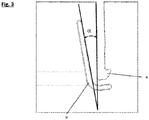
- the channel 9, seen in the profile cross-section is oriented obliquely to the ridge-shaped projection 4, the channel 9 and the ridge-shaped projection 4 enclosing an angle ⁇ of 8 ° -15 ° with one another.
Landscapes
- Engineering & Computer Science (AREA)
- Mechanical Engineering (AREA)
- Physics & Mathematics (AREA)
- Thermal Sciences (AREA)
- Extrusion Moulding Of Plastics Or The Like (AREA)
Abstract
Description
- Die Erfindung betrifft ein Verfahren zur Herstellung eines Kunststoff-Profils mit mindestens einem stegförmigen Vorsprung, insbesondere eines Fenster- oder Tür-Hohlkammerprofiles, mittels eines Extrusionsverfahrens,
- wobei im Rahmen des Extrusionsverfahrens zur Profilformgebung Kunststoffschmelze durch ein Extrusionswerkzeug geführt wird,
- wobei während des Extrusionsverfahrens in mindestens einer Temperiersektion des Extrusionswerkzeugs eine gezielt lokale Beeinflussung der Wandstärke des Kunststoff-Extrusionsprofils durch Temperierung erfolgt,
- wobei die Temperiersektion einem einzelnen stegförmigen Vorsprung des Kunststoff-Extrusionsprofils zugeordnet ist, und
- wobei zur lokalen Beeinflussung der Wandstärke pro Temperiersektion mindestens eine Temperiervorrichtung im Extrusionswerkzeug vorgesehen ist, mittels derer die Innenwandung des Extrusionswerkzeugs in der Temperiersektion gezielt beheizt und/oder gekühlt werden kann.
- Ein derartiges Verfahren ist aus der
WO 2012 / 143373 A1 bekannt. Die genannte Druckschrift beschäftigt sich mit der Extrusion von Fensterrahmenprofilen. Derartige Profile weisen regelmäßig sogenannte Mauerhaken auf, welche zur Verankerung des Fensterrahmens im Mauerwerk dienen. Aus Stabilitätsgründen muss sichergestellt sein, dass diese Mauerhaken eine vorgegebene Wandstärke nicht unterschreiten. Um dies zu gewährleisten, ist es bei einer Standardextrusion erforderlich, dass Profil insgesamt mit einer ausreichend großen Wandstärke herzustellen, um die geforderte Dimensionierung der Mauerhaken sicherzustellen. Dies führt regelmäßig dazu, dass das gesamte Profil vergleichsweise "dick" hergestellt werden muss und dadurch mehr Kunststoffmaterial verbraucht wird, als es eigentlich notwendig wäre. Zur Lösung dieses Problems schlägt die genannte Druckschrift vor, lokal - im konkret genannten Fall beispielsweise im Bereich der Mauerhaken - eine gezielte Temperierung des Werkzeugs vorzunehmen, um durch ein entsprechendes Heizen bzw. Kühlen lediglich die Wandstärke der Mauerhaken zu beeinflussen, wohingegen die Profilstärke des restlichen Fensterrahmenprofils hiervon praktisch unbeeinflusst bleibt. Durch eine Beheizung der entsprechenden Sektion im Werkzeug wird die Viskosität der Kunststoffschmelze lediglich lokal reduziert und dadurch der Schmelzefluss dort erhöht, was sich in einer lediglich lokal erhöhten Wandstärke niederschlägt. Bei einer Kühlung hingegen reduziert sich die Wandstärke lokal entsprechend. Durch die so erzielbare gezielte Beeinflussung der Wandstärke des Profils lediglich im Bereich der Mauerhaken soll insgesamt eine nicht unerhebliche Materialeinsparung realisiert werden. Gleiches gilt entsprechend für andere Bereiche der Extrusionsprofile, die stegförmig ausgebildet sind. Nachteilig bei dem vorgenannten Verfahren ist jedoch, dass dieses den konkreten geometrischen Anforderungen hinsichtlich der Mauerhaken bzw. anderer stegförmiger Bereiche des Profilquerschnitts im Einzelfall nicht genügend Rechnung trägt und somit der Effekt der Materialeinsparung begrenzt ist. - Vor diesem Hintergrund liegt der Erfindung die Aufgabe zugrunde, ein Verfahren mit den eingangs beschriebenen Merkmalen anzugeben, welches eine verbesserte lokale Temperierung ermöglicht.
- Erfindungsgemäß wird diese Aufgabe dadurch gelöst, dass die Temperiervorrichtung als von einem Heiz- bzw. Kühlmedium durchströmbarer Kanal ausgebildet ist, der im Profilquerschnitt gesehen eine Krümmung aufweist und hierdurch an die Endkontur des stegförmigen Vorsprungs angepasst ist. Die Krümmung erstreckt sich zweckmäßigerweise über einen Winkel von mindestens 30°, vorzugsweise mindestens 45°, z.B. mindestens 90°. Mithilfe der erfindungsgemäßen Lehre ist es möglich, innerhalb einer Temperiersektion eine wesentlich genauer an die jeweiligen Anforderungen angepasste und damit exaktere Steuerung bzw. Regelung der entsprechenden Wandstärke des einzelnen stegförmigen Vorsprungs vorzunehmen. Hierdurch lässt sich das Potenzial der Materialeinsparung bei der Herstellung des Extrusionprofils sehr gut ausschöpfen. Bei dem Heiz-bzw. Kühlmedium kann es sich um eine Flüssigkeit, beispielsweise Wasser oder Öl, oder aber auch um ein Gas, beispielsweise Luft, handeln.
- Zweckmäßigerweise weist der Kanal im Profilquerschnitt gesehen eine Erstreckung von mindestens 22 mm auf. Der Kanal kann in einen in das Extrusionswerkzeug einschiebbaren Einsatz der Temperiersektion integriert sein, der die Wärme des Heizmediums bzw. die Kälte des Kühlmediums an die Innenwandung des Extrusionswerkzeugs herantransportiert. Der Einsatz besteht zweckmäßigerweise aus einem Material mit hoher Wärmeleitfähigkeit λ > 100 W/mK, z.B. einem Metall, insbesondere Kupfer, einer Kupferlegierung oder Aluminium.
- Vorzugsweise beträgt die Erstreckung des Kanals in Extrusionsrichtung gesehen weniger als 20 mm, vorzugsweise weniger als 18 mm. Diese kurze axiale Erstreckung gewährleistet eine gleichmäßige Temperierung in Extrusionsrichtung, vereinfacht den konstruktiven Aufwand und ist hinsichtlich der Beeinflussung der Dimensionierung des entsprechenden Abschnittes des Extrusionsprofils ausreichend.
- Im Rahmen der Erfindung liegt es ferner, dass der Kanal im Profilquerschnitt gesehen schräg zum steqförmigen Vorsprung ausgerichtet ist. Vorzugsweise schließen hierbei der Kanal und der stegförmige Vorsprung miteinander einen Winkel von 5° - 30°, vorzugsweise von 8° - 15°, ein. Hierdurch ist eine differenzierte Kühlung bzw. Beheizung möglich, die an die konkreten Anforderungen hinsichtlich der Wandstärke des stegförmigen Vorsprungs anpassbar ist.
- Gegenstand der Erfindung ist auch ein Kunststoff-Profil, welches mit dem vorstehend beschriebenen erfindungsgemäßen Verfahren hergestellt wurde.
- Im Folgenden wird die Erfindung anhand einer lediglich ein Ausführungsbeispiel darstellenden Zeichnung ausführlich erläutert. Es zeigen schematisch:
- Fig. 1
- eine Kombination aus Fensterflügel und Fensterrahmen im Querschnitt gesehen
- Fig.2a
- die Darstellung eines erfindungsgemäßen Verfahrens anhand einer Querschnittsdarstellung des entsprechenden Extrusionswerkzeugs,
- Fig.2b
- das Ausführungsbeispiel gemäß
Fig. 2a in einer dreidimensionalen Darstellung und - Fig. 3
- eine weitere Ausführungsform der Erfindung in einer der
Fig. 2 entsprechenden Darstellung. - Die
Figur 1 zeigt im Querschnitt gesehen eine Kombination aus einem Fensterflügel 1 und einem Fensterrahmen 2, wobei sowohl Fensterflügel 1 als auch Fensterrahmen 2 jeweils mittels eines Kunststoff-Extrusionsverfahrens hergestellt wurden. Es ist erkennbar, dass sowohl das Fensterflügel-Profil 1 als auch das Fensterrahmen-Profil 2 jeweils eine vergleichsweise komplexe Geometrie aufweisen über eine Vielzahl von Hohlkammern 3 verfügen. Beim Fensterrahmen 2 ist ferner erkennbar, dass dieser an seinem unteren Ende über insgesamt fünf sogenannte Mauerhaken 4 verfügt, welche zur mechanischen Befestigung des Fensterrahmens 2 im (nicht dargestellten) Mauerwerk eines Gebäudes dienen. Diese Mauerhaken 4 müssen aus Festigkeitsgründen eine bestimmte Mindeststärke aufweisen. - Um während des Extrusionsverfahrens die Geometrie der Mauerhaken 4, insbesondere deren Wandstärke genau zu steuern bzw. zu regeln, wird das in den
Figuren 2a und 2b bzw. inFig. 3 dargestellte erfindungsgemäße Herstellungsverfahren eingesetzt. DieFig. 2a zeigt ausschnittsweise ein Extrusionswerkzeug 5, mit dem das inFig. 1 dargestellte Fensterrahmenprofil 2 hergestellt wird. Zu erkennen ist inFig. 2 das Extrusionswerkzeug 5 im Bereich des Mauerhakens 4 inFig. 1 links unten, der dort durch einen gestrichelten Kreis hervorgehoben ist. Beim Extrusionsverfahren wird zur Profilformgebung Kunststoffschmelze durch das Extrusionswerkzeug 5 geführt. Im Extrusionswerkzeug 5 ist für alle fünf Mauerhaken 4 - also für jeden entsprechenden einzelnen stegförmigen Vorsprung - jeweils eine Temperiersektion 6 vorgesehen, von denen inFig. 2 entsprechend diejenige für den inFig. 1 hervorgehobenen Mauerhaken 4 links unten dargestellt ist. Während des Extrusionsverfahrens erfolgt in jeder Temperiersektion 6 des Extrusionswerkzeugs 5 eine gezielt lokale Beeinflussung der Wandstärke eines einzelnen stegförmigen Vorsprungs des Kunststoff-Extrusionsprofils 2 - hier also der einzelnen Mauerhaken 4 - durch Temperierung, wobei gattungsgemäß zur lokalen Beeinflussung der Wandstärke pro Temperiersektion 6 mindestens eine Temperiervorrichtung 7 im Extrusionswerkzeug 5 vorgesehen ist, mittels derer die Innenwandung des Extrusionswerkzeugs 5 in der Temperiersektion 6 gezielt beheizt und/oder gekühlt werden kann. Erfindungsgemäß ist nun die Temperiervorrichtung 7 als von einem Heiz- bzw. Kühlmedium durchströmbarer Kanal 9 ausgebildet, der im Profilquerschnitt gesehen eine Krümmung aufweist und hierdurch an die Endkontur der stegförmigen Vorsprünge, also der Mauerhaken 4 angepasst ist. Im Ausführungsbeispiel beträgt die Krümmung mehr als 90°. Der Kanal 9 weist im Profilquerschnitt gesehen eine (im unteren Endbereich entlang der Krümmung verlaufende) Erstreckung von mindestens h = 22 mm auf. Dies bedeutet im Ausführungsbeispiel, dass auch die inFig. 2b dargestellte, vom Kanal 9 überdeckte Abwicklung A des Endbereichs des stegförmigen Vorsprungs 4 eine Erstreckung von mindestens 22 mm besitzt. Die Erstreckung des Kanals 9 in Extrusionsrichtung gesehen (also aus der Zeichenebene inFig. 2 herauszeigend) beträgt hingegen im Ausführungsbeispiel weniger als L = 18 mm (s.Fig. 2b ). - Anhand der
Fig. 2b ist erkennbar, dass der Kanal 9 jeweils mit einem Zulauf 10 und einem Ablauf 11 versehen ist, durch den das fluide Heizmedium bzw. das fluide Kühlmedium zum Kanal 9 transportiert bzw. von diesem weg transportiert wird. - Beim Ausführungsbeispiel gemäß
Fig. 3 ist der Kanal 9 im Profilquerschnitt gesehen schräg zum steqförmigen Vorsprung 4 ausgerichtet, wobei der Kanal 9 und der stegförmige Vorsprung 4 miteinander einen Winkel α von 8° - 15° einschließen.
Claims (7)
- Verfahren zur Herstellung eines Kunststoff-Profils (2) mit mindestens einem stegförmigen Vorsprung (4), insbesondere eines Fenster- oder Tür-Hohlkammerprofiles (1), mittels eines Extrusionsverfahrens,- wobei im Rahmen des Extrusionsverfahrens zur Profilformgebung Kunststoffschmelze durch ein Extrusionswerkzeug (5) geführt wird,- wobei während des Extrusionsverfahrens in mindestens einer Temperiersektion (6) des Extrusionswerkzeugs (5) eine gezielt lokale Beeinflussung der Wandstärke des Kunststoff-Extrusionsprofils (2) durch Temperierung erfolgt,- wobei die Temperiersektion (6) einem einzelnen stegförmigen Vorsprung (4) des Kunststoff-Extrusionsprofils (2) zugeordent ist, und- wobei zur lokalen Beeinflussung der Wandstärke pro Temperiersektion (6) mindestens eine Temperiervorrichtung (7) im Extrusionswerkzeug (5) vorgesehen ist, mittels derer die Innenwandung des Extrusionswerkzeugs (5) in der Temperiersektion (6) gezielt beheizt und/oder gekühlt werden kann,dadurch gekennzeichnet, dass die Temperiervorrichtung (7) als von einem Heiz- bzw. Kühlmedium durchströmbarer Kanal (9) ausgebildet ist, der im Profilquerschnitt gesehen eine Krümmung aufweist und hierdurch an die Endkontur des stegförmigen Vorsprungs (4) angepasst ist.
- Verfahren nach Anspruch 1, dadurch gekennzeichnet, dass der Kanal (9) im Profilquerschnitt gesehen eine Erstreckung von mindestens h = 22 mm aufweist.
- Verfahren nach Anspruch 1 oder 2, dadurch gekennzeichnet, dass der Kanal (9) in einen in das Extrusionswerkzeug (5) einschiebbaren Einsatz (12) der Temperiersektion (6) integriert ist, der die Wärme des Heizmediums bzw. die Kälte des Kühlmediums an die Innenwandung des Extrusionswerkzeugs (5) herantransportiert.
- Verfahren nach einem der Ansprüche 1 bis 3, dadurch gekennzeichnet, dass die Erstreckung des Kanals (9) in Extrusionsrichtung gesehen weniger als L = 20 mm, vorzugsweise weniger als L = 18 mm, beträgt.
- Verfahren nach einem der Ansprüche 1 bis 4, dadurch gekennzeichnet, dass der Kanal (9) im Profilquerschnitt gesehen schräg zum steqförmigen Vorsprung (4) ausgerichtet ist.
- Verfahren nach Anspruch 5, dadurch gekennzeichnet, dass der Kanal (9) und der stegförmige Vorsprung (4) miteinander einen Winkel von 5° - 30°, vorzugsweise von 8° - 15°, einschließen.
- Kunststoff-Profil (2), hergestellt mit einem Verfahren nach einem der Ansprüche 1 bis 6.
Applications Claiming Priority (1)
| Application Number | Priority Date | Filing Date | Title |
|---|---|---|---|
| DE102019133360.1A DE102019133360A1 (de) | 2019-12-06 | 2019-12-06 | Verfahren zur Herstellung eines Kunststoff-Profils |
Publications (3)
| Publication Number | Publication Date |
|---|---|
| EP3831570A1 true EP3831570A1 (de) | 2021-06-09 |
| EP3831570B1 EP3831570B1 (de) | 2023-07-12 |
| EP3831570C0 EP3831570C0 (de) | 2023-07-12 |
Family
ID=73694735
Family Applications (1)
| Application Number | Title | Priority Date | Filing Date |
|---|---|---|---|
| EP20211025.0A Active EP3831570B1 (de) | 2019-12-06 | 2020-12-01 | Verfahren zur herstellung eines kunststoff-profils |
Country Status (4)
| Country | Link |
|---|---|
| EP (1) | EP3831570B1 (de) |
| DE (1) | DE102019133360A1 (de) |
| ES (1) | ES2956264T3 (de) |
| PL (1) | PL3831570T3 (de) |
Citations (4)
| Publication number | Priority date | Publication date | Assignee | Title |
|---|---|---|---|---|
| DE3937273A1 (de) * | 1988-11-18 | 1990-05-31 | Cincinnati Milacron Austria | Verfahren zum herstellen von rohren und profilen aus thermoplastischen kunststoffmassen |
| DE202007014876U1 (de) * | 2007-10-23 | 2007-12-20 | Krauss Maffei Gmbh | Extrusionswerkzeug mit Temperierung |
| DE102008047210B4 (de) * | 2008-09-15 | 2011-07-21 | Battenfeld-Cincinnati Austria Gmbh | Extrusionslinie und Verfahren zum Kühlen von Kunststoffprofilen |
| WO2012143373A1 (de) | 2011-04-18 | 2012-10-26 | Greiner Tool.Tec Gmbh | Extrusionsvorrichtung und verfahren zur beeinflussung von wanddicken eines extrudierten kunststoffprofils |
-
2019
- 2019-12-06 DE DE102019133360.1A patent/DE102019133360A1/de not_active Withdrawn
-
2020
- 2020-12-01 ES ES20211025T patent/ES2956264T3/es active Active
- 2020-12-01 EP EP20211025.0A patent/EP3831570B1/de active Active
- 2020-12-01 PL PL20211025.0T patent/PL3831570T3/pl unknown
Patent Citations (4)
| Publication number | Priority date | Publication date | Assignee | Title |
|---|---|---|---|---|
| DE3937273A1 (de) * | 1988-11-18 | 1990-05-31 | Cincinnati Milacron Austria | Verfahren zum herstellen von rohren und profilen aus thermoplastischen kunststoffmassen |
| DE202007014876U1 (de) * | 2007-10-23 | 2007-12-20 | Krauss Maffei Gmbh | Extrusionswerkzeug mit Temperierung |
| DE102008047210B4 (de) * | 2008-09-15 | 2011-07-21 | Battenfeld-Cincinnati Austria Gmbh | Extrusionslinie und Verfahren zum Kühlen von Kunststoffprofilen |
| WO2012143373A1 (de) | 2011-04-18 | 2012-10-26 | Greiner Tool.Tec Gmbh | Extrusionsvorrichtung und verfahren zur beeinflussung von wanddicken eines extrudierten kunststoffprofils |
Also Published As
| Publication number | Publication date |
|---|---|
| DE102019133360A1 (de) | 2021-06-10 |
| PL3831570T3 (pl) | 2023-12-27 |
| EP3831570B1 (de) | 2023-07-12 |
| EP3831570C0 (de) | 2023-07-12 |
| ES2956264T3 (es) | 2023-12-18 |
Similar Documents
| Publication | Publication Date | Title |
|---|---|---|
| EP3216544B1 (de) | Druckgussbauteil sowie verfahren zur herstellung eines druckgussbauteils | |
| DE69634308T2 (de) | Verfahren zum kontinuierlichen herstellen von profilierten teilen und vorrichtung zum durchführen des verfahrens | |
| EP3831570B1 (de) | Verfahren zur herstellung eines kunststoff-profils | |
| DE602005004996T2 (de) | Verfahren zur Herstellung eines Hochdruckrohrteils und Hochdruckrohrteil | |
| EP3831569B1 (de) | Verfahren zur herstellung eines kunststoffprofils | |
| DE2303699C3 (de) | Flüssigkeitsgekühltes Auslaßventil für eine Brennkraftmaschine und Herstellungsverfahren | |
| AT504806B1 (de) | Zarge für feuerschutztüren, welche aus mehreren parallel verlaufenden teilprofilen gebildet wird | |
| DE102013101790A1 (de) | Temperiervorrichtung, Anlage zur Temperierung und Verfahren zur Temperierung | |
| EP3010740A1 (de) | Verstärkungselement für eine kraftfahrzeugtür, kraftfahrzeugtür und verfahren zur herstellung eines verstärkungselements | |
| DE112018004481B4 (de) | Verfahren zum Herstellen einer Tankheizung sowie Tankheizung | |
| DE102017001528A1 (de) | Formwerkzeug | |
| EP3219401B1 (de) | Stranggepresstes profil | |
| DE102007040028A1 (de) | Werkzeug für das Warmumformen oder Presshärten eines Metallblechs | |
| EP1154115A1 (de) | Ausschäumbares Hohlprofil | |
| DE102004029588B4 (de) | Verfahren zur Herstellung von Profilen aus Magnesiumwerkstoffen | |
| DE20121281U1 (de) | Bauelement und Verwendung eines Trägers | |
| DE202007005298U1 (de) | Tür, Metallkonstruktionsprofil für eine Zarge oder einen Rahmen für eine Tür oder ein Fenster | |
| DE102013008632A1 (de) | Verfahren und Einrichtung zum Trennen von Hohlkammerprofilen | |
| DE102012220300A1 (de) | Verfahren für die Herstellung einer Stanznietverbindung | |
| EP2098812A2 (de) | Flachheiz- oder -kühlkörper und Verfahren zur Herstellung eines Flachheiz- oder -kühlkörpers | |
| EP2607599A1 (de) | Hohlprofil für einen Rahmen | |
| EP1837095A2 (de) | Metallprofil für Rahmenkonstruktionen von Fenster-, Tür- oder Fassadenelementen sowie Verfahren zur Herstellung desselben | |
| DE102014105440A1 (de) | Sicherungsschiene zum Einbau in Fahrzeuge | |
| DE1262107B (de) | Verfahren zur spanlosen Herstellung einer hohlen, geraden oder gewundenen Verdichterschaufel aus Leichtmetall | |
| DE2041399C3 (de) | Pressengesenk zum Runden von U-förmig vorgebogenen Blechzuschnitten |
Legal Events
| Date | Code | Title | Description |
|---|---|---|---|
| PUAI | Public reference made under article 153(3) epc to a published international application that has entered the european phase |
Free format text: ORIGINAL CODE: 0009012 |
|
| STAA | Information on the status of an ep patent application or granted ep patent |
Free format text: STATUS: THE APPLICATION HAS BEEN PUBLISHED |
|
| AK | Designated contracting states |
Kind code of ref document: A1 Designated state(s): AL AT BE BG CH CY CZ DE DK EE ES FI FR GB GR HR HU IE IS IT LI LT LU LV MC MK MT NL NO PL PT RO RS SE SI SK SM TR |
|
| STAA | Information on the status of an ep patent application or granted ep patent |
Free format text: STATUS: REQUEST FOR EXAMINATION WAS MADE |
|
| 17P | Request for examination filed |
Effective date: 20211206 |
|
| RBV | Designated contracting states (corrected) |
Designated state(s): AL AT BE BG CH CY CZ DE DK EE ES FI FR GB GR HR HU IE IS IT LI LT LU LV MC MK MT NL NO PL PT RO RS SE SI SK SM TR |
|
| RAP1 | Party data changed (applicant data changed or rights of an application transferred) |
Owner name: REHAU INDUSTRIES SE & CO. KG |
|
| RAP3 | Party data changed (applicant data changed or rights of an application transferred) |
Owner name: REHAU INDUSTRIES SE & CO. KG |
|
| GRAP | Despatch of communication of intention to grant a patent |
Free format text: ORIGINAL CODE: EPIDOSNIGR1 |
|
| STAA | Information on the status of an ep patent application or granted ep patent |
Free format text: STATUS: GRANT OF PATENT IS INTENDED |
|
| RIC1 | Information provided on ipc code assigned before grant |
Ipc: B29C 48/30 20190101ALN20230207BHEP Ipc: B29C 48/11 20190101ALN20230207BHEP Ipc: B29L 31/00 20060101ALN20230207BHEP Ipc: B29C 48/87 20190101ALI20230207BHEP Ipc: B29C 48/12 20190101AFI20230207BHEP |
|
| INTG | Intention to grant announced |
Effective date: 20230227 |
|
| GRAS | Grant fee paid |
Free format text: ORIGINAL CODE: EPIDOSNIGR3 |
|
| GRAA | (expected) grant |
Free format text: ORIGINAL CODE: 0009210 |
|
| STAA | Information on the status of an ep patent application or granted ep patent |
Free format text: STATUS: THE PATENT HAS BEEN GRANTED |
|
| AK | Designated contracting states |
Kind code of ref document: B1 Designated state(s): AL AT BE BG CH CY CZ DE DK EE ES FI FR GB GR HR HU IE IS IT LI LT LU LV MC MK MT NL NO PL PT RO RS SE SI SK SM TR |
|
| REG | Reference to a national code |
Ref country code: CH Ref legal event code: EP |
|
| REG | Reference to a national code |
Ref country code: DE Ref legal event code: R096 Ref document number: 502020004136 Country of ref document: DE |
|
| REG | Reference to a national code |
Ref country code: IE Ref legal event code: FG4D Free format text: LANGUAGE OF EP DOCUMENT: GERMAN |
|
| U01 | Request for unitary effect filed |
Effective date: 20230718 |
|
| U07 | Unitary effect registered |
Designated state(s): AT BE BG DE DK EE FI FR IT LT LU LV MT NL PT SE SI Effective date: 20230727 |
|
| REG | Reference to a national code |
Ref country code: LT Ref legal event code: MG9D |
|
| REG | Reference to a national code |
Ref country code: ES Ref legal event code: FG2A Ref document number: 2956264 Country of ref document: ES Kind code of ref document: T3 Effective date: 20231218 |
|
| U20 | Renewal fee for the european patent with unitary effect paid |
Year of fee payment: 4 Effective date: 20231211 |
|
| PG25 | Lapsed in a contracting state [announced via postgrant information from national office to epo] |
Ref country code: GR Free format text: LAPSE BECAUSE OF FAILURE TO SUBMIT A TRANSLATION OF THE DESCRIPTION OR TO PAY THE FEE WITHIN THE PRESCRIBED TIME-LIMIT Effective date: 20231013 |
|
| PG25 | Lapsed in a contracting state [announced via postgrant information from national office to epo] |
Ref country code: IS Free format text: LAPSE BECAUSE OF FAILURE TO SUBMIT A TRANSLATION OF THE DESCRIPTION OR TO PAY THE FEE WITHIN THE PRESCRIBED TIME-LIMIT Effective date: 20231112 |
|
| PG25 | Lapsed in a contracting state [announced via postgrant information from national office to epo] |
Ref country code: RS Free format text: LAPSE BECAUSE OF FAILURE TO SUBMIT A TRANSLATION OF THE DESCRIPTION OR TO PAY THE FEE WITHIN THE PRESCRIBED TIME-LIMIT Effective date: 20230712 Ref country code: NO Free format text: LAPSE BECAUSE OF FAILURE TO SUBMIT A TRANSLATION OF THE DESCRIPTION OR TO PAY THE FEE WITHIN THE PRESCRIBED TIME-LIMIT Effective date: 20231012 Ref country code: IS Free format text: LAPSE BECAUSE OF FAILURE TO SUBMIT A TRANSLATION OF THE DESCRIPTION OR TO PAY THE FEE WITHIN THE PRESCRIBED TIME-LIMIT Effective date: 20231112 Ref country code: HR Free format text: LAPSE BECAUSE OF FAILURE TO SUBMIT A TRANSLATION OF THE DESCRIPTION OR TO PAY THE FEE WITHIN THE PRESCRIBED TIME-LIMIT Effective date: 20230712 Ref country code: GR Free format text: LAPSE BECAUSE OF FAILURE TO SUBMIT A TRANSLATION OF THE DESCRIPTION OR TO PAY THE FEE WITHIN THE PRESCRIBED TIME-LIMIT Effective date: 20231013 |
|
| REG | Reference to a national code |
Ref country code: DE Ref legal event code: R097 Ref document number: 502020004136 Country of ref document: DE |
|
| PG25 | Lapsed in a contracting state [announced via postgrant information from national office to epo] |
Ref country code: SM Free format text: LAPSE BECAUSE OF FAILURE TO SUBMIT A TRANSLATION OF THE DESCRIPTION OR TO PAY THE FEE WITHIN THE PRESCRIBED TIME-LIMIT Effective date: 20230712 Ref country code: SK Free format text: LAPSE BECAUSE OF FAILURE TO SUBMIT A TRANSLATION OF THE DESCRIPTION OR TO PAY THE FEE WITHIN THE PRESCRIBED TIME-LIMIT Effective date: 20230712 |
|
| PLBE | No opposition filed within time limit |
Free format text: ORIGINAL CODE: 0009261 |
|
| STAA | Information on the status of an ep patent application or granted ep patent |
Free format text: STATUS: NO OPPOSITION FILED WITHIN TIME LIMIT |
|
| 26N | No opposition filed |
Effective date: 20240415 |
|
| REG | Reference to a national code |
Ref country code: CH Ref legal event code: PL |
|
| PG25 | Lapsed in a contracting state [announced via postgrant information from national office to epo] |
Ref country code: MC Free format text: LAPSE BECAUSE OF FAILURE TO SUBMIT A TRANSLATION OF THE DESCRIPTION OR TO PAY THE FEE WITHIN THE PRESCRIBED TIME-LIMIT Effective date: 20230712 |
|
| PG25 | Lapsed in a contracting state [announced via postgrant information from national office to epo] |
Ref country code: MC Free format text: LAPSE BECAUSE OF FAILURE TO SUBMIT A TRANSLATION OF THE DESCRIPTION OR TO PAY THE FEE WITHIN THE PRESCRIBED TIME-LIMIT Effective date: 20230712 |
|
| REG | Reference to a national code |
Ref country code: IE Ref legal event code: MM4A |
|
| PG25 | Lapsed in a contracting state [announced via postgrant information from national office to epo] |
Ref country code: IE Free format text: LAPSE BECAUSE OF NON-PAYMENT OF DUE FEES Effective date: 20231201 |
|
| PG25 | Lapsed in a contracting state [announced via postgrant information from national office to epo] |
Ref country code: CH Free format text: LAPSE BECAUSE OF NON-PAYMENT OF DUE FEES Effective date: 20231231 |
|
| PG25 | Lapsed in a contracting state [announced via postgrant information from national office to epo] |
Ref country code: IE Free format text: LAPSE BECAUSE OF NON-PAYMENT OF DUE FEES Effective date: 20231201 Ref country code: CH Free format text: LAPSE BECAUSE OF NON-PAYMENT OF DUE FEES Effective date: 20231231 |
|
| U20 | Renewal fee for the european patent with unitary effect paid |
Year of fee payment: 5 Effective date: 20241204 |
|
| PGFP | Annual fee paid to national office [announced via postgrant information from national office to epo] |
Ref country code: PL Payment date: 20241025 Year of fee payment: 5 |
|
| PGFP | Annual fee paid to national office [announced via postgrant information from national office to epo] |
Ref country code: GB Payment date: 20241202 Year of fee payment: 5 |
|
| PGFP | Annual fee paid to national office [announced via postgrant information from national office to epo] |
Ref country code: CZ Payment date: 20241025 Year of fee payment: 5 |
|
| PGFP | Annual fee paid to national office [announced via postgrant information from national office to epo] |
Ref country code: RO Payment date: 20241126 Year of fee payment: 5 |
|
| PGFP | Annual fee paid to national office [announced via postgrant information from national office to epo] |
Ref country code: ES Payment date: 20250102 Year of fee payment: 5 |
|
| PG25 | Lapsed in a contracting state [announced via postgrant information from national office to epo] |
Ref country code: CY Free format text: LAPSE BECAUSE OF FAILURE TO SUBMIT A TRANSLATION OF THE DESCRIPTION OR TO PAY THE FEE WITHIN THE PRESCRIBED TIME-LIMIT; INVALID AB INITIO Effective date: 20201201 |
|
| PG25 | Lapsed in a contracting state [announced via postgrant information from national office to epo] |
Ref country code: HU Free format text: LAPSE BECAUSE OF FAILURE TO SUBMIT A TRANSLATION OF THE DESCRIPTION OR TO PAY THE FEE WITHIN THE PRESCRIBED TIME-LIMIT; INVALID AB INITIO Effective date: 20201201 |
|
| PG25 | Lapsed in a contracting state [announced via postgrant information from national office to epo] |
Ref country code: TR Free format text: LAPSE BECAUSE OF FAILURE TO SUBMIT A TRANSLATION OF THE DESCRIPTION OR TO PAY THE FEE WITHIN THE PRESCRIBED TIME-LIMIT Effective date: 20230712 |
|
| U20 | Renewal fee for the european patent with unitary effect paid |
Year of fee payment: 6 Effective date: 20251125 |
|
| PG25 | Lapsed in a contracting state [announced via postgrant information from national office to epo] |
Ref country code: RO Free format text: LAPSE BECAUSE OF NON-PAYMENT OF DUE FEES Effective date: 20251201 |
|
| PG25 | Lapsed in a contracting state [announced via postgrant information from national office to epo] |
Ref country code: CZ Free format text: LAPSE BECAUSE OF NON-PAYMENT OF DUE FEES Effective date: 20251201 |