EP3823944B1 - Kugelstrahlverfahren - Google Patents
Kugelstrahlverfahren Download PDFInfo
- Publication number
- EP3823944B1 EP3823944B1 EP19740029.4A EP19740029A EP3823944B1 EP 3823944 B1 EP3823944 B1 EP 3823944B1 EP 19740029 A EP19740029 A EP 19740029A EP 3823944 B1 EP3823944 B1 EP 3823944B1
- Authority
- EP
- European Patent Office
- Prior art keywords
- powder
- oxides
- less
- inférieure
- préférence
- Prior art date
- Legal status (The legal status is an assumption and is not a legal conclusion. Google has not performed a legal analysis and makes no representation as to the accuracy of the status listed.)
- Active
Links
Images
Classifications
-
- B—PERFORMING OPERATIONS; TRANSPORTING
- B24—GRINDING; POLISHING
- B24C—ABRASIVE OR RELATED BLASTING WITH PARTICULATE MATERIAL
- B24C1/00—Methods for use of abrasive blasting for producing particular effects; Use of auxiliary equipment in connection with such methods
- B24C1/10—Methods for use of abrasive blasting for producing particular effects; Use of auxiliary equipment in connection with such methods for compacting surfaces, e.g. shot-peening
-
- C—CHEMISTRY; METALLURGY
- C09—DYES; PAINTS; POLISHES; NATURAL RESINS; ADHESIVES; COMPOSITIONS NOT OTHERWISE PROVIDED FOR; APPLICATIONS OF MATERIALS NOT OTHERWISE PROVIDED FOR
- C09K—MATERIALS FOR MISCELLANEOUS APPLICATIONS, NOT PROVIDED FOR ELSEWHERE
- C09K3/00—Materials not provided for elsewhere
- C09K3/14—Anti-slip materials; Abrasives
- C09K3/1409—Abrasive particles per se
- C09K3/1418—Abrasive particles per se obtained by division of a mass agglomerated by sintering
-
- B—PERFORMING OPERATIONS; TRANSPORTING
- B24—GRINDING; POLISHING
- B24C—ABRASIVE OR RELATED BLASTING WITH PARTICULATE MATERIAL
- B24C11/00—Selection of abrasive materials or additives for abrasive blasts
-
- C—CHEMISTRY; METALLURGY
- C04—CEMENTS; CONCRETE; ARTIFICIAL STONE; CERAMICS; REFRACTORIES
- C04B—LIME, MAGNESIA; SLAG; CEMENTS; COMPOSITIONS THEREOF, e.g. MORTARS, CONCRETE OR LIKE BUILDING MATERIALS; ARTIFICIAL STONE; CERAMICS; REFRACTORIES; TREATMENT OF NATURAL STONE
- C04B35/00—Shaped ceramic products characterised by their composition; Ceramics compositions; Processing powders of inorganic compounds preparatory to the manufacturing of ceramic products
- C04B35/01—Shaped ceramic products characterised by their composition; Ceramics compositions; Processing powders of inorganic compounds preparatory to the manufacturing of ceramic products based on oxide ceramics
- C04B35/48—Shaped ceramic products characterised by their composition; Ceramics compositions; Processing powders of inorganic compounds preparatory to the manufacturing of ceramic products based on oxide ceramics based on zirconium or hafnium oxides, zirconates, zircon or hafnates
- C04B35/486—Fine ceramics
- C04B35/488—Composites
- C04B35/4885—Composites with aluminium oxide
-
- C—CHEMISTRY; METALLURGY
- C04—CEMENTS; CONCRETE; ARTIFICIAL STONE; CERAMICS; REFRACTORIES
- C04B—LIME, MAGNESIA; SLAG; CEMENTS; COMPOSITIONS THEREOF, e.g. MORTARS, CONCRETE OR LIKE BUILDING MATERIALS; ARTIFICIAL STONE; CERAMICS; REFRACTORIES; TREATMENT OF NATURAL STONE
- C04B35/00—Shaped ceramic products characterised by their composition; Ceramics compositions; Processing powders of inorganic compounds preparatory to the manufacturing of ceramic products
- C04B35/622—Forming processes; Processing powders of inorganic compounds preparatory to the manufacturing of ceramic products
- C04B35/624—Sol-gel processing
-
- C—CHEMISTRY; METALLURGY
- C04—CEMENTS; CONCRETE; ARTIFICIAL STONE; CERAMICS; REFRACTORIES
- C04B—LIME, MAGNESIA; SLAG; CEMENTS; COMPOSITIONS THEREOF, e.g. MORTARS, CONCRETE OR LIKE BUILDING MATERIALS; ARTIFICIAL STONE; CERAMICS; REFRACTORIES; TREATMENT OF NATURAL STONE
- C04B35/00—Shaped ceramic products characterised by their composition; Ceramics compositions; Processing powders of inorganic compounds preparatory to the manufacturing of ceramic products
- C04B35/622—Forming processes; Processing powders of inorganic compounds preparatory to the manufacturing of ceramic products
- C04B35/626—Preparing or treating the powders individually or as batches ; preparing or treating macroscopic reinforcing agents for ceramic products, e.g. fibres; mechanical aspects section B
- C04B35/62605—Treating the starting powders individually or as mixtures
- C04B35/6261—Milling
-
- C—CHEMISTRY; METALLURGY
- C04—CEMENTS; CONCRETE; ARTIFICIAL STONE; CERAMICS; REFRACTORIES
- C04B—LIME, MAGNESIA; SLAG; CEMENTS; COMPOSITIONS THEREOF, e.g. MORTARS, CONCRETE OR LIKE BUILDING MATERIALS; ARTIFICIAL STONE; CERAMICS; REFRACTORIES; TREATMENT OF NATURAL STONE
- C04B35/00—Shaped ceramic products characterised by their composition; Ceramics compositions; Processing powders of inorganic compounds preparatory to the manufacturing of ceramic products
- C04B35/622—Forming processes; Processing powders of inorganic compounds preparatory to the manufacturing of ceramic products
- C04B35/626—Preparing or treating the powders individually or as batches ; preparing or treating macroscopic reinforcing agents for ceramic products, e.g. fibres; mechanical aspects section B
- C04B35/62605—Treating the starting powders individually or as mixtures
- C04B35/62625—Wet mixtures
- C04B35/6264—Mixing media, e.g. organic solvents
-
- C—CHEMISTRY; METALLURGY
- C04—CEMENTS; CONCRETE; ARTIFICIAL STONE; CERAMICS; REFRACTORIES
- C04B—LIME, MAGNESIA; SLAG; CEMENTS; COMPOSITIONS THEREOF, e.g. MORTARS, CONCRETE OR LIKE BUILDING MATERIALS; ARTIFICIAL STONE; CERAMICS; REFRACTORIES; TREATMENT OF NATURAL STONE
- C04B35/00—Shaped ceramic products characterised by their composition; Ceramics compositions; Processing powders of inorganic compounds preparatory to the manufacturing of ceramic products
- C04B35/622—Forming processes; Processing powders of inorganic compounds preparatory to the manufacturing of ceramic products
- C04B35/626—Preparing or treating the powders individually or as batches ; preparing or treating macroscopic reinforcing agents for ceramic products, e.g. fibres; mechanical aspects section B
- C04B35/62605—Treating the starting powders individually or as mixtures
- C04B35/62695—Granulation or pelletising
-
- C—CHEMISTRY; METALLURGY
- C04—CEMENTS; CONCRETE; ARTIFICIAL STONE; CERAMICS; REFRACTORIES
- C04B—LIME, MAGNESIA; SLAG; CEMENTS; COMPOSITIONS THEREOF, e.g. MORTARS, CONCRETE OR LIKE BUILDING MATERIALS; ARTIFICIAL STONE; CERAMICS; REFRACTORIES; TREATMENT OF NATURAL STONE
- C04B35/00—Shaped ceramic products characterised by their composition; Ceramics compositions; Processing powders of inorganic compounds preparatory to the manufacturing of ceramic products
- C04B35/622—Forming processes; Processing powders of inorganic compounds preparatory to the manufacturing of ceramic products
- C04B35/626—Preparing or treating the powders individually or as batches ; preparing or treating macroscopic reinforcing agents for ceramic products, e.g. fibres; mechanical aspects section B
- C04B35/63—Preparing or treating the powders individually or as batches ; preparing or treating macroscopic reinforcing agents for ceramic products, e.g. fibres; mechanical aspects section B using additives specially adapted for forming the products, e.g.. binder binders
- C04B35/632—Organic additives
- C04B35/636—Polysaccharides or derivatives thereof
-
- C—CHEMISTRY; METALLURGY
- C04—CEMENTS; CONCRETE; ARTIFICIAL STONE; CERAMICS; REFRACTORIES
- C04B—LIME, MAGNESIA; SLAG; CEMENTS; COMPOSITIONS THEREOF, e.g. MORTARS, CONCRETE OR LIKE BUILDING MATERIALS; ARTIFICIAL STONE; CERAMICS; REFRACTORIES; TREATMENT OF NATURAL STONE
- C04B35/00—Shaped ceramic products characterised by their composition; Ceramics compositions; Processing powders of inorganic compounds preparatory to the manufacturing of ceramic products
- C04B35/622—Forming processes; Processing powders of inorganic compounds preparatory to the manufacturing of ceramic products
- C04B35/64—Burning or sintering processes
-
- C—CHEMISTRY; METALLURGY
- C09—DYES; PAINTS; POLISHES; NATURAL RESINS; ADHESIVES; COMPOSITIONS NOT OTHERWISE PROVIDED FOR; APPLICATIONS OF MATERIALS NOT OTHERWISE PROVIDED FOR
- C09K—MATERIALS FOR MISCELLANEOUS APPLICATIONS, NOT PROVIDED FOR ELSEWHERE
- C09K3/00—Materials not provided for elsewhere
- C09K3/14—Anti-slip materials; Abrasives
- C09K3/1436—Composite particles, e.g. coated particles
-
- C—CHEMISTRY; METALLURGY
- C04—CEMENTS; CONCRETE; ARTIFICIAL STONE; CERAMICS; REFRACTORIES
- C04B—LIME, MAGNESIA; SLAG; CEMENTS; COMPOSITIONS THEREOF, e.g. MORTARS, CONCRETE OR LIKE BUILDING MATERIALS; ARTIFICIAL STONE; CERAMICS; REFRACTORIES; TREATMENT OF NATURAL STONE
- C04B2235/00—Aspects relating to ceramic starting mixtures or sintered ceramic products
- C04B2235/02—Composition of constituents of the starting material or of secondary phases of the final product
- C04B2235/30—Constituents and secondary phases not being of a fibrous nature
- C04B2235/32—Metal oxides, mixed metal oxides, or oxide-forming salts thereof, e.g. carbonates, nitrates, (oxy)hydroxides, chlorides
- C04B2235/3205—Alkaline earth oxides or oxide forming salts thereof, e.g. beryllium oxide
- C04B2235/3208—Calcium oxide or oxide-forming salts thereof, e.g. lime
-
- C—CHEMISTRY; METALLURGY
- C04—CEMENTS; CONCRETE; ARTIFICIAL STONE; CERAMICS; REFRACTORIES
- C04B—LIME, MAGNESIA; SLAG; CEMENTS; COMPOSITIONS THEREOF, e.g. MORTARS, CONCRETE OR LIKE BUILDING MATERIALS; ARTIFICIAL STONE; CERAMICS; REFRACTORIES; TREATMENT OF NATURAL STONE
- C04B2235/00—Aspects relating to ceramic starting mixtures or sintered ceramic products
- C04B2235/02—Composition of constituents of the starting material or of secondary phases of the final product
- C04B2235/30—Constituents and secondary phases not being of a fibrous nature
- C04B2235/32—Metal oxides, mixed metal oxides, or oxide-forming salts thereof, e.g. carbonates, nitrates, (oxy)hydroxides, chlorides
- C04B2235/3205—Alkaline earth oxides or oxide forming salts thereof, e.g. beryllium oxide
- C04B2235/3213—Strontium oxides or oxide-forming salts thereof
-
- C—CHEMISTRY; METALLURGY
- C04—CEMENTS; CONCRETE; ARTIFICIAL STONE; CERAMICS; REFRACTORIES
- C04B—LIME, MAGNESIA; SLAG; CEMENTS; COMPOSITIONS THEREOF, e.g. MORTARS, CONCRETE OR LIKE BUILDING MATERIALS; ARTIFICIAL STONE; CERAMICS; REFRACTORIES; TREATMENT OF NATURAL STONE
- C04B2235/00—Aspects relating to ceramic starting mixtures or sintered ceramic products
- C04B2235/02—Composition of constituents of the starting material or of secondary phases of the final product
- C04B2235/30—Constituents and secondary phases not being of a fibrous nature
- C04B2235/32—Metal oxides, mixed metal oxides, or oxide-forming salts thereof, e.g. carbonates, nitrates, (oxy)hydroxides, chlorides
- C04B2235/3205—Alkaline earth oxides or oxide forming salts thereof, e.g. beryllium oxide
- C04B2235/3215—Barium oxides or oxide-forming salts thereof
-
- C—CHEMISTRY; METALLURGY
- C04—CEMENTS; CONCRETE; ARTIFICIAL STONE; CERAMICS; REFRACTORIES
- C04B—LIME, MAGNESIA; SLAG; CEMENTS; COMPOSITIONS THEREOF, e.g. MORTARS, CONCRETE OR LIKE BUILDING MATERIALS; ARTIFICIAL STONE; CERAMICS; REFRACTORIES; TREATMENT OF NATURAL STONE
- C04B2235/00—Aspects relating to ceramic starting mixtures or sintered ceramic products
- C04B2235/02—Composition of constituents of the starting material or of secondary phases of the final product
- C04B2235/30—Constituents and secondary phases not being of a fibrous nature
- C04B2235/32—Metal oxides, mixed metal oxides, or oxide-forming salts thereof, e.g. carbonates, nitrates, (oxy)hydroxides, chlorides
- C04B2235/3217—Aluminum oxide or oxide forming salts thereof, e.g. bauxite, alpha-alumina
-
- C—CHEMISTRY; METALLURGY
- C04—CEMENTS; CONCRETE; ARTIFICIAL STONE; CERAMICS; REFRACTORIES
- C04B—LIME, MAGNESIA; SLAG; CEMENTS; COMPOSITIONS THEREOF, e.g. MORTARS, CONCRETE OR LIKE BUILDING MATERIALS; ARTIFICIAL STONE; CERAMICS; REFRACTORIES; TREATMENT OF NATURAL STONE
- C04B2235/00—Aspects relating to ceramic starting mixtures or sintered ceramic products
- C04B2235/02—Composition of constituents of the starting material or of secondary phases of the final product
- C04B2235/30—Constituents and secondary phases not being of a fibrous nature
- C04B2235/32—Metal oxides, mixed metal oxides, or oxide-forming salts thereof, e.g. carbonates, nitrates, (oxy)hydroxides, chlorides
- C04B2235/3224—Rare earth oxide or oxide forming salts thereof, e.g. scandium oxide
-
- C—CHEMISTRY; METALLURGY
- C04—CEMENTS; CONCRETE; ARTIFICIAL STONE; CERAMICS; REFRACTORIES
- C04B—LIME, MAGNESIA; SLAG; CEMENTS; COMPOSITIONS THEREOF, e.g. MORTARS, CONCRETE OR LIKE BUILDING MATERIALS; ARTIFICIAL STONE; CERAMICS; REFRACTORIES; TREATMENT OF NATURAL STONE
- C04B2235/00—Aspects relating to ceramic starting mixtures or sintered ceramic products
- C04B2235/02—Composition of constituents of the starting material or of secondary phases of the final product
- C04B2235/30—Constituents and secondary phases not being of a fibrous nature
- C04B2235/32—Metal oxides, mixed metal oxides, or oxide-forming salts thereof, e.g. carbonates, nitrates, (oxy)hydroxides, chlorides
- C04B2235/3224—Rare earth oxide or oxide forming salts thereof, e.g. scandium oxide
- C04B2235/3225—Yttrium oxide or oxide-forming salts thereof
-
- C—CHEMISTRY; METALLURGY
- C04—CEMENTS; CONCRETE; ARTIFICIAL STONE; CERAMICS; REFRACTORIES
- C04B—LIME, MAGNESIA; SLAG; CEMENTS; COMPOSITIONS THEREOF, e.g. MORTARS, CONCRETE OR LIKE BUILDING MATERIALS; ARTIFICIAL STONE; CERAMICS; REFRACTORIES; TREATMENT OF NATURAL STONE
- C04B2235/00—Aspects relating to ceramic starting mixtures or sintered ceramic products
- C04B2235/02—Composition of constituents of the starting material or of secondary phases of the final product
- C04B2235/30—Constituents and secondary phases not being of a fibrous nature
- C04B2235/32—Metal oxides, mixed metal oxides, or oxide-forming salts thereof, e.g. carbonates, nitrates, (oxy)hydroxides, chlorides
- C04B2235/3224—Rare earth oxide or oxide forming salts thereof, e.g. scandium oxide
- C04B2235/3229—Cerium oxides or oxide-forming salts thereof
-
- C—CHEMISTRY; METALLURGY
- C04—CEMENTS; CONCRETE; ARTIFICIAL STONE; CERAMICS; REFRACTORIES
- C04B—LIME, MAGNESIA; SLAG; CEMENTS; COMPOSITIONS THEREOF, e.g. MORTARS, CONCRETE OR LIKE BUILDING MATERIALS; ARTIFICIAL STONE; CERAMICS; REFRACTORIES; TREATMENT OF NATURAL STONE
- C04B2235/00—Aspects relating to ceramic starting mixtures or sintered ceramic products
- C04B2235/02—Composition of constituents of the starting material or of secondary phases of the final product
- C04B2235/30—Constituents and secondary phases not being of a fibrous nature
- C04B2235/32—Metal oxides, mixed metal oxides, or oxide-forming salts thereof, e.g. carbonates, nitrates, (oxy)hydroxides, chlorides
- C04B2235/3231—Refractory metal oxides, their mixed metal oxides, or oxide-forming salts thereof
- C04B2235/3244—Zirconium oxides, zirconates, hafnium oxides, hafnates, or oxide-forming salts thereof
- C04B2235/3246—Stabilised zirconias, e.g. YSZ or cerium stabilised zirconia
-
- C—CHEMISTRY; METALLURGY
- C04—CEMENTS; CONCRETE; ARTIFICIAL STONE; CERAMICS; REFRACTORIES
- C04B—LIME, MAGNESIA; SLAG; CEMENTS; COMPOSITIONS THEREOF, e.g. MORTARS, CONCRETE OR LIKE BUILDING MATERIALS; ARTIFICIAL STONE; CERAMICS; REFRACTORIES; TREATMENT OF NATURAL STONE
- C04B2235/00—Aspects relating to ceramic starting mixtures or sintered ceramic products
- C04B2235/02—Composition of constituents of the starting material or of secondary phases of the final product
- C04B2235/30—Constituents and secondary phases not being of a fibrous nature
- C04B2235/32—Metal oxides, mixed metal oxides, or oxide-forming salts thereof, e.g. carbonates, nitrates, (oxy)hydroxides, chlorides
- C04B2235/3262—Manganese oxides, manganates, rhenium oxides or oxide-forming salts thereof, e.g. MnO
-
- C—CHEMISTRY; METALLURGY
- C04—CEMENTS; CONCRETE; ARTIFICIAL STONE; CERAMICS; REFRACTORIES
- C04B—LIME, MAGNESIA; SLAG; CEMENTS; COMPOSITIONS THEREOF, e.g. MORTARS, CONCRETE OR LIKE BUILDING MATERIALS; ARTIFICIAL STONE; CERAMICS; REFRACTORIES; TREATMENT OF NATURAL STONE
- C04B2235/00—Aspects relating to ceramic starting mixtures or sintered ceramic products
- C04B2235/02—Composition of constituents of the starting material or of secondary phases of the final product
- C04B2235/30—Constituents and secondary phases not being of a fibrous nature
- C04B2235/32—Metal oxides, mixed metal oxides, or oxide-forming salts thereof, e.g. carbonates, nitrates, (oxy)hydroxides, chlorides
- C04B2235/327—Iron group oxides, their mixed metal oxides, or oxide-forming salts thereof
- C04B2235/3272—Iron oxides or oxide forming salts thereof, e.g. hematite, magnetite
-
- C—CHEMISTRY; METALLURGY
- C04—CEMENTS; CONCRETE; ARTIFICIAL STONE; CERAMICS; REFRACTORIES
- C04B—LIME, MAGNESIA; SLAG; CEMENTS; COMPOSITIONS THEREOF, e.g. MORTARS, CONCRETE OR LIKE BUILDING MATERIALS; ARTIFICIAL STONE; CERAMICS; REFRACTORIES; TREATMENT OF NATURAL STONE
- C04B2235/00—Aspects relating to ceramic starting mixtures or sintered ceramic products
- C04B2235/02—Composition of constituents of the starting material or of secondary phases of the final product
- C04B2235/30—Constituents and secondary phases not being of a fibrous nature
- C04B2235/32—Metal oxides, mixed metal oxides, or oxide-forming salts thereof, e.g. carbonates, nitrates, (oxy)hydroxides, chlorides
- C04B2235/3281—Copper oxides, cuprates or oxide-forming salts thereof, e.g. CuO or Cu2O
-
- C—CHEMISTRY; METALLURGY
- C04—CEMENTS; CONCRETE; ARTIFICIAL STONE; CERAMICS; REFRACTORIES
- C04B—LIME, MAGNESIA; SLAG; CEMENTS; COMPOSITIONS THEREOF, e.g. MORTARS, CONCRETE OR LIKE BUILDING MATERIALS; ARTIFICIAL STONE; CERAMICS; REFRACTORIES; TREATMENT OF NATURAL STONE
- C04B2235/00—Aspects relating to ceramic starting mixtures or sintered ceramic products
- C04B2235/02—Composition of constituents of the starting material or of secondary phases of the final product
- C04B2235/30—Constituents and secondary phases not being of a fibrous nature
- C04B2235/32—Metal oxides, mixed metal oxides, or oxide-forming salts thereof, e.g. carbonates, nitrates, (oxy)hydroxides, chlorides
- C04B2235/3284—Zinc oxides, zincates, cadmium oxides, cadmiates, mercury oxides, mercurates or oxide forming salts thereof
-
- C—CHEMISTRY; METALLURGY
- C04—CEMENTS; CONCRETE; ARTIFICIAL STONE; CERAMICS; REFRACTORIES
- C04B—LIME, MAGNESIA; SLAG; CEMENTS; COMPOSITIONS THEREOF, e.g. MORTARS, CONCRETE OR LIKE BUILDING MATERIALS; ARTIFICIAL STONE; CERAMICS; REFRACTORIES; TREATMENT OF NATURAL STONE
- C04B2235/00—Aspects relating to ceramic starting mixtures or sintered ceramic products
- C04B2235/02—Composition of constituents of the starting material or of secondary phases of the final product
- C04B2235/30—Constituents and secondary phases not being of a fibrous nature
- C04B2235/34—Non-metal oxides, non-metal mixed oxides, or salts thereof that form the non-metal oxides upon heating, e.g. carbonates, nitrates, (oxy)hydroxides, chlorides
- C04B2235/3418—Silicon oxide, silicic acids or oxide forming salts thereof, e.g. silica sol, fused silica, silica fume, cristobalite, quartz or flint
-
- C—CHEMISTRY; METALLURGY
- C04—CEMENTS; CONCRETE; ARTIFICIAL STONE; CERAMICS; REFRACTORIES
- C04B—LIME, MAGNESIA; SLAG; CEMENTS; COMPOSITIONS THEREOF, e.g. MORTARS, CONCRETE OR LIKE BUILDING MATERIALS; ARTIFICIAL STONE; CERAMICS; REFRACTORIES; TREATMENT OF NATURAL STONE
- C04B2235/00—Aspects relating to ceramic starting mixtures or sintered ceramic products
- C04B2235/02—Composition of constituents of the starting material or of secondary phases of the final product
- C04B2235/50—Constituents or additives of the starting mixture chosen for their shape or used because of their shape or their physical appearance
- C04B2235/52—Constituents or additives characterised by their shapes
- C04B2235/528—Spheres
-
- C—CHEMISTRY; METALLURGY
- C04—CEMENTS; CONCRETE; ARTIFICIAL STONE; CERAMICS; REFRACTORIES
- C04B—LIME, MAGNESIA; SLAG; CEMENTS; COMPOSITIONS THEREOF, e.g. MORTARS, CONCRETE OR LIKE BUILDING MATERIALS; ARTIFICIAL STONE; CERAMICS; REFRACTORIES; TREATMENT OF NATURAL STONE
- C04B2235/00—Aspects relating to ceramic starting mixtures or sintered ceramic products
- C04B2235/60—Aspects relating to the preparation, properties or mechanical treatment of green bodies or pre-forms
- C04B2235/602—Making the green bodies or pre-forms by moulding
- C04B2235/6023—Gel casting
-
- C—CHEMISTRY; METALLURGY
- C04—CEMENTS; CONCRETE; ARTIFICIAL STONE; CERAMICS; REFRACTORIES
- C04B—LIME, MAGNESIA; SLAG; CEMENTS; COMPOSITIONS THEREOF, e.g. MORTARS, CONCRETE OR LIKE BUILDING MATERIALS; ARTIFICIAL STONE; CERAMICS; REFRACTORIES; TREATMENT OF NATURAL STONE
- C04B2235/00—Aspects relating to ceramic starting mixtures or sintered ceramic products
- C04B2235/65—Aspects relating to heat treatments of ceramic bodies such as green ceramics or pre-sintered ceramics, e.g. burning, sintering or melting processes
- C04B2235/656—Aspects relating to heat treatments of ceramic bodies such as green ceramics or pre-sintered ceramics, e.g. burning, sintering or melting processes characterised by specific heating conditions during heat treatment
- C04B2235/6562—Heating rate
-
- C—CHEMISTRY; METALLURGY
- C04—CEMENTS; CONCRETE; ARTIFICIAL STONE; CERAMICS; REFRACTORIES
- C04B—LIME, MAGNESIA; SLAG; CEMENTS; COMPOSITIONS THEREOF, e.g. MORTARS, CONCRETE OR LIKE BUILDING MATERIALS; ARTIFICIAL STONE; CERAMICS; REFRACTORIES; TREATMENT OF NATURAL STONE
- C04B2235/00—Aspects relating to ceramic starting mixtures or sintered ceramic products
- C04B2235/65—Aspects relating to heat treatments of ceramic bodies such as green ceramics or pre-sintered ceramics, e.g. burning, sintering or melting processes
- C04B2235/656—Aspects relating to heat treatments of ceramic bodies such as green ceramics or pre-sintered ceramics, e.g. burning, sintering or melting processes characterised by specific heating conditions during heat treatment
- C04B2235/6567—Treatment time
-
- C—CHEMISTRY; METALLURGY
- C04—CEMENTS; CONCRETE; ARTIFICIAL STONE; CERAMICS; REFRACTORIES
- C04B—LIME, MAGNESIA; SLAG; CEMENTS; COMPOSITIONS THEREOF, e.g. MORTARS, CONCRETE OR LIKE BUILDING MATERIALS; ARTIFICIAL STONE; CERAMICS; REFRACTORIES; TREATMENT OF NATURAL STONE
- C04B2235/00—Aspects relating to ceramic starting mixtures or sintered ceramic products
- C04B2235/70—Aspects relating to sintered or melt-casted ceramic products
- C04B2235/74—Physical characteristics
- C04B2235/77—Density
-
- C—CHEMISTRY; METALLURGY
- C04—CEMENTS; CONCRETE; ARTIFICIAL STONE; CERAMICS; REFRACTORIES
- C04B—LIME, MAGNESIA; SLAG; CEMENTS; COMPOSITIONS THEREOF, e.g. MORTARS, CONCRETE OR LIKE BUILDING MATERIALS; ARTIFICIAL STONE; CERAMICS; REFRACTORIES; TREATMENT OF NATURAL STONE
- C04B2235/00—Aspects relating to ceramic starting mixtures or sintered ceramic products
- C04B2235/70—Aspects relating to sintered or melt-casted ceramic products
- C04B2235/74—Physical characteristics
- C04B2235/78—Grain sizes and shapes, product microstructures, e.g. acicular grains, equiaxed grains, platelet-structures
-
- C—CHEMISTRY; METALLURGY
- C04—CEMENTS; CONCRETE; ARTIFICIAL STONE; CERAMICS; REFRACTORIES
- C04B—LIME, MAGNESIA; SLAG; CEMENTS; COMPOSITIONS THEREOF, e.g. MORTARS, CONCRETE OR LIKE BUILDING MATERIALS; ARTIFICIAL STONE; CERAMICS; REFRACTORIES; TREATMENT OF NATURAL STONE
- C04B2235/00—Aspects relating to ceramic starting mixtures or sintered ceramic products
- C04B2235/70—Aspects relating to sintered or melt-casted ceramic products
- C04B2235/74—Physical characteristics
- C04B2235/78—Grain sizes and shapes, product microstructures, e.g. acicular grains, equiaxed grains, platelet-structures
- C04B2235/785—Submicron sized grains, i.e. from 0,1 to 1 micron
-
- C—CHEMISTRY; METALLURGY
- C04—CEMENTS; CONCRETE; ARTIFICIAL STONE; CERAMICS; REFRACTORIES
- C04B—LIME, MAGNESIA; SLAG; CEMENTS; COMPOSITIONS THEREOF, e.g. MORTARS, CONCRETE OR LIKE BUILDING MATERIALS; ARTIFICIAL STONE; CERAMICS; REFRACTORIES; TREATMENT OF NATURAL STONE
- C04B2235/00—Aspects relating to ceramic starting mixtures or sintered ceramic products
- C04B2235/70—Aspects relating to sintered or melt-casted ceramic products
- C04B2235/96—Properties of ceramic products, e.g. mechanical properties such as strength, toughness, wear resistance
Definitions
- the invention relates to a shot-blasting method, in particular for the treatment of metal surfaces, for example steel.
- Shot blasting consists of projecting particles, generally balls, at high speed onto the part to be treated.
- the particles are made of materials with a hardness adapted to the objective to be achieved.
- Steel balls or ceramic balls are commonly used.
- Shot blasting can be implemented for cleaning purposes, for example for the removal of rust (descaling), to modify the surface appearance of a part, in particular the roughness, luminosity or gloss. “cosmetic finishing” ), or to create compressive prestresses, or “residual stresses”, on the surface of a part (“shot-peening”).
- Such prestresses make it possible to improve the properties of the part treated by surface hardening (hardening). For example, they can make it possible to increase the resistance to fatigue or the resistance to corrosion.
- Shot peening is thus conventionally implemented, for example, to improve the service life of highly stressed parts such as, for example, automobile parts, in particular gears or transmission shafts, springs, torsion bars , connecting rods, or crankshafts.
- EP 2 231 363 describes a shot peening process which makes it possible to efficiently create high compressive prestresses on the surface and in the surface layer of the treated part. This method comprises an operation of projecting particles having an apparent density of between 4.0 and 5.0 g/cm 3 . EP 2 231 363 teaches that when the bulk density of the projected particles is greater than 5 g/cm 3 , the thickness of the surface layer affected by the peening decreases.
- An object of the invention is to respond, at least partially, to this need.
- the invention proposes a process using a shot-blasting powder consisting of sintered particles, more than 95% by mass of the particles being balls, the powder having - a chemical analysis such as, in percentages by mass on the basis of the oxides, - ZrO 2 partially stabilized with Ce02 and Y 2 O 3 : complement to 100%, CeO 2 and Y 2 O 3 being present in such quantities as, in molar percentage on the basis of the sum of ZrO 2 , CeO 2 and Y 2 O 3 , CeO 2 : 2.5 - 11 mol% and Y2O3 : 0.5 - 2 mol%, - Al 2 O 3 : 3 - 50% - additive chosen from CaO, manganese oxides, ZnO, praseodymium oxides, SrO, copper oxides, Nd 2 O 3 , BaO, iron oxides, and mixtures thereof: 0.2 - 6% the CaO content being less than 2%, - elements other than ZrO 2 , CeO 2
- the invention relates to a shot-blasting process comprising a step of spraying a powder onto a surface of a part to be treated, said powder being in accordance with that mentioned in claim 1.
- the invention finally relates to the use of a method according to the invention for creating compressive prestresses in the surface layer of a part to be treated, the projected powder having a median size D 50 greater than 40 ⁇ m and less than 1200 ⁇ m, or to modify the appearance of the surface of a part to be treated, the projected powder having a median size D 50 of less than 200 ⁇ m.
- ball we mean a particle having a sphericity, that is to say a ratio between its smallest Ferret diameter and its largest Ferret diameter, greater than or equal to 0.75, regardless of the way by which this sphericity was obtained.
- bead powder is meant a powder comprising more than 95% by mass of beads.
- sintered bead is meant a bead obtained by mixing appropriate raw materials then shaping this mixture uncooked and firing the resulting green bead at a temperature and for a time sufficient to obtain the sintering of this green bead.
- a sintered bead is made up of “grains” bonded together during sintering.
- the “size” of a particle of a powder is conventionally its dimension measured by means of a laser granulometer.
- percentiles 50 denoted D 50 and 99.5 (denoted D 99.5 ), the sizes of particles or beads corresponding to the percentages equal respectively to 50% and 99.5%, by mass, on the curve of cumulative particle size distribution of the sizes of particles, respectively of balls of the powder, said sizes of particles, respectively of balls being classified in ascending order.
- 99.5% by mass of the particles or balls of the powder thus have a size less than D 99.5 and 0.5% of the particles or balls, by mass, have a size greater than or equal to D 99.5 .
- the percentiles are determined using a particle size distribution produced using a laser particle sizer.
- the “median size" of a powder of particles or beads is called the 50th percentile.
- the median size therefore divides the particles, the beads respectively, of the powder into first and second populations equal in mass, these first and second populations not comprising only particles, beads respectively, having a size greater than or equal to, or less than, respectively, the median size.
- maximum size of a powder of particles or beads is the 99.5 percentile.
- the “median sphericity” of a powder divides the particles of this powder into first and second populations equal in mass, these first and second populations comprising only particles having a sphericity greater than or equal to, or less than, respectively, the median sphericity.
- ZrO 2 zirconia, “hafnie” and “corundum” to designate crystallized phases of these oxides consisting of ZrO 2 , HfO 2 and Al 2 O 3 , respectively.
- These oxides can however also be present in other phases.
- Al 2 O 3 can be present combined with other oxides in the elongated aluminous nodules.
- ZrO 2 When reference is made to ZrO 2 , it should be understood as (ZrO 2 +HfO 2 ), with HfO 2 ⁇ 5%, preferably Hf02 ⁇ 3%, preferably Hf02 ⁇ 2%. Indeed, some HfO 2 , chemically inseparable from Zr02 and exhibiting similar properties, is always naturally present in zirconia sources. HfO 2 is then not considered as an impurity.
- a total content of several oxides does not imply that each of said oxides is present, even if, in one embodiment, each of said oxides is present .
- absolute density of a powder is meant the absolute density conventionally calculated using a law of mixtures, from a chemical analysis of said powder, considering that all of the oxides of yttrium and cerium stabilizes zirconia, and without taking into account additives and impurities.
- the absolute density of zirconia partially stabilized at Y 2 O 3 and Ce02 is calculated according to the teaching of the document " Phase transformation and lattice constants of zirconia solid solutions in the system Y 2 O 3 -CeO 2 -ZrO 2 ", Urabe et al., Materials Science Forum Vols. 34-36 (1988) pp 147-152.
- relative density of a powder is meant the ratio equal to the apparent density divided by the absolute density, expressed as a percentage.
- powder density of a powder, is meant the ratio between the mass of powder and the cumulative volume of the particles of the powder, therefore including the closed porosity located inside these particles.
- the "coverage” is the ratio of the surface of the part impacted, i.e. modified by the impact of the projected particles, to the total surface towards which the powder of particles is projected, i.e. say the surface of the part exposed to the jet of projected particles.
- the recovery is expressed in percentages. The overlap is therefore less than 100% as long as there are, within the surface which intersects the jet of particles, zones not modified by the impacts of these particles.
- the “coverage rate”, expressed as a percentage, is the ratio of the processing time to the processing time enabling a recovery equal to 98% to be obtained.
- a recovery rate equal to 200% expresses the fact that the duration of the treatment is equal to twice that necessary to achieve a recovery equal to 98%.
- a “precursor” of an oxide is a constituent which is transformed into said oxide during the manufacture of a powder according to the invention.
- Grains picked up from a sintered product are called “average size”, the dimension measured according to a “Mean Linear Intercept” method.
- a measurement method of this type is described in standard ASTM E1382. The measurement can be made on a cut of the product, as described in the examples.
- a person skilled in the art knows how to increase the average size of the grains by increasing the median size of the particulate mixture in step i′) and/or by increasing the sintering temperature in step ii′) and/or by increasing the duration sintering in step vii').
- An “elongated aluminous nodule” is a structure having a shape factor greater than or equal to 2.5 and consisting of an aluminous grain or several adjacent aluminous grains, that is to say in contact.
- a person skilled in the art knows how to increase the quantity of elongated aluminous nodules by increasing the quantity of additive in the particulate mixture in stage i') and/or by increasing the sintering temperature in stage ii'), in particular up to 1500° C. and/or by increasing the quantity of Al 2 O 3 in the particulate mixture in step i').
- An “aluminous” grain is a grain containing aluminum and additive, in which Al 2 O 3 + additive > 40% (cumulative content of additive and aluminium, the aluminum and additive contents being expressed under the oxide form > 40%), in mass percentage of the grain.
- a “grain” is a particle agglomerated with other particles in a sintered product.
- grains of partially stabilized zirconia and “grains of alumina”, is meant grains comprising more than 90% partially stabilized zirconia and alumina, respectively.
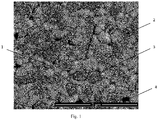
- shape factor of a grain or an elongated aluminous nodule is the ratio between the largest dimension of the grain or of the aluminous elongated nodule, or "length”, and the largest dimension measured perpendicular to the direction of said largest dimension, or "width”. These dimensions are measured in an observation plane of a polished section of the ball, conventionally on electron microscopy images of this section (see figure 1 ).
- average length of the elongated aluminous nodules refers to the average of the lengths of the elongated aluminous nodules, said lengths being measured in an observation plane of a polished section of the ball, conventionally on electron microscopy images of this section.
- a grain having a form factor of less than 2.5 is called a “pick-up grain”.
- figure 1 represents a photograph of a polished section of a sintered ball of the powder of example 3, usable in the process according to the invention, obtained after sintering at a temperature of 1460° C., this ball having undergone, after polishing, a thermal attack at 1360°C for 30 minutes to reveal the grain boundaries.
- the powders of raw materials can be ground individually or, preferably, co-ground, if their mixing in proportions suitable for the manufacture of ceramic balls having the desired composition does not lead to a particulate mixture having a median size less than 0.6 ⁇ m.
- This grinding may be a wet grinding.
- grinding or co-grinding is carried out so that the median size of said particulate mixture is less than 0.5 ⁇ m, preferably less than 0.4 ⁇ m.
- the powders used each have a median size of less than 5 ⁇ m, or even less than 3 ⁇ m , less than 1 ⁇ m, less than 0.8 ⁇ m, less than 0.7 ⁇ m, preferably less than 0.6 ⁇ m, preferably less than 0.5 ⁇ m, preferably less than 0.3 ⁇ m, or even less than 0.2 ⁇ m.
- step i′ is optional.
- the zirconia powder used has a specific surface area, calculated by the BET method, greater than 5 m 2 /g, preferably greater than 8 m 2 /g, preferably greater than 10 m 2 /g, and less than 30 m 2 /g.
- the sintering temperature in step vii′) is reduced, and the grinding in step i′), generally in suspension, is thereby facilitated.
- the particulate mixture is dried, for example in an oven or by atomization, in particular if it was obtained by wet grinding.
- the temperature and/or the duration of the drying step are adapted so that the residual humidity of the particulate mixture is less than 2%, or even less than 1.5%.
- a starting charge suitable for the shaping process of step iv′) is prepared, preferably at ambient temperature, as is well known to those skilled in the art.
- the filler is adapted so that the composition of the powder obtained at the end of step vii′) is in accordance with the invention.
- it comprises powders of ZrO 2 , Al 2 O 3 , CeO 2 , and Y 2 O 3 and, where appropriate, one or more powders of CaO, and/or of a manganese oxide, and/ or ZnO, and/or praseodymium oxide, and/or SrO, and/or copper oxide, and/or Nd 2 O 3 , and/or BaO and/or iron oxide.
- These powders can also be replaced, at least partially, by powders of precursors of these oxides, introduced in equivalent quantities.
- the powders providing the oxides or the precursors are preferably chosen so that the total content of impurities, that is to say of elements not intentionally introduced, is less than 4%, preferably less than 3%, preferably less at 2%, in mass percentage on the basis of the oxides.
- Y 2 O 3 is introduced, at least in part, in the form of a zirconia partially stabilized with yttrium oxide.
- CeO2 is introduced, at least in part, in the form of a zirconia partially stabilized with cerium oxide, or even stabilized with cerium oxide.
- the manganese oxide is chosen from MnO, Mn 3 O 4 and their mixtures.
- the praseodymium oxide is Pr 6 O 11 .
- the copper oxide is CuO.
- the iron oxide is chosen from FeO, Fe 2 O 3 and their mixtures.
- the starting charge may comprise, in addition to the particulate mixture, a solvent, preferably water, the amount of which is adapted to the shaping method of step iv′).
- the starting charge then consists of the particulate mixture and the solvent.
- Dispersants, surface tension modifiers and gelling agents are well known to those skilled in the art.
- the particulate mixture is preferably added to a mixture of water and dispersants/defocculants in a ball mill. After stirring, water is added in which a gelling agent has been dissolved beforehand so as to obtain a suspension.
- drops of the suspension described above are obtained by flowing the suspension through a calibrated orifice. The drops emerging from the orifice fall into a bath of a gelling solution (electrolyte adapted to react with the gelling agent) where they harden after having recovered a substantially spherical shape.
- step v′ optional, the raw balls obtained during the previous step are washed, for example with water.
- step vi′ optional, the raw balls, optionally washed, are dried, for example in an oven.
- step vii′ the raw balls, optionally washed and/or dried, are sintered.
- the sintering is carried out in air, preferably in an electric furnace, preferably at atmospheric pressure.
- the sintering time is greater than 1 hour, greater than 2 hours and/or less than 10 hours, less than 7 hours, or less than 5 hours. Preferably, the sintering time is between 2 and 5 hours.
- the sintering in step vii′) is carried out at a temperature above 1300°C and preferably below 1600°C, preferably below 1550°C, preferably below 1500°C. If, before sintering, the balls do not contain a compound of Mn, Zn, Cu, Pr, Nd, Sr, La, Ba or Fe, i.e. if the additive in the balls of the powder is CaO , the sintering temperature is greater than 1400°C, preferably greater than 1425°C.
- the sintering temperature is greater than 1400°C.
- the sintering temperature is preferably all the higher as the amount of Al 2 O 3 is high.
- step vii′ optional, the powder obtained undergoes particle size sorting, for example by sieving and/or by air separation, configured to obtain a particle size distribution suitable for the shot-blasting process envisaged.
- a powder of beads used in the process according to the invention comprises, in mass percentage, more than 96%, preferably more than 97%, preferably more than 98%, preferably more than 99%, preferably substantially 100% marbles.
- more than 80%, preferably more than 85%, preferably more than 90%, preferably more than 95%, preferably more than 97% by mass of the balls of the powder each have a sphericity greater than 0, 80, preferably greater than 0.85, preferably greater than 0.90, preferably greater than 0.92, preferably greater than 0.94, preferably greater than 0.95.
- the median sphericity of the bead powder is preferably greater than 0.80, preferably greater than 0.85, preferably greater than 0.90, preferably greater than 0.92, preferably greater than 0.94, preferably greater than 0.95, preferably greater than 0.97, preferably greater than 0.98.
- the bead powder preferably has a maximum size of less than 2 mm, preferably less than 1.8 mm, preferably less than 1.5 mm and preferably a median size greater than 40 ⁇ m and less than 1200 ⁇ m.
- the powder of beads has a median size D 50 greater than 80 ⁇ m, preferably greater than 100 ⁇ m, preferably greater than 150 ⁇ m, preferably greater than 200 ⁇ m, preferably greater than 400 ⁇ m and/ or less than 1000 ⁇ m, preferably less than 800 ⁇ m. This embodiment is particularly well suited for shot peening.
- the powder of beads has a median size D 50 of less than 200 ⁇ m, preferably less than 150 ⁇ m. This embodiment is particularly well suited for shot blasting aimed at modifying the surface appearance of a part (in English “cosmetic finishing” ).
- the powder preferably has a relative density greater than 96%, preferably greater than 97%, preferably greater than 98%, preferably greater than 99%.
- the powder preferably has a bulk density greater than 5.0 g/cm 3 , preferably greater than 5.1 g/cm 3 , and/or less than 6.0 g/cm 3 , preferably less than 5, 9 g/cm 3 , preferably less than 5.8 g/cm 3 .
- the difference in composition of the particles compared to those described in EP 2 231 363 advantageously allows, with apparent densities greater than 5.0 g/cm 3 , to obtain high compressive prestresses in the surface layer of the treated part for depths greater than or equal to 150 ⁇ m.
- the balls preferably have a hardness greater than 900 HV (0.5/15) , preferably greater than 1000 HV (0.5/15) , preferably greater than 1100 HV (0.5/15) , and/or preferably less than 1400 HV (0.5/15) .
- the beads of the powder have a polished surface.
- the treated part exhibits better fatigue behavior with respect to cyclic stress.
- the powder consists of oxides for more than 95%, preferably for more than 97%, preferably for more than 99% of its mass.
- each ball of the powder consists of oxides for more than 95%, preferably for more than 97%, preferably for more than 99% of its mass.
- the presence, in the starting charge, of CaO, and/or of a manganese oxide, and/or of ZnO, and/or of a praseodymium oxide, and/or of SrO, and/or of a copper oxide, and/or Nd 2 O 3 , and/or BaO, and/or an iron oxide and/or precursors of these oxides advantageously makes it possible to increase the quantity of elongated aluminous nodules contained in the sintered balls.
- the inventors have noted the presence of a particular microstructure in the sintered products used in the process according to the invention.
- said microstructure is characterized by the presence of clustered grains of partially stabilized zirconia 1, clustered grains of alumina 2, elongated aluminous nodules 3, which may be in the form of substantially rectilinear rods, as well as pores 4.
- the average length of the elongated aluminous nodules is typically greater than 1 ⁇ m and/or less than 20 ⁇ m.
- the collected grains typically have an average size of less than 3 ⁇ m and/or greater than 0.1 ⁇ m. Typically, more than 90%, more than 95%, or even more than 98% or 100% of the mass of the zirconia is in the form of packed grains of zirconia.
- Ce02 and Y 2 O 3 serve to stabilize the zirconia but can also be present outside of it.
- the elongated aluminous nodules consist substantially, depending on the additive, of a phase of the hibonite type and/or of a phase of the magneto-plombite type.
- the SiO 2 content is less than 4%, preferably less than 3%, preferably less than 2%, preferably less than 1.5%, preferably less than 1%, or even less than 0.5 %, in mass percentage on the basis of the oxides.
- the resistance to crushing is thereby improved.
- more than 80%, preferably more than 85%, preferably more than 90%, preferably more than 95% by mass of the beads of the powder each exhibit one or more of the characteristics described previously.
- no metal particles are sprayed, either before or after the spraying of the powder according to claim 1.
- the projection is carried out by means of a compressed air shot-blasting machine, preferably with a venturi effect or with direct pressure, preferably with direct pressure, or by means of a turbine(s) shot-blasting machine.
- the particles are projected at a speed greater than 40 m/s, preferably greater than 48 m/s, or even greater than 50 m/s, or even greater than 55 m/s. Conventionally, this speed is measured at the outlet of the nozzle
- the particles are projected in a direction forming a projection angle with the surface to be treated, the projection angle, that is to say the angle between the surface to be treated and said direction (the axis of the jet of projected balls), preferably being greater than 45°, preferably greater than 50°.
- the particles are projected by passing through a nozzle disposed at a distance, called “projection distance", from the surface to be treated, said projection distance being preferably greater than 5 cm, preferably greater than 10 cm and/or preferably less to 30 cm, preferably less than 25 cm.
- the projection nozzle of the shot blasting machine preferably has a diameter greater than 6 mm, preferably greater than 7 mm, and/or less than 15 mm, preferably less than 12 mm.
- the particles are thrown onto the surface by being carried by a fluid, preferably air, the overpressure of which (additional pressure beyond atmospheric pressure) is preferably greater than 0.5 bar, preferably greater than 1 bar , preferably greater than 2 bar and/or preferably less than 7 bar, preferably less than 6 bar.
- a fluid preferably air
- the overpressure of which is preferably greater than 0.5 bar, preferably greater than 1 bar , preferably greater than 2 bar and/or preferably less than 7 bar, preferably less than 6 bar.
- the method includes suction, preferably during the spraying step.
- the particles are projected with a coverage rate preferably greater than 100%, preferably greater than 120%, or even greater than 150% and/or preferably less than 300%, preferably less than 250%, preferably less than 200 %.
- the surface to be treated can undergo, before treatment by spraying, a pretreatment, for example polishing, for example of the mirror type.
- a pretreatment for example polishing, for example of the mirror type.
- the surface to be treated has no coating.
- the surface to be treated is made of a metallic material, preferably in the form of a metal or a metallic alloy, preferably steel, aluminum or titanium.
- the surface to be treated may in particular be a surface of an automobile part, and in particular be chosen from among a pinion, a transmission shaft, a spring, a torsion bar, a connecting rod, and a crankshaft.
- the surface to be treated may in particular be a surface of a part of an aeronautical machine, and in particular be chosen from among a turbine blade, a landing gear, a pinion, a transmission shaft, a spring, a torsion bar , a connecting rod, and a crankshaft.
- the surface to be treated is a surface of a part chosen from the group formed by a jewel, a watch, a bracelet, a necklace, a ring, a brooch, a tie pin, a handbag , a piece of furniture, a household utensil, a handle, a knob, a veneer, a visible part of consumer good equipment, a part of a spectacle frame, an article of tableware and a frame.
- the bulk density of a powder was measured using an Accupyc 1330 automatic helium pycnometer.
- microhardness was measured using a Vickers Zwick 3212 micro-hardness tester. The values are obtained from Vickers indentations at a load of 0.5 kg, said load being applied for a time equal to 15 seconds (HV (0.5/15) ).
- the particle size analysis was carried out using a Camsizer XT laser particle sizer marketed by the company Horiba.
- the form factor of the elongated aluminous nodules and of the picked grains, as well as the average length of the elongated aluminous nodules are measured on images obtained by scanning electron microscopy in backscattered electrons, of sections of sintered beads, said sections having previously been polished until a mirror quality is obtained and then heat-etched to reveal the grain boundaries, in a cycle having a temperature rise rate equal to 100°C/h, until a plateau temperature equal to 1360°C, maintained for 30 minutes, and a temperature drop in natural cooling.
- the magnification used for taking the images is chosen so as to visualize between 2 and 4 elongated aluminous nodules on an image. 10 beads were randomly sampled and 5 images per bead were taken.
- the average size of the grains picked up from the sintered balls of the powder was measured by the “Mean Linear Intercept” method.
- a method of this type is described in standard ASTM E1382. According to this standard, lines of analysis are drawn on images of the balls, then, along each line of analysis, the lengths, called “intercepts", are measured between two consecutive picked-up grain boundaries intersecting said line of to analyse. The lines of analysis are determined so as not to cut an aluminous elongated nodule.
- the powder of Example 1, outside the invention, is a powder of beads obtained by electro-fusion, the particles of which have been sieved so as to recover the beads passing through a sieve with a square mesh opening equal to 850 ⁇ m and not passing through a sieve with a square mesh opening equal to 600 ⁇ m, said sieving being carried out on an AS 200 sieving machine marketed by the company Retsch.
- the powder of Example 2 used in the process according to the invention is a powder of beads, the particles of which have been sieved so as to recover the particles passing through a sieve with a square mesh opening equal to 850 ⁇ m and not passing through a sieve with a square mesh opening equal to 600 ⁇ m, said sieving being carried out on an AS 200 sieving machine sold by the company Retsch.
- This powder was made from a source of zirconia (specific surface of the order of 8 m 2 /g; median size ⁇ 5 ⁇ m), a source of Ce02 (median size ⁇ 10 ⁇ m), a source of Y 2 O 3 (median size ⁇ 20 ⁇ m), a source of alumina (median size ⁇ 5 ⁇ m), a source of manganese oxides, mainly in the form Mn 3 O 4 (D 90 less than 44 ⁇ m) and also containing MnO.
- the purity of the zirconia and CeO2 sources was greater than 99%.
- the purity of the manganese oxide source, expressed as MnO was greater than 88%.
- aqueous suspension comprising, in percentages by weight of the dry matter, 7.5% of a dispersant of the polyacrylic acid type, 1% of a deflocculant of the carbonic acid ester type (viscosity stabilizer), and 1% of a gelling agent, namely a polysaccharide from the alginate family, was then prepared from this mixture.
- a ball mill was used for this preparation so as to obtain good homogeneity of the suspension: A solution containing the gelling agent was first formed. Successively added in water, the dried mixture resulting from the co-grinding, and the dispersant. The solution containing the gelling agent was then added. The mixture thus obtained was stirred for 8 hours. Then the deflocculant was added and the mixture was stirred for 0.5 hour. After checking the size of the particles (median size less than 0.3 ⁇ m), water was added in a determined quantity to obtain an aqueous suspension at 61% in dry matter and a viscosity, measured with a Brookfield viscometer, lower at 8500 centipoise. The pH of the suspension was then about 9.
- the suspension was forced through a calibrated hole and at a rate making it possible to obtain, after sintering, balls of between about 0.6 mm and 0.85 mm in the context of this example.
- the drops of suspension fell into a gelation bath based on an electrolyte, divalent or trivalent cation salt, reactive with the gelling agent. Green beads were collected, washed to remove excess reagents, then dried at 90°C to remove moisture.
- the balls were then transferred to a sintering furnace where they were brought, at a rate of 100° C./h, to a sintering temperature equal to 1460° C. At the end of a 3-hour plateau at the sintering temperature, the temperature was lowered by natural cooling.
- the powders of Examples 3 and 4 used in the process according to the invention are bead powders, the particles of which have been sieved so as to recover the particles passing through a sieve with a square mesh opening equal to 850 ⁇ m and not passing through a sieve with a square mesh opening equal to 600 ⁇ m, said sieving being carried out on an AS 200 sieving machine sold by the company Retsch.
- the bead powders of Examples 3 and 4 were manufactured using the same process as that used for the bead powder of Example 2, the amounts of zirconia powder, CeO 2 , Y 2 O 3 , manganese and alumina oxides in the feedstock being suitable to obtain the chemical analysis described in Table 1.
- the powders of examples 1 to 4 have the characteristics indicated in the following table 1. ( ⁇ sup> ⁇ /sup>): excluding invention Table 1
- Table 1 Examples 1 ( ⁇ ) 2 3 4 Chemical analysis (in % by mass based on oxides) ZrO2 63 63 77 49.9 SiO 2 7.6 0.2 0.05 0.05 Al 2 O 3 5 24.5 14.8 40.2 Y2O3 _ 3.8 1.3 1.75 1.11 CeO 2 19.7 8.6 4.36 6.79
- Manganese oxide expressed as MnO ⁇ 0.02 0.50 0.40 0.50 CaO ⁇ 0.02 0.42 0.51 0.46 impurities 0.87 1.48 1.13 0.99 Molar content, based on the sum ZrO 2 +Y 2 O 3 +CeO 2 (molar %) ZrO2 79.6 90.2 95 90.1 Y2O3 _ 2.6 1 1.2 1.1 CeO 2 17.8 8.8 3.8 8.8
- the balls of the powder of Example 2 have a microstructure comprising clustered grains having an average size equal to 0.4 ⁇ m and elongated aluminous nodules having an average length equal to 1.5 ⁇ m.
- the balls of the powder of Example 3 have a microstructure comprising clustered grains having an average size equal to 0.5 ⁇ m and elongated aluminous nodules having an average length equal to 10.4 ⁇ m.
- the balls of the powder of Example 4 have a microstructure comprising clustered grains having an average size equal to 0.5 ⁇ m and elongated aluminous nodules having an average length equal to 2.9 ⁇ m.
- a quantity of 100 g of each powder was then sprayed, with recirculation, onto an XC65 steel surface to be treated, using a Venturi effect gun equipped with a spray nozzle 8 mm in diameter, placed 150 mm of the surface to be treated, with a projection angle of 85° and an overpressure equal to 5 bar. The projection was continued until a recovery rate equal to 125% was obtained.
- the compressive prestresses in the treated surface were then measured by X-ray diffraction with a Siemens D500 device from the analysis of the average deformation of the crystallographic planes as a function of their orientation.
- Table 2 summarizes the results obtained. ( ⁇ sup> ⁇ /sup>): excluding invention Table 2 Compressive prestress measured at a depth equal to 150 ⁇ m (MPa) 175 ⁇ m (MPa) 200 ⁇ m (MPa) Example 1 ( ⁇ ) 350 180 30 Example 2 470 300 100 Improvement of the compression prestress measured example 2 / example 1 (%) +34.3 +66.7 +233.3 Example 3 457 255 65 Example 4 457 255 83 Improvement of the compression prestress measured example 3 / example 1 (%) +30.6 +41.8 +116.7 Improvement of the compression prestress measured example 4 / example 1 (%) +30.6 +41.8 +177.8
- Example 2 used in the method according to the invention, and of Example 1 shows an improvement in the compression prestress measured at a depth equal to 150 ⁇ m equal to 34.3%, said prestress being equal at 350 MPa for example 1 and equal to 470 MPa for example 2.
- the improvement in the compression prestress of an example, here example 2, with respect to a reference, in this case example 1, is equal to (compression prestress measured for the example - compression prestress measured for the reference) / (compression prestress measured for the example), expressed in percentages.
- the compressive prestresses measured at a depth equal to 175 ⁇ m and 200 ⁇ m the improvement being equal to 66.7% and 233.3%, respectively.
- Example 3 used in the method according to the invention, and of Example 1 shows an improvement in the compression prestress measured at a depth equal to 150 ⁇ m equal to 30.6%, said prestress being equal at 457 MPa for example 3.
- Example 4 used in the method according to the invention, and of Example 1 shows an improvement in the compression prestress measured at a depth equal to 150 ⁇ m equal to 30.6%, said prestress being equal at 457 MPa for example 4.
- the invention therefore provides a shot-peening process making it possible to create higher compressive prestresses in a surface layer of the treated part, in particular at a depth greater than or equal to 150 ⁇ m.
- the present invention is not limited to the embodiments described and represented provided by way of illustrative and non-limiting examples.
- the balls could have other compositions or other particle sizes than those described above and other gelling systems could also be suitable for manufacturing a powder of sintered balls according to claim 1.
- US 5,466,400 , FR 2 842438 and US 4,063,856 describe applicable sol-gel methods.
- FR 2 842438 and US 4,063,856 use a gelation system similar to that described above (based on alginate) whereas US 5,466,400 describes a very different gelation system.
Landscapes
- Chemical & Material Sciences (AREA)
- Engineering & Computer Science (AREA)
- Ceramic Engineering (AREA)
- Manufacturing & Machinery (AREA)
- Organic Chemistry (AREA)
- Materials Engineering (AREA)
- Structural Engineering (AREA)
- Inorganic Chemistry (AREA)
- Composite Materials (AREA)
- Mechanical Engineering (AREA)
- Dispersion Chemistry (AREA)
- Inorganic Compounds Of Heavy Metals (AREA)
- Compositions Of Oxide Ceramics (AREA)
Claims (15)
- Kugelstrahlverfahren, das einen Schritt des Verspritzens eines Pulvers auf eine Fläche eines zu behandelnden Werkstücks aufweist, wobei das Pulver aus gesinterten Partikeln besteht, wobei es sich bei mehr als 95 Massen-% der Partikel um Kugeln handelt, wobei das Pulver Folgendes aufweist- eine chemische Analyse, die folgendermaßen ist, nach Massenprozentanteilen auf Grundlage der Oxide,- ZrO2, teilweise mit CeO2 und Y2O3 stabilisiert:zu 100 % fehlender Anteil,wobei CeO2 und Y2O3 in derartigen Mengen vorliegen, dass nach Molprozentanteilen, auf Grundlage der Summe von ZrO2, CeO2 und Y2O3,CeO2: 2,5 bis 11 Mol-% undY2O3: 0,5 bis 2 Mol-%,- Al2O3: 3 bis 50 %- Zusatzstoff, ausgewählt aus CaO, Manganoxiden, ZnO, Praseodymoxiden, SrO, Kupferoxiden, Nd2O3, BaO, Eisenoxiden und deren Mischungen: 0,2 bis 6 %
wobei der Gehalt an CaO geringer als 2 % ist,- Elemente, bei denen es sich nicht um ZrO2, CeO2, Y2O3, Al2O3, CaO, Manganoxide, ZnO, Praseodymoxide, SrO, Kupferoxide, Nd2O3, BaO und Eisenoxide handelt: ≤ 5%
wobei die Manganoxide, die Praseodymoxide, die Kupferoxide und die Eisenoxide in Form von MnO, Pr6O11, CuO beziehungsweise Fe2O3 ausgedrückt sind, und- eine relative volumenbezogene Masse von 95 %. - Verfahren nach dem vorhergehenden Anspruch, wobei der Zusatzstoff aus CaO, Manganoxiden, ZnO, SrO, BaO und deren Mischungen ausgewählt ist.
- Verfahren nach dem unmittelbar vorhergehenden Anspruch, wobei der Zusatzstoff Folgendes aufweist:- CaO, wobei der Gehalt an CaO in dem Pulver mehr als 0,2 % beträgt, und- eine zweite Zusatzstoffverbindung, die aus Manganoxiden, ZnO, SrO, BaO und deren Mischungen ausgewählt ist, wobei der Gehalt der zweiten Zusatzstoffverbindung in dem Pulver mehr als 0,1 % beträgt,
in Massenprozentanteilen, auf Grundlage der Oxide des Pulvers. - Verfahren nach dem unmittelbar vorhergehenden Anspruch, wobei es sich bei dem Zusatzstoff um eine Mischung aus einem oder mehreren Oxid(en) von Mangan und aus CaO handelt, wobei der Gehalt als Manganoxid(en), welcher in Form von MnO ausgedrückt wird, in dem Pulver mehr als 0,1 % und weniger als 4 % beträgt und der Gehalt an CaO mehr als 0,2 % und weniger als 4 % beträgt, nach Massenprozentanteilen auf Grundlage der Oxide.
- Verfahren nach einem beliebigen der vorhergehenden Ansprüche, wobei der Gehalt an "Elementen, bei denen es sich nicht um ZrO2, CeO2, Y2O3, Al2O3, CaO, Manganoxide, ZnO, Praseodymoxide, SrO, Kupferoxide, Nd2O3, BaO und Eisenoxide handelt", in dem Pulver weniger als 2,0 % beträgt, nach Massenprozentanteilen auf Grundlage der Oxide.
- Verfahren nach einem beliebigen der vorhergehenden Ansprüche, wobei der Gehalt an Al2O3 in dem Pulver mehr als 8 % und weniger als 40 % beträgt, nach Massenprozentanteilen auf Grundlage der Oxide.
- Verfahren nach einem beliebigen der vorhergehenden Ansprüche, wobei der molare Gehalt an Y2O3 in dem Pulver mehr als 0,7 % und weniger als 1,7 % beträgt, nach Molprozentanteilen auf Grundlage der Summe von ZrO2, CeO2 und Y2O3.
- Verfahren nach einem beliebigen der vorhergehenden Ansprüche, wobei der molare Gehalt an CeO2 in dem Pulver im Bereich von 8,0 % bis 10,0 % liegt, nach Molprozentanteilen auf Grundlage der Summe von ZrO2, CeO2 und Y2O3 .
- Verfahren nach einem beliebigen der vorhergehenden Ansprüche, wobei der Gehalt an Al2O3 in dem Pulver mehr als 15 % und weniger als 35 % beträgt und/oder der Gehalt an SiO2 weniger als 1,5 % beträgt, nach Massenprozentanteilen auf Grundlage der Oxide.
- Verfahren nach einem beliebigen der Ansprüche 1 bis 7, wobei der molare Gehalt an CeO2 in dem Pulver mehr als 3 % und weniger als 6,0 % beträgt, nach Molprozentanteilen auf Grundlage der Summe von ZrO2, CeO2 und Y2O3 .
- Verfahren nach dem unmittelbar vorhergehenden Anspruch, wobei der Gehalt an Al2O3 in dem Pulver mehr als 5 % und weniger als 19 % beträgt, nach Massenprozentanteilen auf Grundlage der Oxide.
- Verfahren nach einem beliebigen der vorhergehenden Ansprüche, wobei das Pulver eine relative volumenbezogene Masse von mehr als 98 % aufweist.
- Verfahren nach einem beliebigen der vorhergehenden Ansprüche, wobei die Partikel mit einer Geschwindigkeit von mehr als 40 m/s verspritzt werden, gemäß einer Richtung, die mit der zu behandelnden Fläche einen Aufspritzwinkel von mehr als 45° bildet.
- Verfahren nach einem beliebigen der vorhergehenden Ansprüche, wobei das zu behandelnde Werkstück aus der Gruppe ausgewählt ist, die von einem Automobilbauteil, einem Teil eines Luftfahrzeugs, einem Schmuckstück, einer Uhr, einem Armband, einer Halskette, einem Ring, einer Brosche, einer Krawattennadel, einer Handtasche, einem Möbelstück, einem Haushaltsgegenstand, einem Handgriff, einem Knopf, einer Verblendung, einem sichtbaren Abschnitt eines Verbrauchsgutes, einem Abschnitt eines Brillengestells, einem Geschirrartikel und einem Rahmen gebildet wird.
- Anwendung eines Verfahrens nach einem beliebigen der vorhergehenden Ansprüche, um Druckvorspannungen in der oberflächlichen Schicht eines zu behandelnden Werkstück zu erzeugen, wobei das verspritzte Pulver einen Medianwert der Größe D50 von mehr als 40 µm und weniger als 1200 µm aufweist, oder um das Aussehen der Fläche eines zu behandelnden Werkstücks zu verändern, wobei das verspritzte Pulver einen Medianwert der Größe D50 von weniger als 200 µm aufweist.
Applications Claiming Priority (2)
| Application Number | Priority Date | Filing Date | Title |
|---|---|---|---|
| FR1856745A FR3084076B1 (fr) | 2018-07-20 | 2018-07-20 | Procede de grenaillage |
| PCT/EP2019/069555 WO2020016430A1 (fr) | 2018-07-20 | 2019-07-19 | Procédé de grenaillage |
Publications (2)
| Publication Number | Publication Date |
|---|---|
| EP3823944A1 EP3823944A1 (de) | 2021-05-26 |
| EP3823944B1 true EP3823944B1 (de) | 2022-09-07 |
Family
ID=65031481
Family Applications (1)
| Application Number | Title | Priority Date | Filing Date |
|---|---|---|---|
| EP19740029.4A Active EP3823944B1 (de) | 2018-07-20 | 2019-07-19 | Kugelstrahlverfahren |
Country Status (7)
| Country | Link |
|---|---|
| US (1) | US20210292625A1 (de) |
| EP (1) | EP3823944B1 (de) |
| JP (1) | JP2021530424A (de) |
| KR (1) | KR20210029209A (de) |
| CN (1) | CN112771011A (de) |
| FR (1) | FR3084076B1 (de) |
| WO (1) | WO2020016430A1 (de) |
Families Citing this family (1)
| Publication number | Priority date | Publication date | Assignee | Title |
|---|---|---|---|---|
| CN115193713A (zh) * | 2022-08-16 | 2022-10-18 | 郑州振中电熔新材料有限公司 | 一种陶瓷喷丸整形分级处理工艺及其应用 |
Family Cites Families (11)
| Publication number | Priority date | Publication date | Assignee | Title |
|---|---|---|---|---|
| US4063856A (en) | 1975-02-21 | 1977-12-20 | Gte Sylvania Incorporated | Particulate product of self supporting spheres containing inorganic material and apparatus for producing same |
| JPH0761614B2 (ja) * | 1992-07-02 | 1995-07-05 | 東ソー株式会社 | ジルコニア質投射材 |
| US5409415A (en) | 1992-07-02 | 1995-04-25 | Nikkato Corp. | Shot method |
| US5312571A (en) | 1993-01-07 | 1994-05-17 | Norton Company | Shaped bodies and the production thereof |
| FR2842438B1 (fr) | 2002-07-22 | 2004-10-15 | Centre Nat Rech Scient | Procede de preparation de billes contenant une matrice minerale reticulee |
| US8074472B2 (en) | 2007-07-31 | 2011-12-13 | Zircoa Inc. | Grinding beads and method of producing the same |
| FR2925378B1 (fr) * | 2007-12-20 | 2012-06-15 | Saint Gobain Ct Recherches | Particules de grenaillage. |
| FR2946337B1 (fr) * | 2009-06-03 | 2011-08-05 | Saint Gobain Ct Recherches | Produit fritte a base d'alumine et de zircone |
| FR2994177B1 (fr) * | 2012-08-01 | 2014-08-15 | Saint Gobain Ct Recherches | Particule frittee a base d'alumine |
| FR3035607B1 (fr) * | 2015-04-30 | 2017-04-28 | Saint-Gobain Centre De Rech Et D'Etudes Europeen | Procede de modification de l'aspect d'une surface |
| FR3039540B1 (fr) * | 2015-07-30 | 2019-12-06 | Saint-Gobain Centre De Recherches Et D'etudes Europeen | Produit fritte a base d'alumine et de zircone |
-
2018
- 2018-07-20 FR FR1856745A patent/FR3084076B1/fr not_active Expired - Fee Related
-
2019
- 2019-07-19 JP JP2021502791A patent/JP2021530424A/ja active Pending
- 2019-07-19 CN CN201980061841.4A patent/CN112771011A/zh active Pending
- 2019-07-19 KR KR1020217001832A patent/KR20210029209A/ko not_active Abandoned
- 2019-07-19 US US17/261,165 patent/US20210292625A1/en not_active Abandoned
- 2019-07-19 WO PCT/EP2019/069555 patent/WO2020016430A1/fr not_active Ceased
- 2019-07-19 EP EP19740029.4A patent/EP3823944B1/de active Active
Also Published As
| Publication number | Publication date |
|---|---|
| US20210292625A1 (en) | 2021-09-23 |
| EP3823944A1 (de) | 2021-05-26 |
| WO2020016430A1 (fr) | 2020-01-23 |
| JP2021530424A (ja) | 2021-11-11 |
| FR3084076A1 (fr) | 2020-01-24 |
| CN112771011A (zh) | 2021-05-07 |
| KR20210029209A (ko) | 2021-03-15 |
| FR3084076B1 (fr) | 2022-05-13 |
Similar Documents
| Publication | Publication Date | Title |
|---|---|---|
| EP3475379B1 (de) | Gesinterte schleifpartikel mit oxiden aus bauxit | |
| EP2257509B1 (de) | Mit kieselsäure beschichtete geschmolzene körner | |
| EP2231363B1 (de) | Sandstrahlpartikel | |
| EP2438029B1 (de) | Gesintertes aluminium- und zirkoniummaterial | |
| EP2448881B1 (de) | Gefärbtes sinter-zirkonoxid | |
| EP2879800B1 (de) | Partikel aus gesintertem aluminiumoxid | |
| EP3328813B1 (de) | Sinterprodukt auf aluminiumoxidbasis und zirkonoxidbasis | |
| EP2740717A2 (de) | Gesinterter gefärbter keramischer Formkörper | |
| WO2013011436A1 (fr) | Particule frittée à base de zircon | |
| EP1853532B1 (de) | Sinterkugel auf basis von zirconiumoxid und ceroxid | |
| EP3655376B1 (de) | Gesinterte zirkoniumkugeln | |
| WO2009081074A2 (fr) | Produit en matiere ceramique fondue, procede de fabrication et utilisations | |
| EP3823944B1 (de) | Kugelstrahlverfahren | |
| EP3801985B1 (de) | Kugelstrahlpulver | |
| WO2006018519A2 (fr) | Grain abrasif a haute teneur en alumine destine en particulier aux applications d’abrasifs appliques et agglomeres, par exemple aux meules de decriquage des brames en acier allie. | |
| WO2022136176A1 (fr) | Bille magnetique | |
| JP2005272946A (ja) | 誘電体膜用の複合焼結ターゲット材とその製造方法 | |
| FR3161680A1 (fr) | Poudre de billes frittees en carbure(s) metallique(s) |
Legal Events
| Date | Code | Title | Description |
|---|---|---|---|
| STAA | Information on the status of an ep patent application or granted ep patent |
Free format text: STATUS: UNKNOWN |
|
| STAA | Information on the status of an ep patent application or granted ep patent |
Free format text: STATUS: THE INTERNATIONAL PUBLICATION HAS BEEN MADE |
|
| PUAI | Public reference made under article 153(3) epc to a published international application that has entered the european phase |
Free format text: ORIGINAL CODE: 0009012 |
|
| STAA | Information on the status of an ep patent application or granted ep patent |
Free format text: STATUS: REQUEST FOR EXAMINATION WAS MADE |
|
| 17P | Request for examination filed |
Effective date: 20210222 |
|
| AK | Designated contracting states |
Kind code of ref document: A1 Designated state(s): AL AT BE BG CH CY CZ DE DK EE ES FI FR GB GR HR HU IE IS IT LI LT LU LV MC MK MT NL NO PL PT RO RS SE SI SK SM TR |
|
| DAV | Request for validation of the european patent (deleted) | ||
| DAX | Request for extension of the european patent (deleted) | ||
| GRAP | Despatch of communication of intention to grant a patent |
Free format text: ORIGINAL CODE: EPIDOSNIGR1 |
|
| STAA | Information on the status of an ep patent application or granted ep patent |
Free format text: STATUS: GRANT OF PATENT IS INTENDED |
|
| INTG | Intention to grant announced |
Effective date: 20220314 |
|
| GRAS | Grant fee paid |
Free format text: ORIGINAL CODE: EPIDOSNIGR3 |
|
| GRAA | (expected) grant |
Free format text: ORIGINAL CODE: 0009210 |
|
| STAA | Information on the status of an ep patent application or granted ep patent |
Free format text: STATUS: THE PATENT HAS BEEN GRANTED |
|
| AK | Designated contracting states |
Kind code of ref document: B1 Designated state(s): AL AT BE BG CH CY CZ DE DK EE ES FI FR GB GR HR HU IE IS IT LI LT LU LV MC MK MT NL NO PL PT RO RS SE SI SK SM TR |
|
| REG | Reference to a national code |
Ref country code: GB Ref legal event code: FG4D Free format text: NOT ENGLISH |
|
| REG | Reference to a national code |
Ref country code: CH Ref legal event code: EP Ref country code: AT Ref legal event code: REF Ref document number: 1516938 Country of ref document: AT Kind code of ref document: T Effective date: 20220915 |
|
| REG | Reference to a national code |
Ref country code: DE Ref legal event code: R096 Ref document number: 602019019294 Country of ref document: DE |
|
| REG | Reference to a national code |
Ref country code: IE Ref legal event code: FG4D Free format text: LANGUAGE OF EP DOCUMENT: FRENCH |
|
| REG | Reference to a national code |
Ref country code: LT Ref legal event code: MG9D |
|
| REG | Reference to a national code |
Ref country code: NL Ref legal event code: MP Effective date: 20220907 |
|
| PG25 | Lapsed in a contracting state [announced via postgrant information from national office to epo] |
Ref country code: SE Free format text: LAPSE BECAUSE OF FAILURE TO SUBMIT A TRANSLATION OF THE DESCRIPTION OR TO PAY THE FEE WITHIN THE PRESCRIBED TIME-LIMIT Effective date: 20220907 Ref country code: RS Free format text: LAPSE BECAUSE OF FAILURE TO SUBMIT A TRANSLATION OF THE DESCRIPTION OR TO PAY THE FEE WITHIN THE PRESCRIBED TIME-LIMIT Effective date: 20220907 Ref country code: NO Free format text: LAPSE BECAUSE OF FAILURE TO SUBMIT A TRANSLATION OF THE DESCRIPTION OR TO PAY THE FEE WITHIN THE PRESCRIBED TIME-LIMIT Effective date: 20221207 Ref country code: LV Free format text: LAPSE BECAUSE OF FAILURE TO SUBMIT A TRANSLATION OF THE DESCRIPTION OR TO PAY THE FEE WITHIN THE PRESCRIBED TIME-LIMIT Effective date: 20220907 Ref country code: LT Free format text: LAPSE BECAUSE OF FAILURE TO SUBMIT A TRANSLATION OF THE DESCRIPTION OR TO PAY THE FEE WITHIN THE PRESCRIBED TIME-LIMIT Effective date: 20220907 Ref country code: FI Free format text: LAPSE BECAUSE OF FAILURE TO SUBMIT A TRANSLATION OF THE DESCRIPTION OR TO PAY THE FEE WITHIN THE PRESCRIBED TIME-LIMIT Effective date: 20220907 |
|
| REG | Reference to a national code |
Ref country code: AT Ref legal event code: MK05 Ref document number: 1516938 Country of ref document: AT Kind code of ref document: T Effective date: 20220907 |
|
| PG25 | Lapsed in a contracting state [announced via postgrant information from national office to epo] |
Ref country code: HR Free format text: LAPSE BECAUSE OF FAILURE TO SUBMIT A TRANSLATION OF THE DESCRIPTION OR TO PAY THE FEE WITHIN THE PRESCRIBED TIME-LIMIT Effective date: 20220907 Ref country code: GR Free format text: LAPSE BECAUSE OF FAILURE TO SUBMIT A TRANSLATION OF THE DESCRIPTION OR TO PAY THE FEE WITHIN THE PRESCRIBED TIME-LIMIT Effective date: 20221208 |
|
| PG25 | Lapsed in a contracting state [announced via postgrant information from national office to epo] |
Ref country code: SM Free format text: LAPSE BECAUSE OF FAILURE TO SUBMIT A TRANSLATION OF THE DESCRIPTION OR TO PAY THE FEE WITHIN THE PRESCRIBED TIME-LIMIT Effective date: 20220907 Ref country code: RO Free format text: LAPSE BECAUSE OF FAILURE TO SUBMIT A TRANSLATION OF THE DESCRIPTION OR TO PAY THE FEE WITHIN THE PRESCRIBED TIME-LIMIT Effective date: 20220907 Ref country code: PT Free format text: LAPSE BECAUSE OF FAILURE TO SUBMIT A TRANSLATION OF THE DESCRIPTION OR TO PAY THE FEE WITHIN THE PRESCRIBED TIME-LIMIT Effective date: 20230109 Ref country code: ES Free format text: LAPSE BECAUSE OF FAILURE TO SUBMIT A TRANSLATION OF THE DESCRIPTION OR TO PAY THE FEE WITHIN THE PRESCRIBED TIME-LIMIT Effective date: 20220907 Ref country code: CZ Free format text: LAPSE BECAUSE OF FAILURE TO SUBMIT A TRANSLATION OF THE DESCRIPTION OR TO PAY THE FEE WITHIN THE PRESCRIBED TIME-LIMIT Effective date: 20220907 Ref country code: AT Free format text: LAPSE BECAUSE OF FAILURE TO SUBMIT A TRANSLATION OF THE DESCRIPTION OR TO PAY THE FEE WITHIN THE PRESCRIBED TIME-LIMIT Effective date: 20220907 |
|
| PG25 | Lapsed in a contracting state [announced via postgrant information from national office to epo] |
Ref country code: SK Free format text: LAPSE BECAUSE OF FAILURE TO SUBMIT A TRANSLATION OF THE DESCRIPTION OR TO PAY THE FEE WITHIN THE PRESCRIBED TIME-LIMIT Effective date: 20220907 Ref country code: PL Free format text: LAPSE BECAUSE OF FAILURE TO SUBMIT A TRANSLATION OF THE DESCRIPTION OR TO PAY THE FEE WITHIN THE PRESCRIBED TIME-LIMIT Effective date: 20220907 Ref country code: IS Free format text: LAPSE BECAUSE OF FAILURE TO SUBMIT A TRANSLATION OF THE DESCRIPTION OR TO PAY THE FEE WITHIN THE PRESCRIBED TIME-LIMIT Effective date: 20230107 Ref country code: EE Free format text: LAPSE BECAUSE OF FAILURE TO SUBMIT A TRANSLATION OF THE DESCRIPTION OR TO PAY THE FEE WITHIN THE PRESCRIBED TIME-LIMIT Effective date: 20220907 |
|
| REG | Reference to a national code |
Ref country code: DE Ref legal event code: R097 Ref document number: 602019019294 Country of ref document: DE |
|
| PG25 | Lapsed in a contracting state [announced via postgrant information from national office to epo] |
Ref country code: NL Free format text: LAPSE BECAUSE OF FAILURE TO SUBMIT A TRANSLATION OF THE DESCRIPTION OR TO PAY THE FEE WITHIN THE PRESCRIBED TIME-LIMIT Effective date: 20220907 Ref country code: AL Free format text: LAPSE BECAUSE OF FAILURE TO SUBMIT A TRANSLATION OF THE DESCRIPTION OR TO PAY THE FEE WITHIN THE PRESCRIBED TIME-LIMIT Effective date: 20220907 |
|
| PLBE | No opposition filed within time limit |
Free format text: ORIGINAL CODE: 0009261 |
|
| STAA | Information on the status of an ep patent application or granted ep patent |
Free format text: STATUS: NO OPPOSITION FILED WITHIN TIME LIMIT |
|
| PG25 | Lapsed in a contracting state [announced via postgrant information from national office to epo] |
Ref country code: DK Free format text: LAPSE BECAUSE OF FAILURE TO SUBMIT A TRANSLATION OF THE DESCRIPTION OR TO PAY THE FEE WITHIN THE PRESCRIBED TIME-LIMIT Effective date: 20220907 |
|
| 26N | No opposition filed |
Effective date: 20230608 |
|
| PG25 | Lapsed in a contracting state [announced via postgrant information from national office to epo] |
Ref country code: SI Free format text: LAPSE BECAUSE OF FAILURE TO SUBMIT A TRANSLATION OF THE DESCRIPTION OR TO PAY THE FEE WITHIN THE PRESCRIBED TIME-LIMIT Effective date: 20220907 |
|
| REG | Reference to a national code |
Ref country code: DE Ref legal event code: R119 Ref document number: 602019019294 Country of ref document: DE |
|
| PG25 | Lapsed in a contracting state [announced via postgrant information from national office to epo] |
Ref country code: MC Free format text: LAPSE BECAUSE OF FAILURE TO SUBMIT A TRANSLATION OF THE DESCRIPTION OR TO PAY THE FEE WITHIN THE PRESCRIBED TIME-LIMIT Effective date: 20220907 |
|
| PG25 | Lapsed in a contracting state [announced via postgrant information from national office to epo] |
Ref country code: MC Free format text: LAPSE BECAUSE OF FAILURE TO SUBMIT A TRANSLATION OF THE DESCRIPTION OR TO PAY THE FEE WITHIN THE PRESCRIBED TIME-LIMIT Effective date: 20220907 |
|
| REG | Reference to a national code |
Ref country code: CH Ref legal event code: PL |
|
| REG | Reference to a national code |
Ref country code: BE Ref legal event code: MM Effective date: 20230731 |
|
| PG25 | Lapsed in a contracting state [announced via postgrant information from national office to epo] |
Ref country code: LU Free format text: LAPSE BECAUSE OF NON-PAYMENT OF DUE FEES Effective date: 20230719 |
|
| GBPC | Gb: european patent ceased through non-payment of renewal fee |
Effective date: 20230719 |
|
| PG25 | Lapsed in a contracting state [announced via postgrant information from national office to epo] |
Ref country code: LU Free format text: LAPSE BECAUSE OF NON-PAYMENT OF DUE FEES Effective date: 20230719 |
|
| REG | Reference to a national code |
Ref country code: IE Ref legal event code: MM4A |
|
| PG25 | Lapsed in a contracting state [announced via postgrant information from national office to epo] |
Ref country code: DE Free format text: LAPSE BECAUSE OF NON-PAYMENT OF DUE FEES Effective date: 20240201 Ref country code: GB Free format text: LAPSE BECAUSE OF NON-PAYMENT OF DUE FEES Effective date: 20230719 Ref country code: CH Free format text: LAPSE BECAUSE OF NON-PAYMENT OF DUE FEES Effective date: 20230731 |
|
| PG25 | Lapsed in a contracting state [announced via postgrant information from national office to epo] |
Ref country code: IT Free format text: LAPSE BECAUSE OF FAILURE TO SUBMIT A TRANSLATION OF THE DESCRIPTION OR TO PAY THE FEE WITHIN THE PRESCRIBED TIME-LIMIT Effective date: 20220907 Ref country code: FR Free format text: LAPSE BECAUSE OF NON-PAYMENT OF DUE FEES Effective date: 20230731 Ref country code: BE Free format text: LAPSE BECAUSE OF NON-PAYMENT OF DUE FEES Effective date: 20230731 |
|
| PG25 | Lapsed in a contracting state [announced via postgrant information from national office to epo] |
Ref country code: IE Free format text: LAPSE BECAUSE OF NON-PAYMENT OF DUE FEES Effective date: 20230719 |
|
| PG25 | Lapsed in a contracting state [announced via postgrant information from national office to epo] |
Ref country code: IE Free format text: LAPSE BECAUSE OF NON-PAYMENT OF DUE FEES Effective date: 20230719 |
|
| PG25 | Lapsed in a contracting state [announced via postgrant information from national office to epo] |
Ref country code: BG Free format text: LAPSE BECAUSE OF FAILURE TO SUBMIT A TRANSLATION OF THE DESCRIPTION OR TO PAY THE FEE WITHIN THE PRESCRIBED TIME-LIMIT Effective date: 20220907 |
|
| PG25 | Lapsed in a contracting state [announced via postgrant information from national office to epo] |
Ref country code: BG Free format text: LAPSE BECAUSE OF FAILURE TO SUBMIT A TRANSLATION OF THE DESCRIPTION OR TO PAY THE FEE WITHIN THE PRESCRIBED TIME-LIMIT Effective date: 20220907 |
|
| PG25 | Lapsed in a contracting state [announced via postgrant information from national office to epo] |
Ref country code: CY Free format text: LAPSE BECAUSE OF FAILURE TO SUBMIT A TRANSLATION OF THE DESCRIPTION OR TO PAY THE FEE WITHIN THE PRESCRIBED TIME-LIMIT; INVALID AB INITIO Effective date: 20190719 |
|
| PG25 | Lapsed in a contracting state [announced via postgrant information from national office to epo] |
Ref country code: HU Free format text: LAPSE BECAUSE OF FAILURE TO SUBMIT A TRANSLATION OF THE DESCRIPTION OR TO PAY THE FEE WITHIN THE PRESCRIBED TIME-LIMIT; INVALID AB INITIO Effective date: 20190719 |
|
| PG25 | Lapsed in a contracting state [announced via postgrant information from national office to epo] |
Ref country code: TR Free format text: LAPSE BECAUSE OF FAILURE TO SUBMIT A TRANSLATION OF THE DESCRIPTION OR TO PAY THE FEE WITHIN THE PRESCRIBED TIME-LIMIT Effective date: 20220907 |