EP3823085B1 - Stacked battery pack - Google Patents
Stacked battery pack Download PDFInfo
- Publication number
- EP3823085B1 EP3823085B1 EP20207406.8A EP20207406A EP3823085B1 EP 3823085 B1 EP3823085 B1 EP 3823085B1 EP 20207406 A EP20207406 A EP 20207406A EP 3823085 B1 EP3823085 B1 EP 3823085B1
- Authority
- EP
- European Patent Office
- Prior art keywords
- resin holder
- metal plate
- stacking direction
- battery pack
- stacked battery
- Prior art date
- Legal status (The legal status is an assumption and is not a legal conclusion. Google has not performed a legal analysis and makes no representation as to the accuracy of the status listed.)
- Active
Links
Images








Classifications
-
- H—ELECTRICITY
- H01—ELECTRIC ELEMENTS
- H01M—PROCESSES OR MEANS, e.g. BATTERIES, FOR THE DIRECT CONVERSION OF CHEMICAL ENERGY INTO ELECTRICAL ENERGY
- H01M50/00—Constructional details or processes of manufacture of the non-active parts of electrochemical cells other than fuel cells, e.g. hybrid cells
- H01M50/20—Mountings; Secondary casings or frames; Racks, modules or packs; Suspension devices; Shock absorbers; Transport or carrying devices; Holders
-
- H—ELECTRICITY
- H01—ELECTRIC ELEMENTS
- H01M—PROCESSES OR MEANS, e.g. BATTERIES, FOR THE DIRECT CONVERSION OF CHEMICAL ENERGY INTO ELECTRICAL ENERGY
- H01M10/00—Secondary cells; Manufacture thereof
- H01M10/60—Heating or cooling; Temperature control
- H01M10/61—Types of temperature control
- H01M10/613—Cooling or keeping cold
-
- H—ELECTRICITY
- H01—ELECTRIC ELEMENTS
- H01M—PROCESSES OR MEANS, e.g. BATTERIES, FOR THE DIRECT CONVERSION OF CHEMICAL ENERGY INTO ELECTRICAL ENERGY
- H01M10/00—Secondary cells; Manufacture thereof
- H01M10/60—Heating or cooling; Temperature control
- H01M10/64—Heating or cooling; Temperature control characterised by the shape of the cells
- H01M10/647—Prismatic or flat cells, e.g. pouch cells
-
- H—ELECTRICITY
- H01—ELECTRIC ELEMENTS
- H01M—PROCESSES OR MEANS, e.g. BATTERIES, FOR THE DIRECT CONVERSION OF CHEMICAL ENERGY INTO ELECTRICAL ENERGY
- H01M10/00—Secondary cells; Manufacture thereof
- H01M10/60—Heating or cooling; Temperature control
- H01M10/65—Means for temperature control structurally associated with the cells
- H01M10/655—Solid structures for heat exchange or heat conduction
- H01M10/6551—Surfaces specially adapted for heat dissipation or radiation, e.g. fins or coatings
-
- H—ELECTRICITY
- H01—ELECTRIC ELEMENTS
- H01M—PROCESSES OR MEANS, e.g. BATTERIES, FOR THE DIRECT CONVERSION OF CHEMICAL ENERGY INTO ELECTRICAL ENERGY
- H01M10/00—Secondary cells; Manufacture thereof
- H01M10/60—Heating or cooling; Temperature control
- H01M10/65—Means for temperature control structurally associated with the cells
- H01M10/655—Solid structures for heat exchange or heat conduction
- H01M10/6554—Rods or plates
-
- H—ELECTRICITY
- H01—ELECTRIC ELEMENTS
- H01M—PROCESSES OR MEANS, e.g. BATTERIES, FOR THE DIRECT CONVERSION OF CHEMICAL ENERGY INTO ELECTRICAL ENERGY
- H01M10/00—Secondary cells; Manufacture thereof
- H01M10/60—Heating or cooling; Temperature control
- H01M10/65—Means for temperature control structurally associated with the cells
- H01M10/655—Solid structures for heat exchange or heat conduction
- H01M10/6554—Rods or plates
- H01M10/6555—Rods or plates arranged between the cells
-
- H—ELECTRICITY
- H01—ELECTRIC ELEMENTS
- H01M—PROCESSES OR MEANS, e.g. BATTERIES, FOR THE DIRECT CONVERSION OF CHEMICAL ENERGY INTO ELECTRICAL ENERGY
- H01M10/00—Secondary cells; Manufacture thereof
- H01M10/60—Heating or cooling; Temperature control
- H01M10/65—Means for temperature control structurally associated with the cells
- H01M10/658—Means for temperature control structurally associated with the cells by thermal insulation or shielding
-
- H—ELECTRICITY
- H01—ELECTRIC ELEMENTS
- H01M—PROCESSES OR MEANS, e.g. BATTERIES, FOR THE DIRECT CONVERSION OF CHEMICAL ENERGY INTO ELECTRICAL ENERGY
- H01M50/00—Constructional details or processes of manufacture of the non-active parts of electrochemical cells other than fuel cells, e.g. hybrid cells
- H01M50/20—Mountings; Secondary casings or frames; Racks, modules or packs; Suspension devices; Shock absorbers; Transport or carrying devices; Holders
- H01M50/202—Casings or frames around the primary casing of a single cell or a single battery
-
- H—ELECTRICITY
- H01—ELECTRIC ELEMENTS
- H01M—PROCESSES OR MEANS, e.g. BATTERIES, FOR THE DIRECT CONVERSION OF CHEMICAL ENERGY INTO ELECTRICAL ENERGY
- H01M50/00—Constructional details or processes of manufacture of the non-active parts of electrochemical cells other than fuel cells, e.g. hybrid cells
- H01M50/20—Mountings; Secondary casings or frames; Racks, modules or packs; Suspension devices; Shock absorbers; Transport or carrying devices; Holders
- H01M50/204—Racks, modules or packs for multiple batteries or multiple cells
- H01M50/207—Racks, modules or packs for multiple batteries or multiple cells characterised by their shape
- H01M50/209—Racks, modules or packs for multiple batteries or multiple cells characterised by their shape adapted for prismatic or rectangular cells
-
- H—ELECTRICITY
- H01—ELECTRIC ELEMENTS
- H01M—PROCESSES OR MEANS, e.g. BATTERIES, FOR THE DIRECT CONVERSION OF CHEMICAL ENERGY INTO ELECTRICAL ENERGY
- H01M50/00—Constructional details or processes of manufacture of the non-active parts of electrochemical cells other than fuel cells, e.g. hybrid cells
- H01M50/20—Mountings; Secondary casings or frames; Racks, modules or packs; Suspension devices; Shock absorbers; Transport or carrying devices; Holders
- H01M50/204—Racks, modules or packs for multiple batteries or multiple cells
- H01M50/207—Racks, modules or packs for multiple batteries or multiple cells characterised by their shape
- H01M50/211—Racks, modules or packs for multiple batteries or multiple cells characterised by their shape adapted for pouch cells
-
- H—ELECTRICITY
- H01—ELECTRIC ELEMENTS
- H01M—PROCESSES OR MEANS, e.g. BATTERIES, FOR THE DIRECT CONVERSION OF CHEMICAL ENERGY INTO ELECTRICAL ENERGY
- H01M50/00—Constructional details or processes of manufacture of the non-active parts of electrochemical cells other than fuel cells, e.g. hybrid cells
- H01M50/20—Mountings; Secondary casings or frames; Racks, modules or packs; Suspension devices; Shock absorbers; Transport or carrying devices; Holders
- H01M50/218—Mountings; Secondary casings or frames; Racks, modules or packs; Suspension devices; Shock absorbers; Transport or carrying devices; Holders characterised by the material
- H01M50/22—Mountings; Secondary casings or frames; Racks, modules or packs; Suspension devices; Shock absorbers; Transport or carrying devices; Holders characterised by the material of the casings or racks
- H01M50/222—Inorganic material
- H01M50/224—Metals
-
- H—ELECTRICITY
- H01—ELECTRIC ELEMENTS
- H01M—PROCESSES OR MEANS, e.g. BATTERIES, FOR THE DIRECT CONVERSION OF CHEMICAL ENERGY INTO ELECTRICAL ENERGY
- H01M50/00—Constructional details or processes of manufacture of the non-active parts of electrochemical cells other than fuel cells, e.g. hybrid cells
- H01M50/20—Mountings; Secondary casings or frames; Racks, modules or packs; Suspension devices; Shock absorbers; Transport or carrying devices; Holders
- H01M50/218—Mountings; Secondary casings or frames; Racks, modules or packs; Suspension devices; Shock absorbers; Transport or carrying devices; Holders characterised by the material
- H01M50/22—Mountings; Secondary casings or frames; Racks, modules or packs; Suspension devices; Shock absorbers; Transport or carrying devices; Holders characterised by the material of the casings or racks
- H01M50/227—Organic material
-
- H—ELECTRICITY
- H01—ELECTRIC ELEMENTS
- H01M—PROCESSES OR MEANS, e.g. BATTERIES, FOR THE DIRECT CONVERSION OF CHEMICAL ENERGY INTO ELECTRICAL ENERGY
- H01M50/00—Constructional details or processes of manufacture of the non-active parts of electrochemical cells other than fuel cells, e.g. hybrid cells
- H01M50/20—Mountings; Secondary casings or frames; Racks, modules or packs; Suspension devices; Shock absorbers; Transport or carrying devices; Holders
- H01M50/233—Mountings; Secondary casings or frames; Racks, modules or packs; Suspension devices; Shock absorbers; Transport or carrying devices; Holders characterised by physical properties of casings or racks, e.g. dimensions
- H01M50/238—Flexibility or foldability
-
- H—ELECTRICITY
- H01—ELECTRIC ELEMENTS
- H01M—PROCESSES OR MEANS, e.g. BATTERIES, FOR THE DIRECT CONVERSION OF CHEMICAL ENERGY INTO ELECTRICAL ENERGY
- H01M50/00—Constructional details or processes of manufacture of the non-active parts of electrochemical cells other than fuel cells, e.g. hybrid cells
- H01M50/20—Mountings; Secondary casings or frames; Racks, modules or packs; Suspension devices; Shock absorbers; Transport or carrying devices; Holders
- H01M50/289—Mountings; Secondary casings or frames; Racks, modules or packs; Suspension devices; Shock absorbers; Transport or carrying devices; Holders characterised by spacing elements or positioning means within frames, racks or packs
- H01M50/293—Mountings; Secondary casings or frames; Racks, modules or packs; Suspension devices; Shock absorbers; Transport or carrying devices; Holders characterised by spacing elements or positioning means within frames, racks or packs characterised by the material
-
- H—ELECTRICITY
- H01—ELECTRIC ELEMENTS
- H01M—PROCESSES OR MEANS, e.g. BATTERIES, FOR THE DIRECT CONVERSION OF CHEMICAL ENERGY INTO ELECTRICAL ENERGY
- H01M2220/00—Batteries for particular applications
- H01M2220/20—Batteries in motive systems, e.g. vehicle, ship, plane
-
- Y—GENERAL TAGGING OF NEW TECHNOLOGICAL DEVELOPMENTS; GENERAL TAGGING OF CROSS-SECTIONAL TECHNOLOGIES SPANNING OVER SEVERAL SECTIONS OF THE IPC; TECHNICAL SUBJECTS COVERED BY FORMER USPC CROSS-REFERENCE ART COLLECTIONS [XRACs] AND DIGESTS
- Y02—TECHNOLOGIES OR APPLICATIONS FOR MITIGATION OR ADAPTATION AGAINST CLIMATE CHANGE
- Y02E—REDUCTION OF GREENHOUSE GAS [GHG] EMISSIONS, RELATED TO ENERGY GENERATION, TRANSMISSION OR DISTRIBUTION
- Y02E60/00—Enabling technologies; Technologies with a potential or indirect contribution to GHG emissions mitigation
- Y02E60/10—Energy storage using batteries
Definitions
- the present invention relates to a stacked battery pack and, more particularly, to a stacked battery pack having a plurality of stacked flat cells.
- JP 2009-301877A , JP 2012-511802 , JP 2010-218716A and EP 1 071 147 A1 are known.
- JP 2009-301877A and JP 2012-511802 describe a stacked battery pack having a structure in which flat cells are stacked through a metal plate.
- a given flat cell abnormally generates heat
- an adjacent flat cell is heated through the metal plate to abnormally generate heat, which may cause propagation of abnormal heat generation to other cells.
- EP 1 071 147 A1 discloses a structure which includes a flat cell housed in a resin holder and a metal plate covering the flat cell.
- JP 2010-218716A has a complicated structure in which the heat insulating sheet is sandwiched between two metal plates.
- a stacked battery pack according to the present invention has a plurality of stacked unit cells, wherein each of the plurality of unit cells includes a resin holder, a flat cell housed in the resin holder, and a metal plate covering the flat cell, thereby the flat cell is sandwiched between the resin holder and the metal plate in the stacking direction of the unit cells.
- the resin holder and the metal plate are interposed between the flat cells adjacent in the stacking direction, so that it is possible to achieve a heat insulating effect by the presence of the resin holder and a heat capacity enhancing effect, a heat dissipation effect, and a fire protection effect by the presence of the metal plate.
- the plurality of unit cells are stacked in a direction perpendicular to the support surface of a casing, so that, unlike a case where the flat cells are arranged in parallel to the support surface of a casing, there is no need to provide a complicated support mechanism for stably supporting the individual flat cells.
- Each of the plurality of unit cells may further include a sheet member positioned between the resin holder and the flat cell, the sheet member being lower in heat conductivity and higher in flexibility than the resin holder.
- the presence of the sheet member can further enhance the heat insulating effect and prevent the individual flat cell in the resin holder from being displaced or rattling when the unit cells are stacked in a direction perpendicular to the support surface of a casing.
- the metal plate has a protrusion part that does not overlap the resin holder in the stacking direction.
- heat of the flat cell can be efficiently dissipated from the protrusion part.
- the protrusion parts adjacent in the stacking direction may be connected through a heat conducting member or may be connected directly. With this configuration, the heat capacity can be significantly enhanced, so that even if a given flat cell abnormally generates heat, the heat is efficiently dissipated through the plurality of protrusion parts.
- the protrusion parts may each include a first part constituting the same plane as a main area of the metal plate that overlaps the resin holder in the stacking direction, a second part that is connected to the first part and extends in the stacking direction, and a third part connected to the second part and the first part of another protrusion part adjacent in the stacking direction, and the first and third parts may protrude in a direction away from the resin holder as viewed from the second part to constitute a heat dissipating fin.
- the resin holder has a side plate part that covers the flat cell in a direction perpendicular to the stacking direction.
- the side plate part has a step in which the metal plate is positioned. This increases the contact area between the flat cell and the metal plate, thus making it possible to increase the heat capacity enhancing effect, heat dissipation effect, and fire protection effect by the presence of the metal plate.
- the stacked battery pack according to the present invention may further include a bracket on which the plurality of stacked unit cells are placed.
- the bracket may include a bottom plate part positioned between the support surface of a casing and the lowermost one of the plurality of unit cells and a wall surface part connected to the bottom plate part and extending in the stacking direction.
- the wall surface part may have an opening at a portion facing a terminal electrode of the flat cell.
- the stacked battery pack according to the present invention can prevent propagation of abnormal heat generation with a simple configuration.
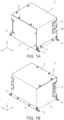
- FIGS. 1A and 1B are schematic perspective views illustrating the outer appearance of a stacked battery pack 1 according to an embodiment of the present invention.
- the stacked battery pack 1 has a box-like outer shape having a base casing 2 and a top casing 3 which are fixed to each other by screws 4.
- a pair of terminal electrodes E1 and E2 are provided so as to be exposed from openings formed in the top casing 3, and a connector P is provided so as to be exposed from an opening formed in the base casing 2.
- the terminal electrodes E1 and E2 are a pair of terminals for charging the stacked battery pack 1.
- the connector P is a terminal for data input/output with respect to the stacked battery pack 1.
- the material of the base casing 2 and top casing 3 is not particularly limited and may be a metal material or a resin material.
- the base casing 2 has fixing members 5 for fixing the stacked battery pack 1 according to the present embodiment to equipment (conveyance vehicle, etc.) using a power source.
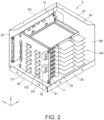
- FIG. 2 is a schematic perspective view of the stacked battery pack 1 according to the present embodiment from which the top casing 3 is removed.
- a cell stack 100 is housed inside the casing.
- the base casing 2 has a bottom plate part 2A constituting the xy plane, a side plate part 2B constituting the yz plane, and a side plate part 2C constituting the xz plane.
- the cell stack 100 is fixed on the bottom plate part 2A constituting a support surface of the casing.
- the base casing 2 further has folded parts 2D and 2E continuing from the bottom plate part 2A, a folded part 2F continuing from the side plate part 2B, and a folded part 2G continuing from the side plate part 2C.
- the folded parts 2D to 2G each have screw holes 4a into which the screws 4 are screwed.
- the cell stack 100 is mounted on a bracket 20, and seven unit cells 101 to 107 are stacked in the z-direction as illustrated in FIG. 3 .
- the unit cell 107 positioned in the uppermost layer is covered with a cover 150.
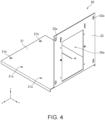
- the bracket 20 is a member constituted by a bottom plate part 21 constituting the xy plane and a wall surface part 22 constituting the yz plane.
- the cell stack 100 is mounted on the bottom plate part 21.
- the bracket 20 and the cell stack 100 are fixed by screwing using screw holes 21a formed in the bottom plate part 21.
- the bracket 20 and base casing 2 are fixed by inserting fixing pins (not illustrated) fixed to the base casing 2 into positioning holes 21b formed in the bottom plate part 21.
- the bracket 20 is preferably made of a metal material.
- An opening 20a is formed in the wall surface part 22 of the bracket 20.
- terminal electrodes 131 and 132 provided in the cell stack 100 are exposed through the opening 20a.
- a circuit board 11 illustrated in FIG. 2 is fixed to the wall surface part 22.
- the circuit board 11 has a circuit for connecting the cell stack 100 and the terminal electrodes E1 and E2.
- the wall surface part 22 and the circuit board 11 are fixed by screwing using screw holes 22a formed in the wall surface part 22.
- the circuit board 12 is fixed to the side plate part 2C of the base casing 2.
- the circuit board 12 has a circuit for controlling the cell stack 100, a circuit for monitoring the operating state of the cell stack 100, and the like. These circuits are connected to an external device through the connector P.
- FIG. 5 is a schematic exploded perspective view for explaining the structure of the unit cell.
- the unit cell has a resin holder 110, a sheet member 120 provided in the resin holder 110, a flat cell 130 housed in the resin holder 110 so as to contact the sheet member 120, and a metal plate 140 covering the flat cell 130.
- the resin holder 110 is a housing body having a bottom plate part 111 constituting the xy plane, side plate parts 112 and 113 constituting the xz plane, and side plate parts 114 and 115 constituting the yz plane.
- the dimension of the side plate part 113 in the z-direction is partially reduced so as not to interfere with the metal plate 140.
- Projections each having a screw hole 110a project from each of the side plate parts 112 and 113. By screwing screws (not illustrated) into the screw holes 110a, the plurality of unit cells 101 to 107 are connected together in the z-direction and fixed to the bottom plate part 21 of the bracket 20.
- the side plate part 114 has cuts 110b for letting out the terminal electrodes 131 and 132 of the flat cell 130 and guide parts 110c for guiding the terminal electrodes 131 and 132.
- the side plate parts 112 and 113 each have positioning parts 116 and 117 protruding in the y- and z-directions
- the side plate part 115 has positioning parts 116 and 117 protruding in the x- and z-directions.
- the sheet member 120 is a buffer member and is formed of a material which is lower in heat conductivity and higher in flexibility than the resin holder 110. Although it is not essential to use the sheet member 120 in the present invention, the presence of the sheet member 120 having the above characteristics between the bottom plate part 111 of the resin holder 110 and flat cell 130 can prevent the flat cell 130 in the resin holder 110 from being displaced or rattling.
- the stacked battery pack 1 has a structure in which the flat cells 130 are stacked in a direction (z-direction) perpendicular to the support surface of the casing, so that when the sheet member 120 having a high flexibility is interposed between the resin holder 110 and the flat cell 130, the sheet member 120 and the resin holder 110 and flat cell 130 closely adhere due to gravity.
- the heat conductivity of the sheet member 120 is lower than that of the resin holder 110, so that it is possible to improve heat insulating characteristics between the flat cells adjacent in the z-direction.
- the flat cell 130 is, e.g., a lithium-ion cell, in which the xy plane having the largest area has a substantially rectangular shape.
- the flat cell 130 is housed in the resin holder 110 such that the xy plane (bottom surface) thereof faces the bottom plate part 111 of the resin holder 110 through the sheet member 120, the xz planes (side surfaces in the longitudinal direction) thereof face the side plate parts 112 and 113 of the resin holder 110, and the yz planes (side surfaces in the short length direction) thereof face the side plate parts 114 and 115 of the resin holder 110.
- the terminal electrodes 131 and 132 of the flat cell 130 are led out from the yz plane (side surface in the short length direction) to protrude from the side plate part 114 of the resin holder 110 through the cuts 110b while being guided by the guide parts 110c.
- the flat cell 130 whose structure is not particularly limited, there can be used a pouch cell having a structure in which a stacked body having a plurality of positive and negative electrodes which are stacked through a separator is encapsulated in a bag-like laminate film together with electrolyte solution.
- the metal plate 140 is a plate-like member made of metal such as aluminum and has a main area 141 covering the xy plane (top surface) of the flat cell 130 and two protrusion parts 142 protruding in the y-direction from the main area 141. With this configuration, the flat cell 130 is sandwiched in the stacking direction between the bottom plate part 111 of the resin holder 110 and the main area 141 of the metal plate 140. Although the main area 141 of the metal plate 140 preferably contacts the xy plane (top surface) of the flat cell 130, a slight gap may exist therebetween. In this case as well, if the flat cell 130 generates heat, it expands to contact the metal plate 140.
- the metal plate 140 plays a role of enhancing the heat capacity of the unit cell, making the temperature distribution of the flat cell 130 in the xy plane uniform by the main area 141, and dissipating heat of the flat cell 130 outside by the protrusion part 142. Further, if the flat cell 130 abnormally generates heat and causes fire, the metal plate 140 function also as a fire protection wall for preventing high-temperature gas from being sprayed onto the flat cell 130 adjacent in the z-direction. Although it is not essential for the metal plate 140 to have the protrusion part 142, the presence of the protrusion part 142 significantly improves heat dissipation characteristics.
- the thus configured unit cells 101 to 107 are stacked on the bracket 20 as illustrated in FIG. 6 to constitute the cell stack 100.
- the unit cell 107 positioned in the uppermost layer of the cell stack 100 is covered with the cover 150, which is made of resin, as illustrated in FIG. 3 .
- the unit cells 101 to 107 may be connected in series or in parallel between the terminal electrodes E1 and E2.
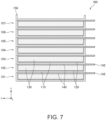
- FIG. 7 is a schematic yz cross-sectional view of the cell stack 100.
- the metal plate 140, the resin holder 110, and the sheet member 120 are interposed between the flat cells 130 adjacent to one another in the z-direction.
- the resin holder 110 and sheet member 120 function as a heat insulating member between the flat cells 130 adjacent in the z-direction.
- the metal plate 140 plays a role of enhancing the heat capacity of the unit cell, a role of making the temperature distribution of the flat cell 130 uniform, a role of dissipating heat of the flat cell 130 outside, and a role as a fire protection wall.
- FIG. 8 is a schematic yz cross-sectional view of a cell stack 100A according to a modification.
- FIG. 9 is a yz cross-sectional view illustrating in an enlarged manner the main part of the cell stack 100A according to the modification.
- a step is formed in the side plate part 112 of the resin holder 110, and the metal plate 140 is positioned in this step. That is, the side plate part 112 of the resin holder 110 has upper and lower level surfaces 112a and 112b constituting the xy plane and an inner side surface 112c constituting the xz plane, and the lower level surface 112b is located at a lower position in the z-direction than the upper level surface 112a.
- the lower level surface 112b and the inner side surface 112c define a cut portion, in which an end portion of the metal plate 140 in the y-direction is positioned.
- the upper level surface 112a contacts a back surface 118 of the resin holder 110 included in the unit cell in the upper layer.
- the entire top surface of the flat cell 130 contacts the metal plate 140, allowing the metal plate 140 to play the above roles more effectively.
- the stacked battery pack 1 has a structure in which the unit cells 101 to 107, including the metal plates 140, are stacked in a direction perpendicular to the support surface of the casing, so that it is possible to achieve a heat insulating effect by the presence of resin holder 110 and sheet member 120 and further to achieve a heat capacity enhancing effect, a heat dissipation effect, and a fire protection effect by the presence of metal plate 140.
- a simple configuration involving merely stacking the resin holders 110 each housing the flat cell 130 through the metal plate 140 and fixing them by screwing allows the individual flat cells 130 to be stably supported.
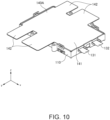
- the shape of the metal plate is not particularly limited, and, as in a metal plate 140A ( FIG. 10 ) according to a first modification, the protrusion part 142 may protrude to both sides in the y-direction. Further, although not illustrated, the protrusion part 142 may protrude in the x-direction. Furthermore, when the top casing 3 is made of a metal material, thermally connecting the protrusion part 142 of the metal plate 140A to the top casing 3 allows the entire casing to function as a heat sink, whereby a significantly large heat capacity can be achieved.
- the protrusion parts 142 of the metal plates 140 adjacent to one another in the z-direction may be connected by heat conducting members 160.
- the heat conducting member 160 is preferably made of metal such as aluminum and can be fixed to the protrusion part 142 by screwing.
- the metal plates 140 are thermally connected to one another, so that even if a given flat cell 130 abnormally generates heat, the heat can be released through the plurality of metal plates 140.
- the heat is applied through the metal plates 140 to other flat cells 130 that have not generated heat abnormally; however, the protrusion part 142 is positioned in an external area that does not overlap the resin holder 110 and flat cell 130 in the z-direction, so that the temperature of the heat is lowered by the heat dissipation effect of the protrusion part 142, and thus the heat to be applied to other flat cells 130 does not become significantly high.
- the protrusion part 142 may extend in the z-direction in a folded manner.
- FIG. 13 which is a yz cross-sectional view of a cell stack 100B configured using the metal plates 140B
- the protrusion parts 142 adjacent in the z-direction contact one another, so that the metal plates 140 can be thermally connected.
- the protrusion parts 142 adjacent in the z-direction may contact one another directly or may be thermally connected through a member having a high heat conductivity.
- the end portion of one metal plate 140 is folded three times (once folded inward by 180°, and then folded outward two times by 90°) to form the protrusion part 142.
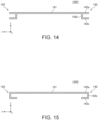
- a metal plate 140C FIG. 14
- a metal plate 140D FIG. 15
- the end portion of one metal plate 140 may be folded twice (folded inward two times by 90°) to form the protrusion part 142.
- a part of the protrusion part 142 that constitutes the same plane as the main area 141 is defined as a first part 142a
- a part of the protrusion part 142 that is connected to the first part 142a and extends in the z-direction is defined as a second part 142b
- a part of the protrusion part 142 that is connected to the second part 142b and the first part 142a of another protrusion part 142 adjacent in the z-direction is defined as a third part 142c
- the first and third parts 142a and 142c preferably protrude in a direction (x-direction or y-direction) away from the resin holder 110 and flat cell 130 as viewed from the second part 142b, as in the metal plates 140B and 140C illustrated in FIGS. 12 to 14 , to constitute a heat dissipating fin.
- the end portion of one metal plate 140 may be folded four times (sequentially folded inward by 90°, outward by 90°, inward by 90°, and outward by 90°) to form the protrusion part 142.
- a part of the protrusion part 142 that constitutes the same plane as the main area 141 is defined as a first part 142a
- a part of the protrusion part 142 that is connected to the first part 142a and extending in the z-direction is defined as a second part 142b
- a part of the protrusion part 142 that is connected to the second part 142b and extending in the y-direction is defined as a third part 142c
- a part of the protrusion part 142 that is connected to the third part 142c and extending in the z-direction is defined as a fourth part 142d
- a part of the protrusion part 142 that is connected to the fourth part 142d and extending in the y-direction is defined as a fifth part 142e
- the first part 142a contacts the third part 142c of the metal plate 140E in the upper layer
- the second part 142b contacts the fourth part 142d of the metal plate 140E in the upper
- the metal plate 140E is designed such that the dimension between the outer sides of a pair of the second parts 142b positioned at both ends in the y-direction and the dimension between the inner sides of a pair of the fourth parts 142d positioned at both ends in the y-direction substantially coincide with each other and that the dimension of the second part 142b in the z-direction and the dimension of the fourth part 142d in the z-direction substantially coincide with each other.
Landscapes
- Chemical & Material Sciences (AREA)
- Chemical Kinetics & Catalysis (AREA)
- Electrochemistry (AREA)
- General Chemical & Material Sciences (AREA)
- Engineering & Computer Science (AREA)
- Manufacturing & Machinery (AREA)
- Inorganic Chemistry (AREA)
- Battery Mounting, Suspending (AREA)
- Secondary Cells (AREA)
Description
- The present invention relates to a stacked battery pack and, more particularly, to a stacked battery pack having a plurality of stacked flat cells.
- As a stacked battery pack having a plurality of stacked flat cells, those disclosed in
JP 2009-301877A JP 2012-511802 JP 2010-218716A EP 1 071 147 A1 are known. For example,JP 2009-301877A JP 2012-511802 - In this regard, in a stacked battery pack described in
JP 2010-218716A EP 1 071 147 A1 - However, the spacer used in
JP 2010-218716A - It is therefore an object of the present invention to provide a stacked battery pack capable of propagation of abnormal heat generation with a simple configuration.
- The present invention is defined by the appended claims. A stacked battery pack according to the present invention has a plurality of stacked unit cells, wherein each of the plurality of unit cells includes a resin holder, a flat cell housed in the resin holder, and a metal plate covering the flat cell, thereby the flat cell is sandwiched between the resin holder and the metal plate in the stacking direction of the unit cells.
- According to the present invention, the resin holder and the metal plate are interposed between the flat cells adjacent in the stacking direction, so that it is possible to achieve a heat insulating effect by the presence of the resin holder and a heat capacity enhancing effect, a heat dissipation effect, and a fire protection effect by the presence of the metal plate. Further, the plurality of unit cells are stacked in a direction perpendicular to the support surface of a casing, so that, unlike a case where the flat cells are arranged in parallel to the support surface of a casing, there is no need to provide a complicated support mechanism for stably supporting the individual flat cells. Thus, it is possible to stably support the individual flat cells with a simple configuration.
- Each of the plurality of unit cells may further include a sheet member positioned between the resin holder and the flat cell, the sheet member being lower in heat conductivity and higher in flexibility than the resin holder. The presence of the sheet member can further enhance the heat insulating effect and prevent the individual flat cell in the resin holder from being displaced or rattling when the unit cells are stacked in a direction perpendicular to the support surface of a casing.
- The metal plate has a protrusion part that does not overlap the resin holder in the stacking direction. Thus, heat of the flat cell can be efficiently dissipated from the protrusion part. In this case, the protrusion parts adjacent in the stacking direction may be connected through a heat conducting member or may be connected directly. With this configuration, the heat capacity can be significantly enhanced, so that even if a given flat cell abnormally generates heat, the heat is efficiently dissipated through the plurality of protrusion parts. When the protrusion parts adjacent in the stacking direction may be connected directly, the protrusion parts may each include a first part constituting the same plane as a main area of the metal plate that overlaps the resin holder in the stacking direction, a second part that is connected to the first part and extends in the stacking direction, and a third part connected to the second part and the first part of another protrusion part adjacent in the stacking direction, and the first and third parts may protrude in a direction away from the resin holder as viewed from the second part to constitute a heat dissipating fin. With this configuration, a higher heat dissipation effect can be achieved. Further, the resin holder has a side plate part that covers the flat cell in a direction perpendicular to the stacking direction. In this case, the side plate part has a step in which the metal plate is positioned. This increases the contact area between the flat cell and the metal plate, thus making it possible to increase the heat capacity enhancing effect, heat dissipation effect, and fire protection effect by the presence of the metal plate.
- The stacked battery pack according to the present invention may further include a bracket on which the plurality of stacked unit cells are placed. The bracket may include a bottom plate part positioned between the support surface of a casing and the lowermost one of the plurality of unit cells and a wall surface part connected to the bottom plate part and extending in the stacking direction. The wall surface part may have an opening at a portion facing a terminal electrode of the flat cell. Thus, a circuit board can be attached to the wall surface part. Further, even if a given flat cell abnormally generates heat to cause high-temperature gas to blow out from the vicinity of the terminal electrode, the high-temperature gas is released outside through the opening without being blocked by the wall surface part.
- As described above, the stacked battery pack according to the present invention can prevent propagation of abnormal heat generation with a simple configuration.
- The above features and advantages of the present invention will be more apparent from the following description of certain preferred embodiments taken in conjunction with the accompanying drawings, in which:
-
FIGS. 1A and 1B are schematic perspective views illustrating the outer appearance of a stackedbattery pack 1 according to an embodiment of the present invention; -
FIG. 2 is a schematic perspective view of thestacked battery pack 1 from which atop casing 3 is removed; -
FIG. 3 is a schematic perspective view illustrating a state where acell stack 100 is mounted on abracket 20; -
FIG. 4 is a schematic perspective view illustrating the structure of thebracket 20; -
FIG. 5 is a schematic exploded perspective view for explaining the structure of a unit cell; -
FIG. 6 is a schematic perspective view illustrating a state whereunit cells 101 to 107 are stacked on thebracket 20; -
FIG. 7 is a schematic yz cross-sectional view of thecell stack 100; -
FIG. 8 is a schematic yz cross-sectional view of acell stack 100A according to a modification; -
FIG. 9 is a yz cross-sectional view illustrating in an enlarged manner the main part of thecell stack 100A according to the modification; -
FIG. 10 is a schematic perspective view for explaining the shape of ametal plate 140A according to a first modification; -
FIG. 11 is a schematic perspective view illustrating a stacked battery pack additionally provided with aheat conducting member 160; -
FIG. 12 is a schematic perspective view for explaining the shape of ametal plate 140B according to a second modification; -
FIG. 13 is a schematic yz cross-sectional view of acell stack 100B using ametal plate 140B; -
FIG. 14 is a schematic cross-sectional view for explaining the shape of ametal plate 140C according to a third modification; -
FIG. 15 is a schematic cross-sectional view for explaining the shape of ametal plate 140D according to a fourth modification; -
FIG. 16 is a schematic cross-sectional view for explaining the shape of ametal plate 140E according to a fifth modification; and -
FIG. 17 is a schematic yz cross-sectional view of acell stack 100E using themetal plate 140E. - Hereinafter, a preferred embodiment of the present invention will be described in detail with reference to the accompanying drawings.
-
FIGS. 1A and 1B are schematic perspective views illustrating the outer appearance of a stackedbattery pack 1 according to an embodiment of the present invention. - As illustrated in
FIGS. 1A and 1B , thestacked battery pack 1 according to the present embodiment has a box-like outer shape having abase casing 2 and atop casing 3 which are fixed to each other byscrews 4. A pair of terminal electrodes E1 and E2 are provided so as to be exposed from openings formed in thetop casing 3, and a connector P is provided so as to be exposed from an opening formed in thebase casing 2. The terminal electrodes E1 and E2 are a pair of terminals for charging the stackedbattery pack 1. The connector P is a terminal for data input/output with respect to the stackedbattery pack 1. The material of thebase casing 2 andtop casing 3 is not particularly limited and may be a metal material or a resin material. Using a metal material allows achievement of high reliability and high heat dissipation characteristics. Using a resin material allows achievement of weight reduction. Thebase casing 2 has fixingmembers 5 for fixing the stackedbattery pack 1 according to the present embodiment to equipment (conveyance vehicle, etc.) using a power source. -
FIG. 2 is a schematic perspective view of the stackedbattery pack 1 according to the present embodiment from which thetop casing 3 is removed. - As illustrated in
FIG. 2 , acell stack 100 is housed inside the casing. Thebase casing 2 has abottom plate part 2A constituting the xy plane, aside plate part 2B constituting the yz plane, and a side plate part 2C constituting the xz plane. Thecell stack 100 is fixed on thebottom plate part 2A constituting a support surface of the casing. Thebase casing 2 further has foldedparts bottom plate part 2A, a foldedpart 2F continuing from theside plate part 2B, and a foldedpart 2G continuing from the side plate part 2C. The foldedparts 2D to 2G each havescrew holes 4a into which thescrews 4 are screwed. - The
cell stack 100 is mounted on abracket 20, and sevenunit cells 101 to 107 are stacked in the z-direction as illustrated inFIG. 3 . Theunit cell 107 positioned in the uppermost layer is covered with acover 150. As illustrated inFIG. 4 , thebracket 20 is a member constituted by abottom plate part 21 constituting the xy plane and awall surface part 22 constituting the yz plane. Thecell stack 100 is mounted on thebottom plate part 21. Thebracket 20 and thecell stack 100 are fixed by screwing usingscrew holes 21a formed in thebottom plate part 21. Thebracket 20 andbase casing 2 are fixed by inserting fixing pins (not illustrated) fixed to thebase casing 2 intopositioning holes 21b formed in thebottom plate part 21. Although not particularly limited, thebracket 20 is preferably made of a metal material. - An
opening 20a is formed in thewall surface part 22 of thebracket 20. In a state where thecell stack 100 is mounted on thebracket 20,terminal electrodes cell stack 100 are exposed through theopening 20a. Thus, even if a part of thecell stack 100 abnormally generates heat to cause high-temperature gas to blow out from the vicinity of theterminal electrodes opening 20a without being blocked by thewall surface part 22. Acircuit board 11 illustrated inFIG. 2 is fixed to thewall surface part 22. Thecircuit board 11 has a circuit for connecting thecell stack 100 and the terminal electrodes E1 and E2. Thewall surface part 22 and thecircuit board 11 are fixed by screwing usingscrew holes 22a formed in thewall surface part 22. - Another
circuit board 12 is fixed to the side plate part 2C of thebase casing 2. Thecircuit board 12 has a circuit for controlling thecell stack 100, a circuit for monitoring the operating state of thecell stack 100, and the like. These circuits are connected to an external device through the connector P. -
FIG. 5 is a schematic exploded perspective view for explaining the structure of the unit cell. - As illustrated in
FIG. 5 , the unit cell has aresin holder 110, asheet member 120 provided in theresin holder 110, aflat cell 130 housed in theresin holder 110 so as to contact thesheet member 120, and ametal plate 140 covering theflat cell 130. - The
resin holder 110 is a housing body having abottom plate part 111 constituting the xy plane,side plate parts side plate parts side plate part 113 in the z-direction is partially reduced so as not to interfere with themetal plate 140. Projections each having ascrew hole 110a project from each of theside plate parts screw holes 110a, the plurality ofunit cells 101 to 107 are connected together in the z-direction and fixed to thebottom plate part 21 of thebracket 20. Further, theside plate part 114 hascuts 110b for letting out theterminal electrodes flat cell 130 and guideparts 110c for guiding theterminal electrodes side plate parts positioning parts side plate part 115 haspositioning parts unit cells 101 to 107 are stacked in the z-direction, thepositioning parts 116 of a lower unit cell and thepositioning parts 117 of an upper unit cell are fitted to each other, whereby theunit cells 101 to 107 are positioned in the xy-directions. This allows theunit cells 101 to 107 to be temporarily fixed before connection by screwing the screws into thescrew holes 110a. - The
sheet member 120 is a buffer member and is formed of a material which is lower in heat conductivity and higher in flexibility than theresin holder 110. Although it is not essential to use thesheet member 120 in the present invention, the presence of thesheet member 120 having the above characteristics between thebottom plate part 111 of theresin holder 110 andflat cell 130 can prevent theflat cell 130 in theresin holder 110 from being displaced or rattling. That is, the stackedbattery pack 1 according to the present embodiment has a structure in which theflat cells 130 are stacked in a direction (z-direction) perpendicular to the support surface of the casing, so that when thesheet member 120 having a high flexibility is interposed between theresin holder 110 and theflat cell 130, thesheet member 120 and theresin holder 110 andflat cell 130 closely adhere due to gravity. In addition, the heat conductivity of thesheet member 120 is lower than that of theresin holder 110, so that it is possible to improve heat insulating characteristics between the flat cells adjacent in the z-direction. - The
flat cell 130 is, e.g., a lithium-ion cell, in which the xy plane having the largest area has a substantially rectangular shape. Theflat cell 130 is housed in theresin holder 110 such that the xy plane (bottom surface) thereof faces thebottom plate part 111 of theresin holder 110 through thesheet member 120, the xz planes (side surfaces in the longitudinal direction) thereof face theside plate parts resin holder 110, and the yz planes (side surfaces in the short length direction) thereof face theside plate parts resin holder 110. Theterminal electrodes flat cell 130 are led out from the yz plane (side surface in the short length direction) to protrude from theside plate part 114 of theresin holder 110 through thecuts 110b while being guided by theguide parts 110c. As theflat cell 130, whose structure is not particularly limited, there can be used a pouch cell having a structure in which a stacked body having a plurality of positive and negative electrodes which are stacked through a separator is encapsulated in a bag-like laminate film together with electrolyte solution. - The
metal plate 140 is a plate-like member made of metal such as aluminum and has amain area 141 covering the xy plane (top surface) of theflat cell 130 and twoprotrusion parts 142 protruding in the y-direction from themain area 141. With this configuration, theflat cell 130 is sandwiched in the stacking direction between thebottom plate part 111 of theresin holder 110 and themain area 141 of themetal plate 140. Although themain area 141 of themetal plate 140 preferably contacts the xy plane (top surface) of theflat cell 130, a slight gap may exist therebetween. In this case as well, if theflat cell 130 generates heat, it expands to contact themetal plate 140. Themetal plate 140 plays a role of enhancing the heat capacity of the unit cell, making the temperature distribution of theflat cell 130 in the xy plane uniform by themain area 141, and dissipating heat of theflat cell 130 outside by theprotrusion part 142. Further, if theflat cell 130 abnormally generates heat and causes fire, themetal plate 140 function also as a fire protection wall for preventing high-temperature gas from being sprayed onto theflat cell 130 adjacent in the z-direction. Although it is not essential for themetal plate 140 to have theprotrusion part 142, the presence of theprotrusion part 142 significantly improves heat dissipation characteristics. - The thus configured
unit cells 101 to 107 are stacked on thebracket 20 as illustrated inFIG. 6 to constitute thecell stack 100. Theunit cell 107 positioned in the uppermost layer of thecell stack 100 is covered with thecover 150, which is made of resin, as illustrated inFIG. 3 . Theunit cells 101 to 107 may be connected in series or in parallel between the terminal electrodes E1 and E2. -
FIG. 7 is a schematic yz cross-sectional view of thecell stack 100. - As illustrated in
FIG. 7 , themetal plate 140, theresin holder 110, and thesheet member 120 are interposed between theflat cells 130 adjacent to one another in the z-direction. Theresin holder 110 andsheet member 120 function as a heat insulating member between theflat cells 130 adjacent in the z-direction. Specifically, even if a givenflat cell 130 abnormally generates heat, theresin holder 110 andsheet member 120 prevent propagation of the generated heat to otherflat cells 130. On the other hand, as described above, themetal plate 140 plays a role of enhancing the heat capacity of the unit cell, a role of making the temperature distribution of theflat cell 130 uniform, a role of dissipating heat of theflat cell 130 outside, and a role as a fire protection wall. -
FIG. 8 is a schematic yz cross-sectional view of acell stack 100A according to a modification.FIG. 9 is a yz cross-sectional view illustrating in an enlarged manner the main part of thecell stack 100A according to the modification. - As illustrated in
FIGS. 8 and9 , in thecell stack 100A according to the modification, a step is formed in theside plate part 112 of theresin holder 110, and themetal plate 140 is positioned in this step. That is, theside plate part 112 of theresin holder 110 has upper andlower level surfaces inner side surface 112c constituting the xz plane, and thelower level surface 112b is located at a lower position in the z-direction than theupper level surface 112a. Thelower level surface 112b and theinner side surface 112c define a cut portion, in which an end portion of themetal plate 140 in the y-direction is positioned. Theupper level surface 112a contacts aback surface 118 of theresin holder 110 included in the unit cell in the upper layer. Thus, the entire top surface of theflat cell 130 contacts themetal plate 140, allowing themetal plate 140 to play the above roles more effectively. - As described above, the stacked
battery pack 1 according to the present embodiment has a structure in which theunit cells 101 to 107, including themetal plates 140, are stacked in a direction perpendicular to the support surface of the casing, so that it is possible to achieve a heat insulating effect by the presence ofresin holder 110 andsheet member 120 and further to achieve a heat capacity enhancing effect, a heat dissipation effect, and a fire protection effect by the presence ofmetal plate 140. In addition, a simple configuration involving merely stacking theresin holders 110 each housing theflat cell 130 through themetal plate 140 and fixing them by screwing allows the individualflat cells 130 to be stably supported. - The shape of the metal plate is not particularly limited, and, as in a
metal plate 140A (FIG. 10 ) according to a first modification, theprotrusion part 142 may protrude to both sides in the y-direction. Further, although not illustrated, theprotrusion part 142 may protrude in the x-direction. Furthermore, when thetop casing 3 is made of a metal material, thermally connecting theprotrusion part 142 of themetal plate 140A to thetop casing 3 allows the entire casing to function as a heat sink, whereby a significantly large heat capacity can be achieved. - Further, as illustrated in
FIG. 11 , theprotrusion parts 142 of themetal plates 140 adjacent to one another in the z-direction may be connected byheat conducting members 160. Theheat conducting member 160 is preferably made of metal such as aluminum and can be fixed to theprotrusion part 142 by screwing. Thus, themetal plates 140 are thermally connected to one another, so that even if a givenflat cell 130 abnormally generates heat, the heat can be released through the plurality ofmetal plates 140. In this case, the heat is applied through themetal plates 140 to otherflat cells 130 that have not generated heat abnormally; however, theprotrusion part 142 is positioned in an external area that does not overlap theresin holder 110 andflat cell 130 in the z-direction, so that the temperature of the heat is lowered by the heat dissipation effect of theprotrusion part 142, and thus the heat to be applied to otherflat cells 130 does not become significantly high. - Further, as in a
metal plate 140B (FIG. 12 ) according to a second modification, theprotrusion part 142 may extend in the z-direction in a folded manner. Thus, as illustrated inFIG. 13 , which is a yz cross-sectional view of acell stack 100B configured using themetal plates 140B, theprotrusion parts 142 adjacent in the z-direction contact one another, so that themetal plates 140 can be thermally connected. Theprotrusion parts 142 adjacent in the z-direction may contact one another directly or may be thermally connected through a member having a high heat conductivity. - In the example illustrated in
FIGS. 12 and13 , the end portion of onemetal plate 140 is folded three times (once folded inward by 180°, and then folded outward two times by 90°) to form theprotrusion part 142. Alternatively, as in ametal plate 140C (FIG. 14 ) according to a third modification, it is possible to use an extrusion molding method to form theprotrusion part 142 without folding it. Further alternatively, as in ametal plate 140D (FIG. 15 ) according to a fourth modification, the end portion of onemetal plate 140 may be folded twice (folded inward two times by 90°) to form theprotrusion part 142. However, assuming that a part of theprotrusion part 142 that constitutes the same plane as themain area 141 is defined as afirst part 142a, a part of theprotrusion part 142 that is connected to thefirst part 142a and extends in the z-direction is defined as asecond part 142b, and a part of theprotrusion part 142 that is connected to thesecond part 142b and thefirst part 142a of anotherprotrusion part 142 adjacent in the z-direction is defined as athird part 142c, the first andthird parts resin holder 110 andflat cell 130 as viewed from thesecond part 142b, as in themetal plates FIGS. 12 to 14 , to constitute a heat dissipating fin. With this configuration, a higher heat dissipation effect can be achieved. - Further, as in a
metal plate 140E (FIG. 16 ) according to a fifth embodiment, the end portion of onemetal plate 140 may be folded four times (sequentially folded inward by 90°, outward by 90°, inward by 90°, and outward by 90°) to form theprotrusion part 142. Assuming here that a part of the protrusion part 142 that constitutes the same plane as the main area 141 is defined as a first part 142a, a part of the protrusion part 142 that is connected to the first part 142a and extending in the z-direction is defined as a second part 142b, a part of the protrusion part 142 that is connected to the second part 142b and extending in the y-direction is defined as a third part 142c, a part of the protrusion part 142 that is connected to the third part 142c and extending in the z-direction is defined as a fourth part 142d, and a part of the protrusion part 142 that is connected to the fourth part 142d and extending in the y-direction is defined as a fifth part 142e, the first part 142a contacts the third part 142c of the metal plate 140E in the upper layer, the second part 142b contacts the fourth part 142d of the metal plate 140E in the upper layer, the third part 142c contacts the first part 142a of the metal plate 140E in the lower layer, the fourth part 142d contacts the second part 142b of the metal plate 140E in the lower layer, and the fifth part 142e protrudes in the y-direction, as illustrated inFIG. 17 which is a yz cross-sectional view of a cell stack 100E using the metal plate 140E. - To achieve the above configuration, the
metal plate 140E is designed such that the dimension between the outer sides of a pair of thesecond parts 142b positioned at both ends in the y-direction and the dimension between the inner sides of a pair of thefourth parts 142d positioned at both ends in the y-direction substantially coincide with each other and that the dimension of thesecond part 142b in the z-direction and the dimension of thefourth part 142d in the z-direction substantially coincide with each other. This significantly increases the contact area between themetal plates 140E adjacent in the vertical direction, making it possible to achieve higher heat dissipation characteristics. When themetal plate 140E according to the fifth modification is used, heat is more apt to be applied through themetal plate 140E to otherflat cells 130 that have not generated heat abnormally; however, the heat to be applied to otherflat cells 130 does not become significantly high due to the heat dissipation effect of theprotrusion part 142. - It is apparent that the present invention is not limited to the above embodiments, but may be modified within the scope of the claims.
Claims (6)
- A stacked battery pack (1) comprising a plurality of unit cells (101-107) stacked in a stacking direction (z),wherein each of the plurality of unit cells (101-107) includes a resin holder (110), a flat cell (130) housed in the resin holder (110), and a metal plate (140) covering the flat cell (130), thereby the flat cell (130) is sandwiched between the resin holder (110) and the metal plate (140) in the stacking direction (z),wherein each of the metal plates (140) has a protrusion part (142) that does not overlap the resin holder (110) in the stacking direction (z),characterized in that,the resin holder (110) has a side plate part (112) that covers the flat cell (130) in a direction perpendicular to the stacking direction (z), andwherein the side plate part (112) has a step (112b) in which the metal plate (140) is positioned.
- The stacked battery pack (1) as claimed in claim 1,wherein each of the plurality of unit cells (101-107) further includes a sheet member (120) positioned between the resin holder (110) and the flat cell (130), andwherein the sheet member (120) is lower in heat conductivity and higher in flexibility than the resin holder (110) .
- The stacked battery pack (1) as claimed in claim 1 or 2, wherein the protrusion parts (142) adjacent in the stacking direction (z) are connected through a heat conducting member (160).
- The stacked battery pack (1) as claimed in claim 1 or 2, wherein the protrusion parts (142) adjacent in the stacking direction (z) are connected directly.
- The stacked battery pack (1) as claimed in claim 4,wherein the protrusion part (142) includes:a first part (142a) constituting a same plane as a main area (141) of the metal plate (130) that overlaps the resin holder (110) in the stacking direction (z);a second part (142b) that is connected to the first part (142a) and extends in the stacking direction (z); anda third part (142c) connected to the second part (142b) and the first part (142a) of another protrusion part (142) adjacent in the stacking direction (z), andwherein the first and third parts (142a,142c) protrude in a direction away from the resin holder (110) as viewed from the second part (142b) to constitute a heat dissipating fin.
- The stacked battery pack (1) as claimed in any one of claims 1 to 5, further comprising a bracket (20) on which the plurality of unit cells (101-107) are placed,wherein the bracket (20) includes a bottom plate part (21) positioned between the support surface (2A) of a casing (2) and a lowermost one of the plurality of unit cells (101) and a wall surface part (22) connected to the bottom plate part (21) and extending in the stacking direction (z),wherein the wall surface part (22) has an opening (20a) at a portion facing a terminal electrode (131, 132) of the flat cell (130).
Applications Claiming Priority (1)
| Application Number | Priority Date | Filing Date | Title |
|---|---|---|---|
| JP2019205616A JP7310561B2 (en) | 2019-11-13 | 2019-11-13 | Stacked battery pack |
Publications (3)
| Publication Number | Publication Date |
|---|---|
| EP3823085A2 EP3823085A2 (en) | 2021-05-19 |
| EP3823085A3 EP3823085A3 (en) | 2021-09-29 |
| EP3823085B1 true EP3823085B1 (en) | 2024-07-17 |
Family
ID=73448846
Family Applications (1)
| Application Number | Title | Priority Date | Filing Date |
|---|---|---|---|
| EP20207406.8A Active EP3823085B1 (en) | 2019-11-13 | 2020-11-13 | Stacked battery pack |
Country Status (4)
| Country | Link |
|---|---|
| US (1) | US12142777B2 (en) |
| EP (1) | EP3823085B1 (en) |
| JP (1) | JP7310561B2 (en) |
| CN (1) | CN112803091B (en) |
Families Citing this family (4)
| Publication number | Priority date | Publication date | Assignee | Title |
|---|---|---|---|---|
| WO2023121416A1 (en) * | 2021-12-24 | 2023-06-29 | 주식회사 엘지에너지솔루션 | Battery module with reinforced safety |
| DE102022104370A1 (en) | 2022-02-24 | 2023-08-24 | Audi Aktiengesellschaft | Battery cell unit and energy store for a motor vehicle |
| CN114614189B (en) * | 2022-03-29 | 2024-05-24 | 东莞新能安科技有限公司 | Battery modules and electronic devices |
| CN121529084A (en) * | 2023-01-17 | 2026-02-13 | 厦门新能达科技有限公司 | Battery packs and electrical equipment |
Family Cites Families (49)
| Publication number | Priority date | Publication date | Assignee | Title |
|---|---|---|---|---|
| JPH11176400A (en) | 1997-10-06 | 1999-07-02 | Japan Storage Battery Co Ltd | Battery case |
| EP1071147A1 (en) | 1999-07-19 | 2001-01-24 | Toshiba Battery Co., Ltd. | Battery pack |
| JP2006339032A (en) | 2005-06-02 | 2006-12-14 | Toshiba Corp | Battery pack |
| JP2008198860A (en) | 2007-02-14 | 2008-08-28 | Nec Corp | Cooling method of small portable terminal equipment |
| US20080299452A1 (en) | 2007-05-31 | 2008-12-04 | Densei-Lambda K.K. | Battery pack |
| JP2009026703A (en) | 2007-07-23 | 2009-02-05 | Toyota Motor Corp | Manufacturing method of battery pack |
| JP5111099B2 (en) | 2007-12-28 | 2012-12-26 | シャープ株式会社 | Battery pack |
| JP2009301877A (en) | 2008-06-13 | 2009-12-24 | Toyoda Gosei Co Ltd | Battery pack device |
| JP2010062093A (en) | 2008-09-05 | 2010-03-18 | Panasonic Corp | Battery pack |
| KR101095346B1 (en) | 2008-12-12 | 2011-12-16 | 주식회사 엘지화학 | Battery module and medium / large battery pack with excellent heat dissipation |
| JP2010218716A (en) | 2009-03-13 | 2010-09-30 | Sanyo Electric Co Ltd | Battery pack |
| WO2010131700A1 (en) * | 2009-05-14 | 2010-11-18 | 株式会社Gsユアサ | Battery assembly |
| KR101071537B1 (en) | 2009-09-17 | 2011-10-10 | 주식회사 엘지화학 | Battery Module Having Heat Dissipation Member of Novel Structure and Battery Pack Employed with the Same |
| EP2557627B1 (en) | 2010-04-07 | 2016-04-06 | Eig Ltd. | Secondary battery module |
| JP2011238521A (en) | 2010-05-12 | 2011-11-24 | Ngk Insulators Ltd | Secondary battery module |
| JP2011238520A (en) | 2010-05-12 | 2011-11-24 | Ngk Insulators Ltd | Secondary battery module |
| DE102011013617A1 (en) * | 2011-03-11 | 2012-09-13 | Li-Tec Battery Gmbh | Energy storage device, energy storage cell and heat conduction |
| JP5776345B2 (en) * | 2011-06-09 | 2015-09-09 | ソニー株式会社 | Battery module, electronic device, power system and electric vehicle |
| JP5811949B2 (en) | 2012-05-23 | 2015-11-11 | 株式会社豊田自動織機 | Power storage device |
| JP5904113B2 (en) | 2012-12-10 | 2016-04-13 | 株式会社豊田自動織機 | Battery module and battery module manufacturing method |
| CN105190934B (en) * | 2012-12-28 | 2017-10-13 | 日立汽车系统株式会社 | Battery pack |
| JP5621859B2 (en) * | 2013-01-25 | 2014-11-12 | 株式会社豊田自動織機 | Battery module |
| CA2887537A1 (en) | 2014-04-16 | 2015-10-16 | Southwest Electronic Energy Corporation | Tri-layer material for heat spreading in battery pack modules |
| US20150325893A1 (en) | 2014-05-06 | 2015-11-12 | Ford Global Technologies, Llc | Heat retaining vehicle battery assembly |
| KR101787638B1 (en) | 2014-11-05 | 2017-10-19 | 주식회사 엘지화학 | Cartridge Frame Having Double Sidewall Structure and Battery Module Having the Same |
| JP6435883B2 (en) * | 2015-01-28 | 2018-12-12 | 株式会社豊田自動織機 | Battery module and battery module disassembly method |
| US10236134B1 (en) | 2015-02-26 | 2019-03-19 | Amazon Technologies, Inc. | Battery thermal shield |
| KR102044409B1 (en) | 2015-05-14 | 2019-11-13 | 주식회사 엘지화학 | Battery pack including cartridge for secondary battery |
| US9806387B2 (en) | 2015-09-02 | 2017-10-31 | General Electric Company | Energy storage device with reduced temperature variability between cells |
| WO2017056407A1 (en) | 2015-09-30 | 2017-04-06 | パナソニックIpマネジメント株式会社 | Cell module |
| JP2017076526A (en) | 2015-10-15 | 2017-04-20 | 株式会社豊田自動織機 | Battery module |
| KR101943285B1 (en) | 2015-10-22 | 2019-01-28 | 닛산 지도우샤 가부시키가이샤 | Battery pack and manufacturing method thereof |
| GB2545214A (en) | 2015-12-09 | 2017-06-14 | Jaguar Land Rover Ltd | Apparatus for providing a barrier between battery modules |
| JP6528689B2 (en) | 2016-01-08 | 2019-06-12 | 株式会社デンソー | Battery pack |
| KR102072765B1 (en) | 2016-02-22 | 2020-03-02 | 주식회사 엘지화학 | Battery module, battery pack comprising the battery module and vehicle comprising the battery pack |
| KR102072764B1 (en) | 2016-03-03 | 2020-02-03 | 주식회사 엘지화학 | Battery module, battery pack comprising the battery module and vehicle comprising the battery pack |
| KR102285283B1 (en) | 2016-05-11 | 2021-08-03 | 에스케이이노베이션 주식회사 | Submodule and battery module comprising the submodule |
| KR102051108B1 (en) | 2016-06-13 | 2019-12-02 | 주식회사 엘지화학 | Battery module, battery pack comprising the battery module and vehicle comprising the battery pack |
| JP6920660B2 (en) | 2016-08-05 | 2021-08-18 | パナソニックIpマネジメント株式会社 | Battery module |
| JP6846689B2 (en) | 2016-08-24 | 2021-03-24 | パナソニックIpマネジメント株式会社 | Battery module |
| CN115241567A (en) | 2016-11-18 | 2022-10-25 | 罗密欧系统公司 | System and method for thermal management of a battery using a vapor chamber |
| KR102461577B1 (en) | 2017-07-17 | 2022-11-01 | 삼성에스디아이 주식회사 | Secondary Battery Module |
| US11437664B2 (en) | 2017-09-22 | 2022-09-06 | Panasonic Intellectual Property Management Co., Ltd. | Battery module |
| JP7396895B2 (en) | 2017-09-22 | 2023-12-12 | 株式会社Aescジャパン | battery module |
| JP7074455B2 (en) | 2017-10-31 | 2022-05-24 | イビデン株式会社 | Insulation sheet for assembled battery and assembled battery |
| US11121426B2 (en) | 2017-11-30 | 2021-09-14 | William Koetting | Battery module including nodal cell compression and heat rejection |
| CN207800719U (en) | 2018-02-06 | 2018-08-31 | 宁德时代新能源科技股份有限公司 | Battery modules |
| US10593920B2 (en) | 2018-08-13 | 2020-03-17 | Wisk Aero Llc | Capacitance reduction in battery systems |
| JP7183811B2 (en) | 2019-01-24 | 2022-12-06 | Tdk株式会社 | battery pack |
-
2019
- 2019-11-13 JP JP2019205616A patent/JP7310561B2/en active Active
-
2020
- 2020-09-30 US US17/038,664 patent/US12142777B2/en active Active
- 2020-11-13 EP EP20207406.8A patent/EP3823085B1/en active Active
- 2020-11-13 CN CN202011266693.0A patent/CN112803091B/en active Active
Also Published As
| Publication number | Publication date |
|---|---|
| EP3823085A2 (en) | 2021-05-19 |
| JP2021077595A (en) | 2021-05-20 |
| CN112803091B (en) | 2024-03-22 |
| EP3823085A3 (en) | 2021-09-29 |
| JP7310561B2 (en) | 2023-07-19 |
| US12142777B2 (en) | 2024-11-12 |
| US20210143379A1 (en) | 2021-05-13 |
| CN112803091A (en) | 2021-05-14 |
Similar Documents
| Publication | Publication Date | Title |
|---|---|---|
| EP3823085B1 (en) | Stacked battery pack | |
| JP6141732B2 (en) | Battery stack and battery pack | |
| CN116261806A (en) | Battery module and battery pack including the battery module | |
| CN114128020B (en) | Battery module and battery pack including the battery module | |
| KR20220126441A (en) | Battery module and battery pack including same | |
| KR20060037598A (en) | Battery module | |
| US20220013829A1 (en) | Battery Pack | |
| JP2014072088A (en) | Power storage device | |
| JP2023535947A (en) | Battery modules and battery packs containing the same | |
| US11489217B2 (en) | Battery pack | |
| KR101430619B1 (en) | Battery Pack | |
| KR20170021561A (en) | Battery pack | |
| KR102755060B1 (en) | Battery pack including a protection circuit module heat radiation structure using heat radiation tape | |
| JP7806296B2 (en) | Battery pack | |
| US11764434B2 (en) | Connection board and battery module including the same | |
| US20230369672A1 (en) | Heat dissipation member and battery pack including the same | |
| CN223334903U (en) | Functional module and energy storage equipment | |
| KR20140074411A (en) | Battery Sub-Pack and a Method for manufacturing the same | |
| JP2022111599A (en) | battery device | |
| JP6081866B2 (en) | Battery pack | |
| KR20250131625A (en) | Battery module, Battery pack and vehicle including the same | |
| KR20250177156A (en) | Battery pack and device including the same |
Legal Events
| Date | Code | Title | Description |
|---|---|---|---|
| PUAI | Public reference made under article 153(3) epc to a published international application that has entered the european phase |
Free format text: ORIGINAL CODE: 0009012 |
|
| STAA | Information on the status of an ep patent application or granted ep patent |
Free format text: STATUS: THE APPLICATION HAS BEEN PUBLISHED |
|
| AK | Designated contracting states |
Kind code of ref document: A2 Designated state(s): AL AT BE BG CH CY CZ DE DK EE ES FI FR GB GR HR HU IE IS IT LI LT LU LV MC MK MT NL NO PL PT RO RS SE SI SK SM TR |
|
| PUAL | Search report despatched |
Free format text: ORIGINAL CODE: 0009013 |
|
| AK | Designated contracting states |
Kind code of ref document: A3 Designated state(s): AL AT BE BG CH CY CZ DE DK EE ES FI FR GB GR HR HU IE IS IT LI LT LU LV MC MK MT NL NO PL PT RO RS SE SI SK SM TR |
|
| RIC1 | Information provided on ipc code assigned before grant |
Ipc: H01M 10/6555 20140101ALI20210824BHEP Ipc: H01M 10/6551 20140101ALI20210824BHEP Ipc: H01M 10/647 20140101ALI20210824BHEP Ipc: H01M 10/613 20140101ALI20210824BHEP Ipc: H01M 50/293 20210101ALI20210824BHEP Ipc: H01M 50/227 20210101ALI20210824BHEP Ipc: H01M 50/224 20210101ALI20210824BHEP Ipc: H01M 50/209 20210101ALI20210824BHEP Ipc: H01M 50/202 20210101AFI20210824BHEP |
|
| STAA | Information on the status of an ep patent application or granted ep patent |
Free format text: STATUS: REQUEST FOR EXAMINATION WAS MADE |
|
| 17P | Request for examination filed |
Effective date: 20220323 |
|
| RBV | Designated contracting states (corrected) |
Designated state(s): AL AT BE BG CH CY CZ DE DK EE ES FI FR GB GR HR HU IE IS IT LI LT LU LV MC MK MT NL NO PL PT RO RS SE SI SK SM TR |
|
| RIC1 | Information provided on ipc code assigned before grant |
Ipc: H01M 50/238 20210101ALI20231228BHEP Ipc: H01M 50/211 20210101ALI20231228BHEP Ipc: H01M 10/6555 20140101ALI20231228BHEP Ipc: H01M 10/6551 20140101ALI20231228BHEP Ipc: H01M 10/647 20140101ALI20231228BHEP Ipc: H01M 10/613 20140101ALI20231228BHEP Ipc: H01M 50/293 20210101ALI20231228BHEP Ipc: H01M 50/227 20210101ALI20231228BHEP Ipc: H01M 50/224 20210101ALI20231228BHEP Ipc: H01M 50/209 20210101ALI20231228BHEP Ipc: H01M 50/202 20210101AFI20231228BHEP |
|
| GRAP | Despatch of communication of intention to grant a patent |
Free format text: ORIGINAL CODE: EPIDOSNIGR1 |
|
| STAA | Information on the status of an ep patent application or granted ep patent |
Free format text: STATUS: GRANT OF PATENT IS INTENDED |
|
| INTG | Intention to grant announced |
Effective date: 20240212 |
|
| GRAS | Grant fee paid |
Free format text: ORIGINAL CODE: EPIDOSNIGR3 |
|
| GRAA | (expected) grant |
Free format text: ORIGINAL CODE: 0009210 |
|
| STAA | Information on the status of an ep patent application or granted ep patent |
Free format text: STATUS: THE PATENT HAS BEEN GRANTED |
|
| AK | Designated contracting states |
Kind code of ref document: B1 Designated state(s): AL AT BE BG CH CY CZ DE DK EE ES FI FR GB GR HR HU IE IS IT LI LT LU LV MC MK MT NL NO PL PT RO RS SE SI SK SM TR |
|
| REG | Reference to a national code |
Ref country code: CH Ref legal event code: EP |
|
| REG | Reference to a national code |
Ref country code: DE Ref legal event code: R096 Ref document number: 602020034031 Country of ref document: DE |
|
| REG | Reference to a national code |
Ref country code: IE Ref legal event code: FG4D |
|
| REG | Reference to a national code |
Ref country code: LT Ref legal event code: MG9D |
|
| REG | Reference to a national code |
Ref country code: NL Ref legal event code: MP Effective date: 20240717 |
|
| PG25 | Lapsed in a contracting state [announced via postgrant information from national office to epo] |
Ref country code: PT Free format text: LAPSE BECAUSE OF FAILURE TO SUBMIT A TRANSLATION OF THE DESCRIPTION OR TO PAY THE FEE WITHIN THE PRESCRIBED TIME-LIMIT Effective date: 20241118 |
|
| REG | Reference to a national code |
Ref country code: AT Ref legal event code: MK05 Ref document number: 1705012 Country of ref document: AT Kind code of ref document: T Effective date: 20240717 |
|
| PG25 | Lapsed in a contracting state [announced via postgrant information from national office to epo] |
Ref country code: NL Free format text: LAPSE BECAUSE OF FAILURE TO SUBMIT A TRANSLATION OF THE DESCRIPTION OR TO PAY THE FEE WITHIN THE PRESCRIBED TIME-LIMIT Effective date: 20240717 |
|
| PG25 | Lapsed in a contracting state [announced via postgrant information from national office to epo] |
Ref country code: PT Free format text: LAPSE BECAUSE OF FAILURE TO SUBMIT A TRANSLATION OF THE DESCRIPTION OR TO PAY THE FEE WITHIN THE PRESCRIBED TIME-LIMIT Effective date: 20241118 Ref country code: NL Free format text: LAPSE BECAUSE OF FAILURE TO SUBMIT A TRANSLATION OF THE DESCRIPTION OR TO PAY THE FEE WITHIN THE PRESCRIBED TIME-LIMIT Effective date: 20240717 |
|
| PG25 | Lapsed in a contracting state [announced via postgrant information from national office to epo] |
Ref country code: NO Free format text: LAPSE BECAUSE OF FAILURE TO SUBMIT A TRANSLATION OF THE DESCRIPTION OR TO PAY THE FEE WITHIN THE PRESCRIBED TIME-LIMIT Effective date: 20241017 |
|
| PG25 | Lapsed in a contracting state [announced via postgrant information from national office to epo] |
Ref country code: FI Free format text: LAPSE BECAUSE OF FAILURE TO SUBMIT A TRANSLATION OF THE DESCRIPTION OR TO PAY THE FEE WITHIN THE PRESCRIBED TIME-LIMIT Effective date: 20240717 Ref country code: GR Free format text: LAPSE BECAUSE OF FAILURE TO SUBMIT A TRANSLATION OF THE DESCRIPTION OR TO PAY THE FEE WITHIN THE PRESCRIBED TIME-LIMIT Effective date: 20241018 Ref country code: PL Free format text: LAPSE BECAUSE OF FAILURE TO SUBMIT A TRANSLATION OF THE DESCRIPTION OR TO PAY THE FEE WITHIN THE PRESCRIBED TIME-LIMIT Effective date: 20240717 |
|
| PG25 | Lapsed in a contracting state [announced via postgrant information from national office to epo] |
Ref country code: BG Free format text: LAPSE BECAUSE OF FAILURE TO SUBMIT A TRANSLATION OF THE DESCRIPTION OR TO PAY THE FEE WITHIN THE PRESCRIBED TIME-LIMIT Effective date: 20240717 |
|
| PG25 | Lapsed in a contracting state [announced via postgrant information from national office to epo] |
Ref country code: LV Free format text: LAPSE BECAUSE OF FAILURE TO SUBMIT A TRANSLATION OF THE DESCRIPTION OR TO PAY THE FEE WITHIN THE PRESCRIBED TIME-LIMIT Effective date: 20240717 |
|
| PG25 | Lapsed in a contracting state [announced via postgrant information from national office to epo] |
Ref country code: IS Free format text: LAPSE BECAUSE OF FAILURE TO SUBMIT A TRANSLATION OF THE DESCRIPTION OR TO PAY THE FEE WITHIN THE PRESCRIBED TIME-LIMIT Effective date: 20241117 Ref country code: AT Free format text: LAPSE BECAUSE OF FAILURE TO SUBMIT A TRANSLATION OF THE DESCRIPTION OR TO PAY THE FEE WITHIN THE PRESCRIBED TIME-LIMIT Effective date: 20240717 |
|
| PG25 | Lapsed in a contracting state [announced via postgrant information from national office to epo] |
Ref country code: HR Free format text: LAPSE BECAUSE OF FAILURE TO SUBMIT A TRANSLATION OF THE DESCRIPTION OR TO PAY THE FEE WITHIN THE PRESCRIBED TIME-LIMIT Effective date: 20240717 |
|
| PG25 | Lapsed in a contracting state [announced via postgrant information from national office to epo] |
Ref country code: ES Free format text: LAPSE BECAUSE OF FAILURE TO SUBMIT A TRANSLATION OF THE DESCRIPTION OR TO PAY THE FEE WITHIN THE PRESCRIBED TIME-LIMIT Effective date: 20240717 Ref country code: RS Free format text: LAPSE BECAUSE OF FAILURE TO SUBMIT A TRANSLATION OF THE DESCRIPTION OR TO PAY THE FEE WITHIN THE PRESCRIBED TIME-LIMIT Effective date: 20241017 |
|
| PG25 | Lapsed in a contracting state [announced via postgrant information from national office to epo] |
Ref country code: RS Free format text: LAPSE BECAUSE OF FAILURE TO SUBMIT A TRANSLATION OF THE DESCRIPTION OR TO PAY THE FEE WITHIN THE PRESCRIBED TIME-LIMIT Effective date: 20241017 Ref country code: PL Free format text: LAPSE BECAUSE OF FAILURE TO SUBMIT A TRANSLATION OF THE DESCRIPTION OR TO PAY THE FEE WITHIN THE PRESCRIBED TIME-LIMIT Effective date: 20240717 Ref country code: NO Free format text: LAPSE BECAUSE OF FAILURE TO SUBMIT A TRANSLATION OF THE DESCRIPTION OR TO PAY THE FEE WITHIN THE PRESCRIBED TIME-LIMIT Effective date: 20241017 Ref country code: LV Free format text: LAPSE BECAUSE OF FAILURE TO SUBMIT A TRANSLATION OF THE DESCRIPTION OR TO PAY THE FEE WITHIN THE PRESCRIBED TIME-LIMIT Effective date: 20240717 Ref country code: IS Free format text: LAPSE BECAUSE OF FAILURE TO SUBMIT A TRANSLATION OF THE DESCRIPTION OR TO PAY THE FEE WITHIN THE PRESCRIBED TIME-LIMIT Effective date: 20241117 Ref country code: HR Free format text: LAPSE BECAUSE OF FAILURE TO SUBMIT A TRANSLATION OF THE DESCRIPTION OR TO PAY THE FEE WITHIN THE PRESCRIBED TIME-LIMIT Effective date: 20240717 Ref country code: GR Free format text: LAPSE BECAUSE OF FAILURE TO SUBMIT A TRANSLATION OF THE DESCRIPTION OR TO PAY THE FEE WITHIN THE PRESCRIBED TIME-LIMIT Effective date: 20241018 Ref country code: FI Free format text: LAPSE BECAUSE OF FAILURE TO SUBMIT A TRANSLATION OF THE DESCRIPTION OR TO PAY THE FEE WITHIN THE PRESCRIBED TIME-LIMIT Effective date: 20240717 Ref country code: ES Free format text: LAPSE BECAUSE OF FAILURE TO SUBMIT A TRANSLATION OF THE DESCRIPTION OR TO PAY THE FEE WITHIN THE PRESCRIBED TIME-LIMIT Effective date: 20240717 Ref country code: BG Free format text: LAPSE BECAUSE OF FAILURE TO SUBMIT A TRANSLATION OF THE DESCRIPTION OR TO PAY THE FEE WITHIN THE PRESCRIBED TIME-LIMIT Effective date: 20240717 Ref country code: AT Free format text: LAPSE BECAUSE OF FAILURE TO SUBMIT A TRANSLATION OF THE DESCRIPTION OR TO PAY THE FEE WITHIN THE PRESCRIBED TIME-LIMIT Effective date: 20240717 |
|
| PG25 | Lapsed in a contracting state [announced via postgrant information from national office to epo] |
Ref country code: SM Free format text: LAPSE BECAUSE OF FAILURE TO SUBMIT A TRANSLATION OF THE DESCRIPTION OR TO PAY THE FEE WITHIN THE PRESCRIBED TIME-LIMIT Effective date: 20240717 Ref country code: DK Free format text: LAPSE BECAUSE OF FAILURE TO SUBMIT A TRANSLATION OF THE DESCRIPTION OR TO PAY THE FEE WITHIN THE PRESCRIBED TIME-LIMIT Effective date: 20240717 Ref country code: RO Free format text: LAPSE BECAUSE OF FAILURE TO SUBMIT A TRANSLATION OF THE DESCRIPTION OR TO PAY THE FEE WITHIN THE PRESCRIBED TIME-LIMIT Effective date: 20240717 |
|
| REG | Reference to a national code |
Ref country code: DE Ref legal event code: R097 Ref document number: 602020034031 Country of ref document: DE |
|
| PG25 | Lapsed in a contracting state [announced via postgrant information from national office to epo] |
Ref country code: EE Free format text: LAPSE BECAUSE OF FAILURE TO SUBMIT A TRANSLATION OF THE DESCRIPTION OR TO PAY THE FEE WITHIN THE PRESCRIBED TIME-LIMIT Effective date: 20240717 |
|
| PG25 | Lapsed in a contracting state [announced via postgrant information from national office to epo] |
Ref country code: CZ Free format text: LAPSE BECAUSE OF FAILURE TO SUBMIT A TRANSLATION OF THE DESCRIPTION OR TO PAY THE FEE WITHIN THE PRESCRIBED TIME-LIMIT Effective date: 20240717 |
|
| PG25 | Lapsed in a contracting state [announced via postgrant information from national office to epo] |
Ref country code: SK Free format text: LAPSE BECAUSE OF FAILURE TO SUBMIT A TRANSLATION OF THE DESCRIPTION OR TO PAY THE FEE WITHIN THE PRESCRIBED TIME-LIMIT Effective date: 20240717 |
|
| PLBE | No opposition filed within time limit |
Free format text: ORIGINAL CODE: 0009261 |
|
| STAA | Information on the status of an ep patent application or granted ep patent |
Free format text: STATUS: NO OPPOSITION FILED WITHIN TIME LIMIT |
|
| 26N | No opposition filed |
Effective date: 20250422 |
|
| REG | Reference to a national code |
Ref country code: CH Ref legal event code: PL |
|
| PG25 | Lapsed in a contracting state [announced via postgrant information from national office to epo] |
Ref country code: MC Free format text: LAPSE BECAUSE OF FAILURE TO SUBMIT A TRANSLATION OF THE DESCRIPTION OR TO PAY THE FEE WITHIN THE PRESCRIBED TIME-LIMIT Effective date: 20240717 |
|
| PG25 | Lapsed in a contracting state [announced via postgrant information from national office to epo] |
Ref country code: LU Free format text: LAPSE BECAUSE OF NON-PAYMENT OF DUE FEES Effective date: 20241113 |
|
| REG | Reference to a national code |
Ref country code: CH Ref legal event code: PL |
|
| PG25 | Lapsed in a contracting state [announced via postgrant information from national office to epo] |
Ref country code: CH Free format text: LAPSE BECAUSE OF NON-PAYMENT OF DUE FEES Effective date: 20241130 |
|
| REG | Reference to a national code |
Ref country code: BE Ref legal event code: MM Effective date: 20241130 |
|
| PG25 | Lapsed in a contracting state [announced via postgrant information from national office to epo] |
Ref country code: SE Free format text: LAPSE BECAUSE OF FAILURE TO SUBMIT A TRANSLATION OF THE DESCRIPTION OR TO PAY THE FEE WITHIN THE PRESCRIBED TIME-LIMIT Effective date: 20240717 |
|
| PG25 | Lapsed in a contracting state [announced via postgrant information from national office to epo] |
Ref country code: BE Free format text: LAPSE BECAUSE OF NON-PAYMENT OF DUE FEES Effective date: 20241130 |
|
| PG25 | Lapsed in a contracting state [announced via postgrant information from national office to epo] |
Ref country code: FR Free format text: LAPSE BECAUSE OF NON-PAYMENT OF DUE FEES Effective date: 20241130 |
|
| PG25 | Lapsed in a contracting state [announced via postgrant information from national office to epo] |
Ref country code: IE Free format text: LAPSE BECAUSE OF NON-PAYMENT OF DUE FEES Effective date: 20241113 |
|
| PGFP | Annual fee paid to national office [announced via postgrant information from national office to epo] |
Ref country code: DE Payment date: 20250930 Year of fee payment: 6 |
|
| PGFP | Annual fee paid to national office [announced via postgrant information from national office to epo] |
Ref country code: GB Payment date: 20251001 Year of fee payment: 6 |
|
| PG25 | Lapsed in a contracting state [announced via postgrant information from national office to epo] |
Ref country code: IT Free format text: LAPSE BECAUSE OF FAILURE TO SUBMIT A TRANSLATION OF THE DESCRIPTION OR TO PAY THE FEE WITHIN THE PRESCRIBED TIME-LIMIT Effective date: 20240717 |
|
| PG25 | Lapsed in a contracting state [announced via postgrant information from national office to epo] |
Ref country code: HU Free format text: LAPSE BECAUSE OF FAILURE TO SUBMIT A TRANSLATION OF THE DESCRIPTION OR TO PAY THE FEE WITHIN THE PRESCRIBED TIME-LIMIT; INVALID AB INITIO Effective date: 20201113 |
|
| PG25 | Lapsed in a contracting state [announced via postgrant information from national office to epo] |
Ref country code: CY Free format text: LAPSE BECAUSE OF FAILURE TO SUBMIT A TRANSLATION OF THE DESCRIPTION OR TO PAY THE FEE WITHIN THE PRESCRIBED TIME-LIMIT; INVALID AB INITIO Effective date: 20201113 |