EP3822064A1 - Ladungsträger und verfahren zu seiner herstellung - Google Patents
Ladungsträger und verfahren zu seiner herstellung Download PDFInfo
- Publication number
- EP3822064A1 EP3822064A1 EP20020517.7A EP20020517A EP3822064A1 EP 3822064 A1 EP3822064 A1 EP 3822064A1 EP 20020517 A EP20020517 A EP 20020517A EP 3822064 A1 EP3822064 A1 EP 3822064A1
- Authority
- EP
- European Patent Office
- Prior art keywords
- item
- mixture
- load carrier
- pos
- upper tool
- Prior art date
- Legal status (The legal status is an assumption and is not a legal conclusion. Google has not performed a legal analysis and makes no representation as to the accuracy of the status listed.)
- Pending
Links
- 238000004519 manufacturing process Methods 0.000 title claims abstract description 8
- 238000000034 method Methods 0.000 title claims description 11
- 239000000463 material Substances 0.000 claims abstract description 35
- 239000011230 binding agent Substances 0.000 claims abstract description 34
- 239000000203 mixture Substances 0.000 claims abstract description 31
- 239000000835 fiber Substances 0.000 claims abstract description 19
- 239000002800 charge carrier Substances 0.000 claims abstract description 13
- 238000003825 pressing Methods 0.000 claims abstract description 12
- 239000002131 composite material Substances 0.000 claims abstract description 8
- 238000010438 heat treatment Methods 0.000 claims abstract description 8
- 239000002245 particle Substances 0.000 claims abstract description 5
- 239000000470 constituent Substances 0.000 claims abstract 2
- 238000002347 injection Methods 0.000 claims description 7
- 239000007924 injection Substances 0.000 claims description 7
- 244000025254 Cannabis sativa Species 0.000 claims description 4
- 238000001816 cooling Methods 0.000 claims description 4
- 229920002101 Chitin Polymers 0.000 claims description 3
- 229920002472 Starch Polymers 0.000 claims description 3
- 229920002678 cellulose Polymers 0.000 claims description 3
- 239000001913 cellulose Substances 0.000 claims description 3
- 230000006835 compression Effects 0.000 claims description 3
- 238000007906 compression Methods 0.000 claims description 3
- 229920001971 elastomer Polymers 0.000 claims description 3
- 229920005989 resin Polymers 0.000 claims description 3
- 239000011347 resin Substances 0.000 claims description 3
- 239000005060 rubber Substances 0.000 claims description 3
- 150000004760 silicates Chemical class 0.000 claims description 3
- 239000008107 starch Substances 0.000 claims description 3
- 235000019698 starch Nutrition 0.000 claims description 3
- 229920001187 thermosetting polymer Polymers 0.000 claims description 3
- 238000009825 accumulation Methods 0.000 claims description 2
- 239000011091 composite packaging material Substances 0.000 claims description 2
- 239000010893 paper waste Substances 0.000 claims description 2
- 239000004033 plastic Substances 0.000 claims description 2
- 229920003023 plastic Polymers 0.000 claims description 2
- 229920001296 polysiloxane Polymers 0.000 claims description 2
- 102000004169 proteins and genes Human genes 0.000 claims description 2
- 108090000623 proteins and genes Proteins 0.000 claims description 2
- 239000002023 wood Substances 0.000 claims description 2
- 229920000965 Duroplast Polymers 0.000 claims 1
- 238000005304 joining Methods 0.000 claims 1
- 239000000969 carrier Substances 0.000 description 8
- 238000007664 blowing Methods 0.000 description 4
- 235000013361 beverage Nutrition 0.000 description 3
- 229920001131 Pulp (paper) Polymers 0.000 description 2
- XUIMIQQOPSSXEZ-UHFFFAOYSA-N Silicon Chemical compound [Si] XUIMIQQOPSSXEZ-UHFFFAOYSA-N 0.000 description 2
- 239000011111 cardboard Substances 0.000 description 2
- 239000003795 chemical substances by application Substances 0.000 description 2
- 238000004064 recycling Methods 0.000 description 2
- 229910052710 silicon Inorganic materials 0.000 description 2
- 239000010703 silicon Substances 0.000 description 2
- 239000007787 solid Substances 0.000 description 2
- 239000002699 waste material Substances 0.000 description 2
- 241000894006 Bacteria Species 0.000 description 1
- 240000008564 Boehmeria nivea Species 0.000 description 1
- 235000012766 Cannabis sativa ssp. sativa var. sativa Nutrition 0.000 description 1
- 235000012765 Cannabis sativa ssp. sativa var. spontanea Nutrition 0.000 description 1
- 244000146553 Ceiba pentandra Species 0.000 description 1
- 235000003301 Ceiba pentandra Nutrition 0.000 description 1
- 244000060011 Cocos nucifera Species 0.000 description 1
- 235000013162 Cocos nucifera Nutrition 0.000 description 1
- 229920000742 Cotton Polymers 0.000 description 1
- 241000196324 Embryophyta Species 0.000 description 1
- 241000219146 Gossypium Species 0.000 description 1
- 230000004913 activation Effects 0.000 description 1
- 239000000654 additive Substances 0.000 description 1
- 235000009120 camo Nutrition 0.000 description 1
- 235000005607 chanvre indien Nutrition 0.000 description 1
- 238000005056 compaction Methods 0.000 description 1
- 230000001419 dependent effect Effects 0.000 description 1
- 238000011161 development Methods 0.000 description 1
- 230000018109 developmental process Effects 0.000 description 1
- 239000000945 filler Substances 0.000 description 1
- 239000011487 hemp Substances 0.000 description 1
- 239000002184 metal Substances 0.000 description 1
- 244000005700 microbiome Species 0.000 description 1
- 238000002156 mixing Methods 0.000 description 1
- 238000000465 moulding Methods 0.000 description 1
- 239000005022 packaging material Substances 0.000 description 1
- 239000011087 paperboard Substances 0.000 description 1
- 239000002994 raw material Substances 0.000 description 1
- 238000007711 solidification Methods 0.000 description 1
- 230000008023 solidification Effects 0.000 description 1
- 239000007858 starting material Substances 0.000 description 1
- 239000010902 straw Substances 0.000 description 1
- 239000004753 textile Substances 0.000 description 1
- XLYOFNOQVPJJNP-UHFFFAOYSA-N water Substances O XLYOFNOQVPJJNP-UHFFFAOYSA-N 0.000 description 1
- 239000001993 wax Substances 0.000 description 1
- 235000013618 yogurt Nutrition 0.000 description 1
Images

Classifications
-
- B—PERFORMING OPERATIONS; TRANSPORTING
- B29—WORKING OF PLASTICS; WORKING OF SUBSTANCES IN A PLASTIC STATE IN GENERAL
- B29C—SHAPING OR JOINING OF PLASTICS; SHAPING OF MATERIAL IN A PLASTIC STATE, NOT OTHERWISE PROVIDED FOR; AFTER-TREATMENT OF THE SHAPED PRODUCTS, e.g. REPAIRING
- B29C43/00—Compression moulding, i.e. applying external pressure to flow the moulding material; Apparatus therefor
- B29C43/32—Component parts, details or accessories; Auxiliary operations
- B29C43/34—Feeding the material to the mould or the compression means
-
- B—PERFORMING OPERATIONS; TRANSPORTING
- B29—WORKING OF PLASTICS; WORKING OF SUBSTANCES IN A PLASTIC STATE IN GENERAL
- B29C—SHAPING OR JOINING OF PLASTICS; SHAPING OF MATERIAL IN A PLASTIC STATE, NOT OTHERWISE PROVIDED FOR; AFTER-TREATMENT OF THE SHAPED PRODUCTS, e.g. REPAIRING
- B29C43/00—Compression moulding, i.e. applying external pressure to flow the moulding material; Apparatus therefor
- B29C43/32—Component parts, details or accessories; Auxiliary operations
- B29C43/36—Moulds for making articles of definite length, i.e. discrete articles
-
- B—PERFORMING OPERATIONS; TRANSPORTING
- B29—WORKING OF PLASTICS; WORKING OF SUBSTANCES IN A PLASTIC STATE IN GENERAL
- B29C—SHAPING OR JOINING OF PLASTICS; SHAPING OF MATERIAL IN A PLASTIC STATE, NOT OTHERWISE PROVIDED FOR; AFTER-TREATMENT OF THE SHAPED PRODUCTS, e.g. REPAIRING
- B29C43/00—Compression moulding, i.e. applying external pressure to flow the moulding material; Apparatus therefor
- B29C43/32—Component parts, details or accessories; Auxiliary operations
- B29C43/52—Heating or cooling
-
- B—PERFORMING OPERATIONS; TRANSPORTING
- B29—WORKING OF PLASTICS; WORKING OF SUBSTANCES IN A PLASTIC STATE IN GENERAL
- B29C—SHAPING OR JOINING OF PLASTICS; SHAPING OF MATERIAL IN A PLASTIC STATE, NOT OTHERWISE PROVIDED FOR; AFTER-TREATMENT OF THE SHAPED PRODUCTS, e.g. REPAIRING
- B29C70/00—Shaping composites, i.e. plastics material comprising reinforcements, fillers or preformed parts, e.g. inserts
- B29C70/02—Shaping composites, i.e. plastics material comprising reinforcements, fillers or preformed parts, e.g. inserts comprising combinations of reinforcements, e.g. non-specified reinforcements, fibrous reinforcing inserts and fillers, e.g. particulate fillers, incorporated in matrix material, forming one or more layers and with or without non-reinforced or non-filled layers
- B29C70/021—Combinations of fibrous reinforcement and non-fibrous material
- B29C70/025—Combinations of fibrous reinforcement and non-fibrous material with particular filler
-
- B—PERFORMING OPERATIONS; TRANSPORTING
- B29—WORKING OF PLASTICS; WORKING OF SUBSTANCES IN A PLASTIC STATE IN GENERAL
- B29C—SHAPING OR JOINING OF PLASTICS; SHAPING OF MATERIAL IN A PLASTIC STATE, NOT OTHERWISE PROVIDED FOR; AFTER-TREATMENT OF THE SHAPED PRODUCTS, e.g. REPAIRING
- B29C70/00—Shaping composites, i.e. plastics material comprising reinforcements, fillers or preformed parts, e.g. inserts
- B29C70/04—Shaping composites, i.e. plastics material comprising reinforcements, fillers or preformed parts, e.g. inserts comprising reinforcements only, e.g. self-reinforcing plastics
- B29C70/28—Shaping operations therefor
- B29C70/40—Shaping or impregnating by compression not applied
- B29C70/42—Shaping or impregnating by compression not applied for producing articles of definite length, i.e. discrete articles
- B29C70/46—Shaping or impregnating by compression not applied for producing articles of definite length, i.e. discrete articles using matched moulds, e.g. for deforming sheet moulding compounds [SMC] or prepregs
-
- B—PERFORMING OPERATIONS; TRANSPORTING
- B65—CONVEYING; PACKING; STORING; HANDLING THIN OR FILAMENTARY MATERIAL
- B65D—CONTAINERS FOR STORAGE OR TRANSPORT OF ARTICLES OR MATERIALS, e.g. BAGS, BARRELS, BOTTLES, BOXES, CANS, CARTONS, CRATES, DRUMS, JARS, TANKS, HOPPERS, FORWARDING CONTAINERS; ACCESSORIES, CLOSURES, OR FITTINGS THEREFOR; PACKAGING ELEMENTS; PACKAGES
- B65D19/00—Pallets or like platforms, with or without side walls, for supporting loads to be lifted or lowered
- B65D19/0004—Rigid pallets without side walls
- B65D19/0006—Rigid pallets without side walls the load supporting surface being made of a single element
- B65D19/0008—Rigid pallets without side walls the load supporting surface being made of a single element forming a continuous plane contact surface
- B65D19/001—Rigid pallets without side walls the load supporting surface being made of a single element forming a continuous plane contact surface the base surface being made of a single element
- B65D19/0014—Rigid pallets without side walls the load supporting surface being made of a single element forming a continuous plane contact surface the base surface being made of a single element forming discontinuous or non-planar contact surfaces
- B65D19/0018—Rigid pallets without side walls the load supporting surface being made of a single element forming a continuous plane contact surface the base surface being made of a single element forming discontinuous or non-planar contact surfaces and each contact surface having a discrete foot-like shape
-
- B—PERFORMING OPERATIONS; TRANSPORTING
- B29—WORKING OF PLASTICS; WORKING OF SUBSTANCES IN A PLASTIC STATE IN GENERAL
- B29C—SHAPING OR JOINING OF PLASTICS; SHAPING OF MATERIAL IN A PLASTIC STATE, NOT OTHERWISE PROVIDED FOR; AFTER-TREATMENT OF THE SHAPED PRODUCTS, e.g. REPAIRING
- B29C43/00—Compression moulding, i.e. applying external pressure to flow the moulding material; Apparatus therefor
- B29C43/32—Component parts, details or accessories; Auxiliary operations
- B29C43/34—Feeding the material to the mould or the compression means
- B29C2043/345—Feeding the material to the mould or the compression means using gas, e.g. air, to transport non liquid material
-
- B—PERFORMING OPERATIONS; TRANSPORTING
- B29—WORKING OF PLASTICS; WORKING OF SUBSTANCES IN A PLASTIC STATE IN GENERAL
- B29C—SHAPING OR JOINING OF PLASTICS; SHAPING OF MATERIAL IN A PLASTIC STATE, NOT OTHERWISE PROVIDED FOR; AFTER-TREATMENT OF THE SHAPED PRODUCTS, e.g. REPAIRING
- B29C43/00—Compression moulding, i.e. applying external pressure to flow the moulding material; Apparatus therefor
- B29C43/02—Compression moulding, i.e. applying external pressure to flow the moulding material; Apparatus therefor of articles of definite length, i.e. discrete articles
-
- B—PERFORMING OPERATIONS; TRANSPORTING
- B29—WORKING OF PLASTICS; WORKING OF SUBSTANCES IN A PLASTIC STATE IN GENERAL
- B29K—INDEXING SCHEME ASSOCIATED WITH SUBCLASSES B29B, B29C OR B29D, RELATING TO MOULDING MATERIALS OR TO MATERIALS FOR MOULDS, REINFORCEMENTS, FILLERS OR PREFORMED PARTS, e.g. INSERTS
- B29K2101/00—Use of unspecified macromolecular compounds as moulding material
- B29K2101/10—Thermosetting resins
-
- B—PERFORMING OPERATIONS; TRANSPORTING
- B29—WORKING OF PLASTICS; WORKING OF SUBSTANCES IN A PLASTIC STATE IN GENERAL
- B29K—INDEXING SCHEME ASSOCIATED WITH SUBCLASSES B29B, B29C OR B29D, RELATING TO MOULDING MATERIALS OR TO MATERIALS FOR MOULDS, REINFORCEMENTS, FILLERS OR PREFORMED PARTS, e.g. INSERTS
- B29K2105/00—Condition, form or state of moulded material or of the material to be shaped
- B29K2105/06—Condition, form or state of moulded material or of the material to be shaped containing reinforcements, fillers or inserts
-
- B—PERFORMING OPERATIONS; TRANSPORTING
- B29—WORKING OF PLASTICS; WORKING OF SUBSTANCES IN A PLASTIC STATE IN GENERAL
- B29K—INDEXING SCHEME ASSOCIATED WITH SUBCLASSES B29B, B29C OR B29D, RELATING TO MOULDING MATERIALS OR TO MATERIALS FOR MOULDS, REINFORCEMENTS, FILLERS OR PREFORMED PARTS, e.g. INSERTS
- B29K2105/00—Condition, form or state of moulded material or of the material to be shaped
- B29K2105/26—Scrap or recycled material
-
- B—PERFORMING OPERATIONS; TRANSPORTING
- B29—WORKING OF PLASTICS; WORKING OF SUBSTANCES IN A PLASTIC STATE IN GENERAL
- B29L—INDEXING SCHEME ASSOCIATED WITH SUBCLASS B29C, RELATING TO PARTICULAR ARTICLES
- B29L2031/00—Other particular articles
- B29L2031/712—Containers; Packaging elements or accessories, Packages
- B29L2031/7178—Pallets
-
- B—PERFORMING OPERATIONS; TRANSPORTING
- B65—CONVEYING; PACKING; STORING; HANDLING THIN OR FILAMENTARY MATERIAL
- B65D—CONTAINERS FOR STORAGE OR TRANSPORT OF ARTICLES OR MATERIALS, e.g. BAGS, BARRELS, BOTTLES, BOXES, CANS, CARTONS, CRATES, DRUMS, JARS, TANKS, HOPPERS, FORWARDING CONTAINERS; ACCESSORIES, CLOSURES, OR FITTINGS THEREFOR; PACKAGING ELEMENTS; PACKAGES
- B65D2519/00—Pallets or like platforms, with or without side walls, for supporting loads to be lifted or lowered
- B65D2519/00004—Details relating to pallets
- B65D2519/00009—Materials
- B65D2519/00014—Materials for the load supporting surface
- B65D2519/00019—Paper
-
- B—PERFORMING OPERATIONS; TRANSPORTING
- B65—CONVEYING; PACKING; STORING; HANDLING THIN OR FILAMENTARY MATERIAL
- B65D—CONTAINERS FOR STORAGE OR TRANSPORT OF ARTICLES OR MATERIALS, e.g. BAGS, BARRELS, BOTTLES, BOXES, CANS, CARTONS, CRATES, DRUMS, JARS, TANKS, HOPPERS, FORWARDING CONTAINERS; ACCESSORIES, CLOSURES, OR FITTINGS THEREFOR; PACKAGING ELEMENTS; PACKAGES
- B65D2519/00—Pallets or like platforms, with or without side walls, for supporting loads to be lifted or lowered
- B65D2519/00004—Details relating to pallets
- B65D2519/00009—Materials
- B65D2519/00014—Materials for the load supporting surface
- B65D2519/00024—Metal
-
- B—PERFORMING OPERATIONS; TRANSPORTING
- B65—CONVEYING; PACKING; STORING; HANDLING THIN OR FILAMENTARY MATERIAL
- B65D—CONTAINERS FOR STORAGE OR TRANSPORT OF ARTICLES OR MATERIALS, e.g. BAGS, BARRELS, BOTTLES, BOXES, CANS, CARTONS, CRATES, DRUMS, JARS, TANKS, HOPPERS, FORWARDING CONTAINERS; ACCESSORIES, CLOSURES, OR FITTINGS THEREFOR; PACKAGING ELEMENTS; PACKAGES
- B65D2519/00—Pallets or like platforms, with or without side walls, for supporting loads to be lifted or lowered
- B65D2519/00004—Details relating to pallets
- B65D2519/00009—Materials
- B65D2519/00014—Materials for the load supporting surface
- B65D2519/00029—Wood
-
- B—PERFORMING OPERATIONS; TRANSPORTING
- B65—CONVEYING; PACKING; STORING; HANDLING THIN OR FILAMENTARY MATERIAL
- B65D—CONTAINERS FOR STORAGE OR TRANSPORT OF ARTICLES OR MATERIALS, e.g. BAGS, BARRELS, BOTTLES, BOXES, CANS, CARTONS, CRATES, DRUMS, JARS, TANKS, HOPPERS, FORWARDING CONTAINERS; ACCESSORIES, CLOSURES, OR FITTINGS THEREFOR; PACKAGING ELEMENTS; PACKAGES
- B65D2519/00—Pallets or like platforms, with or without side walls, for supporting loads to be lifted or lowered
- B65D2519/00004—Details relating to pallets
- B65D2519/00009—Materials
- B65D2519/00014—Materials for the load supporting surface
- B65D2519/00034—Plastic
-
- B—PERFORMING OPERATIONS; TRANSPORTING
- B65—CONVEYING; PACKING; STORING; HANDLING THIN OR FILAMENTARY MATERIAL
- B65D—CONTAINERS FOR STORAGE OR TRANSPORT OF ARTICLES OR MATERIALS, e.g. BAGS, BARRELS, BOTTLES, BOXES, CANS, CARTONS, CRATES, DRUMS, JARS, TANKS, HOPPERS, FORWARDING CONTAINERS; ACCESSORIES, CLOSURES, OR FITTINGS THEREFOR; PACKAGING ELEMENTS; PACKAGES
- B65D2519/00—Pallets or like platforms, with or without side walls, for supporting loads to be lifted or lowered
- B65D2519/00004—Details relating to pallets
- B65D2519/00009—Materials
- B65D2519/00014—Materials for the load supporting surface
- B65D2519/00039—Agglomerates, i.e. different materials mixed together
-
- B—PERFORMING OPERATIONS; TRANSPORTING
- B65—CONVEYING; PACKING; STORING; HANDLING THIN OR FILAMENTARY MATERIAL
- B65D—CONTAINERS FOR STORAGE OR TRANSPORT OF ARTICLES OR MATERIALS, e.g. BAGS, BARRELS, BOTTLES, BOXES, CANS, CARTONS, CRATES, DRUMS, JARS, TANKS, HOPPERS, FORWARDING CONTAINERS; ACCESSORIES, CLOSURES, OR FITTINGS THEREFOR; PACKAGING ELEMENTS; PACKAGES
- B65D2519/00—Pallets or like platforms, with or without side walls, for supporting loads to be lifted or lowered
- B65D2519/00004—Details relating to pallets
- B65D2519/00009—Materials
- B65D2519/00049—Materials for the base surface
- B65D2519/00054—Paper
-
- B—PERFORMING OPERATIONS; TRANSPORTING
- B65—CONVEYING; PACKING; STORING; HANDLING THIN OR FILAMENTARY MATERIAL
- B65D—CONTAINERS FOR STORAGE OR TRANSPORT OF ARTICLES OR MATERIALS, e.g. BAGS, BARRELS, BOTTLES, BOXES, CANS, CARTONS, CRATES, DRUMS, JARS, TANKS, HOPPERS, FORWARDING CONTAINERS; ACCESSORIES, CLOSURES, OR FITTINGS THEREFOR; PACKAGING ELEMENTS; PACKAGES
- B65D2519/00—Pallets or like platforms, with or without side walls, for supporting loads to be lifted or lowered
- B65D2519/00004—Details relating to pallets
- B65D2519/00009—Materials
- B65D2519/00049—Materials for the base surface
- B65D2519/00059—Metal
-
- B—PERFORMING OPERATIONS; TRANSPORTING
- B65—CONVEYING; PACKING; STORING; HANDLING THIN OR FILAMENTARY MATERIAL
- B65D—CONTAINERS FOR STORAGE OR TRANSPORT OF ARTICLES OR MATERIALS, e.g. BAGS, BARRELS, BOTTLES, BOXES, CANS, CARTONS, CRATES, DRUMS, JARS, TANKS, HOPPERS, FORWARDING CONTAINERS; ACCESSORIES, CLOSURES, OR FITTINGS THEREFOR; PACKAGING ELEMENTS; PACKAGES
- B65D2519/00—Pallets or like platforms, with or without side walls, for supporting loads to be lifted or lowered
- B65D2519/00004—Details relating to pallets
- B65D2519/00009—Materials
- B65D2519/00049—Materials for the base surface
- B65D2519/00064—Wood
-
- B—PERFORMING OPERATIONS; TRANSPORTING
- B65—CONVEYING; PACKING; STORING; HANDLING THIN OR FILAMENTARY MATERIAL
- B65D—CONTAINERS FOR STORAGE OR TRANSPORT OF ARTICLES OR MATERIALS, e.g. BAGS, BARRELS, BOTTLES, BOXES, CANS, CARTONS, CRATES, DRUMS, JARS, TANKS, HOPPERS, FORWARDING CONTAINERS; ACCESSORIES, CLOSURES, OR FITTINGS THEREFOR; PACKAGING ELEMENTS; PACKAGES
- B65D2519/00—Pallets or like platforms, with or without side walls, for supporting loads to be lifted or lowered
- B65D2519/00004—Details relating to pallets
- B65D2519/00009—Materials
- B65D2519/00049—Materials for the base surface
- B65D2519/00069—Plastic
-
- B—PERFORMING OPERATIONS; TRANSPORTING
- B65—CONVEYING; PACKING; STORING; HANDLING THIN OR FILAMENTARY MATERIAL
- B65D—CONTAINERS FOR STORAGE OR TRANSPORT OF ARTICLES OR MATERIALS, e.g. BAGS, BARRELS, BOTTLES, BOXES, CANS, CARTONS, CRATES, DRUMS, JARS, TANKS, HOPPERS, FORWARDING CONTAINERS; ACCESSORIES, CLOSURES, OR FITTINGS THEREFOR; PACKAGING ELEMENTS; PACKAGES
- B65D2519/00—Pallets or like platforms, with or without side walls, for supporting loads to be lifted or lowered
- B65D2519/00004—Details relating to pallets
- B65D2519/00009—Materials
- B65D2519/00049—Materials for the base surface
- B65D2519/00074—Agglomerates, i.e. different materials mixed together
-
- B—PERFORMING OPERATIONS; TRANSPORTING
- B65—CONVEYING; PACKING; STORING; HANDLING THIN OR FILAMENTARY MATERIAL
- B65D—CONTAINERS FOR STORAGE OR TRANSPORT OF ARTICLES OR MATERIALS, e.g. BAGS, BARRELS, BOTTLES, BOXES, CANS, CARTONS, CRATES, DRUMS, JARS, TANKS, HOPPERS, FORWARDING CONTAINERS; ACCESSORIES, CLOSURES, OR FITTINGS THEREFOR; PACKAGING ELEMENTS; PACKAGES
- B65D2519/00—Pallets or like platforms, with or without side walls, for supporting loads to be lifted or lowered
- B65D2519/00004—Details relating to pallets
- B65D2519/00258—Overall construction
- B65D2519/00263—Overall construction of the pallet
- B65D2519/00268—Overall construction of the pallet made of one piece
-
- B—PERFORMING OPERATIONS; TRANSPORTING
- B65—CONVEYING; PACKING; STORING; HANDLING THIN OR FILAMENTARY MATERIAL
- B65D—CONTAINERS FOR STORAGE OR TRANSPORT OF ARTICLES OR MATERIALS, e.g. BAGS, BARRELS, BOTTLES, BOXES, CANS, CARTONS, CRATES, DRUMS, JARS, TANKS, HOPPERS, FORWARDING CONTAINERS; ACCESSORIES, CLOSURES, OR FITTINGS THEREFOR; PACKAGING ELEMENTS; PACKAGES
- B65D2519/00—Pallets or like platforms, with or without side walls, for supporting loads to be lifted or lowered
- B65D2519/00004—Details relating to pallets
- B65D2519/00258—Overall construction
- B65D2519/00283—Overall construction of the load supporting surface
- B65D2519/00288—Overall construction of the load supporting surface made of one piece
-
- B—PERFORMING OPERATIONS; TRANSPORTING
- B65—CONVEYING; PACKING; STORING; HANDLING THIN OR FILAMENTARY MATERIAL
- B65D—CONTAINERS FOR STORAGE OR TRANSPORT OF ARTICLES OR MATERIALS, e.g. BAGS, BARRELS, BOTTLES, BOXES, CANS, CARTONS, CRATES, DRUMS, JARS, TANKS, HOPPERS, FORWARDING CONTAINERS; ACCESSORIES, CLOSURES, OR FITTINGS THEREFOR; PACKAGING ELEMENTS; PACKAGES
- B65D2519/00—Pallets or like platforms, with or without side walls, for supporting loads to be lifted or lowered
- B65D2519/00004—Details relating to pallets
- B65D2519/00258—Overall construction
- B65D2519/00313—Overall construction of the base surface
- B65D2519/00318—Overall construction of the base surface made of one piece
-
- B—PERFORMING OPERATIONS; TRANSPORTING
- B65—CONVEYING; PACKING; STORING; HANDLING THIN OR FILAMENTARY MATERIAL
- B65D—CONTAINERS FOR STORAGE OR TRANSPORT OF ARTICLES OR MATERIALS, e.g. BAGS, BARRELS, BOTTLES, BOXES, CANS, CARTONS, CRATES, DRUMS, JARS, TANKS, HOPPERS, FORWARDING CONTAINERS; ACCESSORIES, CLOSURES, OR FITTINGS THEREFOR; PACKAGING ELEMENTS; PACKAGES
- B65D2519/00—Pallets or like platforms, with or without side walls, for supporting loads to be lifted or lowered
- B65D2519/00004—Details relating to pallets
- B65D2519/00258—Overall construction
- B65D2519/00313—Overall construction of the base surface
- B65D2519/00328—Overall construction of the base surface shape of the contact surface of the base
- B65D2519/00338—Overall construction of the base surface shape of the contact surface of the base contact surface having a discrete foot-like shape
Definitions
- the invention relates to a load carrier, which can be, for example, a pallet, a box or a component thereof and a carrying aid, as well as a method for its production. consists.
- Load carriers are irreplaceable and well-known for logistics. A distinction must be made between single-use load carriers and reusable load carriers, including those made from residual materials. For example, cardboard pallets or pressboard pallets, but also bottle carriers, are available. However, these are produced by the simplest pressing or molding from just a few materials, among other things because they require a constant raw material quality. Due to waste disposal, it is desirable to reuse residual materials - even from single-use load carriers.
- the charge carriers according to the invention are essentially made of a composite material which has mixtures of residual materials, curable binding agent and possibly fibers; mixing residues, binder particles and optionally fibers in a mixer; Introducing the charge carrier mixture produced in this way into a multi-part mold with a lower tool and a first upper tool; Closing the mold with another upper tool while pressing the mixture on the lower tool, if necessary heating the mold - to harden the binding agent and connect the mixture components, allow it to cool and remove the load carrier from the mold.
- the load carrier can be, for example, a pallet, box component or carrying aid (e.g. beverage crate), as it is defined in DIN 30781, i.e. a supporting means for combining goods into a loading unit.
- the load carriers include in particular the load-bearing transport aids pallets, containers and also vehicle (parts). They facilitate the handling of the load units and thus promote the efficiency and speed of the transport chain.
- a part of a load carrier is also referred to as a load carrier.
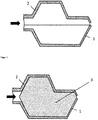
- the mold used to make it has a lower tool ( Fig. 1 and FIGS. 2 and 3 , Item 1) and at least one upper tool ( Fig. 1 and Fig. 2 , Item 2) and ( Fig. 3 , Item 10) and at least one blow-in opening.
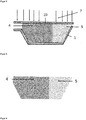
- the mixture to be hardened is introduced unevenly into the mold according to a predetermined pattern, depending on the degree of compression to be achieved, before pressing, whereby the mixture to be hardened ( Fig. 2 , Pos. 3) after the introduction into the mold with a first upper tool by pressing and, if necessary, heating with a second upper tool ( Fig. 3 , Pos 10) is brought into the final form and thereby predetermined degrees of compaction with partly more highly compacted material ( FIGS. 3 and 4 , Pos. 4) and less compacted material ( FIGS. 3 and 4 , Pos. 5), depending on the deviation of the shape of the first upper tool ( Fig. 1 and Fig. 2 , Pos. 2) of the shape of the second upper tool 10, are present.
- An embodiment of a completely biodegradable load carrier that is recyclable can have residues such as cellulose, natural fibers such as hemp, linen, ramie, wood pulp fibers, fibers from grass and natural binders or load carrier residues;
- residues such as cellulose, natural fibers such as hemp, linen, ramie, wood pulp fibers, fibers from grass and natural binders or load carrier residues;
- chips from composite packaging materials e.g. Tetra Pak®
- printed scraps of paper and cardboard also scraps of waste paper and synthetic binders can be processed in the load carrier.
- the (heat) curable binder of the charge carrier can be selected from thermosetting plastics, two-component binders and natural hardening binders such as starch, proteins, chitin, resins or rubber. It is also possible to use silicon-based binders, such as silicone binders and silicates.
- the introduction of residual materials, possibly fibers and binders between the lower tool and possibly changing upper works is carried out in several steps while maintaining a layer structure.
- the layers produced in this way can have different material compositions.
- the charge carrier according to the invention can essentially be produced from a composite material which comprises a wide variety of residual materials. Residual materials also include complex composite materials such as discarded beverage cartons, coffee to go cups, packaging materials with the registered brand name Tetra Pak® or yoghurt cups that have been shredded accordingly.
- the composite material for the charge carriers according to the invention can also be mixed with rather problematic residues that contain binder particles, plastic residues, and possibly metal residues.
- a particular advantage of the invention is that it can be adapted to the starting materials that are currently available - it is by no means restricted to a specific combination of materials, but can be adapted accordingly to the residual materials present.
- the load carriers are manufactured in several steps.
- the residual materials - e.g. beverage cartons and cups - are ground up into small pieces that are only a few millimeters in size and are ground into regrind.
- This shredded grist is then mixed with a heat and pressure curable binder, and the mixture with special fibers is blown into a hollow mold with a lower tool and a first upper tool and then pressed in several steps with at least one other upper tool (s) to form the finished product.
- the mold shown for the production of a load carrier according to the invention has a lower tool 1, which defines the final shape of the underside of the load carrier, and a variable upper tool 2, 10.
- a first upper tool 2 is used for blowing in and, in this embodiment, has different depressions, which have different volumes for the material mixture ( Fig. 2 , Pos. 3) against the lower tool.
- the first upper tool is exchanged for a second upper tool 10, which here corresponds to the final shape.
- the second upper tool 10 is placed over the preformed material mixture ( Fig. 2 , Pos. 3) closed, whereby different densities are formed in the material mixture on the lower tool 1 and heated for the purpose of hardening the binding agent.
- the molded part thus formed from residues, fibers and hardened binder is removed from the mold.
- the mold with the lower tool and the first upper tool in the injection station is filled with the material mixture described above by injection.
- Fig. 2 the completely filled state of the tool in the injection station is shown. The larger volume is clearly visible on the left side of the blowing tool.
- the next step takes place in the press station ( Fig. 3 ).
- the material is compacted by the second, possibly heatable upper tool 10 in the heating-press station by heating and pressing and solidified by setting the binding agent ( Fig. 3 ), the shape of the second upper tool 10.2 corresponding to the final upper side of the load carrier, here in the example a flat surface.
- the density of the filled material is increased depending on the shape deviation of the second upper tool 10 compared to the first upper tool 2. In ( Fig. 3 ) this is indicated by a darker area, with a lighter area 5 with less compression remaining.
- binding agent that sets at temperatures above 120 ° C., preferably above 170 ° C.
- organic microorganisms such as bacteria that may be in unwashed residues are killed. This also greatly reduces any possible odor pollution.
- Setting agents such as superheated steam or hot, vaporous setting agents can also be blown into the mold in order to improve the activation of the binding agent.
- additives can be added to the material mixture in the process in order to obtain special product properties.
- the water resistance can be increased significantly if you add certain waxes or waterproof material.
- the fire resistance can also be increased (binding agent based on silicon).
- charge carriers made from natural fibers, natural thermosetting binders (starch, chitin, silicates, rubber and resins) and natural fillers, such as cellulose, wood pulp and wood residues, plant residues such as straw, blades of grass, cotton, kapok, coconut fibers, even like them when processing the fibers into yarns, fibers and textiles, etc. getting produced.
- a cooling station the material is allowed to cool down to normal temperature or is actively cooled down to normal temperature.
- the bound load carrier is removed from the press. Reworking - for example deburring the edges - is usually not necessary.
Landscapes
- Engineering & Computer Science (AREA)
- Mechanical Engineering (AREA)
- Chemical & Material Sciences (AREA)
- Composite Materials (AREA)
- Dry Formation Of Fiberboard And The Like (AREA)
- Compositions Of Macromolecular Compounds (AREA)
- Casting Or Compression Moulding Of Plastics Or The Like (AREA)
Abstract
Description
- Die Erfindung betrifft einen Ladungsträger, der z.B. eine Palette, eine Kiste oder Bestandteil derselben und Traghilfe sein kann, sowie ein Verfahren zu seiner Herstellung. besteht.
- Ladungsträger sind für die Logistik unersetzlich und bekannt. Dabei ist zu unterscheiden zwischen Einmal-Ladungsträgern und mehrfach verwendbaren Ladungsträgern, auch solche aus Reststoffen. So sind bspw. Papp-Paletten oder Preßspanpaletten, aber auch Flaschenträger erhältlich. Diese sind jedoch durch einfachstes Pressen bzw. Formen aus nur wenigen Materialien produziert, u.a. deshalb, da sie eine konstante Ausgangsmaterialqualität benötigen. Aufgrund der Abfallentsorgung ist es erwünscht, Reststoffe - auch aus Einmal-Ladungsträgern - wiederzuverwenden.
- Es ist daher Aufgabe der Erfindung, einen Ladungsträger und ein Verfahren zu seiner Herstellung zu schaffen, der auch Recyclingmaterial aufweisen kann. Dies erfolgt in Anbetracht des Abfallproblems und dem Wunsch nach mehr Recycling.
- Die Aufgabe wird erfindungsgemäß durch Ladungsträger nach Anspruch 1 sowie ein Verfahren zu seiner Herstellung nach Anspruch 8 gelöst. Vorteilhafte Weiterbildungen ergeben sich aus den abhängigen Ansprüchen.
- Die erfindungsgemäßen Ladungsträger sind im Wesentlichen aus einem Komposit Material hergestellt, das Mischungen von Reststoffen, härtbarem Bindemittel und ggf. Fasern aufweist; wobei Mischen von Reststoffen, Bindemittelpartikeln und gegebenenfalls Fasern in einem Mischer; Einbringen der so hergestellten Ladungsträger-Mischung in eine mehrteilige Form mit Unterwerkzeug und einem ersten Oberwerkzeug; Schließen der Form mit einem weiteren Oberwerkzeug unter Pressen der Mischung auf dem Unterwerkzeug, ggf. Erwärmen der Form - zum Härten des Bindemittels und Verbinden der Mischungsbestandteile, Abkühlenlassen und Entformen des Ladungsträgers.
- Der Ladungsträger kann bspw. eine Palette, Kistenbestandteil oder Traghilfe (z.B. Getränkekasten) sein, wie er bspw. in der DIN 30781 definiert ist, also ein tragendes Mittel zur Zusammenfassung von Gütern zu einer Ladeeinheit. Zu den Ladungsträgern gehören insbesondere die tragenden Transporthilfsmittel Palette, Container und auch Fahrzeug(teile) Sie erleichtern den Umschlag der Ladeeinheiten und fördern so die Effizienz und die Geschwindigkeit der Transportkette. Im Zusammenhang mit der Erfindung wird als Ladungsträger auch ein Teil eines Ladungsträgers bezeichnet.
- Die zu seiner Herstellung verwendete Form weist ein Unterwerkzeug (
Fig. 1 undFig. 2 und Fig. 3 , Pos. 1) und mindestens ein Oberwerkzeug (Fig. 1 undFig. 2 , Pos. 2) und (Fig. 3 , Pos. 10) sowie mindestens eine Einblasöffnung auf. - Die zu härtende Mischung wird bei einer Ausführungsform mit unterschiedlich verdichteten Ladungsträger-Abschnitten vor dem Pressen ungleichmäßig in die Form nach einem vorherbestimmten Muster je nach zu erreichendem Verdichtungsgrad eingebracht, wobei die zu härtende Mischung (
Fig. 2 , Pos. 3) nach der Einbringung in die Form mit einem ersten Oberwerkzeug durch Pressen und ggf. Erwärmen mit einem zweiten Oberwerkzeug (Fig. 3 , Pos 10) in die endgültige Form gebracht wird und dadurch vorherbestimmte Verdichtungsgrade mit teils höher verdichtetem Material (Fig. 3 und Fig. 4 , Pos. 4) und weniger verdichtetem Material (Fig. 3 und Fig. 4 , Pos. 5), je nach Abweichung der Form des ersten Oberwerkzeugs (Fig. 1 undFig. 2 , Pos. 2) von der Form des zweiten Oberwerkzeugs 10, vorliegen. - Eine Ausführungsform eines vollständig biologisch abbaubaren Ladungsträgers, der recyclingfähig ist, kann Reststoffe , wie Zellulose, Naturfasern, wie Hanf, Leinen, Ramie, Holzschlifffasern, Fasern von Gräsern und natürliche Bindemittel oder Ladungsträgerreste aufweisen; bei nicht biologisch abbaubaren, aber recyclingfähigen erfindungsgemäßen Ladungsträgern können auch Schnitzel aus Verbund-Verpackungsmaterialien (z.B. Tetra Pak®), bedruckte Papier- und Pappreste, auch Altpapierreste sowie synthetische Bindemittel im Ladungsträger verarbeitet sein.
- Das (wärme)härtbare Bindemittel des Ladungsträgers kann ausgewählt sein aus Duroplasten, ZweikomponentenBindemitteln und natürlichen aushärtenden Bindemitteln, wie Stärke, Eiweiße, Chitin, Harze oder Gummi. Es können auch Bindemittel auf Silicium Basis, wie Silikon Bindemittel und Silikate eingesetzt werden.
- Das erfindungsgemäße Verfahren zum Herstellen eines Ladungsträgers beinhaltet die folgenden Schritte:
- Einblasen von Bindemittel und zerkleinertem Material in eine mehrteilige Form mit wechselbarem Oberwerkzeug; wobei ein Mehrschritt-Befüllen mit unterschiedlichen Oberwerkzeugen möglich ist,
- Schließen der Form über dem Werkzeug;
- Aufbringen von Pressdruck auf das in der Endform-Form aus Unterwerkzeug und Endform-Oberwerkzeug befindliche Material, ggf. unter Erwärmen (auch durch heißes Gas, wie Wasserdampf), unter Härten des Bindemittels und Verbinden der Mischungsbestandteile;
- Bei einer weiteren Ausführungsform des Verfahrens wird das Einbringen von Reststoffen, ggf. Fasern und Bindemittel zwischen Unterwerkzeug und ggf. ändernden Oberwerkezeigen in mehreren Schritten unter Erhalt eines Schichtaufbaus durchgeführt.
- Die so hergestellten Schichten können unterschiedliche Materialzusammensetzung haben.
- Somit kann der erfindungsgemäße Ladungsträger im Wesentlichen aus einem Komposit Material hergestellt sein, das verschiedenste Reststoffe umfasst. Unter Reststoffen werden auch komplexe Verbund-Materialien, wie weggeworfene Getränkekartons, Coffee to Go-Becher, Verpackungsmaterialien mit dem eingetragenen Markennamen Tetra Pak® oder Joghurtbecher verstanden, die entsprechend klein geschreddert wurden.
- Das Kompositmaterial für die erfindungsgemäßen Ladungsträger kann auch mit eher problematischen Reststoffen gemischt werden, die Bindemittelpartikel, Kunststoffreste, ggf. Metallreste enthalten.
- Ein besonderer Vorteil der Erfindung besteht in ihrer Anpassbarkeit an die gerade verfügbaren Ausgangsmaterialien - sie ist keineswegs nur auf eine spezielle Materialkombination eingeschränkt, sondern kann an die vorliegenden Reststoffe entsprechend angepasst werden.
- Die Herstellung der Ladungsträger erfolgt in mehreren Schritten.
- Zunächst werden die Reststoffe - bspw. Getränkekartons und Becher - ungereinigt in kleine Stückchen, die nur wenige Millimeter groß sind, zu Mahlgut zermahlen.
- Dieses geschredderte Mahlgut wird nun mit einem wärme- und Druck härtbaren Bindemittel vermischt, und die Mischung mit speziellen Fasern in eine hohle Werkzeugform mit Unterwerkzeug und erstem Oberwerkzeug geblasen und anschließend in mehreren Schritten mit mindestens einem weiteren Oberwerkzeug(en) zum fertigen Endprodukt gepresst.
- Nachfolgend wird die Erfindung anhand eines in der beigefügten Zeichnung dargestellten Ausführungsbeispiels eines Ladungsträgers mit unterschiedlichen Dichten näher erläutert, auf das sie keinesfalls eingeschränkt ist. In dieser zeigen:
-
Fig. 1 eine Ansicht einer zu befüllenden Form aus einem Unterwerkzeug und einem ersten Oberwerkzeug -
Fig. 2 die mit eingeblasener Materialmischung gefüllte Form mit einem ersten Oberwerkzeug -
Fig.3 eine Ansicht des mittels eines zweiten geschlossenen Oberwerkzeugs gepressten Materials in der Form -
Fig. 4 eine Ansicht eines entformten Ladungsträgers nachFig. 3 ; und -
Fig. 5 eine Ansicht der Unterseite einer erfindungsgemäßen Palette. - Bei der in
Fig. 1 dargestellten Form zur Herstellung eines erfindungsgemäßen Ladungsträgers weist diese ein Unterwerkzeug 1, das die Endform der Unterseite des Ladungsträgers vorgibt und ein variables Oberwerkzeug 2, 10 auf. Ein erstes Oberwerkzeug 2 wird zum Einblasen genommen und weist bei dieser Ausführungsform unterschiedliche Vertiefungen auf, die verschiedene Volumina für die Materialmischung (Fig. 2 , Pos. 3) gegen das Unterwerkzeug bieten. Abweichend von der endgültigen Form der Oberseite des inFigur 4 beispielhaft dargestellten entformten Ladungsträges mit einer planen Oberfläche, wird im ersten Oberwerkzeug 2 in bestimmten Bereichen mit höherer Belastung ein größerer Einblas-Raum an der entsprechenden Werkzeugstelle vorgegeben, als der endgültigen Form des Ladungsträgers entspricht. Dadurch entsteht beim Einblasen dort eine Materialanhäufung (s.Fig. 2 ). Nach beendetem Einblasen wird das erste Oberwerkzeug gegen ein zweites Oberwerkzeug 10, das hier der Endform entspricht, getauscht. Das zweite Oberwerkzeug 10 wird über der so vorgeformten Materialmischung (Fig. 2 , Pos. 3) geschlossen, wodurch sich unterschiedliche Dichten in der Materialmischung auf dem Unterwerkzeug 1 ausbilden und zwecks Härten des Bindemittels geheizt. Das so gebildete Formteil aus Reststoffen, Fasern und gehärtetem Bindemittel wird entformt. - Durch die Möglichkeit des mehrfachen Oberwerkzeugtauschs, ggf. mit Zwischenverfestigung - können auch Schichten unterschiedlicher Dichte bzw. unterschiedlicher Materialien in einem Formkörper produziert werden, wodurch sich völlig neue Formkörpergestaltungen ergeben. So können wasserfeste Deckschichten auf nicht wasserfesten Füllungen produziert werden, aber auch feste bis hochfeste Schichten mit leichterem Material verbunden werden.
- Hinsichtlich der Details dieses Verfahrens wird vollinhaltlich auf die
DE10 2019 121 222.7 der Fiber Engineering GmbH, Karlsruhe Bezug genommen. - Meist wird im ersten Schritt die Werkzeugform mit Unterwerkzeug und erstem Oberwerkzeug in der Einblasstation durch Einblasen mit der oben beschriebenen Materialmischung gefüllt. In
Fig. 2 ist der vollständig gefüllte Zustand des Werkzeugs in der Einblasstation gezeigt. Deutlich ist das größere Volumen auf der linken Seite des Einblaswerkzeugs erkennbar. - Der nächste Schritt erfolgt in der Press-Station (
Fig. 3 ). Hier wird das Material durch das zweite, ggf. beheizbare Oberwerkzeug 10 in der Heiz-Press-Station durch Heizen und Pressen verdichtet und durch Abbinden des Bindemittels verfestigt (Fig. 3 ), wobei die Form des zweiten Oberwerkzeugs 10.2 der endgültigen Oberseite des Ladungsträgers, hier im Beispiel eine plane Fläche, entspricht. So wird beim Pressen, angedeutet durch die Pfeile 7, die Dichte des eingefüllten Materials je nach Formabweichung des zweiten Oberwerkzeugs 10 gegenüber dem ersten Oberwerkzeug 2 erhöht. In (Fig. 3 ) ist dies durch einen dunkleren Bereich angedeutet, wobei ein hellerer Bereich 5 mit geringerer Verdichtung verbleib. - Das bedeutet: man kann besonders belastete Stellen (zum Beispiel die Kanten einer Palette) mit diesem Verfahren besonders stabil und massiv fertigen. Außerdem wird das Gewicht der Platten entsprechend der belasteten Bereiche optimiert.
- Bei Verwendung eines bei Temperaturen von über 120°C, bevorzugt über 170°C abbinden-den Binde-mittels werden organische Mikroorganismen, wie Bakterien abgetötet, die sich möglicherweise in ungewaschenen Reststoffen befinden. So wird auch eine mögliche Geruchsbelastung stark reduziert. Es können auch Abbinde Fördermittel, wie Heißdampf oder heiße dampfförmige Abbinde Hilfsmittel in die Form eingeblasen werden, um die Bindemittelaktivierung zu verbessern.
- Bei Bedarf können im Prozess zusätzlich Additive zur Materialmischung beifügt werden, um spezielle Produkteigenschaften zu erhalten. So kann zum Beispiel die Wasserfestigkeit erheblich gesteigert werden, wenn man bestimmte Wachse oder wasserfestes Material hinzufügt. Je nach Bindemittel kann auch die Brandfestigkeit erhöht werden (Bindemittel auf Silicium Basis). Es können auch vollständig kompostierbare Ladungsträger aus natürlichen Fasern, natürlichen wärmehärtenden Bindemitteln (Stärke, Chitin, Silikate, Gummi und Harze) und natürlichen Füllstoffen, wie Cellulose, Holzschliff und Holzresten, Pflanzenresten wie Stroh, Grashalmen, Baumwolle, Kapok, Kokosfasern, auch wie sie bei der Bearbeitung der Fasern zu Garnen, Fasern und Textilien anfallen u. dgl. hergestellt werden.
- Im letzten Schritt, einer Kühlstation, darf das Material auf Normaltemperatur abkühlen oder wird aktiv auf Normaltemperatur heruntergekühlt. Nach Abkühlen und Aushärten (
Fig. 4 ) wird der gebundene Ladungsträger aus der Presse herausgenommen. Nacharbeiten - zum Beispiel ein Entgraten der Ränder - ist in der Regel nicht notwendig. - Während die Erfindung detailliert anhand bevorzugter Ausführungsformen beschrieben wurde, ist dem Fachmann ersichtlich, dass verschiedenste Alternativen und Ausführungs-formen zur Durchführung der Erfindung im Rahmen des Schutzumfangs der Ansprüche möglich sind.
-
- 1:
- Unterwerkzeug der Einblasstation
- 2:
- erstes Oberwerkzeug der Einblasstation
- 3:
- Mischung
- 4:
- Material stärker verdichtet
- 5:
- Material weniger stark verdichtet
- 7:
- Presskraft
- 10:
- zweites Oberwerkzeug zum Pressen/Heizen
Claims (9)
Wechsel des Oberwerkzeugs gegen ein Endform-Oberwerkzeug und
Schließen der Form unter Ausübung von Druck auf die Materialmischung (Fig. 2, Pos. 3)auf dem befüllten Unterwerkzeug (Fig. 1 und Fig. 2 und Fig. 3 , Pos. 1) und ggf. unter zusätzlichem Erwärmen der Form unter Aushärten des Bindemittels und Verbinden der Bestandteile der Mischung (Fig. 2, Pos. 3), ggf. Abkühlen und Entformen des Ladungsträgers.
Priority Applications (2)
| Application Number | Priority Date | Filing Date | Title |
|---|---|---|---|
| PCT/DE2021/000167 WO2022100771A2 (de) | 2019-11-13 | 2021-10-08 | Ladungsträger und verfahren zu seiner herstellung |
| EP21820453.5A EP4244037A2 (de) | 2019-11-13 | 2021-10-08 | Ladungsträger und verfahren zu seiner herstellung |
Applications Claiming Priority (1)
| Application Number | Priority Date | Filing Date | Title |
|---|---|---|---|
| DE202019004661.5U DE202019004661U1 (de) | 2019-11-13 | 2019-11-13 | Ladungsträger |
Publications (1)
| Publication Number | Publication Date |
|---|---|
| EP3822064A1 true EP3822064A1 (de) | 2021-05-19 |
Family
ID=69621441
Family Applications (2)
| Application Number | Title | Priority Date | Filing Date |
|---|---|---|---|
| EP20020517.7A Pending EP3822064A1 (de) | 2019-11-13 | 2020-11-10 | Ladungsträger und verfahren zu seiner herstellung |
| EP21820453.5A Pending EP4244037A2 (de) | 2019-11-13 | 2021-10-08 | Ladungsträger und verfahren zu seiner herstellung |
Family Applications After (1)
| Application Number | Title | Priority Date | Filing Date |
|---|---|---|---|
| EP21820453.5A Pending EP4244037A2 (de) | 2019-11-13 | 2021-10-08 | Ladungsträger und verfahren zu seiner herstellung |
Country Status (3)
| Country | Link |
|---|---|
| EP (2) | EP3822064A1 (de) |
| DE (1) | DE202019004661U1 (de) |
| WO (1) | WO2022100771A2 (de) |
Cited By (1)
| Publication number | Priority date | Publication date | Assignee | Title |
|---|---|---|---|---|
| DE202024101025U1 (de) | 2024-03-01 | 2024-06-28 | Willy Lutz | Gebaute Palette |
Families Citing this family (1)
| Publication number | Priority date | Publication date | Assignee | Title |
|---|---|---|---|---|
| DE202019004661U1 (de) * | 2019-11-13 | 2020-01-30 | Logistics Arts Production Gmbh | Ladungsträger |
Citations (6)
| Publication number | Priority date | Publication date | Assignee | Title |
|---|---|---|---|---|
| DE3610822A1 (de) * | 1986-04-01 | 1987-10-08 | Erwin Moeck | Verfahren zum herstellen von paletten |
| DE4026786A1 (de) * | 1990-08-24 | 1992-02-27 | Basf Ag | Wiederverwertung von kunststoff-altteilen und -abfaellen |
| US20020050235A1 (en) * | 1995-03-15 | 2002-05-02 | Dan R. Radke | Pallet and process for making thereof |
| DE10324735B3 (de) * | 2003-05-30 | 2004-11-11 | Fiber Engineering Gmbh | Verfahren und Vorrichtung zur Herstellung von dreidimensional ausgeprägten Formteilen sowie Formteil |
| US20070204769A1 (en) * | 2004-06-11 | 2007-09-06 | Wong Teck T | Pallet And Method For Manufacturing The Same |
| DE102019121222A1 (de) * | 2019-08-06 | 2021-02-11 | Fiber Engineering Gmbh | Verfahren und Vorrichtung zur Herstellung dreidimensionaler Formteile |
Family Cites Families (3)
| Publication number | Priority date | Publication date | Assignee | Title |
|---|---|---|---|---|
| DE4231097C2 (de) * | 1992-09-17 | 1997-09-11 | Evd Gmbh | Verfahren zur Herstellung eines Verbundpartikelkörpers und der nach diesem hergestellte Körper |
| DE10318136B3 (de) * | 2003-04-17 | 2004-10-07 | Carcoustics Tech Center Gmbh | Aus Korkpartikeln und wärmereaktivem Bindemittel gebildeter poröser Schallabsorber und Verfahren zu dessen Herstellung |
| DE202019004661U1 (de) * | 2019-11-13 | 2020-01-30 | Logistics Arts Production Gmbh | Ladungsträger |
-
2019
- 2019-11-13 DE DE202019004661.5U patent/DE202019004661U1/de active Active
-
2020
- 2020-11-10 EP EP20020517.7A patent/EP3822064A1/de active Pending
-
2021
- 2021-10-08 EP EP21820453.5A patent/EP4244037A2/de active Pending
- 2021-10-08 WO PCT/DE2021/000167 patent/WO2022100771A2/de not_active Ceased
Patent Citations (6)
| Publication number | Priority date | Publication date | Assignee | Title |
|---|---|---|---|---|
| DE3610822A1 (de) * | 1986-04-01 | 1987-10-08 | Erwin Moeck | Verfahren zum herstellen von paletten |
| DE4026786A1 (de) * | 1990-08-24 | 1992-02-27 | Basf Ag | Wiederverwertung von kunststoff-altteilen und -abfaellen |
| US20020050235A1 (en) * | 1995-03-15 | 2002-05-02 | Dan R. Radke | Pallet and process for making thereof |
| DE10324735B3 (de) * | 2003-05-30 | 2004-11-11 | Fiber Engineering Gmbh | Verfahren und Vorrichtung zur Herstellung von dreidimensional ausgeprägten Formteilen sowie Formteil |
| US20070204769A1 (en) * | 2004-06-11 | 2007-09-06 | Wong Teck T | Pallet And Method For Manufacturing The Same |
| DE102019121222A1 (de) * | 2019-08-06 | 2021-02-11 | Fiber Engineering Gmbh | Verfahren und Vorrichtung zur Herstellung dreidimensionaler Formteile |
Cited By (2)
| Publication number | Priority date | Publication date | Assignee | Title |
|---|---|---|---|---|
| DE202024101025U1 (de) | 2024-03-01 | 2024-06-28 | Willy Lutz | Gebaute Palette |
| EP4610187A1 (de) | 2024-03-01 | 2025-09-03 | Willy Lutz | Gabauter ladungsträger und verfahren zu dessen reparatur oder herstellung |
Also Published As
| Publication number | Publication date |
|---|---|
| WO2022100771A2 (de) | 2022-05-19 |
| DE202019004661U1 (de) | 2020-01-30 |
| WO2022100771A3 (de) | 2022-08-18 |
| EP4244037A2 (de) | 2023-09-20 |
Similar Documents
| Publication | Publication Date | Title |
|---|---|---|
| DE69716953T2 (de) | Verfahren zum formen von pulverisierten pflanzenfasern in materialien hoher dichte | |
| EP0542186B1 (de) | Verfahren zum Herstellen eines Schichtwerkstoffs unter Wiederverwendung von Kunststoffabfällen und eigensteifer, Kunststoffabfälle enthaltender Schichtwerkstoff | |
| DE69213746T2 (de) | Verfahren zur aufbereitung von verbundstoffen | |
| EP0741761B1 (de) | Verfahren zur herstellung von formkörpern aus biologisch abbaubarem material und formkörper | |
| EP0586644B1 (de) | Recycling-verfahren für polyurethan-hartschaum | |
| CH633819A5 (de) | Konstruktionsmaterial und verfahren zur herstellung desselben. | |
| EP0850269B1 (de) | Verfahren zur herstellung von formkörpern aus biologisch abbaubarem material und formkörper | |
| EP3822064A1 (de) | Ladungsträger und verfahren zu seiner herstellung | |
| DE3686244T2 (de) | Herstellungsverfahren geformter holzprodukte. | |
| DE60220221T2 (de) | Zehenkappe aus langfaserverstärktem thermoplastischem Kunststoff für Sicherheitsschuhe und Verfahren zu dessen Herstellung | |
| DE4105285A1 (de) | Verfahren und vorrichtung zum aufbereiten und wiederverwenden von bereits benutzten rohstoffen aus gebrauchtteilen, die thermo- und duroplaste enthalten | |
| EP3772408B1 (de) | Verfahren zur herstellung dreidimensionaler formteile | |
| DE69328350T2 (de) | Hartplatte und herstellungsverfahren aus zurückgewonnenem papier | |
| EP0588023B1 (de) | Verfahren zur Herstellung eines Verbundpartikelkörpers und der nach diesem hergestellte Körper | |
| DE102021103400A1 (de) | Verfahren zur Herstellung eines Behälters aus Fasermaterial und Behälter aus Fasermaterial | |
| DE69913901T2 (de) | Verfahren zur Herstellung von Gegenständen aus rohem, pflanzlichem Material durch Pressen | |
| EP0688642A2 (de) | Formteil und Verfahren zu seiner Herstellung | |
| EP1066936A1 (de) | Dekor-Formpressverfahren zur Verarbeitung von Altholz zu dreidimensionalen Formteilen und Anlage | |
| DE3610822A1 (de) | Verfahren zum herstellen von paletten | |
| AT389840B (de) | Verfahren zur herstellung einer pressmasse | |
| DE4316498C2 (de) | Verfahren zur Herstellung von bindemittelhaltigen Holzfaserformteilen | |
| EP3960412B1 (de) | Verfahren zur herstellung recycelter matten aus pvc-kunstlederrandbeschnitt | |
| EP2451620A1 (de) | Verfahren zur herstellung von platten aus nachwachsenden rohstoffen im endlosverfahren und platte aus nachwachsenden rohstoffen | |
| DE4342789C2 (de) | Verfahren zum Herstellen von Formteilen | |
| DE202023002752U1 (de) | Kunststoffpalette |
Legal Events
| Date | Code | Title | Description |
|---|---|---|---|
| PUAI | Public reference made under article 153(3) epc to a published international application that has entered the european phase |
Free format text: ORIGINAL CODE: 0009012 |
|
| STAA | Information on the status of an ep patent application or granted ep patent |
Free format text: STATUS: THE APPLICATION HAS BEEN PUBLISHED |
|
| AK | Designated contracting states |
Kind code of ref document: A1 Designated state(s): AL AT BE BG CH CY CZ DE DK EE ES FI FR GB GR HR HU IE IS IT LI LT LU LV MC MK MT NL NO PL PT RO RS SE SI SK SM TR |
|
| STAA | Information on the status of an ep patent application or granted ep patent |
Free format text: STATUS: REQUEST FOR EXAMINATION WAS MADE |
|
| 17P | Request for examination filed |
Effective date: 20210805 |
|
| RBV | Designated contracting states (corrected) |
Designated state(s): AL AT BE BG CH CY CZ DE DK EE ES FI FR GB GR HR HU IE IS IT LI LT LU LV MC MK MT NL NO PL PT RO RS SE SI SK SM TR |
|
| STAA | Information on the status of an ep patent application or granted ep patent |
Free format text: STATUS: EXAMINATION IS IN PROGRESS |
|
| 17Q | First examination report despatched |
Effective date: 20230720 |