EP3821580B1 - Verfahren und systeme zum effizienten netzwerkschutz - Google Patents
Verfahren und systeme zum effizienten netzwerkschutz Download PDFInfo
- Publication number
- EP3821580B1 EP3821580B1 EP19745478.8A EP19745478A EP3821580B1 EP 3821580 B1 EP3821580 B1 EP 3821580B1 EP 19745478 A EP19745478 A EP 19745478A EP 3821580 B1 EP3821580 B1 EP 3821580B1
- Authority
- EP
- European Patent Office
- Prior art keywords
- threat
- packet
- packets
- network
- gateway
- Prior art date
- Legal status (The legal status is an assumption and is not a legal conclusion. Google has not performed a legal analysis and makes no representation as to the accuracy of the status listed.)
- Active
Links
Images




Classifications
-
- H—ELECTRICITY
- H04—ELECTRIC COMMUNICATION TECHNIQUE
- H04L—TRANSMISSION OF DIGITAL INFORMATION, e.g. TELEGRAPHIC COMMUNICATION
- H04L63/00—Network architectures or network communication protocols for network security
- H04L63/02—Network architectures or network communication protocols for network security for separating internal from external traffic, e.g. firewalls
- H04L63/0227—Filtering policies
-
- H—ELECTRICITY
- H04—ELECTRIC COMMUNICATION TECHNIQUE
- H04L—TRANSMISSION OF DIGITAL INFORMATION, e.g. TELEGRAPHIC COMMUNICATION
- H04L43/00—Arrangements for monitoring or testing data switching networks
- H04L43/02—Capturing of monitoring data
- H04L43/028—Capturing of monitoring data by filtering
-
- H—ELECTRICITY
- H04—ELECTRIC COMMUNICATION TECHNIQUE
- H04L—TRANSMISSION OF DIGITAL INFORMATION, e.g. TELEGRAPHIC COMMUNICATION
- H04L63/00—Network architectures or network communication protocols for network security
- H04L63/02—Network architectures or network communication protocols for network security for separating internal from external traffic, e.g. firewalls
- H04L63/0227—Filtering policies
- H04L63/0236—Filtering by address, protocol, port number or service, e.g. IP-address or URL
-
- H—ELECTRICITY
- H04—ELECTRIC COMMUNICATION TECHNIQUE
- H04L—TRANSMISSION OF DIGITAL INFORMATION, e.g. TELEGRAPHIC COMMUNICATION
- H04L63/00—Network architectures or network communication protocols for network security
- H04L63/14—Network architectures or network communication protocols for network security for detecting or protecting against malicious traffic
- H04L63/1408—Network architectures or network communication protocols for network security for detecting or protecting against malicious traffic by monitoring network traffic
- H04L63/1416—Event detection, e.g. attack signature detection
-
- H—ELECTRICITY
- H04—ELECTRIC COMMUNICATION TECHNIQUE
- H04L—TRANSMISSION OF DIGITAL INFORMATION, e.g. TELEGRAPHIC COMMUNICATION
- H04L63/00—Network architectures or network communication protocols for network security
- H04L63/14—Network architectures or network communication protocols for network security for detecting or protecting against malicious traffic
- H04L63/1433—Vulnerability analysis
-
- H—ELECTRICITY
- H04—ELECTRIC COMMUNICATION TECHNIQUE
- H04L—TRANSMISSION OF DIGITAL INFORMATION, e.g. TELEGRAPHIC COMMUNICATION
- H04L63/00—Network architectures or network communication protocols for network security
- H04L63/20—Network architectures or network communication protocols for network security for managing network security; network security policies in general
-
- H—ELECTRICITY
- H04—ELECTRIC COMMUNICATION TECHNIQUE
- H04L—TRANSMISSION OF DIGITAL INFORMATION, e.g. TELEGRAPHIC COMMUNICATION
- H04L69/00—Network arrangements, protocols or services independent of the application payload and not provided for in the other groups of this subclass
- H04L69/16—Implementation or adaptation of Internet protocol [IP], of transmission control protocol [TCP] or of user datagram protocol [UDP]
Definitions
- aspects described herein generally relate to computer hardware and software and network security.
- one or more aspects of the disclosure generally relate to computer hardware and software for efficient, high-fidelity, low-latency cyber analysis of network communications, which may be applied to protecting TCP/IP networks from Internet-borne threats and attacks.
- Network security is becoming increasingly important as the information age continues to unfold.
- Network threats/attacks may take a variety of forms, including unauthorized requests or data transfers, viruses, malware, large volumes of traffic designed to overwhelm resources, and the like.
- a variety of automated cyber analysis systems have been developed to protect networks against such network threats. In practice, cyber analysis systems are often operated in a highly inefficient manner.
- a communication is a (usually bi-directional) flow of packets between two endpoints, and may be characterized by the L3/L4 "5-tuple" of source and destination IP addresses, source and destination ports, and L4 protocol type (e.g., TCP, UDP, etc.).
- L3/L4 "5-tuple" of source and destination IP addresses, source and destination ports, and L4 protocol type (e.g., TCP, UDP, etc.).
- L4 protocol type e.g., TCP, UDP, etc.
- Conventional solutions may log all packet communications crossing the enterprise network perimeter, which may be often located at the boundary between the protected network and the Internet. Packets may also be captured, copied, and/or stored, for use in subsequent cyber analysis. Stored logs may be searched for communications that are potential threats/attacks. The stored packets may be input into automated cyber analysis systems that search for signatures and behaviors that indicate potential threats. Automated cyber analysis systems are usually not deployed as inline systems because they may decrease network performance to
- Any potential threats may be reported to human cyber analysts, who either (a) determine that communications may be a threat, and identify any remedial actions that may mitigate the threat; or (b) determine that the communications may not be a threat; or (c) make no determination because, for example, there may be insufficient information to make a determination, or, for example, they do not investigate a threat due to the overwhelming volume of potential threats in their work queues.
- search criteria and analysis rules may identify relatively large volumes of legitimate communications as potential threats, which may further increase inefficiencies and inline processing lag (e.g., the time interval spanning the time instant when a threat communications occurred and the time when the threat communications was detected, confirmed, and remediated). Also, increases in the volume and complexity of search criteria and analysis rules may cause significant increases in latency. As a result, despite potentially large capital and operational expenditures on conventional network protection solutions, many actual threats are never discovered, or discovered long after any asset damage, loss, and theft have occurred.
- US 2016/127417 A1 discloses initiating a secure network communication system.
- US 8 510 821 B1 discloses performing tiered network flow analysis.
- aspects of this disclosure relate to efficient and performant operation of cyber analysis systems for use in protecting networks from cyber threats. These systems may also be used (a) to actively protect networks, for example, by detecting and then blocking a threat/attack as the associated network communications may be occurring; (b) to proactively protect networks, for example, by preventing a threat/attack communications from occurring (e.g., by preventing the threat/attack from breaching the network perimeter in either direction); and (c) to reactively protect networks by, for example, detecting ex post facto solutions when malware has been downloaded and/or detonated.
- a network protection system may be modeled as a gateway that interfaces a protected network (e.g., a private enterprise network) and an unprotected network (e.g., the Internet).
- the NPS gateway may be composed of three stages.
- the first stage may include a threat intelligence gateway (TIG).
- the second stage may include one or more cyber analysis systems that ingest TIG-filtered communications and associated threat metadata signals.
- the third stage may include network protection logic that determines which protective actions to take based on the threat metadata signaled by the first stage and second stage.
- the NPS gateway may be provisioned and configured with rules that specify the network protection policies to be enforced.
- the NPS gateway may ingest all communications flowing between the protected network and the unprotected network.
- the NPS gateway may filter all of the communications through the first-stage TIG, which may triage the communications into, for example, zero threat-risk communications, non-zero threat-risk communications, and 100% threat-risk communications.
- the first-stage TIG may generate threat metadata for each threat and/or communication, or for a portion thereof.
- the first-stage TIG may forward zero threat-risk communications to their destinations, may block 1 00% risk communications, and may forward non-zero threat-risk communications and their associated threat metadata signals to the second-stage.
- the first-stage TIG or another element of the NPS may select which (second-stage) cyber analysis systems may be used to process each non-zero threat-risk communication.
- the first stage threat intelligence gateway may be provided as inline filters for TCP/IP packet communications. Communications that match with cyber threat intelligence (CT1), which may be network addresses in the form of IP addresses, domain names, URLs, etc., may be filtered for further processing by other stages.
- CT1 cyber threat intelligence
- the TIG operates to triage the communications by their potential threat risk, to determine which communications may need additional processing and which communications may not need to be further processed.
- the TIG may also generate threat metadata for each communication.
- the metadata signals may be used to signal the second stage and/or third stage or may be used in the further processing performed by the second and/or third stages such as the generation of additional metadata.
- the second-stage cyber analysis systems may process the communications to further triage the communications into actual threat/attack communications and benign/legitimate communications, may update the threat metadata associated with the communications, and may forward the benign/legitimate communications to their intended destinations.
- the second stage may include one or more cyber analysis systems that ingest TIG filtered communications and associated threat metadata signals, perform complex analyses on the communications, determine whether the communications may be actual threats/attacks or non-threat/benign, legitimate communications, and update the threat metadata signals.
- a plurality of second-stage cyber analysis systems may be differentiated by some combination of the type of analysis methods (e.g., signature-based, behavior-based, statistics-based, etc.) and the types of threats and attacks that the cyber analysis systems analyze.
- Both the first-stage TIG and the second-stage cyber analysis systems may be configured with rules that specify the network protection policies that they enforce.
- the TIG may be provisioned with rules generated from CTI and CTI metadata supplied by multiple external/3 rd -party CTI providers, as well as by internal sources including the NPS gateway itself.
- the second-stage cyber analysis systems may be provisioned with rules similarly generated from CTI and CTI metadata and other threat detection data supplied by multiple external/3 rd -party providers, as well as by internal sources including the NPS gateway itself.
- the second-stage cyberanalysis systems may also be provisioned with intrusion detection system (IDS) signature rules, which define patterns to be detected.
- IDS intrusion detection system
- the NPS gateway takes additional actions in the third stage.
- the third stage may include network protection logic or one or more devices that ingest communications from the one or more cyber analysis systems.
- the third stage may also ingest metadata or other information from the first stage.
- the third stage may determine which protective actions to take based on the threat metadata signaled by the first stage and second stage, including transmitting signals to management devices or transmitting packets to their intended destinations.
- the NPS gateway may actively protect the network, for example, by blocking a threat/attack communication (e.g., dropping the communication packets) as the threat/attack may be occurring.
- the NPS gateway may proactively protect the network, for example, by extracting CTI from a threat/attack communication and then configuring the first-stage TIG to filter future communications against the CTI. This proactive threat filtering may prevent threats/attacks from occurring by blocking the communications before the threats/attacks penetrate the network perimeter, in either direction.
- the NPS gateway may also reactively protect the network, for example, by identifying and reporting hosts that have downloaded malware and/or may be infected by malware so that, for example, authorities or other systems can remove the malware from the infected hosts.
- the NPS gateway may realize high efficiency and resultant improved performance, increased fidelity, and improved network protections.
- the first-stage TIG may only forward those communications that have non-zero threat risk (as computed by the TIG) to the second-stage cyber analysis system(s).
- the second-stage cyber analysis systems only process a small percentage of the network communications that inline cyber analysis systems would otherwise process in conventional network protection solutions.
- Further efficiencies may be gained by using first-stage threat metadata to select which cyber analysis system(s) (e.g., which analysis methods and types) should be applied to each (non-zero or medium threat risk) communication passed to the second stage.
- performance of the second-stage cyber analysis systems may be significantly increased and should, in many cases, be sufficient to enable active protections.
- the NPS gateway may improve CTI fidelity with analysis response.
- the CTI applied by the TIG may not properly identify targeted threats or attacks in the sense that communications that match the CTI may be not necessarily actual threats or attacks, but may be instead non-malicious/benign, legitimate communications.
- the second-stage cyber analysis system(s) may improve the fidelity of communications output of the first-stage TIG by determining which of the CTI-matching communications may be actual threats/attacks and which may be non-malicious/benign, legitimate communications.
- the NPS gateway may improve network protections in several ways that will be apparent from the detailed description that follows.
- the NPS gateway may block some malicious communications that may not be blocked by a (first-stage) TIG acting alone or a (second-stage) cyber analysis system acting alone.
- TIGs may be configured to allow some portion of communications that match low-fidelity CTI when network administrators/operators would rather allow a malicious communication than block a legitimate communication.
- some cyber analysis systems such as network intrusion detection systems (NIDS) may not be operated inline (and therefore cannot block malicious communications), because inline cyber analysis would add unacceptable latency and possibly packet drops to the communications. That is, the processing load of analyzing substantially all network traffic across many different analysis methods and types, many of which may not be relevant to the current communication being analyzed, would slow the delivery of all traffic.
- NIDS network intrusion detection systems
- An NPS gateway may forward a TIG-filtered, low-fidelity CTI-matching communications and associated threat metadata to a second-stage cyber analysis systems.
- a network intrusion detection system may be configured to signature-analyze only a portion of network traffic based on the type of threat/attack signaled in the threat metadata.
- the NIDS may be operated inline without introducing unacceptable latencies to the communications and/or unnecessarily dropping packets. Thus, if the NIDS determines that a communication may be malicious, then those systems may actively block such communications.
- connections between elements are discussed in the following description. These connections are general and, unless specified otherwise, may be direct or indirect, wired or wireless, physical or logical (virtual/software-defined). In this respect, the specification is not intended to be limiting.
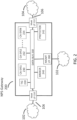
- a network protection system (NPS) 200 may function as a gateway interfacing a protected network 102, such as a private enterprise network, and an unprotected network 104, such as the Internet. Networks 102 and 104 may be connected by link 106.
- the NPS gateway 200 may be physical or virtual, and the networks' intraconnections and interconnections 106 may be wired, wireless, and/or software defined.
- the NPS gateway 200 may protect network 102 by filtering and analyzing all communications between hosts, for example 110, 112, and 114, connected to network 102 that have been assigned network addresses associated with network 102; and hosts, for example 140, 142, and 144, connected to network 104 that have been assigned network addresses associated with network 104.
- Endpoint applications for example web browsers (HTTP clients), executing on hosts 110, 112, and 114 may communicate with endpoint applications, including web servers (HTTP servers), executing on hosts 140, 142, and 144. These communications may be transported over the link 106 connecting network 102 and network 104.
- NPS gateway 200 may be provisioned inline with link 106 in order to inspect and to potentially act on any communications.
- the NPS gateway 200 includes one or more threat intelligence gateways (TIGs) 220, as shown in Fig. 2 , as a functional component.
- TIGs may be commercially available from a variety of vendors.
- a TIG 220 may be an inline TCP/IP packet filter that applies packet filtering rules to packet traffic, wherein the packet filtering rules have been derived from cyber threat intelligence (CTI) and from CTI metadata.
- CTI may include Internet network addresses -- in the form of IP addresses, IP address ranges, L3/L4 ports and protocols, domain names, URLs, and the like - of resources controlled/operated by threat actors.
- CTI metadata may be, for example, the threat type, the threat name, the threat risk score, the threat actor, and the like.
- a rule's disposition may be an action or actions to be applied to a matching packet, such as block/drop, allow/forward, log, capture, re-direct, mirror (copy, then forward and re-direct), and the like. Dispositions may be combined, for example, a packet may be simultaneously allowed, logged, captured, and re-directed.
- the collection of rules that a TIG 220 applies to packet traffic may be called a network protection policy, and may be set by a network administrator or operator.
- the CTI used to derive TIG packet filtering rules may be supplied by one or more CTI provider services.
- these CTI provider services may host one or more CTI servers 120, 122, and 124. Those CTI servers may provide to or be accessed by a TIG 220 to download and update local CTI databases.
- the CTI provider services may also provide metadata associated with the CTI, for example, the names and types of threats/attacks, threat actors, threat risk values/reputation scores, and other data associated with each unit of CTI.
- a TIG 220 may determine packet filtering rules based on the CTI and CTI metadata, and may apply the rules to network packet traffic.
- a unit of CTI may be supplied by multiple different CTI providers, in which case the names of the multiple different CTI providers may be included in the threat metadata of the associated rule. That is, cyber threat intelligence based on the same threat data may be supplied from one or more different CTI providers.
- the threat metadata of the matching rule may be used to signal other logical components of the NPS gateway, for example, to make decisions regarding handling, processing, and/or reporting of the (threat) communication.
- the NPS gateway 200 may include one or more cyber analysis systems (shown as 230-234 in Fig. 2 ) as functional components.
- cyber analysis systems for example network intrusion detection (NIDS) and network intrusion protection systems (NIPS), malware analysis systems, and other cyber analysis systems may be provisioned in the NPS gateway 200.
- NIDS network intrusion detection
- NIPS network intrusion protection systems
- These cyber analysis systems may also be configured with rules, which may be supplied by rule servers 130, 132, and 134 hosted by various providers and services.
- the NPS gateway 200 cyber analysis systems 230-234 may access these servers, download analysis rules and metadata associated with the rules, and apply the analysis rules to network communications.
- the output of the NPS gateway 200 includes log files that report communications information and the NPS gateway actions and threat metadata related to protecting the network. These log files may be processed by a security information and event monitoring (SIEM) device such as the SIEM device 150 connected to network 102.
- SIEM device 150 may include an application that may be operated by the administrators of network 102 who may be responsible for protecting network 102.
- the log files may be inspected and analyzed with a SIEM application to allow an administrative user to make changes to the handling of certain types of threats.
- FIG. 2 depicts a system component diagram of an NPS gateway 200.
- Network interfaces 210 and 212 connect to internetwork link 106, which connects the protected network 102 and the unprotected network 104. Although not required, in practice the network interfaces 210 and 212 may be transparent in that they do not have L3 network addresses or L2 network addresses, and thus are not directly addressable.
- Network interfaces 210 and 212 connect to the data bus 260.
- the data bus 260 provides a communications channel between all system components of the NPS gateway 200. Data bus 260 transports content (communication packet flows) and signal (threat metadata) between the components.
- the data bus 260 may not solely be an integrated/embedded data bus of a printed circuit board (PCB), but may also be, for example, an L2/L3 switched network, L3 routed network, L2/L3 network links connecting logical components, and the like, in any combination.
- the data bus may be wired, wireless, physical, logical, virtual, software-defined, etc., in any combination.
- the system components may be any combination of (co-resident) processes or applications executing on the same host, processes executing on different hosts, processes executing on virtual infrastructure, such as a hypervisor, or other arrangement of components and software.
- the management interface 280 may connect to a local network such as network 102 and has an L3 address.
- the management interface 280 may enable communications between the components of the NPS gateway 200 and L3--addressable hosts connected to networks 102 and 104. For example, when the TIG 220 may download CTI data and associated metadata supplied by CTI server 120, then the CTI server 120 may send L3 packets to the L3 IP address of the management interface 280, which may send them to TIG 220 via the data bus 260.
- the other components connected to data bus 260 may include: a threat intelligence gateway 220; one or more cyber analysis systems 230, 232, and 234; a broker 240 that may decide which cyber analysis systems may be applied to a communications; and a network protector 242 that may decide which protective actions to apply to a communications.
- FIG. 3 shows a representative operational block diagram/flowchart of the NPS gateway 200 that may function to protect a network, for example network 102, from threats/attacks borne by the unprotected network, for example external network 104.
- the threat intelligence gateway (TIG) 220 may be configured with packet filtering rules generated from cyber threat intelligence (CTI) and CTI metadata, which may by supplied (via the management interface 280) by CTI servers 120, 122, and 124 that may be hosted by one or more CTI provider organizations.
- CTI may comprise network addressing data - IP addresses, ports, protocols, domain names, URIs, and the like - of resources that may be operated/controlled by threat actors, as determined by the CTI providers organizations.
- CTI providers may enrich their CTI with threat metadata, such as the type of threat, the name of the threat, the identity of the actors associated with the threat, the discovery date of the threat, a risk score for the threat, a remedial action for the threat, the CTI provider name and other provenance information, and the like.
- This threat metadata may be included with the CTI when it is downloaded to the TIG 220.
- the TIG 220 may determine and may generate packet filtering rules from the CTI.
- Threat metadata may be associated with the rules so that it can be included in any signal messages between NPS gateway components and in any log files that record the (threat) communication events and associated actions by the NPS gateway.
- a TIG may also use the CTI threat metadata to determine the structure of rules, for example, the threat risk score(s) of the CTI provider(s) associated with a unit of CTI may be used to select the disposition (e.g., block, allow, re-direct, etc.) of the associated rule.
- the threat risk score(s) of the CTI provider(s) associated with a unit of CTI may be used to select the disposition (e.g., block, allow, re-direct, etc.) of the associated rule.
- the volume of communications in the first stage TIG 220 second threat category (“non-zero threat risk”) is typically much smaller than the volume of communications in the first threat category (“zero threat risk”).
- the network protection system realizes significant efficiency gains by analyzing (in the second stage) only the communications in the second category.
- cyber analysis systems 230, 232 and 234 included in the NPS gateway 200 may be configured with analysis rules -- signature analysis rules, anomalous behavior analysis rules, and the like -- supplied by rule servers 130, 132, 134, hosted by cyber analysis rule provider organizations. Similar to CTI providers, cyber analysis rule providers may enrich their rules with threat analysis metadata, such as the type of threat, the name of the threat, the identity of the actors associated with the threat, a threat/attack severity score, provenance information, and the like. When the cyber analysis systems 230, 232, and 234 report analysis results for a communication, threat metadata associated with the communication may be updated or associated with threat analysis metadata generated by the associated cyber analysis system. The threat analysis metadata may be included in any log files for the communication.
- the first-stage TIG may be expected to operate inline even under heavy traffic loads.
- the triage process TIG may be expected to be time- efficient and resource-efficient as well as performant relative to the operational environment.
- the TIG 220 applies the CTI-generated filtering rules to triage all communications between, for example, endpoint hosts 110, 112, 114 and endpoint servers 140, 142, 144 into three categories.
- a first threat category of communications may be considered to have low, no, or zero threat risk, including legitimate or benign communications.
- the TIG 220 may expedite processing of communications considered to have low, no, or zero threat risk, and ensure that those communications are forwarded to their intended destinations with a minimal delay.
- a second threat category of communications, that may match the CTI may be considered to have medium or non-zero threat risk.
- a medium or non-zero threat risk may include all packets not assessed to be no-risk packets or high risk packets.
- this second category of medium or non-zero threat risk may span the risk spectrum from very low risk (close to 0) to very high risk (close to 1). Communications with a medium or non-zero threat risk may be potentially, but not necessarily (e.g., due to low-fidelity CTI), actual threat/attack communications.
- a third threat category of communications may match CTI rules associated with a block disposition. Such communications may be considered as high or 100% threat-risk communications. Those communications are associated with or are highly likely to be associated with known or actual threats/attacks.
- the TIG 220 may drop or block communications determined to be part of this third category with high or 100% risk, thereby proactively protecting the network.
- the second stage refines the fidelity of the CTI used in the first stage, such that the output of the network protection system includes minimal false positives; thus, consumers (e.g., network authorities) of the NPS gateway results do not waste any resources investigating communications that are not threats/attacks, or designing and implementing protection policies that are not needed/do not improve the network's security position.
- the second-stage fidelity refinements further improve network protections.
- Cybersecurity administrators operating (first-stage) a TIG 220 may generally not block communications that match low-fidelity CTI, because of the likelihood that legitimate communications will be blocked, which may harm their business. This means, however, that certain threat/attacks may also not be blocked.
- a cyber analysis system 230-234 that are configured to block true positives (actual threats/attacks) and allow false positives (legitimate/benign communications)
- malicious communications that would not have been blocked by a network protected by only a TIG 220 are blocked by a network protected by an NPS gateway 200.
- High-fidelity CTI may be extracted from true positives/malicious communications that are detected by second-stage cyber analysis systems. This high-fidelity CTI may then be used to configure the TIG 220 to block on communications that match the high-fidelity CTI.
- a (first-stage) TIG 220 may match a communication with a low-fidelity IP address range, but because of the low fidelity of the CTI, the TIG 220 may be configured to allow the communication but report it and copy/capture it for further, deeper analysis by the second stage.
- a second-stage cyber analysis may determine that the communication contains a URL for a malware file.
- the (high-fidelity) URL may be mapped into a filtering rule that may be used to configure the TIG 220 to block communications that contain the URL.
- Step 3-4 communications in the first threat category (with "zero threat risk” values) egress the NPS gateway 200 via the network interfaces 210 and 212 and continue toward their destinations.
- the TIG 220 may generate and associate (initial) threat metadata to the communication.
- the threat metadata may include the threat metadata associated with the CTI rule that matches the communication, such as the type and name of the threat (for example, as labeled by the CTI provider(s)), the identity of the threat actor (if known), the CTI providers' identities, provenance information, the risk score(s) assigned by the CTI providers of the rule CTI, and other threat metadata provided from outside sources.
- the threat metadata may also include additional threat metadata computed by the TIG 220, such as the dispositions of each rule, a TIG 220 computed threat risk score (which may be derived in part from the threat risk score(s) and metadata supplied by the CTI provider(s) of the matching CTI), a threat event ID, and other NPS gateway 200 determined data.
- the TIG 220 may then forward the communication and the associated threat metadata signal to a second stage of the NPS gateway 200, which may be managed by a broker 240.
- the TIG 220 may generate or update a (flow) log for the communication event.
- the threat metadata may be included in the (flow) log for the communications event, which uses a standard format such as syslog so that the log can be readily processed by, for example, a security information and event management (SIEM) platform.
- SIEM security information and event management
- the log data may also be sent to external devices and applications, such as the SIEM device 150 connected to the network 102, via the management interface 280.
- the second-stage of the network protection system may further resolve any low-fidelity CTI of the first stage. That is, the second-stage cyber analysis systems 230, 232, and 234 may triage the communications into false positives (benign or legitimate communications) and true positives (communications associated with confirmed threats or attacks).
- CTI providers may supply CTI in the form of network addresses, which can be IP address ranges (typically represented in CIDR notation), individual IP addresses, "5-tuples" (some combination of L3/L4 source and destination IP addresses, source and destination ports, and protocol type), fully qualified domain names (FQDNs), URIs, and the like.
- CTI fidelity may be a measure of the likelihood that a single unit of CTI (a network address) maps to a single malicious resource.
- an absolute URL typically maps to a single resource and, thus, a URL may be considered high-fidelity CTI.
- a communication matching a CTI specified URL may be considered highly likely to be an actual threat/attack.
- a single IP address may map to many resources, of which only a few may be malicious.
- the CTI fidelity comparison/ordering hierarchy may be: Fidelity(IP address range) ⁇ Fidelity(IP address) ⁇ Fidelity(5-tuple) ⁇ Fidelity(FQDN) ⁇ Fidelity(URL).
- a single physical web server which may be operated by a web site hosting service, may host multiple virtual domains (e.g., multiple web sites). Each of the domain names of the web sites resolve to the same IP address in the Internet domain name server (DNS), namely the IP address of the web server.
- DNS Internet domain name server
- the domain names may change as the service operator adds or drops clients, adds or drops domains and domain names, modifies domain deployments across a virtualized environment, and make other changes to the system.
- the hosting service provider may be unwittingly providing hosting services to domains/sites operated by threat actors.
- some (small) portion of the web server communications may be malicious, but the rest of the communications are legitimate/benign.
- all of the web server communications, both malicious and legitimate may be associated with the IP address of the web server.
- the IP address does not have high CTI fidelity, because the IP address may map to multiple resources, with only some portion of the resources being malicious.
- the second stage of the NPS gateway 200 performs such analyses.
- the second stage may be composed of a collection of one or more automated cyber analysis systems 230, 232, and 234, which are differentiated by the threat analysis methods.
- the cyber analysis systems may apply different types of analysis, such as - signature analysis, anomalous behavior analysis, malware execution analysis, and the like - that the cyber analysis systems apply to communications, and by the types of threats/attacks that the cyber analysis systems analyze.
- rules being implemented by the cyber analysis systems need to similarly evolve for the cyber analysis systems to be effective detectors.
- Such dynamic rules may be supplied by (external) providers that specialize in developing threat/attack detection rules and associated metadata, as in Step 3-2 described above.
- a network intrusion detection system applies signature (pattern-matching) rules to communications to detect threats/attacks.
- a NIDS may also apply other types of rules and attack detection methods to communications, such as statistical anomaly-based detection, stateful network protocol analysis detection, and the like.
- the second-stage NIDS analysis systems may be operated inline (sometimes called network intrusion prevention systems, or NIPS).
- NIPS network intrusion prevention systems
- a single NIDS applying serially all types of rules and analysis and detection methods, which may incur unacceptably high latencies that adversely affect network performance.
- multiple NIDS systems may be executing concurrently.
- One of more of the plurality of NIDS may perform operations based on different sets of rules and analysis and detection methods.
- a first NIDS 230 in the NPS gateway 200 may be configured with rules for detecting threats/attacks on the Domain Name System (DNS), while another NIDS 232 may be configured with rules for detecting threats/attacks on SNMP (Simple Network Management Protocol); and still other NIDS may be configured with other rule/analysis methods.
- the second stage may also include cyber analysis systems that are not designed to be operated inline. For example, malware analysis sandboxes that "detonate" suspect executable files and then observe behaviors to confirm maliciousness (or not) and gather cyber threat intelligence information on the suspected malware. This intelligence may be, for example, the URL of a botnet command and control server that the malware attempts to contact.
- the gathered cyber threat intelligence data may be fed back to the TIG 220 as a proactive defense action, as shown in Step 3-8.
- a broker 240 at the front end of the second stage receives the communications and associated threat metadata from the first stage. Based on the associated threat metadata and other criteria, for example the application-level protocol (e.g., DNS, HTTP, HTTPS, SNMP, NTP, RTP, etc.), the broker 240 decides which of the one or more cyber analysis systems 230, 232, and 234 will be applied to each communication.
- the broker 240 may also signal and configure the cyber analysis system(s) to apply a particular analysis method and rule set, then forwards each communication to the selected set of cyber analysis systems.
- the second-stage cyber analysis systems may determine if the communications are true positives (actual threats/attacks) or false positives (no threat), and may update logs associated with the communications to include the analysis results.
- the cyber analysis system(s) may also update the threat metadata with threat analysis metadata, such as threat/attack severity scores, threat/attack type, name, actor identity, rule provider name, and the like.
- the logs for each communication may also include threat event IDs, which may be same value as the threat event ID produced by the first-stage TIG 220. Similar to the first stage, the logs should use a standard format such as syslog, so that the logs can be readily processed by, for example, a SIEM 150.
- the logs are associated with communications, and may be sent to external devices or applications, such as the SIEM 150 connected to network 102, via the management interface 280.
- the second stage triages the communications into a true positives category (actual threats/attacks) and a false positives category (legitimate/benign communications). If the second-stage analysis systems applied to the communications are being operated inline, for example if the systems are functioning as NIPS, then in Step 3-7, communications that are false positives (e.g., benign/legitimate communications) may be safely forwarded to their destinations in the networks 102 and 104 interfaced by the NPS gateway 200. For communications that are true positives (e.g., actual attacks/threats), in Step 3-8 the NPS Gateway protection system 242 acts to protect the network.
- a true positives category actual threats/attacks
- a false positives category legitimate/benign communications
- Protections may be active, proactive, and/or reactive. Active protections may be, for example, blocking the communications, redirecting the communications to a sinkhole, forwarding but monitoring the communications, and the like. Proactive protections may be, for example, extracting CTI from the communications (e.g., URLs, domain names, ports, etc.), generating new rules based on the CTI, and re-configuring the TIG 220 with new rules. Proactive protections also may be, for example, changing the dispositions of existing rules. Reactive protections may be, for example, identifying malware-infected hosts and reporting those malware-infected hosts to network authorities.
- Protection system 242 or outside network authorities may malware--sweep the hosts, and/or quarantine malware-infected hosts,
- the TIG 220 may be configured with rules that block any network communications with source or destination IP addresses of a host identified as a malware-infected host.
- Protection system 242 may update the threat metadata and the logs, and may forward the logs to external applications via management interface 280.
- Step 3-9 the SIEM application or device reports the threat communications and NPS gateway 200 actions to network authorities, cyberanalysts, compliance officers, and/or other network administrators for review.
- the network authorities et al. may decide to take actions to further increase network protections or further mitigate threats, for example, by updating network protection policies.
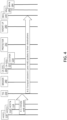
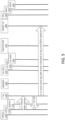
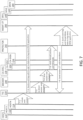
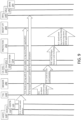
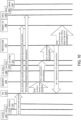
- FIGs. 4 , 5 , 6 , 7 , 8 , 9 , and 10 depict illustrative event sequences for an NPS gateway 200 that efficiently protects networks, in accordance with one or more aspects of the disclosure.
- the depicted steps are merely illustrative and may be omitted, combined, or performed in an order other than that depicted.
- the numbering of the steps is merely for ease of reference and does not imply any particular ordering may be necessary or preferred.
- the communications are shown as uni-directional flows, but in most cases the communications are actually bi-directional flows.
- communications are composed of sequences of TCP/IP packets, but in the diagrams the plurality of packets are aggregated and represented as a single communication.
- the threat intelligence gateway (TIG) 220 and cyber analysis systems 230, 232, 234 have already been configured with rules, as described above in the detailed description of FIG. 1 and in Step 3-1 and Step 3-2. of FIG. 2 , which comprise the NPS gateway network protection policies.
- the rules may define filtering decisions or policies to be applied.
- the rules may define conditions in which certain protective actions, such as logging or blocking packets, are to be applied to received communications.
- FIG. 4 illustrates a process in which the NPS gateway 200 forwards zero-risk, benign/legitimate traffic without expending resources unnecessarily on cyber analysis.
- a web browser executing on a host HOST1 110 in network 102 initiates a session with a web server executing on a host SRV1 140 in network 104.
- the session packets ingress NPS gateway 200 and are received by TIG 220, which filters the packets through all of the CTI rules.
- TIG 220 determines that there may be zero threat risk and therefore no need for further analysis.
- TIG 220 forwards the session packets to their destinations (via the network interfaces 210 and 212).
- FIG. 5 illustrates a process in which the NPS gateway 200 blocks high-risk threat communications without expending resources unnecessarily on cyber analysis.
- a web browser executing on a host HOST2 112 in network 102 may initiate a session with a web server executing on a host SRV2 142 in network 104.
- the session packets ingress and are received by TIG 220, which may filter the packets through all of the CTI rules.
- TIG 220 may match a packet containing a URL with a (high-fidelity) URL rule for which the disposition is block.
- the TIG 220 drops the packet, thereby preventing it from reaching its destination host 142.
- TIG 220 may send a TCP RST packet to host 112 in order to tear down the associated TCP connection so that the web browser will not "hang” while waiting for the TCP connection to time out.
- TIG 220 may send a log of the event, which includes threat metadata, to a log storage device and a SIEM application or device (for reviewing and reporting), connected to network 102 via the management interface MGMT I/F 280.
- FIG. 6 illustrates a process in which the NPS gateway 200 first-stage TIG 220 redirects a communication matching a medium-fidelity CTI rule to the second stage, where further targeted cyber analysis determines that the communication is benign/legitimate and forwards the communication to its destination.
- a web browser executing on a host HOSTN 114 in network 102 may initiate a session with a web server executing on a host SRVN 144 in network 104.
- the session packets ingress to TIG 220, which filters the packets through all of the CTI rules.
- TIG 220 may match a packet containing the web server fully qualified domain name (FQDN) with a (medium-fidelity) FQDN rule for which the disposition is re-direct (to the broker BROKER 240 for further analysis).
- TIG 220 may send a log of the event, which includes threat metadata and the re-direct disposition, to a log storage device and a SIEM device or application (for reviewing and reporting) connected to network 102 via the management interface MGMT I/F 280.
- the TIG 220 may re-direct the session communication data and the associated threat metadata to the broker 240.
- the broker 240 may select, at Step 6-4, a cyber analysis system CA-SYS1 230.
- the session communication data and the associated threat metadata may indicate that the potential threat type is credential harvesting.
- the broker 240 may select a cyber analysis system which has been configured with signature rules for detecting web credential harvesting phishes, may perform further analysis on the session, and may send the session and metadata to cyber analysis system 230.
- the cyber analysis system 230 may apply rules for detecting credential harvesting to the session, and may determine that the session is not a threat/attack.
- system 230 may forward the session packets to their destinations (via the network interfaces 210 and 212).
- cyber analysis system 230 may send a log of the event, which may include threat metadata and the results of the analysis, to a log store and a SIEM device or application (for reviewing and reporting), connected to network 102 via the management interface MGMT I/F 280.
- FIG. 7 illustrates a process in which the NPS gateway 200 first-stage TIG 220 re-directs a communication matching a medium-fidelity CTI rule to the second stage, where further targeted cyber analysis determines that the communication is an actual threat, and then the NPS gateway takes actions to protect the network.
- Steps 7-1 through 7-4 in FIG. 7 are the same as Steps 6-1 through 6-4 in FIG. 6 ).
- a web browser executing on a host HOSTN 114 in network 102 initiates a session with a web server executing on a host SRVN 144 in network 104.
- the session packets ingress TIG 220, which filters the packets through all of the CTI rules.
- TIG 220 matches a packet containing the web server fully qualified domain name (FQDN) with a (medium-fidelity) FQDN rule for which the disposition is re-direct (to the broker BROKER 240 for further analysis).
- TIG 220 may send a log of the event, which may include threat metadata and the re-direct disposition, to a log storage device and a SIEM device or application (for reviewing and reporting), connected to network 102 via the management interface MGMT I/F 280.
- the TIG 220 may re-direct the session communication data and the associated threat metadata to the broker 240.
- the broker 240 may select, at Step 7-4, cyber analysis system CA-SYS1 230, which may have been configured with signature rules for detecting web credential harvesting phishes, to perform further analysis on the session, and to send the session communication data and metadata to cyber analysis system 230.
- HTTP session protocol
- the threat metadata which may say that the potential threat type is credential harvesting
- the broker 240 may select, at Step 7-4, cyber analysis system CA-SYS1 230, which may have been configured with signature rules for detecting web credential harvesting phishes, to perform further analysis on the session, and to send the session communication data and metadata to cyber analysis system 230.
- a cyber analysis system such as system 230, may apply rules for detecting credential harvesting to the session, and may determine that the session is a threat/attack.
- the system 230 may then forward the session packets and metadata to the network protector 242.
- the protector 242 may examine the metadata and may decide to actively protect network 102 by blocking the session (by dropping packets) to prevent the session packets (which may contain stolen credentials) from reaching their destination host 144.
- protector 242 may proactively protect network 102 by extracting CTI from the session - for example, the origin host 114 IP address, target domain name, target URL - and sending the CTI and dispositions to the TIG 220, which may generate new rules and may add them to its network protection policy.
- protector 242 may reactively protect network 102 by reporting the origin host 114 IP address and the attack type in the threat metadata, and may then send the log to a log storage unit and a SIEM device or application (for reviewing and reporting), connected to network 102 via the management interface MGMT I/F 280.
- Network authorities or management devices may then take protective actions. For example, network authorities or management devices may contact the origin host 114 or operator of the origin host 114 about the (thwarted) credential harvesting attack, and may educate the operator about how to prevent similar attacks in the future.
- FIG. 8 illustrates a process in which the NPS gateway 200 first-stage TIG 220 processes a communication matching a low-fidelity CTI rule.
- the TIG 220 may log, capture, and mirror (e.g., copy, forward, and re-direct) a communication matching a low-fidelity CTI rule.
- the TIG 220 may forward the original communication or a first copy to its intended destination (because it is considered low-risk by the policy and rules), and may send a second copy of the communication to the second stage.
- the second stage cyber analysis system broadly scoped or targeted cyber analysis may determine that the communication is an actual threat. Since the communication data has been forwarded, the communication is determined to be a successful attack. Then, the NPS gateway 200 may take actions to protect the network, including notifying authorities, who may assess the damage by performing forensics on the captured communication, and take remedial actions.
- a web browser executing on a host HOST1 110 in network 102 initiates a session with a web server executing on a host SRV1 140 in network 104.
- the session packets ingress to TIG 220, which may filters the packets through all of the CTI rules.
- TIG 220 may match a packet containing the web server IP address with a (low-fidelity) IP address rule.
- the TIG 220 may be configured to forward communications matching only a low-fidelity rule.
- the TIG 220 may also log the communications data and associated metadata, capture the data (e.g., store a copy of all of the communication packets, not shown in FIG.
- TIG 220 sends a log of the event, which includes threat metadata and the capture and mirror dispositions, to a log store and a SIEM device or application (for reviewing and reporting), connected to network 102 via the management interface MGMT I/F 280.
- TIG 220 mirrors the communication by forwarding, at Step 8-3, the session communication data to its intended destination.
- the TIG 220, at Step 8-4, also transmits a copy of the session communication data and the associated threat metadata to the broker 240.
- the broker 240 may select, at Step 8-5, cyber analysis system CA-SYS2 232, which has been configured with a large, broadly scoped set of signature rules for detecting web/HTTP threats.
- the broker 240 may perform further analysis on the session communication data and may send the session communication data and metadata to cyber analysis system 232.
- Cyber analysis system 232 may apply rules for detecting HTTP-mediated threats to the session, and determine that the session is a threat/attack. Thus, at Step 8-6, system 232 forwards the session packets and metadata to the network protector 242.
- the protector 242 may examine the metadata and may determine that it cannot actively protect network 102 by blocking the session communication data, because TIG 220 already forwarded the session/communication to its destination host 140. The protector 242 may determine that it can proactively protect network 102. To do so, protector 242, in Step 8-7, may extract CTI from the session communication data or metadata - for example, the IP address of origin host 110, the session target domain name and target URL - and may send the CTI and dispositions to the TIG 220.
- the TIG 220 may generate new rules based on the CTI and may add those generated rules to the TIG network protection policy.
- the protector 242 may also determine to reactively protect network 102.
- protector 242 reports, in the threat metadata, the IP address of origin host 110, the attack type, and an alert that the credential harvesting attack was successful. That data may be transmitted with a log to a log storage device and a SIEM device or application (for reviewing and reporting), connected to network 102 via the management interface MGMT I/F 280.
- Network management devices and authorities may be alerted to the successful attack, may retrieve the capture of the session/attack, conduct forensic analysis to understand and assess the damage, and determine appropriate remedial actions, which may include contacting the operator of the origin host 110 and requiring the operator to change their credentials so that they are no longer useful to the attackers.
- FIG. 9 illustrates a process in which the NPS gateway 200 first-stage TIG 220 may log, capture, and mirror (e.g., copies, forwards, and re-directs) communication data matching a low-fidelity CTI rule.
- the TIG 220 may forward the original communication to its intended destination (because it is considered low-risk by the TIG policy), and may send a copy of the communication to the second stage, where broadly scoped cyber analysis may determine that the communication is not a threat.
- the second stage cyber analysis device of the NPS gateway 200 may report the false positive and other communications metadata to management devices and other authorities, which may implement changes to proactively refine the TIG policy.
- Steps 9-1 through 9-5 are substantially similar to Steps 8-1 through 8-5 in FIG. 8 , so detailed descriptions will not be repeated here.
- the broker 240 selects cyber analysis system CA-SYS2 232, which may be configured with a large, broadly scoped set of signature rules for detecting web/HTTP threats, to perform further analysis on the session communication data and to send the session communication data and metadata to cyber analysis system 232.
- Cyber analysis system 232 applies rules for detecting HTTP-mediated threats to the session, and determines that the session is a legitimate/benign communication (and not a threat/attack), and then updates the metadata accordingly.
- system 232 forwards the session communication packets and metadata to the network protector 242.
- the protector 242 may examine the metadata and determine that no active or reactive protective actions are necessary. However, as network management devices or network authorities may want to take some proactive measures related to refining the TIG policy, the protector 242 may update the metadata accordingly with CTI, and in Step 9-7 may send the log data to a log storage device and a SIEM device or application (for reviewing and reporting), connected to network 102 via the management interface MGMT I/F 280.
- Network management devices or authorities may review the event log(s) may decide to refine the TIG policy by, for example, adding a rule with the event URL as the (high-fidelity) CTI value and with a disposition of allow. This is a proactive measure that will not waste NPS gateway resources, particularly cyber analysis system resources, if a communications with the same URL occurs in the future.
- FIG. 10 illustrates a process in which the NPS gateway 200 first-stage TIG 220 may log, capture, and mirror (e.g., copies, forwards, and re-directs) a communication matching a low-fidelity CTI rule for malware downloads, and may forward the original communication to its destination (because it is considered low-risk by the TIG policy).
- the TIG 220 may send a copy of the communication to the second stage, where a malware analysis system determines that the communication contains a high-severity malware executable.
- the NPS gateway may transmit reports of the attack and other communications metadata, for example the network communications addressing and behavior, to network management devices authorities, who take action to proactively and reactively protect the network 102.
- a web browser executing on a host HOST1 110 in network 102 initiates a session with a web server executing on a host SRV1 140 in network 104.
- the session packets ingress TIG 220, which filters the packets through all of the CTI rules.
- TIG 220 matches a packet containing the web server IP address with a (low-fidelity) IP address rule for which, since the TIG policy creators consider this CTI to be low-risk, the TIG 220 rule dispositions for session communication packets are to log, capture (e.g., store a copy of all of the communication packets, not shown in FIG.
- TIG 220 may send a log of the event, which includes threat metadata that indicates the CTI may be associated with malware downloads, and the capture and mirror dispositions, to a log store and a SIEM application (for reviewing and reporting), connected to network 102 via the management interface MGMT I/F 280.
- TIG 220 may mirror the communication by, at Step 10-3, forwarding the session communication data to its intended destination.
- TIG 220 may, at Step 10-4, re-direct a copy of the session and the associated threat metadata to the broker 240.
- the broker 240 may select cyber analysis system CA-SYSN 234.
- the selected cyber analysis system may be a malware analysis system 234 that works by detonating the malware in a sandbox (a security mechanism for separating running programs through virtualization and the like), and then recording the behavior of the malware.
- the selected cyber analysis system monitors and records network communications behavior of the suspected malware, including for example the DNS requests that the malware may issue, and may send the session communication data and metadata to malware analysis system 234. Malware analysis system 234 may then determine that the executable file is a malware.
- system 234 forwards, at Step 10-6, the session communication packets and associated metadata to the network protector 242.
- the protector 242 may examine the metadata and may determine that it cannot actively protect network 102 by blocking the session, because TIG 220 already forwarded the session/communication (which includes the malware executable file) to an intended destination host 140.
- the protector 242, however, may proactively protect network 102.
- protector 242 may extract CTI from the session - for example, the IP address of origin host 110, the session target domain name and target URL - and may also extract CTI from the malware execution.
- the protector 242 may sends the extracted CTI and dispositions to the TIG 220.
- the TIG 220 may generate new rules and may add the generated rules to the network protection policy.
- the protector 242 may also reactively protect network 102.
- the protector 242 may therefore report, in Step 10-8, in the threat metadata, the IP address of origin host 110, the attack type, the malware executable filename, and an alert that the malware was successfully downloaded (onto host 110).
- the protector 242 may then send the log to a log storage device and a SIEM device or application (for reviewing, reporting, and alerting), connected to network 102 via the management interface MGMT I/F 280.
- Network management devices and authorities that are alerted to the successful attack may, for example, determine to isolate or quarantine host 110, preferably before host 110 executes the malware; remove the malware executable file from host 110; check the logs of host 110 to see if the malware was executed, and if so, then mitigate or otherwise remediate the damage caused by the malware; and/or take other actions to remove or isolate the malware or to remove or isolate the host from protected network.
- program modules include routines, programs, objects, components, data structures, etc. that perform particular tasks or implement particular abstract data types when executed by one or more processors in a computer or other data-processing device.
- the computer-executable instructions may be stored on a computer-readable medium such as a hard disk, optical disk, removable storage media, solid-state memory, RAM, etc.
- a computer-readable medium such as a hard disk, optical disk, removable storage media, solid-state memory, RAM, etc.
- the functionality may be embodied in whole or in part in firmware or hardware equivalents, such as integrated circuits, application-specific integrated circuits (ASICs), field-programmable gate arrays (FPGA), and the like.
- firmware or hardware equivalents such as integrated circuits, application-specific integrated circuits (ASICs), field-programmable gate arrays (FPGA), and the like.
- Particular data structures may be used to more effectively implement one or more aspects of the disclosure, and such data structures are contemplated to be within the scope of computer-executable instructions and computer-usable data described herein.
- aspects described herein may be embodied as a method, system, apparatus, or one or more computer-readable media storing computer-executable instructions. Accordingly, aspects may take the form of an entirely hardware embodiment, an entirely software embodiment, an entirely firmware embodiment, or an embodiment combining software, hardware, and firmware aspects in any combination.
- the various methods and acts may be operative across one or more computing devices and networks.
- the functionality may be distributed in any manner or may be located in a single computing device (e.g., a server, client computer, or the like).
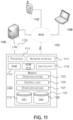
- FIG. 11 illustrates one example of a system architecture and data processing device that may be used to implement one or more illustrative aspects described herein in a standalone and/or networked environment.
- Various network nodes 1103, 1105, 1107, and 1109 may be interconnected via a wide area network (WAN) 1101, such as the Internet.
- WAN wide area network
- Other networks may also or alternatively be used, including private intranets, corporate networks, local area networks (LAN), metropolitan area networks (MAN), wireless networks, personal networks (PAN), and the like.
- Network 1101 is for illustration purposes and may be replaced with fewer or additional computer networks.
- a local area network 1133 may have one or more of any known LAN topology and may use one or more of a variety of different protocols, such as Ethernet.
- Devices 1103, 1105, 1107, and 1109 and other devices may be connected to one or more of the networks via twisted pair wires, coaxial cable, fiber optics, radio waves, or other communication media.
- network refers not only to systems in which remote storage devices are coupled together via one or more communication paths, but also to stand-alone devices that may be coupled, from time to time, to such systems that have storage capability. Consequently, the term “network” includes not only a “physical network” but also a “content network,” which is comprised of the data-attributable to a single entity-which resides across all physical networks.
- Data server 1103 provides overall access, control and administration of databases and control software for performing one or more illustrative aspects describe herein.
- Data server 1103 may be connected to web server 1105 through which users interact with and obtain data as requested.
- data server 1103 may act as a web server itself and be directly connected to the Internet.
- Data server 1103 may be connected to web server 1105 through the local area network 1133, the wide area network 1101 (e.g., the Internet), via direct or indirect connection, or via some other network.
- Users may interact with the data server 1103 using remote computers 1107, 1109, e.g., using a web browser to connect to the data server 1103 via one or more externally exposed web sites hosted by web server 1105.
- Client computers 1107, 1109 may be used in concert with data server 1103 to access data stored therein, or may be used for other purposes.
- a user may access web server 1105 using an Internet browser, as is known in the art, or by executing a software application that communicates with web server 1105 and/or data server 1103 over a computer network (such as the Internet).
- FIG. 11 illustrates just one example of a network architecture that may be used, and those of skill in the art will appreciate that the specific network architecture and data processing devices used may vary, and are secondary to the functionality that they provide, as further described herein. For example, services provided by web server 1105 and data server 1103 may be combined on a single server.
- Each component 1103, 1105, 1107, 1109 may be any type of known computer, server, or data processing device.
- Data server 1103, e.g., may include a processor 1111 controlling overall operation of the data server 1103.
- Data server 1103 may further include random access memory (RAM) 1113, read only memory (ROM) 1115, network interface 1117, input/output interfaces 1119 (e.g., keyboard, mouse, display, printer, etc.), and memory 1121.
- RAM random access memory
- ROM read only memory
- I/O Input/output
- I/O may include a variety of interface units and drives for reading, writing, displaying, and/or printing data or files.
- Memory 1121 may further store operating system software 1123 for controlling overall operation of the data processing device 1103, control logic 1125 for instructing data server 1103 to perform aspects described herein, and other application software 1127 providing secondary, support, and/or other functionality which may or might not be used in conjunction with aspects described herein.
- the control logic may also be referred to herein as the data server software 1125.
- Functionality of the data server software may refer to operations or decisions made automatically based on rules coded into the control logic, made manually by a user providing input into the system, and/or a combination of automatic processing based on user input (e.g., queries, data updates, etc.).
- Memory 1121 may also store data used in performance of one or more aspects described herein, including a first database 1129 and a second database 1131.
- the first database may include the second database (e.g., as a separate table, report, etc.). That is, the information can be stored in a single database, or separated into different logical, virtual, or physical databases, depending on system design.
- Devices 1105, 1107, and 1109 may have similar or different architecture as described with respect to device 1103.
- data processing device 1103 may be spread across multiple data processing devices, for example, to distribute processing load across multiple computers, to segregate transactions based on geographic location, user access level, quality of service (QoS), etc.
- QoS quality of service
- One or more aspects may be embodied in computer-usable or readable data and/or computer-executable instructions, such as in one or more program modules, executed by one or more computers or other devices as described herein.
- program modules include routines, programs, objects, components, data structures, etc. that perform particular tasks or implement particular abstract data types when executed by a processor in a computer or other device.
- the modules may be written in a source code programming language that is subsequently compiled for execution, or may be written in a scripting language such as (but not limited to) HyperText Markup Language (HTML) or Extensible Markup Language (XML).
- HTML HyperText Markup Language
- XML Extensible Markup Language
- the computer executable instructions may be stored on a computer readable medium such as a nonvolatile storage device.
- Any suitable computer readable storage media may be utilized, including hard disks, CD-ROMs, optical storage devices, magnetic storage devices, and/or any combination thereof.
- various transmission (non-storage) media representing data or events as described herein may be transferred between a source and a destination in the form of electromagnetic waves traveling through signal-conducting media such as metal wires, optical fibers, and/or wireless transmission media (e.g., air and/or space).
- signal-conducting media such as metal wires, optical fibers, and/or wireless transmission media (e.g., air and/or space).
- signal-conducting media such as metal wires, optical fibers, and/or wireless transmission media (e.g., air and/or space).
- Various aspects described herein may be embodied as a method, a data processing system, or a computer program product. Therefore, various functionalities may be embodied in whole or in part in software, firmware, and/or hardware or hardware equivalents such as integrated circuits, field programmable gate arrays (
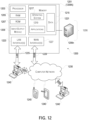
- FIG. 12 depicts an example system architecture including a computing device 1201 in an illustrative computing environment 1200 that may be used according to one or more illustrative aspects described herein.
- Computing device 1201 may be used as a server 1206a in a single-server or multi-server desktop virtualization system (e.g., a remote access or cloud system) configured to provide virtual machines for client access devices.
- the computing device 1201 may have a processor 1203 for controlling overall operation of the server and its associated components, including RAM 1205, ROM 1207, Input/Output (I/O) module 1209, and memory 1215.
- I/O module 1209 may include a mouse, keypad, touch screen, scanner, optical reader, and/or stylus (or other input device(s)) through which a user of computing device 201 may provide input, and may also include one or more of a speaker for providing audio output and one or more of a video display device for providing textual, audiovisual, and/or graphical output.
- Software may be stored within memory 1215 and/or other storage to provide instructions to processor 1203 for configuring computing device 1201 into a special purpose computing device in order to perform various functions as described herein.
- memory 1215 may store software used by the computing device 1201, such as an operating system 1217, application programs 1219, and an associated database 1221.
- Computing device 1201 may operate in a networked environment supporting connections to one or more remote computers, such as terminals 1240 (also referred to as client devices).
- the terminals 1240 may be personal computers, mobile devices, laptop computers, tablets, or servers that include many or all of the elements described above with respect to the computing device 1103 or 1201.
- the network connections depicted in FIG. 12 include a local area network (LAN) 1225 and a wide area network (WAN) 1229, but may also include other networks.
- LAN local area network
- WAN wide area network
- computing device 1201 may be connected to the LAN 1225 through a network interface or adapter 1223.
- computing device 1201 When used in a WAN networking environment, computing device 1201 may include a modem 1227 or other wide area network interface for establishing communications over the WAN 1229, such as computer network 1230 (e.g., the Internet). It will be appreciated that the network connections shown are illustrative and other means of establishing a communications link between the computers may be used.
- Computing device 1201 and/or terminals 1240 may also be mobile terminals (e.g., mobile phones, smartphones, personal digital assistants (PDAs), notebooks, etc.) including various other components, such as a battery, speaker, and antennas (not shown).
- PDAs personal digital assistants
- aspects described herein may also be operational with numerous other general purpose or special purpose computing system environments or configurations.
- Examples of other computing systems, environments, and/or configurations that may be suitable for use with aspects described herein include, but are not limited to, personal computers, server computers, hand-held or laptop devices, multiprocessor systems, microprocessor-based systems, set top boxes, programmable consumer electronics, network personal computers (PCs), minicomputers, mainframe computers, distributed computing environments that include any of the above systems or devices, and the like.
- one or more client devices 1240 may be in communication with one or more servers 1206a-1206n (generally referred to herein as "server(s) 1206").
- the computing environment 1200 may include a network appliance installed between the server(s) 1206 and client machine(s) 1240.
- the network appliance may manage client/server connections, and in some cases can load balance client connections amongst a plurality of backend servers 1206.
- the client machine(s) 1240 may in some embodiments be referred to as a single client machine 1240 or a single group of client machines 1240, while server(s) 1206 may be referred to as a single server 1206 or a single group of servers 1206.
- a single client machine 1240 communicates with more than one server 1206, while in another embodiment a single server 1206 communicates with more than one client machine 1240.
- a single client machine 1240 communicates with a single server 1206.
- a client machine 1240 can, in some embodiments, be referenced by any one of the following non-exhaustive terms: client machine(s); client(s); client computer(s); client device(s); client computing device(s); local machine; remote machine; client node(s); endpoint(s); or endpoint node(s).
- the server 1206, in some embodiments, may be referenced by any one of the following non-exhaustive terms: server(s), local machine; remote machine; server farm(s), or host computing device(s).
- the client machine 1240 may be a virtual machine.
- the virtual machine may be any virtual machine, while in some embodiments the virtual machine may be any virtual machine managed by a Type 1 or Type 2 hypervisor, for example, a hypervisor developed by Citrix, IBM, VMware, or any other hypervisor.
- the virtual machine may be managed by a hypervisor, while in other aspects the virtual machine may be managed by a hypervisor executing on a server 1206 or a hypervisor executing on a client 1240.
- Some embodiments include a client device 1240 that displays application output generated by an application remotely executing on a server 1206 or other remotely located machine.
- the client device 1240 may execute a virtual machine receiver program or application to display the output in an application window, a browser, or other output window.
- the application is a desktop, while in other examples the application is an application that generates or presents a desktop.
- a desktop may include a graphical shell providing a user interface for an instance of an operating system in which local and/or remote applications can be integrated.
- Applications as used herein, are programs that execute after an instance of an operating system (and, optionally, also the desktop) has been loaded.
- the thin-client or remote-display protocol can be a protocol such as the Independent Computing Architecture (ICA) protocol developed by Citrix Systems, Inc. of Ft. Lauderdale, Florida; or the Remote Desktop Protocol (RDP) manufactured by the Microsoft Corporation of Redmond, Washington.
- ICA Independent Computing Architecture
- RDP Remote Desktop Protocol
- a remote computing environment may include more than one server 1206a-1206n such that the servers 1206a-1206n are logically grouped together into a server farm 1206, for example, in a cloud computing environment.
- the server farm 1206 may include servers 1206 that are geographically dispersed while and logically grouped together, or servers 1206 that are located proximate to each other while logically grouped together.
- Geographically dispersed servers 1206a-1206n within a server farm 1206 can, in some embodiments, communicate using a WAN (wide), MAN (metropolitan), or LAN (local), where different geographic regions can be characterized as: different continents; different regions of a continent; different countries; different states; different cities; different campuses; different rooms; or any combination of the preceding geographical locations.
- the server farm 1206 may be administered as a single entity, while in other embodiments the server farm 1206 can include multiple server farms.
- a server farm may include servers 1206 that execute a substantially similar type of operating system platform (e.g., WINDOWS, UNIX, LINUX, iOS, ANDROID, SYMBIAN, etc.)
- server farm 1206 may include a first group of one or more servers that execute a first type of operating system platform, and a second group of one or more servers that execute a second type of operating system platform.
- Server 1206 may be configured as any type of server, as needed, e.g., a file server, an application server, a web server, a proxy server, an appliance, a network appliance, a gateway, an application gateway, a gateway server, a virtualization server, a deployment server, a Secure Sockets Layer (SSL) VPN server, a firewall, a web server, an application server or as a master application server, a server executing an active directory, or a server executing an application acceleration program that provides firewall functionality, application functionality, or load balancing functionality.
- SSL Secure Sockets Layer
- Other server types may also be used.
- Some embodiments include a first server 1206a that receives requests from a client machine 1240, forwards the request to a second server 1206b (not shown), and responds to the request generated by the client machine 1240 with a response from the second server 1206b (not shown.)
- First server 1206a may acquire an enumeration of applications available to the client machine 1240 and well as address information associated with an application server 1206 hosting an application identified within the enumeration of applications.
- First server 1206a can then present a response to the client's request using a web interface, and communicate directly with the client 1240 to provide the client 1240 with access to an identified application.
- One or more clients 1240 and/or one or more servers 1206 may transmit data over network 1230, e.g., network 1101.
Landscapes
- Engineering & Computer Science (AREA)
- Computer Security & Cryptography (AREA)
- Computer Networks & Wireless Communication (AREA)
- Signal Processing (AREA)
- Computer Hardware Design (AREA)
- Computing Systems (AREA)
- General Engineering & Computer Science (AREA)
- Data Exchanges In Wide-Area Networks (AREA)
- Computer And Data Communications (AREA)
Claims (17)
- Verfahren, umfassend:Empfangen, durch ein Gateway (220), das mit einer Vielzahl von Paketfilterregeln konfiguriert ist, einer Vielzahl von Paketen, die mit einem Netzwerk assoziiert sind, das durch das Gateway geschützt ist;Filtern, durch das Gateway, das mit der Vielzahl von Paketfilterregeln konfiguriert ist, jedes einzelnen der Pakete;Erzeugen, durch das Gateway, das mit der Vielzahl von Paketfilterregeln konfiguriert ist, Bedrohungs-Metadaten, die mit wenigstens einem ersten Teil der Vielzahl von Paketen assoziiert sind, wobei die Bedrohungs-Metadaten, die mit dem wenigstens ersten Teil der Vielzahl von Paketen assoziiert sind, eines oder mehr aus einer Bedrohungsart, einem Bedrohungsnamen, einer Identität eines Bedrohungs-Akteurs, einer Risiko-Punktzahl, einer Bedrohungsaufklärungsanbieter-Identität, Herkunftsinformationen, oder anderen Bedrohungs-Metadaten, die von äußeren Quellen bereitgestellt werden, umfassen;Bestimmen, durch einen Broker (240) und basierend auf den Bedrohungs-Metadaten, die mit wenigstens dem ersten Teil der Vielzahl von Paketen assoziiert sind, wenigstens eines aus einer Vielzahl von Cyber-Analyse-Systemen (230, 232, 234), um den ersten Teil der Vielzahl von Paketen zu verarbeiten;Empfangen, durch das wenigstens eine Cyber-Analyse-System (230, 232, 234) und von dem Broker, des ersten Teils der Vielzahl von Paketen, der Bedrohungs-Metadaten, die mit dem ersten Teil der Vielzahl von Paketen assoziiert sind, und eines Konfigurations-Signals, um das wenigstens eine Cyber-Analyse-System dazu einzurichten, eine bestimmte Analyse-Methode auszuführen;Bestimmen, durch das wenigstens eine Cyber-Analyse-System, das gemäß dem Konfigurations-Signal eingerichtet ist, basierend auf Paket-Daten, und basierend auf den Bedrohungs-Metadaten, die mit den Paket-Daten assoziiert sind, wenigstens einer Schutz-Aktion für wenigstens einen zweiten Teil der Vielzahl von Paketen; undVerarbeiten, basierend auf der bestimmten wenigstens einen Schutz-Aktion, des zweiten Teils der Vielzahl von Paketen, wobei die bestimmte wenigstens eine Schutz-Aktion gemäß Bedingungen implementiert ist, die durch die Vielzahl von Paketfilterregeln definiert sind.
- Verfahren nach Anspruch 1, wobei das Filtern, durch das Gateway, das mit der Vielzahl von Paketfilterregeln eingerichtet ist, jedes einzelnen der Vielzahl von Paketen, umfasst Vergleichen, für jedes einzelne der Vielzahl von Paketen, von Paket-Daten mit Bedrohungsaufklärungs-Daten basierend auf der Vielzahl von Paketfilterregeln.
- Verfahren nach einem der Ansprüche 1 oder 2, ferner umfassend Weiterleiten, durch das Gateway, das mit der Vielzahl von Paketfilterregeln eingerichtet ist, eines dritten Teils der Vielzahl von Paketen an ihr beabsichtigtes Ziel, wobei der dritte Teil der Vielzahl von Paketen nicht mit der Vielzahl von Paketfilterregeln übereinstimmt.
- Verfahren nach einem der Ansprüche 1 - 3, wobei das Filtern, durch das Gateway, das mit der Vielzahl von Paketfilterregeln eingerichtet ist, jedes einzelnen der Vielzahl von Paketen umfasst:Bestimmen, basierend auf wenigstens einer der Vielzahl von Paketfilterregeln, einer Paket-Bedrohungs-Stufe; undÜbermitteln, basierend auf einer bestimmten geringen Paket-Bedrohungs-Stufe, eines niedrige-Bedrohung-Pakets an sein beabsichtigtes Ziel;Übermitteln, basierend auf einer bestimmten mittleren Paket-Bedrohungs-Stufe, eines mittlere-Bedrohung-Pakets an das wenigstens eine Cyber-Analyse-System; undVerhindern, basierend auf einer bestimmten hohen Paket-Bedrohungs-Stufe, eines hohe-Bedrohung-Pakets davon, an sein beabsichtigtes Ziel zu gelangen.
- Verfahren nach Anspruch 4, wobei das Übermitteln, basierend auf der bestimmten mittleren Paket-Bedrohungs-Stufe, des mittlere-Bedrohung-Pakets an das wenigstens eine Cyber-Analyse-System umfasst:Übermitteln, basierend auf der bestimmten mittleren Paket-Bedrohungs-Stufe, einer ersten Kopie des mittlere-Bedrohung-Pakets an ein beabsichtigtes Ziel des mittlere-Bedrohung-Pakets;Übermitteln, basierend auf der bestimmten mittleren Paket-Bedrohungs-Stufe, einer zweiten Kopie des mittlere-Bedrohung-Pakets and das wenigstens eine Cyber-Analyse-System;Bestimmen, durch das wenigstens eine Cyber-Analyse-System, dass die mittlere Paket-Bedrohungs-Stufe mit einer bestätigten Bedrohung assoziiert ist; undAktualisieren, basierend auf dem Verarbeiten des wenigstens einen Cyber-Analyse-Systems, wenigstens einer Paketfilterregel, die mit dem mittlere-Bedrohung-Paket assoziiert ist, um es zu verhindern, dass Pakete, die mit dem mittlere-Bedrohung-Paket assoziiert sind, an ihr beabsichtigtes Ziel gelangen.
- Verfahren nach einem der Ansprüche 4 oder 5, wobei das Übermitteln, basierend auf der bestimmten mittleren Paket-Bedrohungs-Stufe, des mittlere-Bedrohung-Pakets an das wenigstens eine Cyber-Analyse-System umfasst:Übermitteln, basierend auf der bestimmten mittleren Paket-Bedrohungs-Stufe, einer ersten Kopie des mittlere-Bedrohung-Pakets an das beabsichtigte Ziel des mittlere-Bedrohung-Pakets;Übermitteln, basierend auf der mittleren Paket-Bedrohungs-Stufe, einer zweiten Kopie des mittlere-Bedrohung-Pakets an das wenigstens eine Cyber-Analyse-System;Bestimmen, durch das wenigstens eine Cyber-Analyse-System, dass die mittlere Paket-Bedrohungs-Stufe nicht mit einer Bedrohung assoziiert ist; undAktualisieren, basierend auf dem Verarbeiten des wenigstens einen Cyber-Analyse-Systems, wenigstens einer Paketfilterregel, die mit dem mittlere-Bedrohung-Paket assoziiert ist, um es Paketen, die mit dem mittlere-Bedrohung-Paket assoziiert sind, zu erlauben, an ihr beabsichtigtes Ziel übermittelt zu werden.
- Verfahren nach einem der Ansprüche 4 - 6, wobei das Bestimmen, basierend auf der wenigstens einen aus der Vielzahl von Paketfilterregeln, der Paket-Bedrohungsstufe umfasst:Bestimmen einer Zuverlässigkeit von Paket-Filter-Bedrohungs-Aufklärungs-Daten;Zuweisen einer mittleren Paket-Bedrohungs-Stufe an Pakete, die mit niedriger-Zuverlässigkeit-Paket-Filter-Bedrohungs-Aufklärungs-Daten assoziiert sind;Zuweisen einer hohen Paket-Bedrohungs-Stufe an Pakete, die mit hoher-Zuverlässigkeit-Bedrohungs-Aufklärungs-Daten assoziiert sind.
- Verfahren nach einem der Ansprüche 4 - 7, ferner umfassend Konfigurieren des Gateways, basierend auf Bedrohungs-Metadaten mit der bestimmten hohen Paket-Bedrohungs-Stufe, mit hoher-Zuverlässigkeit-Paketfilterregeln, die basierend auf den Bedrohungsmetadaten erzeugt wurden, die mit der bestimmten hohen Paket-Bedrohungs-Stufe assoziiert sind.
- Verfahren nach einem der Ansprüche 1 - 8, ferner umfassend:Erzeugen eines Protokolls des ersten Teils der Vielzahl von Paketen und der Bedrohungs-Metadaten, die mit dem ersten Teil der Vielzahl von Paketen assoziiert sind; undÜbermitteln des Protokolls an einen System-Administrator.
- Verfahren nach einem der Ansprüche 1 - 9, ferner umfassend:
Aktualisieren des Protokolls basierend auf Bedrohungs-Metadaten, die von dem wenigstens einen Cyber-Analyse-System erzeugt wurden, wobei das aktualisierte Protokoll sowohl die Bedrohungs-Metadaten umfasst, die durch das Gateway erzeugt wurden, als auch die Bedrohungs-Metadaten, die von dem wenigstens einen Cyber-Analyse-System erzeugt wurden. - Verfahren nach einem der Ansprüche 1 - 10, wobei das Bestimmen, durch das wenigstens eine Cyber-Analyse-System, basierend auf den Paket-Daten, und basierend auf den Bedrohungs-Metadaten, die mit den Paket-Daten assoziiert sind, der wenigstens einen Schutz-Aktion für wenigstens den zweiten Teil der Vielzahl von Paketen umfasst:
Bestimmen, basierend auf den Bedrohungs-Metadaten, die durch das Gateway erzeugt wurden und basierend auf den Bedrohungs-Metadaten, die durch das wenigstens eine Cyber-Analyse-System erzeugt wurden, wenigstens einer Schutz-Aktion für wenigstens den zweiten Teil der Vielzahl von Paketen. - Verfahren nach einem der Ansprüche 1 - 11, wobei das Verarbeiten, basierend auf der wenigstens einen Schutz-Aktion, des zweiten Teils der Vielzahl von Paketen umfasst:Bestimmen, basierend auf Bedrohungs-Metadaten, die das Gateway erzeugt hat, und basierend auf Bedrohungs-Metadaten, die das wenigstens eine Cyber-Analyse-System erzeugt hat, wenigstens eines aus aktiv-schützendem Verarbeiten, proaktiv-schützendem Verarbeiten, und reaktivschützendem Verarbeiten, für das wenigstens eine bestimmte Bedrohungs-Paket,wobei aktiv-schützendes Verarbeiten Rekonfigurieren des Gateways umfasst, um Pakete zu blockieren, die mit dem gleichen Paketfluss assoziiert sind wie das wenigstens eine bestimmte Bedrohungs-Paket,wobei proaktiv-schützendes Verarbeiten Extrahieren von Bedrohungs-Aufklärungs-Daten aus dem wenigstens einen bestimmten Bedrohungs-Paket und Rekonfigurieren des Gateways basierend auf den extrahierten Bedrohungs-Aufklärungs-Daten aus dem wenigstens einen bestimmten Bedrohungs-Paket umfasst, undwobei reaktiv-schützendes Verarbeiten Übermitteln, an eine Verwaltungs-Vorrichtung, von Metadaten umfasst, die mit dem wenigstens einen bestimmten Bedrohungs-Paket assoziiert sind.
- Verfahren nach einem der Ansprüche 1 - 12, ferner umfassend:Übermitteln, an einen System-Administrator, von Protokoll-Dateien, die Metadaten enthalten, die mit wenigstens einer Bedrohung in Verbindung stehen;Empfangen, von dem System-Administrator, aktualisierte Regel-Informationen; undAktualisieren, basierend auf den aktualisierten Regel-Informationen, die von dem System-Administrator erhalten werden, wenigstens einer aus der Vielzahl von Paketfilterregeln des Gateways.
- Verfahren nach einem der Ansprüche 1 - 13, wobei das wenigstens eine Cyber-Analyse-System wenigstens zwei aus einer Netzwerk-Eindringungs-Feststellungs-Vorrichtung, einer Netzwerk-Eindringungs-Schutz-Vorrichtung, einer Netzwerk-Signatur-Feststellungs-Vorrichtung, einer Überwachungs-Vorrichtung, einer Sandkasten-Analyse-Vorrichtung, und einer Malware-Analyse-Vorrichtung umfasst.
- Verfahren nach einem der Ansprüche 1 - 14, wobei das Verarbeiten, basierend auf der bestimmten wenigstens einen Schutz-Aktion, des zweiten Teils der Vielzahl von Paketen wenigstens eines aus Folgendem umfasst:Blockieren weiterer Kommunikationen, die mit dem zweiten Teil der Vielzahl von Paketen assoziiert sind;Extrahieren von Bedrohungs-Aufklärungs-Daten aus dem zweiten Teil der Vielzahl von Paketen und Erzeugen von Regeln basierend auf den extrahierten Bedrohungs-Aufklärungs-Daten;In-Quarantäne-Setzen einer infizierten Host-Vorrichtung, die mit dem zweiten Teil der Vielzahl von Paketen assoziiert ist; oderWeiterleiten von Protokollen, die mit dem zweiten Teil der Vielzahl von Paketen assoziiert sind, an eine Verwaltungs-Vorrichtung.
- System umfassend:ein Gateway;einen Broker; undein Cyber-Analyse-System, wobei das System dazu eingerichtet ist, das Verfahren nach einem der Ansprüche 1 - 15 auszuführen.
- Ein Computer-lesbares Medium, auf dem Instruktionen gespeichert sind, die, wenn sie ausgeführt werden, das Ausführen des Verfahrens nach einem der Ansprüche 1 - 15 zu verursachen.
Priority Applications (1)
| Application Number | Priority Date | Filing Date | Title |
|---|---|---|---|
| EP24178476.8A EP4443839A3 (de) | 2018-07-09 | 2019-07-08 | Verfahren und systeme für effizienten netzwerkschutz |
Applications Claiming Priority (2)
| Application Number | Priority Date | Filing Date | Title |
|---|---|---|---|
| US16/030,374 US10333898B1 (en) | 2018-07-09 | 2018-07-09 | Methods and systems for efficient network protection |
| PCT/US2019/040830 WO2020014134A1 (en) | 2018-07-09 | 2019-07-08 | Methods and systems for efficient network protection |
Related Child Applications (1)
| Application Number | Title | Priority Date | Filing Date |
|---|---|---|---|
| EP24178476.8A Division EP4443839A3 (de) | 2018-07-09 | 2019-07-08 | Verfahren und systeme für effizienten netzwerkschutz |
Publications (2)
| Publication Number | Publication Date |
|---|---|
| EP3821580A1 EP3821580A1 (de) | 2021-05-19 |
| EP3821580B1 true EP3821580B1 (de) | 2024-05-29 |
Family
ID=66996488
Family Applications (2)
| Application Number | Title | Priority Date | Filing Date |
|---|---|---|---|
| EP19745478.8A Active EP3821580B1 (de) | 2018-07-09 | 2019-07-08 | Verfahren und systeme zum effizienten netzwerkschutz |
| EP24178476.8A Pending EP4443839A3 (de) | 2018-07-09 | 2019-07-08 | Verfahren und systeme für effizienten netzwerkschutz |
Family Applications After (1)
| Application Number | Title | Priority Date | Filing Date |
|---|---|---|---|
| EP24178476.8A Pending EP4443839A3 (de) | 2018-07-09 | 2019-07-08 | Verfahren und systeme für effizienten netzwerkschutz |
Country Status (4)
| Country | Link |
|---|---|
| US (3) | US10333898B1 (de) |
| EP (2) | EP3821580B1 (de) |
| CN (2) | CN118018282A (de) |
| WO (1) | WO2020014134A1 (de) |
Families Citing this family (23)
| Publication number | Priority date | Publication date | Assignee | Title |
|---|---|---|---|---|
| US20190362075A1 (en) * | 2018-05-22 | 2019-11-28 | Fortinet, Inc. | Preventing users from accessing infected files by using multiple file storage repositories and a secure data transfer agent logically interposed therebetween |
| US10333898B1 (en) | 2018-07-09 | 2019-06-25 | Centripetal Networks, Inc. | Methods and systems for efficient network protection |
| US10764211B2 (en) * | 2018-10-19 | 2020-09-01 | Avago Technologies International Sales Pte. Limited | Flexible switch logic |
| US11399038B2 (en) * | 2018-11-06 | 2022-07-26 | Schlumberger Technology Corporation | Cybersecurity with edge computing |
| US12375502B2 (en) * | 2019-02-08 | 2025-07-29 | Fortinet, Inc. | Providing secure data-replication between a master node and tenant nodes of a multi-tenancy architecture |
| US12206694B2 (en) * | 2020-02-28 | 2025-01-21 | Telefonaktiebolaget Lm Ericsson (Publ) | Cyberattack identification in a network environment |
| US11606369B2 (en) | 2020-03-20 | 2023-03-14 | Cisco Technology, Inc. | Intelligent quarantine on switch fabric for physical and virtualized infrastructure |
| CN111800439B (zh) * | 2020-09-08 | 2020-12-22 | 江苏苏宁银行股份有限公司 | 一种威胁情报在银行中的应用方法及其系统 |
| US12301590B2 (en) * | 2020-09-23 | 2025-05-13 | Open Text Holdings, Inc. | Endpoint security systems and methods with telemetry filters for event log monitoring |
| CN114390556B (zh) * | 2020-10-21 | 2023-07-07 | 中国联合网络通信集团有限公司 | 一种整改方案的确定方法和装置 |
| US20220141188A1 (en) * | 2020-10-30 | 2022-05-05 | Splunk Inc. | Network Security Selective Anomaly Alerting |
| US20220159029A1 (en) * | 2020-11-13 | 2022-05-19 | Cyberark Software Ltd. | Detection of security risks based on secretless connection data |
| EP4248317A4 (de) | 2020-11-23 | 2024-09-25 | Reliaquest Holdings, LLC | Bedrohungsabschwächungssystem und -verfahren |
| US11159546B1 (en) | 2021-04-20 | 2021-10-26 | Centripetal Networks, Inc. | Methods and systems for efficient threat context-aware packet filtering for network protection |
| US12289323B1 (en) * | 2021-06-30 | 2025-04-29 | Rapid7, Inc. | Recognizing and mitigating successful cyberattacks |
| CN119895414A (zh) * | 2022-07-25 | 2025-04-25 | 向心网络有限公司 | 用于基于新的和/或更新的网络威胁情报来进行网络威胁检测的系统和方法 |
| US20240098105A1 (en) * | 2022-09-14 | 2024-03-21 | Trustwave Holdings Inc | Tactics, techniques, and procedures (ttp) based threat hunting |
| US12487834B2 (en) | 2022-11-29 | 2025-12-02 | Open Text Inc. | Event logging protocol connector systems and methods |
| US12368728B2 (en) * | 2022-11-29 | 2025-07-22 | Open Text Inc. | Security event transformation and logging systems and methods |
| FR3150675A1 (fr) * | 2023-06-28 | 2025-01-03 | Orange | Procédés de protection d’un équipement et de transmission de données, dispositifs et ensemble électroniques, produits programmes d’ordinateur et supports d’information correspondants |
| US11924241B1 (en) * | 2023-09-26 | 2024-03-05 | Lookout, Inc. | Real-time mitigative security architecture |
| US20250310353A1 (en) * | 2023-12-12 | 2025-10-02 | Cisco Technology, Inc. | Data unit capture management |
| US12219360B1 (en) | 2024-07-24 | 2025-02-04 | Netskope, Inc. | Cellular IoT security using dynamic policy-driven mechanisms for threat mitigation |
Citations (7)
| Publication number | Priority date | Publication date | Assignee | Title |
|---|---|---|---|---|
| US7746862B1 (en) | 2005-08-02 | 2010-06-29 | Juniper Networks, Inc. | Packet processing in a multiple processor system |
| US20120110667A1 (en) | 2010-11-01 | 2012-05-03 | Zubrilin Sergey A | System and Method for Server-Based Antivirus Scan of Data Downloaded From a Network |
| US8510821B1 (en) | 2010-06-29 | 2013-08-13 | Amazon Technologies, Inc. | Tiered network flow analysis |
| US8953458B2 (en) | 2011-09-30 | 2015-02-10 | Gigamon Inc. | Systems and methods for implementing a traffic visibility network |
| US9223972B1 (en) | 2014-03-31 | 2015-12-29 | Fireeye, Inc. | Dynamically remote tuning of a malware content detection system |
| US9591015B1 (en) | 2014-03-28 | 2017-03-07 | Fireeye, Inc. | System and method for offloading packet processing and static analysis operations |
| WO2017086928A1 (en) | 2015-11-17 | 2017-05-26 | Hewlett Packard Enterprise Development Lp | Handling network threats |
Family Cites Families (275)
| Publication number | Priority date | Publication date | Assignee | Title |
|---|---|---|---|---|
| US6147976A (en) | 1996-06-24 | 2000-11-14 | Cabletron Systems, Inc. | Fast network layer packet filter |
| US6453345B2 (en) | 1996-11-06 | 2002-09-17 | Datadirect Networks, Inc. | Network security and surveillance system |
| US6098172A (en) | 1997-09-12 | 2000-08-01 | Lucent Technologies Inc. | Methods and apparatus for a computer network firewall with proxy reflection |
| US7143438B1 (en) | 1997-09-12 | 2006-11-28 | Lucent Technologies Inc. | Methods and apparatus for a computer network firewall with multiple domain support |
| US6484261B1 (en) | 1998-02-17 | 2002-11-19 | Cisco Technology, Inc. | Graphical network security policy management |
| US6279113B1 (en) | 1998-03-16 | 2001-08-21 | Internet Tools, Inc. | Dynamic signature inspection-based network intrusion detection |
| US6317837B1 (en) | 1998-09-01 | 2001-11-13 | Applianceware, Llc | Internal network node with dedicated firewall |
| US6826694B1 (en) | 1998-10-22 | 2004-11-30 | At&T Corp. | High resolution access control |
| US20010039624A1 (en) | 1998-11-24 | 2001-11-08 | Kellum Charles W. | Processes systems and networks for secured information exchange using computer hardware |
| CA2287689C (en) | 1998-12-03 | 2003-09-30 | P. Krishnan | Adaptive re-ordering of data packet filter rules |
| US6226372B1 (en) | 1998-12-11 | 2001-05-01 | Securelogix Corporation | Tightly integrated cooperative telecommunications firewall and scanner with distributed capabilities |
| US6611875B1 (en) | 1998-12-31 | 2003-08-26 | Pmc-Sierra, Inc. | Control system for high speed rule processors |
| US6678827B1 (en) | 1999-05-06 | 2004-01-13 | Watchguard Technologies, Inc. | Managing multiple network security devices from a manager device |
| JP2000332817A (ja) | 1999-05-18 | 2000-11-30 | Fujitsu Ltd | パケット処理装置 |
| AU5486800A (en) | 1999-06-10 | 2001-01-02 | Alcatel Internetworking, Inc. | Policy based network architecture |
| US7051365B1 (en) | 1999-06-30 | 2006-05-23 | At&T Corp. | Method and apparatus for a distributed firewall |
| US6971028B1 (en) | 1999-08-30 | 2005-11-29 | Symantec Corporation | System and method for tracking the source of a computer attack |
| EP1107140A3 (de) | 1999-11-30 | 2004-01-28 | Hitachi, Ltd. | Verfahren zur Unterstützung des Entwurfs von Sicherheitssystemen |
| US7215637B1 (en) | 2000-04-17 | 2007-05-08 | Juniper Networks, Inc. | Systems and methods for processing packets |
| US7058976B1 (en) | 2000-05-17 | 2006-06-06 | Deep Nines, Inc. | Intelligent feedback loop process control system |
| US8204082B2 (en) | 2000-06-23 | 2012-06-19 | Cloudshield Technologies, Inc. | Transparent provisioning of services over a network |
| US6907470B2 (en) | 2000-06-29 | 2005-06-14 | Hitachi, Ltd. | Communication apparatus for routing or discarding a packet sent from a user terminal |
| US20020164962A1 (en) | 2000-07-18 | 2002-11-07 | Mankins Matt W. D. | Apparatuses, methods, and computer programs for displaying information on mobile units, with reporting by, and control of, such units |
| US7152240B1 (en) * | 2000-07-25 | 2006-12-19 | Green Stuart D | Method for communication security and apparatus therefor |
| US6834342B2 (en) | 2000-08-16 | 2004-12-21 | Eecad, Inc. | Method and system for secure communication over unstable public connections |
| US6662235B1 (en) | 2000-08-24 | 2003-12-09 | International Business Machines Corporation | Methods systems and computer program products for processing complex policy rules based on rule form type |
| US20020038339A1 (en) | 2000-09-08 | 2002-03-28 | Wei Xu | Systems and methods for packet distribution |
| US9525696B2 (en) | 2000-09-25 | 2016-12-20 | Blue Coat Systems, Inc. | Systems and methods for processing data flows |
| US20110214157A1 (en) | 2000-09-25 | 2011-09-01 | Yevgeny Korsunsky | Securing a network with data flow processing |
| US7129825B2 (en) | 2000-09-26 | 2006-10-31 | Caterpillar Inc. | Action recommendation system for a mobile vehicle |
| US20060212572A1 (en) | 2000-10-17 | 2006-09-21 | Yehuda Afek | Protecting against malicious traffic |
| US7657628B1 (en) | 2000-11-28 | 2010-02-02 | Verizon Business Global Llc | External processor for a distributed network access system |
| US7046680B1 (en) | 2000-11-28 | 2006-05-16 | Mci, Inc. | Network access system including a programmable access device having distributed service control |
| DE60124295T8 (de) | 2000-11-30 | 2007-12-06 | Lancope, Inc. | Flussbasierte erfassung eines eindringens in ein netzwerk |
| US7095741B1 (en) | 2000-12-20 | 2006-08-22 | Cisco Technology, Inc. | Port isolation for restricting traffic flow on layer 2 switches |
| US20030051026A1 (en) | 2001-01-19 | 2003-03-13 | Carter Ernst B. | Network surveillance and security system |
| US7061874B2 (en) | 2001-01-26 | 2006-06-13 | Broadcom Corporation | Method, system and computer program product for classifying packet flows with a bit mask |
| FI20010256A0 (fi) | 2001-02-12 | 2001-02-12 | Stonesoft Oy | Pakettidatayhteystietojen käsittely tietoturvagatewayelementissä |
| EP1371242A1 (de) | 2001-03-14 | 2003-12-17 | Nokia Corporation | Verfahren zur aktivierung einer verbindung in einem kommunikationssystem, mobilstation, netzwerkelement und paketfilter |
| US7095716B1 (en) | 2001-03-30 | 2006-08-22 | Juniper Networks, Inc. | Internet security device and method |
| US20020186683A1 (en) | 2001-04-02 | 2002-12-12 | Alan Buck | Firewall gateway for voice over internet telephony communications |
| AUPR435501A0 (en) | 2001-04-11 | 2001-05-17 | Firebridge Systems Pty Ltd | Network security system |
| KR100398281B1 (ko) | 2001-04-17 | 2003-09-19 | 시큐아이닷컴 주식회사 | 패킷 차단방식 방화벽 시스템에서의 고속 정책 판별 방법 |
| US7227842B1 (en) | 2001-04-24 | 2007-06-05 | Tensilica, Inc. | Fast IP packet classification with configurable processor |
| IL159264A0 (en) | 2001-06-11 | 2004-06-01 | Bluefire Security Technology | Packet filtering system and methods |
| US6947983B2 (en) | 2001-06-22 | 2005-09-20 | International Business Machines Corporation | Method and system for exploiting likelihood in filter rule enforcement |
| US7315892B2 (en) | 2001-06-27 | 2008-01-01 | International Business Machines Corporation | In-kernel content-aware service differentiation |
| US7028179B2 (en) | 2001-07-03 | 2006-04-11 | Intel Corporation | Apparatus and method for secure, automated response to distributed denial of service attacks |
| KR20010079361A (ko) | 2001-07-09 | 2001-08-22 | 김상욱 | 네트워크 상태 기반의 방화벽 장치 및 그 방법 |
| US7207062B2 (en) | 2001-08-16 | 2007-04-17 | Lucent Technologies Inc | Method and apparatus for protecting web sites from distributed denial-of-service attacks |
| US7331061B1 (en) | 2001-09-07 | 2008-02-12 | Secureworks, Inc. | Integrated computer security management system and method |
| US7386525B2 (en) | 2001-09-21 | 2008-06-10 | Stonesoft Corporation | Data packet filtering |
| US7159109B2 (en) | 2001-11-07 | 2007-01-02 | Intel Corporation | Method and apparatus to manage address translation for secure connections |
| US7325248B2 (en) | 2001-11-19 | 2008-01-29 | Stonesoft Corporation | Personal firewall with location dependent functionality |
| FI20012338A0 (fi) | 2001-11-29 | 2001-11-29 | Stonesoft Corp | Palomuuri tunneloitujen datapakettien suodattamiseksi |
| US20030123456A1 (en) | 2001-12-28 | 2003-07-03 | Denz Peter R. | Methods and system for data packet filtering using tree-like hierarchy |
| US7222366B2 (en) | 2002-01-28 | 2007-05-22 | International Business Machines Corporation | Intrusion event filtering |
| US7161942B2 (en) | 2002-01-31 | 2007-01-09 | Telcordia Technologies, Inc. | Method for distributing and conditioning traffic for mobile networks based on differentiated services |
| JP3797937B2 (ja) * | 2002-02-04 | 2006-07-19 | 株式会社日立製作所 | ネットワーク接続システム、ネットワーク接続方法、および、それらに用いられるネットワーク接続装置 |
| US8370936B2 (en) | 2002-02-08 | 2013-02-05 | Juniper Networks, Inc. | Multi-method gateway-based network security systems and methods |
| US7249194B2 (en) | 2002-02-08 | 2007-07-24 | Matsushita Electric Industrial Co., Ltd. | Gateway apparatus and its controlling method |
| US7185365B2 (en) | 2002-03-27 | 2007-02-27 | Intel Corporation | Security enabled network access control |
| US7107613B1 (en) | 2002-03-27 | 2006-09-12 | Cisco Technology, Inc. | Method and apparatus for reducing the number of tunnels used to implement a security policy on a network |
| AU2003228541A1 (en) | 2002-04-15 | 2003-11-03 | Core Sdi, Incorporated | Secure auditing of information systems |
| GB2387681A (en) | 2002-04-18 | 2003-10-22 | Isis Innovation | Intrusion detection system with inductive logic means for suggesting new general rules |
| AUPS214802A0 (en) | 2002-05-01 | 2002-06-06 | Firebridge Systems Pty Ltd | Firewall with stateful inspection |
| US20030212900A1 (en) | 2002-05-13 | 2003-11-13 | Hsin-Yuo Liu | Packet classifying network services |
| WO2003105009A1 (en) | 2002-06-07 | 2003-12-18 | Bellsouth Intellectual Property Corporation | Sytems and methods for establishing electronic conferencing over a distributed network |
| TWI244297B (en) | 2002-06-12 | 2005-11-21 | Thomson Licensing Sa | Apparatus and method adapted to communicate via a network |
| US7441262B2 (en) | 2002-07-11 | 2008-10-21 | Seaway Networks Inc. | Integrated VPN/firewall system |
| US20040015719A1 (en) * | 2002-07-16 | 2004-01-22 | Dae-Hyung Lee | Intelligent security engine and intelligent and integrated security system using the same |
| US7684400B2 (en) | 2002-08-08 | 2010-03-23 | Intel Corporation | Logarithmic time range-based multifield-correlation packet classification |
| US7263099B1 (en) | 2002-08-14 | 2007-08-28 | Juniper Networks, Inc. | Multicast packet replication |
| JP3794491B2 (ja) | 2002-08-20 | 2006-07-05 | 日本電気株式会社 | 攻撃防御システムおよび攻撃防御方法 |
| FR2844415B1 (fr) | 2002-09-05 | 2005-02-11 | At & T Corp | Systeme pare-feu pour interconnecter deux reseaux ip geres par deux entites administratives differentes |
| DE60313987T2 (de) | 2002-10-02 | 2008-01-24 | Telus Communications Co., Edmonton | Herstellung von regeln zur filterung von computerapplikationen |
| US7313141B2 (en) | 2002-10-09 | 2007-12-25 | Alcatel Lucent | Packet sequence number network monitoring system |
| US7574738B2 (en) | 2002-11-06 | 2009-08-11 | At&T Intellectual Property Ii, L.P. | Virtual private network crossovers based on certificates |
| US7454499B2 (en) * | 2002-11-07 | 2008-11-18 | Tippingpoint Technologies, Inc. | Active network defense system and method |
| US7296288B1 (en) | 2002-11-15 | 2007-11-13 | Packeteer, Inc. | Methods, apparatuses, and systems allowing for bandwidth management schemes responsive to utilization characteristics associated with individual users |
| US20040098511A1 (en) | 2002-11-16 | 2004-05-20 | Lin David H. | Packet routing method and system that routes packets to one of at least two processes based on at least one routing rule |
| US7366174B2 (en) | 2002-12-17 | 2008-04-29 | Lucent Technologies Inc. | Adaptive classification of network traffic |
| US7050394B2 (en) | 2002-12-18 | 2006-05-23 | Intel Corporation | Framer |
| US20050125697A1 (en) | 2002-12-27 | 2005-06-09 | Fujitsu Limited | Device for checking firewall policy |
| US7913303B1 (en) | 2003-01-21 | 2011-03-22 | International Business Machines Corporation | Method and system for dynamically protecting a computer system from attack |
| US20040148520A1 (en) | 2003-01-29 | 2004-07-29 | Rajesh Talpade | Mitigating denial of service attacks |
| US20040193943A1 (en) | 2003-02-13 | 2004-09-30 | Robert Angelino | Multiparameter network fault detection system using probabilistic and aggregation analysis |
| US20040177139A1 (en) | 2003-03-03 | 2004-09-09 | Schuba Christoph L. | Method and apparatus for computing priorities between conflicting rules for network services |
| US7539186B2 (en) | 2003-03-31 | 2009-05-26 | Motorola, Inc. | Packet filtering for emergency service access in a packet data network communication system |
| US7441036B2 (en) | 2003-04-01 | 2008-10-21 | International Business Machines Corporation | Method and system for a debugging utility based on a TCP tunnel |
| US7305708B2 (en) | 2003-04-14 | 2007-12-04 | Sourcefire, Inc. | Methods and systems for intrusion detection |
| US7681235B2 (en) | 2003-05-19 | 2010-03-16 | Radware Ltd. | Dynamic network protection |
| US7308711B2 (en) | 2003-06-06 | 2007-12-11 | Microsoft Corporation | Method and framework for integrating a plurality of network policies |
| US7509673B2 (en) | 2003-06-06 | 2009-03-24 | Microsoft Corporation | Multi-layered firewall architecture |
| US7710885B2 (en) | 2003-08-29 | 2010-05-04 | Agilent Technologies, Inc. | Routing monitoring |
| KR100502068B1 (ko) | 2003-09-29 | 2005-07-25 | 한국전자통신연구원 | 네트워크 노드의 보안 엔진 관리 장치 및 방법 |
| KR100558658B1 (ko) | 2003-10-02 | 2006-03-14 | 한국전자통신연구원 | 인-라인 모드 네트워크 침입 탐지/차단 시스템 및 그 방법 |
| US20050108557A1 (en) | 2003-10-11 | 2005-05-19 | Kayo David G. | Systems and methods for detecting and preventing unauthorized access to networked devices |
| US7237267B2 (en) | 2003-10-16 | 2007-06-26 | Cisco Technology, Inc. | Policy-based network security management |
| US7672318B2 (en) | 2003-11-06 | 2010-03-02 | Telefonaktiebolaget L M Ericsson (Publ) | Adaptable network bridge |
| US8839417B1 (en) | 2003-11-17 | 2014-09-16 | Mcafee, Inc. | Device, system and method for defending a computer network |
| US20050183140A1 (en) | 2003-11-20 | 2005-08-18 | Goddard Stephen M. | Hierarchical firewall load balancing and L4/L7 dispatching |
| US7389532B2 (en) | 2003-11-26 | 2008-06-17 | Microsoft Corporation | Method for indexing a plurality of policy filters |
| US7756008B2 (en) | 2003-12-19 | 2010-07-13 | At&T Intellectual Property Ii, L.P. | Routing protocols with predicted outrage notification |
| US7523314B2 (en) | 2003-12-22 | 2009-04-21 | Voltage Security, Inc. | Identity-based-encryption message management system |
| US20050141537A1 (en) | 2003-12-29 | 2005-06-30 | Intel Corporation A Delaware Corporation | Auto-learning of MAC addresses and lexicographic lookup of hardware database |
| US7761923B2 (en) | 2004-03-01 | 2010-07-20 | Invensys Systems, Inc. | Process control methods and apparatus for intrusion detection, protection and network hardening |
| US7610621B2 (en) | 2004-03-10 | 2009-10-27 | Eric White | System and method for behavior-based firewall modeling |
| US7814546B1 (en) | 2004-03-19 | 2010-10-12 | Verizon Corporate Services Group, Inc. | Method and system for integrated computer networking attack attribution |
| US8031616B2 (en) | 2004-03-23 | 2011-10-04 | Level 3 Communications, Llc | Systems and methods for accessing IP transmissions |
| US20050229246A1 (en) | 2004-03-31 | 2005-10-13 | Priya Rajagopal | Programmable context aware firewall with integrated intrusion detection system |
| US8923292B2 (en) | 2004-04-06 | 2014-12-30 | Rockstar Consortium Us Lp | Differential forwarding in address-based carrier networks |
| US20050249214A1 (en) | 2004-05-07 | 2005-11-10 | Tao Peng | System and process for managing network traffic |
| JP4341517B2 (ja) | 2004-06-21 | 2009-10-07 | 日本電気株式会社 | セキュリティポリシー管理システム、セキュリティポリシー管理方法およびプログラム |
| EP1762079A1 (de) | 2004-06-23 | 2007-03-14 | Qualcomm Incorporated | Effiziente netzwerkpaketeklassifizierung |
| US20060031928A1 (en) | 2004-08-09 | 2006-02-09 | Conley James W | Detector and computerized method for determining an occurrence of tunneling activity |
| US20060048142A1 (en) | 2004-09-02 | 2006-03-02 | Roese John J | System and method for rapid response network policy implementation |
| US8331234B1 (en) | 2004-09-08 | 2012-12-11 | Q1 Labs Inc. | Network data flow collection and processing |
| US7478429B2 (en) | 2004-10-01 | 2009-01-13 | Prolexic Technologies, Inc. | Network overload detection and mitigation system and method |
| US7490235B2 (en) | 2004-10-08 | 2009-02-10 | International Business Machines Corporation | Offline analysis of packets |
| US7509493B2 (en) | 2004-11-19 | 2009-03-24 | Microsoft Corporation | Method and system for distributing security policies |
| JP4369351B2 (ja) | 2004-11-30 | 2009-11-18 | 株式会社日立製作所 | パケット転送装置 |
| JP2006174350A (ja) | 2004-12-20 | 2006-06-29 | Fujitsu Ltd | 通信装置 |
| US7607170B2 (en) | 2004-12-22 | 2009-10-20 | Radware Ltd. | Stateful attack protection |
| CA2594020C (en) | 2004-12-22 | 2014-12-09 | Wake Forest University | Method, systems, and computer program products for implementing function-parallel network firewall |
| US7602731B2 (en) | 2004-12-22 | 2009-10-13 | Intruguard Devices, Inc. | System and method for integrated header, state, rate and content anomaly prevention with policy enforcement |
| US20060147821A1 (en) | 2004-12-30 | 2006-07-06 | Asml Netherlands B.V. | Lithographic apparatus and device manufacturing method |
| US7551567B2 (en) | 2005-01-05 | 2009-06-23 | Cisco Technology, Inc. | Interpreting an application message at a network element using sampling and heuristics |
| GB2422505A (en) | 2005-01-20 | 2006-07-26 | Agilent Technologies Inc | Sampling datagrams |
| JP4662080B2 (ja) | 2005-02-24 | 2011-03-30 | 日本電気株式会社 | フィルタリングルール分析方法及びシステム |
| AU2006230171B2 (en) | 2005-03-28 | 2012-06-21 | Wake Forest University | Methods, systems, and computer program products for network firewall policy optimization |
| US20080229415A1 (en) | 2005-07-01 | 2008-09-18 | Harsh Kapoor | Systems and methods for processing data flows |
| US7499412B2 (en) | 2005-07-01 | 2009-03-03 | Net Optics, Inc. | Active packet content analyzer for communications network |
| US8296846B2 (en) | 2005-08-19 | 2012-10-23 | Cpacket Networks, Inc. | Apparatus and method for associating categorization information with network traffic to facilitate application level processing |
| US20070056038A1 (en) * | 2005-09-06 | 2007-03-08 | Lok Technology, Inc. | Fusion instrusion protection system |
| US20070083924A1 (en) | 2005-10-08 | 2007-04-12 | Lu Hongqian K | System and method for multi-stage packet filtering on a networked-enabled device |
| US8027251B2 (en) | 2005-11-08 | 2011-09-27 | Verizon Services Corp. | Systems and methods for implementing protocol-aware network firewall |
| US7716729B2 (en) | 2005-11-23 | 2010-05-11 | Genband Inc. | Method for responding to denial of service attacks at the session layer or above |
| US7661136B1 (en) | 2005-12-13 | 2010-02-09 | At&T Intellectual Property Ii, L.P. | Detecting anomalous web proxy activity |
| US7832009B2 (en) | 2005-12-28 | 2010-11-09 | Foundry Networks, Llc | Techniques for preventing attacks on computer systems and networks |
| US8397284B2 (en) | 2006-01-17 | 2013-03-12 | University Of Maryland | Detection of distributed denial of service attacks in autonomous system domains |
| US8116312B2 (en) | 2006-02-08 | 2012-02-14 | Solarflare Communications, Inc. | Method and apparatus for multicast packet reception |
| WO2007096884A2 (en) | 2006-02-22 | 2007-08-30 | Elad Barkan | Wireless internet system and method |
| US7898963B2 (en) | 2006-03-07 | 2011-03-01 | Cisco Technology, Inc. | Graphical representation of the flow of a packet through a network device |
| KR101503624B1 (ko) | 2006-03-16 | 2015-03-17 | 엠.브루베이커 커티스 | 이동 객체에 하이퍼-관련 광고의 표시를 통한 수익 획득 시스템 및 방법 |
| US20070240208A1 (en) | 2006-04-10 | 2007-10-11 | Ming-Che Yu | Network appliance for controlling hypertext transfer protocol (HTTP) messages between a local area network and a global communications network |
| US7849507B1 (en) | 2006-04-29 | 2010-12-07 | Ironport Systems, Inc. | Apparatus for filtering server responses |
| GB2437791A (en) | 2006-05-03 | 2007-11-07 | Skype Ltd | Secure communication using protocol encapsulation |
| US8009566B2 (en) | 2006-06-26 | 2011-08-30 | Palo Alto Networks, Inc. | Packet classification in a network security device |
| US7966655B2 (en) | 2006-06-30 | 2011-06-21 | At&T Intellectual Property Ii, L.P. | Method and apparatus for optimizing a firewall |
| US8639837B2 (en) | 2006-07-29 | 2014-01-28 | Blue Coat Systems, Inc. | System and method of traffic inspection and classification for purposes of implementing session ND content control |
| KR100909552B1 (ko) | 2006-08-21 | 2009-07-27 | 삼성전자주식회사 | 모바일 아이피를 사용하는 네트워크 시스템에서 패킷필터링 장치 및 방법 |
| US8234702B2 (en) | 2006-08-29 | 2012-07-31 | Oracle International Corporation | Cross network layer correlation-based firewalls |
| US8385331B2 (en) | 2006-09-29 | 2013-02-26 | Verizon Patent And Licensing Inc. | Secure and reliable policy enforcement |
| US7624084B2 (en) | 2006-10-09 | 2009-11-24 | Radware, Ltd. | Method of generating anomaly pattern for HTTP flood protection |
| US7768921B2 (en) | 2006-10-30 | 2010-08-03 | Juniper Networks, Inc. | Identification of potential network threats using a distributed threshold random walk |
| US8004994B1 (en) | 2006-11-01 | 2011-08-23 | Azimuth Systems, Inc. | System and method for intelligently analyzing performance of a device under test |
| US7954143B2 (en) | 2006-11-13 | 2011-05-31 | At&T Intellectual Property I, Lp | Methods, network services, and computer program products for dynamically assigning users to firewall policy groups |
| US8176561B1 (en) | 2006-12-14 | 2012-05-08 | Athena Security, Inc. | Assessing network security risk using best practices |
| US7835348B2 (en) * | 2006-12-30 | 2010-11-16 | Extreme Networks, Inc. | Method and apparatus for dynamic anomaly-based updates to traffic selection policies in a switch |
| WO2008093320A1 (en) | 2007-01-31 | 2008-08-07 | Tufin Software Technologies Ltd. | System and method for auditing a security policy |
| US7873710B2 (en) | 2007-02-06 | 2011-01-18 | 5O9, Inc. | Contextual data communication platform |
| US8448234B2 (en) * | 2007-02-15 | 2013-05-21 | Marvell Israel (M.I.S.L) Ltd. | Method and apparatus for deep packet inspection for network intrusion detection |
| US7853998B2 (en) | 2007-03-22 | 2010-12-14 | Mocana Corporation | Firewall propagation |
| US8209738B2 (en) | 2007-05-31 | 2012-06-26 | The Board Of Trustees Of The University Of Illinois | Analysis of distributed policy rule-sets for compliance with global policy |
| US20120084866A1 (en) | 2007-06-12 | 2012-04-05 | Stolfo Salvatore J | Methods, systems, and media for measuring computer security |
| US7853689B2 (en) * | 2007-06-15 | 2010-12-14 | Broadcom Corporation | Multi-stage deep packet inspection for lightweight devices |
| US20080320116A1 (en) | 2007-06-21 | 2008-12-25 | Christopher Briggs | Identification of endpoint devices operably coupled to a network through a network address translation router |
| US7995584B2 (en) | 2007-07-26 | 2011-08-09 | Hewlett-Packard Development Company, L.P. | Method and apparatus for detecting malicious routers from packet payload |
| US8763108B2 (en) | 2007-11-29 | 2014-06-24 | Qualcomm Incorporated | Flow classification for encrypted and tunneled packet streams |
| KR100949808B1 (ko) | 2007-12-07 | 2010-03-30 | 한국전자통신연구원 | P2p 트래픽 관리 장치 및 그 방법 |
| US8307029B2 (en) | 2007-12-10 | 2012-11-06 | Yahoo! Inc. | System and method for conditional delivery of messages |
| CN101459660A (zh) | 2007-12-13 | 2009-06-17 | 国际商业机器公司 | 用于集成多个威胁安全服务的方法及其设备 |
| US8418240B2 (en) | 2007-12-26 | 2013-04-09 | Algorithmic Security (Israel) Ltd. | Reordering a firewall rule base according to usage statistics |
| US8561129B2 (en) | 2008-02-28 | 2013-10-15 | Mcafee, Inc | Unified network threat management with rule classification |
| US9298747B2 (en) | 2008-03-20 | 2016-03-29 | Microsoft Technology Licensing, Llc | Deployable, consistent, and extensible computing environment platform |
| CN101552803B (zh) | 2008-04-03 | 2011-10-05 | 华为技术有限公司 | 网络地址转换地址映射表维护方法、媒体网关及其控制器 |
| US8346225B2 (en) | 2009-01-28 | 2013-01-01 | Headwater Partners I, Llc | Quality of service for device assisted services |
| US8856926B2 (en) | 2008-06-27 | 2014-10-07 | Juniper Networks, Inc. | Dynamic policy provisioning within network security devices |
| US8490171B2 (en) | 2008-07-14 | 2013-07-16 | Tufin Software Technologies Ltd. | Method of configuring a security gateway and system thereof |
| US8161155B2 (en) | 2008-09-29 | 2012-04-17 | At&T Intellectual Property I, L.P. | Filtering unwanted data traffic via a per-customer blacklist |
| US8572717B2 (en) | 2008-10-09 | 2013-10-29 | Juniper Networks, Inc. | Dynamic access control policy with port restrictions for a network security appliance |
| US20100107240A1 (en) | 2008-10-24 | 2010-04-29 | Microsoft Corporation | Network location determination for direct access networks |
| US8850571B2 (en) | 2008-11-03 | 2014-09-30 | Fireeye, Inc. | Systems and methods for detecting malicious network content |
| US8272029B2 (en) | 2008-11-25 | 2012-09-18 | At&T Intellectual Property I, L.P. | Independent role based authorization in boundary interface elements |
| US20100199346A1 (en) | 2009-02-02 | 2010-08-05 | Telcordia Technologies, Inc. | System and method for determining symantic equivalence between access control lists |
| US8321938B2 (en) * | 2009-02-12 | 2012-11-27 | Raytheon Bbn Technologies Corp. | Multi-tiered scalable network monitoring |
| US8468220B2 (en) | 2009-04-21 | 2013-06-18 | Techguard Security Llc | Methods of structuring data, pre-compiled exception list engines, and network appliances |
| US8588422B2 (en) | 2009-05-28 | 2013-11-19 | Novell, Inc. | Key management to protect encrypted data of an endpoint computing device |
| US8098677B1 (en) | 2009-07-31 | 2012-01-17 | Anue Systems, Inc. | Superset packet forwarding for overlapping filters and related systems and methods |
| US8495725B2 (en) | 2009-08-28 | 2013-07-23 | Great Wall Systems | Methods, systems, and computer readable media for adaptive packet filtering |
| US7890627B1 (en) | 2009-09-02 | 2011-02-15 | Sophos Plc | Hierarchical statistical model of internet reputation |
| CN101651692B (zh) | 2009-09-15 | 2012-07-18 | 成都市华为赛门铁克科技有限公司 | 网络安全保护方法、安全服务器和转发设备 |
| US9413616B2 (en) | 2009-10-14 | 2016-08-09 | Hewlett Packard Enterprise Development Lp | Detection of network address spoofing and false positive avoidance |
| EP2478720A1 (de) | 2009-10-30 | 2012-07-25 | Panasonic Corporation | Kommunikationssystem und -vorrichtung für statusabhängige mobile dienste |
| US8271645B2 (en) | 2009-11-25 | 2012-09-18 | Citrix Systems, Inc. | Systems and methods for trace filters by association of client to vserver to services |
| US8219675B2 (en) | 2009-12-11 | 2012-07-10 | Tektronix, Inc. | System and method for correlating IP flows across network address translation firewalls |
| US8254257B2 (en) | 2009-12-11 | 2012-08-28 | At&T Intellectual Property I, Lp | System and method for location, time-of-day, and quality-of-service based prioritized access control |
| US9154462B2 (en) | 2009-12-22 | 2015-10-06 | At&T Intellectual Property I, L.P. | Methods, systems, and computer program products for managing firewall change requests in a communication network |
| US8438270B2 (en) | 2010-01-26 | 2013-05-07 | Tenable Network Security, Inc. | System and method for correlating network identities and addresses |
| US8793789B2 (en) | 2010-07-22 | 2014-07-29 | Bank Of America Corporation | Insider threat correlation tool |
| JP5408332B2 (ja) | 2010-03-10 | 2014-02-05 | 富士通株式会社 | 中継装置および通信プログラム |
| US8549650B2 (en) | 2010-05-06 | 2013-10-01 | Tenable Network Security, Inc. | System and method for three-dimensional visualization of vulnerability and asset data |
| EP2385676B1 (de) | 2010-05-07 | 2019-06-26 | Alcatel Lucent | Verfahren zur Anpassung von Sicherheitsrichtlinien einer Informationssysteminfrastruktur |
| US8935785B2 (en) | 2010-09-24 | 2015-01-13 | Verisign, Inc | IP prioritization and scoring system for DDoS detection and mitigation |
| EP2437442B1 (de) | 2010-09-30 | 2013-02-13 | Alcatel Lucent | Vorrichtung und Verfahren zum Umschalten von Datenverkehr in einem digitalen Übertragungsnetzwerk |
| US8627448B2 (en) | 2010-11-02 | 2014-01-07 | Jose Renato Santos | Selective invalidation of packet filtering results |
| US8806638B1 (en) | 2010-12-10 | 2014-08-12 | Symantec Corporation | Systems and methods for protecting networks from infected computing devices |
| US8726376B2 (en) | 2011-03-11 | 2014-05-13 | Openet Telecom Ltd. | Methods, systems and devices for the detection and prevention of malware within a network |
| US9052898B2 (en) | 2011-03-11 | 2015-06-09 | Qualcomm Incorporated | Remote access and administration of device content, with device power optimization, using HTTP protocol |
| US8261295B1 (en) | 2011-03-16 | 2012-09-04 | Google Inc. | High-level language for specifying configurations of cloud-based deployments |
| ES2827183T3 (es) | 2011-04-28 | 2021-05-20 | Voipfuture Gmbh | Correlación del plano de medios y del plano de señalización de servicios de medios en una red con conmutación de paquetes |
| EP2715991A4 (de) | 2011-05-23 | 2014-11-26 | Nec Corp | Kommunikationssystem, steuerungsvorrichtung, kommunikationsverfahren und programm |
| US8621556B1 (en) | 2011-05-25 | 2013-12-31 | Palo Alto Networks, Inc. | Dynamic resolution of fully qualified domain name (FQDN) address objects in policy definitions |
| US9118702B2 (en) | 2011-05-31 | 2015-08-25 | Bce Inc. | System and method for generating and refining cyber threat intelligence data |
| US8995360B2 (en) | 2011-06-09 | 2015-03-31 | Time Warner Cable Enterprises Llc | Techniques for prefix subnetting |
| US8683573B2 (en) | 2011-06-27 | 2014-03-25 | International Business Machines Corporation | Detection of rogue client-agnostic nat device tunnels |
| US8949413B2 (en) | 2011-06-30 | 2015-02-03 | Juniper Networks, Inc. | Filter selection and resuse |
| US9843601B2 (en) | 2011-07-06 | 2017-12-12 | Nominum, Inc. | Analyzing DNS requests for anomaly detection |
| US8726379B1 (en) | 2011-07-15 | 2014-05-13 | Norse Corporation | Systems and methods for dynamic protection from electronic attacks |
| WO2013055807A1 (en) | 2011-10-10 | 2013-04-18 | Global Dataguard, Inc | Detecting emergent behavior in communications networks |
| US8856936B2 (en) | 2011-10-14 | 2014-10-07 | Albeado Inc. | Pervasive, domain and situational-aware, adaptive, automated, and coordinated analysis and control of enterprise-wide computers, networks, and applications for mitigation of business and operational risks and enhancement of cyber security |
| US8856922B2 (en) | 2011-11-30 | 2014-10-07 | Facebook, Inc. | Imposter account report management in a social networking system |
| GB2497940B (en) | 2011-12-21 | 2016-02-17 | Eckoh Uk Ltd | Method and apparatus for mediating communications |
| US8930690B2 (en) | 2012-03-21 | 2015-01-06 | Microsoft Corporation | Offloading packet processing for networking device virtualization |
| US9973473B2 (en) | 2012-03-30 | 2018-05-15 | The University Of North Carolina At Chapel Hill | Methods, systems, and computer readable media for rapid filtering of opaque data traffic |
| US20130291100A1 (en) | 2012-04-30 | 2013-10-31 | Sundaram S. Ganapathy | Detection And Prevention Of Machine-To-Machine Hijacking Attacks |
| US9548962B2 (en) | 2012-05-11 | 2017-01-17 | Alcatel Lucent | Apparatus and method for providing a fluid security layer |
| US8789135B1 (en) | 2012-06-15 | 2014-07-22 | Google Inc. | Scalable stateful firewall design in openflow based networks |
| US9392003B2 (en) | 2012-08-23 | 2016-07-12 | Raytheon Foreground Security, Inc. | Internet security cyber threat reporting system and method |
| US9386030B2 (en) | 2012-09-18 | 2016-07-05 | Vencore Labs, Inc. | System and method for correlating historical attacks with diverse indicators to generate indicator profiles for detecting and predicting future network attacks |
| US9124628B2 (en) | 2012-09-20 | 2015-09-01 | Cisco Technology, Inc. | Seamless engagement and disengagement of transport layer security proxy services |
| US9565213B2 (en) | 2012-10-22 | 2017-02-07 | Centripetal Networks, Inc. | Methods and systems for protecting a secured network |
| US9137205B2 (en) | 2012-10-22 | 2015-09-15 | Centripetal Networks, Inc. | Methods and systems for protecting a secured network |
| JP2014112768A (ja) | 2012-12-05 | 2014-06-19 | Hitachi Ltd | 自動障害対応キャッシュシステム及びキャッシュサーバの障害対応処理方法並びにキャッシュマネージャ |
| US9203806B2 (en) | 2013-01-11 | 2015-12-01 | Centripetal Networks, Inc. | Rule swapping in a packet network |
| US9077702B2 (en) | 2013-01-30 | 2015-07-07 | Palo Alto Networks, Inc. | Flow ownership assignment in a distributed processor system |
| JP6001689B2 (ja) | 2013-01-30 | 2016-10-05 | 日本電信電話株式会社 | ログ分析装置、情報処理方法及びプログラム |
| US9154502B2 (en) | 2013-01-31 | 2015-10-06 | Google Inc. | Accessing objects in hosted storage |
| US9130901B2 (en) | 2013-02-26 | 2015-09-08 | Zentera Systems, Inc. | Peripheral firewall system for application protection in cloud computing environments |
| US9124552B2 (en) | 2013-03-12 | 2015-09-01 | Centripetal Networks, Inc. | Filtering network data transfers |
| US9430646B1 (en) * | 2013-03-14 | 2016-08-30 | Fireeye, Inc. | Distributed systems and methods for automatically detecting unknown bots and botnets |
| US9094445B2 (en) | 2013-03-15 | 2015-07-28 | Centripetal Networks, Inc. | Protecting networks from cyber attacks and overloading |
| US9172627B2 (en) | 2013-03-15 | 2015-10-27 | Extreme Networks, Inc. | Device and related method for dynamic traffic mirroring |
| US9407519B2 (en) | 2013-03-15 | 2016-08-02 | Vmware, Inc. | Virtual network flow monitoring |
| US9338134B2 (en) | 2013-03-27 | 2016-05-10 | Fortinet, Inc. | Firewall policy management |
| US8739243B1 (en) | 2013-04-18 | 2014-05-27 | Phantom Technologies, Inc. | Selectively performing man in the middle decryption |
| KR101394424B1 (ko) | 2013-04-22 | 2014-05-13 | 한국인터넷진흥원 | 하이퍼바이저 기반 침입 방지 플랫폼 및 가상화 네트워크 침입 방지 시스템 |
| US9021575B2 (en) | 2013-05-08 | 2015-04-28 | Iboss, Inc. | Selectively performing man in the middle decryption |
| US9419942B1 (en) | 2013-06-05 | 2016-08-16 | Palo Alto Networks, Inc. | Destination domain extraction for secure protocols |
| US20150033336A1 (en) | 2013-07-24 | 2015-01-29 | Fortinet, Inc. | Logging attack context data |
| US9634911B2 (en) | 2013-07-30 | 2017-04-25 | Avaya Inc. | Communication device event captures |
| DE102013216847B4 (de) | 2013-08-23 | 2023-06-01 | Siemens Mobility GmbH | Verfahren, Vorrichtung und System zur Überwachung einer Sicherheits-Netzübergangseinheit |
| JP6201614B2 (ja) | 2013-10-11 | 2017-09-27 | 富士通株式会社 | ログ分析装置、方法およびプログラム |
| WO2015066604A1 (en) | 2013-11-04 | 2015-05-07 | Crypteia Networks S.A. | Systems and methods for identifying infected network infrastructure |
| US9516049B2 (en) | 2013-11-13 | 2016-12-06 | ProtectWise, Inc. | Packet capture and network traffic replay |
| US8832832B1 (en) | 2014-01-03 | 2014-09-09 | Palantir Technologies Inc. | IP reputation |
| US9886581B2 (en) | 2014-02-25 | 2018-02-06 | Accenture Global Solutions Limited | Automated intelligence graph construction and countermeasure deployment |
| US20150256431A1 (en) | 2014-03-07 | 2015-09-10 | Cisco Technology, Inc. | Selective flow inspection based on endpoint behavior and random sampling |
| US9462008B2 (en) | 2014-05-16 | 2016-10-04 | Cisco Technology, Inc. | Identifying threats based on hierarchical classification |
| US20150350229A1 (en) | 2014-05-29 | 2015-12-03 | Singularity Networks, Inc. | Network Threat Detection and Mitigation Using a Domain Name Service and Network Transaction Data |
| US10469514B2 (en) | 2014-06-23 | 2019-11-05 | Hewlett Packard Enterprise Development Lp | Collaborative and adaptive threat intelligence for computer security |
| US20160191558A1 (en) * | 2014-12-23 | 2016-06-30 | Bricata Llc | Accelerated threat mitigation system |
| US9306818B2 (en) | 2014-07-17 | 2016-04-05 | Cellos Software Ltd | Method for calculating statistic data of traffic flows in data network and probe thereof |
| US9450972B2 (en) | 2014-07-23 | 2016-09-20 | Cisco Technology, Inc. | Network attack detection using combined probabilities |
| US9531672B1 (en) | 2014-07-30 | 2016-12-27 | Palo Alto Networks, Inc. | Network device implementing two-stage flow information aggregation |
| EP3095034B1 (de) | 2014-10-21 | 2019-05-29 | Ironnet Cybersecurity, Inc. | Internetsicherheitssystem |
| US20160119365A1 (en) | 2014-10-28 | 2016-04-28 | Comsec Consulting Ltd. | System and method for a cyber intelligence hub |
| US20160127417A1 (en) | 2014-10-29 | 2016-05-05 | SECaaS Inc. | Systems, methods, and devices for improved cybersecurity |
| US10484405B2 (en) | 2015-01-23 | 2019-11-19 | Cisco Technology, Inc. | Packet capture for anomalous traffic flows |
| US10764162B2 (en) | 2015-03-25 | 2020-09-01 | Gigamon Inc. | In-fabric traffic analysis |
| US9667656B2 (en) | 2015-03-30 | 2017-05-30 | Amazon Technologies, Inc. | Networking flow logs for multi-tenant environments |
| US20170223034A1 (en) * | 2016-01-29 | 2017-08-03 | Acalvio Technologies, Inc. | Classifying an email as malicious |
| US11044270B2 (en) | 2016-03-15 | 2021-06-22 | Carbon Black, Inc. | Using private threat intelligence in public cloud |
| US10333898B1 (en) | 2018-07-09 | 2019-06-25 | Centripetal Networks, Inc. | Methods and systems for efficient network protection |
-
2018
- 2018-07-09 US US16/030,374 patent/US10333898B1/en active Active
-
2019
- 2019-05-08 US US16/406,311 patent/US11290424B2/en active Active
- 2019-07-08 WO PCT/US2019/040830 patent/WO2020014134A1/en not_active Ceased
- 2019-07-08 CN CN202410185097.1A patent/CN118018282A/zh active Pending
- 2019-07-08 EP EP19745478.8A patent/EP3821580B1/de active Active
- 2019-07-08 EP EP24178476.8A patent/EP4443839A3/de active Pending
- 2019-07-08 CN CN201980055472.8A patent/CN112602301B/zh active Active
-
2022
- 2022-03-14 US US17/693,550 patent/US12413553B2/en active Active
Patent Citations (7)
| Publication number | Priority date | Publication date | Assignee | Title |
|---|---|---|---|---|
| US7746862B1 (en) | 2005-08-02 | 2010-06-29 | Juniper Networks, Inc. | Packet processing in a multiple processor system |
| US8510821B1 (en) | 2010-06-29 | 2013-08-13 | Amazon Technologies, Inc. | Tiered network flow analysis |
| US20120110667A1 (en) | 2010-11-01 | 2012-05-03 | Zubrilin Sergey A | System and Method for Server-Based Antivirus Scan of Data Downloaded From a Network |
| US8953458B2 (en) | 2011-09-30 | 2015-02-10 | Gigamon Inc. | Systems and methods for implementing a traffic visibility network |
| US9591015B1 (en) | 2014-03-28 | 2017-03-07 | Fireeye, Inc. | System and method for offloading packet processing and static analysis operations |
| US9223972B1 (en) | 2014-03-31 | 2015-12-29 | Fireeye, Inc. | Dynamically remote tuning of a malware content detection system |
| WO2017086928A1 (en) | 2015-11-17 | 2017-05-26 | Hewlett Packard Enterprise Development Lp | Handling network threats |
Non-Patent Citations (8)
| Title |
|---|
| ANONYMOUS: "THE DEFINITIVE GUIDE, To Visibility Use Cases", IXIA, A KEYSIGHT BUSINESS, 18 December 2017 (2017-12-18), pages 1 - 92, XP093265992 |
| D01: UPC Court action (page 1) |
| D02: UPC Request to EPO |
| D10a: SaWitness statement by Mr. Mukesh Satija and download table |
| D10b: Keith Bromley et al., "How to Improve Network Troubleshooting" |
| D10d: Webpage "Best Practices and Use Cases for Network Visibility", https://itupdate.com.au/page/best-practices-and-use-cases-fornetwork-visibility (20.03.2018) |
| D10e: Post on X: "Keysight Network Visibility test & Security" |
| NETWORKDATAPEDIA: "LMTV LIVE | How To Diffuse The IT Blame Game (with Keith Bromley and Scott Peerbolte)", 27 June 2018 (2018-06-27), XP093265999, Retrieved from the Internet <URL:https://www.youtube.com/watch?v=azKOLiVg568> |
Also Published As
| Publication number | Publication date |
|---|---|
| US20200106742A1 (en) | 2020-04-02 |
| US20220210125A1 (en) | 2022-06-30 |
| US12413553B2 (en) | 2025-09-09 |
| CN118018282A (zh) | 2024-05-10 |
| CN112602301A (zh) | 2021-04-02 |
| CN112602301B (zh) | 2024-03-08 |
| EP4443839A2 (de) | 2024-10-09 |
| US10333898B1 (en) | 2019-06-25 |
| US11290424B2 (en) | 2022-03-29 |
| WO2020014134A1 (en) | 2020-01-16 |
| EP4443839A3 (de) | 2025-04-09 |
| EP3821580A1 (de) | 2021-05-19 |
Similar Documents
| Publication | Publication Date | Title |
|---|---|---|
| US12413553B2 (en) | Methods and systems for efficient network protection | |
| US12015590B2 (en) | Methods and systems for efficient cyber protections of mobile devices | |
| US12113772B2 (en) | Cyber protections of remote networks via selective policy enforcement at a central network | |
| EP1817685B1 (de) | Eindringungsdetektion in einer datenzentrumsumgebung | |
| US20160359809A1 (en) | Real-Time Reconfigurable Web Application Firewall For a Distributed Platform | |
| CN113228585A (zh) | 具有基于反馈回路的增强流量分析的网络安全系统 | |
| EP2599026A1 (de) | System und verfahren für lokalen schutz vor bösartiger software | |
| JP2022067092A (ja) | サイバーセキュリティ保護システムおよび関連する事前対応型の不審ドメイン警告システム | |
| JP2022067091A (ja) | サイバーセキュリティ保護システムおよび関連する事前対応型の不審ドメイン警告システム | |
| TWI764618B (zh) | 網路資安威脅防護系統及相關的前攝性可疑網域示警系統 | |
| WO2023154122A1 (en) | Cyber protections of remote networks via selective policy enforcement at a central network |
Legal Events
| Date | Code | Title | Description |
|---|---|---|---|
| STAA | Information on the status of an ep patent application or granted ep patent |
Free format text: STATUS: UNKNOWN |
|
| STAA | Information on the status of an ep patent application or granted ep patent |
Free format text: STATUS: THE INTERNATIONAL PUBLICATION HAS BEEN MADE |
|
| PUAI | Public reference made under article 153(3) epc to a published international application that has entered the european phase |
Free format text: ORIGINAL CODE: 0009012 |
|
| STAA | Information on the status of an ep patent application or granted ep patent |
Free format text: STATUS: REQUEST FOR EXAMINATION WAS MADE |
|
| 17P | Request for examination filed |
Effective date: 20210209 |
|
| AK | Designated contracting states |
Kind code of ref document: A1 Designated state(s): AL AT BE BG CH CY CZ DE DK EE ES FI FR GB GR HR HU IE IS IT LI LT LU LV MC MK MT NL NO PL PT RO RS SE SI SK SM TR |
|
| DAV | Request for validation of the european patent (deleted) | ||
| DAX | Request for extension of the european patent (deleted) | ||
| STAA | Information on the status of an ep patent application or granted ep patent |
Free format text: STATUS: EXAMINATION IS IN PROGRESS |
|
| 17Q | First examination report despatched |
Effective date: 20220819 |
|
| RAP1 | Party data changed (applicant data changed or rights of an application transferred) |
Owner name: CENTRIPETAL LIMITED |
|
| REG | Reference to a national code |
Ref country code: DE Ref legal event code: R079 Free format text: PREVIOUS MAIN CLASS: H04L0029060000 Ipc: H04L0043028000 Ref country code: DE Ref legal event code: R079 Ref document number: 602019052930 Country of ref document: DE Free format text: PREVIOUS MAIN CLASS: H04L0029060000 Ipc: H04L0043028000 |
|
| P01 | Opt-out of the competence of the unified patent court (upc) registered |
Effective date: 20230701 |
|
| GRAP | Despatch of communication of intention to grant a patent |
Free format text: ORIGINAL CODE: EPIDOSNIGR1 |
|
| STAA | Information on the status of an ep patent application or granted ep patent |
Free format text: STATUS: GRANT OF PATENT IS INTENDED |
|
| RIC1 | Information provided on ipc code assigned before grant |
Ipc: H04L 43/028 20220101AFI20230731BHEP |
|
| INTG | Intention to grant announced |
Effective date: 20230821 |
|
| GRAJ | Information related to disapproval of communication of intention to grant by the applicant or resumption of examination proceedings by the epo deleted |
Free format text: ORIGINAL CODE: EPIDOSDIGR1 |
|
| STAA | Information on the status of an ep patent application or granted ep patent |
Free format text: STATUS: EXAMINATION IS IN PROGRESS |
|
| GRAP | Despatch of communication of intention to grant a patent |
Free format text: ORIGINAL CODE: EPIDOSNIGR1 |
|
| STAA | Information on the status of an ep patent application or granted ep patent |
Free format text: STATUS: GRANT OF PATENT IS INTENDED |
|
| INTC | Intention to grant announced (deleted) | ||
| INTG | Intention to grant announced |
Effective date: 20240130 |
|
| GRAS | Grant fee paid |
Free format text: ORIGINAL CODE: EPIDOSNIGR3 |
|
| GRAA | (expected) grant |
Free format text: ORIGINAL CODE: 0009210 |
|
| STAA | Information on the status of an ep patent application or granted ep patent |
Free format text: STATUS: THE PATENT HAS BEEN GRANTED |
|
| AK | Designated contracting states |
Kind code of ref document: B1 Designated state(s): AL AT BE BG CH CY CZ DE DK EE ES FI FR GB GR HR HU IE IS IT LI LT LU LV MC MK MT NL NO PL PT RO RS SE SI SK SM TR |
|
| REG | Reference to a national code |
Ref country code: CH Ref legal event code: EP |
|
| REG | Reference to a national code |
Ref country code: IE Ref legal event code: FG4D |
|
| REG | Reference to a national code |
Ref country code: DE Ref legal event code: R096 Ref document number: 602019052930 Country of ref document: DE |
|
| REG | Reference to a national code |
Ref country code: NL Ref legal event code: FP |
|
| P04 | Withdrawal of opt-out of the competence of the unified patent court (upc) registered |
Free format text: CASE NUMBER: APP_41426/2024 Effective date: 20240712 |
|
| REG | Reference to a national code |
Ref country code: LT Ref legal event code: MG9D |
|
| PG25 | Lapsed in a contracting state [announced via postgrant information from national office to epo] |
Ref country code: IS Free format text: LAPSE BECAUSE OF FAILURE TO SUBMIT A TRANSLATION OF THE DESCRIPTION OR TO PAY THE FEE WITHIN THE PRESCRIBED TIME-LIMIT Effective date: 20240929 |
|
| PG25 | Lapsed in a contracting state [announced via postgrant information from national office to epo] |
Ref country code: BG Free format text: LAPSE BECAUSE OF FAILURE TO SUBMIT A TRANSLATION OF THE DESCRIPTION OR TO PAY THE FEE WITHIN THE PRESCRIBED TIME-LIMIT Effective date: 20240529 |
|
| PG25 | Lapsed in a contracting state [announced via postgrant information from national office to epo] |
Ref country code: FI Free format text: LAPSE BECAUSE OF FAILURE TO SUBMIT A TRANSLATION OF THE DESCRIPTION OR TO PAY THE FEE WITHIN THE PRESCRIBED TIME-LIMIT Effective date: 20240529 Ref country code: HR Free format text: LAPSE BECAUSE OF FAILURE TO SUBMIT A TRANSLATION OF THE DESCRIPTION OR TO PAY THE FEE WITHIN THE PRESCRIBED TIME-LIMIT Effective date: 20240529 |
|
| PG25 | Lapsed in a contracting state [announced via postgrant information from national office to epo] |
Ref country code: GR Free format text: LAPSE BECAUSE OF FAILURE TO SUBMIT A TRANSLATION OF THE DESCRIPTION OR TO PAY THE FEE WITHIN THE PRESCRIBED TIME-LIMIT Effective date: 20240830 |
|
| REG | Reference to a national code |
Ref country code: AT Ref legal event code: MK05 Ref document number: 1691553 Country of ref document: AT Kind code of ref document: T Effective date: 20240529 |
|
| PG25 | Lapsed in a contracting state [announced via postgrant information from national office to epo] |
Ref country code: ES Free format text: LAPSE BECAUSE OF FAILURE TO SUBMIT A TRANSLATION OF THE DESCRIPTION OR TO PAY THE FEE WITHIN THE PRESCRIBED TIME-LIMIT Effective date: 20240529 |
|
| PG25 | Lapsed in a contracting state [announced via postgrant information from national office to epo] |
Ref country code: AT Free format text: LAPSE BECAUSE OF FAILURE TO SUBMIT A TRANSLATION OF THE DESCRIPTION OR TO PAY THE FEE WITHIN THE PRESCRIBED TIME-LIMIT Effective date: 20240529 |
|
| PG25 | Lapsed in a contracting state [announced via postgrant information from national office to epo] |
Ref country code: PL Free format text: LAPSE BECAUSE OF FAILURE TO SUBMIT A TRANSLATION OF THE DESCRIPTION OR TO PAY THE FEE WITHIN THE PRESCRIBED TIME-LIMIT Effective date: 20240529 |
|
| PG25 | Lapsed in a contracting state [announced via postgrant information from national office to epo] |
Ref country code: LV Free format text: LAPSE BECAUSE OF FAILURE TO SUBMIT A TRANSLATION OF THE DESCRIPTION OR TO PAY THE FEE WITHIN THE PRESCRIBED TIME-LIMIT Effective date: 20240529 |
|
| PG25 | Lapsed in a contracting state [announced via postgrant information from national office to epo] |
Ref country code: PL Free format text: LAPSE BECAUSE OF FAILURE TO SUBMIT A TRANSLATION OF THE DESCRIPTION OR TO PAY THE FEE WITHIN THE PRESCRIBED TIME-LIMIT Effective date: 20240529 Ref country code: NO Free format text: LAPSE BECAUSE OF FAILURE TO SUBMIT A TRANSLATION OF THE DESCRIPTION OR TO PAY THE FEE WITHIN THE PRESCRIBED TIME-LIMIT Effective date: 20240829 Ref country code: LV Free format text: LAPSE BECAUSE OF FAILURE TO SUBMIT A TRANSLATION OF THE DESCRIPTION OR TO PAY THE FEE WITHIN THE PRESCRIBED TIME-LIMIT Effective date: 20240529 Ref country code: IS Free format text: LAPSE BECAUSE OF FAILURE TO SUBMIT A TRANSLATION OF THE DESCRIPTION OR TO PAY THE FEE WITHIN THE PRESCRIBED TIME-LIMIT Effective date: 20240929 Ref country code: HR Free format text: LAPSE BECAUSE OF FAILURE TO SUBMIT A TRANSLATION OF THE DESCRIPTION OR TO PAY THE FEE WITHIN THE PRESCRIBED TIME-LIMIT Effective date: 20240529 Ref country code: GR Free format text: LAPSE BECAUSE OF FAILURE TO SUBMIT A TRANSLATION OF THE DESCRIPTION OR TO PAY THE FEE WITHIN THE PRESCRIBED TIME-LIMIT Effective date: 20240830 Ref country code: FI Free format text: LAPSE BECAUSE OF FAILURE TO SUBMIT A TRANSLATION OF THE DESCRIPTION OR TO PAY THE FEE WITHIN THE PRESCRIBED TIME-LIMIT Effective date: 20240529 Ref country code: ES Free format text: LAPSE BECAUSE OF FAILURE TO SUBMIT A TRANSLATION OF THE DESCRIPTION OR TO PAY THE FEE WITHIN THE PRESCRIBED TIME-LIMIT Effective date: 20240529 Ref country code: BG Free format text: LAPSE BECAUSE OF FAILURE TO SUBMIT A TRANSLATION OF THE DESCRIPTION OR TO PAY THE FEE WITHIN THE PRESCRIBED TIME-LIMIT Effective date: 20240529 Ref country code: AT Free format text: LAPSE BECAUSE OF FAILURE TO SUBMIT A TRANSLATION OF THE DESCRIPTION OR TO PAY THE FEE WITHIN THE PRESCRIBED TIME-LIMIT Effective date: 20240529 Ref country code: RS Free format text: LAPSE BECAUSE OF FAILURE TO SUBMIT A TRANSLATION OF THE DESCRIPTION OR TO PAY THE FEE WITHIN THE PRESCRIBED TIME-LIMIT Effective date: 20240829 |
|
| PG25 | Lapsed in a contracting state [announced via postgrant information from national office to epo] |
Ref country code: DK Free format text: LAPSE BECAUSE OF FAILURE TO SUBMIT A TRANSLATION OF THE DESCRIPTION OR TO PAY THE FEE WITHIN THE PRESCRIBED TIME-LIMIT Effective date: 20240529 |
|
| PG25 | Lapsed in a contracting state [announced via postgrant information from national office to epo] |
Ref country code: EE Free format text: LAPSE BECAUSE OF FAILURE TO SUBMIT A TRANSLATION OF THE DESCRIPTION OR TO PAY THE FEE WITHIN THE PRESCRIBED TIME-LIMIT Effective date: 20240529 |
|
| PG25 | Lapsed in a contracting state [announced via postgrant information from national office to epo] |
Ref country code: CZ Free format text: LAPSE BECAUSE OF FAILURE TO SUBMIT A TRANSLATION OF THE DESCRIPTION OR TO PAY THE FEE WITHIN THE PRESCRIBED TIME-LIMIT Effective date: 20240529 |
|
| PG25 | Lapsed in a contracting state [announced via postgrant information from national office to epo] |
Ref country code: SK Free format text: LAPSE BECAUSE OF FAILURE TO SUBMIT A TRANSLATION OF THE DESCRIPTION OR TO PAY THE FEE WITHIN THE PRESCRIBED TIME-LIMIT Effective date: 20240529 Ref country code: RO Free format text: LAPSE BECAUSE OF FAILURE TO SUBMIT A TRANSLATION OF THE DESCRIPTION OR TO PAY THE FEE WITHIN THE PRESCRIBED TIME-LIMIT Effective date: 20240529 |
|
| PG25 | Lapsed in a contracting state [announced via postgrant information from national office to epo] |
Ref country code: SM Free format text: LAPSE BECAUSE OF FAILURE TO SUBMIT A TRANSLATION OF THE DESCRIPTION OR TO PAY THE FEE WITHIN THE PRESCRIBED TIME-LIMIT Effective date: 20240529 |
|
| PG25 | Lapsed in a contracting state [announced via postgrant information from national office to epo] |
Ref country code: SM Free format text: LAPSE BECAUSE OF FAILURE TO SUBMIT A TRANSLATION OF THE DESCRIPTION OR TO PAY THE FEE WITHIN THE PRESCRIBED TIME-LIMIT Effective date: 20240529 Ref country code: SK Free format text: LAPSE BECAUSE OF FAILURE TO SUBMIT A TRANSLATION OF THE DESCRIPTION OR TO PAY THE FEE WITHIN THE PRESCRIBED TIME-LIMIT Effective date: 20240529 Ref country code: RO Free format text: LAPSE BECAUSE OF FAILURE TO SUBMIT A TRANSLATION OF THE DESCRIPTION OR TO PAY THE FEE WITHIN THE PRESCRIBED TIME-LIMIT Effective date: 20240529 Ref country code: EE Free format text: LAPSE BECAUSE OF FAILURE TO SUBMIT A TRANSLATION OF THE DESCRIPTION OR TO PAY THE FEE WITHIN THE PRESCRIBED TIME-LIMIT Effective date: 20240529 Ref country code: DK Free format text: LAPSE BECAUSE OF FAILURE TO SUBMIT A TRANSLATION OF THE DESCRIPTION OR TO PAY THE FEE WITHIN THE PRESCRIBED TIME-LIMIT Effective date: 20240529 Ref country code: CZ Free format text: LAPSE BECAUSE OF FAILURE TO SUBMIT A TRANSLATION OF THE DESCRIPTION OR TO PAY THE FEE WITHIN THE PRESCRIBED TIME-LIMIT Effective date: 20240529 |
|
| PG25 | Lapsed in a contracting state [announced via postgrant information from national office to epo] |
Ref country code: MC Free format text: LAPSE BECAUSE OF FAILURE TO SUBMIT A TRANSLATION OF THE DESCRIPTION OR TO PAY THE FEE WITHIN THE PRESCRIBED TIME-LIMIT Effective date: 20240529 |
|
| REG | Reference to a national code |
Ref country code: DE Ref legal event code: R026 Ref document number: 602019052930 Country of ref document: DE Ref country code: CH Ref legal event code: PL |
|
| PLBI | Opposition filed |
Free format text: ORIGINAL CODE: 0009260 |
|
| PLAX | Notice of opposition and request to file observation + time limit sent |
Free format text: ORIGINAL CODE: EPIDOSNOBS2 |
|
| PG25 | Lapsed in a contracting state [announced via postgrant information from national office to epo] |
Ref country code: LU Free format text: LAPSE BECAUSE OF NON-PAYMENT OF DUE FEES Effective date: 20240708 |
|
| PG25 | Lapsed in a contracting state [announced via postgrant information from national office to epo] |
Ref country code: LU Free format text: LAPSE BECAUSE OF NON-PAYMENT OF DUE FEES Effective date: 20240708 |
|
| 26 | Opposition filed |
Opponent name: KEYSIGHT TECHNOLOGIES, INC. Effective date: 20250228 |
|
| PG25 | Lapsed in a contracting state [announced via postgrant information from national office to epo] |
Ref country code: BE Free format text: LAPSE BECAUSE OF NON-PAYMENT OF DUE FEES Effective date: 20240731 Ref country code: CH Free format text: LAPSE BECAUSE OF NON-PAYMENT OF DUE FEES Effective date: 20240731 Ref country code: SI Free format text: LAPSE BECAUSE OF FAILURE TO SUBMIT A TRANSLATION OF THE DESCRIPTION OR TO PAY THE FEE WITHIN THE PRESCRIBED TIME-LIMIT Effective date: 20240529 |
|
| REG | Reference to a national code |
Ref country code: BE Ref legal event code: MM Effective date: 20240731 |
|
| PLBB | Reply of patent proprietor to notice(s) of opposition received |
Free format text: ORIGINAL CODE: EPIDOSNOBS3 |
|
| PG25 | Lapsed in a contracting state [announced via postgrant information from national office to epo] |
Ref country code: IE Free format text: LAPSE BECAUSE OF NON-PAYMENT OF DUE FEES Effective date: 20240708 |
|
| PGFP | Annual fee paid to national office [announced via postgrant information from national office to epo] |
Ref country code: NL Payment date: 20250714 Year of fee payment: 7 |
|
| PG25 | Lapsed in a contracting state [announced via postgrant information from national office to epo] |
Ref country code: SE Free format text: LAPSE BECAUSE OF FAILURE TO SUBMIT A TRANSLATION OF THE DESCRIPTION OR TO PAY THE FEE WITHIN THE PRESCRIBED TIME-LIMIT Effective date: 20240529 |
|
| PG25 | Lapsed in a contracting state [announced via postgrant information from national office to epo] |
Ref country code: PT Free format text: LAPSE BECAUSE OF NON-PAYMENT OF DUE FEES Effective date: 20240529 |
|
| PGFP | Annual fee paid to national office [announced via postgrant information from national office to epo] |
Ref country code: DE Payment date: 20250714 Year of fee payment: 7 |
|
| PGFP | Annual fee paid to national office [announced via postgrant information from national office to epo] |
Ref country code: IT Payment date: 20250714 Year of fee payment: 7 |
|
| PGFP | Annual fee paid to national office [announced via postgrant information from national office to epo] |
Ref country code: GB Payment date: 20250714 Year of fee payment: 7 |
|
| PGFP | Annual fee paid to national office [announced via postgrant information from national office to epo] |
Ref country code: FR Payment date: 20250717 Year of fee payment: 7 |
|
| PG25 | Lapsed in a contracting state [announced via postgrant information from national office to epo] |
Ref country code: CY Free format text: LAPSE BECAUSE OF FAILURE TO SUBMIT A TRANSLATION OF THE DESCRIPTION OR TO PAY THE FEE WITHIN THE PRESCRIBED TIME-LIMIT; INVALID AB INITIO Effective date: 20190708 |
|
| RDAF | Communication despatched that patent is revoked |
Free format text: ORIGINAL CODE: EPIDOSNREV1 |
|
| APAH | Appeal reference modified |
Free format text: ORIGINAL CODE: EPIDOSCREFNO |
|
| APAW | Appeal reference deleted |
Free format text: ORIGINAL CODE: EPIDOSDREFNO |
|
| APBP | Date of receipt of notice of appeal recorded |
Free format text: ORIGINAL CODE: EPIDOSNNOA2O |