EP3812176B1 - Tire - Google Patents
Tire Download PDFInfo
- Publication number
- EP3812176B1 EP3812176B1 EP19823358.7A EP19823358A EP3812176B1 EP 3812176 B1 EP3812176 B1 EP 3812176B1 EP 19823358 A EP19823358 A EP 19823358A EP 3812176 B1 EP3812176 B1 EP 3812176B1
- Authority
- EP
- European Patent Office
- Prior art keywords
- groove
- protrusions
- tire
- face
- protrusion
- Prior art date
- Legal status (The legal status is an assumption and is not a legal conclusion. Google has not performed a legal analysis and makes no representation as to the accuracy of the status listed.)
- Active
Links
Images



Classifications
-
- B—PERFORMING OPERATIONS; TRANSPORTING
- B60—VEHICLES IN GENERAL
- B60C—VEHICLE TYRES; TYRE INFLATION; TYRE CHANGING; CONNECTING VALVES TO INFLATABLE ELASTIC BODIES IN GENERAL; DEVICES OR ARRANGEMENTS RELATED TO TYRES
- B60C11/00—Tyre tread bands; Tread patterns; Anti-skid inserts
- B60C11/03—Tread patterns
- B60C11/13—Tread patterns characterised by the groove cross-section, e.g. for buttressing or preventing stone-trapping
- B60C11/1353—Tread patterns characterised by the groove cross-section, e.g. for buttressing or preventing stone-trapping with special features of the groove bottom
-
- B—PERFORMING OPERATIONS; TRANSPORTING
- B60—VEHICLES IN GENERAL
- B60C—VEHICLE TYRES; TYRE INFLATION; TYRE CHANGING; CONNECTING VALVES TO INFLATABLE ELASTIC BODIES IN GENERAL; DEVICES OR ARRANGEMENTS RELATED TO TYRES
- B60C11/00—Tyre tread bands; Tread patterns; Anti-skid inserts
- B60C11/03—Tread patterns
- B60C11/0311—Patterns comprising tread lugs arranged parallel or oblique to the axis of rotation
-
- B—PERFORMING OPERATIONS; TRANSPORTING
- B60—VEHICLES IN GENERAL
- B60C—VEHICLE TYRES; TYRE INFLATION; TYRE CHANGING; CONNECTING VALVES TO INFLATABLE ELASTIC BODIES IN GENERAL; DEVICES OR ARRANGEMENTS RELATED TO TYRES
- B60C11/00—Tyre tread bands; Tread patterns; Anti-skid inserts
- B60C11/03—Tread patterns
- B60C11/0302—Tread patterns directional pattern, i.e. with main rolling direction
-
- B—PERFORMING OPERATIONS; TRANSPORTING
- B60—VEHICLES IN GENERAL
- B60C—VEHICLE TYRES; TYRE INFLATION; TYRE CHANGING; CONNECTING VALVES TO INFLATABLE ELASTIC BODIES IN GENERAL; DEVICES OR ARRANGEMENTS RELATED TO TYRES
- B60C11/00—Tyre tread bands; Tread patterns; Anti-skid inserts
- B60C11/03—Tread patterns
- B60C11/0306—Patterns comprising block rows or discontinuous ribs
- B60C11/0309—Patterns comprising block rows or discontinuous ribs further characterised by the groove cross-section
-
- B—PERFORMING OPERATIONS; TRANSPORTING
- B60—VEHICLES IN GENERAL
- B60C—VEHICLE TYRES; TYRE INFLATION; TYRE CHANGING; CONNECTING VALVES TO INFLATABLE ELASTIC BODIES IN GENERAL; DEVICES OR ARRANGEMENTS RELATED TO TYRES
- B60C11/00—Tyre tread bands; Tread patterns; Anti-skid inserts
- B60C11/03—Tread patterns
- B60C11/0311—Patterns comprising tread lugs arranged parallel or oblique to the axis of rotation
- B60C11/0316—Patterns comprising tread lugs arranged parallel or oblique to the axis of rotation further characterised by the groove cross-section
-
- B—PERFORMING OPERATIONS; TRANSPORTING
- B60—VEHICLES IN GENERAL
- B60C—VEHICLE TYRES; TYRE INFLATION; TYRE CHANGING; CONNECTING VALVES TO INFLATABLE ELASTIC BODIES IN GENERAL; DEVICES OR ARRANGEMENTS RELATED TO TYRES
- B60C11/00—Tyre tread bands; Tread patterns; Anti-skid inserts
- B60C11/03—Tread patterns
- B60C11/13—Tread patterns characterised by the groove cross-section, e.g. for buttressing or preventing stone-trapping
- B60C11/1307—Tread patterns characterised by the groove cross-section, e.g. for buttressing or preventing stone-trapping with special features of the groove walls
-
- B—PERFORMING OPERATIONS; TRANSPORTING
- B60—VEHICLES IN GENERAL
- B60C—VEHICLE TYRES; TYRE INFLATION; TYRE CHANGING; CONNECTING VALVES TO INFLATABLE ELASTIC BODIES IN GENERAL; DEVICES OR ARRANGEMENTS RELATED TO TYRES
- B60C11/00—Tyre tread bands; Tread patterns; Anti-skid inserts
- B60C11/03—Tread patterns
- B60C11/0311—Patterns comprising tread lugs arranged parallel or oblique to the axis of rotation
- B60C2011/0313—Patterns comprising tread lugs arranged parallel or oblique to the axis of rotation directional type
-
- B—PERFORMING OPERATIONS; TRANSPORTING
- B60—VEHICLES IN GENERAL
- B60C—VEHICLE TYRES; TYRE INFLATION; TYRE CHANGING; CONNECTING VALVES TO INFLATABLE ELASTIC BODIES IN GENERAL; DEVICES OR ARRANGEMENTS RELATED TO TYRES
- B60C11/00—Tyre tread bands; Tread patterns; Anti-skid inserts
- B60C11/03—Tread patterns
- B60C2011/0337—Tread patterns characterised by particular design features of the pattern
- B60C2011/0339—Grooves
- B60C2011/0341—Circumferential grooves
-
- B—PERFORMING OPERATIONS; TRANSPORTING
- B60—VEHICLES IN GENERAL
- B60C—VEHICLE TYRES; TYRE INFLATION; TYRE CHANGING; CONNECTING VALVES TO INFLATABLE ELASTIC BODIES IN GENERAL; DEVICES OR ARRANGEMENTS RELATED TO TYRES
- B60C11/00—Tyre tread bands; Tread patterns; Anti-skid inserts
- B60C11/03—Tread patterns
- B60C2011/0337—Tread patterns characterised by particular design features of the pattern
- B60C2011/0386—Continuous ribs
- B60C2011/0388—Continuous ribs provided at the equatorial plane
-
- B—PERFORMING OPERATIONS; TRANSPORTING
- B60—VEHICLES IN GENERAL
- B60C—VEHICLE TYRES; TYRE INFLATION; TYRE CHANGING; CONNECTING VALVES TO INFLATABLE ELASTIC BODIES IN GENERAL; DEVICES OR ARRANGEMENTS RELATED TO TYRES
- B60C11/00—Tyre tread bands; Tread patterns; Anti-skid inserts
- B60C11/03—Tread patterns
- B60C11/13—Tread patterns characterised by the groove cross-section, e.g. for buttressing or preventing stone-trapping
- B60C11/1307—Tread patterns characterised by the groove cross-section, e.g. for buttressing or preventing stone-trapping with special features of the groove walls
- B60C2011/1338—Tread patterns characterised by the groove cross-section, e.g. for buttressing or preventing stone-trapping with special features of the groove walls comprising protrusions
-
- B—PERFORMING OPERATIONS; TRANSPORTING
- B60—VEHICLES IN GENERAL
- B60C—VEHICLE TYRES; TYRE INFLATION; TYRE CHANGING; CONNECTING VALVES TO INFLATABLE ELASTIC BODIES IN GENERAL; DEVICES OR ARRANGEMENTS RELATED TO TYRES
- B60C11/00—Tyre tread bands; Tread patterns; Anti-skid inserts
- B60C11/03—Tread patterns
- B60C11/13—Tread patterns characterised by the groove cross-section, e.g. for buttressing or preventing stone-trapping
- B60C11/1353—Tread patterns characterised by the groove cross-section, e.g. for buttressing or preventing stone-trapping with special features of the groove bottom
- B60C2011/1361—Tread patterns characterised by the groove cross-section, e.g. for buttressing or preventing stone-trapping with special features of the groove bottom with protrusions extending from the groove bottom
Definitions
- the present invention relates to a tire formed with fine protrusions on a groove on an outer surface of the tire.
- the groove serves to drain water when running over a wet road surface.
- the flow of water is suppressed due to the water contacting the fine protrusions in the groove, which might be detrimental to water drainage from the groove.
- such tires have room for improvement with respect to increasing the contrast between the tread face and the groove, while suppressing detriment to water drainage from the groove.
- An object of the present invention is to increase contrast between a tread face and a groove of a tire, while also suppressing detriment to water drainage from the groove.
- a tire according to the present invention includes a groove that is formed in a tread face so as to open toward an outer side in a tire radial direction, and plural protrusions that are formed on a surface of the groove so as to project to a projection height of from 0.1 mm to 1.0 mm at a spacing of from 0.1 mm to 1.0 mm, a center line linking a center point of a leading end side with a center point of a base end side of the respective protrusions leaning with respect to a perpendicular line orthogonal to a surface of the groove, such that the leading end side of the each protrusion is positioned further toward a tire rotation direction downstream side than the base end side of the protrusion when viewed along a tire width direction or the tire radial direction, characterized in that the groove includes a circumferential direction groove extending along the tire rotation direction, and a lateral groove extending from the circumferential direction groove along an intersecting direction that intersects the tire rotation direction, one end portion of the lateral groove
- the fine protrusions are formed in the groove, thereby enabling the contrast between the tread face and the groove to be increased.
- water flows inside the groove from an upstream side toward a downstream side in the same direction as the tire rotation direction. Some of the water flowing inside the groove flows toward the protrusions projecting from the surface of the groove.
- the center line linking the center point of the leading end side and the center point of the base end side of the respective protrusions leans with respect to the perpendicular line orthogonal to the groove surface such that the leading end side of the protrusion is positioned further toward the tire rotation direction downstream side than the base end side of the protrusion.
- the leading end side of the protrusion is positioned further toward the downstream side than the base end side of the protrusion in the direction in which water flows.
- the flow of water is better suppressed from backing up behind a portion of the protrusion at the upstream side of the center line than it would be in configurations in which the leading end side and the base end side of the protrusion are aligned along the perpendicular line orthogonal to the groove surface, or configurations in which the leading end side of the protrusion is positioned further toward the upstream side than the base end side thereof in the direction in which water flows.
- the tire is thus capable of increasing the contrast between the tread face and the groove while also suppressing any detriment to water drainage from the groove.
- the tire of the present invention is capable of increasing the contrast between the tread face and the groove while also suppressing any detriment to water drainage from the groove.
- the tire 10 is primarily intended for use in passenger cars.
- the tire 10 is not limited to a tire employed in a passenger car, and may be a tire employed for other purposes.
- the tire 10 may be employed as a tire for a light truck, an aircraft, or a construction vehicle.
- the arrow C indicates a tire rotation direction (tire circumferential direction)
- the arrow R indicates a tire radial direction
- the arrow W indicates a tire width direction, this being a direction running parallel to a rotation axis of the tire 10.
- the tire rotation direction is referred to as the C direction
- the tire radial direction is referred to as the R direction
- the tire width direction is referred to as the W direction.
- the single-dotted dashed line CL in Fig. 1 indicates an equatorial plane of the tire 10.
- a W direction side nearer to the tire equatorial plane CL is referred to as the W direction inside, and a W direction side further from the tire equatorial plane CL is referred to as the W direction outside.
- the internal structure of the tire 10 may be an internal structure similar to an internal structure of a conventional pneumatic tire. Explanation regarding the internal structure of the tire 10 is therefore omitted.
- the tire 10 includes a tread face 12 serving as an outer surface configuring a ground contact face that contacts a road surface GL (see Fig. 2A ).
- the tread face 12 is formed with a groove portion 20, serving as an example of a groove open toward the R direction outside (set back from the tread face 12 in the R direction).
- the groove portion 20 is formed with plural protrusions 32 (see Fig. 3A ) and plural protrusions 42 (see Fig. 4A ), described later.
- the tire 10 includes the groove portion 20, the plural protrusions 32, and the plural protrusions 42.
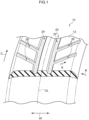
- the groove portion 20 includes circumferential direction grooves (rib grooves) 22, 24 extending in the C direction, and plural lateral grooves (lug grooves) 26, 28 that extend from the circumferential direction groove 22 along an intersecting direction that intersects the C direction as viewed along the R direction.
- This intersecting direction is hereafter referred to as the K direction.
- a K direction side that is closer to the circumferential direction grooves 22, 24 is referred to as an upstream side (rear side), and a K direction side that is further from the circumferential direction grooves 22, 24 is referred to as a downstream side (front side).
- the lateral grooves 26, 28 are disposed at an incline such that the K direction upstream side is positioned further upstream in the C direction than the K direction downstream side.
- the circumferential direction groove 22 and the plural lateral grooves 26, and the circumferential direction groove 24 and the plural lateral grooves 28, are formed symmetrically to each other on one and the other W direction sides of the tire equatorial plane CL. Explanation will therefore be given regarding the circumferential direction groove 22 and the plural lateral grooves 26, and explanation regarding the circumferential direction groove 24 and the plural lateral grooves 28 will be omitted. Moreover, since the plural lateral grooves 26 are configured similarly to one another, explanation will be given regarding one of the lateral grooves 26, and explanation regarding the other lateral grooves 26 will basically be omitted.
- the circumferential direction groove 22 extends in a straight line in the C direction.
- the circumferential direction groove 22 is formed with an inverted trapezoidal shaped cross-section profile when viewed in cross-section sectioned orthogonally to a groove length direction.
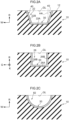
- the circumferential direction groove 22 when viewed in cross-section sectioned orthogonally to the groove length direction, includes a single groove bottom face 22A extending in the W direction, and two groove side faces 22B respectively extending toward the R direction outside from the two W direction ends of the groove bottom face 22A.
- the groove bottom face 22A and the groove side faces 22B configure an example of a groove surface.
- the groove side faces 22B are inclined with respect to an imaginary perpendicular line HA that is orthogonal to the groove bottom face 22A.
- a first protruding portion 30 is formed to the groove bottom face 22A.
- Second protruding portions 40 are formed to the groove side faces 22B.
- the first protruding portion 30 includes the plural protrusions 32.
- the plural protrusions 32 project out from the groove bottom face 22A in the R direction.
- each of the plural protrusions 32 is formed in a rectangular shape with its short direction in the C direction and its long direction in the W direction as viewed along the R direction.
- the plural protrusions 32 are arranged in a matrix pattern on the groove bottom face 22A so as to be spaced apart by a spacing P1 in the C direction and by a spacing P2 in the W direction.
- a projection height of the plural protrusions 32 in the R direction is a predetermined length of from 0.1 mm to 1.0 mm.
- the plural protrusions 32 are fine protrusions.
- the projection height is less than 0.1 mm, it becomes difficult to mold the protrusions 32, and there is a concern that it might not be possible to attenuate light incident thereto sufficiently to lower the brightness to a degree that appears black.
- the projection height no greater than 1.0 mm, the local difference between rigidity at the protrusions 32 and rigidity in the surroundings of the protrusions 32 is small, thereby suppressing a localized concentration of stress.
- the spacing P1 and the spacing P2 between the plural protrusions 32 are both a predetermined length of from 0.1 mm to 1.0 mm. In cases in which either of the spacings P1 or P2 is less than 0.1 mm, it becomes difficult to mold the plural protrusions 32. In cases in which either of the spacings P1 or P2 is greater than 1.0 mm, it might not be possible to attenuate light incident thereto sufficiently to lower the brightness to a degree that appears black.
- the projection heights and the spacing dimensions of the respective protrusions may be measured using a VR-3000 series one-shot 3D measuring macroscope, manufactured by Keyence Corporation.
- the brightness may be measured by a handheld spectrophotometer manufactured by Nippon Denshoku Industries Co. (Ltd).
- Fig. 3B illustrates one of the protrusions 32 in a state opposing the road surface GL in the R direction when part of the tread face 12 (see Fig. 2A ) is in contact with the road surface GL (see Fig. 2A ), as viewed along the W direction.
- the protrusion 32 has a trapezoidal shaped cross-section profile in a C-R plane, and has a three-dimensional cross-section profile extending in the W direction.
- the protrusion 32 has a trapezoidal shaped cross-section profile in which a base end (groove bottom face 22A) side configures a lower trapezoid base 33A, a leading end side configures an upper trapezoid base 33B, and the two base angles (internal angles) at either end of the lower trapezoid base 33A are different sizes to each other.
- a C direction length L1 of the upper trapezoid base 33B is shorter than a C direction length L2 of the lower trapezoid base 33A.
- a first base angle ⁇ 1 at the C direction downstream side is an obtuse angle.
- a second base angle ⁇ 2 at the C direction upstream side is an acute angle.
- the protrusion 32 leans such that the leading end side thereof is positioned further toward the C direction downstream side than the base end side thereof.
- a center line MA linking a center point M1 of the upper trapezoid base 33B at the leading end side and a center point M2 of the lower trapezoid base 33A at the base end side leans with respect to the perpendicular line HA.
- a leading edge T1 at a portion of the protrusion 32 further toward the C direction upstream side (rear side) than the center line MA is positioned further toward the C direction downstream side (front side) than a base edge T2 of the protrusion 32.
- a leading edge T3 at a portion of the protrusion 32 further toward the C direction downstream side than the center line MA is positioned further toward the C direction downstream side than a base edge T4 of the protrusion 32.
- an inclined face 34A that is inclined such that a leading edge T1 side thereof is positioned further toward the C direction upstream side than a base end T2 side thereof is formed at the C direction upstream side of the center line MA of the protrusion 32.
- the C direction and the direction in which water (not illustrated in the drawings) flows inside the circumferential direction groove 22 are the same direction.
- the inclined face 34A is inclined such that the leading edge T1 side is positioned further toward an F direction downstream side than the base end T2 side.
- an inclined face 34B that is inclined such that a leading edge T3 side thereof is positioned further toward the C direction downstream side than a base edge T4 side thereof is formed at the C direction downstream side of the center line MA of the protrusion 32.
- An incline angle of the inclined face 34A with respect to the groove bottom face 22A is gentler than an incline angle of the inclined face 34B with respect to the groove bottom face 22A.
- the inclined face 34A thereby has a function of guiding water flowing toward the inclined face 34A toward the downstream side.
- the incline angle of the inclined face 34B is steeper than the incline angle of the inclined face 34A.
- the inclined face 34B thereby has a function of restricting water that has flowed over the inclined face 34A toward the inclined face 34B side from flowing back toward the inclined face 34A side.
- each of the second protruding portions 40 includes the plural protrusions 42.
- the plural protrusions 42 project out from the groove side faces 22B in the W direction.
- each of the plural protrusions 42 is formed in a rectangular shape with its short direction along the C direction and its long direction along the R direction when viewed along the W direction.
- the plural protrusions 42 are arranged in a matrix pattern on each of the groove side faces 22B so as to be spaced apart by a spacing P3 in the C direction and by a spacing P4 in the R direction.
- a W direction projection height of the plural protrusions 42 is the same as the projection height of the plural protrusions 32 (see Fig. 3A ).
- the spacings P3, P4 between the plural protrusions 42 employ the same values as the spacings P1, P2 between the plural protrusions 32 (see Fig. 3A ). Namely, the plural protrusions 42 are fine protrusions.
- the protrusion 42 illustrated in Fig. 4B has a trapezoidal shaped cross-section profile in a C-W plane, and has a three-dimensional cross-section profile extending along the R direction.
- the protrusion 42 has a trapezoidal shaped cross-section profile in which a base end (groove side face 22B) side configures a lower trapezoid base 43A, a leading end side configures an upper trapezoid base 43B, and the two base angles (internal angles) at either end of the lower trapezoid base 43A are different sizes to each other.
- a C direction length L3 of the upper trapezoid base 43B is shorter than a C direction length L4 of the lower trapezoid base 43A.
- a third base angle ⁇ 3 at the C direction downstream side is an obtuse angle.
- a fourth base angle ⁇ 4 at the C direction upstream side is an acute angle.
- the protrusion 42 leans such that the leading end side thereof is positioned further toward the C direction downstream side than the base end side thereof.
- a center line MB linking a center point M3 of the upper trapezoid base 43B at the leading end side and a center point M4 of the lower trapezoid base 43A at the base end side leans with respect to an imaginary perpendicular line HB orthogonal to the corresponding groove side face 22B.
- a leading edge T5 at a portion of the protrusion 42 further toward the C direction upstream side than the center line MB is positioned further toward the C direction downstream side than a base edge T6 of the protrusion 42.
- a leading edge T7 at a portion of the protrusion 42 further toward the C direction downstream side than the center line MB is positioned further toward the C direction downstream side than a base edge T8 of the protrusion 42.
- an inclined face 44A that is inclined such that a leading edge T5 side thereof is positioned further toward the C direction downstream side than a base end T6 side thereof is formed at the C direction upstream side of the center line MB of the protrusion 42.
- an inclined face 44B that is inclined such that a leading edge T7 side thereof is positioned further toward the C direction downstream side than a base end T8 side thereof is formed at the C direction downstream side of the center line MB of the protrusion 42.
- An incline angle of the inclined face 44A with respect to the groove side face 22B is gentler than an incline angle of the inclined face 44B with respect to the groove side face 22B.
- the inclined face 44A thereby has a function of guiding water flowing toward the inclined face 44A toward the downstream side.
- the incline angle of the inclined face 44B is steeper than the incline angle of the inclined face 44A.
- the inclined face 44B thereby has a function of restricting water that has flowed over the inclined face 44A toward the inclined face 44B side from flowing back toward the inclined face 44A side.
- the lateral grooves 26 illustrated in Fig. 1 extend in straight lines along the K direction previously described.
- an angle ⁇ a formed between the circumferential direction groove 22 and each of the lateral grooves 26 is approximately 60°.
- the angle ⁇ a is not limited to 60°, and may be another angle, excluding 0°.
- the plural lateral grooves 26 are formed running parallel to each other spaced apart in the C direction, and extend from the circumferential direction groove 22 as far as a W direction outside end of the tread face 12.
- One end portion (a W direction inside end portion) of each of the plural lateral grooves 26 opens onto the circumferential direction groove 22.
- each of the lateral grooves 26 is formed with a quadrilateral cross-section profile when viewed in cross-section sectioned orthogonally to a groove length direction.
- each of the lateral grooves 26 when viewed in cross-section sectioned orthogonally to the groove length direction, each of the lateral grooves 26 includes a single groove bottom face 26A running along the K direction, and two groove side faces 26B extending from the two C direction ends of the groove bottom face 26A toward the R direction outside.
- the groove bottom face 26A and the groove side faces 26B configure an example of a groove surface.
- the groove side faces 26B are stand substantially straight up from the groove bottom face 26A.
- Third protruding portions 50 are formed to the groove bottom face 26A and the groove side faces 26B.
- the third protruding portions 50 formed to the groove side faces 26B and the third protruding portion 50 formed to the groove bottom face 26A each have substantially the same configuration, with the exception that projection directions thereof differ from each other by substantially 90°. Explanation will therefore be given regarding the third protruding portion 50 formed to the groove bottom face 26A, and illustration and explanation of the third protruding portions 50 formed to the groove side faces 26B will be omitted.
- the third protruding portion 50 includes plural protrusions 52.
- the plural protrusions 52 project out from the groove bottom face 26A in the R direction.
- each of the plural protrusions 52 is formed in a rectangular shape with its long direction along the K direction and its short direction along a direction (hereafter referred to as the G direction) orthogonal to the K direction when viewed along the R direction.
- the plural protrusions 52 are arranged in a matrix pattern on the groove bottom face 26A so as to be spaced apart by a spacing P5 in the K direction and by a spacing P6 in the G direction.
- a projection height of the plural protrusions 52 in the R direction is a predetermined length of from 0.1 mm to 1.0 mm.
- the plural protrusions 52 are fine protrusions.
- the projection height is less than 0.1 mm, it becomes difficult to mold the protrusions 52, and there is a concern that it might not be possible to attenuate light incident thereto sufficiently to lower the brightness to a degree that appears black.
- the projection height no greater than 1.0 mm, the local difference between rigidity at the protrusions 52 and rigidity in the surroundings of the protrusions 52 is small, thereby suppressing a localized concentration of stress.
- the spacing P5 and the spacing P6 between the plural protrusions 52 are both a predetermined length of from 0.1 mm to 1.0 mm. In cases in which either of the spacings P5 or P6 is less than 0.1 mm, it becomes difficult to mold the plural protrusions 52. In cases in which either of the spacings P5 or P6 is greater than 1.0 mm, it might not be possible to attenuate light incident thereto sufficiently to lower the brightness to a degree that appears black. In the present exemplary embodiment, the projection heights and the spacing dimensions of the respective protrusions may be measured using the 3D measuring macroscope mentioned above.
- Fig. 5B illustrates one of the protrusions 52 when viewed along the G direction.
- the protrusion 52 has a trapezoidal shaped cross-section profile in a K-R plane, and has a three-dimensional cross-section profile extending along the G direction.
- the protrusion 52 has a trapezoidal shaped cross-section profile in which a base end (groove bottom face 26A) side configures a lower trapezoid base 53A, a leading end side configures an upper trapezoid base 53B, and the two base angles (internal angles) at either end of the lower trapezoid base 53A are different sizes to each other.
- a K direction length L5 of the upper trapezoid base 53B is shorter than a K direction length L6 of the lower trapezoid base 53A.
- a fifth base angle ⁇ 5 at the K direction downstream side is an obtuse angle.
- a sixth base angle ⁇ 6 at the K direction upstream side is an acute angle.
- the protrusion 52 leans such that the leading end side thereof is positioned further toward the K direction downstream side than the base end side thereof.
- a center line MC linking a center point M5 of the upper trapezoid base 53B at the leading end side and a center point M6 of the lower trapezoid base 53A at the base end side leans with respect to an imaginary perpendicular line HC that is orthogonal to the groove bottom face 26A.
- a leading edge TA at a portion of the protrusion 52 further toward the K direction upstream side than the center line MC is positioned further toward the K direction downstream side than a base edge TB of the protrusion 52.
- a leading edge TC at a portion of the protrusion 52 further toward the K direction downstream side than the center line MC is positioned further toward the K direction downstream side than a base edge TD of the protrusion 52.
- an inclined face 54A that is inclined such that a leading edge TA side thereof is positioned further toward the K direction downstream side than a base end TB side thereof is formed at the K direction upstream side of the center line MC of the protrusion 52.
- the K direction and an F direction in which water flows inside the lateral groove 26 correspond to the same direction.
- the inclined face 54A is inclined such that the leading edge TA side thereof is positioned further toward the F direction downstream side than the base edge TB side thereof.
- an inclined face 54B that is inclined such that a leading edge TC side thereof is positioned further toward the K direction downstream side than a base edge TD side thereof is formed at the K direction downstream side of the center line MC of the protrusion 52.
- An incline angle of the inclined face 54A with respect to the groove bottom face 26A is gentler than an incline angle of the inclined face 54B with respect to the groove bottom face 26A.
- the inclined face 54A thereby has a function of guiding water flowing toward the inclined face 54A toward the F direction downstream side.
- the incline angle of the inclined face 54B is steeper than the incline angle of the inclined face 54A.
- the inclined face 54B thereby has a function of restricting water that has flowed over the inclined face 54A toward the inclined face 54B side from flowing back toward the inclined face 54A side.
- the sixth base angle ⁇ 6 of the inclined face 54A with respect to the groove bottom face 26A of each of the lateral grooves 26 is smaller than the previously-described second base angle ⁇ 2 (see Fig. 3B ).
- the present exemplary embodiment is configured such that the incline angle of protrusions in grooves with a narrower width is gentler than the incline angle of protrusions in grooves with a wider width.
- an R direction height of the protrusions 52 is lower than an R direction height of the protrusions 32 (see Fig. 3B ).
- the sixth base angle ⁇ 6 is an example of a first incline angle.
- the second base angle ⁇ 2 is an example of a second incline angle.
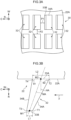
- Figs. 6 schematically illustrate a connecting portion 60 between the circumferential direction groove 22 and one of the lateral grooves 26 in an enlarged state. Note that in order to facilitate understanding of the arrangement, only some of the protrusions are illustrated, in an enlarged state.
- the arrow FA indicates a direction in which water flows inside the circumferential direction groove 22 accompanying rotation of the tire 10 in the C direction.
- the arrow FB indicates a direction in which water flows inside the lateral groove 26.
- the arrow FB corresponds to the K direction.
- the arrows FC indicate the manner and direction in which some of the water flowing inside the circumferential direction groove 22 flows into the lateral groove 26 at the connecting portion 60.
- the connecting portion 60 is an example of a connecting location between the circumferential direction groove 22 and the lateral grooves 26.
- the connecting portion 60 refers to an opening where the lateral groove 26 opens onto the circumferential direction groove 22, and a portion in the vicinity of this opening. Namely, the connecting portion 60 includes part of the circumferential direction groove 22 and part of the lateral groove 26.
- Plural protrusions 62 are disposed at the connecting portion 60.
- the plural protrusions 62 are formed straddling between the groove bottom face 22A and the groove bottom face 26A.
- the plural protrusions 62 project out in the R direction from the groove bottom face 22A and the groove bottom face 26A.
- a projection height of the plural protrusions 62 in the R direction is a predetermined length of from 0.1 mm to 1.0 mm.
- the plural protrusions 62 are fine protrusions.
- the plural protrusions 62 have a configuration corresponding to the protrusions 32 if shortened in width in the W direction and turned toward the lateral groove 26 so as to be angled toward the K direction that intersects the C direction.
- an angle ⁇ b of the plural protrusions 62 with respect to the C direction is smaller than the previously-described angle ⁇ a.
- the R direction height of the protrusions 62 may be higher than the R direction height of the protrusions 32.
- each of the protrusions 62 has a trapezoidal shaped cross-section profile in which a base end (groove bottom face 22A) side configures a lower trapezoid base 63A, a leading end side configures an upper trapezoid base 63B, and the two base angles (internal angles) at either end of the lower trapezoid base 63A are different sizes to each other.
- a length L7 of the upper trapezoid base 63B is shorter than a length L8 of the lower trapezoid base 63A.
- the protrusion 62 leans such that its leading end side is positioned closer to the lateral groove 26 (see Fig. 6A ) than its base end side.
- a center line MD linking a center point M7 of the upper trapezoid base 63B at the leading end side and a center point M8 of the lower trapezoid base 63A at the base end side leans with respect to an imaginary perpendicular line HD that is orthogonal to the groove bottom face 22A.
- a leading edge TE at a portion of the protrusion 62 further toward the FC direction upstream side than the center line MD is positioned further toward the FC direction downstream side than a base edge TF of the protrusion 62.
- a leading edge TG at a portion of the protrusion 62 further toward the FC direction downstream side than the center line MD is positioned further toward the FC direction downstream side than a base edge TH of the protrusion 62.
- an inclined face 64A that is inclined such that a leading edge TE side thereof is positioned further toward the FC direction downstream side than a base edge TF side thereof is formed at the FC direction upstream side of the center line MD of the protrusion 62.
- an inclined face 64B that is inclined such that a leading edge TG side thereof is positioned further toward the FC direction downstream side than a base edge TH side thereof is formed at the FC direction downstream side of the center line MD of the protrusion 62.
- An incline angle of the inclined face 64A with respect to the groove bottom face 22A is gentler than an incline angle of the inclined face 64B with respect to the groove bottom face 22A.
- the inclined face 64A is an example of a guide face.
- the inclined face 64A has a function of guiding some of the water flowing along the circumferential direction groove 22 toward the corresponding lateral groove 26.
- the inclined face 64A may be configured as a curved face that guides water toward the lateral groove 26.
- the plural fine protrusions 32 are formed to the circumferential direction groove 22, there enabling the contrast between the tread face 12 and the circumferential direction groove 22 to be increased in comparison to configurations in which the plural protrusions 32 are not formed.
- the tire 10 rotates in the C direction when running over the wet road surface GL. Water flows from upstream side toward the downstream side in the F direction inside the circumferential direction groove 22 where the tire 10 contacts the road surface GL. Some of this water flows toward the plural protrusions 32.
- the center line MA of each of the protrusions 32 leans such that the leading end side thereof is positioned further toward the F direction downstream side than the base end side thereof.
- the leading end side of the protrusion 32 is positioned further toward the F direction downstream side than the base end side of the protrusion 32.
- the flow of water in the tire 10 is better suppressed from backing up behind a portion of the protrusion 32 at the upstream side of the center line MA than it would be in configurations in which the leading end side and the base end side of the protrusion 32 are aligned along the perpendicular line HA, or configurations in which the leading end side of the protrusion 32 is positioned further toward the F direction upstream side than the base end side thereof.
- the tire 10 in which the fine protrusions 32 are formed in the circumferential direction groove 22 is capable of suppressing any detriment to water drainage from the circumferential direction groove 22.
- the respective protrusions 42 in the circumferential direction groove 22 operate similarly to the protrusions 32 in that the flow of water is suppressed from backing up behind a portion of the protrusion 42 at the upstream side of the center line MB.
- the tire 10 formed with the fine protrusions 32 and the protrusions 42 in the circumferential direction groove 22 is capable of suppressing any detriment to water drainage from the circumferential direction groove 22.
- the leading ends (T1, T3) are positioned further toward the C direction downstream side than the corresponding base ends (T2, T4).
- part of the groove bottom face 22A of the circumferential direction groove 22 can be easily covered by the protrusion 32 when viewed from the R direction outside, thereby lowering the brightness comparative to the brightness of other regions where light is simply reflected. Less light is reflected along the R direction than is reflected in directions other than the R direction.
- the groove appears black when the circumferential direction groove 22 is viewed from the R direction outside. Namely, the contrast between the tread face 12 and the circumferential direction groove 22 can be increased.
- the protrusions 42, the protrusions 52, and the protrusions 62 are all capable of obtaining an effect similar to this.
- the inclined face 34A and the inclined face 44A are respectively formed on the F direction upstream side of each of the protrusions 32 and protrusions 42 inside the circumferential direction groove 22 of the tire 10.
- the inclined face 34A and the inclined face 44A are each inclined such that the leading end side thereof is positioned further toward the F direction downstream side than the base end side thereof.
- the protrusions 52 are formed in the lateral grooves 26 of the tire 10. Since the respective lateral grooves 26 open onto the circumferential direction groove 22, some of the water flowing along inside the circumferential direction groove 22 accompanying rotation of the tire 10 flows from the circumferential direction groove 22 into the lateral grooves 26. However, the lateral grooves 26 extend along the K direction. The water therefore contacts the groove side faces 26B (see Fig. 2B ) present on the C direction sides of the lateral grooves 26, partially restricting the flow of water, with the result that water flows into the lateral grooves 26 running along the K direction less readily than it does along the circumferential direction groove 22 running along the C direction.
- the sixth base angle ⁇ 6 of the inclined faces 54A inside the lateral grooves 26 is smaller than the second base angle ⁇ 2 of the inclined faces 34A inside the circumferential direction groove 22. Water therefore flows over the protrusions 52 more easily than it would in configurations in which ⁇ 6 ⁇ ⁇ 2. Water is therefore less liable to pool inside the lateral grooves 26, enabling any detriment to water drainage from the lateral grooves 26 to be suppressed.
- Fig. 7 illustrates part of the tire 70 in an enlarged state.
- protruding portions 72 are formed to the tire 70 instead of the protruding portions 30 (see Fig. 3A ), the protruding portions 40 (see Fig. 4A ), and the protruding portions 50 (see Fig. 5A ) of the tire 10 (see Fig. 1 ) of the first exemplary embodiment.
- Configuration other than the protruding portions 72 is similar to the configuration of the tire 10, and so explanation thereof is omitted.
- explanation regarding the protruding portion 72 is given for a protruding portion 72 formed to the groove bottom face 22A of the circumferential direction groove 22, and explanation regarding protruding portions 72 formed to the groove side faces 22B (see Fig. 2A ) and protruding portions 72 formed in the lateral grooves 26 (see Fig. 2B ) is omitted.
- the protruding portion 72 projects out in the R direction from the groove bottom face 22A.
- the protruding portion 72 includes plural first asterisk protrusions 74 and second asterisk protrusions 76, serving as an example of plural protrusions.
- the first asterisk protrusions 74 and the second asterisk protrusions 76 are protrusions configured with the same external appearance and size as each other, but are arranged differently.
- first asterisk protrusions 74 and the second asterisk protrusions 76 were the first asterisk protrusion 74 to be inverted with line symmetry about a non-illustrated axis of symmetry and then rotated through 90°, the first asterisk protrusion 74 would become a carbon-copy of the second asterisk protrusion 76.
- the first asterisk protrusions 74 and the second asterisk protrusions 76 are arranged alternately in both the C direction and the W direction.
- each of the first asterisk protrusions 74 is configured including extension portions 74A, 74B, 74C, 74D, 74E, and 74F extending in different directions to each other in a radial pattern originating from a center OA.
- the extension directions of any pair of adjacent extension portions 74A, 74B, 74C, 74D, 74E, and 74F are directions offset by a central angle of 60° about the center OA.
- a leading end portion of the extension portion 74A is bent at substantially a right angle with respect to its extension direction.
- a leading end portion of the extension portion 74F is curved.
- Each of the extension portions 74B, 74C, 74D, and 74E extends in a straight line.
- a projection height of the first asterisk protrusions 74 in the R direction from the groove bottom face 22A is a predetermined length of from 0.1 mm to 1.0 mm.
- each of the second asterisk protrusions 76 is configured including extension portions 76A, 76B, 76C, 76D, 76E, and 76F that extend in different directions to each other in a radial pattern originating from a center OB.
- the extension directions of any pair of adjacent extension portions 76A, 76B, 76C, 76D, 76E, and 76F are directions offset by a central angle of 60° about the center OB.
- a leading end portion of the extension portion 76B is bent at substantially a right angle with respect to its extension direction.
- a leading end portion of the extension portion 76C is curved.
- Each of the extension portions 76A, 76D, 76E, and 76F extends in a straight line.
- a projection height of the second asterisk protrusions 76 in the R direction from the groove bottom face 22A is a predetermined length of from 0.1 mm to 1.0 mm.
- a leading end of the extension portion 74A is coupled to a leading end of one of the extension portions 76F.
- a leading end of the extension portion 74C is coupled to a leading end of one of the extension portions 76B.
- a C direction spacing PA and a W direction spacing PB between adjacent first asterisk protrusions 74 and second asterisk protrusions 76 are both set to a predetermined length of from 0.1 mm to 1.0 mm. Namely the first asterisk protrusions 74 and the second asterisk protrusions 76 are fine protrusions.
- the spacing PA and the spacing PB each refer to the spacing between a given center OA and the adjacent centers OB.
- Fig. 8 illustrates an example of one of the second asterisk protrusions 76 as viewed obliquely from above.
- the extension portions 76A, 76B, 76C, 76D, 76E, and 76F of the second asterisk protrusion 76 each lean in a direction intersecting the R direction (see Fig. 7 ).
- the extension portions 74A, 74B, 74C, 74D, 74E, and 74F (see Fig. 7 ) of each of the first asterisk protrusions 74 each lean in a direction intersecting the R direction.
- Fig. 9 is a C-R cross-section illustrating extension direction central portions of the extension portion 76B and the extension portion 76C.
- the central portion of the extension portion 76B and the central portion of the extension portion 76C have the same cross-section profile as each other.
- the central portion of the extension portion 76B and the central portion of the extension portion 76C lean in the same direction as each other, and would almost align almost perfectly with each other if slid along the C direction. Explanation therefore follows regarding the cross-section of the extension portion 76B, whereas explanation regarding the cross-section of the extension portion 76C will be omitted. Note that the extension portion 76B and the extension portion 76C may have similar cross-section profiles.
- the extension portion 76B When viewed along the W direction, the extension portion 76B has a trapezoidal shaped cross-section profile in a C-R plane. Specifically, the extension portion 76B has a trapezoidal shaped cross-section profile in which a base end (groove bottom face 22A) side configures a lower trapezoid base 77A, a leading end side configures an upper trapezoid base 77B, and the two base angles (internal angles) at either end of the lower trapezoid base 77A are different sizes to each other.
- a C direction length L9 of the upper trapezoid base 77B is shorter than a length L10 of the lower trapezoid base 77A.
- a base angle ⁇ c at the C direction downstream side is an obtuse angle.
- Abase angle ⁇ d at the C direction upstream side is an acute angle.
- the extension portion 76B leans such that the leading end side thereof is positioned further toward the C direction downstream side (F direction downstream side) than the base end side thereof.
- a center line ME linking a center point M9 of the upper trapezoid base 77B at the leading end side and a center point M10 of the lower trapezoid base 77A at the base end side leans with respect to an imaginary perpendicular line HA.
- a leading edge T9 of a portion of the extension portion 76B further toward the C direction upstream side than the center line ME is positioned further toward the C direction downstream side than a base edge T10 of the extension portion 76B.
- a leading edge T11 of a portion of the extension portion 76B further toward the C direction downstream side than the center line ME is positioned further toward the C direction downstream side than a base edge T12 of the extension portion 76B.
- an inclined face 78A that is inclined such that a leading edge T9 side thereof is positioned further toward the C direction downstream side than a base end T10 side thereof is formed at the C direction upstream side of the center line ME of the extension portion 76B.
- an inclined face 78B that is inclined such that a leading edge T11 side thereof is positioned further toward the C direction downstream side than a base edge T12 side thereof is formed at the C direction downstream side of the center line ME of the extension portion 76B.
- An incline angle of the inclined face 78A with respect to the groove bottom face 22A is gentler than an incline angle of the inclined face 78B with respect to the groove bottom face 22A.
- the inclined face 78A thereby has a function of guiding water flowing toward the inclined face 78A toward the downstream side.
- the incline angle of the inclined face 78B is steeper than the incline angle of the inclined face 78A.
- the inclined face 78B thereby has a function of restricting water that has flowed over the inclined face 78A toward the inclined face 78B side from flowing back toward the inclined face 78A side.
- the plural fine first asterisk protrusions 74 and second asterisk protrusions 76 are formed to the circumferential direction groove 22 of the tire 70, thereby enabling the contrast between the tread face 12 and the circumferential direction groove 22 to be increased compared to in configurations in which these protrusions are not formed.
- the leading end sides of each of the plural first asterisk protrusions 74 and second asterisk protrusions 76 are positioned further toward the F direction downstream side than the base end sides thereof.
- the flow of water is better suppressed from backing up behind a portion at the upstream side of the center line ME than it would be in configurations in which the leading end side and the base end side of the projecting locations are aligned along the perpendicular line HA that is orthogonal to the groove bottom face 22A, or configurations in which the leading end side is positioned further toward the upstream side than the base end side.
- the tire 70 in which the first asterisk protrusions 74 and the second asterisk protrusions 76 are formed in the circumferential direction groove 22 is capable of suppressing any detriment to water drainage from the circumferential direction groove 22.
- portions of the first asterisk protrusions 74 and second asterisk protrusions 76 at the F direction downstream side of the center lines ME cover part of the groove bottom face 22A when viewed along the R direction. This suppresses light reflection by the first asterisk protrusions 74 and the second asterisk protrusions 76, making the circumferential direction groove 22 appear closer to black (enabling the contrast between the tread face 12 and the circumferential direction groove 22 to be increased).
- the leading ends are positioned further toward the C direction downstream side than the corresponding base ends.
- part of the groove bottom face 22A of the circumferential direction groove 22 can be easily covered by the protrusions 32 when viewed from the R direction outside, thereby lowering the brightness comparative to the brightness of other regions where light is simply reflected.
- the groove appears black when the circumferential direction groove 22 is viewed from the R direction outside. Namely, the contrast between the tread face 12 and the circumferential direction groove 22 can be increased.
- the inclined face 78A is respectively formed at the F direction upstream side of each of the first asterisk protrusions 74 and second asterisk protrusions 76 inside the circumferential direction groove 22 of the tire 70.
- the inclined face 78A is inclined such that the leading end side thereof is positioned further toward the F direction downstream side than the base end side thereof.
- Fig. 2C illustrates a first modified example in which a circumferential direction groove 82 has a semicircular cross-section profile in a W-R plane of the tire 10 (see Fig. 1 ).
- the first protruding portion 30 is formed to the circumferential direction groove 82.
- the first protruding portion 30 may thus be formed to the circumferential direction groove 82 in which a groove bottom face and groove side faces are linked to form a smooth curved face.
- the lateral grooves 26 (see Fig. 2B ) may also have semicircular cross-section profiles.
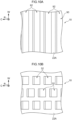
- Fig. 10A illustrates a second modified example in which a first protruding portion 90 is formed to the tire 10 instead of the first protruding portion 30 (see Fig. 3A ).
- the first protruding portion 90 includes plural protrusions 92.
- the protrusions 92 have a configuration achieved by linking together and integrating the protrusions 32 (see Fig. 3A ) along the W direction. Note that the spacing along the C direction is unchanged.
- the protrusions are not limited to being discrete island-like features, and may form elongated shapes in the W direction.
- Fig. 10B illustrates a third modified example in which plural protrusions 32 are arranged in a staggered pattern in the C direction and the W direction of the tire 10.
- the arrangement of the plural protrusions is not limited to a matrix pattern arrangement, and other arrangements may be applied.
- Fig. 11 illustrates a protrusion 94 of a fourth modified example.
- the protrusion 94 has a configuration achieved by forming the protrusion 32 (see Fig. 3B ) with a curved face 95A instead of the inclined face 34A (see Fig. 3B ).
- the curved face 95A has a convex profile protruding toward the F direction upstream side.
- a face formed to the protrusion is not limited to a flat planar face (inclined face), and a convex or concave curving face may be applied.
- a configuration may be applied in which the lateral grooves 26 are not formed, and only the circumferential direction groove 22 is formed to the tire 10.
- a configuration may be applied in which the plural protrusions 32 are only formed to the circumferential direction groove 22, and the plural protrusions 32 are not formed in the lateral grooves 26.
- the plural protrusions 32, 42 may have the same or different incline angles to each other at the groove bottom faces 22A and the groove side faces 22B.
- the plural protrusions 32, 42 may have different R direction heights from the groove bottom faces 22A and the groove side faces 22B. Moreover, a configuration may be applied in which the plural protrusions 62 including the inclined faces 64A are not formed to the tire 10.
- the incline angles of the first asterisk protrusions 74 and the second asterisk protrusions 76 in the lateral grooves 26 may be gentler than the incline angles of the first asterisk protrusions 74 and the second asterisk protrusions 76 in the circumferential direction groove 22.
- the protrusions 62 including the inclined faces 64A may be formed at the connecting portions 60 of the tire 70.
- the guiding faces are not limited to flat planar faces such as the inclined faces 64A, and convex or concave curving faces may be employed.
Landscapes
- Engineering & Computer Science (AREA)
- Mechanical Engineering (AREA)
- Tires In General (AREA)
Description
- The present invention relates to a tire formed with fine protrusions on a groove on an outer surface of the tire.
- Hitherto, fine protrusions formed on an outer surface of a tire have been used to form contrasting pattern regions. For example, International Publication
WO 2016/182076 discloses technology in which a pattern region is formed on an outer surface of a tire, with plural unit patterns being formed within this pattern region.WO 2015/135928 discloses technology in which fine protrusions are formed at a groove bottom. Reference is also made toEP 3296129 which shows a tire with a circumferential tread groove provided with protrusions on a bottom surface of the groove in order to form a contrasting pattern. - In tires in which fine protrusions are formed in a groove in order to increase the contrast between the tread face (outer surface) and the groove, the groove serves to drain water when running over a wet road surface. However, in tires in which fine protrusions are formed in a groove in the tread face as in
WO 2015/135928 , the flow of water is suppressed due to the water contacting the fine protrusions in the groove, which might be detrimental to water drainage from the groove. Namely, such tires have room for improvement with respect to increasing the contrast between the tread face and the groove, while suppressing detriment to water drainage from the groove. - An object of the present invention is to increase contrast between a tread face and a groove of a tire, while also suppressing detriment to water drainage from the groove.
- A tire according to the present invention includes a groove that is formed in a tread face so as to open toward an outer side in a tire radial direction, and plural protrusions that are formed on a surface of the groove so as to project to a projection height of from 0.1 mm to 1.0 mm at a spacing of from 0.1 mm to 1.0 mm, a center line linking a center point of a leading end side with a center point of a base end side of the respective protrusions leaning with respect to a perpendicular line orthogonal to a surface of the groove, such that the leading end side of the each protrusion is positioned further toward a tire rotation direction downstream side than the base end side of the protrusion when viewed along a tire width direction or the tire radial direction, characterized in that the groove includes a circumferential direction groove extending along the tire rotation direction, and a lateral groove extending from the circumferential direction groove along an intersecting direction that intersects the tire rotation direction, one end portion of the lateral groove opens onto the circumferential direction groove; and a guide face, configured to guide a part of water flowing in the circumferential direction groove toward the lateral groove, is formed at protrusions that are disposed at a connecting location between the circumferential direction groove and the lateral groove.
- In the tire according to the present invention, the fine protrusions are formed in the groove, thereby enabling the contrast between the tread face and the groove to be increased. Moreover, when running over a wet road surface, water flows inside the groove from an upstream side toward a downstream side in the same direction as the tire rotation direction. Some of the water flowing inside the groove flows toward the protrusions projecting from the surface of the groove. Note that the center line linking the center point of the leading end side and the center point of the base end side of the respective protrusions leans with respect to the perpendicular line orthogonal to the groove surface such that the leading end side of the protrusion is positioned further toward the tire rotation direction downstream side than the base end side of the protrusion.
- In other words, the leading end side of the protrusion is positioned further toward the downstream side than the base end side of the protrusion in the direction in which water flows. Thus, the flow of water is better suppressed from backing up behind a portion of the protrusion at the upstream side of the center line than it would be in configurations in which the leading end side and the base end side of the protrusion are aligned along the perpendicular line orthogonal to the groove surface, or configurations in which the leading end side of the protrusion is positioned further toward the upstream side than the base end side thereof in the direction in which water flows. The tire is thus capable of increasing the contrast between the tread face and the groove while also suppressing any detriment to water drainage from the groove.
- The tire of the present invention is capable of increasing the contrast between the tread face and the groove while also suppressing any detriment to water drainage from the groove.
-
-
Fig. 1 is a perspective view illustrating circumferential direction grooves and lateral grooves of a tire according to a first exemplary embodiment. -
Fig. 2A is a vertical cross-section of a circumferential direction groove of a tire according to the first exemplary embodiment. -
Fig. 2B is a vertical cross-section of a lateral groove of a tire according to the first exemplary embodiment. -
Fig. 2C is a vertical cross-section of a circumferential direction groove of a tire according to a first modified example. -
Fig. 3A is an explanatory diagram illustrating plural protrusions on a side face of a circumferential direction groove according to the first exemplary embodiment. -
Fig. 3B is an enlarged explanatory diagram illustrating a single protrusion on a side face of a circumferential direction groove according to the first exemplary embodiment. -
Fig. 4A is an explanatory diagram illustrating plural protrusions on a bottom face of a circumferential direction groove according to the first exemplary embodiment. -
Fig. 4B is an enlarged explanatory diagram illustrating a single protrusion on a bottom face of a circumferential direction groove according to the first exemplary embodiment. -
Fig. 5A is an explanatory diagram illustrating plural protrusions on a bottom face of a lateral groove according to the first exemplary embodiment. -
Fig. 5B is an enlarged explanatory diagram illustrating a single protrusion on a bottom face of a lateral groove according to the first exemplary embodiment. -
Fig. 6A is an explanatory diagram illustrating a state in which water is guided by a guide face at a connecting portion between a circumferential direction groove and a lateral groove according to the first exemplary embodiment. -
Fig. 6B is an enlarged explanatory diagram illustrating a protrusion at a bond portion according to the first exemplary embodiment. -
Fig. 7 is a plan view illustrating protrusions on a circumferential direction groove according to a second exemplary embodiment. -
Fig. 8 is an enlarged explanatory diagram illustrating a single protrusion according to the second exemplary embodiment. -
Fig. 9 is an explanatory diagram illustrating a cross-section (sectioned along line 9-9 inFig. 8 ) of protrusions according to the second exemplary embodiment. -
Fig. 10A is a plan view illustrating protrusions according to a second modified example. -
Fig. 10B is a plan view illustrating protrusions according to a third modified example. -
Fig. 11 is an explanatory diagram illustrating a protrusion according to a fourth modified example. - Explanation follows regarding a
tire 10 according to a first exemplary embodiment, as an example of the present invention. Thetire 10 is primarily intended for use in passenger cars. Note that thetire 10 is not limited to a tire employed in a passenger car, and may be a tire employed for other purposes. For example, thetire 10 may be employed as a tire for a light truck, an aircraft, or a construction vehicle. In each of the drawings, the arrow C indicates a tire rotation direction (tire circumferential direction), the arrow R indicates a tire radial direction, and the arrow W indicates a tire width direction, this being a direction running parallel to a rotation axis of thetire 10. In the following explanation, the tire rotation direction is referred to as the C direction, the tire radial direction is referred to as the R direction, and the tire width direction is referred to as the W direction. - The single-dotted dashed line CL in
Fig. 1 indicates an equatorial plane of thetire 10. In the present exemplary embodiment, a W direction side nearer to the tire equatorial plane CL is referred to as the W direction inside, and a W direction side further from the tire equatorial plane CL is referred to as the W direction outside. Note that the internal structure of thetire 10 may be an internal structure similar to an internal structure of a conventional pneumatic tire. Explanation regarding the internal structure of thetire 10 is therefore omitted. - As illustrated in
Fig. 1 , thetire 10 includes atread face 12 serving as an outer surface configuring a ground contact face that contacts a road surface GL (seeFig. 2A ). The tread face 12 is formed with agroove portion 20, serving as an example of a groove open toward the R direction outside (set back from thetread face 12 in the R direction). Thegroove portion 20 is formed with plural protrusions 32 (seeFig. 3A ) and plural protrusions 42 (seeFig. 4A ), described later. In other words, thetire 10 includes thegroove portion 20, theplural protrusions 32, and theplural protrusions 42. - As an example, the
groove portion 20 includes circumferential direction grooves (rib grooves) 22, 24 extending in the C direction, and plural lateral grooves (lug grooves) 26, 28 that extend from thecircumferential direction groove 22 along an intersecting direction that intersects the C direction as viewed along the R direction. This intersecting direction is hereafter referred to as the K direction. A K direction side that is closer to thecircumferential direction grooves circumferential direction grooves lateral grooves - As an example, the
circumferential direction groove 22 and the plurallateral grooves 26, and thecircumferential direction groove 24 and the plurallateral grooves 28, are formed symmetrically to each other on one and the other W direction sides of the tire equatorial plane CL. Explanation will therefore be given regarding thecircumferential direction groove 22 and the plurallateral grooves 26, and explanation regarding thecircumferential direction groove 24 and the plurallateral grooves 28 will be omitted. Moreover, since the plurallateral grooves 26 are configured similarly to one another, explanation will be given regarding one of thelateral grooves 26, and explanation regarding the otherlateral grooves 26 will basically be omitted. - The
circumferential direction groove 22 extends in a straight line in the C direction. As an example, thecircumferential direction groove 22 is formed with an inverted trapezoidal shaped cross-section profile when viewed in cross-section sectioned orthogonally to a groove length direction. - As illustrated in
Fig. 2A , when viewed in cross-section sectioned orthogonally to the groove length direction, thecircumferential direction groove 22 includes a singlegroove bottom face 22A extending in the W direction, and two groove side faces 22B respectively extending toward the R direction outside from the two W direction ends of the groovebottom face 22A. The groove bottom face 22A and the groove side faces 22B configure an example of a groove surface. The groove side faces 22B are inclined with respect to an imaginary perpendicular line HA that is orthogonal to the groovebottom face 22A. A first protrudingportion 30 is formed to the groovebottom face 22A. Second protrudingportions 40 are formed to the groove side faces 22B. - As illustrated in
Fig. 3A , the first protrudingportion 30 includes theplural protrusions 32. Theplural protrusions 32 project out from the groovebottom face 22A in the R direction. As an example, each of theplural protrusions 32 is formed in a rectangular shape with its short direction in the C direction and its long direction in the W direction as viewed along the R direction. Theplural protrusions 32 are arranged in a matrix pattern on the groovebottom face 22A so as to be spaced apart by a spacing P1 in the C direction and by a spacing P2 in the W direction. - A projection height of the
plural protrusions 32 in the R direction is a predetermined length of from 0.1 mm to 1.0 mm. Namely, theplural protrusions 32 are fine protrusions. In cases in which the projection height is less than 0.1 mm, it becomes difficult to mold theprotrusions 32, and there is a concern that it might not be possible to attenuate light incident thereto sufficiently to lower the brightness to a degree that appears black. By making the projection height no greater than 1.0 mm, the local difference between rigidity at theprotrusions 32 and rigidity in the surroundings of theprotrusions 32 is small, thereby suppressing a localized concentration of stress. - The spacing P1 and the spacing P2 between the
plural protrusions 32 are both a predetermined length of from 0.1 mm to 1.0 mm. In cases in which either of the spacings P1 or P2 is less than 0.1 mm, it becomes difficult to mold theplural protrusions 32. In cases in which either of the spacings P1 or P2 is greater than 1.0 mm, it might not be possible to attenuate light incident thereto sufficiently to lower the brightness to a degree that appears black. As an example, in the present exemplary embodiment, the projection heights and the spacing dimensions of the respective protrusions may be measured using a VR-3000 series one-shot 3D measuring macroscope, manufactured by Keyence Corporation. As an example, in the present exemplary embodiment, the brightness may be measured by a handheld spectrophotometer manufactured by Nippon Denshoku Industries Co. (Ltd). -
Fig. 3B illustrates one of theprotrusions 32 in a state opposing the road surface GL in the R direction when part of the tread face 12 (seeFig. 2A ) is in contact with the road surface GL (seeFig. 2A ), as viewed along the W direction. Theprotrusion 32 has a trapezoidal shaped cross-section profile in a C-R plane, and has a three-dimensional cross-section profile extending in the W direction. Specifically, theprotrusion 32 has a trapezoidal shaped cross-section profile in which a base end (groovebottom face 22A) side configures alower trapezoid base 33A, a leading end side configures anupper trapezoid base 33B, and the two base angles (internal angles) at either end of thelower trapezoid base 33A are different sizes to each other. A C direction length L1 of theupper trapezoid base 33B is shorter than a C direction length L2 of thelower trapezoid base 33A. - In this cross-section of the
protrusion 32, a first base angle θ1 at the C direction downstream side is an obtuse angle. A second base angle θ2 at the C direction upstream side is an acute angle. In other words, when viewed along the W direction, theprotrusion 32 leans such that the leading end side thereof is positioned further toward the C direction downstream side than the base end side thereof. Specifically, a center line MA linking a center point M1 of theupper trapezoid base 33B at the leading end side and a center point M2 of thelower trapezoid base 33A at the base end side leans with respect to the perpendicular line HA. - When viewed along the W direction, a leading edge T1 at a portion of the
protrusion 32 further toward the C direction upstream side (rear side) than the center line MA is positioned further toward the C direction downstream side (front side) than a base edge T2 of theprotrusion 32. Furthermore, a leading edge T3 at a portion of theprotrusion 32 further toward the C direction downstream side than the center line MA is positioned further toward the C direction downstream side than a base edge T4 of theprotrusion 32. - In addition thereto, an
inclined face 34A that is inclined such that a leading edge T1 side thereof is positioned further toward the C direction upstream side than a base end T2 side thereof is formed at the C direction upstream side of the center line MA of theprotrusion 32. Note that the C direction and the direction in which water (not illustrated in the drawings) flows inside the circumferential direction groove 22 (indicated by the arrow F) are the same direction. Thus, expressed in terms of an F direction, namely a direction in which water flows, theinclined face 34A is inclined such that the leading edge T1 side is positioned further toward an F direction downstream side than the base end T2 side. Furthermore, aninclined face 34B that is inclined such that a leading edge T3 side thereof is positioned further toward the C direction downstream side than a base edge T4 side thereof is formed at the C direction downstream side of the center line MA of theprotrusion 32. - An incline angle of the
inclined face 34A with respect to the groove bottom face 22A is gentler than an incline angle of theinclined face 34B with respect to the groovebottom face 22A. Theinclined face 34A thereby has a function of guiding water flowing toward theinclined face 34A toward the downstream side. The incline angle of theinclined face 34B is steeper than the incline angle of theinclined face 34A. Theinclined face 34B thereby has a function of restricting water that has flowed over theinclined face 34A toward theinclined face 34B side from flowing back toward theinclined face 34A side. - As illustrated in
Fig. 4A , each of the second protrudingportions 40 includes theplural protrusions 42. Theplural protrusions 42 project out from the groove side faces 22B in the W direction. As an example, each of theplural protrusions 42 is formed in a rectangular shape with its short direction along the C direction and its long direction along the R direction when viewed along the W direction. Theplural protrusions 42 are arranged in a matrix pattern on each of the groove side faces 22B so as to be spaced apart by a spacing P3 in the C direction and by a spacing P4 in the R direction. Note that a W direction projection height of theplural protrusions 42 is the same as the projection height of the plural protrusions 32 (seeFig. 3A ). Similarly, the spacings P3, P4 between theplural protrusions 42 employ the same values as the spacings P1, P2 between the plural protrusions 32 (seeFig. 3A ). Namely, theplural protrusions 42 are fine protrusions. - When viewed along the R direction, the
protrusion 42 illustrated inFig. 4B has a trapezoidal shaped cross-section profile in a C-W plane, and has a three-dimensional cross-section profile extending along the R direction. Specifically, theprotrusion 42 has a trapezoidal shaped cross-section profile in which a base end (groove side face 22B) side configures alower trapezoid base 43A, a leading end side configures anupper trapezoid base 43B, and the two base angles (internal angles) at either end of thelower trapezoid base 43A are different sizes to each other. A C direction length L3 of theupper trapezoid base 43B is shorter than a C direction length L4 of thelower trapezoid base 43A. - In this cross-section of the
protrusion 42, a third base angle θ3 at the C direction downstream side is an obtuse angle. A fourth base angle θ4 at the C direction upstream side is an acute angle. In other words, when viewed along the R direction, theprotrusion 42 leans such that the leading end side thereof is positioned further toward the C direction downstream side than the base end side thereof. Specifically, a center line MB linking a center point M3 of theupper trapezoid base 43B at the leading end side and a center point M4 of thelower trapezoid base 43A at the base end side leans with respect to an imaginary perpendicular line HB orthogonal to the correspondinggroove side face 22B. - When the
protrusion 42 is viewed along the W direction, a leading edge T5 at a portion of theprotrusion 42 further toward the C direction upstream side than the center line MB is positioned further toward the C direction downstream side than a base edge T6 of theprotrusion 42. Furthermore, a leading edge T7 at a portion of theprotrusion 42 further toward the C direction downstream side than the center line MB is positioned further toward the C direction downstream side than a base edge T8 of theprotrusion 42. - In addition thereto, an inclined face 44Athat is inclined such that a leading edge T5 side thereof is positioned further toward the C direction downstream side than a base end T6 side thereof is formed at the C direction upstream side of the center line MB of the
protrusion 42. Furthermore, aninclined face 44B that is inclined such that a leading edge T7 side thereof is positioned further toward the C direction downstream side than a base end T8 side thereof is formed at the C direction downstream side of the center line MB of theprotrusion 42. - An incline angle of the
inclined face 44A with respect to thegroove side face 22B is gentler than an incline angle of theinclined face 44B with respect to thegroove side face 22B. Theinclined face 44A thereby has a function of guiding water flowing toward theinclined face 44A toward the downstream side. The incline angle of theinclined face 44B is steeper than the incline angle of theinclined face 44A. Theinclined face 44B thereby has a function of restricting water that has flowed over theinclined face 44A toward theinclined face 44B side from flowing back toward theinclined face 44A side. - In the present exemplary embodiment, as an example, for the protrusions 32 (see
Fig. 3A and Fig. 3B ) and theprotrusions 42, L1 = L3, L2 = L4, θ1 = θ3, and θ2 = θ4. Note that these respective lengths and angles may be set to values that differ from each other. - The
lateral grooves 26 illustrated inFig. 1 extend in straight lines along the K direction previously described. As an example, an angle θa formed between thecircumferential direction groove 22 and each of the lateral grooves 26 (seeFig. 6A ) is approximately 60°. Note that the angle θa is not limited to 60°, and may be another angle, excluding 0°. The plurallateral grooves 26 are formed running parallel to each other spaced apart in the C direction, and extend from thecircumferential direction groove 22 as far as a W direction outside end of thetread face 12. One end portion (a W direction inside end portion) of each of the plurallateral grooves 26 opens onto thecircumferential direction groove 22. As an example, each of thelateral grooves 26 is formed with a quadrilateral cross-section profile when viewed in cross-section sectioned orthogonally to a groove length direction. - As illustrated in
Fig. 2B , when viewed in cross-section sectioned orthogonally to the groove length direction, each of thelateral grooves 26 includes a single groove bottom face 26A running along the K direction, and two groove side faces 26B extending from the two C direction ends of the groove bottom face 26A toward the R direction outside. The groove bottom face 26A and the groove side faces 26B configure an example of a groove surface. The groove side faces 26B are stand substantially straight up from the groovebottom face 26A. Third protrudingportions 50 are formed to the groove bottom face 26A and the groove side faces 26B. - Note that the third protruding
portions 50 formed to the groove side faces 26B and the third protrudingportion 50 formed to the groove bottom face 26A each have substantially the same configuration, with the exception that projection directions thereof differ from each other by substantially 90°. Explanation will therefore be given regarding the third protrudingportion 50 formed to the groove bottom face 26A, and illustration and explanation of the third protrudingportions 50 formed to the groove side faces 26B will be omitted. - As illustrated in
Fig. 5A , the third protrudingportion 50 includesplural protrusions 52. Theplural protrusions 52 project out from the groovebottom face 26A in the R direction. As an example, each of theplural protrusions 52 is formed in a rectangular shape with its long direction along the K direction and its short direction along a direction (hereafter referred to as the G direction) orthogonal to the K direction when viewed along the R direction. Theplural protrusions 52 are arranged in a matrix pattern on the groovebottom face 26A so as to be spaced apart by a spacing P5 in the K direction and by a spacing P6 in the G direction. - A projection height of the
plural protrusions 52 in the R direction is a predetermined length of from 0.1 mm to 1.0 mm. Namely, theplural protrusions 52 are fine protrusions. In cases in which the projection height is less than 0.1 mm, it becomes difficult to mold theprotrusions 52, and there is a concern that it might not be possible to attenuate light incident thereto sufficiently to lower the brightness to a degree that appears black. By making the projection height no greater than 1.0 mm, the local difference between rigidity at theprotrusions 52 and rigidity in the surroundings of theprotrusions 52 is small, thereby suppressing a localized concentration of stress. - The spacing P5 and the spacing P6 between the
plural protrusions 52 are both a predetermined length of from 0.1 mm to 1.0 mm. In cases in which either of the spacings P5 or P6 is less than 0.1 mm, it becomes difficult to mold theplural protrusions 52. In cases in which either of the spacings P5 or P6 is greater than 1.0 mm, it might not be possible to attenuate light incident thereto sufficiently to lower the brightness to a degree that appears black. In the present exemplary embodiment, the projection heights and the spacing dimensions of the respective protrusions may be measured using the 3D measuring macroscope mentioned above. -
Fig. 5B illustrates one of theprotrusions 52 when viewed along the G direction. Theprotrusion 52 has a trapezoidal shaped cross-section profile in a K-R plane, and has a three-dimensional cross-section profile extending along the G direction. Specifically, theprotrusion 52 has a trapezoidal shaped cross-section profile in which a base end (groovebottom face 26A) side configures alower trapezoid base 53A, a leading end side configures anupper trapezoid base 53B, and the two base angles (internal angles) at either end of thelower trapezoid base 53A are different sizes to each other. A K direction length L5 of theupper trapezoid base 53B is shorter than a K direction length L6 of thelower trapezoid base 53A. - In this cross-section of the
protrusion 52, a fifth base angle θ5 at the K direction downstream side is an obtuse angle. A sixth base angle θ6 at the K direction upstream side is an acute angle. In other words, when viewed along the G direction, theprotrusion 52 leans such that the leading end side thereof is positioned further toward the K direction downstream side than the base end side thereof. Specifically, a center line MC linking a center point M5 of theupper trapezoid base 53B at the leading end side and a center point M6 of thelower trapezoid base 53A at the base end side leans with respect to an imaginary perpendicular line HC that is orthogonal to the groovebottom face 26A. - When viewing the
protrusion 52 along the G direction, a leading edge TA at a portion of theprotrusion 52 further toward the K direction upstream side than the center line MC is positioned further toward the K direction downstream side than a base edge TB of theprotrusion 52. Furthermore, a leading edge TC at a portion of theprotrusion 52 further toward the K direction downstream side than the center line MC is positioned further toward the K direction downstream side than a base edge TD of theprotrusion 52. - In addition thereto, an
inclined face 54A that is inclined such that a leading edge TA side thereof is positioned further toward the K direction downstream side than a base end TB side thereof is formed at the K direction upstream side of the center line MC of theprotrusion 52. Note that the K direction and an F direction in which water flows inside thelateral groove 26 correspond to the same direction. Thus, expressed in terms of the F direction, theinclined face 54A is inclined such that the leading edge TA side thereof is positioned further toward the F direction downstream side than the base edge TB side thereof. Furthermore, aninclined face 54B that is inclined such that a leading edge TC side thereof is positioned further toward the K direction downstream side than a base edge TD side thereof is formed at the K direction downstream side of the center line MC of theprotrusion 52. - An incline angle of the
inclined face 54A with respect to the groove bottom face 26A is gentler than an incline angle of theinclined face 54B with respect to the groovebottom face 26A. Theinclined face 54A thereby has a function of guiding water flowing toward theinclined face 54A toward the F direction downstream side. The incline angle of theinclined face 54B is steeper than the incline angle of theinclined face 54A. Theinclined face 54B thereby has a function of restricting water that has flowed over theinclined face 54A toward theinclined face 54B side from flowing back toward theinclined face 54A side. - Furthermore, as an example, the sixth base angle θ6 of the
inclined face 54A with respect to the groovebottom face 26A of each of thelateral grooves 26 is smaller than the previously-described second base angle θ2 (seeFig. 3B ). Namely, the present exemplary embodiment is configured such that the incline angle of protrusions in grooves with a narrower width is gentler than the incline angle of protrusions in grooves with a wider width. Moreover, as an example, an R direction height of theprotrusions 52 is lower than an R direction height of the protrusions 32 (seeFig. 3B ). The sixth base angle θ6 is an example of a first incline angle. The second base angle θ2 is an example of a second incline angle. -
Figs. 6 schematically illustrate a connectingportion 60 between thecircumferential direction groove 22 and one of thelateral grooves 26 in an enlarged state. Note that in order to facilitate understanding of the arrangement, only some of the protrusions are illustrated, in an enlarged state. The arrow FA indicates a direction in which water flows inside thecircumferential direction groove 22 accompanying rotation of thetire 10 in the C direction. The arrow FB indicates a direction in which water flows inside thelateral groove 26. The arrow FB corresponds to the K direction. The arrows FC indicate the manner and direction in which some of the water flowing inside thecircumferential direction groove 22 flows into thelateral groove 26 at the connectingportion 60. - The connecting
portion 60 is an example of a connecting location between thecircumferential direction groove 22 and thelateral grooves 26. The connectingportion 60 refers to an opening where thelateral groove 26 opens onto thecircumferential direction groove 22, and a portion in the vicinity of this opening. Namely, the connectingportion 60 includes part of thecircumferential direction groove 22 and part of thelateral groove 26.Plural protrusions 62 are disposed at the connectingportion 60. - As an example, the
plural protrusions 62 are formed straddling between the groove bottom face 22A and the groovebottom face 26A. Theplural protrusions 62 project out in the R direction from the groove bottom face 22A and the groovebottom face 26A. A projection height of theplural protrusions 62 in the R direction is a predetermined length of from 0.1 mm to 1.0 mm. Namely, theplural protrusions 62 are fine protrusions. As an example, as viewed along the R direction, theplural protrusions 62 have a configuration corresponding to theprotrusions 32 if shortened in width in the W direction and turned toward thelateral groove 26 so as to be angled toward the K direction that intersects the C direction. As an example, an angle θb of theplural protrusions 62 with respect to the C direction is smaller than the previously-described angle θa. Note that the R direction height of theprotrusions 62 may be higher than the R direction height of theprotrusions 32. - As illustrated in
Fig. 6B , each of theprotrusions 62 has a trapezoidal shaped cross-section profile in which a base end (groovebottom face 22A) side configures alower trapezoid base 63A, a leading end side configures anupper trapezoid base 63B, and the two base angles (internal angles) at either end of thelower trapezoid base 63A are different sizes to each other. A length L7 of theupper trapezoid base 63B is shorter than a length L8 of thelower trapezoid base 63A. Theprotrusion 62 leans such that its leading end side is positioned closer to the lateral groove 26 (seeFig. 6A ) than its base end side. Specifically, a center line MD linking a center point M7 of theupper trapezoid base 63B at the leading end side and a center point M8 of thelower trapezoid base 63A at the base end side leans with respect to an imaginary perpendicular line HD that is orthogonal to the groovebottom face 22A. - When the
protrusion 62 is viewed along a direction intersecting both the C direction and W direction (seeFig. 6A ), a leading edge TE at a portion of theprotrusion 62 further toward the FC direction upstream side than the center line MD is positioned further toward the FC direction downstream side than a base edge TF of theprotrusion 62. Furthermore, a leading edge TG at a portion of theprotrusion 62 further toward the FC direction downstream side than the center line MD is positioned further toward the FC direction downstream side than a base edge TH of theprotrusion 62. - In addition thereto, an
inclined face 64A that is inclined such that a leading edge TE side thereof is positioned further toward the FC direction downstream side than a base edge TF side thereof is formed at the FC direction upstream side of the center line MD of theprotrusion 62. Furthermore, aninclined face 64B that is inclined such that a leading edge TG side thereof is positioned further toward the FC direction downstream side than a base edge TH side thereof is formed at the FC direction downstream side of the center line MD of theprotrusion 62. An incline angle of theinclined face 64A with respect to the groove bottom face 22A is gentler than an incline angle of theinclined face 64B with respect to the groovebottom face 22A. Theinclined face 64A is an example of a guide face. The inclined face 64Ahas a function of guiding some of the water flowing along thecircumferential direction groove 22 toward the correspondinglateral groove 26. Note that theinclined face 64A may be configured as a curved face that guides water toward thelateral groove 26. - Next, explanation follows regarding operation and advantageous effects of the
tire 10 according to the first exemplary embodiment, with reference toFig. 1 to Fig. 6B . Note that reference to individual drawing numbers is omitted. - In the
tire 10, the pluralfine protrusions 32 are formed to thecircumferential direction groove 22, there enabling the contrast between thetread face 12 and thecircumferential direction groove 22 to be increased in comparison to configurations in which theplural protrusions 32 are not formed. Thetire 10 rotates in the C direction when running over the wet road surface GL. Water flows from upstream side toward the downstream side in the F direction inside thecircumferential direction groove 22 where thetire 10 contacts the road surface GL. Some of this water flows toward theplural protrusions 32. Note that the center line MA of each of theprotrusions 32 leans such that the leading end side thereof is positioned further toward the F direction downstream side than the base end side thereof. In other words, the leading end side of theprotrusion 32 is positioned further toward the F direction downstream side than the base end side of theprotrusion 32. Thus, the flow of water in thetire 10 is better suppressed from backing up behind a portion of theprotrusion 32 at the upstream side of the center line MA than it would be in configurations in which the leading end side and the base end side of theprotrusion 32 are aligned along the perpendicular line HA, or configurations in which the leading end side of theprotrusion 32 is positioned further toward the F direction upstream side than the base end side thereof. Thus, thetire 10 in which thefine protrusions 32 are formed in thecircumferential direction groove 22 is capable of suppressing any detriment to water drainage from thecircumferential direction groove 22. - Note that due to the lean of the center line MA of each of the
protrusions 32, a portion of theprotrusion 32 at the F direction downstream side of the center line MA covers part of the groove bottom face 22A when viewed along the R direction. This suppresses light reflection by theprotrusions 32, making thecircumferential direction groove 22 appear closer to black (enabling the contrast between thetread face 12 and thecircumferential direction groove 22 to be increased). - The
respective protrusions 42 in thecircumferential direction groove 22 operate similarly to theprotrusions 32 in that the flow of water is suppressed from backing up behind a portion of theprotrusion 42 at the upstream side of the center line MB. Thus, thetire 10 formed with thefine protrusions 32 and theprotrusions 42 in thecircumferential direction groove 22 is capable of suppressing any detriment to water drainage from thecircumferential direction groove 22. - Furthermore, in the
tire 10, at portions of therespective protrusions 32 both further toward both the C direction upstream side and downstream side than the center line MA, the leading ends (T1, T3) are positioned further toward the C direction downstream side than the corresponding base ends (T2, T4). Thus, at the portion of theprotrusion 32 further toward the C direction downstream side than the center line MA, part of the groovebottom face 22A of thecircumferential direction groove 22 can be easily covered by theprotrusion 32 when viewed from the R direction outside, thereby lowering the brightness comparative to the brightness of other regions where light is simply reflected. Less light is reflected along the R direction than is reflected in directions other than the R direction. Thus, the groove appears black when thecircumferential direction groove 22 is viewed from the R direction outside. Namely, the contrast between thetread face 12 and thecircumferential direction groove 22 can be increased. Note that theprotrusions 42, theprotrusions 52, and theprotrusions 62 are all capable of obtaining an effect similar to this. - In addition thereto, the
inclined face 34A and theinclined face 44A are respectively formed on the F direction upstream side of each of theprotrusions 32 andprotrusions 42 inside thecircumferential direction groove 22 of thetire 10. Theinclined face 34A and theinclined face 44A are each inclined such that the leading end side thereof is positioned further toward the F direction downstream side than the base end side thereof. Thus, the flow of water contacting theprotrusions 32 and theprotrusions 42 is less liable to be suppressed than it would be in configurations in which faces on the F direction upstream sides of theprotrusions 32 and theprotrusions 42 are uneven faces, thereby enabling any detriment to water drainage from thecircumferential direction groove 22 to be suppressed. - In addition to the
protrusions 32 and theprotrusions 42 formed in thecircumferential direction groove 22, theprotrusions 52 are formed in thelateral grooves 26 of thetire 10. Since the respectivelateral grooves 26 open onto thecircumferential direction groove 22, some of the water flowing along inside thecircumferential direction groove 22 accompanying rotation of thetire 10 flows from thecircumferential direction groove 22 into thelateral grooves 26. However, thelateral grooves 26 extend along the K direction. The water therefore contacts the groove side faces 26B (seeFig. 2B ) present on the C direction sides of thelateral grooves 26, partially restricting the flow of water, with the result that water flows into thelateral grooves 26 running along the K direction less readily than it does along thecircumferential direction groove 22 running along the C direction. - In the
tire 10, the sixth base angle θ6 of the inclined faces 54A inside thelateral grooves 26 is smaller than the second base angle θ2 of the inclined faces 34A inside thecircumferential direction groove 22. Water therefore flows over theprotrusions 52 more easily than it would in configurations in which θ6 ≥ θ2. Water is therefore less liable to pool inside thelateral grooves 26, enabling any detriment to water drainage from thelateral grooves 26 to be suppressed. - In the
tire 10, some of the water flowing along the circumferential direction groove 22 contacts the inclined faces 64A at the connectingportions 60 between thecircumferential direction groove 22 and thelateral grooves 26, such that this water is guided into thelateral grooves 26. This enables thelateral grooves 26 to be effectively utilized, namely improving drainage efficiency, compared to configurations in which only thecircumferential direction groove 22 is employed for water drainage. This thereby enables any detriment to water drainage from thecircumferential direction groove 22 and the lateral grooves 26 (the groove portion 20) to be suppressed. - Explanation follows regarding a
tire 70 according to a second exemplary embodiment as an example of the present invention. Note that configuration similar to that in the first exemplary embodiment is allocated the same reference numerals as that in the first exemplary embodiment, and explanation thereof is omitted as appropriate. -
Fig. 7 illustrates part of thetire 70 in an enlarged state. Note that protrudingportions 72 are formed to thetire 70 instead of the protruding portions 30 (seeFig. 3A ), the protruding portions 40 (seeFig. 4A ), and the protruding portions 50 (seeFig. 5A ) of the tire 10 (seeFig. 1 ) of the first exemplary embodiment. Configuration other than the protrudingportions 72 is similar to the configuration of thetire 10, and so explanation thereof is omitted. Moreover, explanation regarding the protrudingportion 72 is given for a protrudingportion 72 formed to the groovebottom face 22A of thecircumferential direction groove 22, and explanation regarding protrudingportions 72 formed to the groove side faces 22B (seeFig. 2A ) and protrudingportions 72 formed in the lateral grooves 26 (seeFig. 2B ) is omitted. - The protruding
portion 72 projects out in the R direction from the groovebottom face 22A. The protrudingportion 72 includes pluralfirst asterisk protrusions 74 and second asterisk protrusions 76, serving as an example of plural protrusions. As an example, thefirst asterisk protrusions 74 and thesecond asterisk protrusions 76 are protrusions configured with the same external appearance and size as each other, but are arranged differently.
Specifically, regarding thefirst asterisk protrusions 74 and the second asterisk protrusions 76, were thefirst asterisk protrusion 74 to be inverted with line symmetry about a non-illustrated axis of symmetry and then rotated through 90°, thefirst asterisk protrusion 74 would become a carbon-copy of thesecond asterisk protrusion 76. Thefirst asterisk protrusions 74 and thesecond asterisk protrusions 76 are arranged alternately in both the C direction and the W direction. - As an example, when viewed along the R direction, each of the first asterisk protrusions 74 is configured including
extension portions adjacent extension portions - A leading end portion of the
extension portion 74A is bent at substantially a right angle with respect to its extension direction. A leading end portion of theextension portion 74F is curved. Each of theextension portions first asterisk protrusions 74 in the R direction from the groove bottom face 22A is a predetermined length of from 0.1 mm to 1.0 mm. - As an example, when viewed along the R direction, each of the second asterisk protrusions 76 is configured including
extension portions adjacent extension portions - A leading end portion of the
extension portion 76B is bent at substantially a right angle with respect to its extension direction. A leading end portion of theextension portion 76C is curved. Each of theextension portions second asterisk protrusions 76 in the R direction from the groove bottom face 22Ais a predetermined length of from 0.1 mm to 1.0 mm. - As an example, a leading end of the
extension portion 74A is coupled to a leading end of one of theextension portions 76F. As an example, a leading end of theextension portion 74C is coupled to a leading end of one of theextension portions 76B. A C direction spacing PA and a W direction spacing PB between adjacentfirst asterisk protrusions 74 andsecond asterisk protrusions 76 are both set to a predetermined length of from 0.1 mm to 1.0 mm. Namely thefirst asterisk protrusions 74 and thesecond asterisk protrusions 76 are fine protrusions. The spacing PA and the spacing PB each refer to the spacing between a given center OA and the adjacent centers OB. -
Fig. 8 illustrates an example of one of thesecond asterisk protrusions 76 as viewed obliquely from above. Theextension portions second asterisk protrusion 76 each lean in a direction intersecting the R direction (seeFig. 7 ). Similarly, theextension portions Fig. 7 ) of each of the first asterisk protrusions 74 (seeFig. 7 ) each lean in a direction intersecting the R direction. -
Fig. 9 is a C-R cross-section illustrating extension direction central portions of theextension portion 76B and theextension portion 76C. As an example, the central portion of theextension portion 76B and the central portion of theextension portion 76C have the same cross-section profile as each other. In other words, the central portion of theextension portion 76B and the central portion of theextension portion 76C lean in the same direction as each other, and would almost align almost perfectly with each other if slid along the C direction. Explanation therefore follows regarding the cross-section of theextension portion 76B, whereas explanation regarding the cross-section of theextension portion 76C will be omitted. Note that theextension portion 76B and theextension portion 76C may have similar cross-section profiles. - When viewed along the W direction, the
extension portion 76B has a trapezoidal shaped cross-section profile in a C-R plane. Specifically, theextension portion 76B has a trapezoidal shaped cross-section profile in which a base end (groovebottom face 22A) side configures alower trapezoid base 77A, a leading end side configures anupper trapezoid base 77B, and the two base angles (internal angles) at either end of thelower trapezoid base 77A are different sizes to each other. A C direction length L9 of theupper trapezoid base 77B is shorter than a length L10 of thelower trapezoid base 77A. - In this cross-section of the
extension portion 76B, a base angle θc at the C direction downstream side is an obtuse angle. Abase angle θd at the C direction upstream side is an acute angle. In other words, when viewed along the W direction, theextension portion 76B leans such that the leading end side thereof is positioned further toward the C direction downstream side (F direction downstream side) than the base end side thereof. Specifically, a center line ME linking a center point M9 of theupper trapezoid base 77B at the leading end side and a center point M10 of thelower trapezoid base 77A at the base end side leans with respect to an imaginary perpendicular line HA. - When viewed along the W direction, a leading edge T9 of a portion of the
extension portion 76B further toward the C direction upstream side than the center line ME is positioned further toward the C direction downstream side than a base edge T10 of theextension portion 76B. Furthermore, a leading edge T11 of a portion of theextension portion 76B further toward the C direction downstream side than the center line ME is positioned further toward the C direction downstream side than a base edge T12 of theextension portion 76B. - In addition thereto, an
inclined face 78A that is inclined such that a leading edge T9 side thereof is positioned further toward the C direction downstream side than a base end T10 side thereof is formed at the C direction upstream side of the center line ME of theextension portion 76B. Furthermore, aninclined face 78B that is inclined such that a leading edge T11 side thereof is positioned further toward the C direction downstream side than a base edge T12 side thereof is formed at the C direction downstream side of the center line ME of theextension portion 76B. - An incline angle of the
inclined face 78A with respect to the groove bottom face 22A is gentler than an incline angle of theinclined face 78B with respect to the groovebottom face 22A. Theinclined face 78A thereby has a function of guiding water flowing toward theinclined face 78A toward the downstream side. The incline angle of theinclined face 78B is steeper than the incline angle of theinclined face 78A. Theinclined face 78B thereby has a function of restricting water that has flowed over theinclined face 78A toward theinclined face 78B side from flowing back toward theinclined face 78A side. - Next, explanation follows regarding operation and advantageous effects of the
tire 70 according to the second exemplary embodiment, with reference mainly toFig. 7 to Fig. 9 . Note that reference to individual drawing numbers is omitted. - When the
tire 70 rotates, water flows from the F direction upstream side toward the downstream side inside thecircumferential direction groove 22 where thetire 70 contacts the wet road surface GL. Some of the water flowing along inside thecircumferential direction groove 22 flows toward the pluralfirst asterisk protrusions 74 andsecond asterisk protrusions 76 projecting out from the groovebottom face 22A. - The plural fine
first asterisk protrusions 74 andsecond asterisk protrusions 76 are formed to thecircumferential direction groove 22 of thetire 70, thereby enabling the contrast between thetread face 12 and thecircumferential direction groove 22 to be increased compared to in configurations in which these protrusions are not formed. In thetire 70, the leading end sides of each of the pluralfirst asterisk protrusions 74 andsecond asterisk protrusions 76 are positioned further toward the F direction downstream side than the base end sides thereof. Thus, the flow of water is better suppressed from backing up behind a portion at the upstream side of the center line ME than it would be in configurations in which the leading end side and the base end side of the projecting locations are aligned along the perpendicular line HA that is orthogonal to the groove bottom face 22A, or configurations in which the leading end side is positioned further toward the upstream side than the base end side. Thus, thetire 70 in which thefirst asterisk protrusions 74 and thesecond asterisk protrusions 76 are formed in thecircumferential direction groove 22 is capable of suppressing any detriment to water drainage from thecircumferential direction groove 22. - Note that due to the lean of the center lines ME of each of the
first asterisk protrusions 74 and second asterisk protrusions 76, portions of thefirst asterisk protrusions 74 andsecond asterisk protrusions 76 at the F direction downstream side of the center lines ME cover part of the groove bottom face 22A when viewed along the R direction. This suppresses light reflection by thefirst asterisk protrusions 74 and the second asterisk protrusions 76, making thecircumferential direction groove 22 appear closer to black (enabling the contrast between thetread face 12 and thecircumferential direction groove 22 to be increased). - Furthermore, in the
tire 70, at portions of each of thefirst asterisk protrusions 74 andsecond asterisk protrusions 76 both further toward both the C direction upstream side and downstream side than the center lines ME, the leading ends are positioned further toward the C direction downstream side than the corresponding base ends. Thus, at the portions of thefirst asterisk protrusions 74 and thesecond asterisk protrusions 76 further toward the C direction downstream side than the center lines ME, part of the groovebottom face 22A of thecircumferential direction groove 22 can be easily covered by theprotrusions 32 when viewed from the R direction outside, thereby lowering the brightness comparative to the brightness of other regions where light is simply reflected. Less light is reflected along the R direction than is reflected in directions other than the R direction. Thus, the groove appears black when thecircumferential direction groove 22 is viewed from the R direction outside. Namely, the contrast between thetread face 12 and thecircumferential direction groove 22 can be increased. - Furthermore, the
inclined face 78A is respectively formed at the F direction upstream side of each of thefirst asterisk protrusions 74 andsecond asterisk protrusions 76 inside thecircumferential direction groove 22 of thetire 70. Theinclined face 78A is inclined such that the leading end side thereof is positioned further toward the F direction downstream side than the base end side thereof. Thus, the flow of water contacting thefirst asterisk protrusions 74 and the second asterisk protrusions 76 is less liable to be suppressed than it would be in configurations in which upstream side faces of thefirst asterisk protrusions 74 and thesecond asterisk protrusions 76 are uneven faces. This enables any detriment to water drainage from thecircumferential direction groove 22 to be suppressed. -
Fig. 2C illustrates a first modified example in which acircumferential direction groove 82 has a semicircular cross-section profile in a W-R plane of the tire 10 (seeFig. 1 ). The first protrudingportion 30 is formed to thecircumferential direction groove 82. The first protrudingportion 30 may thus be formed to thecircumferential direction groove 82 in which a groove bottom face and groove side faces are linked to form a smooth curved face. The lateral grooves 26 (seeFig. 2B ) may also have semicircular cross-section profiles. -
Fig. 10A illustrates a second modified example in which a first protrudingportion 90 is formed to thetire 10 instead of the first protruding portion 30 (seeFig. 3A ). The first protrudingportion 90 includesplural protrusions 92. Theprotrusions 92 have a configuration achieved by linking together and integrating the protrusions 32 (seeFig. 3A ) along the W direction. Note that the spacing along the C direction is unchanged. As this demonstrates, the protrusions are not limited to being discrete island-like features, and may form elongated shapes in the W direction. -
Fig. 10B illustrates a third modified example in whichplural protrusions 32 are arranged in a staggered pattern in the C direction and the W direction of thetire 10. As this demonstrates, the arrangement of the plural protrusions (including protrusions other than the protrusions 32) is not limited to a matrix pattern arrangement, and other arrangements may be applied. -
Fig. 11 illustrates aprotrusion 94 of a fourth modified example. Theprotrusion 94 has a configuration achieved by forming the protrusion 32 (seeFig. 3B ) with acurved face 95A instead of theinclined face 34A (seeFig. 3B ). Thecurved face 95A has a convex profile protruding toward the F direction upstream side. As this demonstrates, a face formed to the protrusion is not limited to a flat planar face (inclined face), and a convex or concave curving face may be applied. - A configuration may be applied in which the
lateral grooves 26 are not formed, and only thecircumferential direction groove 22 is formed to thetire 10. Alternatively, a configuration may be applied in which theplural protrusions 32 are only formed to thecircumferential direction groove 22, and theplural protrusions 32 are not formed in thelateral grooves 26. Furthermore, theplural protrusions - In addition, the
plural protrusions plural protrusions 62 including the inclined faces 64A are not formed to thetire 10. - In the
tire 70, the incline angles of thefirst asterisk protrusions 74 and thesecond asterisk protrusions 76 in thelateral grooves 26 may be gentler than the incline angles of thefirst asterisk protrusions 74 and thesecond asterisk protrusions 76 in thecircumferential direction groove 22. Moreover, theprotrusions 62 including the inclined faces 64A may be formed at the connectingportions 60 of thetire 70. The guiding faces are not limited to flat planar faces such as the inclined faces 64A, and convex or concave curving faces may be employed. - Tires according to various exemplary embodiments and various modified examples of the present invention have been described above. Obviously these various exemplary embodiments and various modified examples may be employed in appropriate combinations, and various embodiments may be implemented within a range not departing from the scope of the claims of the present invention.
Claims (4)
- A tire (10), comprising:a groove (20) that is formed in a tread face (12) so as to open toward an outer side in a tire radial direction; anda plurality of protrusions (32) that are formed on a surface of the groove (20) so as to project to a projection height of from 0.1 mm to 1.0 mm, at a spacing of from 0.1 mm to 1.0 mm,
characterised in thata center line linking a center point of a leading end side with a center point of a groove bottom face (22A) side of the respective protrusions (32) leaning with respect to a perpendicular line orthogonal to a surface of the groove, such that the leading end side of the each protrusion (32) is positioned further toward a tire rotation direction front side than the groove bottom face (22A) side of the protrusion (32) when viewed along a tire width direction or the tire radial direction;the groove (20) includes a circumferential direction groove (22, 24) extending along the tire rotation direction, and a lateral groove (26) extending from the circumferential direction groove (22, 24) along an intersecting direction that intersects the tire rotation direction;one end portion of the lateral groove (26) opens onto the circumferential direction groove (22, 24); anda guide face, configured to guide a part of water flowing in the circumferential direction groove (22, 24) toward the lateral groove (26), is formed at protrusions (32) that are disposed at a connecting location between the circumferential direction groove (22, 24) and the lateral groove (26). - The tire (10) of claim 1, wherein, when viewing each of the protrusions (32) along the tire width direction, a leading end of a first portion of the protrusion (32) that is further toward the tire rotation direction front side than the center line is positioned further toward the tire rotation direction front side than a groove bottom face (22A) of the first portion, and a leading end of a second portion of the protrusion (32) that is further toward a tire rotation direction rear side than the center line is positioned further toward the tire rotation direction front side than a groove bottom face (22A) of the second portion.
- The tire (10) of claim 1 or claim 2, wherein an inclined face is formed at a tire rotation direction rear side of the center line of each of the protrusions (32) and is inclined such that the leading end side is positioned further toward the tire rotation direction front side than the groove bottom face (22A) side.
- The tire (10) of claim 3, wherein:
a first incline angle of the inclined face with respect to a surface in the lateral groove (26) is gentler than a second incline angle of the inclined face with respect to a surface in the circumferential direction groove (22, 24).
Applications Claiming Priority (2)
| Application Number | Priority Date | Filing Date | Title |
|---|---|---|---|
| JP2018118162A JP6930944B2 (en) | 2018-06-21 | 2018-06-21 | tire |
| PCT/JP2019/022809 WO2019244682A1 (en) | 2018-06-21 | 2019-06-07 | Tire |
Publications (3)
| Publication Number | Publication Date |
|---|---|
| EP3812176A1 EP3812176A1 (en) | 2021-04-28 |
| EP3812176A4 EP3812176A4 (en) | 2022-03-09 |
| EP3812176B1 true EP3812176B1 (en) | 2024-01-17 |
Family
ID=68983943
Family Applications (1)
| Application Number | Title | Priority Date | Filing Date |
|---|---|---|---|
| EP19823358.7A Active EP3812176B1 (en) | 2018-06-21 | 2019-06-07 | Tire |
Country Status (5)
| Country | Link |
|---|---|
| US (1) | US11872847B2 (en) |
| EP (1) | EP3812176B1 (en) |
| JP (1) | JP6930944B2 (en) |
| CN (1) | CN112313090B (en) |
| WO (1) | WO2019244682A1 (en) |
Families Citing this family (1)
| Publication number | Priority date | Publication date | Assignee | Title |
|---|---|---|---|---|
| JP7576453B2 (en) * | 2020-12-17 | 2024-10-31 | 株式会社ブリヂストン | tire |
Family Cites Families (33)
| Publication number | Priority date | Publication date | Assignee | Title |
|---|---|---|---|---|
| JPH03279005A (en) * | 1990-03-28 | 1991-12-10 | Bridgestone Corp | Pneumatic radial tire |
| JPH06239108A (en) * | 1993-02-19 | 1994-08-30 | Ohtsu Tire & Rubber Co Ltd :The | Stone jamming preventive structure of tire |
| DE69414692T2 (en) | 1993-12-27 | 1999-04-08 | Hirohisha Kyoto Fukata | VEHICLE TIRES |
| JP2000247111A (en) | 1999-02-26 | 2000-09-12 | Bridgestone Corp | Pneumatic tire |
| JP4677106B2 (en) * | 2000-02-07 | 2011-04-27 | 株式会社ブリヂストン | tire |
| US6866076B2 (en) * | 2000-02-07 | 2005-03-15 | Bridgestone Corporation | Tire having longitudinally extending smaller grooves formed in the walls of a groove |
| JP2002019420A (en) * | 2000-07-04 | 2002-01-23 | Bridgestone Corp | Pneumatic tire |
| JP2002225510A (en) * | 2001-02-01 | 2002-08-14 | Bridgestone Corp | Pneumatic tire |
| US7497240B2 (en) * | 2001-12-19 | 2009-03-03 | The Goodyear Tire & Rubber Company | Tire including projections having sides of unequal length and an undercut extending beneath the apex |
| JP3998574B2 (en) * | 2002-12-19 | 2007-10-31 | 横浜ゴム株式会社 | Pneumatic tire |
| JP4462001B2 (en) * | 2004-10-18 | 2010-05-12 | 横浜ゴム株式会社 | Pneumatic tire |
| KR100812049B1 (en) * | 2006-12-06 | 2008-03-10 | 한국타이어 주식회사 | Automotive tires with improved drainage performance |
| DE102007016930A1 (en) * | 2007-04-05 | 2008-10-09 | Continental Aktiengesellschaft | Vehicle tires |
| JP5294735B2 (en) * | 2008-07-03 | 2013-09-18 | 株式会社ブリヂストン | Pneumatic tire |
| JP2010052698A (en) * | 2008-08-29 | 2010-03-11 | Bridgestone Corp | Tire |
| JP5798106B2 (en) * | 2010-02-22 | 2015-10-21 | 株式会社ブリヂストン | tire |
| JP2012035684A (en) * | 2010-08-05 | 2012-02-23 | Yokohama Rubber Co Ltd:The | Pneumatic tire |
| JP5134662B2 (en) * | 2010-09-10 | 2013-01-30 | 住友ゴム工業株式会社 | Heavy duty tire |
| JP5679105B2 (en) * | 2010-11-12 | 2015-03-04 | 横浜ゴム株式会社 | Pneumatic tire and its vulcanization mold |
| KR101190163B1 (en) * | 2011-02-17 | 2012-10-11 | 한국타이어 주식회사 | Snow tire improved circumferential groove |
| JP5406949B2 (en) | 2012-01-16 | 2014-02-05 | 住友ゴム工業株式会社 | Heavy duty pneumatic tire |
| JP5827575B2 (en) * | 2012-01-23 | 2015-12-02 | 住友ゴム工業株式会社 | Motorcycle tires for running on rough terrain |
| JP5851275B2 (en) * | 2012-02-17 | 2016-02-03 | 株式会社ブリヂストン | Pneumatic tire |
| EP2815898B1 (en) | 2012-02-17 | 2019-07-10 | Bridgestone Corporation | Tire, and tire manufacturing method |
| JP2013244854A (en) * | 2012-05-25 | 2013-12-09 | Bridgestone Corp | Pneumatic tire |
| EP2871072B1 (en) | 2012-07-04 | 2017-09-20 | Bridgestone Corporation | Tire |
| JP2014094645A (en) * | 2012-11-08 | 2014-05-22 | Yokohama Rubber Co Ltd:The | Pneumatic tire |
| US9517660B1 (en) * | 2013-04-21 | 2016-12-13 | The Boeing Company | Studded tire and method of increasing tire traction |
| FR3018223B1 (en) | 2014-03-10 | 2017-11-03 | Michelin & Cie | PNEUMATIC COMPRISING A HIGH CONTRAST TEXTURE IN A GROOVE |
| WO2016182076A1 (en) | 2015-05-14 | 2016-11-17 | 株式会社ブリヂストン | Tire |
| JP6549412B2 (en) * | 2015-05-14 | 2019-07-24 | 株式会社ブリヂストン | tire |
| CN107531109B (en) | 2015-05-14 | 2020-01-14 | 株式会社普利司通 | Tyre for vehicle wheels |
| JP2018118162A (en) | 2018-05-14 | 2018-08-02 | 株式会社大都技研 | Game board |
-
2018
- 2018-06-21 JP JP2018118162A patent/JP6930944B2/en active Active
-
2019
- 2019-06-07 WO PCT/JP2019/022809 patent/WO2019244682A1/en not_active Ceased
- 2019-06-07 US US17/057,107 patent/US11872847B2/en active Active
- 2019-06-07 EP EP19823358.7A patent/EP3812176B1/en active Active
- 2019-06-07 CN CN201980041237.5A patent/CN112313090B/en active Active
Also Published As
| Publication number | Publication date |
|---|---|
| JP6930944B2 (en) | 2021-09-01 |
| JP2019217974A (en) | 2019-12-26 |
| EP3812176A1 (en) | 2021-04-28 |
| CN112313090A (en) | 2021-02-02 |
| US20210197623A1 (en) | 2021-07-01 |
| US11872847B2 (en) | 2024-01-16 |
| CN112313090B (en) | 2023-03-21 |
| EP3812176A4 (en) | 2022-03-09 |
| WO2019244682A1 (en) | 2019-12-26 |
Similar Documents
| Publication | Publication Date | Title |
|---|---|---|
| US10850572B2 (en) | Tire | |
| US11104184B2 (en) | Tire | |
| US8789567B2 (en) | Pneumatic tire | |
| EP3296129B1 (en) | Tire | |
| JP5849572B2 (en) | Pneumatic tire | |
| EP3812176B1 (en) | Tire | |
| JP2017024657A (en) | Pneumatic tire | |
| JP2017024658A (en) | Pneumatic tire | |
| JP6607230B2 (en) | Pneumatic tire | |
| JP2019073062A (en) | Pneumatic tire | |
| CN111376657A (en) | Pneumatic tires | |
| EP3409510B1 (en) | Tire | |
| US20200001663A1 (en) | Pneumatic tire | |
| CN112805159A (en) | Pneumatic tire | |
| JP6929188B2 (en) | Pneumatic tires | |
| JP6937216B2 (en) | Pneumatic tires | |
| JP7306121B2 (en) | pneumatic tire | |
| JP6949654B2 (en) | Pneumatic tires | |
| CN104428143B (en) | Tire | |
| EP4140780B1 (en) | Pneumatic tire | |
| US11633992B2 (en) | Tire | |
| JP6796178B2 (en) | Pneumatic tires | |
| JP2023071332A (en) | pneumatic tire | |
| JP7066517B2 (en) | Pneumatic tires | |
| JP2019073132A (en) | Pneumatic tire |
Legal Events
| Date | Code | Title | Description |
|---|---|---|---|
| STAA | Information on the status of an ep patent application or granted ep patent |
Free format text: STATUS: THE INTERNATIONAL PUBLICATION HAS BEEN MADE |
|
| PUAI | Public reference made under article 153(3) epc to a published international application that has entered the european phase |
Free format text: ORIGINAL CODE: 0009012 |
|
| STAA | Information on the status of an ep patent application or granted ep patent |
Free format text: STATUS: REQUEST FOR EXAMINATION WAS MADE |
|
| 17P | Request for examination filed |
Effective date: 20201124 |
|
| AK | Designated contracting states |
Kind code of ref document: A1 Designated state(s): AL AT BE BG CH CY CZ DE DK EE ES FI FR GB GR HR HU IE IS IT LI LT LU LV MC MK MT NL NO PL PT RO RS SE SI SK SM TR |
|
| AX | Request for extension of the european patent |
Extension state: BA ME |
|
| DAV | Request for validation of the european patent (deleted) | ||
| DAX | Request for extension of the european patent (deleted) | ||
| A4 | Supplementary search report drawn up and despatched |
Effective date: 20220208 |
|
| RIC1 | Information provided on ipc code assigned before grant |
Ipc: B60C 11/03 20060101ALI20220202BHEP Ipc: B60C 11/13 20060101AFI20220202BHEP |
|
| GRAP | Despatch of communication of intention to grant a patent |
Free format text: ORIGINAL CODE: EPIDOSNIGR1 |
|
| STAA | Information on the status of an ep patent application or granted ep patent |
Free format text: STATUS: GRANT OF PATENT IS INTENDED |
|
| INTG | Intention to grant announced |
Effective date: 20230921 |
|
| P01 | Opt-out of the competence of the unified patent court (upc) registered |
Effective date: 20231016 |
|
| GRAS | Grant fee paid |
Free format text: ORIGINAL CODE: EPIDOSNIGR3 |
|
| GRAA | (expected) grant |
Free format text: ORIGINAL CODE: 0009210 |
|
| STAA | Information on the status of an ep patent application or granted ep patent |
Free format text: STATUS: THE PATENT HAS BEEN GRANTED |
|
| AK | Designated contracting states |
Kind code of ref document: B1 Designated state(s): AL AT BE BG CH CY CZ DE DK EE ES FI FR GB GR HR HU IE IS IT LI LT LU LV MC MK MT NL NO PL PT RO RS SE SI SK SM TR |
|
| REG | Reference to a national code |
Ref country code: GB Ref legal event code: FG4D |
|
| REG | Reference to a national code |
Ref country code: DE Ref legal event code: R096 Ref document number: 602019045303 Country of ref document: DE |
|
| REG | Reference to a national code |
Ref country code: CH Ref legal event code: EP |
|
| REG | Reference to a national code |
Ref country code: IE Ref legal event code: FG4D |
|
| REG | Reference to a national code |
Ref country code: LT Ref legal event code: MG9D |
|
| REG | Reference to a national code |
Ref country code: NL Ref legal event code: MP Effective date: 20240117 |
|
| REG | Reference to a national code |
Ref country code: AT Ref legal event code: MK05 Ref document number: 1650322 Country of ref document: AT Kind code of ref document: T Effective date: 20240117 |
|
| PG25 | Lapsed in a contracting state [announced via postgrant information from national office to epo] |
Ref country code: NL Free format text: LAPSE BECAUSE OF FAILURE TO SUBMIT A TRANSLATION OF THE DESCRIPTION OR TO PAY THE FEE WITHIN THE PRESCRIBED TIME-LIMIT Effective date: 20240117 |
|
| PG25 | Lapsed in a contracting state [announced via postgrant information from national office to epo] |
Ref country code: NL Free format text: LAPSE BECAUSE OF FAILURE TO SUBMIT A TRANSLATION OF THE DESCRIPTION OR TO PAY THE FEE WITHIN THE PRESCRIBED TIME-LIMIT Effective date: 20240117 |
|
| PG25 | Lapsed in a contracting state [announced via postgrant information from national office to epo] |
Ref country code: IS Free format text: LAPSE BECAUSE OF FAILURE TO SUBMIT A TRANSLATION OF THE DESCRIPTION OR TO PAY THE FEE WITHIN THE PRESCRIBED TIME-LIMIT Effective date: 20240517 |
|
| PG25 | Lapsed in a contracting state [announced via postgrant information from national office to epo] |
Ref country code: LT Free format text: LAPSE BECAUSE OF FAILURE TO SUBMIT A TRANSLATION OF THE DESCRIPTION OR TO PAY THE FEE WITHIN THE PRESCRIBED TIME-LIMIT Effective date: 20240117 |
|
| PG25 | Lapsed in a contracting state [announced via postgrant information from national office to epo] |
Ref country code: GR Free format text: LAPSE BECAUSE OF FAILURE TO SUBMIT A TRANSLATION OF THE DESCRIPTION OR TO PAY THE FEE WITHIN THE PRESCRIBED TIME-LIMIT Effective date: 20240418 |
|
| PG25 | Lapsed in a contracting state [announced via postgrant information from national office to epo] |
Ref country code: HR Free format text: LAPSE BECAUSE OF FAILURE TO SUBMIT A TRANSLATION OF THE DESCRIPTION OR TO PAY THE FEE WITHIN THE PRESCRIBED TIME-LIMIT Effective date: 20240117 Ref country code: RS Free format text: LAPSE BECAUSE OF FAILURE TO SUBMIT A TRANSLATION OF THE DESCRIPTION OR TO PAY THE FEE WITHIN THE PRESCRIBED TIME-LIMIT Effective date: 20240417 |
|
| PG25 | Lapsed in a contracting state [announced via postgrant information from national office to epo] |
Ref country code: ES Free format text: LAPSE BECAUSE OF FAILURE TO SUBMIT A TRANSLATION OF THE DESCRIPTION OR TO PAY THE FEE WITHIN THE PRESCRIBED TIME-LIMIT Effective date: 20240117 |
|
| PG25 | Lapsed in a contracting state [announced via postgrant information from national office to epo] |
Ref country code: AT Free format text: LAPSE BECAUSE OF FAILURE TO SUBMIT A TRANSLATION OF THE DESCRIPTION OR TO PAY THE FEE WITHIN THE PRESCRIBED TIME-LIMIT Effective date: 20240117 |
|
| PG25 | Lapsed in a contracting state [announced via postgrant information from national office to epo] |
Ref country code: RS Free format text: LAPSE BECAUSE OF FAILURE TO SUBMIT A TRANSLATION OF THE DESCRIPTION OR TO PAY THE FEE WITHIN THE PRESCRIBED TIME-LIMIT Effective date: 20240417 Ref country code: NO Free format text: LAPSE BECAUSE OF FAILURE TO SUBMIT A TRANSLATION OF THE DESCRIPTION OR TO PAY THE FEE WITHIN THE PRESCRIBED TIME-LIMIT Effective date: 20240417 Ref country code: LT Free format text: LAPSE BECAUSE OF FAILURE TO SUBMIT A TRANSLATION OF THE DESCRIPTION OR TO PAY THE FEE WITHIN THE PRESCRIBED TIME-LIMIT Effective date: 20240117 Ref country code: IS Free format text: LAPSE BECAUSE OF FAILURE TO SUBMIT A TRANSLATION OF THE DESCRIPTION OR TO PAY THE FEE WITHIN THE PRESCRIBED TIME-LIMIT Effective date: 20240517 Ref country code: HR Free format text: LAPSE BECAUSE OF FAILURE TO SUBMIT A TRANSLATION OF THE DESCRIPTION OR TO PAY THE FEE WITHIN THE PRESCRIBED TIME-LIMIT Effective date: 20240117 Ref country code: GR Free format text: LAPSE BECAUSE OF FAILURE TO SUBMIT A TRANSLATION OF THE DESCRIPTION OR TO PAY THE FEE WITHIN THE PRESCRIBED TIME-LIMIT Effective date: 20240418 Ref country code: FI Free format text: LAPSE BECAUSE OF FAILURE TO SUBMIT A TRANSLATION OF THE DESCRIPTION OR TO PAY THE FEE WITHIN THE PRESCRIBED TIME-LIMIT Effective date: 20240117 Ref country code: ES Free format text: LAPSE BECAUSE OF FAILURE TO SUBMIT A TRANSLATION OF THE DESCRIPTION OR TO PAY THE FEE WITHIN THE PRESCRIBED TIME-LIMIT Effective date: 20240117 Ref country code: BG Free format text: LAPSE BECAUSE OF FAILURE TO SUBMIT A TRANSLATION OF THE DESCRIPTION OR TO PAY THE FEE WITHIN THE PRESCRIBED TIME-LIMIT Effective date: 20240117 Ref country code: AT Free format text: LAPSE BECAUSE OF FAILURE TO SUBMIT A TRANSLATION OF THE DESCRIPTION OR TO PAY THE FEE WITHIN THE PRESCRIBED TIME-LIMIT Effective date: 20240117 |
|
| PG25 | Lapsed in a contracting state [announced via postgrant information from national office to epo] |
Ref country code: PL Free format text: LAPSE BECAUSE OF FAILURE TO SUBMIT A TRANSLATION OF THE DESCRIPTION OR TO PAY THE FEE WITHIN THE PRESCRIBED TIME-LIMIT Effective date: 20240117 Ref country code: PT Free format text: LAPSE BECAUSE OF FAILURE TO SUBMIT A TRANSLATION OF THE DESCRIPTION OR TO PAY THE FEE WITHIN THE PRESCRIBED TIME-LIMIT Effective date: 20240517 |
|
| PG25 | Lapsed in a contracting state [announced via postgrant information from national office to epo] |
Ref country code: SE Free format text: LAPSE BECAUSE OF FAILURE TO SUBMIT A TRANSLATION OF THE DESCRIPTION OR TO PAY THE FEE WITHIN THE PRESCRIBED TIME-LIMIT Effective date: 20240117 Ref country code: PT Free format text: LAPSE BECAUSE OF FAILURE TO SUBMIT A TRANSLATION OF THE DESCRIPTION OR TO PAY THE FEE WITHIN THE PRESCRIBED TIME-LIMIT Effective date: 20240517 Ref country code: PL Free format text: LAPSE BECAUSE OF FAILURE TO SUBMIT A TRANSLATION OF THE DESCRIPTION OR TO PAY THE FEE WITHIN THE PRESCRIBED TIME-LIMIT Effective date: 20240117 Ref country code: LV Free format text: LAPSE BECAUSE OF FAILURE TO SUBMIT A TRANSLATION OF THE DESCRIPTION OR TO PAY THE FEE WITHIN THE PRESCRIBED TIME-LIMIT Effective date: 20240117 |
|
| PG25 | Lapsed in a contracting state [announced via postgrant information from national office to epo] |
Ref country code: DK Free format text: LAPSE BECAUSE OF FAILURE TO SUBMIT A TRANSLATION OF THE DESCRIPTION OR TO PAY THE FEE WITHIN THE PRESCRIBED TIME-LIMIT Effective date: 20240117 |
|
| PG25 | Lapsed in a contracting state [announced via postgrant information from national office to epo] |
Ref country code: SM Free format text: LAPSE BECAUSE OF FAILURE TO SUBMIT A TRANSLATION OF THE DESCRIPTION OR TO PAY THE FEE WITHIN THE PRESCRIBED TIME-LIMIT Effective date: 20240117 |
|
| REG | Reference to a national code |
Ref country code: DE Ref legal event code: R097 Ref document number: 602019045303 Country of ref document: DE |
|
| PG25 | Lapsed in a contracting state [announced via postgrant information from national office to epo] |
Ref country code: EE Free format text: LAPSE BECAUSE OF FAILURE TO SUBMIT A TRANSLATION OF THE DESCRIPTION OR TO PAY THE FEE WITHIN THE PRESCRIBED TIME-LIMIT Effective date: 20240117 Ref country code: CZ Free format text: LAPSE BECAUSE OF FAILURE TO SUBMIT A TRANSLATION OF THE DESCRIPTION OR TO PAY THE FEE WITHIN THE PRESCRIBED TIME-LIMIT Effective date: 20240117 |
|
| PG25 | Lapsed in a contracting state [announced via postgrant information from national office to epo] |
Ref country code: SK Free format text: LAPSE BECAUSE OF FAILURE TO SUBMIT A TRANSLATION OF THE DESCRIPTION OR TO PAY THE FEE WITHIN THE PRESCRIBED TIME-LIMIT Effective date: 20240117 |
|
| PG25 | Lapsed in a contracting state [announced via postgrant information from national office to epo] |
Ref country code: SM Free format text: LAPSE BECAUSE OF FAILURE TO SUBMIT A TRANSLATION OF THE DESCRIPTION OR TO PAY THE FEE WITHIN THE PRESCRIBED TIME-LIMIT Effective date: 20240117 Ref country code: SK Free format text: LAPSE BECAUSE OF FAILURE TO SUBMIT A TRANSLATION OF THE DESCRIPTION OR TO PAY THE FEE WITHIN THE PRESCRIBED TIME-LIMIT Effective date: 20240117 Ref country code: RO Free format text: LAPSE BECAUSE OF FAILURE TO SUBMIT A TRANSLATION OF THE DESCRIPTION OR TO PAY THE FEE WITHIN THE PRESCRIBED TIME-LIMIT Effective date: 20240117 Ref country code: EE Free format text: LAPSE BECAUSE OF FAILURE TO SUBMIT A TRANSLATION OF THE DESCRIPTION OR TO PAY THE FEE WITHIN THE PRESCRIBED TIME-LIMIT Effective date: 20240117 Ref country code: DK Free format text: LAPSE BECAUSE OF FAILURE TO SUBMIT A TRANSLATION OF THE DESCRIPTION OR TO PAY THE FEE WITHIN THE PRESCRIBED TIME-LIMIT Effective date: 20240117 Ref country code: CZ Free format text: LAPSE BECAUSE OF FAILURE TO SUBMIT A TRANSLATION OF THE DESCRIPTION OR TO PAY THE FEE WITHIN THE PRESCRIBED TIME-LIMIT Effective date: 20240117 |
|
| PLBE | No opposition filed within time limit |
Free format text: ORIGINAL CODE: 0009261 |
|
| STAA | Information on the status of an ep patent application or granted ep patent |
Free format text: STATUS: NO OPPOSITION FILED WITHIN TIME LIMIT |
|
| PG25 | Lapsed in a contracting state [announced via postgrant information from national office to epo] |
Ref country code: IT Free format text: LAPSE BECAUSE OF FAILURE TO SUBMIT A TRANSLATION OF THE DESCRIPTION OR TO PAY THE FEE WITHIN THE PRESCRIBED TIME-LIMIT Effective date: 20240117 |
|
| 26N | No opposition filed |
Effective date: 20241018 |
|
| PG25 | Lapsed in a contracting state [announced via postgrant information from national office to epo] |
Ref country code: IT Free format text: LAPSE BECAUSE OF FAILURE TO SUBMIT A TRANSLATION OF THE DESCRIPTION OR TO PAY THE FEE WITHIN THE PRESCRIBED TIME-LIMIT Effective date: 20240117 |
|
| PG25 | Lapsed in a contracting state [announced via postgrant information from national office to epo] |
Ref country code: MC Free format text: LAPSE BECAUSE OF FAILURE TO SUBMIT A TRANSLATION OF THE DESCRIPTION OR TO PAY THE FEE WITHIN THE PRESCRIBED TIME-LIMIT Effective date: 20240117 |
|
| REG | Reference to a national code |
Ref country code: CH Ref legal event code: PL |
|
| PG25 | Lapsed in a contracting state [announced via postgrant information from national office to epo] |
Ref country code: LU Free format text: LAPSE BECAUSE OF NON-PAYMENT OF DUE FEES Effective date: 20240607 |
|
| GBPC | Gb: european patent ceased through non-payment of renewal fee |
Effective date: 20240607 |
|
| PG25 | Lapsed in a contracting state [announced via postgrant information from national office to epo] |
Ref country code: IE Free format text: LAPSE BECAUSE OF NON-PAYMENT OF DUE FEES Effective date: 20240607 |
|
| PG25 | Lapsed in a contracting state [announced via postgrant information from national office to epo] |
Ref country code: BE Free format text: LAPSE BECAUSE OF NON-PAYMENT OF DUE FEES Effective date: 20240630 Ref country code: SI Free format text: LAPSE BECAUSE OF FAILURE TO SUBMIT A TRANSLATION OF THE DESCRIPTION OR TO PAY THE FEE WITHIN THE PRESCRIBED TIME-LIMIT Effective date: 20240117 Ref country code: CH Free format text: LAPSE BECAUSE OF NON-PAYMENT OF DUE FEES Effective date: 20240630 |
|
| PG25 | Lapsed in a contracting state [announced via postgrant information from national office to epo] |
Ref country code: GB Free format text: LAPSE BECAUSE OF NON-PAYMENT OF DUE FEES Effective date: 20240607 |
|
| REG | Reference to a national code |
Ref country code: BE Ref legal event code: MM Effective date: 20240630 |
|
| PGFP | Annual fee paid to national office [announced via postgrant information from national office to epo] |
Ref country code: DE Payment date: 20250618 Year of fee payment: 7 |
|
| PGFP | Annual fee paid to national office [announced via postgrant information from national office to epo] |
Ref country code: FR Payment date: 20250627 Year of fee payment: 7 |
|
| PG25 | Lapsed in a contracting state [announced via postgrant information from national office to epo] |
Ref country code: CY Free format text: LAPSE BECAUSE OF FAILURE TO SUBMIT A TRANSLATION OF THE DESCRIPTION OR TO PAY THE FEE WITHIN THE PRESCRIBED TIME-LIMIT; INVALID AB INITIO Effective date: 20190607 |
|
| PG25 | Lapsed in a contracting state [announced via postgrant information from national office to epo] |
Ref country code: HU Free format text: LAPSE BECAUSE OF FAILURE TO SUBMIT A TRANSLATION OF THE DESCRIPTION OR TO PAY THE FEE WITHIN THE PRESCRIBED TIME-LIMIT; INVALID AB INITIO Effective date: 20190607 |