EP3808595A1 - Sitz für den öffentlichen personen-nahverkehr - Google Patents
Sitz für den öffentlichen personen-nahverkehr Download PDFInfo
- Publication number
- EP3808595A1 EP3808595A1 EP20020479.0A EP20020479A EP3808595A1 EP 3808595 A1 EP3808595 A1 EP 3808595A1 EP 20020479 A EP20020479 A EP 20020479A EP 3808595 A1 EP3808595 A1 EP 3808595A1
- Authority
- EP
- European Patent Office
- Prior art keywords
- seat
- bars
- back shell
- spars
- stability
- Prior art date
- Legal status (The legal status is an assumption and is not a legal conclusion. Google has not performed a legal analysis and makes no representation as to the accuracy of the status listed.)
- Granted
Links
Images

Classifications
-
- B—PERFORMING OPERATIONS; TRANSPORTING
- B60—VEHICLES IN GENERAL
- B60N—SEATS SPECIALLY ADAPTED FOR VEHICLES; VEHICLE PASSENGER ACCOMMODATION NOT OTHERWISE PROVIDED FOR
- B60N2/00—Seats specially adapted for vehicles; Arrangement or mounting of seats in vehicles
- B60N2/68—Seat frames
- B60N2/686—Panel like structures
-
- B—PERFORMING OPERATIONS; TRANSPORTING
- B29—WORKING OF PLASTICS; WORKING OF SUBSTANCES IN A PLASTIC STATE IN GENERAL
- B29C—SHAPING OR JOINING OF PLASTICS; SHAPING OF MATERIAL IN A PLASTIC STATE, NOT OTHERWISE PROVIDED FOR; AFTER-TREATMENT OF THE SHAPED PRODUCTS, e.g. REPAIRING
- B29C70/00—Shaping composites, i.e. plastics material comprising reinforcements, fillers or preformed parts, e.g. inserts
- B29C70/02—Shaping composites, i.e. plastics material comprising reinforcements, fillers or preformed parts, e.g. inserts comprising combinations of reinforcements, e.g. non-specified reinforcements, fibrous reinforcing inserts and fillers, e.g. particulate fillers, incorporated in matrix material, forming one or more layers and with or without non-reinforced or non-filled layers
- B29C70/021—Combinations of fibrous reinforcement and non-fibrous material
-
- B—PERFORMING OPERATIONS; TRANSPORTING
- B29—WORKING OF PLASTICS; WORKING OF SUBSTANCES IN A PLASTIC STATE IN GENERAL
- B29C—SHAPING OR JOINING OF PLASTICS; SHAPING OF MATERIAL IN A PLASTIC STATE, NOT OTHERWISE PROVIDED FOR; AFTER-TREATMENT OF THE SHAPED PRODUCTS, e.g. REPAIRING
- B29C70/00—Shaping composites, i.e. plastics material comprising reinforcements, fillers or preformed parts, e.g. inserts
- B29C70/02—Shaping composites, i.e. plastics material comprising reinforcements, fillers or preformed parts, e.g. inserts comprising combinations of reinforcements, e.g. non-specified reinforcements, fibrous reinforcing inserts and fillers, e.g. particulate fillers, incorporated in matrix material, forming one or more layers and with or without non-reinforced or non-filled layers
- B29C70/026—Shaping composites, i.e. plastics material comprising reinforcements, fillers or preformed parts, e.g. inserts comprising combinations of reinforcements, e.g. non-specified reinforcements, fibrous reinforcing inserts and fillers, e.g. particulate fillers, incorporated in matrix material, forming one or more layers and with or without non-reinforced or non-filled layers and with one or more layers of pure plastics material, e.g. foam layers
-
- B—PERFORMING OPERATIONS; TRANSPORTING
- B29—WORKING OF PLASTICS; WORKING OF SUBSTANCES IN A PLASTIC STATE IN GENERAL
- B29C—SHAPING OR JOINING OF PLASTICS; SHAPING OF MATERIAL IN A PLASTIC STATE, NOT OTHERWISE PROVIDED FOR; AFTER-TREATMENT OF THE SHAPED PRODUCTS, e.g. REPAIRING
- B29C70/00—Shaping composites, i.e. plastics material comprising reinforcements, fillers or preformed parts, e.g. inserts
- B29C70/04—Shaping composites, i.e. plastics material comprising reinforcements, fillers or preformed parts, e.g. inserts comprising reinforcements only, e.g. self-reinforcing plastics
- B29C70/06—Fibrous reinforcements only
-
- B—PERFORMING OPERATIONS; TRANSPORTING
- B60—VEHICLES IN GENERAL
- B60N—SEATS SPECIALLY ADAPTED FOR VEHICLES; VEHICLE PASSENGER ACCOMMODATION NOT OTHERWISE PROVIDED FOR
- B60N2/00—Seats specially adapted for vehicles; Arrangement or mounting of seats in vehicles
- B60N2/24—Seats specially adapted for vehicles; Arrangement or mounting of seats in vehicles for particular purposes or particular vehicles
- B60N2/242—Bus seats
-
- B—PERFORMING OPERATIONS; TRANSPORTING
- B60—VEHICLES IN GENERAL
- B60N—SEATS SPECIALLY ADAPTED FOR VEHICLES; VEHICLE PASSENGER ACCOMMODATION NOT OTHERWISE PROVIDED FOR
- B60N2/00—Seats specially adapted for vehicles; Arrangement or mounting of seats in vehicles
- B60N2/68—Seat frames
- B60N2/682—Joining means
-
- B—PERFORMING OPERATIONS; TRANSPORTING
- B29—WORKING OF PLASTICS; WORKING OF SUBSTANCES IN A PLASTIC STATE IN GENERAL
- B29C—SHAPING OR JOINING OF PLASTICS; SHAPING OF MATERIAL IN A PLASTIC STATE, NOT OTHERWISE PROVIDED FOR; AFTER-TREATMENT OF THE SHAPED PRODUCTS, e.g. REPAIRING
- B29C44/00—Shaping by internal pressure generated in the material, e.g. swelling or foaming ; Producing porous or cellular expanded plastics articles
- B29C44/34—Auxiliary operations
- B29C44/36—Feeding the material to be shaped
- B29C44/38—Feeding the material to be shaped into a closed space, i.e. to make articles of definite length
- B29C44/42—Feeding the material to be shaped into a closed space, i.e. to make articles of definite length using pressure difference, e.g. by injection or by vacuum
Definitions
- the invention relates to a seat for local public transport, with a back shell, at least one front seat surface and at least two bars which carry the back shell and / or the at least one seat surface.
- ⁇ PNV local public transport
- the seats are provided with seats in a known manner, which are often designed in the form of seat shells.
- These seat shells are often made of plastic, for example polyamide.
- Such seat shells can also be upholstered for comfort purposes. It is customary to design the seat shells themselves as a back shell and to attach seat surfaces to this back shell which, in particular, are provided as upholstery supports with a cushion and a fabric cover.
- such spars were designed as steel or aluminum tubes. With a corresponding stability of these spars, however, they are again correspondingly heavy. In addition, it is difficult with such tubes to integrate them into a corresponding seat in a visually pleasing manner, the back shells and possibly also the seat surfaces being initially placed on these tubes.
- the object of the present invention is therefore to develop a seat as indicated above in such a way that it is easier to manufacture and therefore more cost-effective.
- a seat with the lowest possible weight should also be realized.
- this object is achieved in that the spars are produced separately as foamed plastic parts.
- the advantage of the invention is that in the production of back shells, the problem-prone insertion of components into the injection molds can be dispensed with, and the production of the seat according to the invention becomes more reliable.
- the production of the spars as foamed plastic parts also has the advantage that very light but nevertheless sufficiently stable components can be produced.
- contours and cross-sections that are designed to meet the demands of stress can be selected for the spars, which means that they have a minimal weight.
- the spars are glass fiber reinforced and have a glass fiber content in the material of 20-40%, preferably of approx. 30%. This also results in an optimum between low weight and stability
- the bars are designed with an L-shaped contour, as a result of which the stability of the seat is optimized.
- receptacles for seat fastening elements are provided on the lower legs of the spars, which run essentially horizontally. This enables quick and precise assembly of a seat according to the invention at its place of use.
- the spars provided according to the invention are arranged in particular between the back shells and the seat surface.
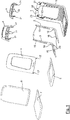
- Two bars 2, 3, which are L-shaped and ensure the stability of the local traffic seat shown here, are inserted into this back shell. These spars are manufactured separately.
- a handle 8 or a chin guard 9 are mounted between the seat 4 and the back shell 1 at the upper end.
- the back shell 1 and the two spars 2, 3 are shown in more detail. It can be seen that the back shell 1 is provided with a plurality of ribs 10, in particular at the transition between the upwardly extending back section 11 of the back shell and its to the front running, below arranged assembly area 12 can be found.
- the back section 11 has two downwardly open receiving pockets 13 in its side areas, which are integrally molded onto the back shell. Insertion ends 14, which are integrally formed on the upper ends of the bars 2, 3, can be received in these receiving pockets 13. As a result, the bars 2, 3 are closely connected to the back section 11 of the back shell 1.
- the bars 2, 3 are to be screwed via existing through holes 19 with corresponding screw domes 20 with integrated blind bores that are formed on the back shell 1, whereby the close connection of the bars 2, 3 with the back shell 1 is further reinforced.
- the spars 2, 3 are produced by means of thermoplastic foam injection molding.
- a thermoplastic is foamed in a cavity by adding a blowing agent to the melt in the injection molding machine.
- a blowing agent for example, the bars shown here can be given optimum rigidity with minimal weight.
- glass fiber with a mass fraction of approx. 30% is added to the thermoplastic material, whereby a particularly high stability of the finished spars is achieved with a very low weight.
- the bars 2, 3 are L-shaped and, if necessary, carry webs 15 and receptacles 16 that are attached.
- the seat surfaces 4, 5 can be supported precisely on the webs 15 if they are loaded by a passenger and are somewhat elastically deformed by this load, with the element 4 of the seat surface provided for the back of a passenger on its lower part in the example shown here Has two tabs 17 laterally at the end, which correspond to two recesses 18 on the bars 2, 3. Via these tabs 17 it is possible to screw this element 4, which is provided for supporting a back, onto the bars 2, 3 in order to achieve a further increased stability and torsional stiffness of the seat.
- under-grip sections 25 attached to the bars during their production can also be seen, which correspond to corresponding fastening claws, not shown, on the underside of the seat surfaces 5 and ensure that these seat surfaces are fixed in the fully assembled seat.
- both the handle 8 and the chin guard 9 have downwardly directed holding elements 21 and fixing elements 22.
- the holding elements 21 engage in corresponding holders 23 provided on the back section 11, while the fixing elements 22 encompass the upper edge 24 of the back section 11 and are inserted with their lower ends into pockets 26 in order to create an intimate connection with the back shell 1.
- the seat described here is therefore a particularly good option for building a local traffic seat in a modular fashion and at the same time achieving a high level of stability for the seat.
Landscapes
- Engineering & Computer Science (AREA)
- Mechanical Engineering (AREA)
- Chemical & Material Sciences (AREA)
- Composite Materials (AREA)
- Aviation & Aerospace Engineering (AREA)
- Transportation (AREA)
- Seats For Vehicles (AREA)
Abstract
Description
- Die Erfindung betrifft einen Sitz für den öffentlichen Personennahverkehr (ÖPNV), mit einer Rückenschale, wenigstens einer vorderen Sitzfläche und wenigstens zwei Holmen, die die Rückenschale und/oder die wenigstens eine Sitzfläche tragen.
- Im öffentlichen Personennahverkehr (ÖPNV) sind für Passagiere sowohl Sitzals auch Stehplätze vorgesehen. Die Sitzplätze sind dabei bekannter Weise mit Sitzen versehen, die häufig in der Form von Sitzschalen ausgeführt sind. Diese Sitzschalen bestehen häufig aus Kunststoff, zum Beispiel Polyamid.
- Zu Komfortzwecken können derartige Sitzschalen auch noch gepolstert werden. Es ist dabei üblich, die Sitzschalen selbst als Rückenschale auszuführen und an dieser Rückenschale Sitzflächen anzubringen, die insbesondere als Polsterträger mit einem Polster und einem Stoffbezug versehen sind.
- Um diesen Sitzschalen die aus Sicherheitsgründen vorgeschriebene Stabilität zu verleihen, ist es bekannt, insbesondere die Rückenschale stark zu verrippen. Die dabei angeformten Rippen werden abschließend dann durch die Sitzflächen abgedeckt.
- Diese Bauform hat aber den Nachteil, dass ein entsprechendes Werkzeug zur Herstellung der Sitz- bzw. Rückenschale sehr aufwendig ist. Außerdem haben entsprechende Sitzschalen aufgrund der für die Stabilität notwendigen erheblichen Stärken der angespritzten Rippen den Nachteil, dass sie sehr schwer sind. Dies erschwert nicht nur ein Handling während des Einbaus, sondern verringert auch die in einem Fahrzeug für Passagiere zur Verfügung stehende Nutzlast.
- Unter diesem Aspekt ist man dazu übergegangen, derartige Sitze mit Holmen zu versehen, die für eine benötigte Stabilität sorgen.
- Zunächst wurden derartige Holme als Stahl- oder Aluminiumrohre ausgebildet. Bei einer entsprechenden Stabilität dieser Holme sind diese aber ebenfalls wieder entsprechend schwer. Außerdem ist es bei derartigen Rohren schwierig, sie optisch gefällig in einen entsprechenden Sitz zu integrieren, wobei anfangs die Rückenschalen und gegebenenfalls auch die Sitzflächen auf diese Rohre aufgesetzt wurden.
- Unter diesem Aspekt ist man dazu übergegangen, entsprechende Holme insbesondere in der Rückenschale zu umspritzen.
- Dies hat aber den Nachteil, dass die Herstellung der Rückenschalen komplizierter wird: Es ist nämlich nötig, die entsprechenden Holme in die Spritzgussformen für die Rückenschalen einzulegen. Hierdurch wird nicht nur die Konstruktion für die Spritzgussformen komplizierter, da Halterungen für die Holme vorzusehen sind, die diese während des Spritzgussvorganges fixieren. Auch benötigt das Einlegen der Holme in die Spritzgussformen Zeit und häufig auch ein manuelles Handling, sodass eine preiswerte, vollautomatisierte Fertigung erschwert wird.
- Außerdem wird innerhalb der Spritzgussform durch die eingelegten Holme das Strömungs-, Abkühl- und damit Erstarrungsverhalten des für die Rückenschale eingespritzten Kunststoffes beeinflusst, was Qualitätsprobleme mit sich bringen kann. Dies erfordert wiederum einen erhöhten Kontrollaufwand. Die Herstellung wird auch dadurch teurer.
- Aufgabe der vorliegenden Erfindung ist daher, einen Sitz wie oben angegeben derart weiterzubilden, dass er leichter herstellbar und damit kostengünstiger wird. Insbesondere soll dabei auch ein Sitz mit möglichst geringem Gewicht realisiert werden.
- Diese Aufgabe wird erfindungsgemäß dadurch gelöst, dass die Holme als geschäumte Kunststoffteile separat hergestellt sind.
- Der Vorteil der Erfindung liegt darin, dass bei der Herstellung von Rückenschalen auf das für Probleme anfällige Einlegen von Bauteilen in die Spritzgussformen verzichtet werden kann und die Herstellung des erfindungsgemäßen Sitzes prozesssicherer wird.
- Die Herstellung der Holme als geschäumte Kunststoffteile hat auch den Vorteil, dass sehr leichte aber dennoch ausreichend stabile Bauteile herstellbar sind. Außerdem können für die Holme beanspruchungsgerecht ausgelegte Konturen und Querschnitte gewählt werden, womit diese ein minimales Gewicht haben.
- Vorzugsweise wird vorgesehen, dass die Holme glasfaserverstärkt sind und einen Glasfaseranteil im Material von 20-40 %, bevorzugterweise von ca. 30 % haben. Dies ergibt auch ein Optimum zwischen niedrigem Gewicht und Stabilität
- Insbesondere werden die Holme mit einer L-förmigen Kontur ausgestaltet, wodurch die Stabilität des Sitzes optimiert wird.
- Dabei kann auch vorgesehen sein, an den unteren Schenkeln der Holme, die im Wesentlichen horizontal verlaufen, Aufnahmen für Sitzbefestigungselemente vorzusehen. Über diese ist eine schnelle und präzise Montage eines erfindungsgemäßen Sitzes an seiner Einsatzstelle möglich.
- Die erfindungsgemäß vorgesehenen Holme sind insbesondere zwischen der Rückenschalen und der Sitzfläche angeordnet.
- Damit ist zu erreichen, dass der Sitz nach außen ein in sich geschlossenes optisch angenehmes Erscheinungsbild hat. Außerdem ist ein entsprechender Sitz dann auch gut zu reinigen, was für Betreiber des öffentlichen Personennahverkehrs von Vorteil ist.
- Weitere Vorteile und Merkmale der Erfindung ergeben sich aus der nachfolgenden Beschreibung eines Ausführungsbeispiels. Dabei zeigt
- Figur 1
- die Explosionszeichnung eines erfindungsgemäßen Sitzes.
- Figur 2
- eine perspektivische Ansicht einer Rückenschale mit davor angeordneten Holmen.
- In der
Figur 1 erkennt man eine Explosionsdarstellung eines erfindungsgemäßen Nahverkehrssitzes. - Dieser weist eine Rückenschale 1 auf, die aus einem Kunststoff wie beispielsweise Polyamid als Spritzgussteil hergestellt ist.
- In diese Rückenschale werden zwei Holme 2, 3 eingesetzt, die L-förmigen ausgebildet sind und für die Stabilität des hier dargestellten Nahverkehrssitzes sorgen. Diese Holme sind separat hergestellt.
- Auf die Holme 2, 3, die in die Rückenschale 1 eingesetzt sind, werden Sitzflächen 4, 5 aufgesetzt, die wie die Rückenschale 1 als Spritzgussteil vorzugsweise aus Polyamid hergestellt sind. An den Sitzflächen 4, 5 sind bedarfsweise stoffüberzogene Polsterelemente 6, 7 zu befestigen.
- Zwischen die Sitzfläche 4 und die Rückenschale 1 sind am oberen Ende alternativ ein Haltegriff 8 oder ein Kinnschutz 9 montiert.
- In der
Figur 2 ist die Rückenschale 1 und die beiden Holme 2, 3 detaillierter dargestellt. Man erkennt, dass die Rückenschale 1 mit einer Mehrzahl von Rippen 10 versehen ist, die insbesondere an dem Übergang zwischen dem nach oben verlaufenden Rückenabschnitt 11 der Rückenschale und deren nach vorne laufenden, unten angeordneten Montagebereich 12 zu finden sind. - Im oberen Bereich weist der Rückenabschnitt 11 in seinen Seitenbereichen zwei nach unten offene Aufnahmetaschen 13 auf, die einstückig an die Rückenschale angespritzt sind. In diesen Aufnahmetaschen 13 können Einsteckenden 14, die an den oberen Enden der Holme 2, 3 angeformt sind aufgenommen werden. Dadurch wird eine enge Verbindung der Holme 2, 3 mit dem Rückenabschnitt 11 der Rückenschale 1 bewirkt.
- Unterhalb der in den Aufnahmetaschen 13 sitzenden Einsteckenden 14 sind die Holme 2, 3 über an ihnen vorhandene Durchgangsbohrungen 19 mit korrespondierenden Schraubdomen 20 mit integrierten Sackbohrungen, die an der Rückenschale 1 angeformt sind, zu verschrauben, wodurch die enge Verbindung der Holme 2, 3 mit der Rückenschale 1 weiter verstärkt wird.
- Die Holme 2, 3 sind mittels Thermoplast-Schaumspritzgießen hergestellt. Bei diesem Verfahren wird ein thermoplastischer Kunststoff in einer Kavität aufgeschäumt, indem man der Schmelze in der Spritzgussmaschine ein Treibmittel zusetzt. Dadurch können zum Beispiel die hier dargestellten Holme bei minimalem Gewicht eine optimale Steifigkeit erhalten. Für die hier dargestellten Holme wird dem thermoplastischen Kunststoff dabei außer dem Treibmittel für das Aufschäumen auch noch Glasfaser mit einem Masseanteil von ca. 30 % beigesetzt, wodurch eine besonders hohe Stabilität der fertigen Holme erreicht wird bei einem gleichzeitig sehr niedrigen Gewicht.
- Die Holme 2, 3 sind L-förmig ausgebildet und tragen bedarfsweise angebrachte Stege 15 und Aufnahmen 16.
- Auf die Stege 15 können sich die Sitzflächen 4, 5 passgenau abstützen, wenn sie durch einen Passagier belastet und durch diese Belastung etwas elastisch verformt werden, wobei im hier dargestellten Beispiel das für den Rücken eines Passagiers vorgesehene Element 4 der Sitzfläche an seinem unteren Ende seitlich zwei Laschen 17 aufweist, die mit zwei Ausnehmungen 18 an den Holmen 2, 3 korrespondieren. Über diese Laschen 17 ist es möglich, dieses zur Stützung eines Rückens vorgesehene Element 4 an den Holmen 2, 3 festzuschrauben, um so eine weiter erhöhte Stabilität und Verwindungsteifigkeit des Sitzes zu erreichen.
- Die angesprochenen, in die Holme 2, 3 bei deren Herstellung bereits eingebrachten Aufnahmen 16 werden benutzt, um hier Sitzbefestigungselemente anzubringen, wie insbesondere Maschinenschrauben, mit denen der Sitz an seiner Einsatzstelle befestigt wird.
- Benachbart zu diesen Aufnahmen 16 sind des Weiteren noch an den Holmen ebenfalls bereist bei deren Herstellung angebrachte Untergreifabschnitte 25 zu erkennen, die mit entsprechenden nicht dargestellten Befestigungskrallen auf der Unterseite der Sitzflächen 5 korrespondieren und bei dem fertig montierten Sitz für die Fixierung dieser Sitzflächen sorgen.
- Je nach Einsatzstelle werden am oberen Ende des Rückenabschnitts 11 der eingangs erwähnte Haltegriff 8 oder alternativ der Kinnschutz 9 montiert. Sowohl der Haltegriff 8 als auch der Kinnschutz 9 weisen dazu nach unten gerichtete Halteelemente 21 und Fixierelemente 22 auf. Die Halteelemente 21 greifen in entsprechende an dem Rückenabschnitt 11 vorgesehene Halterungen 23 ein, während die Fixierelemente 22 die obere Kante 24 des Rückenabschnitts 11 umgreifen und mit ihren unteren Enden in Taschen 26 eingeführt werden, um so eine innige Verbindung mit der Rückenschale 1 zu erzeugen.
- Der hier beschriebene Sitz ist somit eine besonders gute Möglichkeit, einen Nahverkehrssitz modular aufzubauen und dabei gleichzeitig eine hohe Stabilität des Sitzes zu erreichen.
-
- 1
- Rückenschale
- 2
- Holm
- 3
- Holm
- 4
- Sitzfläche
- 5
- Sitzfläche
- 6
- Polsterelement
- 7
- Polsterelement
- 8
- Haltegriff
- 9
- Kinnschutz
- 10
- Rippen
- 11
- Rückenabschnitt
- 12
- Montagebereich
- 13
- Aufnahmetaschen
- 14
- Einsteckenden
- 15
- Stege
- 16
- Aufnahmen
- 17
- Laschen
- 18
- Ausnehmung
- 19
- Durchgangsbohrung
- 20
- Schraubdom
- 21
- Halteelement
- 22
- Fixierelement
- 23
- Halterung
- 24
- Kante
- 25
- Untergreifabschnitte
- 26
- Taschen
Claims (6)
- Sitz für den öffentlichen Personennahverkehr, mit einer Rückenschale (1), wenigstens einer vorderen Sitzfläche (4, 5) und wenigstens zwei Holmen (2, 3), die die Rückenschale (1) und/oder die wenigstens eine Sitzfläche (4, 5) tragen,
dadurch gekennzeichnet,
dass die Holme (2, 3) als geschäumte Kunststoffteile separat hergestellt sind. - Sitz gemäß Anspruch 1,
dadurch gekennzeichnet,
dass die Holme (2, 3) einen Glasfaser-Anteil im Material von 20-40 %, vorzugsweise ca. 30 % haben. - Sitz gemäß Anspruch 1 oder 2,
dadurch gekennzeichnet,
dass die Holme (2, 3) L-förmig ausgestaltet sind. - Sitz gemäß einem oder mehreren der vorstehenden Ansprüche,
dadurch gekennzeichnet,
dass die Holme (2, 3) Aufnahmen (16) für Sitzbefestigungselemente aufweisen. - Sitz gemäß einem oder mehreren der vorstehenden Ansprüche,
dadurch gekennzeichnet,
dass die Holme (2, 3) zwischen Rückenschale (1) und Sitzfläche (4, 5) angeordnet sind. - Sitz gemäß einem oder mehreren der vorstehenden Ansprüche,
dadurch gekennzeichnet,
dass die Holme (2, 3), die Rückenschale (1) und/oder die Sitzflächen (4, 5) miteinander korrespondierende Rastelemente aufweisen.
Applications Claiming Priority (1)
| Application Number | Priority Date | Filing Date | Title |
|---|---|---|---|
| DE202019004314 | 2019-10-18 |
Publications (2)
| Publication Number | Publication Date |
|---|---|
| EP3808595A1 true EP3808595A1 (de) | 2021-04-21 |
| EP3808595B1 EP3808595B1 (de) | 2023-05-10 |
Family
ID=72943850
Family Applications (1)
| Application Number | Title | Priority Date | Filing Date |
|---|---|---|---|
| EP20020479.0A Active EP3808595B1 (de) | 2019-10-18 | 2020-10-16 | Sitz für den öffentlichen personen-nahverkehr |
Country Status (1)
| Country | Link |
|---|---|
| EP (1) | EP3808595B1 (de) |
Citations (3)
| Publication number | Priority date | Publication date | Assignee | Title |
|---|---|---|---|---|
| EP0937604A1 (de) * | 1998-02-18 | 1999-08-25 | Vogel Industrie GmbH | Fahrgastsitz für ein Personenbeförderungsfahrzeug |
| US20140197271A1 (en) * | 2011-06-07 | 2014-07-17 | Composite Helicopter Holdings Limited | Helicopter |
| FR3037890A1 (fr) * | 2015-06-29 | 2016-12-30 | Faurecia Sieges Automobile | Realisation d'un element d'habillage pour siege de vehicule automobile ou habitacle de vehicule automobile |
Family Cites Families (1)
| Publication number | Priority date | Publication date | Assignee | Title |
|---|---|---|---|---|
| DE19839325C2 (de) * | 1998-08-28 | 2003-12-18 | Streuber Sulo Eisenwerk F | Fahrgastsitz mit Hohlräumen |
-
2020
- 2020-10-16 EP EP20020479.0A patent/EP3808595B1/de active Active
Patent Citations (3)
| Publication number | Priority date | Publication date | Assignee | Title |
|---|---|---|---|---|
| EP0937604A1 (de) * | 1998-02-18 | 1999-08-25 | Vogel Industrie GmbH | Fahrgastsitz für ein Personenbeförderungsfahrzeug |
| US20140197271A1 (en) * | 2011-06-07 | 2014-07-17 | Composite Helicopter Holdings Limited | Helicopter |
| FR3037890A1 (fr) * | 2015-06-29 | 2016-12-30 | Faurecia Sieges Automobile | Realisation d'un element d'habillage pour siege de vehicule automobile ou habitacle de vehicule automobile |
Also Published As
| Publication number | Publication date |
|---|---|
| EP3808595B1 (de) | 2023-05-10 |
Similar Documents
| Publication | Publication Date | Title |
|---|---|---|
| DE19609945B4 (de) | Armlehnenbaugruppe und Armlehnenträger für eine Fahrzeugtür | |
| DE102008038851A1 (de) | Lehnenrahmen eines Fahrzeugsitzes | |
| DE102013205559A1 (de) | Fahrzeugsitz | |
| EP2511127B1 (de) | Kopfstütze für Fahrzeugsitze | |
| EP1946962A2 (de) | Sitzstruktur für einen Fahrzeugsitz | |
| EP2531374A1 (de) | Rückenlehne aus kunststoff mit aus kunststoff gebildeten oder beschichteten funktionselementen | |
| DE19901747B4 (de) | Kopfstütze für einen Sitz in einem Kraftfahrzeug | |
| DE19757060A1 (de) | Rückenlehne für ein Kraftfahrzeug | |
| DE3841534C2 (de) | ||
| WO2002066295A1 (de) | Fahrzeugkörper für ein pkw-cabriolet und baueinheit | |
| EP1262362A1 (de) | Klappbare Rückenlehne für einen Rücksitz eines Kraftfahrzeugs | |
| DE102008061738B4 (de) | Kopfstütze, insbesondere für Fahrzeugsitz | |
| DE19728052A1 (de) | Sitzelement mit Rahmen | |
| DE2846830A1 (de) | Fahrzeug-tragboden sowie verfahren zu seiner herstellung | |
| EP3808595B1 (de) | Sitz für den öffentlichen personen-nahverkehr | |
| DE102012204813B4 (de) | Fahrzeugsitz mit einer integrierten Kopfstütze und Verfahren zur Herstellung eines Fahrzeugsitzes | |
| DE102010036798B4 (de) | Sitzteil | |
| EP2585339B1 (de) | Rückenlehne eines kraftfahrzeugsitzes | |
| DE19745491C2 (de) | Verfahren zur Herstellung eines Fahrgastsitzes | |
| DE10161082B4 (de) | Rückenlehne für einen Fahrzeugsitz | |
| DE10340745B3 (de) | Kraftfahrzeug-Dachmodul mit integrierter Befestigungseinrichtung | |
| EP1477360A2 (de) | Rückenlehne | |
| DE102024119526B4 (de) | Sattel für ein Fahrrad | |
| DE4023126A1 (de) | Befestigungsvorrichtung fuer auskleidungsteile | |
| DE102008030169A1 (de) | Rückenlehne für einen Fahrgastsitz |
Legal Events
| Date | Code | Title | Description |
|---|---|---|---|
| PUAI | Public reference made under article 153(3) epc to a published international application that has entered the european phase |
Free format text: ORIGINAL CODE: 0009012 |
|
| STAA | Information on the status of an ep patent application or granted ep patent |
Free format text: STATUS: THE APPLICATION HAS BEEN PUBLISHED |
|
| AK | Designated contracting states |
Kind code of ref document: A1 Designated state(s): AL AT BE BG CH CY CZ DE DK EE ES FI FR GB GR HR HU IE IS IT LI LT LU LV MC MK MT NL NO PL PT RO RS SE SI SK SM TR |
|
| AX | Request for extension of the european patent |
Extension state: BA ME |
|
| STAA | Information on the status of an ep patent application or granted ep patent |
Free format text: STATUS: REQUEST FOR EXAMINATION WAS MADE |
|
| 17P | Request for examination filed |
Effective date: 20211005 |
|
| RBV | Designated contracting states (corrected) |
Designated state(s): AL AT BE BG CH CY CZ DE DK EE ES FI FR GB GR HR HU IE IS IT LI LT LU LV MC MK MT NL NO PL PT RO RS SE SI SK SM TR |
|
| STAA | Information on the status of an ep patent application or granted ep patent |
Free format text: STATUS: EXAMINATION IS IN PROGRESS |
|
| 17Q | First examination report despatched |
Effective date: 20221111 |
|
| RIC1 | Information provided on ipc code assigned before grant |
Ipc: B29C 70/06 20060101ALI20221214BHEP Ipc: B29C 70/02 20060101ALI20221214BHEP Ipc: B29C 44/42 20060101ALI20221214BHEP Ipc: B60N 2/68 20060101ALI20221214BHEP Ipc: B60N 2/24 20060101AFI20221214BHEP |
|
| GRAP | Despatch of communication of intention to grant a patent |
Free format text: ORIGINAL CODE: EPIDOSNIGR1 |
|
| STAA | Information on the status of an ep patent application or granted ep patent |
Free format text: STATUS: GRANT OF PATENT IS INTENDED |
|
| INTG | Intention to grant announced |
Effective date: 20230120 |
|
| GRAS | Grant fee paid |
Free format text: ORIGINAL CODE: EPIDOSNIGR3 |
|
| GRAA | (expected) grant |
Free format text: ORIGINAL CODE: 0009210 |
|
| STAA | Information on the status of an ep patent application or granted ep patent |
Free format text: STATUS: THE PATENT HAS BEEN GRANTED |
|
| RIN1 | Information on inventor provided before grant (corrected) |
Inventor name: SCHAEFER, TIMO |
|
| AK | Designated contracting states |
Kind code of ref document: B1 Designated state(s): AL AT BE BG CH CY CZ DE DK EE ES FI FR GB GR HR HU IE IS IT LI LT LU LV MC MK MT NL NO PL PT RO RS SE SI SK SM TR |
|
| REG | Reference to a national code |
Ref country code: GB Ref legal event code: FG4D Free format text: NOT ENGLISH |
|
| REG | Reference to a national code |
Ref country code: AT Ref legal event code: REF Ref document number: 1566387 Country of ref document: AT Kind code of ref document: T Effective date: 20230515 Ref country code: CH Ref legal event code: EP |
|
| REG | Reference to a national code |
Ref country code: DE Ref legal event code: R096 Ref document number: 502020003203 Country of ref document: DE |
|
| REG | Reference to a national code |
Ref country code: IE Ref legal event code: FG4D Free format text: LANGUAGE OF EP DOCUMENT: GERMAN |
|
| REG | Reference to a national code |
Ref country code: LT Ref legal event code: MG9D |
|
| REG | Reference to a national code |
Ref country code: NL Ref legal event code: MP Effective date: 20230510 |
|
| PG25 | Lapsed in a contracting state [announced via postgrant information from national office to epo] |
Ref country code: SE Free format text: LAPSE BECAUSE OF FAILURE TO SUBMIT A TRANSLATION OF THE DESCRIPTION OR TO PAY THE FEE WITHIN THE PRESCRIBED TIME-LIMIT Effective date: 20230510 Ref country code: PT Free format text: LAPSE BECAUSE OF FAILURE TO SUBMIT A TRANSLATION OF THE DESCRIPTION OR TO PAY THE FEE WITHIN THE PRESCRIBED TIME-LIMIT Effective date: 20230911 Ref country code: NO Free format text: LAPSE BECAUSE OF FAILURE TO SUBMIT A TRANSLATION OF THE DESCRIPTION OR TO PAY THE FEE WITHIN THE PRESCRIBED TIME-LIMIT Effective date: 20230810 Ref country code: NL Free format text: LAPSE BECAUSE OF FAILURE TO SUBMIT A TRANSLATION OF THE DESCRIPTION OR TO PAY THE FEE WITHIN THE PRESCRIBED TIME-LIMIT Effective date: 20230510 Ref country code: ES Free format text: LAPSE BECAUSE OF FAILURE TO SUBMIT A TRANSLATION OF THE DESCRIPTION OR TO PAY THE FEE WITHIN THE PRESCRIBED TIME-LIMIT Effective date: 20230510 |
|
| PG25 | Lapsed in a contracting state [announced via postgrant information from national office to epo] |
Ref country code: RS Free format text: LAPSE BECAUSE OF FAILURE TO SUBMIT A TRANSLATION OF THE DESCRIPTION OR TO PAY THE FEE WITHIN THE PRESCRIBED TIME-LIMIT Effective date: 20230510 Ref country code: PL Free format text: LAPSE BECAUSE OF FAILURE TO SUBMIT A TRANSLATION OF THE DESCRIPTION OR TO PAY THE FEE WITHIN THE PRESCRIBED TIME-LIMIT Effective date: 20230510 Ref country code: LV Free format text: LAPSE BECAUSE OF FAILURE TO SUBMIT A TRANSLATION OF THE DESCRIPTION OR TO PAY THE FEE WITHIN THE PRESCRIBED TIME-LIMIT Effective date: 20230510 Ref country code: LT Free format text: LAPSE BECAUSE OF FAILURE TO SUBMIT A TRANSLATION OF THE DESCRIPTION OR TO PAY THE FEE WITHIN THE PRESCRIBED TIME-LIMIT Effective date: 20230510 Ref country code: IS Free format text: LAPSE BECAUSE OF FAILURE TO SUBMIT A TRANSLATION OF THE DESCRIPTION OR TO PAY THE FEE WITHIN THE PRESCRIBED TIME-LIMIT Effective date: 20230910 Ref country code: HR Free format text: LAPSE BECAUSE OF FAILURE TO SUBMIT A TRANSLATION OF THE DESCRIPTION OR TO PAY THE FEE WITHIN THE PRESCRIBED TIME-LIMIT Effective date: 20230510 Ref country code: GR Free format text: LAPSE BECAUSE OF FAILURE TO SUBMIT A TRANSLATION OF THE DESCRIPTION OR TO PAY THE FEE WITHIN THE PRESCRIBED TIME-LIMIT Effective date: 20230811 |
|
| PG25 | Lapsed in a contracting state [announced via postgrant information from national office to epo] |
Ref country code: FI Free format text: LAPSE BECAUSE OF FAILURE TO SUBMIT A TRANSLATION OF THE DESCRIPTION OR TO PAY THE FEE WITHIN THE PRESCRIBED TIME-LIMIT Effective date: 20230510 |
|
| PG25 | Lapsed in a contracting state [announced via postgrant information from national office to epo] |
Ref country code: SK Free format text: LAPSE BECAUSE OF FAILURE TO SUBMIT A TRANSLATION OF THE DESCRIPTION OR TO PAY THE FEE WITHIN THE PRESCRIBED TIME-LIMIT Effective date: 20230510 |
|
| P01 | Opt-out of the competence of the unified patent court (upc) registered |
Effective date: 20231222 |
|
| PG25 | Lapsed in a contracting state [announced via postgrant information from national office to epo] |
Ref country code: SM Free format text: LAPSE BECAUSE OF FAILURE TO SUBMIT A TRANSLATION OF THE DESCRIPTION OR TO PAY THE FEE WITHIN THE PRESCRIBED TIME-LIMIT Effective date: 20230510 Ref country code: SK Free format text: LAPSE BECAUSE OF FAILURE TO SUBMIT A TRANSLATION OF THE DESCRIPTION OR TO PAY THE FEE WITHIN THE PRESCRIBED TIME-LIMIT Effective date: 20230510 Ref country code: RO Free format text: LAPSE BECAUSE OF FAILURE TO SUBMIT A TRANSLATION OF THE DESCRIPTION OR TO PAY THE FEE WITHIN THE PRESCRIBED TIME-LIMIT Effective date: 20230510 Ref country code: EE Free format text: LAPSE BECAUSE OF FAILURE TO SUBMIT A TRANSLATION OF THE DESCRIPTION OR TO PAY THE FEE WITHIN THE PRESCRIBED TIME-LIMIT Effective date: 20230510 Ref country code: DK Free format text: LAPSE BECAUSE OF FAILURE TO SUBMIT A TRANSLATION OF THE DESCRIPTION OR TO PAY THE FEE WITHIN THE PRESCRIBED TIME-LIMIT Effective date: 20230510 Ref country code: CZ Free format text: LAPSE BECAUSE OF FAILURE TO SUBMIT A TRANSLATION OF THE DESCRIPTION OR TO PAY THE FEE WITHIN THE PRESCRIBED TIME-LIMIT Effective date: 20230510 |
|
| REG | Reference to a national code |
Ref country code: DE Ref legal event code: R097 Ref document number: 502020003203 Country of ref document: DE |
|
| PLBE | No opposition filed within time limit |
Free format text: ORIGINAL CODE: 0009261 |
|
| STAA | Information on the status of an ep patent application or granted ep patent |
Free format text: STATUS: NO OPPOSITION FILED WITHIN TIME LIMIT |
|
| 26N | No opposition filed |
Effective date: 20240213 |
|
| PG25 | Lapsed in a contracting state [announced via postgrant information from national office to epo] |
Ref country code: SI Free format text: LAPSE BECAUSE OF FAILURE TO SUBMIT A TRANSLATION OF THE DESCRIPTION OR TO PAY THE FEE WITHIN THE PRESCRIBED TIME-LIMIT Effective date: 20230510 |
|
| PG25 | Lapsed in a contracting state [announced via postgrant information from national office to epo] |
Ref country code: SI Free format text: LAPSE BECAUSE OF FAILURE TO SUBMIT A TRANSLATION OF THE DESCRIPTION OR TO PAY THE FEE WITHIN THE PRESCRIBED TIME-LIMIT Effective date: 20230510 Ref country code: IT Free format text: LAPSE BECAUSE OF FAILURE TO SUBMIT A TRANSLATION OF THE DESCRIPTION OR TO PAY THE FEE WITHIN THE PRESCRIBED TIME-LIMIT Effective date: 20230510 Ref country code: MC Free format text: LAPSE BECAUSE OF FAILURE TO SUBMIT A TRANSLATION OF THE DESCRIPTION OR TO PAY THE FEE WITHIN THE PRESCRIBED TIME-LIMIT Effective date: 20230510 |
|
| REG | Reference to a national code |
Ref country code: CH Ref legal event code: PL |
|
| REG | Reference to a national code |
Ref country code: BE Ref legal event code: MM Effective date: 20231031 |
|
| PG25 | Lapsed in a contracting state [announced via postgrant information from national office to epo] |
Ref country code: LU Free format text: LAPSE BECAUSE OF NON-PAYMENT OF DUE FEES Effective date: 20231016 |
|
| PG25 | Lapsed in a contracting state [announced via postgrant information from national office to epo] |
Ref country code: LU Free format text: LAPSE BECAUSE OF NON-PAYMENT OF DUE FEES Effective date: 20231016 |
|
| PG25 | Lapsed in a contracting state [announced via postgrant information from national office to epo] |
Ref country code: CH Free format text: LAPSE BECAUSE OF NON-PAYMENT OF DUE FEES Effective date: 20231031 |
|
| PG25 | Lapsed in a contracting state [announced via postgrant information from national office to epo] |
Ref country code: FR Free format text: LAPSE BECAUSE OF NON-PAYMENT OF DUE FEES Effective date: 20231031 Ref country code: CH Free format text: LAPSE BECAUSE OF NON-PAYMENT OF DUE FEES Effective date: 20231031 |
|
| PG25 | Lapsed in a contracting state [announced via postgrant information from national office to epo] |
Ref country code: BE Free format text: LAPSE BECAUSE OF NON-PAYMENT OF DUE FEES Effective date: 20231031 |
|
| PG25 | Lapsed in a contracting state [announced via postgrant information from national office to epo] |
Ref country code: IE Free format text: LAPSE BECAUSE OF NON-PAYMENT OF DUE FEES Effective date: 20231016 |
|
| PG25 | Lapsed in a contracting state [announced via postgrant information from national office to epo] |
Ref country code: IE Free format text: LAPSE BECAUSE OF NON-PAYMENT OF DUE FEES Effective date: 20231016 |
|
| PG25 | Lapsed in a contracting state [announced via postgrant information from national office to epo] |
Ref country code: BG Free format text: LAPSE BECAUSE OF FAILURE TO SUBMIT A TRANSLATION OF THE DESCRIPTION OR TO PAY THE FEE WITHIN THE PRESCRIBED TIME-LIMIT Effective date: 20230510 |
|
| PG25 | Lapsed in a contracting state [announced via postgrant information from national office to epo] |
Ref country code: BG Free format text: LAPSE BECAUSE OF FAILURE TO SUBMIT A TRANSLATION OF THE DESCRIPTION OR TO PAY THE FEE WITHIN THE PRESCRIBED TIME-LIMIT Effective date: 20230510 |
|
| PG25 | Lapsed in a contracting state [announced via postgrant information from national office to epo] |
Ref country code: CY Free format text: LAPSE BECAUSE OF FAILURE TO SUBMIT A TRANSLATION OF THE DESCRIPTION OR TO PAY THE FEE WITHIN THE PRESCRIBED TIME-LIMIT; INVALID AB INITIO Effective date: 20201016 |
|
| PG25 | Lapsed in a contracting state [announced via postgrant information from national office to epo] |
Ref country code: HU Free format text: LAPSE BECAUSE OF FAILURE TO SUBMIT A TRANSLATION OF THE DESCRIPTION OR TO PAY THE FEE WITHIN THE PRESCRIBED TIME-LIMIT; INVALID AB INITIO Effective date: 20201016 |
|
| PG25 | Lapsed in a contracting state [announced via postgrant information from national office to epo] |
Ref country code: TR Free format text: LAPSE BECAUSE OF FAILURE TO SUBMIT A TRANSLATION OF THE DESCRIPTION OR TO PAY THE FEE WITHIN THE PRESCRIBED TIME-LIMIT Effective date: 20230510 |
|
| PGFP | Annual fee paid to national office [announced via postgrant information from national office to epo] |
Ref country code: DE Payment date: 20251020 Year of fee payment: 6 |
|
| PGFP | Annual fee paid to national office [announced via postgrant information from national office to epo] |
Ref country code: GB Payment date: 20251024 Year of fee payment: 6 |
|
| PGFP | Annual fee paid to national office [announced via postgrant information from national office to epo] |
Ref country code: AT Payment date: 20260113 Year of fee payment: 5 |