EP3800189A1 - Preparation of (s)-n-(5-((r)-2-(2,5-difluorophenyl)pyrrolidin-1-yl)pyrazolo[1,5-a]pyrimidin-3-yl)-3-hydroxypyrrolidine-1-carboxamide - Google Patents
Preparation of (s)-n-(5-((r)-2-(2,5-difluorophenyl)pyrrolidin-1-yl)pyrazolo[1,5-a]pyrimidin-3-yl)-3-hydroxypyrrolidine-1-carboxamide Download PDFInfo
- Publication number
- EP3800189A1 EP3800189A1 EP20208218.6A EP20208218A EP3800189A1 EP 3800189 A1 EP3800189 A1 EP 3800189A1 EP 20208218 A EP20208218 A EP 20208218A EP 3800189 A1 EP3800189 A1 EP 3800189A1
- Authority
- EP
- European Patent Office
- Prior art keywords
- formula
- compound
- salt
- alkoxy
- halogen
- Prior art date
- Legal status (The legal status is an assumption and is not a legal conclusion. Google has not performed a legal analysis and makes no representation as to the accuracy of the status listed.)
- Granted
Links
- 0 *c(cc1)cc(C=O)c1F Chemical compound *c(cc1)cc(C=O)c1F 0.000 description 4
- GONDHXHVJFAXIR-PKNBQFBNSA-N C=C/C(/[N+]([O-])=O)=C(\N(C=C1)N)/N=C1N1CCCC1 Chemical compound C=C/C(/[N+]([O-])=O)=C(\N(C=C1)N)/N=C1N1CCCC1 GONDHXHVJFAXIR-PKNBQFBNSA-N 0.000 description 1
- NYNZQNWKBKUAII-KBXCAEBGSA-N O[C@@H](CC1)CN1C(Nc(cn[n]1cc2)c1nc2N(CCC1)[C@H]1c(cc(cc1)F)c1F)=O Chemical compound O[C@@H](CC1)CN1C(Nc(cn[n]1cc2)c1nc2N(CCC1)[C@H]1c(cc(cc1)F)c1F)=O NYNZQNWKBKUAII-KBXCAEBGSA-N 0.000 description 1
- QMEPCSOVUDFEQT-GHMZBOCLSA-N O[C@H](C/C(/O)=[O]\c1cc(F)c([C@@H]2NCCC2)cc1F)C(O)=O Chemical compound O[C@H](C/C(/O)=[O]\c1cc(F)c([C@@H]2NCCC2)cc1F)C(O)=O QMEPCSOVUDFEQT-GHMZBOCLSA-N 0.000 description 1
Classifications
-
- C—CHEMISTRY; METALLURGY
- C07—ORGANIC CHEMISTRY
- C07D—HETEROCYCLIC COMPOUNDS
- C07D487/00—Heterocyclic compounds containing nitrogen atoms as the only ring hetero atoms in the condensed system, not provided for by groups C07D451/00 - C07D477/00
- C07D487/02—Heterocyclic compounds containing nitrogen atoms as the only ring hetero atoms in the condensed system, not provided for by groups C07D451/00 - C07D477/00 in which the condensed system contains two hetero rings
- C07D487/04—Ortho-condensed systems
-
- A—HUMAN NECESSITIES
- A61—MEDICAL OR VETERINARY SCIENCE; HYGIENE
- A61K—PREPARATIONS FOR MEDICAL, DENTAL OR TOILETRY PURPOSES
- A61K31/00—Medicinal preparations containing organic active ingredients
- A61K31/33—Heterocyclic compounds
- A61K31/395—Heterocyclic compounds having nitrogen as a ring hetero atom, e.g. guanethidine or rifamycins
- A61K31/495—Heterocyclic compounds having nitrogen as a ring hetero atom, e.g. guanethidine or rifamycins having six-membered rings with two or more nitrogen atoms as the only ring heteroatoms, e.g. piperazine or tetrazines
- A61K31/505—Pyrimidines; Hydrogenated pyrimidines, e.g. trimethoprim
- A61K31/519—Pyrimidines; Hydrogenated pyrimidines, e.g. trimethoprim ortho- or peri-condensed with heterocyclic rings
-
- A—HUMAN NECESSITIES
- A61—MEDICAL OR VETERINARY SCIENCE; HYGIENE
- A61P—SPECIFIC THERAPEUTIC ACTIVITY OF CHEMICAL COMPOUNDS OR MEDICINAL PREPARATIONS
- A61P35/00—Antineoplastic agents
-
- A—HUMAN NECESSITIES
- A61—MEDICAL OR VETERINARY SCIENCE; HYGIENE
- A61P—SPECIFIC THERAPEUTIC ACTIVITY OF CHEMICAL COMPOUNDS OR MEDICINAL PREPARATIONS
- A61P43/00—Drugs for specific purposes, not provided for in groups A61P1/00-A61P41/00
Definitions
- the compound of Formula I (S)-N-(5-((R)-2-(2,5-difluorophenyl)-pyrrolidin-1-yl)-pyrazolo[1,5-a]pyrimidin-3-yl)-3-hydroxypyrrolidine-1-carboxamide, is a TRK kinase inhibitor.
- the compound of Formula I may be prepared as disclosed in WO 2010/048314 , incorporated by reference herein in its entirety.
- WO 2010/048314 discloses in Example 14A a hydrogen sulfate salt of the compound of Formula I.
- the compound may also be prepared as disclosed in US Application Ser. No. 14/943,014, filed November 16, 2015 , incorporated by reference herein in its entirety.
- a process for preparing a compound of Formula I or a salt thereof comprising:
- a process for preparing a compound of Formula I or a salt thereof comprising:
- the process for preparing the compound of Formula I further comprises preparing the compound of formula 13 or a salt thereof by a process comprising
- the process for preparing the compound of Formula I further comprises preparing the compound of formula 11 or a salt thereof by a process comprising treating a compound of formula 10 or a salt thereof, with a compound of formula 5 or a salt thereof, to form the compound of formula 11 or salt thereof.
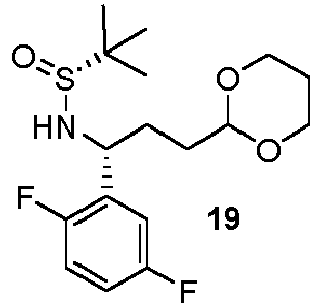
- the process for preparing the compound of Formula I further comprises preparing the compound of formula 10 or a salt thereof by a process comprising treating a compound of formula 19 or a salt thereof, with an acid in the presence of a first reducing agent, to form a compound of formula 10 or a salt thereof,
- the process for preparing the compound of Formula I further comprises preparing the compound of formula 19 or a salt thereof by a process comprising treating a compound of formula 17 with a reagent system comprising the group to form a compound of formula 19,
- the reagent system comprising comprises a metal or compound of a metal.
- the metal or the compound of a metal is capable of acting as an electron transfer agent.
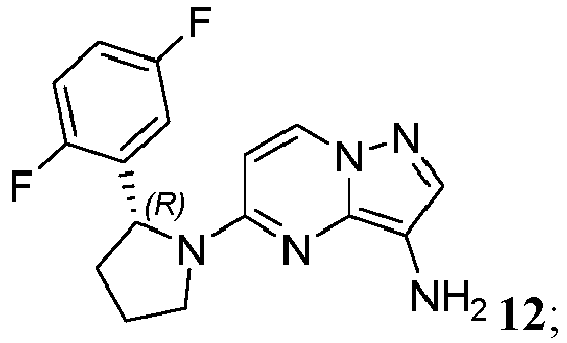
- the process for preparing the compound of Formula I further comprises preparing the compound of formula 17 or a salt thereof by a process comprising treating a compound of formula 16 with (R)-2-methylpropane-2-sulfinamide, to form a compound of formula 17.
- a process for preparing a pharmaceutical composition comprising mixing (i) a compound of Formula I or salt thereof prepared according to any of the processes described herein, and (ii) a pharmaceutically acceptable carrier, to form the composition.
- provided herein is a process for preparing a compound of formula 13 or a salt thereof by a process comprising
- provided herein is a process for preparing a compound of formula 13 or a salt thereof comprising
- a process for preparing a compound of formula 12 or a salt thereof comprising
- a process for preparing a compound of formula 10 or a salt thereof comprising treating a compound of formula 19 or a salt thereof, with an acid in the presence of a first reducing agent, to form a compound of formula 10 or a salt thereof.
- a process for preparing a compound of formula 19 or a salt thereof comprising treating a compound of formula 17 with a reagent system comprising the group to form a compound of formula 19.
- provided herein is a process for preparing a compound of formula 17 or a salt thereof, comprising treating a compound of formula 16 with (R)-2-methylpropane-2-sulfinamide to form a compound of formula 17.
- provided herein is a compound of formula 19: or a salt thereof.
- provided herein is a compound of formula 17: or a salt thereof.
- a "nitro reduction system” is any substance or plurality of substances capable of converting a NO 2 group to an NH 2 group.
- Nitro reduction systems may include, for example, heterogeneous systems, homogeneous systems, catalytic systems, and non-catalytic systems.
- Examples of nitro reduction systems include systems comprising a metal or a compound of a metal, such as a salt of the metal or an oxide of the metal. Examples of such metals include palladium, platinum, rhodium, ruthenium, nickel, copper, iron, tin, and zinc.
- Examples of nitro reduction systems include systems comprising an acid. Such systems comprising an acid can also comprise a metal or a compound of a metal such as are disclosed herein. Examples of nitro reduction systems include systems comprising H 2 .
- nitro reduction systems include metal hydrides, which can be, for example, mixed metal hydrides.
- metal hydrides include LiAlR 4 , NaBH 4 , diisobutylaluminium hydride (DIBAL), and the like.
- nitro reduction systems include systems comprising an organic compound capable of providing hydrogen.
- An example of such an organic compound capable of providing hydrogen is cyclohexene.
- nitro reduction systems are systems comprising Pd, Pd/C, Raney nickel, PtO 2 , Fe/acid, Zn/acid.
- halogen refers to fluorine (F), chlorine (CI), bromine (Br), or iodine (I).
- alkyl refers to a hydrocarbon chain that may be a straight chain or branched chain, containing the indicated number of carbon atoms.
- C 1-6 indicates that the group may have from 1 to 6 (inclusive) carbon atoms in it. Examples include methyl, ethyl, iso -propyl, tert -butyl, n -hexyl.
- haloalkyl refers to an alkyl, in which one or more hydrogen atoms is/are replaced with an independently selected halo.
- alkoxy refers to an -O-alkyl radical (e.g., -OCH 3 ).
- aryl as used herein includes an aromatic monocyclic or bicyclic hydrocarbon radical having 6 to 10 carbons. Examples of aryl include phenyl and naphthyl.
- heteroaryl refers to an aromatic radical having 1-4 heteroatoms. Examples of heteroatoms are N, O, and S. Examples of heteroaryl include pyridyl, pyrimidinyl, furanyl, thiophenyl, pyrrolyl, pyrazolyl, imidazolyl, and the like.
- a salt can form from a compound in any manner familiar to the skilled artisan. Accordingly, the recitation "to form a compound or salt thereof' includes embodiments where a compound is formed and the salt is subsequently formed from the compound in a manner familiar to the killed artisan.
- the compounds disclosed herein include compounds having a sulfoxide group, as shown, by way of example, in the structure of compound 17, below:
- the sulfur-oxygen bond may also be rendered pictorially as being in ionic form.
- compound 17 may also be rendered as shown the structure below:
- a process for preparing a compound of Formula I or a salt thereof comprising:
- the compound of formula 13 or salt thereof is in isolated form prior to the treatment with the compound of formula 14 or salt thereof.
- a process for preparing a compound of Formula I or a salt thereof comprising:
- the salt of the compound of formula I is the hydrogen sulfate salt.
- forming a salt of the compound of formula I comprises treating the compound of formula I with an acid to form the salt.
- forming a salt of the compound of formula I comprises treating a salt of the compound of formula I with an acid to form a different salt via anion exchange.
- the process for preparing the compound of Formula I further comprises preparing the compound of formula 13 or a salt thereof by a process comprising
- preparing the compound of formula 13 comprises: forming the compound of formula 13 in a second mixture; and isolating the compound of formula 13 from the second mixture.
- the first mixture comprises a compound of formula 12 or a salt thereof
- the processes comprises isolating the compound of formula 12 or a salt thereof from the first mixture prior to treating with XC(O)Z.
- the salt of the compound of formula 12 is the fumarate salt.
- Z is halogen
- Z is chlorine
- Z is bromine
- Z is imidazolyl
- the nitro reduction system with which compound 11 is treated is a heterogeneous system.
- the nitro reduction system is a homogeneous system.
- the nitro reduction system is a catalytic system.
- the nitro reduction system is a non-catalytic systems.
- the nitro reduction system comprises a metal or a compound of a metal, such as a salt of the metal or an oxide of the metal.
- the nitro reduction system comprises palladium, platinum, rhodium, ruthenium, nickel, copper, iron, tin, or zinc.
- the nitro reduction system comprises an acid. In some embodiments, the nitro reduction system comprising an acid comprises a metal or a compound of a metal.
- the nitro reduction system comprises H 2 .
- the nitro reduction system comprises a metal hydride. In some embodiments, the nitro reduction system comprises a mixed metal hydride. In some embodiments, the mixed metal hydride is LiAlH 4 , NaBH 4 , or diisobutylaluminium hydride (DIBAL).
- DIBAL diisobutylaluminium hydride
- the nitro reduction system comprises an organic compound capable of providing hydrogen.
- the organic compound capable of providing hydrogen is cyclohexene.
- the nitro reduction system comprises Pd, Pd/C, Raney nickel, PtO 2 , Fe/acid, or Zn/acid.
- the nitro reduction system comprises Pd.
- the nitro reduction system comprises Pd/C.
- the process for preparing the compound of Formula I further comprises preparing the compound of formula 11 or a salt thereof by a process comprising treating a compound of formula 10 or a salt thereof, with a compound of formula 5 or a salt thereof, to form the compound of formula 11 or salt thereof.
- the salt of the compound of formula 10 is a malate salt. In some embodiments, the salt of the compound of formula 10 is the D-malate salt.
- the compound of formula 5 is disclosed in US Application Ser. No. 14/943,014, filed November 16, 2015 , incorporated by reference herein in its entirety.
- the compound of formula 5 may be prepared as follows:
- the process for preparing the compound of Formula I further comprises preparing the compound of formula 10 or a salt thereof by a process comprising treating a compound of formula 19 or a salt thereof, with an acid in the presence of a first reducing agent, to form a compound of formula 10 or a salt thereof.
- the first reducing agent is a silane. In some embodiments, the first reducing agent is triethylsilane.
- each of R 3 and R 4 in the reagent system comprising the group is the same. In some embodiments, each of R 3 and R 4 in 19 is the same. In some embodiments, each of R 3 and R 4 is methyl. In some embodiments, each of R 3 and R 4 is ethyl. In some embodiments, each of R 3 and R 4 is n-propyl. In some embodiments, each of R 3 and R 4 is i-propyl. In some embodiments, R 3 and R 4 taken together with the atoms connecting them form a five-membered ring. In some embodiments, R 3 and R 4 taken together with the atoms connecting them form a six-membered ring. In some embodiments, R 3 and R 4 taken together with the atoms connecting them form a seven-membered ring. In some embodiments, R 3 and R 4 taken together with the atoms connecting them form the ring
- the reagent system comprising comprises (i) wherein Y is halogen, and (ii) a second reducing agent.
- the second reducing agent is samarium iodide.
- Y is Cl.
- Y is Br.
- Y is I.
- the reagent system comprising comprises a metal or compound of a metal.
- the metal or the compound of a metal is capable of acting as an electron transfer agent.
- the reagent system comprising comprises Zn.
- the reagent system comprising comprises Sn.
- the reagent system comprising comprises Fe.
- the reagent system comprising comprises Ge.
- the reagent system comprising comprises Cu.
- the reagent system comprising comprises a salt of Zn.
- the reagent system comprising comprises a salt of Sn.
- the reagent system comprising comprises a salt of Fe.
- the reagent system comprising comprises a salt of Ge.
- the reagent system comprising comprises a salt of Cu.
- the reagent system comprising comprises vherein M is either (i) M 1 , wherein M 1 is a monovalent metal, or (ii) M 2 Y, wherein Y is halogen and M 2 is a divalent metal.
- M 1 is lithium.
- M 2 is magnesium.
- M 2 is Zn.
- M 2 is Fe.
- M 2 is Cu.
- M 2 is Sn.
- M 2 is Sm.
- M 2 is Ge.
- Y is halogen.
- Y is Cl.
- Y is Br.
- Y is I.
- the process for preparing the compound of Formula I further comprises preparing the compound of formula 19 or a salt thereof by a process comprising treating a compound of formula 17 with a reagent system comprising the group to form a compound of formula 19.
- the process for preparing the compound of Formula I further comprises preparing the compound of formula 17 or a salt thereof by a process comprising treating a compound of formula 16 with (R)-2-methylpropane-2-sulfinamide, to form a compound of formula 17.
- treating a compound of formula 16 with (R)-2-methylpropane-2-sulfinamide is performed in the presence of a base.
- provided herein is a process for preparing a compound of formula 13 or a salt thereof by a process comprising
- provided herein is a process for preparing a compound of formula 13 or a salt thereof comprising
- a process for preparing a compound of formula 12 or a salt thereof comprising
- a process for preparing a compound of formula 10 or a salt thereof by a process comprising treating a compound of formula 19 or a salt thereof, with an acid in the presence of a first reducing agent, to form a compound of formula 10 or a salt thereof
- a process for preparing a compound of formula 19 or a salt thereof by a process comprising treating a compound of formula 17 with a reagent system comprising the group to form a compound of formula 19.
- a process for preparing a compound of formula 17 or a salt thereof by a process comprising treating a compound of formula 16 with (R)-2-methylpropane-2-sulfinamide, to form a compound of formula 17.
- provided herein is a compound of formula 19: or a salt thereof.
- provided herein is a compound of formula 17: or a salt thereof.
- a process for preparing a pharmaceutical composition comprising mixing (i) a compound of Formula I or salt thereof prepared according to any of the processes described herein, and (ii) a pharmaceutically acceptable carrier.
- Pharmaceutical compositions containing the compound of Formula I or a salt thereof as the active ingredient can be prepared by intimately mixing the compound of Formula I or a salt thereof with a pharmaceutical carrier according to conventional pharmaceutical compounding techniques.
- the carrier may take a wide variety of forms depending upon the desired route of administration (e.g., oral, parenteral).
- suitable carriers and additives include water, glycols, oils, alcohols, flavoring agents, preservatives, stabilizers, coloring agents and the like;
- suitable carriers and additives include starches, sugars, diluents, granulating agents, lubricants, binders, disintegrating agents and the like.
- Solid oral preparations may also be coated with substances such as sugars or be enteric-coated so as to modulate major site of absorption.
- the carrier will usually consist of sterile water and other ingredients may be added to increase solubility or preservation.
- injectable suspensions or solutions may also be prepared utilizing aqueous carriers along with appropriate additives.
- the compound of Formula I or a salt thereof may be administered by any convenient route, e.g. into the gastrointestinal tract (e.g. rectally or orally), the nose, lungs, musculature or vasculature, or transdermally or dermally.
- the compound of Formula I or a salt thereof may be administered in any convenient administrative form, e.g. tablets, powders, capsules, solutions, dispersions, suspensions, syrups, sprays, suppositories, gels, emulsions, patches etc.
- Such compositions may contain components conventional in pharmaceutical preparations, e.g. diluents, carriers, pH modifiers, sweeteners, bulking agents, and further active agents. If parenteral administration is desired, the compositions will be sterile and in a solution or suspension form suitable for injection or infusion. Such compositions form a further aspect of the invention.
- compositions comprising a compound of Formula I or salt thereof.
- the compound of Formula I or a salt thereof as the active ingredient is intimately admixed with a pharmaceutical carrier according to conventional pharmaceutical compounding techniques, which carrier may take a wide variety of forms depending of the form of preparation desired for administration, e.g., oral or parenteral such as intramuscular.
- a pharmaceutical carrier may take a wide variety of forms depending of the form of preparation desired for administration, e.g., oral or parenteral such as intramuscular.
- any of the usual pharmaceutical media may be employed.
- suitable carriers and additives include water, glycols, glycerols, oils, cyclodextrins, alcohols, e.g., ethanol, flavoring agents, preservatives, coloring agents and the like;
- suitable carriers and additives include starches, sugars, diluents, granulating agents, lubricants, binders, disintegrating agents and the like.
- Suitable binders include, without limitation, starch, gelatin, natural sugars such as glucose or beta-lactose, corn sweeteners, natural and synthetic gums such as acacia, tragacanth or sodium oleate, sodium stearate, magnesium stearate, sodium benzoate, sodium acetate, sodium chloride and the like.
- Disintegrators include, without limitation, starch, methyl cellulose, agar, bentonite, xanthan gum and the like.
- tablets and capsules represent the most advantageous oral dosage unit form, in which case solid pharmaceutical carriers are obviously employed.
- tablets may be sugar coated or enteric coated by standard techniques.
- the carrier will usually comprise sterile water, through other ingredients, for example, for purposes such as aiding solubility or for preservation, may be included.
- injectable suspensions may also be prepared, in which case appropriate liquid carriers, suspending agents and the like may be employed.
- the pharmaceutical compositions herein will contain, per dosage unit, e.g., tablet, capsule, powder, injection, teaspoonful and the like, an amount of the active ingredient necessary to deliver an effective dose as described above.
- compositions herein will contain, per unit dosage unit, e.g., tablet, capsule, suspension, solution, sachet for reconstitution, powder, injection, I.V., suppository, sublingual/buccal film, teaspoonful and the like, of from about 0.1-1000 mg or any range therein, and may be given at a dosage of from about 0.01-300 mg/kg/day, or any range therein, preferably from about 0.5-50 mg/kg/day, or any range therein.
- unit dosage unit e.g., tablet, capsule, suspension, solution, sachet for reconstitution, powder, injection, I.V., suppository, sublingual/buccal film, teaspoonful and the like, of from about 0.1-1000 mg or any range therein, and may be given at a dosage of from about 0.01-300 mg/kg/day, or any range therein, preferably from about 0.5-50 mg/kg/day, or any range therein.
- the pharmaceutical compositions provided herein contain, per unit dosage unit, about 25 mg to about 500 mg of a compound provided herein (for example, about 25 mg to about 400 mg, about 25 mg to about 300 mg, about 25 mg to about 250 mg, about 25 mg to about 200 mg, about 25 mg to about 150 mg, about 25 mg to about 100 mg, about 25 mg to about 75 mg, about 50 mg to about 500 mg, about 100 mg to about 500 mg, about 150 mg to about 500 mg, about 200 mg to about 500 mg, about 250 mg to about 500 mg, about 300 mg to about 500 mg, about 400 mg to about 500 mg, about 50 to about 200 mg, about 100 to about 250 mg, about 50 to about 150 mg).
- a compound provided herein for example, about 25 mg to about 400 mg, about 25 mg to about 300 mg, about 25 mg to about 250 mg, about 25 mg to about 200 mg, about 25 mg to about 150 mg, about 25 mg to about 100 mg, about 25 mg to about 75 mg, about 50 mg to about 500 mg, about 100 mg to about 500 mg, about 150 mg to about 500
- the pharmaceutical compositions provided herein contain, per unit dosage unit, about 25 mg, about 50 mg, about 100 mg, about 150 mg, about 200 mg, about 250 mg, about 300 mg, about 400 mg, or about 500 mg of a compound provided herein.
- the dosages may be varied depending upon the requirement of the patients, the severity of the condition being treated and the compound being employed. In some embodiments, the dosages are administered once daily (QD) or twice daily (BID).
- compositions are in unit dosage forms from such as tablets, pills, capsules, powders, granules, sterile parenteral solutions or suspensions, metered aerosol or liquid sprays, drops, ampoules, autoinjector devices or suppositories; for oral parenteral, intranasal, sublingual or rectal administration, or for administration by inhalation or insufflation.
- the composition may be presented in a form suitable for once-weekly or once-monthly administration; for example, an insoluble salt of the active compound, such as the decanoate salt, may be adapted to provide a depot preparation for intramuscular injection.
- the compound of Formula I or a salt thereof is mixed with a pharmaceutical carrier, e.g. conventional tableting ingredients such as corn starch, lactose, sucrose, sorbitol, talc, stearic acid, magnesium stearate, dicalcium phosphate or gums, and other pharmaceutical diluents, e.g. water, to form a solid composition containing a compound of Formula I or salt thereof.
- a pharmaceutical carrier e.g. conventional tableting ingredients such as corn starch, lactose, sucrose, sorbitol, talc, stearic acid, magnesium stearate, dicalcium phosphate or gums, and other pharmaceutical diluents, e.g. water.
- This solid preformulation composition is then subdivided into unit dosage forms of the type described above containing from 0.1 to about 1000 mg, or any amount or range thereof, of the active ingredient provided herein.
- the tablets or pills of the novel composition can be coated or otherwise compounded to provide a dosage form affording the advantage of prolonged action.
- the tablet or pill can comprise an inner dosage and an outer dosage component, the latter being in the form of an envelope over the former.
- the two components can be separated by an enteric layer which serves to resist disintegration in the stomach and permits the inner component to pass intact into the duodenum or to be delayed in release.
- enteric layers or coatings such materials including a number of polymeric acids with such materials as shellac, cetyl alcohol and cellulose acetate.
- liquid forms in which the novel compositions provided herein may be incorporated for administration orally or by injection include, aqueous solutions, cyclodextrins, suitably flavored syrups, aqueous or oil suspensions, and flavored emulsions with edible oils such as cottonseed oil, sesame oil, coconut oil or peanut oil, as well as elixirs and similar pharmaceutical vehicles.
- Suitable dispersing or suspending agents for aqueous suspensions include synthetic and natural gums such as tragacanth, acacia, alginate, dextran, sodium carboxymethylcellulose, methylcellulose, polyvinyl-pyrrolidone or gelatin.
- sterile suspensions and solutions are desired. Isotonic preparations which generally contain suitable preservatives are employed when intravenous administration is desired.
- the compound of Formula I or a salt thereof can be administered in intranasal form via topical use of suitable intranasal vehicles, or via transdermal skin patches well known to those of ordinary skill in that art.
- suitable intranasal vehicles or via transdermal skin patches well known to those of ordinary skill in that art.
- transdermal skin patches well known to those of ordinary skill in that art.
- the dosage administration will, of course, be continuous rather than intermittent throughout the dosage regimen.
- the compound of Formula I or a salt thereof as the active ingredient is intimately admixed with a pharmaceutical carrier according to conventional pharmaceutical compounding techniques, which carrier may take a wide variety of forms depending of the form of preparation desired for administration (e.g. oral or parenteral).
- a pharmaceutical carrier may take a wide variety of forms depending of the form of preparation desired for administration (e.g. oral or parenteral).
- Suitable pharmaceutically acceptable carriers are well known in the art. Descriptions of some of these pharmaceutically acceptable carriers may be found in The Handbook of Pharmaceutical Excipients, published by the American Pharmaceutical Association and the Pharmaceutical Society of Great Britain .
- Compounds provided herein may be administered in any of the foregoing compositions and according to dosage regimens established in the art whenever treatment of cancer, pain, inflammation, neurodegenerative disease or Trypanosoma cruzi infection is required.
- the daily dosage of the compound of Formula I or a salt thereof may be varied over a wide range from 1.0 to 10,000 mg per adult human per day, or higher, or any range therein.
- the compositions are preferably provided in the form of tablets containing, 0.01, 0.05, 0.1, 0.5, 1.0, 2.5, 5.0, 10.0, 15.0, 25.0, 50.0, 100, 150, 200, 250 and 500 milligrams of the active ingredient for the symptomatic adjustment of the dosage to the patient to be treated.
- An effective amount of the drug is ordinarily supplied at a dosage level of from about 0.1 mg/kg to about 1000 mg/kg of body weight per day, or any range therein.
- the range is from about 0.5 to about 500 mg/kg of body weight per day, or any range therein. More preferably, from about 1.0 to about 250 mg/kg of body weight per day, or any range therein. More preferably, from about 0.1 to about 100 mg/kg of body weight per day, or any range therein. In an example, the range may be from about 0.1 to about 50.0 mg/kg of body weight per day, or any amount or range therein. In another example, the range may be from about 0.1 to about 15.0 mg/kg of body weight per day, or any range therein. In yet another example, the range may be from about 0.5 to about 7.5 mg/kg of body weight per day, or any amount to range therein.
- the compound of Formula I or a salt thereof may be administered on a regimen of 1 to 4 times per day or in a single daily dose.
- Optimal dosages to be administered may be readily determined by those skilled in the art, and will vary with the mode of administration, the strength of the preparation, the mode of administration, and the advancement of the disease condition. In addition, factors associated with the particular patient being treated, including patient age, weight, diet and time of administration, will result in the need to adjust dosages.
- the dried hydrogen sulfate salt (6389 g from 4 combined lots) was added to a 5:95 w/w solution of water/2-butanone (total weight 41652 g).
- the mixture was heated at about 68° Celsius with stirring until the weight percent of ethanol was about 0.5%, during which time a slurry formed.
- the slurry was filtered, and the filter cake was washed with a 5:95 w/w solution of water/2-butanone.
Landscapes
- Chemical & Material Sciences (AREA)
- Organic Chemistry (AREA)
- Health & Medical Sciences (AREA)
- General Health & Medical Sciences (AREA)
- Veterinary Medicine (AREA)
- Medicinal Chemistry (AREA)
- Public Health (AREA)
- Pharmacology & Pharmacy (AREA)
- Life Sciences & Earth Sciences (AREA)
- Animal Behavior & Ethology (AREA)
- Chemical Kinetics & Catalysis (AREA)
- Nuclear Medicine, Radiotherapy & Molecular Imaging (AREA)
- General Chemical & Material Sciences (AREA)
- Epidemiology (AREA)
- Engineering & Computer Science (AREA)
- Bioinformatics & Cheminformatics (AREA)
- Pharmaceuticals Containing Other Organic And Inorganic Compounds (AREA)
- Nitrogen Condensed Heterocyclic Rings (AREA)
- Organic Low-Molecular-Weight Compounds And Preparation Thereof (AREA)
- Low-Molecular Organic Synthesis Reactions Using Catalysts (AREA)
Abstract
Description
- This application claims priority to
U.S. Provisional Application No. 62/338,359, filed May 18, 2016 - Provided herein are processes and intermediates useful for the preparation of a compound of Formula I

- The compound of Formula I

WO 2010/048314 , incorporated by reference herein in its entirety.WO 2010/048314 discloses in Example 14A a hydrogen sulfate salt of the compound of Formula I. The compound may also be prepared as disclosed inUS Application Ser. No. 14/943,014, filed November 16, 2015 - There exists a need for alternative synthetic procedures for the preparation of the compound of Formula I. Such alternative synthetic procedures are disclosed herein.
- In some embodiments, provided herein is a process for preparing a compound of Formula I

- (a) treating a compound of formula 13


- (b) optionally forming a salt of the compound of Formula I;
wherein X is halogen, C1-C6 alkoxy, C6-C10 aryloxy or a 5-membered heteroaryl containing at least one nitrogen directly bonded to the C=O of the compound of formula 13, each optionally substituted with one or more substituents independently selected from the group consisting of C1-C6 alkyl, C1-C6 haloalkyl, halogen, CN, OH, C1-C6 alkoxy, and NR1R2, where R1 and R2 are each independently selected from hydrogen and C1-C6 alkyl. - In some embodiments, provided herein is a process for preparing a compound of Formula I

comprising: - (a) isolating a compound of formula 13

- (b) optionally forming a salt of formula 13;
- (c) treating the compound of formula 13 or a salt thereof with a compound of formula 14

- (d) optionally forming a salt of the compound of Formula I;
wherein X is halogen, C1-C6 alkoxy, C6-C10 aryloxy or a 5-membered heteroaryl containing at least one nitrogen directly bonded to the C=O of the compound of formula 13, each optionally substituted with one or more substituents independently selected from the group consisting of C1-C6 alkyl, C1-C6 haloalkyl, halogen, CN, OH, C1-C6 alkoxy, and NR1R2, where R1 and R2 are each independently selected from hydrogen and C1-C6 alkyl. - In some embodiments, the process for preparing the compound of Formula I further comprises preparing the compound of formula 13

- (a) treating a compound of formula 11

and - (b) treating the first mixture with XC(O)Z to form a compound of formula 13 or a salt thereof,
- In some embodiments, the process for preparing the compound of Formula I further comprises preparing the compound of formula 11 or a salt thereof by a process comprising treating a compound of formula 10
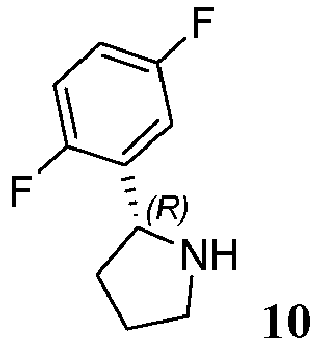

- In some embodiments, the process for preparing the compound of Formula I further comprises preparing the compound of formula 10 or a salt thereof by a process comprising treating a compound of formula 19

- wherein each of R3 and R4 is independently C1-C4 alkyl;
- or R3 and R4 taken together with the atoms connecting them form a five- to seven-membered ring.
- In some embodiments, the process for preparing the compound of Formula I further comprises preparing the compound of formula 19 or a salt thereof by a process comprising treating
a compound of formula 17

- wherein each of R3 and R4 is independently C1-C4 alkyl;
- or R3 and R4 taken together with the atoms connecting them form a five- to seven-membered ring.
- In some embodiments, the reagent system comprising

- In some embodiments, the process for preparing the compound of Formula I further comprises preparing the compound of formula 17 or a salt thereof by a process comprising treating a compound of formula 16

to form a compound of formula 17. - In some embodiments, provided herein is a process for preparing a pharmaceutical composition, comprising mixing (i) a compound of Formula I or salt thereof prepared according to any of the processes described herein, and (ii) a pharmaceutically acceptable carrier, to form the composition.
- In some embodiments, provided herein is a process for preparing a compound of formula 13

- a) treating a compound of formula 11

and - b) treating the first mixture with XC(O)Z to form a compound of formula 13 or a salt thereof,
- In some embodiments, provided herein is a process for preparing a compound of formula 13 or a salt thereof comprising
- a) isolating a compound of formula 12

- b) treating a compound of formula 12 with XC(O)Z to form a compound of formula 13 or a salt thereof; and
- c) optionally isolating the compound of formula 13.
- In some embodiments, provided herein is a process for preparing a compound of formula 12 or a salt thereof comprising
- a) treating a compound of formula 11

- b) isolating the compound of formula 12 or a salt thereof.
- In some embodiments, provided herein is a process for preparing a compound of formula 10 or a salt thereof, comprising treating a compound of formula 19

- In some embodiments, provided herein is a process for preparing a compound of formula 19 or a salt thereof, comprising treating a compound of formula 17


- In some embodiments, provided herein is a process for preparing a compound of formula 17 or a salt thereof, comprising treating a compound of formula 16

to form a compound of formula 17. - In some embodiments, provided herein is a compound of formula 19:

- In some embodiments, provided herein is a compound of formula 17:
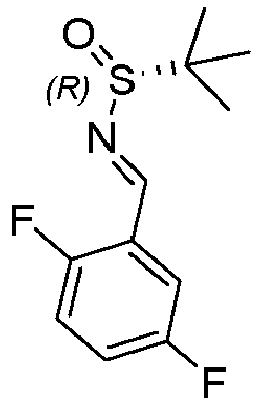
- A "nitro reduction system" is any substance or plurality of substances capable of converting a NO2 group to an NH2 group. Nitro reduction systems may include, for example, heterogeneous systems, homogeneous systems, catalytic systems, and non-catalytic systems. Examples of nitro reduction systems include systems comprising a metal or a compound of a metal, such as a salt of the metal or an oxide of the metal. Examples of such metals include palladium, platinum, rhodium, ruthenium, nickel, copper, iron, tin, and zinc. Examples of nitro reduction systems include systems comprising an acid. Such systems comprising an acid can also comprise a metal or a compound of a metal such as are disclosed herein. Examples of nitro reduction systems include systems comprising H2. Examples of nitro reduction systems include metal hydrides, which can be, for example, mixed metal hydrides. Examples of such metal hydrides include LiAlR4, NaBH4, diisobutylaluminium hydride (DIBAL), and the like. Examples of nitro reduction systems include systems comprising an organic compound capable of providing hydrogen. An example of such an organic compound capable of providing hydrogen is cyclohexene.
- More particular examples of nitro reduction systems are systems comprising Pd, Pd/C, Raney nickel, PtO2, Fe/acid, Zn/acid.
- The terms "hydrogen" and "H" are used interchangeably herein.
- The term "halogen" refers to fluorine (F), chlorine (CI), bromine (Br), or iodine (I).
- The term "alkyl" refers to a hydrocarbon chain that may be a straight chain or branched chain, containing the indicated number of carbon atoms. For example, C1-6 indicates that the group may have from 1 to 6 (inclusive) carbon atoms in it. Examples include methyl, ethyl, iso-propyl, tert-butyl, n-hexyl.
- The term "haloalkyl" refers to an alkyl, in which one or more hydrogen atoms is/are replaced with an independently selected halo.
- The term "alkoxy" refers to an -O-alkyl radical (e.g., -OCH3).
- The term "aryl" as used herein includes an aromatic monocyclic or bicyclic hydrocarbon radical having 6 to 10 carbons. Examples of aryl include phenyl and naphthyl.
- The term "heteroaryl" refers to an aromatic radical having 1-4 heteroatoms. Examples of heteroatoms are N, O, and S. Examples of heteroaryl include pyridyl, pyrimidinyl, furanyl, thiophenyl, pyrrolyl, pyrazolyl, imidazolyl, and the like.
- A salt can form from a compound in any manner familiar to the skilled artisan. Accordingly, the recitation "to form a compound or salt thereof' includes embodiments where a compound is formed and the salt is subsequently formed from the compound in a manner familiar to the killed artisan.
- The compounds disclosed herein include compounds having a sulfoxide group, as shown, by way of example, in the structure of compound 17, below:

- The sulfur-oxygen bond may also be rendered pictorially as being in ionic form. Thus, for example, compound 17 may also be rendered as shown the structure below:

- It is intended throughout this disclosure that the recitation of a given structure for a compound having a sulfoxide group encompasses all representations of the compound, whether the sulfur-oxygen bond is rendered as being an ionic bond, a covalent bond, a dative bond, or in any form that may be envisioned by the skilled artisan.
- It is appreciated that certain features of the invention, which are, for clarity, described in the context of separate embodiments, may also be provided in combination in a single embodiment. Conversely, various features of the invention, which are, for brevity, described in the context of a single embodiment, may also be provided separately or in any suitable subcombination.
- All combinations of the embodiments pertaining to the aspects described herein are specifically embraced by the present invention just as if each and every combination was individually explicitly recited, to the extent that such combinations embrace possible aspects. In addition, all subcombinations of the embodiments contained within the aspects described herein, as well as all subcombinations of the embodiments contained within all other aspects described herein, are also specifically embraced by the present invention just as if each and every subcombination of all embodiments are explicitly recited herein.
- In some embodiments, provided herein is a process for preparing a compound of Formula I

- (a) treating a compound of formula 13


- (b) optionally forming a salt of the compound of Formula I;
- In some embodiments, X is halogen. In some embodiments, X is Cl. In some embodiments, X is Br. In some embodiments, X is I. In some embodiments, X is C1-C6 alkoxy. In some embodiments, X is C6-C10 aryloxy. In some embodiments, X is phenoxy. In some embodiments, X is a 5-membered heteroaryl containing at least one nitrogen directly bonded to the C=O of the compound of formula 13. In some embodiments, X is imidazolyl.
- In some embodiments, the compound of formula 13 or salt thereof is in isolated form prior to the treatment with the compound of formula 14 or salt thereof.
- In some embodiments, provided herein is a process for preparing a compound of Formula I

comprising: - (a) isolating a compound of formula 13

- (b) optionally forming a salt of formula 13;
- (c) treating the compound of formula 13 or a salt thereof with a compound of formula 14
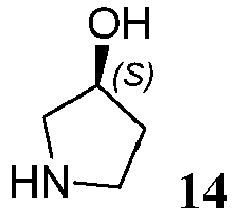
and - (d) optionally forming a salt of the compound of Formula I;
- In some embodiments, X is halogen. In some embodiments, X is Cl. In some embodiments, X is Br. In some embodiments, X is I. In some embodiments, X is C1-C6 alkoxy. In some embodiments, X is C6-C10 aryloxy. In some embodiments, X is phenoxy. In some embodiments, X is a 5-membered heteroaryl containing at least one nitrogen directly bonded to the C=O of the compound of formula 13. In some embodiments, X is imidazolyl.
- In some embodiments, the salt of the compound of formula I is the hydrogen sulfate salt.
- In some embodiments, forming a salt of the compound of formula I comprises treating the compound of formula I with an acid to form the salt.
- In some embodiments, forming a salt of the compound of formula I comprises treating a salt of the compound of formula I with an acid to form a different salt via anion exchange.
- In some embodiments, the process for preparing the compound of Formula I further comprises preparing the compound of formula 13

- (a) treating a compound of formula 11

- (b) treating the first mixture with XC(O)Z to form a compound of formula 13 or a salt thereof,
- In some embodiments, preparing the compound of formula 13 comprises: forming the compound of formula 13 in a second mixture; and isolating the compound of formula 13 from the second mixture.
- In some embodiments, the first mixture comprises a compound of formula 12

- In some embodiments, the salt of the compound of formula 12 is the fumarate salt.
- In some embodiments, Z is halogen.
- In some embodiments, Z is chlorine.
- In some embodiments, Z is bromine.
- In some embodiments, Z is imidazolyl.
- In some embodiments, the nitro reduction system with which compound 11 is treated is a heterogeneous system.
- In some embodiments, the nitro reduction system is a homogeneous system.
- In some embodiments, the nitro reduction system is a catalytic system.
- In some embodiments, the nitro reduction system is a non-catalytic systems.
- In some embodiments, the nitro reduction system comprises a metal or a compound of a metal, such as a salt of the metal or an oxide of the metal.
- In some embodiments, the nitro reduction system comprises palladium, platinum, rhodium, ruthenium, nickel, copper, iron, tin, or zinc.
- In some embodiments, the nitro reduction system comprises an acid. In some embodiments, the nitro reduction system comprising an acid comprises a metal or a compound of a metal.
- In some embodiments, the nitro reduction system comprises H2.
- In some embodiments, the nitro reduction system comprises a metal hydride. In some embodiments, the nitro reduction system comprises a mixed metal hydride. In some embodiments, the mixed metal hydride is LiAlH4, NaBH4, or diisobutylaluminium hydride (DIBAL).
- In some embodiments, the nitro reduction system comprises an organic compound capable of providing hydrogen. In some embodiments, the organic compound capable of providing hydrogen is cyclohexene.
- In some embodiments, the nitro reduction system comprises Pd, Pd/C, Raney nickel, PtO2, Fe/acid, or Zn/acid.
- In some embodiments, the nitro reduction system comprises Pd.
- In some embodiments, the nitro reduction system comprises Pd/C.
- In some embodiments, the process for preparing the compound of Formula I further comprises preparing the compound of formula 11 or a salt thereof by a process comprising treating a compound of formula 10


- In some embodiments, the salt of the compound of formula 10 is a malate salt. In some embodiments, the salt of the compound of formula 10 is the D-malate salt.
- The compound of formula 5 is disclosed in
US Application Ser. No. 14/943,014, filed November 16, 2015 
- In some embodiments, the process for preparing the compound of Formula I further comprises preparing the compound of formula 10 or a salt thereof by a process comprising treating a compound of formula 19

compound of formula 10 or a salt thereof. - In some embodiments, the first reducing agent is a silane. In some embodiments, the first reducing agent is triethylsilane.
- In some embodiments, each of R3 and R4 in the reagent system comprising the group


- In some embodiments, the reagent system comprising


- In some embodiments, the reagent system comprising

- In some embodiments, the reagent system comprising

- In some embodiments, the reagent system comprising

- In some embodiments, the reagent system comprising

- In some embodiments, the reagent system comprising

- In some embodiments, the reagent system comprising

- In some embodiments, the reagent system comprising

- In some embodiments, the reagent system comprising

- In some embodiments, the reagent system comprising

- In some embodiments, the reagent system comprising

- In some embodiments, the reagent system comprising

- In some embodiments, the reagent system comprising


- In some embodiments, the process for preparing the compound of Formula I further comprises preparing the compound of formula 19 or a salt thereof by a process comprising treating a compound of formula 17


- In some embodiments, the process for preparing the compound of Formula I further comprises preparing the compound of formula 17 or a salt thereof by a process comprising treating a compound of formula 16

- In some embodiments, treating a compound of formula 16 with (R)-2-methylpropane-2-sulfinamide is performed in the presence of a base.
- In some embodiments, provided herein is a process for preparing a compound of formula 13

- a) treating a compound of formula 11

and - b) treating the first mixture with XC(O)Z to form a compound of formula 13 or a salt thereof,
- In some embodiments, provided herein is a process for preparing a compound of formula 13 or a salt thereof comprising
- (a) isolating a compound of formula 12

- (b) treating a compound of formula 12 with XC(O)Z to form a compound of formula 13 or a salt thereof; and
- (c) optionally isolating the compound of formula 13,
- In some embodiments, provided herein is a process for preparing a compound of
formula 12 or a salt thereof comprising - a) treating a compound of formula 11

and - b) isolating the compound of formula 12 or a salt thereof.
- In some embodiments, provided herein is a process for preparing a compound of formula 10 or a salt thereof by a process comprising
treating a compound of formula 19
compound of formula 10 or a salt thereof - In some embodiments, provided herein is a process for preparing a compound of formula 19 or a salt thereof by a process comprising treating a compound of formula 17


- In some embodiments, provided herein is a process for preparing a compound of formula 17 or a salt thereof by a process comprising treating a compound of formula 16

to form a compound of formula 17. - In some embodiments, provided herein is a compound of formula 19:

- In some embodiments, provided herein is a compound of formula 17:

- In some embodiments, provided herein is a process for preparing a pharmaceutical composition comprising mixing (i) a compound of Formula I or salt thereof prepared according to any of the processes described herein, and (ii) a pharmaceutically acceptable carrier. Pharmaceutical compositions containing the compound of Formula I or a salt thereof as the active ingredient can be prepared by intimately mixing the compound of Formula I or a salt thereof with a pharmaceutical carrier according to conventional pharmaceutical compounding techniques. The carrier may take a wide variety of forms depending upon the desired route of administration (e.g., oral, parenteral). Thus for liquid oral preparations such as suspensions, elixirs and solutions, suitable carriers and additives include water, glycols, oils, alcohols, flavoring agents, preservatives, stabilizers, coloring agents and the like; for solid oral preparations, such as powders, capsules and tablets, suitable carriers and additives include starches, sugars, diluents, granulating agents, lubricants, binders, disintegrating agents and the like. Solid oral preparations may also be coated with substances such as sugars or be enteric-coated so as to modulate major site of absorption. For parenteral administration, the carrier will usually consist of sterile water and other ingredients may be added to increase solubility or preservation. Injectable suspensions or solutions may also be prepared utilizing aqueous carriers along with appropriate additives.
- The compound of Formula I or a salt thereof may be administered by any convenient route, e.g. into the gastrointestinal tract (e.g. rectally or orally), the nose, lungs, musculature or vasculature, or transdermally or dermally. The compound of Formula I or a salt thereof may be administered in any convenient administrative form, e.g. tablets, powders, capsules, solutions, dispersions, suspensions, syrups, sprays, suppositories, gels, emulsions, patches etc. Such compositions may contain components conventional in pharmaceutical preparations, e.g. diluents, carriers, pH modifiers, sweeteners, bulking agents, and further active agents. If parenteral administration is desired, the compositions will be sterile and in a solution or suspension form suitable for injection or infusion. Such compositions form a further aspect of the invention.
- Also provided herein are pharmaceutical compositions comprising a compound of Formula I or salt thereof. To prepare the pharmaceutical compositions provided herein, the compound of Formula I or a salt thereof as the active ingredient is intimately admixed with a pharmaceutical carrier according to conventional pharmaceutical compounding techniques, which carrier may take a wide variety of forms depending of the form of preparation desired for administration, e.g., oral or parenteral such as intramuscular. In preparing the compositions in oral dosage form, any of the usual pharmaceutical media may be employed. Thus, for liquid oral preparations, such as for example, suspensions, elixirs and solutions, suitable carriers and additives include water, glycols, glycerols, oils, cyclodextrins, alcohols, e.g., ethanol, flavoring agents, preservatives, coloring agents and the like; for solid oral preparations such as, for example, powders, capsules, caplets, gelcaps and tablets, suitable carriers and additives include starches, sugars, diluents, granulating agents, lubricants, binders, disintegrating agents and the like. Suitable binders include, without limitation, starch, gelatin, natural sugars such as glucose or beta-lactose, corn sweeteners, natural and synthetic gums such as acacia, tragacanth or sodium oleate, sodium stearate, magnesium stearate, sodium benzoate, sodium acetate, sodium chloride and the like. Disintegrators include, without limitation, starch, methyl cellulose, agar, bentonite, xanthan gum and the like.
- Because of their ease in administration, tablets and capsules represent the most advantageous oral dosage unit form, in which case solid pharmaceutical carriers are obviously employed. If desired, tablets may be sugar coated or enteric coated by standard techniques. For parenterals, the carrier will usually comprise sterile water, through other ingredients, for example, for purposes such as aiding solubility or for preservation, may be included. Injectable suspensions may also be prepared, in which case appropriate liquid carriers, suspending agents and the like may be employed. The pharmaceutical compositions herein will contain, per dosage unit, e.g., tablet, capsule, powder, injection, teaspoonful and the like, an amount of the active ingredient necessary to deliver an effective dose as described above.
- The pharmaceutical compositions herein will contain, per unit dosage unit, e.g., tablet, capsule, suspension, solution, sachet for reconstitution, powder, injection, I.V., suppository, sublingual/buccal film, teaspoonful and the like, of from about 0.1-1000 mg or any range therein, and may be given at a dosage of from about 0.01-300 mg/kg/day, or any range therein, preferably from about 0.5-50 mg/kg/day, or any range therein. In some embodiments, the pharmaceutical compositions provided herein contain, per unit dosage unit, about 25 mg to about 500 mg of a compound provided herein (for example, about 25 mg to about 400 mg, about 25 mg to about 300 mg, about 25 mg to about 250 mg, about 25 mg to about 200 mg, about 25 mg to about 150 mg, about 25 mg to about 100 mg, about 25 mg to about 75 mg, about 50 mg to about 500 mg, about 100 mg to about 500 mg, about 150 mg to about 500 mg, about 200 mg to about 500 mg, about 250 mg to about 500 mg, about 300 mg to about 500 mg, about 400 mg to about 500 mg, about 50 to about 200 mg, about 100 to about 250 mg, about 50 to about 150 mg). In some embodiments, the pharmaceutical compositions provided herein contain, per unit dosage unit, about 25 mg, about 50 mg, about 100 mg, about 150 mg, about 200 mg, about 250 mg, about 300 mg, about 400 mg, or about 500 mg of a compound provided herein. The dosages, however, may be varied depending upon the requirement of the patients, the severity of the condition being treated and the compound being employed. In some embodiments, the dosages are administered once daily (QD) or twice daily (BID).
- Preferably these compositions are in unit dosage forms from such as tablets, pills, capsules, powders, granules, sterile parenteral solutions or suspensions, metered aerosol or liquid sprays, drops, ampoules, autoinjector devices or suppositories; for oral parenteral, intranasal, sublingual or rectal administration, or for administration by inhalation or insufflation. Alternatively, the composition may be presented in a form suitable for once-weekly or once-monthly administration; for example, an insoluble salt of the active compound, such as the decanoate salt, may be adapted to provide a depot preparation for intramuscular injection. For preparing solid compositions such as tablets, the compound of Formula I or a salt thereof is mixed with a pharmaceutical carrier, e.g. conventional tableting ingredients such as corn starch, lactose, sucrose, sorbitol, talc, stearic acid, magnesium stearate, dicalcium phosphate or gums, and other pharmaceutical diluents, e.g. water, to form a solid composition containing a compound of Formula I or salt thereof. When referring to these preformulation compositions as homogeneous, it is meant that the active ingredient is dispersed evenly throughout the composition so that the composition may be readily subdivided into equally effective dosage forms such as tablets, pills and capsules. This solid preformulation composition is then subdivided into unit dosage forms of the type described above containing from 0.1 to about 1000 mg, or any amount or range thereof, of the active ingredient provided herein. The tablets or pills of the novel composition can be coated or otherwise compounded to provide a dosage form affording the advantage of prolonged action. For example, the tablet or pill can comprise an inner dosage and an outer dosage component, the latter being in the form of an envelope over the former. The two components can be separated by an enteric layer which serves to resist disintegration in the stomach and permits the inner component to pass intact into the duodenum or to be delayed in release. A variety of material can be used for such enteric layers or coatings, such materials including a number of polymeric acids with such materials as shellac, cetyl alcohol and cellulose acetate.
- The liquid forms in which the novel compositions provided herein may be incorporated for administration orally or by injection include, aqueous solutions, cyclodextrins, suitably flavored syrups, aqueous or oil suspensions, and flavored emulsions with edible oils such as cottonseed oil, sesame oil, coconut oil or peanut oil, as well as elixirs and similar pharmaceutical vehicles. Suitable dispersing or suspending agents for aqueous suspensions, include synthetic and natural gums such as tragacanth, acacia, alginate, dextran, sodium carboxymethylcellulose, methylcellulose, polyvinyl-pyrrolidone or gelatin. For parenteral administration, sterile suspensions and solutions are desired. Isotonic preparations which generally contain suitable preservatives are employed when intravenous administration is desired.
- The compound of Formula I or a salt thereof can be administered in intranasal form via topical use of suitable intranasal vehicles, or via transdermal skin patches well known to those of ordinary skill in that art. To be administered in the form of a transdermal delivery system, the dosage administration will, of course, be continuous rather than intermittent throughout the dosage regimen.
- To prepare a pharmaceutical compositions provided herein, the compound of Formula I or a salt thereof as the active ingredient is intimately admixed with a pharmaceutical carrier according to conventional pharmaceutical compounding techniques, which carrier may take a wide variety of forms depending of the form of preparation desired for administration (e.g. oral or parenteral). Suitable pharmaceutically acceptable carriers are well known in the art. Descriptions of some of these pharmaceutically acceptable carriers may be found in The Handbook of Pharmaceutical Excipients, published by the American Pharmaceutical Association and the Pharmaceutical Society of Great Britain.
- Methods of formulating pharmaceutical compositions have been described in numerous publications such as Pharmaceutical Dosage Forms: Tablets, Second Edition, Revised and Expanded, Volumes 1-3, edited by Lieberman et al; Pharmaceutical Dosage Forms: Parenteral Medications, Volumes 1-2, edited by Avis et al; and Pharmaceutical Dosage Forms: Disperse Systems, Volumes 1-2, edited by Lieberman et al; published by Marcel Dekker, Inc.
- Compounds provided herein may be administered in any of the foregoing compositions and according to dosage regimens established in the art whenever treatment of cancer, pain, inflammation, neurodegenerative disease or Trypanosoma cruzi infection is required.
- The daily dosage of the compound of Formula I or a salt thereof may be varied over a wide range from 1.0 to 10,000 mg per adult human per day, or higher, or any range therein. For oral administration, the compositions are preferably provided in the form of tablets containing, 0.01, 0.05, 0.1, 0.5, 1.0, 2.5, 5.0, 10.0, 15.0, 25.0, 50.0, 100, 150, 200, 250 and 500 milligrams of the active ingredient for the symptomatic adjustment of the dosage to the patient to be treated. An effective amount of the drug is ordinarily supplied at a dosage level of from about 0.1 mg/kg to about 1000 mg/kg of body weight per day, or any range therein. Preferably, the range is from about 0.5 to about 500 mg/kg of body weight per day, or any range therein. More preferably, from about 1.0 to about 250 mg/kg of body weight per day, or any range therein. More preferably, from about 0.1 to about 100 mg/kg of body weight per day, or any range therein. In an example, the range may be from about 0.1 to about 50.0 mg/kg of body weight per day, or any amount or range therein. In another example, the range may be from about 0.1 to about 15.0 mg/kg of body weight per day, or any range therein. In yet another example, the range may be from about 0.5 to about 7.5 mg/kg of body weight per day, or any amount to range therein. The compound of Formula I or a salt thereof may be administered on a regimen of 1 to 4 times per day or in a single daily dose.
- Optimal dosages to be administered may be readily determined by those skilled in the art, and will vary with the mode of administration, the strength of the preparation, the mode of administration, and the advancement of the disease condition. In addition, factors associated with the particular patient being treated, including patient age, weight, diet and time of administration, will result in the need to adjust dosages.
- The invention will now be further described by means of the following numbered paragraphs which are not the claims:
- 1. A process for preparing a compound of Formula I

comprising:- (a) treating a compound of formula 13
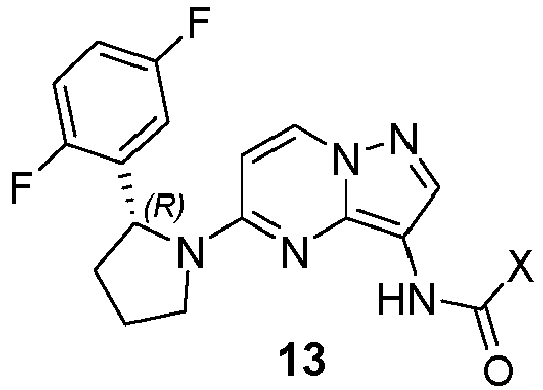

and - (b) optionally forming a salt of the compound of Formula I;
wherein X is halogen, C1-C6 alkoxy, C6-C10 aryloxy or a 5-membered heteroaryl containing at least one nitrogen directly bonded to the C=O of the compound of formula 13, each optionally substituted with one or more substituents independently selected from the group consisting of C1-C6 alkyl, C1-C6 haloalkyl, halogen, CN, OH, C1-C6 alkoxy, and NR1R2, where R1 and R2 are each independently selected from hydrogen and C1-C6 alkyl.
- (a) treating a compound of formula 13
- 2. The process of paragraph 1, wherein the compound of formula 13 or salt thereof is in isolated form prior to the treatment with the compound of formula 14 or salt thereof.
- 3. A process for preparing a compound of Formula I

comprising:- (a) isolating a compound of formula 13

- (b) optionally forming a salt of formula 13;
- (c) treating the compound of formula 13 or a salt thereof with a compound of formula 14

and - (d) optionally forming a salt of the compound of Formula I;
wherein X is halogen, C1-C6 alkoxy, C6-C10 aryloxy or a 5-membered heteroaryl containing at least one nitrogen directly bonded to the C=O of the compound of formula 13, each optionally substituted with one or more substituents independently selected from the group consisting of C1-C6 alkyl, C1-C6 haloalkyl, halogen, CN, OH, C1-C6 alkoxy, and NR1R2, where R1 and R2 are each independently selected from hydrogen and C1-C6 alkyl.
- (a) isolating a compound of formula 13
- 4. The process of paragraph 1, 2 or 3, wherein X is halogen.
- 5. The process of paragraph 4, wherein X is Cl.
- 6. The process of paragraph 4, wherein X is Br.
- 7. The process of paragraph 1, 2 or 3, wherein X is C6-C10 aryloxy.
- 8. The process of paragraph 7, wherein X is phenoxy.
- 9. The process of paragraph 1, 2 or 3, wherein X is a 5-membered heteroaryl containing at least one nitrogen directly bonded to the C=O of the compound of formula 13.
- 10. The process of paragraph 9, wherein X is imidazolyl.
- 11. The process of any one of the preceding paragraphs, further comprising preparing the compound of formula 13

- (a) treating a compound of formula 11

and - (b) treating the first mixture with XC(O)Z to form a compound of formula 13 or a salt thereof,
consisting of C1-C6 alkyl, C1-C6 haloalkyl, halogen, CN, OH, C1-C6 alkoxy, and NR5R6, where R5 and R6 are each independently selected from hydrogen and C1-C6 alkyl; provided that if Z is optionally substituted C1-C6 alkoxy, optionally substituted C6-C10 aryloxy, or optionally substituted 5-membered heteroaryl, then Z and X are the same. - (a) treating a compound of formula 11
- 12. The process of paragraph 11, wherein the process comprises:
- forming the compound of formula 13 in a second mixture; and
- isolating the compound of formula 13 from the second mixture.
- 13. The process of paragraph 11 or 12, wherein the first mixture comprises a compound of formula 12

- 14. The process of paragraph 13, wherein the salt of the compound of formula 12 is the fumarate salt.
- 15. The process of paragraph 13 or 14, wherein Z is halogen.
- 16. The process of paragraph 13 or 14, wherein Z is chlorine.
- 17. The process of paragraph 13 or 14, wherein Z is bromine.
- 18. The process of paragraph 13 or 14, wherein Z is a 5-membered heteroaryl containing at least one nitrogen directly bonded to the C=O of XC(O)Z.
- 19. The process of paragraph 18, wherein Z is imidazolyl.
- 20. The process of any one of paragraphs 11 to 19, wherein the nitro reduction system comprises a metal or a compound of a metal.
- 21. The process of paragraph 20, wherein the nitro reduction system comprises a metal.
- 22. The process of paragraph 20, wherein the nitro reduction system comprises a salt of a metal.
- 23. The process of paragraph 20, wherein the nitro reduction system comprises an oxide of a metal.
- 24. The process of any one of paragraphs 11 to 19, wherein the nitro reduction system comprises palladium, platinum, rhodium, ruthenium, nickel, copper, iron, tin, or zinc.
- 25. The process of any one of paragraphs 11 to 24, wherein the nitro reduction system comprises an acid.
- 26. The process of any one of paragraphs 11 to 19, wherein the nitro reduction system comprises a metal hydride.
- 27. The process of any one of paragraphs 11 to 19, wherein the nitro reduction system comprises a mixed metal hydride.
- 28. The process of any one of paragraphs 11 to 19, wherein the nitro reduction system comprises LiAlR4, NaBH4, or diisobutylaluminium hydride (DIBAL).
- 29. The process of any one of paragraphs 11 to 19, wherein the nitro reduction system comprises H2.
- 30. The process of any one of paragraphs 11 to 19, wherein the nitro reduction system comprises an organic compound capable of providing hydrogen.
- 31. The process of paragraph 30, wherein the nitro reduction system comprises cyclohexene.
- 32. The process of any one of paragraphs 11 to 19, wherein the nitro reduction system comprises Pd, Pd/C, Raney nickel, PtO2, Fe/acid, or Zn/acid.
- 33. The process of paragraph 32, wherein the nitro reduction system comprises Pd.
- 34. The process of paragraph 32, wherein the nitro reduction system comprises Pd/C.
- 35. The process of any one of the preceding paragraphs, further comprising preparing the compound of formula 11 or a salt thereof by a process comprising treating a compound of formula 10


- 36. The process of paragraph 35, wherein the salt of the compound of formula 10 is a malate salt.
- 37. The process of paragraph 35 or 36, wherein the salt of the compound of formula 10 is the D-malate salt.
- 38. The process of any one of paragraphs 35 to 37, further comprising preparing the compound of formula 10 or a salt thereof by a process comprising treating a compound of formula 19

- 39. The process of paragraph 38, wherein the first reducing agent is a silane.
- 40. The process of paragraph 38, wherein the first reducing agent is triethylsilane.
- 41. The process of paragraph 38 to 40, wherein each of R3 and R4 is the same.
- 42. The process of paragraph 38 to 40, wherein each of R3 and R4 is methyl.
- 43. The process of paragraph 38 to 40, wherein each of R3 and R4 is ethyl.
- 44. The process of paragraph 38 to 40, wherein R3 and R4 taken together with the atoms connecting them form a six-membered ring.
- 45. The process of paragraph 44, wherein R3 and R4 taken together with the atoms connecting them form the ring

- 46. The process of any one of paragraphs 38 to 45, further comprising preparing the compound of formula 19 or a salt thereof by a process comprising treating a compound of formula 17


- 47. The process of paragraph 46, wherein the reagent system comprising the group


- 48. The process of paragraph 46, wherein the second reducing agent is samarium iodide.
- 49. The process of paragraph 46, wherein the reagent system comprising

- 50. The process of paragraph 46, wherein the reagent system comprising


- 51. The process of paragraph 50, wherein M is M2Y.
- 52. The process of paragraph 50, wherein M is MgY.
- 53. The process of any one of paragraphs 48 to 52, wherein Y is Cl.
- 54. The process of any one of paragraphs 48 to 52, wherein Y is Br.
- 55. The process of any one of paragraphs 48 to 52, wherein Y is I.
- 56. The process of paragraph 50, wherein M is M1.
- 57. The process of any one of paragraphs 46 to 56, further comprising preparing the compound of formula 17 or a salt thereof by a process comprising treating a compound of formula 16

to form a compound of formula 17. - 58. The process of paragraph 57, wherein the process is performed in the presence of a base.
- 59. A process for preparing a pharmaceutical composition, comprising mixing (i) a compound of Formula I or salt thereof prepared according to the process of any one of the preceding paragraphs and (ii) a pharmaceutically acceptable carrier, to form the pharmaceutical composition.
- 60. The process of any one of the preceding paragraphs, wherein the salt of the compound of Formula I is the hydrogen sulfate salt.
- 61. A process for preparing a compound of formula 13

- a) treating a compound of formula 11

and - b) treating the first mixture with XC(O)Z to form a compound of formula 13 or a salt thereof,
consisting of C1-C6 alkyl, C1-C6 haloalkyl, halogen, CN, OH, C1-C6 alkoxy, and NR5R6, where R5 and R6 are each independently selected from hydrogen and C1-C6 alkyl; provided that if Z is optionally substituted C1-C6 alkoxy, optionally substituted C6-C10 aryloxy, or optionally substituted 5-membered heteroaryl, then Z and X are the same. - a) treating a compound of formula 11
- 62. A process for preparing a compound of formula 13 or a salt thereof comprising
- a) isolating a compound of formula 12
- b) treating a compound of formula 12 with XC(O)Z to form a compound of formula 13 or a salt thereof; and
- c) optionally isolating the compound of formula 13,
- a) isolating a compound of formula 12
- 63. A process for preparing a compound of formula 12 or a salt thereof comprising
- a) treating a compound of formula 11

- b) isolating the compound of formula 12 or a salt thereof.
- a) treating a compound of formula 11
- 64. A process for preparing a compound of formula 10 or a salt thereof, comprising treating a compound of formula 19

- Preparation of 10:
- 1)

- 2)
- 3)

- Salt formation: To a solution of (R)-2-(2,5-difluorophenyl)pyrrolidine 10 (1 eq) in EtOH (15 mL/g) was added D-(+)-Malic Acid (1 eq). The suspension was heated to 70 °C for 30 minutes (full dissolution had occurred before 70 °C was reached), and then allowed to cool to room temperature slowly (mixture was seeded when the temperature was < 40 °C). The slurry was stirred at room temperature overnight, then cooled to <5 °C the next morning. The suspension was stirred at <5 °C for 2h, filtered (PPFC), washed with cold EtOH (2 x 2 mL/g), and dried (50-55 °C) under vacuum to give the product as a white solid (96% based on 91% potency, product is an EtOH solvate or hemi-solvate).
-
- 1)

- 2)

- 3)

- 4)

- Concentrated sulfuric acid (392 mL) was added to a solution of 3031 g of (S)-N-(5-((R)-2-(2,5-difluorophenyl)pyrrolidin-1-yl)-pyrazolo[1,5 -a]pyrimidin-3 -yl)-3 - hydroxypyrrolidine-1-carboxamide in 18322 mL EtOH to form the hydrogen sulfate salt. The solution was seeded with 2 g of (S)-N-(5-((R)-2-(2,5-difluorophenyl)pyrrolidin-1-yl)-pyrazolo[1,5-a]pyrimidin-3-yl)-3-hydroxypyrrolidine-1-carboxamide hydrogen sulfate and the solution was stirred at room temperature for at least 2 hours to form a slurry of the hydrogen sulfate salt. Heptane (20888 g) was added and the slurry was stirred at room temperature for at least 60 min. The slurry was filtered and the filter cake was washed with 1:1 heptane/EtOH. The solids were then dried under vacuum at ambient temperature (oven temperature set at 15° Celsius).
- The dried hydrogen sulfate salt (6389 g from 4 combined lots) was added to a 5:95 w/w solution of water/2-butanone (total weight 41652 g). The mixture was heated at about 68° Celsius with stirring until the weight percent of ethanol was about 0.5%, during which time a slurry formed. The slurry was filtered, and the filter cake was washed with a 5:95 w/w solution of water/2-butanone. The solids were then dried under vacuum at ambient temperature (oven temperature set at 15° Celsius) to provide the crystalline form of (S)-N-(5-((R)-2-(2,5-difluorophenyl)-pyrrolidin-1-yl)-pyrazolo[1,5-a]pyrimidin-3-yl)-3-hydroxypyrrolidine-1-carboxamide hydrogen sulfate.
provided that if Z is optionally substituted C1-C6 alkoxy, optionally substituted C6-C10 aryloxy, or optionally substituted 5-membered heteroaryl, then Z and X are the same.
consisting of C1-C6 alkyl, C1-C6 haloalkyl, halogen, CN, OH, C1-C6 alkoxy, and NR5R6, where R5 and R6 are each independently selected from hydrogen and C1-C6 alkyl; provided that if Z is optionally substituted C1-C6 alkoxy, optionally substituted C6-C10 aryloxy, or optionally substituted 5-membered heteroaryl, then Z and X are the same.
Claims (12)
- A process for preparing a compound of Formula I:

comprising:(a) treating a compound of Formula 13:

and(b) optionally forming a salt of the compound of Formula 1;
wherein X is halogen, C1-C6 alkoxy, or C6-C10 aryloxy, each optionally substituted with one or more substituents independently selected from the group consisting of C1-C6 alkyl, Ci-C6 haloalkyl, halogen, CN, OH, C1-C6 alkoxy, and NR1R2, where R1 and R2 are each independently selected from hydrogen and C1-C6 alkyl. - The process of claim 1, wherein X is halogen.
- The process of claim 2, wherein X is Cl.
- The process of claim 2, wherein X is Br.
- The process of claim 1, wherein X is C6-C10 aryloxy.
- The process of claim 5, wherein X is phenoxy.
- The process according to any one of claims 1-6, further comprising the step of preparing the compound of Formula 13 by treating a compound of Formula 12:

wherein Z is a leaving group selected from halogen, C1-C6 alkoxy, C6-C10 aryloxy and a 5-membered heteroaryl containing at least one nitrogen directly bonded to the C=O of XC(O)Z, each optionally substituted with one or more substituents independently selected from the group consisting of C1-C6 alkyl, C1-C6 haloalkyl, halogen, CN, OH, C1-C6 alkoxy, and NR5R6 where R5 and R6 are each independently selected from hydrogen and C1-C6 alkyl; provided that if Z is optionally substituted C1-C6 alkoxy, optionally substituted C6-C10 aryloxy, then Z and X are the same. - The process according to claim 7, wherein the compound of Formula 12 or salt thereof is isolated prior to being treated with a compound of formula XC(O)Z.
- The process according to any one of claims 1-8, further comprising the step of preparing the compound of Formula 12 by treating a compound of Formula 11:

- The process according to claim 9, wherein the nitro reduction system comprises H2 and a metal.
- The process according to any one of claims 1-10, further comprising the step of preparing the compound of Formula 11 by treating a compound of Formula 5,


- An intermediate useful in the preparation of a TRK kinase inhibitor, having the structure of Formula 13:

wherein X is halogen, C1-C6 alkoxy, or C6-C10 aryloxy, each optionally substituted with one or more substituents independently selected from the group consisting of C1-C6 alkyl, C1-C6 haloalkyl, halogen, CN, OH, C1-C6 alkoxy, and NR1R2, where R1 and R2 are each independently selected from hydrogen and C1-C6 alkyl.
Priority Applications (3)
| Application Number | Priority Date | Filing Date | Title |
|---|---|---|---|
| SI201731380T SI3800189T1 (en) | 2016-05-18 | 2017-05-18 | Preparation of (s)-n-(5-((r)-2-(2,5-difluorophenyl)pyrrolidin-1-yl)pyrazolo(1,5-a)pyrimidin-3-yl)-3-hydroxypyrrolidine-1-carboxamide |
| HRP20230704TT HRP20230704T1 (en) | 2016-05-18 | 2017-05-18 | Preparation of (s)-n-(5-((r)-2-(2,5-difluorophenyl)pyrrolidin-1-yl)pyrazolo[1,5-a]pyrimidin-3-yl)-3-hydroxypyrrolidine-1-carboxamide |
| RS20230571A RS64698B1 (en) | 2016-05-18 | 2017-05-18 | Preparation of (s)-n-(5-((r)-2-(2,5-difluorophenyl)pyrrolidin-1-yl)pyrazolo[1,5-a]pyrimidin-3-yl)-3-hydroxypyrrolidine-1-carboxamide |
Applications Claiming Priority (3)
| Application Number | Priority Date | Filing Date | Title |
|---|---|---|---|
| US201662338359P | 2016-05-18 | 2016-05-18 | |
| EP17726442.1A EP3458456B1 (en) | 2016-05-18 | 2017-05-18 | Preparation of (s)-n-(5-((r)-2-(2,5-difluorophenyl)pyrrolidin-1-yl)pyrazolo[1,5-a]pyrimidin-3-yl)-3-hydroxypyrrolidine-1-carboxamide |
| PCT/US2017/033257 WO2017201241A1 (en) | 2016-05-18 | 2017-05-18 | Preparation of (s)-n-(5-((r)-2-(2,5-difluorophenyl)pyrrolidin-1-yl)pyrazolo[1,5-a]pyrimidin-3-y l)-3-hydroxypyrrolidine-1-carboxamide |
Related Parent Applications (1)
| Application Number | Title | Priority Date | Filing Date |
|---|---|---|---|
| EP17726442.1A Division EP3458456B1 (en) | 2016-05-18 | 2017-05-18 | Preparation of (s)-n-(5-((r)-2-(2,5-difluorophenyl)pyrrolidin-1-yl)pyrazolo[1,5-a]pyrimidin-3-yl)-3-hydroxypyrrolidine-1-carboxamide |
Publications (2)
| Publication Number | Publication Date |
|---|---|
| EP3800189A1 true EP3800189A1 (en) | 2021-04-07 |
| EP3800189B1 EP3800189B1 (en) | 2023-06-28 |
Family
ID=58794189
Family Applications (2)
| Application Number | Title | Priority Date | Filing Date |
|---|---|---|---|
| EP20208218.6A Active EP3800189B1 (en) | 2016-05-18 | 2017-05-18 | Preparation of (s)-n-(5-((r)-2-(2,5-difluorophenyl)pyrrolidin-1-yl)pyrazolo[1,5-a]pyrimidin-3-yl)-3-hydroxypyrrolidine-1-carboxamide |
| EP17726442.1A Active EP3458456B1 (en) | 2016-05-18 | 2017-05-18 | Preparation of (s)-n-(5-((r)-2-(2,5-difluorophenyl)pyrrolidin-1-yl)pyrazolo[1,5-a]pyrimidin-3-yl)-3-hydroxypyrrolidine-1-carboxamide |
Family Applications After (1)
| Application Number | Title | Priority Date | Filing Date |
|---|---|---|---|
| EP17726442.1A Active EP3458456B1 (en) | 2016-05-18 | 2017-05-18 | Preparation of (s)-n-(5-((r)-2-(2,5-difluorophenyl)pyrrolidin-1-yl)pyrazolo[1,5-a]pyrimidin-3-yl)-3-hydroxypyrrolidine-1-carboxamide |
Country Status (27)
| Country | Link |
|---|---|
| US (1) | US11214571B2 (en) |
| EP (2) | EP3800189B1 (en) |
| JP (1) | JP7443057B2 (en) |
| KR (1) | KR102566858B1 (en) |
| CN (1) | CN110049987B (en) |
| AU (1) | AU2017268371B2 (en) |
| CA (1) | CA3024603A1 (en) |
| CL (1) | CL2018003264A1 (en) |
| CO (1) | CO2018013015A2 (en) |
| DK (2) | DK3458456T3 (en) |
| ES (2) | ES2836222T3 (en) |
| FI (1) | FI3800189T3 (en) |
| HR (2) | HRP20201984T1 (en) |
| HU (2) | HUE053643T2 (en) |
| IL (1) | IL262964B (en) |
| LT (2) | LT3458456T (en) |
| MX (1) | MX392604B (en) |
| PE (1) | PE20190437A1 (en) |
| PL (2) | PL3800189T3 (en) |
| PT (2) | PT3458456T (en) |
| RS (2) | RS61463B1 (en) |
| RU (1) | RU2745953C2 (en) |
| SG (1) | SG11201810245WA (en) |
| SI (2) | SI3458456T1 (en) |
| UA (1) | UA127826C2 (en) |
| WO (1) | WO2017201241A1 (en) |
| ZA (1) | ZA201808534B (en) |
Families Citing this family (22)
| Publication number | Priority date | Publication date | Assignee | Title |
|---|---|---|---|---|
| RS53350B (en) | 2008-09-22 | 2014-10-31 | Array Biopharma, Inc. | SUBSTITUTED COMPOUNDS OF IMIDASO [1,2-B] PYRIDASINE AS INK KINASE INHIBITORS |
| HRP20140309T1 (en) | 2008-10-22 | 2014-05-09 | Array Biopharma, Inc. | SUBSTITUTED COMPOUNDS OF PIRAZOLO [1,5-a] PYRIMIDINE AS INHIBITORS OF TRK KINASE |
| AR077468A1 (en) | 2009-07-09 | 2011-08-31 | Array Biopharma Inc | PIRAZOLO COMPOUNDS (1,5-A) PYRIMIDINE SUBSTITUTED AS TRK-QUINASA INHIBITORS |
| KR102015402B1 (en) | 2010-05-20 | 2019-08-28 | 어레이 바이오파마 인크. | Macrocyclic compounds as trk kinase inhibitors |
| JP6914834B2 (en) | 2014-11-16 | 2021-08-04 | アレイ バイオファーマ インコーポレイテッド | (S) -N- (5-((R) -2- (2,5-difluorophenyl) -pyrrolidine-1-yl) -pyrazolo [1,5-a] pyrimidin-3-yl) -3-hydroxy Crystal form of pyrrolidine-1-carboxamide hydrogen sulfate |
| TN2018000138A1 (en) | 2015-10-26 | 2019-10-04 | Array Biopharma Inc | Point mutations in trk inhibitor-resistant cancer and methods relating to the same |
| US10045991B2 (en) | 2016-04-04 | 2018-08-14 | Loxo Oncology, Inc. | Methods of treating pediatric cancers |
| AU2017246554B2 (en) | 2016-04-04 | 2022-08-18 | Loxo Oncology, Inc. | Liquid formulations of (S)-N-(5-((R)-2-(2,5-difluorophenyl)-pyrrolidin-1-yl)-pyrazolo(1,5-a)pyrimidin-3-yl)-3-hydroxypyrrolidine-1-carboxamide |
| KR102566858B1 (en) | 2016-05-18 | 2023-08-11 | 어레이 바이오파마 인크. | (S)-N-(5-((R)-2-(2,5-difluorophenyl)pyrrolidin-1-yl)-pyrazolo[1,5-A]pyrimidin-3-yl Method for producing )-3-hydroxypyrrolidine-1-carboxamide |
| JOP20190092A1 (en) | 2016-10-26 | 2019-04-25 | Array Biopharma Inc | PROCESS FOR THE PREPARATION OF PYRAZOLO[1,5-a]PYRIMIDINES AND SALTS THEREOF |
| JOP20190213A1 (en) | 2017-03-16 | 2019-09-16 | Array Biopharma Inc | Macrocyclic compounds as ros1 kinase inhibitors |
| US11344553B2 (en) * | 2017-08-11 | 2022-05-31 | Teligene Ltd. | Substituted pyrazolopyrimidines useful as kinases inhibitors |
| CN109232582B (en) * | 2018-11-28 | 2021-02-05 | 安礼特(上海)医药科技有限公司 | Crystalline form of ralotinib bisulfate, preparation and application thereof |
| CN112457231A (en) * | 2019-09-09 | 2021-03-09 | 上海医药工业研究院 | Racemization method of larotrytinib intermediate |
| CN110804059B (en) * | 2019-09-30 | 2024-03-12 | 郑州泰基鸿诺医药股份有限公司 | Carbamate compounds, pharmaceutical compositions and their applications |
| CN111138437B (en) * | 2019-12-04 | 2021-03-05 | 杭州华东医药集团新药研究院有限公司 | Substituted pyrazolo [1,5-a ] pyrimidine amino acid derivatives and uses thereof |
| CN112624950A (en) * | 2020-12-10 | 2021-04-09 | 北京蓝博特科技有限公司 | Synthesis method of (R) -2- (2, 5-difluorophenyl) pyrrolidine |
| WO2022168115A1 (en) | 2021-02-05 | 2022-08-11 | Mylan Laboratories Limited | A process for the preparation of larotrectinib or its salts |
| CN113444070A (en) * | 2021-07-28 | 2021-09-28 | 深圳市真味生物科技有限公司 | Preparation method for synthesizing chiral nicotine from chiral tert-butyl sulfinamide |
| CN115872905B (en) * | 2021-09-29 | 2024-08-09 | 凯特立斯(深圳)科技有限公司 | A preparation method of larotrectinib intermediate |
| WO2024023836A1 (en) | 2022-07-27 | 2024-02-01 | Mylan Laboratories Limited | Polymorphic form of larotrectinib sulfate |
| EP4382529A1 (en) | 2022-12-07 | 2024-06-12 | Bayer Consumer Care AG | A process for preparing pure (3s)-pyrrolidin-3-ol and pure (3s)-pyrrolidin-3-ol hydrochloride |
Citations (2)
| Publication number | Priority date | Publication date | Assignee | Title |
|---|---|---|---|---|
| WO2010048314A1 (en) | 2008-10-22 | 2010-04-29 | Array Biopharma Inc. | SUBSTITUTED PYRAZOLO[1,5-a]PYRIMIDINE COMPOUNDS AS TRK KINASE INHIBITORS |
| WO2016077841A1 (en) * | 2014-11-16 | 2016-05-19 | Array Biopharma, Inc. | Crystalline form of (s)-n-(5-((r)-2-(2,5-difluorophenyl)-pyrrolidin-1-yl)-pyrazolo[1,5-a]pyrimidin-3-yl)-3-hydroxypyrrolidine-1-carboxamide hydrogen sulfate |
Family Cites Families (270)
| Publication number | Priority date | Publication date | Assignee | Title |
|---|---|---|---|---|
| NZ234143A (en) | 1989-06-28 | 1991-10-25 | Mcneil Ppc Inc | Aqueous pharmaceutical suspension formulation for administering substantially insoluble pharmaceutical agents |
| GB9212308D0 (en) * | 1992-06-10 | 1992-07-22 | Ici Plc | Therapeutic compositions |
| RO118291B1 (en) | 1993-11-30 | 2003-04-30 | Searle & Co | PIRAZOL DERIVATIVES 1,3,4,5 - TETRASUBSTITUITIS AND PHARMACEUTICAL COMPOSITION CONTAINING CONTAINERS |
| US5430021A (en) | 1994-03-18 | 1995-07-04 | Pharmavene, Inc. | Hydrophobic drug delivery systems |
| US5877016A (en) | 1994-03-18 | 1999-03-02 | Genentech, Inc. | Human trk receptors and neurotrophic factor inhibitors |
| US5844092A (en) | 1994-03-18 | 1998-12-01 | Genentech, Inc. | Human TRK receptors and neurotrophic factor inhibitors |
| US6458811B1 (en) | 1996-03-26 | 2002-10-01 | Eli Lilly And Company | Benzothiophenes formulations containing same and methods |
| CA2206201A1 (en) | 1996-05-29 | 1997-11-29 | Yoshiaki Isobe | Pyrazole derivatives and their pharmaceutical use |
| JP3898296B2 (en) | 1996-08-28 | 2007-03-28 | ポーラ化成工業株式会社 | Pyrrolopyrazolopyrimidine compounds and pharmaceuticals containing the same as active ingredients |
| EP0979231B1 (en) | 1997-04-25 | 2004-11-24 | Takeda Chemical Industries, Ltd. | Condensed pyridazine derivatives, their production and use |
| CA2359646C (en) | 1999-01-21 | 2008-12-02 | Bristol-Myers Squibb Company | Complex of ras-farnesyltransferase inhibitor and sulfobutylether-7-.beta.-cyclodextrin or 2-hydroxypropyl-.beta.-cyclodextrin and method |
| UA74546C2 (en) | 1999-04-06 | 2006-01-16 | Boehringer Ingelheim Ca Ltd | Macrocyclic peptides having activity relative to hepatitis c virus, a pharmaceutical composition and use of the pharmaceutical composition |
| US6534085B1 (en) | 1999-09-23 | 2003-03-18 | Bioresponse L.L.C. | Phytochemicals for promoting weight loss |
| IL153375A0 (en) | 2000-06-22 | 2003-07-06 | Genentech Inc | Agonist anti-trk-c monoclonal antibodies |
| GB0028575D0 (en) | 2000-11-23 | 2001-01-10 | Elan Corp Plc | Oral pharmaceutical compositions containing cyclodextrins |
| GB0121919D0 (en) * | 2001-09-11 | 2001-10-31 | Astrazeneca Ab | Chemical compounds |
| WO2002051806A1 (en) | 2000-12-22 | 2002-07-04 | Astrazeneca Ab | Carbazole derivatives and their use as neuropeptide y5 receptor ligands |
| TWI312347B (en) | 2001-02-08 | 2009-07-21 | Eisai R&D Man Co Ltd | Bicyclic nitrogen-containing condensed ring compounds |
| EP2340849A1 (en) | 2001-05-30 | 2011-07-06 | Genentech, Inc. | Anti-NGF antibodies for the treatment of various disorders |
| US7101572B2 (en) | 2001-12-07 | 2006-09-05 | Unilab Pharmatech, Ltd. | Taste masked aqueous liquid pharmaceutical composition |
| US20030199525A1 (en) | 2002-03-21 | 2003-10-23 | Hirst Gavin C. | Kinase inhibitors |
| KR20040097375A (en) | 2002-04-23 | 2004-11-17 | 시오노기 앤드 컴파니, 리미티드 | Pyrazolo[1, 5-a]pyrimidine derivative and NAD(P)H oxidase inhibitor containing the same |
| US7449488B2 (en) | 2002-06-04 | 2008-11-11 | Schering Corporation | Pyrazolopyrimidines as protein kinase inhibitors |
| US6982253B2 (en) | 2002-06-05 | 2006-01-03 | Supergen, Inc. | Liquid formulation of decitabine and use of the same |
| ITMI20021620A1 (en) | 2002-07-23 | 2004-01-23 | Novuspharma Spa | ANTI-TUMORAL ACTIVITY COMPOUND |
| JP4024624B2 (en) | 2002-08-26 | 2007-12-19 | 富士通株式会社 | Semiconductor device manufacturing method and manufacturing apparatus |
| US7196078B2 (en) | 2002-09-04 | 2007-03-27 | Schering Corpoartion | Trisubstituted and tetrasubstituted pyrazolopyrimidines as cyclin dependent kinase inhibitors |
| MXPA05002571A (en) | 2002-09-04 | 2005-09-08 | Schering Corp | Pyrazolopyrimidines as cyclin-dependent kinase inhibitors. |
| US8580782B2 (en) | 2002-09-04 | 2013-11-12 | Merck Sharp & Dohme Corp. | Substituted pyrazolo[1,5-a]pyrimidines as cyclin dependent kinase inhibitors |
| US7119200B2 (en) | 2002-09-04 | 2006-10-10 | Schering Corporation | Pyrazolopyrimidines as cyclin dependent kinase inhibitors |
| AU2003299651A1 (en) | 2002-12-11 | 2004-06-30 | Merck And Co., Inc. | Tyrosine kinase inhibitors |
| US7262199B2 (en) | 2002-12-11 | 2007-08-28 | Merck & Co., Inc. | Tyrosine kinase inhibitors |
| DE602004021472D1 (en) | 2003-02-20 | 2009-07-23 | Smithkline Beecham Corp | Pyrimiidinverbindungen |
| GB0303910D0 (en) | 2003-02-20 | 2003-03-26 | Merck Sharp & Dohme | Therapeutic agents |
| WO2004082458A2 (en) | 2003-02-21 | 2004-09-30 | The Johns Hopkins University | Tyrosine kinome |
| JP2004277337A (en) | 2003-03-14 | 2004-10-07 | Sumitomo Pharmaceut Co Ltd | Pyrazolo [1,5-a] pyrimidine derivatives |
| US20070179161A1 (en) | 2003-03-31 | 2007-08-02 | Vernalis (Cambridge) Limited. | Pyrazolopyrimidine compounds and their use in medicine |
| EP1615667A2 (en) | 2003-04-11 | 2006-01-18 | Novo Nordisk A/S | Combinations of an 11-beta-hydroxysteroid dehydrogenase type 1 inhibitor and a glucocorticoid receptor agonist |
| US20060094699A1 (en) | 2003-04-11 | 2006-05-04 | Kampen Gita Camilla T | Combination therapy using an 11beta-hydroxysteroid dehydrogenase type 1 inhibitor and a glucocorticoid receptor agonist to minimize the side effects associated with glucocorticoid receptor agonist therapy |
| WO2004089471A2 (en) | 2003-04-11 | 2004-10-21 | Novo Nordisk A/S | NEW PYRAZOLO[1,5-a] PYRIMIDINES DERIVATIVES AND PHARMACEUTICAL USE THEREOF |
| EP1619203A1 (en) | 2003-04-28 | 2006-01-25 | Galpharma Co., Ltd. | Galectin 9-inducing factor |
| PA8603801A1 (en) | 2003-05-27 | 2004-12-16 | Janssen Pharmaceutica Nv | DERIVATIVES OF QUINAZOLINE |
| JP2005008581A (en) | 2003-06-20 | 2005-01-13 | Kissei Pharmaceut Co Ltd | Novel pyrazolo [1,5-a] pyrimidine derivatives, pharmaceutical compositions containing the same, and uses thereof |
| EA009517B1 (en) | 2003-06-27 | 2008-02-28 | Байер Кропсайенс Аг | Pyrazolopyrimidines |
| MEP31508A (en) | 2003-07-15 | 2010-10-10 | Amgen Inc | HUMAN ANTI-NGF NEUTRAL ANTIBODIES AS SELECTIVE NGF SIGNAL CASCADE INHIBITORS |
| US7491794B2 (en) | 2003-10-14 | 2009-02-17 | Intermune, Inc. | Macrocyclic compounds as inhibitors of viral replication |
| WO2005044835A1 (en) | 2003-10-27 | 2005-05-19 | Genelabs Technologies, Inc. | METHODS FOR PREPARING 7-(2'-SUBSTITUTED-ß-D-RIBOFURANOSYL)-4-(NR2R3)-5-(SUBSTITUTED ETHYN-1-YL)-PYRROLO[2,3-D]PYRIMIDINE DERIVATIVES |
| MY141220A (en) | 2003-11-17 | 2010-03-31 | Astrazeneca Ab | Pyrazole derivatives as inhibitors of receptor tyrosine kinases |
| TW200529849A (en) | 2003-11-28 | 2005-09-16 | Novartis Ag | Diaryl urea derivatives in the treatment of protein kinase dependent diseases |
| DE602004012891T2 (en) | 2003-12-18 | 2009-04-09 | Janssen Pharmaceutica N.V. | PYRIDO AND PYRIMIDOPYRIMIDIN DERIVATIVES AS ANTI-PROLIFERATIVE AGENTS |
| PL1696920T3 (en) | 2003-12-19 | 2015-03-31 | Plexxikon Inc | Compounds and methods for development of ret modulators |
| WO2005068424A1 (en) | 2004-01-20 | 2005-07-28 | Cell Therapeutics Europe S.R.L. | Indolinone derivatives as receptor tyrosine kinase ihibitors |
| US20050222171A1 (en) | 2004-01-22 | 2005-10-06 | Guido Bold | Organic compounds |
| WO2005099363A2 (en) | 2004-03-26 | 2005-10-27 | Whitehead Institute For Biomedical Research | Methods of diagnosing, preventing and treating cancer metastasis |
| UA91677C2 (en) | 2004-03-30 | 2010-08-25 | Интермюн, Инк. | Macrocyclic compounds as inhibitors of hcv replication |
| GB0512324D0 (en) | 2005-06-16 | 2005-07-27 | Novartis Ag | Organic compounds |
| PE20060664A1 (en) | 2004-09-15 | 2006-08-04 | Novartis Ag | BICYCLE AMIDAS AS KINASE INHIBITORS |
| ES2354824T3 (en) | 2004-11-04 | 2011-03-18 | Vertex Pharmaceuticals, Inc. | PIRAZOLO [1,5-A] USEFUL PYRIMIDINS AS INHIBITORS OF KINASE PROTEINS. |
| JO3088B1 (en) | 2004-12-08 | 2017-03-15 | Janssen Pharmaceutica Nv | Macrocyclic Quinazoline derivatives and their use as MTKI |
| DE102005003687A1 (en) | 2005-01-26 | 2006-07-27 | Sphingo Tec Gmbh | Immunodiagnostic determination of neurotensin in mammal blood, comprises injecting immune active N-terminal mammal proneurotensin in to the serum- or plasma- sample |
| CN101119996A (en) | 2005-02-16 | 2008-02-06 | 阿斯利康(瑞典)有限公司 | chemical compound |
| WO2006087538A1 (en) | 2005-02-16 | 2006-08-24 | Astrazeneca Ab | Chemical compounds |
| PT1869049E (en) | 2005-03-21 | 2009-05-26 | Lilly Co Eli | Imidazopyridazine compounds |
| US20090005396A1 (en) | 2005-04-27 | 2009-01-01 | Astrazeneca Ab | Use of Pyrazolyl-Pyrimidine Derivatives in the Treatment of Pain |
| JP2008540622A (en) | 2005-05-16 | 2008-11-20 | アストラゼネカ アクチボラグ | Compound |
| CN100406650C (en) | 2005-06-05 | 2008-07-30 | 徐斌 | A Modular Comb-type Bridge Expansion Joint Device Against Large Displacement |
| ITRM20050290A1 (en) | 2005-06-07 | 2006-12-08 | Lay Line Genomics Spa | USE OF MOLECULES ABLE TO INHIBIT THE BOND BETWEEN NGF AND ITS TRKA RECEPTOR AS AN EXTENDED EFFECT ANALGESICS. |
| DK2395004T3 (en) | 2005-06-22 | 2016-03-21 | Plexxikon Inc | Pyrrolo [2,3-b] pyridine derivatives as protein kinase inhibitors |
| US20070025540A1 (en) | 2005-07-07 | 2007-02-01 | Roger Travis | Call center routing based on talkativeness |
| JP5249028B2 (en) | 2005-07-25 | 2013-07-31 | インターミューン・インコーポレーテッド | Novel macrocyclic inhibitor of hepatitis C virus replication |
| JP2009502734A (en) | 2005-07-29 | 2009-01-29 | アステラス製薬株式会社 | Fused heterocycles as Lck inhibitors |
| US20070184117A1 (en) | 2005-08-03 | 2007-08-09 | Stephen Gregory | Tocopheryl polyethylene glycol succinate powder and process for preparing same |
| US20070191306A1 (en) | 2005-08-17 | 2007-08-16 | Bristol-Myers Squibb Company | FACTOR Xa INHIBITOR FORMULATION AND METHOD |
| WO2007024680A1 (en) | 2005-08-22 | 2007-03-01 | Amgen Inc. | Pyrazolopyridine and pyrazolopyrimidine compounds useful as kinase enzymes modulators |
| US20070049591A1 (en) | 2005-08-25 | 2007-03-01 | Kalypsys, Inc. | Inhibitors of MAPK/Erk Kinase |
| HRP20140218T4 (en) | 2005-08-25 | 2017-06-16 | Creabilis Therapeutics S.P.A. | POLYMER CONJUGATES K-252A AND THEIR DERIVATIVES |
| DE102005042742A1 (en) | 2005-09-02 | 2007-03-08 | Schering Ag | Substituted imidazo [1,2b] pyridazines as kinase inhibitors, their production and use as pharmaceuticals |
| US20070078136A1 (en) | 2005-09-22 | 2007-04-05 | Bristol-Myers Squibb Company | Fused heterocyclic compounds useful as kinase modulators |
| CN101316847A (en) | 2005-10-06 | 2008-12-03 | 先灵公司 | Pyrazolo (1,5A) pyrimidine compounds as protein kinase inhibitors |
| BRPI0616985B1 (en) | 2005-10-06 | 2021-10-26 | Merck Sharp & Dohme Corp. | PIRAZOLE[1,5-A]PYRIMIDINE COMPOUND, E, USE OF A COMPOUND |
| US7880021B2 (en) | 2005-10-11 | 2011-02-01 | Centre National De La Recherche Scientifique (Cnrs) | Compounds and kits for the detection and the quantification of cell apoptosis |
| GEP20104956B (en) | 2005-10-11 | 2010-04-12 | Array Biopharma Inc | Compounds for inhibiting hepatitis c viral replication and use thereof |
| WO2007048064A2 (en) | 2005-10-21 | 2007-04-26 | Exelixis, Inc. | Amino-pyrimidines as casein kinase ii (ck2) modulators |
| WO2007057399A2 (en) | 2005-11-15 | 2007-05-24 | Boehringer Ingelheim International Gmbh | Treatment of cancer with indole derivatives |
| GB0524436D0 (en) | 2005-11-30 | 2006-01-11 | Novartis Ag | Organic compounds |
| WO2007070504A2 (en) | 2005-12-13 | 2007-06-21 | Morton Grove Pharmaceuticals, Inc. | Stable and palatable oral liquid sumatriptan compositions |
| WO2007077435A1 (en) | 2005-12-30 | 2007-07-12 | Astex Therapeutics Limited | Pharmaceutical compounds |
| US20080108611A1 (en) | 2006-01-19 | 2008-05-08 | Battista Kathleen A | Substituted thienopyrimidine kinase inhibitors |
| WO2007087245A2 (en) | 2006-01-24 | 2007-08-02 | Merck & Co., Inc. | Ret tyrosine kinase inhibition |
| KR100846988B1 (en) | 2006-03-06 | 2008-07-16 | 제일약품주식회사 | Novel thienopyrimidine derivatives or pharmaceutically acceptable salts thereof, process for the preparation thereof and pharmaceutical composition comprising the same |
| MX2008011220A (en) | 2006-03-07 | 2008-09-11 | Array Biopharma Inc | Heterobicyclic pyrazole compounds and methods of use. |
| UA94097C2 (en) | 2006-03-27 | 2011-04-11 | НЕРВИАНО МЕДИКАЛ САЙЕНСИЗ С.р.л. | Pyridyl- and pyrimidinyl-substituted pyrrole-, thiophene- and furane-derivatives as kinase inhibitors |
| GB0606805D0 (en) | 2006-04-04 | 2006-05-17 | Novartis Ag | Organic compounds |
| RU2439074C2 (en) | 2006-04-26 | 2012-01-10 | Ф. Хоффманн-Ля Рош Аг | THIENO[3,2-d]PYRIMIDINE DERIVATIVE AS PHOSPHATIDYL INOSITOL-3-KINASE (PI3K) INHIBITOR |
| WO2007136103A1 (en) | 2006-05-18 | 2007-11-29 | Eisai R & D Management Co., Ltd. | Antitumor agent for thyroid cancer |
| EP1873157A1 (en) | 2006-06-21 | 2008-01-02 | Bayer Schering Pharma Aktiengesellschaft | Pyrazolopyrimidines and salts thereof, pharmaceutical compositions comprising same, methods of preparing same and uses of same |
| TWI419889B (en) | 2006-07-05 | 2013-12-21 | Mitsubishi Tanabe Pharma Corp | A pyrazolo [1,5-a] pyrimidine compound |
| US20100029619A1 (en) | 2006-08-04 | 2010-02-04 | Takeda Pharmaceutical Company Limted | Fused heterocyclic compound |
| BRPI0714665A2 (en) | 2006-08-04 | 2012-03-13 | Takeda Pharmaceutical Company Limited | COMPOSITE, PRODUCT, PHARMACEUTICAL AGENT, AND METHOD FOR CANCER PROPHYLAXY OR TREATMENT |
| US7531539B2 (en) | 2006-08-09 | 2009-05-12 | Bristol-Myers Squibb Company | Pyrrolotriazine kinase inhibitors |
| AU2007292924A1 (en) | 2006-09-07 | 2008-03-13 | Biogen Idec Ma Inc. | IRAK modulators for treating an inflammatory condition, cell proliferative disorder, immune disorder |
| EP2067039A2 (en) | 2006-09-12 | 2009-06-10 | Novartis Forschungsstiftung, Zweigniederlassung Friedrich Miescher Institute for Biomedical Research | Non-neuroendocrine cancer therapy |
| KR20090073121A (en) | 2006-09-29 | 2009-07-02 | 노파르티스 아게 | Pyrazolopyrimidines as PI3 'Lipid Kinase Inhibitors |
| KR20090075714A (en) | 2006-10-30 | 2009-07-08 | 노파르티스 아게 | Heterocyclic compounds as anti-inflammatory agents |
| MY146474A (en) | 2006-11-06 | 2012-08-15 | Supergen Inc | Imidazo[1,2-b]pyridazine and pyrazolo[1,5-a]pyrimidine derivatives and their use as protein kinase inhibitors |
| PE20081581A1 (en) | 2006-12-21 | 2008-11-12 | Plexxikon Inc | PIRROLO [2,3-b] PYRIDINES COMPOUNDS AS KINASE MODULATORS |
| WO2008079909A1 (en) | 2006-12-21 | 2008-07-03 | Plexxikon, Inc. | Pyrrolo [2,3-b] pyridines as kinase modulators |
| WO2008080015A2 (en) | 2006-12-21 | 2008-07-03 | Plexxikon, Inc. | Compounds and methods for kinase modulation, and indications therefor |
| US7820684B2 (en) | 2007-03-01 | 2010-10-26 | Supergen, Inc. | Pharmaceutical formulations comprising salts of a protein kinase inhibitor and methods of using same |
| US20080234267A1 (en) | 2007-03-20 | 2008-09-25 | Karen Elizabeth Lackey | Compounds and Methods of Treatment |
| US20080234262A1 (en) | 2007-03-21 | 2008-09-25 | Wyeth | Pyrazolopyrimidine analogs and their use as mtor kinase and pi3 kinase inhibitors |
| EP2137187A1 (en) | 2007-03-28 | 2009-12-30 | Inovacia AB | Pyrazolo [1,5-a]pyrimidines as inhibitors of stearoyl-coa desaturase |
| NZ580327A (en) | 2007-04-03 | 2012-02-24 | Array Biopharma Inc | IMIDAZO[1,2-a]PYRIDINE COMPOUNDS AS RECEPTOR TYROSINE KINASE INHIBITORS |
| EP2152688A1 (en) | 2007-05-04 | 2010-02-17 | Irm Llc | Compounds and compositions as c-kit and pdgfr kinase inhibitors |
| DK2170827T3 (en) | 2007-06-21 | 2013-11-18 | Janssen Pharmaceutica Nv | Indoline-2-ones and aza-indoline-2-ones |
| BRPI0814818A2 (en) | 2007-07-09 | 2019-09-10 | Astrazeneca Ab | compound, use of a compound, methods for producing an antiproliferative effect and a inhibitor effect of mtor kinase in a warm-blooded animal, method for treating disease, and, pharmaceutical composition |
| US20100190777A1 (en) | 2007-07-17 | 2010-07-29 | Plexxikon Inc. | Compounds and methods for kinase modulation, and indications therefor |
| WO2009014637A2 (en) | 2007-07-19 | 2009-01-29 | Schering Corporation | Heterocyclic amide compounds as protein kinase inhibitors |
| US8299057B2 (en) | 2007-07-20 | 2012-10-30 | Nerviano Medical Sciences S.R.L. | Substituted indazole derivatives active as kinase inhibitors |
| WO2009017838A2 (en) | 2007-08-01 | 2009-02-05 | Exelixis, Inc. | Combinations of jak-2 inhibitors and other agents |
| MY161564A (en) | 2007-08-10 | 2017-04-28 | Regeneron Pharma | High affinity human antibodies to human nerve growth factor |
| CA2702838A1 (en) | 2007-10-16 | 2009-04-23 | Wyeth Llc | Thienopyrimidine and pyrazolopyrimidine compounds and their use as mtor kinase and pi3 kinase inhibitors |
| EA201000603A1 (en) | 2007-10-23 | 2010-12-30 | Новартис Аг | APPLICATION OF ANTIBODIES TO TRKB FOR THE TREATMENT OF RESPIRATORY DISTURBANCES |
| WO2009060197A1 (en) | 2007-11-08 | 2009-05-14 | Centro Nacional De Investigaciones Oncologicas (Cnio) | Imidazopyridazines for use as protein kinase inhibitors |
| CA2706946A1 (en) | 2007-11-28 | 2009-06-04 | Schering Corporation | 2-fluoropyrazolo[1,5-a]pyrimidines as protein kinase inhibitors |
| JP5400791B2 (en) | 2007-12-04 | 2014-01-29 | ネルビアーノ・メデイカル・サイエンシーズ・エツセ・エルレ・エルレ | Substituted dihydropteridin-6-one derivatives, processes for their preparation and their use as kinase inhibitors |
| CL2009000090A1 (en) | 2008-01-17 | 2009-07-24 | Irm Llc | Antibody that binds to receptor tyrosine kinase b (trkb); composition comprising the antibody; method of reducing blood glucose levels and / or body weight in an individual. |
| US20090227556A1 (en) | 2008-01-31 | 2009-09-10 | Eisai R&D Management Co., Ltd. | Receptor tyrosine kinase inhibitors comprising pyridine and pyrimidine derivatives |
| DK2273975T3 (en) | 2008-03-03 | 2014-06-30 | Ucb Pharma Sa | Pharmaceutical solutions, methods of preparation and therapeutic applications |
| KR100963051B1 (en) | 2008-03-14 | 2010-06-09 | 광동제약 주식회사 | Oral liquid composition with reduced bitter taste containing sulfodehydroabietic acid with controlled particle size |
| WO2009118411A2 (en) | 2008-03-28 | 2009-10-01 | Nerviano Medical Sciences S.R.L. | 3,4-dihydro-2h-pyrazino[1,2-a]indol-1-one derivatives active as kinase inhibitors, process for their preparation and pharmaceutical compositions comprising them |
| US20090275622A1 (en) | 2008-04-30 | 2009-11-05 | Prasoona Linga | Nizatidine formulations |
| EP2300469B1 (en) | 2008-05-13 | 2015-06-24 | Novartis AG | Fused nitrogen containing heterocycles and compositions thereof as kinase inhibitors |
| PE20091846A1 (en) | 2008-05-19 | 2009-12-16 | Plexxikon Inc | PIRROLO [2,3-d] -PYRIMIDINE DERIVATIVES AS KINE MODULATORS |
| US8158636B2 (en) | 2008-05-19 | 2012-04-17 | Plexxikon Inc. | Compounds and methods for kinase modulation, and indications therefor |
| JP5351254B2 (en) | 2008-05-23 | 2013-11-27 | ノバルティス アーゲー | Quinoxaline- and quinoline-carboxamide derivatives |
| US8119637B2 (en) | 2008-06-10 | 2012-02-21 | Plexxikon Inc. | Substituted pyrrolo[2,3-b]pyrazines and methods for kinase modulation, and indications therefor |
| WO2010012733A1 (en) | 2008-07-29 | 2010-02-04 | Nerviano Medical Sciences S.R.L. | Use of a cdk inhibitor for the treatment of glioma |
| EP2376492B1 (en) | 2008-09-19 | 2015-04-08 | Nerviano Medical Sciences S.r.l. | 3,4 DIHYDRO-2H-PYRROLO[1,2-a]PYRAZIN-1-ONE DERIVATIVES |
| RS53350B (en) | 2008-09-22 | 2014-10-31 | Array Biopharma, Inc. | SUBSTITUTED COMPOUNDS OF IMIDASO [1,2-B] PYRIDASINE AS INK KINASE INHIBITORS |
| CN102271515B (en) | 2008-10-31 | 2014-07-02 | 健泰科生物技术公司 | Pyrazolopyrimidine jak inhibitor compounds and methods |
| WO2010058006A1 (en) | 2008-11-24 | 2010-05-27 | Nerviano Medical Sciences S.R.L. | Cdk inhibitor for the treatment of mesothelioma |
| JO3265B1 (en) | 2008-12-09 | 2018-09-16 | Novartis Ag | Pyridyloxyindoles Inhibitors of VEGF-R2 and Use Thereof for Treatment of Disease |
| JP5979877B2 (en) | 2009-02-12 | 2016-08-31 | セル・シグナリング・テクノロジー・インコーポレイテツド | Mutant ROS expression in human cancer |
| WO2010111527A1 (en) | 2009-03-26 | 2010-09-30 | Plexxikon, Inc. | Pyrazolo [ 3, 4 -b] pyridines as kinase inhibitors and their medical use |
| WO2010145998A1 (en) | 2009-06-15 | 2010-12-23 | Nerviano Medical Sciences S.R.L. | Substituted pyrimidinylpyrrolopyridinone derivatives, process for their preparation and their use as kinase inhibitors |
| AR077468A1 (en) | 2009-07-09 | 2011-08-31 | Array Biopharma Inc | PIRAZOLO COMPOUNDS (1,5-A) PYRIMIDINE SUBSTITUTED AS TRK-QUINASA INHIBITORS |
| SMT201700581T1 (en) | 2009-12-21 | 2018-01-11 | Samumed Llc | 1h-pyrazolo[3,4-b]pyridines and therapeutic uses thereof |
| EP2528918B1 (en) | 2010-01-29 | 2014-09-10 | Nerviano Medical Sciences S.r.l. | 6,7-dihydroimidazo[1,5-a]pyrazin-8(5h)-one derivatives as protein kinase modulators |
| ES2594927T3 (en) | 2010-02-18 | 2016-12-23 | INSERM (Institut National de la Santé et de la Recherche Médicale) | Methods to prevent cancerous metastases |
| WO2011127219A1 (en) | 2010-04-06 | 2011-10-13 | Caris Life Sciences Luxembourg Holdings | Circulating biomarkers for disease |
| US8383793B2 (en) | 2010-04-15 | 2013-02-26 | St. Jude Children's Research Hospital | Methods and compositions for the diagnosis and treatment of cancer resistant to anaplastic lymphoma kinase (ALK) kinase inhibitors |
| TWI619713B (en) | 2010-04-21 | 2018-04-01 | 普雷辛肯公司 | Compounds and methods for kinase regulation and their indications |
| KR102015402B1 (en) | 2010-05-20 | 2019-08-28 | 어레이 바이오파마 인크. | Macrocyclic compounds as trk kinase inhibitors |
| PT2580322T (en) | 2010-06-09 | 2018-03-01 | Dana Farber Cancer Inst Inc | A MUTATION IN MEK1 THAT CONFERS RESISTANCE TO RAF AND MEK INHIBITORS |
| WO2012024650A2 (en) | 2010-08-19 | 2012-02-23 | Abbott Laboratories | Anti-ngf antibodies and their use |
| WO2012034095A1 (en) | 2010-09-09 | 2012-03-15 | Irm Llc | Compounds and compositions as trk inhibitors |
| US8637516B2 (en) | 2010-09-09 | 2014-01-28 | Irm Llc | Compounds and compositions as TRK inhibitors |
| JP2014005206A (en) | 2010-10-22 | 2014-01-16 | Astellas Pharma Inc | Arylamino heterocyclic carboxamide compound |
| NZ611076A (en) | 2010-12-01 | 2015-09-25 | Alderbio Holdings Llc | Anti-ngf compositions and use thereof |
| US8916577B2 (en) | 2011-01-26 | 2014-12-23 | Nerviano Medical Sciences S.R.L. | Tricyclic derivatives, process for their preparation and their use as kinase inhibitors |
| RU2591191C2 (en) | 2011-01-26 | 2016-07-10 | НЕРВИАНО МЕДИКАЛ САЙЕНСИЗ С.р.л. | Tricyclic pyrrole derivatives, method for production thereof and use thereof as kinase inhibitors |
| MA34948B1 (en) | 2011-02-07 | 2014-03-01 | Plexxikon Inc | COMPOUNDS AND METHODS FOR MODULATING KINASE, AND INDICATIONS THEREOF |
| WO2012113774A1 (en) | 2011-02-24 | 2012-08-30 | Nerviano Medical Sciences S.R.L. | Thiazolylphenyl-benzenesulfonamido derivatives as kinase inhibitors |
| AU2012220572A1 (en) | 2011-02-25 | 2013-08-29 | Irm Llc | Compounds and compositions as trk inhibitors |
| WO2012139930A1 (en) | 2011-04-11 | 2012-10-18 | Nerviano Medical Sciences S.R.L. | Pyrazolyl-pyrimidine derivatives as kinase inhibitors |
| BR112013026137B1 (en) | 2011-04-19 | 2020-12-01 | Nerviano Medical Sciences S.R.L | substituted pyrimidinyl-pyrroles as kinase inhibitors |
| CA2835478C (en) | 2011-05-12 | 2019-02-05 | Nerviano Medical Sciences S.R.L. | Substituted indazole derivatives active as kinase inhibitors |
| KR102001364B1 (en) | 2011-05-13 | 2019-07-22 | 어레이 바이오파마 인크. | Pyrrolidinyl urea and pyrrolidinyl thiourea compounds as trka kinase inhibitors |
| EP2736514B1 (en) | 2011-07-28 | 2017-10-18 | Nerviano Medical Sciences S.r.l. | Alkynyl substituted pyrimidinyl-pyrroles active as kinases inhibitors |
| US9145418B2 (en) | 2011-10-07 | 2015-09-29 | Nerviano Medical Sciences S.R.L. | Substituted 3,4-dihydropyrrolo[1,2-a]pyrazin-1(2H)-ones as protein kinase inhibitors |
| US9181258B2 (en) | 2011-10-07 | 2015-11-10 | Nerviano Medical Sciences S.R.L. | Substituted 3,4-dihydropyrrolo[1,2-a]pyrazin-1(2H)-ones as protein kinase inhibitors |
| WO2013059740A1 (en) | 2011-10-21 | 2013-04-25 | Foundation Medicine, Inc. | Novel alk and ntrk1 fusion molecules and uses thereof |
| WO2013074518A1 (en) | 2011-11-14 | 2013-05-23 | Tesaro, Inc. | Modulating certain tyrosine kinases |
| BR112014014276A2 (en) | 2011-12-12 | 2017-06-13 | Dr Reddys Laboratories Ltd | compound, pharmaceutical composition, method for inhibiting a receptor kinase, and methods for treating conditions, diseases and / or disorders, and pain |
| US8377946B1 (en) | 2011-12-30 | 2013-02-19 | Pharmacyclics, Inc. | Pyrazolo[3,4-d]pyrimidine and pyrrolo[2,3-d]pyrimidine compounds as kinase inhibitors |
| US9242977B2 (en) | 2012-04-26 | 2016-01-26 | Ono Pharmaceutical Co., Ltd. | Trk-inhibiting compound |
| JP2013226108A (en) | 2012-04-27 | 2013-11-07 | Astellas Pharma Inc | Method for detecting new ntrk2 activating mutation |
| KR102151963B1 (en) | 2012-05-23 | 2020-09-07 | 네르비아노 메디칼 사이언시스 에스.알.엘. | Process for the preparation of n-[5-(3,5-difluoro-benzyl)-1h-indazol-3-yl]-4-(4-methyl-piperazin-1-yl)-2-(tetrahydro-pyran-4-ylamino)-benzamide |
| TWI585088B (en) | 2012-06-04 | 2017-06-01 | 第一三共股份有限公司 | Imidazo[1,2-b]indole derivatives as kinase inhibitors |
| HK1208177A1 (en) | 2012-06-28 | 2016-02-26 | 麦克内尔-Ppc股份有限公司 | Racecadotril liquid compositions |
| NZ703495A (en) | 2012-07-11 | 2018-02-23 | Blueprint Medicines Corp | Inhibitors of the fibroblast growth factor receptor |
| AU2013293087B2 (en) | 2012-07-24 | 2017-08-31 | Pharmacyclics Llc | Mutations associated with resistance to inhibitors of Bruton's tyrosine kinase (BTK) |
| EP2689778A1 (en) | 2012-07-27 | 2014-01-29 | Pierre Fabre Medicament | Derivatives of azaindoles or diazaindoles for treating pain |
| DK2880025T3 (en) | 2012-08-02 | 2019-03-18 | Nerviano Medical Sciences Srl | SUBSTITUTED PYROLES ACTIVE AS KINase INHIBITORS |
| US20150218652A1 (en) | 2012-08-31 | 2015-08-06 | The Regents Of The Unversity Of Colorado, A Body Corporate | Methods for diagnosis and treatment of cancer |
| EP2892532B1 (en) | 2012-09-07 | 2019-02-13 | Exelixis, Inc. | Inhibitors of met, vegfr and ret for use in the treatment of lung adenocarcinoma |
| US20140084039A1 (en) | 2012-09-24 | 2014-03-27 | Electro Scientific Industries, Inc. | Method and apparatus for separating workpieces |
| JP2014082984A (en) | 2012-10-23 | 2014-05-12 | Astellas Pharma Inc | Method for detecting novel ntrk2 activating mutation |
| WO2014071419A2 (en) | 2012-11-05 | 2014-05-08 | Foundation Medicine, Inc. | Novel fusion molecules and uses thereof |
| AU2013337277B2 (en) | 2012-11-05 | 2018-03-08 | Foundation Medicine, Inc. | Novel NTRK1 fusion molecules and uses thereof |
| ES2755772T3 (en) | 2012-11-07 | 2020-04-23 | Nerviano Medical Sciences Srl | Pyrimidinyl and substituted pyridinylpyrrolopyridinones, process for their preparation and use as kinase inhibitors |
| RU2664541C2 (en) | 2012-11-13 | 2018-08-20 | Эррэй Биофарма Инк. | Bicyclic urea, thiourea, guanidine and cyanohuanidine compounds, useful for the treatment of pain |
| US9822118B2 (en) | 2012-11-13 | 2017-11-21 | Array Biopharma Inc. | Bicyclic heteroaryl urea, thiourea, guanidine and cyanoguanidine compounds as TrkA kinase inhibitors |
| US9981959B2 (en) | 2012-11-13 | 2018-05-29 | Array Biopharma Inc. | Thiazolyl and oxazolyl urea, thiourea, guanidine and cyanoguanidine compounds as TrkA kinase inhibitors |
| UA116455C2 (en) | 2012-11-13 | 2018-03-26 | Еррей Біофарма Інк. | N-pyrrolidinyl, n'-pyrazolyl- urea, thiourea, guanidine and cyanoguanidine compounds as trka kinase inhibitors |
| US9809578B2 (en) | 2012-11-13 | 2017-11-07 | Array Biopharma Inc. | Pyrazolyl urea, thiourea, guanidine and cyanoguanidine compounds as trkA kinase inhibitors |
| WO2014078328A1 (en) | 2012-11-13 | 2014-05-22 | Array Biopharma Inc. | N-bicyclic aryl,n'-pyrazolyl urea, thiourea, guanidine and cyanoguanidine compounds as trka kinase inhibitors |
| US9790178B2 (en) | 2012-11-13 | 2017-10-17 | Array Biopharma Inc. | Pyrrolidinyl urea, thiourea, guanidine and cyanoguanidine compounds as TrkA kinase inhibitors |
| WO2014078325A1 (en) | 2012-11-13 | 2014-05-22 | Array Biopharma Inc. | N-(monocyclic aryl),n'-pyrazolyl-urea, thiourea, guanidine and cyanoguanidine compounds as trka kinase inhibitors |
| WO2014078378A1 (en) | 2012-11-13 | 2014-05-22 | Array Biopharma Inc. | Pyrrolidinyl urea, thiourea, guanidine and cyanoguanidine compounds as trka kinase inhibitors |
| WO2014078331A1 (en) | 2012-11-13 | 2014-05-22 | Array Biopharma Inc. | N-(arylalkyl)-n'-pyrazolyl-urea, thiourea, guanidine and cyanoguanidine compounds as trka kinase inhibitors |
| EP2925359A2 (en) | 2012-11-29 | 2015-10-07 | Yeda Research and Development Co., Ltd. | Methods of preventing tumor metastasis, treating and prognosing cancer and identifying agents which are putative metastasis inhibitors |
| US9447135B2 (en) | 2012-12-14 | 2016-09-20 | University Of Kentucky Research Foundation | Semi-synthetic mithramycin derivatives with anti-cancer activity |
| US9127055B2 (en) | 2013-02-08 | 2015-09-08 | Astellas Pharma Inc. | Method of treating pain with anti-human NGF antibody |
| BR122017003188A2 (en) | 2013-02-19 | 2019-09-10 | Ono Pharmaceutical Co | 1- {2- [4- (2-amino-5-chloro-3-pyridinyl) phenoxy] -5-pyrimidinyl} -3- [2- (methylsulfonyl) -5- (trifluoromethyl) phenyl] urea salt thereof , pharmaceutical composition comprising them and their use for cancer treatment |
| EP2981613A4 (en) | 2013-02-22 | 2016-11-02 | Boris C Bastian | FUSION POLYNUCLEOTIDES AND FUSION POLYPEPTIDES ASSOCIATED WITH CANCER, IN PARTICULAR MELANOMA, AND THEIR USES AS THERAPEUTIC AND DIAGNOSTIC TARGETS |
| US20140243332A1 (en) | 2013-02-27 | 2014-08-28 | Oregon Health & Science University | Methods of treating cancers characterized by aberrent ros1 activity |
| EP2968551B1 (en) | 2013-03-15 | 2021-05-05 | The Trustees of Columbia University in the City of New York | Fusion proteins and methods thereof |
| WO2014152777A2 (en) | 2013-03-15 | 2014-09-25 | Insight Genetics, Inc. | Methods and compositions for the diagnosis and treatment of cancers resistant to ros1 inhibitors |
| ES2900301T3 (en) | 2013-03-15 | 2022-03-16 | Novartis Ag | Biomarkers associated with BRM inhibition |
| CN113337604A (en) | 2013-03-15 | 2021-09-03 | 莱兰斯坦福初级大学评议会 | Identification and use of circulating nucleic acid tumor markers |
| MA38394B1 (en) | 2013-03-15 | 2018-04-30 | Glaxosmithkline Ip Dev Ltd | Pyridine derivatives used as inhibitors of rearranged kinase during transfection (ret) |
| WO2014160521A1 (en) | 2013-03-15 | 2014-10-02 | Blueprint Medicines Corporation | Piperazine derivatives and their use as kit modulators |
| AU2014254394B2 (en) | 2013-04-17 | 2020-06-18 | Life Technologies Corporation | Gene fusions and gene variants associated with cancer |
| US10072298B2 (en) | 2013-04-17 | 2018-09-11 | Life Technologies Corporation | Gene fusions and gene variants associated with cancer |
| US9682083B2 (en) | 2013-05-14 | 2017-06-20 | Nerviano Medical Sciences S.R.L. | Pyrrolo[2,3-D]pyrimidine derivatives, process for their preparation and their use as kinase inhibitors |
| AU2014274093B2 (en) | 2013-05-30 | 2018-11-08 | Plexxikon Inc. | Compounds for kinase modulation, and indications therefor |
| JP6510510B2 (en) | 2013-07-11 | 2019-05-08 | ベータ ファーマシューティカルズ カンパニー リミテッド | Protein tyrosine kinase modulators and methods of use |
| WO2015012397A1 (en) | 2013-07-26 | 2015-01-29 | 公益財団法人がん研究会 | Method for detecting ntrk3 fusant |
| WO2015017533A1 (en) | 2013-07-30 | 2015-02-05 | Blueprint Medicines Corporation | Ntrk2 fusions |
| EP3027654B1 (en) | 2013-07-30 | 2019-09-25 | Blueprint Medicines Corporation | Pik3c2g fusions |
| WO2015039006A1 (en) | 2013-09-16 | 2015-03-19 | The General Hospital Corporation | Methods of treating cancer |
| US9334263B2 (en) | 2013-10-17 | 2016-05-10 | Blueprint Medicines Corporation | Compositions useful for treating disorders related to kit |
| LT3057969T (en) | 2013-10-17 | 2018-07-10 | Blueprint Medicines Corporation | Compositions useful for treating disorders related to kit |
| RU2016114498A (en) | 2013-10-24 | 2017-11-29 | Джорджтаун Юниверсити | METHODS AND COMPOSITIONS FOR TREATMENT OF CANCER DISEASES |
| DK3395814T3 (en) | 2013-10-25 | 2022-07-04 | Blueprint Medicines Corp | Inhibitors of the fibroblast growth factor receptor |
| WO2015064621A1 (en) | 2013-10-29 | 2015-05-07 | 公益財団法人がん研究会 | Novel fusions and detection method therefor |
| WO2015108992A1 (en) | 2014-01-15 | 2015-07-23 | Blueprint Medicines Corporation | Heterobicyclic compounds and their use as fgfr4 receptor inhibitors |
| AU2015209239C1 (en) | 2014-01-24 | 2026-05-07 | Turning Point Therapeutics, Inc. | Diaryl macrocycles as modulators of protein kinases |
| WO2015120136A1 (en) | 2014-02-05 | 2015-08-13 | VM Oncology LLC | Compositions of compounds and uses thereof |
| TWI672141B (en) | 2014-02-20 | 2019-09-21 | 美商醫科泰生技 | Molecules for administration to ros1 mutant cancer cells |
| EP3132054B1 (en) | 2014-04-18 | 2021-06-30 | Blueprint Medicines Corporation | Met fusions |
| EP3132056B1 (en) | 2014-04-18 | 2021-11-24 | Blueprint Medicines Corporation | Pik3ca fusions |
| MY191956A (en) | 2014-05-15 | 2022-07-20 | Array Biopharma Inc | 1-((3s,4r)-4-(3-fluorophenyl)-1-(2-methoxyethyl)pyrrolidin-3-yl)-3-(4-methyl-3-(2-methylpyrimidin-5-yl)-1-phenyl-1h-pyrazol-5-yl)urea as a trka kinase inhibitor |
| WO2015183836A1 (en) | 2014-05-27 | 2015-12-03 | Brian Haynes | Compositions, methods, and uses related to ntrk2-tert fusions |
| WO2015183837A1 (en) | 2014-05-27 | 2015-12-03 | Brian Haynes | Compositions, methods, and uses related to ntrk2-tert fusions |
| WO2015184443A1 (en) | 2014-05-30 | 2015-12-03 | The Regents Of The University Of Colorado | Activating ntrk1 gene fusions predictive of kinase inhibitor therapy |
| US10378063B2 (en) | 2014-06-10 | 2019-08-13 | Blueprint Medicines Corporation | RAF1 fusions |
| US10246750B2 (en) | 2014-06-10 | 2019-04-02 | Blueprint Medicines Corporation | Method for detection of a TECR:PKN1 or an ANXA4:PKN1 gene fusion |
| WO2016011147A1 (en) | 2014-07-17 | 2016-01-21 | Blueprint Medicines Corporation | Prkc fusions |
| EP3169804B3 (en) | 2014-07-17 | 2019-09-18 | Blueprint Medicines Corporation | Fgr fusions |
| US10370723B2 (en) | 2014-07-17 | 2019-08-06 | Blueprint Medicines Corporation | TERT fusions |
| SG11201700774UA (en) | 2014-08-01 | 2017-02-27 | Pharmacyclics Llc | Biomarkers for predicting response of dlbcl to treatment with a btk inhibitor |
| US9688680B2 (en) | 2014-08-04 | 2017-06-27 | Blueprint Medicines Corporation | Compositions useful for treating disorders related to kit |
| CN106573913B (en) | 2014-08-18 | 2019-11-19 | 小野药品工业株式会社 | Acid addition salts of compounds that inhibit Trk |
| WO2016061142A1 (en) | 2014-10-14 | 2016-04-21 | Novartis Ag | Antibody molecules to pd-l1 and uses thereof |
| KR102562866B1 (en) | 2014-11-14 | 2023-08-04 | 네르비아노 메디칼 사이언시스 에스.알.엘. | 6-amino-7-bicyclo-7-deaza-purine derivatives as protein kinase inhibitors |
| EP3221700B1 (en) | 2014-11-18 | 2022-06-22 | Blueprint Medicines Corporation | Prkacb fusions |
| ES2983908T3 (en) | 2014-12-15 | 2024-10-28 | Cmg Pharmaceutical Co Ltd | Fused ring heteroaryl compounds and their use as TRK inhibitors |
| CA2986235A1 (en) | 2015-05-20 | 2016-11-24 | The Broad Institute, Inc. | Shared neoantigens |
| AU2016270321B2 (en) | 2015-05-29 | 2020-09-10 | Ignyta, Inc. | Compositions and methods for treating patients with RTK mutant cells |
| KR20180021745A (en) | 2015-06-01 | 2018-03-05 | 록쏘 온콜로지, 인코포레이티드 | How to diagnose and treat cancer |
| AU2015101722A4 (en) | 2015-06-19 | 2016-05-19 | Macau University Of Science And Technology | Oncogenic ros1 and alk kinase inhibitor |
| US9782400B2 (en) | 2015-06-19 | 2017-10-10 | Macau University Of Science And Technology | Oncogenic ROS1 and ALK kinase inhibitor |
| GB201511546D0 (en) | 2015-07-01 | 2015-08-12 | Immatics Biotechnologies Gmbh | Novel peptides and combination of peptides for use in immunotherapy against ovarian cancer and other cancers |
| MX2017017097A (en) | 2015-07-02 | 2018-05-23 | Tp Therapeutics Inc | Chiral diaryl macrocycles as modulators of protein kinases. |
| TN2018000138A1 (en) | 2015-10-26 | 2019-10-04 | Array Biopharma Inc | Point mutations in trk inhibitor-resistant cancer and methods relating to the same |
| US20170224662A1 (en) | 2016-01-22 | 2017-08-10 | The Medicines Company | Aqueous Formulations and Methods of Preparation and Use Thereof |
| WO2017155018A1 (en) | 2016-03-11 | 2017-09-14 | 小野薬品工業株式会社 | THERAPEUTIC AGENT FOR Trk INHIBITOR-RESISTANT CANCER |
| ES2987501T3 (en) | 2016-04-04 | 2024-11-15 | Loxo Oncology Inc | Methods of treating pediatric cancers |
| US10045991B2 (en) | 2016-04-04 | 2018-08-14 | Loxo Oncology, Inc. | Methods of treating pediatric cancers |
| AU2017246554B2 (en) | 2016-04-04 | 2022-08-18 | Loxo Oncology, Inc. | Liquid formulations of (S)-N-(5-((R)-2-(2,5-difluorophenyl)-pyrrolidin-1-yl)-pyrazolo(1,5-a)pyrimidin-3-yl)-3-hydroxypyrrolidine-1-carboxamide |
| US20210030737A1 (en) | 2016-04-19 | 2021-02-04 | Exelixis, Inc. | Triple Negative Breast Cancer Treatment Method |
| WO2017201156A1 (en) | 2016-05-18 | 2017-11-23 | Duke University | Method of treating kras wild-type metastatic colorectal cell carcinoma using cabozantinib plus panitumumab |
| KR102566858B1 (en) | 2016-05-18 | 2023-08-11 | 어레이 바이오파마 인크. | (S)-N-(5-((R)-2-(2,5-difluorophenyl)pyrrolidin-1-yl)-pyrazolo[1,5-A]pyrimidin-3-yl Method for producing )-3-hydroxypyrrolidine-1-carboxamide |
| JOP20190092A1 (en) | 2016-10-26 | 2019-04-25 | Array Biopharma Inc | PROCESS FOR THE PREPARATION OF PYRAZOLO[1,5-a]PYRIMIDINES AND SALTS THEREOF |
| JOP20190213A1 (en) | 2017-03-16 | 2019-09-16 | Array Biopharma Inc | Macrocyclic compounds as ros1 kinase inhibitors |
| WO2019084285A1 (en) | 2017-10-26 | 2019-05-02 | Qian Zhao | Formulations of a macrocyclic trk kinase inhibitor |
| CA3095366A1 (en) | 2018-03-29 | 2019-10-03 | Loxo Oncology, Inc. | Treatment of trk-associated cancers |
-
2017
- 2017-05-18 KR KR1020187036701A patent/KR102566858B1/en active Active
- 2017-05-18 ES ES17726442T patent/ES2836222T3/en active Active
- 2017-05-18 FI FIEP20208218.6T patent/FI3800189T3/en active
- 2017-05-18 EP EP20208218.6A patent/EP3800189B1/en active Active
- 2017-05-18 WO PCT/US2017/033257 patent/WO2017201241A1/en not_active Ceased
- 2017-05-18 PL PL20208218.6T patent/PL3800189T3/en unknown
- 2017-05-18 PL PL17726442T patent/PL3458456T3/en unknown
- 2017-05-18 HU HUE17726442A patent/HUE053643T2/en unknown
- 2017-05-18 HR HRP20201984TT patent/HRP20201984T1/en unknown
- 2017-05-18 RS RS20201498A patent/RS61463B1/en unknown
- 2017-05-18 ES ES20208218T patent/ES2952056T3/en active Active
- 2017-05-18 SI SI201730551T patent/SI3458456T1/en unknown
- 2017-05-18 PT PT177264421T patent/PT3458456T/en unknown
- 2017-05-18 LT LTEP17726442.1T patent/LT3458456T/en unknown
- 2017-05-18 RU RU2018144557A patent/RU2745953C2/en active
- 2017-05-18 DK DK17726442.1T patent/DK3458456T3/en active
- 2017-05-18 PT PT202082186T patent/PT3800189T/en unknown
- 2017-05-18 CA CA3024603A patent/CA3024603A1/en active Pending
- 2017-05-18 DK DK20208218.6T patent/DK3800189T3/en active
- 2017-05-18 HU HUE20208218A patent/HUE063877T2/en unknown
- 2017-05-18 UA UAA201812601A patent/UA127826C2/en unknown
- 2017-05-18 JP JP2019512951A patent/JP7443057B2/en active Active
- 2017-05-18 SG SG11201810245WA patent/SG11201810245WA/en unknown
- 2017-05-18 AU AU2017268371A patent/AU2017268371B2/en active Active
- 2017-05-18 PE PE2018002807A patent/PE20190437A1/en unknown
- 2017-05-18 SI SI201731380T patent/SI3800189T1/en unknown
- 2017-05-18 EP EP17726442.1A patent/EP3458456B1/en active Active
- 2017-05-18 CN CN201780030470.4A patent/CN110049987B/en active Active
- 2017-05-18 HR HRP20230704TT patent/HRP20230704T1/en unknown
- 2017-05-18 MX MX2018014116A patent/MX392604B/en unknown
- 2017-05-18 RS RS20230571A patent/RS64698B1/en unknown
- 2017-05-18 LT LTEP20208218.6T patent/LT3800189T/en unknown
- 2017-05-18 US US16/302,312 patent/US11214571B2/en active Active
-
2018
- 2018-11-12 IL IL262964A patent/IL262964B/en active IP Right Grant
- 2018-11-16 CL CL2018003264A patent/CL2018003264A1/en unknown
- 2018-11-30 CO CONC2018/0013015A patent/CO2018013015A2/en unknown
- 2018-12-18 ZA ZA2018/08534A patent/ZA201808534B/en unknown
Patent Citations (2)
| Publication number | Priority date | Publication date | Assignee | Title |
|---|---|---|---|---|
| WO2010048314A1 (en) | 2008-10-22 | 2010-04-29 | Array Biopharma Inc. | SUBSTITUTED PYRAZOLO[1,5-a]PYRIMIDINE COMPOUNDS AS TRK KINASE INHIBITORS |
| WO2016077841A1 (en) * | 2014-11-16 | 2016-05-19 | Array Biopharma, Inc. | Crystalline form of (s)-n-(5-((r)-2-(2,5-difluorophenyl)-pyrrolidin-1-yl)-pyrazolo[1,5-a]pyrimidin-3-yl)-3-hydroxypyrrolidine-1-carboxamide hydrogen sulfate |
Non-Patent Citations (1)
| Title |
|---|
| REVISED AND EXPANDED: "Pharmaceutical Dosage Forms: Parenteral Medications", vol. 1-2, AMERICAN PHARMACEUTICAL ASSOCIATION AND THE PHARMACEUTICAL SOCIETY OF GREAT BRITAIN |
Also Published As
Similar Documents
| Publication | Publication Date | Title |
|---|---|---|
| EP3458456B1 (en) | Preparation of (s)-n-(5-((r)-2-(2,5-difluorophenyl)pyrrolidin-1-yl)pyrazolo[1,5-a]pyrimidin-3-yl)-3-hydroxypyrrolidine-1-carboxamide | |
| US10377759B2 (en) | Brk inhibitory compound | |
| RU2425041C2 (en) | Crystalline and other forms of salts of lactic acid and 4-amino-5-fluorine-3-[6-(4-methylpiperazine-1-yl)-1h-benzimidazole-2-yl]-1h-quinoline-2-one | |
| AU2012275637B2 (en) | Novel crystalline forms of a dipeptidyl peptidase-IV inhibitor | |
| EA015902B1 (en) | Kinase inhibitors | |
| ZA200509933B (en) | Phosphoric acid salt of a dipeptidyl peptidase-IV inhibitor | |
| TW201130842A (en) | Substituted fused aryl and heteroaryl derivatives as PI3K inhibitors | |
| EA019554B1 (en) | Amino pyrazole compound | |
| JP2018150298A (en) | Method for producing benzoxazepine compound | |
| US20200000810A1 (en) | Brk inhibitory compound | |
| CA2883513A1 (en) | Process for making thienopyrimidine compounds | |
| EP2616460B1 (en) | Heterocyclic compounds for treating or preventing disorders caused by reduced neurotransmission of serotonin, norephnephrine or dopamine. | |
| JP7014719B2 (en) | Crystal form of substituted aminopyran derivative | |
| JP7186874B2 (en) | Pyrazolyl compound and method of use thereof | |
| HK40011277B (en) | Process for the preparation of a compound and salts thereof | |
| HK40011277A (en) | Process for the preparation of a compound and salts thereof | |
| BR112018073504B1 (en) | PROCESS FOR PREPARING (S)-N-(5-((R)-2-(2,5-DIFLUOROPHENYL)PYRROLIDIN-1-IL)- PYRAZOLE[1,5-A]PYRIMIDIN-3-IL)-3- HYDROXYPIRROLIDINE-1-CARBOXAMIDE AND SALTS THEREOF | |
| KR20220148758A (en) | Novel compounds and pharmaceutical composition for preventing or treating comprising the same | |
| KR20260028055A (en) | Method for preparing a crystalline soluble guanylate cyclase stimulant | |
| CN117843633A (en) | Sulfoximine compounds, pharmaceutical compositions and uses thereof | |
| HK1185878B (en) | Heterocyclic compounds for treating or preventing disorders caused by reduced neurotransmission of serotonin, norephnephrine or dopamine |
Legal Events
| Date | Code | Title | Description |
|---|---|---|---|
| REG | Reference to a national code |
Ref country code: HR Ref legal event code: TUEP Ref document number: P20230704T Country of ref document: HR |
|
| PUAI | Public reference made under article 153(3) epc to a published international application that has entered the european phase |
Free format text: ORIGINAL CODE: 0009012 |
|
| STAA | Information on the status of an ep patent application or granted ep patent |
Free format text: STATUS: THE APPLICATION HAS BEEN PUBLISHED |
|
| AC | Divisional application: reference to earlier application |
Ref document number: 3458456 Country of ref document: EP Kind code of ref document: P |
|
| AK | Designated contracting states |
Kind code of ref document: A1 Designated state(s): AL AT BE BG CH CY CZ DE DK EE ES FI FR GB GR HR HU IE IS IT LI LT LU LV MC MK MT NL NO PL PT RO RS SE SI SK SM TR |
|
| STAA | Information on the status of an ep patent application or granted ep patent |
Free format text: STATUS: REQUEST FOR EXAMINATION WAS MADE |
|
| 17P | Request for examination filed |
Effective date: 20210927 |
|
| RBV | Designated contracting states (corrected) |
Designated state(s): AL AT BE BG CH CY CZ DE DK EE ES FI FR GB GR HR HU IE IS IT LI LT LU LV MC MK MT NL NO PL PT RO RS SE SI SK SM TR |
|
| GRAP | Despatch of communication of intention to grant a patent |
Free format text: ORIGINAL CODE: EPIDOSNIGR1 |
|
| STAA | Information on the status of an ep patent application or granted ep patent |
Free format text: STATUS: GRANT OF PATENT IS INTENDED |
|
| INTG | Intention to grant announced |
Effective date: 20230120 |
|
| GRAS | Grant fee paid |
Free format text: ORIGINAL CODE: EPIDOSNIGR3 |
|
| GRAA | (expected) grant |
Free format text: ORIGINAL CODE: 0009210 |
|
| STAA | Information on the status of an ep patent application or granted ep patent |
Free format text: STATUS: THE PATENT HAS BEEN GRANTED |
|
| P01 | Opt-out of the competence of the unified patent court (upc) registered |
Effective date: 20230403 |
|
| AC | Divisional application: reference to earlier application |
Ref document number: 3458456 Country of ref document: EP Kind code of ref document: P |
|
| AK | Designated contracting states |
Kind code of ref document: B1 Designated state(s): AL AT BE BG CH CY CZ DE DK EE ES FI FR GB GR HR HU IE IS IT LI LT LU LV MC MK MT NL NO PL PT RO RS SE SI SK SM TR |
|
| REG | Reference to a national code |
Ref country code: CH Ref legal event code: EP |
|
| REG | Reference to a national code |
Ref country code: AT Ref legal event code: REF Ref document number: 1582618 Country of ref document: AT Kind code of ref document: T Effective date: 20230715 |
|
| REG | Reference to a national code |
Ref country code: IE Ref legal event code: FG4D |
|
| REG | Reference to a national code |
Ref country code: DE Ref legal event code: R096 Ref document number: 602017070849 Country of ref document: DE |
|
| REG | Reference to a national code |
Ref country code: RO Ref legal event code: EPE |
|
| REG | Reference to a national code |
Ref country code: PT Ref legal event code: SC4A Ref document number: 3800189 Country of ref document: PT Date of ref document: 20230727 Kind code of ref document: T Free format text: AVAILABILITY OF NATIONAL TRANSLATION Effective date: 20230720 |
|
| REG | Reference to a national code |
Ref country code: DK Ref legal event code: T3 Effective date: 20230725 Ref country code: FI Ref legal event code: FGE |
|
| REG | Reference to a national code |
Ref country code: SE Ref legal event code: TRGR |
|
| REG | Reference to a national code |
Ref country code: NL Ref legal event code: FP |
|
| REG | Reference to a national code |
Ref country code: NO Ref legal event code: T2 Effective date: 20230628 |
|
| REG | Reference to a national code |
Ref country code: SK Ref legal event code: T3 Ref document number: E 41989 Country of ref document: SK |
|
| REG | Reference to a national code |
Ref country code: EE Ref legal event code: FG4A Ref document number: E023481 Country of ref document: EE Effective date: 20230726 |
|
| REG | Reference to a national code |
Ref country code: ES Ref legal event code: FG2A Ref document number: 2952056 Country of ref document: ES Kind code of ref document: T3 Effective date: 20231026 |
|
| REG | Reference to a national code |
Ref country code: HR Ref legal event code: T1PR Ref document number: P20230704 Country of ref document: HR |
|
| PG25 | Lapsed in a contracting state [announced via postgrant information from national office to epo] |
Ref country code: GR Free format text: LAPSE BECAUSE OF FAILURE TO SUBMIT A TRANSLATION OF THE DESCRIPTION OR TO PAY THE FEE WITHIN THE PRESCRIBED TIME-LIMIT Effective date: 20230929 |
|
| PG25 | Lapsed in a contracting state [announced via postgrant information from national office to epo] |
Ref country code: SM Free format text: LAPSE BECAUSE OF FAILURE TO SUBMIT A TRANSLATION OF THE DESCRIPTION OR TO PAY THE FEE WITHIN THE PRESCRIBED TIME-LIMIT Effective date: 20230628 |
|
| REG | Reference to a national code |
Ref country code: HU Ref legal event code: AG4A Ref document number: E063877 Country of ref document: HU |
|
| REG | Reference to a national code |
Ref country code: DE Ref legal event code: R097 Ref document number: 602017070849 Country of ref document: DE |
|
| PLBE | No opposition filed within time limit |
Free format text: ORIGINAL CODE: 0009261 |
|
| STAA | Information on the status of an ep patent application or granted ep patent |
Free format text: STATUS: NO OPPOSITION FILED WITHIN TIME LIMIT |
|
| REG | Reference to a national code |
Ref country code: HR Ref legal event code: ODRP Ref document number: P20230704 Country of ref document: HR Payment date: 20240328 Year of fee payment: 8 |
|
| 26N | No opposition filed |
Effective date: 20240402 |
|
| PG25 | Lapsed in a contracting state [announced via postgrant information from national office to epo] |
Ref country code: MC Free format text: LAPSE BECAUSE OF FAILURE TO SUBMIT A TRANSLATION OF THE DESCRIPTION OR TO PAY THE FEE WITHIN THE PRESCRIBED TIME-LIMIT Effective date: 20230628 |
|
| PG25 | Lapsed in a contracting state [announced via postgrant information from national office to epo] |
Ref country code: LU Free format text: LAPSE BECAUSE OF NON-PAYMENT OF DUE FEES Effective date: 20240518 |
|
| PG25 | Lapsed in a contracting state [announced via postgrant information from national office to epo] |
Ref country code: MC Free format text: LAPSE BECAUSE OF FAILURE TO SUBMIT A TRANSLATION OF THE DESCRIPTION OR TO PAY THE FEE WITHIN THE PRESCRIBED TIME-LIMIT Effective date: 20230628 Ref country code: LU Free format text: LAPSE BECAUSE OF NON-PAYMENT OF DUE FEES Effective date: 20240518 |
|
| REG | Reference to a national code |
Ref country code: HR Ref legal event code: ODRP Ref document number: P20230704 Country of ref document: HR Payment date: 20250324 Year of fee payment: 9 |
|
| PGFP | Annual fee paid to national office [announced via postgrant information from national office to epo] |
Ref country code: FI Payment date: 20250513 Year of fee payment: 9 |
|
| PGFP | Annual fee paid to national office [announced via postgrant information from national office to epo] |
Ref country code: DE Payment date: 20250325 Year of fee payment: 9 |
|
| PGFP | Annual fee paid to national office [announced via postgrant information from national office to epo] |
Ref country code: DK Payment date: 20250516 Year of fee payment: 9 Ref country code: ES Payment date: 20250605 Year of fee payment: 9 |
|
| PGFP | Annual fee paid to national office [announced via postgrant information from national office to epo] |
Ref country code: LT Payment date: 20250422 Year of fee payment: 9 |
|
| PGFP | Annual fee paid to national office [announced via postgrant information from national office to epo] |
Ref country code: IS Payment date: 20250506 Year of fee payment: 9 Ref country code: RS Payment date: 20250428 Year of fee payment: 9 Ref country code: HU Payment date: 20250415 Year of fee payment: 9 Ref country code: NO Payment date: 20250509 Year of fee payment: 9 |
|
| PGFP | Annual fee paid to national office [announced via postgrant information from national office to epo] |
Ref country code: BE Payment date: 20250410 Year of fee payment: 9 Ref country code: IT Payment date: 20250422 Year of fee payment: 9 |
|
| PGFP | Annual fee paid to national office [announced via postgrant information from national office to epo] |
Ref country code: HR Payment date: 20250424 Year of fee payment: 9 |
|
| PGFP | Annual fee paid to national office [announced via postgrant information from national office to epo] |
Ref country code: PT Payment date: 20250516 Year of fee payment: 9 |
|
| PGFP | Annual fee paid to national office [announced via postgrant information from national office to epo] |
Ref country code: EE Payment date: 20250409 Year of fee payment: 9 |
|
| PGFP | Annual fee paid to national office [announced via postgrant information from national office to epo] |
Ref country code: MT Payment date: 20250516 Year of fee payment: 9 |
|
| PGFP | Annual fee paid to national office [announced via postgrant information from national office to epo] |
Ref country code: CH Payment date: 20250601 Year of fee payment: 9 |
|
| PGFP | Annual fee paid to national office [announced via postgrant information from national office to epo] |
Ref country code: RO Payment date: 20250409 Year of fee payment: 9 Ref country code: AT Payment date: 20250425 Year of fee payment: 9 |
|
| PGFP | Annual fee paid to national office [announced via postgrant information from national office to epo] |
Ref country code: TR Payment date: 20250508 Year of fee payment: 9 Ref country code: SK Payment date: 20250416 Year of fee payment: 9 |
|
| PGFP | Annual fee paid to national office [announced via postgrant information from national office to epo] |
Ref country code: CZ Payment date: 20250430 Year of fee payment: 9 |
|
| PG25 | Lapsed in a contracting state [announced via postgrant information from national office to epo] |
Ref country code: CY Free format text: LAPSE BECAUSE OF FAILURE TO SUBMIT A TRANSLATION OF THE DESCRIPTION OR TO PAY THE FEE WITHIN THE PRESCRIBED TIME-LIMIT; INVALID AB INITIO Effective date: 20170518 |
|
| REG | Reference to a national code |
Ref country code: AT Ref legal event code: UEP Ref document number: 1582618 Country of ref document: AT Kind code of ref document: T Effective date: 20230628 |
|
| PGFP | Annual fee paid to national office [announced via postgrant information from national office to epo] |
Ref country code: SE Payment date: 20260312 Year of fee payment: 10 |
|
| PGFP | Annual fee paid to national office [announced via postgrant information from national office to epo] |
Ref country code: GB Payment date: 20260310 Year of fee payment: 10 |
|
| PGFP | Annual fee paid to national office [announced via postgrant information from national office to epo] |
Ref country code: IE Payment date: 20260310 Year of fee payment: 10 |
|
| PGFP | Annual fee paid to national office [announced via postgrant information from national office to epo] |
Ref country code: NL Payment date: 20260317 Year of fee payment: 10 |
|
| PGFP | Annual fee paid to national office [announced via postgrant information from national office to epo] |
Ref country code: FR Payment date: 20260309 Year of fee payment: 10 |
|
| PGFP | Annual fee paid to national office [announced via postgrant information from national office to epo] |
Ref country code: PL Payment date: 20260306 Year of fee payment: 10 |
|
| PGFP | Annual fee paid to national office [announced via postgrant information from national office to epo] |
Ref country code: LV Payment date: 20260320 Year of fee payment: 10 |
|
| PGFP | Annual fee paid to national office [announced via postgrant information from national office to epo] |
Ref country code: SI Payment date: 20260325 Year of fee payment: 10 |
|
| PGFP | Annual fee paid to national office [announced via postgrant information from national office to epo] |
Ref country code: BG Payment date: 20260316 Year of fee payment: 10 |