EP3798699B1 - Faserarray-abstandhalter, optische montagen mit faserarray-abstandhaltern und verfahren zur herstellung der gleichen - Google Patents
Faserarray-abstandhalter, optische montagen mit faserarray-abstandhaltern und verfahren zur herstellung der gleichen Download PDFInfo
- Publication number
- EP3798699B1 EP3798699B1 EP20199086.8A EP20199086A EP3798699B1 EP 3798699 B1 EP3798699 B1 EP 3798699B1 EP 20199086 A EP20199086 A EP 20199086A EP 3798699 B1 EP3798699 B1 EP 3798699B1
- Authority
- EP
- European Patent Office
- Prior art keywords
- array
- spacer
- fiber
- fibers
- optical
- Prior art date
- Legal status (The legal status is an assumption and is not a legal conclusion. Google has not performed a legal analysis and makes no representation as to the accuracy of the status listed.)
- Active
Links
Images






Classifications
-
- G—PHYSICS
- G02—OPTICS
- G02B—OPTICAL ELEMENTS, SYSTEMS OR APPARATUS
- G02B6/00—Light guides; Structural details of arrangements comprising light guides and other optical elements, e.g. couplings
- G02B6/24—Coupling light guides
- G02B6/36—Mechanical coupling means
- G02B6/3628—Mechanical coupling means for mounting fibres to supporting carriers
-
- G—PHYSICS
- G02—OPTICS
- G02B—OPTICAL ELEMENTS, SYSTEMS OR APPARATUS
- G02B6/00—Light guides; Structural details of arrangements comprising light guides and other optical elements, e.g. couplings
- G02B6/24—Coupling light guides
- G02B6/36—Mechanical coupling means
- G02B6/38—Mechanical coupling means having fibre to fibre mating means
- G02B6/3807—Dismountable connectors, i.e. comprising plugs
- G02B6/3873—Connectors using guide surfaces for aligning ferrule ends, e.g. tubes, sleeves, V-grooves, rods, pins, balls
- G02B6/3885—Multicore or multichannel optical connectors, i.e. one single ferrule containing more than one fibre, e.g. ribbon type
-
- G—PHYSICS
- G02—OPTICS
- G02B—OPTICAL ELEMENTS, SYSTEMS OR APPARATUS
- G02B6/00—Light guides; Structural details of arrangements comprising light guides and other optical elements, e.g. couplings
- G02B6/24—Coupling light guides
- G02B6/25—Preparing the ends of light guides for coupling, e.g. cutting
-
- G—PHYSICS
- G02—OPTICS
- G02B—OPTICAL ELEMENTS, SYSTEMS OR APPARATUS
- G02B6/00—Light guides; Structural details of arrangements comprising light guides and other optical elements, e.g. couplings
- G02B6/24—Coupling light guides
- G02B6/36—Mechanical coupling means
- G02B6/3628—Mechanical coupling means for mounting fibres to supporting carriers
- G02B6/3648—Supporting carriers of a microbench type, i.e. with micromachined additional mechanical structures
-
- G—PHYSICS
- G02—OPTICS
- G02B—OPTICAL ELEMENTS, SYSTEMS OR APPARATUS
- G02B6/00—Light guides; Structural details of arrangements comprising light guides and other optical elements, e.g. couplings
- G02B6/24—Coupling light guides
- G02B6/36—Mechanical coupling means
- G02B6/3628—Mechanical coupling means for mounting fibres to supporting carriers
- G02B6/3664—2D cross sectional arrangements of the fibres
- G02B6/3676—Stacked arrangement
-
- G—PHYSICS
- G02—OPTICS
- G02B—OPTICAL ELEMENTS, SYSTEMS OR APPARATUS
- G02B6/00—Light guides; Structural details of arrangements comprising light guides and other optical elements, e.g. couplings
- G02B6/24—Coupling light guides
- G02B6/36—Mechanical coupling means
- G02B6/38—Mechanical coupling means having fibre to fibre mating means
- G02B6/3807—Dismountable connectors, i.e. comprising plugs
- G02B6/3833—Details of mounting fibres in ferrules; Assembly methods; Manufacture
- G02B6/3855—Details of mounting fibres in ferrules; Assembly methods; Manufacture characterised by the method of anchoring or fixing the fibre within the ferrule
- G02B6/3861—Adhesive bonding
Definitions
- the present disclosure generally relates to optical assemblies and, more particularly, to optical assemblies incorporating fiber array spacers having a precise height provided by precision-diameter optical fiber.
- optical fiber is increasingly being used for a variety of applications, including, but not limited to, broadband voice, video, and data transmission.
- Outdoor fiber networks are popular to support the demand of data consumption. Due to high speed wireless communication networks and the Internet of Things, many communication devices and antennas need to be equipped with a fiber optic connection for communicating data into the optical fiber infrastructure required of such communication networks.
- Low-cost fiber array assemblies are important components for connectors and photonic integrated circuit interconnections.
- two-dimensional fiber arrays on a precise pitch may be required for low-loss coupling to arrays of lenses on a separate substrate.
- Two-dimensional fiber array interconnections can also be used in high density interconnections to photonic chip grating couplers.
- Such fiber arrays require not only a precise lateral pitch between adjacent optical fibers, but also a precise vertical pitch between optical fibers of adjacent rows of optical fibers. Precise height placement of optical components may be required in other optical applications as well.
- substrates of a precise thickness to provide such precise height tolerances are costly and difficult to fabricate. For example, it may be difficult to precisely draw a glass sheet having a desired thickness. Additionally, it may be time consuming and costly to machine or etch a substrate to a desired thickness.
- WO2019089220 discloses fiber array assemblies which include an interdigitated signal-fiber array supported on a support substrate and formed by front-end sections of first signal fibers interdigitated with either front-end sections of second signal fibers or spacer fibers.
- the assemblies also include a fiber pusher device that may comprise glass and first and second ends.
- the fiber pusher device is disposed so that its first and second ends contact and push against first and second edges of the interdigitated signal-fiber array to remove gaps between adjacent signal fibers.
- a cover sheet is disposed atop the interdigitated signal-fiber array and covers at least a portion of the fiber pusher device to define a ferrule.
- a securing material is disposed within a ferrule interior to secure the cover sheet, the interdigitated signal-fiber array and the fiber pusher devices.
- the fiber array assemblies can be connectorized by adding an interconnect device or the like.
- US9709750 discloses a two-dimensional fiber array structure including a base which includes a baseboard, a cover board and a spacer layer, and an optical fiber cable is positioned between the baseboard and the cover board, positioning fibers are positioned at two external sides of the optical fiber cable, the spacer layer is abutted with two adjacent fiber layers of the optical fiber cable to reduce the position tolerance along X axis for further improving accuracy.
- Embodiments described herein are directed to fiber array spacers that provide a precision-thickness spacer for optical components, as well as optical assemblies that incorporate fiber array spacers and methods of fabricating the same.
- the fiber array spacers described herein are fabricated from optical fibers and leverage the precise diameter of exposed glass optical fibers to enable fiber array spacers of a highly precise thickness.
- the precision of the thickness of the fiber array spacer is based on the tolerance of the diameter of the spacer fibers that make up the fiber array spacer. It is much easier to fabricate drawn glass optical fibers having a precise diameter than it is to fabricate a sheet having a uniformly precise thickness.
- embodiments described herein enable low-cost fabrication of two-dimensional fiber arrays as well as other optical components where precision along the Y-axis (i.e., vertical direction) may be required.
- fiber array spacers comprising spacer fibers, optical fiber assemblies optical components, and methods of manufacture are described in detail herein.
- the multi-fiber cable 60 (i.e., a fiber ribbon) for fabricating a fiber array spacer for an optical fiber assembly is illustrated.
- the multi-fiber cable 60 comprises an array of optical fibers 52 that are supported by a cable jacket 61.
- the front end of the cable jacket 61 is stripped away, thereby exposing the array of optical fibers 52.
- the stripping process for removing the cable jacket 61 may be carried out using mechanical strippers, which heat and soften the cable jacket 61 prior to removal using a pair of serrated blades.
- a protective coating 76 is stripped away at the front end of the array of optical fibers 52 to expose an glass portion 74.
- the glass portion 74 may be a core portion.
- the protective coating 76 may be removed using a similar mechanical process referred to above with respect to the cable jacket 61, or it may be removed by a laser-based stripping process.
- FIG. 1A illustrates a portion of the protective coating 76 present on the exposed array of optical fibers, embodiments are not limited thereto.
- FIG. 1B illustrates a multi-fiber cable 60 wherein substantially all of the protective coating 76 is removed from the exposed array of optical fibers 52.
- each optical fiber 52 comprises a core 72, a cladding 74 surrounding the core, and a protective coating 76 surrounding the cladding.
- the protective coating is stripped way to provide an glass portion 74.
- the core 72 has a core diameter DC
- the cladding has a cladding layer diameter DCL
- the protective coating has a protective coating layer DPL.
- the glass portion i.e., the cladding
- the glass portion has a precise diameter DCL that is utilized form a fiber array spacer with a precise height to precisely align optical fibers of an optical connector or an optical assembly.
- An example optical fiber for the optical fiber 52 is Corning SMF-28 ® fiber manufactured and sold by Corning, Inc.
- the optical fiber may have a cladding layer diameter DCL (or a core diameter DC) of 250 ⁇ m.
- Optical fibers may be selected based on their diameter, and also may be custom manufactured to have a desired diameter within a specified tolerance.
- an example assembly bench 111 used to fabricate an optical fiber array spacer is illustrated.
- the assembly bench 111 is used to interdigitate optical fibers of two multi-fiber cables 60.
- the term "interdigitate” or “interdigitated” as used herein means that the first and second optical fibers of two multi-fiber cables 60 (e.g., A and B) are arranged in an alternating pattern A-B-A-B-A-B and so on.
- the illustrated assembly bench 111 includes a support plate 20 (i.e., a first support substrate), a first release sheet 131A, a first pusher element 110A, a second pusher element 110B, a second release sheet 131B, and a cover plate 120 (i.e., a second support substrate).
- a support plate 20 i.e., a first support substrate
- a first release sheet 131A i.e., a first pusher element 110A
- a second pusher element 110B i.e., a second release sheet 131B
- a cover plate 120 i.e., a second support substrate
- the support plate 20 supports all of the elements of the assembly bench 111 and serves as a bearing surface for applied vertical squeeze forces V1 and V2 ( FIG. 2B ).
- the support plate 20 has a precision flat surface 22 such that any deviation from an ideal plane fitted to the precision flat surface 22 is less than or equal to 0.1 ⁇ m.
- the surface flatness of the precision flat surface 22 should be precisely controlled to ensure uniform height of the resulting fiber array spacer.
- the support plate 20 may be fabricated from any suitable material. As a non-limiting example, the support plate 20 may be a fusion drawn glass substrate having a uniform thickness.
- the first release sheet 131A is disposed on the precision flat surface 22 of the support plate 20.
- the first release sheet 131A (and the second release sheet 131B) may be implemented as a thin polymer sheet of uniform thickness (e.g., a sheet of polytetrafluoroethylene (PTFE), polyvinylidene chloride (PVDC), and low-density polyethylene (LDPE)), or it may be thin surface coating (e.g., PTFE or oil coating) of controlled uniform thickness applied to the precision flat surface 22 prior to adhesive application.
- the first release sheet 131A should be thin enough to enable sufficient ultra-violet (UV) radiation transmission to enable adhesive curing, as described in more detail below.
- first release sheets described herein should be thin enough (e.g., less than or equal to 10 ⁇ m or less than or equal to 5 ⁇ m) such that deformation of the release sheet(s) during fabrication does not contribute to error in the vertical alignment of the spacer fibers., as described in more detail below. Further, the release sheets described herein should be precisely thick such that the release sheet(s) do not contribute to error in the vertical alignment of the spacer fibers. As a non-limiting example.
- the first release sheet 131A and/or the second release sheet 131B may be configured as a fluorosilane coating that is applied to at least the precision flat surface 22, such as by a dipping process.
- the fluorosilane coating results in a durable monolayer that does not bond to UV cured adhesives.
- fluorosilane release coating may be applied to any material with surface oxides, such as metals or certain ceramics, they are also useful for coating other fixture elements, such as the first and second pusher elements 110A, 110B described below.
- a first multi-fiber cable 60A and a second multi-fiber cable 60B are used to fabricate the fiber array spacer.
- the first multi-fiber cable 60A includes a first cable jacket 61A having been stripped to expose an array of first optical fibers 52A, which have a first protective coating portion 76A and a first glass portion 74A (which may be exposed cladding or core). It should be understood that embodiments may not use a multi-fiber cable but rather bare optical fibers that have neither a protective coating nor a cable jacket.
- the second multi-fiber cable 60B includes a second cable jacket 61B having been stripped to expose an array of second optical fibers 52B, which have a second protective coating portion 76B and a second glass portion 74B (which may be exposed cladding or core).
- the second multi-fiber cable 60B provides an additional array of optical fibers.
- the first and second glass portions 74A, 74B may be exposed cladding or core. However, in some embodiments, the first and second glass portions 74A, 74B may be coated with a coating to increase durability, or to improve laser bonding as described in more detail below.
- a coating to increase durability, or to improve laser bonding as described in more detail below.
- a non-limiting example is a titanium coating. The coating should be thin enough and its thickness controlled so that the coating does not adversely affect the precise diameter of the drawn fibers that enable the precision spacing of the fiber spacer array.
- the glass portions 74A, 74B of the first and second optical fibers 52A, 52B are arranged in opposition and interdigitated on the first release sheet 131A.
- the interdigitated array of optical fibers comprises alternating first optical fibers 52A and second optical fibers 52B.
- the cover plate 120 includes a precision flat surface 122 such that any deviation from an ideal plane fitted to the precision flat surface 22 is less than or equal to 0.1 ⁇ m.
- a non-limiting example material is fusion drawn glass. As described in more detail below, the cover plate 120 applies a vertical downward force on the interdigitated glass portions 74A, 74B of the first and second optical fibers 52A, 52B.
- a second release sheet 131B is disposed on the glass portions 74A, 74B of the first and second optical fibers 52A, 52B and the adhesive 135.
- the second release sheet 131B may be a polymer sheet or a coating (e.g., a fluorosilane coating) that is applied to the precision flat surface 122 of the cover plate 120 as described above with respect to the first release sheet 131A.
- first release sheet 131A and the second release sheet 131B are positioned between the interdigitated glass portions 74A, 74B and the support plate 20 and the cover plate 120, respectively, to prevent the interdigitated glass portions 74A, 74B from becoming permanently bonded to the support plate 20 and the cover plate 120.
- the first and second pusher elements 110A, 110B apply horizontal forces that squeeze the interdigitated glass portions 74A, 74B together from opposite sides.
- the first and second pusher elements 110A, 110B should have a thickness that is less than a diameter of the glass portions 74A, 74B of the first and second optical fibers 52A, 52B to enable them to slide between the support plate 20 and the cover plate 120.
- Examples of the first and second pusher elements 110A, 110B include, but are not limited to, solid sheets of glass, metal, plastic, or ceramic.
- the first and second pusher elements 110A, 110B may be an array of optical fibers having a diameter less than the diameter of the interdigitated glass portions 74A, 74B.
- first and second pusher elements 110A, 110B may be coated with a fluorosilane release coating, which may be beneficial over PTFE-coated elements because PTFE-coated pusher elements can experience delamination during pusher element removal after adhesive curing, which results in damage to the pusher elements and residual PTFE material remaining along the sides of the fiber array where it can inhibit precision passive alignment to other components.
- the interdigitated glass portions 74A, 74B are squeezed by the first pusher element 110A applying a first lateral force L1 and the second pusher element 110B applying a second, opposing lateral force L2.
- the first and second lateral forces L1, L2 drive the interdigitated glass portions 74A, 74B into contact with one another such that there is substantially no gap (less than 0.1 ⁇ m as a non-limiting example) between adjacent glass portions of the first and second optical fibers 52A, 52B.
- a first vertical force V1 is applied by way of the cover plate 120 and a second vertical force V2 is applied by way of the support plate 20.
- the first and second vertical forces V1, V2 establish the location of the interdigitated glass portions 74A, 74B in the Y-direction.
- FIG. 3A provides a cross-section view looking down the axes of the interdigitated glass portions 74A, 74B.
- interdigitated glass portions 74A, 74B are an array of alternating first optical fibers 52A and second optical fibers 52B.
- the interdigitated glass portions 74A, 74B define an interdigitated array of optical fibers 75.
- the first and second pusher elements 110A, 110B may push the first optical fibers 52A and second optical fibers 52B such that there is substantially no gap between adjacent optical fibers. This may be beneficial in applications wherein the resulting fiber array spacer provides a V-groove surface on its top surface for placement of optical fibers.
- center-to-center spacing between adjacent optical fibers may be determined by the diameter of the optical fibers, such as 125 ⁇ m, for example. In other embodiments, there is no requirement as to the spacing between adjacent optical fibers.
- a rigid mechanical bond can be formed between adjacent glass portions of optical fibers using laser joining technology.
- metallized optical fibers are fabricated to enable soldered feedthrough ports in hermetically packaged phonic components (e.g., erbium pump amplifiers).
- Fiber metallization can involve deposition of a thin layer (e.g., 20-500 ⁇ ) of optically absorbing material (e.g., stainless steel, chromium). The additional metallization layer is sufficiently thin to not alter the diameter of the optical fiber beyond target specifications.
- an assembly bench 111' is modified to include a laser beam delivery system 10 that is positioned directly over the interdigitated array of optical fibers 75.
- the laser may be, without limitation, a Nd:YAG laser with a wavelength of 1.06 ⁇ m that delivers a laser beam 12 having pulses with 0.1-2.0 kW pulse power.
- a laser beam focal spot 13 (20-50 ⁇ m diameter) can be moved up-down and left-right so that the focus may be located at the joining interface between adjacent fibers.
- the laser beam focal spot 13 is used to join each neighboring optical fiber 52A, 52B in the interdigitated array of optical fibers 75.
- Laser activation heats the optical fibers 52A, 52B where they contact each other so that the metal coating on adjacent optical fibers 52A, 52B melts and flows together.
- the metal cools and solidifies, a metallized bond 137 is formed that holds the optical fibers 52A, 52B together.
- the laser bond 137 is confined to the contact region between adjacent optical fibers 52A, 52B so that the distance between the top and bottom surfaces of each optical fiber 52A, 52B equals the original fiber diameter.
- the laser beam focal spot 13 can also be translated parallel to the optical fiber axis to provide a long, metallized bond between adjacent optical fibers 52A, 52B that may be more mechanically robust than bonding at a single point.
- the first and second release sheets 131A, 131B shown in FIG. 3B may not be needed if the interdigitated array of optical fibers 75 can be easily removed from the support plate 20 and the cover plate 120 after laser bonding.
- cover plate 120 and the first release sheet 131A it may be desirable to split these components into two parts to provide an unobstructed optical path between the laser beam 12 and the interdigitated array of optical fibers 75. While these components are split, they are still able to provide vertical squeeze force in close proximity to laser bonding region. This ensures that during laser bonding the interdigitated array of optical fibers 75 are correctly aligned to each other and the top and bottom plates.
- the top plate can also be made of one piece of glass with a hole in the middle so that its left and right bottom surfaces are guaranteed to be coplanar.
- the elastic modulus of the first and second release sheets 131A, 131B may be sufficiently low to allow deformation of the release sheets during application of the first and second vertical forces V1, V2.
- Release sheet deformation should be approximately uniform across the interdigitated glass portions 74A, 74B, ensuring that the squeezed interdigitated glass portions 74A, 74B remains parallel to the support plate 20 and the cover plate 120. Release sheet deformation helps ensure that substantially no adhesive remains on the top and bottom surfaces of the interdigitated glass portions 74A, 74B so that the distance between these surfaces is precisely determined by the diameter of the optical fibers.
- the first and second pusher elements 110A, 110B can be designed to be removed after fiber array spacer assembly.
- the pusher elements 110A, 110B are designed to only extend between the support plate 20 and the cover plate 120 by a small distance (e.g., 300-500 ⁇ m), it may be removed after adhesive curing. Adhesion of the adhesive to the pusher elements 110A, 110B may be prevented using non-stick coatings or other release materials.
- first and second pusher elements 110A, 110B may be designed to break off in subsequent assembly steps so that the tip of the first and second pusher elements 110A, 110B remains.
- the length of the first and second pusher elements 110A, 110B may be extended to allow them to be used as a handle to simplify fiber array spacer positioning in subsequent assembly steps.
- the first and second multi-fiber cables 60A, 60B are removed from the assembly bench 111. If the first and second release sheets 131A, 131B are implemented as discrete sheets or films (as opposed to coatings), then the first and second release sheets 131A, 131B will initially remain on the interdigitated glass portions 74A, 74B as shown in FIG. 4A . After the removal of the first and second release sheets 131A, 131B, the assembly appears as shown in FIG. 4B . Note that the first or second cable jacket 61A, 61B is not shown in FIGS. 4A and 4B .
- top fiber surfaces T i.e., first surfaces
- bottom fiber surfaces B i.e., second surfaces
- the top fiber surfaces T define a first plane P 1
- the bottom fiber surfaces B define a second plane P 2 that is parallel to the first plane P 1 .
- the adhesive 135 does not extend beyond the first plane P 1 and the second plane P 2 . This surface variation may reduce the influence of dust and debris during fiber array spacer stacking as described below.
- the adhesive 135 used to join adjacent optical fibers may be a flexible low modulus adhesive, which allows the resulting fiber array spacer to conform to the surface it is placed on so that the fiber array spacer is positioned at a precision vertical offset from a mounting surface.
- a high modulus adhesive can also be used between adjacent optical fibers to produce a rigid fiber array spacer. This type of fiber array spacer may be desirable in applications where the fiber array spacer serves as a geometrical datum surface for additional elements that are joined to the fiber array spacer.
- the support plate 20 and/or the cover plate 120 are elements of the resulting fiber array spacer.
- the first release sheet 131A and/or the second release sheet 131B may not be provided.
- the interdigitated array of optical fibers 75 will be bonded to the support plate 20 when the first release sheet 131A is not provided, and the interdigitated array of optical fibers 75 will be bonded to the cover plate 120 when the second release sheet 131B is not provided.
- the support plate 20 and/or the cover plate 120 may be fabricated with a precise thickness.
- a glass support plate 20 can be fabricated with an extremely flat surface (e.g., deviation of less than 0.1 ⁇ m from an ideal plane) using fusion draw processes.
- the support plate 20 may be made of other materials, such as a CTE-matched silicon substrate, a glass-ceramic material, or a ceramic material. The same process can produce glass sheets with parallel top and bottom surfaces and precise thickness control. In these embodiments, the entire fiber array and its support plate can serve as a precision spacer.
- FIG. 4C illustrates an embodiment wherein no first release sheet 131A is provided on the surfaces 22 of the support plate 20 such that the adhesive 135 bonds the interdigitated array of optical fibers 75 to the support plate 20 during the interdigitating process described above and illustrated by FIGS. 3A and 3B .
- This is a single step process.
- an interdigitated array of optical fibers 75 bonded to the support plate 20 by a two-step process.
- a layer of adhesive is applied to a support plate 20 to subsequently bond the interdigitated array of optical fibers 75 to the surface 22 of the support plate.
- the lower support plate 20 may be a thin sheet of glass, or a fiber array spacer that is fabricated to be precisely flat (by forming between flat sheets, such as fusion drawn glass sheets).
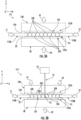
- FIG. 5A illustrates a first multi-fiber cable 60A and a second multi-fiber cable 60B that are joined at the interdigitated glass portions 74A, 74B by the process using the assembly bench 111 described above.
- Multiple fiber array spacers can be harvested from a single interdigitated array of optical fibers 75.
- the interdigitated array of optical fibers 75 is cut along a cut line CL, such as, without limitation, by scoring and breaking the bare fibers, diamond sawing, or laser cleaving.
- a first interdigitated array of optical fibers 75A is attached to the first multi-fiber cable 60A and a second interdigitated array of optical fibers 75B is attached to the second multi-fiber cable 60B, as shown in FIG. 5B .
- the first interdigitated array of optical fibers 75A comprises alternating first glass portions 74A of the first optical fibers 52A and spacer fibers 77 which are fiber stubs cut from the second optical fibers 52B of the second multi-fiber cable 60B. Fiber stubs are short lengths of optical fiber that do not pass optical signals.
- the second interdigitated array of optical fibers 75B comprises alternating second glass portions 74B of the second optical fibers 52B and spacer fibers 77 which are fiber stubs cut from the first optical fibers 52A of the first multi-fiber cable 60A.
- a first fiber array spacer 80A is defined by the first interdigitated array of optical fibers 75A and a second fiber array spacer 80B is defined by the second interdigitated array of optical fibers 75B.
- FIG. 5C illustrate a cut line CL that may be used to fully separate the first fiber array spacer 80A from the first multi-fiber cable 60A.
- FIG. 5D illustrates a fully separated fiber array spacer 80 that may be used in an optical device, such as an optical connector.
- FIG. 5D illustrates a fiber array spacer 80 with substantially no gap between adjacent spacer fibers 77. Additionally, the spacer fibers 77 do not need to be parallel to one another.
- the fiber array spacer 80 further includes a precision support plate 20 as shown in FIG. 4C and described above.
- FIG. 6A illustrates how multiple cut lines CL may be used to separate multiple fiber array spacers 80 from a single interdigitated array of optical fibers 75.
- FIG. 6B illustrates three separated fiber array spacers 80 from the single interdigitated array of optical fibers 75 shown in FIG. 6A .
- a fiber array spacer may be fabricated with as few as two precision diameter optical fibers. In embodiments having just two optical fibers, the fiber array spacer will be most stable if it is fabricated with the two optical fibers spaced as far apart as is practical.
- a fiber array spacer 80-1 may include at least two spacer fibers 77 that are spaced apart by an intermediary spacer sheet 78 having a height H S that is less than the diameter of the spacer fibers 77 (e.g., the diameter of the cladding layer DCL). Having the H S of the intermediary spacer sheet 78 ensures that only the upper and lower surfaces of the at least two spacer fibers 77 define the thickness of the fiber array spacer 80-1.
- the fiber array spacer 80-1 of FIG. 6C may be fabricated in a similar manner as shown in FIGS. 2A-4B and described above except internal spacer fibers are replaced by at least two outer spacer fibers 77.
- the intermediary spacer sheet 78 may be bonded to the spacer fibers 77 by an adhesive 135 as shown in FIG. 6C or it may be bonded to the spacer fibers 77 by laser bonding.
- the intermediary spacer sheet 78 may be fabricated from any suitable material.
- the intermediary spacer may be a flexible elastomer or a rigid material, such as glass.
- the fiber array spacer may also be fabricated with an integral support sheet (not shown) that stiffens the fiber array.
- a support sheet may be provided between the interdigitated array of optical fibers 75 and the support plate 20.
- An adhesive bonds the interdigitated array of optical fibers 75 to the support sheet.
- the support sheet may be fabricated from any material that provides a flat surface, such as polished glass, ceramic, or metal materials.
- a glass support sheet may be fabricated with an extremely flat surface (e.g., deviation of less than 0.1 ⁇ m from an ideal plane) using a fusion draw process.
- the support sheet may be rigid in some embodiments. However, the support sheet may also be thin enough to be flexible. If the support sheet is fabricated from metal, metalized optical fibers may be laser bonded to the support sheet by a laser bonding process as described above.
- a support sheet may be replaced by a second fiber array spacer that is positioned beneath a first fiber array spacer, thereby resulting in a two-layer fiber array spacer comprising optical fiber stubs.
- the first multi-fiber cable 60A is arranged transverse to the second multi-fiber cable 60B.
- Adhesive 135 is applied to a top surface of the second interdigitated array of optical fibers 75B (i.e., a second fiber array spacer 80B still attached to the second multi-fiber cable 60B).
- the second interdigitated array of optical fibers 75B and the first interdigitated array of optical fibers 75A are brought into contact with one another by vertical forces.
- the adhesive 135 is then cured to secure the first fiber array spacer 80A to the second fiber array spacer 80B, thereby forming a two-layer fiber array spacer 80'.
- the spacer fibers 77 of the first fiber array spacer 80A are shown as orthogonal to the spacer fibers 77 of the second fiber array spacer 80B, embodiments are not limited thereto.
- the fiber stubs of the first fiber array spacer 80A and the second fiber array spacer 80B should be transverse to one another but an orthogonal arrangement is not required.
- Excess fiber array material may be removed from the first fiber array spacer 80A and/or the second fiber array spacer 80B before or after adhesive joining.
- FIG. 7C illustrates a two-layer fiber array spacer 80' after the remaining portion of the second multi-fiber cable 60B is cut away and removed from the second fiber array spacer 80B.
- the remaining first optical fibers 52A and first cable jacket 61A may be used as a handle to support and align the two-layer fiber array spacer 80' during subsequent alignment and assembly operations.
- FIG. 8A illustrates a perspective view of an example wherein the two-layer fiber array spacer 80" is separated from both the first multi-fiber cable 60A and the second multi-fiber cable 60B.
- FIG. 8B illustrates a cross-section view of the two-layer fiber array spacer 80" illustrated by FIG. 8A .
- the first layer is defined by a first fiber array spacer 80A having an array of spacer fibers 77 and the second layer is defined by a second fiber array spacer 80B having an additional array of spacer fibers 77.
- FIG. 9 illustrates a cross-section view of an assembly bench 111' where a laser beam delivery system 10 is used to laser bond metallized optical fibers.
- Laser bonds 137 bond adjacent optical fibers within the same array of interdigitated optical fibers. Additionally, the laser bonds 137 bond the first interdigitated array of optical fibers 75A to the second interdigitated array of optical fibers 75B.
- optical fibers precisely set the thickness of the fiber array spacer. Therefore, if a precision spacer is required of a given thickness in an optical assembly (e.g., an optical connector) or any of the type of assembly not limited to optical assemblies, it can be fabricated by drawing optical fibers of the desired diameters. This is much easier to do than to, for example, draw a sheet of glass to a target thickness using a fusion draw process, or to polish a substrate to the target thickness. As an example, a series of optical fibers could be drawn at different standard diameters so that, by mixing and matching upper and lower fiber array spacer thicknesses, the desired combined thickness can meet the target thickness.
- optical fibers provide lines of contact on both top and bottom surfaces that are more immune to debris contamination that would otherwise contribute to thickness errors during stacking.
- the cavities formed between the optical fibers during interdigitation provide a place for debris to flow through during surface mating. Meanwhile, the limited total surface area during optical fiber contact with other fiber arrays or flat sheets can produce high pressures that tends to compact debris to reduce its error contribution to stacking height.
- the illustrated optical fiber assembly 100 may be utilized as a one-dimensional fiber array wherein the second fiber array spacer 80B is used as a spacing element in a final optical package, and the first interdigitated array of optical fibers 75A is used to transmit and/or receive optical signals.
- the first multi-fiber cable 60A is a fiber optical cable that may be housed in a connector body (see FIG. 14 , described in more detail below).
- the optical fibers of the illustrated optical fiber assembly 100 comprise an array of interdigitated first glass portions 74A (from the first optical fibers 52A) and lateral spacer optical fibers 79 (cut from the second multi-fiber cable 60B as described above with respect to the spacer fibers 77).
- the first optical fibers 52A are signal optical fibers in the present embodiment because they propagate optical signals for optical communication.
- the lateral spacer optical fibers 79 are fiber stubs similar to the spacer fibers 77 and are therefore dummy optical fibers because they are not used for optical communication.
- Prefabricated optical fiber assemblies (comprising a fiber array spacer and an array of interdigitated glass portions of optical fibers and spacer fibers) can be stacked to implement two-dimensional optical fiber arrays.
- optical fiber assemblies 100 as shown in FIG. 7C are used, where a one-dimensional array of signal optical fibers 52A are on precise pitch provided by lateral spacer optical fibers 79 and supported by a fiber array spacer 80 of spacer fibers 77.
- the fiber array spacer 80 is shifted laterally relative to the interdigitated array signal optical fibers 52A and lateral spacer optical fibers so that it undercuts the interdigitated array by a distance D1, where 0 ⁇ m ⁇ D1 ⁇ D/2, and where D is the optical fiber diameter.
- the opposite end of the fiber array spacer 80 extends beyond the interdigitated array by a distance D2, where, for example, 0.5 mm ⁇ D1 ⁇ 2 mm.
- an assembly bench 111A may be constructed by mounting a precision vertical alignment block 140 on a precision flat surface 22 of a support plate 20.
- the precision flat surface 22 of the support plate 20 serves as the bottom-side alignment surface.
- the precision flat surface 141 of the vertical alignment block 140 serves as the left-side alignment surface.
- the precision vertical alignment block 140 and the support plate 20 provide a precise right-angle corner that enables left-right alignment of first and second interdigitated array of optical fibers 75, 75'.
- the vertical alignment block 140 and the support plate 20 serving as a horizontal alignment block are integrated into a single, right angle component.
- a first optical fiber assembly 100 comprising a first fiber array spacer 80 is disposed on a release sheet 131 on a precision flat surface 22 of the support plate 20.
- a first interdigitated array of optical fibers 75 of the first fiber optical assembly 100 is secured to the first fiber array spacer 80 as described above.
- a second optical fiber assembly 100' comprising a second fiber array spacer 80' secured to a second interdigitated array of optical fibers 75' is stacked onto the first optical fiber assembly 100 such that the second fiber array spacer 80' is positioned on the first interdigitated array of optical fibers 75.
- top precision spacer sheet 142 (e.g., precision flat fusion glass) is applied on the second interdigitated array of optical fibers 75', and a cover plate 120 is positioned on the top precision spacer sheet 142.
- a release sheet may be provided on the bottom surface 143 of the top precision spacer sheet 142 such that the precision support sheet is not a component of the resulting two-dimensional optical fiber array.
- first and second release sheets 133, 131 may be configured as individual sheets, or a coating, such as a fluorosilane coating, for example.
- the first and second optical fiber assemblies 100, 100' are pushed laterally into the precision flat surface 141 of the vertical alignment block 140 using first and second pusher elements 110A, 110B that contact the outermost optical fibers in the first and second interdigitated array of optical fibers 75, 75', respectively.
- the first and second pusher elements 110A, 110B are guided into contact with the outermost optical fibers by the portions of the fiber array spacers 80, 80' that extend a distance D2 to the right (see FIG. 10 ).
- the first and second pusher element 110A, 110B force the outermost optical fiber in each interdigitated array of optical fibers be pushed into contact with the release sheet 133 attached to the vertical alignment block 140.
- the optical fibers in the first and second interdigitated array of optical fibers 75, 75' become vertically aligned to each other (i.e., each fiber core is located directly over the fiber core beneath it). This causes all optical fibers in the two-dimensional optical fiber array to be precisely located relative to one another in a grid.
- the two-dimensional horizontal fiber array pitch equals twice the optical fiber diameter
- the two-dimensional vertical fiber array pitch equals the sum of the optical fiber diameter and the spacer fiber 77 diameter.
- the two-dimensional optical fiber array 210 is removed from the assembly bench 112, as shown in FIG. 12 .
- the two-dimensional optical fiber array 210 may be disposed in an optical connector, for example.
- the first interdigitated array of optical fibers 75 comprises alternating lateral spacer optical fibers 79 and signal optical fibers 52A and is supported by the first fiber array spacer 80.
- the second interdigitated array of optical fibers 75' comprises alternating lateral spacer optical fibers 79' and signal optical fibers 52A' and is supported by the second fiber array spacer 80'.
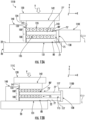
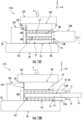
- FIG. 13A depicts another assembly bench 111B for assembling a two-dimensional optical fiber array that is similar to the assembly bench 111A illustrated by FIG 11 .
- an extended length of the spacer fibers 77, 77' of the first and second fiber array spacers 80, 80', respectively, is used to simplify the process of forcing the outermost optical fibers (i.e., leftmost optical fibers in FIG. 13 ) of the first and second interdigitated array of optical fibers 75, 75' against the precision flat surface 141 of the vertical alignment block 140.
- a large pusher element 110C e.g., a pusher block
- the pusher element 110C may have a thickness that is closely matched to the total thickness of stack of first and second fiber optic assemblies 100, 100'.
- an elastomeric pad 138 is disposed on the end of the pusher element 110C so that force is transferred to each spacer fiber 77, 77', even if the spacer fibers 77, 77' are of different lengths.
- FIG. 13B depicts another assembly bench 111C for assembling a two-dimensional optical fiber array that is similar to the assembly bench 111B illustrated by FIG 13A .
- an extended length of the spacer fibers 77, 77' of the first and second fiber array spacers 80, 80', respectively, is such that D2 (see FIG. 10 ) is approximately 3-5mm.
- This additional length allows the spacer fibers 77, 77' to flex as force is applied to them via a pusher element 110D, such as first and second pusher elements 110A, 110C (see FIG. 3A ) configured as pusher fibers that squeeze the first and second optical fibers 52A, 52B to form an interdigitated array.
- the example pusher element 110D is configured as a block having a pocket 115 with raised shoulders 117 that prevents the deflected spacer fibers 77, 77' from slipping off of the end of the pusher element 110D.
- the elastomeric pad 138 may or may not be utilized in this embodiment. After alignment and adhesive curing, the excess length of the spacer fibers 77, 77' may be removed via cutting or grinding operations.
- FIG. 13C another assembly bench 111D for assembling a two-dimensional optical fiber array that is similar to the assembly benches 111B and 111C illustrated by FIGS. 13A and 13B .
- the spacer fibers 77, 77' are reduced in length such that D2 (see FIG. 10 ) is approximate 0 ⁇ m.
- the ends of the spacer fibers 77, 77' line up with outer optical fibers (i.e., rightmost optical fibers) in each of the first and second interdigitated arrays of optical fibers 75, 75'.
- a pusher element 110E having an elastomeric pad 138 on the end is used to simultaneously push the first and second optical fiber assemblies 100, 100' into the release sheet 133 on the precision flat surface 141 of the vertical alignment block 140.
- a two-dimensional optical fiber array 200 may be fabricated using only one fiber array spacer 80 that is disposed between a first interdigitated array of optical fibers 75 and a second interdigitated array of optical fibers 75'.
- a first interdigitated array of optical fibers 75 is disposed on a first release sheet 131 on the precision flat surface 22 of the support plate 20 of an example assembly bench 111E.
- a support interdigitated array of optical fibers 75" is disposed on the first interdigitated array of optical fibers 75 such that its longitudinal axis is transverse (e.g., perpendicular) to the longitudinal axis of the first interdigitated array of optical fibers 75.
- perpendicular means within ⁇ 5 degrees of 90 degrees.
- the support interdigitated array of optical fibers 75" will become spacer fibers 77 upon cutting the glass portion 74 and separating the coating portion 76 from the assembly.
- the second interdigitated array of optical fibers 75' are disposed on the support interdigitated array of optical fibers 75".
- a vertical force V is applied by way of the cover plate 120 to establish the position of the first and second interdigitated arrays of optical fibers 75, 75' in the Y-direction.
- First and second pusher elements 110A, 110B apply lateral forces L1, L2 to the first and second interdigitated array of optical fibers 75, 75', respectively, to force the outermost optical fibers (e.g., the leftmost optical fibers) first and second interdigitated array of optical fibers 75, 75' into contact with the release sheet 133 on the precision flat surface of the vertical alignment block 140.
- the fiber assembly is removed from the vertical alignment block 140, the support plate 20, and the cover plate 120.
- the excess optical fiber of the support interdigitated array of optical fibers 75" is removed by cutting, thereby forming a fiber array spacer 80 disposed between the first and second interdigitated arrays of optical fibers 75, 75'.
- FIG. 13E illustrates another example assembly bench 111F that may be utilized to fabricate two-dimensional fiber arrays of various configurations.
- a vertical alignment block 140 is mounted on a precision rotation stage (represented by array A) that is capable of rotating relative to a fixed support plate 20.
- a two-dimensional optical fiber array 200 as illustrated by FIG. 13D is disposed on a bottom precision spacer sheet 144 (e.g., a precision fusion drawn glass sheet).
- the bottom precision spacer sheet 144 provides clearance C1 for the vertical alignment block 140 to rotate.
- a release sheet may be provided on the top surface of the bottom precision spacer sheet 144.
- a top precision spacer sheet 142 is disposed on the second interdigitated array of optical fibers 75'.
- the top precision spacer sheet 142 provides clearance C2 for the vertical alignment block to rotate.
- a release sheet may be provided on the bottom surface of the top precision spacer sheet 142.
- a precise right angle between the vertical alignment block 140' and the support plate 20 may be established by placing a right-angle gage block on the support plate 20 and adjusting the vertical alignment block 140' until it is parallel with the vertical side face of the right angle gage block.
- the vertical alignment block 140' may be aligned via optical power peaking of retro-reflected light from a collimator that produces a precise beam that extends parallel to the support plate 20.
- a light signal parallel to the precision flat surface 22 of the support plate 20 may be emitted such that it is reflected by the precision flat surface 141 of the vertical alignment block 140'.
- the reflected light signal is detected by a detector, and the vertical alignment block 140' is rotated until peak-power is received at the detector.
- the angular adjustment of the vertical alignment block 140' enables different configurations of the two-dimensional fiber array. For example, it is possible to fabricate two-dimensional fiber arrays where the optical fiber cores are not positioned directly on top of one another but rather offset laterally along the X-direction by a precise offset distance.
- FIG. 13 depicts an offset distance OD of zero. However, rotation of the vertical alignment block 140' causes an offset distance OD between the cores of stacked optical fibers to be present.
- any of the fiber array spacers and the fiber arrays described herein may be implemented in any optical component.
- the precision diameter of the optical fibers used to fabricate the fiber spacers enable a low-cost method of setting the position of the signal optical fibers (or waveguides) along the X-axis.
- the example fiber optic connector 301 has a connector body 302 having a mating face 303 that may be mated to a receptacle, a waveguide assembly (e.g., a waveguide assembly of a photonic integrated circuit (PIC)), or any other optical component.
- the connector body 302 may take on any shape and include any retention features to facilitate physical mating.
- the mating face 303 has an opening 304 that exposes an end face of an optical fiber assembly 100 disposed within connector body 302.
- the optical fiber assembly 100 includes a one-dimensional interdigitated array of optical fibers 75 comprising alternating spacer fibers 79 and signal optical fibers 52 of a multi-fiber ribbon cable 60.
- the interdigitated array of optical fibers 75 is supported on a two-layer precision fiber array spacer 80" that precisely establishes a height of the end faces of the signal optical fibers 52 with respect to a bottom surface 305 of the opening by the precise diameter of the spacer fibers 77.
- multi-dimensional fiber arrays may be utilized, and any number of signal optical fibers may be provided. Any of the fiber array spacers and fiber arrays described herein may be provided within a connector.
- FIG. 15 illustrates an example photonics assembly 400 comprising PIC 401 mounted on a two-layer fiber array spacer 80".
- the PIC 401 may be bonded to the two-layer fiber array spacer 80" by adhesive or by laser bonding, for example.
- the PIC 401 has a plurality of integrated waveguides 402 that are optically coupled to one or more active optical components 403 (e.g., optical emitters and/or optical receivers) and terminate at an optical coupling face 404.
- active optical components 403 e.g., optical emitters and/or optical receivers
- the two-layer fiber array spacer 80" includes a first fiber array spacer 80A and a second fiber array spacer 80B.
- the height h of the two-layer fiber array spacer 80" is equal to the diameter of the spacer fibers of the first fiber array spacer 80A plus the diameter of the spacer fibers of the second fiber array spacer 80B.
- the two-layer fiber array spacer 80" precisely sets the location of the end-faces of the waveguides 402 along the Y-axis, thereby enabling precision coupling with an optical component that mates to the PIC 401 at the optical coupling face 404.
Landscapes
- Physics & Mathematics (AREA)
- General Physics & Mathematics (AREA)
- Optics & Photonics (AREA)
- Chemical & Material Sciences (AREA)
- Crystallography & Structural Chemistry (AREA)
- Optical Couplings Of Light Guides (AREA)
- Mechanical Coupling Of Light Guides (AREA)
Claims (15)
- Faseroptische Anordnung (100, 300, 400), die aufweist:einen ersten Faser-Array-Abstandhalter (80, 80A, 80B), der aufweist:
ein Abstandsfaser-Array, wobei einzelne Abstandsfasern (77) des Abstandsfaser-Arrays aneinander angefügt sind; undein erstes Faserband (60), das ein erstes Array optischer Fasern (75, 52) aufweist, wobei:jede optische Faser des ersten Arrays optischer Fasern einen Glasteil (74, 74A, 74B) aufweist; undder Glasteil (74, 74A, 74B) jeder optischen Faser (75, 52) des ersten Arrays optischer Fasern (75, 52) an den ersten Faser-Array-Abstandhalter (80, 80A, 80B) angefügt ist, so dass eine Längsachse der einzelnen Abstandsfasern (77) quer zu einer Längsachse einzelner optischer Fasern (75, 52) des ersten Arrays optischer Fasern verläuft;dadurch gekennzeichnet, dass es im Wesentlichen keine Lücke zwischen benachbarten Abstandsfasern (77) gibt. - Faseroptische Anordnung (100, 300, 400) nach Anspruch 1, die ferner einen zweiten Faser-Array-Abstandhalter (80') aufweist, wobei der zweite Faser-Array-Abstandhalter (80') aufweist:ein zweites Abstandsfaser-Array (77'), wobei:einzelne Abstandsfasern des zweiten Abstandsfaser-Arrays (77') aneinander angefügt sind; unddas zweite Abstandsfaser-Array (77') so an das erste Array optischer Fasern (75) angefügt ist, dass die Längsachse der einzelnen Abstandsfasern des zweiten Abstandsfaser-Arrays (77') quer zur Längsachse einzelner optischer Fasern des ersten Arrays optischer Fasern (75) verläuft und das erste Array optischer Fasern (75) zwischen dem ersten Faser-Array-Abstandhalter (80, 80A, 80B) und dem zweiten Faser-Array-Abstandhalter (80') angeordnet ist.
- Faseroptische Anordnung (100, 300, 400) nach Anspruch 2, die ferner ein zweites Faserband (60B) aufweist, das ein zweites Array optischer Fasern (75') aufweist, wobei:jede optische Faser des zweiten Arrays optischer Fasern (75') einen Glasteil (74B) aufweist; undder Glasteil (74B) jeder optischen Faser des zweiten Arrays optischer Fasern (75') an den zweiten Faser-Array-Abstandhalter (80') angefügt ist, so dass eine Längsachse der einzelnen Abstandsfasern (77') des zweiten Faser-Array-Abstandhalters (80') quer zu einer Längsachse einzelner optischer Fasern (75') des zweiten Arrays optischer Fasern (75') verläuft.
- Faseroptische Anordnung (100, 300, 400) nach einem der Ansprüche 1 bis 2, die ferner ein zweites Faserband (60B) aufweist, das ein zweites Array optischer Fasern (75') aufweist, wobei:der Glasteil (74) jeder optischen Faser des ersten Arrays optischer Fasern (75) an eine erste Seite des ersten Faser-Array-Abstandhalters (80) angefügt ist; undein Glasteil (74) jeder optischen Faser des zweiten Arrays optischer Fasern (75') an eine zweite Seite des ersten Faser-Array-Abstandhalters (80) angefügt ist.
- Faseroptische Anordnung (300, 400) nach Anspruch 1, die ferner einen zweiten Faser-Array-Abstandhalter (80B) aufweist, der aufweist:
ein zweites Abstandsfaser-Array (77'), wobei:einzelne Abstandsfasern des zweiten Abstandsfaser-Arrays (77') aneinander angefügt sind; unddas zweite Abstandsfaser-Array (77') so an den ersten Faser-Array-Abstandhalter (80A) angefügt ist, dass die Längsachse der einzelnen Abstandsfasern des zweiten Abstandsfaser-Arrays (77') quer zur Längsachse einzelner Abstandsfasern des ersten Abstandsfaser-Arrays (77) verläuft. - Faseroptische Anordnung (100, 300, 400) nach einem der Ansprüche 1 bis 5, wobei der Glasteil (74) jeder optischen Faser des ersten Arrays optischer Fasern (75, 52) durch einen Klebstoff oder Fügen mit Laser an den ersten Faser-Array-Abstandhalter (80, 80A, 80B) angefügt ist.
- Faseroptische Anordnung (100, 300, 400) nach einem der Ansprüche 1 bis 6, wobei:das erste Array optischer Fasern (75, 52) ein ineinandergreifendes Array optischer Fasern aufweist, das optische Signalfasern (52) und quer verlaufende optische Abstandsfasern (79) aufweist; unddie quer verlaufenden optischen Fasern (79) optische Faserstummel sind,wobei die optischen Signalfasern (52) und die quer verlaufenden optischen Abstandsfasern (79) des ineinandergreifenden Arrays optischer Fasern aneinander angefügt sind.
- Faseroptische Anordnung (100, 300, 400) nach einem der Ansprüche 1 bis 7, wobei der Glasteil (74) jeder optischen Faser des ersten Arrays optischer Fasern (72, 52) so an den ersten Faser-Array-Abstandhalter (80, 80A, 80B) angefügt ist, dass die Längsachse einzelner Abstandsfasern (77) des Abstandsfaser-Arrays (77') lotrecht zur Längsachse einzelner optischer Fasern (75, 52) des Arrays optischer Fasern verläuft.
- Faseroptische Anordnung (100, 300, 400) nach einem der Ansprüche 1 bis 8, die ferner einen Verbinderkörper aufweist, wobei der erste Faser-Array-Abstandhalter (80, 80A, 80B) in dem Verbinderkörper angeordnet ist.
- Faseroptische Anordnung (100, 300, 400) nach einem der Ansprüche 1 bis 9, wobei:jede einzelne Abstandsfaser (77) des ersten Abstandsfaser-Arrays (77) eine erste Oberfläche, die eine erste Ebene definiert, und eine zweite Oberfläche, die eine zu der ersten Ebene parallele zweite Ebene definiert, aufweist; undein zwischen benachbarten Abstandsfasern (77) angeordneter Klebstoff sich nicht über die erste Ebene und die zweite Ebene hinaus erstreckt.
- Faseroptische Anordnung (100, 300, 400) nach einem der Ansprüche 1 bis 10, die ferner ein zwischenliegendes Abstandsblatt (78) aufweist, das zwischen zwei einzelnen Abstandsfasern des ersten Abstandsfaser-Arrays (77) angeordnet ist, wobei eine Höhe des zwischenliegenden Abstandsblatts (78) geringer ist als ein Durchmesser der einzelnen Abstandsfasern (77) des ersten Abstandsfaser-Arrays (77), so dass der Durchmesser der einzelnen Abstandsfasern (77) eine Höhe des ersten Faser-Array-Abstandhalters (80, 80A, 80B) definiert.
- Faseroptische Anordnung (100, 300, 400) nach einem der Ansprüche 1 bis 11, die ferner eine Trägerplatte (20) aufweist, wobei das erste Abstandsfaser-Array (77) an eine Oberfläche der Trägerplatte (20) angefügt ist.
- Verfahren zur Herstellung einer faseroptischen Anordnung (100, 300, 400), wobei das Verfahren aufweist:Anordnen einer optischen Komponente auf einem Faser-Array-Abstandhalter (80, 80A, 80B), wobei der Faser-Array-Abstandhalter ein Abstandsfaser-Array aufweist, wobei einzelne Abstandsfasern (77) des Abstandsfaser-Arrays im Wesentlichen ohne eine Lücke zwischen benachbarten Abstandsfasern (77) aneinander angefügt sind, und wobei die optische Komponente ein Faserband (60) aufweist, das ein erstes Array optischer Fasern (75, 52) aufweist, wobei jede optische Faser des Arrays optischer Fasern einen Glasteil (74) aufweist; undAnfügen des Glasteils (74) jeder optischen Faser (75, 52) des Arrays optischer Fasern an den Faser-Array-Abstandhalter (80, 80A, 80B), so dass eine Längsachse der einzelnen Abstandsfasern (77) quer zu einer Längsachse einzelner optischer Fasern (75, 52) des Arrays optischer Fasern verläuft.
- Verfahren nach Anspruch 13, wobei der Faser-Array-Abstandhalter (80, 80A, 80B) und das Array optischer Fasern des Faserbands (60) gefertig werden durch:Anordnen eines Glasteils (74) eines Arrays erster optischer Fasern (75, 52) eines ersten Faserbands (60A) auf einem ersten Trägersubstrat;Anordnen eines Glasteils (74) eines Arrays zweiter optischer Fasern (75, 52) eines zweiten Faserbands (60B) auf dem ersten Trägersubstrat, so dass ein ineinandergreifendes Array optischer Fasern gebildet wird, das abwechselnde erste optische Fasern und zweite optische Fasern (75, 52) aufweist;Anordnen eines zweiten Trägersubstrats auf dem ineinandergreifenden Array optischer Fasern;Anwenden entgegengesetzter seitlicher Kräfte auf das ineinandergreifende Array optischer Fasern, um eine Lücke zwischen benachbarten optischen Fasern (75, 52) des Arrays optischer Fasern zu verringern;Zusammenfügen einzelner optischer Fasern des ineinandergreifenden Arrays optischer Fasern;Schneiden des ineinandergreifenden Arrays optischer Fasern zum Trennen des ersten Faserbands (60A) von dem zweiten Faserband (60B), wobei das erste Faserband ein erstes ineinandergreifendes Abstandsfaser-Array (77) aufweist und das zweite Faserband ein ineinandergreifendes Array optischer Fasern aufweist, das abwechselnde zweite optische Fasern (75) und optische Seitenabstandsfasern (79), die von geschnittenen ersten optischen Fasern definiert werden, aufweist;Anfügen des ersten ineinandergreifenden Abstandsfaser-Arrays des ersten Faserbands (60A) an das ineinandergreifende Array optischer Fasern des zweiten Faserbands (60B); undSchneiden des Arrays erster optischer Fasern zum Bilden des Faser-Array-Abstandhalters (80, 80A, 80B), wobei das Array optischer Fasern des Faserbands durch das zweite Faserband (60B) definiert wird.
- Verfahren nach Anspruch 14, wobei:der Faser-Array-Abstandhalter (80, 80A, 80B) und das ineinandergreifende Array optischer Fasern des zweiten Faserbands (60B) eine erste faseroptische Anordnung (100) definieren;wobei das Verfahren ferner aufweist:Bilden einer zweiten faseroptischen Anordnung (100') durch das Verfahren nach Anspruch 14; undAnfügen des Faser-Array-Abstandhalters (80B) der zweiten faseroptischen Anordnung an das ineinandergreifende Array optischer Fasern der ersten faseroptischen Anordnung (100).
Applications Claiming Priority (1)
| Application Number | Priority Date | Filing Date | Title |
|---|---|---|---|
| US201962908187P | 2019-09-30 | 2019-09-30 |
Publications (2)
| Publication Number | Publication Date |
|---|---|
| EP3798699A1 EP3798699A1 (de) | 2021-03-31 |
| EP3798699B1 true EP3798699B1 (de) | 2024-11-06 |
Family
ID=72670639
Family Applications (1)
| Application Number | Title | Priority Date | Filing Date |
|---|---|---|---|
| EP20199086.8A Active EP3798699B1 (de) | 2019-09-30 | 2020-09-29 | Faserarray-abstandhalter, optische montagen mit faserarray-abstandhaltern und verfahren zur herstellung der gleichen |
Country Status (3)
| Country | Link |
|---|---|
| US (1) | US11415754B2 (de) |
| EP (1) | EP3798699B1 (de) |
| CN (2) | CN120405857A (de) |
Families Citing this family (6)
| Publication number | Priority date | Publication date | Assignee | Title |
|---|---|---|---|---|
| US11567285B2 (en) | 2020-04-30 | 2023-01-31 | Corning Research & Development Corporation | High-density FAUs and optical interconnection devices including optimized arrays and related methods |
| US11500160B2 (en) | 2020-05-29 | 2022-11-15 | Corning Research & Development Corporation | Multicore optical fiber fan-out assemblies and apparatuses |
| US11914193B2 (en) | 2021-06-22 | 2024-02-27 | Corning Research & Development Corporation | Optical assembly for coupling with two-dimensionally arrayed waveguides and associated methods |
| CN115704936A (zh) * | 2021-08-17 | 2023-02-17 | 华为技术有限公司 | 光纤板和光纤板制作方法 |
| US11880071B2 (en) | 2021-08-23 | 2024-01-23 | Corning Research & Development Corporation | Optical assembly for interfacing waveguide arrays, and associated methods |
| US12394690B2 (en) | 2022-01-04 | 2025-08-19 | Corning Research & Development Corporation | Systems and methods of nano-particle bonding for electronics cooling |
Citations (1)
| Publication number | Priority date | Publication date | Assignee | Title |
|---|---|---|---|---|
| US9709750B1 (en) * | 2016-06-21 | 2017-07-18 | Alliance Fiber Optic Products Inc. | 2-dimensional fiber array structure |
Family Cites Families (12)
| Publication number | Priority date | Publication date | Assignee | Title |
|---|---|---|---|---|
| CH628152A5 (fr) * | 1977-11-24 | 1982-02-15 | Comp Generale Electricite | Fiche de connecteur fibre a fibre pour cable optique multifibre. |
| US4733068A (en) * | 1986-04-07 | 1988-03-22 | Rockwell International Corporation | Crossed fiber optic tactile sensor |
| JP3076126B2 (ja) * | 1992-02-07 | 2000-08-14 | 日本電信電話株式会社 | 光ファイバ二次元アレーコネクタおよびその製作方法 |
| EP0985943B1 (de) * | 1998-09-09 | 2006-11-15 | Sumitomo Electric Industries, Ltd. | Verfahren zur Herstellung eines faseroptischen Arrays und Vorrichtung zur Herstellung eines faseroptischen Arrays |
| US6618514B1 (en) * | 2001-10-11 | 2003-09-09 | Lightwave Microsystems Corporation | Passive pigtail attachment apparatus and method for planar lightwave circuits |
| TWI557460B (zh) * | 2012-12-27 | 2016-11-11 | 鴻海精密工業股份有限公司 | 光電轉換裝置及光纖耦合連接器 |
| US9304264B2 (en) * | 2013-04-26 | 2016-04-05 | Tyco Electronics Corporation | Optical fiber subassembly |
| TW201530209A (zh) * | 2014-01-23 | 2015-08-01 | Hon Hai Prec Ind Co Ltd | 光耦合透鏡及光纖耦合連接器 |
| US10048455B2 (en) * | 2016-01-18 | 2018-08-14 | Cisco Technology, Inc. | Passive fiber array connector alignment to photonic chip |
| WO2018022319A1 (en) * | 2016-07-29 | 2018-02-01 | Corning Optical Communications LLC | Waveguide connector elements and optical assemblies incorporating the same |
| US10345535B2 (en) * | 2017-03-16 | 2019-07-09 | Corning Research & Development Corporation | Glass-based ferrules and optical interconnection devices and methods of forming same |
| US10107967B1 (en) * | 2017-10-30 | 2018-10-23 | Corning Research & Development Corporation | Fiber array assemblies for multifiber connectorized ribbon cables and methods of forming same |
-
2020
- 2020-09-16 US US17/022,443 patent/US11415754B2/en active Active
- 2020-09-29 EP EP20199086.8A patent/EP3798699B1/de active Active
- 2020-09-30 CN CN202510596755.0A patent/CN120405857A/zh active Pending
- 2020-09-30 CN CN202011062701.XA patent/CN112578505A/zh active Pending
Patent Citations (1)
| Publication number | Priority date | Publication date | Assignee | Title |
|---|---|---|---|---|
| US9709750B1 (en) * | 2016-06-21 | 2017-07-18 | Alliance Fiber Optic Products Inc. | 2-dimensional fiber array structure |
Also Published As
| Publication number | Publication date |
|---|---|
| US20210096302A1 (en) | 2021-04-01 |
| US11415754B2 (en) | 2022-08-16 |
| CN112578505A (zh) | 2021-03-30 |
| CN120405857A (zh) | 2025-08-01 |
| EP3798699A1 (de) | 2021-03-31 |
Similar Documents
| Publication | Publication Date | Title |
|---|---|---|
| EP3798699B1 (de) | Faserarray-abstandhalter, optische montagen mit faserarray-abstandhaltern und verfahren zur herstellung der gleichen | |
| CN215932210U (zh) | 光纤配件 | |
| US10795086B2 (en) | Universal photonic adaptor for coupling an optical connector to an optoelectronic substrate | |
| EP3171206B1 (de) | Optische schnittstellenvorrichtungen und verfahren mit optischen fasern und stützelement mit biegeabschnitt | |
| US10107967B1 (en) | Fiber array assemblies for multifiber connectorized ribbon cables and methods of forming same | |
| JP5166295B2 (ja) | 光ファイバアレイおよびその製造方法 | |
| KR20040015287A (ko) | 고정밀 암형 다중파이버 커넥터 | |
| US6324323B1 (en) | Adhesive-free lens-attached optical fibers to optical waveguide packaging system | |
| US11914193B2 (en) | Optical assembly for coupling with two-dimensionally arrayed waveguides and associated methods | |
| JP2004078028A (ja) | 光ファイバガイド部品およびその作製方法 | |
| JP2005292379A (ja) | 光結合装置及びその製造方法 | |
| JP4288604B2 (ja) | 光結合装置 | |
| EP4066031A1 (de) | Verfahren zum laserschweissen von optischen elementen auf substrate und damit hergestellte optische anordnungen | |
| US11880071B2 (en) | Optical assembly for interfacing waveguide arrays, and associated methods | |
| WO2024033988A1 (ja) | 光ファイバと光導波路との接続構造及び光導波路基板の製造方法 | |
| JP2000056188A (ja) | 光接続方法 |
Legal Events
| Date | Code | Title | Description |
|---|---|---|---|
| PUAI | Public reference made under article 153(3) epc to a published international application that has entered the european phase |
Free format text: ORIGINAL CODE: 0009012 |
|
| STAA | Information on the status of an ep patent application or granted ep patent |
Free format text: STATUS: THE APPLICATION HAS BEEN PUBLISHED |
|
| AK | Designated contracting states |
Kind code of ref document: A1 Designated state(s): AL AT BE BG CH CY CZ DE DK EE ES FI FR GB GR HR HU IE IS IT LI LT LU LV MC MK MT NL NO PL PT RO RS SE SI SK SM TR |
|
| AX | Request for extension of the european patent |
Extension state: BA ME |
|
| STAA | Information on the status of an ep patent application or granted ep patent |
Free format text: STATUS: REQUEST FOR EXAMINATION WAS MADE |
|
| 17P | Request for examination filed |
Effective date: 20210511 |
|
| RBV | Designated contracting states (corrected) |
Designated state(s): AL AT BE BG CH CY CZ DE DK EE ES FI FR GB GR HR HU IE IS IT LI LT LU LV MC MK MT NL NO PL PT RO RS SE SI SK SM TR |
|
| STAA | Information on the status of an ep patent application or granted ep patent |
Free format text: STATUS: EXAMINATION IS IN PROGRESS |
|
| 17Q | First examination report despatched |
Effective date: 20230102 |
|
| GRAP | Despatch of communication of intention to grant a patent |
Free format text: ORIGINAL CODE: EPIDOSNIGR1 |
|
| STAA | Information on the status of an ep patent application or granted ep patent |
Free format text: STATUS: GRANT OF PATENT IS INTENDED |
|
| INTG | Intention to grant announced |
Effective date: 20240528 |
|
| GRAS | Grant fee paid |
Free format text: ORIGINAL CODE: EPIDOSNIGR3 |
|
| GRAA | (expected) grant |
Free format text: ORIGINAL CODE: 0009210 |
|
| STAA | Information on the status of an ep patent application or granted ep patent |
Free format text: STATUS: THE PATENT HAS BEEN GRANTED |
|
| AK | Designated contracting states |
Kind code of ref document: B1 Designated state(s): AL AT BE BG CH CY CZ DE DK EE ES FI FR GB GR HR HU IE IS IT LI LT LU LV MC MK MT NL NO PL PT RO RS SE SI SK SM TR |
|
| REG | Reference to a national code |
Ref country code: GB Ref legal event code: FG4D |
|
| REG | Reference to a national code |
Ref country code: CH Ref legal event code: EP |
|
| REG | Reference to a national code |
Ref country code: DE Ref legal event code: R096 Ref document number: 602020040732 Country of ref document: DE |
|
| REG | Reference to a national code |
Ref country code: IE Ref legal event code: FG4D |
|
| REG | Reference to a national code |
Ref country code: LT Ref legal event code: MG9D |
|
| REG | Reference to a national code |
Ref country code: NL Ref legal event code: MP Effective date: 20241106 |
|
| PG25 | Lapsed in a contracting state [announced via postgrant information from national office to epo] |
Ref country code: HR Free format text: LAPSE BECAUSE OF FAILURE TO SUBMIT A TRANSLATION OF THE DESCRIPTION OR TO PAY THE FEE WITHIN THE PRESCRIBED TIME-LIMIT Effective date: 20241106 Ref country code: PT Free format text: LAPSE BECAUSE OF FAILURE TO SUBMIT A TRANSLATION OF THE DESCRIPTION OR TO PAY THE FEE WITHIN THE PRESCRIBED TIME-LIMIT Effective date: 20250306 Ref country code: IS Free format text: LAPSE BECAUSE OF FAILURE TO SUBMIT A TRANSLATION OF THE DESCRIPTION OR TO PAY THE FEE WITHIN THE PRESCRIBED TIME-LIMIT Effective date: 20250306 |
|
| PG25 | Lapsed in a contracting state [announced via postgrant information from national office to epo] |
Ref country code: FI Free format text: LAPSE BECAUSE OF FAILURE TO SUBMIT A TRANSLATION OF THE DESCRIPTION OR TO PAY THE FEE WITHIN THE PRESCRIBED TIME-LIMIT Effective date: 20241106 Ref country code: NL Free format text: LAPSE BECAUSE OF FAILURE TO SUBMIT A TRANSLATION OF THE DESCRIPTION OR TO PAY THE FEE WITHIN THE PRESCRIBED TIME-LIMIT Effective date: 20241106 |
|
| REG | Reference to a national code |
Ref country code: AT Ref legal event code: MK05 Ref document number: 1739964 Country of ref document: AT Kind code of ref document: T Effective date: 20241106 |
|
| PG25 | Lapsed in a contracting state [announced via postgrant information from national office to epo] |
Ref country code: BG Free format text: LAPSE BECAUSE OF FAILURE TO SUBMIT A TRANSLATION OF THE DESCRIPTION OR TO PAY THE FEE WITHIN THE PRESCRIBED TIME-LIMIT Effective date: 20241106 |
|
| PG25 | Lapsed in a contracting state [announced via postgrant information from national office to epo] |
Ref country code: ES Free format text: LAPSE BECAUSE OF FAILURE TO SUBMIT A TRANSLATION OF THE DESCRIPTION OR TO PAY THE FEE WITHIN THE PRESCRIBED TIME-LIMIT Effective date: 20241106 |
|
| PG25 | Lapsed in a contracting state [announced via postgrant information from national office to epo] |
Ref country code: NO Free format text: LAPSE BECAUSE OF FAILURE TO SUBMIT A TRANSLATION OF THE DESCRIPTION OR TO PAY THE FEE WITHIN THE PRESCRIBED TIME-LIMIT Effective date: 20250206 |
|
| PG25 | Lapsed in a contracting state [announced via postgrant information from national office to epo] |
Ref country code: GR Free format text: LAPSE BECAUSE OF FAILURE TO SUBMIT A TRANSLATION OF THE DESCRIPTION OR TO PAY THE FEE WITHIN THE PRESCRIBED TIME-LIMIT Effective date: 20250207 Ref country code: LV Free format text: LAPSE BECAUSE OF FAILURE TO SUBMIT A TRANSLATION OF THE DESCRIPTION OR TO PAY THE FEE WITHIN THE PRESCRIBED TIME-LIMIT Effective date: 20241106 Ref country code: AT Free format text: LAPSE BECAUSE OF FAILURE TO SUBMIT A TRANSLATION OF THE DESCRIPTION OR TO PAY THE FEE WITHIN THE PRESCRIBED TIME-LIMIT Effective date: 20241106 |
|
| PG25 | Lapsed in a contracting state [announced via postgrant information from national office to epo] |
Ref country code: PL Free format text: LAPSE BECAUSE OF FAILURE TO SUBMIT A TRANSLATION OF THE DESCRIPTION OR TO PAY THE FEE WITHIN THE PRESCRIBED TIME-LIMIT Effective date: 20241106 |
|
| PG25 | Lapsed in a contracting state [announced via postgrant information from national office to epo] |
Ref country code: RS Free format text: LAPSE BECAUSE OF FAILURE TO SUBMIT A TRANSLATION OF THE DESCRIPTION OR TO PAY THE FEE WITHIN THE PRESCRIBED TIME-LIMIT Effective date: 20250206 |
|
| PG25 | Lapsed in a contracting state [announced via postgrant information from national office to epo] |
Ref country code: SM Free format text: LAPSE BECAUSE OF FAILURE TO SUBMIT A TRANSLATION OF THE DESCRIPTION OR TO PAY THE FEE WITHIN THE PRESCRIBED TIME-LIMIT Effective date: 20241106 |
|
| PG25 | Lapsed in a contracting state [announced via postgrant information from national office to epo] |
Ref country code: DK Free format text: LAPSE BECAUSE OF FAILURE TO SUBMIT A TRANSLATION OF THE DESCRIPTION OR TO PAY THE FEE WITHIN THE PRESCRIBED TIME-LIMIT Effective date: 20241106 |
|
| PG25 | Lapsed in a contracting state [announced via postgrant information from national office to epo] |
Ref country code: EE Free format text: LAPSE BECAUSE OF FAILURE TO SUBMIT A TRANSLATION OF THE DESCRIPTION OR TO PAY THE FEE WITHIN THE PRESCRIBED TIME-LIMIT Effective date: 20241106 |
|
| PG25 | Lapsed in a contracting state [announced via postgrant information from national office to epo] |
Ref country code: RO Free format text: LAPSE BECAUSE OF FAILURE TO SUBMIT A TRANSLATION OF THE DESCRIPTION OR TO PAY THE FEE WITHIN THE PRESCRIBED TIME-LIMIT Effective date: 20241106 |
|
| PG25 | Lapsed in a contracting state [announced via postgrant information from national office to epo] |
Ref country code: SK Free format text: LAPSE BECAUSE OF FAILURE TO SUBMIT A TRANSLATION OF THE DESCRIPTION OR TO PAY THE FEE WITHIN THE PRESCRIBED TIME-LIMIT Effective date: 20241106 |
|
| PG25 | Lapsed in a contracting state [announced via postgrant information from national office to epo] |
Ref country code: CZ Free format text: LAPSE BECAUSE OF FAILURE TO SUBMIT A TRANSLATION OF THE DESCRIPTION OR TO PAY THE FEE WITHIN THE PRESCRIBED TIME-LIMIT Effective date: 20241106 |
|
| PG25 | Lapsed in a contracting state [announced via postgrant information from national office to epo] |
Ref country code: IT Free format text: LAPSE BECAUSE OF FAILURE TO SUBMIT A TRANSLATION OF THE DESCRIPTION OR TO PAY THE FEE WITHIN THE PRESCRIBED TIME-LIMIT Effective date: 20241106 |
|
| REG | Reference to a national code |
Ref country code: DE Ref legal event code: R097 Ref document number: 602020040732 Country of ref document: DE |
|
| PG25 | Lapsed in a contracting state [announced via postgrant information from national office to epo] |
Ref country code: SE Free format text: LAPSE BECAUSE OF FAILURE TO SUBMIT A TRANSLATION OF THE DESCRIPTION OR TO PAY THE FEE WITHIN THE PRESCRIBED TIME-LIMIT Effective date: 20241106 |
|
| PLBE | No opposition filed within time limit |
Free format text: ORIGINAL CODE: 0009261 |
|
| STAA | Information on the status of an ep patent application or granted ep patent |
Free format text: STATUS: NO OPPOSITION FILED WITHIN TIME LIMIT |
|
| PGFP | Annual fee paid to national office [announced via postgrant information from national office to epo] |
Ref country code: DE Payment date: 20250808 Year of fee payment: 6 |
|
| 26N | No opposition filed |
Effective date: 20250807 |
|
| PGFP | Annual fee paid to national office [announced via postgrant information from national office to epo] |
Ref country code: GB Payment date: 20250814 Year of fee payment: 6 |
|
| PGFP | Annual fee paid to national office [announced via postgrant information from national office to epo] |
Ref country code: FR Payment date: 20250808 Year of fee payment: 6 |