EP3797986B1 - Verbundwerkstoff zur thermischen oder akustischen isolierung - Google Patents
Verbundwerkstoff zur thermischen oder akustischen isolierung Download PDFInfo
- Publication number
- EP3797986B1 EP3797986B1 EP20153409.6A EP20153409A EP3797986B1 EP 3797986 B1 EP3797986 B1 EP 3797986B1 EP 20153409 A EP20153409 A EP 20153409A EP 3797986 B1 EP3797986 B1 EP 3797986B1
- Authority
- EP
- European Patent Office
- Prior art keywords
- drainage structure
- composite material
- insulation
- insulating material
- insulation material
- Prior art date
- Legal status (The legal status is an assumption and is not a legal conclusion. Google has not performed a legal analysis and makes no representation as to the accuracy of the status listed.)
- Active
Links
Images
Classifications
-
- B—PERFORMING OPERATIONS; TRANSPORTING
- B32—LAYERED PRODUCTS
- B32B—LAYERED PRODUCTS, i.e. PRODUCTS BUILT-UP OF STRATA OF FLAT OR NON-FLAT, e.g. CELLULAR OR HONEYCOMB, FORM
- B32B3/00—Layered products comprising a layer with external or internal discontinuities or unevennesses, or a layer of non-planar shape; Layered products comprising a layer having particular features of form
- B32B3/02—Layered products comprising a layer with external or internal discontinuities or unevennesses, or a layer of non-planar shape; Layered products comprising a layer having particular features of form characterised by features of form at particular places, e.g. in edge regions
- B32B3/06—Layered products comprising a layer with external or internal discontinuities or unevennesses, or a layer of non-planar shape; Layered products comprising a layer having particular features of form characterised by features of form at particular places, e.g. in edge regions for securing layers together; for attaching the product to another member, e.g. to a support, or to another product, e.g. groove/tongue, interlocking
-
- B—PERFORMING OPERATIONS; TRANSPORTING
- B60—VEHICLES IN GENERAL
- B60R—VEHICLES, VEHICLE FITTINGS, OR VEHICLE PARTS, NOT OTHERWISE PROVIDED FOR
- B60R13/00—Elements for body-finishing, identifying, or decorating; Arrangements or adaptations for advertising purposes
- B60R13/08—Insulating elements, e.g. for sound insulation
-
- B—PERFORMING OPERATIONS; TRANSPORTING
- B32—LAYERED PRODUCTS
- B32B—LAYERED PRODUCTS, i.e. PRODUCTS BUILT-UP OF STRATA OF FLAT OR NON-FLAT, e.g. CELLULAR OR HONEYCOMB, FORM
- B32B15/00—Layered products comprising a layer of metal
- B32B15/04—Layered products comprising a layer of metal comprising metal as the main or only constituent of a layer, which is next to another layer of the same or of a different material
- B32B15/046—Layered products comprising a layer of metal comprising metal as the main or only constituent of a layer, which is next to another layer of the same or of a different material of foam
-
- B—PERFORMING OPERATIONS; TRANSPORTING
- B32—LAYERED PRODUCTS
- B32B—LAYERED PRODUCTS, i.e. PRODUCTS BUILT-UP OF STRATA OF FLAT OR NON-FLAT, e.g. CELLULAR OR HONEYCOMB, FORM
- B32B15/00—Layered products comprising a layer of metal
- B32B15/14—Layered products comprising a layer of metal next to a fibrous or filamentary layer
-
- B—PERFORMING OPERATIONS; TRANSPORTING
- B32—LAYERED PRODUCTS
- B32B—LAYERED PRODUCTS, i.e. PRODUCTS BUILT-UP OF STRATA OF FLAT OR NON-FLAT, e.g. CELLULAR OR HONEYCOMB, FORM
- B32B15/00—Layered products comprising a layer of metal
- B32B15/20—Layered products comprising a layer of metal comprising aluminium or copper
-
- B—PERFORMING OPERATIONS; TRANSPORTING
- B32—LAYERED PRODUCTS
- B32B—LAYERED PRODUCTS, i.e. PRODUCTS BUILT-UP OF STRATA OF FLAT OR NON-FLAT, e.g. CELLULAR OR HONEYCOMB, FORM
- B32B29/00—Layered products comprising a layer of paper or cardboard
- B32B29/002—Layered products comprising a layer of paper or cardboard as the main or only constituent of a layer, which is next to another layer of the same or of a different material
- B32B29/007—Layered products comprising a layer of paper or cardboard as the main or only constituent of a layer, which is next to another layer of the same or of a different material next to a foam layer
-
- B—PERFORMING OPERATIONS; TRANSPORTING
- B32—LAYERED PRODUCTS
- B32B—LAYERED PRODUCTS, i.e. PRODUCTS BUILT-UP OF STRATA OF FLAT OR NON-FLAT, e.g. CELLULAR OR HONEYCOMB, FORM
- B32B29/00—Layered products comprising a layer of paper or cardboard
- B32B29/02—Layered products comprising a layer of paper or cardboard next to a fibrous or filamentary layer
-
- B—PERFORMING OPERATIONS; TRANSPORTING
- B32—LAYERED PRODUCTS
- B32B—LAYERED PRODUCTS, i.e. PRODUCTS BUILT-UP OF STRATA OF FLAT OR NON-FLAT, e.g. CELLULAR OR HONEYCOMB, FORM
- B32B3/00—Layered products comprising a layer with external or internal discontinuities or unevennesses, or a layer of non-planar shape; Layered products comprising a layer having particular features of form
- B32B3/26—Layered products comprising a layer with external or internal discontinuities or unevennesses, or a layer of non-planar shape; Layered products comprising a layer having particular features of form characterised by a particular shape of the outline of the cross-section of a continuous layer; characterised by a layer with cavities or internal voids ; characterised by an apertured layer
- B32B3/30—Layered products comprising a layer with external or internal discontinuities or unevennesses, or a layer of non-planar shape; Layered products comprising a layer having particular features of form characterised by a particular shape of the outline of the cross-section of a continuous layer; characterised by a layer with cavities or internal voids ; characterised by an apertured layer characterised by a layer formed with recesses or projections, e.g. hollows, grooves, protuberances, ribs
-
- B—PERFORMING OPERATIONS; TRANSPORTING
- B32—LAYERED PRODUCTS
- B32B—LAYERED PRODUCTS, i.e. PRODUCTS BUILT-UP OF STRATA OF FLAT OR NON-FLAT, e.g. CELLULAR OR HONEYCOMB, FORM
- B32B33/00—Layered products characterised by particular properties or particular surface features, e.g. particular surface coatings; Layered products designed for particular purposes not covered by another single class
-
- B—PERFORMING OPERATIONS; TRANSPORTING
- B32—LAYERED PRODUCTS
- B32B—LAYERED PRODUCTS, i.e. PRODUCTS BUILT-UP OF STRATA OF FLAT OR NON-FLAT, e.g. CELLULAR OR HONEYCOMB, FORM
- B32B37/00—Methods or apparatus for laminating, e.g. by curing or by ultrasonic bonding
- B32B37/04—Methods or apparatus for laminating, e.g. by curing or by ultrasonic bonding characterised by the partial melting of at least one layer
-
- B—PERFORMING OPERATIONS; TRANSPORTING
- B32—LAYERED PRODUCTS
- B32B—LAYERED PRODUCTS, i.e. PRODUCTS BUILT-UP OF STRATA OF FLAT OR NON-FLAT, e.g. CELLULAR OR HONEYCOMB, FORM
- B32B5/00—Layered products characterised by the non- homogeneity or physical structure, i.e. comprising a fibrous, filamentary, particulate or foam layer; Layered products characterised by having a layer differing constitutionally or physically in different parts
- B32B5/02—Layered products characterised by the non- homogeneity or physical structure, i.e. comprising a fibrous, filamentary, particulate or foam layer; Layered products characterised by having a layer differing constitutionally or physically in different parts characterised by structural features of a fibrous or filamentary layer
- B32B5/022—Non-woven fabric
-
- B—PERFORMING OPERATIONS; TRANSPORTING
- B32—LAYERED PRODUCTS
- B32B—LAYERED PRODUCTS, i.e. PRODUCTS BUILT-UP OF STRATA OF FLAT OR NON-FLAT, e.g. CELLULAR OR HONEYCOMB, FORM
- B32B5/00—Layered products characterised by the non- homogeneity or physical structure, i.e. comprising a fibrous, filamentary, particulate or foam layer; Layered products characterised by having a layer differing constitutionally or physically in different parts
- B32B5/02—Layered products characterised by the non- homogeneity or physical structure, i.e. comprising a fibrous, filamentary, particulate or foam layer; Layered products characterised by having a layer differing constitutionally or physically in different parts characterised by structural features of a fibrous or filamentary layer
- B32B5/06—Layered products characterised by the non- homogeneity or physical structure, i.e. comprising a fibrous, filamentary, particulate or foam layer; Layered products characterised by having a layer differing constitutionally or physically in different parts characterised by structural features of a fibrous or filamentary layer characterised by a fibrous or filamentary layer mechanically connected, e.g. by needling to another layer, e.g. of fibres, of paper
-
- B—PERFORMING OPERATIONS; TRANSPORTING
- B32—LAYERED PRODUCTS
- B32B—LAYERED PRODUCTS, i.e. PRODUCTS BUILT-UP OF STRATA OF FLAT OR NON-FLAT, e.g. CELLULAR OR HONEYCOMB, FORM
- B32B5/00—Layered products characterised by the non- homogeneity or physical structure, i.e. comprising a fibrous, filamentary, particulate or foam layer; Layered products characterised by having a layer differing constitutionally or physically in different parts
- B32B5/02—Layered products characterised by the non- homogeneity or physical structure, i.e. comprising a fibrous, filamentary, particulate or foam layer; Layered products characterised by having a layer differing constitutionally or physically in different parts characterised by structural features of a fibrous or filamentary layer
- B32B5/08—Layered products characterised by the non- homogeneity or physical structure, i.e. comprising a fibrous, filamentary, particulate or foam layer; Layered products characterised by having a layer differing constitutionally or physically in different parts characterised by structural features of a fibrous or filamentary layer the fibres or filaments of a layer being of different substances, e.g. conjugate fibres, mixture of different fibres
-
- B—PERFORMING OPERATIONS; TRANSPORTING
- B32—LAYERED PRODUCTS
- B32B—LAYERED PRODUCTS, i.e. PRODUCTS BUILT-UP OF STRATA OF FLAT OR NON-FLAT, e.g. CELLULAR OR HONEYCOMB, FORM
- B32B5/00—Layered products characterised by the non- homogeneity or physical structure, i.e. comprising a fibrous, filamentary, particulate or foam layer; Layered products characterised by having a layer differing constitutionally or physically in different parts
- B32B5/14—Layered products characterised by the non- homogeneity or physical structure, i.e. comprising a fibrous, filamentary, particulate or foam layer; Layered products characterised by having a layer differing constitutionally or physically in different parts characterised by a layer differing constitutionally or physically in different parts, e.g. denser near its faces
- B32B5/142—Variation across the area of the layer
-
- B—PERFORMING OPERATIONS; TRANSPORTING
- B32—LAYERED PRODUCTS
- B32B—LAYERED PRODUCTS, i.e. PRODUCTS BUILT-UP OF STRATA OF FLAT OR NON-FLAT, e.g. CELLULAR OR HONEYCOMB, FORM
- B32B5/00—Layered products characterised by the non- homogeneity or physical structure, i.e. comprising a fibrous, filamentary, particulate or foam layer; Layered products characterised by having a layer differing constitutionally or physically in different parts
- B32B5/14—Layered products characterised by the non- homogeneity or physical structure, i.e. comprising a fibrous, filamentary, particulate or foam layer; Layered products characterised by having a layer differing constitutionally or physically in different parts characterised by a layer differing constitutionally or physically in different parts, e.g. denser near its faces
- B32B5/147—Layered products characterised by the non- homogeneity or physical structure, i.e. comprising a fibrous, filamentary, particulate or foam layer; Layered products characterised by having a layer differing constitutionally or physically in different parts characterised by a layer differing constitutionally or physically in different parts, e.g. denser near its faces by treatment of the layer
-
- B—PERFORMING OPERATIONS; TRANSPORTING
- B32—LAYERED PRODUCTS
- B32B—LAYERED PRODUCTS, i.e. PRODUCTS BUILT-UP OF STRATA OF FLAT OR NON-FLAT, e.g. CELLULAR OR HONEYCOMB, FORM
- B32B5/00—Layered products characterised by the non- homogeneity or physical structure, i.e. comprising a fibrous, filamentary, particulate or foam layer; Layered products characterised by having a layer differing constitutionally or physically in different parts
- B32B5/18—Layered products characterised by the non- homogeneity or physical structure, i.e. comprising a fibrous, filamentary, particulate or foam layer; Layered products characterised by having a layer differing constitutionally or physically in different parts characterised by features of a layer of foamed material
-
- B—PERFORMING OPERATIONS; TRANSPORTING
- B32—LAYERED PRODUCTS
- B32B—LAYERED PRODUCTS, i.e. PRODUCTS BUILT-UP OF STRATA OF FLAT OR NON-FLAT, e.g. CELLULAR OR HONEYCOMB, FORM
- B32B5/00—Layered products characterised by the non- homogeneity or physical structure, i.e. comprising a fibrous, filamentary, particulate or foam layer; Layered products characterised by having a layer differing constitutionally or physically in different parts
- B32B5/22—Layered products characterised by the non- homogeneity or physical structure, i.e. comprising a fibrous, filamentary, particulate or foam layer; Layered products characterised by having a layer differing constitutionally or physically in different parts characterised by the presence of two or more layers which are next to each other and are fibrous, filamentary, formed of particles or foamed
- B32B5/24—Layered products characterised by the non- homogeneity or physical structure, i.e. comprising a fibrous, filamentary, particulate or foam layer; Layered products characterised by having a layer differing constitutionally or physically in different parts characterised by the presence of two or more layers which are next to each other and are fibrous, filamentary, formed of particles or foamed one layer being a fibrous or filamentary layer
- B32B5/245—Layered products characterised by the non- homogeneity or physical structure, i.e. comprising a fibrous, filamentary, particulate or foam layer; Layered products characterised by having a layer differing constitutionally or physically in different parts characterised by the presence of two or more layers which are next to each other and are fibrous, filamentary, formed of particles or foamed one layer being a fibrous or filamentary layer another layer next to it being a foam layer
-
- B—PERFORMING OPERATIONS; TRANSPORTING
- B32—LAYERED PRODUCTS
- B32B—LAYERED PRODUCTS, i.e. PRODUCTS BUILT-UP OF STRATA OF FLAT OR NON-FLAT, e.g. CELLULAR OR HONEYCOMB, FORM
- B32B5/00—Layered products characterised by the non- homogeneity or physical structure, i.e. comprising a fibrous, filamentary, particulate or foam layer; Layered products characterised by having a layer differing constitutionally or physically in different parts
- B32B5/22—Layered products characterised by the non- homogeneity or physical structure, i.e. comprising a fibrous, filamentary, particulate or foam layer; Layered products characterised by having a layer differing constitutionally or physically in different parts characterised by the presence of two or more layers which are next to each other and are fibrous, filamentary, formed of particles or foamed
- B32B5/24—Layered products characterised by the non- homogeneity or physical structure, i.e. comprising a fibrous, filamentary, particulate or foam layer; Layered products characterised by having a layer differing constitutionally or physically in different parts characterised by the presence of two or more layers which are next to each other and are fibrous, filamentary, formed of particles or foamed one layer being a fibrous or filamentary layer
- B32B5/26—Layered products characterised by the non- homogeneity or physical structure, i.e. comprising a fibrous, filamentary, particulate or foam layer; Layered products characterised by having a layer differing constitutionally or physically in different parts characterised by the presence of two or more layers which are next to each other and are fibrous, filamentary, formed of particles or foamed one layer being a fibrous or filamentary layer another layer next to it also being fibrous or filamentary
-
- B—PERFORMING OPERATIONS; TRANSPORTING
- B32—LAYERED PRODUCTS
- B32B—LAYERED PRODUCTS, i.e. PRODUCTS BUILT-UP OF STRATA OF FLAT OR NON-FLAT, e.g. CELLULAR OR HONEYCOMB, FORM
- B32B5/00—Layered products characterised by the non- homogeneity or physical structure, i.e. comprising a fibrous, filamentary, particulate or foam layer; Layered products characterised by having a layer differing constitutionally or physically in different parts
- B32B5/22—Layered products characterised by the non- homogeneity or physical structure, i.e. comprising a fibrous, filamentary, particulate or foam layer; Layered products characterised by having a layer differing constitutionally or physically in different parts characterised by the presence of two or more layers which are next to each other and are fibrous, filamentary, formed of particles or foamed
- B32B5/32—Layered products characterised by the non- homogeneity or physical structure, i.e. comprising a fibrous, filamentary, particulate or foam layer; Layered products characterised by having a layer differing constitutionally or physically in different parts characterised by the presence of two or more layers which are next to each other and are fibrous, filamentary, formed of particles or foamed at least two layers being foamed and next to each other
-
- B—PERFORMING OPERATIONS; TRANSPORTING
- B32—LAYERED PRODUCTS
- B32B—LAYERED PRODUCTS, i.e. PRODUCTS BUILT-UP OF STRATA OF FLAT OR NON-FLAT, e.g. CELLULAR OR HONEYCOMB, FORM
- B32B7/00—Layered products characterised by the relation between layers; Layered products characterised by the relative orientation of features between layers, or by the relative values of a measurable parameter between layers, i.e. products comprising layers having different physical, chemical or physicochemical properties; Layered products characterised by the interconnection of layers
- B32B7/02—Physical, chemical or physicochemical properties
- B32B7/027—Thermal properties
-
- B—PERFORMING OPERATIONS; TRANSPORTING
- B32—LAYERED PRODUCTS
- B32B—LAYERED PRODUCTS, i.e. PRODUCTS BUILT-UP OF STRATA OF FLAT OR NON-FLAT, e.g. CELLULAR OR HONEYCOMB, FORM
- B32B7/00—Layered products characterised by the relation between layers; Layered products characterised by the relative orientation of features between layers, or by the relative values of a measurable parameter between layers, i.e. products comprising layers having different physical, chemical or physicochemical properties; Layered products characterised by the interconnection of layers
- B32B7/04—Interconnection of layers
- B32B7/05—Interconnection of layers the layers not being connected over the whole surface, e.g. discontinuous connection or patterned connection
-
- B—PERFORMING OPERATIONS; TRANSPORTING
- B32—LAYERED PRODUCTS
- B32B—LAYERED PRODUCTS, i.e. PRODUCTS BUILT-UP OF STRATA OF FLAT OR NON-FLAT, e.g. CELLULAR OR HONEYCOMB, FORM
- B32B7/00—Layered products characterised by the relation between layers; Layered products characterised by the relative orientation of features between layers, or by the relative values of a measurable parameter between layers, i.e. products comprising layers having different physical, chemical or physicochemical properties; Layered products characterised by the interconnection of layers
- B32B7/04—Interconnection of layers
- B32B7/08—Interconnection of layers by mechanical means
- B32B7/09—Interconnection of layers by mechanical means by stitching, needling or sewing
-
- B—PERFORMING OPERATIONS; TRANSPORTING
- B32—LAYERED PRODUCTS
- B32B—LAYERED PRODUCTS, i.e. PRODUCTS BUILT-UP OF STRATA OF FLAT OR NON-FLAT, e.g. CELLULAR OR HONEYCOMB, FORM
- B32B7/00—Layered products characterised by the relation between layers; Layered products characterised by the relative orientation of features between layers, or by the relative values of a measurable parameter between layers, i.e. products comprising layers having different physical, chemical or physicochemical properties; Layered products characterised by the interconnection of layers
- B32B7/04—Interconnection of layers
- B32B7/12—Interconnection of layers using interposed adhesives or interposed materials with bonding properties
- B32B7/14—Interconnection of layers using interposed adhesives or interposed materials with bonding properties applied in spaced arrangements, e.g. in stripes
-
- B—PERFORMING OPERATIONS; TRANSPORTING
- B60—VEHICLES IN GENERAL
- B60R—VEHICLES, VEHICLE FITTINGS, OR VEHICLE PARTS, NOT OTHERWISE PROVIDED FOR
- B60R13/00—Elements for body-finishing, identifying, or decorating; Arrangements or adaptations for advertising purposes
- B60R13/08—Insulating elements, e.g. for sound insulation
- B60R13/0815—Acoustic or thermal insulation of passenger compartments
-
- E—FIXED CONSTRUCTIONS
- E04—BUILDING
- E04B—GENERAL BUILDING CONSTRUCTIONS; WALLS, e.g. PARTITIONS; ROOFS; FLOORS; CEILINGS; INSULATION OR OTHER PROTECTION OF BUILDINGS
- E04B1/00—Constructions in general; Structures which are not restricted either to walls, e.g. partitions, or floors or ceilings or roofs
- E04B1/62—Insulation or other protection; Elements or use of specified material therefor
- E04B1/70—Drying or keeping dry, e.g. by air vents
-
- E—FIXED CONSTRUCTIONS
- E04—BUILDING
- E04B—GENERAL BUILDING CONSTRUCTIONS; WALLS, e.g. PARTITIONS; ROOFS; FLOORS; CEILINGS; INSULATION OR OTHER PROTECTION OF BUILDINGS
- E04B1/00—Constructions in general; Structures which are not restricted either to walls, e.g. partitions, or floors or ceilings or roofs
- E04B1/62—Insulation or other protection; Elements or use of specified material therefor
- E04B1/74—Heat, sound or noise insulation, absorption, or reflection; Other building methods affording favourable thermal or acoustical conditions, e.g. accumulating of heat within walls
- E04B1/88—Insulating elements for both heat and sound
-
- G—PHYSICS
- G10—MUSICAL INSTRUMENTS; ACOUSTICS
- G10K—SOUND-PRODUCING DEVICES; METHODS OR DEVICES FOR PROTECTING AGAINST, OR FOR DAMPING, NOISE OR OTHER ACOUSTIC WAVES IN GENERAL; ACOUSTICS NOT OTHERWISE PROVIDED FOR
- G10K11/00—Methods or devices for transmitting, conducting or directing sound in general; Methods or devices for protecting against, or for damping, noise or other acoustic waves in general
- G10K11/16—Methods or devices for protecting against, or for damping, noise or other acoustic waves in general
- G10K11/162—Selection of materials
- G10K11/168—Plural layers of different materials, e.g. sandwiches
-
- B—PERFORMING OPERATIONS; TRANSPORTING
- B32—LAYERED PRODUCTS
- B32B—LAYERED PRODUCTS, i.e. PRODUCTS BUILT-UP OF STRATA OF FLAT OR NON-FLAT, e.g. CELLULAR OR HONEYCOMB, FORM
- B32B2250/00—Layers arrangement
- B32B2250/02—2 layers
-
- B—PERFORMING OPERATIONS; TRANSPORTING
- B32—LAYERED PRODUCTS
- B32B—LAYERED PRODUCTS, i.e. PRODUCTS BUILT-UP OF STRATA OF FLAT OR NON-FLAT, e.g. CELLULAR OR HONEYCOMB, FORM
- B32B2250/00—Layers arrangement
- B32B2250/03—3 layers
-
- B—PERFORMING OPERATIONS; TRANSPORTING
- B32—LAYERED PRODUCTS
- B32B—LAYERED PRODUCTS, i.e. PRODUCTS BUILT-UP OF STRATA OF FLAT OR NON-FLAT, e.g. CELLULAR OR HONEYCOMB, FORM
- B32B2250/00—Layers arrangement
- B32B2250/04—4 layers
-
- B—PERFORMING OPERATIONS; TRANSPORTING
- B32—LAYERED PRODUCTS
- B32B—LAYERED PRODUCTS, i.e. PRODUCTS BUILT-UP OF STRATA OF FLAT OR NON-FLAT, e.g. CELLULAR OR HONEYCOMB, FORM
- B32B2250/00—Layers arrangement
- B32B2250/20—All layers being fibrous or filamentary
-
- B—PERFORMING OPERATIONS; TRANSPORTING
- B32—LAYERED PRODUCTS
- B32B—LAYERED PRODUCTS, i.e. PRODUCTS BUILT-UP OF STRATA OF FLAT OR NON-FLAT, e.g. CELLULAR OR HONEYCOMB, FORM
- B32B2250/00—Layers arrangement
- B32B2250/22—All layers being foamed
-
- B—PERFORMING OPERATIONS; TRANSPORTING
- B32—LAYERED PRODUCTS
- B32B—LAYERED PRODUCTS, i.e. PRODUCTS BUILT-UP OF STRATA OF FLAT OR NON-FLAT, e.g. CELLULAR OR HONEYCOMB, FORM
- B32B2262/00—Composition or structural features of fibres which form a fibrous or filamentary layer or are present as additives
- B32B2262/02—Synthetic macromolecular fibres
- B32B2262/0246—Acrylic resin fibres
-
- B—PERFORMING OPERATIONS; TRANSPORTING
- B32—LAYERED PRODUCTS
- B32B—LAYERED PRODUCTS, i.e. PRODUCTS BUILT-UP OF STRATA OF FLAT OR NON-FLAT, e.g. CELLULAR OR HONEYCOMB, FORM
- B32B2262/00—Composition or structural features of fibres which form a fibrous or filamentary layer or are present as additives
- B32B2262/02—Synthetic macromolecular fibres
- B32B2262/0253—Polyolefin fibres
-
- B—PERFORMING OPERATIONS; TRANSPORTING
- B32—LAYERED PRODUCTS
- B32B—LAYERED PRODUCTS, i.e. PRODUCTS BUILT-UP OF STRATA OF FLAT OR NON-FLAT, e.g. CELLULAR OR HONEYCOMB, FORM
- B32B2262/00—Composition or structural features of fibres which form a fibrous or filamentary layer or are present as additives
- B32B2262/02—Synthetic macromolecular fibres
- B32B2262/0276—Polyester fibres
- B32B2262/0284—Polyethylene terephthalate [PET] or polybutylene terephthalate [PBT]
-
- B—PERFORMING OPERATIONS; TRANSPORTING
- B32—LAYERED PRODUCTS
- B32B—LAYERED PRODUCTS, i.e. PRODUCTS BUILT-UP OF STRATA OF FLAT OR NON-FLAT, e.g. CELLULAR OR HONEYCOMB, FORM
- B32B2262/00—Composition or structural features of fibres which form a fibrous or filamentary layer or are present as additives
- B32B2262/06—Vegetal fibres
- B32B2262/062—Cellulose fibres, e.g. cotton
-
- B—PERFORMING OPERATIONS; TRANSPORTING
- B32—LAYERED PRODUCTS
- B32B—LAYERED PRODUCTS, i.e. PRODUCTS BUILT-UP OF STRATA OF FLAT OR NON-FLAT, e.g. CELLULAR OR HONEYCOMB, FORM
- B32B2262/00—Composition or structural features of fibres which form a fibrous or filamentary layer or are present as additives
- B32B2262/14—Mixture of at least two fibres made of different materials
-
- B—PERFORMING OPERATIONS; TRANSPORTING
- B32—LAYERED PRODUCTS
- B32B—LAYERED PRODUCTS, i.e. PRODUCTS BUILT-UP OF STRATA OF FLAT OR NON-FLAT, e.g. CELLULAR OR HONEYCOMB, FORM
- B32B2266/00—Composition of foam
- B32B2266/02—Organic
- B32B2266/0214—Materials belonging to B32B27/00
- B32B2266/0278—Polyurethane
-
- B—PERFORMING OPERATIONS; TRANSPORTING
- B32—LAYERED PRODUCTS
- B32B—LAYERED PRODUCTS, i.e. PRODUCTS BUILT-UP OF STRATA OF FLAT OR NON-FLAT, e.g. CELLULAR OR HONEYCOMB, FORM
- B32B2266/00—Composition of foam
- B32B2266/06—Open cell foam
-
- B—PERFORMING OPERATIONS; TRANSPORTING
- B32—LAYERED PRODUCTS
- B32B—LAYERED PRODUCTS, i.e. PRODUCTS BUILT-UP OF STRATA OF FLAT OR NON-FLAT, e.g. CELLULAR OR HONEYCOMB, FORM
- B32B2307/00—Properties of the layers or laminate
- B32B2307/10—Properties of the layers or laminate having particular acoustical properties
- B32B2307/102—Insulating
-
- B—PERFORMING OPERATIONS; TRANSPORTING
- B32—LAYERED PRODUCTS
- B32B—LAYERED PRODUCTS, i.e. PRODUCTS BUILT-UP OF STRATA OF FLAT OR NON-FLAT, e.g. CELLULAR OR HONEYCOMB, FORM
- B32B2307/00—Properties of the layers or laminate
- B32B2307/30—Properties of the layers or laminate having particular thermal properties
- B32B2307/304—Insulating
-
- B—PERFORMING OPERATIONS; TRANSPORTING
- B32—LAYERED PRODUCTS
- B32B—LAYERED PRODUCTS, i.e. PRODUCTS BUILT-UP OF STRATA OF FLAT OR NON-FLAT, e.g. CELLULAR OR HONEYCOMB, FORM
- B32B2307/00—Properties of the layers or laminate
- B32B2307/30—Properties of the layers or laminate having particular thermal properties
- B32B2307/306—Resistant to heat
- B32B2307/3065—Flame resistant or retardant, fire resistant or retardant
-
- B—PERFORMING OPERATIONS; TRANSPORTING
- B32—LAYERED PRODUCTS
- B32B—LAYERED PRODUCTS, i.e. PRODUCTS BUILT-UP OF STRATA OF FLAT OR NON-FLAT, e.g. CELLULAR OR HONEYCOMB, FORM
- B32B2307/00—Properties of the layers or laminate
- B32B2307/50—Properties of the layers or laminate having particular mechanical properties
- B32B2307/538—Roughness
-
- B—PERFORMING OPERATIONS; TRANSPORTING
- B32—LAYERED PRODUCTS
- B32B—LAYERED PRODUCTS, i.e. PRODUCTS BUILT-UP OF STRATA OF FLAT OR NON-FLAT, e.g. CELLULAR OR HONEYCOMB, FORM
- B32B2307/00—Properties of the layers or laminate
- B32B2307/50—Properties of the layers or laminate having particular mechanical properties
- B32B2307/554—Wear resistance
-
- B—PERFORMING OPERATIONS; TRANSPORTING
- B32—LAYERED PRODUCTS
- B32B—LAYERED PRODUCTS, i.e. PRODUCTS BUILT-UP OF STRATA OF FLAT OR NON-FLAT, e.g. CELLULAR OR HONEYCOMB, FORM
- B32B2307/00—Properties of the layers or laminate
- B32B2307/70—Other properties
- B32B2307/724—Permeability to gases, adsorption
-
- B—PERFORMING OPERATIONS; TRANSPORTING
- B32—LAYERED PRODUCTS
- B32B—LAYERED PRODUCTS, i.e. PRODUCTS BUILT-UP OF STRATA OF FLAT OR NON-FLAT, e.g. CELLULAR OR HONEYCOMB, FORM
- B32B2307/00—Properties of the layers or laminate
- B32B2307/70—Other properties
- B32B2307/726—Permeability to liquids, absorption
-
- B—PERFORMING OPERATIONS; TRANSPORTING
- B32—LAYERED PRODUCTS
- B32B—LAYERED PRODUCTS, i.e. PRODUCTS BUILT-UP OF STRATA OF FLAT OR NON-FLAT, e.g. CELLULAR OR HONEYCOMB, FORM
- B32B2307/00—Properties of the layers or laminate
- B32B2307/70—Other properties
- B32B2307/732—Dimensional properties
-
- B—PERFORMING OPERATIONS; TRANSPORTING
- B32—LAYERED PRODUCTS
- B32B—LAYERED PRODUCTS, i.e. PRODUCTS BUILT-UP OF STRATA OF FLAT OR NON-FLAT, e.g. CELLULAR OR HONEYCOMB, FORM
- B32B2419/00—Buildings or parts thereof
- B32B2419/04—Tiles for floors or walls
-
- B—PERFORMING OPERATIONS; TRANSPORTING
- B32—LAYERED PRODUCTS
- B32B—LAYERED PRODUCTS, i.e. PRODUCTS BUILT-UP OF STRATA OF FLAT OR NON-FLAT, e.g. CELLULAR OR HONEYCOMB, FORM
- B32B2419/00—Buildings or parts thereof
- B32B2419/06—Roofs, roof membranes
-
- B—PERFORMING OPERATIONS; TRANSPORTING
- B32—LAYERED PRODUCTS
- B32B—LAYERED PRODUCTS, i.e. PRODUCTS BUILT-UP OF STRATA OF FLAT OR NON-FLAT, e.g. CELLULAR OR HONEYCOMB, FORM
- B32B2605/00—Vehicles
- B32B2605/10—Trains
-
- B—PERFORMING OPERATIONS; TRANSPORTING
- B32—LAYERED PRODUCTS
- B32B—LAYERED PRODUCTS, i.e. PRODUCTS BUILT-UP OF STRATA OF FLAT OR NON-FLAT, e.g. CELLULAR OR HONEYCOMB, FORM
- B32B2605/00—Vehicles
- B32B2605/18—Aircraft
-
- B—PERFORMING OPERATIONS; TRANSPORTING
- B32—LAYERED PRODUCTS
- B32B—LAYERED PRODUCTS, i.e. PRODUCTS BUILT-UP OF STRATA OF FLAT OR NON-FLAT, e.g. CELLULAR OR HONEYCOMB, FORM
- B32B2607/00—Walls, panels
-
- B—PERFORMING OPERATIONS; TRANSPORTING
- B32—LAYERED PRODUCTS
- B32B—LAYERED PRODUCTS, i.e. PRODUCTS BUILT-UP OF STRATA OF FLAT OR NON-FLAT, e.g. CELLULAR OR HONEYCOMB, FORM
- B32B37/00—Methods or apparatus for laminating, e.g. by curing or by ultrasonic bonding
- B32B37/0076—Methods or apparatus for laminating, e.g. by curing or by ultrasonic bonding characterised in that the layers are not bonded on the totality of their surfaces
-
- B—PERFORMING OPERATIONS; TRANSPORTING
- B32—LAYERED PRODUCTS
- B32B—LAYERED PRODUCTS, i.e. PRODUCTS BUILT-UP OF STRATA OF FLAT OR NON-FLAT, e.g. CELLULAR OR HONEYCOMB, FORM
- B32B37/00—Methods or apparatus for laminating, e.g. by curing or by ultrasonic bonding
- B32B37/12—Methods or apparatus for laminating, e.g. by curing or by ultrasonic bonding characterised by using adhesives
Definitions
- the present invention relates to a composite material for realizing thermal and/or acoustic insulation in vehicles, buildings, systems or similar areas of application, in which an additional functional layer is provided as a drainage structure.
- composite materials are used today for the purposes of insulation in rail vehicles, aircraft or systems, for example.
- the composite materials of this type used to date have at least one insulation material and usually one or more functional layers with additional technical functions.
- Such composite materials are conventionally provided as a plate-shaped, essentially flat product or as rolled goods, with the plate or rolled goods being cut to size for the respective application and installed in the area of application, for example a wall or floor area of a rail vehicle.
- the composite material must have as low a thermal conductivity as possible.
- the material must also have a certain degree of mechanical stability.
- the composite material must also be adapted for sound absorption purposes, i.e. it must enable the best possible acoustic insulation.
- Such composite materials must also meet the strict requirements of fire hazard in such areas of application. In certain areas, highly effective thermal and acoustic insulation materials have been used to meet these requirements. In some areas, however, there is a risk that these properties will be severely impaired due to moisture, wetness or other external influences that are present in certain environments.
- the spacer fabric is a surface material made of interconnected or connected plastic filaments and is firmly connected to the insulating material at certain points, for example by gluing or by fusing with the material of the insulating material.
- the partially protruding ends and kinks of the plastic filaments of the spacer fabric serve on the one hand to attach it to the insulating material.
- these points of the drainage structure also protrude at certain points.
- WO 2019/014096 A1 relates to an insulation structure made of a matrix of plastic fibers.
- This plastic matrix is optionally provided with additional layers on the two outer sides, which can be implemented, for example, as an adhesive layer, additional insulation layer or as a moisture barrier (vapor barrier).
- thermoacoustic insulation material for use in vehicles or buildings.
- the composite essentially comprises two interconnected nonwoven layers and may contain an additional layer to reduce abrasion, which may be a textile, paper or film.
- a composite material for realizing thermal and/or acoustic insulation in vehicles, buildings or systems with a particularly flat plate-like basic shape which has at least one Insulation material and at least one functional layer connected to the insulation material in the form of a drainage structure, wherein the drainage structure forms an air- and liquid-permeable layer of the composite material, wherein the insulation material comprises a soft foam or a volume fleece based in particular on PET, PP, PANox, cotton or a mixture thereof, characterized in that the drainage structure is uneven on the side facing the insulation material, in particular with point-protruding points or parts for attachment to the insulation material and has a means for abrasion protection on the outside of the composite material on the side facing away from it.
- An insulation material provided according to the invention in the form of a plate-shaped composite material is used, for example, in a floor or wall area of rail vehicles for thermal insulation and sound absorption.
- the insulation material is connected to a drainage structure which is provided on the outside.
- the drainage structure has the advantage that the insulation properties are guaranteed in the long term, since moisture penetrating through the drainage structure is prevented. Direct contact of the insulation material with the adjacent walls such as a floor or ceiling area of a rail vehicle is thereby prevented.
- the insulation material is provided as a soft foam or as a so-called volume fleece, which, in contrast to a flat fleece, has a certain thickness: in particular, thicknesses of the insulation material in the form of a volume fleece in the order of 10-100 mm can be provided, with the thickness of the volume fleece being measured using the ISO 9073-2 standard.
- the insulation material which has such a not inconsiderable thickness, offers sufficient thermal insulation and also good sound absorption.
- the drainage structure according to the invention which comprises a reticulated foam and provides an air and liquid-permeable layer on an outer side of a composite material on at least one side, is attached directly to the volume fleece.
- the invention is characterized in that the drainage structure is uneven on the side facing the insulation material, in particular it is provided with protruding points or parts which serve to attach it to the insulation material.
- the drainage structure is also provided on the opposite side with a means for abrasion protection on the outside of the composite material.
- the drainage structure can be attached to the insulation material with only point-specific connection points sufficiently firmly for further processing.
- the abrasion protection means have the advantage that the drainage structure does not cause any damage or scratches to adjacent components or layers. can. For example, this prevents unwanted damage to a rust-proof coating on a wall or floor in a train carriage due to slight movement or vibration during use of the vehicle.
- the drainage structure is thus realized with two different sides, namely one side on which protruding points or uneven surfaces are provided, which serve to ensure good attachment to the insulation material, and a second side lying opposite this, which is specially formed with a means of abrasion protection.
- Such a means of abrasion protection can have different shapes and consist either of the material of the drainage structure itself or of additional layers or plies of materials.
- the composite material according to the invention thus offers a specially designed outer side on the side of the drainage structure, which forms a side that is, for example, smoothed, flattened or provided with other abrasion protection means compared to the normally rough or uneven side.
- the means for abrasion protection is a specially flattened side of the drainage structure, which is realized by smoothing or flattening the drainage structure on one side by means of heated rollers.
- the advantage is that, compared to a material with the rough side facing outwards, for example towards the ground when used in the vehicle floor of a train or the like, the flattened and therefore smoother side offers direct abrasion protection.
- the surface on which the composite material is installed and comes to rest cannot be scratched in an undesirable manner by the flattened side of the drainage structure provided with the abrasion protection agent.
- scratches caused by the composite material being moved or shifted or vibrating during continuous use can lead to any protective layer of the metal surface or an anodized protective layer or rust protection paint being damaged and the metal surface can therefore begin to rust.
- long-term damage to such rust protection layers is avoided by using the advantageous composite material on the vehicle. This ensures a longer service life of the insulation and functionality. Any superficial damage or scratching of adjacent components is thus effectively avoided with the invention using surprisingly simple structural measures.
- a layer such as a film, paper, fleece or textile attached to the drainage structure is provided as a means of abrasion protection.
- the fleece or the film can be attached to the drainage structure and offers similar advantages to the previously discussed flattened side of the drainage structure. Scratching or damage to adjacent components and in particular to paintwork or rust protection layers is thus reliably avoided.
- the drainage structure comprises a reticulated foam.
- a reticulated foam has the advantage that it is permeable to air or moisture, but at the same time offers relatively good structural stability.
- a reticulated foam based on PU ether can be provided, whereby here too there is a rough side and a smooth side of the drainage structure.
- the smooth side is formed by a means for abrasion protection as described above.
- Such a reticulated foam also offers an uneven, rough side, which enables the above-mentioned advantages for fastening to the insulation material, in particular only locally at certain points.
- a chafing protection according to the invention is provided on an opposite side.
- the drainage structure is only firmly connected locally to the insulation material at specific connection points.
- the local connection between the insulation material and the drainage structure has the advantage that only the connection between the individual components that is necessary for further processing and assembly is provided. In addition, only a comparatively small amount of effort is required to produce the connection.
- the adhesive or the connecting means only need to be used locally.
- the reduction to only local and specific adhesive points has the advantage, for example, that the fire load of the material is not increased unnecessarily. This ensures that the composite material has good heat and fire resistance. This also significantly reduces production costs.
- the drainage structure is connected to the insulation material at the point connection points by fusing with or embedding in the insulation material.
- Fusing with the insulation material can occur, for example, when a plastic-based insulation material is used, such as a volume fleece or a soft foam.
- a soft foam based on polyurethane foam can also be used as the insulation material.
- the connection can be made by simply heating when joining the two layers (drainage structure, insulation material) or just one of the layers. By melting the outer layer of the insulation material, the protruding points of the drainage structure are embedded in the insulation material and are thus firmly connected after cooling.
- Direct integration in a manufacturing process can also be considered according to the invention.
- An additional fastening material, such as an adhesive or the like, is also not necessary. This significantly reduces the manufacturing costs and offers the advantages of a comparatively low fire load, easy further processing and rapid implementation of the connection.
- the drainage structure is connected to the insulation material at the point connection points by gluing or sewing to the insulation material.
- This alternative connection method has the advantage that heating is not absolutely necessary in the manufacturing process.
- the bonding can be implemented in such a way that the adhesive or adhesive layer is only applied to the protruding points on the room side of the drainage structure. This avoids an increase in the fire load compared to applying an adhesive layer over a large area.
- sewing or stapling the insulation material can be firmly connected to the drainage structure, thereby safely preventing premature detachment of the drainage structure.
- an additional insulation layer in particular an aluminum foil or an insulation board, is provided on the side of the composite material facing away from the drainage structure.
- an additional insulation layer in particular an aluminum foil or an insulation board, is provided on the side of the composite material facing away from the drainage structure.
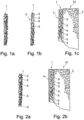
- the Fig. 1a, Fig. 1b and Fig. 1c show in various schematic side views a first embodiment, various manufacturing steps and a composite material 10 according to the invention.
- the composite material 10 is composed of an insulating material 2 and a drainage structure 1 connected thereto.
- the composite material 10 may contain further layers, functional layers or elements which are Fig. 1a to 1c are not shown.
- the composite material 10 according to the invention is used for thermal and/or acoustic insulation in vehicles, buildings or technical systems, for example in rail vehicles or aircraft.
- the composite material 10 has an overall flat, plate-like basic shape, ie it can be used directly as a plate-like element or as a roll for further use as insulation material in various fields of application.
- the composite material 10 according to the invention comprises at least one layer of an insulation material 2, which here is in the form of a volume fleece.
- the insulation material is, for example, a volume fleece based on, in particular, PET, PP, cotton or a mixture thereof.
- the insulation material can, for example, be a volume fleece based on an insulation material.
- the insulation material can also be a soft foam based on polyurethane foam, which also enables good thermal insulation properties and significant sound absorption.
- the volume fleece can also be based on PANox or other such materials, as long as it provides thermal and/or acoustic insulation.
- the insulating material is provided as a soft foam or as a volume fleece in contrast to a surface fleece.
- the insulating material has a certain minimum thickness and is not a simple, thin layer of a fleece-like insulating material.
- a volume fleece can be defined, for example, according to the ISO 9073-2 standard as a fleece which can have thicknesses ranging from 10 mm to 100 mm in particular.
- the density of such an insulating material can, for example, be in the range of 10 to 120 kg/m 3 according to the definition of the ISO 9073-1 standard. Such a density with such a basis weight for nonwovens is advantageous for the good thermal insulation and sound absorption properties.
- the composite material 10 according to the invention is provided with a drainage structure 1 which is attached to the insulation material, preferably via local point connection points 5.
- the drainage structure 1 comprises a reticulated foam.
- the drainage structure 1 is firmly connected to the insulation material 2 at the local connection points 5 of the rough side of the drainage structure 1. This can be done, for example, by punctual bonding, local fusing with the insulation material 2 or by other connection techniques which are known to the person skilled in the art.
- the composite material 10 is provided with a means 3, 4 for abrasion protection on one side of the drainage structure 1.
- the means 3, 4 for abrasion protection is present on an outer side of the composite material 10, so that the outer side lying on the side of the drainage structure 1 is covered and protected against damage due to protruding parts of the drainage structure.
- Such a means 3, 4 for abrasion protection can, according to the invention, either be a deliberately flattened side 3 as in the first embodiment according to Fig. 1b, Fig. 1c or an additional layer such as a film or a paper or a nonwoven fabric, which is attached to the outside of the drainage structure 1 as a means 4 for abrasion protection (cf. Fig. 2b , second embodiment).
- the composite material 10 is provided with very good long-term insulation properties. Moisture cannot reach the insulation material 2 due to the drainage structure 1. Furthermore, damage caused by abrasion of adjacent walls or floors is reliably avoided.
- the drainage structure 1 can also comprise a PU ether-based reticulated foam.
- a material is, for example, a hydrolysis-resistant reticulated foam with two rough sides with 5-55 ppi.
- a one-sided smooth layer or side can be provided to form a means 3, 4 for abrasion protection.
- Such a drainage structure 1 made of reticulated foam also offers the function of an air and moisture permeable area on the outside of the composite material, whereby according to the invention a means 3, 4 for abrasion protection outside
- a film, paper or fleece is separately attached to the outside of the reticulated foam, which provides sound insulation and a smooth outside of the composite material 10.
- the insulation material 2 according to the invention is an insulation material, for example made of a soft foam or a volume fleece based on PET, PP, cotton, PANox or a mixture thereof.
- Various forms of such materials, such as the volume fleece can be used for the composite material 10 in conjunction with the drainage structure 1.
- Volume fleece refers to those fleece materials that have a certain minimum thickness of approximately more than 10 mm, preferably thicknesses of 10 mm to 100 mm (method of measuring the thickness of the fleece according to ISO 9073-2).
- such volume fleeces have, for example, a density of 10-120 kg/m 3 (area weight of the possible nonwoven used for the volume fleece according to the ISO 9073-1 standard).
- an insulation material can vary according to the respective application, depending on whether thermal insulation or acoustic absorption of sound is desired.
- An advantageous material for this purpose is also a melamine foam or a volume fleece with an oil and water repellent property as well as with a high temperature resistance, for example between -50°C and +150°C.
- FIG. 2a and Fig. 2b show a second embodiment of a composite material 10 according to the invention, wherein Fig. 2b the composite material 10 as a whole and Fig. 2a only shows the drainage structure 1 according to the invention, which is connected to the insulation material 2 at the point connection points 5.
- an extra layer in the form of a film 4 is attached to the outside of the drainage structure 1 as a means for sound insulation 4.
- Such an additional layer can be in the form of a film 4, a paper, a flat fleece (in contrast to the above volume fleece 2) or a textile material.
- the outside of the comparatively rough drainage structure cf. Fig.
- the composite material 10 is realized with a smooth and flat outer side on the side used for assembly, namely the side of the drainage structure 1.
- the advantages according to the invention are also achieved with the alternative design. Compared to a composite material with only one rough side is on the side of the drainage structure facing outwards, ie for example towards a floor when used on a vehicle floor, the solution according to the invention offers a smooth side as a means 3, 4 for abrasion protection.
- the surface on which the composite material 10 is placed cannot be scratched due to the smooth outer side on the side of the drainage pattern 1.
- such scratches can have the disadvantage of damaging a protective layer of the metal surface and causing rust to form on the metal surface.
- a metal floor or a metal wall is provided with a rust-proof coating or primer or an anodized protective layer, which are susceptible to damage from the abrasive movements of the composite material 10 for the purposes of insulation.
- connection between the insulation material 2 and the drainage structure 1 can be made in various ways with the essentially rough or uneven side of the drainage structure 1.
- connection points 5 for example, local bonding can be provided or the material of the insulation material 2 is heated in a targeted manner and thus virtually fused with the drainage structure 1.
- Other connection methods such as sewing or linking or clamping, can also be implemented without impairing the advantages of the invention.
- the material of a composite material 10 according to the invention is provided, for example, in the form of plates or as rolls and can be cut to size on site depending on the circumstances.
- the material, together with the drainage structure 1, has the insulation layer around the insulation material 2 and, according to the invention, additionally has the advantage that it does not cause scratches or damage to adjacent components due to the means 3, 4 for abrasion protection.
- the composite material 10 according to the invention thus offers numerous advantageous application possibilities even in areas of application that are critical and susceptible to damage.
- the Fig. 1a, Fig. 1b and Fig. 1c show in various schematic side views a first embodiment, various manufacturing steps and a composite material 10 according to the invention.
- the composite material 10 is composed of an insulation material 2 and a drainage structure 1 connected thereto.
- the composite material 10 can contain further layers, functional layers or elements which are in the Fig. 1a to 1c are not shown.
- the composite material 10 according to the invention is used for thermal and/or acoustic insulation in vehicles, buildings or technical systems, for example in rail vehicles or aircraft.
- the composite material 10 has an overall flat, plate-like basic shape, ie it can be used directly as a plate-like element or as a roll for further use as insulation material in various fields of application.
- the composite material 10 according to the invention comprises at least one layer of an insulation material 2, which is in the form of a volume fleece.
- the insulation material is, for example, a volume fleece based on, in particular, PET, PP, cotton or a mixture thereof.
- the insulation material can, for example, be a volume fleece based on an insulation material.
- the insulation material can also be a soft foam based on polyurethane foam, which also enables good thermal insulation properties and significant sound absorption.
- the volume fleece can also be based on PANox or other such materials, as long as it provides thermal and/or acoustic insulation.
- the insulation material is provided, for example, as a volume fleece in contrast to a surface fleece.
- a volume fleece can be defined, for example, according to the ISO 9073-2 standard as a fleece that can have thicknesses ranging from 10 mm to 100 mm in particular.
- the density of such an insulation material can, for example, be in the range of 10 to 120 kg/m 3 according to the definition of the ISO 9073-1 standard. Such a density with such a basis weight for nonwovens is advantageous according to the invention for the good thermal insulation and sound absorption properties.
- the composite material 10 according to the invention is further provided with a drainage structure 1 which is attached to the insulation material, preferably via local point connection points 5.
- the drainage structure 1 is firmly connected to the insulation material 2 at the local connection points 5 of the rough side of the drainage structure 1. This can be done, for example, by punctual bonding, local fusing with the insulation material 2 or by other connection techniques which are known to the person skilled in the art.
- the composite material 10 is provided with a means 3, 4 for abrasion protection on one side of the drainage structure 1.
- the means 3, 4 for abrasion protection is present on an outer side of the composite material 10, so that the outer side lying on the side of the drainage structure 1 is covered and protected against damage due to protruding parts of the drainage structure.
- Such a means 3, 4 for abrasion protection can, according to the invention, either be a deliberately flattened side 3 as in the first embodiment according to Fig. 1b, Fig. 1c or an additional layer such as a film or a paper or a nonwoven fabric, which is attached to the outside of the drainage structure 1 as a means 4 for abrasion protection (cf. Fig. 2b , second embodiment).
- the composite material 10 is provided with very good long-term insulation properties. Moisture cannot reach the insulation material 2 due to the drainage structure 1. Furthermore, damage caused by abrasion of adjacent walls or floors is reliably avoided.
- the drainage structure 1 can comprise a PU ether-based reticulated foam.
- a material is, for example, a hydrolysis-resistant reticulated foam with two rough sides with 5-55 ppi.
- a one-sided smooth layer or side can be provided using a separate process in order to form a means 3, 4 for abrasion protection.
- Such a drainage structure 1 made of reticulated foam also offers the function of an air and moisture-permeable area on the outside of the composite material, wherein according to the invention a means 3, 4 for abrasion protection is attached to the outside.
- a film, paper or fleece is separately attached to the outside of the reticulated foam, which forms sound insulation and a smooth outside of the composite material 10.
- the insulation material 2 according to the invention is an insulation material, for example made of a soft foam or a volume fleece based on PET, PP, cotton, PANox or a mixture thereof.
- Various forms of such materials, such as the volume fleece can be used for the composite material 10 in conjunction with the drainage structure 1.
- Volume fleece refers to those fleece materials that have a certain minimum thickness of approximately more than 10 mm, preferably thicknesses of 10 mm to 100 mm (method of measuring the thickness of the fleece according to ISO 9073-2).
- such volume fleeces have, for example, a density of 10-120 kg/m 3 (area weight of the possible nonwoven used for the volume fleece according to the ISO 9073-1 standard).
- an insulation material can vary according to the respective application, depending on whether thermal insulation or acoustic absorption of sound is desired.
- An advantageous material for this purpose is also a melamine foam or a volume fleece with an oil and water repellent property as well as with a high temperature resistance, for example between -50°C and +150°C.
- FIG. 2a and Fig. 2b show a second embodiment of a composite material 10 according to the invention, wherein Fig. 2b the composite material 10 as a whole and Fig. 2a only shows the drainage structure 1 according to the invention, which is connected to the insulation material 2 at the point connection points 5.
- a smooth or An extra layer in the form of a film 4 is applied to the outside of the drainage structure 1 as a means 3 for abrasion protection.
- Such an additional layer can be in the form of a film 4, a paper, a flat fleece (in contrast to the above volume fleece 2) or a textile material.
- the outside of the comparatively rough drainage structure cf. Fig.
- the composite material 10 is realized with a smooth and flat outer side on the side used for assembly, namely the side of the drainage structure 1.
- the advantages according to the invention are also achieved with the alternative design.
- the solution according to the invention offers a smooth side as a means 3, 4 for abrasion protection.
- the surface on which the composite material 10 is placed cannot be scratched due to the smooth outer side on the side of the drainage pattern 1.
- such scratches can have the disadvantage of damaging a protective layer of the metal surface and causing rust to form on the metal surface.
- a metal floor or a metal wall is provided with a rust-proof coating or primer or an anodized protective layer, which are susceptible to damage from the abrasive movements of the composite material 10 for the purposes of insulation.
- connection between the insulation material 2 and the drainage structure 1 can be made in various ways with the essentially rough or uneven side of the drainage structure 1.
- local bonding can be provided at the point connection points 5 or the material of the insulation material 2 is heated in a targeted manner and thus virtually fused with the drainage structure 1.
- Other connection methods such as sewing or a link or a clamp fastening, can also be used. realize without impairing the advantages according to the invention.
- the material of a composite material 10 according to the invention is provided, for example, in the form of plates or as a roll and can be cut to size on site depending on the circumstances.
- the material, together with the drainage structure 1, has the insulation layer around the insulation material 2 and, according to the invention, has the additional advantage that it does not cause any scratches or damage to adjacent components due to the means 3, 4 for abrasion protection.
- the composite material 10 according to the invention therefore offers numerous advantageous application possibilities, even in areas of use that are critical and susceptible to damage.
Landscapes
- Engineering & Computer Science (AREA)
- Physics & Mathematics (AREA)
- Acoustics & Sound (AREA)
- Architecture (AREA)
- Mechanical Engineering (AREA)
- Electromagnetism (AREA)
- Structural Engineering (AREA)
- Civil Engineering (AREA)
- Multimedia (AREA)
- Textile Engineering (AREA)
- Thermal Sciences (AREA)
- Laminated Bodies (AREA)
- Building Environments (AREA)
Description
- Die vorliegende Erfindung betrifft einen Verbundwerkstoff zur Realisierung einer thermischen und/oder akustischen Isolierung in Fahrzeugen, Bauten, Anlagen oder ähnlichen Anwendungsbereichen, bei welchem eine zusätzliche Funktionsschicht als Drainagegebilde vorgesehen ist. Zur Schallisolierung oder zur thermischen Isolierung oder einer Kombination von beiden werden beispielsweise heutzutage in Schienenfahrzeugen, Flugzeugen oder Anlagen derartige Verbundwerkstoffe für die Zwecke der Isolierung eingesetzt. Die bisher verwendeten derartigen Verbundwerkstoffe weisen dabei mindestens ein Isolationsmaterial sowie in der Regel eine oder mehrere Funktionsschichten mit weiteren technischen Funktionen auf. Solche Verbundwerkstoffe werden herkömmlicherweise als ein plattenförmiges, im Wesentlichen flächiges Produkt oder als Rollenware bereitgestellt, wobei für die jeweilige Anwendungszwecke die Platten- oder die Rollenware entsprechend zugeschnitten und im Einsatzgebiet, beispielsweise einem Wand- oder Bodenbereich eines Schienenfahrzeuges, eingebaut werden.
- Ein Problem bei derartigen Isolierungen ist, dass unterschiedliche, teils gegensätzliche technische Anforderungen gleichzeitig erfüllt werden müssen: So muss für eine gute thermische Isolierung der Verbundwerkstoff einen möglichst geringen Wärmeleitwert haben. Zudem muss eine gewisse mechanische Stabilität des Materials gegeben sein. Außerdem muss der Verbundwerkstoff für die Zwecke der Schallabsorption angepasst sein, d. h. eine möglichst gute akustische Isolierung ermöglichen. Nicht zuletzt ist in vielen derartigen Anwendungen, beispielsweise im Bereich von Schienenfahrzeugen oder Flugzeugen, außerdem noch eine hohe Hitzebeständigkeit bzw. Temperaturbeständigkeit in einem weiten Temperaturbereich erforderlich. Die derartigen Verbundwerkstoffe müssen auch den strengen Erfordernissen der Brandgefährdung in solchen Anwendungsbereichen genügen. in bestimmten Bereichen sind thermisch und akustisch hochwirksame Isoliermaterialien zur Erfüllung dieser Anforderungen eingesetzt worden. In manchen Anwendungsbereichen besteht jedoch die Gefahr, dass diese Eigenschaften stark beeinträchtigt werden aufgrund von Feuchtigkeit, Nässe oder anderen äußeren Einflüssen, die in bestimmten Umgebungen vorhanden sind.
- Ein weiteres Problem derartiger Isolationsverfahren besteht darin, dass die Drainagegebilde der Funktionsschichten häufig aus einem Drahtgeflecht oder einem Kunststoffgebilde aus miteinander verknüpften, punktuell vorragenden Einzelfilamenten bestehen. Die vorragenden Stellen der Drähte oder des Kunststoffgeflechts führen aber dazu, dass sie nach einem Einbau in bestimmten Anwendungsbereichen an der Außenseite mit den angrenzenden Oberflächen in direkten Kontakt gelangen und eine Beschädigung von beispielsweise den Oberflächen, Lackierungen, Rostschutzbeschichten oder Ähnlichem hervorrufen können. Aus
DE 20 2019 100 429 U1 ist ein Verbundwerkstoff für Isolationszwecke mit einem Isoliermaterial und einem daran angebrachten Abstandsgelege für die Zwecke einer Drainage von Feuchtigkeit an einer Anlagefläche des Verbundwerkstoffs bekannt. Das Abstandsgelege ist ein Flächenmaterial aus miteinander verknüpften oder verbundenen Kunststofffilamenten und wird an dem Isoliermaterial punktuell beispielsweise durch Verkleben oder durch Verschmelzen mit dem Material des Isoliermaterials fest verbunden. Die teilweise vorstehenden Enden und Knickstellen der Kunststofffilamente des Abstandsgeleges dienen einerseits der Befestigung an dem Isoliermaterial. Auf der gegenüberliegenden Seite ragen diese Stellen des Drainagegebildes ebenfalls punktuell vor. -
WO 2019/014096 A1 betrifft eine Isolationsstruktur aus einer Matrix aus Kunststofffasern. Diese Kunststoffmatrix ist optional auf den beiden Außenseiten mit zusätzlichen Schichten versehen, welche beispielsweise als Klebeschicht, zusätzliche Isolationsschicht oder als Feuchtigkeitssperre (Dampfsperre) realisiert sein können. -
US 2005/115662 A1 offenbart ein thermoakustisches Isolationsmaterial für den Einsatz in Fahrzeugen oder Gebäuden. Der Verbund umfasst im Wesentlichen zwei miteinander verbundene Vlieslagen und kann eine zusätzliche Schicht enthalten um Abrasion zu verringern, welche ein Textil, Papier oder eine Folie sein kann. - Vor diesem Hintergrund ist es die Aufgabe der vorliegenden Erfindung, einen solchen Verbundwerkstoff für eine Realisierung von thermischen und/oder akustischen Isolierungen in Fahrzeugen, Bauten oder Anlagen bereitzustellen, bei welchem nicht nur eine hohe Beständigkeit der Isolationseigenschaften bei auch feuchten Umgebungsbedingungen oder eindringenden äußeren Flüssigkeiten oder dergleichen gewährleistet ist, sondern zusätzlich eine Beschädigung von an der Außenseite angrenzenden Bauteilen, Lackierungen oder Beschichtungen möglichst vermieden wird.
- Diese Aufgabe wird mit einem Verbundwerkstoff mit den Merkmalen des Anspruchs 1 gelöst. Vorteilhafte Ausgestaltungen und Weiterbildung der Erfindung sind Gegenstand der jeweils abhängigen Ansprüche.
- Erfindungsgemäß wird nach Anspruch 1 ein Verbundwerkstoff zur Realisierung einer thermischen und/oder akustischen Isolierung in Fahrzeugen, Bauten oder Anlagen mit einer insbesondere flächigen plattenartigen Grundform vorgeschlagen, welcher mindestens ein Isolationsmaterial und mindestens eine mit dem Isolationsmaterial verbundene Funktionsschicht in Form eines Drainagegebildes umfasst, wobei das Drainagegebilde eine luft- und flüssigkeitsdurchlässige Schicht des Verbundwerkstoffs ausbildet, wobei das Isolationsmaterial ein Weichschaumstoff oder ein Volumenvlies auf Basis von insbesondere PET, PP, PANox, Baumwolle oder einem Gemisch davon umfasst, dadurch gekennzeichnet, dass das Drainagegebilde auf der zum Isolationsmaterial weisenden Seite uneben, insbesondere mit punktuell vorragenden Stellen oder Teilen zur Befestigung an dem Isolationsmaterial gebildet ist und auf der demgegenüber abgewandten Seite ein Mittel zum Scheuerschutz an der Außenseite des Verbundwerkstoffs aufweist. Ein erfindungsgemäß bereitgestelltes Isolationsmaterial in Form eines plattenförmigen Verbundwerkstoffs dient beispielsweise in einem Boden- oder Wandbereich von Schienenfahrzeugen zur thermischen Isolierung und Schallabsorption. Das Isolationsmaterial ist mit einem Drainagegebilde verbunden, welches an der Außenseite vorgesehen ist. Das Drainagegebilde hat den Vorteil, dass die Isolationseigenschaften langfristig gewährleistet werden, da eindringende Feuchtigkeit durch das Drainagegebilde verhindert wird. Ein direkter Kontakt des Isolationsmaterials mit den angrenzenden Wänden wie einem Boden- oder Deckenbereich eines Schienenfahrzeugs wird hierdurch verhindert. Das Isolationsmaterial ist als ein Weichschaumstoff oder als sogenanntes Volumenvlies vorgesehen, welches im Gegensatz zu einem Flachvlies eine gewisse Dicke aufweist: insbesondere können Dicken des Isolationsmaterials in Form eines Volumenvlieses in der Größenordnung von 10-100 mm vorgesehen werden, wobei eine Dickenmessung des Volumenvlieses mittels der Norm ISO 9073-2 erfolgt. Das Isolationsmaterial, welches so eine nicht unerhebliche Dicke aufweist, bietet eine ausreichende thermische Isolierung und auch eine gute Schallabsorption. An dem Volumenvlies direkt angebracht ist das Drainagegebilde gemäß der Erfindung welches einen retikulierten Schaumstoff umfasst und eine luft- und flüssigkeitsdurchlässige Schicht an einer Außenseite eines Verbundwerkstoffs zumindest einseitig bereitstellt. Die Erfindung ist dadurch gekennzeichnet, dass das Drainagegebilde auf der zum Isolationsmaterial weisenden Seite uneben gebildet ist, insbesondere mit punktuell vorragenden Stellen oder Teilen versehen ist, welche einer Befestigung an dem Isolationsmaterial dienen. Auch ist das Drainagegebilde auf der demgegenüber abgewandten Seite mit einem Mittel zum Scheuerschutz an der Außenseite des Verbundwerkstoffs versehen.
- Somit lässt sich das Drainagegebilde mit lediglich punktuell vorgesehenen Verbindungsstel len an dem Isolationsmaterial ausreichend fest für eine Weiterverarbeitung anbringen. Die Mittel zum Scheuerschutz haben den Vorteil, dass durch das Drainagegebilde keine Beschädigung oder keine Kratzer an angrenzenden Bauteilen oder Schichten entstehen können. Beispielsweise wird so vermieden, dass an einer Rostschutzbeschichtung einer Wand oder eines Bodens in einem Zugwaggon durch das leichte Bewegen oder Vibrieren während der Nutzung des Fahrzeuges zu unerwünschten Beschädigungen führen. Erfindungsgemäß ist somit das Drainagegebilde mit zwei unterschiedlichen Seiten realisiert, nämlich einer Seite, an welcher vorragende Stellen oder unebene Flächen vorgesehen sind, die zur guten Befestigung am Isolationsmaterial dienen, und an einer demgegenüber liegend zweiten Seite, welche speziell mit einem Mittel zum Scheuerschutz gebildet ist. Ein solches Mittel zum Scheuerschutz kann unterschiedliche Formen aufweisen und entweder im Material des Drainagegebildes selbst oder in zusätzlichen Schichten oder Lagen von Materialien bestehen. Somit bietet der erfindungsgemäße Verbundwerkstoff eine besonders ausgestaltete Außenseite an der Seite des Drainagegebildes, welche gegenüber der normalerweise rauen oder unebenen Seite eine beispielsweise geglättete, abgeflachte oder mit anderen Scheuerschutzmitteln versehene Seite ausbildet.
- Gemäß einem Aspekt der Erfindung ist das Mittel zum Scheuerschutz eine speziell abgeflachte Seite des Drainagegebildes, welche durch einseitiges Glätten oder Abflachen des Drainagegebildes mittels beheizter Walzen realisiert ist.
- Der Vorteil ist, dass gegenüber einem Material mit der rauen Seite nach außen hin, beispielsweise zum Boden bei einer Anwendung in einem Fahrzeugboden eines Zugs oder dergleichen, die abgeflachte und damit glattere Seite einen direkten Scheuerschutz bietet. Der Untergrund, auf dem der Verbundwerkstoff eingebaut wird und zu liegen kommt, kann durch die abgeflachte und mit dem Scheuerschutzmittel versehene Seite des Drainagegebildes nicht unerwünscht verkratzt werden. Je nach Untergrund können nämlich solche Kratzer durch ein Verschieben oder Verlagern oder Vibrieren des Verbundwerkstoffs in der fortwährenden Nutzung dazu führen, dass eine etwaige Schutzschicht des Metalluntergrundes oder eine eloxierte Schutzschicht oder einen Rostschutzlack, beschädigt wird und der Metalluntergrund somit zu rosten beginnen kann. Mit der erfindungsgemäßen Lösung wird eine langfristige Beschädigung derartiger Rostschutzschichten durch Einsatz des vorteilhaften Verbundwerkstoffs von dem Fahrzeug vermieden. Eine längere Lebensdauer der Isolierung und Funktionsfähigkeit wird hierdurch gewährleistet. Jegliche oberflächliche Beschädigung oder Verkratzung von angrenzenden Bauteilen wird so mit der Erfindung effektiv mit konstruktiv überraschend einfachen Maßnahmen vermieden.
- Gemäß einem weiteren vorteilhaften Aspekt der Erfindung ist als ein Mittel zum Scheuerschutz eine an dem Drainagegebilde angebrachte Schicht, wie eine Folie, Papier, Vlies oder Textil vorgesehen. Das Vlies oder die Folie kann auf dem Drainagegebilde angebracht werden und bietet ähnliche Vorteile wie die zuvor diskutierte abgeflachte Seite des Drainagegebildes. Ein Verkratzen oder Beschädigen von angrenzenden Bauteilen und insbesondere von Lackierungen oder Rostschutzschichten wird so sicher vermieden.
- Gemäß der Erfindung umfasst das Drainagegebilde einen retikulierten Schaumstoff. Ein solcher retikulierter Schaumstoff hat den Vorteil, dass er durchlässig ist für Luft beziehungsweise Feuchtigkeit, jedoch gleichzeitig eine relativ gute Strukturstabilität bietet. Beispielsweise kann ein retikulierter Schaumstoff auf PU-Etherbasis vorgesehen werden, wobei auch hier eine raue Seite und eine glatte Seite des Drainagegebildes vorhanden sind. Die glatte Seite ist durch ein wie oben beschriebenes Mittel zum Scheuerschutz gebildet. Auch solch ein retikulierter Schaumstoff bietet eine unebene raue Seite, welche die oben genannten Vorteile für eine insbesondere nur lokal an bestimmten Punkten vorgesehene Befestigung mit dem Isolationsmaterial ermöglicht. An einer gegenüberliegenden Seite ist ein erfindungsgemäßer Scheuerschutz vorgesehen.
- Gemäß einer vorteilhaften Ausgestaltung der Erfindung ist das Drainagegebilde an punktuellen Verbindungsstellen mit dem Isolationsmaterial lediglich lokal fest verbunden. Die punktuelle Verbindung an lokalen Stellen zwischen dem Isolationsmaterial und dem Drainagegebilde hat den Vorteil, dass nur die für die Weiterverarbeitung und die Montage notwendige Verbindung zwischen den einzelnen Bestandteilen gegeben ist. Außerdem wird nur ein vergleichsweise geringerer Aufwand bei der Herstellung der Verbindung benötigt. Beispielsweise sind mit einer Klebeverbindung oder einer anderen Art der Verbindung nur lokal der Kleber oder die Verbindungsmittel einzusetzen. Die Reduzierung auf lediglich lokal und punktuell festgelegt vorgesehene Klebestellen hat beispielsweise den Vorteil, dass die Brandlast des Materials nicht unnötig stark vergrößert wird. Eine gute Hitze- und Brandwiderstandsfähigkeit des Verbundwerkstoffs ist dadurch gewährleistet. Auch sind die Kosten der Herstellung dadurch deutlich reduziert.
- Gemäß einer vorteilhaften Ausgestaltung der Erfindung ist das Drainagegebilde an den punktuellen Verbindungsstellen mit dem Isolationsmaterial durch Verschmelzen mit oder durch Einbetten in dem Isolationsmaterial verbunden. Ein Verschmelzen mit dem Isolationsmaterial kann beispielsweise dann erfolgen, wenn ein kunststoffbasiertes Isolationsmaterial verwendet wird, wie zum Beispiel ein Volumenvlies oder ein Weichschaumstoff. Es kann auch ein Weichschaumstoff auf Polyurethanschaumbasis als Isolationsmaterial verwendet werden. Das Verbinden kann durch einfaches Erhitzen beim Zusammenfügen der beiden Schichten (Drainagegebilde, Isolationsmaterial) oder lediglich einer der Schichten erfolgen. Durch ein Anschmelzen der Außenschicht des Isolationsmaterials werden die vorragenden Punkte des Drainagegebildes in dem Isolationsmaterial eingebettet und damit nach einem Abkühlen fest verbunden. Auch ein direktes Einbinden in einem Herstellungsprozess kann erfindungsgemäß in Betracht gezogen werden. Ein zusätzliches Befestigungsmaterial, wie ein Klebstoff oder dergleichen, ist ferner nicht notwendig. Dies reduziert deutlich die Herstellungskosten und bietet die Vorteile hinsichtlich einer vergleichsweise geringen Brandlast, einer einfachen Weiterverarbeitbarkeit und einer schnellen Realisierung der Verbindung.
- Gemäß einer vorteilhaften weiteren Ausgestaltung der Erfindung ist das Drainagegebilde mit dem Isolationsmaterial an den punktuellen Verbindungsstellen durch ein Verkleben oder durch ein Vernähen mit dem Isolationsmaterial verbunden. Diese alternative Verbindungsmethode hat den Vorteil, dass die Erhitzung im Herstellungsprozess nicht unbedingt erforderlich ist. Die Verklebung kann so realisiert werden, dass lediglich an den vorragenden Stellen der Raumseite des Drainagegebildes der Klebstoff oder die Klebeschicht aufgebracht wird. Ein Erhöhen der Brandlast wird dadurch vermieden im Vergleich zu einem großflächigen Auftrag einer Klebeschicht. Mit dem Vernähen oder Verklammern lässt sich das Isolationsmaterial mit dem Drainagegebilde fest anbinden, wobei eine vorzeitige Ablösung des Drainagegebildes sicher vermieden wird.
- Gemäß einer weiteren vorteilhaften Ausgestaltung der Erfindung ist an der dem Drainagegebilde abgewandten Seite des Verbundwerkstoffs eine zusätzliche Isolationsschicht, insbesondere eine Aluminiumfolie oder eine Dämmplatte, vorgesehen. Mit solch einem Verbundwerkstoff können weitere technische Funktionen bereitgestellt werden, wie zum Beispiel eine weiter vergrößerte Wärmedämmeigenschaft, eine Dampfsperre mittels einer Aluminiumfolie oder andere technische Eigenschaften wie einer Versteifung und strukturelle Stützung des Verbundwerkstoffs.
- Weitere Vorteile, Merkmale und Aspekte der vorliegenden Erfindung werden in der nachfolgenden Beschreibung von Ausführungsbeispielen offenbart werden. Die Beschreibung der Ausführungsbeispiele erfolgt anhand der in den Zeichnungen dargestellten Ausführungsbeispiele, in welchen:
- Fig. 1a, 1b und 1c
- schematische Seitenansichten eines ersten Ausführungsbeispiels eines erfindungsgemäßen Verbundwerkstoffs, wobei in
Fig. 1a und 1b das Drainagegebilde in verschiedenen Herstellungsstufen zeigen und wobeiFig. 1c den Verbundwerkstoff im Zusammenhang mit dem Isolationsmaterial zeigt; und - Fig. 2a und 2b
- verschiedene schematische Ansichten eines zweiten Ausführungsbeispiels eines erfindungsgemäßen Verbundwerkstoffs zeigen, wobei
Fig. 2a eine Detailansicht des Drainagegebildes ist undFig. 2b eine Ansicht des fertiggestellten Verbundwerkstoffs mit Scheuerschutz gemäß der Erfindung ist. - Die
Fig. 1a, Fig. 1b und Fig. 1c zeigen in verschiedenen schematischen Seitenansichten ein erstes Ausführungsbeispiel, verschiedene Herstellungsschritte sowie einen Verbundwerkstoff 10 gemäß der Erfindung. Bei diesem ersten Ausführungsbeispiel ist der Verbundwerkstoff 10 aus einem Isolationsmaterial 2 sowie einem damit verbundenen Drainagegebilde 1 zusammengesetzt. Der Verbundwerkstoff 10 kann weitere Schichten, Funktionsschichten oder Elemente enthalten, die in denFig. 1a bis 1c nicht gezeigt sind. Der Verbundwerkstoff 10 gemäß der Erfindung dient einer thermischen und/oder akustischen Isolierung in Fahrzeugen, Bauten oder technischen Anlagen, beispielsweise in Schienenfahrzeugen oder Flugzeugen. Der Verbundwerkstoff 10 weist eine insgesamt flächige, plattenartige Grundform auf, d.h. er ist als plattenartiges Element oder als Rollenware für eine weitere Verwendung als Isolationsmaterial in verschiedenen Anwendungsgebieten direkt einsetzbar. Der Verbundwerkstoff 10 gemäß der Erfindung umfasst mindestens eine Schicht eines Isolationsmaterials 2, welche hier in Form eines Volumenvlieses vorliegt. Das Isolationsmaterial ist beispielsweise ein Volumenvlies auf Basis von insbesondere PET, PP, Baumwolle oder einem Gemisch davon. Das Isolationsmaterial kann beispielsweise ein Volumenvlies auf Basis eines Isolationswerkstoffs sein. Alternativ kann das Isolationsmaterial auch ein Weichschaumstoff auf Polyurethanschaumbasis sein, welcher ebenfalls gute thermische Isoliereigenschaften sowie eine deutliche Schallabsorption ermöglicht. Das Volumenvlies kann auch auf Basis eines PANox oder anderen derartigen Materialien sein, solange es eine thermische und/oder akustische Isolierung bereitstellt. - Erfindungsgemäß ist das lsolatioiismateria als ein Weichschaumstoff oder als ein Volumenvlies im Gegensatz zu einem Flächenvlies vorgesehen. Das heißt, das Isolationsmaterial weist eine gewisse Mindestdicke auf und ist nicht eine einfache, dünne Lage eines vliesförmigen Isolationswerkstoffs. Ein Volumenvlies lässt sich beispielsweise gemäß der Norm ISO 9073-2 als ein solches Vlies definieren, welches Dicken von einem Bereich von insbesondere 10 mm bis 100 mm umfassen kann. Die Dichte eines solchen Isolationsmaterials kann beispielsweise im Bereich von 10 bis 120 kg/m3 gemäß der Definition der Norm ISO 9073-1 liegen. Eine solche Dichte mit einem solchen Flächengewicht für Vliesstoffe ist vorteilhaft für die guten Wärmedämmungs- und Schallabsorptionseigenschaften.
- Der Verbundwerkstoff 10 gemäß der Erfindung ist mit einem Drainagegebilde 1 versehen, welches an dem Isolationsmaterial angebracht ist, vorzugsweise über lokale punktuelle Verbindungsstellen 5. Das Drainagegebilde 1 umfasst einen retikulierten Schaumstoff.
- Erfindungsgemäß wird das Drainagegebilde 1 mit dem Isolationsmaterial 2 fest verbunden an den lokalen Verbindungsstellen 5 der rauen Seite des Drainagegebildes 1. Dies kann beispielsweise durch eine punktuelle Verklebung, ein lokales Verschmelzen mit dem Isolationsmaterial 2 oder durch andere Verbindungstechniken, welche dem Fachmann des Gebietes bekannt sind, erfolgen.
- Gemäß der Erfindung ist der Verbundwerkstoff 10 auf einer Seite des Drainagegebildes 1 mit einem Mittel 3, 4 zum Scheuerschutz versehen. Das Mittel 3, 4 zum Scheuerschutz ist an einer Außenseite des Verbundwerkstoffs 10 vorhanden, sodass die an der Seite des Drainagegebildes 1 liegende Außenseite gegenüber Beschädigungen aufgrund von vorragenden Stellen des Drainagegebildes abgedeckt und geschützt ist. Ein solches Mittel 3, 4 zum Scheuerschutz kann gemäß der Erfindung entweder eine gezielt abgeflachte Seite 3 wie bei dem ersten Ausführungsbeispiel gemäß
Fig. 1b, Fig. 1c sein oder eine zusätzliche Schicht wie eine Folie oder ein Papier oder ein Vliesstoff, welche als Mittel 4 zum Scheuerschutz an der Außenseite des Drainagegebildes 1 angebracht ist (vgl.Fig. 2b , zweites Ausführungsbeispiel). Durch das Vorsehen eines solchen erfindungsgemäßen Mittels 3, 4 zum Scheuerschutz ist der Verbundwerkstoff 10 sowohl mit sehr guten langfristigen Isolationseigenschaften versehen. Eine Feuchtigkeit kann aufgrund des Drainagegebildes 1 nicht an das Isolationsmaterial 2 herangelangen. Ferner ist eine Beschädigung durch Anscheuern von angrenzenden Wänden oder Böden sicher vermieden. Der Scheuerschutz in Form einer abgeflachten Seite 3 an dem Drainagegebilde 1 oder in Form eines zusätzlich angebrachten Mittels 4, wie eine Folie, ein Papier, ein Vlies oder Textil, verhindert die Verkratzung und Beschädigung von beispielsweise Rostschutzschicht oder Lackierungen an angrenzenden Bauteilen. - Das Drainagegebilde 1 kann auch einen retikulierten Schaumstoff auf PU-Etherbasis umfassen. Ein solches Material ist beispielsweise ein hydrolysebeständiger retikulierter Schaumstoff mit zwei rauen Seiten mit 5-55 ppi. Bei solch einem Drainagegebilde 1 kann mit einem separaten Prozess eine einseitige glatte Schicht oder Seite bereitgestellt werden, um ein Mittel 3, 4 für einen Scheuerschutz zu bilden. Auch solch ein Drainagegebilde 1 aus retikuliertem Schaumstoff bietet die Funktion eines luft- und feuchtigkeitsdurchlässigen Bereichs an der Außenseite des Verbundwerkstoffs, wobei erfindungsgemäß ein Mittel 3, 4 für einen Scheuerschutz außen angebracht ist. Bei dieser Ausführungsform ist beispielsweise an der Außenseite des retikulierten Schaumstoffs eine Folie, ein Papier oder ein Vlies extra angebracht, was einen Schallschutz und eine glatte Außenseite des Verbundwerkstoffs 10 bildet.
- Das Isolationsmaterial 2 gemäß der Erfindung ist ein Isolationsmaterial beispielsweise aus einem Weichschaumstoff oder einem Volumenvlies auf Basis von PET, PP, Baumwolle, PANox oder einem Gemisch davon. Verschiedene Formen von solchen Materialien, wie den Volumenvliesen, lassen sich für den Verbundwerkstoff 10 in Zusammenwirken mit dem Drainagegebilde 1 verwenden. Als Volumenvlies werden solche Vliesmaterialien bezeichnet, die eine gewisse Mindestdicke von etwa mehr als 10 mm, vorzugsweise Dicken von 10 mm bis 100 mm aufweisen (Methode Vliesdickenmessung gemäß ISO 9073-2). Solche Volumenvliese haben erfindungsgemäß beispielsweise eine Dichte von 10-120 kg/m3 (Flächengewicht an dem verwendeten möglichen Vliesstoff für das Volumenvlies gemäß Norm ISO 9073-1). Die Verwendung eines Isolationsmaterials kann entsprechend den jeweiligen Anwendungsfällen variieren, je nachdem, ob mehr eine thermische Isolierung oder eine akustische Absorption von Schall gewünscht ist. Ein hierzu vorteilhafter Werkstoff ist auch ein Melamin-Schaumstoff oder ein Volumenvlies mit einer öl- und wasserabweisenden Eigenschaft sowie mit einer hohen Temperaturbeständigkeit, beispielsweise zwischen -50°C und +150°C.
- Die schematischen Seitenansichten der
Fig. 2a und Fig. 2b zeigen ein zweites Ausführungsbeispiel eines erfindungsgemäßen Verbundwerkstoffs 10, wobeiFig. 2b den Verbundwerkstoff 10 als Ganzes undFig. 2a lediglich das Drainagegebilde 1 gemäß der Erfindung zeigt, das an den punktuellen Verbindungsstellen 5 mit dem Isolationsmaterial 2 verbunden wird. Bei diesem zweiten Ausführungsbeispiel der Erfindung ist anstatt einer glatten oder geglätteten Seite als Mittel 3 zum Scheuerschutz eine Extraschicht in Form einer Folie 4 als Mittel zum Schallschutz 4 an der Außenseite des Drainagegebildes 1 angebracht. Eine solche zusätzliche Schicht kann in Form einer Folie 4, einem Papier, einem flächigen Vlies (im Gegensatz zum obigen Volumenvlies 2) oder einem Textilstoff sein. Die Außenseite des an sich vergleichsweise rauen Drainagegebildes (vgl.Fig. 2a ) ist somit mit einem Mittel 4 zum Scheuerschutz gebildet, sodass insgesamt der Verbundwerkstoff 10 an der für die Montage dienenden Seite, nämlich der Seite des Drainagegebildes 1, mit einer glatten und ebenen Außenseite realisiert ist. Auch mit der alternativen Ausgestaltung werden die erfindungsgemäßen Vorteile erzielt. Gegenüber einem Verbundwerkstoff mit lediglich einer rauen Seite wird auf Seiten des Drainagegebildes nach außen hin, d.h. zu beispielsweise einem Boden bei der Anwendung an einem Fahrzeugboden, bietet die erfindungsgemäße Lösung eine glatte Seite als ein Mittel 3, 4 zum Scheuerschutz. - Der Untergrund, auf dem der Verbundwerkstoff 10 zu liegen kommt, kann durch die glatte Außenseite an der Seite des Drainagebildes 1 nicht zerkratzt werden. Je nach Untergrund können solche Kratzer in nachteiliger Weise dazu führen, dass eine Schutzschicht des Metalluntergrundes beschädigt wird und es zu einer Rostbildung auf dem Metalluntergrund kommt. Bei solchen Einbausituationen ist beispielsweise ein Metallboden oder eine Metallwand mit einer Rostschutzlackierung oder -grundierung oder einer eloxierten Schutzschicht versehen, die gegenüber den Scheuerbewegungen seitens des Verbundwerkstoffs 10 für die Zwecke der Isolierung anfällig für Beschädigungen sind. Diese Nachteile werden erfindungsgemäß in überraschend einfacher Weise vermieden. Die erfindungsgemäße Lösung bietet nicht nur vorteilhafte Aspekte hinsichtlich der thermischen Isolierung und der akustischen Abschottung, sondern auch eine Verbesserung hinsichtlich einer möglichst langfristigen Lebensdauer und eines langfristigen Zusammenwirkens mit angrenzenden Bauteilen in der Betriebssituation derartiger Fahrzeuge oder Anlagen.
- Auch bei diesem zweiten Ausführungsbeispiel gemäß der
Fig. 2a und 2b kann die Verbindung zwischen dem Isolationsmaterial 2 und dem Drainagegebilde 1 auf verschiedene Art und Weise erfolgen mit der im Wesentlichen rauen oder unebenen Seite des Drainagegebildes 1. An den punktuellen Verbindungsstellen 5 kann beispielsweise eine lokale Verklebung vorgesehen sein oder das Material des Isolationsmaterials 2 wird gezielt aufgeheizt und somit mit dem Drainagegebilde 1 quasi verschmolzen. Auch lassen sich weitere Verbindungsmethoden, wie z.B. eine Vernähung oder eine Verknüpfung oder eine Klammerbefestigung, realisieren, ohne dass die erfindungsgemäßen Vorteile beeinträchtigt werden. Das erfindungsgemäße Material eines Verbundwerkstoffs 10 ist beispielsweise in Form von Platten oder als Rollenware bereitgestellt und kann je nach Gegebenheiten an Ort und Stelle zugeschnitten werden. Das Material weist zusammen mit dem Drainagegebilde 1 die Isolationsschicht um das Isolationsmaterial 2 auf und hat zusätzlich gemäß der Erfindung den Vorteil, dass sie keine Verkratzungen oder Beschädigungen von angrenzenden Bauteilen erzeugt aufgrund des Mittels 3, 4 zum Scheuerschutz. Der Verbundwerkstoff 10 gemäß der Erfindung bietet somit zahlreiche vorteilhafte Einsatzmöglichkeiten auch in gegenüber Beschädigungen kritischen und anfälligen Einsatzbereichen. - Die
Fig. 1a, Fig. 1b und Fig. 1c zeigen in verschiedenen schematischen Seitenansichten ein erstes Ausführungsbeispiel, verschiedene Herstellungsschritte sowie einen Verbundwerkstoff 10 gemäß der Erfindung. Bei diesem ersten Ausführungsbeispiel ist der Verbundwerkstoff 10 aus einem Isolationsmaterial 2 sowie einem damit verbundenen Drainagegebilde 1 zusammengesetzt. Der Verbundwerkstoff 10 kann weitere Schichten, Funktionsschichten oder Elemente enthalten, die in denFig. 1a bis 1c nicht gezeigt sind. Der Verbundwerkstoff 10 gemäß der Erfindung dient einer thermischen und/oder akustischen Isolierung in Fahrzeugen, Bauten oder technischen Anlagen, beispielsweise in Schienenfahrzeugen oder Flugzeugen. Der Verbundwerkstoff 10 weist eine insgesamt flächige, plattenartige Grundform auf, d.h. er ist als plattenartiges Element oder als Rollenware für eine weitere Verwendung als Isolationsmaterial in verschiedenen Anwendungsgebieten direkt einsetzbar. Der Verbundwerkstoff 10 gemäß der Erfindung umfasst mindestens eine Schicht eines Isolationsmaterials 2, welche in Form eines Volumenvlieses vorliegt. Das Isolationsmaterial ist beispielsweise ein Volumenvlies auf Basis von insbesondere PET, PP, Baumwolle oder einem Gemisch davon. Das Isolationsmaterial kann beispielsweise ein Volumenvlies auf Basis eines Isolationswerkstoffs sein. Alternativ kann das Isolationsmaterial auch ein Weichschaumstoff auf Polyurethanschaumbasis sein, welcher ebenfalls gute thermische Isoliereigenschaften sowie eine deutliche Schallabsorption ermöglicht. Das Volumenvlies kann auch auf Basis eines PANox oder anderen derartigen Materialien sein, solange es eine thermische und/oder akustische Isolierung bereitstellt. - Erfindungsgemäß ist das Isolationsmaterial beispielsweise als ein Volumenvlies im Gegensatz zu einem Flächenvlies vorgesehen. Das heißt, das Isolationsmaterial weist eine gewisse Mindestdicke auf und ist nicht eine einfache, dünne Lage eines vliesförmigen Isolationswerkstoffs. Ein Volumenvlies lässt sich beispielsweise gemäß der Norm ISO 9073-2 als ein solches Vlies definieren, welches Dicken von einem Bereich von insbesondere 10 mm bis 100 mm umfassen kann. Die Dichte eines solchen Isolationsmaterials kann beispielsweise im Bereich von 10 bis 120 kg/m3 gemäß der Definition der Norm ISO 9073-1 liegen. Eine solche Dichte mit einem solchen Flächengewicht für Vliesstoffe ist erfindungsgemäß vorteilhaft für die guten Wärmedämmungs- und Schallabsorptionseigenschaften.
- Der Verbundwerkstoff 10 gemäß der Erfindung ist ferner mit einem Drainagegebilde 1 versehen, welches an dem Isolationsmaterial angebracht ist, vorzugsweise über lokale punktuelle Verbindungsstellen 5.
- Erfindungsgemäß wird das Drainagegebilde 1 mit dem Isolationsmaterial 2 fest verbunden an den lokalen Verbindungsstellen 5 der rauen Seite des Drainagegebildes 1. Dies kann beispielsweise durch eine punktuelle Verklebung, ein lokales Verschmelzen mit dem Isolationsmaterial 2 oder durch andere Verbindungstechniken, welche dem Fachmann des Gebietes bekannt sind, erfolgen.
- Gemäß der Erfindung ist der Verbundwerkstoff 10 auf einer Seite des Drainagegebildes 1 mit einem Mittel 3, 4 zum Scheuerschutz versehen. Das Mittel 3, 4 zum Scheuerschutz ist an einer Außenseite des Verbundwerkstoffs 10 vorhanden, sodass die an der Seite des Drainagegebildes 1 liegende Außenseite gegenüber Beschädigungen aufgrund von vorragenden Stellen des Drainagegebildes abgedeckt und geschützt ist. Ein solches Mittel 3, 4 zum Scheuerschutz kann gemäß der Erfindung entweder eine gezielt abgeflachte Seite 3 wie bei dem ersten Ausführungsbeispiel gemäß
Fig. 1b, Fig. 1c sein oder eine zusätzliche Schicht wie eine Folie oder ein Papier oder ein Vliesstoff, welche als Mittel 4 zum Scheuerschutz an der Außenseite des Drainagegebildes 1 angebracht ist (vgl.Fig. 2b , zweites Ausführungsbeispiel). Durch das Vorsehen eines solchen erfindungsgemäßen Mittels 3, 4 zum Scheuerschutz ist der Verbundwerkstoff 10 sowohl mit sehr guten langfristigen Isolationseigenschaften versehen. Eine Feuchtigkeit kann aufgrund des Drainagegebildes 1 nicht an das Isolationsmaterial 2 herangelangen. Ferner ist eine Beschädigung durch Anscheuern von angrenzenden Wänden oder Böden sicher vermieden. Der Scheuerschutz in Form einer abgeflachten Seite 3 an dem Drainagegebilde 1 oder in Form eines zusätzlich angebrachten Mittels 4, wie eine Folie, ein Papier, ein Vlies oder Ähnliches, verhindert die Verkratzung und Beschädigung von beispielsweise Rostschutzschicht oder Lackierungen an angrenzenden Bauteilen. - Das Drainagegebilde 1 kann einen retikulierten Schaumstoff auf PU-Etherbasis umfassen. Ein solches Material ist beispielsweise ein hydrolysebeständiger retikulierter Schaumstoff mit zwei rauen Seiten mit 5-55 ppi. Bei solch einem Drainagegebilde 1 kann mit einem separaten Prozess eine einseitige glatte Schicht oder Seite bereitgestellt werden, um ein Mittel 3, 4 für einen Scheuerschutz zu bilden. Auch solch ein Drainagegebilde 1 aus retikuliertem Schaumstoff bietet die Funktion eines luft- und feuchtigkeitsdurchlässigen Bereichs an der Außenseite des Verbundwerkstoffs, wobei erfindungsgemäß ein Mittel 3, 4 für einen Scheuerschutz außen angebracht ist. Bei dieser Ausführungsform ist beispielsweise an der Außenseite des retikulierten Schaumstoffs eine Folie, ein Papier oder ein Vlies extra angebracht, was einen Schallschutz und eine glatte Außenseite des Verbundwerkstoffs 10 bildet.
- Das Isolationsmaterial 2 gemäß der Erfindung ist ein Isolationsmaterial beispielsweise aus einem Weichschaumstoff oder einem Volumenvlies auf Basis von PET, PP, Baumwolle, PANox oder einem Gemisch davon. Verschiedene Formen von solchen Materialien, wie den Volumenvliesen, lassen sich für den Verbundwerkstoff 10 in Zusammenwirken mit dem Drainagegebilde 1 verwenden. Als Volumenvlies werden solche Vliesmaterialien bezeichnet, die eine gewisse Mindestdicke von etwa mehr als 10 mm, vorzugsweise Dicken von 10 mm bis 100 mm aufweisen (Methode Vliesdickenmessung gemäß ISO 9073-2). Solche Volumenvliese haben erfindungsgemäß beispielsweise eine Dichte von 10-120 kg/m3 (Flächengewicht an dem verwendeten möglichen Vliesstoff für das Volumenvlies gemäß Norm ISO 9073-1). Die Verwendung eines Isolationsmaterials kann entsprechend den jeweiligen Anwendungsfällen variieren, je nachdem, ob mehr eine thermische Isolierung oder eine akustische Absorption von Schall gewünscht ist. Ein hierzu vorteilhafter Werkstoff ist auch ein Melamin-Schaumstoff oder ein Volumenvlies mit einer öl- und wasserabweisenden Eigenschaft sowie mit einer hohen Temperaturbeständigkeit, beispielsweise zwischen -50°C und +150°C.
- Die schematischen Seitenansichten der
Fig. 2a und Fig. 2b zeigen ein zweites Ausführungsbeispiel eines erfindungsgemäßen Verbundwerkstoffs 10, wobeiFig. 2b den Verbundwerkstoff 10 als Ganzes undFig. 2a lediglich das Drainagegebilde 1 gemäß der Erfindung zeigt, das an den punktuellen Verbindungsstellen 5 mit dem Isolationsmaterial 2 verbunden wird. Bei diesem zweiten Ausführungsbeispiel der Erfindung ist anstatt einer glatten oder geglätteten Seite als Mittel 3 zum Scheuerschutz eine Extraschicht in Form einer Folie 4 als Mittel zum Schallschutz 4 an der Außenseite des Drainagegebildes 1 angebracht. Eine solche zusätzliche Schicht kann in Form einer Folie 4, einem Papier, einem flächigen Vlies (im Gegensatz zum obigen Volumenvlies 2) oder einem Textilstoff sein. Die Außenseite des an sich vergleichsweise rauen Drainagegebildes (vgl.Fig. 2a ) ist somit mit einem Mittel 4 zum Scheuerschutz gebildet, sodass insgesamt der Verbundwerkstoff 10 an der für die Montage dienenden Seite, nämlich der Seite des Drainagegebildes 1, mit einer glatten und ebenen Außenseite realisiert ist. Auch mit der alternativen Ausgestaltung werden die erfindungsgemäßen Vorteile erzielt. Gegenüber einem Verbundwerkstoff mit lediglich einer rauen Seite wird auf Seiten des Drainagegebildes nach außen hin, d.h. zu beispielsweise einem Boden bei der Anwendung an einem Fahrzeugboden, bietet die erfindungsgemäße Lösung eine glatte Seite als ein Mittel 3, 4 zum Scheuerschutz. - Der Untergrund, auf dem der Verbundwerkstoff 10 zu liegen kommt, kann durch die glatte Außenseite an der Seite des Drainagebildes 1 nicht zerkratzt werden. Je nach Untergrund können solche Kratzer in nachteiliger Weise dazu führen, dass eine Schutzschicht des Metalluntergrundes beschädigt wird und es zu einer Rostbildung auf dem Metalluntergrund kommt. Bei solchen Einbausituationen ist beispielsweise ein Metallboden oder eine Metallwand mit einer Rostschutzlackierung oder -grundierung oder einer eloxierten Schutzschicht versehen, die gegenüber den Scheuerbewegungen seitens des Verbundwerkstoffs 10 für die Zwecke der Isolierung anfällig für Beschädigungen sind. Diese Nachteile werden erfindungsgemäß in überraschend einfacher Weise vermieden. Die erfindungsgemäße Lösung bietet nicht nur vorteilhafte Aspekte hinsichtlich der thermischen Isolierung und der akustischen Abschottung, sondern auch eine Verbesserung hinsichtlich einer möglichst langfristigen Lebensdauer und eines langfristigen Zusammenwirkens mit angrenzenden Bauteilen in der Betriebssituation derartiger Fahrzeuge oder Anlagen.
- Auch bei diesem zweiten Ausführungsbeispiel gemäß der
Fig. 2a und 2b kann die Verbindung zwischen dem Isolationsmaterial 2 und dem Drainagegebilde 1 auf verschiedene Art und Weise erfolgen mit der im Wesentlichen rauen oder unebenen Seite des Drainagegebildes 1. An den punktuellen Verbindungsstellen 5 kann beispielsweise eine lokale Verklebung vorgesehen sein oder das Material des Isolationsmaterials 2 wird gezielt aufgeheizt und somit mit dem Drainagegebilde 1 quasi verschmolzen. Auch lassen sich weitere Verbindungsmethoden, wie z.B. eine Vernähung oder eine Verknüpfung oder eine Klammerbefestigung, realisieren, ohne dass die erfindungsgemäßen Vorteile beeinträchtigt werden. Das erfindungsgemäße Material eines Verbundwerkstoffs 10 ist beispielsweise in Form von Platten oder als Rollenware bereitgestellt und kann je nach Gegebenheiten an Ort und Stelle zugeschnitten werden. Das Material weist zusammen mit dem Drainagegebilde 1 die Isolationsschicht um das Isolationsmaterial 2 auf und hat zusätzlich gemäß der Erfindung den Vorteil, dass sie keine Verkratzungen oder Beschädigungen von angrenzenden Bauteilen erzeugt aufgrund des Mittels 3, 4 zum Scheuerschutz. Der Verbundwerkstoff 10 gemäß der Erfindung bietet somit zahlreiche vorteilhafte Einsatzmöglichkeiten auch in gegenüber Beschädigungen kritischen und anfälligen Einsatzbereichen.
Claims (5)
- Verbundwerkstoff (10) zur Realisierung einer thermischen und/oder akustischen Isolierung in Fahrzeugen, Bauten oder Anlagen mit einer insgesamt flächigen plattenartigen Grundform umfassend mindestens ein Isolationsmaterial (2) und mindestens eine mit dem Isolationsmaterial (2) verbundene Funktionsschicht in Form eines Drainagegebildes (1), wobei das Drainagegebilde (1) eine luft- und flüssigkeitsdurchlässige Schicht des Verbundwerkstoffs (10) ausbildet, wobei das Isolationsmaterial (2) ein Weichschaumstoff oder ein Volumenvlies auf Basis von insbesondere PET, PP, PA-Nox, Baumwolle oder einem Gemisch davon umfasst, dadurch gekennzeichnet, dass
das Drainagegebilde (1) auf der zum Isolationsmaterial (2) weisenden Seite uneben, insbesondere mit punktuell vorragenden Stellen oder Teilen zur Befestigung an dem Isolationsmaterial (2) gebildet ist und auf der demgegenüber abgewandten Seite ein Mittel (3, 4) zum Scheuerschutz in Form einer speziell abgeflachten Seite (3) des Drainagegebildes (1) an der Außenseite des Verbundwerkstoffs (10) aufweist, welche durch einseitiges Glätten oder Abflachen des Drainagegebildes (1) mittels beheizter Walzen realisiert ist, oder das Mittel zum Scheuerschutz eine an dem Drainagegebilde (1) angebrachte Schicht, wie eine Folie (4), Papier, Vlies oder Textil ist, und dass das Drainagegebilde (1) einen retikulierten Schaumstoff umfasst. - Verbundwerkstoff (10) nach Anspruch 1, dadurch gekennzeichnet, dass das Drainagegebilde (1) an punktuellen Verbindungsstellen (5) mit dem Isolationsmaterial (2) lediglich lokal fest verbunden ist.
- Verbundwerkstoff (10) nach Anspruch 2, dadurch gekennzeichnet, dass das Drainagegebilde (1) an den punktuellen Verbindungsstellen (5) mit dem Isolationsmaterial (2) durch Verschmelzen oder durch Einbetten mit/in dem Isolationsmaterial (2) verbunden ist.
- Verbundwerkstoff (10) nach Anspruch 2, dadurch gekennzeichnet, dass das Drainagegebilde (1) an den punktuellen Verbindungsstellen (5) mit dem Isolationsmaterial (2) durch Verkleben oder Vernähen mit dem Isolationsmaterial (2) verbunden ist.
- Verbundwerkstoff (10) nach einem der vorangegangenen Ansprüche, dadurch gekennzeichnet, dass an der dem Drainagegebilde (1) abgewandten Seite des Verbundwerkstoffs (10) eine zusätzliche Isolationsschicht, insbesondere eine Aluminiumfolie oder eine Dämmplatte, vorgesehen ist.
Priority Applications (1)
| Application Number | Priority Date | Filing Date | Title |
|---|---|---|---|
| SI202030525T SI3797986T1 (sl) | 2019-09-26 | 2020-01-23 | Kompozitni material za toplotno ali zvočno izolacijo |
Applications Claiming Priority (1)
| Application Number | Priority Date | Filing Date | Title |
|---|---|---|---|
| DE102019125953.3A DE102019125953A1 (de) | 2019-09-26 | 2019-09-26 | Verbundwerkstoff zur thermischen oder akustischen Isolierung sowie Verfahren zum Herstellen eines derartigen Verbundwerkstoffs |
Publications (2)
| Publication Number | Publication Date |
|---|---|
| EP3797986A1 EP3797986A1 (de) | 2021-03-31 |
| EP3797986B1 true EP3797986B1 (de) | 2024-10-16 |
Family
ID=69190703
Family Applications (1)
| Application Number | Title | Priority Date | Filing Date |
|---|---|---|---|
| EP20153409.6A Active EP3797986B1 (de) | 2019-09-26 | 2020-01-23 | Verbundwerkstoff zur thermischen oder akustischen isolierung |
Country Status (7)
| Country | Link |
|---|---|
| EP (1) | EP3797986B1 (de) |
| CN (1) | CN112550182A (de) |
| DE (1) | DE102019125953A1 (de) |
| ES (1) | ES2993489T3 (de) |
| HU (1) | HUE069627T2 (de) |
| PL (1) | PL3797986T3 (de) |
| SI (1) | SI3797986T1 (de) |
Families Citing this family (1)
| Publication number | Priority date | Publication date | Assignee | Title |
|---|---|---|---|---|
| US12435508B2 (en) * | 2021-05-05 | 2025-10-07 | Advanced Building Products, Inc. | Sound-deadening drainage mat |
Family Cites Families (6)
| Publication number | Priority date | Publication date | Assignee | Title |
|---|---|---|---|---|
| FR2807055B1 (fr) * | 2000-04-03 | 2002-06-28 | Plasto Sa | Bande adhesive de protection et d'insonorisation |
| US7294218B2 (en) * | 2003-10-17 | 2007-11-13 | Owens Corning Intellectual Capital, Llc | Composite material with improved structural, acoustic and thermal properties |
| KR101827025B1 (ko) * | 2010-03-25 | 2018-02-07 | 바스프 에스이 | 발포성 반응성 수지를 함유하는 지지체 물질로 제조된 발포체 및 성형물 |
| US10174503B2 (en) * | 2017-02-03 | 2019-01-08 | Atlas Roofing Corporation | Construction sheathing and methods of making and using same |
| EP3652372B1 (de) * | 2017-07-10 | 2023-09-13 | Zephyros, Inc. | Polymere vliesstruktur für hochtemperaturanwendungen |
| DE202019100429U1 (de) * | 2019-01-25 | 2019-02-19 | Cellofoam Gmbh & Co. Kg | Verbundwerkstoff zur Realisierung einer thermischen und/oder akustischen Isolierung |
-
2019
- 2019-09-26 DE DE102019125953.3A patent/DE102019125953A1/de active Pending
-
2020
- 2020-01-23 HU HUE20153409A patent/HUE069627T2/hu unknown
- 2020-01-23 PL PL20153409.6T patent/PL3797986T3/pl unknown
- 2020-01-23 SI SI202030525T patent/SI3797986T1/sl unknown
- 2020-01-23 EP EP20153409.6A patent/EP3797986B1/de active Active
- 2020-01-23 ES ES20153409T patent/ES2993489T3/es active Active
- 2020-09-25 CN CN202011022889.5A patent/CN112550182A/zh active Pending
Also Published As
| Publication number | Publication date |
|---|---|
| HUE069627T2 (hu) | 2025-04-28 |
| CN112550182A (zh) | 2021-03-26 |
| ES2993489T3 (en) | 2025-01-02 |
| DE102019125953A1 (de) | 2021-04-01 |
| SI3797986T1 (sl) | 2025-02-28 |
| PL3797986T3 (pl) | 2025-03-24 |
| EP3797986A1 (de) | 2021-03-31 |
Similar Documents
| Publication | Publication Date | Title |
|---|---|---|
| WO2017129398A1 (de) | Trockenbauwand und dichtungseinrichtung zur abdichtung einer anschlussfuge einer trockenbauwand | |
| EP2784232B1 (de) | Dichtband | |
| EP2354410A2 (de) | Schaumstoff-Dichtstreifen und Fensterrahmen mit Schaumstoff-Dichtstreifen | |
| EP4200491B1 (de) | Verfahren zur herstellung mehrerer dichtprofile sowie dichtprofil | |
| EP3797986B1 (de) | Verbundwerkstoff zur thermischen oder akustischen isolierung | |
| EP3825501A1 (de) | Dichtband | |
| EP2754705B1 (de) | Selbstklebefolie zum Verkleben eines Belags | |
| EP1963596B1 (de) | Fussbodenpaneel mit einer feuerhemmenden schicht | |
| DE9300152U1 (de) | Akustikplatte | |
| DE29910987U1 (de) | Schutzummantelung | |
| EP2093513A2 (de) | Wärmeisolierende Umkleidung | |
| EP2960389A1 (de) | Akustikabsorber | |
| EP3144136B1 (de) | Trägerfolie für ein klettverlegesystem einer flächentemperierungsvorrichtung, dieses umfassendes flächentemperierungssystem sowie verfahren zur herstellung eines flächentemperierungssystems | |
| EP3343082A1 (de) | Flächentemperierungssystem | |
| AT519010B1 (de) | Kfz-Bauteil | |
| EP2754774B1 (de) | Zwischenschicht für eine belagskonstruktion | |
| EP3144138A1 (de) | Trägerfolie für ein klettverlegesystem einer flächentemperierungssystems, diese umfassendes flächentemperierungssystem sowie herstellung eines flächentemperierungssystems | |
| DE9211921U1 (de) | In Kraftfahrzeugen zu verwendendes Abschirmelement | |
| EP3686002A1 (de) | Verbundwerkstoff zur realisierung einer thermischen und/oder akustischen isolierung | |
| DE947021C (de) | Rolladen | |
| WO2008131467A1 (de) | Schutzhüllen | |
| EP4003724A1 (de) | Expansionselement | |
| DE202012101648U1 (de) | Schalldämpfende Folie | |
| EP3501815A1 (de) | Verkleidungselement und verfahren zum entdröhnen eines bauteils sowie verfahren zum herstellen eines verkleidungselements und verwendung eines verkleidungselements | |
| DE102004054099A1 (de) | Trittschalldämmung |
Legal Events
| Date | Code | Title | Description |
|---|---|---|---|
| PUAI | Public reference made under article 153(3) epc to a published international application that has entered the european phase |
Free format text: ORIGINAL CODE: 0009012 |
|
| STAA | Information on the status of an ep patent application or granted ep patent |
Free format text: STATUS: THE APPLICATION HAS BEEN PUBLISHED |
|
| AK | Designated contracting states |
Kind code of ref document: A1 Designated state(s): AL AT BE BG CH CY CZ DE DK EE ES FI FR GB GR HR HU IE IS IT LI LT LU LV MC MK MT NL NO PL PT RO RS SE SI SK SM TR |
|
| AX | Request for extension of the european patent |
Extension state: BA ME |
|
| STAA | Information on the status of an ep patent application or granted ep patent |
Free format text: STATUS: REQUEST FOR EXAMINATION WAS MADE |
|
| 17P | Request for examination filed |
Effective date: 20210930 |
|
| RBV | Designated contracting states (corrected) |
Designated state(s): AL AT BE BG CH CY CZ DE DK EE ES FI FR GB GR HR HU IE IS IT LI LT LU LV MC MK MT NL NO PL PT RO RS SE SI SK SM TR |
|
| STAA | Information on the status of an ep patent application or granted ep patent |
Free format text: STATUS: EXAMINATION IS IN PROGRESS |
|
| 17Q | First examination report despatched |
Effective date: 20221026 |
|
| P01 | Opt-out of the competence of the unified patent court (upc) registered |
Effective date: 20230607 |
|
| GRAP | Despatch of communication of intention to grant a patent |
Free format text: ORIGINAL CODE: EPIDOSNIGR1 |
|
| STAA | Information on the status of an ep patent application or granted ep patent |
Free format text: STATUS: GRANT OF PATENT IS INTENDED |
|
| RIC1 | Information provided on ipc code assigned before grant |
Ipc: B32B 7/14 20060101ALI20240506BHEP Ipc: B32B 7/09 20190101ALI20240506BHEP Ipc: B32B 7/05 20190101ALI20240506BHEP Ipc: B32B 5/18 20060101ALI20240506BHEP Ipc: B32B 5/14 20060101ALI20240506BHEP Ipc: B32B 5/02 20060101ALI20240506BHEP Ipc: B32B 3/30 20060101ALI20240506BHEP Ipc: B32B 3/06 20060101ALI20240506BHEP Ipc: B32B 7/027 20190101AFI20240506BHEP Ipc: G10K 11/168 20060101ALI20240506BHEP |
|
| INTG | Intention to grant announced |
Effective date: 20240521 |
|
| GRAS | Grant fee paid |
Free format text: ORIGINAL CODE: EPIDOSNIGR3 |
|
| GRAA | (expected) grant |
Free format text: ORIGINAL CODE: 0009210 |
|
| STAA | Information on the status of an ep patent application or granted ep patent |
Free format text: STATUS: THE PATENT HAS BEEN GRANTED |
|
| AK | Designated contracting states |
Kind code of ref document: B1 Designated state(s): AL AT BE BG CH CY CZ DE DK EE ES FI FR GB GR HR HU IE IS IT LI LT LU LV MC MK MT NL NO PL PT RO RS SE SI SK SM TR |
|
| REG | Reference to a national code |
Ref country code: GB Ref legal event code: FG4D Free format text: NOT ENGLISH |
|
| REG | Reference to a national code |
Ref country code: CH Ref legal event code: EP |
|
| REG | Reference to a national code |
Ref country code: IE Ref legal event code: FG4D Free format text: LANGUAGE OF EP DOCUMENT: GERMAN |
|
| REG | Reference to a national code |
Ref country code: DE Ref legal event code: R096 Ref document number: 502020009479 Country of ref document: DE |
|
| REG | Reference to a national code |
Ref country code: ES Ref legal event code: FG2A Ref document number: 2993489 Country of ref document: ES Kind code of ref document: T3 Effective date: 20250102 |
|
| REG | Reference to a national code |
Ref country code: SE Ref legal event code: TRGR |
|
| PGFP | Annual fee paid to national office [announced via postgrant information from national office to epo] |
Ref country code: CZ Payment date: 20241218 Year of fee payment: 6 |
|
| REG | Reference to a national code |
Ref country code: LT Ref legal event code: MG9D |
|
| REG | Reference to a national code |
Ref country code: NL Ref legal event code: MP Effective date: 20241016 |
|
| PGFP | Annual fee paid to national office [announced via postgrant information from national office to epo] |
Ref country code: SI Payment date: 20241217 Year of fee payment: 6 |
|
| PGFP | Annual fee paid to national office [announced via postgrant information from national office to epo] |
Ref country code: HU Payment date: 20241220 Year of fee payment: 6 |
|
| PG25 | Lapsed in a contracting state [announced via postgrant information from national office to epo] |
Ref country code: NL Free format text: LAPSE BECAUSE OF FAILURE TO SUBMIT A TRANSLATION OF THE DESCRIPTION OR TO PAY THE FEE WITHIN THE PRESCRIBED TIME-LIMIT Effective date: 20241016 |
|
| PG25 | Lapsed in a contracting state [announced via postgrant information from national office to epo] |
Ref country code: NL Free format text: LAPSE BECAUSE OF FAILURE TO SUBMIT A TRANSLATION OF THE DESCRIPTION OR TO PAY THE FEE WITHIN THE PRESCRIBED TIME-LIMIT Effective date: 20241016 |
|
| PG25 | Lapsed in a contracting state [announced via postgrant information from national office to epo] |
Ref country code: PT Free format text: LAPSE BECAUSE OF FAILURE TO SUBMIT A TRANSLATION OF THE DESCRIPTION OR TO PAY THE FEE WITHIN THE PRESCRIBED TIME-LIMIT Effective date: 20250217 Ref country code: IS Free format text: LAPSE BECAUSE OF FAILURE TO SUBMIT A TRANSLATION OF THE DESCRIPTION OR TO PAY THE FEE WITHIN THE PRESCRIBED TIME-LIMIT Effective date: 20250216 Ref country code: HR Free format text: LAPSE BECAUSE OF FAILURE TO SUBMIT A TRANSLATION OF THE DESCRIPTION OR TO PAY THE FEE WITHIN THE PRESCRIBED TIME-LIMIT Effective date: 20241016 |
|
| PGFP | Annual fee paid to national office [announced via postgrant information from national office to epo] |
Ref country code: DE Payment date: 20250127 Year of fee payment: 6 |
|
| PG25 | Lapsed in a contracting state [announced via postgrant information from national office to epo] |
Ref country code: FI Free format text: LAPSE BECAUSE OF FAILURE TO SUBMIT A TRANSLATION OF THE DESCRIPTION OR TO PAY THE FEE WITHIN THE PRESCRIBED TIME-LIMIT Effective date: 20241016 |
|
| PG25 | Lapsed in a contracting state [announced via postgrant information from national office to epo] |
Ref country code: BG Free format text: LAPSE BECAUSE OF FAILURE TO SUBMIT A TRANSLATION OF THE DESCRIPTION OR TO PAY THE FEE WITHIN THE PRESCRIBED TIME-LIMIT Effective date: 20241016 |
|
| PGFP | Annual fee paid to national office [announced via postgrant information from national office to epo] |
Ref country code: ES Payment date: 20250203 Year of fee payment: 6 |
|
| PGFP | Annual fee paid to national office [announced via postgrant information from national office to epo] |
Ref country code: SE Payment date: 20250123 Year of fee payment: 6 |
|
| PG25 | Lapsed in a contracting state [announced via postgrant information from national office to epo] |
Ref country code: NO Free format text: LAPSE BECAUSE OF FAILURE TO SUBMIT A TRANSLATION OF THE DESCRIPTION OR TO PAY THE FEE WITHIN THE PRESCRIBED TIME-LIMIT Effective date: 20250116 |
|
| PG25 | Lapsed in a contracting state [announced via postgrant information from national office to epo] |
Ref country code: LV Free format text: LAPSE BECAUSE OF FAILURE TO SUBMIT A TRANSLATION OF THE DESCRIPTION OR TO PAY THE FEE WITHIN THE PRESCRIBED TIME-LIMIT Effective date: 20241016 Ref country code: GR Free format text: LAPSE BECAUSE OF FAILURE TO SUBMIT A TRANSLATION OF THE DESCRIPTION OR TO PAY THE FEE WITHIN THE PRESCRIBED TIME-LIMIT Effective date: 20250117 |
|
| PGFP | Annual fee paid to national office [announced via postgrant information from national office to epo] |
Ref country code: CH Payment date: 20250201 Year of fee payment: 6 |
|
| PGFP | Annual fee paid to national office [announced via postgrant information from national office to epo] |
Ref country code: PL Payment date: 20241217 Year of fee payment: 6 Ref country code: FR Payment date: 20250125 Year of fee payment: 6 |
|
| PGFP | Annual fee paid to national office [announced via postgrant information from national office to epo] |
Ref country code: IT Payment date: 20250129 Year of fee payment: 6 |
|
| REG | Reference to a national code |
Ref country code: HU Ref legal event code: AG4A Ref document number: E069627 Country of ref document: HU |
|
| PG25 | Lapsed in a contracting state [announced via postgrant information from national office to epo] |
Ref country code: RS Free format text: LAPSE BECAUSE OF FAILURE TO SUBMIT A TRANSLATION OF THE DESCRIPTION OR TO PAY THE FEE WITHIN THE PRESCRIBED TIME-LIMIT Effective date: 20250116 |
|
| PGFP | Annual fee paid to national office [announced via postgrant information from national office to epo] |
Ref country code: TR Payment date: 20250114 Year of fee payment: 6 |
|
| PG25 | Lapsed in a contracting state [announced via postgrant information from national office to epo] |
Ref country code: SM Free format text: LAPSE BECAUSE OF FAILURE TO SUBMIT A TRANSLATION OF THE DESCRIPTION OR TO PAY THE FEE WITHIN THE PRESCRIBED TIME-LIMIT Effective date: 20241016 |
|
| PG25 | Lapsed in a contracting state [announced via postgrant information from national office to epo] |
Ref country code: DK Free format text: LAPSE BECAUSE OF FAILURE TO SUBMIT A TRANSLATION OF THE DESCRIPTION OR TO PAY THE FEE WITHIN THE PRESCRIBED TIME-LIMIT Effective date: 20241016 |
|
| REG | Reference to a national code |
Ref country code: DE Ref legal event code: R097 Ref document number: 502020009479 Country of ref document: DE |
|
| PG25 | Lapsed in a contracting state [announced via postgrant information from national office to epo] |
Ref country code: EE Free format text: LAPSE BECAUSE OF FAILURE TO SUBMIT A TRANSLATION OF THE DESCRIPTION OR TO PAY THE FEE WITHIN THE PRESCRIBED TIME-LIMIT Effective date: 20241016 |
|
| PG25 | Lapsed in a contracting state [announced via postgrant information from national office to epo] |
Ref country code: RO Free format text: LAPSE BECAUSE OF FAILURE TO SUBMIT A TRANSLATION OF THE DESCRIPTION OR TO PAY THE FEE WITHIN THE PRESCRIBED TIME-LIMIT Effective date: 20241016 |
|
| PG25 | Lapsed in a contracting state [announced via postgrant information from national office to epo] |
Ref country code: SK Free format text: LAPSE BECAUSE OF FAILURE TO SUBMIT A TRANSLATION OF THE DESCRIPTION OR TO PAY THE FEE WITHIN THE PRESCRIBED TIME-LIMIT Effective date: 20241016 |
|
| PLBE | No opposition filed within time limit |
Free format text: ORIGINAL CODE: 0009261 |
|
| STAA | Information on the status of an ep patent application or granted ep patent |
Free format text: STATUS: NO OPPOSITION FILED WITHIN TIME LIMIT |
|
| PG25 | Lapsed in a contracting state [announced via postgrant information from national office to epo] |
Ref country code: LU Free format text: LAPSE BECAUSE OF NON-PAYMENT OF DUE FEES Effective date: 20250123 Ref country code: MC Free format text: LAPSE BECAUSE OF FAILURE TO SUBMIT A TRANSLATION OF THE DESCRIPTION OR TO PAY THE FEE WITHIN THE PRESCRIBED TIME-LIMIT Effective date: 20241016 |
|
| 26N | No opposition filed |
Effective date: 20250717 |
|
| GBPC | Gb: european patent ceased through non-payment of renewal fee |
Effective date: 20250123 |
|
| PG25 | Lapsed in a contracting state [announced via postgrant information from national office to epo] |
Ref country code: GB Free format text: LAPSE BECAUSE OF NON-PAYMENT OF DUE FEES Effective date: 20250123 Ref country code: BE Free format text: LAPSE BECAUSE OF NON-PAYMENT OF DUE FEES Effective date: 20250131 |
|
| REG | Reference to a national code |
Ref country code: BE Ref legal event code: MM Effective date: 20250131 |
|
| PG25 | Lapsed in a contracting state [announced via postgrant information from national office to epo] |
Ref country code: IE Free format text: LAPSE BECAUSE OF NON-PAYMENT OF DUE FEES Effective date: 20250123 |
|
| REG | Reference to a national code |
Ref country code: AT Ref legal event code: MM01 Ref document number: 1732627 Country of ref document: AT Kind code of ref document: T Effective date: 20250123 |
|
| PG25 | Lapsed in a contracting state [announced via postgrant information from national office to epo] |
Ref country code: AT Free format text: LAPSE BECAUSE OF NON-PAYMENT OF DUE FEES Effective date: 20250123 |