EP3795711A1 - Low cr ferritic stainless steel having excellent damping capacity and manufacturing method therefor - Google Patents
Low cr ferritic stainless steel having excellent damping capacity and manufacturing method therefor Download PDFInfo
- Publication number
- EP3795711A1 EP3795711A1 EP18924969.1A EP18924969A EP3795711A1 EP 3795711 A1 EP3795711 A1 EP 3795711A1 EP 18924969 A EP18924969 A EP 18924969A EP 3795711 A1 EP3795711 A1 EP 3795711A1
- Authority
- EP
- European Patent Office
- Prior art keywords
- stainless steel
- ferritic stainless
- less
- precipitates
- vibration attenuation
- Prior art date
- Legal status (The legal status is an assumption and is not a legal conclusion. Google has not performed a legal analysis and makes no representation as to the accuracy of the status listed.)
- Granted
Links
Images
Classifications
-
- C—CHEMISTRY; METALLURGY
- C21—METALLURGY OF IRON
- C21D—MODIFYING THE PHYSICAL STRUCTURE OF FERROUS METALS; GENERAL DEVICES FOR HEAT TREATMENT OF FERROUS OR NON-FERROUS METALS OR ALLOYS; MAKING METAL MALLEABLE, e.g. BY DECARBURISATION OR TEMPERING
- C21D9/00—Heat treatment, e.g. annealing, hardening, quenching or tempering, adapted for particular articles; Furnaces therefor
- C21D9/46—Heat treatment, e.g. annealing, hardening, quenching or tempering, adapted for particular articles; Furnaces therefor for sheet metals
-
- C—CHEMISTRY; METALLURGY
- C22—METALLURGY; FERROUS OR NON-FERROUS ALLOYS; TREATMENT OF ALLOYS OR NON-FERROUS METALS
- C22C—ALLOYS
- C22C38/00—Ferrous alloys, e.g. steel alloys
- C22C38/18—Ferrous alloys, e.g. steel alloys containing chromium
- C22C38/40—Ferrous alloys, e.g. steel alloys containing chromium with nickel
- C22C38/50—Ferrous alloys, e.g. steel alloys containing chromium with nickel with titanium or zirconium
-
- C—CHEMISTRY; METALLURGY
- C21—METALLURGY OF IRON
- C21D—MODIFYING THE PHYSICAL STRUCTURE OF FERROUS METALS; GENERAL DEVICES FOR HEAT TREATMENT OF FERROUS OR NON-FERROUS METALS OR ALLOYS; MAKING METAL MALLEABLE, e.g. BY DECARBURISATION OR TEMPERING
- C21D1/00—General methods or devices for heat treatment, e.g. annealing, hardening, quenching or tempering
- C21D1/26—Methods of annealing
-
- C—CHEMISTRY; METALLURGY
- C21—METALLURGY OF IRON
- C21D—MODIFYING THE PHYSICAL STRUCTURE OF FERROUS METALS; GENERAL DEVICES FOR HEAT TREATMENT OF FERROUS OR NON-FERROUS METALS OR ALLOYS; MAKING METAL MALLEABLE, e.g. BY DECARBURISATION OR TEMPERING
- C21D6/00—Heat treatment of ferrous alloys
-
- C—CHEMISTRY; METALLURGY
- C21—METALLURGY OF IRON
- C21D—MODIFYING THE PHYSICAL STRUCTURE OF FERROUS METALS; GENERAL DEVICES FOR HEAT TREATMENT OF FERROUS OR NON-FERROUS METALS OR ALLOYS; MAKING METAL MALLEABLE, e.g. BY DECARBURISATION OR TEMPERING
- C21D6/00—Heat treatment of ferrous alloys
- C21D6/002—Heat treatment of ferrous alloys containing Cr
-
- C—CHEMISTRY; METALLURGY
- C21—METALLURGY OF IRON
- C21D—MODIFYING THE PHYSICAL STRUCTURE OF FERROUS METALS; GENERAL DEVICES FOR HEAT TREATMENT OF FERROUS OR NON-FERROUS METALS OR ALLOYS; MAKING METAL MALLEABLE, e.g. BY DECARBURISATION OR TEMPERING
- C21D6/00—Heat treatment of ferrous alloys
- C21D6/004—Heat treatment of ferrous alloys containing Cr and Ni
-
- C—CHEMISTRY; METALLURGY
- C21—METALLURGY OF IRON
- C21D—MODIFYING THE PHYSICAL STRUCTURE OF FERROUS METALS; GENERAL DEVICES FOR HEAT TREATMENT OF FERROUS OR NON-FERROUS METALS OR ALLOYS; MAKING METAL MALLEABLE, e.g. BY DECARBURISATION OR TEMPERING
- C21D6/00—Heat treatment of ferrous alloys
- C21D6/005—Heat treatment of ferrous alloys containing Mn
-
- C—CHEMISTRY; METALLURGY
- C21—METALLURGY OF IRON
- C21D—MODIFYING THE PHYSICAL STRUCTURE OF FERROUS METALS; GENERAL DEVICES FOR HEAT TREATMENT OF FERROUS OR NON-FERROUS METALS OR ALLOYS; MAKING METAL MALLEABLE, e.g. BY DECARBURISATION OR TEMPERING
- C21D6/00—Heat treatment of ferrous alloys
- C21D6/008—Heat treatment of ferrous alloys containing Si
-
- C—CHEMISTRY; METALLURGY
- C22—METALLURGY; FERROUS OR NON-FERROUS ALLOYS; TREATMENT OF ALLOYS OR NON-FERROUS METALS
- C22C—ALLOYS
- C22C38/00—Ferrous alloys, e.g. steel alloys
-
- C—CHEMISTRY; METALLURGY
- C22—METALLURGY; FERROUS OR NON-FERROUS ALLOYS; TREATMENT OF ALLOYS OR NON-FERROUS METALS
- C22C—ALLOYS
- C22C38/00—Ferrous alloys, e.g. steel alloys
- C22C38/001—Ferrous alloys, e.g. steel alloys containing N
-
- C—CHEMISTRY; METALLURGY
- C22—METALLURGY; FERROUS OR NON-FERROUS ALLOYS; TREATMENT OF ALLOYS OR NON-FERROUS METALS
- C22C—ALLOYS
- C22C38/00—Ferrous alloys, e.g. steel alloys
- C22C38/02—Ferrous alloys, e.g. steel alloys containing silicon
-
- C—CHEMISTRY; METALLURGY
- C22—METALLURGY; FERROUS OR NON-FERROUS ALLOYS; TREATMENT OF ALLOYS OR NON-FERROUS METALS
- C22C—ALLOYS
- C22C38/00—Ferrous alloys, e.g. steel alloys
- C22C38/04—Ferrous alloys, e.g. steel alloys containing manganese
-
- C—CHEMISTRY; METALLURGY
- C22—METALLURGY; FERROUS OR NON-FERROUS ALLOYS; TREATMENT OF ALLOYS OR NON-FERROUS METALS
- C22C—ALLOYS
- C22C38/00—Ferrous alloys, e.g. steel alloys
- C22C38/06—Ferrous alloys, e.g. steel alloys containing aluminium
-
- C—CHEMISTRY; METALLURGY
- C22—METALLURGY; FERROUS OR NON-FERROUS ALLOYS; TREATMENT OF ALLOYS OR NON-FERROUS METALS
- C22C—ALLOYS
- C22C38/00—Ferrous alloys, e.g. steel alloys
- C22C38/18—Ferrous alloys, e.g. steel alloys containing chromium
- C22C38/40—Ferrous alloys, e.g. steel alloys containing chromium with nickel
- C22C38/42—Ferrous alloys, e.g. steel alloys containing chromium with nickel with copper
-
- C—CHEMISTRY; METALLURGY
- C22—METALLURGY; FERROUS OR NON-FERROUS ALLOYS; TREATMENT OF ALLOYS OR NON-FERROUS METALS
- C22C—ALLOYS
- C22C38/00—Ferrous alloys, e.g. steel alloys
- C22C38/18—Ferrous alloys, e.g. steel alloys containing chromium
- C22C38/40—Ferrous alloys, e.g. steel alloys containing chromium with nickel
- C22C38/48—Ferrous alloys, e.g. steel alloys containing chromium with nickel with niobium or tantalum
Definitions
- the present disclosure relates to a low-Cr ferritic stainless steel with excellent vibration attenuation ability to absorb external vibration energy and a manufacturing method thereof.
- Ferritic stainless steel has excellent corrosion resistance while adding less expensive alloying elements, and has a higher price competitiveness than austenitic stainless steel.
- 9-14% of low-Cr ferritic stainless steel has superior cost competitiveness and is used in exhaust system parts (Muffler, Ex-manifold, Collector cone, etc.) corresponding to the exhaust gas temperature range of room temperature to 800°C.
- the steel plate for vehicle exhaust system must be capable of absorbing noise and vibration generated during engine or other driving, and must be able to withstand external environmental factors such as exhaust gas generated inside the vehicle, rain or fog. Therefore, sound absorption and corrosion resistance must be secured.
- the embodiments of the present disclosure are intended to provide a low-Cr ferritic stainless steel and a manufacturing method thereof maximizing the vibration attenuation ability by utilizing the Nb, Cu fine precipitated phase.
- a low-Cr ferritic stainless steel with excellent vibration attenuation ability includes, in percent (%) by weight of the entire composition, C: 0.005 to 0.01%, N: 0.005 to 0.01%, Si: 0.1 to 0.9%, Mn: 0.1 to 0.9%, Cr: 9 to 14%, Ni: 0.3% or less, P: 0.04% or less, S: 0.002% or less, Ti: 0.15 to 0.3%, Nb: 0.15 to 0.3%, Cu: 0.15 to 0.3%, Al: 0.01 to 0.05%, the remainder of iron (Fe) and other inevitable impurities, and includes 5 ⁇ 10 2 / mm 2 or more of Nb laves phase precipitates and Cu precipitates.
- the ferritic stainless steel may satisfy the following equation (1).
- the ferritic stainless steel may satisfy the following equation (2).
- the Nb Laves phase precipitate may be Fe 2 Nb, and the size of the Nb Laves phase precipitate and the Cu precipitate may be 1 to 200nm.
- the vibration attenuation index (Q-1) of the stainless steel may be 2.0 ⁇ 10 -4 or more at 25°C, 2.5 ⁇ 10 -4 or more at 300°C.
- a manufacturing method of a low-Cr ferritic stainless steel with excellent vibration attenuation ability includes: cold-rolling annealing a cold-rolled steel plate of a ferritic stainless steel comprising in percent (%) by weight of the entire composition, C: 0.005 to 0.01%, N: 0.005 to 0.01%, Si: 0.1 to 0.9%, Mn: 0.1 to 0.9%, Cr: 9 to 14%, Ni: 0.3% or less, P: 0.04% or less, S: 0.002% or less, Ti: 0.15 to 0.3%, Nb: 0.15 to 0.3%, Cu: 0.15 to 0.3%, Al: 0.01 to 0.05%, the remainder of iron (Fe) and other inevitable impurities, at a temperature of (Ac1-10)°C or less; and quenching at 400 to 600°C and maintaining for 5 minutes or more.
- the cold-rolled steel plate may satisfy the following equation (1).
- the cold-rolled steel plate may satisfy the following equation (2).
- the low-Cr ferritic stainless steel according to an embodiment of the present disclosure can increase vibration attenuation ability by 100% or more through a sound absorption mechanism by the movement of solid solution C and N and a vibration attenuation mechanism through suppression of precipitation of carbonitrides.
- the low-Cr ferritic stainless steel according to the embodiment of the present disclosure has excellent corrosion resistance, so that when used in vehicle exhaust system parts, etc., quietness and durability can be secured.
- a low-Cr ferritic stainless steel with excellent vibration attenuation ability includes, in percent (%) by weight of the entire composition, C: 0.005 to 0.01%, N: 0.005 to 0.01%, Si: 0.1 to 0.9%, Mn: 0.1 to 0.9%, Cr: 9 to 14%, Ni: 0.3% or less, P: 0.04% or less, S: 0.002% or less, Ti: 0.15 to 0.3%, Nb: 0.15 to 0.3%, Cu: 0.15 to 0.3%, Al: 0.01 to 0.05%, the remainder of iron (Fe) and other inevitable impurities, and includes 5 ⁇ 10 2 / mm 2 or more of Nb laves phase precipitates and Cu precipitates.
- the ferritic stainless steel according to an embodiment of the present disclosure may satisfy the following equation (1).
- Nb, Cu, Ti mean the content (% by weight) of each element.
- part when a part "includes” or “comprises” an element, unless there is a particular description contrary thereto, the part may further include other elements, not excluding the other elements.
- the present inventors have conducted various studies in order to improve the vibration attenuation ability of low-Cr ferritic stainless steel, and have obtained the following knowledge.
- the sound-absorbing mechanism indicates that during vibration, solid solution C and N cause energy loss while changing their position in the lattice, and as a result, absorb sound.
- the sound-absorbing effect by solid solution C and N is proportional to the amount of solid solution C and N, and the vibration attenuation effect by magnetic domain wall becomes better as there are no factors that hinder the movement of the magnetic domain wall such as precipitate, dislocation, and internal stress.
- Nb is added for high temperature strength to ferritic stainless steel that is applied at high temperatures of 400°C or higher
- Cu is added as a solid solution strengthening element.
- a fine-sized Nb Laves Phase (Fe 2 Nb) and Cu precipitated phase of 1 to 200 nm may be generated under specific heat treatment conditions, the interface between the coherent precipitated phase and the matrix reacts to external vibration and vibrates together, and by absorbing external vibration energy, the vibration attenuation ability can be increased. At this time, the effect is further increased when the Nb Laves phase or Cu is precipitated in a complex manner than when precipitated alone.
- the vibration attenuation ability can be maximized by precipitating fine Nb Laves-phase precipitates and Cu precipitates at the interface of the matrix.
- a low-Cr ferritic stainless steel with excellent vibration attenuation ability includes, in percent (%) by weight of the entire composition, C: 0.005 to 0.01%, N: 0.005 to 0.01%, Si: 0.1 to 0.9%, Mn: 0.1 to 0.9%, Cr: 9 to 14%, Ni: 0.3% or less, P: 0.04% or less, S: 0.002% or less, Ti: 0.15 to 0.3%, Nb: 0.15 to 0.3%, Cu: 0.15 to 0.3%, Al: 0.01 to 0.05%, the remainder of iron (Fe) and other inevitable impurities, and includes 5 ⁇ 10 2 / mm 2 or more of Nb laves phase precipitates and Cu precipitates.
- the content of C is 0.005 to 0.01%.
- the content of N is 0.005 to 0.01%.
- N is a key element that causes sound absorption and vibration attenuation through the same mechanism as C.
- the vibration attenuation ability increases.
- the concentration of solid solution N reaches its limit, it binds to Cr and generates Cr 2 N precipitates, which hinders the movement of the magnetic domain wall, and local Cr depletion within the matrix causes golden dust. Therefore, corrosion resistance is lowered.
- the precipitation of carbonitrides can be suppressed by increasing the solid solution C and N in the matrix by controlling the content of C+N to be less than or equal to 0.02%, and the vibration attenuation ability due to the smooth movement of the magnetic domain wall can be improved.
- the content of Si is 0.1 to 0.9%.
- Si is an element that acts as a deoxidizer in steel making, and contains 0.1% or more. However, when it is contained in a large amount, inclusions are generated due to Si oxide, and since such inclusions hinder the movement of the magnetic domain wall and thus inhibit vibration attenuation ability, the content is limited to 0.9% or less.
- the content of Mn is 0.1 to 0.9%.
- Mn serves to stabilize austenite.
- the austenite-ferrite transformation point (Ac1) is lowered, and high temperature annealing capable of dissolving C and N after cold rolling becomes impossible, so the content is limited to 0.9% or less.
- the content of Cr is 9 to 14%.
- Cr increases the magnetostriction constant of the steel to further promote the movement of the magnetic domain wall compared to carbon steel when vibration occurs, and increases the vibration attenuation ability by the movement of the magnetic domain wall. It also plays a positive role in the vibration attenuation effect caused by C and N. However, if the Cr content exceeds 14%, because carbonitrides are easily formed by easily combining with C and N, the amount of solid solution C and N is lowered, and the precipitate interferes with the movement of the magnetic domain wall, the content is limited to the above range..
- the content of Ni is 0.3% or less.
- Ni may be contained in an amount of 0.1% as an impurity unavoidably included in steel by scrap melting, and its upper limit is limited to 0.3%.
- the content of P is 0.04% or less.
- P is an inevitable impurity contained in steel, and it is limited to 0.04% or less because it causes grain boundary corrosion during pickling or impairs hot workability.
- the preferred P content is 0.01 to 0.04%.
- the content of S is 0.002% or less.
- S is an inevitable impurity contained in steel, and its content is limited to 20 ppm or less because it segregates at grain boundaries and impairs hot workability.
- the content of Ti is 0.15 to 0.3%.
- Ti should be added in order to increase the corrosion resistance of the weld, so it is added at least 0.15%. However, since Ti combines with C and N to form Ti(C,N) precipitates to lower the amount of solid solution C and N, and Ti(C,N) precipitates hinder the movement of the magnetic domain wall, Ti makes the vibration attenuation ability inferior. Therefore, the content is limited to 0.3% or less.
- the content of Nb is 0.15 to 0.3%.
- Nb is also an element that is essentially added to increase the corrosion resistance of the weld.
- Nb satisfies the appropriate component conditions and heat treatment conditions, fine laves phase precipitates are generated, which helps to improve the vibration attenuation ability, and is added at least 0.15%.
- Nb combines with C and N to form Nb(C,N) precipitates to lower the amount of solid solution C and N, and Nb C,N) precipitates hinder the movement of the magnetic domain wall, Nb makes the vibration attenuation ability inferior. Therefore, the content is limited to 0.3% or less.
- the content of Cu is 0.15 to 0.3%.
- Cu generates fine precipitates by appropriate heat treatment and helps to improve vibration attenuation ability, so it is added at least 0.15%. However, if the content of Cu is high, the hot workability at high temperature may be impaired, so the content is limited to 0.3% or less.
- the content of Al is 0.01 to 0.05%.
- Al combines with N to form AIN precipitates to lower the amount of solid solution N, and because AIN precipitates hinder the movement of the magnetic domain wall, it makes the vibration attenuation ability inferior.
- Al is an alloy component that is added as a deoxidizing agent during steelmaking, but when added in a large amount, it exists as non-metallic inclusions and causes sliver defects in the cold-rolled strip, so its content is limited to 0.01 to 0.05%.
- the remainder of the ferritic stainless steel except for the above alloying elements is made of Fe and other inevitable impurities.
- the low-Cr ferritic stainless steel according to an embodiment of the present disclosure may satisfy equation (1) below.
- the low-Cr ferritic stainless steel according to an embodiment of the present disclosure may satisfy equation (2) below.
- the Nb+Cu content is limited to 0.5% or less.
- the Nb Laves phase precipitate is Fe 2 Nb, and the size of the Nb Laves phase precipitate and the Cu precipitate may be 1 to 200 nm.
- the size of the Nb Laves-phase precipitate and the Cu precipitate are coarse, the number of precipitates is relatively small compared to the fine precipitates, and the coherency between the precipitate and the matrix interface is poor, so that the vibration attenuation effect is small. Therefore, in order to maximize the vibration attenuation ability, it is desirable to control the size of the precipitate to 200 nm or less.
- the low-Cr ferritic stainless steel of present disclosure including 5 ⁇ 10 2 / mm 2 or more of Nb laves phase precipitates and Cu precipitates of 200 nm or less has a vibration attenuation index (Q-1) of 2.0 ⁇ 10 -4 or more at 25°C and 2.5 ⁇ 10 -4 or more at 300°C, which can exhibit excellent vibration attenuation.
- Q-1 vibration attenuation index
- the manufacturing method of the low-Cr ferritic stainless steel with excellent vibration attenuation ability of the present disclosure can be manufactured into a cold-rolled steel plate through a conventional manufacturing process, and includes cold-rolling annealing a cold-rolled steel plate of the ferritic stainless steel containing the above-described alloy component composition at a temperature of (Ac1-10) °C or less; and quenching at 400 to 600°C and maintaining for 5 minutes or more.
- the slab including the above-described alloy component composition may be hot-rolled, the hot-rolled hot-rolled steel plate may be annealed, and cold-rolled to form a cold-rolled steel plate.
- Cold-rolled steel plate is cold-rolled and annealed in a temperature range below the temperature 10°C lower than the austenite-ferrite transformation temperature (Ac1). Since some austenite phase exists in the Cr content range of the present disclosure, the annealing temperature is limited to (Ac1-10) °C or less to prevent reverse transformation. Annealing is performed so that C and N are sufficiently dissolved in the matrix within the above temperature range.
- the Nb+Cu content according to equation (2) exceeds 0.5%, as compared to the Nb Laves phase precipitate and Cu precipitate, which are additionally generated by the heat treatment, the pre-precipitated precipitates are coarsened, so that the total number of precipitates may be reduced. Therefore, when the Nb+Cu content exceeds 0.5%, it is preferable not to perform additional heat treatment after cold rolling annealing.
- the vibration attenuation ability was measured through IMCE's "RFDA LTVP800" equipment.
- the above equipment generates vibration at a natural frequency by applying a shock of a certain force to a sample of 80 mm (length) * 20 mm (width), and then measures the degree of attenuation of the sound to obtain the vibration attenuation index (Q-1).
- Q-1 vibration attenuation index
- the higher the vibration attenuation index the faster the vibration is attenuated. In other words, it has excellent vibration attenuation ability.
- the vibration attenuation index can be obtained for a temperature range of 25 ⁇ 800°C.
- the vibration attenuation index at room temperature (25°C) and 300°C was calculated.
- the natural frequency was 1 kHz.
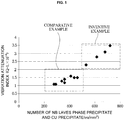
- FIG. 1 is a graph showing the correlation of the vibration attenuation index according to the number of Nb Laves phase precipitates and Cu precipitates.
- Comparative Example 1 satisfies equations (1) and (2), but the content of Ti, Nb, and Cu did not reach 0.15%, so even after annealing and additional heat treatment at 500°C, the total amount of precipitates was as small as 360 /mm 2 . It was found that this was due to insufficient Nb and Cu content for forming the Nb Laves phase precipitate and Cu precipitate.
- Comparative Example 3 satisfies all the component ranges of the present disclosure including Ti, Nb, and Cu, but is not satisfied with equation (1) due to the high content of Ti compared to Nb+Cu, and accordingly, a large amount of Ti(C,N) carbonitrides was precipitated.
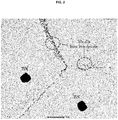
- FIG. 2 is a photograph showing the distribution of Nb Laves phase precipitates and Cu precipitates at the matrix interface of Comparative Example 3. It can be seen that TiN was generated due to the high Ti content. These TiN precipitates not only lower the solid solution C and N, but also the precipitates themselves hinder the movement of the magnetic domain wall. The vibration attenuation index was also measured to be 1.7 ⁇ 10 -4 or less even after additional heat treatment.
- Comparative Example 4 satisfies the component range of the present disclosure including Ti, Nb, and Cu and equation (1), but dissatisfied with the equation (2) due to the high Nb+Cu content.
- the content of Nb+Cu was high at 0.55%, so it was estimated that the Nb Laves phase precipitate and the Cu precipitate were coarsened.
- the total amount of precipitates having a size of 200 nm or less was reduced, which was confirmed to be due to the coarsening of the precipitates.
- the vibration attenuation index was the lowest despite satisfying the component range of the present disclosure.
- the ferritic stainless steel according to the present disclosure maximizes vibration attenuation ability by utilizing Nb and Cu fine precipitation phases, thereby securing quietness and durability of vehicle exhaust system parts.
Landscapes
- Chemical & Material Sciences (AREA)
- Engineering & Computer Science (AREA)
- Materials Engineering (AREA)
- Mechanical Engineering (AREA)
- Metallurgy (AREA)
- Organic Chemistry (AREA)
- Physics & Mathematics (AREA)
- Thermal Sciences (AREA)
- Crystallography & Structural Chemistry (AREA)
- Heat Treatment Of Sheet Steel (AREA)
- Heat Treatment Of Steel (AREA)
Abstract
Description
- The present disclosure relates to a low-Cr ferritic stainless steel with excellent vibration attenuation ability to absorb external vibration energy and a manufacturing method thereof.
- Ferritic stainless steel has excellent corrosion resistance while adding less expensive alloying elements, and has a higher price competitiveness than austenitic stainless steel. In particular, 9-14% of low-Cr ferritic stainless steel has superior cost competitiveness and is used in exhaust system parts (Muffler, Ex-manifold, Collector cone, etc.) corresponding to the exhaust gas temperature range of room temperature to 800°C. The steel plate for vehicle exhaust system must be capable of absorbing noise and vibration generated during engine or other driving, and must be able to withstand external environmental factors such as exhaust gas generated inside the vehicle, rain or fog. Therefore, sound absorption and corrosion resistance must be secured.
- In order to solve this problem, in the case of high Cr ferritic stainless steel, attempts have been made to improve the vibration attenuation ability by controlling the number of precipitates, solid solution C, N, and the size and shape of inclusions, and the effects have been reported. However, there are no attempts and achievements to improve vibration attenuation ability by specializing in low-Cr ferritic stainless steel.
- The embodiments of the present disclosure are intended to provide a low-Cr ferritic stainless steel and a manufacturing method thereof maximizing the vibration attenuation ability by utilizing the Nb, Cu fine precipitated phase.
- In accordance with an aspect of the present disclosure, a low-Cr ferritic stainless steel with excellent vibration attenuation ability includes, in percent (%) by weight of the entire composition, C: 0.005 to 0.01%, N: 0.005 to 0.01%, Si: 0.1 to 0.9%, Mn: 0.1 to 0.9%, Cr: 9 to 14%, Ni: 0.3% or less, P: 0.04% or less, S: 0.002% or less, Ti: 0.15 to 0.3%, Nb: 0.15 to 0.3%, Cu: 0.15 to 0.3%, Al: 0.01 to 0.05%, the remainder of iron (Fe) and other inevitable impurities, and includes 5×10²/ mm2 or more of Nb laves phase precipitates and Cu precipitates.
- The ferritic stainless steel may satisfy the following equation (1).
(1) (Nb+Cu)/Ti ≥ 1.5
(Nb, Cu, Ti mean the content (% by weight) of each element) - The ferritic stainless steel may satisfy the following equation (2).
(2) Nb+Cu ≤ 0.5
(Nb, Cu mean the content (% by weight) of each element) - The Nb Laves phase precipitate may be Fe2Nb, and the size of the Nb Laves phase precipitate and the Cu precipitate may be 1 to 200nm.
- The vibration attenuation index (Q-1) of the stainless steel may be 2.0×10⁻⁴ or more at 25°C, 2.5×10⁻⁴ or more at 300°C.
- In accordance with an aspect of the present disclosure, a manufacturing method of a low-Cr ferritic stainless steel with excellent vibration attenuation ability includes: cold-rolling annealing a cold-rolled steel plate of a ferritic stainless steel comprising in percent (%) by weight of the entire composition, C: 0.005 to 0.01%, N: 0.005 to 0.01%, Si: 0.1 to 0.9%, Mn: 0.1 to 0.9%, Cr: 9 to 14%, Ni: 0.3% or less, P: 0.04% or less, S: 0.002% or less, Ti: 0.15 to 0.3%, Nb: 0.15 to 0.3%, Cu: 0.15 to 0.3%, Al: 0.01 to 0.05%, the remainder of iron (Fe) and other inevitable impurities, at a temperature of (Ac1-10)°C or less; and quenching at 400 to 600°C and maintaining for 5 minutes or more.
- The cold-rolled steel plate may satisfy the following equation (1).
(1) (Nb+Cu)/Ti ≥ 1.5
(Nb, Cu, Ti mean the content (% by weight) of each element) - The cold-rolled steel plate may satisfy the following equation (2).
(2) Nb+Cu ≤ 0.5
(Nb, Cu mean the content (% by weight) of each element) - The low-Cr ferritic stainless steel according to an embodiment of the present disclosure can increase vibration attenuation ability by 100% or more through a sound absorption mechanism by the movement of solid solution C and N and a vibration attenuation mechanism through suppression of precipitation of carbonitrides.
- In addition, the low-Cr ferritic stainless steel according to the embodiment of the present disclosure has excellent corrosion resistance, so that when used in vehicle exhaust system parts, etc., quietness and durability can be secured.
-
-
FIG. 1 is a graph showing the correlation of the vibration attenuation index according to the number of Nb Laves phase precipitates and Cu precipitates. -
FIG. 2 is a photograph showing the distribution of Nb Laves phase precipitates and Cu precipitates at the matrix interface. - A low-Cr ferritic stainless steel with excellent vibration attenuation ability according to an embodiment of the present disclosure includes, in percent (%) by weight of the entire composition, C: 0.005 to 0.01%, N: 0.005 to 0.01%, Si: 0.1 to 0.9%, Mn: 0.1 to 0.9%, Cr: 9 to 14%, Ni: 0.3% or less, P: 0.04% or less, S: 0.002% or less, Ti: 0.15 to 0.3%, Nb: 0.15 to 0.3%, Cu: 0.15 to 0.3%, Al: 0.01 to 0.05%, the remainder of iron (Fe) and other inevitable impurities, and includes 5×10²/ mm2 or more of Nb laves phase precipitates and Cu precipitates.
- The ferritic stainless steel according to an embodiment of the present disclosure may satisfy the following equation (1).
(1) (Nb+Cu)/Ti ≥ 1.5
- Here, Nb, Cu, Ti mean the content (% by weight) of each element.
- Hereinafter, the embodiments of the present disclosure will be described in detail with reference to the accompanying drawings. The following embodiments are provided to transfer the technical concepts of the present disclosure to one of ordinary skill in the art. However, the present disclosure is not limited to these embodiments, and may be embodied in another form. In the drawings, parts that are irrelevant to the descriptions may be not shown in order to clarify the present disclosure, and also, for easy understanding, the sizes of components are more or less exaggeratedly shown.
- Also, when a part "includes" or "comprises" an element, unless there is a particular description contrary thereto, the part may further include other elements, not excluding the other elements.
- An expression used in the singular encompasses the expression of the plural, unless it has a clearly different meaning in the context.
- The present inventors have conducted various studies in order to improve the vibration attenuation ability of low-Cr ferritic stainless steel, and have obtained the following knowledge.
- The sound-absorbing mechanism (Snoek Effect) indicates that during vibration, solid solution C and N cause energy loss while changing their position in the lattice, and as a result, absorb sound. The sound-absorbing effect by solid solution C and N is proportional to the amount of solid solution C and N, and the vibration attenuation effect by magnetic domain wall becomes better as there are no factors that hinder the movement of the magnetic domain wall such as precipitate, dislocation, and internal stress.
- In general, a trace amount of Ti and Nb is added to the ferritic stainless steel for exhaust system for corrosion resistance of the weld. In the case of such ferritic stainless steel with Ti and Nb added, a large amount of Ti(C,N) and Nb(C,N) carbonitrides are inevitably precipitated in the ferrite matrix of the surface layer. These Ti(C,N), Nb(C,N) precipitates are essentially inferior in the vibration attenuation ability of ferritic stainless steel because they inhibit the movement of the magnetic domain wall, which is one of the vibration attenuation mechanisms during vibration. In addition, since C and N are mostly combined with Nb and Ti in a precipitate state, there is relatively no solid solution C and N present in the ferrite matrix. Therefore, the sound absorption mechanism (Snoek Effect) due to the movement of solid solution C and N during vibration cannot be expected.
- On the other hand, Nb is added for high temperature strength to ferritic stainless steel that is applied at high temperatures of 400°C or higher, and Cu is added as a solid solution strengthening element. In this case, a fine-sized Nb Laves Phase (Fe2Nb) and Cu precipitated phase of 1 to 200 nm may be generated under specific heat treatment conditions, the interface between the coherent precipitated phase and the matrix reacts to external vibration and vibrates together, and by absorbing external vibration energy, the vibration attenuation ability can be increased. At this time, the effect is further increased when the Nb Laves phase or Cu is precipitated in a complex manner than when precipitated alone. However, when the size of the precipitate is coarsened to more than 200 nm, the coherency of the precipitate and the matrix decreases, and the number of precipitates decreases, so the effect of improving the vibration attenuation ability is rather offset. Therefore, the vibration attenuation ability can be maximized by precipitating fine Nb Laves-phase precipitates and Cu precipitates at the interface of the matrix.
- A low-Cr ferritic stainless steel with excellent vibration attenuation ability according to an embodiment of the present disclosure includes, in percent (%) by weight of the entire composition, C: 0.005 to 0.01%, N: 0.005 to 0.01%, Si: 0.1 to 0.9%, Mn: 0.1 to 0.9%, Cr: 9 to 14%, Ni: 0.3% or less, P: 0.04% or less, S: 0.002% or less, Ti: 0.15 to 0.3%, Nb: 0.15 to 0.3%, Cu: 0.15 to 0.3%, Al: 0.01 to 0.05%, the remainder of iron (Fe) and other inevitable impurities, and includes 5×10²/ mm2 or more of Nb laves phase precipitates and Cu precipitates.
- Hereinafter, the reason for the numerical limitation of the content of the alloy component element in the embodiment of the present disclosure will be described. Hereinafter, unless otherwise specified, the unit is% by weight.
- The content of C is 0.005 to 0.01%.
- C is a key element that causes sound absorption, and since the solid solution C continues to move from its original position in the lattice of the matrix to another position when the steel plate vibrates, energy loss occurs and sound absorption occurs. In general, as the solid solution C in the matrix increases, the sound absorption and vibration attenuation ability increases. However, when the content exceeds 0.01%, the concentration of solid solution C reaches its limit, and it combines with Cr to form Cr23C6 precipitates, which hinders the movement of the magnetic domain wall, and local Cr depletion within the matrix causes golden dust. Therefore, corrosion resistance is lowered.
- The content of N is 0.005 to 0.01%.
- Among the steels, N is a key element that causes sound absorption and vibration attenuation through the same mechanism as C. As the solid solution N in the matrix increases, the vibration attenuation ability increases. However, if it exceeds 0.01%, the concentration of solid solution N reaches its limit, it binds to Cr and generates Cr2N precipitates, which hinders the movement of the magnetic domain wall, and local Cr depletion within the matrix causes golden dust. Therefore, corrosion resistance is lowered.
- The precipitation of carbonitrides can be suppressed by increasing the solid solution C and N in the matrix by controlling the content of C+N to be less than or equal to 0.02%, and the vibration attenuation ability due to the smooth movement of the magnetic domain wall can be improved.
- The content of Si is 0.1 to 0.9%.
- Si is an element that acts as a deoxidizer in steel making, and contains 0.1% or more. However, when it is contained in a large amount, inclusions are generated due to Si oxide, and since such inclusions hinder the movement of the magnetic domain wall and thus inhibit vibration attenuation ability, the content is limited to 0.9% or less.
- The content of Mn is 0.1 to 0.9%.
- Mn serves to stabilize austenite. When it is contained in a large amount, the austenite-ferrite transformation point (Ac1) is lowered, and high temperature annealing capable of dissolving C and N after cold rolling becomes impossible, so the content is limited to 0.9% or less.
- The content of Cr is 9 to 14%.
- Cr increases the magnetostriction constant of the steel to further promote the movement of the magnetic domain wall compared to carbon steel when vibration occurs, and increases the vibration attenuation ability by the movement of the magnetic domain wall. It also plays a positive role in the vibration attenuation effect caused by C and N. However, if the Cr content exceeds 14%, because carbonitrides are easily formed by easily combining with C and N, the amount of solid solution C and N is lowered, and the precipitate interferes with the movement of the magnetic domain wall, the content is limited to the above range..
- The content of Ni is 0.3% or less.
- Ni may be contained in an amount of 0.1% as an impurity unavoidably included in steel by scrap melting, and its upper limit is limited to 0.3%.
- The content of P is 0.04% or less.
- P is an inevitable impurity contained in steel, and it is limited to 0.04% or less because it causes grain boundary corrosion during pickling or impairs hot workability. The preferred P content is 0.01 to 0.04%.
- The content of S is 0.002% or less.
- S is an inevitable impurity contained in steel, and its content is limited to 20 ppm or less because it segregates at grain boundaries and impairs hot workability.
- The content of Ti is 0.15 to 0.3%.
- Ti should be added in order to increase the corrosion resistance of the weld, so it is added at least 0.15%. However, since Ti combines with C and N to form Ti(C,N) precipitates to lower the amount of solid solution C and N, and Ti(C,N) precipitates hinder the movement of the magnetic domain wall, Ti makes the vibration attenuation ability inferior. Therefore, the content is limited to 0.3% or less.
- The content of Nb is 0.15 to 0.3%.
- Nb is also an element that is essentially added to increase the corrosion resistance of the weld. When Nb satisfies the appropriate component conditions and heat treatment conditions, fine laves phase precipitates are generated, which helps to improve the vibration attenuation ability, and is added at least 0.15%. However, since Nb combines with C and N to form Nb(C,N) precipitates to lower the amount of solid solution C and N, and Nb C,N) precipitates hinder the movement of the magnetic domain wall, Nb makes the vibration attenuation ability inferior. Therefore, the content is limited to 0.3% or less.
- The content of Cu is 0.15 to 0.3%.
- Cu generates fine precipitates by appropriate heat treatment and helps to improve vibration attenuation ability, so it is added at least 0.15%. However, if the content of Cu is high, the hot workability at high temperature may be impaired, so the content is limited to 0.3% or less.
- The content of Al is 0.01 to 0.05%.
- Al combines with N to form AIN precipitates to lower the amount of solid solution N, and because AIN precipitates hinder the movement of the magnetic domain wall, it makes the vibration attenuation ability inferior. In addition, Al is an alloy component that is added as a deoxidizing agent during steelmaking, but when added in a large amount, it exists as non-metallic inclusions and causes sliver defects in the cold-rolled strip, so its content is limited to 0.01 to 0.05%.
- The remainder of the ferritic stainless steel except for the above alloying elements is made of Fe and other inevitable impurities.
- The low-Cr ferritic stainless steel according to an embodiment of the present disclosure may satisfy equation (1) below.
(1) (Nb+Cu)/Ti ≥ 1.5
- As the content of Ti increases, the formation of Ti(C,N) precipitates increases to lower the solid solution C and N, and the vibration attenuation ability decreases because the precipitates themselves interfere with the movement of the magnetic domain wall. In order to overcome this, it is necessary to increase the Nb+Cu content so that the vibration attenuating effect by the fine Nb Laves phase precipitate and Cu precipitate should be increased. When the above equation (1) is satisfied together with the above-described alloy component composition, the vibration attenuation ability can be significantly improved compared to the existing one.
- The low-Cr ferritic stainless steel according to an embodiment of the present disclosure may satisfy equation (2) below.
(2) Nb+Cu ≤ 0.5
- When the content of Nb+Cu becomes higher than necessary, coarsening of precipitates easily occurs. In this case, the coherent between the precipitate and the matrix decreases, and the number of precipitates and the total interface area are reduced, so that the vibration attenuation effect due to the Nb Laves-phase precipitate and the Cu precipitate is difficult to develop. Therefore, the Nb+Cu content is limited to 0.5% or less.
- The Nb Laves phase precipitate is Fe2Nb, and the size of the Nb Laves phase precipitate and the Cu precipitate may be 1 to 200 nm. As described above, when the size of the Nb Laves-phase precipitate and the Cu precipitate are coarse, the number of precipitates is relatively small compared to the fine precipitates, and the coherency between the precipitate and the matrix interface is poor, so that the vibration attenuation effect is small. Therefore, in order to maximize the vibration attenuation ability, it is desirable to control the size of the precipitate to 200 nm or less.
- The low-Cr ferritic stainless steel of present disclosure including 5×10²/ mm2 or more of Nb laves phase precipitates and Cu precipitates of 200 nm or less has a vibration attenuation index (Q-1) of 2.0×10⁻⁴ or more at 25°C and 2.5×10⁻⁴ or more at 300°C, which can exhibit excellent vibration attenuation.
- Next, a method of manufacturing a low-Cr ferritic stainless steel with excellent vibration attenuation ability according to an embodiment of the present disclosure will be described.
- The manufacturing method of the low-Cr ferritic stainless steel with excellent vibration attenuation ability of the present disclosure can be manufactured into a cold-rolled steel plate through a conventional manufacturing process, and includes cold-rolling annealing a cold-rolled steel plate of the ferritic stainless steel containing the above-described alloy component composition at a temperature of (Ac1-10) °C or less; and quenching at 400 to 600°C and maintaining for 5 minutes or more.
- For example, the slab including the above-described alloy component composition may be hot-rolled, the hot-rolled hot-rolled steel plate may be annealed, and cold-rolled to form a cold-rolled steel plate.
- Cold-rolled steel plate is cold-rolled and annealed in a temperature range below the temperature 10°C lower than the austenite-ferrite transformation temperature (Ac1). Since some austenite phase exists in the Cr content range of the present disclosure, the annealing temperature is limited to (Ac1-10) °C or less to prevent reverse transformation. Annealing is performed so that C and N are sufficiently dissolved in the matrix within the above temperature range.
- In addition, in order to suppress the formation of Cr carbonitrides, quenching is required in a temperature range of 400 to 600°C after cold rolling annealing, and by increasing the number of fine Nb Laves phase precipitates and Cu precipitates through heat treatment maintained in the above temperature range for 5 minutes or more, vibration attenuation ability can be maximized.
- At this time, when the Nb+Cu content according to equation (2) exceeds 0.5%, as compared to the Nb Laves phase precipitate and Cu precipitate, which are additionally generated by the heat treatment, the pre-precipitated precipitates are coarsened, so that the total number of precipitates may be reduced. Therefore, when the Nb+Cu content exceeds 0.5%, it is preferable not to perform additional heat treatment after cold rolling annealing.
- Hereinafter, it will be described in more detail through a preferred embodiment of the present disclosure.
- The vibration attenuation ability was measured through IMCE's "RFDA LTVP800" equipment. The above equipment generates vibration at a natural frequency by applying a shock of a certain force to a sample of 80 mm (length) * 20 mm (width), and then measures the degree of attenuation of the sound to obtain the vibration attenuation index (Q-1). The higher the vibration attenuation index, the faster the vibration is attenuated. In other words, it has excellent vibration attenuation ability. In the above equipment, the vibration attenuation index can be obtained for a temperature range of 25 ∼ 800°C. For each of the final heat-treated alloys, the vibration attenuation index at room temperature (25°C) and 300°C was calculated. The natural frequency was 1 kHz.
- The number of Nb Laves phase precipitates and Cu precipitates was measured for only precipitates having a size of 200 nm or less.
<table 1> C N Si Mn Cr Ti Nb Cu (Nb+Cu) /Ti (Nb+Cu) Inventive example1 0.00 7 0.008 0.27 0.41 11.7 0.19 0.18 0.23 2.16 0.41 Inventive example 2 0.00 6 0.007 0.35 0.28 12.5 0.16 0.22 0.27 3.06 0.49 Comparative example1 0.00 5 0.009 0.45 0.33 10.5 0.11 0.12 0.12 2.18 0.24 Comparative example 2 0.00 8 0.006 0.29 0.29 13.1 0.38 0.34 0.32 1.74 0.66 Comparative example 3 0.00 5 0.006 0.23 0.22 11.2 0.25 0.16 0.17 1.32 0.33 Comparative example 4 0.00 9 0.009 0.17 0.53 11.8 0.16 0.28 0.27 3.44 0.55 <table 2> After annealing, maintain 500°C for 5 minutes Total amount of Nb and Cu precipitates (ea/mm2) vibration attenuation index (Q-1, ×10-4) @25°C vibration attenuation index (Q-1, ×10-4) @300°C Inventive example 1 × 528 2.3 2.5 ○ 679 3.1 3.3 Inventive example 2 × 613 2.8 3.1 ○ 718 3.5 3.7 Comparative example 1 × 289 1.1 1.2 ○ 360 1.2 1.3 Comparative example 2 × 336 1.3 1.4 ○ 435 1.5 1.6 Comparative example 3 × 359 1.4 1.5 ○ 460 1.5 1.7 Comparative example 4 × 410 1.6 1.6 ○ 275 1.1 1.2 -
FIG. 1 is a graph showing the correlation of the vibration attenuation index according to the number of Nb Laves phase precipitates and Cu precipitates. The results of analyzing the data of the inventive examples and comparative examples of Tables 1 to 2 with reference toFIG. 1 are as follows. - Looking at Invention Examples 1 and 2, by satisfying both the component range of the present disclosure and Equations (1) and (2), even without heat treatment at 500° C for 5 minutes or more after annealing, the total amount of Nb Laves phase precipitate and Cu precipitate is 500 or more per mm2, and at room temperature, the vibration attenuation index (Q-1) was measured to be 2.3×10⁻⁴ or higher. In particular, in the case of performing heat treatment, it was found that the total amount of precipitates increased by 100 to 150 to increase 15 to 30%. Accordingly, the vibration attenuation index (Q-1) was also increased by 20 to 35% and was measured to be 3.1×10⁻⁴ or more.
- Comparative Example 1 satisfies equations (1) and (2), but the content of Ti, Nb, and Cu did not reach 0.15%, so even after annealing and additional heat treatment at 500°C, the total amount of precipitates was as small as 360 /mm2. It was found that this was due to insufficient Nb and Cu content for forming the Nb Laves phase precipitate and Cu precipitate.
- In Comparative Example 2, the content of Ti, Nb, and Cu all exceeded 0.3%, so that the Nb+Cu value in equation (2) exceeded 0.5%, and accordingly, even after annealing and additional heat treatment at 500°C, the total amount of precipitates did not reach 500 /mm2 Equation (1) is satisfactory, but since the content of Ti and Nb is high, forming carbonitrides with C and N, lowering the solid solution C and N, and since the carbonitride itself interferes with the movement of the magnetic domain wall, it was confirmed that the vibration attenuation ability was deteriorated. In addition, it was estimated that the total amount of precipitates was lower than that of the inventive example as the precipitates became coarse due to the high content of Cu as well as Nb.
- Comparative Example 3 satisfies all the component ranges of the present disclosure including Ti, Nb, and Cu, but is not satisfied with equation (1) due to the high content of Ti compared to Nb+Cu, and accordingly, a large amount of Ti(C,N) carbonitrides was precipitated.
FIG. 2 is a photograph showing the distribution of Nb Laves phase precipitates and Cu precipitates at the matrix interface of Comparative Example 3. It can be seen that TiN was generated due to the high Ti content. These TiN precipitates not only lower the solid solution C and N, but also the precipitates themselves hinder the movement of the magnetic domain wall. The vibration attenuation index was also measured to be 1.7×10⁻⁴ or less even after additional heat treatment. - Comparative Example 4 satisfies the component range of the present disclosure including Ti, Nb, and Cu and equation (1), but dissatisfied with the equation (2) due to the high Nb+Cu content. In Comparative Example 4, the content of Nb+Cu was high at 0.55%, so it was estimated that the Nb Laves phase precipitate and the Cu precipitate were coarsened. In particular, as a result of heat treatment at 500°C after annealing, the total amount of precipitates having a size of 200 nm or less was reduced, which was confirmed to be due to the coarsening of the precipitates. When the precipitate becomes coarse, the coherency of the matrix interface and the interface area are lowered, thereby reducing the vibration attenuation effect. After the additional heat treatment of Comparative Example 4, the vibration attenuation index was the lowest despite satisfying the component range of the present disclosure.
- As described above, although exemplary embodiments of the present disclosure have been described, the present disclosure is not limited thereto, and a person with ordinary knowledge in the relevant technical field may not depart from the concept and scope of the following claims. It will be appreciated that various changes and modifications are possible.
- The ferritic stainless steel according to the present disclosure maximizes vibration attenuation ability by utilizing Nb and Cu fine precipitation phases, thereby securing quietness and durability of vehicle exhaust system parts.
Claims (8)
- A low-Cr ferritic stainless steel with excellent vibration attenuation ability, the ferritic stainless steel comprising, in percent (%) by weight of the entire composition, C: 0.005 to 0.01%, N: 0.005 to 0.01%, Si: 0.1 to 0.9%, Mn: 0.1 to 0.9%, Cr: 9 to 14%, Ni: 0.3% or less, P: 0.04% or less , S: 0.002% or less, Ti: 0.15 to 0.3%, Nb: 0.15 to 0.3%, Cu: 0.15 to 0.3%, Al: 0.01 to 0.05%, the remainder of iron (Fe) and other inevitable impurities, and
wherein the ferritic stainless steel comprises 5×10²/ mm2 or more of Nb laves phase precipitates and Cu precipitates. - The ferritic stainless steel of claim 1, wherein the ferritic stainless steel satisfies the following equation (1)
(1) (Nb+Cu)/Ti ≥ 1.5
(Nb, Cu, Ti mean the content (% by weight) of each element) - The ferritic stainless steel of claim 1, wherein the ferritic stainless steel satisfies the following equation (2)
(2) Nb+Cu ≤ 0.5
(Nb, Cu mean the content (% by weight) of each element) - The ferritic stainless steel of claim 1, wherein the Nb Laves phase precipitate is Fe2Nb, and
the size of the Nb Laves phase precipitate and the Cu precipitate is 1 to 200nm. - The ferritic stainless steel of claim 1, wherein a vibration attenuation index (Q-1) of the stainless steel is 2.0×10⁻⁴ or more at 25°C, 2.5×10⁻⁴ or more at 300°C.
- A manufacturing method of a low-Cr ferritic stainless steel with excellent vibration attenuation ability, the manufacturing method comprising:cold-rolling annealing a cold-rolled steel plate of a ferritic stainless steel comprising in percent (%) by weight of the entire composition, C: 0.005 to 0.01%, N: 0.005 to 0.01%, Si: 0.1 to 0.9%, Mn: 0.1 to 0.9%, Cr: 9 to 14%, Ni: 0.3% or less, P: 0.04% or less, S: 0.002% or less, Ti: 0.15 to 0.3%, Nb: 0.15 to 0.3%, Cu: 0.15 to 0.3%, Al: 0.01 to 0.05%, the remainder of iron (Fe) and other inevitable impurities, at a temperature of (Ac1-10)°C or less; andquenching at 400 to 600°C and maintaining for 5 minutes or more.
- The manufacturing method of claim 6, wherein the cold-rolled steel plate satisfies the following equation (1)
(1) (Nb+Cu)/Ti ≥ 1.5
(Nb, Cu, Ti mean the content (% by weight) of each element) [Cla - The manufacturing method of claim 6, wherein the cold-rolled steel plate satisfies the following equation (2)
(2) Nb+Cu ≤ 0.5
(Nb, Cu mean the content (% by weight) of each element)
Applications Claiming Priority (2)
| Application Number | Priority Date | Filing Date | Title |
|---|---|---|---|
| KR1020180073250A KR102109898B1 (en) | 2018-06-26 | 2018-06-26 | LOW-Cr FERRITIC STAINLESS STEEL WITH EXCELLENT VIBRATION DAMPING PROPERTY AND MANUFACTURING METHOD THEREOF |
| PCT/KR2018/010699 WO2020004710A1 (en) | 2018-06-26 | 2018-09-12 | Low cr ferritic stainless steel having excellent damping capacity and manufacturing method therefor |
Publications (4)
| Publication Number | Publication Date |
|---|---|
| EP3795711A1 true EP3795711A1 (en) | 2021-03-24 |
| EP3795711A4 EP3795711A4 (en) | 2021-03-24 |
| EP3795711C0 EP3795711C0 (en) | 2024-02-07 |
| EP3795711B1 EP3795711B1 (en) | 2024-02-07 |
Family
ID=68985020
Family Applications (1)
| Application Number | Title | Priority Date | Filing Date |
|---|---|---|---|
| EP18924969.1A Active EP3795711B1 (en) | 2018-06-26 | 2018-09-12 | Low cr ferritic stainless steel having excellent damping capacity and manufacturing method therefor |
Country Status (4)
| Country | Link |
|---|---|
| EP (1) | EP3795711B1 (en) |
| KR (1) | KR102109898B1 (en) |
| ES (1) | ES2978502T3 (en) |
| WO (1) | WO2020004710A1 (en) |
Family Cites Families (8)
| Publication number | Priority date | Publication date | Assignee | Title |
|---|---|---|---|---|
| JP3886933B2 (en) * | 2003-06-04 | 2007-02-28 | 日新製鋼株式会社 | Ferritic stainless steel sheet excellent in press formability and secondary workability and manufacturing method thereof |
| JP5420292B2 (en) * | 2008-05-12 | 2014-02-19 | 日新製鋼株式会社 | Ferritic stainless steel |
| JP5682901B2 (en) | 2008-09-18 | 2015-03-11 | Jfeスチール株式会社 | Ti-added ferritic stainless steel sheet excellent in spinning workability and manufacturing method thereof |
| CN102234740B (en) * | 2010-04-22 | 2013-07-17 | 宝山钢铁股份有限公司 | Ferrite stainless steel and manufacturing method of ferrite stainless steel cold-rolled sheet made therefrom |
| JP5659061B2 (en) * | 2011-03-29 | 2015-01-28 | 新日鐵住金ステンレス株式会社 | Ferritic stainless steel sheet excellent in heat resistance and workability and manufacturing method thereof |
| JP6240423B2 (en) | 2012-12-26 | 2017-11-29 | 新日鐵住金ステンレス株式会社 | Ferritic stainless steel sheet with excellent antibacterial properties and method for producing the same |
| KR101641794B1 (en) * | 2014-12-23 | 2016-07-22 | 주식회사 포스코 | High-corrosion resistance steel with excellent sound-absorbing and method for manufacturing the same |
| KR102306578B1 (en) * | 2017-03-27 | 2021-09-29 | 닛테츠 스테인레스 가부시키가이샤 | Ferritic stainless steel sheet, manufacturing method thereof, and exhaust parts |
-
2018
- 2018-06-26 KR KR1020180073250A patent/KR102109898B1/en active Active
- 2018-09-12 EP EP18924969.1A patent/EP3795711B1/en active Active
- 2018-09-12 ES ES18924969T patent/ES2978502T3/en active Active
- 2018-09-12 WO PCT/KR2018/010699 patent/WO2020004710A1/en not_active Ceased
Also Published As
| Publication number | Publication date |
|---|---|
| KR102109898B1 (en) | 2020-05-12 |
| ES2978502T3 (en) | 2024-09-13 |
| WO2020004710A1 (en) | 2020-01-02 |
| EP3795711C0 (en) | 2024-02-07 |
| KR20200000942A (en) | 2020-01-06 |
| EP3795711B1 (en) | 2024-02-07 |
| EP3795711A4 (en) | 2021-03-24 |
Similar Documents
| Publication | Publication Date | Title |
|---|---|---|
| EP2692889B1 (en) | Ferritic stainless steel sheet having excellent heat resistance and processability, and method for producing same | |
| EP2557189B1 (en) | Ferrite stainless steel sheet having high thermal resistance and processability, and method for manufacturing the same | |
| EP2548988B1 (en) | Ferrite-based stainless steel for use in components of automobile exhaust system | |
| JP4362318B2 (en) | High strength steel plate with excellent delayed fracture resistance and method for producing the same | |
| CN104769144A (en) | Ferritic stainless steel plate with excellent heat resistance | |
| JP5846950B2 (en) | Ferritic stainless steel hot-rolled steel sheet and method for producing the same, and method for producing ferritic stainless steel sheet | |
| KR102178731B1 (en) | High strength steel sheet having excellent workability property, and method for manufacturing the same | |
| JP4237183B2 (en) | Stainless steel work hardener | |
| KR20200075359A (en) | Steel sheet having excellent strength and ductility, and method for manufacturing the same | |
| EP4079894A1 (en) | High strength steel sheet having excellent workability and method for manufacturing same | |
| KR20160077515A (en) | High-corrosion resistance steel with excellent sound-absorbing and method for manufacturing the same | |
| JP3606200B2 (en) | Chromium-based stainless steel foil and method for producing the same | |
| JP2013204136A (en) | Ferritic stainless steel plate excellent in heat resistance | |
| EP4079892B1 (en) | High strength steel sheet having excellent workability and method for manufacturing same | |
| EP4079904A1 (en) | High-strength steel sheet having superior workability, and manufacturing method therefor | |
| EP3795711B1 (en) | Low cr ferritic stainless steel having excellent damping capacity and manufacturing method therefor | |
| JP4209513B2 (en) | Martensitic stainless steel annealed steel with good strength, toughness and spring properties | |
| US12454734B2 (en) | High strength steel sheet having excellent workability and method for manufacturing same | |
| JPH07109544A (en) | Low yield ratio thick steel plate good in toughness | |
| EP3998369A1 (en) | Ferritic stainless steel with improved high temperature creep resistance and manufacturing method therefor | |
| KR20240019756A (en) | High-strength cold-rolled steel sheet for automobiles with excellent overall formability and bending properties | |
| KR102209575B1 (en) | Steel sheet having excellent workability and balance of strength and ductility, and method for manufacturing the same | |
| EP4613906A1 (en) | Ferritic stainless steel with improved impact toughness, and manufacturing method thereof | |
| EP3859044A1 (en) | Hot-rolled steel sheet with excellent low-temperature impact toughness and manufacturing method therefor | |
| JP3956683B2 (en) | Multi-layered chromium-based stainless steel and its manufacturing method |
Legal Events
| Date | Code | Title | Description |
|---|---|---|---|
| STAA | Information on the status of an ep patent application or granted ep patent |
Free format text: STATUS: THE INTERNATIONAL PUBLICATION HAS BEEN MADE |
|
| PUAI | Public reference made under article 153(3) epc to a published international application that has entered the european phase |
Free format text: ORIGINAL CODE: 0009012 |
|
| STAA | Information on the status of an ep patent application or granted ep patent |
Free format text: STATUS: REQUEST FOR EXAMINATION WAS MADE |
|
| 17P | Request for examination filed |
Effective date: 20201216 |
|
| A4 | Supplementary search report drawn up and despatched |
Effective date: 20210224 |
|
| AK | Designated contracting states |
Kind code of ref document: A1 Designated state(s): AL AT BE BG CH CY CZ DE DK EE ES FI FR GB GR HR HU IE IS IT LI LT LU LV MC MK MT NL NO PL PT RO RS SE SI SK SM TR |
|
| AX | Request for extension of the european patent |
Extension state: BA ME |
|
| DAV | Request for validation of the european patent (deleted) | ||
| DAX | Request for extension of the european patent (deleted) | ||
| RAP3 | Party data changed (applicant data changed or rights of an application transferred) |
Owner name: POSCO HOLDINGS INC. |
|
| RAP1 | Party data changed (applicant data changed or rights of an application transferred) |
Owner name: POSCO CO., LTD |
|
| GRAP | Despatch of communication of intention to grant a patent |
Free format text: ORIGINAL CODE: EPIDOSNIGR1 |
|
| STAA | Information on the status of an ep patent application or granted ep patent |
Free format text: STATUS: GRANT OF PATENT IS INTENDED |
|
| INTG | Intention to grant announced |
Effective date: 20231006 |
|
| GRAS | Grant fee paid |
Free format text: ORIGINAL CODE: EPIDOSNIGR3 |
|
| GRAA | (expected) grant |
Free format text: ORIGINAL CODE: 0009210 |
|
| STAA | Information on the status of an ep patent application or granted ep patent |
Free format text: STATUS: THE PATENT HAS BEEN GRANTED |
|
| AK | Designated contracting states |
Kind code of ref document: B1 Designated state(s): AL AT BE BG CH CY CZ DE DK EE ES FI FR GB GR HR HU IE IS IT LI LT LU LV MC MK MT NL NO PL PT RO RS SE SI SK SM TR |
|
| REG | Reference to a national code |
Ref country code: GB Ref legal event code: FG4D |
|
| REG | Reference to a national code |
Ref country code: CH Ref legal event code: EP |
|
| REG | Reference to a national code |
Ref country code: IE Ref legal event code: FG4D |
|
| REG | Reference to a national code |
Ref country code: DE Ref legal event code: R096 Ref document number: 602018065103 Country of ref document: DE |
|
| U01 | Request for unitary effect filed |
Effective date: 20240307 |
|
| U07 | Unitary effect registered |
Designated state(s): AT BE BG DE DK EE FI FR IT LT LU LV MT NL PT SE SI Effective date: 20240404 |
|
| PG25 | Lapsed in a contracting state [announced via postgrant information from national office to epo] |
Ref country code: IS Free format text: LAPSE BECAUSE OF FAILURE TO SUBMIT A TRANSLATION OF THE DESCRIPTION OR TO PAY THE FEE WITHIN THE PRESCRIBED TIME-LIMIT Effective date: 20240607 |
|
| PG25 | Lapsed in a contracting state [announced via postgrant information from national office to epo] |
Ref country code: GR Free format text: LAPSE BECAUSE OF FAILURE TO SUBMIT A TRANSLATION OF THE DESCRIPTION OR TO PAY THE FEE WITHIN THE PRESCRIBED TIME-LIMIT Effective date: 20240508 |
|
| PG25 | Lapsed in a contracting state [announced via postgrant information from national office to epo] |
Ref country code: HR Free format text: LAPSE BECAUSE OF FAILURE TO SUBMIT A TRANSLATION OF THE DESCRIPTION OR TO PAY THE FEE WITHIN THE PRESCRIBED TIME-LIMIT Effective date: 20240207 Ref country code: RS Free format text: LAPSE BECAUSE OF FAILURE TO SUBMIT A TRANSLATION OF THE DESCRIPTION OR TO PAY THE FEE WITHIN THE PRESCRIBED TIME-LIMIT Effective date: 20240507 |
|
| PG25 | Lapsed in a contracting state [announced via postgrant information from national office to epo] |
Ref country code: RS Free format text: LAPSE BECAUSE OF FAILURE TO SUBMIT A TRANSLATION OF THE DESCRIPTION OR TO PAY THE FEE WITHIN THE PRESCRIBED TIME-LIMIT Effective date: 20240507 Ref country code: NO Free format text: LAPSE BECAUSE OF FAILURE TO SUBMIT A TRANSLATION OF THE DESCRIPTION OR TO PAY THE FEE WITHIN THE PRESCRIBED TIME-LIMIT Effective date: 20240507 Ref country code: IS Free format text: LAPSE BECAUSE OF FAILURE TO SUBMIT A TRANSLATION OF THE DESCRIPTION OR TO PAY THE FEE WITHIN THE PRESCRIBED TIME-LIMIT Effective date: 20240607 Ref country code: HR Free format text: LAPSE BECAUSE OF FAILURE TO SUBMIT A TRANSLATION OF THE DESCRIPTION OR TO PAY THE FEE WITHIN THE PRESCRIBED TIME-LIMIT Effective date: 20240207 Ref country code: GR Free format text: LAPSE BECAUSE OF FAILURE TO SUBMIT A TRANSLATION OF THE DESCRIPTION OR TO PAY THE FEE WITHIN THE PRESCRIBED TIME-LIMIT Effective date: 20240508 |
|
| PG25 | Lapsed in a contracting state [announced via postgrant information from national office to epo] |
Ref country code: PL Free format text: LAPSE BECAUSE OF FAILURE TO SUBMIT A TRANSLATION OF THE DESCRIPTION OR TO PAY THE FEE WITHIN THE PRESCRIBED TIME-LIMIT Effective date: 20240207 |
|
| PG25 | Lapsed in a contracting state [announced via postgrant information from national office to epo] |
Ref country code: PL Free format text: LAPSE BECAUSE OF FAILURE TO SUBMIT A TRANSLATION OF THE DESCRIPTION OR TO PAY THE FEE WITHIN THE PRESCRIBED TIME-LIMIT Effective date: 20240207 |
|
| REG | Reference to a national code |
Ref country code: ES Ref legal event code: FG2A Ref document number: 2978502 Country of ref document: ES Kind code of ref document: T3 Effective date: 20240913 |
|
| PG25 | Lapsed in a contracting state [announced via postgrant information from national office to epo] |
Ref country code: SM Free format text: LAPSE BECAUSE OF FAILURE TO SUBMIT A TRANSLATION OF THE DESCRIPTION OR TO PAY THE FEE WITHIN THE PRESCRIBED TIME-LIMIT Effective date: 20240207 |
|
| PG25 | Lapsed in a contracting state [announced via postgrant information from national office to epo] |
Ref country code: CZ Free format text: LAPSE BECAUSE OF FAILURE TO SUBMIT A TRANSLATION OF THE DESCRIPTION OR TO PAY THE FEE WITHIN THE PRESCRIBED TIME-LIMIT Effective date: 20240207 |
|
| PG25 | Lapsed in a contracting state [announced via postgrant information from national office to epo] |
Ref country code: SK Free format text: LAPSE BECAUSE OF FAILURE TO SUBMIT A TRANSLATION OF THE DESCRIPTION OR TO PAY THE FEE WITHIN THE PRESCRIBED TIME-LIMIT Effective date: 20240207 |
|
| U20 | Renewal fee for the european patent with unitary effect paid |
Year of fee payment: 7 Effective date: 20240920 |
|
| PG25 | Lapsed in a contracting state [announced via postgrant information from national office to epo] |
Ref country code: SM Free format text: LAPSE BECAUSE OF FAILURE TO SUBMIT A TRANSLATION OF THE DESCRIPTION OR TO PAY THE FEE WITHIN THE PRESCRIBED TIME-LIMIT Effective date: 20240207 Ref country code: SK Free format text: LAPSE BECAUSE OF FAILURE TO SUBMIT A TRANSLATION OF THE DESCRIPTION OR TO PAY THE FEE WITHIN THE PRESCRIBED TIME-LIMIT Effective date: 20240207 Ref country code: RO Free format text: LAPSE BECAUSE OF FAILURE TO SUBMIT A TRANSLATION OF THE DESCRIPTION OR TO PAY THE FEE WITHIN THE PRESCRIBED TIME-LIMIT Effective date: 20240207 Ref country code: CZ Free format text: LAPSE BECAUSE OF FAILURE TO SUBMIT A TRANSLATION OF THE DESCRIPTION OR TO PAY THE FEE WITHIN THE PRESCRIBED TIME-LIMIT Effective date: 20240207 |
|
| REG | Reference to a national code |
Ref country code: DE Ref legal event code: R097 Ref document number: 602018065103 Country of ref document: DE |
|
| PLBE | No opposition filed within time limit |
Free format text: ORIGINAL CODE: 0009261 |
|
| STAA | Information on the status of an ep patent application or granted ep patent |
Free format text: STATUS: NO OPPOSITION FILED WITHIN TIME LIMIT |
|
| 26N | No opposition filed |
Effective date: 20241108 |
|
| PG25 | Lapsed in a contracting state [announced via postgrant information from national office to epo] |
Ref country code: MC Free format text: LAPSE BECAUSE OF FAILURE TO SUBMIT A TRANSLATION OF THE DESCRIPTION OR TO PAY THE FEE WITHIN THE PRESCRIBED TIME-LIMIT Effective date: 20240207 |
|
| REG | Reference to a national code |
Ref country code: CH Ref legal event code: PL |
|
| GBPC | Gb: european patent ceased through non-payment of renewal fee |
Effective date: 20240912 |
|
| PG25 | Lapsed in a contracting state [announced via postgrant information from national office to epo] |
Ref country code: GB Free format text: LAPSE BECAUSE OF NON-PAYMENT OF DUE FEES Effective date: 20240912 |
|
| PG25 | Lapsed in a contracting state [announced via postgrant information from national office to epo] |
Ref country code: CH Free format text: LAPSE BECAUSE OF NON-PAYMENT OF DUE FEES Effective date: 20240930 |
|
| PG25 | Lapsed in a contracting state [announced via postgrant information from national office to epo] |
Ref country code: IE Free format text: LAPSE BECAUSE OF NON-PAYMENT OF DUE FEES Effective date: 20240912 |
|
| PGFP | Annual fee paid to national office [announced via postgrant information from national office to epo] |
Ref country code: TR Payment date: 20250711 Year of fee payment: 8 |
|
| U20 | Renewal fee for the european patent with unitary effect paid |
Year of fee payment: 8 Effective date: 20250924 |
|
| PG25 | Lapsed in a contracting state [announced via postgrant information from national office to epo] |
Ref country code: CY Free format text: LAPSE BECAUSE OF FAILURE TO SUBMIT A TRANSLATION OF THE DESCRIPTION OR TO PAY THE FEE WITHIN THE PRESCRIBED TIME-LIMIT; INVALID AB INITIO Effective date: 20180912 |
|
| PGFP | Annual fee paid to national office [announced via postgrant information from national office to epo] |
Ref country code: ES Payment date: 20251008 Year of fee payment: 8 |
|
| PG25 | Lapsed in a contracting state [announced via postgrant information from national office to epo] |
Ref country code: HU Free format text: LAPSE BECAUSE OF FAILURE TO SUBMIT A TRANSLATION OF THE DESCRIPTION OR TO PAY THE FEE WITHIN THE PRESCRIBED TIME-LIMIT; INVALID AB INITIO Effective date: 20180912 |