EP3794273B1 - Lighting device comprising intersecting wires - Google Patents
Lighting device comprising intersecting wires Download PDFInfo
- Publication number
- EP3794273B1 EP3794273B1 EP19783573.9A EP19783573A EP3794273B1 EP 3794273 B1 EP3794273 B1 EP 3794273B1 EP 19783573 A EP19783573 A EP 19783573A EP 3794273 B1 EP3794273 B1 EP 3794273B1
- Authority
- EP
- European Patent Office
- Prior art keywords
- wire
- light
- lighting device
- contact
- longitudinal axis
- Prior art date
- Legal status (The legal status is an assumption and is not a legal conclusion. Google has not performed a legal analysis and makes no representation as to the accuracy of the status listed.)
- Active
Links
Images
Classifications
-
- F—MECHANICAL ENGINEERING; LIGHTING; HEATING; WEAPONS; BLASTING
- F21—LIGHTING
- F21V—FUNCTIONAL FEATURES OR DETAILS OF LIGHTING DEVICES OR SYSTEMS THEREOF; STRUCTURAL COMBINATIONS OF LIGHTING DEVICES WITH OTHER ARTICLES, NOT OTHERWISE PROVIDED FOR
- F21V23/00—Arrangement of electric circuit elements in or on lighting devices
- F21V23/001—Arrangement of electric circuit elements in or on lighting devices the elements being electrical wires or cables
- F21V23/002—Arrangements of cables or conductors inside a lighting device, e.g. means for guiding along parts of the housing or in a pivoting arm
-
- B—PERFORMING OPERATIONS; TRANSPORTING
- B60—VEHICLES IN GENERAL
- B60Q—ARRANGEMENT OF SIGNALLING OR LIGHTING DEVICES, THE MOUNTING OR SUPPORTING THEREOF OR CIRCUITS THEREFOR, FOR VEHICLES IN GENERAL
- B60Q1/00—Arrangement of optical signalling or lighting devices, the mounting or supporting thereof or circuits therefor
- B60Q1/0088—Details of electrical connections
-
- B—PERFORMING OPERATIONS; TRANSPORTING
- B60—VEHICLES IN GENERAL
- B60Q—ARRANGEMENT OF SIGNALLING OR LIGHTING DEVICES, THE MOUNTING OR SUPPORTING THEREOF OR CIRCUITS THEREFOR, FOR VEHICLES IN GENERAL
- B60Q1/00—Arrangement of optical signalling or lighting devices, the mounting or supporting thereof or circuits therefor
- B60Q1/26—Arrangement of optical signalling or lighting devices, the mounting or supporting thereof or circuits therefor the devices being primarily intended to indicate the vehicle, or parts thereof, or to give signals, to other traffic
- B60Q1/50—Arrangement of optical signalling or lighting devices, the mounting or supporting thereof or circuits therefor the devices being primarily intended to indicate the vehicle, or parts thereof, or to give signals, to other traffic for indicating other intentions or conditions, e.g. request for waiting or overtaking
- B60Q1/503—Arrangement of optical signalling or lighting devices, the mounting or supporting thereof or circuits therefor the devices being primarily intended to indicate the vehicle, or parts thereof, or to give signals, to other traffic for indicating other intentions or conditions, e.g. request for waiting or overtaking using luminous text or symbol displays in or on the vehicle, e.g. static text
-
- B—PERFORMING OPERATIONS; TRANSPORTING
- B60—VEHICLES IN GENERAL
- B60Q—ARRANGEMENT OF SIGNALLING OR LIGHTING DEVICES, THE MOUNTING OR SUPPORTING THEREOF OR CIRCUITS THEREFOR, FOR VEHICLES IN GENERAL
- B60Q3/00—Arrangement of lighting devices for vehicle interiors; Lighting devices specially adapted for vehicle interiors
- B60Q3/80—Circuits; Control arrangements
-
- F—MECHANICAL ENGINEERING; LIGHTING; HEATING; WEAPONS; BLASTING
- F21—LIGHTING
- F21K—NON-ELECTRIC LIGHT SOURCES USING LUMINESCENCE; LIGHT SOURCES USING ELECTROCHEMILUMINESCENCE; LIGHT SOURCES USING CHARGES OF COMBUSTIBLE MATERIAL; LIGHT SOURCES USING SEMICONDUCTOR DEVICES AS LIGHT-GENERATING ELEMENTS; LIGHT SOURCES NOT OTHERWISE PROVIDED FOR
- F21K9/00—Light sources using semiconductor devices as light-generating elements, e.g. using light-emitting diodes [LED] or lasers
- F21K9/20—Light sources comprising attachment means
- F21K9/23—Retrofit light sources for lighting devices with a single fitting for each light source, e.g. for substitution of incandescent lamps with bayonet or threaded fittings
- F21K9/238—Arrangement or mounting of circuit elements integrated in the light source
-
- F—MECHANICAL ENGINEERING; LIGHTING; HEATING; WEAPONS; BLASTING
- F21—LIGHTING
- F21K—NON-ELECTRIC LIGHT SOURCES USING LUMINESCENCE; LIGHT SOURCES USING ELECTROCHEMILUMINESCENCE; LIGHT SOURCES USING CHARGES OF COMBUSTIBLE MATERIAL; LIGHT SOURCES USING SEMICONDUCTOR DEVICES AS LIGHT-GENERATING ELEMENTS; LIGHT SOURCES NOT OTHERWISE PROVIDED FOR
- F21K9/00—Light sources using semiconductor devices as light-generating elements, e.g. using light-emitting diodes [LED] or lasers
- F21K9/90—Methods of manufacture
-
- F—MECHANICAL ENGINEERING; LIGHTING; HEATING; WEAPONS; BLASTING
- F21—LIGHTING
- F21S—NON-PORTABLE LIGHTING DEVICES; SYSTEMS THEREOF; VEHICLE LIGHTING DEVICES SPECIALLY ADAPTED FOR VEHICLE EXTERIORS
- F21S41/00—Illuminating devices specially adapted for vehicle exteriors, e.g. headlamps
- F21S41/10—Illuminating devices specially adapted for vehicle exteriors, e.g. headlamps characterised by the light source
- F21S41/14—Illuminating devices specially adapted for vehicle exteriors, e.g. headlamps characterised by the light source characterised by the type of light source
- F21S41/141—Light emitting diodes [LED]
-
- F—MECHANICAL ENGINEERING; LIGHTING; HEATING; WEAPONS; BLASTING
- F21—LIGHTING
- F21S—NON-PORTABLE LIGHTING DEVICES; SYSTEMS THEREOF; VEHICLE LIGHTING DEVICES SPECIALLY ADAPTED FOR VEHICLE EXTERIORS
- F21S43/00—Signalling devices specially adapted for vehicle exteriors, e.g. brake lamps, direction indicator lights or reversing lights
- F21S43/10—Signalling devices specially adapted for vehicle exteriors, e.g. brake lamps, direction indicator lights or reversing lights characterised by the light source
- F21S43/13—Signalling devices specially adapted for vehicle exteriors, e.g. brake lamps, direction indicator lights or reversing lights characterised by the light source characterised by the type of light source
- F21S43/14—Light emitting diodes [LED]
-
- F—MECHANICAL ENGINEERING; LIGHTING; HEATING; WEAPONS; BLASTING
- F21—LIGHTING
- F21V—FUNCTIONAL FEATURES OR DETAILS OF LIGHTING DEVICES OR SYSTEMS THEREOF; STRUCTURAL COMBINATIONS OF LIGHTING DEVICES WITH OTHER ARTICLES, NOT OTHERWISE PROVIDED FOR
- F21V23/00—Arrangement of electric circuit elements in or on lighting devices
- F21V23/001—Arrangement of electric circuit elements in or on lighting devices the elements being electrical wires or cables
-
- G—PHYSICS
- G09—EDUCATION; CRYPTOGRAPHY; DISPLAY; ADVERTISING; SEALS
- G09F—DISPLAYING; ADVERTISING; SIGNS; LABELS OR NAME-PLATES; SEALS
- G09F9/00—Indicating arrangements for variable information in which the information is built-up on a support by selection or combination of individual elements
- G09F9/30—Indicating arrangements for variable information in which the information is built-up on a support by selection or combination of individual elements in which the desired character or characters are formed by combining individual elements
- G09F9/301—Indicating arrangements for variable information in which the information is built-up on a support by selection or combination of individual elements in which the desired character or characters are formed by combining individual elements flexible foldable or roll-able electronic displays, e.g. thin LCD, OLED
-
- G—PHYSICS
- G09—EDUCATION; CRYPTOGRAPHY; DISPLAY; ADVERTISING; SEALS
- G09F—DISPLAYING; ADVERTISING; SIGNS; LABELS OR NAME-PLATES; SEALS
- G09F9/00—Indicating arrangements for variable information in which the information is built-up on a support by selection or combination of individual elements
- G09F9/30—Indicating arrangements for variable information in which the information is built-up on a support by selection or combination of individual elements in which the desired character or characters are formed by combining individual elements
- G09F9/33—Indicating arrangements for variable information in which the information is built-up on a support by selection or combination of individual elements in which the desired character or characters are formed by combining individual elements being semiconductor devices, e.g. diodes
-
- F—MECHANICAL ENGINEERING; LIGHTING; HEATING; WEAPONS; BLASTING
- F21—LIGHTING
- F21Y—INDEXING SCHEME ASSOCIATED WITH SUBCLASSES F21K, F21L, F21S and F21V, RELATING TO THE FORM OR THE KIND OF THE LIGHT SOURCES OR OF THE COLOUR OF THE LIGHT EMITTED
- F21Y2105/00—Planar light sources
- F21Y2105/10—Planar light sources comprising a two-dimensional [2D] array of point-like light-generating elements
- F21Y2105/14—Planar light sources comprising a two-dimensional [2D] array of point-like light-generating elements characterised by the overall shape of the two-dimensional [2D] array
- F21Y2105/16—Planar light sources comprising a two-dimensional [2D] array of point-like light-generating elements characterised by the overall shape of the two-dimensional [2D] array square or rectangular, e.g. for light panels
-
- F—MECHANICAL ENGINEERING; LIGHTING; HEATING; WEAPONS; BLASTING
- F21—LIGHTING
- F21Y—INDEXING SCHEME ASSOCIATED WITH SUBCLASSES F21K, F21L, F21S and F21V, RELATING TO THE FORM OR THE KIND OF THE LIGHT SOURCES OR OF THE COLOUR OF THE LIGHT EMITTED
- F21Y2115/00—Light-generating elements of semiconductor light sources
- F21Y2115/10—Light-emitting diodes [LED]
Definitions
- the present disclosure relates to lighting devices based on light-emitting elements arranged on wires, in particular in the field of automotive lighting.
- Automotive lighting may be used to improve or enhance communication between a vehicle and its environment, for example pedestrians or other road users. Developments have been made to provide more comprehensive information to the environment by using communication lights, in particular for automated and autonomous vehicles. For instance, it may be desirable to provide information on the intentions of the vehicle or on the status of the vehicle. Lighting devices may for example be used to signal an intended stopping position, the trajectory, acceleration or braking action. Further, a vehicle may signal that a road user has been noticed and the vehicle gives the right of way. Information relating to status of the vehicle, e.g. whether it is in an active or inactive state, the activation of an automated driving mode, a battery or sensor status, etc. may also be given. Corresponding lighting devices may increase road safety and the confidence of other road users relating to the vehicle, in particular in respect to automated and autonomous vehicles.
- a simple way to provide communication by means of a lighting device is to display an image in a display module comprising an array of light-emitting elements.
- Electronic display modules may be suitable to achieve a high response time and high contrast in order to deliver images with high visibility suitable for automotive applications.
- LCDs liquid crystal displays
- the overall energy efficiency may be limited due to internal absorption of light.
- LCDs may be costly to manufacture.
- organic light-emitting diode (OLED) displays may be used to provide display modules.
- OLEDs may suffer from luminance decay, i.e. a rapid ageing and limited lifetime when operated at a high brightness required for automotive applications, for example a sufficient brightness for driving in conditions with poor visibility.
- LEDs may provide high energy efficiency and brightness. LEDs however require being arranged in an array of multiple LED dies or LED packages, wherein each of the LEDs needs to be provided with electric energy independently from other LEDs. An individual addressing of LEDs therefore requires a high number of electrical connections, such that LEDs may for example be arranged in an array of lead frames on a common substrate, such as a printed circuit board, comprising a pattern of electrical conductors.
- the lighting device limits the shape of the lighting device to a substantially flat shape.
- the lighting device is able to assume different shapes, i.e. the lighting device should be conformable to the shape of different objects that serve as support for the lighting device.
- the lighting device may conform the shape of the body of a car or of an interior panel of a car.
- Document JP S57 95682 A discloses a lighting device according to the preamble of claim 1.
- the invention further relates to a method for producing such a lighting device and a use of such a lighting device based on the aforementioned object.
- a lighting device according to claim 1 is provided.
- a method for producing a lighting device comprising: providing a first wire having a first longitudinal axis with a bent section, providing a second wire having a second longitudinal axis, arranging the first wire and the second wire to intersect within an intersection region with the bent section of the first wire being arranged in the intersection region, such that a predefined minimum distance is provided between the first wire and the second wire in the intersection region, arranging a light-emitting element at the intersection region and establishing electrical contact between the light-emitting element and the first wire and the light-emitting element and the second wire.
- a use of a lighting device according to the first aspect in automotive lighting is described, in particular as communication light, indicator light, signaling light, and/or interior light.
- Exemplary embodiments of the first, second, and third aspect of the invention may have one or more of the properties described below.
- the lighting device comprises at least one first wire and at least one second wire.
- the first wire has a first longitudinal axis, which may correspond to the main extension direction of the first wire, i.e. the longest dimension of the wire.
- the first wire may comprise at least one straight section, wherein the extension direction of the straight section(s) corresponds to the first longitudinal axis.
- the second wire has a second longitudinal axis, which may correspond to the main extension direction of the second wire.
- the second wire may be straight in sections or, in some embodiments, straight substantially along its entire length, wherein the extension direction of the straight section(s) corresponds to the second longitudinal axis.
- the first wire and/or second wire may have a regular cross section.
- the first wire and/or second wire may be round shaped, in particular circular shaped in cross section. Other cross sections may also be suitable, such as rectangular, square or other polygonal shapes, for instance.
- the first wire and second wire are configured to conduct an electrical current, in particular electrical current suitable to operate at least one light-emitting element.
- the first wire and/or second wire comprises or consists of Cu or a Cu alloy, CuFe 2 P and/or CuNiSi.
- the light-emitting element is in electrical contact to the first wire and to the second wire, for example, with the first and second wire representing different polarities to provide a voltage to the light-emitting element.
- the at least one light-emitting element may be a light-emitting diode (LED).
- the LED may comprise at least one semiconductor element such as a p-n-junction, a diode, and/or a transistor.
- the LED may be provided as LED package, for example in conjunction with a lead frame and/or wire bond(s).
- the light-emitting element, in particular the LED may have a light-emitting face and side faces, e.g. with an LED having a flat shape with one of the large surfaces being the light-emitting face.
- the first wire and/or second wire may be arranged on a face of the light-emitting element situated opposite to the light-emitting face.
- the light-emitting element may comprise an interposer which is in electrical contact to the first wire and the second wire.
- the interposer may in particular be mounted (directly) on the first wire and/or second wire.
- Interposers may for instance comprise a combination of electrical conductive and insulating elements, for example as a printed circuit board.
- the first wire and the second wire intersect within an intersection region.
- the first longitudinal axis and the second longitudinal axis may be arranged at an angle in respect to each other.
- the first wire comprises a bent section arranged in the intersection region, a direct contact of the first wire and the second wire is avoided.
- the bent section may be represented by a deviation from an otherwise straight configuration of the first wire.
- the bent section may be formed by a deviation of the shape of the first wire from the first longitudinal axis.
- the bent section may be in particular be formed by rounded bends, a U-shaped or V-shaped bend, sharp bends providing a rectangular shape of the bent section.
- the bent section may have a flat shape or two-dimensional shape, i.e. the bent section is substantially located within a plane, which is for instance a radial plane of the first longitudinal axis.
- the bent section in particular extends away from the light-emitting element.
- the light-emitting element may be in electrical contact to the first wire and/or second wire by means of wire bonds, wherein the wire bonds are arranged in or near the intersection region.
- a direct contact for example by means of solder patches, is also possible.
- the light-emitting element is arranged at the intersection region, such that the electrical contact to the first wire and the second wire may be provided in a particularly simple manner.
- a minimum distance between the first wire and the second wire is provided in the intersection region.
- the minimum distance is predefined, in particular such that a contact of the first wire and the second wire is avoided during the intended use of the lighting device.
- the lighting device may have a substantially flat shape and may be deformable into a shape that conforms the shape of a substrate or a support, e.g. to integrate the lighting device into an object with a complex shape such as a car body or a car interior panel.
- the lighting device may be easily deformed, e.g. by bending the first wire and/or second wire, to obtain various shapes.
- the bent section of the first wire may ensure that an electrical contact between the first wire and the second wire is avoided even when the lighting device is deformed.
- the bent section may be configured as spring section.
- the bent section may provide additional flexibility and deformability to the first wire. This may be particularly advantageous when stiffer materials are used for the first wire or a large cross section of the first wire is provided, for instance in applications requiring high currents.
- a plurality of first wires and/or a plurality of second wires is provided, intersecting at a plurality of intersecting regions, wherein in a plurality of light-emitting elements is provided, the light-emitting elements being arranged at the intersection regions.
- the lighting device may therefore comprise an array or a matrix of light-emitting elements such as LEDs.
- Each light-emitting element arranged at an intersection region is in particular in electrical contact to one of the first wires and one of the second wires in or near the intersection region of the respective first wire and second wire.
- each light-emitting element may be in electrical contact to an individual pair of one of the first wires and one of the second wires, therefore allowing for an individual addressing of each light-emitting element. That is, each of the light-emitting elements may be activated independently of the other light-emitting elements.
- the first wires may correspond to columns of light-emitting elements in the array and the second wires may correspond to rows of light-emitting elements in the array.
- the array may be regular, e.g. with regular nearest neighbour distances and/or angles between the light-emitting elements or the array may be irregular.
- the light-emitting elements may form a rectangular array or square array.
- the lighting device may also be stretchable and/or compressible, in particular when no insulating material is arranged between the first wire and the second wire or before insulating material is inserted.
- the first wire and the second wire may be stretched and/or compressed to obtain a given distance or distribution of distances between the light-emitting elements.
- the lighting device may be produced with a predetermined arrangement of first wires and second wires and a corresponding predetermined distance between the light-emitting elements. The arrangement of first wires and second wires and therefore the positions of the light-emitting elements in the array may be varied by stretching and/or compressing to obtain a specific arrangement as required by the intended application.
- first wires may be stretched or compressed by a different amount than the second wires.
- Stretching and/or compression may also be used to obtain an irregular arrangement of light-emitting elements, i.e. with varying distances between the light-emitting elements.
- the lighting device further comprises: a control unit being in electrical contact to the plurality of first wires and/or the plurality of second wires, wherein the control unit is configured to activate part of the plurality of light-emitting elements independently from the remaining light-emitting elements.
- the control unit is configured to activate part of the plurality of light-emitting elements independently from the remaining light-emitting elements.
- each of the light-emitting elements or at least groups of light-emitting elements may be activated independently of the remaining light-emitting elements by means of the control unit.
- voltages may be applied to specific combinations of first wires and second wires to address specific light-emitting elements.
- the control unit may provide for a switching of the assignment of voltages and optionally for providing the voltages.
- control unit may be configured to address light-emitting elements sequentially, e.g. based on a switching frequency.
- the corresponding light-emitting elements i.e. the pixels of the display
- the switching frequency is chosen higher than the eye sensitivity, e.g. at least 100 Hz
- the sequential addressing of light-emitting elements may form an (apparently continuous) image on the lighting device.
- the first longitudinal axis and the second longitudinal axis are arranged substantially within the same plane.
- the first longitudinal axes and the second longitudinal axes corresponding to the plurality of wires are arranged substantially within the same plane.
- the light-emitting element(s) may be mounted on the first wire(s) and second wire(s) in a more simple and secure manner, as a face of the light-emitting element(s), e.g. a face with contact pads, may be arranged on sections of the first wire and second wire that are arranged within the same plane.
- the light-emitting element may be arranged on straight sections of the first wire and the second wire, leading to an increase in contact surface between the wires and the light-emitting element for improved electrical conductivity and higher mechanical stability.
- the second wire intersects the first wire substantially in the center of the bent section of the first wire.
- the bent section may be symmetrical in respect to a plane comprising the second wire.
- At least one of the predefined minimum distance, the material of the first wire and/or second wire, the cross section of the first wire and/or second wire is chosen such that the first wire and second wire avoid contact under a predetermined deformation degree on the first wire and/or second wire.
- the lighting device may be intended for an application with a predefined maximum deformation, e.g. a maximum bend angle.
- the predefined minimum distance, the material of the first wire and/or second wire, the cross section of the first wire and/or second wire may be chosen such that even under the given predefined maximum deformation, a contact of the wires and a possible short circuiting during use is avoided in that the wires are spaced apart also under these deformation conditions.
- the cross section and material of the wires may be optimized with regard to the requirements in electrical conduction, while the predefined minimum distance may be chosen as small as possible to obtain a smaller intersection region and a more compact lighting device, while the wires are still protected from undesired contact.
- the second wire comprises a bent section substantially in the center between two intersection regions .
- the bent section of the first wire may be configured as spring section to provide the deformation properties of the lighting device, and providing the second wire with a bent section may optimize the deformation properties of the lighting device further.
- multiple intersections are provided, and the second wire or each of the second wires comprise at least one bent section substantially in the center between two intersection regions to obtain more homogeneous deformation properties of the lighting device.
- the light-emitting element is in electrical contact to a contact section of the first wire, which contact section extends along the first longitudinal axis; and/or the light-emitting element is in electrical contact to a contact section of the second wire, which contact section extends along the second longitudinal axis.
- the contact sections of the first wire and/or second wire are configured as straight sections extending along the corresponding longitudinal axis. Providing contact sections may lead to an increase in contact surface between the wires and the light-emitting element(s) for improved electrical conductivity and higher mechanical stability.
- the light-emitting elements may be in electrical contact to the first wire and/or second wire by means of a contact material such as solder, in particular solder paste, and/or a conductive adhesive.
- a contact material allows a simple and reliable production of the lighting device.
- contact sections are provided on the first wire and/or second wire, a variety of contact materials may be utilized.
- the contact material may be chosen to provide a certain degree of rigidity or flexibility.
- a solder based on the type SAC 305 has shown advantageous mechanical properties and reliability during a deformation of lighting devices according to the invention.
- the contact material may connect the first wire and/or second wire with the light-emitting element via contact pads, e.g. contact pads arranged on an interposer or directly on an LED die.
- the contact pads are arranged relative to each other at the predetermined minimum distance between the first wire and the second wire.
- the predetermined minimum distance between the first wire and the second wire may be given within a plane, wherein the first longitudinal axis and the second longitudinal axis are arranged substantially within the plane.
- the light-emitting element may be arranged at the intersection region, such that the contact pads may be directly aligned with the first wire and second wire in the intersection region.
- the distance of the contact pads corresponds to the distance of contact sections of the first wire and the second wire.
- the contact pads may have an elongated shape being arranged at an angle corresponding to an angle between the first longitudinal axis and the second longitudinal axis.
- An elongated shape of the contact pads and an angular alignment may increase the contact area between the contact pads of the light-emitting element and the first wire and second wire.
- the first longitudinal axis and the second longitudinal axis are arranged substantially perpendicular to each other in the intersection region.
- a particularly simple arrangement of light-emitting elements may therefore be provided.
- the bent section of the first wire may serve to avoid contact between the first wire and the second wire, such that in principle the first wire and/or second wire do not require additional electrical insulation.
- the light-emitting element, the first wire, and/or the second wire is at least partially covered by an insulating material.
- the insulating material may be provided to improve the mechanical characteristics of the lighting device and to protect the lighting device from its environment, e.g. from humidity.
- the insulating material may also improve the optical properties of the lighting device.
- the light-emitting element, the first wire, and/or the second wire may be overmolded and/or encapsulated with insulating material.
- the insulating material may for instance be a highly flexible material.
- the insulating material may further be transparent, opaque or reflective depending on the desired optical properties.
- An example for a suitable insulating material is silicone.
- the first wire and/or second wire may be provided with an insulating coating, e.g. a wire jacket comprising insulating material.
- the lighting device further comprises a spacing element arranged between the first wire and the second wire in the intersection region.
- the spacing element has in particular insulating properties.
- the spacing element may extend from the first wire to the second wire and/or may comprise a spring section to provide additional flexibility to the spacing element, such that a deformation of the lighting device and in particular of the first and second wires in the intersection region is not hindered by the spacing element.
- the spacing element may comprise attachment elements to attach the spacing element to the first wire and/or second wire.
- attachment means based on a positive fit may be provided, for example clip-on fittings to the first and/or second wire.
- sheet material may be inserted between the first wire and the second wire at the intersection region.
- the sheet material may comprise insulating materials like polyimides.
- sheet material may (only) be inserted between the first wire and the second wire in the intersection region to avoid electrical contact of the wires.
- the sheet material may cover at least part of the first wires and in particular multiple intersection regions.
- the sheet material may comprise openings that correspond to the contact sections of the first wires. The openings may be formed by cutting, in particular laser cutting or laser ablation.
- the sheet material has in particular a thickness that allows for an easy bending. For example, the sheet material has a thickness of 20 ⁇ m to 300 ⁇ m.
- the lighting device further comprises a frame element having at least one cavity, wherein the at least one cavities is arranged to surround at least one light-emitting element.
- the frame element with at least one cavity may for example be configured as a light-guiding element that shapes the illumination pattern of each light-emitting element.
- the lighting device may be based on (smaller) light-emitting elements that are arranged spaced apart, allowing a more cost-effective production of the lighting device.
- the frame element may be configured to spread the illumination of each light-emitting element to provide a practically continuous display.
- the frame element may for example comprise refractory and/or reflective elements to provide the desired illumination pattern. Further, the frame element may protect the light-emitting element(s) from the environment.
- a contact material stencil with cavities corresponding to contact sections of the first wire and/or contact sections of the second wire is used to apply contact material for establishing the electrical contact.
- the first wire(s) and second wire(s) may form a substantially flat shape that allow using a contact material stencil for a simple application of contact material such as solder paste and/or conductive adhesive.
- the method for producing the lighting device may therefore be performed in a particularly simple manner.
- a sheet material may be inserted between the first wire and the second wire in the intersection region, wherein the sheet material may comprise openings that correspond to the contact sections of the first wire.
- the openings in the sheet material which may for example formed by cutting such as laser cutting or ablation, may also serve as contact material stencil.
- Contact material such as solder paste may be applied through the openings of the sheet material.
- the lighting device is deformed, in particular from a flat or two-dimensional shape that allows a simple production of the lighting device, to conform the shape of a support for the lighting device.
- the first wire and/or second wire may be deformed, as the material and cross section of the wires may allow deformation, while the light-emitting elements may be more rigid and may in particular be provided with an interposer that is less deformable.
- the bent section of the first wire and optionally of the second wire may provide a substantial amount of the total deformation.
- the lighting device may be stretched and/or compressed in particular to change the distance between light-emitting elements.
- stretching and/or compression of the lighting device is performed before insulating material is arranged between the first wire and the second wire, for example before overmoulding insulating material.
- the configuration of the support may be defined by the intended application of the lighting device.
- the lighting device is used in automotive lighting, in particular as communication light, indicator light, signal light, and/or interior light.
- the support may for example be a part of the car body or the interior paneling of a car.
- the arrangement of first wire(s) and second wire(s) in the lighting device may provide a highly deformable lighting device, which can be applied and conformed to the shape of supports.
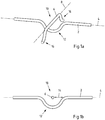
- Fig. 1a shows a schematic representation of an arrangement of a first wire 2 having a first longitudinal axis 4 and a second wire 6 having a second longitudinal axis 8.
- the first wire 2 and the second wire 6 intersect within an intersection region 10.
- the first wire 2 comprises a bent section 12 arranged in the intersection region 10.
- the bent section 12 is configured as a U-shaped bend arranged in a radial plane of the first longitudinal axis 4.
- the first longitudinal axis 4 and the second longitudinal axis 8 are arranged substantially perpendicular to each other in the intersection region 10. Further, the first longitudinal axis 4 and the second longitudinal axis 8 are arranged substantially within the same plane.
- FIG. 1b showing a schematic representation of the arrangement of the first wire 2 and the second wire 6 with the intersection region 10 from Fig. 1a in a side view.
- a predefined minimum distance 14 is provided between the first wire 2 and the second wire 6 in the intersection region 10.
- the second wire 6 intersects the first wire 2 substantially in the center of the bent section 12 of the first wire 2.
- the minimum distance 14 is predefined such that a contact of the first wire 2 and the second wire 6 is avoided during the intended use of the lighting device, for instance when the lighting device is deformed to conform the shape of support such as a car body.
- the bent section 12 of the first wire 2 may ensure that an electrical contact between the first wire 2 and the second wire 6 is avoided during deformation and is further configured as spring section to improve the deformation characteristics of the lighting device.
- the second wire 6 also comprises bent sections 16, as can be seen in Fig. 1a , to further improve the deformation characteristics of the lighting device.
- the predefined minimum distance 14, the material of the first wire 2 and the second wire 6, as wells as the cross section of the first wire 2 and second wire 6 are chosen such that the first wire 2 and second wire 6 avoid contact under a predetermined deformation stress on the lighting device, and therefore on the first wire 2 and/or second wire 6.
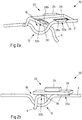
- Fig. 2a-c show schematic representations of a first embodiment of a lighting device 20 in perspective views based on the arrangement of first wire2 and second wire 6 shown in Fig. 1a and 1b .
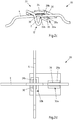
- Fig. 2d shows a corresponding side view of the first embodiment of a lighting device 20.
- a light-emitting element 22 is in electrical contact to the first wire 2 and to the second wire 6.
- the light-emitting element 22 comprises an LED die 24 arranged on an interposer 26 having contact pads 28a,b.
- Contact pad 28a is soldered to the first wire 2 and contact pad 28b is soldered to the second wire 6 in corresponding contact sections 32a, 32b.
- Solder patches 30 are formed at the contact sections 32a, 32b.
- Contact section 32a of the first wire 2 extends along the first longitudinal axis 4 and contact section 32b of the second wire 6 extends along the second longitudinal axis 8.
- the contact pads 32a, 32b are arranged relative to each other at the predetermined minimum distance between the first wire 2 and the second wire 6.
- the contact pads 32a, 32b have an elongated (rectangular) shape and are arranged perpendicular to each other, corresponding to the perpendicular arrangement of between the first longitudinal axis 4 and the second longitudinal axis 8, as can in particular be seen from Fig. 2d .
- the contact areas of the first wire 2 and the second wire 6 with the contact pads 32a, 32b and therefore with the light-emitting element 22 are enlarged, improving electrical conductivity and mechanical stability.
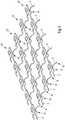
- Fig. 3 shows a schematic representation of a second embodiment of a lighting device 20 in a perspective view.
- a plurality of first wires 2 and a plurality of second wires 6 are provided, intersecting at a plurality of intersecting regions 10.
- a plurality of light-emitting elements 22 is provided, the light-emitting elements 22 being arranged at the intersection regions 10.
- the light-emitting elements 22 therefore form an array.
- the second wires 6 comprise bent sections 16 substantially in the centre between two intersection regions 10.
- the first wires 2 correspond to columns of light-emitting elements 22 in the array and the second wires 6 correspond to rows of light-emitting elements 22 in the array.
- Each light-emitting element 22 is therefore in electrical contact to an individual pair of one of the first wires 2 and one of the second wires 6, allowing for an individual addressing of each light-emitting element 22.
- the array of light-emitting elements 22 is a regular rectangular array, which is in particular useful in automotive lighting.
- the lighting device 20 may be used as communication light, as the array may serve as an electronic display module to provide images to other road users.
- the array has 4 rows and 5 columns, resulting in 20 individually addressable light-emitting elements 22 forming 20 pixels of a display.
- other configurations of the array and in particular a higher number of rows and columns are possible.
- the lighting device 20 is easily deformable and an undesired contact of the first wires 2 and the second wires 6 is avoided by means of the aforementioned arrangement of the first wire 2 and the second wire 6 at the intersection regions 10, and in particular due to the bent section 12 of the first wire 2.
- the lighting device 20 may therefore be deformed to conform to the shape of a support such as a car body.
- the light-emitting elements 22, the first wire 2, and/or the second wire 6 may in addition be at least partially covered by an insulating material such as silicone (not shown). Further, a frame element having at least one cavity may be provided, wherein the at least one cavities is arranged to surround at least one of the light-emitting elements 22 to improve the optical characteristics of the lighting device 20 (not shown).
Landscapes
- Engineering & Computer Science (AREA)
- Physics & Mathematics (AREA)
- General Engineering & Computer Science (AREA)
- Microelectronics & Electronic Packaging (AREA)
- Optics & Photonics (AREA)
- Theoretical Computer Science (AREA)
- General Physics & Mathematics (AREA)
- Mechanical Engineering (AREA)
- Manufacturing & Machinery (AREA)
- Non-Portable Lighting Devices Or Systems Thereof (AREA)
- Fastening Of Light Sources Or Lamp Holders (AREA)
- Arrangements Of Lighting Devices For Vehicle Interiors, Mounting And Supporting Thereof, Circuits Therefore (AREA)
- Led Device Packages (AREA)
Description
- The present disclosure relates to lighting devices based on light-emitting elements arranged on wires, in particular in the field of automotive lighting.
- Automotive lighting may be used to improve or enhance communication between a vehicle and its environment, for example pedestrians or other road users. Developments have been made to provide more comprehensive information to the environment by using communication lights, in particular for automated and autonomous vehicles. For instance, it may be desirable to provide information on the intentions of the vehicle or on the status of the vehicle. Lighting devices may for example be used to signal an intended stopping position, the trajectory, acceleration or braking action. Further, a vehicle may signal that a road user has been noticed and the vehicle gives the right of way. Information relating to status of the vehicle, e.g. whether it is in an active or inactive state, the activation of an automated driving mode, a battery or sensor status, etc. may also be given. Corresponding lighting devices may increase road safety and the confidence of other road users relating to the vehicle, in particular in respect to automated and autonomous vehicles.
- A simple way to provide communication by means of a lighting device is to display an image in a display module comprising an array of light-emitting elements. Electronic display modules may be suitable to achieve a high response time and high contrast in order to deliver images with high visibility suitable for automotive applications. However, in display modules based on conventional liquid crystal displays (LCDs), the overall energy efficiency may be limited due to internal absorption of light. Moreover, LCDs may be costly to manufacture. As an alternative, organic light-emitting diode (OLED) displays may be used to provide display modules. However, OLEDs may suffer from luminance decay, i.e. a rapid ageing and limited lifetime when operated at a high brightness required for automotive applications, for example a sufficient brightness for driving in conditions with poor visibility.
- Displays using light-emitting diodes (LEDs) may provide high energy efficiency and brightness. LEDs however require being arranged in an array of multiple LED dies or LED packages, wherein each of the LEDs needs to be provided with electric energy independently from other LEDs. An individual addressing of LEDs therefore requires a high number of electrical connections, such that LEDs may for example be arranged in an array of lead frames on a common substrate, such as a printed circuit board, comprising a pattern of electrical conductors.
- However, arranging an LED arrays on a common substrate limits the shape of the lighting device to a substantially flat shape. For some applications, and in particular due to technical or design considerations, it may be required that the lighting device is able to assume different shapes, i.e. the lighting device should be conformable to the shape of different objects that serve as support for the lighting device. For example, it may be desirable that the lighting device may conform the shape of the body of a car or of an interior panel of a car.
- Document
JP S57 95682 A - It is an object of the present invention to provide a lighting device that is simple and cost-effective to produce and that is in particular conformable to different shapes and may provide for various arrangements of light-emitting elements. The invention further relates to a method for producing such a lighting device and a use of such a lighting device based on the aforementioned object.
- According to a first aspect of the present invention, a lighting device according to claim 1 is provided.
- According to a second aspect of the present invention, a method for producing a lighting device according to the first aspect is provided, the method comprising: providing a first wire having a first longitudinal axis with a bent section, providing a second wire having a second longitudinal axis, arranging the first wire and the second wire to intersect within an intersection region with the bent section of the first wire being arranged in the intersection region, such that a predefined minimum distance is provided between the first wire and the second wire in the intersection region, arranging a light-emitting element at the intersection region and establishing electrical contact between the light-emitting element and the first wire and the light-emitting element and the second wire.
- According to a third aspect of the present invention, a use of a lighting device according to the first aspect in automotive lighting is described, in particular as communication light, indicator light, signaling light, and/or interior light.
- Exemplary embodiments of the first, second, and third aspect of the invention may have one or more of the properties described below.
- The lighting device comprises at least one first wire and at least one second wire. The first wire has a first longitudinal axis, which may correspond to the main extension direction of the first wire, i.e. the longest dimension of the wire. In particular, the first wire may comprise at least one straight section, wherein the extension direction of the straight section(s) corresponds to the first longitudinal axis. Analogously, the second wire has a second longitudinal axis, which may correspond to the main extension direction of the second wire. The second wire may be straight in sections or, in some embodiments, straight substantially along its entire length, wherein the extension direction of the straight section(s) corresponds to the second longitudinal axis. The first wire and/or second wire may have a regular cross section. For example, the first wire and/or second wire may be round shaped, in particular circular shaped in cross section. Other cross sections may also be suitable, such as rectangular, square or other polygonal shapes, for instance.
- The first wire and second wire are configured to conduct an electrical current, in particular electrical current suitable to operate at least one light-emitting element. In some embodiments, the first wire and/or second wire comprises or consists of Cu or a Cu alloy, CuFe2P and/or CuNiSi. The light-emitting element is in electrical contact to the first wire and to the second wire, for example, with the first and second wire representing different polarities to provide a voltage to the light-emitting element.
- In some embodiments, the at least one light-emitting element may be a light-emitting diode (LED). The LED may comprise at least one semiconductor element such as a p-n-junction, a diode, and/or a transistor. The LED may be provided as LED package, for example in conjunction with a lead frame and/or wire bond(s). The light-emitting element, in particular the LED, may have a light-emitting face and side faces, e.g. with an LED having a flat shape with one of the large surfaces being the light-emitting face. The first wire and/or second wire may be arranged on a face of the light-emitting element situated opposite to the light-emitting face.
- In some embodiments, the light-emitting element may comprise an interposer which is in electrical contact to the first wire and the second wire. The interposer may in particular be mounted (directly) on the first wire and/or second wire. Interposers may for instance comprise a combination of electrical conductive and insulating elements, for example as a printed circuit board.
- The first wire and the second wire intersect within an intersection region. For instance, the first longitudinal axis and the second longitudinal axis may be arranged at an angle in respect to each other. As the first wire comprises a bent section arranged in the intersection region, a direct contact of the first wire and the second wire is avoided. For instance, the bent section may be represented by a deviation from an otherwise straight configuration of the first wire. In particular, the bent section may be formed by a deviation of the shape of the first wire from the first longitudinal axis. The bent section may be in particular be formed by rounded bends, a U-shaped or V-shaped bend, sharp bends providing a rectangular shape of the bent section. The bent section may have a flat shape or two-dimensional shape, i.e. the bent section is substantially located within a plane, which is for instance a radial plane of the first longitudinal axis. The bent section in particular extends away from the light-emitting element.
- In some embodiments, the light-emitting element may be in electrical contact to the first wire and/or second wire by means of wire bonds, wherein the wire bonds are arranged in or near the intersection region. A direct contact, for example by means of solder patches, is also possible. The light-emitting element is arranged at the intersection region, such that the electrical contact to the first wire and the second wire may be provided in a particularly simple manner.
- A minimum distance between the first wire and the second wire is provided in the intersection region. The minimum distance is predefined, in particular such that a contact of the first wire and the second wire is avoided during the intended use of the lighting device. In particular, the lighting device may have a substantially flat shape and may be deformable into a shape that conforms the shape of a substrate or a support, e.g. to integrate the lighting device into an object with a complex shape such as a car body or a car interior panel. By using the first wire and second wire as elements for electrical connection, the lighting device may be easily deformed, e.g. by bending the first wire and/or second wire, to obtain various shapes. The bent section of the first wire may ensure that an electrical contact between the first wire and the second wire is avoided even when the lighting device is deformed. Further, the bent section may be configured as spring section. In particular, the bent section may provide additional flexibility and deformability to the first wire. This may be particularly advantageous when stiffer materials are used for the first wire or a large cross section of the first wire is provided, for instance in applications requiring high currents.
- According to the invention, a plurality of first wires and/or a plurality of second wires is provided, intersecting at a plurality of intersecting regions, wherein in a plurality of light-emitting elements is provided, the light-emitting elements being arranged at the intersection regions. The lighting device may therefore comprise an array or a matrix of light-emitting elements such as LEDs. Each light-emitting element arranged at an intersection region is in particular in electrical contact to one of the first wires and one of the second wires in or near the intersection region of the respective first wire and second wire. That is, each light-emitting element may be in electrical contact to an individual pair of one of the first wires and one of the second wires, therefore allowing for an individual addressing of each light-emitting element. That is, each of the light-emitting elements may be activated independently of the other light-emitting elements. For instance, the first wires may correspond to columns of light-emitting elements in the array and the second wires may correspond to rows of light-emitting elements in the array. The array may be regular, e.g. with regular nearest neighbour distances and/or angles between the light-emitting elements or the array may be irregular. In some embodiments, the light-emitting elements may form a rectangular array or square array.
- Further, the lighting device may also be stretchable and/or compressible, in particular when no insulating material is arranged between the first wire and the second wire or before insulating material is inserted. For instance, the first wire and the second wire may be stretched and/or compressed to obtain a given distance or distribution of distances between the light-emitting elements. In particular, the lighting device may be produced with a predetermined arrangement of first wires and second wires and a corresponding predetermined distance between the light-emitting elements. The arrangement of first wires and second wires and therefore the positions of the light-emitting elements in the array may be varied by stretching and/or compressing to obtain a specific arrangement as required by the intended application. Different amounts of stress may be applied on different directions, for instance the first wires may be stretched or compressed by a different amount than the second wires. Stretching and/or compression may also be used to obtain an irregular arrangement of light-emitting elements, i.e. with varying distances between the light-emitting elements.
- According to another exemplary embodiment of the invention, the lighting device further comprises: a control unit being in electrical contact to the plurality of first wires and/or the plurality of second wires, wherein the control unit is configured to activate part of the plurality of light-emitting elements independently from the remaining light-emitting elements. For example, each of the light-emitting elements or at least groups of light-emitting elements may be activated independently of the remaining light-emitting elements by means of the control unit. For instance, voltages may be applied to specific combinations of first wires and second wires to address specific light-emitting elements. The control unit may provide for a switching of the assignment of voltages and optionally for providing the voltages.
- In some embodiments, the control unit may be configured to address light-emitting elements sequentially, e.g. based on a switching frequency. To obtain an image with the lighting device, the corresponding light-emitting elements (i.e. the pixels of the display) may be addressed one after another by applying voltage to the corresponding pairs of first wires and second wires. When the switching frequency is chosen higher than the eye sensitivity, e.g. at least 100 Hz, the sequential addressing of light-emitting elements may form an (apparently continuous) image on the lighting device.
- According to the invention, the first longitudinal axis and the second longitudinal axis are arranged substantially within the same plane. In particular, when a plurality of first wires and/or a plurality of second wires is provided, the first longitudinal axes and the second longitudinal axes corresponding to the plurality of wires are arranged substantially within the same plane. Hence, a substantially flat shaped lighting device is obtained. In particular, the light-emitting element(s) may be mounted on the first wire(s) and second wire(s) in a more simple and secure manner, as a face of the light-emitting element(s), e.g. a face with contact pads, may be arranged on sections of the first wire and second wire that are arranged within the same plane. In particular, the light-emitting element may be arranged on straight sections of the first wire and the second wire, leading to an increase in contact surface between the wires and the light-emitting element for improved electrical conductivity and higher mechanical stability.
- According to another exemplary embodiment of the invention, the second wire intersects the first wire substantially in the center of the bent section of the first wire. In particular, the bent section may be symmetrical in respect to a plane comprising the second wire. Hence, the deformation properties of the lighting device may become more uniform, wherein in particular a contact of the first wire and second wire may be avoided irrespective of the direction of deformation.
- According to another exemplary embodiment of the invention, at least one of the predefined minimum distance, the material of the first wire and/or second wire, the cross section of the first wire and/or second wire is chosen such that the first wire and second wire avoid contact under a predetermined deformation degree on the first wire and/or second wire. For instance, the lighting device may be intended for an application with a predefined maximum deformation, e.g. a maximum bend angle. The predefined minimum distance, the material of the first wire and/or second wire, the cross section of the first wire and/or second wire may be chosen such that even under the given predefined maximum deformation, a contact of the wires and a possible short circuiting during use is avoided in that the wires are spaced apart also under these deformation conditions. For example, the cross section and material of the wires may be optimized with regard to the requirements in electrical conduction, while the predefined minimum distance may be chosen as small as possible to obtain a smaller intersection region and a more compact lighting device, while the wires are still protected from undesired contact.
- According to the invention, the second wire comprises a bent section substantially in the center between two intersection regions . As described above, the bent section of the first wire may be configured as spring section to provide the deformation properties of the lighting device, and providing the second wire with a bent section may optimize the deformation properties of the lighting device further. In particular, multiple intersections are provided, and the second wire or each of the second wires comprise at least one bent section substantially in the center between two intersection regions to obtain more homogeneous deformation properties of the lighting device.
- According to another exemplary embodiment of the invention, the light-emitting element is in electrical contact to a contact section of the first wire, which contact section extends along the first longitudinal axis; and/or the light-emitting element is in electrical contact to a contact section of the second wire, which contact section extends along the second longitudinal axis. In particular, the contact sections of the first wire and/or second wire are configured as straight sections extending along the corresponding longitudinal axis. Providing contact sections may lead to an increase in contact surface between the wires and the light-emitting element(s) for improved electrical conductivity and higher mechanical stability.
- In some embodiments, the light-emitting elements may be in electrical contact to the first wire and/or second wire by means of a contact material such as solder, in particular solder paste, and/or a conductive adhesive. A contact material allows a simple and reliable production of the lighting device. In particular when contact sections are provided on the first wire and/or second wire, a variety of contact materials may be utilized. The contact material may be chosen to provide a certain degree of rigidity or flexibility. In particular, a solder based on the type SAC 305 has shown advantageous mechanical properties and reliability during a deformation of lighting devices according to the invention. The contact material may connect the first wire and/or second wire with the light-emitting element via contact pads, e.g. contact pads arranged on an interposer or directly on an LED die.
- According to another exemplary embodiment of the invention involving at least one light-emitting element comprising contact pads, the contact pads are arranged relative to each other at the predetermined minimum distance between the first wire and the second wire. For example, the predetermined minimum distance between the first wire and the second wire may be given within a plane, wherein the first longitudinal axis and the second longitudinal axis are arranged substantially within the plane. The light-emitting element may be arranged at the intersection region, such that the contact pads may be directly aligned with the first wire and second wire in the intersection region. In particular, the distance of the contact pads corresponds to the distance of contact sections of the first wire and the second wire.
- In addition or as an alternative, the contact pads may have an elongated shape being arranged at an angle corresponding to an angle between the first longitudinal axis and the second longitudinal axis. An elongated shape of the contact pads and an angular alignment may increase the contact area between the contact pads of the light-emitting element and the first wire and second wire.
- According to another exemplary embodiment of the invention, the first longitudinal axis and the second longitudinal axis are arranged substantially perpendicular to each other in the intersection region. In particular, a particularly simple arrangement of light-emitting elements may therefore be provided.
- As described above, the bent section of the first wire may serve to avoid contact between the first wire and the second wire, such that in principle the first wire and/or second wire do not require additional electrical insulation. According to another exemplary embodiment of the invention, however, the light-emitting element, the first wire, and/or the second wire is at least partially covered by an insulating material. The insulating material may be provided to improve the mechanical characteristics of the lighting device and to protect the lighting device from its environment, e.g. from humidity. The insulating material may also improve the optical properties of the lighting device. For example, the light-emitting element, the first wire, and/or the second wire may be overmolded and/or encapsulated with insulating material. The insulating material may for instance be a highly flexible material. The insulating material may further be transparent, opaque or reflective depending on the desired optical properties. An example for a suitable insulating material is silicone. Further, in addition or as alternative, the first wire and/or second wire may be provided with an insulating coating, e.g. a wire jacket comprising insulating material.
- According to another exemplary embodiment of the invention, the lighting device further comprises a spacing element arranged between the first wire and the second wire in the intersection region. The spacing element has in particular insulating properties. In some embodiments, the spacing element may extend from the first wire to the second wire and/or may comprise a spring section to provide additional flexibility to the spacing element, such that a deformation of the lighting device and in particular of the first and second wires in the intersection region is not hindered by the spacing element. The spacing element may comprise attachment elements to attach the spacing element to the first wire and/or second wire. In particular, attachment means based on a positive fit may be provided, for example clip-on fittings to the first and/or second wire. In other embodiments, sheet material may be inserted between the first wire and the second wire at the intersection region. The sheet material may comprise insulating materials like polyimides. In some cases, sheet material may (only) be inserted between the first wire and the second wire in the intersection region to avoid electrical contact of the wires. Alternatively, the sheet material may cover at least part of the first wires and in particular multiple intersection regions. The sheet material may comprise openings that correspond to the contact sections of the first wires. The openings may be formed by cutting, in particular laser cutting or laser ablation. The sheet material has in particular a thickness that allows for an easy bending. For example, the sheet material has a thickness of 20 µm to 300 µm.
- According to another exemplary embodiment of the invention, the lighting device further comprises a frame element having at least one cavity, wherein the at least one cavities is arranged to surround at least one light-emitting element. The frame element with at least one cavity may for example be configured as a light-guiding element that shapes the illumination pattern of each light-emitting element. In some embodiments, the lighting device may be based on (smaller) light-emitting elements that are arranged spaced apart, allowing a more cost-effective production of the lighting device. The frame element may be configured to spread the illumination of each light-emitting element to provide a practically continuous display. The frame element may for example comprise refractory and/or reflective elements to provide the desired illumination pattern. Further, the frame element may protect the light-emitting element(s) from the environment.
- According to another exemplary embodiment of the invention, a contact material stencil with cavities corresponding to contact sections of the first wire and/or contact sections of the second wire is used to apply contact material for establishing the electrical contact. As described above, in particular when the first longitudinal axis and the second longitudinal axis are arranged substantially within the same plane, the first wire(s) and second wire(s) may form a substantially flat shape that allow using a contact material stencil for a simple application of contact material such as solder paste and/or conductive adhesive. The method for producing the lighting device may therefore be performed in a particularly simple manner. As already described above, a sheet material may be inserted between the first wire and the second wire in the intersection region, wherein the sheet material may comprise openings that correspond to the contact sections of the first wire. In some embodiments, the openings in the sheet material, which may for example formed by cutting such as laser cutting or ablation, may also serve as contact material stencil. Contact material such as solder paste may be applied through the openings of the sheet material.
- According to another exemplary embodiment of the invention, the lighting device is deformed, in particular from a flat or two-dimensional shape that allows a simple production of the lighting device, to conform the shape of a support for the lighting device. For example, the first wire and/or second wire may be deformed, as the material and cross section of the wires may allow deformation, while the light-emitting elements may be more rigid and may in particular be provided with an interposer that is less deformable. In particular, the bent section of the first wire and optionally of the second wire may provide a substantial amount of the total deformation. Further, the lighting device may be stretched and/or compressed in particular to change the distance between light-emitting elements. Different amounts of stress may be applied on different directions and stretching and/or compression may also be used to obtain an irregular arrangement of light-emitting elements. In particular, stretching and/or compression of the lighting device is performed before insulating material is arranged between the first wire and the second wire, for example before overmoulding insulating material.
- The configuration of the support may be defined by the intended application of the lighting device. In some embodiments, the lighting device is used in automotive lighting, in particular as communication light, indicator light, signal light, and/or interior light. The support may for example be a part of the car body or the interior paneling of a car. The arrangement of first wire(s) and second wire(s) in the lighting device may provide a highly deformable lighting device, which can be applied and conformed to the shape of supports.
- The features and example embodiments of the invention described above may equally pertain to the different aspects according to the present invention. In particular, with the disclosure of features relating to the lighting device according to the first aspect, also corresponding features relating to the method according to the second aspect and the use according to the third aspect are disclosed.
- It is to be understood that the presentation of embodiments of the invention in this region is merely exemplary and non-limiting.
- Other features of the present invention will become apparent from the following detailed description considered in conjunction with the accompanying drawings. It is to be understood, however, that the drawings are designed solely for purposes of illustration and not as a definition of the limits of the invention, for which reference should be made to the appended claims. It should be further understood that the drawings are not drawn to scale and that they are merely intended to conceptually illustrate the structures and procedures described herein.
- Examples of the invention will now be described in detail with reference to the accompanying drawing, in which:
- Fig. 1a
- shows a schematic representation of an arrangement of a first wire and a second wire with an intersection region in a perspective view;
- Fig. 1b
- shows a schematic representation of the arrangement of a first wire and a second wire with an intersection region in a side view;
- Fig. 2a-c
- show schematic representations of a first embodiment of a lighting device in perspective views;
- Fig. 2d
- shows a schematic representation of the first embodiment of a lighting device in a side views; and
- Fig. 3
- shows a schematic representation of a second embodiment of a lighting device in a perspective view.
-
Fig. 1a shows a schematic representation of an arrangement of afirst wire 2 having a firstlongitudinal axis 4 and asecond wire 6 having a secondlongitudinal axis 8. Thefirst wire 2 and thesecond wire 6 intersect within anintersection region 10. - The
first wire 2 comprises abent section 12 arranged in theintersection region 10. Thebent section 12 is configured as a U-shaped bend arranged in a radial plane of the firstlongitudinal axis 4. The firstlongitudinal axis 4 and the secondlongitudinal axis 8 are arranged substantially perpendicular to each other in theintersection region 10. Further, the firstlongitudinal axis 4 and the secondlongitudinal axis 8 are arranged substantially within the same plane. As thefirst wire 2 is provided with thebent section 12, a contact of thefirst wire 2 and thesecond wire 6 is avoided. - This can be seen more clearly from
Fig. 1b , showing a schematic representation of the arrangement of thefirst wire 2 and thesecond wire 6 with theintersection region 10 fromFig. 1a in a side view. A predefinedminimum distance 14 is provided between thefirst wire 2 and thesecond wire 6 in theintersection region 10. Thesecond wire 6 intersects thefirst wire 2 substantially in the center of thebent section 12 of thefirst wire 2. Theminimum distance 14 is predefined such that a contact of thefirst wire 2 and thesecond wire 6 is avoided during the intended use of the lighting device, for instance when the lighting device is deformed to conform the shape of support such as a car body. Thebent section 12 of thefirst wire 2 may ensure that an electrical contact between thefirst wire 2 and thesecond wire 6 is avoided during deformation and is further configured as spring section to improve the deformation characteristics of the lighting device. Thesecond wire 6 also comprisesbent sections 16, as can be seen inFig. 1a , to further improve the deformation characteristics of the lighting device. - In particular, the predefined
minimum distance 14, the material of thefirst wire 2 and thesecond wire 6, as wells as the cross section of thefirst wire 2 andsecond wire 6 are chosen such that thefirst wire 2 andsecond wire 6 avoid contact under a predetermined deformation stress on the lighting device, and therefore on thefirst wire 2 and/orsecond wire 6. -
Fig. 2a-c show schematic representations of a first embodiment of alighting device 20 in perspective views based on the arrangement of first wire2 andsecond wire 6 shown inFig. 1a and 1b .Fig. 2d shows a corresponding side view of the first embodiment of alighting device 20. - A light-emitting
element 22 is in electrical contact to thefirst wire 2 and to thesecond wire 6. The light-emittingelement 22 comprises an LED die 24 arranged on aninterposer 26 havingcontact pads 28a,b.Contact pad 28a is soldered to thefirst wire 2 andcontact pad 28b is soldered to thesecond wire 6 incorresponding contact sections Solder patches 30 are formed at thecontact sections -
Contact section 32a of thefirst wire 2 extends along the firstlongitudinal axis 4 andcontact section 32b of thesecond wire 6 extends along the secondlongitudinal axis 8. Thecontact pads first wire 2 and thesecond wire 6. In addition, thecontact pads longitudinal axis 4 and the secondlongitudinal axis 8, as can in particular be seen fromFig. 2d . Hence, the contact areas of thefirst wire 2 and thesecond wire 6 with thecontact pads element 22 are enlarged, improving electrical conductivity and mechanical stability. -
Fig. 3 shows a schematic representation of a second embodiment of alighting device 20 in a perspective view. A plurality offirst wires 2 and a plurality ofsecond wires 6 are provided, intersecting at a plurality ofintersecting regions 10. A plurality of light-emittingelements 22 is provided, the light-emittingelements 22 being arranged at theintersection regions 10. The light-emittingelements 22 therefore form an array. Thesecond wires 6 comprisebent sections 16 substantially in the centre between twointersection regions 10. Thefirst wires 2 correspond to columns of light-emittingelements 22 in the array and thesecond wires 6 correspond to rows of light-emittingelements 22 in the array. Each light-emittingelement 22 is therefore in electrical contact to an individual pair of one of thefirst wires 2 and one of thesecond wires 6, allowing for an individual addressing of each light-emittingelement 22. The array of light-emittingelements 22 is a regular rectangular array, which is in particular useful in automotive lighting. For instance, thelighting device 20 may be used as communication light, as the array may serve as an electronic display module to provide images to other road users. In this embodiment, the array has 4 rows and 5 columns, resulting in 20 individually addressable light-emittingelements 22 forming 20 pixels of a display. Naturally, other configurations of the array and in particular a higher number of rows and columns are possible. - The
lighting device 20 is easily deformable and an undesired contact of thefirst wires 2 and thesecond wires 6 is avoided by means of the aforementioned arrangement of thefirst wire 2 and thesecond wire 6 at theintersection regions 10, and in particular due to thebent section 12 of thefirst wire 2. Thelighting device 20 may therefore be deformed to conform to the shape of a support such as a car body. - The light-emitting
elements 22, thefirst wire 2, and/or thesecond wire 6 may in addition be at least partially covered by an insulating material such as silicone (not shown). Further, a frame element having at least one cavity may be provided, wherein the at least one cavities is arranged to surround at least one of the light-emittingelements 22 to improve the optical characteristics of the lighting device 20 (not shown).
Claims (12)
- A lighting device, comprising:- a first wire (2) having a first longitudinal axis (4);- a second wire (6) having a second longitudinal axis (8),- wherein the first wire (2) and the second wire (6) intersect within an intersection region (10);- a light-emitting element (22) arranged at the intersection region (10) and being in electrical contact to the first wire (2) and to the second wire (6),- wherein the first wire (2) comprises a bent section (12) arranged in the intersection region (10), such that a predefined minimum distance (14) is provided between the first wire (2) and the second wire (6) in the intersection region (10),- wherein a plurality of first wires (2) and/or a plurality of second wires (6) is provided, intersecting at a plurality of intersecting regions (10),- wherein a plurality of light-emitting elements (22) is provided, the light-emitting elements (22) being arranged at the intersection regions (10),- wherein the first longitudinal axis (4) and the second longitudinal axis (8) are arranged substantially within the same plane,- characterized in that the second wire (6) comprises a bent section (16) substantially in the center between two intersection regions (10).
- The lighting device according to claim 1, further comprising:- a control unit being in electrical contact to the plurality of first wires (2) and/or the plurality of second wires (6), wherein the control unit is configured to activate part of the plurality of light-emitting elements (22) independently from the remaining light-emitting elements (22).
- The lighting device according to any of the preceding claims,
wherein the second wire (6) intersects the first wire (2) substantially in the center of the bent section (12) of the first wire (2). - The lighting device according to any of the preceding claims,
wherein at least one of the predefined minimum distance (12), the material of the first wire (2), the material of the second wire (6), the cross section of the first wire (2) and/or the cross section of the second wire (6) is chosen such that the first wire (2) and second wire (6) avoid contact under a predefined deformation stress on the lighting device. - The lighting device according to any of the preceding claims,
wherein the light-emitting element (22) is in electrical contact to a contact section (32a) of the first wire (2), which contact section (32a) extends along the first longitudinal axis (4); and/or
wherein the light-emitting element (22) is in electrical contact to a contact section (32b) of the second wire (6), which contact section (32b) extends along the second longitudinal axis (8). - The lighting device according to any of the preceding claims,
wherein the light-emitting element (22) comprises contact pads (28a, 28b),
wherein the contact pads (28a, 28b)are arranged relative to each other corresponding to the predetermined minimum distance (14) between the first wire (2) and the second wire (6); and/or
wherein the contact pads (28a, 28b) have an elongated shape being arranged at an angle corresponding to an angle between the first longitudinal axis (4) and the second longitudinal axis (8). - The lighting device according to any of the preceding claims,
wherein the light-emitting element (22), the first wire (2), and/or the second wire (6) is at least partially covered by an insulating material. - The lighting device according to any of the preceding claims,
further comprising a frame element having at least one cavity, wherein the at least one cavities is arranged to surround at least one light-emitting element (22). - A method for producing a lighting device (20) according to any of the preceding claims, the method comprising:- providing the first wire (2) having the first longitudinal axis (4) with the bent section (12),- providing the second wire (4) having the second longitudinal axis (8),- arranging the first wire (2) and the second wire (6) to intersect within the intersection region (10), wherein the bent section (12) of the first wire (2) being arranged in the intersection region (10), such that a predefined minimum distance (14) is provided between the first wire (2) and the second wire (6) in the intersection region (10),- arranging the light-emitting element (22) at the intersection region (10) and establishing electrical contact between the light-emitting element (22) and the first wire (2) and the light-emitting element (22) and the second wire (6).
- The method according to claim 9,
further comprising using a contact material stencil with cavities corresponding to at least one contact section (32a) of the first wire (2) and/or at least one contact section (32b) of the second wire (6) to apply contact material for establishing the electrical contact. - The method according to claim 9 or 10,
further comprising deforming the lighting device (20) to conform the shape of a support for the lighting device (20). - Use of a lighting device (20) according to any of claims 1 to 8 in automotive lighting, in particular as communication light, indicator light, signal light, and/or interior light.
Applications Claiming Priority (2)
| Application Number | Priority Date | Filing Date | Title |
|---|---|---|---|
| EP18202223 | 2018-10-24 | ||
| PCT/EP2019/077928 WO2020083708A1 (en) | 2018-10-24 | 2019-10-15 | Lighting device comprising intersecting wires |
Publications (2)
| Publication Number | Publication Date |
|---|---|
| EP3794273A1 EP3794273A1 (en) | 2021-03-24 |
| EP3794273B1 true EP3794273B1 (en) | 2021-06-16 |
Family
ID=64051328
Family Applications (1)
| Application Number | Title | Priority Date | Filing Date |
|---|---|---|---|
| EP19783573.9A Active EP3794273B1 (en) | 2018-10-24 | 2019-10-15 | Lighting device comprising intersecting wires |
Country Status (6)
| Country | Link |
|---|---|
| US (1) | US10883707B2 (en) |
| EP (1) | EP3794273B1 (en) |
| JP (1) | JP6892561B2 (en) |
| KR (1) | KR102237303B1 (en) |
| CN (1) | CN111386427B (en) |
| WO (1) | WO2020083708A1 (en) |
Families Citing this family (1)
| Publication number | Priority date | Publication date | Assignee | Title |
|---|---|---|---|---|
| US11553337B2 (en) | 2019-12-10 | 2023-01-10 | Winkk, Inc. | Method and apparatus for encryption key exchange with enhanced security through opti-encryption channel |
Family Cites Families (14)
| Publication number | Priority date | Publication date | Assignee | Title |
|---|---|---|---|---|
| JPS5795682A (en) * | 1980-12-04 | 1982-06-14 | Seiko Epson Corp | Manufacturing method of semiconductor display device |
| JP3246927B2 (en) * | 1991-09-17 | 2002-01-15 | 電気化学工業株式会社 | Flexible matrix circuit board and display board |
| US7105858B2 (en) * | 2002-08-26 | 2006-09-12 | Onscreen Technologies | Electronic assembly/system with reduced cost, mass, and volume and increased efficiency and power density |
| JP4861366B2 (en) * | 2003-06-20 | 2012-01-25 | 矢崎総業株式会社 | LED lamp module and lamp module assembly |
| JP2005093594A (en) * | 2003-09-16 | 2005-04-07 | Fuji Photo Film Co Ltd | Light emitting device and manufacturing method thereof |
| KR101537796B1 (en) * | 2009-03-31 | 2015-07-22 | 서울반도체 주식회사 | Light emitting package |
| WO2010127610A1 (en) * | 2009-05-04 | 2010-11-11 | 成都市华为赛门铁克科技有限公司 | Method, equipment and system for processing visual private network node information |
| JP5383475B2 (en) * | 2009-12-24 | 2014-01-08 | 三菱電機株式会社 | LED lighting device |
| KR101063928B1 (en) * | 2010-11-11 | 2011-09-08 | (주)팔콘시스템 | Wire-mounted light emitting device and display device using same |
| KR101240919B1 (en) * | 2011-05-04 | 2013-03-11 | (주)팔콘시스템 | Touch panel display using the led matrix |
| WO2012064148A1 (en) * | 2010-11-11 | 2012-05-18 | (주)팔콘시스템 | Transparent display device and light-emitting element therefor |
| JP2014017249A (en) * | 2012-06-13 | 2014-01-30 | Lapin Create:Kk | Case mounting light emitting element, display device and display system |
| EP2890925B1 (en) | 2012-08-31 | 2016-04-06 | Koninklijke Philips N.V. | Modular led array grid and method for providing such modular led array grid |
| US10256389B1 (en) * | 2016-01-06 | 2019-04-09 | Andrey Zykin | LS grid core LED connector system and manufacturing method |
-
2019
- 2019-10-15 KR KR1020207015155A patent/KR102237303B1/en active Active
- 2019-10-15 CN CN201980006123.7A patent/CN111386427B/en active Active
- 2019-10-15 EP EP19783573.9A patent/EP3794273B1/en active Active
- 2019-10-15 JP JP2020530316A patent/JP6892561B2/en active Active
- 2019-10-15 WO PCT/EP2019/077928 patent/WO2020083708A1/en not_active Ceased
- 2019-10-24 US US16/662,935 patent/US10883707B2/en active Active
Also Published As
| Publication number | Publication date |
|---|---|
| US20200132287A1 (en) | 2020-04-30 |
| KR20200067212A (en) | 2020-06-11 |
| EP3794273A1 (en) | 2021-03-24 |
| CN111386427A (en) | 2020-07-07 |
| WO2020083708A1 (en) | 2020-04-30 |
| JP2021506060A (en) | 2021-02-18 |
| CN111386427B (en) | 2022-04-29 |
| JP6892561B2 (en) | 2021-06-23 |
| US10883707B2 (en) | 2021-01-05 |
| KR102237303B1 (en) | 2021-04-07 |
Similar Documents
| Publication | Publication Date | Title |
|---|---|---|
| CN214541522U (en) | Passive matrix LED display assembly, motor vehicle | |
| JP3169479U (en) | Transparent LED display | |
| US11538972B2 (en) | Light-emitting unit and manufacturing method of light-emitting unit | |
| US6270236B1 (en) | L.E.D Lighting unit with transparent carrier panel | |
| EP3152477B1 (en) | Leds mounted on curved lead frame | |
| CN110536542A (en) | Flexible circuit board and preparation method thereof, display device, mobile terminal | |
| CN101578475A (en) | Light source module and backlight light source | |
| KR20160036584A (en) | Light-emitting diode display screen | |
| EP3794273B1 (en) | Lighting device comprising intersecting wires | |
| KR20190097143A (en) | Array of LEDs on Leadframe | |
| JP6081669B2 (en) | Lighting arrangement | |
| US20110156083A1 (en) | Light emission module with high-efficiency light emission and high-efficiency heat dissipation and applications thereof | |
| US10168037B1 (en) | SSL lighting apparatus | |
| JP3832977B2 (en) | Dot matrix display | |
| EP2887415B1 (en) | Oled lighting module | |
| KR20050100083A (en) | A displaying board using a led | |
| US10168038B1 (en) | Solid state lighting (SSL) apparatus having electrically conductive sheets coupled to solid state lighting on an SSL element carrier | |
| US20110157868A1 (en) | Light emission module with high-efficiency light emission and high-efficiency heat dissipation and applications thereof | |
| TWI814097B (en) | Conductive module and display device thereof | |
| KR20090053215A (en) | Decorative Flexible Light Emitting Module | |
| JP2009250998A (en) | Display | |
| KR200356934Y1 (en) | A displaying board using a LED | |
| KR20080102674A (en) | Transparent light emitting device |
Legal Events
| Date | Code | Title | Description |
|---|---|---|---|
| STAA | Information on the status of an ep patent application or granted ep patent |
Free format text: STATUS: UNKNOWN |
|
| STAA | Information on the status of an ep patent application or granted ep patent |
Free format text: STATUS: THE INTERNATIONAL PUBLICATION HAS BEEN MADE |
|
| PUAI | Public reference made under article 153(3) epc to a published international application that has entered the european phase |
Free format text: ORIGINAL CODE: 0009012 |
|
| STAA | Information on the status of an ep patent application or granted ep patent |
Free format text: STATUS: REQUEST FOR EXAMINATION WAS MADE |
|
| 17P | Request for examination filed |
Effective date: 20201215 |
|
| AK | Designated contracting states |
Kind code of ref document: A1 Designated state(s): AL AT BE BG CH CY CZ DE DK EE ES FI FR GB GR HR HU IE IS IT LI LT LU LV MC MK MT NL NO PL PT RO RS SE SI SK SM TR |
|
| AX | Request for extension of the european patent |
Extension state: BA ME |
|
| GRAP | Despatch of communication of intention to grant a patent |
Free format text: ORIGINAL CODE: EPIDOSNIGR1 |
|
| STAA | Information on the status of an ep patent application or granted ep patent |
Free format text: STATUS: GRANT OF PATENT IS INTENDED |
|
| GRAS | Grant fee paid |
Free format text: ORIGINAL CODE: EPIDOSNIGR3 |
|
| INTG | Intention to grant announced |
Effective date: 20210412 |
|
| GRAA | (expected) grant |
Free format text: ORIGINAL CODE: 0009210 |
|
| STAA | Information on the status of an ep patent application or granted ep patent |
Free format text: STATUS: THE PATENT HAS BEEN GRANTED |
|
| DAV | Request for validation of the european patent (deleted) | ||
| DAX | Request for extension of the european patent (deleted) | ||
| AK | Designated contracting states |
Kind code of ref document: B1 Designated state(s): AL AT BE BG CH CY CZ DE DK EE ES FI FR GB GR HR HU IE IS IT LI LT LU LV MC MK MT NL NO PL PT RO RS SE SI SK SM TR |
|
| REG | Reference to a national code |
Ref country code: GB Ref legal event code: FG4D |
|
| REG | Reference to a national code |
Ref country code: CH Ref legal event code: EP |
|
| REG | Reference to a national code |
Ref country code: DE Ref legal event code: R096 Ref document number: 602019005434 Country of ref document: DE |
|
| REG | Reference to a national code |
Ref country code: AT Ref legal event code: REF Ref document number: 1402623 Country of ref document: AT Kind code of ref document: T Effective date: 20210715 |
|
| REG | Reference to a national code |
Ref country code: IE Ref legal event code: FG4D |
|
| REG | Reference to a national code |
Ref country code: LT Ref legal event code: MG9D |
|
| PG25 | Lapsed in a contracting state [announced via postgrant information from national office to epo] |
Ref country code: FI Free format text: LAPSE BECAUSE OF FAILURE TO SUBMIT A TRANSLATION OF THE DESCRIPTION OR TO PAY THE FEE WITHIN THE PRESCRIBED TIME-LIMIT Effective date: 20210616 Ref country code: HR Free format text: LAPSE BECAUSE OF FAILURE TO SUBMIT A TRANSLATION OF THE DESCRIPTION OR TO PAY THE FEE WITHIN THE PRESCRIBED TIME-LIMIT Effective date: 20210616 Ref country code: LT Free format text: LAPSE BECAUSE OF FAILURE TO SUBMIT A TRANSLATION OF THE DESCRIPTION OR TO PAY THE FEE WITHIN THE PRESCRIBED TIME-LIMIT Effective date: 20210616 Ref country code: BG Free format text: LAPSE BECAUSE OF FAILURE TO SUBMIT A TRANSLATION OF THE DESCRIPTION OR TO PAY THE FEE WITHIN THE PRESCRIBED TIME-LIMIT Effective date: 20210916 |
|
| REG | Reference to a national code |
Ref country code: AT Ref legal event code: MK05 Ref document number: 1402623 Country of ref document: AT Kind code of ref document: T Effective date: 20210616 |
|
| PG25 | Lapsed in a contracting state [announced via postgrant information from national office to epo] |
Ref country code: GR Free format text: LAPSE BECAUSE OF FAILURE TO SUBMIT A TRANSLATION OF THE DESCRIPTION OR TO PAY THE FEE WITHIN THE PRESCRIBED TIME-LIMIT Effective date: 20210917 Ref country code: NO Free format text: LAPSE BECAUSE OF FAILURE TO SUBMIT A TRANSLATION OF THE DESCRIPTION OR TO PAY THE FEE WITHIN THE PRESCRIBED TIME-LIMIT Effective date: 20210916 Ref country code: LV Free format text: LAPSE BECAUSE OF FAILURE TO SUBMIT A TRANSLATION OF THE DESCRIPTION OR TO PAY THE FEE WITHIN THE PRESCRIBED TIME-LIMIT Effective date: 20210616 Ref country code: SE Free format text: LAPSE BECAUSE OF FAILURE TO SUBMIT A TRANSLATION OF THE DESCRIPTION OR TO PAY THE FEE WITHIN THE PRESCRIBED TIME-LIMIT Effective date: 20210616 Ref country code: RS Free format text: LAPSE BECAUSE OF FAILURE TO SUBMIT A TRANSLATION OF THE DESCRIPTION OR TO PAY THE FEE WITHIN THE PRESCRIBED TIME-LIMIT Effective date: 20210616 |
|
| PG25 | Lapsed in a contracting state [announced via postgrant information from national office to epo] |
Ref country code: SK Free format text: LAPSE BECAUSE OF FAILURE TO SUBMIT A TRANSLATION OF THE DESCRIPTION OR TO PAY THE FEE WITHIN THE PRESCRIBED TIME-LIMIT Effective date: 20210616 Ref country code: ES Free format text: LAPSE BECAUSE OF FAILURE TO SUBMIT A TRANSLATION OF THE DESCRIPTION OR TO PAY THE FEE WITHIN THE PRESCRIBED TIME-LIMIT Effective date: 20210616 Ref country code: EE Free format text: LAPSE BECAUSE OF FAILURE TO SUBMIT A TRANSLATION OF THE DESCRIPTION OR TO PAY THE FEE WITHIN THE PRESCRIBED TIME-LIMIT Effective date: 20210616 Ref country code: CZ Free format text: LAPSE BECAUSE OF FAILURE TO SUBMIT A TRANSLATION OF THE DESCRIPTION OR TO PAY THE FEE WITHIN THE PRESCRIBED TIME-LIMIT Effective date: 20210616 Ref country code: AT Free format text: LAPSE BECAUSE OF FAILURE TO SUBMIT A TRANSLATION OF THE DESCRIPTION OR TO PAY THE FEE WITHIN THE PRESCRIBED TIME-LIMIT Effective date: 20210616 Ref country code: NL Free format text: LAPSE BECAUSE OF FAILURE TO SUBMIT A TRANSLATION OF THE DESCRIPTION OR TO PAY THE FEE WITHIN THE PRESCRIBED TIME-LIMIT Effective date: 20210616 Ref country code: RO Free format text: LAPSE BECAUSE OF FAILURE TO SUBMIT A TRANSLATION OF THE DESCRIPTION OR TO PAY THE FEE WITHIN THE PRESCRIBED TIME-LIMIT Effective date: 20210616 Ref country code: PT Free format text: LAPSE BECAUSE OF FAILURE TO SUBMIT A TRANSLATION OF THE DESCRIPTION OR TO PAY THE FEE WITHIN THE PRESCRIBED TIME-LIMIT Effective date: 20211018 Ref country code: SM Free format text: LAPSE BECAUSE OF FAILURE TO SUBMIT A TRANSLATION OF THE DESCRIPTION OR TO PAY THE FEE WITHIN THE PRESCRIBED TIME-LIMIT Effective date: 20210616 |
|
| PG25 | Lapsed in a contracting state [announced via postgrant information from national office to epo] |
Ref country code: PL Free format text: LAPSE BECAUSE OF FAILURE TO SUBMIT A TRANSLATION OF THE DESCRIPTION OR TO PAY THE FEE WITHIN THE PRESCRIBED TIME-LIMIT Effective date: 20210616 |
|
| REG | Reference to a national code |
Ref country code: DE Ref legal event code: R097 Ref document number: 602019005434 Country of ref document: DE |
|
| PLBE | No opposition filed within time limit |
Free format text: ORIGINAL CODE: 0009261 |
|
| STAA | Information on the status of an ep patent application or granted ep patent |
Free format text: STATUS: NO OPPOSITION FILED WITHIN TIME LIMIT |
|
| PG25 | Lapsed in a contracting state [announced via postgrant information from national office to epo] |
Ref country code: DK Free format text: LAPSE BECAUSE OF FAILURE TO SUBMIT A TRANSLATION OF THE DESCRIPTION OR TO PAY THE FEE WITHIN THE PRESCRIBED TIME-LIMIT Effective date: 20210616 |
|
| 26N | No opposition filed |
Effective date: 20220317 |
|
| PG25 | Lapsed in a contracting state [announced via postgrant information from national office to epo] |
Ref country code: AL Free format text: LAPSE BECAUSE OF FAILURE TO SUBMIT A TRANSLATION OF THE DESCRIPTION OR TO PAY THE FEE WITHIN THE PRESCRIBED TIME-LIMIT Effective date: 20210616 |
|
| REG | Reference to a national code |
Ref country code: BE Ref legal event code: MM Effective date: 20211031 |
|
| PG25 | Lapsed in a contracting state [announced via postgrant information from national office to epo] |
Ref country code: MC Free format text: LAPSE BECAUSE OF FAILURE TO SUBMIT A TRANSLATION OF THE DESCRIPTION OR TO PAY THE FEE WITHIN THE PRESCRIBED TIME-LIMIT Effective date: 20210616 |
|
| PG25 | Lapsed in a contracting state [announced via postgrant information from national office to epo] |
Ref country code: LU Free format text: LAPSE BECAUSE OF NON-PAYMENT OF DUE FEES Effective date: 20211015 Ref country code: IT Free format text: LAPSE BECAUSE OF FAILURE TO SUBMIT A TRANSLATION OF THE DESCRIPTION OR TO PAY THE FEE WITHIN THE PRESCRIBED TIME-LIMIT Effective date: 20210616 Ref country code: BE Free format text: LAPSE BECAUSE OF NON-PAYMENT OF DUE FEES Effective date: 20211031 |
|
| PG25 | Lapsed in a contracting state [announced via postgrant information from national office to epo] |
Ref country code: IE Free format text: LAPSE BECAUSE OF NON-PAYMENT OF DUE FEES Effective date: 20211015 |
|
| REG | Reference to a national code |
Ref country code: CH Ref legal event code: PL |
|
| PG25 | Lapsed in a contracting state [announced via postgrant information from national office to epo] |
Ref country code: CY Free format text: LAPSE BECAUSE OF FAILURE TO SUBMIT A TRANSLATION OF THE DESCRIPTION OR TO PAY THE FEE WITHIN THE PRESCRIBED TIME-LIMIT Effective date: 20210616 |
|
| P01 | Opt-out of the competence of the unified patent court (upc) registered |
Effective date: 20230530 |
|
| PG25 | Lapsed in a contracting state [announced via postgrant information from national office to epo] |
Ref country code: LI Free format text: LAPSE BECAUSE OF NON-PAYMENT OF DUE FEES Effective date: 20221031 Ref country code: HU Free format text: LAPSE BECAUSE OF FAILURE TO SUBMIT A TRANSLATION OF THE DESCRIPTION OR TO PAY THE FEE WITHIN THE PRESCRIBED TIME-LIMIT; INVALID AB INITIO Effective date: 20191015 Ref country code: CH Free format text: LAPSE BECAUSE OF NON-PAYMENT OF DUE FEES Effective date: 20221031 |
|
| PG25 | Lapsed in a contracting state [announced via postgrant information from national office to epo] |
Ref country code: MK Free format text: LAPSE BECAUSE OF FAILURE TO SUBMIT A TRANSLATION OF THE DESCRIPTION OR TO PAY THE FEE WITHIN THE PRESCRIBED TIME-LIMIT Effective date: 20210616 |
|
| PG25 | Lapsed in a contracting state [announced via postgrant information from national office to epo] |
Ref country code: MT Free format text: LAPSE BECAUSE OF FAILURE TO SUBMIT A TRANSLATION OF THE DESCRIPTION OR TO PAY THE FEE WITHIN THE PRESCRIBED TIME-LIMIT Effective date: 20210616 |
|
| PG25 | Lapsed in a contracting state [announced via postgrant information from national office to epo] |
Ref country code: TR Free format text: LAPSE BECAUSE OF FAILURE TO SUBMIT A TRANSLATION OF THE DESCRIPTION OR TO PAY THE FEE WITHIN THE PRESCRIBED TIME-LIMIT Effective date: 20210616 |
|
| PGFP | Annual fee paid to national office [announced via postgrant information from national office to epo] |
Ref country code: DE Payment date: 20251028 Year of fee payment: 7 |
|
| PGFP | Annual fee paid to national office [announced via postgrant information from national office to epo] |
Ref country code: GB Payment date: 20251023 Year of fee payment: 7 |
|
| PGFP | Annual fee paid to national office [announced via postgrant information from national office to epo] |
Ref country code: FR Payment date: 20251027 Year of fee payment: 7 |