EP3786156B1 - 10h-phenothiazine ferroptosis inhibitor and preparation method therefor and application thereof - Google Patents
10h-phenothiazine ferroptosis inhibitor and preparation method therefor and application thereof Download PDFInfo
- Publication number
- EP3786156B1 EP3786156B1 EP19793210.6A EP19793210A EP3786156B1 EP 3786156 B1 EP3786156 B1 EP 3786156B1 EP 19793210 A EP19793210 A EP 19793210A EP 3786156 B1 EP3786156 B1 EP 3786156B1
- Authority
- EP
- European Patent Office
- Prior art keywords
- compound
- heterocyclic group
- substituted
- alkyl
- unsubstituted
- Prior art date
- Legal status (The legal status is an assumption and is not a legal conclusion. Google has not performed a legal analysis and makes no representation as to the accuracy of the status listed.)
- Active
Links
Images

Classifications
-
- C—CHEMISTRY; METALLURGY
- C07—ORGANIC CHEMISTRY
- C07D—HETEROCYCLIC COMPOUNDS
- C07D417/00—Heterocyclic compounds containing two or more hetero rings, at least one ring having nitrogen and sulfur atoms as the only ring hetero atoms, not provided for by group C07D415/00
- C07D417/02—Heterocyclic compounds containing two or more hetero rings, at least one ring having nitrogen and sulfur atoms as the only ring hetero atoms, not provided for by group C07D415/00 containing two hetero rings
- C07D417/12—Heterocyclic compounds containing two or more hetero rings, at least one ring having nitrogen and sulfur atoms as the only ring hetero atoms, not provided for by group C07D415/00 containing two hetero rings linked by a chain containing hetero atoms as chain links
-
- C—CHEMISTRY; METALLURGY
- C07—ORGANIC CHEMISTRY
- C07D—HETEROCYCLIC COMPOUNDS
- C07D279/00—Heterocyclic compounds containing six-membered rings having one nitrogen atom and one sulfur atom as the only ring hetero atoms
- C07D279/10—1,4-Thiazines; Hydrogenated 1,4-thiazines
- C07D279/14—1,4-Thiazines; Hydrogenated 1,4-thiazines condensed with carbocyclic rings or ring systems
- C07D279/18—[b, e]-condensed with two six-membered rings
- C07D279/20—[b, e]-condensed with two six-membered rings with hydrogen atoms directly attached to the ring nitrogen atom
-
- A—HUMAN NECESSITIES
- A61—MEDICAL OR VETERINARY SCIENCE; HYGIENE
- A61P—SPECIFIC THERAPEUTIC ACTIVITY OF CHEMICAL COMPOUNDS OR MEDICINAL PREPARATIONS
- A61P9/00—Drugs for disorders of the cardiovascular system
- A61P9/10—Drugs for disorders of the cardiovascular system for treating ischaemic or atherosclerotic diseases, e.g. antianginal drugs, coronary vasodilators, drugs for myocardial infarction, retinopathy, cerebrovascula insufficiency, renal arteriosclerosis
-
- C—CHEMISTRY; METALLURGY
- C07—ORGANIC CHEMISTRY
- C07D—HETEROCYCLIC COMPOUNDS
- C07D417/00—Heterocyclic compounds containing two or more hetero rings, at least one ring having nitrogen and sulfur atoms as the only ring hetero atoms, not provided for by group C07D415/00
- C07D417/02—Heterocyclic compounds containing two or more hetero rings, at least one ring having nitrogen and sulfur atoms as the only ring hetero atoms, not provided for by group C07D415/00 containing two hetero rings
- C07D417/06—Heterocyclic compounds containing two or more hetero rings, at least one ring having nitrogen and sulfur atoms as the only ring hetero atoms, not provided for by group C07D415/00 containing two hetero rings linked by a carbon chain containing only aliphatic carbon atoms
-
- C—CHEMISTRY; METALLURGY
- C07—ORGANIC CHEMISTRY
- C07D—HETEROCYCLIC COMPOUNDS
- C07D417/00—Heterocyclic compounds containing two or more hetero rings, at least one ring having nitrogen and sulfur atoms as the only ring hetero atoms, not provided for by group C07D415/00
- C07D417/02—Heterocyclic compounds containing two or more hetero rings, at least one ring having nitrogen and sulfur atoms as the only ring hetero atoms, not provided for by group C07D415/00 containing two hetero rings
- C07D417/10—Heterocyclic compounds containing two or more hetero rings, at least one ring having nitrogen and sulfur atoms as the only ring hetero atoms, not provided for by group C07D415/00 containing two hetero rings linked by a carbon chain containing aromatic rings
-
- C—CHEMISTRY; METALLURGY
- C07—ORGANIC CHEMISTRY
- C07D—HETEROCYCLIC COMPOUNDS
- C07D417/00—Heterocyclic compounds containing two or more hetero rings, at least one ring having nitrogen and sulfur atoms as the only ring hetero atoms, not provided for by group C07D415/00
- C07D417/14—Heterocyclic compounds containing two or more hetero rings, at least one ring having nitrogen and sulfur atoms as the only ring hetero atoms, not provided for by group C07D415/00 containing three or more hetero rings
-
- C—CHEMISTRY; METALLURGY
- C07—ORGANIC CHEMISTRY
- C07D—HETEROCYCLIC COMPOUNDS
- C07D451/00—Heterocyclic compounds containing 8-azabicyclo [3.2.1] octane, 9-azabicyclo [3.3.1] nonane, or 3-oxa-9-azatricyclo [3.3.1.0<2,4>] nonane ring systems, e.g. tropane or granatane alkaloids, scopolamine; Cyclic acetals thereof
- C07D451/02—Heterocyclic compounds containing 8-azabicyclo [3.2.1] octane, 9-azabicyclo [3.3.1] nonane, or 3-oxa-9-azatricyclo [3.3.1.0<2,4>] nonane ring systems, e.g. tropane or granatane alkaloids, scopolamine; Cyclic acetals thereof containing not further condensed 8-azabicyclo [3.2.1] octane or 3-oxa-9-azatricyclo [3.3.1.0<2,4>] nonane ring systems, e.g. tropane; Cyclic acetals thereof
- C07D451/04—Heterocyclic compounds containing 8-azabicyclo [3.2.1] octane, 9-azabicyclo [3.3.1] nonane, or 3-oxa-9-azatricyclo [3.3.1.0<2,4>] nonane ring systems, e.g. tropane or granatane alkaloids, scopolamine; Cyclic acetals thereof containing not further condensed 8-azabicyclo [3.2.1] octane or 3-oxa-9-azatricyclo [3.3.1.0<2,4>] nonane ring systems, e.g. tropane; Cyclic acetals thereof with hetero atoms directly attached in position 3 of the 8-azabicyclo [3.2.1] octane or in position 7 of the 3-oxa-9-azatricyclo [3.3.1.0<2,4>] nonane ring system
- C07D451/06—Oxygen atoms
-
- C—CHEMISTRY; METALLURGY
- C07—ORGANIC CHEMISTRY
- C07D—HETEROCYCLIC COMPOUNDS
- C07D471/00—Heterocyclic compounds containing nitrogen atoms as the only ring hetero atoms in the condensed system, at least one ring being a six-membered ring with one nitrogen atom, not provided for by groups C07D451/00 - C07D463/00
- C07D471/02—Heterocyclic compounds containing nitrogen atoms as the only ring hetero atoms in the condensed system, at least one ring being a six-membered ring with one nitrogen atom, not provided for by groups C07D451/00 - C07D463/00 in which the condensed system contains two hetero rings
- C07D471/08—Bridged systems
-
- Y—GENERAL TAGGING OF NEW TECHNOLOGICAL DEVELOPMENTS; GENERAL TAGGING OF CROSS-SECTIONAL TECHNOLOGIES SPANNING OVER SEVERAL SECTIONS OF THE IPC; TECHNICAL SUBJECTS COVERED BY FORMER USPC CROSS-REFERENCE ART COLLECTIONS [XRACs] AND DIGESTS
- Y02—TECHNOLOGIES OR APPLICATIONS FOR MITIGATION OR ADAPTATION AGAINST CLIMATE CHANGE
- Y02A—TECHNOLOGIES FOR ADAPTATION TO CLIMATE CHANGE
- Y02A50/00—TECHNOLOGIES FOR ADAPTATION TO CLIMATE CHANGE in human health protection, e.g. against extreme weather
- Y02A50/30—Against vector-borne diseases, e.g. mosquito-borne, fly-borne, tick-borne or waterborne diseases whose impact is exacerbated by climate change
Definitions
- the present invention relates to the technical field of chemically synthetic drugs, in particular to a 10H-phenothiazine ferroptosis inhibitor as well as the preparative method and the use thereof.
- Cell ferroptosis is a new mode of cell death caused by iron-dependent oxidative damage that has only been discovered in recent years, and it is different from the traditional death modes of apoptosis, necrosis and autophagy, whose typical features are the increase of reactive oxygen free radicals in cytoplasm and lipid, the shrinkage of mitochondria, and the density increase of the mitochondrial bilayer membrane. Since this mode of cell death depends on the presence of iron, Dixon et al. named it "Ferroptosis" in 2012 .
- Cell ferroptosis is closely related to the occurrence and development of neurodegeneration, tissue ischemia-reperfusion injury, stroke, cardiovascular diseases, renal failure, and diabetic complications, and ferroptosis inhibitors are considered to be potential drugs for treatment of these diseases.
- Ferrostatin the first generation of Ferrostatin is called Ferrostatin-1, which inhibits the formation of iron ions induced by Erastin- and RSL3 in HT1080 cells.
- the activity of Ferrostain-1 mainly depends on aromatic amines, which specifically inhibit the accumulation of ROS caused by lipid oxidation.
- the second generation (called SRS11-92) and the third generation of Ferrostatins (called SRS16-86) have better plasma stability and metabolic stability, and can significantly prevent the damage of tissues in vivo (such as acute kidney injury and ischemia-reperfusion injury).
- Liproxstatin-1 can prevent ROS accumulation and cell death in GPX4-/- cells. In addition, Liproxstatin-1 inhibits ferroptosis induced by FINs (such as Erastin, RSL3, and BSO). In inducible GPX4-/- mice, intraperitoneal administration of Liproxstatin-1 (10 mg/kg) can increase the survival rate of the animals against kidney injury. Liproxstatin-1 can also protect mice from liver injury caused by ischemia-reperfusion.
- FINs such as Erastin, RSL3, and BSO
- Zileuton is an active specific inhibitor of oral 5-LOX, but not an inhibitor of 12/15-LOX. Zileuton inhibits the production of ROS in cytosol and provides significant protection against the increase of iron ions induced by glutamate and ergosporin in HT22 cells (mouse hippocampal cell line).
- ferroptosis inhibitors have strong targeted activity, but the activity is not high, and there is no application for stroke genes. Therefore, how to prepare a ferroptosis inhibitor with high activity, which can be used as a drug for treatment of stroke, is a problem that urgently needs to be solved.
- the present invention provides the compound of formula I, or a pharmaceutically acceptable salt, or crystal, or solvate thereof
- ring A is selected from aryl or heteroaryl substituted by m R 2 ; the heteroatom of said heteroaryl is N, and the number of heteroatoms is 1 or 2.
- R 21 , R 22 , R 23 , and R 24 are each independently selected from the group consisting of H, - C(O)OR 51 , substituted or unsubstituted C 1 -C 4 alkyl, substituted or unsubstituted C 1 -C 3 alkoxy, - N(H)C(O)R 51 , 6 membered saturated cycloalkyl, -C(O)R 51 , 6 membered saturated heterocyclic group, carbazolyl, amino, hydroxyl, nitro, -S(O)(O)R 51 , aryl, cyano, halogen, -C(O)N(H)R 51 ;
- starting material A includes the compounds having following structures:
- starting material A includes the compounds having following structures:
- starting material A includes the compounds having following structures:
- step (1) during the rinsing process after completion of the reaction, MeOH and ethyl ether are used to wash; and/or in the step (2), during the extraction process after completion of the reaction, the extraction is carried out with saturated NaHCO 3 /DCM; and/or, the reaction process is detected all by TLC.
- the present invention provides also the compound mentioned above, or a pharmaceutically acceptable salt, or crystal, or solvate thereof for use as ferroptosis inhibitor and/or for treatment of stroke; wherein, said ferroptosis inhibitor is a targeted drug for inhibiting cell ferroptosis.
- the present invention also provides a pharmaceutical preparation obtained by using the compound mentioned above, or a pharmaceutically acceptable salt, or crystal, or solvate thereof as active ingredients, with the addition of pharmaceutically acceptable excipients; wherein, said preparations is an oral preparation or an intravenous injection preparation.
- the compounds and derivatives provided in the present invention can be named according to IUPAC (International Union of Pure and Applied Chemistry) or CAS (Chemical Abstracting Service, Columbus, OH) naming system.
- substitution means that the hydrogen in a molecule is substituted by other different atoms or molecules.
- the structure of the compound mentioned in the present invention all denotes the one that can exist stably.
- the minimum and the maximum for the content of carbon atoms in hydrocarbon groups are represented by prefixes, for example, the prefix (C a -C b ) alkyls mean any alkyls containing "a"-"b" carbon atoms. Therefore, for example, C 1 -C 8 alkyls denotes the straight or branched alkyls containing 1-8 carbon atoms. C 1 -C 8 alkoxyls denote the alkoxyls containing 1-8 carbon atoms.
- 3-8-membered saturated cycloalkyls denote a monocyclic or polycyclic cycloalkyl consisting of 3-8 carbon atoms, in which there isn't a double bond
- 3-8 membered unsaturated cycloalkyls denote a monocyclic cycloalkyl consisting of 3-8 carbon atoms, in which there are one or more double bonds
- 3-8-membered saturated heterocyclic groups denote a saturated monocyclic heterocyclic group without double bonds, in which there is at least one heteroatom selected from O, S or substituted nitrogen atom, and the remained atoms in the ring are carbons
- 3-8-membered unsaturated heterocyclic groups mean an unsaturated monocyclic heterocyclic group containing double bonds, in which there is at least one heteroatom selected from O, S or substituted nitrogen atom, and the remained atoms in the ring are carbons
- a benzo(saturated)heterocyclic group means a
- halogen is fluorine, chlorine, bromine or iodine.
- 10H-phenothiazine derivatives prepared in the present invention have the effect of inhibiting ferroptosis, and ferroptosis is related to various diseases such as stroke, Parkinson's syndrome and pancreatic cancer, and it has been found that the development of the disease can be intervened by activating or inhibiting ferroptosis. Therefore, 10H-phenothiazine derivatives including bio-pharmaceutically acceptable salts, crystals, and solvates thereof can be used as the main active ingredient, together with the addition of bio-pharmaceutically acceptable excipients, to prepare the inhibitors of ferroptosis. 10H-phenothiazine derivatives or the prepared ferroptosis inhibitors can be used as the main active ingredient of the drugs for treatment of stroke.
- a new 10H-phenothiazine derivative has been synthesized that can inhibit ferroptosis, and by study on its structure optimization and structure-activity relationship, it is confirmed that in some embodiments 10H-phenothiazine derivatives can have a better inhibitory effect on body death, and there are compounds that show better therapeutic effects on the rat focal cerebral ischemia model, which can be used as the main active ingredient for the preparation of body death inhibitors.
- the compounds and the inhibitors prepared by said compounds have good medicinal potential and are expected to become a new candidate drug for treatment of stroke; at the same time, the preparative method of the new compound provided by the present invention is simple, and the reaction conditions are mild, that are convenient for the operation and control. Moreover, the reactions have low consumption, high yield and low cost, and are suitable for industrialized production.
- the prepared compound has higher biological activity, strong selectivity, and remarkable drug-like properties, and has broad market prospects.
- the starting materials and equipment used in the specific examples of the present invention are all known products and can be obtained by purchasing commercially available products.
- the synthetic route is as follows:
- the synthetic route is as follows:
- the synthetic route is as follows:
- the synthetic route is as follows:
- the synthetic route is as follows:
- the synthetic route is as follows:
- the synthetic route is as follows:
- the synthetic route is as follows:
- the synthetic route is as follows:
- the synthetic route is as follows:
- the synthetic route is as follows:
- the synthetic route is as follows:
- the synthetic route is as follows:
- the synthetic route is as follows:
- the synthetic route is as follows:
- the synthetic route is as follows:
- the synthetic route is as follows:
- the synthetic route is as follows:
- the synthetic route is as follows:
- the synthetic route is as follows:
- the synthetic route is as follows:
- the synthetic route is as follows:
- the synthetic route is as follows:
- the synthetic route is as follows:
- the synthetic route is as follows:
- the synthetic route is as follows:
- the synthetic route is as follows:
- the synthetic route is as follows:
- the synthetic route is as follows:
- the synthetic route is as follows:
- the synthetic route is as follows:
- the synthetic route is as follows:
- the synthetic route is as follows:
- the synthetic route is as follows:
- the synthetic route is as follows:
- the synthetic route is as follows:
- the synthetic route is as follows:
- the synthetic route is as follows:
- the synthetic route is as follows:
- the synthetic route is as follows:
- the synthetic route is as follows:
- the synthetic route is as follows:
- the synthetic route is as follows:
- the synthetic route is as follows:
- the synthetic route is as follows:
- the synthetic route is as follows:
- the synthetic route is as follows:
- the synthetic route is as follows:
- the synthetic route is as follows:
- the synthetic route is as follows:
- the synthetic route is as follows:
- the synthetic route is as follows:
- the synthetic route is as follows:
- the synthetic route is as follows:
- the synthetic route is as follows:
- the synthetic route is as follows:
- the synthetic route is as follows:
- the synthetic route is as follows:
- the synthetic route is as follows:
- the synthetic route is as follows:
- the synthetic route is as follows:
- the synthetic route is as follows:
- the synthetic route is as follows:
- the synthetic route is as follows:
- the synthetic route is as follows:
- the synthetic route is as follows:
- the synthetic route is as follows:
- the synthetic route is as follows:
- the synthetic route is as follows:
- the synthetic route is as follows:
- the synthetic route is as follows:
- the synthetic route is as follows:
- the synthetic route is as follows:
- the resultant mixture was heated to 70°C for reaction, and the reaction was monitored by TLC. After about 4 h, the reaction was completed, and cooled to room temperature, then filtered with Celite. The reaction solution was concentrated under reduced pressure, and the residue was extracted with water/DCM (1:1). The organic layer was concentrated and separated by column chromatography to obtain the target product compound 1 (58 mg), with a yield of 74.8%.
- the synthetic route is as follows:
- the synthetic route is as follows:
- the synthetic route is as follows:
- the synthetic route is as follows:
- the synthetic route is as follows:
- the synthetic route is as follows:
- the synthetic route is as follows:
- the synthetic route is as follows:
- the synthetic route is as follows:
- the synthetic route is as follows:
- the synthetic route is as follows:
- the synthetic route is as follows:
- the synthetic route is as follows:
- the synthetic route is as follows:
- the synthetic route is as follows:
- the synthetic route is as follows:
- the synthetic route is as follows:
- the synthetic route is as follows:
- the synthetic route is as follows:
- the synthetic route is as follows:
- the synthetic route is as follows:
- the synthetic route is as follows:
- the synthetic route is as follows:
- the synthetic route is as follows:
- the synthetic route is as follows:
- the synthetic route is as follows:
- the synthetic route is as follows:
- the synthetic route is as follows:
- the synthetic route is as follows:
- the synthetic route is as follows:
- the synthetic route is as follows:
- the synthetic route is as follows:
- the synthetic route is as follows:
- the synthetic route is as follows:
- the synthetic route is as follows:
- the synthetic route is as follows:
- the synthetic route is as follows:
- the synthetic route is as follows:
- the synthetic route is as follows:
- the synthetic route is as follows:
- the synthetic route is as follows:
- the synthetic route is as follows:
- the synthetic route is as follows:
- the synthetic route is as follows:
- the synthetic route is as follows:
- the synthetic route is as follows:
- the synthetic route is as follows:
- the synthetic route is as follows:
- the synthetic route is as follows:
- the synthetic route is as follows:
- the synthetic route is as follows:
- the synthetic route is as follows:
- the synthetic route is as follows:
- the synthetic route is as follows:
- the synthetic route is as follows:
- the synthetic route is as follows:
- the synthetic route is as follows:
- the synthetic route is as follows:
- the synthetic route is as follows:
- the synthetic route is as follows:
- the synthetic route is as follows:
- the synthetic route is as follows:
- the synthetic route is as follows:
- the synthetic route is as follows:
- the synthetic route is as follows:
- the synthetic route is as follows:
- the synthetic route is as follows:
- the synthetic route is as follows:
- the synthetic route is as follows:
- the synthetic route is as follows:
- the synthetic route is as follows:
- the synthetic route is as follows:
- the synthetic route is as follows:
- the synthetic route is as follows:
- the synthetic route is as follows:
- the synthetic route is as follows:
- the synthetic route is as follows:
- the synthetic route is as follows:
- the synthetic route is as follows:
- the synthetic route is as follows:
- the synthetic route is as follows:
- the synthetic route is as follows:
- the synthetic route is as follows:
- the synthetic route is as follows:
- the synthetic route is as follows:
- the synthetic route is as follows:
- the synthetic route is as follows:
- the synthetic route is as follows:
- the synthetic route is as follows:
- the synthetic route is as follows:
- the synthetic route is as follows:
- the synthetic route is as follows:
- the synthetic route is as follows:
- the synthetic route is as follows:
- the synthetic route is as follows:
- the synthetic route is as follows:
- the synthetic route is as follows:
- the synthetic route is as follows:
- the synthetic route is as follows:
- the synthetic route is as follows:
- the synthetic route is as follows:
- the synthetic route is as follows:
- the synthetic route is as follows:
- the synthetic route is as follows:
- the synthetic route is as follows:
- the synthetic route is as follows:
- the synthetic route is as follows:
- the synthetic route is as follows:
- the synthetic route is as follows:
- the synthetic route is as follows:
- the synthetic route is as follows:
- the synthetic route is as follows:
- the synthetic route is as follows:
- the synthetic route is as follows:
- the synthetic route is as follows:
- the synthetic route is as follows:
- a screening model for ferroptosis was independently constructed, and the detailed was as follows:
- the screening model for ferroptosis mainly used MTT method.
- the fibrosarcoma cell line was cultured in a dish, and the cells in the logarithmic growth phase were inoculated into a 96-well plate in a certain number (3000-10000 cells/well), 100 ⁇ L per well, and then the plate was put in an 5% CO 2 incubator at 37 °C, to allow the cells to adhere.
- the compound prepared in the present invention had good inhibitory activity against ferroptosis.
- compound A38 when the meta position of the benzene ring is substituted by an amino group, compound A38 had the highest activity, with an EC 50 value of about 1 nM, and when this position was substituted by cyano, methyl, ethyl, isopropyl, ethoxyl, isopropoxyl, formic acid tert-butyl ester, and trifluoromethoxyl, etc., the EC 50 values were about 15 nM; all of them are better than the positive control Fer-1; when the para position of the benzene ring was substituted by fluorine, chlorine, trifluoromethyl, cyano, trifluoromethoxyl, ethyl, propyl, isopropyl, isobutyl, t-butyl, methoxyl, ethoxyl, isopropoxyl, benzyloxy
- the cell lines used were human fibroma cell lines (HT80: NRAS mutation) and human lung cancer cell lines (Calu-1: KRAS mutation), and both of them were purchased from American Type culture collection (ATCC) and cultured according to the methods of literature.
- ATCC American Type culture collection
- the Sprague Dawley rats used in the experiment were purchased from Beijing Huafukang Biotechnology Co., Ltd. and raised in the animal room of the State Key Laboratory of Biotherapy of Sichuan University.
- the specific operation was as follows: after the rat was weighed, enflurane at the volume fraction of 4%-5% was used to induce anesthesia, while 1%-2% enflurane mixed with 70% N 2 O and 30% O 2 was used to maintain anesthesia.
- the rat was supinated on the operating table, a median neck incision was cut, and the subcutaneous fat and muscle, the right common carotidartery (CCA), external carotidartery (ECA), internal carotidartery (ICA) were carefully separated; the main trunk of ECA was separated, and then the thyroid artery and occipital artery were bluntly separated and cut off by electrocautery.
- CCA common carotidartery
- ECA external carotidartery
- ICA internal carotidartery
- the rats were anesthetized again, the neck incision was opened, the thread plug was pulled out, and ECA stump was electrocoagulated and the neck incision was sutured to complete the rat cerebral ischemia 2 h reperfusion injury model.
- the present invention has synthesized a new 10H-phenothiazine derivative that can inhibit ferroptosis.
- 10H-phenothiazine derivatives were confirmed that they have a better inhibitory effect on cell death, and some compounds showed a better therapeutic effect in the rat focal cerebral ischemia model, which can be used as the main active ingredient for the preparation of ferroptosis inhibitors.
- Both the compound and the inhibitors prepared by the compound have good medicinal potential and are expected to become new candidate drugs for treatment of stroke; at the same time, the preparative method of the new compound provided by the present invention is simple, and the reaction conditions are mild, that are convenient for the operation and control.
- the reactions have low consumption, high yield and low cost, and are suitable for industrialized production.
- the prepared compound has higher biological activity, strong selectivity, and remarkable drug-like properties, and has broad market prospects.
Landscapes
- Chemical & Material Sciences (AREA)
- Organic Chemistry (AREA)
- Health & Medical Sciences (AREA)
- Engineering & Computer Science (AREA)
- Bioinformatics & Cheminformatics (AREA)
- General Chemical & Material Sciences (AREA)
- Life Sciences & Earth Sciences (AREA)
- Cardiology (AREA)
- Heart & Thoracic Surgery (AREA)
- Chemical Kinetics & Catalysis (AREA)
- Urology & Nephrology (AREA)
- Medicinal Chemistry (AREA)
- Nuclear Medicine, Radiotherapy & Molecular Imaging (AREA)
- Pharmacology & Pharmacy (AREA)
- Vascular Medicine (AREA)
- Animal Behavior & Ethology (AREA)
- General Health & Medical Sciences (AREA)
- Public Health (AREA)
- Veterinary Medicine (AREA)
- Pharmaceuticals Containing Other Organic And Inorganic Compounds (AREA)
- Plural Heterocyclic Compounds (AREA)
- Nitrogen- Or Sulfur-Containing Heterocyclic Ring Compounds With Rings Of Six Or More Members (AREA)
- Nitrogen Condensed Heterocyclic Rings (AREA)
Description
- The present invention relates to the technical field of chemically synthetic drugs, in particular to a 10H-phenothiazine ferroptosis inhibitor as well as the preparative method and the use thereof.
- Cell ferroptosis is a new mode of cell death caused by iron-dependent oxidative damage that has only been discovered in recent years, and it is different from the traditional death modes of apoptosis, necrosis and autophagy, whose typical features are the increase of reactive oxygen free radicals in cytoplasm and lipid, the shrinkage of mitochondria, and the density increase of the mitochondrial bilayer membrane. Since this mode of cell death depends on the presence of iron, Dixon et al. named it "Ferroptosis" in 2012.
- Cell ferroptosis is closely related to the occurrence and development of neurodegeneration, tissue ischemia-reperfusion injury, stroke, cardiovascular diseases, renal failure, and diabetic complications, and ferroptosis inhibitors are considered to be potential drugs for treatment of these diseases.
- At present, most of the small molecule inhibitors of ferroptosis are antioxidants or iron chelating agents. Here, we mainly introduce three kinds of compounds with specific anti-ferroptosis activity: Ferrostatin: the first generation of Ferrostatin is called Ferrostatin-1, which inhibits the formation of iron ions induced by Erastin- and RSL3 in HT1080 cells. The activity of Ferrostain-1 mainly depends on aromatic amines, which specifically inhibit the accumulation of ROS caused by lipid oxidation. Compared with Ferrostatin-1, the second generation (called SRS11-92) and the third generation of Ferrostatins (called SRS16-86) have better plasma stability and metabolic stability, and can significantly prevent the damage of tissues in vivo (such as acute kidney injury and ischemia-reperfusion injury).
- Liproxstatin-1: Liproxstatin-1 can prevent ROS accumulation and cell death in GPX4-/- cells. In addition, Liproxstatin-1 inhibits ferroptosis induced by FINs (such as Erastin, RSL3, and BSO). In inducible GPX4-/- mice, intraperitoneal administration of Liproxstatin-1 (10 mg/kg) can increase the survival rate of the animals against kidney injury. Liproxstatin-1 can also protect mice from liver injury caused by ischemia-reperfusion.
- Zileuton: Zileuton is an active specific inhibitor of oral 5-LOX, but not an inhibitor of 12/15-LOX. Zileuton inhibits the production of ROS in cytosol and provides significant protection against the increase of iron ions induced by glutamate and ergosporin in HT22 cells (mouse hippocampal cell line).


- The above-mentioned ferroptosis inhibitors have strong targeted activity, but the activity is not high, and there is no application for stroke genes. Therefore, how to prepare a ferroptosis inhibitor with high activity, which can be used as a drug for treatment of stroke, is a problem that urgently needs to be solved.
- In order to solve above problems, the present invention provides the compound of formula I, or a pharmaceutically acceptable salt, or crystal, or solvate thereof

- Wherein,
- When the dotted line is a bond,
- R1 is selected from 3-10 membered saturated cycloalkyl, 3-10 membered unsaturated cycloalkyl, 3-10 membered saturated heterocyclic group, and 3-10 membered unsaturated heterocyclic group, all of which are substituted by m R2;
- m is an integer of 0-5;
- R2 is selected from the group consisting of substituted or unsubstituted C1-C8 alkyl, substituted or unsubstituted C1-C8 alkoxy, substituted or unsubstituted 3-10 membered saturated cycloalkyl, substituted or unsubstituted 3-10 membered saturated heterocyclic group, substituted or unsubstituted 3-10 membered unsaturated cycloalkyl, carbazolyl, amino, hydroxyl, nitro, cyano, halogen, -C(O)OR51, -N(H)C(O)R51, -C(O)R51, -S(O)(O)R51, -C(O)N(H)R51;
- R51 is selected from the group consisting of H, C1-C8 alkyl, amino, substituted or unsubstituted 3-10 membered unsaturated cycloalkyl, substituted or unsubstituted 3-10 membered saturated heterocyclic group, -NR52R53;
- R52 and R53 are each independently selected from H, substituted or unsubstituted 5-10 membered saturated heterocyclic group, substituted or unsubstituted C1-C8 alkyl, substituted or unsubstituted 3-8 membered saturated cycloalkyl;
- The substituent of the alkyl is halogen, substituted or unsubstituted 4-10 membered saturated heterocyclic group;
- The substituent of the alkoxyl is halogen, 3-10 membered unsaturated cycloalkyl;
- The substituent of the saturated cycloalkyl is C1-C8 alkyl;
- The substituent of the unsaturated cycloalkyl is C1-C8 alkyl;
- The substituent of the saturated heterocyclic group is C1-C8 alkyl;
- The heteroatom of the unsaturated heterocyclic group is N, O, and S, and the number of heteroatoms is 1 or 2;
- The heteroatom of the saturated heterocyclic group is N, O, and S, and the number of heteroatoms is 1 or 2;
- When the dotted line is none,
- R1 is selected from the group consisting of 3-10 membered unsaturated cycloalkyl, benzo(3-8 membered saturated)heterocyclic group, benzo(3-8 membered unsaturated)heterocyclic group, naphthyl, anthryl, 3-10 membered saturated cycloalkyl, all of which are substituted by n R3 and - S(O)(O)R1';
- n is an integer of 0-5;
- R3 is selected from the group consisting of halogen, cyano, hydroxyl, amino, nitro, substituted or unsubstituted 3-10 membered unsaturated cycloalkyl, phenoxyl, substituted or unsubstituted 3-10 membered saturated heterocyclic group, substituted or unsubstituted C1-C8 alkyl, substituted or unsubstituted C1-C8 alkoxy, -C(O)OR51, -N(H)C(O)R51, -NR52R53;
- R1' is selected from 3-10 membered saturated heterocyclic group, 3-10 membered saturated cycloalkyl, 3-10 membered unsaturated cycloalkyl, and 3-10 membered unsaturated heterocyclic group, all of which are substituted by p R4;
- p is an integer of 0-5;
- R4 is selected from the group consisting of hydroxyl, substituted or unsubstituted C1-C8 alkyl, - C(O)R51, -N(H)C(O)OR51, -S(O)(O)R51, -C(O)OR51, substituted or unsubstituted 3-10 membered unsaturated heterocyclic group, substituted or unsubstituted 3-10 membered saturated heterocyclic group, and substituted or unsubstituted 3-10 membered unsaturated cycloalkyl;
- R51 is selected from the group consisting of C1-C10 alkyl, amino, 3-8 membered saturated heterocyclic group, and benzo(3-8 membered saturated)heterocyclic group;
- R52 and R53 are each independently selected from 3-10 membered unsaturated cycloalkyl, C1-C8 alkyl;
- The substituent of the alkyl is halogen, benzo(5-10 membered saturated)heterocyclic group, substituted or unsubstituted 3-10 membered unsaturated cycloalkyl, 5-10 membered saturated heterocyclic group, hydroxyl, -N(H)C(O)OR51, -C(O)R51, -NR52R53;
- The substituent of the alkoxyl is 3-10 membered unsaturated cycloalkyl, halogen;
- The substituent of the unsaturated cycloalkyl is halogen, C1-C6 alkoxyl, cyano, nitro, substituted or unsubstituted C1-C8 alkyl;
- The substituent of the saturated heterocyclic group is C1-C8 alkyl;
- The substituent of the unsaturated heterocyclic group is C1-C8 alkyl;
- The heteroatom of the saturated heterocyclic group is O, N, and S, and the number of heteroatoms is 1 or 2;
- The heteroatom of the unsaturated heterocyclic group is N, O, and S, and the number of heteroatoms is 1 or 2.
- Further,
- When the dotted line is a bond,
- R1 is selected from 3-8 membered unsaturated cycloalkyl, and 3-8 membered unsaturated heterocyclic group, all of which are substituted by m R2;
- m is an integer of 0-4;
- R2 is selected from the group consisting of substituted or unsubstituted C1-C6 alkyl, substituted or unsubstituted C1-C6 alkoxy, 3-8 membered saturated cycloalkyl, substituted or unsubstituted 3-8 membered saturated heterocyclic group, 3-8 membered unsaturated cycloalkyl, carbazolyl, amino, hydroxyl, nitro, cyano, halogen, -C(O)OR51, -N(H)C(O)R51, -C(O)R51, -S(O)(O)R51, - C(O)N(H)R51;
- R51 is selected from the group consisting of H, C1-C4 alkyl, amino, substituted or unsubstituted 3-8 membered unsaturated cycloalkyl, substituted or unsubstituted 5-8 membered saturated heterocyclic group, -NR52R53;
- R52 and R53 are each independently selected from H, substituted or unsubstituted 5-8 membered saturated heterocyclic group, substituted or unsubstituted C1-C6 alkyl, 3-6 membered saturated cycloalkyl;
- The substituent of the alkyl is halogen, substituted or unsubstituted 5-8 membered saturated heterocyclic group;
- The substituent of the alkoxyl is halogen, 3-8 membered unsaturated cycloalkyl;
- The substituent of the unsaturated cycloalkyl is C1-C4 alkyl;
- The substituent of the saturated heterocyclic group is C1-C4 alkyl;
- The heteroatom of the unsaturated heterocyclic group is N and O, and the number of heteroatoms is 1 or 2;
- The heteroatom of the saturated heterocyclic group is N and O, and the number of heteroatoms is 1 or 2;
- When the dotted line is none,
- R1 is selected from the group consisting of 3-8 membered unsaturated cycloalkyl, benzo(5-8 membered saturated)heterocyclic group, benzo(5-8 membered unsaturated)heterocyclic group, naphthyl, anthryl, 3-8 membered saturated cycloalkyl, all of which are substituted by n R3, and - S(O)(O)R1';
- n is an integer of 0-4;
- R3 is selected from the group consisting of halogen, cyano, hydroxyl, amino, nitro, 3-8 membered unsaturated cycloalkyl, phenoxyl, substituted 5-8 membered saturated heterocyclic group, substituted or unsubstituted C1-C6 alkyl, substituted or unsubstituted C1-C6 alkoxy, -C(O)OR51, - N(H)C(O)R51, -NR52R53,
- R1' is selected from 3-8 membered saturated heterocyclic group substituted by p R4;
- p is an integer of 0-4;
- R4 is selected from the group consisting of hydroxyl, substituted or unsubstituted C1-C6 alkyl, - C(O)R51, -N(H)C(O)OR51, -S(O)(O)R51, -C(O)OR51, 3-8 membered unsaturated heterocyclic group, 3-8 membered saturated heterocyclic group, and substituted or unsubstituted 3-8 membered unsaturated cycloalkyl;
- R51 is selected from the group consisting of C1-C8 alkyl, amino, 5-8 membered saturated heterocyclic group, and benzo(5-8 membered saturated)heterocyclic group;
- R52 and R53 are each independently selected from 3-8 membered unsaturated cycloalkyl, C1-C4 alkyl;
- The substituent of the alkyl is halogen, benzo(5-8 membered saturated)heterocyclic group, substituted or unsubstituted 3-8 membered unsaturated cycloalkyl, 5-10 membered saturated heterocyclic group, hydroxyl, -N(H)C(O)OR51, -C(O)R51, -NR52R53;
- The substituent of the alkoxyl is 3-8 membered unsaturated cycloalkyl, halogen;
- The substituent of the unsaturated cycloalkyl is halogen, C1-C4 alkoxyl, cyano, nitro, substituted or unsubstituted C1-C4 alkyl;
- The substituent of the saturated heterocyclic group is C1-C4 alkyl;
- The heteroatom of the saturated heterocyclic group is O, N, and S, and the number of heteroatoms is 1 or 2;
- The heteroatom of the unsaturated heterocyclic group is N and O, and the number of heteroatoms is 1 or 2.
- Further, said compound has a structure of formula II:

- Wherein, ring A is selected from aryl or heteroaryl substituted by m R2; the heteroatom of said heteroaryl is N, and the number of heteroatoms is 1 or 2.
- m is an integer of 0-4;
- R2 is selected from the group consisting of H, substituted or unsubstituted C1-C4 alkyl, substituted or unsubstituted C1-C3 alkoxy, 6-8 membered saturated cycloalkyl, substituted or unsubstituted 6-7 membered saturated heterocyclic group, carbazolyl, amino, hydroxyl, nitro, aryl, cyano, halogen, -C(O)OR51, -N(H)C(O)R51, -C(O)R51, -S(O)(O)R51, -C(O)N(H)R51;
- R51 is selected from the group consisting of H, C1-C2 alkyl, amino, substituted or unsubstituted aryl, substituted or unsubstituted 5-6 membered saturated heterocyclic group, -NR52R53;
- R52 and R53 are each independently selected from H, substituted or unsubstituted 6-8 membered saturated heterocyclic group, substituted or unsubstituted C1-C4 alkyl, 4-5 membered saturated cycloalkyl;
- The substituent of the alkyl is halogen, substituted or unsubstituted 6-8 membered saturated heterocyclic group;
- The substituent of the alkoxyl is halogen, aryl;
- The substituent of the aryl is substituted C1-C3 alkyl;
- The substituent of the saturated heterocyclic group is C1-C3 alkyl; the heteroatom of said heterocyclic group is N and O, and the number of heteroatoms is 1 or 2.
- Or, said compound has a structure of formula III:

- Wherein, ring B is selected from the group consisting of aryl benzo(5-6 membered saturated)heterocyclic group, benzo(5 membered unsaturated)heterocyclic group, naphthyl, anthryl, 6-8 membered unsaturated heterocyclic group or 6-8 membered saturated cycloalkyl, all of which are substituted by n R3;
- n is an integer of 0-3;
- R3 is selected from the group consisting of H, halogen, cyano, hydroxyl, amino, nitro, aryl, phenoxy, substituted 6-8 membered saturated heterocyclic group, substituted or unsubstituted C1-C4 alkyl, substituted or unsubstituted C1-C3 alkoxy, -C(O)OR51, -N(H)C(O)R51, -NR52R53;
- R51 is selected from C1-C4 alkyl;
- R52 and R53 are each independently selected from aryl;
- The substituent of the alkyl is halogen;
- The substituent of the alkoxyl is aryl, halogen;
- The substituent of the saturated heterocyclic group is C1-C2 alkyl;
- The heteroatom of the saturated heterocyclic group is N and O, and the number of heteroatoms is 1 or 2;
- The heteroatom of the unsaturated heterocyclic group is N and O, and the number of heteroatoms is 1 or 2;
- Or, a compound of formula IV:
-

- Wherein, ring C is a 5-8 membered saturated heterocyclic group substituted by p R4; p is an integer of 0-4;
- R4 is selected from the group consisting of H, hydroxyl, substituted or unsubstituted C1-C4 alkyl, -C(O)R51, -N(H)C(O)OR51, -S(O)(O)R51, -C(O)OR51, 6-8 membered unsaturated heterocyclic group, 6-8 membered saturated heterocyclic group, substituted or unsubstituted aryl;
- R51 is selected from C1-C4 alkyl, amino, 5 membered saturated heterocyclic group, benzo(6 membered saturated)heterocyclic group;
- The substituent of the alkyl is halogen, benzo(5 membered saturated)heterocyclic group, substituted or unsubstituted aryl, 6 membered saturated heterocyclic group, hydroxyl, - N(H)C(O)OR51, -C(O)R51, -NR52R53,
- The substituent of the aryl is halogen, C1alkoxyl, cyano, nitro, substituted or unsubstituted C1 alkyl; R52 and R53 are each independently selected from C1-C1 alkyl;
- The heteroatom of the saturated heterocyclic group is O, N and S, and the number of heteroatoms is 1 or 2;
- The heteroatom of the unsaturated heterocyclic group is N, and the number of heteroatoms is 1 or 2
- Further, said compound has a structure of formula IIA:

- Wherein, R21, R22, R23, and R24 are each independently selected from the group consisting of H, - C(O)OR51, substituted or unsubstituted C1-C4 alkyl, substituted or unsubstituted C1-C3 alkoxy, - N(H)C(O)R51, 6 membered saturated cycloalkyl, -C(O)R51, 6 membered saturated heterocyclic group, carbazolyl, amino, hydroxyl, nitro, -S(O)(O)R51, aryl, cyano, halogen, -C(O)N(H)R51;
- R51 is selected from the group consisting of H, C1-C2 alkyl, amino, substituted or unsubstituted aryl, substituted or unsubstituted 5-6 membered saturated heterocyclic group, -NR52R53;
- R52 and R53 are each independently selected from H, substituted or unsubstituted 6 membered saturated heterocyclic group, substituted or unsubstituted C1-C4 alkyl, 4 membered cycloalkyl;
- The substituent of the alkyl is halogen, substituted or unsubstituted 6 membered saturated heterocyclic group;
- The substituent of the alkoxyl is halogen, aryl;
- The substituent of the aryl is substituted C1 alkyl;
- The substituent of the saturated heterocyclic group is C1 alkyl; the heteroatom of said saturated heterocyclic group is N and O, and the number of heteroatoms is 1 or 2.
- Or, said compound has a structure of formula IIB:
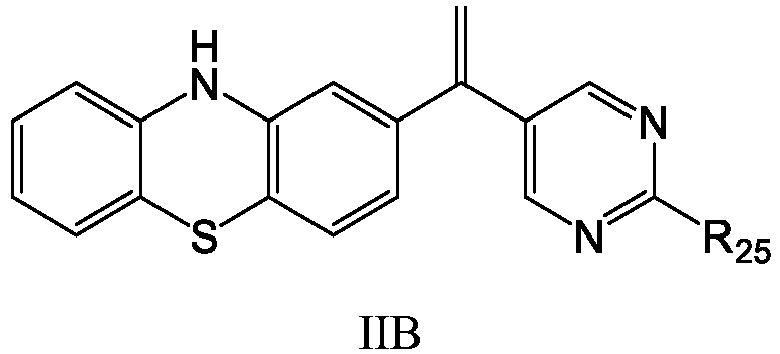
- Wherein, R25 is selected from substituted or unsubstituted 6-7 membered saturated heterocyclic group;
- The substituent of the saturated heterocyclic group is C1 alkyl;
- The heteroatom of said heterocyclic group is N and O, and the number of heteroatoms is 2;
- Or, said compound has a structure of formula IIC:

- Wherein, R26 is selected from -N(H)C(O)R51, amino, 6 membered saturated heterocyclic group;
- The heteroatom of said saturated heterocyclic group is N and O, and the number of heteroatoms is 2;
- R51 is selected from C1 alkyl;
- Or, said compound has a structure of formula IIIA:
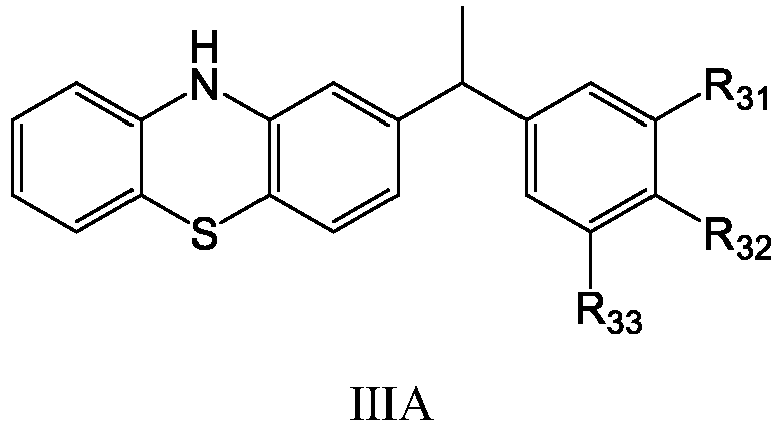
- Wherein, R31, R32, R33 are each independently selected from the group consisting of H, halogen, cyano, hydroxyl, amino, substituted or unsubstituted C1-C4 alkyl, substituted or unsubstituted C1-C3 alkoxy, -C(O)OR51, -N(H)C(O)R51,aryl, phenoxy, -NR52R53, substituted 6 membered saturated heterocyclic group, nitro;
- R51 is selected from C1-C4 alkyl;
- The substituent of the alkyl is halogen;
- The substituent of the alkoxyl is aryl, halogen;
- The substituent of the saturated heterocyclic group is C1 alkyl;
- The heteroatom of the saturated heterocyclic group is N, and the number of heteroatoms is 2; R52 and R53 are each independently selected from aryl;
- Or, said compound has a structure of formula IIIB:

- Wherein,
- Ring Bis selected from the group consisting of benzo(5-6 membered saturated)heterocyclic group, benzo(5 membered unsaturated)heterocyclic group, substituted or unsubstituted naphthyl, anthryl, substituted 6 membered unsaturated heterocyclic group or 6 membered saturated cycloalkyl; The substituent of the unsaturated heterocyclic group is cyano, C1 alkyl, C2 alkoxyl;
- The substituent of the naphthyl is C1-C2 alkoxyl;
- The heteroatom of the saturated heterocyclic group is O, and the number of heteroatoms is 1 or 2;
- The heteroatom of the unsaturated heterocyclic group is O and N, and the number of heteroatoms is 1;
- Or, said compound has a structure of formula IVA:

- Wherein, R41, R42, R43, and R44 are each independently selected from the group consisting of H, hydroxyl, -N(H)C(O)OR51, substituted or unsubstituted C1 alkyl;
- R51 is selected from C4 alkyl;
- The substituent of the alkyl is -N(H)C(O)OR51;
- Or, said compound has a structure of formula IVB:

- Wherein, R41', R42', R43', and R44' are each independently selected from H, hydroxyl; Or, said compound has a structure of formula IVC:

- Wherein, R41", R42", R43", and R44" are each independently selected from H, C1 alkyl, -C(O)R51; R51 is selected from C1 alkyl;
- Or, said compound has a structure of formula IVD:
-

- Wherein, R45, R46, R47, and R48 are each independently selected from the group consisting of H, substituted or unsubstituted C1-C4 alkyl, -C(O)R51, -S(O)(O)R51, 6 membered unsaturated heterocyclic group, -C(O)OR51, substituted or unsubstituted aryl;
- R51 is selected from 5 membered saturated heterocyclic group, C1-C4 alkyl, benzo(6 membered saturated)heterocyclic group;
- R52 and R53 are each independently selected from C1 alkyl;
- The substituent of the alkyl is halogen, benzo(5 membered saturated)heterocyclic group, -C(O)R51, -NR52R53, substituted or unsubstituted aryl, 6 membered saturated heterocyclic group, hydroxyl;
- The substituent of the aryl is C1 alkoxyl, halogen, cyano, nitro, substituted or unsubstituted C1 alkyl; The heteroatom of the saturated heterocyclic group is O and N, and the number of heteroatoms is 1 or 2;
- The heteroatom of the unsaturated heterocyclic group is N, and the number of heteroatoms is 1 or 2;
- Or, said compound has a structure of formula IVE:

- Wherein, R45', R46', R47', and R48' are each independently selected from H, C1 alkyl;
- Or, said compound has a structure of formula IVF:

- Wherein, R45", R46", R47", and R48" are each independently selected from H, C1 alkyl;
- Or, said compound has a structure of formula IVG:

- Wherein, R45‴, R46‴, R47‴, and R48‴ are each independently selected from H, hydroxyl, - C(O)OR51, -N(H)C(O)OR51,substituted aryl, substituted or unsubstituted C1 alkyl, 6 membered saturated heterocyclic group, -C(O)R51;
- R51 is selected from C2-C4 alkyl, amino;
- The substituent of the aryl is halogen;
- The substituent of the alkyl is -N(H)C(O)OR51, hydroxyl;
- The heteroatom of the saturated heterocyclic group is N, and the number of heteroatoms is 1. Further, said compounds are:














- The present invention also provides the preparative method for the compound mentioned above, or a pharmaceutically acceptable salt, or crystal, or solvate thereof, that includes the following steps:
- (1) 2-Acetylphenothiazine and 4-methylbenzenesulfonyl hydrazide are used as starting materials, and dissolved in MeOH, to which is then added the catalyst HOAc. The mixture is heated to 60°C for reaction, and the progress of the reaction is monitored. After completion of the reaction, the reaction is cooled to room temperature, filtered under reduced pressure, and the filtrate is rinsed to be colorless, then dried in vacuo to obtain intermediate I;
- (2) Intermediate I, starting material A, and anhydrous K2CO3 are dissolved in 1,4-dioxane, and then reacted at 110 °C . The progress of the reaction is monitored. And after completion of the reaction, the mixture is cooled to room temperature and concentrated under reduced pressure to remove 1,4-dioxane. The residue is extracted, and the organic layer is concentrated and then separated by column chromatography to obtain the target product;
- Or, the method includes the following steps:
- (1) 2-Acetylphenothiazine and 4-methylbenzenesulfonyl hydrazide are used as starting materials, that are dissolved in MeOH, to which is then added the catalyst HOAc. The mixture is heated to 60°C for reaction, and the progress of the reaction is monitored. After completion of the reaction, the reaction is cooled to room temperature, filtered under reduced pressure, and the filtrate is rinsed to be colorless, then dried in vacuo to obtain intermediate I;
- (2) Intermediate I, starting material A, tris(dibenzylidene-BASE acetone)dipalladium, 2-dicyclohexylphosphino-2,4,6-triisopropylbiphenyl and anhydrous t-BuOLi are dissolved in 1,4-dioxane, to which argon is purged and exchanged for 3 times. The resultant mixture is heated to 70°C for reaction, and the reaction is monitored by TLC. After about 4 h, the reaction is completed, cooled to room temperature, filtered, concentrated under reduced pressure, and the residue is extracted. The organic layer is concentrated and separated by column chromatography to obtain the target compound;
- Or, the method includes the following steps:
- (1) 2-Acetylphenothiazine and 4-methylbenzenesulfonyl hydrazide are used as starting materials, that are dissolved in MeOH, to which is then added the catalyst HOAc. The mixture is heated to 60°C for reaction, and the progress of the reaction is monitored. After completion of the reaction, the reactions are cooled to room temperature, filtered under reduced pressure, and the filtrate is rinsed to be colorless, then dried in vacuo to provide intermediate I;
- (2) Intermediate I, starting material A, and DABSO are dissolved in DMSO, to which argon is purged and exchanged for 3 times. The resultant mixture is heated to 100 °C for reaction, and the reaction is monitored. After about 12 h, the reaction is completed, cooled to room temperature, filtered, concentrated under reduced pressure, and the residue is extracted. The organic layer is concentrated and separated by column chromatography to obtain the target compound.
- Further, in said step (2), starting material A includes the compounds having following structures:





- Or, in said step (2), starting material A includes the compounds having following structures:




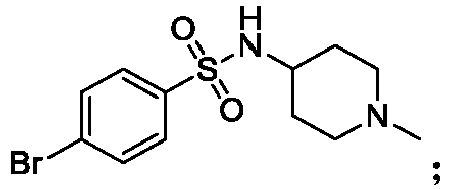
- Or, in said step (2), starting material A includes the compounds having following structures:


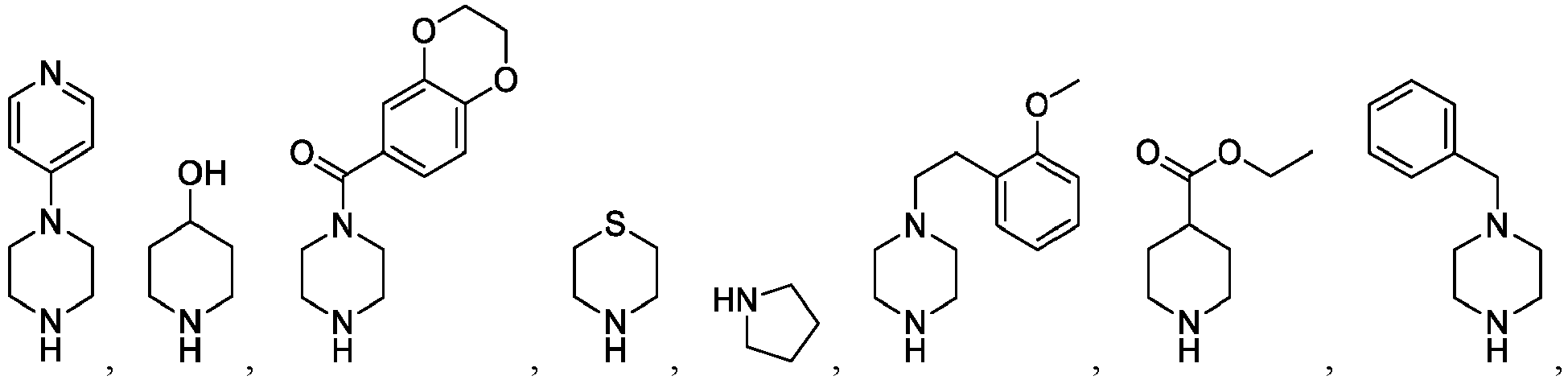



- Further, in said step (1), during the rinsing process after completion of the reaction, MeOH and ethyl ether are used to wash; and/or in the step (2), during the extraction process after completion of the reaction, the extraction is carried out with saturated NaHCO3/DCM; and/or, the reaction process is detected all by TLC.
- The present invention provides also the compound mentioned above, or a pharmaceutically acceptable salt, or crystal, or solvate thereof for use as ferroptosis inhibitor and/or for treatment of stroke; wherein, said ferroptosis inhibitor is a targeted drug for inhibiting cell ferroptosis.
- The present invention also provides a pharmaceutical preparation obtained by using the compound mentioned above, or a pharmaceutically acceptable salt, or crystal, or solvate thereof as active ingredients, with the addition of pharmaceutically acceptable excipients; wherein, said preparations is an oral preparation or an intravenous injection preparation.
- The compounds and derivatives provided in the present invention can be named according to IUPAC (International Union of Pure and Applied Chemistry) or CAS (Chemical Abstracting Service, Columbus, OH) naming system.
- For the definition of term used in the present the invention: unless otherwise specified, the initial definition provided for the group or the term herein is applicable to those in the whole specification; for terms not specifically defined herein, according to the disclosure content and the context, the term should have the meaning commonly given by those skilled in the field.
- "Substitution" means that the hydrogen in a molecule is substituted by other different atoms or molecules.
- The structure of the compound mentioned in the present invention all denotes the one that can exist stably.
- In the present invention, the structure of substituent"-C(O)R51"is


- In the present invention, the minimum and the maximum for the content of carbon atoms in hydrocarbon groups are represented by prefixes, for example, the prefix (Ca-Cb) alkyls mean any alkyls containing "a"-"b" carbon atoms. Therefore, for example, C1-C8 alkyls denotes the straight or branched alkyls containing 1-8 carbon atoms. C1-C8 alkoxyls denote the alkoxyls containing 1-8 carbon atoms.
- In the present invention, "3-8-membered saturated cycloalkyls" denote a monocyclic or polycyclic cycloalkyl consisting of 3-8 carbon atoms, in which there isn't a double bond; 3-8 membered unsaturated cycloalkyls denote a monocyclic cycloalkyl consisting of 3-8 carbon atoms, in which there are one or more double bonds; 3-8-membered saturated heterocyclic groups denote a saturated monocyclic heterocyclic group without double bonds, in which there is at least one heteroatom selected from O, S or substituted nitrogen atom, and the remained atoms in the ring are carbons; 3-8-membered unsaturated heterocyclic groups mean an unsaturated monocyclic heterocyclic group containing double bonds, in which there is at least one heteroatom selected from O, S or substituted nitrogen atom, and the remained atoms in the ring are carbons; a benzo(saturated)heterocyclic group means a saturated heterocyclic group fused with a benzene; a benzo(unsaturated)heterocyclic group means an unsaturated heterocyclic group fused with a benzene.
- In the present invention, halogen is fluorine, chlorine, bromine or iodine.
- 10H-phenothiazine derivatives prepared in the present invention have the effect of inhibiting ferroptosis, and ferroptosis is related to various diseases such as stroke, Parkinson's syndrome and pancreatic cancer, and it has been found that the development of the disease can be intervened by activating or inhibiting ferroptosis. Therefore, 10H-phenothiazine derivatives including bio-pharmaceutically acceptable salts, crystals, and solvates thereof can be used as the main active ingredient, together with the addition of bio-pharmaceutically acceptable excipients, to prepare the inhibitors of ferroptosis. 10H-phenothiazine derivatives or the prepared ferroptosis inhibitors can be used as the main active ingredient of the drugs for treatment of stroke.
- In the present invention, a new 10H-phenothiazine derivative has been synthesized that can inhibit ferroptosis, and by study on its structure optimization and structure-activity relationship, it is confirmed that in some embodiments 10H-phenothiazine derivatives can have a better inhibitory effect on body death, and there are compounds that show better therapeutic effects on the rat focal cerebral ischemia model, which can be used as the main active ingredient for the preparation of body death inhibitors. The compounds and the inhibitors prepared by said compounds have good medicinal potential and are expected to become a new candidate drug for treatment of stroke; at the same time, the preparative method of the new compound provided by the present invention is simple, and the reaction conditions are mild, that are convenient for the operation and control. Moreover, the reactions have low consumption, high yield and low cost, and are suitable for industrialized production. The prepared compound has higher biological activity, strong selectivity, and remarkable drug-like properties, and has broad market prospects.
- By following specific examples of said embodiments, above content of the present invention is further illustrated. But it should not be construed that the scope of above subject of the present invention is limited to following examples. The techniques realized based on above content of the present invention are all within the scope of the present invention.
-
-
Figure 1 shows a graph of EC50 comparison between compound A38 of the present invention and the positive control Fer-1. -
Figure 2 shows a graph of the therapeutic effect on rat model of focal cerebral ischemia (stroke) for compound A38 according to the present invention. - The starting materials and equipment used in the specific examples of the present invention are all known products and can be obtained by purchasing commercially available products.
-

- 2-Acetylphenothiazine (10.0 g, 41.44 mmol, 1.0 eq) and 4-methylbenzenesulfonyl hydrazide (7.72 g, 41.44 mmol, 1.0 eq) were dissolved in 100 mL MeOH, to which was added 1 mL HOAc, and the resultant mixture was heated to 60°C for reaction. The reaction was monitored by TLC, and after about 4 h, the reaction was completed. After cooling to room temperature, a yellow solid appeared, that was collected by vacuum filtration, and then washed with MeOH and ethyl ether until the filtrate was colorless. After drying under vacuum, intermediate I (15 g) was obtained with a yield of 88.4%. 1HNMR and HRMS data of intermediate I are as follows:
- 1H NMR (400 MHz, DMSO-d6 ) δ 10.45 (s, 1H), 8.70 (s, 1H), 7.82 (d, J = 8.3 Hz, 2H), 7.40 (d, J = 8.1 Hz, 2H), 7.06 (d, J = 1.7 Hz, 1H), 6.98 (dd, J = 8.0, 1.7 Hz, 2H), 6.89 (dd, J = 7.2, 3.0 Hz, 2H), 6.75 (dd, J = 7.5, 0.9 Hz, 1H), 6.72 - 6.62 (m, 1H), 2.37 (s, 3H), 2.08 (s, 3H).
- MS m/z (ESI): 410.1 [M+H]+.
- Compounds 1-76 in Example 2 were also named compoundsA1-A76.
- Using the intermediate I prepared in Example 1 and various substituted boronic acids as starting materials to prepare compounds 1-76, namely compounds A1-A76Among them, the method for preparation of compounds 2-76 is the same as that of
compound 1 in Example 2. - Synthetic route was as follows:

- Intermediate I (100 mg, 0.244 mmol, 1.0 eq), phenylboronic acid (45 mg, 0.366 mmol, 1.5 eq), and anhydrous K2CO3 (51 mg, 0.366 mmol, 1.5 eq) were dissolved in 10
mL 1,4-dioxane and warmed to 110 °C for reaction, and the reaction was monitored by TLC. After about 4 h, the reaction was completed. After cooling to room temperature, the reactions were concentrated under reduced pressure to remove 1,4-dioxane, and the residue was extracted with saturated NaHCO3/DCM (1:1). The organic layer was concentrated and separated by column chromatography to obtain the target product compound 1 (48 mg), with a yield of 74.8%. - 1HNMR and HRMS data of
compound 1 are as follows: - 1H NMR (400 MHz, DMSO-d6 ) δ 8.50 (s, 1H), 7.29 (t, J = 7.4 Hz, 2H), 7.22 (d, J = 7.1 Hz, 2H), 7.18 (d, J = 7.1 Hz, 1H), 6.95 (dd, J = 10.9, 4.4 Hz, 1H), 6.91 - 6.85 (m, 1H), 6.82 (d, J = 7.9 Hz, 1H), 6.73 (td, J = 7.6, 1.0 Hz, 1H), 6.71 - 6.62 (m, 2H), 6.54 (d, J= 1.4 Hz, 1H), 4.00 (q, J = 7.1 Hz, 1H), 1.50 (d, J = 7.2 Hz, 3H).
- HRMS m/z (ESI) calcd for C20H17NS [M+H]+ 303.1082 found: 403.1085.
- The synthetic route is as follows:

- 1H NMR and HRMS data of compound 2 are as follows:
1HNMR (400 MHz, DMSO-d6 ) δ 8.50 (s, 1H), 7.33 (td, J = 8.0, 6.3 Hz, 1H), 7.10 - 6.92 (m, 4H), 6.89 (dd, J = 7.6, 1.3 Hz, 1H), 6.84 (d, J = 7.9 Hz, 1H), 6.76 - 6.67 (m, 2H), 6.65 (dd, J= 7.9, 1.1 Hz, 1H), 6.53 (d, J = 1.7 Hz, 1H), 4.04 (q, J = 7.2 Hz, 1H), 1.50 (d, J = 7.2 Hz, 3H). HRMS m/z (ESI) calcd for C20H16FNS [M+H]+ 321.1082 found: 321.1082. - The detailed preparative method are same as that of
compound 1, with a yield of 75.3%∘ - The synthetic route is as follows:

- 1H NMR and HRMS data of compound 3are as follows:
- 1H NMR (400 MHz, DMSO-d6 ) δ 8.49 (s, 1H), 6.96 (t, J = 7.5 Hz, 1H), 6.89 (d, J = 7.5 Hz, 1H), 6.82 (d, J = 7.9 Hz, 2H), 6.77 (s, 1H), 6.74 (d, J = 7.4 Hz, 1H), 6.67 (dd, J = 15.7, 7.9 Hz, 3H), 5.95 (s, 2H), 3.93 (q, J = 6.9 Hz, 1H), 1.46 (d, J = 7.1 Hz, 3H).
- HRMS m/z (ESI) calcd for C20H16ClNS [M+H]+ 337.0692 found: 337.0695.
- The detailed preparative method is same as that of
compound 1, with a yield of 73.4%. - The synthetic route is as follows:

- 1H NMR and HRMS data of compound 4 are as follows:
- 1H NMR (400 MHz, DMSO-d6 ) δ 8.51 (s, 1H), 7.59 (s, 1H), 7.55 (d, J = 7.9 Hz, 1H), 7.25 (d, J = 7.8 Hz, 1H), 7.10 (t, J = 7.7 Hz, 1H), 7.03 - 6.92 (m, 1H), 6.89 (d, J = 6.9 Hz, 1H), 6.83 (d, J = 7.9 Hz, 1H), 6.73 (t, J = 7.5 Hz, 1H), 6.70 - 6.61 (m, 2H), 6.51 (d, J = 1.3 Hz, 1H), 3.99 (q, J = 7.1 Hz, 1H), 1.48 (d, J = 7.2 Hz, 3H).
- HRMS m/z (ESI) calcd for C20H16INS [M+H]+ 429.0048 found: 429.0045.
- The detailed preparative method is same as that of
compound 1, with a yield of 63.8%. - The synthetic route is as follows:

- 1H NMR and HRMS data of compound 5 are as follows:
- 1H NMR (400 MHz, DMSO-d6 ) δ 8.51 (s, 1H), 7.73 (s, 1H), 7.67 (d, J = 7.2 Hz, 1H), 7.56 (d, J = 7.5 Hz, 1H), 7.52 (d, J = 7.5 Hz, 1H), 6.96 (t, J = 7.4 Hz, 1H), 6.89 (d, J = 7.5 Hz, 1H), 6.84 (d, J = 7.8 Hz, 1H), 6.72 (dd, J = 15.9, 7.7 Hz, 2H), 6.65 (d, J = 7.8 Hz, 1H), 6.51 (s, 1H), 4.11 (d, J = 7.0 Hz, 1H), 1.52 (d, J = 7.0 Hz, 3H).
- HRMS m/z (ESI) calcd for C21H16N2S [M+H]+ 328.1034 found: 328.1033.
- The detailed preparative method is same as that of
compound 1, with a yield of 71.4%. - The synthetic route is as follows:

- 1H NMR and HRMS data of compound 6 are as follows:
- 1H NMR (400 MHz, DMSO-d6 ) δ 9.25 (s, 1H), 8.52 (s, 1H), 7.07 (t, J = 7.4 Hz, 1H), 6.96 (t, J = 7.3 Hz, 1H), 6.89 (d, J = 7.3 Hz, 1H), 6.82 (d, J = 7.6 Hz, 1H), 6.78 - 6.70 (m, 1H), 6.65 (d, J = 7.0 Hz, 3H), 6.57 (d, J = 9.2 Hz, 2H), 6.53 (s, 1H), 3.90 (d, J = 6.7 Hz, 1H), 1.46 (d, J = 6.8 Hz, 3H).
- HRMS m/z (ESI) calcd for C20H17NOS [M+H]+ 319.1031 found: 319.1034.
- The detailed preparative method is same as that of
compound 1, with a yield of 65.5%. - The synthetic route is as follows:

- 1H NMR and HRMS data of compound 7 are as follows:
- 1H NMR (400 MHz, DMSO-d6 ) δ 8.50 (s, 1H), 6.95 (dd, J = 7.7, 1.3 Hz, 1H), 6.89 (dd, J = 11.5, 4.6 Hz, 2H), 6.81 (d, J = 7.9 Hz, 1H), 6.73 (dd, J = 7.5, 1.2 Hz, 1H), 6.65 (d, J = 7.9 Hz, 2H), 6.52 (d, J = 1.6 Hz, 1H), 6.44 - 6.33 (m, 3H), 4.95 (s, 2H), 3.80 (t, J = 7.2 Hz, 1H), 1.42 (t, J = 9.4 Hz, 3H).
- HRMS m/z (ESI) calcd for C20H18N2S [M+H]+ 318.1191 found: 318.1192.
- The detailed preparative method is same as that of
compound 1, with a yield of 75.5%. - The synthetic route is as follows:

- 1H NMR and HRMS data of compound 8 are as follows:
- 1H NMR (400 MHz, DMSO-d6 ) δ 8.49 (s, 1H), 7.17 (t, J = 7.5 Hz, 1H), 7.06 - 6.92 (m, 4H), 6.89 (d, J = 7.6 Hz, 1H), 6.82 (d, J = 7.9 Hz, 1H), 6.73 (t, J = 7.5 Hz, 1H), 6.66 (dd, J = 13.7, 8.0 Hz, 2H), 6.53 (s, 1H), 3.95 (q, J = 7.1 Hz, 1H), 2.26 (s, 3H), 1.49 (d, J = 7.2 Hz, 3H).
- HRMS m/z (ESI) calcd for C21H19NS [M+H]+ 317.1238 found: 317.1240.
- The detailed preparative method is same as that of
compound 1, with a yield of 63.8%. - The synthetic route is as follows:

- 1H NMR and HRMS data of compound 9 are as follows:
- 1H NMR (400 MHz, DMSO-d6 ) δ 8.50 (s, 1H), 7.20 (t, J = 7.5 Hz, 1H), 7.06 (s, 1H), 7.02 (d, J = 7.5 Hz, 2H), 6.95 (dd, J = 7.6, 1.0 Hz, 1H), 6.89 (d, J = 7.6 Hz, 1H), 6.82 (d, J = 7.9 Hz, 1H), 6.72 (td, J = 7.6, 1.0 Hz, 1H), 6.70 - 6.62 (m, 2H), 6.54 (d, J = 1.4 Hz, 1H), 3.96 (q, J = 7.1 Hz, 1H), 2.56 (q, J = 7.6 Hz, 2H), 1.49 (d, J = 7.2 Hz, 3H), 1.16 (t, J = 7.6 Hz, 3H).
- HRMS m/z (ESI) calcd for C22H21NS [M+H]+ 331.1395 found: 331.1398.
- The detailed preparative method is same as that of
compound 1, with a yield of 68.7%. - The synthetic route is as follows:

- 1H NMR and HRMS data of
compound 10 are as follows: - 1H NMR (400 MHz, DMSO-d6 ) δ 8.50 (s, 1H), 7.20 (t, J = 7.6 Hz, 1H), 7.10 (s, 1H), 7.04 (dd, J = 15.4, 7.6 Hz, 2H), 6.96 (t, J = 7.6 Hz, 1H), 6.89 (d, J = 7.5 Hz, 1H), 6.82 (d, J = 7.9 Hz, 1H), 6.72 (t, J = 8.0 Hz, 1H), 6.71 - 6.61 (m, 2H), 6.55 (s, 1H), 3.97 (d, J = 7.1 Hz, 1H), 2.97 - 2.74 (m, 1H), 1.49 (d, J = 7.2 Hz, 3H), 1.20 (dd, J = 17.5, 7.0 Hz, 6H).
- HRMS m/z (ESI) calcd for C23H23NS [M+H]+ 345.1551 found: 345.1552.
- The detailed preparative method is same as that of
compound 1, with a yield of 60.8%. - The synthetic route is as follows:

- 1H NMR and HRMS data of
compound 11 are as follows: - 1H NMR (400 MHz, DMSO-d6 ) δ 8.49 (s, 1H), 7.18 (t, J = 7.5 Hz, 1H), 6.96 (t, J = 7.3 Hz, 1H), 6.89 (d, J = 7.2 Hz, 1H), 6.82 (d, J = 7.7 Hz, 1H), 6.75 (t, J = 11.5 Hz, 3H), 6.67 (dd, J = 16.5, 7.9 Hz, 2H), 6.53 (s, 1H), 4.07 - 3.87 (m, 3H), 1.48 (d, J = 6.8 Hz, 3H), 1.30 (t, J = 6.6 Hz, 3H).
- HRMS m/z (ESI) calcd for C22H21NOS [M+H]+ 347.1344 found: 347.1345.
- The detailed preparative method is same as that of
compound 1, with a yield of 70.6%. - The synthetic route is as follows:

- 1H NMR and HRMS data of
compound 12 are as follows: - 1H NMR (400 MHz, DMSO-d6 ) δ 8.50 (s, 1H), 7.20 (t, J = 7.6 Hz, 1H), 7.10 (s, 1H), 7.04 (dd, J = 15.4, 7.6 Hz, 2H), 6.96 (t, J = 7.6 Hz, 1H), 6.89 (d, J = 7.5 Hz, 1H), 6.82 (d, J = 7.9 Hz, 1H), 6.72 (t, J = 8.0 Hz, 1H), 6.71 - 6.61 (m, 2H), 6.55 (s, 1H), 4.62 - 4.44 (m, 1H), 3.92 (d, J = 7.1 Hz, 1H), 1.47 (d, J = 7.2 Hz, 3H), 1.23 (d, J = 6.0 Hz, 6H).
- HRMS m/z (ESI) calcd for C23H23NOS [M+H]+ 361.1500 found: 361.1502.
- The detailed preparative method is same as that of
compound 1, with a yield of 71.9%. - The synthetic route is as follows:

- 1H NMR and HRMS data of
compound 13 are as follows: - 1H NMR (400 MHz, DMSO-d6 ) δ 8.49 (s, 1H), 7.43 (d, J = 7.0 Hz, 2H), 7.38 (dd, J = 10.0, 4.7 Hz, 2H), 7.31 (d, J = 7.1 Hz, 1H), 7.20 (t, J = 7.9 Hz, 1H), 6.96 (td, J = 7.8, 1.4 Hz, 1H), 6.92 - 6.84 (m, 2H), 6.85 - 6.78 (m, 3H), 6.73 (td, J = 7.5, 1.1 Hz, 1H), 6.66 (ddd, J = 12.2, 7.9, 1.3 Hz, 2H), 6.54 (d, J = 1.6 Hz, 1H), 5.05 (s, 2H), 3.96 (q, J= 7.1 Hz, 1H), 1.48 (d, J = 7.2 Hz, 3H).
- HRMS m/z (ESI) calcd for C27H23NOS [M+H]+ 409.1500 found: 409.1496.
- The detailed preparative method is same as that of
compound 1, with a yield of 68.8%. - The synthetic route is as follows:

- 1H NMR and HRMS data of
compound 14 are as follows: - 1H NMR (400 MHz, DMSO-d6 ) δ 8.51 (s, 1H), 7.80 (d, J = 8.8 Hz, 2H), 7.53 (d, J = 7.7 Hz, 1H), 7.46 (t, J = 7.6 Hz, 1H), 7.03 - 6.92 (m, 1H), 6.89 (d, J = 7.5 Hz, 1H), 6.84 (d, J = 7.9 Hz, 1H), 6.77 - 6.67 (m, 2H), 6.64 (d, J = 7.9 Hz, 1H), 6.52 (d, J = 1.3 Hz, 1H), 4.12 (q, J = 7.1 Hz, 1H), 3.84 (s, 3H), 1.53 (d, J = 7.2 Hz, 3H).
- HRMS m/z (ESI) calcd for C23H21NO2S [M+H]+ 375.1293 found: 375.1295.
- The detailed preparative method is same as that of
compound 1, with a yield of 65.2%. - The synthetic route is as follows:

- 1H NMR and HRMS data of
compound 15 are as follows: - 1H NMR (400 MHz, DMSO-d6 ) δ 8.51 (s, 1H), 7.82 - 7.66 (m, 2H), 7.48 (d, J = 7.8 Hz, 1H), 7.42 (t, J = 7.6 Hz, 1H), 6.96 (td, J = 7.9, 1.3 Hz, 1H), 6.89 (d, J = 7.6 Hz, 1H), 6.84 (d, J = 7.9 Hz, 1H), 6.71 (ddd, J= 9.6, 7.7, 1.3 Hz, 2H), 6.64 (d, J = 7.9 Hz, 1H), 6.51 (d, J = 1.5 Hz, 1H), 4.10 (d, J = 7.1 Hz, 1H), 1.52 (d, J = 7.2 Hz, 12H).
- HRMS m/z (ESI) calcd for C25H25NO2S [M+H]+ 403.1606 found: 403.1609.
- The detailed preparative method is same as that of
compound 1, with a yield of 61.8%. - The synthetic route is as follows:

- 1H NMR and HRMS data of compound 16are as follows:
- 1H NMR (400 MHz, DMSO-d6 ) δ 9.24 (s, 1H), 8.50 (s, 1H), 7.35 (s, 1H), 7.25 (d, J= 8.0 Hz, 1H), 7.15 (t, J= 7.8 Hz, 1H), 6.95 (td, J = 7.8, 1.4 Hz, 1H), 6.88 (dd, J = 7.6, 1.2 Hz, 1H), 6.82 (d, J= 7.9 Hz, 2H), 6.72 (td, J = 7.5, 1.2 Hz, 1H), 6.68 - 6.60 (m, 2H), 6.50 (d, J = 1.6 Hz, 1H), 3.92 (d, J = 7.1 Hz, 1H), 1.46 (d, J = 10.0 Hz, 11H).
- HRMS m/z (ESI) calcd for C25H26N2O2S [M+H]+ 418.1715 found: 418.1720.
- The detailed preparative method is same as that of
compound 1, with a yield of 64.9%. - The synthetic route is as follows:

- 1H NMR and HRMS data of
compound 17 are as follows:
1H NMR (400 MHz, DMSO-d6 ) δ 8.52 (s, 1H), 7.43 (s, 1H), 7.27 (s, 1H), 7.20 (s, 2H), 6.96 (s, 1H), 6.92 - 6.79 (m, 2H), 6.70 (dd, J = 17.6, 10.0 Hz, 3H), 6.54 (s, 1H), 4.10 (s, 1H), 1.52 (s, 3H). HRMS m/z (ESI) calcd for C21H16F3NOS [M+H]+ 387.0905 found: 387.0902. - The detailed preparative method is same as that of
compound 1, with a yield of 73.4%. - The synthetic route is as follows:

- 1H NMR and HRMS data of compound 18 are as follows:
- 1H NMR (400 MHz, DMSO-d6 ) δ 8.51 (s, 1H), 7.69 - 7.59 (m, 2H), 7.52 (s, 1H), 7.46 (t, J = 7.7 Hz, 3H), 7.42 - 7.33 (m, 2H), 7.22 (d, J = 7.6 Hz, 1H), 6.95 (td, J = 7.8, 1.4 Hz, 1H), 6.91 - 6.86 (m, 1H), 6.84 (d, J = 7.9 Hz, 1H), 6.73 (ddd, J = 8.5, 7.7, 1.3 Hz, 2H), 6.64 (dd, J = 7.9, 0.9 Hz, 1H), 6.59 (d, J = 1.5 Hz, 1H), 4.09 (q, J = 7.1 Hz, 1H), 1.57 (d, J = 7.2 Hz, 3H).
- HRMS m/z (ESI) calcd for C26H21NS [M+H]+ 379.1395 found: 379.1398.
- The detailed preparative method is same as that of
compound 1, with a yield of 69.4%. - The synthetic route is as follows:

- 1H NMR and HRMS data of compound 19 are as follows:
- 1H NMR (400 MHz, DMSO-d6 ) δ 8.50 (s, 1H), 7.35 (d, J = 8.0 Hz, 2H), 7.24 (d, J = 8.0 Hz, 2H), 6.96 (t, J = 7.3 Hz, 1H), 6.89 (d, J = 7.2 Hz, 1H), 6.83 (d, J = 7.7 Hz, 1H), 6.73 (t, J = 7.4 Hz, 1H), 6.70 - 6.60 (m, 2H), 6.50 (s, 1H), 4.02 (d, J = 7.0 Hz, 1H), 1.49 (d, J = 6.9 Hz, 3H).
- HRMS m/z (ESI) calcd for C20H16FNS [M+H]+ 321.0987 found: 321.0989.
- The detailed preparative method is same as that of
compound 1, with a yield of 75.1%. - The synthetic route is as follows:

- 1H NMR and HRMS data of compound 20 are as follows:
- 1H NMR (400 MHz, DMSO-d6 ) δ 8.50 (s, 1H), 7.35 (d, J = 8.3 Hz, 2H), 7.24 (d, J = 8.3 Hz, 2H), 6.96 (t, J = 7.4 Hz, 1H), 6.89 (d, J = 7.4 Hz, 1H), 6.83 (d, J = 7.9 Hz, 1H), 6.73 (t, J = 7.4 Hz, 1H), 6.66 (t, J = 8.7 Hz, 2H), 6.50 (s, 1H), 4.02 (d, J = 7.1 Hz, 1H), 1.49 (d, J = 7.1 Hz, 3H).
- HRMS m/z (ESI) calcd for C20H16ClNS [M+H]+ 337.0692 found: 337.0695.
- The detailed preparative method is same as that of
compound 1, with a yield of 73.5%. - The synthetic route is as follows:

- 1H NMR and HRMS data of compound 21 are as follows:
- 1H NMR (400 MHz, DMSO-d6 ) δ 8.51 (s, 1H), 7.76 (d, J = 8.0 Hz, 2H), 7.43 (d, J = 8.0 Hz, 2H), 6.96 (t, J = 7.5 Hz, 1H), 6.89 (d, J = 7.5 Hz, 1H), 6.84 (d, J = 7.9 Hz, 1H), 6.73 (t, J = 7.4 Hz, 1H), 6.68 (d, J = 7.8 Hz, 1H), 6.64 (d, J = 7.9 Hz, 1H), 6.51 (s, 1H), 4.12 (q, J = 6.9 Hz, 1H), 1.52 (d, J = 7.1 Hz, 3H)∘
- HRMS m/z (ESI) calcd for C21H16F3NS [M+H]+ 371.0956 found: 371.0952.
- The detailed preparative method is same as that of
compound 1, with a yield of 71.8%. - The synthetic route is as follows:

- 1H NMR and HRMS data of compound 22 are as follows:
- 1H NMR (400 MHz, DMSO-d6 ) δ 8.51 (s, 1H), 7.76 (d, J = 8.0 Hz, 2H), 7.43 (d, J = 8.0 Hz, 2H), 6.96 (t, J = 7.5 Hz, 1H), 6.89 (d, J = 7.5 Hz, 1H), 6.84 (d, J = 7.9 Hz, 1H), 6.73 (t, J = 7.4 Hz, 1H), 6.68 (d, J = 7.8 Hz, 1H), 6.64 (d, J = 7.9 Hz, 1H), 6.51 (s, 1H), 4.12 (q, J = 6.9 Hz, 1H), 1.52 (d, J = 7.1 Hz, 3H)∘
- HRMS m/z (ESI) calcd for C21H16N2S [M+H]+ 328.1034 found: 328.1038∘
- The detailed preparative method is same as that of
compound 1, with a yield of 67.8%. - The synthetic route is as follows:

- 1H NMR and HRMS data of compound 23 are as follows:
- 1H NMR (400 MHz, DMSO-d6 ) δ 8.51 (s, 1H), 7.35 (d, J = 8.7 Hz, 2H), 7.28 (d, J = 8.2 Hz, 2H), 6.95 (dd, J = 7.6, 1.3 Hz, 1H), 6.89 (dd, J = 7.6, 1.2 Hz, 1H), 6.84 (d, J = 7.9 Hz, 1H), 6.74 (dd, J = 7.5, 1.1 Hz, 1H), 6.69 (dd, J = 7.9, 1.6 Hz, 1H), 6.64 (dd, J = 7.9, 1.0 Hz, 1H), 6.52 (d, J = 1.6 Hz, 1H), 4.07 (d, J = 7.1 Hz, 1H), 1.51 (d, J = 7.2 Hz, 3H).
- HRMS m/z (ESI) calcd for C21H16F3NOS [M+H]+ 387.0905 found: 387.0903.
- The detailed preparative method is same as that of
compound 1, with a yield of 55.2%. - The synthetic route is as follows:

- 1H NMR and HRMS data of
compound 24 are as follows: - 1H NMR (400 MHz, DMSO-d6 ) δ 8.49 (s, 1H), 7.12 (s, 4H), 6.96 (td, J = 7.8, 1.3 Hz, 1H), 6.91 - 6.85 (m, 1H), 6.81 (d, J = 7.9 Hz, 1H), 6.72 (td, J = 7.5, 1.1 Hz, 1H), 6.70 - 6.61 (m, 2H), 6.52 (d, J = 1.6 Hz, 1H), 3.95 (q, J = 7.2 Hz, 1H), 2.55 (q, J = 7.6 Hz, 2H), 1.48 (d, J = 7.2 Hz, 3H), 1.15 (t, J = 7.6 Hz, 3H).
- HRMS m/z (ESI) calcd for C22H21NS [M+H]+ 331.1395 found: 331.1391.
- The detailed preparative method is same as that of
compound 1, with a yield of 60.8%. - The synthetic route is as follows:

- 1H NMR and HRMS data of
compound 25 are as follows: - 1H NMR (400 MHz, DMSO-d6 ) δ 8.49 (s, 1H), 7.17 - 7.06 (m, 4H), 6.96 (td, J = 7.8, 1.4 Hz, 1H), 6.92 - 6.86 (m, 1H), 6.81 (d, J = 7.9 Hz, 1H), 6.72 (td, J = 7.5, 1.1 Hz, 1H), 6.66 (ddd, J = 10.5, 8.0, 1.3 Hz, 2H), 6.53 (d, J = 1.6 Hz, 1H), 3.95 (d, J = 7.2 Hz, 1H), 1.55 (dd, J = 15.1, 7.5 Hz, 2H), 1.50 (dd, J = 11.8, 7.4 Hz, 3H), 0.88 (t, J = 7.3 Hz, 3H).
- HRMS m/z (ESI) calcd for C23H23NS [M+H]+ 345.1551 found: 345.1555.
- The detailed preparative method is same as that of
compound 1, with a yield of 69.5%. - The synthetic route is as follows:

- 1H NMR and HRMS data of
compound 26 are as follows: - 1H NMR (400 MHz, DMSO-d6 ) δ 8.49 (s, 1H), 7.10 (d, J = 8.6 Hz, 2H), 7.00 - 6.93 (m, 1H), 6.89 (d, J = 7.6 Hz, 1H), 6.85 - 6.78 (m, 3H), 6.73 (d, J = 7.5 Hz, 1H), 6.66 (dd, J = 10.6, 4.3 Hz, 2H), 6.52 (d, J = 1.4 Hz, 1H), 3.97 (d, J = 7.1 Hz, 1H), 2.97 - 2.74 (m, 1H), 1.49 (d, J = 7.2 Hz, 3H), 1.20 (dd, J = 17.5, 7.0 Hz, 6H)∘
- HRMS m/z (ESI) calcd for C23H23NS [M+H]+ 345.1551 found: 345.1557.
- The detailed preparative method is same as that of
compound 1, with a yield of 75.5%. - The synthetic route is as follows:

- 1H NMR and HRMS data of
compound 27 are as follows: - 1H NMR (400 MHz, DMSO-d6 ) δ 8.49 (s, 1H), 7.19 - 7.05 (m, 4H), 7.01 - 6.91 (m, 1H), 6.88 (d, J = 7.5 Hz, 1H), 6.81 (d, J = 7.9 Hz, 1H), 6.73 (d, J = 7.4 Hz, 1H), 6.66 (dd, J = 12.7, 4.6 Hz, 2H), 6.53 (d, J = 1.2 Hz, 1H), 3.95 (q, J = 7.1 Hz, 1H), 1.61 - 1.40 (m, 5H), 1.28 (tt, J = 9.3, 4.6 Hz, 3H), 0.88 (t, J = 7.3 Hz, 3H).
- HRMS m/z (ESI) calcd for C23H23NS [M+H]+ 359.1708 found: 359.1715.
- The detailed preparative method is same as that of
compound 1, with a yield of 71.4%∘ - The synthetic route is as follows:

- 1H NMR and HRMS data of
compound 28 are as follows: - 1H NMR (400 MHz, DMSO-d6 ) δ 8.49 (s, 1H), 7.12 (d, J = 7.8 Hz, 2H), 7.06 (d, J = 7.8 Hz, 2H), 6.96 (t, J = 7.4 Hz, 1H), 6.88 (d, J = 7.5 Hz, 1H), 6.81 (d, J = 7.8 Hz, 1H), 6.72 (t, J = 7.4 Hz, 1H), 6.66 (t, J = 8.3 Hz, 2H), 6.54 (s, 1H), 3.95 (q, J = 6.8 Hz, 1H), 2.39 (d, J = 7.0 Hz, 2H), 1.79 (dt, J = 13.4, 6.6 Hz, 1H), 1.49 (d, J = 7.1 Hz, 3H), 0.84 (d, J = 6.5 Hz, 6H).
- HRMS m/z (ESI) calcd for C24H25NS [M+H]+ 359.1708 found: 359.1711.
- The detailed preparative method is same as that of
compound 1, with a yield of 72.8%. - The synthetic route is as follows:

- 1H NMR and HRMS data of
compound 29 are as follows: - 1H NMR (400 MHz, DMSO-d6 ) δ 8.50 (s, 1H), 7.30 (d, J = 8.3 Hz, 2H), 7.14 (d, J = 8.3 Hz, 2H), 6.96 (td, J = 7.8, 1.4 Hz, 1H), 6.88 (dd, J = 7.6, 1.1 Hz, 1H), 6.82 (d, J = 7.9 Hz, 1H), 6.77 - 6.59 (m, 3H), 6.54 (d, J = 1.6 Hz, 1H), 3.95 (q, J = 7.1 Hz, 1H), 1.49 (d, J = 7.2 Hz, 3H), 1.29 - 1.15 (m, 10H).
- HRMS m/z (ESI) calcd for C24H25NS [M+H]+ 359.1708 found: 359.1710.
- The detailed preparative method is same as that of
compound 1, with a yield of 68.8%. - The synthetic route is as follows:

- 1H NMR and HRMS data of
compound 30 are as follows: - 1H NMR (400 MHz, DMSO-d6 ) δ 8.48 (s, 1H), 7.13 (d, J = 8.6 Hz, 2H), 6.96 (t, J = 7.6 Hz, 1H), 6.92 - 6.79 (m, 4H), 6.72 (t, J = 7.4 Hz, 1H), 6.69 - 6.61 (m, 2H), 6.51 (s, 1H), 3.94 (q, J = 7.1 Hz, 1H), 3.71 (s, 3H), 1.47 (d, J = 7.2 Hz, 3H).
- HRMS m/z (ESI) calcd for C21H19NOS [M+H]+ 333.1187 found: 333.1186.
- The detailed preparative method is same as that of
compound 1, with a yield of 67.8%. - The synthetic route is as follows:

- 1H NMR and HRMS data of
compound 31 are as follows: - 1H NMR (400 MHz, DMSO-d6 ) δ 8.48 (s, 1H), 7.11 (d, J = 8.6 Hz, 2H), 6.96 (d, J = 0.9 Hz, 1H), 6.91 - 6.86 (m, 1H), 6.82 (t, J = 8.1 Hz, 3H), 6.72 (d, J = 1.0 Hz, 1H), 6.68 - 6.61 (m, 2H), 6.51 (d, J = 1.5 Hz, 1H), 4.06 - 3.86 (m, 3H), 1.47 (d, J = 7.2 Hz, 3H), 1.30 (t, J = 7.0 Hz, 3H).
- HRMS m/z (ESI) calcd for C22H21NOS [M+H]+ 347.1344 found: 347.1341.
- The detailed preparative method is same as that of
compound 1, with a yield of 61.9%. - The synthetic route is as follows:

- 1H NMR and HRMS data of
compound 32 are as follows: - 1H NMR (400 MHz, DMSO-d6 ) δ 8.48 (s, 1H), 7.11 (d, J = 8.6 Hz, 2H), 6.95 (dd, J = 11.3, 4.0 Hz, 1H), 6.89 (d, J = 7.6 Hz, 1H), 6.82 (dd, J = 10.4, 8.3 Hz, 3H), 6.72 (t, J = 7.5 Hz, 1H), 6.69 - 6.60 (m, 2H), 6.51 (d, J = 1.2 Hz, 1H), 3.93 (d, J = 7.1 Hz, 1H), 3.87 (t, J = 6.5 Hz, 2H), 1.70 (dd, J = 14.0, 6.9 Hz, 2H), 1.47 (d, J = 7.2 Hz, 3H), 0.96 (t, J = 7.4 Hz, 3H).
- HRMS m/z (ESI) calcd for C23H23NOS [M+H]+ 361.1500 found: 361.1501.
- The detailed preparative method is same as that of
compound 1, with a yield of 59.2%. - The synthetic route is as follows:

- 1H NMR and HRMS data of
compound 33 are as follows: - 1H NMR (400 MHz, DMSO-d6 ) δ 8.49 (s, 1H), 7.10 (d, J = 8.6 Hz, 2H), 7.00 - 6.93 (m, 1H), 6.89 (d, J = 7.6 Hz, 1H), 6.85 - 6.78 (m, 3H), 6.73 (d, J = 7.5 Hz, 1H), 6.66 (dd, J = 10.6, 4.3 Hz, 2H), 6.52 (d, J = 1.4 Hz, 1H), 4.62 - 4.44 (m, 1H), 3.92 (d, J = 7.1 Hz, 1H), 1.47 (d, J = 7.2 Hz, 3H), 1.23 (d, J = 6.0 Hz, 6H).
- HRMS m/z (ESI) calcd for C23H23NOS [M+H]+ 361.1500 found: 361.1547.
- The detailed preparative method is same as that of
compound 1, with a yield of 68.4%. - The synthetic route is as follows:

- 1H NMR and HRMS data of compound 34 are as follows:
- 1H NMR (400 MHz, CDCl3) δ 7.31 (t, J = 7.6 Hz, 2H), 7.14 (d, J = 8.2 Hz, 2H), 7.08 (t, J = 7.2 Hz, 1H), 7.04 - 6.87 (m, 7H), 6.76 (d, J = 24.8 Hz, 2H), 6.51 (s, 1H), 6.37 (s, 1H), 5.74 (s, 1H), 3.98 (d, J = 6.5 Hz, 1H), 1.60 - 1.53 (m, 3H).
- HRMS m/z (ESI) calcd for C26H21NOS [M+H]+ 395.1344 found: 395.1345.
- The detailed preparative method is same as that of
compound 1, with a yield of 63.8%. - The synthetic route is as follows:

- 1H NMR and HRMS data of compound 35 are as follows:
- 1H NMR (400 MHz, DMSO-d6 ) δ 8.48 (s, 1H), 7.43 (d, J = 7.0 Hz, 2H), 7.38 (t, J = 7.3 Hz, 2H), 7.32 (d, J = 7.1 Hz, 1H), 7.13 (d, J = 8.6 Hz, 2H), 6.99 - 6.85 (m, 4H), 6.81 (d, J = 7.9 Hz, 1H), 6.73 (dd, J = 7.5, 0.9 Hz, 1H), 6.68 - 6.61 (m, 2H), 6.51 (d, J = 1.4 Hz, 1H), 5.05 (s, 2H), 3.94 (d, J = 7.1 Hz, 1H), 1.47 (d, J = 7.2 Hz, 3H).
- HRMS m/z (ESI) calcd for C27H23NOS [M+H]+ 409.1500 found: 409.1502.
- The detailed preparative method is same as that of
compound 1, with a yield of 62.9%. - The synthetic route is as follows:4-(1-(10H-phenothiazin-2-yl)ethyl)benzoic acid methyl ester

- 1H NMR and HRMS data of compound 36 are as follows:
- 1H NMR (400 MHz, DMSO-d6 ) δ 8.50 (s, 1H), 7.90 (d, J = 7.4 Hz, 2H), 7.38 (d, J = 7.4 Hz, 2H), 6.95 (d, J = 6.9 Hz, 1H), 6.89 (d, J = 7.2 Hz, 1H), 6.84 (d, J = 7.5 Hz, 1H), 6.80 - 6.57 (m, 3H), 6.51 (s, 1H), 4.11 (d, J = 6.5 Hz, 1H), 3.83 (s, 3H), 1.52 (d, J = 6.6 Hz, 3H).
- HRMS m/z (ESI) calcd for C22H19NO2S [M+H]+ 361.1136 found: 361.1132.
- The detailed preparative method is same as that of
compound 1, with a yield of 63.3%. - The synthetic route is as follows:

- 1H NMR and HRMS data of compound 37 are as follows:
- 1H NMR (400 MHz, DMSO-d6 ) δ 8.52 (s, 1H), 7.27 (dd, J = 8.3, 7.5 Hz, 4H), 7.16 (d, J = 8.5 Hz, 2H), 7.05 - 6.86 (m, 10H), 6.83 (d, J = 7.9 Hz, 1H), 6.77 - 6.62 (m, 3H), 6.58 (d, J = 1.6 Hz, 1H), 3.95 (q, J = 7.1 Hz, 1H), 1.49 (t, J = 6.1 Hz, 3H).
- HRMS m/z (ESI) calcd for C32H26N2S [M+H]+ 470.1817 found: 470.1818.
- The detailed preparative method is same as that of
compound 1, with a yield of 64.8%. - The synthetic route is as follows:

- 1H NMR and HRMS data of compound 38 are as follows:
- 1H NMR (400 MHz, DMSO) δ 8.48 (s, 1H), 7.06 (s, 1H), 7.04 (s, 1H), 6.95 (td, J = 7.8, 1.4 Hz, 1H), 6.88 (dd, J = 7.6, 1.1 Hz, 1H), 6.86 (s, 1H), 6.84 (s, 1H), 6.80 (d, J = 7.9 Hz, 1H), 6.72 (td, J = 7.5, 1.1 Hz, 1H), 6.65 (ddd, J = 7.9, 4.2, 1.3 Hz, 2H), 6.50 (d, J = 1.6 Hz, 1H), 3.89 (q, J = 7.1 Hz, 1H), 3.09 - 3.00 (m, 4H), 2.46 - 2.36 (m, 4H), 2.21 (d, J = 4.3 Hz, 3H), 1.45 (d, J = 7.2 Hz, 3H).
- HRMS m/z (ESI) calcd for C22H21NS [M+H]+ 401.1926 found: 401.1926.
- The detailed preparative method is same as that of
compound 1, with a yield of 73.7%. - The synthetic route is as follows:

- 1H NMR and HRMS data of compound 39 are as follows:
- 1H NMR (400 MHz, DMSO-d6 ) δ 8.50 (s, 1H), 7.38 - 7.26 (m, 2H), 7.10 - 7.01 (m, 1H), 6.96 (td, J = 7.8, 1.4 Hz, 1H), 6.89 (dd, J = 7.6, 1.2 Hz, 1H), 6.84 (d, J = 7.9 Hz, 1H), 6.73 (td, J = 7.5, 1.2 Hz, 1H), 6.68 (dd, J = 7.9, 1.7 Hz, 1H), 6.64 (dd, J = 7.9, 1.0 Hz, 1H), 6.50 (d, J = 1.7 Hz, 1H), 4.03 (t, J = 7.2 Hz, 1H), 1.49 (d, J = 7.2 Hz, 3H).
- HRMS m/z (ESI) calcd for C20H15F2NS [M+H]+ 339.0893 found: 339.0891.
- The detailed preparative method is same as that of
compound 1, with a yield of 78.4%. - The synthetic route is as follows:

- 1H NMR and HRMS data of compound 40 are as follows:
- 1H NMR (400 MHz, DMSO-d6 ) δ 8.53 (s, 1H), 7.61 - 7.09 (m, 3H), 7.08 - 6.79 (m, 3H), 6.68 (d, J = 18.8 Hz, 3H), 6.50 (s, 1H), 4.06 (s, 1H), 1.50 (s, 3H).
- HRMS m/z (ESI) calcd for C20H15ClFNS [M+H]+ 355.0598 found: 355.0592.
- The detailed preparative method is same as that of
compound 1, with a yield of 80.5%. - The synthetic route is as follows:

- 1H NMR and HRMS data of compound 41 are as follows:
- 1H NMR (400 MHz, DMSO-d6 ) δ 8.51 (s, 1H), 7.59 (t, J = 7.2 Hz, 2H), 7.51 - 7.37 (m, 1H), 6.96 (t, J = 7.6 Hz, 1H), 6.87 (dd, J = 15.4, 7.7 Hz, 2H), 6.72 (dd, J = 15.1, 7.6 Hz, 2H), 6.64 (d, J = 7.9 Hz, 1H), 6.51 (s, 1H), 4.16 (d, J = 7.1 Hz, 1H), 1.52 (d, J = 7.2 Hz, 3H).
- HRMS m/z (ESI) calcd for C21H15F4NS [M+H]+ 389.0861 found: 389.0863.
- The detailed preparative method is same as that of
compound 1, with a yield of 79.6%. - The synthetic route is as follows:

- 1H NMR and HRMS data of compound 42 are as follows:
- 1H NMR (400 MHz, DMSO-d6 ) δ 8.51 (s, 1H), 7.55 (d, J = 8.3 Hz, 1H), 7.49 (s, 1H), 7.21 (d, J = 8.2 Hz, 1H), 6.95 (d, J = 7.5 Hz, 1H), 6.89 (d, J = 7.5 Hz, 1H), 6.84 (d, J = 7.9 Hz, 1H), 6.72 (dd, J = 19.7, 7.8 Hz, 2H), 6.65 (d, J = 7.8 Hz, 1H), 6.50 (s, 1H), 4.06 (d, J = 7.1 Hz, 1H), 1.50 (d, J = 7.1 Hz, 3H).
- HRMS m/z (ESI) calcd for C20H15Cl2NS [M+H]+ 371.0302 found: 371.0305.
- The detailed preparative method is same as that of
compound 1, with a yield of 72.7%. - The synthetic route is as follows:

- 1H NMR and HRMS data of compound 43 are as follows:
- 1H NMR (400 MHz, DMSO-d6 ) δ 8.51 (s, 1H), 7.69 (d, J = 1.9 Hz, 1H), 7.66 (d, J = 8.3 Hz, 1H), 7.53 (dd, J = 8.3, 1.9 Hz, 1H), 6.96 (td, J = 7.8, 1.4 Hz, 1H), 6.92 - 6.82 (m, 2H), 6.72 (ddd, J = 15.6, 7.8, 1.4 Hz, 2H), 6.64 (dd, J = 7.9, 1.0 Hz, 1H), 6.50 (d, J = 1.7 Hz, 1H), 4.17 (q, J = 7.2 Hz, 1H), 1.52 (d, J = 7.2 Hz, 3H)∘
- HRMS m/z (ESI) calcd for C21H15ClF3NS [M+H]+ 405.0566 found: 405.0562.
- The detailed preparative method is same as that of
compound 1, with a yield of 63.4%. - The synthetic route is as follows:

- 1H NMR and HRMS data of compound 44 are as follows:
- 1H NMR (400 MHz, DMSO-d6 ) δ 8.50 (s, 1H), 7.50 (t, J = 8.1 Hz, 1H), 7.29 (dd, J = 10.8, 1.9 Hz, 1H), 7.08 (dd, J = 8.3, 1.8 Hz, 1H), 6.96 (td, J = 7.8, 1.4 Hz, 1H), 6.89 (dd, J = 7.6, 1.1 Hz, 1H), 6.84 (d, J = 7.9 Hz, 1H), 6.74 (dd, J = 7.5, 1.1 Hz, 1H), 6.72 - 6.67 (m, 1H), 6.65 (dd, J = 7.9, 1.0 Hz, 1H), 6.50 (d, J = 1.6 Hz, 1H), 4.06 (q, J = 7.1 Hz, 1H), 1.50 (d, J = 7.2 Hz, 3H).
- HRMS m/z (ESI) calcd for C20H15ClFNS [M+H]+ 355.0598 found: 355.0592.
- The detailed preparative method is same as that of
compound 1, with a yield of 69.1%. - The synthetic route is as follows:

- 1H NMR and HRMS data of compound 45 are as follows:
- 1H NMR (400 MHz, DMSO-d6 ) δ 8.53 (s, 1H), 7.78 (d, J = 8.2 Hz, 1H), 7.59 (s, 1H), 7.39 (d, J = 8.1 Hz, 1H), 6.96 (dd, J = 11.1, 4.2 Hz, 1H), 6.88 (dd, J = 12.5, 7.7 Hz, 2H), 6.74 (d, J = 10.7 Hz, 2H), 6.65 (d, J = 7.8 Hz, 1H), 6.52 (s, 1H), 4.23 - 4.06 (m, 1H), 1.53 (d, J = 7.2 Hz, 3H).
- HRMS m/z (ESI) calcd for C21H15ClF3NS [M+H]+ 405.0566 found: 405.0563.
- The detailed preparative method is same as that of
compound 1, with a yield of 68.3%. - The synthetic route is as follows:

- 1H NMR and HRMS data of compound 46 are as follows:
- 1H NMR (400 MHz, DMSO-d6 ) δ 8.47 (s, 1H), 7.04 (d, J = 7.7 Hz, 1H), 6.97 (s, 1H), 6.93 (t, J = 8.0 Hz, 2H), 6.88 (d, J = 7.6 Hz, 1H), 6.81 (d, J = 7.9 Hz, 1H), 6.72 (td, J = 7.6, 1.0 Hz, 1H), 6.66 (dd, J = 12.2, 4.3 Hz, 2H), 6.50 (d, J = 1.5 Hz, 1H), 3.91 (d, J = 7.2 Hz, 1H), 2.16 (d, J = 5.8 Hz, 6H), 1.44 (t, J = 15.8 Hz, 3H).
- HRMS m/z (ESI) calcd for C22H21NS [M+H]+ 331.1395 found: 331.1394.
- The detailed preparative method is same as that of
compound 1, with a yield of 80.1%. - The synthetic route is as follows:

- 1H NMR and HRMS data of compound 47 are as follows:
- 1H NMR (400 MHz, DMSO-d6 ) δ 8.48 (s, 1H), 7.02 - 6.92 (m, 1H), 6.88 (t, J = 7.6 Hz, 2H), 6.81 (d, J = 8.0 Hz, 2H), 6.74 (d, J = 2.1 Hz, 1H), 6.72 (d, J = 3.2 Hz, 1H), 6.71 - 6.67 (m, 1H), 6.67 - 6.63 (m, 1H), 6.51 (d, J = 1.2 Hz, 1H), 3.93 (q, J = 7.1 Hz, 1H), 3.71 (d, J = 3.2 Hz, 6H), 1.48 (d, J = 7.1 Hz, 3H).
- HRMS m/z (ESI) calcd for C22H21NO2S [M+H]+ 363.1293 found: 363.1296.
- The detailed preparative method is same as that of
compound 1, with a yield of 78.9%. - The synthetic route is as follows:

- 1H NMR and HRMS data of compound 48 are as follows:
- 1H NMR (400 MHz, DMSO-d6 ) δ 8.48 (s, 1H), 7.03 (d, J = 7.7 Hz, 1H), 6.99 - 6.92 (m, 1H), 6.92 - 6.85 (m, 1H), 6.85 - 6.76 (m, 2H), 6.73 (dd, J = 7.5, 1.0 Hz, 1H), 6.69 (dd, J = 8.1, 2.2 Hz, 2H), 6.66 - 6.61 (m, 1H), 6.52 (d, J = 1.5 Hz, 1H), 3.96 (q, J = 7.2 Hz, 1H), 3.75 (s, 3H), 2.09 (s, 3H), 1.49 (d, J = 7.2 Hz, 3H).
- HRMS m/z (ESI) calcd for C22H21NOS [M+H]+ 347.1344 found: 347.1345.
- The detailed preparative method is same as that of
compound 1, with a yield of 79.1%. - The synthetic route is as follows:

- 1H NMR and HRMS data of compound 49 are as follows:
- 1H NMR (400 MHz, DMSO-d6 ) δ 8.48 (s, 1H), 7.03 - 6.92 (m, 3H), 6.88 (d, J = 7.6 Hz, 1H), 6.82 (dd, J = 10.8, 8.2 Hz, 2H), 6.72 (td, J = 7.5, 1.0 Hz, 1H), 6.69 - 6.61 (m, 2H), 6.50 (d, J = 1.4 Hz, 1H), 3.90 (d, J = 7.2 Hz, 1H), 3.74 (s, 3H), 2.10 (s, 3H), 1.46 (d, J = 7.2 Hz, 3H).
- HRMS m/z (ESI) calcd for C22H21NOS [M+H]+ 347.1344 found: 347.1347.
- The detailed preparative method is same as that of
compound 1, with a yield of 72.9%. - The synthetic route is as follows:

- 1H NMR and HRMS data of
compound 50 are as follows: - 1H NMR (400 MHz, DMSO-d6 ) δ 8.49 (s, 1H), 7.32 (d, J = 8.1 Hz, 1H), 7.02 (s, 1H), 6.96 (t, J = 7.2 Hz, 1H), 6.89 (d, J = 7.4 Hz, 1H), 6.83 (d, J = 7.9 Hz, 1H), 6.79 (d, J = 8.1 Hz, 1H), 6.72 (dd, J = 14.2, 7.3 Hz, 2H), 6.64 (d, J = 7.8 Hz, 1H), 6.51 (s, 1H), 4.02 (q, J = 6.9 Hz, 1H), 3.83 (s, 3H), 1.51 (d, J = 7.2 Hz, 3H).
- HRMS m/z (ESI) calcd for C21H18ClNOS [M+H]+ 367.0798 found: 367.0795.
- The detailed preparative method is same as that of
compound 1, with a yield of 62.4%. - The synthetic route is as follows:

- 1H NMR (400 MHz, DMSO-d6 ) δ 8.49 (s, 1H), 7.11 (dd, J = 11.5, 8.3 Hz, 1H), 7.01 (dd, J = 8.4, 1.9 Hz, 1H), 6.96 (td, J = 7.8, 1.4 Hz, 1H), 6.89 (d, J = 7.6 Hz, 1H), 6.83 (d, J = 7.9 Hz, 1H), 6.79 - 6.72 (m, 2H), 6.69 (dd, J = 8.1, 1.7 Hz, 1H), 6.67 - 6.61 (m, 1H), 6.51 (d, J = 1.5 Hz, 1H), 4.00 (q, J = 7.1 Hz, 1H), 3.81 (s, 3H), 1.50 (d, J = 7.2 Hz, 3H).
- HRMS m/z (ESI) calcd for C21H18FNOS [M+H]+ 351.1093 found: 351.1098.
- The detailed preparative method is same as that of
compound 1, with a yield of 64.8%. - The synthetic route is as follows:

- 1H NMR and HRMS data of compound 52 are as follows:
- 1H NMR (400 MHz, DMSO-d6 ) δ 8.53 (s, 1H), 8.03 (s, 1H), 7.66 - 7.53 (m, 1H), 7.41 (d, J = 8.1 Hz, 1H), 6.96 (s, 1H), 6.88 (d, J = 7.5 Hz, 1H), 6.83 (s, 2H), 6.78 (s, 1H), 6.73 (d, J = 7.5 Hz, 1H), 6.64 (d, J = 7.8 Hz, 1H), 5.96 (s, 1H), 2.47 (s, 3H), 1.79 (s, 3H).
- HRMS m/z (ESI) calcd for C21H18N2O2S [M+H]+ 362.1089 found: 362.1085.
- The detailed preparative method is same as that of
compound 1, with a yield of 66.5%. - The synthetic route is as follows:

- 1H NMR and HRMS data of compound 53 are as follows:
- 1H NMR (400 MHz, DMSO-d6 ) δ 8.52 (s, 1H), 7.76 (d, J = 8.0 Hz, 1H), 7.43 (s, 1H), 7.30 (d, J = 8.1 Hz, 1H), 6.96 (t, J = 7.3 Hz, 1H), 6.87 (dd, J = 15.4, 7.7 Hz, 2H), 6.72 (dd, J = 15.7, 7.7 Hz, 2H), 6.64 (d, J = 7.8 Hz, 1H), 6.50 (s, 1H), 4.11 (d, J = 7.1 Hz, 1H), 3.84 (s, 3H), 1.51 (d, J = 7.1 Hz, 3H).
- HRMS m/z (ESI) calcd for C22H18ClNO2S [M+H]+ 395.0747 found: 395.0743.
- The detailed preparative method is same as that of
compound 1, with a yield of 69.8%. - The synthetic route is as follows:

- 1H NMR and HRMS data of compound 54 are as follows:
- 1H NMR (400 MHz, DMSO-d6 ) δ 8.49 (s, 1H), 7.44 (d, J = 7.1 Hz, 2H), 7.39 (t, J = 7.4 Hz, 2H), 7.32 (d, J = 7.2 Hz, 1H), 6.98 (d, J = 8.7 Hz, 2H), 6.95 (dd, J = 7.7, 1.2 Hz, 1H), 6.93 - 6.86 (m, 2H), 6.81 (d, J = 7.9 Hz, 1H), 6.72 (td, J = 7.5, 1.1 Hz, 1H), 6.68 - 6.61 (m, 2H), 6.51 (d, J = 1.5 Hz, 1H), 5.07 (s, 2H), 3.90 (q, J = 7.1 Hz, 1H), 2.16 (s, 3H), 1.46 (d, J = 7.2 Hz, 3H).
- HRMS m/z (ESI) calcd for C28H25NOS [M+H]+ 423.1657 found: 423.1652.
- The detailed preparative method is same as that of
compound 1, with a yield of 77.1%. - The synthetic route is as follows:

- 1H NMR and HRMS data of compound 55 are as follows:
- 1H NMR (400 MHz, DMSO-d6 ) δ 8.49 (s, 1H), 7.42 (d, J = 7.1 Hz, 2H), 7.37 (t, J = 7.4 Hz, 2H), 7.30 (d, J = 7.1 Hz, 1H), 7.18 - 7.07 (m, 2H), 6.96 (d, J = 7.2 Hz, 1H), 6.90 (d, J = 7.5 Hz, 1H), 6.82 (d, J = 7.9 Hz, 1H), 6.78 (ddd, J = 6.6, 4.2, 2.0 Hz, 1H), 6.75 (dd, J = 7.3, 4.9 Hz, 1H), 6.66 (d, J = 7.8 Hz, 2H), 6.51 (s, 1H), 5.14 (s, 2H), 3.97 (d, J = 7.1 Hz, 1H), 1.48 (d, J = 7.2 Hz, 3H).
- HRMS m/z (ESI) calcd for C27H22FNOS [M+H]+ 427.1406 found: 427.1402.
- The detailed preparative method is same as that of
compound 1, with a yield of 74.9%. - The synthetic route is as follows:

- 1H NMR and HRMS data of compound 56 are as follows:
- 1H NMR (400 MHz, DMSO-d6 ) δ 8.51 (s, 1H), 7.14 - 7.00 (m, 1H), 7.00 - 6.91 (m, 3H), 6.92 - 6.80 (m, 2H), 6.78 - 6.68 (m, 2H), 6.65 (dd, J = 7.9, 1.0 Hz, 1H), 6.52 (d, J = 1.6 Hz, 1H), 4.06 (q, J= 7.2 Hz, 1H), 1.51 (t, J = 8.2 Hz, 3H).
- HRMS m/z (ESI) calcd for C20H15F2NS [M+H]+ 339.0893 found: 339.0896.
- The detailed preparative method is same as that of
compound 1, with a yield of 69.9%. - The synthetic route is as follows:

- 1H NMR and HRMS data of compound 57 are as follows:
- 1H NMR (400 MHz, DMSO-d6 ) δ 8.52 (s, 1H), 7.43 (s, 1H), 7.28 (d, J = 1.6 Hz, 2H), 7.03 - 6.93 (m, 1H), 6.87 (dd, J = 15.5, 7.7 Hz, 2H), 6.79 - 6.68 (m, 2H), 6.65 (d, J = 7.9 Hz, 1H), 6.51 (s, 1H), 4.07 (d, J = 7.1 Hz, 1H), 1.50 (d, J = 7.2 Hz, 3H).
- HRMS m/z (ESI) calcd for C20H15Cl2NS [M+H]+ 371.0302 found: 371.0305.
- The detailed preparative method is same as that of
compound 1, with a yield of 79.9%. - The synthetic route is as follows:

- 1H NMR and HRMS data of compound 58 are as follows:
- 1H NMR (400 MHz, DMSO-d6 ) δ 8.52 (s, 1H), 7.95 (s, 1H), 7.92 (s, 2H), 6.96 (td, J = 7.8, 1.4 Hz, 1H), 6.88 (dd, J = 11.5, 4.6 Hz, 2H), 6.79 - 6.69 (m, 2H), 6.65 (dd, J = 7.9, 1.0 Hz, 1H), 6.54 (d, J = 1.6 Hz, 1H), 4.33 (q, J = 7.1 Hz, 1H), 1.58 (d, J = 7.2 Hz, 3H).
- HRMS m/z (ESI) calcd for C22H15F6NS [M+H]+ 439.0829 found: 439.0825.
- The detailed preparative method is same as that of
compound 1, with a yield of 80.0%. - The synthetic route is as follows:

- 1H NMR and HRMS data of compound 59 are as follows:
- 1H NMR (400 MHz, DMSO-d6 ) δ 8.49 (s, 1H), 6.95 (dd, J = 7.6, 1.3 Hz, 1H), 6.91 - 6.86 (m, 1H), 6.84 - 6.78 (m, 3H), 6.73 (dd, J = 7.5, 1.1 Hz, 1H), 6.66 (ddd, J = 11.4, 7.9, 1.3 Hz, 2H), 6.51 (d, J = 1.6 Hz, 1H), 3.90 (d, J = 7.2 Hz, 1H), 2.22 (s, 5H), 1.47 (d, J = 7.2 Hz, 3H).
- HRMS m/z (ESI) calcd for C22H21NS [M+H]+ 331.1395 found: 331.1390.
- The detailed preparative method is same as that of
compound 1, with a yield of 64.8%. - The synthetic route is as follows:

- 1H NMR and HRMS data of compound 60 are as follows:
- 1H NMR (400 MHz, DMSO-d6 ) δ 8.49 (s, 1H), 6.95 (d, J = 7.4 Hz, 1H), 6.89 (d, J = 7.5 Hz, 1H), 6.82 (d, J = 7.9 Hz, 1H), 6.72 (dd, J = 15.9, 7.7 Hz, 2H), 6.65 (d, J = 7.9 Hz, 1H), 6.53 (s, 1H), 6.37 (d, J = 1.9 Hz, 2H), 6.33 (d, J = 2.0 Hz, 1H), 3.92 (d, J = 7.1 Hz, 1H), 3.70 (s, 6H), 1.47 (d, J = 7.2 Hz, 3H).
- HRMS m/z (ESI) calcd for C22H21NO2S [M+H]+ 363.1293 found: 363.1295.
- The detailed preparative method is same as that of
compound 1, with a yield of 77.2%. - The synthetic route is as follows:

- 1H NMR and HRMS data of compound 61 are as follows:
- 1H NMR (400 MHz, DMSO-d6 ) δ 8.50 (s, 1H), 7.02 - 6.93 (m, 1H), 6.89 (d, J = 7.6 Hz, 1H), 6.83 (d, J = 7.9 Hz, 1H), 6.72 (ddd, J = 9.7, 7.7, 1.2 Hz, 2H), 6.69 - 6.57 (m, 4H), 6.52 (d, J = 1.4 Hz, 1H), 3.99 (dd, J = 14.0, 7.0 Hz, 3H), 1.47 (d, J = 7.2 Hz, 3H), 1.29 (t, J = 7.0 Hz, 3H).
- HRMS m/z (ESI) calcd for C22H20FNOS [M+H]+ 365.1250 found: 365.1253.
- The detailed preparative method is same as that of
compound 1, with a yield of 64.8%. - The synthetic route is as follows:

- 1H NMR and HRMS data of compound 62 are as follows:
- 1H NMR (400 MHz, DMSO-d6 ) δ 8.50 (s, 1H), 7.07 (d, J = 7.7 Hz, 2H), 7.00 (s, 1H), 6.99 - 6.93 (m, 1H), 6.89 (d, J = 6.7 Hz, 1H), 6.83 (d, J = 7.9 Hz, 1H), 6.74 (d, J = 7.5 Hz, 1H), 6.72 - 6.67 (m, 1H), 6.66 - 6.62 (m, 1H), 6.51 (d, J = 1.5 Hz, 1H), 3.98 (q, J = 7.1 Hz, 1H), 2.27 (s, 3H), 1.48 (d, J = 7.2 Hz, 3H).
- HRMS m/z (ESI) calcd for C21H18ClNS [M+H]+ 351.0848 found: 351.0852.
- The detailed preparative method is same as that of
compound 1, with a yield of 66.8%. - The synthetic route is as follows:

- 1H NMR and HRMS data of compound 63 are as follows:
- 1H NMR (400 MHz, DMSO-d6 ) δ 8.51 (s, 1H), 7.65 (s, 1H), 7.57 - 7.48 (m, 1H), 7.43 (d, J = 9.8 Hz, 1H), 6.96 (td, J = 7.8, 1.3 Hz, 1H), 6.87 (dd, J = 15.2, 7.8 Hz, 2H), 6.77 - 6.68 (m, 2H), 6.64 (d, J = 7.9 Hz, 1H), 6.51 (d, J = 1.5 Hz, 1H), 4.16 (q, J = 7.1 Hz, 1H), 3.84 (d, J = 7.2 Hz, 3H), 1.53 (d, J = 7.2 Hz, 3H).
- HRMS m/z (ESI) calcd for C21H18FNO2S [M+H]+ 379.1042 found: 379.1046.
- The detailed preparative method is same as that of
compound 1, with a yield of 80.3%. - The synthetic route is as follows:

- 1H NMR and HRMS data of compound 64 are as follows:
- 1H NMR (400 MHz, DMSO-d6 ) δ 8.50 (s, 1H), 7.55 - 7.24 (m, 5H), 7.05 - 6.80 (m, 3H), 6.79 - 6.58 (m, 6H), 6.53 (s, 1H), 5.07 (s, 2H), 3.98 (d, J = 6.6 Hz, 1H), 1.48 (d, J = 6.5 Hz, 3H).
- HRMS m/z (ESI) calcd for C27H22FNOS [M+H]+ 427.1406 found: 427.1402.
- The detailed preparative method is same as that of
compound 1, with a yield of 45.2%. - The synthetic route is as follows:

- 1H NMR and HRMS data of compound 65 are as follows:
- 1H NMR (400 MHz, DMSO-d6 ) δ 8.50 (s, 1H), 6.96 (t, J = 7.6 Hz, 1H), 6.89 (d, J = 7.5 Hz, 1H), 6.81 (d, J = 7.9 Hz, 1H), 6.74 (dd, J = 15.0, 7.8 Hz, 2H), 6.70 - 6.62 (m, 4H), 6.52 (s, 1H), 4.19 (s, 4H), 3.98 - 3.77 (m, 1H), 1.55 - 1.40 (m, 3H).
- HRMS m/z (ESI) calcd for C22H19NO2S [M+H]+ 361.1136 found: 361.1133.
- The detailed preparative method is same as that of
compound 1, with a yield of 71.8%. - The synthetic route is as follows:

- 1H NMR and HRMS data of compound 66 are as follows:
- 1H NMR (400 MHz, DMSO-d6 ) δ 8.51 (s, 1H), 7.32 (t, J = 7.7 Hz, 1H), 7.28 - 7.22 (m, 2H), 7.19 (d, J = 7.6 Hz, 1H), 6.96 (t, J = 7.3 Hz, 1H), 6.89 (d, J = 7.5 Hz, 1H), 6.84 (d, J = 7.9 Hz, 1H), 6.72 (dd, J = 17.7, 7.8 Hz, 2H), 6.65 (d, J = 7.9 Hz, 1H), 6.52 (s, 1H), 4.04 (d, J = 7.1 Hz, 1H), 1.50 (d, J = 7.2 Hz, 3H).
- HRMS m/z (ESI) calcd for C21H17NO2S [M+H]+ 347.0980 found: 347.0985.
- The detailed preparative method is same as that of
compound 1, with a yield of 59.8%. - The synthetic route is as follows:

- 1H NMR and HRMS data of compound 67 are as follows:
- 1H NMR (400 MHz, DMSO-d6 ) δ 8.54 (s, 1H), 7.57 (d, J = 6.4 Hz, 1H), 7.46 (d, J = 6.9 Hz, 1H), 7.21 (s, 2H), 6.95 (d, J = 7.4 Hz, 1H), 6.93 - 6.79 (m, 2H), 6.72 (d, J = 10.1 Hz, 3H), 6.64 (d, J = 7.6 Hz, 1H), 6.56 (s, 1H), 4.18 (d, J = 6.5 Hz, 1H), 1.57 (d, J = 6.7 Hz, 3H).
- HRMS m/z (ESI) calcd for C22H17NOS [M+H]+ 343.1031 found: 343.1036.
- The detailed preparative method is same as that of
compound 1, with a yield of 69.8%. - The synthetic route is as follows:

- 1H NMR and HRMS data of compound 68 are as follows:
- 1H NMR (400 MHz, DMSO-d6 ) δ 8.48 (s, 1H), 7.93 - 7.80 (m, 3H), 7.78 (s, 1H), 7.58 - 7.41 (m, 2H), 7.33 (d, J = 8.5 Hz, 1H), 6.94 (t, J = 7.6 Hz, 1H), 6.88 (d, J = 7.5 Hz, 1H), 6.84 (d, J = 7.9 Hz, 1H), 6.73 (dd, J = 13.6, 6.9 Hz, 2H), 6.62 (d, J = 7.8 Hz, 1H), 6.54 (s, 1H), 4.18 (q, J = 7.1 Hz, 1H), 1.61 (d, J = 7.1 Hz, 3H).
- HRMS m/z (ESI) calcd for C24H19NS [M+H]+ 353.1238 found: 353.1242.
- The detailed preparative method is same as that of
compound 1, with a yield of 57.8%. - The synthetic route is as follows:

- 1H NMR and HRMS data of compound 69 are as follows:
- 1H NMR (400 MHz, DMSO-d6 ) δ 8.47 (s, 1H), 7.79 (d, J = 9.0 Hz, 1H), 7.76 - 7.67 (m, 2H), 7.27 (dd, J = 10.7, 1.9 Hz, 2H), 7.13 (dd, J = 8.9, 2.5 Hz, 1H), 6.99 - 6.91 (m, 1H), 6.88 (d, J = 7.6 Hz, 1H), 6.83 (d, J = 7.9 Hz, 1H), 6.71 (dd, J = 11.7, 4.3 Hz, 2H), 6.62 (d, J = 7.9 Hz, 1H), 6.52 (s, 1H), 4.13 (q, J = 7.1 Hz, 1H), 3.85 (s, 3H), 1.59 (d, J = 7.1 Hz, 3H).
- HRMS m/z (ESI) calcd for C25H21NOS [M+H]+ 383.1344 found: 383.1350.
- The detailed preparative method is same as that of
compound 1, with a yield of 59.8%. - The synthetic route is as follows:

- 1H NMR and HRMS data of compound 70 are as follows:
- 1H NMR (400 MHz, DMSO-d6 ) δ 8.47 (s, 1H), 7.78 (d, J = 9.0 Hz, 1H), 7.70 (d, J = 9.1 Hz, 2H), 7.33 - 7.21 (m, 2H), 7.12 (dd, J = 8.9, 2.5 Hz, 1H), 6.94 (td, J = 7.8, 1.3 Hz, 1H), 6.91 - 6.86 (m, 1H), 6.83 (d, J = 7.9 Hz, 1H), 6.72 (td, J = 7.7, 1.2 Hz, 2H), 6.62 (dd, J = 7.9, 0.9 Hz, 1H), 6.53 (d, J = 1.5 Hz, 1H), 4.12 (dt, J = 9.4, 5.6 Hz, 3H), 1.58 (d, J = 7.2 Hz, 3H), 1.38 (t, J = 7.0 Hz, 3H).
- HRMS m/z (ESI) calcd for C26H23NOS [M+H]+ 397.1500 found: 397.1496.
- The detailed preparative method is same as that of
compound 1, with a yield of 64.3%. - The synthetic route is as follows:

- 1H NMR and HRMS data of compound 71 are as follows:
- 1H NMR (400 MHz, DMSO-d6 ) δ 8.86 (d, J = 8.0 Hz, 1H), 8.81 (d, J = 8.8 Hz, 1H), 8.36 (s, 1H), 8.05 (dd, J = 8.3, 4.4 Hz, 2H), 7.89 (s, 1H), 7.75 - 7.60 (m, 3H), 7.56 (t, J = 7.4 Hz, 1H), 6.96 - 6.79 (m, 4H), 6.69 (t, J = 7.4 Hz, 1H), 6.53 (d, J = 7.9 Hz, 1H), 6.41 (s, 1H), 4.79 (q, J = 6.4 Hz, 1H), 1.73 (d, J = 6.9 Hz, 3H).
- HRMS m/z (ESI) calcd for C28H21NS [M+H]+ 403.1395 found: 403.1392.
- The detailed preparative method is same as that of
compound 1, with a yield of 74.8%. - The synthetic route is as follows:

- 1H NMR and HRMS data of compound 72 are as follows:
- 1H NMR (400 MHz, DMSO-d6 ) δ 8.48 (s, 1H), 7.05 (s, 1H), 7.01 - 6.91 (m, 2H), 6.89 (d, J = 7.4 Hz, 1H), 6.81 (d, J = 7.7 Hz, 1H), 6.77 - 6.70 (m, 1H), 6.66 (d, J = 5.0 Hz, 3H), 6.52 (s, 1H), 4.46 (t, J = 8.5 Hz, 2H), 3.92 (d, J = 6.8 Hz, 1H), 3.11 (t, J = 8.3 Hz, 2H), 1.46 (d, J = 6.9 Hz, 3H).
- HRMS m/z (ESI) calcd for C22H19NOS [M+H]+ 345.1187 found: 345.1183.
- The detailed preparative method is same as that of
compound 1, with a yield of 78.5%. - The synthetic route is as follows:

- 1H NMR and HRMS data of compound 73 are as follows:
- 1H NMR (400 MHz, DMSO-d6 ) δ 8.87 (d, J = 1.5 Hz, 1H), 8.77 (d, J = 1.7 Hz, 1H), 8.51 (s, 1H), 8.23 (s, 1H), 6.96 (t, J = 7.6 Hz, 1H), 6.87 (dd, J = 11.7, 7.6 Hz, 2H), 6.73 (t, J = 8.4 Hz, 2H), 6.64 (d, J = 7.9 Hz, 1H), 6.51 (s, 1H), 4.17 (q, J = 7.2 Hz, 1H), 1.56 (d, J = 7.2 Hz, 3H).
- HRMS m/z (ESI) calcd for C20H15N3S [M+H]+ 329.0987 found: 329.0986.
- The detailed preparative method is same as that of
compound 1, with a yield of 71.8%. - The synthetic route is as follows:

- 1H NMR and HRMS data of compound 74 are as follows:
- 1H NMR (400 MHz, DMSO-d6 ) δ 8.51 (s, 1H), 8.33 (d, J = 5.1 Hz, 1H), 7.10 (s, 1H), 7.02 (d, J = 4.8 Hz, 1H), 6.96 (t, J = 7.6 Hz, 1H), 6.89 (d, J = 7.5 Hz, 1H), 6.84 (d, J = 7.8 Hz, 1H), 6.73 (t, J = 7.5 Hz, 1H), 6.68 (d, J = 8.0 Hz, 1H), 6.64 (d, J = 7.9 Hz, 1H), 6.50 (s, 1H), 3.97 (q, J = 6.9 Hz, 1H), 2.42 (s, 3H), 1.49 (d, J = 7.1 Hz, 3H).
- HRMS m/z (ESI) calcd for C20H18N2S [M+H]+ 318.1191 found: 318.1194.
- The detailed preparative method is same as that of
compound 1, with a yield of 50.1%. - The synthetic route is as follows:

- 1H NMR and HRMS data of
compound 75 are as follows: - 1H NMR (400 MHz, DMSO-d6 ) δ 8.50 (s, 1H), 8.04 (d, J = 2.5 Hz, 1H), 7.50 (dd, J = 8.6, 2.5 Hz, 1H), 6.96 (td, J = 7.7, 1.4 Hz, 1H), 6.89 (dd, J = 7.7, 1.3 Hz, 1H), 6.83 (d, J = 7.9 Hz, 1H), 6.76 - 6.66 (m, 3H), 6.64 (dd, J = 7.9, 1.1 Hz, 1H), 6.51 (d, J = 1.7 Hz, 1H), 4.26 (q, J = 7.0 Hz, 2H), 3.98 (q, J = 7.1 Hz, 1H), 1.49 (d, J= 7.2 Hz, 3H), 1.29 (t, J = 7.0 Hz, 3H).
- HRMS m/z (ESI) calcd for C21H20N2OS [M+H]+ 348.1296 found: 348.1291.
- The detailed preparative method is same as that of
compound 1, with a yield of 71.7%. - The synthetic route is as follows:

- 1H NMR and HRMS data of compound 76 are as follows:
- 1H NMR (400 MHz, DMSO-d6 ) δ 8.50 (s, 1H), 6.98 (td, J = 7.8, 1.4 Hz, 1H), 6.94 - 6.86 (m, 1H), 6.80 (d, J = 7.8 Hz, 1H), 6.74 (td, J = 7.5, 1.1 Hz, 1H), 6.67 (d, J = 7.9 Hz, 1H), 6.56 (dd, J = 7.9, 1.6 Hz, 1H), 6.49 (d, J = 1.5 Hz, 1H), 2.36 - 2.22 (m, 1H), 1.79 (d, J = 12.3 Hz, 1H), 1.69 (d, J = 12.9 Hz, 1H), 1.58 (s, 2H), 1.42 (d, J = 14.5 Hz, 1H), 1.36 - 1.23 (m, 1H), 1.17 (d, J = 12.5 Hz, 1H), 1.11 (d, J = 7.0 Hz, 3H), 1.07 (d, J = 7.9 Hz, 2H), 0.97 - 0.68 (m, 3H).
- HRMS m/z (ESI) calcd for C20H23NS [M+H]+ 309.1551 found: 309.1554∘
- The detailed preparative method is same as that of
compound 1, with a yield of 64.7%. - Compounds 1-59 in Example 3 were also named compounds B1-B59.
- Using the intermediate I prepared in Example 1 and various substituted bromides as starting materials, to prepare compounds 1-59, namely compounds B1-B59. Among them, the method for preparation of compounds 2-59 is the same as that of
compound 1 in Example 3. - The synthetic route was as follows:

- Intermediate I (120 mg, 0.293 mmol, 1.2 eq), bromobenzene (38 mg, 0.244 mmol, 1.0 eq), tris (dibenzylidene-BASE acetone)dipalladium(0) Pd2(dpa)3 (24 mg, 0.03 mmol, 0.1 eq), 2-dicyclohexyl phosphorus-2,4,6-triisopropylbiphenyl X-phos (25 mg, 0.03 mmol, 0.2 eq) and anhydrous t-BuOLi (43 mg, 0.537 mmol, 2.2 eq) were dissolved in 10
mL 1,4-dioxane, and argon was purged and exchanged 3 times. The resultant mixture was heated to 70°C for reaction, and the reaction was monitored by TLC. After about 4 h, the reaction was completed, and cooled to room temperature, then filtered with Celite. The reaction solution was concentrated under reduced pressure, and the residue was extracted with water/DCM (1:1). The organic layer was concentrated and separated by column chromatography to obtain the target product compound 1 (58 mg), with a yield of 74.8%. - 1H NMR and HRMS data of
compound 1 are as follows: - 1H NMR (400 MHz, DMSO-d6 ) δ 8.50 (s, 1H), 7.29 (t, J = 7.4 Hz, 2H), 7.22 (d, J = 7.1 Hz, 2H), 7.18 (d, J = 7.1 Hz, 1H), 6.95 (dd, J = 10.9, 4.4 Hz, 1H), 6.91 - 6.85 (m, 1H), 6.82 (d, J = 7.9 Hz, 1H), 6.73 (td, J = 7.6, 1.0 Hz, 1H), 6.71 - 6.62 (m, 2H), 6.54 (d, J = 1.4 Hz, 1H), 4.00 (q, J = 7.1 Hz, 1H), 1.50 (d, J = 7.2 Hz, 3H).
- HRMS m/z (ESI) calcd for C20H17NS [M+H]+ 303.1082 found: 403.1085.
- The synthetic route is as follows:

- 1H NMR and HRMS data of compound 2 are as follows:
- 1H NMR (400 MHz, DMSO-d6 ) δ 8.57 (s, 1H), 7.97 (d, = 8.
J 0 Hz, 2H), 7.46 (d, J = 7.8 Hz, 2H), 7.02 - 6.95 (m, 1H), 6.93 (dd, J = 13.6, 6.1 Hz, 2H), 6.75 (t, J = 6.6 Hz, 2H), 6.63 (d, J = 7.7 Hz, 1H), 6.55 (s, 1H), 5.54 (d, J = 14.4 Hz, 2H), 3.87 (s, 3H). - HRMS m/z (ESI) calcd for C22H17NO2S [M+H]+ 360.1058 found: 360.1062.
- The detailed preparative method is same as that of
compound 1, with a yield of 84.1%. - The synthetic route is as follows:

- 1H NMR and HRMS data of compound 3 are as follows:
- 1H NMR (400 MHz, DMSO-d6 ) δ 8.57 (s, 1H), 7.75 (d, J = 8.2 Hz, 2H), 7.53 (d, J = 8.0 Hz, 2H), 7.01 - 6.88 (m, 3H), 6.81 - 6.72 (m, 2H), 6.62 (dd, J = 7.9, 0.9 Hz, 1H), 6.54 (d, J = 1.7 Hz, 1H), 5.59 (s, 1H), 5.51 (s, 1H).
- HRMS m/z (ESI) calcd for C21H14F3NS [M+H]+ 370.0877 found: 370.0875.
- The detailed preparative method is same as that of
compound 1, with a yield of 73.1%. - The synthetic route is as follows:

- 1H NMR and HRMS data of compound 4 are as follows:
- 1H NMR (400 MHz, DMSO-d6 ) δ 8.56 (s, 1H), 7.22 (s, 4H), 6.96 (dd, J = 7.6, 1.3 Hz, 1H), 6.91 (d, J = 7.9 Hz, 2H), 6.75 (dd, J = 7.6, 1.4 Hz, 2H), 6.63 (dd, J = 7.9, 1.0 Hz, 1H), 6.58 (d, J = 1.8 Hz, 1H), 5.37 (dd, J = 11.5, 0.9 Hz, 2H), 2.62 (q, J = 7.6 Hz, 2H), 1.20 (t, J = 7.6 Hz, 3H).
- HRMS m/z (ESI) calcd for C22H19NS [M+H]+ 330.1316 found: 330.1318.
- The detailed preparative method is same as that of
compound 1, with a yield of 72.8%. - The synthetic route is as follows:

- 1H NMR and HRMS data of compound 5 are as follows:
- 1H NMR (400 MHz, DMSO-d6 ) δ 8.57 (s, 1H), 7.44 (d, J = 8.8 Hz, 2H), 7.37 (d, J = 8.4 Hz, 2H), 6.98 (dd, J= 11.3, 3.9 Hz, 1H), 6.96 - 6.88 (m, 2H), 6.81 - 6.70 (m, 2H), 6.62 (d, J = 7.9 Hz, 1H), 6.56 (d, J = 1.6 Hz, 1H), 5.47 (d, J = 20.6 Hz, 2H).
- HRMS m/z (ESI) calcd for C22H19NS [M+H]+ 386.4122 found: 386.4125.
- The detailed preparative method is same as that of
compound 1, with a yield of 63.4%. - The synthetic route is as follows:

- 1H NMR and HRMS data of compound 6 are as follows:
- 1H NMR (400 MHz, DMSO-d6 ) δ 8.55 (s, 1H), 7.19 (s, 4H), 6.97 (dd, J = 11.3, 3.9 Hz, 1H), 6.95 - 6.88 (m, 2H), 6.81 - 6.70 (m, 2H), 6.62 (d, J = 7.9 Hz, 1H), 6.57 (d, J = 1.6 Hz, 1H), 5.36 (d, J = 13.4 Hz, 2H), 2.32 (s, 3H).
- HRMS m/z (ESI) calcd for C21H17NS [M+H]+ 316.1160 found: 316.1163.
- The detailed preparative method is same as that of
compound 1, with a yield of 83.5%. - The synthetic route is as follows:

- 1H NMR and HRMS data of compound 7 are as follows:
- 1H NMR (400 MHz, DMSO-d6 ) δ 8.56 (s, 1H), 7.27 - 7.15 (m, 4H), 7.05 - 6.94 (m, 1H), 6.91 (d, J = 7.9 Hz, 2H), 6.83 - 6.71 (m, 2H), 6.63 (d, J = 7.9 Hz, 1H), 6.58 (d, J = 1.6 Hz, 1H), 5.37 (d, J = 4.9 Hz, 2H), 2.64 - 2.55 (m, 2H), 1.56 (dd, J = 15.2, 7.8 Hz, 2H), 1.33 (dd, J = 14.8, 7.4 Hz, 2H), 0.91 (t, J = 7.3 Hz, 3H).
- HRMS m/z (ESI) calcd for C24H23NS [M+H]+ 358.1629 found: 358.1630.
- The detailed preparative method is same as that of
compound 1, with a yield of 68.5%. - The synthetic route is as follows:

- 1H NMR and HRMS data of compound 8 are as follows:
- 1H NMR (400 MHz, DMSO-d6 ) δ 8.57 (s, 1H), 7.34 - 7.16 (m, 4H), 6.97 (td, J = 7.9, 1.3 Hz, 1H), 6.91 (d, J = 7.9 Hz, 2H), 6.75 (dd, J = 10.8, 4.4 Hz, 2H), 6.63 (d, J = 7.9 Hz, 1H), 6.59 (d, J = 1.7 Hz, 1H), 5.37 (d, J = 8.4 Hz, 2H), 3.00 - 2.81 (m, 1H), 1.22 (d, J = 6.9 Hz, 6H).
- HRMS m/z (ESI) calcd for C23H21NS [M+H]+ 344.1473 found: 344.1476.
- The detailed preparative method is same as that of
compound 1, with a yield of 76.2%. - The synthetic route is as follows:

- 1H NMR and HRMS data of compound 9 are as follows:
- 1H NMR (400 MHz, DMSO-d6 ) δ 10.00 (s, 1H), 8.56 (s, 1H), 7.58 (d, J = 8.5 Hz, 2H), 7.24 (d, J = 8.5 Hz, 2H), 7.01 - 6.94 (m, 1H), 6.91 (d, J = 7.9 Hz, 2H), 6.75 (dd, J = 7.8, 1.9 Hz, 2H), 6.63 (d, J = 7.4 Hz, 1H), 6.58 (d, J = 1.6 Hz, 1H), 5.35 (s, 2H), 2.05 (s, 3H).
- HRMS m/z (ESI) calcd for C22H18N2OS [M+H]+ 359.1218 found: 359.1220.
- The detailed preparative method is same as that of
compound 1, with a yield of 75.7%. - The synthetic route is as follows:

- 1H NMR and HRMS data of
compound 10 are as follows: - 1H NMR (400 MHz, DMSO-d6 ) δ 8.61 (s, 1H), 8.55 (s, 1H), 7.40 (d, J = 8.6 Hz, 2H), 7.17 (d, J = 8.6 Hz, 2H), 7.05 - 6.94 (m, 1H), 6.94 - 6.87 (m, 2H), 6.78 - 6.71 (m, 2H), 6.66 - 6.61 (m, 1H), 6.59 (d, J = 1.7 Hz, 1H), 5.85 (s, 2H), 5.31 (d, J = 5.7 Hz, 2H).
- HRMS m/z (ESI) calcd for C21H17N3OS [M+H]+ 360.1171 found: 360.1174.
- The detailed preparative method is same as that of
compound 1, with a yield of 84.8%. - The synthetic route is as follows:

- 1H NMR and HRMS data of
compound 11 are as follows: - 1H NMR (400 MHz, DMSO-d6 ) δ 8.57 (s, 1H), 7.22 (s, 4H), 6.97 (t, J = 7.6 Hz, 1H), 6.91 (d, J = 7.9 Hz, 2H), 6.79 - 6.70 (m, 2H), 6.62 (d, J = 7.8 Hz, 1H), 6.58 (d, J = 1.6 Hz, 1H), 5.36 (d, J = 2.6 Hz, 2H), 1.80 (d, J = 9.5 Hz, 4H), 1.70 (d, J = 12.7 Hz, 1H), 1.39 (d, J = 8.5 Hz, 4H), 1.29 - 1.18 (m, 1H).
- HRMS m/z (ESI) calcd for C26H25NS [M+H]+ 384.1786 found: 384.1788.
- The detailed preparative method is same as that of
compound 1, with a yield of 62.8%. - The synthetic route is as follows:

- 1H NMR and HRMS data of
compound 12 are as follows: - 1H NMR (400 MHz, DMSO-d6 ) δ 8.56 (s, 1H), 7.22 (d, J = 8.1 Hz, 2H), 7.16 (d, J = 8.1 Hz, 2H), 6.96 (dd, J = 10.8, 4.5 Hz, 1H), 6.91 (d, J = 7.9 Hz, 2H), 6.74 (dd, J = 12.2, 4.2 Hz, 2H), 6.70 - 6.61 (m, 1H), 6.59 (d, J = 1.7 Hz, 1H), 5.37 (s, 2H), 2.46 (d, J = 7.1 Hz, 2H), 1.85 (dt, J = 13.5, 6.8 Hz, 1H), 0.88 (d, J = 6.6 Hz, 6H).
- HRMS m/z (ESI) calcd for C24H23NS [M+H]+ 358.1629 found: 358.1633.
- The detailed preparative method is same as that of
compound 1, with a yield of 76.4%. - The synthetic route is as follows:

- 1H NMR and HRMS data of
compound 13 are as follows: - 1H NMR (400 MHz, DMSO-d6 ) δ 8.56 (s, 1H), 7.22 (d, J = 8.1 Hz, 2H), 7.16 (d, J = 8.1 Hz, 2H), 6.96 (dd, J = 10.8, 4.5 Hz, 1H), 6.91 (d, J = 7.9 Hz, 2H), 6.74 (dd, J = 12.2, 4.2 Hz, 2H), 6.70 - 6.61 (m, 1H), 6.59 (d, J = 1.7 Hz, 1H), 5.37 (s, 2H), 2.46 (d, J = 7.1 Hz, 2H), 1.85 (dt, J = 13.5, 6.8 Hz, 1H), 0.88 (d, J = 6.6 Hz, 6H)∘
- HRMS m/z (ESI) calcd for C21H15NOS [M+H]+ 330.0953 found: 330.0955.
- The detailed preparative method is same as that of
compound 1, with a yield of 79.8%. - The synthetic route is as follows:

- 1H NMR and HRMS data of
compound 14 are as follows: - 1H NMR (400 MHz, DMSO-d6 ) δ 8.55 (s, 1H), 7.17 (d, J = 8.7 Hz, 2H), 7.00 - 6.87 (m, 5H), 6.78 - 6.71 (m, 2H), 6.63 (d, J = 7.1 Hz, 1H), 6.59 (d, J = 1.6 Hz, 1H), 5.27 (d, J = 18.8 Hz, 2H), 3.80 - 3.65 (m, 4H), 3.21 - 3.10 (m, 4H).
- HRMS m/z (ESI) calcd for C24H22N2OS [M+H]+ 387.1531 found: 387.1533.
- The detailed preparative method is same as that of
compound 1, with a yield of 74.2%. - The synthetic route is as follows:

- 1H NMR and HRMS data of
compound 15 are as follows: - 1H NMR (400 MHz, DMSO-d6 ) δ 8.63 (s, 1H), 8.26 (d, J = 7.7 Hz, 2H), 7.64 (dd, J = 19.7, 8.5 Hz, 4H), 7.46 (d, J = 3.6 Hz, 4H), 7.31 (dt, J = 7.9, 4.1 Hz, 2H), 6.98 (d, J = 7.9 Hz, 2H), 6.93 (d, J = 7.6 Hz, 1H), 6.85 (dd, J = 7.9, 1.7 Hz, 1H), 6.76 (s, 1H), 6.71 (d, J = 1.6 Hz, 1H), 6.66 (d, J = 7.9 Hz, 1H), 5.56 (d, J = 16.8 Hz, 2H).
- HRMS m/z (ESI) calcd for C32H22N2S [M+H]+ 467.1582 found: 467.1583.
- The detailed preparative method is same as that of
compound 1, with a yield of 79.8%. - The synthetic route is as follows:

- 1H NMR and HRMS data of
compound 16 are as follows: - 1H NMR (400 MHz, DMSO-d6 ) δ 8.56 (s, 1H), 7.09 - 7.02 (m, 1H), 6.99 - 6.91 (m, 2H), 6.91 - 6.85 (m, 2H), 6.81 (dd, J = 8.0, 1.7 Hz, 1H), 6.73 (td, J = 7.6, 1.1 Hz, 1H), 6.69 (d, J = 8.0 Hz, 1H), 6.66 - 6.57 (m, 2H), 6.55 (d, J = 1.7 Hz, 1H), 5.69 (d, J = 1.2 Hz, 1H), 5.17 (d, J = 1.1 Hz, 1H), 4.48 (s, 2H).
- HRMS m/z (ESI) calcd for C20H16N2S [M+H]+ 317.1112 found: 317.1114.
- The detailed preparative method is same as that of
compound 1, with a yield of 86.9%. - The synthetic route is as follows:

- 1H NMR and HRMS data of
compound 17 are as follows: - 1H NMR (400 MHz, DMSO-d6 ) δ 8.57 (s, 1H), 6.98 (dd, J = 18.2, 8.0 Hz, 2H), 6.91 (d, J = 2.8 Hz, 1H), 6.90 (d, J = 3.9 Hz, 1H), 6.79 - 6.76 (m, 1H), 6.75 (d, J = 3.0 Hz, 1H), 6.64 (d, J = 7.8 Hz, 1H), 6.59 (d, J = 1.4 Hz, 1H), 6.53 (d, J = 7.9 Hz, 1H), 6.47 (d, J = 1.6 Hz, 2H), 5.30 (d, J = 14.9 Hz, 2H), 5.08 (s, 2H).
- HRMS m/z (ESI) calcd for C20H16N2S [M+H]+ 317.1112 found: 317.1115.
- The detailed preparative method is same as that of
compound 1, with a yield of 67.4%. - The synthetic route is as follows:

- 1H NMR and HRMS data of compound 18 are as follows:
- 1H NMR (400 MHz, DMSO-d6 ) δ 8.57 (s, 1H), 7.99 (s, 1H), 7.89 (d, J = 8.3 Hz, 2H), 7.37 (d, J = 8.3 Hz, 3H), 6.95 (ddd, J = 18.4, 10.9, 3.3 Hz, 3H), 6.84 - 6.70 (m, 2H), 6.62 (d, J = 7.9 Hz, 1H), 6.56 (d, J = 1.7 Hz, 1H), 5.49 (d, J = 16.9 Hz, 2H).
- HRMS m/z (ESI) calcd for C20H15NOS [M+H]+ 318.0953 found: 318.0955.
- The detailed preparative method is same as that of
compound 1, with a yield of 83.4%. - The synthetic route is as follows:

- 1H NMR and HRMS data of compound 19 are as follows:
- 1H NMR (400 MHz, DMSO-d6 ) δ 8.59 (s, 1H), 8.23 (d, J = 7.1 Hz, 1H), 8.07 (s, 1H), 7.78 (d, J = 7.7 Hz, 1H), 7.71 (d, J = 7.9 Hz, 1H), 7.06 - 6.87 (m, 3H), 6.76 (t, J = 7.0 Hz, 2H), 6.63 (d, J = 7.8 Hz, 1H), 6.59 (s, 1H), 5.60 (d, J = 11.2 Hz, 2H).
- HRMS m/z (ESI) calcd for C20H14N2O2S [M+H]+ 347.0854 found: 347.0824.
- The detailed preparative method is same as that of
compound 1, with a yield of 64.1%. - The synthetic route is as follows:

- 1H NMR and HRMS data of compound 20 are as follows:
- 1H NMR (400 MHz, DMSO-d6 ) δ 8.59 (s, 1H), 7.81 (d, J = 7.7 Hz, 1H), 7.74 (s, 1H), 7.64 - 7.50 (m, 2H), 7.39 (s, 2H), 7.05 - 6.87 (m, 3H), 6.74 (dd, J = 10.9, 4.4 Hz, 2H), 6.63 (d, J = 7.8 Hz, 1H), 6.56 (d, J = 1.6 Hz, 1H), 5.55 (s, 1H), 5.46 (s, 1H).
- HRMS m/z (ESI) calcd for C20H16N2O2S2 [M+H]+ 381.0731 found: 381.0733.
- The detailed preparative method is same as that of
compound 1, with a yield of 87.5%. - The synthetic route is as follows:

- 1H NMR and HRMS data of compound 21 are as follows:
- 1H NMR (400 MHz, DMSO-d6 ) δ 8.56 (s, 1H), 7.30 (t, J = 7.9 Hz, 1H), 6.95 (dd, J = 7.6, 4.5 Hz, 2H), 6.91 (d, J = 7.9 Hz, 2H), 6.84 (dd, J = 8.3, 4.9 Hz, 2H), 6.75 (dd, J = 7.8, 1.4 Hz, 2H), 6.62 (d, J = 7.1 Hz, 1H), 6.58 (d, J = 1.7 Hz, 1H), 5.42 (d, J = 16.3 Hz, 2H), 3.75 (s, 3H).
- HRMS m/z (ESI) calcd for C21H17NOS [M+H]+ 332.1109 found: 332.1105.
- The detailed preparative method is same as that of
compound 1, with a yield of 65.8%. - The synthetic route is as follows:

- 1H NMR and HRMS data of compound 22 are as follows:
- 1H NMR (400 MHz, DMSO-d6 ) δ 8.59 (s, 1H), 7.53 (t, J = 8.0 Hz, 1H), 7.48 - 7.31 (m, 2H), 7.26 (s, 1H), 6.95 (dt, J = 14.3, 6.9 Hz, 3H), 6.75 (t, J = 7.2 Hz, 2H), 6.64 (d, J = 7.8 Hz, 1H), 6.58 (s, 1H), 5.52 (d, J = 13.2 Hz, 2H).
- HRMS m/z (ESI) calcd for C21H14F3NOS [M+H]+ 386.0826 found: 386.0829.
- The detailed preparative method is same as that of
compound 1, with a yield of 75.8%. - The synthetic route is as follows:

- 1H NMR and HRMS data of compound 23 are as follows:
- 1H NMR (400 MHz, DMSO-d6 ) δ 8.60 (s, 1H), 7.27 (t, J = 7.9 Hz, 1H), 6.97 (t, J = 7.6 Hz, 1H), 6.90 (t, J = 6.6 Hz, 3H), 6.85 (d, J = 7.6 Hz, 1H), 6.76 (dd, J = 15.9, 8.1 Hz, 3H), 6.65 (d, J = 7.9 Hz, 1H), 6.62 (d, J = 1.1 Hz, 1H), 5.41 (d, J = 11.3 Hz, 2H), 4.58 (dd, J = 12.0, 6.0 Hz, 1H), 1.25 (d, J = 6.0 Hz, 7H).
- HRMS m/z (ESI) calcd for C23H21NOS [M+H]+ 360.1422 found: 360.1425.
- The detailed preparative method is same as that of
compound 1, with a yield of 62.2%. - The synthetic route is as follows:

- 1H NMR and HRMS data of
compound 24 are as follows: - 1H NMR (400 MHz, DMSO-d6 ) δ 8.57 (s, 1H), 7.27 (t, J = 7.6 Hz, 1H), 7.16 (d, J = 7.6 Hz, 1H), 7.14 - 7.03 (m, 2H), 7.01 - 6.94 (m, 1H), 6.93 (dd, J = 16.7, 4.6 Hz, 2H), 6.82 - 6.71 (m, 2H), 6.63 (d, J = 7.9 Hz, 1H), 6.57 (d, J = 1.6 Hz, 1H), 5.41 (s, 1H), 5.36 (s, 1H), 2.31 (s, 3H).
- HRMS m/z (ESI) calcd for C21H17NS [M+H]+ 316.1160 found: 316.1165.
- The detailed preparative method is same as that of
compound 1, with a yield of 73.8%. - The synthetic route is as follows:

- 1H NMR and HRMS data of
compound 25 are as follows: - 1H NMR (400 MHz, DMSO-d6 ) δ 8.58 (s, 1H), 7.39 (d, J = 7.9 Hz, 1H), 7.31 (dd, J = 13.9, 6.2 Hz, 2H), 7.07 (d, J = 7.6 Hz, 1H), 6.96 (dd, J = 7.6, 1.1 Hz, 1H), 6.91 (d, J = 7.9 Hz, 2H), 6.75 (dd, J = 7.6, 1.3 Hz, 2H), 6.62 (dd, J = 11.6, 4.8 Hz, 2H), 5.44 (s, 1H), 5.38 (s, 1H), 1.28 (s, 9H).
- HRMS m/z (ESI) calcd for C24H23NS [M+H]+ 358.1629 found: 358.1625.
- The detailed preparative method is same as that of
compound 1, with a yield of 69.5%. - The synthetic route is as follows:

- 1H NMR and HRMS data of
compound 26 are as follows: - 1H NMR (400 MHz, DMSO-d6 ) δ 8.57 (s, 1H), 8.03 (s, 1H), 7.86 (d, J = 7.2 Hz, 1H), 7.83 (s, 1H), 7.50 - 7.41 (m, 2H), 7.38 (s, 1H), 6.95 (ddd, J = 18.0, 11.0, 3.4 Hz, 3H), 6.75 (dd, J = 12.2, 4.3 Hz, 2H), 6.62 (d, J = 7.9 Hz, 1H), 6.56 (d, J = 1.6 Hz, 1H), 5.48 (d, J = 20.9 Hz, 2H).
- HRMS m/z (ESI) calcd for C21H16N2OS [M+H]+ 345.1062 found: 345.1064.
- The detailed preparative method is same as that of
compound 1, with a yield of 69.5%. - The synthetic route is as follows:

- 1H NMR and HRMS data of
compound 27 are as follows: - 1H NMR (400 MHz, DMSO-d6 ) δ 8.57 (s, 1H), 7.29 (d, J = 7.5 Hz, 1H), 7.23 (d, J = 7.8 Hz, 1H), 7.18 (s, 1H), 7.08 (d, J = 7.5 Hz, 1H), 6.96 (dd, J = 7.6, 1.2 Hz, 1H), 6.95 - 6.88 (m, 2H), 6.75 (dd, J = 7.8, 1.8 Hz, 2H), 6.63 (dd, J = 7.9, 0.9 Hz, 1H), 6.59 (d, J = 1.7 Hz, 1H), 5.49 - 5.31 (m, 2H), 3.01 - 2.81 (m, 1H), 1.22 (dd, J = 16.0, 8.7 Hz, 6H).
- HRMS m/z (ESI) calcd for C23H21NS [M+H]+ 344.1473 found: 344.1475.
- The detailed preparative method is same as that of
compound 1, with a yield of 75.4%. - The synthetic route is as follows:

- 1H NMR and HRMS data of
compound 28 are as follows: - 1H NMR (400 MHz, DMSO-d6 ) δ 8.57 (s, 1H), 7.96 (d, J = 7.4 Hz, 1H), 7.84 (s, 1H), 7.57 (dt, J = 15.1, 7.7 Hz, 2H), 7.01 - 6.95 (m, 1H), 6.92 (t, J = 7.0 Hz, 2H), 6.75 (t, J = 7.5 Hz, 2H), 6.63 (d, J = 7.8 Hz, 1H), 6.56 (d, J = 1.5 Hz, 1H), 5.54 (s, 1H), 5.45 (s, 1H), 4.32 (q, J = 7.1 Hz, 2H), 1.28 (dt, J = 8.0, 6.2 Hz, 3H).
- HRMS m/z (ESI) calcd for C23H19NO2S [M+H]+ 374.1215 found: 374.1212.
- The detailed preparative method is same as that of
compound 1, with a yield of 68.2%. - The synthetic route is as follows:

- 1H NMR and HRMS data of
compound 29 are as follows: - 1H NMR (400 MHz, DMSO-d6 ) δ 8.58 (s, 1H), 7.65 (dd, J = 9.4, 2.2 Hz, 3H), 7.55 (s, 1H), 7.48 (dd, J = 16.8, 7.8 Hz, 3H), 7.38 (d, J = 7.3 Hz, 1H), 7.29 (d, J = 7.8 Hz, 1H), 6.94 (dt, J = 15.3, 4.2 Hz, 3H), 6.81 (dd, J = 8.0, 1.8 Hz, 1H), 6.75 (dd, J = 7.5, 1.0 Hz, 1H), 6.62 (dd, J = 8.6, 1.2 Hz, 2H), 5.50 (d, J = 3.1 Hz, 2H)∘
- HRMS m/z (ESI) calcd for C26H19NS [M+H]+ 378.1316 found: 378.1318.
- The detailed preparative method is same as that of
compound 1, with a yield of 76.8%. - The synthetic route is as follows:

- 1H NMR and HRMS data of
compound 30 are as follows: - 1H NMR (400 MHz, DMSO-d6 )δ 8.58 (s, 1H), 7.74 (d, J = 7.5 Hz, 1H), 7.62 (dd, J = 10.9, 7.1 Hz, 3H), 7.03 - 6.87 (m, 3H), 6.82 - 6.71 (m, 2H), 6.66 - 6.59 (m, 1H), 6.55 (d, J = 1.7 Hz, 1H), 5.54 (d, J = 20.9 Hz, 2H)∘
- HRMS m/z (ESI) calcd for C21H15F3NS [M+H]+ 370.0877 found: 370.0879∘
- The detailed preparative method is same as that of
compound 1, with a yield of 67.8%∘ - The synthetic route is as follows:

- 1H NMR and HRMS data of
compound 31 are as follows: - 1H NMR (400 MHz, DMSO-d6 ) δ 8.56 (s, 1H), 8.01 - 7.90 (m, 1H), 7.83 (d, J = 1.5 Hz, 1H), 7.67 - 7.60 (m, 1H), 7.56 (t, J = 7.7 Hz, 1H), 6.97 (td, J = 7.8, 1.4 Hz, 1H), 6.92 (t, J = 7.3 Hz, 2H), 6.75 (td, J = 7.5, 1.4 Hz, 2H), 6.62 (dd, J = 7.9, 0.9 Hz, 1H), 6.56 (d, J = 1.8 Hz, 1H), 5.49 (d, J = 26.7 Hz, 2H), 3.85 (s, 3H).
- HRMS m/z (ESI) calcd for C22H17NO2S [M+H]+ 360.1058 found: 360.1055.
- The detailed preparative method is same as that of
compound 1, with a yield of 61.9%. - The synthetic route is as follows:

- 1H NMR and HRMS data of
compound 32 are as follows: - 1H NMR (400 MHz, DMSO-d6 ) δ 8.58 (s, 1H), 7.87 - 7.81 (m, 1H), 7.78 (s, 1H), 7.64 - 7.58 (m, 2H), 7.03 - 6.95 (m, 1H), 6.92 (t, J = 7.6 Hz, 2H), 6.79 - 6.70 (m, 2H), 6.67 - 6.59 (m, 1H), 6.54 (d, J = 1.7 Hz, 1H), 5.55 (d, J = 17.8 Hz, 2H).
- HRMS m/z (ESI) calcd for C21H14N2S [M+H]+ 327.0956 found: 327.0959.
- The detailed preparative method is same as that of
compound 1, with a yield of 73.2%. - The synthetic route is as follows:

- 1H NMR and HRMS data of
compound 33 are as follows: - 1H NMR (400 MHz, DMSO-d6 ) δ 8.62 (s, 1H), 7.76 (t, J = 6.8 Hz, 3H), 7.70 - 7.64 (m, 2H), 7.62 (d, J = 7.7 Hz, 1H), 7.59 (s, 1H), 7.54 (t, J = 7.6 Hz, 2H), 6.98 (dd, J = 10.8, 4.4 Hz, 1H), 6.92 (dd, J = 7.3, 4.4 Hz, 2H), 6.84 - 6.72 (m, 2H), 6.65 (dd, J = 10.6, 4.8 Hz, 2H), 5.52 (d, J = 17.4 Hz, 2H).
- HRMS m/z (ESI) calcd for C27H19NOS [M+H]+ 406.1266 found: 406.1261.
- The detailed preparative method is same as that of
compound 1, with a yield of 76.4%. - The synthetic route is as follows:

- 1H NMR and HRMS data of compound 34 are as follows:
- 1H NMR (400 MHz, DMSO-d6 ) δ 8.59 (s, 1H), 7.57 (s, 1H), 7.47 (d, J = 6.5 Hz, 3H), 6.95 (dt, J = 15.3, 7.2 Hz, 3H), 6.76 (d, J = 5.9 Hz, 2H), 6.63 (d, J = 7.8 Hz, 1H), 6.57 (s, 1H), 5.49 (d, J = 25.2 Hz, 2H).
- HRMS m/z (ESI) calcd for C21H15F2NS [M+H]+ 352.0972 found: 352.0975.
- The detailed preparative method is same as that of
compound 1, with a yield of 83.8%. - The synthetic route is as follows:

- 1H NMR and HRMS data of compound 35 are as follows:
- 1H NMR (400 MHz, DMSO-d6 ) δ 8.56 (s, 1H), 7.23 (t, J = 7.9 Hz, 1H), 7.02 - 6.87 (m, 4H), 6.83 (s, 1H), 6.80 - 6.68 (m, 3H), 6.61 (dd, J = 14.3, 4.7 Hz, 2H), 5.39 (d, J = 23.4 Hz, 2H), 3.84 - 3.63 (m, 4H), 3.18 - 2.98 (m, 4H).
- HRMS m/z (ESI) calcd for C27H21NOS [M+H]+ 408.1422 found: 408.1425.
- The detailed preparative method is same as that of
compound 1, with a yield of 68.9%. - The synthetic route is as follows:

- 1H NMR and HRMS data of compound 36 are as follows:
- 1H NMR (400 MHz, DMSO-d6 ) δ 8.56 (s, 1H), 7.23 (t, J = 7.9 Hz, 1H), 7.02 - 6.87 (m, 4H), 6.83 (s, 1H), 6.80 - 6.68 (m, 3H), 6.61 (dd, J = 14.3, 4.7 Hz, 2H), 5.39 (d, J = 23.4 Hz, 2H), 3.84 - 3.63 (m, 4H), 3.18 - 2.98 (m, 4H).
- HRMS m/z (ESI) calcd for C24H22N2OS [M+H]+ 387.1531 found: 387.1533.
- The detailed preparative method is same as that of
compound 1, with a yield of 83.3%. - The synthetic route is as follows:

- 1H NMR and HRMS data of compound 37 are as follows:
- 1H NMR (400 MHz, DMSO-d6 ) δ 8.57 (s, 1H), 7.77 (d, J = 8.0 Hz, 1H), 7.41 (s, 1H), 7.29 (d, J = 8.0 Hz, 1H), 6.97 (dd, J = 10.9, 4.4 Hz, 1H), 6.92 (t, J = 7.1 Hz, 2H), 6.79 - 6.70 (m, 2H), 6.65 - 6.59 (m, 1H), 6.53 (d, J = 1.7 Hz, 1H), 5.58 (s, 1H), 5.51 (s, 1H), 2.49 (s, 3H).
- HRMS m/z (ESI) calcd for C22H16N2S [M+H]+ 341.1112 found: 341.1115.
- The detailed preparative method is same as that of
compound 1, with a yield of 75.8%. - The synthetic route is as follows:

- 1H NMR and HRMS data of compound 38 are as follows:
- 1H NMR (400 MHz, DMSO-d6 ) δ 8.57 (s, 1H), 8.00 (d, J = 8.4 Hz, 1H), 7.45 (s, 1H), 7.35 (dd, J = 8.4, 1.5 Hz, 1H), 6.95 (ddd, J = 20.0, 13.2, 5.4 Hz, 3H), 6.76 (d, J = 8.0 Hz, 2H), 6.62 (dd, J = 7.9, 0.8 Hz, 1H), 6.54 (d, J = 1.7 Hz, 1H), 5.61 (s, 1H), 5.54 (s, 1H), 2.54 (s, 3H).
- HRMS m/z (ESI) calcd for C21H16N2O2S [M+H]+ 361.1011 found: 361.1015.
- The detailed preparative method is same as that of
compound 1, with a yield of 73.7%. - The synthetic route is as follows:

- 1H NMR and HRMS data of compound 39 are as follows:
- 1H NMR (400 MHz, DMSO-d6 ) δ 8.56 (s, 1H), 6.93 (ddd, J = 20.3, 8.4, 3.1 Hz, 5H), 6.78 (ddd, J = 13.3, 8.1, 1.9 Hz, 3H), 6.62 (t, J = 5.3 Hz, 2H), 5.35 (d, J = 5.9 Hz, 2H), 3.76 (d, J = 13.3 Hz, 6H).
- HRMS m/z (ESI) calcd for C22H19NO2S [M+H]+ 362.1215 found: 361.1218.
- The detailed preparative method is same as that of
compound 1, with a yield of 54.4%. - The synthetic route is as follows:

- 1H NMR and HRMS data of compound 40 are as follows:
- 1H NMR (400 MHz, DMSO-d6 ) δ 8.58 (s, 1H), 7.93 (t, J = 7.5 Hz, 1H), 7.49 (d, J = 10.6 Hz, 1H), 7.32 (d, J = 8.0 Hz, 1H), 6.95 (dt, J = 17.1, 8.2 Hz, 3H), 6.75 (dd, J = 15.3, 7.7 Hz, 2H), 6.63 (d, J = 7.8 Hz, 1H), 6.55 (s, 1H), 5.65 (d, J = 1.9 Hz, 2H).
- HRMS m/z (ESI) calcd for C21H13FN2S [M+H]+ 345.0862 found: 345.0866∘
- The detailed preparative method is same as that of
compound 1, with a yield of 76.5%∘ - The synthetic route is as follows:

- 1H NMR and HRMS data of compound 41 are as follows:
- 1H NMR (400 MHz, DMSO-d6 ) δ 8.58 (s, 1H), 7.40 (t, J = 1.7 Hz, 1H), 7.10 (d, J = 1.8 Hz, 2H), 6.96 (td, J = 7.8, 1.4 Hz, 1H), 6.91 (d, J = 7.9 Hz, 2H), 6.80 - 6.70 (m, 2H), 6.62 (dd, J = 8.0, 1.2 Hz, 2H), 5.47 - 5.31 (m, 2H), 1.25 (d, J = 22.6 Hz, 18H).
- HRMS m/z (ESI) calcd for C28H31NS [M+H]+ 414.2255 found: 414.2259.
- The detailed preparative method is same as that of
compound 1, with a yield of 75.6%. - The synthetic route is as follows:

- 1H NMR and HRMS data of compound 42 are as follows:
- 1H NMR (400 MHz, DMSO-d6 ) δ 8.57 (s, 1H), 6.97 (t, J = 7.6 Hz, 1H), 6.91 (d, J = 7.9 Hz, 2H), 6.85 - 6.71 (m, 2H), 6.63 (d, J = 6.1 Hz, 2H), 6.56 (s, 2H), 5.41 (d, J = 10.9 Hz, 2H), 3.72 (d, J = 21.8 Hz, 9H).
- HRMS m/z (ESI) calcd for C23H21NO3S [M+H]+ 392.1320 found: 392.1321.
- The detailed preparative method is same as that of
compound 1, with a yield of 72.7%. - The synthetic route is as follows:

- 1H NMR and HRMS data of compound 43 are as follows:
- 1H NMR (400 MHz, DMSO-d6 ) δ 10.59 (s, 1H), 8.57 (s, 1H), 8.24 (d, J = 2.2 Hz, 1H), 8.08 (d, J = 8.6 Hz, 1H), 7.69 (dd, J = 8.6, 2.4 Hz, 1H), 6.96 (d, J = 7.8 Hz, 1H), 6.92 (t, J = 6.7 Hz, 2H), 6.82 - 6.70 (m, 2H), 6.65 - 6.60 (m, 1H), 6.58 (d, J = 1.7 Hz, 1H), 5.46 (d, J = 11.9 Hz, 2H), 2.11 (s, 3H).
- HRMS m/z (ESI) calcd for C21H17N3OS [M+H]+ 360.1171 found: 360.1175.
- The detailed preparative method is same as that of
compound 1, with a yield of 76.3%. - The synthetic route is as follows:

- 1H NMR and HRMS data of compound 44 are as follows:
- 1H NMR (400 MHz, DMSO-d6 ) δ 8.56 (s, 1H), 7.86 (d, J = 2.2 Hz, 1H), 7.30 (dd, J = 8.6, 2.4 Hz, 1H), 6.96 (dd, J = 7.6, 1.2 Hz, 1H), 6.94 - 6.87 (m, 2H), 6.79 - 6.70 (m, 2H), 6.67 - 6.58 (m, 2H), 6.44 (d, J = 8.6 Hz, 1H), 6.08 (s, 2H), 5.42 - 5.14 (m, 2H).
- HRMS m/z (ESI) calcd for C19H15N3S [M+H]+ 318.1065 found: 318.1069.
- The detailed preparative method is same as that of
compound 1, with a yield of 68.9%. - The synthetic route is as follows:

- 1H NMR and HRMS data of compound 45 are as follows:
- 1H NMR (400 MHz, DMSO-d6 ) δ 8.55 (s, 1H), 8.09 (d, J = 2.2 Hz, 1H), 7.46 (dd, J = 8.8, 2.4 Hz, 1H), 7.03 - 6.95 (m, 1H), 6.91 (d, J = 7.9 Hz, 2H), 6.84 (d, J = 8.8 Hz, 1H), 6.75 (dd, J = 12.5, 4.7 Hz, 2H), 6.62 (d, J = 7.9 Hz, 1H), 6.59 (d, J = 1.7 Hz, 1H), 5.33 (d, J = 5.6 Hz, 2H), 3.81 - 3.65 (m, 4H), 3.51 - 3.40 (m, 4H).
- HRMS m/z (ESI) calcd for C23H21N3OS [M+H]+ 388.1484 found: 388.1487.
- The detailed preparative method is same as that of
compound 1, with a yield of 68.1%. - The synthetic route is as follows:

- 1H NMR and HRMS data of compound 46 are as follows:
- 1H NMR (400 MHz, DMSO-d6 ) δ 10.45 (s, 1H), 8.55 (s, 1H), 8.20 (d, J = 1.9 Hz, 1H), 8.14 - 8.03 (m, 1H), 7.94 (dd, J = 7.9, 1.8 Hz, 1H), 7.84 (d, J = 1.7 Hz, 1H), 7.70 (d, J = 8.5 Hz, 1H), 7.42 (d, J = 8.1 Hz, 1H), 6.95 (td, J = 7.9, 1.3 Hz, 1H), 6.90 (t, J = 6.7 Hz, 2H), 6.79 (dd, J = 8.0, 1.8 Hz, 1H), 6.73 (td, J = 7.6, 1.1 Hz, 1H), 6.65 - 6.58 (m, 1H), 6.48 (d, J = 1.7 Hz, 1H), 5.84 (s, 1H), 5.21 (s, 1H), 3.56 (s, 2H), 2.41 (d, J = 15.1 Hz, 8H), 2.17 (s, 3H), 2.11 (s, 3H).
- HRMS m/z (ESI) calcd for C35H33F3N4OS [M+H]+ 615.2405 found: 615.2407.
- The detailed preparative method is same as that of
compound 1, with a yield of 57.1%. - The synthetic route is as follows:

- 1H NMR and HRMS data of compound 47 are as follows:
- 1H NMR (400 MHz, DMSO-d6 ) δ 8.58 (s, 1H), 7.40 (dd, J = 21.0, 8.1 Hz, 4H), 6.94 (dt, J = 14.2, 6.8 Hz, 3H), 6.76 (dd, J = 13.0, 4.8 Hz, 2H), 6.62 (d, J = 7.8 Hz, 1H), 6.57 (d, J = 1.3 Hz, 1H), 5.48 (d, J = 14.7 Hz, 2H), 3.61 (s, 8H).
- HRMS m/z (ESI) calcd for C25H22N2O2S [M+H]+415.1480 found: 415.1486.
- The detailed preparative method is same as that of
compound 1, with a yield of 64.9%. - The synthetic route is as follows:

- 1H NMR and HRMS data of compound 48 are as follows:
- 1H NMR (400 MHz, DMSO-d6 ) δ 8.58 (s, 1H), 7.46 - 7.31 (m, 4H), 6.96 (dd, J = 7.6, 1.1 Hz, 1H), 6.92 (t, J = 7.1 Hz, 2H), 6.76 (ddd, J = 7.4, 3.8, 1.4 Hz, 2H), 6.68 - 6.60 (m, 1H), 6.57 (d, J = 1.7 Hz, 1H), 5.48 (d, J = 13.0 Hz, 2H), 3.48 (d, J = 91.0 Hz, 4H), 2.32 (s, 4H), 2.20 (s, 3H).
- HRMS m/z (ESI) calcd for C26H25N3OS [M+H]+ 428.1797 found: 428.1795.
- The detailed preparative method is same as that of
compound 1, with a yield of 76.9%. - The synthetic route is as follows:

- 1H NMR and HRMS data of compound 49 are as follows:
- 1H NMR (400 MHz, DMSO-d6 ) δ 8.56 (s, 1H), 8.30 (s, 2H), 6.98 (td, J = 7.8, 1.4 Hz, 1H), 6.94 - 6.91 (m, 1H), 6.90 (d, J = 1.9 Hz, 1H), 6.84 - 6.70 (m, 2H), 6.62 (dd, J = 9.1, 1.3 Hz, 2H), 5.38 (d, J = 2.8 Hz, 2H), 3.93 - 3.65 (m, 4H), 2.47 - 2.30 (m, 4H), 2.22 (s, 3H).
- HRMS m/z (ESI) calcd for C23H23N5S [M+H]+ 402.1752 found: 402.1756.
- The detailed preparative method is same as that of
compound 1, with a yield of 64.9%. - The synthetic route is as follows:

- 1H NMR and HRMS data of
compound 50 are as follows: - 1H NMR (400 MHz, DMSO-d6 ) δ 8.58 (s, 1H), 8.28 (s, 2H), 6.98 (t, J = 7.6 Hz, 1H), 6.95 - 6.88 (m, 2H), 6.82 - 6.71 (m, 2H), 6.63 (d, J = 7.0 Hz, 2H), 5.35 (d, J = 6.1 Hz, 2H), 3.97 - 3.81 (m, 2H), 3.76 (t, J = 6.1 Hz, 2H), 2.75 - 2.57 (m, 2H), 2.28 (s, 3H), 1.97 - 1.80 (m, 2H).
- HRMS m/z (ESI) calcd for C24H25N5S [M+H]+ 416.1909 found: 416.1913.
- The detailed preparative method is same as that of
compound 1, with a yield of 69.0%. - The synthetic route is as follows:

- 1H NMR and HRMS data of compound 51 are as follows:
- 1H NMR (400 MHz, DMSO-d6 ) δ 8.56 (s, 1H), 8.33 (s, 2H), 6.98 (t, J = 7.6 Hz, 1H), 6.92 (dd, J = 7.5, 3.2 Hz, 2H), 6.85 - 6.71 (m, 2H), 6.62 (d, J = 8.6 Hz, 2H), 5.39 (d, J = 5.6 Hz, 2H), 3.84 - 3.71 (m, 4H), 3.71 - 3.60 (m, 4H).
- HRMS m/z (ESI) calcd for C22H20N4OS [M+H]+ 389.1436 found: 389.14367.
- The detailed preparative method is same as that of
compound 1, with a yield of 64.8%. - The synthetic route is as follows:

- 1H NMR and HRMS data of compound 52 are as follows:
- 1H NMR (400 MHz, DMSO-d6 ) δ 8.58 (s, 1H), 7.94 - 7.76 (m, 3H), 7.51 (d, J = 8.4 Hz, 2H), 7.03 - 6.88 (m, 3H), 6.81 - 6.70 (m, 2H), 6.62 (d, J = 7.9 Hz, 1H), 6.55 (d, J = 1.6 Hz, 1H), 5.55 (d, J = 7.7 Hz, 2H), 3.86 - 3.62 (m, 2H), 3.24 (dd, J = 11.2, 9.7 Hz, 3H), 1.53 (t, J = 18.7 Hz, 2H), 1.48 - 1.32 (m, 2H)∘
- HRMS m/z (ESI) calcd for C25H24N2O3S2 [M+H]+ 465.1307 found: 465.1309.
- The detailed preparative method is same as that of
compound 1, with a yield of 78.8%. - The synthetic route is as follows:

- 1H NMR and HRMS data of compound 53 are as follows:
- 1H NMR (400 MHz, DMSO-d6 ) δ 8.59 (s, 1H), 7.89 - 7.77 (m, 1H), 7.70 (s, 1H), 7.58 (dd, J = 14.3, 8.0 Hz, 3H), 7.06 - 6.86 (m, 3H), 6.75 (t, J = 7.5 Hz, 1H), 6.70 (dd, J = 7.9, 1.5 Hz, 1H), 6.63 (d, J = 7.9 Hz, 1H), 6.58 (d, J = 1.4 Hz, 1H), 5.51 (d, J = 23.4 Hz, 2H), 1.08 (s, 9H).
- HRMS m/z (ESI) calcd for C24H24N2O2S2 [M+H]+ 437.1357 found: 437.1356.
- The detailed preparative method is same as that of
compound 1, with a yield of 75.3%. - The synthetic route is as follows:

- 1H NMR and HRMS data of compound 54 are as follows:
- 1H NMR (400 MHz, DMSO-d6 ) δ 8.58 (s, 1H), 7.81 (d, J = 8.4 Hz, 2H), 7.55 (d, J = 8.4 Hz, 2H), 7.07 - 6.88 (m, 3H), 6.83 - 6.71 (m, 2H), 6.62 (d, J = 7.9 Hz, 1H), 6.55 (d, J = 1.7 Hz, 1H), 5.57 (d, J = 11.8 Hz, 2H), 3.17 (s, 4H), 1.68 (d, J = 2.8 Hz, 4H).
- HRMS m/z (ESI) calcd for C24H22N2O2S2 [M+H]+ 435.1201 found: 435.1205.
- The detailed preparative method is same as that of
compound 1, with a yield of 67.2%. - The synthetic route is as follows:

- 1H NMR and HRMS data of compound 55 are as follows:
- 1H NMR (400 MHz, DMSO-d6 ) δ 8.57 (s, 1H), 7.81 (ddd, J = 6.3, 5.6, 4.5 Hz, 2H), 7.68 (s, 1H), 7.66 - 7.54 (m, 2H), 6.96 (ddd, J = 19.4, 11.9, 4.1 Hz, 3H), 6.81 - 6.67 (m, 2H), 6.67 - 6.60 (m, 1H), 6.56 (d, J = 1.7 Hz, 1H), 5.51 (d, J = 26.3 Hz, 2H), 3.71 (dd, J = 8.3, 3.3 Hz, 2H), 3.22 (td, J = 11.5, 2.2 Hz, 3H), 1.50 (d, J = 10.4 Hz, 2H), 1.43 - 1.27 (m, 2H).
- HRMS m/z (ESI) calcd for C25H24N2O3S2 [M+H]+ 465.1307 found: 465.1303.
- The detailed preparative method is same as that of
compound 1, with a yield of 81.8%. - The synthetic route is as follows:

- 1H NMR and HRMS data of compound 56 are as follows:
- 1H NMR (400 MHz, DMSO-d6 ) δ 8.58 (s, 1H), 7.79 (d, J = 8.3 Hz, 2H), 7.70 (t, J = 6.1 Hz, 1H), 7.52 (d, J = 8.3 Hz, 2H), 6.96 (ddd, J = 18.9, 12.3, 4.6 Hz, 3H), 6.75 (t, J = 7.3 Hz, 2H), 6.62 (d, J = 7.8 Hz, 1H), 6.55 (d, J = 1.6 Hz, 1H), 5.54 (d, J = 19.5 Hz, 2H), 3.81 (dd, J = 11.2, 3.1 Hz, 2H), 3.21 (t, J = 10.9 Hz, 2H), 2.66 (t, J = 6.3 Hz, 2H), 1.55 (d, J = 13.3 Hz, 3H), 1.09 (dd, J = 11.9, 3.7 Hz, 2H).
- HRMS m/z (ESI) calcd for C26H26N2O3S2 [M+H]+ 479.1463 found: 479.1466.
- The detailed preparative method is same as that of
compound 1, with a yield of 79.8%. - The synthetic route is as follows:

- 1H NMR and HRMS data of compound 57 are as follows:
- 1H NMR (400 MHz, DMSO-d6 ) δ 8.58 (s, 1H), 7.75 (d, J = 8.4 Hz, 2H), 7.59 (d, J = 8.4 Hz, 2H), 7.09 - 6.87 (m, 3H), 6.76 (d, J = 8.1 Hz, 2H), 6.69 - 6.60 (m, 1H), 6.55 (d, J = 1.7 Hz, 1H), 5.59 (d, J = 15.1 Hz, 2H), 3.79 - 3.54 (m, 4H), 3.03 - 2.83 (m, 4H).
- HRMS m/z (ESI) calcd for C24H22N2O3S2 [M+H]+ 451.1150 found: 451.1154.
- The detailed preparative method is same as that of
compound 1, with a yield of 69.8%. - The synthetic route is as follows:

- 1H NMR and HRMS data of compound 58 are as follows:
- 1H NMR (400 MHz, DMSO-d6 ) δ 8.58 (s, 1H), 8.00 (d, J = 8.5 Hz, 1H), 7.78 (d, J = 8.4 Hz, 2H), 7.50 (d, J = 8.4 Hz, 2H), 7.06 - 6.86 (m, 3H), 6.74 (ddd, J = 9.7, 7.8, 1.4 Hz, 2H), 6.69 - 6.57 (m, 1H), 6.55 (d, J = 1.7 Hz, 1H), 5.54 (d, J = 12.7 Hz, 2H), 3.72 - 3.53 (m, 1H), 2.02 - 1.87 (m, 2H), 1.77 (dd, J = 15.4, 6.3 Hz, 2H), 1.50 (td, J = 10.3, 5.8 Hz, 2H).
- HRMS m/z (ESI) calcd for C24H22N2O2S2 [M+H]+ 435.1201 found: 435.1203.
- The detailed preparative method is same as that of
compound 1, with a yield of 67.4%. - The synthetic route is as follows:

- 1H NMR and HRMS data of compound 59 are as follows:
- 1H NMR (400 MHz, DMSO-d6 ) δ 8.58 (s, 1H), 7.81 (d, J = 8.4 Hz, 2H), 7.74 (d, J = 7.1 Hz, 1H), 7.51 (d, J = 8.4 Hz, 2H), 6.96 (ddd, J = 18.8, 12.4, 4.7 Hz, 3H), 6.84 - 6.70 (m, 2H), 6.62 (d, J = 7.9 Hz, 1H), 6.55 (d, J = 1.6 Hz, 1H), 5.55 (d, J = 7.4 Hz, 2H), 2.94 (dd, J = 10.6, 4.1 Hz, 1H), 2.61 (d, J = 11.7 Hz, 2H), 2.08 (s, 3H), 1.83 (t, J = 10.7 Hz, 2H), 1.56 (d, J = 10.0 Hz, 2H), 1.42 (dd, J = 17.2, 6.5 Hz, 2H).
- HRMS m/z (ESI) calcd for C26H27N3O2S2 [M+H]+ 478.1623 found: 478.1624.
- The detailed preparative method is same as that of
compound 1, with a yield of 79.8%. - Compounds 1-59 in Example 4 were also named compounds C1-C59.
- Using the intermediate I prepared in Example 1 and secondary amine as starting materials, to prepare compounds 1-59, namely compounds C1-C59. Among them, the method for preparation of compounds 2-59 is the same as that of
compound 1 in Example 4. - The synthetic route was as follows:

- Intermediate I (100 mg, mmol, 1.0 eq),morpholine (mg, mmol, 2.0 eq), and DABSO (mg, mmol, 0.55 eq)were dissolved in 10 mL DMSO, and argon was purged and exchanged 3 times. The resultant mixture was warmed to 100 °C for reaction, and the reaction was monitored by TLC. After about 12 h, the reaction was completed, and cooled to room temperature, then directly extracted with saturated aqueous solution/EA(1:1). The organic layer was concentrated and separated by column chromatography to obtain the target product compound 1 (47 mg), with a yield of 76.8%.
- 1H NMR and HRMS data of
compound 1 are as follows: - 1H NMR (400 MHz, DMSO-d6 ) δ 8.70 (s, 1H), 6.98 (t, J = 7.6 Hz, 1H), 6.91 (t, J = 8.1 Hz, 2H), 6.86 - 6.81 (m, 1H), 6.78 (s, 1H), 6.74 (dd, J = 11.5, 7.6 Hz, 1H), 6.68 (d, J = 7.9 Hz, 1H), 4.46 (d, J = 7.1 Hz, 1H), 3.60 - 3.42 (m, 4H), 3.09 (ddd, J = 12.0, 5.7, 3.2 Hz, 2H), 3.02 - 2.87 (m, 2H), 1.54 (d, J = 7.0 Hz, 3H).
- HRMS m/z (ESI) calcd for C18H20N2O3S2 [M+H]+ 377.0994 found: 377.0998.
- The synthetic route is as follows:

- 1H NMR and HRMS data of compound 2 are as follows:
- 1H NMR (400 MHz, DMSO-d6 ) 6 8.71 (s, 1H), 6.98 (td, J = 7.8, 1.4 Hz, 1H), 6.95 - 6.87 (m, 2H), 6.82 (dd, J = 8.0, 1.6 Hz, 1H), 6.79 - 6.72 (m, 2H), 6.68 (dd, J = 7.9, 1.0 Hz, 1H), 4.42 (q, J = 7.0 Hz, 1H), 3.18 - 3.00 (m, 2H), 3.00 - 2.86 (m, 2H), 2.22 (d, J = 2.9 Hz, 4H), 2.12 (s, 3H), 1.53 (d, J = 7.0 Hz, 3H).
- HRMS m/z (ESI) calcd for C19H23N3O2S2 [M+H]+ 390.1310 found: 390.1312.
- The detailed preparative method is same as that of
compound 1, with a yield of 74.1%. - The synthetic route is as follows:

- 1H NMR and HRMS data of compound 3 are as follows:
- 1H NMR (400 MHz, DMSO-d6 ) δ 8.69 (s, 1H), 6.99 (td, J = 7.8, 1.3 Hz, 1H), 6.90 (d, J = 7.8 Hz, 2H), 6.84 - 6.71 (m, 3H), 6.68 (d, J = 7.9 Hz, 1H), 4.44 (q, J = 7.0 Hz, 1H), 3.12 (dd, J = 13.6, 6.4 Hz, 2H), 2.48 - 2.40 (m, 4H), 2.21 (s, 3H), 1.75 - 1.62 (m, 2H), 1.52 (d, J = 7.0 Hz, 3H).
- HRMS m/z (ESI) calcd for C20H25N3O2S2 [M+H]+ 404.1466 found: 404.1467.
- The detailed preparative method is same as that of
compound 1, with a yield of 80.1%. - The synthetic route is as follows:

- 1H NMR and HRMS data of compound 4 are as follows:
- 1H NMR (400 MHz, DMSO-d6 ) δ 8.70 (s, 1H), 6.98 (t, J = 7.2 Hz, 1H), 6.95 - 6.87 (m, 2H), 6.82 (d, J = 7.9 Hz, 1H), 6.80 - 6.71 (m, 2H), 6.67 (d, J = 7.7 Hz, 1H), 4.40 (dd, J = 13.7, 6.7 Hz, 1H), 3.07 (s, 2H), 2.93 (s, 2H), 2.62 (s, 1H), 2.33 (s, 4H), 1.52 (d, J = 7.0 Hz, 3H), 0.90 (d, J = 3.9 Hz, 6H).
- HRMS m/z (ESI) calcd for C21H27N3O2S2 [M+H]+ 418.1623 found: 418.1619.
- The detailed preparative method is same as that of
compound 1, with a yield of 67.8%. - The synthetic route is as follows:

- 1H NMR and HRMS data of compound 5 are as follows:
- 1H NMR (400 MHz, DMSO-d6 ) δ 8.70 (s, 1H), 6.99 (t, J = 7.2 Hz, 1H), 6.91 (d, J = 7.8 Hz, 2H), 6.86 - 6.72 (m, 6H), 6.69 (d, J = 7.6 Hz, 2H), 5.98 (d, J = 6.7 Hz, 2H), 4.39 (q, J = 6.7 Hz, 1H), 3.34 (d, J = 10.1 Hz, 2H), 3.07 (s, 2H), 2.97 (s, 2H), 2.26 (s, 4H), 1.51 (t, J = 11.9 Hz, 3H).
- HRMS m/z (ESI) calcd for C26H27N3O4S2 [M+H]+ 510.1521 found: 510.1523.
- The detailed preparative method is same as that of
compound 1, with a yield of 59.4%. - The synthetic route is as follows:

- 1H NMR and HRMS data of compound 6 are as follows:
- 1H NMR (400 MHz, DMSO-d6 ) δ 8.69 (s, 1H), 6.98 (t, J = 7.4 Hz, 1H), 6.96 - 6.86 (m, 2H), 6.83 (d, J = 7.9 Hz, 1H), 6.80 - 6.72 (m, 2H), 6.68 (d, J = 7.8 Hz, 1H), 4.41 (d, J = 7.0 Hz, 1H), 3.37 (t, J = 6.6 Hz, 2H), 3.25 (t, J = 6.8 Hz, 2H), 3.09 (s, 4H), 2.94 (s, 2H), 2.42 (s, 4H), 1.87 - 1.78 (m, 2H), 1.76 - 1.67 (m, 2H), 1.53 (d, J = 6.9 Hz, 3H).
- HRMS m/z (ESI) calcd for C24H30N4O3S2 [M+H]+ 487.1838 found: 487.1839.
- The detailed preparative method is same as that of
compound 1, with a yield of 73.5%. - The synthetic route is as follows:

- 1H NMR and HRMS data of compound 7 are as follows:
- 1H NMR (400 MHz, DMSO-d6 ) δ 8.69 (s, 1H), 6.98 (td, J = 7.7, 1.4 Hz, 1H), 6.90 (dd, J = 7.1, 4.3 Hz, 2H), 6.82 (dd, J = 8.0, 1.6 Hz, 1H), 6.80 - 6.72 (m, 2H), 6.68 (d, J = 7.9 Hz, 1H), 4.40 (q, J = 7.0 Hz, 1H), 3.12 - 3.01 (m, 2H), 2.94 (d, J = 5.5 Hz, 2H), 2.30 - 2.17 (m, 8H), 2.11 (d, J = 7.2 Hz, 6H), 1.53 (d, J = 7.1 Hz, 3H), 1.49 (s, 2H).
- HRMS m/z (ESI) calcd for C23H32N4O2S2 [M+H]+ 461.2045 found: 461.2041.
- The detailed preparative method is same as that of
compound 1, with a yield of 73.5%. - The synthetic route is as follows:

- 1H NMR and HRMS data of compound 8 are as follows:
- 1H NMR (400 MHz, DMSO-d6 ) δ 8.66 (s, 1H), 6.98 (td, J = 7.7, 1.4 Hz, 1H), 6.90 (dd, J = 10.8, 4.5 Hz, 2H), 6.83 - 6.73 (m, 3H), 6.73 - 6.63 (m, 1H), 4.29 (d, J = 7.1 Hz, 1H), 4.10 (s, 1H), 3.90 - 3.75 (m, 2H), 2.08 (t, J = 6.4 Hz, 2H), 1.94 - 1.83 (m, 2H), 1.74 (d, J = 8.1 Hz, 2H), 1.63 (d, J = 10.2 Hz, 2H), 1.53 (d, J = 7.0 Hz, 3H).
- HRMS m/z (ESI) calcd for C21H24N2O3S2 [M+H]+417.1307 found: 417.1309.
- The detailed preparative method is same as that of
compound 1, with a yield of 86.2%. - The synthetic route is as follows:

- 1H NMR and HRMS data of compound 9 are as follows:
- 1H NMR (400 MHz, DMSO-d6 ) δ 8.70 (s, 1H), 7.29 - 7.22 (m, 2H), 7.17 (dd, J = 7.6, 3.5 Hz, 3H), 6.98 (td, J = 7.6, 1.4 Hz, 1H), 6.94 - 6.87 (m, 2H), 6.83 (dd, J = 7.9, 1.7 Hz, 1H), 6.77 (dd, J = 3.3, 1.5 Hz, 1H), 6.76 - 6.72 (m, 1H), 6.68 (d, J = 7.9 Hz, 1H), 4.41 (q, J = 7.0 Hz, 1H), 3.21 - 3.02 (m, 2H), 2.92 (dd, J = 22.3, 15.4 Hz, 2H), 2.77 - 2.62 (m, 2H), 2.46 - 2.27 (m, 4H), 1.52 (t, J = 10.6 Hz, 3H).
- HRMS m/z (ESI) calcd for C26H29N3O2S2 [M+H]+ 480.1799 found: 480.1795.
- The detailed preparative method is same as that of
compound 1, with a yield of 62.7%. - The synthetic route is as follows:

- 1H NMR and HRMS data of
compound 10 are as follows: - 1H NMR (400 MHz, DMSO-d6 ) δ 8.69 (s, 1H), 6.98 (t, J = 7.1 Hz, 1H), 6.94 - 6.86 (m, 2H), 6.82 (d, J = 7.8 Hz, 1H), 6.76 (d, J = 7.9 Hz, 2H), 6.68 (d, J = 7.6 Hz, 1H), 4.40 (d, J = 6.7 Hz, 1H), 3.07 (s, 2H), 2.94 (s, 2H), 2.29 (d, J = 6.9 Hz, 6H), 1.53 (d, J = 6.6 Hz, 3H), 0.94 (t, J = 6.8 Hz, 3H).
- HRMS m/z (ESI) calcd for C20H25N3O2S2 [M+H]+ 404.1466 found: 404.1467.
- The detailed preparative method is same as that of
compound 1, with a yield of 76.8%. - The synthetic route is as follows:

- 1H NMR and HRMS data of
compound 11 are as follows: - 1H NMR (400 MHz, DMSO-d6 ) δ 8.69 (s, 1H), 6.98 (td, J = 7.7, 1.4 Hz, 1H), 6.94 - 6.87 (m, 2H), 6.82 (dd, J = 8.0, 1.6 Hz, 1H), 6.79 - 6.71 (m, 2H), 6.67 (dd, J = 7.9, 1.0 Hz, 1H), 4.59 (dd, J = 7.4, 5.7 Hz, 1H), 4.45 (dd, J = 7.0, 3.0 Hz, 1H), 3.80 - 3.63 (m, 2H), 3.60 - 3.35 (m, 4H), 3.18 - 3.01 (m, 2H), 2.89 (dd, J = 48.8, 20.8 Hz, 2H), 2.00 - 1.87 (m, 2H), 1.86 - 1.71 (m, 2H), 1.54 (d, J = 7.0 Hz, 3H).
- HRMS m/z (ESI) calcd for C23H27N3O4S2 [M+H]+ 474.1521 found: 474.1523.
- The detailed preparative method is same as that of
compound 1, with a yield of 79.8%. - The synthetic route is as follows:

- 1H NMR and HRMS data of
compound 12 are as follows: - 1H NMR (400 MHz, DMSO-d6 ) δ 8.69 (s, 1H), 6.97 (dd, J = 7.6, 1.2 Hz, 1H), 6.94 - 6.88 (m, 2H), 6.82 (dd, J = 8.0, 1.6 Hz, 1H), 6.76 (dd, J = 7.4, 1.1 Hz, 2H), 6.68 (dd, J = 7.9, 1.0 Hz, 1H), 4.40 (q, J = 6.9 Hz, 1H), 3.55 - 3.49 (m, 4H), 3.15 - 3.01 (m, 2H), 2.92 (d, J = 4.3 Hz, 2H), 2.44 - 2.23 (m, 12H), 1.52 (d, J = 7.0 Hz, 3H).
- HRMS m/z (ESI) calcd for C24H32N4O3S2 [M+H]+ 489.1994 found: 489.1996.
- The detailed preparative method is same as that of
compound 1, with a yield of 76.4%. - The synthetic route is as follows:

- 1H NMR and HRMS data of
compound 13 are as follows: - 1H NMR (400 MHz, DMSO-d6 ) δ 8.69 (s, 1H), 6.98 (td, J = 7.7, 1.4 Hz, 1H), 6.95 - 6.88 (m, 2H), 6.82 (dd, J = 7.9, 1.7 Hz, 1H), 6.80 - 6.71 (m, 2H), 6.68 (dd, J = 7.9, 1.0 Hz, 1H), 4.46 - 4.33 (m, 2H), 3.54 - 3.41 (m, 2H), 3.14 - 3.02 (m, 2H), 3.00 - 2.88 (m, 2H), 2.42 - 2.27 (m, 6H), 1.53 (d, J = 7.0 Hz, 3H).
- HRMS m/z (ESI) calcd for C20H25N3O3S2 [M+H]+420.1416 found: 420.1419.
- The detailed preparative method is same as that of
compound 1, with a yield of 77.8%. - The synthetic route is as follows:

- 1H NMR and HRMS data of
compound 14 are as follows: - 1H NMR (400 MHz, DMSO-d6 ) δ 8.67 (s, 1H), 6.98 (td, J = 7.8, 1.3 Hz, 1H), 6.90 (dd, J = 10.0, 3.6 Hz, 2H), 6.82 (d, J = 7.9 Hz, 1H), 6.78 (s, 1H), 6.75 (td, J = 7.6, 1.0 Hz, 1H), 6.68 (d, J = 7.9 Hz, 1H), 5.00 (d, J = 3.3 Hz, 1H), 4.56 - 4.41 (m, 1H), 4.20 (dd, J = 29.5, 2.9 Hz, 1H), 3.32 - 3.13 (m, 2H), 2.99 (dddd, J = 17.2, 12.5, 9.2, 2.8 Hz, 2H), 1.91 - 1.62 (m, 2H), 1.55 (d, J = 7.0 Hz, 3H).
- HRMS m/z (ESI) calcd for C18H20N2O3S2 [M+H]+377.0994 found: 377.0996.
- The detailed preparative method is same as that of
compound 1, with a yield of 80.2%. - The synthetic route is as follows:

- 1H NMR and HRMS data of
compound 15 are as follows: - 1H NMR (400 MHz, DMSO-d6 ) δ 8.68 (s, 1H), 7.05 - 6.95 (m, 1H), 6.90 (dd, J = 7.7, 3.1 Hz, 2H), 6.81 (dd, J = 8.0, 1.4 Hz, 1H), 6.75 (dd, J = 12.0, 4.4 Hz, 2H), 6.67 (d, J = 7.9 Hz, 1H), 4.44 (q, J = 7.0 Hz, 1H), 3.39 (d, J = 22.5 Hz, 4H), 3.15 - 3.02 (m, 2H), 3.02 - 2.88 (m, 2H), 1.97 (d, J = 11.4 Hz, 3H), 1.54 (d, J = 7.0 Hz, 3H).
- HRMS m/z (ESI) calcd for C20H23N3O3S2 [M+H]+ 418.1259 found: 418.1255.
- The detailed preparative method is same as that of
compound 1, with a yield of 57.8%. - The synthetic route is as follows:

- 1H NMR and HRMS data of
compound 16 are as follows: - 1H NMR (400 MHz, DMSO-d6 ) δ 8.71 (s, 1H), 6.98 (dd, J = 10.8, 4.4 Hz, 1H), 6.95 - 6.87 (m, 2H), 6.84 (dd, J = 7.9, 1.6 Hz, 1H), 6.80 - 6.72 (m, 2H), 6.67 (d, J = 7.8 Hz, 1H), 4.46 (q, J = 7.0 Hz, 1H), 3.21 (dd, J = 9.4, 6.8 Hz, 2H), 3.06 (dt, J = 14.7, 6.5 Hz, 6H), 2.84 (d, J = 6.5 Hz, 3H), 1.55 (d, J = 7.0 Hz, 3H).
- HRMS m/z (ESI) calcd for C19H23N3O4S3 [M+H]+454.0929 found: 454.0928.
- The detailed preparative method is same as that of
compound 1, with a yield of 80.9%. - The synthetic route is as follows:

- 1H NMR and HRMS data of
compound 17 are as follows: - 1H NMR (400 MHz, DMSO-d6 ) δ 8.70 (s, 1H), 8.15 (t, J = 6.6 Hz, 2H), 6.98 (td, J = 7.8, 1.4 Hz, 1H), 6.93 - 6.87 (m, 2H), 6.83 (dd, J = 8.0, 1.6 Hz, 1H), 6.79 (d, J = 6.0 Hz, 3H), 6.77 - 6.72 (m, 1H), 6.66 (d, J = 7.8 Hz, 1H), 4.49 (q, J = 7.0 Hz, 1H), 3.32 - 3.25 (m, 4H), 3.25 - 3.17 (m, 2H), 3.06 (dd, J = 11.9, 6.4 Hz, 2H), 1.56 (d, J = 7.0 Hz, 3H).
- HRMS m/z (ESI) calcd for C23H24N4O2S2 [M+H]+453.1419 found: 453.1423.
- The detailed preparative method is same as that of
compound 1, with a yield of 78.4%. - The synthetic route is as follows:

- 1H NMR and HRMS data of compound 18 are as follows:
- 1H NMR (400 MHz, DMSO-d6 ) δ 8.68 (s, 1H), 6.98 (t, J = 7.2 Hz, 1H), 6.89 (d, J = 7.8 Hz, 2H), 6.83 - 6.71 (m, 3H), 6.68 (d, J = 7.8 Hz, 1H), 4.68 (d, J = 3.9 Hz, 1H), 4.37 (d, J = 7.0 Hz, 1H), 3.61 - 3.48 (m, 1H), 3.34 - 3.19 (m, 2H), 2.91 (t, J = 9.3 Hz, 1H), 2.73 (t, J = 9.4 Hz, 1H), 1.63 (d, J = 13.0 Hz, 2H), 1.52 (d, J = 7.0 Hz, 3H), 1.29 (ddd, J = 19.8, 14.0, 9.7 Hz, 2H).
- HRMS m/z (ESI) calcd for C19H22N2O3S2 [M+H]+ 391.1150 found: 391.1152.
- The detailed preparative method is same as that of
compound 1, with a yield of 61.4%. - The synthetic route is as follows:

- 1H NMR and HRMS data of compound 19 are as follows:
- 1H NMR (400 MHz, DMSO-d6 ) δ 8.70 (d, J = 7.2 Hz, 1H), 7.02 - 6.95 (m, 1H), 6.95 - 6.87 (m, 3H), 6.87 - 6.81 (m, 4H), 6.81 - 6.78 (m, 1H), 6.74 (dd, J = 10.8, 4.1 Hz, 1H), 6.68 (d, J = 7.8 Hz, 1H), 5.16 (ddd, J = 16.0, 6.5, 2.5 Hz, 1H), 4.53 - 4.41 (m, 1H), 4.34 (ddd, J = 11.4, 8.6, 2.5 Hz, 1H), 4.22 - 4.04 (m, 2H), 3.59 (s, 2H), 3.46 (s, 2H), 3.28 - 3.02 (m, 4H), 1.55 (d, J = 7.0 Hz, 3H).
- HRMS m/z (ESI) calcd for C27H27N3O5S2 [M+H]+538.1470 found: 538.1473.
- The detailed preparative method is same as that of
compound 1, with a yield of 78.1%. - The synthetic route is as follows:

- 1H NMR and HRMS data of compound 20 are as follows:
- 1H NMR (400 MHz, DMSO-d6 ) δ 8.69 (s, 1H), 7.02 - 6.95 (m, 1H), 6.91 (t, J = 8.4 Hz, 2H), 6.82 (dd, J = 8.0, 1.5 Hz, 1H), 6.78 - 6.72 (m, 2H), 6.68 (d, J = 7.9 Hz, 1H), 4.40 (q, J = 7.0 Hz, 1H), 3.39 - 3.31 (m, 2H), 3.26 - 3.12 (m, 2H), 2.58 - 2.52 (m, 2H), 2.50 - 2.44 (m, 2H), 1.52 (d, J = 7.0 Hz, 3H).
- HRMS m/z (ESI) calcd for C18H20N2O2S3 [M+H]+ 393.0765 found: 393.0767.
- The detailed preparative method is same as that of
compound 1, with a yield of 64.5%. - The synthetic route is as follows:

- 1H NMR and HRMS data of compound 21 are as follows:
- 1H NMR (400 MHz, DMSO-d6 ) δ 8.69 (s, 1H), 6.98 (td, J = 7.8, 1.3 Hz, 1H), 6.90 (d, J = 7.8 Hz, 2H), 6.86 - 6.72 (m, 3H), 6.68 (d, J = 7.9 Hz, 1H), 4.49 (q, J = 7.0 Hz, 1H), 3.28 - 3.13 (m, 2H), 3.01-2.84 (m, 2H), 1.72 (dd, J = 12.7, 6.1 Hz, 4H), 1.54 (d, J = 7.1 Hz, 3H).
- HRMS m/z (ESI) calcd for C18H20N2O2S2 [M+H]+ 361.1004 found: 361.1007.
- The detailed preparative method is same as that of
compound 1, with a yield of 74.8%. - The synthetic route is as follows:

- 1H NMR and HRMS data of compound 22 are as follows:
- 1H NMR (400 MHz, DMSO-d6 ) δ 8.69 (s, 1H), 7.41 - 7.30 (m, 2H), 7.26 (t, J = 6.1 Hz, 3H), 6.98 (t, J = 7.6 Hz, 1H), 6.91 (dd, J = 7.7, 2.7 Hz, 2H), 6.82 (d, J = 8.0 Hz, 1H), 6.80 - 6.72 (m, 2H), 6.68 (d, J = 7.8 Hz, 1H), 4.40 (q, J = 6.9 Hz, 1H), 4.32 (dd, J = 7.8, 3.7 Hz, 1H), 3.08 (s, 3H), 3.05 (d, J = 6.4 Hz, 2H), 2.92 (d, J = 5.3 Hz, 2H), 2.61 (d, J = 8.0 Hz, 1H), 2.50 - 2.28 (m, 6H), 1.53 (d, J = 7.0 Hz, 3H).
- HRMS m/z (ESI) calcd for C27H31N3O3S2 [M+H]+510.1885 found: 510.1886.
- The detailed preparative method is same as that of
compound 1, with a yield of 68.8%. - The synthetic route is as follows:

- 1H NMR and HRMS data of compound 23 are as follows:
- 1H NMR (400 MHz, DMSO-d6 ) δ 8.67 (s, 1H), 7.06 - 6.94 (m, 1H), 6.89 (dd, J = 7.3, 3.9 Hz, 2H), 6.85 - 6.70 (m, 3H), 6.68 (d, J = 7.9 Hz, 1H), 4.39 (q, J = 7.0 Hz, 1H), 4.04 (q, J = 7.1 Hz, 2H), 3.38 (dd, J = 12.4, 4.6 Hz, 2H), 2.88 (t, J = 10.6 Hz, 1H), 2.63 (t, J = 10.7 Hz, 1H), 2.48 - 2.36 (m, 1H), 1.77 (t, J = 10.7 Hz, 2H), 1.52 (d, J = 7.0 Hz, 3H), 1.48 - 1.32 (m, 2H), 1.16 (dd, J = 9.1, 5.1 Hz, 3H).
- HRMS m/z (ESI) calcd for C22H26N2O4S2 [M+H]+ 447.1412 found: 447.1415.
- The detailed preparative method is same as that of
compound 1, with a yield of 79.2%. - The synthetic route is as follows:

- 1H NMR and HRMS data of
compound 24 are as follows: - 1H NMR (400 MHz, DMSO-d6 ) δ 8.70 (s, 1H), 7.36 - 7.27 (m, 2H), 7.27 - 7.17 (m, 3H), 7.05 - 6.95 (m, 1H), 6.91 (d, J = 7.8 Hz, 2H), 6.82 (dd, J = 8.0, 1.5 Hz, 1H), 6.80 - 6.73 (m, 2H), 6.69 (d, J = 7.9 Hz, 1H), 4.40 (d, J = 7.1 Hz, 1H), 3.44 (q, J = 13.2 Hz, 2H), 3.10 (dd, J = 8.1, 4.5 Hz, 2H), 2.97 (d, J = 5.9 Hz, 2H), 2.28 (dq, J = 14.5, 8.1 Hz, 4H), 1.53 (d, J = 7.0 Hz, 3H).
- HRMS m/z (ESI) calcd for C25H27N3O2S2 [M+H]+ 466.1623 found: 466.1627.
- The detailed preparative method is same as that of
compound 1, with a yield of 69.8%. - The synthetic route is as follows:

- 1H NMR and HRMS data of
compound 25 are as follows: - 1H NMR (400 MHz, DMSO-d6 ) δ 8.66 (s, 1H), 6.98 (t, J = 7.6 Hz, 1H), 6.90 (d, J = 7.7 Hz, 2H), 6.82 - 6.71 (m, 3H), 6.67 (d, J = 7.9 Hz, 1H), 4.47 (dd, J = 7.0, 3.7 Hz, 1H), 3.52 - 3.36 (m, 4H), 3.11 (dd, J = 30.1, 25.6 Hz, 4H), 1.97 (t, J = 11.3 Hz, 3H), 1.73 - 1.65 (m, 1H), 1.64 - 1.56 (m, 1H), 1.53 (dd, J = 7.0, 3.2 Hz, 3H).
- HRMS m/z (ESI) calcd for C21H25N3O3S2 [M+H]+432.1416 found: 432.1419.
- The detailed preparative method is same as that of
compound 1, with a yield of 81.5%. - The synthetic route is as follows:

- 1H NMR and HRMS data of
compound 26 are as follows: - 1H NMR (400 MHz, DMSO-d6 ) δ 8.75 (s, 1H), 7.41 - 7.29 (m, 4H), 7.26 (t, J = 7.5 Hz, 4H), 7.16 (dd, J = 7.9, 6.0 Hz, 2H), 7.01 (td, J = 7.8, 1.3 Hz, 1H), 6.93 (d, J = 7.8 Hz, 2H), 6.83 (dd, J = 8.0, 1.4 Hz, 1H), 6.82 - 6.71 (m, 3H), 4.40 (q, J = 6.9 Hz, 1H), 4.27 (s, 1H), 3.21 - 3.07 (m, 2H), 2.99 (d, J = 6.8 Hz, 2H), 2.30 - 2.07 (m, 4H), 1.53 (d, J = 7.0 Hz, 3H).
- HRMS m/z (ESI) calcd for C31H31N3O2S2 [M+H]+ 542.1936 found: 542.1938.
- The detailed preparative method is same as that of
compound 1, with a yield of 81.4%. - The synthetic route is as follows:

- 1H NMR and HRMS data of
compound 27 are as follows: - 1H NMR (400 MHz, DMSO-d6 ) δ 8.68 (s, 1H), 6.98 (t, J = 7.6 Hz, 1H), 6.90 (d, J = 7.7 Hz, 2H), 6.82 (d, J = 8.0 Hz, 1H), 6.79 - 6.70 (m, 2H), 6.67 (d, J = 7.8 Hz, 1H), 4.43 (q, J = 6.9 Hz, 1H), 3.25 (d, J = 5.6 Hz, 4H), 3.07 (dd, J = 12.1, 4.9 Hz, 2H), 2.92 (s, 2H), 1.53 (d, J = 7.0 Hz, 3H), 1.39 (d, J = 16.1 Hz, 10H).
- HRMS m/z (ESI) calcd for C23H29N3O4S2 [M+H]+ 476.1678 found: 476.1679.
- The detailed preparative method is same as that of
compound 1, with a yield of 71.5%. - The synthetic route is as follows:

- 1H NMR and HRMS data of
compound 28 are as follows: - 1H NMR (400 MHz, DMSO-d6 ) δ 8.70 (s, 1H), 7.20 (t, J = 7.9 Hz, 2H), 6.97 (dd, J = 10.9, 4.3 Hz, 1H), 6.91 (d, J = 7.9 Hz, 4H), 6.87 - 6.71 (m, 4H), 6.67 (d, J = 7.6 Hz, 1H), 4.48 (q, J = 7.0 Hz, 1H), 3.29 - 3.18 (m, 2H), 3.08 (t, J = 9.6 Hz, 6H), 1.56 (d, J = 7.0 Hz, 3H).
- HRMS m/z (ESI) calcd for C24H25N3O2S2 [M+H]+ 452.1466 found: 452.1469.
- The detailed preparative method is same as that of
compound 1, with a yield of 73.8%. - The synthetic route is as follows:

- 1H NMR and HRMS data of
compound 29 are as follows: - 1H NMR (400 MHz, DMSO-d6 ) δ 8.67 (s, 1H), 6.98 (t, J = 7.6 Hz, 1H), 6.89 (d, J = 7.5 Hz, 2H), 6.86 - 6.71 (m, 4H), 6.67 (d, J = 7.8 Hz, 1H), 4.46 - 4.28 (m, 1H), 3.59 - 3.34 (m, 2H), 3.30 - 3.15 (m, 2H), 2.71 (t, J = 10.9 Hz, 1H), 2.41 - 2.17 (m, 1H), 1.75 - 1.57 (m, 2H), 1.51 (d, J = 7.0 Hz, 3H), 1.36 (d, J = 13.0 Hz, 9H).
- HRMS m/z (ESI) calcd for C24H31N3O4S2 [M+H]+ 490.1834 found: 490.1835.
- The detailed preparative method is same as that of
compound 1, with a yield of 82.8%. - The synthetic route is as follows:

- 1H NMR and HRMS data of
compound 30 are as follows: - 1H NMR (400 MHz, DMSO-d6 ) δ 8.70 (s, 1H), 7.43 (d, J = 8.6 Hz, 2H), 7.32 (d, J = 8.6 Hz, 2H), 7.04 - 6.96 (m, 1H), 6.89 (dt, J = 9.4, 8.0 Hz, 3H), 6.81 (s, 1H), 6.78 - 6.71 (m, 1H), 6.68 (d, J = 7.9 Hz, 1H), 5.13 (s, 1H), 4.44 (q, J = 6.9 Hz, 1H), 3.45 (d, J = 11.9 Hz, 1H), 3.35 (s, 1H), 3.27 - 3.13 (m, 1H), 2.88 (t, J = 11.4 Hz, 1H), 1.76 (td, J = 13.0, 4.8 Hz, 1H), 1.66 (td, J = 12.7, 4.2 Hz, 1H), 1.54 (t, J = 12.9 Hz, 5H).
- HRMS m/z (ESI) calcd for C25H25ClN2O3S2 [M+H]+ 501.1073 found: 501.1075.
- The detailed preparative method is same as that of
compound 1, with a yield of 80.7%. - The synthetic route is as follows:

- 1H NMR and HRMS data of
compound 31 are as follows: - 1H NMR (400 MHz, DMSO-d6 ) δ 8.68 (s, 1H), 7.09 (s, 1H), 7.03 - 6.95 (m, 1H), 6.94 - 6.85 (m, 2H), 6.82 (d, J = 7.9 Hz, 1H), 6.76 (dd, J = 14.6, 7.1 Hz, 2H), 6.68 (d, J = 7.8 Hz, 1H), 4.47 (q, J = 7.0 Hz, 1H), 3.90 (dd, J = 23.0, 5.7 Hz, 1H), 3.48 (dd, J = 9.5, 6.4 Hz, 1H), 3.31 - 3.19 (m, 1H), 3.19 - 3.07 (m, 1H), 3.02 (d, J = 5.2 Hz, 1H), 2.88 (dd, J = 16.0, 9.4 Hz, 1H), 1.93 (ddd, J = 27.8, 13.0, 6.7 Hz, 1H), 1.77 - 1.62 (m, 1H), 1.53 (d, J = 7.0 Hz, 3H), 1.36 (d, J = 11.5 Hz, 9H).
- HRMS m/z (ESI) calcd for C23H29N3O4S2 [M+H]+ 476.1678 found: 476.1672.
- The detailed preparative method is same as that of
compound 1, with a yield of 77.2%. - The synthetic route is as follows:

- 1H NMR and HRMS data of
compound 32 are as follows: - 1H NMR (400 MHz, DMSO-d6 ) δ 8.68 (s, 1H), 6.98 (t, J = 7.6 Hz, 1H), 6.89 (d, J = 7.5 Hz, 2H), 6.86 - 6.70 (m, 4H), 6.67 (d, J = 7.7 Hz, 1H), 4.48 - 4.29 (m, 1H), 3.39 (s, 1H), 3.27 (d, J = 28.6 Hz, 2H), 2.31 (dd, J = 39.0, 16.7 Hz, 1H), 1.68 (s, 2H), 1.51 (d, J = 7.0 Hz, 3H), 1.43 - 1.16 (m, 11H).
- HRMS m/z (ESI) calcd for C24H31N3O4S2 [M+H]+ 490.1834 found: 490.1836.
- The detailed preparative method is same as that of
compound 1, with a yield of 66.2%. - The synthetic route is as follows:

- 1H NMR and HRMS data of
compound 33 are as follows: - 1H NMR (400 MHz, DMSO-d6 ) δ 8.68 (s, 1H), 6.98 (t, J = 7.6 Hz, 1H), 6.89 (dd, J = 7.9, 3.4 Hz, 2H), 6.78 (ddd, J = 16.6, 14.6, 6.7 Hz, 4H), 6.67 (d, J = 7.9 Hz, 1H), 4.53 - 4.39 (m, 1H), 3.83 (s, 1H), 3.28 (s, 1H), 3.15 (s, 1H), 3.10 - 3.00 (m, 1H), 2.95 - 2.73 (m, 1H), 1.77 (s, 2H), 1.62 (s, 2H), 1.54 (d, J = 6.9 Hz, 3H), 1.37 (t, J = 11.9 Hz, 9H).
- HRMS m/z (ESI) calcd for C24H31N3O4S2 [M+H]+ 490.1834 found: 490.1835.
- The detailed preparative method is same as that of
compound 1, with a yield of 76.4%. - The synthetic route is as follows:

- 1H NMR and HRMS data of compound 34 are as follows:
- 1H NMR (400 MHz, DMSO-d6 ) δ 8.70 (s, 1H), 7.01 (dt, J = 15.4, 8.1 Hz, 3H), 6.96 - 6.88 (m, 4H), 6.85 (d, J = 8.1 Hz, 1H), 6.80 (s, 1H), 6.75 (t, J = 7.5 Hz, 1H), 6.67 (d, J = 7.8 Hz, 1H), 4.48 (q, J = 6.9 Hz, 1H), 3.28 - 3.18 (m, 2H), 3.16 - 3.06 (m, 2H), 3.05 - 2.93 (m, 4H), 1.56 (d, J = 7.0 Hz, 3H).
- HRMS m/z (ESI) calcd for C24H24FN3O2S2 [M+H]+ 470.1372 found: 470.1373.
- The detailed preparative method is same as that of
compound 1, with a yield of 77.8%. - The synthetic route is as follows:

- 1H NMR and HRMS data of compound 35 are as follows:
- 1H NMR (400 MHz, DMSO-d6 ) δ 8.67 (d, J = 9.4 Hz, 1H), 6.98 (t, J = 7.6 Hz, 1H), 6.89 (t, J = 6.1 Hz, 2H), 6.86 - 6.80 (m, 1H), 6.80 - 6.71 (m, 3H), 6.68 (d, J = 7.9 Hz, 1H), 4.34 (dd, J = 6.9, 4.5 Hz, 1H), 3.49 (dd, J = 23.4, 11.7 Hz, 1H), 2.99 - 2.64 (m, 3H), 2.45 - 2.25 (m, 1H), 1.69 - 1.47 (m, 7H), 1.37 (d, J = 4.8 Hz, 9H), 1.25 (dd, J = 17.5, 5.2 Hz, 2H).
- HRMS m/z (ESI) calcd for C25H33N3O4S2 [M+H]+504.1991 found: 504.1995.
- The detailed preparative method is same as that of
compound 1, with a yield of 74.9%. - The synthetic route is as follows:

- 1H NMR and HRMS data of compound 36 are as follows:
- 1H NMR (400 MHz, DMSO-d6 )δ 8.70 (s, 1H), 7.35 (d, J = 8.4 Hz, 2H), 7.26 (d, J = 8.4 Hz, 2H), 6.99 (td, J = 7.9, 1.3 Hz, 1H), 6.91 (d, J = 7.9 Hz, 2H), 6.82 (dd, J = 8.0, 1.5 Hz, 1H), 6.79 - 6.73 (m, 2H), 6.73 - 6.64 (m, 1H), 4.40 (q, J = 7.0 Hz, 1H), 3.43 (q, J = 13.4 Hz, 2H), 3.16 - 3.04 (m, 2H), 2.97 (d, J = 5.1 Hz, 2H), 2.38 - 2.16 (m, 4H), 1.53 (d, J = 7.0 Hz, 3H).
- HRMS m/z (ESI) calcd for C25H26ClN3O2S2 [M+H]+ 500.1233 found: 500.1237.
- The detailed preparative method is same as that of
compound 1, with a yield of 63.4%. - The synthetic route is as follows:

- 1H NMR and HRMS data of compound 37 are as follows:
- 1H NMR (400 MHz, DMSO-d6 ) δ 8.67 (s, 1H), 6.98 (t, J = 7.3 Hz, 1H), 6.90 (d, J = 7.7 Hz, 2H), 6.81 (t, J = 9.3 Hz, 2H), 6.74 (d, J = 9.8 Hz, 2H), 6.68 (d, J = 7.8 Hz, 1H), 4.37 (q, J = 6.7 Hz, 1H), 3.50 (d, J = 12.2 Hz, 1H), 3.38 (d, J = 12.6 Hz, 1H), 2.86 (t, J = 11.2 Hz, 1H), 1.67 (dd, J = 24.3, 11.3 Hz, 2H), 1.52 (d, J = 6.9 Hz, 3H), 1.38 (d, J = 8.6 Hz, 10H), 1.33 - 1.17 (m, 3H).
- HRMS m/z (ESI) calcd for C24H31N3O4S2 [M+H]+ 490.1834 found: 490.1838.
- The detailed preparative method is same as that of
compound 1, with a yield of 83.8%. - The synthetic route is as follows:

- 1H NMR and HRMS data of compound 38 are as follows:
- 1H NMR (400 MHz, DMSO-d6 ) δ 8.67 (d, J = 4.7 Hz, 1H), 6.98 (t, J = 7.6 Hz, 1H), 6.90 (d, J = 7.7 Hz, 2H), 6.84 - 6.71 (m, 3H), 6.68 (d, J = 7.9 Hz, 1H), 4.60 - 4.45 (m, 1H), 4.43 - 4.27 (m, 1H), 3.64 (d, J = 9.6 Hz, 1H), 3.55 (d, J = 9.4 Hz, 1H), 3.41 (d, J = 12.1 Hz, 1H), 3.32 - 3.23 (m, 2H), 3.23 - 3.06 (m, 1H), 2.74 (t, J = 10.8 Hz, 1H), 2.43 - 2.22 (m, 1H), 1.69 - 1.56 (m, 2H), 1.50 (t, J = 10.8 Hz, 4H), 1.37 - 1.23 (m, 1H).
- HRMS m/z (ESI) calcd for C20H24N2O3S2 [M+H]+ 405.1307 found: 405.1302.
- The detailed preparative method is same as that of
compound 1, with a yield of 84.7%. - The synthetic route is as follows:

- 1H NMR and HRMS data of compound 39 are as follows:
- 1H NMR (400 MHz, DMSO-d6 ) δ 8.68 (d, J = 2.2 Hz, 1H), 6.98 (dd, J = 11.1, 4.1 Hz, 1H), 6.91 (d, J = 2.6 Hz, 1H), 6.89 (s, 1H), 6.85 - 6.71 (m, 3H), 6.68 (d, J = 7.9 Hz, 1H), 4.41 (q, J = 6.9 Hz, 1H), 4.15 - 3.92 (m, 2H), 3.50 (t, J = 9.0 Hz, 1H), 3.02 - 2.78 (m, 1H), 2.74 - 2.53 (m, 1H), 2.49 - 2.26 (m, 2H), 1.83 (s, 1H), 1.61 (dd, J = 19.6, 9.0 Hz, 1H), 1.52 (d, J = 7.0 Hz, 3H), 1.40 (dd, J = 23.5, 13.1 Hz, 2H), 1.17 - 1.06 (m, 3H).
- HRMS m/z (ESI) calcd for C22H26N2O4S2 [M+H]+447.1412 found: 447.1416.
- The detailed preparative method is same as that of
compound 1, with a yield of 74.4%. - The synthetic route is as follows:

- 1H NMR and HRMS data of compound 40 are as follows:
- 1H NMR (400 MHz, DMSO-d6 ) δ 8.67 (s, 1H), 6.98 (t, J = 7.1 Hz, 1H), 6.90 (d, J = 7.8 Hz, 2H), 6.81 (d, J = 7.7 Hz, 1H), 6.78 - 6.71 (m, 2H), 6.68 (d, J = 7.8 Hz, 1H), 4.91 (dd, J = 22.3, 4.1 Hz, 1H), 4.37 (dd, J = 7.0, 2.8 Hz, 1H), 3.40 (dd, J = 36.2, 10.2 Hz, 2H), 2.80 - 2.53 (m, 1H), 2.31 (dt, J = 23.1, 10.6 Hz, 1H), 1.77 (d, J = 9.3 Hz, 1H), 1.61 (dd, J = 24.0, 13.7 Hz, 1H), 1.52 (d, J = 7.0 Hz, 3H), 1.28 (dd, J = 21.9, 11.2 Hz, 1H), 1.16 (dd, J = 17.2, 9.9 Hz, 1H).
- HRMS m/z (ESI) calcd for C19H22N2O3S2 [M+H]+391.1150 found: 391.1155.
- The detailed preparative method is same as that of
compound 1, with a yield of 82.5%. - The synthetic route is as follows:

- 1H NMR and HRMS data of compound 41 are as follows:
- 1H NMR (400 MHz, DMSO-d6 ) δ 8.66 (s, 1H), 6.99 (td, J = 7.9, 1.2 Hz, 1H), 6.94 - 6.86 (m, 2H), 6.86 - 6.72 (m, 3H), 6.68 (d, J = 7.9 Hz, 1H), 5.00 (d, J = 2.9 Hz, 1H), 4.45 (tt, J = 6.9, 3.4 Hz, 1H), 4.20 (dd, J = 29.5, 2.5 Hz, 1H), 3.31 - 3.14 (m, 2H), 3.11 - 2.87 (m, 2H), 1.92 - 1.63 (m, 2H), 1.55 (d, J = 7.0 Hz, 3H).
- HRMS m/z (ESI) calcd for C18H20N2O3S2 [M+H]+ 377.0994 found: 377.0997.
- The detailed preparative method is same as that of
compound 1, with a yield of 75.6%. - The synthetic route is as follows:

- 1H NMR and HRMS data of compound 42 are as follows:
- 1H NMR (400 MHz, DMSO-d6 ) δ 8.69 (d, J = 8.2 Hz, 1H), 6.98 (t, J = 7.6 Hz, 1H), 6.89 (dd, J = 7.7, 3.9 Hz, 2H), 6.81 (dd, J = 13.7, 5.9 Hz, 2H), 6.75 (t, J = 7.5 Hz, 1H), 6.68 (d, J = 7.9 Hz, 1H), 4.44 (dq, J = 20.5, 6.9 Hz, 1H), 3.91 (dd, J = 10.2, 6.9 Hz, 1H), 3.24 - 2.99 (m, 1H), 2.96 - 2.76 (m, 1H), 1.96 (dd, J = 12.1, 8.8 Hz, 1H), 1.90 - 1.66 (m, 2H), 1.69 - 1.29 (m, 5H), 1.05 (dd, J = 9.1, 6.4 Hz, 3H).
- HRMS m/z (ESI) calcd for C19H22N2O2S2 [M+H]+ 375.1201 found: 375.1205.
- The detailed preparative method is same as that of
compound 1, with a yield of 80.7%. - The synthetic route is as follows:

- 1H NMR and HRMS data of compound 43 are as follows:
- 1H NMR (400 MHz, DMSO-d6 ) δ 8.68 (s, 1H), 6.98 (td, J = 7.9, 1.3 Hz, 1H), 6.89 (d, J = 7.9 Hz, 2H), 6.80 (dd, J = 8.0, 1.5 Hz, 1H), 6.78 - 6.71 (m, 2H), 6.71 - 6.62 (m, 1H), 4.37 (q, J = 7.0 Hz, 1H), 3.51 (dd, J = 33.0, 12.5 Hz, 2H), 2.77 (t, J = 11.2 Hz, 1H), 2.49 - 2.18 (m, 6H), 1.63 (s, 2H), 1.52 (d, J = 7.0 Hz, 3H), 1.42 (d, J = 19.7 Hz, 4H), 1.39 - 1.22 (m, 4H).
- HRMS m/z (ESI) calcd for C24H31N3O2S2 [M+H]+ 458.1936 found: 458.1939.
- The detailed preparative method is same as that of
compound 1, with a yield of 74.3%. - The synthetic route is as follows:

- 1H NMR and HRMS data of compound 44 are as follows:
- 1H NMR (400 MHz, DMSO-d6 ) δ 8.69 (s, 1H), 6.98 (dd, J = 11.0, 4.2 Hz, 1H), 6.91 (t, J = 6.6 Hz, 2H), 6.82 (d, J = 7.9 Hz, 1H), 6.79 - 6.72 (m, 2H), 6.69 (d, J = 7.8 Hz, 1H), 4.44 (q, J = 6.9 Hz, 1H), 3.54 - 3.42 (m, 1H), 3.38 (d, J = 11.6 Hz, 2H), 3.29 (d, J = 15.7 Hz, 2H), 2.24 - 2.09 (m, 1H), 1.53 (d, J = 7.0 Hz, 3H), 1.02 (d, J = 6.1 Hz, 3H), 0.98 (d, J = 6.2 Hz, 3H).
- HRMS m/z (ESI) calcd for C20H24N2O3S2 [M+H]+405.1307 found: 405.1303.
- The detailed preparative method is same as that of
compound 1, with a yield of 83.9%. - The synthetic route is as follows:

- 1H NMR and HRMS data of compound 45 are as follows:
- 1H NMR (400 MHz, DMSO-d6 ) δ 8.69 (s, 1H), 6.94 (d, J = 33.6 Hz, 3H), 6.72 (d, J = 33.3 Hz, 4H), 4.37 (s, 1H), 3.51 (s, 1H), 3.39 (s, 1H), 2.76 (s, 1H), 2.40 (s, 1H), 1.52 (s, 4H), 1.35 (s, 1H), 1.24 (s, 1H), 0.96 (s, 2H), 0.85 (s, 3H).
- HRMS m/z (ESI) calcd for C20H24N2O2S2 [M+H]+ 389.1357 found: 389.1359.
- The detailed preparative method is same as that of
compound 1, with a yield of 76.1%. - The synthetic route is as follows:

- 1H NMR and HRMS data of compound 46 are as follows:
- 1H NMR (400 MHz, DMSO-d6 ) δ 8.70 (s, 1H), 7.12 - 6.87 (m, 3H), 6.85 - 6.63 (m, 4H), 4.38 (s, 1H), 3.40 (s, 1H), 2.74 (d, J = 9.5 Hz, 1H), 2.41 (s, 1H), 2.30 -2.10 (m, 1H), 1.65 (s, 2H), 1.52 (s, 3H), 1.25 (s, 2H), 0.94 (s, 1H), 0.79 (d, J = 19.6 Hz, 3H).
- HRMS m/z (ESI) calcd for C20H24N3O2S2 [M+H]+ 389.1357 found: 389.1353.
- The detailed preparative method is same as that of
compound 1, with a yield of 75.1%. - The synthetic route is as follows:

- 1H NMR and HRMS data of compound 47 are as follows:
- 1H NMR (400 MHz, DMSO-d6 ) δ 8.69 (s, 1H), 7.23 (s, 1H), 6.94 (d, J = 37.3 Hz, 3H), 6.76 (t, J = 25.7 Hz, 5H), 4.40 (s, 1H), 3.55 (s, 1H), 3.42 (d, J = 10.5 Hz, 1H), 2.78 (s, 1H), 2.41 (s, 2H), 1.65 (d, J = 15.4 Hz, 2H), 1.53 (s, 3H), 1.40 (s, 2H)∘
- HRMS m/z (ESI) calcd for C20H23N3O3S2 [M+H]+ 418.1259 found: 418.1254.
- The detailed preparative method is same as that of
compound 1, with a yield of 63.8%. - The synthetic route is as follows:

- 1H NMR and HRMS data of compound 48 are as follows:
- H NMR (400 MHz, DMSO-d6 ) δ 8.67 (s, 1H), 7.05 - 6.94 (m, 1H), 6.90 (d, J = 7.8 Hz, 2H), 6.77 (dt, J = 11.3, 4.6 Hz, 3H), 6.68 (d, J = 7.8 Hz, 1H), 4.38 (q, J = 6.9 Hz, 1H), 3.37 (d, J = 11.1 Hz, 1H), 3.24 (d, J = 11.0 Hz, 1H), 2.69 - 2.51 (m, 2H), 2.29 (t, J = 11.0 Hz, 1H), 2.07 - 1.90 (m, 1H), 1.51 (d, J = 7.0 Hz, 3H), 0.90 (d, J = 6.2 Hz, 3H), 0.84 (d, J = 6.2 Hz, 4H).
- HRMS m/z (ESI) calcd for C20H25N3O2S2 [M+H]+ 404.1466 found: 404.1469.
- The detailed preparative method is same as that of
compound 1, with a yield of 68.9%. - The synthetic route is as follows:

- 1H NMR and HRMS data of compound 49 are as follows:
- 1H NMR (400 MHz, DMSO-d6 ) δ 8.71 (s, 1H), 7.03 - 6.80 (m, 9H), 6.75 (t, J = 7.3 Hz, 1H), 6.69 (d, J = 7.7 Hz, 1H), 4.46 (d, J = 6.9 Hz, 1H), 3.74 (s, 3H), 3.22 (s, 2H), 3.12 (s, 2H), 2.87 (s, 4H), 1.57 (d, J = 6.8 Hz, 3H).
- HRMS m/z (ESI) calcd for C25H27N3O3S2 [M+H]+ 482.1572 found: 482.1576.
- The detailed preparative method is same as that of
compound 1, with a yield of 80.8%. - The synthetic route is as follows:

- 1H NMR and HRMS data of
compound 50 are as follows: - 1H NMR (400 MHz, DMSO-d6 ) δ 8.77 (s, 1H), 7.33 (s, 4H), 7.19 - 6.47 (m, 11H), 4.38 (d, J = 26.0 Hz, 2H), 3.11 (s, 2H), 2.97 (s, 2H), 2.17 (d, J = 26.3 Hz, 4H), 1.52 (s, 3H).
- HRMS m/z (ESI) calcd for C31H29F2N3O2S2 [M+H]+ 578.1748 found: 578.1745.
- The detailed preparative method is same as that of
compound 1, with a yield of 82.8%. - The synthetic route is as follows:

- 1H NMR and HRMS data of compound 51 are as follows:
- 1H NMR (400 MHz, DMSO-d6 ) δ 8.70 (s, 1H), 8.09 (s, 1H), 7.52 (s, 1H), 6.73 (d, J = 53.8 Hz, 9H), 4.47 (s, 1H), 3.43 (s, 4H), 3.18 (s, 2H), 3.04 (s, 2H), 1.55 (s, 3H).
- HRMS m/z (ESI) calcd for C23H24N4O2S2 [M+H]+ 453.1419 found: 453.1415.
- The detailed preparative method is same as that of
compound 1, with a yield of 74.8%. - The synthetic route is as follows:

- 1H NMR and HRMS data of compound 52 are as follows:
- 1H NMR (400 MHz, DMSO-d6 ) δ 8.68 (s, 1H), 8.36 (s, 2H), 6.82 (dd, J = 85.3, 42.4 Hz, 8H), 4.47 (s, 1H), 3.69 (s, 4H), 3.11 (d, J = 52.2 Hz, 4H), 1.55 (s, 3H).
- HRMS m/z (ESI) calcd for C22H23N5O2S2 [M+H]+ 454.1371 found: 454.1375.
- The detailed preparative method is same as that of
compound 1, with a yield of 64.1%. - The synthetic route is as follows:

- 1H NMR and HRMS data of compound 53 are as follows:
- 1H NMR (400 MHz, DMSO-d6 ) δ 8.70 (s, 1H), 7.58 (s, 2H), 6.99 (d, J = 5.4 Hz, 3H), 6.89 (s, 2H), 6.82 (d, J = 16.9 Hz, 2H), 6.75 (s, 1H), 6.67 (s, 1H), 4.49 (s, 1H), 3.30 (s, 4H), 3.26 - 2.99 (m, 4H), 1.56 (s, 3H)∘
- HRMS m/z (ESI) calcd for C25H24N4O2S2 [M+H]+ 477.1419 found: 477.1412.
- The detailed preparative method is same as that of
compound 1, with a yield of 81.2%. - The synthetic route is as follows:

- 1H NMR and HRMS data of compound 54 are as follows:
- 1H NMR (400 MHz, DMSO-d6 ) δ 8.71 (s, 1H), 7.23 - 6.60 (m, 8H), 6.45 (d, J = 21.4 Hz, 3H), 4.47 (s, 1H), 3.69 (s, 3H), 3.26 (d, J = 42.1 Hz, 4H), 1.55 (s, 3H), 1.29 (d, J = 46.2 Hz, 4H).
- HRMS m/z (ESI) calcd for C25H27N3O3S2 [M+H]+ 482.1572 found: 4482.1565.
- The detailed preparative method is same as that of
compound 1, with a yield of 86.4%. - The synthetic route is as follows:

- 1H NMR and HRMS data of compound 55 are as follows:
- 1H NMR (400 MHz, DMSO-d6 ) δ 8.69 (s, 1H), 8.03 (s, 2H), 6.99 (s, 3H), 6.86 (d, J = 15.1 Hz, 3H), 6.80 - 6.69 (m, 2H), 6.65 (d, J = 7.1 Hz, 1H), 4.50 (s, 1H), 3.42 (s, 4H), 3.22 (s, 2H), 3.09 (s, 2H), 1.55 (s, 3H).
- HRMS m/z (ESI) calcd for C24H24N4O4S2 [M+H]+497.1317 found: 497.1313.
- The detailed preparative method is same as that of
compound 1, with a yield of 74.6%. - The synthetic route is as follows:

- 1H NMR and HRMS data of compound 56 are as follows:
- 1H NMR (400 MHz, DMSO-d6 ) δ 8.69 (s, 1H), 7.50 (d, J = 8.7 Hz, 2H), 7.04 (d, J = 8.6 Hz, 2H), 7.02 - 6.94 (m, 1H), 6.89 (d, J = 8.0 Hz, 2H), 6.86 - 6.79 (m, 2H), 6.74 (dd, J = 10.8, 4.2 Hz, 1H), 6.66 (d, J = 7.9 Hz, 1H), 4.49 (q, J = 6.9 Hz, 1H), 3.22 (d, J = 5.6 Hz, 6H), 3.11 (d, J = 8.3 Hz, 2H), 1.56 (d, J = 7.0 Hz, 3H).
- HRMS m/z (ESI) calcd for C25H24F3N3O2S2 [M+H]+ 520.1340 found: 520.1342.
- The detailed preparative method is same as that of
compound 1, with a yield of 79.9%. - The synthetic route is as follows:

- 1H NMR and HRMS data of compound 57 are as follows:
- 1H NMR (400 MHz, DMSO-d6 ) δ 8.70 (s, 1H), 8.30 (s, 1H), 8.07 (s, 1H), 7.86 (s, 1H), 7.20 - 6.38 (m, 7H), 4.49 (s, 1H), 3.52 (s, 4H), 3.13 (d, J = 51.3 Hz, 4H), 1.55 (s, 3H).
- HRMS m/z (ESI) calcd for C22H23N5O2S2 [M+H]+ 454.1371 found: 454.1375.
- HRMS m/z (ESI) calcd for C24H22N2O2S2 [M+H]+ 435.1201 found: 435.1203.
- The detailed preparative method is same as that of
compound 1, with a yield of 67.4%. - The synthetic route is as follows:

- 1H NMR and HRMS data of compound 58 are as follows:
- 1H NMR (400 MHz, DMSO-d6 ) δ 8.70 (s, 1H), 6.83 (d, J = 45.7 Hz, 7H), 4.39 (s, 1H), 2.99 (d, J = 55.5 Hz, 4H), 2.23 (s, 6H), 1.51 (s, 3H), 1.27 (d, J = 38.9 Hz, 4H), 0.82 (s, 3H).
- HRMS m/z (ESI) calcd for C22H29N3O2S2 [M+H]+ 432.1779 found: 432.1775.
- The detailed preparative method is same as that of
compound 1, with a yield of 73.4%. - The synthetic route is as follows:

- 1H NMR and HRMS data of compound 59 are as follows:
- 1H NMR (400 MHz, DMSO-d6 ) δ 8.71 (s, 1H), 6.84 (dd, J = 83.0, 44.9 Hz, 11H), 4.48 (s, 1H), 3.29 - 2.83 (m, 8H), 2.19 (s, 3H), 1.56 (s, 3H).
- HRMS m/z (ESI) calcd for C25H27N3O2S2 [M+H]+ 466.1623 found: 466.1625.
- The detailed preparative method is same as that of
compound 1, with a yield of 63.8%. - In this example, in order to study the inhibitors of ferroptosis, a screening model for ferroptosis was independently constructed, and the detailed was as follows:
The screening model for ferroptosis mainly used MTT method. First, the fibrosarcoma cell line was cultured in a dish, and the cells in the logarithmic growth phase were inoculated into a 96-well plate in a certain number (3000-10000 cells/well), 100 µL per well, and then the plate was put in an 5% CO2 incubator at 37 °C, to allow the cells to adhere. After 24 h, 100 µL compound solution at a certain concentration prepared in the designated medium and ferroptosis inducer Erastin (with a final concentration of 10 µM) were added, setting 3 replicate wells for each compound to ensure the accuracy of the results, and a negative control group, a positive control group (Fer-15 µM), a blank control group and a solvent control group were included. After addition of drugs, the plate was placed in an incubator and cultivated for 72h. On the day of MTT experiment, MTT test solution (5 mg/mL MTT solution dissolved in physiological saline, and stored in the dark at 4 °C) was pre-prepared and 20 µL MTT solution was added to each well, then the plate was put in an incubator and continued to incubate for 2-4 h. After that, 50 µL of 20% SDS solution (dissolved in MiliiQ water, added with 1% concentrated hydrochloric acid) was added to each well and kept in an incubator overnight. On the next day, the absorbance at 570 nm was measured with a microplate reader, to calculate the inhibition rate of drugs on ferroptosis. Generally, the absorbance value of the control group should be in the range of 0.8-1.2 as a normal value. After obtaining the absorbance data, the average of 3 replicate wells was calculated, and the following formula was used to calculate the inhibition rate:
- GraphPadPrism5 software was used to fit the change curve of inhibition rate and calculate the EC50.
- The EC50 values of all compounds prepared in above Examples 2-4 were tested (EC50 values being the average of three tests, with Fer-1 as the positive control group). The results are shown in the following Table:
Table 1 EC50values of compounds of the present invention Compound EC50 (µM) Compound EC50 (µM) Compound EC50 (µM) Fer-1 0.060 A1 0.003 A2 0.006 A3 0.005 A4 0.005 A5 0.015 A6 0.005 A7 0.001 A8 0.005 A9 0.018 A10 0.012 A11 0.019 A12 0.015 A13 0.025 A14 0.005 A15 0.017 A16 0.049 A17 0.013 A18 0.070 A19 0.006 A20 0.015 A21 0.006 A22 0.006 A23 0.020 A24 0.020 A25 0.021 A26 0.006 A27 0.064 A28 0.008 A29 0.007 A30 0.006 A31 0.017 A32 0.062 A33 0.017 A34 0.065 A3 5 0.014 A36 0.013 A37 0.323 A38 0.0005 A39 0.017 A40 0.005 A41 0.018 A42 0.016 A43 0.017 A44 0.019 A45 0.022 A46 0.021 A47 0.007 A48 0.022 A49 0.019 A50 0.025 A51 0.022 A52 0.013 A53 0.020 A54 0.068 A55 0.059 A56 0.019 A57 0.018 A58 0.019 A59 0.020 A60 0.012 A61 0.034 A62 0.024 A63 0.031 A64 0.064 A65 0.008 A66 0.005 A67 0.016 A68 0.005 A69 0.003 A70 0.018 A71 0.017 A72 0.014 A73 0.005 A74 0.003 A75 0.023 A76 0.005 B1 0.010 B2 0.032 B3 0.011 B4 0.023 B5 0.080 B6 0.045 B7 0.029 B8 0.040 B9 0.003 B10 0.010 B11 0.039 B12 0.040 B13 0.030 B14 0.039 B15 0.680 B16 0.029 B17 0.017 B18 0.040 B19 0.013 B20 0.010 B21 0.011 B22 0.030 B23 0.048 B24 0.031 B25 0.016 B26 0.016 B27 0.038 B28 0.027 B29 0.041 B30 0.045 B31 0.051 B32 0.089 B33 0.111 B34 0.011 B35 0.053 B36 0.030 B37 0.014 B38 0.035 B39 0.023 B40 0.041 B41 0.905 B42 0.045 B43 0.004 B44 0.011 B45 0.013 B46 0.010 B47 0.024 B48 0.013 B49 0.002 B50 0.004 B51 0.010 B52 0.011 B53 0.148 B54 0.032 B55 0.012 B56 0.022 B57 0.034 B58 0.066 B59 0.0002 C1 0.068 C2 0.034 C3 0.009 C4 0.029 C5 0.035 C6 0.185 C7 0.046 C8 0.046 C9 0.085 C10 0.017 C11 0.269 C12 0.076 C13 0.062 C14 0.260 C15 0.132 C16 0.035 C17 0.005 C18 0.079 C19 0.129 C20 0.031 C21 0.257 C22 0.730 C23 0.620 C24 0.417 C25 0.405 C26 0.388 C27 0.256 C28 0.142 C29 0.228 C30 0.095 C31 0.399 C32 0.586 C33 0.327 C34 0.233 C35 0.342 C36 0.129 C37 0.271 C38 0.229 C39 0.244 C40 0.142 C41 0.117 C42 0.335 C43 0.049 C44 0.426 C45 0.226 C46 0.156 C47 0.225 C48 0.035 C49 0.228 C50 0.069 C51 0.143 C52 0.069 C53 0.182 C54 0.165 C55 0.070 C56 0.213 C57 0.129 C58 0.178 C59 0.142 - As shown in Table 1, the compound prepared in the present invention had good inhibitory activity against ferroptosis. Wherein, among the compounds prepared in Example 2: when the meta position of the benzene ring is substituted by an amino group, compound A38 had the highest activity, with an EC50 value of about 1 nM, and when this position was substituted by cyano, methyl, ethyl, isopropyl, ethoxyl, isopropoxyl, formic acid tert-butyl ester, and trifluoromethoxyl, etc., the EC50 values were about 15 nM; all of them are better than the positive control Fer-1; when the para position of the benzene ring was substituted by fluorine, chlorine, trifluoromethyl, cyano, trifluoromethoxyl, ethyl, propyl, isopropyl, isobutyl, t-butyl, methoxyl, ethoxyl, isopropoxyl, benzyloxyl and formic acid methyl ester, the EC50 values were in the range of 6-20 nM, which was better than the positive control Fer-1; when the benzene ring was double-substituted, the resultant compounds were better than or equivalent to the positive control Fer-1; when the compound contained benzodioxane, benzodioxine, benzofuran, naphthalene, substituted naphthalene, substituted pyridine, cyclohexyl, andet.al, their activities were all better than the positive control Fer-1.
- The cell lines used were human fibroma cell lines (HT80: NRAS mutation) and human lung cancer cell lines (Calu-1: KRAS mutation), and both of them were purchased from American Type culture collection (ATCC) and cultured according to the methods of literature. The Sprague Dawley rats used in the experiment were purchased from Beijing Huafukang Biotechnology Co., Ltd. and raised in the animal room of the State Key Laboratory of Biotherapy of Sichuan University.
- 20 specific pathogen free (SPF)-grade Sprague-Dawley (SD) male rats, with a body weight of 200-300 g, were randomly raised in separated cages, and maintained at a room temperature of 20-22 °C. The rats were fasted before surgery, but freely accessed to water. The thread plug with the tip diameter of 0.25 mm was soaked in heparin for use. The method of making the middle cerebral artery occlusion ischemia-reperfusion model in this experiment referred to ZeaLonga method with slight changes. The specific operation was as follows: after the rat was weighed, enflurane at the volume fraction of 4%-5% was used to induce anesthesia, while 1%-2% enflurane mixed with 70% N2O and 30% O2 was used to maintain anesthesia. The rat was supinated on the operating table, a median neck incision was cut, and the subcutaneous fat and muscle, the right common carotidartery (CCA), external carotidartery (ECA), internal carotidartery (ICA) were carefully separated; the main trunk of ECA was separated, and then the thyroid artery and occipital artery were bluntly separated and cut off by electrocautery. Ligation, electrocautery, and cutting off ECA were carried out at about 1 cm from the distal of CCA bifurcation, and CCA and ICA were temporarily clamped with an arterial clip, then an incision was cut at the ECA stump with ophthalmic scissors, through which the thread plug was inserted. The suture was ligated, and ICA arterial clamp was loosened, the thread plug was slowly pushed into ICA and then entered into the cranial artery branch. The thread plug was passed about 20 mm away from the bifurcation of ICA and ECA, and once the resistance was felt, the CCA artery clamp was released, the suture at CCA bifurcation was ligated, and the skin is sutured. After 2 h ischemia, the rats were anesthetized again, the neck incision was opened, the thread plug was pulled out, and ECA stump was electrocoagulated and the neck incision was sutured to complete the rat cerebral ischemia 2 h reperfusion injury model.
- The activity of compound A38 prepared in Example 2, namely 2-(1-(4-(4-methylpiperazin-1-yl)phenyl)ethyl)-10H-phenothiazine (EC50 = 0.0005 µM), was about 120 times that of the active positive control Fer-1. As shown in
Figure 1 , this compound was selected for further research on the therapeutic effect in ferroptosis-related disease models. A rat model of focal cerebral ischemia (stroke) was selected for investigation, and the results are shown inFigure 2 . InFigure 2 , MCAO is the rat stroke model group, Fer-1 is the positive control group, and compound A38 is the experimental group; meanwhile, inFigure 2 , the white part represents the dead brain tissue, and the others represent the normal. The less the white part of the brain tissue, the better the activity. It can be found fromFigure 2 that compared with the positive control Fer-1, compound A38 has a better therapeutic effect on the rat model of focal cerebral ischemia (stroke). - In summary, the present invention has synthesized a new 10H-phenothiazine derivative that can inhibit ferroptosis. By the structure optimization and structure-activity relationship study, in certain embodiments, 10H-phenothiazine derivatives were confirmed that they have a better inhibitory effect on cell death, and some compounds showed a better therapeutic effect in the rat focal cerebral ischemia model, which can be used as the main active ingredient for the preparation of ferroptosis inhibitors. Both the compound and the inhibitors prepared by the compound have good medicinal potential and are expected to become new candidate drugs for treatment of stroke; at the same time, the preparative method of the new compound provided by the present invention is simple, and the reaction conditions are mild, that are convenient for the operation and control. Moreover, the reactions have low consumption, high yield and low cost, and are suitable for industrialized production. The prepared compound has higher biological activity, strong selectivity, and remarkable drug-like properties, and has broad market prospects.
Claims (10)
- The compound of formula I, or a pharmaceutically acceptable salt, or crystal, or solvate thereof:
 When the dotted line is a bond,R1 is selected from 3-10 membered saturated cycloalkyl, 3-10 membered unsaturated cycloalkyl, 3-10 membered saturated heterocyclic group, and 3-10 membered unsaturated heterocyclic group, all of which are substituted by m R2;m is an integer of 0-5;R2 is selected from the group consisting of substituted or unsubstituted C1-C8 alkyl, substituted or unsubstituted C1-C8 alkoxy, substituted or unsubstituted 3-10 membered saturated cycloalkyl, substituted or unsubstituted 3-10 membered saturated heterocyclic group, substituted or unsubstituted 3-10 membered unsaturated cycloalkyl, carbazolyl, amino, hydroxyl, nitro, cyano, halogen, -C(O)OR51, -N(H)C(O)R51, -C(O)R51, -S(O)(O)R51, -C(O)N(H)R51;R51 is selected from the group consisting of H, C1-C8 alkyl, amino, substituted or unsubstituted 3-10 membered unsaturated cycloalkyl, substituted or unsubstituted 3-10 membered saturated heterocyclic group, -NR52R53;R52 and R53 are each independently selected from H, substituted or unsubstituted 5-10 membered saturated heterocyclic group, substituted or unsubstituted C1-C8 alkyl, substituted or unsubstituted 3-8 membered saturated cycloalkyl;The substituent of the alkyl is halogen, substituted or unsubstituted 4-10 membered saturated heterocyclic group;The substituent of the alkoxyl is halogen, 3-10 membered unsaturated cycloalkyl;The substituent of the saturated cycloalkyl is C1-C8 alkyl;The substituent of the unsaturated cycloalkyl is C1-C8 alkyl;The substituent of the saturated heterocyclic group is C1-C8 alkyl;The heteroatom of the unsaturated heterocyclic group is N, O, and S, and the number of heteroatoms is 1 or 2;The heteroatom of the saturated heterocyclic group is N, O, and S, and the number of heteroatoms is 1 or 2;When the dotted line is none,R1 is selected from the group consisting of 3-10 membered unsaturated cycloalkyl, benzo(3-8 membered saturated)heterocyclic group, benzo(3-8 membered unsaturated)heterocyclic group, naphthyl, anthryl, 3-10 membered saturated cycloalkyl, all of which are substituted by n R3, and-S(O)(O)R1'.n is an integer of 0-5;R2 is selected from the group consisting of halogen, cyano, hydroxyl, amino, nitro, substituted or unsubstituted 3-10 membered unsaturated cycloalkyl, phenoxyl, substituted or unsubstituted 3-10 membered saturated heterocyclic group, substituted or unsubstituted C1-C8 alkyl, substituted or unsubstituted C1-C8 alkoxy, -C(O)OR51, -N(H)C(O)R51, -NR52R53;R1' is selected from 3-10 membered saturated heterocyclic group, 3-10 membered saturated cycloalkyl, 3-10 membered unsaturated cycloalkyl, and 3-10 membered unsaturated heterocyclic group, all of which are substituted by p R4;p is an integer of 0-5;R4 is selected from the group consisting of hydroxyl, substituted or unsubstituted C1-C8 alkyl,-C(O)R51,-N(H)C(O)OR51, -S(O)(O)R51,-C(O)OR51, substituted or unsubstituted 3-10 membered unsaturated heterocyclic group, substituted or unsubstituted 3-10 membered saturated heterocyclic group, and substituted or unsubstituted 3-10 membered unsaturated cycloalkyl;R51 is selected from the group consisting of C1-C10 alkyl, amino, 3-8 membered saturated heterocyclic group, and benzo(3-8 membered saturated)heterocyclic group;R52 and R53are each independently selected from 3-10 membered unsaturated cycloalkyl, C1-C8 alkyl;The substituent of the alkyl is halogen, benzo(5-10 membered saturated)heterocyclic group, substituted or unsubstituted 3-10 membered unsaturated cycloalkyl, 5-10 membered saturated heterocyclic group, hydroxyl, -N(H)C(O)OR51, -C(O)R51, -NR52R53;The substituent of the alkoxyl is 3-10 membered unsaturated cycloalkyl, halogen;The substituent of the unsaturated cycloalkyl is halogen, C1-C6 alkoxyl, cyano, nitro, substituted or unsubstituted C1-C8 alkyl;The substituent of the saturated heterocyclic group is C1-C8 alkyl;The substituent of the unsaturated heterocyclic group is C1-C8 alkyl;The heteroatom of the saturated heterocyclic group is O, N, and S, and the number of heteroatoms is 1 or 2;The heteroatom of the unsaturated heterocyclic group is N, O, and S, and the number of heteroatoms is 1 or 2.
 - The compound according to claim 1, or a pharmaceutically acceptable salt, or crystal, or solvate thereof, characterized in that:When the dotted line is a bond,R1 is selected from 3-8 membered unsaturated cycloalkyl, and 3-8 membered unsaturated heterocyclic group, all of which are substituted by m R2;m is an integer of 0-4;R2 is selected from the group consisting of substituted or unsubstituted C1-C6 alkyl, substituted or unsubstituted C1-C6 alkoxy, 3-8 membered saturated cycloalkyl, substituted or unsubstituted 3-8 membered saturated heterocyclic group, 3-8 membered unsaturated cycloalkyl, carbazolyl, amino, hydroxyl, nitro, cyano, halogen, -C(O)OR51, -N(H)C(O)R51, -C(O)R51, -S(O)(O)R51, - C(O)N(H)R51;R51 is selected from the group consisting of H, C1-C4 alkyl, amino, substituted or unsubstituted 3-8 membered unsaturated cycloalkyl, substituted or unsubstituted 5-8 membered saturated heterocyclic group, -NR52R53;R52 and R53 are each independently selected from H, substituted or unsubstituted 5-8 membered saturated heterocyclic group, substituted or unsubstituted C1-C6 alkyl, 3-6 membered saturated cycloalkyl;The substituent of the alkyl is halogen, substituted or unsubstituted 5-8 membered saturated heterocyclic group;The substituent of the alkoxyl is halogen, 3-8 membered unsaturated cycloalkyl;The substituent of the unsaturated cycloalkyl is C1-C4 alkyl;The substituent of the saturated heterocyclic group is C1-C4 alkyl;The heteroatom of the unsaturated heterocyclic group is N and O, and the number of heteroatoms is 1 or 2;The heteroatom of the saturated heterocyclic group is N and O, and the number of heteroatoms is 1 or 2;When the dotted line is none,R1 is selected from the group consisting of 3-8 membered unsaturated cycloalkyl, benzo(5-8 membered saturated)heterocyclic group, benzo(5-8 membered unsaturated)heterocyclic group, naphthyl, anthryl, 3-8 membered saturated cycloalkyl, all of which are substituted by n R3, and S(O)(O)R1';n is an integer of 0-4;R3 is selected from the group consisting of halogen, cyano, hydroxyl, amino, nitro, 3-8 membered unsaturated cycloalkyl, phenoxyl, substituted 5-8 membered saturated heterocyclic group, substituted or unsubstituted C1-C6 alkyl, substituted or unsubstituted C1-C6 alkoxy, -C(O)OR51, - N(H)C(O)R51, -NR52R53;R1' is selected from 3-8 membered saturated heterocyclic group substituted by p R4;p is an integer of 0-4;R4 is selected from the group consisting of hydroxyl, substituted or unsubstituted C1-C6 alkyl, - C(O)R51, -N(H)C(O)OR51, -S(O)(O)R51, -C(O)OR51, 3-8 membered unsaturated heterocyclic group, 3-8 membered saturated heterocyclic group, and substituted or unsubstituted 3-8 membered unsaturated cycloalkyl;R51 is selected from the group consisting of C1-C8 alkyl, amino, 5-8 membered saturated heterocyclic group, and benzo(5-8 membered saturated)heterocyclic group;R52 and R53 are each independently selected from 3-8 membered unsaturated cycloalkyl, C1-C4 alkyl;The substituent of the alkyl is halogen, benzo(5-8 membered saturated)heterocyclic group, substituted or unsubstituted 3-8 membered unsaturated cycloalkyl, 5-10 membered saturated heterocyclic group, hydroxyl, -N(H)C(O)OR51, -C(O)R51, -NR52R53;The substituent of the alkoxyl is 3-8 membered unsaturated cycloalkyl, halogen;The substituent of the unsaturated cycloalkyl is halogen, C1-C4 alkoxyl, cyano, nitro, substituted or unsubstituted C1-C4 alkyl;The substituent of the saturated heterocyclic group is C1-C4 alkyl;The heteroatom of the saturated heterocyclic group is O, N, and S, and the number of heteroatoms is 1 or 2;The heteroatom of the unsaturated heterocyclic group is N and O, and the number of heteroatoms is 1 or 2.
- The compound according to claim 2, or a pharmaceutically acceptable salt, or crystal, or solvate thereof, characterized in that said compound has a structure of formula II:
 Wherein, ring A is selected from aryl or heteroaryl substituted by m R2; the heteroatom of said heteroaryl is N, and the number of heteroatoms is 1 or 2.m is an integer of 0-4;R2 is selected from the group consisting of H, substituted or unsubstituted C1-C4 alkyl, substituted or unsubstituted C1-C3 alkoxy, 6-8 membered saturated cycloalkyl, substituted or unsubstituted 6-7 membered saturated heterocyclic group, carbazolyl, amino, hydroxyl, nitro, aryl, cyano, halogen, -C(O)OR51, -N(H)C(O)R51, -C(O)R51, -S(O)(O)R51, -C(O)N(H)R51;R51 is selected from the group consisting of H, C1-C2 alkyl, amino, substituted or unsubstituted aryl, substituted or unsubstituted 5-6 membered saturated heterocyclic group, -NR52R53;R52 and R53 are each independently selected from H, substituted or unsubstituted 6-8 membered saturated heterocyclic group, substituted or unsubstituted C1-C4 alkyl, 4-5 membered saturated cycloalkyl;The substituent of the alkyl is halogen, substituted or unsubstituted 6-8 membered saturated heterocyclic group;The substituent of the alkoxyl is halogen, aryl;The substituent of the aryl is substituted C1-C3 alkyl;The substituent of the saturated heterocyclic group is C1-C3 alkyl; the heteroatom of said heterocyclic group is N and O, and the number of heteroatoms is 1 or 2.Or, said compound has a structure of formula III:
 Wherein, ring B is selected from the group consisting of aryl, benzo(5-6 membered saturated)heterocyclic group, benzo(5 membered unsaturated)heterocyclic group, naphthyl, anthryl, 6-8 membered unsaturated heterocyclic group or 6-8 membered saturated cycloalkyl, all of which are substituted by n R3n is an integer of 0-3;R3 is selected from the group consisting of H, halogen, cyano, hydroxyl, amino, nitro, aryl, phenoxy, substituted 6-8 membered saturated heterocyclic group, substituted or unsubstituted C1-C4 alkyl, substituted or unsubstituted C1-C3 alkoxy, -C(O)OR51, -N(H)C(O)R51, -NR52R53;R51 is selected from C1-C4 alkyl;R52 and R53 are each independently selected from aryl;The substituent of the alkyl is halogen;The substituent of the alkoxyl is aryl, halogen;The substituent of the saturated heterocyclic group is C1-C2 alkyl;The heteroatom of the saturated heterocyclic group is N and O, and the number of heteroatoms is 1 or 2;The heteroatom of the unsaturated heterocyclic group is N and O, and the number of heteroatoms is 1 or 2;Or, a compound of formula IV:
 Wherein, ring C is a 5-8 membered saturated heterocyclic group substituted by p R4; p is an integer of 0-4;R4 is selected from the group consisting of H, hydroxyl, substituted or unsubstituted C1-C4 alkyl, -C(O)R51, -N(H)C(O)OR51, -S(O)(O)R51, -C(O)OR51, 6-8 membered unsaturated heterocyclic group, 6-8 membered saturated heterocyclic group, substituted or unsubstituted aryl;R51 is selected from C1-C4 alkyl, amino, 5 membered saturated heterocyclic group, benzo(6 membered saturated)heterocyclic group;The substituent of the alkyl is halogen, benzo(5 membered saturated)heterocyclic group, substituted or unsubstituted aryl, 6 membered saturated heterocyclic group, hydroxyl, - N(H)C(O)OR51, -C(O)R51, -NR52R53;The substituent of the aryl is halogen, C1 alkoxyl, cyano, nitro, substituted or unsubstituted C1 alkyl;R52 and R53 are each independently selected from C1-C1 alkyl;The heteroatom of the saturated heterocyclic group is O, N and S, and the number of heteroatoms is 1 or 2;The heteroatom of the unsaturated heterocyclic group is N, and the number of heteroatoms is 1 or 2.
 - The compound according to claim 3, or a pharmaceutically acceptable salt, or crystal, or solvate thereof, characterized in that said compound has a structure of formula IIA:
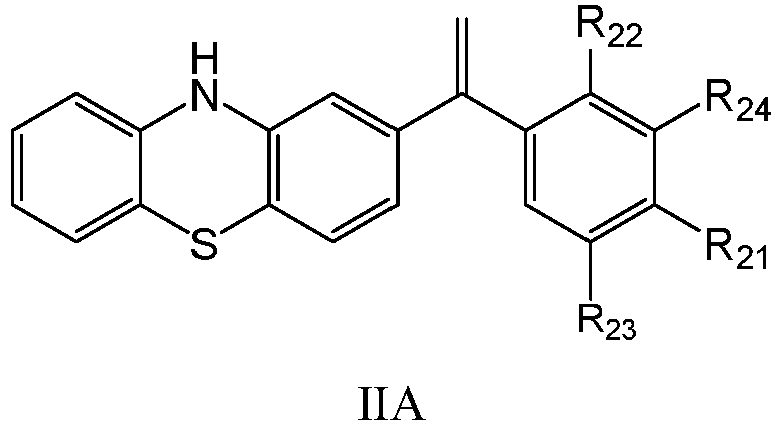 Wherein, R21, R22, R23, and R24 are each independently selected from the group consisting of H, - C(O)OR51, substituted or unsubstituted C1-C4 alkyl, substituted or unsubstituted C1-C3 alkoxy, - N(H)C(O)R51, 6 membered saturated cycloalkyl, -C(O)R51, 6 -membered saturated heterocyclic group, carbazolyl, amino, hydroxyl, nitro, -S(O)(O)R51, aryl, cyano, halogen, -C(O)N(H)R51;R51 is selected from the group consisting of H, C1-C2 alkyl, amino, substituted or unsubstituted aryl, substituted or unsubstituted 5-6 membered saturated heterocyclic group, -NR52R53;R52 and R53 are each independently of selected from H, substituted or unsubstituted 6 membered saturated heterocyclic group, substituted or unsubstituted C1-C4 alkyl, 4 membered cycloalkyl;The substituent of the alkyl is halogen, substituted or unsubstituted 6 membered saturated heterocyclic group;The substituent of the alkoxyl is halogen, aryl;The substituent of the aryl is substituted C1 alkyl;The substituent of the saturated heterocyclic group is C1 alkyl; the heteroatom of said saturated heterocyclic group is N and O, and the number of heteroatoms is 1 or 2.Or, said compound has a structure of formula IIB:
 Wherein, R25 is selected from substituted or unsubstituted 6-7 membered saturated heterocyclic group;The substituent of the saturated heterocyclic group is C1 alkyl;The heteroatom of said heterocyclic group is N and O, and the number of heteroatoms is 2;Or, said compound has a structure of formula IIC:
 Wherein, R26 is selected from -N(H)C(O)R51, amino, 6 membered saturated heterocyclic group;The heteroatom of said saturated heterocyclic group is N and O, and the number of heteroatoms is 2;R51 is selected from C1 alkyl;Or, said compound has a structure of formula IIIA:
 Wherein, R31, R32, R33 are each independently selected from the group consisting of H, halogen, cyano, hydroxyl, amino, substituted or unsubstituted C1-C4 alkyl, substituted or unsubstituted C1-C3 alkoxy, -C(O)OR51, -N(H)C(O)R51,aryl, phenoxy, -NR52R53, substituted 6 membered saturated heterocyclic group, nitro;R51 is selected from C1-C4 alkyl;The substituent of the alkyl is halogen;The substituent of the alkoxyl is aryl, halogen;The substituent of the saturated heterocyclic group is C1 alkyl;The heteroatom of the saturated heterocyclic group is N, and the number of heteroatoms is 2;R52 and R53 are each independently selected from aryl;Or, said compound has a structure of formula IIIB:
 Wherein, ring Bis selected from the group consisting of benzo(5-6 membered saturated)heterocyclic group, benzo(5 membered unsaturated)heterocyclic group, substituted or unsubstituted naphthyl, anthryl, substituted 6 membered unsaturated heterocyclic group or 6 membered saturated cycloalkyl;The substituent of the unsaturated heterocyclic group is cyano, C1 alkyl, C2 alkoxyl;The substituent of the naphthyl is C1-C2 alkoxyl;The heteroatom of the saturated heterocyclic group is O, and the number of heteroatoms is 1 or 2;The heteroatom of the unsaturated heterocyclic group is O and N, and the number of heteroatoms is 1;Or, said compound has a structure of formula IVA:
 Wherein, R41, R42, R43, and R44 are each independently selected from the group consisting of H, hydroxyl, -N(H)C(O)OR51, substituted or unsubstituted C1 alkyl;R51 is selected from C4 alkyl;The substituent of the alkyl is -N(H)C(O)OR51;Or, said compound has a structure of formula IVB:
 Wherein, R41', R42', R43', and R44' are each independently of selected from H, hydroxyl;Or, said compound has a structure of formula IVC:
 Wherein, R41", R42", R43", and R44" are each independently selected from H, C1 alkyl, -C(O)R51, R51 is selected from C1 alkyl;Or, said compound has a structure of formula IVD:
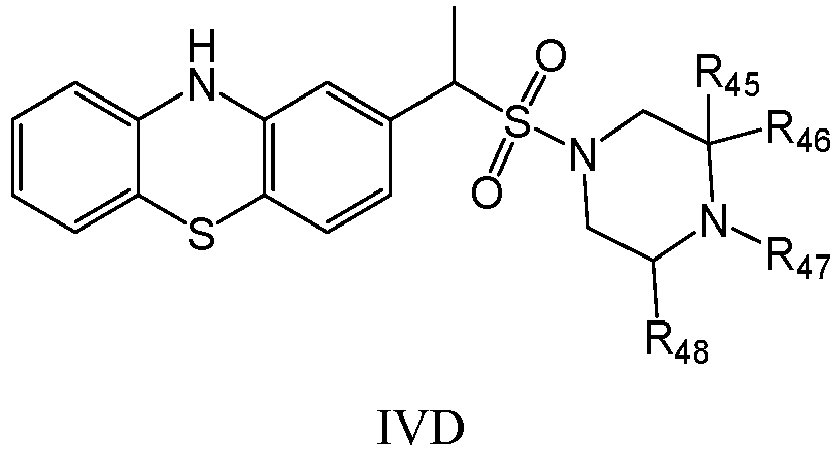 Wherein, R45, R46, R47, and R48 are each independently selected from the group consisting of H, substituted or unsubstituted C1-C4 alkyl, -C(O)R51, -S(O)(O)R51, 6 membered unsaturated heterocyclic group, -C(O)OR51, substituted or unsubstituted aryl;R51 is selected from 5 membered saturated heterocyclic group, C1-C4 alkyl, benzo(6 membered saturated)heterocyclic group;R52 and R53 are each independently selected from C1 alkyl;The substituent of the alkyl is halogen, benzo(5 membered saturated)heterocyclic group, -C(O)R51, -NR52R53, substituted or unsubstituted aryl, 6 membered saturated heterocyclic group, hydroxyl;The substituent of the aryl is C1 alkoxyl, halogen, cyano, nitro, substituted or unsubstituted C1 alkyl;The heteroatom of the saturated heterocyclic group is O and N, and the number of heteroatoms is 1 or 2;The heteroatom of the unsaturated heterocyclic group is N, and the number of heteroatoms is 1 or 2;Or, said compound has a structure of formula IVE:
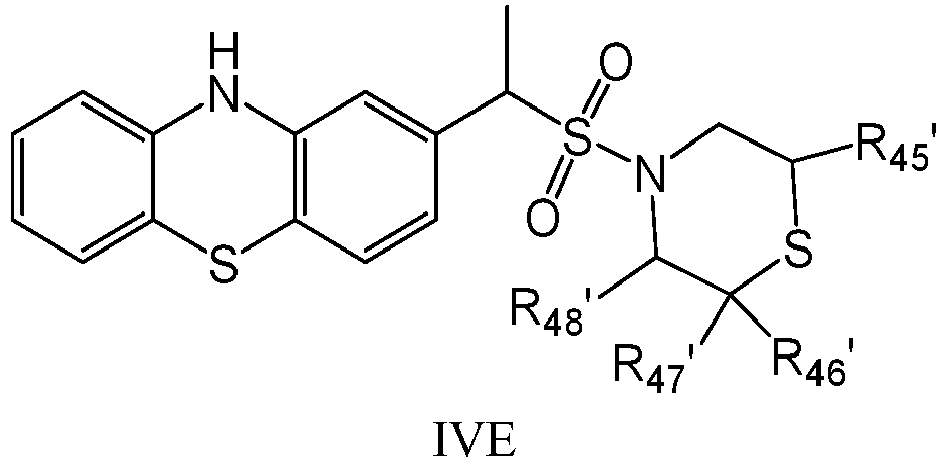 Wherein, R45', R46', R47', and R48' are each independently selected from H, C1 alkyl;Or, said compound has a structure of formula IVF:
 Wherein, R45", R46", R47", and R48" are each independently selected from H, C1 alkyl;Or, said compound has a structure of formula IVG:
 Wherein, R45‴, R46‴, R47‴, and R48‴ are each independently selected from H, hydroxyl, - C(O)OR51, -N(H)C(O)OR51,substituted aryl, substituted or unsubstituted C1 alkyl, 6 membered saturated heterocyclic group, -C(O)R51;R51 is selected from C2-C4 alkyl, amino;The substituent of the aryl is halogen;The substituent of the alkyl is -N(H)C(O)OR51, hydroxyl;The heteroatom of the saturated heterocyclic group is N, and the number of heteroatoms is 1.
 - The compound according to any one of claims 1 to 4, or a pharmaceutically acceptable salt, or crystal, or solvate thereof, characterized in that said compound is select from:














- The preparative method for the compound according to any one of claims 1 to 5, or a pharmaceutically acceptable salt, or crystal, or solvate thereof, characterized in that the method includes the following steps:(1) 2-Acetylphenothiazine and 4-methylbenzenesulfonyl hydrazide are used as starting materials, and dissolved in MeOH, to which is then added the catalyst HOAc. The mixture is heated to 60°C for reaction, and the progress of the reaction is monitored. After completion of the reaction, the reaction is cooled to room temperature, filtered under reduced pressure, and the filtrate is rinsed to be colorless, then dried in vacuo to provide intermediate I;(2) Intermediate I, starting material A, and anhydrous K2CO3 are dissolved in 1,4-dioxane, and then reacted at 110 °C. The progress of the reaction is monitored. And after completion of the reaction, the mixture is cooled to room temperature and concentrated under reduced pressure to remove 1, 4-dioxane. The residue is extracted, and the organic layer is concentrated and then separated by column chromatography to obtain the target product;Or, the method includes the following steps:(1) 2-Acetylphenothiazine and 4-methylbenzenesulfonyl hydrazide are used as starting materials, that are dissolved in MeOH, to which is then added the catalyst HOAc. The mixture is heated to 60°C for reaction, and the progress of the reaction is monitored. After completion of the reaction, the reaction is
cooled to room temperature, filtered under reduced pressure, and the filtrate is rinsed to be colorless, then dried in vacuo to obtain intermediate I;(2) Intermediate I, starting material A, tris(dibenzylidene-BASE acetone)dipalladium, 2-dicyclohexylphosphino-2,4,6-triisopropylbiphenyl and anhydrous t-BuOLi are dissolved in 1,4-dioxane, to which argon is purged and exchanged for 3 times. The resultant mixture is heated to 70°C for reaction, and the reaction is monitored by TLC. After about 4 h, the reaction is completed, cooled to room temperature, filtered, concentrated under reduced pressure, and the residue is extracted. The organic layer is concentrated and separated by column chromatography to provide the target compound;Or, the method includes the following steps:(1) 2-Acetylphenothiazine and 4-methylbenzenesulfonyl hydrazide are used as starting materials, that are dissolved in MeOH, to which is then added the catalyst HOAc. The mixture is heated to 60°C for reaction, and the progress of the reaction is monitored. After completion of the reaction, the reactions are cooled to room temperature, filtered under reduced pressure, and the filtrate is rinsed to be colorless, then dried in vacuo to provide intermediate I;(2) Intermediate I, starting material A, and DABSO are dissolved in DMSO, to which argon is purged and exchanged for 3 times. The resultant mixture is heated to 100 °C for reaction, and the reaction is monitored. After about 12 h, the reaction is completed, cooled to room temperature, filtered, concentrated under reduced pressure, and the residue is extracted. The organic layer is concentrated and separated by column chromatography to provide the target compound. - The preparative method according to claim 6, characterized in that in said step (2), starting material A is selected from


 Or, in said step (2), starting material A includes the compounds having following structures:





 Or, in the step (2), starting material A includes the compounds having following structures:


- The preparative method according to claim 6, characterized in that in said step (1), during the rinsing process after completion of the reaction, MeOH and ethyl ether are used to wash; and/or in the step (2), during the extraction process after completion of the reaction, the extraction is carried out with saturated NaHCO3/DCM; and/or, the reaction process is detected all by TLC.
- The compound according to any one of claims 1 to 5, or a pharmaceutically acceptable salt, or crystal, or solvate thereof for use as ferroptosis inhibitor and/or for treatment of stroke; wherein, said ferroptosis inhibitor is a targeted drug for inhibiting cell ferroptosis.
- A pharmaceutical preparation, characterized in that it is a preparation obtained by using the compound according to any one of claims 1 to 5, or a pharmaceutically acceptable salt, or crystal, or solvate thereof as active ingredients, with the addition of pharmaceutically acceptable excipients; wherein, said preparation is an oral preparation or an intravenous injection preparation.
Applications Claiming Priority (4)
| Application Number | Priority Date | Filing Date | Title |
|---|---|---|---|
| CN201810393712.2A CN108484527B (en) | 2018-04-27 | 2018-04-27 | 10H-phenothiazine iron death inhibitor and preparation method and application thereof |
| CN201910122341.9A CN109796424A (en) | 2019-02-19 | 2019-02-19 | A kind of small molecule compound and the preparation method and application thereof inhibiting iron death |
| CN201910124457.6A CN109748884B (en) | 2019-02-19 | 2019-02-19 | Iron death inhibitor and preparation method and application thereof |
| PCT/CN2019/079421 WO2019205854A1 (en) | 2018-04-27 | 2019-03-25 | 10h-phenothiazine ferroptosis inhibitor and preparation method therefor and application thereof |
Publications (4)
| Publication Number | Publication Date |
|---|---|
| EP3786156A1 EP3786156A1 (en) | 2021-03-03 |
| EP3786156A4 EP3786156A4 (en) | 2022-02-23 |
| EP3786156C0 EP3786156C0 (en) | 2024-06-05 |
| EP3786156B1 true EP3786156B1 (en) | 2024-06-05 |
Family
ID=68294743
Family Applications (1)
| Application Number | Title | Priority Date | Filing Date |
|---|---|---|---|
| EP19793210.6A Active EP3786156B1 (en) | 2018-04-27 | 2019-03-25 | 10h-phenothiazine ferroptosis inhibitor and preparation method therefor and application thereof |
Country Status (6)
| Country | Link |
|---|---|
| US (1) | US11440909B2 (en) |
| EP (1) | EP3786156B1 (en) |
| JP (1) | JP7433292B2 (en) |
| AU (1) | AU2019258078B2 (en) |
| CA (1) | CA3098219C (en) |
| WO (1) | WO2019205854A1 (en) |
Families Citing this family (5)
| Publication number | Priority date | Publication date | Assignee | Title |
|---|---|---|---|---|
| CN109748884B (en) * | 2019-02-19 | 2022-06-24 | 成都恒昊创新科技有限公司 | Iron death inhibitor and preparation method and application thereof |
| MX2023008677A (en) | 2021-01-27 | 2023-10-03 | Vandria Sa | Urolithin derivatives and methods of use thereof. |
| US11541116B1 (en) | 2022-01-07 | 2023-01-03 | Kojin Therapeutics, Inc. | Methods and compositions for inducing ferroptosis in vivo |
| KR20240134998A (en) | 2022-01-28 | 2024-09-10 | 청두 헌가오 이노배이티브 싸이언스 앤 테크놀로지 씨오. 엘티디. | Crystalline form and salt of phenothiazine compound, preparation method thereof and use thereof |
| EP4561976A2 (en) * | 2022-07-27 | 2025-06-04 | Vandria SA | Urolithin and fluorene derivatives for inhibiting ferroptosis |
Family Cites Families (10)
| Publication number | Priority date | Publication date | Assignee | Title |
|---|---|---|---|---|
| JPS57115435A (en) * | 1981-01-07 | 1982-07-17 | Sumitomo Chem Co Ltd | Degradation preventive agent |
| CS231000B1 (en) * | 1983-06-21 | 1984-09-17 | Mechanism for creating the wedges pH for the production of glass pans | |
| JPS6156175A (en) * | 1984-08-24 | 1986-03-20 | Yamanouchi Pharmaceut Co Ltd | Rhodanine derivative and its preparation |
| US4915873A (en) * | 1988-01-22 | 1990-04-10 | Uniroyal Chemical Company, Inc. | Polymerization inhibitor composition for vinyl aromatic compounds |
| CN1131944A (en) * | 1993-09-30 | 1996-09-25 | 山之内制药株式会社 | Azole derivatives and its pharmaceutical composition |
| ZA977103B (en) * | 1996-08-09 | 1999-02-08 | Eisai Co Ltd | Benzopiperidine derivatives |
| FR2784678B1 (en) | 1998-09-23 | 2002-11-29 | Sod Conseils Rech Applic | NOVEL N- (IMINOMETHYL) AMINE DERIVATIVES, THEIR PREPARATION, THEIR USE AS MEDICAMENTS AND THE PHARMACEUTICAL COMPOSITIONS CONTAINING THEM |
| US7122544B2 (en) | 2000-12-06 | 2006-10-17 | Signal Pharmaceuticals, Llc | Anilinopyrimidine derivatives as IKK inhibitors and compositions and methods related thereto |
| CN105611930B (en) | 2013-07-15 | 2021-03-02 | 亥姆霍兹慕尼黑中心-德国环境与健康研究中心(股份有限公司) | Spiro quinoxaline derivatives as non-apoptotic regulated cell death inhibitors |
| CN107496401A (en) * | 2017-09-30 | 2017-12-22 | 浙江大学 | Iron death inhibitor is preparing the application in preventing medicament for myocardial ischemia-reperfusion injury |
-
2019
- 2019-03-25 EP EP19793210.6A patent/EP3786156B1/en active Active
- 2019-03-25 CA CA3098219A patent/CA3098219C/en active Active
- 2019-03-25 WO PCT/CN2019/079421 patent/WO2019205854A1/en not_active Ceased
- 2019-03-25 AU AU2019258078A patent/AU2019258078B2/en active Active
- 2019-03-25 JP JP2021508045A patent/JP7433292B2/en active Active
-
2020
- 2020-10-23 US US17/078,802 patent/US11440909B2/en active Active
Also Published As
| Publication number | Publication date |
|---|---|
| EP3786156A1 (en) | 2021-03-03 |
| JP2021526157A (en) | 2021-09-30 |
| CA3098219C (en) | 2024-05-07 |
| JP7433292B2 (en) | 2024-02-19 |
| EP3786156C0 (en) | 2024-06-05 |
| WO2019205854A1 (en) | 2019-10-31 |
| US11440909B2 (en) | 2022-09-13 |
| CA3098219A1 (en) | 2019-10-31 |
| US20210040079A1 (en) | 2021-02-11 |
| EP3786156A4 (en) | 2022-02-23 |
| AU2019258078A1 (en) | 2020-11-19 |
| AU2019258078B2 (en) | 2023-12-21 |
Similar Documents
| Publication | Publication Date | Title |
|---|---|---|
| EP3786156A1 (en) | 10h-phenothiazine ferroptosis inhibitor and preparation method therefor and application thereof | |
| RU2275360C2 (en) | Ortho-substituted nitrogen-containing bis-aryl compounds for using as potassium channel inhibitors and pharmaceutical compositions comprising thereof | |
| Triggle et al. | Crystal structures of calcium channel antagonists: 2, 6-dimethyl-3, 5-dicarbomethoxy-4-[2-nitro-, 3-cyano-, 4-(dimethylamino)-, and 2, 3, 4, 5, 6-pentafluorophenyl]-1, 4-dihydropyridine | |
| US6333337B1 (en) | Potassium channel inhibitors | |
| TWI254039B (en) | Ortho, meta-substituted bisaryl compounds, processes for their preparation, their use as medicaments, and pharmaceutical preparations comprising them | |
| EP3626699A1 (en) | Ssao inhibitor | |
| EP2611779B1 (en) | CRYSTALLINE FORMS OF A FACTOR Xa INHIBITOR | |
| CN114181170B (en) | 10H-phenothiazine iron death inhibitor and preparation method and application thereof | |
| AU2014230569A1 (en) | Pyrazole-amide compound and medicinal uses therefor | |
| JP2004526680A (en) | Arylated furans and thiophenecarboxamides with potassium channel blocking action | |
| CN109796424A (en) | A kind of small molecule compound and the preparation method and application thereof inhibiting iron death | |
| JP2003511369A (en) | Pyridinium derivatives for the management of aging-related and diabetic vascular complications, their preparation and their therapeutic use | |
| Srinivas et al. | Design and synthesis of quinoxaline-piperazine-pyrazolo conjugates as VEGFR-2 targeting agents and ADMET studies | |
| Wang et al. | ATP-sensitive potassium channel openers and 2, 3-dimethyl-2-butylamine derivatives | |
| RU2122546C1 (en) | N-[[1-[4-(fluorophenoxy)butyl]-4-piperidinyl]-n-methylamino]-2-benzthiazoles or their pharmaceutically acceptable acid salts, a method of synthesis, an antiarrhythmic composition of the third-class and a method of its preparing | |
| JP6594957B2 (en) | Novel adamantane derivative compounds | |
| RU2787366C2 (en) | 10h-phenothiazine ferroptosis inhibitors, their production method and their use | |
| Koltun et al. | New fatty acid oxidation inhibitors with increased potency lacking adverse metabolic and electrophysiological properties | |
| ZA200106440B (en) | Polycyclic thiazole systems and their utilization as anorectics. | |
| KR20230169982A (en) | Compositions and methods for treating anemia associated with ribosomal disorders | |
| ES3011633T3 (en) | Thiophene compounds, process for synthesis and use thereof for the treatment of autoimmune disorders | |
| JP4223237B2 (en) | 3-Phenyl-3,7-diazabicyclo [3,3,1] nonane-compound, pharmaceuticals containing the same, use thereof and process for producing the same | |
| US20130164218A1 (en) | Hypoxia inducible factor-1 pathway inhibitors and uses as anticancer and imaging agents | |
| CN117143040B (en) | Cyclobutene-diketo-benzoxazole derivative as well as preparation method and application thereof | |
| JP7652424B2 (en) | Photooxygenation catalyst compound and medicine containing the same |
Legal Events
| Date | Code | Title | Description |
|---|---|---|---|
| STAA | Information on the status of an ep patent application or granted ep patent |
Free format text: STATUS: THE INTERNATIONAL PUBLICATION HAS BEEN MADE |
|
| PUAI | Public reference made under article 153(3) epc to a published international application that has entered the european phase |
Free format text: ORIGINAL CODE: 0009012 |
|
| STAA | Information on the status of an ep patent application or granted ep patent |
Free format text: STATUS: REQUEST FOR EXAMINATION WAS MADE |
|
| 17P | Request for examination filed |
Effective date: 20201112 |
|
| AK | Designated contracting states |
Kind code of ref document: A1 Designated state(s): AL AT BE BG CH CY CZ DE DK EE ES FI FR GB GR HR HU IE IS IT LI LT LU LV MC MK MT NL NO PL PT RO RS SE SI SK SM TR |
|
| AX | Request for extension of the european patent |
Extension state: BA ME |
|
| DAV | Request for validation of the european patent (deleted) | ||
| DAX | Request for extension of the european patent (deleted) | ||
| A4 | Supplementary search report drawn up and despatched |
Effective date: 20220124 |
|
| RIC1 | Information provided on ipc code assigned before grant |
Ipc: A61P 9/10 20060101ALI20220118BHEP Ipc: A61K 31/245 20060101ALI20220118BHEP Ipc: C07D 233/56 20060101AFI20220118BHEP |
|
| STAA | Information on the status of an ep patent application or granted ep patent |
Free format text: STATUS: EXAMINATION IS IN PROGRESS |
|
| 17Q | First examination report despatched |
Effective date: 20230616 |
|
| GRAP | Despatch of communication of intention to grant a patent |
Free format text: ORIGINAL CODE: EPIDOSNIGR1 |
|
| STAA | Information on the status of an ep patent application or granted ep patent |
Free format text: STATUS: GRANT OF PATENT IS INTENDED |
|
| INTG | Intention to grant announced |
Effective date: 20240214 |
|
| GRAS | Grant fee paid |
Free format text: ORIGINAL CODE: EPIDOSNIGR3 |
|
| GRAA | (expected) grant |
Free format text: ORIGINAL CODE: 0009210 |
|
| STAA | Information on the status of an ep patent application or granted ep patent |
Free format text: STATUS: THE PATENT HAS BEEN GRANTED |
|
| AK | Designated contracting states |
Kind code of ref document: B1 Designated state(s): AL AT BE BG CH CY CZ DE DK EE ES FI FR GB GR HR HU IE IS IT LI LT LU LV MC MK MT NL NO PL PT RO RS SE SI SK SM TR |
|
| REG | Reference to a national code |
Ref country code: CH Ref legal event code: EP |
|
| REG | Reference to a national code |
Ref country code: DE Ref legal event code: R096 Ref document number: 602019053302 Country of ref document: DE |
|
| REG | Reference to a national code |
Ref country code: IE Ref legal event code: FG4D |
|
| U01 | Request for unitary effect filed |
Effective date: 20240702 |
|
| U07 | Unitary effect registered |
Designated state(s): AT BE BG DE DK EE FI FR IT LT LU LV MT NL PT SE SI Effective date: 20240710 |
|
| PG25 | Lapsed in a contracting state [announced via postgrant information from national office to epo] |
Ref country code: HR Free format text: LAPSE BECAUSE OF FAILURE TO SUBMIT A TRANSLATION OF THE DESCRIPTION OR TO PAY THE FEE WITHIN THE PRESCRIBED TIME-LIMIT Effective date: 20240605 |
|
| PG25 | Lapsed in a contracting state [announced via postgrant information from national office to epo] |
Ref country code: GR Free format text: LAPSE BECAUSE OF FAILURE TO SUBMIT A TRANSLATION OF THE DESCRIPTION OR TO PAY THE FEE WITHIN THE PRESCRIBED TIME-LIMIT Effective date: 20240906 |
|
| PG25 | Lapsed in a contracting state [announced via postgrant information from national office to epo] |
Ref country code: ES Free format text: LAPSE BECAUSE OF FAILURE TO SUBMIT A TRANSLATION OF THE DESCRIPTION OR TO PAY THE FEE WITHIN THE PRESCRIBED TIME-LIMIT Effective date: 20240605 |
|
| PG25 | Lapsed in a contracting state [announced via postgrant information from national office to epo] |
Ref country code: NO Free format text: LAPSE BECAUSE OF FAILURE TO SUBMIT A TRANSLATION OF THE DESCRIPTION OR TO PAY THE FEE WITHIN THE PRESCRIBED TIME-LIMIT Effective date: 20240905 Ref country code: HR Free format text: LAPSE BECAUSE OF FAILURE TO SUBMIT A TRANSLATION OF THE DESCRIPTION OR TO PAY THE FEE WITHIN THE PRESCRIBED TIME-LIMIT Effective date: 20240605 Ref country code: GR Free format text: LAPSE BECAUSE OF FAILURE TO SUBMIT A TRANSLATION OF THE DESCRIPTION OR TO PAY THE FEE WITHIN THE PRESCRIBED TIME-LIMIT Effective date: 20240906 Ref country code: ES Free format text: LAPSE BECAUSE OF FAILURE TO SUBMIT A TRANSLATION OF THE DESCRIPTION OR TO PAY THE FEE WITHIN THE PRESCRIBED TIME-LIMIT Effective date: 20240605 Ref country code: RS Free format text: LAPSE BECAUSE OF FAILURE TO SUBMIT A TRANSLATION OF THE DESCRIPTION OR TO PAY THE FEE WITHIN THE PRESCRIBED TIME-LIMIT Effective date: 20240905 |
|
| PG25 | Lapsed in a contracting state [announced via postgrant information from national office to epo] |
Ref country code: PL Free format text: LAPSE BECAUSE OF FAILURE TO SUBMIT A TRANSLATION OF THE DESCRIPTION OR TO PAY THE FEE WITHIN THE PRESCRIBED TIME-LIMIT Effective date: 20240605 |
|
| PG25 | Lapsed in a contracting state [announced via postgrant information from national office to epo] |
Ref country code: IS Free format text: LAPSE BECAUSE OF FAILURE TO SUBMIT A TRANSLATION OF THE DESCRIPTION OR TO PAY THE FEE WITHIN THE PRESCRIBED TIME-LIMIT Effective date: 20241005 |
|
| PG25 | Lapsed in a contracting state [announced via postgrant information from national office to epo] |
Ref country code: CZ Free format text: LAPSE BECAUSE OF FAILURE TO SUBMIT A TRANSLATION OF THE DESCRIPTION OR TO PAY THE FEE WITHIN THE PRESCRIBED TIME-LIMIT Effective date: 20240605 |
|
| PG25 | Lapsed in a contracting state [announced via postgrant information from national office to epo] |
Ref country code: RO Free format text: LAPSE BECAUSE OF FAILURE TO SUBMIT A TRANSLATION OF THE DESCRIPTION OR TO PAY THE FEE WITHIN THE PRESCRIBED TIME-LIMIT Effective date: 20240605 Ref country code: SK Free format text: LAPSE BECAUSE OF FAILURE TO SUBMIT A TRANSLATION OF THE DESCRIPTION OR TO PAY THE FEE WITHIN THE PRESCRIBED TIME-LIMIT Effective date: 20240605 |
|
| PG25 | Lapsed in a contracting state [announced via postgrant information from national office to epo] |
Ref country code: SM Free format text: LAPSE BECAUSE OF FAILURE TO SUBMIT A TRANSLATION OF THE DESCRIPTION OR TO PAY THE FEE WITHIN THE PRESCRIBED TIME-LIMIT Effective date: 20240605 |
|
| PG25 | Lapsed in a contracting state [announced via postgrant information from national office to epo] |
Ref country code: SM Free format text: LAPSE BECAUSE OF FAILURE TO SUBMIT A TRANSLATION OF THE DESCRIPTION OR TO PAY THE FEE WITHIN THE PRESCRIBED TIME-LIMIT Effective date: 20240605 Ref country code: SK Free format text: LAPSE BECAUSE OF FAILURE TO SUBMIT A TRANSLATION OF THE DESCRIPTION OR TO PAY THE FEE WITHIN THE PRESCRIBED TIME-LIMIT Effective date: 20240605 Ref country code: RO Free format text: LAPSE BECAUSE OF FAILURE TO SUBMIT A TRANSLATION OF THE DESCRIPTION OR TO PAY THE FEE WITHIN THE PRESCRIBED TIME-LIMIT Effective date: 20240605 Ref country code: PL Free format text: LAPSE BECAUSE OF FAILURE TO SUBMIT A TRANSLATION OF THE DESCRIPTION OR TO PAY THE FEE WITHIN THE PRESCRIBED TIME-LIMIT Effective date: 20240605 Ref country code: IS Free format text: LAPSE BECAUSE OF FAILURE TO SUBMIT A TRANSLATION OF THE DESCRIPTION OR TO PAY THE FEE WITHIN THE PRESCRIBED TIME-LIMIT Effective date: 20241005 Ref country code: CZ Free format text: LAPSE BECAUSE OF FAILURE TO SUBMIT A TRANSLATION OF THE DESCRIPTION OR TO PAY THE FEE WITHIN THE PRESCRIBED TIME-LIMIT Effective date: 20240605 |
|
| PLBE | No opposition filed within time limit |
Free format text: ORIGINAL CODE: 0009261 |
|
| STAA | Information on the status of an ep patent application or granted ep patent |
Free format text: STATUS: NO OPPOSITION FILED WITHIN TIME LIMIT |
|
| U20 | Renewal fee for the european patent with unitary effect paid |
Year of fee payment: 7 Effective date: 20250323 |
|
| 26N | No opposition filed |
Effective date: 20250306 |
|
| PGFP | Annual fee paid to national office [announced via postgrant information from national office to epo] |
Ref country code: CH Payment date: 20250401 Year of fee payment: 7 |
|
| PG25 | Lapsed in a contracting state [announced via postgrant information from national office to epo] |
Ref country code: MC Free format text: LAPSE BECAUSE OF FAILURE TO SUBMIT A TRANSLATION OF THE DESCRIPTION OR TO PAY THE FEE WITHIN THE PRESCRIBED TIME-LIMIT Effective date: 20240605 |
|
| PG25 | Lapsed in a contracting state [announced via postgrant information from national office to epo] |
Ref country code: IE Free format text: LAPSE BECAUSE OF NON-PAYMENT OF DUE FEES Effective date: 20250325 |
|
| REG | Reference to a national code |
Ref country code: CH Ref legal event code: U11 Free format text: ST27 STATUS EVENT CODE: U-0-0-U10-U11 (AS PROVIDED BY THE NATIONAL OFFICE) Effective date: 20260401 |
|
| PGFP | Annual fee paid to national office [announced via postgrant information from national office to epo] |
Ref country code: GB Payment date: 20260330 Year of fee payment: 8 |
|
| U20 | Renewal fee for the european patent with unitary effect paid |
Year of fee payment: 8 Effective date: 20260323 |