EP3784498B1 - Feuille securisee - Google Patents
Feuille securisee Download PDFInfo
- Publication number
- EP3784498B1 EP3784498B1 EP19717325.5A EP19717325A EP3784498B1 EP 3784498 B1 EP3784498 B1 EP 3784498B1 EP 19717325 A EP19717325 A EP 19717325A EP 3784498 B1 EP3784498 B1 EP 3784498B1
- Authority
- EP
- European Patent Office
- Prior art keywords
- watermark
- aperture
- film
- security
- sheet
- Prior art date
- Legal status (The legal status is an assumption and is not a legal conclusion. Google has not performed a legal analysis and makes no representation as to the accuracy of the status listed.)
- Active
Links
Images


Classifications
-
- B—PERFORMING OPERATIONS; TRANSPORTING
- B42—BOOKBINDING; ALBUMS; FILES; SPECIAL PRINTED MATTER
- B42D—BOOKS; BOOK COVERS; LOOSE LEAVES; PRINTED MATTER CHARACTERISED BY IDENTIFICATION OR SECURITY FEATURES; PRINTED MATTER OF SPECIAL FORMAT OR STYLE NOT OTHERWISE PROVIDED FOR; DEVICES FOR USE THEREWITH AND NOT OTHERWISE PROVIDED FOR; MOVABLE-STRIP WRITING OR READING APPARATUS
- B42D25/00—Information-bearing cards or sheet-like structures characterised by identification or security features; Manufacture thereof
- B42D25/30—Identification or security features, e.g. for preventing forgery
- B42D25/333—Watermarks
-
- B—PERFORMING OPERATIONS; TRANSPORTING
- B42—BOOKBINDING; ALBUMS; FILES; SPECIAL PRINTED MATTER
- B42D—BOOKS; BOOK COVERS; LOOSE LEAVES; PRINTED MATTER CHARACTERISED BY IDENTIFICATION OR SECURITY FEATURES; PRINTED MATTER OF SPECIAL FORMAT OR STYLE NOT OTHERWISE PROVIDED FOR; DEVICES FOR USE THEREWITH AND NOT OTHERWISE PROVIDED FOR; MOVABLE-STRIP WRITING OR READING APPARATUS
- B42D25/00—Information-bearing cards or sheet-like structures characterised by identification or security features; Manufacture thereof
- B42D25/30—Identification or security features, e.g. for preventing forgery
- B42D25/328—Diffraction gratings; Holograms
-
- B—PERFORMING OPERATIONS; TRANSPORTING
- B42—BOOKBINDING; ALBUMS; FILES; SPECIAL PRINTED MATTER
- B42D—BOOKS; BOOK COVERS; LOOSE LEAVES; PRINTED MATTER CHARACTERISED BY IDENTIFICATION OR SECURITY FEATURES; PRINTED MATTER OF SPECIAL FORMAT OR STYLE NOT OTHERWISE PROVIDED FOR; DEVICES FOR USE THEREWITH AND NOT OTHERWISE PROVIDED FOR; MOVABLE-STRIP WRITING OR READING APPARATUS
- B42D25/00—Information-bearing cards or sheet-like structures characterised by identification or security features; Manufacture thereof
- B42D25/30—Identification or security features, e.g. for preventing forgery
- B42D25/346—Perforations
-
- B—PERFORMING OPERATIONS; TRANSPORTING
- B42—BOOKBINDING; ALBUMS; FILES; SPECIAL PRINTED MATTER
- B42D—BOOKS; BOOK COVERS; LOOSE LEAVES; PRINTED MATTER CHARACTERISED BY IDENTIFICATION OR SECURITY FEATURES; PRINTED MATTER OF SPECIAL FORMAT OR STYLE NOT OTHERWISE PROVIDED FOR; DEVICES FOR USE THEREWITH AND NOT OTHERWISE PROVIDED FOR; MOVABLE-STRIP WRITING OR READING APPARATUS
- B42D25/00—Information-bearing cards or sheet-like structures characterised by identification or security features; Manufacture thereof
- B42D25/30—Identification or security features, e.g. for preventing forgery
- B42D25/351—Translucent or partly translucent parts, e.g. windows
-
- B—PERFORMING OPERATIONS; TRANSPORTING
- B42—BOOKBINDING; ALBUMS; FILES; SPECIAL PRINTED MATTER
- B42D—BOOKS; BOOK COVERS; LOOSE LEAVES; PRINTED MATTER CHARACTERISED BY IDENTIFICATION OR SECURITY FEATURES; PRINTED MATTER OF SPECIAL FORMAT OR STYLE NOT OTHERWISE PROVIDED FOR; DEVICES FOR USE THEREWITH AND NOT OTHERWISE PROVIDED FOR; MOVABLE-STRIP WRITING OR READING APPARATUS
- B42D25/00—Information-bearing cards or sheet-like structures characterised by identification or security features; Manufacture thereof
- B42D25/30—Identification or security features, e.g. for preventing forgery
- B42D25/355—Security threads
-
- B—PERFORMING OPERATIONS; TRANSPORTING
- B42—BOOKBINDING; ALBUMS; FILES; SPECIAL PRINTED MATTER
- B42D—BOOKS; BOOK COVERS; LOOSE LEAVES; PRINTED MATTER CHARACTERISED BY IDENTIFICATION OR SECURITY FEATURES; PRINTED MATTER OF SPECIAL FORMAT OR STYLE NOT OTHERWISE PROVIDED FOR; DEVICES FOR USE THEREWITH AND NOT OTHERWISE PROVIDED FOR; MOVABLE-STRIP WRITING OR READING APPARATUS
- B42D25/00—Information-bearing cards or sheet-like structures characterised by identification or security features; Manufacture thereof
- B42D25/30—Identification or security features, e.g. for preventing forgery
- B42D25/36—Identification or security features, e.g. for preventing forgery comprising special materials
- B42D25/364—Liquid crystals
-
- B—PERFORMING OPERATIONS; TRANSPORTING
- B42—BOOKBINDING; ALBUMS; FILES; SPECIAL PRINTED MATTER
- B42D—BOOKS; BOOK COVERS; LOOSE LEAVES; PRINTED MATTER CHARACTERISED BY IDENTIFICATION OR SECURITY FEATURES; PRINTED MATTER OF SPECIAL FORMAT OR STYLE NOT OTHERWISE PROVIDED FOR; DEVICES FOR USE THEREWITH AND NOT OTHERWISE PROVIDED FOR; MOVABLE-STRIP WRITING OR READING APPARATUS
- B42D25/00—Information-bearing cards or sheet-like structures characterised by identification or security features; Manufacture thereof
- B42D25/30—Identification or security features, e.g. for preventing forgery
- B42D25/36—Identification or security features, e.g. for preventing forgery comprising special materials
- B42D25/373—Metallic materials
-
- B—PERFORMING OPERATIONS; TRANSPORTING
- B42—BOOKBINDING; ALBUMS; FILES; SPECIAL PRINTED MATTER
- B42D—BOOKS; BOOK COVERS; LOOSE LEAVES; PRINTED MATTER CHARACTERISED BY IDENTIFICATION OR SECURITY FEATURES; PRINTED MATTER OF SPECIAL FORMAT OR STYLE NOT OTHERWISE PROVIDED FOR; DEVICES FOR USE THEREWITH AND NOT OTHERWISE PROVIDED FOR; MOVABLE-STRIP WRITING OR READING APPARATUS
- B42D25/00—Information-bearing cards or sheet-like structures characterised by identification or security features; Manufacture thereof
- B42D25/40—Manufacture
- B42D25/405—Marking
- B42D25/43—Marking by removal of material
- B42D25/435—Marking by removal of material using electromagnetic radiation, e.g. laser
-
- B—PERFORMING OPERATIONS; TRANSPORTING
- B42—BOOKBINDING; ALBUMS; FILES; SPECIAL PRINTED MATTER
- B42D—BOOKS; BOOK COVERS; LOOSE LEAVES; PRINTED MATTER CHARACTERISED BY IDENTIFICATION OR SECURITY FEATURES; PRINTED MATTER OF SPECIAL FORMAT OR STYLE NOT OTHERWISE PROVIDED FOR; DEVICES FOR USE THEREWITH AND NOT OTHERWISE PROVIDED FOR; MOVABLE-STRIP WRITING OR READING APPARATUS
- B42D25/00—Information-bearing cards or sheet-like structures characterised by identification or security features; Manufacture thereof
- B42D25/40—Manufacture
- B42D25/405—Marking
- B42D25/43—Marking by removal of material
- B42D25/44—Marking by removal of material using mechanical means, e.g. engraving
Definitions
- the present invention relates to a secure sheet, in particular intended for the production of a secure document.
- a "secure document” means a means of payment, such as a banknote, a check or a restaurant voucher, an identity document, such as an identity card, a visa, a passport or a driving licence, a lottery ticket, a transport ticket or an entry ticket to cultural or sporting events.
- the invention relates more particularly but not exclusively to security sheets intended for the production of banknotes.
- the watermark technique is very widely used in the field of security papers and paper money in particular, where it remains the historical first level of security, identifiable and recognizable by most users of banknotes, even the man in the street.
- WO2005/106118 It has already been proposed by demand WO2005/106118 to produce a secure sheet comprising a paper substrate provided with a watermark, with openings covered by a security film affixed to one side of the substrate. The openings are made outside the watermark, and visually complete the appearance of the latter.
- the security film may include de-metallizations contributing to the overall observable pattern.
- THE patent US8465625 discloses an opening made by papermaking, having an irregular edge with fibers protruding into the opening in a manner visible to the naked eye. This opening can contribute to forming an overall pattern by cooperating with a watermark arranged around it. The opening can be covered by a film applied to one side of the paper substrate. The production of such an opening with an irregular edge is a complex papermaking operation to master, which makes it relatively more difficult to obtain detailed, reproducible and aesthetic renderings.
- the patent DE102005022018 discloses a security document with two apertures, one with a regular edge and the other with an irregular edge.
- the regular edge aperture may be incorporated into a watermark.
- the patent DE102014016249 discloses a security document comprising a through aperture which may be combined with a security thread or watermark, the aperture being laser cut.
- the invention aims to further improve security sheets, and in particular to provide security that is easily recognizable by the man in the street and offers numerous aesthetic possibilities, while being complex for a counterfeiter to reproduce.
- the invention achieves this objective by providing, according to a first of its aspects, a security sheet as described in claim 1.
- inside the watermark is meant the connected surface bounded by a curve following the outermost contour of the watermark.
- a watermark in the shape of a circular ring will define a connected surface in the shape of a disc with an outer diameter equal to that of the ring.
- the opening may extend inside the watermark and may or may not overlap a watermarked area, that is, the watermark itself.
- a watermarked area that is, the watermark itself.
- the opening may be inside the watermark without overlapping it if the opening is a hole with a diameter smaller than that of the inner circle of the ring.
- the watermarked area is the one whose thickness is different from the thickness of the vellum. This thickness may be less than that of the vellum for a light watermark, and greater for a dark watermark.
- Cutting may or may not be done through a watermarked area. When cutting is done through a watermarked area, it means that part of the watermark is removed by the cutting operation.
- the watermark has varying paper thickness and creating a regular edge cut within it requires a high-performance cutting tool, making counterfeiting more difficult.
- the opening may have various surfaces, being less than 1 mm 2 or greater than 1 mm 2 , for example extending almost to the outer contour of the watermark in which it is made.
- regular edge is meant an edge without long free fibers protruding in a manner visible to the naked eye in the opening, unlike the opening obtained by papermaking disclosed in the patent US8465625 aforementioned.
- the regular edge is preferably an edge obtained by laser cutting, and this edge can be straight, curved, wavy or indented, the waves or teeth having come from cutting.
- the invention also relates, according to a second of its aspects, to a security sheet as described in claim 11.
- the secure document is a banknote.
- the security film comprises a plastic backing.
- the security film comprises a transparent plastic backing.
- the area of the sheet where the opening overlaps the safety film is called the "window.”
- the invention makes it possible to further secure the document against the risks of counterfeiting by proposing a combination making it possible to observe the watermark and the united security film synchronously, either in transmitted light or in reflected light.
- the security element may have, in the area of the opening, front and back faces with different appearances. This may include, in particular, a difference in brightness, contrast, color and/or shade, patterns of different size, contour and/or content, and/or different patterns. This difference in appearance is observable in transmitted or reflected light, preferably in reflected light. It is then observable according to at least one observation angle given to the front and at least one observation angle given to the back. It may be observable according to at least one illumination, in particular in visible, UV or IR light, illuminating the front and at least one illumination, in particular in visible, UV or IR light, illuminating the back.
- the front and back sides have different patterns. In this way, observation can be made in a differentiated manner by an asymmetry of appearance on the front and back.
- This combination advantageously makes it possible to compensate for the lack of visibility of the window when the associated patterns are too busy, particularly due to printing, for be immediately identifiable by the man in the street. It is indeed customary not to overload the printing at the watermark level, and in particular to deprive the watermarked area of printing.
- Another advantage that can be provided by the invention is the lasting protection of the watermark by the security film, partial or total depending on the covering of the watermark by the film and the presence or absence of another protective film, affixed to the opposite side of the paper substrate, and called “counter-foil”.
- the optical effect present in the window may be uniform, with “CLEARTEXT” effects visible in transmitted light, and present in reflected light different patterns and/or optical effects and/or colors on each of the faces.
- the safety film can advantageously leave a transparent surface at the opening free from any visible optical effect.
- the extent of the watermark as delimited by its outer contour may be greater by a factor of at least 1.1 than the extent of said at least one opening, better still at least 1.5, even better still by a factor of at least 10 or 20.
- the opening may be small, and may in particular constitute a micro-perforation.
- micro-perforation we mean an opening whose extent is less than or equal to 1 mm 2 .
- the at least one opening may be placed in the center of the watermark or elsewhere.
- a central arrangement can further enhance security, requiring precise positioning.
- the aperture is positioned relative to a nominal position on the secure document with an accuracy better than +/- 3 mm in the machine direction SM (i.e. in the direction of travel of the substrate in the paper machine) and in the transverse direction ST. If necessary, the measured deviation between the expected position of the aperture relative to the watermark and the observed position is measured, and it is checked whether this deviation satisfies a predefined statistical law. If so, this can constitute an additional indicator of the authenticity of the document.
- the security film comprises at least one security element overlapping at least partially with the opening.
- the security film completely covers the opening.
- the security element may or may not completely cover the opening.
- the security element may be an optically variable device, in particular a diffractive device.
- the outline of the security element may be homothetic to that of the opening, or alternatively, it may be arbitrary.
- a homothetic outline can further enhance security, being more difficult to achieve. It can also make it easier to detect incorrect positioning of the security element relative to the outline of the opening.
- the security film and the security element may completely cover the opening, being in particular 5 to 20% larger than the opening.
- the security element may be optically variable in the area of the opening.
- it may be an optically variable device (OVD) such as a lenticular, Moiré, diffractive security element, in particular of first order (laser hologram, 3D hologram, echelon grating or blazed grating in English) or zero order, or such as a thin film interference structure, in particular single-layer or multi-layer (Bragg structures, volume holograms, liquid crystals, etc.).
- ODD optically variable device
- the security element may be a diffractive structure, and in particular a diffractive optical element of the DOE digital hologram type as described in the application WO 2014/119296 on page 5.
- a diffractive optical element When such an optical element is illuminated, in particular by a collimated beam, it generates an interference pattern producing an image in a viewing plane, which is visible on a surface positioned in this plane, or visible in transmission from this plane.
- Such a diffractive optical element is computer-generated, being different from so-called rainbow, Fresnel or volume reflection holograms.
- the security element may have, in the area of the opening, a metal layer and at least one recess therein.
- the outline of said at least one opening may be substantially homothetic to that of the watermark.
- the outline of said at least one opening may be homothetic to a pattern of the watermark.
- the watermark may be screened and/or shaded, or otherwise, for example electrotype.
- the film completely covers said at least one opening.
- the film may extend in a strip from one edge to the opposite edge of the sheet.
- the film is applied as a patch extending beyond the opening, which may also be superimposed on the watermark.
- the film is a patch, it extends back from at least three edges of the document; when the document is rectangular, it is better to extend back from all edges of the document.
- the width of the film may be less than the width of the watermark.
- the outline of said at least one opening may be reproduced elsewhere on the sheet or on the security element. This increases security by making it more difficult to reproduce the secure sheet.
- Said at least one window may extend into contact with a watermarked area of thickness different from the vellum thickness of the sheet, in particular an area of lower thickness. This may minimize the creation of excess thicknesses.
- the watermark can be without a center of symmetry.
- the invention also relates to a method of manufacturing a secure sheet according to the first aspect, as described in claim 10.
- the opening is preferably made using a laser, but alternatively it can be made using a punch.
- the method may include optical acquisition of the watermark area, and real-time control of the laser based on this acquisition, so as to direct the laser using the watermark as a reference, to guarantee a predefined positioning of the opening within the watermark. This makes it possible to maintaining substantially constant the appearance of the combined pattern formed by the watermark and the aperture, while taking into account the dispersion of positioning of the watermark within the sheet resulting from the papermaking process.
- the reference pattern may be present on the security film, in particular in the form of printing, metallization or demetallization, and preferably in the form of partial demetallization after metallization (hereinafter “metallization/demetallization”).
- the watermark may comprise several repeating elementary patterns and said at least one opening may have the same outline as one of said elementary patterns.
- the film at least partially overlaps the watermark.
- the film may extend outside the watermark.
- the watermark may be sandwiched between two films applied on either side of it, on the front and back sides of the paper substrate. These films may or may not cover the same surface of the paper substrate, and may or may not overlap exactly. In this case, at least one of these films covers the entire surface of the paper substrate. In one example, each of these films covers the entire surface of the paper substrate.
- the invention also relates, according to another of its aspects, to a secure document as described in claim 9.
- the secure sheet, or the document obtained from it, in particular the banknote, may include one or more additional security elements as defined below.
- These additional security features are detectable by eye, in daylight or artificial light, without the use of any special equipment.
- These security features include, for example, colored fibers or planchettes, printed or fully or partially metallized threads. These security features are called first-level security features.
- Additional security features are detectable only using a relatively simple device, such as a lamp emitting in the ultraviolet (UV) or infrared (IR) range.
- These security features include, for example, fibers, boards, strips, wires or particles.
- These security elements may or may not be visible to the naked eye, for example being luminescent under the illumination of a Wood lamp emitting at a wavelength of 365 nm. These security elements are called second level.
- Additional security features require a more sophisticated detection device for their detection.
- These security features are, for example, capable of generating a specific signal when subjected, simultaneously or not, to one or more external excitation sources. Automatic signal detection allows the document to be authenticated, if necessary.
- These security features include, for example, tracers in the form of active materials, particles or fibers, capable of generating a specific signal when these tracers are subjected to optronic, electrical, magnetic or electromagnetic excitation. These security features are called third-level security features.
- the additional security element(s) present on and/or within the security sheet, in particular the security film and/or the paper substrate, may have first, second or third level security features.
- Described but not claimed is a method for authenticating a secure sheet or a secure document, as defined above, in which at least one face of the sheet is observed in reflected light and in transmitted light, and information concerning the authenticity of the document is generated from this observation.
- the front and back faces can each be observed in reflected light and in transmitted light and said information generated from this observation.
- the observation can be made in the window.
- An overall pattern formed by the watermark, the opening(s) and at least one element of the security film can be compared with a reference pattern appearing elsewhere on the sheet or the document, this reference pattern being for example printed, formed by metallization and/or demetallization or by a hologram.
- This document 1 is for example a banknote, and may have a rectangular shape.
- Document 1 comprises a paper substrate 10 having a watermark 11, which may be of any type.
- This watermark 11 is represented in isolation at the Figure 3A , in the appearance it may take after the manufacture of the paper substrate 10.
- the document 1 comprises at least one opening 12 made in the substrate 11.
- This opening 12 is preferably made by cutting with a laser, which makes it possible to obtain a cut with a regular edge.
- two openings 12 each in the shape of a star are thus made through the watermark 11, during the production of the document 1, as illustrated in Figure 3B .
- openings 12 are located set back from the outer contour 13 of the watermark 11, being for example at a minimum distance d from this non-zero contour, for example greater than or equal to 3 mm.
- the laser cutting installation may comprise an optical device for locating the watermark on the paper substrate, so as to use this watermark as a spatial reference for producing the opening(s).
- the optical device comprises, for example, at least one camera filming the sheet and a computer for analyzing the image and recognizing the watermark. Then, the computer can control the laser to produce the opening(s) in a predefined area of the watermark.
- the secure document 1 also comprises at least one film 15 applied to the paper substrate 10.
- This film 15 may be in the form, as illustrated, of a strip extending from one edge of the document to the opposite edge.
- the film 15 may comprise a support made of thermoplastic material, such as PET for example.
- the material of the support is transparent.
- the film 15 carries at least one security element 20, in the form of at least one pattern formed by metallization/demetallization for example or alternatively by printing.
- the film 15 comprises two security elements 20 each in the form of a star produced by metallization/demetallization.
- the pattern of the security element 20 may correspond to the shape of the opening, for example to within a homothety.
- the security element may have a size greater than that of the opening 12 on which it is superimposed.
- the security element 20 continues to fully close the opening, as illustrated.
- the film 15 comprises a transparent region 21 in which the security element(s) 20 are produced, the film 15 being metallized, or alternatively printed, outside this region 21 in areas 22 not superimposed on the watermark 11.
- the area 21 is for example formed by demetallization of a layer of metal deposited on the film 15, for example by vacuum metallization or galvanic deposition. Alternatively, the area 21 can be obtained by printing. The two techniques can also coexist within the same film 15.
- the film 15 is fixed to the paper substrate by an adhesive, heat-activated for example. It is for example applied by heat transfer.
- the film 15 is fixed after the openings 12 have been made.
- the film 15 may have a sufficient width to allow it to completely cover the openings 12, as illustrated.
- the minimum distance k between the edge of an opening and the edge of the film 15 is preferably non-zero, in particular to ensure strength of the assembly, and for example greater than or equal to 3 mm.
- the width of the film 15 ranges for example from 5 to 20 mm.
- the film 15 at least partially covers the watermark.
- the covering is partial, the watermark overflowing on each side of the film 15.
- the film 15 it is useful for the film 15 to maintain a certain transparency in its region 21 which overlaps the watermark 11, so as not to affect the visibility of the latter in transmitted light.
- the film may comprise a first-level security element as just described, formed by printing or by metallization/demetallization.
- the security element is diffractive, for example being made so as to produce an image when illuminated by a beam of light such as a laser beam.
- the film comprises a security element superimposed on the opening which is a second-level security.
- the security elements 20 can be seen through the openings 12.
- the secure document 1 When the secure document 1 is observed in reflected light on the front side, it can be seen as illustrated in Figure 2 the areas 22 of the film 15 as well as the security elements 20. The openings 12 are masked by the security elements 20. The watermark 11 is weakly visible, but becomes more visible in transmitted light.
- the secure document 1 comprises a second film which covers the paper substrate on the side opposite the film 15. This can make it possible to improve the protection of the openings 12.
- a watermark 11 produced in the paper substrate 10 of the document is for example formed by the juxtaposition of a screened watermark 11a and a shaded watermark 11b.
- FIG. 4B illustrates the creation of an opening 12 within this watermark 11, at a distance from the edges of the watermark 11a.
- a safety film 15 is attached to the paper substrate 10, as illustrated in the Figure 4C
- This film 15 comprises a security element 20 which is positioned on the document so as to overlap with the opening 12 and at a distance from the edge thereof, so as to provide a margin 24 as illustrated.
- the security element 20 may have a pattern formed by metallization/demetallization or by printing, or even by a combination of these two techniques, the outline of which has a link with that of the opening 12, for example is homothetic to it as illustrated.
- the security element 20 may have text appearing in negative writing, for example letters as illustrated.
- the film 15 may have a transparent region 21 whose contour 26 matches that of the watermark 11, for example by leaving a gap 27.
- the transparent region 21 is for example formed by demetallization of the film 15.
- the zones 22 of the film 15 located on either side of the transparent region 21 may be opaque, being for example metallized, and may have patterns 29 in negative writing, for example the letters of the word “africa” in the example illustrated.
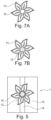
- This watermark 11 is represented in isolation at the Figure 7A .
- Document 1 comprises an opening 12, for example in the shape of a hexagon, made in the central part of the watermark 11, as illustrated in Figure 7B
- This opening 12 is preferably made by laser cutting, like the previous examples.
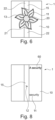
- Document 1 includes a security film 15, which has as shown in the Figure 6 a transparent region 21 with a security element 20 formed for example by printing or by metallization/demetallization of the film 15.
- This security element 20 has for example a contour homothetic to that of the opening 12, preferably being of larger dimensions.
- the security element 20 advantageously complements, aesthetically and conceptually, the watermark 11, as can be seen in the Figure 6 .
- the security element 20 is visible through the opening 12 on the reverse side, as illustrated in the Figure 5 .
- a secure document 1 comprising an electrotype watermark 11, representing an alphanumeric pattern for example, for example the term “security” and an opening 12 made by laser, completing the pattern of the watermark 11, for example the letter "A".
- the watermark 11 and the opening 12 fully reproduce a reference sign 60 which appears elsewhere on the document 1, in this case "A security”.
- a security film 15 is laminated onto the paper substrate 10 and covers the opening 12.
- This film 15 can provide various optical effects to the document, such as a holographic, iridescent, metallic effect, etc.
- the pattern of the opening 12 can thus appear with the effect provided by the security film 15.
- This document 1 comprises a paper substrate 10 provided with a watermark 11 which represents, for example, a frangipani flower and a butterfly.
- An opening 12 is made through the watermark 11, preferably by laser cutting. This opening 12 completes or matches the contour of a part of the pre-existing watermark 11, in this case a petal of the flower.
- the document 1 comprises a security film 15 which covers the watermark 11.
- This film 15 comprises a transparent region 21 whose contours substantially match the shape of the watermark 11, except in the opening 12 where the edge 30 of the transparent region may have, as illustrated, a shape which follows that of an opposite edge 31 of the opening 12, thus providing a transparent window 32 through the opening 12 between the edge 30 and the edge 31.
- Film 15 is narrower than watermark 11 but wider than aperture 12, as illustrated, completely covering it.
- This reference pattern 35 may be produced by demetallization of a metallized region of the film 15 or by negative printing on the film 15.
- Another motif 40 for example reproducing identically or conceptually another part of the watermark, in this case the butterfly, can be reproduced elsewhere on the security film, for example by demetallization also, for example on the opposite side of the reference pattern 35 with respect to the watermark 11.
- demetallization also, for example on the opposite side of the reference pattern 35 with respect to the watermark 11.
- the watermark 11 is faintly visible, as is the window 32.
- the film 15 is perfectly visible, and may present, for example, a metallic reflection effect, diffractive elements or a variable color depending on the angle of observation or illumination.
- window 32 becomes perfectly visible, as do watermark 11 and text and other motifs 35 and 40 in negative writing.
- the image created by the combination of the watermark and the opening, which recomposes a flower, can be compared to the reference motif 35; in an authentic document, the recomposed motif is identical in appearance or sufficiently close to that of the reference motif to be considered identical by the observer.
- one or more small openings for example of an area less than or equal to 1 mm 2 , can be made through the watermark, then constituting one or more micro-perforations.
- the security film is superimposed on at least one of these micro-perforations and has in the superposition zone a diffractive security element, allowing when a beam of light, in particular a laser, is sent through the opening to generate an image by projection.
- a diffractive security element is described in the application WO2014/199296
- the security film is transparent in the area that overlaps the micro-perforation.
- the security film may still include a diffractive element that is superimposed on a larger opening in the paper substrate.
- Security film may contain various security features, which may or may not have the same appearance on the front and back of the film.
- security film may have different colored metallizations on its front and back sides.
- the security film may have micro-reliefs created, for example, by embossing the plastic support of the film, and these micro-reliefs may be metallized where appropriate.
- the security film can be in the form of a patch or as a variant of a film completely covering one side of the paper substrate.
- Two plastic films at least one of which is a security film, may cover the substrate on both sides and sandwich the opening(s) made through the paper substrate. In this case, these two films cover the entire surface of each side of the sheet.
- the aperture may be given any shape, including polygonal, non-polygonal, alphanumeric, reproducing the shape of a watermark pattern or a pattern appearing elsewhere on the document or security film, for example a pattern printed on the paper substrate.
- the outline of the aperture may reproduce the shape of a country.
- the invention makes it possible to bring together in a single limited area of the document various securities, through the presence of the watermark, the opening and the security film, leaving more space on the document for security prints and other associated security elements.
- the security film may comprise a lenticular array.
- This array may comprise microlenses cooperating with micro-patterns to form an image whose appearance varies with the direction of observation.
- the lenticular grating may or may not be present in the area of the film overlapping the aperture.
- the lenticular grating is present on the film both in an area overlapping the aperture and elsewhere; alternatively, the lenticular grating is present only in the area of the aperture, and the associated effect can be observed through the aperture.
- the area(s) of the film bearing the lenticular network may complete the watermark pattern.
Landscapes
- Engineering & Computer Science (AREA)
- Manufacturing & Machinery (AREA)
- General Health & Medical Sciences (AREA)
- Physics & Mathematics (AREA)
- Health & Medical Sciences (AREA)
- Electromagnetism (AREA)
- Mechanical Engineering (AREA)
- Optics & Photonics (AREA)
- Toxicology (AREA)
- Chemical & Material Sciences (AREA)
- Crystallography & Structural Chemistry (AREA)
- Credit Cards Or The Like (AREA)
- Holo Graphy (AREA)
- Diffracting Gratings Or Hologram Optical Elements (AREA)
Applications Claiming Priority (2)
| Application Number | Priority Date | Filing Date | Title |
|---|---|---|---|
| FR1853542A FR3080324B1 (fr) | 2018-04-23 | 2018-04-23 | Feuille securisee |
| PCT/EP2019/059912 WO2019206760A1 (fr) | 2018-04-23 | 2019-04-17 | Feuille securisee |
Publications (3)
| Publication Number | Publication Date |
|---|---|
| EP3784498A1 EP3784498A1 (fr) | 2021-03-03 |
| EP3784498B1 true EP3784498B1 (fr) | 2025-06-25 |
| EP3784498C0 EP3784498C0 (fr) | 2025-06-25 |
Family
ID=62751131
Family Applications (1)
| Application Number | Title | Priority Date | Filing Date |
|---|---|---|---|
| EP19717325.5A Active EP3784498B1 (fr) | 2018-04-23 | 2019-04-17 | Feuille securisee |
Country Status (10)
| Country | Link |
|---|---|
| US (1) | US11491815B2 (pl) |
| EP (1) | EP3784498B1 (pl) |
| JP (1) | JP2021522087A (pl) |
| KR (1) | KR102754946B1 (pl) |
| CN (1) | CN112074416B (pl) |
| ES (1) | ES3040536T3 (pl) |
| FR (1) | FR3080324B1 (pl) |
| PL (1) | PL3784498T3 (pl) |
| UA (1) | UA129742C2 (pl) |
| WO (1) | WO2019206760A1 (pl) |
Family Cites Families (26)
| Publication number | Priority date | Publication date | Assignee | Title |
|---|---|---|---|---|
| MY102798A (en) * | 1987-12-04 | 1992-10-31 | Portals Ltd | Security paper for bank notes and the like |
| PT861156E (pt) * | 1995-11-13 | 2000-09-29 | Orell Fussli Banknote Engineer | Documento de seguranca com marcacao de seguranca |
| EP0825297B1 (en) * | 1996-03-12 | 2002-06-12 | Tokushu Paper Mfg. Co., Ltd | Forgery preventive sheet and method of manufacturing same |
| GB9828770D0 (en) * | 1998-12-29 | 1999-02-17 | Rue De Int Ltd | Security paper |
| DE10163381A1 (de) * | 2001-12-21 | 2003-07-03 | Giesecke & Devrient Gmbh | Sicherheitspapier sowie Verfahren und Vorrichtung zu seiner Herstellung |
| DE10218897A1 (de) * | 2002-04-26 | 2003-11-06 | Giesecke & Devrient Gmbh | Sicherheitselement und Verfahren zu seiner Herstellung |
| CN2655367Y (zh) * | 2003-06-27 | 2004-11-10 | 于奉民 | 一种具有水印的防伪标签和防伪包装容器 |
| ATE381728T1 (de) * | 2003-07-30 | 2008-01-15 | Mapper Lithography Ip Bv | Modulator-schaltkreise |
| DE10342252A1 (de) * | 2003-09-11 | 2005-04-07 | Giesecke & Devrient Gmbh | Foliensicherheitselement |
| GB0409747D0 (en) * | 2004-04-30 | 2004-06-09 | Rue De Int Ltd | Improvements in substrates incorporating security devices |
| DE102005022018A1 (de) * | 2005-05-12 | 2006-11-16 | Giesecke & Devrient Gmbh | Sicherheitspapier und Verfahren zu seiner Herstellung |
| CN1978786B (zh) * | 2005-12-09 | 2012-05-30 | 中国印钞造币总公司 | 一种防伪水印纸及其制造方法 |
| FR2922227B1 (fr) * | 2007-10-12 | 2009-12-18 | Arjowiggins Licensing Sas | Feuille comprenant au moins un filigrane observable que d'une face de la feuille |
| CN201416129Y (zh) * | 2009-04-20 | 2010-03-03 | 深圳市华德防伪技术开发有限公司 | 一种黑水印防伪纸及其制备装置 |
| CN102191722B (zh) * | 2011-04-14 | 2013-08-28 | 保定钞票纸业有限公司 | 一种多重防伪水印纸及其制作方法 |
| KR101616573B1 (ko) * | 2012-03-19 | 2016-04-28 | 드 라 뤼 인터내셔날 리미티드 | 종이 제조 공정 동안 이미지를 형성하기 위한 전기판 |
| CN103015248B (zh) * | 2013-01-10 | 2015-03-18 | 保定钞票纸业有限公司 | 一种含有亮窗水印的防伪纸及其制造方法 |
| EP2953145A4 (en) | 2013-01-30 | 2016-04-06 | Panasonic Ip Man Co Ltd | CONTACTLESS POWER TRANSMISSION DEVICE |
| DE102013008082A1 (de) * | 2013-05-10 | 2014-11-13 | Giesecke & Devrient Gmbh | Wert- und Sicherheitsdokument mit einem Wasserzeichen und einem Sicherheitsfaden |
| FR3006795B1 (fr) | 2013-06-10 | 2016-12-09 | Arjowiggins Security | Structure de securite a element optique diffractif |
| FR3022489B1 (fr) * | 2014-06-23 | 2021-10-29 | Arjowiggins Security | Papiers de securite et procedes de fabrication. |
| GB2531582B (en) * | 2014-10-23 | 2016-09-07 | De La Rue Int Ltd | Improvements in security papers and documents |
| DE102014016249A1 (de) * | 2014-11-04 | 2016-05-04 | Giesecke & Devrient Gmbh | Datenträger mit Durchsichtssicherheitselement |
| DE102015000694A1 (de) * | 2015-01-20 | 2016-07-21 | Giesecke & Devrient Gmbh | Datenträger mit einem Fenstersicherheitsfaden |
| DE102015000690A1 (de) * | 2015-01-20 | 2016-07-21 | Giesecke & Devrient Gmbh | Datenträger mit einem Fenstersicherheitsfaden |
| CN106283812B (zh) * | 2016-08-24 | 2018-03-16 | 西安兴晟造纸不锈钢网有限公司 | 防伪纸的制造方法 |
-
2018
- 2018-04-23 FR FR1853542A patent/FR3080324B1/fr active Active
-
2019
- 2019-04-17 ES ES19717325T patent/ES3040536T3/es active Active
- 2019-04-17 CN CN201980027581.9A patent/CN112074416B/zh active Active
- 2019-04-17 EP EP19717325.5A patent/EP3784498B1/fr active Active
- 2019-04-17 WO PCT/EP2019/059912 patent/WO2019206760A1/fr not_active Ceased
- 2019-04-17 JP JP2020560324A patent/JP2021522087A/ja active Pending
- 2019-04-17 US US17/048,796 patent/US11491815B2/en active Active
- 2019-04-17 KR KR1020207031854A patent/KR102754946B1/ko active Active
- 2019-04-17 UA UAA202006590A patent/UA129742C2/uk unknown
- 2019-04-17 PL PL19717325.5T patent/PL3784498T3/pl unknown
Also Published As
| Publication number | Publication date |
|---|---|
| EP3784498A1 (fr) | 2021-03-03 |
| CN112074416A (zh) | 2020-12-11 |
| CN112074416B (zh) | 2023-01-10 |
| UA129742C2 (uk) | 2025-07-23 |
| PL3784498T3 (pl) | 2025-11-17 |
| BR112020021374A2 (pt) | 2021-01-26 |
| FR3080324A1 (fr) | 2019-10-25 |
| US11491815B2 (en) | 2022-11-08 |
| WO2019206760A1 (fr) | 2019-10-31 |
| ES3040536T3 (en) | 2025-11-03 |
| JP2021522087A (ja) | 2021-08-30 |
| KR20210005615A (ko) | 2021-01-14 |
| US20210146712A1 (en) | 2021-05-20 |
| EP3784498C0 (fr) | 2025-06-25 |
| FR3080324B1 (fr) | 2022-04-01 |
| KR102754946B1 (ko) | 2025-01-14 |
Similar Documents
| Publication | Publication Date | Title |
|---|---|---|
| EP2989250B1 (fr) | Element de securite comportant un hologramme en volume | |
| EP2753753B1 (fr) | Bandeau de securite et document qui en est pourvu | |
| US20100253062A1 (en) | Banknote with edge windows | |
| FR2969670A1 (fr) | Element pour document de securite comportant une structure optique | |
| FR2948217A1 (fr) | Element de securite a effet de parallaxe | |
| EP3157756B1 (fr) | Papiers de sécurité et procédés de fabrication | |
| WO2007125266A1 (fr) | Composant optique de marquage de sécurité, procédé de fabrication d'un tel composant, système comprenant un tel composant et lecteur pour le contrôle d'un tel composant | |
| EP3007903B1 (fr) | Structure de securite a element optique diffractif | |
| FR3068293A1 (fr) | Document de securite comportant un element optique de securite | |
| EP3784498B1 (fr) | Feuille securisee | |
| EP2935696B1 (fr) | Structure de securite | |
| FR2979735A1 (fr) | Structure de securite comportant un vernis transparent, et procede associe. | |
| FR3033735A1 (fr) | Element de securite et document securise | |
| FR3011508A1 (fr) | Document de securite comprenant un film a effets interferentiels, procede de determination de l'authenticite d'un tel document et dispositif pour la mise en œuvre d'un tel procede. | |
| WO2004062942A1 (fr) | Dispositif de securite en guide d'onde | |
| RU2775784C2 (ru) | Защищенный документ | |
| FR3078015A1 (fr) | Intégration de motif de micro-imagerie | |
| BR112020021374B1 (pt) | Folha de segurança, documento de segurança compreendendo a mesma, e processo para produzí-la | |
| FR3105757A1 (fr) | Document de sécurité pourvu d’un motif de perforations réalisées au laser | |
| FR3010000A1 (pl) | ||
| HK1148988A (en) | Banknote with edge windows |
Legal Events
| Date | Code | Title | Description |
|---|---|---|---|
| STAA | Information on the status of an ep patent application or granted ep patent |
Free format text: STATUS: UNKNOWN |
|
| STAA | Information on the status of an ep patent application or granted ep patent |
Free format text: STATUS: THE INTERNATIONAL PUBLICATION HAS BEEN MADE |
|
| PUAI | Public reference made under article 153(3) epc to a published international application that has entered the european phase |
Free format text: ORIGINAL CODE: 0009012 |
|
| STAA | Information on the status of an ep patent application or granted ep patent |
Free format text: STATUS: REQUEST FOR EXAMINATION WAS MADE |
|
| 17P | Request for examination filed |
Effective date: 20201019 |
|
| AK | Designated contracting states |
Kind code of ref document: A1 Designated state(s): AL AT BE BG CH CY CZ DE DK EE ES FI FR GB GR HR HU IE IS IT LI LT LU LV MC MK MT NL NO PL PT RO RS SE SI SK SM TR |
|
| AX | Request for extension of the european patent |
Extension state: BA ME |
|
| DAV | Request for validation of the european patent (deleted) | ||
| DAX | Request for extension of the european patent (deleted) | ||
| STAA | Information on the status of an ep patent application or granted ep patent |
Free format text: STATUS: EXAMINATION IS IN PROGRESS |
|
| 17Q | First examination report despatched |
Effective date: 20220310 |
|
| P01 | Opt-out of the competence of the unified patent court (upc) registered |
Effective date: 20230516 |
|
| GRAP | Despatch of communication of intention to grant a patent |
Free format text: ORIGINAL CODE: EPIDOSNIGR1 |
|
| STAA | Information on the status of an ep patent application or granted ep patent |
Free format text: STATUS: GRANT OF PATENT IS INTENDED |
|
| INTG | Intention to grant announced |
Effective date: 20240930 |
|
| GRAJ | Information related to disapproval of communication of intention to grant by the applicant or resumption of examination proceedings by the epo deleted |
Free format text: ORIGINAL CODE: EPIDOSDIGR1 |
|
| STAA | Information on the status of an ep patent application or granted ep patent |
Free format text: STATUS: EXAMINATION IS IN PROGRESS |
|
| GRAP | Despatch of communication of intention to grant a patent |
Free format text: ORIGINAL CODE: EPIDOSNIGR1 |
|
| STAA | Information on the status of an ep patent application or granted ep patent |
Free format text: STATUS: GRANT OF PATENT IS INTENDED |
|
| INTC | Intention to grant announced (deleted) | ||
| INTG | Intention to grant announced |
Effective date: 20250211 |
|
| RAP1 | Party data changed (applicant data changed or rights of an application transferred) |
Owner name: VHP SECURITY PAPER BV |
|
| RAP3 | Party data changed (applicant data changed or rights of an application transferred) |
Owner name: VHP SECURITY PAPER B.V. |
|
| GRAS | Grant fee paid |
Free format text: ORIGINAL CODE: EPIDOSNIGR3 |
|
| GRAA | (expected) grant |
Free format text: ORIGINAL CODE: 0009210 |
|
| STAA | Information on the status of an ep patent application or granted ep patent |
Free format text: STATUS: THE PATENT HAS BEEN GRANTED |
|
| AK | Designated contracting states |
Kind code of ref document: B1 Designated state(s): AL AT BE BG CH CY CZ DE DK EE ES FI FR GB GR HR HU IE IS IT LI LT LU LV MC MK MT NL NO PL PT RO RS SE SI SK SM TR |
|
| REG | Reference to a national code |
Ref country code: GB Ref legal event code: FG4D Free format text: NOT ENGLISH |
|
| REG | Reference to a national code |
Ref country code: CH Ref legal event code: EP |
|
| REG | Reference to a national code |
Ref country code: CH Ref legal event code: EP |
|
| REG | Reference to a national code |
Ref country code: IE Ref legal event code: FG4D Free format text: LANGUAGE OF EP DOCUMENT: FRENCH |
|
| REG | Reference to a national code |
Ref country code: DE Ref legal event code: R096 Ref document number: 602019071519 Country of ref document: DE |
|
| U01 | Request for unitary effect filed |
Effective date: 20250711 |
|
| U07 | Unitary effect registered |
Designated state(s): AT BE BG DE DK EE FI FR IT LT LU LV MT NL PT RO SE SI Effective date: 20250717 |
|
| PG25 | Lapsed in a contracting state [announced via postgrant information from national office to epo] |
Ref country code: GR Free format text: LAPSE BECAUSE OF FAILURE TO SUBMIT A TRANSLATION OF THE DESCRIPTION OR TO PAY THE FEE WITHIN THE PRESCRIBED TIME-LIMIT Effective date: 20250926 Ref country code: NO Free format text: LAPSE BECAUSE OF FAILURE TO SUBMIT A TRANSLATION OF THE DESCRIPTION OR TO PAY THE FEE WITHIN THE PRESCRIBED TIME-LIMIT Effective date: 20250925 |
|
| U1N | Appointed representative for the unitary patent procedure changed after the registration of the unitary effect |
Representative=s name: IPSILON; FR |
|
| PG25 | Lapsed in a contracting state [announced via postgrant information from national office to epo] |
Ref country code: HR Free format text: LAPSE BECAUSE OF FAILURE TO SUBMIT A TRANSLATION OF THE DESCRIPTION OR TO PAY THE FEE WITHIN THE PRESCRIBED TIME-LIMIT Effective date: 20250625 |
|
| PG25 | Lapsed in a contracting state [announced via postgrant information from national office to epo] |
Ref country code: RS Free format text: LAPSE BECAUSE OF FAILURE TO SUBMIT A TRANSLATION OF THE DESCRIPTION OR TO PAY THE FEE WITHIN THE PRESCRIBED TIME-LIMIT Effective date: 20250925 |
|
| REG | Reference to a national code |
Ref country code: ES Ref legal event code: FG2A Ref document number: 3040536 Country of ref document: ES Kind code of ref document: T3 Effective date: 20251103 |
|
| PG25 | Lapsed in a contracting state [announced via postgrant information from national office to epo] |
Ref country code: IS Free format text: LAPSE BECAUSE OF FAILURE TO SUBMIT A TRANSLATION OF THE DESCRIPTION OR TO PAY THE FEE WITHIN THE PRESCRIBED TIME-LIMIT Effective date: 20251025 |
|
| PG25 | Lapsed in a contracting state [announced via postgrant information from national office to epo] |
Ref country code: SM Free format text: LAPSE BECAUSE OF FAILURE TO SUBMIT A TRANSLATION OF THE DESCRIPTION OR TO PAY THE FEE WITHIN THE PRESCRIBED TIME-LIMIT Effective date: 20250625 |
|
| PG25 | Lapsed in a contracting state [announced via postgrant information from national office to epo] |
Ref country code: CZ Free format text: LAPSE BECAUSE OF FAILURE TO SUBMIT A TRANSLATION OF THE DESCRIPTION OR TO PAY THE FEE WITHIN THE PRESCRIBED TIME-LIMIT Effective date: 20250625 |
|
| PG25 | Lapsed in a contracting state [announced via postgrant information from national office to epo] |
Ref country code: SK Free format text: LAPSE BECAUSE OF FAILURE TO SUBMIT A TRANSLATION OF THE DESCRIPTION OR TO PAY THE FEE WITHIN THE PRESCRIBED TIME-LIMIT Effective date: 20250625 |