EP3777284B1 - Breitbandiger pdcch für unlizenziertes band für new radio - Google Patents
Breitbandiger pdcch für unlizenziertes band für new radio Download PDFInfo
- Publication number
- EP3777284B1 EP3777284B1 EP18913644.3A EP18913644A EP3777284B1 EP 3777284 B1 EP3777284 B1 EP 3777284B1 EP 18913644 A EP18913644 A EP 18913644A EP 3777284 B1 EP3777284 B1 EP 3777284B1
- Authority
- EP
- European Patent Office
- Prior art keywords
- subbands
- control channel
- base station
- control
- configuration
- Prior art date
- Legal status (The legal status is an assumption and is not a legal conclusion. Google has not performed a legal analysis and makes no representation as to the accuracy of the status listed.)
- Active
Links
Images




Classifications
-
- H—ELECTRICITY
- H04—ELECTRIC COMMUNICATION TECHNIQUE
- H04W—WIRELESS COMMUNICATION NETWORKS
- H04W24/00—Supervisory, monitoring or testing arrangements
- H04W24/08—Testing, supervising or monitoring using real traffic
-
- H—ELECTRICITY
- H04—ELECTRIC COMMUNICATION TECHNIQUE
- H04L—TRANSMISSION OF DIGITAL INFORMATION, e.g. TELEGRAPHIC COMMUNICATION
- H04L1/00—Arrangements for detecting or preventing errors in the information received
- H04L1/0001—Systems modifying transmission characteristics according to link quality, e.g. power backoff
- H04L1/0036—Systems modifying transmission characteristics according to link quality, e.g. power backoff arrangements specific to the receiver
- H04L1/0038—Blind format detection
-
- H—ELECTRICITY
- H04—ELECTRIC COMMUNICATION TECHNIQUE
- H04L—TRANSMISSION OF DIGITAL INFORMATION, e.g. TELEGRAPHIC COMMUNICATION
- H04L5/00—Arrangements affording multiple use of the transmission path
- H04L5/0001—Arrangements for dividing the transmission path
- H04L5/0003—Two-dimensional division
- H04L5/0005—Time-frequency
- H04L5/0007—Time-frequency the frequencies being orthogonal, e.g. OFDM(A) or DMT
- H04L5/001—Time-frequency the frequencies being orthogonal, e.g. OFDM(A) or DMT the frequencies being arranged in component carriers
-
- H—ELECTRICITY
- H04—ELECTRIC COMMUNICATION TECHNIQUE
- H04L—TRANSMISSION OF DIGITAL INFORMATION, e.g. TELEGRAPHIC COMMUNICATION
- H04L5/00—Arrangements affording multiple use of the transmission path
- H04L5/003—Arrangements for allocating sub-channels of the transmission path
- H04L5/0053—Allocation of signalling, i.e. of overhead other than pilot signals
-
- H—ELECTRICITY
- H04—ELECTRIC COMMUNICATION TECHNIQUE
- H04L—TRANSMISSION OF DIGITAL INFORMATION, e.g. TELEGRAPHIC COMMUNICATION
- H04L5/00—Arrangements affording multiple use of the transmission path
- H04L5/0091—Signalling for the administration of the divided path, e.g. signalling of configuration information
- H04L5/0092—Indication of how the channel is divided
-
- H—ELECTRICITY
- H04—ELECTRIC COMMUNICATION TECHNIQUE
- H04W—WIRELESS COMMUNICATION NETWORKS
- H04W16/00—Network planning, e.g. coverage or traffic planning tools; Network deployment, e.g. resource partitioning or cells structures
- H04W16/14—Spectrum sharing arrangements between different networks
-
- H—ELECTRICITY
- H04—ELECTRIC COMMUNICATION TECHNIQUE
- H04W—WIRELESS COMMUNICATION NETWORKS
- H04W72/00—Local resource management
- H04W72/04—Wireless resource allocation
- H04W72/044—Wireless resource allocation based on the type of the allocated resource
- H04W72/0453—Resources in frequency domain, e.g. a carrier in FDMA
-
- H—ELECTRICITY
- H04—ELECTRIC COMMUNICATION TECHNIQUE
- H04W—WIRELESS COMMUNICATION NETWORKS
- H04W72/00—Local resource management
- H04W72/20—Control channels or signalling for resource management
- H04W72/23—Control channels or signalling for resource management in the downlink direction of a wireless link, i.e. towards a terminal
-
- H—ELECTRICITY
- H04—ELECTRIC COMMUNICATION TECHNIQUE
- H04L—TRANSMISSION OF DIGITAL INFORMATION, e.g. TELEGRAPHIC COMMUNICATION
- H04L27/00—Modulated-carrier systems
- H04L27/0006—Assessment of spectral gaps suitable for allocating digitally modulated signals, e.g. for carrier allocation in cognitive radio
Definitions
- This invention relates generally to wireless communications and, more specifically, relates to downlink control channels and unlicensed band usage.
- NR-U NR unlicensed
- the network e.g., gNB
- One way is using a downlink control channel, and specifically PDCCH transmissions and monitoring in the case when NR-U operates according to wideband operation.
- WO2018/031327 discloses a mechanism for power saving in a wireless network, wherein a processor determines a processing state pertaining to behavior of the a wireless unit and determines a minimum amount of resources to be processed for one or more sets of physical resources based on the determined processing state.
- Each respective set of physical resources may comprise resources in time, and any of frequency or space.
- the time may comprise a frame structure associated with a numerology applicable to the respective set of physical resources
- the frequency may comprise any of a frequency location, a bandwidth, or the numerology
- the space may comprise one or more beams.
- WO2017/034238 discloses a mechanism for a machine type communication (MTC) terminal to report a channel state information (CSI) in a wireless communication system, wherein the mechanism comprises the steps of: selecting a set of M downlink subframes as a CSI reference resource for the MTC terminal; measuring a channel quality indicator (CQI) through the CSI reference resource; and transmitting a CSI report including the CQI to a base station through an uplink subframe, wherein the MTC terminal is configured to repeatedly receive an MTC signal by frequency-hopping N sub-bands among a plurality of sub-bands.
- the number 'M' of the downlink subframes to be included in the CSI reference resource is determined on the basis of an upper layer parameter received from the base station.
- the exemplary embodiments herein describe techniques for wideband PDCCH for the unlicensed band and suitable for new radio. Additional description of these techniques is presented after a system into which the exemplary embodiments may be used is described.
- FIG. 1 this figure shows a block diagram of one possible and non-limiting exemplary system in which the exemplary embodiments may be practiced.
- a user equipment (UE) 110 is in wireless communication with a wireless network 100.
- a UE is a wireless, typically mobile device that can access a wireless network.
- the UE 110 includes one or more processors 120, one or more memories 125, and one or more transceivers 130 interconnected through one or more buses 127.
- Each of the one or more transceivers 130 includes a receiver, Rx, 132 and a transmitter, Tx, 133.
- the one or more buses 127 may be address, data, or control buses, and may include any interconnection mechanism, such as a series of lines on a motherboard or integrated circuit, fiber optics or other optical communication equipment, and the like.
- the one or more transceivers 130 are connected to one or more antennas 128.
- the one or more memories 125 include computer program code 123.
- the UE 110 includes a wideband (WB) physical downlink control channel (PDCCH) module 140, comprising one of or both parts 140-1 and/or 140-2, which may be implemented in a number of ways.
- the WB PDCCH module 140 may be implemented in hardware as WB PDCCH module 140-1, such as being implemented as part of the one or more processors 120.
- the WB PDCCH module 140-1 may be implemented also as an integrated circuit or through other hardware such as a programmable gate array.
- the WB PDCCH module 140 may be implemented as WB PDCCH module 140-2, which is implemented as computer program code 123 and is executed by the one or more processors 120.
- the one or more memories 125 and the computer program code 123 may be configured to, with the one or more processors 120, cause the user equipment 110 to perform one or more of the operations as described herein.
- the UE 110 communicates with gNB 170 via a wireless link 111.
- the gNB 170 is a base station (e.g., for NR/5G) that provides access by wireless devices such as the UE 110 to the wireless network 100. Although primary reference herein is to a gNB, it might also be possible for disclosed techniques to be performed by an eNB, which is a base station for LTE.
- the gNB 170 includes one or more processors 152, one or more memories 155, one or more network interfaces (N/W I/F(s)) 161, and one or more transceivers 160 interconnected through one or more buses 157.
- Each of the one or more transceivers 160 includes a receiver, Rx, 162 and a transmitter, Tx, 163.
- the one or more transceivers 160 are connected to one or more antennas 158.
- the one or more memories 155 include computer program code 153.
- the gNB 170 includes a WB PDCCH module 150, comprising one of or both parts 150-1 and/or 150-2, which may be implemented in a number of ways.
- the WB PDCCH module 150 may be implemented in hardware as WB PDCCH module 150-1, such as being implemented as part of the one or more processors 152.
- the WB PDCCH module 150-1 may be implemented also as an integrated circuit or through other hardware such as a programmable gate array.
- the WB PDCCH module 150 may be implemented as WB PDCCH module 150-2, which is implemented as computer program code 153 and is executed by the one or more processors 152.
- the one or more memories 155 and the computer program code 153 are configured to, with the one or more processors 152, cause the gNB 170 to perform one or more of the operations as described herein.
- the one or more network interfaces 161 communicate over a network such as via the links 176 and 131.
- Two or more gNBs 170 communicate using, e.g., link 176.
- the link 176 may be wired or wireless or both and may implement, e.g., an X2 interface.
- the one or more buses 157 may be address, data, or control buses, and may include any interconnection mechanism, such as a series of lines on a motherboard or integrated circuit, fiber optics or other optical communication equipment, wireless channels, and the like.
- the one or more transceivers 160 may be implemented as a remote radio head (RRH) 195, with the other elements of the gNB 170 being physically in a different location from the RRH, and the one or more buses 157 could be implemented in part as fiber optic cable to connect the other elements of the gNB 170 to the RRH 195.
- RRH remote radio head
- each cell can correspond to a single carrier and a gNB may use multiple carriers. So if there are three 120 degree cells per carrier and two carriers, then the gNB has a total of 6 cells.
- the wireless network 100 may include a network control element (NCE) 190 that may include MME (Mobility Management Entity)/SGW (Serving Gateway) functionality, and which provides connectivity with a further network, such as a telephone network and/or a data communications network (e.g., the Internet).
- the gNB 170 is coupled via a link 131 to the NCE 190.
- the link 131 may be implemented as, e.g., an S1 interface.
- the NCE 190 includes one or more processors 175, one or more memories 171, and one or more network interfaces (N/W I/F(s)) 180, interconnected through one or more buses 185.
- the one or more memories 171 include computer program code 173.
- the one or more memories 171 and the computer program code 173 are configured to, with the one or more processors 175, cause the NCE 190 to perform one or more operations.
- the wireless network 100 may implement network virtualization, which is the process of combining hardware and software network resources and network functionality into a single, software-based administrative entity, a virtual network.
- Network virtualization involves platform virtualization, often combined with resource virtualization.
- Network virtualization is categorized as either external, combining many networks, or parts of networks, into a virtual unit, or internal, providing network-like functionality to software containers on a single system. Note that the virtualized entities that result from the network virtualization are still implemented, at some level, using hardware such as processors 152 or 175 and memories 155 and 171, and also such virtualized entities create technical effects.
- the various embodiments of the user equipment 110 can include, but are not limited to, cellular telephones such as smart phones, tablets, personal digital assistants (PDAs) having wireless communication capabilities, portable computers having wireless communication capabilities, image capture devices such as digital cameras having wireless communication capabilities, gaming devices having wireless communication capabilities, music storage and playback appliances having wireless communication capabilities, Internet appliances permitting wireless Internet access and browsing, tablets with wireless communication capabilities, as well as portable units or terminals that incorporate combinations of such functions.
- cellular telephones such as smart phones, tablets, personal digital assistants (PDAs) having wireless communication capabilities, portable computers having wireless communication capabilities, image capture devices such as digital cameras having wireless communication capabilities, gaming devices having wireless communication capabilities, music storage and playback appliances having wireless communication capabilities, Internet appliances permitting wireless Internet access and browsing, tablets with wireless communication capabilities, as well as portable units or terminals that incorporate combinations of such functions.
- PDAs personal digital assistants
- portable computers having wireless communication capabilities
- image capture devices such as digital cameras having wireless communication capabilities
- gaming devices having wireless communication capabilities
- music storage and playback appliances having wireless communication capabilities
- the computer readable memories 125, 155, and 171 may be of any type suitable to the local technical environment and may be implemented using any suitable data storage technology, such as semiconductor based memory devices, flash memory, magnetic memory devices and systems, optical memory devices and systems, fixed memory and removable memory.
- the computer readable memories 125, 155, and 171 may be means for performing storage functions.
- the processors 120, 152, and 175 may be of any type suitable to the local technical environment, and may include one or more of general purpose computers, special purpose computers, microprocessors, digital signal processors (DSPs) and processors based on a multi-core processor architecture, as non-limiting examples.
- the processors 120, 152, and 175 may be means for performing functions, such as controlling the UE 110, gNB 170, and other functions as described herein.
- 3GPP has approved a new study item related to NR-based access to unlicensed spectrum.
- This document concerns monitoring of the downlink control channel in NR unlicensed (NR-U) band scenarios. More specifically, we consider PDCCH monitoring in the case when NR-U operates according to wideband operation.
- NR physical downlink control channel may be used to convey downlink control information (DCI). It may utilize OFDM waveform(s) and polar coding. NR PDCCH may utilize every fourth resource element for demodulation reference signals (DMRSs). DCI can be used for downlink (DL) and uplink (UL) resource allocation signaling. DCI may be used also for other purposes, such as carrier aggregation and bandwidth part (BWP) (de)activation, frame structure indication (with group common PDCCH, GC-PDCCH) and power control updates. GC-PDCCH may be used for slot format indication (SFI) in NR.
- DCI downlink control information
- DL downlink
- UL uplink
- DCI may be used also for other purposes, such as carrier aggregation and bandwidth part (BWP) (de)activation, frame structure indication (with group common PDCCH, GC-PDCCH) and power control updates.
- BWP carrier aggregation and bandwidth part
- GC-PDCCH may be
- Certain embodiments herein are directed to the monitoring of the control channel in NR that may be carried out by means of blind searches.
- Blind searching also called blind decoding, refers to the process by which a UE 110 finds its PDCCH by monitoring a set of PDCCH candidates in every monitoring occasion.
- a monitoring occasion can be once a slot, once per multiple slots, or multiple times in a slot.
- physical downlink control channel (PDCCH) blind search may be arranged by means of parallel search space sets mapped to one or multiple control resource sets (CORESETs).
- a UE 110 may be monitoring predefined control channel elements (CCEs), aggregated CCEs and/or downlink control information (DCI) sizes with predefined RNTIs (Radio Network Temporary Identifier) in predefined time instants, corresponding to configured monitoring occasions.
- CCEs predefined control channel elements
- DCI downlink control information
- RNTIs Radio Network Temporary Identifier
- CCEs may be arranged within a predefined CORESET configured via higher layer signaling.
- Each CCE may include 6 REGs, each REG consisting of 12 subcarriers within 1 OFDM symbol, and 1, 2 or 3 REG bundles.
- REG bundles may be arranged into the CORESET either according to interleaved or non-interleaved mapping.
- the UE 110 may assume that REG bundle defines the precoder granularity in frequency and time used by the gNB 170 when transmitting PDCCH.
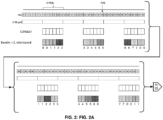
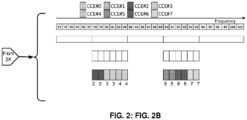
- CORESET resources may be configured in units of 6 resource blocks in the frequency. FIG. 2 , split over FIGS.
- FIG. 2A and 2B illustrates an example PDCCH mapping assuming 1 symbol CORESET, interleaved REG-to-CCE mapping and REG bundle size 2.
- a 6-RB (resource block) grid is shown. The numbers below the blocks indicate the CCEs being used, where each of 0, 1, 2, 3, 4, 5, 6, and 7 corresponds respectively to CCE #1, CCE #2, CCE #3, CCE #4, CCE #5, CCE #6, and CCE #7.
- the max number of CORESETs configurable for a bandwidth part (BWP) in a cell for a UE is three and the max number of search space sets configurable for a BWP in a cell for a UE is 10, respectively.
- wideband operation is one of the building blocks for NR unlicensed.
- Both carrier aggregation and BWP (bandwidth part) mechanisms are supported in Rel-15 NR for wideband operations (on licensed spectrum) and NR unlicensed may use both mechanisms to achieve sufficiently versatile support for wideband.
- carrier aggregation may be supported for NR unlicensed in addition to facilitating the LAA operation with NR licensed carrier.
- carrier aggregation has also its price: multiple RF chains are required, increasing the price of UE transceivers.
- carrier aggregation increases UE power consumption and has rather considerable latency in the component carrier activation/deactivation (to save UE power).
- Rel-15 NR a concept of serving cell adaptive BW was introduced by means of BWPs.
- a UE is instructed to operate on a specific part of a gNB's BW, that is, on a BWP.
- BWPs can be configured separately for UL and DL.
- Each BWP can have, e.g., the following, separately configured:
- UL and DL BWPs can be paired, in which case the center frequency of both BWPs is required to be the same.
- One of the BWPs may be defined as the default BWP.
- a UE 110 may have only one BWP active at a time.
- the active BWP can be indicated by a field in the DCI or by RRC signaling.
- BWP switching occurs after UE has received the signaling changing the active BWP, but switching time is yet to be determined.
- the UE may also fall back to default BWP after a configured period of inactivity.
- the BWP mechanism provides an alternative wideband mechanism when accessing unlicensed spectrum on adjacent 20 MHz channels, as this mechanism can provide savings in UE cost with reduced number of RF chains.
- a single RF chain and FFT processing can be used to access wide bandwidth of, e.g., 80 MHz or 160 MHz on 5 GHz or 6 GHz (potential) unlicensed bands. It is assumed herein that unlicensed band carrier size is, e.g., 80 MHz or 160 MHz (depending on the FFT size).
- unlicensed band carrier size is, e.g., 80 MHz or 160 MHz (depending on the FFT size).
- This mechanism also improves the trade-off between UE throughput and battery consumption via fast dynamic BWP switching.
- the UE can be switched rather aggressively to narrow BWP (and back to wideband BWP), saving UE battery and compromising throughput less than the slower CC (de)activation.
- NR BWP switching time (about hundreds of microseconds) has clearly a different order of magnitude than a single clear channel assessment (CCA) (e.g., 9 microseconds) in an LBT procedure, where CCA is equivalent to a single measurement within an LBT procedure. This poses significant constraints on how BWP operation and LBT can interact.
- CCA clear channel assessment
- Channel contention (i.e., LBT) mechanism is one of the components for efficient wideband operation, and the channel contention mechanism for wideband operations needs to be considered during the NR-Unlicensed study item (SI).
- SI NR-Unlicensed study item
- both Wi-Fi and LTE LAA LBT operate on 20 MHz channels and some of the regulatory rules, e.g. ETSI's standard, require LBT operation on a 20 MHz grid at 5 GHz unlicensed bands.
- ETSI's standard require LBT operation on a 20 MHz grid at 5 GHz unlicensed bands.
- NR unlicensed bands should support at least a 20 MHz grid for LBT operation.
- wider LBT BWs should be supported for higher frequency unlicensed bands or for potential new unlicensed bands like the 6 GHz band.
- Carrier bandwidth is the NR carrier bandwidth, such as a carrier of 40 MHz (two subbands of 20 MHz each) for a subcarrier spacing of 15 kHz, a carrier of 80 MHz (four subbands of 20 MHz each) for a subcarrier spacing of 30 kHz, or a carrier of 160 MHz (eight subbands, from zero to seven, of 20 MHz each) for a subcarrier spacing of 60 kHz. See FIG. 3 . As can be seen for this example that assumes a 4k FFT, each carrier bandwidth comprises multiple 20 MHz subbands.
- a subband is one (or possibly multiple adjacent) channel(s) on an unlicensed carrier, typically having a bandwidth of 20 MHz.
- a subband is aligned with the bandwidth of single LBT.
- a gNB 170 When operating according to NR-U scenario, a gNB 170 should perform LBT before the gNB 170 can start transmitting a DL NR-U Tx burst in the cell.
- NR unlicensed should support subband LBT, e.g., with 20 MHz resolution.
- the practical implementation of subband LBT is beyond the scope of this invention report.
- FIG. 4 shows possible transmission bandwidth for NR-U transmission combinations for a gNB 170 after a subband-specific LBT. This example assumes 80 MHz carrier bandwidth, and contiguous allocation of 20 MHz subbands.
- the subbands are 0, 1, 2, and 3, and the figure shows how one, two, three, or all four subbands could be allocated for NR-U transmissions.
- the gNB 170 may need to adjust the transmission bandwidth (Tx BW) configuration, including RF settings (e.g., center frequency, analog filters) in order to meet the regulatory rules defined for the out-of-band emissions.
- Tx BW transmission bandwidth
- the gNB 170 may decide on and perform the transmission bandwidth adaptation during the LBT process, although the details of gNB BW adaptation are outside of the scope of this description.
- TX BW transmission bandwidth
- the TX BW may be equal to the carrier BW or the TX BW is a portion of carrier BW (one or more subbands) based on the outcome of LBT. It should be understood that given the said meaning of TX BW, change in Tx BW (e.g., and its configuration) may change the bandwidth of transmission, the center frequency of transmission, or both the bandwidth and center frequency of transmission.
- one exemplary problem is how to facilitate DL control channel monitoring when a UE 110 has uncertainty related to the gNB's Tx BW configuration.
- transmission bandwidth of the gNB is always known by the UE beforehand.
- this scenario supports WB operation only by means of carrier aggregation, where each carrier typically has its own, independent PDCCH.
- WiFi does not support scheduling structure based on PDCCH. Therefore, techniques used in these technologies do not transfer explicitly to wideband NR-U scenarios.
- Exemplary embodiments herein solve or ameliorate the issues described above.
- Exemplary ideas relate to PDCCH monitoring in WB operation.
- Exemplary embodiments contain the following configuration aspects, depending on implementation:
- the gNB 170 determines the RF configuration, in terms of consecutive (i.e., adjacent in frequency domain) subbands. This may be performed based on subband specific LBT. The gNB 170 may adjust its Tx BW configuration accordingly. According to an exemplary proposed idea, the gNB 170 indicates its Tx BW configuration to the UEs in the cell (e.g., at least) by means of DL control information.
- the "at least" is used here because this does not exclude usage of other signals such as preamble and/or PDCCH demodulation reference signal (DMRS) and/or tracking reference signal (TRS).
- DMRS PDCCH demodulation reference signal
- TRS tracking reference signal
- the indication is conveyed via group common PDCCH (GC-PDCCH) and/or via dedicated DCI (such as DL/UL grant).
- the Tx BW configuration may indicate the active subbands, e.g. in terms of bitmap or RIV (resource indication value).
- the GC-PDCCH may indicate the slot format for one or more slots of the COT.
- One important exemplary idea relates to the way the UE PDCCH monitoring and the corresponding CORESET(s) are arranged within the COT: (1) before knowing the gNB Tx BW configuration; and (2) after knowing the gNB Tx BW configuration.
- a first aspect concerns determining the gNB Tx BW configuration from PDCCH.
- this gNB Tx BW configuration is the intersection of UE BWP configuration and gNB Tx BW configuration. This is achieved such that the PDCCH candidates are confined within each subband. Furthermore, the configuration is made such that each subband contains sufficient amount of PDCCH candidates to convey PDCCH reliably enough.
- An example of the wideband CORESET configuration placed on a common PRB grid and covering four subbands is shown in the example of FIG. 5.
- FIG. 5 illustrates CORESET spanning over four frequency chunks. Subcarrier spacing is 30 kHz in this example.
- a 20 MHz frequency band is formed using 55.6 PRBs at 30 kHz SCS, of which 48 PRBs are used, e.g., for subband-specific CORESET.
- the other PRBs may be unused (e.g., to serve as guard bands).
- FIG. 5 also illustrates a size of two PRBs ("2 PRBs").
- interleaving is performed within each subband but not between subbands (see also examples below). Additionally, the gNB 170 transmits (at least) one GC-PDCCH via (at least) one of the subbands, as indicated below:
- a second aspect concerns providing opportunities for additional control resources for the cases when only a limited number of subbands is active and included to the gNB's Tx BW.
- the motivation behind this is that one, e.g., GC-PDCCH, DL assignment, or UL grant DCI may require a considerable amount of control channel resources, e.g., up-to 8 CCEs, and this may consume the entire control channel capacity of a single subband.
- additional control channel capacity may not be needed. This is due to the fact that control channel capacity scales linearly with the channel bandwidth and a single GC-PDCCH may be shared between multiple subbands.
- the additional control resources can be determined based on the DCI. Another option is to have the additional control resources present always when Tx BW configuration indicated by the gNB is just one or two subbands. Furthermore, the additional control resources may be available only for the first mini-slot or slot monitoring occasion of the COT, or in all mini-slots or slot monitoring occasions of the COT. The additional control resources may be available only on the subband carrying GC-PDCCH in the later slots of the COT.
- a third aspect involves the UE changing the PDCCH monitoring based on detected indication on the gNB Tx BW configuration.
- PDCCH monitoring corresponding to the first mini-slot or slot covers all the possible subbands.
- the UE 110 adapts the PDCCH monitoring configuration (including also CORESET configuration, if changed) according to the determined Tx BW configuration.
- the gNB 170 may dynamically allocate additional control resources already for the 1st slot of the COT.
- the change of the PDCCH monitoring may impact also on the PDCCH monitoring between different DCIs (i.e., search space set configuration). For example, the first slot may have more BDs for the GC-PDCCH whereas other slots may have more BDs for dedicated DCIs.
- the first row 630 represents the CORESET monitoring based on the UE's BWP configuration
- the second row 640 represents the CORESETs based on the gNB's Tx BW configuration.
- a first example concerns a case where an LBT procedure indicates for all subbands to be available for transmission, that is, they are unoccupied. This is illustrated in FIG. 6 , which illustrates a CORESET variation in response to LBT positive (meaning an LBT procedure indicates the channel can be used) for all subbands, using the 80 MHz carrier of FIG. 5 . This is the assumed configuration:
- Subbands 600-1, 600-2, 600-3 are available for conveying other PDCCHs.
- FIG. 6 in reference 610 shows the CCEs that are mapped to the REG bundles, where numbers 0, 1, 2, 3, 4, 5, 6, and 7 indicate CCE #0, CCE #1, CCE #2, CCE #3, CCE #4, CCE #5, CCE #6, and CCE #7, respectively. Note that this is merely for ease of reference, and other mappings may be used. Furthermore, one box corresponds to two REGs, and each CCE contains three REG bundles.
- This example concerns LBT positive only for the second (2nd) subband. See FIG. 7 , which illustrates a CORESET variation in response to LBT positive only for the second subband 600-1, using the 80 MHz carrier of FIG. 5 .
- the Tx BW configuration covers only the 2nd subband 600-1.
- An additional CORESET 710 is made available for another symbol (in this example, Symbol 1) of the (mini-)slot for conveying other PDCCHs.
- Another symbol, illustrated as Symbol 0 contains the GC-PDCCH, with aggregation level (AL) 8, REG size of two and interleaved mapping.
- Symbols 0 and 1 are the first two OFDM symbols of a DL burst. This figure uses the same CCEs to REG bundles mapping in reference 610 from FIG. 6 .
- LBT positive occurs for the second and third subband.
- FIG. 8 illustrates a CORESET variation in response to LBT positive for the second (2nd) and the third (3rd) subband, using the 80 MHz carrier of FIG. 5 .
- the Tx BW configuration covers the 2nd and the 3rd subbands.
- the GC-PDCCH is sent using the 2nd subband and using aggregation level 4.
- FIG. 8 in reference 810 shows the CCEs that are mapped to the REG bundles, where numbers 0, 1, 2, and 5 indicate CCE #0, CCE #1, CCE #2, and CCE #5, respectively.
- FIG. 9 illustrates UE operation in four subbands 600-0, 600-1, 600-2, and 600-3 of NR-U WB bands according to an exemplary embodiment.
- FIG. 9 corresponds to FIG. 8 , where the second and third subbands 600-1 and 600-2 are LBT positive, meaning that an LBT process indicates the gNB 170 can transmit in those subbands.
- the time axis is divided into Steps 1, 2, and 3, also described in FIG. 10 , each of which has symbols 0 and 1, which are again the first two OFDM symbols of a DL burst. Note that all steps involve the same two symbols, i.e. the steps are following each other very rapidly in time.
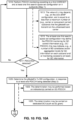
- FIG. 10 is split over FIGS. 10A and 10B , and is a logic flow diagram performed by a UE for wideband PDCCH for the unlicensed band and suitable for new radio, and illustrates the operation of an exemplary method or methods, a result of execution of computer program instructions embodied on a computer readable memory, functions performed by logic implemented in hardware, and/or interconnected means for performing functions in accordance with exemplary embodiments.
- the UE 110 is assumed to perform the blocks in FIG. 10 , e.g., under control at least in part by the WB PDCCH module 140.
- search space set configuration search space covers only one aggregation level. Search space set covers multiple aggregation levels, and PDCCH monitoring is configured per search space set.
- Blocks 1013 and 1015 are possible examples corresponding to block 1010, and individual ones or both of these may be used.
- the value of n may depend, e.g., on the UEs BWP configuration, and is equal to or less than the maximum number of subbands that the gNodeB can transmit on the unlicensed band carrier. Note that if UE supports also carrier aggregation, this can be seen as operation performed separately for each component carrier.
- the at least one first search space set configuration may define the PDCCH monitoring (at least) for group common control information such as GC-PDCCH.
- This may indicate, e.g., a number of BD candidates and/or aggregation levels for GC information (e.g., GC-PDCCH) on each subband. Alternatively or in addition, it may also indicate the monitoring occasions (at least) for GC information (e.g., GC-PDCCH). It should also be noted that GC control information may be GC-PDCCH, but also may be referred to using other terminology, such as group common downlink control information. It is possible for the subbands of the second control resource set to be next to each other, e.g., as shown in FIG. 9 , where the subbands 600-1 and 600-2 are next to each other.
- Step 1 shows the available control resources for the gNB
- Step 2 shows an actual transmission of GC-PDCCH.
- PDCCH monitoring relates to predefined DCI formats with predefined RNTIs. Put differently, the UE detects control information intended to the UE on the PDCCH resources, and if there is such information, there is a detection of PDCCH in block 1017 (and similarly in block 1039, described below). Since there is a PDCCH transmission in subband 600-1 (see Step 1 in FIG. 9 and the transmission in symbol 0), the flow proceeds to block 1020.
- Step 2 based on the PDCCH monitoring and in response to at least one PDCCH being detected (e.g., CRC positive), the UE determines the gNodeB's Tx BW configuration. That is, the UE determines the subbands that the gNodeB uses for transmission during a given COT. However, because of LBT failures, some of the subbands 600 cannot be used.
- the eNB 170 indicates that to the UE 170 via GC-PDCCH, in this example in symbol 0 of Step 2, the first CORESET configuration being confined on the first symbol of the (mini-)slot.
- the gNodeB 170 takes also symbol #1 into use in Step 2 for PDCCH CORESETs (to compensate for the subbands 0 and 3 that cannot be used due to failed LBT in those subbands).
- the UE initially attempts to receive PDCCH from all subbands in symbol 0 and discovers GC-PDCCH in subband 600-1.
- the GC-PDCCH in symbol 0 of the second subband 600-1 tells the UE that there are also additional CORESETs that the UE should monitor within symbol #1 (see Step 3).
- the Tx BW configuration covers the second and the third subbands 600-1 and 600-2, respectively, in the example of FIG. 9 .
- Blocks 1023 and 1025 are options corresponding to block 1020.
- the determination may be performed based on indication(s) carried on GC-PDCCH, which is illustrated in symbol 0 and subband 600-1 of Step 2 in FIG. 9 .
- the determination may be carried on dedicated DCI (such as a DL grant). This approach may be used, e.g., for UEs configured to narrowband operation.
- step 3 after determining the gNodeB's Tx BW configuration, the UE continues PDCCH monitoring, using the determined gNodeB's Tx BW configuration, e.g., according to a second CORESET configuration and at least one second search space set on m subbands, m ⁇ n.
- This second CORESET configuration indicates in this example that symbol 1 in subbands 600-1 and 600-2 contains CORESET and should be monitored. That is, the UE may assume CORESET/search space set configuration according to Step 3 for all PDCCH at least until the end of the COT. In other words, Step 1, Step 2 are carried out only when there is uncertainty with respect to TX BW of the gNB 170.
- Step 2 and Step 3 may alternatively be considered to be logical steps, which means that it is possible to run them also in parallel.
- Option 1 Step 1 and Step 2 are carried out for a first monitoring occasion.
- Step 3 is carried out for a second monitoring occasion.
- Option 2 Step 3 is carried out already for the first monitoring occasion.
- Blocks 1033, 1035, 1037, and 1038 are options corresponding to block 1030.
- the second CORESET may be a subset of the first CORESET, and is located on at least some of the active subbands (i.e., the m subbands) according to the gNodeB's Tx BW configuration.
- CCE indexing of the second CORESET may also depend on the gNodeB's Tx BW configuration.
- the second CORESET may include also control resources on additional symbol(s) (when compared to the first CORESET). This may be determined based on GC-PDCCH received according to the first CORESET and at least one first search space set configuration.
- the second CORESET contains one or more portions in frequency (i.e., m subbands) and one or two portions in time (symbols occupied by the first CORESET + additional symbols if configured).
- the at least one second search space configuration contains PDCCH monitoring for at least one UE-specific DCI.
- the configuration may also contain a new search space set configuration for GC-PDCCH.
- operation does not require that UE switches its BWP (including RF) to correspond to the (intersection of UE BWP and) gNB Tx BW. Instead, the UE 110 may keep its current BWP and corresponding RF BW. This is an important difference to Rel-15 BWP switching.
- One benefit of this is that there is no BWP switch transition time which may be in range of 600 ⁇ s - 1ms, i.e., in the order of few slots.
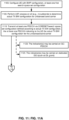
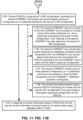
- FIG. 11 is a logic flow diagram performed by a gNB for wideband PDCCH for the unlicensed band and suitable for new radio.
- FIG. 11 is split over FIGS. 11A and 11B .
- This figure illustrates the operation of an exemplary method or methods, a result of execution of computer program instructions embodied on a computer readable memory, functions performed by logic implemented in hardware, and/or interconnected means for performing functions in accordance with exemplary embodiments.
- the blocks in FIG. 11 are assumed to be performed by a base station such as gNB 170, e.g., under control of the WB PDCCH module 150 at least in part.
- the gNB 170 is assumed, though other base stations (such as an eNB) or network nodes may be used.
- the gNB 170 configures the UE 110, e.g., with BWP configuration and the at least one first search space set configuration.
- the gNB 170 performs an LBT process on all (e.g., n) subbands to determine actual TX BW configuration for the unlicensed band carrier. This corresponds in part to Step 1 of FIG. 9 .
- the gNB 170 transmits at least one PDCCH via CORESET/search space set configuration defined according to actual TX BW configuration.
- the at least one PDCCH indicates to the UE the actual TX BW configuration for the unlicensed band carrier. This corresponds to Step 2 of FIG. 9 .
- Blocks 1123 and 1125 are examples of possible implementations of block 1110.
- the indication(s) may be carried on GC-PDCCH.
- the indication(s) may be carried on dedicated DCI (such as a DL grant).
- Block 1130 transmits at least one PDCCH, using actual Tx BW configuration, according to a second CORESET and at least one second search space set configuration on m subbands defined by the actual Tx BW configuration.
- Block 1130 corresponds to Step 3 in FIG. 9 .
- Blocks 1133, 1135, 1137, and 1138 are examples of possible implementations associated with block 1130.
- the second CORESET may be a subset of the first CORESET and is located on at least some of the active subbands according to the actual Tx BW configuration. CCE indexing of the second CORESET may also depend on the actual Tx BW configuration.
- Block 1135 indicates the second CORESET may include also control resources on additional symbol(s) (when compared to the 1st CORESET). This may be determined based on the transmitted GC-PDCCH according to the first CORESET and at least one first search space set configuration.
- Block 1137 indicates the second CORESET contains one or more portions in frequency (i.e. m subbands) and one or two portions in time (symbols occupied by the first CORESET + additional symbols if configured).
- the at least one second search space contains PDCCH monitoring for at least one UE-specific DCI.
- the configuration may also contain a new search space set configuration for GC-PDCCH.
- the gNB 170 in block 1140 in response to control information being in PDCCH for this UE, uses the control information to transmit data on (or receive data using) gNodeB's NR-U Tx BW for this UE. Note that the gNB 170 would put the control information into the PDCCH in block 1130.
- a technical effect and advantage of one or more of the example embodiments disclosed herein is a reasonable UE blind detection burden.
- Another technical effect and advantage of one or more of the example embodiments disclosed herein is more robust operation, e.g., compared to preamble-only based solutions (due to CRC protection). For instance, all UEs become aware of the gNB's Tx BW configuration already at the beginning of the COT.
- Another technical effect and advantage of one or more of the example embodiments disclosed herein is these solutions provide scalable control channel capacity for different scenarios with different amount of subbands obtained.
- Another technical effect and advantage of one or more of the example embodiments disclosed herein is the solutions can provide sufficient control channel capacity also in the scenarios where gNB's Tx BW convers only one or two subbands.
- Embodiments herein may be implemented in software (executed by one or more processors), hardware (e.g., an application specific integrated circuit), or a combination of software and hardware.
- the software e.g., application logic, an instruction set
- a "computer-readable medium” may be any media or means that can contain, store, communicate, propagate or transport the instructions for use by or in connection with an instruction execution system, apparatus, or device, such as a computer, with one example of a computer described and depicted, e.g., in FIG. 1 .
- a computer-readable medium may comprise a computer-readable storage medium (e.g., memories 125, 155, 171 or other device) that may be any media or means that can contain, store, and/or transport the instructions for use by or in connection with an instruction execution system, apparatus, or device, such as a computer.
- a computer-readable storage medium does not comprise propagating signals.
- the different functions discussed herein may be performed in a different order and/or concurrently with each other. Furthermore, if desired, one or more of the above-described functions may be optional or may be combined.
Landscapes
- Engineering & Computer Science (AREA)
- Signal Processing (AREA)
- Computer Networks & Wireless Communication (AREA)
- Quality & Reliability (AREA)
- Mobile Radio Communication Systems (AREA)
Claims (14)
- Verfahren, das Folgendes umfasst:Durchführen (1010) einer ersten Steuerkanalüberwachung durch eine Teilnehmereinrichtung (110) gemäß einem ersten Steuerressourcensatz und mindestens einer ersten Suchraumsatzauslegung, wobei die erste Steuerkanalüberwachung auf n Unterbändern, n>1, durchgeführt wird, die von einer Basisstation (170) in einem Träger eines nicht lizenzierten Bandes übertragen werden können;Bestimmen (1020) einer Übertragungsbandbreitenauslegung, die von der Basisstation (170) im Träger des nicht lizenzierten Bandes für Steuerkanäle zu verwenden ist, in Reaktion auf eine Detektion eines Steuerkanals bei der ersten Steuerkanalüberwachung und anhand des Steuerkanals, wobei das Bestimmen der Übertragungsbandbreitenauslegung, die von der Basisstation (170) im Träger des nicht lizenzierten Bandes für Steuerkanäle zu verwenden ist, auf Basis von einer oder mehreren Anzeigen, die im Steuerkanal zu einem gruppengemeinsamen physischen Downlinksteuerkanal übertragen werden und/oder einer oder mehreren Anzeigen, die im Steuerkanal zu dedizierten Downlinksteuerinformationen übertragen werden, durchgeführt wird; undDurchführen (1030) einer zweiten Steuerkanalüberwachung durch die Teilnehmereinrichtung (110) gemäß einem zweiten Steuerressourcensatz und mindestens einer zweiten Suchraumsatzauslegung, wobei die zweite Steuerkanalüberwachung an m Unterbändern, m≤n, im Träger des nicht lizenzierten Bandes durchgeführt wird, wobei die m Unterbänder ein Untersatz der n Unterbänder sind, wobei der zweite Steuerressourcensatz ein Untersatz des ersten Steuerressourcensatzes ist und sich mindestens auf einigen einer Vielzahl der m Unterbänder gemäß der bestimmten Übertragungsbandbreitenauslegung befindet, die von der Basisstation (170) im Träger des nicht lizenzierten Bandes für Steuerkanäle zu verwenden ist.
- Vorrichtung (110), die Mittel zum Durchführen von Folgendem umfasst:Durchführen einer ersten Steuerkanalüberwachung durch eine Teilnehmereinrichtung gemäß einem ersten Steuerressourcensatz und mindestens einer ersten Suchraumsatzauslegung, wobei die erste Steuerkanalüberwachung auf n Unterbändern, n>1, durchgeführt wird, die von einer Basisstation in einem Träger eines nicht lizenzierten Bandes übertragen werden können;Bestimmen einer Übertragungsbandbreitenauslegung, die von der Basisstation im Träger des nicht lizenzierten Band für Steuerkanäle zu verwenden ist, in Reaktion auf eine Detektion eines Steuerkanals bei der ersten Steuerkanalüberwachung und anhand des Steuerkanals, wobei das Bestimmen der Übertragungsbandbreitenauslegung, die von der Basisstation (170) im Träger des nicht lizenzierten Bandes für Steuerkanäle zu verwenden ist, auf Basis von einer oder mehreren Anzeigen, die im Steuerkanal zu einem gruppengemeinsamen physischen Downlinksteuerkanal übertragen werden und/oder einer oder mehreren Anzeigen, die im Steuerkanal zu dedizierten Downlinksteuerinformationen übertragen werden, durchgeführt wird; undDurchführen einer zweiten Steuerkanalüberwachung durch die Teilnehmereinrichtung gemäß einem zweiten Steuerressourcensatz und mindestens einer zweiten Suchraumsatzauslegung, wobei die zweite Steuerkanalüberwachung an m Unterbändern, m≤n, im Träger des nicht lizenzierten Bandes durchgeführt wird, wobei die m Unterbänder ein Untersatz der n Unterbänder sind, wobei der zweite Steuerressourcensatz ein Untersatz des ersten Steuerressourcensatzes ist und sich mindestens auf einigen einer Vielzahl der m Unterbänder gemäß der bestimmten Übertragungsbandbreitenauslegung befindet, die von der Basisstation (170) im Träger des nicht lizenzierten Bandes für Steuerkanäle zu verwenden ist.
- Vorrichtung (110) nach Anspruch 2, wobei der erste Steuerressourcensatz und mindestens eine erste Suchraumsatzauslegung mindestens in jedem Unterband der n Unterbänder einen Blinddecodierungskandidaten enthält.
- Vorrichtung (110) nach einem der Ansprüche 2 oder 3, wobei eine Anzahl der n Unterbänder von einer Bandbreitenteilauslegung der Teilnehmereinrichtung abhängig ist und gleich oder kleiner als eine maximale Anzahl von Unterbändern ist, die die Basisstation im Träger des nicht lizenzierten Bandes übertragen kann.
- Vorrichtung (110) nach einem der Ansprüche 2 oder 4, wobei die mindestens eine erste Suchraumsatzauslegung die Steuerkanalüberwachung für gruppengemeinsame Steuerinformationen definiert, und mindestens eine erste Suchraumsatzauslegung eines oder mehreres von Folgendem anzeigt: eine Anzahl von Blinddecodierungskandidaten für die gruppengemeinsamen Steuerinformationen; Aggregationsniveaus für die gruppengemeinsamen Steuerinformationen auf jedem der n Unterbänder und Überwachungsgelegenheiten für die gruppengemeinsamen Steuerinformationen.
- Vorrichtung (110) nach einem der Ansprüche 2 bis 5, wobei Unterbänder des zweiten Steuerressourcensatzes nebeneinander liegen.
- Vorrichtung (110) nach einem der Ansprüche 2 bis 6, wobei der zweite Steuerressourcensatz verglichen mit dem ersten Steuerressourcensatz auch Steuerressourcen auf einem oder mehreren zusätzlichen Symbolen beinhaltet.
- Vorrichtung (110) nach einem der Ansprüche 2 bis 7, wobei der zweite Steuerressourcensatz einen oder mehrere Frequenzabschnitte als die m Unterbänder und einen oder mehrere Zeitabschnitte, die Symbole, die vom ersten Steuerressourcensatz belegt sind, und zusätzliche Symbole beinhalten, umfasst.
- Vorrichtung (110) nach einem der Ansprüche 2 bis 8, wobei mindestens ein zweiter Suchraumsatz eine Steuerkanalüberwachung für mindestens eine teilnehmereinrichtungsspezifische Downlinksteuerinformation enthält.
- Vorrichtung (110) nach Anspruch 9, wobei der mindestens eine zweite Suchraum auch eine neue Suchraumsatzauslegung für einen gruppengemeinsamen physischen Downlinksteuerkanal enthält.
- Vorrichtung (110) nach einem der Ansprüche 2 bis 10, wobei die Mittel ferner dazu ausgelegt sind, Folgendes durchzuführen: Bestimmen, ob sich Auslegungsinformationen in einem Steuerkanal für die zweite Steuerkanalüberwachung befinden, und, wenn ja, Verwenden der Auslegungsinformationen, um unter Verwendung des Trägers des nicht lizenzierten Bandes Daten von einer Basisstation zu empfangen oder Daten zur Basisstation (170) zu übertragen.
- Verfahren, das Folgendes umfasst:Übertragen (1110) von mindestens einem Steuerkanal durch eine Basisstation (170), die auf n Unterbändern, n>1, für einen Träger eines nicht lizenzierten Bandes und zu einer Teilnehmereinrichtung (110), und via einen ersten Steuerressourcensatz und eine Suchraumsatzauslegung, die gemäß einer tatsächlichen Übertragungsbandbreitenauslegung für den Träger des nicht lizenzierten Bandes für die Basisstation definiert ist, übertragen kann, wobei der mindestens eine Steuerkanal der Teilnehmereinrichtung (110) die tatsächliche Übertragungsbandbreitenauslegung für den Träger des nicht lizenzierten Bandes für die Basisstation anzeigt, wobei eine oder mehrere Anzeigen der tatsächlichen Übertragungsbandbreitenauslegung für den Träger des nicht lizenzierten Bandes für die Basisstation in dem mindestens einen Steuerkanal auf einem gruppengemeinsamen physischen Downlinksteuerkanal übertragen werden, und/oder eine oder mehrere Anzeigen, die im Steuerkanal zu dedizierten Downlinksteuerinformationen übertragen werden; undÜbertragen (1130) eines Steuerkanals durch die Basisstation (170) unter Verwendung der tatsächlichen Übertragungsbandbreitenauslegung für den Träger des nicht lizenzierten Bandes für die Basisstation gemäß einem zweiten Steuerressourcensatz und mindestens einem zweiten Suchraumsatz auf einem oder mehreren Unterbändern, die durch die tatsächliche Übertragungsbandbreitenauslegung definiert sind, wobei das eine oder die mehreren Unterbänder m Unterbänder sind, m≤n, wobei der zweite Steuerressourcensatz ein Untersatz des ersten Steuerressourcensatzes ist und sich gemäß der Übertragungsbandbreitenauslegung für den Träger des nicht lizenzierten Bandes für die Basisstation in mindestens einigen einer Vielzahl der m Unterbänder befindet.
- Vorrichtung (170), die Mittel zum Durchführen von Folgendem umfasst:Übertragen von mindestens einem Steuerkanal durch eine Basisstation, die auf n Unterbändern, n>1, für einen Träger eines nicht lizenzierten Bandes und zu einer Teilnehmereinrichtung (110), und via einen ersten Steuerressourcensatz und eine Suchraumsatzauslegung, die gemäß einer tatsächlichen Übertragungsbandbreitenauslegung für den Träger des nicht lizenzierten Bandes für die Basisstation definiert ist, übertragen kann, wobei der mindestens eine Steuerkanal der Teilnehmereinrichtung (110) die tatsächliche Übertragungsbandbreitenauslegung für den Träger des nicht lizenzierten Bandes für die Basisstation anzeigt, wobei eine oder mehrere Anzeigen der tatsächlichen Übertragungsbandbreitenauslegung für den Träger des nicht lizenzierten Bandes für die Basisstation in dem mindestens einen Steuerkanal auf einem gruppengemeinsamen physischen Downlinksteuerkanal übertragen werden, und/oder eine oder mehrere Anzeigen, die im Steuerkanal zu dedizierten Downlinksteuerinformationen übertragen werden; undÜbertragen eines Steuerkanals durch die Basisstation unter Verwendung der tatsächlichen Übertragungsbandbreitenauslegung für den Träger des nicht lizenzierten Bandes für die Basisstation gemäß einem zweiten Steuerressourcensatz und mindestens einem zweiten Suchraumsatz auf einem oder mehreren Unterbändern, die durch die tatsächliche Übertragungsbandbreitenauslegung definiert sind, wobei das eine oder die mehreren Unterbänder m Unterbänder sind, m≤n, wobei der zweite Steuerressourcensatz ein Untersatz des ersten Steuerressourcensatzes ist und sich gemäß der Übertragungsbandbreitenauslegung für den Träger des nicht lizenzierten Bandes für die Basisstation in mindestens einigen einer Vielzahl der m Unterbänder befindet.
- Computerprogrammprodukt, das eine oder mehrere Computerprogrammanweisungen beinhaltet, die, wenn sie auf einem Computer ausgeführt werden, dazu ausgelegt sind, das Verfahren nach Anspruch 1 oder 12 umzusetzen.
Applications Claiming Priority (1)
| Application Number | Priority Date | Filing Date | Title |
|---|---|---|---|
| PCT/FI2018/050249 WO2019193238A1 (en) | 2018-04-06 | 2018-04-06 | Wideband pdcch for unlicensed band useful for new radio |
Publications (3)
| Publication Number | Publication Date |
|---|---|
| EP3777284A1 EP3777284A1 (de) | 2021-02-17 |
| EP3777284A4 EP3777284A4 (de) | 2021-11-17 |
| EP3777284B1 true EP3777284B1 (de) | 2024-12-04 |
Family
ID=68100126
Family Applications (1)
| Application Number | Title | Priority Date | Filing Date |
|---|---|---|---|
| EP18913644.3A Active EP3777284B1 (de) | 2018-04-06 | 2018-04-06 | Breitbandiger pdcch für unlizenziertes band für new radio |
Country Status (4)
| Country | Link |
|---|---|
| US (1) | US11540152B2 (de) |
| EP (1) | EP3777284B1 (de) |
| CN (1) | CN112189353B (de) |
| WO (1) | WO2019193238A1 (de) |
Families Citing this family (31)
| Publication number | Priority date | Publication date | Assignee | Title |
|---|---|---|---|---|
| CN107005960B (zh) | 2014-09-24 | 2020-07-07 | 交互数字专利控股公司 | 用于无授权频段中的lte操作的信道使用指示和同步 |
| US11039429B2 (en) * | 2018-04-04 | 2021-06-15 | Huawei Technologies Co., Ltd. | Method and apparatus for downlink control information communication and interpretation |
| WO2019217852A1 (en) | 2018-05-10 | 2019-11-14 | Convida Wireless, Llc | Channel access indication for spectral reuse, power savings and coexistence |
| CN115665873A (zh) * | 2018-06-11 | 2023-01-31 | 上海朗帛通信技术有限公司 | 一种被用于无线通信的用户设备、基站中的方法和装置 |
| CN112640547B (zh) * | 2018-06-12 | 2024-02-13 | 株式会社Ntt都科摩 | 终端、无线通信方法、基站以及系统 |
| US12273923B2 (en) * | 2018-06-19 | 2025-04-08 | Interdigital Patent Holdings, Inc. | Methods, apparatus and systems for system access in unlicensed spectrum |
| AU2019290737B2 (en) * | 2018-06-21 | 2024-05-09 | Guangdong Oppo Mobile Telecommunications Corp., Ltd. | Bandwidth part processing method, terminal device and network device |
| US11184776B2 (en) | 2018-07-16 | 2021-11-23 | Kt Corporation | Method and apparatus for performing wireless communication in unlicensed band |
| EP3651525B1 (de) * | 2018-08-03 | 2021-11-24 | LG Electronics Inc. | Verfahren zum konfigurieren eines referenzpunktes unabhängig von einem gemeinsamen ressourcenblockraster und vorrichtung dafür |
| GB2577510B (en) * | 2018-09-26 | 2021-04-14 | Tcl Communication Ltd | Flexible NR-U wideband operation |
| CN113170479B (zh) | 2018-09-27 | 2024-06-21 | 上海诺基亚贝尔股份有限公司 | 非许可子带的下行链路控制 |
| US11223532B2 (en) * | 2018-10-05 | 2022-01-11 | Qualcomm Incorporated | Subband usage dependent downlink signals and channels |
| CN113472510B (zh) * | 2018-10-30 | 2024-05-14 | 北京小米移动软件有限公司 | 下行控制信息接收方法、装置及存储介质 |
| WO2020091574A1 (ko) * | 2018-11-02 | 2020-05-07 | 엘지전자 주식회사 | 무선 통신 시스템에서 무선 신호 송수신 방법 및 장치 |
| DE112019005481T5 (de) * | 2018-11-02 | 2021-08-12 | Lg Electronics Inc. | Verfahren und vorrichtung für drahtlossignalübertragung oder -empfang in einem drahtloskommunikationssystem |
| CN118574128A (zh) * | 2018-11-02 | 2024-08-30 | 韦勒斯标准与技术协会公司 | 基于未授权频带的带宽部分(bwp)发送和接收物理信道和信号的方法及使用该方法的设备 |
| US11115110B2 (en) * | 2018-12-14 | 2021-09-07 | Qualcomm Incorporated | Default beam selection based on a subset of coresets |
| CN118828949A (zh) * | 2018-12-18 | 2024-10-22 | 谷歌有限责任公司 | 一种未授权带宽部分中的资源分配方法和设备 |
| CN118612881A (zh) | 2019-01-09 | 2024-09-06 | 韦勒斯标准与技术协会公司 | 在未授权频带中执行传输的信道接入方法及使用其的设备 |
| EP3917193A4 (de) * | 2019-01-23 | 2022-10-19 | Ntt Docomo, Inc. | Übertragungsvorrichtung und drahtloskommunikationsverfahren |
| CN113475032B (zh) * | 2019-02-13 | 2024-06-14 | 交互数字专利控股公司 | 在nr-u中接收控制信息 |
| US11546897B2 (en) * | 2019-03-28 | 2023-01-03 | Mediatek Inc. | Control information for wideband operation |
| WO2020204506A1 (en) * | 2019-03-29 | 2020-10-08 | Samsung Electronics Co., Ltd. | Method and apparatus for transmitting and receiving control channel in wireless communication system |
| EP4005131B1 (de) * | 2019-07-23 | 2024-12-18 | Fraunhofer-Gesellschaft zur Förderung der angewandten Forschung e.V. | Coreset-gruppierung |
| US20210022181A1 (en) * | 2019-10-07 | 2021-01-21 | Yongjun KWAK | Mechanisms to operate downlink wideband carrier in unlicensed band |
| US20210058970A1 (en) * | 2019-11-08 | 2021-02-25 | Intel Corporation | Mechanisms to operate on a downlink wideband carrier in unlicensed band |
| CN114651500B (zh) | 2019-11-20 | 2026-02-10 | 高通股份有限公司 | 管理控制信道监测 |
| US12369189B2 (en) | 2020-02-28 | 2025-07-22 | Qualcomm Incorporated | Listen before talk techniques for wireless communications systems |
| WO2021184334A1 (en) * | 2020-03-20 | 2021-09-23 | Qualcomm Incorporated | Low complexity physical downlink control channel |
| CN113632522A (zh) * | 2021-07-07 | 2021-11-09 | 北京小米移动软件有限公司 | 一种监测方法、监测装置及存储介质 |
| CN116367327B (zh) * | 2021-12-23 | 2025-07-25 | 维沃移动通信有限公司 | 通信资源确定方法、终端及网络侧设备 |
Family Cites Families (14)
| Publication number | Priority date | Publication date | Assignee | Title |
|---|---|---|---|---|
| US9693264B2 (en) | 2011-04-18 | 2017-06-27 | Lg Electronics Inc. | Signal transmission method and device in a wireless communication system |
| US10079658B2 (en) * | 2011-11-04 | 2018-09-18 | Qualcomm Incorporated | Search space design for e-PDCCH in wireless communication networks |
| WO2014087148A1 (en) * | 2012-12-03 | 2014-06-12 | Sony Corporation | Group based pdcch capability for lte |
| US9647864B2 (en) | 2015-04-10 | 2017-05-09 | Motorola Mobility Llc | Method and apparatus for reception of control signaling |
| US10582524B2 (en) | 2015-08-21 | 2020-03-03 | Lg Electronics Inc. | Method for transmitting and receiving channel state information in wireless communication system and apparatus therefor |
| WO2018019085A1 (en) * | 2016-07-29 | 2018-02-01 | Huawei Technologies Co., Ltd. | Coexistence of grant-based and grant-free uplink transmissions in a channel |
| US20180035459A1 (en) * | 2016-07-29 | 2018-02-01 | Huawei Technologies Co., Ltd. | Coexistence of Grant-Based and Grant-Free Uplink Transmissions in a Channel |
| EP4447374B1 (de) | 2016-08-10 | 2026-02-25 | InterDigital Patent Holdings, Inc. | Suchraumüberwachung in drahtlosen netzwerken |
| WO2018031623A1 (en) * | 2016-08-11 | 2018-02-15 | Intel Corporation | Flexible transmission time interval and on slot aggregation for data transmission for new radio |
| US10631178B2 (en) * | 2017-02-06 | 2020-04-21 | Qualcomm Incorporated | Control resource set group design for improved communications devices, systems, and networks |
| CN110679095B (zh) * | 2017-06-14 | 2023-06-27 | 索尼公司 | 确定是否提供csi报告的装置和方法 |
| US11206655B2 (en) * | 2017-08-11 | 2021-12-21 | Electronics And Telecommunications Research Institute | Method for transmitting or receiving downlink control channel and device using same |
| CN107659994A (zh) * | 2017-09-05 | 2018-02-02 | 宇龙计算机通信科技(深圳)有限公司 | 资源指示方法、相关设备及通信系统 |
| US11160050B2 (en) * | 2018-03-28 | 2021-10-26 | Samsung Electronics Co., Ltd. | Method and apparatus for supporting large subcarrier spacing for SS/PBCH block |
-
2018
- 2018-04-06 EP EP18913644.3A patent/EP3777284B1/de active Active
- 2018-04-06 CN CN201880093731.1A patent/CN112189353B/zh active Active
- 2018-04-06 WO PCT/FI2018/050249 patent/WO2019193238A1/en not_active Ceased
- 2018-04-06 US US17/041,575 patent/US11540152B2/en active Active
Also Published As
| Publication number | Publication date |
|---|---|
| CN112189353B (zh) | 2024-08-09 |
| US20210092622A1 (en) | 2021-03-25 |
| EP3777284A4 (de) | 2021-11-17 |
| CN112189353A (zh) | 2021-01-05 |
| US11540152B2 (en) | 2022-12-27 |
| WO2019193238A1 (en) | 2019-10-10 |
| EP3777284A1 (de) | 2021-02-17 |
Similar Documents
| Publication | Publication Date | Title |
|---|---|---|
| EP3777284B1 (de) | Breitbandiger pdcch für unlizenziertes band für new radio | |
| US12500724B2 (en) | Methods and apparatuses for transmitting control information | |
| US12126573B2 (en) | Signal transmission method, related device, and system | |
| JP7181909B2 (ja) | 無線システムにおける信号伝達構成 | |
| RU2703448C1 (ru) | Конфигурация srs для нелицензированных несущих | |
| US11019499B2 (en) | Signal transmission apparatus and method, and wireless access node | |
| US8837422B2 (en) | Low-cost LTE system with distributed carrier aggregation on the unlicensed band | |
| US11856562B2 (en) | Terminal, apparatus, and system | |
| US9319202B2 (en) | System and method for carrier aggregation for wireless local area networks | |
| US20200068610A1 (en) | Resource scheduling method, network device, and communications device | |
| RU2634922C2 (ru) | Устройство и способ передачи данных | |
| CA3148156A1 (en) | Method for indicating control information and apparatus | |
| US20220110118A1 (en) | Control channel transmission method and apparatus, and storage medium | |
| US10257736B2 (en) | Method and apparatus for performing RRM measurements in unlicensed band in wireless communication system | |
| US20200404699A1 (en) | Control channel position determining method, device, and processor-readable storage medium | |
| WO2019216910A1 (en) | Wideband nr-u operation compatible with narrowband interlace structures | |
| US12464369B2 (en) | Adaptively configuring guard bands of a communications channel of a user equipment | |
| CN117730608A (zh) | 高效的多小区调度机制 | |
| WO2020065124A1 (en) | Burst detection in wireless communications | |
| JP7639831B2 (ja) | 端末、通信システム及び通信方法 | |
| KR20240158687A (ko) | 하향링크 채널을 수신하는 방법, 사용자기 및 저장매체, 그리고 하향링크 채널을 전송하는 방법 및 기지국 |
Legal Events
| Date | Code | Title | Description |
|---|---|---|---|
| STAA | Information on the status of an ep patent application or granted ep patent |
Free format text: STATUS: THE INTERNATIONAL PUBLICATION HAS BEEN MADE |
|
| PUAI | Public reference made under article 153(3) epc to a published international application that has entered the european phase |
Free format text: ORIGINAL CODE: 0009012 |
|
| STAA | Information on the status of an ep patent application or granted ep patent |
Free format text: STATUS: REQUEST FOR EXAMINATION WAS MADE |
|
| 17P | Request for examination filed |
Effective date: 20201106 |
|
| AK | Designated contracting states |
Kind code of ref document: A1 Designated state(s): AL AT BE BG CH CY CZ DE DK EE ES FI FR GB GR HR HU IE IS IT LI LT LU LV MC MK MT NL NO PL PT RO RS SE SI SK SM TR |
|
| AX | Request for extension of the european patent |
Extension state: BA ME |
|
| DAV | Request for validation of the european patent (deleted) | ||
| DAX | Request for extension of the european patent (deleted) | ||
| A4 | Supplementary search report drawn up and despatched |
Effective date: 20211019 |
|
| RIC1 | Information provided on ipc code assigned before grant |
Ipc: H04L 27/00 20060101ALN20211013BHEP Ipc: H04L 5/00 20060101ALI20211013BHEP Ipc: H04W 16/14 20090101AFI20211013BHEP |
|
| STAA | Information on the status of an ep patent application or granted ep patent |
Free format text: STATUS: EXAMINATION IS IN PROGRESS |
|
| 17Q | First examination report despatched |
Effective date: 20221108 |
|
| GRAP | Despatch of communication of intention to grant a patent |
Free format text: ORIGINAL CODE: EPIDOSNIGR1 |
|
| STAA | Information on the status of an ep patent application or granted ep patent |
Free format text: STATUS: GRANT OF PATENT IS INTENDED |
|
| RIC1 | Information provided on ipc code assigned before grant |
Ipc: H04L 27/00 20060101ALN20240530BHEP Ipc: H04L 5/00 20060101ALI20240530BHEP Ipc: H04W 16/14 20090101AFI20240530BHEP |
|
| INTG | Intention to grant announced |
Effective date: 20240702 |
|
| GRAJ | Information related to disapproval of communication of intention to grant by the applicant or resumption of examination proceedings by the epo deleted |
Free format text: ORIGINAL CODE: EPIDOSDIGR1 |
|
| STAA | Information on the status of an ep patent application or granted ep patent |
Free format text: STATUS: EXAMINATION IS IN PROGRESS |
|
| GRAP | Despatch of communication of intention to grant a patent |
Free format text: ORIGINAL CODE: EPIDOSNIGR1 |
|
| STAA | Information on the status of an ep patent application or granted ep patent |
Free format text: STATUS: GRANT OF PATENT IS INTENDED |
|
| INTC | Intention to grant announced (deleted) | ||
| RIC1 | Information provided on ipc code assigned before grant |
Ipc: H04L 27/00 20060101ALN20240917BHEP Ipc: H04L 5/00 20060101ALI20240917BHEP Ipc: H04W 16/14 20090101AFI20240917BHEP |
|
| GRAS | Grant fee paid |
Free format text: ORIGINAL CODE: EPIDOSNIGR3 |
|
| GRAA | (expected) grant |
Free format text: ORIGINAL CODE: 0009210 |
|
| STAA | Information on the status of an ep patent application or granted ep patent |
Free format text: STATUS: THE PATENT HAS BEEN GRANTED |
|
| INTG | Intention to grant announced |
Effective date: 20241009 |
|
| RIC1 | Information provided on ipc code assigned before grant |
Ipc: H04L 27/00 20060101ALN20241004BHEP Ipc: H04L 5/00 20060101ALI20241004BHEP Ipc: H04W 16/14 20090101AFI20241004BHEP |
|
| AK | Designated contracting states |
Kind code of ref document: B1 Designated state(s): AL AT BE BG CH CY CZ DE DK EE ES FI FR GB GR HR HU IE IS IT LI LT LU LV MC MK MT NL NO PL PT RO RS SE SI SK SM TR |
|
| REG | Reference to a national code |
Ref country code: GB Ref legal event code: FG4D |
|
| REG | Reference to a national code |
Ref country code: CH Ref legal event code: EP |
|
| REG | Reference to a national code |
Ref country code: DE Ref legal event code: R096 Ref document number: 602018077400 Country of ref document: DE |
|
| REG | Reference to a national code |
Ref country code: IE Ref legal event code: FG4D |
|
| REG | Reference to a national code |
Ref country code: LT Ref legal event code: MG9D |
|
| REG | Reference to a national code |
Ref country code: NL Ref legal event code: MP Effective date: 20241204 |
|
| PG25 | Lapsed in a contracting state [announced via postgrant information from national office to epo] |
Ref country code: HR Free format text: LAPSE BECAUSE OF FAILURE TO SUBMIT A TRANSLATION OF THE DESCRIPTION OR TO PAY THE FEE WITHIN THE PRESCRIBED TIME-LIMIT Effective date: 20241204 |
|
| PG25 | Lapsed in a contracting state [announced via postgrant information from national office to epo] |
Ref country code: FI Free format text: LAPSE BECAUSE OF FAILURE TO SUBMIT A TRANSLATION OF THE DESCRIPTION OR TO PAY THE FEE WITHIN THE PRESCRIBED TIME-LIMIT Effective date: 20241204 |
|
| PG25 | Lapsed in a contracting state [announced via postgrant information from national office to epo] |
Ref country code: BG Free format text: LAPSE BECAUSE OF FAILURE TO SUBMIT A TRANSLATION OF THE DESCRIPTION OR TO PAY THE FEE WITHIN THE PRESCRIBED TIME-LIMIT Effective date: 20241204 |
|
| PG25 | Lapsed in a contracting state [announced via postgrant information from national office to epo] |
Ref country code: ES Free format text: LAPSE BECAUSE OF FAILURE TO SUBMIT A TRANSLATION OF THE DESCRIPTION OR TO PAY THE FEE WITHIN THE PRESCRIBED TIME-LIMIT Effective date: 20241204 |
|
| PG25 | Lapsed in a contracting state [announced via postgrant information from national office to epo] |
Ref country code: NO Free format text: LAPSE BECAUSE OF FAILURE TO SUBMIT A TRANSLATION OF THE DESCRIPTION OR TO PAY THE FEE WITHIN THE PRESCRIBED TIME-LIMIT Effective date: 20250304 |
|
| PG25 | Lapsed in a contracting state [announced via postgrant information from national office to epo] |
Ref country code: GR Free format text: LAPSE BECAUSE OF FAILURE TO SUBMIT A TRANSLATION OF THE DESCRIPTION OR TO PAY THE FEE WITHIN THE PRESCRIBED TIME-LIMIT Effective date: 20250305 Ref country code: LV Free format text: LAPSE BECAUSE OF FAILURE TO SUBMIT A TRANSLATION OF THE DESCRIPTION OR TO PAY THE FEE WITHIN THE PRESCRIBED TIME-LIMIT Effective date: 20241204 |
|
| PG25 | Lapsed in a contracting state [announced via postgrant information from national office to epo] |
Ref country code: RS Free format text: LAPSE BECAUSE OF FAILURE TO SUBMIT A TRANSLATION OF THE DESCRIPTION OR TO PAY THE FEE WITHIN THE PRESCRIBED TIME-LIMIT Effective date: 20250304 |
|
| PG25 | Lapsed in a contracting state [announced via postgrant information from national office to epo] |
Ref country code: NL Free format text: LAPSE BECAUSE OF FAILURE TO SUBMIT A TRANSLATION OF THE DESCRIPTION OR TO PAY THE FEE WITHIN THE PRESCRIBED TIME-LIMIT Effective date: 20241204 |
|
| REG | Reference to a national code |
Ref country code: AT Ref legal event code: MK05 Ref document number: 1749452 Country of ref document: AT Kind code of ref document: T Effective date: 20241204 |
|
| PG25 | Lapsed in a contracting state [announced via postgrant information from national office to epo] |
Ref country code: SM Free format text: LAPSE BECAUSE OF FAILURE TO SUBMIT A TRANSLATION OF THE DESCRIPTION OR TO PAY THE FEE WITHIN THE PRESCRIBED TIME-LIMIT Effective date: 20241204 |
|
| PG25 | Lapsed in a contracting state [announced via postgrant information from national office to epo] |
Ref country code: PL Free format text: LAPSE BECAUSE OF FAILURE TO SUBMIT A TRANSLATION OF THE DESCRIPTION OR TO PAY THE FEE WITHIN THE PRESCRIBED TIME-LIMIT Effective date: 20241204 |
|
| PGFP | Annual fee paid to national office [announced via postgrant information from national office to epo] |
Ref country code: DE Payment date: 20250305 Year of fee payment: 8 |
|
| PG25 | Lapsed in a contracting state [announced via postgrant information from national office to epo] |
Ref country code: IS Free format text: LAPSE BECAUSE OF FAILURE TO SUBMIT A TRANSLATION OF THE DESCRIPTION OR TO PAY THE FEE WITHIN THE PRESCRIBED TIME-LIMIT Effective date: 20250404 |
|
| PG25 | Lapsed in a contracting state [announced via postgrant information from national office to epo] |
Ref country code: PT Free format text: LAPSE BECAUSE OF FAILURE TO SUBMIT A TRANSLATION OF THE DESCRIPTION OR TO PAY THE FEE WITHIN THE PRESCRIBED TIME-LIMIT Effective date: 20250404 |
|
| PG25 | Lapsed in a contracting state [announced via postgrant information from national office to epo] |
Ref country code: EE Free format text: LAPSE BECAUSE OF FAILURE TO SUBMIT A TRANSLATION OF THE DESCRIPTION OR TO PAY THE FEE WITHIN THE PRESCRIBED TIME-LIMIT Effective date: 20241204 |
|
| PG25 | Lapsed in a contracting state [announced via postgrant information from national office to epo] |
Ref country code: RO Free format text: LAPSE BECAUSE OF FAILURE TO SUBMIT A TRANSLATION OF THE DESCRIPTION OR TO PAY THE FEE WITHIN THE PRESCRIBED TIME-LIMIT Effective date: 20241204 Ref country code: AT Free format text: LAPSE BECAUSE OF FAILURE TO SUBMIT A TRANSLATION OF THE DESCRIPTION OR TO PAY THE FEE WITHIN THE PRESCRIBED TIME-LIMIT Effective date: 20241204 |
|
| PG25 | Lapsed in a contracting state [announced via postgrant information from national office to epo] |
Ref country code: SK Free format text: LAPSE BECAUSE OF FAILURE TO SUBMIT A TRANSLATION OF THE DESCRIPTION OR TO PAY THE FEE WITHIN THE PRESCRIBED TIME-LIMIT Effective date: 20241204 |
|
| PG25 | Lapsed in a contracting state [announced via postgrant information from national office to epo] |
Ref country code: CZ Free format text: LAPSE BECAUSE OF FAILURE TO SUBMIT A TRANSLATION OF THE DESCRIPTION OR TO PAY THE FEE WITHIN THE PRESCRIBED TIME-LIMIT Effective date: 20241204 |
|
| PG25 | Lapsed in a contracting state [announced via postgrant information from national office to epo] |
Ref country code: IT Free format text: LAPSE BECAUSE OF FAILURE TO SUBMIT A TRANSLATION OF THE DESCRIPTION OR TO PAY THE FEE WITHIN THE PRESCRIBED TIME-LIMIT Effective date: 20241204 |
|
| REG | Reference to a national code |
Ref country code: DE Ref legal event code: R097 Ref document number: 602018077400 Country of ref document: DE |
|
| PG25 | Lapsed in a contracting state [announced via postgrant information from national office to epo] |
Ref country code: SE Free format text: LAPSE BECAUSE OF FAILURE TO SUBMIT A TRANSLATION OF THE DESCRIPTION OR TO PAY THE FEE WITHIN THE PRESCRIBED TIME-LIMIT Effective date: 20241204 |
|
| PG25 | Lapsed in a contracting state [announced via postgrant information from national office to epo] |
Ref country code: DK Free format text: LAPSE BECAUSE OF FAILURE TO SUBMIT A TRANSLATION OF THE DESCRIPTION OR TO PAY THE FEE WITHIN THE PRESCRIBED TIME-LIMIT Effective date: 20241204 |
|
| PLBE | No opposition filed within time limit |
Free format text: ORIGINAL CODE: 0009261 |
|
| STAA | Information on the status of an ep patent application or granted ep patent |
Free format text: STATUS: NO OPPOSITION FILED WITHIN TIME LIMIT |
|
| REG | Reference to a national code |
Ref country code: CH Ref legal event code: L10 Free format text: ST27 STATUS EVENT CODE: U-0-0-L10-L00 (AS PROVIDED BY THE NATIONAL OFFICE) Effective date: 20251015 |
|
| 26N | No opposition filed |
Effective date: 20250905 |
|
| REG | Reference to a national code |
Ref country code: CH Ref legal event code: H13 Free format text: ST27 STATUS EVENT CODE: U-0-0-H10-H13 (AS PROVIDED BY THE NATIONAL OFFICE) Effective date: 20251125 |
|
| PG25 | Lapsed in a contracting state [announced via postgrant information from national office to epo] |
Ref country code: LU Free format text: LAPSE BECAUSE OF NON-PAYMENT OF DUE FEES Effective date: 20250406 |
|
| PG25 | Lapsed in a contracting state [announced via postgrant information from national office to epo] |
Ref country code: MC Free format text: LAPSE BECAUSE OF FAILURE TO SUBMIT A TRANSLATION OF THE DESCRIPTION OR TO PAY THE FEE WITHIN THE PRESCRIBED TIME-LIMIT Effective date: 20241204 |
|
| REG | Reference to a national code |
Ref country code: BE Ref legal event code: MM Effective date: 20250430 |
|
| PG25 | Lapsed in a contracting state [announced via postgrant information from national office to epo] |
Ref country code: BE Free format text: LAPSE BECAUSE OF NON-PAYMENT OF DUE FEES Effective date: 20250430 |
|
| PG25 | Lapsed in a contracting state [announced via postgrant information from national office to epo] |
Ref country code: CH Free format text: LAPSE BECAUSE OF NON-PAYMENT OF DUE FEES Effective date: 20250430 |
|
| PGFP | Annual fee paid to national office [announced via postgrant information from national office to epo] |
Ref country code: GB Payment date: 20260312 Year of fee payment: 9 |
|
| PG25 | Lapsed in a contracting state [announced via postgrant information from national office to epo] |
Ref country code: IE Free format text: LAPSE BECAUSE OF NON-PAYMENT OF DUE FEES Effective date: 20250406 |
|
| PGFP | Annual fee paid to national office [announced via postgrant information from national office to epo] |
Ref country code: FR Payment date: 20260309 Year of fee payment: 9 |