EP3772665A1 - Verfahren und vorrichtungen mit verwendung von effektiven elastischen parameterwerten für anisotrope medien - Google Patents
Verfahren und vorrichtungen mit verwendung von effektiven elastischen parameterwerten für anisotrope medien Download PDFInfo
- Publication number
- EP3772665A1 EP3772665A1 EP20305752.6A EP20305752A EP3772665A1 EP 3772665 A1 EP3772665 A1 EP 3772665A1 EP 20305752 A EP20305752 A EP 20305752A EP 3772665 A1 EP3772665 A1 EP 3772665A1
- Authority
- EP
- European Patent Office
- Prior art keywords
- isotropic
- seismic
- elastic parameter
- parameter values
- eff
- Prior art date
- Legal status (The legal status is an assumption and is not a legal conclusion. Google has not performed a legal analysis and makes no representation as to the accuracy of the status listed.)
- Pending
Links
- 238000000034 method Methods 0.000 title claims abstract description 107
- 230000015572 biosynthetic process Effects 0.000 claims abstract description 41
- 238000012545 processing Methods 0.000 claims abstract description 36
- 238000004458 analytical method Methods 0.000 claims description 23
- 239000004215 Carbon black (E152) Substances 0.000 claims description 11
- 229930195733 hydrocarbon Natural products 0.000 claims description 11
- 150000002430 hydrocarbons Chemical class 0.000 claims description 11
- 238000001615 p wave Methods 0.000 claims description 9
- 238000005755 formation reaction Methods 0.000 description 29
- 230000004044 response Effects 0.000 description 8
- 230000014509 gene expression Effects 0.000 description 7
- 238000002310 reflectometry Methods 0.000 description 7
- 230000000694 effects Effects 0.000 description 6
- 230000001419 dependent effect Effects 0.000 description 3
- 238000013500 data storage Methods 0.000 description 2
- 238000010586 diagram Methods 0.000 description 2
- 238000002474 experimental method Methods 0.000 description 2
- 230000008569 process Effects 0.000 description 2
- 229920000535 Tan II Polymers 0.000 description 1
- 238000013459 approach Methods 0.000 description 1
- 238000005452 bending Methods 0.000 description 1
- 230000005540 biological transmission Effects 0.000 description 1
- 230000008859 change Effects 0.000 description 1
- 238000004891 communication Methods 0.000 description 1
- 238000007796 conventional method Methods 0.000 description 1
- 230000010485 coping Effects 0.000 description 1
- 238000007405 data analysis Methods 0.000 description 1
- 238000009826 distribution Methods 0.000 description 1
- 239000012530 fluid Substances 0.000 description 1
- 238000010348 incorporation Methods 0.000 description 1
- 238000011835 investigation Methods 0.000 description 1
- 239000011159 matrix material Substances 0.000 description 1
- 238000005259 measurement Methods 0.000 description 1
- 238000012986 modification Methods 0.000 description 1
- 230000004048 modification Effects 0.000 description 1
- 230000010287 polarization Effects 0.000 description 1
- 238000007781 pre-processing Methods 0.000 description 1
- 230000008707 rearrangement Effects 0.000 description 1
- 239000013049 sediment Substances 0.000 description 1
- 238000000926 separation method Methods 0.000 description 1
- 238000013517 stratification Methods 0.000 description 1
- 238000006467 substitution reaction Methods 0.000 description 1
- 230000001131 transforming effect Effects 0.000 description 1
Images




Classifications
-
- G—PHYSICS
- G01—MEASURING; TESTING
- G01V—GEOPHYSICS; GRAVITATIONAL MEASUREMENTS; DETECTING MASSES OR OBJECTS; TAGS
- G01V1/00—Seismology; Seismic or acoustic prospecting or detecting
- G01V1/28—Processing seismic data, e.g. for interpretation or for event detection
-
- G—PHYSICS
- G01—MEASURING; TESTING
- G01V—GEOPHYSICS; GRAVITATIONAL MEASUREMENTS; DETECTING MASSES OR OBJECTS; TAGS
- G01V1/00—Seismology; Seismic or acoustic prospecting or detecting
- G01V1/28—Processing seismic data, e.g. for interpretation or for event detection
- G01V1/30—Analysis
- G01V1/307—Analysis for determining seismic attributes, e.g. amplitude, instantaneous phase or frequency, reflection strength or polarity
-
- G—PHYSICS
- G01—MEASURING; TESTING
- G01V—GEOPHYSICS; GRAVITATIONAL MEASUREMENTS; DETECTING MASSES OR OBJECTS; TAGS
- G01V1/00—Seismology; Seismic or acoustic prospecting or detecting
- G01V1/28—Processing seismic data, e.g. for interpretation or for event detection
- G01V1/282—Application of seismic models, synthetic seismograms
-
- G—PHYSICS
- G01—MEASURING; TESTING
- G01V—GEOPHYSICS; GRAVITATIONAL MEASUREMENTS; DETECTING MASSES OR OBJECTS; TAGS
- G01V1/00—Seismology; Seismic or acoustic prospecting or detecting
- G01V1/28—Processing seismic data, e.g. for interpretation or for event detection
- G01V1/30—Analysis
-
- G—PHYSICS
- G01—MEASURING; TESTING
- G01V—GEOPHYSICS; GRAVITATIONAL MEASUREMENTS; DETECTING MASSES OR OBJECTS; TAGS
- G01V2210/00—Details of seismic processing or analysis
- G01V2210/50—Corrections or adjustments related to wave propagation
- G01V2210/58—Media-related
- G01V2210/586—Anisotropic media
-
- G—PHYSICS
- G01—MEASURING; TESTING
- G01V—GEOPHYSICS; GRAVITATIONAL MEASUREMENTS; DETECTING MASSES OR OBJECTS; TAGS
- G01V2210/00—Details of seismic processing or analysis
- G01V2210/60—Analysis
- G01V2210/62—Physical property of subsurface
- G01V2210/624—Reservoir parameters
- G01V2210/6242—Elastic parameters, e.g. Young, Lamé or Poisson
-
- G—PHYSICS
- G01—MEASURING; TESTING
- G01V—GEOPHYSICS; GRAVITATIONAL MEASUREMENTS; DETECTING MASSES OR OBJECTS; TAGS
- G01V2210/00—Details of seismic processing or analysis
- G01V2210/60—Analysis
- G01V2210/63—Seismic attributes, e.g. amplitude, polarity, instant phase
-
- G—PHYSICS
- G01—MEASURING; TESTING
- G01V—GEOPHYSICS; GRAVITATIONAL MEASUREMENTS; DETECTING MASSES OR OBJECTS; TAGS
- G01V2210/00—Details of seismic processing or analysis
- G01V2210/60—Analysis
- G01V2210/64—Geostructures, e.g. in 3D data cubes
-
- G—PHYSICS
- G01—MEASURING; TESTING
- G01V—GEOPHYSICS; GRAVITATIONAL MEASUREMENTS; DETECTING MASSES OR OBJECTS; TAGS
- G01V2210/00—Details of seismic processing or analysis
- G01V2210/60—Analysis
- G01V2210/66—Subsurface modeling
Definitions
- Embodiments of the subject matter disclosed herein generally relate to methods and devices for seismic data modeling and inversion for anisotropic media and, more particularly, to using isotropic-type processing with effective elastic parameter values based on anisotropy and elastic parameter values.
- Seismic data is routinely acquired to obtain information about subsurface structure, stratigraphy, lithology and fluids contained in underground formations (sometimes called simply "earth”). Seismic data is a term used for recordings of an underground structure's response to seismic waves (also called “acoustic waves”). The seismic waves are reflected in underground formations at locations of changes in earth properties that impact the seismic wave propagation.
- Modeling is used to gain understanding of seismic wave propagation and to help analyze seismic data.
- seismic responses are estimated using models of earth properties and seismic wave propagation modeling algorithms.
- Models of earth properties are often specified in terms of physical parameters.
- modeling methods are widely used to study changes in seismic reflection amplitudes with the changing angle of incidence of a plane wave reflecting from a flat interface as described in the article by Castagna, J. P., and Backus, M. M., "Offset-dependent reflectivity - Theory and practice of AVO analysis,” published in Investigations in Geophysics Series No. 8, 1993 , Society of Exploration Geophysicists (incorporated herewith by reference in its entirety).
- a source seismic wavelet may be used to model the earth response.
- earth parameters are estimated based on the measured seismic responses, and an estimate of the source seismic wavelet.
- Inversion methods are generally based on forward models of seismic wave propagation, and some make use of some input elastic parameter data such as low frequency trend information or statistical distributions. Other inversion methods use some calibration of seismic amplitudes, performed in a pre-processing step or as part of an algorithm.
- estimates of earth properties obtained from the inversion methods are generally provided as a series of 2D sections or 3D volumes of elastic parameter values. Inversion is often followed by analysis and interpretation of the inversion results. Available borehole log measurements may be used during the analysis and interpretation.
- Local isotropy is a core assumption of most conventional methods for forward modeling, wavelet estimation, inversion, analysis and interpretation of inversion results, as well as analysis and interpretation of seismic data.
- Local isotropy assumption considers the earth (i.e., the underground formation) to be a stack of layers, with each layer being described by a physical parameter or property with the same value when measured in different directions. Such methods are referred to hereinafter as "isotropic" methods.
- anisotropic seismic data Seismic data affected by the anisotropy.
- Earth parameters that describe anisotropy are referred to as anisotropy parameters.
- Anisotropy has to be taken into consideration in order to improve the accuracy of seismic modeling, wavelet estimation, inversion, and the analysis and interpretation of inversion results for anisotropic seismic data.
- anisotropy makes seismic processing mathematically and numerically more complex than similar isotropic methods. Modeling methods (such as wavelet estimation and certain types of seismic data analysis and interpretation) must also be expanded to incorporate the anisotropy parameters, which makes them more challenging to use. Moreover, from the inversion perspective, explicit incorporation of anisotropy parameters is difficult. Performing inversion for the elastic parameters from amplitude-variation with offset (AVO) seismic data is recognized to be a difficult problem for most seismic data acquisition geometries. If the anisotropy parameters are also included in inversion, the number of unknown values increases, making it even harder to find a solution. Adding more parameters and coping with such difficulties also complicates the analysis and interpretation of inversion results.
- AVO amplitude-variation with offset
- anisotropic elastic parameters here called effective elastic parameters for anisotropic medium
- anisotropic media vertically transverse isotropic (VTI) media, which possess polar anisotropy characteristics
- HAI horizontally transverse isotropic
- underground formations may not be characterized by HTI or VTI anisotropy, being instead tilted transverse isotropic (TTI) and/or orthorhombic anisotropy (which are more general anisotropy types than VTI and HTI).
- TTI tilted transverse isotropic
- orthorhombic anisotropy which are more general anisotropy types than VTI and HTI.
- Various embodiments for modeling and seismic data inversion related to underground formation including anisotropic media use effective elastic parameter values based on anisotropy and elastic parameter values. Take into consideration anisotropy effects in this manner allows an efficient and accurate processing for orthorhombic and tilted transverse isotropic (TTI) media. Not taking into consideration the anisotropy effects may cause a significant error in locating hydrocarbon reservoirs.
- TTI transverse isotropic
- a method for seismic exploration of an underground formation including an orthorhombic anisotropic medium includes obtaining seismic data acquired for the underground formation, wherein the seismic data includes seismic amplitudes detected at plural values of an azimuth angle, ⁇ - ⁇ , of a source-receiver direction relative to a principal axis of the orthorhombic anisotropic medium.
- the method further includes calculating elastic parameter values and anisotropy parameter values related to the orthorhombic anisotropic medium based on the seismic data, and performing an isotropic-type processing technique using effective elastic parameter values calculated based on the elastic parameter values, the anisotropy parameter values, and the azimuth angle for the orthorhombic anisotropic medium.
- the isotropic-type processing technique leads to a quantitative model of the underground formation usable to locate hydrocarbon reservoirs.
- a method for seismic exploration of an underground formation including a tilted transverse isotropic, TTI, medium having a symmetry axis tilted at a tilt angle ⁇ relative to a horizontal plane thereof.
- the method includes obtaining seismic data acquired for the underground formation, wherein the seismic data includes seismic amplitudes detected at plural values of an azimuth angle, ⁇ - ⁇ , of a source-receiver direction relative to a projection of the symmetry axis in a horizontal plane.
- the method further includes calculating elastic parameter values and anisotropy parameter values related to the TTI medium based on the seismic data, and performing an isotropic-type processing technique using effective elastic parameter values calculated based on the elastic parameter values, the anisotropy parameter values, the values of the azimuth angle and of the tilt angle for the TTI medium.
- the isotropic-type processing technique leads to a quantitative model of the underground formation usable to locate hydrocarbon reservoirs.
- a seismic data processing apparatus for exploration of an underground formation.
- the apparatus includes an interface configured to obtain seismic data acquired for the underground formation, wherein the seismic data includes seismic amplitudes detected at plural values of an azimuth angle, ⁇ - ⁇ , of a source-receiver direction relative to (1) a principal axis of the orthorhombic anisotropic medium if the underground formation includes an orthorhombic anisotropic medium, or (2) relative to a projection of a symmetry axis in a horizontal plane, if the underground formation includes a tilted transverse isotropic, TTI, medium having a symmetry axis tilted at a tilt angle ⁇ relative to an isotropy plane thereof.
- TTI transverse isotropic
- the apparatus also includes a central processing unit connected to the interface and configured (A) to calculate elastic parameter values and anisotropy parameter values related to the orthorhombic anisotropic medium or to the TTI medium based on the seismic data, and (B) to perform an isotropic-type processing technique using effective elastic parameter values calculated based on the elastic parameter values, and the anisotropy parameter values and the azimuth angle.
- the isotropic-type processing technique leads to a quantitative model of the underground formation usable to locate hydrocarbon reservoirs, and the effective elastic parameter values depend also on the tilt angles for TTI medium.
- Methods and devices that process seismic data taking into account the effects of anisotropy associated with tilted transverse isotropic (TTI) and orthorhombic media (i.e., subsurface layers being imaged which possess azimuthal anisotropy) are describes in this section.
- earth elastic and anisotropy parameters associated with TTI and orthorhombic media are converted into anisotropic parameters used in isotropic seismic data processing such as, but not limited to, seismic modeling, wavelet estimation, inversion, the analysis and interpretation of inversion results, and the analysis and interpretation of seismic data.
- FIG. 1 Prior to discussing such embodiments in detail, consider system 100 for land seismic data acquisition illustrated in Figure 1 .
- This system is configured to generate, transmit and receive seismic waves thereby exploring underground formations.
- Such exploration may determine the absence or presence of hydrocarbon deposits (such as 10 in sediment layer 12) or at least the probability of the absence or presence of hydrocarbon deposits underground.
- System 100 includes a seismic wave source 110, which may be a vibrator moved to different locations by the first vehicle/truck 112.
- the seismic source generates seismic waves.
- Some of the seismic waves' energy is detected by receivers 130 (e.g., geophones).
- the receivers convert the detected waves into electrical signals recorded by seismic data acquisition system 120 (which can be located, for example, on vehicle/truck 122).
- Source 110, receivers 130, and data acquisition system 120 are placed on ground surface 11 and are interconnected by one or more cables 132.
- Vehicle 122 may communicate wirelessly with vehicle 112 via antenna 124 and 114, respectively.
- Antenna 134 may facilitate wireless communications of the receivers with vehicles 112 and 122.
- Seismic waves generated by source 110 propagate on the ground surface 11 as surface wave 111 and underground as transmitted waves 116.
- the transmitted waves are partially reflected at interface 13 between layers 12 and 14 (which have different wave propagation properties) as reflected waves 118.
- the surface and the reflected waves may be detected by receivers 130 that convert the detected seismic energy into an electrical signal.
- the electrical signal represents both reflected waves and surface waves, which are undesirable and filtered out as much as is practically possible during seismic data processing.
- Data acquisition system 120 samples the electrical signals, yielding a series of sample amplitude versus time, which is the seismic data.
- Figure 1 illustrates a linear land data acquisition.
- receivers may be placed on a survey area enabling data acquisition for different azimuth angles (i.e., different angles of source-receiver direction relative to a reference direction) as illustrated, for example, in U.S. Patent No. 9,791,578 .
- seismic data acquired with streamer spreads towed yields at least a narrow range of azimuth angles.
- This limited range may be extended by using an assembly of vessels as described, for example, in U.S. Patent 9,482,773 , of by placing a seismic source in a middle of a streamer spread.
- Figure 2 illustrates an HTI medium with vertical fractures that are substantially parallel with an isotropy plane and substantially perpendicular to symmetry axes in a symmetry plane.
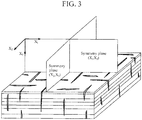
- Figure 3 illustrates an orthorhombic medium with two orthogonal systems of parallel fractures, thus having two vertical symmetry planes.
- Figures 2 and 3 are adapted from 1997 article "Anisotropic parameters and P-wave velocity for orthorhombic media" by Tsvankin, I. published in Geophysics, vol. 62, no. 4, pp. 1292-1309 .
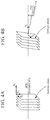
- Figure 4A illustrates HTI and Figure 4B illustrates TTI. Different from HTI, in TTI the symmetry axis is tilted with respect to a horizontal plane by a given angle ⁇ .
- FIG. 5 illustrates another example of an anisotropic medium.
- the illustrated orthorhombic medium's anisotropy is caused by two orthogonal systems of vertical parallel cracks and also by a horizontal fine layering.
- three symmetry planes are orthogonal to one another, with one symmetry plane being horizontal and the other two being vertical.
- Both TTI and orthorhombic media also known as media with azimuthal anisotropy
- AVO Amplitude Versus Offset AVO
- AVO may be converted, for example, to angles for Amplitude Versus Angle (AVA) analysis and interpretation.
- AVO may be converted, for example, to angles for Amplitude Versus Angle (AVA) analysis and interpretation.
- AVO may be converted, for example, to angles for Amplitude Versus Angle (AVA) analysis and interpretation.
- AVO may be converted, for example, to angles for Amplitude Versus Angle (AVA) analysis and interpretation.
- the link between the subsurface parameters and AVO is determined by seismic wave propagation modeling. For the most general case, this leads to a very complex relationship that can only be solved by numerical wave equation modeling.
- Most conventional modeling methods are based on a simplified wave propagation model. For example, the following assumption has been used to define a simplified seismic wave propagation model: the earth (i.e., underground formation) is stratified into isotropic parallel layers; seismic waves propagate as plane waves impinging on each interface at a constant angle; each interface acts as an independent reflector; transmission effects other than ray bending are neglected; and the calculated plane wave reflection coefficients assume that half-spaces above and below the reflector interface are isotropic.
- the following embodiments use effective elastic parameters for anisotropic medium.
- the effective elastic parameters which are based on the anisotropy parameters and the elastic parameters, are used in the isotropic-type techniques applied to the seismic data. These effective elastic parameters take into consideration azimuthal anisotropy to an acceptable level of accuracy.
- V P eff , V S eff ,and ⁇ eff are defined such that the PP reflectivity coefficients have an identical form to the isotropic media case of Aki-Richards (see Aki, K.T., and Richards, P.G., "Quantitative Seismology: Theory and Methods," Vol. 1, published in 1980 by W.H.
- ⁇ is the azimuth of the x 1 principal axis (relative to an arbitrary reference)
- ⁇ is the azimuth of the source - receiver direction (relative to the same reference)
- the reflectivity expressions for TTI media are derived from the general anisotropic expression for PP wave reflectivity.
- V P is the P -velocity as referenced within the isotropy symmetry plane
- G ⁇ is the shear modulus
- G ⁇ ⁇ V S ⁇ 2
- V S ⁇ is the reference shear velocity that corresponds to the fast shear wave as defined within the isotropy symmetry plane
- ⁇ r * ⁇ ⁇ V sin ⁇ 2 + ⁇ V ⁇ ⁇ V sin ⁇ 4
- g r * ⁇ 2 ⁇ V sin ⁇ 2
- ⁇ is the tilt angle between the symmetry axis and the horizontal plane (see Figure 4 ).
- the functions ⁇ * ( ⁇ , ⁇ , ⁇ ), ⁇ * ( ⁇ , ⁇ , ⁇ ) and ⁇ * ( ⁇ , ⁇ , ⁇ ) are similar to the ones in formula (8), (9) and (10) but also depend on the tilt angle ⁇ .
- the ⁇ is the azimuth angle of the projection of the symmetry axis in a horizontal plane.
- Formulas for the reflectivity coefficient were written by choosing the reference velocities within the isotropy plane. In turn, these formulas could be equivalently rewritten by choosing the reference P - and S - velocities along the anisotropic symmetry axis, by defining the so-called VTI reference system.
- G ⁇ ⁇ V ⁇ S 2 is the shear modulus
- ⁇ ⁇ r * ⁇ ⁇ ⁇ sin ⁇ ⁇ 2 + ⁇ ⁇ ⁇ sin ⁇ ⁇ 4
- g ⁇ r * ⁇ ⁇ 2 ⁇ sin ⁇ ⁇ 2 .
- the tilt angle ⁇ is the angle between the symmetry axis and the vertical direction.
- E eff ⁇ r X ⁇ r Y ⁇ r Z E with ⁇ r X , ⁇ r Y , ⁇ r Z defined by equations (26), (27) and (28).
- Exponents X, Y, Z, U, V, W from equations (71) and (72) are independent from the elastic parameters and Thomsen parameters, but they may depend on K. It should be noted that these exponents are different for each of the elastic parameters and for each type of anisotropy.
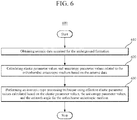
- Figure 6 is a flowchart illustrating a method 600 for seismic exploration of an underground formation including an orthorhombic anisotropic medium according to an embodiment.
- method 600 includes obtaining seismic data acquired for the underground formation, wherein the seismic data includes seismic amplitudes detected at plural values of an azimuth angle, ⁇ - ⁇ , of a source-receiver direction relative to a principal axis of the orthorhombic anisotropic medium.
- Method 600 further includes calculating elastic parameter values and anisotropy parameter values related to the orthorhombic anisotropic medium based on the seismic data at 620.
- the calculated values may include values for V P , V S ⁇ , ⁇ , ⁇ (1) , ⁇ (2) , ⁇ (1) , ⁇ (2) , ⁇ (3) , ⁇ (3) , ⁇ , ⁇ . These values may be obtained via conventional seismic data processing, where offset and azimuth-dependent time shifts are indicative of changes in the propagation velocity. Additionally, at the position of the well borehole, one can perform additional seismic experiments to specifically recover TTI and/or orthorhombic parameters. Such experiments are known as walk-away and walk-around VSP (Vertical Seismic Profiling).
- Method 600 further includes performing an isotropic-type processing technique using effective elastic parameter values at 630.
- the effective elastic parameter values are calculated based on the elastic parameter values, the anisotropy parameter values, and the azimuth angle (as in equations (14), (15) and (16)).
- the isotropic-type processing technique leads to a quantitative model of the underground formation usable to locate hydrocarbon reservoirs. That is, the output of the isotropic-type processing technique is a quantitative model of the orthorhombic anisotropic medium within the orthorhombic anisotropic medium.
- the isotropic-type processing technique may be an isotropic seismic modeling method, an isotropic seismic analysis and interpretation method, an isotropic seismic wavelet estimation method, an isotropic seismic inversion method, or an isotropic method for analysis and interpretation of inversion results to produce processed effective elastic parameter data.
- An elastic parameter E may have a corresponding effective elastic parameter E eff expressed as in equation (71).
- a elastic parameter E may have a corresponding effective elastic parameter E eff expressed as in equation (73).
- the elastic parameters values may represent p-wave velocity, s-wave velocity and density.
- the elastic parameters values may represent p-wave impedance, s-wave impedance and density.
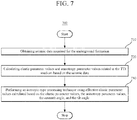
- Figure 7 is a flowchart illustrating a method 700 for seismic exploration of an underground formation including a TTI medium having a symmetry axis tilted at a tilt angle ⁇ relative to a horizontal plane thereof according to an embodiment.
- Method 700 includes obtaining seismic data acquired for the underground formation at 710.
- the seismic data includes seismic amplitudes detected at plural values of an azimuth angle, ⁇ - ⁇ , of a source-receiver direction relative to a projection of the symmetry axis in the horizontal plane.
- Method 700 further includes calculating elastic parameter values and anisotropy parameter values related to the TTI medium based on the seismic data at 720.
- Step 720 is similar to step 620 of method 600.
- the calculated values may include values for V P , V S ⁇ , ⁇ , ⁇ ( V ) , ⁇ ( V ) , ⁇ , ⁇ , ⁇ .
- Method 700 further includes performing an isotropic-type processing technique using effective elastic parameter values at 730.
- the effective elastic parameter values are calculated based on the elastic parameter values, the anisotropy parameter values, the values of the azimuth angle and of the tilt angle (equations (51), (52), (53)).
- the isotropic-type processing technique leads to quantitative model of the underground formation usable to locate hydrocarbon reservoirs.
- the isotropic-type processing technique in methods 600 and 700 may be an isotropic seismic modeling method to synthesize anisotropic seismic data. Additionally, the synthesized anisotropic seismic data may be used in an isotropic seismic analysis and interpretation method for analysis and interpretation of anisotropic seismic data. Accordingly, the azimuthal effective elastic parameter data may be substituted for the isotropic elastic parameters in any of the above-mentioned methods.
- Another embodiment is directed to a method for approximating anisotropic seismic modeling by applying isotropic seismic modeling.
- the method includes an initial step of inputting earth elastic parameter data and earth anisotropy parameter data for an area of interest. Next, the earth elastic parameter data is transformed to obtain effective elastic parameter data based on the earth anisotropy parameter data. Isotropic seismic modeling is then applied to the transformed effective elastic parameter data. The resulting modeled anisotropic seismic data is an approximation of seismic data obtained by a corresponding anisotropic seismic modeling. The processed anisotropic seismic data is then output.
- the method may further include a step of substituting the effective elastic parameter data for isotropic elastic parameter data to synthesize the anisotropic seismic data.
- the synthesized anisotropic seismic data may be used in an isotropic analysis and interpretation method for analysis and interpretation of the anisotropic seismic data.
- the area of interest may be imaged by acquisition of borehole data, wide azimuth (WAZ) data, three-dimension (3D) earth models, or four-dimensional (4D) earth models.
- WAZ wide azimuth
- 3D three-dimension
- 4D four-dimensional
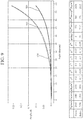
- Figures 8 and 9 illustrate modeling results for layers with relatively strong anisotropy contrasts.
- Figure 8 illustrates the effect of using the 3-term approximation for the Zoeppritz equations described above for TTI media, wherein curve 810 (thin line) shows the anisotropic response and curve 820 (thick line) shows the isotropic response.
- curve 830 shows the result of isotropic modeling with the effective elastic parameters specified in the table under the graph, where V P eff , V S eff and ⁇ eff are the anisotropic elastic primary wave velocity, shear wave velocity and density, respectively, calculated from the transform expressions (51), (52) and (53). The results show that isotropic modeling with the effective elastic parameters closely approximates anisotropic modeling.
- Figure 9 illustrates the similar results as the ones in Figure 8 (i.e., curve 910 is the anisotropic response, curve 920 is the isotropic response and curve 930 is the result of isotropic modeling with the effective elastic parameters), but for the orthorhombic anisotropy case.
- the effective elastic parameter values calculated with equations (14), (15) and (16) are shown in the table under the graph. Again, the results illustrate that isotropic modeling with the effective elastic parameters closely approximates anisotropic modeling.
- the equations (71) for orthorhombic and (72) for TTI cases show that the transform functions have parameters that control the transforms. In some cases, appropriate values for these transform parameters can be obtained analytically. However, in another embodiment, an iterative procedure can also be readily followed to obtain appropriate values for the transform parameters. This implies further important benefits such as: exact modeling methods rather than 3-term approximations can be used as reference for the case of the simple single flat interface model, or more complex modeling methods can be applied; and other transform functions with other functional forms and with other transform parameters than equations (71) and (72) can be applied to evaluate if a better approximation can be obtained.
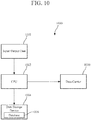
- FIG 10 is a block diagram of a seismic data processing apparatus 1000 according to an embodiment.
- Apparatus 1000 includes a CPU 1002, a data storage device 1004 (that may include a database 1006), and an interface 1008.
- Interface 1008 is configured to obtain seismic data acquired for the underground formation.
- the CPU is configured to perform methods similar to 600 and/or 700 described above.
- the CPU may include a software or hardware interface to a computer readable recording medium such as the data storage device 1004 or an external device.
- the computer readable recording medium stores executable codes, which, when executed by the CPU, make the CPU perform methods similar with 600 and 700 described above.
- Embodiments described in this section may perform in the context of an arbitrary stack of layers with different anisotropy types (e.g., orthorhombic, TTI, VTI and/or HTI).
- anisotropy types e.g., orthorhombic, TTI, VTI and/or HTI.
- the disclosed embodiments provide methods and systems for seismic exploration of an underground formation including an orthorhombic anisotropic medium or a TTI medium. It should be understood that this description is not intended to limit the invention. On the contrary, the embodiments are intended to cover alternatives, modifications and equivalents, which are included in the spirit and scope of the invention as defined by the appended claims. Further, in the detailed description of the embodiments, numerous specific details are set forth in order to provide a comprehensive understanding of the claimed invention. However, one skilled in the art would understand that various embodiments may be practiced without such specific details.
Landscapes
- Engineering & Computer Science (AREA)
- Remote Sensing (AREA)
- Physics & Mathematics (AREA)
- Life Sciences & Earth Sciences (AREA)
- Acoustics & Sound (AREA)
- Environmental & Geological Engineering (AREA)
- Geology (AREA)
- General Life Sciences & Earth Sciences (AREA)
- General Physics & Mathematics (AREA)
- Geophysics (AREA)
- Geophysics And Detection Of Objects (AREA)
Applications Claiming Priority (1)
| Application Number | Priority Date | Filing Date | Title |
|---|---|---|---|
| US16/531,726 US11828895B2 (en) | 2019-08-05 | 2019-08-05 | Methods and devices using effective elastic parameter values for anisotropic media |
Publications (1)
| Publication Number | Publication Date |
|---|---|
| EP3772665A1 true EP3772665A1 (de) | 2021-02-10 |
Family
ID=71728684
Family Applications (1)
| Application Number | Title | Priority Date | Filing Date |
|---|---|---|---|
| EP20305752.6A Pending EP3772665A1 (de) | 2019-08-05 | 2020-07-03 | Verfahren und vorrichtungen mit verwendung von effektiven elastischen parameterwerten für anisotrope medien |
Country Status (3)
| Country | Link |
|---|---|
| US (1) | US11828895B2 (de) |
| EP (1) | EP3772665A1 (de) |
| CA (1) | CA3086064A1 (de) |
Families Citing this family (15)
| Publication number | Priority date | Publication date | Assignee | Title |
|---|---|---|---|---|
| CN115113273A (zh) * | 2021-03-22 | 2022-09-27 | 中国石油化工股份有限公司 | 裂缝参数的确定方法、装置、设备及存储介质 |
| CN113341455B (zh) * | 2021-06-24 | 2024-02-09 | 中国石油大学(北京) | 一种粘滞各向异性介质地震波数值模拟方法、装置及设备 |
| CN113568045B (zh) * | 2021-07-26 | 2022-11-11 | 中南大学 | 一种tti介质裂缝倾角的反演方法 |
| CN114488302B (zh) * | 2022-01-25 | 2024-06-14 | 中南大学 | 一种原位各向异性地应力场预测方法及系统 |
| CN114755722B (zh) * | 2022-03-07 | 2024-11-15 | 中国石油大学(华东) | 倾斜正交各向异性介质五维地震反演方法 |
| CN114924316B (zh) * | 2022-06-24 | 2026-04-10 | 中国石油大学(北京) | 基于地震横波反演的vti介质横波各向异性参数估算方法 |
| CN116755148A (zh) * | 2023-05-25 | 2023-09-15 | 山东省胜利油田地学开拓基金会 | 正交各向异性介质多方位反射波走时反演方法 |
| CN119535545B (zh) * | 2023-08-29 | 2025-10-10 | 中国石油化工股份有限公司 | Vti介质各向异性参数叠前地震同步反演方法及系统 |
| CN120178324A (zh) * | 2023-12-19 | 2025-06-20 | 中国石油天然气股份有限公司 | 一种利用ovt地震数据提高裂缝预测精度的方法及系统 |
| CN117724154B (zh) * | 2024-02-05 | 2024-04-30 | 中国石油大学(华东) | 一种考虑强各向异性特征的vti介质参数预测方法 |
| CN118707604B (zh) * | 2024-08-27 | 2024-11-22 | 中国石油大学(华东) | 基于组合降维策略的正交各向异性介质方位地震反演方法 |
| CN119355808B (zh) * | 2024-10-30 | 2025-08-01 | 成都理工大学 | 页岩储层地质工程双甜点地震识别方法 |
| CN119535588B (zh) * | 2024-11-20 | 2025-09-23 | 中国石油天然气集团有限公司 | 用于地震勘探的各向异性介质的确定方法和设备 |
| CN119199994B (zh) * | 2024-12-02 | 2025-12-16 | 长江大学 | 联合反演方法、装置、存储介质及电子设备 |
| CN119960023B (zh) * | 2024-12-30 | 2025-08-05 | 中国石油大学(华东) | 基于弹性阻抗二阶导数的正交各向异性介质分步反演方法 |
Citations (4)
| Publication number | Priority date | Publication date | Assignee | Title |
|---|---|---|---|---|
| US6901333B2 (en) | 2003-10-27 | 2005-05-31 | Fugro N.V. | Method and device for the generation and application of anisotropic elastic parameters |
| WO2015014762A2 (en) | 2013-07-29 | 2015-02-05 | Cgg Services Sa | Method and device for the generation and application of anisotropic elastic parameters in horizontal transverse isotropic (hti) media |
| US9482773B2 (en) | 2013-06-19 | 2016-11-01 | Cgg Services Sa | Wide azimuth seismic data acquisition method and system with at least three streamer sets |
| US9791578B2 (en) | 2013-05-01 | 2017-10-17 | Cgg Services Sas | Apparatus and method for seismic data acquisition with simultaneous activation of clustered vibrators |
Family Cites Families (3)
| Publication number | Priority date | Publication date | Assignee | Title |
|---|---|---|---|---|
| US11237288B2 (en) * | 2016-03-30 | 2022-02-01 | Halliburton Energy Services, Inc. | Verifying measurements of elastic anisotropy parameters in an anisotropic wellbore environment |
| DK3465286T3 (en) * | 2016-05-25 | 2022-10-31 | Geoquest Systems Bv | Elastic parameter estimation |
| US11243318B2 (en) * | 2017-01-13 | 2022-02-08 | Cgg Services Sas | Method and apparatus for unambiguously estimating seismic anisotropy parameters |
-
2019
- 2019-08-05 US US16/531,726 patent/US11828895B2/en active Active
-
2020
- 2020-07-03 EP EP20305752.6A patent/EP3772665A1/de active Pending
- 2020-07-07 CA CA3086064A patent/CA3086064A1/en active Pending
Patent Citations (5)
| Publication number | Priority date | Publication date | Assignee | Title |
|---|---|---|---|---|
| US6901333B2 (en) | 2003-10-27 | 2005-05-31 | Fugro N.V. | Method and device for the generation and application of anisotropic elastic parameters |
| US9791578B2 (en) | 2013-05-01 | 2017-10-17 | Cgg Services Sas | Apparatus and method for seismic data acquisition with simultaneous activation of clustered vibrators |
| US9482773B2 (en) | 2013-06-19 | 2016-11-01 | Cgg Services Sa | Wide azimuth seismic data acquisition method and system with at least three streamer sets |
| WO2015014762A2 (en) | 2013-07-29 | 2015-02-05 | Cgg Services Sa | Method and device for the generation and application of anisotropic elastic parameters in horizontal transverse isotropic (hti) media |
| US20150293245A1 (en) * | 2013-07-29 | 2015-10-15 | Cgg Services Sa | Method and device for the generation and application of anisotropic elastic parameters in horizontal transverse isotropic (hti) media |
Non-Patent Citations (9)
| Title |
|---|
| "Distinguished Instructor Series Λ/ο. 5", EUROPEAN ASSOCIATION OF GEOSCIENTISTS AND ENGINEERS, article "Understanding Seismic Anisotropy in Exploration and Exploitation" |
| AKI, K.T.RICHARDS, P.G.: "Quantitative Seismology: Theory and Methods", vol. 1, 1980, W.H. FREEMAN AND CO., pages: 153 |
| CASTAGNA, J. P.BACKUS, M. M.: "Investigations in Geophysics Series Λ/ο. 8", 1993, SOCIETY OF EXPLORATION GEOPHYSICISTS, article "Offset-dependent reflectivity — Theory and practice of AVO analysis" |
| ERIC DUVENECK AND PETER M BAKKER: "Stable P-wave modeling for reverse-time migration in tilted TI media", GEOPHYSICS, SOCIETY OF EXPLORATION GEOPHYSICISTS, US, vol. 76, no. 2, 1 March 2011 (2011-03-01), pages S65 - S75, XP001574308, ISSN: 0016-8033, [retrieved on 20110310], DOI: 10.1190/1.3533964 * |
| FENG ZHANG ET AL: "Generalized approximations of reflection coefficients in orthorhombic media", JOURNAL OF GEOPHYSICS AND ENGINEERING, INSTITUTE OF PHYSICS PUBLISHING, BRISTOL, GB, vol. 10, no. 5, 25 September 2013 (2013-09-25), pages 54004, XP020251733, ISSN: 1742-2140, [retrieved on 20130925], DOI: 10.1088/1742-2132/10/5/054004 * |
| RÜGER A: "Variation of P-wave reflectivity with offset and azimuth in anisotropic media", GEOPHYSICS, SOCIETY OF EXPLORATION GEOPHYSICISTS, US, vol. 63, no. 3, 1 May 1998 (1998-05-01), pages 935 - 947, XP002326797, ISSN: 0016-8033, DOI: 10.1190/1.1444405 * |
| RUGER, A.: "Geophysical Monograph Series Λ/ο. 10", 2002, SOCIETY OF EXPLORATION GEOPHYSICISTS, article "Reflection Coefficients and Azimuthal AVO Analysis in Anisotropic Media" |
| TSVANKIN, I.: "Anisotropic parameters and P-wave velocity for orthorhombic media", GEOPHYSICS, vol. 62, no. 4, pages 1292 - 1309, XP002238921, DOI: 10.1190/1.1444231 |
| Y IVANOV ET AL: "Weak-anisotropy Approximation for P-wave Reflection Coefficient at the Boundary between Two TTI Media", 4 June 2015 (2015-06-04), pages 1 - 4, XP055757601, Retrieved from the Internet <URL:https://www.earthdoc.org/docserver/fulltext/2214-4609/2015/We_N110_03.pdf?expires=1607377575&id=id&accname=fromqa185&checksum=E610112512CDA33429A0D63582BEBC4B> [retrieved on 20201207] * |
Also Published As
| Publication number | Publication date |
|---|---|
| CA3086064A1 (en) | 2021-02-05 |
| US11828895B2 (en) | 2023-11-28 |
| US20210041587A1 (en) | 2021-02-11 |
Similar Documents
| Publication | Publication Date | Title |
|---|---|---|
| US11828895B2 (en) | Methods and devices using effective elastic parameter values for anisotropic media | |
| EP3028071B1 (de) | Verfahren und vorrichtung zur erzeugung und anwendung von anisotropischen elastischen parametern in horizontalen transversal-isotropen (hti-)medien | |
| US8352190B2 (en) | Method for analyzing multiple geophysical data sets | |
| US6826484B2 (en) | 3D prestack time migration method | |
| US6901333B2 (en) | Method and device for the generation and application of anisotropic elastic parameters | |
| US7355923B2 (en) | Seismic analysis using post-imaging seismic anisotropy corrections | |
| US6839658B2 (en) | Seismic processing with general non-hyperbolic travel-time corrections | |
| EP2483712B1 (de) | Ava-analysis basiertes verfahren zur exploration von kohlenwasserstoff, computerprogrammprodukt und computervorrichtung | |
| US6263284B1 (en) | Selection of seismic modes through amplitude characteristics | |
| US7082368B2 (en) | Seismic event correlation and Vp-Vs estimation | |
| EP3094992B1 (de) | Konstruktion eines geschwindigkeitsmodells zur verarbeitung von seismischen daten unter verwendung von pp-ps tomografie mit co-tiefeneinschränkung | |
| US11867856B2 (en) | Method and system for reflection-based travel time inversion using segment dynamic image warping | |
| US7315783B2 (en) | Traveltime calculation in three dimensional transversely isotropic (3D TI) media by the fast marching method | |
| US20030021184A1 (en) | Extraction of P-wave and S-wave velocities from multi-component seismic data by joint velocity inversion | |
| US20060023569A1 (en) | Method and constructing a model of a heterogeneous medium described by several parameters from data expresed in different time scales | |
| US11604299B2 (en) | Mixed-phase source wavelet estimation from recorded seismic data | |
| US11320554B2 (en) | Method and system that uses an anisotropy parameter to generate high-resolution time-migrated image gathers for reservoir characterization, and interpretation | |
| Leaney et al. | Sub-salt velocity prediction with a look-ahead AVO walkaway | |
| Uren et al. | Anisotropic wave propagation and zero-offset migration | |
| EP2796899A2 (de) | Seismische Datenverarbeitung und Vorrichtung | |
| Scott Leaney | AVO and anisotropy from logs and walkaways | |
| Droujinine | Sub‐basalt decoupled walkaway VSP imaging | |
| Mahmoudian et al. | AVAZ inversion for anisotropy parameters of a fractured medium: a physical modeling study | |
| van der Hilst et al. | Wave-Equation Reflection Tomography: Annihilators and Sensitivity Kernals |
Legal Events
| Date | Code | Title | Description |
|---|---|---|---|
| PUAI | Public reference made under article 153(3) epc to a published international application that has entered the european phase |
Free format text: ORIGINAL CODE: 0009012 |
|
| STAA | Information on the status of an ep patent application or granted ep patent |
Free format text: STATUS: THE APPLICATION HAS BEEN PUBLISHED |
|
| AK | Designated contracting states |
Kind code of ref document: A1 Designated state(s): AL AT BE BG CH CY CZ DE DK EE ES FI FR GB GR HR HU IE IS IT LI LT LU LV MC MK MT NL NO PL PT RO RS SE SI SK SM TR |
|
| AX | Request for extension of the european patent |
Extension state: BA ME |
|
| STAA | Information on the status of an ep patent application or granted ep patent |
Free format text: STATUS: REQUEST FOR EXAMINATION WAS MADE |
|
| 17P | Request for examination filed |
Effective date: 20210723 |
|
| RBV | Designated contracting states (corrected) |
Designated state(s): AL AT BE BG CH CY CZ DE DK EE ES FI FR GB GR HR HU IE IS IT LI LT LU LV MC MK MT NL NO PL PT RO RS SE SI SK SM TR |
|
| STAA | Information on the status of an ep patent application or granted ep patent |
Free format text: STATUS: EXAMINATION IS IN PROGRESS |
|
| 17Q | First examination report despatched |
Effective date: 20220805 |